Connect with your community and watch it grow
List your hall on Vennu and make managing your space simple, efficient, and impactful.
GET STARTED TODAY - IT’S EASY AND FREE:
No upfront costs No lock-in contracts Set up in minutes
A Smarter Way to Manage Your Church Hall
Vennu is the easiest way to connect your space with your community. Whether you're looking to reduce admin time, increase bookings, or create new opportunities for connection, our platform has you covered.
WITH VENNU, YOU GET:
• Real-time enquiry and booking tracking
• Secure online payments direct to your nominated account
• Custom listings with photos and key details
• Easy change and cancellation management
• Automated recurring bookings for regular events
• A live availability calendar
• Targeted digital marketing to boost visibility
• Friendly support, 7 days a week
WHY CHURCHES CHOOSE VENNU:
• Spend less time on admin – focus on what matters
• Turn idle space into valuable income
• Reach more people and grow your bookings
• Foster deeper community engagement
• Revitalise underused spaces with new activity and energy
“Perfect setting for our student singing concert. Lovely church, wonderful piano, Alison was so helpful and encouraging in all the organisation and it was warm and comfortable for everyone.”
Rachael C, Guest at Carlingford-West Epping Uniting Church

Be part of something bigger. Share your space. Strengthen your community.

Revitalising our Congregations
Ihave been thinking about constitutions lately. Along with various documents called regulations, charters, and by-laws. All those things we might assume constitute the church. Yet these documents don’t constitute the church. None of them.
The purpose which constitutes the church is the maintenance of a message. The church’s mission is to care for and share that message. The message informs all that we are and all that we do. It is a message about the life, death and resurrection of Jesus of Nazareth. It is not a tool for spiritual imperialism. It is an invitation to share in some good news. God has entrusted to us, surprisingly, a role in offering that invitation. It is the message we call the Gospel.
the church, maintaining the message, and on the primary way that we embody that purpose, the local church.
My hope is that, along with the necessary and constructive changes that are coming from our activity on structures, we now also elevate the importance of the local church: our congregations, faith communities, diaconal communities, local ministries, and ministry leaders. That might just be our strategy for change: revitalising our congregations. I realise it’s a simple strategy, and perhaps obvious. Yet simplicity is not a bad thing. And sometimes it’s important to amplify the obvious.
THE GENERAL SECRETARY IS APPOINTED BY THE SYNOD TO PROVIDE LEADERSHIP TO THE CHURCH BY ACTIVELY ENGAGING IN STRATEGIC THINKING ABOUT THE LIFE, DIRECTION, VISION AND MISSION OF THE CHURCH.
The essential way the church maintains that message is by sustaining communities in which people experience the Gospel and are invited into discipleship. God moves in that experience (despite us!). It is God who grows the church, we don’t. Our contribution is to maintain the message in communities where the Bible is opened and proclaimed, bread is broken and shared, people are seen, heard, and feel united, and are then moved by their encounter with God and such a community to draw closer. The reason God calls the church into being is to ensure those communities exist. They come in many forms and, for the most part, we call them congregations.
RE-ENERGISE THE MISSION OF THE UNITING CHURCH
What is the church’s future without healthy congregations? Especially in complex institutions like the church, where it is easy mistake maintenance of the institution for the real work, it’s helpful to regularly re-centre ourselves in our real work.
Healthy congregations, well-resourced and well-located, and led by well-supported lay and ordained ministers, are crucial to the mission of the church. Yet I think our greatest challenge today is the declining vitality of so many of our congregations. Several factors are contributing, and our present challenge is not a sign of weakness or failure. It is an opportunity.
Focusing on revitalising our congregations can re-energise the mission of the Uniting Church. Future Directions are in our fabric now. And the Presbytery Transition Project is well underway. Both will make a tangible difference to our ability to undertake the real work. They will strengthen our endeavours. However, they are not it. In addition, we can pray for a shared focus on the purpose which truly constitutes
Sustaining the vitality of local communities that invite people into Christian discipleship is the purpose for which God has called the church into being. The Basis of Union reminds us that the primary way in which we embody the church in the world is through our congregations. In our congregations, in all their diversity, people ‘meet regularly to hear God’s Word, to celebrate the sacraments, to build one another up in love, to share in the wider responsibilities of the Church, and to serve the world.’ (Basis of Union, paragraph 15a).
I know ‘revitalising our congregations’ are merely words. Yet words are powerful. And words like this can support us to begin a new day. My commitment in this new placement with the Synod is to ensure the primary focus of my thinking will be, not on the documents that we might assume constitute the church, but on the purpose which does constitute the church.
In particular, I aim to ask each day, how can Synod work alongside the new presbyteries and our congregations so that, together, we are revitalising our congregations and faith communities? I ask you to help by keeping me accountable to that commitment.
REV. DR PETER WALKER GENERAL SECRETARY


Easter in times of change

REV. FAAIMATA HAVEA HILIAU MODERATOR
instagram.com/moderator_ucanswact Follow the Moderator on instagram:
This Easter, I invite you to pause with me and look again at the resurrection of Jesus; and to consider what it asks of us today. The empty tomb is more than a story we remember. It declares that God’s life is still moving, with purpose and urgency, even through fear, injustice and despair.
Before the light fully breaks, before understanding stirs, resurrection begins.
Jesus rises, reaches out, and calls us by name; not away from the world, but back into it, with renewed purpose.
When we sit with the resurrection story, we learn that faith is never only personal.
The risen Christ draws us toward others, especially those pushed to the edges of our communities. Resurrection calls us to live our faith through the care we offer, the justice we pursue, and the love we extend to those in need.
This Easter, we proclaim resurrection in a world that carries real grief.
Recent acts of violence, close to home and beyond our shores; have shaken communities and left deep wounds, and yet, amid this pain, we have witnessed compassion and courage; neighbours supporting one another, first responders stepping forward, chaplains offering presence and prayer.
my first grandchild was a gentle, grace-filled reminder that new life keeps arriving; even in uncertain times. A newborn does not ignore the world’s brokenness, but invite us to imagine what might yet be possible. He calls us to ask what kind of world, and what kind of Church, we are shaping for those who will follow us.
The resurrection of Jesus is not an escape from the world’s pain. It is an invitation to enter the world’s need with hope. Wherever people choose justice over indifference, service over self-interest, and love over fear; the risen Christ is already at work.
A FUTURE OF COURAGE AND COMPASSION IS ALREADY OPENING BEFORE US
Here, we have a glimpse of resurrection at work; not by denying suffering but by refusing to let it have the final word.
Hope also meets us in quieter, deeply personal ways. Late last year, the birth of
As this Holy Easter unfolds..
Let the light that breaks through darkness, guide your way.
Let it move you closer to those who are excluded or unheard.
In the risen Christ a future of courage and compassion is already opening before us.
In these times of change, may the resurrection of Jesus continue to call us to our commitment to Justice and kindness.
Christ is risen.
Have a blessed Easter.

SAY...
IN RESPONSE TO THE STORY AUSTRALIA DAY, RACISM AND THE COST OF SILENCE
Thank you, Nathan, for this excellent and thought-provoking piece.
#changethedate
SUSAN LORD
IN RESPONSE TO THE STORY IS THE COST OF LIVING CRISIS JUST THE NEW NORMAL?
The article was very interesting to read and it provided me information I never knew. It was a pleasure reading your article. I am in class 7 and I was preparing for World Scholars Cup 2025 so I came across this article and enjoyed reading it!
DANISH
IN RESPONSE TO THE STORY WHAT AUSTRALIA’S BURNING SUMMER IS TELLING US
Maybe if people stop catching so many planes and driving huge vehicles it might help. And put pressure on huge greenhouse gas emitters like China at 30+% rather than Australia at 1%.
JUNE COLBERT
IN RESPONSE TO THE STORY PHILIP YANCEY, CELEBRITY, BROKENNESS, AND ME
“This was a very informative, insightful article. It helps with understanding how this would happen- sort of. Personally, I can’t imagine it but I’m not him. Your transparency is appreciated here.
LISA HARDISON
RESPONSE TO THE STORY MORNING WARS: POWER, TRUTH, AND THE COST OF SILENCE
I’d like to express how I feel about The Morning Show :
There are really two separate frustrations that I feel which I believe are valid:
Feeling like you missed key parts of the story:
With The Morning Show, the writers deliberately use time jumps and off-screen resolution, which can feel unsatisfying — especially if you’re invested in character growth and reconciliation.
I feel confused about Alex and her daughter – their reconciliation mostly happens off screen and is implied rather than shown.
Bradley and her boss – the fallout and consequences are skipped over rather than explored deeply.
Bradley and Laura – again, we are left to assume what happened.
Is it lazy storytelling or even avoidance? instead of letting us witness repentance, repair, and accountability.
Disappointment from a Christian perspective:
Unfortunately the whole world has lost wholesome characters that we once admired and very low morality when I saw Reese with the spoon kiss Laura I shouted at the television and said oh not you please not you!
I wasn’t being judgmental — I was mourning the loss of integrity in a character I once loved and trusted.
Unfortunately, many modern shows treat moral boundaries as obstacles rather than values and the name of Christ is continually used as a curse word. For Christians, that creates a real tension but also it’s discerning the times that we live in which is moral decay.
ANITA DE BORTOLI
IN CONVERSATION WITH GENERAL SECRETARY
Rev. Dr Peter Walker
For Rev. Dr Peter Walker, the heart of the Uniting Church is found in its congregations. It is there, he says, that God’s work in the world is lived out quietly and faithfully.
“They embody the Church in their communities. The work of the Synod and presbyteries is to resource and support them so they can thrive in their local communities. That is where the Church is most alive, and where God’s hope flows into the world.”
Far from seeing ageing congregations as a problem, Peter describes them as a gift.
“Older members carry wisdom and memory of who the Church is and who it is called to be. When we lose that memory, we risk losing direction. The faithful memory of people who have lived the life of the Church helps to focus our mission.”
That focus on mission shapes how Peter understands leadership. He speaks often of the quiet faithfulness of people who make life more hopeful for others simply by living and loving in the way of Jesus. Their humility, he says, is what sustains the Church.
A defining moment in his own understanding of hope came when he was 20 years old. At a prayer service for South Africa at St Mary’s Cathedral, he heard Nelson Mandela speak.
That night, alongside Mandela’s address, a passage from the book of Revelation was read, describing a new heaven and a new earth, a holy city descending from God, and a river of life whose leaves are for the healing of the nations. Peter recalls hearing those words differently.
Seeing the resilience of a leader who had endured imprisonment, he grasped in a new way how faith can sustain a person through hardship.
“It was the first time I understood what it means to be sustained by hope.”
His theological formation further deepened that conviction. During his time at United Theological College, engagement with the cultural diversity of the Church strengthened his faith.
“What I found deepening to my faith was engagement with the cultural diversity of the Church.”
In many culturally diverse communities, he observed, faith is not compartmentalised. It is woven through family life, work, education and daily routines. It shapes relationships and decisions. This integrated expression of faith, Peter says, shows how deeply God’s message can form ordinary life when it is lived together.
As General Secretary, he remains clear that mission must anchor every practical decision, even amid pressures such as financial sustainability and demographic change.
“A budget is a mission statement. How we set a budget is about making a statement about our mission in the world.”
He also stresses the importance of discernment, trusting that God has

PHOTOGRAPHY BY SUZANNE LONGDEN
already provided what is needed for the Church’s work today.
“Our job is to think carefully about the resources we have – people, programs, property – and deploy them in service of mission.”
Leadership, for Peter, is never a solo task. His role, he says, is to discern how best to support people and teams so they can flourish.
“Everyone in the team is better at many things than you are. If you are good at something, it is about encouraging, guiding and making some decisions. That usually means the group can achieve something they otherwise would not.”
Peter is the former Principal of United Theological College. He studied history and theology at the University of New South Wales, McGill University and Charles Sturt University, and is a graduate of the Australian Institute of Company Directors. He is the author of The Theological Promise of Religious Diversity and co-editor of Theology on a Defiant Earth: Seeking Hope in the Anthropocene.
Rev. Dr. Peter Walker was inducted as General Secretary of the Uniting Church Synod of NSW and the ACT during a ceremony attended by family, friends and colleagues, including former General Secretaries, Moderators and Presidents on Friday 23 January 2026.
JO MALONEY


Jione Havea RECEIVES
PRESTIGIOUS INTERNATIONAL MENTORING
AWARD


JIONE IS PICTURED HERE WITH THE EXECUTIVE DIRECTOR OF SBL AND ANOTHER COLLEAGUE.
At the recent Society of Biblical Literature (SBL) Annual Meeting in Boston, Jione Havea -- known across our Synod as the “Climate Catalyst” -- received one of the most significant mentoring honours in global biblical scholarship.
He was presented with the Outstanding Mentor Award from the SBL’s Underrepresented Racial and Ethnic Minorities in the Profession Committee. The award was handed to him by Steed Davidson, Executive Director of the SBL, during the association’s annual gathering of scholars, teachers and theologians from around the world.
The award recognises mentors who have supported and lifted up scholars from underrepresented racial and ethnic communities. It honours not only academic supervision, but the quiet, consistent work of encouragement, advocacy and hospitality that helps emerging scholars find direction and confidence.
For many in the Uniting Church, this description fits Jione almost exactly.
His years as a lecturer at United Theological College left a deep mark on ministers and lay leaders across our Synod. Students often speak of his honest, generous approach to theological learning — grounding biblical study in lived experience, Pacific identity, and the call to justice for creation.
Even after moving into new roles, including his current appointments at Charles Sturt University and Pilgrim Theological College, he continues to mentor, guide and challenge people in ministry. His capacity to hold space for
others, particularly those navigating questions of identity, culture or vocation, remains one of his most valued gifts.
The Society of Biblical Literature is the peak international body for the field. To be honoured by this community signals both the depth of Jione’s scholarship and the impact of his mentoring across continents.
For our churches, the recognition serves as a reminder that voices formed in local congregations and regional colleges can influence the global conversation. Jione’s work brings the concerns of our region — climate justice, the wisdom of Pacific communities, and the realities of colonisation — into dialogue with the broader world of biblical studies.
Many in our Synod continue to be shaped by Jione’s teaching and witness. His insistence that theology must engage the world as it is — fragile, diverse, interconnected — continues to inform ministry in congregations, presbyteries and community spaces.
This award affirms what many here have long known: that Jione Havea is not only a scholar of international standing, but a mentor whose influence continues to change lives and strengthen the church’s commitment to stewardship of the earth.
ADRIAN DRAYTON
MUDGEE AND RYLESTONE:
BUILDING COMMUNITY AND PLANNING FOR THE FUTURE
The Cudgegong Cluster - which is made up of Mudgee and Rylestone Uniting Churches - gathered in November last year in Mudgee Uniting Church for a retreat that brought leaders, and members together to clarify their mission, reflect on their identity, and prepare for a future shaped by significant structural change across the Uniting Church.
With the move from twelve presbyteries to three planned, the Cluster used this time to consider what it means to call a new minister and how to shape a role that reflects both their values and the realities of ministry in a rural region.
The retreat, facilitated by Joanna Drayton, Team Leader of Pulse, began with a close look at the regulations that define what a congregation is, who belongs to it, and how it lives out its purpose. Participants revisited the role of adherents, the responsibility of members, and the statement in the Basis of Union that the church is called to live “in the world.”
This raised practical questions about how each community understands its presence in Rylestone and Mudgee, and what it means to welcome, include, and stand alongside people in daily life.
One of the strongest threads of the day was the Cluster’s commitment to inclusion. Leaders repeatedly named welcome, acceptance, and community as central to their identity. They spoke about hospitality that is not surface-level but grounded in genuine belonging. “I personally value the welcome that we endeavor to give everybody that walks in the door,” one participant said, pointing to a shared desire to meet people without judgement.

The visibility of the Mudgee congregation on the main street came up often. Members discussed how the church’s values are clearly expressed to the wider community, at times provoking strong responses. Refugee support banners have been torn down, yet the congregation remains committed to public witness. The Community Garden was highlighted as one of the clearest expressions of this witness, offering food, connection, shared labour, and a practical way for people to gather. Its partnerships with the Baptist Community Pantry show how small initiatives can build stronger relationships across denominations.
Participants named the challenges that come with shrinking congregations and ageing volunteers. Many expressed concern about capacity, fatigue, and the workload carried by a few. “Some of the people who are doing this are tired,” one person said.
The retreat took these reflections seriously, prompting discussion about how to make the work of the church more joyful and sustainable. This fed into conversations about the ministerial role, including the possibility of shared ministry arrangements as part of the future presbytery structure.
The second part of the retreat focused on the strengths of the broader community. The Community Garden was revisited in detail. Leaders reflected on its need for younger volunteers and its potential to connect with restaurants, wineries, and local schools. Ideas included student partnerships, youth group projects, targeted social media outreach, and a stall at the local Farmer’s Market. All of these were seen as ways to communicate the garden’s impact more clearly and invite new people to join its work.
The Crossroads ministry for people with disabilities was also recognised as an important part of the Cluster’s outreach. Regular meals, worship, and social activities draw support from several churches, offering a safe and welcoming space.
The final session turned to next steps. The Cluster agreed to explore sharing a minister with another congregation as part of the 3P restructure. Leaders will now gather the insights from the retreat and shape a draft position description, which will be taken back to the Cluster Council and lay leadership teams for further input.
The retreat closed with a clear sense of the Cluster’s core values: welcome, inclusion, openness, community, love, service, resilience, and participation. These values will guide the next stage of discernment, helping the congregations of Mudgee and Rylestone remain grounded in who they are while preparing for the work ahead.
ADRIAN DRAYTON


Understanding Other Cultures:
A PRINCETON TRAVEL COURSE
What do we do in order to understand people who are different from us? How do we learn from people who come from minoritised cultures? Can we free our perception of those people from our biases?
Understanding other or foreign cultures is a classic topic in mission, ministry, and theology. In today’s multicultural and globalising societies, this matter is more and more advanced – from a mere theoretical approach to an urgent necessity in the face of society’s integration, and the world becoming a global village, to a fully developed course of study in a theological institution.
PRINCETON TRAVEL COURSE
Because of the concerns noted above, a “travel course” of twenty-one seminary students from Princeton Theological Seminary (New Jersey, USA) came to United Theological College (UTC), North Parramatta, led by Prof. Afe Adogame, from 10th to 16th January. This travel course offered theoretical, methodological and empirical (on the ground) insights into how we may understand other cultures.
At UTC, their course of study included presentations by Mikenzie Ling (First Peoples matter), Derya ISRA (migration and Islamophobia), Chris Budden (doing theology on invaded space), and Cliff Bird (climate justice). The group also visited local sites including Nan Tien Buddhist Temple (Wollongong), Aboriginal Housing Company (Redfern), and the Australian Museum.

THE PRINCETON STUDENTS WERE INTRODUCED TO THE ART OF “CHANGING THE DATA” BY LANI TU’ITAVAKE AT THE ABORIGINAL HOUSING COMPANY, REDFERN.
FEEDBACK FROM STUDENTS
Chané M. Jones, Esq. (2nd Year, M. Div., Princeton Theological Seminary):
“My time in Australia was enlightening, emotionally compelling, and inspiring. As a Black woman in America, hearing the history of the Aboriginal people, their endurance and resilience has been truly inspiring and affirming. It has been a reminder that culture does not have to be something that divides but rather can be the source of community through the sharing and expression of identity, belief, and love. This is best seen through the Redfern community.
Cynthia Lindsay (MDiv Student, Princeton Theological Seminary):
“We are so grateful that United Theological College had opened its doors to us and were incredibly hospitable. Being just a short bus ride away from the downtown area of Parramatta, our group was able to explore the city and see what great restaurants and shops it has to offer. Also, due to the location of the college, we were able to go on beautiful walks around the lake and see some Australian wildlife. What an honor it was to learn from some of the professors and friends of UTC, as well as some of the locals of Parramatta and Sydney.

Thank you so much, UTC, for making this trip to Australia an amazing experience for our group!”
Kaylie Crabtree (MDiv Student, Princeton Theological Seminary):
“The community at United Theological College in Parramatta were incredible hosts for our stay in Australia. From rich conversations with local scholars to an impromptu worship service in the chapel, UTC was the perfect stop on our journey. We loved exploring the beautiful nature surrounding campus and the many local restaurants downtown. We cannot thank UTC enough for opening their doors and partnering with us on our journey in theological education.”
And of course, the group visited touristy sites – Featherdale Wildlife Park, Three Sisters, Opera House, Bondi Beach, The Gap – but with native and critical historiography and commentary.
They were invited to bear in mind the scars and wounds of the people and the land on this beautiful island. And to also celebrate the creativity and energy around us (e.g, at the Aboriginal Housing Company, and at the Wansolmoana exhibit).
AOTEAROA NEW ZEALAND
The group moved to Aotearoa New Zealand from 16th to 22nd January, where they were hosted by Te Aroha Rountree (President, Methodist Church in Aotearoa NZ), Emily Colgan (Acting Principal, Trinity Methodist Theological College), Andrew Picard (Acting Principal, St. John’s Theological College), Maungarongo Tito (Maori guide), and their whanau.
JIONE HAVEA

United Theological College has welcomed a new voice in theological formation, with Rev Dr Michael Earl appointed as Lecturer in Practical Theology & Ministry Studies.
Dr Earl joins UTC after more than 14 years serving as Minister of the Word with the Bowral–Mittagong Uniting Church. His long experience in congregational ministry has shaped not only his pastoral identity, but also his understanding of what forms the heart of the church.
Reflecting on his time in Bowral–Mittagong, Dr Earl describes the congregation as “the heart of the church,” and the place where ministry unfolds most profoundly. He speaks of the privilege of walking alongside people as they wrestle with faith, hope, fragility, doubt, and the realities of life and mortality.
Rev. Dr Michael
APPOINTED LECTURER IN PRACTICAL THEOLOGY & MINISTRY STUDIES AT UTC
BRIDGING FORMATION AND PRACTICE
Practical theology, for Dr Earl, is not simply an academic field but a way of understanding how faith is lived daily. He describes all Christians as practitioners, shaped by a rhythm of prayer, scripture, worship, reflective practice, service, and participation in the church’s long tradition.
“It’s within the community of the church that calling and gifts are discerned, and Christ-like character is formed,” he says. “The resources of our theological tradition are among the greatest gifts we have. When used well, they exist to equip and encourage the whole church especially its leaders.”
Dr Earl hopes to bring this integration of theological depth and pastoral immediacy into his teaching, helping students draw from the tradition in ways that connect meaningfully with the lived reality of congregational ministry.
THE ROLE OF TRUST IN MINISTRY AND FORMATION
Trust has been a central theme in Dr Earl’s scholarship, including his doctoral work on ordination. He describes trust as slow-growing, fragile, and essential to every dimension of church life.
Drawing on Eugene Peterson’s wellknown phrase “a long obedience in the same direction,” he believes trust is cultivated over time, through consistent faithfulness and shared commitment to Christ.
“Trust takes time to grow, yet can be lost quickly,” he says. “If we take the long view of what it means to be a church, and remain obedient to the truth and goodness of God, trust can flourish as a shared, Christological virtue.”
This vision extends to theological education, where he hopes to foster an environment marked by patience, honesty, and steadfastness.
“Serving in that liminal space is where ministry happens most deeply,” he says. “One thing I’ve learned is that the basics of pastoral ministry must remain our first priority. Preaching, the sacraments, and pastoral care form the backbone of congregational life. When these core practices are done well, creativity can flourish from a strong foundation.”
His commitment to these fundamentals, combined with an openness to contextual and flexible approaches to ministry, has shaped the theological lens he now brings into the classroom.
A CHANGING LANDSCAPE FOR THEOLOGY AND MINISTRY
Looking ahead, Dr Earl acknowledges both the opportunities and the challenges facing theological education. While he values the academic environment for its interdisciplinary richness, he believes theological study must always be oriented toward the life of the church.
“The ultimate purpose of theology is to build up the church,” he explains. “Yet for many people in the pews, there remains a gap between ‘academics’ and ‘ordinary faith’. Bridging that divide from a confessional standpoint is one of the essential tasks of theological teaching.”
His own formation was shaped by teachers who approached theology as an expression of faithful discipleship. He hopes to continue that legacy, helping students explore the mysteries of God with both intellectual curiosity and pastoral grounding.
HOPES FOR UTC AND WIDER CHURCH
As he prepares to join UTC, Dr Earl’s prayers centre on the strengthening of the church’s witness and its capacity to embody Christ’s self-giving love.
“The power of Christ is found in servanthood, not control,” he reflects. “The cross is a paradoxical place, a place of sacrifice rather than triumph. If I can play even a small part in encouraging the church to remain faithful to this calling, I will be thankful.”
With a passion for grounded pastoral ministry, a deep respect for the church’s theological tradition, and a commitment to bridging gaps between academic reflection and lived faith, Dr Earl’s appointment marks a significant moment in the life of UTC.
ADITEE VORA


Be-friending Borders ACROSS
Be-friending is about nurturing relationships across borders, cultures and histories. This reflection offers some background to the Friends of the Middle East (FME), a network within our Synod committed to deepening connections with churches and communities across the Middle East.
A LITTLE HISTORY –RECENT AND PAST
Some years ago, representatives of the Assembly visited Lebanon. They met with church leaders and conversations were held about shared commitments and future partnership. Some of the hopes expressed at that time have proved difficult to realise.
In 2015 the Assembly also committed to acknowledge annually the Armenian Genocide of 110 years ago. At that time the Congregational, Methodist and Presbyterian Churches were closely involved in supporting Armenians through medical and food supplies, public rallies and lectures, and the establishment of a large orphanage north of Beirut. These links form part of our own story.
FRIENDS OF THE MIDDLE EAST (FME)
In the meantime, several members of congregations within this Synod formed the Friends of the Middle East network. Among them are Gaby Kobrossi, Krikor Youmshajekian, Dean Drayton, and Mary and Clive Pearson. The FME has also received strong support from Moira Bryant of the Camden Theological Library in North Parramatta and Peter Walker, formerly Principal of UTC and now General Secretary.

HELPING OUT
FME seeks to encourage closer relationships between our church and its counterparts in the region. When circumstances allow, it hopes to facilitate exposure visits. Such visits would give lay and ordained leaders a window into biblical and church history in ways not normally available to us. They would also provide an opportunity to experience ecumenism in contexts where other Christian traditions are numerically stronger and where Christian communities live alongside Muslim neighbours.
WHY THIS MATTERS
It is not always recognised in Australia that several Middle Eastern countries have longstanding Christian populations. Armenia was the first nation to declare itself Christian in 301, decades before the Council of Nicaea. What we know as Lebanon is also part of the biblical landscape. Lebanon is mentioned 71 times in Scripture. Jesus travelled through Tyre and Sidon.
The Lebanese diaspora is one of the oldest in Australia. The first significant wave dates from the 1870s, with the first two of three waves predominantly Christian. Other denominations in Australia were often quicker to establish links with Middle Eastern churches. Redfern was once known as “Little Beirut”.
Today, churches and theological institutions across the Middle East continue to live and work amid political instability, economic hardship and the long shadows of conflict. These pressures affect daily life and the ability of churches to sustain theological education, form leaders and serve their communities. In this context, relationships of solidarity, learning and practical support are both urgent and meaningful.
One of the most significant initiatives undertaken by FME has been support from the Camden Theological Library to the Near East School of Theology (NEST), an ecumenical college in Beirut. Ongoing conflict, economic constraints and the need to restore buildings after the port explosion have limited NEST’s ability to purchase books for its library and courses.
The Camden Theological Library at the Centre for Ministry has assisted by funding part of NEST’s access to online resources through the Digital Theological Library 2. Martin Accad, President of NEST, has described DTL2 as a vital resource. Compared with the cost of acquiring similar materials in print, he notes, there is little comparison to be made.
He also writes of deep gratitude for the support offered by friends around the world and of the encouragement it brings to staff and students as they continue their ministry in the region.
HOW YOU MIGHT OFFER SUPPORT
You may wish to include the Near East School of Theology in your prayers, along with churches and communities in Armenia, Syria and Lebanon.
If you would like to offer practical assistance, any donation, however modest, will help sustain access to essential resources for students and staff at NEST and the communities they serve. To contribute, please contact library@nswact.uca.org with “NEST donation” in the subject line. Moira Bryant will advise how to make a taxdeductible gift.
We invite you to walk alongside our friends in the Middle East through prayer, learning and practical support. In befriending one another across cultures and histories, we bear witness to a shared and enduring faith.
ASSOC. PROF. CLIVE PEARSON
UNITING CHURCH ADULT FELLOWSHIP (UCAF)
Fellowship News
Greetings as we begin the new year. The NSW/ACT Uniting Church Adult Fellowship (UCAF) Synod Committee wishes you a rewarding and fulfilling year ahead. While our numbers may be decreasing, the enthusiasm and commitment to service continue strongly.
Our UCAF Mission Statement reminds us that Adult Fellowship is about the coming together of women and men in the church for a wide range of spiritual, recreational, service and mission-support activities. It reflects so much of what happens within our congregations and is far more than just a single fellowship group.
ANNUAL DEDICATION SERVICE
The year began with the NSW/ACT UCAF Synod Committee Annual Dedication Service, always a special and meaningful occasion. This gathering allows us to connect with churches, organisations, Presbytery Contact people and invited guests. The service was held via Zoom, enabling participation from our usual attendees as well as representatives from other State Synods. Our special guest this year was Rev. Nicole Fleming from the United Theological College.
We were pleased to inform Rev. Fleming that the UCAF Synod Committee will be donating a $1,500 scholarship to a student from the College this year, with hopes of making this an annual contribution. This was very warmly received, and further details will follow.
PRESBYTERY GATHERINGS
Presbytery Gatherings are already being planned for the year ahead.
Illawarra Presbytery will host the first gathering at Albion Park Uniting Church on 21 May, with the guest speaker to be advised. These gatherings continue to be wonderful opportunities for fellowship, learning more about our Uniting Church organisations, and strengthening connections across our communities.
The Hunter Presbytery UCAF Committee met in February, and it is hoped that dates for the Annual Gathering and the Retired Ministry Persons Lunch will be confirmed soon.
APPRECIATION CERTIFICATES
Appreciation Certificates continue to be sent to many congregations and are always warmly received. If your congregation would like to request certificates, please contact Secretary Laraine Jones.
2026 YEARBOOK
The 2026 Yearbook has now been distributed to those on our email list. If you have not received a copy or would like one, please let us know.
FLYING PADRE SUPPORT
The NSW/ACT UCAF Synod Committee has agreed to continue supporting the Flying Padre Project in 2026 and has made a small donation. Many of our church communities contributed in 2025, and we hope this support will continue in the year ahead.
STAMP COMMITTEE
The Stamp Committee continues its wonderful work. Donated stamps are sold to raise funds that support grants for projects within our congregations. Stamps can be brought to gatherings or dropped off at the Synod Office.
FELLOWSHIP OF THE LEAST COIN
The Fellowship of the Least Coin is supported by many congregations and groups and is managed by the Australian Church Women (ACW). Donations can be forwarded to the ACW Treasurer. Further information is available in the Yearbook.
WORLD DAY OF PRAYER – FRIDAY 6 MARCH
World Day of Prayer will be observed in churches around the world on Friday, 6 March. This year’s theme is “I Will Give You Rest”, prepared by Nigeria. We encourage you to attend a service near you and join with thousands across the world in prayer while learning more about Nigeria’s story.

If you would like to share your fellowship news or have any questions, please contact Judy Hicks: judyh_rnh@hotmail.com


STEPPING INTO THE 3P FUTURE
AN UPDATE FROM THE TRANSITION COMMISSION CHAIR SHARON FLYNN
In February, the Chair of the 3P Transition Commission wrote to all Presbyteries to gather the threads of work undertaken in the Commission’s first three months. That letter now forms the basis of a broader conversation with the whole Synod as we move from twelve Presbyteries to three. This is a significant moment in the life of our Church. It carries administrative detail and technical change, but it is also pastoral, relational and spiritual. It affects office bearers, lay and ordained staff, volunteers and congregations across the state.
LISTENING BEFORE ACTING
One of the first priorities of the Transition Commission has been listening. The February Conversations that Matter forum focused on lay staff serving in Presbytery support roles. It was the first forum of its kind and signalled a commitment to care for those most directly impacted by change.
Across these conversations, a wide range of responses have been expressed. Some feel excitement about innovation and new possibilities. Others feel overwhelmed or anxious. Some are ready to move forward quickly. Others are cautious and name the need to lament what is ending. Many carry fatigue after years of service and responsibility.
All of this is being heard. The Commission recognises that transition is not simply a project plan. It involves people, relationships and callings.
WHERE WE ARE NOW
The technical and structural groundwork required to establish the three new Presbyteries has now been completed. Detailed documents, including the rolling workplan required by Synod resolution, are available on the Transition Commission website for those who wish to engage more deeply with the specifics.
In summary, the Commission has worked through what is required to create:
• Presbyteries by name: the formal and technical elements necessary for the new structure to operate, with the intention that key elements are in place by 1 July 2026.
• Presbyteries by nature: preparing people for governance, oversight and leadership in larger, culturally, geographically and missionally diverse contexts.
Following three months of reflection and planning, 1 September 2026 has been proposed as the transition date.
With the foundational work complete, the focus now shifts from design to participation.
CONSULTATION, DISCERNMENT AND CO-DESIGN
From March through to mid-May, Presbyteries will receive invitations to take part in structured consultation and discernment processes. These conversations are intended to ensure that the new 3P framework is shaped not only by documents but by the wisdom and experience of the Church.

These forums will include:
• Office Bearers
• Lay employed staff
• Ordained staff
• Committee members
• Volunteers who provide vital support
The commitment is clear: no one is to be left out of the conversation.
By June, the fruits of this consultation will begin to be shared more broadly. Presbyteries will then be equipped to contextualise and adapt shared understandings within their new settings.

KEY AREAS OF FOCUS
The first phase of consultation will centre on several significant areas.
1. 2.
Being a Strategic and MissionFocused Standing Committee
The new Presbyteries will need governance structures that are both faithful and effective. Questions to be explored include:
How do we carry forward the strategic vision of our twelve current Presbyteries?
What governance principles, including those used by effective boards, might assist us in exercising oversight in larger and more diverse contexts?
How will increased staff support strengthen continuity and enable clearer focus?
What might full Presbytery gatherings look like in this new configuration?
The intention is not to discard existing vision, but to steward it wisely and embed it within a framework that supports mission.
The Pastoral Relations Committee (PRC)
The PRC remains central to the life of the Church. In larger Presbyteries, new questions arise:
How will PRCs function across broad geographic and cultural diversity?
How will authentic relationships with congregations be maintained?
How will pastoral care for ministers and lay leaders be strengthened?
How can education and discipleship needs be supported across varied contexts?
One anticipated benefit of the 3P model is greater staff support around administrative and property matters. This may allow PRCs to focus more directly on mission, pastoral care and discipleship.
3. 4.
Establishing the PRF and Affirming Funding
Financial sustainability underpins effective mission. Work is underway to establish the Presbytery Resource Fund and confirm funding arrangements to ensure the new structures are viable and responsible.
Basic Requirements of a Presbytery Decisions will need to be prepared for the Synod Standing Committee and the 2027 Synod. This includes clarifying the regulatory language and carefully defining what responsibilities must be retained centrally and what may be delegated locally to ensure the new model functions well.
A CALL TO ENVISION
The next six months are not simply about consultation. They are about envisioning.
To envision is to imagine clearly and concretely what could be. It also leaves room for ideas that emerge through prayer and shared discernment. For the Church, envisioning includes attentiveness to the leading of the Holy Spirit.
Some will sense a call to continue discerning before stepping back after 1 September. Others will move from leadership within the twelve Presbyteries into new roles within the three. Part of faithful stewardship in this season is ensuring that existing dreams, strategies and commitments are passed on clearly to those who will carry them forward.

The three Presbytery Transition Leaders, supported by volunteer members of the Transition Commission, will continue to walk alongside Presbyteries throughout this process.
This is a time of change, but also of trust. Trust in the faithfulness of those who have served. Trust in the gifts of those stepping forward. Trust that the same Spirit who has guided the Church thus far will continue to lead us into what is next.
Grace and peace accompany us as we take these steps together.
SHARON FLYNN
TRANSITION COMMISSION CHAIR
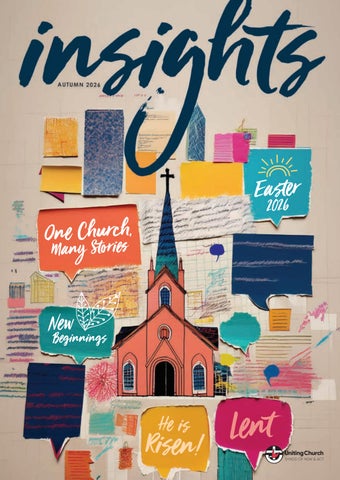
One Church, Many Stories
EASTER 2026
Across cities, coastal towns and remote communities, there is no single way the Church has celebrated this Easter, only a shared faith expressed through diverse voices and contexts. Insights brings these stories together: a mosaic of witness across the Church, revealing how Christ’s message of love and hope continues to take shape in many communities.
Stories
P17
P18
Jesus is Risen! So why do we so often look for the living among the dead?
Light and life out of darkness: An Easter reflection
P20
P22
We are still capable of being a better community
Responding to disaster and violence with compassion and faith
SO WHY DO WE SO OFTEN LOOK FOR THE LIVING AMONG THE DEAD?
The earliest accounts of the resurrection of Christ are found in two basic forms: stories of the empty tomb and stories of the appearances of the Risen Lord.
For instance, in Mark 16:1-8, the women arrive at the tomb and find it empty; an angel instructs them to share the news with the disciples, thereby emphasising both the emptiness of the tomb and the imperative “to go” and “to tell others”. In Mathew’s account (Matthew 28: 1-10) Mary Magdalene and Mary encounter an empty tomb and an angel who assures them that Jesus has been raised from the dead with the imperative “to go quickly and tell his disciples”; they also meet the resurrected Jesus, who charges them with the command “to go and tell my brothers and sisters…” Similarly, in 1 Corinthians 15:1-11, Paul recounts the appearances of Jesus to various individuals and groups, underscoring the reality of the resurrection and the importance of bearing witness. Luke 24:13-35 describes how two disciples encounter the risen Jesus on the road to Emmaus, recognising him only as he breaks bread with them, and immediately they return to Jerusalem to report what they have seen.
These passages illustrate two recurring themes in the gospel accounts: first, the tomb is empty; second, the witnesses are commanded “to go” and “tell”. This command encourages an active response, inviting us—as it did the early witnesses— not to dwell “among the dead” but to a movement of “going” and “telling.” For it is in the movement of “going and telling” that the hope and joy of the resurrection is encountered and experienced. Just as those first witnesses were called to action, we too are invited to share hope in our communities and world —whether through acts of kindness, words of encouragement and accountability, or simply being present for others. In so doing, we participate in the ongoing story of the resurrection, bringing light and hope to the world around us, edging us forward to making possible and real “a new heaven and new earth” (Rev 21:1).
resurrection serves as a radical truth: death has lost its sting; the darkness cannot overcome the light that has already entered the world. In every act of kindness, justice and bold declaration of life after death, we echo the truth that darkness cannot snuff out the light. The resurrection inspires us to move forward— not in passive observance, but in confident hope and purposeful action— bringing light and renewal wherever despair threatens to take hold.
The resurrection of Jesus marks the dawn of a new creation initiated by God— a creation in which each one of us is invited to play a part. This profound event does not simply signal a fresh start; it calls us to participate wholeheartedly in God's unfolding story. The community, us, collective individuals, all called to be church— become a living, breathing expression of Christ’s presence. No longer defined merely by shared traditions or rituals, but shaped by compassion, justice, forgiveness, and a readiness to serve. The empty tomb is not a void but a place brimming with hope, possibility, and new life.
THE EASTER MESSAGE IS NOT A CALL TO REMAIN AT OR IN THE TOMB, BUT AN INVITATION TO MOVE CONFIDENTLY AND COURAGEOUSLY FORWARD IN THE WORLD IN FAITH, HOPE AND PURPOSEFUL ACTION
The resurrection invites us to encounter the risen Christ not just as a distant memory but as a living reality in our present. Christ work continues through us—his followers—who become the bearers of his good deeds and good news. This active participation means serving others, not by simply observing from afar, but by engaging directly with the needs and pains of the world. For example, volunteering at a local shelter, advocating for justice for the marginalised, the non-human creation, or supporting those in need through friendship and practical help are concrete ways we embody Christ’s presence. In these actions, we become agents of transformation, bearing witness to the hope and life that the resurrection offers.
The message of Easter extends far beyond the empty tomb; it is anchored in the bold proclamation that Jesus has risen. The empty tomb is not just a historical event—it is a call to transformative action, urging us to share this news and embody its meaning in the world. In proclaiming ‘Jesus is risen’, we step into the world’s pain and injustice, carrying a hope that actively transforms despair into possibility. The resurrection reminds us that renewal and justice are possible, inspiring us to bring this hope into our communities through acts of kindness, advocacy, and solidarity.
‘Jesus is risen!’ These are powerful, countercultural words spoken boldly in faith amid a world burdened by pain, injustice, suffering, and poverty. Into this darkness and death, the
The Easter message is not a call to remain at or in the tomb, but an invitation to move confidently and courageously forward in the world in faith, hope and purposeful action. The empty tomb is not a symbol of loss, but a call to action. We are prompted to go, to tell and to follow the living Christ in the world for he has gone ahead of us. Do we (still) have the courage to follow?
Living, risen and ascended Christ, may our living witness manifest your presence.
REV. DR SEFOROSA CARROLL
ACTING PRINCIPAL, UNITED THEOLOGICAL COLLEGE
LIGHT AND LIFE OUT OF DARKNESS:
An Easter Reflection HE IS
In the pre-dawn darkness, Mary of Magdala pushed down on the fear and grief in her being and ventured out of the safe place, secure behind solid walls and locked doors, and into the wild and dangerous world. She left the followers of Jesus behind in their fear of Roman soldiers or Temple guards who were responsible for the death of Jesus.
Mary stumbled through the dark world of shadows and fear, a world that symbolised her own grieving, anxious and confused heart.
The darkness of that pre-dawn morning is the darkness of every life when we are confronted by the pain and suffering that is life, the grief, loss, chaos and vulnerability we feel before the powers and movement of our lives where we have lost any of the control, we imagined we had. Out of control, we stumble, fall, and edge our way forward towards – where? This is the liminal space of lonely helplessness, a powerlessness to change things, where we are left to sit in our grief and pain. There are the questions and doubts, the ‘if only’ thinking and the wishful dreaming of what might have been ‘if only’ this or that or something else had happened or intervened. This ‘shadowlands’ of our lives is a hard place, but it is mostly where Easter begins, and we receive the light that leads us into deeper life and being.
Mary stumbled through her darkness to the tomb where Jesus’ body lay. The dark pre-dawn world symbolised everything that caused her heart to break, her eyes to overflow with tears and her body to be wracked with physical suffering. Mary’s spirit was crushed, the life and hope
drained from it as she had watched Jesus suffer and die – with him, the hopes, dreams and expectations of herself and the other followers – and the world!
Mary had been lifted from lowliness and error, from victim and marginalised woman to one given equal status in Jesus’ eyes. In him she was known and loved, and she felt the deep love, grace and acceptance of God in her being. There was hope and life, but now?
The tomb came closer with each stumbling step, and she finally saw the stone was rolled away from the front. The tomb was open! The tomb that held her pain and grief, the tomb that had locked, within its own dark spaces, her deepest anguish and fear, was open. What did this mean? Was his body, the body of the one who had loved her so deeply and profoundly and given himself for her and so many, now stolen from them? She ran back to tell the disciples.
Peter and another disciple ran to the tomb. The other disciple ran in and saw the emptiness. Peter joined him and they believed – what did they believe? Mary’s story of theft and emptiness? The powers that be had surely struck again. They turned back to tell the others and lock the doors even tighter, perhaps. Mary stayed in the dark world, stumbling in the darkness of the tomb to look. There, in the shadows, figures, strange figures and voices asking about her tears. She turned, and in the shadows another figure. The gardener perhaps, but at this early hour? ‘Why are you weeping, woman?’ it said. ‘Did you take his body? If so, tell me so I can find him,’ Mary replied.
‘Mary!’ And Mary looked up, and recognised in the darkness the person, the voice, the figure and cried out, ‘Teacher.’ She lunged to grasp him but was told to let go, you cannot hold me. I am alive in the world but in a new way and am with you!
Mary went to tell the disciples that she had seen Jesus and explained what he had said to her.
But what did she say? What was her experience? What do the stories of Easter that feature in each of the stories of Jesus say and mean? Each has a distinct perspective, a different angle, a different encounter told in a different way. What did the disciples think, imagine? How did they receive Mary’s witness and what did it all mean? Jesus was no longer with them, and they were still afraid of the powers. What would life be like? They were caught in the darkness of life, the liminal place between the worlds of ‘what was’ and ‘what might be.’ What does this story mean in our lives and how will the loud, resounding ‘Hallelujahs’ and proclamation of ‘Christ is Risen! He is risen indeed!’ mean this weekend as they ring out across the world? Where will we find Easter in our own experience and how does it come to us?
We follow this story and the confusion, the mystery and the wonderment of people as they grasp an experience that lies beyond full comprehension or description, an experience that comes in stories and metaphors because it is too hard to grasp. We follow this story and the people grasping to name and define and reduce this mystery
RISEN
EASTER BREAKS IN WHEN WE LEAST EXPECT ANYTHING CAN HAPPEN, WHEN WE ARE BEYOND OUR LIMITS AND CANNOT IMAGINE A FUTURE. WE LET GO AND TRUST IN GOD
to something we can hold and control, but it always slips from our grasp. In our own darkness when hope fades and raw pain grips our heart, and fear rages wild in our being, Easter gently breaks in. It comes in a word or act of love and care. It comes in the dawning of a new day, and we see the wonder of life and believe in something bigger, more and beyond everything –breaking into our thin existence with hope. It is in the moment we let go and our broken heart or scared mind is released into the unfathomable mystery of Divine grace and love – a limitless ocean that holds us gently in a flow of life and being, sustaining and nurturing.
Easter breaks in when we least expect anything can happen, when we are beyond our limits and cannot imagine a future. We let go and trust in God, whatever that looks like in that moment. Sometimes angry acquiescence; sometimes desperate yearning and reaching out; sometimes despairing, powerlessness and helplessness that can do nothing else. It is in the cries of help, desperate in the dark night of the soul or the wracking sobs of grief and the arms that reach out to hold. It is in the mysterious arms of love that extend into our being and touch our soul, the all-seeing and knowing mystery of love that reaches in and offers life and love to our deepest being and the invitation to live anew.
Mary, Peter, John, Paul and the countless others witness to the transformative experience of the Risen Christ, a vision of light and voice, a figure walking and talking, a vision that breaks into our mind and being that speaks a new truth and hope. There are disciples whose eyes are opened in a moment of seeing and all of us witness to the wonder of new life springing up in the least likely places if only we will let go and trust this one who was raised into new life and comes to us in the darkness of life with love and hope!
REV. GEOFF STEVENSON
One Church, Many Stories

WE ARE STILL CAPABLE OF BEING A BETTER COMMUNITY
A few weeks ago, I spent the day at the Bondi Pavilion serving as a Disaster Recovery Chaplain. I arrived thinking I was there to offer support, a listening ear, maybe a few steady words. I left realising—again—that I was the one being ministered to.

Bondi Pavilion today felt like a meeting place of the world. Not a conference. Not a rally. Something quieter and deeper. People from different countries, cultures, faiths, and stories crossed the same space, drawn together not by agreement, but by shared humanity. By grief for our world as it is. By a longing for comfort. By the stubborn, hopeful belief that love still matters.
What struck me most was how little people needed fixing. What they needed was permission to speak, to remember, to feel. To honour what has been lost and what still aches.
I met a woman from the UK who spoke gently, almost casually, about prejudice. Her father was Jamaican—the only Black man in their neighbourhood. “It was tough,” she said, without bitterness. “But we had one another. And great food.” She laughed. Not to minimise the pain, but to honour the resilience. Love, family, shared meals… sometimes that’s how survival looks. Ordinary. Sacred. Defiant.


A family from Portugal stood quietly for a long time. They didn’t rush. They wanted to honour the people we have lost properly. They spoke about community, about contributing, about making donations not as charity but as responsibility. “This matters,” they said. And it did. Their presence said that grief doesn’t belong only to those directly affected, it belongs to all of us who choose to care.
A couple from Ohio, American Jewish, told me they had changed their travel plans just to be there. They wanted to leave a message of love. No speeches. No explanations. Just love, placed carefully into a space that needed it. That choice, altering plans, showing upfelt like a quiet act of resistance against apathy.


A family from Canada stopped so their children could listen. They wanted their boys to hear the stories, to understand what had happened, to learn so they would grow into better men. That stayed with me. Teaching children not just history, but empathy. Not just facts, but responsibility.


I met a couple from New York, veterans of the NYPD. They were present on 9/11. That kind of memory lives in the body, not just the mind. They moved slowly through the Pavilion, taking time to thank every volunteer at the Recovery Centre. Every one. Their gratitude was deliberate, practiced, almost liturgical. They knew what it costs to show up in moments like this, and they honoured it.


Throughout the day, I watched strangers comfort one another. I watched volunteers being honoured, thanked, seen. I watched grief shared instead of hidden. Pain held instead of avoided. No one asked what religion you were. No one checked your politics or passport. We met as people.


SURVIVAL IS NOT JUST ABOUT ENDURANCE, BUT ABOUT CHOOSING MEANING AGAIN AND AGAIN
And then there was the bus from the local Jewish nursing home. Dozens of people arrived together, carrying decades of stories, memories, losses. Some had lost friends. Some carried past events that still echo painfully in the present. And yet—hope. Resilience. Messages that were tender, strong, unashamed. They reminded me that survival is not just about endurance, but about choosing meaning again and again.


I am deeply touched by this shared experience. Not because it was perfect or resolved—far from it. But because it was honest. Because it reminded me that community is not something we talk about; it’s something we practice, often imperfectly, in moments like these.
I don’t feel like this reflection is finished. Maybe it never will be. Some days don’t wrap themselves up neatly. They stay open, asking something of us.

But I am grateful. Grateful for conversations that mattered. For stories entrusted. For the quiet courage of people who showed up carrying grief and still chose love.
If this experience taught me anything, it’s this: we are still capable of being a better community. Not through slogans or certainty, but through presence, grace, and the simple, ever present call to love one another.

REV. PABLO NUNEZ


One Church, Many Stories
RESPONDING TO DISASTER AND VIOLENCE WITH COMPASSION AND FAITH
On December 14, 2025, one of the most violent events in Australia’s recent history occurred. On a warm summer’s evening at iconic Bondi Beach 15 people celebrating Hannukah were killed, and numerous seriously wounded.
While the DRCN usually deploys to natural disasters, their volunteers have been increasingly needed at mass casualty events, including the Bondi Junction stabbing in 2024 and Hunter Valley wedding bus crash in 2023. The scenes of these events see many bereaved friends and relatives, as well as distraught community members, attend to try and make sense of the senseless. Chaplains never try to solve these unsolvable situations, instead they come alongside people in love to provide care and compassion. The listening ear chaplains provide is often just when people start the process of grief, and hopefully healing. It is a sense of hope that chaplains bring.
The Senior Chaplain of the DRCN, Rev Dr Mark Layson said, “The events in Bondi are so very hard to understand especially in such an idyllic location. Our chaplains have felt the ‘terrible privilege’ of standing, sitting, and walking beside those whose world and worldview is turned upside down. It allows us to bring to others the comfort we ourselves have in Christ.”
The DRCN is a vital ministry of the NSW/ACT Synod, that allows the Uniting Church to express its heart for the hurting. There are currently 441 volunteer chaplains in the network from 16 different faith groups. As natural and human cause tragedies increase in frequency, it is hoped that this number will climb to over 500 volunteers in the coming years to meet increasing demand for their services.
If you have ministry qualifications and would like to know more about joining please email: drcntraining@nswact.uca.org.au
If you would like to support the work financially please consider giving to the Moderator’s Disaster Appeal.
In 2022, Rev. Dr. Stephen Robinson, the National Disaster Recovery Officer of the UCA, undertook a Churchill Fellowship where he met with faith leaders and survivors of congregations which had endured mass-fatalities through violence. These included the Christchurch mosques, three churches and a synagogue in the United States and a Methodist Church in Britain. Stephen had the rare privilege of listening to the leaders even as they continued to grieve and heal. Lessons gleaned from these conversations were gathered in a report (Faith Leaders’ Responses to Violent Attacks on Houses of Worship).
In 2024 the NSW Government announced the “Safe Places for Faith Communities” grant through Multicultural NSW. The Synod was successful in gaining a grant to create “The Shepherd Project”. Led by Rev. Robinson, and supported by the DRCN team and Mission Services, this project brought together leaders from very diverse faith groups with a common vision to build a resource which would assist any faith leader in caring for their people.


In April 2025, having prepared the materials for the first round of engagement workshops, Stephen found himself very ill in hospital with a dangerous reaction to chemotherapy. Rev. Mark Muss – who had been engaged from the start, stepped up to run the initial workshops, allowing the program to continue.
The project surpassed Rev. Robinson’s expectations, with engagement of over 70 faith leaders at the very time when escalating hate and division threatened worshipping people across Australia - all this ahead of the Bondi Beach atrocity.
Stephen regards the Resource Manual as one of the key achievements of this project…
“When I had spoken to pastors who had suffered the terrible anguish of these fatal attacks on their people, some of them said ‘…there was no manual for this. We found ourselves having to work it out somehow’. Now there is a manual, and planning resources and videos.”
What lies ahead? Stephen says, “There is ongoing support from Multicultural NSW and interest from interstate Church Councils in the material and workshops, and we have just put in for another round of funding for 2026 into next year. This is so valuable, and so needed at this present time. I’m so grateful that the Uniting Church could support it as it has.”
DISASTER RECOVERY CHAPLAINCY NETWORK


The cost of Silence AUSTRALIA DAY AND RACISM
Every year as the 26th of January approaches I often feel like locking myself away for two weeks and turning off all TV and social media. Why? Because of the nasty and mean-spirited racism and bigotry that is at its peak on social and other media at this time of year. It’s not new, it happens every year. Every. Year.
In a basic sense it offends me as an Aboriginal person and a decent human being, but it also upsets me because I have seen the grief and trauma that racism and racial vilification causes. In a previous job, I investigated complaints of unlawful discrimination and attempted to conciliate many of these complaints. Racism and discrimination contribute to social dysfunction and division. It leads to people being murdered, including children – for example Cassius Turvey and Elijah Doughty. Racism, and racial vilification, have zero positive social outcomes.
In times past ‘Australia Day’ has been held on a number of dates. Prior to 1888, New South Wales was the only place that celebrated Australia Day (then called Anniversary Day) on January 26. The first national ‘Australia Day’, was held on July 30, 1915, to support fundraising for the war. In 1916 ‘Australia Day’ was celebrated on 28 July. In 1935, all states and territories agreed to call 26 January Australia Day, although NSW still called it ‘Anniversary Day’ and some other states called it ‘Foundation Day’. The 26 January has only been celebrated by all states and territories as a public holiday for ‘Australia Day’ since 1994.
So in effect the “Australia Day” public holiday has been around for a bit over 30 years. Is there any good reason why we can’t change the date? Will people die? Will it ruin our economy? Will it impact our international trade or foreign partnerships? The answer is “No”. There is no valid reason why we can’t change the date. When you ask the question about changing the date, and wade through the various smokescreens of “It’s just always been that way”, and similar arguments that simply don’t hold much water, the only reason people don’t want it changed is because it would be kind and compassionate towards
Aboriginal people and communities. That’s it. In my experience, this nastiness is purely based on racism, prejudice and bigotry. It is spiteful and mean spirited.
Any discussion about changing the date is seen by racists as an opportunity to “sink the boot in” to Aboriginal peoples and communities, to remind Aboriginal people and communities that we are not equal, that we are not considered as “real Australians”, that we have negligible political influence, and that we are lesser citizens who simply don’t matter.
Ironically, it is those who claim they don’t want a divided Australia who are the quickest to insist on keeping Australia Day on a day that leads to division. In my experience such people don’t really care about ‘division’, and they don’t want ‘unity’ – what they demand is ‘assimilation’, based on ideologies of white supremacy.
Don’t rock the boat, don’t dare be proud of your heritage and belonging to the oldest continuing culture in the world. Just forget 60,000 years or so of existence and relationship with this continent, and act like white Anglo people. That’s what white supremacists want. They are people driven by fear that somehow somebody is going to stop them being white people, that they may somehow end up muddying their “bloodlines” and thus complain that their “whiteness” is under attack (apparently raping Aboriginal women and producing mixed race children was quite OK for centuries, but having a person of colour in the white family genealogy was/is seen as scandalous and unacceptable. Once upon a time, when international travel often took several months at sea, and was risky and dangerous, and when human beings were relatively uneducated and “tribal”, there was reason to “stick to your own”.

There was strength in unity and safety in belonging to a particular people or culture.
But it is 2026. We can travel to the other side of the world in 24 hours or less. We have the internet and are able to connect with anyone, almost anywhere in the world, instantly. We are literally a global community. We should be smart enough to realise that racism, hate, division, conflict and war are not conducive to human survival. I believe the majority of human beings on the planet do realise this.
JESUS MADE IT CLEAR THAT WE SHOULD ESPECIALLY CARE FOR THE LEAST – THOSE MARGINALISED AND OPPRESSED BY SOCIAL, ECONOMIC AND POLITICAL STRUCTURES
So, who is causing the division and the conflict? In the context of Australia Day, it is a small cohort of predominantly white males who rage against any notion of changing the date. For no reason other than mean-spirited hatred and bigotry towards Aboriginal peoples and communities. Seriously, I’ve been waiting for decades for a reasonable explanation, but that is all I’ve ever seen.
Why do so many people suggest we should change the date? Obviously, the 26 January represents the date that British colonisation of the continent began, resulting in a multitude of negative ramifications for Aboriginal peoples. So that’s one great reason to find another date to celebrate together. I mean, would we consider moving Australia Day to 14 December – the date of the Bondi massacre? Of course not! What about 28 April, the date of the Port Arthur massacre? Again, of course not. What about 12 October – the date of the Bali Bombings? No, of course we wouldn’t think that was appropriate. We would not even consider any of these dates in recognition of the grief and trauma that impacted, and continues to impact, those affected and their families. It’s just common decency,
So why can’t we apply the same common decency and recognise that for many Aboriginal peoples and communities, the 26 January similarly represents historical and ongoing grief and trauma.
As Christians, we are meant to show love, empathy and compassion to others. Jesus told us that the two greatest commandments were to love God with all our heart, mind and soul, and to love our neighbour as ourselves. Is engaging in racial vilification and bigotry towards any group of people a Christian behaviour? Not according to Christ –who is the literal source of Christian teaching and related values.
So if you are a Christian, and thus aspire to follow the teachings of Christ, please realise that racism and bigotry are absolutely not Jesus-sanctioned. They are not Christian behaviours.
Showing love means we listen, we hear, we care, and we do our best to welcome and include all humans, regardless of class, race, gender, cultural background, social or financial status. Jesus made it clear that we should especially care for the least – those marginalised and oppressed by social, economic and political structures. In fact, He said our entry into God’s Kingdom will depend entirely on how we have treated the least (See Matthew 25:31-46).
So let’s act with common decency. Let’s act according to our Christian values if we claim to be Christian. Let’s just act as decent human beings if we are from other faith backgrounds, or of no faith background. Let’s treat others how we would like to be treated.
Let’s just change the date of Australia Day to a day we can all celebrate together. I, for one, would be very grateful to no longer have to put up with nasty and meanspirited people sinking the boot into Aboriginal people and communities in the lead up to the 26th January every year. I’d love for my soon to be born grandchild to be able to grow up in a country where racism and racial vilification wasn’t an annual event every time we prepare to celebrate this wonderful country.
NATHAN TYSON

Share your story


We want to share your story!
Whether it’s:
A creative new ministry initiative
A community partnership making a difference
A faith story that has shaped your congregation
A response to local need
A youth, children’s, or intergenerational project
A reflection on mission in your context
If it matters to your community, it matters to the wider Church. Our Communications team can assist with shaping and editing your submission for publication.
Where will it be shared?
Selected stories may be featured across: Church-wide newsletters

The Synod website
Social media channels
Synod or presbytery communications

Help us tell the story of our Church — not just what we believe, but what we are doing together in faith. Email your story, photos, and contact details to ContactUs@nswact.uca.org.au or scan the QR code.
Let’s make visible the life, faith, and mission that is already unfolding across our Congregations and Presbyteries. Your story matters.


Bidwill Uniting Walking Alongside Western Sydney’s Most Vulnerable
In Western Sydney’s Mount Druitt, Bidwill Uniting is a small suburban ministry doing work that far exceeds its size. It may not have the numbers or resources of larger parishes, but it has built a significant network of trust and practical support that continues to play a significant role in the community.
For more than a decade, community development worker Bec Reidy has been learning from the Bidwill community. “We’re not here to fix people,” says Bec. “We’re here to walk alongside them. That’s how lasting change happens.”
Bidwill Uniting sits in a part of Sydney that faces ongoing social and economic pressure. A large portion of the families that Bidwill Uniting works with are living in social housing, dealing with rising living costs and generational trauma. In response to these challenges, Bidwill Uniting has developed programs with community members that not only provide support but also empower residents to take an active role in their community.

CREATING SPACES THAT EMPOWER
Over the past year, the Bidwill Uniting has been part of creating spaces where residents can develop leadership skills, advocate for their own community, and build connections that last.

Through a joint Leadership Program run with partners in the Together in 2770 Collective, residents have developed skills in communication, self-awareness, and conflict resolution. The program has empowered participants to move beyond receiving support to actively shaping their community’s future. In September 2024, around 15 participants attended a local candidates forum with the Sydney Alliance, sharing their stories and securing commitments from politicians on housing, transport, childcare, and
Bidwill Uniting also coordinates a free dental clinic each year in partnership with the Tzu Chi Foundation- last year was its tenth year. Over a weekend, around 50 volunteers provide dental care to residents who would otherwise go without. For primary school children and their families, Bidwill Family Afternoons offer a safe, fun, inclusive space filled with activities that build confidence alongside social and emotional skills.

Beyond offering services, the heart of Bidwill Uniting’s approach is building trust, a process that has taken years of listening and consistent presence.
EARNING TRUST, ONE STEP AT A TIME
When Bec first started at Bidwill Uniting more than ten years ago, she learned that it would take time to earn the community’s trust.
“There is a lot of suspicion towards services around here- often with good reason,” Bec reflects. “People have seen services come and go and not always act with integrity. We have had to show that we are not just another program that will disappear when funding runs out.”
listening, Bidwill Uniting is known as a safe place. Our aim is never to impose solutions, but to work with people to identify what would make a difference in their lives.
“It’s not about religion here,” says Bec. “It’s about being treated like a person.”
That sense of belonging has made Bidwill Uniting a cornerstone of local life. For some, it’s the only place where they feel seen, and some describe it a second home- a family.
“We often see people who are struggling. Sometimes all we can do is meet them where they’re at and offer a meal, a conversation, or occasionally, a prayer. But that’s where relationships start,” says Faith, Chair of the Bidwill Uniting Board.
This commitment to walking alongside people is rooted in Bidwill Uniting’s commitment to following the example of Jesus, with faith expressed not in words but in action.
FAITH IN ACTION
At its core, Bidwill Uniting’s mission is shaped by faith but not in a way that excludes or divides. Instead, it’s faith expressed through presence, solidarity, and genuine care.
“We don’t preach people,” says Faith. “We live out what we believe through what we do. That’s what makes the gospel real for this community.”
Every meal and conversation shared, every small act of kindness is part of that mission. It’s about embodying hope in practical ways, especially in places where hope is often in short supply.
Bidwill Uniting’s approach reflects a wider Uniting Church vision to be present where it matters most, offering compassion and dignity to those on the margins.
The impact of this approach can be seen in the lives of community members like Kayla and Robyn, whose journeys illustrate the power of support, trust, and faith in action.
STORIES OF CHANGE AND HOPE
Five years ago, Kayla arrived in Bidwill a homeless, a single mother. Hesitant at first, she joined the Getting Ahead program, and it changed her life. With a Certificate 3 in Childcare but no experience, she struggled to find work until Bec gave her a start and later connected her with The Hive.
“Bec and Bidwill Uniting didn’t just champion me but also supported me through life,” Kayla says. Today, she’s completing her Certificate 3 in Community Service, doing her placement at Bidwill, and inspiring her children, who now dream bigger: her oldest wants to be a dancer and teacher, her youngest an architect.
Robyn’s story echoes this transformation. Starting at a local’s youth group at 14, she credits the various programs and community workers, including those at Bidwill Uniting, with turning her life around. Now 24 and working across four
community and youth roles, she says, “I’m not a suicidal 14-year-old anymore. I have prospects.”
GROWING NEED, LIMITED RESOURCES
The need for Bidwill Uniting’s services has continued to rise. Economic pressures, housing insecurity and mental-health challenges have pushed more families toward crisis. Many rely on Bidwill Uniting’s open doors and holistic care to bridge gaps left by an under-resourced, fragmented and siloed service system.
But while demand has grown, funding hasn’t kept pace. The ministry operates on small grants and individual donations. Much of the work depends on a small team of staff and volunteers who engage with residents, run the drop in space, and develop and run programs.
THE IMPACT OF COLLECTIVE SUPPORT
Over the years, small acts of generosity have made a big difference. Funding from individuals and local congregations have allowed Bidwill Uniting to keep its doors open, maintain weekly programs, and create safe, inclusive, empowering spaces for all residents including children and families.
The model is simple: consistent, community-based support that treats people as partners rather than clients. This approach has earned Bidwill Uniting respect across the wider Uniting network
as a quiet but powerful example of what local congregations can achieve.
“We have been privileged to have been a part of building community here” says Bec. “People who care about one another, who look out for each other. People who say that this is their family. That’s not something you can manufacture. It grows out of time, trust and shared experience.”
While the community has achieved so much through collective effort, rising demand and limited resources mean Bidwill Uniting cannot meet every need alone. This is where wider support can make a real difference.
WHY SUPPORT MATTERS NOW
Whilst the combined cost of living, housing and climate change crises affect everyone, the effects are felt more drastically amongst the already vulnerable. These and other factors serve to further entrench place-based disadvantage and intergenerational poverty that is experienced by so many in the 2770 postcode.
We must act now- not only to empower people who are struggling to build the skills they need to achieve their goals and create a better life for themselves and their children, but we also need to urgently speak truth to power and change the systems that create entrenched disadvantage in the first place.
ADITEE VORA


ONE ONE ONE

3
ONE is more than an event. It’s a shared moment of formation for the Uniting Church — a chance to listen, worship, and become more fully one in Christ. A gathering of the Uniting Church, coming together to practise unity that is honest, courageous, and lived.
Don’t miss out! Registrations Open in March
Program Snapshot
Keynote speakers across four plenary sessions
Interactive breakout sessions in multiple formats
Reflection and small-group spaces
Art and creative expression throughout Friday night youth event
Saturday children’s program
Program Highlight
Thursday 29 October 2026
Pre-Conference Leaders Day

Education as Ministry
RETHINKING SCHOOLING FOR YOUNG PEOPLE WHO DON’T FIT THE MOULD


As a new school year begins, familiar concerns are already resurfacing: attendance rates, school refusal, and student disengagement. These conversations often carry an undertone of anxiety, sometimes even blame, as though young people are turning away from education itself. But what if school refusal is not a rejection of learning, but a signal that the way learning is designed is not working for everyone?
In this, Margaret Jurd College offers a different lens and a lived expression of what can best be described as Education as Ministry.
This idea positions education not as a separate institutional function, but as a practical expression of the Church’s mission. It is about dignity, justice, and deep care for young people, particularly those who have been excluded from mainstream schooling. In this sense, MJC is more than an alternative school; it is a credible and functioning model of what a Uniting Church–aligned college can look like when education itself is understood as ministry.
While broader systems are grappling with attendance challenges, MJC continues to hear from families exploring alternative schooling options. This contrast invites a question worth exploring: are some students and families “refusing school,” or are they seeking schooling that better meets their needs?"
School refusal and disengagement are complex issues. Many young people facing anxiety, trauma, learning gaps, social difficulties, or negative past school experiences are often not disengaged from learning. Rather, they are overwhelmed by environments that do not feel safe, relational, or flexible enough to support them. For these families, an alternative approach is not a second-best option; it is a deliberate and hopeful choice.
MJC was born from this recognition: that there is a need to support young people experiencing disadvantages and disconnection from mainstream education. Its model combines secondary education with strong wellbeing support, small class sizes, and trauma-informed practice. Each student works with a caseworker to address social and emotional goals alongside academic learning. Wellbeing and education, therefore, are not competing priorities; they are interdependent.
This is Education as Ministry in action. It is visible in governance decisions that prioritise student care, in the persistence required to sustain complex support structures, and in the daily relationships between staff and students. It is also evident in the courage of congregations willing to
move beyond advocacy and pastoral care into the demanding, practical work of running a school.
The Tuncurry campus is a powerful example. Its establishment did not happen because it was easy or simply “a nice idea”. It happened because people were prepared to commit deeply.
Margaret Hingley, a congregation member, played a significant role in this journey and was recently recognised with a Meritorious Service Award. Her contribution represents longterm lay discipleship expressed through educational ministry; the kind that involves meetings, paperwork, setbacks, and sustained presence, not just vision statements.
Alongside her, Pastor Geoff Battle, Minister of the Forster–Tuncurry Congregation, was instrumental. When the concept of opening a campus was first shared, Geoff was open to the possibility and helped guide his congregation through the substantial change that followed. That leadership did not end once the doors opened. It continues as the congregation lives with the realities of hosting and supporting a school.
And those realities are significant. Establishing Tuncurry involved logistical hurdles, financial pressures, and technical complications. Progress was not smooth. There were moments that tested resolve and required problem-solving well beyond anyone’s comfort zone. Yet that persistence is precisely what makes Education as Ministry credible. It is not light or abstract. It is grounded, costly, and sustained.
This also demonstrates that when the Church invests in education as a form of ministry, the impact is tangible. Young people who once felt they did not belong in school begin to reengage with learning, relationships, and hope.
In the wider conversation about school refusal, MJC offers a reframing. Sometimes the issue is not that young people are opting out of education; it is that education systems have not been designed with their realities in mind. Alternative models like MJC do not lower expectations; they redesign the environment so students can meet them.
JENNAE JEREZA


New Beginnings Through Connection


This Easter, you are invited to walk alongside Parramatta Mission by supporting work that brings compassion, dignity and hope to people in our community who need it most.
Easter is a season of renewal, a time to pause and reflect on the promise of resurrection and the new beginnings made possible through hope, love and connection. As we gather in worship and community at Parramatta Community Uniting Church, we are reminded that faith is not only something we believe, but something we live. We live it through our care for one another, in acts of welcome, and in the ways we respond when our neighbours experience hardship.
This commitment finds expression through Parramatta Mission, the church’s community service arm. Through ministry, chaplaincy and outreach programs, we seek to nurture communion with God and with each other by addressing the realities many in our region face - social isolation, homelessness, hunger, and financial stress. Behind every meal shared, every conversation offered, and every service delivered is a story of connection and often, transformation.

Mina’s story is one of those reminders.
Seven months pregnant and caring for a toddler, Mina found herself alone, unemployed, and on the verge of homelessness. She and her partner had migrated to Australia as skilled professionals but were unable to work in their fields. Financial strain led to the breakdown of their relationship, and Mina was left without support. She recalls the isolation of that time: not knowing where to turn or how she would provide for her children.
Eventually, she heard about the Meals Plus program and decided to visit. What she encountered was not only practical help, but welcome and dignity.
“When I walked through the doors, I found kindness, support, and a way forward,” she shared.
Through Meals Plus, Mina accessed meals, emergency assistance, and guidance to essential services. The program provides more than 80,000 meals annually - is designed not only to meet immediate needs but to connect people with longer-term support. Because Parramatta Mission hosts a dedicated Services Australia specialist onsite, Mina was able to navigate financial assistance and establish a manageable rent arrangement in a familiar and trusted environment.
Today, she has reunited with her partner, secured stable housing, and is preparing to welcome her growing family with renewed hope.
Her journey reflects something deeply resonant with the Easter story: that renewal is possible even in life’s most uncertain moments, and that connection can open the way toward restoration.
Each day we witness similar moments of renewal across Parramatta Mission’s work - providing a safe space in Meals Plus for those facing homelessness or hardship to receive a meal and access to vital services; supporting families staying close to hospitalised children through Wesley Apartments; welcoming migrants and refugees through English classes; fostering belonging through playgroups; and creating spaces where individuals can find dignity, support, and community. These ministries represent our shared calling to be present with compassion and courage in the lives of others.
This Easter, as we celebrate the promise of new life, we also reflect on how we participate in that promise together. Prayer, presence, volunteering, and generosity are all ways our community embodies Christ’s love in action.
If you feel moved to support this work, we invite you to consider contributing to the work of Parramatta Mission. Your support strengthens our capacity to offer connection, care, and pathways forward for those experiencing hardship. In doing so, you become part of the shared ministry that continues to bring hope to life in our community.
May this season remind us that new beginnings often start with simple acts of connection and that together, we can continue to be the hands and feet of Christ in the world.


When the failsgardenfood

A family in Timor-Leste faces hunger as climate change disrupts the land they depend on, but finds hope through partnership and faith.
Manuel wakes before dawn each day in the Oecusse region of Timor-Leste. While the air is still cool, he lights a small fire to cook breakfast for his family. Then he begins the long walk to his garden, carrying tools that have been passed down and repaired many times over.
For generations, Manuel’s family has lived from this land. They have known when to plant, when to harvest, when to rest. The seasons once kept their promises.
But in recent years, those rhythms have begun to unravel.
Climate change has brought longer dry spells, intense heat, and rain that arrives at the wrong time. Crops that once grew reliably now fail without warning. When the vegetables died in the ground, there was nothing to sell at the market and no money for rice, oil or medicine.
“We planted and the rains didn’t come, so the crops died,” explains Manuel.
“We had no money to buy more, so for a time we went hungry. Angelina and I just ate one meal so the children could have two.”
In Timor-Leste, families like Manuel’s live close to the edge. Almost half of all children experience stunting caused by chronic malnutrition, one of the highest rates in the world. Most families rely on small food gardens for both nourishment and income, leaving them deeply exposed to changes in weather patterns they did nothing to cause.

CHANGE THAT BEGINS WITH PEOPLE
What makes the difference for families like Manuel’s is partnership rooted in trust, faith and local leadership.
In Oecusse, UnitingWorld works alongside the Protestant Church in Timor-Leste, a Uniting Church partner with deep roots in the community and a long history of walking with people through hardship. Together, they are supporting families to adapt, not abandon their land.
Manuel learned new climate-smart farming techniques that help his garden survive longer dry spells. Improved access to water means seedlings no longer die before they can take root. Savings and loans groups allow families to invest without falling into crippling debt. Community health nurses support pregnant mothers and monitor children’s nutrition.
In villages where the church has been working consistently, child malnutrition has dropped to zero.
For Manuel, the change is tangible. “Now we can grow food again,” he says. “We can eat well and sell some at the market.”
The return of reliable harvests has restored more than food security. It has restored agency.

Food insecurity does not only empty stomachs. It hollows people out, stripping away confidence, identity and hope. By contrast, solutions that are community-led and sustained help people reclaim their sense of purpose and belonging.

This is central to UnitingWorld’s approach. Change lasts when people are not treated as recipients, but as leaders of their own future.
What is happening in Oecusse is echoed across the Pacific, Asia and Africa. Communities are facing hunger, rising seas, stronger storms and deep uncertainty. Again and again, our church partners are responding with courage, creativity and compassion.
These are not quick fixes. They are patient, faithful investments in people and place.

A WAY TO RESPOND

Stories like Manuel’s remind us that change is possible, even in the face of immense global challenges. They also remind us that hope is not passive. It takes shape through solidarity, generosity and shared commitment.
Each year, UnitingWorld invites people to respond through Lent Event, a season of prayer, giving and action that supports this kind of community-led change.
Lent Event is one way people of faith across Australia stand alongside partners like the Protestant Church in Timor-Leste, helping families grow food, restore dignity and build a future where children can thrive. IN VILLAGES WHERE THE CHURCH HAS BEEN WORKING CONSISTENTLY ON THIS PROJECT, CHILD MALNUTRITION HAS DROPPED TO ZERO

Visit www.lentevent.com.au to find out more and donate.

RESTAND TRUTH
52 Young(ish) people, came together to Retreat from a world where we consume and are consumed by busyness and our choice was to unravel our identity from the ways we make money, the titles and tribes we engage with in the world.
We came because Jesus says, come to me, all you that are weary. Throughout his ministry, Jesus frequently withdrew to a deserted place to pray. Likewise, our rest in community is not an escape from discipleship or calling; it is actually a pathway into it. Rest was written into creation, where delight was shown on the seventh day, it was woven into the shape of God’s rest for us. God gives us rest in calling us to green pastures and going with us into the dark places.
We intentionally did something that feels subversive in nature by putting rest and truth side by side. Challenging ourselves to see rest not as a passive release, but an intentional act that leads to our bold participation in the world we believe God is creating. This happened in yarning circles led by Paige Owen, Mikenzie Ling, and Nathan Tyson. We practiced what it means to step into truth through deep listening to stories of First Peoples, and by joining a practice of reciprocal listening.
We were grateful to be led in worship by Tonga Parish’s Young Adult Ministry, and the Pulse team enjoyed sharing the leadership of the event with members of many of our communities including Salt Bush.
RETREAT YOURSELF 2026

REST WAS WRITTEN INTO CREATION, WHERE DELIGHT WAS SHOWN ON THE SEVENTH DAY, IT WAS WOVEN INTO THE SHAPE OF GOD’S REST FOR US
Truth is found as we accept each other's stories, learn from shared wisdom in community and remember our core truth, that Jesus calls us to love one another. So, we didn’t participate in a weekend of escape; we retreated intentionally as a community of truth and rest.
This might be something that your congregation, young adults, youth group, or family would like to engage with. If so, please reach out! Nathan’s team and ours love engaging with these conversations and would love to share resources and listen to your stories too. Email us on: contact-pulse@nswact. uca.org.au
REV. JAMES BAKER
PULSE, YOUNG ADULT MINISTRY FACILITATOR


Lent MAKING SPACE NOT EARNING POINTS
Lent starts with ashes and reminding us, that we are God’s children. From dust we came and to dust we shall return. In a world that tells young people to perform, achieve, brand themselves and perform.
Tradition calls us back to hear that you don’t have to prove your worth. You already belong.
For those who are seeking a practice of Lent in community, the dinner table, with friends or small groups we might ask together:
What is exhausting us? What is numbing us? Where might we pay attention to those areas of life we have lost tenderness?
This contrasts with the constant bombardment of those things we carry everyday, climate fears, wars and injustice, everyday living costs, crisis, health and so on. Where might God be calling us to prayer? Instead of giving things up for Lent, we might ask: What conversations am I avoiding? What am I hungry for? Where do I need the truth rather than another distraction?
heard call us, doesn’t avoid the suffering, but enters into it. Jesus understands anxiety, injustice, fear, and loss. When we reach Good Friday, there is no glory in pain, but rather there is a truth telling! Good Friday is about naming pain, honestly, and refusing to pretend it doesn’t matter.
Easter, everything can be made new!
This is not the drop-down menu reset button that erases suffering or the cross. It is God’s way or showing us that death doesn’t get the final word, that love is strong than fear. And that even after the worst has happened, new life is possible.
HOLY WEEK DOESN’T SKIP OVER THE HARD STUFF!

If we sit in the tradition of our Uniting Church, we might step out of individual piety or holiness. That is we can examine ourselves, but we might also hear the call to justice, repentance and hope. If fasting from chocolate, Snap Chat or Instagram is helpful for you that’s great, but that silence or hunger should point us toward rest, prayer that tells the truth, and listening to voices we usually ignore.
Holy Week doesn’t skip over the hard stuff! It walks alongside betrayal, fear, violence, grief and a society that crushes the vulnerable. This God we have
That burnout from navigating life in identity, climate concern, injustice, loneliness or uncertainty, is not answered by the Easter story, however our response could be to see that God Promises us presence. The resurrection is not an escape as we learn in the early church, but it is a transformation.
Hope can rise in unexpected places, broken things are not disposable, and God is still at work, even when we thought that the story was over.
Lent is about telling the truth, The cross is about love that refuses to walk away.
Easter is about hope that survives everything.
REV. JAMES BAKER PULSE, YOUNG ADULT MINISTRY FACILITATOR
The Sacred Tension Tuning the Heart of Uniting Creative
WE ARE NO LONGER JUST WRITING THE STORY; WE ARE THE STORY BEING TOLD

To witness a great artwork is to enter a dialogue with detail. You lean in, tracing colour and brushstroke as the story unfolds. Then you step back, letting sharp edges blur into something larger. In that shift, detail gives way to the whole. You sense the patient process— layer upon layer—until the lines merge and the full picture comes into view.
We have been in a season of weaving, our stories, ministries and voices crossing and overlapping. It has been gentle work, but the question remains: what are we making? As we move forward, the weave tightens. Like a painting seen from a distance, the gaps close and the colours find their depth. In this tension, separate strands become a living composition, where beauty is found not only in the spaces between us but in the strength of our BOND.
WE ARE STEPPING INTO A SEASON OF BONDING
In the UCA, we are no strangers to holding space for difference. We know what it is to sit in the tension of diverse theological convictions, cultural expressions and generations. Too often, that tension causes us to draw lines in the sand—boundaries where we decide how much of our heart we are willing to risk, or how much of our sound we are willing to yield for the sake of the collective. We treat diversity as compromise rather than power. To BOND in the face of difference is to move from polite distance to sacred proximity. It means recognising that tension is not a sign something is broken; it’s a sign the weave is being pulled tight enough to hold weight.
We are at our strongest when we are uninhibited in love. When we stop guarding the edges of our threads and allow them to be drawn into the centre, something shifts. The line in the sand isn’t erased by force; it is blurred by the fullness of shared life.
SO, WHAT DOES THIS HAVE TO DO WITH UNITING CREATIVE?
As we look toward 2026, we are refining our connection not just to improve what we produce, but to shape who we are—moving from weaving threads to becoming them, from writing songs to embodying them.
In our Churches and Presbyteries, this feels like a string pulled tight. Loose, it is silent. Taut, it carries a note. As we lean into the tension of our diverse traditions and voices, isolated notes become chords. Layers gather, and a symphony begins to rise. This is where the BOND comes alive—not in sounding the same, but in being tuned and connected so our lines rise together in witness to the Creator.
Last year, Uniting Creative embraced WITNESS, creating an album shaped by Attentive Presence, Authentic Voice and Embodied Action, honouring the stories of our artists.
This year, we expand. We welcome new voices and refine our craft—not for excellence alone, but to enliven creatives in local churches. As we create together, we raise leaders to carry this fire home. Each voice strengthens the weave; each song becomes a gift to the community, reflecting the resilience of our shared bond.
TASH HOLMES
MISSION CATALYST | MISSION,
GROWTH & INNOVATION
UNITING MISSION AND EDUCATION
This year, Uniting Creative is leaning into a season of intentional proximity and shared craft. We are moving beyond scattered threads to become a unified, singular witness through the following offerings:
'CAMPFIRE' RETREATS
Grounding, songwriting, spiritual alignment, and preparing our teams for worship leadership at Synod events.
COLLAB GROUPS
Intimate, local gatherings designed to be the “engine rooms” of our collective across Presbyteries.
NEXT GEN BAND CAMP
A dedicated peer-to-peer space for young creatives to find their authentic voice and lead the way for the next generation.
DIGITAL PLATFORM & ENLIVEN WORKSHOPS
A new home for shared resourcing and artistry refinement, designed to wake up the creative spirit within our local churches.
COMMUNITY CONNECTION & MUSIC PRODUCTION:
Deepening our bond through collaborative songwriting and production, as we gather to turn our individual stories into a collective symphony.
GLOBAL MENTORSHIP
A “master-class” journey with Audrey Assad, David Gungor, and The Good Shepherd Collective to refine our artistry and liturgical depth.
Whether you are a seasoned songwriter, a young producer finding your feet, or a worship leader who simply believes in the power of a creative church, there is a place for you here!
To express your interest, click on the Uniting Creative LinkTree and choose your own adventure: linktr.ee/unitingcreative
March: The Way of Dying and Rising
Prepared by Rev. Geoff Stevenson

MARCH 1 (LENT 2)
Genesis 12:1-4a Psalm 121 Romans 4:1-5, 13-17 John 3:1-17
As we move through Lent we are invited into the journey of letting go. Abram and Sarai’s is a story of letting go to engage in the journey of faith. They leave their home and safety, where life is familiar, and comfortable. They are not given a destination, but an invitation to trust in this mysterious God.
We all know something of this as we journey through life, where there are so many points of ending, dying, and letting go, in order to embrace the new and emerging reality of our life and being. Letting go is hard. We want to hold on, to maintain our sense of control over our lives and our little part of the world we inhabit.
The conversation between Jesus and Nicodemus (coming in darkness, a metaphor for his confusion and yearning), is confusing. Jesus speaks of a new birth, from above, of Spirit. This is a renewal of being, to let go of everything to embrace a new way in God.
MARCH 8 (LENT 3)
Exodus 17:1-7 Psalm 95 Romans 5:1-11 John 4:5-42
Stories of seeking water to quench thirst, of body, mind and spirit, challenge us this week. The Israelite people journey through wilderness and are thirsty. They complain to Moses about their thirst and fear of dying of such thirst. Moses prays and is given a way forward to provide water for the people. This thirsting has a deeper resonance – it is physical and spiritual as the people are formed as God’s people.
In John’s story of Jesus, a Samaritan woman encounters Jesus at a well when she comes, alone to draw water.
For what does she yearn or thirst? In this strange, forbidden conversation between a Jewish male and a Samaritan woman, Jesus invites her into a deeper experience and awareness of life in God, and offers her Living Water, that will restore her soul, renew her, and give her life in its rich and wondrous reality.
MARCH 15 (LENT 4)
1 Samuel 16:1-13 Psalm 23 Ephesians 5:8-14 John 9:1-41
As we meander closer to Easter, through a world of darkness, seeking the light, Ephesians reminds us to live as children of light, to ‘awake and rise from the dead, and Christ will shine on you.’
The psalmist invites us into deeper faith and to trust God, the shepherd, who leads us beside still waters, into pastures of green grass, restoring our souls. Even through the deepest darkness of death’s shadow, God will be with us to comfort and hold.
This is a journey into deeper faith and trust. John’s story this week tells of the growing awareness of a man born blind and healed of his blindness. Though he is given sight, it takes time and further encounter to really see who Jesus is. His path is into deeper awareness, then trust and finally the faith to surrender in worship. Samuel is led into deeper awareness to see beyond his expectations and assumptions about who God would call to lead.
MARCH 22 (LENT 5)
Ezekiel 37:1-14 Psalm 130 Romans 8:6-11 John 11:1-45
We listen, along with entombed Lazarus, and Ezekiel in death’s valley, to the voice of God calling us out of death and into life.
Easter comes to us from the midst of crisis and pain. For Lazarus and his
family, through grief and experience of death. The liminal space of powerlessness and vulnerability. Into this helplessness Jesus calls out to Lazarus to come out of his tomb and live.
Ezekiel, confronted by the vision of a valley of dry bones, his nation ‘dead’ in exile, is given the vision of life. ‘Prophesy, mortal and call these dry bones to live!’ In his vision, the bones formed bodies and God breathed life into them – they live and so will his people.
Paul wrestles with life and death inviting us to live in Christ because God’s Spirit is in us. These stories promise life out of death. From within the challenges of human life as we turn to God in faith and letting go, we will find new life - the ‘dying-rising’ life Jesus calls us into.
MARCH 29 (LENT 6 – PALM/ PASSION SUNDAY)
Isaiah 50:4-9a Psalm 118:1-2,19-29 Philemon 2:5-11 Matthew 21:1-11 (Matthew 26:14-27:66)
Passover week was turbulent, with remembrance of God’s deliverance from slavery. Fanatics fuelled a crowd yearning for their own liberation. Rome made its presence felt – Pilate rode in on a war horse surrounded by Rome’s army. This procession came from the Mediterranean coast to the city, with the warning of violence and punishment for those who caused trouble.
As the week commenced, Jesus chose to enter through the other side of the city, gently, humbly on a donkey and celebrated by the common people, ‘Hosanna to the Son of David!’ This parade of humble witness to God contrasted the power, might and violence of Rome. It was a radical and profound vision of the alternative way of God. He proclaimed that God’s Reign of love, justice and peace was here!
For more information on the Schofield Loan and Church Loan, visit: unitingfinancial.com.au/uniting- church-organisations
April: Held in the Mystery of Resurrection
Prepared by Rev. Geoff Stevenson

IT COMES IN THE DAWNING OF A NEW DAY, AND WE SEE THE WONDER OF LIFE AND BEGIN TO BELIEVE IN SOMETHING BIGGER
APRIL 5 – EASTER
Acts 10:34-43 or Jeremiah 31:1-6 Psalm 118:1-2, 14-24 Colossians 3:1-4 or Acts 10:34-43 John 20:1-18 or Matthew 28:1-10
The story of Easter is surrounded by violence and human struggle. It is into the context of the world’s darkness that the story and life of Jesus must be heard. It is from those places of darkness, oppression, impoverishment, struggle and hopelessness that the Easter story speaks loudest.
We journey with Mary in pre-dawn darkness, the disciples in confused wonder and then hidden away behind locked doors and solid walls, surprised by the Risen Christ breaking into the darkness of their lives.
Easter comes to us in our own darkness when the world seems to have beaten us and life slips beyond our grasp to contain, order and control. In our own darkness when hope fades and raw pain grips our heart, and fear rages wild in our being, Easter gently breaks in. It comes in a word or act of love and care. It comes in the dawning of a new day, and we see the wonder of life and begin to believe in something bigger, something from beyond the life we know and pain we feel – breaking into our thin existence with hope. It is in this moment as we let go and our broken heart or
scared mind is released into the unfathomable mystery of Divine grace and love – a limitless ocean that holds us gently in a flow of life and being, sustaining and nurturing.
APRIL 12 (EASTER 2) Acts 2:14a, 22-32 Psalm 16 1 Peter 1:3-9 John 20:19-31
Jesus’ disciples remain locked away from the world – afraid that those who had Jesus crucified would come after them. Through these locked doors and solid walls the Risen Christ appears, saying: ‘Peace be with you!’ He breathed on them and said, ‘Receive the Holy Spirit. Go into the world and take reconciling forgiveness to all people.’
These disciples and followers of Jesus were ‘dead’ in their grief and loss, the death of their hopes and expectations. They were dead – but then Jesus breathed new life and invited them to live into a new way that was life-giving for them and the world.
Thomas was absent and couldn’t believe without proof. Jesus, again, appeared and presented himself to Thomas with words of peace. It was in the scars that he was recognised and Thomas believed. In the midst of pain, fear, scars, doubt and life’s challenges, the mystery of Easter breaks in with transforming, resurrection life and power. We are drawn into the way of faith that lets go and trusts this dying-rising life of Christ as the way of faith in God.
APRIL 19 (EASTER 3)
Acts 2:14a, 36-41 Psalm 116:1-4, 12-19 1 Peter 1:17-23 Luke 24:13-35
The faith journey leads us down the road to Emmaus. Two disciples, Cleopas and another are tired, lost, confused, grieving Jesus’s death. Their hope was dead and their lives turned upside down and emptied out. They and grieve and a mysterious figure joins the conversation.
This one was familiar but unknown, relating deeply as he listened to their questions, confusion and pain. He joined the stories, highlights deeper truth, and opens their hearts to God more deeply. They arrived home, invited him in and they sat at the table. He took the bread, gave thanks and broke it. When they received it, their eyes were opened and they recognised him, and he vanished from their sight.
When they returned to Jerusalem and shared with others, Jesus appeared in their midst, revealing has scars and offering them peace. Jesus commissioned them to continue his mission and promised the God’s Spirit to lead and empower them. Resurrection life comes through death, and the light of the Risen Christ is revealed most brightly in the darkness of pain, grief and despair of our world.
APRIL 26 (EASTER 4)
Acts 2:42-47 Psalm 23 1 Peter 2:19-25 John 10:1-10
The Lord is my shepherd I shall not want. So, the Psalm begins, offering profound challenge – if the Lord is my shepherd, I shall not want! He leads me in places of nutrition and life-giving water, restoring soul, and walking through the dark places where death’s shadow lurks. In the presence of enemies and fear, God comforts, holds, anoints me and provides an overflowing cup. Goodness, mercy and guidance in right pathways is the promise, and I will find joy and hope in God’s presence all my life.
Jesus, the Good Shepherd, speaks of his voice draws people to him. His voice stands apart from the other voices that would lure us away, promising the world – wealth, power, status, personal magnificence. We are promised everything – and nothing, as empty words flow freely from false leaders.
Those who hear and recognise enter the gate that leads into life, into God’s Reign, and they follow, denying the thieves and false prophets who would lead us away. The Lord is my shepherd I shall not want!
May: In the Power of the Spirit
Prepared by Rev. Geoff Stevenson
MAY 3 (EASTER 5)
Acts 7:55-60 Psalm 31:1-5, 15-16 1 Peter 2:2-10 John 14:1-14
As Jesus confronts death, he prepares the disciples for what is to come, suggesting they know the way they are going. Thomas interrupts and asks: ‘We don’t know where you are going so how can we know the way?’
Jesus said: ‘I am the way, the truth and the life. No-one comes to the Father except through me.’ This is either the height of egotistical arrogance or profound truth. Either Jesus is deluded or points us to something deeper than other relative truths in our pluralistic society. Caesar held all truth, life and was allpowerful and Jesus’ claim that he is the way, the truth and the life-giving one, was to proclaim that Caesar was not. In our world of pluralism, with competing voices and truths, with many opinions expressed, despite their violence, and untruth, Jesus’ words offer an alternate way of life.
MAY 10 (EASTER 6)
Acts 17:22-31 Psalm 66:8-20 1 Peter 3:1322 John 14:15-21
We live in a society that both denies God but seeks meaning in various forms of religiosity. There are forms of ‘worship’ as people seek meaning beyond the ordinary things that control their lives. There are rituals and adoration in the marketplace, sporting arenas, gambling spaces. People worship money, power, status, career, image and everywhere reveals the idols, shrines and temples of such worship and trust.
Paul wandered through Athens, amazed by the breadth and depth of statues and idols to any and every god – including the ‘Unknown God.’ He spoke into their religiosity, drawing on their poets and philosophers, and his own experience of this God they called ‘Unknown’ – the One in whom we live and move and have our being!
Many rejected him but some were opened to their own encounter of God’s grace and followed on the way. The religiously nonreligious of our world need to encounter this same God through the witness of our own experience and how this God offers us a deeper, richer way, life and peace.
MAY 17 (EASTER 7)
Acts 1:6-14
Psalm 68:1-10, 32-35 1 Peter 4:12-14, 5:6-11
John 17:1-11
Jesus responds to disciples asking when God will restore everything. It isn’t for them to know the times of God, but they will receive power from the Holy Spirit and be witnesses to Jesus to the end of the world. The Reign of God has come. It is experienced in the words and actions of Jesus –teaching that subverts the world order, healing the sick, opening eyes of the blind, making the lame to walk, embracing the outcast and welcoming all into the Reign of God’s love. They have experienced the power of resurrection life that transforms despair into hope.
WE DISCOVER OUR HOME IS IN THE HEART OF GOD, THE DEEPEST, TRUEST PLACE OF EXISTENCE FOR WHICH OUR SPIRIT YEARN

that which turns everything upside down as the Holy Spirit arrives in power, wind and flames, disturbing our neat and defined faith, rituals and expectations. The whole world hears the witness to Christ in the language of their heart. This is the power of love that sends us out to witness and reconcile in God’s name!
MAY 31 (TRINITY SUNDAY)
They are to await the Spirit’s coming, and they will be witnesses in the power of God’s Spirit. Our calling is to share in God’s reconciling mission in the world in the power of God’s Spirit, witnessing to the faith, hope and love we have received and to embrace each other and the world into the beloved community of God’s grace, justice, peace and life.
MAY 24 (PENTECOST)
Acts 2:1-21 or Numbers 11:24-30 Psalm 104:24-34, 35b 1 Corinthians 12:3b-13 or Acts 2:1-21 John 20:19-23 or John 7:37-39
Through the season of Lent, we were challenged to let go as we journeyed to the cross. Through Easter the disciples’ experience, echoed of our own fear, confusion, questions and the rending of our own sense of control over life, faith, God and Jesus. We continue to be confounded by the mystery of resurrection, as we witness this inbreaking apocalyptic moment(s) of transformation, wonder and grace.
Such is the Pentecostal moment. The story depicts that which is undefinable,
Genesis 1:1 – 2:4a Psalm 8 2 Corinthians 13:11-13 Matthew 28:16-20
In the Orthodox understanding of Trinity, God is three persons in their individuality who are one. The unity is in relationship – the Trinity is a relational community of love. The Divine dance of love, that flows through each Person of the Trinity to the next, sustaining the very life and heart of God. God is a community of relationship held in love and this love flows out through the act of creation.
Our journey through Lent and Easter has been an invitation to let go and trust in the infinite grace of God – the dyingrising of which Jesus speaks so often. We discover our home is in the heart of God, the deepest, truest place of existence for which our spirit yearns. God is relational love drawing us into this love to be filled and renewed. We are sent out into the world to witness to this reconciling love, serving the mission of God’s healing, reconciling, restoring grace.
This is our calling and participation in God’s mission in the world, in God’s power and love.
AcClimatise

JIONE HAVEA
Mission Catalyst – Stewardship of the Earth
Climate change is one of the critical challenges of our time that needs to find more attention in worship events.
"The Lectionary is not tuned to the current realities of real life, such realities as bushfire season, hurricane season, the mourning of Indigenous people on Invasion Day," says author Jione Havea. "The project is an invitation and a dare, to make the lectionary see, hear and feel the conditions and the environment in which we live."
"In other words, to tune the lectionary to the conditions and the mournings of the earth."
"These reflections are offered to help advocate for climate justice," says Alimoni Taumoepeau.
"Please use these these reflections in your study groups and worship and service events. This is at the heart of our theme for Synod 2025 - Transforming Communities," says Moderator, Rev. Faaimata Havea Hiliau.
This conviction is behind the “Acclimatise (the) Lectionary” project, which will begin by providing weekly reflections to address the realities of climate change and the rise of climate injustice.
JIONE HAVEA


Gratitude as Action
PRACTISING THANKFULNESS WHEN YOU DON’T FEEL IT

Many people treat gratitude as something you feel only when life lines up neatly.
The faith tradition takes another view. Scripture presents gratitude as action. You choose it. You practise it. You let it guide the way you see God and the people around you. Feelings may or may not follow, but the practice shapes your inner life over time.
Psalm 136 repeats the call to “give thanks to the Lord, for he is good” (Psalm 136:1). The psalmist does this while recalling struggle and uncertainty.
Gratitude becomes a way of naming God’s presence in real life, not an attempt to pretend everything is fine. When you choose gratitude, you are acknowledging that God has not stepped back from you.
If gratitude is action, it needs habits. You can begin by naming small things each day that you are thankful for. This follows the pattern of Psalm 103, which urges you to “forget not all his benefits” (Psalm 103:2). The list does not need to be impressive. What matters is that you train your attention toward what is already there. You practice seeing the care that God continues to provide.
You can also express gratitude aloud. When Paul writes, “give thanks in all circumstances” (1 Thessalonians 5:18), he is not asking you to overlook hardship. He calls you to build a life shaped by trust in God’s presence. When you thank someone in your life, or name a moment where you sensed support, you take part in that same practice. You shift your attention away from what wears you down and place it on what steadies you.
Gratitude is linked with spiritual clarity. Philippians 4:6 instructs you to bring your concerns to God “with
thanksgiving”. This does not suggest you must feel grateful before you pray. It invites you to begin with one honest statement of thanks, even when your emotions sit elsewhere. Doing this helps you anchor your prayer in what God has already done.
Practicing gratitude when you do not feel it is not a performance. It is a decision to align your thoughts with what you believe to be true. You believe God is faithful. You believe God is near. You believe your life has meaning that cannot be undone by a difficult season. Psalm 118 voices this steady posture: “This is the day the Lord has made; let us rejoice and be glad in it” (Psalm 118:24). It is a choice to recognise the day as held by God, even when it is not an easy one.
Some days gratitude will feel like effort. That is part of the practice. Colossians 3:15 calls you to “be thankful” as a daily posture. It is active, not accidental. Your spiritual life grows through repeated choices that draw
your attention back to God’s movement in your life. Gratitude is one of those choices. It helps you remain open to the people around you. It helps you recognise small moments that carry God’s care.
If you want to deepen this practice, try ending each day by reading a short passage such as Psalm 92:1, which states that “it is good to give thanks to the Lord”. Let that voice guide your own. Say one sentence of thanks, then pause. With time, you may find your awareness changing. You start seeing what was always there: signs of God’s presence in ordinary moments.
Gratitude as action shapes your posture toward God and toward others. When you choose it, you develop a clearer sense of how God is at work in your life. Even on days when gratitude feels distant, the practice helps you move with steadiness, trust and awareness.
ADRIAN DRAYTON
Time to Check What Your Body Thinks of Doomscrolling
You probably notice how often your phone pulls you out of the present moment. You check it while waiting in line, before a conversation ends, after a pause in your thoughts. That pattern is not incidental. It reflects a deeper shift in how you experience boredom and what your mind does when it is not preoccupied with notifications or scrolling.
Manoush Zomorodi, a journalist and host of NPR’s TED Radio Hour and the Body Electric series, has spent years examining how our digital habits shape what we think and how we think.
Her book Bored and Brilliant: How Spacing Out Can Unlock Your Most Productive and Creative Self and its later edition Spark: How to Free Your Brain from Technology to Ignite Your Creativity explore the research and lived experience behind boredom, creativity, attention, and distraction.
PEOPLE RARELY LET THEIR MINDS IDLE ANYMORE
Her work began with a simple but unsettling observation: people rarely let their minds idle anymore. When you feel a moment of nothing to do, you reach for a phone. That action replaces a period of internal processing with external stimulation. In her 2015 project that gave the book its name, Zomorodi invited listeners to observe their phone use and intentionally create moments without digital input. “I was shocked that 20,000 people signed up,” she said at the time on her podcast Note To Self, and participants reported new ideas, deeper reflection, and changes in their routines simply by introducing small breaks from constant connectivity.
One clear pattern from that research was how rarely boredom arises on its own now. Zomorodi points to scientific work showing that when people are bored, their brains activate a network associated with creativity and planning. In Bored and Brilliant she writes that “boredom is the gateway to mindwandering,” which helps your brain solve problems and generate insights.
She quotes neuroscientific research showing that when your mind is unoccupied, you engage the “default mode,” a mental state where you make sense of your world and set goals — the kind of thinking that leads to original ideas. “When our minds wander, we activate something called the default mode,” she explains, “the mental place where we solve problems and generate our best ideas.”
In her TED talk TED talk How Boredom Can Lead to Your Most Brilliant Ideas Zomorodi describes how constant connectivity and smartphone addiction inhibit creativity and cognitive function. She highlighted how people often fill every empty moment with their phones, depriving their minds of the very downtime that leads to generative thought.
Zomorodi’s inquiry later evolved. Her Body Electric series moves beyond creativity and attention to examine how the Information Age affects your body and brain physically and mentally. This work reflects broader concerns about the human consequences of long hours spent in front of screens and in sedentary positions.
In reporting for Body Electric, which is the result of a large collaboration involving thousands of participants, she has explored how our screen-filled lifestyles shape the way our bodies function. “It’s my journey through the human body to understand its relationship to our technology, to our habits, and what we need to do about it,” Zomorodi said in an interview about the project’s goals.

Her reporting includes working with experts to understand how prolonged sitting, screen focus, and repetitive posture affect energy, stress, and physical health. In one segment she described her own experiment sitting at a desk for a full day. She found her concentration faltering and her body complaining, leading her to question how much of our physical state is shaped by adaptation to screens.
Zomorodi’s work also examines the way digital habits influence stress, sleep, and overall physical well-being. She spoke with researchers about how the position your body takes when using devices can contribute to tension and strain, and how small changes in movement may offset some of these effects. “Slouching and hunching will give you tight muscles, maybe a lower backache,” she reported after interviewing a neurobiology expert.
Another thread in Body Electric is the rise of what Zomorodi and collaborators call “artificial intimacy.” As generative AI becomes more capable and accessible, Zomorodi has investigated how relationships formed with AI companions — whether chatbots posing as personal coaches or supportive friends — affect human emotional life.


In one report she tried multiple types of AI companions and found them surprisingly easy to engage with, leading her to ask whether positive effects matter even if the connection is with a machine.
She interviewed MIT sociologist Sherry Turkle about how people use AI to feel understood or supported. Some listeners turn to bots for companionship because it is easier or more accessible than forming human connections. These interactions raise questions about how intimacy is changing in an era where a
sense of emotional connection can be simulated by software.
Zomorodi’s follow-up work reinforces a key idea from her earlier research: how you interact with technology matters not just for your productivity and creativity but for your physical and emotional experiences. When you create space away from screens — whether to be bored, to move your body, or to connect with people in person — you allow processes to unfold that constant stimulation can interrupt.
Her reporting suggests that agents of physical and mental health are not found in dramatic digital detoxes but in intentional choices that give your attention and your body room to operate on their own terms.
Those choices create the conditions under which your most authentic thoughts, your bodily resilience, and your meaningful connections with others can emerge.
ADRIAN DRAYTON

When Forgiveness Costs Everything
REVISITING THE MISSION 40 YEARS ON
In 1986, The Mission arrived with the confidence of a prestige epic: sweeping landscapes, Ennio Morricone’s aching score, Robert De Niro hauling a sack of armour up a cliff in penance, the searing image of a martyr being sent over a raging waterfall, strapped to a cross.
Forty years on, some of its assumptions sit uneasily.
The film is unambiguous about its Catholic frame, and it depicts the evangelisation of Indigenous peoples as largely benevolent, even redemptive. That tension matters. Still The Mission endures, because it wrestles seriously with forgiveness, faith, and grace in a world shaped by violence, which to be honest, 40 years on feels more relevant than ever.
Set in 18th-century South America, the film centres on Jesuit missionaries working among the Guaraní people as colonial borders shift and political protection evaporates. At its heart are two men: Father Gabriel (played wonderfully by Jeremy Irons), whose faith is expressed through gentleness and presence, and Rodrigo Mendoza (the commanding Robert De Niro), a former mercenary slave trader who murders his brother and is consumed by guilt and seeks absolution from Father Gabriel. Their stories converge around a question that still feels urgent four decades later: what does repentance look like when harm cannot be undone?
Rodrigo’s conversion is the film’s most explicit meditation on forgiveness. His penance, dragging the tools of his oppression up a near-vertical cliff, has often been criticised as theatrically heavy-handed. But the symbolism is blunt for a reason. Rodrigo believes
forgiveness must be earned through suffering. He cannot imagine grace without pain. The Guaraní, however, forgive him for killing and enslaving their own, not because he has suffered enough, but because they choose to release him. They cut the rope. The weight falls away. It is a moment that resists transactional morality.
distant authority, appears brittle and calculating. When the Jesuits are ordered to abandon the mission, faith is tested not in belief but in obedience. Is faithfulness about survival, or about witness?
FORGIVENESS IS NOT A WAGE PAID FOR ENDURANCE; IT IS A GIFT FREELY GIVEN
Forgiveness is not a wage paid for endurance; it is a gift freely given.
In an age still wrestling with restorative justice, The Mission insists that forgiveness is not the same as forgetting, nor does it erase the past. Rodrigo is changed, but the structures that enabled his violence remain. Grace transforms a person, not a system. The film does not fully explore that gap, but it gestures toward it, and that gesture is part of its lasting power.
Faith in The Mission is diverse. Father Gabriel’s approach is relational and non-coercive. He learns the Guaraní language. He plays music rather than preaching first. His faith is embodied, quiet, and patient. By contrast, the institutional Church, represented through political compromise and
The film’s answer is ambiguous, and that ambiguity is one of its strengths. Gabriel chooses martyrdom, believing that nonviolence is the truest expression of the Gospel. Rodrigo, having once been a man of violence, takes up arms to defend the community he now loves. Both are acting from faith. Both pay with their lives. The film refuses to neatly resolve which response is “right.” Instead, it suggests that faith is lived in tension, shaped by conscience, context, and cost.
This is where The Mission remains provocative by not offering tidy theology. It shows faith colliding with empire, economics, and fear.
The Church’s failure in the film is not a loss of belief, but a loss of courage. Its leaders are complicit and know what is happening to the Guaraní is wrong, but they choose political expediency.
The film’s depiction of Indigenous people is limited and shaped by a 1980s Western gaze. The Guaraní are
often presented as noble and spiritually intuitive, but rarely as complex agents of their own destiny. Their conversion to Catholicism is treated as an unproblematic good, a framing that today demands critical dialogue. Enduring relevance does not mean uncritical admiration. It means being willing to hold a work to account while still recognising what it gets right.
What The Mission gets right is its understanding of grace as costly and disruptive. Grace unsettles power. It exposes hypocrisy. It asks more of institutions than they are often willing to give. In a world where faith is frequently reduced to branding or ideology, the film insists on faith as lived risk. Forgiveness, too, is shown not as sentiment but as action - an act that can change a life, even if it cannot save a system.
Forty years on, The Mission remains a film worth arguing and wrestling with. Its beauty is not just visual but moral, found in its refusal to let faith be comfortable. It reminds us that forgiveness is not a strategy, grace is not a reward, and faith, at its best, is not about control but about surrender.
That message, imperfectly delivered though it may be, is why the film still matters.
ADRIAN DRAYTON

Did you know that when you invest or borrow through Uniting Financial Services (UFS), you are not just benefiting from competitive financial products but are also helping to support the varied and important work of the Synod?
As a non-profit organisation, each year UFS distributes a surplus to the Uniting Church, Synod of NSW and ACT, helping to support Synod operations, fund missional activities and help communities.
• Products designed for Church organisations and congregations, including transactional facilities and Church loans.
• Specially designed products for Ministers and employees of the Synod, including home, personal and car loans and a Ministers Benefit Facility.
• Products for community of faith, including fixed term investments and a funeral investment.
• A range of ethical managed funds for larger organisations
To find out more about how we can assist you or your organisation, visit