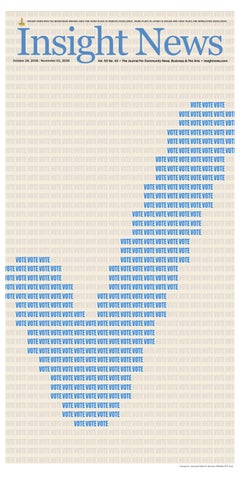
insightnews.com Insight News • October 26, 2026 - November 01, 2026 • Page 1 VOTE VOTE VOTE VOTE VOTE VOTE VOTE VOTE VOTE VOTE VOTE VOTE VOTE VOTE VOTE VOTE VOTE VOTE VOTE VOTE VOTE VOTE VOTE VOTE VOTE VOTE VOTE VOTE VOTE VOTE VOTE VOTE VOTE VOTE VOTE VOTE VOTE VOTE VOTE VOTE VOTE VOTE VOTE VOTE VOTE VOTE VOTE VOTE VOTE VOTE VOTE VOTE VOTE VOTE VOTE VOTE VOTE VOTE VOTE VOTE VOTE VOTE VOTE VOTE VOTE VOTE VOTE VOTE VOTE VOTE VOTE VOTE VOTE VOTE VOTE VOTE VOTE VOTE VOTE VOTE VOTE VOTE VOTE VOTE VOTE VOTE VOTE VOTE VOTE VOTE VOTE VOTE VOTE VOTE VOTE VOTE VOTE VOTE VOTE VOTE
Insight News
INSIGHT NEWS WON THE MESSENGER AWARDS 2024 F OR THIRD PLACE IN WEBSITE EXCELLENCE, THIRD PLACE IN LAYOUT & DESIGN AND FIRS T PLACE F OR NEWSLETTER EXCELLENCE.
2026 VOTE - November 01, 2026 Vol. 53 No. 43 •VOTE The Journal ForVOTE Community News, Business & The Arts •VOTE insightnews.com VOTEOctober VOTE26,VOTE VOTE VOTE VOTE VOTE VOTE VOTE VOTE VOTE VOTE VOTE VOTE VOTE VOTE VOTE VOTE VOTE VOTE VOTE VOTE VOTE VOTE VOTE VOTE VOTE VOTE VOTE VOTE VOTE VOTE VOTE VOTE VOTE VOTE
VOTE VOTE VOTE VOTE VOTE VOTE VOTE VOTE VOTE VOTE VOTE VOTE VOTE VOTE VOTE VOTE VOTE VOTE VOTE VOTE VOTE VOTE VOTE VOTE VOTE VOTE VOTE VOTE VOTE VOTE VOTE VOTE VOTE VOTE VOTE VOTE VOTE VOTE VOTE VOTE VOTE VOTE VOTE VOTE VOTE VOTE VOTE VOTE VOTE VOTE VOTE VOTE VOTE VOTE VOTE VOTE VOTE VOTE VOTE VOTE VOTE VOTE VOTE VOTE VOTE VOTE VOTE VOTE VOTE VOTE VOTE VOTE VOTE VOTE VOTE VOTE VOTE VOTE VOTE VOTE VOTE VOTE VOTE VOTE VOTE VOTE VOTE VOTE VOTE VOTE VOTE VOTE VOTE VOTE VOTE VOTE VOTE VOTE VOTE VOTE VOTE VOTE VOTE VOTE VOTE VOTE VOTE VOTE VOTE VOTE VOTE VOTE VOTE VOTE VOTE VOTE VOTE VOTE VOTE VOTE VOTE VOTE VOTE VOTE VOTE VOTE VOTE VOTE VOTE VOTE VOTE VOTE VOTE VOTE VOTE VOTE VOTE VOTE VOTE VOTE VOTE VOTE VOTE VOTE VOTE VOTE VOTE VOTE VOTE VOTE VOTE VOTE VOTE VOTE VOTE VOTE VOTE VOTE VOTE VOTE VOTE VOTE VOTE VOTE VOTE VOTE VOTE VOTE VOTE VOTE VOTE VOTE VOTE VOTE VOTE VOTE VOTE VOTE VOTE VOTE VOTE VOTE VOTE VOTE VOTE VOTE VOTE VOTE VOTE VOTE VOTE VOTE VOTE VOTE VOTE VOTE VOTE VOTE VOTE VOTE VOTE VOTE VOTE VOTE VOTE VOTE VOTE VOTE VOTE VOTE VOTE VOTE VOTE VOTE VOTE VOTE VOTE VOTE VOTE VOTE VOTE VOTE VOTE VOTE VOTE VOTE VOTE VOTE VOTE VOTE VOTE VOTE VOTE VOTE VOTE VOTE VOTE VOTE VOTE VOTE VOTE VOTE VOTE VOTE VOTE VOTE VOTE VOTE VOTE VOTE VOTE VOTE VOTE VOTE VOTE VOTE VOTE VOTE VOTE VOTE VOTE VOTE VOTE VOTE VOTE VOTE VOTE VOTE VOTE VOTE VOTE VOTE VOTE VOTE VOTE VOTE VOTE VOTE VOTE VOTE VOTE VOTE VOTE VOTE VOTE VOTE VOTE VOTE VOTE VOTE VOTE VOTE VOTE VOTE VOTE VOTE VOTE VOTE VOTE VOTE VOTE VOTE VOTE VOTE VOTE VOTE VOTE VOTE VOTE VOTE VOTE VOTE VOTE VOTE VOTE VOTE VOTE VOTE VOTE VOTE VOTE VOTE VOTE VOTE VOTE VOTE VOTE VOTE VOTE VOTE VOTE VOTE VOTE VOTE VOTE VOTE VOTE VOTE VOTE VOTE VOTE VOTE VOTE VOTE VOTE VOTE VOTE VOTE VOTE VOTE VOTE VOTE VOTE VOTE VOTE VOTE VOTE VOTE VOTE VOTE VOTE VOTE VOTE VOTE VOTE VOTE VOTE VOTE VOTE VOTE VOTE VOTE VOTE VOTE VOTE VOTE VOTE VOTE VOTE VOTE VOTE VOTE VOTE VOTE VOTE VOTE VOTE VOTE VOTE VOTE VOTE VOTE VOTE VOTE VOTE VOTE VOTE VOTE VOTE VOTE VOTE VOTE VOTE VOTE VOTE VOTE VOTE VOTE VOTE VOTE VOTE VOTE VOTE VOTE VOTE VOTE VOTE VOTE VOTE VOTE VOTE VOTE VOTE VOTE VOTE VOTE VOTE VOTE VOTE VOTE VOTE VOTE VOTE VOTE VOTE VOTE VOTE VOTE VOTE VOTE VOTE VOTE VOTE VOTE VOTE VOTE VOTE VOTE VOTE VOTE VOTE VOTE VOTE VOTE VOTE VOTE VOTE VOTE VOTE VOTE VOTE VOTE VOTE VOTE VOTE VOTE VOTE VOTE VOTE VOTE VOTE VOTE VOTE VOTE VOTE VOTE VOTE VOTE VOTE VOTE VOTE VOTE VOTE VOTE VOTE VOTE VOTE VOTE VOTE VOTE VOTE VOTE VOTE VOTE VOTE VOTE VOTE VOTE VOTE VOTE VOTE VOTE VOTE VOTE VOTE VOTE VOTE VOTE VOTE VOTE VOTE VOTE VOTE VOTE VOTE VOTE VOTE VOTE VOTE VOTE VOTE VOTE VOTE VOTE VOTE VOTE VOTE VOTE VOTE VOTE VOTE VOTE VOTE VOTE VOTE VOTE VOTE VOTE VOTE VOTE VOTE VOTE VOTE VOTE VOTE VOTE VOTE VOTE VOTE VOTE VOTE VOTE VOTE VOTE VOTE VOTE VOTE VOTE VOTE VOTE VOTE VOTE VOTE VOTE VOTE VOTE VOTE VOTE VOTE VOTE VOTE VOTE VOTE VOTE VOTE VOTE VOTE VOTE VOTE VOTE VOTE VOTE VOTE VOTE VOTE VOTE VOTE VOTE VOTE VOTE VOTE VOTE VOTE VOTE VOTE VOTE VOTE VOTE VOTE VOTE VOTE VOTE VOTE VOTE VOTE VOTE VOTE VOTE VOTE VOTE VOTE VOTE VOTE VOTE VOTE VOTE VOTE VOTE VOTE VOTE VOTE VOTE VOTE VOTE VOTE VOTE VOTE VOTE VOTE VOTE VOTE VOTE VOTE VOTE VOTE VOTE VOTE VOTE VOTE VOTE VOTE VOTE VOTE VOTE VOTE VOTE VOTE VOTE VOTE VOTE VOTE VOTE VOTE VOTE VOTE VOTE VOTE VOTE VOTE VOTE VOTE VOTE VOTE VOTE VOTE VOTE VOTE VOTE VOTE VOTE VOTE VOTE VOTE VOTE VOTE VOTE VOTE VOTE VOTE VOTE VOTE VOTE VOTE VOTE VOTE VOTE VOTE VOTE VOTE VOTE VOTE VOTE VOTE VOTE VOTE VOTE VOTE VOTE VOTE VOTE VOTE VOTE VOTE VOTE VOTE VOTE VOTE VOTE VOTE VOTE VOTE VOTE VOTE VOTE VOTE VOTE VOTE VOTE VOTE VOTE VOTE VOTE VOTE VOTE VOTE VOTE VOTE VOTE VOTE VOTE VOTE VOTE VOTE VOTE VOTE VOTE VOTE VOTE VOTE VOTE VOTE VOTE VOTE VOTE VOTE VOTE VOTE VOTE VOTE VOTE VOTE VOTE VOTE VOTE VOTE VOTE VOTE VOTE VOTE VOTE VOTE VOTE VOTE VOTE VOTE VOTE VOTE VOTE VOTE VOTE VOTE VOTE VOTE VOTE VOTE VOTE VOTE VOTE VOTE VOTE VOTE VOTE VOTE VOTE VOTE VOTE VOTE VOTE VOTE VOTE VOTE VOTE VOTE VOTE VOTE VOTE VOTE VOTE VOTE VOTE VOTE VOTE VOTE VOTE VOTE VOTE VOTE VOTE VOTE VOTE VOTE VOTE VOTE VOTE VOTE VOTE VOTE VOTE VOTE VOTE VOTE VOTE VOTE VOTE VOTE VOTE VOTE VOTE VOTE VOTE VOTE VOTE VOTE VOTE VOTE VOTE VOTE VOTE VOTE VOTE VOTE VOTE VOTE VOTE VOTE VOTE VOTE VOTE VOTE VOTE VOTE VOTE VOTE VOTE VOTE VOTE VOTE VOTE VOTE VOTE Concept by: Associate Editor & Associate Publisher B.P. Ford
Page 2 • October 26, 2026 - November 01, 2026 • Insight News
insightnews.com
AL MCFARLANE
insightnews.com
Insight News • October 26, 2026 - November 01, 2026 • Page 3
Insight News
INSIGHT NEWS WON THE MESSENGER AWARDS 2024 F OR THIRD PLACE IN WEBSITE EXCELLENCE, THIRD PLACE IN LAYOUT & DESIGN AND FIRS T PLACE F OR NEWSLETTER EXCELLENCE.
October 26, 2026 - November 01, 2026
Vol. 53 No. 43 • The Journal For Community News, Business & The Arts • insightnews.com
Community media takes center stage with regional Emmy® win, storytelling initiatives, and AI debate Public access television and grass-roots storytelling continue to prove their collective impact across the Twin Cities. In its October update, SPEAK MPLS marked national Community Media Day by celebrating major regional accolades, launching field-journalism segments, and hosting vital dialogues on local artificial intelligence adoption.
Hollies Winston and Anika Robbins
Five years later, Winston again faces an empty chair at Brooklyn Park mayoral forum Shelle Page disputes the invitation process but declines to elaborate as the mayor makes his case on housing, crime and economic development By Tom Gitaa Editor-in-Chief Mshale Five years after Hollies Winston found himself answering questions alone at a mayoral forum organized by minority-owned news organizations, history repeated itself Thursday when his challenger, City Councilmember Shelle Page, did not participate in a forum organized by Black Votes Matter Minnesota. But this time, Winston was the incumbent mayor, Page was the challenger, and a dispute over how the event was organized spilled into a public discussion on Facebook as Brooklyn Park voters prepared to choose their next mayor Nov. 3. Anika Robbins, founder of Black Votes Matter Minnesota, told the audience at North Hennepin Community College on Oct. 15 that Page had been invited several times and that organizers had offered to accommodate her schedule.
“We did reach out and extend an invitation to candidate Page,” Robbins said. She told the audience that Page initially said she was unaware of the event and subsequently was invited to suggest alternative dates. Robbins said Page ultimately declined, saying she was tired. Page offered a different account in a Facebook discussion about the forum, questioning the timing of the invitation. “We learned after the fact from organizers this event had been in planning for more than 90 days and publicly advertised since the beginning of September, but our office was not contacted until the 17th when we initiated it,” Page wrote. Page also said two sponsoring organizations had separately contacted her with apologies. “That timeline is important context,” she wrote.
The two accounts differ on how the invitation was handled, and neither Page nor Robbins has provided Mshale with a detailed timeline of their communications. Reached by Mshale on Monday, Page declined to elaborate on her absence, saying she wanted to focus on running a positive campaign and building Brooklyn Park. Mshale also emailed Robbins seeking clarification about the invitation timeline, the offer of alternative dates and Page’s account of apologies from sponsoring organizations. Robbins had not responded as of Tuesday. The forum proceeded with Winston answering questions about his record and plans for Brooklyn Park, including housing development, crime, property taxes, light rail and a proposed biotechnology district. Robbins moderated after Al McFarlane, editor-in-chief of Insight News,
was unable to attend because of the flu. Insight News was among the media partners involved in the event.
A familiar scene from 2021
The absence of a mayoral candidate from a forum involving Black-led organizations has a precedent in Brooklyn Park’s recent political history. In July 2021, then-mayoral candidate Lisa Jacobson declined to participate in an Aug. 3 forum organized by Mshale, Insight News and Hmong TV. Jacobson cited what she considered unfavorable coverage by Mshale. Winston, who was challenging Jacobson in that year’s special mayoral election, participated without his opponent. Jacobson went on to defeat Winston in a closely contested election that required a recount.
ancies. And we’re going to find the fraudsters. We’ll hire forensic auditors.” He also pledged to strengthen protections for whistleblowers. McFarlane noted that some critics question whether a physician, rather than an accountant, should oversee the state’s complex financial and pension systems. Jensen dismissed the criticism and said the job calls for a leader, not a technician: “This is not a technical position. This is not looking for someone who can create the magic secret sauce. This is a leadership executive position.” He said he served for a decade as audit chairperson of a billion-dollar bank, chaired the board of an accounting firm, has started numerous businesses and runs his own medical clinics. “I deal with financials every day,” he said. Jensen said most of
the fraud in Minnesota takes place in health and human services programs, where he served as vice chair of the Senate committee. He argued that shutting down troubled programs without fixing them hurts the people who depend on them, including residents who need daily caregiving, and he pointed to a housing program that was closed. He asked: “Who gets hurt there? Do the fraudsters get hurt or do the people that are homeless get hurt?” Asked where an auditor should look first, Jensen pointed to cities, counties, towns and school districts, and said the office also has a role in retirement programs for public employees and teachers. McFarlane asked how an auditor could build public trust in the way tax dollars are used. Jensen proposed an online tool: “I would want to create
Leading this month's milestones, SPEAK MPLS, alongside partners The Coven, Zeus Jones, Whittier Alliance, and Lake Street Council, was awarded the Upper Midwest Chapter’s Governors’ Emmy® Award for their collaborative project Show Up For Eat Street. The initiative leveraged media storytelling to drive direct economic support to small businesses along Nicollet Avenue. The movement raised nearly $200,000 for more than 40 local enterprises, highlighting the critical role independent media plays in sustaining small business ecosystems and immigrant-owned storefronts.
Community addresses generative AI in local arts and business
Producer spotlight: Raheem Crosby highlights Black culture
October’s producer spotlight features Raheem "Too Loud Crosby" Crosby, founder of
EMMY 10
The intersection of emerging
From Minneapolis to Bahia, leaders call for organized power and global solidarity
WINSTON 10 Anika Robbins
Scott Jensen pledges fast start on fraud oversight as Black leaders press for results Republican state auditor candidate Scott Jensen promised a fast start on fraud oversight during an October 20 appearance on The Conversation with Al McFarlane, where two Black community leaders pressed him on what accountability should mean for their communities. The program began as early voting was underway in Minnesota. Host Al McFarlane urged listeners to show up and cast their votes. Jensen, a physician and former state senator who was the Republican nominee for governor in 2022, said he has pledged that the auditor’s office would not ease into its work during his first 100 days: “We’re going to start at a hundred miles an hour.” He described his plan in short sentences: “We’re going to follow the money. We’re going to focus on the discrep-
Governors’ Emmy® award honors Eat Street initiative
technology and local culture emerged as a central theme in SPEAK MPLS’ latest AMPLIFY MPLS coverage: · Student demonstrations at MCAD: Freshmen at the Minneapolis College of Art and Design (MCAD) organized a peaceful protest addressing generative AI. Comic Art major Zero Trudeau emphasized the need to preserve artistic integrity, voicing concerns regarding the unauthorized use of artists' intellectual property to train machine-learning models. · Street perspectives in Uptown: A new Question of the Day (QOTD) segment gathered community viewpoints on AI utilization. Local opinions ranged from Curioso Coffee Bar barista Sofie Ostradius, who raised concerns about environmental impacts, to social media specialist Louie Pearson of The Breakfast Club, who characterized AI as a practical tool that should assist rather than replace human creative execution.
Credit: Wikipedia
Scott Jensen
a dashboard of dollars so people could easily find out what grants had been administered or extended.” He said residents should be able to find that information on the auditor’s website and report what they see. Jensen said legislators should consider fraud at the start of the process. Bills carry a policy section and a fiscal note estimating their cost, he said, and he wants to add a third leg to that stool: barriers to fraud built into the initial proposal,
Federal agents search Ilhan Omar’s home just 22 days before election PAGE 5
JENSEN 11
Bill English
Black leaders in Minnesota and Brazil said on The Conversation with Al McFarlane that the political fights in their communities are connected, and that meeting them will take organization, money and a clear shared vision. The October 20 broadcast brought together organizer Anika Robbins, community elder Bill English, Justin Terrell of the Minnesota Justice Research Center, and Yoji Senna, who joined from Bahia, Brazil. Host Al McFarlane asked them to talk about the connections between the concerns of Minnesota voters, and Black Minnesotans in particular, and the same issues around the world. Senna said Brazilians are apprehensive about the Oct. 25 runoff election, in which he said the son of Jair Bolsonaro is a candidate. He said the Bolsonaro movement plays the role in Brazil that MAGA plays in the United States, and that the two are closely allied. Senna said the move-
Justin Terrell
Yoji Senna
ment he opposes aims to cut social benefits that Brazilians have won. He listed free public transportation for people over 60, a 13th-month salary for workers and monthly stipends for children who stay in school. “We have a public health system that is the example in the world,” he said of the system known as SUS. Terrell said he sees the same pattern abroad. During a 2014 fellowship in the former Soviet bloc, he said, he arrived in Sofia, Bulgaria, on the day of a march he described as neo-Nazi. He came home telling his wife and colleagues that he believed the United States was in trouble because of a worldwide resurgence of extremism and nationalism. Terrell also expressed hope. He said Black Americans’ ancestors had already weakened the echoes of white supremacy that communities
LEADERS
8
No group works less for itself than African Americans Just 8% of Black workers are employed by Black-owned firms
PAGE 8
Page 4 • October 26, 2026 - November 01, 2026 • Insight News
insightnews.com
Commentary This election, justice is on the ballot What we’re doing instead of the Reimagining Justice Conference this year Executive Director
By Justin Terrell Every year the Minnesota Justice Research Center (MNJRC) holds a conference focused on reimagining justice. This event brings together scholars, activists, legal practitioners, and people directly impacted by the system – a diverse set of stakeholders with one goal in mind: to reimagine how we administer justice in the state of Minnesota. Over the past six years, we have explored a wide range of issues. And each year, people tell us they walked away feeling hopeful. This hope is what powers us to believe that a better system is possible. This year, we are pausing our regularly scheduled program to channel that hope to get people more engaged with our democracy. Because this election, justice is on the ballot. Ask yourself this question: Have you or anyone you
know been a victim of a crime or been prosecuted for one? What was your experience? Did you feel the process was fair, trustworthy, humane, or effective? We ask this question often, and rarely do we hear Minnesotans say the criminal legal system meets these standards. In fact, according to polling from the end of 2025, most Minnesotans (61%) support major changes or a complete overhaul of this system. To make that happen, people need to get involved in advocating for a system that reflects the values of Minnesotans—voting for the people who govern this system is one way to do that. Because we are a community-based research and advocacy nonprofit, MNJRC doesn’t do a
lot of door knocking or organizing. But this election cycle is different, and while we have plenty of research and policies to discuss, we are switching it up this year to focus on civic engagement and “reimagining democracy.".
Here’s what we’re doing instead of the conference:
• A Count Us In Democracy Fair, designed by and for justice-impacted Minnesotans, with resources and workshops focused on a wide range of topics such as know-your-rights education by the ACLU, a voting workshop from the League of Women Voters, and even a democracy-themed play by Mixed Blood Theater. • Interviewed the can-
didates for Hennepin County Attorney and shared this content, supporting our community with an understanding not just of each candidate’s policy positions but their willingness to be a part of real system change. • Expanded our public safety efforts by hosting a conversation in partnership with the Minnesota Land of Neighbors campaign to explore how Minnesotans can focus on building bridges with their neighbors to create safer communities • Canvassed door-to-door in three historically Black neighborhoods to better understand how the criminal legal system impacts these communities and why civic engagement is required for change. • Finally, after the election, we will invite community members to join us for an event on “Reimagining Democracy,” to debrief the results of the election with community and imagine what is possible under the new political landscape. All of these efforts will work to build a constituency laser-focused on how we administer
justice in our state. Thus, in addition to reimagining justice this year, we at the MNJRC are advocating for Minnesotans to reimagine their relationship with democracy. Whether you’re passionate about specific candidates or not, we’re reminding folks that if justice matters to you, democracy should too. Join us in talking about and pushing for the fair, equitable, effective, responsive administration of justice. This election and every election, justice is on the ballot. From a new Hennepin County Attorney, to judges, sheriffs, the Minnesota Attorney General, and prosecutors across the state, the people we vote in will have a direct hand in shaping what our criminal legal system will look like in the years to
come. They’ll be the ones responding to the next officer-involved shooting; they’ll investigate human trafficking and sexual assault, address racial disparities, close another prison; they’ll be the ones to respond if the federal government invades our state again. From now through Election Day, join us as we “Reimagine Democracy” and encourage Minnesotans to get to the polls in record numbers and elect just administrators of our system who will respond to the call to make Minnesota the safest place to live, work, play, and raise a family. We'll update the links below with information about the events we have coming up—we hope you'll join the effort to build a truly nonpartisan campaign to transform our criminal legal system. Visit mnjrc.org/conference to learn more/stay posted.
INSIGHT NEWS www.insightnews.com
Insight News is published weekly, every Monday by McFarlane Media Interests.
National Newspaper Publishers Association (NNPA)
CEO/Editor-In-Chief Al McFarlane
Postmaster: Send address changes to McFarlane Media Interests, Marcus Garvey House 1815 Bryant Avenue North, Minneapolis, MN, 55411
COO/Associate Publisher Trena V. Stubbs Publisher Batala-Ra McFarlane Associate Editor & Associate Publisher B.P. Ford Web Administrator Sunny Thongthi Yang Associate Editors Afrodescendientes Jesús Chucho Garcia Macdonald Anyanwu Book Review Editor W.D. Foster-Graham Sports Editor Leahjean M. Denley Contributing Writer Pulane Choane
KEITH ELLISON for Attor ney G eneral
STEVE SIMON
for Se c retar y of State
AMY KLOBUCHAR
PEGGY FLANAGAN
fo r Govern o r
fo r U.S . S e n a t e
BEN SCHIERER
ZACK FILIPOVICH
fo r L ieut en a n t Gover no r
fo r S t a t e Auditor
OFFICIAL 2026 GENERAL ELECTION SAMPLE BALLOT V O T E B Y N O V E M B E R 3 R D | I W I L LV O T E . C O M
PAID FOR BY THE MINNESOTA DEMOCRATIC-FARMER-LABOR PARTY (DFL.ORG), AND AUTHORIZED BY PEGGY FLANAGAN FOR MINNESOTA.
Columnist Haley Taylor Schlitz Distribution Sound Construction Photographer Uchechukwu Iroegbu Roy Lewis - Washington D.C. Artist Donald Walker Digital Producer Jared McMullin Graphic Designer Syed Fahad Fayyaz Contact Us: McFarlane Media Interests, Inc. Marcus Garvey House 1815 Bryant Ave. N. Minneapolis. 55411 Ph.: (612) 695-0417 Member: Minnesota Multicultural Media Consortium (MMMC) Minnesota Newspaper Association (MNA)
News, opinion and advertising at Insight News Our news reporting is fair, accurate and impartial. We report in context — the historical and cultural context that explains why a story matters to this community is part of the reporting, not a departure from it. When we endorse a candidate or take a position, we say so plainly and label it as such. Endorsements and commentary are separate from news coverage. Advertising is a business function. Advertisers do not influence our news coverage, our endorsements or our commentary — and our coverage does not depend on who buys space in this paper. That wall stands, and we are telling you it stands. Insight News uses AI-assisted tools in some editorial production. Read our AI Policy & Transparency Statement at www.insightnews.com/site/ ai_policy.html.
insightnews.com
Insight News • October 26, 2026 - November 01, 2026 • Page 5
Federal agents search Ilhan Omar’s home just 22 days before election Federal agents searched the D.C.-area home of Rep. Ilhan Omar (D-Minn.) on Monday, taking the extraordinary step of executing a criminal search warrant against a sitting member of Congress just 22 days before Election Day, as the Trump administration investigates allegations involving her family’s immigration records. The search immediately drew accusations of political intimidation from Omar’s supporters, who pointed to President Donald Trump’s repeated attacks on the Minnesota congresswoman and questioned the timing of an investigation targeting one of his most outspoken critics. “Representative Omar is a dedicated public servant and a true ally for working families, and Donald Trump has done nothing but use racist tropes and stereotypes to attack her,” said Joel Payne, MoveOn’s chief communications officer. “Now, he’s abusing his power to physically intimidate and harass her.”
A Justice Department spokeswoman acknowledged that Homeland Security Investigations agents, part of Immigration and Customs Enforcement, searched a District residence as part of an ongoing federal criminal investigation. The spokeswoman declined to provide additional information or publicly identify the person under investigation. According to published reports, the warrant identified possible violations involving false statements, immigration document fraud and conspiracy. Federal investigators have also examined questions concerning Omar’s finances, campaign funds and interactions with foreign citizens. No criminal charges against the congresswoman were identified, but Monday’s search occurred less than four weeks before voters decided whether to return Omar to Congress. The investigation follows months of public accusations from senior Trump administration officials, including
Vice President JD Vance, who previously claimed that Omar committed immigration fraud. In an interview with conservative commentator Benny Johnson, Vance asserted, without publicly presenting evidence, that the administration believed Omar had broken immigration laws. He also said he and White House deputy chief of staff Stephen Miller had discussed how to pursue the allegations. “What are the legal remedies now that we know that she’s committed immigration fraud?” Vance asked during the interview. “How do you go after her? How do you investigate her?” Omar has repeatedly rejected the accusations, including claims that she married her brother to facilitate immigration fraud. Her office dismissed Vance’s allegations in March as fabricated and defamatory. Questions about the investigation intensified in August when Immigration and Customs Enforcement refused to release records sought under the Freedom of Information Act concerning allegations surrounding Omar’s 2009 marriage to Ahmed Nur Said Elmi. The agency cited an exemption allowing law enforcement authorities to withhold records when disclosure could interfere with enforcement proceedings. The refusal did not establish that Omar committed fraud or, at the time, confirmed that she was personally under investigation. Omar, who came to the United States as a refugee from Somalia, was elected to Congress in 2018 and became one of the first two Muslim women to serve in the House. She represents Minnesota’s 5th Congressional District, which includes Minneapolis, and has frequently challenged Trump over immigration enforcement, civil rights, and his administra-
tion’s treatment of immigrant communities. Her confrontations with the administration have made her a recurring target of the president’s political attacks. The criminal investigation also follows a frightening incident earlier this year in which Omar was physically attacked during a public appearance. On Jan. 27, a man attacked Omar during a town hall meeting at the National Urban League’s Twin Cities headquarters in Minneapolis. The incident prompted condemnation from the National Coalition on Black Civic Participation and its Black Women’s Roundtable, which demanded accountability and warned against political violence. “We are shocked and extremely disturbed by the attack on Rep. Ilhan Omar yesterday while she attempted to address the critical issues and chaos swirling around in Minneapolis,” Melanie L. Campbell, president and CEO of the coalition and national convener of the Black Women’s Roundtable, said in a Jan. 28 statement. Campbell praised Omar for continuing to speak out despite threats against her. “We believe that NO public official should be threatened or physically attacked, especially when they are serving in the best interests of their constituents,” Campbell said. “Political violence and intimidation have no place in our democracy.” MoveOn, the progressive advocacy organization, accused Trump of using federal law enforcement to intimidate a political opponent and urged voters to respond at the ballot box. “On Nov. 3rd, we get our chance to fight back and hold him and his corrupt administration accountable,” Payne said.
IWILLVOTE.COM LEAD THE FIGHT AGAINST DONALD TRUMP INVESTIGATE ICE’S MURDERS AND STOP THEM FROM TERRORIZING OUR COMMUNITIES TAKE ON GUN MAKERS AND MAKE OPIOID COMPANIES PAY FOR THE LIVES THEY DESTROYED HOLD BAD LANDLORDS ACCOUNTABLE AND STOP THEM FROM RIGGING RENT PRICES PREPARED AND PAID FOR BY THE KEITH ELLISON FOR ATTORNEY GENERAL CAMPAIGN
Page 6 • October 26, 2026 - November 01, 2026 • Insight News
insightnews.com
Art, community and culinary vis
Filename: NorthEast-WallMural-sc10 Description: None Addl Desc: Customer: Snelling-Midway Redevelopment LLC (10021630) Finished Size (WxH): 489.50x142.75 Size with Bleed (for internal use): 490.00x143.25" Colors: Cyan,Magenta,Yellow,Black
Job Number: 280181 Operator: jeremy.johnson Date: 06.23.2026 02:41 PM
Cutting Inks (These Do Not Print) Cut Cut : 1265
Filename: SouthEast-WallMural-sc1 Description: None Addl Desc: Customer: Snelling-Midway Redevel Finished Size (WxH): 1100.50x154.1 Size with Bleed (for internal use): 11 Colors: Cyan,Magenta,Yellow,Black
Midway Diner
Midway Diner Ta-coumba rising AikTa-coumba Aiken believes the redevelopment the around Allianz Field should belong toenthebelieves people who redevelopment live near it, and he said the man behind it, Dr. Bill Mcrising around Guire, believes that too. “Dr. McGuire is about that. Editor Allianz Field This belongs to the community,” Aiken said during an should belongHis to October 12 walking interview at United Village. words offer a standard for measuringthethepeople district:who not livewelcome near it,there, and only how much gets built, but who feels said the shape man whose stories are visible and whosehe interests By Alnext. McFarlane behind it, Dr. what comes Bill McGuire, The occasion was a ribbon-cutting for The Midway Diner and Picco Pizza & believes Gelateriathat at too. 445 “Dr. McGuire is about that. Thistobelongs to thebeside commuSimpson Street, new additions the district the nity,” Aiken duringChamber an October 12 walking hosted interstadium. Thesaid Midway of Commerce view at United HisThe words offer a standard for the October 12 Village. gathering. event advisory featured measuring the district: how much gets Direcbuilt, St. Paul Mayor Kaohly not Her,only chamber Executive but welcome there, whose are Vincent visible tor who Chadfeels Kulas and culinary servicesstories director and whose among intereststhose shape what comes next. Francoual offering remarks. The was aseven ribbon-cutting for The The occasion diner is open days a week and Midway Diner and October Picco Pizza Picco would opened 14. & Gelateria at 445 Simpson Street, to the beside districtthe beside Thosenew areadditions modest details scalethe of stadium. Midway Chamber Commerce hosted the largerThe development, but theyofshow how a stadium the October gathering. The event advisory district might12begin functioning between matchfeatured days. St. Paul Mayor Kaohly Her, chamber Executive Director Chad Kulas and game culinaryday services director Vincent A district beyond Francoual among those offering A stadium can gather thousandsremarks. for a match and then The dinercreate is open seven rhythms: days a week and empty. Restaurants different weekday Picco would opened October 14. meals, family gatherings, conversations between neighThose are modest detailsThat beside the scalematof bors and visits unrelated to soccer. distinction the butthe they showofhow a stadium terslarger in thedevelopment, Midway, where value redevelopment district beginsolely functioning between match cannot might be judged by attendance inside days. Allianz Field. The new establishments create reasons to return
Atodistrict the area beyond when thegame standsday are quiet. They do not, by
A stadium can gather whether thousands a match andopporthen themselves, establish thefor jobs, business empty. create different tunitiesRestaurants and other economic benefits rhythms: will reachweekday longtime meals, family gatherings, between beyond neighresidents. Those outcomesconversations will require evidence
Picco Pizza bors and visits unrelated to soccer. That distinction matthe ribbon-cutting. ters in the Midway, where the value of redevelopment Developer Dr. Bill McGuire used the event cannot be judged solely to byaattendance inside Allianz to connect the openings much longer ambition. He Field. establishments createMayor reasonsChris to return tracedThe the new stadium project to former Coletoman the and areathe when the to stands are quiet. They dosoccer not, byin effort establish professional themselves, establish jobs,here business the community. “Thewhether journey the getting reallyopporstarted tunities economic benefits reach longslightlyand overother a decade ago with Mayorwill Chris Coleman,” time residents. willwas require McGuire said. Those He saidoutcomes the stadium builtevidence privately, beyond ribbon-cutting. withoutthe taxpayer funds, and called the vision behind it Developer McGuire the event bold. “I call that bold,Dr. andBill I think it wasused insightful.” to connect the to athe much He“I Heopenings also named costlonger of theambition. long road. traced thealso stadium project to former it Mayor Christoo Colewant to say that unfortunately, has taken long man effort establish professional soccer in and and it hasthecost too to much. We have to approach things the journey getting here really gave started likecommunity. this better,”“The McGuire said. That admission the slightly over aa second decade purpose. ago with Mayor Chris Coleman,” celebration It marked progress while McGuire said. Hethat said stadium wasVillage built privately, acknowledging thethe larger United vision rewithout taxpayer funds, and called vision behind it mains unfinished. Restaurants and the art are visible today; bold. call that bold, and Irequire think itadditional was insightful.” other“Iproposed amenities decisions. He also namedwhat the cost the long The difference between has of opened androad. what“Iis want to also say that unfortunately, it has taken long still envisioned is central to understanding thetoo project’s and it has cost too much. We have to approach things present condition. like this better,” McGuire said. That admission gave the celebration a second purpose. It marked progress while Aiken on the village acknowledging that the reAiken approached the larger districtUnited from Village anothervision direction. mains unfinished. Restaurants and artchildren are visible His interview linked soccer, music, andtoday; shared other amenities require spaceproposed into a statement about whoadditional the projectdecisions. is for. He The between has opened what isis saiddifference McGuire is putting what his money whereand his mouth still envisioned is central to understanding the project’s and working to get people to work together, but that the present condition. effort cannot rest on one man. “But we need other people to do that, too, and step up,” Aiken said. “It has to be
Aiken on you the know, villageor a global village.” a village,
Aiken approached district from another direction. Soccer, the in his telling, is what opens that vilHis linked“And soccer, music,it’s children andstadium, shared lageinterview to the world. because a soccer space intothe a statement who the is for. Hehe you got world thatabout can make thisproject stuff happen,” said putting his place money where his is mouth is said.McGuire He then is turned to the itself. “This the vorand to getit is. people to you workthink together, but thatis, tex. working This is where I know Minneapolis
the cannot rest on man. “But we need other buteffort St. Paul is really theone place.” people to do He that,described too, and seeing step up,” said. “It has theAiken game’s reach firsttohand. be a village, you know, a global village.” “No matter where or I went, Brazil, Australia, Afin his telling, opens rica, they Soccer, were playing soccer is in what the dirt, in that the vilsand, lage the we world. it’s a soccer andtonow have“And it inbecause the stadium,” Aiken stadium, said. The you got the that can make he contrast is world striking. Soccer does this not stuff beginhappen,” with a major said. He then turned to the place itself. vor-offacility. It begins wherever people find“This roomistothe play, tex. where it is. Iand know think Minneapolis ten This with is few resources littleyou ceremony. A stadium is is,one butexpression St. Paul is of really place.” the the game’s international reach; AikHe described the game’s reach energy firsten’s artwork is another,seeing connecting the sport’s hand. matter where went, Brazil, Australia, Afto the“No imagination of an Iartist who insists St. Paul is the rica, they were playing soccer in the dirt, in the sand, place where it happens. and now weAiken have italso in said the stadium,” said. The he used toAiken play soccer himcontrast striking. Soccer not begin with a major self, andishe spoke of doingdoes this work for children. Those facility. It begins find roomoftohis play, ofcomments placewherever children people near the center vision. ten with few resources andart little A stadium is The significance of the is ceremony. not restricted to visitors one expression of the game’s international Aik-up arriving for a professional match. Childrenreach; growing en’s artwork is another, connecting the sport’s nearby should encounter an environment that energy commutonicates the imagination an artist who insists St. Paul is possibilityofrather than exclusion. Public artthe can place it happens. makewhere that message visible without requiring admission, also said he used But to play socceralone him- is a ticket or Aiken specialized knowledge. visibility self, he spoke of doing this work for children. Those not and the same as belonging. comments place children near the center of his vision. The significance of the art is not restricted to visitors Music, movement arriving for a professional match. Children growing up and the mural nearby should encounter an environment that commuAskedrather how than the piece camePublic together, Aiknicates possibility exclusion. art can en turned to music. He said it was a lot like the music make that message visible without requiring admission, plays somewhere between voices a he ticket or often, specialized knowledge. Butvirtuoso visibility aloneof Maiden Voyage and Randy Weston, isHerbie not theHancock same as on belonging. who famously said, "We are historians, and it is our purpose to tell the people the true story of our past, and to Music, extend movement a better vision of the future. We all have music and mural in usthe - your heartbeat is your drum, your voice is your Asked pieceis came together, to sound how - andthe music supposed to putAiken you inturned tune with music. He said it was a lot like the music he plays often, nature."
somewhere between Herbie Randy virtuoso Weston voices never of failed to Hancock make the onconnections Maiden Voyage andAfrican Randy and Weston, who famously between American music. His said, “We arewas historians, and it part is our to tell dedication due in large topurpose his father whothe told people thethat truehestory past, and a bethis son was,ofanour African borntoinextend America. "He tertold vision theto future. all myself have music in us -him your me Iofhad learn We about and about and heartbeat is your drum, yourWeston voice issaid, your "and soundthe - and about my grandparents," only music youtoingotune with nature.” way is to supposed do it was to I'dput have back to the Motherland one day." Randy Weston never failed to make the connections between African music. His a Aiken said that and he American was thinking about dedication wasThe duereferences in large part his establish father who movement. dotonot a told single hisfixed son interpretation that he was, an born America. of African the work; theyinshow how “He Aiken told me I had learn about myself and about him and described histoown creative thinking. about my grandparents,” Weston said,who “andwas thepresent, only McGuire praised Aiken, way do it was I’d have backoftothe thebuilding Motherland andtocalled the mural on to thegoback an exone day.”of using walls to improve everyday life. Aiken’s ample Aiken said that the he was about was a own explanation of how imagethinking was applied movement. The references do viewer not establish a single“It more technical than a casual might expect. fixed interpretation of thebut work; they show how The Aiken looks like it’s painted, it’s vinyl,” he said. madescribed creative terial, ashis he own described it, thinking. conforms to the building, and present, the bumpsMcGuire and boltspraised on the Aiken, wall arewho left was in place rather and called the mural on the back of the building an exthan hidden. ample of using walls to improve everyday life.overlooked Aiken’s That account reveals an often own explanation of how was applied wasan dimension of public art:the theimage collaboration between more technical than aand casual might expect. “It to artist’s composition the viewer production work needed looks it’s painted, but it’s said. The macarrylike it onto architecture. Thevinyl,” viewerhesees a continuous terial, as he described conforms to the building, andreimage. Behind it are it, decisions about surface, scale, the bumps and bolts on the wall left in result place depends rather production and installation. Theare finished than hidden. on those choices. That reveals an oftenwhy overlooked Theaccount mural also demonstrates public art dimension public thedevelopment collaborationprocess. betweenBuildan can matterofearly in art: a long artist’s composition and the production needed ings may remain proposed, and somework parcels maytorecarry onto architecture. viewerchanges sees a continuous mainit empty, but artworkThe already how a place image. are decisions about surface,contribution scale, relooks Behind and howitpeople talk about it. Aiken’s production and installation. The finished result depends gives United Village an identity beyond signage and onreal those choices. estate. Whether that identity becomes a genuinemural demonstrates publicmade art ly sharedThe civic assetalso depends on the why decisions
insightnews.com
Insight News • October 26, 2026 - November 01, 2026 • Page 7
sion converge at United Village Job Number: 280181 Operator: jeremy.johnson Date: 06.23.2026 02:41 PM
10
lopment LLC (10021630) 13 101.00x154.63" Cutting Inks (These Do Not Print) Cut Cut : 2509
St. Paul Mayor Kaohly Her, culinary services director Vincent Francoual, and Developer Dr. Bill McGuire cutting the ribbon for Midway Diner and Picco Pizza & Gelateria at 445 Simpson Street
Ta-Coumba T. Aiken can matter early in a long development Buildbe and described as potential, but for residents may also culturalability, spacesemployment and future housing connect developmentanand artisticin voices. Theirnot presence around the art, including process. access, maintenance opportunities andwith the the ability ber,demonstrated interest the project, a docdepict. United Village’s progress itshould be judged ings may remain proposed, and some voices. parcels may resymbolizethrough the distance between a planpublished and its delivery. neighborhood rathertothan stand apart from it. That testtheir demonstrated an interestabout in theits project, notReporting a documentthe role of neighborhood of residents influence decisions affecting umented consensus effects. on completed work, commitments main empty, but artwork already changes how a place That tension rather than celebration includes pedestrian access, affordability, employment ed consensus streets. anddeserves the livedattention experience of people who use the area. a neighborhood transformation must distinguish the about its effects. Reporting on a neighborlooks and how people talk about still it. Aiken’s do not produce McGuire saidnecessarily photographs hang inside acknowledgment of delays hood ambitions of its sponsors from thethe experiences opportunities and McGuire’s the ability of residents to influence transformation must distinguish ambitions of The development aheadcontribu- alone. Years of proposals tion gives United Village an identity beyond signagethat extend the spacesthe theybuilding depict. United Village’s progress by Valerie Jardin, whom should he described andaffecting expense their opens room for a more complete dis- its sponsors residents from who will live with theofresults. decisions streets. the experiences residents who will McGuire outlined ambitions and real estate. Whether becomesHe a genujudged as through completed work, published cussion of the project. Celebrating opening a French street photographer who commitlives in MinneQuestions of stewardship are especially McGuire’s acknowledgment of the delays and of live with the results. well beyondthat the identity two restaurants. describedbe plans inely shared civic asset depends the decisions ments the lived experience people who weeks use thevisitors businesses need prevent scrutiny of unbuilt He also promisedofthat in three important for spaces as public. Access imcan expense opens room for anot more complete discussion of for another one-acreonpublic park andmade garden, an out- andsota. Questions ofdescribed stewardship are especially around the art, including access,for maintenance and the festivals, area. phases. Appreciating a major artwork need would see three sculptures that would make them be shaped by hours, programming, maintenance, the project. Celebrating the opening of businesses need not portant door amphitheater weekend markets, for spaces described as public. Access can be role of neighborhood voices. McGuire said photographs hang inside the not prevent smile. settle scrutiny questionsof about priorities. aThe shaped transportation and informal expectations who unbuiltdevelopment phases. Appreciating movies and winter ice skating, and a smaller indoor by hours, programming, maintenance,about transporuseful account of United Village can develhold both belongs. A beautiful place is most useful when peoartwork need not settle questions about music venue with associated retail and offices,building along by Valerie Jardin, whom he described as a major most tation and informal expectations about who belongs. A French street photographer lives in Minnesota. He opmenttruths: significant investments have become visible, ple can actually use it. The quality of that invitation The development still ahead with housing. “So lots to do, all are on the drawing Investment andwho accountability priorities. The most useful account of United beautiful place is most useful when people can actually also promised that in three weeks visitors would see and substantial portions of the envisioned district visible in everyday experience, long after McGuire outlined beyond board,ambitions hoping to that be letextend loose,”well McGuire said. A pub- McGuire posed a direct question about the project’s Village can hold both truths: significant investments usebecomes it. The quality of that have invitation becomes visible in three sculptures that would make them smile. remain to be realized. opening-day speeches ended. the two restaurants. Hecan described plans for another one- developlic event articulate a vision; a finished next steps. “Do we, in fact, believe enough in our have become visible, and substantial portions of the everyday experience, long after opening-day The culinary openings may alsospeeches provide acre public park and garden, an outdoor amphitheater ment requires additional commitments that can be communities to invest in them? To invest in this envisioned district remain to be realized. have ended. a way to evaluate the district over time. Restaurant for weekend markets, festivals, movies and winter ice Investment and documented and measured. one?” heaccountability asked. He pressed the point, asking whethA village still being built The culinary openings may also staffing, customer patterns andprovide connec-a skating, and a smaller indoor music venue with associa direct about the project’senough An outdoor amphitheater couldMcGuire sup- posed er the city and itsquestion leaders trusted one another Aiken the project A village stillsaid being built cannot belong to a single per- wayactivity, to evaluate the district over time. Restaurant actions with nearby businesses can be observed and ated retail andport offices, along withfestivals housing.and “Soother lots togatherings. next steps.to“Do in fact, believe enough in our comperformances, act.we, “Does the community, our city and its leaders institution. That observation much Aiken son saidorthe project cannot belong to aapplies singleaspertivity, staffing, customer patterns with reported. Those measures will and offerconnections a more concrete do, all are on the drawing board,could hoping to becultural let loose,” munities investand in them? invest this one?” he those A music venue bring activity into tobelieve trust inTo each otherinenough to make to civic leadership and commercial investment as son or institution. That observation applies as much to nearby businesses can be observed reported. Those picture of neighborhood impactand than promotional McGuire said.the A public cansoccer. articulate a vision; a add asked. pressed the point, asking whether cityof decidistrictevent beyond Housing could res- Heinvestments?” And he challenged thethe pace to art. A and neighborhood be manufactured civic leadership commercialcannot investment as to art. language attention measures willalone. offer They a moredeserve concrete picture as of United neighfinished development requires additional anddifits leaders anothertoenough act. “Does idents whose daily routinescommitments create activity at sions.trusted “Are one we going supporttogrowth, or are A weneighborhood through one ribbon-cutting. It grows through recannot be manufactured through one Village moves from a development concept toward impact than promotional language alone. They that can be documented andEach measured. the community, city and itshe leaders believe and question trust ferent hours. possibility also raises practical going our to hinder it?” asked. “The big is, peated opportunities for people to gather, work, cre- borhood ribbon-cutting. It grows through repeated opportunities a place with routines. Anquestions. outdoor amphitheater support per- the inhouseach other to to make investments?” And attention as United Village moves from a deare enough we going stopthose kicking the can down the road Who would could be able to afford ate and recognize themselves in the places around deserve for people to gather, work, create and recognize themAiken’s words pointwith to the measure that formances, festivals and other A music venhe and challenged the pace of decisions. to velopment concept toward a place routines. ing? Would the gatherings. public spaces be welcoming and act decisively, quickly,“Are and we takegoing advantage of them. selves in the places around them. whetherwords children and to neighbors recognize ue could bringaccessible? cultural activity into the district beyond support growth, or are we going to hinder it?” he asked. Would neighborhood businesses and what’s there?” The October 12 event offered a glimpse matters:Aiken’s point the measure that The October 12 event offered a glimpse the district as achildren place that them. soccer. Housing could add residents whose rou“The are we going framed to stop kicking the as a of that artists have a meaningful chancedaily to participate? Thebig question is, His remarks investment possibility. The Midway Diner and Picco matters: whether andincludes neighbors recognize the of that possibility. The Midway Diner and Picco addUnited Village them. now faces the harder tines create activity at will different hours. whether Each possibility can down civic the road and act quickly, and take answers determine the development choice. Thedecisively, public interest, however, requires added places to meet. Aiken’s mural placed a dis- district as a place that includes ed places to meet. Aiken’s mural placed a distinctive turning an expansive vision into a funcalso raises practical questions. Who wouldasset be able to advantage of what’s functions as a neighborhood or primarily as a more than there?” speed. It requires clear information about tinctive artistic voice on the landscape. McGuire work ofUnited Village now faces the harder work artisticdescribed voice on athe landscape. a tioning neighborhood destination. The next chapafford the housing? Would public spaces be welHis remarks framed as a civic destination for the visitors. what is proposed, howinvestment it will be funded, and how broader futureMcGuire of parks,described performances of turning an expansive vision into a functioning neighfuture of parks, ters will be written not only through construction coming and accessible? Would neighborhood businesschoice. public will interest, requires more broaderand McGuire also pointed to an empty lot The neighbors sharehowever, in the benefits. housing, while performances acknowledgingand thathousing, the project borhood destination.but Thethrough next chapters will be while acknowledging that the project has taken too long announcements, who enters thewritten public es and artists across have a from meaningful chance to participate? speed. It requiresThe clear information what is the loon sculpture known as Thethan Callstadium districtabout sits within a neighhas taken too long and cost too much. Each element not only through construction announcements, and cost too much. Each element belongs in the same not spaces, who finds opportunity there and whobut is The answers ing, will which determine whether themuch-maligned development CVS. proposed, how it will and how neighbors he tied to the A borhood withbeitsfunded, own history; a new development belongs in the same account, but they should through who enters the public spaces, who finds opaccount, they should not be mistaken for equivalent functions as avacant neighborhood asset primarilyasaspotential, a des- but willfor share enters in the benefits. parcel can beordescribed that landscape, but it does not erase what bebut mistaken for equivalent accomplishments. Open heard when plans change. Aiken put the standard and who istoheard when plans The change. plainly:there “This belongs the community.” disaccomplishments. Open businesses, completed art and portunity tination for visitors. Thethere stadium district withintest a neighborresidents it may also symbolize the distance bewas before. The sits practical is whether new businesses, completed art and prospective amenities Aiken put the standard plainly: “This belongs to the trict’s future will show how fully that principle is prospective amenities occupy different stages of the deMcGuire also pointed to an empty lot across hood with its own history; a new development enters occupy different stages of the development story. tween a plan and its delivery. That tension deserves restaurants, cultural spaces and future housing conhonored. The district’s future will show how fully velopment story. The ceremony brought together cham- community.” from the loonattention sculpturerather known The Calling, which that landscape, but the it does not erase rather what was thanascelebration alone. Years of pronect with neighborhood than there stand apart he tied to the much-maligned CVS. A vacant parcel practical whetherpedestrian new restaurants, The ceremony broughtvoices. together posals do not necessarily produce thecan spacesbefore. they The from it. Thattest testisincludes access, affordber, development and artistic Theirchampresence that principle is honored.
Page 8 • October 26, 2026 - November 01, 2026 • Insight News
insightnews.com
No group works less for itself than African Americans: just 8% of Black workers are employed by Black-owned firms An HBCU Money analysis argues that Black labor in the United States builds wealth mostly for institutions Black Americans do not own. The piece opens with an epigraph from William A. Foster, IV, who observes that when a Black worker earns a dollar, an owner elsewhere earns more than that from the same labor and counts the firm as an asset. The article uses a river-and-dam parable to make the point: a wage ends when the shift ends, while ownership keeps generating returns. The central figure comes from Pew Research Center. Black-owned employer firms employed about 1.6 million workers in 2022, with payrolls near $61.2 billion, against more than 20 million Black Americans in the labor force. HBCU Money calls this a “containment” statistic and frames it as a capacity argument rather than a moral one. It draws on economist Claud Anderson’s 1994 book Black Labor, White Wealth and sociologist Thomas Shapiro’s work on wealth versus income.
Leaders From 3 face today, and that his generation has work left to do: “I believe it’s probably our generation’s job to actually put an end to that conversation and start reimagining what this country’s greatness could actually be.” He pointed to violence-intervention work and to aunties and uncles working with young people, and he argued that the character of young people today is higher than when he was growing up in the 1990s. “We have a lot to be optimistic about,” he said. Robbins said organizing is essential but not enough. “Organizing is fundamental, is essential, but I think also what’s
The article lays out several measurements, citing Brookings, Census Bureau, Pew, and other sources: • Ownership density: Black-owned firms are 3.4% of U.S. employer businesses. Brookings found that in 2021 Black Americans owned 2.7%
of employer businesses against a 14.4% population share, the widest gap of any group it measured. • Firm size: About 96.3% of Black-owned businesses have no paid employees, compared with 81.1% for white-owned firms. Roughly
seven in ten Black-owned employer firms have fewer than ten employees. • Revenue: Blackowned employer firms average about $1.2 million in receipts, versus about $3.5 million for white-owned firms. • Sector concentra-
tion: Black-owned firms cluster in low-capital sectors such as health care and professional services, and are nearly absent from capital-intensive industries like utilities and heavy manufacturing. • Capital access: Black-founded startups received about 0.4% of U.S. venture capital in 2024. Federal Reserve data show Black-owned firms denied credit at roughly 39%, versus 18% for white-owned firms. The article also cites a gap in friends-and-family funding, averaging about $35,000 for Black founders against $100,000 to $150,000 for the typical startup, tied to the racial wealth gap. The piece acknowledges real growth. Black-owned employer businesses grew nearly 57% between 2017 and 2022, and Brookings found they posted the largest year-over-year gains in employees, revenue, and payroll of any group. But Brookings estimates it would take about 700,000 additional Black-owned employer firms
paramount is helping communities, especially grassroots community members, create or even see a vision for what is possible, right?” Asked by McFarlane to what end the organizing is directed, she described leaders she is cultivating in Duluth, St. Cloud and on the North Side, and she asked: “What does freedom, true freedom, self-actualization, what does that look like?” She said Black communities must organize even when they disagree: “We do have to move in an organized way, even if we don’t all see eye to eye, which is common.” She said turf can get in the way: “Here on the north side, it’s always conversation about whose lane is which.” The answer, she said, is to draw on the skills of
the creative and visionary people in each community. Robbins said people sometimes talk about leaving the Democratic Party or forming other organizations, but that any such effort needs a long-term plan and money: “We have to have the long-term strategic vision and we have to be able to fundraise. We have to be able to support and fund our own movements.” She said organizers also have families to support. On politics ahead, she said: “We’re seeing the rise of democratic socialism. That’s gonna be a thing.” She added that McFarlane might want to take up the subject in a future conversation. English, speaking about the relationship between Black voters and the Democrat-
ic Party, said Black Americans have gained little: “We allow them to take us for granted. We don’t challenge them with the hard questions.” He said rightwing movements are rising worldwide: “Across this world, right-wing people are trying to take over their country.” He tied the push against immigrants to the history of colonialism and said, “This country is built on immigration.” English said getting Black voters to the polls matters more than anything this year, and he praised Robbins: “This woman has done more to get the vote out than any organization I know, and I’ve been around for fifty years.” He said she has a team of young people in St. Cloud, Duluth and Rochester. He said he and others
tried to raise money to support that work: “We wrote to the fraternities, the sororities, the churches.” He said the community must fund its own efforts: “We need money to support us, and charity starts at home.” He asked what the community could do if every Black person in the Twin Cities gave two dollars. Speaking to Senna, English described solidarity between Africans wherever they live in the world as unfinished work: “It’s a goal we have yet to achieve, but we will keep working on it.” Terrell described the Minnesota Justice Research Center’s election-season plans. The center has paused its annual Re-imagining Justice conference and is hosting a nonparti-
Amy Klobuchar will fight for every Minnesotan
to reach parity with population share, and at the best recorded growth pace, parity is about a century away. HBCU Money ties the findings to four themes it returns to often: institutional density, capital retention, talent concentration, and strategic coordination. It points to 17 African American-owned banks holding about $6.72 billion and 205 credit unions holding about $8.15 billion, roughly $15 billion in combined capacity. It argues that deposit infrastructure alone cannot close the gaps, and calls for a Black-capitalized growth-equity layer. Its proposed solution is coordination among four groups: HBCU business schools that train operators, Black banks and credit unions that can supply working capital, a purpose-built growth-capital layer, and the roughly 200,000 existing Black-owned employer firms. The article ends by calling the 1.6 million figure a target rather than a statistic to mourn. san democracy fair at Sabathani Community Center on Saturday, Oct. 24, at 11 a.m., where residents can find out who is on their ballot and get a ride to the polls. An election debrief with food, music and art is planned for the Thursday after the election. In the meantime, canvassers are going door to door in Heritage Park and Rondo to talk about public safety and the criminal legal system, and to remind residents that judges, prosecutors and sheriffs are elected positions. McFarlane closed the program by calling for continued dialogue across borders: “I think we have to be in community on a global level. Issues are the same.”
Choose a health insurance plan that rewards you for getting care.
Strengthen our economy by making it easier to start and grow a small business, adding 10,000 apprenticeships so everyone can get the skills they need to build a good life, and lowering the cost of:
Health care by reducing premiums and drug costs. Housing by building more homes we can afford to buy and cracking down on out-of-state companies ripping off renters. Child care by expanding affordable child care options for families.
Prepared and Paid for by Minnesotans for Klobuchar, PO Box 4009 St. Paul, MN 55104
your community health plan
insightnews.com
Insight News • October 26, 2026 - November 01, 2026 • Page 9
Celebrating 41 years of planting seeds: the legacy of Seed Academy
Dr Ella L. Gates-Mahmoud In 1985, Seed Early Learning Academy began as a homebased childcare program on Upton Avenue North in Minneapolis. Forty-one years later, Seed Academy celebrates a legacy of education rooted in cultural pride, high expectations, family involvement, and love for African American children. For founder, Dr. Ella Gates-Mahmoud, the calling to teach began at age seven. In a makeshift classroom her father built between neighborhood garages in South Minneapolis, she gathered her brothers and other children for lessons, songs, and homemade worksheets. Those early experiences planted a life-
long commitment to helping children learn and recognize their worth. Her experiences as a special education student, adoptive parent, journalist, and childcare administrator strengthened that commitment. Reporting from the 1985 United Nations World Conference on Women in Nairobi also helped shape her vision for an engaging, culturally affirming learning environment. Seed Academy put that vision into practice through structured instruction, parental participation, and a simple philosophy: expect, model, and teach excellence. As enrollment
grew, the program moved into a renovated former grocery store on Golden Valley Road. The school became a source of hope in the neighborhood, drawing visits from community leaders and supporters, including Terry Lewis and Martin Luther King III. Families helped sustain its traditions, while elders such as Arlene El-Amin and Nola Richmond hand-stitched uniforms and Kente cloth graduation sashes. Parent demand also inspired Harvest Preparatory School, a separate nonprofit that extended the educational opportunity beyond preschool. In 1992, Seed Academy and Harvest Prep moved to a former nursing home at 1300 Olson Memorial Highway following a partnership with Wayman AME Church. Prince, who attended Minneapolis Central High School with Dr. Gates-Mahmoud, contributed $200,000 toward the building purchase. Harvest Prep later became a public charter school in 1999. Seed Academy's impact reaches beyond the classroom. Former students have grown into adults who contribute to their communities, and former employees have established schools and businesses of their own. Families remember a place where children were nurtured, challenged, and encouraged to dream boldly. As Seed Academy marks its 41st anniversary, its purpose remains clear: to help children develop academically, socially, and morally while affirming their identity and potential. What began in a home continues through generations of scholars, families, and educators carrying forward the seeds of excellence planted in 1985.
Your care. Your schedule. Your screen.
WE’RE HERE FOR GOOD
|
hennepinhealthcare.org
Page 10 • October 26, 2026 - November 01, 2026 • Insight News
Winston returned to the ballot in 2022 and won, becoming Brooklyn Park’s first Black mayor. The circumstances surrounding the two forum absences are not identical. Jacobson publicly identified her objections to one of the organizing news outlets in 2021. Page has questioned the invitation process in 2026 but declined Mshale’s request to explain her decision further. Page and Winston previously appeared together at an Aug. 27 candidate forum organized by the League of Women Voters of Brooklyn Park, Osseo and Maple Grove, where they addressed taxes, city spending, public safety and economic development.
or you have a racialized view of Brooklyn Park and what we deserve,” he said, referring to continued calls for affordable housing. He argued that creating better-paying jobs would allow more residents to purchase homes without relying on housing assistance. “I don’t want a city where people come in saying, well, you know, people in Brooklyn Park, they need affordable housing. I want people in Brooklyn Park to afford a house,” Winston said. Winston has made attracting higher-paying jobs and changing perceptions of Brooklyn Park central to his economic development agenda. His approach also raises questions about how the city would balance its ambitions for higher-end development with the housing needs of lower-income residents.
Winston pushes market-rate housing
Biotech district at the center of economic plans
Winston From 3
With no opponent onstage to challenge his positions, Winston used the Oct. 15 forum to defend his vision of a more economically prosperous Brooklyn Park, arguing that the city needs additional commercial development, higher-paying jobs and housing that can attract residents across income levels. His comments on housing were particularly pointed. “We want market rate. We want luxury. We want single family homes” Winston said. The mayor argued that Brooklyn Park already has a substantial supply of affordable housing and should prioritize market-rate apartments, single-family homes and higher-end development. “We have a glut of affordable housing in Brooklyn Park,” Winston said, arguing that the city had provided affordable housing long before it became a major policy priority. He described an approach in which roughly 80% of the city’s housing development efforts would focus on market-rate housing. Winston also suggested that some resistance to Brooklyn Park’s development ambitions reflects assumptions about what a racially diverse suburb should look like. “I’m not sure if you’re not getting the memo
Emmy From 3 Black Shark Worldwide. Crosby, who joined SPEAK MPLS after connecting with organizers at the Soul of the Southside Juneteenth festival, utilizes the studio to produce content rooted in '90s cinematic aesthetics, fashion, and hip-hop culture. His featured production, the Black Dreamers Show, broadcasts weekly on Mondays at 8:30 PM on SPEAK MPLS Channel 16, focusing on elevating community members whose stories often go untold.
Winston repeatedly returned to the city’s proposed biotechnology district as a cornerstone of his administration’s economic development agenda. He said the city has approximately 750 acres available for development along the Medical Alley corridor and wants to attract biotechnology, medical technology and advanced manufacturing companies. The mayor projected that the district could eventually support 5,000 to 10,000 jobs and approximately 3,000 housing units. Those figures represent development projections, not jobs or housing units already delivered. Winston said the city wants to connect young residents with future employment opportunities through education, training and apprenticeship programs. He also compared Brooklyn Park’s commercial property value with Bloomington’s, arguing that a gap of approximately $3.5 billion limits the city’s ability to fund services without placing greater pressure on homeowners. “We have to close a $3.5 billion gap,” Winston said. “That gap in commercial value, who has to shoulder that is residents, is homeowners,” he said.
Fall media workshops and studio opportunities
To expand access to media equipment and production skills, SPEAK MPLS announced its upcoming schedule of public workshops and studio gatherings held at their Northeast Minneapolis facility: • Pocket Production (Nov. 5): Adapting traditional filmmaking strategies to mobile device content creation. • Open Studio Gathering (Nov. 10 & Dec. 1): Facility tours and hands-on equipment orientations for aspiring creators. • Podcasting Essentials
Winston argued that attracting more commercial investment could eventually ease the pressure on residential property taxpayers. His administration, he said, wants to use state-authorized economic development tools and partnerships with private developers to attract investment. Winston also identified Brooklyn Boulevard as a redevelopment priority, saying the older commercial corridor needs additional retail, restaurants, housing and mixed-use development.
Data centers raise questions
The biotechnology discussion prompted audience questions about whether data centers might become part of the city’s development strategy and what their electricity and water demands could mean for residents. Winston acknowledged the concerns but stopped short of endorsing or rejecting data centers. “I haven’t committed to them or committed against them,” he said. He argued that data centers could generate substantial property tax revenue and help attract other technology businesses, but said their infrastructure demands would have to be evaluated. Winston said Xcel Energy would need to be involved in discussions about electricity capacity and that the City Council would have to consider the potential costs and benefits. He also said the city would not be inclined to assume the infrastructure costs associated with a data center. “I’m not going to commit one way or the other,” Winston said. “What I will commit to is I’m never going to create — I’m not going to enter into a deal that is bad for the city.” His remarks left open the possibility of data center development while acknowledging that no decision had been made.
Crime and policing
Public safety was another major theme. Winston said crime in Brooklyn Park has fallen to a 37-year low, crediting a combination of additional police offi-
insightnews.com cers, community violence intervention and alternative response programs. The mayor said the city’s police staffing had grown from approximately 88 officers when he took office to about 105, with an authorized strength of 109. He also pointed to efforts to recruit a more diverse police force. Winston described community intervention teams that can respond to potentially volatile situations involving young people and alternative response workers who can handle some mental health and family-related calls without immediately involving police. “You can be humane and you can have lower crime,” Winston said. He argued that those approaches allow officers to concentrate on more serious emergencies while reducing unnecessary involvement with the criminal justice system. “They’re not in the criminal justice system,” Winston said of people helped through alternative response. “They get to go on with their lives.” The crime statistics and staffing figures were presented by Winston during the forum and were not independently verified by Mshale for this report.
Light rail and economic opportunity
Winston also defended his support for the planned METRO Blue Line light rail extension, portraying the project as an economic development opportunity rather than simply a transportation investment. He said improved transit connections could help Brooklyn Park residents reach jobs and educational institutions while attracting additional commercial development. The mayor acknowledged historical concerns about transportation projects that dis-
placed Black communities, including St. Paul’s Rondo neighborhood and Chicago neighborhoods affected by highway construction. But he argued that Brooklyn Park should position itself to benefit from new investment rather than reject transportation expansion because of past injustices. Winston also challenged arguments that expanding transit would bring crime into suburban communities, saying some opponents were repeating fears associated with earlier battles over racial integration. “The reality of the situation is the vast majority of people do not get on light rail to just do something stupid,” he said. “They’re trying to get to and from work or to and from school or to and from a loved one.” He also rejected the suggestion that expanding bus service alone would generate the same level of economic development as light rail. Winston said better transportation connections could help residents access jobs in the proposed biotechnology district and elsewhere in the Twin Cities.
An election approaching
The Oct. 15 event was part of a series of candidate forums organized by Black Votes Matter Minnesota and its partners ahead of the general election. Robbins told attendees that the organization was nonpartisan and encouraged voters to research both candidates before casting their ballots. She said the organization’s voter guide included information about both Winston and Page despite Page’s absence. For Winston, the forum provided an opportunity to present his record and future plans without a direct challenge from his opponent.
For Page, the event became a dispute over the invitation process that she has chosen not to discuss further with Mshale. Brooklyn Park voters will decide the contest Nov. 3. Early voting is underway, and polls will be open from 7 a.m. to 8 p.m. on Election Day. Voters can find registration information, polling locations and sample ballots at mnvotes.gov.
About Tom Gitaa, Editor-in-Chief
Born and raised in Kenya's coastal city of Mombasa, Tom is the Founder, Editor-in-Chief and Publisher of Mshale which has been reporting on the news and culture of African immigrants in the United States since 1995. He has a BA in Business from Metro State University and a Public Leadership Credential from Harvard’s Kennedy School of Government. He was the original host of Talking Drum, the signature current affairs show on the African Broadcasting Network (ABN-America), which was available nationwide in the United States via the Dish Network satellite service. On the show, he interviewed Nobel laureates such as 2004 Nobel Peace prize winner, Professor Wangari Maathai, the first woman from Africa to win the peace prize and heads of states. Tom has served and chaired various boards including Global Minnesota (formerly Minnesota International Center), the sixth largest World Affairs Council in the United States. He has previously served as the first Black President of the Board of Directors at Books for Africa. He also serves on the board of the Minnesota Multicultural Media Consortium. He has previously served two terms on the board of the United Nations Association. An avid runner, he retired from running full marathons after turning 50 and now only focuses on training for half marathons.
VOTE NOV 3
(Nov. 17): Instruction on production, joystick camera operating, app-controlled lighting, and distribution. • Field Production (Dec. 10): Hands-on training for remote and location-based video capture. • LIVE on Set (Dec. 16): Multi-camera studio production, sound engineering, and green-screen studio control. Additional seasonal programming includes Halloween-themed broadcasts on October 31 featuring youth media showcases from the RYSE MPLS cohort on Channel 17, as well as upcoming municipal election coverage.
Prepare an pai for by a pion for tate enate, 1501 all urve, inneapolis, 55411
insightnews.com
Jensen From 3 so that fraud is prevented rather than only identified after money is missing. He also committed to regular contact with lawmakers of both parties: “I would commit ninety minutes every week to meeting with one of the legislative caucuses.” He said he would rotate among the Democratic and Republican caucuses in the House and Senate. Bill English, a longtime community leader, thanked Jensen for appearing. “First of all, I want to applaud Dr. Jensen for doing what some other Republicans won’t do.” McFarlane said few Republicans have responded to the program’s invitations. English then turned
Insight News • October 26, 2026 - November 01, 2026 • Page 11 to accountability. He said he agrees with Jensen about the Department of Human Services: “The Department of Human Services, whoever’s running it should have been fired two years ago.” English, who described a career in corporate and nonprofit work that included 32 years at Control Data, said the Black agencies he knows have been audited regularly: “I don’t know a Black agency that has not been internally audited every year and externally audited every two years and filed the management letters with their 990s.” English and McFarlane also raised the national political climate. English said democracy is at stake in this election, and McFarlane said he shares that view and asked Jensen to respond. Jensen answered: “I think there are things that are going on at the federal
level that are not simply astonishing, they’re sobering and incredibly disappointing.” He said he hopes for healing. After winning his first Senate race in 2016, he said, he used leftover campaign money for a billboard that said “time to heal.” He said the country needs to move on after the vote: “We need to get past these elections.” Justin Terrell, executive director of the Minnesota Justice Research Center, said the center’s community-based research leads it to value evaluation of government programs. He cautioned that evaluation has also been used against communities, and he asked Jensen: “How do you avoid letting the politics get in the way where we know that as we start evaluating these programs, often it’s used to strip resources from the communities that need it?” Terrell said Black
residents spend more time with government than any other population. He said his team asked residents at their doors in North Minneapolis the night before the broadcast, and the answer was distrust: “We don’t trust government. We don’t see it as effective. We don’t see it as doing what it claims to do.” He pointed to spending on policing and new task forces as an area where residents deserve evidence of results, and he asked how an auditor focused on effective use of resources could change their experience. Jensen agreed with Terrell: “I don’t think there’s been evaluation or even getting close to utilizing the tools that the state auditor has.” He said Minnesota would learn from studying states and cities that do better. “I think sometimes biases grow into our modus operandi. We don’t even realize it. We
get stuck in our bubble.” McFarlane said Jensen’s opponent, Zack Filipovich, was also invited but could not attend because of scheduling, and that he hopes to have him on the program before the
election.
Jensen closed by pledging to keep talking across political lines: “I have always been interested in having conversations that are outside the box.”
Page 12 • October 26, 2026 - November 01, 2026 • Insight News
insightnews.com
HELPING BLACK FAMILIES OWN A HOME! Build Wealth MN & partners are closing the Homeownership Gap! FINANCIAL EDUCATION SUPPORT The 9000 Equities Fund will provide affordable first mortgages to households struggling to access financial support in the African American community!
CREDIT REPAIR FAVORABLE MORTGAGE LOAN PRODUCTS DOWN PAYMENT ASSISTANCE ACCESS TO REPUTABLE LICENSED PROFESSIONALS
Since 2004, Build Wealth MN, has helped thousands of first time homebuyers not just buy a home...but keep it!
THIS COULD BE YOU!
612-871-9000
info@9000Equities.com
www.9000Equities.com