insightnews.com
Insight News • July 13, 2026 - July 19, 2026 • Page 1
Insight News
INSIGHT NEWS WON THE MESSENGER AWARDS 2024 F OR THIRD PLACE IN WEBSITE EXCELLENCE, THIRD PLACE IN LAYOUT & DESIGN AND FIRS T PLACE F OR NEWSLETTER EXCELLENCE.
July 13, 2026 - July 19, 2026
Vol. 53 No. 28 • The Journal For Community News, Business & The Arts • insightnews.com
Julyteenth: What the
FOURTH OF JULY has always meant
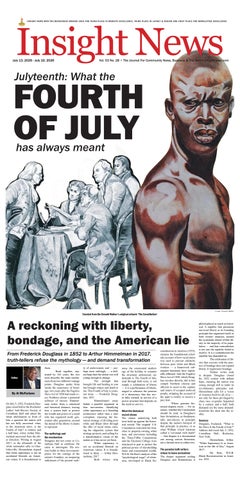
Credit: Donald Walker
Created from the Donald Walker's original artwork 'The Constitution'
A reckoning with liberty, bondage, and the American lie From Frederick Douglass in 1852 to Arthur Himmelman in 2017, truth-tellers refuse the mythology — and demand transformation them.
Editor
By Al McFarlane On July 5, 1852, Frederick Douglass stood before the Rochester Ladies' Anti-Slavery Society at Corinthian Hall and asked the white abolitionists in front of him a question the nation still has not fully answered: what, to the American slave, is the Fourth of July? A century and a half later, writer Arthur Himmelman answered from the other direction. Writing in August 2017, in the aftermath of the white nationalist rally in Charlottesville, Himmelman argued that white supremacy is not an accidental blemish on American values. It is foundational to
Read together, separated by 165 years, the two texts describe the same mechanism from two different vantage points. Douglass spoke from inside the experience of bondage, two years after the Fugitive Slave Act of 1850 had made every Northern citizen a potential enforcer of slavery. Himmelman writes from a structural and historical distance, tracing how a system built to protect the wealth and power of a small elite has organized itself, generation after generation, around the denial of the liberty it claims to represent.
The mythology and the mechanism
Douglass did not come to Corinthian Hall to celebrate. He came to interrogate. His oration builds in three movements: praise for the courage of the nation's founders, an unsparing indictment of the present reali-
ty of enslavement, and — perhaps most strikingly — a defiant hope that the nation was still young enough to change. The sunlight that brought life and healing to you has brought stripes and death to me. This Fourth of July is yours, not mine. — Frederick Douglass, 1852 Himmelman's essay builds a parallel argument in four movements: identifying white supremacy as a founding architecture rather than a later corruption, exposing the historical strategy of dividing poor white and Black labor through the offer of racial status, naming the oligarchic system that strategy protects, and calling for a transformative vision of the nation as it has never yet been. White supremacy is not an accidental blemish on American values. It is foundational to them. — Arthur Himmelman, 2017 Both writers strip
away the ceremonial mythology of the holiday to examine the structural architecture underneath it. The Fourth of July, read through both texts, is not simply a celebration of liberty — it is a performance of liberty, staged to rehearse the promise of a democracy that has never fully existed, in service of a power structure that depends on the myth to survive.
What the historical record shows
The claims underlying both texts hold up against the historical record. The original U.S. Constitution restricted the franchise to property-owning white men, and provisions including the Three-Fifths Compromise and the Electoral College were structured in part to protect the political power of slaveholding states and concentrated wealth. W.E.B. Du Bois's analysis of the "psychological wage" of whiteness, developed in Black Re-
construction in America (1935), remains the foundational scholarly account of how racial status was used to prevent solidarity between poor white and Black workers — a framework subsequent historians have repeatedly affirmed. And the Fugitive Slave Act of 1850, which Douglass invokes directly, did in fact compel Northern citizens and officials to assist in the capture and return of escaped enslaved people, stripping the accused of the right to testify or receive a jury trial. Where genuine historical dispute exists — for instance, whether the Constitution should be read, in Douglass's later formulation, as fundamentally anti-slavery in principle despite the nation's betrayal of that principle in practice, or as what William Lloyd Garrison called a "covenant with death" — that dispute is a documented one among serious historians, not a factual error in either text.
The paradox both writers refuse to leave unresolved
The deeper argument uniting Douglass and Himmelman is
philosophical as much as historical. A republic that proclaims universal liberty as its founding principle has organized itself, in both writers' analyses, around the systematic denial of that liberty to the majority of its population — and that contradiction is not one the republic failed to resolve. It is a contradiction the republic has depended on. The celebration of liberty that coexists with the practice of bondage does not expand liberty. It legitimizes bondage. Neither writer ends in despair. Douglass closed his 1852 oration with defiant hope, insisting the nation was young enough still to make its revolutionary principles real. Himmelman calls for a vision of America built for all of us — not only for those privileged by class, race, or gender. Separated by a century and a half, both demands are the same demand: transform the ideal into the reality.
Sources
Douglass, Frederick. "What to the Slave Is the Fourth of July?" Address delivered July 5, 1852, Corinthian Hall, Rochester, New York. Himmelman, Arthur. "White Supremacy Is as American as the 4th of July." August 2017. Du Bois, W.E.B. Black Reconstruction in America. 1935.