insightnews.com
Insight News • May 11, 2026 - May 17, 2026 • Page 1
Insight News
INSIGHT NEWS WON THE MESSENGER AWARDS 2024 F OR THIRD PLACE IN WEBSITE EXCELLENCE, THIRD PLACE IN LAYOUT & DESIGN AND FIRS T PLACE F OR NEWSLETTER EXCELLENCE.
May 11, 2026 - May 17, 2026
Vol. 53 No. 19 • The Journal For Community News, Business & The Arts • insightnews.com
The river returns to the North Side
Groundbreaking held for Upper Harbor amphitheater
Credit: Greg Helgeson / City of Minneapolis
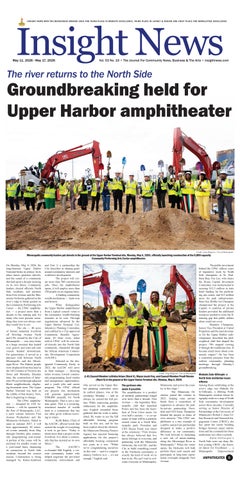
Minneapolis community leaders put shovels in the ground at the Upper Harbor Terminal site, Monday, May 4, 2026, officially launching construction of the 8,000-capacity Community Performing Arts Center amphitheater. On Monday, May 4, 2026, the long-dormant Upper Harbor Terminal broke its silence. In its place: music, speeches, shovels, and the sound of a community that had spent a decade insisting on its own future. Community leaders, elected officials, North Side residents, and partners from First Avenue and the Minnesota Orchestra gathered at the river’s edge to break ground on the Community Performing Arts Center — the CPAC amphitheater — a project more than a decade in the making and, for many who were present, something they were not always sure they would live to see. The site — 48 acres of former industrial riverfront off Dowling Avenue North and I-94, owned by the City of Minneapolis — was once home to a barge terminal that loaded coal, gravel, and road salt onto vessels headed downstream. For generations, it served as a physical wall between North Minneapolis and the Mississippi River. The Dakota people were displaced from this land in the 1851 treaties at Traverse des Sioux and Mendota. Decades later, the construction of Interstate 94 carved through adjacent Black neighborhoods, displacing thousands more. The Upper Harbor Terminal was built on the rubble of that history. Now, that is beginning to change. The CPAC amphitheater — designed by LSE Architects — will be operated by the Port of Minneapolis, LLC, a joint venture between First Avenue Productions and the Minnesota Orchestra. Slated to open in summer 2027, it will host approximately 50 ticketed events annually from May through October, plus community programming year-round. A portion of the venue will be enclosed for smaller events on a year-round basis, deepening its connection to North Side residents beyond the concert season. Construction is being managed by Kraus-Anderson
and Zuri 3, a partnership the City describes as sharing goals around community interests and workforce development. The project will create more than 500 construction jobs. Once the amphitheater opens, it will employ more than 250 people on an ongoing basis. A binding community wealth mechanism — hard-won and historic What distinguishes the Upper Harbor amphitheater from a typical concert venue is the community wealth-building structure at its core. Through negotiations advanced by the Upper Harbor Terminal Collaborative Planning Committee and codified in a City-approved Community Benefits Agreement, $3 from every ticket sold at CPAC will be reinvested directly into the North Side community, channeled through the African American Community Development Corporation (AACDC). Selected as the designated Community Entity in 2023, the AACDC will serve as fund manager — directing ticket revenue toward community programming, local vendor and entrepreneur opportunities, and a youth jobs and career program. The CPAC official site projects this mechanism will generate approximately $500,000 annually for North Minneapolis. That is not a onetime grant. That is a recurring, structured transfer of wealth back to a community that has too often given without receiving in return. Keith Baker, Chair of the AACDC, offered words that carried the weight of everything it took to get here: “Today is about more than a project on the riverfront. It is about a community that has insisted on its own future.” The AACDC’s co-founder Bill English, a veteran community leader who helped negotiate the per-ticket community reinvestment and
The public investment behind the CPAC reflects years of legislative work by North Side champions in St. Paul. State Rep. Fue Lee, who chairs the House Capital Investment Committee, was instrumental in securing $12.5 million in state bond funding for the performing arts center, and $15 million more for park infrastructure. State Sen. Bobby Joe Champion championed the project at the Capitol. A coalition of private funders provided the additional resources needed to close the financing gap that public dollars alone could not cover. Brandon Champeau, Senior Vice President at United Properties and the lead developer for the Upper Harbor redevelopment, described the philosophical shift that shaped the project: “We stopped viewing it through the traditional lens. It became much more about community impact.” He has been a consistent presence from the earliest community planning meetings through Monday’s groundbreaking. Credit: Greg Helgeson / City of Minneapolis
(L-R) Council Member LaTrisha Vetaw (Ward 4), Mayor Jacob Frey, and Council Member Pearll Warren (Ward 5) in the ground at the Upper Harbor Terminal site, Monday, May 4, 2026. who served on the Upper Harbor planning committee since its earliest phases, was at the ceremony Monday — and as always, he carried the full picture. While expressing genuine enthusiasm for the amphitheater, English reminded those gathered that the work is unfinished. He wants to see the full affordable housing program built on this site, and he has been explicit about the obstacle: the Minnesota Housing Finance Agency has rejected financing applications for the project’s affordable housing component two years in a row. “While we’re congratulating ourselves on this start — and it is congratulatory, I believe in it — it’s not enough,” English said.
The partners who made it possible
The amphitheater is a product of unlikely partnerships forged over more than a decade. First Avenue — the legendary Minneapolis club that launched Prince and has been the heartbeat of Twin Cities music for over half a century — is co-operator of what will be a publicly owned venue in a North Minneapolis park. President and CEO Dayna Frank was direct at the ceremony: “First Avenue has always believed that live music belongs to everyone, and partnering with the Minnesota Orchestra, the AACDC, and the City to build something rooted in the Northside community is exactly the kind of work we’re here to do. We can’t wait to welcome everyone in Minneapolis,
Minnesota, and across the country to this stage.” The Minnesota Orchestra joined the venture in 2023, helping raise private funds from a consortium of supporters to advance the public-private partnership. President and CEO Isaac Thompson framed the project in terms of civic mission: “The CPAC amphitheater is a true example of a public and private partnership designed to make a positive difference in our community. We look forward to launching a new era of music-making along the Mississippi River in Minneapolis.” When the venue opens, the Orchestra will both perform there each season and participate in long-term operational oversight alongside First Avenue.
Makeda Zulu-Gillespie: a North Side institution bears witness
Among those celebrating at the river’s edge was Makeda Zulu-Gillespie, a lifelong North Minneapolis resident whose biography reads as a map of North Side community development across three decades. Currently serving as Senior Director of Partnerships at the University of Minnesota’s Robert J. Jones Urban Research and Outreach-Engagement Center (UROC), she has spent her career building bridges between major institutions and the communities those institutions too often overlook. Z u l u - G i l l e s p i e ’s North Side roots run deep. Before joining UROC, she directed Quest for Excellence — a Minneapolis Empowerment
AMPHITHEATER 5