insightnews.com
Insight News • April 20, 2026 - April 26, 2026 • Page 1
Insight News
INSIGHT NEWS WON THE MESSENGER AWARDS 2024 F OR THIRD PLACE IN WEBSITE EXCELLENCE, THIRD PLACE IN LAYOUT & DESIGN AND FIRS T PLACE F OR NEWSLETTER EXCELLENCE.
April 20, 2026 - April 26, 2026
Vol. 53 No. 16 • The Journal For Community News, Business & The Arts • insightnews.com
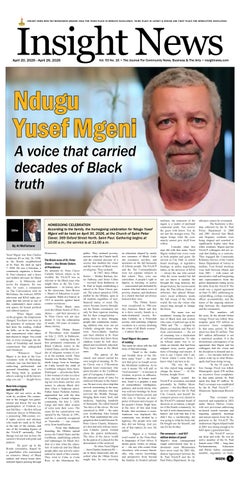
Ndugu Yusef Mgeni A voice that carried decades of Black truth
Editor
By Al McFarlane Yusef Mgeni was born Charles Anderson III on July 26, 1948, in the Rondo neighborhood of St. Paul. He died on April 7, 2026. He was a historian, a community organizer, a former St. Paul educator, and a fierce and faithful advocate for Black people — in Minnesota and across the diaspora. He was also, for years, a companion on The Conversation with Al McFarlane, the webcast, SPNN television and KFAI radio program that has served as one of this community's most consistent spaces for honest political and cultural analysis. When Mgeni came on the program, the temperature changed. You knew you were in the presence of someone who had done the reading, walked the halls, sat in the meetings, and remembered what others had chosen to forget. You could feel, in every exchange, the decades of friendship and shared commitment that undergirded each broadcast. “Whenever Yusef Mgeni is on deck at the Conversations with Al McFarlane webcast, you can feel their decades-long professional and personal friendship. And it’s like being back in graduate school, soaking in all the knowledge you can.” — Insight News
Born into a legacy and worthy of it
Mgeni did not arrive at this work by accident. His connection to the struggle was generational and literal. He was the grandnephew of Fredrick Lamar McGhee — the first African American lawyer in Minnesota, a pioneering 20th-century civil rights activist and attorney who made his mark in St. Paul at the turn of the century, and one of the founding figures of the NAACP nationally. That lineage was not lost on him. He carried it forward with pride and purpose. He grew up in the Rondo community, shaped by a grandfather who maintained an extensive library of Black authors and whose home drew national figures passing through
HOMEGOING CELEBRATION According to the family, the homegoing celebration for Ndugu Yusef Mgeni will be held on April 30, 2026, at the Church of Saint Peter Claver, 369 Oxford Street North, Saint Paul. Gathering begins at 10:00 a.m.; the service is at 11:00 a.m. Minnesota.
The Black nuns of St. Peter Claver — the Oblate Sisters of Providence
He attended St. Peter Claver Catholic School, where, as he recalled, the NAACP was as relevant to the Black nuns who taught there as the Ten Commandments — its history alive in the classroom, from Brown v. Board of Education to pickets against ‘Birth of a Nation’ in 1915 to marches against lunch counter exclusions. Those Black nuns were the Oblate Sisters of Providence — and their presence at St. Peter Claver was not incidental. It was the culmination of nearly 120 years of extraordinary history. The Oblate Sisters of Providence were founded on July 2, 1829, in Baltimore, Maryland — making them the first permanent community of Black Catholic sisters in the United States, and the oldest order of religious women of color in the modern world. Their founder was Mother Mary Elizabeth Lange, born in Santiago de Cuba, herself the child of Caribbean refugees from SaintDomingue — present-day Haiti. A free woman of color in a slave state, she had already been using her own home and her own money to educate Black children when a Sulpician priest, Father James Nicholas Joubert, approached her with the idea of founding a formal religious community. On July 2, 1829, Lange and three other women of color took their vows. The cause for her canonization was opened by the Vatican in 1991, and she is currently recognized as Venerable — one miracle away from beatification. From that Baltimore founding, the Oblates spread across the United States and the Caribbean, establishing schools and orphanages for Black children at a time when the education of enslaved and free Black people alike was actively criminalized in much of this country. They went to Cuba, to Costa Rica, to the Dominican Re-
public. They endured poverty, racism within the Church itself, and the constant pressure of a society that doubted the virtue and the vocation of Black women religious. They endured. In 1947, three Oblate Sisters — Mother Barbara, Sister Anthony, and Sister Celine — traveled from Baltimore to St. Paul to begin establishing a school at St. Peter Claver parish. The school opened in 1950, staffed by the Oblates, open to all students regardless of race, financial status, or creed. The sisters became known throughout the Rondo community not only for their rigorous teaching but for their evangelization — going door to door, bringing people into community, nurturing children who were not yet Catholic alongside those who were. Non-Catholic families sent their children to St. Peter Claver because they knew those children would be well disciplined and excellently educated. They knew them as the Black nuns. The patron of the church and school carried his own weight of meaning. St. Peter Claver was a 17th-century Spanish Jesuit missionary who spent decades at the Caribbean port of Cartagena, Colombia — the principal point of entry for enslaved Africans in the Americas. He met every slave ship that arrived, ministering to the men, women, and children who had survived the Middle Passage, bringing them water, food, and medicine, baptizing hundreds of thousands. He called himself ‘the slave of the slaves.’ He was canonized in 1888 — the same year Archbishop John Ireland of St. Paul established the congregation that would become St. Peter Claver Church, Minnesota’s first and only African American Catholic parish. Ireland chose the patron deliberately. The slave of the slaves would be the patron of a church for the descendants of the enslaved. So when Yusef Mgeni — born Charles Anderson III — sat in those classrooms and absorbed what the Oblate Sisters taught him, he was receiving
an education shaped by nearly two centuries of Black Catholic resistance, sacrifice, and insistence on the full humanity of African people. The NAACP and the Ten Commandments were not separate subjects in that school. They were one curriculum. A people’s right to dignity, to learning, to justice — consecrated and defended by women who had taken vows of poverty, chastity, and obedience in a church that had not always honored their own. “The Oblate Sisters were exceptional in 19th-century America: Black and free in a slave society, female in a male-dominated society, Roman Catholic in a Protestant society, and pursuing religious vocations in a society doubting the virtue of all Black women.” — Catholic Review
Yusef Mgeni: the power of naming
The name he chose tells the full story of that becoming. Yusef is the Arabic and Swahili form of the Hebrew name Yosef — the same root that gives us Joseph across the Abrahamic traditions. At its core it means ‘He will add’ or ‘God increases’ — to increase in wisdom, in power, in influence, in abundance. In Islamic tradition, Yusef is a prophet: a man of extraordinary intelligence, patience, and moral clarity, who was sold into bondage by those who feared what he carried, and who rose to become an interpreter of dreams and a keeper of his people’s future. Right here, in the story of this man from Rondo, that resonance is exact. Anderson was displaced. His community was divided by a highway. His people were told they did not belong. And yet, out of that rupture, he rose. He added. Mgeni is a Swahili word rooted in the Proto-Bantu languages of East Africa. It means guest, visitor, or stranger — the one who comes from elsewhere, who crosses thresholds, who carries knowledge and perspective from beyond the familiar. In Swahili cultural
tradition, the treatment of the mgeni is a matter of profound communal pride. You receive the guest with honor. You do not turn the stranger away. The mgeni brings what the community cannot give itself from within. Consider what this man did with that name. Yusef Mgeni walked into every room as both prophet and guest. He arrived at City Hall, at school board meetings, at legislative hearings, at police negotiating tables, at the airwaves of KFAI — always the one who carried what the room needed but did not yet know it needed. He brought the long memory, the deeper history, the inconvenient data, the Pan-African frame of reference that placed Minnesota’s racial arithmetic inside the full sweep of the African world. He was the visitor who stayed long enough to change the house. The name was not incidental. Among the generation of Black men and women who came of political age in the 1960s and ’70s — shaped by Black nationalism and Pan-African consciousness — the act of renaming was a declaration of self-determination. To take an African name was to reclaim an identity that had been stripped away across generations of bondage and erasure. It was to say: I know who I am. I know where I come from. I know what I am here to do. “He was the visitor who stayed long enough to change the house.” — Al McFarlane, Insight News Mgeni joined the NAACP at seventeen, recruited personally by Debbie Montgomery — the first Black woman ever elected to the St. Paul City Council, and herself the youngest person ever elected to the NAACP’s national board of directors at seventeen, a daughter of the Rondo community. As he told it with characteristic dry humor: she told him that if he didn’t buy a membership, she was going to whip his back end. He bought one for himself, and one for his brother.
The covenant — and $67 million dollars of proof
Mgeni’s most consequential single achievement may be a document most Minnesotans have never read: the 2001 Mediation Agreement between the St. Paul NAACP and the St. Paul Police Department. Its sig-
nificance cannot be overstated. The backstory is this: data collected by the St. Paul Police Department in 2000 and 2001 showed that Black and Hispanic residents were being stopped and searched at significantly higher rates than white residents. Mgeni and his NAACP colleagues did not accept that finding as a curiosity. They engaged the Community Relations Service of the United States Department of Justice to mediate. Four formal meetings were held between March and June 2001 — with senior administrative staff and bargaining unit representatives from the police department sitting across the table from the NAACP. The result was a signed agreement on June 19, 2001, addressing racial profiling, civilian oversight, officer accountability, and the terms of the ongoing relationship between the department and the community. The numbers tell the story. In the decade before George Floyd was killed, Minneapolis spent $70 million on excessive force complaints. In that same period, St. Paul spent less than $3 million. That $67 million differential is not a statistical accident. It is the downstream consequence of an agreement that Mgeni and his colleagues had the vision and the discipline to demand and secure — two decades before the nation woke up to what Minneapolis had been doing wrong. “In the 10 years before George Floyd was killed, Minneapolis spent $70 million on excessive force complaints. In that same period, St. Paul spent less than $3 million. St. Paul’s covenant was established by the St. Paul NAACP.” — Minnesota Spokesman-Recorder That covenant was renewed and expanded in 2022 under Mayor Melvin Carter, with new provisions addressing no-knock search warrants and requiring quarterly meetings and annual reports from the department to the NAACP. The architecture Mgeni helped build in 2001 was strong enough to be built upon a generation later. His NAACP service ran deep and wide. He was an active member of the St. Paul branch since 1988 — long-time Parliamentarian, Education and Public Safety committee member, negotiator on body-
MGENI
8