insightnews.com
Insight News • April 06, 2026 - April 12, 2026 • Page 1
Insight News
INSIGHT NEWS WON THE MESSENGER AWARDS 2024 F OR THIRD PLACE IN WEBSITE EXCELLENCE, THIRD PLACE IN LAYOUT & DESIGN AND FIRS T PLACE F OR NEWSLETTER EXCELLENCE.
April 06, 2026 - April 12, 2026
Vol. 53 No. 14 • The Journal For Community News, Business & The Arts • insightnews.com
Credit: Wikipedia
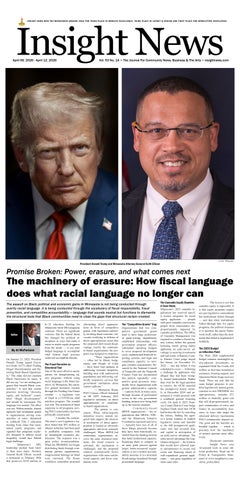
President Donald Trump and Minnesota Attorney General Keith Ellison
Promise Broken: Power, erasure, and what comes next
The machinery of erasure: How fiscal language does what racial language no longer can
The assault on Black political and economic gains in Minnesota is not being conducted through overtly racial language. It is being conducted through the vocabulary of fiscal responsibility, fraud prevention, and competitive accountability — language that sounds neutral but functions to dismantle the structural tools that Black communities need to close the gaps that structural racism created.
Editor
By Al McFarlane On January 21, 2025, President Donald Trump signed Executive Order 14173, titled “Ending Illegal Discrimination and Restoring Merit-Based Opportunity.” The order did not mention Black Americans by name. It did not say “we are ending programs that benefit Black communities.” It said that certain practices involving “diversity, equity, and inclusion” constituted “illegal discrimination” and should be terminated. The language was neutral. The effect was not. Within months, federal agencies had terminated grants to organizations serving communities of color, threatened to withhold Title I education funding from states that maintained equity programs, and signaled that programs explicitly designed to address racial inequality would face federal legal challenge. Minnesota’s DFL leadership pushed back harder than most states. Attorney General Keith Ellison secured a settlement in February 2026 that preserves $530 million in
K–12 education funding for Minnesota while DEI programs continue. These are significant victories. But the federal threat has changed the political atmosphere in ways that make it easier to attack equity programs from the inside — to use state budget language to accomplish what federal legal pressure could not accomplish directly.
The Fraud Narrative as Structural Tool
One of the most effective mechanisms for delegitimizing equity programs without using racial language is the fraud narrative. In Minnesota, this narrative gained enormous traction through the Feeding Our Future scandal — a legitimate case of fraud in a COVID-era child nutrition program. The scandal was real. The extension of fraud suspicion to all programs serving POCI communities has been politically constructed. Consider the contrast. The state’s own Legislative Auditor found that $93 million in ethanol subsidies had been paid to profitable companies with no meaningful economic justification. The response was a quiet policy recommendation. When the PROMISE Act began distributing funds through community partner organizations, congressional hearings on fraud were convened. The House workforce committee proposed
eliminating direct appropriations in favor of competitive grants, with legislators explicitly invoking fraud concerns. Advocates testifying in defense of direct appropriations noted that the proposed shift would disadvantage exactly the community-based organizations the program was designed to empower. “These organizations — often led by Black, Indigenous, and People of Color — have been vital partners in addressing systemic inequities, building trust with underserved populations and delivering culturally responsive services that government institutions alone cannot replicate.” — Minnesota House POCI Caucus, official statement on HF 2497, February 2023 legislative testimony on direct appropriations to community-based organizations The pattern is consistent. When white-majority industries receive named, targeted state support, the structural mechanism of direct appropriation is treated as obviously appropriate and never seriously challenged. When BIPOC-led community organizations receive the same structural treatment, the fraud concern is activated, the mechanism is challenged, and the proposed solution systematically favors organizations with more institutional capacity and fewer community roots.
The “Competitive Grants” Trap
Organizations that win competitive government grants tend to have large professional grant-writing departments, established relationships with government program officers, substantial operating budgets to cover proposal development costs, sophisticated financial reporting systems, and legal and compliance capacity to navigate complex requirements. Research by the National Council of Nonprofits and the Nonprofit Finance Fund has documented this pattern repeatedly: competitive grant processes structurally favor organizations with greater administrative capacity — capacity built, in many cases, through decades of preferential access to the very government funding streams now being held up as the neutral standard. Community-based BIPOC organizations — the organizations that MEDA, NDC, and the Minnesota Initiative Foundations represent and serve — typically have less of all of these things, precisely because they have been historically excluded from the funding streams that build institutional capacity. Requiring them to compete in an open grant process against larger, better-resourced organizations is not a neutral accountability measure. It is a structural disadvantage laundered through procedural language.
The Cannabis Equity Stumble: A Case Study
Minnesota’s 2023 cannabis legalization law reserved specific license categories for social equity applicants — people with prior cannabis convictions, people from communities disproportionately impacted by cannabis prohibition. The Office of Cannabis Management was required to conduct a Social Equity Lottery before the general licensing round, giving equity applicants an early-mover advantage in securing investments and real estate. A Ramsey County District Court judge stayed the lottery on November 25, 2024 — one day before it was scheduled to occur — following a challenge by applicants who alleged they had been wrongly denied participation. Rather than wait for the legal question to resolve, the OCM canceled the preapproval lottery entirely in December 2024 and announced it would proceed with a combined general licensing cycle. On April 4, 2025, Ramsey County District Court Judge Stephen Smith ruled that OCM had broken the law by canceling the lottery, finding the agency’s action contrary to explicit legislative intent and harmful to the 648 preapproved applicants who had invested time and capital in anticipation of an early-mover advantage. The early-mover advantage the Legislature designed — the window that would have allowed equity entrepreneurs to secure real estate and financing ahead of well-capitalized general applicants — was gone regardless of what came after.
The lesson is not that cannabis equity is impossible. It is that equity programs require not just legislative commitment but institutional follow-through — and that when institutional follow-through fails for equity programs, the political response is to question the equity framework itself, rather than the institution that failed to implement it faithfully.
The 2026 Budget as Inflection Point
The Walz 2026 supplemental budget contains meaningful equity-adjacent investments: an expanded Child Tax Credit, $34 million in first-time homebuyer assistance, housing support, and Operation Metro Surge recovery funds. These are real. But the same budget proposes to prohibit legislatively named grants, contains no new PROMISE Act appropriations, includes $71 million in disability grant cuts that will disproportionately impact communities of color, and frames its accountability measures in ways that target the structural delivery mechanisms POCI communities depend on. The good and the harmful are braided together — which is precisely how the machinery of erasure operates most effectively. Disclosure statement Insight News uses AI-assisted tools in some editorial production. Read our AI Policy & Transparency Statement at www.insightnews.com/ site/ai_policy.html.