Vietnam, Laos and Cambodia – InsideAsia Tours US

Page 1


Vietnam, Cambodia & Laos

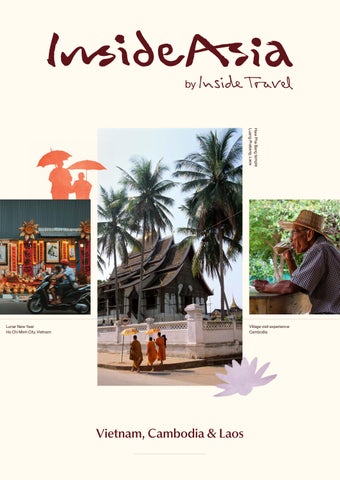
Haw Pha Bang temple Luang Prabang, Laos
Lunar New Year
Ho Chi Minh City, Vietnam
Village visit experience Cambodia

When

Where

Vietnam

Cultural

Where

Cambodia

Cultural

From the founders

Inside Travel was founded in 2000, working out of a spare bedroom in Bristol, England and inspired by the years we spent living in Japan. From the beginning, we believed travel should go deeper than the highlights and we set out to give travelers experiences that “get beneath the surface” and into everyday Japanese life. We shared local culture and included the fun experiences we enjoyed during our time in Japan. We call this approach a Cultural Adventure and it remains at the heart of everything we do.

Today we design immersive journeys across Asia that bring together the best of travel: meaningful connections with local people, new perspectives, and a deeper appreciation for the world’s beauty and diversity. Rooted in culture and community, our experiences create a positive impact at home and in our destinations. We believe travel done right has the power to improve lives and protect cultural and natural heritage. By placing people and culture at the center of every trip, we create experiences that are authentic, enriching, and deeply rewarding.

The ‘Inside Travel’ guarantee

We guarantee that you’ll have our support every step of the way: in planning and preparation, and while you’re traveling – including on the ground, 24/7, if something unexpected happens or you want to make a change.

Whether it’s a medical emergency, a lost phone or a last-minute restaurant booking, we never pass the buck or dodge responsibility. We’ll be there to help, and we’ll make it right.

Our cultural adventure formula

Cultural adventure is a style of travel built around deeper experiences – the kind that connect you to the people, traditions and everyday life of a place. It’s about understanding a culture from the inside out – and doing it in a way that reflects your pace, your interests, and what you want from your vacation.

Quiet contemplation in a Kyoto temple garden; a street food safari in Siem Reap; a kerbside haircut and hot-towel shave in Hanoi; trekking with conservationists through Borneo’s jungles. Maybe a K-pop dance class in Seoul is more your thing. Or a Muay Thai lesson in Bangkok with an ex-professional fighter. That’s cultural adventure at Inside Travel.

+ Your unmissable sights

The famous, the ancient, the iconic. We’ll make sure you experience your highlights, the places that excite you the most.

+ Hands-on cultural experiences

These shared moments with artists, chefs, farmers and families will open a window into their world. Whether you’re learning to cook regional dishes, taking part in traditional crafts, or joining a local ceremony, your trip will be richer for the connections you make.

+ A slice of everyday local life

Our destination experts create space for the in-between. These could be myriad ways of watching a different world go by. Because those simple, joyful moments stay with you.

A holiday with positive impact is a better holiday

We believe in making every trip the very best it can be. We sweat the small stuff – every detail triple checked, every hotel, guide and experience carefully selected to be just right. That focus on doing things properly leads us to make different choices. Working with small-scale, local suppliers often means warmer welcomes, more care and a genuine pride in delivering a great experience – something you feel straight away as a traveler.

It’s also why we spend time in lesser-k nown places, away from the busier tourist hubs. You’ll have more opportunities to meet people, enjoy real cultural exchange and feel part of the places you’re visiting. All whilst making a tangible difference to livelihoods in those communities. We always leave breathing space for travel that gets beneath the surface – calmer journeys, deeper connections, and experiences that stay with you long after you return home. Travel done right – for you and the places you visit.

Find out more

A holiday can make a huge difference to family life. But for some, time away together is simply out of reach. That’s why we give back a percentage of our profits to charity partners who help families in difficult circumstances enjoy a break from home. When you book with InsideAsia, your trip helps make that possible Our giving back commitment

Why book with us?

Travel’s friendliest experts

We promise we’ll care about your trip as much as you do. A dedicated travel consultant will listen, guide and create a trip that could only be yours.

Rockstar service as standard Specialists make it effortless Our Info-Packs are legendary

We guarantee that you’ll have our support every step of the way. We never pass the buck or fail to take responsibility. We’ll be there whenever you need us.

From seamless logistics to unexpected discoveries, our deep destination specialism means travel that feels effortless and richer than you could plan for alone.

Transfers, tickets and check-ins verified so your trip runs like clockwork. Plus, we create your totally tailored trip bible, so every detail is in your hand, at all times.

Accommodation grades

BUDGET

Down-to-earth, no frills, full immersion

Remote treehouses, jungle camps, and homestays offer off-grid stays with minimal amenities but maximum immersion.

These stripped-back stays in village or jungle settings offer our adventure in its rawest form.

Some of our most immersive stays are deep in the wild – think simple, basic shelters, and nature all around.

Smart, simple and full of character

Clean, comfortable and well-located 3★ hotels. Most are independent or run by local families for a more personal feel.

Rooms tend to be generous in size (over 20 sqm), with air-conditioning and occasionally a pool.

Ideal for travellers who want to keep costs down without compromising too much on quality.

Accommodation in Southeast Asia generally offers excellent value for money, especially for those working to a lower budget. A well-chosen 3-star option here can still feel polished, with plenty of comfort and character. For those looking to upgrade, our superior and deluxe stays dial things up with added flair and facilities – from boutique hotels with rooms decked out with local art, to standout resorts where you zipline over waterfalls to check in. To help set expectations, here’s how we define our accommodation grades:

Boutique style and rural wow-factor

Our superior hotels offer something extra: a bit more polish, a few more facilities, and a distinct sense of place.

4★ boutique hotels in great locations, or stylish rural lodges that feel far from the crowds.

Rooms often feature local design touches, pools are more common, and you’re more likely to find extras like spas.

Big names and bold stays

Deluxe hotels in Southeast Asia come in all shapes and sizes – from elegant 5★ city landmarks to remote island resorts.

Think spacious rooms, indulgent spas, excellent dining and plenty of on-site facilities.

Some are international classics, others homegrown hideaways with real wow-factor.

SUPERIOR
DELUXE

Why Vietnam?

What makes Vietnam so special?

Ask any one on our team and you’ll hear a different answer – but they all agree on one thing – life here runs to an unfamiliar, but distinctly Vietnamese rhythm – and the only way to truly get it,

Even from the early hours, Hanoi’s pavements and parks come alive with breakfasting commuters and tai chi classes. Vendors sling soft banh mi from steel carts. Mopeds gather at traffic lights – in chaotic crossing-lanes fashion (but rarely colliding). Even a quick walk to a coffee shop offers a hundred impressions that feel new.

Forget the old clichés. Vietnam today is confident, entrepreneurial, and plugged into global trends. Yes, you’ll still find water buffalo and lotus ponds. But you’ll also find a fashion-forward youth scene, co-working cafés and a food culture as fresh and diverse as any in the world.

The country unfolds in three geographical bands: north, central and south. In Northern Vietnam, high mountain ranges are with ethnic minority villages – it’s the cradle of Vietnamese culture and home to the country’s capital, Hanoi. In the south, Ho Chi Minh City is outward-looking and ready to embrace the world, and yet the Mekong Delta’s villages hold onto a slower, more traditional way of life (the only production lines you’ll find here are in local homes, where coconuts are cracked, hulled and pressed into chewy sweets by hand). Central Vietnam’s golden coastlines could rival that of Thailand, and in the jungles of Phong Nha, there are caves so astoundingly large,

And we haven’t even got to the food. It’s a national obsession. “An c ơ m ch ư a?” (have you eaten yet?) is the standard greeting, not “how are you”, which should give you an idea of the centrality of food in Vietnamese culture.

Vietnamese cuisine is fresh and fragrant, cooked quickly, and loaded with pungent fish sauce, shrimp paste, zingy chilli, and aromatic flavours like lemongrass, lime and basil. From northern bun cha to central mì quang and southern banh xeo, each region has its own specialities. You could fill a whole vacation with organic farms, cooking classes, street-food tours and trendy fusion cuisine (and some people do).

But what stays with you long after your flight home, is the Vietnamese people.

Not just the swarms of commuters you’ll share your morning coffee with in backstreet cafés, or the chancemet stranger who helps you find your way to your hotel. It’s the people in rural villages who welcome you into their homes, and won’t let you leave without a cup of tea and a snack. It’s the talented chef who reveals the secrets of Vietnamese cooking, the fearless scooter driver who whisks you through the streets, and the expat who can’t wait to share their love of their adopted home.

It’s anyone who takes the time to tell their story and share a little bit of their life with you – and you won’t find that hard to find in Vietnam.

We’ve been invited to weddings by people we only just met. Shared beers with off-duty scooter guides. Cooked dinner with hosts we’d known less than an hour. In Vietnam, the best moments aren’t always on the itinerary – and those are the ones that make the trip.

When to travel

“Markets are an integral part of daily life in Vietnam’s cities. With humidity and heat high from June to August, now’s the time to embrace night markets, when the air is a little cooler. You could try a Vespa street food tour after dark: try steamed rice rolls and mung bean cakes.”

Best time to visit

The south is hot and dry (82-90 °F) – so it’s a great time to hit the beach. Hanoi and Halong are cooler (50-68 °F) suiting city explorations. Central Vietnam improves later in the month, though Hue and Hoi An may still see rain. January works for a full-country trip if you’re happy with a mix of climates.

The south is hot and sunny (82-90 °F) – ideal for beach time. Hue and Hoi An are warm and dry (72-79°F). Hanoi stays cool (54-72°F) but it’s brighter than January. February is a good month to travel the length of Vietnam, with only a light winter feel up north. Check Tết dates – travel can be disrupted.

March is one of the best months to link Hanoi, Halong, Hue, Hoi An and Ho Chi Minh City (known as the “5 Hs”). The south remains hot and sunny (84-93°F), central beaches are warm and dry (75-84°F) and the north is mild (59-77°F) with clearer skies. No weather compromises.

Much like June, this is an optimum time to visit central beaches and cities. The weather is hot and dry (84-97°F) with warm, breezy evenings in Hue and Hoi An. Hanoi and Halong are prone to storms, while Ho Chi Minh sees short daily downpours and high temperatures (86-91°F).

Hoi An and Danang stay hot and sunny in August (84-97°F), while Hanoi is hot and stormy (77-93°F).

Ho Chi Minh is wet, but downpours tend to hit in the afternoons, so you can plan for them (86-91°F). It’s storm season for Hanoi and Halong (not the best time for cruising!).

September improves in the north with Hanoi, Halong and Ninh Binh at their greenest and most scenic (73-88°F). Central Vietnam turns stormy. The south is wet showers are short, and predictable. A trip visiting the five Hs work well, but expect rain in Hue and Hoi An.

“Clearer skies in October make northern Vietnam a real photography destination, with crisp light and reflections across the bays.”

April is excellent for a full Vietnam trip if you’re comfortable with rising heat and humidity. The south is hot and mostly dry (86-95 °F), central beaches are warm and weather is settled (79-90°F). Halong and Lan Ha are clear and mild, so you’ll have clear visibility while cruising.

May rewards those who plan carefully. Some Northern terraces are green and good for trekking (68-86°F).

Central Vietnam is hot and dry (8193°F) – it’s one of the best times to visit its beaches. The south enters wet season and remains hot (86-91°F) but showers are brief.

June is peak time for Hoi An, Hue, Danang and nearby beaches (8295°F), and the warm, dry days and long evenings suit a slower pace. Hanoi is hot and humid (75-93°F) and the south sees short, daily storms (86-91°F).

On the whole the rains begin to clear. Hanoi and Halong feel a bit fresher (68-82 °F). The southern rains slow and temperatures remain warm (84-90°F). Central Vietnam is unpredictable: calm some years, particularly stormy in others. A trip including the five Hs can work, but your risk hitting central storms.

One of our favorite months. Hanoi is pleasant (63-77°F), Ho Chi Minh and the Mekong are sunny (82-90°F), beach season begins in the south.

Hue and Hoi An can still be wet, but rain eases by late November. Another good month for the five Hs - but check for central storms.

December offers a striking contrast across the country: dry warmth in the south (82-90°F) and cool, misty mornings in Hanoi and Halong (5468°F) - temples and bays feel quiet and moody. Central Vietnam has mixed weather – wet early, drier late. There may be rain mid-month in Hue and Hoi An.

“Christmas and New Year are celebrated in Vietnam’s bigger cities, in their own Vietnamese way. Lights go up and locals haul Christmas trees home on mopeds, weaving between traffic.”

Family beach trips, Hoi An summer evenings
Hanoi autumn and a mild Ho Chi Minh
Sunny central beaches
Southern beaches and north-south travel
Harvest colors and the Mid-Autumn festival
A warm south, Hanoi winter, festive breaks

Where to travel

Northern Vietnam

A geographically diverse region known for its mountainous landscapes, terraced rice fields, and diverse ethnic groups. It’s home to Vietnam’s capital and cultural heartland, Hanoi.

Central Vietnam

The modern history of Vietnam’s DMZ north-south divide rubs shoulders with dynastic monuments in Hue and the UNESCO-listed streets of Hoi An. Interspersed with up-and-coming beach spots as well as lively coastal cities, these are some of Vietnam’s most contrasting destinations.

Vietnam’s regions

Vietnam stretches the length of the Indochinese Peninsula, from its cultural heartland in Hanoi to the bountiful Mekong Delta in the far south. The Annamite Mountains run south from the highlands of Tibet and Yunnan, home to many northern Vietnam’s hilltribe communities, before tracing the country’s spine along the Laos border.

Southern Vietnam

Known as Vietnam’s “rice basket”, the Mekong Delta’s paddies, palm groves and fruit orchards juxtapose with the fast pace of Vietnam’s most cosmopolitan city, Ho Chi Minh.

From Phu Quoc – a well-developed, easy to reach beach hub, to the Con Dao archipelago – with its vegetation-dense hiking trails, diving spots and turtle watching, the southern islands offer some of Vietnam’s finest beaches.

Places we love

Hanoi

Combining canary-yellow French palaces with energetic market streets dating back to the imperial dynasties, Hanoi offers a vivid slice of old Vietnam, through modernday life. You might start your day with a lakeside walk, passing locals practising their morning t’ai chi, hot egg coffee in hand. By evening, you’ll be on low stools with locals, chasing smoky-sweet bun cha noodles with cold beer. In between, haggle for herbs in the morning market with a chef guide, or take in Vietnam’s creative scene with a young curator. Hanoi moves fast and its traditional spirit holds firm– a fitting start, or finish, to your Vietnam trip.

“From standing, awe-struck at the sight of the high mountains of southern China or sipping fresh coconuts on the tropical islands of the Gulf of Thailand, Vietnam can feel like the very best bits parts of several trips - all packed into one.”

Pu Luong

Deep in the limestone mountains southwest of Hanoi, Pu Luong’s landscape of rippling rice terraces and thatch-roofed stilt villages make for one of our favorite trekking destinations in the country.

Halong, Lan Ha & Bai Tu Long Bays

Jungle-clad islands cloaked in atmospheric sea mist and thousands of limestone pinnacles thrusting skywards: Lan Ha Bay is indisputably one of Asia’s great landscapes –the quieter sibling of Halong Bay.

Phong Nha

Spanning 3,000 square km of junglecovered mountains, Phong Nha-Ke Bang National Park conceals some of the most spectacular caves in the world. We’re talking underground lakes and caverns large enough to house an entire New York City block.

Hoi An Hue

Hue, once the imperial capital of Vietnam, offers a deep dive into royal history – and makes a convenient base for visiting former war sites near the old North–South divide.

It may be best known for its lantern festival and World Heritage architecture, but, for us, Hoi An’s true appeal lies in its foodie experiences (from cooking classes to riverside fusion cuisines) and in the mango farms and villages of its rural fringes.

“Most people begin their Vietnam trip in Hanoi or Ho Chi Minh City. Twin cities, these former enemies are now friendly rivals, matching one another point-forpoint when it comes to historic monuments, cultural experiences, and (most importantly) delicious food.”

Ninh Binh

Firmly on the tourist trail, but the scenery is iconic for a reason. Jagged peaks, pancake-flat rice paddies and grottoes that tunnel beneath mountains sound like the stuff of legend – but it’s real enough.

Ho Chi Minh City Phu Quoc Mekong Delta

The yin to Hanoi’s yang, Ho Chi Minh City offers a more internationally minded counterpoint to the northern bastion of tradition – not to mention an exciting base from which to explore Vietnam’s most interesting war sites.

It may no longer be Vietnam’s best-kept secret, but this tropical island in the Gulf of Thailand delivers on sun, sea and sand to rival many a Thai island. From beach-front resorts to eco-bungalows.

Threaded with longtail taxi boats and crowded with barges piled with mangoes, pineapples and fresh fish, a trip to the Mekong Delta is all about getting to know just how much of life centers around its waters.

Vietnam’s Greatest Hits

First time to Vietnam? This is one of our favorite ways to do it. Sweep the country from north to south, seeing the absolute highlights along the way, without rushing.

This two-week trip through Vietnam balances major sights with meaningful local experiences, bookended by two river cruises, each showcasing different sides of the country.

In Hanoi, Vietnam’s cultural heart, you’ll start with a guided look at the country’s past: visiting an 11th-century university, a Confucian temple, and Ho Chi Minh’s brutalist mausoleum. Later, you’ll meet a local family in their colonial-era home and watch t’ai chi sessions beside Hoan Kiem Lake – a daily ritual for many residents.

Traveling north, you’ll set sail across Lan Ha Bay, the quieter twin of Halong, where limestone islands rise steeply from the sea. You’ll cruise overnight, eat meals on deck, kayak to quiet beaches, and stop by pearl farms and floating fishing villages.

The 15th-century port of Hoi An is easily the most picturesque town in Vietnam. Snack on white rose dumplings and rich coconut curries, browse tailor shops, and cross the river to the nearby village of Triem Tay. Returning by boat at sunset, the riverside glows with multicolored lanterns.

Crossing the Hai Van Pass into Hue, you’ll explore the former imperial capital by cyclo (trishaw). Highlights include the Citadel, royal tombs and riverside pagodas. Whilst here, try some local dishes (we recommend the spicy Bun Bo Hue).

In Ho Chi Minh City, French-built boulevards cut between high-rises and co-working cafés. This is Vietnam’s biggest city, so you’ll have a guide on hand to demystify the nuances of the local culture (and show you where to find the best iced coffee). You’ll make a trip out to the Cu Chi Tunnels where the Viet Cong laid traps for American troops.

The trip ends with a gentle cruise through the Mekong Delta. On a converted rice barge, you’ll drift past tropical orchards, paddy fields and boat-builders’ yards – a peaceful, grounded contrast to the north’s towering cliffs.

Highlights

Cruise through the dramatic karsts of Lan Ha Bay and on a converted rice barge along the Mekong

Try some organic farming techniques in Hoi An countryside

Share a homemade lunch with locals in the village of Triem Tay

Visit the Cu Chi Tunnels for an insight into guerrilla warfare

What’s included?

All accommodation

All domestic transfers and transport

All guided experiences (three full-day, two half-day)

Overnight cruises and activities on Lan Ha Bay the Mekong Delta Breakfast every day, three lunches, two dinners

All entrance fees to sites included in guided experiences

Plan my trip

“ I always recommend visiting the Cu Chi Tunnels by speedboat. Because you avoid the road traffic, you arrive before the big groups, giving you space to explore without the crowds and really focus on all the fascinating stories.”

Insider tip:
Rhys Southeast Asia specialist

Vietnam’s Landscapes

Trek rice terraces, cruise Lan Ha Bay, meet Mekong farmers. This trip connects Vietnam’s daily life with its wild beauty: mountains, rivers, and rural heartlands.

3*

This trip is about Vietnam’s landscapes – and how best to experience them. It’s active, outdoorsy and immersive, with a pace that keeps you moving, but never rushed.

Your launch point is Hanoi – with an alternative take on the capital. Your guide will share stories behind the Old Quarter’s mural-lined alleyways. Together, you’ll huddle onto a train, shoulder-to-shoulder with commuters and visit a family who’ve lived in the same French-colonial home for generations.

Then, it’s out of the city and up into the rippling rice paddies of Pu Luong. With your local guide acting as navigator and translator, you’ll trek past stilt-house village and meet ethnic minority communities who’ll show you how rice wine is made the traditional way. Outdoorsy this trip may be, but you won’t be roughing it. Unwind at your boutique eco-lodge with a pool, complete with sweeping views of the mountainside.

From rice fields to rainforest, it’s onto Cuc Phuong National Park, where a guided hike leads to the Endangered Primate Rescue Center. Just 40 minutes away, Ninh Binh delivers a total contrast, taken in by bike, and sampan boat through rivers, farmland and caves carved into limestone cliffs.

Lan Ha Bay – Halong’s scenic but quieter neighbour – is our pick for overnight sea cruises. Watch from the top deck as the sun sets over those famous karsts, kayaking to secluded islets and visit pearl farms by day.

After over a week in the countryside, it’s back to life at full volume in Ho Chi Minh City. Your guide will home in on what goes on between the skyscrapers. Small, family-run business, based out of living rooms. Temples honouring Vietnam’s five “mother goddesses”. Vendors dishing up Com Tam rice bowls. It’s entrepreneurial, traditional, modern and local in feel.

But, we couldn’t do Vietnam’s landscapes justice without ending in the mighty Mekong Delta. Stay with a local family, share meals and cruise the canals by sampan boat to get a final, beyond-the-guidebook-view at life in Vietnam’s rural heartlands.

Highlights

Trek through remote valleys and villages in Pu Luong

Explore lush karsts by sampan boat in Ninh Binh

Cruise overnight through the dramatic seascapes of Lan Ha Bay

Glide along Mekong canals and stay with a local family

What’s included?

All accommodation

All private transfers and internal transport

All guided experiences as listed

Overnight cruise on Lan Ha Bay

Breakfast daily, eight lunches, five dinners

Entrance fees for all guided-experience sites

Local guides and specialist staff

“ With its emerald-green rice fields, sweeping mountain views, the warmth of the local people, and an unhurried pace so different from the rest of Vietnam, Mai Chau captured my heart and instantly became one of my favorite places.” Insider tip:

Charelle Southeast Asia specialist

Food-lovers Vietnam

Cook with MasterChef finalists. Share meals in village homes. Taste regional dishes from north to south. If eating is the highlight of every vacation, this one’s for you.

Price based on accommodation

3* from $3,800 pp 5* from $5,600 pp 4* from $4,200 pp

Food tells you a lot about a place – how people live, what they value and where they’ve come from. On this journey through Vietnam, your primary compass is your tastebuds, learning not just what’s on your plate, but who’s behind it.

Beginning in Hanoi a local food blogger will lead you through alleyways and markets, sharing the stories behind ingredients and introducing you to their favorite places to get noodle soup for breakfast, or iced coffee in the Old Quarter. You’ll cook with a MasterChef finalist, sourcing ingredients together at the local market, then sit down to dinner with a family in their home. It’s a surefire way to eat as the Vietnamese do, not how Instagram may have told you to.

You’ll swap road traffic for rice paddies in Ky Son, learning traditional countryside cooking techniques, soaking in herbal baths, and visiting ancient temples.

The food in Hoi An is really delicious, and your Info Pack will provide our top picks of the city restaurants, tailored to your tastebuds. You’ll explore its rural fringes, learning how green agriculture is supporting the community, stopping for lunch at a local home.

Hue, the former imperial capital, was home to Vietnam’s last royal dynasty so its food is quite literally fit for kings. Stop for lunch at a former aristocratic residence, and hop on a Vespa for a street food tour by moped.

As you journey south and the weather gets hotter, Vietnamese cuisine gets sweeter and spicier. Paying a visit to the Mekong Delta you’ll drink honey tea, eat tropical fruit, and listen to stories of riverside life. In Ho Chi Minh, you complete your culinary tour of Vietnam with a final cookery lesson – focusing on southern dishes and flavours that contrast to your initial class in the north.

Highlights

Hands-on cooking class and street food walk in Hanoi

Market tours and cuisine fit for a king (literally) in Hue

Eat a home-cooked lunch with a local family in Hoi An

In-depth intro to Vietnamese coffee culture

What’s included?

All accommodation

All private transfers and transport

Food-focused guided experiences in every destination

Cooking classes and local market visits

Overnight cruise on the Mekong Delta

Breakfast daily, eight lunches, six dinners

Entrance fees and expert local guides

“ In this itinerary you’ll not only have the opportunity to try some of the most famous dishes from Northern, Central and Southern Vietnam, but also learn about local farming practices and have a go at cooking a few meals yourself.” Insider tip: Liam Southeast Asia specialist

Plan my trip

Vietnam Young Family Explorer

Trek, cycle, kayak and cruise – this is a family trip that blends fun, culture and memory making – with space to play, learn and explore together.

Designed for curious kids and adventurous parents, this trip takes the best of Vietnam and makes it fun. It’s engaging and hands-on for young families – without cutting corners on comfort or culture.

The adventure begins in Hanoi, where instead of ticking off the usual sights first, you’ll dive into local tradition with a seventh-generation water puppetry master. Later, explore the winding alleyways of the Old Quarter, pausing for tea and stories with your guide.

From the city, the pace shifts as you head into the countryside to Ky Son. A homestay here offers the chance to cook with locals, join dawn Yijin Jing exercises, and muck in on the farm – from making rice beds to harvesting cassava. Then it’s onto two wheels to visit Duong Lam, a courtyard-filled village preserved for over 300 years.

Next, journey to Mai Chau, where thatch-roofed villages are home to White Thai, Hmong, Zao and other minority communities. Hike or cycle through market trails and mountain paths, meeting people whose traditions remain proudly intact.

Vietnam’s largest nature reserve –Cuc Phuong is a real family favorite – see how gibbons, loris and languar are nursed back to health, and hike to a 1,000 year old tree (keeping an eye out for monkeys as you go). Nearby Ninh Binh offers more action set in the classic Vietnamese country scenery you’d hope to find: boat rides through rice fields, cave explorations and cycle past cascading paddies.

Crusing through Lan Ha Bay, there won’t be a boring moment. Kayaking, swimming, cooking on deck, and even a chance to fish for squid under the stars.

From there, you’ll take the train to Hue for stories of emperors and dragons, before ending in Hoi An, where kids can make lanterns while parents unwind on the beach or by the pool.

Highlights

City tour and water puppet show in Hanoi

River boat and wildlife spotting in Ninh Binh

Rural village exploration in Mai Chau

Beach time, rice farming and lantern making in Hoi An

What’s included?

Family-suitable accommodation

All transfers (car seats and breaks planned in)

Guided experiences tailored for children

Boat rides, cycle tours, water puppet shows

Daily breakfast, seven lunches, four dinners

All entrance fees for guided activities

24/7 support and kid-specific destination notes

“ Walking through the streets of Hanoi with kids might seem daunting, but don’t worry! Once armed with the knowledge to ‘be like a rock in a river’ when crossing the road, my boys forged ahead like locals, pulling me along to explore.”

Vietnam’s Northern Soul

This is northern Vietnam as most never see it: dramatic passes, tiered rice terraces, and villages where minority cultures have lived in ways unchanged for generations. 12 days / 11 nights

Price based on accommodation

3* from $3,160 pp

Shaped by soaring mountains and remote uplands where communities continue deep-rooted ways of life, this trip takes you through Vietnam’s north – from Hanoi’s tangled alleys to the far reaches of Ha Giang.

You start your northern explorations in Hanoi, Vietnam’s capital. And for us, the best way to get to know the city is through its food. Spend half a day sampling spring rolls, pancakes and iced coffee on one of our favorite streetfood tours. Then, the day is yours to explore as you choose (we’ll include some suggestions in your Info-Pack, tailored to your interests).

Next, travel to Hoang Su Phi, home to minority communities that have called these mountains home for generations. On your first day in the deep north, you’ll head out on a full day hike, visiting the village of Phin Ho, where residents are famous for their herbal teas.

After a two-hour morning drive, passing terraced rice paddies and thatched homes along the way, you’ll arrive at Thon Tha. Stop here for a short hike before continuing your route to the village of Nam Dam.

You’ll visit the Dong Van Karst Plateau, a UNESCO World Heritage Geopark known for its geological heritage, biodiversity, and cultural richness –home to 17 ethnic minority groups.

En route to Ha Giang, you’ll travel through the dramatic Ma Pi Leng Pass, stopping for a boat trip along the Nho Que River to view the mountains from below, and arrive in Ha Giang by afternoon.

You’ll return to Hanoi for a night to reacclimatise to city life, before swapping wheels for water as you take to Lan Ha Bay: the lesser-known sibling of Halong Bay. Try your hand at t’ai chi and drift out to the dramatic karst scenery by sampan boat or kayak. Or, simply relax on deck, drink in hand as your trip comes to a peaceful close.

Cruise through rainforest-cloaked

Ba Be National Park

Drive over Vietnam’s most scenic mountain passes

Trek Hoang Su Phi’s terraced hills

Visit minority villages

Cruise overnight on Lan Ha Bay

What’s included?

All accommodation

All domestic transfers and transport

Breakfast every day, three lunches and four dinners

Overnight cruise on Lan Ha Bay with activities

Food tour in Hanoi

Trekking in Hoang Su Phi

“The scenery in Northern Vietnam is unmatched. Waking up to sunrise over the rice terraces in was one of my favorite travel moments ever. There was this stillness as the mist moved slowly across the mountains, and the sun broke through.”

Lily Southeast Asia specialist
LAN HA BAY
HOANG SU PHI
QUAN BA DONG VAN
HANOI
HA GIANG

Adventurer’s Vietnam

Hike Sapa’s valleys, camp in remote caves, cycle the Hai Van Pass, and kayak hidden bays. For travellers who want sweat, grit, and rewards you’ll never find in a souvenir shop.

Price based on accommodation

$3,400 pp

If you measure a vacation in calloused feet, muddy kit, and the stories you can’t quite believe happened — this is your Vietnam.

Touch down in Hanoi where you are free to roam. Walk the lakes at dawn, watch the city wake up, and follow the scent of sizzling bánh mì into the night. But it’s what comes next that earns this itinerary its name.

Ride the sleeper train to the north, and trek through Sapa’s bamboo valleys and mist-wrapped rice terraces. Spend two days hiking remote trails, meeting Red Dao and Xa Pho communities, learning how they forge silver and stitch traditional embroidery. You’ll spend your nights at a boutique rural lodge, amid stunning mountain scenery.

If you didn’t get enough of Hanoi before, now’s your chance, as you swing by for a night before flying south to Central Vietnam. Then its south for a two-day expedition in Phong Nha , a landscape of jagged limestone karsts cloaked in thick, tropical jungle. Scramble into Hang Va’s cave towers, wade through underground rivers, and sleep in a camp surrounded by the sound of frogs, trees, and nothing else. Its adrenaline fuelled and unforgettable.

Highlights

Hike to remoye ethnic minority villages in the Sapa valleys

Explore caves and jungle trails in Phong Nha

Cycle the scenic Hai Van Pass between Hue and Hoi An

Learn about Hue’s feudal history on a bike tour

Finish with a few days in pictureperfect Hoi An exploring your way: sample street-food on a Vespa tour, get a tailor-made suit, relax on the beach or, if you haven’t had enough cycling, head out into the countryside by bike. 3*

You’ll slow the pace in Hue cycling from the emperor’s tombs to riverside pagodas, before tackling the last challenge of the trip: the coasthugging Hai Van Pass into Hoi An There are spectacular views over the rugged coastline of central Vietnam and from the top, it’s a thrilling cruise down to Lang Co Beach.

What’s included?

All accommodation

Private and shared transfers, internal flights

Trekking, kayaking, caving, boat trips

All safety equipment and specialist guides

Breakfast daily, nine lunches, six dinners

Entry fees and support vehicle where needed

“ Phong Nha National Park was undoubtedly the highlight of my trip. In one relatively small area you’ll find some of the world’s biggest and most beautiful caves, endless dense jungle, and bright blue springs perfect for swimming.”

Insider tip:
Jon
Southeast Asia specialist
SAPA
HANOI

Vietnam Rejuvenation

Yoga in rice fields, hot springs in the hills, beachside calm. Paired with Vietnam’s culture and landscapes, this journey restores as much as it inspires.

Price based on accommodation

Vietnam’s cities are known for being high-energy, but as a country, it can also have a way of slowing you down. Blending movement, nourishment and rest while uncovering the country’s culture and landscapes – this journey slows things down.

Begin in Hanoi, getting to know the city’s energy and daily rhythms. Join locals for t’ai chi by Hoan Kiem Lake, stroll through the Old Quarter’s narrow streets before lunching on steaming bowls of pho. From here, you board a luxury cruise in Lan Ha Bay, with built-in time to kayak through hidden lagoons, stretch into sunrise with t’ai chi on deck, and relax into spa treatments.

In Hoi An, wellness meets tradition. Cycle through river villages. Learn how food and nutrition connect in a cooking class led by a Vietnamese dietitian. Drift between lantern-lit streets and golden beaches.

Follow the coast over the Hai Van Pass and you’ll reach Alba Wellness Valley, a mountain retreat where natural hot springs, ziplining, spa rituals and yoga fill two days. In nearby Hue, you’ll explore by bicycle, visiting temples and garden houses.

You’ll take a short flight south, to Ho Chi Minh City Vietnam’s most cosmopolitan city, for an afternoon tour of its French-colonial and war history. But, true to this trip’s aim, you’ll end on Phu Quoc Island, where palmfringed beaches, forested hills and brilliant blue waters combine natural beauty with time to pause. Simply being here feels like a reset.

This isn’t a trip about rushing. It’s about moving with intent, eating well, and finding space to breathe – a journey that leaves you restored, body and mind.

Highlights

Tai chi, meditation and spa sessions throughout

Stay at retreats with natural hot springs and herbal baths

Boat through Ninh Binh and visit wellness villages

Time to reflect and reset on the Mekong Delta

What’s included?

Handpicked wellnessoriented hotels

All transfers and internal flights

Spa treatments, meditation and yoga sessions

Light cultural and nature-based excursions

Daily breakfast, eight lunches, four dinners

Entrance fees and private guides for included experiences

Insider tip:

“On a clear day, Lan Ha Bay is as awe-inspiring as the pictures suggest. But like many areas of Indochina, the weather can be changeable. A two-night cruise gives you a better chance of a clear day, and more time to explore hidden treasures.”

Plan my trip

Highlights of Vietnam

Ten days, three regions, countless contrasts. From Hanoi’s alleys to Lan Ha Bay’s karsts, Hoi An’s lanterns to Saigon’s streets – this itinerary is a snapshot that captures the essence of Vietnam.

3*

Designed for those who don’t have time to waste, this is your pocket-sized introduction to the sheer variety of Vietnam: from Hanoi to Ho Chi Minh, with Hoi An and a Lan Ha Bay cruise in between.

Hanoi - Vietnam’s capital. Wake to the sound of motorbikes and temple bells, before exploring the Old Quarter – packed with narrow streets, guild houses, market stalls and tiny cafes where locals breakfast on steaming bowls of pho. With a guide, you’ll uncover layers of history at the Temple of Literature and Hoa Lo Prison.

From here, the pace kicks up a notch. Board an overnight cruise through the limestone karst studded seascape of Lan Ha Bay, Halong’s quieter neighbour. Kayak through lagoons. Swim straight from the boat. And as evening falls, the sun drops behind the karsts as dinner is served on deck - fresh seafood, pho, or bun cha noodles.

Fly south to Hoi An, where every street reflects its history as a trading port: Japanese merchant houses, Chinese temples, French façades, all preserved in the compact Old Town. To learn how those influences have shaped the region’s food, you’ll join a cookery class. Then, take time to explore at your own pace. Tailors offer same-day fittings, cafes spill onto the streets. As dusk falls, lanterns glow over the riverside. Just a short ride away you can trade the town’s bustle for sand and sea.

The grande finale is Ho Chi Minh City. It’s considered Vietnam’s most modern city, but its colonial history is baked into the streets and architecture. Wide boulevards meet narrow alleys. French colonial façades stand beside glass towers. On a guided tour you’ll see both sides – markets alive with southern flavours: com tam rice or banh xeo pancakes, repurposed war-era buildings, and cafes serving rich Vietnamese coffee.

Highlights

Explore Hanoi’s Old Quarter

Cruise the pinnacled bay of Lan Ha

Learn local cuisine techniques – with a Hoi An cookery class

Discover more about Saigon’s role in the Vietnam War

What’s included?

All accommodation

All transfers and internal flights

Guided touring and entrance fees

Overnight Lan Ha Bay cruise

Breakfast daily, two lunches, one dinner

Local guides and 24/7 support

“ Vietnam has two very different cities – traditional, vibrant Hanoi and modern, energetic Ho Chi Minh City. Each demonstrate the country’s many contrasts and reflect a destination that truly has something for everyone.”

Lucy
Vietnam specialist

Luxury Vietnam

Luxury cruises and designer hotels. Paired with expert-guided culture and genuinely awe-inspiring scenery, this is Vietnam at its most indulgent.

Price based on accommodation

Vespa tours. Luxury trains. Beach spas. We don’t just want to give you the best hotels, the most seamless transport and the highest quality food – we want to inject some excitement, too.

Begin in Hanoi on a guided tour totally tailored to you – whether you want to focus on local history in the guild streets or to understand more about the Vietnam War at Hoa Lo Prison. As evening falls, hop between pavement kitchens and backstreet courtyards on a guided street food tour, sampling pho, bun cha and other Hanoi staples.

Your next port of call is Lan Ha Bay, where jagged limestone peaks rise from the emerald water and fishing boats drift between the islands. Spend two nights aboard a luxury junk: kayak into lagoons, cycle on island trails, then return to fine dining on deck as the sun drops behind the karsts.

Next up is the 15th-century port town Hoi An, a beautifully preserved, bougainvillea-draped, lantern-strung hub. Have fabric cut and stitched by master tailors, cycle into the rural fringes, and visit artisans preserving timeworn crafts.

The next journey is done in sleek style: six hours of gourmet food, free-flow drinks, and massages aboard the Vietage train to Quy Nhon. At your luxury hotel, you’ll have two full days to relax at the beach and by the pool – with martial art classes or mountain hikes mountains if you fancy a break from taking a break.

Finish in Ho Chi Minh City, where skyscrapers tower over colonial boulevards. Hop on the back of a vintage Vespa and whizz through the city to craft breweries. Take a speedboat to the Cu Chi Tunnels –where Viet Cong soldiers hid during the Vietnam War and visit the city’s buttery yellow, French-colonial buildings, now repurposed as shops, art spaces and museums.

Cruise Lan Ha Bay aboard a premium vessel

Stay in luxury hotels with boutique charm Private food tours and city sightseeing

Take the luxury train through Vietnamese countryside

What’s included?

5-star hotels, luxury cruises and train

Private transfers and all internal flights

Premium guided touring and cultural experiences

Breakfast daily, four lunches, four dinners

VIP arrival services

24/7 support from our team

“ Boarding the Vietage train down to Quy Nhon rather than flying signals the immediate start of your beach break. With onboard spa services included and stunning scenery, it really is all about the journey.”

Charlotte Southeast Asia specialist LAN
HANOI

Cultural experiences

Cooking classes and coffee

● HOI AN

Organic Farm Cooking Class

Grind your own rice flour, hand pick fresh ingredients from the garden, and learn the secrets of Vietnamese cooking before sitting down to enjoy your freshly cooked meal in lush, laid-back surroundings of this organic farm in the Hoi An countryside.

● HANOI

Home Cooking Class with Chef Ai

This cooking class at the home of Vietnamese MasterChef finalist, Chef Ai, is a window into Vietnamese daily life just as much as its food. Cook up Hanoian dishes layered with spices, herbs and sauces – with a market visit to select produce beforehand.

● HO CHI MINH CITY

Saigon’s Coffee Culture

Vietnam is a world-class, coffee-brewing pro. On this tour, you’ll start where coffee plays its most important role: fuelling the locals as they gear up for the day. Then, visit an 80-year-old coffee warehouse, before learning how to brew yourself at a stylish “Coffee Studio”.

● HO CHI MINH CITY

Vespa Street-Food Tour

Hop on the back of a vintage Vespa and be whisked away from tourist hotspots to local markets, bars and street stalls. This tour is all about a truly immersive (and delicious) slice of local life. It’s one of our favorite experiences in Vietnam.

Vietnam’s natural beauty

● PU LUONG

Trekking in Pu Luong

With its picture-perfect rice terraces rippling down mountainsides and thatch-roofed stilt houses clustered in valleys, Pu Luong’s scenery is the stuff of pure fantasy. We can plan treks to suit any fitness level, from an afternoon walk to multi-day guided hikes.

● PHONG NHA

Phong Nha Caving

This is next-level caving. Visit the cathedralesque caves by boat or boardwalk, with space enough to stand, or take it up a notch. Head into the mountains on a multi-day trek, sleeping in tents and hammocks, swimming through underground lakes and wriggling through tight passageways.

● NINH BINH

Ninh Binh by Sampan

With its sheer-sided mountains rising dramatically from flat-bottomed valleys, Ninh Binh’s scenery is almost otherworldly. It’s the perfect setting for a gentle sampan boat ride through the flooded fields of rice plants, lotus and waterlily.

● LAN HA BAY

Lan Ha Bay Cruise

Wake up in a wood-panelled cabin to the quiet lapping of water against the hull. As the sea mist clears, sheer green cliffs come into view alongside jagged limestone pinnacles. This is Lan Ha Bay by cruise – and the views are the stuff or modern-day legend.

A slice of everyday life

Cu Chi Tunnels by Speedboat

Arrive by speedboat to the tunnels used by the Viet Cong during the Independence and American-Vietnamese wars. You’ll go below ground yourself to get a true feel for how soldiers lived, ate, slept and evaded the US army (using some highly resourceful methods).

● HANOI

Authentic Life of Hanoi

Visit a local family who’ve lived in a classic colonial townhouse for four generations. Hop on board a train alongside commuters. This tour unlocks the city Hanoi as it is really lived – through the stories, daily routines and favorite snacks of those who call it home.

Cycling Along the Thu Bon River

This is not just a bike ride, it’s a glimpse of traditional Vietnamese life, and we can’t recommend it enough. You’ll try your hand at sedge weaving, see how fish sauce is typically made, and eat lunch with a local family.

“ These experiences are hand-picked to give you deeper, more personal ways to connect with Vietnam’s people, places and stories. Whichever you choose, expect hands-on fun in the company of fascinating people.”

Charlotte Southeast Asia specialist

● HO CHI MINH CITY

Saigon’s Back Alleys

A vivid glimpse of daily life with an expert local guide. Rise early and take to the streets, where vendors whip up bun mam fish soup for commuters’ breakfasts. Visit temples to learn about Vietnam’s five “mother goddesses”, and explore chaotic markets and the crumbling, French-era villas.

● HOI AN

Going Green in Hoi An

Triem Tay, on the rural fringes of Hoi An, is home to 150 families whose livelihoods still revolve around farming and sedge-weaving. Meet the village elders, have a go at some of the crafts, and see first-hand how an organic farm has been revitalising the local community.

● HUE

Life of a Mandarin

Step into Hue’s past through the eyes of a mandarin. Wander the Imperial Citadel, visit the striking tomb of Khai Dinh, and explore a traditional garden house still tied to royal ancestry. This is Vietnam life through a different lens – a history lived, not just learned.

● HANOI

The Hidden Life of Hanoi

Incense Tour, Hanoi Quang Phu Cau, just outside Hanoi, is known for its traditional incense-making craft. With a local guide, you’ll walk through the village and see the process up close as artisans work. You’ll make your own incense, dying and scenting it under the guidance of a skilled maker.

● MEKONG DELTA

Local Life in the Mekong Delta

This is a true insider’s insight into the deeply traditional, rural Mekong Delta. You’ll travel from village to village by bicycle and sampan boat through rice paddies and fruit farms, learning about local life and local produce.

Where you’ll stay

Whether you’re unwinding on a rooftop in Ho Chi Minh City or sipping coffee overlooking the tiered, green rice terraces of Pu Luong, Vietnam’s hotels are as much a part of the journey as the landscapes and food.

And with such good value on offer, you don’t necessarily need to choose between convenience and indulgence. This guide explains what to expect from each accommodation grade – with handpicked examples we love – so you can decide where to save, and where to splash out.

Mekong Home

Run by a young couple and a team of locals, these cosy bungalows, encircled by thick, tropical garden are an immersive way to experience life in the Delta region via community tourism. Plus, there’s bikes to hire and a swimming pool.

Bassac Cruise

Cruise along the Mekong in a small, simple wooden Bassac boat. Every room has air conditioning and an en-suite bathroom – ideal if you don’t need the height of luxury but won’t compromise on comfort.

Pu Luong Retreat

You’re surrounded by rice terraces and village life, but still have hot water and a pool with a view. Think peaceful, slow days – ideal after the energy and speed of Vietnam’s cities.

Tam Coc Garden Resort

It’s charming here without being overdone. Surrounded by limestone cliffs and rice fields, it’s just remote enough to feel special. The setting is what really sells it.

Silverland Ben Thanh

Futuristic and asymmetrically design led, Vietnamese, this is not, but well-located and welcoming it is. This central Saigon hotel has a small gym, a rooftop swimming pool, and even Japanese style toilets.

Topas Ecolodge

The view from your private bungalow is ridiculous – misty mountains, curving rice terraces, not a road in sight. It’s the kind of place people imagine when they picture “hidden Vietnam” – except it’s real.

● MEKONG DELTA
● MEKONG DELTA
● NINH BINH
● SAPA

It nails the boutique brief: smart without being stuffy, stylish without being overdesigned. It’s a rare example of a city hotel you’ll actually remember.

You get the best of both worlds –beach in front, ancient town behind, and a quiet pool to come back to. It ’s one of our favorites.

A few miles from central Hue, this secluded retreat is made for downtime. Vietnamese-style rooms with balconies sit among gardens of banana palms and waterlily ponds, alongside a spa and three swimming pools.

a

and yoga on deck. If you’re going to see Lan Ha Bay, this is a showstopping way to do it.

Six Senses Con Dao

Private villas, soft-sand beaches and space to breathe – this is one of Vietnam’s most special stays. You’ll have your own personal assistant to help with everything from arranging spa treatments and excursions to sourcing afternoon ice cream.

It’s a classic. The kind of place you might spot a film crew or a diplomat. Whitejacketed staff and storied history bring old-world charm in all the right ways.

FAQs

When is the best time to visit Vietnam?

What is Vietnamese food like?

How can you combine a trip to Vietnam with Cambodia, Laos or Thailand?

Vietnam’s weather can vary as much as its geography and the best time to visit depends on what you’re most excited about doing on your trip. If the rumbling waters of the Mekong Delta are you calling you towards a cruise, you’ll want to go in November. If you’re looking for a family break in central Vietnam, July or August would be best.

To help you plan with regions, activities, and weather patterns in mind, we’ve put together a detailed guide on the best time to visit Vietnam

How safe is Vietnam for travellers?

One of the first questions we’re asked about vacations to Vietnam is whether or not the country is safe to travel to. And our answer is, resoundingly, yes. As with many places in Southeast Asia, you’ll find the people in Vietnam are generally friendly and approachable, but we’d advise general caution: especially where crossing the road is concerned!

Thailand’s may be the best-known of Southeast Asian cuisines, but a large and vocal portion of the foodie firmament will tell you that Vietnam’s is the most delicious. In fact, the standard Vietnamese greeting isn’t “how are you”, but “have you eaten yet?” (“ă n c ơ m ch ư a?”) – which should give you an idea of the centrality of food in Vietnamese culture.

Vietnamese cuisine is fresh and fragrant, cooked quickly, and loaded with pungent fish sauce, shrimp paste, zingy chilli, and aromatic flavours like lemongrass, ginger, lime and basil. Every region of the country has its own local delicacies, and you could fill a whole vacation with all the organic farms, cooking classes, street-food tours and trendy fusion cuisine on offer.

Slurping a bowl of mouth watering pho noodle soup for breakfast and then watching the world go by over a ca phe sua da (iced coffee with condensed milk) is a rite of passage that every visitor should honour, and you may find even years later that a whiff of fish sauce is all you need to be transported back to your favorite backstreet café in Hanoi.

Beware: Vietnam is a nation with fish sauce in its veins, so if you’re vegetarian, stay vigilant on street food tours. It’s absolutely possible to eat well as a veggie and you’ll find a good array of choice (especially if you like spring rolls).

There’s so much to see and do in Vietnam, it would be easy to spend months on end without running out of things to see, do, and eat. But if you’re visiting from the UK, North America, or Australia, Southeast Asia is a destination that lends itself well to multi-country trips - which means your Vietnam vacation doesn’t have to end in Vietnam.

Combining a visit to Vietnam with either Cambodia or Laos is a popular choice, and easily manageable with relatively short flight-times and good connections. The best route for you all depends on what you’d like to see most, but here’s some inspiration to get you started.

Is Vietnam LGBTQ friendly? How expensive is Vietnam?

For western visitors, no - Vietnam is not expensive compared to the prices you might expect to find at home, in Europe, North America, or Australia. Like other neighbouring countries in Southeast Asia, you’ll find food, accommodation, and experiences come at a reasonable price - but there’s room to splash out on luxury, too.

While Vietnam is getting a little more expensive than some of its neighbours like Cambodia or Laos, it is still miles away from hitting the prices of trips to Japan or Europe and is still seen as an excellent value destination.

And, if you book your Vietnam vacation with us, we include plenty of experiences, accommodation, and transport, so your in-country costs are minimal - leaving lots of spending money for cheap, delicious, and plentiful food.

You’ll find ATMs widely available throughout the country, so access to cash is easy. It’s always useful to have some on you, as cards won’t always be an option in smaller shops, markets and restaurants. Despite strides forward, Vietnam is still largely a cash-based society.

Do Vietnamese people speak English?

Yes, in the bigger cities and tourist-facing industries, you’ll find English widely spoken. The team at your hotel, or restaurants you visit for example, will generally have a strong grasp of English, though the general public or English in more rural areas is likely to be more limited. And, thanks to the influence of French colonialists, Vietnamese uses a Latin-based alphabet (with a few additions), so it’s easy to work out what’s written if you’re looking at street names.

Vietnam has a relatively progressive attitude towards LGBTQ rights. Same sex marriage was legalised in 2015, and Pride parades take place each year. As a relatively conservative country, though, public displays of affection are best avoided - regardless of who they’re with.

Cambodia?

only part of the picture. Most travellers

This is a country where 75% of the population still lives rurally, and where everyday life unfolds in stilted homes, family-run noodle shops, and rice paddies lined with sugar palms. Travel beyond the temple zone and you’ll find it’s

are good, the journeys scenic, and while things can feel

(also ideal for tempting the kids), or quad biking through the countryside.

What many travellers come back most surprised at is Cambodia’s creative energy – especially given its recent history. The scars of the Khmer Rouge era run deep, but they haven’t defined Cambodia’s future. Instead, a generation of artists, musicians and entrepreneurs are reshaping the narrative. Phnom Penh’s urban murals, pop-up galleries and music venues speak to a country rebuilding through culture.

Battambang, in particular, is a creative force. Once a quiet riverside town, it’s now the nucleus of Cambodia’s arts scene. Home to a world-class arts school that trains underprivileged youth in visual art, dance, theater and circus, it’s where many of the performers from the Phare Circus in Siem Reap began their careers. The show itself isn’t your typical tourist performance. It tells stories of trauma and resilience through live painting, music and physical theater – trust us when you say, you have to go.

Chhmar and community-run lodges focussed on wildlife in the northeast. These initiatives offer genuine cultural exchange, while supporting conservation and creating alternative incomes in places where tourism is still new.

And yes, of course, you must see the temples. Angkor Wat, the poster child, a vast network of stone structures built in the 12th century, entwined with tree roots and etched with the stories of a once-great empire. Visit with a local expert and you’ll begin to understand the symbolism carved into the walls: scenes of war, ritual, and daily life, all preserved

the Angkor Thom moat at sunset, with a glass of bubbly

Food, of course, plays its part too. Although less globally celebrated than its Thai and Vietnamese neighbours, Cambodian flavours are subtle and distinctive – think lemongrass, kaffir lime and tamarind, underpinned by smoky fermented pastes and the punchy heat of Kampot pepper. You’ll find family recipes served in converted shophouses and social enterprises run by passionate young chefs.

There’s a distinctive energy here, and generosity too –in the way travellers are welcomed, stories are shared, and space is made for connection. For all its history, this is a place where people are still building something. And that’s exactly why we love it.

When to travel

“In July, the rising water levels transform Tonlé Sap Lake into a vast, glassy expanse – and bring the stilted villages to life. Homes that perch high above the ground for much of the year now appear to float, with porches sitting just above the waterline.”

Best time to visit

Dry temple visits and beach downtime

January is ideal for a full Cambodia trip. Angkor and Phnom Penh are dry and clear (79-86°F), coastal spots like Koh Rong are calm (79-88°F), and river travel runs smoothly. With dry countryside and stable weather, it’s a strong all-round month to visit.

February is a prime time for Cambodia. Temples, cities and beaches are dry and warm (79-88°F), and infrastructure runs reliably. Boats, roads and services operate without disruption. The only drawback is rising heat toward the end of the month

March is excellent for covering Cambodia end to end. Temples, towns and coast all enjoy dry, settled weather (82-91°F), and rivers and trails stay accessible. The main trade-off is rising midday heat, so plan outdoor activities early or late in the day.

July falls firmly in wet season. Angkor and Phnom Penh see frequent rain, but mornings are generally fine for sightseeing. Overcast skies and mist give Angkor a cinematic feel. Expect afternoon downpours and poor rural access. Storms disrupt ferry links to islands.

August brings heavy afternoon rain but mornings remain fine and quiet for exploring Angkor. Phnom Penh stays accessible thanks to paved roads. Countryside turns vivid green, and rising rivers enhance views. Expect wet conditions but fewer crowds and cooler air.

September is among the wettest months. Temples are visitable in dry morning spells, and the countryside is at its greenest. Pchum Ben festival sees locals honour ancestors at pagodas. River levels are ideal for Mekong cruise, but rural flooding is the main drawback.

“Cambodia’s weather runs on a simple rhythm: dry from November to April, wet from May to October. The dry months offer blue skies and easy travel, while the green season brings lush scenery and fewer crowds. Whether you’re visiting temples, coast or countryside, each month offers something appealing.”

April is Cambodia’s hottest month (84-95°F). Mornings suit temple visits, afternoons are best spent by the coast. Khmer New Year brings festive energy to towns. Inland areas can be challenging during peak heat.

May marks the start of the rains. Mornings are often dry – storms hit later. Angkor and Phnom Penh (8190°F) are still easy to explore, and the coast begins to cool. Visitor numbers drop, offering more space at sights. Humidity is high, so remember to take breaks and stay hydrated.

A lush

June sees regular showers, but mornings are mostly dry. Angkor and Phnom Penh (81-90°F) remain easy to explore. Rain revives the countryside, making Angkor especially green, but expect humidity and tricky rural travel – roads can get muddy.

October marks a seasonal transition.

Rain eases late month. Phnom Penh and Siem Reap see mixed weather, with temperatures remaining high (79-86°F). Bon Om Touk (Water Festival) brings boat races and riverside events (check this year’s date). The trade-off is unpredictable conditions – so build in flexibility.

November is one of Cambodia’s most reliable months. Clear skies and lower humidity make for ideal conditions (77-86°F). Angkor, Phnom Penh and the coast all offer good weather, and roads and rivers are dependable. There will be more tourists.

December is a great month to visit. Temples, cities and coast see consistently dry skies (75-86°F). Angkor is excellent for photography, rivers run smoothly, and seas are calm. The trade-off is peak demand – expect crowds. Book early for best availability.

“November is one of the best months to visit Cambodia. Wildlife, islands, temples and city life are all at their most inviting. Just dropping in to see Angkor before moving on feels like selling the country short – this is the time to linger and explore.”

Lush scenery & fewer crowds
Bon Om Touk, dramatic skies, river cruising
Khmer New Year & early morning sightseeing
Smooth transits, warm and dry weather
Off-peak Angkor, green landscapes, cooler air
Dry temples and reliable roads
Quieter temples and a cooler coast
Country-wide travel with clear skies
Mekong cruising & green countryside
Festive city breaks & beach weather
Angkor, quiet sites, fewer tourists

Where to travel

Places we love

Siem Reap

Siem Reap is best known as the base for Angkor Wat, where local guides bring the carvings and conservation stories from the complex to life. It’s also the starting point for visits to Tonlé Sap, Southeast Asia’s largest freshwater lake and a UNESCO-recognised hub of biodiversity. But there’s more here than temples and lakes. The town itself reflects Cambodia’s cultural revival, perhaps most strikingly at Phare, The Cambodian Circus – a social enterprise where live music, theater and acrobatics come together with purpose and energy.

“ While the magnificent complex of Angkor Wat can be the main draw for many, you’ll soon realize that there’s more to Cambodia than temple explorations. Seeing the floating villages along the Mekong and on Tonlé Sap Lake or meeting people making rice wine while cycling through the Battambang countryside.”

Phnom Penh

Phnom Penh may no longer be the ‘Pearl of the Orient’ but it remains the only true Cambodian city (albeit petite). Hop between micro bars, eat nompang baguettes by the Mekong and chat with locals doing the same.

Battambang Cambodian Islands

Surrounded by paddy fields and farmland, this former colonial outpost, characterised by its faded mustard walls and wooden-shuttered buildings, is now at the forefront of Cambodia’s arts revival.

Kratie Kampot Kep

A slightly scruffy but endearing town on the Mekong River, Kratie is one of a handful of places left in the world to spot the endangered Irrawaddy dolphin.

This former bolthole of Phnom Penh’s wealthy urbanites is now a chilled-out coastal escape, offering crab markets, crumbling villas, island day trips and unbeatable seafood.

World famous for its tongue tingling pepper, sleepy Kampot is the jumpingoff point for adventures in Bokor National Park. It’s a wonderfully chilled out place to relax for a few days.

“ Think Southeast Asian beaches and you’d be forgiven for picturing Thailand before Cambodia, but travellers are genuinely stunned by Cambodia’s beaches and islands. They rival those of Thailand for natural beauty, and many remain devoid of crowds and unsightly development.”

Mondulkiri Botum Sakor NP Southern

Think barefoot luxury on a tropical island and it’s unlikely that Cambodia will spring to mind. But if anywhere’s likely to change that, it’s Koh Krabey, Koh Rong and Koh Russey.

Feel as far away from civilisation as possible, sleeping in rainforest huts surrounded by the hoots of yellow-cheeked crested gibbons and trekking through jungle to meet rescued elephants.

Asiatic black bears, Malayan tapirs, pileated gibbons and perhaps even the elusive Indochinese tiger: Botum Sakor National Park is a haven for Cambodia’s endangered mammals.

Cardamom NP

Imagine yourself in the heart of the rainforest: nights in a luxurious safaristyle lodge, days kayaking through mangroves and hiking to remote mountain trailheads. Welcome to the Cardamom Mountains.

Cambodia itineraries

Wild Cambodia

Venture into remote sanctuaries, meet rangers and villagers, and walk with elephants. This is Cambodia at its wildest – where your visit supports conservation and connects you with communities. 12 days / 11 nights

Price based on accommodation

Cambodia is home to some of the most passionate and essential conservation efforts we’ve seen. This journey was designed to take you deep into wilderness – and your visit directly supports its survival.

Begin in Siem Reap, where Angkor’s temples rise from the jungle. Walk the ancient walls, pause at hidden shrines smothered in roots, and watch the sun break over Angkor Wat’s towers. You’ll then meet some unlikely heros – rat heros, at the APOPO Hero Rats center. These rodents are helping Cambodia to hit their target of being landmine free by 2030 – and can clear the size of a tennis court in 30 minutes.

Stretching your legs outside of the city, you’ll visit a nearby bird sanctuary where, in season, you can spot some of Cambodia’s native and hosted migrating birds – the neon purple and black Asian Fairy-Bluebird, or Moustached Barbet, perhaps.

Along the Mekong at Kratie, rise early to track the cute, snub-nosed Irrawaddy dolphins before crossing to Koh Trong. Here the pace of life is slow and friendly, set to the trundle of ox carts and children waving as you pass on your bike.

In Keo Seima and Mondulkiri, you’ll walk alongside elephants in their natural forest home and listen to gibbons call at dawn. You’ll stay at a remote camp working on conservation in the area, led by the indigenous Bunong community.

Finally, head to Phnom Penh for a final slice of urban Cambodian life with its French-era boulevards and riverfront urban landscape.

Highlights

Walk with elephants in Mondulkiri’s forest sanctuary

Listen to the gibbon’s morning |call from your jungle camp

Spot visiting and resident birds on a birdspotting day

What’s included?

All accommodation

All internal transport

Breakfast every day, ten lunches, six dinners

All guided experiences (three full-day, three half-day)

Two-night stays in three wildlife sanctuaries (each)

All entrance fees to sites included in guided experiences

“The dolphins are best viewed from the wooden boats of the local fishermen. If you’re lucky enough to see the small grey creatures breaking the surface of the river, the fisherman cut off their engines to quietly drift downstream.”

Track Irrawaddy dolphins with the fishermen in Kratie
Insider tip:
Paul Travel specialist

Into the Heart of Cambodia

From Angkor’s temples to village homestays, this trip introduces Cambodia through its archaeology, landscapes, food and people. It’s an ideal first timer’s trip. 12 days / 11 nights

Price based on accommodation

This trip takes you to the heart of Cambodia via its archaeological wonders, artistic heritage, rural life and delicious food and drink.

Begin in Siem Reap with a trip to Angkor Wat. At sunrise, the towers of Angkor Wat glow across their moat, just as they have for nearly 900 years. Ta Prohm lies smothered in silk-cotton roots, while Bayon greets you with 200 enigmatic stone faces. With a guide, you’ll come to understand that these aren’t just ruins – they’re stories carved into stone. By evening, a gondola carries you along Angkor Thom’s moat, drink in hand, before Phare, The Cambodian Circus –where sharp, acrobatic moves, complex choreography and spine-tingling live music tell modern, folk and historical stories.

From here, the journey heads north to Banteay Chhmar. Built 800 years ago and still little-visited, this temple is applying for UNESCO World Heritage status – and it’s not hard to see why. Intricate carvings cover its galleries, warriors and deities etched into stone. Dinner is served by torchlight in the ruins, followed by a night with a host family: a rare immersion into rural Khmer life.

Battambang is Cambodia’s artistic soul. Colonial streets now house galleries and workshops, while the surrounding countryside hums with the rhythm of farming life. Cycle through villages where sticky rice steams in bamboo tubes (kralan) and families prepare pungent prahok fish paste. Nearby, the killing caves tell the sombre stories of Cambodia’s brutal (and all too recent) past.

In Phnom Penh, the Royal Palace sparkles with gold and glass mosaics, yet just across town Tuol Sleng and the Killing Fields recount the Khmer Rouge years with harrowing clarity. Both are important as part of your visit.

The trip closes in Kep, a place to kick back and eat crab at your coastal resort, with a visit to neighbouring Kampot for an introduction to the region’s other speciality – peppercorns.

Highlights

Guided visit to neighbouring Angkor Wat, Bayon and Ta Prohm

Eat a torchlit dinner inside Banteay Chhmar Cycle through Battambang’s villages, tasting sticky rice

and

Explore the pepper plantations of Kampot

What’s included?

All accommodation

All internal transport Breakfast every day, five lunches, two dinners

All guided experiences (two full-day, seven half-day)

All entrance fees to sites included in guided experiences

“ I recommend wandering the local market in Kep, watching the fishermen and women retrieving their catch from wicker traps, and sitting down at one of the local stilt restaurants for a taste of the local speciality: crab.”

Visit Phnom Penh’s Royal Palace
the sombre Killing Fields

Kingdom of Adventure

Family fun meets cultural discovery: scavenger hunts at Angkor, tractor rides in villages, kayaking, and island downtime. A high-energy adventure that makes Cambodia unforgettable for kids and parents.

3* from $4,000 pp 4* from $5,100 pp

There’s no better way to experience Cambodia as a family than through adventure. This fifteen-day journey is designed to thrill children and parents alike, and show the country in ways you’ll talk about for years.

Start in Siem Reap, where Angkor isn’t just a set of ruins – it’s a giant puzzle waiting to be solved. Take on a family scavenger hunt around Angkor Thom, tracing the roots that strangle Ta Prohm. Between temple visit, get hands-on: throw clay in a pottery workshop, visit the Hero Rats helping Cambodia demine, then zipline above the canopy. By night, share street food: fragrant amok fish curry or even chilli fried insects, followed by an evening at the acrobatic Phare, The Cambodian Circus.

You’ll then head north to Banteay Chhmar, a temple complex built 800 years ago and still far off the tourist map. It’s applying for UNESCO World Heritage status – and when you see the carvings depicting scenes of war and royal procession, it’s clear why. Bounce along village tracks on a tractor tour, stopping at reservoirs and fields. By night, a barbecue inside the ruins, lit by flickering torches feels almost otherworldly. You’ll spend a night with a host family: meals are shared, stories swapped, and children’s laughter bridges any language gap.

In Battambang, cycle past rice paddies where rice paper sheets dry in the sun, stopping at Phnom Sampeau at dusk to watch thousands of bats pour from the caves in a near endless stream.

Arrive in Phnom Penh to discover gilded palaces, riverside markets and traditional Khmer barbecue. But it doesn’t end there. The finale is wild. Kayak mangrove channels and trek forest trails in Botum Sakor National Park, then take the ferry to Koh Rong for white sand, snorkelling and downtime by the sea.

Complete

What’s included?

All accommodation

All internal transport

Breakfast every day, four lunches, five dinners

All guided experiences (nine half-day)

Four evening experiences

Banteay Chhmar homestay

All entrance fees to sites included in guided experiences

“Trek through the jungle, kayak, and keep your eyes peeled for kingfishers, gibbons, hornbills and maybe an Asian Palm civet. Uplugged and simple, Botum Sakor is a chance to slow down in a peaceful and authentic environment.”

a family scavenger hunt through Angkor Thom temple
Eat a torchlit barbecue within the ruins of Banteay Chhmar
Watch millions of bats stream from Phnom Sampeau caves at dusk
Kayak mangrove channels in Botum Sakor
Relax into island time on Koh Rong
Insider tip:
Lucy Southeast Asia specialist
Plan my trip

Culinary Cambodia

From fine dining to family kitchens, cooking classes and coastal crab shacks, food reveals Cambodia’s story, its resilience and its creativity. If food is the highlight of your vacations, this one’s for you.

Price based on accommodation

Cambodian cuisine is perhaps best-known for coconutty fish amok or stir-fried beef lok lak – but there’s so much more to it than that. This trip is designed to get you beneath the surface of Khmer culture via its food.

Start in Siem Reap, where the temples of Angkor reveal the legacy of a civilisation that was once the largest on Earth. This isn’t just a sightseeing stop – you’ll glide along Angkor Thom’s moat at sunset in a traditional gondola, complete with champagne and canapés. Back in the city, a tasting menu with paired wines awaits at Embassy Restaurant – one of Cambodia’s most respected fine-dining spots. You’ll get more acquainted with local food culture through sampling rice wine, shaking cocktails, and cooking a Khmer meal in a chef’s home kitchen.

Move on to Battambang, where you’ll cycle through rice fields and orchards, learning how sticky rice and pungent fish paste is made, before sipping wine at Cambodia’s only vineyard. As dusk falls, watch millions of bats stream from caves into the night sky, then settle in for an acrobatic performance by students at Phare, The Cambodian Circus – a thrilling show of acrobatics, dance and music.

We recommend skipping the hotel breakfast In Phnom Penh for a morning with “Noodle Guy,” whose hand-pulled noodles and dumplings have earned cult status. But, save room for afternoon tea at the Raffles Hotel, and a sunset Mekong cruise with wine and canapés. Between meals, explore the capital’s colonial streets and genocide memorials –experiences that remind you why Cambodia’s strong sense of culture, community, and, importantly food, mean even more, against a bleak past.

The journey ends in Kep, where the crab market provides fresh ingredients for a cooking class. Here, you’ll learn to prepare coastal dishes with a chef by your side.

Highlights

Cook Khmer classics with a local chef in Siem Reap

Cycle Battambang’s villages, tasting Cambodia’s wine

Try cult status hand-pulled noodles and dumplings in Battambang

Cook up a coastal feast in Kep

What’s included?

All accommodation

All internal transport

Breakfast every day, four lunches, four dinners

Experiences: three full-day, five half-day and four evening

All entrance fees to sites included in guided experiences

Insider tip:

“ Kampot (just outside Kep) is world-renowned for producing pepper – and after a tour of the plantation and a tasting session, I was won over. I can see why chefs all over the world pick it for their dishes.”

Charlotte Southeast Asia specialist

Cambodia in Style

Explore Angkor’s temples by vintage Jeep, cruise the Mekong in luxury, and stay in eco-lodges and private island resorts. Culture, wilderness and comfort – it’s Cambodia at its most refined.

Fifteen days where temples, rivers, rainforest and islands unfold in luxury. Private guides, world-class resorts, and experiences that bring you closer to Cambodia in the most comfortable and luxurious ways we know how.

From Siem Reap, Angkor is your opening act. Touring in a vintage Jeep with an archaeologist, you won’t just visit the absolutely iconic Angkor Wat and Ta Prohm, but you’ll head into the remote ruins where fewer visitors tread. These jungle-clad temples reveal the scale of the Khmer Empire – and with expert insight, the stones tell more stories than you could imagine. Back at your resort, the pool and spa await.

On the overland route to Phnom Penh you’ll pass through lesser-visited areas, including the 6th century temple of Sambor Prei Kuk.

Contrast this with the skyscrapers as you arrive into Cambodia’s capital city, where you’ll get to grips with the area on a walking tour led by your guide. You’ll also discover Phnom Penh’s burgeoning craft spirits scene with a visit to Mawsim, an award-winning gin distillery turning invasive water hyacinths into the city’s favorite tipple (with a chance to taste it for yourself).

In the Southern Cardamom National Park, you’ll stay at Shinta Mani Wild – a safari-style stay design icon with conservation at its core and fine dining, outdoor baths and cocktails to boot. You really are spoilt for choice here: join rangers on patrol, forage in the forest with a chef, kayak hidden estuaries, or simply submit to healing rituals at the Boulder Spa. This is indulgence with purpose.

Finally, retreat to Song Saa Private Island. Thatched villas, white sand, coral reefs, and rainforest trails define your final days. Paddleboard at dawn, snorkel over tropical fish, sail into the sunset, or simply sit back with the ocean at your feet.

Highlights

Tour Angkor’s temples with an archaeologist guide

Cruise

Snorkel, paddleboard or simply relax on Song Saa Private Island

What’s included?

All accommodation

All internal transport

Breakfast every day, seven lunches, seven dinners

Four-night cruise with activities included

Three-night stay at the Shinta Mani Wild including activities and spa

Two full-day experiences

All entrance fees to sites included in guided experiences

“ Many temple tours follow the same route, but my guide at Angkor was different. They reminded me why historical sites matter and how easily they could be lost without the right care.” Insider tip:

the Mekong in luxury, visiting riverside villages
Stay at Shinta Mani Wild: where luxury and conservation combine
Lily Southeast Asia expert
© Lesley Fisher
Plan my trip

Cultural experiences

Cambodia’s wild side

● BOTUM SAKOR NATIONAL PARK

Wildlife Hikes & Kayaking

Cardamom Camp isn’t just a jungle glamping experience, it’s one of the most determined and impressive conservation efforts we’ve seen anywhere. Join rangers to check camera traps and catalogue flora – then take it all in from a different perspective as you kayak on the river.

● SIEM REAP

Angkor Zipline

Take a monkey’s-eye view of the jungle as you fly, climb and swing though the treetops on a mixture of ziplines, hanging bridges and platforms. This conservation-friendly tour gives profits to reforestation and primate rehabilitation, and you might even be lucky enough to spot a gibbon as you soar through their home.

Trace Cambodia’s past

● PHNOM PENH

Tuol Sleng and the Killing Fields

The Cambodian genocide is commemorated at the Tuol Sleng Museum, a former school that served as a Khmer Rouge prison camp, and at the Killing Fields, where prisoners were taken to be executed. Visiting these sites is profoundly chilling, but the only way to appreciate the resilience and drive of Cambodian people.

● KAMPONG THOM

● MONDULKIRI

Walking with Elephants

Gargantuan and yet surprisingly sensitive, an elephant can crack a peanut shell without breaking the seed. The Mondulkiri Project rescues these highly intelligent animals from exploitation in logging and tourism and provides them with a safe and happy retirement while educating the local community on elephant welfare.

● KRATIE

Irrawaddy Dolphin Spotting

Recognisable by their distinctive snub-noses and enigmatic smiles, the largest population of Irrawaddy dolphins in the world lives in the Mekong. Conservationists have teamed up with fishermen to run these lowvolume dolphin-spotting tours, which supplement local incomes and motivate the conservation of these critically endangered (and strikingly cute) creatures.

Sambor Prei Kuk

Built 1,200 years ago by the Hindu civilisation of Chenla, Sambor Prei Kuk is Cambodia’s third World Heritage Site. Much older, more mysterious, and (for some of us) more lovely than the temples of Angkor. Explore ruins halfdevoured strangler fig roots, accompanied by nothing but the whoops and chirps of the rainforest.

● SIEM REAP

Angkor Temples

Magnificent in scale and artistry, half-supported and half-consumed by buttress-rooted silk-cotton trees, the temples of Angkor are among the most fantastic man-made sights on the planet. Our guide will combine big hitters with Preah Khan, or Banteay Samré. These amazing ruins barely get a look-in, and you might have them to yourself.

● SIEM REAP

Angkor Thom Scavenger Hunt

Channel your inner Indiana Jones! Armed with a map, some clues and your camera, you’ll solve riddles and be drawn into the heart of this ancient Khmer city, uncovering the stories behind the Terrace of the Leper King and the enigmatic faces of the 54 Bayon towers as you go.

Everyday life as it is lived

The best of Cambodian cuisine

● SIEM REAP

Phare, The Cambodian Circus

Circus might not be high on your Cambodia bucket list but trust us: go! This is world-class performance art –telling stories of Cambodian legend through ambitious choreography, spine-tingling live music and acrobatics. A social enterprise for disadvantaged young people, Phare is fuelling Cambodia’s cultural renaissance.

● BATTAMBANG

Soksabike Tour of Battambang

Soksabike is one of our absolute favorite partners in Cambodia, a local company with a wholehearted commitment to forging real connections between visitors and locals. Their cycle tours involve you in village daily life and family-run industries of the Battambang countryside, introducing you to some of its most interesting people.

● SIEM REAP

APOPO HeroRats

Learn about the devastating impact of explosives in the Cambodian countryside and their creative (and oddly cute) solution. Desert rats are trained to sniff out explosives, clearing the size of a tennis court in 30 minutes. Every guided tour is led by a mine action professional with reallife experience of humanitarian demining.

● SIEM REAP

Village Life

This tour immerses you in a rural way of life that feels unchanged since Angkor was a new build. Just a few minutes out of Siem Reap you find yourself among farmers planting rice, weaving thatch, harvesting vegetables, and transporting fresh produce to market by oxcart.

● PHNOM PENH

Mawsim Gin Distillery

Get a closer look at Cambodia’s spirits at Mawsim, a pioneering distillery transforming Cambodia’s invasive water hyacinth plant into a craft gin. Finish your tour with a tasting and your choice of handcrafted cocktail, featuring their World Gin award-winning product.

● SIEM REAP & PHNOM PENH

Street Food Tour with Urban Forage

Khmer cuisine is layered with coconut, fermented sauces, cardamom and the kick of Kampot pepper, but, where are the best places eat? This tour takes you to the top local street food spots and restaurants, with your own resident foodie guide sharing the stories, culture and history behind the dishes.

● KAMPOT

La Plantation Pepper Farm

Considered “gourmet pepper” in the culinary world, La Plantation is our favorite place to try Kampot pepper. First, tour the farm, then learn to cook Khmer dishes where pepper is the star. There’s also a shop selling everything, including the wildly popular pepper-infused rum.

● SIEM REAP

Countryside Cookery Class

This class has no fixed menu. You’ll source and cook what’s in season, creating a meal from the day’s freshest offerings. Select your ingredients at the local market, together with your teacher, then gather aromatic herbs from their garden before cooking together at home.

Where you’ll stay

Tented camps, traditional Khmer village homestays, private islands – when it comes to accommodation, Cambodia’s got all the variety you could possibly need.

So, whether your travel style is adventurous, out-and-out luxe, all about the cultural deep-dive, or a blend of everything, we can find you a place to stay that suits you down to the ground. We only choose accommodation that we love; ones with excellent service, heaps of personality and more than a little je-ne-sais-quoi.

Jahoo Gibbon Camp

BUDGET

Wake to gibbon song in the treetops at Jahoo Camp, where canvas tents on bamboo stilts offer a no-frills, all-thrills stay inside Keo Seima Wildlife Sanctuary. Bathrooms are shared, but we think it’s worth it for true jungle immersion.

● PHNOM PENH

Palace Gate

Tucked beside the gilded spires of Cambodia’s Royal Palace, this boutique beauty pairs Khmer elegance with French flair – think garden pool, palace garden views and colonial tiles underfoot.

Cardamom

Tented Camp

Tucked deep in evergreen rainforest, one of the world’s 32 biodiversity hotspots, Cardamom Tented Camp is a comfy, canvas-clad outpost with river views and hot showers.

Maisons Wat Kor

Lotus ponds, stilted homes and homecooked Khmer feasts – Maisons Wat Kor is slow travel at its loveliest. Cycle past rice paddies, swap stories over dinner, or just laze by the saltwater pool and let village life drift by.

Penh House

A (literal) stone’s throw from the Royal Palace, this contemporary concept hotel is home to a salt-water swimming pool, which also happens to be one of the largest panoramic pools in town. MODERATE

Knai Bang Chatt

A resort of Art Deco style, sea breezes and spa time – Knai Bang Chatt is Kep at its most grown-up and gorgeous. Take a cookery class, sip sundowners at the sailing club, or just simply relax.

● PHNOM PENH
● MONDULKIRI
● BOTUM SAKOR NATIONAL PARK
● BATTAMBANG

● SIEM REAP

Anjali by Syphon

Tropical hanging gardens, organic toiletries, and direct pool access, Anjali by Syphon is Siem Reap’s cool, quiet hideout. With just 29 rooms and a focus on local decorations, it’s the perfect blend of tropical calm and templehopping convenience.

● SIEM REAP

Shinta Mani Angkor

Designed by acclaimed architect Bill Bensley, the interior is designed to reflect the famous Angkor temples – but with modern touches including integrated sound systems and rain showers in every room.

● SIEM REAP

Phum Baitang

Styled like a traditional village, Phum Baitang feels traditionally Cambodian with a luxury twist. Stilted villas, spicescented steam rooms and cocktails at sunset, its rhythm slows your right down. Shoes optional. Spa robes encouraged.

● SOUTHERN CARDAMOM NP

Shinta Mani Wild

This is no ordinary check-in. Zipline over river and waterfalls before settling into your luxury tent, complete with outdoor deck and bath. Whether you stick at the spa or follow your “Bensley Butler’ on a wildlife-spotting trek, this is true jungle luxury.

● KOH RONG

The Royal Sands

This is where we’d go to switch off completely. The Royal Sands nails the balance between seriously stylish villas (some with pools), a beach that feels all yours, and kayaking or sailing if you get itchy feet.

Six Senses Koh Krabey

Set on the 30-acre idyllic private island of Koh Krabey, just 15 minutes by speedboat from the mainland, the Six Senses is one of Cambodia’s most exclusive and finest hideaway retreats.

DELUXE
DELUXE
DELUXE
KOH KRABEY

FAQs

When is the best time to visit Cambodia?

What is Cambodian food like?

How safe is Cambodia for travellers?

Cambodian weather is perhaps one of the simplest to understand across Southeast Asia – with minimal variance between regions, unlike its neighbour Vietnam for example, where north, central and southern regions can starkly differ.

November to March is Cambodia’s dry season, with temperatures ranging from 23°C-32°C.

April to May remains dry but temperatures really start to climb – with the mercury hitting 40°C. The landscape is browner and dustier, so it’s not the most scenic of times to appreciate the countryside.

June to October is Cambodia’s rainy, or wet season. We typically refer to it as ‘green season’ because the countryside is at its most lush. But don’t expect day-long downpours. It’s usually an hour or two in the afternoon, before sunny skies return.

See more about each month here

In the Khmer language, “to eat” translates to “nam bai,” which literally means “eat rice”. Rice forms a core part of most meals (breakfast, lunch and dinner included), laden with fragrant herbs and edible flowers.

Khmer cuisine is based on flavour-packed pastes: prahok, a fermented fish paste and kroeung, a more herbal, spiced base. Everything is layered with flavour, from amok trei, a fish curry, to lap khmer (beef salad). Much of Cambodia’s street food scene centers on meat and fish, so that’s something to consider if you are vegetarian or vegan, but lots of Khmer restaurants are now offering plant-based dining. If you’re veggie, desserts can provide your street food treats: kralan (sticky rice and coconut), mango sticky rice and fried banana.

Tonlé Sap provides freshwater fish for amok curries and nom banh chok (Khmer noodles), while its French colonial history is the source of European pastries and French style baguettes (just like Cambodia’s neighbour, Vietnam).

In short, Cambodia’s food is as varied as its history and vibrant culture would lead you to expect.

Can I do a Mekong River cruise in Cambodia?

Yes! Choose between 7 night programs that cruise from Siem Reap to Ho Chi Minh City in Vietnam like in our Mekong Explorer itinerary, or shorter options from Phnom Penh over the border. You don’t have to commit to multiple nights either, with sunset river cruises in Phnom Penh offering shorter options for time on the water.

Note the longer cruise programs change seasonally with high and low water routes, so your consultant will advise you on the best time of year.

How can you combine a trip to Cambodia with Vietnam, Thailand and Laos?

With a bit of planning, you can make the most of your long-haul flight time –a vacation to Cambodia can easily become a joint trip with Vietnam, Thailand or Laos.

If you want to pair the UNESCO sites of Cambodia’s Angkor Wat temple complex with Laos’ city of Luang Prabang, speak to us about our Laos & Cambodia Entwined itinerary.

And, if you want to compare Cambodia’s amok curry with Vietnam’s uniquitous pho, visit Cambodia’s Tonlé Sap lake and spend the night aboard a traditional junk ship in Lan Ha Bay, our Vietnam & Cambodia Uncovered itinerary can provide a great basis for your trip.

Cambodia is a safe place to travel to, so long as you take the standard precautions that you would whenever traveling anywhere: be aware of petty theft, steer clear of protests or civil unrest and don’t do anything generally deemed risky. We always monitor the latest government travel guidelines.

Do I need a visa to travel to Cambodia? How expensive is Cambodia?

If arriving at an airport, we advise getting an eVisa in advance. You can also get a visa on arrival, but eVisa saves time at the airport, and ticks something off your list.

If you’re arriving by cruise or overland, you can get a visa on arrival.

Cambodia is considered one of the cheaper Southeast Asian destinations to visit. Remember to keep a stash of US dollars handy for any unexpected costs or emergencies.

Why Laos?

In a region of blockbuster destinations, Laos keeps a low profile.

This is a country where life runs unforced. Roads wind slowly through the hills, boats leave when they’re ready, and you might find yourself slipping into the rhythm without even noticing. Things are rarely slick, but that’s part of the reason we love it. Laos doesn’t try too hard – and it’s all the better for it.

What it does offer, without fuss, is raw natural beauty. Karst mountains soar like something out of an ink painting, thick with greenery and often shrouded in mist. Rivers coil between cliffs. Forests give way to farmland. There are waterfalls that thunder in the wet season, and open plains that glow gold in the dry. The mighty Mekong is always there, threading through it all.

This landscape invites you in. It’s made for kayaks, for slow boat journeys, for hiking trails that lead through cloud forest and hillside villages. In places like Nong Khiaw or Nam Et-Phou Louey, you can paddle, trek or cycle through scenery that feels almost untouched. It’s not about bucket lists or bragging rights – it’s about being in it.

And then there are the people. In rural Laos especially, visitors are still something of a novelty. You’re likely to be greeted with curiosity and kindness – maybe even a plastic cup of homemade rice wine. You’ll hear the clack of pétanque balls in the late afternoon (a holdover from the French, now a national passion). You might be invited to a family celebration, or just to sit and chat. It’s the kind of place where genuine interactions still happen without agenda.

Laos doesn’t hand you its highlights on a plate. But lean in, and it rewards you with something far more lasting: a sense of space, quiet, and connection. It’s Southeast Asia, unpolished. Still itself.

If that sounds like your kind of adventure, you’ll find Laos more than ready to welcome you – on its own, wonderfully slow terms.

When to travel

“January is a great month to be outdoors in Laos. The north offers dry, mild weather ideal for countryside walks and treks in remote hill regions. For warmth, head south to explore the 4,000 Islands by boat or bike — a wonderful way to experience everyday Lao life away from urban centers.”

Best time to visit

January suits a top to tail Laos journey. The north (54-72°F) is dry and great for highland treks. Vientiane and Vang Vieng see plenty of sun (68-82°F). The south (77-90°F) is hot and dry, with steady water levels ideal for cruising.

February brings steady dry weather across Laos. The north warms up (57-75°F), center and south stay consistently warm and dry (72-86°F). Roads, rivers and walking routes are in good shape. A great time for full-country travel – just expect rising heat later in the month.

&

March is excellent for covering Laos from north to south. The north (6186°F) remains mild, while the center and south (77-90°F) are dry and warm. Roads, rivers and transport run smoothly. Midday heat in lowland areas is the main trade-off.

July sees heavy rain, but travel is still possible if you remain flexible. Morning sightseeing in Luang Prabang and Vientiane is usually dry. Countryside is lush, and river levels enhance boat journeys. Afternoon storms can slow travel plans down, but temples are quieter and Lent rituals begin.

It’s full on rainy season, but mornings remain dry enough for getting out and about. The countryside is at its greenest and visitor numbers are low.

The trade-off is flood risk and travel delays. If you travel in August, plan in buffer time and expect daily rain.

September is one of the wettest months. You might be able to squeeze in a morning temple visit, but storms are frequent. Rural flooding is common and some unpaved roads may be impassable. September suits flexible travellers seeking vivid scenery and adventure. You may catch some local musical and dance events.

“In October, Follow the beat of drums to Luang Prabang’s riverbanks for Boun Souang Heua, where temple and village teams race brightly decorated longboats in a lively, colorful festival. In Vientiane, Boun Xuang Heua brings similar excitement to the Mekong, with races, riverside stalls, and a festive evening atmosphere.”

On the whole the rains begin to clear. Hanoi and Halong feel a bit fresher (68-82°F). The southern rains slow and temperatures remain warm (84-90°F). Central Vietnam is unpredictable: calm some years, particularly stormy in others. A trip including the five Hs can work, but your risk hitting central storms.

Clear, dry weather returns. The north is cool (63-77°F), the south warm and settled (82-90°F). Roads and rivers are in good shape, so it’s a good time for trekking and temple visits.

April is Laos’ hottest month (6495°F). Mornings in the north stay manageable, while temperatures rise sharply in the center and south. Travel is feasible if you plan in early starts and pace yourself. Smoke from burning season could creep in from northern Thailand.

The start of the rains. Mornings are often dry and good for exploring – storms build later. Expect humid conditions, muddy walking routes, and the occasional disruption linked to heavy rains (delays, power cuts). But, you’ll be rewarded by fewer crowds and vivid scenery.

June is firmly in the wet season. Afternoon storms are common, but mornings often stay dry. Northern and central Laos regions are lush, and cities are calmer: fewer visitors and reduced congestion. The tradeoff is muddy roads and travel delays – build in buffer time. Humidity can be high.

Vientiane’s That Luang Festival at the Great Stupa features candlelit processions and alms - giving. Travel across Laos is straightforward, but it’s busier.

December is dry and settled. The north (54-71°F) is cool – ideal for hiking; the center and south (68-86°F) are mild and clear. River levels are stable, so cruises run to schedule. Trekking routes are open and in good condition. Peak season crowds are the trade-off, book ahead for best availability.

“Laos follows a gentle seasonal rhythm: cool and dry from November to February, warm and lush during the rains. The best time to visit depends on your priorities –whether that’s temple-hopping under blue skies, joining a riverside festival, or seeing the countryside at its greenest. With the right planning, every month can work.”

Dry trekking, river cruising, quiet temples
Buddhist Lent, with atmospheric temples
End of the rains & Buddhist festivals
Peak heat, Lao New Year, early starts
Cross-country travel & scenic temple visits
Off-peak travel and vivid landscapes
Dry season returns & cross country travel
Soft light, green valleys, fewer crowds
End-to-end travel
dry weather
Harvest colors and dramatic landscapes
Cool trekking, river cruises, festive markets
Green landscapes & low crowds

Where to travel

Laos moves at its own pace – and that’s a big part of its appeal.

From Luang Prabang’s quiet charm to the cliffs of Vang Vieng and the Mekong’s far south, it’s a place for low-key adventure. Travel here is simple, scenic and refreshingly unhurried –which is exactly how we like it.

Muang La

Nong

Nam

National

Sam

Places we love

Luang Prabang is a World Heritage Site where Frenchera shophouses and gilded temples sit between junglecovered hills and the Mekong. Once the royal capital of Laos for over 600 years, it remains the country’s cultural heart – and for many travellers, their initiation to Laos life.

Life moves slowly here – iced coffee on a shaded veranda, grilled fish by the river, the quiet rituals of morning alms. The pace is unhurried, but the welcome is warm. You might join a cooking class in someone’s home, or chat with a weaver in a riverside village. In a setting of golden roofs and forested hills, it’s the people who give Luang Prabang its lasting sense of grace.

“Laos’ landscapes are striking and surprisingly diverse. Picture near-vertical limestone mountains wrapped in jungle, rice paddies stretching across wide valleys, thundering waterfalls in the south, and misty forested peaks in the north.”

Vientiane

It may be Laos’ fastest-paced city, but Vientiane is still the most laid-back capital in Southeast Asia. Think leafy streets, French-colonial buildings and plenty of places to enjoy a Beerlao by the Mekong.

Vang Vieng 4,000 Islands

Vang Vieng has shaken off its party vibes (and status as an ex-CIA air base), reinventing itself as Laos’ premier destination for eco adventure – perfect for those who want to cave, climb and kayak.

Bolaven Plateau Muang La Nong Khiaw

Famous for its lush plant life, thundering waterfalls, villages and tea and coffee plantations, the Bolaven Plateau is the place to soak up some of Laos’ best scenery (by open-topped Jeep, if you ask us).

Hooked in a bend of the Nam Ou River with forested slopes all around, the low-rise, red-roofed village of Nong Khiaw is a great base from which to explore the surrounding mountains, pocketed with caves.

Gently rolling hills and picturesque farmland, dotted with ethnic minority villages and hot springs: Muang La is a place to unplug and sync up with the rhythms of countryside life.

“No trip to Laos is complete without time on the Mekong – the longest river in Southeast Asia. Whether you opt for a short sunset cruise in Luang Prabang, embark on a two-day journey up to the Thailand border, or spend a day exploring the 4,000 islands by boat and bike.”

Nam Et-Phou

Louey National Protected Area

Si Phan Don, or the 4,000 Islands, is landlocked Laos’ answer to the coast: laid-back and palm-fringed. Best explored by bike – hopping from island to island on little ferries.

A visit to Laos is all about the untamed beauty of the mountains –and it doesn’t get much wilder than Nam Et-Phou Louey, a haven for endangered animals, including sun bears and white-cheeked gibbons.

Pakbeng is a riverside village with an in-between feel, which makes sense, set halfway between Luang Prabang and the Thai border. The town itself is modest, but the setting is striking – forested hills rising steeply from the Mekong, clouds drifting across the mountains.

Prehistoric burial sites, rainwater reservoirs, or bottles used by the giant king Khun Cheung to brew rice wine? The 2,500 stone jars of remote Phonsavan plain are one of the world’s great archaeological mysteries.

Pakbeng Phonsavan

Laos itineraries

Laos Along the Mekong

Follow the Mekong through ancient Khmer ruins and riverside villages. From caves and waterfalls to island cycling, this slow journey reveals a Laos barely touched by mass tourism.

This is a trip that unlocks an altogether slower way of living, along the Mekong. Wind your way overland through Southern Laos, a land of soaring karst mountains, wild plains and pretty riverside villages.

Begin your meander down the Mekong in Luang Prabang – a UNESCO listed town of temples, villas and monasteries. Wake at dawn and head down to the streets for the monks’ alms-giving procession – a tradition unchanged for centuries. Just outside the city, you’ll swim in Kuang Si Falls turquoise pools, visit a center protecting rescued bears, and meet farmers at a buffalo dairy pioneering new agricultural methods for locals. A visit to an elephant sanctuary offers the chance to hear stories from mahouts, elephant carers, and witness their special bonds with the elephants themselves.

Vientiane is Laos’ capital in name but village in feel. Pay a visit to Patuxai, known as the “vertical runway”, a central monument built with American aid. Step inside Wat Sisaket, home to 7,000 Buddha statues. At the COPE Center, meet staff supporting survivors of unexploded ordnance –a sobering reminder of how the war is still devastating the Lao people. At dinner, you’ll have a Lao-style barbecue: meat grilled at the table while a vegetable broth cooks.

Heading south along the river by road, you’ll pass through landscapes few international visitors see. Limestone peaks, remote markets, rickety bridges. A boat takes you into Kong Lor Cave, a four-mile tunnel where villagers still travel by river in pitch darkness, emerging into daylight on the far side.

Your final stop is Champasak. Here lie the ruins of the temple Wat Phou, older than Angkor and once the center of the Khmer world. Here, the Mekong splinters around thousands of islands, and life slows even further. Cycle between fishing villages, watch fishing nets cast at dusk and soak in life from the saddle.

Highlights

Explore Vientiane’s historic temples and Buddhist monuments

Discover the shocking impact of UXOs at the COPE center

Learn how to BBQ Laos style

Cycle across a handful of the 4,000 islands

What’s included?

All accommodation

All internal transport

Breakfast every day, five lunches

Two full day experiences, nine half day experiences

All entrance fees to sites included in guided experiences

“ My perfect day in Champasak began at sunrise at Wat Phou, watching the town below come alive with temple chants and the glow of distant fires, and ended with a cold Beer Lao, overlooking the Mekong.”

Insider tip:
Robyn Southeast Asia expert
Plan my trip

Northern Laos Explorer

Trek to Khmu villages, explore the Plain of Jars and join rangers for a night river safari – a rare glimpse into one of Laos’ most culturally and geographically rich regions.

This journey takes you into one of Asia’s least-known corners, where rivers cut through jagged limestone and village life runs to rhythms barely changed in generations.

Begin in the capital, Vientiane, where your guide introduces you to Lao flavours at the night market, followed by a traditional sindat barbecue. Spend the next day exploring the city’s temples, war memorials, and the COPE center, supporting survivors of unexploded ordnance.

You’ll head deeper into Laos’ central region, swapping city for countryside. Travel by boat through Kong Lor’s vast limestone cave system and walk through Ban Pon Ngam – a remote village few travellers reach.

From here, your local driver will transport you to Phonsavan to see the 2,000-year-old stone jars scattered across the Plain of Jars, their purpose still debated after two millennia. In Vieng Xai, a warren of caves reveals how the Pathet Lao sheltered from relentless bombing during the war. Meeting local guides here gives context – they are often the children of those who lived through it.

It’s a two-hour voyage by longtail boat down the Nam Nern River, to an eco-camp run by the Khmu. Your guide here knows the ways of the forest – which plants heal, which tracks belong to whom. As the sun sets, they’ll take you onto the water for a night safari, scanning the riverbanks for the glint of eyes in the dark.

Reaching Nong Khiaw, spend a day kayaking past limestone cliffs. A scenic boat journey brings you to Muang La, a pastoral village where you’ll visit remote Ikhor and Hmong communities, learning about their beliefs and daily life.

The trip ends in Luang Prabang, where you’ll join the morning alms ritual with orange-robed monks, swim at Kuang Si Waterfall, and meet the locals of the animal kingdom at a buffalo dairy, bear rescue and elephant sanctuary.

Highlights

Meet Khmu villagers and learn about their traditions

Take a night safari on the Nam Nern

Explore the Plain of Jars, still a puzzle to modern-day historians

What’s included?

All accommodation

All internal transport

Breakfast every day, five lunches, two dinners

All experiences: four full-day, five half-day, two evening

Overnight stay in Nam Et-Phou Louey National Protected Area

All entrance fees to sites included in guided experiences

tip:

“ With its outstanding limestone karst scenery and relaxing ambiance, Nong Khiaw is one of my favorite places in Laos.

Populated by ethnic minority communities, it’s a great place to learn about local cottage industries, such as weaving and pottery making.”

Visit the Vieng Xai caves with a local guide - where locals sheltered during the war
River
Insider
Liam Southeast Asia specialist

Treetops, Mountains & Elephants

Cycle through Luang Prabang, zipline to a treehouse in the Bolaven Plateau, walk beside elephants in an ethical sanctuary. This is a family adventure full of energy, variety and shared discovery.

Laos is one of Asia’s most adventurous playgrounds – rivers to kayak, caves to explore, forests to sleep in. This trip is designed for families who want more than sightseeing: it’s about getting muddy and meeting people along the way.

Begin in Luang Prabang, cycling through the UNESCO-listed old town with its gilded temples and colonial villas. Cool off in the turquoise pools of Kuang Si Falls, then discover how rice is planted knee-deep in mud at the Living Land Organic Farm. At MandaLao Sanctuary, elephants roam in forested hills: here you’ll feed them, walk beside them, and learn how they’re cared for in a place that rejects riding. Evenings bring another opportunity for connection: a game of pétanque with locals and a Lao barbecue by the Mekong.

In Vang Vieng, the journey is half the thrill – twisting and turning through the mountains by train, you’ll pass lush, fertile valleys and dramatic limestone karsts soaring from the rice paddies. Days are packed with outdoor fun: exploring the caverns of Tham Phoukham cave and learning Khmu customs from a local guide, who will share the stories behind casting spells, telling fortunes and tattoos.

Food takes center stage in Vientiane, where a local chef guides you through the market before a hands-on cooking class overlooking the Mekong. Pork laab, spicy papaya salad, soup and a soupy noodle dish are likely to be on the menu.

South in the Bolaven Plateau, waterfalls thunder through jungle, coffee plantations stretch across volcanic soil, and a Jeep tour takes you to remote villages. Then comes the ultimate adventure: ziplining into a treehouse for a night suspended in the forest canopy.

The finale is gentle. From Champasak visit just a handful of the 4,000 islands, dotted across the Mekong. Cycle through fishing villages, connect islands by foot ferry and end with a sunset view over the Mekong.

Highlights

Walk beside elephants at MandaLao Sanctuary

Zipline to your treehouse to sleep

Explore caves and cycle rice paddies

Discover Lao flavours in a Vientiane cooking class

What’s included?

All accommodation

All internal transport

Breakfast every day, eight lunches, three dinners

All experiences: three full day, seven half day and two evening

Treetop explorer activities, including zipline and via ferrata

All entrance fees to sites included in guided experiences

Insider

tip:

“ My favorite day was when I rented a bike and cycled out to the lagoons. I was greeted by karst scenery in every direction that I looked. It felt like I had stepped into the Jurassic World.”

Aaron Southeast Asia specialist

Luxurious Laos

Combining classic destinations with the more off-piste, Luxurious Laos showcases the very best of Southeast Asia’s most underrated destination. Remote mountain resorts and private tours included.

Cruise along the Mekong at sunset, learn Laotian cooking from local experts, and stay in some of the finest accommodation Laos has to offer. Along the way, you’ll meet the Lao people — warm, generous and proud to share their culture.

Your luxurious journey through Laos begins in Vientiane, a capital that feels more like a laid-back town than other hectic Southeast Asian cities. Visit gilded temples and French-era monuments with your private guide, then sit down for a Lao barbecue, cooked right at your table. At a weaving expert’s textile studio, you’ll learn how heritage silk weaving is being reimagined into contemporary styles.

From here, the road leads north to Vang Vieng, where limestone cliffs rise sheer above the Nam Song River. Keep your camera close – the scenery’s spectacular. Explore caves, jungles and mountains with an adventure guide, and swim in the bluest of blue lagoons, all before lunch at an organic farm. You’ll spend the afternoon drifting down the Nam Song by longtail boat. Start the next morning with a private, sunrise hot air balloon ride over the Nathong Valley

rom a riverside lodge, that feels both elegant and natural in style, venture into the surrounding hills with local guides. Visit the villages of the Khamu, Hmong, Akha and Ikhos communities – where traditional ways of life remain largely unchanged. Walk rainforest trails to waterfall pools, then unwind in the hotel spa each evening.

Your private longtail boat (complete with lounging sofas) takes you to Pakbeng, where you’ll overnight in a riverside teakwood lodge. Early risers will catch the mist lifting off the Mekong. Then on to Luang Prabang, a UNESCO listed town of saffron robes and colonial villas. Here, you’ll meet with the head chef of Tamarind Restaurant for your own, personalised cookery class, explore archives preserving Buddhist photography with the founder or director of the collection, and take in the sunset from Mount Phousi – it’s our favorite way to take in our final day in Laos.

Stay in teak mountain and river lodges, waking to rising mist over the Mekong

Visit Khmu villages with local guides

Drift along the Mekong to Pakbeng

Take a private cookery class in Luang Prabang

What’s included?

All accommodation

All domestic transfers and transport

Breakfast every day, five lunches, two dinners

All experiences: three full-day, four half-day and one evening experience Day cruise from Pakbeng to Luang Prabang

All entrance fees to sites included in guided experiences

“ For a capital, Vientiane is super chill, even after dark. A night market takes over the wide paved promenade on the banks of the Mekong. City residents are out for their evening strolls and children play impromptu games of boules.”

Trekking the Cloud Forests of Laos

Hike into Nam Et-Phou Louey, sleep in hanging “nests” and join rangers to check camera traps. This is a challenging, conservation-led journey for those who crave the wild.

Trek deep into Nam Et-Phou Louey’s cloud forests: long days on remote trails, nights by the fire. It’s demanding, raw, and rewarding – Laos at its most untamed.

After a night in Luang Prabang to acclimitise (and perhaps visit a temple, or two), your adventure begins, traveling deep into the Laotian wilderness.

Nam Et-Phou Louey is one of the largest protected areas in Indochina, where elephants, gibbons, clouded leopards and sun bears still roam. Few travellers make it this far. Those that do are rewarded by a silence that is broken only by cicadas, birdsong, and the crackle of a fire. Here, you’ll hike three to six hours a day for five days and ascend up to 4,180 feet in elevation, climbing ridges, swimming in waterfall pools, and gazing across oceans of clouds from the summit of Phou Louey, “Forever Mountain,” Laos’ third-highest peak.

The journey is about more than landscapes. Accompanied by experienced guides, you’ll pass through Khmu villages where farming still follows ancestral rhythms, share home-cooked dinners with families, and learn about the forest from your guides – those who know which plants heal, and which tracks belong to rare deer or civet. Conservation runs through everything: you’ll help rangers check cameras for signs of elusive wildlife and climb watchtowers above salt licks to glimpse animals drawn to the minerals. Your visit directly supports the protection of this fragile ecosystem.

After five days of active exploring in the forest, you’ve earned a rest in Nong Khiaw, a riverside lodge surrounded by karst peaks. Your final stop is Luang Prabang. Here you’ll cruise to the Buddha-filled Pak Ou Caves, wander through golden temples, and reflect on your trek with the comforts of town at last. Or, you can scale Mount Phousi, for our favorite Luang Prabang sunset view – if your legs can handle one last ascent.

Highlights

Trek into Nam Et-Phou Louey National Protected Area

Sleep in forest huts and hanging “nests” on Phou Louey

Join rangers to check cameras and watch for rare wildlife

Meet Khmu villagers and learn their ancestral forest knowledge

What’s included?

All accommodation

All domestic transfers and transport

Breakfast every day, seven lunches, five dinners

Two half-day experiences

Five days of guided trekking in Nam Et-Phou Louey NPA

All entrance fees to sites included in guided experiences

“ Nam Et–Phou Louey

National Park is one of mainland Southeast Asia’s last true wildernesses. Jungle where you can fully immerse yourself in nature with exceptional wildlife -spotting opportunities.”

Insider tip: Liam Southeast Asia specialist

NONG KHIAW
LUANG PRABANG
NAM ET-PHOU LOUEY NPA

Flavours of Laos

From fiery laab salad and Chinese-style dumplings to French pâté baguettes and freshly pressed coffee, Laos’ food is a story of external influence turned into something delicious, and unmistakably Laos.

Highlights

Barbecue the Laos way in Vientiane, sip coffee on the Bolaven Plateau, share riverside meals in Mekong villages, and cook in Luang Prabang. Food is your way into Laos’ history, identity and daily life.

In Vientiane, you’ll be introduced to the country’s food culture at night markets and smoky sindat barbecues, cooked over a bucket. Exploring the capital by tuk-tuk, you’ll taste spicy baguettes and Chinese snacks between temple visits, before dinner at (in our opinion) the best restaurant in Vientiane: Doi Ka Noi.

The Bolaven Plateau is where coffee thrives in rich volcanic soil. Instead of the usual tourist loop, you’ll go by vintage Jeep, bumping along dirt tracks to hidden waterfalls, natural pools and minority villages. You’ll spend a night in a bamboo hut on a coffee plantation, eating home-cooked meals, learning the process from bean to brew, and waking to the smell of roasting coffee.

Champasak is a quiet, riverside town, and an ideal base for exploring a handful of the 4,000 Mekong islands that border Cambodia. Traveling between by boat and across by bike, you’ll stop in at weavers’ workshops and at the catch of the day for lunch. Between here and your final stop, Luang Prabang, you’ll eat breakfast at Wat Phou Temple, built by the Khmer Empire and older than Angkor, now a UNESCO world heritage site.

You certainly wont’ go hungry in Luang Prabang. Canapés and cocktails on a sunset cruise. Picnics beside Kuang Si Falls. Fresh mozzarella from a pioneering buffallo dairy. World-class French cuisine. Dinner at a local restaurant, training the chefs and hospitality stars of tomorrow. Between snacks and meals, you’ll learn how rice is grown, take a cookery class and explore the palaces, temples and museums of this former royal capital.

Stay on a Bolaven Plateau coffee plantation

Explore Mekong islands by bike and boat

Visit a community farm to learn about (and help out with) the 13 stages of rice production

Cycle across a handful of the 4,000 islands

What’s included?

All accommodation

All internal transport

Nine breakfasts, six lunches, six dinners

All experiences, three full-day, four half-day and two evening

All entrance fees to sites included in guided experiences

Insider tip:

“ Exploring the Bolaven Plateau in a Vietnam War–era Jeep was a highlight – a bumpy, exhilarating ride through lush rolling hills, with quiet waterfall stops. And tasting fresh coffee at the source is the kind of moment you don’t forget.”

CHAMPASAK
BOLAVEN
Taste Lao street food on a tuk-tuk tour of Vientiane
Plan my trip

Laos by Rail

Travel to dramatic karst valleys, minority villages and UNESCO sites once accessible only by long road journeys – now, by comfortable, high-speed rail. This is a journey of speed, ease and deep cultural connection - with guaranteed excellent scenery throughout.

Laos has always been about slow journeys – days on winding mountain roads or long hours by riverboat. And we do love that. But, the Vientiane-Boten railway means if you want to travel swiftly and in comfort, you can.

Begin in Vientiane, a capital that feels more village than city, clustered with centuries-old temples, colonial-era buildings and red-roofed market stalls. Your local guide will introduce the city’s key landmarks – from Buddha-filled shrines to the Patuxai monument – bringing to life the stories that have shaped its identity. One of the most poignant is told at the COPE Center, where you’ll learn how the legacy of past conflict continues to affect lives today, and how staff are supporting survivors of unexploded ordnance.

Then, it’s time to board the train north to Vang Vieng, chugging through limestone cliffs, rice paddies and blue, blue lagoons for an hour, or little more. First introduced in 2021, these are a far-cry from the rickety carriages you may have expected – air-conditioned, equipped with power outlets and often a snack bar or dining cart. Disembark to bike and kayak to remote villages, creep through caves beneath mountains and take a private cruise along the lazy Nam Song River.

Back on board and heading north, your train climbs into the highlands around Muang La, speeding over bridges. From here, a 4X4 takes you off-road into ethnic minority villages, where you’ll meet Khmu communities whose farming, weaving and spiritual beliefs are much as they were generations ago.

The journey finishes in Luang Prabang, a UNESCO listed town where saffron-robed monks walk at dawn. Learn farming skills from villagers, visit a buffalo dairy supporting rural livelihoods, and walk with elephants at MandaLao Sanctuary – a model of ethical conservation – you can even help the mahout carers prepare elephant snacks.

Highlights

Bike, hike and kayak

Visit

Meet

What’s included?

All accommodation

All internal transport

Breakfast every day, five lunches, three dinners

Four full day experiences, four half-day experiences

All entrance fees to sites included in guided experiences

“One of the best ways to see the lush, green scenery in Laos is by taking the train. Sit back, relax, and watch the mountains, tiny villages and rice fields roll by. It’s such a fun way to see the country!” Insider tip:

Ride the Vientiane –Luang Prabang railway
between limestone peaks in Vang Vieng
Khmu villages from Muang La with expert local guides
elephants at Manda Lao Sanctuary
Keely Southeast Asia specialist
Plan my trip

Cultural experiences

Spiritual and artistic history

● LUANG PRABANG

Laos’ Heritage Revealed

A deep-dive into Luang Prabang’s Buddhist, cultural and historical backdrop. Highlights include private access to rare Buddhist photo archives, a blessing by a senior monk, and insights from an ethnic minority expert. Explore temples, royal history, and traditions – culminating in a panoramic sunset over the Mekong from Mt Phousi.

● SAM NEUA

Vieng Xai Caves of the Pathet Lao

Explore the secret wartime city of Vieng Xai, where over 20,000 people lived underground during intense U.S. bombing. Your audio-guided tour will explain the main cave system – once home to schools, hospitals and theaters – and highlight the resilience of the Pathet Lao and their everyday life deep within the limestone hills.

● CHAMPASAK

Wat Phou Temple

Wat Phou is a relic of a golden age, when the Khmer Empire covered over almost 500,000 square miles. Your guide will uncover its history, told through the stories of the people who built it. With bas-relief carvings, a sacred spring, and reservoirs surrounded by frangipani trees, it’s a magical experience.

● LUANG PRABANG

Insider Experience:

Baci Ceremony with Tiao Nith

Step into the private home of artist and royal descendant Tiao Nithakhong Somsanith. You’ll explore his personal collection and learn about traditional Lao arts: embroidery, stencilling and lacquery. Your visit culminates in a moving Baci Ceremony – a heartfelt ritual of blessings and symbolic string-tying, reserved for honoured guests.

Outdoor adventure and discovery

● BOLAVEN PLATEAU

Treetop Explorer

Strap in for Laos’s most exhilarating jungle adventure. Trek through Doung Hua Sao’s dense rainforest, zipline across gorges, and scale cliffs on a vertigo-inducing via ferrata route. With misty waterfalls and heart-racing heights, this two-day escapade is not for the faint-hearted – but it’s unforgettable for those who dare.

● NAM ET-PHOU LOUEY NATIONAL PARK

Nam Nern Night Safari

Discover Laos’ nocturnal wildlife from a riverboat hideaway. As darkness falls, cruise through Nam Et-Phou Louey National Park in search of elusive jungle species, then swap stories around a firelit ecolodge. Wake to birdsong and misty jungle views – a peaceful contrast to the thrilling sounds of the night.

● BOLAVEN PLATEAU

Bolaven Plateau by Vintage Jeep

Over 3,000 feet above sea level, the Bolaven Plateau is a totally different Laotian landscape. Most tourists follow a well-worn circuit around the plateau’s edge, but we like to plunge right through the middle in an open-top 4x4, stopping at Katu minority villages and cooling off with dips in crashing waterfalls.

● NONG KHIAW

Soft Adventure in Nong

Khiaw

Kayak to remote villages of silk-weaving workshops, picnic by the river on the fringes of the jungle, swim in waterfall pools and then watch the sun set over some of the most otherworldly scenery Asia has to offer. This is just everyday life in Nong Khiaw.

Distinctly Laos

Life in Laos behind the scenes

● PHONSAVAN

The Plain of Jars

This is one of Asia’s best archaeological conundrums. Scattered across hundreds of square miles on the Xieng Khouang Plateau, these giant stone jars (thousands in number) might have been burial urns, rainwater butts, or rice wine kegs belonging to giants. Debate your favorite theory with your expert guide.

● LUANG PRABANG

MandaLao Elephant Sanctuary

Walk beside giants at Laos’s leading ethical elephant sanctuary. At MandaLao, there’s no riding – just meaningful, respectful encounters with retired working elephants in natural forest surroundings. Learn how this sanctuary is reshaping elephant tourism and supporting conservation, all while connecting deeply with one of Asia’s most iconic animals.

● PAKBENG

Cruising on the Upper Mekong

Where the Lower Mekong is pulsing with life, the Upper Mekong is altogether more remote. Cruising here unlocks hard-to-reach regions of Laos. In between, there’s little to do but gaze at the steep-sided limestone mountains cloaked in foliage – and that’s good enough for us.

● VIENTIANE

Night Safari with Traditional Laos BBQ

Tuk tuk your way to street markets, sit down to a sizzling Lao BBQ feast and toast the evening with a cocktail and sweet tapas at one of the city’s coolest bars. This is some of the most fun you can have while snacking your way through Laos cities.

● LUANG PRABANG

Boules & Barbecue

What does Laos have in common with Provence? An abiding love of the boules, it seems. Spend the afternoon with a local pétanque league, learning to aim and throw with a drink in hand. Then, grill marinated meats and vegetables over tabletop coals – Lao-style barbecue –with a Mekong view.

● LUANG PRABANG

Early Morning Alms and Kuang Si Falls with Laos Buffalo Dairy

Mornings in Luang Prabang hum with quiet energy. Rise early for the monks’ almsgiving ceremony at dawn, then join locals at the morning market. After breakfast beside the roar of Kuang Si Falls, visit a sanctuary for rescued Asiatic bears before heading to a buffalo dairy, to meet calves, sample fresh cheeses and sample a scoop of homemade ice cream.

● 4,000 ISLANDS

4,000

Islands by Bike and Boat

With 4,000 Mekong islands to explore, where do you start? Grab a bike, wheel onto a boat, and meet our local guide to help you connect with those who call these islands home. Meet basket weavers, step into riverside temples, and chat with fishermen as they cast their nets.

● LUANG PRABANG

The Hidden Side of Luang Prabang

Experience an alternative side to Luang Prabang, away from the town center, where tuk-tuks putter along dirt roads to quiet temples. Visit a spiritual retreat once used by the kings of Lan Xang and meet Hmong and Khmu people who live lives governed by ancestral traditions.

Where you’ll stay

Laos is often described as slow-paced and stripped-back – and many of its best stays reflect that.

Think jungle homestays, riverside eco-lodges, and converted villas where comfort and culture intertwine. Luxury here is understated – but very special for those who seek it out: royalera residences, mountaintop retreats and boutique hotels that prioritise local furnishings and warm hospitality. Across the board, there’s a shared commitment to showcasing Lao culture through food, design and service. Whether you’re after seclusion, creature comforts or something more immersive, we’ll help you find the right stay. These are some of our favorites.

● NAM OU

Nam Ou Homestay

BUDGET

Arrive by riverboat and be welcomed like family. Ms Kham’s place has beds, mosquito nets, fans, and not much else. What it lacks in Wi-Fi and hot water it makes up for in spades: with hammocks, home-cooked meals and slow, riverside living.

Mandala Ou Resort

Set above the Nam Ou, these Lao-style bungalows come with big beds, balconies and a river-facing infinity pool. There’s yoga by the water, Thai cushions by the pond, and sunsets worth slowing down for.

Sanctuary Pakbeng Lodge is a laidback Mekong stopover with rooms decorated the Hmong way, pétanque, and a pool for cooling off. Grab a local rice whisky and watch boats drift by.

Maison Dalabua

Lotus ponds, frangipani trees and soft lighting – just minutes from Luang Prabang’s center. Maison Dalabua is where we go to exhale. Beautiful rooms, bikes to borrow, and sunset cocktails we keep coming back for.

Satri House

Once home to a prince, Satri House is all four-poster beds, antique desks and tiled bathrooms. Tucked in a quiet neighbourhood, it’s got two pools, a spa, and endless corners to read, sip or unwind.

Nam Kat Yorla Pa

For a hit of fresh air and forest thrills, Nam Kat Yorla Pa delivers. Think ziplining, ATV rides, and treks to waterfalls – with rooms designed so you feel at one with the forest (not just next to it).

● NONG KHIAW
● PAKBENG
Pakbeng Lodge
● LUANG PRABANG
SUPERIOR
LUANG PRABANG
SUPERIOR
● MUANG LA
SUPERIOR

● CHAMPASAK

La Folie Lodge

On Don Daeng island in the middle of the Mekong River, La Folie Lodge blends comfort with social purpose. Laos textiles, a pool with bell-for-drinks service, and real local impact through hospitality training and a reforestation program.

Riverside

Boutique Resort

Our top pick in Vang Vieng. This riverside boutique blends crisp design with batik textiles, big balconies and a pool facing limestone cliffs. A good base for biking, hiking and kayaking.

Heritage Vientiane

26 rooms, all garden-facing with French-colonial design and free minibar treats. It’s peaceful, personal, with an on-site courtyard swimming pool.

● CHAMPASAK

The River Resort

One of Champasak’s top resorts which overlooks a beautifully tranquil stretch of the mighty Mekong. The resort grounds are green and vast set around numerous rice paddies and a lily pond.

Rosewood Luang Prabang

Set in forest just outside town, Rosewood Luang Prabang combines the calm of the riverside calm with old-world detail – polished wood, woven silks and shaded balconies.

Sofitel Luang Prabang

Originally built to serve as the local prison, this historic building was used by the Luang Prabang Governor as his local residence before being refurbished as a stylish and modern hotel.

LUANG PRABANG
● LUANG PRABANG
DELUXE

FAQs

When is the best time to visit Laos?

Any time is great for Laos vacations – and we’re not just saying that to get you there quicker! But, it is worth knowing the pros and cons to traveling in each season.

Laos has two seasons: dry and wet. But the weather varies dramatically across the country, thanks to its mountainous terrain. Generally, central, eastern and northern Laos are higher and cooler, while the southern regions around the Mekong River valley are lower and hotter.

Our advice? Think about where you want to go, how hot you want to be, and whether you mind a bit of rain. We’ve combined more information on the best time to visit Laos here

How do you get around Laos?

What are the entry requirements for Laos?

Traveling by car is quite literally the scenic route, taken in from the bumpy roads winding through the mountains, between rice terraces, through jungle and along verdant river valleys. If that’s not your idea of fun, take a domestic flight, or, our preferred method, try out Laos’ high-speed rail service. Launched in 2021, the rail line runs from capital Vientiane to Boten on the Chinese border. It now takes just 1 hour 15 min to travel between Vang Vieng and Vientiane, and just under 2 hours between Vientiane and Luang Prabang. Expect orderly queues, airport style security and a clean, comfortable experience.

Your passport should have at least six months’ validity beyond the end of your trip and two pages blank for stamps.

All visitors will need to obtain a visa, which can be done online at the Lao eVisa website, or on arrival – remember to bring a passport photo and a fee will be charged.

These are general guidelines and could be subject to change, so remember to check your country’s specific government travel advice.

How safe is Laos for travellers?

As you may have already gathered, the people of Laos are pretty chilled out, and unsurprisingly, crime levels are relatively low. Just remember to take the usual precautions that you would in any other destination. Stay alert to petty theft, keep away from protests or civil unrest and don’t take any unnecessary risks. We always monitor the latest government travel guidelines for up-to-date advice.

What sort of accommodation is there in Laos?

Where can I exchange money in Laos?

Choosing your accommodation can be your route into some of the best experiences of your vacation.

Homestays are basic, but are a truly special way to see Laos life as it is really lived. Staying with a Lao family, you may get to help with picking garden vegetables or making dinner, then eating together out on the veranda. Our customers, Kathy and David, shared their experience of staying in a homestay along the Nam Ou River.

If you’re more into hotel stays with buffet breakfast and pools for the kids, we can share our favorites. It’s worth noting that high-end stays aren’t really available outside of Luang Prabang, but there’s a great collection of superior boutique hotels across the country, equal to around a 4* stay.

The Lao currency is kip, which is only available in country. Outside of Laos, banks won’t accept kip to exchange back to your home currency, so make sure to swap any unused currency you don’t want as a souvenir back to USD the day you leave.

You can exchange money at banks and money exchange services in bigger towns and cities as well as at airports. We recommend getting some US dollars ready before you travel – some exchange points will only exchange kip for USD, or offer a much better rate for USD compared with GBP, EUR or AUD.

You’ll find ATMs in towns and cities which issue kip. Remember that most banks will charge for ATM withdrawals.

Hotels and larger restaurants or shops will also be able to process card payments (with a fee), so make sure your bank/credit card is set up for use abroad. There’ll often be a charge for transactions added on top of your purchase price.

Multicountry itineraries

In Southeast Asia, it’s easy to combine multiple countries into one incredible bumper trip. But when each has so much to offer, why consider a multi-country route?

National boundaries and identities may seem set in stone today, but it hasn’t always been that way. Over the centuries, as empires rose and fell, borders shifted, people moved, and different cultures became fused together or pushed apart. The result is that Southeast Asia today is a patchwork of countries – some only a few decades old – with a rich shared history and an infinitely tangled web of cultural influences.

A multi-country trip is not about packing in destinations or ticking more off your list. It’s about exploring the similarities and subtle differences that tie these countries together and make each of them completely unique.

Come to us with your ideas, and we’ll pull out all the stops to put together the multi-country trip of a lifetime, tailored especially for you. We’ve got the logistics covered – so all you’ll need to do is make sure your passport is up to date!

Mekong Explorer

Usually, covering such a variety of destinations means putting up with multiple transfers, uncomfortable road journeys, and numerous hotel check-ins. Not on this trip.

Glide along the Mekong on a seven-night river cruise. Visit a traditional stilt village, compare Cambodian and Vietnamese cities, and explore one of the most magnificent man-made sites on the planet at a deliciously slow pace.

Getting beyond the tourist sights is what exploring Ho Chi Minh City is all about – and that’s exactly what you’ll do on your first morning, on a walking tour of the city’s hidden backstreets. With a local guide, you’ll wind your way through narrow alleys, where family-run businesses spill into the streets, vendors cook up sizzling treats on rickety food carts, and little temples preserve age-old rituals.

For the next eight days, your home will be a beautiful cruise boat on the Mekong. As you travel deep into the countryside, your journey will be punctuated with opportunities to explore tiny villages, tropical fruit orchards, floating markets, rural workshops and fish farms –communities where life has changed little in centuries.

As you pass from Vietnam into Cambodia, you’ll contrast this with a day in the hustle and bustle of Phnom Penh, a city bursting with optimism after a troubled past. On board, there are even more activities to enjoy, including cultural lectures, t’ai chi classes, dance performances, film screenings and spa treatments.

Your cruise concludes in Siem Reap. Here, abandoned centuries ago to the strangling roots of silk cotton and thitpok trees, the temples of Angkor are the remnants of the biggest pre-industrial civilisation on the planet. Your guide will help you, combine the most famous sites with quieter temples, rounding off the day with canapés on the moat of Angkor Thom.

And there’s one more surprise: the acrobatics and artistry of Phare, the Cambodian Circus. It might not be on your Cambodia bucket list (yet), but trust us – the performers’ strength and balance make this unmissable, in our book.

Highlights

Get to know Vietnam’s biggest city on a walking tour of Ho Chi Minh’s backstreets

Spend a full day exploring the vine-entangled temples of Angkor in Cambodia

See world-class acrobatics at Phare, The Cambodian Circus in Siem Reap

Spend seven nights onboard a Mekong cruise, with stops to explore the countryside and Phnom Penh

What’s included?

All accommodation

All internal transport

Breakfast every day, eight lunches, three dinners

One full day experience, one half day experience, one evening experience

Seven-night cruise in the Mekong River

All entrance fees to sites included in guided experiences

“The main sites are as fantastic as you’d expect – Angkor Wat never fails to impress – but it’s the life you see at the riverside as you gently float past that really sets this journey apart.”

Insider tip:
Paul Asia specialist

Laos and Cambodia Entwined

If you like to cover less ground and take time in each place, this trip is for you. Soak up the culture, history and countryside in four of the most charming destinations in Laos and Cambodia.

If destinations were designed to linger over, it would be these. Luang Prabang and Angkor, the floating communities of Tonlé Sap, and the 4,000 islands dividing the Mekong River are made for slow travel.

Start your trip in the UNESCO world heritage city Luang Prabang. You’ll have a full day of guiding from a local before venturing out for a food safari in the city’s sprawling night market to taste rice pancakes, spicy papaya salad and more. From here, you’ll head outside the city to discover life on the other side of the Mekong.

In Champasak, you’ll stay in a boutique property overlooking the Mekong. You’ll traverse rugged roads leading to coffee plantations, caves, and waterfalls deep in the jungle, and explore the ruins of Wat Phou, with views stretching as far as the Thai border. Then boat and cycle across a select few of the 4,000 Islands dividing the Mekong River at the southern tip of Laos.

In the ancient city of Angkor, you’ll discover the vine-entangled jungle ruins, and the stories behind the carvings, including Angkor Wat, the stone faces of Bayon and the Tomb Raider temple, as well as lesser-known landmarks like the Hindu site of Kbal Spean. Bike along the old city walls, then explore labyrinthian Preah Khan and the pyramid temple of Baksei Chamkrong. With Siem Reap as your base, you’ll be treated to a performance at Phare, the Cambodian Circus. You’ll walk through rural villages timed with the morning market and meet a monk for a Buddhist blessing.

Stop en-route to Phnom Penh at Tonlé Sap, Asia’s largest freshwater lake, where you’ll bob between stilted houses. In the evening, watch a local theater performance.

Your final stop is Phnom Penh, where you can wander residential backstreets to the waterfront. Visit the Royal Palace, then celebrate the final night of your trip in style, embracing Khmer hospitality one last time before you head home.

Highlights

Discover city life and cuisine on a backstreet tour of Phnom Penh and Luang Prabang

Visit Wat Phou temple, centuries older than Angkor

Cruise down the Mekong and stop off at (a handful of) the 4,000 Islands

Cycle through the ancient city of Angkor and hike to Kbal Spean

See Cambodian culture in action with live theater and circus performances

What’s included?

All accommodation

All internal transport

Breakfast every day, four lunches, two dinners

Five full day experiences, five half day experiences, five evening experiences

All entrance fees to sites included in guided experiences

“Phnom Penh truly won me over on an evening food tour – lively streets, fearless Khmer flavours, Angkor beer in hand as a local rock band played. It was a sensory feast that dared me to try everything… even fried red ants!”

Plan my trip

Vietnam and Cambodia Uncovered

If Vietnam and Cambodia are on your bucket list, look no further than this itinerary – it covers the best of both. But nothing here is set in stone. Tell us what you want from your trip, and we’ll tailor a trip to match.

This trip follows the classic trail from Hanoi to Siem Reap, and we’ve added plenty of twists to show you sights that slip under the radar – like Halong Bay’s quieter neighbour, Lan Ha Bay.

Wake up early on your first full day to explore two faces of Hanoi: a snapshot of daily life in the capital today followed by a glimpse into the city’s past at the 1,000-year-old Temple of Literature and One Pillar Pagoda.

Head east from Hanoi to Lan Ha Bay, one of the world’s most spectacular seascapes, where hundreds of limestone karsts dot the ocean. Spend a day and a night aboard a traditional junk, where you can try kayaking, squid fishing and cooking classes, as well as setting out on island excursions.

A vintage Vespa is waiting for you in Hoi An. Zip through the old town, past 15th century merchant houses and ochre villas, before heading into the countryside.

By now, you’ve travelled over 1,000km to Vietnam’s second metropolis, Ho Chi Minh City, the forward-thinking and fast paced sister to Hoi An’s traditional lantern-lit streets. You’ll discover the history of Vietnam with a guided walking tour of historical landmarks, and venture to the Cu Chi Tunnels out of town.

Over the border in Cambodia, start the night with cocktails, Khmer cuisine and live music in Phnom Penh. Explore the backstreets on foot and visit the magnificent Royal Palace, where you’ll find not only diamond-encrusted and crystal Buddha statues.

Head into the Cambodian countryside, stopping off for a boat trip across Tonlé Sap lake to explore villages built on stilts. Arriving in Siem Reap, you’ll head out for a street food safari. Try pancakes from the night market, rice wine and beef skewers served from family-run shacks, and deep-fried insects if you dare.

Catch the sunrise over Phnom Bakheng temple, then spend your final day exploring the ruins, toasting the end of your trip on a gondola cruise along the moat of Angkor Thom.

Highlights

Explore the temples of Angkor and visit Cambodia’s Killing Fields and S-21 Genocide Museum

Learn about Vietnam’s troubled past at the Cu Chi Tunnels

Visit sights guided by a local, on city tours and foodie safaris in Hanoi, Ho Chi Minh City, Phnom Penh and Siem Reap

Ride a vintage Vespa near Hoi An, a traditional junk in Lan Ha Bay, and a boat on Tonlé Sap Lake

What’s included?

All accommodation

All internal transport

Breakfast every day, two lunches, four dinners

Two full day experiences, seven half day experiences, four evening experiences

All entrance fees to sites included in guided experiences

“However many times I visit the charming port town of Hoi An, I always leave wanting more.

Seeing craftsmen building wooden ships by hand makes you feel like you’ve stepped back in time.”

Indochina Honeymoon

15 days / 14 nights

We’re not the kind of people to spend two weeks on a sun lounger. Since you’re here, we’re guessing you’re not either.

Spanning the three former colonies of French Indochina, this grand tour is stacked with stunning landscapes, fascinating history, and hands-on cultural experiences – at a pace that never feels rushed.

Starting in Siem Reap you’ll take in Angkor’s 1,000+ temples with a local guide and see the most famous sites: the giant faces of Bayon, the root-strangled ruins of Ta Prohm, and the piéce de resistance: Angkor Wat. While temples top the agenda, Siem Reap has so much more to offer. We’ve balanced your historical explorations with a champagne cruise, a show at the truly impressive Phare Circus, and time to yourselves to relax at your hotel.

Against a backdrop of golden-roofed wats, elegant French-colonial cafés, and the jungle-fringed Mekong, you’ll spend the next couple of days exploring Luang Prabang by bike, boat and on foot. Stop in at museums and temples, visit ethical elephant and bear sanctuaries, climb Mount Phousi for views of the Mekong River and town, and pedal through quiet neighbourhoods lined with wooden houses and tropical gardens.

Breakfasting in solitude at beautiful Kuang Si Falls is particularly magical, and your traditional baci ceremony at That Luang Temple will guarantee an auspicious start to married life.

You’ll explore Hanoi on a walking tour with a twist. Start with the classics before exploring tiny unassuming alleys. Locals have set up cafés in their living rooms where you can sample traditional salt, egg, and coconut coffees. Then, it’s time for a real Hanoian “must-do”: a ride on the back of a vintage Vespa.

Swapping city for sea, you’ll slow the pace on a romantic two-night cruise on Lan Ha Bay. Drifting between the towering pinnacles, relax and soak up those Lost World vibes from the top deck.

Your final stop, Hoi An, is one of Vietnam’s most popular destinations for good reason. Drink cocktails on the tropical, palm-tree studded beach, beach, shop ‘till you drop at the night market, cycle into the suburbs, or spend your days in search of streetfood treats – this is a city that has it all.

Highlights

Tour the Angkor Archaeological Park and visit Banteay

Meet the

Unwind with three relaxing days on the beach at Hoi An

What’s included?

All accommodation

All internal transport

Breakfast every day, five lunches, three dinners

One full day experience, four half day experiences, four evening experiences

All entrance fees to sites included in guided experiences

“It was my husband’s first time in Southeast Asia, and it was magic seeing him take everything in. Hands down our favorite Vietnam experience was the Vespa tour.” Insider tip: Simi Asia specialist

Srei Temple
Picnic at Kuang Si Falls and cruise on the Mekong River at sunset
Embark on a scenic two-night cruise on Lan Ha Bay
elephants at MandaLao sanctuary

World Heritage Indochina

16 days / 15 nights

If you’re only going to visit Southeast Asia once, why not pack the highlights of three countries into one trip?

Price based on accommodation 3* from

pp

pp

Vietnam, Cambodia and Laos – three beautiful countries with distinctive yet intertwining cultures, histories and cuisines. Discover the best of the region in just over two weeks, all the way from Saigon to Siem Reap.

Ho Chi Minh City, is a forward-looking metropolis on the edge of the Mekong Delta. With a local guide, you’ll visit the former Presidential Palace, the War Remnants Museum and historical spots that are all too easy to miss when traveling solo.

On the banks of the Perfume River, Hue offers a gentler pace. Explore the Imperial City by cyclo before visiting Emperor Khai Dinh’s palace. Later, take a moment to pause in Hue’s traditional garden houses.

From merchant houses and 300-year-old mansions, to understanding more about the flooding and urbanisation issues of modern Hoi An, your guide will give a 360 view of the city. Relax on An Bang beach or visit the town’s world-class tailors, picking your own fabric and getting measured up for the perfectly fitting suit or dress.

Get your bearings in Hanoi with a local guide, visiting the 11th-century Temple of Literature and Ho Chi Minh’s stilt house, stopping by West Lake at dusk, home to the ancient Tran Quoc Pagoda.

You’ll board a traditional junk through the tranquil Lan Ha Bay. Sail past limestone karsts and spend your time kayaking or simply admiring the scenery.

Luang Prabang is the spiritual heart of Laos. Cycle past saffron-robed monks to visit the Royal Palace and traditional weaving centers. Explore boutique cafés for a coconut coffee or climb Mount Phousi for sunset views over the Mekong.

Your final stop is Angkor, Asia’s ancient city. From vine-tangled Ta Prohm to the majesty of Angkor Wat, an expert guide brings these ruins to life. End with a sunset gondola ride before a final day exploring the markets to pick up some Kampot pepper, lacquered coconut bowls or elephant trousers.

Highlights

Discover Vietnam’s cities on expertly-guided tours of Ho Chi Minh City, Hue, Hoi An and Hanoi

Spend the night aboard a traditional junk in Lan Ha Bay, Halong’s more peaceful neighbour

Cycle around Luang Prabang and make stops at the ethnology center and a weaving workshop

Finish at the mighty temple complex of Angkor, and take a gondola cruise on the moat of Angkor Thom

What’s included?

All accommodation

All internal transport

Breakfast every day, three lunches, one dinner

Three full day experiences, four half day experiences

Overnight cruise on Lan Ha Bay with activities

All entrance fees to sites included in guided experiences

“Luang Prabang stays with me as a quietly creative city along the Mekong, where people enjoy a slow pace of life. Nothing felt more magical than reaching Kuang Si Waterfall early and having that turquoise paradise almost entirely to myself!” Insider tip:

Soulful Pursuits

13 days / 12 nights

Steeped in Buddhist tradition and indigenous, animist beliefs, Cambodia and Laos make the perfect setting for this gentle exploration of Southeast Asian spirituality.

Price based on accommodation 3* from

On this wellness-focussed trip, you’ll experience time-honoured local traditions alongside the newer innovations in self-care. From yoga to a Laotian baci ceremony, this is a holistic journey through mind, body and soul.

Legend has it the Buddha himself prophesied the rise of Luang Prabang –it is only fitting that your spiritual journey begins here. Wake early to witness a silent procession of orange-robed monks receiving alms from the faithful, then get an insight into their daily lives as you meet with them at a hillside temple. You’ll receive coaching from a yoga expert in mindfulness, before choosing your own treatment at Luang Prabang’s finest spa. Round off the day with drinks and canapés on a sunset Mekong cruise.

Life in Champasak is so slow it’s practically stationary, and the car-free river island of Don Daeng perhaps reflects this best. Arrive in time for sunset over the water as you’re welcomed with a traditional baci “spirit calling” ceremony. Then, spend a day exploring on foot and by bike, making a stop at Wat Phou – a temple, over a thousand years old, built to express the Hindu vision of nature and human connection.

At the world’s largest religious monument, Angkor, a local expert will guide you through a select handful of the 1,000 temple ruins, through the lens of its Hindu and Buddhist influences, and how they’ve shaped religious beliefs in Cambodia. But of course, this tour balances your historic exploration with plenty of relaxation. Think yoga, traditional Khmer massage, a sunset gondola cruise with champagne and canapés and a guided morning meditation with good luck blessings from local monks.

Your final stop, Koh Krabey, is where rest and relaxation can be as active as you choose. You could fill every waking hour with nature walks, cooking classes, Cambodian rituals, sunset cruises, aerial yoga, picnics, water sports or sustainability tours –take your pick! Or simply relax at the spa, with Khmer-inspired treatments.

Highlights

See different sides of Cambodian and Lao culture with a traditional baci ceremony and circus visit

Understand Cambodia’s history through the eyes of an expert at Angkor’s temples and a gondola cruise on the moat of Angkor Thom

Take in some of the region’s best views as you climb sacred Mount Phousi and cruise on the Mekong River

Embrace self-care with massage, guided meditation, and spa treatments throughout

What’s included?

All accommodation

All internal transport

Breakfast every day, five lunches, one dinner

One full day experience, six half day experiences, four evening experiences

All entrance fees to sites included in guided experiences

“Ancient stone, drifting incense, and quiet moments that slow your breath and steady your soul. Wandering the temples of Laos and Cambodia is sacred, awe-inspiring and will invite you to look inward.”

REAP
KOH KRABEY
LUANG PRABANG
CHAMPASAK

Family Fun in Vietnam and Cambodia

Variety, balance and adventure. They’re the key ingredients of a great family vacation, and they’re at the heart of this fantastic family trip to Vietnam and Cambodia.

Beach relaxation, exciting city stays, countryside paddleboarding and hands-on cultural workshops: this itinerary is packed with family fun, at a comfortable pace.

Relax on Hoi An’s sandy beaches while the kids jump into the sea. Cycle through water palm villages and learn to cast nets from a traditional basket boat. Visit an organic farm to master Vietnamese home-cooking. Explore the lantern-strung riverfront banh mi baguette in hand. This first stop is a well-rounded introduction to Vietnam.

Ho Chi Minh City is packed with history We introduce you to the city through family-friendly lens. Explore the ingenious Cu Chi Tunnels before returning to the city by speedboat. Discover Ben Thanh Market, the go-to shopping market for locals for over a century, in a treasure-hunt style challenge, tracking down colorful tropical fruits and solving puzzles as you go.

You’ll cruise the lush waterways of the Mekong Delta on a converted rice barge. Stop for honey tea with local farmers and watch the delicate craft of rice-paper making. Then, return to your riverside resort each evening for a dip in the pool and a masterclass with the resident chef where the kids will learn to make pancakes the Vietnamese way.

Uncover Phnom Penh’s secrets on an ‘alternative’ walking tour with a local guide, venturing beyond the big monuments into ancient pagodas and lively residential quarters. Visit the Royal Palace and have lunch at a training restaurant, opening doors for underprivileged young Cambodians.

Arrive in the colonial port of Kampot for a sunset cruise, followed by days exploring the town’s French villas by foot and its surrounding mangroves by stand-up paddleboard.

Conclude your adventure in Kep. Take a tuk-tuk through rice paddies to visit village workshops and Kampot pepper farms. It’s a fun, relaxing spot to spend your final day in the Khmer sunshine.

Highlights

Learn to farm and fish the Vietnamese way in Hoi An and take a tuk-tuk tour of Kep’s rural fringes

Take a walking tour of Phnom Penh and a cyclo ride through Ho Chi Minh City – led by your expert local guide

Compare cuisines with a cookery class in Hoi An and a Khmer BBQ in Phnom Penh

Tour Kampot’s mangroves on a stand-up paddleboard and tour of the Mekong Delta by boat

What’s included?

All accommodation

All internal transport

Breakfast every day, eight lunches, three dinners

Two full day experiences, five half day experiences, three evening experiences

All entrance fees to sites included in guided experiences

“Deep in the forests of Angkor, climb ladders to platforms at 100ft (keep an eye out for snakes), cross airy rope bridges between trees, and fly through the air on a zipline, as birds and gibbons call out around you.”

Thailand and Laos Explorer

Did you know that, until the 18th century, northeastern Thailand was part of the Lao kingdom of Lan Xang? Or that even today, a third of the region speaks not Thai, but a dialect of Lao? 13 days / 12 nights

Beginning in Chiang Mai and traveling via Luang Prabang to Nong Khiaw, this cultural journey combines some of the most magnificent scenery in Thailand and Laos with two of the top travellers’ towns in Southeast Asia.

In chilled-out Chiang Mai, street-food shacks sit alongside gourmet coffee shops and contemporary galleries. Explore the town via songtaew truck and saleng scooter, visiting sacred temples and hill-tribe villages. Beyond the classic sights, you’ll discover hidden alleys and local markets with a local guide, even enjoying a traditional Thai massage at the Women’s Correctional Institute.

Thailand’s unofficial capital of the offbeat, Chiang Rai is home to the surreal, Gothically-designed White Temple and the “Cabbages and Condoms” project (a restaurant which uses profits to promote family planning).

Tour the town by three-wheeled rickshaw to sample local delicacies at markets, visit the brass-and-copper Buddha at Wat Phra Kaew, and learn about the region’s diverse minority cultures at the Hilltribe Museum.

Cross into Laos to begin your journey along the Mekong River. Traveling by open-air longtail boat, cruise past palm-fringed banks and hills cloaked in greenery. Stop to visit Khmu ethnic minority villages before arriving at your beautiful riverside lodge for the night in Pakbeng.

Continue downstream to the Buddha-filled Pak Ou caves and the former royal capital and World Heritage site Luang Prabang – where golden wats meet French-colonial charm. Witness the morning alms ceremony, trek to jungle waterfalls, meet rescued bears, and visit a local dairy farm to sample artisanal buffalo cheese and ice cream.

Conclude your journey in Nong Khiaw, set between limestone peaks this is a premier base for adventure. Trek through rice paddies, explore historic caves, and kayak the Nam Ou River as water buffalo bathe nearby. It’s your final night for sunset views before returning to Luang Prabang.

Highlights

Relax on a two-day cruise on the Mekong River, including a visit to the Pak Ou Caves

Soak up the scenery with visits to Kuang Si Falls and hiking and kayaking in Nong Khiaw

Compare Thai and Lao cuisines with a Lanna cookery class in Chiang Mai and a sindat barbecue in Luang Prabang

Get a sense of daily life with walking tours of Chiang Mai, Chiang Rai, and Luang Prabang

What’s included?

All accommodation

All internal transport

Breakfast every day, seven lunches, one dinner

Two full day experiences, seven half day experiences, one evening experience

All entrance fees to sites included in guided experiences

“Chiang Mai has a gentle way of balancing old and new. Ancient temples, modern cafés, monks and digital nomads coexist in a rhythm that feels creative, and real. It’s a city that feels liveable, inviting you to slow down and settle in.”

KOH KRABEY
LUANG PRABANG
CHAMPASAK

Trekking Northern Vietnam & Laos

From the steep valleys and rice terraces of northern Vietnam to the thick jungles and jagged karsts of Laos, this is a journey through some of the most majestic mountain scenery in Asia – bookended by two strikingly different historic capitals.

Be prepared to sweat it out as you conquer peaks and valleys, raft and kayak on rushing rivers, cool off under waterfalls, and hunker down for the night at rural homestays and jungle camps.

Before heading out into the wild, spend a day in the city and immerse yourself in Hanoi’s cultural heart. Explore the Old Quarter’s labyrinthine streets and visit the Gothic Revival cathedral. Step off the tourist trail to visit a family in their ancestral colonial townhouse, gaining rare insight into generations of Hanoian life.

Begin your trekking journey in the fertile Mai Chau valley, a landscape of rice paddies and towering karsts. After an evening of traditional Thai music, trek to the remote village of Hang. Stay overnight in a traditional stilt house, learning Xoe dancing and ancestor worship. Pu Luong Nature Reserve offers Vietnam’s most spectacular trekking, defined by rippling rice terraces and bamboo waterwheels. Hike along ancient French roads, crossing streams and rafting through rivers to reach a boutique eco-retreat.

Cross into Laos to discover the hidden city of Vieng Xai. Explore the vast limestone caves that sheltered 20,000 people during the Vietnam War, complete with underground hospitals and markets. Continue to the remote outpost of Sam Neua, a town that offers a truly authentic, rugged, and un-touristy charm that wouldn’t look out of place in a Soviet republic.

Deep in the dense jungle, board a longtail boat to explore the Nam Nern River. Trek to local salt licks to track elusive wildlife. The highlight is a night safari, where you may spot otters, loris, and porcupines under the forest canopy.

In Nam Et-Phou Louey, you’ll sleep in cosy, spherical baskets suspended from the trees. Rise early to spot wildlife from the watchtower, and travel to Muang Ngoi on the banks of the Nam Ou. Explore the surrounding caves and waterfalls by kayak before relaxing at a riverside lodge.

Conclude your journey in laid-back Luang Prabang.

Highlights

Spend seven days trekking in jungle, farmland and along the rivers of Vietnam and Laos

Go kayaking on the Nam Ou River and bamboo rafting in the Pu Luong Valley

Contrast city life in Hanoi with the sleepy streets of Luang Prabang on two very different walking tours

Meet the elephants of MandaLao and go for a night safari on the Nam Nern River

Sleep in “nests” hanging from trees

What’s included?

All accommodation

All internal transport

Breakfast every day, ten lunches, eight dinners

One full day experience, six half day experiences, two evening experiences

Two overnight treks

All entrance fees to sites included in guided experiences

Insider tip:

“I love the hiking options around Mai Chau and Pu Luong – there’s endless tiered rice terraces in every direction. Heading out before dawn to watch the sunrise from the top of the terraces and seeing the landscape appear is an experience I won’t forget.”

Jon Southeast Asia specialist

General FAQs

Is my booking financially protected?

What visas do I need to travel to Asia?

All of our trips are fully bonded via ABTOT, the Association of Bonded Travel Organisers Trust for your financial protection and peace of mind.

For citizens of the UK, US, Australia, Europe, Canada and New Zealand, many of our destinations simply require a valid passport. This is either because no visa is required, or because visas are available upon arrival. For Vietnam, a visa is sometimes required to be arranged prior to departure, and the best way for you to get one will depend on a few factors. Your consultant will advise you of your best options.

What general vaccinations do I need to travel in Asia?

For the most part, the vaccinations recommended for travel in Asia are the same standard vaccines recommended in the US, UK, Australia, Europe, Canada, and New Zealand. There are some additional vaccinations/medications required when visiting certain areas or participating in certain activities, so we recommend checking with a travel health professional well in advance of travel.

Is Asia safe?

Traveling in Asia is safer than ever. Planning with us means that we’ll take care of all the logistics and keep you updated on any developing situations – plus, we handpick each of the suppliers and accommodations we work with to ensure you have a safe, enjoyable vacation.

Can we get family or adjoining rooms?

What accreditations, awards and recognition has InsideAsia received? Is Asia child-friendly?

Asia offers a variety of standout options for a once-in-a lifetime family vacation, and we can plan family-friendly trips across our destinations. We especially recommend trips based around wildlife, traditional arts, and unique historical sites for family travel – but of course, it all depends on what you and your family are interested in!

There are many accommodation options in Asia, and major destinations often have some hotels with adjoining or family rooms. These types of room tend to be less common in unique and traditional accommodations, but we can work with you to recommend rooming arrangements that work for your situation.

Click here for more information about family vacations to Asia

InsideAsia Tours has a number of international accreditations and awards. We meet the exceptional service standards required for all of the below organisations around the globe. Working with us means you’re working with industry-leading professionals who always have your back.

Will my dietary requirements be catered for?

Why should I use a tour operator like InsideAsia?

A wide variety of dining options are available throughout Asia. We can help you plan a trip to meet almost any dietary requirement, while making the most of the culinary side of your vacation. Some destinations are a little more challenging for certain dietary requirements, but as long as you let us know what you need, we can plan ahead so you have a delicious trip.

Working with a tour operator like InsideAsia takes the stress out of travel, from the earliest planning stages to your return home. Our experts will share in-depth knowledge about the areas we love, and connect you with experiences you couldn’t arrange by yourself. Meanwhile, you’ll have peace of mind knowing that all the details are taken care of – with your booking protected and your money safe in case plans need to change.

Our destinations

Your next cultural adventure awaits…

Did you know we have a sister brand?

Serene Koi ponds, ancient Buddhist temples, Zen gardens. Conveyor belt sushi, ramen bars and charcoal-grilled chicken skewers. Cities awash with neon, giant screens on every corner and 200mph bullet trains. This is Japan, and if you’ve been dreaming of exploring the land of the rising sun then InsideJapan can take you there.

Over the past 25 years we’ve helped over forty thousand people get beneath the surface on our award-wining Self-Guided Adventures and Small Group Tours. See one of the world’s ultimate cultural adventure destinations with the world’s ultimate Japan travel brand.

Mekong River islets
4,000 islands, Laos
Lunar New Year Ho Chi Minh City, Vietnam
Bamboo Railway Battambang, Cambodia

Turn static files into dynamic content formats.

Create a flipbook