
SHAWN DORFLINGER MANAGER
![]()


SHAWN DORFLINGER MANAGER
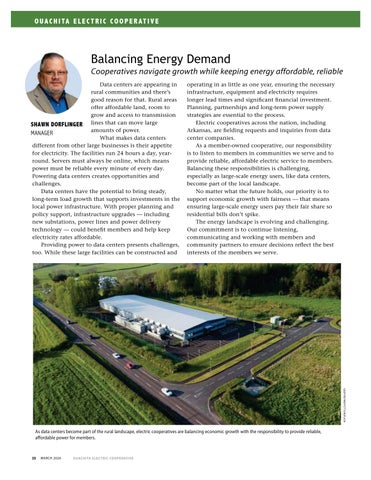
Data centers are appearing in rural communities and there’s good reason for that. Rural areas offer affordable land, room to grow and access to transmission lines that can move large amounts of power.
What makes data centers different from other large businesses is their appetite for electricity. The facilities run 24 hours a day, yearround. Servers must always be online, which means power must be reliable every minute of every day. Powering data centers creates opportunities and challenges.
Data centers have the potential to bring steady, long-term load growth that supports investments in the local power infrastructure. With proper planning and policy support, infrastructure upgrades — including new substations, power lines and power delivery technology — could benefit members and help keep electricity rates affordable.
Providing power to data centers presents challenges, too. While these large facilities can be constructed and
operating in as little as one year, ensuring the necessary infrastructure, equipment and electricity requires longer lead times and significant financial investment. Planning, partnerships and long-term power supply strategies are essential to the process.
Electric cooperatives across the nation, including Arkansas, are fielding requests and inquiries from data center companies.
As a member-owned cooperative, our responsibility is to listen to members in communities we serve and to provide reliable, affordable electric service to members. Balancing these responsibilities is challenging, especially as large-scale energy users, like data centers, become part of the local landscape.
No matter what the future holds, our priority is to support economic growth with fairness –– that means ensuring large-scale energy users pay their fair share so residential bills don’t spike.
The energy landscape is evolving and challenging. Our commitment is to continue listening, communicating and working with members and community partners to ensure decisions reflect the best interests of the members we serve.

Tornadoes can strike with little warning, leaving behind downed power lines, damaged electrical equipment and dangerous debris. Preparing before a tornado, and knowing how to stay safe afterward, can help prevent electrical shock, fire and injury. Make sure your emergency plan includes electrical safety steps so you and your family are ready to act quickly and safely.
Before a tornado
• Prepare an emergency kit with water, battery-powered flashlight, radio, extra batteries and portable phone charger.
• Fully charge cell phones and backup power banks before severe weather hits so you can use them in an emergency.
During a tornado
• Seek shelter immediately in a storm shelter, basement or a small, interior room with no windows, such as a bathroom or closet.
• Turn off and unplug appliances and electronics to protect them from power surges. Leave one light on so you’ll know when power is restored.
• Do not stay inside a vehicle or try to
outrun a tornado. Exit the vehicle and seek shelter in a sturdy building. If none are available, lie flat in a low-lying area away from the vehicle and power lines.
After a tornado
• Stay away from downed power lines and anything they could touch, such as trees, fences or debris. Always assume they are energized.
• If you see a downed line while driving, do not exit your vehicle. Call 911, and warn others to stay away.
• Do not touch anyone who is in contact with a power line. Call 911 immediately and wait for emergency responders.
• Do not enter damaged buildings until electricity and gas are shut off by professionals.
• Never attempt to turn off power if you must stand in water to reach the breaker.
• Avoid flooded areas with electrical outlets, appliances or cords, and never touch electrical equipment when wet or standing in water.
• Have all water-damaged electrical systems, appliances and devices inspected by a licensed electrician before use.
Power outages and generator safety

• Never use a generator indoors or in partially enclosed spaces such as garages, porches or near open windows and doors. Place it at least 20 feet away from your home to prevent carbon monoxide poisoning.
• Keep the generator dry by placing it on a tarp or under a canopy, and follow all manufacturer’s instructions.
• Never plug a generator directly into a wall outlet. This can inadvertently energize power lines and pose a lethal risk to you, neighbors and utility workers.
Stay informed and stay alert. For more safety tips, visit safeelectricity.org

Since Ouachita Electric Cooperative was formed in 1938, we have been dedicated to helping the people in Bradley, Calhoun, Dallas, Nevada and Ouachita counties live better lives — not only with affordable electric power, but through our involvement in several important community endeavors.
Now with Operation Round Up, an innovative community service fundraising program, we can share a simple and rewarding way for Ouachita Electric members to help support worthwhile projects in our service areas.
Operation Round Up is just what the name implies. Each month, Ouachita Electric simply “rounds up” the electric bill of participating members to the next highest dollar. For example, a member’s monthly bill of $52.73

would be automatically rounded up to $53,00, with the additional 27 cents going to the Operation Round Up fund. This program will never cost the contributor more than 99 cents a month. Donations are tax-deductible, and members will be sent a summary of their yearly contributions in December and January. Community spirit. Service. Good will. Operation Round Up is an exciting extension of Ouachita Electric’s commitment to our members. Members can sign up at oecc.com/operation-roundup or call Ouachita Electric at (877) 252-4538.
