VOL. VOL.20 20NO. NO.23 SUMMER AUTUMN 2026 2026
FOR THE MIM, CIM AND SINTER-BASED AM INDUSTRIES
I N T E R N AT I O N A L
IN THIS ISSUE SINTER-BASED AM: LESSONS FROM INDUSTRY ARC IMPACT: BINDER JETTING SILICON CARBIDE MIM DESIGN EXCELLENCE | WORLDPM2026 REVIEW Published by Inovar Communications Ltd
www.pim-international.com
CataMIM® • A direct replacement for all current commercially available catalytic debind feedstocks • Improved flow • Stronger green and brown parts • More materials available and better surface finish
www.ryerinc.com
• Custom scale-up factors available • Faster cycle times • 65°C / 150°F mold temperature
AquaMIM® • Water Debind • Custom scale-up factors available • Large selection of available materials
MIM/PIM
SolvMIM® • Solvent, Super Critical Fluid Extraction (SFE) or Thermal Debind methods • Hundreds of materials available • Custom scale-up factors available
FEEDSTOCKS • At RYER, all our feedstocks are manufactured to the highest level of quality, with excellent batch-to-batch repeatability. • RYER is the ONLY commercially available feedstock manufacturer to offer all five debind methods. • RYER offers the largest material selections of any commercially available feedstock manufacturer. • RYER offers technical support for feedstock selection, injection molding, debinding and sintering.
RYER, Inc. | 42625 Rio Nedo Unit B | Temecula, CA 92590 | USA | Tel: +1 951 296 2203 Email: dave@ryerinc.com | www.ryerinc.com
Publisher & Editorial Offices Inovar Communications Ltd 11 Park Plaza Battlefield Enterprise Park Shrewsbury SY1 3AF United Kingdom Tel: +44 (0)1743 469909 www.pim-international.com
FOR MIM, CIM AND SINTER-BASED AM
Managing Director & Editor Nick Williams, nick@inovar-communications.com Group News Editor & Director Paul Whittaker, paul@inovar-communications.com Advertising Sales Jon Craxford Advertising Sales Director, jon@inovar-communications.com Tel: +44 (0)207 1939 749 Sally Pye Advertising Business Development Manager Tel: +44 (0)1939 839988, sally@inovar-communications.com Features Editor Emma Lawn, emma@inovar-communications.com News Editors Amelia Gregory, amelia@inovar-communications.com Charlie Hopson-VandenBos charlie@inovar-communications.com Marketing Lead Mulltisa Moung, mulltisa@inovar-communications.com Production Manager Hugo Ribeiro, hugo@inovar-communications.com Operations & Partnerships Manager Merryl Le Roux, merryl@inovar-communications.com Office & Accounts Manager Jo Sheffield, jo@inovar-communications.com Technical Consultant Dr Martin McMahon Consulting Editors Prof Randall M German Former Professor of Mechanical Engineering, San Diego State University, USA Dr Yoshiyuki Kato Kato Professional Engineer Office, Yokohama, Japan Professor Dr Frank Petzoldt Ingenieurbüro Dr. Petzoldt, Geestland, Germany Bernard Williams Consultant, Shrewsbury, UK Subscriptions PIM International is published on a quarterly basis as either a free digital publication or via a paid print subscription. The annual print subscription charge for four issues is £150 including shipping. Accuracy of contents Whilst every effort has been made to ensure the accuracy of the information in this publication, the publisher accepts no responsibility for errors or omissions or for any consequences arising therefrom. Inovar Communications Ltd cannot be held responsible for views or claims expressed by contributors or advertisers, which are not necessarily those of the publisher. Advertisements Although all advertising material is expected to conform to ethical standards, inclusion in this publication does not constitute a guarantee or endorsement of the quality or value of such product or of the claims made by its manufacturer. Reproduction, storage and usage Single photocopies of articles may be made for personal use in accordance with national copyright laws. All rights reserved. Except as outlined above, no part of this publication may be reproduced or transmitted in any form or by any means, electronic, photocopying or otherwise, without prior permission of the publisher and copyright owner. Design and production Inovar Communications Ltd. ISSN: 1753-1497 (PRINT) ISSN: 2055-6667 (ONLINE) © 2026 Inovar Communications Ltd.
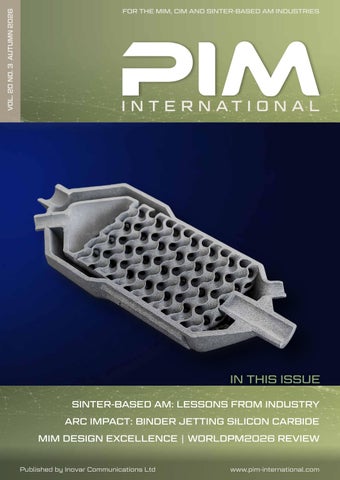
Sinter-based AM: The growing importance of application discipline Sometimes we build a magazine issue around a theme. Sometimes several independently developed articles simply start telling us the same thing. This issue has proved to be a case of the latter. Across our coverage of Binder Jetting and other sinter-based AM technologies, the same message has emerged: industrial progress depends not simply on finding applications, but on identifying those that play to the strengths of a specific process – and screening out those that do not. For years, much of the conversation around AM has understandably been about possibility: Can we make it? With experience comes a harder question: Should we? In his interview, Elnik Systems’ Stefan Joens captures this particularly well when he argues that a technology must be applied to its capability, not its possibility. Binder Jetting, Vat Photopolymerisation, Material Extrusion and other sinter-based AM processes each have distinct strengths and limitations. Success comes from understanding where each offers a genuine advantage, rather than simply demonstrating that it can make a particular part. Elsewhere, from our WorldPM2026 coverage to our examination of Binder Jetting silicon carbide, the same principle emerges: success ultimately depends on the complete manufacturing chain – its technical limitations, process demands and economics. We did not set out to make application discipline a theme of this issue. It emerged independently. Perhaps that itself is significant: maturity in sinter-based AM increasingly means knowing where each process belongs – and having the discipline to recognise where it does not. Nick Williams Managing Editor Cover image
Sectioned silicon carbide heat-exchanger demonstrator showing the complex internal flow geometry enabled by Binder Jetting (Courtesy Arc Impact)
AUTUMN 2026
PIM INTERNATIONAL
3
POWDER PROCESSING
DIVERSE AM TECHNIQUES
SINTERING OPTIMISATION
SEE OUR CERAMIC AM EXPERTISE IN ACTION HERE
COMPUTATIONAL TECHNIQUES
www.lucideon.com/ceramicamPIM query@lucideon.com www.linkedin.com/company/lucideon
ANALYSIS & EVALUATION
COPPER IN ADDITIVE MANUFACTURING
AM of copper2026 alloys has potential applications in thermal and electrical management such Autumn •
Electric motor coils [1, 2]
•
Heat sinks, exchangers, and radiators [3, 4]
•
Waveguides for electromagnetic energy [5]
11
27
Figure. Copper motor coil produced using LPBF [1].
32
Figure. Latticed copper heat sink [4].
80
105
Figure. Copper synchrotro absorber design [6].
Advantages of binder jetting (BJT): Room temperature operation, support-fr printing, high throughput [3]
65
Sinter-based Additive Manufacturing: Beyond the hype, towards industrial success Few people have seen as many sinterbased AM projects succeed – and fail – as Stefan Joens. Through Elnik Systems and DSH Technologies, he has worked across Binder Jetting, Vat Photopolymerisation, Material Extrusion and other emerging routes, drawing on decades of MIM experience. As this article reveals, every major process can succeed in the right application, but industrial success depends on control of the whole route – from green-part design and material selection to debinding, sintering, secondary operations and economics. >>>
Regular features...
11
Industry news
115 Advertisers’ index & buyers’ guide 118 Events guide
VOL. 20 NO. 3 © 2026 INOVAR COMMUNICATIONS LTD
AUTUMN 2026
PIM INTERNATIONAL
5
SINTERING ISN’T DIFFICULT | contents | news | events | advertisers | website | newsletter |
Not when you have the right expertise behind you. With the right knowledge, it becomes a controlled, reliable, and repeatable process. At DSH Technologies, we turn process complexity into production capability.
Reduce Scrap Rate & Variability Improve Yield & Consistency Emergency Troubleshooting Toll Debinding & Sintering
STOP GUESSING, START IMPROVING WITH DSH TECHNOLOGIES. 6
PIM INTERNATIONAL
AUTUMN 2026
VOL. 20 NO. 3
© 2026 INOVAR COMMUNICATIONS LTD
79
Binder Jetting silicon carbide: A new route to complex, highperformance ceramics
89
Silicon carbide offers an exceptional combination of stiffness, thermal conductivity, hardness and chemical resistance, yet these same properties make complex components difficult and costly to manufacture. Binder Jetting offers a different approach: producing geometrically complex preforms that can be processed using established ceramic densification technologies. Arc Impact’s Keith Murphy examines the complete process chain, from powder preparation and green-part production to infiltration and sintering, and considers where this combination of design freedom and material performance could deliver the greatest value. >>>
MPIF’s PM Design Excellence Awards 2026: Recognising innovation in MIM and sinterbased AM The Metal Powder Industries Federation announced the winners of its 2026 Powder Metallurgy Design Excellence Awards during WorldPM2026 in Montréal, Canada. This review focuses on the eleven applications recognised in the Metal Injection Moulding category, together with the sole metal AM winner, produced by Binder Jetting. Spanning firearms, fall-arrest equipment, medical devices, industrial instrumentation, electronics, acoustic control and consumer hardware, the winners demonstrate the capabilities of MIM and sinter-based AM across an exceptionally diverse range of applications. >>>
SUBSCRIBE
TO OUR NEWSLETTER
The PIM International newsletter is sent to several thousand industry professionals worldwide. Register today to ensure you benefit from reading the latest industry news and advances in Metal Injection Moulding, Ceramic Injection Moulding and sinter-based AM technologies.
www.pim-international.com/e-newsletter
VOL. 20 NO. 3 © 2026 INOVAR COMMUNICATIONS LTD
AUTUMN 2026
PIM INTERNATIONAL
7
| contents | news | events | advertisers | website | newsletter |
8
PIM INTERNATIONAL
AUTUMN 2026
VOL. 20 NO. 3
© 2026 INOVAR COMMUNICATIONS LTD
99
WorldPM2026 Montréal: Exploring advances in sinter-based Additive Manufacturing WorldPM2026 brought together an unusually broad cross-section of technical work in sinter-based Additive Manufacturing. In this report, Bernard North examines what the conference revealed about developments in Binder Jetting, Digital Light Processing and ColdMetalFusion, alongside the growing role of AM in design iteration, tolerance development and qualification. The presentations demonstrated a sector moving towards more focused applications and better process control, while showing how sinter-based AM can support early production and a potential transition to MIM as production volumes increase. >>>
PIM International is the essential media platform for professionals in Metal Injection Moulding, Ceramic Injection Moulding, and sinter-based Additive Manufacturing. Through our magazine, website, bi-monthly newsletter, social media channels and webinars, we connect industry innovators with a truly global audience. Our platforms deliver trusted news, in-depth articles, and expert analysis to engineers, designers, researchers, and business leaders worldwide.
•
Have industry news to share? Submit it > paul@inovar-communications.com
•
Want to showcase your expertise? Pitch a feature article > nick@inovar-communications.com
•
Be visible: Ask about advertising opportunities > jon@inovar-communications.com
•
Stay connected: Follow us on LinkedIn > www.linkedin.com/company/
Regular features... 11
piminternationalmagazine
Industry news
115 Advertisers’ index & buyers’ guide Discover the leading suppliers of materials and equipment for MIM, CIM and sinterbased AM, as well as part manufacturing and more. >>>
118 Events guide View a list of upcoming events for the MIM, CIM & sinter-based AM industries. >>> VOL. 20 NO. 3 © 2026 INOVAR COMMUNICATIONS LTD
AUTUMN 2026
PIM INTERNATIONAL
9
| contents | news | events | advertisers | website | newsletter |
10
PIM INTERNATIONAL
AUTUMN 2026
VOL. 20 NO. 3
© 2026 INOVAR COMMUNICATIONS LTD
| contents | news | events | advertisers | website | newsletter |
Industry News To submit news for inclusion in PIM International contact Paul Whittaker: paul@inovar-communications.com
iPhone Duo launch highlights MIM’s role in foldable hinge supply chain The launch of Apple’s first foldable smartphone, the iPhone Duo, has prompted Chinese financial media to highlight the role of Metal Injection Moulding and advanced alloys in the increasingly complex hinge systems used in foldable devices. In an industry analysis published on September 10, Xinhua Finance [1] examined the Chinese manufacturing ecosystem behind the new foldable iPhone, identifying the hinge as one of the device’s major technological and manufacturing challenges. Apple states that the hinge comprises more than 100 components and is designed to provide precise control during opening and closing while supporting the display when fully unfolded. Major Chinese MIM producers have been indicating for some time that smartphone hinge mechanisms are becoming an important growth driver. Xinhua Finance highlighted MIM as particularly well suited to the numerous small, complex precision components required within foldable-phone hinges. The report identified Jiangsu Gian Technology Co., Ltd. as one of the Chinese MIM producers active in this field, alongside Shanghai Future High-Tech Co., Ltd., the MIM subsidiary of NBTM New Materials Group Co., Ltd. Shanghai Future’s products include MIM parts and modules for foldable-phone hinges as well as other precision smartphone components [1]. MIM is already widely used elsewhere in smartphone manufacturing,
VOL. 20 NO. 3
particularly for small, complex metal parts produced in high volumes. Typical applications include camera module frames and supports, vibration-motor components, buttons and other miniature structural parts. Xinhua Finance specifically notes these applications within Shanghai Future High-Tech’s MIM portfolio [1]. Materials are becoming increasingly important as hinge designers seek greater strength and wear resistance while reducing size and weight. As reported in the Summer 2026 issue of PIM International [2],
Gian has been developing ultra-highstrength steels, titanium alloys and copper alloys for MIM, with wearresistant steels already being used for foldable-phone hinge components. The same article highlighted MIM-produced hinge and precision structural components as a major emerging application within China’s consumer-electronics industry. The iPhone Duo also appears to bring other advanced metal technologies into the same hinge system. Xinhua Finance reported that industry sources have suggested that the hinge’s main shaft may use an amorphous alloy, commonly referred to as liquid metal, although Apple has not confirmed this [1]. First Financial likewise reported
The new iPhone Duo features a titanium hinge cover produced by metal Additive Manufacturing. The hinge comprises more than 100 components, many of which are understood to be manufactured by MIM, and is designed to control opening and closing while supporting the centre of the display when the device is open (Courtesy Apple)
© 2026 INOVAR COMMUNICATIONS LTD
AUTUMN 2026
PIM INTERNATIONAL
11
Industry news
| contents | news | events | advertisers | website | newsletter |
supporting supply chain moves into the spotlight,’ September 10, 2026. Chinese-language source. https://www.cnfin.com/gs-lb/ detail/20260910/4467881_1.html [2] PIM International, ‘Metal Injection Moulding in Asia: Scale, supply chains, and growing overlap with metal AM,’ Summer 2026. www.pim-international.com/ powder-injection-mouldinginternational-magazine-archive/ pim-international-vol-20-no-2summer-2026/
The iPhone Duo features an additively manufactured hinge cover with a contrasting micro-blasted finish (Courtesy Apple) on September 10 that amorphousmetal materials are being supplied for foldable-phone hinge applications alongside MIM precision components [3]. Apple has separately highlighted extensive use of titanium in the Duo, including an additively manufactured titanium hinge cover. The potential scale of the application is significant. Counterpoint Research forecasts shipments of up to six million iPhone Duo models in 2026, giving Apple around 25% of the global foldable smartphone market [4].
The launch therefore gives further substance to a trend highlighted in PIM International’s 2026 review of the Asian MIM industry: foldable smartphones are becoming a significant high-volume application for advanced MIM components, with wear-resistant steels, titanium alloys and other specialist materials increasingly used alongside technologies such as amorphous metals and Additive Manufacturing. References [1] Xinhua Finance, ‘Apple’s first foldable-screen phone arrives: China’s
Indo-MIM shares rise sharply following stock market debut Indo-MIM, headquartered in Bengaluru, India, has seen its share price rise sharply in the days following the company’s stock market debut on July 30, 2026. The stock opened at ₹703 ($7.36) on the Bombay Stock Exchange (BSE) and ₹700 ($7.32) on the National Stock Exchange (NSE) on its first day of trading, representing a premium of around 45% to the issue price. The shares subsequently continued to climb, trading at around ₹1,000 ($10.46) in early September, more than double the ₹485 ($5.07) issue price. Initial Public Offering The IPO opened for public subscription on July 23 and was scheduled to close on July 27. The company
12
PIM INTERNATIONAL
allotted 23.5 million equity shares to ninety-two anchor investors at the upper end of the IPO price band of ₹485 per share, according to a filing with the Bombay Stock Exchange, raising ₹1,140.99 crore (approx. $120 million). Anchor investors were reported to include a number of domestic and international institutional funds, including ICICI Prudential Mutual Fund, HDFC Mutual Fund, SBI Mutual Fund, Kotak Mutual Fund, Aditya Birla Sun Life Mutual Fund, WhiteOak Capital, 360 ONE, Norway’s Government Pension Fund Global, Goldman Sachs Funds, BlackRock Global Funds, Mirae Asset, Motilal Oswal Mutual Fund and Bandhan Mutual Fund. Domestic mutual funds accounted for approximately 56% of the anchor
AUTUMN 2026
[3] First Financial, ‘Apple enters foldables as ultra-thin glass and hinge segments face a revaluation,’ September 10, 2026. Chineselanguage source. www.yicai.com/news/103358805. html [4] Counterpoint Research, ‘Global Foldable Shipments to Hit 100-million Cumulative Milestone by End of 2026,’ September 7, 2026 www.counterpointresearch.com/en/ insights/global-foldable-shipmentsto-hit-100-million-cumulativemilestone-by-end-of-2026
allocation, receiving 13.2 million shares through sixty schemes, while life insurance companies were allotted 2.27 million shares, representing 9.64% of the anchor portion. Indo-MIM manufactures precision-engineered MIM components and provides vertically integrated services spanning product design, tooling, feedstock preparation, machining, finishing and assembly. The company also manufactures components using investment casting, precision machining, Ceramic Injection Moulding (CIM) and Additive Manufacturing technologies. According to a Frost & Sullivan report cited in the company’s Red Herring Prospectus, Indo-MIM was the world’s largest manufacturer of MIM precision-engineered components by revenue in calendar year 2025, with a 6.8% global market share. www.indo-mim.com
VOL. 20 NO. 3
© 2026 INOVAR COMMUNICATIONS LTD
| contents | news | events | advertisers | website | newsletter |
VOL. 20 NO. 3
© 2026 INOVAR COMMUNICATIONS LTD
AUTUMN 2026
PIM INTERNATIONAL
13
Industry news
| contents | news | events | advertisers | website | newsletter |
Mimo Technology begins production at new MIM facility in Jiangsu Jiangsu Mimo Metal Technology (Mimo Technology), based in Suzhou, Jiangsu, China, has announced that its new Metal Injection Moulding facility has entered operation. Production equipment and R&D and testing facilities have been installed and commissioned, with production lines now ramping up towards volume manufacturing. The facility forms part of a wider two-phase expansion project announced by Mimo Technology in 2025. The company reported a planned total investment of RMB 280 million (approximately $41.7 million), with the project covering a total building area of approximately 17,568 m². Phase I, which has now been completed, covers approximately 9,048 m² and includes precision forming production lines and an R&D centre. A planned second phase, covering approximately 8,520 m², will include warehousing and testing facilities. Mimo Technology manufactures MIM components for applications including consumer electronics, new energy vehicles, humanoid robots,
medical and dental products, and industrial equipment. The company reports that its products are supplied to more than twenty countries and regions. The facility includes dedicated areas covering the complete MIM production process, including feedstock preparation, injection moulding, debinding and sintering, and precision post-processing. Production areas have been designed to accommodate automated production lines, with dedicated logistics and warehousing areas, as well as dust-free, temperature-controlled production areas. Equipment installed includes injection moulding machines, sintering furnaces, precision sizing equipment and automated robotic systems. During commissioning, Mimo Technology tested process parameters and production-line integration to ensure process stability and component consistency. The company has also established a metallographic analysis laboratory, materials testing laboratory and new-product trial production centre. Equipment includes microscopes,
Mimo Technology’s new facility includes production capacity for feedstock preparation, injection moulding, debinding, sintering and precision postprocessing (Courtesy Mimo Technology)
14
PIM INTERNATIONAL
AUTUMN 2026
Production lines at the facility are currently in the ramp-up stage (Courtesy Mimo Technology)
mechanical testing systems and composition analysis instruments. The facilities will support material formulation development, prototype production and performance testing through to volume manufacturing. Production lines at the facility are currently in the ramp-up stage, with Mimo Technology reporting that small-batch trial production has met customer technical requirements. Equipment utilisation and product yield rates are also increasing. As production increases, the additional capacity is expected to reduce pressure on production scheduling and shorten delivery times, while enabling the company to undertake larger-volume and longer-term orders. The new R&D and trial-production areas will also allow development work to be carried out separately from volume manufacturing. Mimo Technology stated that development activities will include new alloy powder formulations, MIM processing technologies for complex-shaped components and lightweight MIM technologies. www.mimo-mim.com
VOL. 20 NO. 3
© 2026 INOVAR COMMUNICATIONS LTD
| contents | news | events | advertisers | website | newsletter |
MIM and Sinter Based Metal 3D Printing - PureForm™ By combining deep MIM expertise with our advanced metal 3D printing PureForm platform, Greene Group moves your project seamlessly from prototype to production without compromising performance or timelines. Unlike traditional additive methods, PureForm combines MIM powders with a photopolymer process to produce complex geometries layer by layer. After debind and sinter, parts achieve microstructures and properties equivalent to MIM, meeting stringent industry standards while maintaining the flexibility and speed of additive manufacturing. From Design for Manufacture (DfAM & DFM for MIM) to rapid prototyping to mold design and build to production launch with vertically integrated high value-added post sinter operations, Greene Group provides complete MIM and PureForm solutions that simplify complex supply chains and accelerate time to market. Visit www.greenegroup.com to learn how we can help turn your next metals application into a production success.
EMAIL OUR EXPERTS engineering-ca@greenegroup.com VOL. 20 NO. 3
© 2026 INOVAR COMMUNICATIONS LTD
AUTUMN 2026
PIM INTERNATIONAL
15
Industry news
| contents | news | events | advertisers | website | newsletter |
Bodycote agrees £1.65B acquisition by Veritas Capital Bodycote, headquartered in Macclesfield, England, UK, has agreed the terms of a recommended cash acquisition by Vulcan Alpha Bidco Limited, a newly formed company owned by US investment firm Veritas Capital Fund Management. The offer values Bodycote’s issued and to-be-issued share capital at approximately £1.65 billion, with an implied enterprise value of around £1.85 billion. Bodycote is a global provider of heat treatment and specialist thermal processing services, operating approximately 130 facilities in twenty-two countries and employing around 4,000 people. “Bodycote has established itself as a global leader in providing essential technologies for performance metallurgy across a range of mission-critical end markets,” explained James Dimitri, partner & co-head of Flagship Private Equity at Veritas. “We admire what Bodycote and its talented employee base have built, and we look forward to leveraging our deep sector experience and track record of partnering with leading compa-
nies in the performance industrial supply chain to support Bodycote’s continued development and unlock a new chapter of growth.” Under the terms of the acquisition, Bodycote shareholders will receive 932.8 pence in cash per share and will retain the FY26 interim dividend of 7.2 pence per share, giving a total offer value of 940 pence per share. Bodycote’s directors intend unanimously to recommend the transaction to shareholders. As part of Bodycote’s current growth strategy, the company has been investing in increased HIP capacity for aerospace and defence customers, as well as expanding its Specialist Technologies activities. In 2026, Bodycote also completed its acquisition of Spectrum Thermal Processing, a North American precision heat treatment business focused on the aerospace and defence sectors. New York-based Veritas had approximately $54 billion in assets under management as of June 30, 2026. The investment firm has cited Bodycote’s technical capabilities and
Bodycote has agreed the terms of a cash acquisition by Vulcan Alpha Bidco Limited, a newly formed company owned by US investment firm Veritas Capital Fund Management (Courtesy Bodycote)
16
PIM INTERNATIONAL
AUTUMN 2026
Bodycote offers a wide range of postprocessing for metal components (Courtesy Bodycote)
its exposure to aerospace, defence and other engineering markets as factors behind the acquisition. Completion is currently expected in Q1 2027. “The Bodycote Board believes that this offer from Veritas reflects the high quality of Bodycote’s business and management, and delivers shareholders excellent value in cash,” stated Daniel Dayan, Bodycote Chair. “The Bodycote team has worked extremely hard over many years to build a leading position in our industry, including recent success in delivering on the Optimise, Perform and Grow initiatives; accordingly, the board wishes to express its thanks to management and employees on behalf of shareholders. “It is gratifying to see Veritas’ strong support in this announcement for Bodycote’s strategy in focusing the group on its most attractive markets for the benefit of all stakeholders. Veritas is an experienced and knowledgeable owner of industrial businesses with the capability to accelerate the delivery of this strategy. The board remains highly confident in Bodycote’s prospects and believes that this offer recognises that value today and is therefore recommending it to shareholders.” www.veritascapital.com www.bodycote.com
VOL. 20 NO. 3
© 2026 INOVAR COMMUNICATIONS LTD
| contents | news | events | advertisers | website | newsletter |
With partner Novamet, Ultra Fine’s high quality powders can be further enhanced through coating or other post-atomization treatments.
VOL. 20 NO. 3
© 2026 INOVAR COMMUNICATIONS LTD
AUTUMN 2026
PIM INTERNATIONAL
17
Industry news
| contents | news | events | advertisers | website | newsletter |
NBTM reports MIM growth and raises Shanghai Future stake to 99% NBTM New Materials Group Co., Ltd., Ningbo, China, has reported that revenue from its Metal Injection Moulding business increased 8.25% year-on-year to RMB 1.307 billion in the first half of 2026. The company also reported a 219.3% increase in revenue from components for foldable smartphone assemblies. NBTM stated that its MIM business, which currently primarily serves the consumer electronics sector, benefited from increased orders for foldable phones from a major customer. The growth came despite a decline in the wider smartphone market, with IDC data cited by NBTM showing global smartphone shipments fell 6.7% year-on-year in the second quarter of 2026, while shipments in China declined 4.3%. The company highlighted MIM as a core manufacturing process for hinge components used in foldable smartphones. Citing Counterpoint Research, it added that global foldable smartphone shipments are forecast to increase 21% in 2026.
NBTM also sees opportunities to expand the use of MIM into robotics, AI hardware and wearable devices. Potential applications identified in its half-year report include precision complex components for robotic dexterous hands; high-speed connector housings; heat sink components for chips and optical modules; liquid-cooling connectors and housings; and hinge components for AI and AR glasses. In the robotics sector, NBTM stated that MIM is suited to the volume production of miniature precision gears for dexterous robotic hands. The company is targeting the robotics market across its three main manufacturing technology platforms, which comprise Press and Sinter Powder Metallurgy, Soft Magnetic Composites and Metal Injection Moulding. Across these three platforms, NBTM reported first-half revenue of RMB 3.054 billion, up 4.88% year-onyear. P&S revenue declined 5.84% to RMB 1.187 billion, while SMC revenue increased 26.06% to RMB
NBTM has completed the acquisition of a further 34.75% stake in Shanghai Future High-tech Co., Ltd., its principal MIM subsidiary (Courtesy Shanghai Future High-tech)
18
PIM INTERNATIONAL
AUTUMN 2026
560 million. MIM was therefore the group’s largest technology platform by revenue during the period. Products serving what NBTM defines as its ‘new technology’ markets generated approximately RMB 1.079 billion, accounting for 35.33% of the group’s main business revenue. This included RMB 928 million from high-end consumer electronics, RMB 141 million from AI computing applications and RMB 10 million from robotics. NBTM increases Shanghai Future ownership to 99% NBTM has also completed the acquisition of a further 34.75% stake in Shanghai Future High-tech Co., Ltd., its principal MIM subsidiary. The transaction was completed on August 6, 2026, increasing NBTM’s total ownership of Shanghai Future to 99%. Shanghai Future serves as NBTM’s MIM research and development centre, marketing centre and production base for higher-value products. The subsidiary reported first-half revenue of RMB 1.312 billion and net profit of RMB 185.5 million. Further expansion is planned in Dongguan, Guangdong Province. In August, NBTM approved the establishment by Shanghai Future of a wholly owned subsidiary in Daojiao, Dongguan, with an investment of RMB 150 million. The subsidiary is intended to implement the Guangdong NBTM Huajing Technology Base project, which has an estimated total investment of RMB 700 million. Shanghai Future signed an investment agreement for the project with the Daojiao town government on August 7, with the investment subsequently approved by NBTM and Shanghai Future shareholders. NBTM invested RMB 200 million in research and development during the first half of 2026, an increase of 23.47% year-on-year and equivalent to 6.51% of operating revenue. www.pm-china.com www.future-sh.com.cn
VOL. 20 NO. 3
© 2026 INOVAR COMMUNICATIONS LTD
| contents | news | events | advertisers | website | newsletter |
BLUE POWER.
EQUIPMENT & EXPERTISE FOR YOUR METAL POWDER PRODUCTION ● GAS ATOMIZERS
INDUCTION HEATED (PLASMA HEATED IN DEVELOPMENT) ● ULTRASONIC
FOR SPHERICAL POWDERS WITHOUT ANY SATELLITES, IN HIGH PURITY AND A WIDE RANGE OF REPRODUCIBLE PARTICLE SIZE DISTRIBUTION.
ATOMIZERS
● WATER ATOMIZERS
FOR MORE IRREGULAR POWDERS, IDEAL FOR RECYCLING/REFINING, PRESS & SINTER PROCESS AND OTHERS.
● AIR CLASSIFIERS
FOR THE PRECISE SEPARATION OF METAL POWDERS INTO FINE AND COARSE POWDER FRACTIONS ESPECIALLY IN THE RANGE < 25 µM
See us at Formnext Hall 12.0 D41
www.bluepower-casting.com 2026 PIM INTERNATIONAL 75045 Walzbachtal · Germany · Phone +49 7203 9218-0 · E-mail:AUTUMN info@bluepower-casting.com
VOL. 20 NO. 3
© 2026 INOVAR COMMUNICATIONS LTD
19
Member 2026
Industry news
| contents | news | events | advertisers | website | newsletter |
DSH Technologies launches DSH Advantage for MIM and metal AM Debinding and sintering services provider DSH Technologies, based in Pineville, North Carolina, USA, has announced DSH Advantage, a membership programme designed to support metal parts manufacturers by offering structured expert guidance and troubleshooting, thereby improving yield and reducing production downtime. Designed for industrial manufacturers, OEM captive parts makers, Metal Injection Moulding and sinterbased Additive Manufacturing producers, DSH Advantage combines advanced metallurgical controls, decades of experience, and access to laboratory services. The programme aims to enable parts makers to produce more, waste less, and scale effectively under expert supervision. “DSH Advantage bakes metallurgical best practices into systematic workflows so teams can focus on scaling, not firefighting,” stated Bryan Sherman, Chief Metallurgist at DSH Technologies. “From troubleshooting to training, testing to toll services, the DSH Advantage is an intimate opportunity for parts makers to access our decades of expertise to pragmatically build, not guess or hope for better outcomes.”
The monthly membership programme is led by Sherman, who has more than twenty-five years of experience in captive parts manufacturing, research, furnace technologies, debinding, and recipe development and testing. His background includes furnace commissioning and optimisation, failure and root-cause analysis, and the design of testing programmes incorporating metallography, density measurement, hardness testing, thermogravimetric analysis (TGA), and dilatometry. According to Sherman, manufacturers often face challenges when translating laboratory-developed recipes into repeatable production cycles, as well as controlling binder removal and furnace atmospheres. He noted that small deviations in feedstock, debinding profiles, or furnace atmosphere can contribute to yield loss, scrap, and production downtime. DSH Advantage incorporates a data-centric approach to troubleshooting, drawing on process logs, sample history, TGA, dilatometry, and metallography to isolate variables through controlled experiments. Documentation forms a central part of the programme, with every trial,
observation, and parameter change recorded and summarised in monthly performance reports to help teams track trends and decisions. “DSH Advantage was built to solve the real, day-to-day challenges that MIM and sinter-based additive manufacturers face when moving from prototypes to production,” said Stefan Joens, President of DSH Technologies. “By marrying deep metallurgical expertise with powerful instrumentation and process, we’re helping customers make better parts faster, and protect their margins while doing it.” The programme also emphasises knowledge transfer through hands-on training and education. According to Sherman, members learn to interpret process signatures, metallography, and test data, while implementing robust debind and sinter recipes. Scheduled sessions, on-call support, and monthly summaries are intended to reinforce knowledge transfer and help build capability within customer organisations. In addition, members receive discounted access to DSH Technologies’ toll debind and sinter services for controlled troubleshooting, development, and production runs. The company stated that this can enable rapid validation of recipe changes and process trials when external processing is preferred. www.dshtech.com
ATS develops injection moulding for fuel cell tubes Allied Tech Supply, LLC, based in Alpharetta, Georgia, USA, has developed specific feedstocks and moulding capabilities for the injection moulding of tubes and sleeves used in fuel cells and hydrogen generation. ATS offers several composite materials for components used in ionic and protonic generators, as well as tubes for hydrogen generation by electrolysis. The company has several standard composites available for moulding and offers custom composites when required.
20
PIM INTERNATIONAL
Its BCZYYb/Nickel Oxide composites are available in the form of tubes, sleeves, discs, pins/posts and other shapes. Tube and sleeve sizes range from 1.6 mm to 50.8 mm in diameter and from 12.7 mm to 304.8 mm in length, with customised sizes also available. Compositions include BCZYYb/NiO ratios of 65:35, 60:40, or customised formulations. ATS also offers Zirconia/Nickel Oxide composite tubes and sleeves in the same range of shapes and sizes. Compositions include ZrO 2/NiO ratios of 65:35, 60:40, or customised formu-
AUTUMN 2026
Allied Tech Supply, LLC has developed specific feedstocks and moulding capabilities for the injection moulding of tubes and sleeves used in fuel cells and hydrogen generation (Courtesy Allied Tech Supply) lations. Components are supplied binder-free and ready for electrolyte coating, or electrolyte coated and fired. alliedtechsupply.com
VOL. 20 NO. 3
© 2026 INOVAR COMMUNICATIONS LTD
| contents | news | events | advertisers | website | newsletter |
VOL. 20 NO. 3
© 2026 INOVAR COMMUNICATIONS LTD
AUTUMN 2026
PIM INTERNATIONAL
21
Industry news
| contents | news | events | advertisers | website | newsletter |
Shandong Golden Empire to invest $7.5M in MIM liquid-cooling producer Shandong Golden Empire Precision Machinery Technology Co., Ltd. (Jindi) has announced plans to strengthen its position in the server liquidcooling market through an RMB 50 million investment in Dongguan Chenyu Precision Components Co., Ltd (Chenyu Precision), a producer developing Metal Injection Moulding liquid-cooling plates. The investment will be made through Jindi’s wholly owned subsidiary, Boyuan Zhichu (Guangzhou) Technology Development Co., Ltd, by way of a capital increase. Following completion of the transaction, Boyuan Zhichu will hold a 55.56% stake in Chenyu Precision, making it a controlled subsidiary of Jindi. The transaction was approved by Jindi’s board on July 15, 2026, and does not require shareholder approval.
While Chenyu Precision currently manufactures components using both conventional Powder Metallurgy and MIM processes, the transaction requires the businesses to be separated, with Chenyu Precision retaining the MIM operations and non-MIM activities being divested. Chenyu Precision is targeting applications including liquid-cooling systems for servers, energy-storage and battery cooling systems, small motors and gearboxes. According to Jindi, Chenyu Precision’s manufacturing process for liquid-cooling plates incorporates injection moulding, CNC machining, debinding, sintering, heat treatment, precision machining and inspection, as well as electropolishing and additional finishing operations.
Micro channel liquid cooling (Courtesy Shandong Golden Empire Precision Machinery Technology)
Jindi stated that the use of MIM could enable the production of integrated cooling plates incorporating enclosed internal microchannels, pin-fin structures and complex manifolds. Producing these features as part of a single component could eliminate welded joints and, the company stated, reduce potential leakage points compared with cooling plates assembled from separately machined components. The company reports that the process is capable of producing wall thicknesses down to 0.4 mm, high-aspect-ratio pin fins and dimensional accuracy of approximately ±0.1 mm. Jindi also stated that, once tooling has been established and production volumes increase, MIM could offer lower unit costs than alternative manufacturing routes such as Additive Manufacturing or machining followed by welding. Chenyu Precision’s MIM liquidcooling plates have not yet entered full-scale production. Jindi stated that samples have passed customer validation and that the company has begun preparations for batch supply in response to anticipated customer orders. As part of its rationale for the investment, Jindi cited an IDC forecast indicating that China’s liquid-cooled server market could reach approximately $4.8 billion in 2026 and $16.2 billion by 2029. The forecast, as quoted in Jindi’s disclosure, estimates that coldplate liquid cooling will account for around 93% of liquid-cooled server sales in 2026, with a penetration rate of approximately 37%. www.gebchina.com
SUBSCRIBE
TO THE PIM INTERNATIONAL NEWSLETTER
www.pim-international.com/e-newsletter 22
PIM INTERNATIONAL
AUTUMN 2026
VOL. 20 NO. 3
© 2026 INOVAR COMMUNICATIONS LTD
Industry news
| contents | news | events | advertisers | website | newsletter |
Highest Quality Thermocouples for Advanced Materials SHORTEST Lead-Times in the Industry Knowledgeable Staff to Answer Your Questions
VOL. 20 NO. 3
© 2026 INOVAR COMMUNICATIONS LTD
AUTUMN 2026
PIM INTERNATIONAL
23
Industry news
| contents | news | events | advertisers | website | newsletter |
Arc Impact outlines BJT scale-up for aerospace and defence
We print
technical ceramics
from single item up to series production
Visit u0s26! xt 2 Formne Hall 11.0 68 Booth B
Arc Impact, based in Burlington, Massachusetts, USA, a provider of metal and ceramic Binder Jetting (BJT) solutions, has outlined its approach to developing and scaling production applications for the aerospace and defence sectors. Through its AM2 Production framework, the company works with manufacturers to develop production workflows intended to meet dimensional, material and commercial requirements. According to Arc Impact, the challenge for aerospace and defence applications is increasingly not whether a complex geometry can be produced, but whether the complete manufacturing process can provide the repeatability, dimensional control and material performance required for qualification and serial production. Its AM2 Production framework addresses materials and applications development, candidate-part evaluation, design optimisation, manufacturing work cell implementation, technical and business validation, and production scaleup. This includes upstream and downstream stages such as powder selection, sintering, machining, finishing and inspection. One material being addressed through this approach is silicon
carbide. Advanced ceramic components can be required to meet tight tolerances while operating under demanding thermal and mechanical conditions. Arc Impact identifies potential aerospace and defence applications ranging from spaceborne optics to thermal management and protection systems, including components for propulsion, sensing and survivability. The company’s X-Series BJT machines are designed to process metal and ceramic materials, including non-oxide ceramics such as silicon carbide. Open process parameters are said to enable adjustment of factors including powder morphology, binder saturation and sintering profiles. The X25Pro provides a mid-sized platform for benchmark parts and early-stage programmes, including process development, densification studies and dimensional evaluation. The larger X160Pro is intended to apply established processes at production scale, accommodating larger components, batches or arrays where throughput and cost per part become greater considerations. Arc Impact stated that its objective is to establish qualified manufacturing routes capable of progressing high-value components from initial development to serial production. www.arc-impact.com
Your high-precision ceramic parts, manufactured for your industry-specific applications with millimeter-level accuracy
Interested? Just contact us! www.steinbach-ag.de Steinbach AG ∙ Westerfeldstraße 32-42 ∙ 32758 Detmold/GER
24
PIM INTERNATIONAL
Arc Impact’s workflow, from digital component design and initial production through to batches of manufactured parts (Courtesy Arc Impact)
AUTUMN 2026
VOL. 20 NO. 3
© 2026 INOVAR COMMUNICATIONS LTD
Industry news
| contents | news | events | advertisers | website | newsletter |
Unionfab expands metal AM capacity for global customers Unionfab, reported to be China’s largest Additive Manufacturing service provider, headquartered in Shanghai, has expanded its metal Additive Manufacturing capabilities with the goal of supporting customers in the USA, Canada and Germany. Unionfab uses an AI-driven manufacturing platform to reduce low-volume metal part production from around thirty days to as fast as five days. The company now has an installed base of over 100 metal Additive Manufacturing machines, including Binder Jetting (BJT) and Laser Beam Powder Bed Fusion (PBF-LB) machines. Unionfab processes a range of metals, including stainless steel, aluminium alloys, titanium alloys, CuCrZr and nickel-based superalloys. The company also offers its propri-
etary Al901X aluminium alloy, which combines heat resistance, mechanical strength and anodising compatibility for end-use applications. “Over the past few years, China’s metal 3D printing industry has undergone rapid technological iteration and industrial maturation. Continuous innovation among equipment manufacturers, material supply chains and manufacturing service providers is driving rapid improvements in printing efficiency, process stability and overall manufacturing costs,” stated Allen Yang, Unionfab CEO. “We believe now is an important time for global manufacturers to reassess how they develop and produce complex metal parts.” Unionfab operates six smart factories and, including its wide range of polymer systems, operates more than 1,000 AM machines in total.
Unionfab’s in-house AM fleet consists of over 1,000 machines (Courtesy Unionfab)
Beyond Additive Manufacturing, the company provides a range of services, including CNC machining, injection moulding, sheet metal fabrication and rapid casting, supporting projects from prototype development through to production. www.unionfab.com
Microscopic Precision. Industrial Scale. Additive Screen Printing: A Technology Like You‘ve Never Seen.
SCALABLE / PRECISE / COST-EFFECTIVE
VOL. 20 NO. 3
© 2026 INOVAR COMMUNICATIONS LTD
AUTUMN 2026
PIM INTERNATIONAL
25
| contents | news | events | advertisers | website | newsletter |
MIM/PIM Feedstocks
PolyMIM® Water soluble binder system
PolyPOM Catalytic binder system
GranuPrint 3D-Printing Materials
These two binder systems have excellent characteristics during the production process and combine attractive prices with worldwide availability High performance as well for the 3D-Printing process based on the water soluble binder system
Aerospace
Medicine
Mechanical
Luxury Goods
Automotive
Consumer Goods
www.polymim.com PIM INTERNATIONAL AUTUMN 2026 26
VOL. 20 NO. 3
© 2026 INOVAR COMMUNICATIONS LTD
Industry news
| contents | news | events | advertisers | website | newsletter |
SINTX secures $3.2M advanced ceramic component orders SINTX Technologies, Inc, headquartered in Salt Lake City, Utah, USA, has received purchase orders from multiple contract manufacturing customers with a combined value of more than $3.2 million for the production of advanced ceramic components. The company manufactures silicon nitride ceramic components for customers across a range of industries requiring materials with demanding mechanical, thermal and chemical properties. SINTX stated that its expertise in silicon nitride supports both proprietary product development and contract manufacturing. “We are pleased to see continued momentum in our contract manufacturing business,” stated Eric K Olson, chairman and Chief Executive Officer of SINTX Technologies. “We believe these purchase orders reflect continued customer interest in SINTX’s manufacturing capabilities and our ability to support technically demanding component requirements.” Olson continued, “While our longterm strategy remains focused on expanding our proprietary silicon nitride biomaterials and medical device platform, our contract manufacturing business provides an
important source of revenue growth and operational leverage. We believe these orders highlight the value customers place on our technical expertise, manufacturing quality, and ability to produce complex, highperformance ceramic components.” The purchase orders are from several existing contract manufacturing customers. Subject to customer requirements, manufacturing schedules and commercial
SINTX Technologies has received purchase orders from multiple customers valued at more than $3.2 million for the production of advanced ceramic components (Courtesy SINTX Technologies)
ALD Vacuum Technologies to expand Hanau manufacturing facility ALD Vacuum Technologies has announced plans to further expand its headquarters and manufacturing facility in Hanau, Germany. Completion of the new facility is scheduled for the second quarter of 2027, and follows significant expansion in 2019. According to the company, the investment is in response to sustained demand for highly specialised vacuum equipment used across sectors including aerospace, energy, advanced materials and metallurgy.
VOL. 20 NO. 3
terms, SINTX expects production and shipments associated with the orders to begin during the second half of 2026 and continue into 2027. The company stated that revenue from the orders will be recognised in accordance with US generally accepted accounting principles once the relevant performance obligations have been met. The purchase orders remain subject to customary customer requirements and may be modified, delayed, reduced or cancelled under the agreed commercial terms. www.sintx.com
“With the third expansion of our site, we are sending a clear signal in favour of Hanau,” stated Michael Hohmann, Managing Director of ALD Vacuum Technologies. “The new building will enable further growth, create jobs and provide the space needed to continuously advance our technologies.” Within the Powder Metallurgy sector, ALD Vacuum Technologies is known for its vacuum metallurgy and thermal processing equipment. The company supplies machines
© 2026 INOVAR COMMUNICATIONS LTD
for the thermal and thermochemical treatment of metallic materials in both solid and liquid forms. Its technologies are used in a range of powder-related applications, including vacuum induction melting, vacuum arc remelting, atomisation machines for the production of metal powders, and heat treatment equipment for highperformance metallic materials. These capabilities support industries requiring advanced alloys and high-purity materials for aerospace, energy and other demanding applications. www.ald-vt.com
AUTUMN 2026
PIM INTERNATIONAL
27
Industry news
| contents | news | events | advertisers | website | newsletter |
Plansee and Almonty extend Sangdong tungsten supply agreement The Plansee Group, headquartered in Reutte, Austria, has extended its long-term off-take agreement with Almonty Industries for tungsten concentrate from the Sangdong mine in South Korea by a further six years, taking the total term of the agreement to twenty-one years. The agreement, announced ahead of schedule, is intended to strengthen long-term tungsten supply for Europe and the USA. The companies stated that it also reflects their ongoing collaboration to develop a supply chain outside China. Tungsten is recognised as a critical raw material for a wide range of industrial applications, including cutting tools, hightechnology products, energy systems, mobility and defence. As geopolitical uncertainty and supply chain pressures continue, manufacturers are increasingly seeking alternative sources of tungsten outside China. Long-term supply security “The extension of our purchase agreement with Almonty sends an important signal regarding the long-term security of the tungsten supply in Europe and the USA,” stated Karlheinz Wex, Chairman of the Executive Board of the Plansee Group. “With Sangdong, we will have another source of tungsten concentrates outside China. The agreement strengthens the resilience of our supply chains for many years to come and increases the agreed supply volume. Ultimately, this helps ensure the supply of tungsten products to our customers across the value chain.” As part of the extension, the companies have also agreed revised pricing provisions to complement the existing minimum price mechanism. According to Plansee, this is intended to
28
PIM INTERNATIONAL
AUTUMN 2026
support the long-term economic viability of the Sangdong mine during periods of tungsten price volatility, while providing greater certainty for future investment and supply. “A stable, independent and sustainable supply of raw materials requires long-term partnerships that endure even during volatile market phases,” Wex added. “The agreed pricing mechanism supports the mine’s long-term viability and helps secure the supply of tungsten well into the 2040s.” The company also noted that tungsten prices have risen significantly since China introduced export restrictions on the material in February 2025. Recycling remains essential While mine developments such as Sangdong are expected to improve long-term supply security, Plansee noted that bringing new mining projects into production can take more than ten years. “Mines alone are therefore not a short- or medium-term solution for the USA and Europe,” Wex stated. “To ensure timely supply security and, above all, to alleviate the tungsten shortage, we need supply chains that rely not only on long-term off-take agreements with mines but, above all, on regional recycling loops.” According to Plansee, 92% of the tungsten it uses is sourced through recycling, while around 70% of tungsten used globally is not currently recycled. The Plansee Group processes tungsten into raw materials, semifinished products and finished components. Its Ceratizit business manufactures cemented carbide tooling for machining and industrial applications, while Plansee High Performance Materials (HPM) produces tungsten and refractory metal components for hightechnology industries. www.plansee-group.com
VOL. 20 NO. 3
© 2026 INOVAR COMMUNICATIONS LTD
Industry news
| contents | news | events | advertisers | website | newsletter |
Exentis signs $40.8M agreements for 23 AM machines Exentis Group AG, headquartered in Stetten, Switzerland, has entered into separate framework agreements with two new customers in Asia covering twenty-three Exentis Additive Manufacturing machines, with a combined value of around CHF 33 million (approx. $40.8 million). Both customers intend to use the AM machines for the large-scale production of components for the consumer electronics market. The first agreement includes fifteen AM machines with a value of around CHF 22 million (approx. $27.2 million), while the second is for eight AM machines valued at around CHF 11 million (approx. $13.6 million). “We are very pleased to have convinced another key customer in Asia of the benefits of our unique technology platform,” stated Dr Rolf Bachmann, Chief Executive Officer
of Exentis Group AG. “Consumer electronics is a particularly attractive market for Exentis, as high production volumes coincide with demanding requirements in terms of precision, component performance and manufacturing costs. This is where our technology platform can fully leverage its strengths: the large-scale production of millions of high-precision parts, while offering free choice of materials, maximum design flexibility – including the ability to adapt component geometries within just a few days – and an attractive cost-benefit ratio. This major order also underscores the international scalability of our business model across a wide range of market segments.” Commenting on the second agreement, Bachmann added, “The conclusion of a further framework
agreement covering multiple production systems confirms our strategy of building customer relationships on a long-term and scalable basis from the outset. Such agreements provide our customers with planning certainty while also increasing our visibility into future business. We are particularly pleased to have achieved this with another new customer within such a short period of time.” Exentis supplies proprietary technology platforms for large-scale Additive Manufacturing. It can process metals, ceramics and polymers, as well as materials for pharmaceutical and bioprinting applications. The company’s process operates without heat during the build stage and is designed to enable the production of complex component geometries with minimal rework. Customers can either operate Exentis machines in-house under licence agreements or use Exentis as a contract manufacturer for high-volume production. www.exentis-group.com
Hall 11.0, Booth B50 Sintere d Alumin ium Nitride Oil Coo ler Heat Si & nk printed by
Ceramic 3D Printing for Semicon VOL. 20 NO. 3
© 2026 INOVAR COMMUNICATIONS LTD
AUTUMN 2026
PIM INTERNATIONAL
29
Industry news
| contents | news | events | advertisers | website | newsletter |
Centorr posts first-half revenue of $18M Centorr Vacuum Industries (CVI), based in Nashua, New Hampshire, USA, has reported revenue of $18 million for the first half of 2026. The company attributed this performance to demand from the nuclear, hypersonics and Additive Manufacturing sectors. CVI reported orders for multiple vacuum induction melting furnaces, as well as two large-format vacuum hot presses for aerospace filtration and advanced ceramics. The company also received orders for Sintervac furnaces used in tungsten carbide and nuclear fuel sintering, together with furnaces for the production of
tungsten heavy alloys, nuclear space fuel and the heat treatment of titanium additively manufactured parts. Additional orders included Testorr furnaces for the physical testing of hypersonic carbon fibre composites (CFCs) and four LF furnaces for processing advanced carbon and graphite materials at temperatures up to 3,000°C, nuclear fuel materials development, and the metal sintering of medical components. Bookings also remained strong during the first two quarters of 2026, reportedly giving the company one of the largest order backlogs in its history. Founded in 1954, Centorr Vacuum Industries is celebrating its seventy-second anniversary as a manufacturer of high-temperature vacuum and controlled-atmosphere furnaces. The company has an
Metal Powder Works accelerates $2M capacity investment Metal Powder Works Limited (MPW), headquartered in Pittsburgh, Pennsylvania, USA, a producer of metal powders for Additive Manufacturing and other applications, has accelerated its planned capacity expansion programme, committing approximately $2 million to bring forward its target of around 800 tonnes of installed annual capacity from 2028 to the first half of 2027. The decision to accelerate the expansion followed the commercialscale validation of the company’s NextGen DirectPowder platform. According to the company, its first NextGen unit was sustaining production at a rate equivalent to 100
tonnes per annum, with a saleable yield above 95%. The company plans to add four further NextGen machines and order long-lead-time hardware for another four units. MPW had previously flagged two machines for year-end 2026. MPW estimated that the accelerated expansion would require capital expenditure of approximately $2 million, funded from existing cash reserves. The investment is expected to be made across the second half of 2026 and the first half of 2027. MPW reported that the additional capacity was intended to support opportunities in the Additive Manufacturing and Powder Metallurgy markets.
installed base of more than 7,000 machines worldwide. It also operates a fully staffed aftermarket field service group and an Applied Technology Center providing research and development support and toll production services. www.centorr.com
Centorr Vacuum Industries has reported revenue of $18 million for the first half of 2026 (Courtesy Centorr Vacuum Industries) MPW produces powder from bar stock at its Pittsburgh facility. Its patented DirectPowder process is non-thermal and does not use conventional atomisation. The company stated that it could replicate NextGen units as demand developed, enabling further production capacity to be brought online. “We are at an inflection point where our NextGen machine is ready to scale, we’re bringing on experience at the leadership level, and we have a re-tooled sales team poised to take advantage of the supply chain constraints plaguing press & sinter markets,” stated John Barnes, founder and Managing Director of Metal Powder Works. “I want the press and sinter market to know we’re here, we’re serious, and we want them to make money.” www.metalpowderworks.com
DISCOVER ALL BACK ISSUES WWW.PIM-INTERNATIONAL.COM
30
PIM INTERNATIONAL
AUTUMN 2026
VOL. 20 NO. 3
© 2026 INOVAR COMMUNICATIONS LTD
| contents | news | events | advertisers | website | newsletter |
Metal Injection Molding for Aerospace Applications Complex metal parts. Ready for take off.
Discover high-precision metal components for aerospace applications, manufactured using Metal Injection Molding (MIM). MIM enables complex geometries, weight reduction, and outstanding material consistency − making it ideal for aircraft interiors, actuation systems, housings, and functional components. Our solutions deliver tight tolerances, consistent quality, and scalable production, meeting the demanding requirements of aviation environments.
MORE INFORMATION
SCHUNK SINTERMETALLTECHNIK GMBH � Roßtrappenstraße 62 06502 Thale | Germany � +49 3947 7 1560 At thorsten.klein@schunk-group.com � schunk-mobility.com
CREATING THE FUTURE. TOGETHER. VOL. 20 NO. 3
© 2026 INOVAR COMMUNICATIONS LTD
AUTUMN 2026
PIM INTERNATIONAL
31
Industry news
| contents | news | events | advertisers | website | newsletter |
DDM Systems launches Digital Foundry for tool-free investment casting DDM Systems, Inc, an advanced manufacturing company specialising in ceramic Additive Manufacturing for investment casting, based in Atlanta, Georgia, USA, has announced the commercial launch of its Digital Foundry platform, a manufacturing approach designed to eliminate tooling from the investment casting process and deliver precision metal castings in days rather than months. With the United States reported to be facing an unprecedented contraction in its casting and forging industrial base, having lost 67% of its foundries since 2000 according to the American Foundry Society, aerospace investment casting lead times can now stretch to 18 months or longer. Meanwhile, demand from defence programmes, gas turbine manufacturers, and aerospace OEMs continues to accelerate. America Makes’ IMPACT 3.0 project call, released in September 2025 with
$4.5 million in funding, named its first topic area ‘AM in the Digital Foundry,’ signalling federal recognition that Additive Manufacturing must augment the casting industrial base. “The American casting industry has been hollowed out over decades, and the consequences are now showing up in every major defence and energy programme in the country. Our Digital Foundry is not a prototype or a concept. It is a production-ready platform that is already delivering castings for the US Air Force, gas turbine manufacturers, and aerospace OEMs,” explained Dr Suman Das, founder, President, and CEO of DDM Systems, and Morris M Bryan Jr, Chair Professor in Mechanical Engineering for Advanced Manufacturing Systems at Georgia Institute of Technology. The Digital Foundry platform combines three technologies developed by DDM: LAMP, DirectPour and SLE. LAMP (Large Area Maskless
DDM has launched its Digital Foundry platform to deliver precision metal castings in days rather than months (Courtesy DDM Systems)
32
PIM INTERNATIONAL
AUTUMN 2026
Photopolymerisation) uses patterned ultraviolet light to produce ceramic investment casting shells directly from CAD data. According to the company, this reduces the number of process stages required in conventional lost-wax casting. The second technology, DirectPour, provides ready-to-pour ceramic shells with integrated cores for foundry partners. The third, SLE (Scanning Laser Epitaxy), is intended for the Additive Manufacturing of single-crystal, directionally solidified and equiaxed superalloy structures for turbine blade repair and production. According to DDM, the platform can reduce lead times by up to a factor of ten, enabling first castings to be delivered in as little as ten days, compared to typical lead times of 52–80 weeks using conventional methods. The company also reports the elimination of upfront tooling costs and a reduction in scrap rates of approximately 90%. DDM states that it holds more than twenty-six patents across six countries and is registered under the International Traffic in Arms Regulations (ITAR). The company is also a member of the Defense Industrial Base Consortium and the Cornerstone OTA. The Digital Foundry platform is reported to be compatible with a wide range of air-melt and vacuum-melt alloys, including stainless steels, aluminium alloys and nickel-based superalloys. DDM states that castings produced using the platform meet applicable ASTM standards and Investment Casting Institute acceptability criteria. “We built this technology over fifteen years with DARPA and ARPA-E support, specifically to solve the problem of a shrinking domestic casting base. The Digital Foundry does not replace foundries. It removes the tooling bottleneck that prevents foundries from responding to demand at the speed the defence and energy sectors require,” Das added. rapidprecisioncastings.com www.ddmsys.com
VOL. 20 NO. 3
© 2026 INOVAR COMMUNICATIONS LTD
| contents | news | events | advertisers | website | newsletter |
CUSTOM FORMULATIONS ARE STANDARD FOR US Regardless of the complexity of your custom application and formulation, it remains standard for us with our quality systems, technical support, and two proprietary binding systems.
We ensure 100% batch-to-batch consistency, a wide range of alloys, and 36 years of supplying MIM feedstocks for mission-critical parts.
Advanced Metalworking Practices (AMP) manufactures and supplies a wide range of both standard and custom-configured MIM feedstocks for your application. Contact Chris Chapman at cchapman@ampmim.com or 724-396-3663. Scan the QR code or click here to view our current list of alloys www.ampmim.com/resources
VOL. 20 NO. 3
www.ampmim.com
© 2026 INOVAR COMMUNICATIONS LTD
AUTUMN 2026
PIM INTERNATIONAL
33
Industry news
| contents | news | events | advertisers | website | newsletter |
HC Starck Tungsten invests €50M in Goslar expansion HC Starck Tungsten is investing approximately €50 million to expand its tungsten recycling operations at its headquarters in Goslar, Germany. The project, reportedly the largest investment in tungsten operations in Goslar in decades, has been approved by its parent company, Mitsubishi Materials Corporation. The new facility will increase the site’s existing processing capacity by nearly 50% to approximately 7,000 metric tons per year, making it Europe’s largest tungsten recovery plant. This will enable the Goslar operation to meet almost all of its tungsten requirements with recycled material. Today, recycled tungsten already accounts for around 80% of the site’s raw material supply. The expansion represents a key milestone in the MMC Group’s medium-term management strategy of “Creating the Future through
Resource Circulation”. Construction is scheduled to begin in early November and is expected to be completed within 2028. “This decision marks a major milestone for our Goslar site and for our company as a whole,” said Hady Seyeda, CEO of HC Starck Tungsten. “Our ability to process almost exclusively recycled tungsten on site is a significant step toward the future. It will make us largely independent of the increasingly challenging supply situation for primary raw materials while making a substantial contribution to establishing a genuine circular economy for critical metals in Germany and across Europe.” Hideyuki Ozawa, Head of Business Strategy of HC Starck Tungsten, added, “Given the current imbalance in the global supply and demand for tungsten, we aim to complete the expansion as soon as possible and
fulfil our responsibility to ensure a stable supply.” Due to the limited space available at the Metallurgy Park Oker, the existing buildings will be demolished in stages while operations continue uninterrupted. They will be gradually replaced by a new facility. A detailed project management approach has been developed to ensure that production activities can continue without disruption throughout the entire construction period. Management also expects the investment to benefit other HC Starck Group companies based at the Goslar site. ChemiLytics, a laboratory services company that provides analytical support for the recycling processes, is expected to benefit from the significantly higher material volumes. Additionally, Chemitas, the site’s infrastructure and services provider, is expected to benefit from the strengthened long-term competitiveness and future viability of the operations. www.hcstarck.com
CONTRACT MANUFACTURING OF 3D-PRINTED TECHNICAL CERAMICS Sinto Advanced Ceramics (formerly Bosch Advanced Ceramics) is your contract manufacturer for ceramic additive manufacturing 10+ years of industrial series production Full process control: material, printing, debinding and sintering Built on Bosch heritage in ceramic processing and industrial production engineering Scalable manufacturing with consistent, repeatable quality SINTO-ADVANCED-CERAMICS.DE
34
PIM INTERNATIONAL
AUTUMN 2026
VOL. 20 NO. 3
© 2026 INOVAR COMMUNICATIONS LTD
Industry news
| contents | news | events | advertisers | website | newsletter |
Timex highlights titanium MIM in Giorgio Galli S2Ti watch Timex, headquartered in Middlebury, Connecticut, USA, has highlighted the role of titanium Metal Injection Moulding (MIM) in the production of its Giorgio Galli S2Ti watch, a limited-edition model positioned at the premium end of the company’s mechanical watch portfolio. Limited to 500 pieces worldwide, the watch features a titanium case incorporating open-worked side sections and forged carbon elements. The case is manufactured using a Metal Injection Moulding process specifically adapted for titanium, enabling the production of intricate geometries that would be challenging and costly to achieve through conventional CNC machining. The Ti-based MIM process is used to create the complex case architecture, including the open-worked lugs and side structures that form a key part of the watch’s design. The
approach demonstrates how MIM can support the manufacture of highvalue consumer products requiring both aesthetic detail and dimensional precision. Timex described the Giorgio Galli S2Ti as an evolution of its earlier Giorgio Galli S2 model and forms part of the Timex Atelier collection. The watch combines the MIM-produced titanium case with a Swiss-made Sellita SW200-1 automatic movement and an integrated titanium bracelet. While Timex is best known for its high-volume quartz watches, the company has expanded its mechanical watch offering in recent years. The use of titanium MIM in the Giorgio Galli S2Ti illustrates how Powder Injection Moulding technologies can enable the production of premium components for luxury and lifestyle applications. www.timex.com
The Giorgio Galli S2Ti watchcase is manufactured using a titanium Metal Injection Moulding process (Courtesy Timex)
The watch combines the MIM-produced titanium case with a Swiss-made automatic movement (Courtesy Timex)
TheBest Sintering Furnace You’ll Ever Own! The Best Thermal Processing Solution for the Powder Industry FEATURES • Metal or Graphite Hot Zones • Metal and Graphite Retorts • Debinding & Sintering • Trapping Systems to Suit APPLICATIONS • Additive Manufacturing • Metal Injection Moulding • Ceramic Injection Moulding • Powder Metallurgy
Our experienced team is ready to solve your toughest thermal processing challenges and will design, manufacture, install and maintain the Best Sintering Furnace you’ll ever own.
CONTACT US TO LEARN MORE ABOUT OUR VACUUM FURNACE SOLUTIONS
VOL. 20 NO. 3
© 2026 INOVAR COMMUNICATIONS LTD
VACUUM SYSTEMS, INC. 10358 Main Harmonsburg • Harmonsburg, PA 16422 3982 Street,Road Adamsville, PA 16110 (814) 333-1110 • sales@signaturevacuum.com signaturevacuum.com
AUTUMN 2026
MADE IN U. S. A.
PIM INTERNATIONAL
35
Industry news
| contents | news | events | advertisers | website | newsletter |
LIDE Powder develops high-ductility 17-4PH MIM powder Shijiazhuang Lide Powder Material Co., Ltd (LIDE Powder), Shijiazhuang, China, has announced the development of a high-ductility 17-4PH precipitation-hardening stainless steel powder specifically for Metal Injection Moulding. According to LIDE Powder, the development focuses on achieving an optimised balance between high mechanical strength, improved ductility, stable powder characteristics, reliable sintering performance and consistent batch-to-batch quality. LIDE Powder states that by optimising powder characteristics and material processing parameters, the new 17-4PH grade aims to provide
an enhanced material option for MIM applications that require both performance and reliability. According to the company, particle size distribution, chemical composition consistency, and oxygen and impurity control are among the powder characteristics that influence feedstock preparation, moulding behaviour, sintering stability and the final mechanical properties of MIM components. LIDE Powder’s existing 17-4PH MIM powder is produced by watergas combined atomisation and has a reported particle size distribution of D10 2–4 µm, D50 9–11 µm and D90 21–24 µm. The company operates eleven water-gas combined
Lithoz reports 40% growth in ceramic materials revenue Lithoz, based in Vienna, Austria, reported a record 40% year-on-year increase in revenue from its ceramic materials business at the end of Q2 2026 and subsequently raised its revenue forecast for the remainder of the year. According to the company, the growth reflects increasing recognition of the performance advantages offered by technical ceramics, together with the continued expansion of its Lithography-based Ceramic Manufacturing (LCM) machine fleets at existing customer sites. Lithoz also attributes the positive trend to its
At the end of Q2 2026, Lithoz reported a 40% year-on-year rise in ceramic material revenue (Courtesy Lithoz)
36
PIM INTERNATIONAL
continued expansion in the medical technology sector, strong order books among contract manufacturers operating LCM machines, and growing production volumes. The company’s global customer network, known as the Ceramic 3D Factory, comprises industrial and academic partners involved in serial production, research and development projects using LCM technology. Lithoz states that more than half of all installed CeraFab System machines worldwide are operated by approximately 20% of its customer base, reflecting increased adoption of LCM-based serial production in highly regulated industries. Dr Johannes Homa, CEO of Lithoz, commented, “We are not only continuously improving and revalidating our materials. We’ve even developed a good number of customised materials for customers now persistently scaling their production to greater volumes. Reaching ISO 13485 certification for our quality management in material production was a big milestone and proved to be a powerful
AUTUMN 2026
LIDE Powder has announced a highductility 17-4PH powder for Metal Injection Moulding (Courtesy LIDE Powder) atomisation production lines for MIM powders, as well as four gas atomisation lines. The company highlights precision industrial components, humanoid robotics and intelligent automation as areas that could benefit from highperformance MIM materials. www.lidemimpowder.com
door opener to many demanding industries; even the most tightly regulated industries that can profit off our technology.” Alumina and zirconia continue to generate the largest share of Lithoz’s ceramic materials revenue. However, the company reports that aluminium nitride, calcium phosphates and silicabased ceramics have experienced the strongest individual growth across its portfolio of more than twenty ceramic materials. Lithoz states that aluminium nitride, with a thermal conductivity of 211 W/m·K and a coefficient of thermal expansion closely matched to silica, is seeing increasing adoption for thermal management applications in semiconductor manufacturing, propulsion systems and data centre cooling. Ceramic casting core materials have also experienced strong demand. Lithoz attributes this in part to Safran Aircraft Engines’ recent adoption of LCM technology for the development of next-generation single-crystal turbine blades for future aircraft engines, which the company states has significantly increased industry interest in this material. www.lithoz.com
VOL. 20 NO. 3
© 2026 INOVAR COMMUNICATIONS LTD
| contents | news | events | advertisers | website | newsletter |
EXPERT 3D PRINTERS FOR CERAMIC APPLICATIONS Ceram Pro Range
PRECISION Ultra-fine resolution 31 µm
RELIABILITY Repeatable serial production
PERFORMANCE High-throughput industrial production
CORE & MOLDS
HEAT EXCHANGERS
R&D / CUSTOM ENGINEERING PARTS RADOMES
FLUIDIC COMPONENTS FILTERS SEMICONDUCTOR COMPONENTS
From complex thermal management components to precision technical ceramics, Prodways supports demanding industrial applications with high-performance ceramic 3D printing solutions. VOL. 20 NO. 3
© 2026 INOVAR COMMUNICATIONS LTD
AUTUMN 2026
PIM INTERNATIONAL
37
Industry news
| contents | news | events | advertisers | website | newsletter |
VMP gains SCS recycled-content certification for Ti-6Al-4V powder Jiangsu Vilory Advanced Materials Co., Ltd (VMP), Xuzhou, China, has received SCS Recycled Content Certification from SCS Global Services for its Ti-6Al-4V titanium alloy powder, grade Ti6Al4V-R. Certificate SCS-RC-21390 verifies that the powder contains 100% pre-consumer recycled content in accordance with the SCS Recycled Content Standard V8-0.
The powder is produced using electrode induction melting gas atomisation (EIGA), which avoids contact with a ceramic crucible. VMP states that this helps to minimise oxygen pickup when reprocessing titanium feedstock. The company’s in-house titanium recycling operation recovers titanium scrap and converts it into spherical powder for reuse.
VMP produces its Ti6Al4V-R titanium alloy powder using electrode induction melting gas atomisation (EIGA); the grade has been certified as containing 100% pre-consumer recycled content (Courtesy VMP)
3DEO enters insolvency process as IP and machinery offered for sale 3DEO, Inc., headquartered in Torrance, California, USA, has entered an insolvency process under California law, with substantially all of the company’s intellectual property assets, together with its remaining production machinery and equipment, being offered for sale by Insolvency Services Group, acting as assignee for the benefit of creditors. According to auction documents issued by Insolvency Services Group, 3DEO has made an Assignment for the Benefit of Creditors (ABC), a California insolvency procedure under which a company’s assets are transferred to an independent assignee for sale, with the proceeds distributed to creditors. The sale included substantially all of 3DEO’s intellectual property
38
PIM INTERNATIONAL
assets, comprising a portfolio of nineteen issued patents and ten pending patent applications, together with trade secrets, engineering and process documentation, software and control systems, and the company’s brands, trademarks and domain names. The sale also included the company’s remaining production machinery and equipment, including metal Additive Manufacturing machines, debinding and sintering furnaces, CNC equipment, metal powder handling systems, inspection and metrology equipment, and laboratory tooling and support equipment. Founded in 2016, 3DEO developed its proprietary ‘Intelligent Layering’ metal Additive Manufacturing process and operated as a contract
AUTUMN 2026
VMP states that the certification is intended to address demand from European OEMs for third-partyverified recycled content to support Scope 3 and ESG reporting. The company also states that it is among the first Chinese metal powder producers to receive SCS Recycled Content Certification. Alongside the certification, VMP is progressing EU REACH registration for its core material families. Chemical safety assessments covering its titanium alloys, nickelbased superalloys and ferrous alloys have been submitted to ECHA, with exposure-scenario and tonnage-band documentation progressing for these material groups. Registration of VMP’s aluminium, cobalt-chromium and copper alloy powders is scheduled to follow in 2027 as the company expands its supply to the European market. VMP describes the SCS certification and REACH programme as parallel measures intended to support independently verified recycled-content claims and regulatory compliance for its European supply. www.wllxcl.com
manufacturer rather than selling AM equipment. According to the company, the technology combines metal powder deposition, binder application, precision machining and sintering to produce high-volume metal components for applications including the medical, aerospace, industrial and semiconductor sectors. During 2024, 3DEO announced strategic investments from the Development Bank of Japan, Seiko Epson Corporation, IHI Aerospace and Mizuho Bank. No public statement has been issued by either 3DEO or Insolvency Services Group explaining the reasons for the insolvency. As the Assignment for the Benefit of Creditors is a California state-law process rather than a federal bankruptcy proceeding, detailed financial information has not been made publicly available. www.3deo.co
VOL. 20 NO. 3
© 2026 INOVAR COMMUNICATIONS LTD
FIVE TECHNOLOGIES UNDER ONE ROOF | contents | news | events | advertisers | website | newsletter |
Beyond standard PM manufacturing. GEVORKYAN is a strategic development and manufacturing partner, bringing advanced powder metallurgy technologies beyond standard applications and turning complex components into innovative solutions with real added value.
CIM
MIM
PM 100M+
1/3
customers in 30+ countries
new products annually
HIGHLY DIVERSIFIED PORTFOLIO
of our components would never exist without GEVORKYAN
EMPLOYEES and ROBOTS vs. REVENUES
20 %
18 % OTHERS
3D/AM
130+
200+
parts produced annually
HIP
6%
6%
10 % 16 %
3% 15 %
6%
GROWING PRESENCE. STRATEGIC ACQUISITIONS
SALES BY CONTINENTS (%) 9%
Sweden
EU
10%
Northern America
USA
Mexico
58 %
23 %
Poland Slovakia Austria Italy
Latin America Asia
CERTIFIED FOR DEMANDING GLOBAL SUPPLY CHAINS ISO 9001 • ISO 14001 • ISO 45001 • IATF 16949 • ISO 27001 TISAX • AS9100 VOL. 20 NO. 3
AUTUMN 2026
www.gevorkyan.eu
© 2026 INOVAR COMMUNICATIONS LTD
PIM INTERNATIONAL
39
Industry news
| contents | news | events | advertisers | website | newsletter |
Sugiyama manufactures golf clubs using ColdMetalFusion Yuichi Sugiyama, President Director of Sugiyama Co Ltd., Kisosaki, Japan, has shared that the company has manufactured golf clubs using ColdMetalFusion (CMF) technology, developed by Headmade Materials
GmbH, headquartered in Würzburg, Germany. The company states that the Ingeavor golf clubs are the first in Japan to be manufactured using this Additive Manufacturing technology.
Sugiyama Co Ltd has manufactured golf clubs using Headmade Materials GmbH’s ColdMetalFusion (CMF) technology (Courtesy Yuichi Sugiyama via LinkedIn)
The putter and iron club were displayed at the Japan Golf Fair which took place earlier this year in Yokohama, Japan. Sugiyama was reportedly the first company to adopt ColdMetalFusion in Japan. CMF is a sinter-based AM technology designed for the cost-efficient series production of complex metal components made from performance metals such as titanium and Inconel. The technology operates with an open ecosystem of industrially proven equipment for manufacturing, debinding, and sintering. Users can leverage existing infrastructure and scale production flexibly, from prototyping to high-volume manufacturing, without the need for proprietary systems. Headmade Materials signed a Memorandum of Understanding (MoU) with Sugiyama in August 2023 to support the rollout of ColdMetalFusion in Japan. www.forging-sugiyama.com www.coldmetalfusion.am
inmatec-175x120mm.indd 1
40
PIM INTERNATIONAL
02.06.26 12:59
AUTUMN 2026
VOL. 20 NO. 3
© 2026 INOVAR COMMUNICATIONS LTD
Industry news
| contents | news | events | advertisers | website | newsletter |
Heated printhead enables low-saturation aqueous binder for 316L Binder Jetting Researchers from the University of Sheffield, UK, have published a study in the Journal of Manufacturing Processes demonstrating the Binder Jetting of 316L stainless steel using a low-saturation aqueous PVA binder delivered through a heated printhead. The researchers developed a customised Binder Jetting Additive Manufacturing machine and used printhead heating to improve the jettability and wettability of a binder comprising 1 wt.% polyvinyl alcohol (PVA) in deionised water. This enabled parts to be produced at a binder saturation of 20%, with the binder applied solely through the printhead rather than incorporating binder components into the powder feedstock. Green parts produced using the process achieved a compressive strength of 2.72 MPa, considered sufficient for safe handling. Shrinkage was limited to 15.08% or less. The researchers also investigated the influence of layer thickness and sintering temperature. The best results were achieved with an 80 μm layer thickness and vacuum sintering at 1,450°C. Under these conditions, the sintered 316L parts reached a relative density of 98.66 ± 0.20%, as measured using the Archimedes method, and 99.07 ± 0.12% based on cross-sectional measurements. Hardness reached 156.3 HV, while tensile strength was measured at 517.46 MPa, without the use of Hot Isostatic Pressing (HIP). The study was motivated in part by the environmental drawbacks associated with resin-based binders, which can release volatile organic compounds and leave carbon residues during processing. The researchers concluded that combining an aqueous PVA binder with a heated printhead and low binder saturation could offer a route
VOL. 20 NO. 3
towards more sustainable metal Additive Manufacturing while maintaining competitive densification and mechanical properties. ‘Heated printhead binder jetting of 316L stainless steel using a lowsaturation aqueous PVA binder’ is available from Science Direct. www.sciencedirect.com www.sheffield.ac.uk
316L stainless steel Binder Jetting samples produced using the aqueous PVA binder (Courtesy of Zakki Fuadi Emzain et al., University of Sheffield. Journal of Manufacturing Processes (2026) under a CC BY licence)
ADVANCED MIM SOLUTIONS PROVEN EXPERTISE, SUPERIOR PERFORMANCE
© 2026 INOVAR COMMUNICATIONS LTD
EXPERTISE
PERFORMANCE
RELIABILITY
AUTUMN 2026
LEARN MORE
PIM INTERNATIONAL
41
Industry news
| contents | news | events | advertisers | website | newsletter |
Study reviews sustainable binders for Metal Injection Moulding Brazilian researchers from the Instituto Federal de Educação, Ciência e Tecnologia do Rio Grande do Sul, Universidade Federal do Recôncavo da Bahia, and Universidade Federal do Rio Grande do Sul have published research in The International Journal of Advanced Manufacturing Technology examining the current state of sustainable binder systems for Metal Injection Moulding of AISI 316L stainless steel. While MIM is already a mature manufacturing technology for the alloy, they argue that environmentally sustainable binder development remains at an exploratory stage, limiting wider industrial implementation. The paper, Sustainable binder systems for Metal Injection Moulding of AISI 316L stainless steel: a process-oriented review, assesses how powder characteristics, feedstock formulation, rheological behaviour, injection moulding, debinding strategies and sintering conditions interact to influence process stability and the quality of
finished components. Rather than treating these stages independently, the researchers highlight the importance of understanding the relationships between them when designing new feedstocks. Particular attention is given to bio-based and rubber-based binder systems, which have the potential to reduce the environmental impact of MIM while maintaining suitable processing characteristics. The paper examines how binder composition influences key rheological properties, including viscosity, yield stress and viscoelastic behaviour, and how these properties affect flow stability and the formation of injection moulding defects. The review also considers solvent and thermal debinding, describing how diffusion kinetics, pore network evolution and structural integrity are closely linked during binder removal. According to the authors, these mass transport mechanisms directly influence densification during sintering and
the resulting microstructure of the finished component. Although research into sustainable binders has increased in recent years, the authors conclude that current studies remain fragmented, with binder chemistry, rheology, debinding and sintering often investigated in isolation. This limits the ability to predict or control defects such as flow instability, density variation and dimensional inconsistencies. Instead, they propose a processoriented framework that integrates material design with flow behaviour, mass transport and microstructural evolution throughout the MIM process. Such an approach, they suggest, would enable more predictive process design while supporting the reliable industrial implementation of environmentally sustainable feedstocks. The authors conclude that establishing this integrated framework is an important step not only towards the wider adoption of sustainable binder systems, but also towards more robust, defect-tolerant Metal Injection Moulding processes. www.ifrs.edu.br www.ufrb.edu.br www.ufrgs.br
Bill Hopkins, co-founder of Phoenix Scientific Industries, passes away aged 72 Bill Hopkins, co-founder of Phoenix Scientific Industries (PSI), Hailsham, East Sussex, UK, passed away on July 28, 2026, aged seventy-two. Hopkins founded PSI with his wife, Jan, in 1987 and played a central role in the development of the company’s metal powder atomisation and rapid solidification technologies. His work included the design and development of vacuum inert gas atomisation (VIGA) systems supplied to research institutions, universities and industrial manufacturers worldwide. The technologies developed under his leadership have supported the production of spherical metal powders for applications
42
PIM INTERNATIONAL
including Additive Manufacturing, aerospace, defence, medical applications and advanced materials research. His metallurgical expertise also contributed to the development of rapid solidification equipment used in alloy development and materials research. PSI stated that many of the atomisation and rapid solidification technologies it offers today have their origins in Hopkins’ engineering work. Following Hopkins’ passing, co-founder Jan Hopkins has taken on the role of Managing Director and will lead the company alongside its existing management team. Phoenix Scientific Industries stated that it will continue to build
AUTUMN 2026
Bill Hopkins, co-founder of Phoenix Scientific Industries and a trained pilot, pictured with a Spitfire. PSI worked on a project to atomise material from the engine cowling of a Mk-XVI Spitfire for use in commemorative gold coins (Courtesy Phoenix Scientific Industries) on the technical foundations established by Hopkins, maintaining its focus on metal powder atomisation, rapid solidification technologies and related equipment. www.psiltd.co.uk
VOL. 20 NO. 3
© 2026 INOVAR COMMUNICATIONS LTD
| contents | news | events | advertisers | website | newsletter |
TZ ZIRCONIA POWDER FROM TOSOH THE
ZIRCONIA
If you are looking for the best in purity, homogeneity, reproducibility, and ease in sintering, come to TOSOH. With our line of yttria stabilized “TZ” zirconia powders, you will find the ultimate in your processing and sintering properties. As the world leader in high purity zirconia powder for advanced engineering ceramic applications, our powders have set the standards that have come to be accepted worldwide, including various regulatory approvals on sintered bodies. Whether it is for injection molding, pressing, slipcasting or extrusion, our zirconia will provide you with outstanding properties, so that you can take the lead. With the largest capacity in the world, and worldwide technical support through offices in Europe, USA and Japan, you can depend on TOSOH for the ULTIMATE in zirconia!
TOSOHZIRCONIA ZIRCONIA TOSOH Powder Series Powder Series
PartiallyStabilized Stabilized Partially Zirconia Zirconia
Binder"Plus" ”Plus“ Binder Grade Grade
FullyStabilized Stabilized Fully Zirconia Zirconia
3YE 3Y
3YSE 3YS
3YBE 3YSBE 3YB 3YSB
8Y 8Y
8YS 8YS
33 (94.8) (94.8) ≤0.1 0.25 0.1 ≤0.02 0.02 16±3 16 3
3 3 (94.8) (94.8) ≤0.1 0.25 0.1 ≤0.02 0.02 7±2 7 2
3 3 (94.8) (94.8) ≤0.1 0.25 0.1 ≤0.02 0.02 (16±3) (16 3)
3 3 (94.8) (94.8) ≤0.1 0.25 0.1 ≤0.02 0.02 (7±2) (7 2)
8 8 (86.7) (86.7) ≤0.1 0.1 ≤0.02 0.02 16±3 16 3
8 8 (86.7) (86.7) ≤0.1 0.1 ≤0.02 0.02 7±2 7 2
Sintered Density 3) Sintered Density (g/cm
6.05 6.05
6.05 6.05
6.05 6.05
6.05 6.05
5.90 5.90
5.90 5.90
Bending Strength Bending Strength R.T. R.T. (MPa) (MPa)*
1200 1200
1200 1200
1200 1200
1200 1200
300 300
300 300
Specification Specification Y O (mol%)
Y22O33 (mol%) ZrO2 (wt%)
ZrO2 (wt%) Al2O3 (wt%)
Al2O3 (wt%)
SiO2 (wt%)
SiO2 (wt%)
Specific Surface
Specific Surface Area (m2/g) Area (m2/g)
Typical Properties
Typical Properties (g/cm3)
★ 3 point Bending Test
* 3 point Bending Test
TOSOH CORPORATION
Some of the many applications where TOSOH Zirconia is used.
Visit us at www.tosoh.com
Head Office: Tosoh Corporation, Advanced Ceramics, Tokyo Midtown Yaesu, Yaesu Center Tower, 28th & 29th floor, 2-2-1, Yaesu, Chuo-ku, Tokyo 104-8467, Japan, Tel: 81-03 5427-5170 North American Office: Tosoh USA, Inc. 3600 Gantz Road, Grove City, OH 43123 Toll free tel: 866-844-6953 Fax: 614-875-8066 European Office: Tosoh Europe B.V., Rembrandt Tower, Amstelplein 1, 1096 HA Amsterdam, The Netherlands Tel: +31 020-565-0014 Fax: +31 020-691-5458
VOL. 20 NO. 3
© 2026 INOVAR COMMUNICATIONS LTD
AUTUMN 2026
PIM INTERNATIONAL
43
Industry news
| contents | news | events | advertisers | website | newsletter |
Wilson Golf adds women’s MIM Zero Torque putters Wilson Golf, headquartered in Chicago, Illinois, USA, has expanded its INFINITE Zero Torque putter range with two new women’s models: the 606 and Lakeview. Building on the Zero Torque range launched earlier this year, both models are produced using Metal Injection Moulding. Both models incorporate Zero Torque technology, with the centre of gravity positioned so that the shaft axis passes directly through it. According to Wilson Golf, this results in no torque on the hands during the stroke, reducing face rotation and helping the putter remain square to the target for longer. MIM is reported to enable the manufacture of the geometries
Both the 606 (above) and the Lakeview are produced via Metal Injection Moulding (Courtesy Wilson Golf) required for the Zero Torque design, while mass positioning is used to increase stability. “We’re delighted to expand the Zero Torque range with these new models designed to give women golfers access to the same proven stability and consistency as our existing putters,” stated Scott
James, CAD Engineer at Wilson Golf. “The new putters combine our Zero Torque technology, MIM construction and double-milled face to deliver confidence and control on the greens, while the new gold detailing provides a distinctive premium look at address.” www.wilson.com
It’s a matter of choice High temp lab and industrial furnace manufacturer to the world www.cmfurnaces.com info@cmfurnaces.com 103 Dewey Street Bloomfield, NJ 07003-4237 | Tel: 973-338-6500 | Fax: 973-338-1625
44
PIM INTERNATIONAL
AUTUMN 2026
VOL. 20 NO. 3
© 2026 INOVAR COMMUNICATIONS LTD
Industry news
| contents | news | events | advertisers | website | newsletter |
Everyday Metallurgy builds YouTube audience for metallurgy and Powder Metallurgy content Everyday Metallurgy, the YouTube channel and video podcast created by Danish metallurgist Peter Kjeldsteen, has over 30,000 subscribers as it continues to build an audience for in-depth discussions on metallurgy, materials science and manufacturing. Its coverage includes metal powders and Powder Metallurgy, Metal Injection Moulding and Additive Manufacturing technologies. Kjeldsteen launched Everyday Metallurgy in 2023 with the aim of making metallurgy more accessible and encouraging engagement with materials science and engineering. He has around thirty years of experience in Powder Metallurgy and has previously served on the boards of the European Powder Metallurgy Association and the Danish Metallurgical Society. Among the channel’s most-viewed episodes is a discussion with Stefan Joens, President of Elnik Systems, which has attracted more than 22,000 views. The episode covers Metal Injection Moulding, debinding and sintering, furnace technology, process control, and the relationship between MIM and newer sinter-based Additive Manufacturing technologies. Metal powder production and processing are recurring subjects. Guests have included Dr Paul Davies of Wall Colmonoy, who discussed metal powder production, powder quality and manufacturing challenges; and John Barnes of Metal Powder Works, who discussed the company’s mechanical production route for aluminium, copper, titanium and zirconium powders, including powders for Laser Beam Powder Bed Fusion. Other Powder Metallurgy-related episodes have covered high-entropy alloys with Prof José Manuel Torralba; microwave sintering and plasma processing with Marilena Radoiu; hardmetal powder recycling with VTT researcher Hannu Penttilä; and Spark Plasma Sintering and cryogenic milling with Christopher Melnyk of California Nanotechnologies. The channel also covers subjects beyond powderbased technologies, including zirconium alloys for nuclear applications, magnetocaloric materials, corrosion, heat treatment, recycling and conventional metalworking. www.youtube.com/@Everyday-metallurgy
Maximize efficiency in powder compacting With EROWA PM Tooling, the quickclamping system for all your pressing tools. Precise – Powerful – Proven! www.erowa.com
more info
EMPOWERING YOUR PRODUCTION Everyday Metallurgy, the YouTube channel and video podcast created by Danish metallurgist Peter Kjeldsteen (Courtesy Everyday Metallurgy)
VOL. 20 NO. 3
© 2026 INOVAR COMMUNICATIONS LTD
AUTUMN 2026
PIM INTERNATIONAL
45
| contents | news | events | advertisers | website | newsletter |
Osprey takes flight. SAME
POWDERS
·
SAME
EXPERTISE
·
SAME
PARTNERSHIP
For fifty years the Osprey name has defined gas-atomized metal powders, the last decades as part of Sandvik. Now the bird flies on its own again: Osprey Atomiqs, an independent advanced materials platform.
ADVANCED
MATERIALS
PLATFORM
AEROSPACE
·
·
46
DEFENCE
PIM INTERNATIONAL
HEALTHCARE
AUTUMN 2026
·
ENERGY
VOL. 20 NO. 3
ospreyatomiqs.com
© 2026 INOVAR COMMUNICATIONS LTD
Industry news
| contents | news | events | advertisers | website | newsletter |
Callaway patent details Binder Jetting for golf club head structures Callaway Golf Company, headquartered in Carlsbad, California, USA, has been granted US Patent 12,685,908, which covers structural support designs for golf club heads and identifies Binder Jetting (BJT) Additive Manufacturing as a preferred manufacturing route. The patent, Support structures for golf club heads and methods of manufacturing improved support structures, was granted on July 21, 2026. Although principally directed at putter heads, the patent states that the designs may also be applied to drivers, fairway woods, irons and wedges. The proposed structures comprise networks of slender, interconnected members with continuously changing curvature and cross-sectional geometry, enabling designs that can be difficult to manufacture using conventional methods. Callaway identifies Binder Jetting as the preferred Additive Manufacturing process for producing the structures. In the described process, layers of powder are spread across the build area and a liquid binder is selectively deposited to form a green part. This may then undergo debinding before being sintered to consolidate the material. A key focus of the patent is the design freedom that Callaway says Binder Jetting offers compared with laser- and electron-beam metal Additive Manufacturing processes. The specification states that fusionbased processes can impose restrictions on overhang angles and require supports connected directly to the component. Such constraints can limit the orientation and geometry of beams within fine lattice structures and make topologyoptimised designs more difficult to manufacture. In contrast, the patent states that the powder surrounding a Binder Jetting build can provide support during processing, allowing green parts to be stacked in three dimen-
VOL. 20 NO. 3
sions and reducing the need for structures connected to a build plate. According to Callaway, this makes warped, twisted, curved and variable-density lattice structures practical, including geometries incorporating beams that would otherwise violate overhang restrictions associated with fusion-based processes. Of particular relevance to the Powder Injection Moulding industry, Callaway states that Binder Jetting can use standard metal powders common to Metal Injection Moulding (MIM). The company points to the established MIM powder supply chain as a potential source of lowercost feedstock compared with the finer, tightly specified powders used in some fusion-based Additive Manufacturing processes. Together with three-dimensional stacking and batch debinding and sintering, the patent argues that these factors
could make Binder Jetting applicable not only to customised golf clubs and prototypes, but also to larger-scale production. The design approach also employs generative design and topology optimisation. The patent describes lattice structures with locally varied cell size, aspect ratio, skew and beam diameter, allowing effective density and stiffness to be adjusted across a component. In one putter-head embodiment, the internal support structure is used to redistribute mass within the club head, allowing discretionary mass to be positioned in higher-density regions around the heel, toe or rear. Callaway states that this redistribution can be used to modify the centre of gravity and moment of inertia, among other performance characteristics. Other embodiments described in the patent include lower-density polymeric inserts, underlining that the patent is not limited to entirely metal Binder Jetted putter constructions. www.callawaygolf.com
The patent illustrates an internal support structure within a putter head; Callaway identifies Binder Jetting as a preferred Additive Manufacturing route for producing such structures (Courtesy USPTO/Callaway Golf Company)
© 2026 INOVAR COMMUNICATIONS LTD
AUTUMN 2026
PIM INTERNATIONAL
47
Industry news
| contents | news | events | advertisers | website | newsletter |
AMCRC launches STARTER funding for Additive Manufacturing SMEs The Additive Manufacturing Cooperative Research Centre (AMCRC) has launched its STARTER Project Funding Program, making AU $3.25 million available to help Australian small and medium-sized enterprises (SMEs) and start-ups investigate the commercial adoption of Additive Manufacturing. The programme offers dollarfor-dollar matched funding and access to AMCRC’s research network to support industry-led projects exploring how Additive Manufacturing can improve productivity, strengthen supply chains and accelerate innovation. Projects can run from three months to one year and may focus on product redesign, rapid prototyping, on-demand manufacturing, supply chain optimisation or sustainability improvements. According to AMCRC, the initiative addresses the challenges faced by SMEs, which it reports account for
around 95% of Australia’s manufacturing businesses but often lack the resources to participate in larger collaborative research programmes. Simon Marriott, Managing Director of AMCRC, explained that the programme is designed to help businesses assess where Additive Manufacturing can deliver practical commercial benefits without the scale, cost or complexity often associated with larger research projects. “Many SMEs and start-ups recognise the potential of Additive Manufacturing, but they do not always know where to begin or have the capability to assess where it can create value for their business,” he stated. “The STARTER Project Funding Program gives businesses a practical pathway to work alongside researchers, test ideas and evaluate how Additive Manufacturing can improve efficiency, flexibility and competitiveness.”
Eligible businesses can apply for matched funding of between AU $20,000 and AU $75,000, supporting projects with a total value of AU $40,000 to AU $150,000. Successful applicants will work with AMCRC’s national research network to deliver projects focused on measurable commercial and operational outcomes. Marriott added that Australian manufacturers are increasingly viewing Additive Manufacturing as a strategic business capability rather than simply a production technology. “Businesses are using Additive Manufacturing to reduce lead times, overcome production bottlenecks, improve supply chain resilience and bring new products to market faster,” he said. “This programme is about helping Australian companies explore those opportunities in a practical, commercially focused way.” Applications for the STARTER Project Funding Program are now open. www.amcrc.com.au
LÖMI EDA solvent debinding selected for North American orthodontics LÖMI GmbH, a company specialising in solvent and water debinding equipment for Metal and Ceramic Injection Moulding (MIM/CIM), as well as sinter-based Additive Manufacturing, and solvent recovery systems, headquartered in Grossostheim, Germany, has announced that its EDA solvent debinding has been selected for the North American orthodontics market for the first time. The application is for stainless steel dental brackets produced by Metal Injection Moulding. During extensive trials, the company’s EDA technology reportedly demonstrated that these extremely small and delicate components can be solvent debound in minutes, delivering outstanding process reliability, excellent part quality and consistent results.
48
PIM INTERNATIONAL
The customer is said to be making a strategic transition to solvent debinding, replacing its current binder extraction process with LÖMI technology. This decision was driven not only by the convincing trial results and outstanding process quality, but also by the reported costsaving potential of LÖMI’s solvent debinding technology compared to the existing process. “We’re proud to support our customer’s transition to a more efficient, economical and future-ready manufacturing process and to bring LÖMI solvent debinding technology to the North American orthodontics industry for the very first time,” the company stated. www.loemi.com
AUTUMN 2026
LÖMI’s EDA solvent debinding system, selected for the production of Metal Injection Moulded stainless steel orthodontic brackets in North America (Courtesy LÖMI GmbH)
VOL. 20 NO. 3
© 2026 INOVAR COMMUNICATIONS LTD
| contents | news | events | advertisers | website | newsletter |
VOL. 20 NO. 3
© 2026 INOVAR COMMUNICATIONS LTD
AUTUMN 2026
PIM INTERNATIONAL
49
Industry news
| contents | news | events | advertisers | website | newsletter |
Sinto Advanced Ceramics achieves ISO 9001 certification Sinto Advanced Ceramics Europe GmbH, Immenstadt, Germany, announced that it has achieved ISO 9001:2015 certification following an audit conducted by TÜV SÜD. The certification covers quality management processes for the company’s Additive Manufacturing of technical ceramics and is valid until July 23, 2029. According to the company, no non-conformities were identified during the audit. The certification follows the acquisition of Bosch Advanced Ceramics by Japan’s Sintokogio Group, which became effective on January 1, 2026. The company has maintained ISO 9001 certification since 2017, initially as CeriX and subsequently as Bosch Advanced Ceramics. “The successful certification demonstrates that we have seamlessly maintained our high-quality
50
PIM INTERNATIONAL
standards throughout the ownership transition,” stated Dejan Licinovic, Quality Manager at Sinto Advanced Ceramics Europe, who led the certification process. “Completing the audit without a single non-conformity is a strong reflection of the quality of our processes and the commitment of our entire team.” ISO 9001 specifies requirements for quality management systems and provides a framework for organisations to manage and continually improve their processes. At Sinto Advanced Ceramics Europe, the quality management system supports the production of additively manufactured ceramic components for applications including medical technology, semiconductors, machinery and equipment manufacturing, and aerospace.
AUTUMN 2026
“Additive Manufacturing of technical ceramics involves a highly complex process chain that extends far beyond the printing process itself,” Licinovic explained. “From component design and printing to debinding and sintering, every step must be precisely coordinated and carefully controlled. This certification confirms our commitment to ensuring that these processes are transparent, controlled, and fully reproducible.” Nikolai Sauer, Managing Director of Sinto Advanced Ceramics Europe, added: “This certification is the result of an outstanding team effort. I would like to sincerely thank all our colleagues who work every day to uphold and continuously improve our high quality standards. We would also like to thank our customers for their trust and confidence. This successful certification reinforces our commitment to being a reliable partner for the Additive Manufacturing of technical ceramics, now as part of the Sintokogio Group.” www.sinto-advanced-ceramics.de
VOL. 20 NO. 3
© 2026 INOVAR COMMUNICATIONS LTD
Industry news
| contents | news | events | advertisers | website | newsletter |
Malvern Panalytical appoints Christian Sauber as president Malvern Panalytical, Great Malvern, England, UK, has appointed Christian Sauber, PhD, as President following the acquisition of parent company Spectris plc by global investment firm KKR, completed in December 2025. The appointment, together with the new ownership structure, is expected to enable Malvern Panalytical to accelerate decision-making, increase investment and strengthen collaboration with customers across scientific and industrial sectors. Sauber brings more than twentyfive years of leadership experience in the life sciences and diagnostics sectors, including senior positions at Danaher and Agilent. Since joining the company, he has focused on developing a culture of ownership, accountability and customer-centricity, while engaging with employees and customers at sites in the UK, the
Netherlands, the USA, China and India. “We have a clear vision: to continue to be a trusted and recognised leader for quality and insights in material characterisation,” Sauber stated. “That means being the partner our customers rely on, whether they are developing life-saving medicines, engineering cleaner fuels, or pushing the boundaries of materials science. We have the expertise, the technology, and now the resources to move at pace.” Private ownership supports longterm strategy KKR’s acquisition of Spectris, announced in August 2025 and completed in December 2025, marks a change in ownership for Malvern Panalytical. According to the company, the move provides
Christian Sauber has been appointed President of Malvern Panalytical (Courtesy Malvern Panalytical) greater flexibility to pursue long-term investment in innovation, accelerate decision-making and align leadership incentives more closely with business performance. “I am delighted that Christian is joining us and look forward to drawing on his wealth of experience and proven business success. In his new role as President of Malvern Panalytical, Christian will enhance our growth and performance ambitions,” said Andrew Williams, Chairman and Interim CEO, Spectris. www.malvernpanalytical.com
DEBINDING & SINTERING. DONE RIGHT. From Debinding to Sintering - One Reliable Partner
Catalytic / Liquid Debinding • Sintering • Acid Handling Engineered & Made in Germany
www.tisoma.de VOL. 20 NO. 3
© 2026 INOVAR COMMUNICATIONS LTD
AUTUMN 2026
PIM INTERNATIONAL
51
Industry news
| contents | news | events | advertisers | website | newsletter |
Cecimo supports call for increased FP10 research funding Cecimo is among eighty-seven other European associations, including the European Powder Metallurgy Association (EPMA), that have signed a joint declaration fully endorsing the findings of the Draghi report on European Competitiveness, and urgently calling on “EU Institutions to act with commensurate ambition in designing and funding the next Framework Programme for Research and Innovation (FP10).” The report claims that Europe’s productivity growth has stalled and that the region’s innovation gap with the United States and China is widening. It states that the continent risks a slow but irreversible decline in its economic standing. At the same time, the Competitiveness Compass and the EU’s political guidelines place research, development and innovation (RD&I) at the heart of Europe’s strategy to reverse this trend. The Draghi report calls for an additional €800 billion per year in investment to close Europe’s competitiveness gap, with RD&I as the primary driver of sustainable productivity gains. The associations state that innovation-led productivity growth represents the only credible path to financing Europe’s green and digital transitions, its open strategic autonomy, and its social model. FP10 is reportedly the EU’s
over the 2028–2034 Multiannual Financial Framework (MFF) period;
principal instrument for catalysing this transformation. The associations claim that its track record of leveraging private investment, maturing technologies, and building the crossborder collaborative ecosystems that no single Member State can replicate alone makes it uniquely placed to deliver at the scale and speed Europe requires. The declaration states that current EU RD&I spending remains wholly insufficient relative to this challenge. Europe reportedly invests significantly less in R&D as a share of GDP than its main global competitors, and the leverage effects of the Framework Programme, demonstrated in the Horizon 2020 ex-post evaluation, mean that every euro of EU public investment generates multiples in private and national co-investment. The associations claim that cutting or stagnating FP10’s budget would undermine the public-private partnerships, technology maturation pipelines, and talent networks that they deem indispensable to restoring European productivity growth. The associations therefore call on EU institutions to: • Allocate a substantially increased budget to FP10, commensurate with the ambition set out in the Draghi report and the Competitiveness Compass,
• Reinforce collaborative, industry-driven RD&I through a strengthened Pillar II, ensuring that public-private partnerships continue to reduce investment risk, accelerate technology maturation and translate research excellence into marketready innovations that boost productivity; • Ensure FP10, together with ECF, supports the full RD&I continuum, from fundamental research to deployment and scale-up, aligned with EU strategic priorities and clearly defined industrial needs, including the green and digital transitions and European security and resilience. Preserving a strong ECF and FP10, both in terms of budget and in terms of governance and synergies between the two programmes is essential to support the entire innovation cycle, strengthen Europe’s industrial base, and deliver on the Union’s competitiveness objectives. The window of opportunity is narrow, the partners state. Decisions taken in the coming months on the next MFF will reportedly determine whether Europe has the RD&I firepower to compete globally and sustain its prosperity. www.cecimo.eu
Parmatech renews AS9100D and ISO 9001 certification Parmatech, an ATW company based in Petaluma, California, USA, has announced the recertification of its AS9100D and ISO 9001:2015 quality management system for the manufacturing of metal components. The certification covers Metal Injection Moulding, metal Additive Manufacturing, secondary machining operations, and special processes. Parmatech serves the healthcare, aerospace, telecom-
52
PIM INTERNATIONAL
munications, defence, and industrial markets. “This recertification reflects Parmatech’s long-standing commitment to excellence and dedication as a leader in the powder metal industry,” the company stated in a press release. The certification is valid until June 14, 2028. www.atwcompanies.com/ parmatech
AUTUMN 2026
Parmatech has announced the recertification of its AS9100D and ISO 9001:2015 quality management systems (Courtesy Parmatech)
VOL. 20 NO. 3
© 2026 INOVAR COMMUNICATIONS LTD
| contents | news | events | advertisers | website | newsletter |
VOL. 20 NO. 3
© 2026 INOVAR COMMUNICATIONS LTD
AUTUMN 2026
PIM INTERNATIONAL
53
Industry news
| contents | news | events | advertisers | website | newsletter |
Context reports metal AM machine shipments up 10% YoY Context, a provider of market intelligence and analytics for the global technology industry, has released a report detailing the current state of the Additive Manufacturing market, which it states, saw strong growth in Q1 2026. This was said to be attributed to increased demand for both entry-level and high-end industrial machines. According to the latest analysis by Context, the industry reported a 32% year-on-year (YoY) gain in total hardware machine revenues. Most of the growth was reported to have come from accelerated entry-level shipments, with a 39% unit growth translating into a 54% surge in revenues. Industrially, revenues were up 23% from a year ago on the back of an 18% increase in unit shipments. “The current market presents a disparate demand outlook,” said Chris Connery, VP of Global Analysis at Context. “While some vendors report exceptionally strong demand, especially related to global conflicts and defence initiatives, others report challenges associated with the many unknowns, including ongoing global conflicts, fears of rising inflation, higher interest rates impacting capital investments, and a sluggish
European economic environment. However, the strong performance of the industrial sector, marking its third consecutive quarter of growth after two years of declines, is a clear indicator of the technology’s continued integration into volume production.” Industrial class (>$100,000) Global shipments of industrial-class machines were reportedly up 18% in Q1, with metal-based machines rising 10% YoY. In both metal and polymer markets, nine out of the top ten global vendors shipped more units in this quarter than a year ago, and industrial shipments were up across all major regions: • China +29% (most of this demand was filled domestically) • North America +9% • Western Europe +11% Powder Bed Fusion (PBF) remains the dominant technology, accounting for 81% of the total industrial metals market, with metal PBF unit shipments up 24% YoY. In the West, EOS had a strong quarter, seeing its metal shipments more than double from a year ago, and separately announced
the biggest contract in its history with a defence drone maker. According to Context, some reports have indicated that demand for PBF AM machines is outstripping supply in the West, suggesting 2026 may be supply-limited as machine OEMs catch up on production. In China, HBD, Farsoon and BLT all saw strong YoY shipment growth, with the latter two citing incredibly strong demand in the 3C sector (computer, communication, and consumer electronics). This demand, strong in Q4 2025 and carrying over into Q1 2026, was reportedly mostly for the production of titanium mobile phone components, specifically hinges for foldable phones and titanium smartphone frames. While such demand in China shifted the overall market back toward lower-priced metal PBF machines, other vendors reported continued success with more sales of advanced machines. Context noted that Nikon SLM Solutions shipped more of its advanced, large build-volume, multi-laser NXG Laser Beam PBF (PBF-LB) Additive Manufacturing machines than ever before, a 42% YoY increase in unit shipments that put the company at the top of the category’s revenue leaders. www.contextworld.com
MimecriUSA adds liquid penetrant inspection at Georgia MIM facility MimecriUSA, part of the Ecrimesa Group, has commissioned a new liquid penetrant inspection line at its plant in Thomasville, Georgia, USA, adding to the quality-control capabilities of the facility. Liquid penetrant inspection is a non-destructive testing (NDT) method used to detect surface-breaking defects, including fine cracks, porosity and other surface discontinuities that may be invisible to the naked eye. The part is cleaned and coated with a fluorescent penetrant. After the excess penetrant is removed
54
PIM INTERNATIONAL
and a developer applied, the part is inspected under UV-A light, making any discontinuities visible. The MimecriUSA team has also completed hands-on training at the Ecrimesa Group’s plant in Spain. The equipment was supplied by Magnaflux, Glenview, Illinois. The new capability is intended to meet customer inspection requirements and forms part of MimecriUSA’s continuous improvement processes, providing an additional quality-control stage before parts leave the plant. www.mimecriusa.com
AUTUMN 2026
MimecriUSA has added liquid penetrant inspection at its plant (Courtesy Ecrimesa Group)
VOL. 20 NO. 3
© 2026 INOVAR COMMUNICATIONS LTD
www.indo-mim.com
| contents | news | events | advertisers | website | newsletter |
LOOKING FOR PROTO-SAMPLES IN 15 DAYS ?
3D PRINTING IS YOUR SOLUTION LPBF
Binder-Jetting
Ceramic NPJ
Metal/Ceramic SLA
Material Options (Metal)
17-4PH, SS 316, Tool Steel M2 & S-7, Inconel 625, 4140
Material Options (Ceramics)
Alumina 99.5%, Zirconia
Build Envelope
~ 300 grams max, Footprint equivalent of baseball size or less, 0.02” (0.50 mm) wall thickness minimum
Quantity
10~50 samples based on footprint. Larger quantities up to 1,000 pcs welcome depending on the part size.
Tolerance capability
Within 2% of the feature size, 2~3 Ra Surface finish, Option of finishing to closer tolerances available.
CONTACT FOR MORE DETAILS NORTH AMERICA Email: Mukund.N@indo-mim.com Ph: +1 (210) 557-1594 EUROPE Email: InfoEU@indo-mim.com Ph: +49 1732656067 ASIA Email: InfoHQ@indo-mim.com Ph: +9198459 47783 / +91 98450 75320 ISO 9001:2015 / IATF 16949:2016 / AS 9100:Rev D / ISO 13485:2016 / ISO 14001:2015 VOL. 20 NO. 3
© 2026 INOVAR COMMUNICATIONS LTD
AUTUMN 2026
PIM INTERNATIONAL
55
Industry news
| contents | news | events | advertisers | website | newsletter |
Gevorkyan celebrates four years on Prague Stock Exchange Gevorkyan a.s., headquartered in Vlkanová, Slovakia, has shared an update to mark four years since its listing on the Prague Stock Exchange (PSE). The company stated that the move enabled it to expand through the acquisition of businesses in Sweden in 2023 and Poland in 2024. In 2025, the company expanded its workforce and established the subsidiary Gevorkyan Force Defence, strengthening its access to the Polish market, including the defence industry. In 2026, the company further expanded its European presence with a new production plant in Italy, creating synergies across its existing and new customer portfolios. “We are pleased that in 2022 we entered the START Market of the Prague Stock Exchange,
where, despite the outbreak of the conflict in Ukraine, we raised capital from investors in a record amount of almost EUR 28 million,” stated Dipl.-Ing. Artur Gevorkyan, Chairman of the Board of Directors of Gevorkyan. “Four years have passed quickly. During this period, we moved to the PRIME Market, revenues increased by more than 40%, EBITDA by more than 60%, and the EBITDA margin has remained stable at around 30%, reaching the level of some of the world’s largest businesses. This confirms the correctness of our long-term investments in capacity expansion and process efficiency through robotisation, AI and other technologies.” “When we entered PSE, we did so as the first Slovak company on what was, de facto, a foreign stock
Gevorkyan a.s. was listed on the Prague Stock Exchange in 2022. Seen here is Artur Gevorkyan (centre) with his wife, Iryna Yeumianenka, and financial director Andrej Batovsky following the IPO (Courtesy Gevorkyan)
exchange. Yet from the very beginning, we felt accepted and aligned in values. For this, we would like to thank not only our investors, but also the entire team of the Prague Stock Exchange for their professional and open approach,” added Gevorkyan. www.gevorkyan.eu
Enhancing Precision in Powder Metallurgy Our high-performance VIGA systems deliver high-quality metal powders, engineered for novel and complex alloy compositions
Empowering Innovation, Atom by Atom HALL 12.0 G136
www.psiltd.co.uk
56
PIM INTERNATIONAL
AUTUMN 2026
VOL. 20 NO. 3
© 2026 INOVAR COMMUNICATIONS LTD
Industry news
| contents | news | events | advertisers | website | newsletter |
CECIMO launches AM-Europe for Additive Manufacturing sector CECIMO, the European Association of the Machine Tool Industries and Related Manufacturing Technologies, has announced the launch of AM-Europe as a dedicated European platform for the Additive Manufacturing sector. CECIMO has been engaged in AM for decades, working with industry, policymakers, and key stakeholders to promote AM as a strategic technology for Europe’s industrial base. Building on this experience, AM-Europe represents the strategic evolution of CECIMO’s AM activities into a broader, more visible and inclusive European initiative. AM-Europe will continue to advance the vision set out in the Manifesto for a Competitive European Additive Manufacturing Sector: positioning Europe as a global powerhouse for AM and fostering an ecosystem capable of developing and deploying advanced technologies across industrial sectors. The platform will contribute to Europe’s green and digital transition, while strengthening industrial resilience, technological capabilities, and high-value manufacturing. With its formal establishment as a European platform, AM-Europe is now opening participation to a wider range of stakeholders across the AM ecosystem. National associations, research organisations, and competence centres are invited to join the initiative and contribute to a stronger and more coordinated European AM community. AM-Europe has been established by a group of founding members representing key segments of the European Additive Manufacturing ecosystem, including UCIMU, AITA3D, ADDIMAT, FMTI, SWISSMEM and AMUK. Operating within CECIMO’s governance framework while benefiting from a dedicated European identity, AM-Europe will serve as a common platform for coordination, representation, and strategic dialogue. It will support closer cooperation across the sector, help align priorities, and ensure that the voice of the European
VOL. 20 NO. 3
AM ecosystem is clearly reflected in EU policy discussions. This comes at a time when AM is gaining growing recognition among European policymakers as a key enabling technology for industrial competitiveness, flexible production, and advanced manufacturing capabilities. Its relevance is particularly strong in strategic sectors such as defence, aerospace, energy,
healthcare, and other high-value industrial applications. AM-Europe will focus on policy advocacy, industrial collaboration, innovation, standardisation, market intelligence, skills development, and closer engagement with European institutions and stakeholders. Through this work, the platform will promote the framework conditions needed for AM technologies to scale and deliver their full industrial potential in Europe. www.cecimo.eu
MIM debind and sinter vacuum furnaces Over 6,500 production and laboratory furnaces manufactured since 1954 • Metal or graphite hot zones • Processes all binders and feedstocks • Sizes from 8.5 to 340 liters (0.3–12 cu ft.) • Pressures from 10-6 torr to 750 torr • Vacuum, Ar, N2 and H2 • Max possible temperature 3,500°C (6,332°F) • Worldwide field service, rebuilds and parts for all makes
MIM-VacTM Injectavac® Centorr Vacuum Industries 55 Northeastern Blvd Nashua, NH 03062 USA Tel: +1 603 595 7233 Fax: +1 603 595 9220 Email: sales@centorr.com
www.centorr.com
© 2026 INOVAR COMMUNICATIONS LTD
AUTUMN 2026
PIM INTERNATIONAL
57
Industry news
| contents | news | events | advertisers | website | newsletter |
Xometry upgrades AI models for custom manufacturing Xometry, Inc, Bethesda, Maryland, USA, a global AI-native marketplace connecting buyers and suppliers of custom manufacturing services, has announced a series of upgrades to its artificial intelligence model architecture. The company states that the new generation of interconnected AI models supports the manufacturing workflow from quotation through production by drawing on proprietary data covering geometry, manufacturability, pricing, supplier capability and production outcomes. According to Xometry, the enhanced models are intended to improve the speed and accuracy with which engineering data is converted into manufacturing recommendations and pricing decisions. Improved manufacturing process recommendations Xometry has upgraded its contextaware AI process recommender to better interpret a part’s intended application, material requirements and geometry. The company states that the system can infer applicationspecific requirements, such as tighter tolerances and aerospace-grade materials for aerospace components,
enabling it to provide recommendations even for customers with no previous order history. When a CAD model is uploaded, the system recommends the most appropriate manufacturing process from more than twenty supported manufacturing technologies. Xometry reports that customers accept the AI-generated recommendation in more than 85% of cases, representing an improvement over the previous model, particularly among first-time users. Updated cost-prediction models The company has also introduced a new generation of cost-prediction models designed to generate pricing based on the manufacturing requirements of individual parts. According to Xometry, the models consider a wider range of variables, including geometry, material, surface finish and whether a component is produced as an individual part or within a larger production batch. The company states that this results in more accurate pricing estimates. The new models have initially been deployed for CNC machining. Trained using Xometry’s proprietary
The enhanced models are intended to improve the speed and accuracy with which engineering data is converted into manufacturing recommendations (Courtesy Xometry)
58
PIM INTERNATIONAL
AUTUMN 2026
manufacturing data, they reportedly improve CNC cost-prediction accuracy by approximately 15% based on live testing. The models also generate a calibrated confidence level for each quotation before it is returned to the customer. Xometry plans to extend the updated cost models to additional manufacturing processes available through its Instant Quoting Engine (IQE) and expand the range of CNC materials supported by the platform. Enhanced supplier matching The company has also updated its sourcing models to improve job allocation across its supplier network. According to Xometry, the adaptive models use supplier capability data to match manufacturing jobs with suitable partners. Matching criteria include machine dimensions, process capabilities, historical quality performance and on-time delivery records. The company states that this approach improves partner matching by presenting suppliers with manufacturing opportunities better suited to their capabilities, rather than broad job notifications. Xometry believes this will improve pricing responsiveness and strengthen the overall supplier network. “Across the millions of parts quoted through Xometry, our AI is constantly learning,” stated Vaidy Raghavan, Chief Technology Officer at Xometry. “Our new models move beyond treating that knowledge as separate skills, where one model recommends how to build something, another prices it, another finds who should build it. Now, they are an intelligence layer that gets sharper every time a part moves through it. That’s what makes Xometry the digital infrastructure for custom manufacturing.” He explained, “The data layers are what’s actually deciding how a part gets made, what it costs, and who builds it. And the smarter that data gets, the more directly our customers feel it – more optimal recommendations, accurate pricing, better-fit suppliers – every time they upload a part.” www.xometry.com
VOL. 20 NO. 3
© 2026 INOVAR COMMUNICATIONS LTD
| contents | news | events | advertisers | website | newsletter |
VOL. 20 NO. 3
© 2026 INOVAR COMMUNICATIONS LTD
AUTUMN 2026
PIM INTERNATIONAL
59
Industry news
| contents | news | events | advertisers | website | newsletter |
Ipsen launches ICON vacuum furnace control platform Ipsen USA, Cherry Valley, Illinois, USA, has announced the launch of ICON, its next-generation vacuum furnace control platform, now available on most standard Ipsen furnace models. Developed through extensive customer collaboration and realworld testing, the company states that ICON combines the proven strengths of Ipsen’s CompuVac and VacuProf control systems into a single, modern interface, with additional features intended to improve the user experience and provide greater visibility into furnace operations. The launch marks the culmination of an 18-month development effort focused on understanding how customers interact with their equipment every day. Throughout the process, Ipsen gathered feedback from operators, maintenance personnel, and management teams
to develop what the company describes as a platform that is both intuitive and capable of meeting the evolving needs of today’s heat treaters. “ICON represents more than a new control system. It reflects how our customers want to operate their furnaces,” said Aymeric Goldsteinas, Vice President of Digital Technologies at Ipsen. “By listening to their feedback throughout development, we’ve created a platform that simplifies operation while providing the information users need to make informed decisions.” Before its public release, ICON was reportedly evaluated in demanding production environments, including a commercial heat treater and a global aerospace manufacturer. Ipsen states that feedback from both organisations helped refine the platform
Ipsen USA has announced the launch of ICON, its next-generation vacuum furnace control platform, now available on most standard Ipsen furnace models (Courtesy Ipsen USA) and confirmed its ability to deliver an intuitive user experience while supporting the high standards required in critical heat-treating applications. ICON is available immediately on most standard Ipsen vacuum furnace models. Availability for larger, highly customised, or specialised furnace configurations may vary during the initial rollout as Ipsen continues to expand compatibility across its product portfolio. www.ipsenglobal.com
Committed to excellence in Contract Manufacturing
Metal Injection Molding
Cera
ic Injection Molding
Copper Injection Molding
FOLLOW US
Your Strategic Partner In Manufacturing Innovation
@
www.amt-mat.com 60
PIM INTERNATIONAL
AUTUMN 2026
contact
VOL. 20 NO. 3
-
.
amt mat com
© 2026 INOVAR COMMUNICATIONS LTD
Industry news
| contents | news | events | advertisers | website | newsletter |
3DCeram Sinto highlights ceramic AM partnership with Avignon 3DCeram Sinto, based in BonnacLa-Côte, France, has released a new video highlighting its partnership with Avignon Ceramic, based in Bruère-Allichamps, and the role of ceramic Additive Manufacturing in producing complex ceramic cores for investment casting applications. Founded in 1870, Avignon Ceramic employs around 180 people and specialises in Ceramic Injection Moulding for the production of ceramic cores used in investment casting. Its components are supplied to customers in the aerospace and gas turbine sectors, including Howmet, Rolls-Royce and Safran. According to the companies, increasing demand for more complex core geometries, including double- and triple-wall designs that cannot be produced by conventional injection moulding, led Avignon Ceramic to invest in ceramic Additive Manufacturing in 2017. This led to the collaboration with 3DCeram. In the video, Julie Josso, Chemical Engineer – Materials at Avignon Ceramic, discusses the company’s use of 3DCeram’s C100 Easy ceramic Additive Manufacturing machine. Josso explains that the machine’s adjustable processing parameters enable the production of a wide variety of ceramic components while meeting the requirements of industrial applications. Using a top-down stereolithography (SLA) process, the company states that it is able to produce parts with high dimensional fidelity to CAD data while reducing defects such as delamination and warping. She goes on to describe the machine as straightforward to operate and requiring relatively little maintenance, making it suitable for regular industrial use. The companies state that the partnership combines Avignon
VOL. 20 NO. 3
Ceramic’s expertise in ceramic materials and core production with 3DCeram’s knowledge of photopolymer binder systems for ceramic Additive Manufacturing. Together, they have developed an SLA ceramic paste suitable for AM, intended for ceramic cores used in directionally solidified (DS) and single-crystal (SX) investment castings.
According to the companies, the process has significantly reduced lead times: while the manufacture of conventional tooling can take several weeks or months, ceramic Additive Manufacturing enables finished ceramic cores—including manufacturing, firing and finishing— to be produced in up to two weeks. Design modifications can also be implemented within hours by updating the digital model rather than manufacturing new tooling. www.3dceram.com
Your One-Stop-Shop
© 2026 INOVAR COMMUNICATIONS LTD
Visit us at Fakuma 2026 Hall B1 | Booth 1204
AUTUMN 2026
PIM INTERNATIONAL
61
Industry news
| contents | news | events | advertisers | website | newsletter |
MPIF Powder Metallurgy Sintering Seminar returns in November The Metal Powder Industries Federation (MPIF) has announced that its Powder Metallurgy Sintering Seminar will take place at the DuBois Country Club in DuBois, Pennsylvania, USA, from November 17–18, 2026. Held every two years, the seminar will bring together industry experts to address sintering processes and production challenges across Powder Metallurgy applications. Topics will include sintering parts at conventional and elevated temperatures, improving PM part properties through sintering, reducing rework and scrap, troubleshooting sintering problems and improving the efficiency of daily sintering operations. The programme will also cover the latest equipment capabilities.
• High Temperature Continuous Sintering Furnaces • Sintering of Ceramic Materials
Sessions will also address the debinding and sintering of components produced via Metal Injection Moulding and metal Additive Manufacturing. The scheduled talks include: • Theory and Practices of Conventional PM and HighTemperature Sintering • Conventional Sintering Furnaces • Safety, Production, and Role of Sintering Furnace Atmospheres
PIM INTERNATIONAL
• Optimizing the Design of Sintering Furnace Belts • Sintering in Metal Injection Moulding • Sintering Refractory Metals • Fundamentals of Vacuum Sintering
• Conventional Sintering of Ferrous Materials • Using Metallography Techniques to Study Sintering in Ferrous PM Materials
• Simulation of Metal Binder Jet Parts for Sintering Process Distortion Compensation
• Sintering Processes for Nonferrous Materials
• Sinter Brazing and Sinter Bonding Materials and Techniques
• Troubleshooting and Preventive Maintenance of PM Sintering
More than 200 oral and poster presentations will take place as part of the technical programme, covering Powder Metallurgy technologies, materials and applications. Euro PM2027 is expected to attract industry leaders, decision-makers, researchers, academics and other professionals from across the Powder Metallurgy supply chain. The Euro PM2027 Exhibition will be open from Monday to
Euro PM2027 will take place in Florence, Italy (Courtesy EPMA)
62
• Achieving High Performance through the Use of High Temperature Sintering
• Debinding & Sintering of Metal Additive Manufactured Components
Euro PM2027 Powder Metallurgy Congress set for Florence The European Powder Metallurgy Association (EPMA) has announced that the Euro PM2027 Congress & Exhibition will take place at Firenze Fiera in Florence, Italy, from October 10–13, 2027. The four-day event will bring together the international Powder Metallurgy community for a technical programme covering developments, research and applications across the sector, alongside a 3,000 m² exhibition representing the global PM supply chain.
• Sintering of Stainless Steel
AUTUMN 2026
www.mpif.org
Wednesday and will include companies representing the complete Powder Metallurgy supply chain. Exhibitors will include raw material suppliers, powder producers, furnace and equipment manufacturers, tooling specialists and other companies providing technologies and services to the PM industry. Located adjacent to the technical sessions, the exhibition will provide space for business meetings, technical discussions and networking. Coffee points, lunch facilities and dedicated poster presentation areas will also be located within the exhibition area to support interaction between exhibitors, speakers and delegates during the congress. In addition to the technical programme and exhibition, Euro PM2027 will include a Welcome Reception, Congress Dinner and other social events. These will provide opportunities for participants to meet colleagues, exchange ideas and develop professional connections during the event. www.epma.com
VOL. 20 NO. 3
© 2026 INOVAR COMMUNICATIONS LTD
| contents | news | events | advertisers | website | newsletter |
VOL. 20 NO. 3
© 2026 INOVAR COMMUNICATIONS LTD
AUTUMN 2026
PIM INTERNATIONAL
63
| contents | news | events | advertisers | website | newsletter |
From printability and green strength to depowdering and sintering, binder performance affects the entire process. Atomik AM develops binder solutions around your material, machine and application.
64
PIM INTERNATIONAL
AUTUMN 2026
VOL. 20 NO. 3
© 2026 INOVAR COMMUNICATIONS LTD
| contents | news | events | advertisers | website | newsletter |
Hard-won lessons in sinter-based AM
Sinter-based Additive Manufacturing: Beyond the hype, towards industrial success Few people have seen as many sinter-based AM projects succeed – and fail – as Stefan Joens. Through Elnik Systems and DSH Technologies, he has worked across Binder Jetting, Vat Photopolymerisation, Material Extrusion and other emerging routes, drawing on decades of MIM experience. As this article reveals, every major process can succeed in the right application, but industrial success depends on control of the whole route – from greenpart design and material selection to debinding, sintering, secondary operations and economics.
There was a period during the rapid expansion of Additive Manufacturing when Gartner’s Hype Cycle appeared to offer an apt explanation of what the industry was experiencing. New technologies emerged, expectations accelerated, investment followed, and increasingly ambitious claims were made about the displacement of established manufacturing processes. When adoption subsequently proved slower and more difficult than forecast, the ‘Trough of Disillusionment’ provided an equally convenient explanation, with the assumption that successful applications and greater industrial experience would ultimately lead to the ‘Slope of Enlightenment’ and eventual ‘Plateau of Productivity’. Looking back from 2026, the model clearly resonates with parts of AM’s development. The problem comes when it is treated as a maturity curve for Additive Manufacturing itself rather than for expectations surrounding particular technologies and applications. There was never a single AM technology progressing along a
VOL. 20 NO. 3
single path. During the first major wave of industrial enthusiasm in the first half of the 2010s, what was frequently described simply as the rise of ‘metal AM’ was, to a considerable extent, the rapid development and commercialisation of Laser
Beam Powder Bed Fusion (PBF-LB). Its capabilities, costs and limitations consequently came to influence perceptions of metal AM as a whole. Today, there is a risk of repeating the same mistake with sinter-based Additive Manufacturing. Binder
Fig. 1 A fleet of Elnik debind and sinter furnaces in a production environment (Courtesy NPI)
© 2026 INOVAR COMMUNICATIONS LTD
AUTUMN 2026
PIM INTERNATIONAL
65
Hard-won lessons in sinter-based AM
| contents | news | events | advertisers | website | newsletter |
Fig. 2 A complex metal housing produced by Azoth using Binder Jetting. The component incorporates internal cavities, ribs, mounting features and thin-wall sections, illustrating the design freedom available for small, intricate production parts without dedicated tooling (Courtesy Azoth 3D)
ISO/ASTM 52900 process categories
Representative alternative and commercial process names
Binder Jetting (BJT)
–
Vat Photopolymerisation (VPP)
Stereolithography (SLA), Digital Light Processing (DLP), Lithography-based Ceramic Manufacturing (LCM, Lithoz), Lithography-based Metal Manufacturing (LMM, Incus)
Material Extrusion (MEX)
Fused Filament Fabrication (FFF), Fused Granulate Fabrication (FGF), Fused Deposition Modelling (FDM), Bound Metal Deposition (BMD), Pellet Additive Manufacturing (PAM), Composite Extrusion Modelling (CEM)
Material Jetting (MJT)
NanoParticle Jetting (NPJ)
Processes outside the ISO/ ASTM categories
Example company
MoldJet
Tritone
ColdMetalFusion (CMF)
Various within CMF Alliance
Screen-printing-based AM
Exentis
Table 1 The ISO/ASTM 52900 categories provide a shared vocabulary for AM, but the fast-moving sinter-based AM sector is more commonly encountered through process-specific and commercial names. Several emerging approaches do not yet sit neatly within the standard classification
66
PIM INTERNATIONAL
AUTUMN 2026
Jetting (BJT) may be its most visible technology, but it sits alongside Vat Photopolymerisation (VPP), Material Extrusion (MEX) technologies using filament or pellets, Material Jetting (MJT), including NanoParticle Jetting (NPJ), additive screen printing, and proprietary processes such as MoldJet and ColdMetalFusion. All produce ‘green’ components that subsequently require sintering. Although they share important downstream metallurgical principles, their methods of producing the green part, process variables, materials, productivity, design constraints and levels of commercial development differ substantially. These can be considered multistep AM processes: one operation establishes the basic geometry, while a subsequent operation consolidates the component to achieve the properties of the intended material. For sinter-based AM, this is an important distinction because the AM machine performs only part of the manufacturing route. Can such
VOL. 20 NO. 3
© 2026 INOVAR COMMUNICATIONS LTD
| contents | news | events | advertisers | website | newsletter |
Hard-won lessons in sinter-based AM
a diverse collection of technologies meaningfully be assigned a single maturity level? “Every sinter-based AM technology has already been made to work commercially by at least one company,” Joens told PIM International. “But isolated commercial success is not the same as widespread industrial adoption. None has yet achieved anything approaching the scale of MIM, and some are progressing faster than others because they involve fewer variables to control.” A process may therefore be mature for one material, component and production requirement whilst remaining much less developed elsewhere. The more meaningful unit of industrial maturity may no longer be the technology itself, but the combination of process, material, application and production requirement.
Was there ever one metal AM Hype Cycle? A decade ago, PBF-LB dominated much of the discussion around industrial metal Additive Manufacturing. Its capabilities were highly visible: topology-optimised aerospace components, medical implants, internal channels, lattices and integrated geometries demonstrated convincingly that AM could produce structures that were difficult or impossible to manufacture conventionally. Over time, observations that were really specific to PBF-LB came to be treated as general truths about metal AM. Additive Manufacturing was expensive; it was relatively slow; it required carefully controlled spherical powders; support structures were a major concern; and the strongest business cases tended to be low-volume, high-value components. These observations were valid in the applications to which they referred, but they did not describe metal AM as a whole. As other process families expanded, the
VOL. 20 NO. 3
Fig. 3 Apple’s adoption of PBF-LB for the titanium case of the Apple Watch Ultra 3 brings the technology into a product category measured in millions of units. According to IDC, Apple shipped almost 3.5 million Ultra watches across the range in 2025 (Courtesy Apple) limitations of treating the sector as a single technological category became increasingly obvious. PBF-LB itself has meanwhile undergone an important transition. Mature industrial discussions are no longer dominated by whether a difficult geometry can be built. The focus has moved towards repeatability, productivity, qualification, automation, process monitoring, material properties, inspection, postprocessing and cost per conforming component. In selected markets, it is no longer an emerging technology looking for applications, but an established production route whose capabilities and limitations are sufficiently understood to determine where it should or should not be used. Apple’s production of millions of titanium watch cases using PBF-LB offers perhaps the clearest evidence of that transition. The commercial enthusiasm that subsequently developed around sinter-based AM, and Binder Jetting
© 2026 INOVAR COMMUNICATIONS LTD
in particular, was based on a different proposition. Rather than primarily offering a route to complex, high-value parts at comparatively low volumes, the promise increasingly centred on production scale. The separation of shaping from final densification, the opportunity to process many components within one build and the prospect of significantly higher AM machine productivity supported increasingly ambitious expectations around serial production. This period brought rapid growth in the number of AM machine makers, accompanied by increased investment and commercial expectations. A significant contraction followed as suppliers disappeared, consolidated or narrowed their ambitions. The fortunes of equipment companies, however, are a poor measure of process viability. Capital investment and machine development moved much faster than the industrialisation of dependable appli-
AUTUMN 2026
PIM INTERNATIONAL
67
Hard-won lessons in sinter-based AM
| contents | news | events | advertisers | website | newsletter |
Fig. 4 Grand Prize-winning components from the MPIF’s 2025 PM Design Excellence Awards demonstrate the breadth of MIM’s capabilities, from thin-walled automotive LiDAR frames and large firearm components to copper thermal-management housings, near-net-shape knife blades, caravan hardware and intricate multi-part orthodontic assemblies. The pure-copper semiconductor heat sink produced by 3DEO is the only sinter-based AM component shown (Courtesy MPIF) cations, where material properties, dimensional capability, yield, qualification and economics must all be sustained in production. Joens summarises the shift in thinking simply: “The technology needs to be applied to its capability, not its possibility.” Demonstrating that a technology can make a component is fundamentally different from establishing that it represents the best route for producing it reliably, repeatedly and economically.
When ‘nothing new’ can be evidence of progress If the industry is becoming more mature, the evidence may not necessarily be spectacular. Joens points to Formnext 2025, where one of his strongest impressions was the relative absence of fundamentally new sinter-based AM machine concepts.
68
PIM INTERNATIONAL
“At Formnext 2025, there was a glaring theme amongst the AM machine makers: there was nothing really new,” Joens said. “That is actually a good thing when you think about the evolution from brand-new technology to usable technology. From here, innovation starts to improve capability and consistency, and move into new materials and markets.” For much of the recent history of AM, progress has been closely associated with new machine launches. Larger build volumes, greater deposition or binderdelivery capacity, higher quoted build rates and new process architectures provided highly visible evidence of technological activity. For a manufacturer attempting to establish dependable serial production, however, continual changes to the machine platform can be as much a liability as an advantage.
AUTUMN 2026
Joens sees a useful comparison with the development of equipment for Metal Injection Moulding. MIM did not reach industrial maturity because moulding machines and sintering furnaces were repeatedly replaced. Equipment became more dependable, process windows became better understood, controls improved, the range of materials expanded and manufacturers accumulated knowledge around stable production systems. “Companies considering sinterbased AM can now see that a foundation has been built,” Joens stated. “From here, innovations should improve the capability and consistency of the AM technologies. It is similar to how the furnace world developed for MIM.” Joens believes the priority for AM machine makers should increasingly be reliability, including the consistency of successive layers, much as moulding machines improved as they
VOL. 20 NO. 3
© 2026 INOVAR COMMUNICATIONS LTD
| contents | news | events | advertisers | website | newsletter |
Hard-won lessons in sinter-based AM
matured alongside the MIM industry. This also changes the relationship between AM machine makers and their customers. “Success will come if AM machine companies ask how they can improve their technology and make upgrades retrofittable to existing hardware, rather than simply trying to sell another machine with another new technology. The equipment infrastructure is expensive, and manufacturers need to be able to build knowledge around it.” A quieter equipment landscape may therefore reflect a shift from novelty towards reliability, application knowledge and production performance.
Finding the application rather than expanding the promise A second indication of maturity is a greater willingness to recognise that individual processes cannot realistically address every market. During the rapid growth of AM, equipment companies often had strong commercial incentives to present extremely broad addressable markets. The result was a tendency for very different processes to be promoted for many of the same applications across the aerospace, automotive, medical, consumer and industrial sectors. Joens argues that sinter-based AM processes should instead be considered as specialised tools. “I think of the technologies as arrows in a quiver. There are different arrows for different objectives,” he explained. “The wider the offering becomes, the more confusing it can get, but that can be managed if technology providers look honestly at exactly what their technologies are good at and lean into that, instead of trying to appeal to the entire market.” The distinctions are significant. VPP processes can be attractive where fine detail and small components dominate the requirement, whilst additive screen printing offers advantages in repeatable thinlayer structures and geometries
VOL. 20 NO. 3
Fig. 5 Jewellery has emerged as one of the clearest areas of success for Vat Photopolymerisation (VPP) in sinter-based AM. Incus’s Lithographybased Metal Manufacturing technology is used by precious-metal specialist Neoshapes to produce intricate jewellery and watch components that combine complex geometries and delicate features with the fine detail and surface quality required by luxury brands. The application demonstrates how sinterbased AM can succeed when its capabilities are closely matched to the requirements of a well-defined market (Courtesy Incus/Neoshapes)
Fig. 6 A medical instrument component produced by Tritone Technologies using its MoldJet sinter-based AM process. Its thin sections, integrated bosses, holes, curved profiles and identification features demonstrate MoldJet’s ability to produce complex, functional geometries for demanding medical applications without dedicated tooling (Courtesy Tritone Technologies)
© 2026 INOVAR COMMUNICATIONS LTD
AUTUMN 2026
PIM INTERNATIONAL
69
Hard-won lessons in sinter-based AM
| contents | news | events | advertisers | website | newsletter |
Fig. 7 Oil-separator component produced using ColdMetalFusion, combining an enclosed external housing with an integrated internal flow-channel structure (Courtesy Headmade Materials) suited to its method of deposition. Binder Jetting offers a different combination of productivity and geometric flexibility, but introduces considerations surrounding depowdering, green-part handling, surface condition and subsequent thermal processing. MoldJet takes another approach to the shaping stage, whilst ColdMetalFusion and other feedstock-based routes offer different ways of managing materials and production constraints. “All of these technologies have an opportunity to be successful, but they need to focus on the applications to which they are best suited,” Joens stated. Rather than converging around one dominant technology, the sector is likely to divide into increasingly well-defined application areas. A technology supplier that understands where its process does not offer an advantage may ultimately be better positioned than one that continues to expand its claimed addressable market. “Elnik used to be open to making almost any kind of furnace, and we
70
PIM INTERNATIONAL
were good at it. Once we leaned into becoming really good at debinding and sintering technology, however, that became a launchpad for the business. We can still make annealing, heat treatment, brazing and other furnaces if required, but we know what we are good at and where we can best support the market by staying focused.” For sinter-based AM, the corresponding transition is from proving that a process can make many different components to understanding where its particular combination of productivity, detail, materials, process complexity and cost provides a durable advantage.
The AM machine was never the whole manufacturing process Perhaps the most consequential lesson from the first phase of sinterbased AM commercialisation is that the AM machine is only one part of the manufacturing process. This is
AUTUMN 2026
immediately apparent to manufacturers with a background in MIM or conventional Powder Metallurgy, but it was less evident in a young industry where the equipment responsible for generating the green geometry naturally attracted most of the attention. Joens argues that this is also where established process expertise matters. “Success in any technology comes from learning what needs to be done, implementing what was learned, seeing what happened and adjusting as needed. Companies can do all of that themselves, which can be expensive and time-consuming, or surround themselves with people who are great at what they do and can offer practical, real-world advice.” The consequences of changing one variable “One of the biggest challenges early in sinter-based AM was that some AM technology providers did not clearly understand how a change in one variable affected the complete
VOL. 20 NO. 3
© 2026 INOVAR COMMUNICATIONS LTD
| contents | news | events | advertisers | website | newsletter |
process chain,” Joens said. “Changing from one powder supplier to another, even when it is nominally the same alloy, does not mean that it will build, debind or sinter in exactly the same way. There was sometimes an almost carefree approach to changes and how they could impact the final result.” Powder morphology, particle size distribution and surface chemistry affect the shaping stage. The method by which the green body is formed influences density and binder distribution. Curing may change binder chemistry. Depowdering places constraints on geometry and handling. Binder removal influences chemistry and defect formation. Sintering controls final density, dimensional change, microstructure and mechanical properties. Setters and support strategies may determine whether complex geometries survive densification without unacceptable distortion. A change introduced at the beginning of the process may therefore only become visible several operations later. Joens is consequently resistant to treating debinding and sintering as incidental operations appended to the ‘real’ AM process. “Any part designed for sinterbased AM needs to consider the entire process lifecycle, not simply the build, debinding and sintering stages. In Binder Jetting, this includes depowdering; in MoldJet, it includes wax removal. Debinding and sintering are where the part starts to come alive; before that, it is just a paperweight.” When the green part meets physics When asked why an apparently perfect green component may subsequently fail, Joens’ answer is direct: “Physics!” He emphasised that a successful green part is not yet a successful metal component; it demonstrates only that the shaping stage has been able to make a shape. Problems can include building a component in an orientation unsuitable for sintering, failing to provide support for features that move as the material densifies, inadequate
VOL. 20 NO. 3
Hard-won lessons in sinter-based AM
Fig. 8 A 316L stainless steel hydraulic microfilter containing 211 channels, produced by additive screen printing (Courtesy Exentis Group AG)
“Any part designed for sinter-based AM needs to consider the entire process lifecycle, not simply the build […] Debinding and sintering are where the part starts to come alive; before that, it is just a paperweight.”
allowance for distortion, changes in feedstock characteristics, incomplete binder removal or insufficient control of furnace conditions. A simple C-shaped geometry illustrates the problem. During unconstrained sintering, such a component cannot be assumed to retain its exact form. Depending on the design, a live setter, temporary tie bar, geometric compensation, or
© 2026 INOVAR COMMUNICATIONS LTD
another support strategy may be required. The consequences become more significant as component dimensions increase. Joens recalls one request that captured some of the unrealistic assumptions of the earlier market. “I once had somebody ask me to help them make a furnace that would allow them to filament-build a metal table. A table. There were some
AUTUMN 2026
PIM INTERNATIONAL
71
Hard-won lessons in sinter-based AM
| contents | news | events | advertisers | website | newsletter |
Fig. 9 View inside an Elnik debinding and sintering furnace. Uniform gas flow and temperature control throughout the loaded work zone are essential to achieving consistent binder removal, densification and final-part properties in sinterbased AM production (Courtesy Elnik Systems)
highly unrealistic understandings of the physics of the process early on, and that led to some wild assumptions about what was possible.” Difficult or large sintered components are not inherently impossible. Sophisticated support strategies and process development can extend the practical envelope considerably, but the resulting production route still has to make economic sense. “A lot is possible with the right understanding of the part lifecycle and a clear expectation of the costs associated with producing challenging parts,” Joens continued. Live setters – custom supports designed to shrink alongside the component during sintering and help control distortion – “can achieve incredible results, but they add cost. In aerospace and medical applications, that may not be a problem. In an industry where every cent of part cost matters, it may mean that this is simply the wrong technology.”
72
PIM INTERNATIONAL
What fifty years of MIM can teach a younger technology For the PIM International readership, this emphasis on complete processchain understanding is familiar. Metal Injection Moulding has spent decades learning how powder characteristics, shaping, binder systems, debinding, sintering and secondary operations interact in industrial production. Joens believes this existing knowledge offers sinter-based AM a considerable advantage, although he cautions against assuming that the technologies are identical. “The concepts of debinding and sintering are the same from a physics standpoint,” he explained. “Our furnace technology has adapted to differences in binder systems and trapping requirements, but the fundamentals of gas flow and temperature control have not suddenly changed.” Perhaps more importantly, MIM provides an established model for the
AUTUMN 2026
process discipline required to industrialise sintering-based production. Successful MIM producers learned that components could not simply be designed for mould filling and handed downstream for debinding and sintering. Wall thickness, section transitions, tooling, gating, binder removal, support, shrinkage and final tolerances all influence one another. “Success in MIM came when part makers began designing components around the requirements of moulding, debinding and sintering required in order to be successful,” Joens stated. “Uniform walls, avoiding sharp transitions, appropriate gate sizes and the other rules developed because of what happened throughout the route from design to finished part. Sinter-based AM needs the same approach, whilst also understanding the requirements created by each individual AM technology.”
VOL. 20 NO. 3
© 2026 INOVAR COMMUNICATIONS LTD
| contents | news | events | advertisers | website | newsletter |
Hard-won lessons in sinter-based AM
Important differences remain. A MIM component is formed under pressure in a mould, whereas AM green parts may be built by selectively depositing binder into a powder bed, consolidating a polymer-containing powder, extruding a filled feedstock, jetting a nanoparticle-containing suspension, or using a photopolymer-based shaping process. These routes can create different density distributions and degrees of anisotropy, with consequences for shrinkage and distortion. “MIM parts are generally relatively uniform in their moulded state, giving more isotropic shrinkage,” Joens explained. “Metal AM green parts are not necessarily the same because there is no equivalent compression taking place during the AM process. Some technologies get close, but it is not identical, and engineers need to take the shaping technology into consideration when designing for the subsequent process.” Binder chemistry creates another distinction. In Binder Jetting, curing can change the deposited polymer and therefore alter subsequent binder-removal behaviour. Other AM binder systems may respond to heating differently from familiar MIM binder systems, with consequences for debinding cycles, trapping systems, furnace cleaning and residual chemistry. The lesson from MIM is therefore not that the downstream processing of sinter-based AM is already solved, but that the industry does not need to rediscover the principles of disciplined powder processing and sintering from first principles.
Finding applications that justify production at scale Greater understanding of the whole manufacturing chain inevitably changes the way applications are selected. In Joens’ view, the strongest candidates are generally those for which sinter-based
VOL. 20 NO. 3
Fig. 10 One of the earliest commercial applications of HP Metal Jet: 316L stainless steel filters produced by GKN Additive for Schneider Electric’s industrial switchboards. Binder Jetting enabled the filter mesh, grid and frame – previously an assembly of several elements – to be consolidated into a single, more robust component with complex internal structures. More than 5,000 filters were delivered during pilot production, demonstrating how functional improvement and part consolidation can justify scaling a sinter-based AM application (Courtesy HP/GKN Powder Metallurgy/Schneider Electric)
© 2026 INOVAR COMMUNICATIONS LTD
AUTUMN 2026
PIM INTERNATIONAL
73
Hard-won lessons in sinter-based AM
| contents | news | events | advertisers | website | newsletter |
Fig. 11 This copper-alloy housing for heat dissipation in an optical module, produced by Hangzhou Sino-MIM, received a Grand Prize in the MPIF’s 2025 PM Design Excellence Awards. The component is produced near-net-shape by MIM, with secondary CNC machining used to achieve critical surface flatness and roughness requirements. The overall MIM route delivers cost savings of more than 55% compared with machining from wrought or cast material (Courtesy MPIF)
“Established MIM and Powder Metallurgy producers may have an important advantage because powder handling, debinding, sintering, metallurgical control, finishing and quality assurance already exist within their businesses.”
74
PIM INTERNATIONAL
AUTUMN 2026
AM offers a clear advantage over established processes. “The part may be possible to make another way, but sinter-based AM has to offer a compelling reason to use it,” he said. “It may not be the lowest-cost route on a simple part-by-part comparison, but it can win by delivering greater functionality, enabling otherwise impractical features or consolidating multiple components.” That advantage may come from reducing machining and material waste, avoiding costly tooling, simplifying an assembly or making a particular production volume economically viable. The contraction amongst some specialist AM machine makers could be read as evidence that the ambition for high-volume sinter-based AM was misplaced. Yet manufacturers continue to expand capacity around specific production applications. Serial production is emerging across very different process families. Rather than a single process unlocking a universal mass-production market, different sinter-based technologies are finding applications suited to their productivity, material capabilities, resolution and economics. ‘High volume’ may mean hundreds of thousands of identical components in one market and tens of thousands of frequently changing designs in another. What matters is whether AM becomes the preferred and sustained production route. Established MIM and Powder Metallurgy producers may have an important advantage because powder handling, debinding, sintering, metallurgical control, finishing and quality assurance already exist within their businesses. This does not mean that an AM process reproduces MIM conditions: green-part density, binder chemistry and shaping method can substantially alter debinding and sintering behaviour. What transfers is the knowledge needed to develop, control and qualify a powder-based manufacturing process. Increasingly, AM may therefore become one production route amongst several rather than a separate manufacturing identity.
VOL. 20 NO. 3
© 2026 INOVAR COMMUNICATIONS LTD
| contents | news | events | advertisers | website | newsletter |
Hard-won lessons in sinter-based AM
Fig. 12 Components produced by XJet’s NanoParticle Jetting (NPJ) process, a material-jetting route for sinter-based AM that enables fine detail and complex geometries (Courtesy XJet)
Secondary operations and process control The same move towards manufacturing pragmatism is apparent in attitudes to secondary processing. One persistent assumption surrounding AM has been that its value is diminished when machining, polishing or other conventional operations are required after the AM process. Joens sees little justification for applying such a standard to AM when it is not applied to other near-netshape technologies. “Let’s be realistic about this,” he said. “MIM uses plenty of secondary steps to ensure that parts are within specification: coining, tight-tolerance machining, polishing and other operations. Metal AM should not assume that these can be avoided simply because it is a newer technology.” “Attempting to achieve machininglevel precision on every surface through the primary AM and sintering process may cost considerably more than producing a near-net-shape component and finishing a small number of critical features.”
VOL. 20 NO. 3
“Making something that is almost impossible to produce using another technology and then requiring only a small amount of secondary work is a huge win.”
“I have always said that metal AM is Additive Manufacturing with minimal subtractive steps where needed,” Joens stated. “Making something that is almost impossible to produce using another technology and then requiring only a small amount of secondary work is a huge win. When the same part can easily be produced another way, however, the secondary operations often make the AM route uneconomic.” The same applies to quality control. Final-part inspection alone cannot provide sufficient control over a multi-stage process in which problems introduced early may only
© 2026 INOVAR COMMUNICATIONS LTD
become apparent after sintering. “The most successful MIM part makers have quality-control steps at each gate of the process, and metal AM needs to do that too,” Joens explained. “Knowing the effects of each step allows a manufacturer to troubleshoot problems much faster than when the problem is only identified after sintering.” “You cannot over-debind your parts, but you can certainly underdebind them,” he said, identifying inadequate recipes, part staging, furnace gas flow and binder breakdown as common causes of failure. Poorly tuned sintering furnaces can
AUTUMN 2026
PIM INTERNATIONAL
75
Hard-won lessons in sinter-based AM
| contents | news | events | advertisers | website | newsletter |
“Applications that make the best use of the technology will have the greatest impact on the growth of this industry. The technology needs to be applied to its capability, not its possibility.”
likewise produce under-sintered or melted parts, or large variations across the work zone. Better in-process monitoring could strengthen this approach by identifying anomalies during the AM build rather than after further processing costs have accrued. Sintering simulation also offers considerable potential for predicting dimensional change, although Joens remains pragmatic about the time and data required to build useful models.
A more useful definition of maturity Success and failure in sinter-based AM have very different levels of visibility. Investment rounds, machine launches, acquisitions and company closures are public events; a component that remains quietly in serial production for five or ten years may attract little attention outside its supply chain. Confidentiality cannot, however, be treated as evidence of maturity. Repeatable output, acceptable yield, customer reorders, stable production economics and sustained use are what distinguish an industrial process from a successful demonstration. The number of machines launched, companies funded or systems installed indicates market activity, but reveals considerably less about manufacturing adoption. For companies entering the sector, Joens’ advice is notably practical. “Ask for help. Don’t go it alone,”
76
PIM INTERNATIONAL
he said. “Learn from people who have processed Powder Metallurgy parts. Leave your pride at the door, surround yourself with process experts, and commit to the end goal.” There is a reasonable case that expectations surrounding sinterbased AM have moved beyond their most inflated phase. The sector is less dominated by the novelty of new machines, manufacturers are becoming more selective about applications, and far greater attention is being paid to the complete process chain. What has matured most clearly, however, is the industry’s understanding of the questions that must be answered: Does the process offer a genuine advantage for the component? How will the green part behave through debinding and sintering? Where should quality be measured? What yield can be sustained, and what is the cost per conforming component? Joens sees opportunities in copper components for electronics and thermal management, high-temperature alloys such as MAR-M247 for aerospace and turbine applications, and titanium and nickel alloys across several sinter-based technologies. Yet, when asked what will have the greatest influence on the next stage of industrial adoption, he does not begin with a new machine, material or furnace. “Applications that make the best use of the technology will have the greatest impact on the growth of this industry,” he concluded. “The
AUTUMN 2026
technology needs to be applied to its capability, not its possibility.” Gartner’s Hype Cycle remains useful as a reminder that expectations and industrial reality are not the same. It is less useful as a means of assigning fundamentally different manufacturing processes a common level of maturity. Just as the development of PBF-LB did not represent the trajectory of metal AM as a whole, Binder Jetting, Material Extrusion, NanoParticle Jetting, lithography-based processes, MoldJet, ColdMetalFusion and additive screen printing will not advance together simply because they all rely on sintering. Their trajectories will be determined by different materials, applications and economics. What they increasingly share is an understanding that the AM machine represents only one stage of the manufacturing route. Powder processing, debinding, sintering, finishing and quality control ultimately determine whether an application succeeds. It is a less spectacular vision than that presented at the peak of AM’s hype, but perhaps a more convincing indication that sinter-based AM is becoming an industry rather than a promise.
Authors Nick Williams and Emma Lawn PIM International
Contact Elnik Systems / DSH Technologies 12004 Carolina Logistics Drive, Suite A Pineville, NC 28134, USA Elnik Systems +1 973 239 6066 elnik@elnik.com www.elnik.com DSH Technologies +1 973 239 7792 dsh@dshtech.com www.dshtech.com
VOL. 20 NO. 3
© 2026 INOVAR COMMUNICATIONS LTD
| contents | news | events | advertisers | website | newsletter |
CHANEL’S J12: HOW CERAMIC INJECTION MOULDING BECAME PART OF THE LUXURY NARRATIVE Chanel’s J12 has long been one of luxury watchmaking’s most recognisable ceramic watches. Now, through a series of videos shared across its social media channels, Chanel is giving rare visibility to the Ceramic Injection Moulding (CIM) process behind the collection. By presenting powder processing, moulding, sintering and finishing as integral to the J12’s identity, the brand is framing CIM as a source of luxury value in itself. Emma Lawn explores how Chanel is integrating advanced ceramic manufacturing into the language of luxury.
VOL. 20 NO. 3
https://bit.ly/Article-ChanelJ12
© 2026 INOVAR COMMUNICATIONS LTD
www.pim-international.com
AUTUMN 2026
PIM INTERNATIONAL
77
| contents | news | events | advertisers | website | newsletter |
17 – 20.11.2026 FRANKFURT / GERMANY
Where Additive Manufacturing Advances Your Production Discover how Additive Manufacturing enables more efficient, flexible, and sustainable industrial processes while making your production more independent and cost-effective. Gain clear guidance for investment and strategic decisions through direct exchange with leading providers and users. At Formnext, international market leaders showcase the latest developments across the entire AM process chain – from materials and manufacturing systems to automated post-processing, as well as software and quality assurance solutions. Secure your ticket now!
Early bird discount until 22 October 2026
formnext.com/tickets
Honorary sponsor
78
PIM INTERNATIONAL
AUTUMN 2026
VOL. 20 NO. 3
Messe Frankfurt Group
© 2026 INOVAR COMMUNICATIONS LTD
Binder Jetting silicon carbide
| contents | news | events | advertisers | website | newsletter |
Binder Jetting silicon carbide: A new route to complex, highperformance ceramics Silicon carbide offers an exceptional combination of stiffness, thermal conductivity, hardness and chemical resistance, yet these same properties make complex components difficult and costly to manufacture. Binder Jetting offers a different approach: producing geometrically complex preforms that can be processed using established ceramic densification technologies. Arc Impact’s Keith Murphy examines the complete process chain, from powder preparation and green-part production to infiltration and sintering, and considers where this combination of design freedom and material performance could deliver the greatest value.
Silicon carbide is one of engineering’s most capable – and least accommodating – materials. Its combination of high specific stiffness, thermal conductivity, low thermal expansion, extreme hardness and chemical resistance makes it attractive for applications ranging from space optics and semiconductor equipment to hypersonic structures and high-temperature heat exchangers [1]. Conventional forming processes constrain geometry through tooling, while subsequent machining is limited by cutting-tool access and the material’s extreme hardness. Features that cannot be incorporated during forming may require costly diamond grinding; internal channels, undercuts and other complex geometries may be impractical or impossible to produce. Binder Jetting offers a different route by changing how the initial silicon carbide preform is made. The subsequent stages – whether pyrolysis, molten-silicon infiltration, sintering or vapour infiltration – draw on technologies that the
VOL. 20 NO. 3
ceramics industry has used for decades. The opportunity, and the challenge, lies in combining the geometric freedom of Additive Manufacturing with these established densification processes to create a repeatable industrial production chain.
A process that arrived by way of metals Binder Jetting deposits liquid binder selectively into a powder bed, layer by layer, at room temperature. Nothing is melted, unlike laser-based additive technologies. The process
Fig. 1 A sectioned silicon carbide heat-exchanger component during a flame demonstration, revealing its complex internal design (Courtesy Arc Impact)
© 2026 INOVAR COMMUNICATIONS LTD
AUTUMN 2026
PIM INTERNATIONAL
79
Binder Jetting silicon carbide
| contents | news | events | advertisers | website | newsletter |
Fig. 2 A Binder Jetting silicon carbide demonstrator featuring a complex, repeating cellular geometry (Courtesy Arc Impact)
“...infiltration was easier to control than sintering to full density. Only as powders, binders and furnace practice matured did direct sintering of singlealloy parts displace infiltration for most metal applications.”
emerged from work at MIT in the late 1980s and reached industrial metal production over the following two decades. Early commercial metal Binder Jetting did not produce fully dense, single-alloy parts by sintering. It produced a porous green skeleton that was then infiltrated with a lower-melting metal – bronze into stainless steel being the primary example – producing a composite rather than the parent alloy. That was accepted because infiltration was easier to control than sintering to full density. Only as powders, binders and furnace practice matured did direct sintering of single-alloy parts displace infiltration for most metal applications. Ceramic Binder Jetting sits at an earlier point on the same curve. Oxide systems such as alumina and zirconia, nitrides including silicon nitride and aluminium nitride, and various carbide and boride systems have all been processed using Binder Jetting. Silicon carbide, however, has become the most prominent growth area, partly because of strong demand from its target applications and partly because a mature infiltration route is already available. Most silicon carbide components produced by Binder Jetting today follow an infiltration-based route, as early metal Binder Jetting parts did. Direct densification routes are advancing but have not yet displaced infiltration as the principal production
Property
Representative value for reaction-bonded SiC
Engineering significance
Specific stiffness
113 GPa·cm³/g
Enables lightweight components with high dimensional stability
Thermal conductivity
150–175 W/(m·K)
Supports rapid heat transfer and thermal management
Coefficient of thermal expansion
2.4 ppm/K
Limits dimensional change under fluctuating temperatures
Hardness
2,000–2,500 HV
Provides exceptional resistance to wear and abrasion
Chemical resistance
Resistant to a wide range of chemicals
Suits corrosive and otherwise demanding environments
Table 1 Representative properties of reaction-bonded silicon carbide produced from Binder Jetting preforms. Values vary with composition, processing conditions and final density (Courtesy Arc Impact)
80
PIM INTERNATIONAL
AUTUMN 2026
VOL. 20 NO. 3
© 2026 INOVAR COMMUNICATIONS LTD
Binder Jetting silicon carbide
| contents | news | events | advertisers | website | newsletter |
Fig. 3 A Binder Jetting silicon carbide lattice structure illustrating the geometric complexity achievable without conventional tooling (Courtesy Arc Impact) approach. Representative properties of reaction-bonded silicon carbide are presented in Table 1. Where conventional forming reaches its limits Conventional methods of forming silicon carbide are mature. Slip casting, extrusion, dry and isostatic pressing and injection moulding are hard to beat on cost per part where the geometry allows and volumes are high. Hot pressing – in which a SiC preform in a graphite die is held under uniaxial pressure at temperature – can deliver fully dense SiC with the highest strength, stiffness and chemical resistance available, reaching flexural strength in the 600-800 MPa range, but only for simple shapes. Isostatic variants open up the geometry somewhat but still require support media. Machining a carbon or graphite preform and infiltrating it with silicon is another traditional route, and it is how reaction-bonded silicon carbide was first made. It remains in production today for
VOL. 20 NO. 3
applications such as ceramic brake discs, where the material’s friction and wear characteristics are valued. The insight that a shaped preform can be converted in situ into a dense ceramic is decades old, and slip casting and extrusion – the processes mentioned above – can also produce SiC preforms for liquid silicon infiltration. What Binder Jetting changes is how that preform is shaped in the first place.
Producing the preform by Binder Jetting can enable geometries that are difficult or impossible to achieve using conventional forming, including internal channels, conformal passages, lattices and undercuts (Figs. 2 and 3). It can also allow large or complex structures to be produced as single components rather than as assemblies requiring joining or brazing, eliminating joints that might otherwise become thermal or structural weak points.
“What Binder Jetting changes is how that preform is shaped in the first place. Producing the preform by Binder Jetting can enable geometries that are difficult or impossible to achieve using conventional forming.”
© 2026 INOVAR COMMUNICATIONS LTD
AUTUMN 2026
PIM INTERNATIONAL
81
Binder Jetting silicon carbide
| contents | news | events | advertisers | website | newsletter |
Fig. 4 Preparing a silicon carbide build on a Binder Jetting machine (Courtesy Arc Impact) These advantages are particularly relevant to low- and mediumvolume production, where tooling costs cannot be spread across large batches and lead time to the first part may be more important than unit cost. Without dedicated tooling, designs can continue to evolve, multiple variants can be produced without separate tooling, and replacement parts can be manufactured when the original tooling is no longer available.
Building the preform: powder, binder and the process chain Ceramic powders behave differently from metal powders inside an AM machine, and the difference comes down to flowability and abrasion. Fine ceramic fractions flow poorly
82
PIM INTERNATIONAL
and resist the even dispensing that Binder Jetting depends on for a uniform, well-packed layer, and they wear critical components – compaction rollers, gaskets, hoses – more quickly than metal powders do. Advances in recoating technology have therefore been important to the development of ceramic Binder Jetting. The differing demands of infiltration and sintering workflows create a tension in powder characteristics. Finer powders are preferred for the necessary kinetics of sintering and densification, but on their own are harder to spread and pack to the green density required for densification; coarser silicon carbide spreads more easily and infiltrates the preform more readily, but on its own can result in a lower green density. Blending particle size distributions optimises packing, which in turn
AUTUMN 2026
sets the green density and the pore structure that sintering or infiltration must then fill or eliminate. Powder selection is therefore a materials and process decision, rather than simply a matter of supply. In other respects, ceramics are easier to handle than metals. Most are relatively inert to humidity and oxidation, unlike copper or steel powders, though hygroscopic exceptions such as magnesia exist. They also do not carry the explosivity risk that governs the handling of aluminium and titanium powders. Following the build, the standard Binder Jetting workflow involves recovering the green part ahead of densification. The green part’s role is to maintain the shape and develop sufficient strength to withstand handling; it is then depowdered and pyrolysed, converting the hydrocarbon binder into amorphous carbon. That carbon is not a residue to be eliminated. For the reactionbonded route, it is a reactant, and its yield and distribution are process variables in their own right. Depowdering deserves particular attention because it, rather than the nominal resolution of the build process, often determines the practical minimum feature size. A channel that can be built but not cleared of loose powder cannot function as intended. Fine lattices and long internal passages are among the geometries that make Binder Jetting valuable, so provision for depowdering must be considered from the outset.
Densification: the familiar end of the process The dominant densification route for additively manufactured silicon carbide today is molten silicon infiltration, also called siliconisation or reaction bonding. The pyrolysed preform is heated under vacuum or inert atmosphere to well above silicon’s melting point of 1,412°C, and molten silicon is drawn into the pore network by capillary action. It reacts with the amorphous carbon to form
VOL. 20 NO. 3
© 2026 INOVAR COMMUNICATIONS LTD
Binder Jetting silicon carbide
| contents | news | events | advertisers | website | newsletter |
secondary silicon carbide, which bonds the primary grains together, while the remaining pore space is filled by unreacted silicon metal. The part emerges fully dense and close to its as-built dimensions. The principal stages in this reaction-bonded route are summarised in Fig. 5. Although the general process has been understood for decades, many implementation details remain proprietary. Workflows in which additional carbon is introduced and pyrolysed multiple times can help determine the residual free-silicon content. Equipment matters too: silicon vapour is aggressive towards hot-zone components, so furnaces intended for infiltration need to be specified differently from generalpurpose high-temperature furnaces. The grades of Si/SiC on the market today are distinguished by the amount of residual silicon they contain. Commercial reaction-bonded grades run from roughly 8 to 40 vol.% free silicon, with series-production grades typically under about 11%. As free silicon falls, flexural strength and elastic modulus climb; but parts with more free silicon are easier to produce and easier to machine. The metallic phase also sets the limits: continuous service is capped near 1,400°C, and the material is attacked by strong alkalis and hydrofluoric acid. Where purity is critical, sintered silicon carbide or silicon carbide produced by chemical vapour deposition (CVD) may be more appropriate. Other densification routes can also be applied to preforms produced by Binder Jetting. Chemical vapour infiltration (CVI) deposits silicon carbide within the pore network from gaseous precursors, producing a high-purity material with no metallic phase and a higher temperature ceiling, but at greater cost and with slower cycle times. It should be distinguished from CVD, which clads an already-dense substrate rather than densifying a porous one; the two serve different purposes. Spark plasma sintering (SPS) is another route to monolithic SiC densification. Closer in spirit to hot pressing, it passes current
VOL. 20 NO. 3
01 - 3D PRINTED
Part is 3D printed in a porous state
02 - PYROLYSIS
Heating organic materials without oxygen leaves behind a stable carbon residue
03 - INFILTRATED
Molten metal is infiltrated into the porous structure to form the final part
Fig. 5 Principal stages in the production of reaction-bonded silicon carbide: Binder Jetting of the porous preform, binder pyrolysis and molten-silicon infiltration (Courtesy Arc Impact)
“Depowdering, rather than the nominal resolution of the build process, often determines the practical minimum feature size. A channel that can be built but not cleared of loose powder cannot function as intended.”
through graphite tooling to heat the part resistively at very high rates under pressure, and it is particularly effective on materials that resist densification, such as silicon carbide and boron carbide. Using fine powders and sintering aids, SiC preforms produced by Binder Jetting have been densified by SPS to above 99%. As with hot pressing, however, the need to apply pressure uniformly constrains the geometry, generally favouring relatively simple or flat preforms with a high initial green density. Pressureless sintering is possible too, but only via the powder chemistry: a formulation carrying the
© 2026 INOVAR COMMUNICATIONS LTD
right sintering aids, built with appropriate scaling factors and geometric compensation for shrinkage, could follow a workflow much like current metal Binder Jetting. Pre-ceramic polymer routes remain of interest, limited more by precursor cost and availability than by the underlying chemistry. These densification processes are already established within ceramics and benefit from existing property data, qualification experience and installed capacity. Their application to additively manufactured preforms is new, but the underlying material systems are not.
AUTUMN 2026
PIM INTERNATIONAL
83
Binder Jetting silicon carbide
| contents | news | events | advertisers | website | newsletter |
Designing for the complete process
Fig. 6 Metallographic examination of silicon carbide following siliconisation (Courtesy Arc Impact)
“The constraints do not disappear; they move, and they move toward the densification step. Thin walls are fragile in the green state and can crack during infiltration under the hydrostatic pressure of molten silicon. Very thick sections may limit silicon penetration, although the ceiling is higher than commonly assumed...”
84
PIM INTERNATIONAL
AUTUMN 2026
Binder Jetting extends established AM design freedoms to silicon carbide by removing draftangle, undercut and die-release restrictions. This enables internal conformal channels and highsurface-area heat-exchanger cores; lightweight optical substrates with isogrid or lattice backing; and monolithic structures that replace brazed or bolted assemblies. The latter is particularly valuable in a material for which joints are often weak points. Tooling-free iteration is another important advantage. A design revision requires a new build rather than new tooling, and several variants can share a single build plate. This can reduce iteration times from months to days and allow the geometry to evolve while qualification data accumulate. The constraints do not disappear; they move, and they move toward the densification step. Thin walls are fragile in the green state and can crack during infiltration under the hydrostatic pressure of molten silicon. Very thick sections may limit silicon penetration, although the ceiling is higher than commonly assumed (blocks on the order of 115 mm (4.5 in) cubed have been successfully infiltrated). The upper and lower feature-size limits for reliable infiltration have not yet been fully characterised across the field. Published design guidance from organisations with flight experience therefore remains an important reference. An as-built surface roughness of roughly 4-10 µm Ra and a tolerance of approximately ±75 µm or ±1% are the starting point, not the delivered condition. Machining can therefore be limited to features that require finishing, such as sealing faces, interfaces and optical surfaces, rather than being used to create the overall geometry. This reduction in diamond grinding is central to the economic case for the process. If there is a single design principle for
VOL. 20 NO. 3
© 2026 INOVAR COMMUNICATIONS LTD
Binder Jetting silicon carbide
| contents | news | events | advertisers | website | newsletter |
Fig. 7 Silicon carbide optic produced using an Innovent X Binder Jetting machine (Courtesy Arc Impact)
this process, it is that the part must be designed for the densification route, not only for the build stage.
Applications driving adoption Space optics and opto-mechanical structures are among the most mature applications of siliconised silicon carbide. High specific stiffness, low thermal expansion and high thermal conductivity combine to provide structures that are lightweight, stiff and thermally stable. Binder Jetting enables the internal lightweighted geometries needed to meet demanding mass budgets. Northrop Grumman/AOA Xinetics reports that its CERAPRINT™ technology, built on Binder Jetting technology developed by Arc Impact, produced the first additively manufactured silicon carbide optic to fly in space, establishing a flight-proven reference at Technology Readiness Level (TRL) 9 [1]. Published material data include an elastic
VOL. 20 NO. 3
“This reduction in diamond grinding is central to the economic case for the process. If there is a single design principle for this process, it is that the part must be designed for the densification route, not only for the build stage.”
modulus of 328 GPa, while the technology enables areal densities of approximately 7 kg/m². Related applications include optical benches, metering structures, kinematic mounts and isothermal housings. In a project involving TECNALIA and SENER Aeroespacial, silicon carbide optics similar to the one shown in Fig. 7 were produced
© 2026 INOVAR COMMUNICATIONS LTD
on an Innovent® X Binder Jetting machine. Production took approximately three hours and was followed by polymer infiltration and pyrolysis (PIP), then capillary liquid silicon infiltration for densification. The case study reports that the additively manufactured design reduced the mass of the optical support by 15%, while its near-net-shape geometry reduced
AUTUMN 2026
PIM INTERNATIONAL
85
Binder Jetting silicon carbide
| contents | news | events | advertisers | website | newsletter |
Fig. 8 Sectioned silicon carbide heat-exchanger demonstrator showing the complex internal flow geometry enabled by Binder Jetting (Courtesy Arc Impact)
final polishing time by 35% compared with the conventionally manufactured reference component [2]. Lead times for comparable optical structures have also improved relative to a slip-cast baseline, and the improvement is most pronounced for large optical components that have traditionally been built by joining sections. This segmentation presents an additional challenge because surface figure is measured at the angstrom level and each joint introduces another potential source of error. Using AM to build the structure as a single monolith removes
the joining step entirely. As space optics continue to scale, demand will grow for higher-volume Binder Jetting hardware paired with shrinkage-free workflows. Thermal management is the clearest case of performance being won purely through geometry (Fig. 8). Gyroid and other triply periodic minimal surface cores, along with fine fins and conformal channels, deliver surface area and mixing that casting and machining cannot match, while the material itself contributes conductivity, thermal shock resistance and
“The case for Binder Jetting rests on geometry, lead time and part consolidation, and that case is strongest when those boundaries are respected rather than tested.”
86
PIM INTERNATIONAL
AUTUMN 2026
chemical durability. Related work in energy and advanced nuclear applications, including at Oak Ridge National Laboratory, suggests the application base is broader than aerospace alone. Defence applications call for the same properties under harsher conditions: seeker and missile optics, thermal protection structures that exploit internal lattices, and components where both mass and part count matter (Fig. 9). The current emphasis on rapidly producing defence hardware and proliferated space-based sensing systems places a premium on shorter lead times, an area in which this process offers a clear advantage. The semiconductor industry is an obvious adjacency, and a more complicated one. Wafer production itself is out of scope: device work requires single-crystal material in specific polytypes, while additively manufactured silicon carbide is sourced from polycrystalline alpha-phase powder. The plausible entry point is ancillary hardware – handling fixtures, carriers and stage components – where high purity may justify the use of a Binder Jetting preform densified by CVI. That remains to be demonstrated rather than claimed.
Lessons learned Practical experience has highlighted several considerations that are not always apparent from capability data alone. Purpose-built equipment matters more than teams expect. Infiltration is routinely started on repurposed furnaces and can be made to work, but choosing a furnace specified for silicon vapour management, with the thermal profile the reaction requires, removes a category of problems rather than merely managing them. Nor is infiltration simply a matter of exceeding the melting point of silicon: atmosphere, thermal profile, wick and fixture design, cycle count and part geometry all affect the outcome and interact with one another.
VOL. 20 NO. 3
© 2026 INOVAR COMMUNICATIONS LTD
Binder Jetting silicon carbide
| contents | news | events | advertisers | website | newsletter |
Programmes that treat the furnace step as a commodity operation tend to discover otherwise. Powder consistency through production is critical. Lot-to-lot variation in particle size distribution affects green density, residual free-silicon content and final shrinkage, and is the factor that most often explains an unexpected result. First-year production yield can depend as much on depowdering and green part handling as on the build or furnace stages. Thin-walled geometries may be built successfully but subsequently be damaged before reaching infiltration. The densification route should be chosen early because it extends back into the design and the powder specification. Retrofitting a route onto a preform designed for a different one rarely works. Finally, the material should not be pushed where it does not belong. Purity-critical applications belong to CVD and sintered silicon carbide. The case for Binder Jetting rests on geometry, lead time and part consolidation, and that case is strongest when those boundaries are respected rather than tested.
Where this goes next The evolution of metal Binder Jetting provides some indication of how the silicon carbide process may develop. Infiltrationbased approaches lead production today, while direct densification is likely to gain ground as powders, sintering aids and pressureassisted processes improve. This will broaden the range of properties available from Binder Jetting preforms, with both infiltration and direct densification continuing to play a role. Several factors will govern the pace of development. In the reaction-bonded route, better control of residual silicon will be needed to improve properties while maintaining ease of production and
VOL. 20 NO. 3
Fig. 9 Hollow silicon carbide nose-structure concept with an integrated internal mounting structure and fastener pattern. The component is not qualified or flight representative (Courtesy Arc Impact)
machining. Simulation of infiltration and reaction is roughly where metal sintering distortion compensation stood a decade ago. In regulated industries, adoption will also depend on standards, design allowables and shared property data. The change is narrower than is often suggested, but no less consequential. The constraint on silicon carbide was never the material – it was that the shape had to come from tooling, and that whatever the tooling could not deliver had to be introduced through subsequent grinding or machining. Forming the preform additively removes that constraint, and hands the resulting body to processes the industry already knows how to run. As geometric constraints are reduced, the range of components that engineers can manufacture from silicon carbide continues to expand.
References [1] Northrop Grumman AOA Xinetics, AOX 3D Printed CERAPRINT™ Silicon
© 2026 INOVAR COMMUNICATIONS LTD
Carbide (SiC), DS-116, 2025. Available at: https://cdn.northropgrumman. com/-/media/Project/NorthropGrumman/ngc/what-we-do/space/ spacecraft-products/AOX-3D-PrintedCeraprint-Silicon-Carbide.pdf [2] Desktop Metal, “TECNALIA Research & Innovation: Sending optimized silicon carbide into space with binder jetting”, 2022. Available at: https://www. desktopmetal.com/uploads/DM_CST_ TecnaliaCeramic_220509.pdf
Author Keith Murphy Director of Product Management and Marketing Arc Impact
About Arc Impact Acquisition Corporation 63 3rd Ave, Burlington, MA 01803, USA www.arc-impact.com
AUTUMN 2026
PIM INTERNATIONAL
87
| contents | news | events | advertisers | website | newsletter |
2027 PM CHINA
The 19th China International Exhibition for Powder Metallurgy & Cemented Carbides March 24–26 2027 National Exhibition and Convention Center (Shanghai)
+86-21-5988 1253
020-8327 6369/6389
pmchina@unirischina.com
pmchina@unifair.com
www.pmchina.com
88
PIM INTERNATIONAL
AUTUMN 2026
VOL. 20 NO. 3
© 2026 INOVAR COMMUNICATIONS LTD
| contents | news | events | advertisers | website | newsletter |
MPIF PM Design Excellence Awards
MPIF’s PM Design Excellence Awards 2026: Recognising innovation in MIM and sinterbased AM The Metal Powder Industries Federation announced the winners of its 2026 Powder Metallurgy Design Excellence Awards during WorldPM2026 in Montréal, Canada. This review focuses on the eleven applications recognised in the Metal Injection Moulding category, together with the sole metal AM winner, produced by Binder Jetting. Spanning firearms, fall-arrest equipment, medical devices, industrial instrumentation, electronics, acoustic control and consumer hardware, the winners demonstrate the capabilities of MIM and sinter-based AM across an exceptionally diverse range of applications.
The winners of the 2026 Powder Metallurgy Design Excellence Awards provide a compelling demonstration of what Metal Injection Moulding can offer product designers and manufacturers. Across twelve applications, MIM and metal Binder Jetting are being used not simply to produce complex shapes, but to improve product performance, consolidate functions, reduce manufacturing operations and provide a viable route to repeatable volume production. The breadth of the winning applications is itself significant. Components recognised this year are used in fall-arrest equipment, surgical devices, industrial instrumentation, electronics, consumer hardware and firearms. Their functions range from controlling braking and articulated movement to managing fluids, organising electrical connections and dissipating heat. Together, they show how MIM can contribute to the performance of a complete product, rather than serving merely as an alternative means of producing an existing component.
VOL. 20 NO. 3
Fig. 1 The 2026 Grand Prize-winning components span Conventional Press and Sinter PM, Metal Injection Moulding and metal Additive Manufacturing, demonstrating the diversity of metal powder-based manufacturing processes and their applications (Courtesy MPIF)
© 2026 INOVAR COMMUNICATIONS LTD
AUTUMN 2026
PIM INTERNATIONAL
89
MPIF PM Design Excellence Awards
| contents | news | events | advertisers | website | newsletter |
Fig. 2 INDO-MIM’s monolithic rifle housing/chassis manufactured by Metal Injection Moulding (Courtesy MPIF)
Several of the winners are conversions from machined bar stock, castings or components produced from sheet material. Their adoption of MIM reduces machining, material waste, production costs and lead times, while enabling features such as undercuts, cavities, ducts, ports, threads and mounting details to be incorporated into near-netshape components. The benefits are measurable: one MIM door-damping component achieved 74,000 cycles, compared with 40,000 for its cast counterpart, while a pure copper heat-dissipation device has led to the development and series production of several related designs. The applications also demonstrate that realising the potential of MIM depends on expertise throughout the production process. Advanced multi-slide moulds, carefully planned ejection strategies, custom sintering setters and supports, sizing operations and localised finish machining all feature among the winning projects. These are not examples of
90
PIM INTERNATIONAL
complexity for its own sake: each manufacturing decision supports a functional, dimensional or commercial requirement in the finished product. For prospective end-users, the collection provides a useful indication of where MIM can deliver its greatest value. The strongest applications combine geometries that would be costly or wasteful to machine with production volumes that justify dedicated tooling. They also take advantage of MIM’s ability to integrate features, maintain repeatable geometry and minimise secondary processing. The result can be a component that is not only less expensive to manufacture, but better suited to its intended function. The winners were announced by Tim Robinson of Höganäs, Chair of the Metal Powder Industries Federation (MPIF) Industry Development Board, during WorldPM2026 in Montréal, Canada. The awards covered Conventional Press and Sinter PM, MIM and
AUTUMN 2026
metal Additive Manufacturing. The following review focuses on the five Grand Prize-winning applications and six Awards of Distinction in the MIM category, together with the Grand Prize awarded for a metal Binder Jetting application. The Press and Sinter PM award winners are featured in the Autumn 2026 issue of Metal Powder Technology.
Grand Prize Awards Military/Firearms INDO-MIM Ltd, Bengaluru, India, received a Grand Prize in the MIM components category for a monolithic rifle housing/chassis (Fig. 2). Produced from MIM 17-4 PH stainless steel, the component achieves a minimum density of 7.5 g/cm³. The housing combines undercuts and cavities within a complex one-piece geometry. Producing this design by MIM required an advanced mould design and a carefully developed ejection strategy to prevent
VOL. 20 NO. 3
© 2026 INOVAR COMMUNICATIONS LTD
| contents | news | events | advertisers | website | newsletter |
MPIF PM Design Excellence Awards
Fig. 3 INDO-MIM’s fall-arrest system pulley (Courtesy MPIF)
distortion. Custom-designed setters are also used to support the components during a 24-hour sintering cycle in a batch furnace. Together, these measures highlight the level of process control required to carry a complex geometry successfully from moulding through to the finished component. The part was previously machined from bar stock. Its conversion to MIM significantly reduces material waste: the near-net-shape process avoids much of the material removal associated with the former production route. According to the award submission, MIM production is also 70% more energy efficient than casting and forging. Hand Tools/Recreation INDO-MIM Ltd also received a Grand Prize in the MIM components category for a pulley used in a fall-arrest system (Fig. 3). The component controls rope movement and provides automatic braking and locking in response to a fall. If a rapid descent or sudden load occurs,
VOL. 20 NO. 3
the mechanism engages immediately to stop the rope. Its reliable operation is therefore critical to worker safety during construction, maintenance and rescue activities conducted at height. According to the award submission, producing the component by MIM offers higher dimensional accuracy, a superior surface finish and lower porosity than casting, while also reducing the need for
machining. Accurate and repeatable geometry supports consistent braking performance, while increased hardness and wear resistance improve the pulley’s durability. The reduced process variation is particularly valuable in an application whose performance depends on the reliable engagement of a mechanical safety mechanism. Near-net-shape MIM production, combined with minimal finish
“The part was previously machined from bar stock. Its conversion to MIM significantly reduces material waste: the near-net-shape process avoids much of the material removal associated with the former production route.”
© 2026 INOVAR COMMUNICATIONS LTD
AUTUMN 2026
PIM INTERNATIONAL
91
MPIF PM Design Excellence Awards
| contents | news | events | advertisers | website | newsletter |
machining, also provides a lowercost manufacturing route than casting.
Fig. 4 INDO-MIM’s fork/connector for integration within flow-meter sensor assemblies (Courtesy MPIF)
Fig. 5 INDO-MIM’s metal Binder Jetting acoustic mesh for high-performance sound attenuation in compact and space-constrained applications (Courtesy MPIF)
92
PIM INTERNATIONAL
AUTUMN 2026
Industrial Motors/Controls INDO-MIM Ltd received a further Grand Prize in the MIM components category for a fork/connector designed for integration into flowmeter sensor assemblies (Fig. 4). The component has two symmetrical wings, each containing four threaded mounting holes, together with a central pip that provides precise alignment during assembly. The connector is used in fermentation-monitoring instruments operating continuously in hygienic, corrosive and temperaturecontrolled environments, including breweries, biopharmaceutical production facilities and foodprocessing plants. Previously produced as a machined casting, the component is now manufactured by MIM to near-net shape. Despite its multiple mounting and alignment features, the MIM production route eliminates post-process machining and reduces material waste. The application therefore combines integrated geometry and controlled surface quality with the production efficiencies of near-net-shape manufacturing. Hardware/Appliances: Metal AM INDO-MIM Limited received a Grand Prize in the Metal AM components category for an acoustic mesh used for high-performance sound attenuation in compact and spaceconstrained applications (Fig. 5). Metal Binder Jetting was selected for its suitability for volume production and its ability to deliver a superior as-built surface finish compared with Laser Beam Powder Bed Fusion (PBF-LB). The mesh demonstrates how sinter-based AM can produce fine, functionally optimised structures without the need for a beam-based melting process. Acoustic-suppression components can be used in fire-alarm and emergency-communication systems, fire exits, pumps and exhaust fans,
VOL. 20 NO. 3
© 2026 INOVAR COMMUNICATIONS LTD
MPIF PM Design Excellence Awards
| contents | news | events | advertisers | website | newsletter |
as well as control rooms where reducing equipment noise can support safety-critical operations. Medical/Dental INDO-MIM Ltd received a final Grand Prize in the MIM components category for a series of components used in a vesselsealing device designed for laparoscopic and open surgical procedures (Fig. 6). The device is reported to be the world’s first vessel-sealing system to offer full 360° articulation. Rather than recognising a single component, the award encompasses five MIM parts within the device: a jaw, end-tool hub, pitch hub, pulley and actuator hub. Their use within one assembly demonstrates how MIM can contribute to several elements of a sophisticated medical device. The ability to articulate through 360° gives surgeons greater access, precision and control when operating within confined or anatomically complex regions. Electronic/Electrical Hangzhou Sino-MIM Technology Co., Ltd, headquartered in Hangzhou, China, received a Grand Prize in the MIM components category for a pure copper heat-dissipation device used in high-power optical modules (Fig. 7). Within optical communications transceivers, the component performs three functions: directional heat dissipation, thermal-flow management and structural support. The previous production route used sheet material in combination with CNC machining and wire cutting. By incorporating the air-duct structure directly into the MIM component, the redesigned product eliminates the wire-cutting operation. Localised CNC machining is retained at the air-duct orifices to achieve the required surface finish. The significance of the application extends beyond this individual component. Following
VOL. 20 NO. 3
Fig. 6 INDO-MIM’s MIM components for a vessel sealing device with 360° articulation (Courtesy MPIF)
Fig. 7 Hangzhou Sino-MIM Technology’s pure copper heat dissipation device for high-power optical modules (Courtesy MPIF)
its successful introduction, several related designs incorporating similar structures have been developed and brought into routine series production. The
© 2026 INOVAR COMMUNICATIONS LTD
award therefore highlights not only a successful process conversion, but the wider adoption of the resulting MIM design and manufacturing approach.
AUTUMN 2026
PIM INTERNATIONAL
93
MPIF PM Design Excellence Awards
| contents | news | events | advertisers | website | newsletter |
Fig. 8 Advanced Powder Products’ MDP-9 bolt carrier and weights (Courtesy MPIF)
Awards of Distinction
Fig. 9 Advanced Powder Products’ tip-up pistol barrel (Courtesy MPIF)
94
PIM INTERNATIONAL
AUTUMN 2026
Military/Firearms: Advanced Powder Products Advanced Powder Products, Inc., Philipsburg, Pennsylvania, USA, received an Award of Distinction in the MIM components category for an MDP-9 bolt carrier and associated weights (Fig. 8). The component incorporates numerous cut-outs and other complex features, requiring a mould with two cams and a core pin to form its geometry. The bolt carrier is central to the MDP-9’s roller-delayed blowback system, which differs from the conventional one-piece bolt and buffer arrangement used in AR-9 platforms. Designed for use within an AR-15-compatible upper receiver, the roller-delayed mechanism reduces recoil to provide a smoother, lighter shooting experience. Within the assembly, the bolt carrier and weights control the mechanical timing and recoil of the roller-delayed blowback action. The application demonstrates how MIM
VOL. 20 NO. 3
© 2026 INOVAR COMMUNICATIONS LTD
| contents | news | events | advertisers | website | newsletter |
MPIF PM Design Excellence Awards
Fig. 10 NPI’s MIM pistol components, comprising a sear, trigger base, insert and firing pin block (Courtesy MPIF)
tooling can produce the complex geom- Military/Firearms: NPI Nichols Portland, Inc. (NPI), based etry required by a critical group of in St Marys, Pennsylvania, USA, interacting firearm components. received an Award of Distinction for Advanced Powder Products, Inc. received a second Award of Distinction four MIM pistol components: a sear, trigger base, insert and firing-pin in the Military/Firearms category for block (Fig. 10). The parts are tested a MIM tip-up pistol barrel (Fig. 9). using functional gauges. Although the finished component The trigger base incorporates appears relatively straightforward, maintaining a straight body free from cantilevered features and interrupted visible defects presented a significant wall sections that require support development challenge. A complex sintering support was developed to preserve the barrel’s straightness during processing. Requirements for dimensional stability and internal structural integrity restricted the viable manufacturing routes to MIM or CNC machining. Producing the component from bar stock by CNC machining was considered impractical in terms of cost, production volume and processing time. According to the award submission, MIM was the only route capable of achieving the required speed to market while maintaining the necessary dimensional and structural control.
during debinding and sintering. A complex four-slide injection moulding tool is used to produce the insert, allowing adjustability and refurbishment. The firing-pin block interacts and mates with the insert. Sourcing all four critical components from a single MIM supplier provides a more complete understanding of their assembled form, fit and function.
“A complex sintering support was developed to preserve the barrel’s straightness during processing. Requirements for dimensional stability and internal structural integrity restricted the viable manufacturing routes to MIM or CNC machining.”
VOL. 20 NO. 3
© 2026 INOVAR COMMUNICATIONS LTD
AUTUMN 2026
PIM INTERNATIONAL
95
MPIF PM Design Excellence Awards
| contents | news | events | advertisers | website | newsletter |
Fig. 11 ARC Group Worldwide’s hinge upper cam for a door-damping mechanism (Courtesy MPIF)
Hardware/Appliances: ARC Group Worldwide ARC Group Worldwide, Inc., headquartered in Longmont, Colorado, USA, received an Award of Distinction in the MIM components category for a hinge upper cam used in a door-damping mechanism (Fig. 11). The component’s two legs fit into a mating curved track within the mechanism, which prevents the door from slamming shut after being opened.
The part is produced in a twocavity mould. Achieving the required mould filling necessitated positioning the gate on the component’s outer perimeter for sub-gate injection. Following sizing, the parts are gauged to confirm that the two legs are correctly positioned. The MIM component was evaluated against a cast prototype and achieved 74,000 cycles, compared with 40,000 cycles for the cast version. The result
“Multiple stepped cylindrical ports of different diameters are integrated into the connector to provide the ink inlet, outlet and return-flow paths. The component therefore combines several flow-control features within a single MIM part.”
96
PIM INTERNATIONAL
AUTUMN 2026
provides a clear performance comparison between the MIM component and the cast prototype. Hardware/Appliances: INDO-MIM INDO-MIM Ltd also received an Award of Distinction in the Hardware/Appliances category for a MIM print-head hydraulic connector (Fig. 12). The component supplies ink to the print head while regulating its flow and pressure. Multiple stepped cylindrical ports of different diameters are integrated into the connector to provide the ink inlet, outlet and return-flow paths. The component therefore combines several flowcontrol features within a single MIM part. Producing this geometry by CNC machining would require multiple operations, resulting in significant material waste, higher production costs and longer lead times. MIM provides a more efficient manufacturing route for integrating the connector’s various ports and stepped internal features.
VOL. 20 NO. 3
© 2026 INOVAR COMMUNICATIONS LTD
| contents | news | events | advertisers | website | newsletter |
MPIF PM Design Excellence Awards
Electronic/Electrical Hangzhou Sino-MIM Technology Co., Ltd received an Award of Distinction in the MIM components category for a connector distribution head used to sort and secure CPU transmission header cables (Fig. 13). The component layers and locks the transmission wire harness within the connector, keeping the cables correctly arranged and preventing them from winding around one another. By maintaining the required cable distribution, the component reduces the risk of connector failure.
Contact Metal Powder Industries Federation (MPIF) www.mpif.org MPIF is the North American trade association representing the Powder Metallurgy industry.
Winning companies INDO-MIM Limited www.indo-mim.com Hangzhou Sino-MIM Technology Co., Ltd www.sinomimtech.com
Fig. 12 INDO-MIM’s print-head hydraulic connector for controlling ink flow and pressure (Courtesy MPIF)
Advanced Powder Products, Inc. www.advancedpowderproducts.com Nichols Portland, Inc. (NPI) www.nicholsportlandinc.com ARC Group Worldwide, Inc. www.arcw.com
Fig. 13 Hangzhou Sino-MIM Technology’s connector distribution head for organising and securing CPU transmission header cables (Courtesy MPIF)
VOL. 20 NO. 3
© 2026 INOVAR COMMUNICATIONS LTD
AUTUMN 2026
PIM INTERNATIONAL
97
| contents | news | events | advertisers | website | newsletter |
We Convene...
The most brilliant minds from industry and academia
We Coordinate...
We Catalyze...
Transformative technical and workforce data
High-value, high-impact collaborative projects
America Makes is the leading collaborative partner for additive manufacturing and 3D printing technology research, discovery, and innovation in the U.S. Structured as a public-private partnership, we innovate and accelerate AM/3DP to increase global manufacturing competitiveness.
Focused on additive manufacturing, America Makes is the first institute of the Manufacturing USA® network. 98
PIM INTERNATIONAL
AUTUMN 2026
Learn more at
®
www.AmericaMakes.us
VOL. 20 NO. 3
© 2026 INOVAR COMMUNICATIONS LTD
WorldPM2026: Sinter-based AM
| contents | news | events | advertisers | website | newsletter |
WorldPM2026 Montréal: Exploring advances in sinterbased Additive Manufacturing WorldPM2026 brought together an unusually broad cross-section of technical work in sinter-based Additive Manufacturing. In this report, Bernard North examines what the conference revealed about developments in Binder Jetting, Digital Light Processing and ColdMetalFusion, alongside the growing role of AM in design iteration, tolerance development and qualification. The presentations demonstrated a sector moving towards more focused applications and better process control, while showing how sinter-based AM can support early production and a potential transition to MIM as production volumes increase. WorldPM2026, held in Montréal, Canada, from 25-29 June 2026, brought together the Metal Powder Industries Federation’s (MPIF) principal annual conference and exhibition with the World PM Congress and its periodic conference on tungsten, refractory and hard materials. The combined event attracted broader international participation than a typical MPIF conference, reflected in the scale of its technical programme, plenary sessions and trade exhibition. Within this extensive programme, the Metal Injection Moulding and sinter-based Additive Manufacturing content pointed to an increasingly close relationship between the two technologies. Rather than functioning solely as competing production routes, sinter-based AM is emerging as a means of supporting early design iteration, process qualification and initial production before components potentially transition to MIM at higher volumes. The conference demonstrated continued progress in process control, material performance and industrialisation across a diverse – and still fragmented – range of sinter-based AM technologies.
VOL. 20 NO. 3
Market signals from the plenary sessions The opening plenary session brought together regional reports from the MPIF, the European Powder Metallurgy Association (EPMA) and the Asian Powder Metallurgy Association (APMA), each addressing recent developments in MIM and
AM. Although AM accounts for only around 2% of PM powder consumption, it commands a disproportionately large share of public awareness, Jim Adams, MPIF Executive Director and CEO, told delegates. The regional reports pointed to continued growth in both AM and MIM, albeit at markedly different rates. In
Fig. 1 WorldPM2026 took place at the Palais des Congrès de Montréal, Quebec, Canada (Courtesy Jeff Whyte/Adobe Stock)
© 2026 INOVAR COMMUNICATIONS LTD
AUTUMN 2026
PIM INTERNATIONAL
99
WorldPM2026: Sinter-based AM
| contents | news | events | advertisers | website | newsletter |
Fig. 2 European MIM sales from 2009 to 2025, in € millions, showing growth of 0.8% in 2025 following a decline of 5.9% in 2024 (Courtesy EPMA)
Fig. 3 Growth of China’s MIM market: (top) domestic MIM revenue, 2023–2025; and (bottom) MIM powder consumption by grade in 2025 (Courtesy Chiu-Lung Chu/APMA; source: CPMA Annual Report 2026)
North America, combined metal powder shipments for MIM and AM were estimated to have increased by ≈ 5% in 2025, while Europe recorded growth of ≈ 1% for MIM and ≈ 7% for AM (Fig. 2). In China, where more
100
PIM INTERNATIONAL
than 2,000 MIM manufacturers are reported to operate, the sector was growing by approximately 20% annually, with 17-4 PH stainless steel remaining the dominant material (Fig. 3).
AUTUMN 2026
The figures also illustrated the value generated by these technologies relative to their production volumes. EPMA President Adeline Riou reported that conventional press and sinter represented approximately 70% of European PM component volumes but only 29% of their monetary value, highlighting the disproportionate economic significance of MIM, AM and Hot Isostatic Pressing (HIP). In North America, MPIF President Chris Adam attributed the decline in MIM powder sales during 2025 primarily to an inventory correction following the stockbuilding prompted by the Covid-era supply chain disruption, rather than to an equivalent reduction in underlying demand. He expected stronger overall growth in 2026. Across the regions, growth was increasingly associated with highervalue applications. Aerospace, defence and medical demand helped offset weaker North American sales to the firearms sector, while defence was also performing particularly strongly in Europe. Within AM, however, most growth was being generated by Directed Energy Deposition (DED) and Laser Beam Powder Bed Fusion (PBF-LB), with sinter-based AM expanding more slowly. Chris Adam also highlighted the contribution of new MPIF standards to the development of these markets. Drones and humanoid robots were identified by both Chris Adam and APMA President Chiu-Lung Chu as significant emerging opportunities for MIM and AM. Chu anticipated that these applications could generate demand for between five and ten million PM parts over the next five to ten years. He also reported that production of components for foldable smartphones totalled approximately twenty million parts in 2025. Together, these market signals point to opportunities at both ends of the market: high-value aerospace, defence and medical applications, and potentially high-volume demand from emerging products such as drones, humanoid robots and foldable smartphones.
VOL. 20 NO. 3
© 2026 INOVAR COMMUNICATIONS LTD
5
1
Total
Material Extrusion (MEX)
1
Copper
1
Aluminium
Carbide/ cermet
2
Titanium
Stainless steel
2
Refractory
Ferrous
1
Ni/Cr
Unspecified/ multiple Binder Jetting (BJT)
Hard magnetic
WorldPM2026: Sinter-based AM
| contents | news | events | advertisers | website | newsletter |
2
10
Sinter-based AM and MIM
Vat Photopolymerisation (VPP) Intelligent Layering
6
1
3
3
1
1
ColdMetalFusion (CMF)
1
1
MoldJet
3
5
1
1 1
1
1
1
6
1
4
33
Direct Ink Writing (DIW) Unspecified/multiple
3
Total: sinter-based AM
10
Metal Injection Moulding
6
1 2
7
1
1
1
1
6
8
1
PBF and DED Laser Beam Powder Bed Fusion (PBF-LB)
9
10
4
2
8
Electron Beam Powder Bed Fusion (PBF-EB) Directed Energy Deposition (DED)
1
Unspecified/multiple
10
Total: PBF and DED
20
1
11
1
5
5
17
6
2
2
2
10
1
10
3
69 8
5
1
2
1
1
13
25
3
11
10
1
15
4
103
Table 1 Distribution of WorldPM2026 MIM and AM presentations by process and material: sinter-based AM and MIM; and PBF and DED. Some presentations covered multiple or unspecified materials or processes (Courtesy Bernard North)
At the separate Design Experience plenary session, the MPIF Design Excellence Awards were announced, with several MIM components and one Binder Jetting application recognised. These are covered separately elsewhere in this issue.
PBF and DED presentations outnumber sinter-based AM Because MPIF’s separate annual conference on MIM and sinter-based AM typically includes twenty to twenty-five presentations [1], these technologies generally receive more limited coverage at its main annual conference.
VOL. 20 NO. 3
WorldPM2026 was an exception. Its greater international participation contributed to a substantially larger technical programme, comprising 309 oral presentations, including forty-five student presentations, and fifty-nine posters. A detailed review of the conference abstracts identified eight contributions relating to MIM and thirty-three to sinter-based AM, together with 103 covering Laser Beam Powder Bed Fusion, Electron Beam Powder Bed Fusion (PBF-EB) or Directed Energy Deposition. Table 1 presents this MIM and AM subset by process and material. The upper portion covers the MIM and sinter-based AM content that forms the principal focus of this article, while the lower portion presents
© 2026 INOVAR COMMUNICATIONS LTD
the PBF and DED contributions for comparison. The latter is examined separately in the Autumn 2026 issue of Metal Additive Manufacturing. PBF and DED contributions outnumbered those concerning sinter-based AM by slightly more than three to one. Presentation counts should not be interpreted as a direct measure of market size or commercial adoption. However, given the scale of the programme, they provide an indication of publicly reported, non-proprietary and nonclassified research and development activity. Compared with the author’s analysis of the 2024 MPIF conference in Pittsburgh [2], the number of contributions covering PBF and DED increased substantially, while
AUTUMN 2026
PIM INTERNATIONAL
101
WorldPM2026: Sinter-based AM
| contents | news | events | advertisers | website | newsletter |
“Ultimately, Donaldson suggested, series production will be driven by the ability to deliver useful geometries in appropriate materials for genuine customer applications.”
activity relating to sinter-based AM remained broadly unchanged. The underlying review also showed that sinter-based AM, PBF and DED were all being investigated across a broad range of material classes. Some contributions could not be assigned to a single material or process because they concerned modelling, addressed shared process stages such as sintering, or compared multiple materials or process routes. Within sinter-based AM, Binder Jetting (BJT) was the most frequently represented process, with ten contributions, followed by Material Extrusion (MEX), with six, and ColdMetalFusion (Headmade Materials), with five. The programme also included contributions on Vat Photopolymerisation (VPP), Intelligent Layering (3DEO), Direct Ink Writing (DIW) and MoldJet (Tritone Technologies).
From technology proliferation to application focus Ian Donaldson of Dauch Corporation opened his presentation by assessing the progress made in sinter-based AM [3]. A large number of suppliers and technologies continue to compete in a relatively small market where business volumes are growing slowly, making it difficult for potential customers to determine which process best suits their requirements.
102
PIM INTERNATIONAL
Donaldson nevertheless argued that the industry has moved beyond the initial ‘hype’ stage. He anticipated some consolidation around more broadly applicable technology platforms, with certain processes disappearing while others establish sustainable markets. Ultimately, Donaldson suggested, series production will be driven by the ability to deliver useful geometries in appropriate materials for genuine customer applications. Dauch offers evidence of this transition towards industrial production. The company is a major metal powder and press-and-sinter component manufacturer that has also expanded into MIM. Its AM activities include PBF-LB, Binder Jetting and 3D screen printing. Across these processes, its AM production has reached approximately two million parts annually. The company has applied experience from conventional PM production to sinter-based AM, including extensive automation of process control, materials handling, quality assurance, traceability and data analysis, together with AI-supported corrective actions. Dauch has also moved from batch to continuous debinding and sintering furnaces, while coining is used for some components to achieve the required dimensions without machining. Donaldson illustrated this progress with a Binder Jettingproduced tractor fuel bypass for
AUTUMN 2026
John Deere, supplied as a machined and fully assembled product, and a complex filter manufactured for Schneider Electric by 3D screen printing. Both examples reinforced the importance of involving customers in DfAM at an early stage. Looking ahead, Donaldson identified thermal management as a promising market. One potential application for screen printing is the production of copper or silver components combining metalbonded diamond regions with areas consisting entirely of metal.
Sinter-based AM and MIM: competing or complementary? Using sinter-based AM as a route to MIM production Mark Ward of Additive Metal Services LLC drew on approximately twentyfive years of experience in plastics injection moulding and MIM to examine the relationship between MIM and sinter-based AM, particularly Binder Jetting. In Ward’s absence, the presentation [4] was delivered by session chair Joseph Tunick Strauss of HJE Company Inc. The processes have several wellestablished technical similarities: they can use the same metal powders and sintering supports, along with identical or similar sintering cycles. Beyond this shared production infrastructure, however, Strauss argued that the two technologies “work off each other”. Without the cost and lead time associated with MIM tooling, sinterbased AM enables design and process iterations to begin much earlier. This supports close Design for Manufacturing (DFM) collaboration between the customer and component producer, helping to reduce costs, stabilise the production process and improve product quality. Ward noted that design decisions determine approximately 80% of the eventual component cost. These benefits apply whether production remains with sinter-based AM or subsequently transitions to MIM.
VOL. 20 NO. 3
© 2026 INOVAR COMMUNICATIONS LTD
WorldPM2026: Sinter-based AM
| contents | news | events | advertisers | website | newsletter |
. Engineering Development / 10-100 units
Production
Multiple platforms Initial platforms
High volume / 1,000-5,000 units
Moderate volume / 100-1,000 units
AM parts
Initial design
Earlystage/low production
High-volume ramp-up
Hand off to MIM at higher annual volumes
Fig. 4 Typical development and production route showing how sinter-based AM can support design iteration and early production before a potential transition to MIM as annual volumes increase (Courtesy Mark Ward, Additive Metal 17 Services LLC) One particularly important advantage is the ability to establish which finished-part tolerances are genuinely required. Deliberate dimensional and design variations, combined with the greater dimensional variability generally associated with sintered AM parts compared with MIM, allow tolerance studies to be conducted before tooling is finalised. The resulting information can improve the process capability index (Cpk) for critical dimensions by better aligning the specified tolerances with actual process variation and the ability to target the nominal dimension. As Strauss put it, “If sinter-based AM can do the tolerances, MIM will be a cakewalk.” Avoiding unnecessarily restrictive tolerances can reduce the cost of both the primary process and subsequent finishing operations. Ward indicated that sinter-based AM would typically be preferred for annual production volumes of approximately 1,000-5,000 units for a given component, beyond which transitioning to MIM may become economically preferable (Fig. 4). This is not a fixed threshold, but it illustrates how sinter-based AM can function both as a production process in its own right and as a route towards higher-volume MIM production. Close DFM collaboration is essential to realising the benefits of either route.
VOL. 20 NO. 3
Qualification before the production process is locked in Donald Heaney of Advanced Powder Products, Inc. also discussed the relationships between MIM and sinter-based AM, focusing specifically on Binder Jetting [5]. An established MIM component producer, Advanced Powder Products also operates three modified ExOne Innovent machines for process development and component production in 17-4 PH stainless steel, tool steel and tungsten heavy alloys. Heaney reviewed the early development of stainless-steel Binder Jetting. Initial work using coarse powders produced porous sintered parts that were subsequently infiltrated with copper or bronze. By 2015, however, MIM-grade 17-4 PH stainless steel powders were being used to produce fully dense parts meeting MPIF standards. Heaney emphasised the important commercial reality that, once a forged and machined metal part has been qualified for a particular application, subsequently transitioning to MIM can be a lengthy and costly process. This may require redesign and requalification using a different manufacturing process, in addition to the cost and long lead time of MIM tooling. Components typically have a five- to seven-year lifetime, and changing the manufacturing process once it has been “locked in” is difficult.
© 2026 INOVAR COMMUNICATIONS LTD
It is therefore preferable to qualify the lower-cost MIM process earlier, and sinter-based AM can assist in doing so. Although the shaping processes differ, they can use the same metal powder specification, sintering cycle and heat-treatment cycle. Binder Jetting prototypes can be produced in as little as one week, allowing detailed design discussions and part qualification work to begin with the customer at an early stage. The process can also help establish the final design and required tolerance levels, which MIM will generally be able to improve upon. As Heaney put it, MIM can “catch a ride” with Binder Jetting. He illustrated the successful application of this approach with a 17-4 PH stainless-steel dental instrument head.
Binder Jetting: improving process control, materials and qualification Process stability for medical applications Kevin Janzen of Fraunhofer IAPT presented Binder Jetting work undertaken as part of ‘Project FingerAid’ [6]. The project uses design automation and a Markforged DM P2500 with camera process monitoring of Ti-6Al-4V to make finger joint prostheses. Binder Jetting was selected for its combination of geometric
AUTUMN 2026
PIM INTERNATIONAL
103
Resolving Barrier 2: Curing Strategies for Green Part Performance WorldPM2026: Sinter-based AM
| contents | news | events | advertisers | website | newsletter |
Conflicting objectives: green strength vs. binder migration
freedom, accuracy and detailed feature resolution. Janzen stressed the high level of process stability required for such medical applications, identifying four areas requiring improvement and describing IAPT’s progress in addressing each. The first concerned powder-bed irregularities caused by insufficient flowability of the 25 µm MIM-grade powder. These irregularities contributed to variations in green density and, consequently, sintering shrinkage. Vacuum drying reduced Binder agglomerates Insufficient green strength the powder’s moisture content from 51 ppm to below 16 ppm, improving objectives: green strength vs. binder migration 1 cm flowability and reducing shrinkage non-uniformity from ±1.5% to ±0.3%. A second challenge was achieving s sufficient green whiledebinding Objective: Sufficient green strength andstrength reliable avoiding binder migration into the surrounding loose powder during curing (Fig. 5). Slowing the curing this balance Seite 12 -process Restricted improved 16.06.2026 © Fraunhofer and also increased green-density uniformity throughout the build. Thirdly, acceptable economics requires the use of recycled loose powder, but studies showed that loose powder O levels rose by 17% Binder agglomerates and N by 15% on the first recycle but were subsequently stable, indicating 1 cm 1 cm passivation, and at the time of the presentation, four powder recycles Fig. 5 Low green strength and adherent loose-powder failure modes in and fifteen thermal cycles had been Jetting: Top, insufficient green strength and binder residues; Bottom, Sufficient greenBinder strength and reliable debinding validated. binder agglomerates associated with binder migration during curing. The Finally, the absence of harmoobjective is to achieve sufficient green strength while ensuring reliable nised ISO/ASTM material standards debinding (Courtesy Kevin Janzen, Fraunhofer IAPT ) - Restricted for Binder Jetting means that medical certification is proceeding by demonstrating equivalence to existing standards for MIM, PBF and wrought Ti-6Al-4V. Oxygen levels in sintered parts frequently exceed the 0.2% upper limit, however. Alongside further process improvements, fatigue, biocompatibility and physiological corrosion testing is therefore underway to demonstrate equivalent performance to materials covered by the existing standards.
Binder residues
dical Technology
for Green Part Performance
“Finally, the absence of harmonised ISO/ASTM material standards for Binder Jetting means that medical certification is proceeding by demonstrating equivalence to existing standards for MIM, PBF and wrought Ti-6Al-4V.”
104
PIM INTERNATIONAL
AUTUMN 2026
Developing wear-resistant Ni-Hard alloys A presentation authored by Christopher Schade of Hoeganaes Corporation and delivered by his colleague Thomas Murphy exam-
VOL. 20 NO. 3
© 2026 INOVAR COMMUNICATIONS LTD
otor coils motor coils[1, [1, 2] 2] | contents | news | events | advertisers | website | newsletter | , exchangers, [3, 4] 4] s, exchangers, and and radiators radiators [3,
WorldPM2026: Sinter-based AM
es [5] esfor forelectromagnetic electromagnetic energy energy [5] ined the development of a modified Ni-Hard alloy suitable for Binder Jetting [7], with the aim of achieving improved wear resistance. Ni-Hard materials are chromium-, nickel- and carbon-rich white cast irons used in applications requiring both strength and high wear resistance. They are difficult to machine and are therefore often ground to final size, which limits their geometric freedom, hence the interest in AM. The approach used was to modify the composition and heat treatment Figure.Copper Coppermotor motorcoil coil produced produced Figure. after sintering to maximise the vol.% using LPBF[1]. [1]. using LPBF of carbide phases. More specifically, the aim was to move from coarser hard carbide phases to more finely distributed and very hard carbide constituents. Hoeganaes replaced some of the chromium with vanadium, producing a water-atomised powder with a mean particle size of ~15 µm. Test pieces were produced using an ExOne Innovent Plus BJT system and subsequently sintered in a belt furnace at 1,120-1,277°C in a 95% nitrogen/5% hydrogen atmosphere. This was followed by heat treatment at 793°C in nitrogen using different subsequent cooling profiles. Metallography and backscattered electron microscopy revealed microstructures containing coarse FeCrC and fine VC carbide phases within a mixed austenite/martensite matrix. Supporting microhardness indentation testing by the University of Pittsburgh produced approximate Vickers hardness values of 1,5001,900 HV for the coarser carbide phase and 2,600-2,900 HV for the finer phase. These metallographic observations correlated well with bulk hardness testing, with the bestperforming candidate achieving a Rockwell C hardness of 58. A wear test using a modified wafering saw at 300 rpm and a 1,200 g load showed that the developmental Binder Jetting materials had substantially greater wear resistance than the standard Ni-Hard 4 material.
Latticed copper Copper synchrotron Fig.Figure. 6 Copper components thermal and electrical Figure. Latticed copperproduced by AM forFigure. Figure. Copper synchrotron heat sink [4]. absorber design [6]. [6]. management applications: left, latticed copper heat sink; right, copper heat sink [4]. absorber design
synchrotron absorber (Courtesy Alexandra Darroch, University of Waterloo)
dvantages of binder binder jetting jetting (BJT): vantages of (BJT): Room Roomtemperature temperatureoperation, operation,support-free support-free printing, high throughput [3] printing, high throughput [3] geometrically complex “Demand for such
Balancing binder content and green strength Elrik Heaney of Advanced Powder Products, Inc. discussed the impor-
VOL. 20 NO. 3
parts is rapidly growing because the alloy retains useful electrical and/or thermal conductivity at elevated temperatures. However, further improvements in residual porosity and the reproduction of fine dimensional features are still needed.”
tance of green strength in Binder Jetting parts [8]. Greater green strength facilitates depowdering, enables thinner walls and generally increases design freedom. Heaney described an experiment using 17-4 PH stainless steel powder on an ExOne Innovent unit with Desktop Metal FluidFuse binder at seven different levels, from 1.351.97 wt.%, to additively manufacture MPIF Standard 403 three-point bend test pieces in three different build orientations. Both Young’s modulus and green strength increased with higher binder levels. The dependence of these properties on part orientation also increased, indicating a strong interaction between binder level and build orientation. However, as binder levels increased, the incremental benefits in modulus and strength decreased, indicating an effective maximum
© 2026 INOVAR COMMUNICATIONS LTD
binder level. Heaney explained how the work could aid the development of a more capable Binder Jetting process and guide the optimal part orientation for component-specific strength requirements. Improving density and dimensional control in CuCrZr Alexandra Darroch of the University of Waterloo discussed thesis work aimed at improving the metallurgical and dimensional quality of C18150 copper alloy (CuCrZr) parts made by BJT [9]. Demand for such geometrically complex parts is rapidly growing because the alloy retains useful electrical and/ or thermal conductivity at elevated temperatures (Fig. 6). However, further improvements in residual porosity and the reproduction of fine dimensional features are still needed.
AUTUMN 2026
PIM INTERNATIONAL
105
WorldPM2026: Sinter-based AM
| contents | news | events | advertisers | website | newsletter |
Horizontal slot components; X- and Y-oriented Component dimensions: 20.25 x 10 x 5 mm3, slot width of 2.25 mm, slot size 2.0 - 0.1 mm
Y (printhead)
Through hole components; X- and Y-oriented Component dimensions: 15.5 x 10.5 x 3 mm3, hole size 2.0 - 0.1 mm
Z
X (recoater/roller)
Fig. 7 C18150 copper-alloy Binder Jetting test-piece layout: left, the build arrangement containing green-strength coupons, density cubes and dimensional test blocks; top, slot specimens; below, through-hole specimens. The slot and through-hole specimens were built in both X and Y orientations (Courtesy Alexandra Darroch, University of Waterloo)
Darroch used spherical, gasatomised C18150 powder with a particle size of 11-28 µm on an ExOne M-Flex unit with AquaFuse binder. A layer thickness of 60 µm was used at binder saturation levels of 20%, 30%, 40% and 50%, with binder saturation defined as the droplet volume divided by the product of pore size and spacing. Four specimen types were produced in the same build: rectilinear three-point bend coupons for green-strength testing; density cubes; rectilinear blocks containing through-holes with diameters
between 0.1 and 2 mm; and rectilinear blocks containing slots with widths over the same range (Fig. 7). The hole and slot specimens were oriented both parallel and perpendicular to the build direction. After curing, the parts were debound and pre-sintered at 450°C for two hours and then at 700°C for one hour, either in air or in a 95% nitrogen/5% hydrogen atmosphere. They were subsequently sintered for two hours in the nitrogen/ hydrogen atmosphere at 1,000°C, 1,020°C or 1,060°C.
“...the best parameters were 40% binder saturation, debinding in air and sintering at 1,060°C. This combination achieved 96.4% of theoretical density, based on image analysis of porosity in the microstructure.”
106
PIM INTERNATIONAL
AUTUMN 2026
Summarising the results, green density was 45-47% of theoretical, with no clear dependence on binder saturation, whereas green strength was strongly dependent, with lower binder saturation levels yielding fragile parts and poor slot definition. Image processing compared to the CAD model of the slotted components allowed XY plots of actual versus nominal width to be created. In every case, the actual width was below nominal, with the degree of deviation increasing with binder saturation level, but to a quite predictable degree, allowing a correction factor to be applied for future work. Carbon and oxygen analysis of the powder, debound parts and sintered parts showed that debinding in air effectively removed the carbon contamination responsible for most of the subsequent as-sintered porosity. Most of the oxygen was removed during sintering. Overall, the best parameters were 40% binder saturation, debinding in air and sintering at 1,060°C. This combination achieved 96.4% of theoretical density, based on image analysis of porosity in the micro-
VOL. 20 NO. 3
© 2026 INOVAR COMMUNICATIONS LTD
WorldPM2026: Sinter-based AM
| contents | news | events | advertisers | website | newsletter |
Fig. 8 Examples of components produced using the PureForm process, together with selected dimensional and geometric capabilities (Courtesy Jon Frankel, Greene Group Industries)
structure. Future work will vary the powder particle size and morphology and measure the electrical and thermal conductivities of the sintered parts.
VPP moves towards qualified surgical-device production Jon Frankel of Greene Group Industries described his company’s PureForm Digital Light Processing (DLP) technology [10], a Vat Photopolymerisation (VPP) process,
which is used primarily to produce surgical devices in 17-4 PH and 316 stainless steels, as well as copper. A 400-series stainless steel is also under development. The process compounds MIM-grade powders with photopolymer resin to produce a high-solids-content thixotropic slurry in which the solids do not separate. A stepwise layer-building process followed by UV curing is used with a glass window, below which digital micromirror devices scan the slurry according to the precise geometry of each layer of the part.
Sub-pixelation and light-leak compensation software help to create highly detailed parts with fine features and smooth surfaces, as shown in Fig. 8 and Table 2. Green components are subsequently debound and sintered and, following any post-sintering processes, may be heat treated. The process enables the production of precise and detailed parts, although it is limited to section thicknesses of approximately 4 mm and some bridge and overhang features may require sintering supports. Part properties exceed MPIF Standard
Parameter
Specification
Parameter
Specification
Materials
17-4 PH stainless steel, 316 stainless steel, copper
Surface roughness, Ra
0.8-1.5 µm
Pixel size
25, 35 and 76.5 µm
Minimum feature size
50 µm
Layer height
6-17 µm
Minimum hole or post diameter
200 µm
Maximum wall thickness
4.0 mm
Maximum thin-wall aspect ratio
20:1
Minimum wall thickness
70 µm
Maximum hole aspect ratio
12:1
Minimum tolerance (<5 mm)
±25 µm
Minimum feature length at base
125 µm
Table 2 PureForm AM parts’ dimensional capabilities (Courtesy Jon Frankel, Greene Group Industries)
VOL. 20 NO. 3
© 2026 INOVAR COMMUNICATIONS LTD
AUTUMN 2026
PIM INTERNATIONAL
107
WorldPM2026: Sinter-based AM
| contents | news | events | advertisers | website | newsletter |
100
Absorptance in %
80 60 40 20 0 445 nm
808 nm
10,600 nm
Wavelength Feedstock
Pure 316L
Pure Binder
Fig. 9 Optical absorption of 316L ColdMetalFusion feedstock at different laser wavelengths (Courtesy Christian Staudigel, Headmade Materials GmbH)
“When qualifying a new medical component, Greene Group may run PureForm and MIM in parallel, qualifying the sinter-based AM route first and treating subsequent conversion to MIM as a ‘sustaining change’.” 35 and match those of MIM parts, although the material is slightly less ductile than wrought material. As with other AM processes, the dimensional process capability of as-sintered parts often falls below a Cpk of 1.33, meaning that some specific features may require postsintering machining. Similar to Ward and Donald Heaney, Frankel emphasised how sinter-based AM can assist MIM qualification for critical components governed by stringent approval requirements. When qualifying a new medical component, Greene Group may run PureForm and MIM in parallel, qualifying the sinterbased AM route first and treating
108
PIM INTERNATIONAL
subsequent conversion to MIM as a “sustaining change”. MIM is generally preferred for annual volumes above approximately 5,000 parts. This approach avoids initially qualifying a machined wrought component and subsequently having to requalify the MIM-produced part.
ColdMetalFusion: from process capability to critical applications Christian Staudigel of Headmade Materials GmbH presented five talks on the company’s proprietary ColdMetalFusion process. The sinter-based AM process compounds
AUTUMN 2026
MIM-grade powders with polymeric binders to form fully dense granules, which are processed in a standard polymer Laser Beam Powder Bed Fusion (PBF-LB/P) machine, referred to by the term Selective Laser Sintering (SLS). The green parts are then depowdered, and most of the organic binder is removed by solvent debinding. They subsequently undergo batch debinding and sintering to remove the residual binder and achieve densities close to theoretical levels. Staudigel reviewed the previously published advantages of the process [11]. These include the ability to use a range of relatively low-cost commercial PBF-LB/P machines and the very high green strength of the parts. This strength aids automated unloading and depowdering, reduces green-part scrap and supports the production of complex geometries, including thin sections. The individual presentations highlighted production data and specific studies indicating further process advances and the potential for significant commercialisation. Production-scale process capability in Ti-6Al-4V Ti-6Al-4V process capability data drawn from forty production builds covering five distinct feedstock batches were presented using ‘cross’-shaped test pieces arrayed in the xy plane of the build, together with density cubes [12]. For a nominal dimension of 70 mm, green-part deviations in the x and y directions ranged from -0.15 to +0.10 mm, while deviations after sintering ranged from -0.17 to +0.15 mm, equivalent to within approximately ±0.3%. Sintering shrinkage was isotropic in the xy plane and remained within the relatively narrow range of 12.2412.45%. Green density ranged from 96.73-97.05% of theoretical density, while sintered density ranged from 96.9-97.6% of theoretical density. Staudigel anticipates further improvements through the optimisation of the build environment, greater discipline in furnace
VOL. 20 NO. 3
© 2026 INOVAR COMMUNICATIONS LTD
WorldPM2026: Sinter-based AM
| contents | news | events | advertisers | website | newsletter |
Shrinkage (%)
Without CIP
With CIP
14 12 10 8 6 4 2 0 Green part to sintered part without CIP
Green part to sintered part with CIP
Green part to CIP green part
12
Fig. 10 Effect of Cold Isostatic Pressing on shrinkage and overhang stability in ColdMetalFusion Ti-6Al-4V parts (Courtesy Christian Staudigel, Headmade Materials GmbH)
Without CIP
loading and the use of batch-specific ‘shrinkage factors’; in addition, z-direction shrinkage will be quantified. How laser wavelength affects green-part quality A separate study [13] on 316L stainless steel examined the effect of laser wavelength using three PBF-LB/P machines from different manufacturers, with respective laser wavelengths of 445 nm (blue), 808 nm (near-infrared), and 10,600 nm (CO 2 laser). Absorptance was greater at the highest wavelength, with the organic binder apparently having a greater effect than the metal powder (Fig. 9). All three machines produced high quality green parts, but the CO 2 laser produced parts with a slightly higher green density and a notably better surface finish. CIP improves density and property consistency Staudigel also discussed an interesting benefit of the process, namely the ability to collapse the 50-100 μm pores in green parts (arising from the incomplete polymer “sintering” of granules in the PBF-LB/P process), through the use of cold isostatic pressing (CIP), a relatively low-cost and low-energy process versus Hot Isostatic Pressing (HIP). In this study [14], green Ti-6Al-4V samples produced using a ‘quick’ build cycle (which exaggerates the size of these pores) were enclosed
VOL. 20 NO. 3
in elastomeric moulds and subjected to a CIP cycle at 600 MPa (6,000 bar or 87 ksi) for ten minutes. The treatment increased green density from 95.2% to 98.2% of theoretical for the metal-polymer system used. Analysis indicated that the large pores in the green parts had been removed, leaving only much smaller, broadly dispersed pores. After standard debinding and sintering, it was found, paradoxically, that the denser CIP-treated green parts actually shrank more (12.61% vs 12.25% linear shrinkage) despite their higher green density, indicating better sintering activity and a significantly higher sintered density than the controls. Tensile testing showed a ~5% increase in yield strength and a ~3% increase in ultimate tensile strength. More significantly, the consistency of the measured properties improved markedly, and elongation at failure increased from 7.5% to 11.6%. An additional benefit is the ability to make longer unsup-
With CIP
ported lengths (Fig. 10). The study will be repeated using ‘standard’ PBF-LB/P parameters, which will provide a ‘better starting point’ for green density and the initial flaw size distribution, and should result in a sintered density closer to theoretical, with corresponding improvements in properties. HIP enables fatigue-critical Ti-6Al-4V applications Despite the preceding study, HIP remains a key means of improving the properties of AM components and aiding their qualification for very high-value, critical applications. Staudigel described a study [15] in which CMF-processed Ti-6Al-4V tensile test pieces, built vertically and subsequently machined, were evaluated in both the as-sintered and sinteredplus-HIP conditions. The results were compared with literature values for directly produced PBF-LB/M parts in the as-built and HIP-treated conditions, MIM in the as-sintered and
12
“The treatment increased green density from 95.2 to 98.2% of theoretical… Analysis indicated that the large pores in the green parts had been removed, leaving only much smaller, broadly dispersed pores.”
© 2026 INOVAR COMMUNICATIONS LTD
AUTUMN 2026
PIM INTERNATIONAL
109
| contents | news | events | advertisers | website | newsletter |
As sintered
MIM, HIP (Kudo et al. , 2023)
MIM, as-sintered (Kudo et al. , 2023)
Wrought (Rajan et al. , 2024)
MBJ, HIP (Alegre et al. , 2024; Goodman correction, R=-1)
MBJ, as-sintered (Alegre et al. , 2024; Goodman correction, R = -1)
CMF, HIP (R=-1)
Fatigue strength at 10 7 cycles
500 450 400 350 300 250 200 150 100 50 0 CMF, as-sintered (R=-1)
Fatigue strength (MPa)
WorldPM2026: Sinter-based AM
H IP
Fig. 11 Effect of HIP on ColdMetalFusion Ti-6Al-4V: (a) fatigue strength at 10 7 cycles compared with other manufacturing routes; and (b) cross-sections showing an increase in density from 97.5% to 99.6% of theoretical (Courtesy Christian Staudigel, Headmade Materials GmbH)
13
Fig. 12 Green machining of a ColdMetalFusion nickel-base superalloy blisk prior to debinding and sintering (Courtesy Christian Staudigel, Headmade Materials GmbH)
110
PIM INTERNATIONAL
AUTUMN 2026
HIP-treated conditions, and wrought material. Yield strength and ultimate tensile strength were measured. The as-sintered CMF material had a density of 97.5%, with large process-related flaws distributed uniformly throughout the samples. HIP eliminated the larger pores, and the density increased to 99.6% of theoretical. In the as-sintered condition, the CMF material had somewhat lower yield strength (950 MPa) and ultimate tensile strength (1070 MPa) than PBF-LB/M but much higher ductility (15%); both were superior to MIM. Following HIP, the CMF samples had higher strength than the PBF-LB/M and wrought samples, and strength comparable to that of MIM, but with higher ductility than MIM (19%). Fatigue testing was also conducted (Fig. 11) and showed a dramatic improvement in the CMF samples following HIP. Fatigue performance closely matched that of MIM and was superior to BJT, although it remained approximately 10% below that of wrought material. Overall, the results confirm CMF + HIP as a viable route for fatigue-critical Ti-6Al-4V applications, especially those with complex geometries. Green machining reduces downstream finishing Another benefit of high green strength is the ability of the polymer-bonded parts to be machined in the green condition, thereby improving dimensional accuracy, fine-feature details, and surface quality at a much lower cost than conventional machining or grinding after sintering. In a further presentation [16], Staudigel gave examples of this capability being applied to turbine blades and ‘blisks’ – integrated gas-turbine rotor discs and blades (Fig. 12). He explained how CMF could reduce lead times and effectively increase capacity for nickel- and titanium-based alloy gas-turbine and pump components, thereby helping to bypass long production queues for power-generation and fluid-pump infrastructure.
VOL. 20 NO. 3
© 2026 INOVAR COMMUNICATIONS LTD
WorldPM2026: Sinter-based AM
| contents | news | events | advertisers | website | newsletter |
The WorldPM2026 exhibition Beyond the technical programme, around ninety organisations exhibited at WorldPM2026, including several companies closely associated with MIM and sinter-based AM. Relevant exhibitors included Exentis North America for 3D screen printing; MIM feedstock suppliers Ryer, Inc., Advanced Metalworking Practices LLC and PolyMIM GmbH; LÖMI for solvent-debinding equipment; Elnik Systems for sintering furnaces; and DSH Technologies for consulting, contract R&D and toll services. The exhibition is covered in greater detail in the Autumn 2026 issue of Metal Powder Technology magazine.
What WorldPM2026 suggests for the industry Drawing on WorldPM2026, the sinter-based AM content presented at the 2025 Plansee Seminar [17], and the author’s visits to two MIM companies that have diversified into sinter-based AM [18, 19] and two companies specialising exclusively in sinter-based AM [20, 21], several broader conclusions can be drawn. Although sinter-based AM sometimes competes with MIM, several presentations demonstrated its growing role in facilitating MIM adoption. It enables early Design for Manufacturing interaction, tolerance development and qualification while MIM tooling is being manufactured, potentially reducing lead times, improving process capability and controlling part cost. Whether a component remains in sinter-based AM production or transitions to MIM depends on its design, surface finish, secondary operations, certification requirements and annual volume. Approximately 5,000 parts per year was mentioned more than once as a typical, rather than fixed, dividing line. Ian Donaldson discussed the large number of sinter-based AM processes operating in a market
VOL. 20 NO. 3
“Although Binder Jetting is probably still the most widely practised route, there is no clear technical winner: suitability depends on component size, geometry, fine-feature requirements and surface finish.”
that appears to be growing more slowly than the corresponding PBF-LB/M and DED markets. This fragmentation has presented a commercial challenge for equipment manufacturers. Since WorldPM2026, 3DEO has entered insolvency proceedings, with its Intelligent Layering intellectual property and machinery offered for sale [22]. Nevertheless, each process has its own advantages and limitations. Although Binder Jetting is probably still the most widely practised route, there is no clear technical winner: suitability depends on component size, geometry, fine-feature requirements and surface finish. For companies specialising exclusively in sinter-based AM, having two or more processes in-house may help them address a broader range of customer requirements, as demonstrated by Azoth [20, 23]. Such companies may also take a different view of the annual production volume at which MIM becomes preferable and can cite production examples in support of their position [20]. In the cemented carbide industry, sintering is carried out in furnaces broadly similar to those used for MIM and sinter-based AM, but with graphite elements and at higher temperatures. Although HIP has historically been used to fully densify particularly critical components, and is still used in some cases, pressure sintering is now considerably more common. These
© 2026 INOVAR COMMUNICATIONS LTD
furnaces incorporate hot zones within pressure vessels capable of operating at around 20 bar (2 MPa) or higher. This raises an obvious question: if HIP becomes more widely used as a post-sintering treatment for MIM and sinter-based AM, could the lower pressure available during pressure sintering be sufficient to close residual porosity and combine sintering and pressure-assisted densification within a single cycle? Pressure-sintering cycles have already been reported for cemented carbide components produced by sinter-based AM [24]. Regardless of whether products are made by MIM, AM or conventional press and sinter, PM manufacturers benefit from being able to supply finished components or assemblies incorporating them. Lead times, costs and quality control can generally be improved by carrying out as many secondary operations as possible in-house or through qualified specialist partners.
Future events MPIF will hold MIM2027 from 1-3 March 2027 in Costa Mesa, California, USA, followed by PowderMet2027 and AMPM2027 from 20-23 June 2027 in Buffalo, New York, USA. The next World PM Congress, organised by EPMA, will take place from 16-19 October 2028 in Vienna, Austria.
AUTUMN 2026
PIM INTERNATIONAL
111
WorldPM2026: Sinter-based AM
References [1] A Bose, ‘Industry insight from the 2024 International Conference on Injection Moulding Metals, Ceramics and Carbides’, PIM International , Vol. 18, No. 2, Summer 2024, pp 91-111 [2] B North, ‘PowderMet2024 and AMPM2024 report: Cemented Carbides brought into focus in Pittsburgh’, PM Review , Vol. 13, No. 3, Autumn 2024, pp 63-77 [3] I Donaldson, ‘Application Successes with Sinter-based AM technologies – How we can expand PM Knowledge into new Opportunities’, presented at WorldPM2026 [4] M Ward, ‘Sinter Based Additive and how it can help with MIM product design and process development’, presented at WorldPM2026 [5] D Heaney, ‘From Prototype to Production in Tungsten Heavy Alloys, Tool Steels and Stainless Steels: Binder Jet AM as a Development Pathway for High Performance MIM Components’, presented at WorldPM2026 [6] K Janzen, ‘Exploiting the Potential of Metal Binder Jetting for Medical Technology and Beyond’, presented at WorldPM2026 [7] C Schade, ‘Optimization of the Chemical Composition and Heat Treatment of Ni-Hard Alloys for the Metal Binder Jet Process’, presented at WorldPM2026 [8] E Heaney, ‘Influence of Percent Binder Composition and Print Orientation on Green Strength in Binder Jet Additive Manufacturing’, presented at WorldPM2026
112
PIM INTERNATIONAL
| contents | news | events | advertisers | website | newsletter |
[9] A Darroch, ‘Influence of Process Parameters on Dimensional Accuracy and Densification of Binder-Jetted C18150 Copper Alloy’, presented at WorldPM2026 [10] J Frankel, ‘Qualification of a Production Process for Additive Manufacturing of Surgical Devices’, presented at WorldPM2026 [11] M Strobel, ‘Cold Metal Fusion: A new approach to metal Additive Manufacturing’, PIM International , Vol. 20, No. 2, Summer 2026, pp 109-116 [12] C Staudigel, ‘Cold Metal Fusion – Industrial Process Capability in Production’, presented at WorldPM2026 [13] C Staudigel, ‘Cold Metal Fusion – Influence of Laser Wavelength on 316L Steel Feedstock’, presented at WorldPM2026
Jetting and Investment Casting’, PIM International , Vol. 17, No. 3, Autumn 2023, pp 81-89 [19] B North, ‘INDO-MIM in North America: Scaling MIM and developing Binder Jetting to meet evolving market needs’, PIM International , Vol. 19, No. 2, Summer 2025, pp 53-73 [20] B North, ‘Azoth: Driving the acceptance of sinter-based Additive Manufacturing in the automotive industry and beyond’, PIM International , Vol. 18, No. 3, Autumn 2024, pp 65-76 [21] B North, ‘Scaling metal Additive Manufacturing: 3DEO’s unique approach to sinter-based parts production’, PIM International , Vol. 19, No. 1, Spring 2025, pp 55-65 [22] ‘3DEO enters insolvency process as IP and machinery offered for sale’, Metal AM , 14 July 2026
[14] C Staudigel, ‘Cold Metal Fusion – Eliminating Laser Sintering Porosity in Green Parts via Cold Isostatic Pressing’, presented at WorldPM2026
[23] ‘Azoth 3D adds Incus lithography-based metal AM machine for fast-turnaround complex parts’, Metal AM , 4 April 2025
[15] C Staudigel, ‘Cold Metal Fusion – Fatigue of Ti-6Al-4V as-Sintered and HIP’, presented at WorldPM2026
[24] P Prichard et al ., ‘Microstructural Development in Binder Jet Manufacturing of WC-Co’, presented at the 20 th Plansee Seminar, 29 May-3 June 2022
[16] C Staudigel, ‘Cold Metal Fusion – Applications of Nickel-based Alloys in Oil & Gas and Energy’, presented at WorldPM2026 [17] B North, ‘Sinter-based AM & MIM at the 21st Plansee Seminar: Cemented carbide and tungsten heavy alloy developments’, PIM International , Vol. 19, No. 3, Autumn 2025, pp 83-95
Author Bernard North North Technical Management, LLC Greater Pittsburgh area, Pennsylvania, USA brnrdnorth@gmail.com
[18] B North, ‘The future is titanium: Tritech Titanium Parts targets the opportunities for MIM, Binder
AUTUMN 2026
VOL. 20 NO. 3
© 2026 INOVAR COMMUNICATIONS LTD
| contents | news | events | advertisers | website | newsletter |
SHUFFLE OFF TO
CALL FOR PAPERS & POSTERS Americas’ Leading Conferences on Powder Metallurgy and Metal Additive Manufacturing PowderMet2027 International Conference on Powder Metallurgy & Particulate Materials AMPM2027 Additive Manufacturing with Powder Metallurgy
TECHNICAL PROGRAM Attendees will have access to hundreds of technical presentations from worldwide experts on the latest research and development. TRADE EXHIBIT The largest annual American exhibit showcasing leading suppliers of powder metallurgy and metal additive manufacturing powders, equipment, and products.
Visit PowderMet2027.org or AMPM2027.org Metal Powder Industries Federation APMI International VOL. 20 NO. 3
© 2026 INOVAR COMMUNICATIONS LTD
JUNE 20–23 • BUFFALO
AUTUMN 2026
PIM INTERNATIONAL
113
| contents | news | events | advertisers | website | newsletter |
CALL FOR PRESENTATIONS 2 0 2 7
International Conference on Injection Molding of Metals, Ceramics and Carbides March 1–3, 2027 Costa Mesa, California
Join us and be part of this exciting field! Innovation in different segments of metal injection molding (MIM), ceramic injection molding (CIM), and cemented carbide injection molding (CCIM), is responsible for the rapid growth of this technology.
Visit MIM2027.org to submit an abstract.
The objective of this conference is to explore the innovations and latest accomplishments in the areas of part design, tooling, molding, debinding, and sintering of parts. The conference will also focus on the developments in processing of different materials, including metals and alloys, ceramics, and hard metals.
CALL FOR PRESENTATIONS! We invite you to contribute to our technical program focusing on: • Theme: “Designing Materials and Parts for Performance and Value”. • Submissions: All proposals welcome! • Distribution: All presentations will be shared with conference registrants. Conference Highlights: • Explore Innovations in: ° Metal Injection Molding (MIM) ° Ceramic Injection Molding (CIM) ° Cemented Carbide Injection Molding (CCIM)
• Discuss Advancements in: ° Part Design ° Tooling and Molding ° Debinding and Sintering
Who Should Attend? • Product Designers • Engineers • Manufacturers
• Procurement Specialists • Researchers • Educators and Students
Conference Sponsors:
Metal Injection Molding Association
114
PIM INTERNATIONAL
Metal Powder Industries Federation | mpif.org AUTUMN 2026
VOL. 20 NO. 3
© 2026 INOVAR COMMUNICATIONS LTD
Advertisers’ index & buyers’ guide
| contents | news | events | advertisers | website | newsletter |
Advertisers’ index & buyers’ guide PIM International is the only business-to-business publication dedicated to reporting on the technical and commercial advances in the MIM, CIM, and sinter-based Additive Manufacturing industries. Available in both digital and print formats, PIM International is the perfect platform to promote your company to a global audience.
MIM, CIM & AM parts producers AMT Pte. Ltd
Metal powders Avimetal AM Tech Co., Ltd. 60
www.amt-mat.com
Epson Atmix Corporation
Gevorkyan, a.s.
www.atmix.co.jp
39
www.gevorkyan.eu
Hunan Hualiu New Materials Co., Ltd.
Greene Group Industries
www.hlpowder.com
15
www.greenegroup.com
Indo-US MIM Tec Pvt Ltd
Indo-US MIM Tec Pvt Ltd 55
Mitsubishi Steel Mfg. Co., Ltd
Lucideon - AM Ceramics
www.mitsubishisteel.co.jp
www.lucideon.com
Osprey Atomiqs Limited
Schunk Sintermetalltechnik GmbH
www.ospreyatomiqs.com
31
www.schunk-mobility.com
Sinto Advanced Ceramics Europe GmbH
Ultra Fine Powder Technology 34
10 50 53
www.indo-mim.com
www.indo-mim.com
04
08
www.avimetalam.com
13 46 17
www.ultrafinepowder.com
www.sinto-advanced-ceramics.de
HIP systems & services
Injection moulding machines WITTMANN Technology GmbH
Isostatic Pressing Services 61
www.wittmann-group.com
Advertise with us... Combining digital and print publishing for maximum exposure Every issue of the magazine is distributed via multiple channels, including our website, newsletters and social media networks.
VOL. 20 NO. 3
© 2026 INOVAR COMMUNICATIONS LTD
49
www.isostaticpressingservices.com
Isostatic Toll Services, LLC.
49
www.isostatictollservices.com
The print edition is distributed at numerous industry events worldwide as well as to a core subscriber base. All past editions of PIM International magazine are freely accessible via our digital archive, adding extended exposure for your brand and products. For more information contact: Jon Craxford, Advertising Sales Director Tel: +44 207 1939 749 jon@inovar-communications.com
AUTUMN 2026
PIM INTERNATIONAL
115
Advertisers’ index & buyers’ guide
Alphabetical index Advanced Metalworking Practices, LLC.................. 33 America Makes .. ......................................................... 98 AMT Pte. Ltd ............................................................... 60 ATM Qness GmbH - Verder Group. . .......................... 21 Atomik AM Ltd . . .......................................................... 64 Avimetal AM Tech Co., Ltd. . . ..................................... 08
| contents | news | events | advertisers | website | newsletter |
Furnaces & furnace supplies Carbolite Gero Ltd. - Verder Group Centorr Vacuum Industries CM Furnaces Inc
44
Blesol Tech, S.L. ....................................................... 28 BluePower Casting Systems GmbH . . ..................... 19
GeoCorp Inc.
Carbolite Gero Ltd. - Verder Group ....................... 21
www.geocorpinc.com
Centorr Vacuum Industries, Inc ............................. 57
Guangdong Sinterzone Tech Co., Ltd
DSH Technologies .. .................................................... 06 Epson Atmix Corporation ........................................ 10 Erowa AG ................................................................... 45 Euro PM2026 .......................................................... OBC Exentis Group AG .. .................................................... 25
57
www.vacuum-furnaces.com www.cmfurnaces.com
CM Furnaces Inc . . ..................................................... 44
21
www.carbolite-gero.com | www.verder-scientific.com
23 59
www.sinterzone.de
Signature Vacuum Systems Inc
35
www.signaturevacuum.com
TAV Vacuum Furnaces SPA
41
www.tav-vacuumfurnaces.com
Formnext .. .................................................................. 78
Tisoma GmbH
GeoCorp Inc... . ............................................................ 23
www.tisoma.de
51
Gevorkyan. a.s... ......................................................... 39 Guangdong C Fine Technology Ltd......................... 63
Binders & feedstocks
Guangdong Sinterzone Tech Co., Ltd . . .................... 59
Advanced Metalworking Practices, LLC
Hunan Hualiu New Materials Co., Ltd... .................. 50
www.ampmim.com
Indo-US MIM Tec Pvt Ltd .. .................................. 53/55
Atomik AM Ltd
Greene Group Industries. . ........................................ 15
INMATEC Technologies GmbH ................................. 40 Isostatic Pressing Services...................................... 49 Isostatic Toll Services, Llc........................................ 49 Lithoz GmbH . . ............................................................. 29 Lucideon.. ..................................................................... 04 Microtrac Retsch GmbH - Verder Group................. 21
64
www.atomik-am.com
Blesol Tech, S.L.
28
blesoltech.com
Guangdong C Fine Technology Ltd INMATEC Technologies GmbH
Mitsubishi Steel Mfg.Co.,Ltd..................................... 13
www.inmatec-gmbh.com
Osprey Atomiqs Limited ........................................... 46
PolyMIM GmbH
PM China 2027 ........................................................... 88 PolyMIM GmbH .......................................................... 26 PowderMet2027 | AMPM2027.. ................................ 113 Prodways Printers SAS ............................................ 37 Ryer Inc . . .................................................................... IFC Schunk Sintermetalltechnik GmbH ....................... 31 Signature Vacuum Systems Inc ............................. 35 Sinto Advanced Ceramics Europe GmbH . . ............ 34 Steinbach AG . . ........................................................... 22 TAV Vacuum Furnaces SPA . . ................................... 41 Tisoma GmbH . . .......................................................... 51
63
www.cfinemachinery.com
MIM 2027.. .................................................................. 114
Phoenix Scientific Industries Ltd . . .......................... 56
33
40 26
www.polymim.com
Ryer Inc
IFC
www.ryerinc.com
Tosoh Corporation
43
www.tosoh.com
AM technology Exentis Group AG
25
www.exentis-group.com
Lithoz GmbH
29
Tosoh Corporation . . .................................................. 43
www.lithoz.com
Ultra Fine Powder Technology . . .............................. 17
Prodways Printers SAS
Verder Scientific GmbH & Co. KG ........................... 21
www.prodways.com
WITTMANN Technology GmbH . . ............................... 61
Steinbach AG
37 24
www.steinbach-ag.de
116
PIM INTERNATIONAL
AUTUMN 2026
VOL. 20 NO. 3
© 2026 INOVAR COMMUNICATIONS LTD
Advertisers’ index & buyers’ guide
| contents | news | events | advertisers | website | newsletter |
Consultancy, Toll Sintering & Associations
Tooling and associated technology Erowa AG
45
www.erowa.com
America Makes
98
www.americamakes.us
DSH Technologies
Debinding systems Tisoma GmbH
51
www.tisoma.de
21
Formnext
78
www.formnext.com
21
MIM 2027
114
www.mim2026.org
PM China 2027
Powder atomisers
88
en.pmexchina.com
19
www.bluepower-casting.com
Phoenix Scientific Industries Ltd
OBC
www.powdermetallurgycongress.com
www.microtrac.com | www.verder-scientific.com
BluePower Casting Systems GmbH
04
www.lucideon.com
Euro PM2026
www.qatm.com | www.verder-scientific.com
Microtrac Retsch GmbH - Verder Group
Lucideon - AM Ceramics
Events
Powder processing, classification & analysis ATM Qness GmbH - Verder Group
06
www.dshtech.com
PowderMet2027 | AMPM2027
113
www.powdermet2027.org | www.ampm2027.org
56
www.psiltd.co.uk
Subscribe to our Newsletter The PIM International newsletter is sent to several thousand industry professionals worldwide. Register today to ensure you benefit from reading the latest industry news and advances in the MIM, CIM, and sinter-based Additive Manufacturing industries. Newsletter subscribers also benefit from a free digital subscription to
PIM International magazine. As soon as each new issue is available we’ll send you an email containing a direct link to our digital edition.
www.pim-international.com/e-newsletterand-free-digital-subscription/
VOL. 20 NO. 3
© 2026 INOVAR COMMUNICATIONS LTD
AUTUMN 2026
PIM INTERNATIONAL
117
Industry events
| contents | news | events | advertisers | website | newsletter |
Industry events PIM International is dedicated to driving awareness and development of the MIM, CIM and sinter-based AM industries and their related technologies. Key to this aim is our support of a range of international partner conferences. View our complete events listing on: www.pim-international.com
2026
2027
ASTM ICAM26 September 28 – October 2 - Orlando, FL, United States amcoe.org/event/icam2026/
AdditƐD February 23–25 - Bilbao, Spain addit3d.bilbaoexhibitioncentre.com
The Advanced Materials Show USA October 6–7 - Pittsburgh, PA, United States advancedmaterialsshowusa.com
MIM 2027 - International Conference on Injection Molding of Metals, Ceramics and Carbides March 1–3 - Costa Mesa, CA, United States www.mim2027.org
Euro PM 2026 Congress and Exhibition October 11–14 - Budapest, Hungary powdermetallurgycongress.com AM Ceramics 2026 October 13–14 - Frankfurt, Germany amceramics.cc Shenzhen International Powder Metallurgy and Advanced Ceramics Exhibition October 14–16 - Shenzhen, China en.pmexchina.com
PM China 2027 March 24–26 - Shanghai, China en.pmexchina.com RAPID + TCT 2027 April 13–15 - Detroit, MI, United States www.rapid3devent.com Powdermet2027 | AMPM2027 June 20–23 - Buffalo, NY, United States www.powdermet2027.org | www.ampm2027.org
Medical Device Manufacturing & R&D Summit November 2–3 - San Diego, CA, United States www.marcusevans.com/summit/medman-rd/nov26/ Formnext November 17–20 - Frankfurt, Germany www.formnext.com Ceramics & Stone Vietnam December 2–4 - Hanoi, Vietnam aseanceramics.com/vietnam
Looking for an event partner? If you would like to see your CIM, MIM or sinter-based AM related event listed in this magazine and on our websites, please contact Merryl Le Roux: merryl@inovar-communications.com
118
PIM INTERNATIONAL
AUTUMN 2026
VOL. 20 NO. 3
© 2026 INOVAR COMMUNICATIONS LTD
FOR METAL POWDER PRODUCTION, PM AND THE BROADER INDUSTRIAL USE OF METAL POWDERS. Metal Powder Technology magazine is your go-to resource to stay updated on the world of metal powders and metal powder production.
www.metal-powder.tech
Each quarterly issue features a range of content such as exclusive market-focused and technical articles, company profiles and conference reports, and extensive news coverage.
REGISTRATIONS ARE NOW OPEN! JOIN US AT THE EURO PM2026 11-14 OCT 2026 | Budapest, Hungary
Enjoy a world-class technical programme, a 2500 m² exhibition showcasing the latest innovations, and excellent opportunities for networking within the international PM community!
THE ESSENTIAL DESTINATION FOR THE INTERNATIONAL PM COMMUNITY
Networking
Technical Congress
World Exhibition
Scan To Reserve REGISTER your Stand: NOW
www.europm2026.com/ www.europm2026.com reserve-your-exhibition/registration/ stand/