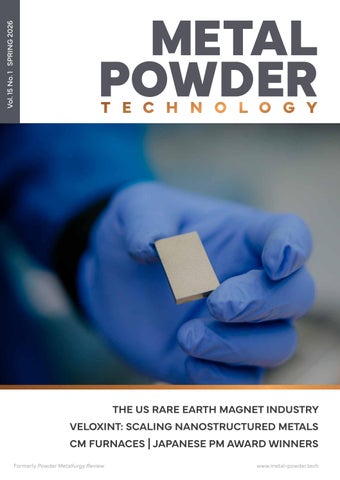
Metal Powder Technology Spring 2026

Page 1


Starmix® Nova

Improves compaction productivity up to 30%

Starmix Nova from Höganäs is designed to meet the demanding requirements of cost-efficient manufacturing for high-performance components. Perfect for producing taller and more complex-shaped parts, it excels in compacting components with narrow sections. Starmix Nova has proven its superiority through rigorous trials by numerous satisfied customers, delivering outstanding results every time.

Main product benefits

Excellent fillability: Achieve optimal material distribution in every mold.

Excellent lubrication: Ensure smooth operations and extend the life of your machinery.

Efficient compaction: Benefit from higher apparent density and faster compaction, leading to more consistent, higher-quality products.

Experience excellence. Experience Starmix Nova.

Publisher & Editorial Offices

Inovar Communications Ltd

11 Park Plaza

Battlefield Enterprise Park Shrewsbury SY1 3AF

United Kingdom

Tel: +44 (0)1743 469909 www.metal-powder.tech

Managing Director & Editor

Nick Williams, nick@inovar-communications.com

Group News Editor & Director

Paul Whittaker, paul@inovar-communications.com

Advertising Sales Director

Jon Craxford, jon@inovar-communications.com Tel: +44 (0)207 1939 749

News Editors

Amelia Gregory, amelia@inovar-communications.com Charlie Hopson-VandenBos, charlie@inovar-communications.com

Features Editor

Emma Lawn, emma@inovar-communications.com

Consulting Editor

Dr David Whittaker

Technical Consultant

Dr Martin McMahon

Marketing Lead Mulltisa Moung, mulltisa@inovar-communications.com

Production Manager

Hugo Ribeiro, hugo@inovar-communications.com

Operations & Partnerships Manager

Merryl Le Roux, merryl@inovar-communications.com

Office & Accounts Manager

Jo Sheffield, jo@inovar-communications.com

Subscriptions

Metal Powder Technology is published on a quarterly basis. It is available as a free electronic publication or as a paid print subscription. The annual subscription charge is £150.00 including shipping.

Accuracy of contents

Whilst every effort has been made to ensure the accuracy of the information in this publication, the publisher accepts no responsibility for errors or omissions or for any consequences arising there from. Inovar Communications Ltd cannot be held responsible for views or claims expressed by contributors or advertisers, which are not necessarily those of the publisher.

Advertisements

Although all advertising material is expected to conform to ethical standards, inclusion in this publication does not constitute a guarantee or endorsement of the quality or value of such product or of the claims made by its manufacturer.

Reproduction, storage and usage

Single photocopies of articles may be made for personal use in accordance with national copyright laws. All rights reserved. Except as outlined above, no part of this publication may be reproduced or transmitted in any form or by any means, electronic, photocopying or otherwise, without prior permission of the publisher and copyright owner.

Design and production

Inovar Communications Ltd.

ISSN: 2977-5892 - PRINT

ISSN: 2977-5906 - ONLINE

© 2026 Inovar Communications Ltd.

POWDER METAL TECHNOLOGY

Magnets and the reshoring paradox: strategic ambition meets commercial reality

The strategic case for reshoring rare earth magnet production is now well established. China’s dominance extends across refining and high-value manufacturing, creating a dependency that is both structural and geopolitical. In response, governments in the US and Europe are backing new capacity, and industry is beginning to invest.

The more difficult question is commercial. Reshoring is not just about building capacity – it is about sustaining that capacity in normal market conditions. Western producers face a structural cost disadvantage, rooted in decades of scale, integration, and process optimisation in China.

Domestically produced magnets are therefore likely to carry a premium. The real issue is whether customers are prepared to support that premium before the next supply chain crisis, rather than only once disruption is already under way.

So far, the evidence is not especially encouraging. GKN Powder Metallurgy’s reported decision to halt plans for a European magnet facility illustrates the point. Investment and technical ambition alone are not enough if customers are unwilling to provide the long-term demand commitments needed to underpin viable production.

That is the central weakness in much of the reshoring narrative. If OEMs will only pay more when supply chains are already breaking down, then reshoring has arrived too late to serve its purpose. Strategic resilience cannot rest on crisis purchasing alone.

Cover image

A rare earth magnet being inspected at MP Materials’ Independence facility in Fort Worth, Texas (Courtesy MP Materials/Robert Guerra)

Osprey® MAR 55 –bridging the gap between strength and weldability

Discover our latest and highly versatile tool steel powder Osprey® MAR 55. This new alloy bridges the gap between maraging steels and tool steels. With Osprey® MAR 55 you no longer have to choose between good weldability of carbon-free maraging steels and the strength and high wear resistance of carbon-bearing steels. Also, Osprey® MAR 55 gives you good mechanical properties and wear resistance already in the as-built condition.

Now available via Osprey® Online.

53 Rebuilding the US rare earth magnet industry: From policy ambition to manufacturing reality

China’s dominance of rare earth permanent magnets has become a critical vulnerability in global industrial supply chains. Control over refining and high-value magnet manufacturing underpins key technologies spanning electric vehicles, renewable energy, and defence. As export controls tighten, the US is pursuing an ambitious effort to rebuild a domestic mine-to-magnet ecosystem.

John Ormerod examines the progress, policy support, and practical manufacturing constraints shaping the path toward supply chain independence.

TITANIUM & REFRACTORY POWDERS

Metal powders designed for mission-critical, high-temperature applications.

HEADQUARTERS

130 Innovation Drive SW McDonald, TN 37353

REGISTRATIONS AND CERTIFICATIONS

The Future of Engineered Materials & Manufacturing

MADE IN AMERICA

Explore Amaero’s innovative, high-performance materials, specifically engineered to meet the demanding needs of industries such as Defense, Space, Aerospace, Oil & Gas, Industrial, Heavy Industry, Medical, and Energy.

Partner with us to harness cutting-edge solutions for your most challenging applications.

PM-HIP (Powder MetallurgyHot Isostatic Pressing)

Near-net-shape components with reduced lead times, ideal for high-mix, low-volume demand.

SEE AMAERO AT THE UPCOMING SHOWS:

DMC | Orlando, FL Mar. 30 – Apr. 2

RAPID/TRX/AeroDef | Boston, MA Apr. 14 – Apr. 16

SeaAirSpace | National Harbor, MD Apr. 19 – Apr. 22

NSMMS | Columbia, SC Jun. 22 – Jun. 25

World PM | Montreal, Canada Jun. 25 – Jun. 29

Space & Missile Defense | Huntsville, AL Aug. 11 – Aug. 13

FOLLOW US CONTACT SALES

67 Veloxint at Touchstone: Scaling nanostructured metals through Powder Metallurgy

Brian Joseph, President, CEO, and Founder of Touchstone Research Laboratory, has spent decades building the company around advanced materials development, technical problem-solving, and the commercialisation of emerging technologies.

During a visit to the Triadelphia, West Virginia site, Bernard North learned how that model led Touchstone to take an ownership stake in Veloxint and bring its nanostructured metals technology – positioned for scale-up via Powder Metallurgy processing and targeting highperformance defence, energy, and aerospace applications – into the organisation.  >>>

81 Eight decades of high-temperature processing: An interview with CM Furnaces’ Jim Neill

Few companies remain active in industrial furnace manufacturing for eighty years. As CM Furnaces reaches that milestone in 2026, its long view offers perspective on how high-temperature processing markets have evolved over time.

In this interview, Jim Neill, Vice President of CM Furnaces, discusses the evolution of Powder Metallurgy, Metal Injection Moulding, and Additive Manufacturing. He also outlines the realities of cyclical equipment markets and what customers now expect from furnace suppliers.  >>>

89 The 2025 JPMA Awards: Recognising innovations in Powder Metallurgy

The 2025 JPMA Awards, organised by the Japan Powder Metallurgy Association (JPMA), highlight recent advances in product design, process innovation, and materials engineering.

The award-winning developments featured in this article range from EV coolingmodule gears and motor-related process innovations to labour-saving production lines, advanced steel powders, and sintered valve components.

Together, they demonstrate how Powder Metallurgy is continuing to adapt to the evolving needs of the automotive and wider industrial sectors. >>>

POWDER METAL

Formerly PM Review, Metal Powder Technology is the essential international resource for the entire metal powder value chain — from production and processing to applications in PM, hardmetals, PM-HIP, batteries, magnetic materials, coatings, and beyond.

Through our magazine, website, weekly newsletter, social media channels and webinars, we connect industry innovators with a truly global audience.

Our platforms deliver trusted news, in-depth articles, and expert analysis to engineers, designers, researchers, and business leaders worldwide.

• Have industry news to share? Submit it

> paul@inovar-communications.com

• Want to showcase your expertise? Pitch a feature article

> nick@inovar-communications.com

• Be visible: Ask about advertising opportunities

> jon@inovar-communications.com

• Stay connected: Follow us on LinkedIn

> www.linkedin.com/company/ metalpowdertechnology

industry news

To submit news for inclusion in Metal Powder Technology contact Paul Whittaker at paul@inovar-communications.com

WorldPM2026 to showcase an evolving PM landscape

The publication of the full technical programme for the Powder Metallurgy World Congress –WorldPM2026, to be held in Montreal, Canada, June 25-29, reflects a number of metal powder processing trends as the PM, Additive Manufacturing and Metal Injection Moulding (MIM) industries respond to shifting end-user markets and applications.

Organised by the Metal Powder Industries Federation (MPIF) and co-located with AMPM2026 and Tungsten2026, WorldPM2026, the event features more than 300 technical presentations and promises to be one of the most comprehensive global PM gatherings in recent years.

As a World Congress, the event brings a broader international perspective and expanded technical depth. However, a closer analysis of the programme illustrates changes in the balance of materials, processes, and application across the industry.

A broader and more diversified materials landscape

A key feature of the 2026 PM World Congress programme is the expanded presence of refractory metals, driven in large part by the dedicated tungsten symposium. This has significantly increased coverage of tungsten, cemented carbides, and cermets, reflecting renewed industrial and strategic interest in these materials for applications ranging from energy systems to defence and electronics.

Alongside this, several other material categories show notable growth. Titanium stands out in particular, with a strong increase

in presentations, many of which are linked to Additive Manufacturing and advanced powder production routes. This reflects titanium’s continued importance in high-performance applications and its close alignment with emerging manufacturing technologies.

There is also a clear rise in activity around hard magnetic materials, as well as increased attention on copper. Both trends are closely tied to the ongoing global push towards electrification, where demand for high-performance magnetic and conductive materials is accelerating across sectors, including automotive, energy, and electronics.

Additive Manufacturing and powder production gain further momentum

From a process perspective, the programme highlights the continued

expansion of Additive Manufacturing within the broader PM landscape. Presentations on Laser Beam Powder Bed Fusion (PBF-LB) and Directed Energy Deposition (DED) have increased significantly, particularly for high-value materials such as titanium. This reflects the growing maturity of these technologies and their increasing adoption in demanding industrial applications.

Supporting technologies are also strongly represented. Hot Isostatic Pressing (HIP), for example, is prominently featured, underscoring its role as a critical post-processing step for high-performance AM components. As quality and reliability requirements increase, the integration of HIP into AM production workflows is becoming ever more important.

Equally notable is the growth in presentations focused on powder manufacturing. As AM moves towards larger-scale industrialisation, the importance of powder quality, consistency, and supply

WorldPM2026 promises to be one of the most comprehensive global PM gatherings in recent years (Courtesy Marc-Olivier Jodoin)

chain control is becoming more pronounced. Advances in atomisation, powder handling, and reuse are therefore a key area of focus across the programme.

Sinter-based technologies:

Bridging traditional PM, MIM and AM

Beyond beam-based AM processes, the programme also highlights the continued development of sinterbased technologies, which are increasingly positioned as a bridge between traditional PM, MIM and Additive Manufacturing.

This includes growing activity in sinter-based AM routes, where shaping is followed by debinding and sintering, offering potential advantages in terms of scalability and cost. These technologies are attracting attention for applications where high volumes and complex geometries intersect.

MIM features within the programme, though to a lesser extent than some other areas, reflecting its established but relatively stable position within the PM landscape. Its continued inclusion underscores its role in the production of complex components and

its technical overlap with emerging sinter-based AM approaches.

In parallel, there is sustained interest in advanced sintering techniques such as Spark Plasma Sintering (SPS) and Field Assisted Sintering Technology (FAST), particularly for research into difficult-to-densify materials. While still largely at the development stage, these processes point towards future opportunities in materials innovation.

Press-and-sinter finds new opportunities in electrification

While considerable attention is focused on advanced and emerging technologies, conventional pressand-sinter PM remains a significant part of the programme. Increasingly, its relevance is being shaped by new application opportunities rather than traditional markets.

In particular, the growth in hard magnetic materials presents a potential avenue for broader adoption of press-and-sinter technologies. As demand for magnetic components rises with electrification, PM offers advantages in material utilisation, design flexibility, and cost-effectiveness.

Gevorkyan announces Italian acquisition to add 94 new customers

Powder Metallurgy parts maker

Gevorkyan a.s., headquartered in Vlkanová, Slovakia, has announced the signing of an agreement to acquire an unnamed production facility located in Italy, gaining access to a stated ninety-four customers worldwide. Formal regulatory approvals are underway and are expected to be completed in the coming weeks.

Gevorkyan will maintain production at the Italian operation, gaining access to its customer base, almost half of which are Italian. Notable customers include Lombardini, Ducati, Piaggio, Bosch Rexroth, Muviq and Rheinmetall Group.

The acquisition represents a strategic step in the company’s long-term ambition to strengthen its presence in South East Europe and expand cooperation in higher value-added segments. Italy is one of the company‘s key markets, supported by its strong industrial base and demand for technologically advanced solutions.

“This is a respected company with a sixty-year tradition, strong customer relationships, and a promising portfolio in industries where Gevorkyan traditionally offers innovative solutions,” stated Dipl-Ing. Artur Gevorkyan, chairman of the board of directors

This alignment between established PM capabilities and emerging application needs underscores the technology’s ability to adapt and remain relevant in a rapidly changing industrial landscape.

A high-value forum for a changing industry

As always, an accompanying exhibition will take place alongside the technical sessions, providing a platform for equipment suppliers, materials producers, and service providers to engage with attendees.

The strength of the PM World Congress lies in the depth and breadth of its industry coverage. The combination of established PM processes, rapidly advancing Additive Manufacturing technologies, and emerging materials applications offers a comprehensive view of the current state of the industry and its future direction.

For attendees, the event offers a unique opportunity to gain insight into these intersecting trends – and to understand how the PM industry is positioning itself for the next phase of its development.

www.mpif.org

Gevorkyan is set to acquire an unnamed production facility in Italy, gaining access to its 94 customers (Courtesy Gevorkyan)

of Gevorkyan. “I am pleased that we will now have the opportunity to cooperate with Italian engineers, and that in the city of Bologna ideas will be born and implemented that will strengthen the competitiveness of European industry.” www.gevorkyan.eu

Neo marks one million sintered magnets from new Estonia facility

In February 2026, Neo Performance Materials shipped its one millionth sintered magnet from its new production facility based in Narva, Estonia. Neo is a producer of bonded neodymium-iron-boron (NdFeB) magnetic powders and magnets, with the news marking an early milestone for the new facility.

Ground breaking for the Narva plant took place in 2023, with the official opening of the facility in September 2025. Since then, the site has focused on ramping up production and establishing regular manufacturing operations.

According to Neo, reaching this production volume in this timeframe reflects the coordinated efforts of the Narva team together with the wider Magnequench and Neo Performance Materials groups, as well as support from customers during the early stages of the plant’s operation.

The company acknowledged the contributions of employees at the Narva facility and across the wider Magnequench and Neo organisations in achieving the milestone. www.neomaterials.com www.mqitechnology.com

Titomic plans headquarters move to USA to support growth

Titomic Limited, headquartered in Melbourne, Australia, has announced that its Board of Directors has approved the commencement of planning activities to redomicile the company from Australia to the United States.

The proposed move is said to reflect Titomic’s continued expansion into US defence, aerospace and industrial markets. According to the company, the United States represents the largest global market for advanced manufacturing technologies supporting the modernisation of the defence and domestic industrial base.

“Titomic’s growth strategy is increasingly aligned with the US defence, aerospace and industrial markets,” stated Jim Simpson, Chief Executive Officer and Managing Director. “Redomiciling the company positions Titomic to fully participate in the modernisation of the US defence industrial base while scaling our advanced manufacturing capabilities globally.”

Under the proposed structure, Titomic intends to establish a US-based holding company (HeadCo),

which will become the new parent company of the Titomic Group. Existing shareholders of Titomic Limited would retain an equivalent proportional economic interest in HeadCo through Chess Depository Instruments, subject to any ineligible foreign ownership provisions. The company states that its global operations, management team and strategic direction will remain unchanged.

Titomic has recently commenced, and expects to expand, engagements with Tier-1 prime contractors supporting programmes for the US Department of Defense. Many of these opportunities involve activities subject to US regulatory requirements, including export controls under the International Traffic in Arms Regulations (ITAR). Establishing a US-domiciled parent company is expected to allow the company’s board and leadership greater participation in these programmes and support the continued expansion of Titomic’s US defence business.

The company anticipates completing the redomicile in the second half of 2026. The transac -

Neo facility in

Estonia, celebrated shipping its one millionth sintered magnet (Courtesy Neo Magnequench)

tion is expected to be implemented through a Scheme of Arrangement between Titomic and its shareholders, subject to shareholder approval and approval by the Federal Court of Australia.

Following completion of the redomicile, Titomic also intends to pursue a listing of its shares on a US exchange at an appropriate time. The company states that a US listing would expand access to global capital markets and support its strategy to scale advanced manufacturing production across defence, aerospace, energy and industrial sectors.

“Titomic will always be an Australian success story at its core,” stated Dag WR Strømme, Titomic Executive Chairman. “To better position the company for the future, we believe establishing a US-domiciled parent company is the right strategic step for Titomic and its shareholders. The United States is the centre of the global defence and advanced manufacturing ecosystem, and aligning our corporate structure with our operational footprint strengthens our ability to execute our growth strategy while maintaining our strong international presence as well as simplicity in running the business.”

www.titomic.com

The
Narva,

Metco adds new Abbott continuous sintering furnace

Abbott Furnace Company, headquartered in St Marys, Pennsylvania, USA, has delivered and commissioned a seven-zone continuous belt sintering furnace for Powder Metallurgy component manufacturer Metco Industries, also based in St Marys.

According to the company, the furnace is designed to provide tighter process control, improved repeatability, and real-time performance visibility. It is equipped with fully digital flow control, advanced moni -

toring, and data-driven diagnostics, intended to optimise sintering conditions and support high-quality, consistent production.

Metco Industries operates state-of-the-art Powder Metallurgy facilities, designed for precision, efficiency, and growth. The company is IATF 16949: 2016 automotive quality standard certified, one of the most widely used global automotive quality standards, which focuses on safeguarding, risk management and

customer satisfaction. The IATF certification, along with ISO 9001:2015, enables Metco Industries to pursue continued growth across global markets.

“Abbott Furnace Company is proud to support customers such as Metco Industries who continue to invest in advanced thermal processing solutions,” Abbott stated. “Projects like this reflect a shared commitment to process control, operational consistency, and long-term manufacturing performance within the powdered metal industry.”

www.abbottfurnace.com

www.metcopm.com

SK Battery America cuts workforce at Georgia EV battery plant

SK Battery America Inc, a subsidiary of South Korea’s SK On, has reportedly laid off nearly 1,000 employees at its battery manufacturing facility in Commerce, Georgia, USA. The layoffs were said to have been implemented to align operations with slowing US domestic growth for electric vehicles.

“SK Battery America remains committed to Georgia and to building a robust US supply chain for advanced battery manufacturing,” stated Joe Guy Collier, spokesperson for SK Americas. “We are pursuing a range of future customers, including

the Battery Energy Storage System arena.”

In October 2025, SK On announced plans to increase LFP battery production at the Commerce facility to meet EV battery demand. However, in the following December, Ford announced the cancellation of plans for a fully electric F-150 pickup, instead focusing on the development of an extended-range variant. SK previously partnered with Ford in a joint venture that invested approximately $11.4 billion in battery manufacturing plants in the US. The companies ended the joint venture in

December. SK also supplies batteries to Volkswagen.

SK Battery America has invested significantly in the Atlanta area in recent years as automotive manufacturers expanded EV programmes and the US government introduced policies intended to support domestic EV supply chains. In June 2020, SK announced plans to invest $940 million to expand its battery manufacturing operations in the Atlanta region, an expansion expected at the time to create approximately 600 jobs.

SK and Hyundai are continuing construction of a $5 billion battery manufacturing facility near Cartersville, Georgia.

eng.sk-on.com

Abbott’s seven-zone continuous belt sintering furnace installed at Metco (Courtesy Abbott Furnace Company)
Parts entering the seven-zone continuous belt sintering furnace (Courtesy Abbott Furnace Company)

Metal 3D Printer

MT100, MT170, MT170DL, MT280, MT400M, MT450 MT450M, MT650, MT650H, MT800, MT1300, MT1550

Metal Powder

CP Ti, Ti6Al4V GR5(23), BT9, BT20, Ti17, Ti31, Ti6242, Ti4822, Ti2AINb IN718, IN625, HX, Haynes 230, Haynes 188, C276, X40, IN939, M247LC AISi10Mg, AIMgErZr, AIMnErZr, MS1, 316L, 17-4PH

We can remanufacture from coarse powder and waste.

Metal Gas Atomizer

AVI-VIGA, AVI-EIGA, AVI-PREP, AVI-PA, AVI-GA

Metal 3D Printing Part

Design Modeling, Structural Optimization, Process Design Print Manufacturing, Post-Processing, Performance Testing

Metal Bar

CP Ti, Ti6AI4V GR5(23), BT9, BT20, Ti17 Ti31, Ti6242, Ti4822, Ti2AINb IN718, IN625, HX, Haynes 230, Haynes 188

Sandvik reports order and revenue growth in 2025 Annual Report

Sandvik AB, headquartered in Stockholm, Sweden, has released its 2025 Annual Report, in which organic order intake grew by 11% and revenues by 5% at fixed exchange rates. Adjusted EBITA margin was in the range of 20 – 22%, whereas the adjusted operating margin was 19%, despite significant currency headwinds.

“We can look back on a successful 2025 for Sandvik,” stated Stefan Widing, President and CEO. “In a year characterised by significant geopolitical uncertainty and trade barriers, we proved the strength of our strategy by delivering good growth, a strong cash flow and resilient profitability, while at the same time advancing our long-term ambitions.”

Investments in R&D amounted to SEK 4.5 billion in 2025, corre -

sponding to 3.8% of group revenues. Widing added, “Sandvik maintains a high innovation pace as we consistently find new ways to create customer value. We continue to build on our technology leadership within areas such as advanced materials, automation, electrification and digitalisation.”

Sandvik stated that the cutting tool market remained mixed in 2025. Underlying demand in general engineering was muted but stable, a consequence of the subdued industrial cycle. Demand in aerospace was strong during the year following several years of backlog amongst major aircraft manufacturers, while the automotive industry remained weak. Sandvik also noted solid order intake development in the defence segment, where geopolitical unrest

has spurred increased investments.

Sandvik also announced an updated Group strategy –Advancing to 2030. The strategy is centred around five strategic objectives, focusing on growth, innovation, digitalisation, profitability, and high-performing teams, with sustainability embedded in all operations.

“Sustainability is integrated into our business model and a major opportunity for Sandvik since our solutions help our customers improve productivity, safety, and resource efficiency in their operations. Our primary focus is on the use of our products as this is where we have our main impact. Minerals are necessary to enable electrification, and we have an important role to play in supplying our customers with the best solutions to support their needs,” added Widing.

www.home.sandvik

Amaero confirms plan to operate as US-based company

Amaero has entered into a scheme implementation deed with newly formed, Delaware-based Amaero Inc (Amaero US HoldCo) to pursue a re-domiciliation of Amaero and its subsidiaries (Amaero Group) from Australia to the United States of America. Amaero US HoldCo will become the ultimate parent company of the Amaero Group.

“After months of consideration and planning, commencing the re-domiciliation process is a very significant milestone for Amaero,” stated Hank J Holland, Amaero’s chairman and CEO. “We are fortunate to have had strong institutional and individual investor support in Australia and we will maintain an ASX listing. At the same time, we have taken intentional corporate actions to establish Amaero as a leading

US company that is integral to domestic sovereign manufacturing and supply chains for missioncritical applications that support defence, aerospace, nuclear energy, medical and industrial sectors.”

“In response to demand pull, we acted boldly three years ago to establish the largest domestic production capacity and the lowest unit cost production for refractory and titanium alloy spherical powders; moreover, we have demonstrated a leadership position in PM-HIP manufacturing of near-net-shape parts that provides an immediate and viable substitute for castings and forgings. We are committed to working closely with our partners in the US government, the Department of War, the US Navy and our commercial

Better By Design.

customers to continue to innovate, to integrate and to scale advanced material production and advanced manufacturing,” Holland concluded.

If the scheme becomes effective, all ordinary and unlisted shares in Amaero will be transferred to Amaero US HoldCo.

If successful, the re-domiciliation will position Amaero for a potential initial public offering in the US in 2026 or 2027, depending on market conditions.

These changes are also expected to position the Amaero Group in a larger, deeper defence market in the United States, supporting growth for shareholders. They are also expected to offer access to a broader US investor pool that may not have invested in non-US securities and improve the group’s access to lower-cost US debt and equity capital markets.

www.amaeroinc.com

OMCD installs 1 MW AEM electrolyser for green hydrogen at hardmetal powder plant

The OMCD Group, a multi-national sintered carbides and hardmetals company headquartered in Anzola d’Ossola, Italy, announced that it has installed a 1 MW Anion Exchange Membrane (AEM) electrolyser for the on-site production of green hydrogen at its Premosello Chiovenda Powder Production Hub.

“The electrolyser will be a core element of our Green Hydrogen project, allowing us to produce hydrogen from renewable energy sources and significantly reduce CO 2 emissions,” the company stated. “Together with our photovoltaic plants and recycling initiatives, this installation represents another tangible step towards a more sustainable, efficient and circular production model for hardmetal powders.”

The AEM Nexus 1000 is a megawatt class containerised electrolyser manufactured by Enapter, based in Saerbeck, Germany. The system features AEM stacks around a common balance of plant (BoP), which includes

Due to the efficiency of our cuttingedge technology we can offer the lowest priced powder on the market with no compromise in quality.

OMCD will use the AEM Nexus 1000 electrolyser to produce green hydrogen on site (Courtesy the OMCD Group)

rectifiers, control/safety system, cooling/heating and electrolyte loop.

Integrated with photovoltaic infrastructure, the electrolyser enables on-site green hydrogen production. Fully automated and optimised with AI, the system is said to offer efficiency of 51.3 kWh/kg.

www.OMCD.it www.enapter.com

Metal powder maker Sinchin New Materials raises

$14M in pre-IPO funding round

Sinchin New Materials, Hangzhou, China, has completed its pre-IPO funding round, raising nearly ¥100 million ($14 million). With funding from Hangzhou Chengtou, Lenovo Capital, ZSCO, and a fund managed by Zhejiang Communications Investment Group, Sinchin plans to focus on its R&D and market development, as well as capacity expansion.

Our powder is:

Spherical

Free-flowing

D50 of 35µm for most materials

• Has high tap density

D50 of 20µm for titanium super alloys

We process directly from:

Raw elemental material •

• Sponge •

Pre-alloyed stock

Recycled chip •

Recycled parts •

Over-sized powder

We can handle refractory and reactive alloys •

Sinchin develops and produces nanoscale metal powders, focusing primarily on nickel powders and ultrafine soft magnetic powders. It also offers photovoltaic copper powder and base metal catalysts for hydrogen production. 2024 saw the company’s nickel powder with sizes of 200 nm and below domestically designated as a ‘new material’.

Over the past year, the company has primarily focused on sustained revenue growth, the expansion of the customer base to include clients in Japan and South Korea, and wider commercialisation across product lines. Through 2028, it plans to prioritise the expansion of its 60-80 nm finished nickel powder.

Sinchin anticipates reaching an annual production capacity of 4,000 tonnes by 2026 and 6,000 tonnes by 2027.

www.sinchinnano.com

Additive powders from CD Bioparticles improve mechanical and chemical properties

CD Bioparticles, headquartered in Shirley, New York, USA, has added a range of additive powders to its product portfolio. Used to enhance or modify the properties of base materials, the additive powders can improve mechanical and chemical properties, including strength, durability, conductivity, and heat resistance.

Additive powders play a crucial role in fields such as Additive Manufacturing, Metal Injection Moulding (MIM), Powder Metallurgy, coatings, composites (such as metal matrix composites and polymer composites), energy storage and batteries, and biomedical applications (such as orthopaedic and dental implants).

CD Bioparticles provides various additive powders, including alloy powder, compound powder, and elemental powder. The alloy powders primarily encompass iron-, nickel-, and cobalt-based materials used extensively in Additive Manufacturing, Powder Metallurgy and surface coating processes. The alloy powders designed specifically for Additive Manufacturing, for example, are characterised by high purity, high sphericity and diverse particle size distributions. Additionally, custom particle sizes are available for highentropy alloy powders for advanced manufacturing applications.

CD Bioparticles also offers boride powders, multi-element oxide powders and single-element oxide

Enhancing Precision in Powder Metallurgy

powders in various particle sizes for different applications. Nanoscale and micron-scale powders are also available upon request. Compound powders can be formulated through multiple methods and are characterised by their ability to combine the advantages of their constituent elements in order to achieve specific physical, chemical or functional properties.

Generic metallic, non-metallic and rare earth element powders are also available with customisable particle size specifications. These powders are suitable for a variety of applications, including Additive Manufacturing, Powder Metallurgy, chemical reactions, pharmaceuticals, and electronics. Elemental powders consist of a single element and are primarily used in scientific research, manufacturing, materials science, chemistry, pharmaceuticals and other specialised fields. www.cd-bioparticles.com

Our high-performance VIGA systems deliver high-quality metal powders, engineered for novel and complex alloy compositions

GMH Gruppe, Georgsmarienhütte, Germany, has combined the production of advanced metal powders and Additive Manufacturing under the umbrella of ProMateria GmbH. The new company, led by Robert Teuber and Philip Stöhr, is co-located alongside GMH’s sister company Energietechnik Essen GmbH.

ProMateria’s focus is on the use of high nitrogenalloyed steels (HNS) in Powder Metallurgy and serial Additive Manufacturing. These materials combine high corrosion resistance with hardness, strength and biocompatibility, opening up opportunities for high-performance components in the aerospace, medical, luxury goods, engineering and energy sectors.

Another field of application is individualised sports equipment: together with Make Golf, ProMateria is currently developing one-off golf clubs that are tailored to an individual’s swing profile and biometric data.

ProMateria produces the metal powder in batches ranging from 25 kg to 10 tonnes in a high-throughput process tailored to Powder Metallurgy. The HNS feedstock is supplied by Energietechnik Essen.

“With ProMateria, we combine our own powder production, Additive Manufacturing and finishing,” stated Philip Stöhr, Commercial Director of ProMateria.

Using Tritone’s MoldJet sinter-based Additive Manufacturing technology and in-house metal pastes, the company has been able to carry on AM as a flexible prototyping to full series production across a fleet of six AM machines. ISO 9001 certification for this area is expected in the third quarter of 2026.

Beyond HNS, ProMateria offers a range of materials including stainless steel, tool steel, low-alloy steels, hightemperature alloys, titanium alloys, ceramics, copper and others.

www.gmh-gruppe.de

• Simple, quick set-up • High accuracy • Low scrap rate • Maximal machine utilization • Increased productivity

punch with Macro
ProMateria’s

6K Additive signs nickel powder deal with Siemens Energy

6K Additive, a division of 6K, based in North Andover, Massachusetts, USA, has signed a global long - term supply agreement under which Siemens Energy will supply spent nickel alloy powder from its Additive Manufacturing facilities to 6K Additive for use as feedstock.

This agreement enables the productive reuse of nickel - based superalloy revert material that would otherwise remain in low - value recycling streams. 6K Additive converts

this feedstock into virgin, AM - ready metal powder using its advanced UniMelt microwave plasma production process, supporting material efficiency and reduced environmental impact across the AM supply chain.

To date, 6K Additive has reportedly processed close to 20 tons of nickel superalloy powder originating from Siemens Energy, with the resulting material supplied into the broader Additive Manufacturing market. The collaboration is intended

CNPC Powder secures funding to expand powder facility

CNPC Powder, headquartered in Vancouver, Canada, with metal powder production based in China, has announced the completion of a new round of equity financing. This funding is intended to accelerate the company’s capacity expansion and finance technology upgrades.

The first phase of the expansion will form part of its 76.5-acre site and is designed to support the manufacture of high-value metal powders. The development is expected to add over 8,000 tons to CNPC’s annual production capacity.

As well as expanding CNPC’s current capabilities, the new facility will add a dedicated space for

storage and logistics. The expansion will also provide space for offices, additional R&D laboratories, and essential supporting facilities for its AM campus.

This phase of expansion is expected to be completed and online by the end of 2026.

Two decades of metal powder manufacturing

Since its founding in the early 2000s, CNPC Powder has leveraged its technological innovation to deliver a diversified portfolio of advanced metal powders to customers and industry partners worldwide. Its materials portfolio includes

to demonstrate how industrial revert materials can be effectively up-cycled into high - quality powders, contributing to a more resilient and sustainable metal AM ecosystem.

“At Siemens Energy, sustainability and responsible resource use are integral to how we approach advanced manufacturing,” said Steve Sarcander, Head of Finance, Additive Manufacturing of Siemens Energy. “By supplying our revert material into 6K Additive’s production process, we are supporting circular material flows while helping to reduce waste and emissions associated with metal powder production. Partnerships like this play an important role in strengthening the overall Additive Manufacturing value chain.”

Frank Roberts, CEO of 6K Additive, added, “Siemens Energy is a strong example of an industrial partner committed to advancing circularity. Their consistent and high - quality feedstock enables us to produce premium nickel alloy powders using our UniMelt process, delivering meaningful reductions in energy use and carbon emissions while supporting the growing demand for sustainable AM materials.“

www.siemens-energy.com www.6KAdditive.com

The first phase of the expansion will form part of its 76.5-acre site and is designed to support the manufacture of high-value metal powders (Courtesy CNPC Powder)

aluminium alloys, fully recycled SGS-certified titanium alloy, ironbased alloys including tool and stainless steel, nickel alloys, copper alloys, precious metals, as well as tailored refractory alloys. www.cnpcpowder.com

Siemens will supply spent nickel alloy powder from its AM facilities to 6K Additive for use as feedstock (Courtesy Siemens Energy)

RIFT secures €113.8M to scale iron powder fuel technology

RIFT, based in Eindhoven, the Netherlands, has announced that it has secured €113.8 million in financing to scale Iron Fuel Technology and move into commercial deployment. Through its €83.1 million Series B round, the company intends to prepare and execute its first commercial project, aimed at decarbonising industrial heat at scale.

“As a consortium, we have closely followed RIFT’s development and see strong potential for tangible industrial impact,” stated Tim van den Brule, Investment Director at PGGM Infrastructure. “Many industrial innovations stall in the transition from demonstration to realisation. We have deliberately chosen a financing structure that provides capital through to execution.”

Building a commercial facility

RIFT intends to construct a commercial production facility from which iron fuel will be supplied to multiple industrial customers integrating Iron Fuel Boilers into their heat processes. This plan follows the company’s first commercial contract, which was signed in 2025 with Kingspan Unidek. RIFT plans to have the facility operational in 2029.

The project is expected to deliver approximately 340 GWh of industrial heat per year. Over a fifteen-year lifetime, that amounts to roughly 5 TWh of decarbonised heat, resulting in more than one million tonnes of avoided CO 2 emissions.

“We are proud of what the team has achieved so far. Over the past years, we have demonstrated that

GKN PM halts plans for European rare earth magnet facility

According to Reuters, GKN Powder Metallurgy, now a Dauch company, has halted plans to produce rare earth permanent magnets in Europe. Sources told Reuters that the decision was made prior to the finalisation of Dauch’s acquisition, noting that the rare earths segment was considered a non-core activity without a guaranteed financial outlook.

In December 2025, GKN PM informed its partner Ionic Technologies – a start-up focused on developing a new method for permanent magnet recycling –that it would cease work in the sector. One source told Reuters that Ionic had received one batch of magnets from GKN’s German pilot magnet plant before the plant’s closure.

Iron Fuel Technology performs reliably in an industrial environment,” the company stated. “With this financing, we are moving into the next phase: preparing and executing our first commercial project.”

According to RIFT, industrial heat remains one of the most challenging parts of the energy transition. Sectors such as food processing, chemicals and building materials require continuous high-temperature heat for their production processes. Today, this heat is largely generated using fossil fuels, primarily natural gas. For many applications, electrification is not readily deployable due to high temperature requirements, large power demand and limited grid capacity, thereby opening an opportunity for the deployment of scalable, CO 2-free alternatives.

RIFT is able to offer such an alternative through a circular energy carrier based on iron. By replacing natural gas in industrial heat processes, high-temperature heat can be generated without direct CO 2 emissions.

Innovation funding

In addition to the Series B round, RIFT has been selected for a €30.7 million project under the EU Innovation Fund. The fund is one of the European Union’s key instruments to support large-scale innovative decarbonisation projects. The Innovation Fund is designed to help bridge the gap between demonstration and commercial deployment.

www.ironfueltechnology.com

There is no further detail available as yet regarding the Memorandum of Understanding (MoU) signed between GKN PM and Schaeffler AG, through which GKN PM would produce permanent magnets for the automotive supplier.

A separate source told Reuters that GKN was still in the decisionmaking stage regarding the future of its European pilot plant following the cessation of its permanent magnet production.

www.gknpm.com

RIFT has secured funding to scale and commercialise its Iron Fuel Technology (Courtesy RIFT)

Pratt & Whitney invests $200M in Columbus Forge expansion

Pratt & Whitney, an RTX business, is investing $200 million to expand its operations in Columbus, Georgia, USA. The site supports both commercial and military engine programmes.

The investment will add a seventh isothermal forging press at the company’s Columbus Forge facility. The additional press is expected to increase output of critical rotating components, including compressor and turbine discs, by 30% in support of the GTF, F135 and other engine programmes. The press is scheduled to become operational in 2028.

The expansion follows a recent 7,525 m² (81,000 sq ft) enlargement of the GTF maintenance, repair and overhaul (MRO) capability at the Columbus Engine Center, located on the same campus. The $70 million project introduced new equipment aligned with the company’s Industry 4.0 strategy and reportedly increased the facility’s annual capacity by more than 25%, adding overhaul capability to the global GTF MRO network.

Shane Eddy, Pratt & Whitney President, stated, “Since 2008, we have invested more than $1 billion to expand the footprint and capabilities of our Columbus facility. This latest investment will increase output of critical parts for our growing military and commercial engine programmes.”

The Columbus site, located approximately 145 km south of Atlanta, comprises the Columbus Engine Center and Columbus Forge. The Engine Center maintains GTF engines for the Airbus A320neo family, Airbus A220 and Embraer E-Jets E2 aircraft. It also services F117 engines for the C-17 transport aircraft and F100 engines for the F-15 and F-16 fighter aircraft.

Columbus Forge produces compressor airfoils and compressor and turbine discs for Pratt & Whitney’s commercial and military engines, including the GTF and the F135 engine, which powers the fifth-

generation F-35 Lightning II fighter. According to the company, more than 2,600 GTF-powered aircraft have been delivered to over ninety global customers. Pratt & Whitney has also delivered more than 1,300 production F135 engines to a global programme that includes twenty allied nations.

www.prattwhitney.com

The Columbus Forge produces compressor airfoils and compressor and turbine discs for the GTF (Courtesy Pratt & Whitney)

Tekna hits one million kilograms of titanium powder

Tekna Holding ASA, headquartered in Sherbrooke, Quebec, Canada, announced that it has produced its one millionth kilogram of titanium powder.

The company began developing its atomisation process in 2015. At that time, industrial production consisted of one atomisation machine and one shift of work per day. Within months, the company scaled to 24/7 operations.

Tekna produces powders using its radio frequency (RF) induction plasma atomisation technology, a process in which titanium wire is

fed into a high-temperature plasma torch. The intense heat melts the wire, transforming it into fine droplets that solidify into spherical powder particles as they cool.

The proprietary plasma atomisation process is continuous and does not require any consumables that may interrupt or contaminate the process. Without any external gas jets or electrodes in contact with the material, the powder remains free from contaminants, making it suited to applications in the aerospace, medical and industrial sectors.

Chery’s Exeed brand to debut highdensity solid-state battery in 2026 models

Exeed Automobile, a premium SUV brand of Chery, headquartered in Wuhu, China, has announced plans to feature its Rhino S solid-state battery in the Liefeng shooting brake 2026 model. The Rhino battery features an energy density reaching 600 Wh/kg and has been developed using oxide electrolyte technology.

The Liefeng is reported to offer a range of 1,500 km, even in -30°C

conditions. It is expected to be equipped with an 800 V architecture and a 30,000 rpm electric motor, enabling 0 to 100 km/h in under three seconds and a top speed of 260 km/h.

According to Chery, the solidstate batteries will be deployed in ride-sharing and rental markets in 2026, before large-scale production begins in 2027. www.exeedinternational.com

Proterial announces company restructuring, plans new subsidiaries

Proterial, headquartered in Tokyo, Japan, has announced a company restructuring programme. It will integrate its current Specialty Steel, Roll, and Power Electronics Materials businesses with parent company, K.K. BCJ-52. Following this, it will establishing a Power & Electronics Material Business Unit and an Aero & Industrial Alloy Business Unit.

In addition, the Magnetic Materials, Electric Wire & Cable, and Automotive Components businesses will be converted into separate subsidiaries.

“We are executing measures aimed at sustainable growth and maximising corporate value,” stated Representative Director, Chairperson, President, & CEO Sean M Stack.

“The Magnetic Materials Business, the Electric Wire & Cable and the Automotive Components Businesses will continue operating as before, while establishing a structure that enables rapid and flexible responses to market and customer needs and product characteristics, thereby maximising business value.”

“We are proud of our R&D team who built the foundation, our Quality team who secured world-class certifications, and our Operations team who run complex systems every day with precision and discipline,” Tekna posted on LinkedIn. “This milestone belongs to the people behind it.”

www.tekna.com

“We will continue to make proactive investments in growth areas and strive to enhance our market presence and competitiveness,” concluded Stack.

www.proterial.com

Proterial offers a range of metal powders, including its Addmuster series for metal Additive Manufacturing (Courtesy Proterial)

Tekna offers Ti-6Al-4V, Grade 5 & 23, as powder in a variety of sizes (Courtesy Tekna)
Chery’s Liefeng shooting brake model concept (Courtesy Chery)

THE BASIS FOR HIGH QUALITY METAL POWDER: DURABLE HEBOSINT ® NOZZLES.

In metal powder production, every detail matters. Our technical ceramic components made from Boron Nitride - HeBoSint® are specifically engineered to meet the demanding requirements of metal atomization.

Here‘s why they provide a competitive edge:

• Highest Precision: Achieve precise and repeatable control of particle size, leading to optimal yield and reduced rejects.

• Maximum Service Life: The excellent non-wetting behavior prevents clogging, while the high thermal shock resistance avoids unnecessary preheating and costly downtime.

• Efficiency and Cost Savings: Our robust, low-maintenance nozzles contribute to a significant reduction in overall process costs.

Henze Boron Nitride Products AG

Grundweg 1

87493 Lauben / Germany

Phone: +49 8374.589 97-0

E-Mail: info@henze-bnp.de

www.henze-bnp.de

Frontier secures $20M for Zandkopsdrift South African rare earths project

Frontier Rare Earths Limited, headquartered in Luxembourg, is developing the Zandkopsdrift magnet rare earths and battery-grade manganese project in South Africa and has signed a Technology Supply Agreement with Carester SAS, based in Lyon, France. The company also announced a $20 million investment from South Africa’s Industrial Development Corporation (IDC) to fund a Definitive Feasibility Study (DFS), with first production targeted for 2030.

Carester SAS is currently constructing a heavy rare earths separation plant and a rare earths recycling plant in Lacq, PyrénéesAtlantiques, France. The plant is scheduled to commence operations in Q4 2026. It is being developed with €216 million in financial support from the French Government, the Japan Organization for Metals and Energy Security (JOGMEC) and Iwatani Corporation, a Japanese industrials and advanced materials company.

In conjunction with the Technology Supply Agreement, Frontier also signed a seven-year offtake

agreement with Carester, renewable for a further three years, under which Carester will purchase the MHREC produced at Zandkopsdrift for separation at its Lacq facility and from which it will produce highpurity Dy and Tb oxides.

“We are delighted to have signed these strategic agreements with Carester, which will result in our flagship Zandkopsdrift project being the first project in Africa to deploy Carester’s industry-leading rare earths extraction technology,” stated Philip Kenny, chairman of Frontier. “We are also very pleased to have secured a $20 million strategic investment from the IDC to fund a DFS on Zandkopsdrift. With Zandkopsdrift expected to be the lowest cost producer of magnet rare earths outside China after taking into account net revenue credits from a battery grade manganese byproduct, for which it will be the lowest cost producer in the world, we believe that Frontier is now well-positioned to make a meaningful contribution to the diversification of the Western world’s rare earths and battery raw material supply chains.”

LCM to build rare earth metals plant in France

Less Common Metals (LCM) Europe

SAS, a subsidiary of USA Rare Earth, headquartered in Stillwater, Oklahoma, USA, has announced plans to develop a metal and alloy production facility in Lacq, France. The new facility will be capable of producing 3,750 metric tons per annum. Scheduled for commissioning in 2026, it is expected to establish a comprehensive supply chain for rare earth processing and metal and alloy production in Europe.

The French government is reportedly committed to addressing multiple aspects of LCM Europe’s

capital and operating requirements. LCM Europe was approved for direct credits of up to 45% of all eligible equipment and up to a total of €130 million for real estate, under the C3IV programme. The French government is also said to be interested in providing support for hiring and training programmes to bolster talent development and skills building at LCM Europe’s new facility.

“The development of an integrated rare earth processing and metal-making platform in France enhances USAR’s integrated rare earth value chain, to the benefit of

Frontier Rare Earths Limited is developing the Zandkopsdrift magnet rare earths and battery-grade manganese project in South Africa (Courtesy Frontier Rare Earths)

Frédéric Carencotte, president of Carester, commented, “This partnership marks another step in Carester’s strong commitment to supporting the development of a secure and sustainable European rare earth industry. The offtake agreement ensures long-term feedstock security for our French plant and demonstrates how close industrial cooperation can reinforce the critical raw materials value chain.” www.frontierrareearths.com www.carester.fr www.idc.co.za

the United States and our allies,” stated Barbara Humpton, Chief Executive Officer of USAR. “We are proud to establish Europe’s first metal-making platform, which will accelerate the realisation of a secure, sustainable transatlantic rare earth value chain.”

According to USAR, the creation of this broad rare earth processing and commercialisation platform reflects its ambition to build a more resilient and sustainable European rare earth industry that supports industrial sovereignty by securing critical resources and capabilities for advanced technologies and the energy transition.

www.usare.com www.lesscommonmetals.com

Metalysis secures €1M ESA funding for titanium process

Metalysis Ltd, Rotherham, UK, has been awarded near €1 million in funding from the European Space Agency (ESA) to develop a continuous or quasi-continuous process for titanium production using its FFC (Fray-Farthing-Chen) molten salt electrolysis technology.

The twenty-four-month project aims to scale Metalysis’ FFC process to support more sustainable bulk titanium production and strengthen Western supply chains for critical metals.

Metalysis will lead a consortium including the UK’s Lucideon Ltd, TTP plc and NCHG Ltd, along with Austria’s RHP-Technology GmbH. Covering key unit operations associated with the FFC process, the partners bring experience in ceramics processing, materials science, electrochemistry, process

development and Powder Metallurgy. The consortium will work to scale the process beyond its current batch configuration towards continuous or quasi-continuous operation.

According to Metalysis, its existing GEN-3 and GEN-4 reactors are able to produce titanium powders to the metal Additive Manufacturing sector, but production volumes are currently insufficient for wider bulk titanium markets. Other consortium partners will contribute expertise in feedstock development, process scale-up, modelling and materials consolidation.

Titanium and its alloys are widely used in space and aerospace applications due to their high strength-to-weight ratio, corrosion resistance and performance at elevated temperatures. However,

supply chain resilience has become an increasing concern.

Prior to 2022, a significant proportion of the titanium sponge used by Western aerospace manufacturers was sourced from Russia, Metalysis explains. China now accounts for roughly 70% of global titanium sponge production, increasing pressure to develop alternative supply routes.

“The near €1 million from ESA to our consortium, led by Metalysis, reflects the strategic need across the space, aerospace, defence, hypersonics and wider advanced manufacturing sectors for industrialscale production of critical metals such as titanium,” stated Nitesh Shah, CEO of Metalysis. “Scaling our technology to continuous or semi-continuous production will help strengthen Western supply of sustainable titanium, as the Metalysis FFC process is leaner, greener and cleaner than traditional manufacturing routes.”

Production cells at the Metalysis Discovery Centre in South Yorkshire (Courtesy Metalysis)

The conventional Kroll process used for titanium production is energy-intensive and involves multiple processing stages, including melting and thermomechanical processing. The process also relies on chlorine gas and generates hazardous waste streams.

Metalysis stated that its FFC process offers a potential alternative through direct electrochemical reduction of metal oxides in molten salt. This approach enables titanium and titanium alloys to be produced in the solid state, avoiding several melting and thermomechanical processing steps associated with conventional production routes. The company also noted that combining the process with Powder Metallurgy routes could enable nearnet-shape component production, potentially reducing material waste and energy consumption.

“Titanium is essential for space exploration and satellite manufacturing, and establishing a secure, environmentally responsible supply chain is vital for the long-term competitiveness of our space sector,” explained Matthew Cook, Head of Space Exploration at the UK Space Agency.

The FFC process was originally developed at the University of Cambridge in 1997 as a lower-cost and more energy-efficient route for producing titanium and other metals.

Tim Abbott, Director of Commerce at Lucideon, added, “By combining our materials and processing expertise with the facilities available at the AMRICC Centre, we aim to help develop scalable feedstock production processes that enable more efficient and sustainable manufacturing solutions.”

David Pooley, Project Leader at TTP plc, stated that the project represents “a major step towards securing a sustainable titanium supply chain for the UK and Europe,” noting that the company will apply modelling and pilotscale data to support the transition to reliable large-scale production.

Erich Neubauer, General Manager at RHP-Technology, said the company will contribute its expertise in advanced materials and consolidation processes “to optimise titanium powder and bulk component properties.” www.metalysis.com

Amaero halfyear revenue increases 367%

Amaero Ltd, McDonald, Tennessee, USA, reported revenue of AU$7.76 million for the half-year ended December 31, 2025, a 367% increase compared to AU$1.66 million in the prior corresponding period. Revenue included AU $6.74 million from powder sales and AU $1.02 million from Powder Metallurgy Hot Isostatic Pressing (PM-HIP) manufacturing services.

Despite the increase in revenue, the company reported a comprehensive loss for the half-year ended December 31, 2025, of AU $17.49 million. Included in the reported loss were foreign currency translation losses totalling AU $2.15 million. Foreign currency translation losses

were said to be driven by the weakening of the US dollar versus the Australian dollar during the period.

Amaero issued 126,175,000 fully paid ordinary shares in connection with its AU $50 million Placement and follow-on Share Purchase Plan (SPP) for existing shareholders, resulting in total gross proceeds of approximately AU $50.5 million. Shares issued under both the placement and SPP were priced at AU $0.40 per share.

During the half-year, the principal continuing activities of the group were the production of refractory and titanium alloy spherical powders and the manufacture of near-netshape parts for mission-critical applications across the defence, space, aviation, medical and industrial sectors.

The company also executed multiple strategic agreements and advanced key customer and industry

Volunteer Sintered Products installs Gasbarre sintering furnace

Volunteer Sintered Products, located in Lafayette, Tennessee, USA, has installed a new mesh belt sintering furnace from Gasbarre Thermal Processing Systems, St

Marys, Pennsylvania, USA. The furnace will enter service soon and is expected to increase the company’s Powder Metallurgy component production.

relationships. This included entering into exclusive long-term supplier and development agreements with Titomic Limited and Knust-Godwin.

Additionally, Amaero progressed technical qualification milestones supporting customer purchase orders, including receipt of a Letter of Support from the United States Navy, recognising the company’s PM-HIP manufacturing capability as a viable and technically mature alternative to traditional manufacturing methods.

It also expanded collaboration activities with aerospace and defence counterparties and executed capital investment commitments to support future production capacity and cost competitiveness. Amaero also made changes to its executive and technical leadership team and commenced trading on the OTCQX Best Market.

www.amaeroinc.com

Volunteer Sintered Products is ISO 9001:2015 certified and a Tier III Automotive Powder Metal Supplier.

Since its founding in 1981, the company has designed and manufactured close tolerance Powder Metallurgy parts with exceptional metallurgical characteristics. The company’s facility houses compacting, coining, and assembly presses as well as state-of-the-art high-temperature controlled atmosphere sintering furnaces.

Volunteer Sintered Products uses the finest grade powders in low, medium, and high-density compositions to produce gears, cams, bushings, bearings and other structural products.

While many parts are ready for use after sintering, the company also offers supplementary processes, such as oil or resin impregnation, heat treating and steam treating, furnace brazing, and various surface treatments to further enhance physical or mechanical properties.

www.powdermetalvsp.com www.gasbarre.com

Volunteer Sintered Products has added a new mesh belt sintering furnace provided by Gasbarre Thermal Processing Systems (Courtesy Volunteer Sintered Products)

tozero opens battery recycling demo plant in Germany

tozero, a lithium-ion battery recycling startup headquartered in Munich, Germany, has established an industrial-scale demonstration plant at Chemical Park Gendorf, Bavaria. The facility is designed to process endof-life batteries and recover lithium, graphite and a nickel-cobalt mix for reuse in manufacturing.

Established in just six months, the plant can process more than 1,500 t of battery waste per year. From this waste, tozero can produce high-purity lithium carbonate, reportedly the equivalent of saving 6,000 electric vehicles’ worth of batteries from landfill. The company will also recover graphite and nickel-cobalt mix at industrial scale.

The recycling process is based on the company’s proprietary hydrometallurgical technology, which operates without the use of acids. tozero reports that the process enables material recovery in a single cycle, producing outputs of sufficient purity for direct use in battery manufacturing.

The company has also reported the qualification of its recycled lithium and graphite with cathode and anode manufacturers for use in lithium-ion batteries.

The development supports broader European efforts to secure domestic sources of critical raw materials. The EU Critical Raw Materials Act targets 25% of supply from recycling, and tozero aims to contribute to this through closed-loop material recovery.

The facility will initially supply recycled lithium and graphite to industries including construction, ceramics and lubricants, with additional materials and applications expected to follow.

“Europe does not yet have the critical raw materials required to scale its energy transition and battery industry,” stated Sarah Fleischer,

co-founder and CEO of tozero. “Our technology enables the recycling of end-of-life batteries and the extraction of these materials at industrial scale. In under four years, tozero has progressed from laboratory-scale work to industrial operation.”

Dr Ksenija Milicevic Neumann, co-founder and CTO, added, “Scaling our technology from laboratory to industrial production in this timeframe represents a key milestone, demonstrating validation at industrial scale.”

The demonstration plant is expected to serve as the basis for a full-scale commercial facility planned for 2030, with capacity to produce several thousand tonnes of lithium carbonate and graphite annually.

Demand for lithium is forecast to increase significantly by 2030, while graphite demand in the EU is expected to rise substantially by 2040, driven by electric vehicles, energy storage and electrification. Europe currently relies heavily on imports for both materials. www.tozero.solutions

Arcway partners with Dynamism for ATO metal powder atomiser US sales

AM solutions provider Dynamism Inc, based in Chicago, Illinois, USA, has partnered with Arcway, headquartered in Warsaw, Poland, to become an official US sales channel for the ATO metal powder atomisers.

The ATO atomisers create spherical metal powders using an ultrasonic vibration technique, rather than the more common gas or water atomisation methods.

“Through this partnership, ATO systems – including our AI-enabled platforms – will become more accessible to industry research institutions and advanced manufacturing labs,” stated Mariusz Lesniak, Sales Director, Arcway. “Together with Dynamism, we look forward to supporting the growth of localised, next-generation metal AM.” www.metalatomizer.com www.dynamism.com

USA Rare Earth announces $1.6B CHIPS Act LOI to scale heavy REE metal and NdFeB magnet production

USA Rare Earth (USAR), headquartered in Stillwater, Oklahoma, has entered into a non-binding Letter of Intent (LOI) with the US Department of Commerce and a collaboration with the US Department of Energy (DOE) to support development of a fully integrated domestic rare earth supply chain.

The Department of Commerce’s CHIPS Program has provided an LOI covering a total of $1.6 billion, including $277 million in proposed federal funding and a $1.3 billion proposed senior secured loan under the CHIPS Act. Concurrently, USAR has raised $1.5 billion in a common stock PIPE anchored by Inflection Point, with participation from major mutual fund institutions.

The funding reflects the strategic importance of USAR’s mine-to-magnet platform, aimed at strengthening US rare earth and critical mineral supply chains for semiconductor, defence and advanced manufacturing applications. The LOI remains subject to further diligence, final agreements and customary approvals.

By 2030, USAR plans to:

• Extract 40,000 metric tons per day of rare earth and critical

mineral feedstock from its Round Top deposit, with commercial production targeted for 2028

Process 8,000 tpa of third-party MREC and heavy rare earth elements (HREEs) and critical mineral oxides and concentrates at Round Top, including dysprosium, terbium, yttrium, gadolinium, hafnium, erbium, thulium, lutetium, ytterbium, holmium, gallium and zirconium

• Reshore 10,000 tpa of heavy REE metal- and alloy-making and strip-casting capacity through subsidiary Less Common Metals Ltd (LCM)

• Increase neodymium-iron-boron (NdFeB) magnet production capacity to 10,000 tpa

• Process 2,000 tpa of swarf from NdFeB magnet manufacturing

Barbara Humpton, Chief Executive Officer of USA Rare Earth, shared, “This landmark collaboration with the US Government represents a transformative step in USAR’s mission to secure and grow a resilient, independent domestic rare earth value chain.

ATO atomisers create spherical metal powders using an ultrasonic vibration technique (Courtesy Arcway ATO)

We are grateful to President Trump, Secretary Lutnick, and Secretary Wright for their support and recognition of the strategic importance of rare earth materials and permanent magnets. With this unprecedented show of public and private support for our company, we are positioned to accelerate the build-out of important domestic capabilities that are essential to US national security, global economic competitiveness, and critical technologies of the future.”

Michael Blitzer, Chairman of the Board of USA Rare Earth and Chairman and CEO of Inflection Point, added, “This transformational collaboration with Department of Commerce and the proposed $1.6 billion of CHIPS Act funding, along with $1.5 billion of private sector financial and strategic capital, will help secure the heavy rare earth supply chain for the US and its allies and underscores USAR’s strategic nature in support of national and economic security.”

In addition, the DOE’s National Energy Technology Laboratory has signed an LOI to collaborate with USAR on advancing heavy REE separation technologies at its Wheat Ridge laboratory and Round Top deposit, leveraging digital twin technology to support development of a fully domestic mine-to-magnet supply chain.

www.usare.com

Guiding your innovation.

Beyond presses - Your all-in-one Powder Metal partner.

Presses are not enough anymore. That’s why SACMI offers an all-around support on the new processes to press the so-called “new generation parts”.

Get ready to know our pool of experts in Powder Metallurgy, build collaborations with the most prestigious universities in the world, powder producers, mold makers, die-setters, designers and process engineers. This is the only way to make it easy to manufacture the new parts required by the market.

Munson unveils cantilevered Vee Cone blender for labs

Munson Machinery Company, Inc, Utica, New York, USA, has introduced a cantilevered laboratory Vee Cone Blender designed to enable optimisation of mixing parameters for bulk solid materials, including formulations requiring liquid additions. The VCB Series blender features a cantilevered mounting system that supports interchangeable Vee Cone vessels in six sizes ranging from 0.24–15.14 L, targeting laboratory testing and small-batch production.

According to the company, the configuration allows users to evaluate mixing behaviour and scale-up parameters using vessels of varying capacities. During operation, two inclined cylinders rotate end-over-end, causing bulk materials to fall, converge and divide with each rotation. Munson stated that this motion can achieve uniform blends in approximately 5–15 minutes while reducing product degradation compared with agitated mixing systems.

The blender incorporates smooth internal surfaces intended to promote unobstructed material flow and enable full discharge through a gate valve. An optional Intensifier Bar is designed to reduce soft agglomerates

Arcast Atomizers are custom built and competitively priced to meet the growing demand to produce high quality, low cost, technically advanced metal powders fulfilling the requirements of today’s pioneering manufacturing processes.

We can supply machines to atomize titanium alloys, super alloys, refractory and reactive metals, and ferrous and non-ferrous alloys in high vacuum purged vessels with inert gas replacement atmospheres.

We have installed machines all over the world, from 1 kg research furnaces to 1000 kg production units.

www.arcastinc.com

and improve diffusion of materials within the mixture, while a Dispersion Bar can be used to spray liquid additions onto the moving powder bed to enable rapid distribution throughout the batch.

The design also aims to minimise residual material and facilitate cleaning. Access to internal surfaces through the discharge valve and cylinder doors allows for sanitising and visual inspection of product-contact surfaces. A control panel enables infinitely variable adjustment of programmable functions and can be mounted remotely if required. The unit is constructed from 316 stainless steel and is available with finishes suitable for USDA, pharmaceutical or industrial applications.

Munson also manufactures production-scale Vee Cone blenders with capacities ranging from 28 L to 5.66 m³, alongside a broader portfolio of powder processing equipment including ribbon, paddle and plow blenders, fluidised bed mixers, rotary batch mixers and rotary continuous mixers.

www.munsonmachinery.com

AM 4 AM gains US patent for cold plasma-treated metal powders

AM 4 AM, a producer of metal powders for Additive Manufacturing based in Foetz, Luxembourg, has shared that its patent is now officially approved in the United States, highlighting the international recognition of its plasma powder treatment process. It also supports wider accessibility of its advanced metal powders.

The company’s cold plasma technology works by evenly coating the surface of metal powders with ceramic particles to produce a dense microstructure that is reported to improve the powder’s durability, processability and reliability. The process requires only 2 kW during each hour of processing and runs entirely on nitrogen gas, reducing the use of potentially harmful chemicals.

This news follows on from the Japanese and Chinese patents that the company received in October and December 2025, respectively.

www.am-4-am.com

Munson’s Vee Cone Blender (Courtesy Munson Machinery)

Powder Processing and Technology acquires Sunrock Ceramics

Sunrock Ceramics LLC, based in Broadview, Illinois, USA, a manufacturer of high purity refractory ceramics, has been acquired by Powder Processing and Technology, LLC (PPT GROUP), based in Valparaiso, Indiana, a wholly owned business of EJ-Vestco Industries. It was stated that the company will continue to operate under the Sunrock Ceramics name and will maintain its existing management leadership.

Sunrock Ceramics, founded in 2005, is a supplier of highperformance ceramic consumables and other specialised refractory for demanding thermal processing applications in industries such as the sintering of technical ceramics and Powder Metallurgy components (including magnets),

investment casting, powder processing, glass melting and foundries. Under the new ownership the company plans to invest in manufacturing capacity and process improvements, as well as boost technical resources to support new product and market opportunities.

Our experienced team is ready to solve your toughest thermal processing challenges and will design, manufacture, install and maintain the Best Sintering Furnace you’ll ever own.

“This transaction provides Sunrock Ceramics with the capital and strategic support needed to continue scaling the business,” said Doug Thurman, president of Sunrock Ceramics. “I am very excited about working together with EJ-Vestco Industries and PPT to build our team, expand our product offerings, increase our production capacity and enter new markets.”

EJ-Vestco Industries focuses on building value through long-term ownership of specialised manu -

The Best Sintering

Our experienced team is ready to solve your toughest thermal processing challenges and will design, manufacture, install and maintain the Best Sintering Furnace you’ll ever own.

facturing businesses. Its existing portfolio companies operate in related industrial chemicals, materials, and specialised engineering equipment and related services and segments, creating opportunities for operational synergies, shared technical expertise, and coordinated growth initiatives.

FEATURES

• Metal or Graphite Hot Zones

• Metal and Graphite Retorts

• Debinding & Sintering

• Trapping Systems to Suit

APPLICATIONS

• Additive Manufacturing

• Metal Injection Moulding

• Ceramic Injection Moulding

• Powder Metallurgy

John Kaziow, the General Managing Operating Partner at EJ-Vestco Industries, stated, “Sunrock Ceramics has a strong foundation, differentiated capabilities, and is a trusted partner with its customers. We believe the company is well-positioned for growth, and we plan to support that growth through targeted capital investment, operational excellence initiatives, and strategic add-on opportunities. Investment in new production equipment is already underway.”

www.sunrockceramics.com www.pptechnology.com

APPLICATIONS

• Additive Manufacturing

• Metal Injection Moulding

• Ceramic Injection Moulding • Powder Metallurgy

FJ Industries invests in new sintering furnace to boost production

FJ Industries, a Powder Metallurgy parts manufacturer based in Ferritslev, Denmark, has added a new sintering furnace at its Ferritslev facility. The company described the investment as a major milestone in its commitment to innovation and quality.

“We’re excited to put it into operation and strengthen our production capabilities, ensuring even better solutions for our customers,” the company stated. “At FJ Industries,

it’s all about thinking long-term and creating value – for our customers and for the industry.”

Founded in 1943, FJ Industries is a global supplier of metal components for the automotive, industrial and pharmaceutical industries.

The company uses Powder Metallurgy technology alongside casting and machining. In addition to its Danish operations, the company has production plants in Sweden and China.

SeAH Superalloy updates progress on $110 million Texas facility

SeAH Superalloy Technologies, a subsidiary of Korea’s SeAH Group, has published an update on the construction of its new $110 million facility in Temple, Texas, USA. Once complete, the site will be home to the first US special-alloy plant built by a South Korean company, producing up to 6,000 tons of advanced nickelbased alloys for aerospace, energy, and other critical sectors.

The update stated that work across core utilities and campus infrastructure continues to support long-term operations and site integration. Factory buildout progressed with continued electrical, dust collection, and equipment preparation work supporting future production systems. The company added that the atomiser decking installation is also progressing.

The sintering furnace was delivered on three trucks to Ferritslev (Courtesy FJ Industries)

The company was awarded a bronze sustainability medal from EcoVadis earlier this year, placing it in the top 35% of companies assessed.

www.fji.dk

Recent efforts have reportedly been focused on bringing key laboratory systems online and advancing site and factory utilities that support future superalloy production. Outfitted to support repeatable, highconfidence analysis, the laboratory provides direct engineering feedback as SeAH advances long-term process control and validation efforts. A dedicated preparation suite, including saws, grinders, and polishers, supports consistent sample preparation for laboratory analysis and reliable downstream elemental testing across a range of materials. The laboratory’s GD-MS system supports detailed chemical analysis, enabling verification of elemental composition and purity against customer requirements and internal quality standards. This capability strengthens quality assurance and supports ongoing accreditation preparation. Multiple LECO elemental analysers expand the lab’s ability to confirm the elemental composition of superalloy products. Alongside tools such as the Optical Emission Spectrometer, they support an accurate and repeatable testing environment for product specification control.

Avimetal raises Series C funding to expand aerospace alloy powder production

Avimetal, a subsidiary of Jingcheng Electromechanical, Beijing, China, has announced that it has completed Series C funding. The investment is said to significantly strengthen the company’s financial foundation, enabling it to expand production

capacity for aerospace aluminium and titanium lightweight alloy powders.

The company plans to leverage its advanced atomisation technology to build a new manufacturing facility for the production of aluminium and tita -

www.seahsuperalloys.com

Once complete, the site will produce up to 6,000 tons of advanced nickelbased alloys for aerospace, energy, and other critical sectors (Courtesy SeAH Superalloy Technologies)

nium powders. The expansion will add 2,000 tons of annual capacity for Additive Manufacturing grade metal powders.

In addition to metal powders for AM, Avimetal produces powder grades for Metal Injection Moulding (MIM), Hot Isostatic Pressing (HIP), spray coating and laser cladding. The company also manufactures a range of Additive Manufacturing machines and equipment. www.avimetalam.com

Energy Fuels to acquire Australian Strategic Materials

Energy Fuels Inc, based in Lakewood, Colorado, USA, reports it is advancing its rare earth supply chain integration with the proposed acquisition of Australian Strategic Materials (ASM), headquartered in West Perth, Australia. The companies have entered into a binding Scheme Implementation Deed (SID), where under the agreement Energy Fuels will acquire 100% of ASM’s issued capital.

The move would position Energy Fuels as the largest fully-integrated rare earth ‘mine-to-metal & alloy’ producer outside of China, meeting critical rare earth magnet supply chain needs for sectors including automotive, drones, robotics, energy, and defence.

The transaction will combine ASM’s currently operating Korean Metals

Plant and its planned American Metals Plant with Energy Fuels’ existing REE oxide capability at its White Mesa Mill in Utah, USA. ASM’s Korean Metals Plant is among the few non-Chinese facilities currently producing REE metals and alloys.

“This proposed combination delivers a significant premium for ASM shareholders and ensures our shareholders retain the opportunity to participate in the substantial upside of a larger, better capitalised critical minerals business,” stated Rowena Smith, Managing Director & CEO, ASM. “We are pleased to recommend this transaction not only for the value it delivers but it accelerates the execution of our mine to metals strategy in a way

Pensana secures $100M strategic funding for US Mine-to-Magnet plan

Pensana Plc, headquartered in London, UK, reports it has concluded a $100 million subscription by a Strategic Investor in support of the company’s US Mine-to-Magnet strategy. Under the agreement, the investor has subscribed for 95,000,000 new ordinary shares of £0.001 each, subject to confirmatory due diligence of the Longonjo project, along with shareholder authorisation of the share issue and approval for the allotment of shares.

In addition to the $100 million investment, 2,850,000 new ordinary shares will be issued to institutional investors at £0.80 per share for a total consideration of $3,000,000.

An application will be made for the 2,850,000 new ordinary shares to be admitted to the Official List and to trade on the Main Market of the London Stock Exchange. These shares will rank pari passu with the existing ordinary shares in issue.

Chairman Paul Atherley commented, “We are delighted with the US$100 million strategic investment from an investor which is highly supportive of our plans to establish a major US Mine-to-Magnet supply chain.”

“The funds will be used to maintain the Longonjo mine development ahead of the US ban on use of Chinese-origin rare earth magnets/ materials in US weapon systems from 2027 and to provide an alternative source for civilian use of NdPr following the announced 25% tariff on rare earths from China starting

Energy Fuels is advancing its rare earth supply chain integration with the proposed acquisition of ASM (Courtesy Australian Strategic Materials)

that unlocks greater scale, de-risks delivery and positions us to capture the full potential of our rare-earths opportunity.”

The transaction is expected to enable a wider product range, including REE oxides, metals, and alloys, serving customers across the US, Asia, and Europe.

www.energyfuels.com

www.asm-au.com

in 2026, fund additional drilling programmes to advance the Longonjo life of mine (LOM) to become one of the largest rare earth mines globally, developing co-products including HREOs alongside the magnet metals currently contemplated and supporting the Nasdaq listing in 2026,” Atherley added.

“The Longonjo mine construction is advancing well with the Company’s major shareholder FSDEA, the Angola Sovereign Wealth Fund, recently advancing the balance of the US$25 million facility,” Atherley concluded. “Once in production from 2027, Longonjo will be one the world’s largest producers of light and heavy rare earths capable of supporting the production of over 10,000 tonnes of rare earth permanent magnets.”

ABG Sundal Collier, an independent Nordic investment bank, has acted as Pensana’s financial advisor and intermediary in the Strategic Investor transaction.

Following the admission of 2,850,000 new ordinary shares, the company’s issued share capital will comprise 310,141,435 ordinary shares.

www.pensana.co.uk

Main construction works at the Longonjo project commenced in May 2025 (Courtesy Pensana PLc)

EXTREME STRENGTH

PowderRange® GRX-810 ODS is a superalloy developed by NASA to withstand the extreme temperatures and harsh conditions of space exploration. Engineered to last up to 2,500x longer than other nickel-base alloys and 2x as oxidation-resistant, it sets a new standard for strength under pressure. Imagine what it could do for your part performance.

PowderRange® GRX-810 ODS

Bodycote acquires Spectrum Thermal Processing to boost US aerospace services

Bodycote plc, headquartered in Macclesfield, UK, has announced the acquisition of Spectrum Thermal Processing, a heat treatment provider based in Cranston, Rhode Island. The acquisition is intended to expand Bodycote’s North American footprint, enhance regional capacity in critical process categories, and reinforce the company’s ability to support aerospace, defence, space and industrial customers across the Northeast.

Spectrum brings established Nadcap-accredited and ITARcompliant capability, including vacuum heat treatment, Low Pressure Carburising, and gas nitriding services. The company stated that

the site’s strong technical reputation, highly skilled team, and strategic position within what is reportedly one of the USA’s most dense aerospace and defence corridors are believed to make it a complementary fit for Bodycote’s growing US network.

Jim Fairbairn, Chief Executive Officer of Bodycote plc, said, “This acquisition reflects our ongoing commitment to invest in highgrowth, high-value sectors and to expand our capability in regions where customers need us most.

Spectrum’s proven technical expertise and strong local relationships enhance our service offering and strengthen our position as the most

Consarc breaks ground on major furnace plant expansion

Consarc Corporation, an Inductotherm Group company specialising in custom vacuum and controlledatmosphere furnaces, has broken ground on a major expansion of its Rancocas, New Jersey, USA, manufacturing facility.

The approximately 3,400 m 2 expansion will nearly double the company’s overall manufacturing footprint and includes additional space for heavy fabrication, equipment assembly, testing, and additional offices to support new staff.

Construction of the expanded facility is scheduled for completion in early 2027. Once finished, Consarc anticipates that the increased space will allow the company to immediately scale manufacturing operations in response to what it has referred to as an ‘unprecedented backlog’ of work.

Consarc customers primarily produce advanced materials for the Additive Manufacturing, aerospace, power generation, medical, and nuclear industries, sectors that are

experienced thermal-processing network in New England.”

The addition of Spectrum complements Bodycote’s broader network of Nadcap-accredited facilities across the Northeast and MidAtlantic, including Connecticut, Massachusetts, New Hampshire, New Jersey, and Pennsylvania, creating a tightly connected regional platform of high-integrity thermal-processing capacity. This expanded footprint provides customers with improved proximity, shorter ramp-up times, and enhanced supply chain resilience.

Heidi McNary, President Aerospace and Defence at Bodycote, added, “Spectrum brings unique equipment, specialist processing capability, and a highly respected team into the Bodycote family. Their expertise strengthens our advanced heat-treating portfolio and further enhances the value we provide to aerospace engine manufacturers, defence primes, and leading industrial customers in the region.”

Spectrum will be integrated into Bodycote’s Aerospace, Defence & Energy (ADE) division, with no immediate changes to customer contacts or service levels. Existing customers will continue to work with the same Spectrum team and will benefit over time from access to Bodycote’s broader global network and specialist technologies.

www.bodycote.com

projecting historically high demand through the remainder of the decade. In addition, the company’s latest technologies support rare-earth magnet production and the reduction of critical rare-earth elements.

“This expansion reflects the strong momentum of our business, driven by growing demand in the US and across our global customer base,” stated Jai Narayan, Consarc President. “By enhancing our manufacturing capabilities, we are positioning Consarc to build more efficiently, innovate faster, and support the next phase of longterm growth. It’s an exciting milestone for our entire organisation.”

www.inductothermgroup.com

Spectrum brings established Nadcap-accredited and ITAR-compliant capability, including vacuum heat treatment, Low Pressure Carburising, and gas nitriding services (Courtesy Bodycote)

BLUE POWER. EQUIPMENT & EXPERTISE FOR YOUR METAL POWDER PRODUCTION

● GAS AND ULTRASONIC ATOMIZERS FOR SPHERICAL POWDERS WITHOUT ANY SATELLITES for LPBF, MIM, Binder Jetting and other Additive Manufacturing applications. High purity, sphericity and wide range of reproducible particle size distribution.

● WATER ATOMIZERS FOR MORE IRREGULAR POWDERS ideal for recycling/refining process, press & sinter process and others.

● AIR CLASSIFIERS FOR THE PRECISE SEPARATION OF METAL POWDERS into fine and coarse powder fractions especially in the range < 25 µm

LAYRR develops nano-coating process for metal AM powders

LAYRR, based in Abingdon, UK, has developed a high-speed surface engineering process, adapted from Physical Vapour Deposition (PVD), to modify standard metal powders at the atomic level. The approach is intended to transform widely available commodity powders into higher-performance materials for metal Additive Manufacturing applications.

“For years, the metal Additive Manufacturing industry has operated under a fundamental constraint: we have mastered the printer, but our progress is bottlenecked by the powder,” stated Phil Hunter, CEO of LAYRR. “We design limitless, complex geometries, but rely on bulk alloy formulations that are expensive and difficult to process, often relying heavily on critical metals. We have developed a clean, high-speed atomic-level surface engineering process using technologies adapted from PVD that transforms standard commodity metal powders into highperformance, next-generation AM materials.”

While complex geometries can now be produced routinely, many applications still rely on expensive,

difficult-to-process alloys, often containing critical raw materials. High-value sectors, including aerospace, automotive and energy, can face supply chain constraints and long material qualification cycles. Demand for advanced superalloys and customised metal matrix composites (MMCs) is increasing, but conventional powder atomisation routes can be time-intensive and costly.

Developing new alloys for processes such as Laser Beam Powder Bed Fusion (PBF-LB) or Directed Energy Deposition (DED) may take several years, explained Hunter, while reliance on critical or geographically constrained raw materials introduces cost volatility and supply risk.

Core-shell architectures

“Instead of relying on bulk alloying, LAYRR focuses entirely on the surface. We use a proprietary, fast, and precise process to deposit ultrathin nano-coatings onto standard, readily available commodity powders. This creates a highly functionalised ‘core-shell’ powder architecture,” said Hunter.

By engineering materials at the atomic level, LAYRR can dictate the powder’s thermodynamic and kinetic behaviour during the AM process.

Rapid iteration

LAYRR’s process enables rapid iteration of material formulations, and is said to shorten material development cycles from years to weeks. By applying a surface treatment to existing commodity powders, rather than atomising new ingots from scratch, the company can quickly evaluate the effect of changing the nano-coating composition or thickness. This rapid, iterative approach, requiring no solvents or complex chemistries, enables the creation of new material systems that were previously considered impossible to manufacture.

Future development

With backing from investors in both the US and the UK, LAYRR is focused on scaling its technology and developing commercial applications across the aerospace, automotive, and energy industries. In aerospace, this includes improving oxidation resistance of established alloys such as Ti-6Al-4V and nickel-based superalloys through the application of refractory nano-coatings. In automotive, the focus is on enhancing the performance of aluminium powders for lightweight structures and thermal management applications. In the energy sector, the company aims to develop alternative material systems to reduce reliance on rare earth or critical elements in power generation technologies.

“We believe the next evolutionary leap in Additive Manufacturing will be driven by materials science over faster lasers or larger build volumes. By shifting the focus from the bulk alloy to the atomic surface, we are unlocking the full potential of metal AM, delivering higher performance, resilient supply chains, and unprecedented speed to market,” concluded Hunter.

www.layrr.co

By applying a surface treatment to existing commodity powders the company can quickly evaluate the effect of changing the nano-coating composition or thickness (Courtesy LAYRR)

Vulcan Elements to build $1B magnet plant in North Carolina

Vulcan Elements, Durham, North Carolina, USA, has selected Benson, North Carolina, as the location for its $1 billion rare earth magnet facility. From this location, Vulcan Elements plans to expand to 10,000 metric tonnes of rare earth magnet manufacturing capacity, thereby executing on the company’s $1.4 billion partnership with the United States Government announced on November 3, 2025.

The facility is expected to be a critical asset for the United States as it onshores the rare earth magnet industry and works to secure an essential supply chain for American economic dynamism and national security.

“North Carolina is a natural home for Vulcan Elements’ next stage,” stated John Maslin, CEO, Vulcan Elements. “We need to draw on world-class talent, innovation, and infrastructure as we secure one of the 21 st century’s most important supply chains. As home to our current facility, North Carolina has proven that it has all three. And as we create 1,000 new American jobs, we will tap into the region’s deep bench of experience across industries, from engineers and technicians who understand hardware and manufacturing to military veterans who have spent their careers managing complex supply chains, operating heavy machinery, and serving their country.”

Vulcan Elements conducted an extensive multi-state search for

TRUSTED

this facility over the course of the last year. The site selected in Benson meets all of Vulcan Elements’ requirements for 10,000 tonnes of magnet production, including size, power, and transportation. The company stated that it placed a special focus on workforce and talent during the site search, prioritising regions where it could recruit top talent from relevant industries, across multiple levels of experience, from PhDs to engineers and technicians.

This announcement follows Vulcan Elements’ $1.4 billion partnership with the United States Government to build a 100% vertically-integrated, domestic magnet supply chain with the company’s upstream partner ReElement Technologies.

“Our investment in Vulcan Elements will accelerate US production of rare earth magnets for American manufacturers,” stated Howard Lutnick, United States Secretary of Commerce. “We are laser-focused on bringing critical mineral and rare earth manufacturing back home, ensuring America’s supply chain is strong, secure and perfectly reliable.”

“The confidence that Vulcan Elements has to expand to Johnston County is proof that we have the right assets to help innovative start-ups scale their businesses,” North Carolina Governor Josh Stein explained. “With semicon -

Vulcan’s new $1 billion rare earth magnet facility is expected to be the largest rare earth magnet factory outside of China

ductor chips, batteries, and now magnets, North Carolina is building an innovation and manufacturing hub that will drive the economy of the future.”

United States Senator Ted Budd, added, “Vulcan’s $1 billion investment in North Carolina will bring the largest rare earth magnet factory outside China to Johnston County, along with 1,000 new, good-paying jobs. As a magnet company that is fully decoupled from China, Vulcan’s investment will revitalise our manufacturing industry by building critical components for many cuttingedge technologies, boosting the American economy and our national security alike. I am proud to have worked in the senate to help forge the partnership between Vulcan and the Departments of Defense and Commerce, and to break down barriers that, for too long, have held back domestic magnet production. I am grateful that the Old North State is leading America’s manufacturing capabilities across the three major components of next-generation technologies: semiconductors, batteries, and now rare earth magnets.”

www.vulcanelements.com

Amsted recognised with Export of the Year Award for one-way clutch system

Amsted Automotive, headquartered in Southfield, Michigan, USA, has been awarded the Michigan Manufactured Export of the Year award by the Michigan Manufacturers Association (MMA). The award is part of MMA’s annual Manufacturing Excellence Awards, a statewide programme that highlights the impact of manufacturers on their employees, communities, the economy and the broader industry by showcasing groundbreaking products and innovative solutions.

Amsted Automotive launched its first mechanical diode one-way clutch into production in 1997 and has shipped over 100 million

clutches, serving thirteen vehicle brands across fifteen countries. This technology is designed to offer fast and seamless powertrain transitions within transmissions and serves the internal combustion engine (ICE), hybrid electric vehicle (HEV) and electric vehicle (EV) markets.

Amsted Automotive was formed in 2021 through the integration of Burgess-Norton, Means Industries, Transform Automotive and SMW

Manufacturing. With twenty-one facilities across North America, Europe, and Asia, the company supports global automotive, off-highway, and mining industries, producing over 200 million components and assemblies annually. Production processes include advanced metal-forming, cold-forming and Powder Metallurgy technologies. www.amstedauto.com www.mimfg.org

Continuous high temperature pusher furnaces for

volume 3D printed metal parts

Asbury Carbons rebrands as Asbury Advanced Materials

Asbury Carbons, headquartered in Asbury, New Jersey, USA, has announced that it will begin operating under a new name: Asbury Advanced Materials. The name change is said to mark a significant milestone in the company’s evolution, better reflecting its expanding technical capabilities, diversified product portfolio, and support for evolving industrial requirements.

“The name Asbury Advanced Materials captures both our heritage and our long-term vision for the

company, pairing more than a century of carbon expertise with a forward-looking commitment to innovation, partnership, and performance,” stated Gregg Jones, CEO.

Asbury Advanced Materials is a leading supplier of graphite and carbon powders for standard non-ferrous Powder Metallurgy, including brass and bronze, protective coatings for sintering trays, and Metal Injection Moulding (MIM). Options are available in

PyroGenesis’s fine cut titanium powder ships to contract manufacturer

PyroGenesis Inc, headquartered in Montreal, Quebec, Canada, has announced the recent signing of an initial order of fine cut titanium powder produced by the company’s NexGen plasma atomisation process. The customer is a contract manufacturer specialising in titanium-based Additive Manufacturing for the consumer product and healthcare industries.

Following the earlier announcement of a half tonne order for PyroGenesis’ coarse cut titanium powder, this new contract is for the supply of fine cut Ti64 powder (particle size: 20-53 µm), for use in the client’s Laser Beam Powder Bed Fusion (PBF-LB) Additive Manu -

facturing machines. The powder shipment is said to be currently en route to the customer.

The contract value will remain confidential for competitive reasons. The expectation for this contract was outlined in the outlook section of PyroGenesis’ Q3 2025 earnings report as a potential near-term business line development.

“The services segment of the metal AM space will be a growing presence as the AM industry continues its shift from prototyping to production, driving the need for increased on-demand and localised production capacity,” stated P Peter Pascali, president

custom shapes and sizes, including micron-sized powders, as well as an advanced line of graphite nanoplatelets.

In addition to PM applications, the company serves a broad range of industries, including speciality polymers, thermal management, electronics, aerospace, and highperformance industrial applications.

The transition comes at a time of continued investment in technology, processing capability and customer partnership. Asbury’s pending acquisition of Graphit Kropfmühl, a provider of natural and synthetic graphite solutions, will expand the company’s technical depth, global footprint, processing capabilities, and ability to support customers with increasingly specialised material requirements.

“As the needs of our customers evolve, so does the Asbury brand,” added Jones. “The name Asbury Advanced Materials captures both our heritage and our long-term vision for the company, pairing more than a century of carbon expertise with a forward-looking commitment to innovation, partnership, and performance.”

www.asbury.com

and CEO of PyroGenesis. “Expanding our reach to include premiere contract manufacturers in key manufacturing hubs, like the client announced today, is an important part of the planned growth of our metal powder business.”

“This initial order begins what we hope may be an ongoing relationship with this client, who are specialists in using the grades of titanium powder that we produce. I believe that the continuous innovation of our patented NexGen plasma atomisation system results in enhanced efficiency for metal powder production while at the same time reducing customer costs. This focus on continuous innovation reinforces our competitive advantage and underscores the company’s long-term value creation strategy,” Pascali concluded. www.pyrogenesis.com

Asbury Carbons will begin operating as Asbury Advanced Materials (Courtesy Asbury Advanced Materials)

Field Proven. Not a Prototype.

n Deployed across hundreds of global production environments, delivering sintered rare earth magnet output every day

n Ready for immediate implementation and scale, achieving up to 1,000 metric tons/year through fully automated pressing and sintering load building

Built Here. Backed Here.

n Secure, US-based supply chain with domestic manufacturing, assembly, engineering, installation, and service based in the U.S.

n Enables customers to build and scale magnet production with confidence in a stable, domestically supported supply chain

n Eliminates compaction from your risk assessment— technically proven with short lead times

Experience That Performs.

n Gasbarre has been the go-to partner for execution, performance, and long-term support for compaction in the U.S. for over 50 years

n Leveraging NDK’s 20+ years of NdFeB magnet compaction and processing experience, helping customers avoid the learning curve and scale with confidence

Rebuilding the US rare earth magnet industry: From policy ambition to manufacturing reality

China’s dominance of rare earth permanent magnets has become a critical vulnerability in global industrial supply chains. Control over refining and high-value magnet manufacturing underpins key technologies spanning electric vehicles, renewable energy, and defence. As export controls tighten, the US is pursuing an ambitious effort to rebuild a domestic mine-to-magnet ecosystem. John Ormerod examines the progress, policy support, and practical manufacturing constraints shaping the path toward supply chain independence.

China’s control of rare earth permanent magnets has become one of the most consequential – but least visible – dependencies in modern industrial supply chains. Its export controls on rare earth materials and technologies are geopolitically and economically significant precisely because they extend beyond raw materials. Rather than merely mining rare earth elements (REEs), China commands the entire global supply chain, from ore to finished, high-value components, creating a powerful and durable strategic lever. China refines approximately 80-90% of the world’s rare earths, including nearly all heavy rare earth elements (HREEs). This processing near-monopoly represents the most critical chokepoint in the supply chain, as few countries possess the complex, capital - intensive, and environmentally demanding industrial capability required to match China’s scale.

For high-performance permanent magnets, dysprosium (Dy) and terbium (Tb) are essential. China

controls over 95% of the global supply of these HREEs, sourced primarily from unique ion-adsorption clay deposits. In addition, China also produces approximately 85-90% of the world’s rare earth permanent magnets. As a result, even where

alternative mineral sources exist, the highest value - added manufacturing for electric vehicles (EVs), defence systems, wind turbines, robotics, and other critical technologies remains overwhelmingly dependent on Chinese industrial output.

Fig. 1 A rare earth magnet being inspected at MP Materials’ Independence facility in Fort Worth, Texas (Courtesy MP Materials/Robert Guerra)

China frames these export controls under its longstanding dual-use export regulations, citing national security considerations. This justification grants the government broad discretionary authority over a foundational segment of global technology supply chains. Export licensing regulations announced by the Ministry of Commerce (MOFCOM) in April 2025 for Dy, Tb, and samarium (Sm) have already created a bureaucratic bottleneck. By introducing delays, uncertainty, and increased transaction costs, these measures function as a de facto

soft quota or tax on magnet material exports.

Although a reported easing in November – including a one - year pause on new regulations and the introduction of a general licence programme – has reduced immediate pressure, it does not dismantle the underlying control architecture. Licensing remains conditional, requiring assurances that exported materials will not be used in weapons systems. This compels foreign firms and governments to disclose sensitive supply - chain and end - use information to Chinese authorities,

“The ultimate threat is not sudden scarcity, but managed dependency: the persistent risk of delayed shipments, opaque licensing decisions, and the enduring leverage that comes from control of near-essential inputs for the global energy transition and modern defence platforms.”

creating both a compliance burden and a source of geopolitical leverage. The ultimate threat is not sudden scarcity, but managed dependency: the persistent risk of delayed shipments, opaque licensing decisions, and the enduring leverage that comes from control of near-essential inputs for the global energy transition and modern defence platforms.

Permanent magnets: hidden but essential

Neodymium-iron-boron (NdFeB) magnets are core components in electric vehicles, wind turbines, medical equipment, consumer electronics, white goods, aerospace systems, defence platforms, and industrial automation. Despite their ubiquity, permanent magnets rarely attract attention, quietly underpinning the electric motors, generators, and actuators that power modern life. A permanent magnet retains its magnetisation after the external field is removed, distinguishing it from soft magnetic materials such as iron

Fig. 2 Key rare earth elements in NdFeB magnets (Nd, Pr, Tb and Dy) used across EVs, wind turbines and other advanced technologies (Courtesy Adobe Stock/Andreas Prott)

Light Rare Earth Elements

Heavy Rare Earth Elements

Main REE in Magnets

Secondary REE in Magnets

or nickel, which lose their magnetisation once the field is withdrawn. A permanent magnet’s robustness is further demonstrated by its ability to maintain magnetisation even when subjected to strong opposing magnetic fields – a critical trait for demanding applications such as high-performance electric motors, precision actuators, and efficient power generators [1].

The defining advantage of a permanent magnet is its ability to provide a constant magnetic field without continuous energy input, resulting in zero operating energy cost. This explains why permanent- magnet motors exhibit higher efficiencies than non - permanent magnet machines, which rely on sustained electrical current.

Five magnet classes are commercially significant: hard ferrite, alnico, bonded NdFeB, samarium cobalt (SmCo), and sintered NdFeB. These materials are distinguished

primarily by their maximum magnetic energy product, (BH) max. Hard ferrite exhibits the lowest (BH) max, while sintered NdFeB exhibits the highest, approximately an order of magnitude greater than hard ferrite. Thermal stability, particularly under elevated operating temperatures, is also a critical differentiator in advanced applications [1].

SmCo magnets were the first generation of rare earth permanent magnets (REPMs), originating from research conducted at the University of Dayton and US Air Force R&D laboratories in the late 1960s and early 1970s. Today, they remain the preferred solution for higher-temperature applications, particularly in aerospace and defence. Supply disruptions in cobalt during the 1970s, driven by political instability in Zaire (now the Democratic Republic of the Congo), redirected research toward iron - based rare earth compositions using more

abundant light rare earth elements (LREEs). This effort culminated in the near - simultaneous discovery of NdFeB magnets by General Motors in the US and Sumitomo Special Metals in Japan.

Not all rare earths are equal

Rare earth elements comprise the fifteen lanthanides ranging from lanthanum to lutetium in the periodic table. Scandium and yttrium are sometimes grouped with rare earths because they are commonly associated with rare earth deposits and exhibit similar chemical properties [2].

REEs are often separated into two categories: light rare earth elements and heavy rare earth elements. As shown in Fig. 3, LREEs include lanthanum, cerium, praseodymium, and neodymium, while HREEs comprise the lanthanides from erbium

Fig. 3 Classification of rare earth elements (Courtesy Wood Mackenzie)

through lutetium. The elements most critical to high - performance permanent magnet applications are highlighted.

A market split between volume and performance

Ferrite and NdFeB magnets together account for over 95% of global permanent magnet market value (Fig. 4) [3]. Within this, sintered

NdFeB (60%) and hard ferrite (25%) dominate, together representing about 85% of total market value. Hard ferrite serves high - volume, cost- sensitive demand, while NdFeB enables efficiency and miniaturisation in advanced technologies.

For the highest-efficiency and renewable energy applications –including EV drivetrain motors, HVAC systems, and wind turbine genera -

tors – sintered NdFeB magnets are the preferred solution. Based on early-2020s demand levels of approximately 200,000 tonnes, global NdFeB demand is forecast to reach around 450,000 tonnes by 2030 [2]. Key growth drivers include EV drivetrains, robotics, artificial intelligence hardware, heating and ventilation systems, and wind energy. The projected shift in market share among these major applications is illustrated in Fig. 5.

Sintered NdFeB production

Most NdFeB magnets are produced via powder metallurgical processing, as shown in Fig. 6 [3]. The process begins with the vacuum melting and rapid solidification of rare earth metals, together with iron, ferroboron, and alloying additives such as cobalt, using strip casting. The molten alloy is poured onto a cooled, rotating cylinder, forming a continuous strip that fractures into flakes as it solidifies. Rapid cooling is crucial for achieving the desired microstructure and minimising the formation of undesirable secondary phases.

The alloy flakes are then further comminuted using hydrogen decrepitation. Hydrogen absorption embrittles the material, causing it to fracture and significantly

Fig. 5 Market share trends across major application segments, 2022-2050 (Courtesy Wood Mackenzie)
Fig. 4 Global permanent magnet market [3] (Courtesy Magnet Report, The Global Permanent Magnet Industry: 2020–2030)

reducing particle size in preparation for milling. The powder is typically finely ground using jet milling, where particle size and morphology are critical, as they directly influence the final magnet microstructure and magnetic properties.

The powder is pressed into a die under a strong aligning magnetic field, using either uniaxial or isostatic pressing, which orients the magnetic grains in the desired direction. Pressed compacts are subsequently sintered at temperatures of approximately 1,000-1,100°C in a vacuum or inert atmosphere, producing near-theoretical density (>99%). A subsequent heat treatment step is used to optimise coercivity and magnetic loop characteristics.

Following sintering, the magnets are machined into their final shapes and dimensions appropriate for their intended applications. To protect against corrosion, a thin metallic coating (typically nickel) is applied; sintered SmCo magnets do not require this step due to their inherent corrosion resistance. The final step involves magnetisation under a high-pulsed magnetic field, aligning all domains to activate full magnetic performance.

Engineering around scarcity: reducing heavy rare earth dependence

Heavy rare earth elements such as dysprosium and terbium are commonly added to NdFeB alloys to enhance coercivity, thermal stability, and maximum operating temperature. Supply constraints and price volatility have in turn driven sustained efforts to minimise HREE usage.

This has led to widespread adoption of grain boundary diffusion (GBD) techniques, in which Dy or Tb is diffused preferentially along grain boundaries rather than

alloyed throughout the magnet. GBD enables substantial reductions in HREE content while maintaining performance. All major manufacturers now offer GBD-treated grades, although the economics depend on HREE prices remaining above certain thresholds [1].

China’s 2025 export licensing requirements have further accelerated efforts to eliminate HREEs altogether. Several manufacturers, including Vacuumschmelze [4] and Proterial [5], have announced hightemperature NdFeB grades with zero HREE content. Comparative thermal performance data, however, indicate

“China’s 2025 export licensing requirements have further accelerated efforts to eliminate HREEs altogether. Several manufacturers, including Vacuumschmelze [4] and Proterial [5], have announced high-temperature NdFeB grades with zero HREE content.”
Fig. 6 Major Process Steps for Sintered NdFeB Magnets (Courtesy LCM)
Magnets and assemblies
Alloying and strip casting
Hydrogen decrepitation
Pressing in magnetic field
Sinter and heat treat and GBD
Plating Magnetise
Machining
Metallisation
“For the US, reducing dependence on critical materials and magnet imports has become a top priority in the industrial sector. Motivated by vulnerabilities in defence and energy supply chains, the US is mobilising a coordinated effort to build a resilient domestic ‘mine-to-magnet’ ecosystem.”

that these grades may not be equivalent to conventional HREE-containing magnets at elevated temperatures, as shown in Fig. 7 [6].

Rebuilding rare earth magnet capability in the US

The year 2025 marked a seismic shift in US government policy toward critical materials supply chains and domestic rare earth magnet production. Two primary factors drove this shift. First, the Trump administration realigned policy priorities away from greenhouse gas reduction and renewable energy objectives toward addressing geopolitical competition with China, particularly vulnerabilities in defence systems. This shift was formalised when China intro -

duced dual-use export licensing on critical rare earth materials used in permanent magnets.

The US approach to rebuilding a domestic rare earth supply chain is now defined by direct government intervention and public-private partnerships. Recognising the close linkage between rare earth magnets and advanced military systems, the US Department of Defense (DoD) has emerged as an unprecedented direct financier. Its $400 million strategic investment in MP Materials – making the DoD the company’s largest shareholder – signals a firm commitment to establishing a national-security-ready industrial base [7].

For the US, reducing dependence on critical materials and magnet imports has become a top priority

in the industrial sector. Motivated by vulnerabilities in defence and energy supply chains, the US is mobilising a coordinated effort to build a resilient domestic ‘mine-tomagnet’ ecosystem.

Key executive actions introduced in early 2025 reinforced this shift in policy direction. National Energy Emergency (EO 14156) declared shortages of critical minerals a national security threat, enabling expedited permitting processes and expanded use of the Defense Production Act (DPA) [8]. In parallel, a Section 232 investigation was initiated  to assess national security risks associated with imports of processed critical minerals [9]. Additionally, the finalisation of the Department of the Interior’s 2025 Critical Minerals List, identified rare earths as among the most economically critical commodities [10].

Alongside these regulatory actions, the US government adopted a public-private partnership model that includes equity ownership and long-term offtake support. In July 2025, the DoD became a major shareholder in MP Materials, providing a $150 million loan to support HREE separation and a ten-year price protection agreement [11]. More broadly, federal investments deployed in 2025 exceeded $1.4 billion, including $550 million targeted at expanding domestic magnet production capacity and investment in Vulcan Elements [12]. In addition, the Department of Energy committed $134 million to projects focused on recovering rare earth elements from recycled materials and mine waste [13].

Status of US NdFeB production: who is building capacity, and how much

Bolstered by this policy environment, several companies are rapidly constructing the physical elements of a domestic NdFeB magnet supply chain.

Fig. 7 Temperature coefficient of coercivity (H cB) vs operating temperature for standard N35UH and HREE-free grades [6]

MP Materials

MP Materials, owner of the Mountain Pass mine in California – the only significant rare earth mine in the Western Hemisphere – sits at the centre of the US mine-to-magnet strategy. The company is slated to supply major OEMs, including General Motors, supporting a North American automotive and defence supply chain.

The company is now pursuing a further scale-up of domestic magnet production. In February 2026, MP Materials selected Northlake, Texas as the site for its proposed ‘10X’ magnet campus. The 120-acre facility is designed to expand vertically integrated operations across mining, refining, metallisation, alloying, sintering, finished magnet manufacturing, and recycling. At full capacity, the site is expected to produce approximately 10,000 metric tonnes of NdFeB magnets annually.

eVAC Magnetics

eVAC Magnetics, the US subsidiary of Germany’s VACUUMSCHMELZE, is

transferring proven NdFeB manufacturing know-how to a new facility in Sumter, South Carolina. Backed by DoD funding and Inflation Reduction Act (IRA) tax credits, the plant began operations in late 2025.

Noveon Magnetics

Noveon Magnetics, headquartered in San Marcos, Texas, is already producing NdFeB magnets domesti -

cally. Formerly known as Urban Mining Company, the company has signed long-term offtake agreements with ABB, Nidec, and General Motors [14].

USA Rare Earth

USA Rare Earth (USARE) is pursuing an integrated mineto-magnet strategy centred on the Round Top deposit in Texas,

“MP Materials, owner of the Mountain Pass mine in California – the only significant rare earth mine in the Western Hemisphere – sits at the centre of the US mine-to-magnet strategy. The company is slated to supply major OEMs, including General Motors...”
Fig. 8 MP Materials’ Independence facility (Courtesy MP Materials/Debra Hale)

Posco/Star Group, Quadrant Magnetics, JL Mag (MX), LS Cable and Systems

TX (Independence) / Northlake, TX (10X campus)

alongside plans for a magnet manufacturing facility in Stillwater, Oklahoma. In 2025, the company strengthened its downstream capabilities through the acquisition of Less Common Metals (LCM), a UK-based producer of rare earth metals and alloys [15].

Federal support is expected to accelerate this development. In January 2026, the US Department of Commerce’s CHIPS Program Office issued a letter of intent outlining potential support of up

to $277 million in direct funding, alongside access to a senior secured loan of up to $1.3 billion. The programme is intended to support domestic supply chains for twelve critical minerals and enable NdFeB magnet production capacity of up to 10,000 metric tonnes per year.

In parallel, consolidation across the Western rare earth sector is targeting upstream and midstream gaps in the magnet supply chain. In January 2026,

Energy Fuels announced plans to acquire Australian Strategic Materials (ASM) in a transaction valued at approximately $299 million. The combined entity is intended to establish a fully integrated “mine-to-metal & alloy” platform outside China. By linking Energy Fuels’ US-based rare earth oxide separation at the White Mesa Mill with ASM’s Korean Metals Plant and its proposed US alloy facility, the transaction is expected to strengthen downstream production of NdPr, Dy, and Tb metals, as well as NdFeB alloys.

“China’s advantage is not limited to lower costs; it reflects at least a twenty-five-year lead in process optimisation, reinforced by structural advantages in scale, production volumes, vertically integrated supply chains, fiscal support mechanisms, and intellectual property.”

A summary of US sintered NdFeB magnet plants, currently operating, under construction, or planned, is shown in Table 1. Installed capacity from these projects could approach 30,000 metric tonnes per year by 2030. By comparison, average US NdFeB imports between 2022 and 2024 were approximately 6,000 tonnes annually [16]. Filling this capacity without creating sustained downward price pressure will require expansion of downstream demand in motors and actuators for robotics, defence, aerospace,

-

medical, and

applications.

Table 1 Sintered NdFeB Plants operating, under construction, or planned in the US (Courtesy John Ormerod)

The remaining barriers: cost, IP, and competitive reality

China’s pricing advantage is structural

Domestic NdFeB producers face higher production costs relative to Chinese ‘market’ price levels. China’s advantage is not limited to lower costs; it reflects at least a twenty-five-year lead in process optimisation, reinforced by structural advantages in scale, production volumes, vertically integrated supply chains, fiscal support mechanisms, and intellectual property. As a result, even with US government support for raw material pricing, domestic producers are likely to remain structurally higher-cost. This implies that customers must be willing to pay a premium price for domestically produced materials.

“...even with US government support for raw material pricing, domestic producers are likely to remain structurally higher-cost. This implies that customers must be willing to pay a premium price for domestically produced materials.”

The critical uncertainty is the magnitude of that premium: both the level required for producers to earn an acceptable return on investment, and the extent to which customers –particularly large OEMs – are willing to absorb higher costs in practice.

Patent concentration and technological maturity

To assess current intellectual property risk, US patents granted over the past decade covering NdFeB compositions, processing methods, and related technolo -

Fig. 9 Electrolysis cell from above at MP Materials’ Independence facility (Courtesy MP Materials)

gies were reviewed. Searches were conducted using the Lens.org database, applying terms including rare earth magnet, R-T-B, REFeB, NdFeB / Nd-Fe-B, RE-Fe-B / R-Fe-B, rare earth permanent magnet, and sintered magnet. The initial search returned more than 2,000 US patents. After excluding non-relevant categories – such as ferrites, motors

and rotors, and samarium-cobalt magnets – just over 500 granted US patents were identified as directly relevant to NdFeB technology.

Patent grants peaked between 2018 and 2020 at approximately sixty-seven per year, before declining to around forty-four per year in subsequent years (Fig. 10).

The top ten US NdFeB patent owners are shown in Fig. 11. The three largest Japanese sintered NdFeB producers occupy the top three positions (TDK, Proterial and Shin-Etsu Chemical) collectively holding roughly 40% of all US NdFeB patents granted over the past decade. Including Toyota and Intermetallics (associated with NdFeB

Fig. 11 Top US NdFeB patent owners, 2016-2025 (Courtesy John Ormerod/The Lens patent data)
Fig. 10 US NdFeB patents granted by year, 2016-2025 (Courtesy John Ormerod/The Lens patent data)

inventor Masato Sagawa), Japanese ownership accounts for more than half of all US NdFeB patents. Three Chinese manufacturers also appear in the top ten.

The principal technology areas are shown in Fig. 12. GBD is the dominant technology area, as expected. Corrosion protection and durability also feature prominently, despite decades of prior work in this area. Recycling and cerium substitution are common themes. HRE-free technologies appear less frequently, reflecting their more recent development; however, patent activity in this area is likely to increase.

Why litigation risk is likely to remain limited

No significant litigation is expected in the near term. NdFeB technology is mature, with dense and overlapping IP. Litigation in this space is costly and uncertain. As a result, many existing patent portfolios appear primarily defensive.

Disputes related to GBD are now less likely, given the large number of existing patents. By contrast, HRE-free technologies represent the most credible future litigation

Top 10 Technology Categories of US NdFeB Patents (2016-2025)

“With rare earth magnets deemed strategically critical, and with direct US government investment in domestic producers, aggressive foreign litigation could trigger political or regulatory intervention.”

risk, reflecting their more recent development.

With rare earth magnets deemed strategically critical, and with direct US government investment in domestic producers, aggressive foreign litigation could trigger political or regulatory intervention.

Among current and announced US NdFeB producers, only Vacuumschmelze and Noveon appear as patent applicants or owners. No records were found for MP Materials, USA Rare Earth, or Vulcan Elements. Applications may be unpublished, filed under different entities, or these companies may

expect limited litigation or government protection.

Predictions in the NdFeB patent space should be treated with caution. Litigation is expensive, slow, and uncertain, and assurances of immunity are rarely reliable. For those who have experienced patent disputes, claim construction is often decisive. Courts must define precisely what claim language does – and does not –cover, relying on legal interpretation and technical experts applying the ‘person of ordinary skill in the art’ standard. In many cases, this process alone determines the outcome, with no guarantees as to timing or winner.

Fig. 12 Top technology categories in US NdFeB patents, 2016-2025 (Courtesy John Ormerod/The Lens patent data)
Figure3:

Why capacity alone will not deliver true independence

Discussion of non-China magnet supply chains often focuses narrowly on securing HREE raw materials. While important, this framing overlooks the more fundamental bottleneck: rebuilding advanced manufacturing expertise after three decades of industry atrophy.

The production hardware –including strip casters, jet mills, presses, sintering furnaces, and magnetisers – is commercially available outside China, as demonstrated by industrial-scale separation and sintering equipment shown (Fig. 13). With sufficient capital, equipment procurement is relatively straightforward. The true challenge lies in converting this equipment into a high-yield, highvolume production system. This is a ‘software’ problem.

Here, ‘software’ refers to human capital and process expertise rather than digital systems. This includes materials scientists, process engineers, automation engineers, magnetics specialists, quality technicians, HSE experts, and skilled manufacturing operators capable of running continuous 24/7 operations. For context, the three US manufacturers producing sintered NdFeB magnets operating in the early 2000s produced less than 1,000 tonnes annually. By contrast, today’s greenfield facilities are designed for several times that volume.

Looking ahead

In 2025, the US government significantly intensified its ‘mine-to-magnet’ strategy through direct investment, executive mandates, and targeted tax incentives, with the aim of ending reliance on Chinese supply chains.

While the learning curve is steep, progress will depend less on access to equipment than on sustained investment in human capital – the manufacturing ‘software.’ Smart experimentation, advanced process modelling, and the strategic deployment of AI for materials and process optimisation can support this transition. Ultimately, the depth and quality of this human ecosystem will be a decisive factor in determining which companies are able to sustain competitive domestic rare earth magnet production.

www.jocllc.com

Fig. 13 Sintering equipment at MP Materials’ Independence facility (Courtesy MP Materials)

Rare earth magnets in the US

References

[1] Croat, J. J., & Ormerod, J. (eds) (2022) Modern Permanent Magnets, 1st ed, Woodhead Publishing

[2] MDPI (2023) Sustainability , 15(20), Article 14901, available at: mdpi.com/2071-1050/15/20/14901

[3] Magnet Report (2020) ‘The Global Permanent Magnet Industry: 2020 to 2030’, Magnet Report , available at: magnetreport.com

[4] VACUUMSCHMELZE, ‘VACODYM® 902 TP: Heavy rare-earth-free permanent magnets’, available at: vacuumschmelze.com/Newsroom

[5] Proterial Ltd (2025) Press release on rare-earth magnet developments, available at: proterial.com/e/press/2025/n0722b. html

[6] Ormerod, J. (2025) ‘Are HREEfree NdFeB grades equivalent to standard HREE grades’, LinkedIn , available at: linkedin. com/feed/update/urn:li:acti vity:7408939887451721728

[7] MP Materials Corp. (2025) ‘MP Materials announces transformational public-private partnership with the US Department of Defense to accelerate U.S. rare earth magnet independence’, available at: mpmaterials.com/news

[8] United States Government Publishing Office (2025) ‘Executive Order 14156 – Declaring a National Energy Emergency’, Daily Compilation of Presidential Documents , available at: govinfo. gov/app/details/DCPD-202500123

[9] The White House (2025) ‘Fact sheet: President Donald J. Trump ensures national security and economic resilience through Section 232 actions on processed critical minerals and derivative products’, available at: whitehouse.gov/ fact-sheets/2025/04/fact-sheetpresident-donald-j-trump-ensuresnational-security-and-economicresilience-through-section-232actions-on-processed-criticalminerals-and-derivative-products

[10] United States Geological Survey (2025) ‘Interior Department releases final 2025 list of critical minerals’, available at: usgs. gov/news/science-snippet/ interior-department-releases-final2025-list-critical-minerals

[11] United States Department of the Army (2025) ‘Office of Strategic Capital announces first loan through Department of Defense agreement with MP Materials’, available at: war.gov/News/Releases/Release/ Article/4270722

[12] United States Department of the Army (2025) ‘Office of Strategic Capital agrees to joint USD 700 million conditional loan commitment’, available at: war. gov/News/Releases/Release/ Article/4339788

[13] United States Department of Energy (2025) ‘Energy Department announces USD 134 million in funding to strengthen rare earth element supply chains’,

available at: energy.gov/articles/ energy-department-announces-134million-funding-strengthen-rareearth-element-supply

[14] ABB Ltd (2025) ‘ABB selects Noveon Magnetics for long-term agreement to supply US-made rare earth magnets’, available at: new. abb.com/news/detail/128298

[15] USA Rare Earth, LLC, ‘[Corporate overview of rare earth magnet supply chain]’, available at: usare. com/article?i=160061

[16] Ormerod, J. (2025) ‘NdFeB and rare earth magnet developments’, LinkedIn , available at: linkedin.com/posts/ jormerod_ndfeb-rarearth-rareearthsactivity-7391200198955323392-k4mS

Fig. 14 NdFeB magnets produced by MP Materials’ Independence facility in Fort Worth, Texas (Courtesy MP Materials/Heather Jacquart)

17 – 20.11.2026 FRANKFURT / GERMANY

Redefining Industry through Additive Manufacturing

Formnext 2026 demonstrates how Additive Manufacturing is transforming the industry: through customized products, more sustainable manufacturing, and local, flexible production.

Position yourself as a driver of this development and showcase your solutions along the entire process chain to an international audience.

Secure your spot as an exhibitor!

formnext.com/ exhibitors

Honorary sponsor

Veloxint at Touchstone: Scaling nanostructured metals through Powder Metallurgy

Brian Joseph, President, CEO, and Founder of Touchstone Research Laboratory, has spent decades building the company around advanced materials development, technical problem-solving, and the commercialisation of emerging technologies.

During a visit to the Triadelphia, West Virginia site, Bernard North learned how that model led Touchstone to take an ownership stake in Veloxint and bring its nanostructured metals technology – positioned for scale-up via Powder Metallurgy processing and targeting high-performance defence, energy, and aerospace applications – into the organisation.

When Brian Joseph, President, CEO, and Founder of Touchstone Research Laboratory, started his metallurgical analysis and testing business in the early 1980s, shortly after leaving college, he wanted a name that conveyed both history and permanence while also reflecting the nature of the work. He chose Touchstone Research Laboratory: historically, a touchstone was used to test the purity of precious metals and, by extension, came to signify a standard by which something is judged [1]. As he explained in conversation, it also represents the earliest known colourimetric chemical analysis technique.

The author spent half a day at Touchstone Research Laboratory in Triadelphia, West Virginia – in the state’s northern panhandle, near Wheeling and about 80 km (50 miles) from Pittsburgh, Pennsylvania – with Brian Joseph. Through detailed discussions and a laboratory tour, the author learned about the origins and history of Touchstone Research Laboratory, its spin-off joint ventures

and companies, and Joseph’s business philosophy for developing and commercialising innovative materials technologies.

Those same capabilities drove his decision, in 2022, to help preserve Veloxint’s nanostructured alloy

technology – developed for highperformance applications through PM routes – through an acquisition alongside other investors.

While Touchstone’s work spans a wide range of advanced materials, its acquisition of Veloxint marks a

Fig. 1 Touchstone Research Laboratory’s campus in Triadelphia, West Virginia, where Veloxint’s operations and equipment were relocated from Massachusetts (Courtesy Touchstone Research Laboratory)

significant step into the development and scale-up of nanostructured alloys produced via Powder Metallurgy routes.

History and operating philosophy of Touchstone Research Laboratory

Joseph explained, “I never actually worked for anyone else; never had an employer.” Out of college, he purchased an old, nonfunctional Scanning Electron Microscope (SEM) (back when SEMs were still uncommon) from Battelle Laboratories for $100. He spent about a year getting it to work, in the process gaining much practical knowledge. In 1980, he started his business in part of a century-old building in Wheeling, West Virginia, performing analytical work for companies. As his capabilities expanded to include a broader range of analytical and testing services, the business eventually diversified into contract R&D.

The business was incorporated in 1983 and gradually occupied more of the original downtown Wheeling building. Eventually, however, it became clear that larger premises were needed. In 1989, with support from West Virginia economic development organisations, the business relocated to its current site on 144 acres along Middle Creek Road in Triadelphia, near Interstate 70. The site includes the 1,500 m² Millennium Center occupied by Touchstone Research Laboratory.

“Because of the defence and energy implications of much of Touchstone’s work, a significant proportion of this funding comes from the US Government, although private funding also plays a role.”

To understand the alignment between the advanced Powder Metallurgy technology now associated with Veloxint and Touchstone Research Laboratory, it is important to understand Joseph’s business philosophy. During our discussions, Joseph clearly articulated his business philosophy: “Touchstone needs to remain a research lab – that is its core competency.”

He continued: “The key is to cover costs by keeping the R&D funded.” Because of the defence and energy implications of much of Touchstone’s

Fig. 2 Brian Joseph speaking at a press conference at the Veloxint facility (Courtesy Senator Jim Justice)

work, a significant proportion of this funding comes from the US Government, although private funding also plays a role. Joseph’s model is then to leverage the company’s broad technical expertise, testing and analytical capability, practical in-house technician skills – including design, machining and welding – and an extensive network of technically specialised partner organisations, many of them local, reflecting the region’s long metallurgical history, to advance technologies towards commercial readiness.

At that stage, once initial scale-up and applications have been established, and the technology is “at the point of profitability,” Joseph believes the right course is often to spin the business out. “I am fortunate to have investors willing to lend me money, but I will not ask for it unless or until I am confident the risk is very low for both parties.” While Joseph does not claim to operate on the same scale, he regards Thomas Edison’s Menlo Park laboratory as a useful model.

Joseph also showed the author a wall displaying the framed front pages of seventy US patents, many with foreign equivalents, alongside certificates representing the twenty countries to which the company has sold products or licensed technology. He stressed, too, his commitment to the local community, including work with local schools and efforts to encourage students to pursue technical careers in manufacturing.

Touchstone Research Laboratory, including embryonic businesses under development, but excluding its joint ventures and spun-off companies, occupies a 3,000 m² (30,000 sq ft) building and an 800 m² (8,000 sq ft) industrial building, about a mile from the main campus.

Individual businesses

In total, Touchstone Research Laboratory and its spun-off businesses occupy about 10,000 m² (100,000 sq ft) across five buildings at the Triadelphia site.

Touchstone Testing Lab LLC (TTL) is a joint venture between

“Touchstone Testing Lab LLC (TTL) is a joint venture between Touchstone Research Laboratory and Standard Laboratories Inc of Scott Depot, West Virginia. It is the largest commercial failure analysis, R&D, and testing laboratory in the US Mid-Atlantic region.”

Touchstone Research Laboratory and Standard Laboratories Inc of Scott Depot, West Virginia. It is the largest commercial failure analysis, R&D, and testing laboratory in the US Mid-Atlantic region. It comprises the core materials analysis, process development, and property-testing capabilities that have formed the central capabilities of Touchstone as it has grown. The laboratory is

ISO 17025- and National Aerospace and Defense Contractors Accreditation Program (Nadcap)-certified and houses approximately $10 million in testing, analysis, and processing equipment spanning a broad range of materials science capabilities. On site, TTL occupies 1,400 m² (15,000 sq ft), including a 280 m² (3,000 sq ft) addition now under construction, and together with

Fig. 3 Touchstone Research Laboratory works with customers in aerospace, defence and related high-performance industries (Courtesy Senator Jim Justice)

its Touchstone parent, employs approximately sixty people. In addition, the company operates a laboratory adjacent to the Constellium SE aluminium plate and sheet plant in Millwood, West Virginia. A high proportion of the work is in aerospace and space applications, split roughly equally between the two.

CFOAM® resulted from development work on a material closely connected to the local geographic area: coal. Retorting coal to remove its liquid and gaseous constituents is a common process that produces coke, used in large quantities, especially in blast furnace ironmaking. Under controlled conditions, however, the process can produce a highly porous foamed coke with a density of only about 15% of theoretical. This material offers excellent thermal insulation and effective fire resistance, is readily

machinable, has good compressive strength, and has a very low thermal expansion coefficient, close to that of carbon fibre composites.

As a result, it has found increasingly broad application not only in specialised end uses but also as a mould material for shaping carbon fibre composites, again primarily for aerospace and space applications. This development was floated through an IPO on the Australian stock market and was later acquired by Consol Innovations LLC, a division of CORE Natural Resources of Canonsburg, Pennsylvania. Manufacturing is carried out in a neighbouring 5,500 m² (55,000 sq ft) building. A further development, Touchstone Advanced Composites, has also been acquired by CORE Natural Resources.

Two more developments are in advanced stages of develop -

ment and application testing and are expected to be commercialised in the coming year or two:

MetPreg™ is an alumina fibrereinforced aluminium composite designed to increase stiffness and strength, particularly at elevated temperatures. According to Touchstone, the material retains about 80% of its room-temperature tensile strength at 540°C (1,000°F), approaching the melting point of aluminium. It is usually produced as a thin sheet or tape, but can also be manufactured as three-dimensional hollow shapes by filament winding alumina under a pool of molten aluminium. A range of aerospace and space applications is anticipated, along with opportunities in other sectors. Its most likely near-term use is as a welded-on ‘crack stopper’ for aluminium-hulled ships.

Faraday Thermal Protection SystemsTM is a further development utilising CFOAM®, leveraging the material’s very low thermal conductivity combined with being an electrical conductor, low density, and high stiffness. This makes it suitable for the outer surfaces of rockets to provide protection from lightning strikes by forming a ‘Faraday cage’, which also allows rocket designers greater freedom in where key components can be positioned.

Enter Veloxint

By this point, readers of Metal Powder Technology may be wondering what this broader Touchstone story has to do with Powder Metallurgy beyond its analytical and testing capabilities. The answer came into clearer focus in May 2022, when the then-Governor (now Senator) of West Virginia, Jim Justice, took part in a press conference announcing that Touchstone Research Laboratory was moving the assets of nanostructured metals company Veloxint CIF from Massachusetts to its site in Triadelphia [2]. The West Virginia Division of Economic Development provided training support.

Fig. 4 Press conference in 2022 announcing the relocation of Veloxint CIF’s assets from Massachusetts to Touchstone Research Laboratory’s site in Triadelphia (Courtesy Senator Jim Justice)

Before discussing that move further, however, it is important to understand the technical basis, origins, and development history of Veloxint.

Origin of Veloxint

Nanostructured metals have long been known to have the potential to combine high hardness and –provided the microstructure is free of large flaws – high strength, and indeed, there have been some successful applications. However, a fundamental limitation is that such microstructures are typically prone to grain coarsening at elevated temperatures. Thermodynamically, this occurs because the system reduces its overall energy by decreasing grain-boundary area and the associated surface energy. That tendency has historically limited nanostructured metals to lower-temperature applications. One breakthrough came from the work of Professor Christopher Schuh

and co-workers at the Massachusetts Institute of Technology (MIT), summarised in a 2012 paper [3]. The name combines velo – from véloce, French for fast – with sint, referring to sintering. Its first facility was established in a mixed-use building in Framingham, Massachusetts. By 2018, staffing had

grown to around two dozen, and the company occupied three small sites in Framingham, Natick, and Ashland, Massachusetts.

While the basic technology is applicable to a range of solvent and solute metals, Veloxint concentrated on two systems – W-based and Cr-based – and worked to develop a

“Nanostructured metals have long been known to have the potential to combine high hardness and – provided the microstructure is free of large flaws – high strength, and indeed, there have been some successful applications.”
Joseph, Founder, President and CEO of Touchstone Research Laboratory, at the May 2022 press conference held at the Veloxint facility (Courtesy Senator Jim Justice)
“Joseph summarised the rationale for investing in Veloxint as confidence that the technology could be further developed and brought towards initial commercialisation relatively quickly and economically...”

portfolio of patents, optimise compositions and processing, determine potential applications, and start scaling up operations. In 2018, the company received both Platts [4] and Edison [5] Awards reflecting the technical promise of the invention.

In March 2018, Veloxint was acquired by Braidy Industries of Ashland, Kentucky, a larger start-up in aluminium sheet manufacturing and recycling [6]. In June 2020, however, Veloxint was downsized, and its parent announced its intention to sell the business. In November 2020, it was sold to

Veloxint CIF Inc, owned by a group of investors that included Touchstone Research Laboratory [8].

Why

did Touchstone Research Laboratory invest in Veloxint CIF?

Joseph summarised the rationale for investing in Veloxint as confidence that the technology could be further developed and brought towards initial commercialisation relatively quickly and economically, much as Touchstone had done with

other businesses. He also pointed to the ability to secure support from US Government funding bodies. In addition, he highlighted the clear complementarity with the company’s analytical and testing capabilities and its wider network of technically proficient partner organisations.

An impressive amount of highquality processing and analytical equipment came from the three Massachusetts facilities and is now integrated with Touchstone’s other capabilities. Three of Veloxint’s technical staff (including Ryan Koseski) were retained, and the Veloxint entity shares Triadelphia-based staff who also work on other Touchstone priorities.

Enter Copper-based nanostructured alloys

While the earlier form of Veloxint was developing nanostructured tungsten- and chromium-based alloys using a somewhat different theoretical model, Kris Darling and his team at the US Army Research Laboratory (ARL), based at Aberdeen Proving Ground, Maryland, having great success in scaling nanostructured copper-based materials [9-12], particularly systems using tantalum as the solute metal.

On February 9, 2022, Veloxint licensed five patents from ARL. In November 2023, the Department of the Army published notice of its intent to grant Veloxint CIF, Inc [13] an exclusive licence to two further patent applications [14,15]. In March 2025, ARL scientists, together with colleagues from Lehigh University, Arizona State University, and Louisiana State University, published a key paper in Science [16] which discussed the nanostructure phases and strengthening mechanisms of both Cu-Ta and a further development in which a small amount of Li is included in the alloy composition. Interested readers should check out this reference, if only to appreciate the quite extraordinary capabilities of modern electron microscopy to image individual atoms in dispersed phases only about 10 atomic spacings wide.

Fig. 6 Powder particles used in nanocrystalline alloy processing (Courtesy Touchstone Research Laboratory)

These tiny, dispersed precipitates provide resistance to dislocation movement, thereby increasing strength, and their high thermal stability inhibits grain boundary migration and thus allows greater retention of this strength, as well as excellent creep resistance, at elevated temperatures.

Delving a little deeper into the mechanisms, in Cu-Ta alloys, Ta-rich, spherical precipitates form during thermal processing. The further development of adding a small amount (just 0.5 atomic %) of Li completely changes the nature of the nanoprecipitates, which now have a cuboidal morphology with Cu 3Li cores with an outer Ta atomic bilayer ‘complexion.’ The Ta atoms dramatically reduce the surface energy of the Cu 3Li in the Cu matrix, thereby stabilising a very high density of precipitates. In addition, the low solubility of Ta in the Cu matrix further stabilises the nanostructure and allows it to be retained at relatively high temperatures.

The Science article further discusses room- and high-temperature (up to 600°C) tensile and 600°C compressive creep testing and reports far superior properties compared to current commercial high-temperature Cu alloys [16]. The mechanism is similar (insofar as the precipitate phase shares the same basic crystal structure as the matrix

phase, but is ordered) to that used in Ni-based superalloys, albeit with a Cu matrix, offering somewhat less temperature capability but with very high thermal and electrical conductivities.

These Cu-based nanostructured materials gain their property advantages through different – though related – physical metallurgy

“These tiny, dispersed precipitates provide resistance to dislocation movement, thereby increasing strength, and their high thermal stability inhibits grain boundary migration and thus allows greater retention of this strength, as well as excellent creep resistance, at elevated temperatures.”
Fig. 7 Industry awards recognising Veloxint’s nanocrystalline alloy technology (Courtesy Senator Jim Justice)

mechanisms compared to the Wand Cr-based systems. However, they share some obvious synergies insofar as they are made from fine metallic powder raw materials, require a very intimate mixing at the atomic scale which is achieved in practice by mechanical alloying (in the case of the Cu-based ones cryogenically to embrittle the Cu powder so that it will be properly comminuted), use PM shaping and densification processes, result in very high strength materials with excellent property retention at elevated temperatures, and from an application viewpoint have great potential in advanced defence and energy applications. Thus, it made sense to include all three families under the Veloxint banner.

The

Veloxint materials family

Veloxint Nanocrystalline Tungsten (VW)

Veloxint Nanocrystalline Tungsten, or VW, contains a solute metal that stabilises a nanograin structure to high temperatures. Powder blends are produced in approximately 2 kg batches using an attritor-type mechanical alloying process. Dense parts can then be made by adding suitable organic lubricants and using either die pressing or injection moulding, followed by delubrication and sintering to about 98% density, then Hot Isostatic Pressing (HIP) to full density. Alternatively, uniaxial hot pressing or spark plasma sintering (SPS) can be used for simple geometries.

Regarding potential applications, Joseph feels they are more long-term prospects, but there is clearly a strong potential fit with first wall applications in nuclear fusion reactors. The author has been fortunate to attend the past three Plansee Seminars, and the growth in research activity on W-based materials for this application has been very marked [17,18]. While commercialisation is not close, and remains uncertain, if it does occur,

Fig. 8 Materials characterisation facilities at Touchstone Research Laboratory (top to bottom): microscopy, general characterisation, and metallographic analysis (Courtesy Touchstone Research Laboratory)

then the demand would be quite massive [19], dwarfing most other applications of W. Other potential applications include penetrators and, in principle, almost any of the broad range of applications currently held by cemented carbide, although that is an established, strong incumbent with many advantages in terms of ease of processing and performance optimisation [20].

Veloxint Nanocrystalline Chromium (VCr)

Veloxint Nanocrystalline Chromium, or VCr, uses the same grainrefinement principle, relying on one or more alloying elements that segregate to and stabilise grain boundaries. Powder processing is similar to that used for VW. To date, however, conventional sintering at temperatures high enough to achieve useful density has resulted in some grain growth, so alternative densification techniques – notably hot pressing and SPS, which reduce time and/or temperature exposure – are employed.

VCr has a very broad range of potential applications once its compositions and processing are sufficiently optimised, and the US Department of Energy awarded Touchstone $5 million in funding for the period 2020 to 2025. The material is a potential nickel-based superalloy substitute with higher operating temperature capabilities and oxidation resistance. In addition, a broad range of component types, for example, in reciprocating engines or power transmissions of various types and sizes, could benefit from downsizing and much-reduced mass if manufactured from VCr.

Veloxint Nanocrystalline Copper (VCu)

At present, the greatest attention is being paid to Veloxint Nanocrystalline Copper, or VCu, which is based on the ARL-developed Ta-complexioned Cu 3Li nanoprecipitate technology. There are two main reasons for this. First, the processing route is comparatively straightforward. Second, and more

Low alloy copper

alloy copper Corson type alloys Corson type alloys

Cu-Be alloys

(MPa)

Fig. 9 Comparison of yield strength versus electrical and thermal conductivity for copper alloys, showing the potential performance space of nanocrystalline Cu-Ta alloys (From Nanotechnology enabled design of a structural material with extreme strength as well as thermal and electrical properties, Materials Today, Vol. 31, December 2019)

10 Example Veloxint nanocrystalline alloy components produced using Powder Metallurgy processing routes (Courtesy Touchstone Research Laboratory)

“VCr has a very broad range of potential applications once its compositions and processing are sufficiently optimised, and the US Department of Energy awarded Touchstone $5 million in funding for the period 2020 to 2025.”
Fig.
“A wide range of applications become feasible when high thermal and electrical conductivities are combined with significant high temperature operating capability. These include rocket and missile combustion system components...”

importantly, the potential applications and addressable markets appear broader and more near-term.

As previously mentioned, the high energy attritor mechanical alloying process is done under cryogenic conditions, and alongside the 2 kg batch size mill in the laboratory sits an operational 70 kg batch size mill, with another of the same size planned.

One method for producing dense material is clad HIP. In this process, VCu powder is encapsulated in a suitable metal ‘can’, air is removed by pumping under vacuum, and the can is welded shut prior to HIPing to achieve full density, while retaining the desired nano microstructure. The can is then machined off, and the VCu billet is amenable to common metalworking processes, with rolling and extrusion already demonstrated (Figs. 12 and 13).

Regarding potential applications and markets, Joseph is highly optimistic. A wide range of applications become feasible when high thermal and electrical conductivities are combined with significant high temperature operating capability. These include rocket and missile combustion system components, structural components in both aerospace and land-based gas turbines, hypersonic vehicle components, heat exchangers in industrial furnaces, high-power electronics, and electrical connectors such as bus bars for high-power applications in extreme environments.

This broad range of applications for which there is an existing and already rapidly growing demand, combined with VCu’s relative ease of processing and scale up, explains why most of Touchstone’s effort in the near term will be focused on this member of the Veloxint materials family.

Additive Manufacturing

Touchstone Research Laboratory is equipped with three sinter-based Additive Manufacturing units from Desktop Metal – an extrusion-type ‘FFF’ system and two Binder Jetting

Fig. 11 Gear components produced from Veloxint nanocrystalline chromium (VCr) powder (Courtesy Touchstone Research Laboratory)
Fig. 12 Mechanical alloying equipment used for producing nanocrystalline alloy powders (Courtesy Touchstone Research Laboratory)

(BJT) units, the ExOne Innovent and M-Flex models. These technologies align closely with conventional Powder Metallurgy routes, in that they rely on the shaping of metal powders followed by thermal debinding and sintering to achieve the final properties.

As such, they provide a flexible route for producing complex geometries from advanced alloy powders, including those under development within the Veloxint materials family. In particular, Binder Jetting offers the potential for relatively high build rates and scalability, while extrusionbased systems enable cost-effective prototyping and smaller batch production.

The application of Additive Manufacturing processes to nanocrystalline metals is currently under development at Touchstone, in collaboration with partner organisations. While still at an early stage in relation to Veloxint’s materials, these sinter-based AM capabilities offer a complementary pathway for component development, particularly where geometric complexity or rapid iteration is required.

More broadly, they reinforce the compatibility of Veloxint’s alloys with established and emerging Powder Metallurgy processing routes, further supporting the case for scalable industrial adoption.

Conclusion

Touchstone Research Laboratory is confident that it will achieve successful implementation of its nanostructured metals family in a relatively short timescale. This confidence is based on its intellectual property, funding sources, skilled cross-functional staff, extensive prototyping, testing and analytical capabilities, and a network of partner organisations that support development, scale-up, application testing, and initial commercialisation.

Veloxint CIF has started to become active in the Powder Metallurgy community. At the 2024 MPIF conference and trade show in Pitts -

“The application of Additive Manufacturing processes to nanocrystalline metals is currently under development at Touchstone, in collaboration with partner organisations.”
Fig. 14 Machining of consolidated copper alloy billet (Courtesy Touchstone Research Laboratory)
Fig. 13 Copper billet produced from nanocrystalline alloy powder (Courtesy Touchstone Research Laboratory)

burgh, Pennsylvania, the company had a booth and gave two presentations. In June 2026, Veloxint plans to be very active at the WorldPM2026 Conference and trade show in Montreal, Quebec, as well as several defence and space-related events.

Veloxint CIF and Touchstone Research Laboratory are welcome newcomers to the Powder Metallurgy community, and their family of highperformance nanostructured metals form a powerful extension of current Powder Metallurgy capabilities, enabling new and exciting applications. It will be fascinating to follow their progress in the months and years ahead!

Author Bernard North North Technical Management, LLC Greater Pittsburgh area, Pennsylvania brnrdnorth@gmail.com

Contact

Brian Joseph Veloxint 1142 Middle Creek Road, Triadelphia, WV 26059 USA

info@veloxint.com www.veloxint.com

References

[1] Merriam-Webster Dictionary, ‘Touchstone’ definition

[2] Official Archive of the 36th Governor, Jim Justice, ‘Gov. Justice, Congressman McKinley announce nanocrystalline metals company Veloxint moving to Ohio County, WV; expected to create 200-300 new jobs’, May 5, 2022

[3] Chongdai Chookajorn, Haley A Murdoch, Christopher A Schuh, ‘Design of Stable Nanocrystalline

Alloys’, Science , 2012, 337(6097), 951-954

[4] Business Wire, ‘Braidy Industries’ Advanced Materials Subsidiary Veloxint Wins 2018 S&P Global Platts Global Metals Award’, June 21, 2018

[5] Business Wire, ‘Braidy Industries Subsidiary Company Veloxint is Named a 2018 Bronze Edison Award Winner’, April 17, 2018

[6] Mergr, ‘Braidy Industries Acquires Veloxint’, March 15, 2018

[7] The Daily Independent, July 3, 2020

[8] The Daily Independent, November 18, 2020

[9] US Patent 9,333,558, May 10, 2016

[10] US Patent 9,822,430, November 21, 2017

[11] US Patent 10,487,375, November 26, 2019

Fig. 15 Glovebox used for handling reactive powders under controlled atmosphere (Courtesy Touchstone Research Laboratory)

[12] US Patent 10,766,071, September 8, 2020

[13] Federal Register, Department of the Army, ‘Notice of Intent to Grant Exclusive Patent License to Veloxint CIF, Inc.; Triadelphia, WV’, November 14, 2023

[14] US Patent Application 17/700,653

[15] US Patent Application 18/127,398

[16] B C Hornbuckle et al, ‘A HighTemperature Nanostructured Cu-Ta-Li Alloy with ComplexionStabilized Precipitates’, Science , 2025, 387, 1413-1417

[17] Bernard North, ‘Historic Traditions and New Innovations: Refractory Metals and Hard Materials at the 20 th Plansee Seminar’, PM Review , 2022, 11(3), 87-95

[18] Bernard North, ‘Advancing Refractory Metals and Hard Materials: Insights from the Plansee Seminar 2025’, Metal Powder Technology , 2025, 14(3), 89-103

[19] Elektra Day-San et al, ‘Supply and Demand of Tungsten in a Fleet of Fusion Power Plants’, Fusion Engineering and Design , 2025, 214, 114881

[20] Bernard North, ‘Why Have Cemented Carbides Become So Technically and Commercially Important in the Last 100 Years?’, presented at Euro PM2023, October 1-4, 2023

3D PRINTING/

Conference: April 13-16

Exhibits: April 14-16

EXECUTIVE PERSPECTIVES

Three Years of Shaping Additive’s Future

Returning for the third year, join senior leaders from across the additive ecosystem as they deliver candid insights on where the technology is headed—and what it means for decision-makers today.

TUESDAY

Mission Critical: Scaling AM for Aerospace and Defense

WEDNESDAY

Life Saver: How AM is Transforming Point-of-Care

THURSDAY

Stay tuned! Presentation to be announced.

FEATURING LUMINARIES FROM

NORTH AMERICA’S LARGEST ADDITIVE MANUFACTURING AND INDUSTRIAL 3D PRINTING EVENT CLAIM YOUR FREE EXPO PASS

Use promo code RPMS when registering

Thomas M. Menino Convention & Exhibition Center

Eight decades of high-temperature processing: An interview with CM Furnaces’ Jim Neill

Few companies remain active in industrial furnace manufacturing for eighty years. As CM Furnaces reaches that milestone in 2026, its long view offers perspective on how high-temperature processing markets have evolved over time. In this interview, Jim Neill, Vice President of CM Furnaces, discusses the evolution of Powder Metallurgy, Metal Injection Moulding, and Additive Manufacturing. He also outlines the realities of cyclical equipment markets and what customers now expect from furnace suppliers.

Eighty years is a long time in the industrial equipment industry. In 2026, CM Furnaces, based in Bloomfield, New Jersey, reaches that milestone – a reminder of how long some high-temperature processing technologies have underpinned modern manufacturing.

The company was founded in 1946 by Seth Combs and James Murphy, not as a furnace manufacturer but as a supplier of refractory metal coils – molybdenum and tungsten used in the lighting and electronics industries. To produce those coils, the founders built furnace equipment in-house. Over time, furnace manufacturing became the company’s primary focus. To date, CM has produced over 6,000 furnaces.

“Back in the 40s, most people didn’t buy furnaces – they made their own. That’s certainly how we got into the furnace business,” says Jim Neill, Vice President of CM Furnaces.

“Because our founders, Combs and Murphy, came out of the refractory metal industry, they understood moly and tungsten like the back

of their hand.” Refractory metals still occupy a central place in CM Furnaces’ work. Processing them requires hydrogen furnaces, very high temperatures, and heavy loads. “The materials are significantly different from traditional PM,” Neill

notes, “and there is a lack of understanding of them unless you are in that world.”

Over time, CM Furnaces’ customer landscape changed through consolidation and globalisation. “Back in the early days, refractory metal compa -

Fig. 1 CM Furnaces’ facility in Bloomfield, New Jersey (Courtesy CM Furnaces)

nies were mostly the big lighting companies. In North America, it would have been Westinghouse, GE, and Sylvania. That has morphed into other things: Westinghouse sold to Philips, Osram bought Sylvania, and it became more global. But we have always built their furnaces.”

“Lighting changed with the switch from traditional incandescent lamps to LEDs. This consumed a steady and

reasonable volume. This had to be replaced by other applications,” Neill explains.

While refractory metals remain a technical baseline, CM Furnaces has applied that experience across a wider set of markets. “We’re in about ten or twelve major industries,” Neill says. “The fact that we are in so many different industries – and address them with equal importance

“We’re in about ten or twelve major industries,” Neill says. “The fact that we are in so many different industries – and address them with equal importance –has been one of our greatest strengths. Of course, building both laboratory and production furnaces has given us a much broader base.”

– has been one of our greatest strengths. Of course, building both laboratory and production furnaces has given us a much broader base. This has greatly helped us over the years.”

Today, CM Furnaces designs and manufactures industrial and laboratory electric furnaces, including box, tube, and muffle configurations, with high-temperature models rated up to around 2,200°C. It also builds custom production furnaces to meet specific process requirements across several sectors, including ceramics, glass, nuclear, metal processing and more.

On the production side, CM Furnaces is well known for its fully automated, high-temperature continuous pusher furnaces. This family of furnaces is used across numerous industries and is built specifically for each customer’s process, offering multiple control zones, varied atmospheres, and very high temperature capability.

Fig. 2 A CM Furnaces pusher furnace in operation (Courtesy CM Furnaces)

A busy market – and a cautious one

CM Furnaces’ anniversary lands during a period of uncertainty across industrial capital equipment. Neill describes a business with a solid backlog and active enquiries – but with a decision-making environment that has been measurably slower than the underlying demand would suggest. Part of that uncertainty stems from US tariff policy, first introduced during the Trump administration and shaping trade conditions across metals and manufacturing supply chains.

“We’re actually quite busy. The tariffs are certainly causing us problems, but not for the reasons you might think,” he says. “We buy very little internationally, so it’s not the cost. They’ve just created such uncertainty that most buyers are holding back and waiting, so we’ve seen a lot of pauses.”

Asked whether the hesitation is mainly affecting sintering-related projects, he says it is broader, “This is for everything – all of our furnaces. But the tariffs don’t seem to be going one way or another, so that pause continues. We have a healthy backlog, and orders are still coming in.”

For equipment suppliers like CM Furnaces, such pauses can complicate planning. Even when projects remain active, customers often delay placing final orders until economic conditions stabilise. “It is very difficult to plan long-term right now,” Neill notes. “Projects are still active, and the need is there, but the release of the order is being held back. Until uncertainty is taken out of the picture, it will remain the same.”

Eighty years of market cycles: the importance of diversification

Over a period of decades, CM Furnaces has served a mix of industrial, academic, and government users – and built furnaces for air, hydrogen, and inert atmospheres.

“The tariffs are certainly causing us problems, but not for the reasons you might think,” he says. “We buy very little internationally, so it’s not the cost. They’ve just created such uncertainty that most buyers are holding back and waiting, so we’ve seen a lot of pauses.”

Some of that breadth is productdriven, and some is strategic.

“Success in surviving eighty years has a lot to do with serving a diversity of markets and industries.”

“In our business, about half of what we do is production furnaces and then half is laboratory. Laboratory furnaces are almost always batch, rarely continuous. We build a lot of those; we’re building those all the time.” CM Furnaces has maintained US-based design and manufacturing as part of its longterm product strategy.

As powder-based manufacturing evolved, CM Furnaces broadened into adjacent sectors. “We are also, of course, in traditional press-andsinter Powder Metallurgy,” he says.

“And then that moved into Metal Injection Moulding. The more recent one is Additive Manufacturing. Over the years, they’ve all ebbed and flowed.”

But this evolution does not mean leaving earlier markets behind, a strategy he sees as one of the company’s long-term stabilisers.

“One of our strengths – and one of the reasons we’re still around after this many years – is we pay equal attention to all these different industries we’re in,” he explains. “Some are up, and some are down, but you don’t want to forget them because they will come back.”

Cyclicality is an unavoidable feature of the equipment market, and Neill is direct about it: “Focusing on

Fig. 3 Production floor at CM Furnaces (Courtesy CM Furnaces)
“If an industry is hot and they add a lot of capacity, then they’re not going to need it next year – or maybe for several years – because they have to absorb that capacity and then wait for additional growth or opportunities to go again.”

one market is great while it lasts. But, when you have satisfied the demand or the market changes, you are going to have a problem.”

“A healthy market is one with slow and sustained growth. This tells us that the specific industry is growing intelligently, not just reacting to what is hot at the moment. The key is to be aware of what is going on in the industries you serve and react as soon as they are ready.” Several of the markets CM serves are rooted in powder-based manufacturing technologies.

Powder Metallurgy

Powder Metallurgy is one area where CM has seen demand rise sharply and then soften as capacity is added. “The PM industry got quite strong for a good period of time,” Neill says. Much of that growth was automotive-driven. As the industry pushed toward higher temperatures to achieve improved properties, CM’s furnaces became more attractive to PM producers.

“Then they added an awful lot of capacity, which is something that happens to us in our business. If an industry is hot and they add a lot

of capacity, then they’re not going to need it next year – or maybe for several years – because they have to absorb that capacity and then wait for additional growth or opportunities to go again.”

Metal Injection Moulding

Metal Injection Moulding remains a steady market for CM Furnaces. “In Metal Injection Moulding, it is different regionally for sure. We do sell those furnaces worldwide –clearly, the US market is our biggest market. Right now I would say that MIM is growing – but at a slow and steady pace,” he says. “We don’t see it declining, but we don’t see it with the rapid growth that it did have for a bunch of years. So it’s kind of steady.”

“And this is another example where, if you sell a great deal of furnaces into that market, they’re not going to need anything for a while.”

Additive Manufacturing

If one market has generated disproportionate attention in the past decade, it is Additive Manufacturing. Neill’s assessment is pragmatic: AM is real, but the scale and rhythm of demand do not yet resemble the “continuous, high-volume” world that some forecasts implied.

“Expectations around additive were very high, and the reality hasn’t quite matched them,” he says. “The breakthrough high-volume parts that many people expected have yet to appear. We’re still selling some furnaces to additive, but they’re all batch. No one has the volume for continuous; right now, I do not see it.”

His view is that Additive Manufacturing will settle into a defined set of applications where its particular advantages – complexity, consolidation, short-run flexibility – genuinely outperform conventional routes. The heat-treatment and sintering demand that follows will likely remain qualification-driven and batch-oriented for the foreseeable future. “But even after this hype dies down, I think additive has its place, but it’s not going to be the next booming technology.”

Fig. 4 A laboratory furnace showing the heating elements (Courtesy CM Furnaces)

Strategic materials and long-term demand

“Nuclear fuel has come back in a big way. Countries need more energy, and they want less dependence on certain suppliers,” he says. “The demand for this is global and will be for the foreseeable future.”

Neill also stresses the technical overlap between nuclear fuel processing and refractory metal work. “The two industries are very similar,” he says. “They require very high-temperature processing in hydrogen and significant weights. What we have learned from one helps the other.” That overlap, he suggests, is one reason CM has remained active in the sector. “We’ve been in that industry because nuclear fuel is very analogous to moly and tungsten. We learned decades ago that we could build those furnaces for the nuclear guys, and we still are doing it today.”

Asked what feels different this time – after years of uneven momentum in nuclear – Neill points to the long service life of the equipment itself. “The lifespan of these furnaces is significant. Any new furnaces will last a very long time. Of course, modern furnaces incorporate more advanced technology than those built decades ago – something of significant interest to end users.”

What customers are asking for: control, data, and automation

Across all segments, Neill points to a shift in what buyers expect from their equipment – and from their suppliers. Core thermal performance still matters, but customers are increasingly focused on throughput, automation, and how well furnaces

“Nuclear fuel has come back in a big way. Countries need more energy, and they want less dependence on certain suppliers,” he says. “The demand for this is global and will be for the foreseeable future.”
Fig. 5 A 3100 Series dual-cart shuttle furnace (Courtesy CM Furnaces)

integrate with monitoring and data systems.

“The innovation is throughput. The other is automation. And then, electronics – data logging and data acquisition – have advanced quite a bit. The basic guts are pretty well known. That’s a case of ‘if it’s not broken, don’t touch it.’ But the rest of it has been worked on quite extensively.”

In practical terms, that means automation, monitoring, and process data have moved from optional extras to baseline expectations.

Furnaces are expected to plug into quality systems, traceability requirements, and continuous improvement programmes – and suppliers are judged on their ability to support that integration, not simply on their ability to reach temperature.

“The innovation is throughput. The other is automation. And then, electronics – data logging and data acquisition – have advanced quite a bit. The basic guts are pretty well known. That’s a case of ‘if it’s not broken, don’t touch it.’”

“Customers want more of all of the above,” Neill says. “In the past, this may have been asked for occasionally. In the past ten years, it has been a constant discussion point.” For buyers, he argues, those demands also shift what matters in supplier selection. “Technical expertise and experience,” he says, “are what customers should be looking for in a furnace supplier beyond price and specifications.”

Conclusion

Eight decades after making tungsten and molybdenum coils for the lighting industry, CM Furnaces is still largely defined by the same technical demands its founders understood from the start.

The markets around it have expanded and contracted, new processing routes have emerged, and the language of customer requirements has evolved – but the core constraints have not changed much. Temperature is only part of the challenge. Control, atmosphere integrity, and engineering judgement are where the value is earned.

In 2026, with buyers cautious and policy uncertainty slowing release timing, the market is not straightforward. But the underlying drivers – strategic materials, demanding components, and manufacturing routes that require controlled, repeatable thermal processing – remain firmly in place. For a company that has navigated eighty years of industry cycles without abandoning its technical base, that is a familiar position.

Contact

CM Furnaces Inc 103 Dewey Street Bloomfield New Jersey 07003, US (973) 338-6500 www.cmfurnaces.com

Fig. 6 A hydrogen batch furnace (Courtesy CM Furnaces)

Topics

D r. Cho-Pei Jiang

D istinguished Professor

National Taipei University of Technology

Powder production and characterization

Metal Injection Molding (MIM)

Consolidation of PM alloys

Sinter-based Additive Manufacturing

Powder-bed and powder-deposition Additive

Manufacturing

Wire or slurry-based Additive Manufacturing

Alloy design in Power Metallurgy (PM) and Additive

Manufacturing (AM)

Titanium Aluminides and Ti Metal Matrix Composites

Proper ties and characterization

Par t and process qualification

Post-processing

Microstructural obser vation and fatigue analysis

Applications

Recycling and sustainability

Modelling and simulation

Impor tant Dates

D r. Hsu -Wei Fang

D istinguished Professor

National Taipei University of Technology

Abstract Submission Deadline February 28, 2026

Notification of Abstract Acceptance

March 21, 2026

Manuscript Submission Deadline May 21, 2026

Early Bird Registration Deadline July 1, 2026

26 – 28.8.2026

Asia’s definitive meeting point for industrial AM

The range of metal AM parts reaching the production floor has never been broader. High-volume production runs are now driving results across consumer electronics, automotive, tooling and footwear, moving applications from design to delivery in months.

This is metal additive manufacturing at its most versatile, and in Shenzhen, it is already a reality.

Formnext Asia Shenzhen brings together the systems, the expertise and the production knowledge you need to understand what is possible. Handle the parts. Question the engineers. See the machines in action.

Shenzhen World Exhibition & Convention Center, Shenzhen, China

The 2025 JPMA Awards: Recognising innovations in Powder Metallurgy

The 2025 JPMA Awards, organised by the Japan Powder Metallurgy Association (JPMA), highlight recent advances in product design, process innovation, and materials engineering. The award-winning developments featured in this article range from EV cooling-module gears and motorrelated process innovations to labour-saving production lines, advanced steel powders, and sintered valve components. Together, they demonstrate how Powder Metallurgy is continuing to adapt to the evolving needs of the automotive and wider industrial sectors.

Development Prize – New Design

Sintered spur gear for EV cooling modules

Diamet Corporation won an award for a sintered spur gear used in a flow-switching valve within a battery electric vehicle (BEV) cooling module. As BEV cooling systems become increasingly complex, demand is expected to grow for modules that enable centralised control of cooling functions. Although resin gears were initially considered, limitations in strength and wear resistance led to the adoption of a sintered solution.

To meet the required specifications, the sintered gear was manufactured from an Fe-Cu-Ni-Mo-C material with a density of 7 g/cm³ or higher. The required levels of strength and wear resistance were achieved through carburising and quenching.

Because part of the gear is exposed outside the unit, there was concern that the inherent porosity

of the sintered material could compromise sealing performance. To address this issue, steam treatment was adopted due to its balance of performance, cost, and productivity.

The heat treatment process, which integrates carburising, quenching, and steam treatment into a single continuous controlled sequence,

represents a novel process integration approach. Through the optimisation of processing conditions and associated cleaning steps, demanding quality requirements (including intricate shape formation, sealing performance, strength, and hardness) were achieved.

Steam treatment conditions were

Fig. 1 Sintered spur gear for EV cooling modules made from heat-treated material with high sealing performance (Courtesy Diamet Corporation)

controlled to ensure sealing performance without reducing the strength benefits obtained through carburising and quenching. Measures were also implemented to prevent steam-treatment-related cosmetic defects and to avoid damage to mating parts.

Process Development

Ultra-thin insulated SMC core for axial-gap motors

Sumitomo Electric Industries won an award for an insulating resin solu -

tion and coating process for soft magnetic composite (SMC) cores, enabling the formation of a thin, uniform insulation layer that can withstand high voltages.

Electric motors efficiently convert electrical energy into mechanical power and are increasingly being used across a wide range of applications. This has driven significant research and development aimed at improving motor efficiency while achieving more compact, lighter designs. This development supports the replacement of conventional radial-gap motors with axial-gap

“The coating increases insulation withstand voltage to approximately three times that of conventional solutions while reducing cost to approximately one-tenth, without compromising mechanical strength.”

motors that use SMCs as core materials, thereby opening new application and market opportunities. In this application, the SMC core concentrates and guides the magnetic flux generated by the coil, producing high rotational torque, while also serving as a heat-dissipation path that effectively removes heat from the coil. To meet these requirements, the developed insulation coating is significantly thinner than conventional insulating materials, such as insulation paper and resin bobbins. The coating is formed as an adherent thin film through controlled chemical reactions with the SMC core material, improving heat dissipation, ensuring a sufficient coil space factor, contributing to mechanical integrity within the motor assembly, and enabling a lowcost coating process. As a result, the coating increases insulation withstand voltage to approximately three times that of conventional solutions while reducing cost to approximately one-tenth, without compromising mechanical strength.

Fig. 2 Soft magnetic composite (SMC) core with an ultra-thin insulation coating offering high withstand voltage for enhanced motor performance (Courtesy Sumitomo Electric Industries, Ltd)

The process consists of compacting insulated soft magnetic powder, followed by heat treatment to eliminate residual stress, and drilling holes for M2 screw fastening. Furthermore, the use of a reactionprecipitation-type insulating paint allows for a thin, uniform coating thickness of 40-50 µ m, compared to the conventional coating thickness of 200-300 µ m.

Labour-saving production line for sinter-brazed planetary carriers

Sumitomo Electric Industries won an award for implementing a labour-saving production line for sinter-brazed planetary carriers covering all stages from compacting through to shipment.

Sinter-brazed planetary carriers are manufactured by assembling multiple green compacts, including bridge components and splines. This process requires a large area for storing green compacts, manual assembly of the green compacts, insertion of brazing material, and strict control of the integrity of the joined boundary surfaces, as well as dimensional accuracy in the distance between parts.

As a result, compared with general sintered parts, the manufacturing and inspection processes for sinter-brazed planetary carriers are more numerous and complex, leading to longer lead times prior to shipment and higher production costs. These products have been used for many years, and their production methods are well established.

The key points in the development of this production line were not only to enhance cost competitiveness through labour savings, but also to integrate material fabrication, heat treatment, and inspection into a continuous production line. This integration reduces work-in-process inventory, shortens lead time, ensures consistent product quality, and lowers production energy consumption, thereby contributing to reduced CO 2 emissions. Since the production line handles multiple products, it employs a dual-line configuration consisting of a Manu -

facturing Line for processes ranging from compacting to sintering, and an Assurance Line for heat treatment and quality assurance.

The Manufacturing Line is designed to enable continuous and synchronised production from compacting through assembly,

brazing material insertion, and sintering. The Assurance Line is configured as a one-piece-flow system connected by a belt conveyor and incorporates dimensional inspection, sintered-joint verification, in-line induction hardening and tempering, magnetic particle inspection, and visual inspection.

Fig. 3 Sinter-brazed carriers produced on a labour saving production line covering all stages from compacting to shipment (Courtesy Sumitomo Electric Industries, Ltd)

Fig. 4 Sintered guide bushings for compressor capacity control valves (ECVs) in automotive air-conditioning compressors, replacing conventional machined brass components (Courtesy Porite Corporation)

By integrating the Manufacturing Line and the Assurance Line, lead time from compacting to shipment was reduced by 90% compared with the conventional process. Automation of assembly and material handling further reduced production costs by approximately 30%. The production line is currently operating at a massproduction level of approximately 70,000 units per month.

New Powders

Nickel-free low-alloy steel powder for high-strength sintered components

JFE Steel Corporation won an award for a nickel-free, low-alloy steel powder for producing high-strength sintered components. The developed powder is an Fe-Mo-based alloy steel.

Conventional nickel-based partially diffusion alloyed steel powders (Fe-4Ni-0.5Mo-1.5Cu, hereafter referred to as 4Ni powder) improve mechanical properties through the formation of Ni-rich austenite phases around pores, induced by the addition of 4% Ni. These phases play a critical role in mitigating stress concentration around pores when components are subjected to high mechanical loads.

In recent years, the rapid increase in demand for nickel has led to significant price escalation and supply instability. As a result, there has been a strong need for the development of alloy steel powders without Ni addition, which can deliver equivalent mechanical performance to 4Ni powder.

The developed alloy steel powder was designed based on a novel approach that promotes sintering to refine pore structure. Specifically, the design suppresses reductions in sintered density by refining pores through decreased particle sphericity of the alloy steel powder and by miniaturising the added Cu powder. As a result, the developed alloy achieves strength, hardness, and fatigue strength equal to or exceeding those of conventional 4Ni partially diffusionalloyed steel powders, despite the absence of nickel.

In addition, the alloy design contributes to an approximate 20% reduction in material cost. The material can be produced under standard sintering conditions (1,130°C), rather than hightemperature sintering (1,250°C), contributing to reduced energy consumption and associated CO 2 emissions.

Effort Prize

Sintered guide bush for automotive air-conditioner compressor capacity control valves (ECV) Porite Corporation won a prize for a sintered guide bush for use in the compressor capacity control valve (ECV) of automotive air conditioning compressors (Fig. 4). Variable capacity compressors for car air conditioners are equipped with an ECV to suppress fluctuations in outlet air temperature and reduce compressor load. Traditionally, machined brass bushings have been used to support the sliding movement of the movable valve within the ECV.

To improve sliding performance and reduce costs, the application of a sintered guide bush was investigated. The bush geometry was designed to ensure a sufficient refrigerant flow area while taking manufacturability into account. For material selection, a nonimpregnated material was chosen because impregnated lubricating oil tends to be displaced by the refrigerant during operation. A copper-tin-phosphorus-carbon (Cu-Sn-P-C)-based material containing a solid lubricant (graphite, 2-3 mass%) was applied, enabling use without oil impregnation.

As a result, sliding characteristics were improved, and production costs were reduced by more than 50% compared with the conventional machined brass bushing. The sintered guide bush has been applied in mass production, with an annual production volume of approximately 3.68 million units.

More information

Japan Powder Metallurgy Association (JPMA) Matsuda Shoji Building 3-42-7 Taito, Taito-ku Tokyo 110-0016, Japan www.jpma.gr.jp info@jpma.gr.jp

Advertisers’ index & buyers’ guide

Our advertisers’ index and buyers’ guide serves as a convenient guide to suppliers across the PM supply chain. In the digital edition of Metal Powder Technology magazine, available at www.metal-powder.tech, simply click on a company name to view its advert, or on the company’s weblink to go directly to its website.

www.yueanmetal.com

Ltd.

FURNACES & ACCESSORIES & TOLL SINTERING

Carbolite

Henze Boron Nitride Products AG

www.henze-bnp.com

Signature Vacuum Systems, Inc 39 signaturevacuum.com

TAV Vacuum Furnaces SPA

www.tav-vacuumfurnaces.com

PRESSES,

Euro PM2026

www.europm2026.com

WorldPM2026 | AMPM2026 | Tungsten

www.worldpm2026.org | www.ampm2026.org www.tungsten2026.org

We Convene...

The most brilliant minds from industry and academia

We Coordinate... Transformative technical and workforce data

America Makes is the leading collaborative partner for additive manufacturing and 3D printing technology research, discovery, and innovation in the U.S.

Structured as a public-private partnership, we innovate and accelerate AM/3DP to increase global manufacturing competitiveness.

Focused on additive manufacturing, America Makes is the first institute of the Manufacturing USA® network.

®

We Catalyze... High-value, high-impact collaborative projects

SAVE THE DATE: Members Meeting & Exchange (MMX) August 4-6, 2026 Youngstown, OH

Learn more at AmericaMakes.us

Industry events

Metal Powder Technology is dedicated to driving awareness and development of metal powders, Powder Metallurgy and its related technologies. Key to this aim is our support of a range of international conferences and events. View our complete events listing on www.metal-powder.tech

America Makes Technical Review & Exchange (TRX) in partnership with SME & RAPID+TCT

April 14–16 – Boston, MA, United States www.americamakes.us/events/trx-spring/

RAPID + TCT

April 14–16 – Boston, MA, United States www.rapid3devent.com

Hannover Messe

April 20–24 – Hannover, Germany www.hannovermesse.de

Materials on the Edge Workshop / Seminar

May 19 – Madrid, Spain sites.google.com/view/materials-on-the-edgeworkshop/inicio

EPMA Seminars – Powering the Future: Powder Metallurgy for Advanced Energy Solutions

June 2–3 – Lyon, France seminars.epma.com/event/powering-the-futurepowder-metallurgy-for-advanced-energy-solutions/

3D Print Lyon Congress & Exhibition

June 2–4 – Lyon, France www.3dprint-exhibition-lyon.com

Looking for an event partner?

EMATec 2026 – International Conference on Emerging Applications of PM & AM Materials and Technologies: Sustainable Materials and Technologies

June 2–5 – Dresden, Germany www.ifam.fraunhofer.de/EMATec

EPMA Seminars – Gearing Up for the Future: PM Breakthroughs in Automotive Engineering 2026

June 3–4 – Lyon, France seminars.epma.com/event/gearing-up-for-the-futurepm-breakthroughs-in-automotive-engineering/

CSAT 2026 (Cold Spray Action Team)

June 9–10 – Worcester, MA, United States www.coldsprayteam.com

LSAAT 2026 (Large Scale Additive Action Team)

June 11 – Worcester, MA, United States www.largescaleadditiveteam.com

Metal Recycling Expo

June 17–18 – Frankfurt am Main, Germany ewaste-expo.com/metal-recycling-expo-global

Metal Powder Technology collaborates with a variety of metal powder, Powder Metallurgy and associated events throughout the year, ranging from major trade shows to smaller technical conferences and seminars.

If you would like to partner with us for your event, contact Merryl Le Roux: merryl@inovar-communications.com

HI-AM Conference – Holistic Innovation in Additive Manufacturing

June 22–23 – Banff, Canada hiam.uwaterloo.ca/2026/

WorldPM2026 | AMPM2026 | Tungsten2026

June 25–29 – Montreal, Canada www.worldpm2026.org | www.ampm2026.org www.tungsten2026.org

Dritev

June 30 – July 1 – Baden-Baden, Germany www.vdiconference.com/dritev/

The Advanced Ceramics Show

The Advanced Materials Show

July 8–9 – Birmingham, United Kingdom advancedceramicsshow.com advancedmaterialsshow.com

EPMA Summer School

July 19–24 – Porto, Portugal summerschool.epma.com

America Makes Members Meetings & Exchange (MMX)

August 4–6 – Youngstown, OH, United States www.americamakes.us/events/mmx/

Formnext Asia Shenzhen

August 26–28 – Shenzhen, China qr.messefrankfurt.com/s0606

Powder Metallurgy and Additive Manufacturing of Titanium (PMAMTi 2026)

September 2–4 – Taipei, Taiwan www.pmti2026.com

ASTM International Conference on Advanced Manufacturing 2026

September 28 – October 2 – Orlando, FL, United States amcoe.org/event/icam2026/

The Advanced Materials Show USA

October 6–7 – Pittsburgh, PA, United States advancedmaterialsshowusa.com

Euro PM2026 Congress & Exhibition

October 11–14 – Budapest, Hungary www.europm2026.com

Seminar on Rare-Earth Materials & Magnet Technology

November 16–17 – Stuttgart, Germany www.msiport.com/msit-events/seminar-on-magnettechnology/seminar-2026/

Formnext

November 17–20 – Frankfurt am Main, Germany www.formnext.com

Looking for an event partner?

If you would like to partner with us for your event, contact Merryl Le Roux: merryl@inovar-communications.com

• Gain Insights into the Latest Advancements in Powder Metallurgy

• Meet Experts in Metal Powders, MIM, Hard Materials, and More

• Full Supply Chain Representation : From Materials to Applications

• Network with New Leads and Potential Collaborators

11-14 OCT 2026

Scan To Reserve your Stand:

HOLISTIC INNOVATION IN ADDITIVE MANUFACTURING

JUNE 22 & 23 BANFF, AB, CANADA

REGISTRATION IS OPEN

Scan the QR code or visit hiam.uwaterloo.ca/2026/ to learn more.

Early-bird registration ends May 1, 2026.

Photo Credit: Paul Zizka

Turn static files into dynamic content formats.

Create a flipbook