Vol. 15 No. 3 AUTUMN 2026
METAL POWDER
WORLD PM2026: MAPPING PM’S GROWTH THE NEXT GENERATION: SOMALOY 700 7P PM IN NORTH AMERICA | AWARD WINNING PARTS Formerly Powder Metallurgy Review
www.metal-powder.tech
The heart of the design lies within the material!
When the design pushes limits, the material has to keep up. Höganäs metal powders are engineered for exactly that, enabling cost-efficient production of high-performance components with more intricate shapes than conventional materials would allow. The result? More consistent parts, fewer compromises, less downtime and lower cost per piece. It all starts with what's inside,
3794HOG
The material.
POWDER THAT EMPOWERS®
Publisher & Editorial Offices
METAL
Inovar Communications Ltd 11 Park Plaza Battlefield Enterprise Park Shrewsbury SY1 3AF United Kingdom
POWDER
Tel: +44 (0)1743 469909 www.metal-powder.tech
TECHNOLOGY
Managing Director & Editor Nick Williams, nick@inovar-communications.com Group News Editor & Director Paul Whittaker, paul@inovar-communications.com Advertising Sales Jon Craxford Advertising Sales Director, Tel: +44 (0)207 1939 749, jon@inovar-communications.com Sally Pye Advertising Business Development Manager Tel: +44 (0)1939 839988, sally@inovar-communications.com News Editors Amelia Gregory, amelia@inovar-communications.com Charlie Hopson-VandenBos, charlie@inovar-communications.com Features Editor Emma Lawn, emma@inovar-communications.com Technical Consultant Dr Martin McMahon Marketing Lead Mulltisa Moung, mulltisa@inovar-communications.com Production Manager Hugo Ribeiro, hugo@inovar-communications.com Operations & Partnerships Manager Merryl Le Roux, merryl@inovar-communications.com Office & Accounts Manager Jo Sheffield, jo@inovar-communications.com Subscriptions
Metal Powder Technology is published on a quarterly basis. It is available as a free electronic publication or as a paid print subscription. The annual subscription charge is £150.00 including shipping. Accuracy of contents Whilst every effort has been made to ensure the accuracy of the information in this publication, the publisher accepts no responsibility for errors or omissions or for any consequences arising there from. Inovar Communications Ltd cannot be held responsible for views or claims expressed by contributors or advertisers, which are not necessarily those of the publisher. Advertisements Although all advertising material is expected to conform to ethical standards, inclusion in this publication does not constitute a guarantee or endorsement of the quality or value of such product or of the claims made by its manufacturer. Reproduction, storage and usage Single photocopies of articles may be made for personal use in accordance with national copyright laws. All rights reserved. Except as outlined above, no part of this publication may be reproduced or transmitted in any form or by any means, electronic, photocopying or otherwise, without prior permission of the publisher and copyright owner. Design and production Inovar Communications Ltd. ISSN: 2977-5892 - PRINT ISSN: 2977-5906 - ONLINE © 2026 Inovar Communications Ltd.
© 2026 Inovar Communications Ltd
Beyond tonnage: Rethinking how we measure progress in PM For decades, metal powder shipment volumes have been used as a barometer for the state of the Powder Metallurgy industry. However, tonnages now provide only part of the picture. Presentations at the WorldPM2026 congress in Montréal illustrated this well. Whilst established ferrous PM parts markets remain under pressure in North America and Europe, growth continues in MIM, Additive Manufacturing, magnetic materials, energy storage and refractory metals. The fact that, in Europe, conventional press and sinter PM still accounts for around 70% of the market by weight, but only 29% by value, reinforces the point. Metal powder statistics themselves are also becoming harder to compile. Following the closure of Rio Tinto’s iron powder operation, only two major iron powder suppliers remain in North America, so future shipment figures will inevitably rely more heavily on estimates. At the same time, more of the industry’s opportunities lie in functional materials, where value is defined by what the material enables, be it magnetic performance, energy storage, thermal management or improved system efficiency. Powder reuse, near-net-shape processing and closed-loop gas recovery can all help create more value from fewer resources. Tonnage will remain important. But, increasingly, the story is about what a powder does, how efficiently it is used, and how much value is created from every kilogram. Nick Williams Managing Director
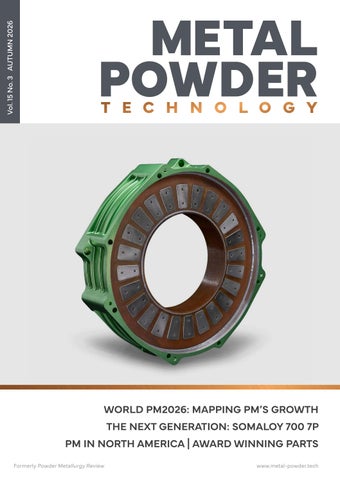
An axial-flux motor developed by Alvier Mechatronics (Courtesy Jens Ekberg, Höganäs AB)
Autumn 2026
Metal Powder Technology
3
| contents | news | advertisers | events | website | newsletter |
4
Metal Powder Technology
Autumn 2026
© 2026 Inovar Communications Ltd
METAL POWDER
12
28
40
124
82
Contents 63
Beyond tonnage: WorldPM2026 Montréal maps Powder Metallurgy’s next growth phase Powder Metallurgy’s traditional automotive base is under some pressure, yet WorldPM2026 showed an industry with credible routes to renewed growth. Higherdensity components, advanced joining and sintering, magnetic materials, battery precursors and strategically important refractory metals are expanding the performance and relevance of established PM technologies. Reporting from Montréal, Bernard North examines how electrification, material security and shifting regional markets are redefining where value lies – and why powder tonnage alone no longer tells the industry’s full story. >>>
Regular features... © 2026 Inovar Communications Ltd
79
Somaloy 700 7P: Extending the potential of Soft Magnetic Composites in electric motors As electrification increases demands on motors, generators and other electromagnetic devices, designers need magnetic materials that combine performance with geometric freedom, manufacturability and environmental goals. Josip Karlovic, Höganäs AB, examines the company’s new-generation Somaloy® 700 7P soft magnetic composite, its magnetic, mechanical and thermal properties, processing requirements and potential applications, including where it may offer system-level advantages over conventional laminated electrical steel. >>>
11
Industry news >>>
131
Advertisers’ index & buyers’ guide >>>
134
Industry events >>>
Autumn 2026
Metal Powder Technology
5
| contents | news | advertisers | events | website | newsletter |
6
Metal Powder Technology
Autumn 2026
© 2026 Inovar Communications Ltd
89
North American Powder Metallurgy at a turning point: The data behind a changing market
97
MPIF’s PM Design Excellence Awards 2026: Recognising innovation in conventional PM, MIM and metal AM Presented at WorldPM2026 in Montreal, Canada, the MPIF 2026 Powder Metallurgy Design Excellence Awards recognised outstanding achievements in conventional press and sinter PM, Metal Injection Moulding (MIM) and metal Additive Manufacturing (AM).
North American metal powder shipments may have remained broadly flat in 2025, but the headline figure conceals significant changes across materials, processes and end markets. In his State of the Industry address at WorldPM2026, Christopher Adam, President of MPIF and VALIMET, Inc., examined the latest shipment data, pressures affecting automotive PM, the emerging recovery in MIM and metal Additive Manufacturing, severe disruption to tungsten supplies, and the applications that could provide the industry’s next sources of growth. >>>
The award-winning components demonstrate how metal powder technologies continue to enable innovative engineering solutions across automotive, industrial, medical, security and consumer applications. >>>
THE ONLY MAGAZINE DEDICATED TO MIM, CIM AND SINTER-BASED AM TECHNOLOGIES
WWW.PIM-INTERNATIONAL.COM
© 2026 Inovar Communications Ltd
Autumn 2026
Metal Powder Technology
7
| contents | news | advertisers | events | website | newsletter |
VACUUM FURNACE FOR POWDER RECYCLING (TER)
STAND-ALONE SOLUTIONS FOR COARSE POWDER RECYCLING TITANIUM POWDER 15
EIGA bar Ø50 x H1000mm Ti ELI
Powder for AM and EBM
10
5
0 1,0
15
10,0
100,0
Starting bar
1000,0
15
TER Furnace
10
5
EIGA bar Ø50H x 1000mm
10
5
0
Ti ELI
1° recycling cycle
Ti 64
2° recycling cycle
Ti 64
3° recycling cycle
0 1,0
10,0
100,0
1000,0
15
1,0
10,0
100,0
1000,0
1,0
10,0
100,0
1000,0
15
TER Furnace
10
5
EIGA bar Ø50H x 1000mm
10
5
0
0 1,0
10,0
100,0
1000,0
15
15
TER Furnace
10
5
EIGA bar Ø50H x 1000mm
10
5
0
0 1,0
10,0
100,0
1000,0
1,0
10,0
100,0
1000,0
BRAND NEW EIGA BARS
Volume Density (96)
15
20 µm
10
5
0 1,0
10,0
100,0
1000,0
Size Classes (µm)
D10
[µm] 23,3
D50
[µm] 57,3
Via Leopoldo di Toscana, 9-11 8 Metal Powder Technology 52048 Monte San Savino (AR) ITALY
D90
[µm] 96,9
Autumn 2026
Ot
[%] 0,10
N
[%] 0,016
C
[%] 0,012
+39 0575 441341 © 2026 Inovar Communications Ltd info@topcast.it www.topcast.it
111
EMATec 2026: How advances in PM and AM are improving industrial systems From automated serial production and lower-loss electrical steels to circular titanium processing, hydrogen technologies and energy-efficient furnaces, EMATec 2026 reflected the breadth of PM and AM development. Organised by Fraunhofer IFAM Dresden and TUD Dresden University of Technology, the conference showed that technical capability alone does not establish industrial value. This article examines how application needs are shaping powder-based technologies for wider manufacturing and energy systems. >>>
123
Closing the argon loop: Assessing recovery in metal powder production Argon is essential across metal powder production, but its cost, supply burden and associated emissions are often accepted as unavoidable. Closed-loop recovery offers an alternative, provided exhaust gas can be collected, purified and returned without compromising process or product quality. Dr Rob Grant, founder of Gas Recovery and Recycle Limited (GR2L), examines the technical and commercial factors that determine viability, drawing on the company’s experience developing and deploying its ArgonØ™ point-of-use recovery equipment across a range of demanding industrial applications. >>>
METAL POWDER Metal Powder Technology is the essential international resource for the entire metal powder value chain — from production and processing to applications in PM, hardmetals, PM-HIP, batteries, magnetic materials, coatings, and beyond. Through our magazine, website, weekly newsletter, social media channels and webinars, we connect industry innovators with a truly global audience. Our platforms deliver trusted news, in-depth articles, and expert analysis to engineers, designers, researchers, and business leaders worldwide.
•
Have industry news to share? Submit it > paul@inovar-communications.com
•
Want to showcase your expertise? Pitch a feature article > nick@inovar-communications.com
•
Be visible: Ask about advertising opportunities > jon@inovar-communications.com > sally@inovar-communications.com
•
Stay connected: Follow us on LinkedIn > www.linkedin.com/company/ metalpowdertechnology
Regular features... 11
Industry news >>>
131
Advertisers’ index & buyers’ guide >>>
134
Industry events >>>
© 2026 Inovar Communications Ltd
Autumn 2026
Metal Powder Technology
9
| contents | news | advertisers | events | website | newsletter |
10
Metal Powder Technology
Autumn 2026
© 2026 Inovar Communications Ltd
| contents | news | advertisers | events | website | newsletter |
industry news
To submit news for inclusion in Metal Powder Technology contact Paul Whittaker at paul@inovar-communications.com
Bodycote agrees £1.65B acquisition by Veritas Capital Bodycote, headquartered in Macclesfield, England, UK, has agreed the terms of a recommended cash acquisition by Vulcan Alpha Bidco Limited, a newly formed company owned by US investment firm Veritas Capital Fund Management. The offer values Bodycote’s issued and to-be-issued share capital at approximately £1.65 billion, with an implied enterprise value of around £1.85 billion. Bodycote is a global provider of heat treatment and specialist thermal processing services, operating approximately 130 facilities in 22 countries and employing around 4,000 people. “Bodycote has established itself as a global leader in providing essential technologies for performance metallurgy across a range of mission-critical end markets,” explained James Dimitri, partner & co-head of Flagship Private Equity at Veritas. “We admire what Bodycote and its talented employee base have built, and we look forward to leveraging our deep sector experience and track record of partnering with leading companies in the performance industrial supply chain to support Bodycote’s continued development and unlock a new chapter of growth.” Under the terms of the acquisition, Bodycote shareholders will receive 932.8 pence in cash per share and will retain the FY26 interim dividend of 7.2 pence per share, giving a total offer value of 940 pence per share. Bodycote’s directors intend unanimously to recommend the transaction to shareholders. © 2026 Inovar Communications Ltd
As part of Bodycote’s current growth strategy, the company has been investing in increased HIP capacity for aerospace and defence customers, as well as expanding its Specialist Technologies activities. In 2026, Bodycote also completed its acquisition of Spectrum Thermal Processing, a North American precision heat treatment business focused on the aerospace and defence sectors. New York-based Veritas had approximately $54 billion in assets under management as of June 30, 2026. The investment firm has cited Bodycote’s technical capabilities and its exposure to aerospace, defence and other engineering markets as factors behind the acquisition. Completion is currently expected in Q1 2027. “The Bodycote Board believes that this offer from Veritas reflects the high quality of Bodycote’s
business and management, and delivers shareholders excellent value in cash,” stated Daniel Dayan, Bodycote Chair. “The Bodycote team has worked extremely hard over many years to build a leading position in our industry, including recent success in delivering on the Optimise, Perform and Grow initiatives; accordingly, the board wishes to express its thanks to management and employees on behalf of shareholders. “It is gratifying to see Veritas’ strong support in this announcement for Bodycote’s strategy in focusing the group on its most attractive markets for the benefit of all stakeholders. Veritas is an experienced and knowledgeable owner of industrial businesses with the capability to accelerate the delivery of this strategy. The board remains highly confident in Bodycote’s prospects and believes that this offer recognises that value today and is therefore recommending it to shareholders.” www.veritascapital.com www.bodycote.com
Bodycote has agreed the terms of a cash acquisition by Vulcan Alpha Bidco Limited, a newly formed company owned by US investment firm Veritas Capital Fund Management (Courtesy Bodycote)
Autumn 2026
Metal Powder Technology
11
Industry News
| contents | news | advertisers | events | website | newsletter |
Energy Fuels to acquire VAC in $1.9 billion deal Energy Fuels Inc, headquartered in Lakewood, Colorado, USA, has announced a definitive agreement to acquire 100% of Vacuumschmelze GmbH & Co. KG (VAC) for a total cash-and-stock consideration of approximately $1.9 billion. The move is expected to create a fully integrated platform to strengthen global critical rare earth element (REE) supply chains. VAC is an advanced magnetics company with more than century of experience, registering over 400 patents in that time. Serving more than 1,000 customers, VAC employs almost 4,000 people in several production facilities in North America, Europe and Asia. Over the last decade, VAC has produced and shipped more than one billion rare earth permanent magnets. VAC’s product portfolio spans both permanent magnets (sintered neodymium-iron-boron, NdFeB, and samarium-cobalt, SmCo) and soft magnetics (amorphous and nanocrystalline alloys, cobalt-iron
and nickel-iron products), enabling integrated cross-selling among electrification and industrial applications. The transaction brings together Energy Fuels’ upstream REE assets, including low-cost REE mining projects and existing separation capacity, with VAC’s downstream REE magnet manufacturing expertise. The combined company will also benefit from Energy Fuels’ planned acquisition of Australian Strategic Materials Limited, which will add existing commercial-scale REE metals and alloys capacity in South Korea, with plans to build a new metals and alloys facility in the US. The combined company aims to serve customers across North America, Europe and Asia in high-growth sectors, including automotive, aerospace and defence, robotics, data centres, electronics and industrial automation. “This is a transformational moment for Energy Fuels and the global rare earth supply chain,”
Energy Fuels Inc is set to acquire VAC for approximately $1.9 billion (Courtesy Vacuumschmelze GmbH)
12
Metal Powder Technology
Autumn 2026
stated Ross Bhappu, President and Chief Executive Officer of Energy Fuels. “Together with VAC, we will strengthen global rare earth and magnet supply chains, providing a reliable, secure and diversified source of critical materials from mines to highly valued permanent magnets.” “In addition, VAC’s rapid solidification and crystalline businesses provide a soft-magnetics platform that is expected to result in greater scale, broader customer reach and enhanced ability to invest in innovation, manufacturing and growth. The combination of our two companies provides enhanced shareholder value and positions Energy Fuels as a leading, secure and trusted supplier for critical materials that are essential for national security and the safety and integrity of Western supply chains,” added Bhappu. Following completion of the transaction, VAC will become a wholly owned subsidiary of Energy Fuels and will retain its branding and historic identity. VAC’s technology base, engineering expertise and manufacturing footprint will remain critical to the success of Energy Fuels, with VAC maintaining its headquarters in Hanau, Germany. “For over a century, VAC has been at the forefront of advanced magnetics and pioneering critical materials,” stated Dr Erik Eschen, President and Chief Executive Officer of VAC. “This transaction reinforces VAC as the cornerstone of a resilient and reliable permanent magnet supply chain, which is essential for alternative energy development, industrial competitiveness and national security. Joining forces with Energy Fuels gives our team, our technology, and our customers something that no other Western platform can offer today: a fully integrated supply chain platform from mine to finished magnet.” www.energyfuels.com www.vacuumschmelze.com
© 2026 Inovar Communications Ltd
MADE IN GERMANY
EP200M
Worldwide first and only 200t pure electric multiplaten-press
More Output Highest Precision Great Savings Optimized Usability
YOUR INNOVATION PARTNER
Industry News
| contents | news | advertisers | events | website | newsletter |
Elmet to acquire ams OSRAM tungsten and molybdenum facility The Elmet Group Co, headquartered in Portland, Maine, USA, has signed a definitive agreement to acquire ams OSRAM’s tungsten and molybdenum manufacturing operations in Schwabmünchen, Bavaria, Germany. The assets will be acquired through Elmet’s newly formed German subsidiary, Elmet Technologies GmbH. The transaction will establish Elmet’s first refractory metals manufacturing operation in the European Union, creating a European production base for tungsten and molybdenum powder, rods, wire, electrodes and machined components. Operating since 1961, the Schwabmünchen site has an integrated tungsten and molybdenum production chain covering powder production, pressing, sintering, swaging, drawing and finishing. The facility also includes an on-site materials laboratory for chemical and physical analysis. “We are excited to welcome the talented Schwabmünchen team to Elmet and build on the expertise and capabilities they have developed
over many decades,” stated Peter V Anania, CEO and Chairman of the Board at The Elmet Group Co. “We expect this acquisition to extend our vertically integrated tungsten and molybdenum platform into Europe, giving us a production base to serve customers there directly. It is intended to advance one of our key post-IPO objectives of expanding our footprint in Europe.” European tungsten and molybdenum production Elmet’s Critical Materials Components Division currently operates refractory metals manufacturing facilities in Maine, Ohio and Michigan, USA, with operations spanning powder processing, pressing, sintering, forming and machining. The Schwabmünchen acquisition is expected to extend this manufacturing model to Europe and provide locally manufactured tungsten and molybdenum products for applications including defence, fusion research, semiconductor manufacturing, medical technology, automotive production and general industry.
The Schwabmünchen facility operates an integrated tungsten and molybdenum production chain, including powder manufacture, pressing, sintering, swaging, drawing and finishing (Courtesy The Elmet Group)
14
Metal Powder Technology
Autumn 2026
The Elmet Group has agreed to acquire ams OSRAM’s tungsten and molybdenum operations (Courtesy The Elmet Group) Elmet plans to retain the existing Schwabmünchen leadership and operating team and invest in the site’s workforce, equipment, production capacity, quality systems and commercial capabilities. It also intends to expand the range of materials manufactured at the site to include TZM and tungsten heavy alloys. “Schwabmünchen has a long history of technical excellence in tungsten and molybdenum manufacturing. I am happy that our great team from Schwabmünchen will become part of Elmet, an organisation committed to carrying this legacy forward through its people and capabilities,” stated Rainer Barthel, Managing Director of OSRAM GmbH. During the transition, Elmet Technologies GmbH will support ams OSRAM and a recent spin-off under production agreements covering products currently sourced from the Schwabmünchen facility. Existing external customers are expected to continue to be supplied without interruption. The transaction is expected to close in the first quarter of 2027, subject to customary regulatory approvals and completion of transition activities required for the Schwabmünchen facility to operate on a standalone basis. www.theelmetgroup.com
© 2026 Inovar Communications Ltd
| contents | news | advertisers | events | website | newsletter |
© 2026 Inovar Communications Ltd
Autumn 2026
Metal Powder Technology
15
Industry News
| contents | news | advertisers | events | website | newsletter |
HC Starck Tungsten invests €50m in Goslar expansion HC Starck Tungsten is investing approximately €50 million to expand its tungsten recycling operations at its headquarters in Goslar, Germany. The project, reportedly the largest investment in tungsten operations in Goslar in decades, has been approved by its parent company, Mitsubishi Materials Corporation. The new facility will increase the site’s existing processing capacity by nearly 50% to approximately 7,000 metric tons per year, making it Europe’s largest tungsten recovery
plant. This will enable the Goslar operation to meet almost all of its tungsten requirements with recycled material. Today, recycled tungsten already accounts for around 80% of the site’s raw material supply. The expansion represents a key milestone in the MMC Group’s Medium-term Management Strategy of “Creating the Future through Resource Circulation”. Construction is scheduled to begin in early November and is expected to be completed within 2028.
HC Starck Tungsten is investing €50 million to expand its tungsten recycling operations (Courtesy HC Starck Tungsten)
Metal Powder Works accelerates $2M capacity investment Metal Powder Works Limited (MPW), headquartered in Pittsburgh, Pennsylvania, USA, a producer of metal powders for Additive Manufacturing and other applications, has accelerated its planned capacity expansion programme, committing approximately $2 million to bring forward its target of around 800 tonnes of installed annual capacity from 2028 to the first half of 2027. The decision to accelerate the expansion followed the commercialscale validation of its NextGen DirectPowder platform. According to the company, its first NextGen unit was sustaining production at a rate equivalent to 100 tonnes per annum, with a saleable yield above 95%.
16
Metal Powder Technology
The company plans to add four further NextGen machines and order long-lead-time hardware for another four units. MPW had previously flagged two machines for year-end 2026. MPW estimated that the accelerated expansion would require capital expenditure of approximately $2 million, funded from existing cash reserves. The investment is expected to be made across the second half of 2026 and the first half of 2027, with the additional capacity intended to support opportunities in the Additive Manufacturing and Powder Metallurgy markets. MPW produces powder from bar stock at its Pittsburgh facility. Its
Autumn 2026
“This decision marks a major milestone for our Goslar site and for our company as a whole,” said Hady Seyeda, CEO of HC Starck Tungsten. “Our ability to process almost exclusively recycled tungsten on site is a significant step toward the future. It will make us largely independent of the increasingly challenging supply situation for primary raw materials while making a substantial contribution to establishing a genuine circular economy for critical metals in Germany and across Europe.” Hideyuki Ozawa, Head of Business Strategy of HC Starck Tungsten, added, “Given the current imbalance in the global supply and demand for tungsten, we aim to complete the expansion as soon as possible and fulfil our responsibility to ensure a stable supply.” Due to the limited space available at the Metallurgy Park Oker, the existing buildings will be demolished in stages and gradually replaced by a new facility. A detailed project management approach has been developed in an effort to ensure that production activities can continue without disruption throughout the entire construction period. www.hcstarck.com
patented DirectPowder process is non-thermal and does not use conventional atomisation. The company stated that it could replicate NextGen units as demand developed, enabling further production capacity to be brought online. “We are at an inflection point where our NextGen machine is ready to scale, we’re bringing on experience at the leadership level, and we have a re-tooled sales team poised to take advantage of the supply chain constraints plaguing press & sinter markets,” stated John Barnes, founder and Managing Director of Metal Powder Works. “I want the press and sinter market to know we’re here, we’re serious, and we want them to make money.” www.metalpowderworks.com
© 2026 Inovar Communications Ltd
| contents | news | advertisers | events | website | newsletter |
TECHNOLOGIES CHOSEN FOR DIFFERENT METAL POWDER REQUIREMENTS Metal Powder Production. Chosen for atomization versatility. Powder requirements vary by material, alloy, production scale and application. Retech brings together three atomization systems designed to support research, prototyping and industrial powder production. / Plasma Gas Atomizer (PGA). Chosen for scalability. Delivers high-sphericity powders at production rates suited for demanding powder metallurgy applications. / Ceramic Induction Gas Atomizer (R-CIGA). Chosen for powder production efficiency. Combines induction melting with close-coupled atomization for efficient, semi-continuous powder production. / Small Scale Atomizer (SSA). Chosen for small-batch production. Produces precise, small batches with narrow, repeatable particle-size distributions.
When powder requirements differ, technology must be ready to adapt
www.retechsystemsllc.com
© 2026 Inovar Communications Ltd
Autumn 2026
Metal Powder Technology
17
Industry News
| contents | news | advertisers | events | website | newsletter |
Tekna secures $8M plasma atomiser order Tekna Holding ASA, headquartered in Sherbrooke, Quebec, Canada, has announced it has received an order valued at $8.1 million from a new US-based customer in the critical minerals industry. Tekna will supply an integrated solution consisting of two machines, enabling the company to manufacture high-purity powder using Tekna’s plasma technology. The customer is a US-based materials and process development company, and the project is reported to be part of the US Critical Minerals Initiative. “This order reflects the trust our customers place in Tekna’s plasma technology to power their most demanding materials development and production needs,” said Claude Jean, CEO of Tekna. “Securing a project of this scale in
18
Metal Powder Technology
the US market, with the potential for further expansion, underscores the strength of our integrated plasma solutions and our commitment to supporting innovation in advanced materials.” Tekna’s Inductively Coupled Plasma technology is intended to enable state-of-the-art research and manufacturing capabilities in advanced materials, offering various configurations to meet the needs of diverse industries and academic research sectors. According to Tekna, the $8.1 million contract represents the equivalent of Tekna’s total 2025 revenue within the Systems business area and is a substantial contribution to the company’s target of delivering doubledigit annual revenue growth towards 2030, with the company’s
Autumn 2026
Tekna will provide two plasma atomisers, enabling the company to manufacture high-purity powder (Courtesy Tekna) Materials business area also continuing to show significant momentum. Tekna expects an accelerated delivery of the first machine by early 2027. The second machine is expected to be delivered in the second half of 2027. Discussions are ongoing regarding a possible third machine for a different programme. www.tekna.com
© 2026 Inovar Communications Ltd
Industry News
| contents | news | advertisers | events | website | newsletter |
General Atomics to lead 7075-equivalent aluminium PBF-LB material qualification project America Makes, Youngstown, Ohio, and the National Center for Defense Manufacturing and Machining (NCDMM) have named General Atomics Aeronautical Systems, Poway, California, as the winner of a $5.5 million project call for Generation Of Technical-data for High-strength Aluminum Alloy Material (GOTHAAM). GOTHAAM is funded by the Office of the Under Secretary of Defense, Manufacturing Technology Office (OSD ManTech). The project aims to develop material allowables for a high-strength, 7075-T73-equivalent aluminium alloy across three classes of Laser Beam Powder Bed Fusion (PBF-LB) Additive Manufacturing machines, supporting scalable production on small-, medium- and large-format AM machines.
The project is intended to deliver data for a corrosion-resistant, aerospace-grade alloy with defence and commercial applications. America Makes stated that GOTHAAM will also develop approaches intended to generate a strong return on investment for original equipment manufacturers and the organic industrial base as the alloy moves into qualified production. “Qualifying advanced AM materials to deliver robust material data supporting durable, corrosion-resistant components for critical defence applications directly strengthens the defence industrial base,” stated John Martin, Additive Manufacturing Research Director at America Makes. “By delivering validated data and maturing LPBF
A topology-optimised node from a unitised small UAS airframe structure (Courtesy GA-ASI) capability, we’re giving US manufacturers what they need to produce reliable components for critical defence systems.” Project team partners include Lockheed Martin, Northrop Grumman, Airbus Space & Defense + APWorks, MIMO Technik, Quadrus Corporation, Hadrian Additive, Nikon AM, EOS America, Valimet, Toyal America, Equispheres, AMG Aluminum, Rio Tinto, Sunrise Metals, Nio Corp, Dyndrite and Scot Forge. www.americamakes.us www.ga-asi.com
Better By Design.
A SPECIALTY MATERIALS COMPANY
Copper and Aluminum Alloys, CP-Titanium and Zirconium
25+ POWDERS AVAILABLE! To view our full portfolio, visit metalpowderworks.com.
made in the USA
© 2026 Inovar Communications Ltd
Autumn 2026
Metal Powder Technology
19
Industry News
| contents | news | advertisers | events | website | newsletter |
Ames National Laboratory adds high-temperature refractory metal powder atomiser The US Department of Energy’s Ames National Laboratory has installed a new refractory metal powder atomiser capable of processing materials at temperatures up to 3,400°C, with production rates of up to 1 kg per minute. The atomiser will support the development of materials for extreme-temperature applications, including gas turbines and fusion energy systems. “Ames Lab has a long history of making specialised powders that other places simply can’t,” stated Ames Lab Scientist Jordan Tiarks. “This system builds on that foundation but pushes us into a new temperature and materials regime that’s been largely out of reach.” Refractory metals such as tungsten, molybdenum, niobium and vanadium have high melting points and can be used to develop alloys capable of operating at temperatures beyond conventional nickel- and cobalt-based superalloys. However, these materials can be difficult to process into complex components using conventional manufacturing methods. Powder-based manufacturing offers an alternative, but the availability of suitable powders has been a challenge. The new atomiser is intended in part to support the
Department of Energy’s Advanced Research Projects Agency-Energy (ARPA-E) ULTIMATE programme, which is developing ultrahigh-temperature materials for next-generation gas turbines. According to Ames Lab, researchers developing new alloys under the programme have experienced difficulties obtaining powders in the quantities and quality required for testing and validation. The new atomiser uses a transferred arc plasma process, in which high-energy plasma locally melts feedstock before atomisation. Feedstock can include bars and chunks, provided the composition is consistent throughout. Melting takes place in a watercooled copper hearth, where a layer of solidified material forms a protective ‘skull’ between the molten material and copper. Only a small volume is molten at any one time, reducing exposure to high temperatures and helping control purity and reactivity. Researchers are currently training on the atomiser using commercial titanium alloys and will subsequently process materials including molybdenum and nickel-based superalloys. The atomiser will then be used to produce powders for research into next-generation turbine components,
MPIF and APMI to relocate headquarters to Hamilton The Metal Powder Industries Federation (MPIF) and APMI International have announced plans to relocate their joint headquarters. After 46 years at the current Princeton, New Jersey site, MPIF and APMI will move to Hamilton, New Jersey, in January 2027. Originally established as a single industry association, MPIF has evolved into a federation of six trade associations representing distinct
20
Metal Powder Technology
segments of the Powder Metallurgy, metal powders and particulate materials sectors, including: • Powder Metallurgy Parts Association • Metal Powder Producers Association • Powder Metallurgy Equipment Association • Metal Injection Molding Association • Refractory Metals Association
Autumn 2026
Detail of metal powders for research into high-temperature and refractory alloys at Ames (Courtesy Ames National Laboratory) fusion energy systems and other extreme-environment applications. This includes Ames Lab’s collaboration with Pacific Northwest National Laboratory on structural materials for fusion energy systems. The refractory atomiser complements Ames Lab’s existing induction and close-coupled atomisers. These can achieve yields of 50–60% within the target particle-size range, compared with around 10–20% for high-temperature alloys processed using the refractory atomiser. “One of our long-term goals is to take what we’ve learned over decades of atomisation and apply it to this new class of equipment,” Tiarks added. “We want to improve yields, develop smart recycling strategies for off-size powders, and help push the industrial state of the art forward for ultra-high-temperature materials.” The atomiser was funded through ARPA-E’s ULTIMATE programme. www.ameslab.gov • Association for Metal Additive Manufacturing In addition to managing the trade associations, MPIF organises educational short courses, seminars, conferences and exhibitions. It promotes metal powder technology to a wide range of potential end users and develops industry standards that are recognised around the world. Effective January 1, 2027, the new address will be: MPIF & APMI, 3840 Quakerbridge Road, Suite 120, Hamilton, New Jersey 08619, USA. www.mpif.org © 2026 Inovar Communications Ltd
| contents | news | advertisers | events | website | newsletter |
BLUE POWER.
EQUIPMENT & EXPERTISE FOR YOUR METAL POWDER PRODUCTION ● GAS ATOMIZERS
INDUCTION HEATED (PLASMA HEATED IN DEVELOPMENT) ● ULTRASONIC
FOR SPHERICAL POWDERS WITHOUT ANY SATELLITES, IN HIGH PURITY AND A WIDE RANGE OF REPRODUCIBLE PARTICLE SIZE DISTRIBUTION.
ATOMIZERS
● WATER ATOMIZERS
FOR MORE IRREGULAR POWDERS, IDEAL FOR RECYCLING/REFINING, PRESS & SINTER PROCESS AND OTHERS.
● AIR CLASSIFIERS
FOR THE PRECISE SEPARATION OF METAL POWDERS INTO FINE AND COARSE POWDER FRACTIONS ESPECIALLY IN THE RANGE < 25 µM
See us at Formnext Hall 12.0 D41
www.bluepower-casting.com
2026 Metal Powder Technology 75045 Walzbachtal · Germany · Phone +49 7203 9218-0 · Autumn E-mail: info@bluepower-casting.com
© 2026 Inovar Communications Ltd
21
Member 2026
The Future of Engineered Materials & Manufacturing
| contents | news | advertisers | events | website | newsletter |
MADE IN AMERICA Explore Amaero’s innovative, high-performance materials, specifically engineered to meet the demanding needs of industries such as Defense, Space, Aerospace, Oil & Gas, Industrial, Heavy Industry, Medical, and Energy. Partner with us to harness cutting-edge solutions for your most challenging applications. TI64 METAL POWDER
C103 METAL POWDER
TITANIUM & REFRACTORY POWDERS Metal powders designed for mission-critical, high-temperature applications.
REGISTRATIONS AND CERTIFICATIONS
POST-HIP
POST-CHEM MILLED
PM-HIP
(Powder Metallurgy Hot Isostatic Pressing) Near-net-shape components with reduced lead times, ideal for high-mix, low-volume demand.
SEE AMAERO AT THE UPCOMING SHOWS: ICAM | Orlando, FL Sept. 28 - Oct. 2 AUSA | Washington D.C. Oct. 12 - Oct. 14 AM for Oil & Gas Summit | Houston, TX Oct. 14 - Oct. 15 America Makes TRX | Los Angeles, CA Oct. 27 - Oct. 29 PM-HIP 2026 Workshop | Knoxville, TN Nov. 4 - Nov. 5 Formnext | Frankfurt, Germany Nov. 17 - Nov. 20
HEADQUARTERS 130 Innovation Drive SW McDonald, TN 37353
GET STARTED TODAY
FOLLOW US
22
contactsales@amaeroinc.com
Metal Powder Technology
Autumn 2026
For your Powder and PM-HIP © 2026 Inovar Communications Ltd Component Needs
Industry News
| contents | news | advertisers | events | website | newsletter |
Elmet secures $450M US investment for tungsten expansion The Elmet Group Co, Portland, Maine, USA, has announced a $450 million committed investment from the United States Department of War (DoW) to expand its US manufacturing capabilities and strengthen agreements with key supply-chain partners. The investment will support increased domestic tungsten manufacturing, long-term access to critical raw materials and expanded mining and processing capacity. It will also support the establishment of Elmet Refining & Trading (ERT), a new division that will coordinate sourcing, processing and material delivery across the company’s global network. “This investment represents an important step toward securing a resilient supply of tungsten, a material that is critical to America’s defence, industrial, and economic future,” stated Peter V Anania, CEO and chairman, The Elmet Group. Tungsten is used in applications requiring resistance to extreme heat, pressure and wear, including compo-
nents for the defence, aerospace, energy, semiconductor, medical and industrial sectors. The Elmet Group supplies a number of US defence programmes, including Patriot, Javelin, AEGIS, Trident II and THAAD, as well as Virginia- and Columbiaclass submarines. The investment is being made through the DoW’s newly established Economic Defense Unit (EDU). An initial $200 million will be drawn down at closing, followed by additional drawdowns. More than $165 million is expected to be invested in The Elmet Group’s US manufacturing facilities in Lewiston, Maine; Coldwater, Michigan; and Euclid, Ohio. The sites manufacture and process tungsten, molybdenum and other advanced materials and components. Approximately $150 million will be allocated to Blue Moon’s Springer Tungsten Complex in Imlay, Nevada. The Elmet Group plans to form and operate a majority-owned joint venture with Blue Moon Metals and
Centorr posts first-half revenue of $18M Centorr Vacuum Industries (CVI), based in Nashua, New Hampshire, USA, has reported revenue of $18 million for the first half of 2026. The company attributed this performance to demand from the nuclear, hypersonics and Additive Manufacturing sectors. CVI reported orders for multiple vacuum induction melting furnaces, as well as two large-format vacuum hot presses for aerospace filtration and advanced ceramics. The company also received orders for Sintervac furnaces used in tungsten carbide and nuclear fuel sintering, together with furnaces for the production of tungsten heavy alloys, nuclear space fuel and the heat treatment of titanium additively manufactured parts.
© 2026 Inovar Communications Ltd
Additional orders included Testorr furnaces for the physical testing of hypersonic carbon fibre composites (CFCs) and four LF furnaces for processing advanced carbon and graphite materials at temperatures up to 3,000°C, nuclear fuel materials development, and the metal sintering of medical components. Bookings also remained strong during the first two quarters of 2026, reportedly giving the company one of the largest order backlogs in its history. Founded in 1954, Centorr Vacuum Industries is celebrating its seventy-second anniversary as a manufacturer of high-temperature vacuum and controlled-atmosphere furnaces. The company has an
Autumn 2026
Australia’s EQ Resources to restart and expand ammonium paratungstate (APT) conversion capacity at the facility. The Springer mine and mill are expected to restart production in the fourth quarter of 2027, with the APT conversion facility expected to begin operations in the second half of 2028. Further investments, partnerships and offtake agreements are planned to secure long-term tungsten feedstock and processing capacity in the United States, Australia and Spain. Up to $2 billion National Defense Stockpile agreement Separately, Elmet Technologies, a subsidiary of The Elmet Group, has been awarded an indefinite delivery/ indefinite quantity (IDIQ) contract by the Defense Logistics Agency (DLA) to support the rebuilding of the US National Defense Stockpile and longterm supply of tungsten. The contract has a ceiling value of up to $2 billion, including a guaranteed funded commitment of $150 million, and covers tungsten ores, concentrates and sodium tungstate supplied to DLA Strategic Materials. www.theelmetgroup.com
installed base of more than 7,000 machines worldwide. It also operates a fully staffed aftermarket field service group and an Applied Technology Center providing research and development support and toll production services. www.centorr.com
Centorr Vacuum Industries has reported revenue of $18 million for the first half of 2026 (Courtesy Centorr Vacuum Industries)
Metal Powder Technology
23
Industry News
| contents | news | advertisers | events | website | newsletter |
Kennametal reports 20% sales growth in fiscal 2026 Kennametal Inc, based in Pittsburgh, Pennsylvania, USA, has reported sales of $2.36 billion for its fiscal year 2026, an increase of 20% from $1.97 billion in the previous year. Organic sales increased 19%, while favourable foreign currency movements added 2%, partially offset by a 1% divestiture effect. “Our team delivered strong fiscal 2026 results, reflecting volume from improving market conditions and our strategic growth initiatives,” said Sanjay Chowbey, President and CEO. “We achieved record adjusted EPS this quarter through decisive pricing actions in an unprecedented tungsten environment, volume growth and cost improvement efforts.” For the full year, operating income increased to $473 million,
or 20.1% of sales, compared with $143 million, or 7.3%, in fiscal 2025. Adjusted operating income was $484 million, representing a 20.5% margin, compared with $158 million, or 8.0%, in the previous year. Kennametal stated that the increase in operating income was driven in part by the favourable timing of raw material-related pricing compared with raw material costs, which contributed approximately $316 million. Non-raw material-related pricing and tariff surcharges in its Metal Cutting business, higher sales and production volumes, and approximately $27 million of incremental yearon-year restructuring savings also contributed. These benefits were partially offset by higher compensation costs, tariffs and general inflation, as well as fewer insurance
proceeds within its Infrastructure business. The company reported negative operating cash flow of $4 million for fiscal 2026, compared with positive $208 million in the previous year. Kennametal attributed the decline primarily to increased working capital requirements, including higher inventory values resulting from what it described as unprecedented tungsten price increases. Free operating cash flow was negative $79 million, compared with positive $121 million in fiscal 2025. The decline reflected the same working capital requirements, partially offset by higher net income and lower capital expenditure. Looking ahead, Kennametal expects fiscal 2027 sales of $3.33– 3.45 billion. Capital expenditure is expected to be approximately $85 million. www.kennametal.com
Maximum Efficiency Through
Pressing Process Optimization
We don‘t just build presses — we empower our customers
Economic. Ecologic. Electrified.
From fine-tuning tool design and pressing parameters to modernizing existing presses with intelligent automation — our experts work side by side with customers to unlock the full potential of their powder compaction processes. Improved material utilization Shorter cycle times Enhanced part consistency Lower energy consumption Multiple materials (metal powders, ceramics or special materials) Sustainable
KOMAGE Gellner Maschinenfabrik KG
24
+49 (0) 6589-9142-0
Metal Powder Technology
Autumn 2026
info@komage.de
www.komage.de
© 2026 Inovar Communications Ltd
Industry News
| contents | news | advertisers | events | website | newsletter |
Amaero expands powder production with third EIGA atomiser Amaero Ltd, headquartered in McDonald, Tennessee, USA, has completed commissioning of its third Electrode Induction Melting Inert Gas Atomiser (EIGA) ahead of schedule. The additional atomiser, located at its Tennessee manufacturing facility, is expected to support customer demand in the defence, space, aerospace, nuclear and medical sectors. Amaero now operates three EIGA atomisers, with one dedicated to refractory alloy powders and two dedicated to titanium alloy powders. The company expects annual production capacity of approximately 200 tonnes of refractory alloy powder and 480 tonnes of titanium alloy powder. Further investments Amaero has also reported completion of its three-year capital investment programme, valued at approximately AUS $72 million. Future expansion projects include the installation of an argon recycling plant, scheduled for commissioning in the first quarter of 2027, and a fourth EIGA atomiser, planned for June 2027. Amaero has also completed its move to the United States and stated that it is positioning itself for a potential US initial public offering in late 2026 or early 2027, subject to market conditions. “We were gratified by the strong shareholder support for the redomiciliation, as this will further Amaero’s market position as a leading US company that is integral to domestic sovereign manufacturing and supply chains for mission-critical applications supporting defence, space, aerospace, nuclear, medical and industrial applications,” stated Hank J Holland, chairman and CEO of Amaero. “In response to demand pull, we acted boldly three years ago to establish the largest domestic production capacity for refractory and titanium alloy spherical powders; moreover, we have demonstrated a leadership position in PM-HIP manufacturing of near-net-shape parts that provide an immediate and viable substitute for long lead times and vulnerabilities in the castings and forgings supply chain. “As we have been in sustained dialogue with counterparts at the US government, the Department of War, the US Navy and our commercial customers, we are excited about incremental growth opportunities. “Amaero has established foundational production capabilities and scale that position the company to integrate and co-locate adjacent manufacturing processes that result in a more modern, more resilient and more agile defence industrial base,” he continued. “Re-shoring, modernising and scaling sovereign manufacturing is an imperative for both national security and economic development.” www.amaeroinc.com
© 2026 Inovar Communications Ltd
TOOLING | AUTOMATION | SOFTWARE
Tooling for Powder Compacting Technology • Simple, quick set-up • High accuracy • Low scrap rate • Maximal machine utilization • Increased productivity
Upper punch with Macro
Die with Matrix
Lower punch with Macro
Core rod
www.system3r.com
Autumn 2026
Metal Powder Technology
25
Industry News
| contents | news | advertisers | events | website | newsletter |
Neo advances European sintered magnet expansion as Magnequench EBITDA rises 39% Neo Performance Materials Inc, headquartered in Toronto, Canada, reported revenue of $205.7 million for the second quarter of 2026, up from $114.7 million in Q2 2025. “Neo delivered outstanding second-quarter results, with Adjusted EBITDA of $57 million, up over 200% year-over-year. This represents our second straight record quarter and reflects continued strength in volumes across all of our segments, disciplined operational execution and a sustained favourable pricing environment,” said Rahim Suleman, President and Chief Executive Officer of Neo. “On the back of this momentum and a healthy demand outlook, in early July we raised our full-year Adjusted EBITDA guidance to $140 million to $150 million, and we expect results at the high end of this range — this would represent close to double our full year 2025 Adjusted EBITDA of $76 million. The updated guidance also reflects higher contracted volumes of critical materials, including hafnium, for the
second half of 2026 and into 2027. This gives us improved visibility, and it’s supported by a pricing environment that remains strong. As we continue to advance our strategic priorities, we are well-positioned to build on this progress through the remainder of 2026 and beyond.” Operating income increased to $41.8 million, compared with $8.2 million in Q2 2025. For the six months ended June 30, 2026, cash used in operating activities totalled $49.6 million, attributed to higher strategic inventory, increased material costs, higher receivables due to the timing of sales and settlement of European patent litigation in January 2026. At June 30, Neo held $96.2 million in cash and had $157.2 million in gross debt. Magnequench reports 39% increase in Adjusted EBITDA Magnequench generated Adjusted EBITDA of $10.5 million in the second quarter, up $2.9 million, or 39%, year-over-year. Year-to-date Adjusted EBITDA reached $19.7 million, also up 39%.
Neo Performance Materials Inc has announced its financial results for the second quarter of 2026 (Courtesy Neo Performance Materials)
26
Metal Powder Technology
Autumn 2026
Bonded magnet shipments increased 35% year-over-year, supported by demand from electrification, industrial automation and advanced computing infrastructure. Bonded powder volumes fell 13.8%, although year-to-date volumes remained modestly higher. Neo attributed the quarterly decline primarily to customer order timing rather than a change in underlying demand. Neo also continued to advance its European Permanent Magnet facility, which is producing and shipping qualification magnets as it moves towards full commercial production later this year. The company remains on track to launch two to three commercial programmes in the second half of 2026. Chemicals & Oxides Adjusted EBITDA rises 56.4% Chemicals & Oxides generated Adjusted EBITDA of $8.5 million in the second quarter, up $3.1 million, or 56.4%, reflecting improved pricing, operational execution and portfolio optimisation. Year-to-date Adjusted EBITDA reached $16.2 million, up 32%. Rare Metals Adjusted EBITDA rises 313% Rare Metals generated Adjusted EBITDA of $44.4 million in the second quarter, an increase of $33.7 million, or 313%, year-over-year, reflecting record hafnium, gallium and tantalum pricing and resilient volumes amid tight global supply. Neo stated that its gallium business achieved the strongest gross profit in its history, benefiting from strong pricing and increased focus on supply security. The company is one of the few gallium recyclers in North America. Gallium is used in semiconductors and permanent magnets, among other applications. The segment continues to secure scrap and input materials through sourcing partnerships and recovery initiatives to support a stable and diversified supply base. www.neomaterials.com
© 2026 Inovar Communications Ltd
| contents | news | advertisers | events | website | newsletter |
POWDER COMPACTION SOLUTIONS
PRECISION IN EVERY PART. PRODUCTIVITY IN EVERY PRESS CYCLE.
24/7 CUSTOMER SUPPORT ON-SITE SERVICE
Gasbarre delivers servo-electric compaction systems purpose-built for refractory metals, hard materials, and technical ceramics. With over 50 years of experience in powdered material compaction, Gasbarre understands the unique demands of carbide and cermet manufacturing—down to the density control, precision tooling requirements, and production efficiency requirements that drive performance and cost.
Why Hard Material Producers Are Choosing Gasbarre: BARR
n
n
AD
Si
nc
dl
e1
973
H H H P rou
yM
n
H H H
AS
E
G
n
E IN
THE U
SA
Full CNC control of upper punch, die, and core rod with flexible bottom punch/core rod arrangements Extraordinary productivity supported by multiple automation options, including process monitoring with 100% weight and length feedback Optimized energy efficiency through servo-electric drives Latest generation control software with programmability, real-time visualizations, and data collection
n
Small footprint with no pit required for installation
n
Maintenance-friendly design to maximize uptime and press life
590 Division Street, DuBois, Pennsylvania 15801 © 2026 Inovar Communications Ltd 814.371.3015 n press-sales@gasbarre.com
27 Metal Powder Technology www.gasbarre.com
Autumn 2026
Industry News
| contents | news | advertisers | events | website | newsletter |
N.A.N. MagneTech to build India’s first NdFeB magnet plant N.A.N. GreenMet Pvt Ltd, a critical minerals and advanced manufacturing business based in Mumbai, India, has announced its newly launched subsidiary, N.A.N. MagneTech Pvt Ltd, focusing on rare earth permanent magnet manufacturing. The venture will establish what the company states will be India’s first fully integrated neodymium-iron-boron (NdFeB) permanent magnet manufacturing plant. The facility is being developed in collaboration with leading Japanese technology partners and will be located at Naidupeta Industrial Park in Andhra Pradesh, where land has been secured along with state government incentives. Feedstock supply, including heavy rare earth oxides, is secured with a major Australian global rare earth producer. The project will integrate
the entire oxide-to-magnet value chain, encompassing rare earth oxide processing, metal and alloy production, fully automated sintered magnet manufacturing, and advanced closed-loop recycling. The company states that this integration will make it one of the world’s most technologically advanced facilities. Offtake agreements with automotive OEMs and Tier 1 companies have reportedly been executed. This announcement comes at a time when countries across the world are accelerating investments in domestic rare earth manufacturing. High-performance NdFeB permanent magnets are key components in electric vehicles, wind turbines, defence systems, robotics, semiconductors and advanced electronics, with demand reportedly expected to grow at approximately 25% CAGR over the next decade.
N.A.N MagneTech will focus on rare earth permanent magnet manufacturing, establishing India’s first fully integrated NdFeB permanent magnet manufacturing plant (Courtesy N.A.N. MagneTech)
India currently relies heavily on imports of high-performance rare earth permanent magnets despite rapidly growing domestic demand, with nearly 95% sourced from China, making domestic manufacturing a strategic national priority. By establishing a domestic, fully integrated manufacturing platform, N.A.N. MagneTech aims to strengthen India’s rare earth ecosystem, reduce import dependence, enhance supply chain resilience, create highly skilled employment, accelerate technology development, and support the country’s advanced manufacturing ambitions. Navin Agarwal, Founder & Chairman, N.A.N. GreenMet, said, “The industries shaping the future will be defined by those who control advanced materials and manufacturing technologies. At N.A.N. GreenMet, we are building a globally competitive industrial enterprise that strengthens India’s manufacturing capabilities in strategically important sectors. N.A.N. MagneTech is an important milestone in that endeavour, bringing world-class technology to establish a domestic rare earth magnet ecosystem that supports the country’s long-term industrial growth.” Dr John Ormerod, Chairman, Technology Board, N.A.N. MagneTech, added, “We are bringing the most advanced Japanese process technology to India and covering the complete oxide-to-magnet ecosystem. This platform is backed by world-class partnerships, a robust feedstock strategy, and sustainable closed-loop recycling. It is engineered to deliver consistent, world-class quality.” www.nangreenmet.com
TRUSTED CONTENT TARGETED AUDIENCE Advertise with Metal Powder Technology Contact Jon Craxford: jon@inovar-communications.com 28
Metal Powder Technology
Autumn 2026
© 2026 Inovar Communications Ltd
Industry News
| contents | news | advertisers | events | website | newsletter |
AE Industrial acquires Powder Alloy Corporation AE Industrial Partners, a private investment firm focused on technologies and services critical to the aerospace, national security and economic security sectors, has announced the acquisition of Powder Alloy Corporation (PAC), headquartered in Loveland, Ohio, USA. Founded in 1973, PAC produces a diverse range of specialised powders used in both OEM and aftermarket applications in the aerospace and gas turbine sectors, as well as biomedical, power & energy, and other industrial segments. PAC’s in-house capabilities include inert gas atomisation, composite cladding, mechanical blending, agglomeration and sintering, and plasma densification. “PAC’s end markets run on materials that are extraordinarily difficult to produce – powders engineered to exacting specifications, qualified through years of rigorous testing, and proven in the most demanding applications on earth and in the air,” stated Bryan McElwee, Partner at AE Industrial. “PAC has built exactly that capability over more than 50 years, and the breadth of their proprietary portfolio is something that simply cannot be replicated.” “This investment is the foundation of our newest specialty materials platform. Our vision is to build the preeminent independent provider of proprietary powders and materials – a platform purpose-built to address the critical supply chain gaps that exist today for unique, difficult-toproduce materials across PAC’s end markets,” added McElwee. Steve Payne, President and founder of PAC, stated, “For more than 50 years, PAC has built its reputation on delivering specialised powders that meet the most demanding specifications throughout our end markets. AE Industrial understands these
© 2026 Inovar Communications Ltd
markets and brings the resources and relationships to help us scale production capacity, invest in nextgeneration formulations, and serve the growing demand for PAC’s existing portfolio of specificationcontrolled products.” Andrew McElhinney, Principal at AE Industrial, added, “As a differentiated strategic manufacturing partner, the investment in PAC
AUTOMATION
EFFICIENCY
Autumn 2026
reflects our firm’s philosophy of supporting companies that are addressing the critical tollgates for national and economic security. This acquisition launches our specialty materials platform, and we see meaningful growth opportunities through new product development, strategic partnerships, and complementary acquisitions.” Financial terms of the transaction were not disclosed. www.aeroequity.com www.powderalloy.com
RELIABILITY
LEARN MORE
Metal Powder Technology
29
Industry News
| contents | news | advertisers | events | website | newsletter |
Metalysis produces C-103 alloy powder to commercial specification Metalysis, based in Rotherham, UK, is now producing C-103 alloy powder, a niobium-hafnium-titanium alloy, to commercial specification for space, aerospace, defence and hypersonic applications. The move is intended to provide an alternative source of C-103 for Western customers seeking secure and consistent supplies of the refractory alloy for high-temperature and extreme-environment applications. The C-103 market is estimated at $46 million and is forecast to reach $200 million by 2032. It currently accounts for about 2% of the wider niobium alloy market. However, the supply of C-103 is vulnerable in part because of constraints in hafnium metal production, rather than in hafnium oxide production. Demand for other hafnium compounds has also increased, driven by the expansion of semiconductor chip manufacturing.
The demand for C-103 powder is also expected to increase in the Additive Manufacturing industry. AM allows complex C-103 structures and geometries to be produced with less material waste, addressing historical manufacturing challenges and reducing costs and lead times. Metalysis uses its FFC electrolysis process to reduce metal oxides and carry out in-situ alloying within a solid-state process. Its Gen 1 to Gen 4 systems range from grammes of output per run to tens of tonnes a year, depending on reactor size. The company can now produce C-103 at up to Gen 4 scale, with each unit capable of producing tens of tonnes of output. The process is described as ‘powder in, powder out’: controlling the size of the feedstock enables powders to be produced within a defined size range for Additive Manufacturing applications.
The resulting powder particles are naturally irregular in shape but can be spheroidised in-house by Metalysis to improve density and flowability while retaining the original size range. Oxygen levels in Metalysis’ C-103 powder are below 500 ppm. Metalysis sources its hafnium oxide from a number of countries, including the US and Australia. “Metalysis is adding C-103 niobium hafnium titanium alloy to its product suite, given our core focus on refractory alloys – combined with lightweighting expertise. C-103 was developed in the 1960s, but now we are seeing a huge surge in demand because of the renewed race for space – as well as advanced manufacturing sectors such as hypersonics/ defence,” stated Nitesh Shah, CEO of Metalysis. “The Metalysis FFC process is able to produce C-103 alloy to the morphology required by AM partners, whilst reducing metal oxides rather than metal means we are not constrained by the availability of hafnium metal.” www.metalysis.com
Ipsen USA expands Titan vacuum furnace assembly line Ipsen USA is expanding the Titan assembly line at its Vacuum Technology Excellence Centre in Cherry Valley, Illinois, USA, in a move expected to increase annual production capacity from thirty-six to sixty Titan vacuum furnaces. The expansion follows a record month for the company: in May, Ipsen received orders for twenty-one Titan furnaces, attributed to investment in the aerospace and energy sectors. It forms part of the company’s wider investment programme across its facilities, products and workforce. Introduced in 2009, the Titan furnace has become one of Ipsen’s most successful product lines, with more than 450 installed worldwide.
30
Metal Powder Technology
The Titan furnace has become one of Ipsen’s most successful product lines (Courtesy Ipsen) The vacuum furnaces are designed with standardised features intended to reduce lead times and provide a cost-effective vacuum heat-treatment solution for manufacturers. The project will convert Ipsen’s former showroom into a dedicated Titan assembly area, bringing engineering, manufacturing and
Autumn 2026
assembly together in a single facility. The expansion adds approximately 650 m 2 (7,000 ft 2) of production space. “We continue to see strong demand for the Titan product line, and we’re investing today to ensure we can support our customers tomorrow,” stated Geoffrey Somary, CEO of Ipsen. www.ipsenglobal.com © 2026 Inovar Communications Ltd
| contents | news | advertisers | events | website | newsletter |
THE BASIS FOR HIGH QUALITY METAL POWDER:
DURABLE HEBOSINT® NOZZLES. In metal powder production, every detail matters. Our technical ceramic components made from Boron Nitride - HeBoSint® are specifically engineered to meet the demanding requirements of metal atomization. Here‘s why they provide a competitive edge: • Highest Precision: Achieve precise and repeatable control of particle size, leading to optimal yield and reduced rejects. • Maximum Service Life: The excellent non-wetting behavior prevents clogging, while the high thermal shock resistance avoids unnecessary preheating and costly downtime. • Efficiency and Cost Savings: Our robust, low-maintenance nozzles contribute to a significant reduction in overall process costs. Henze Boron Nitride Products AG Grundweg 1 87493 Lauben / Germany Phone: +49 8374.589 97-0 E-Mail: info@henze-bnp.de www.henze-bnp.de
© 2026 Inovar Communications Ltd
Autumn 2026
Metal Powder Technology
31
| contents | news | advertisers | events | website | newsletter |
Osprey takes flight. SAME
POWDERS
·
SAME
EXPERTISE
·
SAME
PARTNERSHIP
For fifty years the Osprey name has defined gas-atomized metal powders, the last decades as part of Sandvik. Now the bird flies on its own again: Osprey Atomiqs, an independent advanced materials platform.
ADVANCED
MATERIALS
PLATFORM
AEROSPACE
·
·
HEALTHCARE
Metal Powder Technology
Autumn 2026
32
DEFENCE
·
ENERGY
ospreyatomiqs.com © 2026 Inovar Communications Ltd
Industry News
| contents | news | advertisers | events | website | newsletter |
IperionX wins US DoD funding for titanium production IperionX, headquartered in Charlotte, North Carolina, USA, has been awarded up to $6.6 million through a US Department of Defense (DoD) programme funded by the Office of the Secretary of Defense’s Submarine Workforce and Industrial Base (OSD-SWIB). The funding is said to form part of a wider initiative to increase US production of highperformance titanium alloy products. The funding is intended to support the purchase of capital equipment for IperionX’s Titanium Manufacturing Campus in Virginia, expanding its capability to manufacture largeformat titanium components and increasing domestic production capacity for mission-critical titanium products. The programme will be completed in two phases. Phase 1 provides $200,000 for project scoping and test work. Subject to successful completion, IperionX expects to receive a further $6.4 million to expand manufacturing capacity and install additional equipment. Titanium plate production Conventional titanium plate production involves multiple energy-intensive processing stages, including sponge production, vacuum melting, remelting, ingot or slab casting, forging, hot rolling, repeated annealing and surface finishing. These steps can contribute to long lead times, high production costs, reduced material yields and supply chain constraints. IperionX’s patented titanium technologies are designed to simplify this manufacturing route. Its HAMR process produces titanium powder from titanium minerals or recycled titanium feedstock, while its HSPT and THRM technologies are intended to produce wrought-like titanium properties without the conventional melt-remelt-forge process. These technologies form the basis of its
© 2026 Inovar Communications Ltd
IperionX received an order from the US Army Ground Vehicle Systems Center for prototype titanium fasteners for the JLTV (Courtesy Oshkosh Defense) powder-to-plate titanium manufacturing platform, designed to reduce processing steps, lower capital and energy requirements, improve material utilisation and strengthen domestic titanium supply chains. Evaluating titanium alloy products Under the programme, IperionX will manufacture and evaluate titanium alloy products for applications where titanium may provide a lightweight alternative to steel, including armour precursor plate, hatches, covers, brackets, structural components and maritime systems. The company will collaborate with the George H W Bush Combat Development Complex, part of The Texas A&M University System (TAMUS), and the US Army Combat Capabilities Development Command Army Research Laboratory. The organisations will undertake material characterisation, ballistic and shock testing, product validation and evaluation for defence and strategic industrial applications. The project will investigate how THRM and HSPT microstructural engineering can be used to improve ballistic performance. It complements separate DoDfunded powder-to-plate titanium programmes and is intended to provide an alternative domestic production route that could reduce US dependence on imported titanium sponge.
Autumn 2026
Joint Light Tactical Vehicle fastener prototypes Alongside the OSD-SWIB award, IperionX has also received a purchase order from the US Army Ground Vehicle Systems Center to manufacture prototype titanium fasteners for the Joint Light Tactical Vehicle (JLTV) and its associated trailer. Originally developed by Oshkosh Defense, the JLTV was designed to replace many Humvees by providing improved protection, mobility, payload capacity and mission flexibility. Successful completion of the prototype programme could lead to wider adoption of titanium fasteners across future JLTV production and other military vehicle programmes. “During my time as Deputy Commanding General of Army Futures Command, I enjoyed my collaboration with BCDC, and I saw firsthand the importance of a secure US low-cost titanium supply chain for national security,” stated IperionX Senior Adviser US Army Lieutenant General Ross Coffman US Army (Retired). “The Army has a pressing need to reduce the weight of our ground vehicle platforms to maintain combat effectiveness. The benefits of titanium across all defence mobility platforms, including robotics, are well known, and I’m proud to be on this mission with IperionX.” www.iperionx.com
Metal Powder Technology
33
Industry News
| contents | news | advertisers | events | website | newsletter |
Tekna secures further titanium powder orders from US defence customer Tekna Holding ASA, headquartered in Sherbrooke, Quebec, Canada, has received a new order from a long-standing customer, a US-based contract manufacturer supplying precision components to defence original equipment manufacturers (OEMs). Including the latest order, the total value of orders placed this year exceeds CA$3 million, more than six times the value of orders received from the customer during the whole of 2025. The orders are for Tekna’s Ti-6Al-4V titanium powder, an alloy widely used in Additive Manufacturing for aerospace and defence applications because of its high strength-to-weight ratio and corrosion resistance. According to the company, the customer, which has not been identified at its request,
uses the powder to manufacture components for defence applications. Approximately half of the order volume has already been delivered, with the remaining material scheduled for shipment during the second half of 2026. The latest orders build on a customer relationship that began in 2017. Claude Jean, CEO of Tekna, stated, “This expansion reflects the trust our customer has placed in Tekna’s quality, consistency and reliability over nearly a decade of partnership. Demand for near-shore, high-performance metal powders is accelerating as our customers move Additive Manufacturing into serial production, and we are proud to support our customer’s mission-critical production with material that meets the
The total value of orders placed this year exceeds CA$3 million (Courtesy Tekna Holding) most stringent industry requirements.” According to Tekna, the increased order volume reflects continued demand from the aerospace and defence metal AM sectors, where contract manufacturers are increasing production capacity for titanium components to support OEM programmes. www.tekna.com
Huacheng Moulding (Changshu) Co., Ltd.
Professional Tooling Maker for POWDER METALLURGY since 1978
34
Metal Powder Technology
Autumn 2026
© 2026 Inovar Communications Ltd
Industry News
| contents | news | advertisers | events | website | newsletter |
HC Starck Tungsten develops tungsten powder for fusion reactors HC Starck Tungsten, based in Goslar, Germany, is developing specialised tungsten powders as a vital component to help build what is reportedly Germany’s first fusion reactor. The project is part of the German Federal Ministry of Research, Technology and Space’s (BMFTR) multi-billion-euro Fusion 2040 funding programme, which aims to bring the first power plants based on this revolutionary technology into operation around 2040. The company will supply tungsten metal powders for producing assemblies that line the interior walls of the fusion reactor. This ‘first wall’ lining shields the reactor structure from the plasma burning inside the reactor, which reaches temperatures of approximately 100 million °C. In addition to withstanding these extreme temperatures, the reactor walls must resist particle bombardment and intense neutron irradiation. Tungsten is particularly well suited to this application thanks to its exceptional heat resistance and its unique stability under neutron exposure. “The key challenges for our research and development team lie less in the protective properties of the tungsten alloys themselves – which we are already familiar with from other applications – and more in their mechanical processing, which we expect to be based on Additive Manufacturing,” said Project Manager Tino Säuberlich. “Because tungsten is inherently brittle, we are developing innovative solutions that enable highprecision manufacture of the tiles and their secure attachment to cooling elements. At the same time, maximum material purity is essential to prevent issues such as cracking, radioactive activation or oxidation caused by oxygen inclusions.” Testing the manufacture of these components and their performance when exposed to plasma will require Germany to establish dedicated testing infrastructure in the years ahead. Julia Meese-Marktscheffel, Director Technology & Innovation Global, added, “Our involvement in the ‘Fusion 2040’ program demonstrates that our understanding of innovation extends far beyond short-term solutions and also addresses the technological challenges of upcoming decades.” The aim of Fusion 2040 is to establish fusion technology as a climate-neutral, safe, affordable and baseload-capable source of energy while positioning Germany as a key player in this industry of the future. The roadmap follows clearly defined development stages, with the current research and development phase being followed by technology transfer to industrial applications in the early 2030s and the commissioning of initial demonstration reactors during the 2040s. www.hcstarck.com
© 2026 Inovar Communications Ltd
Maximize efficiency in powder compacting With EROWA PM Tooling, the quickclamping system for all your pressing tools. Precise – Powerful – Proven! www.erowa.com
more info
EMPOWERING YOUR PRODUCTION
Autumn 2026
Metal Powder Technology
35
Industry News
| contents | news | advertisers | events | website | newsletter |
Amaero wins AU$6.51 million US Defence alloy powder contract Amaero Inc., headquartered in McDonald, Tennessee, USA, has been awarded an AU$6.51 million contract from the United States Department of Defense (DoD) for the development of alternative refractory alloy powders. High-temperature refractory alloys such as Niobium C103 (C103) are critical for thermal protection systems and propulsion systems for hypersonic and space components. C103 has been a well-established material system for high-temperature aerospace systems since the Apollo lunar mission in 1969. Its appeal stems from its high strength-to-weight ratio, excellent ductility and service capability at temperatures above 2,000°C, making it ideal for rocket nozzles, thrusters and hypersonic components. Importantly, C103 has a long-standing material allowable database and history of use. Developing alternative hightemperature refractory alloys that can be interoperable with C103 has increasingly become an important consideration. Despite its exceptional
high-temperature strength and its long history in aerospace propulsion, the insertion of C103 in modern engineering design is constrained by its price inflation and volatility; moreover, there are more recent advanced material developments for other refractory alloys and high-entropy materials. C103 comprises approximately 89% niobium, 10% hafnium and 1% titanium. Over the past three years, the price of Hafnium has increased by over 700% and is currently selling for approximately US$12,500/kg. In consultation with the DoD, US national laboratories, defence and space prime contractors and suppliers, Amaero will shortlist two alternative high-temperature development refractory alloys. Amaero will atomise the refractory alloys using its advanced gas atomisation technology and will manufacture test parts via its PM-HIP process, as well as collaborate with strategic suppliers to additively manufacture coupons and to test the alternative development refractory alloys.
Hank J Holland, Amaero’s Chairman and CEO, commented, “Over the past two years, Amaero has collaborated closely with the US government and the Department of War (“DoW”). In response to the DoW’s supply chain challenge, Amaero commissioned the only EIGA Premium in the US, the most advanced gas atomisation technology for refractory alloy powders. As high-temperature refractory alloy powders are essential to thermal protection systems and propulsion systems in hypersonic and space platforms, it’s essential that we develop the next generation refractory alloy powders. The AU$6.5 million award from DoW positions Amaero to down select the most promising alternative refractory alloys and to establish the necessary print and test data to advance maturity and adoption. We appreciate being selected as a trusted and strategic partner with unique technical and production capabilities and we look forward to collaborating with DoW to advance the next generation refractory alloy powders.” www.amaeroinc.com
Bill Hopkins, co-founder of Phoenix Scientific Industries, passes away aged 72 Bill Hopkins, co-founder of Phoenix Scientific Industries (PSI), Hailsham, East Sussex, UK, passed away on July 28, 2026, aged seventy-two. Hopkins founded PSI with his wife, Jan, in 1987 and played a central role in the development of the company’s metal powder atomisation and rapid solidification technologies. His work included the design and development of vacuum inert gas atomisation (VIGA) systems supplied to research institutions, universities and industrial manufacturers worldwide. The technologies developed under his leadership have supported the production of spherical metal powders for applications
36
Metal Powder Technology
including Additive Manufacturing, aerospace, defence, medical applications and advanced materials research. His metallurgical expertise also contributed to the development of rapid solidification equipment used in alloy development and materials research. PSI stated that many of the atomisation and rapid solidification technologies it offers today have their origins in Hopkins’ engineering work. Following Hopkins’ passing, co-founder Jan Hopkins has taken on the role of Managing Director and will lead the company alongside its existing management team. Phoenix Scientific Industries stated that it will continue to build
Autumn 2026
Bill Hopkins, co-founder of Phoenix Scientific Industries and a trained pilot, pictured with a Spitfire. PSI worked on a project to atomise material from the engine cowling of a Mk-XVI Spitfire for use in commemorative gold coins (Courtesy Phoenix Scientific Industries) on the technical foundations established by Hopkins, maintaining its focus on metal powder atomisation, rapid solidification technologies and related equipment. www.psiltd.co.uk
© 2026 Inovar Communications Ltd
Industry News
| contents | news | advertisers | events | website | newsletter |
Plansee and Almonty extend Sangdong tungsten supply agreement The Plansee Group, headquartered in Reutte, Austria, has extended its long-term off-take agreement with Almonty Industries for tungsten concentrate from the Sangdong mine in South Korea by a further six years, taking the total term of the agreement to twenty-one years. The agreement, announced ahead of schedule, is intended to strengthen long-term tungsten supply for Europe and the USA. The companies stated that it also reflects their ongoing collaboration to develop a supply chain outside China. Tungsten is recognised as a critical raw material for a wide range of industrial applications, including cutting tools, high-technology products, energy systems, mobility and defence. As geopolitical uncertainty and supply chain pressures continue, manufacturers are increasingly seeking alternative sources of tungsten outside China. “The extension of our purchase agreement with Almonty sends an important signal regarding the long-term security of the tungsten supply in Europe and the USA,” stated Karlheinz Wex, Chairman of the Executive Board of the Plansee Group. “With Sangdong, we will have another source of tungsten concentrates outside China. The agreement strengthens the resilience of our supply chains for many years to come and increases the agreed supply volume. Ultimately, this helps ensure the supply of tungsten products to our customers across the value chain.” The company noted that tungsten prices have risen significantly since China introduced export restrictions on the material in February 2025. While mine developments such as Sangdong are expected to improve long-term supply security, Plansee noted that bringing new mining projects into production can take more than ten years.
As part of the extension, the companies have also agreed revised pricing provisions to complement the existing minimum price mechanism. According to Plansee, this is intended to support the long-term economic viability of the Sangdong mine during periods of tungsten price volatility, while providing greater certainty for future investment and supply.
Cut Metal Powder Handling Time by 85% REcover. REclaim. REcondition. REuse. Direct-to-printer, HEPA-filtered metal powder transfer, full extraction & integrated sieving in one compact, mobile system.
Reactive & Non-Reactive Metal Powders No Manual or Open Transfer Steps Closed-Loop Capability AM-MPRR
Additive Manufacturing Metal Powder Recovery & Reconditiong System
AM-MPRS
Additive Manufacturing Metal Powder Recovery System
For RFQ visit www.vac-u-max.com or call (800) VAC-U-MAX
VAC-U-MAX -69 William Street, Belleville, New Jersey 07109 www.vac-u-max.com • info@vac-u-max.com • (800) VAC-U-MAX
Half Page Island 120 x 175 bleed - no RAPID.indd 1
© 2026 Inovar Communications Ltd
“A stable, independent and sustainable supply of raw materials requires long-term partnerships that endure even during volatile market phases,” Wex added. “The agreed pricing mechanism supports the mine’s long-term viability and helps secure the supply of tungsten well into the 2040s.” According to Plansee, 92% of the tungsten it uses is sourced through recycling, while around 70% of tungsten used globally is not currently recycled. www.plansee-group.com
Autumn 2026
6/1/2026 3:18:39 PM
Metal Powder Technology
37
Industry News
| contents | news | advertisers | events | website | newsletter |
Gevorkyan outlines plans to restore Italian plant operations Gevorkyan a.s., headquartered in Vlkanová, Slovakia, has reported that in late June 2026, the management team met with regional representatives of the Italian trade unions FIM and FIOM, together with the Works Council (RSU) at Gevorkyan Sinteris Italia‘s Bologna plant. During the meeting, the parties agreed on priorities for the plant’s continued development and committed to ongoing dialogue aimed at improving operational efficiency and modernising production, while maintaining a stable working environment and high safety standards. At the meeting, Gevorkyan founder and majority shareholder Artur Gevorkyan outlined the initial measures already implemented to restore the plant’s operations and
maximise its production capacity and customer potential. These measures include an audit of production equipment, the reorganisation of manufacturing processes and the introduction of a third production shift, all intended to ensure the efficient fulfilment of customer orders received during the ownership transition. He expanded, “We appreciate Italy for the openness of its people, its engineering mindset and its ability to create brands known throughout the world. We are bringing our know-how to the industrial heart of Italy because we are convinced that the Bologna plant has strong foundations, and we therefore want to build a top company in Western Europe. We put our name on it, and we will not back
down. The meeting with the Italian trade unions showed that we share common goals and are able to conduct a dialogue based on logic and the priorities of a long-term strategy. “I believe that connecting European manufacturing and technological capacities is the only path towards strengthening the competitiveness of European industry against the rest of the world,” he concluded. In a joint statement issued following the meeting, FIM, FIOM and the Works Council (RSU) stated that there is “a full willingness on the part of the trade unions to take on the challenge of relaunching the Bologna plant and its products, while always placing the protection and central role of employees first throughout the process of further change.” www.gevorkyan.eu www.sinteris.it
100 95 75
25 5 0
38
Metal Powder Technology
Fluidtherm PM Half Pg Advt Aug24
Tuesday, August 20, 2024 9:28:09 AM
Autumn 2026
© 2026 Inovar Communications Ltd
Industry News
| contents | news | advertisers | events | website | newsletter |
Gas Atomised
Wolfram to use green hydrogen for tungsten production Tungsten powder producer Wolfram Bergbau und Hütten AG, a member of the Sandvik Group, based in Mittersill, Austria, has signed a long-term agreement with regional energy provider Energie Steiermark for the supply of green hydrogen to its production site in St Martin, Austria. The green hydrogen will be used in Wolfram’s tungsten reduction and carburisation processes, replacing the grey hydrogen currently used in production. According to the company, the transition is expected to significantly reduce direct CO 2 emissions from its manufacturing operations and support its target of achieving net-zero emissions by 2050. “Securing green hydrogen for our St Martin operations is a milestone for Wolfram,” stated David Goulbourne, President, Wolfram Bergbau und Hütten AG. “This partnership supports our net-zero ambition, strengthens our long-term supply security, and embeds sustainable production directly into the heart of our value creation.” Under the agreement, Energie Steiermark will develop and operate a proton exchange membrane (PEM) electrolysis plant with a capacity of more than 5 MW. The facility is expected to produce up to 750 tonnes of green hydrogen annually. A dedicated pipeline will connect the electrolysis plant in Bergla with the industrial area around St Martin, with Wolfram serving as the first anchor customer. As part of the Sandvik Group, Wolfram aligns its sustainability targets with the Science Based Targets initiative (SBTi). The company states that the switch to green hydrogen will contribute to both its own decarbonisation strategy and the wider sustainability goals of the Sandvik Group. Martin Graf and Werner Ressi, members of the Management Board of Energie Steiermark, stated, “With this large-scale green hydrogen project, we are implementing our hydrogen strategy through concrete initiatives and building infrastructure that supports industrial decarbonisation in the region.” The agreement was signed together with Austria’s Federal Ministry for Economic Affairs, which is supporting the project through funding. Construction is scheduled to begin in 2026, with commissioning planned for late 2027. www.wolfram.at
AM MIM Filter Press Sinter Thermal Spray
WE MAKE THE POWDERS
www.atomising.co.uk Hall 11.0 E30
Stainless Steels Nickel Alloys Low Alloy Steels Tool Steels
Left to right: Martin Graf; Federal Minister Wolfgang Hartmannsdorfer; Manuela Khom, Styria Deputy Governor; Werner Ressi; David Goulbourne; and Andreas Raffelsberger, member of the Wolfram Management Board (Courtesy Wolfram Bergbau und Hütten AG) © 2026 Inovar Communications Ltd
Water Atomised Autumn 2026
Metal Powder Technology
39
Industry News
| contents | news | advertisers | events | website | newsletter |
Hiperbaric to supply first Spanish-built HIP system to TTT Group Hiperbaric, located in Burgos, Spain, will supply TTT Group with the first Hot Isostatic Pressing (HIP) machine featuring 100% Spanish technology to be marketed in Spain. The machine, a Hiperbaric HIP 107 industrial model, enables post-processing and enhances the mechanical properties of critical metal components intended for industries such as aerospace, defence, and energy, particularly when casting and Additive Manufacturing are used. The supplied model features high industrial capabilities, operating at extreme pressures of up to 2,000 bar (200 MPa) and temperatures of up to 1,400°C (with the option to reach 2,000°C). The equipment incorporates Fast Cooling technology, which allows the heat treatment cycle and material consolidation to be integrated into a single step, reportedly reducing energy costs and optimising cycle times.
Andrés Hernando, CEO of Hiperbaric, shared, “We are immensely proud that our first HIP system installed in Spain is being deployed by a leader like TTT Group. We’ve been exporting our leadership in high-pressure technology to all five continents for 27 years, and seeing our own domestic industry firmly commit to taking this leap toward excellence in critical components strengthens our position at home.” Xabier Berasategi, CEO of TTT Group, commented, “This operation represents the largest investment in our company’s 65-year history. For TTT Group, incorporating Hiperbaric’s HIP technology aligns with a clear strategy of diversification and high added value, with a particular focus on the aerospace sector; it also opens the door to other markets and future technologies such as Additive Manufacturing and Near Net Shape (PM-HIP).
Representatives of Hiperbaric and TTT Group standing in front of a HIP 107 unit under construction (Courtesy Hiperbaric)
40
Metal Powder Technology
Autumn 2026
With this equipment, we not only eliminate microscopic internal pores in mechanical parts to ensure their extreme fatigue resistance, but we also provide the market with a comprehensive competitive advantage: heat treatments and HIP densification under one roof.” TTT Group provides heat treatments, surface treatments, and coatings for major OEMs and Tier 1 suppliers in the European automotive and aerospace supply chains. With this new investment, the company is definitively expanding its industrial capabilities into emerging markets such as Oil & Gas. HIP treatment subjects components to pressures of up to 2,000 bar and temperatures of up to 1,400°C, improving their mechanical properties, such as fatigue life, resilience, and ductility. The company states that Hiperbaric is the only company in Spain that manufactures HIP equipment and operates, at its facilities, the first HIP Innovation Centre in Southern Europe, where researchers test new material developments using HIP. In addition to improving mechanical properties, HIP increases fatigue resistance and results in parts with a fine-grained microstructure and excellent mechanical properties. This technology eliminates porosity and other internal defects, provides greater consistency in high-performance materials, allows for the remanufacturing of defective parts, and enables lighter, more weightefficient designs. Specifically, the process reaches pressure levels twice those found at the bottom of the Mariana Trench, making it possible to process everything from highprecision fasteners to critical industrial components. This announcement follows Hiperbaric’s sale of its first HIP system to Plus Metal last year. www.hiperbaric.com
© 2026 Inovar Communications Ltd
| contents | news | advertisers | events | website | newsletter |
MPneo 480. Multi‑plate control. Fully electric.
The MPneo 480 is a 480 kN high-precision, fully electric powder press designed for the production of complex, near-net-shape components with consistent quality. Featuring true multi‑plate technology with up to six cross‑pressing modules, it enables advanced compaction for demanding multi-level parts. The press supports a wide range of materials, including hard metals, iron-based materials, technical ceramics, and engineered powders. Optional PRS (Part Removal System) automation further increases productivity while enhancing operator comfort. Learn more: www.osterwalder.com © 2026 Inovar Communications Ltd
Contact: info@osterwalder.com
Autumn 2026
Metal Powder Technology
41
Industry News
| contents | news | advertisers | events | website | newsletter |
Volkmann vDryer removes moisture from metal AM powders Volkmann USA, Bristol, Pennsylvania, has highlighted its vDryer vacuum drying module for conditioning metal Additive Manufacturing powders that have absorbed moisture. The machine is designed to return powder to a defined moisture level before it is delivered to Additive Manufacturing equipment. Installed upstream of one or more AM machines, the vDryer is available as an optional module for Volkmann’s vLoader 250 powder conveyor. It uses vacuum drying without heat to remove absorbed moisture, aiming to improve powder flowability and reduce moisture-related effects that could affect part quality or increase post-processing requirements.
The vDryer vacuum drying module is designed to condition powders by removing absorbed moisture without heat (Courtesy Volkmann USA) The vDryer uses Volkmann’s electric vacuum pump technology to remove moisture without exposing temperature-sensitive powders to elevated temperatures. According to the company, conditioning the powder can help reduce agglomeration, caking, particle adhesion and other moisture-related issues during material handling. The machine is compatible with Additive Manufacturing equipment
from a range of manufacturers and is suitable for powders including stainless steel, aluminium, titanium, nickel-chromium alloys, copper, cobalt, tungsten, silver, iron and alumina. The vDryer can be integrated into Volkmann’s automated closed-loop powder handling systems or supplied as a standalone unit for applications requiring dedicated powder drying. www.volkmannusa.com
Enhancing Precision in Powder Metallurgy Our high-performance VIGA systems deliver high-quality metal powders, engineered for novel and complex alloy compositions
Empowering Innovation, Atom by Atom HALL 12.0 G136
www.psiltd.co.uk
42
Metal Powder Technology
Autumn 2026
© 2026 Inovar Communications Ltd
Industry News
| contents | news | advertisers | events | website | newsletter |
Tungaloy reports progress on energy, carbide efficiency The use and material Sintering Furnace You’ll Ever Own!
Best
Tungaloy Corporation, headquarment, manufacturing operations tered in Fukushima, Japan, and part and the machining solutions it The Thermal Processing of the IMC Group, has released its provides to customers worldwide. Solution for the Powder Industry 2026 Environmental & Sustainability The report outlines measures FEATURES Report, covering its environmental intended to reduce emissions, Tungaloy has released its 2026 Hot Zones • Metal or Graphite performance in 2025, sustainability improve resource efficiency and Environmental & Sustainability and Graphite Retorts • Metal initiatives and progress towards its support more sustainable manufacReport, highlighting progress & Sintering • Debinding long-term sustainability goals. turing through its operations and towards its long-term sustainSystems to Suit • Trapping Founded in 1934, Tungaloy customer solutions. ability goals (Courtesy Tungaloy) APPLICATIONS Corporation manufactures cutting The report is structured around • Safe & Responsible Operatools and industrial solutions for three strategic pillars: Manufacturing • Additive tions, Metalcovering Injectionenvironmental Moulding • industries including automotive, • Climate & Energy, covering management, employee engageMoulding • Ceramic Injection aerospace, energy and general measures to reduce emissions • Powder ment and Metallurgy community initiatives engineering. Its activities include through renewable energy, intended to support responsible materials technology, product develenergy optimisation and operamanufacturing opment and global engineering Our experienced team is ready to solve tionalyour improvements The report also details the support for machining applications toughest thermal processing challenges and will • Material & Product Efficiency, company’s approach to ‘Machining worldwide, with a particular focus on design, manufacture, install and maintain the focusing on machining soluX Responsibility’, linking its sustainthe use of cemented carbide. Sintering Furnace you’ll evertions own.intended to improve SYSTEMS, INC. abilityVACUUM activities with product Under its ‘Think Green’ initiaproductivity while reducing development, manufacturing tive, Tungaloy’s latest sustainability 10358 Main Harmonsburg Road • Harmonsburg, PA 16422and MADE IN 3982 Street, Adamsville, PA 16110 (814) 333-1110engineering • sales@signaturevacuum.com TO LEARN MORE energy consumption, carbide support. reportCONTACT addresses US environmental U. S. A. signaturevacuum.com use and material waste ABOUT OUR VACUUM FURNACE SOLUTIONS www.tungaloy.com considerations in product develop-
Best
Best
TheBest Sintering Furnace You’ll Ever Own! The Best Thermal Processing Solution for the Powder Industry FEATURES • Metal or Graphite Hot Zones • Metal and Graphite Retorts • Debinding & Sintering • Trapping Systems to Suit APPLICATIONS • Additive Manufacturing • Metal Injection Moulding • Ceramic Injection Moulding • Powder Metallurgy
Our experienced team is ready to solve your toughest thermal processing challenges and will design, manufacture, install and maintain the Best Sintering Furnace you’ll ever own.
CONTACT US TO LEARN MORE ABOUT OUR VACUUM FURNACE SOLUTIONS
© 2026 Inovar Communications Ltd
VACUUM SYSTEMS, INC.
3982 Street,Road Adamsville, PA 16110 10358 Main Harmonsburg • Harmonsburg, PA 16422
MADE IN
(814) 333-1110 • sales@signaturevacuum.com signaturevacuum.com
U. S. A.
Autumn 2026
Metal Powder Technology
43
Industry News
| contents | news | advertisers | events | website | newsletter |
6K Additive posts record secondquarter revenue 6K Additive, a division of 6K, based in Burgettstown, Pennsylvania, USA, has reported record second-quarter revenue of $7.1 million for the period ended June 30, 2026, driven by continued growth across its Powder and Alloy businesses and increasing demand from the aerospace, defence and industrial sectors. Revenue increased 63% compared with the second quarter of 2025 and 14% over the previous quarter. Powder sales were reported at $5.0 million, while the Alloy business contributed $2.1 million. The company ended the quarter with $22.1 million in cash and a backlog of $11.9 million, up 23% from the previous quarter. During the quarter, 6K Additive continued work on the expansion of its headquarters and manufacturing campus in Burgettstown. Major construction contracts have been awarded, the primary production furnace has been ordered, and upgrades to the site’s electrical infrastructure are under way. The company expects the expanded facility to begin production by the end of 2026, increasing annual production capacity from 1,600 to
more than 6,000 metric tonnes across its product range. The company also secured a further $1.9 million Small Business Innovation Research (SBIR) Phase II contract from the US Defense Logistics Agency, bringing the total value of the eighteen-month programme to $3.9 million. The project supports domestic production of titanium, tungsten, niobium and nickel powders for defence and industrial applications. Operationally, 6K Additive appointed Brandon Davis as Chief Operating Officer and reported no lost-time incidents during the quarter. The company also launched its Mission Zero safety programme as it prepares for the next phase of its manufacturing expansion. “The second quarter of 2026 demonstrated continued execution across the business, highlighted by record quarterly revenue, strong order intake, and expanding customer demand across our advanced materials portfolio,” stated Frank Roberts, CEO. “While we are pleased with the operational and commercial progress
SCI adds plasma spheroidisation capability for metal AM powders SCI Engineered Materials Inc, Columbus, Ohio, USA, announced that it has installed a Plasma Spheroidisation System (PSS), expanding its materials processing capabilities. The company states that the equipment can process high-value raw materials, including platinum-group precious metals. The PSS uses plasma processing to convert irregular metal powder into high-sphericity, high-purity powder suitable for use as Additive Manufacturing feedstock, with SCI stating that spherical powders can improve manufacturing and performance properties. SCI offers
44
Metal Powder Technology
advanced characterisation and testing used to validate feedstock qualifications and other customer quality requirements before higher-volume production, which the company stated can result in fewer defects. SCI has also developed debinding capabilities for use prior to sintering. The company reported that its debinding process can reduce costs and support product integrity by improving flow, density, tensile strength and material fatigue performance. Faster debinding may also improve throughput and reduce cycle times in the manufacture of customer products.
Autumn 2026
6K Additive offers a range of US-produced critical materials for Additive Manufacturing (Courtesy 6K Additive) achieved during the quarter, we believe the more significant story is the strategic position 6K Additive is building for the years ahead.” He continued, “The United States is entering a sustained period of investment in defence, advanced manufacturing, and supply chain resilience. As government and industry increasingly prioritise secure, domestic sources of critical materials, the reshoring of strategic manufacturing is creating a structural demand tailwind that extends well beyond traditional market cycles. We believe 6K Additive is uniquely positioned to benefit from these trends through our domestic production capabilities, qualified aerospace and defence materials, and expanding portfolio of critical metal powders.” www.6kadditive.com “The PSS equipment complements our current manufacturing footprint and highlights the company’s strategic focus on advanced materials through Additive Manufacturing,” stated Jeremy Young, President and Chief Executive Officer. “We are now able to produce spherical powders and debind custom parts for customers. This comprehensive solution is especially important for companies engaged in the aeronautical, defence and biomedical markets. We will be launching targeted marketing initiatives in the third quarter of 2026 to support this extension of our business, initially through online campaigns and direct customer contact.” www.sciengineeredmaterials.com
© 2026 Inovar Communications Ltd
| contents | news | advertisers | events | website | newsletter |
© 2026 Inovar Communications Ltd
Autumn 2026
Metal Powder Technology
45
Industry News
| contents | news | advertisers | events | website | newsletter |
YASA launches Project Resilience for rare-earth-free axial flux motors YASA Ltd, a wholly owned subsidiary of Mercedes-Benz AG headquartered in Oxford, UK, has launched Project Resilience, a YASA-led programme to develop fully rare-earth-free and heavy-rare-earth-free axial flux motor technologies for future electric and hybrid vehicles. YASA’s existing axial flux motor architecture uses segmented stator pole pieces manufactured from soft magnetic composite (SMC), an approach that enables the complex three-dimensional shapes central to its motor design. Its current technology also uses permanent
magnets, although YASA states that its axial flux architecture requires less permanent-magnet material than conventional e-motors. “Rare-earth materials have played an important role in the development of powerful and compact electric motors, but the automotive industry must now prepare for a future in which availability, environmental impact and security of supply are increasingly important considerations,” stated Tom Hillman, Head of Motor Simulation, YASA. “Project Resilience is about creating credible alternatives without losing sight of
Project Resilience will investigate technologies intended to reduce or eliminate the reliance on rare-earth materials (Courtesy YASA)
LIDE Powder develops high-ductility 17-4PH MIM powder Shijiazhuang Lide Powder Material Co., Ltd (LIDE Powder), Shijiazhuang, China, has announced the development of a high-ductility 17-4PH precipitation-hardening stainless steel powder specifically for Metal Injection Moulding (MIM). According to LIDE Powder, the development focuses on achieving an optimised balance between high mechanical strength, improved ductility, stable powder characteristics, reliable sintering performance and consistent batch-to-batch quality.
46
Metal Powder Technology
LIDE Powder states that by optimising powder characteristics and material processing parameters, the new 17-4PH grade aims to provide an enhanced material option for MIM applications that require both performance and reliability. According to the company, particle size distribution, chemical composition consistency, and oxygen and impurity control are among the powder characteristics that influence feedstock preparation, moulding behaviour, sintering
Autumn 2026
what vehicle manufacturers need from an electric motor. Different applications require different balances of performance, efficiency, packaging, cost and production volume, which is why we are developing two complementary technology routes rather than pursuing a single universal solution.” “Our axial flux architecture provides an exciting platform from which to explore these next-generation technologies. The aim is to help build a more sustainable and secure future for electric propulsion, while continuing to deliver the exceptional power density that defines YASA technology.” Project Resilience will investigate two complementary technology pathways intended to reduce reliance on rare-earth materials while maintaining the power density, efficiency and compact packaging of YASA’s existing technology. Project Resilience is supported by UK Government grant funding through the DRIVE35 Demonstrate competition, part of the government’s £4 billion DRIVE35 programme, delivered by the Department for Business and Trade in partnership with the Advanced Propulsion Centre UK and Innovate UK. All grant funding is subject to UK Government approval. www.yasa.com
stability and the final mechanical properties of MIM components. LIDE Powder’s existing 17-4PH MIM powder is produced by watergas combined atomisation and has a reported particle size distribution of D10 2–4 µm, D50 9–11 µm and D90 21–24 µm. The company operates eleven water-gas combined atomisation production lines for MIM powders, as well as four gas atomisation lines. The company highlights precision industrial components, humanoid robotics and intelligent automation as areas that could benefit from high-performance MIM materials. www.lidemimpowder.com
© 2026 Inovar Communications Ltd
Industry News
| contents | news | advertisers | events | website | newsletter |
BN Strategic Metals plans California APT processing facility BN Strategic Metals Corp, headquartered in Indian Wells, California, USA, has announced plans to develop an ammonium paratungstate (APT) processing facility in California’s Rand Mining District as part of its strategy to establish an integrated US tungsten supply chain. The proposed facility would complement the company’s Atolia Tungsten Project, creating a mineto-APT operation intended to supply domestically produced tungsten products to sectors including defence, aerospace, semiconductors, energy, mining and advanced manufacturing. The announcement follows completion of an S-K 1300 Technical Report Summary, effective June 30, 2026, which reported more than 18,000 tonnes of tungsten trioxide (WO 3) at the Atolia Tungsten Project. According to BN Strategic Metals, this makes Atolia one of the
largest advanced-stage tungsten development projects in the USA. The company states that combining the project with downstream APT production would strengthen domestic tungsten processing capacity and reduce reliance on imported material. APT is the principal intermediate chemical used in the production of tungsten metal powders, tungsten carbide powders, heavy alloys and other tungsten-based products. These materials are used in applications ranging from cutting tools and drilling equipment to defence systems, semiconductor manufacturing and aerospace components. The company is targeting initial tungsten production during the second half of 2027, subject to permitting, financing, engineering, construction and other development milestones. It is also continuing engineering studies, metallurgical testing
BN Strategic Metals plans to develop an ammonium paratungstate processing facility in California’s Rand Mining District (Courtesy BN Strategic Metals Corp) and permitting work to support future mine development and downstream processing. “By combining domestic mining with our planned Ammonium Paratungstate (APT) processing facility, we believe BN Strategic Metals can play an important role in helping build America’s critical minerals independence while supporting our nation’s industrial base, defence supply chain, and long-term economic resilience,” stated Robert Binkele. www.bnstrategicmetals.com
More than a century of inovation and precision in metallic engineering
TRANSFORMING METAL INTO SOLUTIONS
© 2026 Inovar Communications Ltd
Based in Barcelona, we are the world’s leading manufacturer of mesh belts for sintering furnaces, with a global presence.
Autumn 2026
Contact Us: +34 93 801 15 40 www.codinametal.com info@codinametal.com
Metal Powder Technology
47
Industry News
| contents | news | advertisers | events | website | newsletter |
Valimet gains AS9100 certification for aluminium alloy powder production Valimet, Inc, headquartered in Stockton, California, USA, has gained AS9100 certification as a manufacturer of aluminium alloy powders. The company stated that its powders are now produced under Quality Management Systems certified to both ISO 9001 and AS9100. AS9100 is an internationally recognised Quality Management System standard for organisations operating in the aviation, space and defence industries. Based on ISO 9001, it incorporates additional
requirements specific to these sectors. Valimet stated that it operates in, and is continuing to expand its contribution to, the aviation, space and defence markets. The company supplies aluminium alloy powders for applications including energetics, propellants, Additive Manufacturing and thermal interface materials. Valimet produces spherical aluminium and aluminium alloy powders using inert gas atomisation at its manufacturing facility
Ceratizit highlights recycling role in tungsten supply security Ceratizit, part of the Plansee Group headquartered in Mamer, Luxembourg, has highlighted the role of recycling and supply-chain integration in securing long-term tungsten supply, following renewed calls from the European Cutting Tools Association (ECTA) to strengthen Europe’s tungsten recycling infrastructure. Speaking at the European Cutting Tools Conference (ECTC) in Graz, Austria, the ECTA warned that securing tungsten supply has become an increasingly important issue for Europe’s metalworking sector. The association stated that recycling cemented carbide and retaining tungsten-containing scrap within European processing networks will be essential to maintaining supply security and industrial competitiveness. According to ECTA, China continues to account for more than 80% of global tungsten production and processing, while approximately half of the cemented carbide used in Europe is already derived from recycled material. However, the association cautioned that Europe’s recycling systems are under increasing pressure
48
Metal Powder Technology
and called for greater investment and coordination across the value chain. Ceratizit stated that its approach to supply security is based on a fully integrated tungsten value chain within the Plansee Group, encompassing powder production, carbide manufacturing and finished cutting tools. The company believes this structure provides greater control over key production stages and reduces exposure to short-term market fluctuations. A key element of this strategy is the recovery and recycling of tungsten-bearing scrap. Through its subsidiary Stadler Raw Materials, which the company states is Europe’s largest collector and trader of tungsten scrap, tungstencontaining materials are collected and directed into established recycling routes within Western markets. “We systematically collect and sort tungsten-bearing scrap across Europe and channel it into our Western recycling network,” stated Andreas Lackner, member of the Ceratizit Group Executive Board. The company reported a tungsten recycling rate of more than
Autumn 2026
in Stockton. Its powder production capabilities support a range of industrial applications, including Additive Manufacturing. According to Valimet, achieving AS9100 certification required a coordinated effort across the organisation. The certification project was led by the company’s Quality Manager, Simi Dhaliwal Hundal. Valimet stated that Hundal guided the team through the certification process and coordinated the company-wide effort required to complete the project. The company announced the completion of its AS9100 certification on August 10, 2026. www.valimet.com 90% during fiscal year 2024/25 and stated that increasing the use of secondary raw materials helps reduce dependence on primary tungsten sources. “Ceratizit manages a fully integrated value chain – from powder production to carbide manufacturing and finished tools – complemented by advanced recycling capabilities,” added Oliver Sax, member of the Ceratizit Group Executive Board. ECTA President Federico Costa emphasised the growing importance of recycling within Europe’s tungsten supply chain, stating, “Recycling is now decisive: returning cemented carbide to the European cycle is a key lever for supply security and competitiveness.” Ceratizit also stated that it sources raw materials through Responsible Minerals Initiative (RMI)-conformant smelters and applies a Supplier Code of Conduct intended to support traceability and responsible sourcing requirements. The company believes that combining recycling infrastructure, processing capabilities and supply-chain transparency can help customers address increasing raw-material volatility and evolving traceability requirements. www.stadler-rawmaterials.com www.ceratizit.com
© 2026 Inovar Communications Ltd
| contents | news | advertisers | events | website | newsletter |
VISIT US AT FRANKFURT HALL 12.0 BOOTH F119
DISCOVER MORE
carbolite.com eltra.com qatm.com retsch.com microtrac.com
© 2026 Inovar Communications Ltd
Autumn 2026
Metal Powder Technology
49
Industry News
| contents | news | advertisers | events | website | newsletter |
Study compares physics and AI approaches for crack detection in powder compaction Researchers at the Free University of Bozen-Bolzano, Italy, have compared physics-based simulation with machine learning (ML) for detecting cracks during powder compaction, concluding that the two approaches are best viewed as complementary tools rather than competing technologies. Crack formation during compaction remains a challenge in Powder Metallurgy, the authors explain, with defects compromising the mechanical integrity of sintered components. Finite element modelling can predict where cracks are likely to occur by analysing stress development within the compact, but the simulations are too computationally intensive for routine production monitoring. Machine learning, meanwhile, can analyse press sensor data in near real time, although its predictions are often
criticised for lacking a clear physical explanation. Rather than demonstrating that machine learning outperforms physics-based modelling, the study shows that the two approaches detect the same underlying physical mechanisms in different ways. The study compared the two approaches to determine whether the force signatures identified by the ML model corresponded to the stress redistribution predicted by the physics-based model. To do this, the team applied both methods to the same industrial multi-level powder compaction process, evaluating forty components: twenty cracked and twenty crack-free, as confirmed by post-sintering inspection. The physics-based approach used a Drucker-Prager Cap (DPC) material model to identify crack initiation by tracking stress paths as the powder
Geometry (top), with punches TR, UL2, LL1–LL3. Below a micrograph of the cracked section at the target location (Courtesy Trans Tech Publications Ltd/ Materials Letters)
50
Metal Powder Technology
Autumn 2026
densified. The machine learning approach analysed statistical features extracted from force differences between punch levels, with an Extra Trees classifier selected following comparison with several tree-based algorithms. The ML classifier achieved an accuracy of 93%, compared to 75% for the DPC-based model. While the physics-based approach produced more false-positive predictions, the authors note that it offers valuable insight into the mechanisms responsible for crack formation. The trained classifier processed components in a fraction of a second, whereas FEM simulations required tens of minutes on the same hardware. The researchers also identified a clear relationship between the two methods. Components whose stress paths exceeded the DPC yield envelope exhibited corresponding anomalies in the measured force signals, indicating that the ML classifier was identifying the same stress redistribution mechanisms without explicitly modelling them. This correspondence provides a physical explanation for the forcebased predictions generated by the data-driven approach. The authors suggest the findings support a hybrid approach to industrial crack detection. Finite element analysis could continue to guide tooling and process development offline, while machine learning provides rapid, low-overhead monitoring during production. They also propose that future systems could combine the two techniques by incorporating physics-based information into machine learning models, with potential applications extending to other densificationbased processes, including cold powder compaction and advanced ceramics. The full paper ‘Complementary physics-based and data-driven approaches for crack detection in metal powder compaction’ is available in Materials Letters. www.sciencedirect.com
© 2026 Inovar Communications Ltd
Industry News
| contents | news | advertisers | events | website | newsletter |
Ipsen launches ICON vacuum furnace control platform Ipsen USA, Cherry Valley, Illinois, USA, has announced the launch of ICON, its next-generation vacuum furnace control platform, now available on most standard Ipsen furnace models. Developed through extensive customer collaboration and realworld testing, the company states that ICON combines the proven strengths of Ipsen’s CompuVac and VacuProf control systems into a single, modern interface, with additional features intended to improve the user experience and provide greater visibility into furnace operations. The launch marks the culmination of an 18-month development effort focused on understanding how customers interact with their equipment every day. Throughout the process, Ipsen gathered feedback from operators, maintenance personnel, and management teams
to develop what the company describes as a platform that is both intuitive and capable of meeting the evolving needs of today’s heat treaters. “ICON represents more than a new control system. It reflects how our customers want to operate their furnaces,” said Aymeric Goldsteinas, Vice President of Digital Technologies at Ipsen. “By listening to their feedback throughout development, we’ve created a platform that simplifies operation while providing the information users need to make informed decisions.” Before its public release, ICON was reportedly evaluated in demanding production environments, including a commercial heat treater and a global aerospace manufacturer. Ipsen states that feedback from both organisations helped refine the platform
Ipsen USA has announced the launch of ICON, its next-generation vacuum furnace control platform, now available on most standard Ipsen furnace models (Courtesy Ipsen USA) and confirmed its ability to deliver an intuitive user experience while supporting the high standards required in critical heat-treating applications. ICON is available immediately on most standard Ipsen vacuum furnace models. Availability for larger, highly customised, or specialised furnace configurations may vary during the initial rollout as Ipsen continues to expand compatibility across its product portfolio. www.ipsenglobal.com
MADE BY ECKART. DESIGNED FOR AM. In-house manufacturing of metal powders backed by decades of atomization experience.
Visit us at Formnext, Frankfurt / Germany November 17 – 20, 2026 / Booth 12.0 B42 For further information, please contact: ECKART GmbH · Guentersthal 4 · 91235 Hartenstein · Germany Tel.: +49 9152 77-0 · E-Mail: request.eckart.bitterfeld@altana.com www.eckart.net
© 2026 Inovar Communications Ltd
Autumn 2026
Metal Powder Technology
51
Industry News
| contents | news | advertisers | events | website | newsletter |
Hyperion completes acquisition of India’s Manar Tools Hyperion Materials & Technologies, based in Worthington, Ohio, USA, has acquired Manar Tools, a manufacturer of custom cutting tools based in Pune, India. Manar specialises in PCD rotary tools, inserts, gun drills, and indexable tooling, with a strong foothold in India’s consumer electronics industry. The sale was completed on July 8, 2026. The addition of Manar Tools expands Hyperion’s range of custom tooling solutions for end users. The company’s specialised capabilities and market niche are said to make it a natural partner for Hyperion’s expertise in PCD, PCBN and tungsten carbide. “The fast-paced consumer electronics industry is establishing a strong foothold in India, and highprecision manufacturing is critical
to success in this market. Manar has established itself as a key player for top manufacturers in this industry, as well as for the automotive, aerospace and oil and gas industries,” said Mudassir Fajandar, Hyperion’s Senior Vice President for the APAC region. “We look forward to using Hyperion’s R&D and commercial infrastructure to expand Manar’s reach and bring its custom-engineered products to a broader market.” With over 15 years of manufacturing experience, Manar focuses on the efficient manufacture of high-quality tools that are customised to its clients’ specific requirements. Manar’s capabilities in PCD, CBN and CVD end mills, boring drills, reamers and inserts make it a strong partner for
China releases seven national Additive Manufacturing standards The Chinese State Administration for Market Regulation (SAMR) and the Standardization Administration of China (SAC) have published seven national standards for metal Additive Manufacturing. Six came into effect on August 1, 2026, and a seventh on September 1, 2026.. The standards cover a range of areas across the metal Additive Manufacturing process chain, including metal powder feedstock, the production of titanium alloy components via laser-based Directed Energy Deposition (DED), quality classification for parts produced via Laser Beam Powder Bed Fusion (PBF-LB), non-destructive internal cavity inspection, aluminium alloy processing and personnel certification. The standards are: • GB/T 47005-2026 – ‘Technical Specification for Laser Directed Energy Deposition of Titanium
52
Metal Powder Technology
Alloy Parts’ fills a domestic gap in standardising large-format aerospace titanium components. • GB/T 47006-2026 – ‘Quality Classification and Testing Requirements for Laser Powder Bed Fusion Metal Parts’ is China’s first national grade-based standard for additively manufactured metal parts and establishes thresholds for defects such as pores and cracks. • GB/T 47008-2026 – ‘Industrial Endoscope Inspection Atlas’ includes over one hundred standard images of internal cavity defects. • GB/T 47084-2026 – ‘Aluminium Alloy processed by Powder Bed Fusion (PBF-LB)’ specifies classification, material composition, mechanical property requirements, quality inspection and testing methods.
Autumn 2026
Manar Tools specialises in a range of PCD rotary tools, inserts, and indexable tooling (Courtesy Manar Tools)
meeting a versatile set of customer requirements. Vishal Telge, Managing Director at Manar Tools, shared, “We are excited to join our custom toolmaking operation with Hyperion’s material science expertise. Hyperion’s investment in India, from its tungsten processing capabilities to finished tooling, shows a commitment to growth in APAC that we’re happy to be part of.” www.hyperionmt.com www.manartools.com
• GB/T 47094-2026 – ‘Zinc and Zinc-alloy Powder for Additive Manufacturing’ introduces zinc powder for Additive Manufacturing into the national standards system for the first time. • GB/T 47570-2026 – ‘Qualification of Metal AM Coordination Personnel’ establishes requirements relating to the qualification of personnel responsible for coordinating metal Additive Manufacturing activities. • GB/T 47195-2026 – ‘Technical Specification for Additive Manufacturing of Laser Powder Bed Fusion Aluminium Alloy and its Composite Parts’ covering the production of aluminium alloy and aluminium-matrix composite components using PBF-LB, including technical requirements, testing and inspection. www.openstd.samr.gov.cn
© 2026 Inovar Communications Ltd
Zhuzhou Diyuan Powder Metallurgy Furnace Co., Ltd. (DMF) | contents | news | advertisers | events | website | newsletter |
Founded in 2003 | Zhuzhou, Hunan, China Based in Zhuzhou, China’s world-renowned cemented carbide
Zhuzhou Diyuan Metallurgy Furnace Co., Ltd. industrial hub,Powder DMF specializes in the R&D and(DMF) production Founded in 2003 | Zhuzhou, Hunan, China of powder metallurgy electric furnaces mainly applied to
Company carbides Overviewand industrial ceramics manufacturing. cemented
Located in Zhuzhou—the world-famous of China’s cemented carbide industry— Our core team boasts over 30 years hub of industry experience, DMF specializes in the R&D and manufacturing of electric furnaces for powder continuously pursuing technological innovation and supplying metallurgy, cemented carbide production, and industrial ceramics. Our core team customized furnace solutions to global customers. brings over 30 years of industry experience, driving innovation and delivering customized furnace solutions for global markets.
Expertise & Experience
DMF through long-term DMF drives drives innovationinnovation through long-term cooperation with top cooperation with top Chinese Chinese universities and leading tungsten material enterprises, universities and leading tungsten material enterprises, integrating materials integrating materials science and powder metallurgy expertise science and furnace powder metallurgy to develop advanced solutions. Our flagshipexpertise equipment to develop advanced furnace includes Carburizing Furnaces, Sintering Furnaces, and Zinc solutions. Our flagship equipment includes Carburizing Furnaces, Sintering Furnaces for cemented carbide recycling. Furnaces, and Zinc Furnaces for cemented carbide recycling.
DMF has hornored with two National Innovation awards, DMFas has hornored withand twocurrently National awards, certified as a Highcertified a High-Tech Enterprise, holds Innovation 29 authorized Tech patents. Enterprise, and currently holds 29 authorized patents.
Product Coverage
Product Coverage Powder Manufacturing
Dewaxing & Sintering
Cemented Carbide Recycling
Rotary Furnace
Dewaxing & Sintering Furnace
Zinc Furnace
Reduction Furnace
HIP Sintering Furnace
Carburizing Furnace
Special Purpose Vacuum Furnace
Low-melting-point
Powder Manufacturing Cemented Carbide Application Rotary Furnace Metallic Reduction Furnace
Cermet
Carburizing Furnace
non-ferrous metals
Dewaxing & Sintering MIM Metal
Cemented Carbide Recycling
TantalumFurnace Dewaxing & Sintering & Niobium
Zinc Furnace
HIP Sintering Furnace
Special Purpose Vacuum Furnace
ZHUZHOU DIYUAN POWDER METALLURGY FURNACE CO., LTD. Address: Jinshan Industrial Park, Hetang District, Zhuzhou, Hunan, China Website: http://www.dmfurnace.cn Email: sales@diyuanmf.cn PC: 412003 Tel.: +86-731-28626588,+86-13307418206 Mr. Lu, Fax: +86-731-28626596 USA contact tel: +1-310-528-1764(Ms. Katherlin)
Cemented Carbide
Cemented MIM Metal Carbide
Metallic Cermet
Application
Low-melting-point Low-melting-point non-ferrous metals non-ferrous metals MIM Metal
Metallic Cermet
Tantalum & Niobium
Tantalum & Niobium
ZHUZHOU DIYUAN POWDER METALLURGY FURNACE CO., LTD. Address: Jinshan Industrial Park, Hetang District, Zhuzhou, Hunan, China Website: http://en.dmfurnace.cn Email: sales@dmfurnace.cn PC: 412003 Tel.: +86-731-28626588,+86-13307418206 Mr. Lu, Fax: +86-731-28626596 © 2026 Inovar Communications Ltd USA contact tel: +1-310-528-1764(Ms. Katherlin)
Autumn 2026
Metal Powder Technology
53
Industry News
| contents | news | advertisers | events | website | newsletter |
PyroGenesis secures titanium powder contract from US DoD and NASAsupported research facility PyroGenesis Inc, based in Montreal, Canada, has announced a contract with a large US applied research facility. PyroGenesis will provide coarse-cut titanium powder, produced using its NexGen plasma atomisation process, for use in critical materials research. The identity of the client and terms of the contract have not been disclosed for competitive reasons. As previously mentioned in the company’s Q2 2026 earnings release, the company has been in discussions with a major US entity for the sale of metal powder for use in advanced research. According to PyroGenesis, the client operates one of the largest applied research laboratories supported by the US Department of Defense and NASA. The facility was established at the end of World War II and currently employs more than 1,000 personnel. PyroGenesis stated that the contract award had been delayed while its compliance with the Defense Federal Acquisition Regulation Supplement (DFARS) was confirmed.
This included security-related requirements applicable to certain US Department of Defense contractors. This process has now been completed. The company states that this contract marks the first commercial order with this client, which has indicated an immediate need for potential follow-up orders. The order is for a Ti64 “coarse” cut titanium metal powder (particle size: 45-106 µm) for use in Electron Beam Powder Bed Fusion (PBFEB), a technology widely used in the aerospace and biomedical manufacturing industries to manufacture lightweight, robust, and intricate structural components. PyroGenesis stated that the powder for this order will be shipped to the client in the days following the announcement. “This contract speaks directly to the strategic goal we outlined in our April 29, 2026, press release, which was to position the Additive Manufacturing Division for the next level of growth anticipated to be several times larger than
US to restrict exports of tungsten scrap and black mass The US Bureau of Industry and Security (BIS) has announced a temporary final rule restricting the export of tungsten waste and scrap and black mass without explicit BIS authorisation, as part of measures intended to address the scarcity of recoverable critical minerals and materials. Since August 27, 2026, US-based individuals and organisations (‘persons’) engaged in the sale of tungsten waste and scrap or black mass have been required to allocate 100% of their monthly sales to other US-based individuals or
54
Metal Powder Technology
organisations, unless an adjustment or exception has been obtained in advance from BIS. The Directive Allocation Order will remain in effect from August 27, 2026, through August 27, 2027. Requests for adjustments and exceptions may be submitted on a rolling basis from August 6, 2026, until August 27, 2027. The measure has been introduced under Section 101 of the Defense Production Act of 1950, as amended, and the Defense Priorities and Allocations System. It follows
Autumn 2026
that which is currently in place. At the time, we enumerated a sixpoint approach to achieve this goal, which included (i) continuous improvement, (ii) reduction of operational expenses, (iii) development of additional products from existing production runs, (iv) expanding our customer base, (v) developing repeat customers, (vi) expanding powder suitability across three broad-based applications,” stated P Peter Pascali, President and CEO of PyroGenesis. “While our numerous press releases relating to Additive Manufacturing have spoken at great length to the first 3 targets of our 6-point approach, today’s announcement speaks directly to the last three elements of this approach, namely (i) expanding the customer base, (ii) developing repeat customers, and (iii) expanding powder suitability. As we add to the established success underscored by today’s announcement, we are quickly reaching the critical mass required to execute on our strategic goal. Now that we have confirmed our DFARScompliant status, we look forward to an ongoing relationship with this important new client,” concluded Pascali. www.pyrogenesis.com
a Presidential Determination dated July 30, 2026, which authorised the Department of Commerce to address the scarcity of recoverable critical minerals and materials. For the metal powder and broader Powder Metallurgy industries, the inclusion of tungsten waste and scrap is particularly notable, meaning material that might otherwise be exported is now subject to a domestic sales requirement. BIS is also seeking public comments, to be submitted by November 4, 2026, on whether additional sales requirements may be necessary or appropriate to support the national defence. www.federalregister.gov
© 2026 Inovar Communications Ltd
| contents | news | advertisers | events | website | newsletter |
© 2026 Inovar Communications Ltd
Autumn 2026
Metal Powder Technology
55
Industry News
| contents | news | advertisers | events | website | newsletter |
NCAME and 6K study Cold Spray AM repair materials The National Center for Additive Manufacturing Excellence (NCAME), Auburn University, Alabama, USA, has partnered with 6K, based in North Andover, Massachusetts, to investigate the mechanical performance of Cold Spray AM feedstock materials for component repair applications. “This project is about understanding how Cold Spray materials behave when they’re used for repair and sustainment operations in demanding environments,” explained Mikyle Paul, NCAME research engineer, who leads this project. “We’re evaluating the mechanical performance and strength of a range of feedstock materials so we can generate data that supports future repair strategies for critical components across defence and industrial sectors.” Cold Spray Additive Manufacturing is increasingly being used for component repair, restoration and life extension in aerospace, defence, energy and other industries. The research will be conducted using NCAME’s VRC Gen IV Cold Spray Additive Manufacturing machine. The results are expected to improve understanding of how Cold Spray materials can be deployed for field
Made in Switzerland
IN-LINE THROUGH-FEED GRINDING SOLUTIONS FOR: arc and block magnet sintered parts forged parts
New generation of machines - compact and efficient
Double disc grinder
Profile grinder
Single spindle grinder
www.linearabrasive.ch
56
Metal Powder Technology
Autumn 2026
NCAME Research Engineer Mikyle Paul (right) and Hunter Ryan with the centre’s VRC Gen IV Cold Spray AM machine (Courtesy NCAME) repairs where reliability and structural integrity are critical. “This project gives us an opportunity to generate the fundamental performance data needed to increase confidence in Cold Spray repair technologies,” stated Scot Carpenter, NCAME laboratories manager. “By understanding the strengths and limitations of these materials, we can help accelerate their adoption for real-world repair applications where downtime, cost, and operational readiness are major considerations.” Pete Bochinni, Technology Director at 6K Additive, highlighted the importance of collaboration between industry and research organisations. “Partnerships like this bring together material suppliers, researchers, and end users to solve practical challenges,” Bochinni added. “The knowledge generated through this work will help move advanced repair technologies closer to widespread implementation.” NCAME Director Nima Shamsaei, who is also the Philpott-WestPoint Stevens Distinguished Professor of Mechanical Engineering, said the project aligns with the university’s mission to advance manufacturing technologies while supporting national priorities. “Research efforts such as this demonstrate Auburn Engineering’s commitment to developing the next generation of advanced manufacturing solutions,” said Shamsaei. “By combining world-class facilities, talented researchers, and strong industry partnerships, we are helping accelerate innovation and strengthen the future of manufacturing.” “This project further expands NCAME’s growing portfolio of advanced manufacturing research and reinforces Auburn University’s leadership in materials characterisation, Additive Manufacturing and repair technologies. Through efforts like this, NCAME continues to support industry and government partners while providing valuable research opportunities that advance the state of manufacturing science and engineering,” concluded Shamsaei. www.eng.auburn.edu/ncame www.6kinc.com
© 2026 Inovar Communications Ltd
Industry News
| contents | news | advertisers | events | website | newsletter |
Coogee Titanium and partners to assess TiRO powder for Additive Manufacturing Coogee Titanium, based in Laverton North, Australia, has partnered with the University of Queensland (UQ) and the Additive Manufacturing Cooperative Research Centre (AMCRC) to evaluate whether TiRO powder, produced locally by Coogee, is suitable for producing titanium components by Additive Manufacturing and other advanced manufacturing processes. The TiRO process (Titanium Recovery from Oxide) is an advanced method developed by the Commonwealth Scientific and Industrial Research Organisation (CSIRO) for the continuous, direct production of titanium powder. The AU$677,000 research project aims to support the development of an Australian titanium supply chain
by assessing the material’s technical performance and identifying applications where it may offer economic and environmental benefits. “This project is about proving that TiRO powder can meet the performance demands of advanced manufacturing while delivering cost and sustainability benefits,” explained Peter Duxson, Technical Director at Coogee Titanium. “We’ve developed a unique production process and invested in multiple facilities here in Australia, and this research will help unlock its full commercial potential across both domestic and international markets.” Researchers will benchmark TiRO powder against commercially available titanium powders used in Additive Manufacturing, including
gas-atomised and hydride-dehydride (HDH) feedstocks. The study will examine how trace impurities, including magnesium and chlorine, affect microstructure and the mechanical properties of manufactured components. Material performance will be evaluated using Laser Beam Powder Bed Fusion (PBF-LB) Additive Manufacturing and Hot Isostatic Pressing (HIP). The research will assess the applications in which TiRO powder can compete with established titanium feedstocks. “Understanding how this new titanium powder behaves during manufacturing is essential,” stated Professor Michael Bermingham, project lead at UQ. “By comparing it directly with established materials and studying the role of impurities, we can determine whether it is suitable for producing high-quality, reliable components.” www.coogeetitanium.com.au
Continuous high temperature pusher furnaces for high volume 3D printed metal parts The furnaces have both debind and sinter capabilities
www.cmfurnaces.com info@cmfurnaces.com © 2026 Inovar Communications Ltd
103 Dewey Street Bloomfield, NJ 07003-4237 | Tel: 973-338-6500 | Fax: 973-338-1625
Autumn 2026
Metal Powder Technology
57
Industry News
| contents | news | advertisers | events | website | newsletter |
IperionX to acquire rare earth assets adjacent to Titan project in Tennessee IperionX, headquartered in Charlotte, North Carolina, USA, has entered into an agreement to acquire selected assets associated with Covia Solutions LLC’s Camden silica sand operation in Tennessee, USA, for $3 million. The Camden site is located adjacent to IperionX’s Titan Critical Minerals Project and within the McNairy Formation, a geological unit that has previously been identified as containing monazite and xenotime, minerals that can host rare earth elements including dysprosium, terbium and yttrium. IperionX stated that historic silica sand production at Camden
generated significant quantities of mineral-bearing stockpiles. In addition, previous mining activities focused on the Upper McNairy Formation, potentially providing access to underlying heavy mineral horizons without the need for extensive additional overburden removal. Taso Arima, Chief Executive Officer of IperionX, stated, “This is a strategically important acquisition for IperionX and for the United States. Camden adds pre-processed stockpiled minerals, pre-stripped mineral horizons, mineral rights, processing equipment and infrastructure within the same McNairy critical mineral system that hosts Titan.”
qualloy to distribute Aheadd CP1 alloy powder across Europe qualloy, based in Düsseldorf, Germany, has signed a distribution agreement with Constellium, headquartered in Paris, France, to supply Aheadd CP1 aluminium alloy powder developed for Additive Manufacturing to customers across Europe. Under the agreement, the material will be available through qualloy’s online marketplace and webshop. Aheadd CP1 will be stocked in Germany from August, enabling short lead times for customers across Europe. qualloy will work with Rosswag Engineering, which provides expertise in powder handling, material qualification, Additive Manufacturing processing and application development.
According to the companies, the agreement provides customers with local stock availability in Germany, competitive pricing, short delivery times across Europe and access to technical support. The partnership also supports Constellium’s strategy of making Aheadd CP1 more widely available through qualified distribution partners. “By entering into this distribution agreement with Constellium, we are strengthening access to one of the most advanced aluminium powders for Additive Manufacturing,” stated Yannik Wilkens, CEO and Co-Founder of qualloy. “Together with Rosswag Engineering, we can offer not only fast supply from
The company believes the acquisition could support future domestic supply chains for rare earth minerals, titanium and zircon, materials used in defence, aerospace, semiconductor and advanced manufacturing applications. IperionX added that Titan remains the cornerstone of the company’s Tennessee critical minerals strategy. It hosts the largest JORC-compliant resource of rare earth, titanium and zircon mineral sands in the United States, containing approximately 10 million metric tonnes of critical minerals across more than 11,000 acres. The project has received the key Tennessee state permits required for development and operation. www.iperionx.com
Germany, but also deep technical expertise and practical application experience for customers across Europe.” Aheadd CP1 is an aluminiumiron-zirconium alloy powder developed specifically for Additive Manufacturing. The alloy contains no volatile elements, rare earth elements, silicon or ceramic particle additions. According to Constellium, Aheadd CP1 offers a combination of high strength and ductility, good thermal and electrical conductivity, high processing productivity and simplified post-processing. The agreement expands qualloy’s portfolio of metal powders for Additive Manufacturing and broadens access to Aheadd CP1 for European users. www.qualloy.com www.constellium.com
TRUSTED CONTENT TARGETED AUDIENCE Advertise with Metal Powder Technology Contact Jon Craxford: jon@inovar-communications.com 58
Metal Powder Technology
Autumn 2026
© 2026 Inovar Communications Ltd
| contents | news | advertisers | events | website | newsletter |
ULTRA-PURE CARBON. CONSISTENT CARBIDE PRODUCTION. Natural-gas carbon black for demanding powder metallurgy applications International market distributor: China National Nonferrous Metals Imp. & Exp. Jiangxi Corp. Ltd. Contact: Mr. Chang Yuzhong Email: dept1@cniecjx.com.cn Mobile/WeChat: +86 139 700 058 11
HIGH PURITY
LOW SULPHUR
CONSISTENT QUALITY
Carbon content > 99%
For controlled processing
Controlled particle characteristics
For tungsten carbide, boron carbide, titanium carbide and other industrial carbide materials.
ISO 9001 / ISO 14001 / ISO 45001 certified
request technical data or a sample
xinjiang yakela carbon black co., ltd.
© 2026 Inovar Communications Ltd
Autumn 2026
Metal Powder Technology
59
Industry News
| contents | news | advertisers | events | website | newsletter |
Doosan Enerbility to supply Rolls-Royce SMR components Doosan Enerbility, headquartered in Changwon, South Korea, has been selected by Rolls-Royce SMR, based in Manchester, UK, as its strategic partner for manufacturing key components to be used in the company’s Small Modular Reactor (SMR) projects currently under development. Rolls-Royce SMR is currently developing a 470 MW SMR, which is expected to provide baseload power for a minimum of 60 years.
Doosan Enerbility will be conducting manufacturability reviews on the main components, including the reactors, which are to be deployed at the Rolls-Royce SMR projects in the UK and Czech Republic. The company reported that it is adopting innovative manufacturing technologies, including Powder Metallurgy Hot Isostatic Pressing (PM-HIP), to further elevate its SMR component manufacturing expertise.
The Rolls-Royce SMR is designed to deploy proven nuclear technology economically and efficiently (Courtesy Rolls-Royce SMR)
Dauch receives Ford Supplier of the Year Award for Quality Dauch Corporation, headquartered in Detroit, Michigan, USA, has received a 2026 Ford Supplier of the Year Award in the Quality category, recognising its performance, collaboration and commitment to quality during Ford Motor Company’s 2025 fiscal year. The award was presented at Ford’s annual Supplier Summit & Awards event in Detroit. The programme recognises topperforming global suppliers that ‘exceed expectations in areas including quality, delivery, cost competitiveness and innovation’,
60
Metal Powder Technology
while demonstrating alignment with Ford’s values and supporting the resilience of its global supply chain. “Our customers are at the centre of everything we do, and we are incredibly proud to receive this recognition from Ford,” stated David C Dauch, chairman and Chief Executive Officer of Dauch Corporation. “Quality is the foundation of Dauch’s commitment to operational excellence. This recognition reflects a collective effort across our organisation to deliver excellence to our customers.” Liz Door, Chief Supply Chain Officer at Ford Motor Company, commented,
Autumn 2026
The partnership will support Rolls-Royce SMR’s Wylfa project in the UK and the Temelin project in the Czech Republic. In April, Rolls-Royce SMR signed a contract with Great British Energy-Nuclear (GBE-N) to commence site-specific design for the three SMR units at the Wylfa site in Anglesey, Wales. An early works contract was also signed with the Czech utility ČEZ to proceed with the licensing, permitting and preliminary design work. “Our partnership with RollsRoyce SMR will be an important stepping stone for Doosan Enerbility in expanding our role in the global SMR supply chain,” stated Jongdoo Kim, CEO of Doosan Enerbility’s Nuclear Business Group. “By leveraging our extensive nuclear components manufacturing experience and technology, we plan to actively support Rolls-Royce SMR’s projects.” Doosan Enerbility said it is expanding production capacity and upgrading its manufacturing expertise as part of its efforts to enhance the competitiveness of its SMR business. The company is constructing a new SMR fabrication shop at its Changwon headquarters. www.rolls-royce-smr.com www.doosanenerbility.com
“The Ford Supplier Awards & Summit is a key moment where we celebrate the vital companies we work with every day, who help us deliver iconic vehicles and services to customers. We are so proud of the momentum underway at Ford and with our suppliers to find new ways to collaborate and unlock efficiencies. We are committed to building stronger and closer relationships so we can compete to win together.” Dauch Corporation (formerly American Axle & Manufacturing Holdings) completed its previously announced acquisition of Dowlais Group plc and its subsidiaries, GKN Automotive and GKN Powder Metallurgy in February 2026. www.dauch.com
© 2026 Inovar Communications Ltd
| contents | news | advertisers | events | website | newsletter |
HIGH-VOLUME POWDER-FED LASER CLADDING FOR BRAKE DISC COATINGS: INLINE MONITORING AND PROCESS CONTROL
As Extreme High-Speed Laser Material Deposition (EHLA) brake disc coating moves into industrial-scale production, inline monitoring and process validation are becoming central to ensuring process stability, repeatability and coated-disc quality. In this article, Itziar Onandia Calvo, R&D Project Manager at Etxetar, Gipuzkoa, Spain, examines the monitoring architecture developed for the company’s EHLA brake disc coating platform, where powder handling, melt-pool observation, thermal sensing, geometry inspection and AIassisted data analysis are integrated within a single high-volume production system.
www.metal-powder.tech
© 2026 Inovar Communications Ltd
Autumn 2026
https://bit.ly/46tmlha
Metal Powder Technology
61
| contents | news | advertisers | events | website | newsletter |
17 – 20.11.2026 FRANKFURT / GERMANY
Where Additive Manufacturing Advances Your Production Discover how Additive Manufacturing enables more efficient, flexible, and sustainable industrial processes while making your production more independent and cost-effective. Gain clear guidance for investment and strategic decisions through direct exchange with leading providers and users. At Formnext, international market leaders showcase the latest developments across the entire AM process chain – from materials and manufacturing systems to automated post-processing, as well as software and quality assurance solutions. Secure your ticket now!
Early bird discount until 22 October 2026
formnext.com/tickets
Honorary sponsor
62
Metal Powder Technology
Autumn 2026
Messe Frankfurt Group
© 2026 Inovar Communications Ltd
WorldPM2026
| contents | news | advertisers | events | website | newsletter |
Beyond tonnage: WorldPM2026 Montréal maps Powder Metallurgy’s next growth phase Powder Metallurgy’s traditional automotive base is under some pressure, yet WorldPM2026 showed an industry with credible routes to renewed growth. Higher-density components, advanced joining and sintering, magnetic materials, battery precursors and strategically important refractory metals are expanding the performance and relevance of established PM technologies. Reporting from Montréal, Bernard North examines how electrification, material security and shifting regional markets are redefining where value lies – and why powder tonnage alone no longer tells the industry’s full story.
The Metal Powder Industries Federation (MPIF) held WorldPM2026 from June 25-29, 2026, at the Palais des congrès de Montréal, Québec, Canada. The event brought together the World Powder Metallurgy Congress, AMPM2026 and MPIF’s triennial Tungsten, Refractory and Hard Materials Conference, alongside an extensive trade exhibition. WorldPM2026 took the place of MPIF’s annual PowderMet conference for 2026, reflecting the Federation’s turn to host the World Powder Metallurgy Congress. The congress rotates between MPIF, the European Powder Metallurgy Association (EPMA) and the Asian Powder Metallurgy Association (APMA). Around 900 delegates from thirtytwo countries registered for the combined event, which featured 309 presentations, fifty-nine posters and approximately ninety exhibitors. The breadth of the programme offered insights into both the current position of established PM markets and technical developments in high-density components,
© 2026 Inovar Communications Ltd
magnetic materials, energy storage, hard materials and refractory metals. This article considers the wider market picture presented in Montréal and highlights selected developments from across the conventional PM programme. MIM
and sinter-based Additive Manufacturing are covered separately in PIM International [1], while laser and electron beam Powder Bed Fusion (PBF-LB/EB) and Directed Energy Deposition (DED) will be addressed in Metal AM.
Fig. 1 Montréal, Canada, host city of WorldPM2026, viewed from Mount Royal (Courtesy Beatrice Prève/Adobe Stock)
Autumn 2026
Metal Powder Technology
63
WorldPM2026
| contents | news | advertisers | events | website | newsletter |
180 000
150 kton -4.6%
160 000 140 000 120 000 100 000 80 000 60 000 40 000 20 000 0
2020
2021
2022
Non Ferrous
Ferrous
2023
2024 Source : EPMA
Fig. 2 European production of ferrous and non-ferrous Press and Sinter parts from 2020 to 2024. Total production fell by 4.6% to approximately 150,000 tonnes in 2024 (Courtesy EPMA)
2024 production (short tons)
2025 production (short tons)
2025/2024 (%)
China
219,179
250,326
+14.2
Japan
65,278
63,239
-3.1
South Korea
66,528
66,661
+0.2
Taiwan
22,520
26,225
+16.5
India
69,500
71,000
+2.2
ASEAN and other areas
22,925
22,676
-1.1
Asia total
465,930
500,145
+7.3
Country/region
Table 1 Asian PM production by country and region in 2024 and 2025 (Courtesy APMA; data compiled from APMA member associations)
“...the regional reports suggest that powder tonnage alone provides an incomplete measure of the industry’s position. Established ferrous PM markets remain under pressure in North America and Europe, while non-ferrous powders, MIM and Additive Manufacturing continue to show growth in important markets.”
64
Metal Powder Technology
Autumn 2026
A changing global PM market Following a welcome from MPIF Executive Director and CEO Jim Adams and an overview of APMI’s activities by its President, Rob Hayes, the plenary programme began with regional industry reports from MPIF, EPMA and APMA. Plenary contributions by the National Research Council of Canada addressed national PM research capabilities and permanent-magnet materials; these are considered later in the sections on research infrastructure and electrification. Although market conditions differed, the regional reports reflected several common themes, including uncertainty in automotive demand, pressure on established ferrous PM markets and growth in newer processes and applications. North America MPIF President Christopher Adam, Valimet Inc., described the North American outlook as one of ‘glorious uncertainty’, shaped by tariff volatility, geopolitical pressure, reshoring and technological change. Around 70% of regional iron powder consumption is linked to transportation, and the average North American passenger vehicle produced in 2025 contained 14.3 kg of PM parts, 3.6% less than in 2024. Total metal powder shipments were broadly stable at approximately 327,000 tonnes, with iron and steel powder shipments declining and combined MIM and metal AM powder shipments increasing by an estimated 5%. Adam identified electric motors, fuel cells, energy storage, medical, defence, aerospace, drones and robotics as potential growth areas. A fuller account of the North American State of the Industry report, including detailed automotive and powder-shipment data, appears elsewhere in this issue. Europe EPMA President Adeline Riou, Aubert & Duval, reported that European metal powder volume declined by 5.3% in 2025 to 162,000 tonnes, entirely as a result of lower iron powder
© 2026 Inovar Communications Ltd
WorldPM2026
| contents | news | advertisers | events | website | newsletter |
WorldPM2026 trade exhibition Organisations represented by principal area of activity 26
Powder and lubricant suppliers 9
Furnaces 8
Powder-processing equipment 6
Furnace components
6
MIM 5
Presses
5
Metal AM 4
Materials/process analysis
4
Industrial gases Die tooling
3
Post-sinter processing
3 3
Tungsten/cemented carbide 2
Automation/materials handling
2
Trade associations Contract R&D
1
Hot isostatic pressing
1
Metal-matrix composites
1
Packaging
1
Rare-earth magnets
1
Technical publishing
1 0
4
8
12
16
20
24
28
Number of category assignments Some organisations were assigned to more than one category (analysis by Bernard North)
Fig. 3 Distribution of exhibitor category assignments at the WorldPM2026 trade exhibition by principal area of activity. Some organisations were assigned to more than one category (Courtesy Bernard North) consumption. Hard-material volumes, primarily tungsten carbide, fell by approximately 2.5% to around 16,000 tonnes. By process, Press and Sinter declined by 4.5%, while MIM grew by around 1%, Additive Manufacturing by 7%, and Hot Isostatic Pressing by 5.1%. Riou noted that Press and Sinter represented approximately 70% of the market by weight but only 29% by monetary value, illustrating the greater value generated per unit of material by some newer PM technologies. Non-ferrous powder volumes increased, and defence was identified as a particularly strong sector. The 2025 contraction followed a 4.6% decrease in European Press and Sinter parts production in 2024, to approximately 150,000 tonnes (Fig. 2). Asia The Asian picture was markedly different. APMA President Chiu-Lung Chu, Porite Taiwan Co., Ltd., reported that total PM production across the principal Asian markets increased by 7.3%, from 465,930 short tons in 2024 to 500,145 short tons in 2025 (Table 1). China accounted for approx-
© 2026 Inovar Communications Ltd
imately half of the total, at 250,326 short tons, while Taiwan recorded the strongest percentage increase. Production also grew in India and South Korea, but declined in Japan and across the ASEAN and other markets included in the data. Electronics, robotics, drones and defence were identified as important markets. Chu reported that China has approximately 2,000 MIM manufacturers, with production growing by around 20% annually and 17-4 PH stainless steel remaining the most widely used material. The foldablesmartphone market was identified as particularly significant, with approximately 20 million MIM parts produced for this sector in 2025.
are also influenced by improvements in material utilisation. As PM processes move closer to net shape and component designs become more efficient, reduced powder consumption does not necessarily indicate an equivalent decline in component output or market value. Automotive PM nevertheless remains an active market, as demonstrated by recent investment and product-development activity among North American parts producers [2-4]. The closure of Rio Tinto’s iron and steel powder facility in SorelTracy has also changed the regional supply picture, reducing the overcapacity that might otherwise have resulted from lower demand [5].
Wider market trends Taken together, the regional reports suggest that powder tonnage alone provides an incomplete measure of the industry’s position. Established ferrous PM markets remain under pressure in North America and Europe, while non-ferrous powders, MIM and Additive Manufacturing continue to show growth in important markets. Powder shipment volumes
Trade exhibition The scale of WorldPM2026 was evident in its trade exhibition, which featured approximately ninety organisations, compared with roughly seventy exhibitors at PowderMet2024/AMPM2024 in Pittsburgh [6]. For the purposes of this review, the WorldPM2026 exhibitors have been grouped into twenty principal areas of activity (Fig. 3).
Autumn 2026
Metal Powder Technology
65
WorldPM2026
Unspecified/ multiple
Ferrous
Stainless steel
Cemented carbide/ cermet
Nickel/chromium
Refractory metals
Titanium
Hard-magnetic materials
Aluminium
Copper
Magnesium
Total
Process trend
| contents | news | advertisers | events | website | newsletter |
Unspecified or multiple
13
1
1
16
1
9
4
1
0
2
0
48
~
Metal AM – PBF-LB/ PBF-EB/DED
20
11
5
2
10
13
25
3
10
4
0
103
+++
Metal AM – sinter-based
10
2
7
1
1
1
6
0
1
4
0
33
~
Press and sinter
8
17
2
13
0
6
4
4
1
1
0
56
++
HIP
5
4
4
0
2
0
3
0
0
1
0
19
+
Polymerbonded
0
8
0
0
0
0
0
0
1
0
0
9
~
Powder manufacturing
11
4
1
2
1
7
6
7
0
4
0
43
+++
MIM
6
0
1
0
0
0
1
0
0
3
0
11
++
SPS/FAST
1
1
0
0
1
5
1
0
2
0
0
11
++
Friction stir processing
0
0
0
0
0
0
0
0
0
0
1
1
Total
74
48
21
34
16
41
50
15
15
19
1
334
Material trend
~
~
–
+
~
++
+++
++
++
+++
Table 2 Distribution of WorldPM2026 oral presentations and posters by process and material. The trend indicators provide the author’s qualitative comparison with PowderMet2024 and AMPM2024. Some contributions covered multiple or unspecified materials or processes (Courtesy Bernard North)
Technical sessions and posters The technical programme extended over four days, with as many as twelve sessions running concurrently. Following cancellations, it comprised more than 300 oral presentations and almost sixty posters. Based on a review of the available abstracts, the author classified the contributions, where possible, by their principal material and process to provide an overview of the programme (Table 2).
66
Metal Powder Technology
Comparison with a similar analysis of PowderMet2024 and AMPM2024 [6] shows a substantial increase in the number of presentations addressing titanium, copper and their respective alloys, with notable growth also evident in aluminium, hard magnetic materials and refractory metals. The inclusion of Tungsten2026 contributed to the increase in refractory-metal presentations, while wider concerns surrounding strategicmaterial availability, recycling and defence supply chains were evident throughout the programme.
Autumn 2026
The largest increase by process was in contributions addressing PBF-LB, PBF-EB and DED, which will be considered separately in the Autumn 2026 issue of Metal AM. Adams also remarked that metal AM accounts for only around 2% of metal powder use but attracts a disproportionately large share of research activity and industry visibility. Powder production also received greater attention, although much of this work concerned feedstock for PBF-LB, PBF-EB and DED. Conventional Press and Sinter, MIM and
© 2026 Inovar Communications Ltd
WorldPM2026
| contents | news | advertisers | events | website | newsletter |
HIP were also represented by more contributions. Spark plasma sintering/field-assisted sintering technology (SPS/FAST) featured in at least eleven presentations, many addressing refractory materials that are difficult to densify by conventional routes. Cemented carbide and cermet research focused less on changing the basic shaping route than on reducing tungsten and cobalt content, incorporating high proportions of recycled material without compromising key properties, and improving recycling processes. Most studies used conventional uniaxial pressing. European contributions were particularly prominent, reflecting substantial EU support for research into critical raw materials and reduced environmental impact.
Extending the performance of established PM processes A recurring theme across the programme was the effort to improve density, mechanical performance and process control in established PM processes. The studies that follow range from powder behaviour during compaction to furnace development, joining and near-full-density processing. Pressing: Influence of powder and lubricant particle size N Takatori, JFE Steel Corporation, examined the effects of iron powder and admixed lubricant particle size on compaction behaviour [7]. The study drew on the Cooper-Eaton model, which describes densification in terms of initial particle packing, particle rearrangement to fill larger pores, and plastic deformation that progressively closes smaller pores. Four iron powders, with median particle sizes of 185, 111, 85 and 39 µm, were combined with either medium or fine lubricant particles to produce eight experimental blends. Apparent density and Hall flow rate were measured before the blends were uniaxially warm
© 2026 Inovar Communications Ltd
“A recurring theme across the programme was the effort to improve density, mechanical performance and process control in established PM processes.”
compacted at 80°C under pressures of up to 686 MPa. Springback and green density were then evaluated. The coarser iron powders achieved higher green densities overall, while finer lubricant particles improved the densities obtained with fine iron powders. A split die enabled the surfaces of compacts produced at 98 MPa to be examined by scanning electron microscopy (SEM). The coarser iron powder exhibited little plastic deformation at this pressure, while the finer lubricant adhered more effectively to the iron particles and promoted their rearrangement. The results indicated that lubricant particle size becomes increasingly important as the particle size of the metal powder decreases.
Raising the operating temperature of mesh-belt furnaces Ravi Malhotra, Malhotra Engineers, contributed eight presentations covering subjects ranging from powder reduction and scrap reclamation to sinter hardening and furnace design. Among these, the author attended a presentation on the development of a mesh-belt furnace intended to narrow the processing gap between conventional continuous furnaces and higher-temperature pusher, walking-beam and batch systems [8]. Mesh-belt furnaces used for ferrous components are commonly limited to approximately 1,150°C, while improved density and mechanical performance may require temperatures approaching 1,300°C. The proposed furnace was
“...metal AM accounts for only around 2% of metal powder use but attracts a disproportionately large share of research activity and industry visibility.”
Autumn 2026
Metal Powder Technology
67
Temperature °C
WorldPM2026
| contents | news | advertisers | events | website | newsletter |
1400 1200 1000 800 600 400 200
1200°C-1250°C 1250°C-1150°C 1100°C-1200°C
1150°C-650°C
950°C-1100°C
650°C-240°C 240°C-160°C
650°C-950°C 450°C-650°C
1
2
3
4
5
6
7
160°C-90°C
8
90°C-60°C
9
10
Distance travelled (m)
AIR
CHIMNEY
N2 + DA
1
DELUBE SECTION
2
3
4
5
6
SINTERING SECTION
7
8
9
10
1 SS COOLING JACKET SINTER HARDENING UNIT
2
3
ENDBOX
MS COOLING JACKETS
Fig. 4 Expected temperature profile and layout of the high-temperature mesh-belt furnace (Courtesy Malhotra Engineers)
designed to operate at temperatures of up to approximately 1,250°C. The design incorporates two-stage lubricant removal followed by a hot nitrogen curtain. Multiple independently controlled zones in the sintering section provide operating flexibility, with only the final one or two zones expected to reach the maximum cycle temperature. Gas dams promote the reverse flow of nitrogen or nitrogen-hydrogen atmospheres between zones, supporting more uniform processing conditions. Spiral water cooling and nitrogen curtains are used to limit oxidation and surface discolouration during cooling (Fig. 4).
The mesh belt itself remains a limiting component. A stainless steel belt was used in the initial system, with an Inconel 600 belt planned for future operation. Discussion following the presentation highlighted the increasing tensile loads encountered in long furnaces and the difficulty of developing belt systems that combine sufficient tensile strength with resistance to sustained high-temperature operation. Controlling sinter-brazed joints Sudarshan Palve, Egearz Pvt Ltd, investigated the sinter-brazing of PM steel assemblies in a single thermal cycle [9]. The technique enables separately compacted parts
Fig. 5 Microstructure of a sinter-brazed joint formed under an N 2-H 2-CO atmosphere: overview of the joint (left) and higher-magnification view of the joint interface (right) (Courtesy S Palve/Egearz Pvt Ltd)
68
Metal Powder Technology
Autumn 2026
to be joined without a subsequent brazing operation, but joint quality is sensitive to material composition, component density, joint geometry, lubricant removal, sintering conditions and furnace atmosphere. Principal failure modes include either insufficient or excessive braze flow and distortion of the components. FC-0208 components were compacted to green densities of 6.0, 6.5 and 6.9 g/cm³ and joined using the copper-based brazing material Höganäs Ancorbraze 72. The braze mixture included 3% flux to assist oxide reduction and wetting, together with 0.5% Acrawax to support pellet compaction. Stand-off features maintained the joint gap within a target range of 60-120 µm. Nitrogen-hydrogen and nitrogenhydrogen-carbon monoxide furnace atmospheres were compared using a mesh-belt furnace. Joint quality was assessed by visual inspection, metallography and mechanical testing. The study indicated that slow initial heating was required to ensure clean lubricant removal, followed by rapid heating to the sintering and brazing temperature and then slow cooling. Higher green density reduced penetration of the braze into open porosity, leaving more material available at the joint. Increasing
© 2026 Inovar Communications Ltd
WorldPM2026
| contents | news | advertisers | events | website | newsletter |
20µm
20µm
Fig. 6 Microstructures of PM-HIP high-speed steels APM 2711 (left) and APM 2799 HT2 (right) (Courtesy MTC Powder Solutions AB)
the hydrogen content aided oxide reduction, while the addition of carbon monoxide was reported to be particularly effective in improving wetting and joint integrity (Fig. 5). Balancing hardness, toughness and wear resistance Thomas Berglund, MTC Powder Solutions AB, compared two PM-HIP high-speed steels, APM 2711 and APM 2799 [10]. Nitrogen gas-atomised powders, sieved to a maximum particle size below 500 µm, were consolidated by Hot Isostatic Pressing for three hours at 1,150°C and 100 MPa. Following austenitising, quenching and tempering to achieve the target hardness levels, specimens were examined by optical and scanning electron microscopy and evaluated using Palmqvist indentation toughness and unnotched impact testing. Rockwell C hardness values were converted from Vickers measurements made at loads of 20 and 30 kg in accordance with ASTM E140, while abrasion resistance was assessed using ASTM G65 and a modified higher-stress test. Both alloys reached full density, and Thermo-Calc calculations using the TCFE13 database accurately predicted their carbide fractions. APM 2711 contained approximately 17 vol.% of a finely dispersed, vanadium-rich carbide phase, typically 1-2 µm in size. No cracking was observed during Palmqvist indentation testing, indicating comparatively
© 2026 Inovar Communications Ltd
high toughness. APM 2799 contained approximately 29 vol.% carbide, generally 2-3 µm in size, with some larger carbides and clusters (Fig. 6). Its highest-hardness condition produced an indicative value of 70.1 HRC, but its increased hardness and carbide content were accompanied by reduced toughness. Abrasive wear resistance broadly increased with hardness. The results indicated that APM 2711 was better suited to tooling requiring a balance of toughness and wear resistance, while APM 2799 offered potential for highly abrasive applications, including mining and mineral processing.
Routes to higher component density Rahul Lokmanwar, Höganäs India Pvt Ltd, and Sudarshan Palve examined routes to improving density either throughout a PM component or selectively at its surface [11]. Conventional ferrous PM parts generally have sintered densities of 5.5-7.2 g/cm³; the authors classified high-density PM as 7.3-7.5 g/cm³ and near-full-density PM as above 7.5 g/ cm³. Even relatively small increases in density can produce disproportionate improvements in mechanical properties (Fig. 7). The approaches considered were double press-double sinter (2P2S),
Fig. 7 Influence of relative density on the tensile strength, fatigue strength, elongation and impact strength of PM steel (Courtesy R Lokmanwar and S Palve)
Autumn 2026
Metal Powder Technology
69
WorldPM2026
| contents | news | advertisers | events | website | newsletter |
ACHIEVABLE DENSITY RANGE BY PROCESSING ROUTE 8.4 8.2 8.0
Density (g/cm 3)
7.8 7.6
2P2S WDC DWL Sinter forging FDG
Repressing after pre-sintering Warm die compaction Die wall lubrication Hot forging of sintered preform Surface densification (functional density gradient)
7.0
>7.70
7.80
7.40
7.4 7.2
7.60
7.50
>7.80
7.70 7.30
7.25
7.20
7.25-7.50
7.20-7.40
7.30-7.60
>7.80
2P2S
WDC
DWL
Sinter forging
6.8 6.6 6.4 6.2 6.0
Processing route
Localised >7.70 FDG
(surface densification)
Fig. 8 Density ranges achievable by double pressing and double sintering (2P2S), warm-die compaction (WDC), die-wall lubrication (DWL), sinter forging and functional density gradients (FDG) (Courtesy R Lokmanwar and S Palve)
warm-die compaction (WDC), die-wall lubrication (DWL), sinter forging and functional density gradients (FDG). Industrial examples illustrated the performance and processing implications of each route. In the 2P2S example, an FD-0405 diesel injector clamp was initially compacted at 650 MPa and presintered at 780-850°C, before being repressed and high-temperature sintered at 1,250°C, followed by quenching and tempering. It achieved a density of approximately 7.35 g/cm³, an ultimate tensile strength of 1,380 MPa and impact energy of approximately 40 J. An FC-0208 automotive synchroniser hub was warm-die compacted at 90°C and 700 MPa, sintered at 1,140°C and subsequently sized. It reached a density of 7.20 g/cm³, a hardness of 90 HRB and an ultimate tensile strength of approximately 610 MPa. Die-wall lubrication was demonstrated using an FL-5305 motorcycle starter gear compacted at approximately 750 MPa, hightemperature sintered at 1,250°C and then quenched and tempered.
70
Metal Powder Technology
The component reached a density of 7.35 g/cm³ and a surface hardness of 48 HRC. Its gear-tooth strength was reported to be 12% greater than that of an equivalent forged part. Sinter forging was used to produce an FL-4605 bevel gear for a three-wheeler through compaction, sintering, reheating, closed-die forging, case carburising, quenching and tempering. The finished gear reached a density of 7.82 g/cm³, a hardness of 46-47 HRC and a case depth of 0.45 mm. Finally, an FL-4400 motorcycle primary-drive gear, initially compacted to a green density of 7.10 g/cm³, demonstrated the use of a functional density gradient. Following sintering, rolling densified the surface to a depth of approximately 0.5 mm before case carburising, quenching and tempering. These routes impose different equipment and processing costs, but collectively demonstrate how conventional PM can approach wrought-material performance where an application requires greater fatigue resistance, contact strength
Autumn 2026
or impact performance. The density ranges associated with the five routes are summarised in Fig. 8.
Electrification creates new roles for metal powders While electrification is reducing demand for some established automotive PM components, it is also creating opportunities in magnetic materials, power-electronics components and battery precursors. Several contributions examined how PM can meet emerging performance requirements while reducing reliance on constrained raw materials. Permanent magnets and material security In a plenary presentation, Fabrice Bernier, National Research Council Canada (NRC), reviewed the expanding role of PM in hardmagnetic materials [12]. He noted that the MPIF conference held in Montréal in 2005 included no presentations specifically addressing permanent magnets; WorldPM2026 included twelve, together with
© 2026 Inovar Communications Ltd
WorldPM2026
| contents | news | advertisers | events | website | newsletter |
Nd-rich Nd 2Fe 14B
Tundish Strip Cooled roll
+ H 2 (g)
Strip casting, alloy production
Hydrogen decrepitation
Filter
Milling chamber Cyclone
Jet milling (nano scale size)
P S
N
S
N P
Pulse magnetisation
Electroplating or coating
Slicing, machining
Sintering, heat treating
Aligning, pressing
Fig. 9 Powder Metallurgy at the heart of permanent-magnet production, from alloy preparation and hydrogen decrepitation to pressing, sintering and final machining (Courtesy National Research Council Canada; source cited in original graphic: Habibzadeh et al., 2023)
several closely related contributions. Global permanent-magnet production increased from approximately 50,000 tonnes in 2006 to 280,000 tonnes two decades later. The principal material families include ferrites, AlNiCo, SmCo and NdFeB. Applications range from electric and hybrid vehicles and wind turbines to industrial and humanoid robots, aerospace and defence, and numerous others. NdFeB offers the highest magnetic performance in many applications (Fig. 9), but its supply chain is geographically concentrated and its coercivity declines at temperatures above approximately 100°C. Heavy rare-earth elements, particularly dysprosium and terbium, can extend the useful operatingtemperature range of NdFeB magnets. However, their relative scarcity, cost and associated supply risks provide a strong incentive to reduce their use. Grain-boundary diffusion during sintering can concentrate these elements where they are most effective, rather than distributing them throughout the material.
© 2026 Inovar Communications Ltd
Under aggressive decarbonisation scenarios, global NdFeB demand was shown rising from approximately 15,000 tonnes in 2020 to around 40,000 tonnes in 2030 and 75,000 tonnes by 2050. Bernier identified four parallel responses: strengthening and localising supply chains, increasing recycling, developing materials with reduced or no rare-earth content, and introducing new manufacturing processes capable of improving performance and material utilisation. Only around 3% of rare earths are currently recycled, but both short-loop recycling and hydrometallurgical recovery are receiving considerable attention. Alternative compositions under investigation include MnBi, MnGa, MnAl, L10-FeNi and α″- Fe 16N 2, although Bernier cautioned that these materials should not be regarded as direct substitutes for NdFeB. NRC is also investigating the production of complex permanent-magnet geometries that, when combined with motor redesign, could improve both material utilisation and electrical efficiency.
Autumn 2026
Soft Magnetic Composites for compact power electronics Minami Akazawa, Diamet, presented a three-stage study evaluating Soft Magnetic Composites (SMCs) as alternatives to ferrites in DC-DC converters [13]. The objective was to combine high relative permeability with low core loss, thereby increasing conversion efficiency while enabling smaller components. Five materials were evaluated: Fe-6.5Si, FeSiAl, an amorphous alloy, a metallic glass and a nanocrystalline alloy. The powders were coated with an insulating layer, sieved to below 300 µm, mixed with a wax lubricant, compacted, debound and annealed in nitrogen for thirty minutes at temperatures ranging from 425-700°C. FeSiAl provided the most favourable combination of core loss and permeability. A subsequent study evaluated mixtures of coarse and fine FeSiAl powders following warm compaction and annealing. An 80% coarse and 20% fine powder mixture provided the best combination of density, core loss and relative permeability,
Metal Powder Technology
71
WorldPM2026
| contents | news | advertisers | events | website | newsletter |
70 60 50 40 30 20 10 0
12 10 8 6 4 2 50,000
0
100,000
0 200,000
150,000
Green strength (MPa)
TRS (MPa)
Mechanical strength as function of coating thickness
Resistivity (µΩ .m) due to varied coating thickness TRS
TRS green
Fig. 10 Transverse rupture strength in the green and cured conditions as a function of component resistivity produced by varying coating thickness (Courtesy Höganäs AB)
50
5
40
4
30
3
20
2
10
1
0 40
0 45
50
55
60
65
70
75
% of basepowder mix consisting of Sendust TRS
TRS green
Fig. 11 Transverse rupture strength in the green and cured conditions as a function of the proportion of Sendust in the base-powder mixture (Courtesy Höganäs AB)
Thermal conductivity 18.6
Thermal conductivity (W.m -1.K-1)
20 15 10
7.7
5 0
REF
Sample D
Fig. 12 Thermal conductivity of the highest-coating-thickness sample, Sample D, compared with the reference material (Courtesy Höganäs AB)
72
Metal Powder Technology
Autumn 2026
Green strength (MPa)
TRS (MPa)
Mechanical strength as function % Sendust
although remaining voids indicated scope for further optimisation. Incorporating the selected SMC into a redesigned electrical circuit reduced circuit-board volume by 32% and increased conversion efficiency from 96% to 97.25%, with a corresponding reduction in heat generation. Future work will target materials suitable for higher switching frequencies. A water-based coating for SMC powders Axel Persson, Höganäs AB, described a water-based coating for SMC powders intended for passive components operating at frequencies above 10 kHz [14]. Such applications require adequate mechanical strength, high electrical resistivity, low core loss, effective heat transfer and stable properties during prolonged exposure to elevated temperatures. Water-atomised iron powders of two particle-size ranges were evaluated, including blends containing 50-70 wt.% Sendust (FeSiAl) powder below 35 µm. Four coating thicknesses were applied. Bars were compacted for transverse rupture testing and toroids for electrical and magnetic measurements, followed by curing in nitrogen with controlled oxygen content. Ageing tests were conducted at 310°C for twenty-four hours and at 240°C for periods of up to 400 hours. Commercial Somaloy 110i 5P served as the reference. Coating thickness had little effect on transverse rupture strength after curing, and the addition of Sendust caused only a limited reduction in strength despite its lower compressibility (Figs. 10 and 11). Samples with the thickest coating combined favourable electrical and magnetic properties with a thermal conductivity of 18.6 W/(m·K), compared with 7.7 W/(m·K) for the reference (Fig. 12). They also retained their electrical and magnetic properties more effectively during thermal ageing. The coating concept has subsequently been commercialised through the Somaloy 7P product range.
© 2026 Inovar Communications Ltd
WorldPM2026
| contents | news | advertisers | events | website | newsletter |
Demand of CAM in KT for LFP & LMFP
600 500 400 300
Demand of iron equivalent* in KT for LFP & LMFP
Demand for LFP & LMFP CAM and iron powder demand forecast model LFP CAM LMFP CAM Total (LFP+LMFP)
358 KT
295 KT
200 100 0
63 KT
200
150
Iron-LFP Iron-LMFP Total (LFP+LMFP)
100
50 8 KT 0
2030
114 KT
106 KT
2030
Fig. 13 Projected North American demand for LFP and LMFP cathode active materials and their iron precursor requirements in 2030 (Courtesy GKN Hoeganaes Corporation; source cited in original graphic: Ricardo)
© 2026 Inovar Communications Ltd
trials using progressively purer—and therefore more costly—input materials reduced these contaminants but did not achieve the required levels (Fig. 14). Two alternative routes were therefore investigated, initially at a scale of approximately 25 g. The first involved dissolving Ancorsteel 1000C water-atomised powder in phosphoric acid before precipitating iron phosphate. The second produced iron phosphate directly from precursor materials through ingot formation at approximately 1,200°C, followed by
crushing and milling. The resulting products were characterised using scanning electron microscopy (SEM), X-ray diffraction (XRD), inductively coupled plasma (ICP) analysis and optical microscopy. Both routes achieved the required impurity levels, although calcination was necessary to obtain the desired crystal structure. The hydrometallurgical route was subsequently scaled to approximately 400 g and produced high-purity iron phosphate. External evaluation by two prospective customers indicated that the
700 600 Residual element (PPM)
Iron powder as a precursor for LFP batteries Kylan McQuaig, Hoeganaes Corporation, presented early-stage work on the use of iron powder as a precursor for lithium iron phosphate (LFP) cathode materials [15]. Although LFP batteries generally offer lower energy density than nickel-manganese-cobalt systems, they provide advantages in cost, safety, thermal stability and cycle life. Demand is consequently increasing in electric-vehicle and stationary-energy-storage applications. North American demand for LFP cathode material was forecast to reach approximately 350,000 tonnes in 2030, corresponding to a potential requirement for around 110,000 tonnes of iron powder (Fig. 13). Much existing LFP production is located in China, where high-purity iron sulphate is available as a by-product of titanium dioxide production. One potential North American or European route would react iron powder with phosphoric acid to produce iron phosphate. This would then be converted into LFP, carbon coated and incorporated into cathode sheets. Commercial water-atomised iron powder is commonly produced from steel scrap and contains copper and nickel impurities at levels too high for battery applications. Atomisation
500 400 Copper Nickel
300 200 100 0
0%
5%
10% 15% 20% 25% Increase in scrap cost
30%
35%
Fig. 14 Copper and nickel impurity levels in water-atomised iron powder as a function of increasing scrap input cost (Courtesy GKN Hoeganaes Corporation)
Autumn 2026
Metal Powder Technology
73
WorldPM2026
| contents | news | advertisers | events | website | newsletter |
Fig. 15 Specific capacity over repeated charge-discharge cycles for coin cells produced using commercial LFP and LFP derived from laboratory-produced iron phosphate (Courtesy GKN Hoeganaes Corporation)
required composition could be achieved with minor process changes. Coin cells incorporating the material matched or exceeded the performance of commercial controls during repeated chargedischarge testing (Fig. 15). The
direct precursor route also produced promising results in terms of purity, morphology and crystal structure. The work remains at a relatively early stage, but its potential scale makes it significant. If the production route can be commercialised
Fig. 16 Manual depowdering of Laser Powder Bed Fusion test specimens (Courtesy National Research Council Canada)
74
Metal Powder Technology
Autumn 2026
economically, battery materials could provide a substantial new outlet for iron powder as demand from conventional automotive applications declines.
Research infrastructure and supply-chain capability In a plenary presentation, Eric Baril, National Research Council Canada (NRC), outlined the organisation’s PM research capabilities. Following the conference, the author joined an optional visit to NRC’s Boucherville facility outside Montréal, where attendees viewed relevant equipment and examples of ongoing work. The site forms part of a wider network of Canadian laboratories active in areas considered strategically important to the country. Baril explained that PM activities at Boucherville began in 1981. Its current capabilities include the production of small development batches of powder by ultrasonic and plasma atomisation, together with
© 2026 Inovar Communications Ltd
WorldPM2026
| contents | news | advertisers | events | website | newsletter |
cold spray, wire-based DED, PBF-LB, PBF-EB, Binder Jetting, ceramic thermal spraying and powderassisted arc welding. Other areas of research include titanium foams for prosthetic applications and SMC-based motor concepts. When combined with an appropriate motor redesign, the latter could reduce permanentmagnet requirements by around 60%. The facility also undertakes work in critical-material recycling, modelling and materials characterisation. The combination of powder production, processing and analytical capabilities enables projects to progress from feedstock development through to component evaluation within a domestic research environment (Fig. 16). Baril linked these capabilities to shorter lead times, greater circularity and closer integration. He identified drones, robotics, ammunition and battlefield repair and overhaul as future priorities.
Outlook WorldPM2026 did not present an industry undergoing a simple transition from established technologies to new ones. Instead, it showed a sector adapting its existing strengths to changing markets while pursuing new applications in electrification, energy, defence and other strategically important fields. Conventional ferrous PM continues to face declining demand from some automotive applications, particularly in Europe and North America. However, developments in compaction, sintering, joining, HIP and surface densification are extending the performance available from established powder-based processes. The continuing drive towards higher density reflects demand for components capable of carrying greater loads, resisting wear and delivering improved thermal or electrical performance, often while enabling smaller and more efficient systems.
© 2026 Inovar Communications Ltd
Electrification presents both the clearest disruption and some of the largest opportunities. Permanent magnets, SMCs, power-electronics components and battery precursors could create substantial new demand for metal powders. Realising that potential will require challenges in material availability, purity, processing cost and product qualification to be overcome. The emphasis placed throughout the programme on recycling, material substitution and more efficient component design demonstrated that supply security can no longer be separated from technical performance. This was particularly evident in research on tungsten, cemented carbides and other refractory mate-
rials. Recycling, reduced tungsten and cobalt content, and the development of more secure supply chains were recurring priorities, driven by growing demand from defence, aerospace and fusion energy. Geopolitical restrictions, rising prices and the concentration of processing capacity have made material availability a design and manufacturing consideration rather than simply a purchasing concern. The same relationship between material supply and component design is emerging in electrification. Motor architectures that require less permanent-magnet material may create additional opportunities for SMCs [16], while
WORLDPM2026: Organisers, student support and awards The technical programme was led by WorldPM2026 co-chairs Gilles L’Espérance, Polytechnique Montréal, and Blaine Stebick, Phoenix Sintered Metals; AMPM2026 co-chairs Carl Blais, Université Laval, and Amir Nobari, Tekna; and Tungsten2026 co-chairs Animesh Bose, Shaping Innovations, Inc.; Robert Dowding, formerly of the US Army Research Laboratory; John Johnson, Novamet/Ultra Fine Specialty Products; and Mike Stawovy, Elmet Technologies LLC. They were supported by the chairs of the individual technical sessions. MPIF and the Center for Powder Metallurgy Technology awarded conference grants to forty-five students representing thirty universities. Grant recipients were required to submit a manuscript and poster, deliver a twenty-five-minute presentation and attend the full conference. Jim Adams reported that fortythree grant-supported students attended WorldPM2026 and that the programme has enabled 470
Autumn 2026
students to participate in MPIF conferences since 1990. Awards presented at WorldPM2026 included the 2025 Howard I. Sanderow Outstanding Technical Paper Award, received by Simon Mercier et al. for Advancing Microstructure Characterization of Boron-Containing PM Steels Through Machine Learning Approaches, and the 2025 Metal Additive Manufacturing Outstanding Technical Paper Award, received by Justin Plante et al. for Tool Steels in Laser Additive Manufacturing: Leveraging Machine Learning to Mitigate Cracking. The 2026 Outstanding Poster Award was presented to Foroozan Forooghi for Cracking in Additively Manufactured Tungsten. Thomas Murphy et al. received the 2025 Excellence in Metallography Award for The Effect of Heat Treatment on the Microstructure of Additively Manufactured Abrasion Resistant Ni-Hard Steel Parts. Rodney Brennen, president of Metco Industries, Inc., was named a 2026 APMI Fellow.
Metal Powder Technology
75
WorldPM2026
current development programmes include rare-earth-free axial-flux systems [17] and other magnetfree motor technologies [18]. Their eventual market share will depend not only on technical performance but on whether they can achieve the required cost, reliability and manufacturing scale. Powder shipment volumes remain an important measure of market activity, but they cannot fully capture this movement towards higher-value materials, processes and components. The future position of PM will depend on two things: continuing to improve the cost, performance and material efficiency of its established technologies, and converting promising work in emerging markets into qualified, high-volume applications. WorldPM2026 demonstrated considerable progress on both fronts. The studies discussed here and in the companion articles represent only a fraction of the technical content presented in Montréal. That breadth – and the connections between materials, processes, applications and supply chains that became apparent across the programme – underlines the continuing value of major international conferences and exhibitions. MPIF will hold PowderMet2027 and AMPM2027 in Buffalo, New York, USA, from June 20-23, 2027. The next World PM Congress, organised by the EPMA, will take place in Vienna, Austria, from October 16-19, 2028.
Author Bernard North North Technical Management, LLC Greater Pittsburgh area, Pennsylvania, USA brnrdnorth@gmail.com
76
Metal Powder Technology
| contents | news | advertisers | events | website | newsletter |
Contact Metal Powder Industries Federation (MPIF) 105 College Road East Princeton, NJ 08540, USA +1 609 452 7700 info@mpif.org www.mpif.org
References [1] B North, ‘WorldPM2026 Montréal: Exploring advances in sinterbased Additive Manufacturing’, PIM International , Vol. 20, No. 3, Autumn 2026 [2] B North, ‘Burgess-Norton and Amsted Automotive – how a legacy automotive supplier is growing with, not despite, electrification’, PM Review , Vol. 11, No. 4, Winter 2022, pp. 43-51 [3] B North, ‘Phoenix Sintered Metals: A story of transformation, growth, and community from America’s PM heartland’, PM Review , Vol. 13, No. 2, Summer 2024, pp. 45-55 [4] B North, ‘Metco Industries: Balancing PM innovation, investment discipline and next-generation pressing technology’, Metal Powder Technology , Vol. 14, No. 4, Winter 2025, pp. 63-73 [5] ‘Rio Tinto to close Sorel-Tracy powder production facility’, Metal Powder Technology , 13 October 2025 [6] B North, ‘PowderMet2024 and AMPM2024 report: Cemented carbides brought into focus in Pittsburgh’, PM Review , Vol. 13, No. 3, Autumn 2024, pp. 63-77
Refractory Embedded Heaters for Iron and Stainless Steel PM Parts’, presented at WorldPM2026 [9] S Palve, ‘Optimization of SinterBrazing Process Parameters for Repeatable High-Strength Joints for Mass-Produced Complex PM Components’, presented at WorldPM2026 [10] T Berglund, ‘Mechanical and Tribological Properties of PM-HIP Tool Steels: Hardness, Toughness and Wear Resistance’, presented at WorldPM2026 [11] S Palve and R Lokmanwar, ‘High-Density Powder Metallurgy and Functional Density Gradients via Advanced Compaction and SinterForging Routes for Superior Strength with Weight Reduction’, presented at WorldPM2026 [12] F Bernier, ‘Permanent Magnets & Powder Metallurgy: A Critical Opportunity’, presented at WorldPM2026 [13] M Akazawa, ‘Development of Soft Magnetic Composite Materials for Innovative Circuit Designs in Miniaturized, High-Efficiency DC-DC Converters’, presented at WorldPM2026 [14] A Persson, ‘Performance Enhancement of Soft Magnetic Composites for Passive Applications Using an Innovative Water Based Coating Concept’, presented at WorldPM2026 [15] K McQuaig, ‘Energy Storage Materials Derived from Iron Powder’, presented at WorldPM2026 [16] F Bernier, ‘SMC Material Selection for EV Applications’, presented at PowderMet2024
[7] N Takatori, ‘Analysis of the Effects of Lubricant and Iron Powder Particle Sizes on Compaction Behavior’, presented at WorldPM2026
[17] ‘YASA launches Project Resilience to develop rare-earth-free axial-flux motors’, Metal Powder Technology , 13 August 2026
[8] R Malhotra, ‘High Temperature Mesh-Belt Sintering Furnace Design with Hot Air Debinding and
[18] ‘AEM secures £16M to accelerate rare-earth-free electric motor innovation’, Tech.eu , 4 August 2026
Autumn 2026
© 2026 Inovar Communications Ltd
| contents | news | advertisers | events | website | newsletter |
METALYSIS: FROM CAMBRIDGE BREAKTHROUGH TO INDUSTRIAL METAL POWDER PRODUCTION
For more than two decades, Metalysis has been associated with the possibility of producing metals and alloys directly from oxide feedstocks using molten salt electrochemical reduction. Yet relatively little has been publicly revealed about the industrial operation behind the technology. Following an in-depth visit to the company’s Rotherham, UK, facilities, Dr Martin McMahon examines how the Cambridgedeveloped process has evolved into a specialist metal powder production business and what comes next for the technology and the company. www.metal-powder.tech
© 2026 Inovar Communications Ltd
Autumn 2026
https://bit.ly/4h2mz56
Metal Powder Technology
77
| contents | news | advertisers | events | website | newsletter |
We Convene...
The most brilliant minds from industry and academia
We Coordinate...
We Catalyze...
Transformative technical and workforce data
High-value, high-impact collaborative projects
America Makes is the leading collaborative partner for additive manufacturing and 3D printing technology research, discovery, and innovation in the U.S. Structured as a public-private partnership, we innovate and accelerate AM/3DP to increase global manufacturing competitiveness.
Focused on additive manufacturing, America Makes is the first institute of the Manufacturing USA® network. 78
Metal Powder Technology
Autumn 2026
Learn more at
®
www.AmericaMakes.us © 2026 Inovar Communications Ltd
Somaloy 700 7P
| contents | news | advertisers | events | website | newsletter |
Somaloy 700 7P: Extending the potential of Soft Magnetic Composites in electric motors As electrification increases demands on motors, generators and other electromagnetic devices, designers need magnetic materials that combine performance with geometric freedom, manufacturability and environmental goals. Josip Karlovic, Höganäs AB, examines the company’s new-generation Somaloy® 700 7P soft magnetic composite, its magnetic, mechanical and thermal properties, processing requirements and potential applications, including where it may offer system-level advantages over conventional laminated electrical steel.
Across automotive, renewable energy, industrial automation and power electronics, engineers are seeking to improve the efficiency and performance of motors, generators, inductors and other electromagnetic devices. This requires designers to consider not only magnetic properties, but also component geometry, manufacturing complexity and the performance of the complete electromagnetic system. Laminated electrical steel remains the dominant magnetic material in many applications. However, its construction largely confines magnetic flux to the plane of the laminations, while producing and assembling a laminated component may involve multiple operations. These characteristics can become restrictive where packaging space is limited or a design would benefit from a more complex, three-dimensional magnetic circuit. Soft magnetic composites (SMCs) provide an alternative approach. They consist of electrically insulated iron-powder particles compacted
© 2026 Inovar Communications Ltd
into near-net-shape components. The particle-level insulation limits eddy-current losses, particularly at higher operating frequencies, while the material’s approximately isotropic magnetic behaviour permits three-dimensional flux paths. This
combination can provide greater geometric freedom and allow multiple features to be consolidated into a single pressed component. These advantages do not make SMCs a universal replacement for laminated electrical steel. Their
Fig. 1 An axial-flux motor developed by Alvier Mechatronics. Axial-flux architectures are an important potential application for soft magnetic composite stator components (Courtesy Jens Ekberg, Höganäs AB)
Autumn 2026
Metal Powder Technology
79
Somaloy 700 7P
| contents | news | advertisers | events | website | newsletter |
Material Performance
7P
S700 1P
S500 1P
3P
5 Competing with 0.27 (0.2) mm laminated steel sheets
5P
Lower losses
Low losses
Competing with 0.35 mm laminated steel sheets
Strength > 5P
High strength High permeability
Baseline
1997
2004
2006
2009/2014
2026
Time
New lube for steam treatment #100
#40 #100
#40
#100
Fig. 2 Development of successive Somaloy coating generations, culminating in the 7P material developed for lower core losses, improved strength and easier oxygen control during heat treatment [3] (Courtesy Höganäs)
From Somaloy’s early generations to electrification Soft magnetic composites are not a new response to electrification. Höganäs has developed its Somaloy family through successive particle-coating generations, identified in its published research as 1P, 3P and 5P before the arrival of 7P. Each generation has sought a better balance between electrical resistivity, magnetic performance, mechanical strength and the temperatures available for relieving stresses introduced during compaction. A major step came with the 5P coating, which enabled heat treatment at around 650°C and therefore more complete stress relief, reducing coercivity and hysteresis loss. The 7P generation represents the next stage of this development, seeking to further reduce core losses while improving induction, permeability and thermal durability [1].
80
Metal Powder Technology
That development is particularly relevant as electrification spreads beyond traction motors into industrial drives, renewable energy systems, robotics, auxiliary motors and power electronics. Many of these applications demand higher operating frequencies, compact packaging, improved thermal management and magnetic circuits that are difficult to realise with stacked two-dimensional laminations. Somaloy does not automatically replace electrical steel: its significance lies in giving designers another route where three-dimensional flux, near-netshape manufacture or component consolidation produces a measurable system-level advantage. More advanced electromagnetic simulation and emerging motor topologies are making those opportunities easier to identify and evaluate. The development of the Somaloy coating generations and their broad material-performance positioning are summarised in Fig. 2.
Autumn 2026
suitability depends on the required magnetic performance, component geometry, tooling and assembly requirements, production volume and, ultimately, the performance of the complete electromagnetic system. Höganäs developed Somaloy® 700 7P to improve the balance between magnetic performance and manufacturability for applications including electric motors, particularly axial-flux designs, as well as inductors and reactors. An example of an axial-flux motor architecture is shown in Fig. 1. Somaloy 700 7P was developed as a natural next step for existing SMC applications, offering lower core losses while retaining the design flexibility and manufacturing advantages associated with the technology. The development extends beyond a change in coating chemistry. Somaloy 700 7P combines a waterbased insulating coating with an iron powder of higher purity, a lower proportion of fine particles and a smoother surface morphology than the corresponding 5P material. Research published by Jönsson et al.
© 2026 Inovar Communications Ltd
Somaloy 700 7P
| contents | news | advertisers | events | website | newsletter |
indicates that these powder characteristics reduce coercivity, while the new coating provides the required resistivity with a thinner insulating layer. The resulting reduction in the effective air gaps between particles contributes to higher magnetic induction and permeability [1]. The coating is also designed to withstand the subsequent heat treatment while maintaining electrical resistivity and thermal stability.
Core loss@1 T 400Hz (W/kg) 50 45 40 35
Somaloy 700 7P was developed for electromagnetic applications in which magnetic performance must be balanced against component geometry, mechanical handling requirements and a repeatable production route. Core losses Core loss is a central consideration in electromagnetic-system efficiency because it contributes to energy consumption and heat generation. The relevant comparison, however, depends on flux density, frequency, component geometry and the performance of the complete component or system. For Somaloy 700 7P compacted to a density of 7.5 g/cm³, published material data give core losses of 6.5 W/kg at 100 Hz, 29 W/kg at 400 Hz and 84 W/kg at 1,000 Hz, all measured at 1 T. The values were obtained from ring specimens in accordance with IEC 60404-6 and should not be interpreted as a direct motor-level comparison with laminated electrical steel. At 1 T and 400 Hz, the comparative data show lower core loss for Somaloy 700 7P than for the earlier Somaloy 700HR 3P and Somaloy 130i 5P grades (Fig. 3). Comparisons should therefore be made at motor level for the intended design. Depending on the application, relevant benchmarks may include motors using electrical-steel laminations 0.25 or 0.35 mm thick.
© 2026 Inovar Communications Ltd
34.0
30
28.4
25 20 15 10 5 0
Magnetic and mechanical performance
45.0
700 HR 3P
130i 5P
700 7P
Fig. 3 Core loss of Somaloy 700HR 3P, Somaloy 130i 5P and Somaloy 700 7P at 1 T and 400 Hz. The reported values are 45.0, 34.0 and 28.4 W/kg, respectively (Courtesy Höganäs)
“Core loss is a central consideration in electromagnetic-system efficiency because it contributes to energy consumption and heat generation. The relevant comparison, however, depends on flux density, frequency, component geometry and the performance of the complete component or system.” Magnetic induction and permeability Higher magnetic induction can support a required magnetic field within a smaller material volume, although its effect on motor performance depends on the complete design. At a density of 7.5 g/cm³, the published material data for Somaloy 700 7P give a magnetic induction of 1.55 T at 10,000 A/m and a maximum relative permeability, μ r,max, of 500. These values provide inputs for electromagnetic design and finite-element modelling; they do not, in isolation, determine torque density or overall motor size.
Autumn 2026
Mechanical strength SMC processing requires a balance between magnetic properties and sufficient mechanical strength for handling, assembly and service. The property profile of Somaloy 700 7P can be adjusted through the curing conditions. Published material data indicate transverse rupture strength values of approximately 55-60 MPa for the listed processing routes, while optimised part curing can increase the transverse rupture strength further. Thermal properties Increasing power density can expose electromagnetic components to higher thermal loads.
Metal Powder Technology
81
Somaloy 700 7P
| contents | news | advertisers | events | website | newsletter |
Fig. 4 Pressed SMC stator for an axial-flux electric water-pump motor, illustrating the geometric freedom offered by near-net-shape compaction (Courtesy Höganäs)
Axial-flux motors
The published data give thermal conductivity values of 35-42 W/ (m·K), depending on density and lubricant addition [2]. In development testing, specimens were exposed to temperatures between 150°C and 260°C for 120 hours before being tested at room temperature. Somaloy 700 7P exhibited a smaller increase in core loss than the two 5P materials across the reported conditions (Table 1). Jönsson et al. interpreted this as evidence of more complete particle coverage. The tests demonstrate improved thermalageing resistance at exposure temperatures of up to 260°C, but should not be treated as a universal component-temperature rating [1].
Axial-flux motors are an important potential application for SMC technology because their magnetic circuits can benefit from threedimensional flux paths. Compared with conventional radial-flux motors, axial-flux architectures can offer high torque density and a short axial package. Their stator geometries may also be difficult to produce economically from stacked electricalsteel laminations, depending on the topology and production volume. Because Somaloy materials can be compacted into near-net-shape geometries and exhibit approximately isotropic magnetic behaviour, axialflux stators represent a key target application. The potential benefits arise from the interaction between
Material
150°C
200°C
260°C
Somaloy 700HR 5P
5%
10%
–
Somaloy 130i 5P
6%
–
40%
Somaloy 700 7P
0%
1%
5%
Table 1 Increase in core loss at 1 T and 1,000 Hz following 120 hours of thermal exposure [1]
82
Metal Powder Technology
Autumn 2026
magnetic performance, geometry and the manufacturing route rather than from the material alone. The geometric freedom offered by nearnet-shape compaction is illustrated by the axial-flux stator shown in Fig. 4. For axial-flux stators, pressing may provide control of critical dimensions and surface finish while reducing secondary operations. Any system-level cost assessment should account for material performance, tooling, assembly, component consolidation and production volume rather than comparing material prices alone. Production trials have also demonstrated the compaction of a 72 mm-high Somaloy 700 7P component for an axial-flux motor in a single piece, including a geometry requiring release in multiple directions (Fig. 5) [3].
Compaction and heat treatment A material intended for series production must combine the required properties with a stable and scalable processing route.Somaloy 700 7P has been developed to provide the compressibility and lubrication
© 2026 Inovar Communications Ltd
pieces Somaloy 700 7P
| contents | news | advertisers | events | website | newsletter |
» Height 72 mm. Needed release angles in all directions. behaviour required for a practical compaction window across different component sizes and geometries. Depending on the component and processing route, compact densities of up to approximately 7.5 g cm³ are reported. Increasing density generally raises magnetic induction and permeability. Its effect on losses is more complex, however, because hysteresis and eddy-current contributions also depend on compaction-induced stress, particle insulation and heat treatment.
mpaction of 7P YASA part made in one eces Warm-die compaction
Warm-die compaction (WDC) ght 72 mm. Needed release angles inisall directions.
dPM 2026
one route used to achieve higher 7 | M Lenberg, WorldPM 2026 density. In WDC, the tooling is heated before compaction. The published material data specify a die temperature of 100°C for the reported property sets, while processing guidance gives a broader range of 60-100°C depending on component geometry. The reported benefits include higher achievable density, lower ejection forces, reduced internal-lubricant additions, improved surface quality and greater process consistency. Fig. 5 Compaction concept for a 72 mm-high Somaloy 700 7P component for These factors can be particua YASA axial-flux motor. The component was produced in one piece despite larly important for larger or more requiring release angles in multiple directions [3] (Courtesy Höganäs) complex components, for which density distribution, dimensional stability and magnetic consistency must be controlled across production volumes. In production-scale trials conducted by Höganäs, Somaloy 700 7P showed lower variation in component mass and density than Somaloy 700HR 5P. In a separate component comparison, the maximum density variation measured across the 7P component was 0.18 g/cm³ [3]. These results
relate to the reported trial conditions and should not be interpreted as universal process tolerances. Die-wall lubrication can further reduce the quantity of lubricant added to the powder, as shown in Table 2. This can increase compact density, although the outcome depends on component geometry
and the control of lubricant application and ejection. In development trials, reducing the internal lubricant content to 0.1% and applying die-wall lubrication increased density and magnetic induction while reducing core loss. Transverse rupture strength decreased, however,
Density (g/cm³)
TRS (MPa)
B at 10 kA/m (T)
Core loss at 1 T and 1,000 Hz (W/kg)
0.1% internal lubricant + die-wall lubrication*
7.63
57
1.64
78.3
0.3% internal lubricant
7.50
65
1.59
82.9
0.4% internal lubricant
7.46
73
1.56
84.6
Lubrication route
Table 2 Effect of lubricant content and die-wall lubrication on selected properties of Somaloy 700 7P [1]
© 2026 Inovar Communications Ltd
Autumn 2026
Metal Powder Technology
83
Somaloy 700 7P
| contents | news | advertisers | events | website | newsletter |
Fig. 6 Somaloy 700 7P components following heat treatment in pure nitrogen (left) and a controlled oxygen atmosphere (right) (Courtesy Jens Ekberg, Höganäs AB)
illustrating that the processing route improves some properties at the expense of others and must be selected against the component requirements [1]. Heat treatment The thermal cycle must remove the lubricant, activate the insulating coating, relieve compaction stresses and develop the required
mechanical strength. Both insufficient and excessive heat treatment can adversely affect magnetic or mechanical performance, making control of the temperature-time profile important. For smaller components, the submitted processing guidance recommends a peak temperature of approximately 610-620°C with controlled time above 600°C.
“Component temperature, rather than furnace setpoint alone, is the relevant process variable. Direct measurement within a representative component can therefore support the development and control of the heattreatment cycle.”
84
Metal Powder Technology
Autumn 2026
Larger components may require slower heating and an intermediate lubricant burn-off stage to achieve a suitable temperature distribution through the part. Atmosphere control changes during the thermal cycle. During lubricant removal, excessive oxygen can oxidise the iron powder and increase coercivity. During the subsequent coating-activation and stress-relief stages, however, controlled oxygen is used to develop electrical resistivity. Earlier development trials identified approximately 10,000-20,000 ppm oxygen as an effective range, while the current published material data specify nitrogen containing 1% oxygen at 620°C [1, 2]. The optimum cycle must nevertheless be established for the furnace and component geometry. Further trials presented by Lenberg et al. at WorldPM2026 indicate that surface appearance and measured DC resistivity do not necessarily predict AC magnetic performance. Samples heat-treated in pure nitrogen and nitrogen
© 2026 Inovar Communications Ltd
Somaloy 700 7P
| contents | news | advertisers | events | website | newsletter |
containing 0.1% oxygen developed markedly different surface appearances (Fig. 6). The samples treated in pure nitrogen exhibited substantially lower DC resistivity, while induction, permeability and core loss at 1 T and 1,000 Hz remained broadly unchanged. In one large-component comparison, DC resistivity decreased from 14,350 to 310 µΩ·m, but the calculated eddy-current loss remained 18.2 W/kg. Lenberg et al. attributed this apparent discrepancy to local conductive paths or surface shorts that affect a DC measurement without necessarily forming the closed loops responsible for eddycurrent loss [3]. These results are development evidence rather than a replacement for the published processing condition. Component temperature, rather than furnace setpoint alone, is the relevant process variable. Direct measurement within a representative component can therefore support the development and control of the heat-treatment cycle.
Environmental considerations Environmental performance is increasingly considered alongside technical and economic requirements when selecting materials and manufacturing routes. For electromagnetic components, this assessment should distinguish between material production, component manufacture and energy consumption during use. Somaloy 700 7P is intended to address aspects of each stage. The material uses a water-based coating. Its expected cradle-to-gate product carbon footprint when produced in Sweden is 0.88 kg CO 2e/ kg of powder mix, based on 2024 production data and calculated in accordance with ISO 14067:2018. The figure provides one input to an application-specific comparison; it does not on its own establish the environmental performance of an SMC component relative to a lami-
© 2026 Inovar Communications Ltd
Fig. 7 Local surface shorts or conductive paths can reduce measured DC resistivity without forming the closed current loops responsible for bulk eddy-current loss under AC conditions [3] (Courtesy Höganäs)
nated alternative. During use, lower core losses can reduce energy consumption, but the saving must be calculated for the operating cycle and complete system. The scale of any lifetime benefit therefore depends on the application, duty cycle, electricity supply and service life. The near-net-shape PM route can also limit material waste and secondary machining. A complete comparison should nevertheless include powder production, compaction, heat treatment, tooling, yield and any assembly operations required by the competing routes. Taken together, these factors provide a basis for evaluating environmental performance without assuming that one material or process will be preferable in every application.
Process and component quality control The performance of an SMC component depends on both the supplied powder and the subsequent compaction and heattreatment conditions. Quality control should therefore address density, dimensions, magnetic properties and mechanical integrity.
Autumn 2026
Density influences permeability, induction and core loss. Archimedes’ method can be used to monitor achieved density, provided that the measurement procedure is appropriate for the component and any open porosity. Depending on the application, height, flatness, parallelism and other critical dimensions may be measured using coordinatemeasuring machines, gauges or optical systems. Relevant tests can include hysteresis measurement, core-loss determination, permeability evaluation and coercivity measurement. Low coercivity can indicate effective stress relief, while high-frequency loss measurements can help determine whether particle insulation has been maintained through compaction and heat treatment. DC resistivity is commonly used as a rapid indication of particleinsulation integrity, but results presented by Lenberg et al. at WorldPM2026 suggest that it should not be interpreted in isolation. Local surface shorts or conductive paths can reduce measured DC resistivity without creating the closed loops that govern bulk eddy-current loss under AC conditions (Fig. 7) [3]. Lenberg et al. proposed supplementing DC-resistivity
Metal Powder Technology
85
Somaloy 700 7P
| contents | news | advertisers | events | website | newsletter |
drones. In electric vehicles, the material may also be relevant to auxiliary systems, on-board chargers, DC/DC converters, and compact cooling or oil pumps. Further possibilities include renewable energy conversion systems, inductors and reactors. In each case, the design must account for the relationship between frequency, flux density, magnetic path, mechanical loading, thermal management and production volume. The freedom to press a three-dimensional magnetic circuit is useful only where it produces a measurable component- or system-level benefit. As electromagnetic simulation and motor topologies continue to develop, they may increase the range of designs able to exploit the three-dimensional magnetic behaviour of SMCs. Validation at component and system levels remains essential.
Josip Karlovic, Project & Material Data Development Engineer at Höganäs AB, works on the development and evaluation of soft magnetic composite materials, focusing on processing, component manufacture, and magnetic and mechanical performance.
measurements with an LCRbased assessment of how relative permeability changes with frequency. In the reported 7P samples, a greater reduction in permeability between 10 and 100 kHz corresponded with higher eddy-current loss. The method is comparative and should be applied to specimens produced from the same base powder [3]. Transverse rupture strength testing can be used to assess processing consistency and the component’s ability to withstand handling and assembly. Application-specific mechanical requirements may require additional tests. Together, these measurements provide a framework for
86
Metal Powder Technology
controlling repeatable component properties rather than relying on powder specification alone.
Further applications and development opportunities SMCs are relevant where three-dimensional flux paths, higher-frequency operation or near-net-shape manufacture provide a system-level advantage. Potential applications span electric motors, power conversion and auxiliary systems. Those identified for the material include axial-flux motors and high-speed industrial drives, alongside integrated motors for robotics and
Autumn 2026
Conclusion The choice between an SMC and laminated electrical steel cannot be made from a single material property. It depends on frequency, flux density, geometry, mechanical requirements, manufacturing scale and the performance of the complete electromagnetic system. Somaloy 700 7P extends Höganäs’ SMC portfolio through a water-based particle coating and a property profile that can be adjusted through density, lubrication and curing conditions. At 7.5 g/cm³, the published data give a magnetic induction of 1.55 T at 10,000 A/m, maximum relative permeability of 500 and core losses of 6.5, 29 and 84 W/kg at 1 T and 100, 400 and 1,000 Hz, respectively. Its most relevant applications are likely to be those in which three-dimensional magnetic paths and near-net-shape compaction offset the magnetic or manufacturing advantages of laminations. Axial-flux stators are one example,
© 2026 Inovar Communications Ltd
Somaloy 700 7P
| contents | news | advertisers | events | website | newsletter |
but the balance must be established for each design. The material data therefore provide a starting point for component development rather than a universal case for replacing electrical steel. Processing trials and component- or system-level comparisons will determine whether Somaloy 700 7P offers the required technical, economic and environmental performance.
THE MAGAZINE FOR METAL 3D PRINTING/ ADDITIVE MANUFACTURING
Author Josip Karlovic Project & Material Data Development Engineer Höganäs AB SE-263 83 Höganäs Sweden www.hoganas.com
References [1] C Jönsson, B Skårman, Y Zhou and L Kjellén, ‘A new generation of sustainable SMC materials with low core loss’, Journal of the Japan Society of Powder and Powder Metallurgy, Vol. 72, 2025, pp. S711– S714. https://doi.org/10.2497/ jjspm.15E-T16-16 [2] Höganäs AB, Somaloy 7P: Material data, publication 3786HOG, 2026 [3] M Lenberg, A Albert, J Karlovic, Y Zhou and A R Persson, ‘An Investigation of Component Manufacturing Processes on the Properties of new Developed SMC Material’, presented at WorldPM2026, Montréal, Canada, 27 June 2026
WWW.METAL-AM.COM © 2026 Inovar Communications Ltd
Autumn 2026
Metal Powder Technology
87
| contents | news | advertisers | events | website | newsletter |
SHUFFLE OFF TO
CALL FOR PAPERS & POSTERS Americas’ Leading Conferences on Powder Metallurgy and Metal Additive Manufacturing PowderMet2027 International Conference on Powder Metallurgy & Particulate Materials AMPM2027 Additive Manufacturing with Powder Metallurgy
TECHNICAL PROGRAM Attendees will have access to hundreds of technical presentations from worldwide experts on the latest research and development. TRADE EXHIBIT The largest annual American exhibit showcasing leading suppliers of powder metallurgy and metal additive manufacturing powders, equipment, and products.
Visit PowderMet2027.org or AMPM2027.org Metal Powder Industries Federation APMI International
88
Metal Powder Technology
Autumn 2026
JUNE 20–23 • BUFFALO © 2026 Inovar Communications Ltd
MPIF - State of the industry
| contents | news | advertisers | events | website | newsletter |
North American Powder Metallurgy at a turning point: The data behind a changing market North American metal powder shipments may have remained broadly flat in 2025, but the headline figure conceals significant changes across materials, processes and end markets. In his State of the Industry address at WorldPM2026, Christopher Adam, President of MPIF and VALIMET, Inc., examined the latest shipment data, pressures affecting automotive PM, the emerging recovery in MIM and metal Additive Manufacturing, severe disruption to tungsten supplies, and the applications that could provide the industry’s next sources of growth.
The global Powder Metallurgy industry is navigating what can best be described as a period of ‘glorious uncertainty,’ driven by political upheaval, trade disruptions, technological shifts, sustainability challenges, and geopolitical conflict. These forces are reshaping metal powder technologies, including conventional press-and-sinter PM, Metal Injection Moulding (MIM), and metal Additive Manufacturing (AM). A major disruptor has been tariff volatility. The imposition, invalidation, and restructuring of US global tariffs, along with sector-specific steel and aluminium duties, have created significant uncertainty in pricing, contracts, and supply chains. Companies are being forced to renegotiate supplier and customer agreements while reassessing sourcing strategies. For conventional press-and-sinter PM, which depends heavily on global powder flows, tariff shocks and legal reversals have made long-term planning difficult. At the same time, reshoring efforts, particularly in rare earths
© 2026 Inovar Communications Ltd
and magnet production, are opening domestic growth opportunities. China’s new export controls on rare-earth materials, coupled with US restrictions on Chinese-origin rare-earth magnets beginning January 2027, are accelerating
investment in domestic mining, alloying, and magnet manufacturing. China controls 80-90% of rare-earth refining and 85-90% of permanent magnet production, leveraging export licensing as a strategic means of control rather
Fig. 1 Christopher Adam, President of the Metal Powder Industries Federation (MPIF) and VALIMET, Inc., presented the annual State of the Industry address during WorldPM2026 in Montreal, Canada (Courtesy VALIMET, Inc.)
Autumn 2026
Metal Powder Technology
89
MPIF - State of the industry
| contents | news | advertisers | events | website | newsletter |
Fig. 2 A selection of components recognised in the 2026 MPIF Powder Metallurgy Design Excellence Awards (Courtesy MPIF)
“More than 70% of North American iron powder shipments go to passenger vehicles, underscoring the sector’s reliance on automotive demand.”
than outright supply cuts. The US capacity could reach 30,000 tons annually by 2030, but faces higher costs, demand uncertainty, and heavy rare-earth processing chokepoints. As the projected capacity benefits PM producers of magnetic materials, tungsten, and refractory metals, a critical shortage of skilled labour and environmental concerns in mining, chemical processing, and magnet manufacturing threaten to slow expansion.
90
Metal Powder Technology
Automotive demand evolves In transportation, where automotive is the largest consumer of iron powder, market dynamics are shifting. While earlier forecasts anticipated rapid electrification, EV momentum has cooled amid government policy reversals and weaker-than-expected demand. Numerous EV programmes have been cancelled or delayed. Ford discontinued the F-150 Lightning
Autumn 2026
pickup, Ram cancelled the electric 1500 truck, and the Chevrolet BrightDrop van has been retired. Since the report was delivered, Tesla has also ended production of the Model S and Model X. The list of paused, cancelled or delayed EVs keeps growing, and General Motors has paused its battery production for facility upgrades. Rising passenger vehicle prices, elevated interest rates, and increasing insurance and repair costs are making new vehicles less attainable for lower-income households. As affordability challenges intensify, many price-sensitive consumers are being pushed out of the new-car market altogether. In contrast, higher-income buyers continue to drive sales, particularly in hybrid vehicles and higher-margin models, helping to sustain overall market demand despite broader economic pressures. This shift in purchasing dynamics carries important implications for the PM industry, which remains closely tied to automotive production volumes and vehicle mix. A market increasingly weighted toward premium and hybrid models may influence both material demand and component requirements. Additionally, there are encouraging signs for improved affordability. Several automakers have announced plans to expand their lineup of lower-cost vehicles in the coming years. Stellantis, for example, has indicated it intends to introduce nine North American models priced under $40,000 by 2030. If realised, such initiatives could help broaden consumer access to new vehicles and provide renewed momentum for automotive-related manufacturing sectors, including PM. More than 70% of North American iron powder shipments go to passenger vehicles, underscoring the sector’s reliance on automotive demand. Improving fuel efficiency – through enhanced engine performance, lightweighting, and alternative power systems – will remain a priority for both internal combustion and hybrid vehicles.
© 2026 Inovar Communications Ltd
MPIF - State of the industry
| contents | news | advertisers | events | website | newsletter |
Although lightweight materials such as aluminium and titanium are gaining traction, ferrous alloys are expected to retain dominance due to their strength and cost advantages. In 2025, the average North American passenger vehicle is estimated to contain about 14.3 kg (31.5 lb) of PM components, a slight decline from prior years. As market conditions shift, automotive design and manufacturing will continue to evolve, creating new opportunities for PM innovation. However, PM should continue strong R&D activities to look for new and emerging markets. Production of new battery materials and energy storage devices is expected to grow for both EVs and stationary electric storage facilities. This represents a potentially significant new growth area for PM.
MIM and metal AM outlook Metal Injection Moulding continues to demonstrate resilience. Industry surveys show cautious optimism, with growth concentrated in medical and stainless-steel applications, even as demand for firearms softens. MIM’s core strength – high-volume production of complex geometries – remains intact. However, it faces challenges from tariffs, labour shortages, inflationary pressures, and overseas competition. Updated MPIF material standards and engineering data are helping strengthen design confidence and quality compliance. Many believe the MIM industry is about to begin its recovery. Metal AM remains promising but turbulent. After years of heavy investment and hype, the sector has faced consolidation and high-profile bankruptcies. Most of the success in metal AM has been driven by Powder Bed Fusion (PBF) and Directed Energy Deposition (DED) processes, as the industry has shifted from prototyping to production, qualification, and implementation. However, high capital costs, raw material prices, and technical hurdles, such as Binder Jetting’s (BJT) binder composition, green strength, density
© 2026 Inovar Communications Ltd
North American Powder Metallurgy in numbers 327,379 tonnes total metal powder shipments in 2025 14.3 kg of PM parts per average passenger vehicle More than 70% of iron powder shipments linked to passenger vehicles +5% estimated combined MIM and AM powder shipments 30,000 tons/year potential US rare-earth capacity by 2030
control, and sintering distortion, have slowed adoption. Nevertheless, innovation continues in binder development, hybrid additive-subtractive systems, cold spray-based processes, and AI-assisted process optimisation. AM currently complements MIM in prototyping and low-volume production, but will become more competitive if productivity and reliability improve.
Geopolitical conflicts, including the war in the Middle East and the ongoing Russia-Ukraine conflict, are increasing defence demand for refractory and hard materials while driving energy price volatility. Oil, gas, mining, and strategic materials exploration are expanding, creating new opportunities for PM in wear parts, tungsten carbide, and energy infrastructure.
“MIM’s core strength – high-volume production of complex geometries – remains intact. However, it faces challenges from tariffs, labour shortages, inflationary pressures, and overseas competition.”
Autumn 2026
Metal Powder Technology
91
MPIF - State of the industry
| contents | news | advertisers | events | website | newsletter |
2024
Type
2025
Short Tons
Metric Tons
Short Tons
Metric Tons
Iron & Steel
301,126
273,121
296,450
268,880
E
Stainless Steel
5,607
5,086
E
5,300
4,807
E
Copper & Copper Base/Tin*
9,497
8,614
E**
12,015
10,898
E***
Aluminium
29,000
26,303
E
32,500
29,478
E
Molybdenum
987
895
E
1,319
1,196
E
Tungsten
2,750
2,494
E
3,277
2,972
E
Tungsten Carbide
5,761
5,225
E
6,056
5,493
E
Nickel
4,100
3,719
E
4,030
3,655
E
Total
358,828
325,457
E
360,947
327,379
E
(E) estimate | 1 short ton = 0.907 metric ton | *PM parts only | **This estimate is based on 3.5% of the iron powder shipments for PM & Friction | ***This estimate is based on 4.5% of the iron powder shipments for PM & Friction
Table 1 North American metal powder shipments, 2024-2025 (Courtesy MPIF)
Metal powder shipments Total estimated North American metal powder shipments in 2025 mirrored 2024, with a slight 0.6% increase to 327,379 mt (360,947 st) (Table 1). North American iron powder shipments have traditionally served as the most reliable indicator of the PM industry’s overall health. However, moving forward, reported shipment data will be based on estimates, as only two major iron powder suppliers remain in North America. Total iron and steel powder shipments decreased 1.6% to 268,880 mt (296,450 st).
Estimated aluminium powder shipments for 2025 rose 12.1% to 29,478 mt (32,500 st). However, this increase largely reflects a correction of previously understated shipment figures rather than true market growth. Similarly, copper and copper-base powder shipments increased by 26.5% to 10,898 mt (12,015 st). This rise is primarily attributed to inventory stabilisation following the consolidation of two separate facilities into a single operation, rather than a significant increase in underlying demand. Estimates for nickel shipments decreased 1.7% to 3,655
“However, moving forward, reported shipment data will be based on estimates, as only two major iron powder suppliers remain in North America.”
92
Metal Powder Technology
Autumn 2026
mt (4,030 st); stainless steel powders decreased 5.5% to 4,807 mt (5,300 st). Estimates for molybdenum increased 33.6% to 1,196 mt (1,319 st); tungsten increased 19.2% to 2,972 mt (3,277 st); and tungsten carbide powder increased by 5.1% to 5,493 mt (6,056 st). PM and friction-grade iron powder shipments declined 1.6% to 242,169 mt (267,000 st) (Table 2). Welding applications decreased by approximately 1% to 13,605 mt (15,000 st), while cutting, scarfing and lancing applications decreased by approximately 3.6% to 680 mt (750 st). Miscellaneous uses were broadly flat. MIM and AM powder markets show early recovery Producers of spherical powders for MIM and metal AM experienced continued declines in shipments in early 2025, extending a downturn that began in 2023. The slowdown was largely attributed to excess inventories accumulated during prior years when purchases outpaced consumption. In addition, increased reuse of powder recovered from metal AM builds reduced the need to purchase new powder, further dampening demand.
© 2026 Inovar Communications Ltd
MPIF - State of the industry
| contents | news | advertisers | events | website | newsletter |
Feedstock producers, among the largest consumers of spherical metal powders, also contributed to market instability by maintaining substantial raw powder inventories to safeguard supply continuity for their customers. While this strategy ensured production reliability, it suppressed new powder orders and prolonged the correction cycle across the supply chain. Despite the challenging start to the year, many industry experts reported that market conditions began to improve in the second half of 2025. Inventory levels gradually normalised, and order activity strengthened. Powder producers are increasingly optimistic that the recovery will continue through 2026 and beyond, with some anticipating sustained double-digit growth if demand trends hold. Stainless steels, low-alloy steels, and titanium remain the core materials used in MIM applications. However, Additive Manufacturing has significantly broadened the material landscape. AM technologies enable greater use of aluminium, copper, titanium, tungsten, and a growing range of specialised alloys, expanding opportunities across multiple industries. Demand growth is particularly strong in aerospace, defence, and medical sectors, where performance requirements and design complexity favour powder-based manufacturing technologies. Combined North American metal powder shipments for MIM and AM are estimated to have increased by approximately 5% in 2025, signalling early recovery. While some industry insiders described 2025 shipment levels as comparable to the prior year, there is broad consensus that 2026 will deliver more meaningful growth as inventory corrections subside and end-market demand strengthens. With improving conditions and expanding application opportunities, the MIM and AM metal powder sector appears positioned for a more robust growth phase in the years ahead.
© 2026 Inovar Communications Ltd
2024 Application
2025
Short Tons
Metric Tons
Short Tons
Metric Tons
PM & Friction
271,344
246,109
267,000
242,169
E
Welding
15,154
13,745
15,000
13,605
E
Cutting
778
706
750
680
E
Misc.
13,850
12,562
13,700
12,426
E
Total
301,126
273,121
296,450
268,880
E
(E) estimate | One short ton = 0.907 metric ton
Table 2 North American iron powder shipments by application, 2024-2025 (Courtesy MPIF)
“Meanwhile, accelerating global growth in artificial intelligence and data centres boosted semiconductor production, increasing demand for high-purity tungsten powder.”
Tungsten supply disruptions reshape the market Beginning in February 2025, China imposed export restrictions on dual-use tungsten materials, authorising only fifteen domestic companies to export these products. At the same time, China sharply increased its global purchases of ore concentrates, raw materials, and scrap, intensifying supply pressures. Within months, the global market experienced a severe shortage of tungsten raw materials. The ammonium paratungstate (APT) price index surged from approximately $325 per metric ton unit (MTU) to nearly $3,100 per MTU. As a result, tungsten and tungsten carbide (WC) powder prices rose by roughly eight to ten times their previous levels. US tungsten refiners responded by increasing chemical production to full or near-full capacity.
Autumn 2026
However, this expansion proved insufficient to meet domestic demand for tungsten and WC powders. Downstream producers of sintered components struggled to secure an adequate supply, and many US companies that had previously relied on Chinese sources remained cut off. Elevated prices further constrained the market, leaving some part manufacturers unable to afford essential raw materials. Meanwhile, accelerating global growth in artificial intelligence and data centres boosted semiconductor production, increasing demand for high-purity tungsten powder. Rising electricity consumption also spurred the construction of multiple prototype fusion reactors, each requiring substantial tungsten volumes. US defence demand rose sharply in 2025 and continued into 2026 amid global conflicts. Molybdenum demand
Metal Powder Technology
93
MPIF - State of the industry
Metal Powder Industries Federation Metal Powder Industries Federation is the North American trade association formed by the Powder Metallurgy industry to advance the interests of the metal powder producing and consuming industries. It provides a single point of reference for all member companies. www.mpif.org
APMI International APMI International is a nonprofit professional society that promotes the advancement of Powder Metallurgy and particulate materials as a science. Its purpose is to disseminate and exchange information about PM and particulate materials through publications, conferences, and other activities of the society. www.apmiinternational.org
Center for Powder Metallurgy Technology The Center for Powder Metallurgy Technology merges the academic and corporate PM worlds with a joint goal to promote PM industry progress. This progress depends on the business community and its drive for profit, and it also takes the educational community, with its dedication to research and the pursuit of knowledge.
94
Metal Powder Technology
| contents | news | advertisers | events | website | newsletter |
“Across every platform, the fundamentals remain the same: strong workforce development, resilient supply networks, and sustained investment in R&D will determine who leads in this volatile era.” similarly increased, driven by military, aerospace, and space applications, while traditional industrial uses remained steady with modest growth.
Outlook In many ways, the PM industry is being tested and defined at this moment. Conventional press-andsinter continues to benefit from demand for hybrid vehicles and defence growth, even as supplychain uncertainty tempers optimism. MIM remains steady but measured, balancing opportunity with caution. Metal AM offers unbridled potential but must still clear financial and technical hurdles before it can be fully scaled. Across every platform, the fundamentals remain the same: strong workforce development, resilient supply networks, and sustained investment in R&D will determine who leads in this volatile era. But challenges and opportunities often arrive together. The PM industry stands at the threshold of meaningful transformation, with the tools, expertise, and ingenuity to chart new pathways for growth. By embracing sustainability, accel-
Autumn 2026
erating technological advancement, and deepening cross-sector collaboration, we can turn uncertainty into momentum. Advancing metal powder technologies will not only unlock new applications but also strengthen our collective position in a rapidly evolving manufacturing landscape. Sintered rare-earth magnets, drones, humanoid robots, energy storage, thermal management, soft magnetic composites (SMCs) for electric motors, surgical instruments, wearable devices, turbocharger components, small complex aerospace components, fuel nozzles, nuclear components, and manufacturing tools are all opportunities for metal powder technologies. By seizing existing opportunities and creating new ones, the PM industry can position itself to meet the evolving needs of its customers and address the challenges ahead with resilience and innovation.
Contact Metal Powder Industries Federation 105 College Road East Princeton, NJ 08540-6622 USA www.mpif.org
© 2026 Inovar Communications Ltd
| contents | news | advertisers | events | website | newsletter |
DORST TECHNOLOGIES’ UPTIME: AUTOMATING PRODUCT CHANGEOVER IN POWDER PRESSING
As PM parts producers face shorter lead times, smaller batch sizes and growing part variety, press changeover is becoming a major influence on productivity. Retooling a powder press from one die set and powder system to another can tie up skilled staff, reduce machine availability and affect the stability of production restart. As Alexander Blankenhagen explains, Dorst Technologies’ UPTIME concept brings tooling and powder-system changeover into the controlled sequence of the production cell, helping manufacturers reduce operator dependency, improve repeatability and make more flexible use of press capacity.
www.metal-powder.tech
© 2026 Inovar Communications Ltd
Autumn 2026
https://bit.ly/4iAQKS0
Metal Powder Technology
95
CALL FOR PRESENTATIONS | contents | news | advertisers | events | website | newsletter |
2 0 2 7
International Conference on Injection Molding of Metals, Ceramics and Carbides March 1–3, 2027 Costa Mesa, California
Join us and be part of this exciting field! Innovation in different segments of metal injection molding (MIM), ceramic injection molding (CIM), and cemented carbide injection molding (CCIM), is responsible for the rapid growth of this technology.
Visit MIM2027.org to submit an abstract.
The objective of this conference is to explore the innovations and latest accomplishments in the areas of part design, tooling, molding, debinding, and sintering of parts. The conference will also focus on the developments in processing of different materials, including metals and alloys, ceramics, and hard metals.
CALL FOR PRESENTATIONS! We invite you to contribute to our technical program focusing on: • Theme: “Designing Materials and Parts for Performance and Value”. • Submissions: All proposals welcome! • Distribution: All presentations will be shared with conference registrants. Conference Highlights: • Explore Innovations in: ° Metal Injection Molding (MIM) ° Ceramic Injection Molding (CIM) ° Cemented Carbide Injection Molding (CCIM)
• Discuss Advancements in: ° Part Design ° Tooling and Molding ° Debinding and Sintering
Who Should Attend? • Product Designers • Engineers • Manufacturers
• Procurement Specialists • Researchers • Educators and Students
Conference Sponsors:
Metal Injection Molding Association
96
Metal Powder Technology
Metal Powder Industries Federation | mpif.org
Autumn 2026
© 2026 Inovar Communications Ltd
| contents | news | advertisers | events | website | newsletter |
MPIF’s PM Design Excellence Awards 2026
MPIF’s PM Design Excellence Awards 2026: Recognising innovation in conventional PM, MIM and metal AM Presented at WorldPM2026 in Montreal, Canada, the MPIF 2026 Powder Metallurgy Design Excellence Awards recognised outstanding achievements in conventional press and sinter PM, Metal Injection Moulding (MIM) and metal Additive Manufacturing (AM). The award-winning components demonstrate how metal powder technologies continue to enable innovative engineering solutions across automotive, industrial, medical, security and consumer applications.
The 2026 MPIF Powder Metallurgy Design Excellence Awards demonstrate how effectively metal powder-based manufacturing can solve specific engineering and production challenges. Across the winning applications, conventional Powder Metallurgy, Metal Injection Moulding, and metal Additive Manufacturing are used to reduce machining and material waste, integrate functions, improve repeatability, enable economical production and, in some instances, deliver parts that would otherwise be impossible to manufacture. Many of the winning parts are conversions from castings, machined components or multi-part assemblies. Their success reflects not simply a change in manufacturing process, but the redesign of components around the capabilities of powder-based production. The applications span automotive, industrial, medical, electronic, safety and consumer markets, illustrating both the breadth and maturity of these technologies.
© 2026 Inovar Communications Ltd
Twenty-four awards were presented at WorldPM2026 in Montréal: twelve for press and sinter PM, eleven for MIM and one for metal AM. The following review presents all ten Grand Prizes and fourteen Awards of Distinction.
Grand Prize Awards Automotive/Engine Capstan, California, USA, received a Grand Prize in the Conventional PM components category for its output gear used in an automo-
Fig. 1 Grand Prize winners from the 2026 MPIF Powder Metallurgy Design Excellence Awards (Courtesy MPIF)
Autumn 2026
Metal Powder Technology
97
MPIF’s PM Design Excellence Awards 2026
| contents | news | advertisers | events | website | newsletter |
tive diesel engine turbocharger (Fig. 2). The six-level output gear is made from 316 stainless steel with a minimum density of 6.4 g/ cm 3. The programme represents a new design developed to optimise engine performance at a time when much engineering effort is focused on EV development. The gear must pass a stringent outgassing test to ensure there are no traces of sulphur or chlorine (parts per billion) so that no soldered connections would fail due to outgassing. This necessitated investment in in-house copper-silver coupon testing.
Fig. 2 Capstan California’s six-level 316 output gear for an automotive diesel engine turbocharger (Courtesy MPIF)
Fig. 3 Burgess-Norton’s notch and pocket plate for an automotive clutch assembly (Courtesy MPIF)
98
Metal Powder Technology
Autumn 2026
Automotive/Transmission Burgess-Norton MFG. Co., Illinois, USA, an Amsted Automotive company, received a Grand Prize in the Conventional PM components category for its notch and pocket plate used in a clutch assembly (Fig. 3). The selectable one-way clutch utilises an electronically actuated solenoid to engage and disengage a radial rocker that interfaces with a radial cam face, allowing free rotation of the torque transfer as required. The assembled clutch components successfully passed OEM dynamometer testing and vehicle life validation. Production of these parts via PM processing results in significantly less machining and material waste than alternative metal-forming processes. Military/Firearms INDO-MIM Ltd, Bengaluru, India, received a Grand Prize in the MIM components category for its monolithic housing/chassis for a rifle (Fig. 4). The component is made using MIM-17-4 PH stainless steel to a minimum density of 7.5 g/cm 3. The complex geometry with undercuts and cavities requires advanced mould design and careful ejection strategies to prevent distortion. The components are sintered on custom-designed setters in a batch furnace with a sintering cycle time of 24 hours. The part was originally machined
© 2026 Inovar Communications Ltd
| contents | news | advertisers | events | website | newsletter |
MPIF’s PM Design Excellence Awards 2026
Fig. 4 INDO-MIM’s monolithic rifle housing/chassis manufactured by Metal Injection Moulding (Courtesy MPIF)
from bar stock. MIM processing is 70% more energy efficient than casting and forging and reduces material waste significantly. Lawn & Garden NPI, Pennsylvania, USA, received a Grand Prize in the Conventional PM components category for its inlet flange for a diesel engine exhaust after-treatment system (Fig. 5). The flange is welded directly to a fabricated cylindrical housing, taking advantage of the saddled contour of the hub and flange for a seamless weld joint. The inlet flange is designed to serve as a coupling for a V-bandclamped joint and a fastening point for two exhaust gas sensors, integrating multiple features that would otherwise be stand-alone components. Hand Tools/Recreation INDO-MIM Ltd received a Grand Prize in the MIM components category for its fall-arrest system pulley. The component is designed to control
© 2026 Inovar Communications Ltd
Fig. 5 NPI’s inlet flange for a diesel engine exhaust after-treatment system (Courtesy MPIF)
Autumn 2026
Metal Powder Technology
99
MPIF’s PM Design Excellence Awards 2026
| contents | news | advertisers | events | website | newsletter |
Fig. 6 INDO-MIM’s fall-arrest system pulley (Courtesy MPIF)
rope movement and provide automated braking and locking during a fall (Fig. 6). When a rapid descent or sudden load occurs, the mechanism engages instantly, stopping the rope and ensuring worker safety in height-related tasks in construction, maintenance, and rescue operations. MIM processing leads to higher dimensional accuracy, superior surface finish, lower porosity, and less machining compared with casting. This results in more reliable braking control due to accurate and repeatable geometry, higher durability from improved hardness and wear resistance, reduced variation compared with casting, and lower cost through near-net shape MIM processing and minimal machining.
Fig. 7 INDO-MIM’s fork/connector for integration within flow-meter sensor assemblies (Courtesy MPIF)
100
Metal Powder Technology
Autumn 2026
Industrial Motors/Controls INDO-MIM Ltd also received a Grand Prize in the MIM components category for its fork/connector, designed for integration within flow-meter sensor assemblies (Fig. 7). The component features two symmetrical wings, each containing four threaded holes for secure mounting and a central pip to ensure precise alignment during assembly. The component is widely used in fermentation monitoring instruments that operate continuously in hygienic, corrosive, and temperature-controlled environments such as breweries, biopharma, and food
© 2026 Inovar Communications Ltd
| contents | news | advertisers | events | website | newsletter |
MPIF’s PM Design Excellence Awards 2026
processing plants. The smooth, pore-free surfaces of the component are ideal for repeated sterilisation. The part was previously a machined casting. MIM processing produced a near-net-shape part, eliminating post-process machining and reducing material waste. Hardware/Appliances GKN Sinter Metals SpA, South Tyrol, Italy, and customer Nuki, Graz, Austria, received a Grand Prize in the Conventional PM components category for their ring gear set used in a residential smart door-lock system (Fig. 8). Three PM components are assembled by the customer into a smart door-lock system that enables fully automated door opening and closing. The system is designed for new installations as well as for retrofitting existing mechanical locks, while allowing remote control and monitoring via electronic interfaces. The PM components, driven by a small electric motor, enable reliable, repeatable actuation of the locking and unlocking mechanism. The PM gear set converts the motor torque into controlled mechanical motion, ensuring smooth, precise, and quiet operation. INDO-MIM Ltd., Karnataka, India, received a Grand Prize in the
Fig. 8 GKN Sinter Metals’ three-component ring gear set for Nuki smart doorlock systems (Courtesy MPIF)
Metal AM components category for its acoustic mesh used for highperformance sound attenuation in compact and space-constrained applications (Fig. 9). Binder Jetting (BJT) was selected as the preferred Additive Manufacturing process due to its suitability for high-volume production and its ability to achieve a comparatively superior as-built surface finish compared with Laser
Beam Powder Bed Fusion (PBF-LB) processing. Acoustic suppression parts play an important role in fire alarm systems, emergency communication systems, soundproofing fire exits, reducing noise from equipment such as pumps and exhaust fans, and creating a quieter environment in control rooms where safety operations are managed.
Fig. 9 INDO-MIM’s metal Binder Jetting acoustic mesh for high-performance sound attenuation (Courtesy MPIF)
© 2026 Inovar Communications Ltd
Autumn 2026
Metal Powder Technology
101
MPIF’s PM Design Excellence Awards 2026
| contents | news | advertisers | events | website | newsletter |
Fig. 10 Indo-MIM parts for a vessel sealing device (Courtesy MPIF)
Medical/Dental INDO-MIM Ltd received a Grand Prize in the MIM components category for its vessel sealing device designed for laparoscopic and open surgical procedures (Fig. 10). It is reported to be the world’s first vessel sealing system with 360º articulation.
The device consists of several MIM parts: a jaw, an end-tool hub, a pitch hub, a pulley, and an actuator hub. With full 360º articulation, this vessel sealing device gives surgeons superior access, precision, and control in confined and complex anatomical regions.
Electronic/Electrical Hangzhou Sino-MIM Technology Co., Ltd, headquartered in Hangzhou, China, received a Grand Prize in the MIM components category for its pure copper heat dissipation device for high-power optical modules (Fig. 11). This product serves three core functions in optical communication transceivers: directional heat dissipation, thermal flow management, and structural support. Previously, parts were made using sheet material and involved CNC machining and wire cutting. The current MIM product incorporates the air duct structure. With localised CNC machining, this approach not only resolves surface finish issues at the air duct orifices but also eliminates the wire cutting process. Several similar structural designs have been developed since the successful application of this product and have achieved stable mass production.
Awards of Distinction Automotive/Engine NPI received an Award of Distinction in the Conventional PM components category for its inner-plate sprocket assembly. The component is installed on
Fig. 11 Hangzhou Sino-MIM Technology’s pure-copper heat-dissipation device for high-power optical modules (Courtesy MPIF)
102
Metal Powder Technology
Autumn 2026
© 2026 Inovar Communications Ltd
| contents | news | advertisers | events | website | newsletter |
MPIF’s PM Design Excellence Awards 2026
Fig. 12 NPI’s inner-plate sprocket assembly for automotive cam phasers (Courtesy MPIF)
both the intake and exhaust cam phasers of a dual-overhead-cam engine (Fig. 12). Its key functions include the chain-driven torque transfer between the exhaust phaser and the intake phaser, acting as a cover plate, providing an engagement feature for the phaser lock-pin, and providing rotational piloting between the phaser assemblies and the camshaft nose. Machining the part from a forging or casting would result in significantly more waste material. The wrought or cast parts would also be heavier – not a favoured solution for an automotive application. Metalpo Ind e Com. Ltda., São Paulo, Brazil, also received an Award of Distinction in the Automotive/Engine category for Conventional PM components for its water-pump pulley (Fig. 13). The part would normally require a multi-level compaction press to form the different section thicknesses. An innovative tooling
© 2026 Inovar Communications Ltd
concept was developed using a system of wedges and sliding inserts integrated into the die set. The tooling was designed with controlled fill compensation and optimised cavity geometry to ensure uniform powder distribution and
balance green density across all functional regions. Compared with alternative processes such as machining cast or wrought materials, the PM approach eliminates material waste and shortens overall lead time.
Fig. 13 Metalpo Ind e Com. Ltda.’s water-pump pulley (Courtesy MPIF)
Autumn 2026
Metal Powder Technology
103
MPIF’s PM Design Excellence Awards 2026
| contents | news | advertisers | events | website | newsletter |
Automotive/Transmission NPI received an Award of Distinction in the Conventional PM components category for its gerotor set used to pump automatic transmission fluid in on-highway trucks, including construction, refuse and emergency vehicles (Fig. 14). As automatic transmissions have gained popularity in medium and even heavy-duty truck applications, PM gerotors have become the go-to solution for efficiency and cost, displacing more expensive and less efficient crescent gears. The sheer size of the components and the required dimensional control for the application would necessitate excessive material removal and additional, more expensive machining operations to control the gerotor lobe forms if traditional, subtractive manufacturing techniques had been selected. Fig. 14 NPI’s gerotor set for pumping automatic transmission fluid in on-highway trucks (Courtesy MPIF)
Fig. 15 Advanced Powder Products’ MDP-9 bolt carrier and weights (Courtesy MPIF)
104
Metal Powder Technology
Autumn 2026
Military/Firearms Advanced Powder Products, Inc., Philipsburg, Pennsylvania, USA, received an Award of Distinction in the MIM components category for its MDP-9 bolt carrier and weights. Complex features needed numerous cut-outs requiring two cams and a core pin to form the part (Fig. 15). The bolt carrier is a core component of the roller-delayed system that differs from traditional onepiece bolt and buffer AR-9 systems. The roller-delayed system utilises a blowback mechanism within an AR-15 compatible upper receiver, resulting in reduced recoil and a smoother, lighter shooting experience. The bolt carrier and weights manage the mechanical timing and recoil through the roller-delayed blowback system. Advanced Powder Products, Inc. also received an Award of Distinction in the Military/Firearms category for MIM components for its tip-up barrel for a pistol (Fig. 16). While the finished part may appear straightforward, keeping the body straight and free of visual defects presented a challenge to the development team.
© 2026 Inovar Communications Ltd
| contents | news | advertisers | events | website | newsletter |
A complex sintering support needed to be developed to help maintain straightness. Strict requirements for dimensional stability and internal structural integrity limited the choice of manufacturing techniques to MIM and CNC machining. CNC machining the part from bar stock was deemed ineffective from a cost, volume, and operational time perspective. The demand for speed to market was only possible with MIM processing. NPI, based in St Marys, Pennsylvania, USA, received an Award of Distinction in the MIM components category for its pistol components: a sear, trigger base, insert and firing pin block (Fig. 17). The parts are tested using functional gauges. The trigger base needs support of cantilevered features as well as interrupted wall segments during debinding and sintering. A complex four-slide injection moulding tool is used for the insert, to allow adjustability and refurbishment. The firing pin block interacts and mates with the insert component. Sourcing all these critical parts with a single MIM supplier allows a more thorough understanding of the assembled form, fit, and function of the parts. Lawn & Garden/Off Highway FMS Corporation, Minnesota, USA, received an Award of Distinction in the Conventional PM components category for its shift arm used in a commercial landscape utility cart transmission (Fig. 18). The PM shift arm connects the shift knob, which the driver manipulates, to the vehicle transmission. The component has five levels, requiring three lower punches and two upper punches to achieve a uniform density throughout the compacted part. A state-of-the-art servo-electric press is used for compaction and has been found to be approximately 80% more energy efficient than a hydraulic press of the same size. For shift-arm production, this translates into keeping 64.2 t of CO 2 from entering our atmosphere – the equivalent of taking fourteen cars off the road.
© 2026 Inovar Communications Ltd
MPIF’s PM Design Excellence Awards 2026
Fig. 16 Advanced Powder Products’ tip-up pistol barrel (Courtesy MPIF)
Fig. 17 NPI’s MIM pistol components, comprising a sear, trigger base, insert and firing pin block (Courtesy MPIF)
Fig. 18 FMS Corporation’s shift arm for a commercial landscape utility cart transmission (Courtesy MPIF)
Autumn 2026
Metal Powder Technology
105
MPIF’s PM Design Excellence Awards 2026
| contents | news | advertisers | events | website | newsletter |
Fig. 19 Capstan California’s eight-level valve handle (Courtesy MPIF)
Industrial Motors/Controls Capstan, California, USA, received an Award of Distinction in the Conventional PM components category for its valve handle (Fig. 19). This component is an eight-level blank with secondary operations to create the radial and side features. The all-metal design reduces the risk of hose torsion and leaks due to the stability of the design and longterm use. Lot tracing was built into the tooling to eliminate the need for laser etching QR codes into the finished part.
The PM component replaced a machined casting. The entire surface of the castings had to be finish ground. The bottom hole was incorporated in the PM part, whereas the feature could not be included in the casting. Phoenix Sintered Metals LLC, Pennsylvania, USA, also received an Award of Distinction in the Industrial Motors/Controls category for Conventional PM components for its output and input gears (Fig. 20). The gears are used in Class 3-5 wreckers and bucket trucks to drive
hydraulic pumps. After extensive engineering collaboration and successful testing, the customer decided to use PM gears for the first time in their power-take-off (PTO) system. The gears allow the PTO to engage with the truck’s transmission, transferring mechanical energy to the driven implement (usually a hydraulic pump). This implementation is expected to enable further PM gear applications. The PM gears replaced fully machined wrought gears.
Fig. 20 Phoenix Sintered Metals’ output and input gears for power-take-off systems (Courtesy MPIF)
106
Metal Powder Technology
Autumn 2026
© 2026 Inovar Communications Ltd
| contents | news | advertisers | events | website | newsletter |
Hardware/Appliances FMS Corporation received an Award of Distinction in the Conventional PM components category for its floor lock cam (Fig. 21). The PM cam is part of an assembly that pulls and locks two 1.2 x 1.2 m (4 x 4 ft) panel sections of a portable dance floor together. When two panels of the dance floor are placed near one another, the cam is rotated using an Allen wrench or hex key. As the cam rotates, the cam profile pulls the two sections together tightly. Once the floor sections are tightened, the twentysix teeth on the upper side and the nine teeth on the lower create an interference fit with a stamped housing, allowing the cam to remain firmly in position. ARC Group Worldwide, headquartered in Longmont, Colorado, USA, received an Award of Distinction in the MIM components category for its hinge upper cam (Fig. 22). The component fits into a mating curved track for both legs that go into the damping mechanism of the door. The mechanism prevents the door from slamming shut after it is opened. The part is made in a two-cavity mould, and a gate was required on the outer perimeter for proper subgate injection. After sizing, the parts were gauged to ensure the leg position was correct. The MIM part was compared with a cast prototype. The MIM component gave 74,000 cycles compared with 40,000 cycles for the cast part. INDO-MIM Ltd also received an Award of Distinction in the Hardware/Appliances category for MIM components for its print-head hydraulic connector (Fig. 23). This hydraulic connector is responsible for supplying and regulating ink flow and pressure to the print-head. Multiple stepped cylindrical ports of different sizes are integrated for the ink inlet, outlet, and return flow. CNC machining of the connectors would involve multiple steps, significant material waste, higher costs, and longer lead times compared with MIM processing.
© 2026 Inovar Communications Ltd
MPIF’s PM Design Excellence Awards 2026
Fig. 21 FMS Corporation’s floor lock cam for a portable dance-floor assembly (Courtesy MPIF)
Fig. 22 ARC Group Worldwide’s hinge upper cam for a door damping mechanism (Courtesy MPIF)
Fig. 23 INDO-MIM’s print-head hydraulic connector for controlling ink flow and pressure (Courtesy MPIF)
Autumn 2026
Metal Powder Technology
107
MPIF’s PM Design Excellence Awards 2026
| contents | news | advertisers | events | website | newsletter |
Electronic/Electrical Hangzhou Sino-MIM Technology Co. Ltd. received an Award of Distinction in the MIM components category for its connector distribution head used in CPU transmission-header cable sorting and fastening (Fig. 25). The main function of the component is to layer and lock the transmission wire harness in the connector, preventing the harness from winding and causing connector failure.
About
Fig. 24 Metco Industries’ manual swivel bracket for seat-position adjustment in a stair-lift carriage (Courtesy MPIF)
Medical/Dental Metco Industries, Inc., Pennsylvania, USA, received an Award of Distinction in the Conventional PM components category for its manual swivel bracket for seat-position adjustment in a stairlift carriage (Fig. 24). The component is an interface between the seat assembly and the stair-lift carriage, acting as a multi-position pivot adjustment for the seat.
The final design yielded a threelevel component with two detents on the upper side being formed during compaction and a groove added in a secondary operation. The relative depth of the groove to the flange’s overall thickness necessitated the secondary milling operation. The parts are resin impregnated and plated for corrosion protection.
The Metal Powder Industries Federation (MPIF) is the North American trade association representing the Powder Metallurgy industry. APMI International, founded in 1959 as the American Powder Metallurgy Institute, is the industry’s professional society and is administered by MPIF.
Contact Metal Powder Industries Federation (MPIF) and APMI International 105 College Road East Princeton, NJ 08540 USA +1 609-452-7700 info@mpif.org www.mpif.org www.apmiinternational.org
Fig. 25 Hangzhou Sino-MIM Technology’s connector distribution head for CPU transmission-header cable organisation and fastening (Courtesy MPIF)
108
Metal Powder Technology
Autumn 2026
© 2026 Inovar Communications Ltd
| contents | news | advertisers | events | website | newsletter |
LEARNING EARLIER, BUILDING SMARTER: ALEX GASBARRE ON THE FUTURE OF METAL POWDER PROCESSING TECHNOLOGIES
As metal powder processing moves into more complex applications, from rare earth magnets and battery materials to advanced Powder Metallurgy components, manufacturers are being asked to innovate faster while reducing risk. Alex Gasbarre, CEO of Gasbarre Products, Inc, explains why the future will depend not simply on better machines, but on earlier learning: using simulation, automation, controls, AI and collaborative engineering to understand processes sooner, make stronger decisions and build smarter, more resilient manufacturing systems for tomorrow’s markets and opportunities.
www.metal-powder.tech
© 2026 Inovar Communications Ltd
Autumn 2026
https://bit.ly/4rlpI3i
Metal Powder Technology
109
| contents | news | advertisers | events | website | newsletter |
REGISTRATIONS ARE NOW OPEN! JOIN US AT THE EURO PM2026 11-14 OCT 2026 | Budapest, Hungary
Enjoy a world-class technical programme, a 2500 m² exhibition showcasing the latest innovations, and excellent opportunities for networking within the international PM community!
THE ESSENTIAL DESTINATION FOR THE INTERNATIONAL PM COMMUNITY
World Exhibition Networking Technical Congress 110 Metal Powder Technology Autumn 2026
Scan To Reserve REGISTER your Stand: NOW
www.europm2026.com/ www.europm2026.com reserve-your-exhibition/registration/
stand/© 2026 Inovar Communications Ltd
Fraunhofer EMATec 2026
| contents | news | advertisers | events | website | newsletter |
EMATec 2026: How advances in PM and AM are improving industrial systems
From automated serial production and lower-loss electrical steels to circular titanium processing, hydrogen technologies and energy-efficient furnaces, EMATec 2026 reflected the breadth of PM and AM development. Organised by Fraunhofer IFAM Dresden and TUD Dresden University of Technology, the conference showed that technical capability alone does not establish industrial value. This article examines how application needs are shaping powder-based technologies for wider manufacturing and energy systems.
The development of a new material or manufacturing process does not by itself establish its industrial value. Performance must be considered in the context of the wider application, alongside productivity, cost, resource availability and the practical requirements of implementation. This relationship between research and application provided a useful lens through which to view EMATec 2026. The EMATec conference series was launched in 2023 by Prof Thomas Weissgärber, Director of Fraunhofer IFAM Dresden and Chair of Powder Metallurgy at TUD Dresden University of Technology. Its purpose is to provide an international platform for presenting recent research and development while encouraging dialogue between academia and industry. The 2026 programme focused on sustainable materials and manufacturing through two principal themes: Advanced Materials and Manufacturing, covering emerging PM and AM technologies, applications, modelling
© 2026 Inovar Communications Ltd
and simulation; and Energy Transition, encompassing materials for hydrogen production and storage, waste-heat recovery and storage, and magnetic materials for electric drives and power converters.
Held in Radebeul, near Dresden, Germany, from June 2-5, EMATec 2026 attracted 150 participants from twenty-two countries. The conference was accompanied by an exhibition, poster presentations and
Fig. 1 Metal AM models of Dresden’s Frauenkirche on display at EMATec 2026, held in nearby Radebeul (Courtesy EMATec)
Autumn 2026
Metal Powder Technology
111
Fraunhofer EMATec 2026
| contents | news | advertisers | events | website | newsletter |
an optional tour to the Fraunhofer IFAM Dresden facilities. Following welcome addresses from representatives of the Saxon State Ministry for Science, Culture and Tourism, the City of Dresden and the Faculty of Mechanical Engineering at TU Dresden, the technical programme was organised into plenary presentations and three concurrent streams of themed sessions.
Moving PM and AM into serial production
Fig. 2 Prof Thomas Weissgärber, Director of Fraunhofer IFAM Dresden and Chair of Powder Metallurgy at TU Dresden University of Technology, welcoming delegates to EMATec 2026 (Courtesy EMATec)
Fig. 3 Views of the conference programme and exhibition at EMATec 2026 (Courtesy EMATec)
112
Metal Powder Technology
Autumn 2026
Several presentations examined how powder-based technologies are progressing from technical capability towards automated, repeatable and economically viable production. GKN highlights progress in automated serial AM production Dr Simon Höges of GKN Additive, now owned by Dauch Corporation, reviewed progress in serial AM production and the opportunities to extend Powder Metallurgy into new markets. He illustrated the increasing level of automation within production environments, including the use of robots to handle green parts and remove the need for manual excavation of individual components. Industrial applications with established business cases included induction-hardening coils and filter structures for high-voltage switchgear. GKN’s published product information identifies the induction coils as one-piece CuCr1Zr components produced by PBF-LB, with threedimensional cooling channels and no soldered joints; the company reports improved energy efficiency. The switchgear application is a 316L stainless-steel arc-breaker filter produced by Binder Jetting for 690 V switchboards and intended for serial production [1]. Binder Jetting’s potential for highvolume metal production Animesh Bose of Shaping Innovations, Inc., USA, was unable to attend in person but delivered a virtual
© 2026 Inovar Communications Ltd
Fraunhofer EMATec 2026
| contents | news | advertisers | events | website | newsletter |
Powder Powder properties properties
Relative density Particle Particlesize size 1515 - 45 - 45 µm µm (%) 15 - 45 µm
Powder properties Particle size
Particle Particle shape shapeSpherical Spherical H V
Particle shape Spherical
99.9
99.8
Relative Relative density density
Vickers (%) Hardness (HV5) (%)
Vickers Vickers Hardness Hardness (HV5) (HV5)
HH
VV
HH
99.9 99.9
99.8 99.8
366 366 Note : Micrographs 304 304 are shown at
H
366
V
304
VV different magnifications.
Temperature dependent properties – Build IN718 Temperature dependent ofof AsAs – Build IN718 Temperature dependent tensile properties of Astensile –tensile Buildproperties IN718 Phase II : Vertical
Phase Phase II :IIVertical : Vertical
(850-900°C)
(850-900°C) (850-900°C)
Phase II : HorizontalPhase Phase II :IIHorizontal : Horizontal Phase II : Vertical
Phase Phase II :IIVertical : Vertical
(650-725°C) Phase II : Horizontal
(650-725°C) (650-725°C)
Build direction
Phase Phase II :IIHorizontal : Horizontal
Build Build direction direction
Note : Micrographs are shown at different magnifications.
Note Note : Micrographs : Micrographs areare shown shown at different at different magnifications. magnifications.
Fig. 4 Results from Wayland Additive’s NeuBeam pilot study on IN718, showing powder characteristics, relative density, hardness and as-built ultimate tensile strength for two powder-bed temperature regimes and build orientations (Courtesy Wayland Additive)
plenary presentation on the past, present and future of metal Binder Jetting. Bose described an industry undergoing a period of acquisition and consolidation. However, he argued that its technological potential and cost structure could enable rapid growth and establish Binder Jetting as the AM process of choice for high-volume metal component production. Scaling titanium PM through expanded sinter-based technologies Dr Matthias Scharvogel, CEO of Element 22, Germany, addressed the scale-up of titanium Powder Metallurgy products for medical, aerospace, energy and highend consumer applications. With a particular focus on titanium components produced by Metal Injection Moulding, he discussed the advantages of powder-based manufacturing for aerospace applications. He outlined Element 22’s plans to broaden its manufacturing capabilities by introducing additional technologies, including Cold Metal Fusion, fused filament- and pellet-based Material Extrusion, and Lithography-based Metal Manufacturing. A cleanroom facility is also
© 2026 Inovar Communications Ltd
under development to meet the stringent requirements associated with titanium processing. Element 22 describes Cold Metal Fusion as a sinter-based process in which titanium powder is incorporated into a binder feedstock and shaped using polymer laser-sintering equipment, followed by depowdering, debinding and sintering. Continuous tape casting was highlighted as a productive route for thin titanium foils, including components for proton exchange membrane (PEM) electrolysers. Element 22 states that its titanium-slurry process can produce porous or dense sheets, including Ti6Al4V sheets that cannot readily be produced by cold forming [2,3]. Alongside these scale-up strategies, presentations addressed barriers to industrial implementation, including material compatibility, process porosity and the production of complex internal geometries. Contributions on Cold Metal Fusion demonstrated significant progress in reducing laser-sintering porosity and highlighted the technology’s industrial production capabilities and the application potential of nickel-based alloys in the oil and gas industry.
Autumn 2026
Lower-temperature PBF-EB processing of IN718 Sasidharan Periane Natarajan, Process Specialist at Wayland Additive, UK, presented the company’s NeuBeam® technology for Powder Bed Fusion of metals using an electron beam (PBF-EB), together with a pilot study on the processing of Inconel 718 (IN718). NeuBeam uses a plasma flood source to neutralise the negative charge that can accumulate when an electron beam interacts with the metal powder bed. By suppressing the resulting ‘smoke’ events, the process removes the need to pre-sinter the complete powder bed and avoids the formation of a hard sinter cake. This simplifies powder removal and recovery, while enabling the use of finer powders and the production of complex internal channels [4]. The IN718 study used spherical powder with a particle size of 15-45 µm in a 100 x 100 x 150 mm build tank. Parts produced under the investigated conditions achieved relative densities of 99.8-99.9% and Vickers hardness values of 304-366 HV5 (Fig. 4). Two powder-bed temperature regimes were compared. Reducing
Metal Powder Technology
113
Fraunhofer EMATec 2026
| contents | news | advertisers | events | website | newsletter |
Functional materials for electrification and thermal management
“Together, the contributions showed that component design, dimensions, productivity and the required magnetic performance must all be considered when selecting a suitable manufacturing route.”
the powder bed temperature from 850-900°C to 650-725°C clearly improved performance and efficiency. Horizontal strength increased from 883 MPa to 963 MPa, while vertical strength increased significantly from 897 MPa to 1,105 MPa. Elongation increased from 10.5% in both orientations in Phase I to 27% vertically and 23% horizontally in Phase II, demonstrating an improved strength-ductility balance through controlled thermal management. Reduced beam dwell time in Phase II also shortened vertical and horizontal build times from 35 to 24 hours and from 16 to 10 hours,
respectively, supporting improved productivity and industrial scalability. Rather than maintaining the entire powder bed at the processing temperature, NeuBeam® employs localised heating around the component, while the surrounding loose powder provides thermal insulation. The results indicate that processing temperature and energy input can be reduced without compromising the reported consolidation quality or tensile properties. This localised thermal management approach offers potential reductions in build duration, energy consumption and cooling time, while facilitating powder recovery.
“Tests on Fe-Si alloys showed the expected trade-off as silicon content increased: coercivity and polarisation decreased, while maximum permeability increased and specific magnetic losses fell.”
114
Metal Powder Technology
Autumn 2026
A substantial part of the technical programme highlighted the important role of Powder Metallurgy in current research on functional materials, including thermal management and soft and hard magnetic materials. In particular, the Wednesday Soft Magnets – AM session demonstrated the range of powder-based processing routes being investigated for soft-magnetic materials, including Fe-6.5Si. Presentations covered multi-material Additive Manufacturing, sinter-based metalinsulation-metal structures and Additive Screen Printing of electrical steel. Together, the contributions showed that component design, dimensions, productivity and the required magnetic performance must all be considered when selecting a suitable manufacturing route. Additive Screen Printing advances electrical-steel production Bruno Weise of Fraunhofer IFAM presented recent developments in Additive Screen Printing for electrical steels. Additive Screen Printing is a sinter-based process in which a paste containing metal powder and an organic binder is deposited through a screen to build a green part, followed by debinding and sintering. Weise highlighted its suitability for the near-net-shape production of electrical-steel sheets, including brittle or otherwise difficult-to-process alloys. Typical sheet thicknesses are 100-200 µm, with low material waste and without the effects associated with punching or conventional lamination. Tests on Fe-Si alloys showed the expected trade-off as silicon content increased: coercivity and polarisation decreased, while maximum permeability increased and specific magnetic losses fell. Fe-6.5Si sheets produced by Additive Screen Printing achieved approximately 1% porosity and a surface roughness of around 4 µm. At 1 T and 1 kHz, reducing
© 2026 Inovar Communications Ltd
Fraunhofer EMATec 2026
| contents | news | advertisers | events | website | newsletter |
sheet thickness from 0.35 to 0.15 mm lowered specific loss from 62 to 32.4 W/kg; the corresponding value for the 0.35 mm M270-35A reference material used in the presented comparison was 93.7 W/kg. In a simulation of a standard permanentmagnet synchronous motor that had not been optimised for Fe-6.5Si, the material was predicted to reduce energy loss over the Worldwide harmonised Light vehicles Test Cycle by 6%, although the predicted torque was lower. The work also addressed the challenge of assembling very thin sheets into usable electrical-steel packages. Because conventional stacking with baking varnish produced cracks in the Fe-6.5Si sheets, Fraunhofer IFAM developed a multi-material route in which Fe-Si and ceramic insulation layers are printed and co-sintered. A printer with separate stages for the metallic and ceramic pastes was used to improve quality and productivity, and the approach was demonstrated in a stator sub-stack 4.5 mm high. This moved the process beyond the production of individual sheets towards integrated metalinsulation packages. From advanced magnetic materials to thermal management Related approaches were presented by researchers from Aalen University, Germany, and Hanyang University, Republic of Korea, including multi-material Additive Manufacturing and sinter-based production of metal-insulation-metal structures. In the separate Soft Magnets – Nanocrystalline session, contributions from Fraunhofer IFAM and the Korea Institute of Materials Science also examined nanocrystalline soft-magnetic materials. Reflecting the conference’s focus on magnetic materials for electric drives and power converters, permanent magnets were the subject of two dedicated sessions comprising six presentations. Contributions included the two-powder method for permanent-magnet production, while MUT Advanced Heating GmbH, Germany, provided an overview of
© 2026 Inovar Communications Ltd
Fig. 5 Dr Markus Schneider of Dauch Corporation presenting on functional materials and global supply-chain dependence at EMATec 2026 (Courtesy EMATec)
hydrogen processing for rare-earth magnet manufacture and reviewed recent developments in the United States. The same emphasis on matching material, process and function was evident in the thermal-management presentations, where controlled porosity and complex copper-based structures were used to influence heat transfer. Cellular metals formed another important area of research, particularly for energy and thermalmanagement applications. In the separate Materials for Thermal Energy Storage session, examples included aluminium foams filled with phase-change materials for battery cooling, while Sabrine Medjouel of CIRIMAT, France, presented a freeze-casting route for producing highly anisotropic sintered copper foams. Although the technology is still in its early stages of development, the resulting directional pore structure shows considerable potential to exploit capillary effects in thermal management applications. The growing demand for efficient cooling solutions for computer chips and power-electronic components continues to drive the development
Autumn 2026
of new materials and manufacturing technologies. This trend was reflected in a dedicated session comprising four presentations, with particular attention given to the Additive Manufacturing of copper structures and complex components from copper-based composites. Incus GmbH, Austria; Fraunhofer IFAM’s Dresden and Bremen sites, Germany; and Snam SpA, Italy, presented recent developments in this area.
Reducing material dependence and closing supply loops Alongside improvements in component performance and production efficiency, the programme reflected growing concern over access to critical materials and the resilience of established supply chains. Strengthening material supply resilience Dr Markus Schneider of Dauch Corporation, addressed the production of functional materials by PM and their dependence on global supply chains (Fig. 5). He placed the topic in its historical context, considered the
Metal Powder Technology
115
Fraunhofer EMATec 2026
| contents | news | advertisers | events | website | newsletter |
Fig. 6 Hybrid-manufactured advanced heat sink and exploded view, showing the copper-diamond composite heat spreader, powder-rolled copper intermediate layer and PBF-LB CuCr1Zr pins (Courtesy Dr Markus Schneider)
challenges created by current geopolitical developments and directly addressed policymakers on the need to support a more resilient material supply. Schneider presented a hybrid route for advanced heat sinks, combining a copper-diamond metal matrix composite heat spreader produced by SPS/FAST with PBF-LB CuCr1Zr pins. Direct deposition caused diamond graphitisation and interfacial cracking. Introducing a powder-rolled copper intermediate layer protected the diamonds from laser-induced thermal damage and enabled crack-free bonding. The resulting concept combines the high effective thermal conductivity of the copper-diamond composite with the geometric freedom offered by PBF-LB (Fig. 6).
Substitution, recycling and circular supply chains Several contributions focused on sustainability, the responsible use of critical raw materials, and recycling strategies. Among the topics presented were hard materials free of critical elements such as tungsten and cobalt through the use of highentropy alloy (HEA) phases, magnetic concrete incorporating recycled ferrites, and recycling strategies for permanent magnets aimed at reducing the content of heavy rare earth (HRE) elements. Titanium provided a further example of efforts to reduce dependence on primary material supply. Kenan Boz of the European Powder Metallurgy Association (EPMA) presented new approaches to
“Introducing a powder-rolled copper intermediate layer protected the diamonds from laser-induced thermal damage and enabled crack-free bonding.”
116
Metal Powder Technology
Autumn 2026
securing a more sustainable titanium supply chain for Additive Manufacturing. Researchers from the University of Sheffield, UK, presented the use of dissimilar rotary friction welding for titanium-swarf billets consolidated using Field Assisted Sintering Technology (FAST), demonstrating a potential route for returning machining waste to advanced manufacturing applications. In the parallel PM Characterisation session, Gerhard Weber of Dr Fritsch GmbH presented the use of acoustic signals to analyse FAST/SPS processing.
Engineering materials and structures for hydrogen systems The conference featured four dedicated hydrogen-storage sessions, covering storage materials and systems and bringing together contributions from academia and industry. The presentations covered a broad range of topics relating to metal hydrides, including density functional theory (DFT), CALculation of PHAse Diagrams (CALPHAD) modelling, artificial intelligence and machine learning optimisation, material formulation and selection, optimisation of chemical composition, advanced synthesis routes, recycling and circularity.
© 2026 Inovar Communications Ltd
Fraunhofer EMATec 2026
| contents | news | advertisers | events | website | newsletter |
Fig. 7 Results for porous nickel line structures produced by Additive Screen Printing on a 450 µm nickel-foam electrode: (left) as-built green state; (right) after heat treatment. The structures were designed to provide preferential pathways for hydrogen-bubble removal (Courtesy Fraunhofer IFAM)
Designing and producing metalhydride materials Prof Guilherme Zepon of the Federal University of São Carlos, Brazil, presented a gas-shielded arc-melting process for the rapid production of metal-hydride materials. Dr Bruno Hessel Silva of the University of Oslo, Norway, presented recent developments in multicomponent alloys for roomtemperature hydrogen storage. Johnson Electric Aachen GmbH, Germany, showcased, for the first time, its progress in AI-driven alloy design and manufacturing technologies for metal hydride composite materials with a clear industrial perspective. Thermal management and circular hydrogen systems Jan Warfsmann of HelmholtzZentrum Hereon, Germany, presented the direct combination of hydride-forming alloys and phasechange materials (PCMs). Hereon demonstrated the formation of metal hydrides in direct contact with the PCM, enabling a new thermal-management concept for hydrogen-storage systems. Circularity and the recycling of valuable materials emerged as recurring themes throughout several sessions. For hydrogen technologies, and particularly for metal hydrides, these aspects are becoming increasingly important as Germany and the European Union seek to reduce their dependence on critical raw materials in an increasingly uncertain geopolitical environment.
© 2026 Inovar Communications Ltd
Dr Claudio Pistidda of HelmholtzZentrum Hereon highlighted the need and strategic aspects of metal recovery, followed by Dr Marcus Vogt, Fraunhofer IFAM Dresden, who presented, for the first time, a circular approach for Mg/Mg(OH) 2 produced via the hydrolysis of MgH 2 for on-demand hydrogen generation. The concept builds on molten-salt electrolysis of MgO at a consumable metal cathode, as recently demonstrated for high-purity Mg production by South Korean researchers [5,6]. It replaces the energy-intensive vacuum distillation of Mg alloys with a more energy-efficient combined separation and hydrogenation step.
Engineering electrodes for water electrolysis The four presentations in the H 2 – Materials for Electrolysis session shared an emphasis on using Additive Manufacturing to improve electrochemical performance, particularly through the design of structures for water electrolysis. Oluwajuyigbe Tomisin of the University of Waterloo, Canada, presented the optimisation of porous transport layers through the Additive Manufacturing of IN718 lattice structures, examining the influence of pore size and three-dimensional architecture. Tailoring sinter-based electrode structures In a single presentation covering three sinter-based AM approaches,
Autumn 2026
Dr Sebastian Riecker of Fraunhofer IFAM Dresden examined how nickel and stainless-steel electrode structures could be tailored for alkaline and anionexchange-membrane electrolysis. The work addressed a central limitation in electrolyser performance: hydrogen bubbles can remain attached to the electrode surface, blocking contact with the electrolyte and reducing the area available for electrochemical reaction. In the ENDURE project, Additive Screen Printing was used to deposit porous nickel line structures onto nickel-foam electrodes (Fig. 7). Designed to act as preferential pathways for gas removal, the structures were produced with different line widths, gaps, layer heights and pore-forming particles. Nickel foam with a fine, 450 µm pore structure had to be compressed to provide sufficient contact during screen printing. After heat treatment, the nickel line structures remained in place, although some minor cracking was observed. Testing in a ten-cell alkalineelectrolysis stack demonstrated a reduction in cell voltage of approximately 100 mV at constant current density. The tests were conducted at 80°C and 15 barg using 30 wt.% potassium hydroxide, with an active area of 100 cm² and an operating period of 133.5 hours. Significantly, the nickel structures contained no additional catalyst: Fraunhofer IFAM attributed the
Metal Powder Technology
117
Fraunhofer EMATec 2026
| contents | news | advertisers | events | website | newsletter |
2,28 2,18
Cell voltage / V
2,08 1,98 1,88 1,78 1,68
-100Cell mV voltage 2 - cell W1;G1;LH800
1,58
Cell 2 - W1;G1;LH800 Cell 2 - W1;G1;LH800
1,48
Cell 5 - W0.5;G0.4;LH400 Cell 5 - W0.5;G0.4;LH400 Cell 5 - W0.5;G0.4;LH400
1,38 100
Cell 7 - W1;G1;LH400
300 Cell500 7 - W1;G1;LH400700 Cell 7 - W1;G1;LH400 Current density / mA/cm²
Cell 2 - W1;G1;LH800 Cell 2 - W1;G1;LH800 W1;G1;LH800 -100 mVCell cell2 -voltage
-100 mVCell cell5 -voltage W0.5;G0.4;LH400 -100 mVCell cell5 -voltage W0.5;G0.4;LH400 Cell 5 - W0.5;G0.4;LH400
Cell 8 - 450 µm foam blank Cell 8 - 450 µm foam blank Cell 8 - 450 µm foam blank
Cell 9 - 450 µm foam blank Cell 9 - 450 µm foam blank Cell 9 - 450 µm foam blank
Cell 7 - W1;G1;LH400 Cell 10 - 450 µm foam blank Cell 7 - W1;G1;LH400 Cell 10 - 450 µm foam blank Cell 7 - W1;G1;LH400 Cell 10 - 450 µm foam blank 300 500 700 Fig. 8 Electrochemical testing of screen-printed nickel structures on nickelfoam blank 300 500Cell 8 - 450 µm 700 Current density / Cell mA/cm² foam electrodes showed an approximately 100 mV reduction in cell voltage 300 500 700 8 - 450 µm foam blank Current density / Cell mA/cm² 8 -the 450unmodified µm foam foam blankreference. Testing was conducted in a voltage compared with Current density / mA/cm² voltage ten-cell stack 80°Cµm andfoam 15 barg using 30 wt.% KOH (Courtesy Fraunhofer Cell 9at- 450 blank voltage Cell 9 - 450 µm foam blank IFAM/UCLouvain) Cell 9 - 450 µm foam blank
m² m² m²
improvement to more effective gasbubble removal achieved through structural design alone (Fig. 8). Cell 2 - W1;G1;LH800 Riecker also presented hybrid approaches combining gel casting with nickel foam or felt to Cellexisting 5 - W0.5;G0.4;LH400 create bonded porous layers for anion-exchange-membrane elecCell 7 -Porosity W1;G1;LH400 trolysis. could be adjusted through heat treatment, powder selection and soluble or thermally Cell 8 - 450 µm foam blank decomposable pore-forming materials, with demonstrated structures ranging fullyblank dense to Cell 9 -from 450 almost µm foam approximately 53% porosity. Another approach in the same presentation combined filamentCell 10 - 450 µm foam blank based Material Extrusion with gel casting to produce 316L lattice structures. The initial, non-optimised filament-based structure achieved performance comparable to a conventional foam reference. The gel-cast sample exhibited drift attributed to oxidation caused by residual carbon, which the researchers identified as a solvable heat-treatment issue. The results provided a basis for simulationdriven development of monolithic electrode and transport-layer assemblies.
Cell 10 - 450 µm foam blank Cell 10 - 450 µm foam blank Cell 10 - 450 µm foam blank
700 700 700
50 mm 25 mm Fig. 9 Molybdenum PBF-LB gas nozzle and a PBF-LB FlowBox module. Their thin, gas-permeable channel structures combine controlled gas flow with thermal-radiation shielding in high-temperature furnace hot zones (Courtesy Plansee SE)
118
Metal Powder Technology
Autumn 2026
© 2026 Inovar Communications Ltd
Fraunhofer EMATec 2026
| contents | news | advertisers | events | website | newsletter |
From component design to system-level performance
© 2026 Inovar Communications Ltd
250
0
1,000
1,200
1,300
1,400
213 kW 186 kW (-12.7%)
172 kW 151 kW (-12.3%)
108 kW 96 kW (-11.8%)
50
85 kW 78 kW (-7.4%)
100
137 kW 121 kW (-11.9%)
150 50 kW 46 kW (-8.1%)
Power [kW]
200
1,500
1,600
Temperature [°C] (b) Global temperature difference
10
10.4 K (-50.5%)
15
21.0 K
19.0 K (-17.4%)
18.0 K (-14.3%)
21.0 K
20
23.0 K
25 Temperature difference [K]
Beyond hydrogen technologies, the programme considered how AM-enabled component design could improve wider industrial systems. Dr Arno Plankensteiner, Director of Corporate Research at Plansee SE, Reutte, Austria, presented PBF-LB gas system components developed to improve the energy performance of refractory-metal hot zones in hightemperature furnaces. Such furnaces can operate continuously at temperatures of up to 1,600°C at powers of several hundred kilowatts, making relatively small improvements in thermal efficiency commercially significant. Plansee used thermoelectric and thermofluid-dynamic modelling to redesign the furnace’s gas inlet and outlet components [7-9]. The resulting concepts for gas nozzles and rear gas outlet (Fig. 9) incorporate thin, gas-permeable molybdenum structures formed from arrays of cosine channels and manufactured by Laser Beam Powder Bed Fusion (PBF-LB). These geometries were designed to reduce heat loss of the furnace, improve temperature homogeneity in the load volume and provide a low flow resistance for efficient cooling. Testing against a conventional gas system demonstrated reductions in power consumption of approximately 7-13% across furnace temperatures from 1,000-1,600°C. At 1,200°C, the global temperature difference within the furnace decreased from 21 to 10.4 K, an improvement of approximately 50% (Fig. 10). Plansee reported overall energy savings of 13%, equivalent to approximately 70,000 kWh and €14,000 per year for the test case, while maintaining fastcooling performance. The company stated that the PBF-LB components are available in its next generation of energy-efficient refractory-metal hot zones for high-temperature furnaces. The example demonstrated how AM can create value at the level of the complete manufacturing system. Rather than directly replacing a
(a) Power consumption
5 0
850
1,000
1,200
Temperature [°C] Conventional system
PBF-LB system
Fig. 10 Comparison of conventional and PBF-LB fast cooling gas systems: (a) power consumption; (b) global temperature difference. The PBF-LB gas system reduced both, including an approximately 50% reduction in global temperature difference at 1,200°C (Courtesy Plansee SE)
“At 1,200°C, the global temperature difference within the furnace decreased from 21 to 10.4 K, an improvement of approximately 50%.”
Autumn 2026
Metal Powder Technology
119
Fraunhofer EMATec 2026
conventionally manufactured component, PBF-LB enabled Plansee to integrate gas permeability and thermal shielding into geometries developed through multiphysics simulation, delivering measurable reductions in furnace energy consumption.
From technical capability to application value Across its programme, EMATec 2026 demonstrated that developing a material or manufacturing process is only the starting point. Realising industrial value requires that capability to be matched to an appropriate application while also addressing productivity, cost, scalability, resource availability and the practical requirements of implementation. The examples ranged from automated serial AM production and advanced magnetic materials to circular titanium processing, hydrogen storage, electrolysis and energy-efficient furnace systems. Further presentations on space, defence and biomaterials reinforced the breadth of powder-based
120
Metal Powder Technology
| contents | news | advertisers | events | website | newsletter |
technologies under development. Together, they showed PM and AM operating not simply as routes for producing individual components, but as tools for improving the performance, resilience and sustainability of wider industrial and energy systems. As a triennial event, EMATec is expected to return in 2029.
Contact Fraunhofer IFAM Dresden +49 351 2537-300 www.ifam.fraunhofer.de
References [1] GKN Powder Metallurgy, ‘Metal Additive Manufacturing’, available at: www.gknpm.com/en/about-us/ our-businesses/gkn-additive/ [2] Element 22 GmbH, ‘Cold Metal Fusion’, available at: www.element22. de/technologies/3d-printing/coldmetal-fusion/
[4] Wayland Additive Ltd, ‘NeuBeam®: Revolution in eBeam Metal AM’, available at: www.waylandadditive. com/neubeam/ [5] T-H. Lee et al ., Journal of Magnesium and Alloys 9, 1644-1655 (2021), doi:10.1016/j.jma.2021.01.004 [6] Y Jiang et al ., Journal of Magnesium and Alloys (2022), doi:10.1016/j.jma.2022.07.009 [7] K.-H. Leitz and B. Valentini, ‘Multi-physical modelling of the fast cooling system in high temperature furnaces with respect to a reduced energy consumption’, 20 th Plansee Seminar, Reutte, 2022 [8] K.-H. Leitz, M. Schasching and B. Valentini, ‘Multi-physical modelling of the fast cooling system in high temperature furnaces with respect to a reduced energy consumption’, 21 st Plansee Seminar, Reutte, 2025 [9] K.-H. Leitz and B. Valentini, ‘Multi-Physics Simulation Based Development of LPBF Components for High Temperature Furnaces’, Comsol Conference, Cambridge, 2026
[3] Element 22 GmbH, ‘Tape casting’, available at: www.element22.de/ technologies/alternative-shapingmethods/tape-casting/
Autumn 2026
© 2026 Inovar Communications Ltd
| contents | news | advertisers | events | website | newsletter |
THE MAGAZINE FOR MIM, CIM AND SINTER-BASED ADDITIVE MANUFACTURING PIM International is the leading international resource for the latest developments in Powder Injection Molding (comprising MIM and CIM), as well as the sinter-based Additive Manufacturing of metals and ceramics.
www.pim-international.com
© 2026 Inovar Communications Ltd
Delivering in-depth, industry-focused coverage, the magazine explores market trends, technical innovation, materials, equipment advances, research breakthroughs, and software developments shaping the sector.
Autumn 2026
Metal Powder Technology
121
MAMC 2026 | contents | news | advertisers | events | website | newsletter |
Metal Additive Manufacturing Conference
Industrial Perspectives in Additive Technologies
November 10-12, 2026 Vienna/ Austria
Special Highlight Sessions Additive Manufacturing of Refractory Metals Metal Additive Manufacturing in the Defense Sector
www.mamc.at mamc@asmet.at 122
Metal Powder Technology
Autumn 2026
© 2026 Inovar Communications Ltd
Closed-loop argon recovery
| contents | news | advertisers | events | website | newsletter |
Closing the argon loop: Assessing recovery in metal powder production Argon is essential across metal powder production, but its cost, supply burden and associated emissions are often accepted as unavoidable. Closed-loop recovery offers an alternative, provided exhaust gas can be collected, purified and returned without compromising process or product quality. Dr Rob Grant, founder of Gas Recovery and Recycle Limited (GR2L), examines the technical and commercial factors that determine viability, drawing on the company’s experience developing and deploying its ArgonØ™ point-of-use recovery equipment across a range of demanding industrial applications.
Metal powder producers have made considerable progress in reducing material losses and improving process efficiency. Powder is recovered, sieved, characterised and reused where its condition permits; energy consumption and production data are scrutinised in increasing detail. Argon, however, is still commonly treated as an unavoidable consumable. It enters the plant as bulk liquid or compressed gas, provides the controlled atmosphere required by the process and is then exhausted. The resulting cost extends beyond the supplier invoice. Storage, vaporisation equipment, deliveries, cylinder or tanker handling and exposure to supply disruption all form part of the operating burden. Replacement argon also carries the upstream energy and emissions associated with air separation, purification, liquefaction or compression, and transport. As atomisation capacity or metal Additive Manufacturing fleets expand, those costs rise with gas consumption unless the supply strategy changes.
© 2026 Inovar Communications Ltd
Closed-loop recovery captures suitable exhaust gas, removes particulate and gaseous contaminants, verifies that the treated argon meets the required specification and returns it to production. Some virgin gas remains necessary because start-up purges, delib-
erate vents, leaks and purifier regeneration create unavoidable losses. The practical question is therefore not whether all argon can be recovered, but whether enough can be returned safely and consistently to justify the investment.
Fig. 1 ArgonØ TM equipment with panels open, showing internal gas-handling and treatment components (Courtesy GR2L)
Autumn 2026
Metal Powder Technology
123
Closed-loop argon recovery
| contents | news | advertisers | events | website | newsletter |
Fig. 2 Multiple ArgonØ point-of-use systems installed in a production environment (Courtesy GR2L)
Argon-recovery technology already has an established operating record, particularly in photovoltaic silicon production. Its application to metal powder manufacturing is at an earlier stage, however, and presents different exhaust compositions and operating requirements. Performance achieved in another industry cannot therefore be assumed to transfer directly: each powder-production
application requires assessment against its particular gas flow, contaminant profile and returned-gas specification.
Why recovery is not straightforward Argon performs several duties across the metal powder value chain.
“For powder producers, any cost saving is secondary if recovery introduces uncertainty into product quality. The relevant test is whether the system consistently returns gas at the required specification...”
124
Metal Powder Technology
Autumn 2026
In gas atomisation, a high-velocity gas stream breaks molten metal into droplets while limiting reaction with the surrounding atmosphere. Gas-flow conditions, including conditions at and downstream of the nozzle, affect atomisation behaviour and can influence particle size distribution [1]. Argon is also used to purge vessels, protect powder during handling and provide inert atmospheres in many metal AM machines. Consumption varies markedly with the process and production scale. GR2L has assessed specialist applications with purge flows of several hundred litres per minute, larger atomisation processes operating at several thousand litres per minute and some high-volume iron-based powder processes approaching 10,000 L/min. The recoverable proportion will nevertheless depend on the operating cycle and exhaust arrangement. At those rates, even a modest improvement in gas utilisation can become significant over a full production year.
© 2026 Inovar Communications Ltd
Closed-loop argon recovery
| contents | news | advertisers | events | website | newsletter |
The composition of the exhaust stream is equally important. Depending on the production route and ancillary equipment, it may contain oxygen, moisture, nitrogen, carbon monoxide, carbon dioxide, hydrogen, hydrocarbon species, oil vapour or fine powder. The relevant profile depends on the feedstock, furnace or atomiser design, vacuum equipment, cleaning materials and integrity of the exhaust path. Data from one process should not be applied automatically to another. These contaminants impose different treatment requirements. Fine powder must be intercepted before it reaches compressors, valves, analysers or purification media. Air ingress adds oxygen, moisture and nitrogen. Vacuumpump carry-over may introduce oil vapour, while cleaning materials can add other carbon-bearing species. Effective recovery begins by limiting avoidable ingress and carry-over, then configuring the filtration and purification stages around the measured species and peak concentrations. Returned-gas requirements must also be defined precisely. N5.0 and N6.0 denote nominal argon purities of 99.999% and 99.9999%, respectively, but the permitted concentration of each impurity is governed by the applicable supplier or process specification. For a reactive alloy, the individual oxygen or moisture limit may matter more than the headline grade. Recovery equipment must therefore be designed around the species-specific limits required by the process.
From process exhaust to controlled input A viable design begins with a gas balance: how much argon enters the process, where it leaves and which parts of the operating cycle can be collected without drawing air into the return stream. Leaks reduce the recovered volume and increase the purification duty by introducing oxygen, moisture and nitrogen. Initial
© 2026 Inovar Communications Ltd
Fig. 3 Representative distributed point-of-use arrangement for siliconingot production, with each ArgonØ™ system shown serving four furnaces (Courtesy GR2L)
purges from air-filled vessels may be too contaminated to recover economically and may still need to be vented. Inert-gas recycling is not new to metallurgical processing, and some production equipment is available with integrated gas-recirculation systems. The opportunity considered here is principally the recovery and purification of exhaust argon through dedicated point-of-use equipment, including retrofit applications where gas is currently vented. This approach may allow individual processes to be addressed without establishing a plant-wide central recovery system. The interface between the process exhaust and the recovery header is particularly important. In representative GR2L configurations, an exhaust pressure of approximately 15-20 mbar(g) may allow a three-port valve to divert recoverable gas to a header feeding the compressor. Where the exhaust is close to atmospheric pressure, a pressurecontrolled recovery pump can provide the necessary boost without disturbing the production process.
Autumn 2026
Recovered gas is filtered before it reaches sensitive valves, analysers and purification media. Existing cyclones or dust collectors may recover the powder product, but fine carry-over still has to be controlled separately. In GR2L systems, the gas may then be compressed to approximately 5-15 bar(g), after which a treatment train removes the contaminants identified during sampling. For powder producers, any cost saving is secondary if recovery introduces uncertainty into product quality. The relevant test is whether the system consistently returns gas at the required specification and identifies any deviation before that gas reaches production. Online analysers form part of the gas-quality assurance system. The installation must define the monitored species, sampling points, acceptance limits and automatic response to an out-of-specification result. Depending on the design, non-conforming gas may be isolated, vented safely, treated again or prevented from returning to production. Continuous monitoring can also reveal air ingress, depleted purification media or a change in process conditions before product quality is affected.
Metal Powder Technology
125
Closed-loop argon recovery
| contents | news | advertisers | events | website | newsletter |
Representative closed-loop argon recovery sequence Production process
Recovery and isolation
Particulate removal
Compression
Virgin make-up argon
Clean-gas return to process
Gas-quality verification
Purification
Out-of-specification gas: isolate, vent safely or treat again
Fig. 4 Representative closed-loop argon-recovery sequence; the treatment stages and monitored species must be configured for a process’s exhaust composition and returned-gas specification (Courtesy GR2L)
Assessment input
Illustrative value
Operating basis
600 L/min for 8,000 h/year
Annual demand
288,000 m³/year
Assumed argon cost
£0.75/m³
Annual purchase cost without recovery
£216,000/year
Assumed recycle rate
95%
Avoided purchase volume
273,600 m³/year
Gross avoided purchase cost
£205,200/year
Table 1 Illustrative gross gas-purchase calculation. Operators should substitute their contracted delivered-gas cost and account separately for recovery-system operating and integration costs (Courtesy GR2L)
“Integration requirements include the route and length of the exhaust and return pipework, compressor location, available space, redundancy and the consequences of a recoverysystem outage.”
126
Metal Powder Technology
Autumn 2026
Determining whether recovery is viable A feasibility assessment should use measured operating data rather than nameplate gas consumption. Start-up purges, production cycles, idle periods, planned venting and maintenance events determine the volume genuinely available for recovery. Representative sampling should cover normal production and credible upset conditions, including changes in temperature, pressure, particulate carry-over, vacuumpump operation and any cleaning chemicals that could enter the exhaust. Integration requirements include the route and length of the exhaust and return pipework, compressor location, available space, redundancy and the consequences of a recovery-system outage. GR2L advocates point-of-use equipment (Fig. 3) because it can be installed near the process, phased with factory expansion and avoid the buffer storage and ancillary gases associated with central treatment. The appropriate arrangement depends on the plant and its risk tolerance. GR2L’s largest operating reference base for this point-of-use approach is currently in photovoltaic
© 2026 Inovar Communications Ltd
Closed-loop argon recovery
Average recycle rate (%)
| contents | news | advertisers | events | website | newsletter |
100.0 99.5 99.0 98.5 98.0 97.5 97.0 96.5 96.0 95.5 95.0
13
06
29
22
15
08
01
25
18
11
04
/0
/0
/0
/0
/0
/0
/0
/0
/0
/0
/0
7/
7/
6/
6/
6/
6/
6/
5/
5/
5/
5/
20
20
20
20
20
20
20
20
20
20
20
24
24
24
24
24
24
24
24
24
24
24
Average recycle rate Fig. 5 Recycle-rate stability reported by GR2L for a continuous silicon-ingot application, May-July 2024. These data should not be interpreted as commissioned metal powder production results (Courtesy GR2L)
silicon-ingot production. Of fiftyfive ArgonØ units supplied to one customer, fifteen were retrofitted to an existing facility in Malaysia and forty installed at a new facility in China. The retrofit units have operated continuously for several years, with a reported argon return rate above 94% [3]. These installations demonstrate the maturity of the recovery technology, although their performance should not be taken as direct evidence of the recycle rate achievable in metal powder production, where the contaminant profile and operating cycle may be different. Where new production capacity is planned, recovery should ideally be considered before the exhaust and utility layout is fixed. Providing return routes, sampling points and equipment space at that stage can simplify integration, although retrofit remains possible. Once installed, performance should be assessed using recovered volume, recycle percentage, make-up consumption, contaminant trends, electricity use, downtime and avoided purchases. Commissioning should verify leak integrity, purification performance, analyser response, make-up control and the fail-safe sequence under the customer’s actual operating conditions. Production, quality, facilities
© 2026 Inovar Communications Ltd
“Based on projects assessed by GR2L, make-up argon is often the largest operating-cost component, followed by electricity and scheduled servicing and maintenance.”
and gas-recovery specialists should agree the returned-gas specification, monitored species and response to an out-of-specification result before the equipment enters routine service.
Testing the commercial case Table 1 illustrates how utilisation, recoverable share and delivered gas price determine the gross avoided purchase cost. The assumed gas price of £0.75/m³ is hypothetical and should not be interpreted as a market benchmark. Gross avoided purchase cost is not the same as net saving. The assessment must deduct the cost of make-up
Autumn 2026
argon, recovery-system electricity, consumables, servicing, labour and any additional maintenance or integration burden. The calculation should also state whether the quoted energy intensity applies to recovered gas entering the system or purified gas returned to production. Based on projects assessed by GR2L, make-up argon is often the largest operating-cost component, followed by electricity and scheduled servicing and maintenance. The balance will vary with the plant recycle rate, electricity price, contaminant loading and maintenance requirements. For the representative system considered in Table 1, GR2L has indicated
Metal Powder Technology
127
Closed-loop argon recovery
capital expenditure of approximately £180,000. This is an indicative figure rather than a general system price and will vary with capacity, purification requirements and siteintegration requirements. GR2L publishes a typical returnon-investment range of 12-24 months [2], although that range cannot be derived from the gross gas-purchase calculation alone. Any project-specific payback assessment must include the actual operating profile, make-up argon, electricity, consumables, servicing, contaminant loading, integration costs and commercial quotation. Lower utilisation, a smaller recoverable share or more demanding treatment will lengthen payback; sustained operation and higher delivered-gas costs will shorten it.
Evidence, energy and emissions More than 100 ArgonØ systems are installed worldwide, principally in silicon-wafer production, collectively recycling more than 360,000 m 3 of argon per day. GR2L states that approximately 1.5% of the recovered argon is consumed internally during automatic purifier regeneration, while factory recycle rates are typically between 93% and 97% [2]. The plant recycle rate should not, however, be assumed to equal the annual reduction in purchased argon, which will also reflect purging, leaks, downtime and the production profile. UK-based specialist metal powder producer Metalysis announced in January 2026 that it had contracted GR2L to install an ArgonØ system across its research and production reactors in Rotherham. The published project forecast is that recycling 95% of the argon used could avoid purchasing approximately 350 tonnes of argon and reduce associated Scope 3 emis-
128
Metal Powder Technology
| contents | news | advertisers | events | website | newsletter |
sions by approximately 1,000 tonnes of CO 2e each year. These remain projected outcomes unless and until commissioned operating data are reported [4]. Based on its own system data, GR2L estimates that ArgonØ consumes approximately 0.300.45 kWh per m³ of gas processed, depending on system capacity. The company compares this with an estimated 3-4 kWh per m³ for the production and delivery of bulk liquid argon. On that stated basis, the figures indicate a reduction in energy demand approaching 90%. The precise comparison will depend, however, on the boundary used, including the argon supplier’s production process, liquefaction and transport assumptions, local electricity mix and the recovery system’s make-up-gas requirement. A percentage reduction in energy demand should not automatically be presented as an equivalent reduction in CO 2e emissions.
Closing the loop Not every argon stream is a candidate for recovery. Low-volume or intermittent applications may not support the capital investment, while high contaminant loading, extensive venting or an unsuitable return path can weaken both the technical and commercial case. A credible assessment starts with measured gas use, a representative contaminant profile and an explicit returned-gas specification. Where consumption is sustained and the exhaust stream can be collected and treated reliably, closed-loop recovery can reduce virgin-gas demand, exposure to deliveries and the upstream emissions associated with replacement argon. For metal powder producers, the opportunity is best understood not as a headline recycle percentage, but as an engineering and operating
Autumn 2026
decision: how much gas can be recovered, to what specification and at what net cost?
Acknowledgement GR2L would like to thank Metalysis for permitting details of its use of this technology to be included in this article. www.metalysis.com
Author Dr Rob Grant FRSC Founder and Managing Director Gas Recovery and Recycle Limited 5 Polar Drive Salfords Surrey RH1 5HW United Kingdom www.GR2L.co.uk
References [1] S Mates, S D Ridder, F S Biancaniello and T Zahrah, ‘VacuumAssisted Gas Atomization of Liquid Metal’, Atomization and Sprays, Vol. 22, No. 7, 2012, https://doi. org/10.1615/AtomizSpr.2012005918 [2] GR2L, ‘ArgonØ Argon Recycling’, https://gr2l.co.uk/argono-argonrecycling/ [3] GR2L, ‘Innovation enables recycling of argon in solar ingot production in China’, https://gr2l. co.uk/innovation-enables-recyclingof-argon-in-solar-ingot-productionin-china/ [4] Metalysis, ‘Metalysis further boosts its sustainability credentials’, 14 January 2026, https://metalysis. com/media-release/newest/ metalysis-boosts-sustainabilityargon-recycling-co2-savings/
© 2026 Inovar Communications Ltd
| contents | news | advertisers | events | website | newsletter |
METAL POWDER SUBSCRIBE
TO OUR NEWSLETTER
Subscribe to the Metal Powder Technology newsletter, sent weekly to several thousand industry professionals and end-users worldwide. Make sure you benefit from timely access to the latest industry news and technology trends. Newsletter subscribers also benefit from a free digital subscription to Metal Powder Technology magazine.
https://www.metal-powder.tech/ subscribe-pm-review-e-newsletter/
INOVAR © 2026 Inovar Communications Ltd
Autumn 2026
C O M M U N I C A T I O N S
Metal Powder Technology
129
| contents | news | advertisers | events | website | newsletter |
2027 PM CHINA
The 19th China International Exhibition for Powder Metallurgy & Cemented Carbides March 24–26 2027 National Exhibition and Convention Center (Shanghai)
+86-21-5988 1253
020-8327 6369/6389
pmchina@unirischina.com
pmchina@unifair.com
www.pmchina.com
130
Metal Powder Technology
Autumn 2026
© 2026 Inovar Communications Ltd
Advertisers’ index/buyers’ guide
| contents | news | advertisers | events | website | newsletter |
Advertisers’ index & buyers’ guide Our advertisers’ index and buyers’ guide serves as a convenient guide to suppliers across the PM supply chain. In the digital edition of Metal Powder Technology magazine, available at www.metal-powder. tech, simply click on a company name to view its advert, or on the company’s weblink to go directly to its website.
POWDERS & MATERIALS Amaero Ltd
22
POWDER PROCESSING, CLASSIFICATION & ANALYSIS
www.amaeroinc.com
ATM Qness GmbH - Verder Group
Atomising Systems Ltd
www.qatm.com
39
www.atomising.co.uk
Eltra GmbH - Verder Group
Avimetal AM Tech Co., Ltd
www.eltra.com
10
www.avimetalam.com
CNPC Powder Group Co., Ltd.
LECO Corporation
15
49 18
www.leco.com
www.cnpcpowder.com
Microtrac Retsch GmbH - Verder Group
Eckart GmbH
www.microtrac.com
51
49
49
www.eckart.net
FOMAS Group
06
www.fomasgroup.com
Globus Metal Powders Ltd
04
Advertise with us...
IFC
Combining digital and print publishing for maximum exposure
45
Reach out to our rapidly expanding international audience that includes component manufacturers, end-users, industry suppliers, analysts, researchers and more. For more information contact:
www.globusmetalpowders.com
Höganäs AB www.hoganas.com
INDO-MIM www.indo-mim.com
Metal Powder Works Limited
19
www.metalpowderworks.com
Osprey Atomiqs Limited
32
www.ospreyatomiqs.com
Xinjiang Yakela Carbon Black Co., Ltd.
59
Jon Craxford, Advertising Sales Director Tel: +44 207 1939 749 jon@inovar-communications.com
dept1@cniecjx.com.cn
© 2026 Inovar Communications Ltd
Autumn 2026
Metal Powder Technology
131
Advertisers’ index/buyers’ guide
| contents | news | advertisers | events | website | newsletter |
Alphabetical index AM Ceramics 2026 . . . . . . . . . . . . . . . . . . . . . . . OBC Amaero Ltd. . . . . . . . . . . . . . . . . . . . . . . . . . . . . . . 22
FURNACES & ACCESSORIES & TOLL SINTERING Carbolite Gero Ltd - Verder Group
America Makes. . . . . . . . . . . . . . . . . . . . . . . . . . . . 78
CM Furnaces, Inc.
ATM Qness GmbH - Verder Group . . . . . . . . . . . . . 49
www.cmfurnaces.com
Atomising Systems Ltd. . . . . . . . . . . . . . . . . . . . . . 39
Codina Metal
Avimetal AM Tech Co., Ltd . . . . . . . . . . . . . . . . . . . 10 Bluepower Casting Systems . . . . . . . . . . . . . . . . . 21 Carbolite Gero Ltd - Verder Group . . . . . . . . . . . . 49 CM Furnaces Inc. . . . . . . . . . . . . . . . . . . . . . . . . . . 57 CNPC Powder Group Co., Ltd. . . . . . . . . . . . . . . . . 15
57 47
codinametal.com
Fluidtherm Technology Henze Boron Nitride Products AG
Codina Metal . . . . . . . . . . . . . . . . . . . . . . . . . . . . . 47 Dorst Technologies . . . . . . . . . . . . . . . . . . . . . . . . 13
Signature Vacuum Systems, Inc
Eckart GmbH. . . . . . . . . . . . . . . . . . . . . . . . . . . . . . 51
signaturevacuum.com
Eltra GmbH - Verder Group . . . . . . . . . . . . . . . . . . 49
TAV Vacuum Furnaces SPA
Euro PM2026 . . . . . . . . . . . . . . . . . . . . . . . . . . . . 110 Fluidtherm Technology Pvt. Ltd. . . . . . . . . . . . . . . 38 FOMAS Group . . . . . . . . . . . . . . . . . . . . . . . . . . . . . 06 Formnext . . . . . . . . . . . . . . . . . . . . . . . . . . . . . . . . 62 Gasbarre Products, Inc. . . . . . . . . . . . . . . . . . . . . . 27 Globus Metal Powders Ltd . . . . . . . . . . . . . . . . . . 04 Henze Boron Nitride Products AG . . . . . . . . . . . . . 31 Höganäs AB . . . . . . . . . . . . . . . . . . . . . . . . . . . . . IFC Huacheng Prec. Mold (Changshu) Co., Ltd. . . . . . 34 INDO-MIM . . . . . . . . . . . . . . . . . . . . . . . . . . . . . . . . 45 Isostatic Pressing Service, LCC. . . . . . . . . . . . . . . 55
Zhuzhou Diyuan PM Furnace Co., Ltd
Atomising Systems Ltd
53
39
www.atomising.co.uk
Bluepower Casting Systems
21
www.bluepower-casting.com
KOMAGE Gellner Maschinenfabrik KG. . . . . . . . . . 24 LECO Corporation. . . . . . . . . . . . . . . . . . . . . . . . . . 18
Retech Systems LLC
Microtrac Retsch GmbH - Verder Group . . . . . . . . 49
29
ATOMISERS & POWDER PRODUCTION TECHNOLOGY
www.psiltd.co.uk
Metal Powder Works Limited. . . . . . . . . . . . . . . . . 19
43
www.dymfurnace.com
Phoenix Scientific Industries Ltd
MAMC 2026. . . . . . . . . . . . . . . . . . . . . . . . . . . . . . 122
31
www.tav-vacuumfurnaces.com
Isostatic Toll Service, LCC. . . . . . . . . . . . . . . . . . . 55
Linear Abrasive Engineering S.A.. . . . . . . . . . . . . . 56
38
www.fluidtherm.com www.henze-bnp.com
Erowa AG . . . . . . . . . . . . . . . . . . . . . . . . . . . . . . . . 35
49
www.carbolite-gero.com
42 17
www.retechsystemsllc.com
Topcast SRL
08
www.topcast.it
MIM 2027. . . . . . . . . . . . . . . . . . . . . . . . . . . . . . . . . 96 Osprey Atomiqs Limited. . . . . . . . . . . . . . . . . . . . . 32 Osterwalder Technology AG . . . . . . . . . . . . . . . . . 41 Phoenix Scientific Industries Ltd. . . . . . . . . . . . . . 42 PM China 2027 . . . . . . . . . . . . . . . . . . . . . . . . . . . 130 PowderMet 2027 | AMPM2027 . . . . . . . . . . . . . . . . 88
INDUSTRIAL VACUUM CLEANERS VAC-U-MAX
37
www.vac-u-max.com
Retech Systems LLC . . . . . . . . . . . . . . . . . . . . . . . 17 Signature Vacuum Systems, Inc . . . . . . . . . . . . . . 43 System 3R International AG . . . . . . . . . . . . . . . . . 25 TAV Vacuum Furnaces SPA . . . . . . . . . . . . . . . . . . 29 Topcast SRL . . . . . . . . . . . . . . . . . . . . . . . . . . . . . . 08 VAC-U-MAX. . . . . . . . . . . . . . . . . . . . . . . . . . . . . . . 37 Verder Scientific GmbH & Co. KG. . . . . . . . . . . . . . 49
HIP SERVICES Amaero Ltd
22
www.amaeroinc.com
Isostatic Pressing Services, LCC.
Xinjiang Yakela Carbon Black Co., Ltd. . . . . . . . . . 59
www.isostaticpressingservices.com
Zhuzhou Diyuan PM Furnace Co., Ltd . . . . . . . . . . 53
Isostatic Toll Services, LCC.
55 55
www.isostatictollservices.com
132
Metal Powder Technology
Autumn 2026
© 2026 Inovar Communications Ltd
Advertisers’ index/buyers’ guide
| contents | news | advertisers | events | website | newsletter |
COMPACTION PRESSES, TOOLING & ANCILLARIES Dorst Technologies
13
www.dorst.de
Erowa AG
35
www.erowa.com
Gasbarre Products, Inc.
METAL POWDER
27
www.gasbarre.com
Huacheng Prec. Mold (Changshu) Co., Ltd. 34 www.hc-mold.cn
KOMAGE Gellner Maschinenfabrik KG
24
powder value chain — from production and
41
PM-HIP, batteries, magnetic materials, coatings,
www.komage.de
Osterwalder Technology AG www.osterwalder.com
System 3R International AG
Metal Powder Technology is the essential international resource for the entire metal
25
processing to applications in PM, hardmetals, and beyond. Through our magazine, website, weekly newsletter, social media channels and webinars,
www.system3r.com
we connect industry innovators with a truly global audience.
POST PROCESSING Linear Abrasive Engineering S.A.
Our platforms deliver trusted news, in-depth
56
www.linearabrasive.ch
articles, and expert analysis to engineers, designers, researchers, and business leaders worldwide.
CONSULTING America Makes
•
> paul@inovar-communications.com
78
www.americamakes.us
•
> nick@inovar-communications.com
OBC
amceramics.cc
Euro PM2026
•
62
www.formnext.com
MAMC 2026
122
mamc.at
MIM 2027
Be visible: Ask about advertising opportunities
110
> jon@inovar-communications.com
www.europm2026.com
Formnext
Want to showcase your expertise? Pitch a feature article
EVENTS AM Ceramics 2026
Have industry news to share? Submit it
> sally@inovar-communications.com
•
Stay connected: Follow us on LinkedIn > www.linkedin.com/company/ metalpowdertechnology
96
www.mim2027.org
PM China 2027
130
en.pmexchina.com
PowderMet 2027 | AMPM2027
88
www.powdermet2027.org | www.ampm2027.org
© 2026 Inovar Communications Ltd
Autumn 2026
Metal Powder Technology
133
Industry events
| contents | news | advertisers | events | website | newsletter |
Industry events
Metal Powder Technology is dedicated to driving awareness and development of metal powders, Powder Metallurgy and its related technologies. Key to this aim is our support of a range of international conferences and events. View our complete events listing on www.metal-powder.tech
2026 ASTM International Conference on Advanced Manufacturing 2026 September 28 – October 2 – Orlando, FL, United States amcoe.org/event/icam2026/
Seminar on Rare-Earth Materials & Magnet Technology November 16–17 – Stuttgart, Germany www.msiport.com/msit-events/seminar-on-magnettechnology/seminar-2026/
The Advanced Materials Show USA October 6–7 – Pittsburgh, PA, United States advancedmaterialsshowusa.com
Formnext November 17–20 – Frankfurt am Main, Germany www.formnext.com
Euro PM2026 Congress & Exhibition October 11–14 – Budapest, Hungary www.europm2026.com AM Ceramics 2026 October 13–14 – Frankfurt, Germany amceramics.cc SHENZHEN International Powder Metallurgy and Advanced Ceramics Exhibition October 14–16 – Shenzhen, China en.pmexchina.com Metal Additive Manufacturing Conference (MAMC) 2026 November 10–12 – Vienna, Austria mamc.at
2027 MIM 2027 International Conference on Injection Molding of Metals, Ceramics, and Carbides March 1–3 – Costa Mesa, CA, United States www.mim2027.org PM China 2027 March 24–26 – Shanghai, China en.pmexchina.com RAPID + TCT 2027 April 13–15 – Detroit, MI, United States www.rapid3devent.com PowderMet 2027 | AMPM 2027 June 20–23 – Buffalo, NY, United States www.powdermet2027.org | www.ampm2027.org
Looking for an event partner? Metal Powder Technology collaborates with a variety of metal powder, Powder Metallurgy and associated events throughout the year, ranging from major trade shows to smaller technical conferences and seminars. If you would like to partner with us for your event, contact Merryl Le Roux: merryl@inovar-communications.com
134
Metal Powder Technology
Autumn 2026
© 2026 Inovar Communications Ltd
| contents | news | advertisers | events | website | newsletter |
REBUILDING THE US RARE EARTH MAGNET INDUSTRY: FROM POLICY AMBITION TO MANUFACTURING REALITY
China’s dominance of rare earth permanent magnets has become a critical vulnerability in global industrial supply chains. Control over refining and high-value magnet manufacturing underpins key technologies spanning electric vehicles, renewable energy, and defence. As export controls tighten, the US is pursuing an ambitious effort to rebuild a domestic mine-to-magnet ecosystem. John Ormerod examines the progress, policy support, and practical manufacturing constraints shaping the path toward supply chain independence. www.metal-powder.tech
© 2026 Inovar Communications Ltd
Autumn 2026
Metal Powder Technology
135
| contents | news | advertisers | events | website | newsletter |
REGIST ER NOW
amceram
ics.cc
REWRITE THE RULES OF CERAMICS Industrial Applications Medical and Dental Insights Leading Research Media 136 Partner:
Metal Powder Technology
Autumn 2026
Material Progress AM CeramYcs Award Guided Tour at FGK
In cooperation with:
© 2026 Inovar Communications Ltd