WWW.IN8MOTION.COM
NAKED WITHOUT OUR STUFF Benoit Beaufils and Riccardo Cristiani, June 22nd, 2010
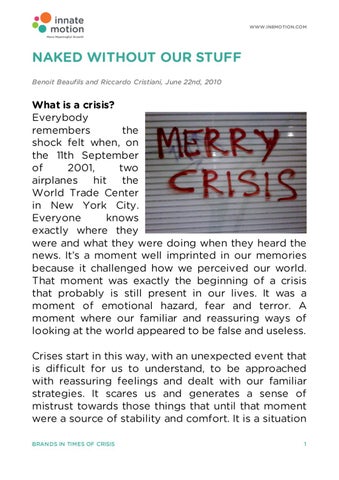
What is a crisis? Everybody remembers the shock felt when, on the 11th September of 2001, two airplanes hit the World Trade Center in New York City. Everyone knows exactly where they were and what they were doing when they heard the news. It’s a moment well imprinted in our memories because it challenged how we perceived our world. That moment was exactly the beginning of a crisis that probably is still present in our lives. It was a moment of emotional hazard, fear and terror. A moment where our familiar and reassuring ways of looking at the world appeared to be false and useless. Crises start in this way, with an unexpected event that is difficult for us to understand, to be approached with reassuring feelings and dealt with our familiar strategies. It scares us and generates a sense of mistrust towards those things that until that moment were a source of stability and comfort. It is a situation BRANDS IN TIMES OF CRISIS
1
WWW.IN8MOTION.COM
where one can feel immobilized and/or hurt, and the first reaction is just simply not move. In these moments, our mental energy is all focused on the hazard and also rationality can be compromised. It’s a natural reaction, a consequence of our past evolution in a world of predators and competitors for food, water and mates. Indeed this type of reactions to the emotional hazard can easily be referred to the functioning of our sympathetic nervous system activated by a situation of danger. Evolutionary psychology has shown that our response to stressors is generated by a system that activates and mobilizes energy in different body systems in order to be ready to use all the resources that we have to survive. This reflex response is activated by our sense of fear. The new information short-circuits the rational paths of thinking and is instantly processed in our brain to find the right way to react: fight or flight? Indeed based on our personality and past experience we decide for one or the other. Facing the situation with a sense of mastery and courage or avoiding it with evident or snaky behavior. Crises are situations when the information is not enough or too different from what the brain knows. One is not able to decide a simple course of action. The result is a continuous activation of our sense of fear and danger with incapacity at the higher rational BRANDS IN TIMES OF CRISIS
2
WWW.IN8MOTION.COM
level to find a solution. We go on experiencing the emotional hazard without being able to cope with the situation in an effective way, reducing our efficiency to the whole span of our functions. Caplan (1964) summarized that logic when defining an emotional crisis as a “psychological disequilibrium in a person who confronts a hazardous circumstance that for him constitutes an important problem which he can, for the time being, neither escape nor solve with his customary problem solving resources�.
PROBLEM OR OPPORTUNITY? As we stated above crisis represent moments when our old models of understanding collapse, when our usual rational processes of understanding and action stop functioning. Therefore we fear and hate these moments, because they force us to look for new solutions and to change ourselves. Crises are about confrontation, about death, about the end of something we knew and the creation of something that we do not know. We dread crises because they represent death. In truth however we should revere them, because they are also births. Crises occur as the expression of an established system coming to an end. They explode when conflicting forces come to an unsolvable confrontation. Crisis will last as long as the BRANDS IN TIMES OF CRISIS
3
WWW.IN8MOTION.COM
representatives of these forces clutch to the past, and will resolve only through the opening a new way, a new force, that will define a new balance. Change is part of our impermanent world. We tend to view change as a smooth process, and constantly imagine that the changes that we go through are leading us to a final, stable situation. “When this is over, we’ll be just fine”… This is an illusion, and forgetting the lessons of history. Change happens through revolutions and disasters. And change is constant. Crises are hence an essential part of our life. Like birth, like adolescence, like the loss of a job, like the end of a relationship, they are growth opportunities. Humans and humankind constantly progress through the destruction of old patterns, of old habits, towards an unknown better way. As the Chinese character for crisis points out (it includes ideographs related to the idea of danger as well as the idea of hope and opportunity), the state of disequilibrium caused by a moment of crisis is dual. It is how this unbalanced moment is managed that defines whether the crisis can evolve towards rapid cultural progression, or introduce a time of durable regression. Accepting the risk is the only way to move on and take real advantages from life. The snowboarder or the surfer has to dive into the slope, accept the BRANDS IN TIMES OF CRISIS
4
WWW.IN8MOTION.COM
imbalance, in order to start using gravity in a different manner. In crisis, releasing old habits and embracing the change is the way to move forward. It is about understanding what is to come out of the ashes of the old, and embracing it as early as possible. Businesses and brands in particular, will also lose in a crisis context if they associate themselves to the old forces. They will win if they can associate themselves to the upcoming flow, surfing on it or even announcing it. They must see crises as a positive thing, an opportunity to question themselves and gain a renewed sense of perspective. The secret is to not deny it but embrace, accept the new reality. Brands also have a unique role to play in deep times of crisis. As they struggle to define their ways, as their old habits are not efficient anymore, people are in need for guidance. Brands have become so visible and so important that the views that they offer represent inspiration for people. In times of crisis, the views that brands offer often serve as beacons in stormy waters. Brands that acquire such meaningfulness are in turn revered by consumers, so that the humanistic role of providing an inspirational worldview in times of crisis actually represents the single biggest opportunity for a brand to reinvent itself and its relevance to consumers.
BRANDS IN TIMES OF CRISIS
5
WWW.IN8MOTION.COM
This is what Coke did in 1971 when launching their iconic “Hilltop” ad. America was then in crisis. The battle for civil rights had seen the black people challenging American society to actually deliver equal rights in the face of a tough segregationist reality. The anti-war movement was challenging Nixon’s government, brutally clashing with the police in universities. But the Vietnam War was only the catalyst of the crisis, an expression of a deeper conflict. The old normative system of the 50’s was crumbling. Forces of social conformism, leveraged after the war in the name of economic progress, were facing a new force of individuation and de-norming. The conflict was severe. The Vietnam war, as a expression of that conflict, became a thorn in America’s side. There was no solution to find in the confrontation, no possible winner. Only a third force could emerge, showing a new direction. That new direction was perceivable, but diffuse. It was present in the conquest of the Moon, a moment of hope towards a new territory. It was perceivable in the speech of Martin Luther King in 1963. After a long, crude description of the violent segregation opposed to the “Negro people”, King expresses his dream, the dream “that one day on the red hills of Georgia the sons of former slaves and the sons of former slave owners will be able to sit down together at the table of brotherhood”. It was perceivable in the dreams of Woodstock. The new direction was appearing but it was minor, lost into the confrontations of the time. BRANDS IN TIMES OF CRISIS
6
WWW.IN8MOTION.COM
In this moment of absolute crisis and change Coke took a inspirational stance. With “Hilltop” the brand pictured youths of all races, holding hands on a hill, singing “I want to offer the world a hope”. What Coke did was no less than putting King’s dream on TV! Hilltop became iconic. Coke received over 100000 letters about it in the US alone in 4 months of airing. The Georgia based corporation had turned the foolish dream of peace and harmony of a few inspired visionaries into a mainstream idea, offering an Alchemist’s belief in a higher truth of peace as a new definition of progress. By doing so, it had fulfilled the thirst of millions of Americans for a new, more inspired direction.
THE THREE LEVELS OF CRISIS RESOLUTION If crisis can be seen as opportunities, what are the elements that we can work around to unlock the way to a progressive resolution of the conflict? Both humans and societies follow a similar path in their process of finding a way out from a moment of crisis. It can be seen as a 3-step process that starts with the manifestation of the emotional hazard and ends with the concretization of the new solution.
BRANDS IN TIMES OF CRISIS
7
WWW.IN8MOTION.COM
Emotional focus Right after the emotional hazard, the event that shakes the fundaments of people stability and world’s familiarity, the major need that people look for is emotional guide and stability. This is a moment of fear and uncertainty where people are still struggling to process what happened and how restructure their perception of the world. Emotionality is very high and finding a way within this chaos of feelings is the main issue. Rational explanations of the situation are not able to settle down the tumult of sensations that are at the crisis’ basis. That is what we can see nowadays in the stock market crisis: an epidemic contagious distrust that is spreading relentlessly despite the logic explanations and the reassuring strategies provided by governments. Rationality is just out of reach at this stage because the crisis needs to be felt and experienced before being able to engage with it rationally and mentally. Fear dominates, so that people are also hardly receptive yet to new directions. It requires a certain time for that initial stage to settle, as it is about coming to terms with the reality of the loss of a previous sense of stability. It is a process that reflects the human grieving process – an initial irrational stage of denial and shock needs to take place before people can be open to other directions. For brands, this is a time to offer reassurance and empathy, a time to offer safety and well known solutions. BRANDS IN TIMES OF CRISIS
8
WWW.IN8MOTION.COM
Existential focus Once the crisis trigger has been emotionally processed, people regain a basic confidence in their ability to deal with the world around them. This is essential to enable them to be inspired by new solutions and find a way out from the conflict. The clashing forces create a sense of impasse and need to set free from this stuck situation. However people start to activate a conscious and unconscious search of resolution mixing and matching all the information they can get in a creative and desperate struggle to find a more progressive adaptation to the situation. This is the moment of the fight, where new outlook of life mushroom and battle for getting relevance in people’s life. However not all are able to offer a real way out to the crisis. Only few or one is the right path, able to engage with people at an existential level, giving new relevance to their role in the new changed world. This is a very crucial moment of the crisis, usually the one lasting longer and that creates the major sense of frustration. This is a time where crisis can settle, a time of uncertainties, which lasts until a proud new direction can emerge. Only accepting this moment of internal conflict and the possibility of destruction we can push ourselves to evolve to a better self or a better society. This is a critical time of opportunity. It is the time when new visions arise, when new directions crystallize.
BRANDS IN TIMES OF CRISIS
9
WWW.IN8MOTION.COM
Rational focus The third level is focused on looking for concrete facts and information on how to pursue the new path – to make it happen. It is a concretization of the inspirational surge through the search of practical directions in order to embrace the new status. It is a translation of the existential level to more daily issues that allows people to feel more in tune with the adapted reality they are creating.
HOW CAN BRANDS BE RELEVANT? Brands can be catalysts of crisis resolution if they are able to read the situation with an eye on the forces behind and the process in act. They can play a role in all the three levels but their impact is probably most relevant from the existential stage. By surfacing the new flow, a solution to the underlying conflict that people can embrace, they can contribute to make the old conflicting forces irrelevant. Consumers then can associate with these new directions with brands, and resonate with the brands offering them. The brand hence becomes deeply relevant. Major brands will play the most prominent roles, as they have the credentials to crystallize new visions. But smaller brands have equal opportunities to offer ways out of the crisis… Iconic brands – the likes of Coca-Cola, Visa, Levi’s, Nike or Apple may offer an alchemist stance, standing for higher truth for people to embrace. But smaller brands will be able to offer strategies to deal BRANDS IN TIMES OF CRISIS
10
WWW.IN8MOTION.COM
with the crises that efficiently can be borrowed by consumers. The Jester stance taken by Fanta, its wild, sharp, happy way to uncover the nonsense of the world also offers an effective way for people to deal with the feelings stemming out of the current crisis. Innate Motion offers a methodology to analyze a crisis in all its sociological and cultural implications. Five core questions are a point of departure for any crisis management situation. 1. What is the hidden emotional hazard that plays the role of the crisis catalyst? 2. What is the bigger arena of conflict: the underlying forces clashing? 3. What is the temporal level of evolution of the crisis? 4. What new way is flowing and gaining relevance? 5. How can the brand disengage from old forces and take meaning in the new flow? Answers and actions will then fundamentally differ from brand to brand – in crisis unfortunately, no onesize-fits-all approach can be established.
BRANDS IN TIMES OF CRISIS
11