SMS marketing
– the e-commerce handbook
Written by Julie M. Nielsen
Layout by
Henriette L. Andersen
inMobile ApS
Published: February 2024
1st edition
Preface
Welcome to your new SMS marketing handbook for e-commerce businesses.
In a digital age where background noise never seems to subside, SMS marketing cuts through with a level of precision and personalisation that few other channels can match.
For an e-commerce business, SMS is therefore not just another potential addition to the marketing toolkit. It is a direct line of communication between brand and consumer. SMS open rates speak for themselves, but it is the relationships built and the sales that follow that make SMS marketing a discipline truly worth mastering.
In “SMS marketing – the e-commerce handbook”, we explore the potential of SMS marketing specifically for e-commerce businesses. We take an in-depth look at how SMS can be leveraged across the digital customer journey, and how to move from planning to executing SMS campaigns that convert casual browsers into loyal customers.
Whether you are holding a printed copy in your hands or scrolling through these pages online, it is our hope that this book will become your trusted companion in the SMS landscape. Written for e-commerce managers, digital marketers and communication professionals, it is designed to equip you with the insights and tools needed to create measurable, long-term results with SMS.
The pages you are about to read are filled with carefully selected insights, practical tips and proven approaches to driving real results. Through case studies, you will gain insight into how leading brands such as Luksusbaby, Munk Store and Vuffeli actively work with SMS marketing and achieve success. Our ambition is for this book not only to inform, but also to inspire you to embark on your own SMS journey.
Take a break from the bustle of everyday life, get comfortable, and step into the timeless world of the SMS channel – a format that never goes out of style.
Introduction to SMS marketing
SMS marketing is a dynamic and direct form of marketing that allows businesses to reach their customers with personalised messages that are not only seen, but also acted upon.
Before we dive into how to work with SMS in practice, we will take a closer look at the core of what SMS marketing is, the role of the SMS channel in the modern marketing landscape – and, of course, why SMS is an indispensable tool for any e-commerce business.
What is SMS marketing?
At its core, SMS marketing involves sending text messages to (potential) customers with the aim of selling or promoting a product, service, brand or event. In other words, it is direct marketing in pocket-sized format – a way of communicating offers, news or updates that requires minimal content, yet has the potential to generate high engagement and strong response from the recipient.
While social media and email compete for users’ attention through algorithms and overcrowded inboxes, SMS marketing offers a direct, immediate and effortless way to engage in dialogue with consumers.
SMS has become a dominant force in the digital landscape in recent years, largely due to the channel’s ability to deliver messages directly, instantly and effectively.
Søren Guldager, CEO, inMobile
SMS marketing in a digital age
The power of the SMS message lies in its simplicity and effectiveness. It requires neither an internet connection nor app downloads. Instead, the vast majority of the world’s population now owns a mobile phone – which is precisely why SMS marketing has never been more relevant.
The digital age has intensified the need to cut through vast amounts of noise and deliver messages that do not get lost in overcrowded inboxes or busy news feeds. It is a challenge, but the high open rates of SMS messages make the channel one of the most effective ways to capture consumers’ attention.
Source: bankmycell.com , January 2024
85,74% of the world population own a smartphone
91,68% of the world population own a mobile phone
Advantages of SMS marketing
With an almost universal reach and open rates close to 100 per cent, SMS marketing has the ability to become a decisive touchpoint in the customer journey – a tool that turns passive reading into active engagement.
E-commerce businesses, in particular, can benefit from the unique format of the SMS channel.
High open rates:
On average, 98% of all SMS messages are opened. This makes SMS the ideal channel when it is crucial that your message is seen.
Instant delivery:
95% of recipients open an SMS within five minutes of receiving it. This makes SMS particularly well suited for important or time-sensitive campaigns.
A personal channel:
With personalised SMS campaigns, a text message can easily feel tailor-made for the individual recipient. At the same time, it is one of the most personal channels, characterised by high engagement.
Targeted communication:
When sending SMS messages, you can segment your audience with precision, ensuring that the right messages reach the right recipients.
Measurable results:
SMS marketing makes it possible to track how your audience interacts with your message, for example through link tracking. These insights can be used to optimise future campaigns.
62% of Danish consumers primarily shop via their smartphone.
95% of SMS messages are opened within 5 minutes.
98% of SMS messages are opened.
36% click on links in SMS marketing messages
02 Chapter
The foundation for success
To succeed with SMS marketing, it is essential to establish a solid foundation. This foundation is built on a number of key pillars, including:
a clear purpose for your SMS strategy an understanding of how it fits into the company’s overall marketing strategy a strong understanding of your core target audience and its typical customer journey.
Once you have defined your purpose and gained an in-depth understanding of your target audience, you are ready to develop a sharp and effective SMS strategy. This chapter will guide you through the process.
Know and understand your target audience
SMS is one of the most effective channels for creating customer interactions and turning those interactions into tangible actions, such as a purchase. This is because SMS is both an immediate and highly personal channel.
This is why SMS is the natural choice for anyone looking to drive customer interaction, dialogue and action.
Before you can achieve the results you are aiming for with SMS - and identify the campaigns and messages that will help you get there - you need a deep understanding of your customers and their typical customer journey. After all, your audience’s preferences, needs and behaviour should form the foundation of your SMS strategy and the planning of your SMS campaigns.
Let us therefore take a step back from the SMS strategy and begin by looking at who your ideal target audience is.
A majority of consumers expect offers to always be personalised
Source: Salesforce, February 2022
Learn from your data
When you understand your customers and their customer journey, you are far better equipped to determine which messages to send via SMS and when to send them in order to engage the recipient.
When seeking to better understand your target audience, it is useful to have insight into the following areas:
Demographics
What is the typical age, geographical location, gender, and similar characteristics of your customers?
Behaviour
How does your audience typically interact with your brand? How much do they research before making a purchase? What do they search for when they find your webshop? Do they primarily browse and shop on desktop or mobile?
Purchasing patterns
How often do customers shop with you? At what times of the year, month, week or day do they purchase the most? What is the average order value?
Needs
What needs are your customers trying to fulfil? Which problem are they looking to solve? How can your company’s product or service help address it?
This knowledge is best found in your data. To gain deeper insights, you can, for example, take a closer look at:
Your email platform
If you are already sending emails to your audience, this is a valuable source of insight into sign-ups, unsubscribes, click-through rates, conversion rates, and more.
Social media
Analyse which profiles typically engage with your company’s content both organic and paid. This can provide valuable insight into who your brand resonates with.
Surveys
Send a survey to your best existing customers to gain a deeper understanding of who they are, along with their needs and preferences.
Existing market research
There may already be in-depth analyses of the type of audience your business serves. Make use of them!
Customer feedback
Review the feedback you receive internally through customer service or externally via review platforms. What are customers saying about your business?
CRM data
Here you can often find insights into demographics, behaviour and purchasing patterns.
The more insights you have access to, the better you will understand your target audience - and the easier it becomes to develop an SMS strategy that hits the mark from the very beginning.
Your purpose with SMS
Successful SMS marketing is not just about sending a single text message that converts in the moment. It is equally about achieving long-term results for your business.
To achieve this, it is not enough to know your target audience in depth. You should also give careful thought to the overall purpose of using the SMS channel, and how SMS fits into your company’s broader marketing activities.
Many mistakenly think of SMS as “just another channel to add on top of email”. If you do this, you risk overlooking its true potential. Instead, you should view your choice of communication channels as a whole and assess where SMS can bring something new, different and valuable to the mix.
Start by asking yourself what you ultimately want to achieve by including SMS marketing in your marketing mix - what is the main purpose? This could, for example, be:
To improve the customer experience
You may want to use SMS to inform customers about new products, special offers or updates on their order status in order to enhance the overall customer experience.
To drive more sales
Many online stores use SMS to create awareness and boost sales through flash sales or exclusive offers and events.
To increase customer loyalty
Regular SMS messages that add value can help keep your brand top of mind and strengthen relationships with your customers.
Naturally, the purpose of your SMS strategy must align with your overall marketing strategy, ensuring a consistent thread across all your marketing activities and that the SMS channel is used at exactly the right moments in your audience’s typical customer journey.
The SMS strategy in the customer journey
There are many ways to view a customer journey. Regardless of what your company’s typical customer journey looks like, it is important to ensure that the messages in your SMS communications support and reinforce the messages you share across other channels, such as social media and email.
In this way, you ensure that the customer receives a cohesive and positive experience, along with a clear understanding of who your company is and what your brand stands for.
CUSTOMER JOURNEY
Action:
Attention Interest
Becomes aware of a problem that needs to be solved, or a need that must be fulfilled.
Researches and compares potential solutions.
Feels: Motivated to solve the problem and curious about the solution. Curious, excited, perhaps slightly sceptical.
Barriers: May feel uncertain about whether the need can be met or the problem can be solved.
A poor website experience, lack of clear information, pricing concerns, competitors.
SMS: Use SMS to create awareness of your brand and how it addresses the problem or fulfils the need.
Send discount codes or helpful guidance to nudge the customer towards a final decision.
Purchase Evaluation Loyalty
Makes a final decision and completes a purchase.
Receives the product or service and begins to use it.
Subscribes, makes repeat purchases, posts, leaves reviews, recommends.
Excited, hopeful, optimistic. Excited, optimistic, confident. Proud, included, satisfied, valued.
A poor checkout experience, slow delivery, or inadequate customer service.
Highlight your USPs and send special offers via SMS to influence the final decision.
Poor quality, difficulty using the product, or a mismatch between expectations and the product/service received.
Provide ongoing order and shipping updates to ensure a positive experience.
Poor experiences throughout the customer journey rarely foster loyalty.
Build loyalty through invitations to membership programmes, VIP offers, events, etc. Ask for a review.
SMS vs email
SMS and email are both channels that fall under the umbrella of permission marketing - that is, marketing channels where you may only contact the customer once you have received their explicit consent.
For this reason, many marketers - quite understandably - find themselves unsure when it comes to implementing SMS within their existing strategy. How do you differentiate your communication across email and SMS?
The best way to determine whether a message should be shared via SMS, email or another channel is to clearly define the purpose of each channel. The role and purpose of SMS should be clarified by the end of this chapter.
Next, consider the nature of your message. Is it important that it is read within a short time frame? And can it be communicated clearly and concisely, or does it require more detailed explanation and perhaps visual elements as well?
If your message requires quick action from the recipient, SMS is the right choice. If, on the other hand, it requires more space and you want to use visual elements to support the message, email is likely the better option.
In some cases, you can also use both channels in a complementary way. For example, you might send an important message via SMS, where you can be almost certain it will be read shortly after delivery. In the SMS message you can direct the recipient to more detailed information in an email you have previously sent.
As a general rule, you should avoid sending the same content via both SMS and email.
Although there are situations where SMS and email can complement each other to strengthen a message or campaign, you should not be tempted to simply send the same messages via both channels. After all, what incentive would customers then have to sign up to both?
Because SMS is a more personal channel than email, you risk recipients losing interest in the SMS channel in particular if you fail to differentiate the content across the two.
As a general rule, it is an advantage to position the SMS channel as the place where recipients receive the most exclusive offers. Typically, it requires more commitment from the customer to share their phone number than their email address.
As illustrated in the table below, there are several use cases where SMS and email can be effectively combined - provided, of course, that you have permission to communicate with the recipient via both channels.
Goal:
SMS Email
Inform customers about timesensitive offers and important messages. Build deeper relationships. Surprise them, build trust, and make them feel valued.
Goal:
Inform customers, launch sales, promote new products.
Examples of use cases:
Early access to sales
Time-limited offers
Event reminders
VIP offers and loyalty programmes
Exclusive SMS offers
Examples of use cases:
Regular newsletters
New product launches
Offers and sales
Blog posts and other value-adding content
Milestones and various company updates
SMS and email
Goal:
Convert and drive sales, strengthen customer relationships, increase CLV (customer lifetime value) and AOV (average order value).
Examples of use cases:
Welcome series (separate for each channel)
Browse abandonment
Abandoned cart
Win-back
Review collection
Order updates and delivery information
Back-in-stock notifications
Case Luksusbaby
Luksusbaby.dk is an online universe created by the couple Ann-Louise and Morten. Here, modern parents can find everything they need for their children in one place. Since its modest beginnings in 2014, the business has grown into one of the preferred destinations for quality-conscious parents seeking premium products and a personal shopping experience.
Read the full case here.
CHALLENGE
Wanted to get closer to loyal customers
Luksusbaby was facing a challenge. The company wanted to build deeper and more personal relationships with its most loyal customers. To achieve this, it was looking for a communication channel that could deliver content directly and effectively, while also enabling customers to act immediately when presented with a compelling offer.
SMS activates and engages customers
For Luksusbaby, SMS marketing proved to be the right solution. By sending targeted and personalised messages directly to customers’ pockets, the company not only informs its audience, but also activates and engages customers.
Members of the SMS list receive tailored messages containing, among other things, information about new products, special offers and exclusive sales. The messages are often personalised and always include a clear call to action, for example through links directly to Luksusbaby’s webshop.
HELP US EMPTY THE WAREHOUSE! 40-60% on popular brands.
Ends Tuesday! s.luksusbaby.com /-5hJeTvcF
Unsubscribe: s.luksusbaby.com/4vNLF0
Luksusbaby
We typically see traffic start flowing to the site just seconds after sending an SMS. And when we look at the results, we see an average ROAS of more than 2,000%”
Morten G. Kjær, founder and CEO of Luksusbaby
RESULT
Increased engagement, loyalty and sales
Since 2020, Luksusbaby has used strategically planned SMS messages to reach customers who have opted in to receive them. Their SMS campaigns are written with a strong focus on action and engagement and have delivered impressive results, with an average ROAS of more than 2,000% per campaign.
At the same time, Luksusbaby sees how personalised messages with unique offers make customers feel valued, strengthening both loyalty and a sense of belonging with the brand.
+2000% average ROAS
+12% CTR on multiple campaigns
+17.000
SMS permissions only via check out
What can you learn from Luksusbaby?
The strong results achieved through the SMS channel can largely be attributed to Luksusbaby’s ability to understand and act on customer preferences. As an e-commerce business, there is much to learn from their case.
Personalisation is key
Tailor your messages and offers to match each customer’s preferences and previous behaviour.
Target your communication
Luksusbaby uses SMS to reach its most engaged customer segments, ensuring that its communication is as relevant as possible.
Timing is everything
Send your SMS messages when your customers are most receptive. For Luksusbaby, this is often in connection with special events or sales.
Make it easy to act
Include links in your SMS messages that lead directly to the featured products, offers or events, making it easy for recipients to act.
Track and optimise
Use data from your SMS campaigns to understand what works and where there is room for improvement. Click-through rates and conversion rates are invaluable insights.
Invest in relationships, not just transactions
Use SMS to build relationships through relevant and valuable content that makes your customers feel special.
03 Chapter
Developing your SMS strategy
With a solid foundation in place – including a strong understanding of your target audience and a clearly defined purpose for using the SMS channel – the time has come to develop your own SMS strategy.
With an SMS strategy serving as the roadmap for all your SMS marketing activities, you ensure that your messages are both targeted and effective.
In this chapter, we will walk through the key components your SMS strategy should include.
Identify goals and define KPIs
Without shared goals, it is difficult to determine whether your SMS efforts have been successful. Your strategy should therefore include clearly defined objectives in the form of measurable KPIs (key performance indicators) that you and your team can work towards and use to continuously evaluate and optimise your efforts.
Your KPIs should reflect the purpose of your SMS marketing and should always be directly measurable. They may relate to elements such as:
Conversion rate
If your objective is to drive sales, you can measure the percentage of recipients who complete a desired action (such as a purchase) after receiving an SMS.
Click rate (CTR)
To assess engagement with your SMS messages, you can monitor how often recipients click on the links included in your messages.
Sign-up rate
When it comes to growing your list of SMS optins and therefore the number of recipients, it is a good idea to continuously monitor how many people sign up.
Unsubscribe rate
It is equally important to monitor how many recipients choose to unsubscribe, as this can be an indicator of how relevant and valuable your communication is.
Your KPIs equip you to assess whether the direction you have chosen for your SMS marketing strategy is the right one, and whether your efforts are delivering results. Without clear objectives to measure against, it becomes difficult to determine whether your efforts have been successful or whether significant changes and improvements are needed.
Below are examples of what a selection of concrete KPIs might look like:
“We aim to achieve an average ROAS of 2,000% on the SMS channel within the first year.”
“The average CTR for SMS should be at least 12% after the first year.”
“We aim to secure 1,000 SMS opt-ins within the first six months of 2024.”
“There should be no more than 1% unsubscribes per SMS after the first six months.”
Of course, you should not simply pull numbers out of thin air. Instead, your KPIs should be realistic and proportionate to the resources you allocate to the SMS channel. It can also be helpful to benchmark your KPIs against the average performance of other e-commerce businesses.
It is also natural to adjust your KPIs over time as you gain a clearer understanding of how SMS performs for your business.
Tips for defining KPIs
Benchmark against similar businesses:
Review industry statistics and averages, and use them as a benchmark.
Use historical data: Once you have been up and running for a few months, you can review past performance and use it as a basis for setting improvement targets.
Set progressive goals:
Consider setting targets that become gradually more ambitiousas your SMS list grows and your campaigns become more targeted.
SMS benchmarks for e-commerce
Excellent: >14.6%
Good: 8.9-14.5%
Fair: 6.0-8.8%
Critical: < 5.9%
Excellent: > 2.1%
Good: 1-2%
Fair: 0.5-0.9%
Critical: < 0.5%
Source: Klaviyo, November 2023
Excellent: >16.5DKK
Good: 4.5-16DKK
Fair: 1-4DKK
Critical: < 1DKK
Excellent: < 0.5%
Good: 0.5-1.2%
Fari: 1.3-2.1%
Critical: > 2.2%
Collecting SMS permissions
You now have a clear understanding of why you want to work with SMS marketing, who you want to send SMS messages to, and how you measure the success of your efforts.
With this knowledge in place, it is time to decide how you will collect permission from your audience to send them SMS messages. Without their consent, you have no one to message making this step absolutely critical to your success with SMS marketing.
Consent should not be viewed solely as a legal requirement. Consumers who actively choose to receive SMS messages from your business do so with an expectation and a desire to hear from you. Collecting SMS permissions therefore ensures that you are investing your resources in a marketing channel where recipients genuinely want to engage with your brand.
For this reason, it is not just about growing your list in terms of volume, but equally about identifying the most interested consumers and building a relationship of trust when they grant you access to one of their most personal communication channels.
Lverage your knowledge of your target audience
With your in-depth understanding of your target audience, you should first identify what truly interests them. What you can offer that is valuable enough for customers to share their phone number and grant SMS permission. This could, for example, be:
Early access to all offers
A VIP club with access to exclusive offers and events
The opportunity to test and purchase new products before anyone else
Invitations to special events and experiences
Early access to information about product launches
Membership of a customer club where points, discounts or similar rewards can be earned through purchases
Access to a community of loyal users with direct access to the company
The opportunity to provide the company with direct feedback in a way others cannot.
Use your knowledge of your core audience’s needs, desires and aspirations to motivate them to sign up to your company’s SMS list.
Why do consumers sign up for SMS?
I’m about to make a purcahse and would like a discount I often buy from this brand
It’s a brand I purchase from when there are sales
It’s a brand I love
I spend a lot of money with this brand
Other
None of the above
Why do consumers unsubscribe from SMS?
Too many messages
The same message too many times
Messages have no purpose
I’m not interested in the topic/product in the message
Messages that don’t seem relevant to me
Messages at inconvenient times
The same messages are sent via SMS and email
The messages focus solely on offers and sales
None of the above
Source: Klaviyo, November 2022
How to collect SMS permissions
There are many ways to collect SMS permissions from your audience. Ranging from the most obvious approaches to more creative ones.
If you are new to SMS marketing and are collecting SMS permissions for the first time, we have two recommendations on where to start:
Collect at checkout in your webshop
A pop-up sign-up form for SMS on your website. 1. 2.
It is relatively quick and easy to set up an SMS opt-in option within your checkout flow, allowing you to collect permission from customers who have already shown interest by making a purchase. Similarly, it does not take long to create a pop-up on your website where potential customers and other visitors can be encouraged to opt in to SMS notifications.
There are, of course, many other ways to grow your SMS list. Common approaches include collecting permissions via your company’s social media platforms or inviting subscribers on your existing email list to also join your SMS list.
Effective methods for collecting SMS permissions:
Checkout in your webshop
Pop-up forms on your website
Converting email subscribers into SMS subscribers
Promoting your SMS list on social media channels.
Regardless of which method you use to collect SMS permissions, it is important to clearly communicate what consumers are signing up for, why they should sign up, and how they can unsubscribe from the SMS list if they choose to do so.
It’s all about trust
An SMS permission is consent to send text messages to an individual. It is a significant vote of confidence, accompanied by the expectation that you will deliver relevant and valuable messages. After all, when you send an SMS, it lands directly in the recipient’s inbox alongside messages from friends and family.
From the moment you ask for permission, you begin building a relationship with the customer. This foundation of trust is essential to establishing longterm relationships and lasting loyalty.
Remember legislation
It is important that consumers are in no doubt about what they are giving permission for. This is not only about building the best possible relationship, but also about compliance with legislation. If you do not obtain proper permission, you risk violating marketing laws, which can result not only in fines, but also in negative consequences for your company’s brand.
Make sure you familiarise yourself with the applicable legislation on SMS marketing and the requirements for obtaining permission. Find The Marketing Act here
In addition, you should ensure that recipients always have easy access to opt out of SMS messages. If you do not offer this option, you risk damaging your brand, as recipients may perceive your messages as spam. Always include a simple unsubscribe option, for example via an unsubscribe link (read more in chapter 4).
Examples of collecting SMS permissions
1. Collection at checkout
As mentioned earlier, one of the most effective ways to collect SMS permissions is during the checkout process in your webshop. At this stage, you have the customer’s full attention, and because they are already in the purchase flow, the likelihood of obtaining SMS permission is higher. You can even collect permission for both SMS and email in the same field provided that you clearly inform the customer that the permission applies to both channels.
When you ask customers whether they would like to receive SMS messages during checkout, you make it incredibly easy for them to give permission, as it often requires nothing more than ticking a box as part of the purchase process.
How?
Most e-commerce platforms offer an easy way to add an SMS permission checkbox at checkout.
If you use one of inMobile’s shop integrations for platforms such as Shopify, PrestaShop, Magento or WooCommerce the integration will automatically synchronise all your SMS permissions to a list in inMobile. This includes valuable purchase data such as number of orders, total order value and most recent order date - key insights for your future segmentation.

2. Website pop-up
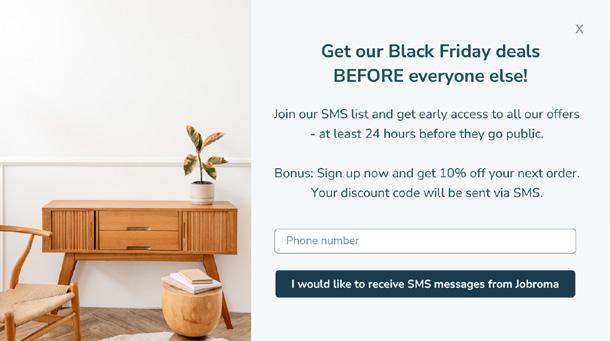
Website pop-ups can perform very well and be an extremely effective way to convert website visitors into SMS permissions. To succeed with a popup, it is essential to use a strong visual element that quickly captures the visitor’s attention.
In addition, you should include a motivating incentive that clearly communicates why visitors should sign up to your SMS list. This could, for example, be free shipping, an exclusive offer, an exciting competition, or access to a members’ club.
The possibilities are many and depend on your business and imagination.
How?
Most pop-up systems allow you to choose whether your form should be shown to visitors who are already on your email list. This enables you to differentiate which pop-up different website visitors see, depending on their prior interactions and relationship with your brand.
If you choose to collect SMS permissions and email permissions in a single pop-up form, make sure it is clearly stated in the consent text that the permission applies to both channels.
3. From email subscriber to SMS subscriber
If you already have a list of email permissions, it makes good sense to invite those recipients to join your SMS list as well.
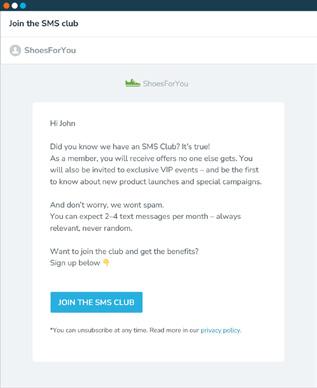
In this case, you are speaking directly to an already engaged audience. These contacts are familiar with your brand through your emails and are on your email list for a reason. Give them an extra incentive to also follow you on SMS.
This approach works particularly well with consumers who have already demonstrated loyalty to your brand, for example by making repeat purchases or engaging with your communications over time.
How?
If you want to invite your email subscribers to join your SMS list, make the process both attractive and easy. Create an email that clearly communicates why recipients should sign up for SMS and what they will receive there that they do not get via email. Your SMS offering should feel exclusive.
Include a clear call to action along with a corresponding button that links to a sign-up form, allowing recipients to quickly and easily give permission to receive SMS messages.
4.1 Organic SoMe posts
If your business is active on one or more social media platforms, this is a great place to start when it comes to collecting SMS permissions. Here, you can encourage your social media followers to sign up to your SMS list using a sign-up link.
Encourage your employees to share the post so it reaches even more potential customers.

How?
Capture users’ attention with compelling visuals and persuade them to join your SMS list with a strong message that speaks directly to your audience’s interests and needs.
Remember to link to a landing page where users can complete the sign-up process.
4.2 Paid social media advertising
If you have some additional budget to work with, you can also use paid social media advertising to collect SMS permissions. For example, you can use lead ads or create engaging competitions to gather SMS permissions.
By targeting your ads towards your company’s primary audiences, you can increase the likelihood of generating more sign-ups. Once again, be sure to offer a strong incentive for signing up - for example, early access to offers, exciting competitions or exclusive discount codes.
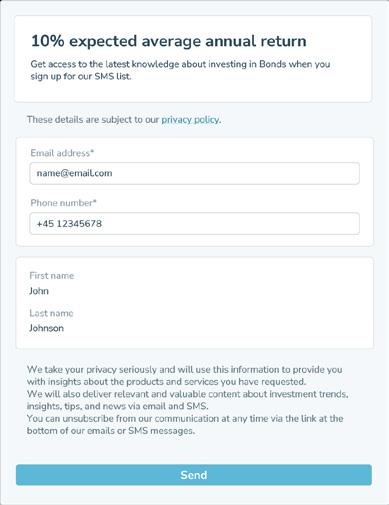
How?
Choose the most suitable ad format - such as an image, video, competition or lead ad - and target it directly at your core audience. Remember to clearly communicate what recipients are giving permission for, and how they can withdraw that permission again.
Segment your recipients
You are now either well on your way to collecting or actively collecting your first SMS permissions. This is an important step towards succeeding with SMS marketing. Now it is time to take a closer look at how to segment your recipients.
The SMS channel is not designed for scattergun messaging, and the old saying “when you aim at everyone, you hit no one” applies here as well.
When you begin segmenting your recipients, it is important to remember that a target audience and a segment are not the same. A segment is a further subdivision - essentially a set of subcategories - within your broader target audience.
The more specific your segments are, the easier it becomes to ensure that the right message reaches the right recipient. When you succeed in creating the right segments for your business, you can tailor your content and offers to resonate more strongly with recipients. This drives higher engagement and ultimately more sales through SMS.
Use your data (again)
Segmentation can be done in many ways, but your options largely depend on the data available to you. Segmentation without data is just guesswork and rarely delivers meaningful results.
If you have access to data such as geographical location, purchase history or previous interactions with your business, you can use it to segment your recipients with a high level of precision. This allows you to send SMS messages that are far more personal and relevant to each individual recipient than if you were to send the same message to everyone on your SMS list.
Typical segmentation data
Demographic data
Demographic data focuses on the basic characteristics of your target audience. This includes factors such as age, gender, interests and geographical location.
Interaction history Purchase history
Interaction history relates to how customers engage with your business. This can include actions such as opening an email, visiting your website, clicking a link or attending a live event.
Relevant segments for e-commerce
Purchase history provides insight into past transactions and purchasing patterns. Here, you look at which products customers have bought, how frequently they make purchases, and the value of those purchases.
Every business has different target audiences and, as a result, different segments that are more or less relevant to work with. Select a small number of the segments that are most relevant to your business and start by focusing your efforts there.
If you run an online store, it may, for example, be relevant to work with segments of recipients who have shown interest in specific product categories, made purchases at certain times, spent above or below particular amounts, or participated in one or more of your company’s events.
First time buyers
New customers on your SMS list should receive a welcome message to ensure a positive first impression and to strengthen their relationship with your brand from the outset.
Frequent buyers
Customers who shop with your business more frequently than average have a strong potential to become loyal VIP customers if you continue to keep them engaged.
Inactive customers
Former customers who have not made a purchase within a defined period (e.g. six months) can be encouraged to buy again with the right incentive.
Bargain hunters
Customers who primarily shop with your business when there is a strong offer or a sale.
Geographic segments
Customers who live close to your company’s physical store and are therefore particularly interested in in-store events and sales.
Customers who have made a recent purchase (e.g. within the past 30 days) can receive a follow-up message with useful information or a relevant offer that further strengthens the relationship.
Recent buyers VIP buyers
Customers who shop with you frequently and/or spend larger amounts are your VIP customers. Give them access to exclusive campaigns and events to ensure their continued loyalty.
Subscribers, non-buyers
Consumers who have subscribed to your SMS list but have not yet made a purchase can be converted into first-time buyers with the right incentive.
Seasonal buyers
Customers who typically shop only during specific seasons or around certain holidays.
Category-specific buyers
Customers who have shown interest in specific products or categories should receive offers aligned with those interests.
Plan your SMS campaigns
Once you have a clear understanding of which segments you want to target with SMS messages, it is time to plan your SMS campaigns.
At this stage, you should consider which messages are important for your business to communicate throughout the year. You should also determine when and how often you want to send SMS messages to your recipients.
SMS campaigns vs SMS automations
Broadly speaking, there are two types of SMS send-outs you can work with: SMS campaigns, which are one-off messages, and SMS automations, which are sent automatically on a recurring basis.
Your choice of SMS type will depend on the nature of your message. If it is a message the customer needs to receive regardless of the time of year, it will typically be added to an SMS automation, ensuring it is sent automatically once certain criteria are met.
If, on the other hand, your message depends on a specific event or season and therefore only needs to be sent once at a particular time, you should create an SMS campaign instead.
SMS campaigns
SMS campaigns are typically one-off send-outs that are planned as part of your annual calendar or content plan, alongside content for your other channels.
The messages in your SMS campaigns are designed to align with seasonal moments and key business events throughout the year. SMS campaigns are directly tied to your marketing objectives, including your SMS KPIs.
An SMS campaign is manually scheduled to be sent once.
SMS automations (flows)
Messages within an SMS automation are evergreen, meaning their content is timeless and not dependent on specific seasons or events.
They are typically triggered by a specific event or when a defined action takes place.
Automations help guide customers through the customer journey by delivering the right messages at exactly the right time. Messages are sent based on each individual customer’s personal timeline and journey.
We will start by looking at how to plan your SMS campaigns.
Messages
Effective messages are crucial to whether your recipients engage with your SMS communications - and, in turn, whether you achieve your goals for the SMS channel. For this reason, you should allocate time to carefully plan your messages.
Some campaigns can be planned up to a year in advance - for example, campaigns tied to holidays or major shopping seasons such as Black Friday. Others may only need to be planned a month ahead, and if you are more spontaneous, an SMS campaign can even be executed on the same day should a great idea suddenly strike.
How and how far in advance you plan your SMS campaigns and their associated messages depends on you and your preferred way of working.
What is the core of your message?
When planning a campaign, your first step should be to define the core of your message. What is it that you want to communicate to the recipient and why? This should, of course, align with your brand identity while also being relevant to the segment the SMS message is sent to.
If you are promoting a new collection, the core message might be e.g. “exclusivity” or “early access”, while a loyalty campaign could centre on “appreciation of the recipient”.
Focus on value creation
Because SMS is such a personal channel, it often takes very little for recipients to unsubscribe. For this reason, you should always make every effort to ensure that the information you share via SMS provides genuine value to the recipient.
For example, if you are promoting a new product line, do more than simply announce it. Instead, highlight the benefits or unique features of the new products. By focusing on value rather than mere information, you create stronger motivation for the recipient to take action.
Personalisation
Once again, we encourage you to make use of the data available to you. This time to create a sense of personalisation in your SMS messages. This can be as simple as using the recipient’s first name, or more advanced, such as recommending products based on previous purchases or browsing behaviour.
Personalisation shows that you value your customers as individuals.
SMS messages that make consumers feel like part of an exclusive group
Invitations to VIP experiences
Loyalty programs and benefits
Birthday offers
Campaigns and discount codes
Special messages
Message about upcoming campaigns
Messages about upcoming events
Messages about new products
Delivery confirmation
Shipping confirmation
Back-in-stock notifications
Order confirmation
Messages based on my actions
Abandoned-cart reminders
Interesting or helpful articles
Source: Klaviyo, November 2022
Keep your message short and to the point
An SMS message is not designed for long, elaborate messaging. You should therefore consider whether your message is best suited for SMS or for one of your other channels. In addition, you should avoid including more than one message per SMS.
With a limit of 160 characters per SMS, your message needs to be concise and to the point. Choose your words carefully to ensure that every word contributes to communicating your message.
Tip: SMS character limits
A single SMS message can contain a maximum of 160 characters. If this limit is exceeded, the message will technically be sent (and billed) as multiple separate SMS messages - even though modern smartphones can display them as a single message for the recipient.
For this reason, keeping your SMS messages short is not only beneficial for the recipient, but also for your budget.
Read more in the article ”How many characters can an SMS message and sender name contain?”
Call to action
It is important that your message includes a clear call to action (CTA).
Once recipients have finished reading your SMS, it should be clear how they are expected to respond. Should they sign up for an event via a link, use a discount code on your website, or reply with a keyword? Make it clear what action you expect them to take.
Tip: Links in SMS messages
Links in SMS messages are an effective and convenient way to encourage action - but they need to be used correctly.
Links that include the sender’s name can achieve up to 39% higher click-through rates compared to generic links. For this reason, you should avoid using public link shorteners, as they can undermine your brand’s credibility. Instead, use inMobile’s automatic link shortener, which includes your domain name in the link. Tracking is also added automatically, allowing you to gain insight into your CTR.
Read more in the article ”Link tracking in SMS”
Frequency and timing
Timing and frequency are two essential factors in your SMS marketing. When you manage to send an SMS at exactly the right moment, it can amplify your message and increase recipient engagement, while the right frequency helps maintain interest in your brand without becoming intrusive.
Frequency
When it comes to frequency in SMS marketing, the key is to find the right balance where recipients feel informed and engaged without crossing the line into irritation.
So where is that line? It depends entirely on your target audience, and the only way to identify the ideal frequency is through testing and by continuously monitoring engagement and unsubscribe rates.
Source: Klaviyo , November 2022
A couple of times a week Once a week Never Once a day
30%
13% Once every other day
13%
It is also an option to let customers choose their preferred frequency during the permission process by asking which types of messages they wish to receive, and by clearly communicating how many messages of each type they can expect per month.
Timing
One of the major advantages of SMS is that messages are sent and received instantly. In most cases, they are also opened very quickly. Studies show that 95% of SMS messages are opened within five minutes of being received.
You can use this to your advantage by timing your SMS sends so they are seen at moments when recipients are most likely to be interested in your message and available to act on it.
For example, sending an SMS during the lunch break or just after work may be when your customers are most receptive to your message. Perhaps they shop most on Mondays or during the first weekend of the month. The best way to find out is by testing.
In addition, your timing should naturally align with your annual calendar. If there are specific events or seasons that fit your company’s overarching messages, your SMS communications should be scheduled accordingly.
For example, an SMS featuring a special offer in connection with an upcoming holiday can encourage spontaneous purchases.
Tip: Send in batches
95% of all SMS messages are opened within five minutes of being received. As a result, an SMS campaign sent to a very large audience can potentially overload your website’s server.
You can avoid this by sending your message in batches. When sending an SMS via inMobile, you can choose to distribute the message in multiple batches, for example with 10-minute intervals - thereby reducing the load on your server.
Examples of SMS campaigns
For an e-commerce business, SMS campaigns are a powerful way to drive engagement and sales. The key is to create campaigns that not only highlight products or offers, but also tell a story that resonates with the recipient.
On the following pages, you will find examples of SMS campaigns designed to inspire your own strategy.
Only today! Get 20% off on all summer dresses with the code SUNNY20. Hurry, the sale ends at midnight!
Unsubscribe: s.ecowear.com/4vNLF0
Time-limited offers and flash sales
Create a sense of urgency and increase customers’ motivation to act quickly. The immediate delivery of SMS messages makes the channel ideal for driving fast decisions and boosting sales through flash sales.
EcoWear
Congratulations! Because you are a GOLD status member, you can enjoy express shipping on all your orders at A Coffee the rest of the year!
Unsubscribe: s.a-coffee.com/4vNLF0
VIP and loyalty programmes
This category of SMS campaigns recognise and reward your most engaged customers with exclusive offers, discounts or updates on loyalty points, strengthening their connection to your brand.
Location-based updates
This type of SMS campaign is based on customers’ geographical location and aims to deliver relevant, location-specific offers or information that can drive traffic to physical stores or events.
Hi John
We have a Halloween surprise for you! Show this SMS in our Baker Street shop at your next visit and get a free gift. The offer ends on Sunday!
Kind regards Mo & Mo
Unsubscribe: s.moandmo.com/4vNLF0
Coffee
Mo & Mo
Hi John
Important update!
We have updated our subscription agreement. This means, that the shipping price will increase by DKK 5 from next month. Read whyr: s.petfood.com/-5hJeTvcF
Unsubscribe: s.petfood.com/4vNLF0
Notifications
Use SMS notifications to communicate important information or changes that customers need to be aware of, such as delivery updates, product recalls, or changes to a subscription.
Targeted product recommendations
Based on a customer’s previous purchases or browsing behaviour, this type of SMS message can recommend relevant products that increase the likelihood of additional purchases.
New collection on the shop - we believe you will love it! Based on your last purchase, we have selected something special for you. Take a look and enjoy 10% off for the rest of the day: s.fashion4u.com/-5hJeTvc
Unsubscribe: s.fashion4u.com/4vNLF0
Fashion4U
VIP access! As a loyal customuer you will be one of the first to get access to our new shoe collection. Click to shop before everyone else: s.shoeshop.com/-5hJeTvc
Unsubscribe: s.shoeshop.com/4vNLF0
VIP campaigns
Send exclusive offers to your most loyal customers. These SMS campaigns can include early access to new products, special events or exceptional offers that further strengthen VIP customer loyalty.
Invitations and events
Use SMS campaigns to inform about and invite customers to store openings, product demonstrations or other events. In addition to driving physical attendance, event invitations can also strengthen a sense of community and overall customer engagement.
Ready for the football fever? Score your team shirt now and be ready for kick off! Order here: s.gosport.com/-5hJeTvcF
Unsubscribe: s.gosport.com/4vNLF0
ShoeShop
GoSport
Mother’s Day is next week! Find the perfect gift with up to 50% off in our big sale.
Check out the sale here: s.scently.com/-5hJeTvcF
Unsubscribe: s.scently.com/4vNLF0
Seasonal campaigns
Tailor your SMS campaigns to seasonal holidays or special occasions. These campaigns leverage seasonal trends and consumer behaviour to maximise relevance and response to your offers.
Back in stock
Has a product been out of stock for a period of time? If so, it can be a good idea to send an SMS to customers who have shown interest once it is back in stock, helping to drive sales.
Good news, John! One of your favorite products, Pure Whey Strawberry, is back in stock. Fill your shelves here: s.azprotein.com/-5hJeTvc
Unsubscribe: s.azprotein.com/4vNLF0
AZprotein
Update your content plan
You now have a clear understanding of why you want to send SMS messages, which messages to include in your SMS campaigns, and when to send them. In other words, you now have a strategy for your SMS activities.
To ensure that your strategy is put into practice, the next step is to map your SMS campaigns into a structured content plan (also referred to as a marketing plan, annual calendar, content calendar or team plan - many names for the same thing).
What you choose to call your plan is less important. What matters most is that your content plan serves as a roadmap, outlining when to share which messages with which segments and through which channels.
You may already have a documented plan or overview of your marketing activities into which SMS can easily be integrated. If not, here are a few tips on what your content plan might include.
1. Define your content
Start by defining your messages. Each campaign can, for example, have a clear headline that specifies the topic and angle of the message you want to communicate.
2. Create a timeline
Your content plan should include a clear timeline that outlines when each campaign will be executed. Include everything from major sales periods and key events to smaller but important milestones that matter to your customers. This might include national holidays, industry-related events, seasonal sales, product launches and campaign periods. From there, plan your messages with appropriate timing and frequency.
3. Segment your content
Make it clear which segment each campaign is intended for. This makes it easier to tailor your content when creating the SMS campaign, as you know exactly who the message should speak to. It also helps you ensure that all relevant segments are covered in your communications.
4. Clarify channel and ownership
It may sound basic, but it is a good idea to note in your content plan which channel each piece of content should be shared on, as well as who in the organisation is responsible for it. This helps ensure that tasks are not overlooked in a busy day-today environment.
5. Update your plan regularly
A content plan is a dynamic tool. It should be updated regularly to reflect changes in your business strategy, customer behaviour or the broader market landscape. There should also be room for spontaneous campaigns when the market shifts, new topics emerge, or a great idea suddenly takes shape.
6. Integrate all your marketing channels
A content plan should not only include SMS campaigns, but all your marketing channels, such as email, social media, blog content and any offline campaigns. This ensures a consistent customer experience across communication channels and helps you maintain an overall overview across platforms.
Tip: Leave room for spontaneity
One of the greatest advantages of the SMS channel is how quickly you can move from idea to execution. For this reason, your content plan should never be set in stone. There must be room for spontaneous campaigns - whether you need to clear dated inventory, give sales a boost, or act on a great idea that taps into current trends.
Your plan should be detailed enough to keep you on track, yet flexible enough to allow for creativity and spontaneity.
Content plan, January 2026
Identify your most important SMS automations
SMS automations are an indispensable part of an e-commerce company’s SMS marketing strategy. These automated messages help ensure that you consistently communicate the right messages to your recipients at the right time - without any manual effort. This is what sets SMS automations apart from SMS campaigns.
In this section, we take a closer look at the most effective SMS automations for e-commerce.
Which automations are relevant?
There are many automations you can work with. Especially if you have access to detailed data. In this section, we present some of the more popular and effective SMS automations, but there may well be others that are equally relevant for your business.
It is also important to note that not all automations will necessarily be equally relevant to your business. Some, for example, require a specific technical setup, access to certain data, or the configuration of particular integrations between your SMS gateway and other systems.
Our recommendation is therefore that you select the two or three automations that are most important to your business and that complement your overall SMS marketing strategy, and start by setting those up.
Which automations are most important depends on your typical customer journey. By now, you should already have a clear understanding of that journey, enabling you to identify the moments where an SMS automation can influence customer behaviour.
Tip: Limit certain automations
Consider setting limits on your SMS automations to ensure that recipients do not receive the same message multiple times or too many messages within a short period. For example, a welcome message should only be sent once, and if a customer has already entered your abandoned cart flow within the past week, they should not receive the same SMS again.
SMS automations for e-commerce
Welcome to Eco Wear! We are happy to have you on board. Get 10% off your first order with the code WELCOME10 – it’s our way of saying thanks!
Unsubscribe: s.ecowear.com/4vNLF0
Welcome flow
A welcome flow is often the first point of contact between your business and new SMS recipients. It sets the tone for future interactions and can, for example, include a special welcome discount or a gift.
EcoWear
Hi John
You forgot something! Your cart at Scently is still waiting. Finish your purchase today and enjoy free shipping with the code FREE10: s.scently.com/-5hJeTvcF
Unsubscribe: s.scently.com/4vNLF0
Abandoned cart automation
When a potential customer abandons a filled shopping cart in your webshop, a welltimed reminder can bring them back to complete the purchase. Consider offering an additional incentive to encourage completion, such as free shipping.
Browse abandonment flow
If a website visitor has viewed a product or category multiple times without adding anything to their cart, a reminder to purchase the selected products can help rekindle interest and convert browsers into buyers.
Did you like what you saw, John? Come back and complete your style with the Super Jeans. Right now, get 3 pairs for the price of 2.
Unsubscribe: s.yesjeans.com/4vNLF0
Scently
Yes Jeans
We miss you at A Coffee! Come back and get 20% off your next purcahse with the code WELCOMEBACK. Valid for the next 24 hours at s.a-coffee.com/-5hJeTvcF
Unsubscribe: s.a-coffee.com/4vNLF0
Cross-sell automation
Increase sales by encouraging customers who have purchased a specific product to buy related items that complement or align with their original purchase.
Win-back automation
Re-engage former customers who have not made a purchase for some time with an appealing SMS message that reminds them of your brand. An attractive offer can be a strong incentive for repeat purchases.
Anne, you recently purchased our popular A-dress. Complete the look with a beautiful scarf! Right now, get 15% off on all accessories. Discover the new patterns: s.fashion4u.com/-5hJeTvc
Unsubscribe: s.fashion4u.com/4vNLF0
A Coffee
Fashion4U
Hi Anne. Ready to upgrade to a YY Plus subscription?
Upgrade today at yinoyoga.com/upgrade –and get the first 3 months at the same price as your basic subscription. Only valid today.
Unsubscribe: s.yinoyoga.com/4vNLF0
Product review automation
The best leads often come from recommendations made by existing customers.
Send a follow-up SMS after a purchase and encourage the recipient to leave a review. This shows that customer feedback matters to your business, while also giving you access to valuable insights directly from your customers.
Upsell automation
Encourage customers who have purchased a basic version of your product to upgrade to a premium version with additional features or benefits. This provides added value for the customer while driving upsell for your business.
Your opinion matters! Tell us about your recent visit for a chance to win a DKK 800 gift card: s.uniqspa.com/-5hJeTvcF
Unsubscribe: s.uniqspa.com/4vNLF0
Uniqspa
YinoYoga
Time to stock up on dog food? Order before you run out - and remember, shipping is always free on orders over DKK 500.
Unsubscribe: s.petfood.com/4vNLF0
Order confirmations
Send an SMS message confirming the transaction immediately after a purchase. A simple confirmation that a customer’s order has been received and is being processed provides peace of mind and builds trust and transparency in the purchase process.
Repeat purchase reminders
If you sell products that need to be repurchased regularly (e.g. cosmetics or dog food), an automated reminder can help ensure that customers shop with you again when it is typically time to restock.
Your order is confirmed and now being handled! We’ll let you know as soon as your order has been packed and dispatched. Thanks for shopping at s.fishinggear.com/-5hJeTv
Unsubscribe: s.fishinggear.com/4vNLF0
Petfood
FishingGear
Good news! Your package #123456 from TV Top is on its way and will arrive at your address in 1-3 days. Track the shipment here: s.shipment.com /-5hJeTvcF
Unsubscribe: s.tvtop.com/4vNLF0
Delivery information
Keep customers informed about where their package is and when they can expect delivery - providing reassurance and peace of mind.
Birthday automation
Send a personal greeting on customers’ special day to create joy and strengthen both the relationship and loyalty. Consider including a special offer or a small gift.
Happy birthday, John! Celebrate with us and get a 10% discount on your favourite products this week with the code BDAYGIFT.
Unsubscribe: s.tvtop.com/4vNLF0
TV Top
TV Top
Building your SMS automations
Once you have selected the SMS automations that are most critical to your business, the next step is to get them up and running. Getting started may feel overwhelming at first, but the great thing about automations is that once they are set up, they run on their own.
Of course, it is important to continuously monitor performance and ensure that everything works as intended, but the bulk of the work lies in the initial automation setup.
A good starting point is to follow this structure:
1. Triggers
Define clear triggers for each of your selected automations. Triggers are typically based on customer actions or behavioural patterns.
2. Personalisation
Use customer data to personalise your automations wherever possible. This helps increase the relevance and effectiveness of your messages.
3. Timing
Adjust the timing of your automations to ensure that your SMS messages are sent when the message is most relevant and most likely to drive action.
4. Valuable content
Create content that is informative, helpful and value-adding to ensure that your automations contribute to an overall positive customer experience.
By implementing a set of key automations, you ensure that your brand consistently interacts with customers in a meaningful way - strengthening loyalty and potentially increasing revenue.
Summary
With the final words of this chapter, we have now taken a significant step deeper into the world of the SMS channel. From the initial considerations around the potential of SMS marketing to the practical steps you have taken to make your strategy operational. You have defined your objectives, identified measurable KPIs and established a robust plan for collecting permissions. You have also explored the art of segmenting your audience and gained an understanding of the importance of tailoring your SMS communications to be as relevant and personal as possible.
Through planning both campaigns and automations, you now have a clear foundation for how SMS marketing will unfold in your business. In Chapter 4, we move from theory to action – it is time to send your first SMS.
Case
Munk Store
Munk Store is a fashion-forward clothing retailer headquartered in Holstebro. The company launched its webshop, munkstore.dk, in 2011, and it has gained significant momentum in recent years. While the webshop accounted for only a small share of the company’s revenue in 2018, it represented 70% of total revenue by 2023. Results like these do not come without effort.
Read the full case here
CHALLENGE
Deeper customer relationships
In 2020, Munk Store was facing a challenge. The company lacked systems that could scale alongside its growing digital presence - and that were capable of sharing data.
At the same time, the company wanted to strengthen its customer relationships and lacked a communication channel that could support its digital strategy and enable fast, seamless customer interaction.
SOLUTION
A data based SMS strategy
With the promise of high open, click and conversion rates, the SMS channel was an obvious choice for Munk Store, which saw strong potential in advanced segmentation, personalisation and rapid response through SMS messages.
After extensive research, Munk Store chose inMobile as its SMS gateway. Here, the company found a partner that met all its needs and requirements: integration with existing systems, Danish support, the ability to leverage customer data, and a competitive pricing model.
Munk Store quickly began to tap into the full potential of the SMS channel by launching a customer club and executing segmented SMS campaigns and automations.
Black Week is on! Monday’s deal of the day:
Women -25-50% off GANNI! https://munks tore.dk/black-week-ganni
Men – 5 pars of underwear ONLY 200 DKK https://munkstore.dk/ black-week-underbukser
New deals every day at 8AM!
Unsubscribe: sms.munkstore.dk/4vNLF0
Munk Store
With inMobile, we can synchronise all our contacts between Klaviyo and inMobile. We use this to send relevant SMS messages to very specific segments based on our customer data – and that combination delivers outstanding results.”
Mathias Thulstrup, e-commerce manager, Munk Store
RESULT
Significant revenue growth
Munk Store’s data-driven SMS strategy has delivered outstanding results. In 2023, an SMS campaign generated an average of DKK 15,000–20,000 in revenue. One SMS campaign sent during Black Friday even achieved a ROAS of 8,260% - a figure that speaks for itself.
These strong results are largely the outcome of Munk Store’s ability to turn data into relevant segments while fully leveraging the competitive advantages of the SMS channel.
+8000% ROAS on one SMS broadcast
9,62% avg. conversion rate on abandoned cart SMS
15-20.000 DKK earned on avg. per SMS campaign
What to learn from Munk Store?
There is no doubt that Munk Store has truly understood and capitalised on the opportunities of the SMS channel. By delivering targeted messages to selected segments, the company has achieved great success with SMS offering valuable inspiration and learning for any e-commerce business.
Use personalised communication
Leverage customer data to send relevant SMS campaigns with personalised messages.
Segment and target
Effective segmentation reduces costs and enhances the customer experience through targeted messaging.
Use your data
Use your data as the foundation for continuously optimising your SMS strategy.
Use time-limited offers
SMS campaigns featuring time-limited offers or limited stock create high engagement.
Automate and optimise
Work smarter and more efficiently with automated SMS flows that deliver the right messages to selected segments at the perfect time.
Send your first SMS
Once your SMS strategy and content plan are in place, it is time to take the leap from theory to practice. In this chapter, you will be equipped to send your first SMS campaign.
It is an important moment, as this is where your plans and strategies are finally translated into real interaction with your customers. This is your opportunity to implement the SMS initiatives you have been planning and to see your SMS campaigns come to life. At the same time, it is your chance to strengthen customer relationships and drive engagement through personalised and targeted communication.
In the sections below, we look at how to ensure that your first SMS is not only seen, but also leaves recipients with a positive impression that sparks interest and curiosity.
With your content plan as your roadmap and your segmented SMS recipient lists ready, the time has come to connect with your audience on their most personal device.
Tip: Exclude segments
Alongside your SMS campaigns, your SMS automations are running continuously. For this reason, it can be a good idea to exclude contacts who have already received an SMS within a given time frame - for example, within the past 48 hours. This can be done using inMobile’s “mobile number cooldown” or “list exclusion” features.
Read how to do it in our guide ”How to use list exclusion”
What do you need to consider?
Before sending your first SMS campaign, there are still a few important decisions to be made. These can influence how your SMS message is perceived by recipients and also affect the effectiveness of your SMS sends.
In the sections below, we walk through the areas you should consider to ensure you are well prepared to make informed decisions.
Virtual number vs. brand name as sender name
When sending an SMS, you can choose which type of sender your recipients see on their mobile phone. You can use either an alphanumeric sender or a numeric sender.
Choosing a sender type is not just a matter of personal preference. It is also a strategic decision that should support the overall purpose of your SMS strategy.
Alphanumeric sender: a name
An alphanumeric sender consists of letters or a combination of letters and numbers. For example, the sender name could be GolfShop. Using your brand name as the sender can help increase brand value, as well as improve recognition and trust in your messages.
If you choose an alphanumeric sender, recipients will not be able to reply directly to the message. For this reason, it can be a good idea to include information in your SMS on how recipients can contact your business (if relevant).
Numeric sender: a phone number
Another option is a numeric sender, meaning a phone number. This type of sender enables two-way communication, allowing recipients to reply to your SMS which is an advantage if customer dialogue is part of your SMS strategy.
If you wish to use a numeric sender, you will need to order a virtual number. It looks like a standard phone number and, as mentioned, allows
Send your first SMS - 81
recipients to reply directly to your SMS messages. Any replies will be visible in your inMobile account.
Please note that if you send SMS campaigns internationally, you should order a local virtual number for each country you are sending messages to.
Alphanumeric: name
Written using letters and numbers.
The sender name can be between 3-11 characters.
Recipients cannot reply directly to the message.
Increases brand recognition and credibility
Numeric: number
Written using numbers only.
The sender number can be between 3-15 digits.
Recipients can reply directly to your message.
Enables personal two-way communication.
Read more about keywords and virtual numbers
Remember unsubscribe options: link vs keyword
When working with SMS marketing, it is essential to always give recipients an easy way to withdraw their permission and unsubscribe from your SMS list. This not only increases your company’s credibility in the eyes of customers, but is also a legal requirement under § 10 of the Marketing Act.
There are two ways to enable recipients to unsubscribe from your SMS messages. You can either use an unsubscribe link or a keyword sent to a short phone number (known as a shortcode), for example BRANDNAME STOP to 1245. For an e-commerce business, the best solution is typically to use an unsubscribe link, as it is far more user-friendly for recipients.
Unsubscribe links
An unsubscribe link is a link placed at the end of your SMS message. If recipients no longer wish to receive SMS messages from your business, they simply click the link and are redirected to an unsubscribe page - just as most people are familiar with from email marketing.
If you wish to use an unsubscribe link, all that is required is that you set up a subdomain. Unsubscribe links will typically look like this: s.yourbrandname.com/4vNLF0
Read more in the guide ”How to use unsubscribe link in SMS”.
Unsubscribe keyword
Before it became possible to unsubscribe via a link, recipients had to opt out by sending an SMS with a keyword often followed by the word STOP to a short phone number. Today, we do not recommend this method, as it can create friction for some mobile users. For example, Android users may be warned that unsubscribing will incur a charge, even though it typically only costs the standard SMS rate.
Read more in the guide ”Unsubscribe via SMS”.
Requires internet access.
Easy to set up and userfriendly for mobile users.
Required: setup of a subdomain on your domain.
Does not require an internet connection.
Required: Access to a keyword and a shortcode in the countries you send SMS messages to (not always available).
Android devices may warn of additional charges, even when this is not the case.
Emojis: Go or no go?
Emojis in SMS messages are a widely debated topic. On one hand, emojis can add personality and reinforce brand identity in your SMS communications. On the other hand, emojis can easily be misinterpreted, as each recipient may read them differently. In addition, it is important to be aware that using emojis in SMS messages can significantly increase sending costs.
If you are considering using emojis in your SMS campaigns, you should also keep the following in mind:
Use the correct encoding
If you want to include emojis in your SMS messages, this requires an encoding known as UCS-2. By default, SMS messages are sent using GSM-7 encoding. GSM-7 does not support emojis, so you need to switch to UCS-2 encoding if you want to include emojis in your messages.
If you switch to UCS-2 encoding, you should be aware that an SMS is limited to 70 characters per message, compared to the usual 160 characters with GSM-7 encoding (see the explanation on page 51, Tip: SMS character limits). That suddenly leaves very little room to work with in each SMS.
Emojis take up more space
An emoji does not necessarily count as a single character. While a traditional text-based smiley like “:-)” will always take up three characters, an emoji such as ”��” can take up anywhere from 1 to 90 characters. As a result, using emojis in your SMS messages can quickly increase the total character count.
What does your emoji mean?
The same emoji does not necessarily carry the same meaning for all recipients. An emoji you perceive as friendly and positive may be interpreted by others as passive-aggressive or even provocative.
Read more in the article ”Emojis in SMS: Is it a go or no-go for your business?”
Luksusbaby tested the impact of emojis in SMS messages
In collaboration with Luksusbaby, we set out in 2022 to investigate the impact of emojis in SMS marketing, focusing on costs in relation to clickthrough rates and conversions.
The experiment
Luksusbaby sent two identical SMS messages to two comparable audience segments at the same time. The only difference between the messages was that one included emojis, while the other was a plain text message. In total, the two messages were sent to just over 11,000 recipients, split across the two segments.
Message 1: with emojis
As a member of our customer club you can get 10% off all nondiscounted items once ��
Use the link below and the discount will be automatically applied at check-out:
s.luksusbaby.dk
/-5hJeTvcF
����
Happy Easter!
Unsubscribe: s.luksusbaby.dk/4vNLF0
Message 2: without emojis
As a member of our customer club you can get 10% off all nondiscounted items once.
Use the link below and the discount will be automatically applied at check-out:
s.luksusbaby.dk
/-5hJeTvcF
Happy Easter!
Unsubscribe: s.luksusbaby.dk/4vNLF0
Luksusbaby
Luksusbaby
The result
Price
The message containing emojis was twice as expensive as the plain text message – in other words, it cost 100% more to send the emoji message.
Click-through rate
The click-through rate for the two messages was virtually identical. In fact, the message without emojis achieved a slightly higher click-through rate (6.78%) than the SMS message containing emojis (6.41%).
Conversion rate
Luksusbaby reported that the message without emojis generated 10% more revenue than the message containing emojis.
548 total 361 unique 6,41 % CTR for message 1: with emojis
555 total 376 unique 6,78 % CTR for message 2: without emojis
Conclusion
When considering the increased cost of using emojis in relation to the marginal difference in click-through rate and the 10% higher revenue generated by the plain text message, the study concluded that using emojis in SMS campaigns did not deliver a positive return for Luksusbaby.
Test your campaign
Before hitting “send” and launching your first SMS campaign, it is a good idea to test your message. First and foremost, you should always review the text for spelling and typing errors. In addition, make sure that any links in the message work correctly, that the discount code is active, that the unsubscribe function is working, and that the message appears presentable on a mobile device.
The best way to test this is to create a test list with a handful of colleagues’ phone numbers and send campaigns to this list first.
Studies show that, on average, 44%, of recipients will unsubscribe if an SMS message contains grammatical or spelling errors.
Best practice: Write engaging SMS messages
Once you have made the final key decisions regarding sender name, unsubscribe options and the use of emojis, all that remains is to write the copy for your SMS campaign.
An SMS offers limited space to communicate your message. As a result, it can initially feel challenging to find the right rhythm and craft clear, compelling SMS copy. With practice – and, of course, a few insider tips – you can quickly learn to write SMS messages that capture recipients’ attention, encourage action and build long-lasting relationships with your brand.
In this section, we share our best tips for writing effective SMS messages.
Short and to the point
Effective SMS communication is an art that requires precision. With a relatively limited number of characters available, it is essential to convey your message in a way that is quick and easy to understand, without becoming superficial. Avoid unnecessary fluff and focus on what truly matters. Ideally, your message should deliver its point without requiring further explanation.
Clear CTA
A clear call to action (CTA) is the backbone of your SMS. Without a clearly defined CTA, you risk losing potential conversions. Tell recipients exactly how you want them to respond to your message – whether that is by replying, clicking a link or using a discount code.
Personalisation
By personalising your messages, you create a deeper connection with the recipient. Using elements such as the recipient’s name, referencing previous interactions or tailoring offers based on purchase behaviour shows that you see the recipient as more than just a phone number in your database. This helps build trust and can increase response rates.
Timing is everything
Timing can play a significant role in the success of your SMS campaigns. Analyse available data to identify the most effective times to send your messages. Avoid disruptive hours and aim to reach recipients during windows when they are most receptive. Where relevant, include an expiry date for your offer so recipients know how long it is valid.
Create value
It is essential that your SMS messages provide clear value to recipients. If they cannot see the benefit of your SMS campaigns, they are likely to unsubscribe quickly. Value can take many forms, such as exclusive offers, useful tips or important reminders. SMS should not be viewed solely as a sales channel, but also as a service that enhances the recipient’s interaction with your brand.
Use urgency and scarcity
One of the key reasons SMS marketing is so effective is its immediate delivery and high open rates. When 95% of messages are opened within the first five minutes, SMS becomes a powerful channel for driving highly effective flash sales and similar campaigns. By adding time-based urgency or quantity-based scarcity to your offers, you introduce a sense of excitement and motivate recipients to act quickly.
It is not only a legal requirement, but also best practice to provide recipients with a clear and easy way to unsubscribe from your SMS list. This can be done by including an unsubscribe link at the end of your SMS messages.
Test and optimise
Continuously test your SMS campaigns and monitor the results. You can, for example, test message content, sending frequency, timing or campaign types. Compare the results and use them to gain insight into your audience’s preferences. Adjust your strategy accordingly. Remember unsubscribe
Use link tracking, and measure effectiveness
Where it fits your message, it is a good idea to use links with tracking enabled. Link tracking provides direct insight into how your SMS campaign has performed, as it allows you to see how many recipients have clicked on your links. In your CRM system, you can further track how many of those clicks resulted in sales. This offers valuable insight into customer behaviour and the effectiveness of your SMS campaigns. Use this knowledge to optimise your SMS strategy.
Proofread your text
On average, 44% of recipients will unsubscribe if an SMS message contains grammatical or spelling errors. Mistakes in your messages can therefore damage your brand’s credibility, create confusion or misunderstandings, and lead to higher unsubscribe rates. For this reason, you should always take the time to proofread your SMS messages before sending them to ensure clear and professional communication.
Clear sender
Make sure it is clear to the recipient who the SMS message is from. This can be achieved by using your company name as the sender name or by including your brand name within the message itself. Clear sender identification significantly increases the credibility of your SMS messages.
By following the recommendations above, you ensure that your SMS messages not only reach recipients, but also capture their interest, drive engagement and encourage action.
What’s next? Monitor your results
Your strategy is in place, your SMS automations are running, and your upcoming SMS campaigns are planned. So now you can simply sit back and relax, right? Unfortunately, not quite.
As with most other marketing activities, it is essential to continuously measure the performance of your SMS campaigns. This is the most effective way to understand what works well and what does not.
When you are able not only to react to results, but also to anticipate and optimise future campaigns based on your data, you are well on your way to succeeding with your SMS strategy. By monitoring and acting on your data, you ensure that your SMS marketing remains dynamic, relevant and, above all, effective.
In this chapter, we outline some of the most important elements you should monitor on an ongoing basis.
Initial analysis: Understand the basic metrics
At the heart of effective SMS marketing lies the ability to measure and understand the core metrics that are essential for evaluating campaign performance. Your data is not just numbers; it provides valuable insight into customer behaviour and how recipients respond to your SMS messages.
Click-through rates
Click-through rate (CTR) is a direct indicator of how engaging and effective your message is. A high CTR means that your SMS message was not only read, but also motivated the recipient to take action by clicking your link. Your click-through rates therefore provide insight into which messages resonate with recipients and which calls to action drive engagement.
Conversion rates
Within your e-commerce platform, you can take your data analysis a step further by examining conversion rates. Conversion rate does not only show how many recipients clicked, but how many actually completed the desired action, such as making a purchase or signing up. When a customer carries out the action your SMS message was designed to drive, SMS can be said to deliver direct value to your business.
Unsubscribe rates
The unsubscribe rate is also an important metric to understand. It shows how many recipients have chosen to opt out of your SMS list. If this figure is high, it may indicate that your messages are not sufficiently relevant to recipients or that your sending frequency is too high. This is critical insight when assessing recipient satisfaction with your SMS efforts.
ROAS or ROI
Return on ad spend (ROAS) or return on investment (ROI) are widely used metrics that provide a financial perspective on the effectiveness of your
SMS campaigns. By calculating the revenue generated in relation to the costs associated with sending SMS messages, you can assess the financial viability of your marketing efforts.
This insight is essential for understanding whether your investments in SMS marketing are delivering a return.
When measuring the performance of an SMS campaign, we recommend calculating ROAS. When calculating ROAS, you compare the direct revenue generated by the SMS message with the direct cost of sending it.
Calculating ROAS
ROAS = revenue / cost = x DKK * 100 = x%
Example:
You sent an SMS campaign consisting of 10,000 messages. The cost of sending the messages was 3,000 DKK, while the campaign generated revenue of 40,000 DKK.
Your ROAS is calculated as follows:
40.000 DKK / 3.000 DKK = 13,33 DKK * 100 = 1.333%
The first result shows that for every DKK spent, 13.33 DKK was generated from the SMS message. The second figure represents your ROAS, meaning your return as a percentage.
ROAS is useful for comparing performance over time and across campaigns, but the metric should not be viewed in isolation. It should be considered as part of a broader evaluation that takes multiple parameters into account. Only then can you gain a well-rounded understanding of your SMS campaign performance.
Summary
By monitoring these core metrics, you lay the foundation for a data-driven approach to SMS marketing. Remember that no single metric can stand alone; they must be viewed in context to gain a complete understanding of campaign performance.
Once you have a solid understanding of the fundamental metrics, you can begin to dive deeper into your data and explore more nuanced insights to further refine your strategy.
More data – more insight
In addition to the core metrics, there are other aspects of your SMS marketing activities that are also worth reviewing. Not necessarily on a weekly or monthly basis, but once or twice a year it can be valuable to gain an overview of the areas covered in the following sections.
Segment insights
Your segments are dynamic and constantly evolving. It is therefore essential to understand whether recipients within different segments continue to engage with your SMS messages in the most effective way. By analysing the performance of your SMS campaigns across specific segments, you can identify patterns – for example, certain demographic groups or age segments may respond more positively to your messages than others.
This can lead to further optimisation and personalisation of your campaigns, which may increase engagement and conversion rates across segments.
If your segments are not responding as expected, it may be worth taking a step back and reviewing how your segments are structured. Is there anything that could be done differently? It may even be that entirely different segments should be your focus, rather than the ones you initially assumed.
User behaviour and the customer journey
To optimise the customer journey, you need to understand how customers interact with your SMS messages and what actions they take afterwards. Do they proceed directly to purchase, or do they seek additional information? Do they use your discount codes, and so on? This understanding can help you create more targeted and effective messaging.
A detailed analysis of user behaviour within your webshop, as well as purchasing patterns, can provide valuable insight into the customer journey. When you understand the path from message to purchase, you can optimise the process and make it easier for customers to follow the intended journey.
However, these insights are not typically found within your SMS gateway, but rather through other analytics tools such as Google Analytics or your chosen CRM system. As a result, the size and depth of your available data will vary. Use the data you do have to assess whether the customer journey still aligns with your assumptions.
Identifying trends
Once you have collected a substantial amount of data, patterns may begin to emerge. These might relate to seasonal trends, shifts in consumer behaviour at specific times, or the impact of particular marketing initiatives.
Comparing data over time can also help you identify which types of messages perform best, as well as which times or seasons generate the highest levels of engagement. This is also where you can examine whether specific words or phrases consistently trigger action, or whether certain messages repeatedly deliver strong performance.
This insight can help you anticipate future trends and plan your SMS campaigns and messaging accordingly.
Using feedback
If you can access feedback from your customers, it can be extremely valuable for your SMS strategy. Customer feedback provides direct input from the audience you are trying to influence. By listening to and acting on customer feedback, you can improve your SMS messages so they resonate more strongly with your target audience.
There are several ways to access feedback. For example, you can send online surveys to customers, review your company’s Trustpilot feedback, or speak with customer service teams, who often have the most direct contact with customers and therefore a strong sense of where frustrations may lie.
Summary
By analysing the data available to you, you gain insight into valuable knowledge - not only about your SMS marketing, but about your customers more broadly. This insight holds significant value for your business and is the most effective way to assess whether your strategy is on the right track.
Remember that your data should serve as the foundation for decisionmaking, rather than merely acting as a static report produced once a month. Your ability to turn raw data into actionable insights is critical to continuously improving your SMS marketing strategy.
Case Den Sidste Flaske
In 2019, the couple Julie and Tobias founded the webshop densidsteflaske.dk with the ambition of shaking up the wine industry and making it easy for consumers in Denmark to understand and purchase quality wine. That vision has clearly been realised. Through a combination of strong commercial acumen and a deep passion for wine, they have built a successful player in the wine market and a platform that makes quality wine accessible to everyone.
Read the full case here
CHALLENGE
Room for spontaneous campaigns
At times, sales may need an extra boost - and this also applies to Den Sidste Flaske. For that reason, they were looking for a solution that would allow them to act quickly when a spontaneous campaign idea arose, or during periods of lower sales activity.
SOLUTION
SMS as a VIP channel
At the time, SMS was uncharted territory for Den Sidste Flaske. The ability to execute campaigns quickly, combined with seamless integration between inMobile, Shopify and Klaviyo, met all of the company’s needs.
The integrations give Den Sidste Flaske access to valuable insights, such as customers’ purchase history. This data is used to build highly engaged segments. In addition, only repeat customers are invited to join the SMS club. Offers are always sent first - or exclusively - via SMS, positioning the channel as a VIP experience.
Den Sidste Flaske’s SMS strategy ensures a strong level of preexisting interest among recipients, who in turn engage highly with the company’s campaigns.
Hi John
VIP SMS - we open in 5 hours but this is a code: VIPWEEK, that will give you access to the products first. s.densidsteflaske.dk/-5hJ
Happy shopping, we look forward to shipping your order.
Unsubscribe: s.densidste flaske.dk/4vNLF0
JT from DSF
I really enjoy working with SMS. Within an hour, I can identify a strong offer, send it out via SMS and see the results - completely spontaneously and with great outcomes. It’s brilliant.”
Julie Silverstein Hinchely, owner and COO, Den Sidste Flaske
Increased sales and activity
Today, SMS marketing is a valuable channel for Den Sidste Flaske, enabling the company to communicate directly and effectively with its customers. The company’s ability to leverage customer data and build highly engaged VIP segments has delivered strong results through the SMS channel.
Every time Den Sidste Flaske sends an SMS campaign, they achieve an average click-through rate of 20%. Their ROAS consistently exceeds 2,000%, resulting in average monthly revenue of DKK 100,000–250,000 generated solely from SMS campaigns.
avg. revenue per month from SMS only RESULT
+2000% ROAS on SMS campaigns - always
+20%
avg. click rate on SMS campaigns
100-250.000 DKK
What can you learn from Den Sidste Flaske?
Den Sidste Flaske demonstrates the potential of positioning SMS as an exclusive sales channel for the most engaged customers. There is much to learn from their experience.
Focus on VIP customers
At Den Sidste Flaske, the SMS strategy is particularly focused on loyal customers - a focus that is clearly reflected in the results achieved through the SMS channel.
Create exclusivity:
SMS is where customers receive the most exclusive offers - either offers that are never shared elsewhere or that are only released on other channels at a later stage.
Targeted communication:
Targeted SMS campaigns mean that recipients remain subscribed to the SMS list over time, and that there is strong engagement every time Den Sidste Flaske sends a message.
Limited frequency:
Den Sidste Flaske has chosen to send only two to three SMS messages per month. In return, recipients know that when they receive an SMS from the company, it is always valuable.
Chapter
Integrations
As we have established throughout the first five chapters of this book, SMS marketing offers a powerful opportunity to create a direct and personal connection with your audience. To fully realise the potential of the SMS channel, it is a significant advantage - and in some cases even a necessity - to integrate your SMS gateway with your other online systems.
Integrating your SMS system with your CRM, customer service platform and other marketing tools helps ensure that data is shared seamlessly and that the customer journey can be monitored as effectively as possible. It also opens the door to a far more personalised, segmented and automated SMS strategy.
In Chapter 6, you will gain a clear understanding of what an SMS integration is, why integrating your systems is beneficial, and which popular e-commerce integrations are available through inMobile.
What is an SMS integration?
An SMS integration is an online connection between your SMS gateway and another software system. With an SMS integration, data can be shared between, for example, your CRM system or e-commerce platform and your SMS gateway. This means that your SMS campaigns are not only based on an understanding of recipients’ preferences and behaviour, but also on their interactions with your brand.
Different systems typically collect different types of data. For example, your e-commerce platform will usually hold information about customers’ purchase history, while your email marketing system provides insight into how recipients interact with specific messages. This is knowledge you can use to target your SMS campaigns far more precisely and to create SMS automations with perfect timing.
An SMS integration is therefore not merely a technical addition to your marketing strategy, but a pathway to a more proactive and data-driven approach to SMS marketing. With the right integrations in place, you are able to act on data in real time and deliver personalised and targeted SMS messages.
Advantages
of SMS integrations
When we talk about SMS integrations, we are essentially talking about creating a more intelligent and responsive SMS marketing strategy. With the right integrations in place, you can automate SMS messages based on specific customer actions, such as a purchase or an abandoned cart, making your messages both relevant and timely.
By integrating your systems, you open up a world of possibilities, enabling you to automatically send everything from welcome messages, order confirmations and delivery updates to win-back messages and birthday greetings.
By integrating your SMS gateway with your CRM or customer service system, you can also ensure that customer information is updated every time an SMS is sent. This provides a consolidated view of your company’s communication with each individual customer, helping to deliver a high level of service and a consistent experience across all touchpoints.
SMS integrations unlock a range of opportunities and benefits, including:
Automation
Put your communication on autopilot and automatically send order confirmations, delivery updates, welcome messages or promotional messages to the right recipients at the ideal time.
Personalisation
Use data on customer behaviour and purchase history to send more personalised SMS messages. For example, you can recommend products based on previous purchases or browsing history.
Segmentations
With efficient data sharing between your systems, you can segment recipients with a high level of precision and target your SMS campaigns more effectively.
Measuring and analysing performance
With an SMS integration to your e-commerce platform, you can, for example, see whether your SMS campaign has driven recipients to your website and subsequently generated sales.
Improved customer experience
Send coordinated and relevant messages across your communication channels to ensure a consistent and positive customer experience with your brand. This helps build trust and loyalty.
Popular SMS integrations for e-commerce
There are many relevant SMS integrations that e-commerce businesses can benefit from. Which integrations are most relevant will depend on the focus of your SMS strategy. Below is a selection of some of the most popular e-commerce integrations available through inMobile.
Shopify, Magento, WooCommerce, Klaviyo, Zapier, Mailchimp, Make
Integration via API
APIs (application programming interfaces) act as bridges between different systems, allowing them to “communicate” with one another and exchange information and data.
Using an API, developers can integrate your SMS gateway and its functionality directly into your existing software systems or applications - whether that is your CRM system, email marketing platform or another solution.
In other words, you can integrate manual, scheduled or automated SMS sends into whichever system you prefer.
If your business has developed its own IT system, an API can also be used to connect that system with your SMS gateway.
In the context of SMS marketing, an API integration enables a high degree of customisation and automation, giving your business a competitive advantage. For example, you can set up automated SMS messages based on specific triggers, or automate welcome messages, abandoned cart reminders or order status updates. With an API integration, you can also build more complex marketing campaigns that respond dynamically to customer behaviour.
With an API, you are not dependent on a pre-built integration between the two systems you want to connect. Instead, the API allows you to tailor the connection yourself, without being limited by predefined integrations or plugins.
Summary
SMS integrations are key to fully unlocking the potential of SMS marketing. With the right integrations in place, you can gain deep insight into your audience and use data to segment and target your messaging effectively.
Which SMS integration is the “right” one for you depends entirely on the software systems your business already uses, as well as how advanced your SMS strategy is.
You can still send targeted, high-converting and effective SMS messages without an SMS integration - integrations simply open up even more possibilities.
Case
Vuffeli
At Vuffeli.dk, the vision is to make it easy to create a great life for dogs including through tailored subscription-based dog food adapted to each dog’s individual needs. Using an advanced algorithm, dog owners can enter relevant information about their dog, and based on this data, the algorithm selects a dog food with the optimal nutritional profile.

Read the full case here
CHALLENGE
Engage and involve members
Vuffeli wanted to build closer relationships with its members and identified untapped potential in the SMS channel. While the company had sent occasional SMS campaigns to members since 2021, it chose to work more actively with SMS from the beginning of 2023.
Vuffeli wanted to create a platform where its subscribers could feel part of the Vuffeli universe and interact more directly with the company.
SOLUTION
Segmented SMS campaigns
Rather than sending sporadic SMS campaigns, Vuffeli chose to shift its focus and make better use of the SMS channel to build closer relationships with its members. Today, this is achieved in several ways, most notably through SMS automations enabled by inMobile’s integration with Klaviyo. The integration makes it possible to work with SMS in a targeted and data-driven way.
Before Vuffeli redefined its SMS strategy, the company primarily sent practical information to customers. Today, communication focuses more on guidance and topics that are relevant to its target audience: dog owners. The company also gathers valuable feedback from members through links to surveys and informative videos.
Does your dog deserve a little extra treat in its member box? Instead of the one bag of salmon treats you ordered, we would like to offer you 4 bags for 99 DKK going forward
If you wish to upgrade to 4x salmon treats, please confirm here: yes/order77.vuffeli.com
Wagging regards, Team Vuffeli
Vuffeli
Hi Anne
SMS is brilliant because we find it much easier to engage with our members through this channel. […] We have gained a far more direct connection with our customers, and we are of course very aware of the responsibility that comes with that connection.”
Josephine Zeltner, head of customer experience, Vuffeli
RESULT
Stronger sense of belonging
With the new direction for SMS, Vuffeli’s primary goal has been to build closer relationships and drive higher engagement among its customers, thereby creating greater value throughout the customer journey. This is something Vuffeli is achieving today, as they can clearly feel that they have moved significantly closer to their members and sparked more ongoing dialogue.
Through SMS, Vuffeli has built a subscription business where customers are more than just subscribers - they are members. When members sign up for a tailored subscription with Vuffeli, they also gain access to expert guidance on being a dog owner.
The membership club helps create a sense of belonging and community, significantly reducing the distance between Vuffeli and its members.
Engaged customers
Increased clickthrough rates Stronger sense of belonging
What can you learn from Vuffeli?
With a clear vision of engaging its members, Vuffeli has demonstrated how SMS marketing can be used to build a strong community. If your business operates a membership or subscription model, there is much to learn from this approach.
Segmentation and personalisation:
At Vuffeli, the key to successful SMS marketing lies in understanding its members and tailoring communication to their needs.
SMS automations:
Automated SMS flows that are relevant to the customer’s situation create value and strengthen customer relationships.
Closer to members:
SMS is an effective channel for building a community where customers feel valued and part of something bigger.
Test and optimise: Vuffeli continues to test and optimise, ensuring that its SMS strategy remains relevant and effective.
07 Chapter
Legal considerations
Before you begin sending SMS messages, you should take the time to familiarise yourself with the rules governing electronic communications, including marketing legislation and GDPR. This may not be the most exciting aspect of permission-based marketing, but it is an important one. Failure to comply can result in fines - and worse still, the loss of your customers’ trust.
In this chapter, we outline why it is important to understand and comply with the legislation governing SMS marketing.
It is important to note that this chapter is intended as guidance only, and that we at inMobile do not provide legal advice on applicable legislation.
Laws may change, and new regulations can come into force at short notice. It is therefore important that you take responsibility for staying informed about the applicable legislation. If you are unsure how the rules should be interpreted or complied with, we recommend seeking advice from a qualified professional, such as a lawyer specialising in this area.
Understand the legislation: GDPR and marketing act
When working with SMS marketing, it is essential to respect recipients’ choices and privacy. In this context, data protection legislation (GDPR) and marketing law play a crucial role.
In short: GDPR governs the processing of personal data, while marketing law regulates the communication itself. As a sender of SMS messages, it is essential to stay up to date with both in order to ensure that your campaigns respect customers’ rights while also complying with applicable legal requirements.
GDPR
If your business operates in Denmark and you have access to personal data, you are required to comply with GDPR. GDPR stands for General Data Protection Regulation and is an EU regulation that sets out the framework for how personal data must be processed. This also applies to personal data collected in connection with SMS marketing.
Read more about GDPR
Marketing law
The purpose of marketing law is to ensure that Danish businesses adhere to good marketing practices and generally show consideration for consumers. It applies when a business markets and sells goods or services to consumers or other businesses.
The Marketing Practices Act sets out rules for marketing across different channels. For those working with SMS marketing, it is particularly important to familiarise yourself with Chapter 3, § 10, concerning “unsolicited communications”.
Read the full Marketing Practices Act here
Rules on consent and unsubscribe options
When familiarising yourself with the rules for SMS marketing, there are two key concepts you should pay particular attention to: consent and unsubscribe options. These two elements form a significant part of marketing law and should therefore also be cornerstones of your SMS marketing efforts.
Consent
Marketing via SMS is only permitted if the recipient has given explicit consent. When obtaining consent for SMS marketing, the same rules apply as for email consent. This means that a number of requirements must be met: in particular, it must be clear to customers what they are consenting to, which channels will be used for marketing, and the types of content they can expect to receive.
Consent must also be freely given, specific, informed and unambiguous. Simply accepting general terms and conditions is not sufficient; consent must be given through an active action, such as ticking a box that clearly explains how and for what purpose communication will take place.
Read more about obtaining consent
Unsubscribe
Unsubscribing is just as important a part of SMS regulations as consent. Marketing law requires that consumers must be able to withdraw their consent easily - in this case, by unsubscribing from the SMS list. For your SMS strategy, this means that all marketing SMS messages must include a clear and easy way to unsubscribe, for example via an unsubscribe link.
Read more about unsubscribe links in SMS
Summary
It is important to familiarise yourself with the rules governing the marketing channels you use. Rather than viewing the legal aspects of SMS marketing as a burden, they should be seen as an opportunity to build trust and transparency with your audience. By ensuring that your marketing activities comply with legislation, you demonstrate to your customers that you value and respect their privacy and choices.
Chapter
The future of SMS
Marketing is constantly evolving. It rarely stands still, instead developing continuously with new channels, emerging trends and new ways of thinking innovatively about how to communicate with audiences. Despite these technological advances, SMS has remained a valuable channel for direct and personal communication for decades. There is, however, no doubt that SMS marketing will also undergo change in the future.
In this final chapter of the book, we look ahead and explore some of the opportunities we see for SMS marketing in the years to come. Technological advancements, shifting consumer trends and stricter requirements around data governance are all likely to influence how you work with SMS marketing going forward.
Technological advancements
In recent years, there have been significant technological advancements in areas such as AI and RCS. As technology continues to evolve, the SMS channel will also undergo changes that expand the boundaries of SMS marketing within e-commerce and open up new, innovative ways to engage with consumers and build deeper relationships.
Rich Communication Services (RCS)
RCS is widely predicted to play a major role in the future of messaging. With RCS, it becomes possible to send more dynamic and interactive messages, including images, videos, live updates, GIFs and buttons, directly within the messages received in the user’s SMS app. RCS therefore does not require users to download a separate app.
When (and if) RCS becomes a reality in the Danish market, it will open up significant opportunities that e-commerce businesses should be aware of. By using dynamic elements, you can create even more engaging and interactive shopping experiences on mobile. At the same time, it becomes easier to establish more personalised dialogue with customers, and more businesses are likely to use SMS and RCS as a shortcut to simple two-way communication.
Artificial intelligence (AI)
There is no doubt that artificial intelligence will play a central role in the future of SMS marketing. SMS chatbots, automated SMS campaigns and the analysis of large volumes of customer data are just some of the areas where AI will have an impact.
Chatbots
Today, we already see larger companies using SMS chatbots, particularly for customer service. With the continued development of artificial intelligence, there is good reason to believe that this trend will continue, with a much higher degree of personalised communication between chatbot and user.
Automation and personalisation
Automation and personalisation are two key elements of an e-commerce business’s SMS strategy. In the future, we are likely to see far more advanced automation capabilities and deeper levels of personalisation, driven by artificial intelligence and more sophisticated data foundations.
Advanced data analysis
Artificial intelligence has long demonstrated its ability to analyse vast amounts of data, and in the future e-commerce businesses will increasingly benefit from this. With advanced analytics tools, it will become possible to predict customer behaviour far more accurately than today and use these insights to deliver hyper-personalised SMS campaigns tailored to each individual customer’s journey and preferences.
Consumer behaviour and trends
Future e-commerce businesses will increasingly need to adapt their communication to changing consumer behaviour and trends. In particular, there are strong indications of continued demand for more personal and meaningful brand interactions, as well as more authentic and transparent communication from businesses.
Authentic communication
In recent years, particularly among younger consumers, there has been an increased focus on companies’ values and purpose. There is therefore good reason to believe that future consumers will place even greater demands on brands for authentic and honest communication. E-commerce businesses should leverage the personal nature of the SMS channel to meet these expectations.
Personalised shopping experiences
Consumers are expected to seek personalised shopping experiences to an even greater extent than today. Advanced AI and data collection will help e-commerce businesses achieve levels of personalisation not yet seen, through tailored messaging based on individual customer behaviour.
Regulation and consumer protection
Finally, there will continue to be a strong focus on personal data, as well as its collection and processing. As a result, future e-commerce businesses will need to stay up to date with the legal landscape and maintain high ethical standards as part of a transparent marketing strategy that respects consumers’ rights and security.
Awareness of data protection
Consumers are becoming increasingly aware of what personal data is and how it is used by businesses. As a result, earning consumers’ trust requires transparency and a high level of control over how customer data is collected and used.
Increased focus on security
SMS spam has long been a topic of debate, and as new technologies emerge, so do new ways of misusing them. This can create uncertainty for both consumers and businesses. Fortunately, we are currently seeing a wide range of initiatives and restrictions aimed at preventing SMS abuse such as phishing and similar threats. We can expect to see much more of this in the future, helping to ensure that SMS remains a secure and trustworthy channel.
Summary
The future of the SMS channel looks bright and innovative. An exciting interplay between new and evolving technologies, combined with a growing awareness of consumer trends and expectations, will create significant opportunities for authentic and personalised SMS communication and more tailored customer journeys. At the same time, an increased focus on security will help ensure that SMS remains a trusted and integral part of consumers’ digital lives.
To navigate the future of SMS marketing with confidence, it is essential to stay informed and adaptable. Embracing upcoming changes is key to maintaining relevance as a business and building strong, lasting relationships with your customers.
Conclusion
You have now reached the end of this introductory guide to SMS marketing for e-commerce businesses. We hope it has inspired you to view SMS marketing as an innovative - and, above all, effective - element of your overall marketing strategy.
Along the way, we have covered:
what SMS marketing is and why it is relevant for e-commerce businesses
how to obtain your audience’s consent to receive SMS messages
how to segment your audiences effectively and create messages for SMS campaigns and key SMS automations
data insights, evaluation and performance measurement.
Our hope is that this book will serve as a valuable resource in your work with SMS marketing.
Thank you very much for reading.
Best of luck on your SMS journey!
Would you like to dive deeper into the world of SMS marketing?
inMobile’s knowledge hub
Visit inMobile’s knowledge hub for articles covering everything from customer loyalty to link tracking, as well as best practices for SMS marketing and more.
Visit inMobile’s knowledge hub
Guides
Continue reading in the guide section, where you will find practical guides to inMobile’s features, such as unsubscribe links, blacklists, subdomains, integrations and more.
Visit inMobile’s guide section
Contact inMobile
Contact us by email or phone to learn more about your opportunities with SMS marketing.
Contact inMobile
SMS marketing
- the e-commerce handbook
While SMS is a long-established communication channel, an increasing number of e-commerce businesses have recognised the significant potential of SMS marketing in recent years. In particular, the channel’s high open rates, click-through rates and conversion rates have driven the growing adoption of SMS marketing among marketing teams and agencies.
In this book, we explore the fundamental principles of SMS marketing, with a particular focus on how e-commerce businesses can succeed with their SMS strategy.
Whether you are new to digital marketing or have many years of experience, this introductory guide will equip you to make informed decisions when building a successful SMS strategy for your business.
Enriched with case studies, step-by-step guides and the latest trends, SMS marketing – the e-commerce handbook provides not only a solid theoretical foundation, but also the practical know-how needed to bring your SMS marketing strategy to life.