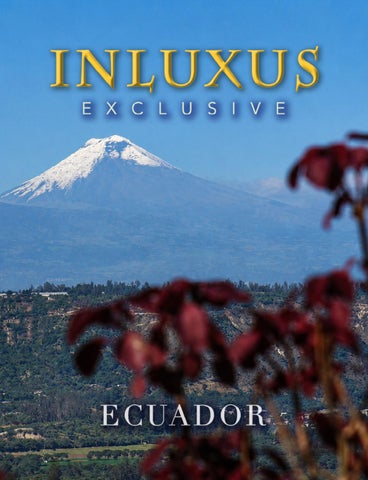
EDITORIAL
Una nueva manera de contar...
H
oy nace INLUXUS Exclusive, una edición especial de nuestra revista pensado para detenernos, mirar con más tiempo y contar en profundidad aquellos destinos que merecen algo más que unas páginas.
Para inaugurar esta propuesta elegimos Ecuador. Aunque, en realidad, después de recorrerlo sentimos que fue Ecuador quien terminó dándonos las razones para hacerlo. Llegamos con una agenda de lugares, entrevistas y producciones. Regresamos con mucho más. Quito y la historia que permanece en sus calles; el bosque nublado del Chocó Andino y una biodiversidad que obliga a mirar cada detalle; Galápagos y esa extraordinaria sensación de encontrarse frente a una naturaleza que todavía impone sus propias reglas; los Andes, sus haciendas, sus flores, el cacao y, sobre todo, las personas que fuimos encontrando a lo largo del camino. Ese recorrido es el origen de las más de 150 páginas que siguen. También de las fotografías, entrevistas y videos que forman parte de esta edición y permiten que INLUXUS Exclusive sea algo más que una revista para leer, queremos que también pueda verse, escucharse y recorrerse. Nada de esto hubiera sido posible sin quienes confiaron en el proyecto desde el comienzo. Nuestro especial agradecimiento a la Embajada del Ecuador en Argentina, por su apoyo y acompañamiento, y a las empresas e instituciones que auspiciaron esta primera edición y nos permitieron desarrollar una producción de esta magnitud. A todos ellos nuestro agradecimiento, y especialmente a cada persona que durante el viaje nos abrió una puerta, compartió su trabajo, su conocimiento o especialmente su tiempo. Esta primera edición de INLUXUS Exclusive es nuestra mirada sobre Ecuador. Una mirada construida después de haberlo recorrido, fotografiado, filmado y, sobre todo, vivido este país. Esperamos que al llegar a la última página quede algo de aquello que nosotros trajimos de regreso: el deseo de volver. EDG
INLUXUS - 3
EL RECORRIDO E CUA DO R Conversación con la embajadora del Ecuador en Argentina
Q UI TO Quito Colonial Casa Gangotena La Casa del Alabado Conversación con Santiago Peralta - Fundador de Paccari
10 18 34 54 70
CHOCO A ND INO Mashpi Lodge 9 0 Conversación con Paulina Barbano de Lara - CEO de Metropolitan Touring 124 G A LA PA G O S
Islas Galápagos 1 4 2 Yate La Pinta 1 7 4
S IER RA NO RTE Hacienda Corazón de Jesús 1 9 4 Hacienda Zuleta 2 1 0 Otavalo y Cotacachi 2 3 4 Q UI TO C O NTE M P O R AN EO
Hotal Le Parc 2 5 2 Zero Lab 2 6 8
F INA L
Cierre de Ecuador 2 8 2 Créditos 2 8 6
INLUXUS EXCLUSIVE
0
E C UA
El comienzo de un v
INLU
EXCLU
01
ADOR
viaje extraordinario
UXUS
USIVE
8 - INLUXUS
CONVERSACIONES
DIANA SALAZAR MENDEZ Embajadora de Ecuador en la República Argentina
Ecuador, cuatro mundos por descubrir. Ecuador, four worlds to discover.
INLUXUS - 9
D
iana Salazar Méndez, Embajadora del Ecuador en Argentina, habla de un país que reúne mundos muy distintos dentro de un territorio relativamente pequeño. Desde la riqueza natural hasta la herencia cultural que permanece viva en sus ciudades y comunidades, su mirada propone acercarse a Ecuador de la mejor manera posible: viajando, recorriendo y permitiéndose descubrirlo. 10 - INLUXUS
D
iana Salazar Méndez, Ecuador’s Ambassador to Argentina, speaks of a country that brings together vastly different worlds within a relatively small territory. From its natural wealth to the cultural heritage that remains vibrant in its cities and communities, her perspective invites us to experience Ecuador in the best possible way: by traveling, exploring, and allowing ourselves to discover it.
INLUXUS - 11
CUATRO MUNDOS EN UN MISMO VIAJE INLUXUS: Si tuviera que presentar Ecuador a alguien que nunca estuvo allí, ¿qué le diría para que pudiera imaginarlo antes de conocerlo? DIANA SALAZAR MÉNDEZ: Le diría que imagine un país en el que puede encontrar cuatro mundos dentro de un espacio muy reducido y que tendrá la posibilidad de ir descubriéndolos a medida que avanza el viaje. Me refiero a la Costa, la Sierra, la Amazonía y, por supuesto, las maravillosas Islas Galápagos. Esa posibilidad de pasar de un ambiente a otro en distancias relativamente pequeñas es una característica muy especial de Ecuador. UNA DIVERSIDAD EXTRAORDINARIA Ecuador reúne los Andes, la Amazonía, la costa del Pacífico y las Islas Galápagos. ¿Qué considera que hace verdaderamente excepcional esa diversidad? Justamente que dentro de un territorio pequeño tengamos la posibilidad de albergar una biodiversidad extraordinaria. A medida que se recorren esos cuatro mundos se van descubriendo ambientes diferentes y también especies que son realmente únicas. Esa riqueza natural concentrada en una superficie relativamente pequeña es una de las grandes particularidades de nuestro país. 12 - INLUXUS
CONSERVAR TAMBIÉN ES RESPETAR Después de recorrer Quito, el Chocó Andino y Galápagos aparece una idea que se repite: conservar no significa únicamente proteger un paisaje, sino también una cultura y una forma de vida. ¿Qué representa para los ecuatorianos esa relación entre naturaleza, comunidades y conservación? Sobre todo representa respeto. El respeto que tenemos los ecuatorianos por nuestra cultura y por nuestros ancestros. En Ecuador existen diferentes nacionalidades que conviven con otras comunidades y esa convivencia tiene una enorme importancia. Hay un vínculo muy profundo con las tradiciones y con aquello que recibimos de quienes estuvieron antes que nosotros. Creo que allí está una parte esencial de esa relación: en comprender el valor de lo propio y respetarlo. QUITO, ENTRE SU HISTORIA Y EL PRESENTE Quito conserva uno de los centros históricos más importantes de América Latina. ¿Cómo convive ese enorme patrimonio con la identidad del Ecuador contemporáneo? Se van combinando. Nuestro centro histórico constituye un patrimonio reconocido por la UNESCO y, al mismo tiempo, convive con la modernidad. Tenemos un centro histórico extraordinariamente conservado que se integra con los nuevos espacios de la ciudad. Para nosotros representa un gran orgullo.
FOUR WORLDS IN A SINGLE TRIP INLUXUS: If you had to introduce Ecuador to someone who had never been there, what would you say to help them visualize it before visiting? DIANA SALAZAR MÉNDEZ: I would tell them to imagine a country where they can find four worlds within a very compact area-worlds they can discover as their journey unfolds. I am referring to the Coast, the Highlands (Sierra), the Amazon, and, of course, the magnificent Galápagos Islands. The ability to move from one environment to another over relatively short distances is a truly special characteristic of Ecuador. EXTRAORDINARY DIVERSITY Ecuador brings together the Andes, the Amazon, the Pacific coast, and the Galápagos Islands. What do you consider makes this diversity truly exceptional? Precisely the fact that, within a small territory, we are able to harbor such extraordinary biodiversity. As you travel through these four worlds, you discover distinct environments and truly unique species. This natural richness, concentrated within a relatively small area, is one of our country’s most remarkable features.
CONSERVATION IS ALSO ABOUT RESPECT After traveling through Quito, the Chocó Andino, and the Galápagos, a recurring idea emerges: conservation means not only protecting a landscape but also a culture and a way of life. What does this relationship between nature, communities, and conservation mean to Ecuadorians? Above all, it represents respect, the respect we Ecuadorians have for our culture and our ancestors. In Ecuador, different nationalities coexist with other communities, and that coexistence is of immense importance. There is a profound bond with our traditions and with what we have inherited from those who came before us. I believe an essential part of that relationship lies right there: in understanding the value of what is our own and respecting it. QUITO, BETWEEN ITS HISTORY AND THE PRESENT Quito preserves one of Latin America’s most important historic centers. How does this vast heritage coexist with the identity of contemporary Ecuador? They blend together. Our historic center is a UNESCO-recognized heritage site that, at the same time, coexists with modernity. We have an extraordinarily well-preserved historic center that integrates seamlessly with the city’s newer areas. It is a source of great pride for us. INLUXUS - 13
Esa convivencia permite encontrarse con la historia de Quito mientras se observa también una ciudad contemporánea. Las iglesias, sus plazas, las construcciones antiguas y las leyendas que forman parte de nuestra tradición siguen estando presentes en la vida cotidiana.
This coexistence allows one to encounter Quito’s history while simultaneously observing a contemporary city. Its churches, plazas, historic buildings, and the legends that form part of our tradition remain a living part of our daily lives.
EL ECUADOR QUE APARECE EN SU GENTE Más allá de los paisajes, ¿qué cree que descubre un visitante cuando empieza a conocer a los ecuatorianos? Cuando empieza a conocer a los ecuatorianos nos conoce como realmente somos. Somos gente trabajadora, honesta y con una gran apertura hacia quien llega desde afuera. También comienza a descubrir nuestras tradiciones, que son muy importantes para nosotros, y una manera de recibir al visitante que hemos ido desarrollando y aprendiendo con el tiempo. Para nosotros es importante acoger a quien llega, atenderlo bien y hacer que pueda sentirse cómodo mientras conoce el país.
THE ECUADOR REVEALED THROUGH ITS PEOPLE Beyond the landscapes, what do you think visitors discover when they get to know Ecuadorians? When visitors begin to get to know Ecuadorians, they see us as we truly are. We are hardworking, honest people who are very open to those arriving from abroad. They also begin to discover our traditions, which are very important to us, and a way of welcoming visitors that we have developed and refined over time. For us, it is important to welcome those who arrive, treat them well, and ensure they feel comfortable while exploring the country.
ATREVERSE A DESCUBRIR Para terminar, ¿qué invitación le haría a quien todavía no conoce Ecuador? Le diría que no solamente me escuche, sino que se atreva a descubrirlo. Que se atreva a viajar y a visitar Ecuador porque realmente será una gran aventura de la cual no se va a arrepentir. Va a descubrir esos cuatro mundos de los que estoy hablando, pero solamente estando allí y permitiéndose conocerlos podrá darse cuenta verdaderamente de lo que significa Ecuador. •
DARE TO DISCOVER To wrap up, what invitation would you extend to someone who has not yet visited Ecuador? I would tell them not only to listen to me but to dare to discover it for themselves. To dare to travel and visit Ecuador, because it will truly be a great adventure, one they won’t regret. They will discover those four worlds I speak of, but only by being there and allowing themselves to experience them will they truly realize what Ecuador is all about. •
14 - INLUXUS
INLUXUS - 15
0
QUI
La historia sigue ha
INLU
EXCLU
02
ITO
abitando sus calles
UXUS
USIVE
18 - INLUXUS
DESTINOS
QUITO COLONIAL
Guarda calles de piedra, arte barroco y sabores que aún laten con fuerza propia. It holds cobblestone streets, Baroque art, and flavors that still pulse with a life of their own.
INLUXUS - 19
20 - INLUXUS
A
2.850 metros de altura, envuelta en la niebla que baja de sus volcanes, Quito conserva intacto el trazado que los españoles dibujaron sobre las bases incas hace casi cinco siglos. Caminar por su centro histórico, el primero en el mundo declarado Patrimonio de la Humanidad por la UNESCO, en 1978, es como abrir un libro cuyas páginas nunca dejaron de escribirse. Iglesias cubiertas de oro, plazas que respiran historia y una gastronomía que reinventa la tradición andina en cada esquina.
A
t an altitude of 2,850 meters, shrouded in the mist rolling down from its volcanoes, Quito preserves the layout the Spanish mapped out over Inca foundations nearly five centuries ago completely intact. Walking through its historic center, the first in the world to be declared a UNESCO World Heritage Site in 1978, is like opening a book whose pages have never stopped being written. Gold-clad churches, squares steeped in history, and a culinary scene that reinvents Andean tradition at every turn. INLUXUS - 21
SAN FRANCISCO LA MEMORIA DE PIEDRA DE LOS ANDES Ningún recorrido por Quito puede comenzar en otro lugar que no sea el Convento e Iglesia de San Francisco, el complejo religioso más antiguo y extenso de Sudamérica. Su construcción arrancó apenas años después de la fundación española de la ciudad, en 1534, y se prolongó por más de un siglo, mezclando estilos mudéjar, renacentista y barroco en una sola fachada de piedra volcánica. Al cruzar el atrio, el espacio abierto más grande de todo el casco antiguo, el visitante queda pequeño frente a las dos torres que enmarcan la entrada. Adentro, el techo de casetones mudéjares, tallado en madera de cedro y recubierto de pan de oro, resplandece sobre un altar mayor que resume siglos de fe y trabajo indígena, fueron los artesanos quiteños, formados en los talleres del propio convento, quienes crearon la célebre Escuela Quiteña de arte, una fusión de técnicas europeas y sensibilidad andina que todavía hoy se estudia en los museos del mundo. Los pasillos del convento, con sus claustros silenciosos y jardines interiores, esconden capillas menores, una imprenta colonial y un museo que resguarda pintura religiosa de los siglos XVI al XVIII. Se dice que bajo sus cimientos corren túneles que conectaban con otros templos de la ciudad, usados, según la leyenda popular, tanto por religiosos como por conspiradores en tiempos de la independencia. Sea mito o realidad, esa capa de misterio es parte del encanto que convierte a San Francisco en el corazón simbólico de Quito. 22 - INLUXUS
SAN FRANCISCO THE STONE MEMORY OF THE ANDES No tour of Quito can begin anywhere other than the Convent and Church of San Francisco, the oldest and most extensive religious complex in South America. Construction began just years after the city’s Spanish founding in 1534 and spanned more than a century, blending Mudéjar, Renaissance, and Baroque styles into a single volcanic-stone façade. Upon crossing the atrium, the largest open space in the Old Town, visitors are dwarfed by the two towers framing the entrance. Inside, the coffered Mudéjar ceiling, carved from cedar and covered in gold leaf, gleams above a high altar that encapsulates centuries of faith and indigenous craftsmanship; it was Quito artisans, trained in the convent’s own workshops, who created the renowned Quito School of art, a fusion of European techniques and Andean sensibilities that is still studied in museums around the world today. The convent’s corridors, with their silent cloisters and interior gardens, conceal smaller chapels, a colonial printing press, and a museum housing religious paintings from the 16th to the 18th centuries. Legend has it that tunnels run beneath the foundations, connecting the complex to other city churches, passageways used, according to popular lore, by both clergy and conspirators during the struggle for independence. Whether myth or reality, this layer of mystery is part of the charm that makes San Francisco the symbolic heart of Quito.
INLUXUS - 23
24 - INLUXUS
INLUXUS - 25
26 - INLUXUS
e
LA PLAZA DE LA INDEPENDENCIA EL PULSO CIVICO DE LA CIUDAD A pocas cuadras, la Plaza de la Independencia, o Plaza Grande, como la llaman los quiteños, concentra los tres poderes que moldearon la historia del país: el Palacio de Carondelet (sede del gobierno), la Catedral Primada y el Palacio Arzobispal. En su centro se alza el monumento a los héroes del 10 de Agosto de 1809, primer grito libertario de América del Sur. Aquí conviven lustrabotas, vendedores de helado de paila y guardias con uniformes de gala, en una postal que resume el mestizaje quiteño, colonial en la arquitectura y absolutamente vivo en su gente. Sentarse un momento en sus bancas, con las campanas de la Catedral marcando la hora, es entender por qué esta plaza sigue siendo un lugar obligado para conocer el centro histórico.
INDEPENDENCE SQUARE THE CITY’S CIVIC HEARTBEAT Just a few blocks away, Independence Square, or “Plaza Grande”, as the locals call it, brings together the three powers that shaped the nation’s history: the Carondelet Palace (the seat of government), the Metropolitan Cathedral, and the Archbishop’s Palace. Rising from its center is the monument to the heroes of August 10, 1809, marking South America’s first cry for independence. Here, shoeshine boys, “paila” ice cream vendors, and guards in ceremonial uniforms share the space, creating a scene that encapsulates Quito’s “mestizo” identity, colonial in its architecture yet alive in its people. To sit for a moment on one of the benches, with the Cathedral bells marking the hour, is to understand why this square remains an essential stop for anyone exploring the historic center. INLUXUS - 27
28 - INLUXUS
INLUXUS - 29
e
EL PANECILLO LA VIRGEN ALADA QUE VIGILA QUITO Desde cualquier rincón del casco antiguo, una silueta plateada domina el horizonte: la Virgen de Quito, o Virgen del Panecillo, una imponente escultura de aluminio de 41 metros que corona la colina homónima. Es la única representación mariana del mundo con alas, corona de estrellas, cadena y una serpiente bajo sus pies, inspirada en la Virgen Apocalíptica del escultor quiteño Bernardo de Legarda, máximo exponente de la Escuela Quiteña. Subir al mirador en vehículo, tour organizado o caminata vigilada durante el día, regala la panorámica más completa de la ciudad, el mar de tejados coloniales, las cúpulas de las iglesias y, al fondo, el perfil nevado del volcán Cotopaxi asomando entre las nubes. Al atardecer, cuando el sol tiñe de dorado la ciudad, se entiende por qué los quiteños consideran a esta Virgen su guardiana silenciosa. 30 - INLUXUS
EL PANECILLO THE WINGED VIRGIN WATCHING OVER QUITO From any corner of the Old Town, a silvery silhouette dominates the skyline: the Virgin of Quito, or the Virgin of El Panecillo, an imposing 41-meter aluminum sculpture crowning the hill of the same name. It is the only depiction of the Virgin Mary in the world featuring wings, a crown of stars, a chain, and a serpent beneath her feet; the design was inspired by the “Apocalyptic Virgin” created by the Quiteño sculptor Bernardo de Legarda, the foremost figure of the Quito School of art. Reaching the viewpoint, whether by vehicle, on an organized tour, or via a supervised daytime walk, offers the most comprehensive panoramic view of the city, a sea of colonial rooftops, church domes, and, in the distance, the snow-capped profile of the Cotopaxi volcano emerging from the clouds. At sunset, as the sun bathes the city in a golden glow, one understands why the people of Quito regard this Virgin as their silent guardian. INLUXUS - 31
32 - INLUXUS
INLUXUS - 33
34 - INLUXUS
HOTELES & RESORTS
CASA GANGOTENA QUITO
La elegancia histórica de Quito. The historic elegance of Quito.
INLUXUS - 35
36 - INLUXUS
F
rente a la histórica Plaza San Francisco, Casa Gangotena ofrece una de las experiencias hoteleras más exclusivas de Sudamérica, donde el patrimonio, la alta gastronomía y una hospitalidad impecable convierten cada estadía en una forma diferente de descubrir Quito.
F
acing the historic Plaza San Francisco, Casa Gangotena offers one of South America’s most exclusive hotel experiences, where heritage, fine dining, and impeccable hospitality transform every stay into a unique way to discover Quito. INLUXUS - 37
EL CORAZON DEL CENTRO HISTORICO Frente a la Plaza San Francisco, en pleno Centro Histórico de Quito, Casa Gangotena ocupa una de las esquinas más emblemáticas de la capital ecuatoriana. La histórica mansión, cuidadosamente restaurada y convertida en uno de los hoteles boutique más prestigiosos de Sudamérica, reúne patrimonio, alta gastronomía y una hospitalidad que refleja lo mejor de Ecuador. Desde aquí, recorrer las calles coloniales declaradas Patrimonio de la Humanidad por la UNESCO resulta tan natural como regresar al final del día para disfrutar de una cena de autor o contemplar, desde su terraza, el perfil de las iglesias y las montañas andinas que enmarcan la ciudad. Su ubicación es, sencillamente, privilegiada. A pocos pasos se encuentran la Iglesia de La Compañía, la Catedral Metropolitana, el Palacio de Carondelet, el Museo Casa del Alabado y una sucesión de conventos, plazas y edificios históricos que convierten al casco antiguo quiteño en uno de los conjuntos coloniales mejor conservados de América. Alojarse aquí significa vivir la ciudad caminando, descubriendo a cada paso nuevas perspectivas de una arquitectura que ha permanecido sorprendentemente intacta durante siglos. 38 - INLUXUS
THE HEART OF THE HISTORIC CENTER Facing Plaza San Francisco, in the very heart of Quito’s Historic Center, Casa Gangotena occupies one of the Ecuadorian capital’s most iconic corners. This historic mansion, meticulously restored and transformed into one of South America’s most prestigious boutique hotels, brings together heritage, fine dining, and a brand of hospitality that reflects the very best of Ecuador. From here, exploring the colonial streets, designated a UNESCO World Heritage Site, feels as natural as returning at day’s end to enjoy signature cuisine or to gaze out from the terrace at the silhouettes of churches and Andean mountains framing the city. Its location is, quite simply, privileged. Just steps away lie the Church of La Compañía, the Metropolitan Cathedral, the Carondelet Palace, the Casa del Alabado Museum, and a succession of convents, plazas, and historic buildings that make Quito’s Old Town one of the best-preserved colonial ensembles in the Americas. Staying here means experiencing the city on foot, discovering, with every step, new perspectives on architecture that has remained remarkably intact for centuries.
INLUXUS - 39
40 - INLUXUS
INLUXUS - 41
42 - INLUXUS
UNA CASA QUE FORMA PARTE DE LA HISTORIA Mucho antes de convertirse en hotel, Casa Gangotena ya ocupaba un lugar destacado en la historia de Quito. Levantada sobre uno de los solares originales de la ciudad, la residencia perteneció a una de las familias más influyentes del Ecuador y fue escenario de encuentros políticos y sociales durante buena parte del siglo XX. Después del incendio que destruyó gran parte de la propiedad en 1914, la familia reconstruyó la mansión incorporando influencias neoclásicas, Art Nouveau y Art Déco que todavía hoy definen su personalidad arquitectónica. Décadas más tarde, Metropolitan Touring emprendió una restauración integral que recuperó molduras, vitrales, escalinatas, pisos de mármol, techos ornamentados y carpinterías originales, incorporando discretamente todas las comodidades de un hotel contemporáneo. El resultado conserva el carácter de una residencia señorial sin perder la funcionalidad que exige el viajero actual.
A HOUSE THAT IS PART OF HISTORY Long before becoming a hotel, Casa Gangotena already held a prominent place in Quito’s history. Built on one of the city’s original plots, the residence belonged to one of Ecuador’s most influential families and served as a setting for political and social gatherings throughout much of the 20th century. Following a fire that destroyed much of the property in 1914, the family rebuilt the mansion, incorporating the Neoclassical, Art Nouveau, and Art Deco influences that still define its architectural character today. Decades later, Metropolitan Touring undertook a comprehensive restoration that preserved original moldings, stainedglass windows, staircases, marble floors, ornate ceilings, and woodwork, while discreetly integrating the modern amenities expected of a contemporary hotel. The result retains the character of a stately residence without sacrificing the functionality required by today’s traveler. INLUXUS - 43
ELEGANCIA EN CADA DETALLE Con apenas 31 habitaciones y suites, Casa Gangotena apuesta por una experiencia íntima, donde el lujo se expresa a través del espacio, la calidad de los materiales y el cuidado por los pequeños detalles. Los amplios ventanales permiten que la luz natural invada las habitaciones durante gran parte del día, mientras los techos altos, los muebles inspirados en el Art Déco, las telas cuidadosamente seleccionadas y los baños de mármol crean una atmósfera refinada sin caer en la ostentación. Cada ambiente transmite la sensación de alojarse en una elegante residencia privada más que en un hotel tradicional, una cualidad cada vez más valorada dentro de la hotelería de lujo internacional. Esa personalidad fue reconocida por la Guía Michelin, que distinguió a Casa Gangotena con una Llave Michelin, reconocimiento reservado a hoteles capaces de ofrecer una experiencia de viaje excepcional, donde el establecimiento se convierte en un destino por sí mismo. 44 - INLUXUS
ELEGANCE IN EVERY DETAIL With just 31 rooms and suites, Casa Gangotena offers an intimate experience where luxury is expressed through spaciousness, high-quality materials, and meticulous attention to detail. Expansive windows allow natural light to flood the rooms for much of the day, while high ceilings, Art Deco-inspired furnishings, carefully selected fabrics, and marble bathrooms create a refined atmosphere that avoids ostentation. Every space evokes the feeling of staying in an elegant private residence rather than a traditional hotel, a quality increasingly prized in the world of international luxury hospitality. This distinctive character was recognized by the Michelin Guide, which awarded Casa Gangotena a Michelin Key, an honor reserved for hotels that offer an exceptional travel experience, where the property itself becomes a destination.
INLUXUS - 45
ECUADOR SERVIDO EN LA MESA La gastronomía constituye uno de los grandes pilares de la experiencia Casa Gangotena. Bajo la experta guía del chef ejecutivo José Tamayo, el restaurante propone un recorrido por la extraordinaria biodiversidad ecuatoriana a través de una cocina contemporánea que rescata ingredientes locales, recetas tradicionales y técnicas modernas con una ejecución impecable. Cada menú refleja la riqueza de los Andes, la Amazonía, la costa y las Islas Galápagos, privilegiando productos de estación provenientes de pequeños productores y mercados regionales. El resultado es una propuesta sofisticada que mantiene intacta la identidad de cada ingrediente, permitiendo que los sabores hablen por sí mismos. Durante nuestra estadía quedó claro que el restaurante trasciende el concepto de cocina de hotel para convertirse en un destino gastronómico por derecho propio. La creatividad del equipo de cocina, el cuidado en la presentación de cada plato y un servicio preciso, atento y elegante convierten cada comida en una experiencia memorable. La carta se complementa con una cuidada selección de vinos internacionales, etiquetas ecuatorianas y una refinada propuesta de coctelería, mientras que el tradicional Café Quiteño, servido por las tardes, ofrece una delicada reinterpretación local del clásico afternoon tea. No sorprende que el restaurante haya recibido importantes reconocimientos internacionales y forme parte de las recomendaciones gastronómicas más prestigiosas del país. 46 - INLUXUS
ECUADOR SERVED AT THE TABLE Gastronomy is a cornerstone of the Casa Gangotena experience. Under the expert guidance of Executive Chef José Tamayo, the restaurant offers a journey through Ecuador’s extraordinary biodiversity via contemporary cuisine that highlights local ingredients, traditional recipes, and modern techniques, all executed flawlessly. Each menu reflects the richness of the Andes, the Amazon, the coast, and the Galápagos Islands, prioritizing seasonal produce sourced from small-scale growers and regional markets. The result is a sophisticated offering that preserves the true identity of every ingredient, allowing the flavors to speak for themselves. During our stay, it became clear that the restaurant transcends the typical hotel dining concept to become a gastronomic destination in its own right. The culinary team’s creativity, the meticulous presentation of each dish, and service that is precise, attentive, and elegant transform every meal into a memorable experience. The menu is complemented by a curated selection of international and Ecuadorian wines and a refined cocktail program, while the traditional “Café Quiteño”, served in the afternoon, offers a delicate, locally inspired take on classic afternoon tea. It comes as no surprise that the restaurant has garnered significant international acclaim and ranks among the country’s most prestigious culinary recommendations. INLUXUS - 47
48 - INLUXUS
LA MEJOR VISTA DE LA PLAZA SAN FRANCISCO La terraza de Casa Gangotena posee una de las panorámicas más privilegiadas del Centro Histórico de Quito. Desde allí la Plaza San Francisco despliega toda su monumentalidad, mientras las cúpulas, campanarios y tejados coloniales se recortan sobre el horizonte andino. En los días despejados, las montañas que rodean la ciudad completan una postal difícil de olvidar. Es un espacio que invita a detener el tiempo. Un desayuno contemplando el despertar de la ciudad, un café durante la tarde o un cóctel al atardecer adquieren aquí una dimensión diferente gracias a un entorno que combina patrimonio histórico y paisaje natural en una armonía poco frecuente.
THE BEST VIEW OF PLAZA SAN FRANCISCO The terrace at Casa Gangotena offers one of the most privileged panoramic views of Quito’s Historic Center. From this vantage point, Plaza San Francisco reveals its full grandeur, while colonial domes, bell towers, and rooftops stand out against the Andean skyline. On clear days, the mountains surrounding the city complete a truly unforgettable scene. It is a space that invites you to pause time. Whether enjoying breakfast as the city wakes up, an afternoon coffee, or a sunset cocktail, the experience takes on a new dimension here, thanks to a setting that blends historical heritage with natural landscape in rare harmony. INLUXUS - 49
LA EXCELENCIA DEL SERVICIO En la hotelería de lujo existen instalaciones extraordinarias, excelentes restaurantes y edificios históricos, pero lo realmente difícil de encontrar es un equipo humano capaz de transformar todo eso en una experiencia inolvidable y Casa Gangotena consigue precisamente ese equilibrio. Desde la recepción hasta el restaurante, cada integrante del personal demuestra una profesionalidad que nunca resulta distante. Las recomendaciones para descubrir Quito se adaptan a los intereses de cada huésped, el servicio acompaña con absoluta discreción y cada detalle parece anticiparse naturalmente a las necesidades del visitante. No hay gestos ensayados ni formalidades innecesarias. Existe, en cambio, una hospitalidad genuina que refleja la calidez característica del Ecuador y que probablemente constituya uno de los mayores atributos del hotel. 50 - INLUXUS
SERVICE EXCELLENCE Luxury hospitality often features extraordinary facilities, excellent restaurants, and historic buildings, but what is truly rare is a team capable of transforming all of that into an unforgettable experience, and Casa Gangotena strikes precisely that balance. From the front desk to the restaurant, every staff member demonstrates professionalism that never feels distant. Recommendations for exploring Quito are tailored to each guest’s interests, service is provided with absolute discretion, and every detail seems to naturally anticipate the visitor’s needs. There are no rehearsed gestures or unnecessary formalities. Instead, there is a genuine hospitality that reflects Ecuador’s characteristic warmth, arguably one of the hotel’s greatest attributes.
INLUXUS - 51
52 - INLUXUS
MUCHO MAS QUE UN LUGAR PARA ALOJARSE Casa Gangotena representa una forma diferente de conocer Quito. Su privilegiada ubicación permite descubrir a pie uno de los centros históricos más fascinantes de América, mientras su propuesta gastronómica, la elegancia de sus espacios y la excelencia del servicio convierten el regreso al hotel en un momento tan esperado como cada paseo por la ciudad. En una época en la que muchos establecimientos de lujo ofrecen experiencias similares alrededor del mundo, Casa Gangotena mantiene una identidad profundamente vinculada a la historia, la cultura y los sabores del Ecuador. Esa autenticidad, sumada a un nivel de hospitalidad sobresaliente, explica por qué hoy ocupa un lugar entre los grandes hoteles boutique de Latinoamérica y por qué alojarse entre sus muros significa, también, comprender una parte esencial del alma de Quito. •
MUCH MORE THAN A PLACE TO STAY Casa Gangotena offers a unique way to experience Quito. Its prime location allows guests to explore one of the Americas’ most fascinating historic centers on foot, while its culinary offerings, elegant interiors, and exceptional service make returning to the hotel a highlight just as anticipated as the city walks themselves. At a time when many luxury properties around the world offer similar experiences, Casa Gangotena retains an identity deeply rooted in Ecuador’s history, culture, and flavors. This authenticity, combined with outstanding hospitality, explains why it ranks among Latin America’s premier boutique hotels, and why staying within its walls means truly understanding an essential part of Quito’s soul. • INLUXUS - 53
54 - INLUXUS
MUSEOS
LA CASA DEL ALABADO QUITO
El Ecuador precolombino encuentra en esta antigua casa quiteña un espacio excepcional para contar su historia. Pre-Columbian Ecuador finds an exceptional space in this historic Quito house to tell its story.
INLUXUS - 55
56 - INLUXUS
A
pocos pasos de la Plaza de San Francisco, una de las casas más antiguas de Quito conserva una extraordinaria colección de arte precolombino. La Casa del Alabado propone acercarse a aquellas culturas desde su propia manera de entender el mundo, descubriendo en cada pieza mucho más que su belleza o su valor arqueológico.
J
ust a few steps from San Francisco Square, one of Quito’s oldest houses preserves an extraordinary collection of pre-Columbian art. Casa del Alabado invites visitors to approach these cultures through their own unique worldview, discovering far more in each piece than mere beauty or archaeological value. INLUXUS - 57
UNA CASA CON HISTORIA En pleno Centro Histórico de Quito, detrás de una fachada discreta de muros blancos, la Casa del Alabado establece desde el ingreso un particular diálogo entre dos épocas. La construcción se remonta probablemente a finales del siglo XVI y debe su nombre a la inscripción tallada sobre el dintel de piedra de su fachada durante una reconstrucción realizada en 1671. Patios, gruesos muros, piedra, madera y adobe fueron cuidadosamente recuperados para convertir la antigua residencia en un museo capaz de conservar su identidad arquitectónica. La restauración, iniciada en 2004, combinó materiales y técnicas tradicionales con soluciones contemporáneas, dejando deliberadamente visibles texturas, irregularidades y rastros de los artesanos que trabajaron sobre la casa. El resultado forma parte de la experiencia. Aquí, continente y contenido parecen pertenecer a un mismo relato. 58 - INLUXUS
A HOUSE WITH A HISTORY In the heart of Quito’s Historic Center, behind an understated white-walled façade, the Casa del Alabado establishes a unique dialogue between two eras from the very moment one enters. The structure likely dates back to the late 16th century and takes its name from an inscription carved into the stone lintel above its entrance during a 1671 reconstruction. Courtyards, thick walls, stone, wood, and adobe were carefully restored to transform the old residence into a museum that preserves its architectural identity. The restoration, begun in 2004, combined traditional materials and techniques with contemporary solutions, deliberately leaving visible the textures, irregularities, and traces of the artisans who worked on the house. The result is part of the experience itself. Here, the setting and its contents seem to belong to the same story.
INLUXUS - 59
60 - INLUXUS
ANTES DE LA CONQUISTA La colección permite recorrer miles de años de desarrollo cultural en el territorio que hoy ocupa Ecuador. Cerámicas, figuras antropomorfas y zoomorfas, recipientes, objetos rituales y piezas trabajadas en diferentes materiales revelan sociedades poseedoras de una notable sofisticación estética y técnica. Culturas como Valdivia, Chorrera, JamaCoaque, La Tolita o Manteño-Huancavilca aparecen a través de objetos que permiten acercarse a sus creencias y a su manera de interpretar el entorno. La museografía evita deliberadamente convertir la visita en una simple sucesión cronológica. Las piezas se relacionan a partir de conceptos vinculados con la espiritualidad, los rituales, los ancestros, los animales y las fuerzas de la naturaleza. Arte, arqueología y antropología terminan así construyendo una lectura mucho más humana de aquellos pueblos. Es precisamente esa mirada la que distingue al Alabado, detrás de la belleza de cada objeto existe una idea que espera ser interpretada.
BEFORE THE CONQUEST The collection offers a journey through millennia of cultural development in the territory that is now Ecuador. Ceramics, anthropomorphic and zoomorphic figures, vessels, ritual objects, and pieces crafted from various materials reveal societies possessing remarkable aesthetic and technical sophistication. Cultures such as Valdivia, Chorrera, Jama-Coaque, La Tolita, and ManteñoHuancavilca are represented through objects that offer insight into their beliefs and their ways of interpreting the world around them. The exhibition design deliberately avoids presenting the visit as a mere chronological sequence. Instead, the pieces are connected through concepts linked to spirituality, rituals, ancestors, animals, and the forces of nature. Art, archaeology, and anthropology thus combine to create a far more human perspective on these peoples. It is precisely this perspective that sets the Alabado apart, behind the beauty of each object lies an idea waiting to be interpreted. INLUXUS - 61
62 - INLUXUS
INLUXUS - 63
CUANDO LOS OBJETOS HABLAN Entre las experiencias más fascinantes de la visita se encuentra el universo sonoro precolombino. Algunas vasijas fueron concebidas no solamente para contener líquidos, sino también para producir sonidos. Mediante cámaras internas, conductos y silbatos incorporados a la cerámica, el movimiento del agua y del aire podía transformar el objeto en un verdadero instrumento. El museo ha investigado estas tecnologías ancestrales y conserva ejemplos de botellas silbato y otros artefactos sonoros cuya complejidad sorprende incluso desde una perspectiva contemporánea. Presenciar una demostración cambia por completo la percepción de la pieza. Al cargar agua y comenzar a mover el recipiente, aquello que parecía una silenciosa antigüedad cobra vida. El sonido establece durante unos segundos un puente inesperado con quienes utilizaron objetos semejantes siglos atrás. Es uno de esos momentos en los que el museo deja de explicar el pasado para permitir, simplemente, escucharlo. 64 - INLUXUS
WHEN OBJECTS SPEAK One of the most fascinating experiences of the visit is the pre-Columbian world of sound. Some vessels were designed not merely to hold liquids but also to produce sound. Through internal chambers, ducts, and whistles built into the ceramic, the movement of water and air could transform the object into a genuine instrument. The museum has researched these ancient technologies and preserves examples of whistle bottles and other soundproducing artifacts whose complexity is striking, even from a contemporary perspective. Witnessing a demonstration completely changes one’s perception of the piece. As the vessel is filled with water and set in motion, what once seemed like a silent antiquity comes to life. For a few moments, the sound creates an unexpected bridge to the people who used similar objects centuries ago. It is one of those moments when the museum stops explaining the past and simply allows us to hear it.
INLUXUS - 65
66 - INLUXUS
OTRA MIRADA SOBRE QUITO La Casa del Alabado complementa de manera excepcional el recorrido por el Quito colonial. Iglesias, conventos y grandes edificios históricos cuentan buena parte de la ciudad surgida después de la llegada española; aquí la perspectiva se desplaza hacia las culturas que ocuparon este territorio mucho antes. También hay detrás de las salas un trabajo permanente de investigación y conservación, desarrollado en colaboración con universidades y organismos especializados nacionales e internacionales. Recorrer sus patios y detenerse frente a sus figuras, animales, rostros y objetos ceremoniales permite descubrir una dimensión diferente de Ecuador. No como una colección de vestigios inmóviles, sino como el legado de sociedades capaces de transformar cerámica, piedra y metal en formas de belleza, conocimiento y comunicación que todavía hoy conservan la capacidad de sorprender.
A DIFFERENT PERSPECTIVE ON QUITO La Casa del Alabado offers an exceptional complement to the tour of colonial Quito. While churches, convents, and grand historic buildings tell much of the story of the city that emerged after the Spanish arrival, here the perspective shifts to the cultures that inhabited this territory long before. Behind the exhibition galleries lies ongoing research and conservation work, carried out in collaboration with national and international universities and specialized organizations. Wandering through its courtyards and pausing before its figures, animals, faces, and ceremonial objects reveals a different dimension of Ecuador. It is not merely a collection of static relics, but the legacy of societies capable of transforming ceramics, stone, and metal into forms of beauty, knowledge, and communication that still retain the power to amaze today. INLUXUS - 67
TIPS INLUXUS • Reservar una visita guiada permite comprender mucho mejor la simbología de las piezas. • Dedicar al menos una hora al recorrido y tiempo adicional para fotografiar los patios y detalles arquitectónicos. • Prestar especial atención a los objetos sonoros y, si está disponible, asistir a su demostración. • Combinar la visita con la Plaza e Iglesia de San Francisco, situadas a pocos pasos del museo. • El museo abre regularmente de miércoles a domingo, de 9 a 17 h; lunes y martes recibe visitas con reserva previa. Más información: www.alabado.org 68 - INLUXUS
INLUXUS TIPS • Booking a guided tour offers a much better understanding of the symbolism behind the pieces. • Allow at least an hour for the tour, plus extra time to photograph the courtyards and architectural details. • Pay special attention to the sound-producing objects and, if available, attend a demonstration. • Combine your visit with the San Francisco Plaza and Church, located just a short walk from the museum. • The museum is generally open Wednesday through Sunday, from 9:00 a.m. to 5:00 p.m.; visits on Mondays and Tuesdays are by prior reservation. More information: www.alabado.org INLUXUS - 69
70 - INLUXUS
CONVERSACIONES
SANTIAGO PERALTA Fundador y CEO de Paccari
El fundador de Paccari, habla sobre el cacao ecuatoriano, el lujo sostenible y la cultura detrás de un gran chocolate. The founder of Paccari discusses Ecuadorian cacao, sustainable luxury, and the culture behind great chocolate.
INLUXUS - 71
D
esde Ecuador, Santiago Peralta impulsó una forma distinta de entender el chocolate, como expresión de origen, territorio, cultura y calidad. Al frente de Paccari, convirtió al cacao ecuatoriano en protagonista de una marca reconocida internacionalmente, construida sobre una idea exigente de excelencia que integra innovación, sostenibilidad y comercio justo. En esta conversación, reflexiona sobre el valor del terroir, la educación del consumidor, el verdadero costo del chocolate barato y el futuro de una industria que todavía tiene mucho por revelar. 72 - INLUXUS
F
rom Ecuador, Santiago Peralta championed a different way of understanding chocolate, as an expression of origin, territory, culture, and quality. At the helm of Paccari, he made Ecuadorian cacao the centerpiece of an internationally recognized brand built on a rigorous standard of excellence that integrates innovation, sustainability, and fair trade. In this conversation, he reflects on the value of “terroir”, consumer education, the true cost of cheap chocolate, and the future of an industry that still has much to reveal.
INLUXUS - 73
74 - INLUXUS
EL CACAO ECUATORIANO Y EL LENGUAJE DEL TERROIR INLUXUS: Paccari nació en Ecuador como una idea que parecía simple, hacer chocolate de origen. Sin embargo, terminó convirtiéndose en una marca global. Mirando hacia atrás, ¿en qué momento entendiste que el cacao ecuatoriano podía hablar el mismo idioma del vino, del café de especialidad o de la alta gastronomía? SANTIAGO PERALTA: Cuando comenzamos a entender el cacao, empezamos creando las primeras asociaciones independientes de productores orgánicos de cacao en Latinoamérica. A medida que probábamos los granos, nos dimos cuenta de que el cacao de Esmeraldas no tenía nada que ver con el de Manabí, ni este con el de la Amazonía o Los Ríos. Cuando ya trabajábamos con tres regiones, recuerdo especialmente Esmeraldas, Manabí y Los Ríos, comenzamos a percibir una dimensión completamente diferente. Hasta ese momento, en el mundo se hablaba del cacao ecuatoriano como si fuera una sola cosa, del mismo modo que podía hablarse del cacao de Venezuela o de Ghana. Pero Ecuador posee alrededor del 70 % del banco genético del cacao y una cantidad enorme de microclimas. Esmeraldas, por ejemplo, es una provincia verde, muy lluviosa, con terrenos quebrados y sin una presencia reciente importante de cenizas volcánicas. Más al sur aparece Manabí, que ya se acerca a un bosque tropical seco, con otras condiciones y otra influencia del suelo. Los sabores eran radicalmente distintos.
ECUADORIAN CACAO AND THE LANGUAGE OF TERROIR INLUXUS: Paccari began in Ecuador with what seemed like a simple idea, to produce single-origin chocolate. Yet, it ultimately grew into a global brand. Looking back, at what point did you realize that Ecuadorian cacao could speak the same language as wine, specialty coffee, or haute cuisine? SANTIAGO PERALTA: When we first began to understand cacao, we started by creating the first independent associations of organic cacao growers in Latin America. As we tasted the beans, we realized that cacao from Esmeraldas was completely different from that of Manabí, and likewise distinct from the cacao found in the Amazon or Los Ríos regions. Once we were working with three regions, specifically Esmeraldas, Manabí, and Los Ríos, we began to perceive a completely different dimension. Until then, the world spoke of Ecuadorian cacao as if it were a single, uniform product, much like how one might speak of cacao from Venezuela or Ghana. However, Ecuador holds around 70% of the cacao genetic bank and possesses a vast array of microclimates. Esmeraldas, for instance, is a lush, green, and very rainy province characterized by rugged terrain and an absence of significant recent volcanic ash deposits. Further south lies Manabí, a region approaching a tropical dry forest environment, with distinct conditions and soil characteristics. The flavor profiles were radically different. INLUXUS - 75
Así comenzamos a establecer una analogía con el vino y a observar que cada región presentaba ciertas tendencias. No es una fórmula matemática, pero Esmeraldas suele inclinarse hacia las nueces y el caramelo, mientras que otras regiones pueden ofrecer fruta roja y notas florales. Entendimos que había una diversidad enorme y que era necesario separar esos orígenes. Durante mucho tiempo se exportó simplemente “cacao de Ecuador”, pero nosotros comenzamos a decir, aquí existen diferencias que el consumidor todavía ignora. Es como hablar de “vino español” sin aclarar si proviene de Ribera del Duero, Toro, Rioja o Andalucía. El cacao puede ser igual de complejo que el vino. Todavía estamos comenzando a comprender las variedades que existen dentro de cada región. En el vino se conoce la cepa, la altura y la denominación de origen; en el cacao recién estamos dando los primeros pasos para reconocer la tendencia regional y las variedades presentes en cada territorio. Estamos en pleno descubrimiento, y eso lo vuelve mucho más interesante. APRENDER A LEER UNA TABLETA DE CHOCOLATE Ustedes suelen hablar del chocolate como cultura y no solamente como producto. ¿Qué le falta todavía al consumidor para aprender a leer una tableta como el origen, la variedad, el terroir, el porcentaje de cacao y la ética que existe detrás de la compra? 76 - INLUXUS
Todo eso requiere un gran trabajo de educación. Si nadie te hubiera hecho probar un Malbec, compararlo con otros vinos del mundo y descubrir sus diferencias, probablemente no habrías aprendido a reconocerlo. Hubo enólogos, sommeliers y catadores que se dedicaron a educar los paladares y a mostrar que los vinos poseen tendencias y personalidades propias. Eso les permitió posicionarse. Con el cacao debe suceder algo parecido. La gente tiene que probar, hacerlo con atención, darse tiempo y educarse poco a poco. Tampoco existe la garantía de que una cosecha sea idéntica a la del año siguiente, exactamente igual que sucede con el vino. Cuando utilizamos esa analogía, el consumidor empieza a comprenderlo. En Occidente, el vino posee además un culto de dos mil años, está presente incluso en la tradición cristiana como la sangre de Cristo. Con el chocolate estamos comenzando a construir una cultura contemporánea, aunque, si acudimos a la arqueología, encontramos un culto de aproximadamente 5500 años. El cacao fue literalmente parte de rituales y de experiencias vinculadas con mostrar una mejor versión de uno mismo o trascender la condición humana. No debemos magnificarlo, pero tampoco minimizarlo. Existe una historia profunda que necesita ser contada. Es un proceso educativo largo y conversaciones como esta forman parte de ese trabajo.
This led us to draw a parallel with wine and observe that each region exhibited specific tendencies. It is not a mathematical formula, but Esmeraldas tends to lean toward nutty and caramel notes, whereas other regions may offer red fruit and floral undertones. We realized there was immense diversity and that it was essential to distinguish between these origins. For a long time, the product was simply exported as “Ecuadorian cacao”, but we began to point out that there were differences the consumer was not yet aware of. It is akin to speaking of “Spanish wine” without specifying whether it comes from Ribera del Duero, Toro, Rioja, or Andalusia. Cacao can be just as complex as wine. We are only just beginning to understand the varieties that exist within each region. With wine, the grape variety, altitude, and appellation of origin are well known; with cacao, we are taking the first steps toward identifying regional characteristics and the specific varieties found in each territory. We are in the midst of discovery, and that makes it all the more fascinating. LEARNING TO READ A CHOCOLATE BAR You often speak of chocolate as a culture, not just a product. What does the consumer still need to learn in order to “read” a chocolate bar, understanding aspects like origin, variety, “terroir”, cacao percentage, and the ethics behind the purchase?
All of that requires a great deal of education. If no one had ever let you taste a Malbec, compare it with other wines from around the world, and discover the differences, you probably wouldn’t have learned to recognize it. Winemakers, sommeliers, and tasters dedicated themselves to educating palates and demonstrating that wines have their own distinct characteristics and personalities. That is what allowed them to establish their standing. Something similar needs to happen with cacao. People need to taste it, do so attentively, take their time, and educate themselves gradually. Furthermore, there is no guarantee that one harvest will be identical to the next, exactly as happens with wine. When we use that analogy, consumers begin to understand. In the West, wine also has a two-thousandyear-old cult following; it is even present in the Christian tradition as the blood of Christ. With chocolate, we are just beginning to build a contemporary culture, though if we look to archaeology, we find a tradition dating back some 5,500 years. Cacao was literally part of rituals and experiences linked to revealing a better version of oneself or transcending the human condition. We shouldn’t overstate its importance, but we shouldn’t downplay it either. There is a profound history here that needs to be told. It is a long educational process, and conversations like this one are part of that work. INLUXUS - 77
LUJO, CALIDAD Y SOSTENIBILIDAD En la industria del lujo se habla mucho de exclusividad, pero Paccari parece proponer otra idea, la excelencia con impacto social. ¿Cómo se construye una marca premium sin despegarse de las comunidades productoras? Creo que estamos haciendo algo para lo que no existe un modelo previo. No hay un ícono o un patrón que nos muestre que alguien ya consiguió reunir todos estos elementos de la misma manera. Tradicionalmente, el mundo del lujo se concentró en el lujo, y el mundo de la calidad organoléptica, en la calidad organoléptica. Lo “yuppie” y lo “hippie”, por decirlo de alguna manera, casi nunca se encontraron. El lujo raramente se vinculó de verdad con la sostenibilidad. Por eso este es un ejercicio innovador que reúne una calidad extrema con una sostenibilidad tomada seriamente. Para muchas personas todavía resulta difícil entender que un producto de muy alto lujo pueda ser, al mismo tiempo, uno de los más éticos y sostenibles del mundo. No descuidamos la calidad organoléptica, la trabajamos como se trabajaría un gran vino. Pero, además de ser uno de los chocolates más premiados del mundo, buscamos ser también el más sostenible y el más ético. Construir una marca alrededor de algo muy “hippie” y, a la vez, muy chic es algo que prácticamente no se había hecho. Para mí continúa siendo un gran desafío. 78 - INLUXUS
LUXURY, QUALITY, AND SUSTAINABILITY In the luxury industry, there is much talk of exclusivity, yet Paccari seems to propose a different concept, excellence with social impact. How do you build a premium brand without losing touch with the producer communities? I believe we are doing something for which there is no existing model. There is no icon or precedent showing that someone has previously managed to combine all these elements in this way. Traditionally, the luxury world focused on luxury, while the world of sensory quality focused on sensory quality. The “yuppie” and the “hippie”, to put it one way, rarely met. Luxury was seldom truly linked to sustainability. That is why this is an innovative endeavor that brings together extreme quality and a serious commitment to sustainability. Many people still find it hard to grasp that a high-end luxury product can simultaneously be one of the most ethical and sustainable in the world. We do not neglect sensory quality; we treat it the way one would a fine wine. Yet, beyond being one of the most awarded chocolates globally, we also aim to be the most sustainable and ethical. Building a brand around something that is both very “hippie” and very chic is something that had practically never been done before. For me, it remains a major challenge.
INLUXUS - 79
EL PREMIO CODESPA Y SU EFECTO EN LOS PRODUCTORES Paccari recibió el Premio Codespa en una ceremonia presidida por el rey Felipe VI por su modelo de negocios inclusivos, “cero desechos, cero brechas”. ¿Qué significa para una empresa ecuatoriana de chocolate recibir este reconocimiento en Europa y cómo se traduce en la vida diaria de los productores? En primer lugar, es un enorme honor y un privilegio recibir un premio de estas características entre cientos de empresas que participan o son nominadas. Pero el reconocimiento también produce un efecto concreto sobre el consumidor final. Cuando una marca es refrendada por un jurado o por un grupo de curadores, las personas confían más en ella, la respetan y están dispuestas a darle una oportunidad. Esa confianza se extiende a toda la cadena, nos permite vender más y pagar los precios premium que pagamos a nuestros productores. Al final llegamos al consumidor consciente, que empieza a entender que forma parte de un despertar y que, al comprar, se suma de alguna manera a un movimiento. Paccari es una marca que busca activar esa conciencia. Lo que sucede con el consumidor llega al agricultor. Los premios se reflejan en mejores precios, mayor estabilidad y condiciones que permiten una vida mejor. Eso ayuda a reducir la migración y genera puestos de trabajo en el campo, precisamente donde son necesarios. A mediano y largo plazo también 80 - INLUXUS
contribuye a que tengamos alimentos en el futuro. Es un círculo virtuoso y multiplicador, se promueve una agricultura limpia, organizada, orgánica, biodinámica, sostenible y coherente. Gana el consumidor, ganan los agricultores y gana el medioambiente. Son varios “win-win” que se multiplican. Dejamos de ser parte del problema para convertirnos en parte de la solución. Además, no queremos que este modelo sea exclusivo ni excluyente de Paccari. Queremos inspirar a otras empresas y a otros negocios para que puedan seguir un camino semejante. Ese sería otro beneficio todavía mayor. INNOVACIÓN Y SABORES DE IBEROAMÉRICA ¿Dónde está hoy la innovación en Paccari, en los nuevos sabores, los procesos, los empaques, la sostenibilidad o las nuevas formas de educar al consumidor? Estamos creando sabores nuevos permanentemente. Tenemos, por ejemplo, chocolate con yerba mate, algo que no es habitual en los 42 países donde vendemos. De ese modo, personas de países que no consumen yerba mate comienzan a conocerla y a enamorarse de ella a través del chocolate. Contamos con alrededor de 80 sabores que llevan pequeños fragmentos de Iberoamérica, incluida la Península Ibérica, al resto del mundo y nos ayudan a conectarnos. Alguien puede interesarse por la yerba mate, otra persona, a través del merkén chileno,
THE CODESPA AWARD AND ITS IMPACT ON PRODUCERS Paccari received the Codespa Award, presented at a ceremony presided over by King Felipe VI, or its inclusive business model based on “zero waste, zero gaps.” What does it mean for an Ecuadorian chocolate company to receive this recognition in Europe, and how does it translate into the daily lives of the producers? First of all, it is a tremendous honor and privilege to receive an award of this caliber among the hundreds of companies that participate or are nominated. But the recognition also has a tangible effect on the end consumer. When a brand is endorsed by a jury or a panel of experts, people trust it more, respect it, and are willing to give it a chance. That trust extends throughout the entire supply chain; it allows us to sell more and pay the premium prices we offer our producers. Ultimately, we reach the conscious consumer, someone who begins to understand that they are part of an awakening and that, by making a purchase, they are joining a movement. Paccari is a brand that seeks to spark that awareness. The impact on the consumer reaches the farmer. Awards translate into better prices, greater stability, and conditions that foster a better quality of life. This helps curb migration and creates jobs in rural areasprecisely where they are needed
most. In the medium and long term, it also helps ensure our future food supply. It creates a virtuous, multiplying cycle that promotes agriculture that is clean, organized, organic, biodynamic, sustainable, and principled. The consumer wins, the farmers win, and the environment wins. It creates multiple “win-win” scenarios that compound over time. We stop being part of the problem and become part of the solution. Furthermore, we do not want this model to be exclusive to Paccari. We want to inspire other companies and businesses to follow a similar path. That would be an even greater benefit. INNOVATION AND FLAVORS FROM IBERO-AMERICA Where does innovation lie for Paccari today, in new flavors, processes, packaging, sustainability, or new ways of educating the consumer? We are constantly creating new flavors. For instance, we offer chocolate with yerba mate, something uncommon in the 42 countries where we sell. In this way, people from countries that do not consume yerba mate begin to discover and fall in love with it through the chocolate. We have around 80 flavors that bring small pieces of Ibero-America, including the Iberian Peninsula, to the rest of the world, helping us connect. Someone might become interested in yerba mate, while another person, perhaps through Chilean INLUXUS - 81
82 - INLUXUS
luego descubrir el cedrón, la sal de Cusco, la muña, el mole mexicano o el pino marítimo de España. Para nosotros, cada tableta funciona como una carta de amor que sale de Ecuador pero representa a todo el barrio iberoamericano. Esa conexión cultural también es innovación.
“merkén”, might go on to discover lemon verbena, Cusco salt, “muña”, Mexican “mole”, or Spanish maritime pine. For us, each bar acts as a love letter that originates in Ecuador but represents the entire Ibero-American neighborhood. That cultural connection is innovation, too.
EL PRECIO OCULTO DEL CHOCOLATE BARATO La crisis del cacao, el cambio climático y el aumento de los precios están golpeando a la industria. ¿El chocolate barato de las últimas décadas tenía un costo oculto? ¿Estamos entrando en una nueva era en la que el verdadero lujo será pagar un precio justo por un cacao bien cultivado? Durante sesenta años hemos condenado al hambre a muchos agricultores de los países que más cacao producen. En África, por ejemplo, una familia puede recibir menos de 25 dólares al mes. Esperemos que, después de esa historia terrible, comencemos finalmente a mejorar su calidad de vida. En África existen, lamentablemente, estructuras muy difíciles, casi mafiosas, que mantienen esa situación. Es un tema que daría para una conversación mucho más extensa. Ecuador, en cambio, es un país dolarizado, con salario mínimo y seguridad social, y además posee un cacao extraordinario. Los cacaos ecuatorianos de calidad no son baratos. Un cacao orgánico, cosechado correctamente, fermentado con precisión y secado con enorme cuidado exige mucho trabajo.
THE HIDDEN COST OF CHEAP CHOCOLATE The cocoa crisis, climate change, and rising prices are hitting the industry hard. Did the cheap chocolate of recent decades come with a hidden cost? Are we entering a new era where true luxury means paying a fair price for well-grown cocoa? For sixty years, we have condemned many farmers in major cocoa-producing countries to hunger. In Africa, for instance, a family might earn less than $25 a month. Hopefully, after such a terrible history, we will finally begin to improve their quality of life. Unfortunately, Africa is home to entrenched, almost mafia-like structures that perpetuate this situation. That is a topic that could fill a much longer conversation. Ecuador, on the other hand, is a dollarized country with a minimum wage and social security, and it produces extraordinary cocoa. High-quality Ecuadorian cocoa does not come cheap. Organic cocoa, properly harvested, precisely fermented, and dried with great care, requires a tremendous amount of work. INLUXUS - 83
Tenemos una materia prima excepcional que se protege durante todo el proceso, hasta convertirse en una tableta de Paccari y llegar a la boca del consumidor. Todo eso implica costos adicionales y, naturalmente, no puede ser barato. Ahora bien, hay algo que alivia esta discusión, uno de los mejores chocolates del mundo puede costar menos de diez dólares. Compáralo con el precio de Romanée-Conti, Pétrus, un gran vino argentino o el mejor café del mundo. El chocolate continúa siendo un lujo extraordinario y, al mismo tiempo, accesible. Es un chocolate que han probado el papa Francisco, Angelina Jolie, Brad Pitt y muchas otras personalidades, pero que cualquier persona también puede comprar y disfrutar. Es un lujo absoluto, pero pagable. Ahí aparece la dimensión democrática, puedes comer el mismo chocolate que consumen reyes o celebridades. Nuestra materia prima ha estado en espacios como el Royal Albert Hall, Paccari ha sido chocolate oficial del Barça y está presente en la primera clase de Emirates, donde un pasaje puede costar decenas de miles de dólares. Sin embargo, una persona puede entrar a una tienda, comprar una tableta y acceder exactamente a esa experiencia. Esa democratización del lujo también es algo muy poco habitual. 84 - INLUXUS
We work with exceptional raw materials that are protected throughout the entire process, from the initial stages right up until the moment a Paccari bar reaches the consumer. All of this entails additional costs, so naturally, it cannot be cheap. However, there is a reassuring aspect to this conversation, one of the world’s finest chocolates can cost less than ten dollars. Compare that to the price of a RomanéeConti, a Pétrus, a top-tier Argentine wine, or the world’s best coffee. Chocolate remains an extraordinary luxury that is, at the same time, accessible. It is a chocolate that has been tasted by Pope Francis, Angelina Jolie, Brad Pitt, and many other prominent figures, yet it is something anyone can buy and enjoy. It is an absolute luxury, but an affordable one. That is where the democratic dimension comes in, you can eat the same chocolate consumed by royalty or celebrities. Our products have been featured at venues like the Royal Albert Hall; Paccari has served as the official chocolate of FC Barcelona and is available in Emirates first class, where a ticket can cost tens of thousands of dollars. Yet, any individual can walk into a shop, buy a bar, and enjoy that exact same experience. That democratization of luxury is a truly rare thing.
INLUXUS - 85
más información: www.paccari.com
86 - INLUXUS
EL FUTURO DE PACCARI Pensando en el futuro de Paccari, ¿qué viene después de haber demostrado que Ecuador puede producir uno de los mejores chocolates del mundo? Nuestro gran enemigo sigue siendo la ignorancia. Lo digo siempre porque la gente respeta un gran vino, un gran queso, un gran whisky o una gran bebida espirituosa, pero el chocolate continúa siendo un producto maltratado y subvalorado. El trabajo que viene es, sobre todo, de educación e información, compartir, generar conversación y dejar que el boca a boca haga su parte. Una persona se lo contará a otra y, poco a poco, más consumidores comprenderán esta cultura. Sucedió algo parecido con el sushi, cuando comenzó a difundirse, era extraño para muchas personas; hoy su consumo está completamente incorporado. Tenemos que construir una cultura del chocolate. Es fantástico maridarlo con buenos vinos, ron, mezcal, tequila, café, champaña o whisky. Todavía hay muchísimo por descubrir. Incluso quienes ya han vivido algunas de esas experiencias suelen sorprenderse. La invitación es precisamente esa, venir a descubrir. Hay muchas dimensiones del chocolate que aún no hemos expuesto al mundo. •
THE FUTURE OF PACCARI Looking to the future of Paccari, what comes next, now that we have proven Ecuador can produce some of the world’s finest chocolate? Our greatest enemy remains ignorance. I say this constantly because people respect fine wine, cheese, whiskey, or spirits, yet chocolate continues to be a product that is mistreated and undervalued. The work ahead is primarily about education and information, sharing, sparking conversation, and letting word-of-mouth do its part. One person will tell another, and gradually, more consumers will come to understand this culture. Something similar happened with sushi; when it first began to spread, it seemed strange to many people, yet today, consuming it has become completely mainstream. We need to build a chocolate culture. It pairs fantastically with fine wines, rum, mezcal, tequila, coffee, champagne, or whiskey. There is still so much to discover. Even those who have already had some of these experiences are often surprised. That is precisely the invitation, come and discover. There are many dimensions of chocolate that we have yet to reveal to the world. • INLUXUS - 87
0
CHOCO A
La niebla abre
INLU
EXCLU
03
ANDINO
e otro Ecuador
UXUS
USIVE
90 - INLUXUS
EXPERIENCIAS
MASHPI LODGE Chocó Andino
Donde el lujo aprende a respirar como el bosque. Where luxury learns to breathe like the forest.
INLUXUS - 91
92 - INLUXUS
E
n el corazón del Chocó Andino ecuatoriano, una de las regiones con mayor biodiversidad del planeta y declarada Reserva de Biosfera por la UNESCO, el bosque parece no tener principio ni final. La niebla se desliza entre árboles, las cascadas descienden por profundas quebradas y el sonido permanente de aves, insectos y anfibios recuerda que aquí la naturaleza continúa escribiendo una historia que todavía está lejos de completarse.
I
n the heart of the Ecuadorian Chocó Andino, one of the most biodiverse regions on the planet and a designated UNESCO Biosphere Reserve, the forest seems to have neither beginning nor end. Mist drifts among the trees, waterfalls cascade down deep ravines, and the constant sounds of birds, insects, and amphibians serve as a reminder that here, nature continues to write a story that is still far from complete. INLUXUS - 93
“Mashpi Lodge demuestra que el turismo de alta gama puede convertirse en una herramienta para proteger algunos de los ecosistemas más frágiles del planeta.”
En medio de ese paisaje emerge Mashpi Lodge, un hotel cinco estrellas cuya arquitectura contemporánea parece desaparecer entre la vegetación. Grandes superficies vidriadas integran las habitaciones con el bosque, permitiendo que el verdadero espectáculo ocurra siempre del otro lado de la ventana. Nació en 2001 como un proyecto de conservación destinado a frenar la tala y la cacería furtiva que amenazaban uno de los ecosistemas más biodiversos del planeta. Reconocido con dos Llaves Michelin, el sello que la Guía reserva solo para estancias verdaderamente excepcionales. La propia Guía destacó su capacidad para integrar arquitectura contemporánea, investigación científica y un respeto casi reverencial por el entorno, una combinación que también le ha valido un lugar entre los mejores hoteles del mundo según Travel + Leisure y una mención de National Geographic como uno de los proyectos de conservación que vale la pena visitar. 94 - INLUXUS
Amidst this landscape emerges Mashpi Lodge, a five-star hotel whose contemporary architecture seems to vanish into the surrounding vegetation. Expansive glass surfaces blend the guest rooms with the forest, ensuring the real spectacle always unfolds just beyond the window. It began in 2001 as a conservation project aimed at halting the logging and poaching that threatened one of the planet’s most biodiverse ecosystems. It has been awarded two Michelin Keys, a distinction the Guide reserves for truly exceptional stays. The Guide itself highlighted the lodge’s ability to integrate contemporary architecture, scientific research, and an almost reverential respect for the environment, a combination that has also earned it a spot among the world’s best hotels according to Travel + Leisure and a mention by National Geographic as a conservation project worth visiting.
INLUXUS - 95
96 - INLUXUS
INLUXUS - 97
98 - INLUXUS
MUCHO MAS QUE UN HOTEL Mashpi Lodge forma parte de un proyecto mucho más amplio que combina hospitalidad, investigación científica y conservación ambiental. La reserva que rodea al hotel constituye el núcleo de la Reserva Mashpi-Tayra, gestionada por la Fundación Futuro, organización que impulsa uno de los programas privados de conservación más importantes del Ecuador. Actualmente protege 3237 hectáreas de bosque, integradas al núcleo de la Reserva de Biosfera Chocó Andino, reconocida internacionalmente por su extraordinaria riqueza biológica. El trabajo de la fundación va mucho más allá de preservar un área protegida. Su estrategia incluye restauración de ecosistemas, creación de corredores biológicos, investigación científica, educación ambiental y colaboración permanente con quince comunidades locales para demostrar que desarrollo y conservación pueden avanzar de la mano.
MUCH MORE THAN A HOTEL Mashpi Lodge is part of a much broader project that combines hospitality, scientific research, and environmental conservation. The reserve surrounding the hotel forms the core of the Mashpi-Tayra Reserve, managed by the Futuro Foundation—an organization driving one of Ecuador’s most significant private conservation programs. It currently protects 3,237 hectares of forest, which are integrated into the core of the Chocó Andino Biosphere Reserve, an area internationally recognized for its extraordinary biological richness. The foundation’s work extends far beyond merely preserving a protected area. Its strategy encompasses ecosystem restoration, the creation of biological corridors, scientific research, environmental education, and ongoing collaboration with fifteen local communities to demonstrate that development and conservation can go hand in hand. INLUXUS - 99
100 - INLUXUS
INLUXUS - 101
102 - INLUXUS
INLUXUS - 103
UN LABORATORIO DONDE TODAVIA SE DESCUBREN ESPECIES Pocos hoteles del mundo pueden decir que cada excursión transcurre dentro de un verdadero laboratorio natural. Su equipo de investigación interno ha descrito ya 23 nuevas especies para la ciencia, desde insectos acuáticos y hormigas hasta una orquídea propia de la reserva, y ha publicado más de 50 artículos científicos en colaboración con universidades como la Universidad de las Américas y el Jardín Botánico de Quito. Cada nuevo hallazgo, desde la diminuta “hormiga tigre de Mashpi” hasta los macrohongos que hoy exploran los chefs de la casa, confirma que estas 3.017 hectáreas de la Reserva Mashpi-Tayra siguen guardando secretos por descubrir. La reserva también alberga más de 410 especies de aves, 97 mamíferos, 69 reptiles y 49 anfibios, cifras que convierten al lugar en uno de los grandes santuarios de biodiversidad de América Latina. Para el visitante, cada caminata deja de ser simplemente un recorrido para transformarse en una experiencia de descubrimiento. 104 - INLUXUS
A LABORATORY WHERE SPECIES ARE STILL BEING DISCOVERED Few hotels in the world can claim that every excursion takes place within a true natural laboratory. Its in-house research team has already described 23 species new to science, ranging from aquatic insects and ants to an orchid unique to the reserve, and has published over 50 scientific papers in collaboration with institutions such as the Universidad de las Américas and the Quito Botanical Garden. Each new discovery, from the tiny “Mashpi tiger ant” to the macro-fungi currently being explored by the in-house chefs, confirms that the 3,017 hectares of the Mashpi-Tayra Reserve still hold secrets waiting to be uncovered. The reserve is also home to more than 410 bird species, 97 mammal species, 69 reptile species, and 49 amphibian species, figures that make this location one of Latin America’s great biodiversity sanctuaries. For the visitor, every hike transcends a simple walk to become an experience of discovery.
INLUXUS - 105
106 - INLUXUS
INLUXUS - 107
108 - INLUXUS
INLUXUS - 109
110 - INLUXUS
EL BOSQUE DESDE OTRA PERSPECTIVA Las actividades propuestas por Mashpi Lodge buscan mostrar el bosque desde distintos niveles y momentos del día. Senderos que atraviesan ríos y cascadas, caminatas nocturnas, observación de aves al amanecer, recorridos por el dosel mediante la Dragonfly y la Sky Bike, permiten apreciar un ecosistema donde la vida se desarrolla tanto sobre el suelo como a treinta metros de altura. Uno de los espacios más fascinantes es el Life Centre, donde funciona el mariposario del lodge. Allí es posible observar todo el proceso de metamorfosis de numerosas especies tropicales, desde los diminutos huevos hasta el instante en que despliegan sus alas por primera vez.
THE FOREST FROM A DIFFERENT PERSPECTIVE The activities offered by Mashpi Lodge aim to showcase the forest from various levels and at different times of the day. Trails crossing rivers and waterfalls, night walks, dawn birdwatching, and canopy tours via the Dragonfly and Sky Bike allow guests to appreciate an ecosystem where life thrives both on the forest floor and thirty meters above the ground. One of the most fascinating spots is the Life Centre, home to the lodge’s butterfly exhibit. There, visitors can observe the entire metamorphosis process of numerous tropical species, from tiny eggs to the moment they spread their wings for the first time. INLUXUS - 111
GASTRONOMIA NACIDA DEL TERRITORIO La propuesta gastronómica mantiene la misma filosofía que inspira todo el proyecto. El restaurante desarrolla una cocina contemporánea basada en ingredientes provenientes del propio Chocó Andino y de pequeños productores de la región. Frutas amazónicas, hierbas silvestres, cacao ecuatoriano, pescados, vegetales de estación y productos ancestrales se combinan mediante técnicas de alta cocina para construir un menú que cambia siguiendo el ritmo del bosque. El resultado es una experiencia culinaria que no podría replicarse en ningún otro lugar del mundo, porque buena parte de lo que llega al plato solo crece ahí, en esas 3.000 hectáreas de niebla permanente. Más que una experiencia gourmet, cada plato refleja la identidad del territorio y el vínculo que Mashpi mantiene con las comunidades locales. Un recomendado personal, el dulce de leche local o “manjar de leche” como lo llaman en Ecuador, exquisito. 112 - INLUXUS
GASTRONOMY ROOTED IN THE LAND The culinary offering reflects the same philosophy that inspires the entire project. The restaurant features contemporary cuisine based on ingredients sourced from the Chocó Andino itself and from small-scale local producers. Amazonian fruits, wild herbs, Ecuadorian cacao, fish, seasonal vegetables, and ancestral products are combined using haute cuisine techniques to create a menu that evolves with the rhythm of the forest. The result is a culinary experience that could not be replicated anywhere else in the world, as much of what reaches the plate grows only there, within those 3,000 hectares of perpetual mist. More than just a gourmet experience, each dish reflects the identity of the region and the bond Mashpi shares with local communities. A personal recommendation: the local dulce de leche, or “manjar de leche”, as it is known in Ecuador, is exquisite.
INLUXUS - 113
Ver Video...
114 - INLUXUS
INLUXUS - 115
116 - INLUXUS
BIENESTAR RODEADO POR NATURALEZA El bosque también marca el ritmo de los momentos de descanso. El spa del lodge, , reconocido como el mejor de Ecuador por los World SPA Awards, propone tratamientos inspirados en ingredientes naturales de la región, mientras que una de las experiencias más memorables ocurre junto a una cascada escondida entre la vegetación, donde el sonido permanente del agua reemplaza cualquier música ambiental y el cuerpo descansa mientras la naturaleza respira alrededor. Es un escenario donde la naturaleza deja de ser paisaje para convertirse en parte de la experiencia.
WELL-BEING AMIDST NATURE The forest also sets the pace for moments of relaxation. The lodge’s spa, recognized as the best in Ecuador by the World Spa Awards, offers treatments inspired by the region’s natural ingredients. Meanwhile, one of the most memorable experiences takes place beside a waterfall hidden within the foliage; there, the constant sound of water replaces ambient music, allowing the body to rest as nature breathes all around. It is a setting where nature ceases to be merely a backdrop and becomes an integral part of the experience. INLUXUS - 117
CONSERVACION CON IMPACTO REAL La sostenibilidad en Mashpi no constituye un simple discurso de moda. La Fundación Futuro impulsa programas de monitoreo biológico de largo plazo, restauración de bosques, educación ambiental y mecanismos innovadores de financiación para la conservación. Entre ellos se destacan iniciativas destinadas a compensar emisiones de carbono mediante la protección de ecosistemas estratégicos y el fortalecimiento de corredores biológicos que conectan áreas protegidas del Chocó Andino. Los bosques de Mashpi capturan miles de toneladas de dióxido de carbono y cumplen un papel fundamental tanto para la mitigación del cambio climático como para la protección de importantes cuencas hídricas de la región. La fundación estima que el área protegida almacena más de 109.000 toneladas de carbono, mientras continúa desarrollando estrategias para ampliar el impacto de su modelo de conservación. 118 - INLUXUS
CONSERVATION WITH REAL IMPACT Sustainability at Mashpi is not merely a trendy buzzword. The Futuro Foundation drives programs focused on long-term biological monitoring, forest restoration, environmental education, and innovative conservation financing mechanisms. Notable among these are initiatives designed to offset carbon emissions by protecting strategic ecosystems and strengthening biological corridors that connect protected areas within the Chocó Andino region. Mashpi’s forests sequester thousands of tons of carbon dioxide, playing a vital role in both climate change mitigation and the protection of the region’s important watersheds. The foundation estimates that the protected area stores over 109,000 tons of carbon, even as it continues to develop strategies to expand the impact of its conservation model.
INLUXUS - 119
120 - INLUXUS
UN DESTINO QUE REDEFINE EL LUJO Mashpi Lodge demuestra que el turismo de alta gama puede convertirse en una herramienta para proteger algunos de los ecosistemas más frágiles del planeta. Aquí, el confort convive con la investigación científica, la gastronomía dialoga con la producción local y cada huésped participa, casi sin advertirlo, de un proyecto de conservación que continúa descubriendo nuevas especies y ampliando el conocimiento sobre uno de los bosques más extraordinarios del mundo. Quedarse en Mashpi Lodge es aceptar una invitación poco habitual en el mundo del lujo contemporáneo siendo, durante unos días, parte activa de un ecosistema que se protege a sí mismo a través de quienes lo visitan. Entre Llaves Michelin, cascadas, mariposas y especies que la ciencia apenas empieza a nombrar, Mashpi demuestra que el verdadero lujo del siglo XXI no consiste en aislarse de la naturaleza, sino en aprender, por fin, a habitarla con respeto. •
A DESTINATION THAT REDEFINES LUXURY Mashpi Lodge demonstrates that high-end tourism can serve as a tool to protect some of the planet’s most fragile ecosystems. Here, comfort coexists with scientific research, gastronomy engages in a dialogue with local production, and every guest participates, almost without realizing it, in a conservation project that continues to discover new species and expand our knowledge of one of the world’s most extraordinary forests. Staying at Mashpi Lodge means accepting an invitation rarely found in the world of contemporary luxury: becoming, for a few days, an active part of an ecosystem that protects itself through those who visit it. Amidst Michelin stars, waterfalls, butterflies, and species science is only just beginning to name, Mashpi proves that true 21stcentury luxury lies not in isolating oneself from nature, but in finally learning to inhabit it with respect. • INLUXUS - 121
más información: www.mashpilodge.com
122 - INLUXUS
INLUXUS - 123
124 - INLUXUS
CONVERSACIONES
PAULINA BURBANO DE LARA CEO de Metropolitan Touring
Una visión del turismo capaz de transformar territorios y personas. A vision of tourism capable of transforming territories and people.
INLUXUS - 125
A
l frente de Metropolitan Touring, Paulina Burbano de Lara analiza los setenta años de una compañía pionera, su apuesta por un turismo boutique ligado a la naturaleza y la cultura, y una visión regenerativa que busca transformar cada viaje en un impacto positivo. También anticipa nuevos hoteles y el enorme potencial del Ecuador continental. 126 - INLUXUS
A
t the helm of Metropolitan Touring, Paulina Burbano de Lara reflects on the seventy-year history of this pioneering company, its commitment to boutique tourism rooted in nature and culture, and a regenerative vision that seeks to turn every trip into a source of positive impact. She also looks ahead to new hotels and the immense potential of mainland Ecuador.
- INLUXUS: Metropolitan Touring ha acompañado la evolución del turismo ecuatoriano durante décadas. Cuando observas el camino recorrido, ¿qué decisiones consideras que marcaron realmente la identidad de la empresa y la diferenciaron del resto del mercado? PAULINA BURBANO DE LARA: Lo primero que tengo que decir es que yo llevo 25 años aquí, pero esta compañía tiene 70. Puedo contar algo de la historia anterior porque uno de los creadores de la compañía es familiar mío. Metropolitan Touring nació de tres amigos emprendedores claramente enamorados del país. Desde el comienzo tuvo un sello de autenticidad, de respeto por la naturaleza y de valoración del Ecuador, con la intención de posicionar la enorme riqueza de biodiversidad que tenemos. En los últimos 25 años, una de las cosas que hicimos bien fue poner foco. En turismo es muy fácil dispersarse. Podrías hacer un hotel de 200 habitaciones con una tarifa de 120 dólares y probablemente generar más volumen que con un hotel de 33 habitaciones a 500 dólares, porque son mercados distintos. Hace 25 años Ecuador tampoco tenía el nivel de turismo que tiene hoy, donde hay viajeros dispuestos a pagar incluso mil dólares por noche por persona, como sucede en Galápagos. Los barcos de entonces eran mucho más pequeños y de otra categoría. Una de las decisiones más importantes de Metropolitan fue decir: nosotros vamos a concentrarnos en un turismo no masivo; todo lo contrario, muy boutique, pequeño, de al-
- INLUXUS: Metropolitan Touring has accompanied the evolution of Ecuadorian tourism for decades. When you look back at the path traveled, which decisions do you think truly shaped the company’s identity and set it apart from the rest of the market? PAULINA BURBANO DE LARA: The first thing I have to say is that while I’ve been here for 25 years, the company itself is 70 years old. I can share some of that earlier history because one of the company’s founders is a relative of mine. Metropolitan Touring was born from three entrepreneurial friends who were clearly in love with the country. From the very beginning, it bore a hallmark of authenticity, respect for nature, and an appreciation for Ecuador, with the aim of showcasing our immense biodiversity. Over the last 25 years, one of the things we did right was to stay focused. In tourism, it is very easy to lose focus. You could build a 200-room hotel with a $120 rate and likely generate more volume than with a 33-room hotel charging $500, because they serve different markets. Twenty-five years ago, Ecuador didn’t have the level of tourism it does today, where travelers are willing to pay even a thousand dollars per person per night, as happens in the Galápagos. The boats back then were much smaller and of a different class. One of Metropolitan’s most important decisions was to commit to non-mass tourism; quite the opposite, we focused on a boutique, intimate, top-quality experience INLUXUS - 127
tísima calidad y dedicado a la naturaleza y a la cultura. No íbamos a mezclar turismo con viajes de negocios ni a buscar simplemente lo más rentable. Decidimos que, aunque el camino fuera más duro y más largo, el foco estaría en un turismo de naturaleza y cultura, especializado y de altísimo nivel. La otra palabra fundamental es convicción. Puedes decir que quieres ser una cosa, pero si esa convicción no existe desde los dueños de la compañía, la administración queda limitada para invertir recursos en temas que no son únicamente la prestación del servicio al huésped: naturaleza, comunidades, educación o, por ejemplo, retirar 60.000 llantas usadas de Galápagos por cuenta de la empresa. Esa convicción estuvo en los dueños anteriores y continúa hoy con Roque Sevilla y Grupo Futuro. Cuando tienes foco y estás convencido de lo que haces, el trabajo fluye de una manera muy natural. Creo que eso explica por qué somos tan especiales, diferentes y de tan alto nivel. - En una industria donde los destinos muchas veces parecen sacados de postales o campañas publicitarias, ¿cómo construyen experiencias capaces de generar un recuerdo duradero y una conexión emocional? La gente. Finalmente, las fotos pueden ser bellísimas en cualquier parte del mundo, ustedes tienen maravillas en su país, y hay lugares extraordinarios en todas partes. Nosotros no creemos que sean las fotos las que venden. Lo importante es entender al 128 - INLUXUS
viajero, entender al huésped. Le dedicamos tiempo a conocer cuáles son sus preocupaciones, sus necesidades y lo que realmente busca. Nuestro proceso comercial deja la foto para el final. Primero queremos entender qué quiere la persona, qué necesita y cómo ayudarla a decidir bien: por qué un barco, por qué cuatro días o seis, por qué entrar por Guayaquil o por Quito. Acompañamos todo ese proceso y, cuando ya entiende las diferencias y lo que puede perderse si no visita determinado lugar, recién entonces aparecen las fotos y los videos. Para nosotros, eso sirve casi para cerrar la decisión. Y una vez que el huésped llega, vuelve a ser la gente. Son las personas las que crean las memorias. El guía que está contigo, que entiende lo que te gusta, que sabe acompañarte y transmitirte conocimiento. Puede ocurrir que alguien no quiera hacer snorkel porque le tiene miedo al agua o no nada bien; un buen guía lo acompaña, le da seguridad y hace posible que viva algo que de otro modo se habría perdido. Son gestos pequeños, a veces muy sutiles, que pueden cambiar completamente una experiencia. Hay historias preciosas. En Casa Gangotena, por ejemplo, una niña no podía tomar el chocolate caliente del desayuno porque necesitaba una leche poco común. Después salió con su madre a la plaza y uno de nuestros meseros fue a comprar esa leche, preparó el chocolate y se lo llevó hasta allí. Ese tipo de gesto normalmente lo hace
dedicated to nature and culture. We weren’t going to mix tourism with business travel or simply chase the most profitable option. We decided that, even if the road was harder and longer, our focus would remain on specialized, high-end nature and cultural tourism. The other key word is conviction. You can say you want to be a certain type of company, but without that conviction coming from the owners, management is limited in its ability to invest resources in areas beyond just guest services, such as nature conservation, local communities, education, or, for instance, the company-funded removal of 60,000 used tires from the Galápagos. That conviction was shared by the previous owners and continues today with Roque Sevilla and Grupo Futuro. When you are focused and convinced of what you are doing, the work flows very naturally. I believe that explains why we are so special, different, and of such high caliber. - In an industry where destinations often look like something out of a postcard or an advertising campaign, how do you create experiences that forge lasting memories and emotional connections? It comes down to people. Ultimately, photos can be stunning anywhere in the world, you have wonders in your own country, and there are extraordinary places everywhere. We don’t believe it’s the photos that make the sale. What matters is understanding the traveler, understanding the guest.
We take the time to learn about their concerns, their needs, and what they are truly looking for. Our sales process saves the photos for last. First, we want to understand what the person wants and needs, and how to help them make the right choice, why a boat, why four days versus six, why start in Guayaquil or Quito? We guide them through that entire process; only once they understand the differences, and what they might miss out on if they skip a certain place, do the photos and videos come into play. For us, that’s usually what seals the deal. And once the guest arrives, it’s all about people again. It’s the people who create the memories. The guide who is with you, who understands what you like, and who knows how to accompany you and share their knowledge. Someone might not want to snorkel because they’re afraid of the water or aren’t a strong swimmer; a good guide will stay by their side, make them feel secure, and enable them to experience something they otherwise would have missed. These are small, sometimes very subtle gestures that can completely transform an experience. There are some beautiful stories. At Casa Gangotena, for instance, a young girl couldn’t have the hot chocolate served at breakfast because she required a specific, uncommon type of milk. Later, when she went out to the plaza with her mother, one of our waiters went to buy that milk, prepared the hot chocolate, and brought it out INLUXUS - 129
alguien que te quiere mucho. Es muy particular encontrarlo en un hotel. Pero también hay otra cara de la moneda, para que nuestros colaboradores sean así con los huéspedes, nosotros como compañía tenemos que ser así con ellos. En Mashpi, por ejemplo, estamos pendientes de sus casas. Antes de la temporada de lluvias podemos revisar si necesitan reforzar un techo o una pared y acompañarlos con asesoramiento y recursos para hacerlo. Si alguien te mira de esa manera, es natural que tú mires al otro de la misma forma.
to her. That kind of gesture usually comes from someone who cares deeply about you. It’s rare to find that in a hotel. But there’s another side to the coin, for our staff to treat guests that way, we as a company have to treat “them” that way. At Mashpi, for example, we look out for their homes. Before the rainy season, we can check whether a roof or wall needs reinforcing and provide guidance and resources to carry out the work. If someone looks at you that way, it is natural for you to look at them the same way.
- Ecuador reúne biodiversidad, cultura y paisajes únicos. ¿Qué oportunidades ves todavía poco desarrolladas para posicionar al país de manera más sólida en el escenario internacional? Creo que la gran oportunidad está en todo el Ecuador continental. Para bien o para mal, lo que Ecuador logró posicionar con enorme fuerza en el mundo es Galápagos. Es reconocido internacionalmente, está toda la historia de Charles Darwin y existe una enorme cantidad de contenido alrededor de las islas. Es una joya que prácticamente se vende por sí sola, aunque por supuesto hay que seguir trabajando porque compite con otros destinos extraordinarios del mundo. En el Ecuador continental no ha ocurrido lo mismo. Tenemos una riqueza étnica enorme, unos Andes maravillosos, montañas nevadas, una Amazonía extraordinaria.
- Ecuador boasts biodiversity, culture, and unique landscapes. What opportunities do you see that remain underdeveloped for positioning the country more strongly on the international stage? I believe the great opportunity lies in mainland Ecuador. For better or worse, what Ecuador has successfully positioned with tremendous impact globally is the Galápagos. It is internationally renowned, steeped in the history of Charles Darwin, and surrounded by a vast amount of content. It is a gem that practically sells itself, though, of course, work must continue, as it competes with other extraordinary destinations worldwide. The same hasn’t happened for mainland Ecuador. We possess immense ethnic diversity, the magnificent Andes, snow-capped mountains, and an extraordinary Amazon
130 - INLUXUS
INLUXUS - 131
Pero como se posicionaron tanto la Amazonía peruana o la brasileña, la nuestra quedó un poco relegada. Incluso nuestras playas son lindas, aunque quizás haya destinos que compitan con arenas más blancas. Creo que nos faltó trabajar en el posicionamiento de todos esos otros atributos. Por eso, después de Galápagos, la estadía promedio en Ecuador puede ser de dos, tres o cuatro días. Y este país, precisamente por ser pequeño, permite moverse muy rápido, desde Quito puedes llegar a la Amazonía por tierra en unas horas o por avión en muy poco tiempo y encontrarte con ríos espectaculares y una enorme diversidad de especies. Tal vez nos relajamos un poco por tener una joya como Galápagos y no hicimos el esfuerzo suficiente para colocar en el mundo el resto de las cosas maravillosas que tiene el país. Las oportunidades existen; es una cuestión de promoverlas y comunicarlas de la manera adecuada. - El turismo sostenible suele mencionarse como un objetivo, pero llevarlo a la práctica implica decisiones concretas. ¿Cómo equilibran el crecimiento del negocio con la protección de los entornos naturales y las comunidades que reciben al visitante? Para nosotros, el turismo sostenible no es un objetivo, es una forma de ser. Si planteas que algún día vas a llegar a ser sostenible, siempre es fácil postergarlo. Puedes decir que todavía no tienes los resultados 132 - INLUXUS
que quieres, que todavía no vendes lo suficiente o que reciclar y reducir cuesta más. Si lo planteas solamente como un objetivo, siempre existe la posibilidad de ahorrar dinero dejando de hacer determinadas acciones de responsabilidad social, reciclaje o conservación. En nuestro caso está declarado en los valores, la misión y la visión de la compañía. Está en el ADN y en cada paso que damos. Y al ser una forma de ser, es algo continuo. No hay algo que estemos dispuestos a sacrificar de esa identidad. Con el tiempo hemos podido profundizar y ampliar nuestro ámbito de acción, primero muy concentrado en Galápagos y luego, con Mashpi y Casa Gangotena, en otros lugares. Pero estuvo presente desde siempre. Por eso, por ejemplo, el carbono neutro se trabaja como una corresponsabilidad con nuestros huéspedes. Es parte de la manera en que opera la compañía. Nuestra misión habla de generar memorias maravillosas para los huéspedes, pero al mismo tiempo de producir un impacto positivo en la gente y en el planeta. En el fondo, queremos hacer un turismo que deje los lugares donde estamos mejor de lo que los encontramos. Eso ya es turismo regenerativo, no solamente conservación. Cuando realmente es una forma de ser, estás dispuesto a invertir el tiempo, el dinero y el esfuerzo que haga falta. Es algo que hacemos cotidianamente.
region. However, because the Peruvian and Brazilian Amazon were so effectively positioned, ours was somewhat overshadowed. Even our beaches are beautiful, though there may be competing destinations with whiter sands. I think we failed to adequately promote those other attributes. That is why, aside from the Galápagos, the average stay in Ecuador might only be two, three, or four days. Yet, precisely because the country is small, it allows for quick travel: from Quito, you can reach the Amazon by land in a few hours, or by air in very little time, and encounter spectacular rivers and an immense diversity of species. Perhaps we became a bit complacent having a gem like the Galápagos and didn’t make enough of an effort to showcase the rest of the country’s wonders to the world. The opportunities are there; it is simply a matter of promoting and communicating them effectively. - Sustainable tourism is often cited as a goal, but putting it into practice requires concrete decisions. How do you balance business growth with the protection of natural environments and the communities that host visitors? For us, sustainable tourism isn’t just a goal; it’s a way of being. If you frame sustainability as something to be achieved someday, it’s easy to keep putting it off. You might
tell yourself you haven’t yet reached the desired results or sales volume, or that recycling and waste reduction are too costly. If it’s merely a goal, there’s always the temptation to save money by cutting back on social responsibility, recycling, or conservation efforts. In our case, it is enshrined in the company’s values, mission, and vision. It is part of our DNA and every step we take. Because it is a way of being, it is an ongoing process. There is no part of that identity we are willing to sacrifice. Over time, we have been able to deepen and expand our scope of action, initially focused heavily on the Galápagos, and later, with Mashpi and Casa Gangotena, extending to other locations, but that commitment has been there from the very beginning. That is why, for instance, we approach carbon neutrality as a shared responsibility with our guests; it is integral to how the company operates. Our mission is about creating wonderful memories for guests while simultaneously generating a positive impact on people and the planet. Ultimately, we aim to practice tourism that leaves the places we visit better than we found them. That goes beyond mere conservation, it is regenerative tourism. When it is truly a way of being, you are willing to invest whatever time, money, and effort are required. It is something we practice every day. INLUXUS - 133
134 - INLUXUS
- Mencionaste el turismo regenerativo. ¿Cómo se traduce ese concepto en la práctica? A veces las personas o las compañías se ponen limitaciones porque creen que para regenerar tienen que hacer cosas enormes. Y el turismo regenerativo no siempre necesita grandes acciones; muchas veces se construye con pequeñas acciones. En Casa Gangotena, por ejemplo, nos hemos definido como “un buen vecino”. ¿Qué hace un buen vecino? No deja su basura al lado de la casa de otro; si se está cayendo un muro, conversa y ayuda a arreglarlo. Son cosas sencillas. Nosotros procuramos colaborar con quienes están alrededor para que también puedan vender y crecer, trabajamos con las familias de la zona, acercamos a sus hijos al hotel para que conozcan ese mundo y tratamos de contratar personas que vivan en el mismo sector, reduciendo además traslados y consumo de combustible. En Mashpi nos definimos como promotores del desarrollo, buscamos impulsar no solamente el crecimiento del hotel sino el de toda el área donde estamos ubicados. En Metropolitan Touring somos agentes de cambio, en cada acción procuramos producir un cambio positivo. Y en Galápagos somos guardianes de su majestuosidad. Cuando puedes resumirlo en frases sencillas y comprensibles, se vuelve muy concreto. Puedes regenerar dondequiera que estés con acciones pequeñas y grandes. Y muchas acciones pequeñas, sumadas, pueden generar cambios enormes.
- You mentioned regenerative tourism. How does that concept translate into practice? Sometimes, individuals or companies impose limitations on themselves because they believe that regeneration requires massive undertakings. Yet, regenerative tourism doesn’t always call for grand gestures; often, it is built through small actions. At Casa Gangotena, for example, we define ourselves as a “good neighbor.” What does a good neighbor do? They don’t leave their trash next to someone else’s house; if a wall is collapsing, they talk to the owner and help fix it. These are simple things. We strive to collaborate with those around us so they, too, can make sales and grow; we work with local families, introduce their children to the hotel so they can learn about this world, and aim to hire people who live in the neighborhood, thereby reducing commuting and fuel consumption. At Mashpi, we define ourselves as promoters of development, we seek to drive growth not only for the hotel but for the entire area where we are located. At Metropolitan Touring, we are agents of change, we aim to bring about positive change in every action we take. And in the Galápagos, we are guardians of its majesty. When you can sum it up in simple, understandable phrases, it becomes very concrete. You can foster regeneration wherever you are, through both small and large actions. And many small actions, when added together, can generate enormous change. INLUXUS - 135
- Desde tu posición de liderazgo, ¿qué señales observas en el mercado que te generan más optimismo sobre el futuro del turismo en Ecuador y cuáles consideras que son los principales desafíos por resolver? Tal vez una de las mayores fortalezas de Ecuador sea precisamente su pequeño tamaño combinado con una biodiversidad enorme. Hoy vemos destinos del mundo con un nivel de saturación muy alto, lugares donde en verano tienes que hacer una fila de dos horas para ver algo durante cinco minutos. El viajero que realmente valora el mundo en el que vive empieza a buscar lo contrario, destinos no masivos, con poca gente, espacio, descanso y desconexión. Ecuador puede ofrecer exactamente eso. En nuestra Amazonía hay hoteles pequeños; en Galápagos el número de visitantes y embarcaciones está muy controlado. No vas a encontrar decenas de barcos desembarcando al mismo tiempo. Creo que los viajeros somos cada día más conscientes de que queremos causar menos huella y elegir lugares donde exista una verdadera conciencia de protección, donde sepamos que nuestra presencia no está empeorando las cosas. El principal desafío de Ecuador es la seguridad. La crisis de enero de 2024 fue muy mala para el turismo y nos golpeó muchísimo. Si esa situación continúa tranquilizándose, como ha venido sucediendo, y podemos reducir el ruido que genera internacionalmente, creo que el país tiene una oportunidad enorme. Además, muchas ve136 - INLUXUS
ces ese ruido está concentrado en determinadas zonas y termina afectando la percepción del país entero. También tenemos una deuda como ecuatorianos, comunicar más las buenas noticias. Hay muchísimo para contar sobre la conservación de Galápagos, sobre Quito y la recuperación de su centro histórico, sobre cómo han cambiado muchos lugares en los últimos veinte años. El viajero del futuro busca más paz y más calma. No quiere irse de su casa para regresar más estresado. Y creo que Ecuador tiene esa paz; la naturaleza por sí sola puede darte esa sensación. - De cara al futuro, ¿qué novedades y proyectos vienen para Metropolitan Touring? Vamos a tener una ampliación de Casa Gangotena. Compramos el terreno posterior y proyectamos seis habitaciones adicionales, un jardín espectacular, un orquidiario con una casa de cristal llena de orquídeas, un segundo restaurante y un piano bar. No es algo de corto plazo porque, al tratarse de una casa patrimonial, tiene que atravesar muchas instancias de aprobación municipal y debemos trabajar sobre lo que ya existe sin alterar el patrimonio. También queremos desarrollar más hoteles. En Galápagos el crecimiento está totalmente controlado, existe un número fijo de barcos y de hoteles, por lo que allí el camino es mejorar lo existente, no aumentar la cantidad de huéspedes. En Finch Bay, por ejemplo, hemos desarrollado las Evolution Suites, que consideramos de las mejores suites del país.
- From your leadership position, what market signals make you most optimistic about the future of tourism in Ecuador, and what do you consider the main challenges to be addressed? Perhaps one of Ecuador’s greatest strengths is precisely its small size combined with immense biodiversity. Today, we see destinations around the world suffering from extreme overcrowding, places where, in the summer, you might have to wait in line for two hours just to see something for five minutes. Travelers who truly value the world they live in are beginning to seek the opposite, uncrowded destinations offering space, relaxation, and a chance to disconnect. Ecuador can offer exactly that. Our Amazon region features small, intimate hotels; in the Galápagos, the number of visitors and vessels is strictly controlled. You won’t find dozens of boats disembarking passengers all at once. I believe travelers are becoming increasingly conscious of wanting to minimize their footprint and choosing places with a genuine commitment to conservation, places where we know our presence isn’t making matters worse. Ecuador’s main challenge is security. The crisis in January 2024 was very damaging to tourism and hit us hard. If the situation continues to stabilize, as it has been doing, and we can manage the international noise surrounding it, I believe the country has a tremendous opportunity. After all, that negative publicity is often concentrated
in specific areas but ends up affecting the perception of the entire country. We also have a responsibility as Ecuadorians to share more good news. There is so much to tell, about conservation efforts in the Galápagos, about Quito and the restoration of its historic center, and about how many places have transformed over the last twenty years. The traveler of the future seeks peace and tranquility; they don’t want to leave home only to return feeling more stressed. I believe Ecuador offers that peace, nature itself can provide that feeling. - Looking ahead, what new developments and projects are in store for Metropolitan Touring? We are planning an expansion of Casa Gangotena. We purchased the adjacent plot behind the property and are planning six additional rooms, a spectacular garden, an orchid house (a glass structure filled with orchids), a second restaurant, and a piano bar. It is not a short-term project because, as it involves a heritage building, it must go through various stages of municipal approval, and we have to work with the existing structure without compromising its heritage value. We also want to develop more hotels. Growth in the Galápagos is strictly controlled, there is a fixed number of boats and hotels, so the path forward there is to improve what already exists rather than increasing guest numbers. At Finch Bay, for instance, we developed the INLUXUS - 137
Donde sí vemos mucho espacio para crecer es en el Ecuador continental. Creemos que existen zonas extraordinarias de los Andes que todavía no están desarrolladas con una propuesta integral como Mashpi, donde no solo te alojas, sino que conservas, aprendes, colaboras con la comunidad y participas de experiencias gastronómicas y de naturaleza. Antes y después de la pandemia recorrimos Ecuador buscando oportunidades. Cuenca nos interesa mucho, tiene un potencial enorme como ciudad patrimonial y está rodeada de áreas naturales extraordinarias. También nos interesa la Amazonía; allí quizás no necesariamente se trate de construir un hotel nuevo, sino de adquirir alguno existente y elevar su calidad al nivel de Mashpi. También hemos observado el norte del país, con sus bosques de polylepis. Creo que en los próximos años van a ver más hoteles de Metropolitan Touring. Pienso en al menos dos o tres nuevos proyectos, algunos con una filosofía similar a Mashpi y, si es posible, una propuesta como Casa Gangotena en Cuenca. Ya dejamos atrás los efectos más fuertes de la pandemia y también los años más difíciles relacionados con la seguridad. Estamos en un buen momento para volver a invertir. Y, como ya tenemos una operación en Perú, eventualmente también nos gustaría desarrollar propiedades propias allí. • 138 - INLUXUS
Evolution Suites, which we consider to be among the best suites in the country. Where we do see significant room for growth is on the Ecuadorian mainland. We believe there are extraordinary areas in the Andes that have not yet been developed with a comprehensive concept like Mashpi, a place where you don’t just stay, but also engage in conservation, learning, and community collaboration, while enjoying unique gastronomic and nature-based experiences. Both before and after the pandemic, we traveled across Ecuador looking for opportunities. We are very interested in Cuenca; it has enormous potential as a heritage city and is surrounded by extraordinary natural areas. We are also interested in the Amazon region; there, the goal might not necessarily be to build a new hotel from scratch, but rather to acquire an existing one and elevate its quality to the level of Mashpi. We have also been looking at the north of the country, with its “Polylepis” forests. I believe you will see more Metropolitan Touring hotels in the coming years. I envision at least two or three new projects, some sharing a philosophy similar to Mashpi and, if possible, a concept like Casa Gangotena in Cuenca. We have moved past the worst effects of the pandemic and the most difficult years regarding security. We are in a good position to invest again. And, since we already operate in Peru, we would eventually like to develop our own properties there as well. •
INLUXUS - 139
0
GALAP
El origen, tod
INLU
EXCLU
04
PA G O S
davía intacto
UXUS
USIVE
142 - INLUXUS
DESTINOS
ISLAS GALAPAGOS Galápagos
Navegar Galápagos permite entrar en un territorio donde la naturaleza todavía impone sus propias reglas. Sailing the Galápagos allows you to enter a territory where nature still dictates its own rules.
INLUXUS - 143
E
n las islas que ayudaron a cambiar nuestra comprensión de la evolución, cada desembarco descubre un escenario diferente. A bordo del yate La Pinta recorrimos el norte del archipiélago siguiendo una ruta que nos llevó desde las tortugas gigantes de Santa Cruz hasta la extraordinaria concentración de aves de Genovesa. 144 - INLUXUS
O
n the islands that helped change our understanding of evolution, every landing reveals a different landscape. Aboard the yacht *La Pinta*, we traveled through the northern part of the archipelago, following a route that took us from the giant tortoises of Santa Cruz to the extraordinary concentration of birds on Genovesa.
INLUXUS - 145
146 - INLUXUS
EL PRIMER ENCUENTRO El viaje comienza apenas aterrizamos en Baltra. Un breve cruce en ferry por el canal de Itabaca nos lleva hasta Santa Cruz y desde allí, por carretera, hacia las tierras altas de la isla. El paisaje árido próximo al aeropuerto desaparece progresivamente y deja lugar a una vegetación mucho más abundante. En El Manzanillo Ranch ocurre el primer gran encuentro de Galápagos, las tortugas gigantes aparecen caminando libremente entre la vegetación. No hay recintos ni animales esperando al visitante. Somos nosotros quienes ingresamos en su territorio. Algunas permanecen casi inmóviles; otras avanzan lentamente entre los pastos, indiferentes a nuestra presencia. Esa falta de temor será una constante durante los días siguientes y terminará modificando nuestra manera de observar la fauna. Después del recorrido continuamos hasta Puerto Ayora. Allí nos esperan los Zodiacs que nos llevan hasta La Pinta, nuestra base durante la expedición. El itinerario Northern Islands contempla cinco días y cuatro noches, con desembarcos y actividades acuáticas determinadas de acuerdo con las regulaciones del Parque Nacional Galápagos.
THE FIRST ENCOUNTER The journey begins the moment we land on Baltra. A short ferry crossing over the Itabaca Channel takes us to Santa Cruz, and from there, we travel by road to the island’s highlands. The arid landscape near the airport gradually gives way to much lusher vegetation. At El Manzanillo Ranch, we experience our first major Galápagos encounter, giant tortoises roaming freely amidst the greenery. There are no enclosures, nor are there animals waiting for visitors; instead, we are the ones entering their territory. Some remain almost motionless, while others move slowly through the grass, indifferent to our presence. This lack of fear proves to be a constant theme over the coming days, ultimately changing the way we observe the wildlife. After the tour, we continue to Puerto Ayora. There, Zodiacs await to take us to “La Pinta”, our base for the expedition. The Northern Islands itinerary spans five days and four nights, featuring landings and water activities scheduled in accordance with Galápagos National Park regulations. INLUXUS - 147
148 - INLUXUS
INLUXUS - 149
COMIENZA LA EXPLORACION Cada mañana, al despertar, el paisaje ha cambiado. Eden Islet, frente a Santa Cruz, ofrece el primer contacto desde el agua. Los Zodiacs permiten aproximarse a la costa y observar piqueros de patas azules, fragatas y otras especies mientras comenzamos a comprender la dinámica de las expediciones. También llega el momento de colocarse luneta, snorkel y aletas para descubrir que una parte fundamental de Galápagos está debajo de la superficie. El deep-water snorkel se repetirá en diferentes puntos del recorrido, pero nunca será exactamente la misma experiencia. Biti, responsable de actividades de La Pinta, explica que los grupos se mantienen deliberadamente pequeños para favorecer la observación sin invadir el entorno. En el agua esa filosofía adquiere otra dimensión. Un lobo marino puede acercarse a jugar frente a la máscara, mientras otras especies continúan su actividad sin alterar su comportamiento por nuestra presencia. En Chinese Hat, un pequeño islote cuya silueta explica inmediatamente su nombre, volvemos al agua y recorremos posteriormente la costa. Playas claras, formaciones volcánicas y fauna marina comienzan a revelar hasta qué punto cada isla construye su propio paisaje. 150 - INLUXUS
THE EXPLORATION BEGINS Each morning, upon waking, the landscape has changed. Eden Islet, off the coast of Santa Cruz, offers our first encounter from the water. Zodiacs allow us to approach the shore and observe blue-footed boobies, frigatebirds, and other species as we begin to grasp the dynamics of the expedition. It is also time to put on a mask, snorkel, and fins to discover that a fundamental part of the Galápagos lies beneath the surface. Deep-water snorkeling will take place at various points along the route, yet the experience will never be exactly the same. Biti, the activities manager for “La Pinta”, explains that groups are kept deliberately small to facilitate observation without intruding on the environment. In the water, that philosophy takes on a new dimension. A sea lion might swim up to play right in front of your mask, while other species go about their business, their behavior undisturbed by our presence. At Chinese Hat, a small islet whose silhouette instantly explains its name, we return to the water before exploring the shoreline. Light-colored beaches, volcanic formations, and marine wildlife begin to reveal the extent to which each island shapes its own unique landscape.
INLUXUS - 151
152 - INLUXUS
INLUXUS - 153
154 - INLUXUS
INLUXUS - 155
156 - INLUXUS
INLUXUS - 157
158 - INLUXUS
380 ESCALONES La mañana siguiente nos lleva a uno de los grandes íconos de Galápagos: Bartolomé. El ascenso exige superar una pasarela de aproximadamente 380 escalones de madera. El esfuerzo tiene recompensa. Desde lo alto aparece una de las panorámicas más reconocibles del archipiélago, con Pinnacle Rock emergiendo junto a la costa y un territorio volcánico que parece extenderse sin intervención humana. Desde arriba, Galápagos adquiere otra escala. El paisaje permite leer su origen geológico y comprender que estas islas nacieron del fuego. Esa historia se vuelve todavía más evidente por la tarde en Sullivan Bay, en Santiago, donde desembarcamos para caminar sobre un extenso campo de lava. Aquí casi desaparecen las referencias habituales del paisaje. Bajo nuestros pies quedan formas retorcidas y superficies solidificadas creadas por una erupción ocurrida hace relativamente poco tiempo en términos geológicos. Caminar sobre ellas permite observar el nacimiento de un territorio antes de que la vegetación consiga conquistarlo.
380 STEPS The next morning takes us to one of the great icons of the Galápagos: Bartolomé. The ascent requires climbing a wooden walkway of approximately 380 steps. The effort pays off. From the summit, one of the archipelago’s most recognizable panoramas comes into view, featuring Pinnacle Rock rising near the coast and a volcanic landscape that seems to stretch out untouched by human hands. From up here, the Galápagos takes on a different scale. The landscape reveals its geological origins, making it clear that these islands were born of fire. That history becomes even more evident later that afternoon at Sullivan Bay on Santiago Island, where we go ashore to walk across an expansive lava field. Here, familiar landscape reference points all but vanish. Beneath our feet lie twisted shapes and solidified surfaces formed by an eruption that occurred, geologically speaking, in the relatively recent past. Walking across them offers a chance to witness the birth of a landscape before vegetation has managed to take hold. INLUXUS - 159
UN ARCHIPIELAGO BAJO EL AGUA Durante el recorrido, snorkel, kayak, Zodiacs y el barco con fondo de cristal ofrecen diferentes maneras de aproximarse al ecosistema marino. El snorkel en aguas profundas es, probablemente, la experiencia que más reduce la distancia entre visitante y naturaleza. Ya no observamos desde una embarcación. Estamos dentro del mismo ambiente. Ese cambio de perspectiva explica por qué las actividades acuáticas ocupan una parte importante del programa de La Pinta. No se trata de repetir una excursión, sino de descubrir ecosistemas diferentes a medida que el barco avanza por el archipiélago. Al regresar, la vida a bordo establece un agradable contrapunto. La gastronomía tiene un nivel claramente gourmet y busca mantener una identidad ecuatoriana. Parte de los ingredientes procede de las propias islas y, según Gaby, concierge de La Pinta, alrededor del 40 % de los alimentos y bebidas utilizados a bordo tiene origen en Galápagos. Es un aspecto que desarrollaremos en nuestro artículo dedicado al yate, porque La Pinta merece ser contada como una experiencia en sí misma. 160 - INLUXUS
AN ARCHIPELAGO UNDERWATER During the journey, snorkeling, kayaking, Zodiac excursions, and the glass-bottom boat offer various ways to engage with the marine ecosystem. Deep-water snorkeling is arguably the experience that most effectively bridges the gap between visitor and nature. We are no longer merely observing from a vessel; we are immersed in the environment itself. This shift in perspective explains why water-based activities play a significant role in the “La Pinta” itinerary. It is not simply a matter of repeating the same excursion, but rather of discovering diverse ecosystems as the ship navigates the archipelago. Upon returning, life on board offers a delightful contrast. The cuisine is distinctly gourmet yet strives to maintain an Ecuadorian identity. Some ingredients are sourced directly from the islands; according to Gaby, La Pinta’s concierge, approximately 40% of the food and beverages served on board originate in the Galápagos. We will explore this aspect further in our article dedicated to the yacht, as “La Pinta” deserves to be described as an experience in its own right.
INLUXUS - 161
162 - INLUXUS
INLUXUS - 163
164 - INLUXUS
GENOVESA, EL REINO DE LAS AVES La navegación nocturna nos conduce finalmente hacia Genovesa, una isla volcánica situada al norte del archipiélago. Darwin Bay cambia nuevamente el escenario. Aquí la fauna adquiere un protagonismo extraordinario. Fragatas, piqueros y lobos marinos aparecen a distancias que en cualquier otro lugar resultarían difíciles de imaginar. La mañana comienza con un desembarco en Darwin Bay y continúa con caminatas y actividades acuáticas. Por la tarde llegan los Prince Philip’s Steps, desde donde se accede a otra zona de observación de aves. Es también un lugar perfecto para comprender los llamados Galápagos BIG15, una selección de especies emblemáticas que Metropolitan Touring propone identificar durante sus expediciones. Entre ellas se encuentran el albatros de Galápagos, los piqueros de patas azules y patas rojas, el piquero de Nazca, las fragatas, el cormorán no volador, el pingüino de Galápagos y la tortuga gigante. No todas habitan las mismas islas ni pueden observarse en un único itinerario. Esa es precisamente parte de la lógica de Galápagos, cada zona conserva sus propios protagonistas. Genovesa permite encontrar varios de ellos en un espacio sorprendentemente reducido. Fotografiar fragatas y piqueros a pocos metros, sin perseguirlos ni alterar su comportamiento, cambia incluso la manera de trabajar detrás de la cámara. Aquí muchas veces basta con detenerse y esperar.
GENOVESA, THE KINGDOM OF BIRDS An overnight sail brings us finally to Genovesa, a volcanic island located in the northern part of the archipelago. Darwin Bay offers a change of scenery. Here, wildlife takes center stage. Frigatebirds, boobies, and sea lions appear at distances that would be hard to imagine anywhere else. The morning begins with a landing at Darwin Bay, followed by hikes and waterbased activities. In the afternoon, we visit Prince Philip’s Steps, which lead to another bird-watching area. It is also the perfect place to discover the “Galápagos BIG15”, a selection of iconic species that Metropolitan Touring encourages guests to spot during their expeditions. These include the Galápagos albatross, blue-footed and red-footed boobies, the Nazca booby, frigatebirds, the flightless cormorant, the Galápagos penguin, and the giant tortoise. Not all of these species inhabit the same islands, nor can they all be seen on a single itinerary. That is precisely the nature of the Galápagos, each area has its own star attractions. Genovesa offers the chance to encounter several of them within a surprisingly compact area. Photographing frigatebirds and boobies from just a few meters away, without chasing them or disturbing their behavior, changes the very way you work behind the camera. Here, simply stopping and waiting is often all it takes. INLUXUS - 165
166 - INLUXUS
INLUXUS - 167
LAS ISLAS DE DARWIN Resulta imposible recorrer Galápagos sin que aparezca Charles Darwin. La propia expedición incluye una charla dedicada a su paso por las islas y a la importancia que aquellas observaciones tendrían posteriormente en sus trabajos sobre la evolución. Pero quizá la mejor manera de comprender aquello que despertó su curiosidad no esté en los libros. Está frente a nosotros! En las diferencias entre especies de una isla a otra, en animales adaptados a condiciones extremas y en un territorio donde el aislamiento permitió que la evolución siguiera caminos extraordinarios. El capitán de La Pinta lleva cerca de 28 años navegando estas aguas y asegura que Galápagos continúa sorprendiéndolo. Para él no existe una isla que pueda definirse como la más importante, cada punto del recorrido aporta algo diferente y va completando progresivamente la experiencia. Después de recorrerlas resulta fácil comprenderlo. Galápagos no necesita grandes artificios para impresionar. Su verdadero privilegio consiste en permitirnos entrar, durante unos días y bajo reglas muy precisas, en un mundo donde nuestra presencia todavía no ocupa el centro de la escena. • 168 - INLUXUS
DARWIN’S ISLANDS It is impossible to tour the Galápagos without encountering the legacy of Charles Darwin. The expedition itself includes a talk dedicated to his time on the islands and the significance his observations there would later hold for his work on evolution. Yet, perhaps the best way to understand what sparked his curiosity is not found in books. It lies right before us! It is found in the differences between species from one island to another, in animals adapted to extreme conditions, and in a landscape where isolation allowed evolution to take extraordinary paths. The captain of “La Pinta” has been sailing these waters for nearly 28 years, yet he maintains that the Galápagos continue to surprise him. For him, no single island stands out as the most important; every stop along the route offers something unique, progressively enriching the overall experience. After exploring the islands, it is easy to see why. The Galápagos need no grand artifice to impress. Their true privilege lies in allowing us to step, for a few days and under strict guidelines, into a world where human presence does not yet take center stage. •
INLUXUS - 169
170 - INLUXUS
INLUXUS - 171
TIPS INLUXUS • Llevar cámara con teleobjetivo, pero también un lente angular para los grandes paisajes volcánicos. • Realizar al menos una experiencia de deepwater snorkel si las condiciones físicas lo permiten. • Para Bartolomé, llevar agua y calzado cómodo, los aproximadamente 380 escalones justifican ampliamente el esfuerzo. • En los desembarcos, seguir siempre las indicaciones de los naturalistas y mantener las distancias establecidas con la fauna. • No concentrarse únicamente en los Big15. Parte de la fascinación de Galápagos está en observar comportamientos inesperados y dejar que cada isla revele sus propios encuentros. Más información: www.metropolitan-touring.com 172 - INLUXUS
INLUXUS TIPS • Bring a camera with a telephoto lens, but also a wide-angle lens for the vast volcanic landscapes. • Try deep-water snorkeling at least once, if your physical condition allows. • For Bartolomé, bring water and comfortable footwear; the approximately 380 steps are well worth the effort. • During landings, always follow the naturalists’ instructions and maintain the required distance from the wildlife. • Don’t focus solely on the “Big 15.” Part of the magic of the Galápagos lies in observing unexpected behaviors and letting each island reveal its own unique encounters. More information: www.metropolitan-touring.com INLUXUS - 173
174 - INLUXUS
HOTELES & RESORTS
YATE LA PINTA Galápagos
Una forma privilegiada de recorrer Galápagos, despertando cada mañana frente a una isla diferente. A privileged way to explore the Galápagos, waking up each morning facing a different island.
INLUXUS - 175
A
bordo del yate La Pinta, el viaje por Galápagos adquiere un ritmo propio. Las jornadas alternan desembarcos, caminatas y exploraciones marinas con una hospitalidad cálida y una operación precisa que permite acercarse a uno de los ecosistemas más extraordinarios del planeta sin alterar su equilibrio. 176 - INLUXUS
A
board the yacht “La Pinta”, the Galapagos journey takes on a rhythm of its own. Days alternate between landings, hikes, and marine explorations, all complemented by warm hospitality and precise operations that allow for close encounters with one of the planet’s most extraordinary ecosystems without disrupting its balance.
INLUXUS - 177
178 - INLUXUS
UN HOTEL EN MOVIMIENTO La Pinta no funciona simplemente como el barco que conecta las diferentes etapas de un recorrido. Durante cinco días y cuatro noches se convierte en la base desde donde se descubre el archipiélago, un hotel en movimiento que permite terminar una jornada frente a un paisaje y comenzar la siguiente ante otro completamente diferente. Gaby, responsable de la experiencia de hospitalidad a bordo, lo resume con una idea sencilla: durante esos días, La Pinta debe sentirse como una casa. El servicio acompaña sin resultar invasivo y encuentra buena parte de su identidad en un equipo íntegramente ecuatoriano. La gastronomía sigue esa misma línea, incorporando productos de las islas obtenidos responsablemente y recetas que permiten recorrer también otros sabores del Ecuador. Ese concepto encaja con la visión de Metropolitan Touring. Paulina Barbano de Lara, CEO de la compañía, explica que la empresa eligió hace décadas concentrarse en un turismo especializado, de pequeña escala y alto nivel, estrechamente relacionado con la naturaleza y la cultura ecuatorianas.
A HOTEL ON THE MOVE La Pinta does not merely serve as the vessel connecting the various stages of the journey. Over the course of five days and four nights, it becomes the base from which the archipelago is explored, a hotel on the move that allows guests to end the day facing one landscape and begin the next before a completely different one. Gaby, who oversees the onboard hospitality experience, sums it up with a simple idea: during those days, La Pinta should feel like home. The service is attentive yet unobtrusive, drawing much of its character from an all-Ecuadorian team. The cuisine follows this same philosophy, incorporating responsibly sourced products from the islands alongside recipes that showcase other flavors of Ecuador. This concept aligns with the vision of Metropolitan Touring. Paulina Barbano de Lara, the company’s CEO, explains that decades ago, the firm chose to focus on specialized, small-scale, high-end tourism deeply connected to Ecuador’s nature and culture. INLUXUS - 179
180 - INLUXUS
INLUXUS - 181
EL ARCHIPIELAGO, DIA A DIA Nuestro itinerario por las islas centrales y del noreste comenzó en Santa Cruz, entre tortugas gigantes en libertad, para continuar hacia el islote Edén y Sombrero Chino. Después llegaron Bartolomé y sus 380 escalones hasta el mirador, las extensiones de lava de Bahía Sullivan y finalmente Genovesa, una isla aislada en el norte del archipiélago donde las aves dominan el paisaje. Cada jornada permite elegir diferentes maneras de aproximarse al entorno. Hay recorridos en Zodiac, kayak, snorkel, paseos en barco con fondo de vidrio y caminatas de distinta exigencia. En tierra, los senderos atraviesan escenarios volcánicos donde la escala humana parece mínima; bajo el agua, la relación con la fauna se vuelve todavía más sorprendente. Biti, gerente de actividades de La Pinta, explica que los itinerarios están establecidos por el Parque Nacional Galápagos y que, sobre esa estructura, el equipo organiza grupos pequeños y distintos niveles de actividad. El principio es observar sin invadir. En sus palabras, se trata de contemplar la naturaleza sin perturbarla ni interferir. 182 - INLUXUS
THE ARCHIPELAGO, DAY BY DAY Our itinerary through the central and northeastern islands began on Santa Cruz, among giant tortoises roaming freely, before continuing to Eden Islet and Sombrero Chino. Next came Bartolomé, with its 380 steps leading to the viewpoint, and the vast lava fields of Sullivan Bay; finally, we visited Genovesa, an isolated island in the north of the archipelago where birds dominate the landscape. Each day offers a choice of ways to experience the surroundings. Options include Zodiac excursions, kayaking, snorkeling, glass-bottom boat rides, and hikes of varying difficulty. On land, trails wind through volcanic landscapes where the human scale seems insignificant; underwater, the encounter with wildlife becomes even more extraordinary. Biti, the activities manager for “La Pinta”, explains that the itineraries are set by the Galápagos National Park and that, within this framework, the team organizes small groups and various activity levels. The guiding principle is to observe without encroaching. In her words, it is about contemplating nature without disturbing or interfering with it.
INLUXUS - 183
184 - INLUXUS
ENCUENTROS EXTRAORDINARIOS Galápagos modifica rápidamente nuestra percepción de la distancia con los animales. Fragatas, piqueros, lobos marinos, tortugas gigantes y muchas de las especies que integran los llamados BIG 15 de Galápagos aparecen en un escenario donde la fauna continúa con su vida mientras nosotros somos apenas visitantes. En Genovesa esa sensación alcanza una dimensión especial. En Bahía Darwin y los escalones del Príncipe Felipe, las colonias de aves permiten observar comportamientos a pocos metros. Durante el snorkel, la experiencia cambia nuevamente. Biti recuerda encuentros con pingüinos y lobos marinos jugando alrededor de los nadadores, e incluso cormoranes acercándose a las aletas. Son instantes en los que surge inevitablemente una pregunta, quién está observando a quién.
EXTRAORDINARY ENCOUNTERS The Galápagos rapidly alters our perception of distance from wildlife. Frigatebirds, boobies, sea lions, giant tortoises, and many of the species comprising the Galápagos “Big 15” appear in a setting where the wildlife goes about its life while we are merely visitors. On Genovesa, that sensation takes on a special dimension. At Darwin Bay and Prince Philip’s Steps, bird colonies allow for the observation of behaviors from just a few meters away. While snorkeling, the experience shifts once more. Biti recalls encounters with penguins and sea lions playing around the swimmers, and even cormorants approaching their fins. These are moments when an inevitable question arises, who is watching whom? INLUXUS - 185
LA PRECISION INVISIBLE Detrás de esa sensación de libertad existe una operación extraordinariamente coordinada. Expedición, hotelería, oficiales y marineros trabajan sobre un programa preciso para que Zodiac, equipos, desembarcos y actividades estén disponibles en el momento adecuado. El pasajero apenas percibe esa complejidad. También la sostenibilidad forma parte de la operación cotidiana. A bordo se reducen los plásticos de un solo uso y alrededor del 40% de los alimentos y bebidas procede de Galápagos. Para el equipo, proteger el ecosistema no aparece como un discurso añadido a la experiencia, sino como una condición necesaria para poder desarrollarla. Patricio Villacis, el capitán de La Pinta, después de casi 28 años navegando estas aguas, asegura que Galápagos todavía consigue sorprenderlo. Su reflexión quizá explique mejor que cualquier descripción el sentido del viaje: recorrer una y otra vez las mismas islas no disminuye su capacidad de asombro. La Pinta permite comprenderlas de esa manera. No como una sucesión de excursiones, sino como un territorio que se revela lentamente mientras el barco navega hacia el próximo horizonte. Al final, el verdadero privilegio consiste en haber podido acercarse tanto y retirarse dejando el paisaje exactamente como estaba. • 186 - INLUXUS
INVISIBLE PRECISION Behind that sense of freedom lies an extraordinarily coordinated operation. Expedition staff, hospitality teams, officers, and crew work to a precise schedule to ensure that Zodiacs, gear, landing operations, and activities are ready at just the right moment. Passengers barely notice this underlying complexity. Sustainability is also part of daily operations. Single-use plastics are minimized on board, and around 40% of food and beverages are sourced from the Galápagos. For the team, protecting the ecosystem is not merely an add-on to the experience, but a fundamental prerequisite for making it possible. After nearly 28 years of sailing these waters, Patricio Villacis, the captain of “La Pinta” says the Galápagos still manage to surprise him. His reflection perhaps captures the essence of the journey better than any description: revisiting the same islands time and again does nothing to diminish his sense of wonder. “La Pinta” allows guests to experience the islands in precisely that way, not as a mere series of excursions, but as a landscape that reveals itself slowly as the ship sails toward the next horizon. Ultimately, the true privilege lies in having come so close, only to depart and leave the landscape exactly as it was. •
INLUXUS - 187
188 - INLUXUS
INLUXUS - 189
0 SIERRA
Paisajes donde el tiem
INLU
EXCLU
05 NORTE
mpo conserva su ritmo
UXUS
USIVE
192 - INLUXUS
EXPERIENCIAS
LEGADO EN FLOR Hacienda Corazón de Jesús
Historia jesuita, hospitalidad familiar y rosas extraordinarias convergen en una hacienda de Cayambe donde la excelencia conserva raíces profundamente ecuatorianas. Jesuit history, family hospitality, and extraordinary roses converge at a Cayambe hacienda where excellence preserves deeply Ecuadorian roots.
INLUXUS - 193
A
poco más de una hora de Quito, Hacienda La Compañía de Jesús reúne cuatro siglos de historia, una residencia familiar intacta, cocina ecuatoriana servida con calidez y una de las plantaciones florícolas más singulares del país. El recorrido enlaza patrimonio, paisaje y precisión técnica en una experiencia cuidadosamente personal. 194 - INLUXUS
L
ocated just over an hour from Quito, Hacienda La Compañía de Jesús brings together four centuries of history, an intact family residence, Ecuadorian cuisine served with warmth, and one of the country’s most unique flower plantations. The tour weaves together heritage, landscape, and technical precision into a carefully personalized experience.
INLUXUS - 195
196 - INLUXUS
LA HACIENDA PATRIMONIO Y HOSPITALIDAD En las tierras altas de Cayambe, la Hacienda La Compañía de Jesús conserva un capítulo excepcional de la historia ecuatoriana. Su nombre recuerda a la orden jesuita, establecida aquí desde fines del siglo XVI y propietaria de extensas tierras cuya producción sostenía su tarea educativa. Tras la expulsión de los jesuitas de los dominios españoles en 1767, la propiedad atravesó distintas administraciones hasta incorporarse, ya en tiempos republicanos, al patrimonio de la familia Jarrín. Desde entonces, sucesivas generaciones han mantenido vivo el lugar. La capilla y el antiguo troje constituyen los testimonios más antiguos del conjunto. La primera permanece prácticamente como fue concebida a comienzos del siglo XVII. En su interior, pinturas coloniales de autores anónimos, antiguas casullas y las imágenes de San Ignacio de Loyola, San Isidro Labrador y la Virgen de Quito construyen una atmósfera recogida, ajena a cualquier reconstrucción escenográfica. El troje, destinado originalmente al almacenamiento de granos, es hoy un extraordinario salón de rosas: miles de tallos abiertos transforman la sobria arquitectura rural en una instalación de color, escala y perfume visual.
THE HACIENDA HERITAGE AND HOSPITALITY In the highlands of Cayambe, the Hacienda La Compañía de Jesús preserves an exceptional chapter of Ecuadorian history. Its name recalls the Jesuit order, established here in the late 16th century; the order owned vast tracts of land, the produce of which supported its educational mission. Following the expulsion of the Jesuits from Spanish territories in 1767, the property passed through various administrations before becoming part of the Jarrín family estate during the republican era. Since then, successive generations have kept the place alive. The chapel and the old granary stand as the complex’s oldest structures. The chapel remains virtually unchanged from its original 17th-century design. Inside, anonymous colonial paintings, antique vestments, and statues of Saint Ignatius of Loyola, Saint Isidore the Farmer, and the Virgin of Quito create an atmosphere of quiet reverence, free from any staged reconstruction. The granary, originally built for grain storage, is now an extraordinary rose hall; thousands of blooming stems transform the austere rural architecture into an installation of color, scale, and visual fragrance. INLUXUS - 197
198 - INLUXUS
INLUXUS - 199
La residencia familiar, construida en 1919 por Aquiles Jarrín Espinosa, aporta otra dimensión. Su arquitectura neoclásica francesa conserva el papel mural, los cielorrasos metálicos, las tapicerías y el mobiliario europeo de comienzos del siglo XX. El piano, el teléfono operado mediante central, las máquinas de coser, las planchas y las fotografías familiares no integran una colección armada con posterioridad. Pertenecen a una casa que nunca dejó de ser habitada, y esa continuidad explica tanto su estado de conservación como la naturalidad del recorrido. La hospitalidad sigue ese mismo espíritu. La hacienda recibe visitas con reserva previa y propone desayunos, brunches o almuerzos servidos al estilo familiar. Los bizcochos de Cayambe con queso fresco, las humitas con ají casero, el jugo de mora, el locro de papa, los llapingachos de quinua y los dulces de tomate de árbol o babaco expresan una cocina ecuatoriana sin artificios, generosa y precisa. No se busca reproducir el ceremonial de un restaurante, sino compartir la mesa de la casa. Esa cercanía, sostenida por un servicio atento y un entorno de notable belleza, convierte la visita en una experiencia de hospitalidad genuina. 200 - INLUXUS
The family residence, built in 1919 by Aquiles Jarrín Espinosa, adds another dimension. Its French neoclassical architecture preserves the original wallpaper, metal ceilings, upholstery, and early 20th-century European furnishings. The piano, the switchboardoperated telephone, the sewing machines, the irons, and the family photographs are not part of a curated collection assembled later; they belong to a home that has been continuously inhabited, and this continuity explains both its excellent state of preservation and the natural flow of the tour. Hospitality reflects this same spirit. The hacienda welcomes visitors by appointment and offers family-style breakfasts, brunches, or lunches. Cayambe biscuits with fresh cheese, “humitas” with homemade chili sauce, blackberry juice, potato “locro” stew, quinoa “llapingachos”, and sweets made from tree tomato or “babaco”, these dishes embody an Ecuadorian cuisine that is unpretentious, generous, and precise. The aim is not to replicate the formality of a restaurant, but rather to share a homestyle table. This sense of closeness, supported by attentive service and a setting of remarkable beauty, transforms the visit into an experience of genuine hospitality.
INLUXUS - 201
202 - INLUXUS
INLUXUS - 203
204 - INLUXUS
LA CIENCIA DE LA ROSA Junto al núcleo histórico, la plantación Rosadex revela el presente productivo de la hacienda. En sus invernaderos, la rosa ecuatoriana alcanza cualidades reconocibles a simple vista por sus tallos firmes y rectos, botones de gran tamaño, colores intensos y una vida prolongada después del corte. La excelencia comienza en la geografía. La ubicación sobre la línea ecuatorial ofrece unas doce horas diarias de luz durante todo el año; el clima presenta variaciones estacionales moderadas y los suelos de origen volcánico aportan una riqueza mineral decisiva. La plantación se extiende sobre 35 hectáreas situadas a dos alturas. En los sectores más elevados, las temperaturas más frescas favorecen tallos más largos y botones mayores. Allí se cultivan decenas de colores destinados a mercados con preferencias muy diferentes, América del Norte, Europa, Europa del Este y Asia demandan largos, aperturas y terminaciones específicas. La elección de cada variedad también dialoga con la moda, porque las tendencias cromáticas de una temporada pueden modificar el gusto internacional por determinadas flores. Nada queda librado al azar. Las plantas adquiridas a obtentores especializados se injertan sobre patrones seleccionados y requieren varios meses antes de producir una rosa exportable. Cada tallo se corta
THE SCIENCE OF THE ROSE Adjacent to the historic core, the Rosadex plantation reveals the estate’s productive side. In its greenhouses, the Ecuadorian rose acquires qualities recognizable at a glance: firm, straight stems, large buds, intense colors, and a long vase life. Excellence begins with geography. Its location on the equator provides around twelve hours of daily sunlight year-round; the climate features moderate seasonal variations, and volcanic soils contribute crucial mineral richness. The plantation spans 35 hectares situated at two different elevations. In the higher sectors, cooler temperatures foster longer stems and larger buds. Dozens of color varieties are cultivated there to meet the widely differing preferences of markets in North America, Europe, Eastern Europe, and Asia, each demanding specific stem lengths, bloom stages, and finishing styles. The choice of variety also responds to fashion, as a season’s color trends can shift international tastes regarding specific flowers. Nothing is left to chance. Plants acquired from specialized breeders are grafted onto selected rootstocks and require several months before producing an export-quality rose. Each stem is cut by hand at the stage INLUXUS - 205
manualmente en el punto de apertura solicitado por el comprador. Luego viaja por un sistema de cable hasta la poscosecha, donde se lava, hidrata y clasifica según longitud y calidad. La solución de hidratación, compuesta por nutrientes, minerales y agentes antibacterianos, prepara a la flor para un trayecto que puede llevarla a miles de kilómetros de Cayambe. El armado de los bouquets también exige precisión. Los grupos de 25 rosas se disponen en dos niveles, protegidos por cartón microcorrugado y papel para evitar que la humedad de las hojas afecte los pétalos. Después del corte final, las flores ingresan en cámaras refrigeradas y mantienen la cadena de frío durante el transporte al aeropuerto y la distribución internacional. La hacienda exporta alrededor de 30 millones de tallos al año, una escala considerable sostenida, sin embargo, por un trabajo esencialmente manual. Detrás de esa producción hay además una estructura humana de 360 trabajadores, en su mayoría mujeres, con transporte, alimentación, atención médica y guardería. Los restos vegetales se convierten en compost para reducir desperdicios y el uso de fertilizantes químicos. Así, la rosa que llega impecable a una mesa de Nueva York, París o Tokio resume mucho más que belleza, contiene conocimiento agronómico, cuidado artesanal, responsabilidad social y la singular energía de los Andes ecuatorianos. • 206 - INLUXUS
of bloom opening requested by the buyer. It then travels via a cable system to the post-harvest facility, where it is washed, hydrated, and sorted by length and quality. The hydration solution, a blend of nutrients, minerals, and antibacterial agents, prepares the flower for a journey that may take it thousands of kilometers away from Cayambe. Assembling the bouquets also demands precision. Bunches of 25 roses are arranged in two tiers, protected by micro-corrugated cardboard and paper to prevent leaf moisture from damaging the petals. After a final trim, the flowers enter cold storage, maintaining the cold chain during transport to the airport and throughout international distribution. The estate exports around 30 million stems annually, a considerable scale, yet one sustained by work that remains essentially manual. Behind this production lies a workforce of 360 people, predominantly women, supported by transportation, meals, medical care, and childcare services. Plant waste is converted into compost to minimize refuse and reduce the use of chemical fertilizers. Thus, the rose that arrives in pristine condition at a table in New York, Paris, or Tokyo embodies far more than mere beauty; it encapsulates agronomic expertise, artisanal care, social responsibility, and the unique energy of the Ecuadorian Andes. •
INLUXUS - 207
más información: www.facebook.com/hdalacompania
208 - INLUXUS
INLUXUS - 209
210 - INLUXUS
HOTELES & RESORTS
HACIENDA ZULETA
En este lugar, entre montañas, la hospitalidad nace de una historia que continúa arraigada al paisaje y la vida de los Andes. In this place, amidst the mountains, hospitality stems from a history that remains rooted in the landscape and life of the Andes.
INLUXUS - 211
E
n el norte de Ecuador, una casa del siglo XVII conserva la historia de la familia del expresidente Galo Plaza Lasso. Hacienda Zuleta reúne hospitalidad íntima, cocina de origen, caballos criados en sus propios establos y un vínculo profundo con la comunidad y el paisaje de los Andes. 212 - INLUXUS
I
n northern Ecuador, a 17th-century house preserves the history of former President Galo Plaza Lasso’s family. Hacienda Zuleta combines intimate hospitality, cuisine rooted in the land, horses bred in its own stables, and a deep connection to the community and the Andean landscape.
INLUXUS - 213
214 - INLUXUS
UNA HISTORIA HABITADA En el corazón de los Andes ecuatorianos, rodeada por montañas, potreros y campos de cultivo, Hacienda Zuleta conserva el ritmo sereno de una propiedad que nunca dejó de estar viva. Su casa principal, cuyos orígenes se remontan al siglo XVII, pertenece desde hace más de cien años a la familia de Galo Plaza Lasso, expresidente de Ecuador. Esa continuidad familiar define su carácter y la distingue de una reconstrucción pensada únicamente para el turismo. Las habitaciones ocupan los espacios donde crecieron y se reunieron distintas generaciones. No responden a una estética uniforme, cada una posee dimensiones, mobiliario y vistas particulares hacia jardines o patios interiores. Chimeneas encendidas, tejidos, fotografías y objetos familiares construyen una atmósfera íntima, más cercana a la de una residencia privada que a la de un hotel convencional. Con solo 21 habitaciones, la escala permite que el servicio conserve un trato pausado y personal.
A LIVING HISTORY Nestled in the heart of the Ecuadorian Andes, surrounded by mountains, pastures, and farmlands, Hacienda Zuleta preserves the serene rhythm of an estate that has always remained a living home. Its main house, with origins dating back to the 17th century, has belonged for over a century to the family of Galo Plaza Lasso, a former president of Ecuador. This family continuity defines the estate’s character, distinguishing it from properties reconstructed solely for tourism. The guest rooms occupy spaces where generations of the family grew up and gathered. Eschewing a uniform aesthetic, each room features unique dimensions, furnishings, and views of the gardens or interior courtyards. Lit fireplaces, textiles, photographs, and family mementos create an intimate atmosphere, one that feels more like a private residence than a conventional hotel. With just 21 rooms, the intimate scale allows for service that remains unhurried and personal. INLUXUS - 215
216 - INLUXUS
INLUXUS - 217
HOSPITALIDAD CON IDENTIDAD La vida en Zuleta transcurre alrededor de la casa y sus jardines. Al final de la tarde, el fuego de las chimeneas acompaña las conversaciones, mientras las noches despejadas invitan a contemplar el cielo andino junto a una fogata. La elegancia surge aquí de la autenticidad y el silencio del paisaje. El pasado presidencial permanece presente, aunque sin convertir la estancia en un museo. Los senderos trazados por Galo Plaza Lasso y los jardines cuidados por su esposa, Rosario Plaza, forman parte de una historia que todavía se reconoce en la vida cotidiana de la propiedad. Alojarse en la hacienda permite entrar, por unos días, en ese universo familiar y comprender la relación que se fue construyendo entre la casa, la tierra y la comunidad de Zuleta. 218 - INLUXUS
HOSPITALITY WITH CHARACTER Life at Zuleta revolves around the house and its gardens. In the late afternoon, the glow of the fireplaces accompanies conversation, while clear nights invite guests to gaze at the Andean sky beside a bonfire. Here, elegance arises from authenticity and the quietude of the landscape. The presidential past remains a living presence, yet the estate never feels like a museum. The trails laid out by Galo Plaza Lasso and the gardens tended by his wife, Rosario Plaza, are part of a history that is still palpable in the property’s daily life. Staying at the hacienda offers a chance to step, for a few days, into this family world and to understand the bond that developed between the house, the land, and the community of Zuleta.
INLUXUS - 219
220 - INLUXUS
INLUXUS - 221
222 - INLUXUS
DEL HUERTO A LA MESA La gastronomía prolonga esa conexión con el territorio. Buena parte de los ingredientes se produce dentro de la hacienda, que mantiene activas sus labores agrícolas y ganaderas. En su huerto crecen vegetales, frutas, hierbas aromáticas, plantas medicinales y especias, cultivados con abono orgánico elaborado en la propia granja. La trucha arcoíris, los lácteos, los quesos y los productos recién cosechados llegan a la cocina con una cercanía que se percibe en cada plato. Las recetas familiares y la cocina tradicional ecuatoriana son el punto de partida de menús preparados según las preferencias de los huéspedes. Más que exhibir complejidad, la propuesta busca expresar el sabor de los Andes a través de ingredientes frescos y reconocibles. La fábrica de quesos merece una visita propia, allí se elaboran artesanalmente distintas variedades a partir de la leche producida en la zona. Clases de cocina y recorridos por el huerto permiten, además, conocer el proceso que une la tierra con la mesa.
FROM GARDEN TO TABLE The cuisine extends the connection to the land. Many of the ingredients are produced right on the estate, which maintains active agricultural and livestock operations. Vegetables, fruits, aromatic herbs, medicinal plants, and spices grow in the garden, all cultivated using organic fertilizer made on the farm itself. Rainbow trout, dairy products, cheeses, and freshly harvested produce reach the kitchen with a freshness that is evident in every dish. Family recipes and traditional Ecuadorian cuisine serve as the starting point for menus tailored to guests’ preferences. Rather than aiming for complexity, the culinary approach seeks to express the flavors of the Andes through fresh, recognizable ingredients. The cheese workshop is well worth a visit; there, various types of cheese are handcrafted using locally produced milk. Cooking classes and garden tours also offer a chance to discover the journey from the land to the table. INLUXUS - 223
UNA TRADICION QUE MADURA La elaboración de quesos forma parte de la historia de Hacienda Zuleta desde el siglo XVI. Antiguos libros de contabilidad y las piedras talladas que alguna vez se utilizaron para prensarlos revelan que esta actividad ya estaba presente mucho antes de que la propiedad llegara a manos de sus actuales propietarios. Con los siglos, aquel conocimiento artesanal fue evolucionando e incorporó técnicas de origen europeo, sin perder su vínculo con la producción de la hacienda. Hoy, la quesería de Zuleta trabaja desde variedades frescas, como La Zuleteña, hasta piezas de mayor maduración e intensidad, entre ellas Parmesano, Danbo, Angochagua y Don Galo. A ellas se suman elaboraciones como Gouda, Blue Cheese o Manchego. Probarlos permite descubrir otra dimensión de Zuleta. Cada queso nace de una tradición que continúa activa y encuentra en la gastronomía una forma especialmente auténtica de contar la historia de la hacienda. 224 - INLUXUS
A TRADITION MATURING AT ZULETA Cheesemaking has been part of the history of Hacienda Zuleta since the 16th century. Old account books and the carved stones once used to press the curds reveal that this activity existed long before the estate came into the hands of its current owners. Over the centuries, that artisanal knowledge evolved, incorporating European techniques without losing its connection to the hacienda’s own production. Today, the Zuleta creamery produces everything from fresh varieties, such as “La Zuleteña”, to cheeses with longer aging and greater intensity, including Parmesan, Danbo, Angochagua, and Don Galo. These are complemented by varieties such as Gouda, Blue Cheese, and Manchego. Tasting them reveals another dimension of Zuleta. Each cheese stems from a living tradition, finding in gastronomy a uniquely authentic way to tell the story of the hacienda.
INLUXUS - 225
226 - INLUXUS
Ver video...
INLUXUS - 227
228 - INLUXUS
EL PAISAJE A CABALLO Los caballos zuleteños forman parte esencial de la identidad de la hacienda. Criados durante generaciones en sus establos, permiten recorrer senderos que atraviesan praderas, bosques y elevaciones desde donde los volcanes dominan el horizonte. Las cabalgatas se adaptan a diferentes niveles de experiencia y recuperan una forma natural de internarse en este territorio, siguiendo el relieve y el paso sereno del animal. También es posible explorar la propiedad a pie, en bicicleta o en antiguas carretas. Los recorridos conducen hacia lagunas de montaña, áreas de cultivo, sitios arqueológicos y vestigios de la cultura caranqui. Entre las lomas aparecen pirámides con rampa, testimonio de uno de los asentamientos preincaicos mejor conservados de Ecuador. El paisaje deja entonces de ser un fondo escénico y se revela como una sucesión de capas naturales, productivas e históricas.
THE LANDSCAPE ON HORSEBACK The horses of Zuleta are an essential part of the hacienda’s identity. Bred in its stables for generations, they allow visitors to traverse trails winding through meadows, forests, and highlands where volcanoes dominate the horizon. Rides are tailored to various skill levels, offering a natural way to immerse oneself in the landscape by following the terrain and the animal’s steady pace. The estate can also be explored on foot, by bicycle, or in vintage carriages. Routes lead to mountain lagoons, cultivated fields, archaeological sites, and remnants of the Caranqui culture. Ramp-equipped pyramids emerge from among the hills, standing as a testament to one of Ecuador’s best-preserved pre-Inca settlements. In this way, the landscape ceases to be merely a scenic backdrop and reveals itself as a succession of natural, productive, and historical layers. INLUXUS - 229
UN LEGADO COMPARTIDO La experiencia de Zuleta no termina en los límites de la casa. Creada en 1995, la Fundación Galo Plaza Lasso trabaja junto a la comunidad en proyectos de educación, conservación y desarrollo. La biblioteca local, el apoyo a los artesanos y la preservación del bordado zuleteño sostienen saberes que forman parte de la identidad de la región. Algunas piezas requieren meses de trabajo y condensan, puntada a puntada, una tradición transmitida entre generaciones. El proyecto Cóndor Huasi ocupa un lugar central en este compromiso. Su trabajo se orienta a la conservación del cóndor andino y a la protección de su hábitat, en una zona donde todavía es posible observar al gran ave de los Andes en su entorno natural. Visitar el proyecto nos permite comprender la fragilidad de la especie y la importancia de conservar el ecosistema que la sostiene. Hacienda Zuleta encuentra su verdadera singularidad en esa convivencia. Casa histórica, hotel, granja productiva, reserva natural y comunidad no funcionan como relatos separados, sino como partes de un mismo paisaje cultural. El lujo de Zuleta reside en una forma pausada y auténtica de comprender el vínculo de Ecuador con su tierra. • 230 - INLUXUS
A SHARED LEGACY The Zuleta experience extends well beyond the confines of the house itself. Established in 1995, the Galo Plaza Lasso Foundation collaborates with the local community on education, conservation, and development projects. Initiatives such as the local library, support for artisans, and the preservation of Zuleta-style embroidery help sustain traditions that are integral to the region’s identity. Some pieces require months of work, embodying—stitch by stitch—a heritage passed down through generations. The Cóndor Huasi project lies at the heart of this commitment. Its work focuses on conserving the Andean condor and protecting its habitat in an area where this magnificent bird can still be observed in its natural environment. A visit to the project offers insight into the species’ fragility and the importance of preserving the ecosystem that sustains it. Hacienda Zuleta derives its unique character from this harmonious coexistence. Historic home, hotel, working farm, nature reserve, and community—these elements do not exist as separate narratives but as parts of a unified cultural landscape. Zuleta’s true luxury lies in a deliberate, authentic way of understanding Ecuador’s connection to its land. •
INLUXUS - 231
más información: www.zuleta.com
232 - INLUXUS
INLUXUS - 233
234 - INLUXUS
DESTINOS
OTAVALO Y COTACACHI Sierra Norte
En el norte de Ecuador, la identidad andina permanece profundamente ligada a la vida cotidiana. In northern Ecuador, Andean identity remains deeply linked to daily life.
INLUXUS - 235
A
menos de dos horas de Quito, Otavalo y Cotacachi permiten descubrir una región donde las tradiciones indígenas siguen ocupando las calles y definiendo el carácter de sus habitantes. Mercados, talleres artesanales y celebraciones ancestrales muestran un Ecuador que ha sabido conservar una identidad extraordinariamente viva. 236 - INLUXUS
L
ess than two hours from Quito, Otavalo and Cotacachi offer the chance to discover a region where indigenous traditions still fill the streets and define the character of the local people. Markets, artisan workshops, and ancestral celebrations showcase an Ecuador that has successfully preserved an extraordinarily vibrant identity.
INLUXUS - 237
238 - INLUXUS
OTAVALO La ruta desde Quito avanza hacia el norte entre montañas, campos cultivados y pequeños poblados hasta alcanzar la provincia de Imbabura. En este paisaje de altura aparece Otavalo, una ciudad cuyo nombre ha trascendido las fronteras ecuatorianas gracias a uno de los pueblos indígenas con mayor presencia internacional del país. Los otavaleños han llevado durante generaciones sus tejidos y artesanías por buena parte del mundo. Esa vocación comercial no ha significado abandonar sus costumbres. Por el contrario, basta caminar por el centro para comprobar cómo la vestimenta tradicional continúa formando parte natural de la vida diaria. El punto inevitable es la Plaza de los Ponchos, oficialmente Plaza del Mercado Centenario. Todos los días recibe artesanos y comerciantes, aunque miércoles y especialmente sábado alcanzan su mayor actividad. Ecuador Travel la señala como una de las grandes ferias artesanales al aire libre de América Latina.
OTAVALO The route from Quito heads north, winding through mountains, cultivated fields, and small villages until reaching the province of Imbabura. Set against this high-altitude landscape lies Otavalo, a city whose name has transcended Ecuador’s borders thanks to one of the country’s indigenous groups, a people with a significant international presence. For generations, the Otavaleño people have taken their textiles and handicrafts to corners of the globe far and wide. Yet, this commercial spirit has not come at the expense of their customs. On the contrary, a simple walk through the town center reveals that traditional attire remains a natural part of daily life. A must-visit spot is the Plaza de los Ponchos, officially known as the Plaza del Mercado Centenario. It hosts artisans and merchants daily, though activity peaks on Wednesdays and, especially, Saturdays. Ecuador Travel ranks it among Latin America’s premier open-air artisan markets. INLUXUS - 239
Caminar entre sus puestos es descubrir el trabajo textil que hizo famosa a la región. Ponchos de lana, mantas, bordados y tejidos conviven con piezas llegadas desde otras zonas de Ecuador. Pero la plaza resulta más interesante cuando se deja de mirar únicamente aquello que está a la venta. Las conversaciones entre comerciantes, las familias que llegan desde las comunidades y el kichwa que todavía se escucha entre los puestos permiten comprender que el mercado continúa siendo un espacio de encuentro. La tradición comercial de este lugar se remonta al siglo XIX. En 1870 ya había sido determinado como espacio para la venta de artesanías y, con el paso del tiempo, terminó convirtiéndose en uno de los símbolos de Otavalo. 240 - INLUXUS
Strolling among the stalls offers a chance to discover the textile craftsmanship that made the region famous. Wool ponchos, blankets, embroidery, and woven goods sit alongside items brought from other parts of Ecuador. Yet, the plaza becomes even more compelling when one looks beyond the merchandise on sale. Conversations between merchants, families arriving from local communities, and the Kichwa language still heard among the stalls all reveal that the market remains a vital gathering place. The site’s commercial tradition dates back to the 19th century. By 1870, it had already been designated as a space for selling handicrafts, and over time, it evolved into one of Otavalo’s defining symbols.
INLUXUS - 241
242 - INLUXUS
INLUXUS - 243
244 - INLUXUS
COTACACHI A unos pocos kilómetros, Cotacachi ofrece un cambio de ritmo. Más pequeña y tranquila, la ciudad construyó buena parte de su reconocimiento alrededor del trabajo artesanal del cuero. La calle 10 de Agosto concentra talleres y comercios donde aparecen desde pequeños accesorios hasta prendas realizadas por productores locales. Entrar en algunos de estos establecimientos permite encontrar todavía esa relación directa entre quien fabrica un objeto y quien lo compra, algo que las grandes ciudades han ido perdiendo. Cotacachi también funciona como puerta de entrada a uno de los grandes paisajes de Imbabura, la laguna de Cuicocha, formada en la caldera de un volcán y situada dentro de la Reserva Ecológica CotacachiCayapas. Sin embargo, existe un momento del año en que esta ciudad serena cambia por completo.
COTACACHI Just a few kilometers away, Cotacachi offers a change of pace. Smaller and quieter, the town has built much of its reputation around leather craftsmanship. 10 de Agosto Street is lined with workshops and shops offering everything from small accessories to garments made by local artisans. Stepping into some of these establishments allows you to rediscover the direct connection between maker and buyer, something that has largely been lost in big cities. Cotacachi also serves as a gateway to one of Imbabura’s most spectacular landscapes, Lake Cuicocha, formed within a volcanic caldera and located inside the Cotacachi-Cayapas Ecological Reserve. However, there is one time of year when this serene town undergoes a complete transformation. INLUXUS - 245
LA TOMA DE LA PLAZA Con la llegada del solsticio de junio, las comunidades andinas de Cotacachi celebran el “Hatun Puncha”, vinculado al Inti Raymi y al ciclo agrícola. Uno de sus momentos más intensos es la tradicional “Toma de la Plaza”. Desde poblaciones cercanas, numerosos grupos llegan hasta el Parque La Matriz y avanzan al ritmo de danzas tradicionales. La celebración transforma por completo el centro de Cotacachi, pero detrás de su fuerza visual existe un profundo significado histórico. “Tomar” la plaza representa la ocupación simbólica de un espacio que durante siglos concentró el poder político y religioso. Las comunidades regresan así al corazón de la ciudad para reafirmar una tradición heredada durante generaciones. Las celebraciones se desarrollan en distintas jornadas e incluyen el “Warmi Puncha”, cuando las mujeres adquieren especial protagonismo. Presenciar la Toma de la Plaza permite acercarse a una cultura que no necesita recrear su pasado, continúa expresándolo como parte natural de su presente. • 246 - INLUXUS
THE TAKING OF THE PLAZA With the arrival of the June solstice, the Andean communities of Cotacachi celebrate “Hatun Puncha,” an event linked to Inti Raymi and the agricultural cycle. One of its most intense moments is the traditional “Taking of the Plaza”. Numerous groups arrive from nearby settlements at La Matriz Park, advancing to the rhythm of traditional dances. The celebration completely transforms the center of Cotacachi, yet beneath its striking visual impact lies profound historical significance. “Taking” the plaza represents the symbolic occupation of a space that, for centuries, was the seat of political and religious power. In doing so, the communities return to the heart of the city to reaffirm a tradition handed down through generations. The festivities unfold over several days and include “Warmi Puncha,” a time when women take center stage. Witnessing the Taking of the Plaza offers a glimpse into a culture that does not need to recreate its past; instead, it continues to express that past as a natural part of its present. •
INLUXUS - 247
TIPS INLUXUS • Visitar la Plaza de los Ponchos un sábado, cuando el mercado alcanza su mayor dimensión. • Combinar Otavalo y Cotacachi en una misma ruta, reservando tiempo suficiente para recorrer ambas ciudades sin prisa. • Incluir Peguche durante la estadía en Otavalo. • Desde Cotacachi, acercarse a la laguna de Cuicocha, uno de los grandes paisajes volcánicos de la región. • Si el viaje coincide con finales de junio, consultar previamente el calendario del Hatun Puncha. La Toma de la Plaza es una celebración comunitaria ancestral y debe presenciarse con respeto por sus participantes. Más información: www.pamtour.com 248 - INLUXUS
INLUXUS TIPS • Visit the Plaza de los Ponchos on a Saturday, when the market is at its largest. • Combine Otavalo and Cotacachi into a single itinerary, allowing enough time to explore both towns at a leisurely pace. • Include a visit to Peguche during your stay in Otavalo. • From Cotacachi, head to Cuicocha Lagoon, one of the region’s spectacular volcanic landscapes. • If your trip coincides with late June, check the schedule for Hatun Puncha in advance. The “Toma de la Plaza” is an ancestral community celebration; please observe it with respect for the participants. More information: www.pamtour.com INLUXUS - 249
0
QUI CONTEMP
Otra mirada so
INLU
EXCLU
06
I TO PORANEO
obre la capital
UXUS
USIVE
252 - INLUXUS
HOTELES & RESORTS
LE PARC HOTEL Quito Contemporáneo
Diseño ecuatoriano, hospitalidad precisa y una mirada contemporánea sobre el nuevo Quito. Ecuadorian design, precise hospitality, and a contemporary perspective on the new Quito.
INLUXUS - 253
E
n el corazón financiero de la capital ecuatoriana, Le Parc Hotel propone una hotelería de escala íntima, marcada por el diseño, el confort y una gastronomía que recupera productos y sabores locales para llevarlos a un lenguaje contemporáneo. 254 - INLUXUS
I
n the financial heart of the Ecuadorian capital, Le Parc Hotel offers an intimate hospitality experience defined by design, comfort, and a culinary approach that revives local products and flavors, translating them into a contemporary style.
INLUXUS - 255
256 - INLUXUS
EL NUEVO PERFIL DE QUITO Quito suele presentarse al viajero a través de su extraordinario Centro Histórico, de las iglesias barrocas, las plazas coloniales y esa geografía andina que aparece detrás de los edificios casi sin previo aviso. Pero la capital ecuatoriana tiene también una dimensión contemporánea que se descubre hacia el norte, especialmente alrededor de la avenida República de El Salvador. En este sector financiero y empresarial se encuentra Le Parc Hotel, una propiedad que interpreta ese otro rostro de la ciudad. Su escala relativamente contenida permite una atención cercana y una atmósfera que se distancia deliberadamente de los grandes hoteles corporativos. Desde el exterior, su arquitectura anticipa una propuesta urbana y actual. Una vez dentro, materiales, iluminación y mobiliario construyen ambientes sobrios donde el diseño adquiere protagonismo sin imponerse sobre la funcionalidad.
QUITO’S NEW PROFILE Quito often introduces itself to travelers through its extraordinary Historic Center, with its Baroque churches, colonial plazas, and the Andean landscape that emerges behind the buildings almost without warning. Yet, the Ecuadorian capital also possesses a contemporary side, found to the north, particularly around República de El Salvador Avenue. Le Parc Hotel, a property that embodies this other facet of the city, is located in this financial and business district. Its relatively intimate scale fosters personalized service and an atmosphere that deliberately sets it apart from large corporate hotels. From the outside, the architecture hints at a modern, urban aesthetic. Inside, the materials, lighting, and furnishings create understated spaces where design takes center stage without compromising functionality. INLUXUS - 257
DISEÑO CON IDENTIDAD Le Parc trabaja sobre una estética contemporánea que acompaña al huésped desde las áreas comunes hasta las habitaciones. Los espacios buscan amplitud visual, confort y privacidad, con una elección de materiales y texturas que aporta calidez a una arquitectura esencialmente urbana. Las habitaciones y suites continúan ese concepto. Dimensiones generosas, áreas de trabajo bien resueltas y equipamiento pensado tanto para quien llega a Quito por placer como para el viajero corporativo permiten que la estadía funcione con naturalidad. El resultado es especialmente interesante en una ciudad donde buena parte de la oferta hotelera de alta gama estuvo tradicionalmente asociada a modelos más clásicos. Le Parc propone otro lenguaje, menos ceremonial y más conectado con una forma contemporánea de viajar. 258 - INLUXUS
DESIGN WITH CHARACTER Le Parc embraces a contemporary aesthetic that accompanies guests from the common areas to their rooms. The spaces prioritize a sense of spaciousness, comfort, and privacy, featuring a selection of materials and textures that infuse warmth into an essentially urban architectural style. The rooms and suites extend this concept. Generous dimensions, well-designed workspaces, and amenities tailored to both leisure and business travelers ensure a seamless and natural guest experience. The result is particularly compelling in a city where much of the high-end hotel market has traditionally been defined by more classic styles. Le Parc offers a different approach, one that is less formal and more in tune with contemporary travel.
INLUXUS - 259
260 - INLUXUS
TIEMPO PERSONAL La experiencia continúa en el spa, concebido como un espacio de pausa dentro del movimiento cotidiano de la ciudad. Tratamientos corporales y masajes permiten incorporar momentos de bienestar a una estadía que, por la propia ubicación del hotel, suele estar vinculada también con reuniones, actividades profesionales o recorridos urbanos. A ello se suma el fitness center y una serie de servicios que permiten organizar el día sin necesidad de abandonar el hotel. Esta combinación resulta particularmente adecuada para estadías breves en Quito. La posibilidad de trabajar, descansar, comer y disponer de espacios dedicados al bienestar dentro de una propiedad de dimensiones controladas convierte al hotel en una alternativa práctica sin resignar calidad.
PERSONAL TIME The experience extends to the spa, designed as a place to pause amidst the city’s daily bustle. Body treatments and massages offer a chance to incorporate moments of well-being into a stay that, given the hotel’s location, is often tied to meetings, professional engagements, or city sightseeing. Complementing this are the fitness center and a range of services that allow guests to organize their day without ever leaving the hotel. This combination is particularly wellsuited for short stays in Quito. The ability to work, rest, dine, and enjoy wellness facilities within a conveniently sized property makes the hotel a practical choice that does not compromise on quality. INLUXUS - 261
NEGOCIOS CON ESTILO La ubicación de Le Parc explica buena parte de su relación con el viajero corporativo. La avenida República de El Salvador concentra oficinas, empresas, restaurantes y buena parte de la actividad económica del Quito moderno. El hotel acompaña ese perfil con espacios de coworking y áreas preparadas para reuniones, pero evita trasladar la estética de un hotel de negocios convencional al resto de la experiencia. Esa diferencia resulta importante. Al terminar una jornada de trabajo, el huésped vuelve a un ambiente que conserva una escala residencial y puede pasar del escritorio al spa, de una cena en NEU Bistro a un cóctel con vistas desde Vértigo. La hotelería contemporánea exige que el confort dialogue cada vez más con la responsabilidad ambiental. En Le Parc, la sostenibilidad forma parte de una estrategia que busca reducir el impacto de la operación mediante distintas prácticas vinculadas con el consumo responsable de recursos y una gestión más eficiente. Es una dirección particularmente relevante en Ecuador, un país donde la biodiversidad y la relación con el territorio forman inevitablemente parte de cualquier conversación sobre turismo. • 262 - INLUXUS
BUSINESS WITH STYLE Le Parc’s location largely defines its relationship with the corporate traveler. República de El Salvador Avenue is a hub for offices, companies, and restaurants, serving as a center of economic activity in modern Quito. The hotel complements this profile with coworking spaces and dedicated meeting areas, yet it avoids imposing the aesthetic of a conventional business hotel on the rest of the guest experience. This distinction is significant. After the workday ends, guests return to an atmosphere that retains a residential feel, allowing them to transition seamlessly from the desk to the spa, or from dinner at NEU Bistro to a cocktail with a view at Vértigo. Contemporary hospitality demands an increasing harmony between comfort and environmental responsibility. At Le Parc, sustainability is integral to a strategy aimed at reducing operational impact through practices focused on responsible resource consumption and greater management efficiency. This approach is particularly relevant in Ecuador, a country where biodiversity and the relationship with the land are inevitably central to any conversation about tourism. •
INLUXUS - 263
264 - INLUXUS
COCINA CONTEMPORANEA La gastronomía de Le Parc encuentra en Alejandro Salazar, chef y gerente de Alimentos y Bebidas, una mirada que combina técnicas contemporáneas con un profundo respeto por el producto ecuatoriano. Su propuesta recupera ingredientes y preparaciones que habían perdido presencia para devolverlos a la alta cocina. Tomate de árbol, remolacha, babaco y la extraordinaria variedad de frutas de Ecuador aparecen reinterpretados incluso en composiciones saladas, manteniendo siempre reconocible su origen. En NEU Bistro, dos platos resumen especialmente esta filosofía. El seco de chivo, cocinado lentamente a baja temperatura con panela, vegetales y cerveza, transforma una receta tradicional mediante una elaboración precisa. El encocado de camarón combina camarones ecuatorianos salteados con ajo, coco, vegetales, arroz y maduro, equilibrando notas dulces y saladas. A ellos se suma un original ceviche de remolacha, otra muestra de una cocina que evoluciona técnicamente sin alejarse de sus raíces.
CONTEMPORARY CUISINE The culinary vision at Le Parc is shaped by Alejandro Salazar, Chef and Food & Beverage Manager, who combines contemporary techniques with a deep respect for Ecuadorian ingredients. His approach revives ingredients and preparations that had faded from the spotlight, bringing them back into the realm of fine dining. Tree tomato, beetroot, babaco, and Ecuador’s extraordinary array of fruits are reimagined, even in savory dishes, while their origins remain clearly recognizable. At NEU Bistro, two dishes perfectly encapsulate this philosophy. “Seco de chivo” (goat stew), slow-cooked at low temperature with “panela” (unrefined cane sugar), vegetables, and beer, transforms a traditional recipe through precise preparation. The “encocado de camarón” (shrimp in coconut sauce) combines Ecuadorian shrimp sautéed with garlic, coconut, vegetables, rice, and ripe plantain, balancing sweet and savory notes. Joining these is an inventive beetroot ceviche, another example of a cuisine that evolves technically without straying from its roots. INLUXUS - 265
TIPS INLUXUS Ubicación: Le Parc se encuentra sobre la avenida República de El Salvador, en pleno distrito financiero y comercial del norte de Quito Para probar: El seco de chivo y el encocado de camarón sintetizan especialmente bien la búsqueda de la cocina por recuperar sabores ecuatorianos y presentarlos desde una elaboración contemporánea. Un detalle gastronómico: Vale la pena prestar atención al uso de frutas ecuatorianas en preparaciones saladas. Tomate de árbol y babaco permiten descubrir productos habituales del país desde perspectivas menos conocidas. Al atardecer: Vértigo Rooftop es una buena alternativa para terminar el día con un cóctel y observar desde la altura el perfil moderno de Quito. Perfil del hotel: Por ubicación y servicios resulta especialmente adecuado para combinar una visita turística a la capital con actividades profesionales o estadías de negocios. Más información: www.leparc.com.ec 266 - INLUXUS
INLUXUS TIPS Location: Le Parc is situated on República de El Salvador Avenue, right in the heart of northern Quito’s financial and commercial district. Must-try dishes: “Seco de chivo” (goat stew) and “encocado de camarón” (shrimp in coconut sauce) perfectly embody the kitchen’s mission to revive Ecuadorian flavors through contemporary preparation. A culinary highlight: It is worth noting the use of Ecuadorian fruits in savory dishes; ingredients like “tomate de árbol” (tamarillo) and “babaco” offer a chance to experience familiar local products from a fresh, lesser-known perspective. At sunset: Vértigo Rooftop is a great spot to end the day with a cocktail while taking in the modern skyline of Quito from above. Hotel profile: Thanks to its location and amenities, it is an ideal choice for combining a sightseeing trip to the capital with professional engagements or business stays. More information: www.leparc.com.ec INLUXUS - 267
268 - INLUXUS
GOURMET
ZERO LAB Quito Contemporáneo
Un padre, un hijo y un país entero servido en catorce tiempos de alta cocina. A father, a son, and an entire country served in fourteen haute cuisine courses.
INLUXUS - 269
270 - INLUXUS
E
n el barrio quiteño de Jipijapa, detrás de una fachada que no anticipa lo que sucede adentro, Carlos y Juan Sebastián Gallardo llevan años desarrollando algo más que un restaurante, siendo una hipótesis sobre lo que Ecuador puede llegar a ser en un plato. Zero Lab, su proyecto conjunto, funciona como su nombre lo sugiere, un laboratorio donde la cocina se investiga antes de servirse, y donde cada bocado parece haber pasado por un proceso casi alquímico antes de llegar a la mesa.
I
n Quito’s Jipijapa neighborhood, behind a façade that gives no hint of what lies within, Carlos and Juan Sebastián Gallardo have spent years developing something more than just a restaurant; it is a hypothesis regarding what Ecuador can become when expressed on a plate. Zero Lab, their joint venture, operates exactly as the name suggests, as a laboratory where cuisine is researched before being served, and where every bite seems to have undergone an almost alchemical process before reaching the table. INLUXUS - 271
La experiencia comienza mucho antes del primer plato. Los comensales son conducidos a la cava y al laboratorio propiamente dicho, un espacio donde el equipo produce sus propias sales, de camarón, entre otras variedades, aceites y fermentos que luego darán forma al menú. Es una manera de decir, sin necesidad de palabras, que aquí nada se improvisa, cada ingrediente ha sido estudiado y cada técnica, perfeccionada. Carlos Gallardo, chef ejecutivo y figura fundacional del proyecto, es de esos cocineros que construyeron su prestigio a pulso, con formación en Le Cordon Bleu de Francia, una especialización en el Instituto Argentino de Gastronomía y más de una década documentando los productos ecuatorianos en publicaciones especializadas. Es, además, el mentor de su propio hijo, Juan Sebastián, quien desde niño lo acompañaba en sus recorridos por el país, absorbiendo en el camino un oficio que hoy ejerce como chef principal de Zero Lab. La admiración es mutua y explícita, Juan Sebastián considera a su padre el mejor cocinero de Ecuador, y en cada plato del menú de degustación parece rendirle un tributo silencioso. 272 - INLUXUS
The experience begins long before the first course is served. Diners are guided to the wine cellar and the laboratory itself, a space where the team produces its own salts (including shrimp salt, among other varieties), oils, and ferments that will eventually shape the menu. It is a way of conveying, without the need for words, that nothing here is left to chance: every ingredient has been studied, and every technique perfected. Carlos Gallardo, the project’s executive chef and a founding figure, is the type of chef who built his reputation through sheer hard work and dedication. His background includes training at Le Cordon Bleu in France, a specialization at the Argentine Institute of Gastronomy, and over a decade spent documenting Ecuadorian products for specialized publications. He is also the mentor to his son, Juan Sebastián; as a child, Juan Sebastián accompanied him on journeys across the country, absorbing a craft that he now practices as the head chef of Zero Lab. Their mutual admiration is openly acknowledged, Juan Sebastián considers his father the best chef in Ecuador, and with every dish on the tasting menu, he seems to pay him a silent tribute.
INLUXUS - 273
274 - INLUXUS
INLUXUS - 275
276 - INLUXUS
Ese menú, de catorce tiempos que atraviesan las cuatro regiones del país, funciona como una cartografía comestible. Nombres como Cholo pata salada, Chulla quiteño o Mestizo no son simples títulos ingeniosos sino guiños a una identidad que los Gallardo se han propuesto documentar y dignificar. El recorrido incluye un corte de cerdo criado en el campo de Caranqui, ahumado con eucalipto y cocido setenta y dos horas a baja temperatura, con dos variedades de chimichurri, humita y choclo frito; también corvinas con camarón trabajadas en texturas de coco y perfumadas con hierbas endémicas como la chillangua. Cada plato narra un territorio, un productor, una historia de origen que los chefs se encargan de contar en la mesa con el mismo cuidado con el que la cocinaron. Aparte tienen magníficos blends de vinos ecuatorianos como el Wambrakuna de Cabernet Frac y Frágola Dulce.
That fourteen-course menu, spanning the country’s four regions, serves as an edible map. Names like “Cholo Pata Salada”, “Chulla Quiteño”, or “Mestizo” are not merely clever titles but nods to an identity the Gallardos have set out to document and elevate. The journey includes a cut of pork raised in the Caranqui countryside, smoked with eucalyptus and slow-cooked for seventy-two hours, served with two types of chimichurri, “humita”, and fried corn; there is also corvina and shrimp prepared with coconut textures and scented with native herbs like “chillangua”. Each dish tells the story of a territory, a producer, and an origin, narratives the chefs share at the table with the same care they applied to the cooking itself. They also offer magnificent Ecuadorian wine blends, such as the Cabernet Franc-based Wambrakuna and Frágola Dulce. INLUXUS - 277
Detrás de esa narrativa hay una filosofía de trabajo que involucra a agricultores, pescadores y exportadores de todo Ecuador, además de una alianza con la Universidad Uniandes para sostener la investigación gastronómica que da nombre al restaurante. El resultado de ese esfuerzo colectivo no ha pasado inadvertido, Zero Lab cerró 2025 coronado como mejor restaurante fine dining de América Latina en los World Culinary Awards, después de haber sido reconocido en 2024 como el mejor restaurante de Ecuador y ganador del People’s Choice de TripAdvisor. Distinciones que, lejos de aquietar a los Gallardo, parecen empujarlos hacia nuevos proyectos, como un recorrido por mercados y cocinas populares del país para rescatar recetas caseras, o un plan de formación interna pensado para que el servicio esté a la altura de la cocina. 278 - INLUXUS
Behind this narrative lies a work philosophy involving farmers, fishermen, and exporters from across Ecuador, alongside a partnership with Uniandes University to support the gastronomic research that gives the restaurant its name. The results of this collective effort have not gone unnoticed, Zero Lab capped off 2025 by being named Latin America’s Best Fine Dining Restaurant at the World Culinary Awards, following its 2024 recognition as Ecuador’s best restaurant and a TripAdvisor People’s Choice winner. Far from causing the Gallardos to rest on their laurels, these accolades seem to be driving them toward new projects, such as a tour of the country’s markets and popular eateries to revive home-style recipes, and an inhouse training program designed to ensure the service matches the quality of the cuisine.
INLUXUS - 279
más información: www.zerolabrestaurante.com
280 - INLUXUS
Porque en Zero Lab la sala es tan protagonista como los fogones. El equipo, integrado por hombres y mujeres de distintas provincias ecuatorianas, trabaja con una coreografía silenciosa y dedicada que acompaña al comensal desde el recibimiento hasta el brindis final, incluyendo salas privadas para ocasiones especiales y, en más de un caso, un recorrido posterior por la cocina como cierre de la velada. Es un servicio que entiende la hospitalidad como una extensión del plato, no como un accesorio. Comer en Zero Lab es aceptar una invitación a redescubrir un país a través de sus productos, sus productores y la obsesión de dos generaciones de cocineros que decidieron convertir la cocina ecuatoriana en materia de estudio permanente. Carlos abrió el camino, Juan Sebastián lo expande hoy con la mirada puesta en el mundo, sin perder nunca de vista el territorio que le dio origen. Entre ambos, y con el trabajo silencioso de todo un equipo, han construido algo poco frecuente en la alta cocina latinoamericana, un restaurante que también es, genuinamente, un lugar de investigación. •
At Zero Lab, the dining room plays as central a role as the kitchen itself. The team, comprising men and women from various Ecuadorian provinces, operates with a silent, dedicated choreography that attends to the diner from the initial welcome to the final toast; this experience encompasses private dining areas for special occasions and, often, a post-meal tour of the kitchen to cap off the evening. It is a service that views hospitality as an extension of the dish, not merely an accessory. Dining at Zero Lab means accepting an invitation to rediscover a country through its ingredients, its producers, and the shared obsession of two generations of chefs who resolved to turn Ecuadorian cuisine into a subject of ongoing study. Carlos paved the way, and today Juan Sebastián is expanding that path with a global outlook, yet without ever losing sight of the land that gave rise to it all. Together, and supported by the quiet dedication of their entire team, they have built something rare in Latin American fine dining, a restaurant that is also, in the truest sense, a place of research. • INLUXUS - 281
0
CIER
El viaje permanece
INLU
EXCLU
07
RRE
e más allá del destino
UXUS
USIVE
LO QUE PERMANECE Llegamos a Ecuador con cámaras, una agenda y muchos lugares por conocer. Regresamos con algo bastante más difícil de guardar en un archivo. Después de recorrer el país entendimos que un viaje nunca termina de explicarse solamente por aquello que vimos. Quedan las personas que nos recibieron, las conversaciones que comenzaron sin saber exactamente hacia dónde nos llevarían y esos momentos inesperados que ninguna planificación puede anticipar. Fotografiar y filmar Ecuador fue también aprender a observarlo de otra manera. Detenernos. Preguntar. Escuchar. Comprender que detrás de cada paisaje existe una historia y que muchas veces son quienes lo habitan quienes terminan revelando su verdadero significado. Estas páginas son nuestra mirada. No pretenden agotar un país, sino compartir aquello que fuimos descubriendo mientras lo recorríamos. La Embajadora de Ecuador en Argentina nos invitó al comienzo de esta edición a conocerlo y vivirlo. Después de haber hecho ese recorrido, entendemos mejor el sentido de aquella invitación. Nosotros hicimos nuestro recorrido. El próximo puede ser el suyo.
ECUADOR, más allá del viaje. 284 - INLUXUS
WHAT REMAINS We arrived in Ecuador with cameras, an itinerary, and many places to explore. We returned with something far harder to store in a file. After traveling across the country, we realized that a journey cannot be fully explained merely by what we saw. What remains are the people who welcomed us, the conversations that began without us knowing exactly where they would lead, and those unexpected moments that no amount of planning can foresee. Photographing and filming Ecuador also meant learning to observe it in a different way. Pausing. Asking questions. Listening. Understanding that there is a story behind every landscape, and that often, it is the people who inhabit it who ultimately reveal its true meaning. These pages represent our perspective. They do not aim to cover every aspect of the country, but rather to share what we discovered as we traveled through it. At the start of this project, the Ambassador of Ecuador to Argentina invited us to experience the country firsthand. Having completed that journey, we better understand the true meaning of that invitation. We have made our journey. The next one could be yours.
ECUADOR, beyond the journey. INLUXUS - 285
INLUXUS E X C L U S I V E
ECUADOR CREDITOS
DIRECCION EDITORIAL
Eduardo Di Gennaro DIRECCION Y PRODUCCION AUDIOVISUAL
Eduardo Di Gennaro FOTOGRAFIA
Alejandra Knezevic y Eduardo Di Gennaro REALIZACION AUDIOVISUAL
Eduardo Di Gennaro DISEÑO EDITORIAL
INLUXUS EDICION Y PRODUCCION
INLUXUS WEBSITE
www.inluxus.com
VIAJES QUE DEJAN HUELLA
286 - INLUXUS
CON EL APOYO DE
Embajada del Ecuador en Argentina Pro Ecuador
AUSPICIARON ESTA EDICION
Metropolitan Touring Paccari Hacienda Zuleta Hacienda Corazón de Jesús Hotel Le Parc LATAM Airlines VIPCLUB Ezeiza
AGRADECIMIENTOS
Fundación Futuro Mashpi Lodge Casa Gangotena Yate La Pinta Casa del Alabado Zero Lab
Buenos Aires · Ecuador · 2026
INLUXUS - 287
INLUXUS E X C L U S I V E
ECUADOR
www.inluxus.com