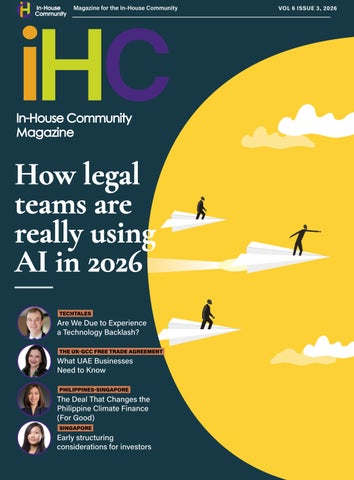

How legal teams are really using AI in 2026


TECHTALES
Are We Due to Experience a Technology Backlash?
THE UK-GCC FREE TRADE AGREEMENT
What UAE Businesses Need to Know
PHILIPPINES-SINGAPORE
The Deal That Changes the Philippine Climate Finance (For Good)
SINGAPORE
Early structuring considerations for investors

Feature contributors
In-House Community
PUBLISHER
Rahul Prakash
+852 8170 2951
rahul.prakash@ inhousecommunity.com
LEAD DESIGNER
Richard Oliver
EDITOR
Nathan Smith
WRITER
Butch Bacaoco
CLIENT RELATIONSHIP MANAGER
Toni Angeline Dorotheo
Published 6 times annually by InHouse Community Ltd.
Publishers of
• In-House Community Magazine
• IHC Briefing
Organisers of the
• IHC Events
Hosts of
• www.inhousecommunity.com
• www.mycareerinlaw.com
Forums for the In-House Community
Opinions expressed herein do not constitute legal advice, and do not necessarily reflect the views of the publishers.
© 2026 InHouse Community Limited and contributors. Magazine

Foutoun Hajjar Managing Partner – Abu Dhabi, M&Co Legal
Foutoun Hajjar is an internationally recognised legal and business executive with over 25 years of senior leadership experience across the UAE, GCC, and the United Kingdom. She is a UK-qualified solicitor and barrister, a former senior partner at one of the Middle East’s largest law firms and has held senior executive roles within FTSE 100 companies, financial institutions, and global advisory firms.

Khaled Mehdi
Legal Director, Abu Dhabi, M&Co Legal
Khaled Mehdi is a Legal Director based in Abu Dhabi with over 17 years of experience advising on corporate, commercial, regulatory, and cross-border transactional matters across the UAE, Lebanon, and other international jurisdictions. He advises corporations, financial institutions, and private clients on mergers and acquisitions, corporate structuring and restructuring, joint ventures, equity investments, transactional lending, and a broad range of commercial contracts.

Kristine T. Torres Partner, Gorriceta Africa Cauton & Saavedra
Kristine T. Torres is a Partner of the Firm, and Head of Project Finance and ESG. She is also a member of the Corporate and Technology Media and Telecommunications practice groups. She specializes in corporate and business law, mergers and acquisitions, technology media & telecommunications, capital markets, banking, finance, securities law, project finance and ESG.

Cassandra Lim
Partner, Trowers & Hamlins
Cass is a Corporate Partner in Trowers & Hamlins’ International department, based in our Singapore office. She was previously based in our Kuala Lumpur office, where she was one of the first Malaysian associates to join the firm after Trowers opened there as the first law firm to be granted a qualified foreign law firm licence to practise in Malaysia, in 2015.

Tim Gilkison Business Development Manager, Perivan
Tim has over two decades of experience in business development, professional services support, publishing and SaaS solutions, both in the UK and across South-East Asia, where he lived for many years. His passion is in building trusted, longterm client relationships and helping organisations to achieve their goals. In his spare time Tim is a keen social runner, hiker and kayaker (when the water is warm!)


London Partner Relocates to Singapore to Lead Squire Patton Boggs’ Asia Pacific Energy Disputes and LNG Practice
Squire Patton Boggs partner Max Rockall has relocated from London to Singapore to lead the firm’s Asia Pacific Energy Disputes and LNG practice, with plans to expand the regional team.
Global disputes co-chair Stephen Anway described the move as “a key investment” in the firm’s Asia Pacific practice. Singapore managing partner Barry Stimpson said Rockall’s expertise would be in demand as price volatility and long-term contract disputes drove increased energy arbitration.

Herbert Smith Freehills Kramer Senior Partner to Lead the Firm’s Asia TMT Practice
Herbert Smith Freehills Kramer senior partner Peter Jones will relocate from Sydney to Singapore on 1 May, to lead and expand
A member of the firm’s Global Board and former co-leader of its London arbitration team, Rockall has more than 15 years’ experience in energy, gas and LNG disputes. He has advised on more than 20 price reviews, along with cargo delivery disputes, force majeure claims, contract flexibility and market arbitrage.
“Having developed my Asia practice over several years, this is a natural next step for me,” Rockall said.

the firm’s Asia Technology, Media and Telecommunications practice.
Jones has more than 30 years’ Asia Pacific experience spanning digital infrastructure transactions, disputes, commercial contracts, outsourcing, procurement and cyber incident preparation and response. His clients have
Max Rockall
Peter Jones
included PCCW, Digital Nasional, Singtel, Vodafone Japan and XL Axiata, along with investors and operators in data centres, mobile towers, fibre networks, satellites and submarine cables. Jones said Asia’s fastchanging technology ecosystem was increasing demand for advice on infrastructure, supply chains, regulation and cyber threats.
“Our practice is built to meet these challenges and to help our clients maximise opportunities,” he said. Asia managing partner Graeme Preston said Jones’ market knowledge made him “the perfect choice” to lead the regional team.
Simpson Thacher to Open Singapore Office, Adds Two Partners
Simpson Thacher & Bartlett will open a Singapore office focused on private equity, funds, M&A, real estate, energy, infrastructure and digital infrastructure.
Ian Ho and Tony King will become co-heads of the firm’s Asia Private Equity Practice and be based in Singapore. New partners Theodore Heng and Carolyn Wong will also join the office. Heng advises sponsors and multinational companies on cross-border

private equity and M&A, particularly in real assets, infrastructure, technology and services.
Wong specialises in energy and infrastructure transactions, joint ventures and project development. Private Funds partner Tony Liu will lead the local funds practice alongside Asia Funds head Adam Furber. Executive Committee chair Alden Millard said the office would strengthen the firm’s ability to serve Southeast Asian clients.
He said the experience of Ho, King, Heng and Wong would be “invaluable” as Simpson Thacher expanded its presence alongside established offices in Hong Kong, Beijing and Tokyo.
Zaid Ibrahim & Co Appoints New Managing Partner
Zaid Ibrahim & Co has promoted deputy managing partner Jonathan Lim Hon Kiat to managing partner, effective 3 April.
Lim began his career at the firm in 2007 and became a corporate partner specialising in fintech, venture capital, blockchain, payment

Ian Ho, Tony King and Theodore Heng
Jonathan Lim Hon Kiat
systems, digital remittance, initial coin offerings and financial regulation. He also serves as secretary of the Fintech Association of Malaysia.
Lim said his priority was ensuring the firm continued to adapt through technology, new working methods and changing client demands while retaining its established values. Executive chairman Tan Sri Dr Nik Norzrul Thani Nhassan Thani said the promotion demonstrated the firm’s commitment to nurturing home-grown talent.
Senior partner Gilbert Gan said Lim had recognised the potential effect of artificial intelligence on legal practice early and had helped position the firm at the forefront of that change.
A&O Shearman Appoints New Greater China Leadership Team
A&O Shearman has appointed Roger Lui senior partner for Greater China and Cindy Lo regional managing partner for Greater China and Hong Kong office managing partner, effective 1 May.

They succeed Vicki Liu and Lorna Chen, while Yvonne Ho remains managing partner for the Shanghai and Beijing offices. Lui, who trained in London and worked in Tokyo before returning to Hong Kong, advises on major financial transactions and will focus on clients and markets.
Lo has worked across the firm’s Hong Kong, Shanghai and Beijing offices and spent time in-house at an international investment bank. She will oversee regional management and performance. Lui said clients increasingly needed advice connecting Greater China with the world.
Lo said her priority was drawing on the combined strength of the three offices to deliver “the speed and quality” required for complex work.
Kudun and Partners Strengthens Capital Markets Leadership, Expands Regional Capability
Kudun and Partners has integrated Manunya & Associates and appointed its founder, Manunya Thitinuntawan, strengthening its corporate and capital markets practice.
Thitinuntawan brings 25 years’ experience, including at Allen & Overy (Thailand), advising on M&A, IPOs, public offerings and Stock Exchange of Thailand regulation. Her work has included the Com7 and PRTR Group IPOs and Bangkok Dusit Medical Services’ merger involving Samitivej Hospital.
Roger Lui, Cindy Lo and Vicki Liu

“I look forward to working with the team to support clients with practical, commercially driven advice,” she said.
The firm has also appointed Krissen Pillay as Counsel in its International Practice to lead its Vietnam offering. Pillay joins from YKVN in Ho Chi Minh City, where he was counsel for six years, after earlier roles at Bowmans and Werksmans. He specialises in M&A, finance and cross-border investment, particularly in financial services, logistics, healthcare and real estate.
HKIAC Appoints New Co-Chairs
The Hong Kong International Arbitration Centre has appointed Domitille Baizeau of LALIVE and Victor Dawes of Temple Chambers as co-chairs from 1 July. They succeed David W Rivkin and Rimsky Yuen.
Baizeau has served on HKIAC’s Council since 2020 and is a member of the International Council for Commercial Arbitration’s Governing Board. Dawes, the immediate past chair of the Hong Kong Bar Association and a

High Court recorder, joined HKIAC’s Council and Appointments Committee in 2024.
Clifford Chance partner Thomas Walsh and Zhong Lun senior counsel Huawei Sun will become vice-chairs, succeeding Nils Eliasson and Briana Young. They join Executive Committee members John Cho of Freshfields and Friven Yeoh of Skadden.
Secretary-General Joanne Lau thanked the outgoing leaders and described Baizeau and Dawes as “impressive practitioners” who would support HKIAC’s role in international dispute resolution.
Johnson Stokes & Master appoints new Senior Partner
Johnson Stokes & Master has appointed Geoffrey Chan as senior partner, succeeding Terence Tung after ten years.
Chan was most recently managing partner of the firm’s Litigation & Dispute Resolution department and served on its four-member Management Committee, which he will now
Krissen Pillay and Manunya Thitinuntawan
Domitille Baizeau and Victor Dawes


lead. A recognised construction lawyer, Chan has served on arbitration panels for the Hong Kong International Arbitration Centre and the China International Economic and Trade Arbitration Commission.
He also chairs a group advocating for a joint Greater Bay Area bid for the 2036 Olympics. Chan thanked Tung for guiding the firm through “significant transformation” and said the transition would build on those foundations for the next generation of lawyers.
Tung said Chan understood the firm’s heritage and talent and was equipped to lead its next chapter. Tung will remain a partner, focusing on his practice in Hong Kong and mainland China.
CLO Further Strengthens Disputes & Advisory Practice with New Senior Litigator and Former Judicial Commissioner
Christopher & Lee Ong, a Rajah & Tann Asia member firm, has appointed Robert Lazar and

Saheran Suhendran as consultants from 1 July.
Lazar brings more than four decades’ experience in civil and commercial litigation, including landmark cases before Malaysia’s superior courts. Suhendran was most recently a Judicial Commissioner at the Kuala Lumpur High Court and retired from the bench in May 2026.
Before his elevation to the High Court, he spent almost 40 years in legal practice, developing particular expertise in restructuring and insolvency. The firm said the appointments would strengthen its disputes and advisory practice by combining deep advocacy experience with insight into the judicial process.
Lazar and Suhendran will help the firm manage complex proceedings and deliver commercially focused outcomes for clients in Malaysia and across the region.
Geoffrey Chan
Robert Lazar and Saheran Suhendran


DLA Piper has appointed Sherlyn Lau APAC Capital Markets and Corporate Finance Head in Hong Kong. Lau was previously Sidley Austin’s Deputy Head of its multidisciplinary China Corporate and Finance practice. She joins DLA Piper’s Asia Corporate and Greater China Equity Capital Markets practices with a 12-member team and two decades of experience in IPOs, M&A, secondary equity fundraising, listing compliance and pre-IPO placements. Her clients include Chinese and international investment banks and Hong Konglisted companies.

Clifford Chance has appointed Charmaine Yeo as private equity counsel. She will initially work in Hong Kong before relocating to Singapore.
Yeo began her career at Clifford Chance and returns with extensive experience advising private equity firms and other financial sponsors on cross-border M&A across Asia Pacific, particularly Southeast Asia. Her sector experience includes healthcare, financial services, digital infrastructure, energy transition and consumer retail.
Yeo said she was “excited to rejoin” as private equity and sponsor-led activity accelerated across Southeast Asia and the wider region. Private equity partner Tom Lin said recruiting lawyers of Yeo’s calibre was critical to supporting the
private capital sector, which continued to play “a transformative role in the global economy”. Her appointment forms part of Clifford Chance’s wider effort to strengthen its private capital capabilities and integrated regional offering.

DLA Piper has expanded its Asia-focused transactional capabilities with the addition of Charles Ching, a highly-ranked private equity and M&A partner based in both Asia and the US. Ching’s practice focus on representing global sponsors in complex acquisitions, carve-outs, privatizations and portfolio company matters. He brings particular strength in cross-border Asia-US and Asia-Europe transactions, with a background that spans technology, healthcare and energy transition.

Shardul Amarchand Mangaldas & Co has appointed Garima Shahani as a banking and finance partner in New Delhi. Her most recent role was not disclosed, although she previously worked at Linklaters’ Singapore office and leading Indian firms. Qualified in India and New York, Shahani has more than eight years’ experience advising domestic and international banks, non-bank lenders, multilateral institutions and private equity sponsors on cross-border and structured financings. She holds an LLM from New York University.

Baker McKenzie has appointed Frankie Tam as a partner in its Hong Kong Data, Technology, Privacy & Cybersecurity Practice. Her former employer and title were not disclosed. Tam advises multinationals on outsourcing, cloud infrastructure, commercial contracts, digital transformation, privacy and cybersecurity, including digital currencies, stablecoins and cross-border payments. Qualified in Hong Kong, New York and England and Wales, she serves as director of the Cyber Legal Policy Committee and has advised Hong Kong’s government on technology projects.

Trilegal has appointed Ashish Teni as Senior Specialist – Insurance & Reinsurance, strengthening its insurance regulatory and compliance practice.
Teni brings more than 17 years’ experience advising insurers, reinsurers, intermediaries, insurtech platforms and institutional investors. His work covers Insurance Regulatory and Development Authority of India rules, crossborder reinsurance, bancassurance and other distribution models, market entry, joint ventures, M&A, claims and regulatory disputes across life, general and health insurance.
Teni said Trilegal offered “an excellent environment” for supporting clients as India’s insurance sector changed. He will work with
partners across the firm on licensing, structuring, transactions and continuing compliance.
Management Committee members Nishant Parikh and Sridhar Gorthi said increasingly sophisticated and globally connected insurance markets required deep sector knowledge, adding that Teni’s experience supported the firm’s strategy of building expertise in highly regulated industries.

Bird & Bird has appointed Peter Koh as Senior Legal Consultant in Riyadh, expanding its Saudi corporate practice alongside partners Raya AlKhatib, Nick O’Connell and Simon Shooter.
Koh brings more than 30 years’ experience in cross-border joint ventures, M&A, private equity, finance and commercial matters across Asia, the Middle East and the US. He has advised international and Saudi clients on market entry, investments, distributorships and service agreements, with particular experience involving Chinese and Korean companies. His regulatory work covers data protection, cybersecurity, e-commerce, financial services and capital markets.
Before joining Bird & Bird, Koh worked at international firms in Los Angeles, Hong Kong, Seoul, Shanghai and Beijing. He said Saudi Arabia was rapidly strengthening its position as a hub for digital infrastructure and advanced manufacturing, creating growing investment where “technology and manufacturing converge”.
MOVES

JSA Advocates and Solicitors has appointed Kushal Ramotre as a corporate partner. Ramotre was previously DirectorCorporate Transactions at Cyril Amarchand Mangaldas in Mumbai and has also worked at Trilegal, Acuity Law, BMR Legal and Indian Law Partners. He brings more than 12 years’ experience in M&A, private equity, strategic partnerships and cross-border deals across infrastructure, renewable energy, technology, financial services and healthcare. His clients have included KKR, Warburg Pincus, OMERS, Alibaba and Circulate Capital.


Halim Hong & Quek appointed Tan Jun Kit and Justin Ng as partners from 1 April. Their former firms and titles were not disclosed. Tan advises on public and private M&A, private equity, venture capital, capital markets and project and acquisition finance. Ng focuses on corporate and commercial matters, conveyancing, IPOs, rights issues, divestments and project and real-estate financing. His wider experience includes cargo, logistics, e-commerce platforms and establishing foreign offices for overseas entities.
A&O Shearman has appointed Rintaro Hirano as a Japanese-qualified debt finance partner in Tokyo from the end of April. Hirano joins

from Nagashima, Ohno & Tsunematsu, where he was a partner and senior member of the finance practice. He advises on leveraged, energy, infrastructure and real-estate finance and regularly acts for lenders supporting global private equity sponsors, along with major energy and infrastructure clients. His appointment strengthens A&O Shearman’s Japanese-law debt finance and private credit capability.

CMS INDUSLAW has appointed Faraz Alam Sagar as an equity partner and Mumbai head of Dispute Resolution & White-Collar Crimes. Sagar was previously co-head and partner at Cyril Amarchand Mangaldas and has worked at Freshfields Bruckhaus Deringer and PricewaterhouseCoopers. Across more than two decades, he has advised governments, multinational companies and high-net-worth individuals on cross-border disputes, trade remedies, regulatory and forensic investigations, white-collar crime, international sanctions and enforcement involving both Indian and international law. He is a permanent Bombay Bar Association member.

RPC has appointed Sumyutha Sivamani as a partner in its Singapore joint venture, RPC Premier Law. Sivamani joins from
Clyde & Co, although her former title was not disclosed. She brings more than 14 years’ insurance experience, advising insurers, reinsurers and multinationals on complex cyber risks, incident response, data privacy, coverage disputes and regulatory investigations across Asia. She will also support RPC’s financial lines, property and casualty insurance work and expand its regional cyber and data practices.

Chandler Mori Hamada has welcomed Siregran Sakuliampaiboon back as a partner in its Corporate and M&A practice from 5 May. Her immediately preceding firm and role were not disclosed, although she gained experience at leading Thai and international firms. Sakuliampaiboon advises on complex and cross-border M&A, corporate structuring and foreign investment across food and beverage, education, energy, healthcare, manufacturing, and media and entertainment. Admitted in Thailand, she holds master’s degrees from Cambridge and the London School of Economics.

A&O Shearman has appointed Hannah Cassidy as a Hong Kong partner leading its financial services regulatory work. Cassidy joins from Herbert Smith Freehills Kramer, where she headed the Asian financial services regulatory practice. She advises financial institutions, investment managers, fintech companies, listed businesses and senior executives on management
accountability, payments, cybersecurity, market abuse, anti-money laundering, fraud and scams, client assets and complex licensing issues. Her experience covers cross-border matters across Asia and other major financial markets.

Global Vietnam Lawyers has appointed Dang Phuong Le as partner and head of its Hanoi office. Her immediately preceding employer was not named, although she previously led the Hanoi branch of an international-standard firm for more than a decade. Le brings over 20 years’ experience spanning private practice and in-house legal leadership, with a focus on cross-border transactions, corporate restructuring and complex advisory matters. The appointment is intended to strengthen the firm’s support for multinational companies and in-house teams in Vietnam.


Dechert has appointed David Cho and Min Kim as Singapore corporate and securities partners. Cho rejoins after serving as Seoul managing partner at another international firm and previously spending a decade as Dechert’s Asia comanaging partner. Kim was special counsel in his former firm’s Global Corporate/ M&A Group. Cho brings more than 30 years’ experience, while Kim focuses on technology, digital infrastructure and energy transition. Both advise
MOVES
corporate and private equity clients on cross-border M&A, joint ventures and strategic investments.


Dentons has appointed
Loke-Khoon Tan, Dominic Edmondson and Maria Joannides
Smith to its Hong Kong partnership and leadership team from Baker McKenzie. Tan previously led Baker McKenzie’s regional IP and Technology and Consumer Goods and Retail practices, and advises on IP protection and anti-counterfeiting. Edmondson specialises in global privacy, AI, technology transactions, cybersecurity and telecommunications, while Smith focuses on trademarks, copyright, portfolio management, brand protection and enforcement strategies across Greater China, Asia and global markets.

Shardul Amarchand
Mangaldas & Co has welcomed Akshay
Sachthey back as a General Corporate partner in Delhi. Sachthey previously led global M&A and strategic investment legal work, along with the prepaid solutions business, at an unnamed fintech platform. He brings more than 10 years’ experience advising on corporate matters, M&A, inbound and outbound investment, commercial
contracts and regulation, with particular expertise in insurance and reinsurance. His sector experience also covers healthcare, retail, fintech, real estate, gaming and IT.

Greenberg Traurig
Khalid Al-Thebity has appointed Nick Roudev as a shareholder in Riyadh, working in a regional role supporting clients across the Gulf Cooperation Council. His previous employer and role were not disclosed. Roudev specialises in telecommunications, AI, data, digital payments and intellectual property, advising on data centres, fibre networks, digital infrastructure, fintech, digital health and other emerging technologies. His clients have included financial institutions, fintech companies, telecommunications operators, health services providers and businesses in digital media, aerospace and retail.

Tilleke & Gibbins has appointed Chanakarn Boonyasith as a partner in its Bangkok office. She was previously a partner at an unnamed international law firm in Bangkok. Boonyasith advises multinational and domestic clients on Thai labour and employment law, workforce restructuring, complex terminations, compliance, workplace investigations, personal data protection, commercial transactions and cross-border employment issues. Her clients span manufacturing, financial services, hospitality, transport, retail, education and renewable
energy, strengthening the firm’s employment and corporate capabilities.

K&L Gates has appointed Yang Wang as a Corporate/ M&A partner in Hong Kong. Wang joins from Dechert, where he led its China practice from Singapore after previously serving as Beijing managing partner. He advises on cross-border M&A, private equity and venture capital, Hong Kong IPOs, Nasdaq deSPAC transactions, regulation and disputes. His clients include investment funds, multinational companies, family offices, investment banks, listed companies and state-owned enterprises across manufacturing, life sciences, technology, media, telecommunications, food and beverage.

Seyfarth Shaw has appointed Nicholas Turner as a Sydney labour and employment partner. Turner was previously DLA Piper’s Australian Head of Employment and a partner in its Global Employment Group. Earlier, he led Sidley Austin’s London employment practice and Linklaters’ Asian practice. With more than 20 years’ experience across Australia, Asia and Europe, he advises boards and senior legal and HR leaders on employment disputes, investigations, executive matters, workforce change, enterprise bargaining, industrial strategy and cross-border transformations.
Sagus Legal has appointed Aashima Shrivastava as Partner and Head of Gurgaon,

coinciding with its new Cyber Hub office. Shrivastava previously led APAC legal affairs at Smiths Group and earlier served as Boston Consulting Group’s legal lead across India, South-East Asia, Australasia and the Middle East. She brings more than 18 years’ experience in governance, employment, cross-border compliance, risk and commercial contracting. Shrivastava called the office “a statement of intent”, while Managing Partner Shruti Kanodia welcomed her “genuinely rare” perspective.


Lee Hishammuddin Allen & Gledhill has appointed Amin Abdul Majid, Khoo Yu Lin and Andreanna Ten Maven as Energy, Projects & Infrastructure partners. All join from Zaid Ibrahim & Co, where Abdul Majid was managing partner and Khoo and Ten were partners. Abdul Majid focuses on energy, infrastructure and policy reform; Khoo advises on major projects, utilities, renewables and M&A; and Ten specialises in energy transition, ESG, sustainability, corporate finance and capital markets.
Chairman Andrew Chiew Ean Vooi highlighted their “complementary experience”.
A&O Shearman acted as sole international counsel to the underwriters on Turtlemint Fintech Solutions’ Rs8.83 billion (US$93m) Indian IPO. The insurtech platform’s offering combined new shares with a sale by existing shareholders. Partner Pallavi Gopinath Aney led the firm’s team.
A&O Shearman advised the Japan International Cooperation Agency on a ¥30 billion (US$188m) loan to Brazilian water utility SABESP. The financing will help upgrade sewage infrastructure and pursue universal service coverage across São Paulo state. Partner Hitomi Komachi led the firm’s team.
A&O Shearman advised the joint dealer and lead managers on Nan Fung Treasury’s tender offers for US$910 million of notes and concurrent US$500 million sustainability bond issue, guaranteed by Nan Fung International Holdings. Proceeds will fund eligible green or social projects. Partner Agnes Tsang led the team.
Allen & Gledhill (Vietnam) advised Offgrid Advanced Sustainable Infrastructure Solutions, a solar platform affiliated with SUSI Partners, on its acquisition of renewable energy company Asia Clean Capital Vietnam. Managing partner Oh Hsiu-Hau and partner Jonathan Lin led the firm’s team.
Allen & Gledhill (Vietnam) advised OCI TerraSus, through OCI ONE, on acquiring a 65% stake in a 2.7GW Vietnamese solar wafer

DEALS
India Trust data centres. The transaction was completed on February 27, 2026. Partners Zia Mody, Anand Shah and Shriram Shah led the firm’s team.
AZB & Partners advised Cleanmax Enviro Energy Solutions and promoters Kuldeep Jain, KEMPINC, Rikhab Investments, Pratap Jain and Nidhi Jain on a stake sale to Temasek subsidiary Jongsong Investments and Bain-managed GSS India Opportunities AIF Scheme I. Partners Niladri Maulik and Siddharth Khanna led the team.
Baker McKenzie and FenXun represented BLOOM FRESH International in winning more than Rmb4 million (US$579,000) in a Chinese plant variety rights infringement case concerning its IFG Six grape, marketed as SWEET SAPPHIRE. Baker McKenzie partner Andrew Sim led the team, supported by FenXun partner Zheng Zhou
Baker McKenzie advised Sime Darby Property on forming a MYR1.25 billion (US$307m) Shariah-compliant investment
fund and co-investment sidecar. Derek Kwan, supported by Jens Carle, led its team. Wong & Partners, led by Stephanie Phua, provided Malaysian advice. The fund will invest in data centre, industrial and logistics projects.
Baker McKenzie acted as lead counsel to Resulticks Global Companies on a US$1.5 billion all-share sale to Nasdaq-listed Diginex. Shirin Tang, Ting Xiao Hui, Piotr Korzynski, Derek Liu, Per Chilstrom and Michael Pilo led the firm’s cross-border team.
Carey Olsen advised Kraken parent Payward on its US$600 million cash-andstock acquisition of Hong Kong stablecoin payments company Reap Technologies. The deal values Payward at US$20 billion and expands Kraken’s payments infrastructure in Asia-Pacific. Partners Chris Duncan, Trevor McCabe and Richard Munden led the BVI and Cayman team.
Chandler Mori Hamada acted as co-lead counsel to domestic and international lenders financing Digital Edge and B.Grimm Power ’s 100MW BKK Campus data centre with a US$880 million green loan. Joseph Tisuthiwongse, supported by Tip-apa Limvichai, led the firm’s banking and real estate teams.
Clifford Chance acted as international counsel to China’s Star Sports Medicine on its Hong Kong IPO and listing. The company supplies sports medicine implants, instruments, equipment, consumables and

regenerative repair products. Partners Fang Liu and Virginia Lee, supported by Beijing partner Claire Cao, led the firm’s team.
Clifford Chance advised Danantara Investment Management on its US$1.5 billion debut dollar bond issue and establishment of a US$5 billion global medium-term note programme. Partner Gareth Deiner led the team, supported by partners Alan Yeung, Jeffrey LeMaster, Avrohom Gelber and Paul Koppel.

Clifford Chance advised joint sponsors CICC and CITIC Securities (Hong Kong), and the underwriters, on smartphone component supplier Viewtrix Technology’s HK$1.1 billion (US$140m) Hong Kong IPO. Partners Tim Wang, Jean Thio and Tianning Xiang led the firm’s team.
CMS INDUSLAW advised Hindustan Unilever on its Rs8.24 billion (US$90.6m) acquisition of the remaining 49% of Zywie Ventures, owner of plant-based nutrition brand
DEALS
OZiva, taking its holding to 100%. Founding and senior partner Avimukt Dar and partner Bharadwaj Jaishankar led the firm’s team.
Davis Polk advised clinical-stage biotechnology company Adagene on its US$70 million SEC-registered direct offering of American depositary shares, which are listed on Nasdaq. Partner Xuelin (Steve) Wang, supported by partner Patrick Sigmon, led the firm’s multi-jurisdictional team.
Davis Polk advised DSC Holdings on its SEC-registered IPO of three million American depositary shares, raising about US$51 million. Nasdaq-listed DSC provides AI application infrastructure for China’s used-car industry. Corporate partners Li He and Ran Li led the firm’s multi-jurisdictional team.
Davis Polk advised silicon carbide epitaxial wafer producer Epiworld International on its Hong Kong IPO, listing and Regulation S international offering, which raised approximately HK$1.6 billion (US$204m).
Corporate partners Jason Xu, Li He and Ran Li led the firm’s Hong Kong and Beijing team.
DLA Piper advised joint placing agents
Macquarie Capital, China International
Capital Corporation Hong Kong
Securities and Haitong International
Securities on Ximei Resources Holding’s share placement and top-up subscription, raising HK$537.2 million (US$69m). Hong Kong corporate partners George Wu and Sherlyn Lau led the firm’s team.
DEALS

DLA Piper advised Banco Bilbao Vizcaya Argentaria on a US$500 million global vendor financing programme supporting Envision Energy’s wind, battery storage and integrated clean-energy projects across Europe, Asia and Latin America. Naomi Hong led the firm’s team on the multi-project, multi-jurisdictional and multi-currency programme.
DLA Piper advised Circuit Fabology Microelectronics Equipment on its HK$3.24 billion (US$413m) Hong Kong IPO of H shares, completing an A+H dual listing. China International Capital Corporation Hong Kong Securities was sole sponsor. George Wu, supported by Sherlyn Lau, led the firm’s team.
Herbert Smith Freehills Kramer advised Kobe Bussan and Gourmet Kineya on forming
Meal Hub and acquiring LSG Asia-Pacific from Aurelius Group. Tokyo partner Joseph Fisher, supported by Hong Kong partner Jason Sung, led the team. Oh-Ebashi LPC & Partners acted as lead and Japanese counsel.
Herbert Smith Freehills Kramer advised Mitsubishi Heavy Industries Compressor Corporation on acquiring Swiss rotatingequipment services company AST Turbo. Asia managing partner Graeme Preston led the firm’s team. Walder Wyss provided Swiss law advice, led by partner Urs Gnos.
JSA Advocates & Solicitors advised Udhaiyam and its promoters on divesting a majority stake in Udhaiyams Agro Foods to Reliance Consumer Products. Anand Lakra led the team, supported by Niharika Mepani, Kumarmanglam Vijay, Surajkumar
DEALS
Shetty, Shareen Gupta, Pratish Kumar, Sumitava Basu, Gerald Manoharan and Sonakshi Das.
JSA Advocates & Solicitors acted for Grasim Industries in securing an appellate order setting aside and remanding a Competition Commission of India ruling that imposed an approximately Rs3 billion (US$32m) penalty and behavioural directions. Partners Nisha Kaur Uberoi and Sarthak Pande led the firm’s team.
JSA Advocates & Solicitors advised digital financial services company 5paisa Capital on a rights issue of up to 15.63 million equity shares, worth as much as Rs4.7 billion (US$50.3m). Partners Arka Mookerjee, Siddhartha Desai and Ananth Balaji led the firm’s team.
K&L Gates and Trilegal advised Olam Holdings on selling Mindsprint and its subsidiaries to Wipro Networks for US$375 million, alongside an eight-year services contract. K&L Gates Straits Law partners David Kuo and Meraj Noor led the team, supported by Ayman Guirguis, Cameron Abbott and Dan Atkin.
Latham & Watkins advised sole sponsor CICC on Shenzhen Creality 3D Technology’s HK$1.38 billion (US$176m) Hong Kong IPO. The global consumer 3D-printing company offered 73.42 million H shares, with an overallotment option. Hong Kong partners Daying Zhang and Mandy Wong led the firm’s team.
Latham & Watkins advised FH Capital on acquiring 75.1% of JinkoSolar’s US subsidiary, Jinko Solar (US) Industries. Sidharth Bhasin and David Zaheer led the team, supported by Tim Fenn, Larry Seymour, Nineveh Alkhas, Adam Greenfield, Patrick English, Erin Brown Jones and Aron Potash
Latham & Watkins advised joint sponsors UBS and CITIC Securities and underwriters on Merdeka Gold Resources’ Hong Kong depositary receipt listing. Overall coordinators included UBS, CLSA, Morgan Stanley and HSBC. Terris Tang and Sharon Lau led the team, supported by Simon Hawkins and Michael Hardy
Maples and Calder acted as Cayman counsel to Microport Cardiac Rhythm Management on its statutory merger with MicroPort CardioFlow CRM, a MicroPort CardioFlow Medtech subsidiary. Hong Kong finance partner Lorraine Pao led the firm’s team, while Sidley Austin acted as Hong Kong counsel.
Maples and Calder acted as Cayman counsel to Nomura Group member Global Funds Trust on launching the Nomura Fund SelectApollo Multi Alternative Strategies Fund. Nomura Securities will distribute the fund in Japan and Nomura Asset Management is investment adviser. Singapore partner Nick Harrold led the firm’s team.
Maples and Calder acted as Cayman counsel to ORIX Corporation on launching a US$2.5
DEALS
billion Japan-focused private equity fund with Qatar Investment Authority. Partners Sharon Yap and Aidan O’Regan led the firm’s team, supported by Asia regional heads Eastern Fong and Charlie Sparrow.
Norton Rose Fulbright advised sole sponsor CITIC Securities (Hong Kong) and sole global coordinator CLSA on Shandong Extreme Vision Technology’s HK$434.4 million (US$55.4m) Hong Kong listing. The AI computer-vision provider’s public offer was more than 4,500 times oversubscribed. Partners Psyche Tai and Doris Ng led the firm’s team.
Norton Rose Fulbright advised the lender group on US$300 million financing for TotalEnergies and Nextnorth’s 440MWp Philippine solar project. The syndicate comprised ING Bank, Sumitomo Mitsui Banking Corporation and Standard Chartered. Partner Ben Carrozzi led the firm’s team, supported by partners Nick Merritt and Vittorio Casamento.
Paul Hastings advised China International Capital Corporation Hong Kong Securities, CMBC International Capital and other underwriters on Keytop Parking’s HK$399 million (US$51m) Hong Kong global offering and listing. Raymond Li and Steven Hsu led the firm’s team, supported by regulatory affairs director Wendy Hung.
Paul Hastings advised Shenzhen-listed printed circuit-board maker Delton
Technology (Guangzhou) on its HK$3.31 billion (US$423m) Hong Kong global offering and listing, including drafting its prospectus.
Raymond Li and Steven Hsu led the firm’s team, supported by regulatory affairs director
Wendy Hung

Paul Hastings advised Shenzhen-listed wireless communications company MeiG Smart Technology on its HK$1.16 billion (US$148m) Hong Kong global offering and listing, including drafting its prospectus.
Raymond Li and Steven Hsu led the firm’s team, supported by regulatory affairs director
Wendy Hung.
Rajah & Tann Singapore and Christopher & Lee Ong acted for placement agents DBS Bank, Oversea-Chinese Banking Corporation, SAC Capital and United Overseas Bank on Aspial Lifestyle’s S$60 million (US$47m) private placement.
Raymond Tong and Jasselyn Seet led the
DEALS
RTS team; Annette Soh and Daphne Lam led CLO’s.
Rajah & Tann Singapore and Rajah & Tann LCT Lawyers represented Primary Wave IP Investment Management on its strategic investment in POPS Music. Terence Quek, Benjamin Cheong, Glen Chiang, Desmond Wee and Jonathan Cham led the Singapore team; deputy managing partner Logan Leung led the LCT team.
Rajah & Tann Singapore acted for Hong Leong Asia on acquiring all shares in architectural building-products supplier Yong Tai Loong. M&A partner Cynthia Goh led the firm’s team, supported by partners Kala Anandarajah, Jonathan Cham, Glen Chiang and Shaun Ng.
S&R Associates represented IRB Infrastructure Trust on its Rs108 billion (US$1.2b) investment in IRB Harihara Corridors, concessionaire for two highway corridors in Uttar Pradesh. Partner Pratichi Mishra led the firm’s team.
S&R Associates represented Ascendas IT Park (Pune), sponsored by CapitaLand India Trust, on its Rs9.15 billion (US$101m) issue of privately placed, India-listed non-convertible debentures. Partner Aparna Ravi led the firm’s team.
S&R Associates represented BW LPG on selling its 8.5% equity stake in listed LPG and CNG solutions provider Confidence
Petroleum India. Counsel Apurv Sharma and partners Rajat Sethi and Rachael Israel led the firm’s team, supported by partner Sumit Bansal on tax matters.
Saraf and Partners advised Gaja Capital on its US$17 million Series B investment in Good Roots Kitchenware, which trades as health-focused cookware brand The Indus Valley. Partner Vivek Pareek led the firm’s team. Existing company investors include DSG Consumer Partners, Rukam Capital, The Chennai Angels and White Whale.
Saraf and Partners advised Larsen & Toubro Power Development on selling Nabha Power’s 1,400MW Punjab thermal power plant to Torrent Power for Rs68.89 billion (US$760m), subject to approvals. Partner Avirup Nag and partner designate Ankit Sahoo led the firm’s projects, infrastructure and energy team.
Shardul Amarchand Mangaldas & Co acted as Indian counsel to Fractal Analytics on its Rs28.34 billion (US$304m) IPO. Kotak Mahindra Capital, Morgan Stanley India, Axis Capital and Goldman Sachs (India) Securities were book-running lead managers. Partners Nikhil Naredi and Krupa Brahmbhatt led the firm’s team.
Shardul Amarchand Mangaldas & Co acted as Indian counsel to sole book-running lead manager Jefferies India on JSW Energy’s Rs40 billion (US$420m) qualified institutions placement. The company issued about 76.2
DEALS
million shares. Partners Nikhil Naredi and Devi Prasad Patel led the firm’s team.
Simpson Thacher represented Advantage Partners on forming the ¥300 billion (US$1.87b) Fund VIII Series Funds. Partners
David Azcue, Adam Furber, Xue Zhang, Nancy Mehlman, Makiko Harunari, Anuj Shah, Owen Lysak and Erica Rozow led the firm’s multidisciplinary team.
Simpson Thacher represented Blackstone on selling Indian data-centre developer Lumina CloudInfra SG to AirTrunk. Partners
Jonathan Hwang, Angus Lennox, Brian Stadler, Matthew Rogers, Peter Vassilev and Andrew Blau led the firm’s team. The firm also advised Blackstone on its 2024 acquisition of AirTrunk.
Simpson Thacher represented Blackstone on establishing Blackstone Capital Partners Asia III, which raised US$13.1 billion. Partners
Steven Klar, Ben Steelsmith, Jonathan Karen, Adam Furber, Nadia Bonnet, Jonathan Goldstein, Jodi Schneider, Erica Rozow and Julia Kohen led the firm’s multidisciplinary team.
Skadden advised underwriters Barclays Bank, Citibank Europe, Daiwa Capital Markets Europe and JP Morgan Securities on Japan Bank for International Cooperation’s €2.5 billion (US$2.9b) offering of government-guaranteed bonds due in 2031. The notes were listed in Luxembourg. Tokyo corporate partners Kenji Taneda and Ken Kiyota led the firm’s team.
Skadden advised JD.com on its Rmb10 billion (US$1.5b) offering of renminbidenominated senior unsecured notes due in 2031 and 2036. The Regulation S notes were listed in Hong Kong. Partners Shu Du, Jonathan Stone and Paloma Wang led the firm’s team.
Squire Patton Boggs acted as US special counsel to Muthoot Finance on a US$600 million high-yield bond issue under its US$4 billion note programme. Deutsche Bank and Standard Chartered Bank were global coordinators and joint book-runners. Singapore corporate partner Philip Lee led the firm’s team.
Trilegal advised Agrow Allied Ventures, its promoters and existing shareholders on a Rs1.86 billion (US$20m) first external fundraising with India Advantage Fund S5 I, managed by ICICI Venture Funds Management. The deal combined primary investment and a secondary share sale. Partner Nikhil Sachdeva led the firm’s team.
Trilegal advised book-running lead managers Axis Capital, BofA Securities India, IIFL Capital Services and Kotak Mahindra Capital on digital financial services platform Moneyview’s proposed IPO, comprising a Rs15 billion (US$163m) fresh issue and secondary share sale. Partners Vinay Sirohia and Jyotsna Jayaram led the firm’s team.
Trilegal advised Axonwise (Sarvam AI) and its founders on a Series B funding round
DEALS
valuing the company at US$1.5 billion. HCL Technologies and Bessemer Venture Partners led the round, joined by Peak XV and Khosla Ventures. Rahul Matthan, Nikhil Narendran, Rahil Pereira, Gauri Chhabra and Thomas J Vallieneth led the team.
TT&A advised sole broker Citigroup Global Markets India on Westbridge AIF I’s sale of more than one million InterGlobe Aviation shares on Indian stock exchanges for approximately Rs4.46 billion (US$46.8m). Partner Abhinav Kumar led the firm’s team.
TT&A advised Dabur India on its approximately Rs600 million (US$6.5m) minority investment in luxury skincare company RAS Beauty, the first investment through Dabur Ventures. Partners Gautam Saha and Swati Chauhan led the firm’s team. RegFin Legal represented RAS Beauty.
TT&A advised broker HSBC Securities and Capital Markets (India) on Temple Trees Impex and Investment’s sale of up to 619,683 Procter & Gamble Hygiene and Health Care shares on Indian stock exchanges for approximately Rs5.6 billion (US$9m). Partner Abhinav Kumar led the firm’s team.
WongPartnership acted as transaction counsel to Granite Asia Capital on establishing Asia’s first AI-focused IPO fund, managed by Granite Asia and distributed exclusively to DBS wealth clients. Partner Felicia Marie Ng led the firm’s team.

WongPartnership acted for DBS on its collaboration with Beverage Container Return Scheme to deliver real-time container deposit refunds through DBS PayLah! and reversevending machines across Singapore. Partner Lam Chung Nian led the firm’s team.
WongPartnership acted for Hong Konglisted Concord New Energy Group on its secondary listing by introduction in Singapore. The company, valued at about HK$2.6 billion (US$332.6m), develops wind, solar and energystorage businesses globally. Partner Chong Hong Chiang led the firm’s team.
Zul Rafique & Partners acted as Malaysian counsel to the finance parties providing a US$283 million green loan for DDSP’s 45MW AI-ready Johor data centre. CTBC Bank, MUFG Bank, Standard Chartered Bank and Entie Commercial Bank arranged the financing. Partner Celine Rangithan led the firm’s team.
What UAE Businesses Need to Know

On 20 May 2026, the United Kingdom and the Gulf Cooperation Council (GCC) concluded a landmark free trade agreement (FTA). As the GCC’s first FTA with a Group of Seven nation, it marks a significant milestone in strengthening trade, investment and economic collaboration between the two sides. For the UAE — among the most open and diversified economies in the bloc — it deepens a relationship that is already substantial.
It is worth being precise on one point of structure: this is a UK agreement with the GCC as a bloc (Bahrain, Kuwait, Oman, Qatar, Saudi Arabia and the UAE), not a standalone UAE-UK deal. The UAE benefits as one of the six members operating within the GCC customs union.
A relationship worth protecting The numbers explain the enthusiasm. The UAE’s Ambassador to the UK has described a vital UAE-UK partnership which, through around £25bn of trade, supports thousands of jobs. Across the wider bloc, total UK-GCC trade was worth around £53bn in 2025, making the GCC the UK’s tenth-largest trading partner. The UK government estimates the deal could, on its own, add around £3.7bn to the UK economy each year in the long run, and £1.9bn a year to real wages.
These are UK government projections and should be read as forecasts rather than guaranteed outcomes.
FOUTOUN HAJJAR AND KHALED MEHDI
What the agreement actually does
The headline is tariff liberalization, phased over a decade. The UK government indicates that, after ten years, 90% of GCC tariff lines will be removed, unlocking tariff-free access for around 93% of UK goods exports based on existing trade flows, with the majority entering the GCC tariff-free immediately on entry into force. On duties, the deal is estimated to eliminate around £580m a year on UK goods exported to the GCC once fully implemented, with about £360m removed on day one.
“Across the wider bloc, total UK-GCC trade was worth around £53bn in 2025, making the GCC the UK’s tenth-largest trading partner.”
Crucially for the UAE, the agreement is reciprocal and notably services-heavy, a good fit for the UAE’s diversification agenda. It is reported to secure the most ambitious services and business-mobility commitments the GCC has agreed in an FTA, and, for the first time, GCC commitments prohibiting unjustified and disproportionate data-localization requirements.
Priority sectors include advanced manufacturing (automotives, aerospace, machinery and electronics), clean energy technologies, financial and professional services, life sciences and medical equipment, and the creative and digital industries.
Several practical features stand out for businesses and professionals:
• Mobility: skilled UK professionals gain greater certainty to travel to the GCC to deliver services under contract, conduct business activities or transfer to a GCC office, subject to each member state’s specific commitments. The GCC has also committed not to introduce new quotas or “economic needs” tests that could limit these visas, and the agreement opens a route towards mutual recognition of professional qualifications, relevant to lawyers, accountants and engineers.
• Goods clearance: the GCC has reportedly agreed that compliant shipments will clear customs within a maximum of 48 hours (perishables in under 6 hours), and exporters will be able to self-certify origin documentation after initial registration.
• Financial services: these are the best financial-services terms the GCC has yet agreed in a trade deal. UK firms gain greater certainty to serve clients in the Gulf (in some cases without needing a local office or partner) and the agreement protects the free flow of financial data, letting firms store and process it outside the region. That is directly relevant to the UAE’s financial centers in the DIFC and ADGM.
• Public procurement: for the first time, the UAE has given UK suppliers a legally guaranteed right to bid for its federal government contracts. UK suppliers can also apply to be certified as “In-Country Value” suppliers, which can add up to a 25% advantage when public contracts are scored.

• Investment protection: the FTA adds a modern investor-State dispute settlement mechanism, giving investors an independent route to resolve treaty disputes. For the UAE specifically, the existing UK-UAE bilateral investment treaty stays in place, while the UK is ending its equivalent treaties with Oman and Bahrain when the FTA takes effect.
Context: how trade deals move the needle
This is only the GCC’s third FTA; the prior two were with Singapore and the European Free Trade Association, which entered into force in 2013 and 2014 respectively. A closer guide to likely impact is the UAE’s own bilateral CEPA program. Its agreement with India, for example, has coincided with bilateral trade crossing US$100bn in 2024-25, a reported increase of close to 20%. That track record suggests well-implemented agreements can materially accelerate trade flows.
It is also worth noting that, separately from the GCC bloc, individual members have struck bilateral deals with major partners; the US, for instance, has long-standing bilateral FTAs with Bahrain (in force 2006) and Oman, underscoring how varied the region’s trade architecture has become.
When does it take effect?
Not yet, and the legal sequence matters. Following the conclusion of negotiations, the parties will finalize and “legally scrub” the text, sign the completed treaty, and then move through pre-ratification scrutiny. Entry into force occurs only once both the UK and the GCC member states have completed their respective ratification processes. No official entry-into-force date has been published.
Comparable agreements have historically taken roughly 12 to 18 months from conclusion, which would point to entry into force during 2027, but this is an estimate based on precedent, not a confirmed timeline,
and should be verified against official announcements as they emerge.
How M&CO Legal can help businesses prepare
M&CO Legal is a full-service UAE law firm advising national and international clients across the full range of their commercial operations (from structuring through to execution) with offices in the DIFC and Abu Dhabi and a team combining civil and common-law expertise. We regularly advise on:
• Company set-up and market entry across mainland, free zone and financial-centre regimes (including DIFC and ADGM);
• Joint ventures, shareholder and stakeholder arrangements, including governance, control and exit mechanics;
• Free zone structuring and regulatory advice, licensing and compliance;
• Distributorship, agency and commercialcontract arrangements;
• Strategic planning, restructuring and cross-border transactions, including M&A, funding and private equity; and
• Tax-efficient structuring and intellectualproperty protection.
Members of our team also bring direct, firsthand experience of free trade agreements in the region (including advising in relation to the US-Bahrain Free Trade Agreement) giving us practical insight into how preferential-trade frameworks are implemented and leveraged in the Gulf.
The window between conclusion and entry into force is the time to get ready.
We can help clients review tariff classifications and rules-of-origin eligibility to confirm which goods will qualify for preferential treatment; structure their corporate presence and supply chains to capture day-one benefits; navigate the new services, mobility and data provisions; and assess the investment-protection and dispute-resolution framework the agreement introduces, positioning businesses to move quickly once the FTA takes effect.
Foutoun
Hajjar,
Managing Partner – Abu Dhabi M&Co
Legal
Foutoun Hajjar is an internationally recognised legal and business executive with over 25 years of senior leadership experience across the UAE, GCC, and the United Kingdom. She is a UK-qualified solicitor and barrister, a former senior partner at one of the Middle East’s largest law firms and has held senior executive roles within FTSE 100 companies, financial institutions, and global advisory firms.
foutoun@mandcolegal.com
Khaled Mehdi, Legal Director, Abu Dhabi
M&Co Legal
Khaled Mehdi is a Legal Director based in Abu Dhabi with over 17 years of experience advising on corporate, commercial, regulatory, and cross-border transactional matters across the UAE, Lebanon, and other international jurisdictions. He advises corporations, financial institutions, and private clients on mergers and acquisitions, corporate structuring and restructuring, joint ventures, equity investments, transactional lending, and a broad range of commercial contracts.
khaledm@mandcolegal.com

The Deal That Changes the Philippine Climate Finance (For Good)

Two Years in the Making
On 30 April 2026, during the Philippines’ ASEAN Chairmanship, the Philippines and Singapore formally entered into a carbon credit collaboration through a virtual signing ceremony. The agreement was signed on behalf of the Philippines by Department of Environment and Natural Resources Secretary Juan Miguel Cuna, and on behalf of Singapore by Minister for Sustainability and the Environment, Grace Fu.
This landmark event marked the culmination of more than two years of negotiations and intergovernmental coordination between the parties. More importantly, it represents the Philippines’ formal entry into the expanding network of bilateral carbon market
arrangements taking shape across ASEAN and, in turn, the broader international landscape.
For the Philippines, the agreement represents its first Implementation Agreement relating to carbon credits — a notable milestone as the country positions itself within the evolving international carbon market framework under Article 6 of the Paris Agreement.
For Singapore, however, this is already its eleventh such agreement, reflecting Singapore’s deliberate and sustained strategy of establishing cross-border carbon market partnerships to support its decarbonization objectives and regional climate agenda.
KRISTINE TORRES AND PAOLA CIARRA VALENCIA
A LOOK AT THE LANDMARK ARTICLE 6 IMPLEMENTATION AGREEMENT SIGNED DURING ASEAN CLIMATE WEEK, AND WHAT IT SIGNALS FOR ESG IN THE PHILIPPINES.
“The logic behind the deal is straightforward: what Singapore lacks, the Philippines has.”
Viewed more broadly, the agreement is not merely an environmental initiative. It is also a strategic economic and regulatory development that may influence investment flows, project development, and the future direction of carbon governance in ASEAN.
Understanding Article 6 of the Paris Agreement and Carbon Credits
Article 6 of the Paris Agreement establishes the legal architecture for international cooperation on climate action, enabling countries to meet their nationally determined contributions (NDCs) through market and non-market mechanisms. Article 6.4 operationalizes this vision through a centralized, UNFCCCsupervised carbon market mechanism that facilitates the generation and cross-border transfer of high-integrity carbon credits.
Carbon credits are tradeable certificates, each representing the reduction of one metric ton of carbon dioxide, or its equivalent in other greenhouse gases, from the atmosphere. While the Paris Agreement does not mandate fixed emissions caps, it relies on a system of voluntary, progressively ambitious commitments—making credibility, transparency, and robust accounting essential.
Against this backdrop, the Implementation Agreement between the Philippines and Singapore marks a significant evolution from principle to practice. It translates Article 6 from a conceptual framework into a functioning bilateral regime for carbon market cooperation. The agreement establishes clear, legally binding processes for the generation, authorization, and transfer of carbon credits derived from mitigation projects, anchored on stringent integrity standards.
Complementary Strengths, Mutual Commitments
The logic behind the deal is straightforward: what Singapore lacks, the Philippines has. Singapore, committed to reaching netzero emissions by 2050, faces real physical constraints, (i.e. limited land area means limited capacity to develop the large-scale renewable energy or forestry projects needed to offset its emissions). International carbon markets are therefore central to its climate strategy.
The Philippines, on the other hand, is among the most mega-biodiverse countries in the world, richly endowed with natural capital and well-positioned to host the kind of climate projects that generate high-quality credits.
Beyond credits, the deal is structured to deliver tangible domestic benefits. Projects funded under the framework are expected to generate green employment, bolster energy security, and reduce localized pollution. These are outcomes that go beyond the immediate carbon accounting. It deepens bilateral climate cooperation while advancing both countries’ Paris Agreement obligations and opening new avenues for sustainable investment.
A Word of Caution
The Agreement was not without its critics. Observers note that the deal’s actual climate integrity will depend on the development of a complete Article 6 rulebook; one that rigorously governs how emission reductions are measured and approved. The framework is in place; the substance still needs to follow.
That caveat aside, the agreement represents something more than a bilateral transaction. The cooperation marks a turning point wherein sustainability is no longer just talked about. Rather, it is being built, funded, and formalized. Carbon markets are (slowly) but nevertheless moving from tentative pilots to full-scale, government-backed, live financial architecture, tied directly to each country’s climate goals.
What This Means for ESG in the Philippines
The Philippines–Singapore Implementation Agreement is more than a bilateral climate initiative—it is a clear signal that the Philippines is moving from policy alignment to active execution of its international climate commitments. That signal is particularly significant at a time when ESG is no longer peripheral but increasingly central to the domestic regulatory and business landscape.
With the Securities and Exchange Commission’s Memorandum Circular No. 16-2025 mandating sustainability reporting on a per-tier basis, Philippine companies are being asked, formally and for the first time, to account for their environmental and social impact. The carbon credit deal fits neatly into this trajectory. It is proof that ESG, at least at the sovereign level,
is no longer a concept being studied, but a commitment being acted upon.
The hope, and consequently, the expectation, is that the corporate sector follows suit. ESG in the Philippines is approaching a decisive moment. The regulatory architecture is taking shape, international linkages are strengthening, and market mechanisms are emerging. The next phase will be defined by how decisively the private sector moves—from compliance to integration, and from reporting to real transformation.
Original article and link to sources https://gorricetalaw.com/the-philippines-singaporecarbon-credit-deal-the-deal-that-changes-thephilippine-climate-finance-for-good/
Kristine T. Torres, Partner, Gorriceta Africa Cauton & Saavedra
Kristine T. Torres is a Partner of the Firm, and Head of Project Finance and ESG. She is also a member of the Corporate and Technology Media and Telecommunications practice groups. She specializes in corporate and business law, mergers and acquisitions, technology media & telecommunications, capital markets, banking, finance, securities law, project finance and ESG.
E: kttorres@gorricetalaw.com
Paola Ciarra E. Valencia, Managing Associate, Gorriceta Africa Cauton & Saavedra
E: counselors@gorricetalaw.com


RAHUL PRAKASH, NATHAN SMITH
It would be a curious experiment to ask what a lawyer from the 1990s would think about the modern law firm’s embrace of artificial intelligence (AI). For example, let’s say an agreement arrives by email. Immediately, an AI system will check it against the company playbook, flag any clauses that stray from policy and then prepare a first set of redlines. By the time a human lawyer opens the document, the all-important first scan has already been done with a remarkable degree of accuracy.
But would that lawyer from the 1990s trust the work of the AI and sign off on it? That’s the million-dollar question. AI tools are becoming so efficient that many legal teams are getting curious about what else AI can do for them and where a human lawyer is still needed in the process at all.
Contributors


Janina Arriola General Counsel, Alternergy Holdings
Chen Sue Ann ERS Energy
Joseph Gatchalian Global Head of Legal and Compliance, Emerhub Group
Mahasweta Ghosh Senior Legal Counsel APAC, Avery Dennison
Nathan Hughes Senior Director, Consilio
Benjamin Khoo Sun Life Malaysia
Daniel Abela General Counsel, Alef Education
Federico Fabiano Head of Legal and Compliance, Hex Trust
Paul Haswell Partner, Hill Dickinson
Daniel Hobson Head of Business, APAC, Vincent AI by Clio
Byron Karuppiah General Counsel, Ahrefs
Gladys Chun General Counsel & Chief of Staff, CEO, Doctor Anywhere
Contributors

David Koh Senior Vice President, Legal & Compliance, Perpetual


Ralph Leung Global Legal Director, Aedas

Effie Vasilopoulos Managing Partner, Broadfield Asia


Wong
Group General Counsel, Sino Land
Isaiah San Miguel Head of Legal, SR Metals
Jeff Si Vice President of Business Development, Consilio
Reena Sidhu AirAsia
Nelson Wong Tam Jai International
Rosana
Chan
Jeny Yeh Head of Legal, ACO Tech
Contracts are AI’s proving ground Contracts are the obvious place to start. There are always lots of them; they use predictable templates and eat up billable hours before the difficult legal thinking even begins.

“It stopped being difficult as soon as we stopped selling ‘AI’ and started selling outcomes”
At Alef Education, General Counsel Daniel Abela uses AI with contracts for first-pass review, issue-spotting and suggested redlines or faults. It also makes signed agreements searchable, allowing his team to answer questions about any risky exposure in minutes rather than hours or days.
Byron Karuppiah, General Counsel at Ahrefs, described a system covering standard contracts, NDAs and vendor procurement. The AI allows anyone in the company to initially review a contract themselves and only pass it up the chain to legal if the tools spot any risks or when it is ready to be signed. Karuppiah is also cleverly using the tools to track what he called “clause drift” across deals to see where market positions are moving and update the playbook before the same sticking points slow down future negotiations.
Hex Trust Head of Legal and Compliance Federico Fabiano said third-party agreements are checked against internal playbooks and local risk settings to produce a trafficlight risk analysis and highlight initial redlines. A first pass that once took half a day now takes less than an hour, leaving the lawyer to concentrate on just the flagged issues.
Reena Sidhu at AirAsia, Benjamin Khoo at Sun Life Malaysia, Mabel Ng at HGC Global Communications and Chen Sue Ann at ERS Energy also pointed to contract review as an early source of value for AI. Chen’s team uses
Claude and NotebookLM to turn documents around faster and get to grips with technical and commercial terms before improving the drafting. Rosana Wong Chan, Group General Counsel at Sino Land, regularly uses AI to draft and summarise legal documents, while Nelson Wong at Tam Jai International has often deployed it on standard clauses, templates and internal policies. Isaiah San Miguel, Head of Legal at SR Metals, uses specialist tools trained on Philippine law to find relevant authorities quickly and is exploring automated compliance calendars as well. At Aedas, Global Legal Director Ralph Leung sees value in building chronologies, comparing versions and pulling risks from project records.
“A capable solution dropped into a disconnected workflow stays disconnected.”
Bobby Shih of Johnson Electric identified contracts,
Daniel Abela General Counsel, Alef Education
Nathan Hughes Senior Director, Consilio
Nathan Hughes, Senior Director, Strategic Client Solutions, Consilio (Based in Hong Kong)
01 What are legal teams getting right and wrong about AI adoption today?
Legal teams are getting the value question right. In Consilio’s 2026 Global Survey of legal professionals, 58% reported measurable gains in efficiency and productivity from AI, and 65% said they are intentionally redesigning how work gets done around these new capabilities.
The most successful implementations are focused on high-volume, repeatable activities such as document review, knowledge retrieval, contract analysis and administrative workflows, where AI can remove friction and free lawyers to focus on strategic judgement. Where many teams get it wrong is confusing adoption with transformation. The same survey found that 41% are struggling with fragmented tools that do not integrate effectively, while 39% continue to rely on manual workarounds between systems. Every previous wave of legal technology rewarded redesigning the work over simply accumulating more tools, and AI follows exactly the same rule.
A capable solution dropped into a disconnected workflow stays disconnected. There is also a widening gap between enthusiasm and governance maturity. While AI use is accelerating, only 7% of organisations report having a documented AI governance framework that is actively followed, despite 73% identifying inaccurate or

hallucinated outputs as their biggest concern.
Trust, accountability and human oversight remain fundamental. Legal leaders are rightly asking not just what can AI do?, but how do we use it responsibly, consistently and at scale?
The organisations making the most progress are treating AI as an operating model challenge rather than a technology project. They are establishing common standards, integrating platforms, aligning legal, IT and risk stakeholders, and investing in the change management required to embed new ways of working. The next competitive advantage will not come from having the most AI tools. It will come from orchestrating people, processes, data and governance into a system that can scale with confidence.
02 What governance controls should legal leaders be prioritising?
Start with accountability before policy documents. AI adoption is moving faster than the controls designed to support it. Most organisations can write policies; far fewer have decided who owns the outcome when an AI-assisted result reaches a client, regulator or court.
Three priorities matter most.
First, appoint a clear owner. Cross-functional committees spanning legal, IT, risk and compliance
are becoming the norm, but committees do not replace accountability. One person must ultimately own standards, escalation pathways and decisionmaking.
Second, ensure outputs are explainable and defensible. Our own research at Consilio found that concerns around inaccurate or hallucinated outputs remain the biggest barrier to adoption. Legal work demands provenance. Teams need to understand how an answer was generated, what data informed it, what human review occurred, and why a conclusion was accepted. If it cannot be explained to a client or regulator, it should not be relied upon.
Third, focus governance on real use cases before building enterprise-wide frameworks. The strongest organisations start with practical controls around approved tools, data access, human oversight, audit trails and retention policies. A framework that exists only on paper protects no one.
Finally, legal leaders should view training as a governance control in its own right. Technology, policy and processes matter, but governance ultimately depends on people understanding both the capabilities and limitations of the tools they use. The organisations that will scale AI successfully will combine clear accountability, transparent systems and confident, well-trained teams. Governance should not slow innovation; it should create the trust that allows organisations to move faster with confidence.
03 What advice would you give General Counsel preparing for the next phase of AI adoption?
Technology should be treated as a coordinated system, not a simple add-on tool. Part of our research has indicated that while 65% of legal teams are redesigning how they use AI, only 34% have
changed team structures and just 26% report shifts in leadership approaches or culture. The technology is moving faster than the operating model around it.
My advice to General Counsel is to plan at the level of the workflow, not the application. Start by defining how a matter should move from intake to resolution, where human judgement is essential, where risk sits, and where automation can genuinely add value. Then select technology that supports that design rather than forcing teams to work around disconnected systems.
From our discussions with clients across eDiscovery, investigations and legal transformation projects in Asia, a consistent theme is emerging: organisations are less interested in isolated AI use cases and more focused on trusted, end-to-end processes. The questions we hear most often are not “Which model should we use?” but “How do we maintain defensibility?”, “How do we manage cross-border data requirements?” and “How do we integrate AI into existing review, investigation and governance workflows?”
The legal teams making the greatest progress are treating AI as infrastructure rather than experimentation. They are embedding human oversight, establishing clear audit trails, and ensuring that technology choices support regulatory obligations and client expectations. In complex matters such as investigations and disputes, explainability and trust remain just as important as speed.
Ultimately, AI should enable legal teams to operate at greater scale and with greater confidence. Orchestration - connecting technology, governance, people and process into a single operating model is what turns isolated efficiencies into a sustainable strategic capability.
workflows and investigations as the practical frontline. That fictional lawyer from the 1990’s has many examples to choose from.
AI also means legal departments covering several markets can notice patterns far more effectively. Joseph

“Human oversight at every stage is not a suggestion; it is a structural necessity.”
Gatchalian, Emerhub Group’s Global Head of Legal and Compliance, uses AI to build regulatory matrices and jurisdictional maps across Asia and the Middle East. Mahasweta Ghosh, Senior Legal Counsel APAC at Avery Dennison, combines contract analysis with
searches of previous advice and regulatory monitoring.
Hex Trust’s Fabiano said he uses AI to organise evidence, cross-reference communications and draft investigation memoranda. His experience is that AI works best when the legal team has already written down its standards. Most of the AI tools are large language models (LLMs), which means they depend on clear instructions and clean data. “Garbage in, garbage out” was a phrase they used back in the 1990’s as well.
Businesses are racing to catch up
Businesses are racing to catch up with this promising new technology. The most common first step is to choose a model, check its answers and decide if the time saved justifies the price tag for the tools. The hard work of calibrating the tools to the specific needs of the company comes next, and Abela found that most lawyers who are cautious of AI need training before they will trust it with real work. Leung sees this caution as a normal response to professional risk. They are lawyers, after all.

Know your why before you shop for tools.”
David Koh, Head of Legal and Compliance in Singapore at Perpetual, was a bit blunter about the likely learning curve. He said staff need time to train and practise. Handing out subscriptions to ChatGPT and expecting to see instant gains is unreasonable. Janina Arriola, General Counsel at Alternergy Holdings, has encountered fear among executives who do not yet understand AI’s merits or risks. Her team is preparing training alongside a new policy for AI use across the company.
Back in the 1990’s, lawyers focused on knowing the law. Other staff were hired to set up the computers or answer
Jeny Yeh Head of Legal, ACO Tech
Daniel Hobson Head of Business, APAC, Vincent AI by Clio DH
the phones. Today, lawyers must be both technically literate and legally literate.
Jeny Yeh, Head of Legal at ACO Tech, argued that lawyers need enough understanding of AI systems and token-based processing to challenge providers. Models can give markedly different answers, while licensing, hardware and secure hosting can push the cost well beyond the sales pitch. The most dangerous answers may be the ones polished enough to escape scrutiny.
“One of the most significant obstacles is the gap in technical literacy within legal teams,” Yeh said. “Human

Gladys Chun General Counsel & Chief of Staff, CEO, Doctor Anywhere GC
“Build governance from Day 1 not from first incident.”
oversight at every stage is not a suggestion; it is a structural necessity.”
Consilio Senior Director
Nathan Hughes has watched companies collect new tools while leaving the old gaps between their systems untouched. “A capable solution dropped into a disconnected workflow stays disconnected,” he said.
Access to AI is easy to buy. Learning how to use it takes longer.
Governance moves into the workflow Governance was once treated as the brake applied after innovation. Legal departments are bringing it much closer to the workface because clear rules give people the confidence to move beyond small, nervous experiments. Gladys Chun of Doctor Anywhere summed up the mood in one sentence: “Build governance from Day 1 not from first incident.” That includes internal policies, frameworks and guidelines for how to use a preferred AI model.
Some firms are well down this road, while others are just starting out. Wong Chan’s organisation uses an
AI governance policy and adoption assessment form. Ng has adopted an AI policy.
“Technology should be treated as a coordinated system, not a simple add-on tool.”
Consilio
San Miguel is developing rules around confidential data. At ACO Tech, the system requires both Legal and IT to approve a tool for operational use after assessing the vendor, its data handling, confidentiality protections and compliance. Yeh would extend that discipline through data classification, allowing more freedom with generic information while keeping sensitive material behind tighter controls.
Jeff Si, Consilio’s Vice President of Business Development in China, said data sovereignty rules are steering companies towards domestic, privately deployed platforms where they can physically isolate sensitive data. Asia is not a monolithic regulatory or cultural bloc. General principles can apply,
Nathan Hughes Senior Director,
Jeff Si, VP, Business Development, Consilio (Based in China)
01 How is the approach to AI adoption evolving across legal teams in China?
Legal teams in China are moving quickly from experimentation to practical implementation, but always within a strong framework of governance, data security and regulatory compliance.
Unlike some markets where the discussion is still centred on whether to adopt AI, many organisations in China are focused on how to scale its use responsibly and integrate it into existing business processes. The emphasis is increasingly on solving real operational challenges rather than pursuing technology for its own sake.
Data sovereignty remains a critical consideration. Under China’s Data Security Law, PIPL and generative AI service filing requirements, organizations must be confident about where data resides, how it is processed, and whether AI solutions align with internal policies and local regulations. This has accelerated the shift toward domestically developed, privately deployed AI platforms with physical data isolation, and created a strong focus on explainability, accountability and human oversight.
At the same time, the fundamentals of

successful adoption are remarkably consistent across regions. The organisations seeing the greatest value are those that connect technology with redesigned workflows, clear governance structures and investment in skills development. AI is not replacing legal judgement; it is augmenting it and allowing teams to focus more time on strategic, highvalue work.
The next phase of adoption in China will be defined not by the number of tools deployed, but by how effectively organisations integrate AI into a trusted, scalable operating model that balances innovation with regulatory confidence.
02 What should multinational organisations consider when deploying AI across Asia?
Multinational organisations need to recognise that Asia is not a single regulatory, operational or cultural environment. Requirements relating to privacy, data residency, governance and cross-border information flows vary considerably across jurisdictions, and successful AI programmes acknowledge those differences rather than attempting to impose a one-size-fits-all approach.
From our work with clients across eDiscovery, investigations and legal transformation
initiatives, the first questions are rarely about technology capability. They are about trust: Where will our data reside? How do we maintain defensibility? How do we satisfy both local regulations and global corporate policies? These considerations increasingly shape implementation decisions as much as functionality or cost.
“AI is not replacing legal judgement; it is augmenting it and allowing teams to focus more time on strategic, highvalue work.”
The most effective organisations establish a common set of enterprise principles - covering accountability, security, human oversight and ethical use, while allowing flexibility in local execution. Global standards provide but local teams need to deal with different privacy rules, residency requirements and cross-border data controls.
Nevertheless, a written policy and training programmes are only the starting points. Hughes argues that accountability should be settled before committees begin drafting documents. Legal, IT, risk and compliance may share the work, but somebody still has to own the standards, escalation paths and final
consistency, but regional teams need the autonomy to navigate local requirements, client expectations and operational realities.
Data sovereignty is particularly important. Organisations should understand not only where information is stored, but also how it is processed, accessed and governed across borders. Building these considerations into programme design from the outset is significantly more effective than retrofitting controls once adoption has accelerated.
Finally, leaders should think beyond individual tools and focus on operating models. AI delivers the greatest value when it is integrated into workflows, governance frameworks and ways of working that people trust and understand. The organisations making the strongest progress across Asia are treating AI as a business transformation initiative rather than a technology deployment.
decisions. Teams also need to show what data informed an answer generated by AI, how that answer was produced and what human review took place. All of this must be transparent.
“A framework that exists only on paper protects no one,” Hughes said.
As such, Leung builds governance around four practical questions: what is the task, what data does it involve, what damage could
an error cause and how much human review is still needed in the process? Abela tells his lawyers to treat an AI output as if it came from a junior colleague and never as the sole source of truth. This is wise given how often AI can “hallucinate” or invent data out of thin air. Gatchalian sets lower barriers for internal jobs than for client-facing work, and he always records how AI is used on crossborder matters. Karuppiah tests risky ideas in a sandbox before introducing real data.
At Hex Trust, Fabiano said regulators want to see how a conclusion was reached, not merely how quickly the system reached it. Governance has to evolve with the technology. A policy written around today’s AI model may need to be updated when a new model is plugged in or after an update is downloaded.
Stop selling AI. Start selling outcomes
But just because an AI model is new doesn’t automatically make it a good fit for a legal team. “New” is not a great argument to convince a CFO. Far better to present the upsides: faster contracts, more consistent advice, lower outside-counsel bills and better use of a small team.
“The market still underestimates how quickly client expectations are shifting.”
Effie Vasilopoulos Managing Partner, Broadfield Asia
“It stopped being difficult as soon as we stopped selling ‘AI’ and started selling outcomes,” Abela said.
Abela favours a narrow pilot tied to measures the business already follows: cycle time, matters per lawyer and external spend avoided. Once a controlled trial shows that a team can handle more work, the argument sells itself.
Ghosh has reached a similar conclusion at Avery Dennison. Time saved on routine reviews can be turned into a cost-per-matter calculation that CFOs can understand intuitively. Faster answers ease bottlenecks, while better visibility over workload helps with resourcing. At ERS Energy, Chen has found generic AI easier to fund than specialist legal platforms. Sidhu faces the same tension at AirAsia, where teams are encouraged to use existing company platforms even when those tools fall short on legal work. Both cases put pressure on legal leaders to explain exactly what an extra dollar buys.
Daniel Hobson’s advice begins with a simple question: “Know your why before you shop for tools.”
For example, a large department buried in repetitive work will deal with different problems from a
small niche boutique team. Hobson suggests looking first

DK
“Handing out subscriptions to ChatGPT and expecting to see instant gains is unreasonable.”
at the work that arrives most often, the bottlenecks and the tasks that leave lawyers feeling overqualified (or overwhelmed). He encourages internal teams to take the first pass on matters that once went straight to external counsel, so that costly law firms can be the checker instead of the starting point.
He also recalled a story about a General Counsel whose team had been stuck on the back foot and always reacting, slowing the business down. AI created enough
David Koh
Senior Vice President, Legal & Compliance, Perpetual
breathing room to spot problems earlier. The success both saved money and gave the legal team more clout in the company.
From task assistance to supervised agency
Wong Chan is building proofs of concept for different AI models. Ghosh’s legal operations team has run workshops in which lawyers built workflows. Gatchalian is testing controlled internal uses involving document comparison, research and firstpass analysis. Arriola expects AI to become key for admin and compliance work involving permits and contracts.

“Qualified lawyers will always need to closely supervise anything that reaches a client.”
Karuppiah believes a lot of the paper-pushing, processbased legal work is blessedly coming to an end for humans. Lawyers may spend more time dividing work among AI tools, pulling the pieces together and testing the quality than dealing with the paper itself. Fabiano sees the largest opening in compliance work with high data volumes and repeatable patterns. Leung favours a supervised AI approach: the tools can handle intake, collection, summaries, chronologies, first drafts and routing, while humans remain in the loop at the points that carry consequences. Khoo, whose team already uses AI in contract review and internal workflows, regards the impact of AI as positive but keeps accuracy at the centre.
Other teams are moving more slowly. Sidhu is not yet using AI, and Nelson Wong remains cautious about its total role and scope. Ng is weighing the balance between headcount and work quality. Koh warns against using agents simply to remove junior jobs. After all, young lawyers still need to build the research and drafting instincts that help them recognise a bad answer. And how are junior lawyers
going to gain the experience required to become senior lawyers if they don’t get their hands dirty with the basics? Koh said AI should give teams more reach and more time, rather than hollow out the skills the professionals will surely need later in their careers.
What clients will demand from law firms
With more work being done by AI tools in-house, external counsel will be called later and for harder questions. Effie Vasilopoulos, Managing Partner of Broadfield Asia, said AI could be weakening the old advantage of size and scale. Boutique and mid-sized firms can now use leaner systems to match the speed and precision of larger firms without carrying the same overhead.
“Clients increasingly expect certainty in pricing, higher responsiveness in delivery, and value that reflects modern technology rather than bloated overhead,” Vasilopoulos said. She sees the next phase of AI as catalysing a strategic overhaul of legal firms. AI needs to fit into an adaptable operation instead of being bolted onto old systems.
Paul Haswell Partner, Hill Dickinson
PH
Effie Vasilopoulos, Managing Partner, Broadfield Asia
01 Having spent time in a large law firm and now building your own practice, how do you see AI changing the way law firms compete and deliver legal services? I’m particularly interested in whether AI creates new opportunities for boutique and mid-sized firms, and how client expectations around responsiveness, value, and legal delivery may evolve.
AI is fundamentally reshaping the competitive landscape for legal services by dismantling the traditional advantage represented by size and scale. Large traditional firms once relied on infrastructure and headcount to drive competitive advantage, but increasingly clients are looking for smarter solutions that are technology enabled that offer value by streamlining cost and overhead. AI enables boutique and mid-size practices to deliver with the same (and greater) speed, precision, and cost efficiency than traditional law firm models.
Clients increasingly expect certainty in pricing, higher responsiveness in delivery, and value that reflects modern technology rather than bloated overhead due to inefficient and outdated systems. Broadfield’s AI-driven modern platform allows us to streamline workflows, dramatically reduce operating costs, and pass those savings directly to clients—transforming

client expectations of what a law firm can be in terms of agility and affordability.
We had our busiest year in over a decade during our first year of operation because our clients immediately recognized and embraced the value proposition that our operationally and technologically advanced systems can provide.
02 What advice would you give law firm leaders and General Counsel as they prepare for the next phase of AI adoption over the next 2-3 years? What should they be prioritising today, and what do you think the market is still underestimating?
Law firm leaders and General Counsel should view the next phase of AI adoption not as a technical upgrade but as a strategic reorientation. The priority today should be about building lean, adaptive infrastructures that allow AI to integrate seamlessly into workflows, rather than bolting it onto legacy systems that are no longer fit for purpose. The market still underestimates how quickly client expectations are shifting—toward guaranteed pricing, real-time responsiveness, and demonstrable efficiency and value.
The next two to three years will demand that law firm leaders and General Counsel move
“Clients increasingly expect certainty in pricing, higher responsiveness in delivery, and value that reflects modern technology rather than bloated overhead due to inefficient and outdated systems.”
beyond experimentation and embed AI into the fabric of their operations. This will require the redesign of processes and governance so AI can continue to deliver consistent, scalable value.
Those who rely on outdated, inefficient legacy infrastructure and pricing structures will continue to struggle. The firms that thrive will be those that take a holistic view of what the client wants and values and are prepared to overhaul outdated operational architecture. This will require an investment in data integrity, certainty over pricing, greater efficiency and embracing AI as a driver of transparency and trust.
03
As AI adoption accelerates across legal teams and law firms, what risks or unintended consequences do you think the profession may be underestimating?
As AI adoption accelerates, the legal profession risks underestimating structural, ethical and cultural consequences. One danger is overreliance on AI outputs without sufficient human judgment, which can dramatically erode trust if errors occur. There have been several high-profile examples of this over the last few months. Another risk is the widening gap between firms that modernize and extend
considerable cost savings, and those burdened by outdated legacy systems that continue to pass on bloated overhead to clients.
Data governance and confidentiality also remain underestimated risks—clients expect flawless stewardship of sensitive information. Finally, there is a cultural risk: those firms that fail to extend state of art training in the use of AI and newer technologies relevant to practice risk finding talent increasingly disengaged.
04
As a law firm Managing Partner in Hong Kong, how are you seeing AI influence client expectations of external counsel?
In Hong Kong and across international markets, AI is reshaping the client expectations of external counsel in profound ways. Clients increasingly demand certainty in pricing, faster turnaround, and measurable efficiency. They no longer see technology as a “bonus”, but as a baseline requirement for the delivery of our legal services.
AI has enabled us to meet these expectations by significantly streamlining our operational processes, dramatically reducing overhead, and providing a high quality service at a reasonable, efficient and certain cost. What clients value most is not just speed, but transparency and predictability—these are all qualities that AI has allowed us to embed in our operations and every aspect of service delivery.
It has been astounding to recognize the speed at which changing client expectations have reshaped the profession over the last two years alone. The significant market share we have gained would not have been possible without embracing a new operating model and technology architecture.
Paul Haswell, a partner at Hill Dickinson, sees AI speeding up litigation support and knowledge management, allowing paralegal teams to spend more time on meaningful work. AI systems may be useful for much of the core legal documentation work, but qualified lawyers will always need to closely supervise anything that reaches a client. Haswell expects a flood of dedicated AI products to hit the market in the coming year, many of which will fail to meet their claims. As such, law firms that understand how a proposed AI model sits inside their
day-to-day operation will be better placed to choose from the widening array of available tools.
Back to the agreement
The 1990’s lawyer is watching keenly as a new agreement appears on the screen. The AI system compares the clauses, marks the risks and drafts redlines in under a minute. But he notices that the tool has misunderstood a commercial detail, left out a local rule or written an explanation that is simply wrong. However, the AI system also knows to pass
the documents over to a human lawyer, who checks and corrects the weak points. The whole process is much cheaper and saves several hours of tedious legal work.
Silicon eyes can look over any document much faster than human eyes, but a human lawyer’s judgement is still crucial because someone must still understand the commercial setting, decide which risks matter and accept responsibility for the answer. In other words, the tool needs a human to use it. And that would not surprise any lawyer from the 1990’s.
Early structuring considerations for investors

AUTHOR NAME
Following the 11th Malaysia-Singapore Leaders’ Retreat hosted by Malaysian Prime Minister Dato’ Seri Anwar Ibrahim, Malaysia and Singapore signed a bilateral agreement to establish the Johor-Singapore Special Economic Zone (JS-SEZ). Since that agreement, Malaysia’s Investment Development Authority has released tax incentive guidelines and early operational measures have begun. The focus for investors has shifted from whether the zone is attractive to how participation should be structured.
The article identifies six practical areas investors should assess before committing capital or operations to the JS-SEZ.
Legal and regulatory alignment: still evolving
There is currently no unified regulatory framework — the JS-SEZ falls under Malaysian jurisdiction, and substantive regimes including tax, labour, and compliance remain separate. Current efforts focus on facilitating coordination rather than integrating laws pending the launch of the formal master plan and investment blueprint which are expected to provide greater detail.
Despite the postponement of the roll-out of the master plan and investment blueprint, several early initiatives based on public feedback to facilitate trade within the JSSEZ have been announced. From 1 January 2025, Singapore based traders need only
CASSANDRA LIM AND JESSICA WEE
apply for a single transshipment permit with Singapore Customs for land intermodal transshipments, replacing the previous twopermit requirement. Paperless cargo clearance now allows drivers and freight forwarders to submit clearance permits via the ICA’s mobile app, cutting clearance times by around 30%. Malaysia has also established the IMFC-J, a one-stop shop to streamline and expedite the process for companies establishing in or expanding to the JS-SEZ.
The practical implication: businesses must navigate both jurisdictions’ regulatory frameworks separately, and implementation friction is real — existing Singaporean businesses in Johor are already receiving contrasting instructions from federal and state Malaysian governments on taxable items.
Where should clients realise value?
Clients can expect to continue to realise highvalue functions — headquarters, financing, client relationships — in Singapore, while Johor is better positioned for operational activities such as manufacturing and data centres, owing to its resources advantages such as land and labour.
The JS-SEZ formalises and supercharges this dynamic, enabling companies to pursue a “twinning” or “plus-one” strategy. Singapore contributes financial infrastructure, regulatory credibility, and capital market connectivity; Johor contributes four times Singapore’s land area, a median monthly wage roughly one-seventh of Singapore’s, and room for industrial-scale development.
While a suite of JS-SEZ related tax incentives have been announced by Malaysia (through
MIDA), Singapore has yet to reveal much about its direct tax incentives specific to the zone although eligible Singapore businesses may leverage on the various grants and enterprise financing extended by the Singaporean government to support the former’s expansion into JS-SEZ.The challenge, however, may lie with the minimum capital investment requirement of RM500 million to qualify for MIDA’s tax incentive package which may act as a barrier for many SMEs.
Tax incentives: who qualifies?
Eligibility is tightly defined. A company must be in one of the designated sectors in the relevant flagship zone and meet minimum capital, operating expenditure, and local employment requirements. The JS-SEZ tax incentives and existing MIDA incentives for the same project (such as Pioneer Status and Investment Tax Allowance) are mutually exclusive — companies may apply for one or the other, not both.
For example, the key eligibility thresholds for the Global Services Hub package include: paid-up capital of at least RM2.5 million and annual operating expenditure of at least RM50 million; serve or have business control of at least 10 network companies, with a minimum of 50% of high-value positions (minimum basic salary RM10,000) filled by full-time Malaysian employees; and at least five key personnel with a minimum basic monthly salary of RM35,000.
On personal tax, the 15% flat personal income tax rate for up to 10 years for knowledge workers is a targeted offer to Singaporeresident Malaysians and regional expatriates to establish themselves on the Johor side of the corridor — though clarity on precise qualification criteria remains limited.
Manufacturing licensing
Manufacturers must navigate two legal systems separately. Manufacturing licensing framework in JS-SEZ still falls primarily under the purview of the Malaysian authorities. Companies must register locally, obtain local council licences, and apply for a manufacturing licence from MIDA. However, products must still comply with Singaporespecific requirements — such as import standards and rules of origin — for Singapore market access
Manufacturing projects in the zone’s identified economic sectors may benefit from fast-track manufacturing licence approval within seven working days, provided the project does not fall within a category considered sensitive from a national security or strategic policy perspective (such as defence, weapons, or certain restricted materials). Whilst the precise scope of “non-sensitive” industries has not, to our knowledge, been formally defined or published by MIDA at the time of writing, businesses in the JS-SEZ’s primary target sectors — including electronics, medical devices, advanced manufacturing, logistics equipment, and food processing — are unlikely to fall within any restricted category. Investors in less conventional sectors should seek specific confirmation from MIDA or the IMFC-J as part of their pre-commitment due diligence.
A critical point for those with Singapore market ambitions: under WTO rules of origin, products wholly manufactured in Johor cannot qualify as “Made in Singapore”. To qualify, products must be manufactured in Singapore with at least 25% local content, or undergo substantial transformation in Singapore.
Key
risk factors
Power and water. Malaysia’s National Energy Transition Roadmap is integrating renewable energy commitments into the JS-SEZ framework, but AI-driven data centres are pushing global power demand up by roughly 20% annually, and Johor’s grid needs to keep pace. Early movers who lock in power capacity reservations now will be significantly advantaged. In late 2025, Johor authorities issued a temporary moratorium on new approvals for water-cooled data centres, forcing a pivot toward air-cooling and closedloop liquid-cooling systems.
Geopolitical exposure. The risk, as several analysts have noted, is that Malaysia cannot simultaneously court US hyperscalers and deepen ties with Chinese chip firms without eventually being forced to choose a side. Johor’s data centre build-out has already attracted both American giants (Microsoft, Equinix) and Chinese players (ByteDance, GDS), operating under what is currently a comfortable ambiguity. Clients with supply chain exposure to either ecosystem should factor this into long-term structuring decisions — including entity selection, IP ownership, and corporate governance.
Land, site acquisition, and infrastructure
Johor offers greater land availability and lower costs, but Malaysia utilises a projectby-project development model which carries risks. Singapore remains more infrastructureready, and the JS-SEZ benefits from its strong proximity to Singaporean infrastructure.
The RTS Link, now expected to commence operations by late 2026, will significantly reduce travel time between Johor and
Singapore. Johor also stands to benefit from Singapore’s extensive submarine cable infrastructure — around 30 international cables with total capacity of 44.8 Tbit/s — as Singapore enforces strict data centre expansion limits.
Investors should nevertheless be cleareyed about: Malaysia’s project-by-project development model, which creates demanddriven risk — unlike moving into completed industrial parks, delays in infrastructure completion can disrupt operations and expansion plans; Causeway congestion, which, while partially alleviated by the RTS Link, remains a real logistics risk requiring robust supply chain planning; and the IMFC-J, which provides general guidance on land use and real estate but does not replace the need for rigorous, project-specific legal review.
Conclusion
The JS-SEZ rewards careful, integrated structuring over reactive decision-making. The “twinning” model offers genuine advantages, but the layered regulatory, tax, and operational considerations differ materially by sector, size, and risk appetite. Key takeaways:
• Engage legal and tax advisers across both jurisdictions at the outset, not sequentially.
• Assess incentive eligibility carefully — the JS-SEZ regime and existing MIDA incentives are mutually exclusive. Opt for one that is best aligned with your corporate objectives and operations.
• Secure power and land arrangements early, particularly in data-intensive sectors.
• Build geopolitical and currency risk into long-term supply chain and technology decisions.
Cassandra Lim, Partner, Trowers & Hamlins
Cass is a Corporate Partner in Trowers & Hamlins’ International department, based in our Singapore office.
She was previously based in our Kuala Lumpur office, where she was one of the first Malaysian associates to join the firm after Trowers opened there as the first law firm to be granted a qualified foreign law firm licence to practise in Malaysia, in 2015.
E: clim@trowers.com
Jessica
Wee, Associate, Trowers & Hamlins
Jessica is a lawyer in the International Department of Trowers & Hamlins, based in our Kuala Lumpur office. She joined in October 2021 from a top tier Malaysian law firm.

Jessica advises on a wide range of corporate and commercial matters with a focus on domestic and cross-border mergers and acquisitions; capital markets; corporate advisory and compliance matters. E: jwee@trowers.com

Showcasing the Future of Corporate Legal Leadership in China
The Shanghai In-House Community Congress 2026 brought together senior in-house counsel, general counsel and legal leaders from across China at the Renaissance Shanghai Pudong Hotel for a full day of discussion, practical learning and networking. The Congress reflected the expanding role of corporate legal departments as organisations navigate AI adoption, regulatory change, cross-border investment and an increasingly complex compliance landscape.
Following opening remarks from Rahul Prakash, Publishing Director at In-House Community, the programme opened with “AI Governance – Risks and Strategy: And the Role of an In-House Legal Department.” Moderated by Rahul Prakash, the panel featured Ivy Yang of Bobst Group, Victor Shen of Henkel North Asia and Daini Li of CapitaLand. The discussion explored how legal departments are balancing innovation with governance while supporting business growth.
The programme continued with “Antitrust Enforcement Trends and Priorities in China,” presented by Michael Gu, Senior Partner and Head of Competition at Hylands Law Firm, who examined recent enforcement developments and practical compliance strategies.

Atticus Zhao and Xiaoping Liu, Partners at King & Wood Mallesons, then presented “China’s Latest Data Protection Practice and Data Compliance in M&A,” focusing on China’s evolving data protection regime and the growing importance of data compliance in transactions.
The afternoon featured “Navigating US-China Investment Crosscurrents: Compliance, Disputes, and the Path to Recovery,” led by Fergus Saurin and Grace Zhu of Broadfield, followed by “Empowering Corporate Legal Teams with AI,” where Kurt Shen of GLinks Law shared practical approaches to integrating AI into legal workflows.


The final session, “Cross-Border Commercial Dispute Resolution in the Age of AI,” was presented by Yuxian Zhao, Partner at Han Kun Law Offices, examining how AI can support dispute prevention and dispute resolution strategies for in-house counsel.
The organisers extend their sincere thanks to Hylands Law Firm, King & Wood Mallesons, Broadfield, GLinks Law and Han Kun Law Offices, together with all speakers and delegates, for contributing to the success of the Congress.
The Shanghai In-House Community Congress will return in 2027, continuing its commitment to bringing together China’s senior in-house legal community to discuss the issues shaping the future of corporate legal practice.

Explores the Future of In-House Legal Departments
The Tokyo Breakfast Briefing: The Future In-House Legal Department brought together a group of 20 senior general counsel and in-house legal leaders at The Peninsula Tokyo for an interactive morning of discussion on the changing role of corporate legal departments. Hosted in partnership with Vincent AI by Clio, the briefing provided an opportunity for participants to exchange perspectives on the challenges and opportunities shaping the legal profession.
Following opening remarks from Rahul Prakash, Publishing Director at In-House Community, Daniel Hobson, Head of APAC at vLex, opened the discussion by sharing practical insights into the growing use of artificial intelligence within corporate legal departments. Drawing on examples from organisations across the region, he explored how AI is supporting legal research, contract
review, knowledge management and workflow efficiency, while emphasising the importance of governance, responsible implementation and maintaining human oversight.
Building on these themes, Anthony Luna, Partner at Southgate, shared his perspectives on the evolving role of the general counsel and the increasing expectation for legal departments to act as strategic business partners. Drawing on his experience in both private practice and inhouse leadership, Anthony discussed how legal teams are adapting to technological change, increasing business demands and a rapidly evolving regulatory environment.
A defining feature of the breakfast briefing was its interactive format. Rather than relying on formal presentations, the session encouraged an open exchange of ideas among participants. General counsel and senior legal


leaders shared their own experiences of AI adoption, legal operations, talent development and the changing expectations placed on inhouse legal teams. The discussion highlighted both the opportunities presented by new technologies and the practical challenges of implementation across different organisations.
We hope to come back to Tokyo in the year to host similar gathering of in-house counsel.


SINGAPORE IN-HOUSE COMMUNITY CONGRESS 2026
Examining AI, Disputes and Emerging Global Risks
As legal departments continue to balance technological innovation with increasing regulatory and commercial pressures, the Singapore In-House Community Congress 2026 provided a timely forum for discussion among senior in-house legal leaders. Hosted at Maxwell Chambers, the half-day forum for a group of senior in-house counsel examined the practical implications of AI, global enforcement trends and dispute management through a series of expert-led sessions.
Following opening remarks from Rahul Prakash, Publishing Director at In-House Community, the programme opened with the panel “Navigating AI Implementation and Governance for In-House Legal Departments.” The discussion featured Dominic Keegan, Managing Director, APAC & Japan at IBM Consulting, Gladys Chun, General Counsel at Doctor Anywhere, Lynette Ooi, Founder & Principal Consultant at BetterWiser, and
Sonia Lim, Partner at Simmons & Simmons. Panellists shared practical experiences on AI adoption, governance frameworks and integrating legal technology into existing legal operations, while exploring how AI is reshaping the role of the in-house legal department.
The programme continued with “Continuity and Uncertainty: Looking Ahead to White Collar and Sanctions Enforcement in the Second Half of Trump 2.0,” presented by Philip Rohlik, Counsel, and Benjamin Teo, Associate, at Debevoise & Plimpton. The session examined evolving enforcement priorities, sanctions, export controls and crossborder compliance issues, providing delegates with practical insights into how geopolitical developments continue to influence legal risk across Asia.
Following the networking break, delegates participated in the panel “When AI Becomes
Exhibit A: Managing Disputes, Evidence, and Risk in Singapore.” The discussion featured Anisha Sud, Partner at King & Spalding, Supriya Gogia, Regional Head of Legal & Public Affairs at H&M Group, and Ritankar Sahu, Head of Legal at TLC Modular. The panellists explored the emerging legal risks associated with AIgenerated content, evidence preservation, crossborder data flows and the growing importance of governance as AI becomes increasingly embedded in business operations.


The Congress concluded with a networking lunch, providing delegates with the opportunity to continue discussions and exchange experiences with peers from a broad range of industries.
The organisers extend their sincere thanks to Vimcent AI by Clio, Simmons & Simmons, Debevoise & Plimpton, and King & Spalding for their support of the Congress, and to all of
the speakers and delegates whose participation contributed to a thoughtful and engaging programme.
The Singapore In-House Community Congress will return in 2027, continuing to provide a platform for senior in-house legal leaders to share practical insights, discuss emerging legal challenges and strengthen professional connections across the region.
Are We Due to Experience a Technology Backlash?

TJoin Paul Haswell a partner at Hill Dickinson LLP in Hong Kong, as he explores the transformative impact of technology on the legal profession in his new column for IHC Magazine. Paul offers insights into the challenges and opportunities for in-house and external counsel, providing thought-provoking perspectives on the future of law in the digital age.
his might be an odd thing for a technology lawyer to ask, but how are you feeling about the role of technology in your work, in your home, or indeed its impact on every aspect of your day-to-day life?
Are you positive about the breakneck speed at which new technologies are emerging? Excited about the next innovation, whatever it might be? Or are you experiencing a bit of “tech fatigue”, wondering just how any of this will genuinely change or improve your life, for better or for worse?
The Regulation of Social Media
The UK has recently proposed legislation restricting the use of social media by under16s. This mirrors similar initiatives in other jurisdictions such as Australia, Austria, Canada and the United Arab Emirates. What
these restrictions will look like, and how they will be enforced, remains to be seen, but the move clearly reflects a significant cooling in the many-faceted relationship we have with social media platforms and the “tech bros” who own them.
Concerns over the impact that social media is having on the mental health of children and young adults have been growing in recent years. Litigation against the social media giants is on the rise, with allegations that social media platforms have (perhaps knowingly) created systems designed to keep users locked in through endless scrolling feeds.
There is also justifiable concern about how online bullying and misinformation cause distress and harm. Before social media, a child who was being bullied at school would have
some respite when they went home (I can personally vouch for this!). Now that is no longer the case, and it has become clear that social media-enabled bullying can have an extremely damaging impact on a child who finds that the bullying continues after school hours on their portable device.
Why is this backlash happening, and why is it happening now?
I was at the very start of my legal career when social media became prevalent, and I recall a time when socialising online involved using ICQ, email mailing lists or later platforms such as Yahoo Groups. I had a Friendster account, a Myspace account and eventually a Facebook account. Social media was, well, actually social. You could connect with people and chat, or arrange and advertise events, and over time Facebook and similar platforms such as Instagram, Snapchat, X (formerly Twitter), TikTok and LinkedIn became ubiquitous. They revolutionised the way people interacted, and they were free to use. When smartphones became commonplace, they enabled us to use these platforms anywhere, at any time of the day or night, at no apparent cost.
Except many users likely did not understand the significance of the mantra, “If a product is free, then you are the product.” The operators of these platforms quickly did, however. They learned that they were amassing vast quantities of personal information, given to them willingly or unknowingly by users, which they could then use to generate significant advertising revenue through targeted campaigns.
From there, it was only a short step to learning that they could also adapt their platforms to entice users to spend even more time
online, with constantly updating feeds of posts, comments and videos that users could endlessly “doomscroll” through until their batteries ran out. Having as many people as possible engaging with your social media platform helps generate revenue and amass huge volumes of data, which can then be exploited to generate even more revenue.
And if these platforms misbehave, for example by allowing misinformation or hate speech to be published, or by enabling users to create nonconsensual explicit images of real people, then that’s a problem. But all too often it’s a problem that is not taken as seriously as you might hope, because it is a revenue-generating problem.
The Rapid Ubiquity of GenAI
This brings us to artificial intelligence, or more correctly, generative artificial intelligence (GenAI). Since the launch of ChatGPT on 30 November 2022, more has been spent on GenAI, more has been invested in it, and more has been written about it than any other technology since the development of the internet. It has also created new, and sometimes seemingly unaccountable, billionaires and technology giants.
Investment in AI appears to have no limit, and whilst we cannot agree whether GenAI will lead to us all living wonderful lives of productive leisure or miserable lives in poverty, there appears to be no end to the investment being poured into a technology which, to quote technology author and journalist Cory Doctorow, “is very good at building sentences by predicting what word would normally come next.” (Despite being a simplification of how generative AI works, this is essentially what it does.)

Worldwide investment in AI is, according to Gartner, predicted to reach US$2.5 trillion this year. In return for that US$2.5 trillion, what do we get?
Depending on whom you ask, we may find that we no longer have jobs because AI has taken them all, or we may find ourselves living on a planet ruled by a handful of semi-accountable billionaires who have become extraordinarily wealthy and powerful because they own AI platforms into which everyone is pouring money.
Of course, there is also the risk that our planet could become uninhabitable because of the greenhouse gas emissions associated with generating the vast amounts of electricity required to power the data centres needed for AI.
If that all sounds depressing, that’s because, unfortunately, it is.
There are increasing numbers of people, many of them recent graduates burdened with expensive degrees, who are finding it difficult to secure even entry-level jobs.
It is therefore understandable that many people are not especially enthusiastic about the prospect of a brave new AI world that either excludes them, ignores them or enslaves them. It is reasonable to expect something more from generative AI than a never-ending stream of AI-generated cat videos, widespread copyright infringement and misinformation.
It is also all very well for Anthropic Chief Executive Dario Amodei to warn us all to “wake up to the risks of AI” and question whether we, as humans, are equipped to manage its “almost unimaginable power” when he is the person leading the company developing and releasing it.
So perhaps, rather than being endlessly told how life-changing AI technology is expected to be, we need to see more genuine advances and practical use cases than we have seen so far. Otherwise, if society concludes that AI has done little more than make the wealthy even wealthier while damaging the livelihoods of everyone else (like a reverse Robin Hood who steals from the poor to give to the rich), then there is a strong chance it will face the same public backlash and calls for regulation that social media has experienced.
Then again, perhaps that is precisely what AI needs, as the AI hype bubble continues to grow with seemingly no sign of its inevitable burst.
INFORMATION GOVERNANCE IN M&A
Why control of information is critical to M&A success

In this article, Tim Gilkison of Perivan considers why effective information governance has become critical to successful M&A execution, and what legal teams should look for in the platforms used to manage sensitive transaction data.
Successful merger and acquisition (M&A) transactions depend on decision-makers having timely access to accurate information. But as deal processes become increasingly digital and multijurisdictional, the way that information is shared, accessed and controlled has become just as important as the information itself.
For in-house and external counsel overseeing transactions, information governance is a legal, regulatory and reputational issue that can materially affect a deal’s execution, success and value.
A series of recent high-profile data incidents have highlighted a common issue: sensitive information being exposed to the wrong people, at the wrong time. While in some cases this has resulted from external attacks, just as often it has stemmed from poor access control, fragmented systems or human error.
For legal teams managing transactions, the implications are significant.
TIM GILKISON
Risking the deal
A live transaction typically involves a wide and expanding group of participants, including internal stakeholders, external counsel, financial advisers, potential bidders, regulators and other third parties. Each requires access to highly sensitive materials, from financial statements and forecasts to legal documents, intellectual property information and key commercial contracts.
For in-house counsel, maintaining oversight of how that information is distributed and controlled is critical, both to supporting the transaction and to meeting broader governance and compliance obligations.
Without tight control, risk can arise at multiple levels:
• Premature disclosure can influence market behaviour, trigger regulatory scrutiny or invite competing bids
• Inconsistent information sharing can undermine trust between parties and create legal exposure
• Limited visibility over who has accessed specific documents can complicate due diligence, governance and post-deal accountability
• Data leaks, whether accidental or malicious, can damage valuation, disrupt negotiations or derail a transaction entirely
• Poor information management can increase pressure on already stretched internal legal and compliance teams
In short, the information underpinning a
successful M&A transaction is no longer simply an asset; it is also a potential point of failure, with legal and commercial risk.
The limitations of traditional approaches
Despite this, many transactions still rely on a patchwork of tools, including email attachments, posted documents, shared drives and unsecured file transfer services.
These approaches were never designed for the complexity, confidentiality and auditability required in modern transactions. For both inhouse counsel and external legal advisers, they can make it difficult to:
• Maintain a single, consistent version of key transaction documents
• Control, monitor and revoke access in real time
• Track document activity and user engagement
• Demonstrate robust governance and defensible processes if challenged by regulators, auditors or counterparties
• Manage increasing volumes of transaction data efficiently across multiple workstreams
As transactions become more complex and timelines more compressed, these limitations become increasingly exposed.
A more controlled environment
This is why virtual data rooms (VDRs) have become an essential component of modern transaction management.
By providing a secure, centralised environment for document sharing and collaboration, a VDR enables legal and deal teams to maintain greater control over sensitive information throughout the transaction lifecycle.
Key capabilities include:
• Granular, role-based permissions to ensure the right people see the right information at the right stage of the process
• Full audit trails, providing visibility into document access, downloads and activity
• Secure distribution, reducing reliance on email and unmanaged file-sharing tools
• The ability to update or withdraw information instantly, without losing control of document versions
• Integrated task management and Q&A functionality, helping streamline due diligence and adviser collaboration
These features are not solely about strengthening security. They also support better decision-making, more efficient due diligence, improved collaboration between in-house and external legal teams, and greater confidence across all parties involved in the transaction.
Supporting better outcomes
As the volume, sensitivity and regulatory scrutiny of transaction data continue to grow, so too does the need for robust information governance.
For in-house legal teams, the right VDR should support not only efficient execution,

but also defensible governance and risk management throughout the transaction lifecycle. External counsel, meanwhile, increasingly require platforms that allow them to manage complex due diligence exercises efficiently while maintaining clear oversight of document activity and stakeholder access.
In practice, this means organisations should look for platforms that offer:
• Strong permission controls and detailed auditability
• Intuitive collaboration tools that reduce administrative burden
• The flexibility to manage multiple stakeholders securely across jurisdictions
• Reliable performance under tight transaction timelines

• Responsive support from providers that understand the pressures of live deals
• Pricing models that encourage full and effective use of the platform, rather than creating cost sensitivities around document volume
Managing costs
Predictability of cost is particularly important. Traditional VDR charging structures based on document or page volumes can create uncertainty around transaction costs and may discourage teams from using the platform as extensively as they otherwise would, or using one at all. Counsel should look for providers offering more transparent pricing models that can help them maintain control of budgets while ensuring that information is shared appropriately and comprehensively throughout the process.
In conclusion
Ultimately, successful transactions depend not only on the quality of the information provided, but also on how effectively that information is governed, controlled and accessed. As dealmaking continues to evolve, legal teams will increasingly view secure, well-managed information environments not as an operational convenience, but as a core component of transaction execution and risk management.
About Perivan and Engage
Perivan is a specialist provider of financial and corporate communications solutions, supporting listed companies, advisers and legal teams on complex transactions and regulatory communications.
Its virtual data room platform, Engage, is designed to support secure and efficient M&A, fundraising and due diligence processes, combining robust information governance with transparent, predictable pricing.
For more information, contact tgilkison@perivan. com or visit https://www.perivan.com/
Tim Gilkison, Business Development Manager, Perivan
Tim has over two decades of experience in business development, professional services support, publishing and SaaS solutions, both in the UK and across South-East Asia, where he lived for many years. His passion is in building trusted, long-term client relationships and helping organisations to achieve their goals.
In his spare time Tim is a keen social runner, hiker and kayaker (when the water is warm!)
