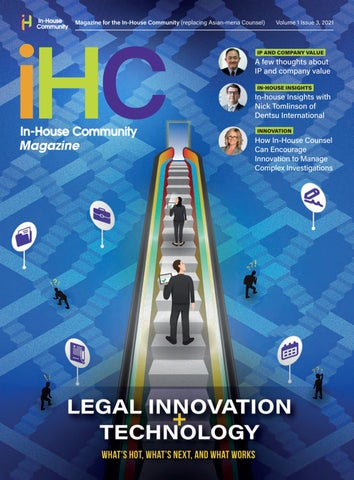
Magazine for the In-House Community (replacing Asian-mena Counsel)
Volume 1 Issue 3, 2021
IP AND COMPANY VALUE
A few thoughts about IP and company value IN-HOUSE INSIGHTS
In-house Insights with Nick Tomlinson of Dentsu International INNOVATION
Magazine
How In-House Counsel Can Encourage Innovation to Manage Complex Investigations
In-House Community Magazine
Online home of the In-House Community
Magazine for the In-House Community
In-House Community events Bi-Monthly eNewsletter with latest news, deals, moves, legal updates, jobs, and more ‒ directly in your inbox
Cutting-edge events to facilitate training, dialogue and change in the corporate legal world
mycareerinlaw.com The best opportunities from top legal recruiters
For advertising opportunities on the above platforms CONTACT US
In-House Community Magazine
Feature contributors
PUBLISHER Rahul Prakash +852 8170 2951 rahul.prakash@ inhousecommunity.com LEAD DESIGNER Ailar Arak EDITOR Nathan Smith WRITER Butch Bacaoco Published 10 times annually by InHouse Community Ltd. Publishers of • In-House Community Magazine • IHC Briefing Organisers of the • IHC Events Hosts of • www.inhousecommunity.com • www.mycareerinlaw.com Forums for the In-House Community Opinions expressed herein do not constitute legal advice, and do not necessarily reflect the views of the publishers. © 2021 InHouse Community Limited and contributors.
Ron Yu
Ron Yu teaches or taught intellectual property law and Fintech at the Chinese University of Hong Kong (where he also does research), the University of Hong Kong, and the Hong Kong University of Science and Technology.
Mitch Kowalski
Mitch Kowalski is a globally-recognised thought leader on the changing legal services ecosystem and the author of two critically acclaimed books in this area. Mitch was admitted in 1991 and spent 10 years as an Associate and Partner at Baker & McKenzie (Toronto) and five years of in-house experience at Aoyuan International (Canada), City of Toronto and at Toronto Community Housing Corporation.
Babar Hayat
Babar is the Head of Product, Tech Innovation & Transformation at Konexo. He is responsible for technology management and driving innovation to support the strategic growth ambitions of the business; across the functions and practice areas.
Eoin Gillen
Eoin Gillen was appointed APAC General Counsel for BNP Paribas in December 2020, having spent the last 13 years with the bank in London and Asia. He assumes responsibility for the legal function at BNP Paribas in the region as it continues on a path of technological transformation.
Stephanie Szeto
Stephanie Szeto is head of Peerpoint in Asia, Allen & Overy’s (A&O) global flexible resourcing business, which connects world-leading organisations to the highest quality consultant lawyers in the market. Peerpoint can bring both A&O’s first-class legal expertise and its market-leading alternative legal services to bear in response to client interim needs.
Mark Hill
Mark Hill is a partner and head of commercial, TMT and Intellectual Property Middle East at Charles Russell Speechlys.
Karishma Nair
Karishma leads Vario’s Flexible Legal Services business in Hong Kong, and looks after Vario’s Financial Services practice in Asia.
Carissa Duenas
Carissa Duenas is a marketing consultant and content contributor for Praxonomy, the company behind Boardlogic, a simple, secure platform for boards to manage meetings, share documents, collaborate and execute governance activities. She began her management consulting career at Accenture and has since worked in a consultant capacity for leading organisations in the technology sector and communications space.
Georgia Foster
Georgia Foster is APAC managing director at Relativity, leading a team driving growth across the region. Previously she ran Uber’s corporate division in Australia/New Zealand, and before that was on LinkedIn’s global team.
EDITORIAL GUIDANCE PANEL Carina Wessels Executive: Governance, Legal and Compliance, Alexander Forbes Group Holdings
Carl Watson General Counsel, Arcadis Asia
Navrita Kaur Chief Legal Officer, Omesti Group
Preeti Balwani General Counsel at Hindustan Coca-Cola Beverages
Raymond Goh General Counsel, International of China Tourism Group
Rebecca Hong Managing Counsel, Intel Corporation
Ron Yu University of Hong Kong, Chinese University of Hong Kong, Hong Kong University of Science and Technology
Sally Dyson Director, Firm Sense
Sesto Vecchi Managing Partner, Russin & Vecchi
Stanley Lui APAC Legal Director, TI Fluid Systems Co-Founder, White Hat Guys
Yosr Hamza Director, Legal Counsel, Gartner
PAGE 4
In this issue LEGAL INNOVATION + TECHNOLOGY
6
8
28
The time for innovation in the legal sector … was yesterday
38
An Atrium, LegalTech, In-House Mash Up
41
Is There A Hole In Your Bucket?
43
Leveraging technology and innovation for in-house legal departments
46
Solutions Templating: A new priority for inhouse legal teams
IHC MAGAZINE
50 53
56
Thinking beyond the pandemic with Karishma Nair of Pinsent Mason’s Vario Pre-IPO Firms and Board Portals: Meeting the Challenge of Governance Excellence How In-House Counsel Can Encourage Innovation to Manage Complex Investigations
JURISDICTION UPDATES
6
PHILIPPINES
Financial rehabilitation as a way to survive Covid-19
8
OFF-SHORE UPDATE
Offshore Share Security in Debt Financings to CoInvestment Structures
VOL 1 ISSUE 3, 2021
PAGE 5
In this issue 21
23
THE IHC BRIEFING
IP AND COMPANY VALUE
IN-HOUSE DIRECTORY
12 16 18
NEWS
21
60
MOVES
A few thoughts about IP and company value
DEALS IN-HOUSE INSIGHTS
23 In-house Insights with Nick Tomlinson of Dentsu International
VOL 1 ISSUE 3, 2021
IHC MAGAZINE
JURISDICTION UPDATES
PHILIPPINES
PAGE 6
Financial rehabilitation as a way to survive Covid-19 BY ZYRA G. MONTEFOLCA
F
ollowing the various types of lockdown measures introduced to limit the spread of Covid-19, many corporations had to pause their work or continue only with limited capacity. Small companies especially took significant losses and many were forced to shut to staunch the financial bleeding. However, it is worth noting that the law has options to help save a distressed company. Republic Act No. 10142 (the Financial Rehabilitation and Insolvency Act of 2010, or FRIA) encourages struggling businesses – including sole proprietorships, partnerships, corporations and individual debtors – to undergo rehabilitation. The FRIA does not apply to banks, quasi-banks, insurance companies or pre-need companies, all of which are governed by different laws and regulations. Rehabilitation allows for the continuation of corporate activities as a business is restored to solvency (Wonder Book Corporation IHC MAGAZINE
v. Philippine Bank of Communication, G.R. No. 187316, 2012). The process may be court-supervised (which may either be voluntary or involuntary, depending on the initiator), follow a pre-negotiated plan or use out-of-court or informal proceedings. COURT-SUPERVISED REHABILITATION If a business is unable to pay its obligations, an insolvent debtor may voluntarily begin a rehabilitation proceeding by filing a petition with the court.
The party who can initiate the petition depends on the type of business. For instance, if the company is a sole proprietorship the party will be the owner. If it is a partnership, initiation will require agreement of the majority of the partners. And in stock corporations, the party will be a majority vote of the Board or trustees, authorised by at least a two-thirds vote of the outstanding capital stock (or of the members, in the case of non-stock corporation).
VOL 1 ISSUE 3, 2021
PAGE 7
On the other hand, involuntary court-supervised rehabilitation may be initiated by any creditor or group of creditors with a claim of approximately ₱1 million (US$19,900) or at least 25% of the subscribed capital stock or partners’ contributions, whichever is higher. Involuntary court-supervised rehabilitation may be initiated if a) there is no genuine issue of fact or law on the claims of the petitioner
Despite the pain of Covid-19, remedies like these offer distressed companies a way to survive shuttering.
and the company’s due payments have not been made for at least sixty days or that the debtor has failed generally to meet its liabilities; or b) a different creditor has initiated foreclosure proceedings against the debtor preventing them from paying their debts as they come due. In both instances, a Rehabilitation Plan must be attached to the petition. Such a plan aims to restore the financial viability of an insolvent debtor through debt forgiveness, debt rescheduling, reorganisation, dacion en pago, debt-equity conversion, sale of the business, creating a new entity or other options approved by the court or creditors. PRE-NEGOTIATED REHABILITATION In a pre-negotiated rehabilitation, an insolvent debtor by itself, or with its creditors, may file a court petition for the approval of a pre-negotiated plan.
This plan must have been approved by creditors holding at least two-thirds of the total
VOL 1 ISSUE 3, 2021
PHILIPPINES
JURISDICTION UPDATES
liabilities of the debtor, including secured creditors with more than 50% of the total secured claims of the debtor and unsecured creditors holding more than half of the total unsecured claims of the debtor. INFORMAL RESTRUCTURING AGREEMENT Lastly, an out-of-court or informal restructuring agreement and rehabilitation plan must meet the following minimum requirements. The debtor must a) agree to it, b) it must be approved by creditors representing at least 67% of the secured obligations of the debtor, c) it must be approved by creditors representing at least 75% of the unsecured obligations of the debtor and d) it must be approved by creditors holding at least 85% of the total liabilities – secured and unsecured – of the debtor.
Only when rehabilitation is no longer feasible, despite the appointment of a receiver and a rehabilitation committee, can liquidation of the debtor's assets and the settlement of its obligations begin. Despite the pain of Covid-19, remedies like these offer distressed companies a way to survive shuttering. With careful rehabilitation, a struggling business may find a new lease on life. This article is for informational and educational purposes only. It does not constitute legal advice. This first appeared in Business World, a newspaper of general circulation in the Philippines.
Zyra G. Montefolca zgmontefolca@accralaw.com Zyra G. Montefolca is an associate of the Davao branch of the Angara Abello Concepcion Regala & Cruz Law Offices (ACCRALAW). IHC MAGAZINE
JURISDICTION UPDATES
OFF-SHORE UPDATE
PAGE 8
Offshore Share Security in Debt Financings to Co-Investment Structures BY JAMES WEBB TIFFY WAN DANIEL MOORE
IHC MAGAZINE
VOL 1 ISSUE 3, 2021
PAGE 9
OFF-SHORE UPDATE
JURISDICTION UPDATES
BACKGROUND Complexities arise when arranging financings to co-investment structures, especially if the credit support includes security over shares granted by some (but not all) of the shareholders.
- If the M+A or the SHA contain “drag and tag,” “right of first refusal” or other provisions that impact share transfers, how would these apply to a transfer of shares by the security taker in an enforcement situation?
Examples of these types of transactions include:
DUE DILIGENCE When it comes to due diligence, transactions involving co-investment structures require an enhanced approach.
- a founder or the early shareholders of an emerging company seeking to leverage their individual shareholdings for personal borrowings; and - leveraged co-investments in which an investor secures its shareholding as security for any debt financing. In APAC, Cayman Islands and British Virgin Islands companies are often used as co-investment vehicles due to their flexibility, ease of administration and tax-neutrality. Co-investment vehicles will normally have in place shareholder agreements with bespoke provisions. It is therefore important to be aware of the types of issues that may arise in order to structure these deals successfully. COMMON QUESTIONS Some common questions asked at the structuring stage include:
- What happens if the shareholder providing the share security (the Chargor) is a minority shareholder who does not want disclose the existence of the security to the other shareholders? - How to deal with a situation where the memorandum and articles (M+A) or the shareholder agreement (SHA) restrict the creation or enforcement of share security?
VOL 1 ISSUE 3, 2021
Shareholder provisions It is crucial to carefully review the terms of any SHA and the M+A (the provisions of the former are often transposed into the latter) to identify all restrictions on the creation or enforcement of share security. Shareholder agreements often contain transfer restrictions. The concept of “transfer” is usually widely drafted to catch not only an outright legal transfer of shares (which could affect a transfer to the secured party or a receiver following default) but also a grant of a security interest over shares or any transfer of beneficial ownership. Even if a transfer is permitted, the terms of the SHA usually require a new transferee to accede to the SHA by way of a deed of adherence. There may also be particular conditions an incoming shareholder must meet which the security taker may be unable to satisfy. Secured parties will also need to understand any 'drag and tag', 'right of first refusal' or similar provisions in favour of other shareholders which could impose limitations on marketing and disposal of the secured shares.
IHC MAGAZINE
JURISDICTION UPDATES
OFF-SHORE UPDATE
Routine due diligence Of course, routine transactional due diligence should always be undertaken. This includes confirming ownership of the shares, capacity of the entities to enter into the transaction and grant security, ensuring the due authorisation of relevant signatories for the deal and carrying out customary litigation and commercial registry searches. DOCUMENTATION
Transfer restrictions Any provisions in the M+A or SHA that may restrict the creation or enforcement of the share security must be considered and, if necessary, waived. Depending on the nature of the financing or investment, it may be possible to add carve-outs into the M+A or SHA to permit the share security. It is in the parties' interests to ensure any necessary carve-outs or waivers are obtained at the outset to avoid potential disputes that may be disruptive to the business. Where applicable, carve-outs or waivers should be
IHC MAGAZINE
PAGE 10
made a condition of the financing and appropriate representations should be contained in the transaction documents. In some situations, a minority shareholder may not be in a position to obtain consents, waivers or carve-outs from the other shareholders. If so, the potential security taker should carefully consider its position and risk appetite. Ultimately, the route to realising value from a secured minority shareholding subject to a SHA may involve the security taker selling to another shareholder. Future listing For businesses hoping to list, provisions for the release of the share security upon a qualifying IPO (which will often be a prepayment event under the finance documents) should be considered. Share security documentation We recommend documenting any share security under a local law share security agreement drafted by offshore counsel. It is customary for the following suite of signed, undated deliverables to be provided to assist the secured party
VOL 1 ISSUE 3, 2021
PAGE 11
OFF-SHORE UPDATE
JURISDICTION UPDATES
in transferring the shares (typically to a receiver or its nominee) on enforcement:
not want other shareholders discovering the security and related financing arrangements).
- share transfer form (with any share certificates); - proxy and power of attorney in favour of the secured party (to allow the secured party to vote the shares on enforcement); - director resignation letters (to allow the secured party to appoint its own directors on enforcement); and - undertakings from the charged company and its registered office provider to register a transfer of shares on enforcement.
CONCLUSION The corporate landscape in Asia is always evolving. Lenders and investors who can understand, structure and evaluate complex offshore shareholding and co-investment structures will be well-placed to offer financing to and develop valuable early relationships with early-stage ventures.
However, where a minority shareholding is being secured, the scope of deliverables will often be reduced to a share transfer form, share certificate (if applicable), director resignations only for directors appointed by that shareholder and a proxy, as a minority shareholder will normally be unable to procure the other items from the company (eg resignation letters from any directors appointed by other shareholders). While not insurmountable, the absence of a full suite of deliverables may make complicate the process of registering the transfer of shares on enforcement, particularly if the company or registered office provider (who maintains the register of members and whose co-operation is necessary to reflect a share transfer) is not co-operative. Registrations Lenders will normally require customary registrations in connection with the share security. These can include an annotation of the register of members of the secured company noting the existence of the security. Parties should also be aware that corporate registry filings may be publicly searchable. However, an annotated private register of members is not usually required to be publicly filed and creating the annotation is negotiable (particularly if a minority shareholder does
VOL 1 ISSUE 3, 2021
Experienced offshore counsel can add significant value by providing commercial and pragmatic advice to allow parties to get deals done while managing risk.
James Webb james.webb@careyolsen.com +852 3628 9012 is a partner at Carey Olsen Hong Kong LLP. James specialises in Cayman Islands, Bermuda and British Virgin Islands (BVI) law and advises on a wide range of corporate and financing transactions. Tiffy Wan tiffy.wan@careyolsen.com +852 3628 9021 Tiffy Wan is a senior associate in at Carey Olsen Hong Kong LLP where she advises Asia and PRC-based clients on offshore corporate transactional matters. Daniel Moore daniel.moore@careyolsen.com +852 3628 9022 Daniel Moore is counsel at Carey Olsen Hong Kong LLP and has a general debt finance background with experience in secured and unsecured commercial lending, pre-IPO financings, margin lending, real estate and acquisition finance transactions.
IHC MAGAZINE
THE IHC BRIEFING
PAGE 12
NEWS
HFW and CyberOwl join forces to help shipping industry manage cyber risk HFW and maritime cybersecurity company CyberOwl will together provide comprehensive technology and legal services to the shipping industry in cyber risk management and compliance. HFW’s shipping lawyers and CyberOwl’s team of data and security experts will collaborate to help the maritime sector prevent and actively defend against commercial, legal, technical and operational risks. It will include reviews of vessel cybersecurity seaworthiness, cybersecurity monitoring and related legal and consulting advice. The new venture complements HFW’s existing cybersecurity advice to clients, as part of its standalone consulting business, HFW Consulting. “Cybersecurity is a growing concern for the global shipping industry as it moves towards digitalisation creating new vulnerabilities. On top of this, IMO 2021. This will introduced a regulatory requirement for owners to demonstrate that their cyber policies are effectively implemented,” said HFW global head of shipping Paul Dean. “Traditional cybersecurity systems are not designed to overcome the unique technical, operational and commercial challenges of shipping, such as the need to demonstrate due diligence in ensuring seaworthiness and cargoworthiness, to minimise disagreements about liabilities after a cyberattack.
IHC MAGAZINE
“We are partnering with CyberOwl’s security experts who share the deep shipping industry expertise on which we pride ourselves at HFW,” Dean added. CyberOwl chief executive Daniel Ng said the company is leveraging data and analytics to shift shipping organisations towards a more active cyber posture and help them prove their cybersecurity controls are working. “We have engaged with 100 vessel owners and managers to understand their challenges. They have expressed a real lack of confidence that the steps they take to comply with IMO 2021 will help them defend themselves technically, operationally, commercially and legally in the eventuality of a cyberattack, and to prove that due diligence was exercised to ensure vessel seaworthiness and cargoworthiness. “Working with HFW will let us provide clients with a broader offering, combining first-rate legal and technology services. We see this as a unique proposition. Other cyber services providers are mainly focused on IMO 2021 compliance, but we can help the industry actively manage and mitigate its cyber risks,” Ng said HFW’s global shipping team includes 200 specialist lawyers and Master Mariners across the Americas, Europe, the Middle East and Asia Pacific, advising clients on a range of dry shipping, admiralty and crisis management and transactional matters.
VOL 1 ISSUE 3, 2021
PAGE 13
THE IHC BRIEFING
NEWS
Kennedys opens new office in Oman
Global law firm Kennedys has opened a new office in Muscat, Oman. The chosen location is in response to client demand for a presence in Oman and will make Kennedys the only international insurance-focused law firm in the Sultanate. The new office will be headed up by insurance, construction and disputes partner Jamie Kellick, who joined the firm’s Dubai office in September 2019 from Addleshaw Goddard. Kellick is joined by Nasser Al Shamli of Nasser Ali Shamli, Advocates & Legal Consultants (NASLAW), Kennedys’ associate firm in Oman. Kennedys said Kellick has strong relationships with local Omani companies. The country conducts high level business with the UAE and India, where Kennedys already has a strong presence, in the form of an established office and co-operation with local firm Tuli & Co, respectively. Kellick's expertise in dispute resolution means Kennedys can build a local litigation
VOL 1 ISSUE 3, 2021
capability in Oman, as it has done in Dubai after the firm opened in 2006. Similarly, Al Shamli is a licensed practitioner with the Oman Ministry of Justice and Legal Affairs with full audience rights before Omani Primary Courts and the Administrative Courts (Primary Circuits). Al Shamli has extensive commercial litigation and arbitration experience in Omani law disputes over the last six years in private practice. He has advised and represented clients in contentious energy, aviation and construction-related matters, shareholder disputes and labour law issues. Kennedys senior partner Nick Thomas said the Oman office is part of the firm’s commitment to its global strategy of growing international capabilities. “There are presently no other international insurance firms in Oman, and we are seeing an increase in client demand, as the country’s economy continues to diversify and develop. Our Dubai office has increased its litigation capability in recent years, and we are now looking to replicate that success in Muscat,” Thomas said. Kellick added that Oman is transforming itself into a modern regional economic centre. “With growth in government, private and foreign direct investment, there are considerable opportunities. Our presence in the region will be a significant benefit to our existing client base, as well as those new clients who want to work with Kennedys," Kellick said. “It’s an exciting time to be opening an office in and bringing a new offering to the Sultanate.”
IHC MAGAZINE
THE IHC BRIEFING
PAGE 14
NEWS
Mayer Brown adds eight lawyers to its HK Corporate & Securities practice Chicago-based law firm Mayer Brown has added four new capital markets partners to its Corporate & Securities practice in Hong Kong, along with four lawyers. Guiping Lu and Philip Hyde (both previously at K&L Gates) will lead the firm’s debt capital markets team while Bonnie Yung and Jason Wang (both previously at Paul Hastings and LC Lawyers LLP) will head up the Mayer Brown equity capital markets team. Guiping Lu’s practice is primarily focused on international debt capital markets transactions. He has built a strong debt capital markets practice representing Chinese investment banks on Regulation S investment-grade bond offerings with different credit enhancement structures and liability management transactions. He also advises on high-yield bond offerings. Philip Hyde is an accomplished lawyer with 25 years’ experience advising on a range of debt capital markets, structured finance, derivatives and securitisation transactions. He has a particular focus on advising trustees on all aspects of transactions, from their initial appointment on new issues, their ongoing obligations throughout the term of the transaction, restructurings or amendments to actions following a default. Bonnie Yung is known for her work advising on numerous IPO deals filed with the Stock Exchange of Hong Kong including both Reg S and Rule 144A international offerings, representing international and Mainland Chinese investment banks in Hong Kong along with issuers from a variety of industry sectors. IHC MAGAZINE
She also acts for clients on transactions under the governance of the Hong Kong Listing Rules and Takeovers Code. Jason Wang has extensive experience acting on Hong Kong IPO deals, large-scale cross-border mergers and acquisitions, private equity investments, post-IPO fundraising and corporate compliance matters in relation to Hong Kong listed companies. Wang has represented many Mainland Chinese enterprises and also international and Mainland Chinese investment banks in a number of Hong Kong IPOs. Mayer Brown Corporate & Securities partner Jason Elder said picking the right legal minds for the roles was critical since the firm’s international and China institutional client base in Hong Kong continues to demand deep expertise in Hong Kong, English and New York law governed capital markets products. “Guiping, Philip, Bonnie and Jason add significant bench strength to our existing debt and equity capital markets offering,” Elder said. Mayer Brown senior partner in Asia Terence Tung added the firm will continue to invest in capital markets. “Our new partners and their team have joined us at an exciting time. Their extensive experience will enable us to build upon the success of our Corporate & Securities practice,” Tung said. The latest hiring announcement followed a recent addition of Oil & Gas partner Joanne Du from Baker Botts to Mayer Brown’s Corporate & Securities practice in Hong Kong. Mayer Brown is a global law firm with 200 lawyers spread across offices in New York, London and Hong Kong advising companies and financial institutions on complex deals and disputes. VOL 1 ISSUE 3, 2021
PAGE 15
THE IHC BRIEFING
NEWS
Pinsent Masons aims to halve its carbon emissions by the year 2030 Global law firm Pinsent Masons has chosen 2030 as the target for cutting its absolute carbon emissions by a minimum of 50%. In addition, the firm also plans to source 100% renewable electricity across its global assets by 2030. The targets are backed by the Science Based Targets initiative (SBTi), which is a collaboration between Carbon Disclosure Project (CDP), the United Nations Global Compact, World Resources Institute (WRI) and the Worldwide Fund for Nature (WWF). This non-profit collaboration defines and promotes best practice in science-based target setting and independently assesses companies’ carbon emissions reduction targets. Pinsent Masons managing partner John Cleland said setting targets to reduce the company's emissions was a “natural next step” for a firm that regularly advises clients on low carbon projects. “We recognise that operating 26 offices in a global network has significant environmental implications and want to implement real, tangible changes that have a positive impact. This helps us focus our efforts to achieve this,” Cleland said. To calculate its global carbon footprint, the firm undertook a 12-month audit of its entire greenhouse gas inventory. In the last five years, the firm has reduced its energy consumption by 30%, shrunk its office space by over 100,000 square feet and
VOL 1 ISSUE 3, 2021
cut air travel by 10% – even creating “no-travel weeks” for all staff. Pinsent Masons senior partner Richard Foley said the firm has adapted to become a “purpose-led organisation” and has set four key metrics to assess its performance. “These metrics represent what is truly meaningful to our stakeholders and that helps us to focus on bettering ourselves as a purpose-led organisation. During a particularly challenging year we’ve continued to focus on and measure ourselves against these metrics and we will continue to do so as we strive to improve,” Foley said. In 2020, Pinsent Masons launched its Climate Change Mitigation & Sustainability platform to coordinate internal and marketfacing climate change initiatives and reduce the firm’s environmental impacts, to support clients and work with third parties to influence positive change. The firm is also a member of the Net Zero Alliance. The 22 global law firms that are members of the alliance are committed to achieving net zero emissions by 2050, while also setting interim targets to reduce their operational emissions by at least 50% by 2030, against 2019 levels. Pinsent, which employs nearly 3600 people globally, including around 1500 lawyers and 400 partners, said it turned over £503.3 million (US$693.83 million) in the year to April – up 1.5% from £495.9m in the previous 12 months. Profits per partner across office locations also rose by 16% to £636,000.
IHC MAGAZINE
THE IHC BRIEFING
PAGE 16
MOVES K&L Gates has added Eugene Yeung as a partner in the firm’s Hong Kong finance practice. He joins from Pillsbury Winthrop Shaw Pittman. Qualified in Hong Kong, Australia, New York and England and Wales, Yeung focuses on aviation finance and restructuring and insolvency in Asia. He regularly acts for financial lenders, aircraft owners, airlines and ultra high-net-worth individuals on regional and local commercial transactions within the aviation sector, including aviation finance, restructuring, bankruptcy and insolvency and investments and general corporate advisory matters. White & Case has added Rahul Guptan as partner to its global capital markets practice and India country group in Singapore. Guptan advises Indian and international companies, along with investment banks and private equity firms, on transactions involving equity and debt capital markets, M&A, private equity and regulatory matters. He joins from Clifford Chance, where he was a partner and co-head of the Global India Group. He has strong, longstanding relationships with key stakeholders in India, Singapore and Hong Kong and a deep understanding of the Indian market. Chandler MHM has added Visitsak Arunsuratpakdee as a partner. He focuses his practice on administrative law litigation, technology, media and telecommunications, particularly personal data protection, M&A, taxation and corporate commercial matters. He has advised both foreign and Thai multinational
IHC MAGAZINE
clients on regulatory compliance and represented them in a range of matters across industries. He has more than 17 years’ experience and is a graduate of King’s College London. Goodwin has added Edwin Chan as partner to its global private equity practice in Hong Kong. Chan brings a proven track record, deep expertise in the Asia-Pacific region and trusted relationships across the private equity industry. His practice focuses on private equity transactions, investment restructuring and exits, including cross-border and domestic M&A, joint ventures, growth capital and pre-IPO investments. He has advised many leading financial sponsors through the life cycle of their investments across the region.
Mayer Brown has added Joanne Du as a partner. Du will divide her time between the Hong Kong, Beijing and Shanghai offices under the globally integrated oil and gas industry team. Previously a partner at Baker Botts, Du advises international and Chinese oil and gas companies, as well as other China-based
VOL 1 ISSUE 3, 2021
PAGE 17
THE IHC BRIEFING
MOVES corporations and state-owned institutions, on their domestic and cross-border energy transactions. Du’s work includes advice and assistance on bids and the tendering process, investment assessment and strategy, due diligence reviews, joint ventures and joint operations, asset or share acquisitions, investment and operation compliance, gas sales and distribution. She is a registered foreign lawyer in Hong Kong and is admitted to practice in New York. Baker McKenzie has added Cécile Baume as a US securities law partner in its corporate team in Sydney. She joins from Allen & Overy. Baume has built a large corporate finance practice, representing Australian and New Zealand issuers, investment banks, private equity sponsors and governments on US and international capital markets transactions. Her practice extends to corporate advisory, including general US securities laws and corporate advice on corporate domestic transactions, cross-border M&A and stock exchange listings. Baker McKenzie has also added leading capital markets and M&A partner Victoria Lloyd to its Hong Kong office. She joins from Ropes & Gray, where she was a partner of the strategic transactions group. Lloyd has over 25 years’ experience advising major Chinese and multinational corporations, investments banks and private equity investors on a wide range of corporate and commercial, corporate finance and M&A matters. Lloyd is a member of the Takeovers and Mergers Panel, the Takeovers Appeals Committee of the Hong Kong Securities and Futures Commission
VOL 1 ISSUE 3, 2021
and the Listing Committee of the Hong Kong Stock Exchange. King & Wood Mallesons has added Corey Zhang to the Hong Kong partnership. Zhang has over a decade of experience advising issuers and underwriters on a range of equity and debt capital markets transactions, including Hong Kong IPOs, London global depositary receipt offerings and Rule 144A and Regulation S debt offerings. He is native in Mandarin and fluent in English and Cantonese. His clients include Chinese and international investment banks, and corporates across various industries, including financial services, technology, healthcare, consumer goods, industrials, real estate and energy. Zhang is well regarded by the investment banking and corporate communities for his strong execution skills, deep client commitment and close Chinese cultural affinity. Simmons & Simmons has added Sonia Lim as a partner in the financial markets team. Lim joins from Linklaters, where she led the growth and development of its Singapore/Southeast Asia derivatives and structured product practice. Prior to that, she was a managing director at JPMorgan, and led its Asia-Pacific regulatory team. She specialises in structured finance and derivatives (SFD), with a focus on financial regulatory and advisory matters. Lim brings over 20 years’ experience in providing legal and regulatory advice to the financial derivatives markets and structuring complex SFD transactions. She primarily advises APAC and global financial institutions on both English law and Singaporean law related issues.
IHC MAGAZINE
THE IHC BRIEFING
PAGE 18
DEALS Allen & Gledhill has advised Bayfront Infrastructure Capital II, a wholly-owned subsidiary of Bayfront Infrastructure Management (BIM), on the issue of five classes of investment-grade rated notes, comprising US$176.9 million Class A1 senior secured floating rate notes due 2044, US$120m Class A1-SU senior secured floating rate notes due 2044, US$33.3m Class B senior secured floating rate notes due 2044, US$22.1m Class C senior secured floating rate notes due 2044, and US$8.8m subordinated notes due 2044. The notes were offered to institutional investors and are listed in Singapore. The US$401.2m portfolio of 27 project and infrastructure loans is diversified across 13 countries and eight industry sub-sectors. Partners Yeo Wico, Jeanne Ong, Andrew Chan, Jo Tay and Sunit Chhabra led the firm’s team in the transaction. AZB & Partners has advised The Hongkong and Shanghai Banking Corporation Singapore Branch, BNP Paribas, Credit Suisse (Hong Kong) and Merrill Lynch (Singapore), as the initial purchasers, on the issue by Wipro IT Services, of 1.5% senior notes due 2026, aggregating to Rs55.6 billion (US$748.6m). The notes are guaranteed by Wipro. Partners Srinath Dasari and Varoon Chandra led the firm’s team in the transaction, which was completed on June 24. Clifford Chance has advised Morgan Stanley, CLSA and other underwriters on biotech company Zylox-Tonbridge Medical Technology’s US$330m IPO and listing in Hong Kong. The public offering tranche of the IPO was oversubscribed by 1190 times. China-based
IHC MAGAZINE
Zylox-Tonbridge provides interventional medical devices for treating neurological and peripheral-vascular diseases, which accounted for over 20% of China’s total mortality in 2019. Hong Kong and Beijing partners Fang Liu and Tianning Xiang led the firm’s team in the transaction. Davis Polk has advised the initial purchasers on a debut Regulation S offering by Leading Holdings Group of US$150m 12% senior notes due 2022. Hong Kong-listed Leading Holdings Group is a property developer dealing with the Sichuan-based property developers and across China. Partners Gerhard Radtke and Yang Chu led the firm’s team in the transaction. Gide has advised Chinese fashion brand ICICLE on the creation of ICCF Group (Icicle Carven China France), uniting ICICLE and the Parisian fashion house CARVEN, which has been owned by ICICLE since 2018. The ICCF Group reflects the original collaboration between France and China and connect the two brands, ICICLE and CARVEN, from natural material expertise to production facilities and multicultural artistic teams. Shanghai partner Fan Jiannian, supported by partners Arnaud Michel, Bertrand Oldra and Foulques de Rostolan, led the Gide team. K Law has advised Axis Bank, the sole financial creditor in the Committee of Creditors of SVIIT Software. Parmjit Gandhi was the successful resolution applicant and an application was filed for approval of the resolution plan, which was allowed by the Principal Bench, National Company Law Tribunal in its order dated May 31. Axis Bank is set to receive
VOL 1 ISSUE 3, 2021
PAGE 19
THE IHC BRIEFING
DEALS Rs351.5 million (US$4.7m) against an admitted claim of Rs592.3 million (US$8m). Aditi Mittal led the K Law team. The resolution professional and PWC, the resolution advisor, was represented by Khaitan & Co. Khaitan & Co has advised O(1) India, its founders and angel investors on the sale of their respective shareholding in Shop101 to Glance InMobi, a subsidiary of InMobi Group and a portfolio company of Google. The Shop101 team, including founders Abhinav Jain, Aditya Gupta and Kalpak Chajjed, will continue working in O(1) India and power social commerce efforts of Glance, through Glance and Roposo platforms. The transaction also provided an exit, via cash and equity, to O(1) India existing investors Kalaari Capital Partners III, Vy Fund I, Stellaris Venture Partners India I and Unilever
Ventures Holdings. Partner Surbhi Kejriwal led the firm’s team in the transaction. Kochhar & Company advised Glance InMobi, while Indus Law advised the investors. L&L Partners has advised US-based private equity firm Center Rock Capital Partners on its acquisition of companies engaged in engineering services, field services and parts manufacturing in the US and India. The firm assisted in the Indian leg of the transaction, which was structured as an all-cash deal, preceded by internal restructuring. This acquisition will help Center Rock enhance its presence in the Indian industrial sector. Partner Shinoj Koshy, supported by partner Lokesh Shah, led the L&L team. White & Brief has advised STUP Consultants and its promoters and STUP Design Forum (SDF) and its proprietor on the Rs1.94 billion (US$26m) sale of 99% equity shares by the promoters of STUP Consultants to Assystem France and the subsequent transfer of the business of SDF to STUP Consultants. Senior partner Manu Varghese led the firm’s team in the transaction. WongPartnership has acted for JPMorgan on its joint venture with DBS and Temasek to create a new blockchain-based platform for payments, trade and foreign exchange settlement. The company, Partior, will use blockchain technology and digitise commercial bank money to reduce frictions and time delays in crossborder payments, trade and currency settlements. Partner Chan Sing Yee led the firm’s team in the transaction, along with partners Ameera Ashraf, Tan Shao Tong and Chan Jia Hui.
VOL 1 ISSUE 3, 2021
IHC MAGAZINE
THE IHC BRIEFING
Ashurst advises Sojitz on buying a stake in Singapore graphene start-up Global law firm Ashurst represented Japanese trading house Sojitz on buying an equity stake in 2D Materials Pte. Ltd. (2DM), a Singapore-based manufacturer of graphene products. The Ashurst team was led by partners Michelle Phang (Singapore) and Tracy Whiriskey (Tokyo). They were supported by senior associates Vanessa Teo (Singapore), Daniel Yip (Singapore), Jessika Colthurst (Tokyo), associates Alex McLeish (Tokyo) and Shojeeb Alam (Tokyo/Melbourne). Ashurst is one of Sojitz’s in-house advisors for deals and legal matters in several countries and lead partner for the transaction Michelle Phang said Ashurst was “delighted” to support Sojitz on its latest strategic investment. Sojitz client relationship partner Tracy Whiriskey added that Japanese corporates are searching for high-growth, early-stage start-ups. Although the investment sum and other terms were not disclosed, Sojitz said the new capital will help the company commercialise the technology. Graphene is a nano carbon material with a mesh-like sheet of hexagonal carbon atoms in a honeycomb structure that resembles the
IHC MAGAZINE
PAGE 20
cross section of a beehive. It is highly conductive, atomically thin, lightweight, flexible, transparent and as strong as a diamond. Based on these properties, one application for graphene is as an industrial additive for electronic components, aluminium, or plastic products to increase conductivity, durability and product function. Graphene is also proving to be a sustainable alternative material. For instance, it enables closed-loop plastic processing and it enhances the capacity and charging speed of lithium ion batteries. But the material is costly and difficult to manufacture. Revenues across the industry remain low to modest and profitability is almost non-existent outside of a few leaders. Sojitz said 2DM can produce high-quality graphene that can be sold at a lower price than its industrial rivals. The company plans to use its global network of 5000 partner companies in the chemicals industry, along with its sales and procurement networks, to promote the practical application of 2DM’s graphene. Sojitz has over US$20 billion of assets across a number of sectors, including 40 power projects in 10 countries. 2DM is a spinoff from the National University of Singapore’s Centre of Advanced 2D Materials, a top two-dimensional materials research institute. In July, Brazilian steelmaker Companhia Siderurgica Nacional (CSN) also invested an undisclosed sum in 2DM via its innovation arm CSN Inova. Earlier this year, Ashurst represented Sojitz on its strategic investment in a leading Asia Pacific primary healthcare and wellness services provider Qualitas Medical Limited. The firm also advised the Japan-based company on its 20% equity stake in Mirfa International Power and Water Company (MIPCO).
VOL 1 ISSUE 3, 2021
PAGE 21
IP AND COMPANY VALUE
A few thoughts about IP and company value BY RON YU
A
s the value of intellectual property (IP) becomes an important part of many company’s valuation, interest grows in how IP can affect a company’s share price or ability to attract financing. If a company’s value is connected to its IP, its loss can result in stock price changes. For example, shares for drug companies Moderna and Pfizer dropped after US President Joe Biden voiced support for waiving patent protections on Covid-19 vaccines. Another example of IP impacting a company’s value is when a firm acquires another for its IP, as when Amazon bought MGM Studios for US$8.45 billion to gain access to its movie catalog.
VOL 1 ISSUE 3, 2021
A CONVOLUTED CONNECTION However, establishing a connection between IP and valuation is not straightforward given the myriad legal, business, environmental and technical factors influencing the value of IP and thus the value of the whole company.
Businesses and academics have studied prosecution data and other statistics to better understand the connection between valuations and patents. A growing number are questioning the common wisdom that patent volume is a good proxy of a company’s innovation. Not surprisingly, a cottage industry of service providers are now analysing company
IHC MAGAZINE
IP AND COMPANY VALUE
CONTINUED
PAGE 22
patents and following patent grants to predict technology or product trends.
than taking a scattershot approach, dabbling in many technological areas but mastering none.
But patent-focused analysis tends to be relevant only to those involved in technical industries who rely on patents to protect their IP, such as IT, biotechnology and the like.
They believe that watching how a company supplements its technological focus in patents with other IP rights, notably trademarks, is a better clue to its internal coordination and the management team’s ability to grow the business. These academics are building an index on technology companies to monitor these activities.
IS IT THE COMBINATION THAT COUNTS? A small number of academics, and even two legally-trained professionals in Hong Kong, note that gross figures (the total numbers of patents owned by a company) offers an incomplete picture about whether management can effectively use IP rights to grow a company’s value. They note that focusing on a particular innovation area can be far more successful
IHC MAGAZINE
Ron Yu Ron Yu teaches or taught intellectual property law and Fintech at the Chinese University of Hong Kong (where he also does research), the University of Hong Kong, and the Hong Kong University of Science and Technology.
VOL 1 ISSUE 3, 2021
PAGE 23
IN-HOUSE INSIGHTS
In-house Insights with Nick Tomlinson of Dentsu International TELL US A BIT ABOUT YOUR BACKGROUND AND YOUR CURRENT ROLE AS GLOBAL DIRECTOR OF ETHICS AND COMPLIANCE, AND GENERAL COUNSEL, ASIA PACIFIC, AT DENTSU INTERNATIONAL I began my legal career in the litigation department of New Zealand law firm Bell Gully, working primarily on competition matters and market access regulatory issues, particularly in the pharmaceuticals, telecoms and energy markets. I progressed into an in-house role at the company that is now Vodafone NZ, which was then a client of Bell Gully. I left New Zealand in 1997, spent some time in Canada, then relocated to Hong Kong in 1998. I joined Hong Kong Telecom and was with that group under various ownership for 10 years.
In 2008, I took some time out to entertain an alternative career in the restaurant business and trained at Le Cordon Bleu in Paris. Following the global financial crisis in 2008, I joined Aegis Group plc in 2009 and I’ve been here ever since. In 2013, Dentsu acquired Aegis Group plc and formed Dentsu International, one of the largest advertising groups in the world.
VOL 1 ISSUE 3, 2021
Nick Tomlinson is the Global Director of Ethics and Compliance and General Counsel, Asia Pacific for Dentsu International, one of the world’s largest marketing and advertising groups. Nick is a New Zealander who started his legal career at Bell Gully, New Zealand’s largest law firm. In total, Nick has been working in Asia for more than 20 years.
IHC MAGAZINE
IN-HOUSE INSIGHTS
CONTINUED
Q: HOW BIG IS YOUR TEAM AND HOW IS IT STRUCTURED? As the general counsel for Asia Pacific (excluding Japan), I run a team of more than 40 lawyers, data and compliance professionals. This team is managed through senior lawyers who directly report to me. The remit is primarily focused on five main areas: mergers & acquisitions, commercial client & supplier work, data & privacy, compliance and management of the legal and compliance team.
In March 2021, in addition to the Asia Pacific role, I took on the challenge of leading the global Ethics and Compliance function of Dentsu International including the other two regions, EMEA (Europe, the Middle East and Africa) and the Americas for ethics and compliance matters.
PAGE 24
Q: WHAT ARE THE BIGGEST CHALLENGES FACING IN-HOUSE LAWYERS TODAY? The biggest challenges come from two opposing forces: expanding levels of business risk – including legal, regulatory, corporate and, increasingly, consumer perception risk – competing with resource demands for legal services that are better, faster, more in tune with the business and cheaper. Satisfying these contradictory forces requires rethinking what a legal and compliance function should and should not do. No longer can legal teams solely focus on contracts and corporate governance, they must also understand the challenges facing their businesses and help deliver sustainable growth. Equally, business teams must be educated away from compartmentalising legal and compliance into the contracts and governance department, and become active partners in managing overall business risk. Striking an appropriate balance is the art of building a great in-house team that is appreciated by the business and motivating for its legal and compliance professionals. Q: DID YOU HAVE A MENTOR EARLY IN YOUR CAREER? IS MENTORSHIP IMPORTANT? I was lucky enough to have strong mentors throughout my career. Early on, my mentor and supervising partner at Bell Gully instilled in me a passion for precision and excellence in legal writing and decision-making in areas of law that were novel and untested at the time. I also had the privilege of working with strong mentors both in legal and non-legal leadership roles who taught me how companies operate (both the good and the bad), how to maximise opportunities for growth and minimise or mitigate business and legal risk. Some of the most important lessons were in how to approach managing the legal function of a company – how to be respectful to the needs of the business but at the same
IHC MAGAZINE
VOL 1 ISSUE 3, 2021
PAGE 25
time courageous enough to make a real difference to the risk profile. Mentorship is crucial throughout a career and I commend my senior colleagues, if they are not already doing so, to search for opportunities to become a mentor. Q: WHAT ARE THE BIGGEST CHALLENGES SPECIFIC TO YOUR INDUSTRY? The advertising industry has been profoundly re-shaped by mobile and online technologies, social media and other aspects of the Big Tech revolution. Concentration of supplier power has never been more acute. Decreasing trust between consumers and technology presents challenges for data governance, compliance and sustainability. Conversely, many brands have never had stronger relationships with their consumers due to technology’s power to match people with their interests. Harnessing and managing that power requires unprecedented understanding of insights from data. Accordingly, while many of advertising's important roles, such as creative directors, would be familiar to those in the Mad Men era, the many new roles require as much science as art. Q: HOW IS TECHNOLOGY CHANGING THE WAY YOU WORK? It’s somewhat of a cliché to mention the swing to remote working we all experienced through the Covid-19 pandemic. Fortunately, Dentsu International had already invested in desktop video and security technologies, so working from home was virtually seamless.
However, this revolution in work has taken a toll. It is easy to look up from the laptop and realise a 14-hour day flew by. The number one management challenge for the first part of this decade will be re-aligning work that remains as productive as we’ve become accustomed to expect, without burning people out.
VOL 1 ISSUE 3, 2021
CONTINUED
IN-HOUSE INSIGHTS
Q: WHAT DO YOU MOST LOOK FOR IN A LAW FIRM WHEN OUTSOURCING WORK? First, the expertise and excellence I look for must be additive to the expertise of our own team. Second, the partners and teams with whom we work must be responsive and engaged – egos should be checked at the door. The whole arena of alternative legal provision is an exciting trend. Combining lower cost services, better charging structures and the smart use of technology is highly compelling. I’m interested in changes and trends across the board — from innovating traditional law firms and new alternative legal providers to technology-based solutions. I’m also encouraged by the move away from traditional hourly billing towards taskedbased billing. Firms adopting a mixture of alternative legal service provision, technology and insight are the most interesting. Q: OTHER THAN LAW FIRMS, WHAT OTHER SERVICES AND TOOLS HELP YOUR LEGAL DEPARTMENT THE MOST? We are presently evaluating legal management tools and platforms, and in my compliance role we are considering solutions to help us with incident management, data capture and insight generation. Generally in daily workflows, my colleagues and I capture as much as we can through platforms and technology solutions, and push away from emails, docs and spreadsheets.
In APAC we are also working with a technology partner, ThoughtRiver, to help us triage thirdparty contracts based on our playbooks by using AI and machine learning. This has been especially helpful when working with English language contracts in many markets where English is not the first language.
IHC MAGAZINE
IN-HOUSE INSIGHTS
CONTINUED
PAGE 26
expertise capable of advising strategically and being highly tuned to business risk. The challenge for the profession is in development and training for legal and compliance professionals while facing pressure to optimise for delivery. Equally, professionals must be given time and space to acquire the right knowledge and experience to manage sophisticated risks and provide the strategic advice companies need.
Q: WHAT ASPECTS OF YOUR IN-HOUSE ROLE DO YOU MOST ENJOY? Making a tangible difference is most rewarding. It is very satisfying when major projects are delivered, whether they are acquisitions, new business development, population-wide training, influencing the Board to adopt risk mitigation strategies, or other aspects.
Developing my team is vital to success and I take a lot of pride in how many of the lawyers and compliance professionals in my team have grown into seasoned leaders in their own right. Q: WHAT CHANGES DO YOU FORESEE IN HOW LEGAL SERVICES WILL BE PROVIDED IN THE COMING FEW YEARS? I think legal services provision will likely bifurcate into managing throughput of similar legal and compliance outputs (such as contracts, regulatory documents, compliance assessments etc.) and sophisticated and strategic legal advice to foster business growth and risk management. The first area will require teams, tools and technologies optimised for sustainable delivery. The second will require IHC MAGAZINE
Q: WHAT ADVICE WOULD YOU GIVE TO YOUNG LAWYERS STARTING OUT IN THEIR CAREERS TODAY? All young lawyers should first learn their craft. Finding a good mentor early in your career is vital. Precision in legal writing and thought should be a priority at the outset. I would be less focused on climbing the ladder too soon. Having the right foundation pays dividends over your career.
The second piece of advice is that courage and integrity are everything for in-house lawyers. These can be hard qualities to maintain in the face of business pressures but are absolutely key. Many companies have foundered when company officers lack the strength to avoid or mitigate predictable risks due to expedience or a focus on short term returns. Q: WHAT IS YOUR HINTERLAND (WHAT DO YOU MOST LIKE TO DO AWAY FROM WORK)? Away from work, I am an enthusiastic but mediocre cyclist and triathlete. I enjoy travelling and setting myself personal challenges, including Ironman 70.3 races in Indonesia, Vietnam and China, climbing Wuling in Taiwan and Mont Ventoux in France by bike (pictured) and participating in the largest cycling sportive in the world, L’Etape du Tour in the Alps in France. My other interests are in cooking and wine and spending time with my family. Making hot cross buns with our girls was a real pandemic treat! VOL 1 ISSUE 3, 2021
28
The time for innovation in the legal sector … was yesterday
46
Solutions Templating: A new priority for in-house legal teams
38
An Atrium, Legal-Tech, In-House Mash Up
50
41
Is There A Hole In Your Bucket?
Thinking beyond the pandemic with Karishma Nair of Pinsent Mason’s Vario
43
Leveraging technology and innovation for in-house legal departments
53
Pre-IPO Firms and Board Portals: Meeting the Challenge of Governance Excellence
54
How In-House Counsel Can Encourage Innovation to Manage Complex Investigations
FEATURE STORY
PAGE 28
The time for innovation in the legal sector … was yesterday BY NATHAN SMITH
F
or the last decade, the phrase “digital disruption” has loomed like a spectre over many industries, but the legal world seemed to mostly escape technical innovation. It’s not as though lawyers are still using paper notepads and quill pens. They have deployed the Microsoft software suite and other IT software just like every other sector. But aside from a handful of intriguing apps, the sector hasn’t really experienced the “digital disruption” that sowed chaos through the rest of the economy. Lawyers are quietly happy about dodging the disruption. After all, no one enjoys being made redundant, especially by a machine. But there’s always some satisfaction in deploying a digital tool that makes the workday faster and boosts productivity. The sector can hide, but changes are coming. Imminent technological advances will bring benefits to clients in the form of lower prices and greater ease of use of legal services, along with increased access to justice. But they may also herald tough times for firms as they square up to the challenge.
IHC MAGAZINE
According to the Altman Weil 2020 Law Firms in Transition survey, 62% of law firms now include innovation initiatives in their strategic plan while 60% have created special projects to test ideas.
According to the Altman Weil 2020 Law Firms in Transition survey, 62% of law firms now include innovation initiatives in their strategic plan while 60% have created special projects to test ideas.
On the other hand, 18% of firms had partnered with a technology company to build new digital solutions and only 18% had appointed an Innovation Director or assigned a specific person to the task of encouraging new ideas. So, while the clouds of “digital disruption” gather, these statistics suggest many legal firms are only rolling out the whiteboard to rethink their internal processes, rather than encouraging
VOL 1 ISSUE 3, 2021
FEATURE STORY
PAGE 29
a real innovation culture. There’s nothing “digital” about hiring a new secretary for the latest partner. The Altman Weil survey also showed that while many managing partners agree in theory on the need to improve practice efficiencies, only 22% of firms have followed through with changing their processes. In other words, even the whiteboard was a bit of a distraction. CLEAR DIVIDE Why is there a disconnect between theory and practice in legal innovation? The answer is partly cost since in-house legal teams are often seen as revenue negative by their company. But an important barrier may be those legal processes themselves.
Consultant with RegulAItion, Clinton Swan said there is a clear divide between firms that
LEGALTECH Q&A IHC: WHAT QUESTIONS SHOULD A LEGAL TEAM ASK A PROVIDER OF LEGALTECH?
DNV head of group legal for the Middle East and Asia Pacific Sigrid Wettwer: The most important task, which needs to be completed before reaching out to possible providers, is to identify the job to be done by the technology. Only when you are clear about this can you compare the options and ask the right questions. Apart from this, it is important that the tool works in all regions with an acceptable speed and that the firm’s high standards for data security are met. UMP Healthcare general counsel Adam Au: Lawyers struggle to handle multiple pain points,
VOL 1 ISSUE 3, 2021
are “innovating by press release” and those which have a clear strategy, are implementing that strategy and actively backing it up with structural investment and resourcing. “The year-on-year development progress for this latter group is evident. My in-market conversations suggest this divide remains, though more firms are moving to a strategic approach,” Swan said. Arcadis Asia general counsel Carl Watson said instilling a culture of innovation will be crucial after the Covid-19 pandemic. The agility of the post-pandemic workplace means that innovating how lawyers work, where they work and who they work for will make it necessary for legal professionals to embrace innovation. DNV head of group legal for the Middle East and Asia Pacific Sigrid Wettwer understands the reticence of law firms to disrupt
in-house or otherwise. No legaltech provider can solve them all. Every end-user must evaluate the gap coverage proposed by providers and see if the product fits within a financial budget. One important diligence question is to ask about the business sustainability of providers. The provider needs to handle important client data, so we do not want to worry that it may not last beyond one audit cycle. Fnatic general counsel Andrew Cooke: The first question we always ask is: what problem do you want to solve? This eliminates a lot of vendors, either because they can’t answer the question or because they’re solving a problem we don’t have. Pricing comes next: solutions that are priced per user often cause us problems, because our goal is to make everyone in the company capable of completing legal tasks.
IHC MAGAZINE
FEATURE STORY
themselves. Law firms are cautious organisations that don’t like to court unnecessary risk. But even if they wanted to disrupt themselves, she said in-house lawyers still face push-back from management teams that often see new ideas as a kind of failure. Wettwer said innovation always involves risk and potential failure and the appetite for those ingredients in a culture of conservative excellence among law firms can be extremely low. It takes a brave CEO and the empowerment of the whole team to break free of that. “A better mindset is to think of these changes as opportunities to learn. For the sake of speed, we should aim a little less at making innovation perfect straight away and allow ourselves to adjust in accordance with the learnings we collect along the way. “We should not be afraid to question the status quo. Open, cross-functional discussions will not only foster mutual understanding, but lead to robust results,” Wettwer said. CURIOUS AMBIVALENCE UMP Healthcare general counsel Adam Au said working with external and internal counsel he has noticed many lawyers with a curious ambivalence toward innovation.
“They tout their firm’s ‘cutting-edge technology’ but do not provide the support to demonstrate its deployment. I care deeply if our external counsel understands our business and the challenges we face from a technology perspective,” he said. Au added that an entire cohort of competitors – ranging from clients, entrepreneurs and technologists – is preparing to disrupt the legal sector’s outdated business model, even if they haven’t quite cracked the riddles yet. IHC MAGAZINE
PAGE 30
SHOULD LAWYERS LEARN TO CODE? Depending on the context, suggesting someone “learn to code” could be an insult or advice. Coding also has the connotations of manual labour, which for white-collar lawyers is often what they tried to avoid by choosing to go to law school. But UMP Healthcare general counsel Adam Au sees nothing wrong with lawyers learning to code. “Lawyers cannot work in silos. New legal entrants must find ways to funnel their natural interest in technology and innovation to push the industry forward. The upcoming generation of lawyers must leverage more technology than that of their predecessors,” Au said. Fnatic general counsel Andrew Cooke said if a lawyer wants to learn how to code, he wouldn’t stop them. But it’s a bit like fixing a car. “We’re beyond the stage of getting out our socket sets and taking the engine to bits. My car tells me when it wants to be serviced, and I pay for the service using an app. “Similarly, we’re seeing no-code legal tools roll out across the full range of tech products. For example, I can rebuild pages on our firm’s website without knowing a single line of code. And our computer robots are built by pointing and clicking within a browser window. “So, although our understanding of how technology products are built may be diminishing, the ability of the average lawyer to use and enjoy their power is going up,” Cooke said. “The billable hours model, for instance, is in crucial need of an overhaul. Despite its perceived efficacy in translating casework into billable price points, the billable hours method is outdated.” VOL 1 ISSUE 3, 2021
FEATURE STORY
PAGE 31
Law Firms in Transition 2020: An Altman Weil Flash Survey
81% of law firms see technology replacing human resources as a permanent trend In his experience, removing billable hours tends to increase innovation, not stymie it. And being efficient while maintaining quality is a legitimate form of innovation.
sector, traditional firms can expect to rank low on interest. The firms and other legal enterprises that adopt innovation will outpace their competition in attracting attention,” Au said.
“If billable hours – along with other dated processes – maintain prominence in the
Another pleasant fiction, he added, is the idea that bespoke client solutions cannot be
VOL 1 ISSUE 3, 2021
IHC MAGAZINE
FEATURE STORY
PAGE 32
HIGHLIGHTS OF ALTMAN WEIL 2020 LAW FIRMS IN TRANSITION SURVEY • Profitability tactics: The three best techniques to improve law firm profitability, all rated as effective by 80% of firms, are cutting underperforming lawyers, moving to smaller office space and reducing staff. • Discounted fees: A median of 21% to 30% of firms’ legal fees come from discounted hourly rates, and 31% to 40% of fees in firms with 250 or more lawyers, according to the survey. •O vercapacity: Even before Covid-19, equity partners don’t have enough work in 31% of firms, non-equity partners were not busy enough in half of all firms and say overcapacity is biting into their profits. • Early stage of business model change: Most firms judge their progress on pricing, staffing and efficiency strategies as either non-existent or ad hoc at best. • Professional non-lawyer staff: Firms are investing in professional staff to manage operations. More than 20% of firms have full-time people working in finance, human resources, marketing, IT and business development.
replicated by computers. To the contrary, modern technology has largely “debunked the myth that all work performed by lawyers is bespoke,” Au said. “The exceptionalism enjoyed by lawyers is now being replaced by an interdisciplinary approach to problem solving. As such, lawyers must prove their value. If a company can hire non-lawyers to perform legal tasks, then why would it hire someone who is a bit of a one-trick pony?” Au asked. FedEx Express managing director legal Shogo Osaka said legal innovation has so far been about crafting an innovative solution for clients, not a disruptive mindset.
middle of the pandemic. Although he took the lead at the beginning, after a few quick successes the team was inspired to offer more ideas. Today, their monthly process update is the most popular agenda item for the team’s regular meeting. “The in-house legal team’s strategic advice and practical solutions have become indispensable because, while its budget and the headcount may not increase, the risks certainly do,” Osaka said. WAVES OF CHANGE Yet the obvious benefits of adopting force-multiplier technologies – like artificial intelligence or data analysis tools – isn't immediately obvious.
“We need to change our mindset to the new way of innovation, to transform our in-house legal service to become more. Such innovation can be achieved just by streamlining processes, or revisions of policies and procedures.”
UMP Healthcare’s Adam Au said the generational divide is a major factor. Decision makers in many companies are products of earlier generations, reared in a pre-tech era and with little faith in embracing changes.
And the team can be encouraged to come along for the ride. For example, Osaka’s legal team reworked its processes last year in the
“In a traditional corporate setting, the in-house legal department is seen as a cost centre. All companies are concerned about their
IHC MAGAZINE
VOL 1 ISSUE 3, 2021
PAGE 33
FEATURE STORY
Law Firms in Transition 2020: An Altman Weil Flash Survey
Law firms are setting up strategic initiatives for innovation, but will these translate to tech?
bottom line especially after the pandemic. That often leaves legal departments adopting technology à la carte rather than as part of a strategy. “Yet, we do witness new waves of changes. Getting management buy-in used to be slow work but has been accelerated by the pandemic. Many companies realise the status quo is a no-go if it means leaving technology on the sideline,” Au said. DNV’s Sigrid Wettwer said the generational divide is important to keep in mind because legal technology will inevitably require people to change their routines and habits. And there’s nothing people hate more than change, especially after decades in the profession. VOL 1 ISSUE 3, 2021
“While the aim is to improve performance in the long run, colleagues must build new habits in the short term. For this reason, technology that is intuitive to use with a low barrier to entry should be prioritised. A short-term loss of efficiency is necessary during the implementation phase to achieve long term gains,” she said. Since even the best technology still requires input from humans, a bizarre reaction can arise when trying to introduce technology: if people feel their job or status is threatened by new technology, they will not be keen to use it, or worse, work to sabotage it. “This is why it is important to identify the stakeholders, communicate with them and IHC MAGAZINE
FEATURE STORY
LEGALTECH Q&A IHC: WHAT HAVE YOU LEARNED FROM WORKING WITH LEGALTECH THAT YOU CAN SHARE WITH YOUR PEERS?
Sigrid Wettwer: Our experience is that a well-chosen solution will pay off not only by increasing efficiency, but also by improving your daily work experience. In addition to that, look for the low hanging fruits! The Microsoft Office suite, for example, is a powerful tool with plenty of features unknown to many users. Not all in-house legal challenges are specific to the profession and can be optimised with IT solutions already available at our fingertips. Apart from Outlook, Excel and TEAMS, MS Milestone or OneNote are only a few examples that can help boost your productivity and free up head space for more important and interesting tasks. Adam Au: While I have not used any legal technology, lawyers often operate in a black box. We rely on what we used to know. Our knowledge reflects the depth of experience we or our firms have accumulated. But we all have finite memories and no firm can claim to know it all. Many insightful data is either disordered or unavailable for analysis. Any legaltech firm that can gather that transaction data, organise it methodically and run a regression model ready for analysis will get ahead.
demonstrate the need for change and the threats that may arrive without it. A certain degree of change management is necessary to overcome resistance and get all players on board,” Wettwer said. D2 Legal Technology legal-change consultant Christy CL Ng added that firms must have the right data governance in place before implementing a technology product.
IHC MAGAZINE
PAGE 34
FedEx Express managing director legal Shogo Osaka: Recently, we started working with Hong Kong University Faculty of Law’s Law, Innovation, Technology and Entrepreneurship Lab (or LITE Lab) to co-design with the student a prototype of internal legal request triage automation. It showed me that making the first step (even if it is small) may offer great opportunities. Another lesson was that we need a plan for new technology adoption as well as its future maintenance since the organisation changes and revisions to the internal policies and procedures would impact how to use such new technology. In that sense the in-house legal team should also learn about the new technology for maintenance purposes. Andrew Cooke: Until this year, I would have described e-signature as the only truly transformative legaltech product. However, the rise of "no code" products is making powerful and complex technologies available to teams. I'm also excited about what bots can do for our workflow. I went into our legaltech search with an open mind. I spoke with more than 25 vendors before finalising our current tech stack. I love where we ended up with two great products, Josef and Tabled, that add value and were developed by teams sharing our passion for making legal teams great. But I must say that most of the conversations I had were a total waste of time.
“This can be a time-consuming process, given the poor state of most data, leaving many legal teams at a loss and often incorrectly blaming the technology. Legal technology with bad processes is simply throwing money away with little business value or benefit,” she said. DOING MORE WITH LESS? The human/machine partnership is already a reality and the connection will get tighter. The future will no doubt also require VOL 1 ISSUE 3, 2021
PAGE 35
LEGALTECH Q&A IHC: WHAT ARE SOME OF THE GAMECHANGING LEGAL TECH SOLUTIONS AVAILABLE RIGHT NOW?
RegulAItion consultant Clinton Swan: Data and collaboration are the emergent macro trends. These are only just starting to be looked at in a combined sense. In terms of the current market, a lot of focus remains on point solutions and segmented workflow support. I’m also seeing a trend around inter-developer partnership activity addressing workflows – both formal and informal: collaboration, co-marketing, integration, OEM licencing and interoperability. On the legal buy-side, a more holistic tech stack awareness and strategy is evolving. All of these things are net positive for the market. However, the next phase of gamechanging legaltech will come from the potential inherent in data and collaboration. Within legal, there is a relatively small number of commentators and industry leaders actively exploring this area, but it is starting to move onto the general awareness radar. For developers and data-holders alike, the ability to collaborate with data will open new business models and value creation. Sigrid Wettwer: DNV Group Legal is using IManage Work as our global case management system. It interacts well with Microsoft Office and can be linked to the Outlook filing system. You can create statistics out of the data and visualise it in Power BI. It has improved filing of cases and
lawyers to become managers of the robolawyer technologies. “Technology is increasingly being recognised as a tool to enhance business outcomes, rather than replacing lawyers. The impetus VOL 1 ISSUE 3, 2021
FEATURE STORY
analysis of data to better organise work and monitor activity to better use our resources. We have also introduced a tool to support corporate governance: Computershare’s “GEMS” (Global Entity Management System). This allows us to store, update and access information about all DNV Group Companies in a centralised and systematic manner. We now just have to access this tool to find the latest information regarding individual legal entities of the DNV Group of Companies. It might sound a bit trivial, but this tool is a large time saver since colleagues do not have to search or ask for information they need for their projects. Finally, we have introduced a chat bot so customers can post their legal questions. The bot is unable to respond to complex legal issues, but it takes on smaller requests like where to find certain templates or insurance certificates, along with some FAQs. D2 Legal Technology legalchange consultant Christy CL Ng: A lot of great vendor technologies are being spearheaded by market-players. The diverse perspectives and techniques benefit the legal marketplace as market-participants have more products and bespoke solutions to choose from. On the other hand, all these different offerings means that there will be an inevitable streamlining that will take place. I am more interested in the macro perspective of legaltech, big legal data analytics and the value that can be unlocked using structured legal data after training artificial intelligence (AI). I am still interested in the implementation of the small vendor solutions but the macro is important to get right.
to integrate technology with traditional legal practice is becoming stronger each day,” Ng said. She said being a lawyer is no longer only about coming up with the correct legal IHC MAGAZINE
FEATURE STORY
LEGALTECH Q&A IHC: WHAT QUESTIONS DO YOU GET FROM THE C-SUITE WHEN JUSTIFYING A LEGALTECH BUDGET?
Sigrid Wettwer: You need to demonstrate that the money and time invested in a new tool will result in efficiency gains without affecting quality. An additional aspect is that a legal tech solution will remove some of the less appealing tasks from employees. Improving the individual work experience and the employer’s branding is an important argument to make to move towards tech-facilitated working. Andrew Cooke: We position tech spend as an alternative to a headcount increase because our goal is to make everyone in the business a lawyer. If I can use tools which allow everyone to make contracts, my capacity to
position. Rather, future lawyers must optimise business with better management of contractual terms, delivery of legal analysis and solving problems by recognising the legal issues. “All of these are best done with technology. There is a real need for in-house teams to work with legal data experts to develop standards for structuring data and performance benchmarks,” Ng said.
PAGE 36
execute on high value projects goes up – so my value to the business goals up as well. Adam Au: Prevailing market conditions such as automation and globalisation demand technology in the workplace. As a result, if a company wishes to avoid an impending revenue drought, dated pivotal operations will need an overhaul. They ask me to justify the investment. I will explain that the previous work style lacks consideration of modern resources at our disposal, which can easily increase output and efficacy. For example, diligent case preparation involves time-consuming legal research, but with advancing tools such as artificial intelligence and machine learning, preparation becomes much more efficient and error-free. A greater level of productivity and precision can be achieved in half the time. Investing in technology means we can work smarter and can reduce costs.
processes – like a driver that lets a golfer hit the ball 30 meters further with the same swing. “In this regard, I have a real problem with the phrase ‘do more with less’ – which is wrong on its face because you do less with less. It also implies that seeking efficiency gains is somehow a burden.
Fnatic general counsel Andrew Cooke said sometimes the barrier to adopting legal technology could be that people simply misunderstand how to use it.
“Our first challenge is always to make workflow as efficient as possible before applying technology – rather than using it as a magic wand to turn a poor-quality workflow into a good one. Every department in a business has an obligation to continually improve its workflow,” Cooke said.
He said technology should be seen as a tool, a way to eliminate process or enhance existing
Lying over the top of the human barriers sits the larger machine of government and
IHC MAGAZINE
VOL 1 ISSUE 3, 2021
FEATURE STORY
PAGE 37
international regulations about how data can be used along with issues about data privacy. Individual countries in the Asia Pacific are also at varying stages of adopting technology as well, said RegulAItion's Clinton Swan. “Regulatory regimes play a large part in the wider legal technology uptake. Some markets are still hesitant while others are actively pushing ahead. Singapore’s government-backed programmes come to mind as an example of the latter. “Also, people will always want to see someone else in the market use a technology first before they jump in,” Swan said.
Ultimately, Arcadis Asia’s Carl Watson said innovation must start in-house and it is crucial for all legal teams to look at what processes or systems can be standardised, automated or digitalised. “We need to liberate mental capacity up the value chain to tackle strategic and complex legal tasks, leaving repetitive and non-value adding tasks to be automated by machines where possible,” Watson said. “In-house innovation should involve wisely leveraging the finite talent you already have, building up that talent and, where possible, automating everything to drive efficiency.”
Not all Law Firms are the same. What separates Sheppard Mullin is not what we do, but how we do it. Aggressive not conservative, problem solvers not just legal practitioners. Our clients understand and value this difference. How can we help you?
Brussels | Century City | Chicago | Dallas | London | Los Angeles | New York | Orange County | Palo Alto San Diego (Downtown) | San Diego (Del Mar) | San Francisco | Seoul | Shanghai | Washington, D.C.
www.sheppardmullin.com
VOL 1 ISSUE 3, 2021
IHC MAGAZINE
LEGAL-TECH
PAGE 38
An Atrium, Legal-Tech, In-House Mash Up
T
he global legal technology industry finally appears to be entering the maturation stage of industrial development.
Entrepreneurs are learning that legal services aren’t the low hanging fruit they first viewed them to be and that disruption of legal services requires more thoughtfulness, than simply blue-sky sessions with friends about the next killer app. Gone (thankfully!) are the days of throwing any sort of technology ideas at legal to “see what sticks.” The spectacular failure of US-based legal services provider Atrium serves not only was a fitting end point to legal technology’s wild adolescence, but it was also an inflection point toward a better, more helpful and sustainable industrial future.
Mitch Kowalski Mitch Kowalski is a globally-recognised thought leader on the changing legal services ecosystem and the author of two critically acclaimed books in this area. Mitch was admitted in 1991 and spent 10 years as an Associate and Partner at Baker & McKenzie (Toronto) and five years of inhouse experience at Aoyuan International (Canada), City of Toronto and at Toronto Community Housing Corporation.
IHC MAGAZINE
In 2017, Justin Kan, best known for making an obscene amount of money by creating Twitch, a technology that allows people to watch other people play video games, announced the creation of Atrium, and promptly raised US$10.5 million in seed funding. Justin later admitted this funding request was based on a short and shallow power point presentation. In effect, he was banking on his reputation to get funding, not a thoughtful and robust presentation. The buzz in Silicon Valley and among many in the global legal technology/ VOL 1 ISSUE 3, 2021
LEGAL-TECH
PAGE 39
innovation community at the time was that if anyone can disrupt legal, it was Kan. Expectations hit a fever pitch in Autumn of 2018 when Atrium raised the absurd sum of US$65m in Series A funding from venture capital firm, Andreessen Horowitz. Atrium was awash with money and one could hear Silicon Valley “bros” chest bumping from all parts of the globe. After all, no new law firm on the planet had ever been given that amount of money to re-invent legal service delivery. But eighteen short months later, Atrium would come to a crashing halt, putting over 100 people out of work despite still having unused funds at its disposal (funds that were given back to investors). It seems that despite the hype, when it came to weaving a delicate tapestry of people, process and technology to create something that would actually make the world a better place, Kan proved he was out of his depth. Simply throwing money and technology at legal services would not create a disruptor. Mark Cohen, Brian Inkster and others have written in detail about Kan’s dalliance with legal services and these pieces contain good lessons on how not to disrupt legal services. At first, many people were upset that a wellfunded, golden opportunity to change the legal world had been given to precisely the wrong person. But in hindsight, Atrium’s fiasco may be a blessing in disguise as it should bring some much-needed sanity and rationality to the legal technology market. No longer will investors pour buckets of money at unrefined business ideas led by people without legal industry experience. Investors will be more cautious and require viable plans, They will be less likely to use fame and fortune in one industry as a proxy for success in legal services. Atrium’s debacle should mark the start of a process where pretenders, dilettantes and VOL 1 ISSUE 3, 2021
wannabes are culled, leaving only serious products and serious companies. Culling is important because with over 2000 legal technology companies all vying for the attention of the same buyers, the marketplace has become noisy and filled with an incredible amount of duplication.
Don’t be fooled by the hype. The ability of technology clusters like Silicon Valley or Cyberport to transform legal services on their own is illusory.
But what does this all mean for in-house lawyers searching for solutions to real problems, and for legal technology entrepreneurs honestly seeking to solve those problems? Here are some things to consider: Don’t be fooled by the hype. The ability of technology clusters like Silicon Valley or Cyberport to transform legal services on their own is illusory. Atrium teaches that technology isn’t a magic balm for all legal services problems and that many of those who populate these clusters know little about the legal industry. Disruption of the legal industry requires a deep, thoughtful consideration of all service delivery elements, so it pays to do a deep dive into the founders, executive team and their strategy to determine if the idea deserves your backing. You don’t want to invest your money, time, documents and systems in a company that closes down due to poor leadership and planning.
1
2
All the venture capital funding in the world cannot make up for a lack of purpose and passion. Being rich and famous is not the same as IHC MAGAZINE
ATRIUM
being purposeful and passionate. Simon Sinek tells the story of how the underfunded, but passionate and purpose-driven, Wright brothers succeeded in making the first manned flight, while the extremely well-funded Samuel Langley was unable to do so. Langley, Sinek says, was motivated to create manned flight because of the fame and fortune the discovery would give him. The Wright brothers however were motivated by the problem they were trying solve; they believed flight would change the world. Any fame or riches they received would be a byproduct of that success, not the purpose of that success. Technology clusters exaggerate both their heroes and their own importance. As a result, dedicated legal technology entrepreneurs should have no FOMO (fear of missing out) by building outside of technology clusters. As a buyer, don’t be put off when a company is outside the traditional tech bubble or lacks a rockstar founder – in fact, seek out these start-ups since they will be driven by passion, rather than by someone seeking a quick return on investment. Making money in legal technology is a slow process, so find those who treat business as a marathon, not a sprint.
3
As an entrepreneur, aim to fully understand every element of the problem you’re trying to solve. What are the real pain points? What didn’t work in the past? What almost worked? Why didn’t those things work? To do otherwise is lazy and courting failure.
4
As a buyer of legal technology, do your internal homework to determine your real pain points. You will need that information to cut through a noisy marketplace. I recently ran a technology procurement process for a client where, if
5
IHC MAGAZINE
PAGE 40
we had not identified with precision how the client worked and what it needed, the client would have been easily swayed to buy the first shiny product presented to it. Because of our initial hard work, we were able to quickly cut through the noise and reduce the number of possible products to three – then had in-depth, thoughtful discussions about what suited the client’s needs. In the end, the client selected a product that was less flashy than its competitors, but which did exactly what the client needed – and nothing more. One of Atrium’s many mistakes was to build its own technology when suitable options already existed. As an inhouse lawyer, your first point of inquiry should always be with your own IT department. Legal technology is nothing more than technology that happens to be used by legal services; for instance, many don’t consider Microsoft’s suite of products to be legal technology, but it is widely used in legal. In the same vein, what is the rest of your company using that can be repurposed to assist legal? What is already out there in a different industry that might be a solution? What are the company IT parameters for integrating new technology? Legal services should never be seen as a technology island, and any new provider needs to understand this.
6
In a nutshell, whatever legal technology venture you’re embarking upon as an entrepreneur, investor or employee, do thorough research, be thoughtful, be hungry, be purposeful and be passionate. If you’re buying legal technology, invest lots of time to become savvy about products in the marketplace and think deeply about your real needs — and don’t get stuck on the “legal” prefix, all that matters is that the technology solves your problem.
VOL 1 ISSUE 3, 2021
CONTRACT MANAGEMENT
PAGE 41
Is There A Hole In Your Bucket? BY BABAR HAYAT
P
oor contract management means you might be losing up to 9% of your annual revenue. Konexo head of technology and transformation Babar Hayat explains how to plug the leaks.
The surveys make grim reading across the legal and finance sectors. The World Commerce and Contracting suggests that, on average, companies are losing 9% of their annual revenue as a result of poor contract management. ThoughtRiver, one of our technology partners, has found that 69% of the senior lawyers and general counsel (GCs) surveyed don’t have good visibility of their major contractual obligations. “Revenue leakage is a challenge that a lot of organisations face,” explained Hayat. “They have contracts in place with customers and suppliers, but they don’t necessarily come to realise the value of that contract.” Poor contract management processes such as expired contracts, missed deadlines, unimplemented amendments, unenforced price increases or forgotten renewal fees are some of the reasons an organisation may miss the opportunity to maximise the value of its contracts. HOW BIG IS THE HOLE? With the economy set to be hit further by the fallout of the global Covid-19 pandemic, plus more localised issues specific to the different countries across Asia, not wasting potential income is more important than ever.
VOL 1 ISSUE 3, 2021
IHC MAGAZINE
CONTRACT MANAGEMENT
“Things will undoubtedly be tougher in the wake of the pandemic and it’s not just a legal problem,” said Hayat. “If you’re a chief financial officer or GC of a business with hundreds or thousands of contracts, and you don’t realise the maximum from them, that is a big problem. Effective contract management can pivot the in-house function from being a cost line to a revenue generator. “It’s a big challenge, though. With large numbers of contracts, how do you easily identify those leakage issues? How do you make sure you’re meeting your contractual obligations? Are you passing on annual inflationary price increases? There are lots of things to consider that can represent significant value for organisations.”
PAGE 42
cost-effective way. By liaising directly with the relevant contractual counterparty on your behalf, revenue leakage can be plugged without monopolising valuable in-house legal, procurement or finance time. “There’s a longer-term picture here as well. Doing this as a one-off exercise is fine and it will clearly deliver benefit. But it’s important to think about how you manage your contracts on an ongoing basis. We can help you by optimising your contract management processes, using technology to track contractual obligations quickly and efficiently. We can also embed automatic reminders to help manage the process because, a year down the line, you don’t want to be back in the same position.”
FIXING THE LEAKS “Our starting point is always trying to understand the scale of the problem,” said Hayat.
“Stage one is to take a sample selection of contracts and look for key criteria, such as expiry dates or service level agreements (SLAs) or minimum spend commitments. We use artificial intelligence tools which can quickly identify the key data points. We then reconcile them within the organisation’s financial system. This allows us to find the contracts and evaluate the scale and benefit of resolving the issue. “Stage two is resolving the issues identified. We can support the recovery on high value/risk contracts in a timely and
IHC MAGAZINE
Babar Hayat babarhayat@konexoglobal.com Babar is the Head of Product, Tech Innovation & Transformation at Konexo. He is responsible for technology management and driving innovation to support the strategic growth ambitions of the business; across the functions and practice areas. Konexo is a provider of legal and compliance services, developed by Eversheds Sutherland, (www.konexoglobal.com). It established a delivery centre in Asia in 2019 and operates globally through different entities. Konexo is present in the UK, US, Hong Kong, Singapore and Malaysia.
VOL 1 ISSUE 3, 2021
INNOVATION
PAGE 43
Leveraging technology and innovation for in-house legal departments
E
oin Gillen (APAC General Counsel for BNP Paribas) speaks to Stephanie Szeto (head of Peerpoint) about the challenges and opportunities of embracing technological transformation within the BNP Paribas in-house legal team.
STEPHANIE: COULD YOU TELL US A BIT ABOUT HOW BNP PARIBAS HAS SUCCESSFULLY LEVERAGED TECHNOLOGY IN YOUR LEGAL TEAM’S INNOVATION? Eoin: With the technological transformation going on around us, legal departments simply cannot afford to ignore the possibilities that digital innovations bring. We’ve developed a number of things, some in partnership with vendors and others internally.
As part of a large financial institution, and with banks themselves becoming more like large technology companies, when it comes to things like document automation tools the legal department is part of a bigger product and process chain. BNP Paribas is not just looking at the production of legal VOL 1 ISSUE 3, 2021
documentation, but every element of the transaction from start to end. Some of our document automation initiatives have been in that context, but our in-house legal function is also large enough to justify investment in technological solutions that are tailor-made to meet our needs. We’ve invested significantly in document automation tools for standardised contracts and have been are upskilling certain staff with basic coding skills to get the most out of those tools. We’ve also built a proprietary legal risk reporting tool that is being used globally, allowing us to monitor and track the development of new legal risks. That creates a structured data set that can be analysed to anticipate risks and spot risk trends and patterns, so we can focus resources or beef up talent as we need to. STEPHANIE: HOW HAVE YOU DECIDED WHICH TOOLS TO DEVELOP INTERNALLY AND WHEN TO ENGAGE EXTERNAL VENDORS? Eoin: A lot of those decisions are taken centrally. First, establishing what we need IHC MAGAZINE
INNOVATION
and then comparing what is available in the market to what we are capable of building. For example, we presently use an external platform to manage our outside legal spend management. This solution uses AI and machine learning and provides us with data analytics and true market intelligence. In contrast, our document automation tools plug into broader systems across the business, so it makes sense for us to develop those internally, plus we have the capability to do so. If there’s a useful tool in the market that does something we need, we will look at it. STEPHANIE: PEERPOINT HAS HAD THE PLEASURE OF WORKING WITH YOUR TEAM TO SUPPORT SOME OF THESE LEGAL INNOVATION INITIATIVES. HOW HAVE YOU CREATED THE CULTURE OF OPENNESS TO CHANGE THAT HAS PUT YOU AT THE FOREFRONT OF LEGAL INNOVATION, PARTICULARLY IN APAC? Eoin: To successfully implement the changes we’ve made, and continue to make, we’ve had to create an environment where our team members are open to, and even embrace, change. It’s a journey we’ve been on for some time, and the pace has certainly accelerated in the past 12 months.
Changing mindsets takes time – you must convince people it is in their interest to accept change. It can’t be a top-down instruction. It is about getting people to believe in the evolution and buy into the process. So, it’s about communication and explanation, and trying to sell the positives because people are naturally suspicious and creatures of habit. We’ve been emphasising that lawyers are primarily employed because of their technical legal skills, so time spent on administrative tasks that can be done more efficiently IHC MAGAZINE
PAGE 44
elsewhere is not time well spent. It is better for everyone if lawyers spend their time on high-value, interesting work. Interestingly, I’ve noticed that once you achieve this openness to change it becomes a motivating force, increasing employee engagement and invigorating lawyers in how they approach their work. This in turn promotes innovation, so you end up with a virtuous circle of organisational or structural change and the introduction of new technologies begetting new ideas, which enables a positive transformation of the legal function. STEPHANIE: THAT’S CONSISTENT WITH OUR EXPERIENCE AT A&O. WE HAVE AN INTERNAL PLATFORM CALLED I2 THAT ALLOWS OUR PEOPLE TO SUGGEST BETTER WAYS OF DOING THINGS, WHICH OUR LEGAL TECHNOLOGY GROUP LOOKS AT AND – WHERE APPROPRIATE – TAKES FORWARD. THAT CREATES A CONTAGIOUS WAY OF THINKING, ENCOURAGING PEOPLE TO THINK ABOUT HOW EFFICIENCIES CAN IMPROVE HOW THEY PRACTICE AND DELIVER ADVICE EFFICIENTLY. BUILDING ON THAT, WHAT NEW SKILLSETS WILL BE PARTICULARLY VALUABLE FOR IN-HOUSE LAWYERS GOING FORWARD? Eoin: More often, we are looking for our lawyers to demonstrate adaptability, agility and intellectual curiosity. Of course, technical skills remain extremely important – such as knowledge of the law of the jurisdiction in which you practice and specialist knowledge of business lines, markets or legal practice areas. But those skills can often be learned on the job and the idea that a lawyer can build an entire career in a single line of specialisation is becoming outmoded.
VOL 1 ISSUE 3, 2021
PAGE 45
To be successful, lawyers will certainly need to be comfortable with technology. We don’t need all our lawyers to be proficient coders but they need to be open to adopting and leveraging the IT tools available to work efficiently and integrate the delivery of legal services into businesses that are becoming ever more reliant on technology. We are fortunate here at BNP Paribas in Asia that we have a diverse and enthusiastic team with a bucketful of talent. They are asking to be challenged and to do new things. That’s exactly what we need and what we look for when recruiting. STEPHANIE: FINALLY, CAN YOU TELL US WHAT EXCITES YOU ABOUT THE FUTURE FOR IN-HOUSE LEGAL TEAMS? Eoin: I’m not worried in-house legal teams are going to become irrelevant, quite the opposite. The world is becoming more complex and institutions need lawyers to help them navigate that complexity, creating a golden opportunity for lawyers to shape change, expand their remit and become more integral to the success of their institutions.
Changing mindsets takes time – you must convince people it is in their interest to accept change. It can’t be a top-down instruction. It is about getting people to believe in the evolution and buy into the process. So, it’s about communication and explanation, and trying to sell the positives because people are naturally suspicious and creatures of habit.
VOL 1 ISSUE 3, 2021
INNOVATION
The centre of gravity is shifting and, while there will always be a place for private practice expertise, the role of in-house teams is becoming increasingly important. Our roles are moving beyond the business-as-usual flow of transactional documentation to encompass issues around risk anticipation, data privacy, franchise, reputation protection, plus a whole host of other topics that were not previously considered our core responsibility. FIND OUT MORE To discuss any of the issues raised in this article, or to find out more about the interim resourcing solutions offered by Peerpoint, please contact Stephanie Szeto stephanie.szeto@allenovery.com or visit www.peerpoint.com
Eoin Gillen Eoin Gillen was appointed APAC General Counsel for BNP Paribas in December 2020, having spent the last 13 years with the bank in London and Asia. He assumes responsibility for the legal function at BNP Paribas in the region as it continues on a path of technological transformation. Stephanie Szeto stephanie.szeto@allenovery.com Stephanie Szeto is head of Peerpoint in Asia, Allen & Overy’s (A&O) global flexible resourcing business, which connects worldleading organisations to the highest quality consultant lawyers in the market. Peerpoint can bring both A&O’s first-class legal expertise and its market-leading alternative legal services to bear in response to client interim needs.
IHC MAGAZINE
SOLUTIONS TEMPLATING
PAGE 46
Solutions Templating: A new priority for in-house legal teams Removing the burden from legal teams, contract managers and administrators BY MARK HILL
T
his may be an odd take on the topic of innovation in a legal services context but there is still an awful lot to be done in the Middle East in the area of contract templating for in-house use. The fit for an in-house legal team looking to drive efficiency and innovation for its contracting activities should be clear. However, there is a lot that still can and need to be done. As legal departments expand technological capabilities, an emphasis of course remains on increasing efficiency while providing value but often the volume of work and contracting being handled by those in-house legal teams can be a real challenge. Contract templating, the appropriate use of a centralised library of pre-approved contract language and contract formats, is an area I have worked in for many years and it can make a real difference if implemented successfully in a way that is tailored to the organisation. However, I remain surprised at how few organisations within this region either have no or an inadequate system for the use of automated and appropriate contract templates across its full range of activities.
IHC MAGAZINE
With advantages of course come challenges, however, and that is where any contract templating project must get the process management right also. Just a few of the advantages and challenges are: Reduced Time to Draft Contracts – by creating and centralising the storage of tailored contract templates, your contract documents become accessible to all members of the legal and contract management teams. Having an available template is however only part of the story.
1
Creating an Appropriate Set of Standard Contracts (Contracting Activities) – most organisations will have an extremely wide range of contract requirements. Not only in terms of contracting activities, for example a contract for minor works versus contracts for the provision of advertising or event management services versus terms and conditions or privacy policy. for an online platform or app. All of course very very different.
2
VOL 1 ISSUE 3, 2021
SOLUTIONS TEMPLATING
PAGE 47
Creating an Appropriate Set of Standard Contracts (Trading Activities) – however, then we must also look at the trading activities that exist within an organisation across its various divisions and business streams, for example divisions for real estate, development activities, F&B, retailing, event management and conferences, training, technology products and solutions, manufacturing, and on and on. The list can be a lengthy one. Which brings with it a major issue. Should an organisation attempt to genericise or tailor all contracting to its range of activities (which will likely mean a much longer list of templates to create)? To give an example, a minor works project may be able to follow a particular contracting model but that will not work in a technology build or for the creation of a temporary venue or stand build for an event or exhibition.
3
4
Key Decisions Before the Templating Project Begins – at a process manage-
VOL 1 ISSUE 3, 2021
ment level, some key decisions must be taken before the templating work begins: • What is the range of templates that will be prepared? This is key to determine the project timeline, who will need to be involved in the internal review process and of course the budget and time resource allocation. • Is there any existing view that certain contracting or trading activities and their respective contracting approach carry higher levels of risk? • Do any required internal or organisational policies already exist or do any need to be created as part of the templating process? • Is there a preferred organisational approach on key terms such as intellectual property, data protection, law and jurisdiction, boiler plate provisions and others?
5
Increase Enforcement of Business Rules – a templating project is an opportunity to revisit preferred policies across
IHC MAGAZINE
SOLUTIONS TEMPLATING
various key areas. However, any lack of or deficiency in business rules is a challenge. Without a standardised approach on certain key areas, team members will not be able to identify business rules, keep track of those rules and any changes, and follow those rules. Contract templating allows your organisation to overcome those challenges by making sure that staff have access to the latest versions of pre-approved templates and pre-approved language. The list of rules and policies are key and an important process step. Many organisations are developing rules both for internal use and requiring supplier compliance e.g. health and safety, equal opportunity and inclusion, modern slavery, sustainability, data protection and many more. The starting point is determining which policies are required.
PAGE 48
conditions. This adds an extra layer of drafting and options. Improve Tracking of Deviations from Approved Contract Language – from the perspective of being able to check on the end position on any agreed contract, being able to track deviations from approved contract language is a must. By leveraging the pre-defined information and contract management approach, the organisation can effectively reduce the time to spot differences and management reporting becomes easier. A contract management solution that can compare a drafted contract against a previously executed contract or pre-approved template and determine differences between the two is a considerable support.
9
Storage Platform – many legal depart-
Facilitate Faster Contract Revision – one of the key points of templating is to have an appropriate range of organisation and activity-specific contract templates so that a bespoke or part bespoke contract drafting approach is not required every time a project arises.
6
Consistency – the very broad range of contracting approaches within an organisation can lead to a considerable and unacceptable level of corporate and project risk. The cut-and-paste approach to contract development should by now be a thing of the past.
7
Localisation Requirements – standard contract language isn’t applicable in all instances. For example, the geographic location of a particular company’s operating division or client and decisions on law and jurisdiction will require contract managers to produce a contract with localised
8
IHC MAGAZINE
10 ments still use self-built or basic systems for their intranet, which stores files on local servers and offer little to no collaboration functionality. Essentially, a series of static sites that store information but offer no dynamic capabilities. Technology of can deliver the difference. Legal technology solutions can provide the ability to quickly share information, track contract developments and perhaps most importantly provide a key file-sharing solution to give members of the team better access and the ability to communicate effectively on contract issues. Automation – Another key element of 11 any templating solution is a range of templates that can be exported or imported to ensure consistency and proper records, but with key automation functionality. By automating and standardising what would otherwise be a repetitive, manual process for contract managers or support team, a primary burden is removed from legal teams, contract managers and administrators.
VOL 1 ISSUE 3, 2021
PAGE 49
Contract and Terms Play Book –
12 another key part of the process is to overlay any contract template with a general and/or contract specific set of guidance for all contact managers. This is a considerable additional task but the advantages are clear – guidance for the team and the ability to create contract options on particular provisions if pushback arises on a contract negotiation, including a layered approach with various fallback positions. Phasing the Work – any contract
13 templating project represents a considerable effort in terms of internal and, through the use of capable and regionally experienced commercial law firm support, external resources and through the appropriate allocation of budget or resource allocation. It also involves important decisions as to project timeline and priorities and should focus in a phased roll-out on the most urgent areas of business risk first.
SOLUTIONS TEMPLATING
• Folder structure; • Homepages and site navigation and links; and • User groups and permissions (including control over the change of any template in the system). As a last thought please always bear in mind that any contract templating project involves a core blend of innovation, process management and technology. This kind of a project requires effort and an appropriate budget or resource allocation. Of course, an automated range of accessible and appropriate pre-approved contract clauses, contract templates, contract and clause guidance and contract negotiation playbook is worth it for most organisations. And any templating project can be phased, for urgency, timing and budgetary reasons. At the end of the day, it is all about enabling the in-house legal team to further take control of its processes and streamline contract lifecycles and project management.
Internal Resource – however, a project is
14 to be rolled-out and even where an
external legal consultancy resource will be used for the bulk of the heavy lifting, there will still be a core requirement for the engagement of legal, contract management, procurement, financial and other divisions within the organisation. Any law firm engaging on the contract templating roll-out should be asked to factor this into its project plan, approach and timeline. Site Structure – the ability to efficiently
15 set up sites that replicate desired struc-
Mark Hill Mark Hill is a partner and head of commercial, TMT and Intellectual Property Middle East at Charles Russell Speechlys.
ture and display is important also. Any technology solution should ideally be able to accommodate key functionality including: • Document automation configuration;
VOL 1 ISSUE 3, 2021
IHC MAGAZINE
Q&A WITH KARISHMA NAIR
PAGE 50
Thinking beyond the pandemic with Karishma Nair of Pinsent Mason’s Vario
IHC MAGAZINE
VOL 1 ISSUE 3, 2021
PAGE 51
Q&A WITH KARISHMA NAIR
IHC: WHAT IMPACT WILL THE COVID-19 PANDEMIC HAVE ON THE FLEXIBLE LEGAL SERVICES MARKET? Nair: The new way of working only reinforces what we have known for some time: that flexible working and productivity aren’t mutually exclusive!
Clients are now much more open to consultants supporting them from other jurisdictions and, given the advances in communication technologies, teams can still collaborate without needing to be onsite and physically present. This opens a whole new world of opportunity for legal consultants and gives clients access to a much wider pool of talent. IHC: WHAT ARE THE PRIORITIES FOR IN-HOUSE COUNSEL AT THE MOMENT, AND HOW ARE YOU HELPING YOUR CLIENTS MEET THOSE OBJECTIVES? Nair: We are lucky to have the opportunity to speak with legal leaders across a range of industries to better understand their most pressing issues. Pinsent Masons’ flexible resourcing unit Vario is now comprised of Brook Graham (Pinsent Masons’ specialist Diversity & Inclusion consultancy), Client Consulting and Legal Project Management. This puts the firm in a unique position to speak to clients about matters beyond the more traditional remit of the legal team.
Some of those priorities are sector specific while others transcend industry
VOL 1 ISSUE 3, 2021
Karishma Nair Karishma leads Vario’s Flexible Legal Services business in Hong Kong, and looks after Vario’s Financial Services practice in Asia.
lines. For example, because of the pandemic, there is a renewed focus on Health and Wellbeing along with ensuring employees feel well supported as they navigate the challenges of working from home or supporting sick family members. Several clients have also committed to making meaningful progress on
IHC MAGAZINE
Q&A WITH KARISHMA NAIR
CONTINUED
PAGE 52
Most seem to agree that, while we won’t soon see a return to the more buoyant market conditions of early 2019, we must accept our new environment and find ways to operate within those parameters.
diversity and inclusion initiatives, while others are looking to expedite their digitalisation and contract management efforts. Legal has a part to play in all of this and, through our broader Professional Services offerings, we’re able to support them on that journey. IHC: WHAT ARE THE KEY AREAS OF FOCUS FOR DIVERSITY AND INCLUSION, AND WHAT DOES THIS MEAN FOR THE LEGAL TEAMS? Nair: Inclusion is about creating an environment where people feel valued, respected and heard. While many organisations focus on creating inclusive cultures, more work on increasing and encouraging diversity – such as, targeted positive actions to increase the under-representation of minority groups – is still needed.
The Covid-19 pandemic exaggerated inequities across society and responsible employers have responded with targeted plans. As such, our clients need support on a broad range of matters including gender equity, cross-cultural exclusion, mental health and help with wellbeing. Legal teams will play a critical role in the formulation of diversity and inclusion policies, advising on local employment legislation and rolling out training to their organisations.
IHC MAGAZINE
IHC: HOW SHOULD BOTH CONSULTANTS AND CLIENTS PREPARE FOR THE OPPORTUNITIES AFTER THE PANDEMIC? Nair: The pandemic brought a level of market uncertainty that few of us have experienced in our lifetimes. An inevitable outcome was the tightening of budgets and headcount freezes. For the first few months of the pandemic, most organisations were reining in spending and trying to do more with less.
However, as we take tentative steps to ending the pandemic, activity levels are starting to increase. M&A activity has been rising in the Asia Pacific as pent-up cash reserves begin to flow once more and, in Hong Kong and Singapore, we’ve seen an uptick in demand from the Financial Services and Energy sectors in particular. Most seem to agree that, while we won’t soon see a return to the more buoyant market conditions of early 2019, we must accept our new environment and find ways to operate within those parameters. We predict increasing demand for consultants who can provide support on anything from day-to-day operational matters, to larger regulatory changes. Clients appreciate the flexibility of our solutions, as they can get the support they need without the fixed overheads and, in turn, our consultants can work on exciting projects with top tier clients.
VOL 1 ISSUE 3, 2021
BOARD PORTALS
PAGE 53
Pre-IPO Firms and Board Portals: Meeting the Challenge of Governance Excellence BY CARISSA DUENAS
VOL 1 ISSUE 3, 2021
IHC MAGAZINE
BOARD PORTALS
L
isting a company on a public stock exchange can be a complex, time-consuming and expensive task. But that does not guarantee future success.
Given the lengthy time frame for an IPO (initial public offering), it is wise for pre-IPO companies to update their governance systems early in the process since this is an area potential stakeholders and shareholders will scrutinise. Technology platforms such as board portals (or board management software) can help companies adhere to best practices for good governance and accelerate their readiness for going public. Using board portals can signal to regulators and potential investors that the company is well-governed and positioned for long-term value creation.
DEFINING BOARD PORTALS A board portal is a centralised, highly secure, online hub designed for board secretaries and directors to organise and manage meetings, access documents and communicate. They also include digital board packs, e-signatures and voting. Board portals allow board members to execute their governance obligations efficiently and securely, at any time, from any device and location. THE BENEFITS OF BOARD PORTALS The use of a board portal makes sense for pre-IPO companies. The technology lets board members collaborate and engage with both internal stakeholders and external advisors, ensuring alignment of overall direction, strategy and goals.
More importantly, a board portal embeds transparency, accountability and confidentiality into a board’s processes – all essential parts of good governance.
IHC MAGAZINE
PAGE 54
With a board portal, pre-IPO firms can effectively deliver on the following: 1. Manage critical information from a central hub Using a board portal, pre-IPO firms can organise, gather and access documentation for building the prospectus and draft agreements, resolutions, filings or letters from a single source and version of truth. Because information is centralised, data requests from stakeholders handling different workstreams (for example, auditors, underwriters, tax advisors, legal counsels, etc.) are easily managed. Being able to easily retrieve information saves time and effort. 2. Minimise regulatory risks for non-compliance The software makes it simple to identify and address gaps in board reporting. All board documentation (board packs, meeting minutes, board correspondence, etc.) can be archived in the system while remaining accessible for regulatory or audit requirements. All processes remain traceable. 3. Streamline meeting workflows while saving on administrative costs By digitising board and information workflows, pre-IPO firms can reduce paper, labour, printing and postage costs. This can be significant when board packs must be organised and printed – or re-printed – for each member. For meetings, board portals use digital board packs so information can be delivered quickly and accurately. Changes can be made on the fly and reflected instantly so all stakeholders can work with the latest version of files. Another beneficial feature is the e-signature which enables board members to sign documents securely from anywhere – speeding up the approval process. VOL 1 ISSUE 3, 2021
PAGE 55
4. Collaborate with board members and advisors inside and outside the boardroom Pre-IPO boards and executives can collaborate with fellow board members and advisors in between meetings, eliminating gaps in communication. To further move priorities and objectives forward, tasks and action items can also be assigned to users of the platform. This transparency keeps stakeholders accountable. 5. Stay secure Given the constant threat of data breaches and leaks, securing confidential information should be of top concern to pre-IPO companies. The use of a board portal can be of tremendous value here. Most board portals adhere to rigorous security measures, with advanced encryption to ensure data remains secure. Board portals are typically standalone, independent platforms separate from the rest of the organisation. In the event of an company-wide cyberattack, the firm’s most important information remains secure and the board can continue to lead.
VOL 1 ISSUE 3, 2021
BOARD PORTALS
RISING TO THE CHALLENGE When effectively implemented, board portals can be a great governance tool for pre-IPO firms. The technology can promote efficiency gains, support good record-keeping, secure board-level confidential information, strengthen accountability and help manage risk. Pre-IPO firms using the technology will understand the importance of a well-governed public company and be ready to meet the tough governance challenges of an IPO journey.
Praxonomy is the company behind boardlogic, a cloudbased, centralised, secure board management platform for company secretaries, executives and directors. boardlogic streamlines board workflows and fosters engagement among board members while enhancing digital corporate governance for organisations around the world. It is the only board portal listed on the London Stock Exchange Issuer Services Marketplace. For more information, please contact Tim Gilkison at tim.gilkison@praxonomy.com Tim Gilkison Tim Gilkison is business development manager for Praxonomy, and a founder of the In-House Community group. IHC MAGAZINE
INNOVATION
PAGE 56
How In-House Counsel Can Encourage Innovation to Manage Complex Investigations BY GEORGIA FOSTER
IHC MAGAZINE
VOL 1 ISSUE 3, 2021
PAGE 57
G
eorgia Foster knows a thing or two about instilling a culture of innovation and growth. In her role as APAC managing director at global legal and compliance technology company Relativity, Foster runs the team driving growth across the region. Previously she ran Uber’s corporate division in Australia/New Zealand, and before that was on LinkedIn’s global team. Foster sat down with IHC to chat about e-discovery and compliance challenges facing in-house legal teams, how in-house counsel can encourage legal tech innovation, how to secure data, how in-house legal work will change and how Asia is the new frontier for technology adoption. TELL US ABOUT RELATIVITY AND WHY YOU CHOSE TO JOIN THE TEAM. Relativity makes software to help users organise data, discover the truth and act on it. Our global SaaS platform, RelativityOne, manages large volumes of data and quickly identifies key issues during legal investigations. And our AI-powered communication surveillance platform, Relativity Trace, proactively detects regulatory misconduct like insider trading, collusion and other non-compliant behaviour. Relativity has clients in 49 countries serving thousands of legal, financial services and government organisations.
When I joined Relativity last September, what stood out immediately was the incredible community of people rallied around the technology. The entire team is comprised of passionate and smart individuals, hungry to make a difference in the world. As I spoke with more customers, it became clear this culture has translated to an incredible product and a global community of more than 300,000 annual users sharing their expertise to solve important problems. VOL 1 ISSUE 3, 2021
INNOVATION
What really sets Relativity apart and was key to my decision to join the team, is that its technology doesn’t just help customers solve important legal problems, but it acknowledges a responsibility to leverage its unique capabilities and ecosystem to solve racial and social justice problems within our municipal communities. I’m excited and proud to be part of a team working to break down technology barriers. CAN YOU IDENTIFY THE GREATEST E-DISCOVERY AND COMPLIANCE CHALLENGES FACING IN-HOUSE LEGAL TEAMS TODAY? In-house legal teams are expected to do more than ever with tight resources. Also, the ability to locate facts inside large sets of varying data types can no longer be done manually. Not only are the costs and resources too high, but it invites additional risk into the business.
In-house legal teams are expected to do more than ever with tight resources. Also, the ability to locate facts inside large sets of varying data types can no longer be done manually.
Whether in-house teams are proactively searching information to detect misconduct before it escalates, or reacting to a formal investigation, the most common challenges in the market include the ability to gather from and search across modern file types, finding only the most relevant electronic information and keeping data secure. Worldwide, more than 23 billion text messages are sent each day, 12 million people log in to Slack and over 500 thousand organisations use Microsoft Teams. Covid-19 accelerated the pace of change for how we all work and IHC MAGAZINE
INNOVATION
communicate. As data volumes skyrocket, the shape of data changes and teams move more work in-house, it’s critical that our customers can automate and streamline processes and gain insights quickly. Relativity anticipated the changing shape of data and is actively investing in next-generation legal and compliance features. This means in-house teams can use RelativityOne and Relativity Trace together with our global network of service providers to manage a wide variety of difficult data types and reveal contextual clues quickly with AI-powered solutions, all while keeping their data within a single, secure platform. WHAT IS ONE THING PEOPLE UNDERESTIMATE ABOUT LEGAL TECH AND HOW CAN IN-HOUSE COUNSEL MAKE THE BUSINESS CASE FOR IT? It may seem like the time and cost of implementing and maintaining a legal software solution matches the time and cost of salaries to do the same job. The reality is legal tech has adapted to meet an ever-evolving volume of data management challenges. With AI technology solutions, users are completing tasks in a matter of hours that previously took weeks. This gives them more time to focus on value-additive – sometimes revenue-generating – work, rather than on costly administrative tasks. Relativity’s AI enables users to tackle challenges in compliance, investigations and e-discovery and reduces review time by up to 99%. Relativity recently acquired Text IQ, a top 100 AI company, to further elevate our AI capabilities and allow Relativity to solve new legal and compliance challenges for its customers, like privilege reviews. Conducting privilege reviews can take thousands of hours and is a process prone to human error – leaving enterprises open to the risks of sharing privileged information. HOW ARE IN-HOUSE LEGAL TEAMS KEEPING THEIR DATA SECURE? By now we’re all familiar with the threat of cyberattacks. In 2020, it was reported that more IHC MAGAZINE
PAGE 58
than 80% of organisations in APAC suffered a cyberattack. Relativity’s Calder7 security team regularly researches the threat landscape for APAC and has found several threat actors specifically targeting the region. Bad actors are continually adapting to changing political and social events to maximise profits from cybercrime. Many in-house teams are moving to cloud-based storage to take advantage of increased security measures and faster security upgrades. The best way to mitigate security risks and protect sensitive data is to avoid moving it between systems and instead use a fully integrated, end-to-end cloud solution like RelativityOne. Some in-house teams are also creating “defence in depth” strategies by preparing their colleagues for social engineering attacks, securing remote work setups and continually prompting them to patch vulnerabilities in their systems, as well as third-party systems in the legal supply chain. Securing data is a critical component of doing business today, and legal teams can be a highvalue target due to their proximity to sensitive digital information. HOW DO YOU SEE IN-HOUSE LEGAL WORK CHANGING IN THE NEXT FEW YEARS? I expect to see more corporations upgrade to end-to-end, cloud-based e-discovery and compliance solutions to simplify, scale and secure their data. Data will continue to grow and evolve to meet the needs of an ever-widening array of challenges ranging from personal data protection rules to anti-corruption efforts and foreign inbound litigation. Gartner predicts that by 2023, more than 70% of enterprise IT leaders will upgrade to end-to-end e-discovery software to reduce time and legal costs. The e-discovery industry has also incorporated SaaS solutions built on the public cloud for the benefits of scaling and performance, better security and access to innovation. Remote work mandates VOL 1 ISSUE 3, 2021
INNOVATION
PAGE 59
over the past year have only accelerated the demand for cloud-based solutions. As a result, cloud-based solutions are quickly becoming the standard and RelativityOne continues to be our fastest growing product (its customer base more than doubled in 2020 and APAC is the most active region in the community). YOUR TEAM JUST LAUNCHED NEW RELATIVITYONE LOCATIONS IN SINGAPORE AND SOUTH KOREA. WHY NOW? The global nature of modern business, remote work and other factors increase the need for our customers to operate around the world, so launching RelativityOne in new data centres ensures they’re set up for success and can grow with their clients.
In selecting new locations, we do a lot of due diligence to assess possible demand and opportunity. The acceleration of digital transformation across Southeast Asia and the shift
to remote work structures has increased the demand for technology and cloud adoption in Singapore. For South Korea, digital forensics will play a larger role in companies’ foreign litigation, and amid the pandemic, many international companies are looking to partner with South Korean law firms and litigation service providers to conduct e-discovery inspections across borders. These trends, coupled with demand from our partner community, led us to prioritise Singapore and South Korea this year. And we expect to grow as Asia becomes a definitive new frontier for technology adoption.
Georgia Foster Georgia Foster is APAC managing director at Relativity, leading a team driving growth across the region. Previously she ran Uber’s corporate division in Australia/New Zealand, and before that was on LinkedIn’s global team.
Join now for a FREE subscription to IHC Magazine and the IHC Briefing Join Now
PAGE 60
IHC Directory Your ‘at a glance’ guide to some of the region’s top service providers. Practice Area key INV
Alt’ Investment Funds (inc. PE)
ENR
Energy & Natural Resources
LDR
Litigation & Dispute Resolution
Antitrust / Competition
ENV
Maritime & Shipping
Environment
MS
AV
Aviation
FT
FinTech
PF
BF
Banking & Finance
INS
Insurance
Projects & Project Finance (inc. Infrastructure)
CM
Capital Markets
IP
Intellectual Property
RE
Real Estate / Construction
REG
Compliance / Regulatory
IA
International Arbitration
RES
Restructuring & Insolvency
COM
CMA E
Corporate & M&A
IF
Islamic Finance
Employment
LS
Life Sciences / Healthcare
— Law Firms — ASIA CAMBODIA MAR & Associates Tel: Email: Contact: Website:
(855) 23 964 876, (855) 23 987 876 borana@mar-associates.com MAR Samborana (Mr.) www.mar-associates.com
CMA • E • IP • RE • REG
CHINA Tel: Email: Contact: Website:
(86) 10 8513 1818 broadbright@broadbright.com Mr Jun Ji (Jun_ji@broadbright.com) www.broadbright.com
COM • CMA • ENR • LDR • TMT
East & Concord Partners Tel: Email: Contact: Website:
(86) 10 6590 6639 Beijing@east-concord.com Mr. Dajin Li www.east-concord.com
W. K. To & Co. Tel: Email: Contact: Website:
(86) 10 8587 5076 wktoco@wktoco.com Cindy Chen www.wktoco.com
CMA • E • LDR • RE • REG
HONG KONG Conyers Dill & Pearman Tel: Email: Contact:
(852) 2524 7106 hongkong@conyers.com Christopher W.H. Bickley, Partner, Head of Hong Kong Office www.conyers.com
BF • CM • CMA • INV • LDR
Elvinger Hoss Prussen Tel: (852) 2287 1900 Email: xavierlesourne_hk@elvingerhoss.lu Contacts: Mr Xavier Le Sourne, Partner, Ms Charlotte Chen, Counsel Website: www.elvingerhoss.lu * Elvinger Hoss Prussen’s Hong Kong office provides inbound and outbound legal services only under Luxembourg law BF • CM • CMA • INV • TX
Vivien Teu & Co LLP Tel: Email: Website:
(86) 21 31358666 master@llinkslaw.com www.llinkslaw.com
BF • CM • CMA • INV • LDR
IHC MAGAZINE
Telecoms, Media & Technology
Tel: Email: Contact: Website:
BF • CM • CMA • IP • LDR
Llinks Law Offices
TMT
Taxation
W. K. To & Co.
Website:
Broad & Bright
TX
Tel: Email: Contact: Website:
(852) 2969 5300 Vivien.teu@vteu.co Vivien Teu, Managing Partner www.vteu.co
BF • CM • CMA • INV • REG
(852) 3628 0000 mail@wktoco.com Vincent To www.wktoco.com
CMA • E • LDR • RE • REG
INDIA Anand and Anand Tel: Email: Contact: Website:
(91) 120 4059300 pravin@anandandanand.com Pravin Anand - Managing Partner www.anandandanand.com
IP • LDR
Clasis Law Tel: Email: Contacts: Website:
(91) 11 4213 0000, (91) 22 4910 0000 info@clasislaw.com Vineet Aneja, Mustafa Motiwala www.clasislaw.com
CMA • E • LDR • REG • RES
ABNR (Ali Budiardjo, Nugroho, Reksodiputro) Tel: Email:
(62) 21 250 5125/5136 info@abnrlaw.com infosg@abnrlaw.com Contacts: Emir Nurmansyah, enurmansyah@abnrlaw.com) Nafis Adwani, nadwani@abnrlaw.com Agus Ahadi Deradjat, aderadjat@abnrlaw.com Website: www.abnrlaw.com BF • CM • CMA • ENR • PF
VOL 1 ISSUE 3, 2021
IHC DIRECTORY
PAGE 61
Emir Pohan & Partners Tel: Email: Contact: Website:
(62) 21 2965 1251 emir.pohan@eplaw.id Emir Pohan www.eplaw.id
COM • E • LDR • RES
Lubis Ganie Surowidjojo Tel: Email: Contacts: Website:
(62) 21 831 5005, 831 5025 lgs@lgslaw.co.id Dr. M. Idwan (‘Kiki’) Ganie www.lgslaw.co.id
PHILIPPINES
SOUTH KOREA
ACCRALAW (Angara Abello Concepcion Regala and Cruz Law Offices)
Bae, Kim & Lee LLC
Tel: (632) 830 8000 Email: accra@accralaw.com Contacts: Emerico O. De Guzman, Ana Lourdes Teresa A. Oracion, Neptali B. Salvanera Website: www.accralaw.com CMA • E • IP • LDR • TX
CMA • COM • INS • LDR • PF
Makarim & Taira S. Tel: Email: Contact: Website:
(62) 21 5080 8300, 252 1272 info@makarim.com Lia Alizia www.makarim.com
DivinaLaw Tel: Email: Contact: Website:
(632) 822-0808 info@divinalaw.com Nilo T. Divina, Managing Partner www.divinalaw.com
Tel: Email: Contact: Website:
(62) 21 5711130 mail@mkklaw.net, ek@mkklaw.net Emir Kusumaatmadja www.mkklaw.net
AV • CMA • ENR • LDR • PF
SSEK Legal Consultants Tel: Email: Contact:
Website: Twitter:
(62) 21 521 2038, 2953 2000 ssek@ssek.com Denny Rahmansyah Managing Partner www.ssek.com @ssek_lawfirm
(82 2) 3404 0000
Email:
bkl@bkl.co.kr
Contact:
Kyong Sun Jung
Website:
www.bkl.co.kr
BF • CMA • IA • LDR • RE
Kim & Chang Tel:
(82-2) 3703-1114
Email:
lawkim@kimchang.com
Website:
www.kimchang.com
COM • BF • CMA • IP • LDR
BF • CMA • E • LDR • TMT
BF • CMA • E • LDR • PF
Mochtar Karuwin Komar
Tel:
Morales & Justiniano Tel:
Email: Contact: Website:
(632) 834 2551, (632) 832 7198, (632) 833 8534 ramorales@primuslex.com Mr. Rafael Morales Managing Partner www.primuslex.com
BF • CM • CMA • IP • LDR
Ocampo & Suralvo Law Offices Tel: Email: Contact: Website:
(632) 625 0765, info@ocamposuralvo.com Jude Ocampo www.ocamposuralvo.com
CMA • ENR • PF • TX • TMT
Yoon & Yang LLC Tel:
(82 2) 6003 7000
Email:
yoonyang@yoonyang.com
Contacts: Jinsu Jeong, Junsang Lee, Myung Soo Lee Website:
www.yoonyang.com
COM • E • IP • LDR • TX
Yulchon LLC Tel:
(82-2) 528 5200
Website:
www.yulchon.com
COM • CMA • IP • LDR • TX
BF • CMA • E • ENR • RE
MALAYSIA Adnan Sundra & Low Tel: Email: Contacts: Website:
(603) 2070 0466 enquiry@adnansundralow.com Deepak Sadasivan, Rodney D’Cruz www.asl.com.my
BF • CM • CMA • IF • PF
Azmi & Associates Tel: Email: Contact:
Website:
(603) 2118 5000 general@azmilaw.com Dato’ Azmi Mohd Ali Senior Partner www.azmilaw.com
SyCip Salazar Hernandez & Gatmaitan Tel: Email: Contact:
Website:
(632) 8982 3500, 3600, 3700 sshg@syciplaw.com Hector M. de Leon, Jr. - Managing Partner www.syciplaw.com
BF • CMA • E • ENR • PF
Villaraza & Angangco Tel: Email: Contact: Website:
(632) 9886088 fm.acosta@thefirmva.com Franchette M. Acosta www.thefirmva.com
CMA • IP • LDR • REG • RES
BF • CM • CMA • ENR • PF
SINGAPORE
Trowers & Hamlins LLP
Joyce A. Tan & Partners
Tel: Email: Contact: Website:
(601) 2615 0186 nwhite@trowers.com Nick White – Partner www.trowers.com
BF • CMA • ENR • IF • PF
VOL 1 ISSUE 3, 2021
Tel: Email: Contact: Website:
(65) 6333 6383 joyce@joylaw.com Joyce T. Tan - Managing Director www.joylaw.com
CMA • E • IP • LDR • TMT
TAIWAN Deep & Far Attorneys-at-Law Tel:
(8862) 25856688
Email:
email@deepnfar.com.tw
Contact:
Mr. C. F. Tsai
Website:
www.deepnfar.com.tw
COM • CM • E • IP • LDR
THAILAND Chandler MHM Limited Tel:
(66) 2266 6485
Email:
jessada.s@chandlermhm.com, satoshi.kawai@chandlermhm.com
Contacts: Jessada Sawatdipong, Satoshi Kawai Website:
www.chandlermhm.com
BF • CMA • ENR • PF • RE
IHC MAGAZINE
IHC DIRECTORY
PAGE 62
Kudun & Partners Limited
Indochine Counsel
Tel: (66) 2 838 1750 Email: info@kap.co.th kudun.s@kap.co.th chinawat.a@kap.co.th pariyapol.k@kap.co.th Contacts: Kudun Sukhumananda Capital Markets, Corporate M&A, Banking & Finance Chinawat Assavapokee Tax, Corporate Restructuring, Insolvency Pariyapol Kamolsilp Litigation / Dispute Resolution Website: www.kap.co.th
Ho Chi Minh Office: Tel: (84) 28 3823 9640 Email: duc.dang@indochinecounsel.com Contact: Mr Dang The Duc Hanoi Office: Tel: (84) 24 3795 5261 Email: hanoi@indochinecounsel.com Website: www.indochinecounsel.com
CMA • CM • LDR • RES • TX
Pisut and Partners Co., Ltd. Tel: Email: Contacts: Website:
(66) 202 66226, 202 66227 info@pisutandpartners.com Mr. Pisut Rakwong www.pisutandpartners.com
CM • CMA • E • LDR • RE
CM • CMA • PF
Russin & Vecchi Ho Chi Minh Office: Tel: (84) 28 3824-3026 Email: lawyers@russinvecchi.com.vn Contacts: Sesto E Vecchi - Managing Partner Nguyen Huu Minh Nhut – Partner Nguyen Huu Hoai – Partner Hanoi Office: Tel: (84) 24 3825-1700 Email: lawyers@russinvecchi.com.vn Contact: Mai Minh Hang – Partner Website: www.russinvecchi.com.vn CMA • E • IP • INS • TMT
Warot Business Consultant Ltd. Tel: Email: Contact: Website:
(66) 81802 5698 warot@warotbusinessconsultant.com Mr. Warot Wanakankowit www.warotbusinessconsultant.com
CM • CMA • E • REG • TX
Weerawong, Chinnavat & Partners Ltd. Tel: (66) 2 264 8000 Email: Veeranuch.t@weerawongcp.com Contacts: Veeranuch Thammavaranucupt Senior Partner Website: www.weerawongcp.com BF • CM • CMA • LDR • PF
VIETNAM Bizconsult Law Firm Tel: Email: Contact: Website:
(84) 24 3933 2129 info-hn@bizconsult.vn Mr. Nguyen Anh Tuan (84) 24 3933 2129 www.bizconsult.vn
Tel:
(84) 28 3827 7300, (84) 24 3934 8530 Email: duyen@vilaf.com.vn, tung@vilaf. com.vn, anh@vilaf.com.vn Contacts: Vo Ha Duyen, Ngo Thanh Tung, Dang Duong Anh Website: www.vilaf.com.vn BF • CMA • RE • ENR • LDR
— Law Firms — MIDDLE EAST Trowers & Hamlins Tel: Email: Contact: Website:
(973) 1 751 5600 bahrain@trowers.com Louise Edwards - Office Manager www.trowers.com
BF • CMA • IF • LDR • RE
Global Vietnam Lawyers LLC
Trowers & Hamlins
Tel: Email: Contacts: Website:
Tel: Email: Contact: Website:
IHC MAGAZINE
Email:
dubai@afridi-angell.com
Contact:
Bashir Ahmed - Managing Partner
Website:
www.afridi-angell.com
BF • CMA • LDR • RE • REG
AMERELLER Tel:
(971) 4 432.3671
Email:
gunson@amereller.com
Contact:
Christopher Gunson
Website:
www.amereller.com
CMA • E • IA • LDR • REG
Horizons & Co Tel:
(971) 4 354 4444
Email:
info@horizlaw.ae
Contact:
Adv. Ali Al Zarooni
Website:
www.horizlaw.ae
CMA • E • LDR • PF • RE
Dubai office: Tel:
(971) 4 351 9201
Email:
dubai@trowers.com
Contact:
Jehan Selim - Office Manager
Abu Dhabi office: Tel:
(971) 2 410 7600
Email:
abudhabi@trowers.com
Contact:
Jehan Selim - Office Manager
Website:
www.trowers.com
BF • CMA • LDR • PF • RES
— Law Firms — NORTH AMERICA
BAHRAIN
OMAN
CMA • IP • LDR • RE • REG
Afridi & Angell
Trowers & Hamlins LLP
VILAF
CM • CMA • LDR • RE • RES
(84) 28 3622 3555 info@gvlawyers.com.vn Nguyen Gia Huy Chuong www.gvlawyers.com.vn
UAE
CANADA Fasken Martineau Tel:
(416) 366-8381
Email:
mstinson@fasken.com
Contact:
Mark Stinson
Website:
www.fasken.com
BF • CMA • ENR • LDR • TMT
(968) 2 468 2900 oman@trowers.com Louise Edwards - Office Manager www.trowers.com
BF • CMA • LDR • PF • RE
Meyer Unkovic Scott Tel:
(412) 456 2833
Email:
du@muslaw.com
Contact:
Dennis Unkovic
Website:
www.muslaw.com
CMA • IP • IA • LDR • RE
VOL 1 ISSUE 3, 2021
IHC DIRECTORY
PAGE 63
— Law Firms — AFRICA
Tel: Email: Website:
JOHANNESBURG
Website:
(27) 11 586 6000 johannesburg@fasken.com Blaize Vance - Regional Managing Partner www.fasken.com
CMA • E • ENR • LDR • PF
— Arbitration — Services Beijing Arbitration Commission / Beijing International Arbitration Center (Concurrently use) Tel: Email: Contact: Website:
(86) 10 85659558 xujie@bjac.org.cn Mr. Terence Xu(許捷) www.bjac.org.cn
Hong Kong International Arbitration Centre Tel: Email: Website:
(852) 2525 2381 adr@hkiac.org www.hkiac.org
Maxwell Chambers Pte Ltd Tel: Email: Website:
(65) 6595 9010 info@maxwell-chambers.com maxwell-chambers.com
Shenzhen Court of International Arbitration (Shenzhen Arbitration commission) Tel:
Email: Website:
(86) 755 83501700, (86) 755 25831662 info@scia.com.cn www.scia.com.cn
(852) 2294 3454 enquiries@pinsentmasonsvario.com https://pinsentmasonsvario.com
Risk, Investigation — and Legal — Support Services
Fasken Martineau
Tel: Email: Contact:
— Non-Legal — Recruitment
Vario from Pinsent Masons (HK) Ltd
True Recruitment Asia Tel:
Email:
LegalComet Pte Ltd (LEGALCOMET) Tel: Contact: Email: Website:
(65) 8118 1175 Michael Lew, Founder & CEO michael@legalcomet.com www.legalcomet.com
Mintz Group Tel: Contacts: Email: Website:
(852) 3427 3717 Jingyi Li Blank jblank@mintzgroup.com www.mintzgroup.com
— Legal — Recruitment Hughes-Castell Tel:
Email: Website:
Hong Kong (852) 2520 1168 Singapore (65) 6220 2722 Beijing (86) 10 6581 1781 Shanghai (86) 21 2206 1200 hughes@hughes-castell.com.hk www.hughes-castell.com
LOD - Lawyers On Demand Tel: Email: Contact: Website:
(65) 6326 0200 singapore@lodlaw.com Oliver Mould lodlaw.com
kannan@truerecruitmentasia.com
— Meditation — Kadampa Meditation Centre Hong Kong KMC HK is a registered non-profit organisation. We offer systematic meditation and study programmes through drop-in classes, day courses, lunchtime meditations, weekend retreats and other classes. Tel:
(852) 2507 2237
Email:
info@meditation.hk
Website:
www.meditation.hk
— Sport & Leisure — Splash Diving (HK) Limited Learn to Dive and Fun Dive with the Winner
ALS International
of the PADI Outstanding Dive Centre/Resort
Tel:
Business Award!
Email: Website:
Hong Kong – (852) 2920 9100 Singapore – (65) 6557 4163 Beijing – (86) 10 6567 8729 Shanghai – (86) 10 6372 1098 als@alsrecruit.com alsrecruit.com
Tel:
(852) 9047 9603, (852) 2792 4495
Email:
info@splashhk.com
Website:
www.splashhk.com
— Charitable — Organisations
Lewis Sanders
Alternative Legal Service Providers
(852) 5325 9168
WhatsApp: (852) 5325 9168
Tel: Email: Website:
(852) 2537 7410 recruit@lewissanders.com www.lewissanders.com
Horizon Recruitment
Impact India Foundation
Tel:
An international initiative against avoidable
Email: Website:
Singapore – (65) 6808 6635 Hong Kong – (852) 3978 1369 Jessica.deery@horizon-recruit.com www.horizon-recruit.com
disablement. Promoted by the UNDP, UNICEF and the World Health Organization in association with the Government of India.
KorumLegal Email: Contact: Website:
Titus.Rahiri@korumlegal.com Titus Rahiri www.korumlegal.com
VOL 1 ISSUE 3, 2021
Jowers Vargas Tel: Email: Website:
(852) 5808-4137 alexis@evanjowers.com https://www.evanjowers.com/
Tel:
(91) 22 6633 9605-7
Email:
nkshirsagar@impactindia.org
Website:
www.impactindia.org
IHC MAGAZINE
mycareerinlaw.com
The best opportunities from top legal recruiters