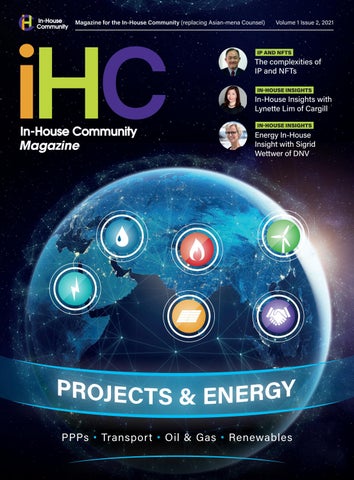
Magazine for the In-House Community (replacing Asian-mena Counsel)
Volume 1 Issue 2, 2021
IP AND NFTS
The complexities of IP and NFTs IN-HOUSE INSIGHTS
In-House Insights with Lynette Lim of Cargill IN-HOUSE INSIGHTS
Magazine
Energy In-House Insight with Sigrid Wettwer of DNV
PPPs • Transport • Oil & Gas • Renewables
In-House Community Magazine
Online home of the In-House Community
Magazine for the In-House Community
In-House Community events Bi-Monthly eNewsletter with latest news, deals, moves, legal updates, jobs, and more ‒ directly in your inbox
Cutting-edge events to facilitate training, dialogue and change in the corporate legal world
mycareerinlaw.com The best opportunities from top legal recruiters
For advertising opportunities on the above platforms CONTACT US
In-House Community Magazine
Feature contributors
PUBLISHER Rahul Prakash +852 8170 2951 rahul.prakash@ inhousecommunity.com LEAD DESIGNER Ailar Arak EDITOR Nathan Smith WRITER Butch Bacaoco Published 10 times annually by InHouse Community Ltd. Publishers of • In-House Community Magazine • IHC Briefing Organisers of the • IHC Events Hosts of • www.inhousecommunity.com • www.mycareerinlaw.com Forums for the In-House Community Opinions expressed herein do not constitute legal advice, and do not necessarily reflect the views of the publishers. © 2021 InHouse Community Limited and contributors.
Kang Zhi Ni Kang Zhi Ni is a Singapore-qualified in-house legal counsel. She practises as a commercial and tech lawyer with broad private practice experience including more than seven years in commercial litigation, arbitration, intellectual property and corporate areas. Benson Lim Benson Lim is a Singapore, English, and New York-qualified lawyer fluent in English and Mandarin Chinese. He spent two years building a legal and compliance team from scratch as the acting general counsel of a cancer diagnostics firm which leverages on artificial intelligence. He has CIPP/A and CIPP/E qualifications. David Beckstead David Beckstead is a counsel at Chandler MHM Limited (CMHM) and a member of the firm’s Energy & Infrastructure Practice Group. Prior to joining CMHM, he gained experience as a consultant at a respected international law firm in Bangkok. Ron Yu Ron Yu teaches or taught intellectual property law and Fintech at the Chinese University of Hong Kong (where he also does research), the University of Hong Kong, and the Hong Kong University of Science and Technology. Anna Chan Anna heads OLN’s Tax Advisory & Private Client Departments. She regularly advises on tax issues ranging from tax compliance, planning for tax efficiency and transactional tax structuring. Josh Kwok Josh obtained his Bachelor of Business Administration degree (Professional Accountancy) from the Chinese University of Hong Kong. He subsequently completed his Bachelor of Laws degree, and then proceeded to obtain the Postgraduate Certificate in Laws at the University of Hong Kong.
EDITORIAL GUIDANCE PANEL Carina Wessels Executive: Governance, Legal and Compliance, Alexander Forbes Group Holdings
Carl Watson General Counsel, Arcadis Asia
Navrita Kaur Chief Legal Officer, Omesti Group
Preeti Balwani General Counsel at Hindustan Coca-Cola Beverages
Raymond Goh General Counsel, International of China Tourism Group
Rebecca Hong Managing Counsel, Intel Corporation
Ron Yu University of Hong Kong, Chinese University of Hong Kong, Hong Kong University of Science and Technology
Sally Dyson Director, Firm Sense
Sesto Vecchi Managing Partner, Russin & Vecchi
Stanley Lui APAC Legal Director, TI Fluid Systems Co-Founder, White Hat Guys
Yosr Hamza Director, Legal Counsel, Gartner
PAGE 4
In this issue 6
8
PPPs Transport Oil & Gas Renewables
32
What’s Next for Thailand’s Rooftop Solar Market?
36
Implications of Vietnam’s new PPP laws to LNG-topower projects
40 44
Myanmar’s Energy & Project Landscape in 2021: Challenges and Outlook Energy In-House Insight with Sigrid Wettwer of DNV
IHC MAGAZINE
JURISDICTION UDPATES
THE IHC BRIEFING
6
10
NEWS
12
MOVES
15
DEALS
PHILIPPINES
CREATE and the VAT passed on to Export Oriented Enterprises
8 OFF-SHORE UPDATE
Duo of decisions reaffirming the Duomatic principle: a closer look at the Ciban and Satyam cases VOL 1 ISSUE 2, 2021
PAGE 5
In this issue 17
21
24
CYBERSECURITY
IN-HOUSE INSIGHTS
IN-HOUSE DIRECTORY
17
24
What more needs to be done for Singapore’s cybersecurity laws
In-House Insights with Lynette Lim of Cargill
48
IP AND NFTS
TAXES
21
27
The complexities of IP and NFTs
Are you ready for the global tax reform?
VOL 1 ISSUE 2, 2021
IHC MAGAZINE
JURISDICTION UPDATES
PHILIPPINES
PAGE 6
CREATE and the VAT passed on to Export Oriented Enterprises BY ERIC R. RECALDE
T
he value added tax (VAT) is only imposed if the goods or services are “destined” for local consumption, not if they are for consumption abroad. The VAT system in the Philippines follows the so-called destination principle insulating exporters and export-oriented enterprises from paying VAT on their local purchases. Prior to the passage of the Corporate Recovery and Tax Incentives for Enterprises Act (CREATE), case law applied the so-called cross-border doctrine. This rule benefits enterprises located in special economic or freeport zones. CREATE now limits the application of this rule. While these zones retain the legal fiction of being a foreign territory for taxation purposes, the export sale treatment of local purchases now only extends to goods or services “directly and exclusively used in the registered project or activity.” In other words, only the local components of their direct costs. Incidentally, these are also the costs they may claim as deduction to compute their income subject to special tax. The local suppliers may now pass on VAT for their selling and administrative expenses. IHC MAGAZINE
Changes in the VAT system are essentially revenue neutral and the law seeks to plug tax evasion loopholes. Recall that the TRAIN law (Tax Reform for Acceleration and Inclusion) phased out the system of effective-zero rating, where a supplier may not ordinarily pass on VAT to exporters. The concept of effective zero-rating created problems such as when suppliers claimed their sales to be zero-rated even when the sales were subject to VAT. To avoid this, the TRAIN shifted the burden of claiming a refund from the suppliers to the exporters. On the other hand, a VAT on the supply of goods and services may be passed on to exporters, which may claim a refund up for whatever was unutilised. As a pre-condition for changing the system, the Bureau of Internal Revenue (BIR) must adopt and implement an enhanced VAT refund scheme. Given the claimants’ poor experience with the previous system, the refund process will be overhauled and the law shifted from a “deemed denied” to a modified “deemed approved” scheme.
VOL 1 ISSUE 2, 2021
PAGE 7
The new refund system creates several mechanisms to assure exporters that the VAT on their purchases will be immediately refunded.
THE ENHANCED VAT REFUND SYSTEM The new refund system creates several mechanisms to assure exporters that the VAT on their purchases will be immediately refunded.
Specifically, the period for the BIR to decide on the refund application was shortened to 90 days from 120 days. Its reckoning date has been changed “from the date of submission of complete documents in support of the application” to “the filing of the VAT refund application” when there will be “submission of the official receipts or invoices and other documents in support of the application.” In effect, the claimant must submit all supporting documents at the time of filing of the application. A dedicated VAT refund centre within the BIR and Bureau of Customs (BOC) is expected to expedite the refund process. Personnel who deliberately fail to act on the claim within the 90-day period can be held criminally liable. To assure that a dedicated fund is available in the National Treasury to service the processed claims, the TRAIN automatically appropriates 5% of the total VAT collection from the preceding year. These funds are placed in a special account or treated as “trust receipts for the purpose of funding claims for VAT refund.” To facilitate monitoring, the BIR and BOC are mandated to submit to Congress a quarterly
VOL 1 ISSUE 2, 2021
PHILIPPINES
JURISDICTION UPDATES
report of all pending claims for refund and any unused fund. WHAT IS THE STATUS OF THE SCHEME? The shortened processing of refund applications will only materialise through the allowance of electronic receipts or invoices, and the proper implementation of the electronic sales reporting system.
This depends on an effective system that requires cash outlay from the government which should be in place by end of 2022. Until such system is in place, exporters and export-oriented enterprises may have to contend with the traditional way of claiming refund on the passed on VAT on their local purchases. The BIR, as part of its service, will hopefully expedite the processing of refund applications to insulate companies from the burden of shouldering extra tax costs and ensuring the Philippines remains competitive to attract foreign investors. The views and opinions expressed in this article are those of the author. This article is for general information and educational purposes, and not offered as, and does not constitute, legal advice or legal opinion.
Eric R. Recalde errecalde@accralaw.com Eric R. Recalde is the Head of the Tax Department and a Partner in the Angara Abello Concepcion Regala & Cruz Law Offices. He is a Certified Public Accountant. He ranked 11th in the September 1996 CPA Licensure Examinations. He also ranked 3rd in the 2002 Philippine Bar Examinations.
IHC MAGAZINE
JURISDICTION UPDATES
OFF-SHORE UPDATE
PAGE 8
Duo of decisions reaffirming the Duomatic principle: a closer look at the Ciban and Satyam cases BY JEREMY LIGHTFOOT XIA LI MONIQUE HANSEN
T
he English Court of Appeal in Satyam Enterprises Ltd v Burton [2021] EWCA Civ 287 has recently followed the Privy Council’s decision in Ciban Management Corporation v Citco (BVI) Ltd [2020] UKPC 21, confirming the applicability of the Duomatic principle to beneficial owners and in situations involving ostensible authority. CIBAN MANAGEMENT CORPORATION V CITCO (BVI) LTD The Duomatic principle is a principle derived from English case law whereby a company’s shareholders can informally give approval through unanimous consent, rather than abiding by the strict formalities. In the case of Ciban, the ultimate beneficial owner of Spectacular Holdings Inc. (the Company), Mr Byington, structured the Company in a way so that there were no ostensible links to him. Mr Costa, a friend and business partner of Mr Byington, was authorised to give instructions to the registered agent, Citco (BVI) Ltd (Citco) and the sole director, Tortola Corporation Company Ltd (TCCL). With Mr Byington’s consent, four powers of attorney (POAs) authorising Mr Delollo, a Brazilian lawyer, to carry out specific acts approved by Mr Byington were executed by TCCL on instructions from Mr Costa. When Mr Byington and Mr Costa’s relationship deteriorated, Mr Costa instructed TCCL to execute a fifth, much broader POA authorising Mr Delollo to sell the properties, which were the Company’s only assets. Citco and TCCL cooperated
IHC MAGAZINE
since they were used to acting on Mr Costa’s instructions. Mr Byington was unaware of the fifth POA until Mr Costa told him, after the sale had taken place. The Company commenced proceedings against TCCL and Citco in the British Virgin Islands (BVI) for breach of tortious and fiduciary duties for granting the POA, which had not been approved by the beneficial owner and had not secured formal shareholder approval, which was required for a disposal of over 50% of the Company’s assets. The BVI Commercial Court held that Citco owed no duty of care in tort to the Company and there had been no breach of a duty of care to Mr Byington. The arrangement meant that he expected Citco to rely on Mr Costa’s instructions, and because TCCL’s role was one of execution only TCCL had not breached its duty. The Eastern Caribbean Court of Appeal upheld this decision, adding that the doctrine of ostensible authority was applicable given that Mr Costa’s instructions to Citco and TCCL appeared to be acting on the authority of Mr Byington, which provided a further reason why the Company’s claims against them failed. The Privy Council noted that in order to decide whether TCCL had breached its duty of care owed to the Company, the key issue was whether the conduct of Mr Byington could be attributed to the Company, and that was where the Duomatic principle came in. VOL 1 ISSUE 2, 2021
PAGE 9
With the first four POAs, Mr Costa had actual authority to give instructions to TCCL (and Citco), but only ostensible authority with the fifth POA, since Mr Byington did not consent by giving Mr Costa actual authority. The Privy Council held that if actual authority could be conferred informally by unanimous shareholder consent (i.e., the Duomatic principle), there was no reason why the same should not apply to ostensible authority. Therefore, the Privy Council found that Mr Costa did have the authority to instruct TCCL in relation to the fifth POA, binding the Company, meaning that TCCL was not in breach of its duty of care. SATYAM ENTERPRISES LTD V BURTON & ANOR Following the Privy Council decision in Ciban, the recent English Court of Appeal case of Satyam again reaffirmed the principles of ostensible authority and the Duomatic principle. The Satyam case involved four properties bought in May 2012 by Mr Sharma, which on completion he arranged to be acquired a company formerly known as JVB Five Properties Ltd (JVB5). Mr Burton was the sole director and shareholder of JVB5. In October that year, Mr Burton transferred the properties to JVB Seven Properties Ltd (JVB7), of which he was also sole director and shareholder. JVB5 alleged that Mr Burton acted in breach of his fiduciary duties by transferring properties out of JVB5 at an undervalue. Mr Burton denied the transfers were at an undervalue and asserted that he held all the issued share capital in JVB5 and JVB7 on trust for Mr Sharma and that the transfer had been carried out at his direction. On the basis that the transfer was expressly authorised by JVB5’s sole beneficial owner, he argued that the Duomatic principle applied. The first instance judge agreed. JVB5 appealed, arguing that the Duomatic principle should not have applied because the transaction amounted to an unlawful distribution of assets and so could not be ratified by the shareholder of JVB5. The Court of Appeal found there was no relevant dishonesty involved, applied Ciban and held that the Duomatic principle applied. Although the Duomatic principle required consent to be more than simply private thoughts, this was not an issue as Mr Sharma had sent an email expressly confirming his agreement to Mr Burton transferring the properties. VOL 1 ISSUE 2, 2021
OFF-SHORE UPDATE
JURISDICTION UPDATES
However, on the point about returning capital to shareholders, the Court of Appeal held that the Duomatic principle did not allow shareholders to authorise informally what they have no power to do formally. The case was therefore remitted to the High Court to be listed for a case management conference at which suitable directions could be given on the question of evidence about whether the transaction amounted to an unlawful distribution. KEY TAKEAWAYS The Duomatic principle applies to ultimate beneficial owners, provided that they are taking all the decisions in the relevant transactions and that the transaction is lawful and honest. Decisions from both the Privy Council, the highest level of the judiciary, and the recent English Court of Appeal judgment, clearly reaffirm this principle. With regards to the doctrine of ostensible authority, the courts will show little sympathy to ultimate beneficial owners who plan to retain control from the shadows when such arrangements backfire, and as the Ciban and Satyam cases have demonstrated, the Duomatic principle will apply even in situations of ostensible authority.
Jeremy Lightfoot jeremy.lightfoot@careyolsen.com +852 3628 9016 Jeremy Lightfoot is the head of Carey Olsen’s litigation team in Hong Kong. He focuses on commercial and corporate litigation, insolvency and restructuring under the laws of Bermuda, the BVI and the Cayman Islands.
Xia Li xia.li@careyolsen.com +852 3628 9009 Xia Li is a counsel in Carey Olsen’s Dispute Resolution and Litigation practice, based in Hong Kong. She has worked in multiple major legal and financial centres, including the Cayman Islands, the BVI, London, New York, Beijing, Singapore and Hong Kong.
Monique Hansen monique.hansen@careyolsen.com +852 3628 9004 Monique is an associate in the dispute resolution and insolvency team. She has experience advising in a broad range of complex and multijurisdictional litigation across several sectors, including large scale infrastructure, energy and technology related disputes. IHC MAGAZINE
THE IHC BRIEFING
PAGE 10
NEWS
Ashurst announces new global chairwoman “Magic circle” law firm Ashurst has elected Karen Davies as its new chairwoman. Davies, presently the UK Head of Corporate and member of the Ashurst board, will begin the four-year term on 1 August. She replaces Ben Tidswell who is also standing down from the partnership after accepting a judicial appointment as a panel chairman of the UK Competition Appeal Tribunal. Tidswell said he is “delighted” by the appointment. Ashurst global managing partner Paul Jenkins thanked Tidswell’s strong leadership as chairman over the last eight years and added that Davies’ “impressive” ability to combine management and leadership roles, along with her “incomparable commitment” makes her a great replacement. Davies said she is honoured to be chosen for the role and is excited about the future of Ashurst. “We have an incredibly strong platform and a fantastic culture. It is a real privilege to serve the firm, my partners and contribute towards
IHC MAGAZINE
our ongoing success in this role. I look forward to working with Paul, the board, the executive team and all my colleagues to help the firm build on its many achievements and deliver on the significant opportunities we have for our people and our clients.” Alongside her leadership and management roles, Davies will continue advising on large and complex deals. Davies has served on the Ashurst board since 2017. After being made partner in 2012, she has been acknowledged as a leading M&A lawyers in the City of London and one of the strongest female leaders in the sector. She also has extensive experience in advising both corporate clients and investment banks on a range of domestic and cross-border corporate finance transactions and specialises in M&A and equity capital markets. The board will comprise chairwoman Karen Davies (London), Global Managing Partner Paul Jenkins (London/Sydney), partners David Jones (London), Tobias Krug (Frankfurt), Phil Breden (Sydney), Kylie Lane (Melbourne), Chief Financial Officer Mark Herbert (London) and independent board members Wu Gang and Robin Lawther.
VOL 1 ISSUE 2, 2021
PAGE 11
THE IHC BRIEFING
NEWS
RPC Launches Global Access Lawyers
UK-based law firm RPC has expanded its international insurance reach by joining the Global Access Lawyers network. The digital platform gives insurer clients easy access to recognised insurance law specialists from around the world. The six Global Access Lawyers firms represent 43 offices and more than 2000 lawyers. Each member of Global Access is a leading insurance law firm in its own jurisdiction, with a proven track record of counselling and representing clients in complex and high-value defence and insurance coverage disputes. Firms already signed up to the platform include RPC in the UK and Asia, Colin Biggers & Paisley in Australia, Hinshaw & Culbertson LLP in the USA, Miller Thomson
VOL 1 ISSUE 2, 2021
LLP in Canada, Kennedy Van Der Laan in the Netherlands and HMN & Partners in France. The platform will accompany RPC’s TerraLex membership, one of the largest legal networks in the world. RPC partner and global head of insurance Simon Laird said the platform offers RPC’s insurer clients new ways access the combined talents of leading insurance law practices and has been developed in line with client feedback. “It will be a global sounding board for insurers, helping them to navigate the challenges of building profitable business books across the globe. We can also provide our clients with access to the resources and capabilities of each firm in times of need and continue working together on significant overseas and cross-border exposures,” Laird said. He added that the platform’s participants already “get on with each other” and will use it to enhance referral work between their shared clients. “It is the authenticity of it all that will end up being the most powerful force in delivering even better client service for insurers across the globe,” he said.
IHC MAGAZINE
THE IHC BRIEFING
PAGE 12
MOVES Baker McKenzie Wong & Leow, the member firm of Baker McKenzie International in Singapore, has welcomed Kay Moon as principal to its M&A practice. Moon joins from Linklaters and has worked both in Hong Kong and London. She brings deep experience in advising major international clients on significant corporate and M&A transactions across a wide range of sectors, including technology, energy, natural resources and infrastructure. Fluent in Korean, Moon also has extensive experience in advising Korean clients on their outbound investments. Moon graduated from the University of Oxford and was admitted as a solicitor in England & Wales in 2010. Christopher & Lee Ong, a member firm of Rajah & Tann Asia, has added new partner Shanti Geoffrey as co-head of its white-collar crime and investigations practice. She brings more than 25 years of experience in investigations, regulation and enforcement of laws relating to securities. Geoffrey’s admission to the partnership is timely, as Malaysia’s regulators step up their efforts in curbing white-collar crime. Geoffrey previously served with the Securities Commission in various roles, where she helped formulate and lead law reforms, policy initiatives and corporate governance reforms. She also represented the regulator on matters relating to the capital market before the Malaysian courts. She was also part of the core team involved in the drafting of the Capital Markets and Services Act 2007, the Anti-Money Laundering and Anti-Terrorism Financing Act 2001, and related guidelines for capital market intermediaries.
IHC MAGAZINE
Clifford Chance has expanded its Australian transactional practice with the hiring of partners David Clee and Elizabeth Hill in its global corporate and M&A practice. Clee and Hill bolster the firm’s public and private M&A, IPO and distressed M&A capabilities. In addition to having extensive public and private M&A experience, Clee is a renowned advisor on distressed M&A transactions, while Hill has extensive M&A experience, along with expertise in technology-focused venture capital and M&A transactions. They both join from Gilbert + Tobin in Sydney, where they were partners. Reed Smith has added Timothy Cooke as partner in its international arbitration practice in the Singapore office. Cooke is a barrister with two decades of experience, representing both international and Asian clients across Asia, in international arbitrations concerning energy, infrastructure and projects, construction, engineering and sectors such as textiles, media, telecoms and automobiles. In his 20 years of practice, he has handled cases under the rules of all the major international arbitration institutions including the ICC, LCIA, SIAC and in UNCITRAL. In 2018, Cooke wrote what is widely considered the authoritative book and academic authority on international arbitration in Singapore titled: International Arbitration in Singapore: Legislation and Materials. Llinks Law Offices has added James Wang as a partner in the firm’s Shanghai office. Wang graduated from Fudan Law School
VOL 1 ISSUE 2, 2021
PAGE 13
THE IHC BRIEFING
MOVES with a bachelor’s degree in International Economic Law. Before joining the firm in January 2021, he was a senior partner in a law firm. Wang started his career in 2004, and he has been dealing with internet-related cases since 2006. His expertise is on litigation and non-litigation services of intellectual property in TMT. He also handled many typical and precedent-setting cases in the industry. Wang enjoys a high reputation, especially in internet antitrust and unfair competition cases and online game litigation cases. Paul Hastings has added preeminent investigations and compliance lawyer Phoebe Yan in its life sciences and healthcare practice and the investigations and white-collar
defence practice as a partner, based in the Shanghai office. Yan has advised a broad client network in the region and has a deep understanding of local practices and industry trends in Asia-Pacific. She has more than ten years of experience representing multinational clients and Chinese companies in investigations by US and Chinese government agencies, involving anti-bribery, anti-corruption, whistleblower claims and conflict of interests, with particular emphasis on life sciences clients. She regularly advises on anti-bribery compliance and investigations under the US Foreign Corrupt Practices Act, before the US Department of Justice, the US Securities Exchange Commission, and other regulatory authorities.
DEALS Allen & Gledhill has advised Keppel Telecommunications & Transportation, through its wholly owned subsidiary Keppel Midgard Holdings (KMH), on a joint build agreement to jointly own and develop the Bifrost Cable System, with a subsidiary of Facebook and Telekomunikasi Indonesia International, a subsidiary of Telkom Indonesia. Spanning over 15,000km, the Bifrost Cable System (BCS) directly connects Singapore to the west coast of North America, via Indonesia through the Java Sea and Celebes Sea, the Philippines and Guam. KMH has been granted a
VOL 1 ISSUE 2, 2021
facilities-based operator licence by Singapore’s Infocomm Media Development Authority to provide telecommunications services, in connection with the BCS, which is also the first subsea cable project undertaken by the Keppel group, and marks the start of Keppel T&T’s subsea cable business. Partners Tan Wee Meng and Yeo Boon Kiat led the firm’s team in the transaction. Ashurst has advised Hong Kong-listed Mobvista on the placing of approximately 72.5 million existing shares sold by the controlling shareholder at HK$5.90 (US$0.76) per placing
IHC MAGAZINE
THE IHC BRIEFING
PAGE 14
DEALS share and a HK$425.9 million (US$54.8m) top-up subscription by the controlling shareholder of 72.5m new shares. The shares were successfully placed to existing shareholder GIC, Singapore’s sovereign wealth fund with about US$488 billion assets under management. It is a significant strategic investment from GIC demonstrating the strong growth potential in Mobvista, a leading technology platform. The firm also advised on Mobvista’s HK$1.28b (US$164.8m) listing in Hong Kong in 2018, and the issuance of US$30m convertible bonds earlier in 2021. Partner Frank Bi, supported by partner Li Jiang, led the firm’s team in the transaction.
to UPL Corporation (UPL), India’s largest agrochemical company. The facility, which is the first sustainability-linked loan in India, was for an original loan of US$500m, and was subsequently upsized to US$750m, as it was over-subscribed. This landmark transaction targeted investors and credit providers focused on meeting ESG objectives. Under the facility, UPL has selected specific sustainability targets in reducing its environmental footprint and improving its greenhouse gas emissions, water consumption and waste disposal. Finance and projects principal Kah Chin Chu led the firm’s team in the transaction, which was completed in March 2021.
Assegaf Hamzah & Partners, a member firm of Rajah & Tann Asia, has advised state mining holding company Indonesia Asahan Aluminium on the upgrading of pot technology for the 1 pot-line at Inalum’s reduction plant in North Sumatra. The upgrade aims to increase the production capacity of Inalum’s smelter plant. Waskita Karya and Unefeco formed a consortium with Chinese company Shenyang Aluminium and Magnesium Engineering and Research Institute, together with its representative office in Indonesia, to construct the project. Partner Ibrahim Assegaf led the firm’s team in the transaction. The firm also represented AEON Mall Indonesia, as one of the creditors, on the suspension of debt payment obligation of Sentul City. Partners Ibrahim Assegaf and Eri Hertiawan led the firm’s team in the transaction.
Davis Polk has advised Onion Global on its SEC-registered IPO of approximately 9.31 million American depositary shares. Each ten ADS represents one Onion Global Class A ordinary share. The ADSs are listed in New York. Onion Global has granted the underwriters an option to purchase up to an additional 1.4 million ADSs. The total gross proceeds of the offering is US$67.5 million, assuming the underwriters do not exercise their option to purchase any over-allotment ADSs. Onion Global is a next-generation lifestyle brand platform. Corporate partners Li He and James Lin led the firm’s team in the transaction.
Baker McKenzie Wong & Leow has advised MUFG Bank and Rabobank, as the mandated lead arrangers and book-runners, on a five-year US$750 million sustainability-linked financing IHC MAGAZINE
J Sagar Associates is advising Info Edge (India) (Naukri.com) as selling shareholder on the proposed IPO of Zomato. Zomato filed the Draft Red Herring Prospectus on April 27, 2021 and intends to raise up to Rs75 billion (US$1b), via a fresh issue in the IPO. Info Edge could raise up to Rs7.5b (US$101.5m) in an offer for sale of its shares in Zomato. If successful, Zomato would be one of India’s first major VOL 1 ISSUE 2, 2021
PAGE 15
THE IHC BRIEFING
DEALS consumer internet startup-turned-unicorn to be listed. Partner Rohitashwa Prasad led the firm’s team in the transaction. Khaitan & Co has advised Shapoorji Pallonji group company Sterling & Wilson on a joint venture with Enel X to promote the adoption of electric vehicle charging infrastructure in India. The joint venture entity will undertake local manufacturing and operations and maintenance services of the electric vehicle charging infrastructure. Sterling & Wilson Solar is the world’s largest solar EPC solutions provider. Enel X is the Enel Group’s advanced energy solutions business line. Partner Surbhi Kejriwal, supported by partners Nishad Nadkarni, Shailendra Bhandare and Anisha Chand, led the firm’s team in the transaction. J Sagar Associates also advised on the deal. Maples and Calder, the Maples Group’s law firm in Hong Kong, has acted as Cayman Islands counsel to Baidu on its global offering of 95 million Class A ordinary shares and the secondary listing in Hong Kong. Baidu was founded as a search engine platform, which has developed into a leading artificial intelligence company. The offering, which raised approximately HK$23 billion (US$3b), closed on March 23. Partners Matt Roberts and Derrick Kan led the firm’s team while Skadden, Arps, Slate, Meagher & Flom advised on Hong Kong and US laws. King & Wood Mallesons advised on Chinese law. The joint sponsors Merrill Lynch, CLSA Capital Markets and Goldman Sachs, and the underwriters, were advised by Davis Polk & Wardwell as to Hong Kong and US laws, and by Haiwen & Partners as to Chinese law.
VOL 1 ISSUE 2, 2021
Paul Hastings has advised Hong Kong-listed China ZhongDi Dairy Holdings on the mandatory conditional cash offer by CLSA, for and on behalf of Wholesome Harvest, to acquire all the issued shares of China ZhongDi. The maximum amount payable by Wholesome Harvest to implement the offer would be HK$1.66 billion (US$213.7m). Subject to the completion of compulsory acquisition, China ZhongDi will be privatised and apply for the withdrawal of listing in Hong Kong. China ZhongDi is principally engaged raising and breeding dairy cows, producing and selling premium raw milk, importing and selling dairy cows of quality breeds and breeding stock. Global partner and chair of Greater China Raymond Li and corporate partner Chaobo Fan led the firm’s team in the transaction. Simmons & Simmons has advised Credit Guarantee and Investment Facility (CGIF), a multilateral facility established by the governments of China, Japan, Korea and ASEAN members, as well as the Asian Development Bank, on the issuance of a three-year Rmb1 billion (US$154.5m) green dim sum bonds listed in Singapore. CGIF acted as the guarantor in the issuance of Rmb1 billion (US$154.5m) senior unsecured guaranteed green bonds due 2024 by Hanwha Solutions, one of South Korea’s largest renewable energy service providers. The “green” certification and ESG components of the issuance were provided by Sustainalytics, the global ESG research and rating provider, and the green bonds have an “AA” rating from S&P. Standard Chartered Bank was the sole lead manager and sole book-runner for the green bonds. Partner Jay Lee led the firm’s team in the transaction.
IHC MAGAZINE
THE IHC BRIEFING
Clifford Chance advises Wanbao Mining and Managem to develop Sudan’s gold mines UK-based Clifford Chance has advised Chinese state-owned Wanbao Mining on its partnership with Moroccan mining company Managem to develop a large-scale gold mining project in Sudan. The deal for the Gabgaba gold mine gives Managem a 65% share of the Block 15 exploration licence and expansion project, along with related licences for Blocks 9 and 24. Wanbao Mining will own the remaining 35% of the licences. Under the terms of the partnership, Wanbao Mining also sold a 35% stake in the exploration licenses Blocks 64 a-b-c and 66 a-b-c to Managem. Wanbao Mining will also assist in securing up to 70% of approximately US$250 million for upgrading the ageing power infrastructure and other factors at the mine. The expansions hope to increase the mine’s annual gold production from 60,000 to 200,000 ounces. Managem remains the operator for the Gabgaba gold mine. The Clifford Chance advisory team was led by China co-managing partner Terence Foo. His Beijing team included associate Yanding He and trainee Jiahong Cai. He was also assisted by a separate team in Sydney which included partner Nadia Kalic and senior associate Georgina Roest. IHC MAGAZINE
PAGE 16
“We are pleased our cross-border team was able to support Wanbao Mining on its partnership with Managem in Sudan. We continue to see strong interest in the metals and mining sector, particular from Chinese investors,” Foo said. Sudan is one of the largest gold producers in Africa, producing a total of 76.6 tonnes in 2019. Over the last two decades, China has established a significant economic presence in about 40 African countries, including Sudan. China’s lucrative economic investment package, flexible political approach, and focused big-ticket development projects under the Belt and Road Initiative (BRI) are a massive opportunity for African countries hoping to develop their economies. More than 400 different mining companies operate in the country, ranging from small artisan miners to large international corporations. So far 23 Chinese enterprises have operated in the mining area in Sudan, with their total investment exceeding US$100 million. In March, Sudan announced plans to reopen a network of mines which were until 2020 linked to the family of the country’s most powerful militia leader, Mohamed Hamdan Dagalo. Soon afterwards, the initial stages of the deal between Managem and Wanbao Mining were completed. Managem chief executive said Imad Toumi said the partnership with Wanbao Mining strengthens the Morocco-based company’s position for future growth in gold production within Sudan. “I am convinced that this new strategic cooperation, based on trust and mutual respect, will have positive impact on both our companies and will lead to a multi-million-ounce gold mining operation in Sudan,” he said in a statement. Managem has exploration licences for more than 23,000 km² in Sudan. Besides Morocco and Sudan, Managem operates in the Democratic Republic of the Congo, Ethiopia, Gabon, Guinea Conackry, Ivory Coast and Mali. VOL 1 ISSUE 2, 2021
CYBERSECURITY
PAGE 17
What more needs to be done for Singapore’s cybersecurity laws BY KANG ZHI NI
BENSON LIM1
A
s data grows in value and importance, the phrase “data is the new gold”2 is now heard regularly in the corporate world. With 5G mobile networks and the internet of things (IoT), more data than ever is being mined and Singapore is in the prime regional position to store this new “gold.” In its 2019 and 2020 reports3, the consultancy Cushman & Wakefield ranked Singapore’s data centre capabilities as sixth worldwide and first in Asia-Pacific market, which is “forecast to reach US$28 billion by 2024, 20% higher than the US$23.4 billion North American market.”4 The reports reasoned that data centre players will “favour Singapore for its relative security to store mission critical data and the business-as-usual data in the neighbouring countries.”5
1 2 3
4
5
6
However, since cyber attacks have the potential to cause US$13.8 million in damages to large-sized organisations in Singapore, the efficacy of the city-state’s cybersecurity laws is mission critical.6 CYBERSECURITY LAWS IN A NUTSHELL Singapore has adopted a framework of key legislation and sector-specific regulations to address cybersecurity issues.
The Cybersecurity Act 2018 moved Singapore away from sector-based regulation and required cybersecurity service providers to gain a license. It empowered the Commissioner of Cybersecurity, amongst others, to establish mandatory codes of practice and reporting/auditing requirements for owners of critical information infrastructure (CII). A non-owner of CII has an obligation to cooperate in cybersecurity investigations by
The views expressed in this article are the authors’ personal views and do not reflect those of their respective organisations. https://www.forbesafrica.com/technology/2019/07/18/data-is-the-new-gold/ https://www.cushmanwakefield.com/en/singapore/insights/blog/ singapore-counts-among-the-top-10-global-data-centre-markets https://www.cushmanwakefield.com/en/singapore/news/2019/08/southeast-asia-to-lead-data-centre-growth-in-thenext-five-years https://www.straitstimes.com/business/economy/singapore-data-centre-market-3rd-most-competitive-globally-report. See also: https://www.datacenterdynamics.com/en/analysis/singapore-data-center-market-shows-signs-saturation/ where examples of new data centres in Singapore include those of Facebook, Equinix, and Global Switch. Google similarly invested a purported US$850m into its Singapore data centres. https://news.microsoft.com/en-sg/2018/05/18/cybersecurity-threats-to-cost-organisations-in-singapore-us17-7-billion-ineconomic-losses/
VOL 1 ISSUE 2, 2021
IHC MAGAZINE
CYBERSECURITY
CONTINUED
the commissioner. The Act is linked to the Computer Misuse Act which criminalises cybersecurity offences such as unauthorised access to computers. The Personal Data Protection Act 2012 (PDPA) also requires organisations to implement security measures to prevent unauthorised access, collection, use or disclosure of personal data.7 At the same time, sector-specific regulations continue in force. For example, the Monetary Authority of Singapore publishes notices and guidelines on cybersecurity best-practice for the banking and finance industry.8 There is also the Infocomm Media Development Authority’s Telecommunication Cybersecurity Code of Practice. Singapore’s legislative efforts are commendable in light of the 2020 breaches at US-based cybersecurity company FireEye. However, several practical and persistent challenges remain. We discuss three ways in which Singapore’s cybersecurity laws may be improved. THE INTERNATIONAL LAW FRAMEWORK That Singapore’s cybersecurity laws do not relate to a coherent international law framework
7 8
PAGE 18
hampers their practical effectiveness. There are two key unresolved jurisdictional issues. First, the range of cyber actors can include individuals and even nation-states. It is unclear over which actors the cybersecurity laws give Singapore jurisdiction, considering state immunity defences, traditional conflict of jurisdictions rules and other policy factors. As a result of this lack of clarity, companies must determine which jurisdiction’s cybersecurity laws they have to comply with. This has real consequences. For example, the reporting and investigation requirements under the Cybersecurity Act 2018 are not replicated in other jurisdictions. A company discovering a cybersecurity incident must comply with various reporting and investigation requirements across jurisdictions rather than devoting more time to prevent further incursions. Second, it is also unclear how Singapore can identify the origin of a breach. Breaches are not always confined within the geographical boundaries of a state. There is no public international law principle – or even customary international law – as to whether cyberspace is international space or how it should be
The October 2020’s amendments to PDPA did not make any substantial changes to the cybersecurity aspects. http://www.mas.gov.sg/regulations-and-financial-stability/regulatory-and-supervisory-framework/risk-management/ technology-risk.aspx
IHC MAGAZINE
VOL 1 ISSUE 2, 2021
PAGE 19
divided between states. Even ratification of the Budapest Convention on Cybercrime has taken a long time. Establishing jurisdiction matters because it determines the appropriate national and international dispute settlement mechanisms. The Permanent Court of Arbitration may be a good candidate for such a mechanism since it already has a mandate on outer space, energy and environmental disputes between states. Singapore has signed several memoranda of understanding with other countries but more needs to be done. Singapore must renew focus on adopting and implementing international norms even as states aim to implement data localisation measures. China-based technology company Huawei recommended a common cybersecurity standard just like European Union’s General Data Protection Regime9 and the World Economic Forum (WEF) agreed with this principle in its April 2016 white paper.10 The WEF recommended that in addition to regulation, “governments also can alter behaviour through encouraging the creation and adoption of norms … at the national, regional or global level.”11 FOCUS ON REGULATING HUMAN BEHAVIOUR Singapore’s cybersecurity laws must be able to evolve along with technology. To surmount this seemingly Sisyphean challenge, the laws must focus instead on regulating human behaviour and creating a resilient cyber society.
The current state of Singapore’s cyber resilience is reflected in how small and medium 9
10 11 12
13
14 15 16
CONTINUED
CYBERSECURITY
enterprises (SMEs) still consider cybersecurity an afterthought. In a 2018 survey conducted by QBE Singapore, while 90% of SMEs are aware of cyber risks, 25% lack any internal processes or policies to protect themselves.12 And yet, 35% of businesses in Singapore have suffered a ransomware attack.13 In 2017, 328 cyber-scam cases involved impersonating business suppliers resulting in losses of about S$43 million.14 In the same year, almost 40% of 146 phishing cases and ransomware scams came from businesses.15 The recent data leak from UOB after its employee fell for an impersonation scam highlights the importance of adequate cybersecurity and data security training.16
To instil greater resilience, Singapore’s cybersecurity laws must reflect a more nuanced understanding of the differing interests in the public and private sectors.
To instil greater resilience, Singapore’s cybersecurity laws must reflect a more nuanced understanding of the differing interests in the public and private sectors. It may be helpful to introduce more soft law options such as codes of practices, threat assessment templates, model incident response plans and preventive guidelines. Social values may change over time and generational values may clash, but certain
https://www.channelnewsasia.com/news/technology/huawei-calls-for-common-cybersecurity-standards-amidstconcerns-11313972 http://www3.weforum.org/docs/GAC16_Cybersecurity_WhitePaper_.pdf Ibid. at 22. https://news.microsoft.com/en-sg/2018/05/18/cybersecurity-threats-to-cost-organisations-in-singapore-us17-7-billion-ineconomic-losses/ https://go.malwarebytes.com/rs/805-USG-300/images/Second%20Annual%20State%20of%20Ransomware%20Report%20-%20 Singapore.pdf https://www.csa.gov.sg/~/media/csa/documents/publications/singaporecyberlandscape2017.pdf at page 12. Ibid. https://www.todayonline.com/singapore/information-1166-uob-customers-leaked-after-employee-allegedly-falls-impersonation-scam
VOL 1 ISSUE 2, 2021
IHC MAGAZINE
CYBERSECURITY
CONTINUED
fundamental human rights and constitutional rights should not be undermined. LOWER COMPLIANCE COSTS AND ENCOURAGE INNOVATION The two most common barriers to implementing digital solutions are the high costs of investment (40% of respondents) and lack of digital skills (35% of respondents), according to QBE Singapore.17 It is a good start that Singapore is a certificate authorising nation under the Common Criteria Recognition Arrangement since 2019, but more similar steps must be taken.18
A solution could be to legislate for cybersecurity insurance as cover for liability and associated costs from system damage or lost revenue. Legislation is needed to help insurers determine how to underwrite risks where traditional models do not work. Costs also come from having to compete for the limited talent pool to fill the roles. Again, Singapore’s cybersecurity laws can establish clear skill accreditation as is the case with specialist accreditation scheme for both building and construction law and maritime and shipping law. Further, the laws should aim to encourage innovation in cybersecurity. Innovation is self-sustaining and naturally spurs the growth of Singapore as a cybersecurity hub. For example, legislating for stricter security features in software products will provide a strong market incentive for software manufacturers to innovate and comply with standards. The laws could include a public-private partnership model for cybersecurity research projects and incorporate tax incentives for approved investments made by a company towards cybersecurity.
17
18
PAGE 20
That said, as was seen in the process of making Singapore into an arbitration and insolvency hub, cybersecurity laws responsive to cutting-edge thinking must be backed by competent investigation services, access to technology to process electronic evidence, quality local and international talent and appropriate training for the judiciary and Attorney’s General Chambers. These will help Singapore become a cybersecurity hub. CONCLUDING REMARKS Data may be the new “gold,” but the bigger picture involves more than just data. With technologies like blockchain being applied in other contexts, the needs of national security are being intertwined with cyberspace. Add to this the greater role of telecommuting and a growing dominance of fintech, and cybersecurity will surely be a focal point over the next few years.
Kang Zhi Ni kangzhini@gmail.com Kang Zhi Ni is a Singapore-qualified in-house legal counsel. She practises as a commercial and tech lawyer with broad private practice experience including more than seven years in commercial litigation, arbitration, intellectual property and corporate areas. Benson Lim bensonlimbl@gmail.com +65 63022593 Benson Lim is a Singapore, English, and New York-qualified lawyer fluent in English and Mandarin Chinese. He spent two years building a legal and compliance team from scratch as the acting general counsel of a cancer diagnostics firm which leverages on artificial intelligence. He has CIPP/A and CIPP/E qualifications.
QBE Singapore, <https://www.qbe.com/sg/-/media/singapore/Files/FINAL%20SME%20Infographic%20Poster_FApathed. pdf?la=en&hash=3064BD616F469986FC3A005F834AACB8C35E47AD> (accessed 17 March 2019). https://www.channelnewsasia.com/news/singapore/singapore-s-growing-cybersecurity-sector-gets-boost-with-11308918
IHC MAGAZINE
VOL 1 ISSUE 2, 2021
IP AND NFTS
PAGE 21
The complexities of IP and NFTs BY RON YU
A
lthough non-fungible tokens (NFTs) have been around for some time, they were recently in the headlines for the astronomical sums people have paid to own them. For example, a NFT issued by digital artist Beeple sold for US$69 million and the NFT of the tweet sold by Twitter co-founder Jack Dorsey for US$2.9m. WHAT IS AN NFT? An NFT is a unique cryptographic asset linked to an object, such as a piece of art or in-game item. In economics, a fungible asset is something with units that can be readily interchanged – like money. However, if something is non-fungible it means it has unique properties so it cannot be interchanged with something else.
For instance, Bitcoin has an interchangeable supply. One Bitcoin is worth the same amount as VOL 1 ISSUE 2, 2021
any other Bitcoin, no matter which Bitcoin you’re holding. A one-of-a-kind trading card, however, is not interchangeable. If you traded it for a different card, you’d have something completely different. An NFT is a digital certificate of authenticity placed on the blockchain and when you buy an NFT, you (typically) hold the right to claim ownership of the NFT itself and the right to exclude others from claiming ownership of the NFT. However, ownership of an NFT will not entitle you to ownership of the digital asset, the underlying artwork, or any other object – unless the relevant contractual terms allow otherwise. By itself, an NFT is not an IP right. It is not a patent, for example. But even if an NFT itself does not easily fall into an existing category of IP, it does not mean there are no IP issues associated with NFTs. IHC MAGAZINE
IP AND NFTS
CONTINUED
PAGE 22
TRADEMARK AND PERSONALITY RIGHTS If the underlying asset contains a trademark or an image, for example, of a famous celebrity there may be potential trademark or personality rights issues. Andy Warhol’s paintings of a can of Campbell’s soup or Marilyn Monroe come to mind. PATENTS NFT patents are already here, and more are no doubt coming. Nike has obtained a patent for “generating cryptographic digital assets for footwear,” which would allow a buyer to ensure their shoe is authentic and also enjoy a digital collectible version of their shoe in their wallet (known as Cryptokicks).
In general, blockchain patents continue to show accelerating interest. But the real challenge is in copyright which apply to things like literature, art, music or video but also software or dramatic works – all of which can be linked to an NFT. COPYRIGHT Copyright is a bundle of rights that can include broadcast and performance rights. Rights of attribution and integrity may also arise with copyright. Such moral rights mean an artist can object to the use of their work particularly if they consider it derogatory treatment of the work.
Consider Nathan Apodaca, who shot to fame with a TikTok video of him drinking cranberry juice while skateboarding and lip synching to the Fleetwood Mac song Dreams. His hopes to monetise the clip with an NFT were dashed when Stevie Nicks, the song’s composer, refused to let him include the song in the NFT. AUTOMATIC, NATIONAL TREATMENT Copyright is automatic. The moment you draw a picture of your pet on a napkin you have copyright rights in the drawing. It also gains the obligation IHC MAGAZINE
Screen grab from viral TikTok video of Nathan Apodaca drinking cranberry juice while skateboarding and lip synching to the Fleetwood Mac song Dreams.
of national treatment, which is found in the Berne Convention, the Rome Convention, the TRIPS Agreement, the WIPO Copyright Treaty and the WIPO Performances and Phonograms Treaty. All of these obligate treaty parties to extend copyright protection to non-nationals on the same terms as they do to their own citizens. These issues are already daunting but there are further potential complications. WHO? The first issue is establishing the actual holder of the copyright rights.
For example, if one were dealing with an employee of a company who created a work as part of his normal duties or an artist commissioned to create a work, absent any contractual rights stating otherwise, the copyright right belongs to the employer or the patron not the individuals. Works involving remixes and sampling also raise potential problems, particularly given VOL 1 ISSUE 2, 2021
CONTINUED
PAGE 23
IP AND NFTS
different entity while the overall work can also be an NFT owned by yet a different entity. There are also other forms of collaboration such as Dada (https://dada.nyc/home) where multiple persons can crowd-source contributions to a single piece of art. But that’s not all. SOFTWARE AND AI Some digital artworks can be programmed to change based on certain triggers or may function autonomously.
Given that the programming can modify the underlying image, the artist of the underlying work could, in theory, object to such usage – not to mention the copyright rights in the underlying software used in programming the art (e.g. if the artist used legitimate software in accordance with its license). An NFT of “Buying Myself Back: A Model for Redistribution” is a photo of model of Emily Ratajkowski, standing in front of an Instagram post showing a photo of herself. Photo credit: Christie’s Images Ltd. 2021.
a lack of harmonisation in how, for example, sampling is treated. COLLABORATIVE COMPLEXITIES There are also collaborative endeavours – such as the Expanse book series whose purported author, James S.A. Corey, is actually the pen name of its two real authors.
Collaborations add yet another wrinkle to an already complicated NFT copyright landscape as each party could have co-authorship rights to the work. Such issues arise where a single work includes multiple layers of art, each created by a different artist who could impose their limitations on how the IP is used. Furthermore, each layer may be tokenised and owned by a VOL 1 ISSUE 2, 2021
Then there is generative art which is art created in whole or in part with the use of an autonomous system. Artificial Intelligence (AI) generated IP raises yet more issues worthy of an entire book but for purposes of this article, an AI cannot hold copyright rights in most places and there is no international harmonisation as to whether an AI artist – the person using an AI to create the work – is the copyright holder. In short, the IP issues relating to NFTs add new layers of complexity to existing matters of securitisation of digital assets, particularly since high value art has been used in money laundering schemes and to circumvent sanctions. Ron Yu Ron Yu teaches or taught intellectual property law and Fintech at the Chinese University of Hong Kong (where he also does research), the University of Hong Kong, and the Hong Kong University of Science and Technology. IHC MAGAZINE
IN-HOUSE INSIGHTS
PAGE 24
In-House Insights with Lynette Lim of Cargill Q: TELL US A LITTLE ABOUT YOUR PROFESSIONAL BACKGROUND AND HOW YOU CAME TO BE IN YOUR CURRENT ROLE? I am currently the Asia Pacific Regional General Counsel for Cargill. I have direct and indirect responsibility for the entire Asia Pacific Law team made up of more than 50 lawyers and legal personnel located in Singapore (where I am based), India, Thailand, Vietnam, Philippines, Indonesia, Australia, China, Japan and Korea. I began my career in a boutique law firm in Singapore where I learned to apply legal critical thinking and develop my technical skills for negotiating deals. In my mind, the best deal is done when all parties go away feeling they have snagged a good deal for themselves and no one feels ripped off. After about six years at a private practice, I moved to my first in-house role with some amount of trepidation since I had no idea how it might change my career path. Over the course of the next 17 years, I worked with three different companies with a diverse and evolving portfolio across three different continents. In those roles I developed a keen interest in how the law interacts with business, the importance of diversity and inclusion and the dynamics of leadership and talent management.
Lynette Lim Regional General Counsel, Asia Pacific, Cargill IHC MAGAZINE
VOL 1 ISSUE 2, 2021
PAGE 25
CONTINUED
IN-HOUSE INSIGHTS
Q: WHAT ASPECTS OF YOUR IN-HOUSE ROLE DO YOU MOST ENJOY? I see myself as a “strategic dots-connector” when I help businesses achieve a commercial goal or when I guide my law team to make good judgment calls. I am a corporate commercial lawyer by training and have always enjoyed the process of understanding objectives, figuring out the crux of issues and finding a simple path to a solution. My career has taught me an international mindset and cultural sensitivity, and it is important to use these skills to build our people, connect the dots and ensure the companies I work with can grow. Q: WHAT DO YOU THINK ARE THE BIGGEST CHALLENGES FACING INHOUSE LAWYERS TODAY? When I first moved in-house, I did not know what to expect but I knew clearly what I never want to be. The in-house law department is often unfairly painted as a back-office support team which must constantly justify its existence and becomes the mailbox between the company and external law firms. This wasn’t the case for me. But if it was, I would have run screaming back to private practice many years ago. Today, I think the biggest challenge for in-house lawyers is to be confident of their role within an organisation. If an in-house legal team addresses only “legal issues” rather than “commercial issues,” then it will limit its
If an in-house legal team addresses only “legal issues” rather than “commercial issues,” then it will limit its overall relevance and impact.
VOL 1 ISSUE 2, 2021
Lynette with her pet Lucas
overall relevance and impact. The role of an in-house lawyer is to fully understand the company’s operations, strategies and risk appetite so they can help chart a way forward legally and practically. Law is integral to the whole process of business and in-house lawyers must constantly elevate their strategic thinking, business acumen and sieve through the noise to spot any relevant market, geopolitical or regulatory trends. Q: HOW IS TECHNOLOGY CHANGING THE WAY YOU WORK? We have all heard how technology like artificial intelligence (AI) may replace lawyers’ jobs. To some extent this will be true – certain types of legal work can be commoditised or made more efficient. But it doesn’t mean we will all be out of jobs. Again, if in-house (or
IHC MAGAZINE
IN-HOUSE INSIGHTS
CONTINUED
PAGE 26
Q: WHAT DO YOU MOST LOOK FOR IN A LAW FIRM WHEN OUTSOURCING WORK? Firstly, I identify what expertise I can build versus what I can buy. Generally speaking, expertise that can be bought falls into three buckets: a) repetitive, commoditised work cheaply outsourced at a fixed and predictable cost, b) high-risk work requiring special ad-hoc expertise and c) work to cover temporary volume peaks and manpower shortages. Each of these buckets are priced differently. Ultimately, I prefer to consolidate buying power and stick to a selected panel of solution-driven firms which are committed to building long-term relationship with my organisation. They must also willingly try to understand my organisation and give my team the loyalty we require. The ideal firm should also appreciate that billings are commensurate with value of their work (not the time spent).
any) lawyers do not elevate the value they can bring, then they do risk being made obsolete by machines. Personally, it excites me to think of ways to integrate technology into day-to-day legal work. Law departments can harness the power of the big data to spot trends, pre-empt issues, plan resources and make better decisions. The problem is the overwhelming and daunting number of legal tech tools available. All too often, law departments must use a variety of systems for everything from document management and repository, contract automation, research, disputes and IP management to corporate secretarial management, legal training, invoicing, internal approvals and e-signatures. Unfortunately, these different tools often do not integrate which creates inefficiencies and a reluctance to adopt the tools.
IHC MAGAZINE
Q: WHAT ADVICE WOULD YOU GIVE TO YOUNG LAWYERS STARTING OUT IN THEIR CAREERS TODAY? Be prepared to put in the hard work. Embrace technology and find opportunities to actively help your organisation go digital and adopt innovation. If possible, take on overseas work postings because they will expand your horizon and enrich your life and professional experience in ways you can never imagine. Q: WHAT IS YOUR HINTERLAND (WHAT DO YOU MOST LIKE TO DO AWAY FROM WORK)? My dream job is to travel the world as a spa reviewer and food critic!
VOL 1 ISSUE 2, 2021
TAXES
PAGE 27
Are you ready for the global tax reform? A brief discussion on how should MNCs respond to OECD’s new measures relating to Automatic Exchange of Information and Transfer Pricing issues BY ANNA CHAN
JOSH KWOK
AEOI AND CRS – ENHANCED TAX CONTROLS ON TAX EVASION e are living in a globalised world, and cross-border activities have become the norm in the last few decades. In the past, multinational corporations (“MNCs”) often adopt aggressive tax strategies by booking most profits in tax heavens where information sharing with foreign tax authorities is often minimal. The result is that tax authorities across the world often face difficulties in gathering sufficient offshore asset and transactional information of the tax payers to conduct tax assessment in their home jurisdiction. To unplug loopholes, the OECD has led the international effort in the implementation of Automatic Exchange of Information (“AEOI”) and adoption of the Common Reporting Standard (“CRS”).
W
In order for participating countries to enjoy the mutual benefits of information exchange, financial institutions (“FIs”) of a participating country are required to report financial information regularly to local tax authorities which is then transmitted VOL 1 ISSUE 2, 2021
to their overseas counterparts in exchange of similar information from other participating jurisdictions. It is noteworthy that more than 100 jurisdictions are already committed to AEOI implementation as at June 2020. WHY RELEVANT TO ME? Let’s assume that you are a tax resident of your home Country A and have offshore assets or income in Country B. If both countries are committed to AEOI, Country B will become duty-bound to share your financial information automatically with tax authorities of Country A such that the latter may track your offshore investments beyond national borders, carry out tax avoidance investigation and enforce any non-compliance. The most typical types of information covered include tax return and financial statements, company directors/shareholders, company registration, interests, dividends, account balance or value, sales proceeds from financial assets, etc. Such new disclosure regime has made tax evasion through non-disclosure extremely difficult, if not practically impossible, because offshore undeclared financial assets can now be targeted by the taxpayer’s residence country.
In Hong Kong, legislative amendments were introduced in the Inland Revenue Ordinance since 2016 to enhance tax transparency and IHC MAGAZINE
TAXES
CONTINUED
combat cross-border tax evasion. Information exchange is permitted where a bilateral agreement is concluded between Hong Kong government and a partner jurisdiction. By the start of 2020, the number of reporting jurisdictions in Hong Kong has increased extensively to 126. FIs in HK are required by law to collect information of identified individual/ corporate account holders and their financial account information for onward exchange with other jurisdictions. Furthermore, FIs in Hong Kong must require account holders to complete a self-certification form to declare their tax residence status, and any intentional or reckless false statement on residence status will constitute a criminal offence. The AEOI regime is relatively new which might explain why reports about defects in CRS are not uncommon. For example, there are still many offshore jurisdictions without public company register and the ultimate beneficial owners might remain unidentifiable. However, with increasing perfection over CRS, the past practice of utilizing offshore entities for secrecy or confidentiality purpose is deemed to be gradually phased out. TAKE-HOME MESSAGE Given the global enhanced tax transparency, in-house legal professionals should plan ahead with their tax advisers before implementing any cross-border transactions, especially where certain offshore financial information may be exposed and reported back to the tax authorities of home jurisdiction. Quite often,
Legal professionals should plan ahead with their tax advisers before implementing any cross-border transactions.
IHC MAGAZINE
PAGE 28
they are no longer protected on the grounds of secrecy or client confidentiality. In addition, since the AEOI regime may take retrospective effects in some jurisdiction, companies with foreign operations are also expected to review past transactions to ensure that tax disclosure has been adequately made to avoid penalty imposed upon future investigations. TRANSFER PRICING – HOW DOES IT WORK? As mentioned above, tax authorities often pay close attention to MNCs to ensure that their modus operandi is not structured in a way that diverts domestic profits to overseas entities. A typical tax strategy which is often subject to challenge and scrutiny is called ‘transfer pricing’ – a practice adopted by MNCs to determine pricing, often artificially, between related entities and reduce tax liability for the group as a whole. This is most common where one entity is located in high-tax rate regime and another overseas company is in a low tax rate jurisdiction. Imagine Company A is a PRC semiconductor manufacturer and Company B is a trading company in Hong Kong set up to facilitate onward global sale. The group may manipulate intercompany pricing by suppressing product price of Company A such that part of the manufacturing profits could be shifted from PRC to HK when they are sold to third-party end customers. The group’s profits are thus subject to a more favourable tax rate in Hong Kong. This example can be illustrated in the following diagram.
Against this background, tax authorities around the world have taken active steps to prevent the artificial pricing manipulation through anti-avoidance legislations to combat against erosion to their tax revenue. Although details in the legislations may vary from jurisdiction to jurisdiction, the common objective is to enforce an ‘arm’s length transaction’ rule that requires pricing to be based on similar transactions done VOL 1 ISSUE 2, 2021
PAGE 29
between unrelated parties. We shall briefly discuss below relevant Transfer Pricing law and practice and latest update in Hong Kong. TRANSFER PRICING (“TP”) IN HONG KONG Prior to the legislative amendment in 2018, s.20 of the Inland Revenue Ordinance (“IRO”) (now repealed) had long been the general provision used to deal with TP issues. Under this section, if a non-HK resident carried on business with a resident with whom he was closely connected and the operations were arranged in such a way that they resulted in the HK resident producing no Hong Kong profits or less than ordinary profits, the non-HK resident’s business would be deemed as carrying on a business Hong Kong, and thus chargeable to HK tax. Currently, TP issues in HK are mainly curbed by s.50AAF (alongside with other anti-avoidance provisions) by empowering the Hong Kong Inland Revenue Department (“HKIRD”) to impose TP adjustments on income or expenses in accordance with the arm’s length principle if a transaction has been made between two associated persons which (i) differs from the one which would have been made between two independent persons and (ii) confers a potential HK tax benefits. This principle corresponds to the OECD TP Guidelines for Multinational Enterprises and Administrators (issued in July 2017) (“Guidelines”) and became effective from 1 April 2018 (i.e. the 2018/19 Year of Assessment). It is worth noting that the burden in proving an arm’s length transaction falls upon the taxpayers and should they fail to satisfy IRD, it may make adjustment accordingly. MANDATORY DOCUMENTATION – A ‘3-TIERED’ APPROACH Master File and Local File Despite the introduction of the new legislation, we understand that some enterprises in Hong Kong are not aware that they could be subject VOL 1 ISSUE 2, 2021
CONTINUED
TAXES
to the three level of TP reporting requirements. In fact, with effect from April 2018, any Hong Kong entities engaging in related party’s transactions (“RPTs”) are required by IRD to prepare a Master File and a Local File. They are required to disclose whether they are required to prepare any TP documentation when filing their Tax Returns. Nevertheless, an entity may be exempted from documentation requirements if at least two of the following exemption criteria are satisfied for a given accounting period: • Total revenue of the MNC group does not exceed $400 million; • Total value of assets does not exceed $300 million; and • Average number of employees does not exceed 100. In addition, Hong Kong entities are not required to prepare the Local File if the relevant RPTs do not exceed the following amounts: • Transfers of properties (whether movable or immovable but excluding financial assets and intangibles) – HK$220 million; • Transactions in respect of financial assets – HK$110 million; • Transfers of intangibles – HK$110 million; and • Other transactions – HK$44 million. HKIRD has issued Departmental Interpretation and Practice Notes No.58 setting out the detailed contents required in the Master File and Local Files. For instance, the Master File must contain a high-level overview of the company group (including global business operations and TP policies) in order for HKIRD to evaluate any significant TP risks. As for the Local File, detailed transactional TP information specific to the enterprise in each jurisdiction, including details of transactions, amounts involved and TP benchmarking analysis with respect to those transactions must be documented. IHC MAGAZINE
TAXES
CONTINUED
Country-by-Country Report (“CbC Report”) MNC groups are also required to file a CbC Report where the consolidated group revenue for the preceding accounting period is at least HK$6.8 billion and the group has constituent entities or operations in two or more jurisdictions. Such report should include (among others) aggregate tax jurisdiction-wide information relating to the global income allocation, taxes paid, and certain indicators of the location of economic activity among tax jurisdictions in which the MNE Group operates. GUIDELINES ON TP BENCHMARKING ANALYSIS The Guidelines have set out five TP methods to establish whether an RPT is consistent with the arm’s length principle when preparing a benchmarking study. Identification of a suitable method for TP analysis is a very technical exercise and is beyond the scope of this article. However, it is important for in-house lawyers to note that depending on the industry or business activities which taxpayers engage in, tax advisers often make use of external database to conduct searches of financial data and to identify domestic data comparable to the RPTs and if such comparables are unavailable, then comparables from similar markets in Asia or other parts of the world will be used. In many cases, statistical concepts, such as the interquartile range, may be helpful tools in determining whether an RPT is consistent with the arm’s length principle. PENALTIES The HKIRD recognizes the imprecise nature of TP and therefore caps the potential penalties at a level lower than for other tax offences. The penalty for non-compliance with the Rule is limited to 100% (as opposed to three times) of the tax undercharged. No additional tax will be imposed when the taxpayer has exercised a reasonable effort to determine the arm’s length amount. IRD also takes the view that preparation of a Local File with a IHC MAGAZINE
PAGE 30
comparability analysis would be considered a reasonable effort in this regard, although more stringent penalties are imposed for omission or understatement of income. TAKE-HOME MESSAGE It is not difficult for HKIRD to identify entities who might have obligations to do TP documentation. Quite often, enterprises do not apprehend the immediate impacts of the new legislation on them simply because HKIRD has not raised requisitions with the taxpayers yet. Many MNCs could therefore be potentially caught for non-compliance unless they fall within the statutory exemptions. It is therefore advisable to do preparations sooner rather than later because the evidential value is higher if a comparability analysis supporting TP calculation is done before (instead of after) an RPT is carried out. Given the technicality involved, it is always important to obtain proper advice from accounting and legal experts to reduce exposure to potential TP risks.
If you would like to discuss any points raised above in more detail, please do contact Anna and Josh on the details below.
Anna Chan anna.chan@oln-law.com Anna heads OLN’s Tax Advisory & Private Client Departments. She regularly advises on tax issues ranging from tax compliance, planning for tax efficiency and transactional tax structuring. Josh Kwok josh.kwok@oln-law.com Josh obtained his Bachelor of Business Administration degree (Professional Accountancy) from the Chinese University of Hong Kong. He subsequently completed his Bachelor of Laws degree, and then proceeded to obtain the Postgraduate Certificate in Laws at the University of Hong Kong. VOL 1 ISSUE 2, 2021
32
What’s Next for Thailand’s Rooftop Solar Market?
36
Implications of Vietnam’s new PPP laws to LNG-topower projects
40
Myanmar’s Energy & Project Landscape in 2021: Challenges and Outlook
44
Energy In-House Insight with Sigrid Wettwer of DNV
PROJECTS & ENERGY
PAGE 32
What’s Next for Thailand’s Rooftop Solar Market? BY DAVID BECKSTEAD
IHC MAGAZINE
VOL 1 ISSUE 2, 2021
PAGE 33
O
ver the past five years, solar electricity developers (developers) have busily installed photovoltaic (PV) panels on the rooftops all over Thailand. For commercial and industrial (C&I) businesses, the panels were an easy sell. For instance, PV installations are often financed by the developers, rooftop solar reduces overall electricity costs and the glare caused by the sun shimmering off PV panels can display the occupant’s green credentials. Developers are seeking premier projects such as new factories or stores with creditworthy occupants as they expand their portfolios in Thailand. The initial exuberance remains, but some developers are hesitant to enter Thailand perceiving that many of the best opportunities have already been seized. However, Thailand’s rooftop solar sector can still expand so interested developers must be aware of relevant regulations so they can take advantage of these opportunities. This article will look at how the market might consolidate if developers sell some of their existing assets, which may also create refinancing and bankability concerns. The potential impact of carbon trading markets will also be discussed. MARKET CONSOLIDATION – REGULATORY ISSUES FOR BUYERS AND SELLERS There are a significant number of developers active in Thailand’s rooftop solar sector and much of their financing is sourced from shareholder equity contributions or corporate lending.
VOL 1 ISSUE 2, 2021
PROJECTS & ENERGY
This has resulted in projects tying-up developers’ capital and delaying expansion plans. To free up some of this cash, developers may look to sell off existing projects which would consolidate the market and result in merger control issues. MERGER CONTROL In 2009, Thailand’s Energy Regulatory Commission (ERC) enacted the Regulation on the Establishment of Criteria to Prevent Mergers, Competition Lessening or Restrictions in Energy Services B.E. 2552 (2009) (the “MR”), which sets out the basic rules for merger control in the power sector.
Section 3 applies to scenarios that are considered “mergers” under the MR, including: • An amalgamation of two or more licensees where one licensee ceases to exist as a distinct juristic person; • The purchase, or any other action taken to obtain all or certain assets of another licensee, resulting in control of policy, management, supervision or administration; • The purchase of, or any other action taken to obtain all or certain shares of another licensee, resulting in control of policy, management, supervision or administration; or • The purchase or any other action taken to obtain all or certain shares of a person who has control of the policy, management, supervision or administration of another licensee. Section 4 of the MR prohibits licensees from merging without first obtaining permission from the ERC.
IHC MAGAZINE
PROJECTS & ENERGY
It should be noted that many rooftop solar projects may fall below the threshold of 1 MW ampere, and therefore the buyer would be exempt from the requirement to obtain licenses under the Energy Industry Act, B.E. 2550 (2007). The MR is promulgated via the EIA so these types of smaller projects would not be subject to the merger control regime. PROPERTY AND REGULATORY ISSUES When conducting due diligence on potential targets, buyers should know the regulatory environment applicable to the rooftop solar sector.
In addition to licenses under the EIA, developers must understand the relevant permits and licenses to lawfully operate a rooftop solar project. These could potentially include a factory operating license, controlled energy production license, network system interconnection or construction permits. While electricity generation is not restricted to foreigners under Thailand’s Foreign Business Operations Act B.E. 2542 (1999), many other activities tangential to rooftop solar projects may impose licensing requirements. For instance, a foreign customer would not be permitted to lease out its rooftop to the developer if the customer does not have a foreign business license under the FBA. Potential buyers should ensure the regulatory framework is carefully considered at the outset of the project. REFINANCING AND BANKABILITY ISSUES There is no standard template power purchase agreement (PPA) in Thailand’s rooftop solar industry which means form agreements differ greatly in the quality of their drafting.
IHC MAGAZINE
PAGE 34
Since most rooftop solar projects are not financed by asset-based lending, these corporate PPAs are generally not scrutinised by lenders at the early stages of development to ensure bankability concerns are minimised.
Many developers will likely seek to refinance their projects to access capital for expansion.
Many developers will likely seek to refinance their projects to access capital for expansion. In doing so, lenders will need to consider their comfortability with the overall risk profile of each project (or their portfolio). It is possible that as a condition to refinancing, lenders will require amendments to the PPAs to address bankability concerns. Some areas of concern when examining the bankability of PPAs could include: • Revenue certainty and demand risk. The C&I customer’s anticipated use of electricity from rooftop solar is the primary factor in assessing prospective financial returns. The pricing formula, as well as incentives to use rooftop solar electricity, must be considered; • Consequences of termination. The likelihood of early termination and the developer’s rights must be properly understood. Although the developer retains ownership of the installations during the term of the PPA, their ability to make use of the installations will be limited upon termination of the PPA. A mechanism that permits the transfer of the equipment to the C&I customer is essential;
VOL 1 ISSUE 2, 2021
PAGE 35
• Force majeure and unforeseen risks. A project’s commercial viability will depend on projected electricity demand over a 20-25 year period. The PPA must consider unforeseeable events which could affect the rights and normal business operations of the parties. Clear drafting is essential. In the wake of Covid-19, the importance of robust force majeure clauses was highlighted. Although force majeure clauses drafted in 2020 and 2021 can reliably be expected to mention “pandemic or epidemic” as a listed event constituting force majeure, it is important to think about the next round of unforeseeable events such as climate change. CARBON TRADING MARKETS - A SECONDARY SOURCE OF REVENUE? Thailand does not have a state-mandated carbon trading market. However, voluntary schemes such as the International Renewable Energy Certificate Standard (I-REC) are gaining in notoriety. Essentially, the I-REC scheme allows generators of renewable electricity to register and sell certificates to consumers on the open market, enabling consumers to meet other clean energy objectives.
Although developers and their customers may not always consider carbon credits when preparing their PPAs, carbon credits could be a secondary source of revenue. Developers are likely better situated than their customers to maximise the benefits of engaging in carbon trading schemes. However, the customers should be conscious of this additional ability to monetise the solar rooftop project in order to leverage preferable terms in the PPA, including a potential reduction of the purchase price for electricity.
VOL 1 ISSUE 2, 2021
PROJECTS & ENERGY
In our experience, only some rooftop solar PPAs contemplate allocation of rights over carbon trading units. This could lead to disputes between developers and their customers. Going forward, as businesses increase their efforts to promote energy transitions, carbon trading schemes will play a more prominent role in negotiations. CONCLUSIONS Thailand’s rooftop solar industry is still young, and there remain numerous opportunities for developers among C&I customers, residential consumers and small retailers. Presently, access to credit and the relatively small size of projects are drawbacks. But these issues can be overcome with proper policy tailoring. As the Thai government has shown a desire to promote renewable energy, it is likely that initiatives will be drawn up to enable greater market penetration.
Although the initial rush to seize the low-hanging fruit of prime C&I rooftop solar projects may be relenting, this sector will continue to provide investors with opportunities. However, whether it is a greenfield or brownfield development, a clear understanding of the business structure and the regulatory framework is essential to ensure projects are built on solid legal foundations.
David Beckstead david.b@mhm-global.com David Beckstead is a counsel at Chandler MHM Limited (CMHM) and a member of the firm’s Energy & Infrastructure Practice Group. Prior to joining CMHM, he gained experience as a consultant at a respected international law firm in Bangkok.
IHC MAGAZINE
PROJECTS & ENERGY
PAGE 36
Implications of Vietnam’s new PPP laws to LNG-to-power projects BY DUYEN HA VO
QUYNH ANH LE
I
n March, Vietnam’s Ministry of Industry and Trade (MOIT) submitted its draft Power Development Plan VIII for 20212030 to the Prime Minister for consideration and approval. According to the document, the mix of natural gas in power generation sources is expected to rise from 14.9% in 2020 to 26% in 2045 and will significantly replace coal. An estimated US$180 billion will be needed over the next decade to meet the expansion targets for gas and renewables generation facilities, along with LNG gas terminals. As with many developing countries, the likely desirable investment model for LNG-topower projects in Vietnam is a public-private partnership (PPP). Among the available PPP models in Vietnam, build-operate-transfer (BOT) is probably the most realistic considering the availability of an established legal framework for off-taking and state-sponsored contracts and precedent BOT projects. IHC MAGAZINE
Sponsors would want the power project to be owned by the BOT company under a BOT contract with the relevant state authority and the LNG infrastructure to be owned by a separate joint venture company, with the cost of LNG infrastructure to be passed through to the electricity tariff. Under current legislation, non-BOT power projects (except solar or wind) are generally ineligible for off-taking arrangements, and are instead required to sell on the “competitive electricity market,” which may raise an important bankability issue. Against this background, Vietnam recently passed a PPP Law and an Investment Law, while issuing a new decree to implement the new PPP Law called Decree 35/2021/ND-CP (together, the “New Laws”). These took effect in early 2021. The changes are not fundamental but do include some features which may be material to new PPP power projects.
VOL 1 ISSUE 2, 2021
PAGE 37
SPECIAL CORPORATE INCOME TAX INCENTIVE The most welcome change under the new investment law was the “special investment incentives” for certain types of preferential projects, which should cover LNG-to-power projects. In particular, the New Laws allow the Prime Minister to grant a new project the corporate income tax rate of 5% for up to 37.5 years as a “special investment incentive.” This is the lowest corporate income tax rate in Vietnam’s legislative history. If an LNG-topower project commits to disburse at least VND10,000 billion (US$433 million) in capital within three years following the project’s in-principle approval, it may be eligible to be considered for this special investment incentive. INVESTOR SELECTION Under the tendering laws, the selection of investor for a PPP project must be conducted via public tendering, except where only one
VOL 1 ISSUE 2, 2021
PROJECTS & ENERGY
eligible investor registers or in certain special national security cases. The New Laws broaden the circumstances where other forms of investor selection may be permitted. “Competitive negotiation” is permitted where up to three eligible investors are invited or where the project applies high technology (under the laws on high technology) or new technology (under the laws on technology transfer). The New Laws also grant the Prime Minister the power to determine the investor selection on a “special-case basis.” CAPITAL REQUIREMENTS Equity capital ratio The equity capital ratio requirement is simplified under the New Laws. These stipulate that an investor must contribute equity at least 15% of the total investment capital of a PPP project, excluding state capital contributions (if any).
IHC MAGAZINE
PROJECTS & ENERGY
Equity transfer A transfer of equity in the PPP project company between existing shareholders is permitted – provided the lead investor retains at least 30%, and each other investor retains at least 15%. A transfer of equity to outsiders is permitted only after the construction is complete. A transfer of equity must also be subject to the approval of the counterparty state authority.
The New Laws raise a concern of whether these restrictions may adversely affect the right of lenders to enforce their security over the equity held by the sponsors in the project company if an event of default under the finance documents occurs prior to construction completion.
The New Laws raise a concern of whether these restrictions may adversely affect the right of lenders to enforce their security over the equity held by the sponsors in the project company if an event of default under the finance documents occurs prior to construction completion. Apparently, this issue should be tackled in the BOT contract and GGU. It also highlights the preference to structure the “sponsor” as an offshore holding company so new or replacement equity participants can join the PPP project via a purchase of shares in the offshore holding company. GOVERNMENT GUARANTEE AND UNDERTAKING For BOT thermal power projects, the government has issued GGUs which primarily
IHC MAGAZINE
PAGE 38
guaranteed 1) financial obligations of the MOIT under the BOT contract and of EVN (Vietnam’s national utility) under the PPA (power purchase agreement); and 2) the implementation of a foreign currency regime for the BOT project, including partial guarantee of availability of foreign currency for conversion. The New Laws remove reference to the above important government guarantees for obligations of state-owned enterprises, such as obligations of EVN under the PPA. The New Laws still allow the Prime Minister to decide on the foreign currency availability guarantee mechanism for a PPP project falling under the authority of investment in-principle approval of the National Assembly or the Prime Minister. However, the New Laws explicitly limit such guarantees to 30% of the revenues of the PPP project, minus its local currency expenditures. RISK SHARING REGIME The New Laws introduce a “risk sharing regime” for PPP projects. Accordingly, if revenue exceeds the agreed financial plan by more than 25%, the project company will share half of the excess with the government subject to cost adjustments. On the other hand, if revenue falls by more than 25%, the government will share half of the shortfall with the project company subject to cost adjustments and satisfaction of certain conditions.
In the case of revenue decrease, the risk sharing regime applies only when the decrease is due to changes in the laws, policies or master plans and relevant measures are implemented (such as granting an extension of the project term or adjusting product prices) but the revenue still does not reach 75% of the agreed financial plan.
VOL 1 ISSUE 2, 2021
PAGE 39
GOVERNING LAW AND DISPUTE RESOLUTION For many years, a PPP contract involving foreign investors were governed by foreign laws. The New Laws now require the PPP contract and its auxiliary documents to be governed by Vietnamese law, except with respect to matters Vietnamese law does not regulate.
Nonetheless, the New Laws still recognise the contractual rights to agree on international arbitration for disputes between a Vietnamese state authority and a foreign investor or a project company formed by a foreign investor. FINANCIAL CLOSE The New Laws require that a PPP power project achieves financial close within 18 months after the PPP contract is executed. If this is delayed, the project shall be dealt with in accordance with the conditions in the investor selection tender package. PPP CONTRACT TEMPLATE Under the New Laws, the MOIT will develop a PPP contract template for power projects in accordance with the guidance of major contents of PPP contracts provided in Annex 6 of Decree 35/2021/ND-CP.
This seems to be an effort to reduce the time required for negotiation of PPP contracts, speeding up the project implementation. Nonetheless, it is unclear how detailed the PPP contract template will be and what would be the extent of deviation permitted in negotiation. This may be a significant issue given that BOT contracts for power projects so far have been highly detailed and extensively negotiated.
VOL 1 ISSUE 2, 2021
PROJECTS & ENERGY
THE FUTURE OF LNG-TO-POWER PROJECTS The New Laws have triggered several material questions for PPP power projects. These include the absence of a government guarantee for EVN’s financial obligations under the PPA, the requirement to apply Vietnamese law as governing law, the restrictions on equity transfer prior to construction completion and the potential PPP contract template.
Nonetheless, until the government introduces a specific legal framework for non-PPP LNG-to-power projects (of which most important would be the framework for PPA off-taking, tariff and exemption from the requirement to participate in the “competitive electricity market”), BOT would probably still be the most desirable investment model. Considering this, investors and the government should expedite the process to fine-tune the legal framework for BOT power projects to fit with the risk profile of the country’s new portfolio of LNG-to-power projects.
Duyen Ha Vo duyen@vilaf.com.vn Duyen Ha Vo is a co-head of VILAF’s Energy and Projects Practice and is recognised as a leading lawyer by Asialaw, IFLR1000 and Legal 500. He was also named an Asialaw Client Service Excellence Outstanding Lawyer and an IFLR Asia Best Lawyer in 2020. Quynh Anh Le quynhanh.le@vilaf.com.vn Quynh Anh Le is an associate at VILAF and has been practicing law since 2014. Her practice focuses on projects and energy, banking, project financing and capital markets.
IHC MAGAZINE
PROJECTS & ENERGY
PAGE 40
Myanmar’s Energy & Project Landscape in 2021: Challenges and Outlook BY WILLIAM D. GREENLEE, JR.
IHC MAGAZINE
ROHAN BISHAYEE
VOL 1 ISSUE 2, 2021
PAGE 41
M
any foreign investors expected to see an upsurge of new or rekindled existing energy projects in Myanmar during 2021. They hoped the November 2020 elections would be the catalyst for the continued liberalisation and expansion of Myanmar’s energy sector. The most noteworthy project tender of 2020 was the Solar Power Tender issued by the Electric Power Generation Enterprise (EPGE) under the Ministry of Electricity and Energy (MOEE) for the purchase of electricity at Designated Connection Points from independent power producers at 30 sites across the country. The combined capacity of the power plants was projected to be about 1 GW and construction would begin in 2021 as per the EPGE’s tender conditions. There were other LNG-topower and infrastructure projects for which preferred concessionaires were selected and negotiations well underway. As predicted, the Aung San Suu Kyi-led National League for Democracy (“NLD”) was voted into power with a resounding majority. However, on 1 February, 2020, a state of emergency was declared by General Min Aung Hlaing, Commander-in-Chief of the Defence Services. Suu Kyi along with other senior members of the NLD were arrested and put under house arrest. The combined powers of the legislative, executive and judicial branches were vested with the State Administrative Council (SAC). As a result, most projects are halted or in limbo and project developers are increasingly wary of continued activity given the legal 1
PROJECTS & ENERGY
uncertainty of the current regime and certification status of their projects. LEGAL AND REGULATORY FRAMEWORK FOR PROJECTS The regulatory flow for projects in Myanmar typically follows a pattern where the project company (set up by the investor) negotiates an agreement with the relevant government party, obtains the necessary approvals/land rights and begins operations.
In the example of the 2020 solar power projects, the respective investors of the 30 sites first negotiated the clauses of the Power Purchase Agreement (PPA) with the EPGE on specifics such as: take-or-pay arrangements, contractual payments, curtailment clauses, equity payment arrangements, liquidated damages and others. The licensing and permitting process then commenced. This is where a company typically deploys most of its efforts in obtaining licenses and approvals to produce electricity.1 These include the Investment Permit issued by the Myanmar Investment Commission (MIC), Environmental Compliance Certificate and Social Impact Assessment from the Ministry of Natural Resources and Environmental Conservation, the Exporter and Importer Registration Certificate and Licence from the Ministry of Commerce, the Construction Permit from the Regional or State City Development Committee, the Electric Safety Certificate (as an electricity consumer) from the MOEE, the Fire Safety Certificate from the Fire Services Department, the Private Industrial Enterprise Registration Certificate from the Ministry of Planning, Finance and Industry and the Electricity Generation Permit from the MOEE.
From recent reports, the investors are in the process of submitting applications for the respective licences to the ministries. The timeline and stages of approval vary between project sites.
VOL 1 ISSUE 2, 2021
IHC MAGAZINE
PROJECTS & ENERGY
Some of the most important regulatory hurdles for energy projects in Myanmar concern land use rights. According to the Transfer of Immovable Property Restriction Act of 1987 (TIPRA), foreign entities or individuals are restricted from owning immovable property in Myanmar. The TIPRA also restricts the duration of leases allowed for foreign individuals or entities which are limited to immovable property leases for a maximum term of one year. Nonetheless, foreign entities or individuals may enter into long-term leases for up to 50 years, renewable twice for ten years at a time. This is subject to obtaining a permit or endorsement from the MIC (the application for the land use rights authorisation is submitted together with the investment application). Furthermore, Myanmar has various types of land. If a project is being constructed on land other than free-hold, grant land or commercial land leased from the government, it must be converted into commercial land. The process entails an application at the township level and in certain cases (like farmland) this can go all the way up to the Union Government level. It is important to conduct due diligence on the type of land to understand its form for further action and to establish clearer estimates of the timeframes involved. For most energy projects, farmland along with virgin, fallow and vacant (VFV) land is typically used. Farmland cannot be used for purposes other than farming (the cultivation of rice and other seasonal crops, plantations etc.). Any person who wants to use farmland must apply for utilisation rights to the central land management committee through the relevant township authority.
IHC MAGAZINE
PAGE 42
The conversion of farmland for purposes other than farming is usually known as La-Na 30, in accordance with the Farmland Law 2012 and the implementing Farmland Rules. If it is VFV land, applications for land use rights are similar to the process to convert farmland, i.e. the application must be submitted stepby-step through to the relevant township, district and regional VFV land Management Committee. The final approval is issued by the Central Land Management Committee in Nay Pyi Taw. The acquisition of land-use rights for any piece of land in Myanmar is usually a time-consuming process but should be done before building the power plant. In a nutshell, investors must set up local project companies in Myanmar to negotiate agreements with government counterparties, obtain the necessary licences and approvals before commencing operations. CONCLUSION: POTENTIAL CHALLENGES AND FUTURE OUTLOOK The Covid-19 pandemic and the one-year state of emergency both caused severe disruptions to projects across Myanmar. The global condemnation and sanctions on key senior military personnel and businesses owned by the junta deeply affected many projects in Myanmar.
Indeed, several high-profile corporate players in Myanmar’s energy market began to pull out over the first few months of 2021. Other projects that were expected to start have been delayed. For instance, the key milestones in the solar power PPA had scheduled commercial operations to begin in 2021. Such investors have faced significant issues in terms of obtaining approvals, licences and permits along with difficulties in conducting land diligence exercises and land conversions. The disrupted flight schedules to and
VOL 1 ISSUE 2, 2021
PAGE 43
from Myanmar have also severely impacted projects where the physical presence of investors is needed. Some investors in the power, oil and gas and infrastructure sector have decided to claim force majeure relief and write to the relevant government party. However, the junta has repeatedly stated that Myanmar would continue to support and facilitate investment promotion. The regime has re-iterated that all government contracts, treaties and conventions would be honoured and foreign investors would not face expropriation or nationalisation of their assets. All pro investor laws including the Myanmar Investment Law (MIL) are untouched and the guarantees against nationalisation have so far been upheld. The protections under the MIL include the following: • The government guarantees not to take any measures which expropriate or indirectly expropriate, or is likely to effect a result in the termination of an investment, unless it is actually necessary for the interest of the Union or its citizens; • Any expropriation would be made in a non-discriminatory manner according to applicable laws; and • Prompt, fair and adequate payment of compensation for any expropriation. The junta has not taken any adverse actions against foreign investors in Myanmar nor has it passed any laws, rules, notifications or guidelines which would deter foreign investors from investing in the country.
PROJECTS & ENERGY
investors. The civil disobedience movement, disruption to the banking system and the devaluation of the local currency (kyat) have resulted in investors taking a cautious “wait and see” approach in Myanmar. The next two quarters of 2021 will be key in determining the future of foreign investment in Myanmar’s energy sector. With the de-escalation of political tension and the resumption of regular business, the junta will need to pursue considerable trust-building measures to restore the confidence of foreign investors willing to invest significant amounts of capital in the Myanmar energy market.
William D. Greenlee, Jr. William D. Greenlee, Jr. is a Partner and Managing Director of the DFDL Myanmar and the Singapore offices and Member of DFDL China Desk. His practice focuses on energy projects, M&A, securities, corporate, energy, mining, infrastructure and project finance. He is recognised as a leading practitioner by all the Chambers, Asia Pacific Legal 500 and IFLR 1000. Rohan Bishayee Rohan Bishayee is a Legal Adviser based at the DFDL Yangon office. His areas of practice include energy and infrastructure, banking & finance, M&A, corporate and commercial advisory, cross-border investments, telecommunications, real estate, intellectual property and competition.
However, the political turmoil has made it extremely challenging for project
VOL 1 ISSUE 2, 2021
IHC MAGAZINE
IN-HOUSE INSIGHT WITH SIGRID WETTWER
PAGE 44
Energy In-House Insight with Sigrid Wettwer of DNV
Q. GIVE US AN OVERVIEW OF YOUR ROLE AS IN-HOUSE COUNSEL IN THE ENERGY SECTOR, IN PARTICULAR. WHAT SORT OF WORK ARE YOU AND YOUR TEAM OFTEN CALLED UPON TO HELP SOLVE? DNV is a leading global independent expert in risk management and quality assurance. We provide services to various fields including energy and maritime. Our regional legal teams support DNV’s business areas in the Middle East and Asia Pacific with day-to-day issues, but also strategic and regulatory matters. The team includes five lawyers with diverse legal and cultural backgrounds working from Shanghai, Singapore, and Dubai. We support DNV’s operations during the contracting phase to guard against legal uncertainties during or after service delivery and on regulatory matters. For DNV’s Energy Systems, our lawyers work closely with the energy contracting section, which is a global team of highly skilled contract advisors.
IHC MAGAZINE
Q. WHAT ARE SOME KEY TRENDS YOU ARE KEEPING AN EYE ON IN THE OVERALL ENERGY SECTOR? The larger trend for the energy sector and wider society is the shift towards more sustainable energy solutions and decarbonisation. Much of the energy industry changed significantly in 2020. DNV’s Energy Transition Outlook (ETO) 2020, where we present an independent, model-based forecast of the world’s most likely energy future through to 2050, found that energy-related CO2 emissions peaked, brought forward five years by the Covid-19 pandemic. We are now seeing lower demand and lower prices for fossil fuels and many governments are pushing plans to stimulate their economies using policies and investments designed to “green” their energy systems.
Similarly, our ETO data also found that Covid-19 reduced global energy demand by 8% in 2020 and although it will pick up again this year, it will be from a lower base. Pandemiclinked behavioural shifts such as remote working and less commuting will have a lasting effect on energy use.
VOL 1 ISSUE 2, 2021
PAGE 45
This energy transition has been discussed for many decades, but we are now seeing large players such as pensions fund and oil and gas companies joining the trend. The ticket sizes of investments in wind, solar, storage and energy efficiency are getting larger. Many green technologies are proven and tenders across the globe have dropped prices in certain markets. Businesses and society are also getting more involved in discussing how to tackle climate change. With the awareness of the need to “build back better” after Covid19, electric vehicles and better energy efficiency have gained a lot of public attention. Q. OVER THE LAST DECADE, WHICH REGULATIONS OR LEGISLATION “CHANGED THE GAME” FOR THE ENERGY SECTOR? In my view, it is difficult to identify the one game changing legislation as there are many different regulatory approaches and developments. But I would point to the 2015 Paris Climate Agreement as setting the pace for many national and regional initiatives. With sufficient scale of less carbon-intensive fuels and technologies, we may still be able to reach these goals.
However, the market alone will not transform the harder-to-abate sectors. Stronger policies and regulations are needed. In many areas – for instance, the heating of buildings, high-heat industrial processes and heavy transport – the decarbonisation process has fallen short of the Paris Agreement. Technical solutions to decarbonise these sectors exist (such as hydrogen), but implementation has been patchy at best. For hard-to-abate sectors, near-term policy mechanisms in the form of R&D funding, economic incentives for piloting and implementation or performance standards and mandates are urgently needed to and bring solutions to commercial readiness. Nationally Determined Contributions should significantly strengthen VOL 1 ISSUE 2, 2021
IN-HOUSE INSIGHT WITH SIGRID WETTWER
In my view, it is difficult to identify the one game changing legislation as there are many different regulatory approaches and developments. But I would point to the 2015 Paris Climate Agreement as setting the pace for many national and regional initiatives.
these areas. Energy efficiency can greatly reduce energy demand in most sectors, but split incentives and lack of regulations prevents progress which, from a societal perspective, can come at low or even negative costs. Q. CAN YOU DISCUSS HOW YOU THINK ABOUT THE “HYDROGEN ECONOMY”? I.E., IS IT CONSIDERED A THREAT OR AN OPPORTUNITY? DOES IT POSE NEW LEGAL PROBLEMS, OR FEWER? IS IT A FANTASY OR AN EXPECTATION? Hydrogen is not a new technology. It has existed for decades with many attempts to make it price competitive. Given that hydrogen is the simplest element and emits only water when consumed for energy production, I believe it is a major opportunity. Its weakness is that its production using an electrical current requires costly electrolysis equipment and generates substantial energy losses. The main alternative production (steam methane reforming) relies on hydrocarbons and currently is cheaper due to low fossil-fuel prices. Therefore, carbon pricing is highly significant for hydrogen to take up. The main effect can be observed in the manufacturing and transport sectors, where policies are tied to carbon prices. Consequently, for higher carbon prices, the assumption is that there is also a stronger decarbonisation push favouring hydrogen. IHC MAGAZINE
IN-HOUSE INSIGHT WITH SIGRID WETTWER
PAGE 46
What is needed are policies to encourage the uptake of electric vehicles and fuel-cell EVs in heavy transport, such as e- buses and fuel-cell trucks. Also, we should ramp up support for R&D on sustainable and carbon-neutral fuels for maritime and aviation as well as policies and funding to boost commercial-scale production.
Another challenge is safety and liability risks. In most countries, policies and regulations are not yet prepared for a shift towards hydrogen, which is hampering investments in this field. Q. ARE ANY REGULATIONS HOLDING BACK MORE GREEN ENERGY INITIATIVES? AND WHAT SORT OF REGULATIONS WOULD YOU SUGGEST ARE REMOVED TO HELP BOOST THESE INITIATIVES? Some regulators still give impetus through public funding to fossil-based technologies. For example, government subsidies for production and consumption, export credit guarantees like in Japan and South Korea, and coal power plant sales from China. These slow down the transition towards renewable technologies. What is needed are policies to encourage the uptake of electric vehicles and fuel-cell EVs in heavy transport, such as e- buses and fuel-cell trucks. Also, we should ramp up support for R&D on sustainable and carbon-neutral fuels for maritime and aviation as well as policies and funding to boost commercial-scale production.
with the Paris Agreement and integrate economic, industrial and environmental policies. The Green Deal targets a sustainable EU economy and faster decarbonisation. Southeast Asia’s economic weight is growing along with its carbon footprint, despite it being amongst regions most vulnerable to climate change. Here, reliance on hydrocarbons in the energy mix is high, mostly oil for transport, and coal and gas for electricity. Unfortunately, this comes with a high degree of regulatory uncertainty dampening private-sector investment in renewables including fast-growing economies like Vietnam or Thailand. In Asia, governments and companies are motivated to implement initiatives, but the most important element is investment security in the long term, thus regulations must be stable. Once there is a sudden regulatory change, investors get insecure, include a risk premium or withdraw from planned projects. Local protectionism, for example in the form of market access restrictions for foreign investors, often hinders the transition towards greener energy.
Q. HOW DOES THE GENERAL REGULATORY ENVIRONMENT IN THE ASIA-PACIFIC DIFFER FROM PERHAPS THE US OR EUROPE, IN TERMS OF THE ENERGY SECTOR? Europe is a frontrunner in the energy transition. The EU steers energy policy to align
Q. DO YOU SEE THE ASIA-PACIFIC AS “CATCHING UP” TO US/EU ENERGY REGULATIONS, OR IS THE REGION ON A DIFFERENT TRAJECTORY? Barriers to investment in renewables in Southeast Asia include regulatory uncertainty, fiscal support for and vested interests in
IHC MAGAZINE
VOL 1 ISSUE 2, 2021
PAGE 47
hydrocarbons, as well as bank-dominated funding categorising large-scale renewable projects as “risky.” Climate-motivated shifts in foreign direct investment could be a gamechanger to overcome these obstacles. With the latter, we see a shift in the right direction like in Indonesia, which is currently easing requirements for foreign investments. Cross-border bilateral power integration is taking place already. In the future,
VOL 1 ISSUE 2, 2021
IN-HOUSE INSIGHT WITH SIGRID WETTWER
multilateral trade and interconnection will spur deployment of variable renewables. The Laos-Thailand-Malaysia-Singapore Power Integration Project is a good example. Electricity market restructuring is unfolding in Malaysia, Philippines and Vietnam as they transition from vertically integrated market structures to competition and customer choice. This will encourage new and more efficient power generation. However, these changes are considered
IHC MAGAZINE
IN-HOUSE INSIGHT WITH SIGRID WETTWER
rather late if you compare them with the energy transition in Europe. Q. CAN YOU GIVE US SOME BEHINDTHE-SCENES INSIGHT INTO HOW INHOUSE LEGAL TEAMS JUGGLE THE BUSINESS NEEDS OF AN ENERGY COMPANY WITH THE SOCIAL PRESSURE OF SUSTAINABILITY? I.E. ACTIVIST, SHAREHOLDER OR PUBLIC PRESSURE THAT THREATEN TO TIE UP A COMPANY’S OPERATIONS. Driven by our purpose to safeguard life, property and the environment, we empower our customers and their stakeholders with facts and reliable insights so they can make critical decisions with confidence.
Strong value-adding customer relationships are essential to our success and our vision is to be a trusted voice to tackle global transformations. We deliver services that truly meet our customers’ needs, helping them to solve problems, make the most of their opportunities and, ultimately, enhance their own business success. In today’s environment, transforming a company to operate less carbon intensive creates a competitive advantage. DNV strongly believes that we can help accelerate the transition to greener energy alongside with our customers. Q. HOW DO IDEALS LIKE THE “NET ZERO” OR THE UNDGS AFFECT YOUR LEGAL WORK ON A DAYTO-DAY BASIS? Environment and sustainability targets are embedded in our DNA and are reflected in both DNV’s deliverables and the way we work. DNV is committed to the shift not only by its purpose, values and strategy, but also our actions. Let me mention two recent examples:
IHC MAGAZINE
PAGE 48
Earlier this year, we combined our Oil & Gas and Power & Renewables businesses to become Energy Systems. This better reflects the emerging energy future as renewables take a greater share of the energy mix and decarbonisation will be a major focus. By combining our expertise, we will better serve customers operating in, and entering, the energy market. As a second example, the Norwegian Foundation Det Norske Veritas – which owns DNV Group – has teamed up with the Maritime and Port Authority of Singapore and five other industry leaders to establish a maritime decarbonisation centre in Singapore in April 2021.The centre’s stated mission is to catalyse and facilitate decarbonisation in the maritime sector and will be supported by contributions from the founding members totalling S$120 million. Its creation follows the release of a recommendation by the International Advisory Panel – a Singapore Maritime Foundation initiative – on maritime decarbonisation. At DNV Group Legal, we are supporting projects like these, which I personally find very rewarding. Q. HOW HAS THE PANDEMIC CHANGED THE WAY YOUR TEAM WORKS? For many of us, the past 15 months were extraordinarily challenging. We all worked from home for a significant amount of time, which posed a variety of personal and professional challenges. The wellbeing of colleagues is more at risk in an environment that makes it difficult to draw clear lines between work and private life. In addition, without meeting in person it is more difficult to observe concerning developments in this regard, so maintaining the virtual dialogue with colleagues is vital. On the positive end, the pandemic boosted the transition to VOL 1 ISSUE 2, 2021
IN-HOUSE INSIGHT WITH SIGRID WETTWER
PAGE 49
flexible ways of working, which presumably will continue post-pandemic. Hopefully, this will make it easier to balance an ambitious career with a rewarding private life for knowledge workers. Our Group Legal Regional Team managed to recruit a new colleague in a fully remote manner, which required extra effort and good communication from all involved. In the end, the process worked out very well. This is only one example showing that a lot is possible if there is buy-in to change from all stakeholders.
Sigrid Wettwer Sigrid Wettwer is a dually qualified lawyer, being a member of the German Bar and also admitted to the roll of solicitors of England and Wales. Since 2018, she has held the position Head of Group Legal Middle East and Asia Pacific at DNV, a leading global independent expert in risk management and quality assurance headquartered in Norway. She leads a diverse team of highly dedicated lawyers working from Dubai, Shanghai and Singapore. Before moving to Singapore for this role, Sigrid was working for DNV in Hamburg and Shanghai, having different functions within the company’s legal department.
Join now for a FREE subscription to IHC Magazine and the IHC Briefing Join Now
VOL 1 ISSUE 2, 2021
IHC MAGAZINE
PAGE 50
IHC Directory Your ‘at a glance’ guide to some of the region’s top service providers. Practice Area key INV
Alt’ Investment Funds (inc. PE)
ENR
Energy & Natural Resources
LDR
Litigation & Dispute Resolution
Antitrust / Competition
ENV
Maritime & Shipping
Environment
MS
AV
Aviation
FT
FinTech
PF
BF
Banking & Finance
INS
Insurance
Projects & Project Finance (inc. Infrastructure)
CM
Capital Markets
IP
Intellectual Property
RE
Real Estate / Construction
REG
Compliance / Regulatory
IA
International Arbitration
RES
Restructuring & Insolvency
COM
CMA E
Corporate & M&A
IF
Islamic Finance
Employment
LS
Life Sciences / Healthcare
— Law Firms — ASIA CAMBODIA MAR & Associates Tel: Email: Contact: Website:
(855) 23 964 876, (855) 23 987 876 borana@mar-associates.com MAR Samborana (Mr.) www.mar-associates.com
CMA • E • IP • RE • REG
CHINA Tel: Email: Contact: Website:
(86) 10 8513 1818 broadbright@broadbright.com Mr Jun Ji (Jun_ji@broadbright.com) www.broadbright.com
COM • CMA • ENR • LDR • TMT
East & Concord Partners Tel: Email: Contact: Website:
(86) 10 6590 6639 Beijing@east-concord.com Mr. Dajin Li www.east-concord.com
W. K. To & Co. Tel: Email: Contact: Website:
(86) 10 8587 5076 wktoco@wktoco.com Cindy Chen www.wktoco.com
CMA • E • LDR • RE • REG
HONG KONG Conyers Dill & Pearman Tel: Email: Contact:
(852) 2524 7106 hongkong@conyers.com Christopher W.H. Bickley, Partner, Head of Hong Kong Office www.conyers.com
BF • CM • CMA • INV • LDR
Elvinger Hoss Prussen Tel: (852) 2287 1900 Email: xavierlesourne_hk@elvingerhoss.lu Contacts: Mr Xavier Le Sourne, Partner, Ms Charlotte Chen, Counsel Website: www.elvingerhoss.lu * Elvinger Hoss Prussen’s Hong Kong office provides inbound and outbound legal services only under Luxembourg law BF • CM • CMA • INV • TX
Vivien Teu & Co LLP Tel: Email: Website:
(86) 21 31358666 master@llinkslaw.com www.llinkslaw.com
BF • CM • CMA • INV • LDR
IHC MAGAZINE
Telecoms, Media & Technology
Tel: Email: Contact: Website:
BF • CM • CMA • IP • LDR
Llinks Law Offices
TMT
Taxation
W. K. To & Co.
Website:
Broad & Bright
TX
Tel: Email: Contact: Website:
(852) 2969 5300 Vivien.teu@vteu.co Vivien Teu, Managing Partner www.vteu.co
BF • CM • CMA • INV • REG
(852) 3628 0000 mail@wktoco.com Vincent To www.wktoco.com
CMA • E • LDR • RE • REG
INDIA Anand and Anand Tel: Email: Contact: Website:
(91) 120 4059300 pravin@anandandanand.com Pravin Anand - Managing Partner www.anandandanand.com
IP • LDR
Clasis Law Tel: Email: Contacts: Website:
(91) 11 4213 0000, (91) 22 4910 0000 info@clasislaw.com Vineet Aneja, Mustafa Motiwala www.clasislaw.com
CMA • E • LDR • REG • RES
ABNR (Ali Budiardjo, Nugroho, Reksodiputro) Tel: Email:
(62) 21 250 5125/5136 info@abnrlaw.com infosg@abnrlaw.com Contacts: Emir Nurmansyah, enurmansyah@abnrlaw.com) Nafis Adwani, nadwani@abnrlaw.com Agus Ahadi Deradjat, aderadjat@abnrlaw.com Website: www.abnrlaw.com BF • CM • CMA • ENR • PF
VOL 1 ISSUE 2, 2021
IHC DIRECTORY
PAGE 51
Emir Pohan & Partners Tel: Email: Contact: Website:
(62) 21 2965 1251 emir.pohan@eplaw.id Emir Pohan www.eplaw.id
COM • E • LDR • RES
Lubis Ganie Surowidjojo Tel: Email: Contacts: Website:
(62) 21 831 5005, 831 5025 lgs@lgslaw.co.id Dr. M. Idwan (‘Kiki’) Ganie www.lgslaw.co.id
PHILIPPINES
SOUTH KOREA
ACCRALAW (Angara Abello Concepcion Regala and Cruz Law Offices)
Bae, Kim & Lee LLC
Tel: (632) 830 8000 Email: accra@accralaw.com Contacts: Emerico O. De Guzman, Ana Lourdes Teresa A. Oracion, Neptali B. Salvanera Website: www.accralaw.com CMA • E • IP • LDR • TX
CMA • COM • INS • LDR • PF
Makarim & Taira S. Tel: Email: Contact: Website:
(62) 21 5080 8300, 252 1272 info@makarim.com Lia Alizia www.makarim.com
DivinaLaw Tel: Email: Contact: Website:
(632) 822-0808 info@divinalaw.com Nilo T. Divina, Managing Partner www.divinalaw.com
Tel: Email: Contact: Website:
(62) 21 5711130 mail@mkklaw.net, ek@mkklaw.net Emir Kusumaatmadja www.mkklaw.net
AV • CMA • ENR • LDR • PF
SSEK Legal Consultants Tel: Email: Contact:
Website: Twitter:
(62) 21 521 2038, 2953 2000 ssek@ssek.com Denny Rahmansyah Managing Partner www.ssek.com @ssek_lawfirm
(82 2) 3404 0000
Email:
bkl@bkl.co.kr
Contact:
Kyong Sun Jung
Website:
www.bkl.co.kr
BF • CMA • IA • LDR • RE
Kim & Chang Tel:
(82-2) 3703-1114
Email:
lawkim@kimchang.com
Website:
www.kimchang.com
COM • BF • CMA • IP • LDR
BF • CMA • E • LDR • TMT
BF • CMA • E • LDR • PF
Mochtar Karuwin Komar
Tel:
Morales & Justiniano Tel:
Email: Contact: Website:
(632) 834 2551, (632) 832 7198, (632) 833 8534 ramorales@primuslex.com Mr. Rafael Morales Managing Partner www.primuslex.com
BF • CM • CMA • IP • LDR
Ocampo & Suralvo Law Offices Tel: Email: Contact: Website:
(632) 625 0765, info@ocamposuralvo.com Jude Ocampo www.ocamposuralvo.com
CMA • ENR • PF • TX • TMT
Yoon & Yang LLC Tel:
(82 2) 6003 7000
Email:
yoonyang@yoonyang.com
Contacts: Jinsu Jeong, Junsang Lee, Myung Soo Lee Website:
www.yoonyang.com
COM • E • IP • LDR • TX
Yulchon LLC Tel:
(82-2) 528 5200
Website:
www.yulchon.com
COM • CMA • IP • LDR • TX
BF • CMA • E • ENR • RE
MALAYSIA Adnan Sundra & Low Tel: Email: Contacts: Website:
(603) 2070 0466 enquiry@adnansundralow.com Deepak Sadasivan, Rodney D’Cruz www.asl.com.my
BF • CM • CMA • IF • PF
Azmi & Associates Tel: Email: Contact:
Website:
(603) 2118 5000 general@azmilaw.com Dato’ Azmi Mohd Ali Senior Partner www.azmilaw.com
SyCip Salazar Hernandez & Gatmaitan Tel: Email: Contact:
Website:
(632) 8982 3500, 3600, 3700 sshg@syciplaw.com Hector M. de Leon, Jr. - Managing Partner www.syciplaw.com
BF • CMA • E • ENR • PF
Villaraza & Angangco Tel: Email: Contact: Website:
(632) 9886088 fm.acosta@thefirmva.com Franchette M. Acosta www.thefirmva.com
CMA • IP • LDR • REG • RES
BF • CM • CMA • ENR • PF
SINGAPORE
Trowers & Hamlins LLP
Joyce A. Tan & Partners
Tel: Email: Contact: Website:
(601) 2615 0186 nwhite@trowers.com Nick White – Partner www.trowers.com
BF • CMA • ENR • IF • PF
VOL 1 ISSUE 2, 2021
Tel: Email: Contact: Website:
(65) 6333 6383 joyce@joylaw.com Joyce T. Tan - Managing Director www.joylaw.com
CMA • E • IP • LDR • TMT
TAIWAN Deep & Far Attorneys-at-Law Tel:
(8862) 25856688
Email:
email@deepnfar.com.tw
Contact:
Mr. C. F. Tsai
Website:
www.deepnfar.com.tw
COM • CM • E • IP • LDR
THAILAND Chandler MHM Limited Tel:
(66) 2266 6485
Email:
jessada.s@chandlermhm.com, satoshi.kawai@chandlermhm.com
Contacts: Jessada Sawatdipong, Satoshi Kawai Website:
www.chandlermhm.com
BF • CMA • ENR • PF • RE
IHC MAGAZINE
IHC DIRECTORY
PAGE 52
Kudun & Partners Limited
Indochine Counsel
Tel: (66) 2 838 1750 Email: info@kap.co.th kudun.s@kap.co.th chinawat.a@kap.co.th pariyapol.k@kap.co.th Contacts: Kudun Sukhumananda Capital Markets, Corporate M&A, Banking & Finance Chinawat Assavapokee Tax, Corporate Restructuring, Insolvency Pariyapol Kamolsilp Litigation / Dispute Resolution Website: www.kap.co.th
Ho Chi Minh Office: Tel: (84) 28 3823 9640 Email: duc.dang@indochinecounsel.com Contact: Mr Dang The Duc Hanoi Office: Tel: (84) 24 3795 5261 Email: hanoi@indochinecounsel.com Website: www.indochinecounsel.com
CMA • CM • LDR • RES • TX
Pisut and Partners Co., Ltd. Tel: Email: Contacts: Website:
(66) 202 66226, 202 66227 info@pisutandpartners.com Mr. Pisut Rakwong www.pisutandpartners.com
CM • CMA • E • LDR • RE
CM • CMA • PF
Russin & Vecchi Ho Chi Minh Office: Tel: (84) 28 3824-3026 Email: lawyers@russinvecchi.com.vn Contacts: Sesto E Vecchi - Managing Partner Nguyen Huu Minh Nhut – Partner Nguyen Huu Hoai – Partner Hanoi Office: Tel: (84) 24 3825-1700 Email: lawyers@russinvecchi.com.vn Contact: Mai Minh Hang – Partner Website: www.russinvecchi.com.vn CMA • E • IP • INS • TMT
Warot Business Consultant Ltd. Tel: Email: Contact: Website:
(66) 81802 5698 warot@warotbusinessconsultant.com Mr. Warot Wanakankowit www.warotbusinessconsultant.com
CM • CMA • E • REG • TX
Weerawong, Chinnavat & Partners Ltd. Tel: (66) 2 264 8000 Email: Veeranuch.t@weerawongcp.com Contacts: Veeranuch Thammavaranucupt Senior Partner Website: www.weerawongcp.com BF • CM • CMA • LDR • PF
VIETNAM Bizconsult Law Firm Tel: Email: Contact: Website:
(84) 24 3933 2129 info-hn@bizconsult.vn Mr. Nguyen Anh Tuan (84) 24 3933 2129 www.bizconsult.vn
Tel:
(84) 28 3827 7300, (84) 24 3934 8530 Email: duyen@vilaf.com.vn, tung@vilaf. com.vn, anh@vilaf.com.vn Contacts: Vo Ha Duyen, Ngo Thanh Tung, Dang Duong Anh Website: www.vilaf.com.vn BF • CMA • RE • ENR • LDR
— Law Firms — MIDDLE EAST Trowers & Hamlins Tel: Email: Contact: Website:
(973) 1 751 5600 bahrain@trowers.com Louise Edwards - Office Manager www.trowers.com
BF • CMA • IF • LDR • RE
Global Vietnam Lawyers LLC
Trowers & Hamlins
Tel: Email: Contacts: Website:
Tel: Email: Contact: Website:
IHC MAGAZINE
Email:
dubai@afridi-angell.com
Contact:
Bashir Ahmed - Managing Partner
Website:
www.afridi-angell.com
BF • CMA • LDR • RE • REG
AMERELLER Tel:
(971) 4 432.3671
Email:
gunson@amereller.com
Contact:
Christopher Gunson
Website:
www.amereller.com
CMA • E • IA • LDR • REG
Horizons & Co Tel:
(971) 4 354 4444
Email:
info@horizlaw.ae
Contact:
Adv. Ali Al Zarooni
Website:
www.horizlaw.ae
CMA • E • LDR • PF • RE
Dubai office: Tel:
(971) 4 351 9201
Email:
dubai@trowers.com
Contact:
Jehan Selim - Office Manager
Abu Dhabi office: Tel:
(971) 2 410 7600
Email:
abudhabi@trowers.com
Contact:
Jehan Selim - Office Manager
Website:
www.trowers.com
BF • CMA • LDR • PF • RES
— Law Firms — NORTH AMERICA
BAHRAIN
OMAN
CMA • IP • LDR • RE • REG
Afridi & Angell
Trowers & Hamlins LLP
VILAF
CM • CMA • LDR • RE • RES
(84) 28 3622 3555 info@gvlawyers.com.vn Nguyen Gia Huy Chuong www.gvlawyers.com.vn
UAE
CANADA Fasken Martineau Tel:
(416) 366-8381
Email:
mstinson@fasken.com
Contact:
Mark Stinson
Website:
www.fasken.com
BF • CMA • ENR • LDR • TMT
(968) 2 468 2900 oman@trowers.com Louise Edwards - Office Manager www.trowers.com
BF • CMA • LDR • PF • RE
Meyer Unkovic Scott Tel:
(412) 456 2833
Email:
du@muslaw.com
Contact:
Dennis Unkovic
Website:
www.muslaw.com
CMA • IP • IA • LDR • RE
VOL 1 ISSUE 2, 2021
IHC DIRECTORY
PAGE 53
— Law Firms — AFRICA
Tel: Email: Website:
JOHANNESBURG
Website:
(27) 11 586 6000 johannesburg@fasken.com Blaize Vance - Regional Managing Partner www.fasken.com
CMA • E • ENR • LDR • PF
— Arbitration — Services Beijing Arbitration Commission / Beijing International Arbitration Center (Concurrently use) Tel: Email: Contact: Website:
(86) 10 85659558 xujie@bjac.org.cn Mr. Terence Xu(許捷) www.bjac.org.cn
Hong Kong International Arbitration Centre Tel: Email: Website:
(852) 2525 2381 adr@hkiac.org www.hkiac.org
Maxwell Chambers Pte Ltd Tel: Email: Website:
(65) 6595 9010 info@maxwell-chambers.com maxwell-chambers.com
Shenzhen Court of International Arbitration (Shenzhen Arbitration commission) Tel:
Email: Website:
(86) 755 83501700, (86) 755 25831662 info@scia.com.cn www.scia.com.cn
(852) 2294 3454 enquiries@pinsentmasonsvario.com https://pinsentmasonsvario.com
Risk, Investigation — and Legal — Support Services
Fasken Martineau
Tel: Email: Contact:
— Non-Legal — Recruitment
Vario from Pinsent Masons (HK) Ltd
True Recruitment Asia Tel:
Email:
LegalComet Pte Ltd (LEGALCOMET) Tel: Contact: Email: Website:
(65) 8118 1175 Michael Lew, Founder & CEO michael@legalcomet.com www.legalcomet.com
Mintz Group Tel: Contacts: Email: Website:
(852) 3427 3717 Jingyi Li Blank jblank@mintzgroup.com www.mintzgroup.com
— Legal — Recruitment Hughes-Castell Tel:
Email: Website:
Hong Kong (852) 2520 1168 Singapore (65) 6220 2722 Beijing (86) 10 6581 1781 Shanghai (86) 21 2206 1200 hughes@hughes-castell.com.hk www.hughes-castell.com
LOD - Lawyers On Demand Tel: Email: Contact: Website:
(65) 6326 0200 singapore@lodlaw.com Oliver Mould lodlaw.com
kannan@truerecruitmentasia.com
— Meditation — Kadampa Meditation Centre Hong Kong KMC HK is a registered non-profit organisation. We offer systematic meditation and study programmes through drop-in classes, day courses, lunchtime meditations, weekend retreats and other classes. Tel:
(852) 2507 2237
Email:
info@meditation.hk
Website:
www.meditation.hk
— Sport & Leisure — Splash Diving (HK) Limited Learn to Dive and Fun Dive with the Winner
ALS International
of the PADI Outstanding Dive Centre/Resort
Tel:
Business Award!
Email: Website:
Hong Kong – (852) 2920 9100 Singapore – (65) 6557 4163 Beijing – (86) 10 6567 8729 Shanghai – (86) 10 6372 1098 als@alsrecruit.com alsrecruit.com
Tel:
(852) 9047 9603, (852) 2792 4495
Email:
info@splashhk.com
Website:
www.splashhk.com
— Charitable — Organisations
Lewis Sanders
Alternative Legal Service Providers
(852) 5325 9168
WhatsApp: (852) 5325 9168
Tel: Email: Website:
(852) 2537 7410 recruit@lewissanders.com www.lewissanders.com
Horizon Recruitment
Impact India Foundation
Tel:
An international initiative against avoidable
Email: Website:
Singapore – (65) 6808 6635 Hong Kong – (852) 3978 1369 Jessica.deery@horizon-recruit.com www.horizon-recruit.com
disablement. Promoted by the UNDP, UNICEF and the World Health Organization in association with the Government of India.
KorumLegal Email: Contact: Website:
Titus.Rahiri@korumlegal.com Titus Rahiri www.korumlegal.com
VOL 1 ISSUE 2, 2021
Jowers Vargas Tel: Email: Website:
(852) 5808-4137 alexis@evanjowers.com https://www.evanjowers.com/
Tel:
(91) 22 6633 9605-7
Email:
nkshirsagar@impactindia.org
Website:
www.impactindia.org
IHC MAGAZINE
mycareerinlaw.com
The best opportunities from top legal recruiters