AI Health Kiosks: A Security and Compliance Perspective
Understanding enterprise risk, governance, and readiness in the era of AI-powered patient care by canada infosprint technologies





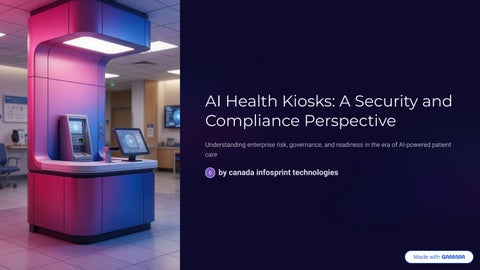
Understanding enterprise risk, governance, and readiness in the era of AI-powered patient care by canada infosprint technologies
AI health kiosks represent a fundamental shift in how healthcare organizations deliver patient-facing services. These intelligent endpoints combine sophisticated sensor technology, artificial intelligence algorithms, and secure connectivity to provide automated health assessments at the point of need. Unlike traditional kiosks that simply collect basic information, modern AI-enabled systems actively analyze patient data, make preliminary assessments, and integrate directly with clinical workflows. These systems capture a comprehensive range of patient information including vital signs (blood pressure, temperature, oxygen saturation, heart rate), symptom descriptions through natural language processing, medical history through guided questionnaires, and even visual assessments through integrated cameras. The data collection happens in real-time with immediate processing and analysis.
The AI-driven triage capabilities enable kiosks to assess urgency levels, recommend appropriate care pathways, and prioritize patients based on clinical need. Virtual consultation features allow patients to connect with healthcare providers remotely, expanding access to care while maintaining clinical quality. Perhaps most significantly, these kiosks are increasingly influencing clinical decisions by providing structured data, preliminary diagnoses, and evidence-based recommendations that inform provider actions. All of this functionality operates while handling extremely sensitive protected health information (PHI), creating a complex intersection of innovation, clinical utility, and regulatory responsibility that enterprise security and compliance leaders must carefully navigate.
The introduction of AI health kiosks fundamentally transforms the healthcare organization's threat landscape and compliance posture. Traditional healthcare IT security has focused primarily on protecting centralized systems4electronic health records, hospital information systems, and core clinical applications housed within controlled data centers. AI health kiosks shatter this paradigm by pushing sensitive data processing and clinical decisionmaking to the edge of the network.
Kiosks operate as independent endpoints outside traditional security perimeters, often in public or semi-public spaces. This distributed model means that PHI is being collected, processed, and temporarily stored on devices that may be physically accessible to unauthorized individuals, creating new vectors for data theft, tampering, or device compromise.
These systems don't just collect PHI4they actively process and analyze it using AI algorithms. This triggers additional regulatory scrutiny around data minimization, purpose limitation, algorithmic transparency, and patient consent. The combination of AI and PHI creates a heightened compliance burden that many organizations are unprepared to manage.
Most AI health kiosks rely on cloud-based infrastructure for AI processing, data storage, and integration with EHR systems. This introduces third-party cloud providers into the data flow, creating shared responsibility models, cross-border data transfer considerations, and complex contractual relationships that must be carefully governed.
Each kiosk represents a new potential entry point for adversaries. The combination of network connectivity, valuable PHI, AI algorithms that could be poisoned or manipulated, and physical accessibility creates an attractive target for both opportunistic and sophisticated threat actors seeking to exfiltrate data, disrupt operations, or manipulate clinical outcomes.

Enterprise security leaders must understand and address a complex array of risks unique to AI health kiosk deployments. These risks span physical security, network architecture, application security, and operational controls.
Kiosks deployed in waiting rooms, pharmacies, or retail locations face physical security challenges that centralized systems do not. Attackers can potentially access USB ports, network connections, or internal components to install malware, extract data, or compromise device integrity. Environmental factors like temperature, humidity, and power stability can affect device reliability and security controls. Organizations must implement tamper-evident seals, secure boot processes, full-disk encryption, and physical monitoring to mitigate these risks.
AI health kiosks typically communicate with multiple backend systems4EHRs, AI processing engines, identity providers, and analytics platforms4through APIs. Weak authentication, insufficient input validation, lack of encryption in transit, or overly permissive authorization can expose sensitive data flows to interception or manipulation. API security requires robust authentication mechanisms (OAuth 2.0, mutual TLS), comprehensive logging, rate limiting, and continuous monitoring for anomalous behavior.
Kiosks must authenticate patients, verify provider credentials for virtual consultations, and authorize access to specific data and functions. Weak password policies, lack of multi-factor authentication, insufficient session management, or improper role-based access controls can lead to unauthorized access. The challenge is balancing security with user experience4overly complex authentication may reduce adoption, while insufficient controls create vulnerability.
Traditional security information and event management (SIEM) systems may not have full visibility into kiosk activities. Without comprehensive logging, real-time monitoring, and integration with security operations centers, threats can go undetected. Organizations need centralized logging infrastructure, behavioral analytics to detect anomalies, and automated alerting for security events like failed authentication attempts, unusual data access patterns, or configuration changes.
AI health kiosks rely on numerous third-party components4hardware manufacturers, software vendors, cloud service providers, AI model developers, and integration partners. Each introduces supply chain risk, including vulnerabilities in components, inadequate vendor security practices, or lack of long-term support. Vendor risk management programs must include security assessments, contractual security requirements, continuous monitoring, and incident response coordination.

AI health kiosk deployments must navigate a complex, multi-jurisdictional regulatory landscape. Compliance requirements vary significantly based on where the kiosk is deployed, where data is processed and stored, and which populations are served. Understanding these frameworks is essential for enterprise compliance leaders.
The Health Insurance Portability and Accountability Act establishes comprehensive requirements for protecting electronic protected health information (ePHI). AI health kiosks must implement administrative safeguards (security management processes, workforce training, contingency planning), physical safeguards (facility access controls, workstation security, device and media controls), and technical safeguards (access controls, audit controls, integrity controls, transmission security). Business Associate Agreements (BAAs) are required with any third-party vendors who process PHI on behalf of the covered entity. HIPAA's Breach Notification Rule mandates reporting breaches affecting 500 or more individuals to HHS within 60 days, creating significant liability for security failures.
Singapore's Personal Data Protection Act requires organizations to obtain consent for collection, use, and disclosure of personal data, including health information. Organizations must appoint a Data Protection Officer, implement reasonable security arrangements, ensure accuracy, and limit retention. The PDPA Amendment Act 2020 introduced mandatory breach notification within 72 hours for data breaches likely to result in significant harm, along with higher penalties for non-compliance. Healthcare organizations deploying AI kiosks in Singapore must ensure compliance with both PDPA and sector-specific healthcare regulations.
The General Data Protection Regulation applies to any organization processing personal health data of EU residents, regardless of where the organization is located. GDPR imposes strict requirements around lawful basis for processing, data minimization, purpose limitation, accuracy, storage limitation, and security. Special category data (health information) requires explicit consent or another valid legal basis. Data Protection Impact Assessments (DPIAs) are mandatory for high-risk processing, including automated decision-making. Cross-border data transfers require adequacy decisions, Standard Contractual Clauses, or Binding Corporate Rules. Canada's Personal Information Protection and Electronic Documents Act (PIPEDA) similarly protects health information with consent, accountability, and security requirements.
India's regulatory landscape is rapidly evolving with the Digital Personal Data Protection Act 2023, which establishes consentbased data processing, individual rights (access, correction, erasure), and breach notification requirements. The National Health Authority has released the Health Data Management Policy under the Ayushman Bharat Digital Mission, creating standards for health information exchanges and digital health applications. State-level regulations may impose additional requirements. Organizations must monitor regulatory developments closely as India's digital health ecosystem matures.
Critical Compliance Principle: Achieving and maintaining compliance depends on establishing clear data flow documentation, implementing robust governance frameworks with defined roles and responsibilities, and creating accountability structures that ensure ongoing adherence to regulatory requirements across all jurisdictions where AI health kiosks operate.

The governance of AI-driven patient interactions represents one of the most challenging aspects of AI health kiosk deployments. Unlike traditional clinical decision support tools that provide recommendations for human review, modern AI kiosks may directly influence patient routing, triage decisions, and care pathways with minimal human oversight. This creates significant clinical, legal, and ethical questions that enterprise governance frameworks must address.
01
Organizations must establish clear governance around AI model development, validation, and deployment. This includes defining clinical protocols that inform AI algorithms, establishing oversight committees with clinical, technical, and ethical expertise, documenting training data sources and potential biases, and creating approval processes for algorithm updates. The governance model must specify roles for clinical leadership, data science teams, vendor partners, and compliance functions. Without clear ownership, AI systems may make decisions that don't align with organizational clinical standards or patient safety requirements.
Comprehensive audit trails are essential for clinical quality assurance, regulatory compliance, and incident investigation. Every AI decision should be logged with timestamps, input data, model version, confidence scores, reasoning (if explainable AI is implemented), and outcomes. Logs must be tamper-proof, retained according to regulatory requirements (typically 6+ years for medical records), and accessible for authorized review. Regular audits should assess AI performance, identify potential biases or errors, and validate that decisions align with clinical standards. Audit capabilities become critical in the event of adverse outcomes or regulatory investigations.
02
Defining escalation thresholds is critical for patient safety and liability management. Organizations need explicit protocols for when AI assessment triggers human review4whether based on symptom severity scores, specific high-risk conditions, patient characteristics, or AI confidence levels. Escalation pathways must be technically enforced through system design, not just documented in policies. Clinical validation should confirm that escalation thresholds appropriately balance efficiency with safety. Failure to properly escalate high-risk cases could result in delayed care, patient harm, and significant legal liability.
04
Despite sophisticated AI, errors are inevitable. Organizations need defined processes for detecting errors (through clinical review, patient feedback, or system monitoring), investigating root causes (data quality issues, model limitations, integration failures), implementing corrective actions (model retraining, threshold adjustments, system fixes), and communicating with affected patients when appropriate. Error handling protocols should include patient safety reporting through established channels, legal review for potential liability, and continuous improvement mechanisms to prevent recurrence. The governance framework must treat AI errors with the same rigor as other clinical quality issues.

Before deploying AI health kiosks, enterprise leaders must honestly assess organizational readiness across security, compliance, operational, and governance dimensions. These critical questions help identify gaps and inform investment priorities.
Can we secure data outside core systems?
This question addresses fundamental security architecture capabilities. Organizations must assess whether they can extend zerotrust security models to edge devices, implement strong encryption for data at rest and in transit, enforce granular access controls at the device level, monitor and respond to security events in real-time, and maintain device integrity through secure boot and attestation. If current security capabilities are designed exclusively for centralized systems, significant architectural enhancements will be required. This may include deploying edge security gateways, implementing device management platforms, enhancing network segmentation, and expanding SIEM coverage.
AI health kiosks create complex shared responsibility across IT security, clinical informatics, compliance, legal, and vendor partners. Organizations need clear RACI matrices defining who is Responsible, Accountable, Consulted, and Informed for security controls, compliance validation, incident response, vendor management, and clinical governance. Ambiguous ownership leads to control gaps, delayed incident response, and compliance failures. Executive sponsorship is essential4without C-suite accountability, crossfunctional coordination falters and initiatives stall.
Is our cloud and security stack ready?
AI health kiosks typically depend on cloud infrastructure for AI processing, data storage, and integration. Organizations must evaluate cloud security posture management capabilities, identity and access management maturity, API security controls, encryption key management, backup and disaster recovery for cloud-hosted data, and cloud security monitoring and threat detection. Additionally, assess whether cloud providers meet healthcare compliance requirements (HIPAA BAAs, HITRUST certification, SOC 2 Type II reports). If the cloud environment lacks healthcare-grade security controls, remediation may require months of architecture work, vendor assessments, and control implementation.
Regulatory audits, whether from HHS Office for Civil Rights, state health departments, or international data protection authorities, can occur with minimal notice. Organizations must assess whether they can demonstrate compliance through documented policies and procedures, technical control evidence (logs, configurations, vulnerability scans), risk assessments and mitigation plans, vendor due diligence documentation, incident response capabilities, and workforce training records. If documentation is incomplete, controls are not consistently enforced, or evidence is unavailable, the organization faces significant audit risk. Achieving audit readiness often requires 6-12 months of systematic preparation, control remediation, and documentation development.
The success or failure of AI health kiosk initiatives is ultimately determined not by the kiosk hardware or AI algorithms, but by the underlying infrastructure foundation. Long before a patient interacts with a kiosk touchscreen, critical architectural decisions shape security posture, operational reliability, and compliance outcomes.
Cloud architecture decisions impact scalability, resilience, security, and cost. Organizations must choose between public cloud (AWS, Azure, Google Cloud), private cloud, or hybrid models based on data residency requirements, performance needs, and compliance constraints. Microservices architectures enable independent scaling of AI processing, data storage, and integration components. Multi-region deployments provide geographic redundancy and support global operations. Infrastructure-as-code enables consistent, auditable deployments. Serverless computing can reduce operational overhead while improving elasticity. Poor architectural choices lead to performance bottlenecks, scaling limitations, and security vulnerabilities that are difficult and expensive to remediate post-deployment.
Security must be architected from the ground up4retrofitting security onto insecure systems is costly and incomplete. Essential controls include network segmentation to isolate kiosk traffic, defense-in-depth with multiple security layers, identity and access management with leastprivilege access, encryption for data in transit and at rest, security monitoring and SIEM integration, vulnerability management and patching, and endpoint detection and response. Security architecture should align with frameworks like NIST Cybersecurity Framework or HITRUST CSF to ensure comprehensive coverage. Inadequate security architecture creates exploitable weaknesses that put patient data and organizational reputation at risk.
Data governance establishes policies, processes, and controls for data lifecycle management. This includes data classification (identifying PHI and other sensitive data), data inventory and mapping (understanding where data flows), consent management (tracking patient authorizations), data quality management (ensuring accuracy and completeness), retention and disposal (complying with legal requirements), and access governance (controlling who can view or modify data). Strong data governance enables compliance, supports clinical quality, and builds patient trust. Weak governance leads to compliance violations, data quality issues, and inability to respond to patient rights requests.
AI health kiosks don't operate in isolation4they must integrate seamlessly with EHR systems, scheduling platforms, billing systems, patient portals, and clinical decision support tools. Integration architecture determines whether data flows reliably, clinical workflows function smoothly, and patient experiences are seamless. Standardsbased integration (HL7 FHIR, DICOM) enables interoperability and reduces vendor lock-in. API gateways provide centralized management, security, and monitoring. Event-driven architectures enable real-time data synchronization. Integration failures cause workflow disruptions, data inconsistencies, and poor user experiences that undermine clinical adoption and patient satisfaction.
Organizations that invest in robust infrastructure before deploying patient-facing AI systems position themselves for operational success, regulatory compliance, and scalable growth. Those that rush deployment without proper infrastructure foundations face costly rework, security incidents, compliance penalties, and potential patient safety issues. Infrastructure excellence is not optional4it's the prerequisite for responsible AI health kiosk deployment.


This presentation provides a strategic overview of the security and compliance challenges inherent in AI health kiosk deployments. For enterprise security, compliance, and IT leaders seeking deeper, practical guidance on implementing robust controls and governance frameworks, we recommend further exploration of this topic.
A comprehensive resource is available that provides detailed technical architecture recommendations, control implementation guidance, vendor evaluation frameworks, compliance checklists, and real-world deployment case studies.
Read the Full Guide Talk to our Experts
Equip your organization with the knowledge and frameworks needed to deploy AI health kiosks securely, compliantly, and successfully.