Best media reporting on ethical and/or impact investment
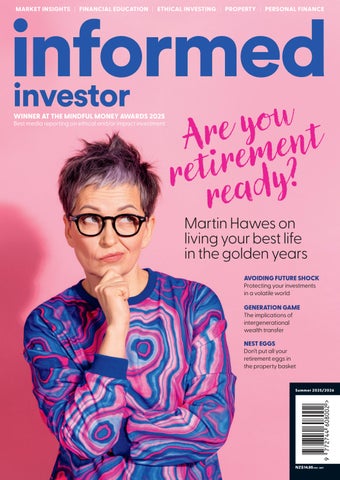
Areyou retirement ready?
Martin Hawes on living your best life in the golden years
AVOIDING FUTURE SHOCK
Protecting your investments in a volatile world
GENERATION GAME
The implications of intergenerational wealth transfer
NEST EGGS
Don’t put all your retirement eggs in the property basket
Powered by
When
Financial author Martin Hawes discusses how to make your golden years work for
John
from Kauri Wealth explains how KiwiSaver is a key
With no certainty in a volatile world, Shamubeel Eaqub advises prudent preparation.
The wealth transfer from today’s retirees to the next generations could have far-reaching implications, says Barry Coates of Mindful Money.
Oliver Mander of NZ Shareholders’ Association takes a deep dive into KiwiSaver as we head into an election year.
Generate’s Greg Smith considers the case for a revamp of KiwiSaver.
Don’t
… yet, says Chris Smith.
Your
Hidden power of your KiwiSaver
Jackson Rowland explains how your KiwiSaver comes with a side of power and influence.
Retirement nest eggs
Don’t put all your eggs in the property basket, says Octagon’s Matt Hardwick.
Income vs capital growth
Trent Bradley from Luminate explores options for investing in your retirement.
Investing in a carbon forest
Plantation forests are sources of sustainable timber and actively growing carbon sinks, which can deliver tradeable carbon credits.
quite retired?
Mortgage investing works both before and after the finish line.
PMG Funds investor relationships manager Rory Diver on recognising the importance of financial education in securing long-term prosperity.
Who wants (needs) to be a millionaire?
Spoiler alert: you do, says Stuart Williams from Amova.
Forces affecting business, investment and the economies across the globe.
Sluggish … for now
Cotality’s Kelvin Davidson predicts the potential for small gains in 2026.
One investor. One asset. 18 years
From acquisition to exit: the journey of a long-term investment in an unlisted commercial property fund.
Williams Corporation Capital provide wholesale investors with four property-backed investment funds, which have a proven track record of success.
Summer 2025/2026 style options revealed.
through connection
Charlotte Clark and Victoria Bahadoor of Empower Her explain how they’re changing the conversation for women over 60.
Sarah Meikle explains how India will awaken the senses
– and tempt savvy investors.
Swedish design with Kiwi can-do
Liz Dobson of automuse.co.nz rates the rugged Volvo Cross Country.
A hill to thrive on
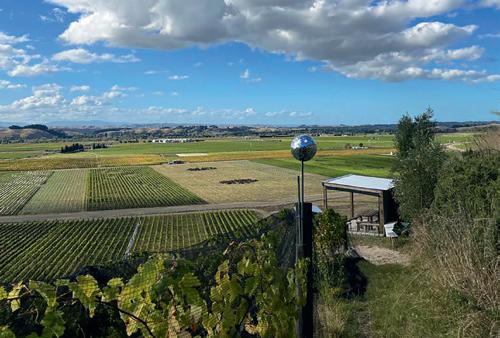
The story of a super-premium syrah, grown in Hawke’s Bay and coveted around the globe.
www.williamscorporationfunds.co.nz
Retirement – more than ‘lock and leave’
Time Reflection
attitude to money, but to make it work for us it’s relate to it.
has flown I’m not one love a bit spacious summer hard look shopping obsessions), trouble in the wiser) I make although certainly used for profoundly lives. money. good to touch of factors pessimistic or money work we relate “money into our which we contents with into our attitudes change
Informed Investor
33 Federal Street, Auckland Central, Auckland.
Published by: Opes Media www.informedinvestor.co.nz
KIWISAVER HAS DONE so much to create better awareness around retirement savings. But the “lock and leave” nature of the scheme, which allows balances to grow without any real oversight, means many stick with default providers and make minimum contributions. Over decades, they could (potentially) be missing out on thousands.
Informed Investor PO Box 40128, Glenfield, Auckland 0747
informedinvestor.co.nz
and develop over our life, and explains how people can develop better relationships with money.
Effective retirement planning necessitates a more nuanced approach. Our summer issue investigates the factors that can mean a retirement with options – travel, dinners out, money for hobbies – or a retirement scrimping and saving.
Informed Investor is an investment magazine published quarterly by Opes Media. You need Informed Investor’s written permission to reproduce any part of the magazine.
Our lead story by Martin Hawes draws on his personal experiences – and the contents of his new book Retirement Ready – to outline how to maximise your financial wellbeing in retirement. He presents two simple activities to help prepare for this – a mock budget and in-depth analysis of investments.
When Hawes mocked up his own retirement budget, it revealed he would need around $110,000 a year to live the life he wanted – a life that included travel.
We’ve also modified a quiz taken from Lynda’s website (moneymentalist.com) so you can discover your own “money personality”. It’s quick, easy, and a bit of fun, but it should also get you thinking. This is a great Christmas holiday activity to share with friends and family over a glass (or bottle) of bubbly.
Looking at the income side of the equation, he knew that NZ Super would only offer around $20,000 a year. That extra $90,000 would need to come from his investments.
Informed Investor is an investment magazine published quarterly by Informed Media. You need Informed Investor ’s written permission to reproduce any part of the magazine.
Advertising statements and editorial opinions in Informed Investor reflect the views of the advertisers and editorial contributors, not Informed Investor and its staff.
For him to achieve his dream retirement, he would need investments valued at $1.5 million to draw upon. It’s a lot of money – luckily for him, he has it. But many of us would look at this total with incredulity.
I know my personal retirement investments are a tiny percentage of his.
That’s why it’s important to think about retirement when you are young. And as alluded to before, a key part of this is ensuring your KiwiSaver settings are optimised.
Amy Hamilton Chadwick delves into another sort of money personality this issue: the financial pessimist. If you’ve been stung before, it makes sense that you’d be cautious around investing. But as Amy explains, fear of doing anything (or “analysis paralysis”) can prevent you from embracing a brighter financial future.
The second part of our lead, written by John Bell from Kauri Wealth, explores how investing in the right KiwiSaver fund for your circumstances “can add up to tens or even hundreds of thousands of dollars over the course of a working life.
Advertising statements and editorial opinions in Informed Investor reflect the views of the editorial contributors and advertisers, not Informed Investor and its staff.
“That’s not because of secret tricks or risky investing. It’s simply the long-term power of compounding growth working at different speed,” Bell explains.
KiwiSaver is just one aspect of sound retirement investments – be it mortgage funds, commercial property or forestry, there are a raft of other options for wealth creation.
We also check out the new convertible Mini, the importance of goal setting, and how electric cars are changing transport economy worldwide.
We really hope you find inspiration in the pages of our magazine and wish you all the very best for this festive season.
But whichever option you choose, it’s extremely important to take advice. We highly recommend finding a reputable financial adviser for this – they will be able to guide you through the process and help you craft your best possible retirement. Your future is valuable – and your retirement planning now could be the difference between luxury cruises or cheese on toast for dinner every night.
Take care and happy holidays.
Informed Investor’s content comes from sources that Informed Investor considers accurate, but we don’t guarantee its accuracy. Charts in Informed Investor are visually indicative, not exact. The content of Informed Investor is intended as general information only, and you use it at your own risk: Informed Investor magazine is not liable to anybody in any way at all. Informed Investor does not contain financial advice as defined by the Financial Advisers Act 2008. Consult a suitably qualified financial adviser before making investment decisions.
Informed Investor ’s content comes from sources that Informed Investor considers accurate, but we don’t guarantee its accuracy. Charts in Informed Investor are visually indicative, not exact. The content of Informed Investor is intended as general information only, and you use it at your own risk: Informed Investor magazine is not liable to anybody in any way at all. Informed Investor does not contain financial advice as defined by the Financial Advisers Act 2008. Consult a suitably qualified financial adviser before making investment decisions.
Joanna Mathers Editor
Joanna Mathers Editor
Resident economist
Informed Investor magazine does not give any representation regarding the quality, accuracy, completeness or merchantability of the information in this publication or that it is fit for any purpose.
Informed Investor magazine does not give any representation regarding the quality, accuracy, completeness or merchantability of the information in this publication or that it is fit for any purpose.
you
Ed McKnight
Managing editor
Joanna Mathers – joanna@informedmedia.co.nz
Printer
Subeditors
SÍana Clifford
Mike Deacon
Webstar
Design director
Sally Fullam – sally@informedmedia.co.nz
Retail Distributor
Sally Lindsay
Printer
To advertise in Informed Investor, you must accept Informed Investor magazine’s advertising terms and conditions. Please contact Stephanie@informedinvestor.co.nz about advertising.
To advertise in Informed Investor, you must accept Informed Investor magazine’s advertising terms and conditions. Please contact joanna@informedmedia.co.nz about advertising.
Account manager
Are Direct
Joanna Mathers – joanna@informedmedia.co.nz
Subscriptions
Sally Fullam – subs@informedmedia.co.nz
Council procedures. A complaint must first be directed in writing, email address, stephanie@informedinvestor.co.nz. complaint may be referred to the Media Council PO Box 10-879, info@mediacouncil.org.nz. Or use the online complaint form at include copies of the article and all correspondence with the publication.
Webstar
Retail distributor Are Direct
Informed Investor is printed on environmentally responsible paper. The paper is produced using elemental chlorine-free pulp, sourced from sustainable and legally harvested farmed trees. The magazine is recyclable.
This magazine is subject to NZ Media Council procedures. A complaint must first be directed in writing, within one month of publication, to the email address, joanna@informedmedia.co.nz. If not satisfied with the response, the complaint may be referred to the Media Council PO Box 10-879, The Terrace, Wellington 6143; info@mediacouncil.org.nz. Or use the online complaint form at www.mediacouncil.org.nz. Please include copies of the article and all correspondence with the publication.
PRINT ISSN 2744-6085
DIGITAL ISSN 2744-6093
Informed Investor is printed on environmentally responsible paper. The paper is produced using elemental chlorine-free pulp, sourced from sustainable and legally harvested farmed trees. The magazine is recyclable. PRINT ISSN 2744-6085
DIGITAL ISSN 2744-6093
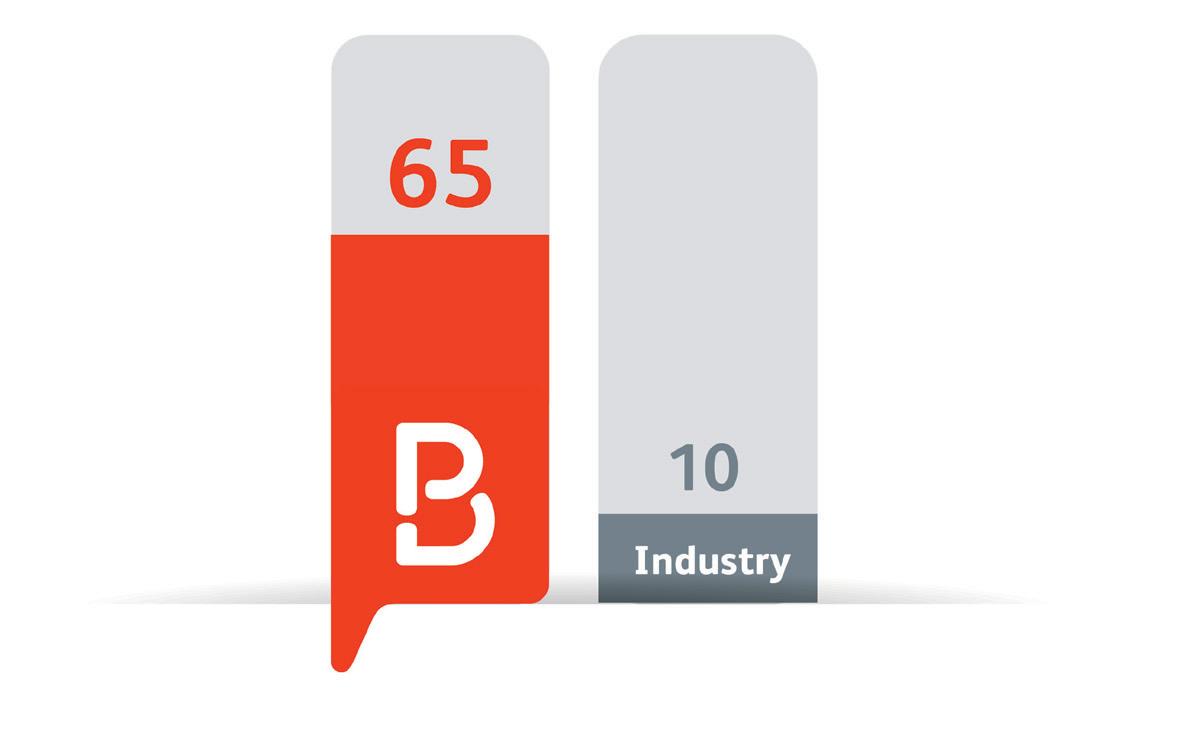
Want a 6.5 x better
Meet Some of Our Contributors
CAMERON BAGRIE
Cameron is the managing director of Bagrie Economics, a boutique research firm. He was previously chief economist at ANZ, a position he held for over 11 years.
Meet some of our contributors
SAM BRYDEN
Sam Bryden is Head of Distribution at Nikko AM NZ. With over 18 years’ experience in investment management and financial markets, the last six of these at Nikko AM, he is responsible for leading the firm’s sales, marketing and client servicing.
AMY HAMILTON CHADWICK
SHAMUBEEL EAQUB
Amy specialises in property and finance journalism. She has been a writer and editor for almost 20 years. Amy is a registered financial adviser.
Shamubeel is chief economist and head of policy at Simplicity, and a thought leader who is unafraid to take a contrarian view.
MARTIN HAWES
MARTIN HAWES
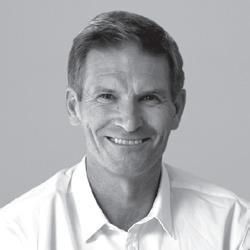
Martin Hawes is a well-known New Zealand financial author, conference speaker, and TV and radio commentator.
Martin is the chairman of the Summer KiwiSaver Investment Committee. He’s an authorised financial adviser and offers his services throughout New Zealand.
TIMOTHY GILES
SCOTT MCKENZIE
Rich is the retail investment manager of Oyster Property Group. He is responsible for overseeing both retail and wholesale equity raising for transactions, the growth of Oyster’s investors, and continuing to improve Oyster’s service offering to investors.
Timothy Giles is our wine enthusiast. For 30 years he has been sharing his enthusiasm for fine and funky wines as a writer, trainer, list curator and podcast host. To build up a thirst he enjoys open-water swimming, triathlons and is a football referee in Auckland. The dad-of-one’s goal is to share more of his wine cellar with his daughter than is left to her.
TOM AYLING
Tom is the head of customer services for InvestNow.
OLIVER MANDER
ANDREW NICOL
Andrew is an authorised financial adviser and the managing partner of Opes Partners. He has more than 15 years’ experience in banking, finance, and property.
Oliver is the CEO of NZ Shareholders’ Association. He is as a strategic thinker, focused on transformative solutions, developing and implementing business strategies so that they come to life for organisations. He believes that a strategy means nothing without delivery.
VICTORIA BAHADOOR & CHARLOTTE CLARK
Charlotte (right), a branding strategist and alignment coach, and Victoria (left), a personal brand photographer and ADHD coach, empower women to build impactful businesses with confidence. Through their global community, they create opportunities for connection, growth, and visibility in a space where women feel truly seen and supported.
KELVIN DAVIDSON
KELVIN DAVIDSON
Kelvin joined Cotality in March 2018 as senior research analyst, before moving into his current role of chief economist. He brings with him a wealth of experience, having spent 15 years working largely in private-sector economic consultancies in both New Zealand and the UK.
Kelvin joined CoreLogic in March 2018 as senior research analyst, before moving into his current role of chief economist. He brings with him a wealth of experience, having spent 15 years working largely in private sector economic consultancies in both New Zealand and the UK.
RORY DIVER
ANDREW KENNINGHAM
Rory is investor relationships manager at PMG. He brings considerable financial services experience having previously worked for KPMG as an auditor and for BNZ in commercial banking.
Andrew is the chief Europe economist for Capital Economics.He was previously an economic adviser for the United Kingdom Foreign Exchange.
LIV LEWIS-LONG
Liv is a passionate finance educator, writer and podcaster, and set up Simplicity’s Money Made Simple podcast to help level up financial literacy in NZ. She also heads up its marketing team, with over 15 years’ experience in brand, communications and storytelling.
BARRY COATES
Founder and CEO of charity Mindful Money, Barry is a former Green Party MP and CEO of Oxfam New Zealand. He is passionate about climate justice, sustainability and social equity.
MATT HARDWICK
SAM STUBBS
Matt joined Octagon Asset Management in 2022 and is responsible for the firm’s business development, go to market strategy and client services. He has over 20 years’ experience in investor relations, fundraising and corporate transaction support for multiple companies in London, Singapore and across European emerging markets.
Sam is the founder and MD of Simplicity, New Zealand’s only low-cost, nonprofit funds manager. Previously from the banking world having worked for Goldman Sachs and NatWest Markets in London and Hong Kong, Sam believes the finance industry should be as much a force for good as a source of profit.
STUART WILLIAMS
Stuart Williams is the managing director of Amova NZ (formerly Nikko AM NZ), which operates the GoalsGetter KiwiSaver Scheme. With over 20 years’ experience across all aspects of investment management, he previously led the NZ Equities team.
Christmas gift guide
From immersive gaming headsets to an ultra-luxe advent calendar, our special Christmas edition has your present ideas covered.
Light speed
I’m not a gamer, but I love my podcasts. My most recent headset was unintentionally dismantled by my son (don’t ask) so I’ve been making do with a substandard headset cobbled together with masking tape.
My son, on the other hand, was battling with his own headset issues – terribly designed and with extremely patchy sound quality, gaming with friends was frustrating him. Often I’d be trying to work while screams of frustration echoed from lounge, as his headset glitched again.
The Logitech G Astro A20 X Lightspeed Wireless Headset (with Playsync Audio technology) is the antithesis of our former headsets. It’s made for gaming (although I steal if for those podcasts); a plug-and-play headset with premium performance features.
My son tells me that the lightweight design of the headset means it never gets uncomfortable, no matter how long he plays (he does have screen-time limits, if you were wondering). It’s immersive, and features a full mobile app and RGB lighting customisation, and console
players can personalise and showcase their unique style, with endless opportunities for creativity.
When I can wrest it off him, I love the depth and subtlety it brings to music. While it’s not designed for music appreciation, it offers an mesmeric, enveloping experience of my favourite artists’ sounds.
Best of all, I can work while he’s entertained after school (when he’s not playing football): no more annoying video game sound effects to distract me from work. It’s a win-win and highly recommended. $399.95 from logitech.com
Holiday hair
The limited edition Cherry Chic Duet Style gift set (RRP $665) could be the hottest Christmas present on offer. The ghd Duet Style is a two-in-one hot air styler; transforming hair from wet to styled, with no heat damage. It blends ghd drying and heat technologies to simplify your styling routine for beautifully smooth and sleek results, with just one tool. The set includes the ghd Cherry Chic Duet Style, a vanity case (worth $120), styling oil (worth $75) and a paddle brush (worth $62). Visit farmers.co.nz to purchase.
It’s a kind of magic
Pōkeno Whisky has introduced the first addition to its core range since 2022, Pōkeno Alchemy. Pōkeno Alchemy balances some of their oldest whisky, which has been fully matured in six different casks, creating a single malt with intense levels of richness. Pōkeno Alchemy is available from Pōkeno’s online store, their Distillery Shop (open Saturdays) and through an exclusive retail partnership with Liquorland. It can also be purchased duty free from Auckland Airport and will be rolled out to international markets through 2026. Visit pokenowhisky.com for more details.
Luxe Christmas countdown
Countdown to Christmas in style with Jo Malone London’s iconic advent calendar. With 25 days of luxurious goodies, including the sumptuous Velvet Rose and Oud Body Creme and luxurious Orange Bitters Cologne, this advent calendar is the ultimate luxury Christmas gift – or even better, a pre-Christmas gift for someone with a birthday at the beginning of December. $980 from mecca.com.
Ergonomic mouse
Great for people whose hands and arms get a bit tense doing computer work, the MX Master 4 mouse has immersive control and customisable haptic feedback on specific actions. Features include two-times better connectivity, ultra-fast scrolling with the MagSpeed scroll wheel, 8k DPI any surface tracking, including glass and Logi Options plus for customisation. The MX Master 4 elevates your workflow; the ergonomic design seamlessly blends comfort and performance. Visit logitech.com for sales.
Swimming girls framed art,
chair
Make it Count
Create a summer sanctuary with Resene’s cool colours.
1. HKLiving 70s ceramics tea cup in glint, $44.99 – boltofcloth.com 2. Florence tea towels (two pack), $62 – achomestore.co.nz 3. Kollab mini cooler in khaki/black, $65 – achomestore.co.nz 4. French linen sofa mattress in Aalborg eucalyptus green, $398 – madderandrouge.co.nz 5. Fermob Lorette trivet in ice mint, $105 – jardin.co.nz 6. Serax Pure Plate (set of four) in sea green, $215 – ecc.co.nz 8. Abacus beach towel in daffodil/cream, $85 – cittadesign.com
Areyou retirement ready?
In the wake of his new book, Retirement Ready, well-known financial author Martin Hawes discusses how to approach the golden years in a way that works for you.
I HAVE ALWAYS known that there would come a time when I would need to live on savings.
I have never thought of this as retirement as such, nor had I made a concrete plan. However, I have always wanted to live with the confidence of having enough if I ever did stop work. I want to be ready for retirement, even if I do not particularly want to be retired.
A few years ago, I had a major review of my finances. I looked at all aspects: family trust, will, housing, insurances, and work. These were things that I had kept a watching brief on for years and so this review was one more in a series.
However, with my advancing years, there were two other things that needed a special, more detailed look: a retirement budget (because you never know) and my investments.
The budget was first: like any budget, this budget was a check that my income would always match or exceed my expenditure – that I had enough. It was a review to insure that I could move out of work and live the life that I wanted.
Mock budget
This started by doing a mock budget – a look at the cost of my desired lifestyle. This exercise showed that I needed about $90,000 pa to live on and another $20,000 pa for travel (I now go to Europe most years for rock climbing).
I then started on the income side of this equation by ignoring funds from work – I had to assume that for whatever reason this had stopped. The only assured income that I would have was from NZ Super (about $20,000 pa)
Simple arithmetic said I had to take $90,000 pa from my investments. The big question for all of us is do we have enough savings to fund the amount we need?
This comes down to two things: the amount of savings and the amount that we can draw from savings to have them last as long as we do.
I knew how much I had in investments – I have measured that on a weekly basis for years. I just needed to apply a drawdown rate to these savings and see if the matched or exceeded $90,000 pa.
‘Someone who had investments of $500,000 and who started drawing down at age 65 could draw $20,000 pa and would see their money run out age 95’
Four per cent rule
The process so far is easy – it is deciding on the drawdown rate that is tricky. In the past many people relied on the 4 per cent rule.
This rule of thumb said that could draw 4 per cent of the starting value of a portfolio and provided that you increased the amount with inflation, and your money was invested in a balanced fund, your investments would last about 30 years.
That would mean that someone who had investments of $500,000 and who started drawing down at age 65 could draw $20,000 pa and would see their money run out age 95.
This has been refined significantly by the New Zealand Society of Actuaries, who have done papers giving various scenarios.
Using one of these and taking account of the fact that I would be starting to draw down well after age 65, I decided that a drawdown of 6 per cent would be appropriate.
That would mean to have my desired income of $90,000 that I would need investments of $1.5 million (which I do have).
My “do I have enough?” question was answered with a “yes”.
Money management
My second question I asked was “who should manage my money”? For nearly 50 years I had managed my own investments, but when I looked at things closely, I realised I was only
getting an average performance.
So, why was my investment performance only average? A little hard (and honest) thinking had me own up to not spending enough of my best time on my own investments – my various other roles took precedent. Moreover, I recognised that although I am not a bad buyer of investments, I was nearly always a reluctant seller.
This meant I did not take a profit when it was on offer and held on too long.
I was spending a lot of time, effort, and energy to be average. If I wanted to be a lot better I would have to spend even more of these three commodities – but, at my stage of life, that was a price I was not prepared to pay.
And so, after 50-odd years of managing my own investments, I took a deep breath and handed my money for others to manage. This has proved one of the best investment decisions I have ever made – it has freed up my time and space of mind.
As I write, I am overseas rock climbing. I have watched the market because I am interested, but I have hardly given my own investments a thought since leaving home. I should have given my portfolio’s management to someone else years ago.
Martin Hawes is a financial writer and presenter. He is not a financial adviser, and the information and opinions here should not be taken as financial advice.
The overlooked asset
KiwiSaver is often overlooked in the average Kiwi’s retirement plan, writes John Bell from Kauri Wealth. But it’s a key component of financial wellbeing post-65.
MOST HARDWORKING NEW
Zealanders don’t think of themselves as “investors”. They think of themselves as builders, nurses, drivers, teachers, tradies: people who turn up, do the mahi, and make an honest living. But here’s the reality: if you’re contributing to KiwiSaver, you’re already an investor, whether you realise it or not.
And yet, for all its potential, KiwiSaver remains one of the most under-optimised assets in many people’s retirement plans.
Set and forget
KiwiSaver was introduced to make long-term saving easy. Set up once, contributions come straight from your pay, your employer adds their share, and over time, the balance grows. For many, that simplicity is part of its appeal.
But the same simplicity that makes KiwiSaver accessible is also what makes it easy to ignore. I regularly meet people who haven’t checked their fund type in years, or worse, don’t even know which fund they’re in. Others assume their bank will “sort it out” or that all funds are roughly the same.
Unfortunately, neither is true.
The difference between an appropriately chosen fund and a mismatched one can add up to tens or even hundreds of thousands of dollars over the course of a working life. That’s not because of secret tricks or risky investing; it’s simply the long-term power of compounding growth working at different speeds.
The hidden cost of inaction
Consider this: two people earning the same salary, contributing the same amount, over the same period could end up with dramatically different KiwiSaver balances at retirement purely because they were in different fund types.
A conservative fund, for instance, might grow slowly but feels “safe”. A growth fund, on the other hand, will experience more ups and downs, but
could deliver significantly higher returns over 10 or 20 years. Over time, that difference compounds and the gap widens.
That’s why the biggest risk for many Kiwis isn’t market volatility, but inaction. Sitting in a default fund because you never made a choice is, effectively, making a choice: the choice to settle for less.
Why fund type matters
The right fund isn’t about chasing the highest returns; it’s about matching your time frame and risk comfort.
If you’re 10 years away from retirement, your money has time to ride out market swings, meaning a higher-growth fund usually makes sense. If you’re closer to retirement, or planning to use your KiwiSaver for a first home in a few years, a more balanced or conservative fund might be appropriate.
The problem is, many people’s circumstances change, but their fund doesn’t. They might buy a home, start a family, change careers, or plan an earlier retirement, all while their KiwiSaver stays exactly where it was when they first signed up.
Regular reviews are essential because your KiwiSaver should evolve with you, not be something you “set and forget” in your twenties.
Not just about the fund
Beyond fund type, other factors quietly cut into returns, like fees and performance. Some providers charge more for the same (or lower) performance. Others focus on ethical investing, which matters to many New Zealanders, but often gets overlooked because people simply don’t realise they have a choice.
These aren’t abstract details as they directly impact how much money you’ll have at 65 and beyond. In a country where housing and living costs keep climbing, that extra 1 per cent in returns or savings on fees can be the difference between retiring comfortably and just scraping by.
The mindset shift
What I’ve noticed over years of talking with everyday workers, from factory staff to office teams to tradies, is that KiwiSaver often feels “too small” to worry about. People think it’s something for later, for financial advisers or older folks. But the truth is, every dollar invested early does the heavy lifting later.
Think of it this way: your KiwiSaver is likely to become one of the largest financial assets you’ll ever own, possibly second only to your home. Yet most people spend more time researching a new phone plan than they do reviewing their KiwiSaver.
This article isn’t about making you feel guilty for your inaction, it’s about awareness. You don’t need to be a market expert or track global indices. You just need to understand the basics: what fund you’re in, how it’s performing, what it’s costing you, and whether it still fits your goals.
Building better habits
A good rule of thumb? Review your KiwiSaver once a year. Look at your fund type, fees, and performance, and consider how your life goals may have shifted.
If you’ve bought your first home, changed your income, or decided to retire earlier, your KiwiSaver strategy should adjust too. A quick check-in is often all it takes to stay on track.
The payoff
Over time, those small moments of attention compound just like your returns. The earlier you take charge, the greater the impact. It’s not about picking winners or predicting markets; it’s about making intentional decisions with the one investment you already have.
For many New Zealanders, KiwiSaver will be the difference between retiring with options and retiring with limitations It deserves more than autopilot. You work hard for your money. It’s time to make sure your money, through KiwiSaver, works just as hard for you. T
Avoiding future shock
Our ageing population needs to make sure they are prepared for many eventualities in a volatile world, writes Shamubeel Eaqub
WE HAVE AN ageing population, and the time to make gradual policy changes is quickly running out. This has implications for us as a country, but also in how we might prepare individually.
It is unlikely that retirement policies will change quickly but looking at the polarised politics unfolding around the world, it would be prudent to prepare, or at least have a “Plan B”. That means a deliberate and considered look at how much you might want to save for your retirement, how you invest that, what kind of retirement you want, and how to fund it with – or without – NZ Super.
A raft of reports from government agencies (Treasury, IRD and MSD) have come to the conclusion (like similar reports of years passed) that our current set-up of taxes, borrowing and spending will not work with the older-skewed
population we know is coming.
More than a decade ago, Sir Michael Cullen (the architect of KiwiSaver) warned that we should not leave harder choices to future generations, simply because we are unwilling to make difficult decisions today. Yet, the politics have proved too hard to handle, and successive governments have avoided doing anything – decrying: “Not on my watch!”
Who pays?
The politics are understandable: voters want and use public services, but do not like paying the taxes that fund them. The fiscal math is also understandable: Those aged between 30 and 64 are net contributors to the fiscal coffers. That is, they pay more into government coffers than the public services they personally consume. Those outside of this age range
(ie kids and retirees), are a net cost. This is more pronounced for the older contingent, who receive a high proportion of public services and welfare: health, superannuation, aged care, housing subsidies for example.
We have a pay-as-you-go retirement income system, meaning our taxes pay for the current generation of retirees. The taxes we pay are not saved up for our own retirement in the future. That means the retirement of current workers will not be funded from the taxes they’re paying now. So, heading towards an ageing population, who will pay? In 1950, there were eight working-age people for every retiree. Today, that number has dropped to four, and in 50 years’ time it will be two. The maths simply doesn’t math.
As this demographic reality bites, it’s impossible to predict the choices that’ll
have to be made in the future. Will NZ Super, which is unsustainable from a future budgetary perspective, remain in its current form? Will health become further rationed, already being the number-one concern for older Kiwis? Will we spend less on education or transport? Will we tax and borrow more? Whatever happens, changes must be made, and there will of course be winners and losers.
Retirement policy choices
There are some retirement policy choices currently on the table. NZ Super could be changed. The most common recommendations are around increasing the age of eligibility and making it means-tested alongside a compulsory retirement savings scheme, like in Australia. Increasing the age of eligibility for NZ Super to 67 would moderate some costs, so makes sense. When pensions were introduced, the age of eligibility was higher than the average life expectancy. Increasing longevity since then has made the policy more expensive. But increasing the age would not address increasing health, aged care, housing and other welfare costs for retirees.
We could enhance KiwiSaver by
making it compulsory, automatically enrolling all workers from 18, and gradually increasing total contributions towards 12 per cent. A simpler single contribution rate would be better than the current employer plus employee, because the contribution is seen as overall compensation of workers regardless. If KiwiSaver was compulsory, in time we could make NZ Super means-tested like in Australia, where around 40 per cent independently fund their retirement. Easing hardship withdrawals for lower-income workers would moderate the impact of lower income during working life.
These options are most likely to be adopted at some stage in our future. We just don’t know when the politics will shift. Will it happen gradually and with enough time for future generations to prepare? Or will it happen abruptly, when workers realise all their taxes from work are being gobbled up by NZ Super and health?
Uncertain future
Uncertainty makes things hard to predict. Planning, however, doesn’t require prediction. For individuals, the question
‘More than a decade ago, Sir Michael Cullen (the architect of KiwiSaver) warned that we should not leave harder choices to future generations, simply because we are unwilling to make difficult decisions today’
‘In 1950, there were eight working-age people for every retiree. Today, that number has dropped to four, and in 50 years’ time it will be two. The maths simply doesn’t math’
is: within your resources, how much do you want to save, what will you invest it in, and how will you manage your retirement?
Because even if my scenarios don’t play out in your lifetime, having done your own planning, you’ll have the benefit of a more comfortable retirement, just with a little less disposable income through your working life. It’s a balancing act. For some people, the choice will be to do nothing.
But it’s good to understand your choices with clarity. Personally, I believe politics and policy changes are inevitable over the next 20-30 years, because the fiscal situation will become completely unsustainable and a new
bolder generation of politicians will make necessary changes.
This is not financial advice of course, but here’s our set-up. We target saving at least 10 per cent of household income for retirement. We contribute just enough to maximise entitlements for KiwiSaver. I do not put in extra, because KiwiSaver locks up money until 65, which I prefer to keep accessible. I do this across a range of investments including a low-cost global equities fund, some low-risk and liquid income assets, venture capital, direct business investments and property.
We also make regular contributions to our kids’ investment funds so that
they are building assets from birth, rather than missing out on the benefit of compounding – this gives them options when they reach adulthood. If there’s subsidised high-quality education when they reach the right age, great. If not, there’s some money available for that. Or a car, or assistance towards a house deposit. The key is, having choices.
For every individual and family, the options available and the choices you make will be unique. But the broad story is one where many things will change over the coming decades. We will get older as a country. Our current set-up of taxes and spending will morph – retirement income and KiwiSaver set-up will be prime candidates for change. While politics is not yet making the gradual changes to help, prudent individuals and families will make gradual preparations now. T
Shamubeel Eaqub is chief economist and head of policy at Simplicity.
The information provided and personal opinions expressed in this article are intended for general guidance only and not personalised to you. These materials do not take into account your particular financial situation or goals and are not financial advice or a recommendation.
Investing with purpose
Barry Coates, co-CEO of Mindful Money, explores the implications of intergenerational transfer of retirement savings.
WE ARE LIVING through a period of the largest transfer of wealth between generations the world has seen. While many individuals and families struggle to save enough for their retirement, the wealthier members of our society collectively have massive assets to pass on to their children and other beneficiaries. What elderly New Zealanders do with the wealth they pass on, and importantly, what the younger generation do with the wealth they receive, is important for the financial system, the economy, the environment and our society.
Passing it on
The growing pool of designated retirement financial assets in New Zealand has been driven by the growth of KiwiSaver. It has reached $130 billion and is already a major factor in the investment system. This capital can and should play a major role in the infrastructure and growth of the economy. Projections are for KiwiSaver to grow to approximately $200 billion by 2030.
Similar dynamics are happening in other countries, such as in Australia, where superannuation funds are a far larger pool of capital and larger in proportion to the rest of the economy. Australian superannuation assets reached $4.3 trillion as of June 2025, representing one of the world’s largest pension systems. But these funds in the financial system are only a small proportion of the total assets – most is in the form of property, household items and businesses. As the large baby-boomer generation ages, this wealth is changing hands. We are seeing the largest intergenerational transfer of wealth in history from the baby boomer generation to Gen Z and Millennials. Business and Economic Research Limited (BERL) estimates that those born before 1966 currently hold 60 percent of New Zealand’s $2.29 trillion in total individual net wealth.
JB Were’s Bequest Report 2025 estimates $1.11 trillion will be transferred from those aged over 55 in the next 20 years, with annual inheritances projected to reach approximately $27 billion in 2024 and grow to $1.6 trillion in cumulative transfers by 2050.
Changing demographics of ethical investment
What happens to this capital will depend to a large degree on the preferences of younger generations. Their approach to wealth and investment is different to the preferences of their parents –it is more likely to have a far stronger ethical foundation.
The next generation of New Zealanders have grown up with a far greater
‘What elderly New Zealanders do with the wealth they pass on, and what the younger generation do with the wealth they receive, is important’
appreciation of the importance of the environment and sustainability. They have also been receptive to the growing evidence that shows ethical investing is smart investing. They have seen examples of companies that have lost their social licence to operate through pollution and harmful practices, and examples of companies that have been rewarded for high standards of sustainability.
Their views have been supported by evidence from thousands of studies that compare the returns from ethical and conventional investment, concluding that ethical investing performs at least as well over the long term, with lower risks and returns skewing on the high side. It is not surprising that most of the leading active investors, and a growing number of passive providers, use tools, such as environmental, social and governance (ESG) analysis to reduce investment risk. Ethical investment has grown rapidly and become mainstream.
Changes to investment flows
The combination of intergenerational shifts in capital and the continued deepening of ethical investment will substantially reshape capital flows and their real-world impacts. Younger people do not invest in the ways their parents did. They care about different things, and they want their money to enable different outcomes. This will result in significant changes to the investment sector and the economy.
This is partly driven by changes in the ways that younger people see money. Some of these are revealed in annual surveys of the New Zealand public that have been undertaken over the past six years by Mindful Money and the Responsible Investment Association of Australasia.
As a headline statistic, the latest annual survey in 2025 reveals that younger New Zealanders have higher expectations that their funds will be managed ethically (81 per cent for Gen Z vs 70 per cent for baby boomers). They are more likely to have chosen their KiwiSaver on the basis of sustainability or alignment with their values and consider the ethical investments are likely to perform better in the long term.
Younger New Zealanders are also
more willing to switch to another fund if the investments do not align with their values (68 per cent Gen Z vs 57 per cent Baby Boomers). The preference for ethical investment is also heavily skewed towards women (81 per cent vs men 67 per cent).
Issues that younger Kiwis care about
The types of issues that Kiwis care about are changing over time. A decade ago, the key unethical issues were more likely to be harmful products and services –tobacco, gambling, alcohol, pornography and weapons. Typically, these have been relatively easy for the investment providers to define and track. Progress has been slow but Mindful Money analysis shows there has been a steady decline in investment in these unethical products and services.
However, the increasingly important issues for the public are more likely to be human rights violations (including child labour, trafficking of women, targeting of civilians in conflict and repression of rights), environmental damage, animal cruelty and climate change. These issues are complex, harder to define and more difficult for investment providers to identify and track. As a result, fewer fund managers in New Zealand avoid these issues in their portfolio or track progress in reducing harm in the investee companies, even though they are the issues of highest concern, especially to younger people.
One particular issue that younger people find more concerning than their parents is climate change. A far larger proportion than their parents want to avoid investing in fossil fuels. They realise that their investment decisions affect climate change and expect their funds to take action to reduce climate emissions and invest in climate solutions.
The importance of investing for purpose
One of the major differences between generations is that a higher proportion of younger Kiwis think their investments should make a positive difference in the world. They expect their investment managers to report on the real world impacts of their investments.
They are more likely to invest in funds that have a positive social and/or environmental impact, even if it has a lower return than comparable funds. They have particular interest in investments in social housing, sustainable transport, education and training, societal inclusion and Māori-led development for the benefit of iwi and hapu.
And, by a large margin, they are motivated to save or invest more if they know their investments make a positive difference in the world (79 per cent for Gen Z vs 58 per cent for the average population).
Implications for the investment sector
Younger Kiwis want to know what companies they are invested in and are increasingly accessing that information –website traffic for Mindful Money’s free portfolio transparency tool is skewed towards younger users. They are more likely to access information from family and friends, and seek automated “roboadvice”, but are as open to seeking financial advice as the average population.
The increased demand for ethical investing is already being reflected in investment claims, but practices vary
widely. Younger consumers are highly attuned to greenwashing practices and it is important that claims of being ethical or responsible are authentic, and reflected in investment portfolios. There are strong growth prospects for fund managers that are attuned to the needs of younger Kiwis, including their ethical preferences.
There are also exciting opportunities for wealth managers, financial advisers, philanthropy advisers and others. Those who come into legacies (sometimes unexpected and substantial) will often need support from advisers on how to invest the funds and incorporate them into life plans including the potential for earlier retirement. This will need to encompass solutions for investment, including providing ethical options and how to plan the use of funds. Good advisers will work with philanthropy consultants to support clients to direct donations in ways to achieve high impact for causes they care about.
There are strong indications that the market for ethical investing will continue to grow. The survey shows that 38 per cent of Gen Z intend to choose a more ethical fund in the next year and a further 27 per cent within the next five years. Even though there is typically a gap
between surveyed intention and observed behaviour, this is a strong indication of future growth in ethical investing.
Wider issues
There are also public policy challenges associated with inter-generational transfers of wealth. In New Zealand, gift duties were applied from 1885 to 2011. The abolition of gift duties, along with other tax changes, have contributed to the subsequent widening disparities of wealth and income in New Zealand. Research by Treasury shows that children of rich parents are more likely to become rich when they grow up, and children of poor parents are more likely to become poor when they grow up.
The transfer of wealth in our society is crucially important for individuals and for society. The decisions made in investing this intergenerational capital have the potential to transfer capital away from businesses that cause harm to people and our planet and increase the pressure on them to raise standards. They also have the potential to contribute towards a low emissions, a more equitable society and more sustainable future.
www.mindfulmoney.nz
WOMEN-LED BUSINESSES IN THE BLUE PACIFIC
You’re invited to
IS YOUR KIWISAVER WORKING AS HARD AS YOU DO?
You’ve done the work – earning, saving, contributing. Now it’s time to make sure your KiwiSaver is doing everything it can for you.
At Kauri Wealth, we believe your KiwiSaver isn’t just a number on a statement. It’s your first home, your retirement, your freedom.
We give 100 per cent free personalised KiwiSaver advice tailored to your goals – whether that’s owning your first home, retiring earlier, or simply having more choice.
We are:
· completely independent, no sales targets, no provider bias
· we work with your existing KiwiSaver balance to optimise outcomes – more growth, fewer fees, smarter fund choices, less volatility
· annual check-ins to keep you on track as life changes.
WHY YOU SHOULD ACT NOW
Thousands of Kiwis sit in default or poormatch funds and think, “it’ll do”. The truth is the right fund could bring thousands more to your balance, or get you into your first home, years sooner. At Kauri Wealth, we help you see the difference, make the choice, and take control.
The evolution of KiwiSaver
In this first part of a two-part story, Oliver Mander, chief executive of NZ Shareholders’ Association, examines the potential for a step change in KiwiSaver and the key questions and trade-offs that could be raised in the 2026 election.
KIWISAVER HAS BEEN a feature of our investment landscape since 2007. I’ve written about its growth in a previous edition of Informed Investor, observing the increase in KiwiSaver from a standing start to approximately NZ$130 billion at the end of June 2025. That pales in comparison to the AU$4.2 trillion invested in Australian pension funds – a function of an earlier start point and higher contribution rates.
The announcement by prime minister Christopher Luxon on November 23, 2025 to create a 12 per cent KiwiSaver contribution has been a long time coming, encouraged by the managed funds sector and investors alike. The proposal, such as it is at this early stage, is a “halfway house” towards New Zealand’s slow but inevitable move to create a superannuation structure that can be sustained in the long term. It envisages a 6 per cent contribution rate
from both employer and employee – a significant difference in structure to the Australian equivalent where the 12 per cent contribution rate is borne solely by the employer.
Leadership is not always about doing what the people want. More often than not, it’s about doing the right thing – often in the face of adversity.
But, given the nature of short-term democracy, it can be difficult for politicians to take the tough decisions. So the integrity behind political will often gives way to the power of popular consensus. In that context, political consensus between major political parties is critical.
When it comes to nurturing KiwiSaver as it heads into its 20s, let’s hope we get that consensus.
Some jargon and a bit of maths Consensus or not, there’s no doubt that superannuation will become a key
issue heading into New Zealand’s 2026 parliamentary elections. So, let’s prepare you for the sort of jargon that you might hear on the campaign trail…
SayGo vs PayGo
SayGo is industry shorthand for a “save as you go” superannuation scheme. KiwiSaver is a good example of this, with contributions from employers and employees adding up to create savings for retirement throughout an employee’s lifetime.
PayGo is the exact opposite, a scheme that pays out money as it is needed to beneficiaries – or “pay as you go”. Our universal NZ Super is an example of this. There are some pros and cons to both – but for New Zealand, the rapidly increasing proportion of over-65s becoming eligible for NZ Super in the next 30 years, funded by an increasingly proportionately smaller workforce
should be a strong lesson in one of the key disadvantages of a PayGo structure. Over 65s will increase from 16.5% of New Zealand’s population to 23.3% by 2050.
KiwiSaver’s SayGo approach has seen an increase in savings rates in New Zealand over the last 20 years, but that does mean that cash is unavailable for spending in the wider economy in the short-term, either to support living costs or in support of other productive investments (eg, capital investment in a business).
The NZ Superannuation Fund (NZSF) has approximately $85 billion invested (as of June 2025) on behalf of New Zealanders. Given its purpose, this is another form of SayGo scheme, benefitting all Kiwis in the long-term.
What this tells us is that current superannuation structures in New Zealand are relatively well-diversified in terms of their design – perhaps unsurprising given that New Zealand began its transition from PayGo to SayGo back in 2007.
A bit of maths
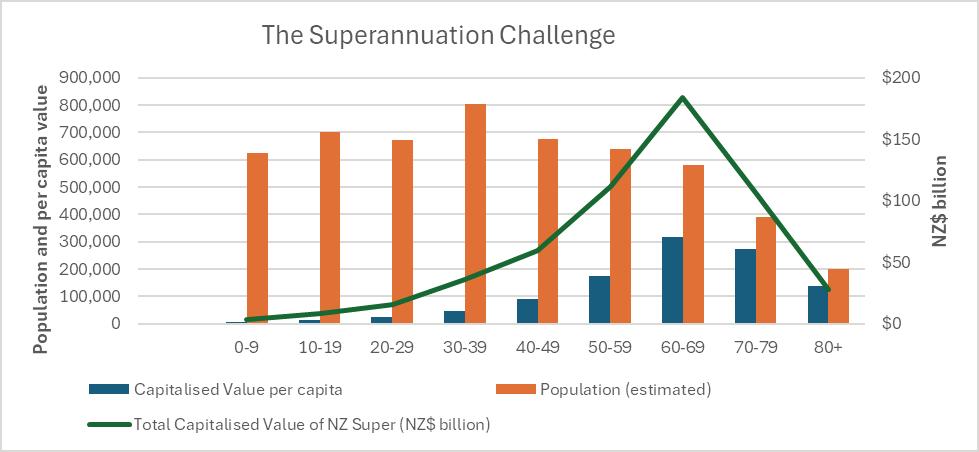
If we assume the average rate for NZ Super (pre-tax) is paid at $29,000 per annum, taking into account the differential rates paid to couples and individuals, and is paid for an average of 25 years, that translates to a capital value of about $343,000 at 7 per cent. Put another way, were you able to sell your entitlement to NZ Super – remember, you can’t – that’s the approximate sum you might be willing to accept at age 65, assuming you live to age 90.
Either side of 65, the capital equivalent value decreases – due to reduced annual payments for the over 65s or the magic of compounding for those with time on their side.
The total value of the government “buying out” all current and future NZ Super entitlements (at 2025 values) is an eye-watering $553 billion.
Of course, the NZ government does not have to buy its way out of the financial commitment associated with NZ Super. And at an estimated cost of $553 billion, why would it? Were affordability to be challenged, it is much easier to just change the rules – perhaps through a gradual increase in the age of entitlement, or reducing entitlement for younger generations.
This (admittedly simplistic) analysis shows us three key things:
• First, the criticality of NZ Super increases once a beneficiary turns 50, with the equivalent capital value increasing rapidly each year
• Second, while the capitalised value of $553 billion is unaffordable and clearly out of reach, that is perhaps an indicator of just how difficult it could be to maintain NZ Super at current levels and entitlement
• Last, the role of the NZ Super Fund (currently $85 billion) in either funding ongoing NZ Super payments or “bridging” NZ to a savings future.
The analysis is simplistic, in the sense that it takes no account of tax. So, now it’s time for a bit more jargon…
The Superannuation Challenge
E and T
When it comes to the powers that be designing retirement savings schemes, “E” and “T” are two key letters, simply standing for “Exempt” and “Taxed”.
Simplistically, there are three key components that determine the amount of cash available to you in your golden years.
The first are contributions – the amount of money that you (or your employer) contribute to your retirement savings.
Next come the earnings, which are simply the returns earned by your savings.
Last, there comes a time in your life when withdrawals become important.
Different countries apply different tax treatments to these three key components. For example, in New Zealand, contributions to KiwiSaver are taxed, as are the earnings of your chosen fund. However, any withdrawals are exempt, as tax has already been paid earlier in the life cycle.
That makes KiwiSaver a TTE (taxed, taxed, exempt) regime, with withdrawals exempt from tax.
That is similar to Australia, but makes us comparative outliers compared to the UK and the US, where both contributions and fund earnings remain untaxed, while withdrawals are taxed, an EET (exempt, exempt, taxed) regime.
As always, there are advantages and disadvantages attached to different systems. Broadly, an EET regime encourages high rates of personal saving, particularly among high-income earners – although the government does not receive tax revenue for decades.
On the other hand, a TTE regime (such as KiwiSaver) is simpler to operate and fairer from a tax equity perspective – but does less to encourage greater saving.
The next generation of KiwiSaver
There are probably things that we can do to encourage greater savings, thereby overcoming the most significant disadvantage of our TTE KiwiSaver regime. The below is a list of random ideas, some supported at different times by New Zealand’s best brains – including, at one time, prime minister Christopher Luxon in his former membership of the Prime Minister’s Business Advisory Council advising former PM Dame Jacinda Ardern.
“Kickstart” payments for children at birth
Most individuals do not start contributing meaningfully to KiwiSaver until their first job, often in their late teens or early 20s. A one-off payment at birth means that children will generate earnings that are likely to make a material difference as they transition to adults.
Higher contribution rates An increased contribution to KiwiSaver is not necessarily an argument against NZ
Super – but it will certainly offer more financial resilience to New Zealanders in their retirement.
Limit on first-house withdrawal
The risks associated with an overheated housing market should be well known to most New Zealanders. And yet, we love our houses.
However, increasing KiwiSaver funds should not be used to encourage higher market pricing for first home buyers, fuelled by withdrawn KiwiSaver money.
Compulsion At a national level, making KiwiSaver compulsory is likely the least contentious measure available to the government to improve national savings rates. Of KiwiSaver’s 3.3 million members, 1.25 million (38%) are not currently contributing. The major reason cited is an inability to afford contributions, although there are a variety of other factors impacting contribution rates. If affordability is a major factor, there are several potential government-supported solutions to overcome this; while this might feel like welfare, there is likely to be a trade-off between supporting savings earlier in life to avoid larger payments later.
KiwiSaver looms large in our consciousness, but we are still not at the point where every member thinks of themselves as an “investor” or “shareholder” in businesses. KiwiSaver will help New Zealanders develop individual financial resilience, rather than being solely dependent on future government policy relating to NZ Super decisions.
As KiwiSaver continues to develop, it is this cultural development that will make the greatest difference to Kiwis retirement planning, investment literacy and commercial knowledge – with an increase in capital and labour productivity a likely outcome.
The proposals made on November 23 to make a step change in NZ’s KiwiSaver contribution rates are a great start. T
In the next issue of Informed Investor… The power of “de-cumulation”
The importance of saving for retirement has been drummed into us for decades. But with KiwiSaver now approaching adulthood, and with consensus political support emerging that supports its expansion, what does that mean for how we think about spending our accumulated savings in retirement?
Informed Investor is New Zealand’s only dedicated investment magazine. Every quarter we dive deeply into the world of investing, economics, ethical investment, small business, world events and property – with a dash of fashion, luxury goods and cars thrown in for good measure. Subscribe today and receive the autumn issue, released in early March, straight to you letterbox.
1
2
(4
Is it time for a KiwiSaver reset?
Greg Smith, investment specialist at Generate, asks whether KiwiSaver needs to change with the times.
AS KIWISAVER NEARS its 20-year anniversary, is it time for a reset – with mandatory membership, higher minimum contribution rates, and perhaps a stronger focus on financial advice?
The coalition government has already committed to raising minimum KiwiSaver rates at the 2025 Budget, from 3 per cent to 3.5 per cent in 2026 and 4 per cent in 2028. But should we be aiming higher?
Since its 2007 launch, KiwiSaver has transformed the financial wellbeing of many New Zealanders and strengthened our economic resilience. Yet a major opportunity remains to expand our national savings pool and unlock greater long-term prosperity. Making KiwiSaver compulsory and lifting contribution rates substantially would ensure more Kiwis are prepared for retirement.
At Generate, we’ve seen first-hand how consistent contributions, financial advice and active investment management
can make a meaningful difference to long-term outcomes.
Our members who’ve received advice typically have higher KiwiSaver balances than the national average, showing the real value of informed decisions. Even modest increases in contribution rates can significantly boost retirement savings over time.
According to the Financial Services Council’s Financial Resilience Index 2025, only 44 per cent of New Zealanders feel prepared for retirement. The Retirement Commission found that raising contribution rates to 4 per cent for a median earner over a 40-year career could make savings last 30 per cent longer than under current settings. The case for higher contributions is clear.
The case for compulsion
The FMA KiwiSaver Annual Report 2025 shows 3.385 million New Zealanders enrolled, with total funds now exceeding
$123 billion. Yet around 30 per cent of members aged 18-65 are not contributing. Making the scheme compulsory would bring over a million more people into active participation.
Despite strong growth, balances remain modest. The Retirement Commission estimated that at the end of 2024 the average KiwiSaver balance was $37,079. Only 12 per cent of members had more than $80,000 saved, while 17 per cent of those with less than $10,000 were already aged between 51 and 65 – fast approaching retirement.
Contrast that with what’s needed: Massey University’s Retirement Expenditure Guidelines suggest a single homeowner requires $273,000 (on top of NZ Super) for a “comfortable” retirement, and $181,000 for a “no-frills” lifestyle. A city-based couple would need roughly $1.03 million combined. The gap between what’s saved and what’s required is wide, and growing.
Source: Massey University https://www.massey.ac.nz/documents/2292/new-zealand-retirement-expenditure-guidelines-2025.pdf
‘Today’s retirees are living longer, healthier, and more active lives. As KiwiSaver approaches its 20th anniversary, a reset is timely to ensure the system remains fit for purpose’
From default to deliberate
And while KiwiSaver is now being introduced in schools (a great step toward building financial literacy), there’s a missed opportunity among those already enrolled. Too many members remain in default funds, earning default results. With investing, time is your greatest friend, and the earlier members make active choices, the better their long-term outcomes.
The value of advice should be considered as part of the KiwiSaver reset. Research from Russell Investments found that professional financial advice can add around 4.5 per cent per year in value to a portfolio – and when compounded over decades, that difference can have a transformative impact on retirement savings.
At Generate, we know financial advice adds long-term value. Over 90 per cent of our members have joined through an adviser, and we have local advisers across the country ready to talk directly with new members to ensure their plan fits their goals.
Why now?
Rising living costs, wage stagnation and longer life expectancy highlight why Kiwis must save more than was envisaged when KiwiSaver began. Today’s retirees are living longer, healthier, and more active lives. As KiwiSaver approaches its 20th anniversary, a reset is timely to ensure the system remains fit for purpose.
Public attitudes toward compulsory saving have likely shifted since the 1997 referendum, when 91.8 per cent voted against it. That proposal required employees to contribute up to 8 per cent without employer support, effectively a pay cut. A modern version (potentially paired with offsetting tax cuts) could be far more acceptable. A poll of Generate’s social-media followers found around 80 per cent support lifting minimum contributions to 10 per cent.
Higher contributions, offset by tax adjustments, could be broadly inflation-neutral. Rather than fuelling consumption, redirected funds would boost savings, supporting long-term growth and financial stability.
Learning from Australia
Across the Tasman, Australia’s compulsory superannuation scheme demonstrates the power of long-term compulsion. Employer contributions currently sit at 12 per cent, helping grow a retirement pool exceeding A$4.2 trillion as at the end of 2024.
Superannuation has been central to Australia’s economic resilience and made it the world’s fifth-largest holder of pension assets.
Other nations such as Sweden, Switzerland, and the Netherlands (all with compulsory retirement-saving systems) have achieved similar success in improving financial security and wellbeing. The evidence is strong: compulsory saving with higher contribution rates works.
Broader benefits for New Zealand
Since inception, KiwiSaver has reduced the future retirement burden on the government, created a $123 billion domestic investment pool, and lessened reliance on foreign capital. KiwiSaver funds now help finance local companies, infrastructure and bonds, deepening our capital markets and improving corporate access to funding.
For members, KiwiSaver encourages saving over consumption, boosts financial security, and supports first-home ownership – more than 500,000 Kiwis have already used KiwiSaver savings for deposits.
The scheme has also lifted financial literacy and broadened participation in investing. Many funds offer valuable global diversification, giving members access to international markets and growth.
Returns, fees, and value
While fees are an important consideration, they’re only half the story –net returns are what ultimately determine outcomes for members. At Generate, we focus on delivering long-term value after fees. As at September 30, 2025, the Generate Moderate KiwiSaver Fund ranked number one for returns over 10 years* (after fees, before tax) according to Morningstar. This reflects our active investment approach, disciplined risk management, and commitment to consistent performance.
The results are evident in member outcomes – the average balance of Generate KiwiSaver members is around $45,000, significantly higher than the national average of $37,000. This suggests our members are not only engaging more actively with their retirement savings, but also benefiting from stronger long-term performance. It highlights how the right mix of disciplined investing, advice, and engagement can materially improve financial preparedness.
The path ahead
KiwiSaver has been a remarkable success story, but to secure the next generation’s financial future, the next logical step may be to make it compulsory and raise contribution levels meaningfully. Detailed analysis will be required on how to offset higher contributions through tax settings, but every major reform begins with a conversation.
At Generate, our mission is to help hardworking Kiwis achieve their savings goals and retire with comfort and confidence; through smart advice and a focus on long-term performance. As KiwiSaver turns 20, the discussion around compulsion and higher contributions is one we strongly encourage, because a stronger, better-managed KiwiSaver means a stronger New Zealand. T
Generate is a Kiwi-owned investment manager helping over 180,000 New Zealanders grow their long-term savings through KiwiSaver and managed funds. This article is for general information only and does not constitute financial advice. All investments carry risk, and past performance is not indicative of future results. To see Generate’s Financial Advice Provider Disclosure Statement or Product Disclosure Statement, go to www.generatewealth.co.nz/ advertising-disclosures/. The issuer is Generate Investment Management Limited.
* Morningstar KiwiSaver survey September quarter end 2025. The Generate Moderate Fund ranked 1st out of 13 NZ Multi Sector Moderate Category Funds.
Proven performance.
Argentina’s wild economic ride
The United States has made a big bet on the changing fortunes of Argentina, as Chris Smith explains.
OVER THE PAST
few years, Argentina has emerged as one of the most fascinating economies to watch around the world. Long seen as a cautionary tale of fiscal mismanagement and runaway inflation, the South American nation is now offering something rarely seen in its modern history – a glimpse of economic recovery.
Just last month, president Javier Milei and his libertarian party, La Libertad Avanza, swept Argentina’s midterm elections with a decisive 41 per cent of the vote. This marked a considerable show of confidence in Milei, who’s often described as part economist, part showman.
Milei’s leadership style has also captured global attention. Known for his impassioned TV appearances and his disdain for the “political caste”, he has built his reputation on disrupting Argentina’s long-entrenched political order.
Political earthquake
His win in late 2023 was described as “a political earthquake”, but at the time, Argentina’s economy was in a dismal state. Inflation was peaking at 287 per cent –among the highest in the world – while public debt had ballooned to more than 100 per cent of GDP.
Two years later, the turnaround is striking. With a programme of radical spending cuts and free-market reforms, which have defined his first two years in office, Milei has accomplished a great deal already. Inflation has plunged to around 31 per cent. Growth has rebounded to 5 per cent. Poverty has dropped to 32 per cent. And in 2024, the government posted its first budget surplus in 14 years – a symbolic milestone that would have seemed unthinkable just a few years ago.
His administration has slashed public spending, removed price controls, deregulated industries, and opened up trade. These moves have restored a measure of investor confidence in Argentina, and none more so than the United States, where Washington has become one of Buenos Aires’ strongest backers.
Trump tick of approval
In October 2025, the Trump administration announced a massive US$40 billion financial support package for Argentina, aimed at stabilising the country’s economy. The package includes a $20 billion currency swap with Argentina’s central bank, providing US dollars in exchange for pesos to bolster the nation’s foreign currency reserves. While contingent on Milei securing the election win, it shows Trump is a major supporter for Milei’s agenda.
Still, scepticism remains warranted. Argentina hasn’t got a good track record of paying back its loans and currency devaluations. Argentina is the International Monetary Fund’s (IMF) single largest borrower, with its debt exceeding the combined total of seven other debtor nations – Ukraine, Egypt, Pakistan, Ecuador, Ivory Coast, Kenya and Bangladesh. The IMF is known as the lender of last resort and countries around the world owe over $180 billion –of which Argentina is ranked number one with over $56 billion in loans, which sit outside the government’s $460 billion in public debt levels.
Its history of defaults, currency collapses, and political instability continues to make investors nervous. Even as the peso shows signs of stabilising, it has fallen
about 30 per cent this year, including roughly 4 per cent over the last month, prompting further intervention from the US Treasury in mid-September. US secretary of treasury Scott Bessent said the US would do whatever was needed to stabilise the situation, calling Argentina a key ally in the region.
Pay attention
For New Zealand, Argentina’s transformation is worth paying attention to. While trade between our two nations is modest – around NZD$20 million in exports in 2024 and $200 million in imports – both countries share similar agricultural strengths, from beef and dairy to wine.
Looking ahead, growth is increasing – Argentina is now predicting economic activity will increase by 4.5 per cent in 2026, well above many countries and its unemployment at 7.5 per cent. But for all the optimism, Argentina’s recovery is far from guaranteed. And while inflation has fallen dramatically, at 31 per cent it remains punishing by global standards. Few countries, including New Zealand, would trade their own inflation challenges for Argentina’s any day of the week.
Argentina’s story is far from over. The coming years will test whether Milei’s brand of economic shock therapy can deliver lasting change or whether the old cycles of boom and bust will return. But for now, Argentina offers something it hasn’t in a long time: hope. T
Chris Smith is the general manager of CMC Markets in New Zealand.
*Disclaimer: The information in this article is of a general nature and not intended to be personalised financial advice.
Retirement-ready at every age.
Liv Lewis-Long on how planning for retirement should start decades before the age of 65.
WE OFTEN THINK of “retirement readiness” as something you sort in your 60s, or maybe in your mid-50s at a push.
But your path to a stress-free, financially secure retirement really needs to start much earlier. That old saying “time in the market over timing the market” really does hold true. Your strategy should also evolve with you over time: whether you’re just starting to build a financial foundation, fine-tuning your investments, or mapping out how to spend what you’ve saved, there are some meaningful steps you can take to optimise your path.
Your financial situation – and your mindset around retirement – will naturally shift throughout life. But these things are also shaped by your individual experiences, responsibilities and circumstances so there’s no one-sizefits-all formula for being retirement ready. You can consider the following a broad
framework: a set of general principles that can help guide your thinking through the decades.
The age bands aren’t rigid; you might find elements from each stage relevant at different times.
20s and 30s
Early in your career, retirement can feel abstract – almost impossible to imagine. But the earlier you start, the more you benefit from the exponential magic of compounding returns.
At this stage, a good goal is to build solid financial habits that become automatic.
• Create a budget that works for you (that you can stick to).
• Build up a rainy-day fund, to avoid high-interest debt in the case of costly emergencies.
• Pay off any high-interest debt (car loans, personal loans, buy-now-pay-later debt).
‘The midlife juggle is real, but this is the phase where you want to stay engaged and avoid the temptation to take your foot off the gas’
• Join KiwiSaver and ensure you’re getting maximum employer and/or government contributions that you’re eligible for.
• Start investing early – small, regular amounts can have bigger impacts than you’d think.
• Choose a KiwiSaver or investment fund that matches your timeframe and risk appetite – often the longer time horizon allows for a higher risk tolerance.
Starting early doesn’t require a perfect plan – just consistency, and a little discipline. A few (or a few hundred) dollars invested in your 20s can do more work than a much larger sum added later in life. Time truly is your greatest asset.
In your 40s
Your 40s is often a decade that comes with extra financial pressures, but also more income. Mortgages, kids, career ladders or plateaus, and the general cost of life can all add extra financial stress and complexity. But it’s also when your investment base – if you established some good financial habits in your 20s
and 30s – starts to snowball. Often the choices you make here can make a significant difference to your future retirement lifestyle. Your late 30s and 40s are a good time to do the following.
• Review your KiwiSaver and any other funds you’re invested in: are your fund types still aligned with your goals and risk appetite?
• Remember you still have decades until you’ll need to withdraw any investments – there’s still time to be more aggressive.
• Alongside increasing income, increase investment contributions if possible; even a small step-up now can translate to thousands more later.
• Start using retirement calculators (try sorted.org.nz) to estimate how much you’ll need, and check whether you’re on track.
The midlife juggle is real, but this is the phase where you want to stay engaged and avoid the temptation to take your foot off the gas. Think of it as financial maintenance that has a long-term payoff.
In your 50s
While it’s still realistic to continue accumulating here, now is the time to also start planning in earnest. Retirement is no longer a distant concept, it’s visible on the horizon. That makes it a good time to get real about your retirement numbers, and ask some questions.
• What kind of lifestyle do I want in retirement, and (realistically!) how much could that cost?
• Is there a gap between what I’ll need, and what I currently have saved/invested?
• When do I actually want to retire? Will I stop working completely, or phase into it with part-time work?
• Would I benefit from some personalised financial advice to plan for the next 10-15 years?
• Can I afford to accelerate my investing now, rather than letting lifestyle creep, creep?
At this point, most will be earning more than earlier in life, so now’s your chance to plug any gaps you see looming. You could also now consider downsizing, reallocating investments across your portfolio, or consider the longevity of any debt you hold, all with retirement calculations in mind. Massey University’s NZ Retirement Expenditure Guidelines can be a helpful resource for working out what retirement actually costs (based on current retirement data), and how much you’ll need to fund your choices.
60s and 70s
As retirement becomes imminent or begins, the focus shifts from saving to spending. That doesn’t mean you can relax just yet! Managing your money in retirement can be more complex than it seems (we hear it from our investors all the time), so it’s important to have a clear strategy.
Some key things to consider:
• understand your KiwiSaver withdrawal options and NZ Super eligibility (that doesn’t mean you need to immediately take up either option!)
• make a plan for required income: will you draw down from KiwiSaver gradually, supplement with continued or part-time work, or rely on income from other investments?
• work on your decumulation strategy –how you’ll turn your lump sum into a sustainable income stream
• explore and understand the “retirement buckets” theory to manage liquidity, income needs and inflation risk over time
There are some simple rules of thumb, which can help you pace your spending. These include the classic 4 per cent rule (inflation adjusted), a 6 per cent frontloaded model, or spending based on life expectancy. Longevity is an important consideration: most people in their early 60s should plan for a retirement that could last 25-plus years. Outliving your savings is a real risk, so ensuring that your money remains invested appropriately and is withdrawn wisely is crucial.
Across the ages
No matter your age, understanding how KiwiSaver fits into your broader retirement plan is essential. But perhaps even more importantly: don’t assume KiwiSaver plus Superannuation will be enough. For most people, KiwiSaver is a crucial foundation, but not the full picture.
Supplementing this with additional funds, property, or alternative investments may be needed to fund the retirement lifestyle you want.
Being retirement ready isn’t just about hitting a number at 65. It’s about building confidence at every stage of life. Knowing what’s ahead, taking action where you can, and making the most of resources and tools can set you up for success. Wherever you are on the journey, the most important thing you can do is stay engaged. Review your progress regularly. Get help if you need, adjust as necessary.
Wherever you are on the journey, it’s never too early – or too late – to take that next step toward the future you want. T
Liv Lewis-Long is the head of marketing at Simplicity.
This editorial is Liv Lewis-Long’s independent commentary and thought leadership on personal finance-related topics. This content is opinion-based and is provided for general information only. It does not relate to your particular financial situation or goals and is not financial advice or recommendations.
Making commercial property investment accessible
Oyster helps New Zealanders grow wealth through commercial property investment.
Our specialist team targets long-term asset performance through a disciplined investment strategy that delivers both regular income today and capital growth tomorrow. Quality assets. Strong tenants. Active management.
“Investing with Oyster Group has been seamless and rewarding. Their expertise in high-quality commercial properties delivers strong capital growth and solid monthly returns. With expert management, I can ‘bottom drawer’ my investment, set it and forget it - while reaping the benefits.”
— Rashid, Investor
If you’d like to participate in our next opportunity, contact Jordan Jennings
How reverse mortgages are helping Kiwis unlock financial freedom.
Delwyn and Dave have managed to stay in their much-loved home due to a Heartland Bank Reverse Mortgage.
FOR MANY OLDER New Zealanders, retirement means comfort, family and the freedom to enjoy life. But with rising living costs, that dream can feel out of reach. Many retirees are “asset rich but cash poor” – owning their homes, but lacking the income to cover unexpected costs or fully enjoy retirement.
That’s where reverse mortgages come in – a way for homeowners over 60 to access some of the equity in their homes without having to sell or move.
“A reverse mortgage is simply another tool in your retirement toolkit,” said Will White, general manager for reverse mortgages at Heartland Bank.
“It allows older homeowners to access some of the equity they’ve built up, without having to sell or move. You continue to own and live in your home for as long as you choose, and you can choose to make repayments if and when it suits you.”
The demand for retirement funding solutions continues to increase. In the financial year ending June 30, 2025, Heartland Bank saw 15.5 per cent growth in reverse mortgages, up $165 million from June 30, 2024 to $1.23 billion as at June 30, 2025.
It’s no surprise, given there are now nearly 900,000 New Zealanders aged 65 and over, with that number expected to surpass one million by 2029. By the early 2050s, Stats NZ projects this group will grow to 1.5 million, and close to 2 million by 2070.
Heartland Bank has already helped more than 26,600 older New Zealanders remain in their homes by unlocking the value tied up in their house.
Delwyn and Dave, aged 75 and 76, live in what they call their “perfect” home in New Plymouth. The couple purchased their
11-acre property in 2006, which includes eight acres of protected native bush. Both teachers, Delwyn has recently retired while Dave continues to work part-time.
“Deciding when and how to retire together was stressful,” Delwyn said. “Although we have no debt, we need to preserve our savings for a rainy day.”
The couple explored downsizing and moving into town, or even subdividing, but neither option felt right.
“Moving to town meant rates and heating would be more expensive, while investigating subdivision options was very costly with no guaranteed outcome,” Delwyn explained.
Encouraged by a close friend and trusted advisor, they decided to explore all their options, including a Heartland Bank Reverse Mortgage – even though Delwyn admits it was “initially bottom of their list”. She contacted Heartland Bank and was soon speaking with a specialist reverse mortgage team member. From the beginning, she felt confident in her communication and said she never once felt pressure to proceed.
Rather, she had the product and process clearly explained and was advised of the requirement to seek independent legal advice. This gave her confidence, and an excellent understanding of how a reverse mortgage could benefit their situation, which enabled her to discuss the prospect with Dave and in turn, their family – who were all supportive.
Delwyn and Dave realised they didn’t want to leave their home. The native bush, cosy fireplace, and sea views were too special to give up.
“Our life here is perfect for us and we dreaded moving away. Since arranging our
reverse mortgage with Heartland Bank, we are relieved and at peace knowing that we can stay.
“As soon as the decision was made to follow through with a Heartland Bank Reverse Mortgage, we felt settled knowing that we could stay in a peaceful place we love and still have the freedom to enjoy doing the things that we had planned.”
For anyone still hesitant, White said the product has several protections in place to ensure you are making an informed decision that meets your needs.
“There’s a lot of stigma around reverse mortgages, but they’re not what they used to be,” he explained.
“Today, there are significant safeguards – including lifetime occupancy, a nonegative-equity guarantee, and even an equity-protection option to preserve part of your home’s value. These protections are designed to make sure people feel confident and secure in their decision.
“We encourage people to talk to their family, seek financial advice, explore all their options, and they must get independent legal advice. Our role is to help people make informed, confident choices about their retirement –whichever path they take.”
For Delwyn and Dave, that decision has meant peace of mind and a future full of possibility – right where they want to be. T
Heartland Bank Limited’s responsible lending criteria, fees and charges apply. This is not financial advice and every person’s situation is different. We encourage you to seek financial and legal advice before making any decision.
How’s your health?
Tom Ayling, head of customer services at InvestNow, on how to perform an annual health check on your investments.
THIS HAS BEEN a rollercoaster year for investors – from plunging on global trade-fuelled volatility before climbing to all-time highs driven by AI advances – markets have once again been characterised by unpredictability.
For Kiwi investors, this year’s market’s volatility is a timely reminder of the importance of ensuring your investment portfolio continues to remain fit for purpose.
Whether you’ve been investing for years or just getting started, now’s the perfect time to perform an annual investment health check.
The key here is to check that your portfolio still aligns with your investment objectives, stage of life, and to ensure it’s on track to achieve your long-term financial goals.
The next month or two is the ideal time to conduct a health check, even if you’d rather be relaxing at the beach. The best thing is, you can do it in just four simple steps, and there are helpful tools to help you at every stage.
1
Review your portfolio(s)
Take a moment to review how your investments have performed over the past 12 months. Look at your portfolio’s overall value, performance, and any changes during the year.
Even if you’ve checked your balance regularly through the year, it’s worth understanding how this all fits in with the bigger picture.
Ask yourself:
• has my overall portfolio value grown in line with my goals
• have my contributions been consistent, or could I increase them in 2026
• am I still comfortable with the level of risk in my current funds?
The last few years have seen strong returns in many asset classes, while others have been marked by persistent volatility. Periods like this can create opportunities, but they also test whether your portfolio is still aligned to your long-term objectives. When reviewing your investments, consider:
• your level of diversification – are your investments well spread across different asset types, industries and regions
• the weightings of your investments – are these still in line with your investment goals, constraints and individual circumstances
• the fees and tax that has been paid –these can have a noticeable impact over time.
Small tweaks now can make a big difference to your investment outcomes later.
2 Revisit your investing principles
This year has been a good reminder of why sticking to solid investment principles matters.
Significant market volatility earlier in the year saw markets plunge following Trump’s tariff induced panic. Unlike during the initial Covid-19 market crash though, fewer investors rushed
to cash this time round and continued to invest regularly. By staying disciplined, many investors were rewarded as the market has rallied strongly ever since.
While it’s important to stay informed, it’s even more important to avoid overreacting to market noise and to stick to a long-term investment plan.
InvestNow’s Investing Workshops are an excellent way to refresh your knowledge and refocus your strategy. Each session is only around 30 minutes and is built around the InvestNow Investing Principles – time-honoured guidelines on how to grow and protect your investments over the long-term.
Here’s a quick summary of the most important takeaways from each workshop:
Investing 101
• Invest now: time in the market matters more than timing the market.
• Have a plan: know what you’re working toward, and how your investments support those goals.
• Stay informed: keep up with markets without getting overwhelmed by daily headlines.
• Investing is not a game: treat your money with care and patience – a long-term, considered approach is the key to investing success.
Portfolio construction
• Understand risk: all assets behave differently – knowing how they work helps you stay confident through market cycles.
• Asset allocation is crucial: the right mix of investments will drive most of your returns over time.
• Diversification matters: spread your risk so no single event can derail your plans.
• Align your portfolio to your individual risk tolerance: knowing how much risk you can stomach makes it easier to stay invested through the market’s ups and downs (rather than to panic and pull out).
Portfolio optimisation
• Keep an eye on fees: over decades, small cost differences can have a surprisingly large impact on your final balance.
• Understand tax rules: different investment types are taxed differently. Knowing how that works can improve your after-tax returns.
Each workshop builds on the last, so whether you’re reviewing your strategy or building one from scratch, they’re a great way to strengthen your foundation for 2026 and beyond.
https://investnow.co.nz/ workshops/
3 Reassess your risk profile
Your tolerance for risk isn’t fixed; it changes with your circumstances, age, goals and other life events. That’s why we recommend reviewing it at least once a year.
If you’ve experienced major life changes, such as retirement, a new job, downsizing or family shifts, your investment strategy may need adjusting too.
Start by evaluating your risk profile. This is a short survey that can help to confirm whether your current portfolio still matches your comfort level with risk and volatility.
See how comfortable you are with the result and make any adjustments you feel you need to.
Pro tip: When you’ve calculated your risk profile, record the results. It can be a handy reference for next year’s annual health check.
4Check your KiwiSaver retirement balance
Our retirement balance calculator is a great tool for projecting how your KiwiSaver balance might look as you get older – in particular, what you can expect to have at retirement, and how much income it could generate.
It’s also valuable if you’re already retired and want to gauge the impact of any drawdowns you’re planning on making.
You can use it to test how adjusting your contribution rate or fund type will impact your long-term balance.
Bonus tip: Maintain perspective
It may have been a bumpy year for investors, but market cycles are normal. They always turn, even if they test your nerves before they do.
There’s every chance financial markets will face more volatility and challenges in 2026 and beyond. The key is to avoid short-term reactions and stay anchored to your long-term plan. Markets reward discipline and patience.
If you’ve got a diversified portfolio, a clear goal and regularly review your investments, you’re already doing most of the important things right.
The bottom line
Small actions like these, done consistently, compound into big results over time.
So, before the year winds down completely, take a few minutes to give your investments their annual health check, and start the new year knowing you’re on track. T
Disclaimer: This information is provided by InvestNow Saving and Investment Service Limited (“InvestNow”). The information and any opinions in this publication are based on sources that InvestNow believes are reliable and accurate. InvestNow, its directors, officers and employees make no representations or warranties of any kind as to the accuracy or completeness of the information contained in this publication and disclaim liability for any loss, damage, cost or expense that may arise from any reliance on the information or any opinions, conclusions or recommendations contained in it, whether that loss or damage is caused by any fault or negligence on the part of InvestNow, or otherwise, except for any statutory liability which cannot be excluded. All opinions and market commentary reflect InvestNow’s judgment on the date of this publication and are subject to change without notice. This disclaimer extends to any entity that may distribute this publication. The information in this publication is not intended to be financial advice for the purposes of the Financial Markets Conduct Act 2013, as amended by the Financial Services Legislation Amendment Act 2019. In particular, in preparing this document, InvestNow did not take into account the investment objectives, financial situation and particular needs of any particular person. Professional investment advice from an appropriately qualified adviser is recommended before making any investment decision. All investments involve risk.
The hidden power of your KiwiSaver
Your KiwiSaver isn’t just saving for the future – it’s shaping it – as Jackson Rowland from NZ Stewardship Code explains.
WHEN MOST PEOPLE check their KiwiSaver balance, they see a nest egg slowly growing for retirement. You might look forward to the day you finally get to enjoy it, but have you thought about the good that it can do right now?
Your KiwiSaver isn’t just sitting quietly in a bank account – those dollars are invested in companies listed on the New Zealand Stock Exchange (NZSE) and around the world. And because they represent ownership in those companies, they come with power and influence.
Every KiwiSaver dollar is effectively a vote for what you support. It signals what business activities you align with. It may even go further, by influencing how companies act on issues that matter for their long-term success: climate change, fair pay, diversity at the top table, and the resilience of their supply chains.
That’s where stewardship comes in –the hidden power behind your KiwiSaver.
Why investors are doubling down
At its simplest, stewardship is about investors using their influence to manage long-term risks and opportunities. That influence can come through voting at annual meetings, engaging with companies, or joining with other investors to push for systemic change.
It’s now the global standard for responsible investors. There are more than 20 stewardship codes or guidelines around the world, including the UK, Japan, Australia and the US, that set expectations for how investors should act as responsible owners.
And despite the political noise around ESG in some countries, the trend isn’t slowing. At the recent International Corporate Governance Network Americas Conference in New York, institutional investors made clear they are staying the course. The reason is straightforward: long-term risks like climate disruption,
modern slavery, or governance failures are financial risks. Ignoring them puts investment value in jeopardy.
New Zealand is no longer an outlier. Through the Aotearoa New Zealand Stewardship Code, we are now part of this global movement to make sure investor influence is used wisely and transparently.
A quiet shift in our markets
The Aotearoa New Zealand Stewardship Code was launched in 2022, setting out nine principles for investors to follow. It asks signatories – from KiwiSaver providers and fund managers to large institutional investors – to be clear about how they vote, how they engage with companies, how they collaborate with others, and how they manage conflicts of interest.
In just a couple of years, the code has become the default expectation. Managers of the majority of the country’s assets
under management, including our largest KiwiSaver providers and investment managers, are already signatories. The uptake has been rapid.
Why does this matter? Because it brings transparency, accountability and improvement into an area that has often been hidden from everyday investors. Stewardship reporting lets you see whether your provider is simply investing your money or actively using it to safeguard long-term value.
From the boardroom to big issues
In practice, stewardship looks like:
• fund managers ensuring they vote at annual meetings, including on topics such as whether companies have credible climate plans, whether boards have the right mix of skills, and whether executive pay is aligned with performance
Questions to ask your KiwiSaver provider
So, what can you do as a KiwiSaver member?
Start by asking your provider some simple questions:
• do you publish your voting record
• how do you engage with companies on climate change, governance, or diversity
• what investor collaborations are you part of?
If they can’t answer, or if their answers are vague, that tells you something important.
Your KiwiSaver isn’t just saving for retirement – it’s shaping the future economy. Make sure your provider is using that influence wisely.
• investors sitting down directly with company execs to push for stronger risk management of long-term business risks such as climate change
• collaborations between investors to address systemic risks that no single fund could tackle alone – from modern slavery to anti-microbial resistance.
Devon Funds Management provided a strong example of stewardship through its engagement with Fletcher Building in 2023. After the resignation of both Fletcher Building’s Chair and CEO, Devon held meetings with the interim chair and wrote formally to the board raising concerns about governance and social issues. To reinforce those concerns, it voted against the re-election of a director linked to a period of poor performance. The goal: stronger governance and accountability to protect long-term shareholder value. Pathfinder is leading a collaborative investor engagement with a major New Zealand logistics company on climate change. While acknowledging the company’s progress, the focus has been on strengthening its climate strategy, improving disclosures, and aligning with international best practice. By encouraging greater transparency and board leadership, Pathfinder is helping to support the low-carbon transition, manage long-term risks, and drive outcomes that benefit both investors and the wider industry.
These examples show that stewardship
isn’t a box-ticking exercise. It’s about outcomes – real shifts in company behaviour that protect investor value over the long run.
Protecting your long-term value
Why should this matter to you as a KiwiSaver member?
KiwiSaver isn’t small change. The pool of retirement savings in New Zealand has now topped $120 billion. That’s a huge amount of capital shaping the future of our markets and economy.
Long-term risks like climate change, biodiversity loss, or poor corporate governance could each dent the value of that pool. Stewardship is how investors manage those risks on your behalf – not by selling out of companies at the first sign of trouble, but by proactively working to improve them.
There’s also something uniquely New Zealand about this story. The Stewardship Code is the first of its kind globally to explicitly reference Te Ao Māori, recognising that investment decisions here can and should reflect indigenous perspectives. That gives the code a distinctly local lens on what good stewardship looks like, while still aligning with global best practice.
The point is simple: stewardship isn’t about being “ethical” or “green”. It’s about ensuring financial resilience and protecting intergenerational value – so your retirement savings are still strong in 20, 30, or 40 years’ time. T
Retirement nest eggs
Matt Hardwick from Octagon on why nest eggs need more than just a property basket.
ONE OF THE most important choices investors make when planning for retirement is what professionals call strategic asset allocation (SAA) – the framework that determines how much to invest across major asset classes such as equities, bonds, cash and property. There is no one correct SAA, just the correct one for you, and finding the correct SAA depends on your risk tolerance, time horizon and investment goals.
Investment decisions are usually complex and will change over time as you move from growing wealth to protecting it and eventually drawing down on it. Hence, one of the wisest investments you can make is to seek qualified financial advice that is personal to your own circumstances. This column is not personalised advice and the comments are general in nature, but what is widely agreed is that a stable and happy retirement likely rests on two investment foundations: diversification and liquidity.
Diversification reduces risk by spreading exposure across different asset classes, industries, and regions. For many New Zealanders, a managed fund or KiwiSaver scheme with both local and international holdings provides simple, low-cost diversification.
Liquidity is equally vital. Retirement inevitably brings unforeseen costs – health scares, home repairs, or family support. It is important to balance long-term growth assets with medium-term liquid assets and maintain a separate emergency fund to prevent forced selling and protect the longevity of your retirement nest egg.
Why invest in property in retirement?
New Zealanders have long been captivated by property investment. The appeal is understandable: property is tangible, familiar, and historically rewarding for most. Homeowners understand the asset class, and with leverage, returns can be amplified. Property can generate income while still appreciating in value, providing both cash flow and capital gains. This combination of leverage, income and growth (and an advantageous tax code) explains much of property’s enduring popularity.
Property offers the satisfaction of ownership and being in control. You can renovate, raise rents, or sell when you want. It offers a feeling of inflation protection – rents and values often rise with prices – making it a comforting anchor for retirees. Rental income appears steady and predictable. For some, this autonomy feels more reassuring than holding “paper assets” in managed funds. This emotional connection and
familiarity can, however, obscure the risks and limitations of relying too heavily on undiversified and illiquid property assets for a comfortable retirement.
The property risks few investors talk about
The key points of difference against property when compared to investment funds are liquidity and diversity. Property, like equities, performs best over long periods – often a decade or more to ride out market cycles. Retirees or nearretirees usually have shorter horizons and a greater need for cash. Property is illiquid and indivisible: it can’t be easily sold in part to release funds while selling takes time, incurs costs, and may not happen in weak markets. For those needing quick access to capital, that rigidity can create an “asset-rich, cash-poor” situation –wealth on paper but limited liquidity for daily needs or unexpected costs.
Property is not diversified, owning one or two rentals – often near one’s own home – limits diversification and ties financial wellbeing to a single market. Local shocks, natural disasters, or government policy changes can impact both your home and investments simultaneously.
Practical considerations also matter.
Lifestyle and energy levels influence whether retirees want to manage tenants, maintenance, and rising compliance costs. Even with a property manager, oversight is required, and fees reduce returns. Hence why many retirees prefer the simplicity and transparency of managed fund portfolios, where income can be drawn easily, and reporting is clear.
Additionally, the exceptional property price gains of previous years have occurred in the low-interest, postGFC environment or during the Covid recovery. The multi-decade boom in New Zealand property has run parallel to a multi-decade downward trend in interest rates, which may now have run its course. The takeaway: future capital appreciation may be significantly lower.
Finally, flip-flopping regulation and rising cost pressures continue to reshape the property landscape. Policy changes (and policy reversals) on interest deductibility, ring-fenced losses, tighter rental standards, and changes to immigration and housing policy have reduced investor appetite. Next year’s election could also bring about another shift: the introduction of a capital gains tax (CGT).
A looming policy shift
The opposition Labour Party recently proposed introducing a 28 per cent CGT on investment properties from gains made
‘Diversification reduces risk by spreading exposure across different asset classes, industries, and regions’
after July 2027. Although not yet law, the political momentum toward taxing property gains appears to be growing.
Under the proposal, KiwiSaver, managed funds, shares, and business assets would be excluded. CGT would be focused on long-term property capital gains. Whether CGT becomes law is a political decision for next year’s election, not an investment decision, but any longterm investor understands the impact would be material: a $200,000 capital gain on an investment property would attract a $56,000 in CGT, cutting the after-tax return by more than a quarter overall. Such a policy would make property less attractive relative to many asset classes, including diversified investment funds. Assuming they retain their existing tax settings under revised CGT rules, managed funds and KiwiSaver portfolios will continue to compound within the portfolio investment entity (PIE) structure. Over time this policy change will widen the after-tax performance gap between property and financial investments, especially those financial investments focused on income stability like bonds and cash, rather than capital appreciation.
The advantages of diversified investment funds
By contrast, investment funds built from shares, bonds, and cash, offer retirees flexibility, diversity, and liquidity –attributes critical to a simple and carefree retirement.
Managed funds allow investors to sell units or draw income without delay or complexity. They provide instant diversification across asset classes, sectors, and countries, reducing exposure to any single market. Professional investment managers relieve investors from day-to-day oversight and ensure that performance, costs, and tax treatment are transparent.
Tax efficiency is another advantage. Most managed funds in New Zealand operate under the PIE structure, where income is taxed at your prescribed investor rate and capital gains on
New Zealand and Australian shares are generally untaxed (and are not likely to be captured in any update to CGT policy either). This structure simplifies administration and enhances compounding returns over time.
As circumstances change, managed funds can be rebalanced to match evolving needs. Younger investors, 15 or 20 years away from retirement will likely emphasise growth through equities, while retirees can shift that investment mix toward some growth but with a focus on fixed income and cash to generate steady income with lower volatility. This flexibility is central to sustaining income over a 20- to 30-year retirement horizon.
A balanced approach for a resilient retirement
Property can still play a role within a broader retirement strategy. It offers a tangible asset backing, rental income and some inflation protection. But retirement income should not depend on a single asset class – least of all one as illiquid and regulation-sensitive as residential property. All your eggs in the property basket exposes investors to illiquidity, concentration risk, and policy uncertainty.
For those approaching or already in retirement, the prudent course is likely to prioritise diversification by spreading risk while liquidity ensures access to cash when needed. Managed funds, supported by sound advice, enable both and provide the best chance of sustaining income, managing risk, and preserving your nest egg throughout retirement. T
Matt Hardwick is business development manager for Octagon Asset Management.
This article has been prepared in good faith based on information obtained from sources believed to be reliable and accurate. This article does not contain financial advice. Octagon Asset Management is the investment manager for Octagon Investment Funds and the Summer KiwiSaver scheme.
Income vs capital growth
WHEN YOU’RE WORKING, investing often has a clear purpose: grow your wealth. Salary covers day-to-day expenses, so investments can be left to compound and appreciate over time. But once retirement arrives, priorities can shift. Without regular income from work, many investors ask: “do I need my money to grow, or do I need it to pay me income?”
Building for the long term Growth-focused investments, like shares or property, aim to increase in value over time. They can provide higher returns, but often come with more volatility. For retirees, growth investments may help to preserve wealth for the future. But they can also mean holding assets that don’t generate regular income, which can make cash-flow planning more difficult. This approach doesn’t replace growth assets, it simply supports them. With a regular income stream, you can retain the flexibility to let long-term investments grow and make decisions on your timeline, not the market’s.
Cash flow you can rely on Income-focused investments prioritise regular payments. These could be dividend stocks, term investments, or lending products that pay on a monthly or quarterly cycle such as a finance company investment. An advantage is predictability: cash arriving when you need it, without selling assets. For retirees, income-focused investments can simplify budgeting and provide peace of mind that expenses can be met on schedule.
At Luminate Finance, for example, the lending model is designed around monthly interest payments. Interest is paid to qualifying wholesale investors on the first business day of each month, creating an income flow that can be incorporated into broader financial planning, and complement other retirement income sources.
Finding the right mix
In practice, most retirement portfolios include both growth and income-focused investments.
Selling down growth assets to create income can work in strong market conditions, but it may feel uncomfortable when markets are weaker. Having a portion of your portfolio generating scheduled income can reduce pressure to sell at the wrong time. This is one reason retirees may find comfort in having a reliable income stream alongside growth assets that can continue to work in the background.
The mix depends on personal goals:
• do you want to preserve wealth for future generations
• do you want predictable income
• how much risk are you comfortable with?
All investments involve risk, and you should always consult with your professional adviser regarding the right mix and to understand the risks associated with each investment type.
What to consider
When weighing income against growth for a new investment, think about the following:
• Timing: do you need income now, or can you wait for assets to appreciate?
• Liquidity: how easily do you need to be able to access your money?
• Risk tolerance: are you comfortable with potential ups and downs in value, or do you prefer stability?
Understanding sustainability of withdrawals
Another consideration is how long your retirement savings need to last. Drawing too heavily on capital early in retirement can reduce your future income options, while relying solely on growth assets may expose you to market downturns at the wrong time. A sustainable withdrawal strategy, whether it’s a set percentage each year or a flexible approach that adjusts
with market conditions, can help balance both reliability and longevity. The goal is to ensure your investments continue to support your lifestyle not just today, but throughout your retirement years.
Adjusting over time
It’s also important to remember that the balance between income and growth doesn’t have to be static. Retirement can span 20-30 years or more, and your needs in year two of retirement may differ significantly from year 15.
Early in retirement, you may be more active, travelling or taking on new projects, which can require greater flexibility with your funds. Later on, priorities may shift toward maintaining comfort and covering ongoing living or healthcare costs. This is why retirees may revisit their portfolio structure periodically. The balance between income and growth is not fixed, it can evolve as your lifestyle does.
As living costs change, health needs evolve, or lifestyle goals shift, your investment strategy may need to adapt with them. Regularly reviewing your portfolio with a professional adviser can help ensure it continues to support both your present needs and your long-term financial security.
The bottom line
Retirement investing is about aligning your money with your lifestyle. Growth investments help maintain the long-term value of capital, while income investments provide the stability of cash flow. The right balance will be different for everyone but understanding the distinction between the two is the first step to making your money work for this stage of life. T
* This article provides information that is general in nature and is not financial advice. You should seek advice from your professional adviser before making investment decisions.
Trent Bradley from Luminate explores options for investing in your retirement.
‘Growth investments help maintain the long-term value of capital, while income investments provide the stability of cash flow’
Investing in a carbon forest to create wealth
Plantation forests are sources of sustainable timber and actively growing carbon sinks, which can deliver tradeable carbon credits.
CARBON GIVES FORESTS a far more powerful role in our economy.
Plantation forests are not only sources of sustainable timber, but are actively growing carbon sinks that can deliver tradeable carbon credits. Blairlogie Pine Investment is structured to harness both streams: carbon credits and the option of timber returns.
Here’s how it all fits together – and why Blairlogie Pine Investment is designed to capture the upside.
Carbon credits: how do they work?
It’s now broadly accepted that greenhouse gases from use of fossil fuel is driving climate disruption. A stable climate is essential if we want to grow crops, avoid extreme weather events, and support healthy communities.
The Emissions Trading Scheme (ETS) is an essential tool in New Zealand’s strategy to meet its greenhouse gas reduction targets. Under the ETS, large emitters must buy and surrender carbon credits (NZUs) for the emissions they produce, effectively putting a price on carbon.
Blairlo gie Pine Inves t ment
Growin g wealt h na turally
Blairlogie Pine Investment is a unique oppor tunit y to invest in a professionally managed pine forest in the Wairarapa - earning income from carbon credits and potentially timber, while helping fight climate change.
It ’ s a long - term, ethical investment designed to grow steadily and sustainably - just like the forest itself. An initial minimum investment of about $15,000 grows to $115,000.
An intelligent, ethical investment grounded in nature. Under the stewardship of Forest Enterprises Grow th Limited.
Projec ted IRR 9.8% p.a.
Minimum investment
$13,538 (200 shares)
Term ~29 years (to 2054)
First distributions From 2034 (carbon credit sales)
Dual revenue streams Carbon credits and har vesting potential
O wnership You own the land, trees, and carbon credits
‘Forests that actively remove carbon dioxide from the atmosphere earn these credits, creating a valuable revenue stream for landowners who invest in carbon forestry’
Forests that actively remove carbon dioxide from the atmosphere earn these credits, creating a valuable revenue stream for landowners who invest in carbon forestry.
This system rewards sustainable land use and ensures that emitters carry the cost of their environmental impact. Ultimately, the ETS encourages industries such as energy, power generation and transportation to innovate, invest in cleaner technologies, and transition toward a low-emissions economy. At the same time, the ETS rewards those, such as forest owners, who help get us there.
Over the past several years, the NZU market has demonstrated both resilience and strong upward price momentum, reflecting tightening supply and growing demand from emitters.
Independent analysts forecast continued strength in carbon pricing as New Zealand advances toward its 2030 and 2050 emissions reduction targets, reinforcing the long-term revenue outlook for registered carbon forests.
Development of ETS and carbon accounting
Over the past decade the ETS rules have shifted materially, especially around how forest carbon is accounted for. The treatment of forests in the ETS depends partly on whether land was forested pre-1990, and when registration occurs, as well as the carbon accounting method chosen or mandated.
Pre-1990 vs post-1989 forest land
• Pre-1990 forests (afforested land that existed on January 1, 1990) receive far less favourable treatment. They do not accrue carbon credits for growth and have harvest restrictions.
• Post-1989 forests (land that was not afforested as at January 1, 1990 and is now planted) are eligible for voluntary registration and accrue credits as carbon accumulates. These are the typical carbon forestry investment vehicles.
Stock change vs averaging accounting
This is a crucial distinction – and a real source of value difference in carbon forest investments.
• Stock change accounting: Under this method, forest owners earn credits as the forest’s carbon stock increases, and must surrender credits if the stock is reduced (for example at harvest or if carbon is lost). This “earn as you grow, pay when you cut or reduce carbon” method is close to a direct tracing of carbon flows.
• Averaging accounting: Introduced more recently (mandatory for new entrants), averaging gives forest owners credits up to a long-term average carbon stock level rather than based on the actual annual growth trajectory. Under this method, carbon credits stop accruing once the forest reaches its average (by age), and the credits typically do not need to be surrendered upon harvest (assuming replanting).
This is the critical drawback of averaging: once a forest moves past its “average age,” no further carbon credits accrue; even if the forest continues to sequester carbon in later years. Averaging is mandatory for new forests registered in the ETS from 2023 onward unless they are permanent forests, which still use stock change accounting.
This makes it harder for new investors to benefit from a full life-cycle carbon
accrual. But for forests like Blairlogie Pine already registered and structured under stock change, Blairlogie Pine is able to leverage that legacy advantage.
How Blairlogie Pine is structured to capture value
The key features of Blairlogie Pine Investment follow.
• Blairlogie Pine is an 888-hectare forest in the Wairarapa region, with over 80 per cent of the land registered in the ETS and eligible for carbon credits under the more favourable stock change accounting.
• Its projected internal rate of return (IRR) is about 9.8 per cent, per annum.
• The minimum investment is 200 shares – approximately $13,538.
• Distributions from carbon credit sales are forecast to begin in 2034.
• Dual revenue streams: carbon credits and optional timber harvest.
• At exit in the final year, land and any standing timber will be sold.
• Each 200-share investment will sequester around 48 tonnes CO₂e annually – more than 10 times the average New Zealand household emissions.
• Forest Enterprises Limited, a licensed MIS manager, is the investment manager, bringing high integrity experience, governance safeguards, compliance systems, and advantages of scale.
• Forest Enterprises combines investment administration and forestry stewardship, which helps align interests and reduce costs.
Forest Enterprises has a commitment to sustainable forest management to deliver long-term value to investors, communities and the environment.
Creating wealth, naturally
Blairlogie Pine Investment provides portfolio diversification and lower volatility. Being a land-backed, biological asset, it effectively bridges climate goals and investor returns. Blairlogie Pine Forest is where environmental responsibility and financial performance come together. T
A copy of the product disclosure statement for Blairlogie Pine Investment is available at forestenterprises.co.nz/blairlogie-pine and on the Disclose Register at disclose-register. companiesoffice.govt.nz.
Forest Enterprises Limited is the licensed manager of this investment under the Financial Markets Conduct Act 2013.
Projected returns are not guaranteed. Returns are based on assumptions and may differ due to market conditions, carbon credit prices, forestry yields, and other factors.
Creating your future wealth is our focus
At Octagon Asset Management, we’re driven by one purpose — helping to create enduring wealth. Established in 2021, Octagon is a boutique fund manager, with experienced teams based in Wellington, Auckland, and Queenstown. Our commitment is personal — our people invest alongside you, sharing in the journey and the results. With Octagon, your investments are guided by seasoned experts. Each of our funds is built around a distinct strategy and objective, offering the structure, oversight, and flexibility of managed funds. Whether you invest in a single fund or build a diversified portfolio, you benefit from thoughtful design, disciplined management, and a partner who’s truly invested in your success.
Not retired?quite
Mortgage investing works both before and after the finish line.
YOU’RE NOT RETIRED yet – but it’s creeping closer. You’re in your 50s, maybe mid-late 40s, still earning, still growing your wealth and investments, but you’re also watching every market dip like it might steal your future.
You don’t want to lose what you’ve built. But you’re not ready to lock everything down in term deposits either.
So, what do you do when you’re stuck between growth and income, risk and regret, markets and piggy bank?
For many investors, mortgage trusts provide the balance they’re looking for – the ability to grow wealth with the reassurance of asset-backed security. And with Norfolk Mortgage Trust, that same investment can evolve when life does –shifting from growth to income, without the need to start over.
It’s not flashy. But it works.
The “not-quite-retired” investor
Today’s investors are living and working differently. Retirement isn’t a single finish line; it’s a transition that can last years. Some in their 40s and 50s are still in growth mode – topping up KiwiSaver,
paying down debt, and adding to their portfolios. Others are easing back from full-time work, seeking steady returns that can supplement part-time income.
Wherever they are on that spectrum, one challenge is universal: finding a place for capital that offers both consistency and flexibility. Equity markets can be volatile. Bonds and term deposits can feel stagnant. That’s where mortgage investing offers a refreshing middle ground.
How mortgage investing works
Mortgage investing is simple in concept but powerful in practice. Investors’ funds are pooled and lent to carefully selected borrowers – secured by first-mortgage loans on real property. Those borrowers pay regular interest, which is distributed back to investors, after fees and costs, as income or reinvested to grow their balance.
At Norfolk Mortgage Trust, the focus is on conservative lending and disciplined management. Every loan is secured by tangible property – commercial, residential, or rural – and the Trust maintains prudent lending ratios to help
safeguard investor capital. The result: consistent monthly returns, backed by real-world assets.
Two
investors, two stages
Investor 1 – Building for tomorrow
Meet Sarah. At 52, she’s still running her business, earning well, and keen to make her money do more. She doesn’t need monthly income now – she’s focused on compounding returns. Through Norfolk Mortgage Trust, she reinvests her monthly distributions, allowing them to grow within the fund. The steady, asset-backed performance helps her balance out the ups and downs of other investments.
“I don’t need the income yet – I like that my capital is doing the work while I focus on life.”
Investor 2 – Enjoying the results
Now meet Peter. At 64, he’s stepped back from full-time work and uses his investments to supplement superannuation. He’s shifted his Norfolk Mortgage Trust investment from reinvestment to monthly income.
Each month, the interest payments from the underlying mortgage loans are distributed to him – creating a reliable, predictable cash flow that feels a world away from market volatility.
“I like knowing where my next month’s income is coming from,” Peter says. “And I like that it’s backed by property, not share prices.”
Same fund. Same property-secured returns. One reinvests, the other draws income. That’s the difference between having to overhaul your retirement plan –and just flicking a switch.
Bridge between growth and income
These two stories show the flexibility of mortgage investing with Norfolk. Whether you’re still in accumulation mode or drawing income in retirement, the Trust offers a smooth path between the two.
Investors can start by compounding returns during their higher-earning years, then transition to monthly income later –without needing to sell assets or re-enter a volatile market. It’s a “bridge strategy:
one investment that adapts to life’s changing pace.
Norfolk Mortgage Trust is designed for long-term investors who want both stability and simplicity. Its focus on secured lending, conservative loan-tovalue ratios, and transparent reporting makes it a compelling option for investors seeking balance. Importantly, the same structure that supports capital growth in one stage of life can deliver dependable income in the next.
Expert perspective
According to Norfolk Mortgage Trust’s chief executive officer, Glenys Holden, flexibility is key to meeting investors’ needs across life stages.
“Our investors’ goals evolve over time – from growth and accumulation to steady, reliable income, they say. We designed Norfolk Mortgage Trust to move with them. It’s about giving people confidence that their money is working productively today and supporting them tomorrow.”
That approach has helped Norfolk build a strong reputation among both financial
‘In October alone, everyday New Zealanders invested more than $1.8 million with Norfolk Mortgage Trust – a reflection of growing confidence in this steady, assetbacked approach’
advisers and individual investors who value consistency and transparency.
In October alone, everyday New Zealanders invested more than $1.8 million with Norfolk Mortgage Trust – a reflection of growing confidence in this steady, asset-backed approach.
Stability that grows with you
As retirement approaches, investors often start to consolidate – not overhaul – their portfolios. Norfolk Mortgage Trust fits that mindset. It’s a place to grow and protect capital during working years, then to draw steady income without changing course.
Whether you’re still racing toward the finish line or easing into the next chapter, mortgage investing offers a reliable rhythm – one that can match your stride before and after retirement.
Because wealth doesn’t stop working when you do. T
Find out how Norfolk Mortgage Trust can help your investments keep pace with you - before and after retirement. Learn more at norfolktrust.co.nz/invest-with-norfolk
Future-proofing wealth
PMG Funds investor relationships manager, Rory Diver, looks at how the question has shifted from “how do I grow my wealth?” to “how can I make my wealth work for me?”
OVER THE PAST few decades, the focus for many investors has been on building and preserving wealth. But as one generation begins to transition into retirement, the conversation is changing.
PMG manages one of New Zealand’s most diverse portfolios of commercial property funds, and this is a conversation we’re having more often with our investors. They’re not just thinking about what their portfolio looks like today, but how it will
serve the next generation, and whether their families are equipped to manage it.
Inheritance and legacy
New Zealand is in the early stages of the great Kiwi wealth transfer, with an estimated $1.6 trillion1 expected to move between generations over the coming decades. The real challenge isn’t the transfer itself, but what happens after. Passing on wealth is easy. Passing on
the knowledge and discipline that built it is the hard part. Without that, even the best investment can become a burden instead of a benefit.
Why financial literacy matters
PMG Funds has long recognised the importance of financial education in securing long-term prosperity. Through the PMG Charitable Trust and its partnership with Life Education
‘Many of today’s retirees built their wealth through decades of consistent effort and prudent decisions. That experience can’t be inherited, but it can be shared’
Trust, PMG helped create the SMART$ Online programme to teach young New Zealanders the basics of money management – from saving and spending to understanding investment risk.
Financial literacy isn’t just about knowing the numbers. It’s about building confidence. When people understand how cash works, the risk-return balance and why diversification matters, they can make better choices. And that’s what preserves wealth across generations.
Looking forward
Ultimately, the most successful wealth transfers are built on communication and capability, not just capital.
Legacy isn’t about how much you leave behind. It’s about what your family does with it. Financial literacy is the bridge between good fortune and good outcomes, and that’s what turns inheritance into lasting impact.
For investors seeking to turn that understanding into action, education and informed decision-making are important, particularly in commercial property.
Commercial property remains one of New Zealand’s most reliable long-term asset classes, but it’s not always well understood. That’s why we’ve created the Commercial Property Investment Guide to help investors understand the fundamentals, from market drivers and risk to structure and performance.
The free guide provides practical insights into how commercial property funds work, what to look for in an investment partner, and how to align property investments with long-term
Education empowers better decisions. And better decisions build
Download the free investment
A
Many of today’s retirees built their wealth through decades of consistent effort and prudent decisions. That experience can’t be inherited, but it can be shared. The families that do this well start the conversation early, and they include their children in discussions about investments, structure and long-term goals.
1 According to research from Te Motu – The Economic and Public Policy Research Institute (Victoria University of Wellington), around $1.6 trillion in wealth is expected to be transferred between generations in New Zealand over the next two decades.
Disclaimer: The information in this article is of a general nature and was current as at November 2025. It is not intended to be regulated financial advice for the purpose of the Financial Markets Conduct Act 2013 and does not take your individual circumstances and financial situation into account. As with any investment, commercial property carries risks, including the risk of loss of capital. Past performance is not a guarantee of future results. PMG does not provide financial advice about whether an investment in one of its funds is right for you. Please seek advice from a licensed financial advice provider before making
Future-proofing your wealth starts with making informed investment decisions. Scan the QR code to download PMG’s free Commercial Property Investment Guide.
Who wants (needs) to be a millionaire?
(Spoiler alert – you do). Stuart Williams from Amova explores the importance of having a million tucked away post-retirement.
A MILLION DOLLARS has always had an almost mythical ring about it. However, according to the latest Massey University Retirement Expenditure Guidelines (REG) report, this is truly how much we’ll need to have saved by the time we retire, should we simply wish to continue enjoying our later years in the suburbs we’ve loved to call home.
The report lays out what for many will feel like Hobson’s choice: enter retirement with at least a million dollars tucked away to continue to enjoy a lifestyle around our main centres it qualifies as “choices”; or prepare to endure a retirement it rather ominously refers to as “no frills”.
I don’t know about you, but I don’t envisage retirement as being a time when work is replaced by worry. I will want the freedom of choice – to socialise, travel and spend time with family wherever they may be in the world. Here’s the thing, though. Ensuring we have the luxury of choice in the future depends greatly on the choices we make right now.
Is your KiwiSaver working hard?
Twenty years on from its launch, KiwiSaver is now firmly embedded as the foundation of most New Zealanders’ retirement planning. In fact, it’s estimated that around 90 per cent of our working population participate in the scheme, and between us, we’ve managed to build a
collective pot of around $130 billion. Clearly, awareness is not the barrier to our future personal wealth creation. But with over three-quarters of this $130 billion having been invested without any personalised advice or strategy, understanding quite possibly is. Therefore, the most important question you can ask yourself – and then your adviser – right now when it comes to planning for your retirement, is “could your KiwiSaver be working harder for you”?
Just as times have changed to make having a million more mainstream, so too has the cadence of our adult lives.
The “norm” of previous generations: of a first home, 2.4 kids and a carefully plotted career path all sorted by the time you exit your 20s, is now anything but. Societal shifts and the cost of living – and houses –means that the new norm for many is still working towards first-home ownership well into your 30s … and needing to clear your KiwiSaver to achieve this.
This then means starting over from a near-zero balance to build a meaningful retirement fund. And with the need to accelerate your savings, a conservative – or even a default balanced – KiwiSaver strategy will simply not get you there in time.
High-growth strategy
While your time frame may be shorter, time is still on your side when it comes to
getting the most out of your KiwiSaver settings. It’s widely recognised that over the long term, equities outperform bonds, and bonds outperform cash. So on the basis that even at the venerable old age of 35 you will have the best part of three decades of earning ahead of you, and therefore multiple market cycles, taking a more growth-oriented approach to KiwiSaver isn’t a risky gamble. In fact, it may be the most practical way to build enough wealth for your retirement.
A high-growth strategy doesn’t mean taking reckless risks. Given time to ride out market cycles, it means being appropriately invested for your time frame through a diversified portfolio that can deliver stronger long-term growth.
At Amova, through our GoalsGetter KiwiSaver scheme and investment portal, we’ve long believed in giving people better access to knowledge and high-quality investment options, tailored to their individual circumstance.
GoalsGetter was originally designed to help everyday New Zealanders understand and participate in the share market. Today, it also gives financial advisers the tools to help you build a diversified, multi-manager KiwiSaver portfolio tailored to your goals, using funds not just from us, but another five of New Zealand’s leading providers. This approach gives you:
• a broader set of investment options
• a truly diversified portfolio personalised to your needs and profile
• a strategy that gives you the greatest opportunity to grow your balance over time
• access to expertise and market commentary that supports informed decision-making.
Good advice and well-structured KiwiSaver portfolios don’t just help individuals’ future quality of life – they help create a stronger, more financially resilient New Zealand. Therefore, we have focused our KiwiSaver model on empowering financial advisers to take the time to talk clients through their options, to ensure their settings and strategy support them to reach their retirement savings goals. By backing advisers, we feel we also have your back too.
If you want to understand whether your KiwiSaver is set up for the future you’re hoping for – not just a “no frills” one –now is the right time to talk to yours. T
This material is general in nature and is not intended to constitute financial advice therefore should not be relied upon. We recommend that you seek financial advice before proceeding to make an investment. We also recommend that you read the product disclosure statement of any financial product that you are considering investing in before proceeding. A copy of the PDS is available at goalsgetter.co.nz.
World snapshot
Business and investment news from around the world.
Business activity growth in Japan accelerated in November, according to data by S&P Global. While growth was driven by the service sector, the contraction in manufacturing production eased midway through the final quarter of the year. Demand remained subdued as new business continued to fall, dampened by another steep fall in goods and new orders. That said, an uplift in business confidence to the highest in ten months hinted at potential improvements in business conditions.
China has committed to strengthening its domestic demand in a five-year plan presented by the ruling Communist Party. In a move redolent of Soviet Era-style planning, the 5,000-word document focused on an economic plan committed to the development of science and technology in the country.
GERMANY
The German economy will benefit from the announcement by US chipmaker GlobalFoundries that it will be investing 1.1 billion euros in order to expand capacity at its German facility, as it looks to increase production. The site, which is located in Dresden, will expand production with its capacity to exceed one million wafers annually by the end of 2028.
Norway’s government has announced a commitment of US $3 billion to the newly launched Tropical Forests Forever Facility, designed to finance conservation of endangered tropical forests. This contribution by Norway reveals the depth of commitment to steering state investment toward climate-impact goals and nature preservation while mobilising private capital. This is said to mark a pivotal shift in how the country leverages its financial backdrop for environmental and fiscal returns.
JAPAN
CHINA NORWAY
ReNew Energy Global Plc, an Indian renewable energy company, will invest about US$9.33 billion in green energy projects in the southern state of Andhra Pradesh. This is one of the largest private investments in renewable energy in the region. The plan aims to expand India’s clean energy capacity while supporting local industries and jobs.
UK prime minister Keir Starmer has announced a critical minerals and rare earths strategy to build resilience against China, writes The Guardian. “For too long, Britain has been dependent on a handful of overseas suppliers, leaving our economy and national security exposed to global shocks,” Starmer stated. This initiative will see a £50m fund to boost production at tungsten and lithium mines in Cornwall, with Europe’s largest deposits of lithium located here.
The United Arab Emirates has committed to investing up to $50 billion in Canada, in a move that includes projects in artificial intelligence, energy and mining sectors, Reuters has reported. The news site stated that the UAE has been looking to expand its energy investments abroad, especially through its recently launched firm XRG, the foreign investment arm of Abu Dhabi’s oil major, ADNOC.
Thailand’s government is set to introduce a “Fast Pass” initiative designed to cut through bureaucratic red tape and unlock at least 300 billion baht in stalled investment projects, deputy prime minister and finance minister Ekniti Nitithanprapas has announced. The measures target 70 largescale projects, worth over 1 billion baht each, that have been held up in the approval process.
KELVIN DAVIDSON
Kelvin joined CoreLogic in March 2018 as senior research analyst, before moving into his current role of chief economist. He brings with him a wealth of experience, having spent 15 years working largely in private sector economic consultancies in both New Zealand and the UK.
Sluggish … for now
ANDREW KENNINGHAM
Andrew is the chief Europe economist for Capital Economics.He was previously an economic adviser for the United Kingdom Foreign Exchange.
Kelvin Davidson explains that while there’s not much action in the property market at present, there may be some small gains in 2026.
SAM STUBBS
Sam is the founder and MD of Simplicity, New Zealand’s only low-cost, nonprofit funds manager. Previously from the banking world having worked for Goldman Sachs and NatWest Markets in London and Hong Kong, Sam believes the finance industry should be as much a force for good as a source of profit.
IT’S BEEN DÉJÀ VU all over again for the New Zealand property market in recent months, with sales volumes generally still trending higher but property values largely tracking sideways – restrained by an above-average stock of dwellings listed for sale and the weakness of the underlying economy. However, the forces do seem to be building for a return to growth for property values next year.
Some markets up, some down
Looking across the main centres, patchiness remains a key word, with the Cotality Home Value Index showing a drop in median values in Auckland of 0.2 per cent in October, and down by 1 per cent in the three months since July. Wellington is another key region that has edged down in the past three months, alongside Hawke’s Bay and Taranaki (among others).
However, Tauranga, Hamilton, Christchurch and Dunedin have shown 0a little more resilience, and this is reflected in slight increases in median values since July in each of their respective regions. Southland, West Coast and Nelson have also been experiencing a bit of growth. And in the case of Southland and West Coast, the strength of the farming sector may be playing a role.
First-home buyers and investors active
Of course, although the general sluggishness of property values may not be impressing some property owners and sellers too much, it’s a good time to be a buyer. Certainly, first-home buyers continue to take a record-high percentage share of property purchases across the country, consistently around 26-27 per cent from month to month.
30/11/23 4:46 PM
Mortgaged multiple property owners (MPOs), including investors, are also on the comeback trail, rising from their lows of around 21-22 per cent of property purchases a year or two ago to around 25 per cent now – pretty much back in line with their long-term average. The reinstatement of mortgage interest deductibility is likely to have been a factor here, but “mum and dad” investors have no doubt been buoyed by lower interest rates too.
Changes to regulations will need to be watched by both these groups. In particular, the probable easing in the LVR rules from December 1 may see some more pre-approvals available for firsthome buyers. And for investors, raising the speed limit for low-deposit lending from 5 per cent to 10 per cent will likely
present some opportunities too.
On the other hand, as mortgage rates fall, the debt-to-income ratio limits may become a bigger consideration (restraint) for some investors, while no doubt the proposal from Labour to introduce a capital gains tax if they win the next election will be in the back of investors’ minds too.
Market drivers might just be turning
Taking a step back from the nitty gritty, housing affordability has returned closer to normal (given that median values remain 17 per cent below the early 2022 peak), listings remain high, but have dropped, the falls in mortgage rates are progressively passing through as more existing borrowers roll off their older fixed rates, and there are also green shoots coming through in the economy.
Accordingly, it seems likely that property values will start to rise again in 2026. But the pace of growth could be modest, reflecting the presence of DTIs, but also the recent rise in the physical stock of housing relative to our population. “Shortages” may not have disappeared, but they have lessened. T
Cotality Home Value Index Percentage change last three months
One investor. One asset. 18 years
From acquisition to exit: the journey of a long-term investment in an unlisted commercial property fund.
INVESTING IN COMMERCIAL
property is a long-term play with the potential to generate a steady monthly income and achieve long-term capital growth. Like any investment class, there will be ups and downs – but what matters most in commercial property is the time horizon.
To realise optimal returns, investors generally hold these investments for an extended period, riding through market cycles and asset-level changes.
This is the story of one investor, one building, and an 18-year journey inside a commercial property fund. It spans market highs, global recessions, and a global pandemic – and shows why taking a long-term view can make all the difference.
The returns journey at a glance
Over the 18 years this investor was in Oyster Property Group’s 60 Khyber
Fund, the asset weathered the global financial crisis (GFC), a major tenant exit, three major refurbishments, and COVID-19 disruption.
Despite this turbulence, they received consistent monthly income, exposure to long-term growth through reinvestment and benefited from stability through market cycles.
The result for that investor
• Annual income returns averaging 8.4 per cent per annum since inception.
• Annualised total return of 12.1 per cent for investors.
• Sold February 2023 for $21 million, double the original purchase price.
Year one: a clear business strategy. In June 2005, Oyster acquired 60 Khyber Pass Rd in Auckland for $10.2 million. The asset was opened to investors in $100,000 parcels. The strategy was clear from day one:
maximise income, invest for future resilience, and grow value through tenant strength and smart capital expenditure.
2009 to 2010: income reduced, asset upgraded. In the wake of the GFC, the anchor tenant exited. Rather than rushing to refill the space, Oyster reduced distributions and undertook a strategic refurbishment to reposition the asset. The short-term impact: lower income. The long-term benefit: stronger tenant appeal and improved lease terms.
2013 to 2019: income strengthened, market strong. As occupancy stabilised and interest rates declined, the building entered a period of strong performance. For the investor, this marked a return to higher distributions – supported by a new well-known global brand as a tenant with a healthy six-year lease, alongside other well-capitalised occupiers.
2019: adapting to a changing market. With new tenant needs emerging and parts of the building ageing, Oyster reduced distributions again to initiate a second major refurbishment. This investment was strategic – anticipating evolving tenant expectations in the office market and positioning the asset to secure quality tenant covenants and extend the value life cycle of the building.
2020: Covid-19 disruption. The pandemic created temporary disruption across the property sector. Rather than increase income as interest rates decreased, Oyster kept distributions at a lower rate to prioritise tenant stability and secure a new anchor lease. As a result, the capital value was preserved – and the fund maintained a clear path to recovery.
2021 to 2023: re-leased, stabilised,
and sold. With the property repositioned and stabilised, the decision was made to divest. The timing reflected a deliberate strategy – crystallising gains following post-Covid stabilisation while tenant strength and occupancy were at target levels.
In early 2023, the property was sold for $21 million – more than double its original purchase price.
Long-term investing, in practice
This isn’t just the story of one property. It’s an example of how commercial property works when it’s done well – and why investors need to think in decades, not quarters. What it shows:
• income stability, even when markets turn
• inflation resilience, through rental escalations and long-term leases
• capital growth, driven by hands-on management and reinvestment
• the compounding effect – returns build slowly, then significantly.
“From the outset, our strategy was clear – invest in a quality asset in a strong location, secure reputable tenants on long-term leases, and actively manage the property to maximise value,” says Mark Schiele, CEO of Oyster Property Group.
“By prioritising strong tenant covenants, investing in targeted refurbishments, and adapting to the changing needs of the office market, we were able to navigate some significant bumps in the road and deliver strong returns to our investors over the course of the property’s life cycle with us.”
To learn more, visit oystergroup.co.nz or contact the Oyster Investor Relations team on +64 9 281 4460
Market snapshot - five signals to watch
As we head into 2026, the market remains in recovery – but the shift is becoming visible. Not in dramatic leaps, but in steady steps that show confidence is rebuilding and capital is moving again.
1. Capital returning to secondary markets
We’re seeing more buyers entering the secondary market for unlisted fund units – a space where existing investors can trade their holdings peer-to-peer. Strengthening distributions and a stabilising interest-rate environment are supporting demand. As term-deposit rates fall, capital is actively looking for new opportunities.
For Oyster, the second half of 2025 delivered some of the highest resale volumes in some time – signalling a renewed interest in income-focused commercial property.
2. Christchurch leading the pack Christchurch continues to outperform, with some of the lowest commercial vacancy rates in the country. Strong leasing fundamentals and a growing economic base are drawing capital south.
Oyster’s three Christchurch assets – two industrial and one office –alongside Dress Smart Hornby, which we manage, have continued to perform steadily despite wider economic volatility. Christchurch presents a compelling regional diversification case for commercial portfolios, and we continue to keep an eye on potential strategic acquisition in the region.
3. Large format retail resilient, investor demand increasing
Retail has been tested – however strong investor demand for large-format retail signals ongoing confidence in the asset class.
Across our own portfolio, large format retail has remained resilient. Our supermarket assets, hardware assets and destination discount outlets like Dress Smart Auckland and Christchurch – which we manage – continue to hold their value. Diversification of occupiers remains key to Oyster’s approach to driving sustained performance.
4. Industrial strength endures
Industrial remains the highest-performing commercial property asset class nationally, underpinned by persistent tenant demand and structurally low vacancy. Rental growth is holding, and sustainability performance is now a decisive factor in major leasing commitments.
We’re leaning into that momentum – continually enhancing operational performance and elevating ESG credentials across our industrial assets. We’re seeing increased tenant appetite for longer-term leases as conditions improve and as always, we continue to explore opportunities for selective portfolio expansion where rental and occupancy strength are proven.
5. Office is re-shaping, not retreating
Premium office assets with strong amenities, transport access and sustainability credentials continue to benefit from the flight to quality. Office remains relevant – it’s just evolving.
Across our own portfolio, flexibility is playing out differently for every tenant. Some are consolidating, others are right-sizing or relocating to be closer to staff and customers. These moves aren’t about growth or contraction in isolation –they’re about aligning space with how work happens now.
Looking forward
This phase of the cycle presents attractive entry points. Conditions are improving, quality assets are currently sensibly priced, and momentum is returning beneath the surface. Those who move early – with conviction, discipline and a long-term view – will be best placed to benefit as the market continues to turn.
Funding the future of housing
Williams Corporation Capital provide wholesale investors with four property-backed investment funds, which have a proven track record of success.
WILLIAMS CORPORATION, ONE of New Zealand’s largest privately owned residential builders, has become a significant player in the housing sector since its inception in 2011.
Founded by Matthew Horncastle and Blair Chappell, the company has grown into a trusted name in property development, delivering high-quality, affordable homes across the country.
With over $1.2 billion in sales and 2,100-plus homes delivered, Williams Corporation’s impact on New Zealand’s housing market is undeniable.
Central to the company’s ability to scale and meet the growing demand for affordable homes is Williams Corporation Capital Limited, the wholesale finance entity that provides crucial funding for its developments.
This funding source allows Williams Corporation to continue building homes that align with its vision of a more liveable country, helping address the ongoing housing shortage in New Zealand.
Essential component
Williams Corporation Capital serves as an essential component in the company’s financial ecosystem, offering investors the opportunity to achieve strong returns while contributing to
the construction of affordable housing.
Investors in Williams Corporation Capital are provided with a gross (pretax) 10 per cent annual return, with dividends paid out on a quarterly basis. The lending operations of Williams Corporation Capital are backed by property securities and guarantees, ensuring a secure and reliable investment option for those looking to support New Zealand’s housing market.
Investor funds play a key role in the ongoing success of Williams Corporation, allowing the company to identify and seize opportunities for future developments. With a track record of profitability and stability, Williams Corporation Capital offers investors the chance to be part of an innovative and sustainable business model that continues to grow and evolve.
Fine-tuned build process
Williams Corporation has fine-tuned its build process over the years, delivering transparent and efficient project costings and predictable timeframes for all developments. The in-house team of designers and project managers work closely with a large network of reputable contractors and suppliers to manage the entire build process. This handson approach ensures high standards of
quality and reliability at every stage.
One of the key features of Williams Corporation’s approach is its use of set plans featuring consistent internal fit-outs and a selection of 12 exterior finishes. This standardised approach allows for faster construction times and a more streamlined workflow, ensuring homes are delivered on schedule without compromising on quality.
The company also employs marketleading technology and software to monitor developments, ensuring accurate tracking of costs, progress, and timelines. This commitment to efficiency ensures that each project is completed on time and within budget, making Williams Corporation a trusted partner for investors and homeowners alike.
Sales strategy
The demand for Williams Corporation homes is robust and consistent, thanks to the company’s targeted marketing strategies and a database of over 300,000 individual contacts. Williams Corporation nurtures relationships with potential customers across its target markets, ensuring a continuous stream of sales opportunities.
The company’s marketing team uses cutting-edge techniques to generate a high volume of daily inquiries, which are then
expertly managed by a high-performing sales team. A notable example of their success is the sold-out development at 180 Marine Parade, where the sales team secured 344 contracts for 37 townhouses within 24 hours of the release.
This level of demand demonstrates the effectiveness of Williams Corporation’s marketing strategy and the growing appetite for the high-quality homes the company delivers. With strong sales performance and a clear understanding of market needs, Williams Corporation continues to build homes that are highly sought after by both homeowners and investors.
Governance and investor confidence
At the heart of Williams Corporation’s operations is a commitment to strong governance and prudent decision-making. The company is governed by directors Horncastle and Chappell, who bring their deep expertise in property development to the management of Williams Corporation Capital. Both founders come from well-established property families and have used their experience to shape the company’s success over the past decade.
Williams Corporation Capital operates under strict and transparent procedures, ensuring that investor funds
are well managed. Funds raised through investment are held in a account, which acts on behalf of Williams Corporation Capital. When a Williams Corporation Group entity requires funding for a development, the relevant loan and security documentation is completed, and the loan is accessed to cover the costs of completing the development.
This disciplined financial structure ensures that investor funds are used efficiently and in accordance with the company’s strategic goals.
Track record of success
Williams Corporation has built a proven track record of success, having delivered more than $290 million in investor funding, and paid out $56 million in dividends since its inception. This financial stability, combined with a strong commitment to quality and customer satisfaction, has established Williams Corporation as a leader in the New Zealand property development market.
The company’s commitment to delivering high-quality homes on time and within budget is a core part of its business model. This dedication to excellence has garnered significant demand for its homes and continues to attract investors looking for secure, high-return opportunities.
Looking to the future
With its proven business model, efficient build process, and commitment to quality, Williams Corporation is well-positioned for continued growth. The company’s focus on delivering affordable homes in high-demand areas, combined with its strong investor support, ensures that Williams Corporation will remain a key player in New Zealand’s housing market for years to come.
As Williams Corporation continues to build new homes and expand its operations, the company remains dedicated to its vision of creating a more liveable country—one home at a time.
For those interested in supporting the development of affordable housing in New Zealand and earning attractive returns, Williams Corporation Capital provides a secure and profitable investment opportunity.
The company’s strong track record, governance, and commitment to quality make it an ideal choice for investors looking to be part of a high-performing and growing business. T
For more information, see www.williamscorporationfunds.co.nz
Williams Corporation Capital is underpinned by Williams Corporation’s high-quality new builds.
1. CAMILLA AND MARC SS26 campaign 2. Kowtow Classic Shirt - RRP $269 3. CAMILLA AND MARC Andy Denim Jean – RRP $420 4. adidas Handball Spezial - RRP $190 5. Silk & Steel Harmony Ring Rose Quartz + Gold - $399 6. Bared Footwear - Cardellina $329 7. Dominique Healy Francis Top - RRP $300
Kowtow Racer Back dress - RRP $169 9. Oofos OOaah
Redefining retirement through connection
Charlotte Clark and Victoria Bahadoor of Empower Her explain how they’re changing the conversation for women over 60.
FOR TOO LONG, retirement has been painted as the final chapter – a time to slow down, simplify, and step away from the busyness of life. But that story no longer fits. The women we meet today are rewriting it. They’re vibrant, curious, and full of life. They’re not retreating; they’re stepping forward. They’re seeking connection, meaning, and a renewed sense of purpose – and they’re refusing to let age define their joy or their impact.
When we created the Empower Her community, our mission began as a global network for women in business. But, as our movement grew, so did our vision. We realised that the need for connection,
confidence, and community doesn’t end at any age – if anything, it deepens.
A new kind of community
The idea for our Empower Her Over-60s Community Hub was born from listening. Women who had seen the impact of our business network reached out asking for something similar in their own stage of life. They weren’t looking for more hustle or growth strategies; they were looking for belonging.
Many had spent years caring for others or adapting to new seasons such as retirement, widowhood, or becoming grandparents. They were ready to
reconnect with themselves and others on a deeper level.
That’s how our first Over-60s Community Hub began on Auckland’s North Shore. From day one, we knew it wasn’t going to be a traditional social club. It’s not about passing time – it’s about enriching it. Each gathering blends deep conversation, inspiring guest speakers, and shared reflection that reminds us just how powerful connection can be.
Linking connection and mental health
Loneliness and isolation are some of the most pressing issues facing older
‘Many women tell us that after years of meaningful work or family commitments, they suddenly feel invisible or unsure of their place’
women – and they’re far more than emotional challenges. The World Health Organization lists social isolation as a major risk factor for anxiety, depression, cognitive decline, and even heart disease.
We’ve seen this play out in our community. Many women tell us that after years of meaningful work or family commitments, they suddenly feel invisible or unsure of their place. Even those who have planned well financially admit something crucial is missing: connection.
That’s what our Over-60s Hub restores – a sense of belonging and identity. It’s a space for real connection, not small talk. A place where women can rediscover purpose and joy in a stage of life that society too often sidelines. Because staying socially and emotionally connected isn’t just good for the heart –it’s vital for mental wellbeing.
A holistic approach
At Empower Her, empowerment has never been one-dimensional. It’s not just about financial literacy or strategy; it’s about the whole woman. Our Over-60s Hub reflects that. We talk about sleep, nutrition, self-confidence, identity, mental health, and even imposter syndrome (yes, that can show up at any age).
Each month, guest experts – from therapists and nutritionists to financial advisers – lead discussions that help women feel grounded, supported, and inspired. It’s not about fixing; it’s about sharing wisdom and growing together.
Our incredible therapist and facilitator Perry King brings warmth and insight to every session. She makes sure each gathering balances education with heart-led conversation, reminding us that emotional wellness and belonging are as vital as physical health or financial preparation.
Belonging: the ripple effect
Since launching, the response has been extraordinary. Members describe the Over-60s Hub as a lifeline – a space where laughter and vulnerability coexist, and where friendships blossom effortlessly.
One woman shared, “I came to my first meeting nervous, unsure if I’d fit in. I left lighter, inspired, and connected – like I’d found a part of myself I didn’t know I’d lost”.
That’s the power of community. It reignites confidence, strengthens mental health, and reminds us that purpose doesn’t retire when we do.
As we often say, “Confidence, passion, and purpose don’t have an expiry date –they just need the right people and the right space to come alive again”.
Beyond retirement –towards renewal
We believe it’s time to change the conversation around retirement. It’s not
only about having enough in your bank account – it’s about investing in your emotional wealth, your social capital, and your sense of identity.
Community is one of the most undervalued assets in later life. It builds emotional stability, mental resilience, and meaning – the kind of richness no retirement fund can buy.
For many women entering this next chapter, that combination – emotional nourishment alongside financial readiness – is exactly what transforms retirement from an ending into a vibrant, connected, and deeply fulfilling new beginning. T
Empower Her Community empowerhercommunity.com
Instagram: @empowerhernetworking
Email: welcome@empowerhercommunity.com
Journey to India, awaken every sense
Sarah Meikle takes us on a journey through the backstreets and tourist destinations of India – and shares some unique investment opportunities.
INDIA IS AN INTOXICATING, kaleidoscopic whirlwind of contrasts. It’s a country that resists definition and rewards curiosity. Both bustling and intense, dazzling and delicious, it’s ancient and unapologetically alive. Every sensory experience feels turned up five notches with so many layered colours, scents, sounds and stories.
For the well-travelled, it’s an irresistible next chapter – a bucket list destination. But India can also be overpowering. Expect to delighted, as well as confronted. Be prepared for awe, and occasional bewilderment. It’s not a destination for passive travel, either, and requires attention and open mindedness.
If you lean in, it promises something few places can: not just a new country to explore, but another way of seeing the world.
Don’t let the chaos deter you
For many, planning a journey to India can feel daunting. With a population exceeding 1.4 billion, 28 states, eight
union territories, and a dizzying diversity of cultures, languages, and landscapes, the idea of “India” quickly reveals itself as complex and plural rather than singular. From the snow-capped Himalayas in the north to the palm-fringed backwaters of Kerala in the south, it pays to approach India not so much as a single destination, but to think of it in the way you might consider travelling across Europe or North America.
Each region has its own distinct rhythm that is shaped by centuries of history, faith, food, climate, and cultural expression. A journey through Rajasthan’s desert citadels and royal palaces will feel entirely different from a slow drift through Kerala’s tropical waterways, a sunrise aarti on the ghats of Varanasi, or a deep dive into Mumbai’s cosmopolitan food scene.
LEFT Exploring Rajasthan’s hidden treasures.
ABOVE Nahargarh Fort, Jaipur.
RIGHT The beautiful backwaters of Monroe Island in Kollam District, Kerala, South India.
A thousand stories told through food
India’s culinary landscape is layered and diverse and although recognised globally for spice, Indian cuisine is not simply “hot.” Spice in India refers to complexity, depth and the clever blending of ingredients. Dishes might be passed down through generations, or shaped by trade and colonial influence. From the fiery curries of Hyderabad to delicate Malabar coast fish stews, every region brings its own story to the plate.
Street food also plays an integral role in India’s culinary identity. In Mumbai, the humble vada pav, a spiced potato fritter in a bread bun said to have been invented through a collaboration between two neighbouring vendors, has become a cultural icon. Food tours, particularly in Delhi, Mumbai and Jaipur, offer a safe and insightful way to sample these everyday delicacies while navigating the infamous “Delhi belly” risk with confidence.
On the other end of the spectrum, India’s fine dining scene has flourished. Restaurants like Indian Accent in Delhi and Mumbai (with an outpost
in New York), Masque in Mumbai, and Naar in the Himalayan foothills near Chandigarh are redefining what Indian food can be. These establishments blend traditional ingredients with contemporary techniques, earning international accolades and changing the way the world sees Indian cuisine. Advance bookings are essential – demand is high, and supply, by design, is limited.
For those keen to take some new skills home, cooking classes are plentiful and regionally specific. From seafood and coconut in Kerala to ghee-laden classics in Delhi, classes are hands-on and so much fun. With over 50 per cent of the country vegetarian, it’s also an ideal destination to expand your plant-based repertoire.
Jewellery, gems, and the art of investment
India is one of the world’s great jewellery centres and Jaipur, in particular, has been at the heart of the global gemstone trade for centuries. It’s a place where royalty once commissioned their heirlooms, and travellers today can browse everything from timeless heritage pieces to cutting-
edge contemporary designs.
In the historic Johri Bazaar, you’ll find traders displaying gold and precious stones in a dazzling array. Think emeralds, rubies, sapphires and diamonds in 24-carat settings, often with generations of knowledge behind the counter. Bargaining is expected, but etiquette applies – it’s common to start by offering around 50 per cent of the asking price but be prepared to move.
Visitors seeking a deeper understanding of India’s jewellery-making traditions should book a visit to the byappointment only Museum of Meenakari Heritage (MoMH), which showcases the exquisite art of enamelwork, a centuriesold technique still practised today.
For more modern aesthetics, head to the Gem Palace or Gem Paradise on Jaipur’s Mirza Ismail Rd, where many ateliers offer bespoke services. There are workshops on-site, too, so resizing or custom commissions can be turned around in just a few days. Those seriously considering investment pieces would do well to start their jewellery hunt early in their itinerary to allow for maximum time.
Textiles: strands of art and identity.
India’s textile heritage is legendary, and for good reason. Nowhere is the connection between craft, culture and identity more visible than in the western state of Gujarat, particularly the Kutch region. Here, centuries-old techniques such as block printing, bandhani (tie-and-dye), embroidery, weaving and natural dyeing, are kept alive by incredible artisans.
Many of these crafts date back to the 15th century and are still done by hand, using traditional tools and natural materials. Some weavers even use wool from camels and goats to produce rich shawls prized by collectors around the world.
Workshops, studio visits and artisanled classes offer travellers the chance to learn techniques first-hand. In Jaipur, the Anokhi Museum hosts block-printing classes as do a number of privatelyoperated schools. In Bhuj, master artisans share techniques in bandhani and in Lucknow, the intricate embroidery tradition of chikankari – delicate, whiteon-white hand embroidery – remains one
of the most elegant forms of textile work in the country.
For serious collectors, a trip to Varanasi (also known as Benares) opens the door to zari weaving, a painstaking process using gold and silver thread, often for saris and ceremonial garments. Some workshops still use pure gold thread, creating rare and highly sought-after works.
If fashion is your thing, a visit to the Khan Market in Delhi is great fun – you’ll find plenty of gorgeous boutiques, tailors, even bookstores and bakeries. Hot tip – keep your eyes peeled for the Pranay Baidya label. This designer, trained in New Zealand, is highly regarded and recently toured here, bringing his colourful cotton dresses, shirts and silk crepe co-ords to women (and men) with flair and a lust for life.
Discover what’s below the surface
Travelling in India isn’t just about visiting monuments and ticking off tourist sites – it’s about meeting people, engaging with living traditions, tasting history, and
India offers savvy investors truly unique opportunities, such as investing in jewellery and textiles.
ABOVE Enjoy the delicious tastes of Indian street food as you explore.
understanding the resilience of craft.
It’s guaranteed that the journey will stay with you long after you’ve filled the camera roll and unpacked your bags. And for those looking to explore potential investment or collaborative opportunities along the way, whether in technology, culture, or cultivation, India has a long tradition of welcoming those who arrive with genuine curiosity and respect. Travel alone or in a group – there’s so much to discover in either case. But do get some expert advice to avoid the overwhelm! You’ll take off on the adventure of a lifetime. T
To plan your ultimate India holiday, talk to Sarah Meikle at All India Permit Tours. Sarah is an India holiday specialist who has travelled to and around her “second home” more than 35 times. allindiapermit.co.nz
Swedish design with a Kiwi can-do attitude
Liz Dobson takes the rugged sibling of Volvo’s EX30 SUV, the Cross Country, for a test drive.
VOLVO’S FIRST FORAY into electric vehicles was the EX30 SUV, which has won numerous awards, including finalist for the Women’s Worldwide Car of the Year, and now it’s joined by a rugged sibling, the Cross Country.
The EX30 is the smallest SUV ever launched by Volvo Cars and is built on a purpose-designed electric vehicle platform. In addition to battery electric power that produces zero tailpipe emissions, it has been developed with a focus on keeping its carbon footprint to a minimum, across the complete vehicle life cycle.
The EX30 Cross Country is a reimagined compact electric that blends urban agility with mild off-road capability and rugged styling. It keeps the EX30’s compact proportions and minimalist
Scandinavian interior but adds extra ground clearance, tougher cladding, and a suspension tuned for rougher surfaces –aimed at buyers who want an EV equally at home in the city and on gravel roads scattered around New Zealand.
The Cross Country is priced at $69,990, a $6000 increase over the EX30 SUV, and has twin electric motors, giving it a range of 462km.
Compared with the standard EX30 SUV, the Cross Country’s differences are functional. The EX30 emphasises sporty, urban-focused dynamics with lower ride height and sharper steering; the Cross Country raises the ride (about 15mm-25 mm), softens damping and fits protective skid plates and wheel-arch trims. The result is less razor-sharp turn-in, but better comfort over potholes and uneven roads.
A cool difference between the siblings is that the Cross Country has a map etched on its front grille – and I had a number of pedestrians stare at it when I was stopped at traffic lights.
Performance remains a strong point. Electric motors deliver instant torque and lively acceleration; Cross Country variants retain the EX30’s punchy initial shove, making city overtakes effortless. Due to slightly higher weight and softer suspension the Cross Country is fractionally slower in peak times, but real-world mid-range response is excellent and the powertrain feels eager and efficient.
Handling a highlight
Handling highlights the trade-offs. The standard EX30 feels taut and engaging
with precise steering and a planted character through fast corners. The Cross Country sacrifices some of that sharpness for increased composure on broken surfaces – expect marginally more body roll and gentler turn-in, but superior ride comfort on rough roads. Stability systems and well-judged steering calibration keep the Cross Country competent and confidence-inspiring in everyday driving.
Inside, Volvo’s tidy layout and quality materials remain reassuringly premium. The cabin is ergonomic, tech-forward and spacious for its class, though packaging in a compact body means cargo capacity trails larger crossovers. Safety features and driver aids are comprehensive, reinforcing Volvo’s safety-first image.
All EX30s have a 12.3in touchscreen system that was co-developed with Google. As standard you get Google Maps and Google Assistant.
It also has the Harman Kardon Premium Surround Sound System with a sound bar running the length of the front windscreen, turning the Volvo into a caraoke machine!
Key competitors
Key competitors include the Audi Q4 e-tron, BMW iX1, Mercedes EQA and premium small electric crossovers such as Hyundai and Kia Ioniq-derived models.
Each competitor offers its own balance of luxury, tech and driving feel; Volvo’s Cross Country stands out for its pragmatic Scandinavian design, safety focus and a comfortable, versatile set-up
for drivers who want an EV that handles both polished streets and modest gravel with equal aplomb.
I preferred the Cross Country over the standard EX30 as it has a more rugged appearance and versatility.
The Volvo EX30 Cross Country emerges as a compelling option in the electric vehicle market, leveraging Volvo’s renowned engineering prowess and commitment to sustainability. With its robust platform, advanced battery technology, and engaging driving dynamics, the Cross Country offers a compelling blend of performance and practicality for eco-conscious drivers. T
Liz Dobson is founder of automuse.co.nz and judge for Women’s Worldwide Car of the Year.
TOP Former chief executive of Volvo Cars Jim Owen at the Cross Country launch.
A hill to thrive on
La collina is a super-premium syrah with fans around the world, as wine writer Timothy Giles explains.
“ARE YOU SURE you’ve poured the right wine?”
I was about to taste 17 wines. Every vintage of a rare, super-premium, Hawke’s Bay red, la collina. A visionary New Zealand wine and a world-class syrah.
I was excited, wouldn’t you be? I was also convinced that my pourer had put the wrong wine in my glass. First up was the 2002. I hadn’t tasted it yet. But it didn’t look right.
A 23-year-old red wine should show obvious signs of age. The bright pink and inky purples of a young red, fade over the years. Bold red, softens to resemble sun-wearied brickwork. Inky intensity slips into a rusty auburn. Deep youthful colour, becomes opaque. Tell-tale signs of the fragility in a wine nearing its time.
But the pourer was right. The 2002 la collina was in my glass. Created in 2002, but looking as bright and perky
as a pilates instructor born in that same year. A surprisingly youthful tribute to the brilliance of the wine and its makers, Lorraine Leheny and Warren Gibson. Partners in love, parenthood and Bilancia, the winery they formed, in part, to make la collina.
On the hill
La collina means “the hill” and refers to one specific hillside site in Hawke’s Bay. A vineyard slope, perfectly aligned to the sun and maritime aspect for grapegrowing. A very steep slope, not suited to labour-saving machinery. The labour came primarily from Lorraine and Warren.
“We bought the land in 1997 and we really we got to know it planting the vines. It was back-breaking. Without the help of family, it would not have happened,” says Lorraine.
The vineyard covers around three hectares, mostly syrah, some two
thousand vines with eight rows of exotic white grapes. Each planted by hand, converting grazing pasture to vineyard.
“Planting took place over three years, 1998, 1999 and 2000, as funds allowed. We started out with more enthusiasm than money.”
They also had ambition to make a landmark red wine – a world-class syrah. Which, Lorraine recalls, they launched at a premium price.
“When we first released la collina it was $80 a bottle and people were saying to us, ‘wow you must be pretty confident.’ I’m not sure we were confident, but we did mean to try and make a statement, to be fair.”
la collina has made a lasting and global statement. Wine-Searcher, a website collating scores from the most influential single critics to respected wine publications, ranks la collina (across it’s last four vintages) at 95-98/100.
winery is a true labour of love for owners Lorraine Leheny and Warren Gibson. A hilly site on their Hawke’s Bay property provides the ideal conditions for growing their celebrated la collina syrah - the couple developed this section of land themselves, as it was too steep for machinery. Friends and family enjoy working at the winery.
Any wine ranked at 95-100, is defined as “classic: a great wine.” There is no higher ranking.
Great value
Among the very few wines in the world that achieve this ranking, la collina is exceptionally good value. They may have launched at a “confident” price point, but as Lorraine muses “in the 20 years since, it’s only gone up a hundred bucks a bottle.”
So how does it perform as an investment, should you rush out and buy some today?
The secondary or auction market is perhaps the best indicator of a wine’s investment potential. I asked Reece Warren, managing director of Australasia’s most reputable wine auction house, The Wine Auction Room, for his view on the market value of la collina.
Reece said: “la collina doesn’t come
to market often. When it does, it always commands great prices. People are looking for this wine, and they are prepared to pay good money for it. The difficulty is that people who buy this wine, rarely re-sell it: they buy it, they cellar it, they drink it.”
Understandably. If you can find a better wine at the current release price of $170 (bilancia.co.nz), then this writer desperately wants to know about it.
That 2002 is an astonishingly fine wine. So, you can’t secure it at auction, should you buy the current release?
Current release
The 2024 la collina, is ranked at an astonishing 98+/100 by both wine writer, Erin Larkin, for Robert Parker, and James Suckling. That’s the highest of praise.
But it’s rare. la collina is made in very small amounts, and the challenge Lorraine says, is to allocate the wine equitably, for an increasingly global demand.
‘Planting took place over three years, 1998, 1999 and 2000, as funds allowed. We started out with more enthusiasm than money’
Bilancia
“Bilancia” means balance or Libra. Founded in 1997 by Warren Gibson and Lorraine Leheny (Librans), 2025 is Bilancia’s 29th vintage.
Winemaking resume
Warren: Australia (Margaret River and South Australia), Hungary, Italy, France, and California. Lorraine: Australia (Yarra Valley and Margaret River), Portugal (Douro Valley), California, Auckland (Delegat).
La collina “the hill”
Planted from 1998 on steep, terraced, northwest-facing slopes on Roy’s Hill. First vintage was 2002, released in 2004. Current 2024 release marks the 20th anniversary.
Tiratore single-vineyard chardonnay Italian meaning sharp-shooter/ marksman, named for the many bullet casings found when planting the vineyard. Current release 2021 is aptly taut and focused and rich. $90.
Uvaggio
Uvaggio meaning field blend/ field wine. From la collina vineyard, eight rows of interplanted viognier, marsanne and roussanne are hand-harvested and co-fermented. Characterful, intriguing and seductively distinctive. Current release 2021. $90.
The Wine Room December auction has a small amount of la collina. Individual bottles of 2008, 2009 and 2013 and single four pack of 13. Reserve is just $100.
“La collina is always a really limited amount and we are committed to a certain quality. Some years we have left the grapes unpicked. Others we’ve made wine, but not la collina, if we didn’t believe the quality was going to be there.”
In fact, in the 24 years between the first (2002) and current release (2024), seven vintages passed with no la collina released.
The winemaking and marketing strategy align, Lorraine explains, and are behind the reputation Bilancia has for exceptional wine
“The idea is to have the one wine that sets an expectation of our wines. The attention coming from la collina creates interest in the wines we are producing at slightly greater volumes. That’s also where our future is, I am partial our single vineyard chardonnays and the uvaggio.”
The strategy is working. While most wineries compete for the attention of distributors, especially to export, Lorraine admits the distributors just come to them.
“We have been very fortunate that way. Most of our wine sells domestically, but we do sell to Australia, a bit in the UK, Germany. We’ve just opened up South Korea, China.
“A New York company has just put in an order and we are excited. Now I just have to be fair in my allocations. It can be a headache when, in some vintages, we only have a few hundred cases to release. Fortunately, there is a bit more of the 2025 coming, so hopefully we can keep everyone happy.”
First in line are established buyers. “Not everyone buys wine every year and I don’t expect them to, but people who’ve bought la collina should, I think, get the first chance to buy our new release. So, they get an email a day or two before we release.”
These proven buyers, also get the opportunity to be hands-on in the making of the wine.
“We’ve built this group of people, customers, friends and family who come in and pick grapes on a weekend morning. We start about 8am and knock off at 1:30pm, lunchtime. Share some food, taste some wines, share stories.”
Lorraine smiles more telling this story than she has in discussing all their achievements and accolades since creating Bilancia. Like la collina, says Lorraine, this fulfils a long-time aspiration.
“We get to have a lot of fun and have a community involved, making our wines with us. I love that Warren and I can create that. It’s something I experienced in my first job as a winemaker and always wanted to do. Now we have and its only taken 30 something years!” T