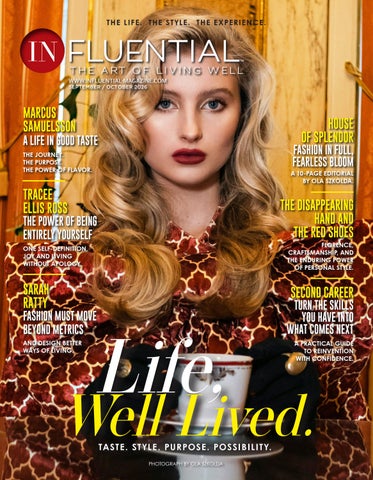
T HE LI F E. T H E STYL E. THE EXPER IENCE.
T HE A RT O F LI V IN G W ELL WWW.INFLUENTIAL-MAGAZINE.COM SEPTEMBER / OCTOBER 2026
MARCUS SAMUELSSON
HOUSE OF SPLENDOR
A LIFE IN GOOD TASTE
FASHION IN FULL, FEARLESS BLOOM
THE JOURNEY. THE PURPOSE. THE POWER OF FLAVOR.
A 10-PAGE EDITORIAL BY OLA SZKOLDA.
TRACEE ELLIS ROSS
THE DISAPPEARING HAND AND THE RED SHOES
THE POWER OF BEING ENTIRELY YOURSELF
FLORENCE, CRAFTSMANSHIP, AND THE ENDURING POWER OF PERSONAL STYLE.
ONE SELF-DEFINITION, JOY AND LIVING WITHOUT APOLOGY.
SARAH RATTY
Life,
FASHION MUST MOVE BEYOND METRICS AND DESIGN BETTER WAYS OF LIVING.
SECOND CAREER
TURN THE SKILLS YOU HAVE INTO WHAT COMES NEXT A PRACTICAL GUIDE TO REINVENTION WITH CONFIDENCE.
Well Lived. TA S T E . S T YL E . PU R POS E. POS S IBILITY. PHOTOGRAPH BY OLA SZKOLDA
EDITORIAL INSIGHTS
ABOUT INFLUENTIAL MAGAZINE
I
nFluential Magazine delivers exceptional content to a sophisticated audience of educated, affluent, and forwardthinking individuals who embrace the art of living well. Our readers are not only upwardly mobile but also deeply engaged in the pursuit of inspiration, innovation, and personal growth.
InFluential Magazine establishes itself as the premier and trusted source for trends that impact the way we live, dream, and distinguish our world. Our content not only reflects what’s current but also provides a window into what’s next, empowering our audience to navigate life with confidence and creativity.
As a digital media platform, InFluential Magazine captures the pulse of emerging trends poised to shape our world. By showcasing avant-garde leaders and cultural innovators, we explore ideas and movements that inspire both personal and professional transformation. Our foundation is built upon identifying and celebrating key elements that define cultural relevance, influence, and positive impact.
Our readership is diverse, globally minded, and deeply connected to their local communities. With a strong sense of self and a belief in their future potential, they represent the aspirational ethos of the magazine. They seek a captivating mix of editorial content, featuring the most interesting people, culture, fashion, style, and health-related insights.
Through insightful storytelling and cuttingedge perspectives,
OUR MISSION To be the global authority and trusted voice on emerging trends, inspiring our readers to live boldly, dream boundlessly, and shape their world with distinction, creativity, and purpose. OUR VOICE Rooted in trust, fueled by inspiration, and driven to influence. InFluential Magazine speaks directly to dreamers, doers, and innovators, offering content that uplifts, informs, and ignites meaningful change.
FOUNDER & CHIEF
With each issue, InFluential Magazine continues to elevate the art of living well, offering trusted, forward-thinking content that informs, inspires, and empowers.
BUSINESS OFFICER William T. Jackson, ABA, B.Acy., MBA, 2018 Folio: 100 Honoree, ForbesBLK Member Round Rock, Texas CO-FOUNDER Sandra Rascon, ME Corpus Christi, Texas
6
FLUENTIAL SEPTEMBER / OCTOBER 2026
THE INFLUENTIAL DIFFERENCE With a sharp focus on lifestyle interests that matter most, InFluential Magazine stands as a beacon of trusted insight. We curate trends that not only inspire our readers to live boldly, and dream expansively but also empower them to distinguish their world with creativity, purpose, and flair.
INFLUENTIAL-MAGAZINE.COM
EDITORIAL TEAM Editor-in-Chief William T. Jackson, ABA, B.Acy., MBA, 2018 Folio: 100 Honoree, ForbesBLK Member Contributing Writers William T. Jackson, ABA, B.Acy., MBA, 2018 Folio: 100 Honoree, ForbesBLK Member InFluential Magazine Editorial Team Ignatious Joseph Gwen Payne Tabish Ali of The Motivational Speakers Agency ART & PRODUCTION Creative Services Argenis Gudino / Jose Luis Venegas Quintero Contributing Photographers Alessandro Michelazzi Elena Kukina Ignatious Joseph Katerin Luis Malibrán Ola Szkolda All rights reserved. No part of this publication may be reproduced or transmitted in any form or by any means without written permission from the Founder & Chief Business Officer. All the rights of the artwork and photography belong to the Founder & Chief Business Officer. InFluential Magazine is Round Rock, Texas owned and operated. SEPTEMBER / OCTOBER 2026
FLUENTIAL
7
EDITORIAL INSIGHTS
LETTERS TO THE EDITOR
CONTACT INFORMATION Advertising Opportunities For advertising inquiries, email us at influentialmagazine roundrocktx@gmail.com. Public Relations For media or partnership inquiries, mail us at the address below. General Information For general inquiries, mail us at the address below.
W
e value deeply the voices and perspectives of our readers, as they are the heart of InFluential Magazine. Your thoughts, feedback, and ideas help shape the dynamic dialogue that defines our publication. Whether you wish to share reflections on a featured article, insights on emerging trends, or your personal experiences inspired by our content, we welcome your contributions.
8
To ensure your letter receives full consideration, please include the following: • Full Name: As a testament to the authenticity of your submission. • Daytime Phone Number: For clarification purposes, if needed. • Mailing Address: To maintain proper records and facilitate correspondence. Please limit your letters to 300 words, allowing us to accommodate as many
FLUENTIAL SEPTEMBER / OCTOBER 2026
Mailing Address: InFluential Magazine P.O. Box 1811 Round Rock, Texas 78680
voices as possible in each issue. Submissions may be edited for clarity, grammar, and length, ensuring your message aligns seamlessly with the overall flow of our publication. Rest assured, our goal is to preserve the essence and intent of your message. By submitting a letter, you become part of a larger conversation, one that celebrates the art of living well and fosters meaningful connections among our community of readers. Selected letters will be featured in future issues, highlighting the diverse and inspiring viewpoints that make InFluential Magazine unique. We look forward to hearing from you and thank you for contributing to the vibrant dialogue that drives our mission forward.
INFLUENTIAL-MAGAZINE.COM
ACKNOWLEDGMENTS
T
his issue of InFluential Magazine was proudly envisioned, crafted, and brought to life in Round Rock, Texas, a vibrant city that embodies creativity, innovation, and community spirit. Rooted in local pride yet soaring with global ambition, this publication reflects a harmonious blend of regional charm and worldwide influence.
We extend heartfelt gratitude to our readers for their unwavering support and enthusiasm. Your passion fuels our mission to deliver content that informs, empowers, and elevates. Together, we continue to shape a world where innovation meets inspiration, and where dreams are not just imagined but realized.
Every page of this issue celebrates the art of living well through a lens that transcends borders and cultures. It’s a tribute to the visionaries, writers, designers, and contributors who inspire us to explore new ideas, embrace fresh perspectives, and redefine what it means to live boldly and exceptionally.
This issue stands as a testament to the transformative power of storytelling and the enduring pursuit of excellence. With every issue, we reaffirm our commitment to being your trusted source for trends, insights, and ideas that shape the way we live, dream, and distinguish our world.
SEPTEMBER / OCTOBER 2026
FLUENTIAL
9
CONTENTS
52 THE COLLECTIVE
52 |
Marcus Samuelsson A Life in Good Taste
18
34 THE PERSPECTIVE
18 |
66
Tracee Ellis Ross The Power of Being Entirely Yourself
THE INFLUENTIAL LIFE
28 |
Sarah Ratty Fashion Must Move Beyond Metrics and Design Better Ways of Living
34 |
The Disappearing Hand and the Red Shoes
62 |
Taste the World Spanish Paella Brings Global Flavor Home
66 |
The Beauty of Eating Light
70 |
Strong at Every Age
74 |
Three Sleep Myths That Could Be Keeping You Awake
80 |
Five Extraordinary Escapes Made for Two
82 |
28
Things to Consider When Hiring an Interior Designer
84 |
A Warmer Home, A Smarter Winter
100 |
12
FLUENTIAL SEPTEMBER / OCTOBER 2026
The Art of the Pour
INFLUENTIAL-MAGAZINE.COM
108
42
POWER MOVES
THE INFLUENTIAL EDIT
The Cost of Saying Yes
Unbreakable Style
How to Transition into a Second Career by Leveraging Your Existing Skills
House of Splendor Fashion in Full, Fearless Bloom
104 | 108 |
42 | 88 |
88
SEPTEMBER / OCTOBER 2026 SEPTEMBER / OCTOBER 2026
FLUENTIAL 13
A NOTE TO YOU FROM OUR PUBLISHER
The Measure of a Life Well Lived There comes a point when the question changes.
For much of our lives, we are encouraged to ask what comes next. What is the next achievement? The next destination? The next opportunity? The next thing to acquire, accomplish or become? Ambition has its place. Curiosity keeps us moving. Dreams give shape to possibility. Yet somewhere along the way, another question begins to feel far more important: Am I living well? Not merely successfully. Not impressively. Not according to someone else’s definition of what a meaningful life should look like. But well. That question became the quiet heartbeat of our September / October issue of InFluential Magazine. Life, Well Lived. Three simple words, but they contain an enormous idea. A life well lived is not necessarily a life without disappointment, uncertainty or change. It is not measured solely by the rooms we enter, the titles attached to our names, the possessions we accumulate or even the milestones we reach. I have come to believe its measure is much more personal. It can be found in knowing what matters to us and having the courage to live accordingly. It is found in the people we love, the work that gives us purpose, the beauty we allow ourselves to notice, the wisdom to change direction when necessary and the confidence to become more fully ourselves. That spirit moves throughout this issue. In Tracee Ellis Ross, we consider the extraordinary power of being entirely yourself in a world that is often eager to prescribe who we should be. Through Marcus Samuelsson, we encounter a life in which food becomes far more than sustenance; it becomes memory, culture, imagination, entrepreneurship and connection. Sarah Ratty challenges us to think beyond conventional measures of progress and toward design that considers how people actually live. Ignatious Joseph takes us through Florence and reminds us of the disappearing hand behind true craftsmanship, the human touch that gives an object meaning beyond its price. And then there is fashion in full, fearless bloom. Our ten-page editorial, House of Splendor, embraces beauty without apology. There is something wonderfully liberating about that. Beauty need not always justify itself through utility. Sometimes color should be magnificent. Sometimes a room should take our breath away. Sometimes we should wear the extraordinary garment, pour something wonderful into the beautiful glass, take the journey, prepare the meal, set the table and make an ordinary Tuesday feel worthy of remembering. That, too, is living well. 14
FLUENTIAL SEPTEMBER / OCTOBER 2026
INFLUENTIAL-MAGAZINE.COM
Throughout these pages, we explore food, travel, wellness, interiors, personal style and the art of the pour. We consider what it means to say yes, and perhaps, more importantly, what our yes costs us. We examine the possibility of a second career and the realization that beginning again does not necessarily mean starting over. The knowledge, failures, victories and experiences we have accumulated travel with us. Reinvention can be an act not of abandoning who we have been, but of honoring who we have become. Perhaps that is why this issue feels particularly meaningful to me. The older I become, the less interested I am in a life performed for the approval of others. I am increasingly interested in a life experienced fully: meaningful conversation, work worth doing, laughter that arrives unexpectedly, a beautifully prepared meal, music that changes the atmosphere of a room, friendships that survive distance and time, and moments when we are present enough to recognize that something ordinary has quietly become extraordinary.
“
Perhaps the great luxury of life is not having everything. Perhaps it is knowing what is enough.
”
William T. Jackson, ABA, B.Acy., MBA
Living well does not require perfection. It requires attention. Attention to the people sitting across from us. Attention to our gifts and how we use them. Attention to what nourishes us and what depletes us. Attention to beauty. Attention to purpose. Attention to the increasingly precious currency of time. Perhaps the great luxury of life is not having everything. Perhaps it is knowing what is enough. As you move through this issue, I hope you discover something that inspires you, not simply to want more, but to experience more deeply. To taste. To travel. To create. To reconsider. To dress beautifully if it delights you. To begin again if something within you says it is time. To protect what matters. To remain curious. And above all, to make room for the people and experiences that remind you why being alive is such an extraordinary privilege. There is no single formula for a life well lived. Thankfully. There is only the opportunity each of us has to make ours unmistakably our own. Taste. Style. Purpose. Possibility. May we pursue them all, and may we never become so busy building a life that we forget to live it.
William T. Jackson, ABA, B.Acy., MBA Publisher & Editor in Chief, InFluential Magazine SEPTEMBER / OCTOBER 2026
FLUENTIAL 15
THE PERSPECTIVE FEATURE
TRACEE ELLIS ROSS
The Power of Being Entirely Yourself THERE ARE PEOPLE WHOSE INFLUENCE CAN BE MEASURED BY THE ROLES THEY HAVE PLAYED, COMPANIES THEY HAVE BUILT, AWARDS THEY HAVE RECEIVED OR INDUSTRIES THEY HAVE ENTERED.
T
hen there are people whose influence is more difficult to quantify because it resides partly in how they have chosen to live. Tracee Ellis Ross belongs in both categories. She is an award-winning actress whose television career stretches across decades, an entrepreneur who spent years developing a beauty company centered on textured hair, a producer, an unmistakable presence in fashion and a woman who has spoken candidly about constructing a meaningful life outside some of the expectations society traditionally places upon women. Yet reducing Ross to a résumé misses what makes her particularly compelling. Her larger achievement has been learning how to occupy her own life without allowing fame, family
18
FLUENTIAL SEPTEMBER / OCTOBER 2026
legacy, beauty standards, conventional timelines or other people’s expectations to determine its dimensions. That is more consequential than confidence for confidence’s sake. Ross has spent her adult life in industries that make enormous profits telling people, especially women, what is wrong with them. Entertainment decides who is marketable. Fashion determines which bodies deserve celebration. Beauty has historically created standards and then sold consumers products intended to help them approximate those standards. Celebrity culture adds another layer, rewarding accessibility while simultaneously scrutinizing nearly every choice a public woman makes. Ross has participated successfully in all those worlds while increasingly challenging some of their assumptions. She wears fashion as expression rather than camouflage. She built a beauty business around consumers whose hair had long been underserved. She has spoken openly about
nWRITTEN BY WILLIAM T. JACKSON, ABA, B.ACY., MBA, 2018 FOLIO: 100 HONOREE, FORBESBLK MEMBER
INFLUENTIAL-MAGAZINE.COM
aging rather than pretending it is not occurring. And she has resisted the idea that a woman’s adulthood must follow a predetermined sequence to qualify as complete. Taken together, those choices form something larger than a personal brand. They form an argument about self-determination.
An Extraordinary Name, and the Work of Becoming Herself Tracee Ellis Ross entered the world with an inheritance few people could imagine. Her mother, Diana Ross, is not simply famous; she is part of the architecture of modern popular culture. Her father, Robert Ellis Silberstein, worked in the music business, and Tracee grew up with access to extraordinary people, places and experiences. Such an upbringing undoubtedly provides opportunity, but privilege does not eliminate the complicated work of identity. Being born near greatness can create a peculiar burden of its own. Before the world has learned who you are, it may already have decided whose daughter you are supposed to remain. Ross did not reject that inheritance, nor has she pretended it did not benefit her. What is interesting is the way she gradually established an identity that could exist beside it. She attended Brown University, where she studied theater, and after graduating in 1994 worked in fashion, including at New York magazine and Mirabella. Acting followed, but not through an overnight transformation into a household name. Her career accumulated through work. That distinction matters because the polished retrospective version of success often removes the years when a person is learning, auditioning, being overlooked, making choices without knowing which will matter and attempting to separate personal ambition from other people’s assumptions. Her background in fashion also helps explain why clothing has remained such a substantive part of her public identity. Ross has described style as a form of creativity and has spoken about an evolution in which clothing n© STARSTOCK | DREAMSTIME.COM
SEPTEMBER / OCTOBER 2026
FLUENTIAL 19
THE PERSPECTIVE FEATURE
once functioned partly as armor before becoming a freer means of expression. That is a surprisingly applicable idea beyond fashion. Many people spend portions of their lives constructing armor: credentials, titles, perfectionism, money, carefully controlled appearances, relationships or personalities designed to make them acceptable in rooms. Some of those protections may even be necessary for a time. Maturity, however, can introduce a different question: What would I choose if I were no longer dressing, working or living primarily to protect myself from somebody else’s judgment? Ross’ fashion may be spectacular, but the more interesting transformation is the movement from protection toward expression.
Success Before the World Decided It Was Success For millions of viewers, Tracee Ellis Ross first became inseparable from Joan Clayton, the ambitious attorney she portrayed on Girlfriends from 2000 until 2008. Created by Mara Brock Akil, the series centered the friendships, careers, romances, disappointments and contradictions of Black women with a fullness still too uncommon on American television at the time. Ross’ Joan could be accomplished and insecure, loyal and exasperating, intelligent and irrational. She was allowed the privilege of being complicated. The series ran for eight seasons, built a devoted audience and earned Ross two NAACP Image Awards for Outstanding Actress in a Comedy Series. Yet its cultural footprint was not always matched by recognition from the mainstream institutions that routinely determine which television programs become part of the larger national conversation. Ross has reflected publicly on that disparity. In 2026, discussing the Girlfriends years with Trevor Noah, she revisited the frustration of working on a successful television series while watching opportunities for mainstream exposure go elsewhere. Her comments illuminate something that becomes easy to forget once a career has reached another level: there can be a substantial distance between doing significant work n © HUTCHINSPHOTO | DREAMSTIME.COM
20
FLUENTIAL SEPTEMBER / OCTOBER 2026
INFLUENTIAL-MAGAZINE.COM
and receiving significant recognition for it. People experience versions of that disparity far beyond Hollywood. An employee can be excellent before being promoted. An entrepreneur can have a viable idea before investors understand it. A writer can be gifted before anyone publishes the work. A person can become exceptional during years that appear, from the outside, remarkably ordinary. That is one reason the Girlfriends chapter matters so much to Ross’ larger story. It resists the seductive idea that external recognition is the moment when work acquires value. The work already had value. The audience already existed. The cultural contribution was already being made. Recognition eventually became larger, but recognition did not travel backward through time and make those earlier years worthwhile. They were worthwhile while she was living them. For anyone building something slowly or wondering whether effort that has not yet produced visible reward matters, that distinction is worth remembering.
The Second Act That Did Not Require Erasing the First When black-ish premiered in 2014, Ross entered a new phase of her career as Dr. Rainbow “Bow” Johnson, an anesthesiologist, wife and mother in a prosperous Black family negotiating questions of race, class, identity, marriage, parenting and American culture. Opposite Anthony Anderson, Ross displayed a range that extended well beyond the elegance with which she is so frequently associated. Her physical comedy could be fearless; her emotional work could be precise; and Rainbow was permitted to be accomplished without becoming impossibly composed. The performance earned Ross a Golden Globe Award and multiple Primetime Emmy nominations, and black-ish became a cultural phenomenon capable of using a network family comedy to engage subjects television had often treated far more cautiously. The temptation is to describe black-ish as Ross’ comeback, but that language would diminish what preceded it. It was an expansion. Her career demonstrates
Her background in fashion also helps explain why clothing has remained such a substantive part of her public identity. Ross has described style as a form of creativity and has spoken about an evolution in which clothing once functioned partly as armor before becoming a freer means of expression. That is a surprisingly applicable idea beyond fashion.
that a second defining chapter does not require declaring the first one a failure. That idea is especially relevant in a culture increasingly populated by people changing professions, starting businesses later in life, returning to school, leaving relationships, relocating, caring for family and reconsidering what they want the next decades to contain. Reinvention is frequently marketed as destruction: burn down old life and construct another. Ross’ trajectory suggests something more mature. Experience can accumulate rather than disappear. One chapter can prepare us for another without becoming an embarrassment we need to disown. That is also why her story belongs naturally in an issue that considers second careers and evolving definitions of success. Ross did not remain Joan Clayton forever because Joan Clayton had worked. Nor did she abandon acting once black-ish established another level of visibility. Her professional life continued widening into production, business, beauty, fashion and other forms of storytelling. The applicable lesson is not that everyone needs multiple careers. It is that success does not obligate us to become permanent custodians of an earlier version of ourselves.
PATTERN: When Personal Experience Becomes a Business Proposition PATTERN Beauty may be the clearest evidence that Ross’ influence extends beyond celebrity. Launched in 2019, the company was created to serve curly, coily, and tight-textured hair, with Ross drawing upon her own long relationship with her hair and the difficulty many consumers with textured hair experienced finding products designed with them at the center rather than added later as an extension of a broader market. The company did not materialize as an impulsive celebrity licensing arrangement. Ross has discussed a development journey that took roughly a decade, including early efforts to articulate the concept, find partners and bring the business to market. That long gestation matters. Celebrity can open doors, but it does not eliminate the discipline required to turn
SEPTEMBER / OCTOBER 2026
FLUENTIAL 21
THE PERSPECTIVE FEATURE
personal frustration into a scalable proposition. PATTERN asked a commercially important question that also carried cultural weight: what happens when consumers historically treated as a niche are approached as the starting point? For generations, beauty standards in the United States frequently privileged straight or loosely textured hair while curls and coils were pressured, chemically altered, professionally restricted or treated as problems requiring correction. A company centered unapologetically on textured hair therefore participates in something larger than shampoo and styling cream. It recognizes the customer before attempting to sell to her. PATTERN has since expanded beyond its original haircare assortment, including tools and body products, demonstrating that the underlying concept was broader than a single category. Ross has explained that the company was deliberately named PATTERN Beauty rather than PATTERN Hair because she envisioned room to grow. That detail reveals entrepreneurial thinking that is easy to miss amid the celebrity surrounding the founder. A strong business is not simply a collection of attractive products. It begins with a clearly understood consumer, identifies an unmet or insufficiently met need, creates a proposition around that need and leaves enough strategic room for the enterprise to evolve. Ross’s fame helped amplify PATTERN. The more important business lesson is that she recognized a problem intimately enough to understand why solving it mattered.
The Freedom to Refuse a Prescribed Life Ross’ public conversations about womanhood have also distinguished her from many of her contemporaries. She has spoken openly about being unmarried and not having children, not as an apology or a manifesto against marriage and motherhood, but as part of a larger insistence that a woman’s life should not be assessed solely against those milestones. That distinction is essential. Celebrating one way of living does not require diminishing another. Marriage can be extraordinary. Parenthood can be profound. Neither becomes more meaningful by treating people whose lives take another shape as incomplete.
22
FLUENTIAL SEPTEMBER / OCTOBER 2026
Ross has described the process of separating what she wanted from what she had been taught she was supposed to want. That question reaches far beyond relationship status. How much of the life we are pursuing is genuinely ours? How much comes from family expectation, professional convention, social comparison, culture, algorithms, advertising or fear of being the person who chose differently? These are uncomfortable questions because sometimes the answer reveals that we have been extremely successful at accomplishing things we never consciously selected. Ross has described the process of separating what she wanted from what she had been taught she was supposed to want. That question reaches far beyond relationship status. How much of the life we are pursuing is genuinely ours?
Her willingness to discuss these issues is particularly powerful because she does so without presenting herself as someone who has transcended vulnerability. Self-possession is not the absence of longing, uncertainty or disappointment. It is the ability to experience those things without allowing them to become evidence that one’s life is defective. That is a much more realistic form of inspiration than pretending confidence means never questioning ourselves. The goal is not to become impervious. It is to become sufficiently grounded that uncertainty does not hand authorship of our lives back to everyone else.
Aging Without Apology A similar philosophy appears in Ross’ conversations about aging. Entertainment, fashion and beauty can be merciless environments for women growing older, even as those same industries profit enormously from products promising to disguise the process. Ross has approached aging with an unusual combination of candor, humor and appreciation for the body she inhabits. That does not mean rejecting beauty, grooming, fashion or pleasure in appearance. Her career and business interests make such a claim absurd. Instead, she complicates the assumption that caring about beauty must require waging war against age. There is something deeply practical in that position. Time is going to move whether we cooperate with it or not. A life organized primarily around appearing
INFLUENTIAL-MAGAZINE.COM
untouched by time risks overlooking what time is giving us: experience, discernment, memories, skill, perspective and, ideally, a clearer understanding of what deserves our attention. Ross’ increasingly confident fashion choices are interesting partly because they do not suggest retreat. She has not responded to maturity by becoming visually quieter. She remains experimental, sensual, playful and occasionally extravagant. The message is not that everyone should dress as she does. The message is age does not automatically require disappearance.
Joy as a Serious Practice Joy is one of the most recognizable qualities Ross projects publicly, and it would be easy to dismiss it as personality. She dances exuberantly, embraces absurdity, laughs readily and seems perfectly willing to sacrifice conventional coolness for genuine delight. Yet joy becomes more interesting when understood not as perpetual happiness but as something cultivated alongside the complexities of adulthood. Ross has spoken about creating a life rooted in joy while also discussing resilience, aging, beauty expectations, independence and the realities of an industry in which she has not always received equal recognition. That version of joy has substance because it does not require denial. Life can be unfair and still contain pleasure. Ambition can remain unfinished and still permit gratitude. A person can want something deeply, not receive it, and refuse to make disappointment the sole narrator of life that remains. Joy, understood this way, becomes less about temperament and more about attention. What are we allowing ourselves to notice? What are we postponing until circumstances become perfect? What sources of pleasure have we decided must be earned by first satisfying somebody else’s definition of accomplishment? Ross does not provide a formula for answering those questions, nor should she. The usefulness of her example is that it encourages us to ask them. n© FEATUREFLASH | DREAMSTIME.COM
SEPTEMBER / OCTOBER 2026
FLUENTIAL 23
THE PERSPECTIVE FEATURE
Fashion Without the Request to Disappear
done so. She is influential because her career illustrates something far more believable: the possibility of becoming increasingly comfortable with the unfinished, evolving person one already is. She has known extraordinary privilege and experienced professional inequity. She has inherited a famous name and built one of her own. She has enjoyed long-running television success and lived through periods when that work received less mainstream recognition than it deserved. She has turned a deeply personal beauty experience into a business proposition. She has celebrated fashion without allowing beauty to become synonymous with conformity. And she has spoken about constructing a satisfying adulthood without pretending that there is only one legitimate blueprint.
Then there are the clothes. Ross’ fashion deserves more than a passing mention because it is one of the clearest visual expressions of the philosophy running through her life. She embraces architectural silhouettes, extraordinary volume, saturated color, menswear, couture, texture, unexpected proportions and garments that make no attempt to apologize for occupying space. Her best looks do not seem designed primarily to make her body conform to an idealized shape. They allow clothing to become creative language. That approach is especially resonant within these pages. In this issue, Sarah Ratty challenges fashion to move beyond conventional metrics and consider better ways of living. Ignatious Joseph writes about craftsmanship, individuality and the human hand. House of Splendor celebrates fashion in full, fearless bloom. Ross belongs in that conversation because she demonstrates what can happen when style becomes less about correction and more about expression. Fashion can certainly flatter, but it can also provoke, amuse, exaggerate, protect, celebrate, communicate and transform. The person wearing it does not always need to look smaller, safer or more easily understood. There is a larger metaphor here worth keeping. Many of us have learned to edit ourselves before entering certain rooms. We reduce the opinion, soften the ambition, hide the eccentricity, translate the background, minimize the accomplishment or choose the metaphorical garment least likely to attract criticism. Sometimes discernment requires restraint. But a lifetime of continual self-editing can eventually leave a person wondering where the original went. Ross’ sartorial fearlessness offers a useful counterpoint: taking up space need not mean taking space away from someone else.
The Power of Being Entirely Yourself Tracee Ellis Ross is not influential because she has solved life. There is no evidence she claims to have
24
FLUENTIAL SEPTEMBER / OCTOBER 2026
Her best looks do not seem designed primarily to make her body conform to an idealized shape. They allow clothing to become creative language.
There is something here for the person considering a second career at fifty, the entrepreneur whose idea has taken longer than expected, the woman confronting an age the culture has taught her to fear, the professional who has done excellent work without receiving appropriate recognition, the person carrying a family name or expectation that feels larger than their own identity, and anyone who has awakened to the uncomfortable realization that they have been living according to a checklist they did not write. Ross’ life cannot tell any of us what choices to make. What it can demonstrate is that questioning the script is not the same as rejecting everything that came before it. Sometimes it is simply the beginning of choosing consciously. Influence, at its most meaningful, does not produce imitation. It produces permission: permission to reconsider, to expand, to begin again, to occupy space, to enjoy what has already been built while remaining curious about what might still be possible. Tracee Ellis Ross has spent decades in public view, but perhaps the most compelling aspect of her journey is not how successfully she has learned to be seen. It is how deliberately she has continued learning to see herself, and how, in doing so, she reminds the rest of us a fully lived life does not require becoming somebody else. It requires the courage to become more completely our own. l
THE PERSPECTIVE FEATURE
SARAH RATTY FRSA HAS SPENT HER CAREER WORKING AT THE INTERSECTION OF SUSTAINABILITY, MATERIALS, PRODUCTS, SUPPLY CHAINS, AND BEHAVIOR. nWRITTEN BY TABISH ALI OF THE MOTIVATIONAL SPEAKERS AGENCY
A
pioneering sustainable fashion designer and eco-innovator, Ratty is the founder of Conscious Earthwear and Ciel and cofounder of the Ethical Fashion Forum. Her work has been featured in the V&A’s Fashioned from Nature exhibition, and she has contributed to sustainability standards through the Soil Association’s work on the Global Organic Textile Standard. In this Q&A with the Champions Speakers Agency, Ratty discusses what craft can teach business leaders, why fashion needs to confront overproduction, and how sustainability can become part of better systems — and ultimately, better ways of living.
SARAH RATTY
Fashion Must Move Beyond Metrics and Design Better Ways of Living 28
FLUENTIAL SEPTEMBER / OCTOBER 2026
INFLUENTIAL-MAGAZINE.COM
“
Fashion is powerful because it makes change visible. People respond to what is new, expressive, and desirable. The problem comes when that appetite for newness becomes overproduction.
”
Sarah Ratty , the founder of Conscious Earthwear and Ciel and co-founder of the Ethical Fashion Forum
SEPTEMBER / OCTOBER 2026
FLUENTIAL 29
THE PERSPECTIVE FEATURE
Question 1: How can craft-based design systems help organizations turn intention into practical, accountable action? Sarah Ratty: Craft teaches us something incredibly important: intention has to pass through our hands. In a craft-based system, there is a direct feedback loop between ideas, materials, labor, and consequence. You feel when something is wrong. You slow down. You adjust.
recipe. You have to find the right components, but you also have to understand how they come together.
Organizations often operate too far away from consequence. Design thinking, when informed by craft, brings decision-making back into contact with the real world. It makes systems tangible, visible, and accountable.
Technology can help here. AI, digital printing, and rapid prototyping can support more localized and responsive production. We can send a file, print it closer to where it is needed, and reduce unnecessary movement through the system.
Craft is a form of systems intelligence. When I worked on a project with Dr. Martens and we were asking how to make a sustainable shoe, we realized it was like a
Design is wider than product. It can shape systems. For me, the interesting space sits where craft, technology, logistics, and human consequence meet.
30
FLUENTIAL SEPTEMBER / OCTOBER 2026
That means asking practical questions. Where is the rubber coming from? Where is the next material coming from? How far is each component traveling? You can create a problem while trying to solve one if you only look at the product and ignore the logistics.
INFLUENTIAL-MAGAZINE.COM
Question 2: How can creative leadership in fashion and culture move sustainability beyond metrics and compliance? Sarah Ratty: Metrics matter. They give structure and accountability. But they rarely inspire people to change.
Question 3: What do you want leaders and audiences to take away from your public speeches? Sarah Ratty: I want people to leave with hope, but a practical kind of hope. I want them to recognize that their lightbulb moments matter and that they can take part in change inside their own organizations.
Creative leadership asks different questions. What story are we telling? What values are we embodying? What future are we rehearsing through our decisions?
I came to this from my own experience of having to rebuild. In 1999, I was in a road traffic accident in South Africa. I broke my back, my leg, my arm, and my shoulder. I was at the peak of my career, and it took me five years to recover.
Fashion is powerful because it makes change visible. People respond to what is new, expressive, and desirable. The problem comes when that appetite for newness becomes overproduction.
That experience changed how I saw everything. I was disabled for a period, but I was still on a path of transformation. I began asking what I could do with the experience I had. That led me to work with the Soil Association, the Ethical Fashion Forum, and the Pesticide Action Network.
If brands reduced the volume they do not need, the effect would move through the whole supply chain. It would reduce pressure on factories, reduce waste, and create space for better decisions. The issue is the system that produced the garment.
I had design knowledge, fashion experience, and connections. I could use those things to help change the system from the inside.
Factories are often squeezed between higher volumes and lower prices. Workers often absorb the cost. That is why design has to look all the way through the system.
Resilience matters. So does imagination. I love the idea that you do not just turn lemons into lemonade; you get the tequila and salt as well. There has to be energy and creativity in the work.
We also have to be honest about waste. When clothing is designed, bought, and discarded without enough care, the consequences appear somewhere else. Those places should not be treated as the endpoint for decisions made elsewhere.
I hope my talks help people believe they have agency. We are one person among billions, but change happens when enough people take the right action where they are. Leaders need the courage to stop what is not working and make better choices. l
The opportunity now is to design with more care at the start: better decisions about volume, production, and the people affected by those choices. That is where fashion can become part of a better way of living.
{
}
Resilience matters. So does imagination. I love the idea that you do not just turn lemons into lemonade; you get the tequila and salt as well. There has to be energy and creativity in the work. Sarah Ratty SEPTEMBER / OCTOBER 2026
FLUENTIAL 31
THE PERSPECTIVE FEATURE
AS MY RED SHOES STEP ONTO THE CENTURIES-OLD COBBLESTONES OF FLORENCE, I AM REMINDED THAT STYLE IS NEVER A MATTER OF COMMERCIAL CONSUMPTION. IT IS A PROFOUNDLY PERSONAL PILGRIMAGE, A LIVED TESTAMENT TO THE HUMAN HAND, AND AN ENDURING ACT OF INDIVIDUAL EXPRESSION. nPHOTO ELENA KUKINA 34
FLUENTIAL SEPTEMBER / OCTOBER 2026
INFLUENTIAL-MAGAZINE.COM
nWRITTEN AND PHOTOGRAPHY BY (EXCEPT WHERE NOTED) IGNATIOUS JOSEPH
THE DISAPPEARING HAND AND THE RED SHOES
E
My Journey Through Florence and Pitti Uomo
very journey I make to Florence begins not at the crowded gates of an exhibition hall, but with a quiet, mandatory morning ritual. Long before the city awakens to the modern roar of scooters, I find myself sitting at Caffè Gilli in the Piazza della Repubblica. Watching the morning sun cast an amber warmth across the classic stone facades, I lift a cup of black, unembellished espresso to my lips. For me, this is where the dialogue of style begins. It is a moment of pure baseline clarity before the sensory explosion of Pitti Immagine Uomo. Dressing is an intensely intimate act — a daily composition where
my gray trousers, navy blazer, soft unconstructed collar, Panama hat, and distinct red shoes form the frame of my identity. To understand style, one must first learn to appreciate these moments of quiet, uncompromising intention. Walking through the narrow streets toward the banks of the River Arno, the weight of the Renaissance is palpable. This city was built on the belief that human creativity could elevate the human spirit. For nearly three decades, I have lived by a single conviction: there is no self from the shelf. Identity cannot be purchased prepackaged from a mass-production
SEPTEMBER / OCTOBER 2026
FLUENTIAL 35
THE PERSPECTIVE FEATURE
line; it must be cultivated from within. It is this truth that brings us back to Florence season after season.
a human hand, an absolute counterweight to modern automation.
The Disappearing Hand and the Oltrarno
This deep connection to the hand is the bedrock of Italian style, famously brought to the global stage in February 1951 by Giovanni Battista Giorgini. By gathering international buyers in the Sala Bianca of the Pitti Palace, Giorgini fundamentally disrupted the rigid monopoly of haute couture. He introduced the world to an approachable, joyous form of luxury that combined flawless execution with sprezzatura — the art of making the complex look entirely effortless. That transformative moment established an enduring love affair with Italian craftsmanship, one that modern readers can actively participate in today by rejecting disposable fashion in favor of objects with a soul.
My steps invariably lead me across the bridges into the Oltrarno, the historic artisans’ quarter. Here, behind heavy wooden doors, the authentic heartbeat of Florence resides. In one small workshop, lit only by a single hanging bulb, an aging artisan pulls a wax-coated thread through a piece of calfskin. The room smells rich with vegetable-tanned leather, brass polish, and history. His fingers are calloused, yet his touch on the material is as tender as a musician’s on a violin. This is what I call “the disappearing hand” — the endangered lineage of manual craftsmanship where master artisans shape leather, hand-sew buttonholes, and roll shirt collars with a devotion passed down across generations. When you examine a genuine piece of sartorial art, you are witnessing the unique imprint of
36
FLUENTIAL SEPTEMBER / OCTOBER 2026
Cuisine: The Culinary Backbone of Italian Culture To speak of Italian craftsmanship without speaking of its food is to miss the very backbone of Italian culture. Gastronomy here shares the exact same philosophy as fine tailoring: an unwavering respect for raw, exceptional materials, a devotion to time-honored
INFLUENTIAL-MAGAZINE.COM
nPHOTO ELENA KUKINA
regional traditions, and the simple, elevated joy of unhurried appreciation. Between visits to workshops and exhibition halls, I sit at a modest wooden table in a neighborhood trattoria. Watching a cook delicately shave dark truffles over handmade gnocchi, or observing an artisan thoughtfully slice prosciutto behind a marble counter, I recognize the same “disappearing hand.” In Italy, food is not merely sustenance; it is revered as a sacred expression of identity, patience, and hospitality. Every plate tells a story of heritage — a living reminder that the simplest ingredients, handled with mastery, yield the most extraordinary results.
The Theater of the Fortezza When I pass through the historic gates of the Fortezza da Basso — the formidable 16th-century fortress that serves as the stage for Pitti Uomo — the atmosphere transforms into an extraordinary, unscripted theater.
The central courtyard is where the world’s most discerning eyes meet. At this edition of Pitti, the air feels vibrant with a subtle return to lightness and fluidity: natural linens in undyed earth tones, softer shoulders, and dynamic, hand-loomed textures. As my red shoes move across the gravel and stone, they act as an immediate conversation starter — a crimson spark bridging cultures and languages. I pause to exchange greetings with an Italian tailor, then discuss the weave of a silk-linen pocket square with a designer from Tokyo. Here, a beautifully arched lapel or a rare weave of fabric serves as an elegant introduction. Yet, the true vitality of Pitti Uomo lies in its refusal to become a static museum piece. Heritage must breathe. The individuals who truly command the space are those who understand the rules of classical tailoring so intimately that they can play with them — introducing what I term “classic with a twist.” It is about understanding geometry while leaving room for personal human narrative.
SEPTEMBER / OCTOBER 2026
FLUENTIAL 37
THE PERSPECTIVE FEATURE
form of liberation. Dressing intentionally is an act of deep self-respect.
A Lasting Impression
nPHOTO KATERIN
nPHOTO ALESSANDRO MICHELAZZI
An Unbroken Thread for the Youth My principal motivation for sharing these reflections with the younger generation is educational. In a hyperdigital era where clothing is frequently reduced to momentary screen-deep trends, our youth risk being detached from the true heritage of dressing. To teach a young person how to look at a garment — to help them appreciate the hours of human labor poured into a hand-sewn shoulder or the balance of a handcrafted umbrella — is to offer them an authentic
38
FLUENTIAL SEPTEMBER / OCTOBER 2026
As evening falls, the sensory noise of the Fortezza fades into the quiet calm of the Florentine night. I walk back toward the Arno, pausing on the Santa Trinita bridge. The sky above is painted in soft brushstrokes of violet and rose, reflected in the dark water below. Looking down, my red shoes rest still against the cool medieval stone. They have carried me through workshops, fortress grounds, quiet cafes, and memorable dinners — a small, steadfast symbol of a personal path chosen deliberately in a world of quick trends. Pitti Uomo reminds us that our clothes, like our meals, form the framework of our daily existence. By supporting independent workshops, honoring the disappearing hand, and standing firmly against anonymity, we keep an ancient, beautiful lineage alive. We ensure that the thread of human creativity continues to flow uninterrupted along the banks of the Arno, preserving a living architecture of individual liberty. l
THE INFLUENTIAL EDIT
UNBREAKABLE 42
FLUENTIAL SEPTEMBER / OCTOBER 2026
INFLUENTIAL-MAGAZINE.COM
nDESIGNER
FÉLIX RAMIRO @felixramirooficial @felixramirodesigner PHOTOGRAPHER LUIS MALIBRÁN @luismalibran
STYLE SEPTEMBER / OCTOBER 2026
MODELS NEL VARGAS @nelvargass PABLO MARQUÉS @pablomarqueslife ALEX @janoquesada JACOB GIANLUCA @jacob_gianluca
FLUENTIAL 43
THE INFLUENTIAL EDIT
44
FLUENTIAL SEPTEMBER / OCTOBER 2026
INFLUENTIAL-MAGAZINE.COM
SEPTEMBER / OCTOBER 2026
FLUENTIAL 45
THE INFLUENTIAL EDIT
46
FLUENTIAL SEPTEMBER / OCTOBER 2026
INFLUENTIAL-MAGAZINE.COM
SEPTEMBER / OCTOBER 2026
FLUENTIAL 47
THE INFLUENTIAL EDIT
UNBREAKABLE
STYLE
48
FLUENTIAL SEPTEMBER / OCTOBER 2026
INFLUENTIAL-MAGAZINE.COM
SEPTEMBER / OCTOBER 2026
FLUENTIAL 49
THE COLLECTIVE FEATURE
MARCUS SAMUELSSON
A Life in Good Taste
FOOD, FASHION, CULTURE, FAMILY, COMMUNITY, AND THE REMARKABLE LIFE OF A MAN WHO LEARNED TO MAKE THE WORLD HIS TABLE
T
here are chefs who know how to prepare extraordinary food, restaurateurs who understand how to create rooms people want to enter, television personalities who know how to hold an audience, and tastemakers who recognize that what we wear, serve, collect and surround ourselves with communicates something about who we are. Marcus Samuelsson has spent decades moving confidently among all of these worlds. Yet reducing him to any collection of titles misses what makes his journey compelling. Born in Ethiopia, raised in Sweden and transformed professionally in New York, Samuelsson has built a life from the intersection of cultures. His food reflects that journey, but food is only its most obvious expression. Look more closely and a larger philosophy emerges, shaped by curiosity, identity, family, hospitality, style, community and the belief that success becomes more meaningful when it creates possibilities for others.
That may be what makes Marcus Samuelsson so InFluential. His influence is not confined to what appears on a plate or how many restaurants carry his name. It can be found in the cultures he brings into conversation, the histories he insists deserve recognition, the communities in which he invests, the young professionals for whom he creates opportunities and the unmistakable personal style with which he moves through it all. Samuelsson has learned how to turn a meal into an experience, an experience into a conversation and, increasingly, his own success into a platform from which other people can rise.
A Life Between Worlds Samuelsson’s story begins far from the celebrated dining rooms that would eventually make his name. Born in Ethiopia, he and his sister were adopted by a Swedish family after the death of their mother and were raised in Sweden. The transition was enormous,
nWRITTEN BY WILLIAM T. JACKSON, ABA, B.ACY., MBA, 2018 FOLIO: 100 HONOREE, FORBESBLK MEMBER PHOTO BY KATHY HUTCHINS | SHUTTERSTOCK.COM
52
FLUENTIAL SEPTEMBER / OCTOBER 2026
INFLUENTIAL-MAGAZINE.COM
SEPTEMBER / OCTOBER 2026
FLUENTIAL 53
THE COLLECTIVE FEATURE
geographically and culturally, and it eventually became fundamental to the chef Samuelsson became. Sweden gave him family, home and formative culinary traditions, while Ethiopia remained part of an identity that he would later revisit not as a distant curiosity but as a living inheritance. The kitchen became one of the places where that identity began to take shape. Samuelsson has long credited his Swedish grandmother with helping form his earliest relationship with food. Cooking in that environment was rooted in seasonality, preservation, resourcefulness and the rhythms of family life. Ingredients did not simply appear; they belonged to places, seasons and memories. Those lessons would remain visible long after Samuelsson entered
54
FLUENTIAL SEPTEMBER / OCTOBER 2026
professional kitchens, and they help explain why his cooking has always been about more than technique. It is about the relationship between food, geography and the people who carry traditions forward. Samuelsson trained professionally in Sweden and Europe before establishing himself in New York. Those kitchens supplied discipline, precision and the standards of fine dining, but his life had already supplied something more difficult to teach: perspective. Ethiopia, Sweden, Europe and eventually America did not have to compete for space within him. Over time, they became parts of the same creative vocabulary. Rather than flattening those influences into something easily categorized, he learned to use the tension among them as a source of originality.
INFLUENTIAL-MAGAZINE.COM
New York, Aquavit, and the Arrival of a Check
the surrounding community became part of the restaurant’s character. That broader cultural orientation is evident in Samuelsson’s continuing work in Harlem, including projects that have incorporated local history, storytelling and music. The result is an understanding of hospitality that reaches beyond service. Restaurants, at their best, are not simply businesses occupying neighborhoods; they can become part of the social architecture of those neighborhoods.
New York has never suffered from a shortage of ambitious chefs, and ambition alone rarely makes anyone remarkable there. Samuelsson’s defining early opportunity came at Aquavit, the acclaimed Scandinavian restaurant in Manhattan, where he rose rapidly through the kitchen. His work earned a threestar review from The New York Times while he was still in his twenties, making him the youngest chef at the time to receive that distinction. Recognition from the James Beard Foundation followed, including Rising Star Chef of the Year and Best Chef: New York City, the beginning of a body of honors that would eventually include eight James Beard Awards. It would have been easy to remain within the rarefied world that had validated him. Fine dining had provided prestige, critical acclaim and a clearly defined professional identity. Yet Samuelsson’s subsequent career suggests that recognition interested him less as a destination than as permission to explore a larger question: What else could a chef become? The answer would eventually encompass television, books, restaurants, design, fashion, philanthropy and cultural advocacy, but one of the most consequential answers took him uptown to Harlem.
Harlem and the Meaning of Place When Samuelsson opened Red Rooster Harlem in 2010, he was doing something more complicated than adding another restaurant to a growing portfolio. Harlem possessed an extraordinary history of Black art, music, literature, politics, food and entrepreneurship long before a celebrity chef arrived. It did not need to be invented, discovered or branded into relevance. The challenge was not simply to open a successful restaurant in Harlem, but to create one capable of participating meaningfully in a community that already knew exactly who it was. Red Rooster drew its identity from American food and the cultural life of Harlem, while art, music, neighborhood personalities and the energy of
A beautifully prepared meal matters, but so does who feels welcome eating it, whose art hangs nearby, whose culture informs the room and whose story is being told.
That distinction is central to Samuelsson’s influence. A beautifully prepared meal matters, but so does who feels welcome eating it, whose art hangs nearby, whose culture informs the room and whose story is being told. Influence is easy to recognize when it produces awards, followers or sales. It becomes more interesting when it produces belonging.
When Hospitality Became Service The depth of that philosophy was tested dramatically in 2020. The COVID-19 pandemic devastated the restaurant industry, shuttering dining rooms, eliminating jobs and worsening food insecurity across the country. Samuelsson’s restaurants were not immune, but he quickly partnered with World Central Kitchen to transform Red Rooster Harlem, Marcus B&P in Newark and Red Rooster Overtown in Miami into community kitchens. World Central Kitchen reports that the effort served more than 230,000 meals to people in need. In a moment when the traditional measures of restaurant success — reservations, revenue, crowded dining rooms — had been stripped away, another measure emerged. A restaurant could demonstrate its value simply by feeding the community around it. Samuelsson later described community as a source of purpose during that period, connecting service with an acknowledgment of privilege and responsibility. The pandemic therefore did not create a new definition of hospitality for him so much as expose the deepest version of one already present: a table matters most when it can make room for people who need it.
SEPTEMBER / OCTOBER 2026
FLUENTIAL 55
THE COLLECTIVE FEATURE
Family, Home, and the Life Beyond the Kitchen For all the public dimensions of Samuelsson’s career, there is also a private architecture supporting it. He is married to model Maya Haile Samuelsson, who was born in Ethiopia, and together they have built a family life shaped by some of the same geographical and cultural intersections that define his work. Public accounts identify their son, Zion Mandela, and daughter, Grace Ethiopia, whose names themselves reflect a conscious relationship with heritage and history. That family dimension adds another layer to Samuelsson’s relationship with Ethiopia. The country is not merely where his biography began or where an international chef eventually decided to open a restaurant. It is also part of the heritage he shares with Maya and part of what is being carried forward within their family. Seen through that lens, home becomes less a single geography than something created through relationships, memory and ritual. Samuelsson’s public life moves constantly among kitchens, airports, television studios, restaurants and cultural events, but his work repeatedly returns to the idea that gathering is meaningful precisely because people need places — and people — to which they belong. The idea of home is also visible in his design work. West Elm’s collaboration with Samuelsson explicitly drew from his Ethiopian heritage, Swedish upbringing and New York home, translating those influences into furniture, tableware and decorative objects. That expansion makes sense for someone whose career has always been interested in more than what people eat. A restaurant is one expression of gathering; a family table is another. A chair, plate or piece of fabric can become part of the atmosphere in which ordinary life unfolds.
Who Gets to Tell the Story of American Food? Samuelsson’s influence also extends into a larger cultural question: Who receives credit for creating
56
FLUENTIAL SEPTEMBER / OCTOBER 2026
Samuelsson’s most interesting abilities. He understands that food can operate simultaneously as pleasure and archive. A dish can be delicious without requiring the diner to contemplate history, but it can also carry migration, geography, ingenuity and memory.
the food America calls its own? Black cooks have profoundly shaped American cuisine for generations, yet the people responsible for that creativity have too often been separated from authorship, ownership and recognition. Samuelsson confronted that history directly in The Rise: Black Cooks and the Soul of American Food, a project that placed Black culinary creativity at the center rather than the margins of the American food story. Through recipes, profiles and essays, the book explored migration, memory, innovation and the extraordinary range of Black food culture. The underlying argument is larger than cuisine: culture does not simply appear. People create it, preserve it, adapt it and deserve to be remembered as its authors. His related public work has similarly emphasized the role of food, music, art and community in understanding Black American culture and history. That perspective reveals one of Samuelsson’s most interesting abilities. He understands that food can operate simultaneously as pleasure and archive. A dish can be delicious without requiring the diner to contemplate history, but it can also carry migration, geography, ingenuity and memory. Samuelsson is comfortable with both possibilities. He knows how to make dinner, but he also recognizes that dinner can tell us who has been present all along.
Style is Another Language Then there are the clothes. Samuelsson dresses with the same willingness to combine influences that defines his cooking. Color, pattern, tailoring, texture and unexpected combinations regularly appear in his wardrobe. Fashion is not incidental to his public identity because Samuelsson appears to understand clothing as another cultural language, one that shares surprising similarities with food. Both begin with materials and technique. Both communicate geography and history. Both can satisfy basic needs or become elaborate expressions of creativity. And both become more interesting when someone understands
INFLUENTIAL-MAGAZINE.COM
tradition well enough to reinterpret it without erasing where it came from.
restaurants; it can extend into the way we design the spaces in which everyday life occurs.
His professional world has repeatedly intersected with fashion and design, and his own official biography identifies him as a figure whose work moves across food, media and fashion. The connection feels natural rather than manufactured. Samuelsson’s style, like his restaurants, is built from accumulation rather than uniformity: Ethiopian heritage, Swedish restraint, New York energy and the cultural confidence of Harlem can coexist without requiring one influence to disappear so another can dominate.
This is where the concept of lifestyle becomes more meaningful than accumulation. Samuelsson’s world is not compelling because it contains restaurants, clothes, furniture, travel and beautiful food. It is compelling because these things connect. Taste, at its most sophisticated, is not simply knowing what is expensive or fashionable. It is understanding why something belongs, where it came from, how it was made and what feeling it creates when brought into relationship with something else.
From the Dining Room to the Way We Live Samuelsson’s creative vocabulary has expanded through books and television, including PBS’s No Passport Required, which explored immigrant communities and the food cultures they have contributed to American life. PBS describes the series as an exploration of the diverse immigrant traditions woven into American food and culture, a subject perfectly aligned with Samuelsson’s own biography. His movement into home design carries the same logic. West Elm describes its collaboration with Samuelsson as a collection inspired by Ethiopian heritage, Swedish roots and his New York home. Furniture, textiles and tableware might initially seem far removed from a chef’s traditional territory, but Samuelsson has never really been interested only in what people eat. He is interested in how they gather. A dining room is an environment. A beautifully considered object changes the feeling of that environment. Hospitality is therefore not confined to
The Return to Ethiopia Few chapters of Samuelsson’s journey carry more symbolic weight than his return to Ethiopia. Marcus Addis, his first restaurant in Africa, opened in Addis Ababa on the 47th floor of the Commercial Bank of Ethiopia building. The restaurant itself describes the project as a homecoming: a chef born in Ethiopia, raised in Sweden and influenced by Harlem bringing those worlds together in the country where his life began. The return is made more resonant by family. Maya shares Ethiopian heritage, and reporting on Marcus Addis has described the couple’s connection to the project and their interest in developing local hospitality talent. That shifts the narrative away from the simplistic idea of an internationally successful chef “coming back.” Samuelsson is not returning empty-handed, nor is he returning unchanged. He carries Sweden, New York, Harlem, family, professional experience and decades of cultural exchange with him. At Marcus Addis, those experiences encounter Ethiopian ingredients, traditions and a new generation
SEPTEMBER / OCTOBER 2026
FLUENTIAL 57
THE COLLECTIVE FEATURE
of hospitality professionals. Samuelsson has also emphasized mentorship and the development of local talent as part of the restaurant’s larger significance. That represents a mature evolution of influence. Early in a career, the challenge is to learn. Then comes the struggle to distinguish yourself, followed, perhaps, by the opportunity to build. Eventually the question changes: What can exist because you were here?
Making Room for What Comes Next That question is especially visible in Samuelsson’s current work. The Rise Residency is a new fellowship designed to support mid-career culinary professionals through six months of mentorship, archival research access and creative retreat, selecting up to two participants annually to develop significant projects. The program is notable because industries are often very good at celebrating people after they have succeeded and considerably less effective at creating the conditions that allow talented people to reach that point. Time, access and mentorship are forms of capital. Successful people accumulate all three, often without recognizing how scarce they are for those still trying to establish themselves. Creating structures through which that capital can be shared suggests that Samuelsson’s definition of achievement continues to evolve. The chef who once needed an opportunity in a New York kitchen is now positioned to create opportunities for people whose work may ultimately look nothing like his own. That does not mean Samuelsson has stopped building. His official biography and restaurant group continue to document an active portfolio spanning hospitality, media and international projects. What has changed is the scale on which influence can operate. The question is no longer simply whether Marcus Samuelsson can create another successful restaurant. Decades into his career, we already know the answer. The more compelling question is what kind of ecosystem can grow around everything he has learned.
58
FLUENTIAL SEPTEMBER / OCTOBER 2026
His professional world has repeatedly intersected with fashion and design, and his own official biography identifies him as a figure whose work moves across food, media and fashion.
Why Marcus Samuelsson Matters It would be easy to explain Samuelsson through accomplishments: eight James Beard Awards, restaurants, books, television, design collaborations and international recognition. Those achievements establish stature, but lists have a way of reducing interesting people to trophies. Samuelsson’s larger contribution is found in the connections he has spent his career making between worlds that are too often treated as separate: Africa and Europe, Harlem and fine dining, food and fashion, family and ambition, commerce and community, personal success and collective opportunity. His journey also offers a compelling argument about identity. Sophistication does not require abandoning where we came from, nor does evolution demand pretending every previous version of ourselves no longer matters. Samuelsson’s life suggests almost the opposite. Identity can become richer as we accumulate places, people, family histories and experiences,
provided we remain curious enough to understand them and confident enough to make the resulting combination our own. That philosophy may explain why the phrase “a life in good taste” feels particularly appropriate. Good taste in Samuelsson’s world is not a rigid collection of rules handed down by someone else. It can recognize the beauty of a meticulously composed plate while remembering the farmer, cook and culture behind it. It can appreciate an exquisitely tailored jacket without confusing price with style. It can create a remarkable restaurant while understanding that hospitality matters even more when the same kitchen is called upon to feed a community. It can celebrate professional ambition without treating family, heritage and belonging as distractions from success. For InFluential Magazine, that is the larger point. Influence is not merely visibility. It is not celebrity, access or the ability to persuade people to buy what we wear, eat or recommend. At its most meaningful, influence is what happens when experience becomes contribution — when what someone has learned, earned and created begins making something possible for other people. Marcus Samuelsson has spent a lifetime crossing borders and setting tables. From Ethiopia to Sweden, from European kitchens to New York, from Aquavit to Harlem and eventually back to Addis Ababa, he has repeatedly transformed displacement into curiosity, curiosity into craft, craft into success and success into opportunity. Along the way, he has also built a marriage, a family and a conception of home capacious enough to hold more than one country at once. The food brought the world to his table, but it is what he has chosen to do with that table that ultimately explains why we should know his name. At this stage of an extraordinary career, the most interesting question may no longer be what Marcus Samuelsson will place on the table next. It is how many more people will find a place because he chose to make room. l
THE INFLUENTIAL LIFE
TASTE THE WORLD:
SPANISH PAELLA BRINGS GLOBAL FLAVOR HOME
T
he flavors and aromas of global cuisines are closer than ever — no passport or flight required. “With a thoughtfully curated spice collection, home chefs can transport their senses anywhere in the world, while adding depth and incredible flavor to every dish,” says Giovanna DiLegge, vice president of marketing at McCormick & Company.
WITH THE RIGHT HERBS, SPICES AND INGREDIENTS, EXPLORING THE FLAVORS OF THE WORLD CAN BEGIN RIGHT IN YOUR OWN KITCHEN.
Featuring 72 distinctive herbs and spices, including a selection of certified organic varieties, the McCormick Gourmet Collection offers home cooks an opportunity to experiment with flavors and ingredients inspired by cuisines from around the world. One place to begin is Spain. Spanish Paella Mixta brings together tender seafood, chicken and chorizo with saffron-infused rice and the smoky depth of paprika. Colorful, aromatic and designed for sharing, paella is traditionally served straight from the pan, finished here with fresh parsley and bright lemon wedges.
62
FLUENTIAL SEPTEMBER / OCTOBER 2026
Spanish Paella Mixta Ingredients • 4 tablespoons extra-virgin olive oil, divided • 2 medium sweet onions, chopped • 4 cloves fresh garlic, chopped • 1 medium red bell pepper, seeded and chopped • 1 teaspoon McCormick Gourmet Organic Paprika • 8 ounces dry-cured Spanish chorizo, cut on a bias into 1/2-inchthick slices • 1/2 teaspoon McCormick Gourmet Organic Coarse Ground Black Pepper, divided • 1 teaspoon McCormick Sea Salt Grinder, divided • 1 pound boneless, skinless chicken thighs, trimmed and quartered • 1 can (14 1/2 ounces) petite diced tomatoes
• 2 cups short- or medium-grain rice, such as bomba or Calasparra • 4 cups chicken stock • 1/2 cup dry white wine • 1/2 teaspoon McCormick Gourmet Organic Saffron, crumbled • 1 pound large shrimp, peeled and deveined • 12 fresh mussels, cleaned and rinsed • 1/2 cup frozen peas • Chopped fresh parsley, for garnish • Fresh lemon wedges, for serving Preparation 1. Prepare the sofrito. Heat 2 tablespoons of the oil in a large, wide-bottomed skillet or paella pan over medium-high heat. Add onions, garlic, bell pepper, paprika, and 1/4 teaspoon each of the black pepper and salt. Cook and stir for 6–8 minutes, or until fragrant and softened. Transfer the sofrito to a large plate. 2. Brown the chorizo and chicken. Add chorizo to the pan and cook, stirring, for 4–6 minutes or until well browned. Transfer to the plate with the sofrito. Heat 1 tablespoon of the remaining oil in the pan. Add chicken and
INFLUENTIAL-MAGAZINE.COM
sprinkle with the remaining 1/4 teaspoon black pepper and 1/4 teaspoon salt. Cook just until the chicken is browned on all sides, about 6 minutes. Transfer to the plate with the sofrito and chorizo. 3. Build the paella. Add the remaining 1 tablespoon oil and diced tomatoes to the pan. Cook, stirring occasionally, for 6–8 minutes or until slightly caramelized and the liquid has reduced. Add rice and cook, stirring, just until fragrant and slightly translucent.
Return the sofrito mixture, chicken and chorizo to the pan. Stir in stock, white wine, saffron and the remaining 1/2 teaspoon salt. Bring to a boil, then reduce heat to low. Simmer for 20 minutes, or until the rice has absorbed most of the liquid.
or until the shrimp are pink and the mussels have opened. Remove from heat and let stand for 5 minutes. Stir before serving and garnish with chopped fresh parsley and lemon wedges, if desired.
A World of Flavor at Home
Cook’s Tip: Test the rice for doneness. It should be al dente— firm with a slight chew. If the rice is too hard, stir in up to 1/4 cup warm stock. Cover and cook for an additional 3–5 minutes before adding the seafood.
From the floral complexity of golden-hued saffron to the balanced sweetness and smoky character of vibrant paprika, the right spices and seasonings can transform familiar ingredients and introduce home cooks to flavors inspired by kitchens around the world.
4. Add the seafood. Nest shrimp and mussels into the rice and sprinkle with peas. Partially cover the pan and cook over medium heat for 10 minutes,
For additional information about the McCormick Gourmet Collection and more globally inspired recipes, visit McCormick Gourmet. (StatePoint) l
SEPTEMBER / OCTOBER 2026
FLUENTIAL 63
THE INFLUENTIAL LIFE
THE BEAUTY OF EATING LIGHT A GRILLED CHICKEN & AVOCADO SALAD MADE FOR THE SEASON BETWEEN SEASONS
THERE IS SOMETHING PARTICULARLY APPEALING ABOUT A MEAL THAT MANAGES TO FEEL BOTH INDULGENT AND SENSIBLE.
well against chicken seasoned with oregano and coriander. A quick turn on the grill gives the chicken a lightly charred exterior and smoky depth without overwhelming the
A
s the ease of summer begins to give way to the rhythms of fall, fresh ingredients, vibrant flavors and uncomplicated preparation offer an inviting way to bring a little balance back to the table. This Grilled Chicken and Avocado Salad does exactly that, combining crisp greens, seasonal fruit and savory grilled chicken with a creamy honey Dijon dressing. The foundation is deliberately simple: chopped romaine and tender spinach provide a crisp, leafy base, while cucumber and avocado introduce contrasting textures. Apple slices and grapes bring a subtle natural sweetness that works especially
66
FLUENTIAL SEPTEMBER / OCTOBER 2026
freshness of the other ingredients. What brings everything together, however, is the dressing. Plain Greek yogurt forms the creamy base, complemented by extra virgin
INFLUENTIAL-MAGAZINE.COM
olive oil, honey, Dijon mustard, fresh lemon juice and apple cider vinegar. Garlic and black pepper add just enough savory character to balance the sweetness. The result is bright and tangy with a luxurious texture, proving that a creamy dressing does not have to make a salad feel heavy. Substantial enough for dinner yet fresh enough for lunch, the salad also lends itself easily to interpretation. Walnuts or dried cranberries can add texture and sweetness, while cherry tomatoes introduce another burst of color and acidity. Those seeking a plant based variation can substitute tofu, tempeh or chickpeas for the chicken and use a nondairy yogurt in the dressing. The beauty of the dish is ultimately its adaptability. It is less about following an elaborate culinary formula than bringing together ingredients that are fresh, satisfying and complementary. For the transitional days when the calendar begins whispering autumn while the weather still holds onto summer, it is precisely the kind of meal that feels right.
Grilled Chicken Preparation & Avocado Salad 1. Preheat a grill or grill pan to Prep time: 10 minutes Cook time: 20 minutes Servings: 4 Ingredients • 2 boneless, skinless chicken breasts, 8 ounces each • 1 teaspoon dried oregano • 1 teaspoon ground coriander • Kosher salt, to taste • Freshly ground black pepper, to taste • 2 tablespoons extra virgin olive oil • 3 romaine hearts, chopped • 3 cups spinach • 2 avocados, thinly sliced • 2 cucumbers, thinly sliced • 1 apple, thinly sliced • 1 cup grapes, halved Creamy Honey Dijon Dressing • 3/4 cup plain Greek yogurt • 3 tablespoons extra virgin olive oil • 1 1/2 tablespoons honey • 1 tablespoon Dijon mustard • 1 tablespoon fresh lemon juice • 1 teaspoon apple cider vinegar • 1/4 teaspoon garlic powder • 1/4 teaspoon salt • 1/8 teaspoon black pepper
medium high heat. Place the chicken in a medium bowl and season with oregano, coriander, salt and pepper. Add the olive oil and toss to coat. 2. Grill the chicken, covered, for approximately 8 minutes per side, or until lightly charred and the thickest portion reaches an internal temperature of 165°F. Transfer the chicken to a cutting board and allow it to rest for 5 minutes before slicing thinly. 3. Divide the romaine, spinach, avocado, cucumber, apple and grapes among four bowls. Arrange the sliced grilled chicken over the greens. 4. To prepare the dressing, whisk together the Greek yogurt, olive oil, honey, Dijon mustard, lemon juice, apple cider vinegar, garlic powder, salt and black pepper until smooth. Drizzle over each salad and serve. l Recipe adapted from Delish. Sources: Culinary.net | Content provided by Feature Impact
SEPTEMBER / OCTOBER 2026
FLUENTIAL 67
THE INFLUENTIAL LIFE
STRONG AT EVERY AGE WHY PROTECTING MUSCLE HEALTH MAY BE ONE OF THE MOST IMPORTANT INVESTMENTS WOMEN CAN MAKE IN LIFELONG STRENGTH, MOBILITY AND INDEPENDENCE.
A
ging may be inevitable, but significant losses in strength and mobility don’t have to be. For women navigating careers, families, caregiving, friendships and full lives, staying healthy with age increasingly means more than simply living longer. It means maintaining the strength, energy and mobility to continue doing the things that make life fulfilling. Yet one important aspect of healthy aging remains surprisingly unfamiliar: sarcopenia, the progressive loss of muscle mass and strength associated with aging. According to a recent survey commissioned by Viactiv, 58% of women in the United States say they are actively focused on staying healthy as they age. However, 73% of respondents were unfamiliar with sarcopenia, even though age-related muscle loss can begin much earlier than many realize. Research published in the International Journal of Women’s Health indicates that age-related
70
FLUENTIAL SEPTEMBER / OCTOBER 2026
muscle loss often begins between ages 30 and 35. Women may lose approximately 3–8% of their muscle mass per decade, with the rate potentially increasing after age 60. Hormonal changes, reduced physical activity, stress, poor sleep and inadequate nutrition can all contribute to declining muscle health. The effects can reach beyond strength, potentially affecting balance, bone health, metabolism, posture and everyday mobility. Despite 70% of women surveyed reporting at least some concern about muscle loss, 54% said they were unsure how to protect their muscle health. “Women want to stay strong, active and independent as they age, but many are getting mixed messages about what actually supports longterm muscle health,” says Dr. Tania Elliott, a dual board-certified physician in internal medicine. “A lot of women are already making healthy choices like walking and staying active, which is a great start. However, maintaining
muscle health really requires a more complete approach, and one that starts earlier than most women think, which is in your 30s.” Prioritize Strength, Not Just Movement Walking and cardiovascular exercise remain important
INFLUENTIAL-MAGAZINE.COM
components of a healthy lifestyle, but preserving muscle requires another element: resistance. Only 34% of women surveyed reported participating in strength or resistance training. Common barriers included feeling overwhelmed, not enjoying exercise and simply not having enough time. The good news is that strength training doesn’t require an extreme fitness regimen.
Two strength-focused workouts each week can provide a practical starting point. Lifting weights, using resistance bands, practicing weight-bearing yoga, or performing bodyweight exercises such as squats and pushups can challenge major muscle groups and help maintain strength. The goal isn’t necessarily to train harder. It’s to train consistently and give muscles sufficient resistance to adapt.
Give Muscles the Nutrition They Need Exercise is only part of the equation. Muscles also need adequate nutrition to recover and remain strong. Protein plays an important role in maintaining muscle mass, particularly as women age. Incorporating quality protein sources throughout the day — such as eggs, Greek yogurt, fish, lean meats, beans, lentils, nuts and seeds — can help support muscle repair and overall strength. A balanced approach matters. Rather than thinking about nutrition as a temporary diet, consider it part of a long-term strategy for supporting the body you want to continue living in. Consider the Bigger Picture Certain nutrients and supplements are also being studied for their potential roles in healthy aging. Coenzyme Q10, commonly known as CoQ10, is a naturally occurring antioxidant involved in cellular energy production. Research published in The Journal of Nutrition, Health and Aging has examined its potential role in sarcopenia, including its relationship to mitochondrial function and oxidative stress. Viactiv, which sponsored the survey cited in this article, offers
SEPTEMBER / OCTOBER 2026
FLUENTIAL
71
THE INFLUENTIAL LIFE
CoQ10 Cardio Complete, a fruitflavored soft chew containing CoQ10 along with vitamins D3 and K2. The product is formulated to support heart health, muscle and nerve function, and daily energy.
Stretching regularly, reducing long periods of sedentary time and incorporating practices such as yoga, meditation or deep breathing can help create a lifestyle that supports healthy aging.
Supplements, however, are only one component of a broader approach to wellness. Individual nutritional needs can vary, and women should consider their overall diet, lifestyle and personal health needs when deciding whether supplementation is appropriate.
These habits don’t have to happen all at once. Sustainable changes are often the ones that become part of everyday life.
Build Habits That Support Strength Muscle health isn’t determined solely in the gym. Quality sleep, stress management, hydration and everyday movement all contribute to overall well-being.
Strength Is About More Than Muscle Perhaps the most important reason to protect muscle isn’t what can be measured in a gym. It’s independence. It’s carrying groceries without assistance. Traveling comfortably.
Playing with family. Walking through a favorite city. Getting out of a chair easily. Continuing hobbies. Maintaining balance. Feeling capable in your own body. And that’s why conversations about muscle health shouldn’t begin only after strength has already been lost. The earlier women begin thinking about strength as part of their long-term health, the greater the opportunity to build habits that support mobility, vitality and independence for years to come. Because healthy aging isn’t simply about adding years to life. It’s about preserving the strength to live them well. This article was adapted from content provided by Feature Impact on behalf of Viactiv. Survey data cited was commissioned by Viactiv. For additional information and resources on muscle health and healthy aging, visit Viactiv. l Sources • International Journal of Women’s Health — research on sarcopenia and age-related muscle loss in women. • The Journal of Nutrition, Health and Aging — research examining CoQ10, mitochondrial function, oxidative stress and sarcopenia. • Viactiv-commissioned survey of U.S. women regarding healthy aging, exercise and awareness of muscle loss. (Feature Impact)
72
FLUENTIAL SEPTEMBER / OCTOBER 2026
THE INFLUENTIAL LIFE
THREE SLEEP MYTHS
THAT COULD BE KEEPING YOU AWAKE BETTER SLEEP DOESN’T BEGIN WHEN YOUR HEAD HITS THE PILLOW. THE HABITS YOU BUILD THROUGHOUT THE DAY CAN HELP PREPARE YOUR BODY AND MIND FOR A MORE RESTFUL NIGHT.
I
n a culture increasingly focused on optimizing health, it’s easy to track steps, workouts, heart rate and other measures of well-being. Yet one of the most fundamental components of health can still be overlooked: quality sleep. According to the Centers for Disease Control and Prevention, more than 30% of U.S. adults regularly get less than the recommended amount of sleep each night. “Many people think of sleep as the first thing they can sacrifice when life gets busy,” says Dr. Stephanie Stahl, medical director at Indiana University Health, Sleep Medicine Fellowship Program director and associate professor at Indiana University School of Medicine. Stahl
74
FLUENTIAL SEPTEMBER / OCTOBER 2026
is also a member of the Natrol Sleep Science Advisory Board. “But sleep isn’t a luxury. It’s one of the most powerful tools we have to support our health, mental well-being and daily performance.” Packed schedules, constant notifications and late-night scrolling can all work against the body’s natural sleep-wake cycle. According to the American Academy of Sleep Medicine, 38% of adults surveyed said using a phone or tablet before bed to read the news or “doomscroll” made their sleep somewhat or significantly worse. Understanding how everyday behavior influences sleep may be an important first step toward improving it. Think Beyond Bedtime “One of the biggest misconceptions I hear is that sleep starts when your head hits the pillow,” Stahl says. “The truth is that your body has been preparing for sleep all day. Your light exposure, activity, meals, stress and evening routine all influence how prepared your brain and body are for sleep.”
Stahl describes this combination of daily habits, routines and environmental cues as a sleep ecosystem. One component of that ecosystem is melatonin, a hormone the body naturally produces in response to darkness that helps signal when it’s time to wind down. So what might be interfering with a better night’s rest? Stahl addresses three common sleep myths. Myth 1: Better Sleep Starts at Bedtime The reality: Your morning may matter more than you think. “Great sleep starts the moment you wake up,” Stahl says. “Morning sunlight helps regulate your body’s internal clock and supports natural melatonin production later that evening.” Exposure to natural light early in the day is one part of establishing the body’s daily rhythm. Physical activity and consistent meal and sleep schedules can also contribute to the routines that prepare the body for rest.
INFLUENTIAL-MAGAZINE.COM
Myth 2: I’ll Catch Up on Sleep This Weekend The reality: Consistency matters. “Consistency matters more than catch-up sleep,” Stahl says. “Keeping a regular sleep and wake schedule—yes, even on weekends—helps reinforce your body’s natural rhythm.”
schedule can give the body clearer signals about when it should be awake and when it should begin preparing for sleep.
That doesn’t mean every evening must unfold perfectly. Rather, establishing a generally consistent
“The hour before bed matters,” Stahl says. “A consistent wind-down routine, like dimming the lights
Myth 3: Only the Hours I’m Asleep Matter The reality: How you prepare for sleep matters, too.
and avoiding screen time, helps prepare your brain and body for quality sleep.” A bedroom that is cool, dark and quiet can help create an environment conducive to rest. Reducing late-night screen use and establishing a predictable wind-down routine can also help separate the activity of the day from the transition to sleep.
SEPTEMBER / OCTOBER 2026
FLUENTIAL 75
THE INFLUENTIAL LIFE
Small Habits Can Support Better Sleep Improving sleep doesn’t necessarily require a complete lifestyle overhaul.
But the way we sleep is connected to the way we live. Research from the National Sleep Foundation underscores that relationship: 88% of adults who reported being satisfied with their sleep also reported that they were flourishing, compared with 47% of those who were dissatisfied with their sleep.
Stahl recommends concentrating on several consistent habits: Get outside for natural light early in the day, stay physically active, avoid caffeine later in the day, maintain a regular sleep schedule and create a cool, dark and quiet sleep environment.
Better rest isn’t simply about feeling less tired tomorrow morning. It’s about creating habits that support how we want to think, feel and function throughout the day.
Taken individually, these actions may seem small. Together, they form the broader sleep ecosystem that can help reinforce the body’s natural rhythms. When Healthy Habits Need Additional Support Even strong routines can’t eliminate every sleep disruption. Travel, shift work, changing schedules and other temporary circumstances can interfere with the body’s normal sleep-wake cycle.
schedules or other temporary disruptions affect that rhythm, melatonin supplements can help support your body’s natural sleepwake cycle.”
Melatonin supplements are one option some adults use for temporary sleep support. Stahl notes that melatonin should be considered as part of a broader sleep strategy rather than a replacement for healthy sleep habits.
Natrol, whose Sleep Science Advisory Board includes Stahl, develops melatonin and other sleep-support products designed to complement healthy sleep habits. Individual sleep needs can vary, and persistent sleep problems may warrant a conversation with a healthcare professional.
“Healthy sleep starts with healthy habits,” she says. “Melatonin is a hormone your body naturally produces to help signal when it’s time to sleep. If travel, changing
Make Sleep Part of Living Well Sleep is easy to treat as whatever remains after work, family, responsibilities and entertainment have taken their share of the day.
76
FLUENTIAL SEPTEMBER / OCTOBER 2026
And perhaps the first step toward sleeping better is recognizing that sleep deserves a place in our lives before bedtime arrives. Adapted from content provided by Brandpoint (BPT) with information from Natrol and Dr. Stephanie Stahl. l Sources • Centers for Disease Control and Prevention. Short Sleep Duration Among Adults. National Center for Health Statistics, U.S. Department of Health and Human Services, 2025. • American Academy of Sleep Medicine. Americans Are Doomscrolling at Bedtime, Prioritizing Screen Time Over Sleep. 2025. • National Sleep Foundation. Sleep in America 2025 Report. March 2025.
THE INFLUENTIAL LIFE
FROM PRIVATE-ISLAND SECLUSION AND AFRICAN SAFARIS TO THE ROMANCE OF ITALY, THESE DESTINATIONS OFFER UNFORGETTABLE WAYS TO EXPERIENCE THE WORLD TOGETHER.
FIVE EXTRAORDINARY
ESCAPES MADE FOR TWO
T
he best journeys for two offer more than beautiful surroundings. They create the kind of memories that become part of a couple’s story: an evening overlooking the Indian Ocean, a first safari at sunrise, a lingering meal in Tuscany or the quiet pleasure of having an island seemingly to yourselves. Whether celebrating a honeymoon, anniversary or simply the opportunity to explore the world together, choosing the right destination is as much about the experience as the place itself. For couples dreaming of their next great escape, these five destinations offer distinctive combinations of romance, adventure, culture and relaxation. Find Seclusion in the Maldives Few destinations capture the fantasy of escaping from the world quite like the Maldives. Scattered across the Indian Ocean, its islands are known for white-sand beaches, brilliant turquoise water and resorts designed around privacy.
80
FLUENTIAL SEPTEMBER / OCTOBER 2026
Overwater villas place couples directly above the sea, often with private terraces and direct lagoon access. Days can unfold almost entirely at your own pace: snorkeling among marine life, unwinding with a spa treatment, taking a sunset cruise or lingering over dinner along the shoreline. The appeal is less about filling an itinerary than having permission not to. For couples seeking privacy, tranquility and uninterrupted time together, the Maldives makes simplicity feel indulgent.
Pair Adventure With Elegance in South Africa South Africa offers an entirely different kind of romantic escape, one defined by contrast. A morning might begin on safari, watching elephants cross the landscape or searching for lions, leopards, rhinos, buffalo and other wildlife in their natural habitat. Afterward, couples can retreat to sophisticated lodges and tented camps that bring comfort and attentive hospitality into extraordinary surroundings.
INFLUENTIAL-MAGAZINE.COM
Then there is another side of South Africa: the Cape Winelands. Vineyards, celebrated wines and destination-worthy dining create an elegant counterpoint to the adventure of safari. For couples reluctant to choose between exploration and indulgence, South Africa offers both. Savor the Romance of Italy Italy rarely requires an introduction. Its appeal lies not in one singular experience, but in the seemingly endless ways couples can experience it together. In Tuscany, rolling landscapes frame vineyards, medieval towns and opportunities to discover regional food and wine. A cooking class can turn an afternoon into a shared memory, while an unhurried meal offers a reminder that some of Italy’s greatest pleasures are found around the table. Along the Amalfi Coast, villages rise dramatically above the Mediterranean, offering another interpretation of Italian romance. Farther north, Venice invites couples onto its canals and through centuries of architecture and history, while Rome offers landmarks including the Colosseum and access to the artistic and spiritual treasures of Vatican City. From Florence’s artistic heritage to the pleasures of Tuscany and the Mediterranean beauty of the Amalfi Coast, Italy rewards travelers who
make room for discovery—and for lingering.
experience the Caribbean at a slower pace.
Escape to French Polynesia French Polynesia’s 118 islands and atolls offer a sense of remoteness that is increasingly rare.
Days might include snorkeling among coral reefs, exploring the water by boat, enjoying Caribbean cuisine or simply watching the sun disappear from a quiet stretch of beach.
Here, overwater bungalows hover above South Pacific lagoons, creating an intimate connection between accommodations and the surrounding landscape. Couples can step directly into clear water, explore coral reefs, snorkel among marine life or venture by boat or kayak in search of secluded lagoons and quieter stretches of coastline. The experience can be as active or as restorative as desired. What distinguishes French Polynesia is its extraordinary sense of place: distant, serene and unmistakably South Pacific. For couples who want their escape to feel truly removed from everyday life, that distance is part of the attraction. Discover Private-Island Life in the Caribbean The Caribbean offers couples something particularly appealing: choice. Across the region, islands provide their own combinations of culture, cuisine, beaches and hospitality. For those seeking greater privacy, private-island resorts and secluded retreats offer an opportunity to
The luxury here isn’t necessarily about excess. Sometimes it is simply the freedom to disconnect, slow down and enjoy being together. The Journey Becomes Part of the Story A memorable romantic escape isn’t defined solely by where you stay or how far you travel. It’s found in experiences shared away from the rhythms and responsibilities of everyday life. Perhaps it’s seeing wildlife across an African landscape for the first time. Perhaps it’s opening the doors of an overwater villa to the Indian Ocean. Or perhaps it’s nothing more elaborate than sharing a bottle of wine over a long Italian dinner and realizing neither of you is watching the clock. The destination provides the setting. What you experience together becomes the story. (Family Features) l Adapted from content provided by Family Features. For additional travel and lifestyle inspiration, visit eLivingtoday.
SEPTEMBER / OCTOBER 2026
FLUENTIAL 81
THE INFLUENTIAL LIFE
THINGS TO CONSIDER WHEN HIRING AN
INTERIOR DESIGNER
READY TO REDESIGN YOUR HOME?
82
FLUENTIAL SEPTEMBER / OCTOBER 2026
W
hether you have a general idea of how you want your space to look or a very specific vision, the expertise of a professional can help bring your dream home to life. Before choosing and hiring an interior designer, consider the following factors:
Style Start by identifying your personal style. Is it boho chic? Industrial? Maximalist? Many designers have their own signature looks and preferences. Understanding the aesthetic you want can help you find a designer whose work aligns with your vision.
INFLUENTIAL-MAGAZINE.COM
nPHOTOS WWW.RENEWALBYANDERSEN.COM
Past Client Projects One of the best ways to determine whether a particular designer is the right fit is to review their past projects. Ask to see a portfolio, or explore completed work on their website and social media channels. Reviews and testimonials can also provide valuable insight into previous clients’ experiences and satisfaction. Budget Communicate your budget before work begins to ensure that you and your designer are on the same page financially. A realistic budget helps establish the scope of the project and guides design decisions. This conversation is also an opportunity to understand the designer’s rates and determine whether the partnership is a good financial fit. Preferred Vendors Consider whether your interior designer has established relationships with trusted vendors. These partnerships can help streamline a renovation or redesign and provide greater continuity throughout the process. “A home renovation has so many moving parts. That’s why we try to
take the hassle out of the process for designers and homeowners alike,” says Katie Zess, senior marketing manager and director of Renewal by Andersen’s Interior Designer Loyalty Program. Through the program, the full-service window and door replacement division of Andersen Corporation provides participating designers with access to benefits that include a designer discount they can share with clients, along with a dedicated point of contact designed to help streamline the process from start to finish. To learn more, visit Renewal by Andersen. Designing With Confidence Before beginning a home renovation or redesign, it’s
important to have confidence in the professionals you hire. Look for an interior designer whose aesthetic complements your vision, whose approach works within your budget and whose professional relationships can help create a smoother experience from concept to completion. (StatePoint) l
SEPTEMBER / OCTOBER 2026
FLUENTIAL 83
THE INFLUENTIAL LIFE
A WARMER HOME, A SMARTER WINTER
C
ooler weather may still be weeks away, but autumn is an ideal time to prepare your home for winter. A few thoughtful improvements now can help increase energy efficiency, reduce unnecessary heat loss and potentially make household energy costs more manageable when temperatures begin to fall.
SIMPLE STEPS YOU CAN TAKE THIS FALL TO IMPROVE ENERGY EFFICIENCY AND HELP MANAGE HEATING COSTS BEFORE TEMPERATURES DROP. efficiency. Some programs may also provide energy-saving products such as LED light bulbs.
With many households already feeling the impact of higher utility costs, preparing early also gives homeowners time to identify potential problems, schedule seasonal maintenance and explore available energy-efficiency programs before winter arrives.
If an audit isn’t available through your utility provider, homeowners can conduct a basic assessment themselves using guidance from organizations such as the National Association of Home Builders.
Start With a Home Energy Audit Before deciding where to invest your time or money, it helps to understand how efficiently your home is performing.
Make Small Improvements That Matter An energy audit may reveal opportunities that don’t require an expensive renovation. Several relatively simple projects can help prepare a home for colder weather.
Professional home energy audits can identify areas where energy is being lost and opportunities for improvement. Many local utility companies offer free, low-cost or subsidized audits that evaluate common trouble spots such as air leaks around windows and doors, insulation levels and HVAC
84
FLUENTIAL SEPTEMBER / OCTOBER 2026
as well. Furniture, dust and other obstructions can interfere with proper airflow, so keep these areas clean and unobstructed. Lighting presents another opportunity for efficiency. Replacing older bulbs with ENERGY STAR-certified LED alternatives can reduce electricity consumption. For windows that are particularly drafty, thermal or blackout curtains can provide another layer between the home’s interior and colder outdoor temperatures. Schedule HVAC Maintenance Before You Need the Heat The best time to discover a heating problem isn’t on the first truly cold night of the season.
Inspect windows and exterior doors for drafts or deteriorating seals. Applying caulk or replacing worn weather stripping can help prevent heat loss and improve comfort.
Fall appointments with HVAC contractors and utility providers can fill quickly, making early scheduling particularly worthwhile. Routine furnace cleaning and maintenance can help identify potential problems before they become more costly or inconvenient repairs.
Take a look around heating vents, air registers and radiators
It’s also a good time to inspect your furnace filter.
INFLUENTIAL-MAGAZINE.COM
horizon, do some research before making the purchase. Local utility providers, municipalities and state programs may offer rebates, incentives or other assistance for qualifying energyefficient equipment and home improvements. Available programs vary considerably by location, so checking eligibility before purchasing equipment can help homeowners understand their options. Some utilities also provide budget-management or energyefficiency programs designed to help customers better manage seasonal energy expenses. A dirty filter can restrict airflow and force the system to work harder. Replace filters according to the manufacturer’s recommendations. Writing the installation date directly on a new filter—or setting a recurring calendar reminder—can make this simple maintenance task easier to remember. Regular filter replacement can also contribute to better indoor air quality. Let Your Thermostat Work Smarter Constantly adjusting the thermostat isn’t necessarily the best approach to comfort or efficiency. A programmable or smart thermostat can automatically adjust temperatures according to your household’s schedule, reducing the need to heat an empty home at the same level as an occupied one.
Even modest temperature adjustments can contribute to energy savings over time. Rather than relying on a single temperature recommendation for every household, consider your home’s characteristics, climate, comfort needs and guidance from your local utility or energy provider when establishing an efficient heating schedule. If your current thermostat is outdated—or temperatures throughout your home are noticeably inconsistent—an upgraded programmable or smart model may offer greater control and more consistent heating. Explore Rebates Before Making Major Upgrades If a new furnace, heat pump or other HVAC upgrade is on your
Prepare Now, Enjoy Winter Later A more comfortable winter doesn’t necessarily require a major home renovation. Sealing drafts, maintaining your heating system, improving airflow, using your thermostat thoughtfully and investigating available energy-efficiency programs are relatively manageable steps that can make a home better prepared for colder weather. The advantage of beginning in fall is simple: you have time. Time to identify problems before they become emergencies. Time to schedule professional help before calendars fill. And time to make thoughtful improvements that can help create a warmer, more efficient home throughout the season ahead. (BPT) l
SEPTEMBER / OCTOBER 2026
FLUENTIAL 85
THE INFLUENTIAL EDIT
House of
SPLENDOR Fashion in Full, Fearless Bloom nPhotography by Ola Szkolda
THERE are MOMENTS when SUBTLETY simply WILL not DO. This SEASON, fashion ENTERS the ROOM with CEREMONY—richly PATTERNED, beautifully EXAGGERATED and ENTIRELY uninterested IN disappearing INTO the BACKGROUND.
88
FLUENTIAL SEPTEMBER / OCTOBER 2026
INFLUENTIAL-MAGAZINE.COM
SEPTEMBER / OCTOBER 2026
FLUENTIAL 89
THE INFLUENTIAL EDIT
90
FLUENTIAL SEPTEMBER / OCTOBER 2026
INFLUENTIAL-MAGAZINE.COM
SEPTEMBER / OCTOBER 2026
FLUENTIAL 91
THE INFLUENTIAL EDIT
92
FLUENTIAL SEPTEMBER / OCTOBER 2026
INFLUENTIAL-MAGAZINE.COM
SEPTEMBER / OCTOBER 2026
FLUENTIAL 93
THE INFLUENTIAL EDIT
94
FLUENTIAL SEPTEMBER / OCTOBER 2026
INFLUENTIAL-MAGAZINE.COM
SEPTEMBER / OCTOBER 2026
FLUENTIAL 95
THE INFLUENTIAL EDIT
96
FLUENTIAL SEPTEMBER / OCTOBER 2026
INFLUENTIAL-MAGAZINE.COM
House of
SPLENDOR Fashion in Full, Fearless Bloom SEPTEMBER / OCTOBER 2026
FLUENTIAL 97
THE INFLUENTIAL LIFE
THE ART OF THE POUR THREE EXPRESSIONS OF AUTUMN, COMPOSED FOR THE SEASON
A
utumn does not need to announce itself with cinnamon sticks and predictable pumpkin spice. Its arrival can be quieter, more sophisticated: the warmth of amber light against crystal, the first cool evening that encourages us to linger, the pleasure of pouring something beautiful for someone who has decided to stay awhile. This season, The Art of The Pour considers the cocktail not simply as a recipe, but as part of the architecture of an evening. Three drinks. Three moments. One unfolding experience.
I. The Arrival The Gilded Welcome Bright. Effervescent. Unexpectedly elegant. There is a particular energy at the beginning of an evening. The door opens. Introductions become conversations. Glasses meet for the first time. The Gilded Welcome captures that moment with pear, elderflower, lemon and sparkling wine — a composition deliberately light enough to invite what comes next. Ingredients • 1 oz pear nectar • ½ oz elderflower liqueur • ¼ oz fresh lemon juice • 3 oz Brut sparkling wine • Lemon twist or thin pear slice The Pour Add the pear nectar, elderflower liqueur and fresh lemon juice to a chilled coupe or flute. Gently top with sparkling wine and give the glass one restrained stir. Garnish with a slender lemon twist or an impossibly thin slice of fresh pear. The Experience Serve it cold and immediately. The beauty of this drink is its restraint. Nothing should overpower the sparkling wine or turn the pear overly sweet. It is not intended to dominate the evening. It is There to begin it.
100
FLUENTIAL SEPTEMBER / OCTOBER 2026
II. The Conversation The Velvet Hour Bourbon. Fig. Black tea. Orange. Eventually, an evening finds its rhythm. People settle deeper into their chairs. The room becomes warmer. Conversation moves beyond pleasantries. The Velvet Hour belongs to that part of the night — a spirit-forward autumn cocktail built around bourbon, fig and the subtle tannic character of black tea. This is the drink at the center of our evening.
INFLUENTIAL-MAGAZINE.COM
Ingredients • 2 oz quality bourbon • ½ oz fig syrup • ½ oz strongly brewed black tea, chilled • ¼ oz fresh lemon juice • 2 dashes aromatic bitters • Expressed orange peel
and rosemary-honey syrup briefly with ice. Strain over a large cube in a rocks glass or stemmed goblet. Finish with chilled sparkling mineral water. Garnish sparingly with rosemary or an expressed lemon peel. The Experience Ember & Pear should arrive looking every bit as considered as The Velvet Hour. No oversized garnish. No visual cue announcing that something has been omitted. Because nothing has. The drink simply offers another way to participate in the ritual.
The Pour Add bourbon, fig syrup, chilled black tea, lemon juice and bitters to a mixing glass with ice. Stir until properly chilled and lightly diluted. Strain over one large cube in a substantial rocks glass. Express an orange peel over the surface of the cocktail before placing it against the ice. The Experience The fig should whisper rather than shout. Black tea introduces structure without making itself immediately identifiable, while bourbon supplies warmth and length. Orange oil reaches the nose before the first sip.This is autumn without costume. This is The Velvet Hour.
III. The Afterglow Ember & Pear Pear. Pomegranate. Black tea. Rosemary. Zero proof. Not every beautiful glass needs a spirit. As dinner ends and conversation continues, Ember & Pear offers something slower and darker without alcohol — a zero-proof composition designed
An Evening, In Three Acts
with the same seriousness as everything poured before it. Pear provides softness, pomegranate brings acidity and color, black tea contributes tannin and rosemary adds an aromatic final note. Ingredients • 2 oz pear nectar • 1 oz strongly brewed black tea, chilled • ¾ oz pure pomegranate juice • ½ oz fresh lemon juice • ¼ oz rosemary-honey syrup • 1–2 oz chilled sparkling mineral water • Rosemary sprig or expressed lemon peel The Pour Shake the pear nectar, tea, pomegranate juice, lemon juice
The Gilded Welcome The Arrival Pear · Elderflower · Lemon · Brut The Velvet Hour The Conversation Bourbon · Fig · Black Tea · Orange Ember & Pear The Afterglow Pear · Pomegranate · Black Tea · Rosemary Zero Proof The best evenings rarely end when the last course disappears. They linger — in half-finished conversations, music playing somewhere beyond the table, another glass poured simply because no one is quite ready to leave. Perhaps that is the real art of the pour. Not what fills the glass, but what happens around it. l
SEPTEMBER / OCTOBER 2026
FLUENTIAL 101
POWER MOVES FEATURE
The Cost of Saying Yes
WHEN CELEBRATIONS BECOME A FINANCIAL CALCULATION AN INVITATION IS SUPPOSED TO BRING ANTICIPATION. A WEDDING. A MILESTONE ANNIVERSARY. A GRADUATION. A LONG-AWAITED GATHERING OF FAMILY AND FRIENDS. YET FOR MANY AMERICANS, OPENING AN INVITATION CAN PROMPT SOMETHING FAR LESS CELEBRATORY: A QUIET CALCULATION OF WHAT SAYING YES WILL COST. 104
FLUENTIAL SEPTEMBER / OCTOBER 2026
T
he price of attending an important occasion can extend well beyond a gift. There may be airfare, gasoline, a hotel room, childcare, clothing, meals and other expenses that accumulate quickly. For people already carrying significant debt, those costs can transform a joyful invitation into a difficult financial decision. The result is an increasingly complicated question: What happens when you genuinely want to be present for someone you love, but cannot comfortably afford the cost of showing up?
The quiet calculation behind an RSVP Debt does not exist separately from the rest of life. It can influence where people go, what they do and, perhaps most painfully, the moments they are able to share with others.
INFLUENTIAL-MAGAZINE.COM
Research commissioned by Accredited Debt Relief and conducted by Drive Research surveyed 2,000 U.S. adults carrying at least $10,000 in unsecured debt. According to the survey, nearly eight in 10 respondents had skipped at least one event or activity during the previous year because of debt. Those missed experiences included weddings, vacations and group trips, dinners and concerts, birthdays and anniversaries, family holiday celebrations, showers and graduations. Behind those decisions is an experience that often remains invisible to everyone else. Every invitation can come with a quiet financial calculation: I want to be there, but can I afford what saying yes will cost me? That tension can make an RSVP about considerably more than attendance. Declining may protect a
person’s finances while creating an entirely different emotional burden. Saying yes, meanwhile, may preserve an important relationship or experience while adding expenses to a budget that is already strained.
When money becomes emotional The survey suggests that this financial pressure can carry a significant emotional dimension. Sixty-eight percent of respondents said receiving an invitation caused anxiety because they worried about the cost. Fifty-seven percent worried that their debt could make them appear to be a bad friend, partner or family member. Perhaps even more revealing is what some people choose not to say. According to the research, 58% of respondents reported having made up a nonfinancial excuse to skip an event they could not afford rather than disclose that
SEPTEMBER / OCTOBER 2026
FLUENTIAL 105
POWER MOVES FEATURE
they were struggling financially. The numbers point toward an uncomfortable reality: financial difficulty can create not only economic limitations, but also embarrassment, guilt and concerns about how others will perceive an absence. A declined invitation, therefore, does not necessarily signal indifference. Sometimes the person missing from the table wanted very much to occupy that chair. That distinction matters. Social celebrations are often treated as moments when everyday financial realities should temporarily disappear. But the cost of participation does not disappear simply because the occasion is important. For someone managing debt, affection and affordability can exist in direct conflict.
Protecting the relationship — and the budget There is no universal answer for navigating that conflict. Financial circumstances differ, and declining an expensive event can sometimes be the more responsible choice. Friendship and family connection should not require someone to jeopardize essential expenses or deepen an already difficult financial situation. There may also be room for greater grace on both sides of an invitation.
106
FLUENTIAL SEPTEMBER / OCTOBER 2026
Hosts cannot always know what is happening privately in someone’s financial life. Guests, meanwhile, may not feel comfortable explaining the details. Recognizing that an RSVP can involve considerations beyond scheduling creates space for empathy without requiring anyone to disclose circumstances they would prefer to keep private. For people carrying substantial unsecured debt, addressing the underlying financial pressure may ultimately make future choices less difficult. Options can include reviewing spending, establishing a realistic repayment strategy, speaking with a qualified financial professional or exploring approaches such as debt consolidation when appropriate. Accredited Debt Relief, which commissioned the survey, offers debt-relief and consolidation services for consumers seeking options for managing unsecured debt. As with any financial product or service, consumers should consider their individual circumstances, costs, terms and alternatives before deciding what approach is appropriate for them. Because financial freedom is about more than a number on a statement. It can affect the freedom to travel, gather, celebrate and participate in the moments that give life meaning. An RSVP may contain only two choices — yes or no. The life behind that answer can be considerably more complicated. (BPT) l
POWER MOVES FEATURE
108
FLUENTIAL SEPTEMBER / OCTOBER 2026
INFLUENTIAL-MAGAZINE.COM
THERE’S A PARTICULAR KIND OF UNEASE THAT CAN SHOW UP AROUND YEAR FIFTEEN OF A CAREER: YOU’RE GOOD AT YOUR JOB. PEOPLE RELY ON YOU. AND YET SOME QUIET PART OF YOU WONDERS IF THIS IS GENUINELY IT.
How to Transition into a Second Career BY LEVERAGING YOUR EXISTING SKILLS
T
hat unease rarely announces itself as a crisis. It may surface as a passing thought during a commute, a flicker of envy at someone else’s work, or a Sunday-night dread that once seemed reserved for Mondays after layoffs. Mid-career professionals with a solid track record often feel pulled toward a different kind of work but hesitate because starting over can sound like exactly that: starting over. The tension is real. Hiring markets reward focus, and a shift in direction can feel as though
it risks credibility, income, and the story a résumé tells. But the most realistic route rarely requires a reset. It usually means leaning on what you already know how to do and allowing your professional identity to evolve in steps rather than all at once. A new chapter can still read like a continuation of the last one.
Understanding What Actually Transfers — and What Doesn’t The abilities you built in one job rarely disappear simply because the title changes. Think beyond
nWRITTEN BY GWEN PAYNE, CONTRIBUTING WRITER FOR INFLUENTIAL MAGAZINE
SEPTEMBER / OCTOBER 2026
FLUENTIAL 109
POWER MOVES FEATURE
specific tools or day-to-day tasks. Your domain knowledge, the judgment you’ve developed through experience, and your ability to adapt under pressure can all count as transferable skills employers value in a new field.
Take a project manager moving into operations. “Kept stakeholders aligned” might become “improved cross-team delivery speed.” The underlying work hasn’t changed; the way its value is communicated has.
The challenge is learning to describe those strengths in language your target field recognizes.
With that groundwork in place, the next move is determining whether your target role is actually worth pursuing before spending time rewriting everything.
This matters because hiring managers don’t need you to be “new.” They need evidence that you can solve their problems quickly and reliably. When you describe your background effectively, your résumé can read like a logical next step rather than a leap of faith.
110
FLUENTIAL SEPTEMBER / OCTOBER 2026
Choosing Education That Actually Matches the Job If you decide additional training will help, don’t simply enroll in a program and hope it aligns with
INFLUENTIAL-MAGAZINE.COM
your goals. Look for education that maps directly to the skills your target role requires. That way, your coursework isn’t a separate chapter from your career; it builds on it.
This step helps determine whether the opportunity for growth you’re seeking is actually there. It can also prevent you from polishing a résumé for a role that ultimately isn’t the right fit.
Start with job postings, not the course catalog.
3. Translate your experience into the new field’s language.
Once you understand what a role actually requires, you can evaluate whether a program teaches those specific skills rather than assuming a broad curriculum will somehow translate. Career-skills tools can also help you compare what a role requires with what you already bring from previous work, allowing you to choose training that closes real gaps rather than imagined ones.
Once you’ve confirmed that the direction is worth pursuing, study five to 10 postings for your target role. Rewrite your strongest accomplishments using the terminology and verbs that appear consistently. Keep every achievement truthful; simply describe it in language the new field recognizes.
Build a Low-Risk Pivot Plan You Can Actually Test A successful career transition doesn’t have to begin with a resignation letter. Instead, turn what you already do well into a plan you can test in the real world without quitting your job or betting everything on a hunch.
1. Run a strengths inventory — with proof.
4. Close only the smallest, highest-impact gaps. Identify the one to three gaps that appear most often in job postings and professional conversations. Then choose an efficient way to address each one: a short course, portfolio project, volunteer assignment, or other hands-on experience. Whenever possible, create something you can show — a case study, dashboard, process improvement, or before-and-after result — rather than relying solely on a certificate.
List 10–15 tasks you’ve performed well repeatedly, then attach evidence to each: a metric, an outcome, or a problem you solved. Group those accomplishments into themes such as leading projects, improving processes, explaining complex ideas, or managing people. This becomes a reusable skills foundation you can apply to more than one career possibility.
Establish weekly targets. Update your résumé. Complete or publish a work sample. Apply to a small group of wellmatched positions. Consider a bridge opportunity, such as a hybrid role, part-time contract, or internal transfer, that allows you to shift gradually rather than all at once.
2. Validate the direction before committing to it.
A Short Example: From Teaching to Learning and Development
Before rewriting your résumé, test whether the role you’re considering is actually what you think it is. Review multiple job postings and note which requirements, tools, and responsibilities appear consistently. Research compensation ranges. Then have several short conversations with people already doing the work. Ask what their typical day looks like, how performance is measured, and how people usually enter the field.
Consider a hypothetical high school teacher with 12 years of experience who wants to leave the classroom but assumes she will need to start from scratch.
5. Run a 30-day sprint with visible wins.
A strengths inventory quickly tells a different story. Lesson planning can translate into instructional design. Classroom management demonstrates facilitation
SEPTEMBER / OCTOBER 2026
FLUENTIAL 111
POWER MOVES FEATURE
and communication skills. Developing grading rubrics reflects experience with performance assessment.
portfolio project, or process-improvement example that demonstrates what you can do.
Rather than discarding 12 years of professional experience, she can begin translating it.
Q: Do I need another degree or certification first? A: Often, no. Start by reviewing job postings to distinguish what employers genuinely require from what they simply prefer. If a particular credential appears consistently, consider a focused, role-specific program. Whenever possible, pair new learning with a project that demonstrates the skill rather than merely claiming it.
She might then validate a move into corporate learning and development through informational interviews, studying job descriptions, and identifying any meaningful gaps between her existing experience and the expectations of the new field. Her résumé can then be built around one clear target, supported by accomplishments that demonstrate skills she has been developing throughout her career—only now described differently.
Second-Career Change Questions, Answered Q: How do I change directions if I feel “too old” to start over? A: Start by challenging the premise that you are starting over. Experience can be an advantage when it brings judgment, reliability, leadership, communication skills, and a demonstrated ability to solve problems. Lead with outcomes rather than years, and target positions where your accumulated experience strengthens your candidacy. Q: What if I have to take a pay cut to switch fields? A: Think of it as a bridge rather than automatically accepting it as a permanent drop. Research salary ranges carefully, identify positions that move you closer to your target, and consider total compensation, including bonus opportunities, flexibility, benefits, and advancement potential. If a temporary reduction in income is likely, establish a financial runway and determine in advance what would make the move worthwhile. Q: How can I look credible in a new industry without the matching title? A: Credibility comes from proof, not labels. Describe your accomplishments in the language of the new role, then support that positioning with something tangible—a work sample, case study,
112
FLUENTIAL SEPTEMBER / OCTOBER 2026
Q: How long does a realistic career transition take? A: There is no universal timeline. The length of a career transition can depend on the field, your professional network, existing skill gaps, the hiring market, and how much time you can devote to the process. Instead of measuring progress only by the number of applications submitted, pay attention to interviews and responses. Those signals can help you refine your positioning as you move forward.
Commit to One Strength-Based Move The hardest part of a career shift isn’t always finding a new direction. It’s trusting that the move is survivable once questions about age, income, credibility, and identity begin competing for attention. The more reliable approach is to build from what you already know how to do. Treat the next chapter as an extension of your track record rather than a rejection of it, and allow evidence to replace anxiety one validated step at a time. Research on voluntary career changes has also examined their relationship to life satisfaction, suggesting that a well-considered professional transition can have benefits that extend beyond the initial excitement of making a change. Progress compounds when it is built from proof rather than from the assumption that you must start over. Choose the one move you haven’t made yet — and make it this week. l