A Florida Politics Publication | January 2026
From freshman during COVID to future Speaker:
Sam Garrison’s steady climb
BY BRENDAN FARRINGTON
T
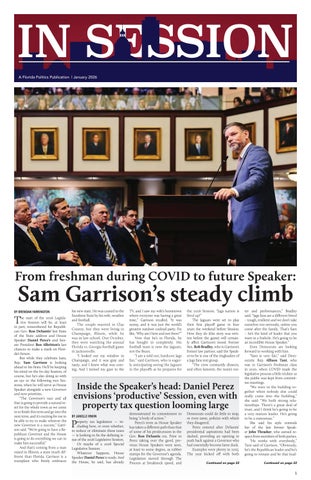
he start of the 2026 Legislative Session will be, at least in part, remembered for Republican Gov. Ron DeSantis’ last State of the State address and House Speaker Daniel Perez’s and Senate President Ben Albritton’s last chances to make a mark on Florida’s future. But while they celebrate lasts, Rep. Sam Garrison is looking ahead to his firsts. He’ll be keeping his mind on the 60-day Session, of course, but he’s also doing so with an eye to the following two Sessions, when he will serve as House Speaker alongside a new Governor and new priorities. “The Governor’s race and all that is going to provide a natural reset for the whole town as we come in to finish this term and go into the next term, and it’s exciting for me to be able to try to make whoever the new Governor is a success,” Garrison said. “We’re going to have a Republican Governor and the House is going to do everything we can to make him successful.” And that’s coming from a man raised in Illinois, a state much different than Florida. Garrison is a transplant who firmly embraces
his new state. He was coaxed to the Sunshine State by his wife, weather and football. The couple married in Clay County, but they were living in Champaign, Illinois, while he was in law school. One October, they were watching the annual Florida vs. Georgia football game in Jacksonville. “I looked out my window in Champaign, and it was gray and nasty, and I knew what was coming. And I turned my gaze to the
TV, and I saw my wife’s hometown where everyone was having a great time,” Garrison recalled. “It was sunny, and it was just the world’s greatest outdoor cocktail party. I’m like, ‘Why am I here and not there?’” Now that he’s in Florida, he has bought in completely. His football team is now the Jaguars, not the Bears. “I am a sold out, hardcore Jags fan,” said Garrison, who is eagerly anticipating seeing the Jaguars in the playoffs as he prepares for
the 2026 Session. “Jags nation is fired up!” The Jaguars were set to play their first playoff game in four years the weekend before Session. How they do (this story was written before the game) will certainly affect Garrison’s mood. Former Sen. Rob Bradley, who is Garrison’s former law partner, said the Speaker-to-be is one of the ringleaders of a Jags fans text group. “The crew constantly dissects, and often laments, the team’s ros-
Democrats could do little to stop, or even tame, policies with which they disagreed. Perez entered after DeSantis’ presidential aspirations had been dashed, providing an opening to push back against a Governor who had essentially become lame duck. Examples were plenty in 2025. The year kicked off with both
ter and performances,” Bradley said. “Jags fans are a different breed – tough, resilient and we don’t take ourselves too seriously, unless you come after the family. That’s Sam – he’s the kind of leader that you want in a foxhole. He’s going to be an incredible House Speaker.” Even Democrats are looking forward to working with him. “Sam is very fair,” said Democratic Rep. Allison Tant, who was in Garrison’s freshman class in 2020, when COVID made the legislative process a little trickier as the public was kept from committee meetings. “We were in the building together when nobody else could really come into the building,” she said. “We built strong relationships. There’s a great deal of trust, and I think he’s going to be a very mature leader. He’s going to be a statesman.” She said his style reminds her of the late former Speaker John Thrasher, who earned respect from members of both parties. “He works with everybody,” Tant said of Garrison. “Obviously, he’s the Republican leader and he’s going to remain and be that lead-
Continued on page 22
Continued on page 22
Inside the Speaker’s head: Daniel Perez envisions ‘productive’ Session, even with property tax question looming large BY JANELLE IRWIN
P
roperty tax legislation — including how, or even whether, to reduce or eliminate these taxes — is looking to be the defining issue of the 2026 Legislative Session. Or maybe of a 2026 Special Legislative Session. Whatever happens, House Speaker Daniel Perez is ready. And the House, he said, has already
demonstrated its commitment to being “a body of action.” Perez’s term as House Speaker has taken a different path than that of some of his predecessors in the Gov. Ron DeSantis era. Prior to Perez taking over the gavel, previous House Speakers were seen, at least to some degree, as rubber stamps for the Governor’s agenda. Legislation moved through The Process at breakneck speed, and
1
IN SESSION
A Florida Politics Publication | January 2026
Ben Albritton readies Senate for taxes, insurance, more BY BRENDAN FARRINGTON
S
enate President Ben Albritton was driving from Tallahassee to his home in Wauchula, using GPS to count the minutes until he arrived. For those who don’t know, Wauchula is a city of about 5,000 in Hardee County. And if that still doesn’t ring a bell, it’s because Hardee County is not a tourist destination. It’s in the middle of the state southeast of Tampa, where suburban sprawl ends and orange groves begin. And that’s where Albritton was taking his final break before the 2026 Session. No meetings, just family gathered for Christmas and the New Year, walks through citrus groves with his wife, Missy, and a lot of reading. “We are now 26 minutes away from home,” Albritton said by phone. “When we get there, we’re going to do a lot of relaxing.” But he won’t be completely tuned out of The Process. “There’s a lot going on. There’s a lot of information I want to be able to get through to continue to educate myself,” Albritton said. “I’m going to relax, but I’m not going to completely turn the switch off.”
2
Once Session starts, the Senate will take up Albritton’s top priority during the first week: a Rural Renaissance bill that would help counties like Hardee develop infrastructure, housing and business opportunities. It would also create a state office directed to help rural communities. It was also his priority last year, but the legislation died amid a tense Session and a tough budget year. “It is surreal that it’s almost time to do my second opening day speech as President,” he said. “That being said, I’m going to be consistent. I’m going to work to encourage the Senators, I’m going to work to encourage Floridians. I’m going to have a positive message,” Albritton said. Of course, another priority for legislative leaders in both chambers and Gov. Ron DeSantis is coming up with a way to cut property taxes. While different plans are being floated, Albritton wants to make sure the cuts are done in an economically prudent way, and not just to make voters happy. “Do I believe it is correct, the right thing to do for the right reasons, to provide property tax relief to Floridians? Yup, I sure do,”
Albritton said. “The Florida Senate is taking this extraordinarily seriously. We’re looking very closely to understand, what can we do, what are the ramifications of that, and how does that affect Floridians as a whole?” Albritton is hoping that this year Floridians will begin seeing the fruits of the Legislature’s efforts to control property insurance costs, noting that sometimes it takes time to see the real benefits of legislation. “We’ve been laser focused on property insurance here in Florida. We’ve done great work, in my estimation, with the tort reform. The good Lord did great work this year and kept us from having a storm,” Albritton said. “I’m excited about what we’ll see for property insurance costs as they evolve next year.” He sees the property tax issue similarly in that it’s going to take a lot of thoughtful work and patience. “Sometimes when you make changes to try to help Floridians, it takes a little while for it to make its way back to them,” he said. “Relief in the property tax space is going to be one of those things.”
Meet the Press: Senate President Ben Albritton lays out his priorities to members of the Capitol Press Corps during a December luncheon. Photo credit: The Workmans.
IN SESSION
A Florida Politics Publication | January 2026
CAPITAL CITY CONSULTING
27 300+ 5 15+ LOBBYISTS
CLIENTS
OFFICES
SPECIALTY AREAS
SUCCESS E We’ve S Cornered the Market S on Winning. I O N cccfla.com | 850.222.9075
TA L L A H A S S E E | TA M P A | P A L M B E A C H | F T. L AU D E R D A L E | M I A M I 3
IN SESSION
A Florida Politics Publication | January 2026
Key people to watch during the 2026 Legislative Session BY JANELLE IRWIN
M
uch like the big game, when all eyes are on the quarterback and top gridiron talent, talk about the Legislative Session also centers on legislative and executive leadership. It’s no secret that the 2026 Session will be dominated by Gov. Ron DeSantis’ desire to eliminate property taxes, as well as Senate President Ben Albritton and House Speaker Daniel Perez’s desire to deliver something along those lines, in their own way. The Governor often sets the tone for budget priorities, with leadership in each chamber working from that blueprint to create a final product to be sent back to the Governor, along with hopes that his veto pen is running dry. Things have been a bit different over the last year, and the 2026 Session will no doubt see some fireworks between legislative and executive leadership. But we are looking beyond the headline-grabbing all-stars of The Process to those who lead from other positions. Here are the names to watch this Session as we plow into the new year.
Gov. Jay Collins. It’s not like she’s a shoo-in for the Hillsborough County-based seat. Despite an advantage for Republicans — Republicans control nearly 39% of the district’s electorate, compared to just shy of 32% for Democrats — SD 14 has historically been a swing district. Collins was first elected to the Senate in 2022, flipping the seat red after former state Sen. Janet Cruz had flipped it blue just four years before.
ditures and, likely, a reduction in recurring spending. Lawmakers can also expect McClure to preside over a budget process less friendly to members’ pet projects back home compared to previous years.
NO. 4: COREY SIMON
Behind every leader is a righthand man (or woman). That’s who state Sen. Corey Simon is to Albritton. He’s a strong ally who often carries Albritton’s priorities,
24 term. That means she serves under a Senate President as a de facto Senate President herself. Before that, she served as Majority Leader for two years and oversaw the powerful Rules Committee for two years, so she has gobs of institutional and leadership experience. But while rank-and-file members will no doubt continue turning to Passidomo for leadership and guidance — she is again Rules Chair — the biggest reason to
NO. 1: JIM BOYD/SAM GARRISON
For this Session, state Sen. Jim Boyd and state Rep. Sam Garrison are, in some regards, just two more Republicans serving from the supermajority. Boyd is already in leadership as Majority Leader, while Garrison heads the Rules and Ethics Committee as its Chair — a powerful position by any definition, though far from the most powerful one. But the two deserve plenty of attention. For the 2027 and 2028 Sessions, Garrison will wield the gavel in the House, leading the Legislature alongside Boyd as Senate President. While that’s not necessarily all that impactful for this Session, it means both will be minding their P’s and Q’s working under current leadership, while also maintaining a watchful eye as they develop priorities for the next Legislative Session. That means, as Garrison previously told Florida Politics, he’ll be watching for leadership decisions and actions with which he agrees, and with which he disagrees, all with an eye of shaping his own leadership future. Boyd will no doubt share that dual role, preparing for a Florida future under a new Governor.
NO. 2: JOSIE TOMKOW
Despite the supermajority that ensures GOP priorities are considered and approved, even with a resignation here or there, state Rep. Josie Tomkow chose to continue serving in the House for the 2026 Legislative Session rather than devoting herself to her Special Election race for Senate District 14, where she is running to replace former state Senator and now-Lt. 4
Republican lawmaker Corey Simon has an ambitious agenda for 2026. Photo credit: Colin Hackley.
And Democrats may now be emboldened following election results across the country in late 2025 that overwhelmingly favored their party. It’s also a Midterm Election cycle, where the party in power in Washington often suffers at the ballot box. Taken as a whole, Tomkow’s continued service in the House is sure to offer glimpses of her Senate campaign priorities. Watch for those teasers in committee and floor debates.
NO. 3: LAWRENCE MCCLURE
State Rep. Lawrence McClure leads the lower chamber’s budget negotiations as Budget Committee Chair. It’s the second-most powerful leadership post in the House, which controls the chamber’s purse strings. And it won’t be McClure’s first rodeo. This is the second Session where he’ll preside over the budget process, meaning he comes in with eyes wide open. That’s especially true given the 2025 Session’s stretch of exhausting overtime. McClure has said he doesn’t expect the same level of delays. But, like the House Speaker, McClure has acknowledged that an extended Session can’t be completely ruled out because lawmakers must take the time to get things right. For McClure and Perez, that means a fiscally conservative budget that responds to out-year expectations through lean expen-
including this year with Rural Renaissance 2.0. Simon is carrying the renewed push (SB 250) this Session after last year’s effort — which Simon also carried — blew up amid fractured negotiations between chambers. This year’s package is largely the same as the 2025 effort, which was Albritton’s top priority. Overall, the legislation seeks to add more resources for rural areas through expanded health care access, better roads and more. With his first attempt squashed, Albritton will again be looking toward Simon to be the finisher. That means Simon will have Albritton’s ear and, by proxy, likely be given deference among other upper chamber members. And if that were not enough to make Simon a lawmaker to watch, he’s also got a busy calendar. Simon holds seats on nine committees and subcommittees, including leadership as Chair of the Education Pre-K-12 Committee and as Vice Chair of the Education Postsecondary Committee.
NO. 5: KATHLEEN PASSIDOMO
A former Senate President herself, state Sen. Kathleen Passidomo is perhaps the most seasoned lawmaker in Tallahassee. While most Senate Presidents hold the gavel their final two years in office, Passidomo still had time on the clock after her tenure as President in the 2022-
watch her is her alliance with DeSantis. She presided over one of the most productive Sessions for the Governor in 2024 when the Legislature passed record tax relief, among other declared wins. But she also manages to maintain her independence when appropriate. In the last Legislative Session, for example, Passidomo didn’t hesitate to blast the House Speaker when he almost scuttled plans to name a building after state Sen. Darryl Rouson in recognition for his years of work on mental health and substance use issues.
NO. 6: ED HOOPER
It might seem odd to place state Sen. Ed Hooper so far below McClure. After all, Hooper is McClure’s Senate budget counterpart in the upper chamber. So on paper, he wields the same amount of power, if not more. But if last year’s marathon budget negotiations are any indication, Hooper’s influence over the process might not be quite as pronounced. The House, known for its larger-than-life personalities and sometimes aggressive legislative agenda, often steals the headlines even as the Senate tends to garner a reputation for being the adults in the room, tending to moderate some of the more controversial proposals. And collegiality is a Hooper trademark. Ever the statesman, he’s no stranger to making friends
on the political right and left. And even if the House is the more forward-facing power broker, Hooper does still oversee budget negotiations for the upper chamber, making him inherently important to keep an eye on.
NO. 7: ALEX ANDRADE
Two words: Hope Florida. State Rep. Alex Andrade has been the point man for investigations related to Hope Florida and its foundation, an initiative championed by First Lady Casey DeSantis that came under scrutiny for using $10 million in Medicaid settlement money to fund political campaigns against two ballot initiatives in 2024. One would have enshrined abortion protections into the state constitution, and another would have legalized cannabis for adults 21 and older regardless of medical need. Both exceeded 50% support at the ballot box, but failed to reach the 60%-plus-one vote share needed to pass. More recently, Andrade filed a bill that seems directed at the DeSantis administration’s reputation for making obtaining public records difficult, expensive, or both. The measure would require state agencies to respond quickly — in just days, not weeks or months — and provide cost estimates and a time frame for fulfillment. Rouson is sponsoring companion legislation, and he filed a similar bill last year, though it failed to gain traction.
NO. 8/9: KEVIN STEELE AND BLAISE INGOGLIA
Who is Kevin Steele? That’s a question some voters outside his Dade City-based House District 55 might have asked just a few months ago. Now, the state Representative first elected in 2022 is a candidate for Chief Financial Officer. That sets up a GOP Primary against current CFO Blaise Ingoglia, who was appointed to the position after former CFO Jimmy Patronis was elected to Congress in a wave of Florida politicos heading to Washington, D.C., on President Donald Trump’s coattails. While they won’t be the only Republicans in the race, they’re the ones to watch, and the contest could get interesting fast. Steele likely would not have been in the race had it not been for the well-known, often festering rivalry between DeSantis and Trump. With Ingoglia being DeSantis’ hand-picked choice for the job and state Sen. Joe Gruters out of contention after he was picked to chair the Republican National Committee, Trump World met with Steele and encouraged him to run. With Trump’s eventual “complete and total endorsement” likely coming, it puts Steele immediately in a strong position to challenge Ingoglia. Ingoglia, meanwhile, won’t take the challenge lying down. He’s a former state Representative, Continued on page 22
IN SESSION
A Florida Politics Publication | January 2026
REPUBLICAN HOUSE MAJORITY 2026 CAMPAIGN EMPLOYMENT OPPORTUNITIES
The florida house republican campAIGn committee is now accepting resumes from qualified individuals SEEKING employment on Florida State House campaigns during the 2026 election cycle. Positions WILL BE available AFTER THE LEGISLATIVE SESSION for trusted field staff and experienced senior staff members. Applicants should possess prior campaign experience, strong professional references, and a demonstrated commitment to advancing the mission and objectives of the Republican House Majority. must be a proven team player. Roles require a willingness to travel throughout the state of Florida and the ability to perform in a demanding, fast-paced campaign environment, including LEGENDARILY extended and irregular work hours as necessary. WE SEEK SERIOUS PEOPLE FOR SERIOUS JOBS. A college degree and participation in post-graduate campaign training programs are preferred but not required. solid technical skills welcome. recognize that there is no campaign task we assign that is beneath you. prove your value.
APPLICATION INSTRUCTIONS Submit a cover letter, writing samples, resume and THREE professional references to:
CampaignTeam@fhrcc.com Sponsored by Florida House Republican Campaign Committee. Speaker-Designate Sam Garrison, Chairman.
5
IN SESSION
A Florida Politics Publication | January 2026
Property tax relief moves to the front burner heading into Session — and the stakes are high BY JESSE SCHECKNER
P
roperty tax relief is a popular dish in Florida politics today, but cooking up a ballot-ready recipe that doesn’t burn is a tall order. With Gov. Ron DeSantis, House Speaker Daniel Perez and legislative leaders crowding the stove and pledging relief, the Sunshine State is barreling toward a November 2026 election in which voters could be asked to sharply reduce — or substantially dismantle — the state’s property tax system, which remains local government’s most reliable funding source for essential services. DeSantis has repeatedly called for sweeping relief, with CFO Blaise Ingoglia reinforcing that message in stops across the state to highlight his agency’s audits of local government spending he says show billions in waste. House leaders have opted for a multiple-choice approach, putting numerous measures of varying impact on the menu — many of them proposed constitutional amendments — that would give voters a range of options, from eliminating non-school homestead property taxes outright to narrower exemptions and assessment caps.
DeSantis has criticized the House approach as overly complicated, warning that multiple ballot questions could confuse voters and spoil the effort. He has called instead for a single, bold amendment. Senate leaders, meanwhile, have signaled caution. President Ben Albritton has said the chamber remains committed to affordability, but is wary of unintended consequences. “We’re still measuring,” he said recently, adding that lawmakers must ensure core services like emergency response remain intact. The issue’s scale explains the hesitancy many have expressed. A Wichita State University study, commissioned by the Florida League of Cities, found property taxes account for roughly 43% of municipal general revenue statewide. Public safety alone consumes more than 56% of municipal general fund spending. Eliminating homestead property taxes outright would reduce ad valorem revenue by 38% statewide and cut overall general fund revenue by 14%, forcing millage rates to nearly double
just to maintain services. Even large fixed-dollar exemptions — $250,000 to $500,000 — would result in revenue losses of 25% to 32%, requiring millage increases of up to 70% on remaining taxable property just to break even. Those impacts would not be evenly distributed. Median losses across Florida’s regions range from about 24% to more than 46%, with Central and Southeast Florida hit hardest due to heavy reliance on homesteaded residential property. Coastal counties — including Miami-Dade, Broward, Palm Beach, Collier and Lee — would see particularly sharp declines, while many rural and inland communities lack the fiscal flexibility to absorb even smaller losses. In testimony before House committees, city officials and service providers warned that carveouts for schools and law enforcement — included in the House proposals — leave other essential services exposed. Fire rescue, emergency medical services, public works and water management districts could face deep cuts or rising fees. Advocates have also warned that weakening a major revenue pillar could damage mu-
PUBLIC Relations STRATEGIC
Communications CRISIS
Management
RESULTS IMPACTFUL STRATEGIES THAT DRIVE
www.YellowFinchStrategies.com
6
nicipal credit ratings, raising borrowing costs and long-term taxpayer expenses. On the other side of the argument is the fact that property taxes have risen sharply in recent years alongside ballooning local budgets. Florida TaxWatch found the statewide average per-capita property tax levy is about $2,398, with many large counties well above that mark. Palm Beach County exceeds $3,740 per capita, Miami-Dade tops $3,360, and Broward surpasses $3,060. Growth has been rapid in many cities: Apopka’s property tax growth exceeded 370% over the past decade, while Port St. Lucie, Homestead, Hialeah, Miami and Miami Gardens all posted increases above 150%. Those figures have become central to arguments that local governments have expanded beyond reasonable bounds. Rep. Toby Overdorf, who chairs the House Select Committee on Property Taxes, has said local property tax revenue is rising “at an unsustainable rate” and that relief is needed to “put money back in the pockets of Floridians.” Ingoglia said last month that across just 11 localities, he found nearly $1.9 billion in excessive spending in one year alone. He’s backing bills that would require local governments to better enable public perusal of pending budgets and extend whistleblower protections to city employees, contractors and residents who report government waste. Polling suggests voters understand the risks of eliminating or
slashing property taxes, but still want relief. A Sachs Media survey found 65% of Florida voters favor eliminating or reducing property taxes, even as 87% acknowledge the change would negatively impact local services. Only 37% said they would support higher sales taxes or fees to offset lost revenue. That tension is driving debate over state backfilling. DeSantis has proposed reimbursing “fiscally constrained” counties for lost homestead revenue, calling the cost manageable given current surpluses. But he has also suggested such support would not be permanent, raising concerns about long-term dependency on Tallahassee and the erosion of local autonomy. There’s no shortage of cooks in Florida’s property tax kitchen. DeSantis is demanding boldness. The House is moving proposals. The Senate is touting caution. Ingoglia is pressuring local budgets. Cities are pleading for a considerate approach that won’t irrevocably undermine their operations. Polls show voters want action, but not necessarily the consequences that come with it. Now it’s about deciding which ingredients belong in one or multiple ballot proposals, how much relief is sustainable and whether Florida can deliver meaningful tax cuts without overcooking the system that funds vital services. The risk is serving voters something that sounds delicious, but proves indigestible.
IN SESSION
A Florida Politics Publication | January 2026
FloridaPoly.edu
Florida Poly is a DYNAMIC INSTITUTION designed to aggressively push the limits of ENGINEERING EDUCATION. With industry-driven programs, leading faculty, and cutting-edge facilities, the University is building a strong pipeline of indemand, high-skilled STEM professionals prepared to innovate and take on the hightech challenges of tomorrow. The STATE’S ONLY ALL-STEM UNIVERSITY, Florida Poly’s full-time employed alumni earn a median wage of $66,800 one year after graduation, the highest among all state universities in Florida.
#
1
Public College IN
T H E
S OUT H
U.S. News and World Report
#
3
10
Best Career Outcomes WalletHub
I N
T H E
S O U T H
N AT I O N A L LY
TOP
30
#
1
Highest Salaries of Graduates A M O N G F LO RI DA’ S S TAT E U N I V E R S I T I E S
SUDS & SWIS
Public Engineering Program W I THOU T
A
PH.D.
U.S. News and World Report
U.S. News and World Report
N AT I O N A L LY
TOP
Best Value Public College
Scan to learn more
#
1
Grads with Lowest Student Debt AM ONG FLOR I DA’S S TAT E U N I V E R S I T I E S
U.S. Department of Education
The Assembly on Adams— Tallahassee’s new event space located in the shadow of the Florida Capitol. Intimate event space Catering (delivered and pickup) Cheese & charcuterie boards Coffee, breakfast and lunch Specialty gifts and wine Schedule a tour or start planning your event today! Email: info@socialcateringandevents.com Website: theassemblyonadams.com 225 South Adams Street Tallahassee, Florida 32301 (850) 661-1009 7
IN SESSION
A Florida Politics Publication | January 2026
When a child is diagnosed with cancer, their family would go to the ends of the earth for a cure. But they shouldn’t have to. At Wolfson Children’s Hospital, we’re leading the charge to change that. Together with Florida’s specialty children’s hospitals, we’re building a world-class destination for pediatric cancer research — so no child has to leave home to receive the very best treatment. Our children deserve world-class cancer care. Let’s bring it home to Jacksonville.
WolfsonChildrens.com/BringHopeHome
WHERE NORTHWEST FLORIDA’S FUTURE TAKES FLIGHT. We’re the hub connecting industry leaders, innovators, and pioneers to Northwest Florida’s unlimited potential. With hundreds of millions in new investments and expanded facilities, Northwest Florida Beaches International Airport is the launchpad for your opportunity.
Northwest Florida and ECP, Flying Higher Every Day.
8
IN SESSION
A Florida Politics Publication | January 2026
House and Senate leaders agree: Next state budget will be lean BY JANELLE IRWIN
I
f preliminary comments from Sen. Ed Hooper and Rep. Lawrence McClure are an accurate indication, the next fiscal year budget will be anywhere from $1 billion to $4 billion less than the current fiscal year. That offers a glimmer of hope that a repeat of the 2025 Legislative Session’s long overtime can be averted. The budget chiefs for their respective chambers for the second and final Legislative Session, Hooper and McClure will lead budget negotiations and largely control the state’s purse strings. For now, at least, they seem largely in lockstep on reining in COVIDera spending levels. “There’s no federal COVID money coming into the coffers,” Hooper reminded. “We’re now adjusting our expectations back to 2018/2019 numbers. To put that into perspective,
the approved budget that year came in at less than $89 billion. The current fiscal year’s approved budget was more than $117 billion, about the same amount Gov. Ron DeSantis has called for in his proposed budget for the 2026-27 fiscal year. Hooper estimates lawmakers will need to slash spending levels by at least $1 billion from the current budget, and may need to enact even deeper budget cuts, up to $4 billion. His estimate is based on increased state spending obligations for Medicaid, as well as anticipated reductions in corporate tax revenue as a result of the depreciation clauses for corporations under President Donald Trump’s One Big Beautiful Bill Act. Under Trump’s tax cut package, the federal government is reducing public health care funding by about $1 trillion. In Florida, $3.8
billion is being cut from health care in general, largely through caps on state-directed payments to hospitals, which is a significant portion of Medicaid spending in the state. Hooper said it will cost the state about $1 billion on Medicaid alone. The One Big Beautiful Bill also changes the bonus depreciation process businesses use to write off expenses related to qualifying property, such as machinery. Previously, businesses used a phase-down schedule, where they claimed a portion of the cost over a period of years at a depreciating rate until the value reached zero. Now, businesses can write off the full cost in the year the property was purchased, and it includes a lookback period for qualifying purchases made in 2024. Hooper expects that to cost the state $1.5 billion to $3 billion in corporate tax revenue. “We need to reimagine our spending patterns; that’s something the House has said consistently,” McClure said. The House and Senate were at odds last year, not over whether to cut taxes, but on how to cut them. DeSantis was calling for an elimination of property taxes. The House instead proposed a historic permanent sales tax cut, while the Senate suggested eliminating sales tax altogether on clothes and shoes for a year. No one got their way entirely, but the showdown that ensued highlighted the differences between the two legislative chambers. The House was more aggressive in identifying permanent
tax cuts and reducing recurring revenue — a fiscally conservative approach meant to rein in spending. The Senate was less aggressive, proposing less sweeping cuts, and ones that weren’t necessarily permanent. While it’s too early to know how the end of next Session will shake out — the budget process should amp up in the final weeks and days of Session, with reconciliation kicking into high gear in March — McClure and Hooper both say they have already been having regular talks to prepare. They aren’t keen on having another extended Session — this year’s went well past the prescribed 60 days, clocking in at an exhausting 105 days. “Both of us have repeatedly said 60 days would be good,” Hooper said. “We are working toward that. That’s the goal. I’m not up for election, but it’s an election year and a lot of people would like to be out campaigning and/or raising support. They certainly don’t want to be out here.” McClure, interviewed separately and unaware of his Senate counterpart’s comments, agreed. “There’s no reason it shouldn’t happen,” McClure said when asked if he thought the 2026 Legislative Session would end on time — or at least close to on time. But he cautioned that House Speaker Daniel Perez is “committed to getting it right,” indicating that, if necessary, lawmakers would stay in Tallahassee to get the job done. “I want Session to end on time just as much as anyone else. However, I’m not going to rush Session,”
Perez confirmed to Florida Politics. “If what we have to do is stay longer, then that’s what we’ll do.” McClure and Hooper each made clear that they are so far aligned on budget ideology: slashing spending to protect future legislative leaders from potential deficits. But don’t expect everyone to be 100% on the same page. The House, as McClure describes it, is still very much committed to cutting recurring spending, something the Senate doesn’t seem as set on. “When you put recurring dollars on there, it’s kind of diluting the Legislature in the future,” he said. “I don’t think the Florida House has shied away from being willing to participate in tough budget conversations.” But McClure again reiterated that he and Hooper are working hard to ensure out-year budgets — those that will be hammered out in future Legislative Sessions — are protected with lean spending now. And Perez punctuated it all. “For far too long we were exceeding our (revenue) projections and spending that money,” Perez lamented, adding a dig against Desantis. “The Governor vetoed the budget stabilization fund and didn’t want to save that money,” he said, referring to the $750 million the Legislature approved to set aside in each of the next two fiscal years, which DeSantis vetoed. Perez said to expect another attempt at putting aside a big chunk of cash in a rainy-day fund.
9
IN SESSION
A Florida Politics Publication | January 2026
‘Blue Ribbon’ project measure marries conservation and development BY JANELLE IRWIN
S
tate lawmakers are considering a proposal aimed at encouraging Florida’s largest private landowners to set aside a majority of their land for conservation space in return for a streamlined development approval process aimed at better aligning growth, conservation and infrastructure planning. The legislation (SB 354, HB 299) — sponsored by Sen. Stan McClain and Rep. Lauren Melo — would establish “Blue Ribbon” projects, which would apply to landowners who control or own at least 10,000 or more contiguous acres. The measures would require participating landowners to conserve at least 60% of the property. The House bill cleared its first committee stop in early December, and a committee substitute reflecting an approved amendment at that Intergovernmental Affairs Subcommittee meeting has now been swapped in. Under the bill, the plan must meet strict statutory requirements.
10
Landowners would still have to earn approval from local governments based on compliance with the statutes, including develop-
ment orders, and concurrency. That’s an important distinction, as critics are already claiming that the bill eliminates the gov-
ernment’s ability to vet proposals. It does allow landowners to bypass the traditional development approval process through a more administrative procedure, but governments still can review the project details and reject the proposal if it does not meet requirements set in state statute already, or other requirements included in the current legislative proposal. “I have heard your concerns about local authority. This bill maintains strong local control over public facilities, concurrency, infrastructure, construction, financing, development, order issuance and implementation,” Melo said when the bill cleared its first committee stop. Melo later added that she has “heard about losing power
Lauren Melo sees her ‘Blue Ribbon’ legislation as a win for taxpayers. Photo credit: Colin Hackley.
with local governments when it comes to preemption.” “We are only talking about (comprehensive) planning and zoning. Local governments will still have power,” she said. And Melo is touting the measure as an economic win for taxpayers. She used a program from her home county, Collier, to highlight taxpayer savings. There, Conservation Collier was most recently approved by voters in 2022. The organization uses ad valorem tax revenue to fund conservation land purchases. “Collier County approved transfers out totaling more than $53.5 million in 2023,” she said. “I don’t take it lightly when a land owner is incentivized to gift thousands of acres in conservation at zero cost to the taxpayer.” If passed, bill sponsors hope the new law would protect wildlife and natural areas; limit urban sprawl; provide a range of housing options, including missing middle and affordable housing; create quality communities designed to reduce vehicle trips and promote multiple mobility options; and enhance local economic development objectives and job creation. The proposal is born of a desire to implement smart growth strategies by ensuring growth occurs only where it can be supported. The proposal requires phased planning for water, wastewater, transportation, schools and utilities. It also emphasizes sustainability beyond just conservation lands by ensuring new developContinued on page 22
IN SESSION
A Florida Politics Publication | January 2026
FLORIDA INTERNATIONAL UNIVERSITY
FIU Modesto A. Maidique Campus, Miami, FL
Florida International University is Miami’s top-ranked Preeminent State Research University serving over 56,000 students and more than 340,000 alumni. FIU is proud to be a driver of talent and innovation locally and globally, with over $300 million in research expenditures. We offer a full range of bachelor’s, master’s, and doctoral programs awarded by 11 colleges and schools, including engineering, medicine, and law.
IN THE NATION ECONOMIC & SOCIAL MOBILITY
Discover the Power of FIU
11
IN SESSION
A Florida Politics Publication | January 2026
New College lays groundwork for expansion while Governor DeSantis advances USF Sarasota-Manatee transfer BY JESSE MENDOZA
N
ew College of Florida has adopted a campus master plan as the institution prepares for growth under a proposal by Gov. Ron DeSantis to transfer all University of South Florida Sarasota-Manatee campus facilities to New College. The New College Board of Trustees unanimously approved a new master plan Dec. 17, establishing a long-range framework for expanded academic space, student housing, infrastructure and capital improvements. The vote came about a week after DeSantis unveiled his 2026-27 budget proposal directing that all facilities at the USF Sarasota-Manatee campus be transferred to New College. Students, faculty, staff, research contracts and academic programs would remain with USF, and current USF students would be allowed to complete their degrees locally under required teachout provisions. New College President Richard Corcoran told Florida Politics that USF facilities would address immediate needs for student housing and educational space while officials work to realize a broader vision for the college outlined in
the new master plan. “We inherited almost 250 beds, give or take, that should have never had students in those rooms,” he said. “We had to shutter them, and rightfully so. … But the massive growth at the institution combined with dilapidated facilities has put us in a real bind.” During the Dec. 17 meeting, Corcoran told Trustees the building transfer would immediately deliver large amounts of usable office, academic and residential space if it is approved by lawmakers — alleviating space constraints and serving as a stepping stone for future growth. Corcoran emphasized that the proposal remains subject to legislative approval. “It’s exciting because it’s movein ready,” Corcoran said during the meeting. “That really solves a lot of problems. It’s massive 100,000-plus-square-foot office space, classroom space, and then the 200-bed dormitory — which would give us only about 50 or less more because we are already in 155 beds. Regardless, it’s just an immediate turnkey if it works out.” Corcoran also told Trustees that negotiations are ongoing regarding land leased from the
Large scale data centers are a key component of America’s AI Action Plan.
New College of Florida President Richard Corcoran could see a major expansion of his university’s footprint. Photo credit: Colin Hackley.
Sarasota-Bradenton International Airport. New College leases land on airport property and has previously explored purchasing the site to support long-term redevelopment plans, an effort that stalled after objections were raised during the federal review process. College officials said new appraisals are un-
derway and discussions with airport officials continue. The adopted master plan does not explicitly reference designs for the USF Sarasota-Manatee campus. However, it anticipates physical growth that includes the addition of a “North Campus,” with expanded housing capacity
and new academic and support facilities designed to accommodate increased enrollment. Master plan maps only preview plans for North Campus land already under New College ownership, located just west of the USF campus. Continued on page 22
the AI race [against “ Winning China] will usher in a new golden age of human flourishing, economic competitiveness, and national security for the American people.”
President Donald Trump’s AI Action Plan
They can bring
PROSPERITY to Florida, too.
12
Enhanced national security 5,322 permanent jobs
$405.8 million in annual tax revenue to state and local governments
IN SESSION
A Florida Politics Publication | January 2026
Powerful Advocacy for the CPA Profession. Florida’s CPAs are a critical part of a strong, growing economy and are champions of efficiency in business and government. Throughout the state, our members serve as the foundation of trust that Florida relies on.
Join us in advancing the profession and strengthening Florida’s future.
ficpa.org
13
IN SESSION
A Florida Politics Publication | January 2026
NEW FROM THE FSU LEROY COLLINS INSTITUTE:
How Florida can make property insurance more affordable by investing in stronger homes and smarter risk-sharing
READ THE REPORT AT LCI.FSU.EDU
An epicenter of innovation Tampa Medical & Research District: Where innovation & progress thrive. In the city of Tampa, a new landscape is taking shape, one where a world-class academic health system, trailblazing medical schools and universities, a thriving business community, and cutting-edge medical research organizations all come together to ignite collaboration and fuel discovery. Anchored by Tampa General Hospital and the USF Health Morsani College of Medicine, the Tampa Medical & Research District is where you’ll find clinical care, life sciences, biotech, private equity, venture capital and academics uniting to create a bedrock of expertise that improves patient care, strengthens communities, fuels economies and betters lives, every day. And this is only the beginning.
14
tgh_59266_01_TMRD_InSession_L.indd 1
1/5/26 2:08 PM
IN SESSION
A Florida Politics Publication | January 2026
Carlos Guillermo Smith is using the spaghetti method on TDT reform BY GABRIELLE RUSSON
R
eforms to Orange County’s hotel tax were stripped from a larger bill behind closed doors in the late-hour budget talks of 2025. Could 2026 finally be the year the Legislature allows the state’s No.1 tourism destination to free up how the community spends millions of tourist development tax (TDT) dollars? Sen. Carlos Guillermo Smith, the lawmaker behind the hot-button issue in Central Florida, is optimistic. “It didn’t make it over the finish line (in 2025), but the fact that it made it so close to passing is (a) testament to the wide bipartisan support that TDT reform enjoys,” Smith said. “People understand that we have to reimagine how we use tourism development taxes in ways that grow tourism but also support the needed infrastructure.” Smith has filed five bills on the issue — including one in late December — and said he is “throwing everything at the wall to see what will stick” for the 2026 Session. “We’re giving the Florida Senate a menu of options to choose from to get something meaningful done,” Smith said. Central Florida is home to Disney World, Universal and SeaWorld, which collectively draw millions of tourists who pay a 6% surcharge tacked onto their hotel bills. The bed tax levy generated about $385 million in the 2024-25 fiscal year, but local officials are limited in how they can spend the money. TDT dollars can’t be spent to better fund Lynx buses, create affordable housing or add night and weekend service to the SunRail commuter line. And for years, the Legislature has declined to move on TDT reform, an issue that faces fierce opposition from the tourism lobby and Disney. Advocates for keeping the status quo also have argued it’s important to reserve spending on tourism advertising, messaging that kept the tourism engine running after hurricanes and through the COVID pandemic. The tourism promotion helped restart the critical economy during bad times in the travel market, they say. About $110 million goes to Visit Orlando to help advertise the region to keep tourists coming back.
THE CURRENT DILEMMA, AND THE POSSIBLE FIXES
Orange County spends about 30% of its TDT revenue on tourism advertising, Smith said. A convoluted state law requires
counties to spend at least 40% of TDT revenue on advertising in order to use remaining funds for public transit or other public needs. Some of Smith’s bills would repeal or soften that provision. One (SB 458) would lower the requirement to just 20%, while another (SB 454) would eliminate the 40% rule altogether. Yet another (SB 456) would modernize the rules to specifically allow TDT funds to be spent on workforce housing to help the thousands employed in low-wage tourism jobs find affordable places to live. It would also allow TDT funding for tourism-related public safety expenses. Meanwhile, Smith’s newest bill filed Dec. 19 (SB 976) would allow TDT funds to be used on commuter rail operations so SunRail could expand to run nights and weekends. Smith’s fifth bill (SB 446) targets Visit Orlando and “large-scale county destination market organizations.” The bill would require them to match all public funding with private dollars, similar to VISIT FLORIDA’s operations, Smith said. Smith said he wants Disney and the multibillion-dollar theme parks to have more skin in the game since publicly funded advertising benefits them directly. “We do need the private sector to invest in tourism marketing to make it a true public-private partnership,” Smith said. When asked which of his bills has the best shot at passing this Session, Smith pointed to SB 446, the one that would require Visit Orlando to match TDT dollars with private money. “Conservatives seem to be interested in ideas like this one,” Smith said. “We’re getting interest in 446 because the supermajority Republican Florida Senate understands that when we invest public dollars, we need to be efficient with the use of our taxpayer money.” “I’m making that a priority, but also just really want to make sure we emphasize our new bill … to give the counties the immediate flexibility to spend TDT on commuter rail,” Smith added. When reached for comment on Smith’s proposals, Visit Orlando issued a statement: “Visit Orlando’s Tourism promotion agreement prohibits us from lobbying on TDT, so we would not take a position on any TDT related proposal. We are always monitoring and trying to educate ourselves on what is be-
Democrat Carlos Guillermo Smith addresses his Senate colleagues during a 2025 floor session. Photo credit: Colin Hackley.
PUBLIC SAFETY YOU CAN COUNT ON. HEALTH CARE YOU CAN TRUST.
INVESTMENTS THAT SAVE LIVES.
Florida’s Only Rural Teaching Hospital Model for Florida’s CORE Network
Revolutionizing Mental Health Care
Expert Financial Governance
ER & Jail Diversion
LIVES PROTECTED. DOLLARS RESPECTED. Scan for our 2025 Impact
Continued on page 22
15
IN SESSION
A Florida Politics Publication | January 2026
Long-standing vaccine rules draw broad public engagement BY PETER SCHORSCH
A
s the Department of Health reviews potential updates to its school immunization rules, a broad mix of parents, patients, educators, faith leaders and business leaders are weighing in alongside the medical community. A December public workshop in Panama City Beach on proposed revisions to Florida Administrative Code Rule 64D-3.046 drew testimony from Floridians describing how long-standing vaccine requirements affect everyday life, from keeping schools and child care centers open to protecting children from preventable disease. Many speakers identified themselves first as parents and community members, emphasizing lived experience over ideology. That participation has helped spur the launch of Florida Families for Vaccines, a new coalition aimed at keeping families engaged as the rulemaking process moves forward. “As someone who helps families advocate for public health every day, I see how much Floridians value clear, reliable standards that help them protect their chil-
16
dren from preventable disease,” said Northe Saunders, president of American Families for Vaccines. “Florida’s long-standing vaccine requirements have kept schools open, child care centers stable, and families confident in the safeguards that prevent serious illness. The science behind these protections has been consistent for decades.” Some parents spoke from deeply personal experience. Cathy Mayfield, a Tallahassee mother who lost her daughter, Lawson, to meningitis, said the speed and severity of preventable disease is often underestimated. “My daughter Lawson went from a healthy, vibrant 18-year-old to fighting for her life in a matter of hours,” Mayfield said. “Meningitis
is that sudden and that devastating. We lost her within 36 hours – a loss no parent should ever endure. That is why vaccines matter.” Physicians who testified emphasized that their role is to explain the science behind protections families already rely on, not to replace parent voices. Dr. Rana Alissa, president of the Florida Chapter of the American Academy of Pediatrics, warned that removing requirements for vaccines such
as Hepatitis B, varicella, Hib, and pneumococcal infections could undo decades of progress. “These immunizations are cornerstones of public health not only because they safeguard individual children, but because they build herd immunity across Florida’s childcare centers and schools,” Alissa said. Business leaders also cautioned against weakening safeguards that support workforce stability. Ju-
lio Fuentes, president and CEO of the Florida State Hispanic Chamber of Commerce, said reliable schools and childcare are critical to Florida’s economy. “When preventable diseases spread, the ripple effects hit families, employers and local businesses alike,” he said. Health officials are expected to continue gathering public input as the Department of Health evaluates proposed changes.
IN SESSION
A Florida Politics Publication | January 2026
Farmers feeding Florida: A model of leadership and innovation
The program works. Earlier this year, when a milk processing plant unexpectedly shut down, milk tankers in Florida were stranded and their dairy haul was at risk of being dumped. Within an hour, the Farmers Feeding Florida team coordinated with Southeast Milk Cooperative and M&B Products to reroute and process the milk in Hillsborough County — saving 300,000 servings from being wasted. Every drop was
BY JANELLE IRWIN
recovered and distributed to Florida families in need. This success story reflects how the program’s rapid-response coordination turns potential crises into community solutions. And as schools prepare to close for the holidays, the network is already positioned to recover 119 tanks of surplus milk post-Thanksgiving. Continued on page 23
A
s lawmakers prepare for the 2026 Legislative Session, Florida’s agricultural community is pointing to one shining example of smart, effective governance: the Farmers Feeding Florida program, championed by Agriculture Commissioner Wilton Simpson and Senate President Ben Albritton. The initiative exemplifies how practical, results-oriented policy can strengthen Florida’s food security, support local farmers and get critical resources to those who need it most. At its core, Farmers Feeding Florida connects the state’s growers and producers directly to the statewide network of food banks. Through this partnership, farmers provide commodities at a greatly discounted rate, ensuring families can access healthy Florida-grown food. “Farmers Feeding Florida is a practical, effective, and efficient initiative,” Simpson said. “We link up Florida farmers to families who need nutritious, quality food, helping Florida farmers withstand natural market shifts. When farmers can farm, we protect our domestic food supply. Food security is national security.”
FDACS, the Florida Senate, and Feeding Florida launched the Farmers Feeding Florida initiative last year and toured M&B Products in Temple Terrace, FL. M&B President Dale McClellan provided the tour to Paco Velez, President of Feeding South Florida; Robin Safley, CEO of Feeding Florida; Sen. Jason Brodeur; FDACS Commissioner Wilton Simpson; Senate President Ben Albritton; and FDACS Staff.
CPR in Schools Training a Nation of Lifesavers.
Act now to secure public funding for Florida schools to teach lifesaving CPR and AED trainings for middle and high school students. Learn more at HeartPowered.org
17
IN SESSION
A Florida Politics Publication | January 2026
LaVon Bracy Davis’ mentorship gave us RaShon Young, and a lesson in shaping the next generation
Welcome to Tallahassee. Rashon Young and LaVon Bracy Davis are the newest members of the Florida Legislature. Photo credit: The Workmans. BY GABRIELLE RUSSON
R
aShon Young went to places in the Capitol most young staffers never go. Back then-Rep. LaVon Bracy Davis’ Chief of Staff, Young sat in on private meetings and observed lobbying behind the scenes in rooms with some of the most powerful politicians in Tallahassee. Bracy Davis was determined to introduce her protégé to Tallahassee’s inner-workings and prepare Young to take the reins himself someday. “I did some things that most 18
“I did some things that most Representatives would not do. I brought him into rooms that you don’t bring your aides or your Chief of Staff. I made sure he was in that room, sometimes even awkwardly.” – LAVON BRACY DAVIS Representatives would not do. I brought him into rooms that you don’t bring your aides or your Chief of Staff,” Bracy Davis said. “I made sure he was in that room, sometimes even awkwardly.”
“For three years it was armin-arm ... pouring into him, and as I learn, he learns. As I grow, he grows,” Bracy Davis added. Young was always at her side when Bracy Davis got face
time with then-House Speaker Paul Renner and current House Speaker Daniel Perez. As Bracy Davis advocated for her appropriations with then-Rep. Tom Leek, Young was there too. Even during an Olive Garden lunch, where Sen. Geraldine Thompson quietly informed Bracy Davis that she did not intend to fulfill her Senate term, Young was listening at the table. As usual, he was soaking everything in. And Bracy Davis was playing the long game. It paid off. On a recent afternoon, the two Central Florida Democrats
sat at a conference table in their shared downtown Orlando office and reflected on their rise in the Legislature. Bracy Davis is now a Senator representing Senate District 15. She is finishing the final term of Thompson, who died in 2025 from knee surgery complications. And Young is a Representative for House District 40, taking over Bracy Davis’ old job. Young’s election is a lesson on the importance of Florida lawmakers mentoring and preparing the next generation to lead, they both said. Bracy Davis, 46, is a member of
IN SESSION
A Florida Politics Publication | January 2026
“The freshman growing learning curve and the growing pains that I had to experience, I was going to be sure that he wasn’t going to have to experience.” – LAVON BRACY DAVIS
TOGET
R • LE
RE
C F L P U B L I C A F FA I R S . C O M
HE
SHAPE
By the time Bracy Davis was elected to HD 40 in 2022, the pair had already made a pact. She would do whatever she could to show her Chief of Staff the ropes. Then they made a long-term plan during the first few weeks of Bracy Davis’ first term. Whenever Bracy Davis was elevated to the Senate, Young would run for her House seat. “The freshman growing learning curve and the growing pains that I had to experience, I was going to be sure that he wasn’t going to have to experience,” she said as she described Young as selfless and hardworking. Others took notice of Young. Democratic aides voted him most likely to run for office in their annual superlatives at the end of the 2025 Session. Days later, Young submitted his resignation letter and filed to run in the Special Election for HD 40 to replace Bracy Davis. On Young’s victorious Election Day, Perez, who already had his cellphone number, called to congratulate him. For the Legislative Session, Bracy Davis and Young are already working together. They co-filed a bill seeking to compensate the families of the Groveland Four, a group of young men who were falsely accused of rape in Lake County in 1949 and suffered at the hands of racist White public officials. Even though the Groveland Four was posthumously pardoned, it has been a state oversight that their surviving family members never received any money for the atrocities, the two lawmakers said. “Just like we did with the Dozier School of Boys, the state needs to step up and do what is right when we’ve done people wrong,” Bracy Davis said. The Groveland Four legislation (SB 694, HB 6523) is one of several measures and appropriations Bracy Davis and Young plan to file together. But even as he respects his mentor, Young is quick to point out they have different priorities this Session. Bracy Davis is focused on arts and culture, as well as civil justice. Improving health care is Young’s biggest concern. As another Legislative Session begins, Young said he hopes lawmakers aren’t “always operating
T’S
Before she ever stepped foot in Tallahassee, Bracy Davis, a lover of the arts, worked at the Dr. Phillips Center for Performing Arts as the senior director of community programming. The Bethune-Cookman University choir was coming for a show in 2021, and a 21-year-old student tour manager coordinated with Bracy Davis. It was Young. “I remember we had a logistics call where I said, ‘I needed this, this, this and this.’ And then that next morning, I had an email with this, this, this and this,” Bracy Davis said. Without skipping a beat, Young updated her on students’ itineraries from beginning to end. “I was like, ‘I like this young man,’” Bracy Davis said. “Literally every single question I had, he had answered.” The show was a success, and Young was on her radar. Before the end of the year, she hired him to be her right-hand man at the marquee downtown Orlando event center. “I noticed that there was something special about him,” she recalled. Bracy Davis was quietly exploring a run for political office. On Young’s first day working for her, she warned him she was not planning to stay long at the Dr. Phillips Center. “I was like, ‘OK. So where are we going?’” Young remembered. “I knew that there was going to be a climb and I knew that I wanted to be a part of that.” “I believed in her. I believed in her success. I believed in the potential that we had to make an impact in our community,” Young added. Young was even closer to his boss because he knew her family. At Bethune Cookman, Young had befriended Bracy Davis’ father, the late Rev. Dr. Randolph Bracy Jr., who worked at the school as a Dean. Young also attends the same church that Bracy Davis’ husband leads. Dr. Phillips Center became the backdrop for deeper philosophical and political conversations be-
A LEGISLATIVE DUO
E F UT U
THROUGH MUSIC, A RELATIONSHIP WAS BORN
tween the two. And Bracy Davis pushed Young to think bigger. “What do you want to do in life?” she asked him, encouraging him to enter public service. On a lunch break, they watched the Florida Channel when Democrats protested redistricting on the House floor. “That was really the moment that we connected politically. I could see myself advocating and I can see myself working in this space,” Bracy Davis said. “Rep. Young got bit by that bug.”
TH
Generation X, while Young, 26, is from Generation Z. But Young isn’t your average rookie lawmaker. Thanks to his unique access under Bracy Davis, Young already knows how to work bills, set up meetings with Chairs and practice the right tone of civility in order to work with the Republican supermajority to get a Democratic cause noticed. Many senior lawmakers don’t need an introduction; they already know him. “I don’t think I really understood the importance of it until now,” Young said. “The only reason why I have the relationships and have the connections and the staff know me is because of the intentionality that the Senator had.”
OFFICES
ORLANDO
| TA L L A H A S S E E
CFPA_Half-page_Ad_2025.indd 1
on the porch, but sometimes stepping on the balcony and having that 10,000-foot view of what the future is going to look like.” For Bracy Davis, she urges everyone to find a mentor, or foster
12/19/25 9:33 AM
a mentee. “When you hear during campaign season, people say, ‘I did this, I did this, I did that,’ you may want to also ask, ‘so you’ve accomplished a lot. So what hap-
pens when the “I” is no longer in the room? Is there somebody else that can do and can continue that good work?’” she said.
19
IN SESSION
A Florida Politics Publication | January 2026
Policy, People & Business.
Our team of veteran Tallahassee-based lobbyists brings decades of experience, a proven track record of navigating the state’s complex regulatory framework and delivering results across all levels of Florida Government.
Put experience to work for you at
vogelgroupdc.com 20
IN SESSION
A Florida Politics Publication | January 2026
10 overlooked Florida politics stories that could shape 2026 – and beyond BY DREW WILSON, JESSE SCHECKNER, AND GABRIELLE RUSSON
N
ot every consequential political fight in Florida comes with a campaign slogan or a cable-news chyron. Some of the most impactful debates unfold quietly — think budget spreadsheets, court dockets and agency rulemaking workshops rather than lengthy floor debates and reams of speaker cards. As the 2026 Legislative Session approaches, a number of issues are taking shape just outside the spotlight, with the potential to shape policy, spending and power long after the hank drops in March (please, let it be March). From simmering legal questions and structural funding gaps to an overfull statewide ballot and an ever-expanding culture war battlefield, here are 10 under-the-radar issues worth keeping tabs on as Florida heads into the final year of the DeSantis era.
But its future is uncertain. The upper-chamber sponsor of last year’s legislation, Jacksonville Sen. Clay Yarborough, confirmed he will not carry the bill again, and no replacement sponsor has stepped up. That alone isn’t a death sentence for the measure, which currently contains no award caps. However, the bill still must escape DeSantis’ veto pen, and without caps, it’s unlikely it will.
THE SPECIAL ELECTION FOR MARCO RUBIO’S U.S. SENATE SEAT
At first blush, it may seem hard to believe that a contest for Rubio’s
In the upcoming Session, we’ll see if the erasure of numerous rainbow street designs that could have been used as actual finish lines will inform how lawmakers treat a renewed push to ban the flags. The Florida Department of Transportation painted over rainbow crosswalks across Florida, including in Boynton Beach, Miami Beach, Orlando, St. Petersburg and West Palm Beach as part of an effort to rid roads of “political ideologies.” Now, lo and behold, Borrero and Yarborough are back with legislation to prohibit the flags. This time, they have concrete — pun
FLORIDA’S FORENSIC MENTAL HEALTH BED SHORTAGE ISN’T GOING AWAY
For decades, Florida law has required that criminal defendants deemed incompetent to stand trial be transferred from jail to a mental health treatment facility within 15 days. In practice, that deadline has become largely theoretical. Commitments to state treatment facilities have surged since 2020, but bed capacity hasn’t kept pace. The result is a persistent backlog of hundreds of mentally ill defendants waiting months in county jails — often without
ARE LICENSE PLATE DECALS GOING AWAY?
The need to keep that little yellow registration sticker on your license plate up to date may be going the way of the dinosaurs, courtesy of legislation recommended by the Clerk of Florida’s most populous county and lawmakers who live there. Miami-Dade Clerk Dariel Fernandez has called for getting rid of the stickers, which he says are unneeded, outdated and, in some cases, counterproductive, since they can fade, peel or get stolen. Doral Sen. Ana Maria Rodriguez and Miami Lakes Rep. Tom Fabricio have filed twin bills to nix the requirement, which would see Florida join other states like Connecticut, Pennsylvania and Vermont in going fully digital. In Miami-Dade alone, Fernandez said the change — which Gov. Ron DeSantis supports — would save the county $2.5 million. It seems like a no-brainer layup for policymakers in a state hyperfocused on cutting wasteful spending.
A “FREE KILL” REPEAL IS ONCE MORE ADVANCING, BUT WHAT’S TO STOP IT FROM DYING AGAIN?
Last Session, lawmakers finally did what political observers long thought they’d never do: pass legislation repealing a unique Florida law that blocks the award of noneconomic damages — grief, loss of companionship and the like — in cases of lethal medical negligence if the victim is 25 or older, unmarried and without children under 25. It was a massive win for surviving family members who’d previously had limited recourse after losing a loved one. Then the Governor stepped in and vetoed the measure, sponsored by Fort Pierce Rep. Dana Trabulsy and Orlando Rep. Johanna López, citing its lack of caps on lawsuit awards as inviting efforts at “jackpot justice.” Trabulsy and López remained undeterred. They again filed legislation for the 2026 Session to overturn the 35-year-old law critics call “free kill,” and the measure has already advanced to the House floor.
policy signals underneath tell a more complicated story. The Florida Forever program, long the backbone of the state’s land acquisition efforts, survived this year largely through an 11thhour sprinkle from the Senate. That precarious funding posture has become familiar in recent Sessions, despite the ballot-tested and voter-approved expectation that hundreds of millions of taxpayer dollars flow to conservation annually. At the same time, lawmakers are experimenting with new models that could reshape how conservation happens going forward. Proposals like the “Blue Ribbon” project framework that would lean more heavily on large private landowners to preserve vast tracts without direct state purchase have gained early traction, but with mixed reception — supporters frame it as smart growth and fiscal restraint; skeptics worry about local control and unintended sprawl. Overlay that with a Governor who continues to highlight land protection in budget messaging (he wants $115 million for Florida Forever and $200 million for conservation easements next fiscal year) and the result is an unresolved tension between preservation, growth and cost. With property tax relief poised to dominate the next Session’s ways-and-means debates, land conservation is likely to reprise its role as a pawn in Florida’s budget fights.
SCHOOLS OF HOPE TAKEOVER
Senator Darryl Rouson is proposing legislation to roll back colocation in public schools.
powerful seat in the Senate would fly under the radar. But with several other high-profile statewide contests coming in 2026 — including races for Governor, Attorney General, CFO and every congressional office — Republican U.S. Sen. Ashley Moody’s bid to keep her appointed post may be a sleeper. It’ll also depend on who challenges her. So far, the Democratic field of four candidates includes former Brevard School Board member Jennifer Jenkins and Joey Atkins, who previously challenged U.S. Rep. Mario Díaz-Balart. Pardoned Jan. 6 rioter Jake Lang is among four GOP Primary candidates. Other rumored candidates or those confirmed to be mulling runs include U.S. Rep. Jared Moskowitz, Jacksonville state Rep. Angie Nixon and former National Security Council official Alexander Vindman — all Democrats. ___
RENEWED PUSH TO BAN PRIDE FLAGS FOLLOWS THE ERASURE OF RAINBOW ROAD DESIGNS
Last Session, a push by thenSen. Randy Fine and Reps. David Borrero and Berny Jacques to ban pride flags and other banners with a “political viewpoint” from public buildings failed to make it across the proverbial finish line.
intended — precedent to point to in supporting their effort.
THE CAIR LAWSUIT COULD DEFINE BOUNDARIES OF GUBERNATORIAL POWER
Gov. DeSantis didn’t flinch when the Council on American-Islamic Relations (CAIR) sued Florida over his executive order labeling it a terrorist organization. In fact, he welcomed it, framing the case as a vehicle for discovery that could expose the group’s funding sources. CAIR, which has never been designated a foreign terrorist organization by the federal government, argues the order violates due process, free speech and federal authority over terror designations. The lawsuit tees up a constitutional showdown with implications well beyond CAIR itself: whether a Governor can unilaterally impose sweeping punitive restrictions on an American civil rights organization without criminal findings or judicial review. With Texas taking similar steps, Donald Trump 2.0-era signals about Muslim Brotherhood designations, and Florida lawmakers hinting at codifying the policy, the case could become a quiet, but consequential, test of state-level executive powers.
appropriate treatment — despite repeated warnings from judges, advocates and the Department of Children and Families (DCF) itself that the system is underfunded. What makes the issue particularly sticky is that the gap is both well-documented and long-running. DCF routinely requests tens of millions of dollars more than lawmakers ultimately appropriate to expand or sustain bed capacity. For Fiscal Year 2025-26, the agency sought $95.4 million in recurring general revenue to “sustain and support” bed capacity, yet the budget signed by DeSantis included only $78.6 million, just $19.6 million of which was cleared for immediate release. The mismatch is already a structural feature of Florida’s criminal justice system, and with population growth accelerating and demand rising faster than infrastructure, it’s a problem that won’t solve itself. Expect it to keep simmering in the background until lawmakers intervene or, more likely, it boils over.
WILDLIFE CORRIDOR, LAND CONSERVATION REMAIN BATTLEGROUNDS
Florida leaders from both political parties continue to talk up land conservation and environmental stewardship, but the funding and
Will Schools of Hope shake up school districts, or will the Legislature bring new reforms to protect public schools from being taken over? That remains one major education issue to follow in 2026. School districts across the state began receiving formal notices in Fall 2025 identifying campuses targeted by charter schools. New rules allow charter schools to take over space rent-free in traditional public school buildings, which school choice advocates argue amounts to efficiently utilizing schools with declining enrollments. DeSantis has also downplayed Schools of Hope criticism, saying the program is for communities with “the least-advantaged students and in areas where a lot of people say it’s not even worth trying.” But school Superintendents are pushing back and warning that Schools of Hope will drain their resources and have big consequences. Sarasota County Schools Superintendent Terry Connor said having charter schools co-locate inside his buildings could cost hundreds of thousands of dollars annually. “When you look at the Schools of Hope and the fact that they’re going to co-locate on district-managed property and will be subsidized by the funding that is earmarked for district-managed schools, I don’t think that’s an example of school choice that we would want here in Florida,” Connor told WUSF. Sen. Darryl Rouson, a St. Petersburg Democrat, filed legislaContinued on page 23
21
IN SESSION
A Florida Politics Publication | January 2026
jobs. Look no further than Collins’ LG predecessor, Jeanette Nuñez, who left the post to serve as Florida International University President. With U.S. Rep. Byron Donalds dominating 2026 Governor’s race polls so far, and with money flowing his way as Trump’s hand-picked choice, it’s possible, even likely, that some behind-thescenes brokering is going on to clear the path. But don’t entirely count Collins out. The decorated military veteran is no stranger to a hard fight.
Continued from page 1 - Garrison
er, but he respects and listens to multiple positions. He’s going to be great.” This Session, Garrison’s loyalty is with Perez, who has had a rocky relationship with DeSantis. That said, Garrison believes a bit of tension is good in the political process. “Creative attention is not a bad thing. We’re all big boys and girls and it’s OK to have disputes and disagreements as long as, at the end of the day, we are focused on the end product and we are leaving the state a better place,” Garrison said. He said he backs Perez 100%, including the current Speaker’s top priority regarding state spending. “His No. 1 priority is controlling spending and walking the walk, not just talking the talk when it comes to being fiscally conservative,” Garrison said. “That’s going to be the No. 1 focus coming out of the House and all the other stuff is going to be noise.” And while focused on this Session, Garrison is still thinking about the next two. “You can walk and chew gum at the same time,” he said. “I view the House as a continuum. It’s not that every two years is separate and unique. I use the phrase ‘links in a chain’ and I truly believe that.” So he’ll be there to advise Perez as needed, but within the context of what’s next. “Looking ahead to how you would solve X problem or Y problem, would you do the same, would you do it differently?” Garrison said. “It’s no secret that I was in line for this position, so I’ve had that mentality for a couple of years now. You’re always thinking when a problem comes up, ‘How would I handle this?’” Former Speaker Chris Sprowls led the chamber during Garrison’s first term in office. He said Garrison wasn’t a typical freshman. “This is a guy who came to the chamber as a seasoned lawyer, a man of great character. He was ready to do work and dig in and make sure that he knew where he stood on issues. He did all the homework before he came to a conclusion on any particular thing,” Sprowls said. “He’ll bring those same qualities to the Speaker’s office.” And Sprowls said Garrison already has the characteristics needed to lead next year. “The advice is always to be authentically you and to lead without fear, and I wouldn’t need to give that advice to Sam because he intuitively knows it,” Sprowls said. Continued from page 1 - Perez
Perez and Senate President Ben Albritton gaveling into a Special Session DeSantis had called to address immigration issues, only to immediately gavel back out to launch their own Special Session. It set the stage for a rocky relationship that has since seen plenty of strife between the legislative and executive branches. Now, the issue of property tax reform seems to be the 2026 version of gaveling out.
DEFYING THE GOVERNOR, OR JUST GETTING A JUMP?
Perez, speaking with Florida Politics before the Christmas holiday, was careful not to be too critical of the Governor, going so 22
Continued from page 10 - Blue Ribbon
Speaker Daniel Perez and Rep. Sam Garrison share a laugh during the 2025 Session. Photo credit: Colin Hackley.
Speaker Daniel Perez and Rep. Sam Garrison share a laugh during the 2025 Session. Photo credit: Colin Hackley.
far as praising him for “starting the conversation.” But he also reminded that even though it was about a year ago that DeSantis first brought up the idea of eliminating property taxes, and months since he suggested during the 2025 Session that it be part of a sweeping tax break package, DeSantis has yet to offer a plan. “In order to pass a law that has to do with property taxes, the Governor first has to have a proposal on property taxes,” Perez said. “If the Governor has a proposal and it’s something we can agree on, then we’re ready today.” But he wasn’t waiting around for DeSantis to tell him how high to jump. Instead, Perez proposed a suite of property tax reform options, most of which would go before voters on the 2026 General Election ballot. All exempt the portion of property taxes that fund public education. One benefits seniors. Some focus on increased homestead exemptions. One seeks to repeal non-school related property tax altogether. Half had moved forward long before the Christmas break, and there are concerns that if the Legislature were to pass more than one — giving voters multiple property tax options on the ballot — they could conflict with one another. But without a proposal from the Governor’s Office, Perez said he just wants to “get something on the ballot that voters can vote on.” “The House has said from the beginning, we agree with the Governor when he stated almost a year ago that we needed to abolish or diminish property taxes,” Perez said, noting that of the several proposals he brought forward, “some could move, or none could move.” And speaking during a St. Petersburg Area Chamber of Commerce event the week before Christmas, former Sen. Jeff Brandes — who has since founded a think tank called the Florida Policy Project — said it will be up to lawmakers to ensure that whatever property tax proposals emerge from the 2026 Session don’t conflict and are workable solutions. Perez, for his part, acknowledges that he is not the sole source of good ideas, and said he is still perfectly willing to entertain a proposal from the Governor’s Office, including in a Special Session later next year, as DeSantis has called for.
FOCUS ON FISCAL CONSERVATISM
Regardless of what happens on the property tax issue, Perez also said his top priority this Session is to “be a legislative body that’s fiscally conservative and is responsible and takes their job seriously when it comes to using taxpayer dollars.” That means not strapping future Legislatures with funding obligations they can’t handle. Outyear estimates as of the end of 2025 painted a grim picture, with the state facing budget deficits in the billions if current funding levels are maintained. That’s why Perez is leading a House determined to reduce recurring spending. “That’s going to take courage and put us in a place to make tough decisions,” Perez said, cautioning that members may not enjoy as much funding for district projects as in years past, especially as they did during the COVID years when the state budget was rife with federal funds that have since dried up. And he has a supportive partner in Rep. Lawrence McClure, the House budget chief working jointly with Sen. Ed Hooper to draft a spending plan for the next fiscal year. McClure, speaking to Florida Politics separately, also emphasized the body’s commitment to passing a lean budget. Even Hooper said there was plenty of fat to be trimmed, pointing to expected losses in revenue from a new federal provision on corporate taxes and increases in costs related to a law reducing the federal government’s share of Medicaid funding. He said he expects the budget will need to come in $1 billion to $4 billion less than the current year’s spending plan.
THE ELEPHANT IN THE ROOM
Will Session end on time? With lawmakers still recovering from a marathon 105-day Legislative Session in 2025, no one is particularly keen on a repeat of the extra innings. “I want Session to end on time just as much as anyone else,” Perez said, adding a caveat. “However, I’m not going to rush Session. If what we have to do is stay longer, then that’s what we’ll do.” With a budget to trim and a property tax fight potentially brewing, no one assumes the work of running the state will be swift, and some are already expecting (and
dreading) an inevitable Special Session, even if the hankie drops on Day 60. Whatever happens, Perez is optimistic. “I think it will be a productive Session. The House is very confident in their position. … We know what we stand for, what we’re working toward,” he said. Continued from page 4 - People to Watch
state Senator and Florida Republican Party Chair who found a place among GOP circles through his Government Gone Wild video series calling out government waste and excessive spending. Now, as CFO, he has continued making a name for himself through Florida’s own version of Elon Musk’s Department of Government Efficiency, or DOGE. Ingoglia’s DOGE efforts will no doubt serve as a springboard for an aggressive 2026 campaign.
NO. 10: JAY COLLINS
Will he or won’t he? That’ll be the question that dominates the first part of the new year as Collins continues to stall on making a gubernatorial announcement. Long expected to run to succeed DeSantis in the Governor’s mansion, Collins has so far failed to earn DeSantis’ endorsement or, it seems, gain enough traction to make an announcement make political sense. And if the answer is “he won’t,” Collins will still be worth watching. While the Lieutenant Governor job he now holds has historically been a figurehead post with little responsibility, it can serve as a valuable launching point for big
ment supports population density in compact communities that are multimobility focused. “These bills are about the Florida we leave behind. They secure meaningful land conservation at no cost to taxpayers, while giving our state a responsible way to plan for future growth,” McClain previously told Florida Politics. “SB 354 and HB 299 also bring fairness and predictability to the review process and support sustainable development that pays its own way — providing the long-term certainty communities and local governments need to plan wisely.” Continued from page 12 - New College
The plan also identifies an “East Campus” on the land leased from the airport, where future development could include baseball and softball fields, a fitness center, a gym with retail space, a soccer/ lacrosse field, pickleball courts and dorms. Corcoran highlighted financial support included in the Governor’s proposed budget, including $25 million in recurring funding for New College and additional capital dollars for major campus projects. He told Trustees the recurring funding would provide flexibility for the college over the next five to 10 years, particularly as it continues to address deferred maintenance and facility expansion needs. Corcoran said an additional one-time funding item upward of $30 million would support the Rice building, envisioned as a “marquee building” on the campus. The master plan outlines a goal of housing roughly 75% of students on campus, expanding academic and athletic facilities, and upgrading infrastructure while preserving open space through denser development and structured parking. If approved by lawmakers, the transfer of USF Sarasota-Manatee facilities would be completed by mid-2026, with New College assuming full legal and financial responsibility for the property.
IN SESSION
A Florida Politics Publication | January 2026
While the master plan itself does not depend on the transfer being approved, the discussion at the Dec. 17 meeting made clear that college leaders view the proposed transfer as an opportunity to accelerate growth envisioned in the newly adopted plan. “The beauty of this master plan is it allows us to start our infrastructure to keep pace with our growth,” Corcoran said. “We can catch up and get where we need to go.” Continued from page 15 - TDT
ing discussed, and any potential future impacts. “We remain focused on our mission to market and sell the destination because it is critical work for our local economy, bringing billions of dollars in annual economic impact.”
IT’LL BE A CLIMB
Smith, an Orlando Democrat, is in a tough position as a member of the minority party, but he sees an opening in the political climate for Republicans to embrace his ideas in Tallahassee. Many Republicans loudly support DOGE (the Department of Government Efficiency), and Chief Financial Officer Blaise Ingoglia has traveled across Florida on his mission to warn governments not to waste taxpayer money. “The reason why our TDT reform made it so far during the 2025 Session is that we framed the issue in a way that aligns with progressive and conservative values,” Smith said.
In the Summer of 2025, Orange County Comptroller Phil Diamond released a Visit Orlando audit raising questions about spending on the CEO’s car allowance, a New York City media event, Kia Center sky boxes and more. Some of the TDT revenue was misappropriated as private money, the audit also found. At the time, Visit Orlando CEO Casandra Matej publicly defended her organization and justified some of the spending, although she also vowed to make improvements based on the audit’s recommendations. She has continued to make a case that Visit Orlando plays a major role as an economic development driver in Central Florida. Smith hopes the audit provides ammunition to propel his bills forward this Session. “I think that this audit strengthens the movement for TDT reform and more scrutiny of these destination marketing organizations,” Smith said, calling the audit findings “really disturbing.” “More than a dozen of their executives make six-figure salaries, all funded by public dollars,” Smith said. “They have not been responsible with taxpayer money.” The Visit Orlando debate could rage on locally at the same time the Legislature resumes its work in 2026. Orange County Commissioners are scheduled to revisit their discussion on Visit Orlando spending and the audit’s recommendations Jan. 27, according to the agenda that had not been finalized at the time of this story’s reporting.
Continued from page 17 - Farmers Feading
“Linking Florida farmers in rural areas with our urban food bank distribution channels and expanding our food bank and food pantry infrastructure statewide enhances rural economies by preventing food waste and supporting farm families who are producing important commodities,” Albritton said. “Connecting hungry families with farmers who produce fresh, wholesome food is a much-needed hand-up for Floridians when it matters most.” “Our network has spent more than a decade building the relationships, infrastructure, and trust needed for this opportunity,” Feeding Florida CEO Robin Safley said. “Farmers Feeding Florida is the culmination of years of hard work by people across agriculture, hunger relief, and state leadership.” Since its implementation, Farmers Feeding Florida has recovered more than 300 million pounds of produce, and the recent investment by the Legislature will expand that recovery effort to beef, dairy, peanut butter, seafood and eggs. The recent addition also expanded the producer network by 60%, including more Florida farmers, food producers and processors. “The growth in producer partners underscores the strength and diversity of Florida’s agricultural sector,” Simpson said. “We’re positioning Florida to survive even with supply chain disruptions. A great example is how this initiative is working with struggling processors and local ranchers to recover
Florida beef.” As the Legislature convenes in 2026, Simpson and Albritton will work to put the program fully into law to ensure the state continues investing in Florida’s farmers and ranchers. Farmers Feeding Florida demonstrates that good policy can do more than feed people — it can fortify communities, sustain local economies and safeguard Florida’s future. Continued from page 21 - 10 overlooked
tion to repeal Schools of Hope in the 2026 Legislative Session. “By eliminating language requiring colocation in public schools, we are ensuring schools do not face the unintentional consequence of an unfunded mandate, and that students can continue thriving in their schools without losing access to spaces they need for academic success,” he said in a statement.
FUTURISTIC COMMUTE?
Could 2026 be the year we finally avoid Interstate 4 traffic by flying in the sky — in an airborne Uber, if you will? DeSantis announced that vertiports — almost like a helicopter, minus the propeller, that go up and down — are in the early stages of construction and coming to the Sunshine State. “This will be the nation’s first advanced air mobility test track, and it will have dedicated airspace,” DeSantis said at a 2025 press conference. “Florida’s going to be a place where it’ll be a testing
ground for this new technology.” The vertiports could each carry about four passengers and travel within 60 miles. To prepare for the new technology, the state is expanding its FDOT SunTrax testing facility in Polk County’s Auburndale that was originally built for autonomous vehicle testing. FDOT is also developing guidelines for local governments to handle zoning. The new year will bring more details, including a timeline for opening and the price point for customers, but state officials described a Florida future that looked like “The Jetsons” or “The Fifth Element” to get us excited for what flies ahead.
THE CURSIVE COMEBACK
Will your kids finally be able to read Grandma’s letter? Yes, if a trio of lawmakers has their way this Legislative Session. Sen. Erin Grall and Reps. Toby Overdorf and Dana Trabulsy filed bills to require elementary students be taught cursive and then tested in fifth grade to prove they are proficient in writing cursive. If the Legislature passes the measure, it would take effect before the start of the 2026-27 school year. “If our students can’t read cursive, they can’t read the Declaration of Independence, the U.S. Constitution or even a grandparent’s handwritten letter,” said Overdorf, a Palm City Republican, during a committee meeting. Added Rep. Yvette Benarroch, “I am a fan of cursive. So my question to you is, does this bill make cursive great?”
Advancing Pediatric Cancer Care Florida’s Specialty Hospitals for Children are driving the future of pediatric cancer treatment and research to ensure no child has to leave Florida for world-class, specialized cancer care. Thank you to Governor DeSantis and the Florida Legislature for your leadership in prioritizing the health and well-being of Florida’s children with a historic investment to make our state a leader in nationally ranked pediatric cancer care.
Florida’s Path to Top Pediatric Cancer Care
INNOVATIVE RESEARCH
TOP TALENT RECRUITMENT
CLINICAL PROGRAM EXPANSION
STATE-OF-THE-ART INFRASTRUCTURE
flspecialtyhospitals4children.com
23
IN SESSION
A Florida Politics Publication | January 2026
Fearless at work, nervous at home: Zach Hubbard’s first Session as a father BY BRENDAN FARRINGTO
A
24
Photo credit: The Workmans.
sk lobbyist Zach Hubbard what causes him the most anxiety heading into the 2026 Legislative Session, and he won’t say the state budget, or continuing to make an impression as a 29-year-old lobbyist in a city of seasoned professionals, or even working for a boss who has a “Jokes to Offend Men” book hanging around a meeting room. He’s most stressed, and excited, about being David Henry Hubbard’s father. Hubbard’s wife, Mary Clare, gave birth to their first child on Christmas day. “Nervous as hell, man,” Hubbard said a week before his son was born. “I’m not nervous about the diaper changing or anything like that. I’m nervous about just, like, you got to always be on. You can’t really let your guard down.” And that’s sort of how Hubbard, in his fifth year with Rubin, Turnbull & Associates, approaches lobbying. He’s not worried about things getting messy. Instead, he’s always on, ready to take on a challenge and learn from others who have succeeded. “My dad was a great dad and I just point to a lot of like, good dads. I’m just trying to mimic their behavior,” he said. “I feel like that’s a lot of what lobbying is, mimicking behavior. And I’ve been able to mimic a lot of the behavior of Heather (Turnbull) and those sorts of people. But with dads, I’m just going to mimic a lot of the good dads in my life.” Before coming to Rubin, Turnbull & Associates, Hubbard worked in Gov. Ron DeSantis’ Office of Policy and Budget. He also worked on Montana Sen. Steve Daines’ campaign and in former state Sen. Jeff Brandes’ office. And then, like now, he’s tried to learn by observing at each stop, including lessons from the DeSantis administration. “The Governor and his team, they’re fearless. I don’t think that they’re afraid of a fight. I don’t think they’re willing to back down on their true values,” Hubbard said. “When you’re a lobbyist, sometimes you do hit a brick wall, and being able to push through that is what separates good lobbyists from great lobbyists. The ability to not quit is most important.” Turnbull admits that when Hubbard came to the firm as a 25-year-old, she was concerned about his lack of experience. That fear was quickly put to rest. “We forget all the time he’s not even 30 yet. He’s just so wise beyond his years,” Turnbull said. “He immediately came in and has, by far, became our problem solver. He can take any complex issue and just grasp it really quick and clearly explain it so that we’re all like, ‘Oh! That makes sense.’” She said there are lobbyists who have been in the capital
much longer who don’t have Hubbard’s problem-solving skills. “That’s a gift,” she said. She also praised him for his
where I was at his age as far as understanding our craft,” Turnbull said. “He’s just a quick study. He just gets it. Bill (Rubin) and I
“I hope I’m in my forever job,” Hubbard said. If he is, it might also be good for hockey fans. Hubbard grew
“He immediately came in and has, by far, became our problem solver. He can take any complex issue and just grasp it really quick and clearly explain it so that we’re all like, ‘Oh! That makes sense.’” – HEATHER TURNBULL
sense of humor, humility and ability to take a stressful situation and put people at ease. “He’s so good and far beyond
won the lotto.” Turnbull calls him the future of the firm, which is good, because Hubbard wants to be there awhile.
up in the Tampa area and is a big Tampa Bay Lightning fan. Tallahassee lost its minor league hockey team, the Tiger Sharks, years
before Hubbard arrived in town. “Hockey’s the best,” he said. “I would much rather watch a football game from the comfort of my own couch, but to go to a Lightning game is one of the best events you can have.” Hockey in Tallahassee is a conversation he’s had with friends over a cigar and a whiskey, and with local officials when he’s had the chance. And despite fatherhood and a busy workload lobbying, he’d be willing to help make hockey happen, too. Pro bono, he said. “We need to get a hockey team in Tallahassee. We need to get ice so we can play hockey,” he said.
IN SESSION
A Florida Politics Publication | January 2026
RED HILLS
Strategies
Strategic Communications and Creative Services MESSAGE D EVELOP MEN T MED IA O UTREAC H CRISIS CO MMUN IC ATIO N S SP EEC HWRITIN G MED IA TRA IN IN G COA LITION B UILD IN G EVEN T P L A N N IN G
We tell stories. We elevate voices. We demonstrate impact.
B RA N D D EVELOP MEN T GRA P HIC D ESIGN P HOTOGRA P HY VID EO GRA P HY
W W W. R E D H I L L S F L . C O M
Real Estate Moves Florida Forward Real estate fuels America’s #1 economy — and Florida Realtors® is at the heart of it.
With 238,000 members statewide, we work alongside lawmakers to drive forwardthinking policies that break down barriers to homeownership, protect property rights, and power prosperity across Florida. Because when real estate thrives, people thrive.
Let’s keep moving Florida forward, together. FloridaRealtors.org
25
IN SESSION
A Florida Politics Publication | January 2026
Meet Kelly Mallette, part of the genius behind Ron Book’s Success BY BRENDAN FARRINGTON
Photo credit: The Workmans.
R
Florida’s Electric Co-ops maintain
95,632 MILES OF LINE WE’RE HERE WE CARE
WE CONNECT 26
on Book is one of the giants in Tallahassee lobbying. A consistent presence, when he’s in a committee room, he captures the attention of members and audiences alike. One of the secrets of his firm’s success, though, is Kelly Mallette, a voice that isn’t as loud, but can be just as powerful. “She knows when we meet with lawmakers, I treat her as an equal,” Book said. “Often times when we are in meetings, I defer to her advocacy and I’m just sitting there just taking it in and not trying to dominate those meetings … I try to make sure that her voice is not just heard, but heard and recognized.” Mallette has worked with Book for 23 years, joining him after working for former Miami Mayor Joe Carollo and former state Sen. Ron Silver. She lives in Biscayne Park with her husband and two teenage children, and stays at a Homewood Suites when in Tallahassee – not because she wants the Hilton points, but because when she’s here, she’s working. A lot. “We have a joke that runs around here. Let’s say we’re leaving here at 9 or 10 o’clock at night,” she said. “I’ll be like, ‘OK, you can do whatever you want for the next 10 hours. It’s yours. You can sleep,
you can eat, you can shower – whatever you want!” She used to rent an apartment, but Session has a way of catching up to those involved in The Process. She decided she didn’t want to come back at 10 p.m. four weeks into Session and suddenly feel the need to spend some of her 10 hours of down time running out to grab cleaning supplies. Afterall, well over half her day is consumed by work, and her approach to it has earned the respect of members and other lobbyists. “Kelly is bright, she’s sharp, she’s one of those folks that’s always prepared and always ready to talk about one of the issues in front of her,” said former House Speaker Chris Sprowls. “She’s insightful and good and making the right case for the right reason. And, of course, interpersonally, she’s a delight to work with.” Mallette’s former boss, Silver, was heavily involved in the budget process during his years in the Senate. And Mallette took what she learned during that chapter with her when she began working for Book, said Heather Turnbull of the lobbying firm Rubin, Turnbull & Associates. “Nobody in the lobbying world has come close since then to understanding the appropriations process” as well as Mallette, Turn-
IN SESSION
A Florida Politics Publication | January 2026
“Kelly is bright, she’s sharp, she’s one of those folks that’s always prepared and always ready to talk about one of the issues in front of her.” – CHRIS SPROWLS bull said. “She’s been someone I’ve looked up to as a mentor, as somebody who works hard and really does lobbying the right way.” And while Book is among the most successful lobbyists in Tallahassee, Mallette should get a lot of credit for that, Turnbull said. “There’s only one Ron Book, but I think that because his star shines so bright, sometimes Kelly gets overlooked,” Turnbull said. “Those of us who understand and work in it day-to-day know what she does. Ron Book is incredible and will always be a top lobbyist, if not the top lobbyist. He’s able to do all of those things because of Kelly.” Politics at the Capitol is about influence more than it is about making friends, but relationships are important. “I call it friendly, not friends,” Mallette said. “I’m not the kind of person who likes a lot of attention, necessarily, but I’m also not shy. What I care about, truly, is doing a good job for the people I represent. I get enjoyment (from) them thinking, ‘She solved that problem for me. She helped us, she gave us great advice.’” So she doesn’t take on clients just for the paycheck. “I don’t want us to get paid for an attempt,” she said. “I want to get a result. People are depending
on you, that means a lot to me … They’re depending on me to be here everyday. They’re depending on me to be here on budget conference weekend. They’re depending on me to be in my office working on their issue and not around town.” And being prepared and friendly doesn’t mean she’s also not tough. Book recalled a staff meeting some years ago when another person at the firm disagreed with Mallette, to the point where Mallette and the staff member stood up and got nose to nose. “It was time for me to step in,” Book said. “Not that they were going to hit each other or punch each other, but there were two tough women in the room with differences of opinion.” But while Book stepped in, he was very careful. “I wouldn’t have fucked with (Kelly) right then if my life depended on it, because my life would be at risk,” Book said with a chuckle. “I’ll stand her up to anyone in The Process. People know when she’s on the other side of them, that they’ve gone to war, and they’ve likely lost. Her unwillingness to quit, her unwillingness to give up, her tenacity and focus is what separates her.”
676K+ followers on X. 256K+ on LinkedIn. Florida legislators have influence.
Moore transforms that reach into strategic digital advocacy to: amplify your message, shape conversations, drive impact.
MAXIMIZE WHAT’S NEXT.
MoorePublicAffairs.com
27
IN SESSION
A Florida Politics Publication | January 2026
Back in Session and So Is Exceptional Dining!
A New Buzz:
Allison Aubuchon Communications rebrands to ‘Buzz with Purpose’
BY JANELLE IRWIN TAYLOR
C
ommunications strategist Allison Aubuchon is rebranding her firm from its self-titled Allison Aubuchon Communications to Buzz with Purpose, an homage to a catch phrase she has often used with clients. Aubuchon celebrates 10 years in service this Spring. Over that time, she has used the phrase to capture the “buzz” that often permeates the halls of the state capital and carries with it negative connotations. Now, she’s given it a positive spin. “It’s communication that’s intentional, strategic, creative and targeted to my client’s audiences,” Aubuchon said of the rebrand. With nearly a decade under her belt, she felt the time was right to do a firm refresh, and it’s not just the name that’s changing. Aubuchon, who has a well-known love of bees, has long used an adorable logo of a bee, with wings inconspicuously being mirrored images on the bee’s body of the lowercase letter “a,” a nod to her initials. The bee is staying. And so are the a-wings, but they’re getting an upgrade, too. Aubuchon tapped Eric Thomas, the co-founder and creative director for the branding firm UnderStory, to bring her new vision to life. The new logo replaces “Allison Aubuchon Communications” with the new firm name. The bee and the text maintain the purple and orange color scheme, but the
thefloridagroup.com
wings are bigger, drawing more attention to the mirrored letter “a,” and the little bee butt is given a more realistic curved point, indicative of the pollinating insect’s stinging posterior. The bee “has matured and evolved,” Aubuchon beamed of Thomas’ work. She also points out to those who might not see it at first glance that the bee’s body, including his spiked booty, is a quote bubble, a subtle representation of the communication Aubuchon facilitates for clients. “UnderStory always enjoys working on rebrands, as they often present the unique challenge of factoring brand equity along with designing for the future. The new Buzz with Purpose design is meant to serve as a nod to the history of the company while bringing new energy for the next decade,” Thomas said. Aubuchon founded her firm in April 2016 with a mission to “help purpose-driven clients communicate.” The firm remains small but mighty, and intentionally so, allowing Aubuchon to remain nimble and provide clients with customized experiences from a firm that enjoys low overhead and high impact. Aubuchon’s firm also works for nonprofit organizations and associations supporting topics ranging from patient health and consumer protection to education and the environment.
904.358.2757 ‘Great Communicator’ Allison Aubuchon has a new look for 2026. Photo: The Workmans
28
A Florida Politics Publication | January 2026
IN SESSION
ALVARADO STRATEGIES
29
IN SESSION
A Florida Politics Publication | January 2026
Move over cheap beer and bad wine, these craft cocktails are Tallahassee head-turners BY BRENDAN FARRINGTON
S
pending a long day at the Capitol during the annual 60-day Session is not just a good excuse to get a drink downtown, it often feels medically necessary. It’s been that way for years. After all, alcohol and politics go hand in hand. Fortunately for Tallahassee, the relationship has evolved, as has the “medicine.” Long gone are the days when lawmakers, lobbyists, staff and reporters would pack Clyde’s, ordering mediocre beer, Jack and Cokes and bad wine. We are now in an Age of Enlightenment, where several places within a walk of the Capitol offer unique, intriguing and delicious cocktails. This is a look not just at those bars, but some of the drinks that define them. And we’re starting with a legend: Steven Dennis, the head bartender at il Lusso. For more than two decades, Dennis has worked some of the finest bars in town and has created about 5,000 different cocktails, about half
of which have been documented in notebooks and computer files. And yes, Dennis has noticed that drinking habits and what people are drinking have changed. The choices are wider and more sophisticated. “I like that the cocktail culture has evolved, with cleaner ingredients as well,” Dennis said. “It makes it more of an experience.” He approaches his craft like a painter. There are broad strokes of flavor and delicate touches of tastes that complement them. He thinks about balance: What acid or herbs bring more life to a drink? Does it need a touch of bitterness, or a hint of sweet? “I wake up with ideas, and I hope these things will work together and play together,” he said. “I usually know where I want to go, but it’s how you want to get there in a creative way.” While we can write a story just about his creations, this assignment has the difficult task of featuring one cocktail. And after consulting with Dennis, we chose
the Full Monty. It’s a mixture of Barcardi 8 (aged in oak barrels for eight years), Amaro Montenegro, passionfruit, mango, lime, grapefruit bitter and an egg white foam. And it’s picture perfect — tasty AND beautiful, with delicate hearts swirled into the foam. The drink “covers everything we do,” Dennis said. “It has an Italian ingredient, which is what we want, it’s perfectly balanced, it’s innovative — nobody else is doing it in town, it’s pretty and it shows up well.” Right next door to il Lusso is the small, cozy Bar 1903, which still retains the charm and look of the historic library it used to house. Bar 1903 has a menu as thick as a Bible with cocktails that were created when Marcellus Lovejoy Stearns was Governor in the 1870s. They do all their cocktails well, but we were looking for something original, and not necessarily 160 years old. So we looked at the ever-changing house cocktail list and Continued on page 36
Il Lusso’s Steven Dennis is one of the capital’s finest bartenders. Photo credit: The Workmans.
Be Fluent in Floridian
from the Capital to the Coast. We position your priorities to get results where they matter most.
Strategic Communication • Public Affairs Reputation Management • Creative
30
Heidi Otway President & Partner
Lexie Savedge PR & Public Affairs Director
850-597-2771
813-482-5506
SMPRFlorida.com
IN SESSION
A Florida Politics Publication | January 2026
Florida Lawyers Est. 1970
First To The Fight | Last To Get Out Criminal Defense: Make The Government Prove It (Good Luck With That)
Personal Injury, Because Big Insurance IS THIS NATION’S Peyronie’s Disease Real Estate Development... - Only If It’s Cool -
Debt & Equity Placement - Strategic Alignment Land Use & Entitlement Execution Economic Impact Analysis Local, State, & Federal Incentives Fort Myers, Fla. (239)334-7696 | WilburSmith.Law [Good Luck In Session]
31
IN SESSION
A Florida Politics Publication | January 2026
Seven culinary surprises now shaping Tallahassee restaurants BY ROCHELLE KOFF
I
f you haven’t visited Tallahassee recently, you’ll find several culinary surprises since the 2025 Legislative Session ended in June. New fast-food chains have popped up. But then, so has a creative fine dining concept, and a brewery that’s gaining a reputation for its cuisine. Yes, that’s brewery and cuisine in the same sentence. A longtime downtown favorite has also returned. Here’s a look at seven of the newcomers in the Tallahassee restaurant scene.
COOK OUT
The popular burger chain now has a Tallahassee link in the former home of Hardee’s, at 1942 N. Monroe St. Cook Out has been attracting throngs, particularly for take-out, since it opened its doors Nov. 11. A friend recommended parking across the street and eating inside, but we had no trouble finding a spot in the lot on a Saturday before Christmas. The place is clean and cheery with a collage of vintage-style Tallahassee posters in one corner and a symbol of the Florida State University Seminoles on a front wall. Cook Out has developed a reputation for quality fast food,
particularly for its char-grilled burgers, expansive menu and delectable milk shakes. You’ll want to allow yourself time to digest the huge selection. You can order combos of customized burgers, chicken sandwiches, barbecue, hot dogs and quesadillas and you can add sides such as hush puppies, Cajun fries and onion rings. My kids have raved about their thick milkshakes. They love the watermelon but it’s only available in the Summer. Still, there are plenty of delicious choices all year. I ordered the cherry chocolate and it came with actual pieces of cherries mixed in. It was so thick I had to lick the straw until it melted some. The privately-owned Cook Out, which was founded in Greensboro, N.C. in 1989, can now tout more than 300 locations in the Southeast. Another attraction of Cook Out – it’s open until 3 a.m. from Sunday to Thursday and until 4 a.m. Friday and Saturday. 1942 N. Monroe St.; 866-547-0011.
DAMAS
This charming new addition, spearheaded by restaurateur/sommelier Amanda Morrison, began in the Spring as a restaurant/event
pop-up in the “Rough House” cottage (originally the Camelia Cottage) on the grounds of the Goodwood Museum & Gardens. In September, Morrison teamed up with local chef Jasmine Dunn to create a permanent Damas restaurant in the cottage. Damas is the Spanish term for ladies. The restaurant offers brunch every Friday and Saturday. Once a month, Damas offers an intimate setting for a four-course dinner. Also look for special events and a potluck cookbook club. Goodwood Museum & Gardens, 1600 Miccosukee Rd.
DEEP BREWING COMPANY & KITCHEN
Forget your ideas about pub grub. The new Deep has plunged into uncharted culinary territory. “Every protein, every vegetable, ev-
ery side dish passes over or through actual burning oak and fruitwood,” said Justo Cruz, executive chef and co-founder. “Real fire. Real smoke.” You can taste the difference. Deep’s porchetta, for instance, “is a three-day process from salt brining to slow roasting to proper slicing,” Cruz said. The menu is evolving, but highlights have included brisket meatloaf made with houseground beef; churrasco with their addictive crisp patatas bravas (fried potatoes); and sandwiches, including a Cubano made with La Segunda bread. Head chef Jeremy Dancer also serves brunch with dishes such as Mississippi Delta fried catfish, an everything bagel sandwich, biscuits and gravy and our favorite, the pork chops. Deep has also added fresh-fried doughnuts and in January, will be offering steaks, fresh fish and prime pork chops all finished over the wood fire. Wing Wednesday is a highlight at the brewery. With lofty goals, Deep has created 27 sauces, dry rubs and seasonings and you can choose how you want the wings cooked. Cruz said it amounts to 108 different ways to eat a chicken wing. Aside from its culinary appeal, the new Deep structure is also a draw. It’s an open-air gleaming, 5,000-foot structure with high ceilings and lots of glass, so it’s bright and breezy. There are a ton of TVs, making it a popular spot to watch the big game or any game. Deep was founded in 2015 and is the brainchild of Ryan LaPete, who was a home brewer before opening the place. He’s also a commercial and scientific diver, hence the name and the decor theme. Deep’s alcohol program is also evolving. In February, look for a curated selection of bourbons, whiskeys and tequilas. 2855 Pablo Avenue; 850-567-0295
GOODIES EATERY
Fans of Goodies Eatery were disheartened when this longtime breakfast and lunch spot in downtown Tallahassee closed in May. But this story has a happy new chapter, one of rebirth. Goodies is back! The new site launched on Oct. 15 at 106 E. College Ave., a few steps away, on the same block as its original location. The new site is open for breakfast 32
and lunch Monday through Friday in the lobby of the Highpoint Center. Despite the new surroundings, the food and personnel will bring back a flood of memories. The owner is Will Johnson, who started working at Goodies when he was 16. “It was the first job I ever had,” he said. Johnson became a managing partner for Goodies when he was a sophomore at Florida State University. He later became an equity holder. He’s now 24 and considers Goodies’ former owner, John Henningsen, “an incredible mentor to me over the years.” Henningsen is now a business consultant. Johnson said he’s brought back the same menu, though he’s tweaked some items. There’s a full salad bar and homemade pastries along with breakfast and lunch sandwiches, soup, combos and a kids’ menu. The new kitchen has a hood vent so Johnson is now able to cook items such as Philly cheesesteaks, grilled cheese sandwiches and smash burgers. Goodies Eatery, 106 E. College Ave.; 850-681-3888.
REGGAE RAIL
The Railroad Square Arts District is quickly becoming a destination for multicultural cuisine, and recently added yet another intriguing entry: The Jamaican restaurant, Reggae Rail, is located in the former home of Sweet Boozy Cakes (now on West Pensacola Street) and the Crum Box Gastgarden. Just look for the real red caboose. The spot also has plenty of outdoor seating and picnic tables. Reggae Rail offers a variety of islandy fare including jerk chicken, oxtail, goat and chicken curry, Jamaican patties and brown stew chicken with specials such as cow foot soup, Jamaican turn cornmeal, chicken soup and red snapper. Among the most popular items are pan samplers. One is the Jamaica Me Crazy Half Pan Sampler, with oxtails, jerk chicken, curry chicken and brown stew chicken with rice and peas, cabbage and plantains. The restaurant offers a lot of specials so check their Facebook page for the latest information. Along with its authentic cuisine, Reggae Rail is also quickly
IN SESSION
A Florida Politics Publication | January 2026
WELCOME LEGISLATORS! Thank you for supporting Florida’s tourism & hospitality industry, the economic engine of our state!
Representing 12,000+ members Supporting 2 million jobs Serving those who serve Florida SINCE 1946 | VISIT FRLA.ORG
making its presence known as a place that cares. In November, the restaurant collected donations to send to families affected by Hurricane Melissa. They also helped people on SNAP impacted by the government shutdown. 653 Railroad Square; 850-4451520. Facebook
calls “cans,” are literally dropped so they make a big impression when they land in each site. The chain was launched by Brandon Landry, who is the founder of Walk On’s Sports Bistreaux. Former NFL quarterback Drew Brees was the first investor in Smalls, according to company info. Brees is also Landry’s
SMALLS SLIDERS
partner at Walk On’s. Tallahassee’s Walk On’s is on Capital Circle. 2014 W. Pensacola St.; 850-3280299.
If you want to keep your food order quick and easy, this eatery fits the bill. Smalls specializes in a few dishes: made-to-order cheeseburger sliders, waffle fries and milkshakes plus dips of queso or their own signature “Smauce.” The first Tallahassee franchise from the national chain of Quick Service Restaurants (QSR) opened in November at 2014 W. Pensacola St. The restaurant chain uses its own prefabricated, bright orange shipping containers for its buildings. The containers, which Smalls
TIFFIN BOX
Tallahassee offers about a half-dozen, full-service Indian restaurants, but Anesh Bodasing wanted to showcase his family’s food in a different way. Bodasing said he chose to reach out to customers who hadn’t tried Indian food before and might be intimidated by the new flavors and ingredients, while still attracting customers who embrace the
Southeast Asian country’s cuisine. “We’ve chosen to simplify our menu, not the food,” Bodasing said. So he opened Tiffin Box, located in College Town. Started in West Palm Beach in 2019, the
restaurant is a tribute to the traditions, taste and quality of dishes that Bodasing remembers from the dinner table. Bodasing’s family heritage originates in Agra, India. For the past
150 years, South Africa was home. Bodasing was actually born and raised in Canada, though he has traveled all over the world, learning about the food of myriad cultures Continued on page 36
33
IN SESSION
A Florida Politics Publication | January 2026
Review: At Damas, a historic cottage becomes Tallahassee’s most intimate culinary destination BY ROCHELLE KOFF
D
amas is a new culinary gem you won’t want to miss. The restaurant is located in the “Rough House” cottage, formerly Camelia Cottage, on the Goodwood Museum & Gardens grounds. The historic elegance of the cottage is the perfect setting for the warm, intimate ambiance of Damas, a term for ladies in Spanish. You might have heard of Damas as a fun pop-up in the spring, celebrating the talents of three women outstanding in their fields. Restaurateur/sommelier Amanda Morrison (creator of Poco
Vino wine shop and event space) joined forces with chef Katie Spelman (now executive chef at Food Glorious Food) and Sylvia Gould (former pastry chef at Kool Beanz Cafe and James Beard semi-finalist) for a series of dinners and special events. Now, Morrison is also teaming up with Jasmine Dunn, a longtime sous chef who played a part in the original pop-up Damas dinners. She’s stepping into the role of executive chef. Morrison and Dunn have taken over the cottage as a permanent destination with a bunch of culinary options.
Amanda Morrison, pictured, is teaming up with chef Katie Spelman and pastry chef Sylvia Gould for a new concept that offers brunch, monthly dinners and small potlucks. Photo credit: The Workmans.
WHERE TALLAHASSEE COMES TO MEET. Power lunches, private dinners, and timeless hospitality all in the heart of downtown.
228 S. Adams St. | (850) 825-7081 | haywardhousetlh.com
34
A European-inspired brunch, offered every Friday and Saturday, is a staple at the cottage, with plans to expand service from Wednesday to Saturday in January. Damas is also offering four-course, once-a-month Friday dinners, special happy hours and a potluck cookbook club. My husband and I enjoyed lunch and dinner at Damas. The food is excellent, ingredient-driven. The wine is carefully curated, highlighting vintages made by women winemakers. The menu includes a few choices, primarily Oyster City Brewing options. The attention to detail is impressive and not surprising. Morrison has a gift for creating intriguing dining, drinking and entertainment experiences in Tallahassee. She revitalized an abandoned gas station into a quirky bar and gathering spot called Happy Motoring. Morrison and her husband, Gus Corbella, a senior director at Greenberg Traurig and longtime lobbyist, were behind Poco Vino, a boutique wine and retail shop and event space, housed in the historic Gallie Hall building, which was built in the late 1800s. The new Damas venture is a perfect pairing for the historic building. The Croom family of North Carolina purchased the land for Goodwood in Tallahassee in the 1830s. Whatever reason brings you to Damas, strolling the grounds at Goodwood is worth your time. The property has also been a source of ingredients, such as the beautyberry jam and the pine for pine-smoked duck breast. Morrison is expecting promising results from the grapefruit trees on the property, and she’s already growing lettuce there. Morrison touts Dunn’s passion for fresh, locally sourced ingredients.
Dunn and Morrison typically coordinate with local farms and visit farmers’ markets before planning their menu. “We top it off with our farm deliveries,” said Morrison, who buys a lot of her produce from Seed Time Harvest Farms. Seed Time, based in Monticello, is a collective working with small farm owners throughout the Big Bend and Georgia. That farm-fresh taste is part of what makes Damas’ dishes so vibrant and appealing.
GOOD FOOD
At Damas’ December Friday night dinner, we were delighted by the whole experience — the intimate atmosphere, attentive servers and of course, the quality of the food. Dinners are $108 per person. For an additional $50, you can get a selection of wine pairings for each course. We skipped the wine pairings on this visit but did order glasses of Sokol Blosser Evolution Pinot Noir and the Le Couer de la Reine Sauvignon Blanc from the Loire Valley — both were excellent. We were greeted at the door with a pine-smoked duck breast and cranberry orange compote crostini, and a glass of May Georges Cremant de Loire Brut. Great start. The first course was a delightful, deconstructed salad with garden lettuces and herbs dressed in a dijon vinaigrette with a refreshing zing. The salad is topped with a slice of Thomasville Tomme from the award-winning Sweet Grass Dairy, billed as a farmhouse table cheese; candied spiced Sheffield pecans; and miso roasted apples. The second course brought a perfectly seared scallop. But the crowning touch was a bisque made Continued on page 36
A Florida Politics Publication | January 2026
IN SESSION
A trusted leader, convener and advocate for children’s first five years. Because the foundation for Florida’s future is laid long before they enter kindergarten.
35
IN SESSION
Continued from page 30 - Cocktails
A Florida Politics Publication | January 2026
settled on the Portrait of a Carrot on Fire. Orange, carrot-themed cocktails aren’t the norm around Tallahassee, or, frankly, many places. It contains Del Maguey Mezcal de Puebla, Espolòn Reposado Tequila, Ancho Reyes (a chili liquor) carrot juice, lime juice, agave and ginger. It comes with a slice of carrot along the brim of the glass. I was skeptical. But, wow. It’s definitely orange in color, but it has a pleasant spice kick from the chile and ginger. It would be a disservice to call it a carrot margarita, but it’s similar to a margarita. Not as sweet, a bit more spicy and, well, carrots. Trust me, it’s worth a try. On the same street on the west side of Monroe, Savour is another favorite for creative cocktails. If it didn’t change from month-tomonth, I’d pick their Sip Sip Hooray as the cocktail to try. What makes Sip Sip Hooray special is proceeds from its sales go to a local charity. It’s always creative, delicious and it not only helps reduce the stress of a day at the Capitol, but feels good because it’s helping a good cause. But I chose the Wolverine. It’s
a mix of blanco tequila, a strawberry-basil shrub, lime juice, jalapeño syrup and fire water bitters topped with an edible orchid. Nice spice and fruit, without too much sweetness. Slightly further away from the Capitol, but still walkable, is The Huntsman. It has one of the best happy hours in town, not just for drinks, but for bar bites, too. The cocktails are as thoughtful as the ever-changing food menu. They also make one of my favorite bourbon cocktails in town. Clearly, by calling it The Huntsman, they wanted the drink to speak for itself, rather than giving it a name that tries to draw you in with a catchy moniker. The libation is bacon fatwashed Old Soul Bourbon and aromatic and walnut bitters, hand smoked with apple wood chips and poured over an ice cube that looks like an iceberg, rather than a cluster of rocks. Smooth, smoky, amazing. The signature drink will continue to be a staple, but The Huntsman gave us a preview of new cocktails hitting the menu in January. By the time you read this,
you’ll be able to enjoy a Dark and Snowy, a new take on a dark and stormy made with dark rum, lime, winter spice, ginger liqueur, egg white foam and nutmeg dust. Moving onto the next stop on
FLOR IDA FLORIDA A IRPORTS ARE AIRPORTS SOAR ING H IGH SOARING HIGH IINTO NTO 2026 Airports contribute over $300 billion annually to Florida's economy. Airports support hundreds of thousands of direct, indirect, and induced jobs. Airports enable tourism, business, travel, cargo transport, and emergency response. A well-governed, well-funded, and well-protected airport system is essential for our economy, safety, and global connectivity.
FloridaAirports.org 36
the booze train, some of us can’t afford a Governor’s Club membership, so while the Lounge has an impressive stock of liquor, it won’t be on this list. But never fear, Filibuster is a private club on the same block, and the memberships are only $11.11 a year – less than the cost of most of the establishment’s craft cocktails. Being a private club doesn’t prohibit access, but rather allows Filibuster to run as a non-profit that donates a portion of revenue to various FSU charities. The night I went there, one of the off-duty bartenders and cocktail creators was enjoying the bar as a patron. It’s always a good sign if a bartender drinks at the same bar where they work. And that night it paid off, as Jake Berry got off the barstool and prepared a drink that’s only occasionally on the menu. It’s called Buffalo Soldier (Filibuster names all its cocktails after songs). “It’s very liquor focused. It’s based on the bourbon Buffalo Trace. It has a lot of citrus and orange notes that highlight and pull out key flavors,” Berry said. “We’ve got some Angostura bitters, giving it a splash of a unique taste that contrasts with the light orange underneath and an orange peel on top and a sprig of rosemary.” To quote the song: “To me, it makes a lot of sense.” Continued from page 32 - Resturants
along the way. Tiffin Box is a casual, colorful storefront eatery, in the former spot of I Heart Mac and Cheese. The restaurant is named after Tiffin boxes, basically “an Indian lunch box,” Bodasing said. Two such Tiffin boxes are attached to colorful bikes by the window Tiffin Box offers recipes handed down by Bodasing’s mother, and others he has created himself. Customers order at the counter. Choices include bowls and wraps and customizable naan rollups. Proteins include seasoned chicken, jackfruit, ground lamb, butter chicken and grilled vegetables. Two of my favorites are the seasoned chicken and the butter chicken, which were flavorful and aromatic. Basmati rice or seasoned cauliflower rice are options – along with a mixed version. Tiffin Box offers dinners for two or four to six. The restaurant prepares specials, some tailored for students. College Town, 799 W. Gaines St.; 850-597-9199
Continued from page 34 - Damas
from local winter vegetables from Full Earth Farm and Seed Time Harvest. Our server poured the hearty soup on the plate surrounding the scallop. The soup was made with pickled carrots, sweet potatoes, Seminole pumpkin, fennel and a dollop of homemade ricotta. The soup was so good we could have licked the plate. The third course brought slices of roasted, Berkshire pork tenderloin with a persimmon chow chow, a Southern staple that’s sweet and vinegary. It’s all plated with a charred kale and hazelnut farro — simple ingredients that add up to an elegant dish. Dessert ends the meal on a light touch, with an eggnog panna cotta made with a tawny port instead of a bourbon or rum. It’s paired with cinnamon whipped cream. We followed our meal with a stroll under the moonlight at Goodwood.
MORE THAN JUST FOOD
Aside from the culinary experience, Morrison and Dunn are also interested in fostering a community spirit. One of their ideas is a once-a-month potluck dinner. The potluck takes place the last Wednesday of every month at the cottage. Check the Damas Instagram site at the start of each month to find out the name of the cookbook author and add your name to the start-up sheet. Decide on a dish you’d like to bring (preferably enough for four to eight people). You pay $5 to participate and bring your own plate (you can wash it there). Sign up quickly because the pot luck club books quickly. The startup fee will be donated to the nonprofit Independence Landing, a residential community for adults with cognitive or intellectual disabilities. Overall, Damas was memorable dining, and we’re eager to go back. Damas is at Goodwood Museum & Gardens, 1600 Miccosukee Rd. Brunch is from 11 a.m. to 3 p.m. Fridays and Saturdays. Dinners are once a month on Friday evenings.
IN SESSION
A Florida Politics Publication | January 2026
VIEWPOINTS High stakes as CRNAs seek full control of anesthesia BY REBEKAH BERNARD, M.D.
A
s the 2026 Florida Legislative Session approaches, lawmakers are preparing to debate new bills expanding the scope of practice for non-physician clinicians. Among them is Senate Bill 138, which would allow psychiatric– mental health nurse practitioners (PMHNPs) to practice without physician supervision; HB 223, which would create a new Board of Naturopathic Medicine; and an anticipated return of last year’s proposal to grant unsupervised practice rights to certified registered nurse anesthetists (CRNAs). Supporters argue these measures will expand access to care; opponents counter that previous expansions have not met that goal and may endanger patients.
LIMITED IMPACT FROM 2020 NURSE PRACTITIONER AUTONOMY LAW
Florida’s 2020 law allowing certain nurse practitioners to practice primary care without physician su-
pervision was designed to relieve physician shortages, especially in rural areas. Five years later, state data show little change in underserved access. The number of autonomous nurse practitioners in rural counties remains flat, while aesthetic and “wellness” clinics — offering cosmetic injections, IV hydration, and weight-loss services — have proliferated. Critics say this outcome reflects a mismatch between the law’s intent and its real-world effects on primary care.
EXPANSION INTO PSYCHIATRIC PRACTICE
SB 138 would extend unsupervised practice rights to PMHNPs, permitting them to diagnose, treat, and prescribe without psychiatrist oversight. The bill aims to ease Florida’s psychiatrist shortage, yet opponents argue nurse practitioner training does not equip graduates to manage complex psychiatric illnesses. PMHNP programs require a minimum of 500 clinical hours, including just 100 hours with children, and sometimes all via telehealth — com-
pared to psychiatrists’ 15,000– 20,000 supervised hours. Education and training differences impact outcomes, with studies showing nurse practitioners more likely to prescribe antipsychotic drugs to children and sedatives to nursing home residents than physicians. The Drug Enforcement Administration (DEA) also warns that nurse practitioners have become the leading prescribers of amphetamine stimulant drugs and the psychoactive drug ketamine.
NATUROPATH BILL
A naturopath is a practitioner trained in alternative or “natural” medicine, such as herbs, supplements, and homeopathy, rather than evidence-based medical care. HB 223 would create a new license to these “natu-
ropathic physicians.” Critics warn this would grant medical titles to individuals without standardized, science-based education, increasing patient confusion and safety risks.
UNSUPERVISED CRNAS AND ANESTHESIA SAFETY
Legislators are expected to revisit a proposal allowing CRNAs to administer anesthesia without physician supervision. Proponents cite improved access, yet research on states that opted out of federal supervision rules finds no measurable access gains. Physician advocates note that anesthesia’s strong safety record exists because of physician leadership.
In emergencies, anesthesiologist oversight can be lifesaving.
BALANCING ACCESS AND SAFETY
Florida’s continuing scope-ofpractice debate underscores the challenge of expanding access while maintaining high quality care. As the 2026 Session begins in January, legislators will again weigh whether prior expansions have improved access and whether new proposals will ensure affordability, safety, and transparency in patient care.
Rebekah Bernard, M.D. is a family physician in Fort Myers, Florida and a board member of Physicians for Patient Protection.
Life is priceless. Don’t let government limit the value of a person’s life or worth. Leave those decisions to a local citizen jury, not politicians or special interests. Paid for by Accountable Florida 37
IN SESSION
A Florida Politics Publication | January 2026
Florida’s economy depends on access, innovation, and smart health policy
BY JULIO FUENTES
F
lorida’s economy is built on growth, innovation, and opportunity. From small businesses and manufacturers to health care providers and life sciences companies, our state succeeds when policy supports stability, competition, and access. That’s why proposals like “Most Favored Nation” policies deserve careful scrutiny. The Florida Legislature filed HB 697, which includes a “Most Favored Nation” policy, that would tie prescription drug pricing in Florida to prices set in other countries. While the goal of lowering
health care costs is one we all share, policies that rely on foreign pricing systems raise serious concerns for Florida’s workforce, employers, and economic future. Health care and life sciences are a major driver of Florida’s economy, supporting nearly 300,000 jobs and more than $80 billion in annual economic activity. These are high-skill, high-wage jobs spread across research, manufacturing, logistics, and clinical care – many of which are Hispanic-owned. Florida’s competitive advantage has always been its commitment to free-market principles, innovation, and patient choice. Importing pricing models from centralized
Let’s Connect 38
health systems that operate very differently from ours risks undermining those strengths and could make Florida a less attractive place to invest, grow, and create jobs. Experience from other countries should give Florida pause. Nations often used as pricing references routinely limit or delay access to new treatments, resulting in longer wait times and reduced access to innovative care for patients. While nearly 90 percent of new medicines launched globally are available to U.S. patients, access drops sharply abroad – to roughly half or less in many countries. These systems may achieve lower prices on paper, but often at the
cost of fewer options and longer wait times for patients. And these types of policies that limit access to medicines or disrupt community-based care don’t just affect patients. They ripple through the economy. When access to treatment is delayed or disrupted, workers miss more days on the job, productivity declines, and employers face higher long-term health care costs. Shifting care from community settings into hospitals also drives up system-wide costs, ultimately impacting premiums, employers, and taxpayers. There are better ways to lower health care costs without risking access or economic stability. As Flor-
ida lawmakers consider HB 697, I urge them to think not only about short-term price signals, but about the long-term impact on patients, workers, and the businesses that keep our state moving forward. Florida can, and should, pursue health care solutions that protect access, support innovation, and strengthen our economy. Our patients, our workforce, and our small businesses deserve nothing less. Julio Fuentes is President & CEO of the Florida State Hispanic Chamber of Commerce, the leading advocate for Hispanic entrepreneurs, representing more than 604,000 businesses that generate over $90 billion annually and drive jobs and growth across Florida.
IN SESSION
A Florida Politics Publication | January 2026
mobility, to community resilience, and long-term prosperity for Florida. The Council appreciates Governor Ron DeSantis’ budget recommendation of $1.9 billion for the FCS, especially knowing the impact these dollars will generate when reinvested into our students and our state. The Lightcast report affirms what we have long known: investing in the Florida College System is one of the best, most cost-effective investments Florida can make. Every dollar invested returns multiple benefits — to students, to taxpayers, to communities, and to the state’s economy at large. As Florida continues to attract new residents, grow industries, and navigate global economic challenges, the FCS stands ready — educating the workforce of today, preparing for the opportunities of tomorrow, and powering Florida’s future success. When we invest in the Florida College System, we invest in Florida itself. Dr. Georgia Lorenz is the President of Seminole State College President.
Investing in Florida’s future: The transformative impact of the Florida college system DR. GEORGIA LORENZ
A
s our state continues to grow and flourish, we stand at a pivotal moment for Florida’s future. Florida’s state colleges continue to play a critical role in that growth, driving economic mobility, strengthening communities, and fueling the state’s economic engine. The recent Lightcast report, The Economic Value of the Florida College System, issued in October by the Association of Florida Colleges, offers clear and compelling evidence that the “Great 28” state colleges are not only educating students and upskilling today’s workforce — they are powering Florida’s prosperity. An investment in the Florida College System (FCS) truly pays dividends for our state. In fiscal year 2023–24, the Florida College System generated $56.7 billion in added income to the state economy, representing roughly 3.7% of Florida’s total gross state product. Equally striking, the activities of FCS colleges supported 640,484 jobs statewide — meaning one out of every 24 Florida jobs is connected to our colleges, students, or alumni. These are not abstract numbers. They represent real livelihoods, thriving small businesses, strong regional economies, and communities that can grow and prosper. For students, an FCS education is a smart and life-changing investment. The Lightcast analysis shows that for every dollar students invest in tuition and fees, and the income they forgo while
studying, they receive $6.30 in lifetime earnings — a 21.2% average annual rate of return, outperforming many traditional investments. Collectively, students enrolled in 2023–24 will earn $14.5 billion more in higher lifetime earnings than if they had not attended a state college. For taxpayers, the return is just as compelling. Every $1 invested in the Florida College System yields $2.40 in added tax revenue and reduced public spending over the course of students’ working lives. A more skilled workforce reduces demand for social services, generating $13.30 in social savings for every dollar invested in 2023–24. At its core, the FCS is about building human capital. Our colleges offer associate and bachelor’s degrees, workforce certificates, high-value skills-based training, continuing education, and professional development — delivered in person and online — all tailored to meet Florida’s evolving economic needs. Thousands of alumni contribute to Florida’s economy each year, supplying talent to industries ranging from advanced manufacturing and healthcare to technology, education, and the skilled trades. The $51 billion in added income generated by alumni underscores the enduring value of an FCS education. As Chair of the FCS Council of Presidents and President of Seminole State College, I see our state colleges as more than postsecondary institutions. They create critical pathways to economic
Maximize budgets. Reduce risk. Serve communities better. With Samsara’s AI-powered platform, agencies run safer, more efficient public operations.
Trusted by 150+ public sector organizations across Florida Learn more at samsara.com
39
IN SESSION
A Florida Politics Publication | January 2026
Six ideas Florida’s Legislature can’t afford to ignore in 2026 BY JEFF BRANDES
should require regular, independent studies examining which policies persist in Citizens and why and identifying creative pathways to move additional policies into the private market. That analysis should explicitly evaluate tools such as quota share arrangements, reverse auctions of bundled policies, and other risk-transfer mechanisms that attract private capital at scale. Are remaining policies mispriced, trapped by regulation, or genuinely beyond market capacity? Without that feedback loop, Citizens risks becoming permanent by
F
lorida enters 2026 with momentum most states would trade for in a heartbeat. The economy is growing. In-migration is cooling to a sustainable pace. State debt has been reduced dramatically. The property insurance market is finally showing signs of stability. That is precisely when Florida tends to get sloppy. When things are going well, Tallahassee has a habit of governing by headline instead of homework. Victory gets declared early. The hard work gets deferred. And a few years later, we are back in crisis mode wondering how it happened. Before offering six ideas, there is one principle Florida should keep firmly in mind in 2026: Do no harm. Sweeping proposals, particularly around property taxes, can feel attractive in the abstract while quietly shifting costs onto renters, small businesses, and local services. Reform should be careful, modeled, and honest about tradeoffs. Florida does not need a fiscal sugar high followed by a hangover. With that guardrail in place, here are six ideas the Legislature should take seriously if it wants this period of stability to last.
1. BUILD THE HOUSING FLORIDA ACTUALLY NEEDS.
Florida’s housing problem is not mysterious. We have made it illegal in much of the state to build the kind of housing working families can afford. Minimum lot sizes, single-use zoning, discretionary approvals, and outdated parking requirements have turned land scarcity into official policy. There is no silver bullet for housing. This is not a problem solvable with money alone. No single program, tax break, or mandate fixes a supply problem created over decades. It takes bold policy built on best practices. The fix is not more subsidies or press conferences. It is legalizing modest density the right way: duplexes, triplexes, accessory dwelling units, smaller minimum lot sizes, and lot splits in urbanized areas. Smaller homes on smaller lots reduce land costs, shorten commutes, and help retain the workforce on which Florida depends. Distance should not be Florida’s primary housing subsidy. In response to this growing crisis, the Florida Policy Project convened more than 30 organizations to form the Sunshine State Housing Alliance. The Alliance provides data, benchmark research, and policy solutions. For more than a year, the Alliance has delivered actionable, best practice recommendations to decision-makers. To date, leaders in the Florida Senate, including Sens. Stan McClain and Don Gaetz and in the Florida House, including Rep. Danny Nix and others have filed meaningful legislation.
40
Former Sen. Jeff Brandes
Florida’s housing problem is not mysterious. We have made it illegal in much of the state to build the kind of housing working families can afford. – JEFF BRANDES
2. FUTURE-PROOF FLORIDA’S INSURANCE SOLUTIONS.
Florida’s insurance market is stabilizing because capital is returning and litigation reform is working. That progress is real, but it will not last on autopilot. Global disasters that drive reinsurance prices come and go, while the lawsuit industry never sleeps. Citizens was designed as a temporary shock absorber, not a permanent warehouse for risk. The long-term goal should be clear: A shrinking Citizens portfolio that moves steadily toward zero policies, except where risk is truly uninsurable. Citizens has taken meaningful steps to depopulate, and the Legislature should ensure it does not grow by default. To avoid that drift, Florida
inertia rather than necessity. At the same time, the Florida Hurricane Catastrophe Fund should be operated at peak efficiency. Properly structured, the Cat Fund is the single most powerful tool the state has today to reduce insurance rates. By providing predictable, well-priced layers of risk transfer, it strengthens insurers’ negotiating position with global reinsurance markets and lowers the cost of capital flowing into Florida. Used correctly, the Cat Fund does not crowd out private capital, it attracts it. Optimizing the Cat Fund alongside a shrinking Citizens portfolio ensures Florida’s insurance risk ultimately rests with diversified global markets, not the state balance sheet. Florida lowers insurance costs
not by denying risk, but by managing it better than anyone else.
3. FIX THE CONDO MARKET WITH TRANSPARENCY, NOT JUST MANDATES.
Post-Surfside reforms were necessary, but they were not sufficient. Inspections alone do not restore confidence if buyers, lenders, and insurers cannot clearly see an association’s financial health and governance practices. To stabilize and grow the condominium market, Florida needs a transparent framework for buyers, sellers, seniors, realtors, board members, vendors, and lenders. The state should move toward standardized financial disclosures, reserve adequacy metrics, and independent certification frameworks that reward responsible boards and expose those kicking the can. Well-run associations should benefit from lower borrowing and insurance costs, while poorly governed ones face clear market signals to improve. Transparency reduces uncertainty. Reduced uncertainty lowers risk. And lower risk ultimately lowers costs. Markets heal faster when good behavior is visible and rewarded.
4. TREAT ROADS LIKE SAFETY SYSTEMS, NOT JUST ASPHALT.
Florida loses thousands of lives each year to traffic fatalities, yet transportation is still managed as if technology stopped evolving decades ago. That needs to change. In collaboration with the Tampa-Hillsborough Expressway Authority (THEA) and the Center for Urban Transportation Research (CUTR) at the University of South Florida, the Florida Policy Project released a best-practice report outlining safety challenges and data-driven solu-
tions. Sen. Nick DiCeglie and Rep. Fiona McFarland deserve recognition for filing legislation to modernize Florida’s traffic signalization and improve safety for residents and visitors alike. AI-enabled traffic signals, sensors, and connected corridors are already reducing crashes and congestion in pilot programs across the country. This is not about chasing buzzwords or futuristic hype. It is about acknowledging that roads are data systems as much as physical ones. Smart roads save lives, move people more efficiently, and prepare Florida’s infrastructure for what comes next.
5. CREATE REAL ACCOUNTABILITY IN FLORIDA’S CORRECTIONS SYSTEM.
Chronic understaffing in Florida’s prisons is not a surprise. It is the predictable result of ignoring workforce policy, facilities, and governance year after year. Mandatory overtime and burnout are not a staffing strategy, and crisis budgeting is not oversight. Florida should establish an independent Corrections Oversight Commission, paired with competitive pay, a long term facilities plan, and technology that reduces staffing pressure. Professionalizing the system costs less and protects public safety far better than perpetual emergency fixes. Accountability is not optional in a system entrusted with lives and liberty. Sen. Darryl Rouson has filed legislation to create such a best practice Commission.
6. PUT FLORIDA’S UNIVERSITIES TO WORK BEFORE LAWS ARE PASSED.
Florida has world-class universities, yet too many major policy decisions are made after the re-
Former Senator Jeff Brandes is laudatory of legislation sponsored by Rep. Fiona McFarland, pictured here, to modernize the state’s traffic signalization. Photo credit: Colin Hackley
IN SESSION
A Florida Politics Publication | January 2026
Florida’s recent success was not accidental. It came from hard choices, market discipline, and a willingness to challenge bad assumptions. The danger now is not decline, but complacency. – JEFF BRANDES search window has already closed. That is backward. Major housing, insurance, transportation, and public safety proposals should be stress-tested by Florida’s public universities before votes are cast. Time-limited Centers of Excellence focused on applied research, not theory, can provide Florida-specific modeling, pilot programs, and transparent data to lawmakers. Governing by evidence consistently beats governing by instinct. Homework should come before headlines. Florida should establish a twoyear John Thrasher Economic Fellowship, placing Florida university economists directly inside the Florida House and Senate at the senior staff level. These embedded analysts would model fiscal impacts, stress-test major proposals, and surface unintended consequences before votes are cast. For lawmakers, the value is immediate: Independent analysis and better information when decisions matter most. For professors, the benefit is lasting: A deep, practical understanding of how Tallahassee works, how
ideas become law, and how policy is shaped in the real world. It would honor John Thrasher’s legacy not with a plaque, but with better policymaking, something he valued deeply. Florida’s recent success was not accidental. It came from hard choices, market discipline, and a willingness to challenge bad assumptions. The danger now is not decline, but complacency. Florida’s momentum is not self-sustaining. The state’s most underutilized advantage remains the depth of expertise inside its universities, and 2026 should be the year that changes. Jeff Brandes is a former Florida Senator, founder and President of The Florida Policy Project. a non-profit, non-partisan research institute dedicated to improving policy outcomes across Florida’s most pressing challenges, including housing affordability, insurance reform, criminal justice, and transportation. Guided by evidence-based research and best practices from other states and contexts, FPP strives to equip policymakers and the public with rigorous analysis that leads to better decisions and measurable results. https://floridapolicyproject.com
CHI NESE- MADE MEDI CAL DEVI CES PUT FLORI DI ANS’
SAFETY AT RISK. PAID FOR BY PROTECTING AMERICA INITIATIVE
EMPOWER YOUR VOICE Need Florida Influence? Our team advocates FOR YOU with decision-makers in local, state, and federal government.
Government Law & Lobbying
Specializing in: Local Government Lobbying & Procurement State Legislative Lobbying Federal Lobbying Land Use and Zoning
Fearlessly Moving You Forward
beckerlawyers.com 41
IN SESSION
A Florida Politics Publication | January 2026
FLORIDA SUGARCANE FARMERS: AMERICAN-MADE FOOD, FLORIDA JOBS & ENVIRONMENTAL STEWARDSHIP Good jobs for Florida’s economy:
According to a Texas A&M analysis, sugarcane farming and processing provides $4.7 billion in annual economic impact and 19,000 jobs for Floridians - feeding millions of Americans every day!
Cleaner water for South Florida’s ecosystem:
Since the Everglades Forever Act was passed in 1994, Florida’s sugarcane farmers have reduced phosphorus in the water flowing off their fields by an annual average of 57% - more than twice what’s required by law.
American-grown technology:
Working with technology partners like John Deere, Florida sugarcane farmers are utilizing the latest American innovations on Florida farms - helping to remain competitive against foreign food suppliers.
Good jobs, clean water and homegrown precision agriculture technology: there’s nothing sweeter than Florida sugarcane farmers!
42