

Sen Prez Albritton floats new tax cut
BY BRENDAN FARRINGTON
For weeks, Senate President Ben Albritton has been asked if he’s going to support Gov. Ron DeSantis’ proposal to get rid of property taxes or House Speaker Daniel Perez’s proposal to cut the state’s 6% sales tax by 0.75 percentage points.
Now he’s offering his own suggestion: eliminating the sales tax on clothing up to a certain amount.
“Step back and look at the average Florida family. What are the must haves? I don’t mean food, which is not taxed in grocery stores,” Albritton said. “Clothing.”
So halfway through Session, he has asked his staff to come up with a plan.
“If you’re a two-income household and you’re raising two kids, that’s a big deal,” he said. “I love
struggles through another recession without the reliable income the state now has.
Once a tax is cut, it’s nearly impossible to restore. Not only that, but about 20% of the sales tax collected by the state comes out of the pockets of tourists, he said.
“The two proposals out of the Governor and the House are serious proposals. We’re just taking a little different look at it. Is there a blend of all of the above that can achieve the type of balance across the landscape in Florida so that it’s targeted more so to those who really need it than not?”
A sales tax exemption would help Florida families for years to come. For years, the state has had a short tax holiday on back-to-school
“If you’re a two-income household and you’re raising two kids, that’s a big deal.” – BEN ALBRITTON
the idea of the property tax and the sales tax, but we’re exploring ideas too to try to find that middle. How do we target some of this to those families too?”
While he’s open to some version of the DeSantis and Perez proposals, Albritton is concerned about what will happen if Florida
items, including clothes. Families would no longer have to wait for those few days of tax freedom.
“You want some really good reading? Read the Florida tax handbook. It’s really interesting and I’ve been working my way through that trying to stimulate ideas,” he said. “Where is there a point for those
folks that we can drill down in?”
The tax cut issue is sure to dominate the rest of Session, and negotiations probably won’t get settled until the final days.
That also applies to the budget, where the House and Senate are about $4 billion apart. And at a time when the federal Department of Government Efficiency (DOGE) is slashing spending and cutting programs and President Donald Trump’s tariffs send a shock wave
through the stock market, Albritton wants to take a thoughtful approach to the state’s spending. Albritton wants a Florida version of DOGE, but he assures Floridians they won’t see the chaos being created in Washington because Florida is much more financially stable. He said that Florida has already made a practice of continually looking at ways to make government more efficient, he said.
“Years ago, when Jeb Bush was Governor, they began this conversation — long-range planning processes, different fiscal responsibility kind of stuff. Kind of like Florida DOGE 1.0,” he said. “It’s served the state well. We continue to have balanced budgets; our economies have largely been resilient. Those things have worked. My goal is to enhance.”
Instead of Elon Musk’s theatrical chainsaw waving, Albritton said
Continued on page 6
Budget chief sees good things ahead despite ‘crapshoot’ budget process
BY JANELLE IRWIN TAYLOR
Passing a balanced budget is, perhaps, one of the most daunting tasks facing lawmakers each Legislative Session.
First, there’s the Governor’s proposed budget to consider, which offers a blueprint for administrative priorities that could signal possible vetoes should the legislative product differ wildly. There are also proposals from both the House and Senate that must be reconciled before sending an approved budget to the Governor. And even before reconciliation, there are member projects to be weighed and sifted through.
This year’s budget process could be particularly challenging, with glaring daylight between all three budget proposals on first release.
Gov. Ron DeSantis was first to the plate, with his $116 billion “Focus on Fiscal Responsibility” budget that comes in about $3 billion below the current fiscal year budget. The Senate, keen to also keep its eye on fiscal responsibility, proposed a budget of about $2 billion less than the current one, at $117 billion. The House, meanwhile, went way lower, proposing a budget framework for the 202526 fiscal year that is a full $4.4 billion less than the Senate’s version.
“I hate to say it’s a crapshoot,”
said Sen. Ed Hooper, the upper chamber’s Appropriations Chair.
But don’t let Hooper’s token “tell it like it is” style send the wrong message. As put to the test as the Senate’s top budget chief is, there’s still plenty of confidence.
“Every Senator feels, and frankly a large portion of the lobby corps feels, we have addressed a large percentage of their needs,” Hooper said.
But he acknowledged that the reconciliation process can be a challenge. It begins with appropriations committees in both chambers reviewing the proposals and
Continued on page 2
Senate President Ben Albritton speaks during the opening day of the 2025 Legislative Session.
Photo: Colin Hackley
A Florida Politics Publication | April 2025

oncile is the issue of tax cuts. Everyone in the majority wants them cut. Few agree on how to do it.
attempting to close the daylight between versions. From there, the budget chiefs further negotiate the plans. Hooper said his House counterpart, Rep. Lawrence McClure, is a respected colleague, and a sometimes-golfing buddy, who he’s been working well with. While that’s helpful to the process, it doesn’t stop with Hooper or McClure. Any remaining differences in the House and Senate budgets, after offers have been batted back
“We
have talked about everything from exempting clothing up to $150 from sales tax, electronics up to $1,500, we’ve talked about everything that could become part of the tax package.” – ED
HOOPER
and forth, will be settled by Senate President Ben Albritton and House Speaker Daniel Perez
One of the biggest things to rec-
DeSantis has leaned into property tax cuts, an effort that could help homeowners as the state — as other places throughout the nation — faces an affordability crisis. Theoretically, such cuts could trickle down to renters, whose landlords would then enjoy a break on expenses. His plan, DeSantis says, would save Floridians $5 billion a year.
The House wants to save Floridians $5 billion a year too, but the plan House lawmakers pitched is far different. As March was waning, Perez announced a plan to slash the state sales tax by three-quarters of a percentage point, from the current 6% to 5.25%. His plan even drew some early support from Democrats who recognize the sales tax as more regressive than property taxes, and therefore more appropriate

in the shadow of the Florida Capitol
Intimate event space
Catering (delivered and pickup)
Cheese & charcuterie boards
Specialty gifts & wine
Lunch available Monday-Friday, 11am-5pm

And then there’s the Senate. It’s tight on spending, with a proposal to eliminate nearly 1,000 vacant state positions and pay off $600 million in state debt before it’s due. But the Senate budget lacks a flashy tax cut and instead sticks with what has become typical: a series of tax holidays.
“The majority party is always going to be in favor of less taxes, but we have to perform,” Hooper said.
started to jumpstart the process. His goal was simple: “Don’t strap the next Senate President, the next Speaker, and frankly, the next Governor” with a bunch of cut taxes that may need to be restored later to keep up with paying the state’s bills and delivering service for residents.
If the state continued with its current funding pattern, year two of the three-year outlook would most likely be OK, Hooper said. But in year three, it could have gotten dicey. In some ways, that made the thinking clear.
“Let’s make this coming year’s budget smaller than the current year budget,” Hooper explained. “And so we did. Not by a lot, but it’s smaller.”
Hooper said the Senate proposal will continue to include state employee raises, including for law enforcement. And while he’s ready to negotiate, he’s also prepared to stick to his guns.
He’s also happy to be working under Albritton’s leadership, a man Hooper describes as a “statesman.”
“At this point, I believe it is prudent that a final tax cut package of this size be predominantly nonrecurring, while permanent tax cuts are explored during the interim,” Albritton said after the House announced its sales tax proposal.


He and members of the Senate are looking at things they want versus things they need. Members have been told to ease up on pet projects following the boost in funding in recent years from various COVID revenue streams from the federal government. That influx is now over. A lot of members have adjusted, Hooper said, allowing him to keep the proposed Senate budget lean. But the upper chamber still must get creative when considering the lofty tax cuts being considered elsewhere.
“We have talked about everything from exempting clothing up to $150 from sales tax, electronics up to $1,500, we’ve talked about everything that could become part of the tax package,” Hooper said.
Ultimately, the goal is to ensure the state’s fiscal three-year outlook is positive.
Even before Hooper was officially named the Senate’s budget chief, he and leadership knew the job was coming, prompting the retired firefighter from the Tampa Bay area to travel to Tallahassee multiple times before Session
“Cutting taxes now does little good if they have to be raised two years from now to address budget shortfalls,” he added.
Hooper agrees, and elaborated on the current economic uncertainty facing not just Florida, but the entire nation. Current and proposed tariffs from the Donald Trump administration will have an impact on both Floridians and state government, Hooper said.
“Tariffs are going to have, I hope, a short-term impact, but I don’t know that,” he said. “It could be much longer than shortterm. And I think it’s going to have an impact on our consumer price index.”
As for the possibility of budget vetoes from DeSantis, Hooper expects them, but also thinks they’ll be tempered.
“I think he’s seen clearly that, for the first time in his elected office of Governor, there is always the risk of those vetoes being very publicly overridden,” Hooper said, referring to the Legislature overturning several of DeSantis’ budget vetoes from the 2024 Legislative Session.
Attorney General James Uthmeier, left, talks with Ray Rodrigues, Chancellor of the State University System of Florida, and Sen. Ed Hooper, during the Opening Day of the 2025 Legislative Session. Photo: Colin Hackley
New Florida study says CRNA opt-out laws don’t boost rural access
BY DREW WILSON
A researchpaper by Florida Atlantic University professors adds a wrinkle to the annual scopeof-practice battle between certified registered nurse anesthetists and physician anesthesiologists.
in favor centers on health care access. CRNAs claim that some Floridians can’t get quality anesthesia care under the current paradigm, but the FAU paper says that’s an inaccurate narrative.
“We discovered that adopting opt-out provisions does not universally result in increased CRNA service provision in U.S. hospitals.”
– SCOTT FEYEREISEN
CRNAs are highly trained nurses who administer anesthesia care. Florida law requires CRNAs to practice under a supervising physician, making autonomous practice unattainable to some practitioners with advanced nursing degrees.
The trade group representing CRNAs, the Florida Association of Nurse Anesthetists, makes a scope-of-practice play nearly every Legislative Session. Thus far, they haven’t been successful.
Still, FANA’s top argument
The paper focuses on “optout” provisions, which allow patients — typically those in rural states — who may not be able to get speedy care from a physician anesthesiologist to be treated by a CRNA who a physician doesn’t supervise after they are informed of the potential risks.
Lead author Scott Feyereisen, Ph.D., examined hospital data from 2010 through 2021 and found no meaningful increase in access to anesthesia care in states with “opt-out” provisions.


“We discovered that adopting opt-out provisions does not universally result in increased CRNA service provision in U.S. hospitals,” the paper reads. “Notably, opt-out provisions do not improve access in rural counties.”
The Florida Society of Anesthesiologists, a trade group representing physician anesthesiologists, funded Feyereisen’s
research. The latest report is a follow-up on prior research that also found opt-out provisions had no impact. FSA hailed the findings, asserting that they prove what medical doctors have been saying all along.
“We have long suspected — based on our direct field experiences — that when states dangerously expand the scope
of practice for CRNAs, allowing them to perform anesthesia services without the supervision of a physician, areas with nurse shortages do not benefit. This detailed analysis by three respected FAU professors clearly bears this out,” said FSA President Asha Padmanabhan


Housing in crisis: How one think tank is tackling a big problem
BY PETER SCHORSCH
Skyrocketing rent, a deficit of affordable rental homes, zoning constraints, and limited options for increased density are creating a crisis in Florida. The state has 9 million households, yet nearly a third of them are struggling to pay for their homes.
The Florida Policy Project’s (FPP) mission is to explore best practices that make housing more affordable for the 3 million households that struggle to pay for their homes and meet other essential needs.
With that goal in mind, FPP is bringing together housing experts next month to share ideas on what the state can do to ease the pressure on individuals and families living throughout the state.
A quick look at key data clearly shows the extent of the problem:
— There is a deficit of more than 500,000 affordable rental homes for low-income households.
— Nearly one in three Florida households spend more than 30% of their income on housing.
— Florida’s median home price has surged in recent years, with areas like Miami and Tampa seeing increases of more than 50% in home values since 2020.
— The average monthly rent in major Florida cities has increased 20-40% since the pandemic, outpacing wage growth.
— Florida is one of the fastest-growing states, with more than 1,000 new residents per day.
— High demand from outof-state buyers and investors (including institutional investors) is driving up prices.
In 2023, FPP completed a comprehensive housing affordability report with best practices from across the nation. The recommendations can be found on the group’s website, FloridaPolicyProject.com.
The Florida Housing Solutions Summit: Blueprint for Better Outcomes, hosted by FPP, will examine the current state of the crisis and how to tackle it through best practices, including fostering innovative, actionable solutions.
The summit is scheduled for Wednesday, May 14, 2025, at The James Museum of Western & Wildlife Art in St. Petersburg.
Building upon the success of the 2024 conference, which united more than 250 industry leaders, policymakers, housing experts, and stakeholders, the 2025 summit will delve into critical topics such as:
— Modernizing zoning policies to promote adaptable and inclusive housing options.
— Incentivizing local governments to encourage development aligned with community needs.
— Implementing Residential Density Units (RDU) and Accessory Dwelling Units (ADU) to optimize land use and expand housing availability.
— Maximizing federal funds to enhance voucher systems and subsidies to improve access to affordable housing.
— Utilizing up-zoning as a strategic tool for increasing housing density in targeted areas.
— Providing recommendations, such as creating the Florida Center of Excellence for Housing Affordability similar to the proposed Florida Center for Excellence in Insurance and Risk Management (SB 114/HB 1097).
Attendees can expect a full day of knowledge-sharing, engaging panel discussions, and networking opportunities. Notable speakers include: Michelle Dennard, Vice President and Regional Executive for the Jacksonville Branch of the Federal Reserve Bank of Atlanta;
— Kevin Erdmann, author of “Shut Out: How a Housing Shortage Caused the Great Recession and Crippled our Economy”;
— Patrick Slevin, former Mayor of Safety Harbor and expert in addressing “NIMBY” opposition; Jim Ayotte, CEO, Florida Manufactured Housing Association; and more.
The Florida Housing Solutions Summit: Blueprint for Better Outcomes, hosted by FPP, will examine the current state of the crisis and how to tackle it through best practices, including fostering innovative, actionable solutions.
Wednesday, May 14, 2025,
In 2022 and 2023, the insurance industry passed reforms that intentionally put Floridians SECOND
The following bills put Floridians FIRST and hold insurance companies accountable
HB 1551
The
hb 947


— Policy discussion of the 2025 Florida Legislative Session housing bills.
— Economic data and new research on housing inventory and affordability.
The James Museum of Western & Wildlife Art in St. Petersburg, Florida.
Get outside! Time to dine al fresco
BY ROCHELLE KOFF
It’s a post-winter chill and pre-summer meltdown in Tallahassee. Spring is here, and it’s prime time to head outdoors to enjoy a meal under the sun or stars. Another plus: pets are often allowed outside.
Fortunately, there are a lot of al fresco restaurants in the capital city. Here is just a sampling of some desirable spots to start the search for the best place to grab a bite.
BLACK DOG CAFE: Sip a latte while taking the air on the deck of this laid-back Lake Ella eatery. Black Dog serves baked goods, bagels and items such as hummus and chicken salad plus coffee, tea, frappes and kombucha. It’s open from early morning to 8 p.m., 6 p.m. on Saturdays. 229 Lake Ella Dr.; 850-224-2518. https://www. facebook.com/blackradishtlh
BLACK RADISH: The restaurant features a pleasant outdoor space where patrons can dine or drink under twinkly lights (be they stars or bulbs). The vegetable-focused restaurant serves small plates, homemade pasta and large, shareable plates, generally meat or seafood.1304 N. Monroe St.; 850-825-1973. facebook.com/ blackradishtlh
THE BLU HALO: The highend restaurant offers a covered patio, especially popular during Saturday and Sunday brunch. Blu Halo is known for its steaks, seafood and martinis. Bannerman Crossings, 3431 Bannerman Rd., #2; 850-999-1696. https://www. thebluhalo.com/
CAFE DE MARTIN: ers of the Peruvian cafe created a lush outdoor patio. The fenced-in space, which offers privacy from the parking lot, is filled with lovely plants, blooming flowers and col orful folk art. Catch live entertain ment on the patio most weekends. 2743 Capital Circle NE; 850-9005969. https://cafedemartin.com/
CHARLIE PARK: restaurant and bar features ex pansive windows and an outdoor terrace with a picturesque view of Cascades Park, the Adderley Am phitheater and Downtown Talla hassee. Craft cocktails star, along with small plates and shareables. 801 S. Gadsden St., eighth floor of AC Hotel by Marriott, Tallahas see; 850-759-4300. charliepark rooftop.com
THE EDISON: Saturday/Sunday brunch are served on the patio of this brick, historic electric building. Chow down while checking out the sce nic view of Cascades Park. 470 Su wannee St.; 850-765-9771. https:// www.edisontally.com/
EVE ON ADAMS: the 17th floor of the DoubleTree by Hilton to visit this rooftop bar and restaurant with an outdoor terrace providing stellar views of the Tallahassee skyline. Look for hors d’oeuvres, dinners and snazzy cocktails. 101 S. Adams St.; 850-5216018; https://www.eoatally.com/
HAYWARD HOUSE: walk from the capitol, the restau rant’s sprawling corner patio is a spot where diners dive into American bistro fare and perhaps some political intrigue. There’s lunch, dinner, a weekend brunch


The final weeks of Session - before the temps are too hot and humid - are ideal for dining outside. Photo: The Workmans

Southern Group top earning lobby firm for 2024


BY DREW WILSON
The Southern Group bested its previous quarterly record in lobbying pay, netting more than $9 million in the fourth quarter and taking the top spot in annual earnings.
Located in the old Andrew’s 228 basement & offering assorted neo-neapolitan pizzas named after Florida leaders, and Italian salads and tapas.
According to Q4 compensation reports, the firm led by founder Paul Bradshaw earned an estimated $9.11 million during the October-through-December reporting period.
Florida Politics estimates lobbying pay based on the middle number of the per-client ranges firms listed on their compensation reports. Contracts are reported in $10,000 increments up to $50,000. Firms are also required to register overall earnings ranges. However, firm-level ranges top out at $1 million, a hurdle most Top 10 earning firms quickly cleared.

The Southern Group’s Q4 haul included $5.42 million in legislative lobbying pay and an additional $3.69 million in earnings lobbying the Governor, Cabinet and state agencies. The combined total is a $340,000 increase over Q3 2024 and continues the firm’s long-running quarter-over-quarter growth.
Ballard Partners wasn’t far behind TSG, earning an estimated $8.83 million and securing the No. 2 spot for the quarter and the year.
The firm, founded by Brian Ballard, collected $5.20 million in legislative lobbying pay and reeled in $3.62 million lobbying the executive branch for an overall total of $8.83 million in Q4.
Ballard Partners was the No. 1 firm in in Q1 and Q3 last year, while TSG took last quarter and in Q2, putting the firms in a dead heat for the No. 1 spot in the annual rankings.
While Ballard finished No. 2, the firm’s business at the federal level is booming amid the power shift in Washington and current-
ly no other Sunshine State firm comes close to Ballard Partners’ D.C. income.
Coming in at No. 3 was Capital City Consulting, which notched nearly $7 million in the fourth quarter. CCC’s Q4 haul makes for a full year of reports in the $7 million neighborhood.
The firm’s growth has accelerated rapidly over the past two years, surpassing $25 million in earnings for 2023, just one year after it broke the $20 million mark.
This year saw CCC raise the bar yet again with total revenues of $26.83 million, a total that includes $14 million in legislative lobbying revenues and $12.83 million in executive branch pay.
Meanwhile, Rubin Turnbull & Associates approached the $3 million mark in the fourth quarter, improving upon its No. 5 finish in Q4.
The firm led by Bill Rubin and Heather Turnbull filed reports showing it earned at least $1 million lobbying the Legislature and another $1 million lobbying the executive branch. That is the top bracket for firm-level ranges, meaning Rubin Turnbull & Associates likely earned more.
And, after a short break, the lobbying firm led by Ron Book has re-entered the Top 5.
Book and lobbying partners Rana Brown, Kelly Mallette, and Gabriela Navarro represented 100-plus clients during the reporting period, amassing $2.38 million in legislative lobbying revenues and tacking on an additional $500,000 lobbying the executive branch for a grand total of $2.88 million in Q4.
With 2024 done and dusted, Book’s firm held on to the No. 5 spot in the annual rankings with $11.64 million earned across all four quarters last year.

Stephanie Cardozo, David Shepp, and Seth McKeel help power The Southern Group’s burgeoning portfolio in the Tampa Bay region.
Sine Die chaos: When lawmaking ends and the party begins
BY BRENDAN FARRINGTON
It’s chaos. A circus. And when it ends, the unloading of stress turns into a celebration comparable to a college graduation.
It’s Sine Die.
“It’s sort of like the last four minutes of an NBA game. It’s all that matters.”
– MATT GAETZ
The 60-day Legislative Session can be the longest and shortest two months of the year. Every day seems to be an endless slog, and then suddenly the last week hits and people realize, “Holy crap! There’s so much left to do. How did this sneak up on us?”
On the last day of Session, lawmakers and lobbyists act unusually giddy, unless their priorities are about to die, and red Solo cup sightings abound. Those unfortunate enough to have bills clinging to life in the final minutes may hold off on the adult beverages, but
there are makeshift bars in offices throughout the Capitol for when the hanky does finally drop.
“It’s sort of like the last four minutes of an NBA game. It’s all that matters,” said former state Rep. Matt Gaetz. “When the Session is finally complete, there’s usually a lot of bars that get drunk out of whiskey on Adams Street.”
Gaetz, who went from the state House to the U.S. House, said the energy, stress and pressure of a Tallahassee Sine Die, followed by the emotional release when it’s finally over, is unlike anything he experienced in Washington.
“It’s an energy I missed in Congress, because in Congress there is no Sine Die. You always come back the next week or the next month with the same old fights,” Gaetz said. “The combination of a part-time Legislature and term limits create a crucible of pressure in those final moments of a Legislative Session and that actually can result in some pretty good public policy and forces choices that are often kicked down the road in Washington.”
Some of the floor speeches on the final day are clearly influenced by alcohol, especially after sunset. They get a little sillier and ramble on a bit.
Former Rep. Jamie Grant said he noticed the people who would start celebrating a little too soon, but he was always in a position of having to bring important legis-
lation in for a landing. He wasn’t known for being a choir boy, but he also took his responsibility seriously and respected the process.
“I don’t know that I had a Ses-
sion ever that I didn’t have significant stuff in play up until the hanky dropped,” Grant said. “My
Continued on page 6

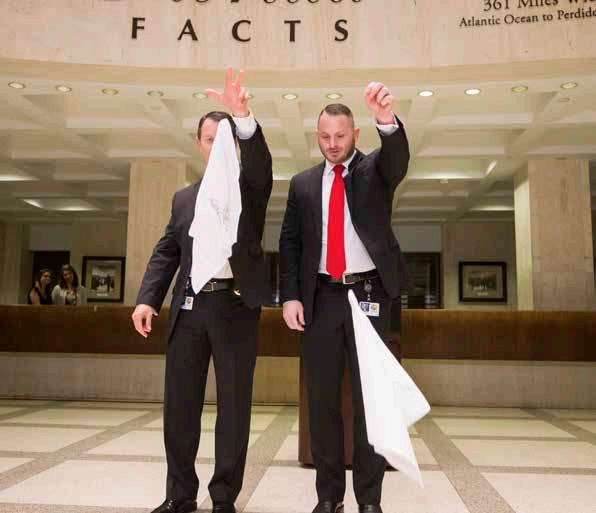
Russell Hosford, left, and Tim Hay, right, drop their handkerchiefs to signal the close of the 2017 legislative session Sine Die. Photo: Colin Hackley
FINAL NOTES
Why we wear pink on Sine Die
BY DAVID RAMBA
The last day of Session is a day of joy for some and a day of agony for others. It is the end of an intense few months of pushing legislation, meeting new members, making new friends and finishing battles. Legislators and the lobby corps share an assortment of emotions.
The last scheduled day of Session is also when lobbyists and legislators wear pink to remember those who aren’t with us anymore and to remember that we all believe in The Process.
Marvin Arrington loved The Process and bringing us all together. The gregarious lobbyist loved cooking for us at his house, or anyone else’s who would put up with him making a total mess in their kitchen.
He brought legislators and lobbyists to the table together to learn more about each other’s families, their children and their issues. To Marvin, lobbyists were not only experts in their field, but an essential part of The Process.
Because of these conversations, better legislation was an outcome for all sides. After dinner, even if we disagreed on the legislation, we knew each other’s intent and could still be cordial and respectful in our discussions.
The pink jacket originated when a young insurance lobbyist named Robert Hawken em-

barked on a trip to the Florida Derby. He accidentally ripped his pants getting out of the plane.
The crowd of lobbyists, which included Marvin and Paul Sanford, stopped by Jacks for Slacks to get Hawkes some new britches and, while there, a few pink jackets were purchased for The Derby. Once back in Tallahassee, Marvin occasionally felt spry enough and wore his jacket to the Capitol advocating for his clients.
According to former Speaker James Harold Thompson, “Anyone that was man enough to wear pink at his age was man enough for us to listen to.”
Jovial and trustworthy, Marvin stood as an honest broker of information on any issue for which he lobbied.
On March 19, 2002, Marvin was

“Anyone that was man enough to wear pink at his age was man enough for us to listen to.” – JAMES HAROLD THOMPSON,
driving to his office and suffered a heart attack pulling into his parking garage at Highpoint Center.
In the most stressful of times, with bills on the line and budget negotiations in gear, we all had to stop and lean on each other. Even more heartbreaking than losing Marvin at the young age of 43 was that he left behind his wife, Lynn, and two young children, Reynolds and Maggie
When Reynolds was a young boy, his constant talking led us to
believe he would follow in his father’s and grandfather’s footsteps (Marvin’s dad, C. Fred Arrington, served in the Florida House in the 1950s).
Marvin would be proud to know Reynolds is still in Tallahassee and has followed in his footsteps on the cooking side. Starvin’ Marvin’s BBQ Company continues to be supported by the Tallahassee community and lobbyists alike. In 2018, Reynolds had a son and appropriately named him after his fa-
ther. Lobbyists Jeff Hartley, Gary Guzzo, and others that knew Marvin continue to offer help, support and plenty of orders of BBQ to support our friend.
On the final day of Session, whether you are sitting in your office or joining friends watching the final hours, wear some pink and remember those we have lost as well as the lessons they have left us.
Remember that the battles we had, although vigorous at times, do not define who we are and are not. Appreciate those who deal honestly and with integrity, celebrate the end of Session, and let us return to our families and friends.
Marvin wouldn’t want it any other way.

David Ramba is the founder of Ramba Consulting Group.