Demonstration



Demonstration
Welcome to the Winter 2026 issue of BizAvJets USA. We are proud to feature the United States Air Force Thunderbirds in this issue; A story that represents the very best of aviation. The Thunderbirds exemplify precision, discipline, and teamwork at the highest level.
This issue also takes us to London Biggin Hill Airport, where rich aviation history meets modern business aviation strategy. From infrastructure investments to global connectivity, Biggin Hill continues to strengthen its position as a premier international gateway.
From operational excellence to innovation, we also feature an in-depth conversation with FL3XX, a platform redefining how business aviation operators manage complex flight operations through connected, intelligent technology.
Continuing on the foundation of excellence, this edition highlights the technologies shaping modern business aviation. We feature Floating Fleet AI, an emerging solution focused on smarter aircraft utilization and data-driven decision-making in an increasingly competitive charter environment.
We continue with coverage of Viasat, exploring how next-generation connectivity continues to redefine the in-flight experience and operational expectations. We also spotlight Web Manuals, showcasing how digital documentation and compliance tools are helping operators improve safety, efficiency, and standardization across fleets.
This edition also highlights Business Jet Fuels Hope, an initiative that aligns business aviation with something even greater: supporting our nation’s veterans. It is a compelling example of how this industry continues to give back in meaningful, measurable ways — and why aviation remains a force for good.
Together, these stories reflect the people, technology, and purpose shaping aviation today. At BizAvJets USA, our mission remains to inform, inspire, and connect the business aviation community. Thank you for flying with us into Winter 2026.
Warm regards,
The BizAvJets USA Magazine Team
P.O. Box 5402, San Mateo, CA 94402 (650) 358-9908, Fax (650) 358-9254



Business matters, advertising and editorial concerns should be addressed to In Flight USA, P.O. Box 5402, San Mateo, CA 94402 or by calling (650) 358-9908–fax (650) 358-9254. Copyright © 2008-2021 In Flight Publishing.
BizAvJets USA is not responsible for any action taken by any person as a result of reading any part of any issue. The pieces are written for information, entertainment and suggestion – not recommendation. The pursuit of flight or any action reflected by this publication is the responsibility of the individual and not of this publication, its staff or contributors. Opinions expressed are those of the individual author, and not necessarily those of BizAvJets USA
All editorial and advertising matter in this edition is copyrighted. Reproduction in any way is strictly prohibited without written permission of the publisher.
BizAvJets USA is not liable or in any way responsible for the condition or airworthiness of any aircraft advertised for sale in any edition. By law the airworthiness of any aircraft sold is the responsibility of the seller and buyer.
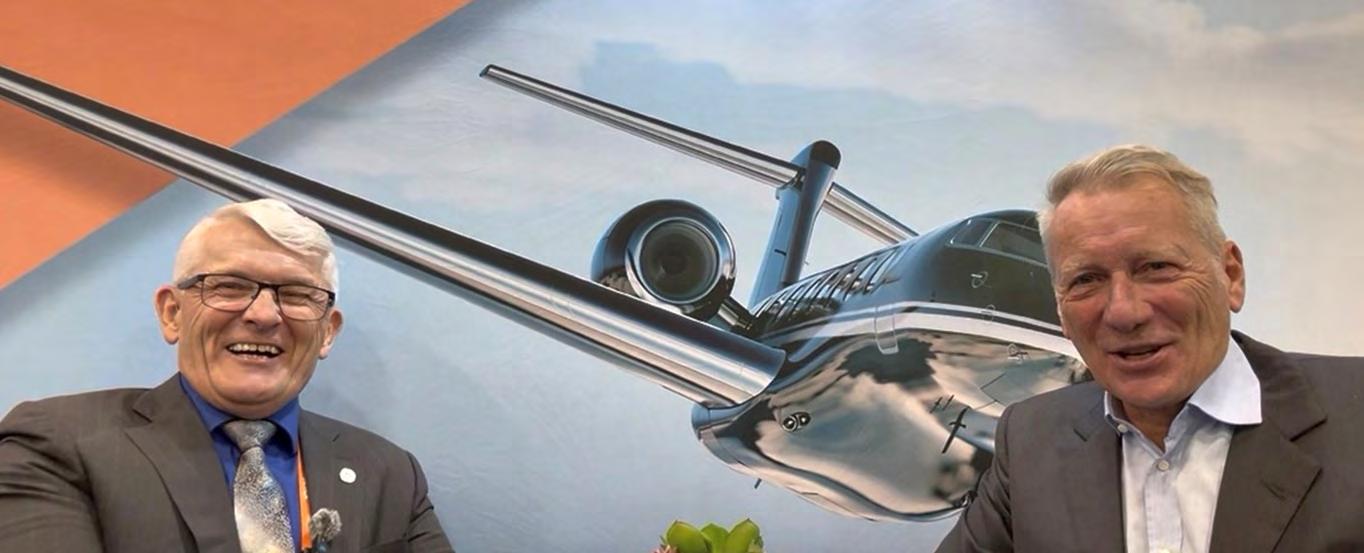
A conversation with FL3XX on building a connected, intelligent, and scalable platform for charter operators and flight departments around the world.
Interview by Eli Stepp, BizAvJets USA Co-Publisher
In today’s fast-moving world of business aviation, FL3XX brings a refreshing level of simplicity and connection to what can often feel like a complex operation. Their cloud-based platform pulls everything together to include quoting, dispatch, crew scheduling, maintenance, compliance, and reporting into one clean, easy-to-use system. With more than 100 service integrations and dedicated mobile apps for sales teams, dispatchers, crew, and aircraft owners, FL3XX helps operators run leaner, faster, and smarter. Whether it’s a small flight department or a large charter operation, the platform is built to grow with the business, turning scattered workflows into one connected ecosystem that actually works for the people using it.
BAJUSA: Magazine is thrilled to have had the opportunity to sit down with FL3XX CEO and Cofounder Paolo Sommariva at NBAA-BACE 2025. We enjoyed a very refreshing interview captured in the following Q&A interview.
BAJUSA: Let’s start with the basics. How would you describe FL3XX to someone who’s hearing about the platform for the first time?
FL3XX: At its core, FL3XX is a cloud-based operating system for business aviation. We bring all the critical parts of flight operations to include quoting, dispatch, crew scheduling, maintenance, compliance, and reporting into one seamless platform. Our goal is to remove unnecessary complexity and help operators work faster and more efficiently.
BAJUSA: What makes FL3XX stand out from other aviation management platforms in the market?
FL3XX: One of our biggest advantages is how connected everything is. We’ve built more than 100 integrations across trip support, maintenance, weather, catering, and other essential services. We also offer dedicated mobile apps for crew, sales teams, dispatchers, and owners—so everyone can access what they need in real time. It’s about creating a truly connected operational ecosystem.
BAJUSA: How does FL3XX help operators of different sizes such as a smaller charter company versus a larger flight department?
FL3XX: The platform is fully scalable. Smaller operators love that they can start with the core
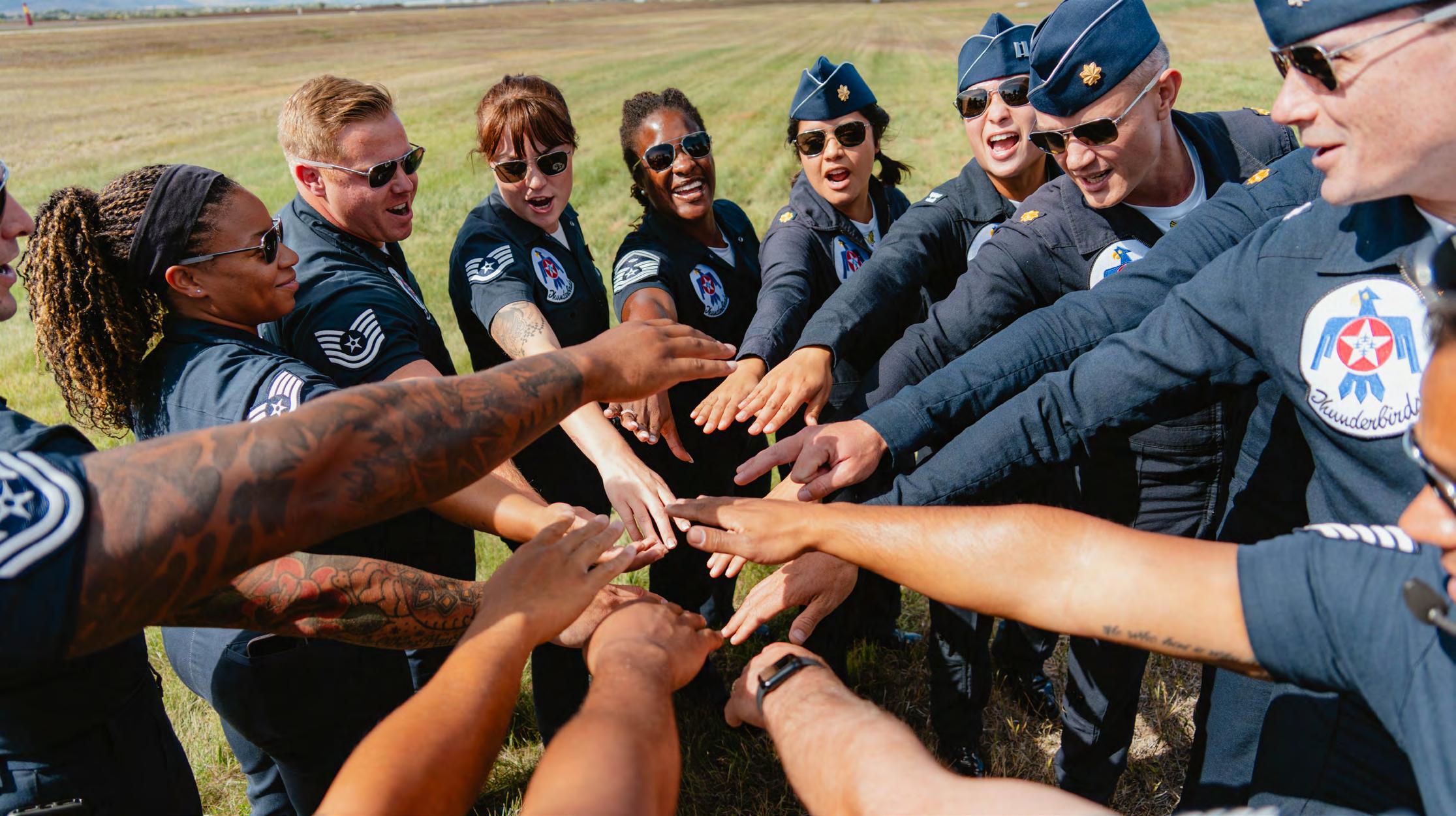
Many in the U.S. and worldwide have been thrilled to see the Thunderbirds in action. BizAvJets USA Magazine recently sat down with members of the Thunderbirds to learn more about their amazing aerobatic demonstrations.
Based at Nellis Air Force Base in Las Vegas, Nevada, the United States Air Force demonstration squadron consists of over 135 members representing 31 career fields/job descriptions. Since starting in 1953 with the Republic F -84G Thunderjet (1953-54) to the current Lockheed Martin F-16C FightingFalcon (1982 to present), there have been eight planes in the fleet (Republic F-84F Thunderstreak (1955), North American F-100C Super Sabre (1956-63), the Republic F-105B Thunderchief (1964), the North American F-100D Super Sabre (196468), the McDonald/Douglas F4E Phantom (1969-73) and the Northrop T-38 Talon (1974-81). The squadron’s mission is deeper than airshow performances – it inspires future generations to represent the professionalism and capabilities of the U.S. Airforce.
BAJUSA: How was the name the “Thunderbirds” name chosen?
THUNDERBIRDS (USAFT):The name “Thunderbirds” is actually a Native American deity. It’s known as an omnipotent being of the skies. The Thunderbirds were originally from Luke Air Force Base in Arizona, which is an area rich in Native American Folklore. Our team’s name choice really came down to an entity we wanted to be associated with to imbue and show the people in the skies.
“The Road (and Sky) Less Traveled – Life on a Military Air Demonstration Team”
BAJUSA: Traveling extensively, what factors into a typical season of moving the team across the country?
USAFT: There are countless hours of planning, prepping, to review of the demonstration sites as well as making sure we have everything we need to get on the road. Our typical season has 70 demonstration sites across the USA. Logistically, it is a massive operation.
Continued from Page 5
Moving the airmen,16,000 pounds of equipment weekly, factors like weather, scheduling, aircraft maintenance, just a massive amount of work to be completed.
BAJUSA: Are there primary points in keeping the team and equipment mission ready with being in so many different locations (cities) across the country?
USAFT: The one item that really stands out is the supply. Everything we need we bring on the road because of the extensive traveling and needing to treat these at a different location. We are consistently working on the process. When we return, we review our supply system and determine the serviceability of parts and components. Keeping up to date with all the parts we may have gone through, from just parts to bringing a backup of something. For example, we bring an engine trailer on the road with us in event of a required engine change which is at least a two-day project. We have had to do this numerous times on the road. Hoping for the best, waiting for the worst. We have what we need with us.
BAJUSA: With shows in different states and the terrain is constantly changing, how does that factor into what the performance looks like?
USAFT: Whenever we get to a new site, our pilots will do a site survey, just getting a layout of the land, what it’s going to look like. Typically, a lot of our sites will have communication all the time with the site. They will usually put out a school bus at a certain point of the show. This helps us to know where the crowd centers will typically be at. We do have someone on the ground doing something called “Shining”. This is a very peculiar, very shiny light. That way they’re flashing it at the jets, and the pilots can see it saying “Hey, this is center, this is where you’re going to be at, this is where you need to hit your mark.” Because we do anticipate the constant terrain changes, we’re working with it to give every show the best possible view and the same show for everybody.
BAJUSA: With the demand of travel, what effects in resilience, discipline and camaraderie come into view within the team? How do these changes affect keeping the team in check with their personal lives and family connections?
USAFT: The challenges are, obviously, being away from our normal family, our family here in Las Vegas. We are constantly on the road. We’re traveling 250+ days out of the year. So, lots of time, just working. You learn to lean on your brothers and sisters while you’re on the road and build up that resilience. We have a lot of internal team activities such as pickleball. We are constantly on call during our show season. When time allows, our team
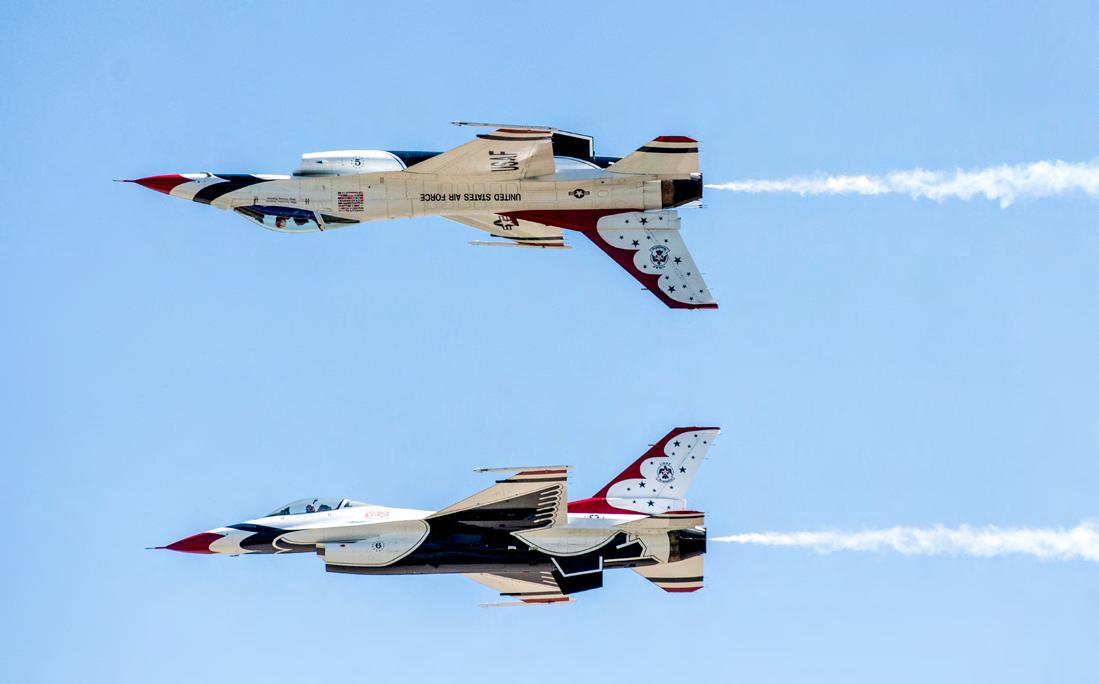
Two Thunderbirds F-16s fly inverted in parallel, perfectly aligned nose to tail with star patterned tails visible beneath them. (Photo courtesy United States Air Force Thunderbirds)
activities take our mind off the pressures of the show schedules. Especially when we are on the road for a long time. There can be two, three or four weeks where we’re just living in the hotels, living out of your suitcase. It gets hard, but we pull together.
BAJUSA: Do you have teams that are made up in advance or just say “we’re getting together today to play pickleball” and see who shows up?
USAFT: We have a particular app that can create different groups, but we have one main group everyone is in. One might say we are creating an event like pickleball, running or other events on the road everyone wants to do. From that, whoever applies and says they want to do it can become a smaller group. This is also another way for us to hang out while we’re on the road.
BAJUSA: Is there one stand out memory from a season that changed the future?
USAFT: At the beginning of the year, we started out for our show demonstration. We had six pilots. We went to five due to some changes in manning. And for a period of time, we flew a wedge formation, which is a very special show that most of the crowd doesn’t get to see. This was a very unique show that people got to see for just those few short months while we did it. Then we brought in Lieutenant Colonel Ian Lee, also known as “Bear”. He filled in for our three-load position for the pilot. It’s interesting because at the beginning of the year, we start out in training where no one sees us. And by the time we come out, all the countless hours we put into it, they just see our finished product. But even while we’re still traveling, they’re still debriefing. They’re going to say, “Oh, that wasn’t the best show, Hey you, we need to do better.” We’re continuing to do better. What was special that year is we were actively in show season while
Continued from Page 6
we were still in training season. We just finished a couple of months ago because we got our “Bear” into the season later on.
We are still pushing countless flight hours. I think that was a very unique one because of the year…I’ve been here for two years. Last year, it wasn’t like that. So far this year, just seeing the dedication of the team pushing in more flight time, more hours, more jet time, and how the team really came together in a difficult situation and really pulled it through to not only give us the satisfaction, but the crowd satisfaction: Satisfaction knowing what we wanted to do with this and to push in a really hard time. I would say that would be my moment for this year.
“The Thunderbirds as Aviation Ambassadors”
BAJUSA: How do the Thunderbirds inspire future aviators, both military and civilian?
USAFT: I have to mention the precision and professionalism that we bring with our performance inspire all, not to mention the standard that we hold ourselves to. There are other demonstration squads at some of the airshows with smaller planes like Cessna’s or even prop planes, flying around, doing formation flying before the Thunderbirds demonstration.
BAJUSA: Describe the typical or non-typical response of young people seeing your performance for the first time? How is the response from older people returning each year?
USAFT: I’ve been able to be a part of our show line. Afterwards, we would be able to do the autograph line. I would get to meet a lot of the kids, individuals, adults and they would always be so surprised. And they just

wouldn’t know what to say because usually for air shows, it can be the first time that they’ve ever seen or interacted with anyone in the military or Air Force. We get to be that Ambassador in blue and show what we’re about, what we demonstrate, what we do. And they’re usually just really shocked. I also love watching their faces during the show when a sneak pass is going to come, and they’re just like, “Oh. My God!!!” Just the utter of all. It’s like watching art or a dance happening in the sky because it’s so precise and everything happens the way it’s supposed to, and that comes from hours and the training we do. It’s just really a lot. But I always really love it. Or the people who came back and said that they come back year after year. Something that our Boss says, “Every team wants to be the best team, but they want to give the next team the best chance to build off of what we’ve done.”
The people in the crowd say that they just keep coming back. I’ve asked them, are we better than last year and they’re like, oh you beat it. That’s just another nod to us that we’re doing something right.
BAJUSA: Can you share a story such as a community outreach event that has left a lasting impression?
USAFT: Yes, I can. I had the opportunity to speak at an aerospace convention, talking about my experience. sharing what I do, my job, talk about our mission, or what we can inspire. It was very nice to get to interact with all these people who don’t have the level of exposure to the military that I do. I feel like that’s how every community outreach event goes. You get to interact with people who don’t super understand the military or get to peek behind the curtain, you get to show them what you’re really about.
BAJUSA: - How does performing internationally build goodwill?
USAFT: We haven’t performed internationally since 2019, so no one on this team has performed internationally. So, it’s a little bit difficult for us to speak to that. It’s also because COVID became a thing during that time. It put a big knot in a plan of going forward. But we still go to Canada and have relationships with them.
BAJUSA: How do you measure the success of each show?
USAFT: I think you can’t necessarily determine the success of the show based on the crowd size. When I was younger, my dad used to be in the military, way before I ever joined sheet metal. But I grew up with him working part-time at an airport. I grew up with a love for airplanes and then also met on air shows. I watched the Thunderbirds a lot when I was a little kid. That inspired me to further join, and now I’m on the team. I’m one of the success stories I would like to count for what we demonstrate. Just saying that not necessarily it’s a “you thing,” it’s that you can be part of something bigger than yourself and be part of a family or a team camaraderie
Continued on Page 8
Continued from Page 7
that has the same goal. I know a lot of people can also get burnt out at work because you’re giving it everything you have and not necessarily everyone else is doing that. But being part of a team where everyone has the same drive and the same work ethic, it really pushes you to do your best.
BAJUSA: How long is a typical day?
USAFT: It really depends on the day. If you’re on the road, when does the jet land, how much maintenance needs to be done. It can be a 6–8-hour day, if you have to do a little more maintenance you look at a 12-hour day, each day differs. Until the jet lands, you have other things to be working on.
On Fridays, because we have two practices for the planes, and a mandatory community outreach event, you could be looking at a 14-hour day overall. Additionally, you have to work outside all day in whatever weather conditions that are in. If you get to eat, if you get to drink a lot of water, you’re healthy. But going to the community events is what makes it for people on the team because it’s not like, hey, we’re just coming here to do a show. The team is invited into these communities and these people actively come. They want to say “hi.” We want to do the same. We want to know, “Hey, come talk to us, please.” It’s one of the unique things about being a part of this team.
“From
the
BAJUSA: While the focus is on the Thunderbird jets, it takes many hands to prepare for a show. Can you describe the various positions and roles the public may not know of?
USAFT: There are all sorts of not really highlighted positions as far as support members. A simple one is being in charge of the tools and making sure we have all the equipment needed to do maintenance on the road. There is supply, they’re in charge of ordering all our parts, making sure we should be able to have all the necessary consumables. We have our own inhouse quality assurance to make sure we are complying to the highest standards in maintenance. Our jets accrue a certain number of hours in flying, with that comes an inspection called a phase. Basically, taking the jet apart and putting it back together again and working properly. There is a small team of crew chiefs and other maintainers dedicated to this service. Additionally, there are lesser known positions like public affairs, finance, radio frequency personnel, and even our
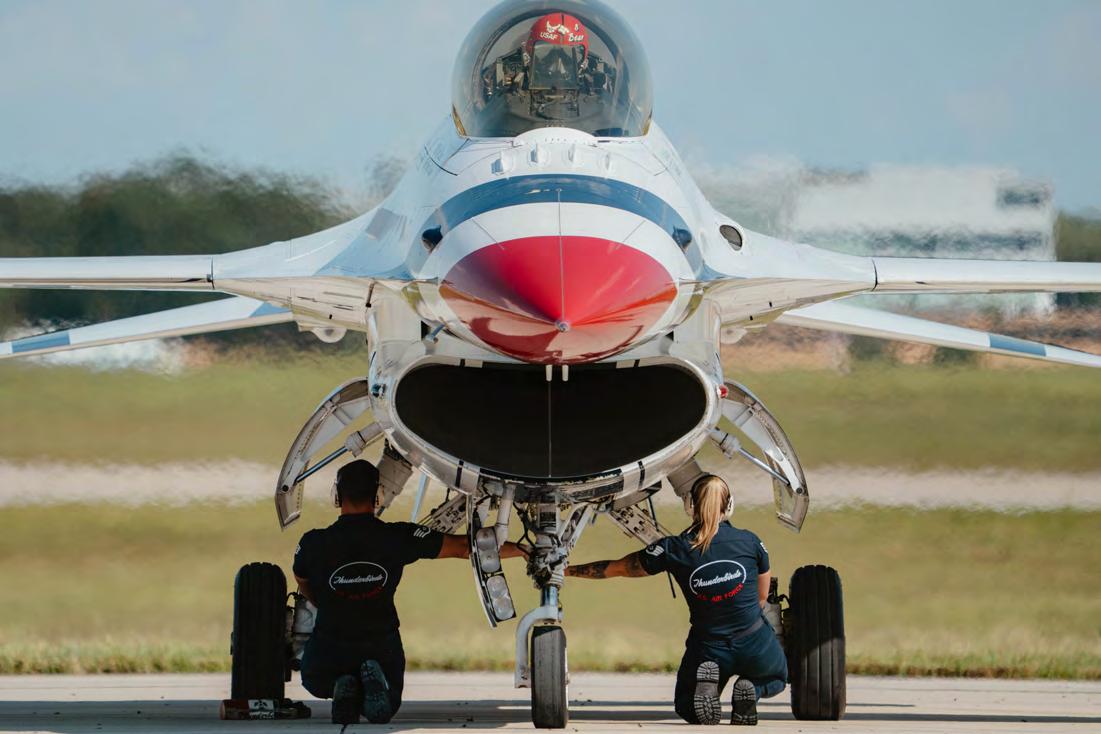
Two Thunderbird maintainers kneel beneath the nose of an F-16 on the flight line, performing final checks as the pilot waits in the cockpit above, (Photo courtesy United States Air Force Thunderbirds.)
independent duty medical technician who helps keep us healthy through the year. We all come together to make sure the Thunderbirds mission continues and reaches audiences worldwide.
BAJUSA: Experience, diversity, flexibility are just a few key points to have, are there other areas you look for in the selection of team members
USAFT: That’s actually one of the unique things about the Air Force and the team in general. The military has something called the MCA, which is multi-capable airmen, and the team is all about that. While we’re crew chiefs, we’re essentially doctors. The jet is our patient, we troubleshoot, diagnose, handle anything inspectionwise, whether it’s scheduled, unscheduled and warrants documentation. We handle all that. However, on the team there are also engines. We can be trained in weapons, avionics, engines, and airframe to include structural repair and electrical and environmental systems. That way, if we don’t have another body on the road to fill that slot, someone else can already be signed off on it to do it. Just like I’m also signed off on certain sheet metal jobs. Actually, a jet broke, and we had to leave a jet last year in another state with the sheet metal body there. While the team left to go to the next spot, something happened and they needed sheet metal, so I was one who came and knocked it out for us and was able to keep progressing with the maintenance versus having to wait. Something that we can say in the last 72 years, we have never cancelled a show due to maintenance. That is one of the very special reasons why we always have someone to fill that spot.
BAJUSA: Eight jets travel, if number three has a mechanical failure, does number eight then become
Continued from Page 8
number three?
USAFT: Yes, we are able to switch numbers with a decal system. Jets Seven and Eight are the spare jets. There is a reason, and they have a function.
BAJUSA: We noticed Jet number Five is upside down, is there a reason?
USAFT: Yes, originally it started as a joke, the crew chief put it upside down. Pilots are very superstitious. The plan launched and no one knew it. But to the crowd, the Five plane spends the majority of time in the upsidedown flying position, thus the number Five is easily readable, and you know what plane it is. At the time this happened, the pilot said that was his best flight he’s ever flown, so the Five has remained upside down. Even their meatball on their chest is upside down. Their pictures are upside down, they park backwards. It’s a whole lifestyle change, a really cool story.
BAJUSA: that’s a whole lot of talent.
USAFT: Even if we’re writing stuff down, we write your five upsides down. -
BAJUSA: Are there any unique challenges the team faces each time a show is scheduled?
USAFT: Yes, there’s a lot of things we have to come up with on the fly. I’d say one of the big things is weather. Weather determines what kind of show we can do, because if we have a lot of clouds rolling in, what’s our actual ceiling? Meaning for the jets to safely fly, how far above the ground can they be? What show can they do? Sometimes, in certain scenarios, the Boss will take off by themselves to go up and just see what they can actually do. But we’re constantly pivoting and training in multiple different scenarios for different shows, whether it’s a high or low show.
BAJUSA: What’s the lowest ceiling?
USAFT: It depends. It’s really just going to be determined by Boss what they’re going to be able to do. But I’d say with the weather being the biggest battle. We’ll be doing a show and just get rain out of nowhere and just get pelted. You maintain your composure and just knock it out. There’s no other option.
BAJUSA: We all come from different backgrounds. Are there any personal stories that have been critical to the mission?
USAFT: One in particular, we mentioned “Bear” earlier. This is the second time”Bear” is back on the team. Previously he flew in the two-position. Now he is flying in the three-position looking the other way. Boss
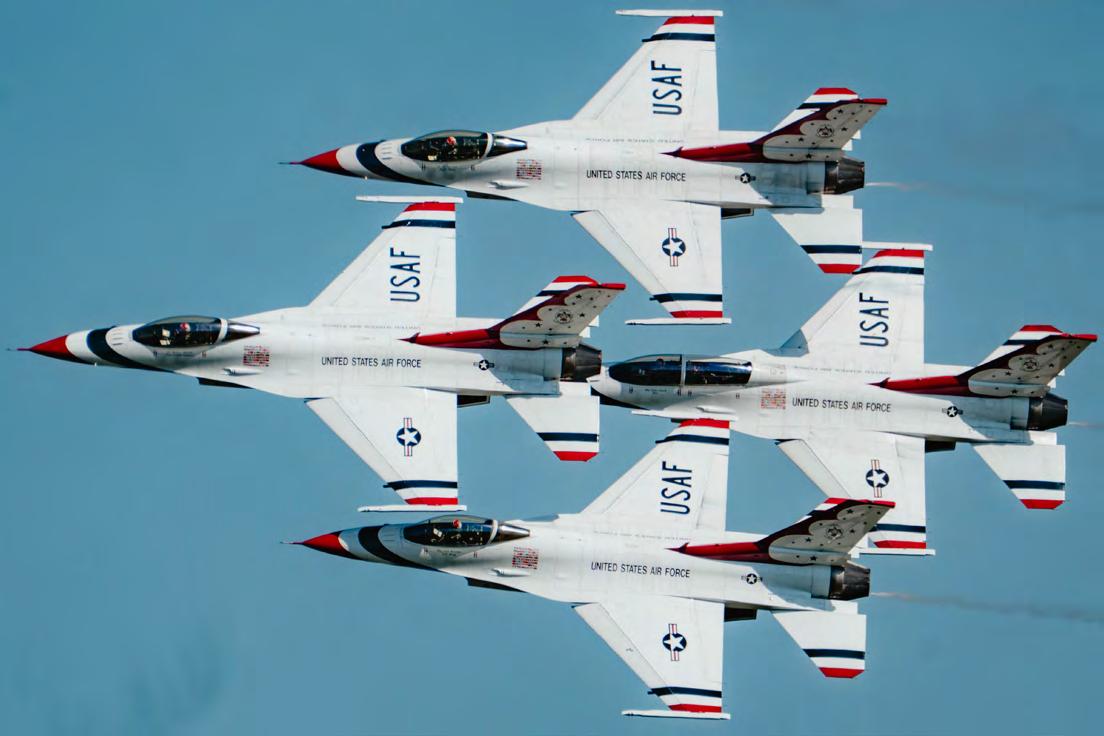
The Thunderbirds fly in razor tight formation, showcasing the precision and discipline built through thousands of training hours. (Photo courtesy United States Air Force Thunderbirds.)
is the only one looking straight ahead. If you are on the left of Boss, you constantly look to your right. If you are on the right of Boss, you’re looking left. We already know they are amazing fighter pilots, being on this team tells them to do everything that they know, take it, throw it out the window, and do it in a different type of way, because now they’re doing it for an air demonstration. This took complete retraining of his brain and skills to do the opposite of what he had previously flown. “Hey Bear, you get this on the other side. We’re going to move you to the other side. Can you do it?” It just shows how truly phenomenal a pilot he is to be able to get out of that headspace, refresh, start brand new, and be like, “I can do this” and walk in. People wondered about it, will he be comfortable? And he did!
BAJUSA: Experience, diversity, flexibility are just a few key points to have, are there other areas you look for in the selection of the team?
USAFT: Yeah, ATTITUDE is really good. We all want people that want to be on the team. It’s a high-stress, high-tempo, high-pressure situation. If you are feeling down, we’re here to support you. We need that attitude. We’re winners, we do the best we can. Let’s do it.
BAJUSA: Can you share some of the hobbies members of the Thunderbirds have to relieve the stress of top performance?
USAFT: There is a big golf group. There’s a couple of individuals that collect golf balls from every site that they go to. Like little mementos. Other than that, you just sign up and go do what others are doing. You do
Continued from Page 9
what you want to do with your friends. There’s also a snowboarding group; we’ve driven two hours to go on our days off.
BAJUSA: - “Build Trust” is a major statement in the Thunderbirds, are there any other catch words the team likes to use?
USAFT: “No Pressure, No Diamond, or Solos.” “Squeeze, Breathe, Here comes the G’s.”
BAJUSA: What is the favorite design formation those on the ground like to see performed by the pilot of the team they are involved in? What is the most thrilling maneuver?
USAFT: The Bomb Burst. How they go out and maneuver, then come back at the precise moment. A lot of planning, a lot of timing. So much timing each jet has a stopwatch in it. Probably the most dangerous maneuver we do.
BAJUSA: Are there any pre-flight rituals?
USAFT: Yes, for a part of our show line, we do have rituals of what we do, or something we also would like to call the “Thunderisms.” Before every show, Show Line will huddle up together in order with our maintenance officer, and will be asked if we want to razzle-dazzle. Everyone will say a keyword that we have pretty much saying we are ready to go. Then the pilots come in, and everyone has their own handshake or their own high five with their pilot of what they do. Six load, they’ll say, “Ready to get this bread, ready to go?” And Boss will say, “No Pressure.” The Diamonds will say “No diamonds,” then the Solos say, “or Solos.” Solo’s always yell it, louder than the Diamonds. It’s a competition. We want the crowd to hear how loud it is. Yeah, maybe something a little extra, but every dedicated crew chief and assistant dedicated crew chief set up the cockpit for each pilot. They get up, get in the seat and it’s ready to go. It’s one last thing they don’t have to worry about versus a normal grey tail unit the pilot is getting in.. When they get in that seat each time, each crew chief is on top of the ladder helping them get in. From how they move something, if they normally hit this switch with their lap belt, the crew chief knows that, resets it and moves forward. You need to keep your pilot in the mindset that they need to be in to be able to knock this show out of the park. You don’t want to mess up any of their traditions. Their traditions are built with their team throughout the year. Once they get into that mind space, you know what to do, what you need to say to keep them in it. You don’t want to get them out of their routine which might “throw them off” before the show.
BAJUSA: What is a favorite show location? What
makes it special?
USAFT: The favorite show location would be where your parents/family are. I am sure that goes across all the members. There are a lot of locations that are really hospitable, that want us there. That’s where they show us kindness and help the team. I know just having conversations with people helps a lot. The entire neighborhood community will come to one house, and have a massive barbecue, really good food, just like homemade food. We are on the road all the time and by them coming, is just nice. You go to the back, and they’ll come together and ask questions, like, “Do you want to water ski, go on a boat ride, or just swim?” They open up like you are a long-lost family member. That’s nice seeing that in communities especially since they don’t know you, but they’ll give you a hug. Some have even asked, “Do you want a towel, sunscreen?” I’d say we became friends with some of them on Facebook, keeping up with them as they welcomed us into their home, into their family.
BAJUSA: Are there any surprises that have happened worth noting?
USAFT: We have engine changes all the time. We had a bird strike. Actually, two bird strikes by one pilot. The second, just after we had changed the engine. We had another one that took three days to get the jet to operations. Two days is very fast. If it happens during an active show, we get it knocked out. The spare jet is behind the scenes. We have what’s known as leper. Let’s say the pilot gets in, turns it on and there’s an issue. If it’s taxi-able, they’ll just taxi away from the crowd. We hear on the radio from Eleven, our maintenance officer, “hey aircraft number three is coming to us with a maintenance issue.” We quickly ready a “reserve” aircraft including installing the number three decal, along with the pilots name and other decals from the original. The pilot leaves the maintenance issue aircraft with us and we assist him into the reserve aircraft and launch him/her directly. It’s all under five minutes, the show goes on. That’s the part of the show magic people don’t know about.
BAJUSA: Are there different take offs?
USAFT: The Diamond takes off together, the Solos take off from opposing sides.
If you haven’t seen the Thunderbirds in action, watch Netflix Air Force Elite – Thunderbirds, a 2025 documentary giving a close look inside the elite team behind the aerial feats.
BAJUSA: thanks, SSgt. Kaitlin Ankrom, SSgt. Zachary Glass and SSgt. Sebastian Romawac for providing the opportunity to learn and listen about the USAF Thunderbirds.
Continued from Page 4
modules and grow into the system without being overwhelmed. Larger operators benefit from more advanced integrations, reporting capabilities, and custom workflows. No matter the size, everyone gets the same powerful, intuitive tools to run operations smoothly.
BAJUSA: Technology in aviation is moving quickly. How is FL3XX staying ahead of the curve?
FL3XX: Innovation is a big part of our culture. We constantly listen to operators and build features that address real operational needs. We’re expanding automation, AI capabilities, and advanced reporting so operators can focus more on flying and less on paperwork.
BAJUSA: What kind of feedback do you get from operators using the platform day to day?
FL3XX: A lot of them tell us it’s a game changer. Dispatchers like the speed and clarity it brings to their workflow. Sales teams appreciate the ability to generate quotes and respond to requests in seconds. Owners enjoy having transparent access to aircraft activity. When every department is working in sync, the results are immediate.
BAJUSA: Looking ahead, what’s next for FL3XX?
FL3XX: We’re focused on deepening our integrations, enhancing AI-driven features, and continuing to make the platform even more intuitive. The vision is to create an environment where everything an operator needs is in one place, which is fully connected, smart, and simple to use.
BAJUSA:
Our sincere thanks to Paolo and everyone at FL3XX for the opportunity to learn more about their platform and services. We are pleased to share an overview of FL3XX’s platform.
An overview of FL3XX and their services
• FL3XX is a cloud-based aviation management platform aimed at business aviation operators.
• Their mission is to automate regulatory, operational, and administrative overhead so flying becomes more seamless and less burdened by bureaucracy.
• The platform is modular, scalable, and designed to accommodate operators of various sizes, geogra-
phies, and regulatory regimes.
1. Sales / Quoting / Charter Management
• Rapid quote generation and feasibility checks
• Integrated CRM with capability to manage customer communications
• Invoicing, expense tracking, and booking-to-flight flows
2. Dispatch
• A central dispatch interface to orchestrate flights, crew, slots, and operational tasks
• Flight release workflows, slots, PPR/permits, ground handling, customs & migration, etc.
3. Crew Management
• Crew rostering, qualifications, duty/legality compliance, time off requests
• Sync with crew calendars, manage crew notifications and changes
4. Maintenance / Engineering
• Track maintenance tasks, forecasts, status, costs, and documentation
• Integrations with third-party maintenance systems such as CAMP, Traxxall, Veryon etc.
5. Reporting / Business Intelligence (BI)
• Built-in dashboards and reports, plus the FL3XX BRIGHT tool for custom analytics and visualization
• Users can schedule reports, share dashboards, and explore datasets (crew, maintenance, flights, services, bookings)
6. Document / Manual / Compliance Management
• Upload and distribute operational documents, manuals, directives
• Track document acknowledgment, version control, and access permissions
Mobile Apps & Role-Specific Apps
To complement the web platform, FL3XX provides mobile / role-oriented apps:
• Sales App: for sales teams / charter brokers to respond to requests, confirm flights, manage quotes,
Jerry Whetstone
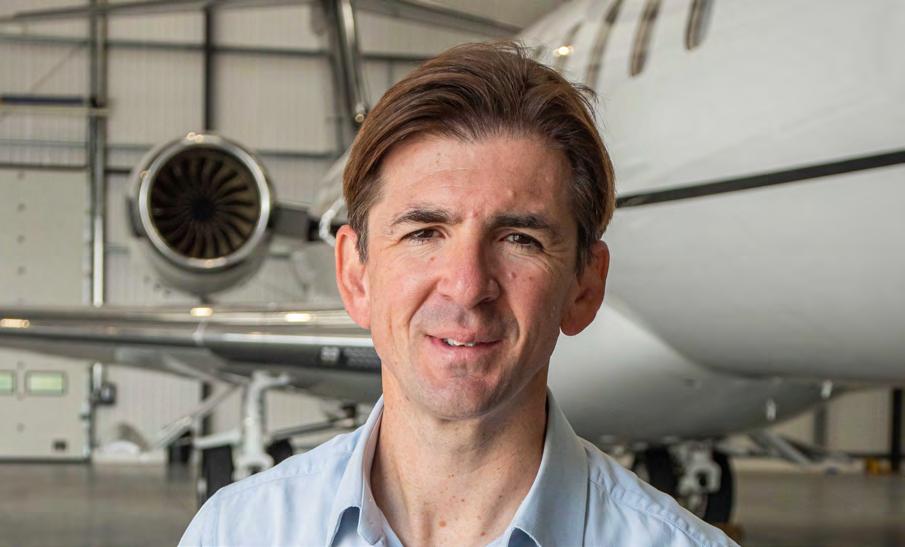
England is known for many reasons; Queen Elizabeth, Ozzy Osborn, David Beckham and so many more from the United Kingdom. A location of significance during World War I and World War II was London Biggin Hill Airport, previously RAF Biggin Hill. During the 2025 NBAABACE in Las Vegas, BizAvJets USA had the opportunity to meet with Robert Walters, Commercial Director, London Biggin Hill Airport, to see how the airport has changed in the decades since.
BAJUSA: We’re here with Robert Walters and Andy Patsalides with London, Biggin Hill Airport. Hello, Robert and Andy, welcome to the United States.
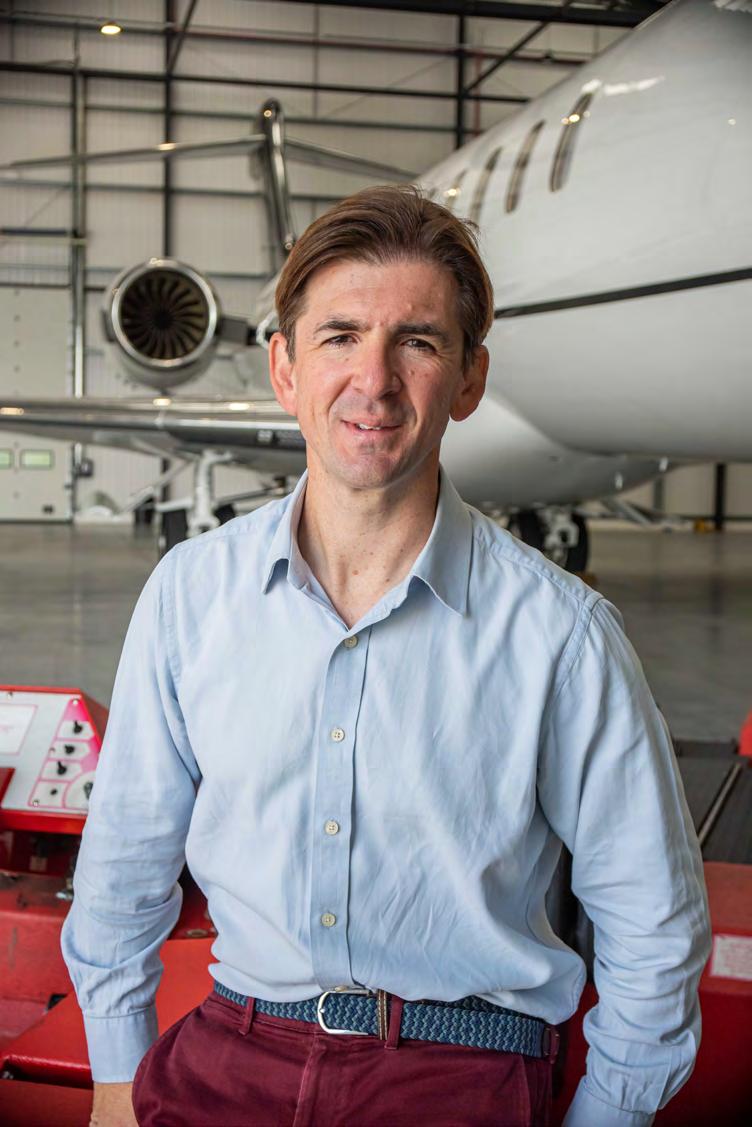
LBHA: Well, thank you very much. I’m pleased to say it’s not my first time. Here we are in 2025, and from London Biggin Hill’s perspective, we came to our first show in 1995. So we’ve been coming to this show for 30 years. Every one we do is a great experience and a big learning curve, and we go home knowing a lot more than we did then when we arrived. Unlike a lot of other countries, the UK has privatized most of its airports and Biggin Hill is one of them, too. We took on the airport in 1994 as a relatively run down ex-military site famed for its role in the Battle of Britain. Since then, we’ve gone about somewhat organically, somewhat cautiously, rebuilding the airport to become the most relevant and the most resilient airport possible. Deciding that Biggin Hill is suitable to be serving as a business and general aviation airport. We have no scheduled services at Biggin Hill.
BAJUSA: With an older airport, what was your approach?
LBHA: We started out very early on, actually focusing on, “what is it the business aviation consumer wants in an airport?” But at the same time, we also
were cognizant of the fact that we had to ensure that our local community was with us in anything we did going forward, too. Without the community on our side, we wouldn’t be able to make the changes that we might need to do in the future to make the airport successful, to employ local people and to remain relevant.
Fast forward to 2015, we had clearly identified that as a dedicated business aviation airport, actually in London, Biggin Hill has a lot to offer. But there were some clear areas where we needed to improve. Having gone out into the market extensively and spoken to people all over the world, OEMs, operators, brokers, and end users about Biggin Hill. However, also about what it is they expect of an airport such as ours. It became very clear that we needed to do a few things.
The first of which was we needed to extend our operating hours to make us more competitive and more flexible. After an extensive public consultation, work with the community and the local authority, we were really pleased to be able to announce to them we will be extending our hours. Originally 7:30 to 21: 00 in the week and 8:00 to 20: 00 at weekends, they improved to 06:30 to 23:00 in the week and 08:00 to 22:00 at weekends. Though some might say, “well, it’s not 24 hours,” but actually it covers 95 percent of all flying activity in London. Also to be able to change hours accepting flights on a 24 hour basis, was simply not possible in the present political environment. With that, we found ourselves in a position of having really competitive operating hours, better than our nearest competition.
BAJUSA: After getting the community behind you, what became your next area to focus upon?
Continued from Page 12
LBHA: When we looked at the next projects that we needed to achieve, we found that those primarily were around our operational resilience and capability. And what we learned from there were five key things that we needed to do. One was we needed to improve the runway surface itself. It’s a very old runway. We needed to improve our lighting system. We needed an approach on the other end of a runway. We only had an instrument landing system on one end of a runway, and the other was visual. And people know in the UK, the weather changes quite a lot. The wind direction can change. Cloud base can be a challenge. So for visual runways in a business aviation context is not a competitive position to be. Especially trying to attract customers. On top of that, our weather reporting systems were not to the same standard as our competition. So following the success of the hours, we then set about planning all of these projects. But in the meantime, while that was going on, and because of the extension of the hours, we were very fortunate to have attracted the likes of Bombardier to come and set up home at Biggin Hill making it their primary location outside of North America in Europe. As we sit here today, Bombardier has made a significant footprint at Biggin Hill, operating state-of-the-art facilities, and continuing to develop and employ more and more people.
BAJUSA: Sounds like a great business success, but it’s also a great community success because the community is getting the benefit of all these additional jobs that are coming with them.
LBHA: Moving back to the five key things that we identified, as we came out of COVID, and we’d finished building our hotel, we’d finished building Bombardier’s new European MRO facility, we undertook to put in a new GPS Radius to Fix approach on Runway 03, which has taken some time to get approval because a Radius to Fix in the UK is not as well known as it is in the US. I’m actually really pleased to say as we sit here now, that approach goes live on the 13th of November this year. For the first time in London Biggin Hill Airport’s history, it will have an IFR approach on both ends of the runway. From an operational resilience perspective, that makes Biggin
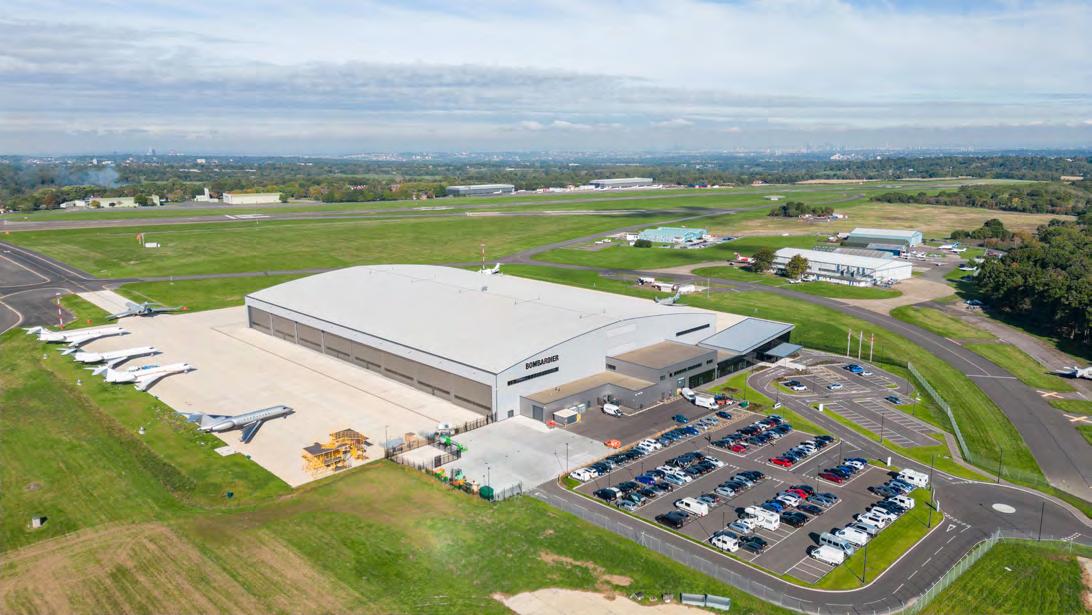
Hill nearly 50 percent more compelling to use than we would have been prior to that, especially for US traffic coming across the pond I should say. Added to this, we’ve just finished the runway project, where, as I said, we fully resurfaced the runway, fully grooved, and with new drainage systems to improve aircraft performance when landing and taking off. We’ve just installed brand new runway edge and centreline lighting to improve situational awareness for crews, given that we are in the winter months, operating half of our time in the dark. The centreline lighting itself will give us a reduced runway takeoff distance, RVR. Probably it will reduce, we think, from 400, to 250 meters RVR for takeoff. So in inclement weather, again, people can get off the runway easier, safer, and legally. Adding to this, we have just received approval and implemented new 24-hour weather reporting. As you are crossing the pond, you have constant live weather at your destination. This gives greater comfort to the crews in the cockpit, knowing that if they need to make a decision to find an alternative airport, they can do so much further out and not be surprised by what they turn up to. That’s really important for them and with that comes the even new IRVR system, which goes hand in hand with the new weather reporting system, a new radar horizontal visual range system, which gives constant feed as to the horizontal visibility on the runway. This is all done and consolidated, electronically and fed through the METAR system. Again, providing a seamless flow of constant up to date and relevant data to crews that we’ve never had before. We are growing up very quickly, and we are now operating on a par with all the main London airports in terms of our runway and operational features. And this is something that we haven’t had ever since we’ve been operating the airport for the last 30 years. So
Continued from Page 13
looking ahead, given this capability now, given we have more runway slots, given we are a pool of entry, we have two choices of FBO, we have an unrivaled choice of MROs, Biggin Hill is climbing the ladder of choice quickly and becoming a far more compelling option for US clients coming to London. Whether it be, as I say, for a gateway to visit London, whether it be to base your aircraft on a temporary basis, or whether it be to have any maintenance done, Biggin Hill covers it all. And so we are nearly in uncharted territory, you might say. But they are friendly territories, and only good can come of it. And so we’re really excited.
BAJUSA: Well, it tells the story plain and simple. Vision, Growth, Success. One thing that is always a concern, how is Biggin Hill affected by “the London Fog?’
LBHA: We’re affected no less or more than any other London airport. The difference being is we hadn’t had
the landing systems available to us to make us more resilient like the other London airports. So that is the difference. So it is, whether you have radiation fog or whatever. Some days, the fog is low lying fog and we’re at an altitude to assist with diversions.
BAJUSA- Tell us a little more about Biggin Hill and what it’s most famous for?
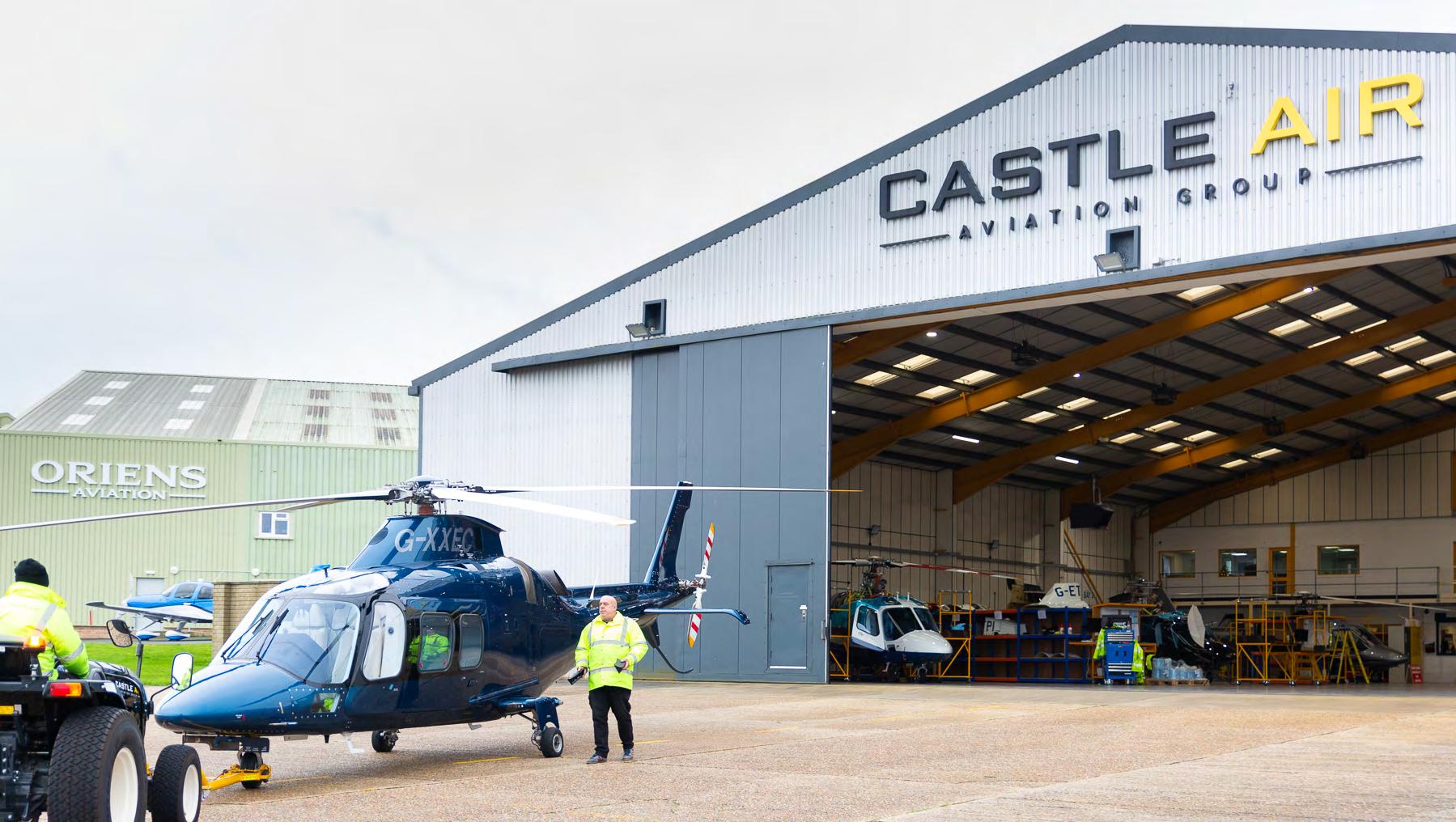
LBHA: It opened up in 1917, 108 years ago, we (The Brits) were looking for a location that would serve as a research base. It’s where communication was invented and rolled out to the Royal Flying Corps in World War I and has a tremendous heritage and history. We were developing air-to-air and air-to-ground, and had locations elsewhere. The weather was effectively helpful. We were looking for a location with good weather. They chose Biggin Hill that was 600 feet up and opened it as a research establishment. And that’s what developed at the airport. During the Battle of Britain, nine Americans gave their lives for us. During the second World War, Biggin Hill helped defend London serving as a fighter base with the Spitfire fighting the German Bombers. Actually, when it comes to things like fog, we had the advantage and it was chosen
Continued on Page 15
Continued from Page 14
because of its weather advantage compared to other locations. Back then it was the instrument landing systems letting us down, not the weather. Sharing that history is housed at the Biggin Hill Heritage museum. Two of the Spitfires are painted in American colors. Today, we get a lot of American crews wanting to visit. That history heritage is very, very important to us. That squadron still exists today in North Carolina at Seymour Johnson Air Force Base.
BAJUSA: How do you feel Biggin Hill connects to America?
LHBA - You may not agree with me, but for me, it’s making the two key financial centers (Wall Street and the City of London) come together. We are the Airbridge in between. After coming across the pond, you head to a shuttle to Teterboro, you get on your aircraft, you land at Biggin, you land at 06:40 in the morning. You walk 10 yards. You’re at the heliport when it opens at seven, and you’re across the river by 7: 30 in your office. And we have someone that does that all the time, week in, week out. So it’s that transatlantic advantage. The six minute shuttle is unrivaled and can’t be done from any other airport. We call that our environmental capacity is really important. And what we mean by that, by environmental capacity, is the way in which our local community will tolerate us being in their midst. And so as long as we can demonstrate we are delivering value to them, and in this case, it’s about jobs for the family members, kids, giving them a future, being able to keep the family unit together, go to school locally, train locally, get a job locally. That glue is so important, and a key part of our economic success is to keep the community on our side. It’s not about taking, take, take, take. I mean, it is about creating those jobs. We do pay a levy back to the community, and the more successful we are, the better off they are as well. So that’s quite important. It’s working. You’ll have three generations of family working at Biggin Hill.
BAJUSA- How has your growth been recently?
LBHA- So the business has doubled in 10 years. And I believe that what we’re introducing in November with the runway capability should see another spot. London is a unique proposition in that there are a
number of airports around London, and each of them have got their own quirks. But one thing’s for sure is the rise of a dedicated business aviation airport is certainly coming. The reliever airport, as you would know them here in the US. The difference is in the UK, there are nine London airports, nine different owners. So implementing a policy to divert traffic to airports for their specialism is not so easy as it’s been done with a reliever airport concept over here. But the concept is absolutely understood. And as the other airports that still accept business aviation become more successful with their commercial traffic, only one thing will happen. They will become increasingly more restrictive, et cetera, and you won’t get the benefits of operating a business check from using them. So it’s not a case of if, it’s just when. And so there’s a lot of... In the next 5, 10, 15 years, there’s a lot of businesses which will be displaced, not all, but it will need to find different ways of operating in London. And the dedicated airports for London is where that key is.
BAJUSA: How would you compare Biggin Hill to airports in the USA?
LBHA- London is fortunate to have Biggin Hill and to have Farnborough, just as New York has, if you like, Teterboro or White Plains, just as Vegas has, Henderson. Okay, it’s not the number one, but in years to come, as Harry Reid gets more successful, business aviation will get more squeezed on spots. And so, Henderson gets busy and busy. It’s a really weird concept. Getting busy is our major challenge, and it’s one of the things that we’re really, really keen to do. You’ve got it there. That is our challenge. We have more maintenance organizations at London Biggin Hill, than any other airport in Europe. So the next challenge is finding a way to invest in maintenance training.
BAJUSA- Do you see London Biggin Hill going commercial?
LBHA: No, never. We are there only for private aviation. No scheduled traffic at Biggin Hill. We made a number of promises, and that was one of the promises made. No fair-paying passengers, Ryanair, EasyJet, any of that at Biggin Hill. You need to be straight with people. And that’s our policy. That’s it. It’s a family-owned airport on a 125-year lease in a local authority, and we made that guarantee when they gave us the hours. It wasn’t about trying to bring in everyone. No, it’s not what we were about. We can look at operating that and say, This airport’s about you. It’s about private
Continued on Page 16
Continued from Page 15
aviation. But it is what I say, it’s not easy because as we bring all these businesses in, we have 70 aerospace related businesses on the airport. But the issue for us is finding skilled labor. We are only allowed to have aerospace space businesses at the airport. So that’s part of our agreement. And of those 70, 10 of them are maintenance and repair organizations, which is very, very unusual. With all of them in one place. But you’ve got to feed them with engineers and techni-
cians. That’s the challenge.
BAJUSA- How did the community like the expansion of hours?
LBHA: There will always be people who are more affected than others. We spent two or three years going through the consultation process, including the job creation extending the hours would bring. When we started operating with the new hours, there were 870 jobs on site and we’re heading towards 2,765. We are well on the way. We kept our promise.
BAJUSA would like to thank Robert and Andy for sharing this information and educating us about London Biggin Hill Airport.
Continued from Page 11
and communicate with customers from mobile.
• Crew App: for pilots/crew to view schedules, their assignments, check qualifications, submit expenses, see documents, etc.
• Dispatch App: gives dispatchers real-time visibility on fleet status, flight changes, requests, etc.
• Owner App: for aircraft owners / stakeholders to see aircraft availability, performance, approve bookings, monitor flights, etc.
These apps are intended to ensure that various stakeholders (crew, dispatch, sales, owners) remain connected and aligned with the operations.
• FL3XX supports over 100 integrated services: covering weather, catering, trip support, marketplaces, reporting, compliance, maintenance, etc.
• They provide APIs so that operators can integrate
FL3XX with other systems (e.g. internal tools, third-party flight support systems).
• The FL3XX SOURCE module acts as a broker/ CRM workflow interface:
• Send and receive requests, quotes, contracts, invoices
• Manage both customer (charter) workflows and aircraft sourcing workflows in one place
• Handling, transport, accommodations, catering all managed via SOURCE.
Compliance, Geography & Scale
• FL3XX is designed for global operations: they claim local service support and compliance with regulations (FTL, etc.) across EMEA, APAC, Americas.
• They process a large volume of flights: their platform dispatches over 250,000 flights annually per their site.
• They emphasize flexibility, modularity, and scalability, able to serve small-to-mid operators up to enterprises.
Interview by Eli Stepp, BizAvJets USA Co-Publisher at 2025 NBAA-BACE
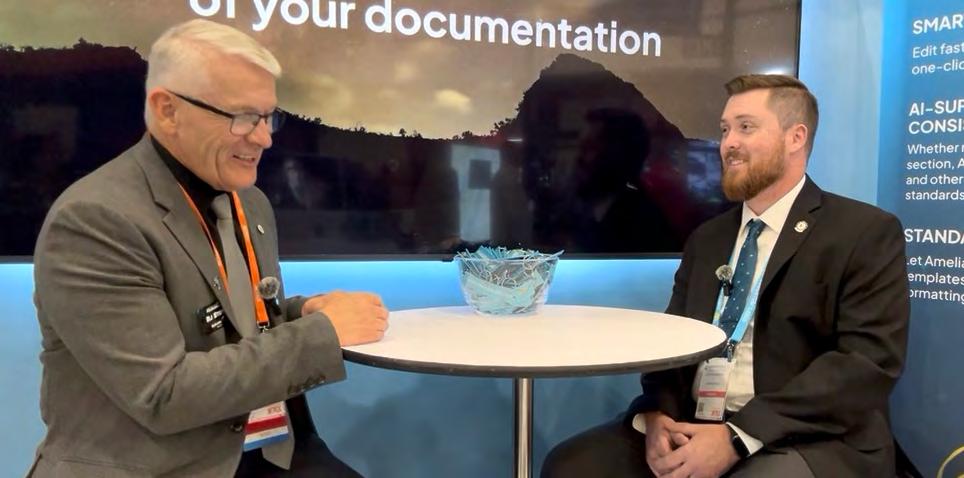
BizAvJets USA Magazine sat down with Justin Raymond of Web Manuals at 2025 NBAA-BACE to discuss digital documentation, global compliance, and the company’s new AI-powered tools shaping the future of aviation manual management.
BAJUSA: Justin, thanks for joining us. Let’s start with the basics. What exactly is Web Manuals?
Web Manuals: Web Manuals is an aviation-specific document management system. It’s designed to help operators write, author, and distribute their manuals to pilots, cabin crews, and other departments. We also integrate regulatory compliance directly into the document workflow. That’s the core of who we are.
BAJUSA: When you say “compliance,” what does that include?
Web Manuals: Aviation documentation can be extremely complex, sometimes it feels like a nuisance. Our platform streamlines the editing process and ties in aviation-specific tools that keep users focused on producing accurate content. As regulations update, our system helps ensure manuals stay aligned with the latest requirements.
BAJUSA: What type of aviation entities do you work with?
Web Manuals: Pretty much the entire aviation ecosystem. Air operators are a large segment, but we also work with maintenance departments, flight operations, quality, and safety departments.
BAJUSA: Coming from a maintenance background myself, we always relied on manufacturer-recommended data at the MRO level. Do you support operators using FAA-approved progressive programs or write those manuals?
Web Manuals: Not directly in that area. Typically, we support flight departments and standard documentation including general maintenance manuals, operations manuals, minimum equipment lists, and similar material.
BAJUSA: What about IS-BAO or similar standards? How do you assist operators with those?
Web Manuals: When operators create manuals that
need authority approval, our compliance tools are key. We provide live links to regulatory requirements. If a rule changes or the user edits a section tied to that requirement, they receive an alert that compliance may be affected. It’s a proactive safeguard.
BAJUSA: Are customers writing their own manuals inside the platform, or do you write them for them?
Web Manuals: We’re a tool at the end of the day. We provide the software so customers can write their own manuals, but we also partner with service providers who can assist if needed. Users get support without having to learn every nuance of aviation documentation from scratch.
BAJUSA: That makes sense letting them do the work, without the burden. How many customers do you have currently?
Web Manuals: A little over 750 customers globally
BAJUSA: Impressive. Where are these customers located?
Web Manuals: We were founded in Malmö, Sweden, which is still our headquarters, but we operate internationally and have offices in New York, San Diego, Sydney, and Singapore.
BAJUSA: With that global footprint, do you find EASA regulations similar to those in the U.S.?
Web Manuals: EASA tends to update requirements more frequently, so it’s a learning experience for many operators. Since Web Manuals originated in Europe, we have a large EASA customer base of around 400 to 450 users. Our embedded EASA regulation libraries help operators stay compliant.
BAJUSA: From my maintenance experience, we used tracking providers that alerted us to AD changes. Is your compliance alert system similar?
Web Manuals: Exactly. If a requirement changes, or if your manual content becomes outdated, the system highlights where and why. It provides clear recommendations on how to bring the document back into compliance.
BAJUSA: Is Web Manuals a subscription-based service?
Interview By Eli Stepp, BizAvJets USA Co-Publisher
NBAA-BACE 2025, Las Vegas
Introduction
As artificial intelligence continues to shape the future of aviation, one company is using it to solve one of the industry’s most persistent challenges: scheduling.
At NBAA-BACE 2025, BizAvJets USA Magazine spoke with Roger Zahn, founder of Floating Fleet AI, to discuss how their platform is helping operators reduce dead legs, increase efficiency, and optimize every flight like never before.
“Think of it like the back end of Uber, but for private aviation.”
— Roger Zahn, Founder, Floating Fleet AI
Q&A Interview
BAJUSA: Roger, give us a nutshell introduction to Floating Fleet AI.
FFAI: Floating Fleet AI helps Part 135 operations manage their flights in the most efficient way possible. Imagine each flight is like a box, and there are countless ways to arrange those boxes as different aircraft, crew assignments, and positioning flights in between. Our AI figures out the best way to cover all those flights at the lowest cost, turning complex schedules into clear, optimized solutions.
BAJUSA: So, your technology also tackles empty legs?
FFAI: Yes, but it goes further than that. We minimize empty legs and reduce unnecessary repositioning. We also handle crew assignments, telling operators which aircraft and crew should be matched to each mission. Think of it like the “back end” of Uber
Continued from Page 18
on-demand transportation, but for aviation. The result is lower operating costs, better asset utilization, and fewer emissions.
BAJUSA: How does a customer actually use your service?
FFAI: It’s a cloud-based platform. Customers simply log in, run the optimizer, and within seconds, they get the best schedule options, whether it’s for 30 aircraft over three, or seven days. They can even run it in the background for continuous optimization.
BAJUSA: And how do they get started? Is it subscription-based?
FFAI: Yes, we offer subscription-based access. No matter what FMS an operator uses, we can integrate with it. For example, FL3XX, Floating Fleet, and JetInsight are all partners. We sit on top of those systems, pull the data, and use it to generate the most
efficient plan. Essentially, it becomes the “brain” of their operation.
BAJUSA: How long have you been in business?
FFAI: We started two years ago, but I’ve been in this space for a long time. My background is in operations research. I have a Ph.D and I have worked with companies like Cessna, and Wheels Up.
BAJUSA: How many customers are currently on the platform?
FFAI: We currently have 45 jets running on the platform. Operators run the optimizer 10 to 20 times a day, and we’re optimizing about 1,000 flights every month.
BAJUSA: How can potential customers learn more?
FFAI: They can visit our website at floatingfleet.ai or find us on LinkedIn. We’re also active on Instagram and have demos available on our YouTube channel.
Continued on Page 22

Business Area
2025 NBAA-BACE
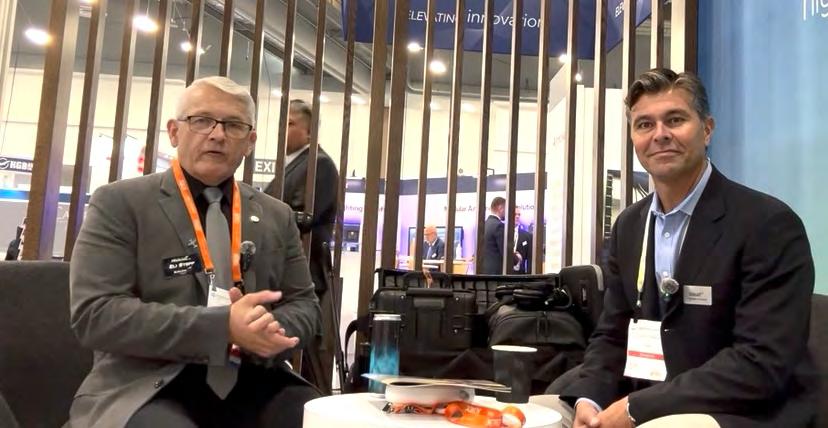
Viasat’s Claudio D’Amico explains how JetXP and the new IQ metric redefines productivity and performance at 40,000 feet.
Interview by Eli Stepp, BizAvJets USA CoPublisher
For more than 30 years, Viasat has been one of the most influential forces in global inflight connectivity pushing bandwidth boundaries, advancing satellite innovation, and transforming how business aviation passengers stay productive in the air. Following its major acquisition of Inmarsat, Viasat now operates one of the world’s most powerful satellite networks, with more than 5,000 business jets connected and a unified focus on delivering high-capacity KA-band performance anywhere in the world. At NBAABACE, Viasat unveiled next-generation services designed to elevate connectivity far beyond traditional “speed tests,” shifting the conversation toward real, measurable quality of experience.
BizAvJets USA Magazine sat down with Claudio D’Amico, Business Area Global Director at Viasat, to discuss satellite technology, KA-band performance, the launch of JetXP, and why the industry needs a smarter way to measure inflight connectivity.
Q&A With Claudio D’Amico, Business Area Global Director, Viasat
BAJUSA:
Viasat is widely known as the connectivity company in business aviation. Is that a fair statement?
Viasat:
(Laughs) Yes, that’s absolutely true.
BAJUSA:
Continued from Page 20
For readers who may be less familiar, tell us about Viasat’s core services.
Viasat:
Viasat has been a connectivity provider for over 30 years. We’re a satellite operator working with major service partners—Honeywell, Gogo, and Collins Aerospace—who help bring our services directly to customers. We offer several solutions, from our legacy L-band SwiftBroadband service to our high-capacity KA-band JetXP network.
Today, more than 5,000 business jets are connected to our networks, and we’re excited to showcase what’s next here at NBAA-BACE.
BAJUSA:
For the uninitiated, can you explain the differences between these “bands,” L-band, KA-band, and so on?
Viasat:
Absolutely. A “band” refers to the frequency range you’re allowed to operate on. Lower bands like L-band are extremely reliable but support less data. Higher bands like KA-band allow you to move much more data. That’s why we’ve focused our satellite technology on KA-band: the capacity is significantly higher, which directly translates to a better user experience.
BAJUSA:
So, at the higher end, we’re talking streaming, video calls, and other things you couldn’t reliably do years ago?
Viasat:
Much more than that. Today, connectivity is a productivity tool. Business aviation passengers need Zoom calls, cloud access, large file downloads, basically everything they’d normally do in their office. And they expect it to work seamlessly in the air.
BAJUSA:
And now multiple devices can connect at once, unlike
the early days?
Viasat:
Exactly. The “Swift 64” era (128 kbps speeds) is long gone. Today, executives board aircraft with phones, laptops, tablets, watches… sometimes several devices each. Our JetXP service is designed to support all of them simultaneously with a high standard of performance.
BAJUSA:
With a name like Viasat, I assume this is all satellitebased. Is there any ground-based infrastructure in the mix?
Viasat:
It’s all satellite. Our connectivity is powered by highcapacity geo-satellites, and we’re integrating a multiorbit strategy as well. For example, highly elliptical orbit satellites allow us to provide coverage over the North Pole. So, if you’re flying from North America to Scandinavia and taking a polar route, you stay connected even at extreme latitudes.
BAJUSA:
That’s impressive. So, what’s new and exciting here at NBAA-BACE?
Viasat:
Two major things. First, we’re launching JetXP, our unified KA-band service. After Viasat acquired Inmarsat two years ago, JetXP integrates the strengths of both companies.
Inmarsat’s Jet ConneX brought global, reliable, consistent coverage. Legacy Viasat brought massive capacity, flexibility, and rapid innovation. JetXP combines the best of both worlds with uncapped speeds, unlimited data plans, and optimized network prioritization specifically for business aviation.
BAJUSA:
And for current customers, is the transition seamless?
Viasat:
Yes. JetXP is available today on all approved terminals on our network including Honeywell JetWave, simple KA solutions, and others. If the terminal is enabled on our network, it supports JetXP.
Continued from Page 21
BAJUSA:
Great. And what’s the second big announcement?
Viasat:
We’re introducing a new concept called IQ, a smarter more comprehensive way to measure inflight connectivity performance.
For years, the industry has relied on speed tests, but we think that’s a flawed metric. A customer could run a speed test showing over 100 Mbps, yet minutes later their Zoom call freezes. What they remember is the bad experience, not the speed test result.
IQ looks at multiple variables, not just raw speed, to give a clearer picture of the true connectivity experience onboard. We’ve collaborated with MIT’s Professor Michael Schrage, who has researched “quality of experience” across industries. His
Continued from Page 19
BAJUSA: What’s your five-year vision for Floating Fleet AI?
FFAI: We want more operators to benefit from AI-powered solutions. Beyond flight scheduling, we’re expanding into crew planning—things like vacation planning and equitable scheduling for corporate flight departments. We believe that for any scheduling or operational problem, there’s an AI solution. It’s an exciting time to be in this business.
About Floating Fleet AI
Floating Fleet AI is a cutting-edge scheduling platform designed to help floating fleet operators, charter brokers, and corporate flight departments optimize their aircraft and crew utilization. By leveraging AI, it reduces dead legs, lowers costs, and simplifies complex scheduling challenges in real time.
www.floatingfleet.ai
insights helped validate how aviation should rethink connectivity measurement.
Think of it like this: when you wake up, you don’t run a speed test on your phone, you look at the signal bars. That’s what we want IQ to be for business aviation: a clear, intuitive indicator of real experience. We plan to launch IQ as a product in the coming months.
BAJUSA:
So, passengers will have a visual indicator showing their connectivity performance?
Viasat:
Yes. And it also gives us better insights into how to support them and continuously improve performance.
BAJUSA:
Claudio, this has been incredibly informative. Thank you for your insight and your time today.
Viasat:
Thank you very much. It was a pleasure.
AI-Powered Fleet Optimization
Real-time scheduling that balances aircraft availability, crew duty limits, and maintenance requirements for maximum efficiency.
Dynamic Empty-Leg Monetization
Automatically identifies and markets empty legs to increase revenue and reduce unproductive repositioning.
Instant AI Charter Pricing
Generates accurate, market-aligned charter quotes in seconds—speeding up response times and improving conversion.
Predictive Maintenance Insights
Forecasts upcoming maintenance events and operational risks to improve dispatch reliability.
Integrated Broker & Operator Tools
Connects seamlessly with flight operations software, enabling unified visibility, instant quoting, and API-driven bookings.


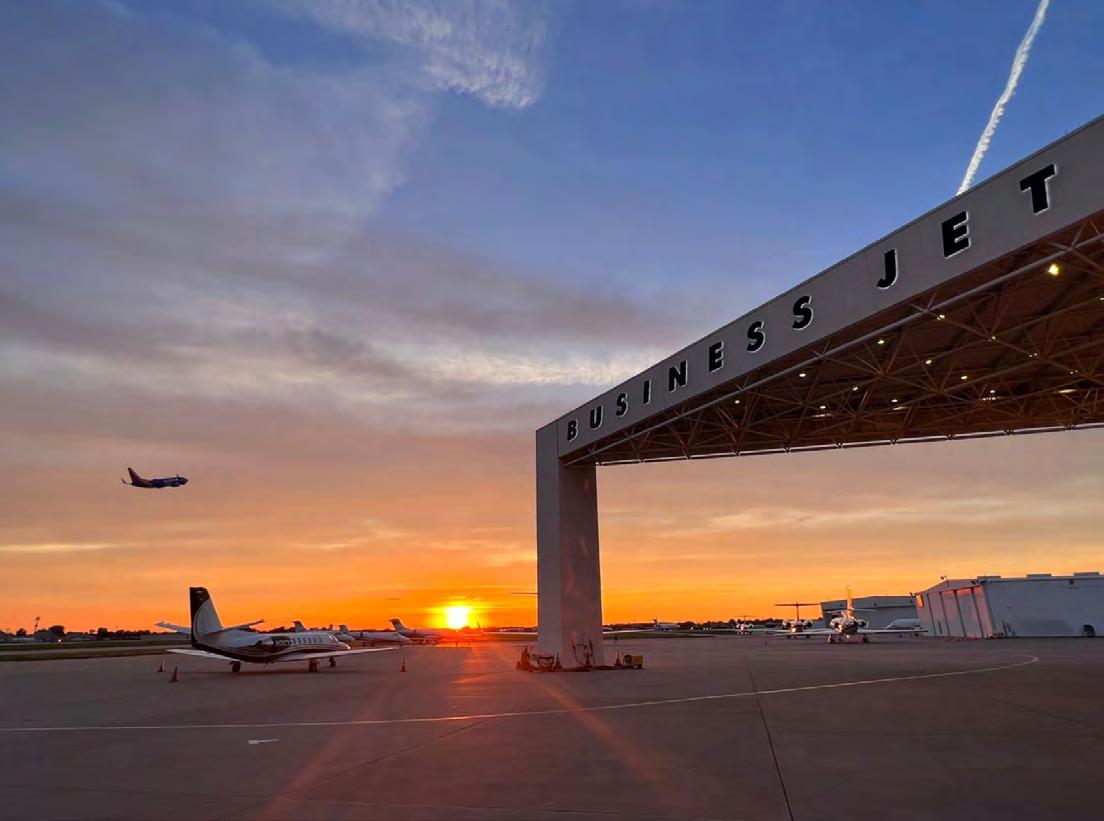
Business Jet Fuels Hope to Support Veterans
DALLAS – As dogs go, Phillips is a special pup, trained to become an elite service dog, one devotedly schooled to support disabled U.S. veterans navigating daunting physical and emotional challenges. This initiative is propelled by the employees of Business Jet, a fixed-base operator (FBO) servicing Dallas Love Field (KDAL), and their passion for supporting veterans, kids, and pets.
More than a decade ago, Business Jet employees were looking for opportunities to give back to their community, says Brittanie Joyner, Culture & Engagement Specialist for the award-winning FBO. Employees felt disabled veterans and children in need deserved the FBO “We care about what is meaningful to our employees, what they’re passionate about,” Joyner explains. “If our employees are passionate about giving back to the community, we’re going to find a way to make sure we support that.”
What began as an employee-driven initiative soon became Business Jet Cares, the nonprofit wing of Business Jet, a Phillips 66â branded FBO.
Since 2013, the annual Business Jet Cares Charity Golf Tournament has raised deeply needed funds supporting Patriot PAWS Service Dogs, the training ground for elite service canines like Phillips. Additionally, Business Jet Cares support Folds of Honor, which awards life-changing scholarships for spouses and children of fallen and disabled veterans and first responders.
The inspiration to support Folds of Honor came from a customer who is a former military pilot, explains Alette Cook, Brand Manager for Business Jet.
“His dedication to families of fallen and disabled veterans and first responders was moving,” says Cook. “We’d been exploring new charitable partnerships, and Folds of Honor aligned perfectly with our employees’ passion for supporting veterans and kids.”
For veterans suffering from mobile disabilities, traumatic brain injuries and/or Post-Traumatic Stress
Continued on Page 25
Continued from Page 24
Disorder (PTSD), a service dog companion can be life changing. But the cost is daunting, beyond the financial reach of most disabled veterans.
It costs $46,000 for Business Jet Cares to sponsor one Patriot PAWS service dog throughout the dog’s lifetime partnership with their veteran. Not only does the sponsorship help cover the cost of the elite training that takes almost two years, a lifetime of feeding and free veterinary care, but it also provides so much more.
“Patriot PAWS likes to say they’re not just in the dog business, they’re in the human business,” Joyner explains. “They really do care for the mental health of the veteran.”
Patriot PAWS serves as the weekly meeting location for PTSD Foundation of America and staff members conduct regular check-ins with their veterans. For dogs needing surgery or veterinary care, they’ll fly the veteran and their service dog into Patriot PAWS’ veterinary clinic. There’s even a Patriot PAWS Veterans Hospitality Center near Dallas where veterans can stay if their dog needs a training refresh. When a Service Dog passes away after their devoted career, they’ll provide a new one.
All at no cost to the veteran. No client ever receives a bill from Patriot PAWS.
But the benefits also extend deep into the local community.
“What’s incredible is that Patriot PAWS even has inmate trainers through their Texas Department of Criminal Justice (TDCJ) Program, Trained to Heal— giving Inmates an opportunity to invest in something meaningful and give back in their own way,” says Joyner.
Dogs in training can also spend time living with Texas A&M University students in College Station, even accompanying them to classes. “Their Patriot PAWS of Aggieland Program is amazing, allowing the dogs to be in multiple, different environments,” explains Cook. “It helps the dogs gain invaluable socialization to best serve their future.”
When a dog trains that hard, they deserve a treat. Phillips
All of which makes Phillips’ Puppy Taxi fairway ride such a feel-good moment. In fact, the Puppy Taxi is one of the hottest sponsorships for the Business Jet
Cares Charity Golf Tournament, says Cook.
Naming the dog Phillips, explains Cook, is a tribute to a longtime tournament sponsor, Phillips 66® Aviation. “It’s just a way to honor and thank Phillips 66 for all they’ve done for us over the years and their continuous sponsorship,” Cook says.
The 12th Annual Business Jet Cares Charity Golf Tournament was set for November 14, 2025, at the Texas Rangers Golf Club in Arlington, Texas. Not long after the golfing ends, Phillips, the Service Dog in Training, will continue his journey preparing for his future Veteran.
For more about Business Jet Cares and its employee-driven initiative to support “kids, vets and pets,” please visit here: https://www.businessjet.com/ about-us/business-jet-cares/

Continued from Page 17
Web Manuals:
Yes, it’s a licensed subscription model. We also offer professional full onboarding services. During implementation, we help customers build their site, set up structures, and learn the system. This can be done online or in person, and that’s typically where a higher year-one cost comes in.
BAJUSA: AI is the buzzword of our time. How are you integrating it?
Web Manuals: We currently have two AI tools. The first is an AI search tool for readers, pilots, maintenance personnel, or anyone looking for information fast. It allows users to search manuals using natural, human language and provides relevant references instantly.
The second is our newest innovation: Amelia Co-Author. It helps users write and format content, standardize layout, convert lists to tables, and much more. It doesn’t replace human review, but it drastically reduces workload and speeds up manual creation.
BAJUSA: Do you support OEM maintenance manuals as well?
Web Manuals:Yes, we do. Customers can import OEM
PDFs into our system if that fits their operation. As for manufacturer agreements, customers typically provide the PDFs themselves.
BAJUSA: Any final points you’d like operators to know?
Web Manuals: Just that we continuing to expand our AI capabilities and compliance tools to make documentation easier, faster, and more accurate. Whether you’re a small flight department or a global operator, our goal is to streamline the entire manual lifecycle.
BAJUSA:
Justin, thank you for speaking with us. We look forward to featuring you in the magazine.
Web Manuals: Thank you, my pleasure.
About Web Manuals
Web Manuals is an aviation-tailored, all-in-one document management system that enables operators to write, review, publish, and distribute their operational manuals. From flight procedures and MELs to maintenance documentation, all from a single secure cloud-based platform. By dramatically reducing manual editing time (up to 80% per revision according to Web Manuals) the platform helps aviation professionals shift focus from paperwork to safety-critical operations. With a global user base and scalable workflows suited for everything from boutique flight departments to major airlines.