
INDY Print Edition Mar. 25, 2026

Page 1


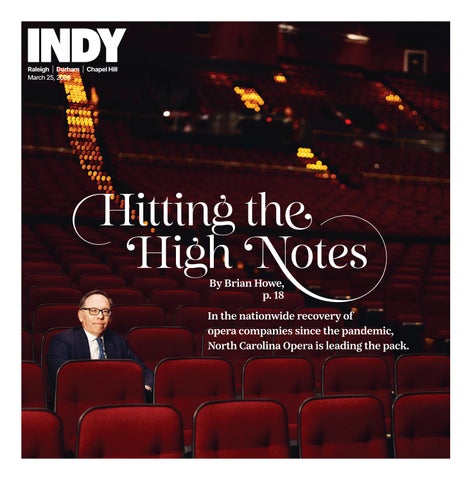
Hitting the High Notes

In the nationwide recovery of opera companies since the pandemic, North Carolina Opera is leading the pack.
Raleigh | Durham | Chapel Hill

Vol. 43 No. 6 | March 25, 2026

News

5 Raising some 200 employees' pay above $25 an hour is causing an unexpected challenge for the city of Durham's upcoming budget. BY JUSTIN LAIDLAW

6 Wake County officials looking to replace Athens Drive Community Library are hoping to keep it in the neighborhood. BY CHLOE COURTNEY BOHL

7 While no decisions have been made, Durham Public Schools administrators are looking at closing older schools to save on repairs. BY CHASE PELLEGRINI DE PAUR

8 How affluent Chapel Hill-Carrboro City Schools ended up with declining enrollment and an impossible choice to close schools. BY CARLI BROSSEAU

10 Apex considers a pause on constructing data centers and how involved residents should be in deciding how to regulate them. BY JASMINE GALLUP

2026 INDY Festival Guide

12 Whatever your interest, you'll find a unique way to explore it in the Triangle this year. We've compiled it all for you in our annual festival and event directory.

Culture

15 Five noteworthy performances coming to Triangle stages this spring. BY LAUREN WINGENROTH

16 Zalman Raffael, founder and CEO of Carolina Ballet CEO, wants the regional ballet company to be as widely known as the Carolina Hurricanes. BY JASMINE GALLUP

18 NC Opera’s Madama Butterfly was the best-selling show in the nonprofit opera company’s 16-year history. How is the opera company doing it? BY BRIAN HOWE

20 An interview with North Carolina writer Rebecca McClanahan about grief, caregiving, and her new memoir. BY ANDREA RICHARDS

21 Lunch Money: A visit to a Burlington steak house. BY LENA GELLER

Sarah Willets

Wake County

Jane Porter

Sarah Edwards

Chloe Courtney Bohl

Contributors

Jasmine Gallup, Desmera Gatewood, Elliott Harrell, Brian Howe, Glenn McDonald, Cy Neff, Andrea Richards, Barry Yeoman, Russ Campbell, Colony Little, Shelbi Polk, Ryan Cocca, Lauren Wingenroth

Eric

sales@indyweek.com 919-666-7229

A Carolina Ballet production (see story on page 16).
PHOTO BY JOSHUA DWIGHT
Cover North Carolina Opera General Director
Mitchko (see story on page 18). PHOTO BY MATT RAMEY

BACKTALK

Earlier this month (and on page 7 of this edition) Chase Pellegrini de Paur reported on early discussions among Durham Public Schools officials about closing some older, smaller schools in order to chip away at a nagging $1 billion maintenance backlog. Readers shared their reactions to the news.

From reader ALLEN MURRAY by email:

School buildings have a usable lifespan. You can’t keep renovating them forever. Being emotionally attached to a building as large and as expensive as a school is a great way to waste money. It’s not like a historic home of 2500 square feet, these things are massive mechanical operations, and you reach a point where it’s more cost-effective to replace than it is to renovate and repair.

From reader FABIAN HEITSCH by email:

Thank you very much for the article of March 13 on DPS’s consideration to close older/low-enrollment schools. Your comment on the 2022 bond vote caught my eye.

The ballot language and the DPS Bond and Building information are very clear on DPS’s priorities.

Yet, revisiting the bond language as advertised by DCO/DPS, it looks like as if “replacing an existing high school” would be a lower priority. As a side note, it is too bad that the “more information” link seems to be broken.

I wonder whether this discrepancy was intended—advertising the bond as focusing on the repairs. Employing what could look like a bait-and-switch scheme certainly does not help with countering the trend of decreasing trust in government.

From my employment with another public institution in the area, I am not unfamiliar with the tendency of administrations to prioritize shiny projects over maintenance.

It’s a question of incentives. Careers benefit more from “landmark” projects than from keeping things running. But it’s really the latter that we, the taxpayers, fund administrations for.

From Bluesky user ZAREENIE:

What if there were some sort of lottery to pay for school buildings repairs? We could call it an education lottery :/ oh wait we do have that. In 2007 the NCGA removed safeguards to protect proceeds from being raided. The % of revenue for schools has dropped from 35% to 20%.

In February, freelancer Colony Little wrote about QuiltCon—the largest modern quilting gathering—coming to Raleigh. At the convention, Colony snapped photos of quilts featuring themes of resistance and shared them on Instagram. The post went viral and Colony wrote a follow-up on QuiltCon pieces commenting on issues like corruption, censorship, immigration, and trans rights. Readers (mostly quilters) enjoyed the piece.

From Bluesky user QUILTY MAMA:

QuiltCon is a marvel. Thank you to @ cultureshockart.bsky.social for capturing this exciting aspect so well. The resurgence of resistance quilts is unnerving but invigorating. We are angry yet hopeful and there are a hell of a lot of us. Quilters have always been badass—thanks for spreading the word!

From Bluesky user ELIZABETH FRY:

Thank you, @indyweek.bsky.social for publishing this story. Quilters might be (mostly?) old ladies, but we always have had voices. It’s not just performative. Despite ageist and sexist tropes, every voice counts.

From Bluesky user GRETCHEN KLOPFER WING:

I love this on so many levels. Where my quilters at?

In our last print edition, Sarah Edwards wrote about the late artist Silvia Heyden and a new Nasher Museum exhibit highlighting her tapestries, which were often inspired by the Eno River. It brought back memories for readers:

From DURHAM ARTS COUNCIL via Instagram:

What a throwback! Thank you for bringing up incredible memories. It was a honor to have Silvia’s work in our gallery and we love to see the spotlight shown on her again

From Instagram user CIRCULARITYCEE:

I fell in love with Silvia Heyden’s work when I saw it at @durham_arts years ago. It’s stunning. I am absolutely thrilled it’s back on display for the public to appreciate. Thank you for the story @indyweek and thank you @nashermuseum

Durham

On a Budget

Expiring federal funds and rising personnel costs are putting a squeeze on the city of Durham’s upcoming ïŹscal year budget.

Before city of Durham officials even draft the upcoming fiscal year’s budget, it’s already shaping up to be a challenging process.

Federal and state funding for local government is uncertain, with the Trump administration cutting money for social support programs and North Carolina legislators unable to reach agreement on a state budget. The costs of doing business change with inflation and new, unpredictable tariffs. More than $50 million in American Rescue Plan Act funds that the city received from the federal government in 2021 to help offset economic impacts of the pandemic is set to expire at the end of this year. And the city is facing what could be a major hike in personnel costs in the fiscal year that begins this summer.

“We don’t really have the same ability to dream big,” said City Councilmember Carl Rist. “We just don’t have quite as much room as we’ve had in the past several years to keep thinking about expanding things. It’s more like we’re keeping the house in order, but it’s still a budget we can all be proud of.”

A major point of tension is striking a balance between maintaining or increasing services and raising personnel wages without overburdening residents with property tax bills.

In 2019, Durham City Council adopted the Durham Minimum Livable Wage (DMLW) Ordinance, which uses a detailed formula to prescribe an appropriate salary threshold for most city employees based on housing costs. The wage rate has grown modestly each year, typically by no more than a dollar. For the current fiscal year, the rate was set at $21.90.

But as the cost of living rises, the city is staring down a spike in personnel costs for

next fiscal year as the livable wage grows close to $25 per hour, a per-year increase roughly four times higher than normal.

“We’re at war with our own values,” said Mayor Leonardo Williams. “While it’s a strong statement of values for us, there are so many things that we can’t control right now. We can’t control the markets. We can’t control the president taking us to war and causing everything to inflate. And so what’s happening is all of the components or areas that we cannot control are running us into a bit of a quagmire.”

The city of Durham employs around 2,862 full-time employees. Only a fraction of those—roughly 200—make below the $25-per-hour threshold, but city staff are concerned that raising the floor will cause compression, which occurs when there is little difference in wages between an organization’s lowest-paid workers and more experienced or senior staff. That means raising wages for the relatively small number of employees at the lowest pay steps could result in having to raise pay for a lot of other workers—or losing staff morale.

Senior staff, many of whom spent years building their résumés by getting graduate degrees and certifications, and working to gain valuable experience, are partly incentivized by the salary that comes with the job. New hires or more junior staff getting pay bumps that move their salaries close to, or above, senior staff feels like a disservice, Williams said.

Employee wages were a major point of contention after salary freezes following the COVID-19 pandemic; the 2023 City Council election was largely a referendum on whether solid waste workers, who went on strike with support from a swath of residents, would receive pay increases. Worker wages have continued to grow, which has

meant fewer public calls from staff and the community for better pay.

But that could come to a head this year. It’s hard to say how much all of this would cost the city, because officials still need to decide whose pay to increase and by how much next fiscal year. At the bottom end, simply getting the 204 employees up to the new livable wage is estimated to cost $1.5 million. Adjusting everyone else’s pay accordingly would add another $44 million, though to be clear, the city is not considering that significant of an acrossthe-board increase, according to Durham Budget Director Christina Riordan.

“In just two years, we went from a nice, pretty, clean, shiny new step plan to something that looks like it got hit by a meteor,”

Jim Reingruber, assistant director of human resources, said at the February 13 budget retreat meeting, “and honestly, we’re glad to be at a point where it’s time to do another pay study and figure out how we want to move forward in a smart and sustainable way.”

During the retreat, Riordan said that since 2023, personnel costs have grown 35%, outpacing revenue, which grew only 22%, meaning staff salaries are also becoming a larger share of the budget overall.

Along with its population, Durham’s

budget has grown. Since 2020, the budget has swelled about 51.1%, from $477.8 million to $722.1 million last year. City staff has also grown by 211 total positions in the same time frame.

Last year, a countywide property revaluation increased assessed property values in Durham County by 72% on average; for comparison, the last revaluation in 2020 raised assessed values by only 21%. The surge in values increased revenue—roughly $54 million (8%) over FY 2025—which helped fund popular services like fare-free public buses and HEART expansion, as well as 42 new staff positions, Riordan said. Another property tax increase, on top of the additional tax burden from the 2024 bond referendum, would be a hard sell to the public. But sales tax, another important revenue stream, has stagnated in the last few years. Early projections put the city at a $10 million deficit, taking into account new budget requests from city departments and City Council.

“While you are seeing your state and federal government failing you on the regular,” City Councilmember Javiera Caballero said during last year’s budget vote, “please know that your local government is trying really hard to meet the needs of this community with a much more constrained pool of resources.”

Durham City Hall PHOTO BY ANGELICA EDWARDS

Wake County

Booking It

Wake County oïŹƒcials are eyeing a pricey but close-by community garden site for the replacement of the Athens Drive Community Library.

The Wake County Board of Commissioners wants to replace Athens Drive Community Library in southwest Raleigh with a new building across the street on the site of the Well Fed Community Garden, the board agreed at a work session earlier this month. That’s good news for library patrons and community members who have been advocating for more than a year to keep the replacement local.

Wake County’s $142 million library bond package, passed in 2024, includes money to replace Athens Drive Community Library, which is currently located within Athens Drive Magnet High School. That cohabitation has created security concerns for the school and led to a stark reduction in the library’s hours. With the school slated for renovation beginning this summer, county staff have been searching for other locations to relocate the community library.

Throughout the search, Athens Drive Community Library patrons urged the county to keep their library as close to the current site as possible, citing its walkability, proximity to transit, and accessibility to a dense, growing, and racially and economically diverse neighborhood. The area is close to North Carolina State University, the State Farmers Market, and the Beltline. The community garden site is less than a quarter mile away from the existing library,

March 25, 2026

just a few minutes’ walk down Athens Drive. Its 2.6-acre size is smaller than is typical for a community branch, meaning the new library building would probably need to be two stories tall.

“It will be difficult and expensive to develop, but it is entirely possible to build a library there,” Deputy County Manager Ashley Jacobs told the commissioners on March 9.

The site is owned by Arthur and Anya Gordon, the retired former owners of Irregardless restaurant. (Last year, the Gordons tried to rezone the community garden parcel for affordable housing, but they later withdrew their application.)

According to Wake County staff, the Gordons are asking $1.8 million for the property, which a county appraisal values at $1.2 million. That $600,000 difference gave the commissioners pause.

“I am uncomfortable with paying more than the appraised value,” Commissioner Safiyah Jackson said. “I don’t fully agree with putting more money, public dollars, in the pocket of a private owner.”

Still, Jackson and the other commissioners seemed to prefer to keep the library in its current neighborhood, as advocates have requested, over their other options: a 12-acre property nearly 3 miles away in Cary owned by the Wake County Pub-

lic School System, or a stand-alone building on the renovated Athens Drive Magnet High School campus. The Cary option is located in a wealthier, less diverse neighborhood that is less accessible by foot and by public transit than the community garden site. County staff said the Athens Drive High School option would be prohibitively expensive at $33 million-$35 million, requiring the cancellation of other library bond projects.

County staff said they considered over 100 other potential sites for the library, but most were either unavailable, too far from the current site, or too small. They offered the commissioners an option to defer the decision by a year but nobody wanted to.

“We could lose the opportunities that we currently have on the table,” said Commissioner Shinica Thomas. “But the other thing is that we have a finite amount of money, and ... we are currently, despite the sunshine outside, a country at war, and gas prices went up 50 cents just last week. In waiting another year, when we talk about construction costs, we talk about tariffs, we talk about materials, that [could] be a large burden for us to assume.”

At the March 9 meeting, commissioners ultimately asked County Manager David Ellis to attempt to negotiate the Gordons down to a lower purchase price. Ellis said he

would come back to them in about a month with the couple’s answer.

County staff said that once Athens Drive Community Library is relocated to a standalone building with normal hours (it is currently open only 35 hours a week, compared to other Wake libraries’ 61), they expect many more people to begin using it.

“We are really underserving the community with the library being in the school, because it’s not open when the school is open,” Jacobs said.

Hannah Mckenzie, who lives on Athens Drive and is a member of the Friends of Athens Drive Community Library advocacy group, told the INDY last year that the library’s walkability, bikeability, and proximity to a GoRaleigh bus stop are what make it such a valuable community space. Neighbors have staved off several past attempts to shutter the library.

“We want [the library] to be a safe place for our kids, something they can walk to,” Mckenzie said. “We want the folks in the community who don’t have access to personal vehicles to be able to access the library. That’s what makes this library unique—we’re hitting big swathes of this really diverse population. That’s what we would like to see again. ... If they put the library here, we’ll be able to see that vibrancy again.”

Friends of Athens Drive Community Library members PHOTO BY ANGELICA EDWARDS

Durham

Class Dismissed

While they are far from making any decisions, Durham Public Schools administrators are tentatively looking at consolidating some older schools in an attempt to reduce a $1 billion maintenance backlog.

The specter of school closures is haunting Durham Public Schools (DPS). By 2030, the district could begin to close some smaller and older elementary school buildings and relocate those students to newer buildings.

The issue, according to administration, is that the district needs nearly $1 billion to deal with basic maintenance and repair needs across its 57 schools and various other holdings.

“That [$1 billion] does not even include a coat of paint, that is simply taking care of what’s broken,” Director of School Planning Devan Mitchell told the school board and County Commission at a joint meeting on March 10.

Administrators have assessed that some of the district’s oldest buildings would cost more to repair than to simply demolish and

rebuild, and they see consolidation as an opportunity to lower that $1 billion price tag. Sixteen schools are on the district’s “watch list.”

Many are roughly 400-student elementary schools that were constructed especially close to each other as parts of the then-separate city and county school systems that merged in 1992. By consolidating students into larger elementary schools, the district could also save money on the personnel and operating costs that come with having separate buildings.

Students from schools that are closed could be relocated to existing schools in better shape or to newly built schools. Plans are still in the draft phase, and the district likely wouldn’t break ground on any projects until the end of the decade. But the process is sure to be messy.

Efficiency & Parity – Small Schools / Small Sites

“Those are the least palatable conversations to ever have in education spaces,” board member Natalie Beyer said about school closures at the meeting. “Those are going to be nearly impossible conversations for this board, and future boards, to wrestle with on behalf of families and the community impact.”

One need look back only to 2024 to see the tension that Beyer is forecasting—community members were outraged over the decision to close the downtown Durham School of the Arts campus, and that’s despite the district’s breaking ground on a $250 million campus to replace it. In nearby Chapel Hill-Carrboro, which is also looking at closing schools, the school board tried to broach the conversation early, but parents were still shocked and dismayed when plans became more tangible and they learned that their own child’s school could be at risk.

The conversation is kicking off during an already tense time for the district (see: a school board election that threw out the incumbent chairwoman, a mounting workers’ union push for pay raises to match city and county wages, and of course, “Anthony”-gate).

The schools up for closure are on the watch list due to condition, not lack of students. Recent declines in enrollment mean that the school certainly isn’t con-

sidering any expansion projects, though the corresponding dip in per-pupil funding isn’t helping the district foot the maintenance bill. At the March 10 meeting, board member Jessica Carda-Auten pointed out that having students “in classrooms that are over 80 degrees or at 55 degrees,” referring to stories about malfunctioning climate control systems, is probably not helping to attract new students to fix that enrollment crisis.

At the top of the administration’s watch list is the 1950s Club Boulevard Elementary School, which has been the subject of a consistent drip of news about failing HVAC systems and children and staff sitting in too hot or too cold temperatures.

The early draft of the plan, which includes Club Elementary, reads a bit like that old river crossing riddle about a fox, a chicken, and a bag of grain.

In one option, the district could close and demolish both Club Elementary and George Watts Elementary School (both of which have about 400 students and are only 1.5 miles apart) and move those students to a new school on the Durham School of the Arts downtown site, which will be vacant once the district finishes construction on the new Durham School of the Arts site north of downtown. In another example, the district could demolish Y.E. Smith Ele-

ILLUSTRATION BY NICOLE PAJOR MOORE

NEWS Chapel Hill

Closing Time

Shrinking enrollment is forcing boards to consider closing schools, even in the state’s aïŹ„uent and growing areas. The Chapel Hill-Carrboro district now reckons with an impossible choice.

Having concluded that no school in Mexico, public or private, could properly educate his child, who has a rare and severe speech disorder, Guillermo Cepeda set out to identify the best bilingual school in the world. He found it in Chapel Hill, Cepeda told the members of the Chapel Hill-Carrboro City Schools board on a Thursday night last month.

The board members were slumped in their seats, drained after almost two hours of discussion about how to select which schools will be closed.

Due to a combination of lower birth rates, higher housing costs, and more families sending their children to private and charter schools, enrollment is on the decline. State funding to the district, awarded primarily on a per-pupil basis, is falling as a result. Enrollment is down 350 students this school year alone, which will translate to about $2.6 million less in state funding next year. Meanwhile, the cost of maintaining multiple half-century-old buildings is mounting. Without quickly moving to close two elementary schools, somewhere between 50 and 80 employees will have to be laid off, Superintendent Rodney Trice had told the board.

It was after 9 p.m. when Cepeda, a slight man with slicked back hair wearing a Ralph Lauren button down, approached the lectern in the packed room at the district’s headquarters. He was the 30th speaker to offer his thoughts during the meeting’s public comment session. Dozens more were still on the list.

As a professional head hunter, “I am trained to find rare gems,” Cepeda said. He reviewed schools in 15 countries, from Australia to Argentina, and decided that the very

best for his son was Frank Porter Graham Elementary, a bilingual PreK-5 school in Chapel Hill.

“What I’m trying to say is FPG has a reputation globally,” he said. “So it is just a matter of promoting the school and not killing what brings you the enrollment, right?”

Districts across the state, and the country, are grappling with the same confluence of factors reducing the number of students enrolled in traditional public schools.

By the calculations of the nonprofit North Carolina Justice Center, the pace of closures is picking up. At least seven other North Carolina districts voted to close a school in the past year; closures or mergers are under discussion in at least four others, from Beaufort County on the coastal plain to Gaston County in the Charlotte suburbs.

Leaders in metropolitan-area districts have the especially sticky challenge of making the cuts necessary to balance their budgets while maintaining and even growing the programs that appeal to the most mobile and highly educated parents. With the General Assembly incentivizing the expansion of charter schools and private schools, these parents have more alternatives to consider.

Frances Tong, a parent at Glenwood Elementary School, which hosts Chapel Hill-Carrboro’s Chinese-immersion program, summarized the results of a parent survey at the school board’s February 5th meeting: If the program ends, parents will flee.

Demography As Destiny?

Superintendent Trice has been trying to prepare the school community for change since late last summer. He

laid out the district’s demographic trends in a series of community meetings.

“We are positioning ourselves to become a smaller district, and it’s time we acknowledge that publicly,” he said at the start of a November presentation at Smith Middle School.

Trice used a battery of graphs and charts to explain how Chapel Hill-Carrboro schools arrived at this inflection point.

The line representing enrollment over the past decade looked like a lopsided mountain. From the left, it sloped moderately upward to a peak of 12,335, then dropped off abruptly amid the pandemic. It hit a plateau in 2022 and 2023, then descended rapidly again, arriving at 10,825 in the 2025-26 school year.

The district investigated where those students went. About 71% moved to another part of the state or out of the country, according to 2023-24 data. About 3% were homeschooled, 7% attended a charter school, and 16% went to a private school.

The private schools receiving the most former Chapel Hill-Carrboro students were Durham Academy (10 students), St. Thomas More Catholic School, Carolina Friends School, and Trinity School of Durham and Chapel Hill. (The North Carolina School of Science and Mathematics, a two-year public residential high school in Durham that received 11 students, was also put in this category.)

The analysis didn’t capture the impact of the General Assembly’s expansion of the state’s private school voucher program, Opportunity Scholarships, to families of any income, which took effect the following year. But many of

The March 5 Chapel Hill-Carrboro City Schools Board of Education meeting was packed with parents, teachers and students PHOTO BY JULIA WALL FOR THE ASSEMBLY

the state’s most elite private schools don’t participate in the program; only two of the four mentioned in the district’s analysis, St. Thomas More and Trinity, do currently.

For as much attention as the voucher program has received, it was not the dominant factor explaining Chapel Hill-Carrboro’s enrollment decline. Out-migration and a decline in the birth rate seemed to play a larger role.

While Orange County’s population has been growing, most of the growth has been among people 65 and older, Trice pointed out. The youngest group, under age 4, actually shrank from 2010 to 2020. The most recent kindergarten cohort was 28% smaller than a decade ago.

“There’s just not as many 5- to 17-yearolds living in our community anymore,” Trice said.

He said the takeaway should not be all “doom and gloom.” There’s also an opportunity to form a new vision for the education the district provides.

“It’s not a crisis if we work together to pivot to become a smaller district, perhaps a 9,000-student district,” he said. “And there’s nothing inherently wrong with being a 9,000-student district—unless you’re funding yourself as a 12,000-student district.”

‘The Schools Will Be Unrecognizable’

Parents of Chapel Hill-Carrboro students have gotten used to staffing levels far above most North Carolina schools.

In every one of the 11 elementary schools

in the district, there is a nurse and a counselor. In every kindergarten through third grade classroom, there is a teaching assistant. There are 11.5 elementary school world-language teachers.

Few of those positions are covered by state funds. The district’s schools get more local tax funding than in any other part of the state—roughly $8,800 per student. Local parents expect to get something extraordinary in return.

In a series of meetings with overflow crowds this winter, Trice and his deputies have cautioned that if schools are not closed, those benefits will have to be peeled away.

“The DNA of what our elementary schools are is going to change significantly, just because we’re going to have to reduce the amount of resources that has made Chapel Hill what it is,” the district’s chief financial officer, Jonathan Scott, said at the February 19 meeting.

Many parents say they see the financial need—district staff estimate that closing an elementary school would save about $1.7 million a year, including about $1.4 million in staff pay and benefits, plus utilities, maintenance, a custodial contract, and property insurance. Major spending on new roofs and HVAC systems would also be avoided. So closing two schools could take a large chunk out of the $3 million to $7 million potential deficit Scott has projected.

It seems unlikely that Chapel Hill-Carrboro schools can expect a significant boost in funding anytime soon. The General Assembly has failed to pass a budget for this fiscal year. Some lawmakers

have threatened to slash Chapel Hill-Carrboro’s funding in particular over culture war issues. Orange County commissioners are worried about raising property taxes. And the Trump administration has made drastic cuts to education spending.

Without reducing fixed costs, the district will have no money to reinvest in a new vision, Trice and his staff have warned. They will have no money to expand pre-kindergarten programming, language programming, career and technical education, or any other community priority.

Still, no parent wants their kid’s school to close.

In a district that’s home to the state’s flagship university and a major medical complex, the board was guaranteed to receive ample feedback.

Its meandering approach to the decision has seemed to elicit even more.

Temperature Checks

On January 15, district staff recommended considering three elementary schools for closure: Ephesus, Glenwood, and Seawell.

A 2023 evaluation of building conditions showed that as some of the district’s oldest schools, built between 1940 and 1971, they would need major investment to remain open.

The same report found that three other elementary schools—Carrboro, Estes Hills, and FPG—had similar investment needs. But the board had already committed to replacing those schools, in that order, with the funds from a 2024 bond referendum.

Some board members argued that the

bond money prioritization should not be binding. As a matter of law, it is not. The bond language committed them only to spending the money on school facilities. But other board members were loath to revisit what had already been a protracted and painful process.

Chair Riza Jenkins took a “temperature check”—an informal, nonbinding vote—that revealed the board was split 4-3, with the majority in favor of considering only the three schools. “I fear if we reopen the discussion of which elementary schools it’s just going to get quite cloudy for the community,” Jenkins said. “We’ve already been there, done that.”

But at the next meeting, the majority flipped. Four members favored studying a larger pool of schools, taking only one of the six high-needs schools out of consideration: Carrboro, because the district had already spent millions to begin the new school’s design.

Parents began to fine-tune their arguments about their schools’ indispensability and uniqueness. At the next meeting, the crowd spilled into the hallway.

Jenkins’ repeated assurance that the decision was about buildings, not programs, seemed to do little to calm fears. Parent after parent lined up to testify to their decision to relocate to Chapel Hill-Carrboro for a particular school or a particular program. Longtime local residents testified to the quality education the district had built its reputation on. Prospective parents shared their hopes. Several current students offered their testimony in Spanish or Mandarin.

Closing

Time story continues on page 11

Superintendent Rodney Trice listens to public comments during the March 5 meeting PHOTO BY JULIA WALL FOR THE ASSEMBLY
Chapel Hill’s Frank Porter Graham Elementary was among the schools listed for potential closure PHOTO BY JULIA WALL FOR THE ASSEMBLY

Data Dump

With one major project apparently up in smoke, the debate in Apex over data centers, how to regulate them, and the role of community input burns on.

One developer’s proposal for a data center near Apex may be dead for now, but the debate is still very much alive.

Less than a week after Natelli Investments pulled its plan for a massive data storage facility in New Hill, the Apex Town Council took the first step toward a yearlong moratorium on data centers. The creation of a public notice, legally required by the state, was approved unanimously by the council at its meeting on March 10, and the moratorium is expected to come before the council for consideration again in April.

A moratorium would give the town time to research the impacts of data centers on the community and environment, and develop regulations for how future facilities can be built. Officials in Chatham County, just across the border from the proposed New Hill Digital Campus, recently approved their own one-year moratorium.

After backlash from Apex residents and Natelli’s withdrawal, however, Mayor Pro Tem Terry Mahaffey said he thinks it’s unlikely another data center proposal will come before the council.

“That’s just the reality,” Mahaffey said during the meeting. “Staff won’t say that, but they’re thinking that. No one’s gonna see what just happened and say, ‘You know what? Next year ... I’m gonna jump right in.”

Mahaffey added that if another data center is proposed, it would be after the town makes adjustments to its Unified Development Ordinance and approves new regulations for data centers. Whether the Natelli project will be revived at that point is uncertain.

On March 5, following withdrawal of the project, Executive Vice President Michael Natelli wrote in a statement that “the company indicated it will determine an appropriate course of action if, in the future, the Town of Apex

ultimately approves a comprehensive zoning text amendment allowing data centers as an approved use within the Town’s limits.”

While council members said these regulations would be intended to protect residents, activists like Michelle Hofner O’Connor, co-leader of the Protect Wake County Coalition, which organized last year to oppose the New Hill Digital Campus, are concerned they won’t be strict enough.

“My hope at the end of the day is that whatever is authored is truly protective, is truly stringent, truly requests a high standard that prioritizes resident safety, and I do question if that’s going to happen,” she told the INDY.

As a biologist and clinical scientist who has been studying this issue for the last six months, O’Connor said she is concerned that town staff and officials don’t have the expertise necessary to effectively consider the merits and drawbacks of proposed regulations.

“If you’re not asking the right questions, you’re not going to find the right information,” O’Connor said. “I want to believe that everyone has the best intentions, but ... you don’t know what you don’t know. And you can have the best of intentions and still make mistakes.”

Putting Residents at the Table

Mayor Jacques K. Gilbert made a proposal at the March 10 meeting that would have addressed some of O’Connor’s concerns—namely the creation of a new committee, made up of residents and experts, to study the impacts of data centers and make policy recommendations.

Town Council members, however, were reluctant to move forward, saying that the town already has a body tasked with assessing environmental impacts and that the creation of any new data center regulations would by default be a transparent process that involves community engagement.

The council ultimately voted to ask the Environmental Affairs Board (EAB) to discuss how it wanted to handle the research and policymaking process. Councilmember Ed Gray added a provision that the board should report back to the council in 60 days, around mid-May.

“I do think in terms of an overall compromise, this would give [the EAB] the ability to figure out how to put together, if necessary, a resident committee,” Gray said. “Dare I say, I don’t think anybody who has heard our conversation is going to say, ‘Nah, we don’t think so.’”

O’Connor, who is in favor of the proposed committee, said it would create two-way communication between residents and officials, echoing Gilbert’s sentiments about the need to create a dialog with residents. She added that “it makes sense to add in people who are invested in this,” whether they’re for or against data centers.

ILLUSTRATION BY NICOLE PAJOR MOORE

“I think the most important aspect of this is having the right experts in the room, having the right voices in the room,” O’Connor told the INDY. “I’ll admit that isn’t necessarily even mine, but ... the town can’t afford to hire, you know, a geologist, a physicist, multiple engineers, to all consult on this. So take the expertise residents have to offer.”

Gilbert pointed out that the committee could make the town’s policymaking process more transparent. Council members were generally in favor of more transparency and public input but also concerned about the efficiency of creating a whole new committee, especially as the town is attempting to support and strengthen existing committees.

“This may be a strong term, but it feels like a little bit of a vote of no confidence in the people that we just appointed, if the moment that something like this comes up, we stand up a new committee instead of letting the existing boards serve us,” said Councilmember Arno Zegerman. He added that the process of creating a new committee would take at least two months, a worry given that the town is looking at a one-year-long moratorium.

Mahaffey was one of the strongest voices opposing the proposed committee, arguing that the process of amending a Unified Development Ordinance, as well as considering rezoning cases, “is incredibly open and has a ton of public input.” With the Natelli proposal, “we never got that far in the process,” he added.

Moreover, Mahaffey said that he favors empowering the EAB to develop policy recommendations. EAB members, he said, are “dying to get another bite of this apple” after an October meeting in which they voted 6-3 in support of zoning conditions designed to address sound pollution, water and electricity usage, and emissions from diesel generators on-site.

The board did not weigh in on the overall project, but its vote indicated a favorable recommendation of the environmental measures if the council decided to rezone the land for industrial use, as the town’s long-range planning documents prescribe. Still, many residents were unhappy with EAB’s vote.

Council members went back and forth over whether data center policy was primarily an environmental issue, to be handled by the EAB, or if more people needed to be brought in to address broader concerns around traffic, health, cost of living, and other nonenvironmental issues.

“We should let them [staff] do their job,” said Mahaffey. “They’re able to have these meetings. They bring together advisory groups of citizens all the time.”

Class Dismissed story continued from page 7

mentary School and move those 400 students to Eastway Elementary School, which would require new construction to house them.

Superintendent Anthony Lewis didn’t explicitly say that this impending maintenance crisis is a result of past poor management. But he noted that the district has historically been “reactive,” rather than “proactive,” in operating. If the lifespan of an HVAC is 7-10 years, Lewis said, then it shouldn’t come as a surprise to the district when a school that got a new HVAC 7-10 years ago now needs another new one.

The DPS repair list is not just a DPS problem. Under North Carolina law, the county is responsible for local school buildings, and Durham County funds a whole slew of other school services. About a quarter of the county’s $1 billion budget went to DPS’s operating budget last year, with an additional $61 million going to service debt related to the schools.

In the joint schools-county meeting, school board members seemed ready to push for a general obligation bond for this November’s ballot. Under a general obligation bond, the county asks for voter approval to raise taxes as necessary to take on the debt for a project. Durham, in 2022, approved a $425 million bond referendum that was supposed to pay for a whole list of projects, including improvements at Club Elementary, but the higher-priority Durham School of the Arts and Murray-Massenburg Elementary School ate through those funds.

“We can’t continue to defer maintenance,” Beyer said, urging County Manager Claudia Hager to move ahead with a bond so that buildings “don’t fall down around” students.

Hager gently pushed back, noting that the county was “not ready for a bond” because not enough projects are “shovel ready” with designs and the proper approvals. She said the county is exploring other options, like limited obligation bonds, which do not require voter approval. The county commissioners will need to decide by July if they want to place a bond referendum on the November ballot.

“We all know the importance of addressing these pent-up needs,” said Hager. “And we will do our part to help us get there in a way that’s affordable, in a way that we know that we can get across all the finish lines when it comes to actually getting approved for those things.”

Closing Time story continues on page 11

With parents wearing T-shirts representing their schools, the room split into color blocks.

Data Driven, But Decisive

The escalating division prompted four PTA leaders to give a joint statement at the board’s March 5 meeting: “We all love our school communities, and of course, do not want them to close. We are speaking together tonight to show that we are also a larger community.”

The representatives of Ephesus, Estes Hills, FPG, and Glenwood asked the board to stick to the timeline district staff had proposed, with a decision by the end of this school year.

“We know this is a financial decision— none of our schools are failing, and each is so special for its own reasons. Please use financially grounded data and criteria that align with the financial strain on the district as a large community. This will help us to support the decision and move forward together in good faith.”

The board had debated 64 potential criteria for selecting the one or two schools to be closed. To move forward, it needed to take a formal vote authorizing district staff to prepare a state-mandated “study” of each possibly closed school.

Board member Barbara Fedders proposed including only the three schools named as candidates for closure in January.

Unraveling the bond plan “introduces instability and uncertainty” and complicates construction logistics, she said. “I

think we as a board need to be data driven, but we also need to be decisive.”

Board member Rani Dasi recapped her arguments for expanding the pool of closure candidates. “The capital improvement plan also made commitments to Ephesus, Glenwood, and Seawell,” she said. “And if our objective is to maximize financial benefits, why would we as a board limit the options that we can even consider that are available to us?”

The decisive vote came from Meredith Ballew, who had been in both camps over the course of the debate. “I know that this process has been deeply hurtful,” she said, reading a prepared statement. Her voice wavered. “These schools are not just buildings. They are all communities with long histories and deep relationships.”

She ultimately favored limiting the candidates to the three on the original list: Ephesus, Glenwood, and Seawell.

“During our bond discussions, we engaged in a robust process that considered facility condition, long-range capital planning, and fiscal sustainability,” she said. “I believe that those factors remain relevant here. If we move away from those principles without clear justification, we risk undermining both public trust and long-term stability.”

Board members settled on the criteria to be included in the report, noting that they still had a final vote ahead of them, likely in June, based on updated demographic projections, followed by a process to determine new enrollment zones, affecting every last school.

The once-boisterous crowd listened in stunned silence.

Parents, teachers, and students pack a recent Board of Education meeting PHOTO BY JULIA WALL FOR THE ASSEMBLY
Closing Time story continued from page 9

2026 INDY Festival Guide

It’s that time of year when temperatures are starting to warm up (hopefully by the time you read this North Carolina’s crazy weather isn’t contradicting us here.) And, perhaps even more excitingly, community calendars are starting to ïŹll up with festivals.

Here, you’ll ïŹnd our annual festival and event directory. Whatever your interest, you’re sure to ïŹnd a unique way to explore it this year in the Triangle, and this guide will help you ïŹnd it.

There are art exhibitions and Pride events. Food-and-drink-themed happenings celebrate everything from mead, to okra, to peppers. And beyond the classic movie and ïŹlm festivals, there are festivals for more niche interests this year, too, like death positivity and wood carving.

Don’t forget to keep our special pull-out section on hand as a reference guide for the rest of the year—and see you out there!

APRIL

APRIL 3-30

Sixpence Art Series | A Pop Up Art Exhibition

104 W Parrish St, Durham Instagram: @alwhyssa.artlab

APRIL 18

Arts on the Block

Artspace, Raleigh artspacenc.org/arts-on-the-block/

APRIL 19

Hemparoo

The Plant, Pittsboro theplantnc.com/hemparoo

APRIL 24-26

Kick Back & Carve

The Plant, Pittsboro greenwoodwrightsfest.com/kick-back-carve/

APRIL 25

Living Well with Blood Cancer Durham Bottling Co., Durham bcutd.org/NCLivingWell

APRIL 25

Won buddhist Temple Open House Won Buddhist Meditation Temple, Chapel Hill wonbuddhismnc.org

MAY

MAY 3

Strawberry Social

The Plant, Pittsboro theplantnc.com/strawberry-social

MAY 9

The Bull City Bike Stampede 2026 Crank Arm, Durham bikedurham.org, instagram: @bikedurham

MAY 27 - JUNE 9

The Soccer Tournament (TST) WakeMed Soccer Park, Cary tst7v7.com

JUNE

JUNE 6

Chapel Hill Pride Promenade Downtown Chapel Hill chapelhillarts.org/calendar/pride-promenade/

JUNE 19

Chapel Hill-Carrboro Juneteenth Celebration

Hargraves Community Center, Chapel Hill chapelhillarts.org/calendar/juneteenthcelebration/

JULY

JULY 12

Blueberry Bonanza

The Plant, Pittsboro theplantnc.com/blueberry-bonanza

AUGUST

AUGUST 1

Mead Day

Starrlight Mead & Cider, Pittsboro starrlightmead.com/upcoming-events

AUGUST 2

Okra Jamboree

The Plant, Pittsboro theplantnc.com/okrajamboree

AUGUST 22

Packapalooza

Hillsborough Street along NC State's campus packapalooza.ncsu.edu/

SEPTEMBER

SEPTEMBER 13

19th Annual Pepperfest

The Plant, Pittsboro theplantnc.com/pepperfest

SEPTEMBER 26

Mead Fest

The Plant, Pittsboro theplantnc.com/meadfest

SEPTEMBER 26

Mead Fest 2026

Starrlight Mead & Cider, Pittsboro starrlightmead.com/mead-fest

OCTOBER

OCTOBER 3

Oktoberfest

The Plant, Pittsboro theplantnc.com/event-details/ oktoberfest-the-plant-2

OCTOBER 4

Move-A-Bull City 2026: Open Streets

Downtown Durham moveabull.org, Instagram: @moveabullcity

OCTOBER 9-11

GreenWood Wright'sFest

The Plant, Pittsboro Greenwoodwrightsfest.com

OCTOBER 17-18

PBO Pride

The Plant, Pittsboro theplantnc.com/pbopride

OCTOBER 25

Chapel Hill DĂ­a de Muertos

140 West Franklin Plaza, Chapel Hill chapelhillarts.org

NOVEMBER

NOVEMBER 7

11th Annual Death Faire

The Plant, Pittsboro theplantnc.com/event-details/ 11th-annual-death-faire

NOVEMBER 7

Festifall Arts Market

Downtown Chapel Hill chapelhillarts.org

NOVEMBER 15

4th Annual Chestnut Carnival

The Plant, Pittsboro theplantnc.com/event-details/4th-annualchestnut-carnival

DECEMBER

DECEMBER 5

Chapel Hill-Carrboro Community Holiday Parade

Downtown Chapel Hill & Carrboro chapelhillarts.org

STAGE

Spring Dreams

Five new performances to look out for on Triangle stages this season.

Spring in the Triangle brings pollen, basketball, and an enticing new flurry of performing arts offerings.

From plays and dance to enigmatically hard-to-categorize works, artists—most of whom are rooted in local communities—bring works to Triangle stages this spring that reimagine the places and stories we think we know, offer familiarity and much-needed comfort, challenge expectations and beliefs, and offer mirrors to ourselves and our world. Below, we’ve selected five productions that’ve piqued our interest, with options for all kinds of tastes and theatergoers.

Eclipse

Carolina Performing Arts | Joan H. Gillings ArtSpace at CURRENT, Chapel Hill | March 30-31 and April 10-11

In 2021, artists from Saxapahaw-based performing arts collective Culture Mill premiered Eclipse, a participatory, site-specific work exploring the history of the land on which Carolina Performing Arts’ Joan H. Gillings ArtSpace at CURRENT theater sits and the way history lives on in our bodies.

Inspired by Geeta N. Kapur’s book To Drink from the Well: The Struggle for Racial Equality at the Nation’s Oldest Public University, the first Eclipse production was part dance performance, part history lesson, part healing ritual, and part community practice, all in service of a collective reimagining of a new kind of future. Four years later, the stakes of remounting a work rooted in telling hard truths and reckoning with the history of a storied institution feel higher: There is both greater risk and greater urgency. In addition to performances on March 30-31 and April 10-11, Culture Mill and Carolina Performing Arts will also offer several weeks of free programming, including a lecture, restorative circles, and a listening practice at the Old Well. For all those who call the University of North Carolina at Chapel Hill their home, their school, their workplace, their alma mater, or their pride, Eclipse is essential and transformative.

Steel Magnolias

Joan H. Gillings Center for Dramatic Art, Chapel Hill | April 8-26

Break out your curlers and your “bless your heart”s: Steel Magnolias , the beloved comedy drama about a group of Louisiana women who bond through loss and love at their local hair salon, is coming to Chapel Hill.

Though the star-studded film, featuring Julia Roberts, Dolly Parton, Sally Field, and Shirley MacLaine, is better known, it was the stage version of Robert Harling’s script that came first, running off-Broadway for several years in the 1980s. In PlayMakers Repertory Company’s version, a cast of the troupe’s regulars, including Sharon Lawrence, Julia Gibson, Kathryn Hunter-Williams, and Elizabeth Dye, portray the ensemble of brassy women. One line in the endlessly quotable script captures both the heart of the play and its likely impact on audiences: “Laughter through tears is my favorite emotion.”

Lungs

Justice Theater Project | Church of the Nativity, Raleigh |April 10-26

A nameless couple debates personal responsibility, the nature of humanity, and—most pressing for their circumstances—the ethics of raising a child on a dying planet, in Duncan Macmillan’s Lungs. Raleigh’s Justice Theater Project will mount the play in April, with local actors tackling the breakneck dialogue and surprisingly funny script.

If the material sounds a bit too close to home, rest assured that there’s more beneath the surface of this play than it may initially seem. It’s as much about the couple and the world they live in as it is about how our reactions to them—recognition, shame, frustration, sadness—tell us something about ourselves and our own world.

Ahkelo’s Walk

UNC Process Series | Swain Hall Black Box Theatre, Chapel Hill | April 17-18

Annette Lawrence, visual artist and chair of UNC-Chapel Hill’s Department of Art and Art History, “counts days by walking miles,” according to the Process Series website. It’s a practice that, several years ago, transformed into Ahkelo’s Walk, a kind of memorial for the artist’s late nephew, Ahkelo, which uses those walks and the charts Lawrence used to record them to present a colorful, poignant reflection on memory and remembrance.

A version of Ahkelo’s Walk will be activated as part of UNC’s Process Series, which features developmental presentations of works in process. For these performances, Lawrence collaborates with South Carolina-based poet Nikky Finney.

Big Red Dance Project

Durham Arts Council | May 9-10

Dancers are too often aged out of performance, thanks to ideas about what kinds of bodies can and should be onstage. It’s a loss for both performers and audiences. What about all the embodied wisdom that comes from growing older? Or the ways in which years of experience might bring more depth, nuance, or meaning to movement?

Durham’s own Big Red Dance Project, which includes dancers ages 35 to 70 and is led by beloved teacher and local dance celebrity Gerri Houlihan, is a welcome but sadly rare opportunity to experience professional-level dancing from performers of many ages. For their annual spring show, they’ll be performing a new work in collaboration with classical Indian kathak dancer Tanu Sharma; Of Love, featuring duets set to 18th-century Italian songs; and 4X4, a highly physical work Houlihan choreographed in 1993 with a propulsive percussive score.

March 25, 2026 INDYweek.com 15

Big Red Dance Project and Eclipse PHOTO COURTESY OF THE SUBJECT; PHOTO BY SHANNON KELLY

STAGE

Carolina Ballet to Start New Chapter in Cary

Plans are moving forward for Starline at South Hills, a mixed-use development slated to open in 2028 with Carolina Ballet as its anchor.

When Zalman Raffael pictures the future of Carolina Ballet, he sees people talking about the technical elements of the pas de deux over a cup of coffee, then stopping by the box office for tickets to the company’s next performance.

The nonprofit’s new base of operations, Starline at South Hills, is set to open in 2028, according to Raffael, Carolina Ballet’s artistic director and CEO. Half of the 70,000-square-foot building, which is owned by development company LODEN, will be dedicated to retail like cafĂ©s and shops. The other half, owned by the ballet, will include a new office space, a costume and production shop, longterm storage, ballet school classrooms, and a 300-seat black box theater.

But the real star of the show is the light-filled atrium. Connected to rehearsal studios through floor-to-ceiling glass, it will give people a behind-the-scenes look at how perfor-

mances are choreographed and rehearsed. Through live lecture demonstrations, workshops, and other events, Raffael told the INDY that he hopes to put ballet front and center.

“These things are community building,” he said, adding that the space will also give regular patrons “an opportunity to really be immersed in their passion for the ballet and art and learn more.”

Raffael wants the Carolina Ballet to be as widely known and highly valued as the Carolina Hurricanes. According to him, many people across the country don’t fully understand what a ballet company is—a point underscored by recent viral comments made by TimothĂ©e Chalamet that “no one cares” about ballet or opera anymore (a barb that was even referenced at the Oscars).

Professional dancers like the ones at Carolina Ballet “have trained competitively throughout the world and country to receive their job,” Raffael said. The result is a

top-tier ballet company that puts on dramatic, engaging performances like this season’s Snow White, which immerses audiences in a classic fairy tale through choreography by Raffael and an original score by Shinji Eshima.

Some of the ballet’s most creative performances have come during Halloween. In 2023, the company brought back fan-favorite Dracula, complete with moody lighting and narration by actor Alan Campbell. In 2024, Carolina Ballet followed up with the world premiere of a personal favorite, Jekyll & Hyde, choreographed by Raffael and featuring a brand-new composition by Eshima.

While the ballet will continue to hold major performances in downtown Raleigh—at A.J. Fletcher Theater in the Martin Marietta Center for the Performing Arts—there are also plans to stage smaller performances at the black box theater in Starline. Surprise pop-ups could even be on the horizon.

“We will offer an opportunity for art and culture to continue to be built into the fabric of [North Carolina and the Triangle] the same way sports are celebrated here,” Raffael said. “These art forms are a part of the history of mankind, and we’re bringing them to the people firsthand, not just in the theater.”

A Permanent Home

Founded in 1998, Carolina Ballet has been searching for a permanent home for the last eight years, but the need became especially clear after its longtime headquarters (off Atlantic Avenue) was abruptly sold in 2022. The nonprofit quickly moved into a new space on Stony Brook Drive but was still renting, which put it in a precarious position.

As real estate costs in the Triangle rise, businesses, including arts organizations, are facing rent hikes and unexpected displacement. Owning a building will give the Carolina Ballet long-term stability, both financially and as an organization. The nonprofit expects to save some $700,000 each year between rent and operating costs, including storage fees and transportation.

“We’re always having to truck costumes and sets over to our current studio,” said Raffael. “We have hundreds of thousands of dollars of costumes in a warehouse that doesn’t have heating or air conditioning, so we’re constantly losing them because they’re dry-rotting.”

The new building will also give Carolina Ballet more visibility, said Raffael. With a more accessible box office and an increase in foot traffic, the ballet expects a 20% bump in annual ticket sales, boosting attendance from about 66,000 to 86,000 people per year.

In addition to raising money through ticketed events at Starline, the ballet also expects to rent out the black box theater when it’s not in use. The venue, though small, will be a much-needed addition to the community, Raffael said. Town officials often have to turn away requests to rent the

A rendering of the future Carolina Ballet space at South Hills IMAGE COURTESY OF LODEN

theater at Cary Arts Center since it’s almost always fully booked, he said. A.J. Fletcher Theater, as well, is often in high demand.

“Having this on the Cary-Raleigh border would offer an opportunity for other organizations [and] schools that do performances, to utilize the space,” said Raffael.

South Hills

Carolina Ballet’s new HQ is the product of a partnership between the nonprofit and LODEN, the development company behind the South Hills project.

In 2024, the Cary Town Council approved LODEN’s rezoning application for about 44 acres off Buck Jones Road, near the intersection of U.S. 1 and Interstate 40. Longtime Cary residents might know it as the old shopping center near Cook Out, home to the Grand Asia Market and Roses department store.

The original plan was to turn the old, disused shopping center into a “mixeduse” district featuring a sports complex. But Cary voters effectively scuppered that when, in November 2024, they voted to reject a Parks and Recreation bond that would have funded the project.

As a result, LODEN withdrew from a contract to purchase 9.5 acres of land slated for the complex (currently home to Grace Christian School), downsizing the South Hills development to about 35 acres. Grace Christian School has since sold some of its

property and is on track to move to a new campus in Apex in August of 2027.

Today, LODEN plans to make the new Carolina Ballet building the star of South Hills. The district will also include a significant amount of green space, including public parks and the “continuation of a future greenway section,” said Henry Ward, a senior developer at LODEN. Plans for the district also include hotels, residential and office space, and more than 100,000 square feet of space for retail and restaurants.

Moving forward with the South Hills project, said Ward, is “incredibly exciting,” especially in tandem with a “regional treasure” like Carolina Ballet.

“How can we create a first phase of the project that brings life and energy?” he said, reflecting on the visioning process. “And gets the public thinking about South Hills in a new way that is in character with its future?”

LODEN hadn’t considered a fine arts use, but after being introduced to the ballet, “we jumped at the opportunity to be able to catalyze our project with such an incredible organization,” Ward said. And by all accounts, LODEN has been the catalyst for Carolina Ballet to finally find a permanent home.

It’s not easy for a nonprofit to break into today’s real estate market, said Raffael, but LODEN is ”really showing their support of the artists.” With the company’s help, the ballet plans to start construction in January of 2027 and move in during the summer of 2028.

Renderings of the future
Carolina Ballet space interior and exterior

MUSIC

Hitting the High Notes

Opera companies across the nation are still struggling to recover from the pandemic. In Raleigh, North Carolina Opera is beating the odds.

F or about three hours on the night of January 30, Raleigh Memorial Auditorium transformed into Nagasaki at the dawn of the 20th century. Singing Cio-Cio-San in Puccini’s Madama Butterfly, Caitlin Gotimer watched the harbor for a certain ship, her hope suspended like the cherry blossoms raining down on the stage. But the audience knew the ship would only bring ruin.

The moment when Cio-Cio-San’s dream dies is one of the most devastating in opera, and this was a polished production helmed by Francesca Zambello, the artistic director of Washington National Opera. But great operas struggle to find audiences all the time. So none of this fully accounts for North Carolina Opera’s recent success.

NC Opera is one of about 119 professional opera companies in the U.S., according to Opera America’s 2025 field report, which was based on surveys of thousands of operagoers and data from hundreds of professionals. And it seems to be markedly outpacing the industry’s recovery

since COVID-19. Nationally, houses are typically filling half to three-quarters of seats, and ticket sales still generate less revenue than before the pandemic.

But NC Opera’s Madama Butterfly was a full sell-out— and the best-selling show in the nonprofit opera company’s 16-year history. It was on track to be its most profitable until one show got snowed out. More important for a sustainable future, the subscriber base has doubled since the 2019–20 season.

“You talk to people around the country in the performing arts, and they’ll say, ‘The subscription model is dead.’ We haven’t found that to be the case,” said Eric Mitchko, who has been the company’s general director since 2010, when the Opera Company of North Carolina and Capital Opera Raleigh merged to form NC Opera.

The COVID-19 shutdown ravaged all the performing arts, but opera had some unique vulnerabilities. Here was an art form defined by unamplified singers expelling prodigious

breath in close proximity—a 400-year-old, distinctly European art form whose relatability to modern Americans was already up for debate. When the country reopened, opera companies found out which patrons had been habitual and which cared enough to return. They also got a small but significant influx of first-time visitors and new subscribers. The question was whether the newcomers were just giving opera a whirl, like theatrical sourdough, or could be convinced to stick around.

The Opera America field report points to several encouraging signs nationally: More than 2 million Americans attend the opera each year, and the field employs about 45,000 people. Ticket revenue per seat has almost rebounded to pre-pandemic levels. But attendance has yet to fully recover, the overall number of performances has shrunk, and inflation keeps increasing pressure on philanthropic donations, which most operas heavily rely on to survive.

Mitchko has a straightforward mindset about the company’s success.

“It’s a matter of doing things that people want to see, right?” he said. “New audiences like the same things old audiences do—the inherited repertoire. It’s theater with really great music, and people like that. It’s a great night out in public to see a show.”

But the question remains: In content-rich 2026, what compels more than 2,000 people to spend a Friday night immersed in the tragic tale of a young Japanese geisha betrayed by an American naval officer, sung in Italian with English supertitles—and what keeps them coming back?

The relevance of opera was in the news recently after the actor TimothĂ©e Chalamet, during a spate of almost impressive insufferableness, proclaimed that no one cared about it anymore. Sheer numbers prove him wrong. But the challenges that modernity poses to opera shouldn’t be underestimated.

Opera can’t do quantity and speed. As NC Opera Director of Marketing Angela Grant pointed out, the difference between a three-show season and a four-show season can be hundreds of thousands of dollars. The subscription model clashes with self-curated times, and the expense of each production makes offering the flexibility that consumers want a gamble.

The Opera America study focused in particular on that small but prized slice of opera newcomers, the majority of whom discovered opera through videos and recordings rather than the traditional route of growing up in a family that attended. But the live acoustic properties of opera are intrinsic to its power. You can chop it up on Reels, but as Will Durant said of philosophy, when dismembered, it loses its beauty and joy.

Grant joined NC Opera’s small team as its marketing director when the pandemic rebound began in 2021.

“I think opera hasn’t, in the past, been as ingrained in our community as it is in bigger cities,” she said. “Hav-

North Carolina Opera General Director Eric Mitchko
PHOTO BY MATT RAMEY

ing grown up here, I knew that there was opera, but I didn’t think of it as something for me to do.”

Opera did used to seem abstract and remote—something you knew from Bugs Bunny cartoons and jokes about fat ladies singing. But the Triangle has evolved culturally, with the influx of people from major metropolises widening local opera’s potential audience. And musical theater, from Glee to Wicked to Hamilton , has been resurgent in 21st-century pop culture, peeling a layer of strangeness from the idea of stories in song.

The Opera America study found that new audiences are primarily seeking big experiences woven into a broader social fabric—the centerpiece of a night out. They prefer works they’ve heard of, but this means contemporary fare like The Handmaid’s Tale as much as classics like La Bohùme. And they want to understand what they’re seeing.

“I won’t lie, not every story is like, oh, I can really relate to that character,” Grant said. “So we talk about the experience as an audience member. This is your granddaughter’s first time at the theater, and her eyes light up when she sees Cinderella on the stage. Or this is your cultural date night out; you get a cocktail in downtown Raleigh and then come take pictures

under the chandelier.”

NC Opera also uses edutainment events to make opera more relatable. Madama Butterfly had a sake tasting at the Raleigh wine school Vitis House, while the April production of Verdi’s Il Trovatore will have a metalwork class at ShopSpace, playing off the opera’s “Anvil Chorus.” These enticements get new people in the door, and perhaps half of them will come back next season—the sliver of territory where opera stakes out its stubborn gains.

“The performing arts model for nonprofits in regional areas, it’s hard,” Grant said. “You have to be fundraising so much because no matter what you do, the ticket sales are not going to pay for the shows. In opera, it can be, ‘we’ve always done this,’ or ‘this is what people expect.’ But Eric listens to the audience and staff and artists, and he adapts. I think that has allowed us to be more nimble, to move with what’s working now.”

Katie Aiello Bridges is one of those vaunted new subscribers. She didn’t grow up with live opera. Her first experience of it was while studying in Italy via NC State, stumbling into a low-budget La Traviata in a Venetian palazzo.

“Everybody was casually dressed,” she said, “and it wasn’t like a big, beauti-

ful production. But the music was just soul-grabbing.”

Now she works as a mental health therapist and finds opera’s stories of abundant humanity healing. When she became an NC Opera subscriber in 2025, she bought two seats so she could bring along friends, and she’s enjoyed seeing the connections they make. At 37, she’s a noticeably youthful presence in Memorial Auditorium.

“My husband doesn’t love the opera, but he loves metal music,” she said. “When I brought him, he was like, ‘oh, I get why you like this.’ The way the notes resonate is very similar. I grew up in theater and married my stage manager, so he’s enjoying it from the perspective of the set work and things like that.”

And she didn’t find the story of Madama Butterfly too strange at all. “A lot of the themes are relevant today,” she said. “The way people are treated, the way we view other people, the way that we feel entitled to things. I think that was a powerful story to tell right now.”

NC Opera’s success with the classics allows them to take calculated risks on a newer or more obscure work, whether it’s Mexican composer Daniel Catán’s Florencia en el Amazonas or Jules Massenet’s dreamy French Cinderella.

“Eric’s programming is a really nice bal-

ance of what’s artistically exciting and what’s going to bring people in the door,” Grant said. “He doesn’t get caught up in the artistic ego trap of ‘I don’t want to appeal to the masses.’ When we program something like Florencia en el Amazonas, a newer work by opera standards, written in the 1990s, Spanish-language, it’s beautiful, beautiful music, one of the best things we’ve ever put on stage. But it didn’t sell as well because people don’t know the title or story. Eric knew that it wouldn’t and didn’t get into saying, ‘we have to make X number of dollars.’”

“Growth for the sake of growth is not the point,” Grant continued. “We don’t have a large budget, so I can’t go paste the opera on the sides of buses all around town. A lot of what I do is opening the door, making sure that you’re having the most welcoming, engaging experience possible.”

It turns out the classics don’t need added pizzazz if you can use it to draw people to them.

“This has been a tradition going on since 1597,” Mitchko said. “It’s been passed down from generation to generation. It’s been accumulated. So you want to be sure not to lose that stuff. What we can do is make these pieces come to life right now, in Raleigh, in 2026.”

March 25, 2026

Left, Madama Butterfly PHOTO BY ERIC WATERS
Below, La Traviata PHOTO BY ERIC WATERS

Out of the Shadows

A conversation with North Carolina writer Rebecca McClanahan about acting as a caregiver for parents with dementia, writing about family, and her new memoir, Light Falls on Everything.

Dementia, for those who have a loved one experiencing it, is a strange, ever-shifting disease. The common refrain is that dementia patients die twice. Watching my mother act as a caregiver, though, for my father, who has dementia, it has become clear to me that the losses are never discrete or sequential—as with the disease, they don’t follow linear time. It’s simply that some days are good and some are bad, and what constitutes good and bad can change as quickly as springtime weather in North Carolina. It’s a ride, and most of us on it are looking for fellow travelers, like passengers on a plane making eye contact during turbulence. With her new memoir, Light Falls on Everything, out this month from the University of North Carolina Press, author Rebecca McClanahan is that kind stranger who grabs your hand when it feels all is about to be shaken from the sky.

A poet, essayist, and teacher in the MFA program at

Queens University in Charlotte, McClanahan has published memoirs before—including a big, multigenerational family history.

Light Falls on Everything works at a smaller scale, with an intimate, contemplative portrait of the last years of her parents’ lives—her mother, Juanita, and father, Paul— who, between them suffer from multiple falls, strokes, and dementia. Both Juanita, a former preschool teacher and mother of six, and Paul, an ex-Marine, have led rich lives, full of the complexities of parenting, gender, and aging, and McClanahan conveys their many decades together with a daughter’s love and a writer’s eye for wry detail.

The book begins with Paul and Juanita on the couch of their town house, where they moved five months earlier from their family home in Indiana to live two doors down from McClanahan and her husband. Juanita has her feet in Paul’s lap—the couple has been married for almost 70

years, and the serenity of the scene is in stark contrast to the night before, when Juanita called her daughter, panicked about a stranger in her house. That stranger was Paul, whose own fits of night terrors have similarly awoken McClanahan from slumber so often that she sleeps with her “firemen clothes” next to the bed, ready to respond at a moment’s notice to whatever confused state she might find her parents in.

Caregiving is brutal work. And while McClanahan never shies away from depicting the stark reality of exhaustion (not to mention the particular type of annihilation and grief one feels when they are no longer remembered by their mother), she also envisions her role as a gift, writing: “The thought of losing my parents feels unbearable; caring for them is a gift to myself. It grows out of my own need—to keep them alive as long as possible so I will not be fatherless, motherless.”

Of course, by the end of the memoir, she will be exactly that—fatherless, motherless. But what unfolds between that opening moment of fleeting domestic bliss and the book’s inevitable end is a world’s worth of lightness and weight, darkness and light. McClanahan’s poetic rendering of her role as a caregiver—a sort of psychopomp scout for the rest of us—is beautifully rendered.

In advance of McClanahan’s April 4 reading at McIntyre’s Books in Pittsboro, the INDY spoke with her about caregiving, grief, and how art can help us process our experiences. This conversation has been edited for clarity and length. A longer version is available online.

INDY: You’re already getting some responses from early readers. How does that feel?

REBECCA MCCLANAHAN: Well, it’s always scary—this is my third memoir and my 12th book. You always say, “I’m not going to do this again,” but it always turns out to be rewarding. This one in particular, because so many of us are going through this at this time, where people are living longer—caregiving, it’s a pretty universal topic.

I wrote the book for myself as a sort of survival technique—a form of desperate prayer, one might say, which is something to say because I call myself an equal-opportunity pantheist.

I’m a poet, but I’m also a memorizer of poems, and I have hundreds memorized because I’ve always reached out

McClanahan story continues on page 22

REBECCA MCCLANAHAN: LIGHT FALLS ON EVERYTHING

FOOD & DRINK

Double Takes at a Burlington Steak House

A lunch special with a baked potato and sweet tea at Western Charcoal Steak House.

IThis story is part of a column, Lunch Money, in which staff writer Lena Geller visits restaurants in the Triangle in an attempt to dine out for less than $15.

’ve almost reached my lunch destination, a steakhouse in Burlington, when I see a strip mall sign—the kind that lists every business in the complex—that reads, at the top: CUM PARK PLAZA. And among the tenants, in faded print: Cum Park Grill.

I do a double take. If there is really a restaurant called Cum Park Grill in this strip mall, I need to throw my planned column out the window and go there instead. I take a sharp turn into the parking lot, but the grill is nowhere to be found. I pull up Yelp and see that it’s permanently closed. Only one review was ever posted: “You have to try their special white sauce!”

I get back on the road.

Once a month, I make the 40-minute drive from Durham to Burlington to pick up a medication that’s stocked more frequently in a community pharmacy here, hence my being a bit off the beaten path today. Western Charcoal Steak House is right around the corner from Cum Park Plaza. It sits long and low in a sprawling parking lot, with a block-letter rooftop marquee sign that looks straight off an old Route 66 postcard. The menu I previewed online gave the same impression, with prices that seem

Western Charcoal Steak House

PHOTOS BY LENA

to belong to a different decade.

Inside the steakhouse, there appear to be at least three dining rooms, each outfitted with wood paneling, frosted glass pendant lamps, and upholstered booths in muted florals. It’s seat-yourself, so I slide into a booth under a framed photo of a dog wearing glasses. A server breezes past and drops a menu on my table.

“I’ll be right with you,” she says.

Then comes the second double take of the day. The laminated cover of the menu bids customers to “visit our other restaurants” and lists just one place: Parazide [sic].

Um, am I at a Giorgios Bakatsias restaurant?

Bakatsias is the restaurateur behind the upscale Mediterranean spot Parizade in Durham, plus Vin Rouge, Kipos, Nikos, and something like 17 other eateries across the Triangle and beyond. His empire spans Mediterranean, French, Greek, Italian, and Spanish cuisines, but I’d never known him to do classic American comfort food at rock-bottom prices.

I look back at the menu and notice a name printed beneath the restaurant’s logo: Johnny Bakatsias, Owner. When my

RECEIPT

Western Charcoal

House 142 N Graham Hopedale Rd, Burlington

Deal: $8.95

$2.25

$2.39

$14.82

server returns, I ask if there’s a connection to Giorgios.

“They’re brothers,” she says. If you’re from Alamance County, this is probably not news. Per a 1984 Elon College magazine article I found buried six pages deep in a Google search, Johnny was the first of three Bakatsias brothers to immigrate from Greece to Burlington, joining his parents, who were already working in the restaurant business here. Terry, who also works in the industry, was next, followed by Giorgios, who went on to build his culinary dynasty in Durham and beyond, with Terry working in his kitchens. Johnny has stayed in Burlington, running this dining room since 1971.

Upon opening the menu, the double takes keep coming. The prices from the

website, which I’d assumed were out of date, are real—a hamburger is $4. Then, a different source of confusion: The first item on a paper lunch-special insert reads “Toss Salad (NOT A VEGETABLE),” which I have to ask my server to decode. She explains that lunch deals come with two “vegetable” sides, and the toss salad isn’t one of them. The actual vegetable options include macaroni salad, Jell-O, french fries, and candied apples, as well as some that live up to the name, like turnip greens, steamed cabbage, and fried okra.

I was hoping to order a proper steak, but even with prices this low—$15.95 for “Johnny’s Special K.C. Steak,” $17.50 for a New York strip—I’d be over budget. So I turn to the lunch specials and go with the chopped sirloin steak with onions and

Steak

gravy. For my two vegetables, I get turnip greens and a baked potato. The meal also comes with hush puppies, and I tack on a sweet tea. With tax and tip, my total comes to $14.82.

The hush puppies and sweet tea come out first. The tea, served in a tall tumbler with ice and a striped straw, tastes both sweet and tart, as if left to steep a beat too long. The hush puppies arrive piled in a basket. One is perfectly cactus shaped, with three arms reaching out from a thick trunk. I dunk each arm in margarine—there are about 15 packets on the table—and shove the whole thing in my mouth.

My full meal arrives a few minutes later. The baked potato is wrapped in foil. I doctor it with margarine and salt and pepper, score it in a crosshatch with my fork, and eat it in chunks. The turnip greens sit in a little ramekin; they’re on the salty side, so I douse them in vinegar, which tames the edge.

Then I turn my attention to the chopped sirloin, an oblong puck drowning in gravy. The meat is well done and studded with diced onion, with a nice char on the outside that would risk drying the whole thing out if not for the gravy pooling around it. There’s a cognitive strain to eating it—it tastes like a no-frills burger fresh off a poolside cookout grill, but I’m in a dim, windowless dining room, squinting at dark meat under dark gravy on a beige plate. It’s like one of those brain teasers where you see the word “red” printed in blue ink and have to name the color; my mouth and my eyes can’t agree. I decide to try looking somewhere else while I eat, to see if that helps.

Mid-chew, I lock eyes with the framed image of the bespectacled dog and realize that it’s not a dog; it’s a cow.

Frantically seeking somewhere else to rest my gaze, I turn to two men on the other side of the dining room who’ve been engaged in a boisterous conversation since I arrived. They’re reclined in their chairs, referring to each other as Moonshine and Starshine.

“Kiss me! I’m lucky!” one of them shouts, toward the kitchen, waving to someone out of sight. I smile to myself. They must be regulars.

Or so I think—until a few minutes later, when one of them asks a server her name. I’d overheard this server mention earlier that she’s worked here for 10 years. The day asks me to look twice once more. Not regulars, then.

“I’ll give you a kiss!” the man shouts, again, toward the kitchen.

“He took his medication this morning,” his buddy announces, presumably alluding to booze, to the mostly empty dining room. With that, I head out to pick up mine.

22 INDYweek.com March 25, 2026

McClanahan story continued from page 20

to works of art as my scouts. You need scouts if you’re a caregiver. And I hope this book serves as a form of scout. Not that I have any wisdom; I don’t. I really messed up a lot. It was a difficult journey. I made a lot of mistakes. This isn’t a guidebook, as I wrote in the prelude; it’s maybe a hownot-to book. But the idea that others have gone here before in various ways, and they leave tracks, and we follow them. I want the book to be a form of scout, so readers can look and go, “Damn, she had good, she was lucky.”

I did because my parents were so devoted to each other. They were such decent, wonderful, loving, generous, sane people, and they allowed me to care for them—mostly.

Can you tell me about the title?

I have a sheet—I may put it on Facebook because it’s kind of funny—of possible titles. People think that writers are inspired, or things just come to them. I’ve been a writer for 45 years, and I’m still waiting for that magic muse to appear. But what happens instead is we [my editor and I] went through probably 15 possible titles in the years in which I was writing this, and nothing was quite right. There were catchy things that would make people open the book, but there weren’t things that really touched on my experience. Then, the book’s designer, Lindsay [Starr at UNC Press ] read the whole book and asked me about the spoons.

I thought, oh my gosh—it’s an abiding image, such a small, domestic thing. Spoons, which contain, as you see on the book’s cover, spoonfuls of light. This is one of the little heartbreaking things that you’ll see dementia patients and people do, and it’s something my mother did. Once in a while, I’d find that my mother had wrapped up a bunch of the little spoons and put them in the little compartment of her rollator.

And I’d say, “Mother, what are you doing with these spoons?” And she’d say, “We need those when I go home.” She wanted to take these spoons with her to go back to Indiana—she knew they were hers, and she wanted to go back to Indiana, where she was from. But she wanted to go back as a child to see her parents. These spoons arrive in a couple of scenes in the book, and I’d forgotten about them. Not totally, I knew they were important— they’d broken my heart in a sweet way. It’s such a domestic thing—mothers care for their babies, spooning food into their mouth. We spoon. I was a hospice volunteer for years, and spooned food into the patients’ mouth as a volunteer.

I was so happy to see the cover art with those spoons, because light falls on everything, even those little spoons. That phrase came as I was rereading Van Gogh’s letters to his brother Theo. This was after Mother had died and I had time to read anything— Van Gogh is describing a very dark, gray day to his brother, who had helped him so much in his career, buying him paints and canvases. Theo really supported him, and while Van Gogh didn’t use the word “depressing,” that’s how I think of the day. He describes how there was not a whole lot to be seen, and painters usually look for the light, right? He writes, “Still, a great deal of light falls on everything.”

Light falls on everything because caregiving isn’t all darkness—there are moments like that in my book, too, where the ones we’re caring for give to us. The caregiving goes two ways. That’s the part of possibility alluded to in the subtitle, because God knows there’s enough grief and darkness over the about 10 years I helped as a caregiver. And I had help; I wasn’t alone.

In the book, you read to your mother from what you call The Book of Juanita, a collection of stories she wrote about her own life before she developed dementia. It’s so interesting that you retell her life to her as a story.

My mother loved to write, but of course, with six kids and a military husband, she never had time. But once we were all gone and she was free, she started taking writing classes along with other classes—and she loved to write. She belonged to a writing club until her dementia got bad. So she had written about her early life, and I gathered all of those and edited them enough just so they were in a certain order and put them together, and I’d read them.

Because she read very haltingly at the end, she wanted me to read them aloud, but of course, they’re in first person from her. So if I read “I would walk to the barn with my father,” she’d look at me and say, “Did you have a barn, too?” So I’d have to switch to third person and say “Juanita would walk with her father.”

The basic idea behind it was—these were her memories in her words—it was to get her to try to read when she could. On good days, she could follow with her finger and could read them and the children’s books, which were part of her life being a preschool teacher. To make a story out of her life because she did remember those early parts very well—it was the most recent 10 to 20 years that were pretty much gone to her.

There’s a moment where she exclaims to your dad, “This girl knows my life better than I do!”

This is true. Yes. What’s funny, “this girl” is very important because there were certain people she always knew. She always knew who Donald [my husband] was. But see, she hadn’t known him as a child or as a teenager. She’d only known him as this grown man. And so he was a constant in her life, and we weren’t.

I was always “the other girl.” That was one of the heartbreaking things to me, because you want them to know who you are. She almost always knew my sister Claudia, although sometimes she’d call her “the girl from the North.” I don’t know why. My sister Jennifer was “the girl with the ponytail.” Lana was “the tall girl.” She would know our names, but she would know our names as the children in photographs. At one point, I was going to call the book “The Other Girl,” but I didn’t—I decided that was putting too much emphasis on me. Also, there’s a lot of books called that—murder mysteries and the like.

I don’t know if you recall the place in the book where she asked me “How [do] both of you fit in the chair?—You and the girl beside you.” At that point, I was so tired, I looked—maybe there is another girl here? But no, it was only me. Still, she saw two of us and said the other girl looked like me but was younger.

Many times I said to Donald, I wish I could be two people so that I could be the good daughter who always does the right thing and stays till the end, and the daughter who can go back to my own life. And I think that’s a basic conflict with all caregivers who love their parents or their children or their husbands or whoever they’re caring for.

I’m with you. It’s interesting just how little we know about dementia. Reading your book felt so much better than reading books about dementia because I saw moments I recognized.

My nephew, at one point, on one of my darkest days, said, “She may not know us, but we know her.” I think sometimes you’re right—at some level, she knew we were connected. At some point, even though she would say to the hospice people when they asked, “Who is this lady beside you?” and she said, “I have no idea.” But she wanted me to touch her. She would let me sing to her, and she would let me do her nails.

she girl do!”

“this girl” were cerShe always was. But child or as him as this constant in

That was things to me, know who knew my sissometimes she’d North.” I don’t was “the “the tall names, but she children in was going Girl,” but I putting too there’s a lot mysteries place in the [do] both and the girl so tired, girl here? saw two looked like me

I wish I could be does the and the own life. conflict with parents or or whointeresting just dementia. much about moments I one of my not know sometimes knew we point, even hospice peothis lady have no touch her. and she

WED 3/25

MUSIC

The All Black Affair 7 p.m. The Pinhook, Durham.

CPH Music: Music as Medicine: Women’s Wisdom in Song 6 p.m. Flyleaf Books, Chapel Hill.

Julianna Barwick and Mary Lattimore with Tara Clerkin Trio 8 p.m. The Rialto, Raleigh.

Miguel: CAOS Tour 7 p.m. The Ritz, Raleigh.

Model/Actriz with Touching Ice 8 p.m. Motorco Music Hall, Durham.

STAGE

Carolina Ballet presents Snow White Mar. 21-29, various times. Martin Marietta Center for the Performing Arts, Raleigh.

Nick Colletti 7:30 p.m. Goodnights Comedy Club, Raleigh.

Testo by Wet Mess Mar. 25-26, 7:30 p.m. The Fruit, Durham.

SCREEN

Banff Centre Mountain Film Festival World Tour –Moraine Program 7:30 p.m. Fletcher Hall, The Carolina Theatre, Durham.

PAGE

Elle Cosimano: Finlay

Donovan Crosses The Line 6:30 p.m. Quail Ridge Books, Raleigh.

THU 3/26

MUSIC

Brit Floyd 7:30 p.m. DPAC, Durham.

Charles Latham and the Borrowed Band, Dragmatic, The Buzzard Company 7:30 p.m. The Pinhook, Durham.

Clover County with Ethansroom 8 p.m. Cat’s Cradle Back Room, Carrboro.

Lennon KC 7:30 p.m. Rubies on Five Points, Durham.

Moon Walker with Demi the Daredevil and Sarah & The Safe Word 7 p.m. Local 506, Chapel Hill.

STAGE

Geoffrey Asmus 9:15 p.m. Goodnights Comedy Club, Raleigh.

Raleigh Comedy Festival Mar. 26-28, various times. Various venues, Raleigh.

SCREEN

Cool Boy’s Tapes (VHS Night) 8 p.m. Shadowbox Studio, Durham.

PAGE

Cotten Seiler: White Care: The Impact of Race on American Infrastructure 5:30 p.m. Flyleaf Books, Chapel Hill.

FRI 3/27

MUSIC

Algorhythm Trio 7 p.m. Succotash, Durham.

Electric Feels 7 p.m. The Ritz, Raleigh.

Emerson Bruno and The Undercurrents with Bee Million, Ranford Almond 8 p.m. Cat’s Cradle Back Room, Carrboro.

Daniel Donato’s Cosmic Country Mar. 27-29, 8:30 p.m. Lincoln Theatre, Raleigh.

Doric String Quartet

7:30 p.m. Baldwin Auditorium, Durham.

Feral Coven: Music For Vampires 10 p.m. Rubies on Five Points, Durham.

International Championship of High School A Cappella 2026 South Semifinals Mar. 27-28, 7 p.m. The Carolina Theatre, Durham.

John Scofield Trio 7:30 p.m. Baldwin Auditorium, Durham.

Nicotine Dolls 8 p.m. Motorco Music Hall, Durham.

Reveri3 6:30 p.m. Rubies on Five Points, Durham.

Robert Morton Album Release Show with Jack the Songman and Chris Chism 8 p.m. Local 506, Chapel Hill.

Sheer Mag 8 p.m. Motorco Music Hall, Durham.

CULTURE CALENDAR

The Still Not Okay Tour: Turtle Smash, Fake Happy, The Dirty Little Rejects 7 p.m. Cat’s Cradle, Carrboro.

STAGE

1776 Mar. 27-Apr. 19, various times. Raleigh Little Theatre, Raleigh.

Actors Improv Theater: Word Jazz 7:30 p.m. Sharp 9 Gallery, Durham.

The ComedyWorx Show Fridays at 8 p.m. ComedyWorx, Raleigh.

David Spade 8 p.m. DPAC, Durham.

Drew Lynch Mar. 27-29, various times. Goodnights Comedy Club, Raleigh.

The Harry Show Fridays at 10 p.m. ComedyWorx, Raleigh.

The Justice Raleigh Theater Project: Season Reveal & Revelry 7 p.m. Umstead Park UCC, Raleigh.

KC Shornima Mar. 27-29, various times. Room 861 at Goodnights Comedy Club, Raleigh.

SCREEN

Teleos Film Festival –Opening Night 5:30 p.m. The Cary Theater, Cary.

SAT 3/28

MUSIC

Candlelight Concert: NeoSoul Favorites ft. Songs by Prince, Childish Gambino, & More 6:30 p.m. The Rialto, Raleigh.

Candlelight: Coldplay & Imagine Dragons 8:45 p.m. The Rialto, Raleigh.

Chris Brydge Quartet 7:30 p.m. Sharp 9 Gallery, Durham.

Cor de Lux, Optic Sink, Hex Files 7:30 p.m. The Pinhook, Durham.

Dreaming of the 90s –Spring Break Edition with DJ Shazad 7 p.m. Rubies on Five Points, Durham.

Model/Actriz performs at Motorco Music Hall on Wednesday, March 25. PHOTO COURTESY OF MOTORCO

CULTURE CALENDAR

Hudson Freeman with Ruby Plume 8 p.m. Cat’s Cradle Back Room, Carrboro.

Matt Vorzimer & Friends: Inspired Modern Sounds thru Black American Music 7 p.m. Succotash, Durham.

NC Symphony: Star Wars & More! 1 and 4 p.m. Martin Marietta Center for the Performing Arts, Raleigh.

Promiscuous: A 2000’s Club Bangers Throwbacks Party 9 p.m. Motorco Music Hall, Durham.

Racoma with St. Yuma 7:30 p.m. Local 506, Chapel Hill.

Spacelab, The BQs, Van Huskins 8 p.m. Shadowbox Studio, Durham.

STAGE

Dog Man The Musical 3 p.m. Martin Marietta Center for the Performing Arts, Raleigh.

PUSH Fetish Arts Festival 12 p.m. The Fruit, Durham.

Zack Fox 7 p.m. The Ritz, Raleigh.

PAGE

Kimberly Wilson: Where There’s A Whale There’s A Way 10:30 p.m. Quail Ridge Books, Raleigh.

SUN 3/29

MUSIC

Conjunto Breve, Africa Unplugged 4 p.m. The Pinhook, Durham.

John Jorgenson Quintet 3 p.m. The Cary Theater, Cary.

Lenore Raphael with Hilliard Greene 3 p.m. Sharp 9 Gallery, Durham.

Sub Empty with Catiline and Mantaray 7:30 p.m. Local 506, Chapel Hill.

SCREEN

Billy Preston: That’s the Way God Planned It Mar. 29-30, 7 p.m. The Rialto, Raleigh.

MON 3/30

MUSIC

Janel & Anthony with 1970s Film Stock (w/ special guest Ben Felton) 8 p.m. Shadowbox Studio, Durham.

Madison Cunningham –The Ace Tour with Annika Bennett 8 p.m. Cat’s Cradle, Carrboro.

STAGE

On Cinema – The Certified “Five Bags of Popcorn” Tour 8 p.m. The Carolina Theatre, Durham.

TUE 3/31

MUSIC

Creation and Cosmos

According to Hildegard of Bingen Mar. 31 and Apr. 2, 6 p.m. Duke Chapel, Durham.

Indigo de Souza with MothĂ© 8 p.m. Cat’s Cradle, Carrboro.

NCJRO 7:30 p.m. Sharp 9 Gallery, Durham.

Robert Plant with Saving Grace and Suzi Dian with special guest Rosie Flores 8 p.m. Martin Marietta Center for the Performing Arts, Raleigh.

SCREEN

Ethics, Courage & Hope – Mr. Smith Goes to Washington 6 p.m. The Carolina Theatre, Durham.

Emily Price: Secret Raleigh 6:30 p.m. Quail Ridge Books, Raleigh.

WED 4/1

MUSIC

Big Star Quintet –Celebrates Five Decades of the Influential Band’s Legacy 8 p.m. Cat’s Cradle, Carrboro.

Blends with Friends (Open Decks) 8 p.m. The Pinhook, Durham.

KBA Jazz Series: Marcel Anderson 7 p.m. Koka Booth Amphitheatre, Cary.

Moon Walker performs at Local 506 on Thursday, March 26. PHOTO COURTESY OF LOCAL 506
Dogs In A Pile perform at Lincoln Theatre on Saturday, April 4. PHOTO COURTESY OF LINCOLN THEATRE

Saltman with Kenmujo and Find Out 7:30 p.m. Rubies on Five Points, Durham.

Treasure Pains and Null with Dug and Snide 8 p.m. Local 506, Chapel Hill.

STAGE

Bear Grease: The Musical Apr. 2-3, 7:30 p.m. Reynolds Industries Theater, Durham.

Come From Away Apr. 1-19, various times. Theatre Raleigh Arts Center, Raleigh.

Puscifer with Dave Hill 7:30 p.m. DPAC, Durham.

PAGE

Bart D. Ehrman: Love Thy Stranger 6:30 p.m. Quail Ridge Books, Raleigh.

THU

4/2

MUSIC

Amelia Riggs with Dino and Alli Blois 6:30 p.m. Rubies on Five Points, Durham.

Blair, Polo Perks, Doris 8 p.m. The Pinhook, Durham.

The Orchestra Starring ELO and ELO Part II Former Members 8 p.m. The Carolina Theatre, Durham.

Red October with Hemlock Theory and Under The Catacombs of Paris 8 p.m. Local 506, Chapel Hill.

Rigometrics – Rigossance Tour with Pollen 8 p.m. Cat’s Cradle Back Room, Carrboro.

Steel Panther: Twenty Twenty $ex Tour 7 p.m. The Ritz, Raleigh.

STAGE

Chris Kattan 7:30 p.m. Goodnights Comedy Club, Raleigh.

Laura Peek Apr. 2-4, various times. Goodnights Comedy Club, Raleigh.

FRI 4/3

MUSIC

A History Worth Repeating: Songs and Stories from Lucius 8 p.m. Martin Marietta Center for the Performing Arts, Raleigh.

Chrishawn Darby Quartet 7:30 p.m. Sharp 9 Gallery, Durham.

Daft Disko: A French House & Disco Party 9 p.m. Motorco Music Hall, Durham.

Persimmon, Bangzz, Cardigan 8 p.m. The Pinhook, Durham.

Proving Ground –Widespread Panic Tribute 8:30 p.m. Lincoln Theatre, Raleigh.

Remember Sports with youbet 8 p.m. Cat’s Cradle Back Room, Carrboro.

Roxanne Fortney with Lisa Pigeon & Friends and Myka Lace 8 p.m. Local 506, Chapel Hill.

Santana: Oneness Tour 2026 8 p.m. DPAC, Durham.

SPICE with Uymami, Gemynii, Sexondecks 10 p.m. Rubies on Five Points, Durham.

Zara Larsson: Midnight Sun Tour 2026 7 p.m. The Ritz, Raleigh.

STAGE

Carolina Theatre’s 100th Birthday Party 6 p.m. The Carolina Theatre, Durham.

Charleston White 9:15 p.m. Goodnights Comedy Club, Raleigh.

The ComedyWorx Show Fridays at 8 p.m. ComedyWorx, Raleigh.

Don Lemon and DL Hughley: DL + DL ‘Anything Goes’ 7:30 p.m. Martin Marietta Center for the Performing Arts, Raleigh.

Gabriel Iglesias: The 1976 Tour 8 p.m. Lenovo Center, Raleigh.

The Harry Show Fridays at 10 p.m. ComedyWorx, Raleigh.

KT Collective Dance: Multiple Moons Renaissance Apr. 3-4, 7:30 p.m. The Fruit, Durham.

CULTURE CALENDAR

Sam Tripoli 7 p.m. Goodnights Comedy Club, Raleigh.

SAT 4/4

MUSIC

Beaux Mondes: Speakeasy Vintage Swing Jazz 7 p.m. Succotash, Durham.

Big Purrr Dance Party w. Sandy J, Femmi the Femme, Black as the Cosmos, Gemynii 10:30 p.m. The Pinhook, Durham.

The Blazers host a Lifetime Celebration for Parthenon Huxley (aka Rick Miller of the Blazers) 8 p.m. Cat’s Cradle Back Room, Carrboro.

Busk and Bloom: A Spring Buskers Day Celebration 1 p.m. NCMA, Raleigh.

A Celebration Concert: Forever K-Pop 7 p.m. Martin Marietta Center for the Performing Arts, Raleigh.

Dogs in a Pile 8:30 p.m. Lincoln Theatre, Raleigh.

Gregg Gelb/Benny Goodman Quartet 7:30 p.m. Sharp 9 Gallery, Durham.

Idle County, Charlie Paso, Hook of Moon 7 p.m. The Pinhook, Durham.

Live Band Karaoke with The Blind Tigers 9 p.m. Rubies on Five Points, Durham.

Nate Smith: Long Live Country Rock And Roll Tour 6:30 p.m. The Ritz, Raleigh.

THE WEDDING PRESENT: Seamonsters 35th

Anniversary Tour 8 p.m. Motorco Music Hall, Durham.

STAGE

Notes From a Narcissistic Negro and Other N Words 5 p.m. Mettlesome, Durham.

SUN 4/5

MUSIC

The Devil Wears Prada: Flowers Tour 6 p.m. The Ritz, Raleigh.

Mila DeGray, Emma Geiger 8 p.m. The Pinhook, Durham.

vaultboy 8 p.m. Cat’s Cradle Back Room, Carrboro.

STAGE

Herman Wrice 7 p.m. Goodnights Comedy Club, Raleigh.

MON 4/6

MUSIC

Camping in Alaska with Dead Butterflies, Stella 8 p.m. Cat’s Cradle Back Room, Carrboro.

NateWantsToBattle: Phantom Burial Tour

8 p.m. Motorco Music Hall, Durham.

Pollute. with Havana Syndrome, Mr. Piss, Country Fetish 8 p.m. Local 506, Chapel Hill.

SCREEN

Stop Making Sense 7 p.m. The Rialto, Raleigh.

TUE 4/7

MUSIC

Ernest Turner Trio 7 p.m. Sharp 9 Gallery, Durham.

In Color with Eden Joel 8 p.m. Cat’s Cradle Back Room, Carrboro.

Old 97’s with Lizzie No. 8 p.m. Lincoln Theatre, Raleigh.

Queer Country Night 7:30 p.m. The Pinhook, Durham.

SCREEN

NCModernist: Maslon House and Curating Modernism 7 p.m. The Rialto, Raleigh.

Running Bull Film Festival 7 p.m. The Carolina Theatre, Durham.

March 25, 2026

RELEASE DATE—Sunday, March 22, 2026

Los Angeles Times Sunday Crossword Puzzle

ACROSS Some neutral tones in a designer’s

The “B” of RBG “Dear old” family member

Shakespeare hero in the lyrics of Taylor Swift’s “Love Story”

SUDOKU

Difficulty level: HARD

There is really only one rule to Sudoku: Fill in the game board so that the numbers 1 through 9 occur exactly once in each row, column, and 3x3 box. The numbers can appear in any order and diagonals are not considered. Your initial game board will consist of several numbers that are already placed. Those numbers cannot be changed. Your goal is to fill in the empty squares following the simple rule above.

If you’re stumped, find the answer keys for these puzzles and archives of previous puzzles (and their solutions) at indyweek.com/puzzles-page or scan this QR code for a link. Best of luck, and have fun!

French cap Nimble Patterned after Motto of an intrepid cotton farmer?

Air” broadcaster Abandons all hope Stuns

Feathery, perhaps

maker

Matthew of “Stranger Things”

First word of “Simple Gifts”

Winemaker’s concern

Like text anyone is allowed to edit?

Thicket

__ milk

Fencing sword

Assent asea

Wise one

Harvested

Accomplishes

CLASSIFIED

HEALTH & WELL BEING EMPLOYMENT

Quantity Surveyor Professional Intermediate

Quantity Surveyor Professional Intermediate at Jacobs Engineering Group, Inc, Cary, NC and various unanticipated worksites in US: improvement of project management database activities. Salary: $125,653 - $132,775 /yr. Apply at: https://careers.jacobs.com/en_US/careers/JobDetail/ Quantity-Surveyor-Professional-Intermediate/37030.

Software Dev

SAS Institute Inc. seeks a Software Dev in Cary, NC to dev services for analytic solutions. Reqs: BS in SW Eng, Comp Sci, IT or rel + 4yrs. Remote role per SAS’ Flexible Work Program. For full reqs & to apply visit sas.com/careers & reference Job #2026-41630.

Software Dev

SAS Institute Inc. seeks Software Dev in Cary, NC to design, develop, and debug software for new & existing products. Reqs: MS in Comp Sci, Comp Networking or rel + 2yrs exp. Remote role per SAS’ Flexible Work Prgrm. For full reqs & to apply visit sas.com/careers & reference Job #2026-41659

Software Engineer II

Software Engineer II sought by RELX, Inc. d/b/a LexisNexis USA in Raleigh, NC to write/ review portions of detailed specifications for development of system components of moderate complexity. Minimum of Master’s degree or foreign equivalent in Computer Science, Computer Engineering, Information Technology, or rltd + 3 yrs exp in job offered or rltd occupations required. Employee reports to LexisNexis USA office in Raleigh, NC but may telecommute from any location within US. Interested candidates should send email to ResumesICT@RELX.com. Ref job code: R107366 ($135,408 to $144,400/yr + standard corporate benefits)

Sr Technologist

Sr Technologist; Labcorp Hldngs. Durham, NC. Verfy proper & consistnt ID of specmns prior/ during accessning & procssng steps. Must have at least bach or equiv in Chem Sci, Bio Sci, Clinical Lab Sci, Med Tech or rltd & 5 yrs progrssve exp as a Technologist or rlt role in a clinical lab. Must have 2 yrs exp w/: polymerase chain reaction; 1 yr exp assisting w/ SOP updates. Resume to resumes@labcorp.com & reference Job Code CC032026.

Turn static files into dynamic content formats.

Create a flipbook