INDY Print Edition Feb. 25, 2026

Page 1


Raleigh | Durham | Chapel Hill

February 25, 2026

All Cri ters Great an Small

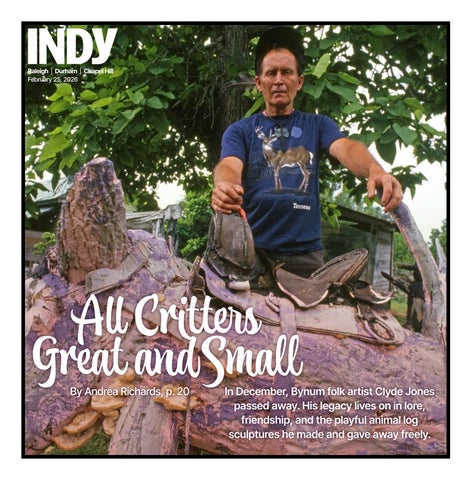
In December, Bynum folk artist Clyde Jones passed away. His legacy lives on in lore, friendship, and the playful animal log sculptures he made and gave away freely.

Raleigh | Durham | Chapel Hill

6 A dispatch from Wake County's landfill, a sprawling trash heap expected to reach capacity in the next 20 years. BY CHLOE COURTNEY BOHL

8 House District 37 in Wake County is considered a true toss-up. Three Democrats are vying for a shot at flipping the seat in the fall. BY CHLOE COURTNEY BOHL

12 Armed with a professor's critical audit, some students and faculty argue Duke University cut jobs prematurely last year. BY MATT HARTMAN

14 Following a leftward shift on the Holly Springs Town Council, the town adopted Wake County's nondiscrimination ordinance this month. BY JASMINE GALLUP

Culture

18 In Southern Roots, an evocative cookbook-meets-memoir, Spring Council takes a look back at a bygone Chapel Hill and the recipes her legendary mother passed down to her BY LENA GELLER

20 In December, Clyde Jones died in his late eighties. A former mill worker, Jones tapped into a life's passion when he began using a chainsaw to make art out of logs—work that quickly found audiences far beyond his Bynum hometown. BY ANDREA RICHARDS

24 Durham’s Stephanie Diaz Mendoza is a reigning state high school champion in the growing sport of girls’ wrestling. BY ELLIOT ACOSTA

We Made This

birds converge on the South Wake Landfill (see story on page 6).

Cover Clyde Jones with one of his horses PHOTO BY MICHAEL EDWARD SMITH

BACKTALK

Earlier

this month, we announced that the INDY is ending election endorsements. The news prompted a deluge of reactions from readers lamenting—and in some cases welcoming—the change. It also led some readers to write to us about the candidates they wished we had endorsed.

From reader ANDREW WITKINS by email:

Kudos for not doing endorsements this year. Hope this is a trend. I am sure you are going to get plenty of negative feedback from people who want their paper to take a more activist role, but on behalf of the rest of us, thank you. Our country’s media climate seems to be falling off a cliff right now - too many Americans have forsaken trustworthy sources for nefarious, misinformation-filled online hucksters masquerading as journalists. We have politicians (including our own president) who exploit that. In my opinion, the most important work you could possibly do is get all of Durham to read & trust you as we move forward together.

From reader LINDA KASTLEMAN by email:

I understand your decision, given limited resources and political chaos, to stop making endorsements for local candidates; I really do. But I want you to know how much I’ve appreciated, through many years, your insights and careful description of candidates’ positions. Almost never have I voted blindly for a candidate solely because you suggested it. Rather, your careful study allowed me to be confident about a candidate I already was leaning toward—or gave me information I didn’t have that led me to change my mind.

I appreciate all you’ve done to improve voter intelligence. I wish—and hope—that you could continue to do it. It’s an invaluable resource to the community.

An excerpt from reader JEFF M. by email:

For me, the guide was the only source that offered endorsements that thoughtfully considered a wide range of progressive issues. Even when I didn’t agree with every recommendation, I found it incredibly helpful as a starting point for further reading and reflection. Regarding your explanation … I don’t believe endorsements undermine reader trust in fairness. Most readers already understand the INDY’s general editorial perspective, whether or not formal endorsements are issued. Transparency about values and reasoning can actually build trust.

As for the time commitment, it seems that once reporting and candidate interviews are completed,

much of the substantive work has already been done. Crafting endorsements would appear to be a natural extension of that reporting.

For this upcoming election, I’ve found myself using AI tools to compare candidates instead of relying on the INDY. Interestingly, AI doesn’t “endorse” but instead presents distinctions in a structured way—for example, “If you value long-term experience, choose Candidate A,” or “If you prioritize diversity and newer leadership, consider Candidate B.” It also allows me to ask directly about potential drawbacks of each candidate. That kind of clear comparative framing is extremely useful.

If the Indy no longer feels endorsements are appropriate, perhaps there is still room for a simplified comparative guide that distills the reporting into accessible distinctions for voters.

From reader W.A. BOWLING by email:

I love INDY. (Spectator was better, because it was more conservative). INDY does great investigative reporting. Thanks. In jest—I use the Indy endorsements at the Polls—to vote for the opposite candidates that you endorse. I will miss that this year. Keep up the good work.

From Bluesky user MICAH IS LOHRTY:

Man do I hate to hear this. You guys were indispensable to making informed voting decisions for me and so many of my normie friends. Endorsements by “organizations” are simply not the same by any measure.

From Bluesky user RANDALL GROSS:

“In a time when people are being murdered in the streets by masked secret police we are not willing to stand up for anyone or anything, but hey, hit that subscribe button.”

From Reddit user NOSTAGE421:

Durham politics are chaotic, and the INDY endorsement was the key to victory. It seems they faced intense pressure from political interests in this last election. If this policy continues through 2026 (and I hope it

does), the strategy for winning Durham races will shift. Except for the [People’s Alliance], all the other endorsing organizations are in decline or are newcomers.

An excerpt from reader KRISTINA BALDRIDGE by email:

This morning I read your announcement that The INDY will no longer participate in political endorsements. Your rationale was clear and thoughtful, and I respect the decision to step back in the name of neutrality and journalistic integrity.

In your letter, you noted that many organizations already vet and endorse candidates. That’s true. But when we look at endorsements from PACs, unions, and advocacy groups, we should remember that each of these organizations represents one part of the school system—not the whole. The board leadership Durham needs must be able to take a holistic view of our district, not cater to the loudest voices or narrowest interests. So I would like to offer another way voters can determine who is right for the Durham school board: watch the board meetings. Read the materials DPS administration presents. Pay attention to the questions board members ask—and the ones they avoid. It takes time, but anyone who does it will see a board and district in urgent need of steady, independent leadership that understands just how difficult the next few years will be.

In District 3, that leader is Lauren Sartain.

Lauren is a K–12 public education and policy expert who works every day with districts and school leaders navigating the same challenges Durham Public Schools faces. She is also a parent of two DPS students who stepped up to run her school’s PTA when no one else would.

But perhaps most importantly, she is already doing the work. Lauren has attended or watched every board meeting since the redistricting process began and the pay crisis erupted. She engages board members with thoughtful, informed ideas grounded in what is actually happening in DPS—not campaign-season talking points. She has also taken the time to listen and connect with parents, teachers, central office staff, and DPS administration about specific ways she can help strengthen support for students.

Also in our last print edition, Justin Laidlaw wrote about the race between incumbent Durham District Attorney Satana Deberry and challenger Jonathan Wilson. Readers shared their thoughts on the story and the primary election.

From readers GITA AND EDD GULATIPARTEE by email:

Though The Indy made the decision to cease making endorsements, your reporting about the candidates for Durham DA leaves no doubt in our minds who will get our vote—DA Satana Deberry.

Readers newer to Durham might not recall the challenges DA Deberry inherited in January 2019, nor appreciate the turnaround she’s led over the last seven years, ensuring that our justice system works justly for everyone.

We are proud that violent crime is down in Durham and that Durham no longer prosecutes people for being poor, having unmet mental health needs, or being afflicted by substance abuse and addiction. Durham has opened the door to meaningful accountability for victims and survivors in cold-case sexual assault cases by clearing the largest backlog of kits in the state. There will always be more to be done, and we are confident that similar success lies ahead as DA Deberry and other community leaders address juvenile crime, particularly gun violence, as well as the safety of downtown residents, visitors, and businesses.

Justice is not a desk job; DA Deberry has forged key community partnerships that have diverted people into treatment programs and social services, saving myriad resources. We especially appreciate DA Deberry’s proactive and authentic engagement with immigrant communities who know she will have all our backs if (when) ICE surges in Durham again.

We applaud anyone who is willing to run for office and have no reason to doubt her challenger’s abilities. But now is not the time to learn on the job or start from scratch. Instead of surveilling the timesheet of a tireless and highly effective public servant, WRAL should shine a light

on the moneyed interests that profit from Durham’s growing unaffordability while depleting the tax base that would fund needed social safety net programs, victim services, and the DA’s office. They have tried relentlessly to discredit and deter this DA. But Durham knows better – and we are better with DA Deberry.

In the article “Primary Redux”, Deberry is quoted as saying “My job is prosection.... All I have is a Hammer. To a hammer, everything looks like a nail, and some of those people don’t need to be nailed.” I agree in principle, but the DA’s Office under Deberry has mishandled cases that need attention and should be taken far more seriously. In 2022 my husband was violently killed 15 feet in front of me and our two young children while riding his bike. A speeding driver ran the red light at the trail crossing intersection, plowed into my husband (even though nothing obstructed his view) and never stopped. The driver then hid from authorities until found 2 weeks later in Ashboro, NC. This man was a repeat offender with 79 prior charges. He never once expressed remorse or regret, yet he received a plea deal and a minimal sentence of 1 year for a low level felony hit and run and a misdemeanor death by motor vehicle. Since his release, he has committed more crimes. This does not keep the public safe. I have met with Deberry twice about the poor management of this case, and have only received broken promises.

Finally, Chase Pellegrini de Paur spoke to all 12 school board candidates for a story in our last edition. One reader wrote that the story fell short of capturing a candidate’s résumé.

From reader LIZ BUNO by email:

I’m writing in response to your recent District 3 school board candidate profile. While the article offered detailed descriptions of the professional and gov-

ernance experience of some candidates, it gave comparatively little attention to the depth and relevance of Gabby Rivero’s experience.

Gabby is deeply rooted in our schools. She is a parent and foster parent. I’ve personally served with her on the PTA at Southwest Elementary, a dual-language Title I school, where she is Vice President. She has also served as one of the PTA’s Title I representatives, working intentionally to ensure that all families are engaged in Title I–funded activities. She has focused not just on participation, but on listening— seeking feedback about which programs truly work for families across languages, cultures, and schedules, rather than assuming a one-size-fits-all approach. Last fall, when increased immigration enforcement created fear and instability for families, I watched her help organize concrete supports—transportation, school watches, and grocery delivery—that improved attendance and helped more than 30 families within a couple of weeks.

As a business owner, she understands budgets, staffing, and long-term planning—skills essential for responsible school board governance that were emphasized in the profiles of other candidates. She serves on the City of Durham’s Recreation Advisory Commission, she has worked across differences, examined budgets, questioned programs, and pushed back when decisions failed to serve the broader community. She serves on the board of the Greater Durham Black Chamber of Commerce, where she chairs the Membership Committee. In that role, she is an accountable leader— asking hard questions, holding decision-makers responsible, and building collective power to strengthen an entire ecosystem. Hands on governance, the kind that affects change.

Gabby Rivero does not simply speak about community; she consistently shows up for it. Political candidates are often described as having one primary strength— policy expertise, professional leadership, or community engagement. Gabby Rivero is a candidate who brings all three.

Wake County

One Manʼs Trash Is Another Gullʼs Treasure

With Wake County’s growing population producing more than their share of garbage, its landfill is expected to be full by 2045. I took a tour, and you should, too.

Wake County’s 1.2 million residents collectively produce a staggering 2.3 billion pounds of waste each year. Per person, they generate more waste (5.3 pounds per day) than the average American (4.9 pounds). Some of that gets reused or recycled, but most of it goes into the South Wake Landfill in Apex, where it takes hundreds of years to decompose. The landfill has a 180-acre footprint, roughly equivalent to 136 American football fields. It opened in 2008 and is currently at 58% capacity. It will be full by 2045, possibly sooner.

The South Wake Landfill is a sprawling, carefully engi-

neered, mostly buried trash heap, which from November until March functions as an all-day buffet for an enormous flock of migrating seagulls. During those months, the landfill’s so-called working face, the exposed part of the heap, is overrun by thousands of grayish-white birds that peck, perch, swoop, and scavenge, completely undeterred by the procession of dump trucks and compactors trundling through.

There is a method to the seeming madness of this vast dumping ground. It’s subdivided into many “cells,” each contained within a 6-foot-thick liner system that’s meant

to be impermeable. As 1,600 fresh tons of trash arrive by the truckload daily, six days a week, the landfill operators fill one cell at a time, building it up to a predetermined elevation before moving on to the next cell.

The landfill is not lifeless or static. Day and night, it belches greenhouse gases (3,000 standard cubic feet per minute), breeds bacteria, and oozes garbage juice (technical term “leachate”—anywhere from 10,000 to 30,000 gallons per day). Horizontal pipes embedded within the trash mound collect the leachate and pump it over to a nearby reverse osmosis machine to distill the contaminants from the water. After reverse osmosis, the concentrated sludge of contaminants gets sprayed back over the trash pile, while the water goes to the Holly Springs Wastewater Reclamation Facility. Vertical pipes arranged throughout the trash mound extract methane and carbon dioxide, minimizing odors and reducing the risk of spontaneous fires. The gases captured in the pipes get routed through an industrial blower and flare station, to be either combusted or converted into electrical energy.

All the while, flocks of migratory birds whirl overhead, noshing on trash. Depending on the season you can spot rock pigeons, eagles, Canada geese, starlings, and turkey vultures at the landfill. But gulls (ring-billed, American herring, lesser black-backed, Iceland, and other types) are the most common visitors, arriving in groups of

Residents send 1,600 tons of trash to the South Wake Landfill each day. PHOTO BY CHLOE COURTNEY BOHL

15,000 or more, according to the birders who log them on eBird.org. After they’ve feasted, they tend to fly away in search of water. A 2017 Duke University study found that nationwide, 1.4 million landfill-scavenging seagulls collectively pollute nearby bodies of water with 240 extra tons of nitrogen and 39 extra tons of phosphorus annually through their poop, fueling algal blooms and oxygen depletion. The South Wake Landfill is 5 miles from Shearon Harris Reservoir and 10 miles from Jordan Lake.

On a recent Monday morning, I embarked on a landfill tour with Sara Davarbakhsh, an environmental education program coordinator for Wake County, as my guide. Aboard a small bus along with three other landfill-curious passengers, we explored the working face and spotted three bald eagles amid the seagulls. We also toured the adjacent South Wake Multi-Material Recycling Facility— the place to bring your appliances, batteries, cardboard, cooking oil, electronics, scrap metal, and tires to be recycled. It even accepts oyster shells—which it sends to the North Carolina Division of Marine Fisheries to be redistributed along the coast.

Sixty percent of the waste that ends up in the landfill could have been recycled or composted instead, Davarbakhsh said. You just have to know where to take it.

“We made it so easy for people to make garbage,” she lamented. “We gave them this giant, 95-gallon roll cart

and said, ‘Hey, fill it up and we’ll empty it every week!’”

There are 2,639 municipal solid waste landfills in the U.S., according to the EPA. Of those, 542 are active; the rest are closed. Those numbers don’t include specialized landfills for hazardous waste, construction debris, or coal combustion residuals.

Unlike Raleigh, most American cities don’t bury their trash in their own backyards. Durham, for instance, sends its waste 100 miles away to the Sampson County regional landfill, whose 1,300-acre footprint makes South Wake look like an anthill.

“Do we just keep building landfills?” Davarbakhsh wondered aloud. “It feels like we’re putting a Band-Aid on the problem.”

In other parts of the world, landfills have fallen out of vogue. Japan incinerates much of its waste these days, capturing the by-products and converting them into energy. Sweden reportedly sends less than 1% of its trash to the landfill, incinerating 52% and recycling the other 47%.

The idea of human waste as a renewable energy source is tantalizing, but waste-to-energy (WtE) plants are controversial. Old, unsophisticated incinerators can be extremely polluting and pose real health risks. However, modern WtE plants are equipped with scrubbing devices that neutralize harmful pollutants, making the whole

process much cleaner and safer. Proponents of WtE also point out that it emits less methane (one of the most corrosive greenhouse gases) than landfills and, as an energy source, is cleaner than fossil fuels.

Last year, Wake County launched the Beyond the South Wake Landfill Study to begin planning for what to do when the landfill reaches capacity sometime in the next 20 years—at which point Wake’s population will be around 1.6 million. The county is weighing either opening a new landfill, hauling its waste to a regional landfill like Durham does now, or opening a public WtE plant. The latter option would be the most environmentally friendly but also the most expensive, both for the county and for individual households.

During an initial round of public engagement on the study, Wake residents said their top priorities for the new waste disposal method were minimizing greenhouse gas emissions, human health risks from pollutants, and ecological impacts. The county will make a decision in late 2026 or 2027.

Back at the South Wake Landfill, Davarbakhsh said she hopes more people sign up for her free tour.

“It really opens your mind,” she said. “Seeing is believing. There’s nothing like seeing that giant mountain of trash—that you know you helped make—to make you want to do better.”

Left: The landfill’s blower and flare station; Above: Thousands of seagulls congregate at the landfill’s active face PHOTOS BY CHLOE COURTNEY BOHL

NEWS Wake County

Primary Colors

Three candidates are making the case to take down Rep. Erin Paré, one of the only Republicans in Wake County’s state House delegation.

Erin Paré, the Republican representative for North Carolina’s 37th House district, usually comes across as mild-mannered on social media. But in November, as Democrats in southern Wake County celebrated historic wins in the 2025 municipal elections, she lashed out.

Democratic challengers had just ousted Republican incumbent mayors in Fuquay-Varina and Holly Springs— previously considered Republican strongholds—by wide margins. As party strategists took a victory lap on TV, Paré, one of two Republicans in Wake County’s 13-member delegation in the state House, penned a bristly clapback to a pundit’s botched pronunciation of “Fuquay-Varina.”

“Typical liberal elite downtown Raleigh swamp creature,” Paré posted on X. “Act like they care about the suburbs during elections, then as they turn and run they can’t even pronounce the town’s name they claim to have conquered.”

Paré has represented District 37, which covers Fuquay-Varina and most of Holly Springs, for a little over five years. This legislative session, she’s sponsored or supported bills to ban transgender schoolkids from competing on women’s sports teams, remove Planned Parenthood from Medicaid coverage, require local law enforcement compliance with federal immigration agents, expand the state auditor’s powers, require schools to post online catalogs of all the books in their libraries, and define gender as male or female

without any acknowledgment of transgender or nonbinary identities. She’s also signed her name to some less-controversial bills related to raising teacher pay and preventing child abuse. A small minority of the bills she’s sponsored have been bipartisan.

Pronunciation faux pas aside, Democrats carved an undeniable foothold in southern Wake last fall, and it’s an open question whether Paré’s right-wing politics will still resonate with voters in her fast-growing, increasingly diverse and educated district in 2026.

Paré’s Republican colleagues have redrawn District 37’s lines twice since she was first elected in 2020, but it remains competitive, and she’s only ever won by about 3,000 votes or a handful of percentage points. This year, it won’t help that the Republican-controlled state House and Senate still haven’t managed to pass a budget due last July, or that Americans are unprecedentedly unhappy with the Trump administration and, by association, Republicans downballot. The Civitas Partisan Index, created by the conservative John Locke Foundation, classifies District 37 as R+0, a true toss-up—down from R+3 in 2024.

Whether Paré gets a fourth term depends, in part, on the quality of her Democratic challenger. There are three candidates running in the primary: an education policy wonk, a constitutional law wonk, and an IT consultant.

All are newcomers to local politics, but in interviews over the last month, each told the INDY they have what it takes to beat Paré.

At a patio table outside Cultivate Coffee Roasters in Fuquay-Varina, Marcus Gadson sipped a double shot of espresso and told me how an elementary school history project helped set the course of his professional life.

Gadson, 38, was raised in a mostly-white Indiana town by parents born into Jim Crow segregation. In the fifth grade, his teacher assigned the class to report on, and dress up as, a historical figure. Everyone on the teacher’s list was white, but Gadson’s parents wanted him to learn about someone who looked like him. They suggested he study Thurgood Marshall, the civil rights lawyer and first Black Supreme Court justice.

“My parents made me go to the library and learn all this information,” Gadson recalled. “[Marshall] ... had a mischievous streak. When he was about my age, he had to copy the Constitution as a punishment. And so then as an adult, he really knew that Constitution backwards and forwards. That piqued my antenna of thinking about becoming a lawyer: seeing the difference he made, but also seeing how good he had to be.”

After college at Dartmouth, Gadson taught high school

ILLUSTRATION BY NICOLE PAJOR MOORE

in Arkansas with Teach for America and attended Harvard Law School. He clerked for an appellate court judge in Tennessee, practiced at a big law firm in Washington, D.C., then moved to North Carolina to join Campbell University’s law school faculty. He now teaches at the UNC School of Law. Last year, he published a book about state constitutions and constitutional crises.

“One of my dreams is that I want Americans to appreciate their state constitutions as much as they do our federal Constitution and understand the role that [they play] in their lives,” Gadson said.

North Carolina’s constitution includes a literacy test, added in the aftermath of the 1898 white supremacist massacre in Wilmington. The clause is no longer enforced, but it hasn’t been removed.

“That’s a problem, because if I’m a Black North Carolinian, that raises a profound question: Why should I respect a state constitution that still has a literacy test in it?” Gadson said. “I don’t have a good answer to give my two little Black boys ... except that ... in the General Assembly, I’m going to try to take it out.”

Gadson wants to make life more affordable for North Carolinians by enacting an earned income tax credit, a child care tax credit, and a tax deduction for rent. And he wants to make it easier to build homes in North Carolina—an idea he thinks could get bipartisan traction.

As a public school parent, Gadson is focused on education policy. He wants to raise teachers’ salaries across the board, increase the focus on civics education in public schools, and provide more mental health resources for students.

“My son has had a rotating cast of substitute teachers for his first year in pre-K,” Gadson said. “To me, that was an emergency. The legislature has not treated it as such, but they did treat redistricting as an emergency.”

The biggest focus of Gadson’s campaign is protecting little-d democracy. He wants to create an independent redistricting commission to redraw North Carolina’s aggressively gerrymandered congressional map. He proposes screening state Supreme Court candidates through an independent nominating commission to reduce the influence of money and partisan politics on the state’s highest court. For Gadson, political and judicial reforms are essential first steps to improving everyday North Carolinians’ quality of life.

“If you don’t have a realistic plan to bolster our democracy, then you only have a theoretical plan to help on cost of living,” he said. “Whatever I propose for cost of living isn’t going to have long-lasting legs if we don’t have politicians with the right incentives in place.”

Over black coffee from Esteamed in Cary, Ralph Clements, 59, pondered the road not taken. After graduating from Raleigh’s Sanderson High School, he very nearly joined the United States Marine Band as a clarinetist. In college, he dreamed of becoming an engineer and building space stations. He took eight years to graduate from North Carolina State University because he was simultaneously working as a computer scientist and for the National Guard.

“People think they’re going to their goal, but if they really look back, their path wiggles,” Clements said. “No one ever goes in a straight line.”

Clements eventually made a career as a health care IT consultant in Atlanta. He returned to the Triangle in 2020 to be closer to aging parents and now lives just outside Fuquay-Varina.

Clements decided to run in District 37 because he wanted to do more than knock doors or make phone calls for the local Democratic Party. The more he learned

“We’re talking about a Republican-plus-three district. Even a small-wave election for Democrats could overcome that structural disadvantage.”

about Paré, the more he became convinced he could mount a serious challenge against her.

“I’ve seen her campaign and her qualifications she lists, and I have more experience and those same categories than she does,” Clements said, citing her roles as a franchise business owner and church and community volunteer. But as we talked, Clements seemed to waver on whether he actually wants to be elected.

“I’m not trying to start a new career,” he said. “My next move professionally is to figure out ‘When I can afford to retire? Let’s go to Provence and tour the wineries.’ But I’m a patriot. My state needs me. I can do this. I can do it well. It would be personally inconvenient and probably painful. ... I’ll have to bite my hand to keep from speaking out in some of those committee meetings where they drag in the wrong direction for hours.”

Clements emphasized that he wanted to flip District 37 and break the Republican supermajority in the house— Democrats already did this in 2024, but his point about chipping away at Republicans’ viselike grip on legislative power stands.

“They don’t lead, because all they have to offer is chaos,” Clements said. “We need to return to normal operations.”

Like Gadson, Clements wants to reinvest in North Carolina’s public schools and restore public trust in the legislature by passing a budget and establishing an independent redistricting commission. He also named affordability and planning for growth as campaign priorities.

Winn Decker had already drained his coffee mug by the time I met him at the Mill café in Fuquay-Varina at our agreed-upon time.

Decker, 33, grew up in rural Tennessee in a town of about 500. He was valedictorian of the small public high school where his mom taught chemistry and his dad taught business and coached football. As an undergrad on a basketball scholarship at Rhodes College, he thought he might become a chemist, until a tedious job at a drinking water lab disabused him of that idea.

As Decker recounted this part of his life, he briefly digressed into talk of haloacetic acids, chlorines, and water purification. “I can be too much of a nerd, I apologize. You can always tell me to shut up,” he said sheep-

Marcus Gadson COURTESY PHOTO
Ralph Clements COURTESY PHOTO

ishly. “Long story short, I realized I was not doing that for the rest of my life.”

Decker decided he was more interested in the public policy questions around water than in the science of treating it. So he ended up in grad school at N.C. State University in 2015, pursuing a master’s in higher education administration, then a Ph.D. in public administration, all while working full-time for N.C. State’s Office of Fraternity and Sorority Life. He also began volunteering with the local Democratic Party.

During the 2016 general election, Decker remembers volunteering as a poll greeter at the Pullen Park voting site near campus and seeing a bunch of N.C. State fraternity brothers show up to cast their ballots.

“I’d sat down with these men and had values-based conversations. I knew we believed similar things,” Decker said. “And I watched them walk up to the polls and take a Republican slate card.”

In that moment, Decker realized: “We’re not losing because we don’t believe in the right things, or because we’re not pushing the right policies, but because we don’t communicate and make people feel heard.”

Decker now lives in Fuquay-Varina, where he’s helped knock doors for Democratic candidates for several years. After completing his degrees, he joined the Hunt Institute as an education policy analyst, then went to work for the Common App on programs related to lowering barriers to higher education.

Unsurprisingly, education is a key plank of Decker’s platform. He supports restoring state funding for teachers’ master’s degree pay supplement, increasing the ratio of social workers and counselors

“We’ve got to be in community all the time,” he said. “So many people, rightfully so, feel like Democrats show up to ask for a vote. But we’ve got to be there, when we’re in power and when we’re not in power, being good community members and doing the things that we believe in.”

Whoever wins the District 37 primary will face a tough race against Paré in November, said David McLennan, a political science professor at Meredith College.

“Paré is a well-funded candidate and someone that Republicans really want to stay in the legislature,” McLennan said. “On a personal level, they perceive [her] as an up-and-comer. She’s already important in the budget writing process, and they see her as potentially moving up in leadership. People like her in the Republican caucus.”

port, he said he makes up for his ability to appeal to more moderate voters.

“Being an older guy, I can connect with the life experience of some of those folks,” he said. “I think I can get centrist people to consider voting for a Democrat when they might not have before, because either they’re tired of MAGA extremism, or they want to see that mature business approach that I have.”

Gadson and Decker both have campaign managers and teams of volunteers. Decker also has a field director. In January, he said his team had already spoken with more than 2,000 voters. He said his campaign has set a target number of doors to knock based on their internal “win number”—the number of votes they’ve calculated they need to win in the general election.

in schools, following the state Supreme Court’s Leandro plan for public school funding, and reinstating the income caps on the controversial Opportunity Scholarship private school voucher program. He also wants to see private schools that receive voucher money publish their test scores and freeze their tuition.

Decker shares Gadson’s and Clements’ interest in ending partisan gerrymandering and bolstering trust in North Carolina’s democratic institutions. But he described himself as a pragmatist who is willing to work across the aisle and has relationships with legislators from both parties.

Decker believes many of his policy ideas, including means-tested property relief for senior residents on fixed incomes, legislating a “right to repair” and updating infrastructure to support southern Wake’s population boom, could garner bipartisan support. But he added he won’t compromise on issues like Medicaid funding and reproductive justice.

“I have ideals and visions that we’re going to fight for, but I also understand how policy and politics work, and so I’m going to navigate carefully,” Decker said.

Of the candidates, Decker had perhaps the most nuanced take on why Paré keeps winning: “Republicans in the legislature have strategically made it so that Democrats are not going to [successfully sponsor] any bills. So to run a bill, someone in Wake County is having to go to Paré. So she gets to put her name on some decent things.”

Decker also granted that Paré is accessible to residents and business owners. He thinks the Democrats could be doing a better job connecting with voters in that way.

Paré is currently one of a few chairs of the influential House appropriations committee. McLennan said Republicans see her as someone who could eventually lead a major committee or even “be second-in-command to [House Speaker] Destin Hall.” He added that Republicans want to protect their majority in the legislature and to hold on to their seats in Wake County “for their pride.”

On the other hand, the population growth in southern Wake and the 2025 mayoral elections in Fuquay-Varina and Holly Springs signal that Republicans’ dominance of the district could be waning. The timing also gives Democrats a leg up.

“Midterm elections tend to favor the party out of power in Washington,” McLennan said. “We’re talking about a Republican-plus-three district. Even a small-wave election for Democrats could overcome that structural disadvantage.”

As for which of the three newcomer candidates will rise to the top in the Democratic primary, McLennan said factors like Decker coaching a local youth basketball team or Gadson’s kids attending Wake public schools could go a long way.

“That kind of thing may make a difference, because they know more people,” he said. “There’s relatively little time to become well known across the district, so you’re going to have to really push your ground game, get your folks out. Those personal connections are going to make a big difference.”

Each of the candidates said they’re prepared to knock doors, reach out to a wide swath of voters (44% of registered voters in district are unaffiliated) and generally run disciplined campaigns.

Clements is his own campaign manager and hasn’t collected many endorsements.

“I don’t really mind being the outside guy,” he said. What he lacks in institutional sup-

Decker also has by far the most local endorsements of the three candidates, including from Holly Springs Mayor Mike Kondratick.

“Winn Decker supports smart infrastructure investments that improve safety, reduce commute times, and strengthen our local economy. His approach balances fiscal responsibility with delivering what Holly Springs needs to continue to grow,” Kondratick wrote in an email to the INDY Wake County Commissioner Safiyah Jackson—who challenged Paré in 2024 and lost by 6 points—also endorsed Decker.

“[Decker] launched a campaign that was serious about engaging volunteers and voters,” Jackson wrote in an email to the INDY “His background in government budgeting, his work on sensible property taxes, and his support of local government control is why he is the strongest contender.”

Decker’s other endorsers include the Wake chapter of the North Carolina Association of Educators, the North Carolina State AFL-CIO, County Commissioner Tara Waters, and over a dozen city and town council members from Holly Springs, Apex, Garner, Cary, and Raleigh.

(No elected officials in Fuquay-Varina have endorsed any of the three candidates. Mayor Bill Harris declined a request for comment.)

Gadson, Clements, and Decker each spoke in “when” rather than “if” terms about winning the Democratic primary. But looking ahead to November, they all conceded that Paré is formidable.

“First off, we’re gonna go win a primary,” Decker said. “That is what we’re focused on right now. Once we do that, we consolidate Democratic voices. Primaries are great because they let different ideas and perspectives pop up. But at the end of the day, we also know this race is ... about going to beat [Paré].

Winn Decker COURTESY PHOTO

NEWS

Balancing Act

Student, community, and faculty groups say Duke’s finances show it didn’t need to make the cuts it did last summer, and they’re renewing their calls for the university to stand up to the Trump administration.

Around 50 people marched along Duke University’s East Campus wall earlier this month while cars honked in solidarity. The group carried signs and a large butterfly puppet that kept getting stuck in tree branches and telephone wires, and protesters helped those with wheelchairs and strollers navigate bulbous tree roots and broken sidewalks.

“Money for jobs and education, not for racist deportation,” the group chanted.

“We work, we sweat, put 25 on our check.”

“If the billionaires keep funding ICE, my people stand up and strike. If the bosses don’t pay my rent, my people stand up and strike.”

Organized by Duke’s American Association of University Professors (AAUP) chapter, Sunrise Duke, the Union of Southern Service Workers, and other organizations, the event built on the findings of a financial report AAUP released last week that concluded Duke is in healthy financial shape and didn’t need to eliminate more than 600 jobs last summer. But more than that, the rally was a demand for a more progressive vision of higher education, calling for Duke to rehire workers who lost their jobs, enhance protections for immigrants, and pay a $25-an-hour minimum wage (hence the chant).

“These walls are literal but also figurative,” cultural anthropologist and Duke AAUP President Emily Lin Rogers said at the march’s endpoint just inside the campus wall at Main and Broad streets. “Duke divides us between the underpaid staff members who clean our classrooms and the faculty who teach in them, between the students and

the precarious bus drivers who take them to class. And between its own wealth and the prosperity of the community.

“Meanwhile, Duke presents its austerity measures as a matter of protection against doomsday predictions of what is to come with this presidential administration. But with its preemptive cuts, suppression of free speech, and inaction around us, Duke is doing Trump’s bidding for him. The excuses end here, Duke. We are not buying it.”

Rogers pointed to the financial report to push back against Duke’s claims of financial precarity. It was completed by Howard Bunsis, a professor of accounting at Eastern Michigan University and AAUP member, who relied on Duke’s public financial audits.

Last fall, Duke administrators estimated a $662 million loss over the next five years from the Trump administration’s increased endowment tax, Medicaid cuts, and attempts to slash research funding. Bunsis concluded the university has more than $14 billion in unrestricted assets that it could use to cover any losses, including parts of its endowment and operational reserves. And the biggest anticipated cut for Duke—a change to reimbursements for research costs associated with federal grants, which administrators estimated would cost the university $230 million a year—has been blocked by both the courts and Congress.

“We had the feeling when it was happening in the spring and summer that this was unnecessarily preemptive, that it was taking place before any of these threats were even close to coming to pass,” said Erika Weiberg, Duke AAUP’s treasurer and a classics professor. “It felt to us that it was an excuse

being used to restructure the university.”

A Duke spokesperson said the university could not comment on Bunsis’ report because it was not involved in preparing it.

“We regularly share information about the university’s finances and outlook with faculty through the university’s shared governance process,” the spokesperson added. They also declined to respond to criticisms that the cuts were unnecessary.

Though the pain of the Trump administration’s cuts has been mitigated by Congress and the courts, the pain of Duke’s has not, other speakers said.

Margoth Erazo, a Honduran immigrant, told the crowd through a translator that she worked as a housekeeper at Duke for more than 23 years before losing her job when the Trump administration removed her temporary protected status, a designation that allows foreign citizens to stay in the United States legally when conditions in their homeland are too dangerous.

When a federal judge overturned that action in December, Erazo believed she’d be able to reclaim her job at Duke.

“They told me at an appointment with Duke Visa Services that I couldn’t continue working because Duke’s housekeeping had restructured their department, and they said my position didn’t exist anymore,” Erazo said. “I didn’t understand how such a large and wealthy place couldn’t have a

space for workers like myself and others.”

Other speakers lamented that while Duke was quick to make cuts to its workforce, it has been reticent to take decisive action against the White House’s aggressive immigration raids.

A Duke spokesperson declined to respond to questions about protections for immigrants.

“I know that a better world is possible,” said Duke student Artivista Karlin, calling on the university to become a “4th Amendment workplace” by providing workers with guarantees that they won’t allow immigration enforcement officers to enter campus without a signed warrant.

Fear of immigration agents leading large raids, like those that killed Renée Good and Alex Pretti in Minnesota, impact students and workers alike, Karlin told The Assembly.

“We as students hold a lot of power to demand that a university do more to protect its workers, and we have to also recognize that the struggle that students face is the same struggle of workers, and throughout history has taken both students and workers to defeat authoritarianism,” she said.

The rally ended with the same message communicated in a slightly different way.

“Snap and clap and touch your toes, workers rights are on a roll, billionaires have got to go,” the Durham Labor Choir sang in a Chappell Roan rewrite.

About 50 people protested Duke’s cost-cutting efforts in a march on February 6, 2026. PHOTO BY MATT HARTMAN

DURHAM CO UN T Y Board of Elec tions

3825 S. Roxboro St., Suite 101, Durham, NC 27713 (919) 560-0700

NOTICE OF CHANGE IN TIME FOR ABSENTEE BOARD MEETINGS

At a meeting duly called and held on the 11th day of December 2025, at 3825 S. Roxboro Street, Suite 101, in Durham, North Carolina, the Durham County Board of Elections changed the time for scheduled absentee ballot review meetings required under NCGS 163-230.1(f) from 5:00 p.m. to 5:30 p.m. These meetings will begin on the 5th Tuesday prior to Election Day and will occur each subsequent Tuesday prior to Election Day, March 3, 2026. To see the full Board of Elections meeting schedule, please visit our website at www.dcovotes.com.

Wake County Rainbow Coalition

The Holly Springs Town Council has seen an almost complete changeover since the last time it considered joining Wake County’s nondiscrimination ordinance in 2022. Last week, it passed.

It took four years and the almost complete changeover of the town council, but Holly Springs has finally approved Wake county’s nondiscrimination ordinance (NDO), which helps protect the LBGTQ+ community, among others.

“The council’s vote is in part a recognition that you all, our residents and our businesses, have been far ahead of your elected officials to this point,” said newly-elected Democratic Mayor Mike Kondratick, moments before signing the resolution on February 17.

“Adopting Wake County’s NDO means that the letter of our law matches the power of your example. I want to make it clear tonight that Holly Springs offers a home to everyone, without question and without exception.”

With Holly Springs onboard, ten of Wake County’s 12 municipalities have now agreed to protect people from discrimination based on sexual orientation or gender identity by employers and businesses (Fuquay-Varina and Zebulon have not signed on, per the county.)

The ordinance protects against discrimination in public places like restaurants, retail stores, and hotels — for example, if a bakery refused to make a wedding cake for a same-sex couple. It also covers discrimination in the workplace, say if a business refused to hire someone because of their gender presentation. The NDO establishes a formal complaint process, in which parties have the opportunity to enter mediation free of charge through Campbell University’s Restorative Justice Clinic.

The NDO also protects from discrimination based on factors including natural hairstyle, race, ethnicity, marital or familial

February 25, 2026

status, veteran status, religious belief, age, and disability. But it is especially important for the LGBTQ+ community, which is not currently protected from this kind of discrimination at a state level.

“As you look at the reality in the General Assembly, and how difficult it will be to pass any non-discrimination and LGBTQ rights protections, it’s extremely important for the community to know that their local elected officials have their back,” said Eliazar Posada, the executive director of Equality NC.

He added that local protections like the NDO are especially significant for queer and trans people of color, so they can “find a place of safety and home.”

The NDO first came before the town council in 2022, when Republican Sean Mayefskie was mayor. As cities like Raleigh, Apex, and Cary all adopted the measure, Holly Springs’ more conservative council delayed taking action.

At a 2022 meeting during Pride Month, Mayefskie and council member Kristi Bennett took hardline stances against the NDO, and were joined by the majority of members, effectively preventing a vote. Then-council member Aaron Wolff’s lone voice of support wasn’t enough to keep the measure alive.

This month, however, the balance of power was reversed. Five of the town council’s six members, including Kondratick, spoke in support of the NDO. The sole dissenting vote came from member Danielle Hewetson.

Hewetson, a Republican, was appointed to the town council in January 2023 to replace Bennett, who had moved out of Holly Springs. In November 2023, she was

elected to a full term on the town council alongside progressive newcomers Annie Drees and Chris Deshazor.

The political balance of the town council shifted further last November, when Kondratick, Sarah Larson, and Kara Foster were elected, replacing Mayefskie and former council members Dan Berry and Timothy Forrest.

Donna Friend, a longtime advocate for the NDO, said it was clear to her that the 2022 town council lacked the political will to move forward. It was amazing to see four years of hard work finally come to fruition, she said.

“I mean, this is about local elections mattering, democracy in action,” Friend told the INDY

At Tuesday’s council meeting, Hewetson objected to the NDO on the grounds of government overreach; she argued that the town didn’t have the authority to enact legislation relating to employment practices and therefore could not adopt the section of the NDO that protects against discrimination in hiring.

Hewetson cited an Orange County case, Williams v. Blue Cross Blue Shield of N.C., saying that it set a legal precedent making the passage of business practice legislation by counties or municipalities unconstitutional.

But town attorney John Schifano disagreed with Hewetson’s evaluation. He said that while the state constitution doesn’t allow for local regulation of business, the town’s agreement with Wake County limits liability for Holly Springs.

“What you’re voting on tonight is Wake County’s ability to enforce their ordinance in your jurisdiction,” he said. “If you were gonna pass your own NDO, I would be pounding my fist on this table arguing against you doing so for employment practices.”

But in this case, he added, “I don’t know that there’s a tremendous amount of risk against the town of Holly Springs.”

Despite Hewetson’s objection, it was clear the new town council was prepared to adopt the NDO. Foster pushed back against concerns that the measure would increase costs for small business owners, saying the NDO didn’t harm her own small business in Apex after it was approved there.

Deshazor added the NDO would not cost the town council or local businesses anything, but would give people an important sense of safety. Drees was also eager to move forward, saying, “I think it’s time that protections that apply to folks in Wake County apply to people who live here in Holly Springs. It’s past time.”

A group in Holly Springs protests the LGBTQ community being left out of a proposed town Pride Month proclamation in June 2023. PHOTO COURTESY OF JACK TURNWALD

NCDOT TO HOLD VIRTUAL PUBLIC MEETING FOR MULTIMODAL CONNECTED VEHICLE PILOT PROJECT IN WAKE COUNTY

RALEIGH - The public is invited to a meeting with the N.C. Department of Transportation to discuss the pilot project that is exploring the safety benefits of multimodal connected vehicle technology near N.C. State University.

For the project, crews updated road infrastructure, introduced a new mobile app for cyclists, pedestrians, and drivers, and used smart transportation systems to evaluate these technologies. The pilot aims to improve safety, mobility and environmental sustainability by boosting bus use and cutting down on car idling with better traffic light timing.

A virtual meeting will be held 6 -7:30 p.m. on Monday, March 9, 2026. Interested residents can attend the meeting online or by phone to learn more about the pilot, ask questions and talk with NCDOT representatives. There will be a formal presentation beginning promptly at 6 p.m.

Meeting registration and project details, including a map of the pilot area, can be found on the NCDOT project webpage at https:// publicinput.com/mmcvp-raleigh.

People may also submit comments by phone, email or mail by April 10, 2026 by contacting NCDOT State Signal Equipment Engineer Keith Mims, PE at 919-814-4931; kmmims@ncdot. gov; or 1561 Mail Service Center in Raleigh

NCDOT will provide auxiliary aids and services under the Americans with Disabilities Act for disabled people who wish to participate in the virtual meeting. Anyone requiring special services should contact Aleksandra Djurkovic, Environmental Analysis Unit, at 1598 Mail Service Center in Raleigh; 919-707-6024; or andjurkovic@ncdot.gov as early as possible so arrangements can be made.

Those who do not speak English, or have a limited ability to read, speak or understand English, may receive interpretive services upon request prior by calling 1-800-481-6494.

Aquellas personas no hablan inglés, o tienen limitaciones para leer, hablar o entender inglés, podrían recibir servicios de interpretación si los solicitan llamando al 1-800-481-6494.

NC NOW recognizes the 53rd Anniversary

We,
of Roe v. Wade

January 22, 2026

“Since Dobbs, 100 brick-and-mortar independent abortion clinics have closed their doors. Republicans’ “Big Beautiful Bill” defunded abortion providers across the country.”

Jeanne Abbott

Janene Ackles

Michael Adamson

Virginia Adamson

Jennifer Albright

Jana Albritton

Robin Allen

Bruce Arnold

Molly Arnold

Jenn Arsenault

Deborah Atkinson

Karla Atkinson

the undersigned, support women’s right We condemn acts of violence and intimidation We agree that these rights extend to all women regardless public funding for family planning

Erica Bullock

Lori Bunton

Dr. Rebecca Campbell

Virginia Carson

Mandy Carter

Becky Carver

Curtis Carver

Pamela Carver

Kicab Castaneda-Mendez

Rep Maria Cervania

Cathy Chandler

Chris Chato

Michael Eisenberg

Wendy Eisenberg

Sonia Ensenat

Ria Ewing-McMillan

Barbara Faison

Mr Robbin L Flowers

Dana Rees Folley

Sharee Fowler

Ciindy Fox

Suzanne Frank

Dr. Wayne Franklin

Marian Franklin

Sue Hoane

Sallie Holt

Adam Holtzman

Maria Holtzman

Marjorie Hoots

Linda Hopkins

Monica Horvath, PhD

Christine Huber

Scott Huler

George Hunker

Aiden Hutcheson

Brian Hutcheson

Lois Baldwin

Krista Barbour

Elizabeth Church

Dianne K Ciesla

Catherine Freeman

Carol Gay

Eric Hyman

Karla Icaza

–JESSICA VALENTI
Feminist writer, journalist, author and activist
“No matter, conservatives say— we can all just get reproductive care from crisis pregnancy centers that tell us birth control causes cancer and, often enough, do not provide any real health care.”

Esther Barkley

Deirdre Barlaz

Mort Barlaz

Marla Barthen

Loretta Bass

Melissa Beattie

Janet Beaudry

Shana Becker

Jacqueline Benton

Carol Beranek

Carolyn Beranek

Betsy Bickel

Dawn Blagrove

Nancy Blood

Violette Blumenthal

Tolly Boatwright

Juanita Bonds

Betty Tucker Boyd

Chad Boykin

Yevonne Brannon

Kayla Brewington

Cindy Brewington-Sinkez

Aliza Bricklin

Nigel Bristow

Libby Brown

Tammy Brunner

B D Clark

Kelly Clay

Susan Cohan

Alberto Colonia

Martha Cotter

Michael Council

Mary Lou Courrege M.D.

Jimmy Creech

Sheila Cuffee

Megan Cunningham

Marci Curtis

Rep Allison Dahle

Patty F. Daniel, RN (ret.)

Jane D Darter

Donna Davis

Robin Davis

Penney De Pas

Jennifer DeLong-White

Dani Devinney

Lary Dial

Sylvia Dickens

Rabbi Lucy HF Dinner

Casey Dobson

John Donovan

Michelle Downey

Rebecca Edwards

Susie Gaylord

Sally W Gillooly

Linda Giltz

Laura Gordon

Ileana Grams-Moog

Leisa Greathouse

Lynette Green

Kathy Greggs

Jennifer Griffith

Marena Groll

Betty Gunz

Judith Haase

Rev. Barbara Hager

Mary A. Hales

Laura Hamelau

Robin M Hammond

Cynthia Hanford

Lucy Harber

Arianne Hartsell-Gundy

Judith E. Hartsook

Karen Hatley

Susan Hauser

Eunice S. Heilig

Bob Hellwig

Jill Hendrickson

Joanne Hill

Edie Jeffreys

Amy Jeroloman

Richard Johnson

Dr Stephen Jurovics

Lynne Kane

Melissa Katzenberger

Susan Kelemen

Jane Kendall

Sheila Kerrigan

SL King

Elli Klein

Mary Klenz

Marilyn Knowles

Priti Lalka

Naomi Lambert

Terry Landers

Holly Latty-Mann

Betty Lazo

Eva Lee

Phyllis LeFevre

Joyous Legacy

Terri LeGrand

C Leinbach

Wilma Leinonen

Lucy Lewis

Charles Liebers

right to safe, legal and accessible birth control and abortion. intimidation directed at women and their health care providers. regardless of economic status and, as taxpayers, affirm our support of services and funding for abortions for indigent women.

Debbie Liebers

Rebecca Llewellyn

Sara Loeppert

Nicolas Long

Judy Lotas

Janette R Lowe

Michelle Lowe

Kathy Luckhaus

Susan R Lundberg

Anna Lynch

Cheri Siler Mack

Cheyetelle Macon

Sherry MacQueen

Erik Mancini

Dr. Joseph V. Marsh (sm)

Nancy Mayer

Terri McClernon

Dr. Margaret McFadden

Thomas McKinney

Brenda McLean

Randa McNamara

Philipp Meadlif

Stefanie Mendell

Julia Merricks

Wendy Michener

Elaine Millen

Carolyn R Miller

Sherry Miller

Lisa Misrok

Tom Mitchell

Cynthia Mixon

Henry Mixon

Sarah Moessinger

Harry Moncelle

Sarah Moncelle

Martha Gay Morton

Mary Moseley

Marguerite Most

Jo Ann Mount

Audrey Muck

Eric Muck

Beverly G Murdock

Cosmo Myers

Rob Myers

Linda Naylor

Leane Neace

Mindy Cherches Nelson

Constance Newman

Karen Newton

Lexie Nuell

Katherine O’Malley

Paul Offen

Elaine Okal

Carrol Olinger

Leon Olinger

Scott Olsen

Brenee Orozco

Sarah Oswald

Jill Over

Gailya Paliga

Diane Parfitt

Michael G. Parker

Helen Parsonage

Cheryl Smith Passarelli

Margret Patterson

Sandy C Pearce

Margaret Peeples

Electa Person

Kareem Person

Rakeem Person

Louise Peters

John Pilutti

Judith Pilutti

Anne A. Platsky

Shelley Ploe Facchina

Barbara Celine Polhamus

Barbara Celine Polhamus

Joyce Pollack

Susan Pollitt

John Porter

Pamela Porter

Cheryl Posner-Cahill

E. Page Potter

Tonya Powell

Anne Prather

Kathe Rauch

Laura Rein Booth

Carol Retsch-Bogart

George Retsch-Bogart

Gary Richards

Geraldine Richards

Ira Richman

Anita Rickenbacker

Douglas Rickert

Ann Ringland

Pam J Robbins

Mary Roberts

Robert Rodriguez

Tara Romano

Louise Romanow

Sherri Zann Rosenthal

Liz Ross

Bill Rowe

Kathy Ruffner-Linn

Aaliyah Sanders

Debbie Sandlin

Jill Sansoucy

Jill Sansoucy

Margaret Scales

Jennifer, MD Schaal, MD

Mary F Schickedantz

Sue A Scott

Donna Sears

Linda A. Sender

Shoshana Serxner-Merchant

Joyce Sexton

Pat Shane

Emily Sharum

Deb Shoemaker

Lynn Shoemaker

Nancy Shoemaker

Mary Sibrack Sibrack

Caitlin Simmons

Jill Simpson

Naomi P. Slifkin, RN

Bernice Smith

James Smith

Maxine Smith

Marcia Sobel

Marcia Sobel

Maxine Solomon

Rabbi Eric Solomon

Rabbi Jenny Solomon

Brenda Sparks

Jenna Spencer

Sharron K St John

Ellen Brasington Stein

Marjorie G Stein

Sarah Stein

Ed Stelli

Amee Stewart

Leigh Stewart

Carol Stubbs

Jason M Sullivan

Brea Summers

Margery Sved

Deborah Swain

Nabila Swan

Helen Tack

Liz Testa

Cindy Thomson

Mary A. Todd

Domenica Vafindes

M Van Horne

Selina Vasquez

Tiffany Vass

Ann Von Brock

Rep Julie von Haefen

Floyd Waddle

Julie Waddle

Roberta Waddle

Brittany Wade

Kathy Wade

Pamela J. Wade

Ann Wall

Rebecca Wall

Aleshia Waller

Georg Waller

Karen Waller

Roxana Waller

Teri Walley

Shelby Ware

Sarah Washington

Jane C Watson

Danie Watson-Goetz

Danielle Boucher Weaver

Margaret Weeber

Joy Weeber, PhD

Hilde Weisert

Maureen Wertheim

Gordon Whitaker

Kathleen Whitmire

Austin Wiley

Patricia Willis

Susan Edna Wilson

Glenn Withrow, MD

Paula Wolf

Elisa Wolper

Janice Woychik

Janet Wright

Dianna Wynn

Rhonda Yocum

Kathy Zaumseil

Karen Ziegler

FOOD & DRINK

SOUTHERN ROOTS: RECIPES AND STORIES FROM MAMA DIP’S DAUGHTER BY SPRING COUNCIL

W.W. Norton and Company | February 17

Preservation Wisdom

In Southern Roots, Spring Council takes a bittersweet look back at the Chapel Hill she grew up in and the recipes passed down from her legendary mother.

I n Southern Roots, Spring Council offers a brûléed riff on her late mother’s corn casserole and writes personal essays in a similar register: comforting, with a singed edge. The cookbook-slash-memoir, out from W.W. Norton and Company this month, intersperses homey recipes with stories of Council’s upbringing in 1960s Chapel Hill as the youngest daughter of the legendary Mildred Council, AKA Mama Dip, whose namesake restaurant stood on Rosemary Street for half a century before closing last July.

As a food writer, Spring Council has chops: she grew up watching her mother cook not with recipes but by smell and sight and feel, and that sensory attention carries into her writing. Cornmeal-coated porgies hit a cast-iron skillet with a “snap, crackle, and pop.” Rock candy gets a “good chew to release the sugariness that had soaked into the string.”

Where the book really finds its footing, though, is in the stories around the food. Page to page, Council’s memoir passages sit somewhere between idyllic and unflinching, with a melancholic yearn—sometimes overt, sometimes aching in the subtext—for places that no longer exist.

Namely: Mama Dip’s, where Council had worked, in various roles, ever since the restaurant first opened in 1976. Council’s tales from the dining room realistically span the spectrum of service industry life: Just as soon as a tearful customer tells Council that the restaurant’s food reminds her of her deceased mother’s cooking, another customer— the reason Southern Roots has two chicken and dumplings recipes—screams because her bowl contained flat, rolled dumplings rather than the pillowy dropped kind her grandmother used to make.

“Steam puffed out of her nostrils and fire came out of her eyes like an angry cartoon character,” Council writes of the aggrieved customer. “A rolled dumpling triggered outrage.”

The book also mourns Chapel Hill’s Northside neighborhood, the historically Black community where Council grew up, steps from downtown Chapel Hill. Council recalls being able to walk to local shops like Danziger’s, a candy store where she tried her first chocolate turtle (“shiny, smooth, and layered with rich, sweet, buttery caramel and crunchy pecan halves”) and Colonial Drugstore, where, after desegregation, she could sit at the counter and order an orangeade. In our modern world of Coke Freestyle machines, the orangeade Council describes sounds absurdly fresh: the drugstore owner would slice

Spring Council PHOTO BY ANNA ROUTH BARZIN

an orange in half, crank it against a hand juicer, and shake the fresh juice with syrup over crushed ice.

Beyond lost places, Southern Roots has a way of capturing lost ways of eating. Council grew up with an intimacy to her food sources that has largely vanished, at least for the kind of lower and middle-class families who populated Northside. The Council family didn’t live on a farm, but that hardly mattered: neighbors grew gardens, local farmers drove up to the restaurant door with seasonal produce, and kids for-

aged as a matter of course. Council writes about roaming from the neighborhood playground into surrounding woods and neighbors’ yards with scores of other children, picking pecans, plums, persimmons, muscadine grapes, figs, and wild honeysuckle. Northside still exists today, but it’s a different place. As Council writes in the book’s afterword, most of the families she grew up with have moved on, and the homes have become student rentals owned by landlords who live elsewhere. In an interview at her current home, a condo across town from

Northside, Council said that what makes her proudest about Southern Roots is that it pins down memories that might have otherwise disappeared alongside the places they belonged to.

“The 100 kids that I would have played with on that playground will read my stories and see that what they experienced has been told on a larger scale,” she said.

Council has worked in the food world her entire life. She started as a tween assembling takeout boxes at her grandfather’s Bill’s Bar-B-Q, a small Northside takeout

spot, then moved on to Mama Dip’s—waiting tables, baking pies, short-order cooking, and eventually taking on a more outward-facing role at the restaurant, representing Mama Dip’s at cooking demonstrations and food festivals.

Last summer, the Council family closed Mama Dip’s for good after a yearlong stint of takeout-only service. Council said the decision to close was straightforward: Her mother had passed away in 2018, and Council and her siblings were all ready to retire. The restaurant’s legacy continues in other forms; Council’s daughter, Tonya, recently opened a café that carries forward some of Mama Dip’s dishes alongside Tonya’s own inventions.

Some of the recipes in Southern Roots are family heirlooms. Others come from what Council calls “having a date with a dish”: tasting something at a restaurant, identifying its flavors, and recreating it at home. The book’s chilled cucumber soup recipe, for instance, hearkens back to a brunch item at the Orient Express, a long-closed restaurant in Carrboro that served food out of vintage train cars.

Council said she wasn’t always able to replicate dishes from memory. For years, she’d bring her attempts to her mother, who’d take a bite and tell her that the texture was off or that the dish was dry. Eventually, Council said, her mom told her she’d never be able to imitate other people’s dishes until she got in touch with the food of her own heritage. She needed to master those recipes first, learn their aromas and tastes and mouthfeels, and build her palate from there.

Council said the method worked. And she’s since applied the same principle beyond the kitchen. All those places she mourns throughout the book—with enough looking inward, she found she could reconstitute them too, at least on the page.

A spread from Southern Roots PHOTO BY NICOLE PAJOR MOORE

All Critters Great and Small

In December, Bynum folk artist Clyde Jones passed away. His legacy lives on in stories, community, and the playful animal log sculptures he made and gave away freely.

Clyde Jones, prodigious folk artist and the bard of Bynum, was born on April Fools’ Day of 1937 and died in 2025, on Christmas Eve. That his life was bookended by two holidays beloved by children seems fitting for the originator of “critter” art. By all accounts, Jones was equal parts jokester and Santa Claus.

Jones famously refused to sell his works, colorful sculptures made of log remnants. The critters, as he called them, are expressive creatures: polka-dotted giraffes, dogs, pigs, and reindeer with eyes crafted from found objects such as artificial flowers, tennis balls, and bottle caps. Instead of selling it, Jones gave his art away to children or charities. Even the likes of Mikhail Baryshnikov couldn’t buy one when he tried—legend has it that the Russian-born ballet dancer arrived by limousine to Jones’ modest mill house, where a menagerie of his critters lived outside, only to depart empty-handed.

“I heard him say a number of times that if you’ve got the

money to buy his critter, then you don’t need my critter,” said Julie Trotter, a friend of the artist.

Known as “Critter Crossing,” Jones’ Bynum yard featured a sea of critters scattered about in all directions against the backdrop of his house, which he’d also painted with bright murals of animals. The house was a local landmark and folk-art pilgrimage site, and if he was around—and mostly he was, or nearby at least (Bynum’s not big; its current population is around 55)—Jones was happy to greet visitors, provided they didn’t park on his mama’s rosebush.

He was especially delighted to greet children, whom he encouraged to climb and play on the sculptures. He didn’t have to ask twice: The rainbow-hued critters, with their crooked limbs and bulging eyes, beckoned even grown-ups to come play.

“The brightness and light of his art was his personality—it’s what he brought into the world,” said Gilda

McDaniel, a friend of Jones’ who for years has overseen the Fearrington Folk Art Show. This year’s festival, held February 21 and 22, was dedicated to Jones and will feature his work alongside a “celebration space” for sharing memories. No doubt, there was plenty to talk about: Jones was long a staple of the annual event, though, belying the point of art fairs, his work there was not up for sale. Jones would have a display but mostly circulated, doing what he did best—greeting friends, fans, and other artists.

“The other folk artists all loved him,” said McDaniel. “They looked up to him.”

This year isn’t the first time Jones has been at the center of a festival—after all, he’s had his own namesake arts festival for 24 years, Chatham Arts Council’s annual ClydeFEST, which draws 3,000 people out to the lawn of Pittsboro’s Agriculture and Conference Center. Paused this year to honor Jones’ passing, the free event is set to return in April 2027.

Jones was also active for decades with the nonprofit Haw River Assembly, which used his artwork in its T-shirt designs for the annual Haw River Festival. In fact, a colorful quilt made from these T-shirts covered the coffin at Jones’ funeral in January—an apt representation of his life, as he lay wrapped up in the good works, community, and art he had made on earth.

Creating Critter Country

Now that Jones is a bit of a folk legend himself, his biography can be difficult to discern—after all, it isn’t a Clyde

Clyde Jones, 2008 PHOTO BY MJ SHARP

Above: A Clyde Critter waiting for its chance to get out on the Bynum Ballfield on set-up day for Chatham Arts Council’s ClydeFEST 2015. PHOTO BY

Jones story if it doesn’t have multiple versions.

Like most folks in Bynum at the time, he was a mill worker before he went on to work with his brother Robert as a pulpwood logger. He was working with Robert when a tree trunk fell on his leg in 1979, an injury that left him unable to work.

“He had to have something to do,” said Jones’ niece Loretta Brady. “He started looking at the trees and seeing the critters in there.”

He carved his first critter in March of 1982—a pig. Using his chainsaw to transform cedarwood into animals, he quickly filled up his yard, a scene Brady recalls her mother, Jones’ sister-in-law, describing as a “snake mess.” There were puppies, horses, alligators, reindeer, and those long-necked giraffes, some painted in bright hues, others unadorned, save for bright, plastic daisies as eyes.

“Never seen some of these animals, but that doesn’t really matter,” Jones said of his process once, in an interview with The Chatham Record. “I just see a piece of wood, and they come out.”

One of Jones’ early appreciators was Gene Hamer, who, alongside chef Bill Neal, opened Crook’s Corner in 1982. Hamer first put a dog critter on the restaurant’s roof; soon, more critters joined the dog. Eventually, a roofer said the critters had to come down—or else the roof would.

“Clyde was a part of Crook’s,” said Hamer. “I would go over to Clyde’s and say, ‘I like that one,’ and he’d say, ‘Well, you can take that one.’ ‘I like that one over there.’ ‘Well, that’s not going. That’s staying here.’”

If you don’t already know, Crook’s in the ’80s and ’90s wasn’t just an award-winning restaurant—it was a center

of Chapel Hill’s cultural scene. Art was a big part of that. The restaurant acted as a gallery for many local artists, and Jones had both rotating and permanent works there (or at least as long as they might last—Hamer recalls fixing a cat’s head repeatedly). In exchange, Jones ate for free, coming in early and eating a hamburger at the bar.

In 2002, when the North Carolina Museum of Art hosted a yearlong outdoor installation of Jones’ critters, Hamer helped Jones transport them in his pickup.

“We just loaded the back of it with animals and drove over to Raleigh,” Hamer said. “All these people came out with white gloves on. And they started delicately taking all those animals off the back, which we had just 45 minutes earlier just piled in the back of the truck.”

By that time, Jones’ work had already been exhibited at the Smithsonian Institution, the American Visionary Art Museum, and the Museum of Modern Art.

Roger Manley, retired director of North Carolina State University’s Gregg Museum of Art and Design, put Jones’ artwork in several important shows he curated, starting with the North Carolina Museum of Art’s 1989 exhibit Signs and Wonders: Outsider Art Inside North Carolina. He also curated the show at Baltimore’s American Visionary Art Museum and Jones’ first solo exhibition of paintings—and added a handful of critters to the Gregg’s permanent collection. (“We had to quarantine them and disinfect them to keep insects from getting into the collection,” said Manley.)

“He really wanted people to just engage directly with his work—that was how he went about everything,” Manley said.“He was really pure of heart in that way.”

A specialist in outsider art, Manley pointed out that

while Jones’ trajectory is similar to that of many selftaught artists, the term “outsider” isn’t quite accurate: Jones “was almost central to his community rather than being outside of it.”

Another institution that includes Jones’ work in its permanent collection is Wilmington’s Cameron Art Museum, which has hosted an annual holiday event since 2010 based on the critters.

“It is this making art for art’s sake and civic engagement that distinguishes Clyde Jones from other self-taught North Carolina ‘outsider’ artists,” wrote Cameron Curator Ben Billingsley in response to a query about Jones.

And what did Jones think of the high regard his art was receiving?

“He said that he didn’t understand the attraction, but he was thrilled that children got into his work,” said Hamer, adding that when Jones began working in schools with kids later in his career, he entered a “glitter period.”

“While the paint was still wet, he’d just dump glitter all over them, you know, a handful at a time like you’re feeding chickens,” Hamer said. “We would have shows at Crook’s and then be vacuuming that stuff up for months.”

Crook’s wasn’t the only restaurant where Jones operated on what he called a “horse trading” model. The artist had a long-standing friendship with John Dimos, proprietor of Captain John’s Dockside, a Chapel Hill seafood restaurant where you would find Jones most Friday nights. Not coincidentally, Captain John’s contains the largest collection of Clyde Jones paintings available anywhere—works now thankfully preserved from the harsh conditions of Jones’ un-air-conditioned house.

Left: The found wood critters in the yard of artist and sculptor Clyde Jones. PHOTO BY JEREMY M. LANGE
MELISSA HLAVAC OF ONFRANKLINANDMAIN; COURTESY OF CHATHAM ARTS COUNCIL

If you are looking to go see some of Jones’ work, Captain John’s is a great place to start before continuing to Bynum, where some critters still can be found in the neighborhood around Jones’ house, although, as his neighbor Stephan Meyers put it, “the herd has thinned.”

Meyers, who moved four doors down from Jones in 2007, first met the artist at a neighborhood wedding where Jones escorted the bride to the altar on the front of his lawn mower.

Meyers went on to assist Jones with errands and his art-making, eventually spearheading a fundraising campaign to help cover the artist’s medical expenses. Like Jones’ friends and family, he’s now both grieving the loss of Jones and trying to figure out the best way to preserve his remaining art. The critters, made of wood, do what wood is supposed to do: biodegrade. Jones got sick just before 2020 and was never really able to return to making art after that. Time is tough on outdoor art; like their maker, many of Jones’ critters are now returning to the earth. Like their maker, it is hard to let them go.

Meyers and others hold hope that a nonprofit or a regional art institution might preserve Jones’ house, turning it into a living museum dedicated not just to folk art

but to the kind of community that made a phenomenon like Clyde’s Critter Crossing possible in the first place. After all, that’s what happened just down the road when Bynum’s general store closed in 2006, and the community banded together to form the nonprofit Bynum Front Porch.

Jones certainly logged his time at that store and, when he was healthy, was a fixture at any Front Porch event. He might even have potatoes (which he called “footballs”) left over from Captain John’s or a few Cheetos in his pocket to feed a dog. No wonder children and animals were drawn to him.

“Clyde saw a special magic both in children and nature,” said David Tate, a former board member of the Haw River Assembly, recalling a visit from Jones to Tate’s daughters’ Carolina Friends preschool. “The children were sad when a large poplar tree that had long dominated the playground had to be cut down to build the new schoolhouse. But Clyde came and turned the tree into two huge reindeer and helped the children paint them. It became a day of celebration, and the tree had a second life as critters.”

Cheryl Chamblee, executive director of the Chatham Arts Council, recalled that there are many stories of children gathering around Jones.

“It’s really exciting when this person who

“Clyde saw a special magic both in children and nature.”

David Tate, former board member, Haw River Assembly

is an artist is in their ball cap, takes out their chainsaw, and starts making something in front of you,” Chamblee said. “I mean, who does that in front of a group of 10-yearolds? You’re seeing art happen right there.”

A Reciprocal Community

For a decade, Jones’ friend Julie Trotter picked him up on Fridays at four o’clock

to take him to dinner at Captain John’s. “He had this amazing scope and range of friendships and people that would stop by, bring food—other people, loggers, and stuff would bring him cedar trees, because that’s what he makes the critters out of,” said Trotter. “When you first meet him, you think, ‘Wow, I’m the only person helping him.’ But it just takes a second to see what an amazing community he has set up. … It’s reciprocal. Clyde is doing as much for oth-

Clyde and Charlie

One sunny summer day, I was sitting on a picnic table in front of his steps, where Clyde was sitting. I was kicking my feet, and out of the blue, Clyde said, “Charlie don’t like that. I’d stop if I were you.” “Who’s Charlie?” I asked. “You haven’t met Charlie? Why, he lives here. He’s a snake.”

This went on for years—talking about Charlie. I’d pull up to his house, and he’d shout at me because I almost ran over Charlie. Another time I came and he told me to be careful, as Charlie scared someone earlier who visited. ... One time I commented on how clean his floor looked—usually it was covered in peanut shells and orange rinds. Clyde looked around and said, “Huh, Charlie must have been hungry.” I’d laugh every time. None of the neighbors nor I had ever seen Charlie. Clyde is a big jokester, and he loves the repeat of a joke.

So over the years, I played along with his imaginary friend Charlie, asking about his well-being and what he’d been up to, and would be rewarded with an elaborate story. One Friday, I picked Clyde up, and he said we needed to go to town first so he could pay his light bill. The problem was he had no idea where it was. ... I’m picking up paper everywhere, looking for the bill. ... Finally, I picked up a load of clothes and stuff from a chair and threw them on his bed. It was much heavier than what it looked. Before I could ask him what was in the chair, Clyde said, “You better wait outside. Charlie don’t like to be throwed.” I looked across the room where I had thrown his stuff, and there indeed was Charlie, all bunched and knotted up, reared up, staring straight at me. I was out the door and in my car in one step—heart pounding, terrified. Charlie was huge!

Clyde meanders out about five minutes later with the bill in hand. I kicked it and we made it in time to pay his bill. The whole way I listened to a mix of haranguing about how mean I am to Charlie, punctuated by bursts of maniacal laughter imitating my face when I saw Charlie.

In-progress restoration of Clyde mural on Salisbury Street in downtown Pittsboro, by Chatham County muralist Thomas Begley
PHOTO BY STEPHAN MEYERS; COURTESY OF CHATHAM ARTS COUNCIL

ers as others are doing for him.”

For Trotter, seeing firsthand how difficult Jones’ daily life was, even when he was healthy—he didn’t drive, and survived off just enough money to cover his bills— offered insight into how much art mattered to him.

“He was brave enough to live life on his own terms,” said Trotter.

Those terms valued art over commerce, people more than things. There’s perhaps no better testament to Jones’ role in community life than ClydeFEST, started by the Chatham Arts Council in 2002. For years, Jones and friends would create wooden “Clyde Critter cutouts,” plywood pieces cut into animal shapes suggestive of his critter sculptures, which kids would then paint and glitter and take home. Creating a cutout was the centerpiece festival activity, a fun opportunity for kids to create their own art, outdoors, and with all the freedom that affords, to make a big, giant mess. (These cutouts, Chamblee assured me, will be back in 2027; they still have Jones’ original templates for them.)

The cutouts allowed Jones to gift his art even further than he could get with

Inviting you to discover your purpose with intuitive guidance

Check in with your soul about career path, relationships, personal growth, and spiritual purpose Say

his critters. It showed. Whereas you once saw Jones’ critters beside every mailbox in Bynum and outside every elementary school in Chapel Hill and Chatham County, suddenly, after a ClydeFEST, every kid had a new critter cutout to hang. One man can make only so much art—but a community? They can put critters everywhere.

For Meyers, Jones’ art carries “a sense of joy and wonder and whimsy.”

“It’s accessible, I don’t have any highfalutin words. It’s just art, and as some art does, it’s just something that talked to me,” Meyers said.

From the scale of ClydeFEST, and of Jones’ influence both in Bynum and beyond, his work reaches and inspires many—kids, adults, maybe even dogs.

For Chamblee, who has helmed many a ClydeFEST and will soon do so again, Jones’ legacy is this: “One, love kids. Just love kids. And two, be you. Clyde was always the same person, whether he was talking to his neighbor or Mikhail Baryshnikov or the First Lady of North Carolina.”

“That’s Clyde’s legacy because he was himself,” Chamblee continued. “And look at what an impact that made.”

Clyde’s yard full of critters PHOTO BY MICHAEL EDWARD SMITH

Wrestling With the Future

Durham’s Stephanie Diaz Mendoza is a reigning state high school champion in the growing sport of girls’ wrestling. Her prospects on the mat depend on that momentum continuing.

On a brisk September evening in North Durham, Riverside High School’s basketball courts are covered baseline to baseline with wrestling mats. Head coach Matt Hall’s exuberant instructions echo off the gym walls: “Jog!” “Shots!” “Chest up!”

About 20 wrestlers march around the mats, following his commands. As sweat and the sound of heavy breathing build, Hall directs the athletes to circle up. At the center, leading the team through their stretches is Riverside’s returning 152-pound state champion, senior Stephanie Diaz Mendoza.

Women’s sports have seized the spotlight in the U.S. over the past few years, reaching record viewership and participation. While mainstream sports like basketball and soccer command most of the national attention, girls’ wrestling has quietly become the fastest-growing scholastic sport in the country.

According to the National Federation of High School Sports, 74,000 girls hit the mats across the country in 2024, a 15% increase from 2023. That total included 1,917 in North Carolina, a state where only a few hundred girls participated in prior years, according to USA Wrestling. This surge of interest has led the NCAA to elevate women’s wrestling as a Division I championship sport for this season.

When the mild-mannered 5-foot-2 Mendoza stepped on the mat for the first time four years ago as a freshman, she was the only female on Riverside’s team. She decided to join after conversations with friends about the sport piqued her interest. Wrestling, she thought, could be an outlet for her. “I was going through a lot my freshman year, and I guess the way I could take it out was by me pushing myself more and more than I thought I could,” she said. Mendoza said she “wasn’t a really sporty kid,” and while

her brother had a brief stint as a middle school wrestler, she didn’t attend any of his matches.

“I didn’t even know how to do a stance; I didn’t know what a shot was,” she said. “I felt like I kept embarrassing myself.” Still, she had drive and found early success, placing fourth in her first tournament, the Jim King Orange Invitational in November 2022.

In many ways, girls who wrestled even a few years ago were being made to fit into a sport designed for boys. Even the uniforms and gear “was all cut for boys,” Mendoza said. “It was so uncomfortable.”

The North Carolina High School Athletic Association began a girls’ division in the 2023-24 season, but in reality, wrestling is still coed: Most squads are predominantly male, and everyone trains and practices together. At Riverside, this is the first season they’ve had more than one female wrestler, with sophomores Isabelle Richie and Trinity Dennison joining the team.

But wrestling with the boys has never been a deterrent for Mendoza. “I was into it before it became just a woman’s sport,” she said.

‘It’s Her Reconstitution’

December’s early evening twilight arrived in Hillsborough. Inside the Orange High School gymnasium, the Jim King Girls Invitational Tournament was playing out across multiple mats.

The 43-year-old tournament added its girls’ event in 2022, the same tournament that Mendoza earned her first spot on a podium. This year, it hosted 117 girls from 27 teams. The sound of bodies crashing onto the floor, coaches yelling instructions, parents screaming encouragement, and referee whistles pulse together until they become ambient sound.

The tournament marked a return to the mat for Mendoza after she suffered her first scholastic loss since her sophomore season, dropping an 18-4 major decision to Taylor Williams of Glenn High School in Kernersville in the final of Cedar Ridge High School’s Red Wolf Girls Classic in Hillsborough.

Riverside High School senior Stephanie Diaz Mendoza is the reigning 152-pound girls’ wrestling state champion.
PHOTO BY TYLER NORTHRUP FOR THE ASSEMBLY

CAT'S CRADLE

FEBRUARY

2/26 TU: STS9 SOLD OUT

2/28 SA: MICHAEL SHANNON, SOLD OUT JASON NARDUCY & FRIENDS

PLAY R.E.M.’S LIFES RICH PAGEANT MARCH

GOLDIE BOUTILIER W /SYD TAYLOR

3/5 TH: NOTHING W/ FULL BODY 2, CRYOGEYSER

3/6 FR: THE NUDE PARTY W/ SIX FOOT BLONDE

3/7 SA: ANDMOREAGAIN PRESENTS: DIRTWIRE

3/8 SU: NINE LIVES FLEA MARKET (11 AM - 4 PM)

3/10 TU: ATERCIOPELADOS

3/11 WE: PUMA BLUE W/ SALAMI ROSE JOE LOUIS

3/13 FR: DOGPARK

3/15 SU: THE EARLY NOVEMBER AND HELLOGOODBYE W/ PUNCHLINE

3/20 FR: MASON JENNINGS W/ SKYLAR GUDASZ (SEATED SHOW)

3/21 SA: BENEE W/ BAYLI

3/27 FR: THE STILL NOT OKAY TOUR FT. TURTLE SMASH : AS MY CHEMICAL ROMANCE

FAKE HAPPY: A TRIBUTE TO PARAMORE THE DIRTY LITTLE REJECTS TRIB. ALL-AMERICAN REJECTS

3/30 MO: MADISON CUNNINGHAM W/ ANNIKA BENNETT

3/31 TU: INDIGO DE SOUZA W/ MOTHÉ APRIL

4/1 WE: BIG STAR QUINTET CELEBRATES FIVE DECADES OF THE INFLUENTIAL BAND’S LEGACY

4/8 WE: TIGERS JAW W/ HOT FLASH HEAT WAVE AND CREEKS (SOLO)

4/10 FR: BILLIE MARTEN

4/14 TU: SARAH KINSLEY W/ CHARLIE BURG

4/15 WE: KISHI BASHI: SONDERLUST

10TH ANNIVERSARY TOUR W/ BAYONNE

4/16 TH: MARTIN SEXTON (SEATED SHOW)

4/18 SA: ELIZA MCLAMB: GOOD STORY TOUR

4/20 MO: THE MOSS W/ HOTEL FICTION

4/24 SA: SUPERCHUNK

4/29 WE: FISHBONE: IN YOUR FACE 40TH ANNIVERSARY TOUR

MAY

5/1 FR: MELT

5/2 SA: WEDNESDAY W/ VERITY DEN SOLD OUT

5/3 SU: WEDNESDAY W/ TRUTH CLUB SOLD OUT

5/4 MO: WEDNESDAY SOLD OUT

5/5 TU: CASS MCCOMBS

5/6 WE: UNPROCESSED W/ ALT, MIDWINTER

5/10 SU: FAILURE W/ ALL UNDER HEAVEN

5/17 SU: IRON & WINE W/ IMPROVEMENT MOVEMENT JUNE

6/9 TU: GEORDIE GREEP

6/17 WE: THE BETHS 2NDNIGHT ADDED!

6/18 TH: THE BETHS SOLD OUT AUGUST

8/7 FR: DIGGY GRAVES W/ RESENTFUL, RYAN OAKES OCTOBER

10/18 SU: BENJAMIN TOD & THE INLINE SIX NOVEMBER

11/21 SA & 11/22 SU (2 SHOWS): HISS GOLDEN MESSENGER – I'M PEOPLE TOUR CAT'S CRADLE BACK ROOM FEBRUARY

2/25 WE: CARRBORO BLUEGRASS FESTIVAL PRESENTS: SIX MORE MILES W/ NORTH STATE GRASS

2/26 TU: TYLER RAMSEY & CARL BROEMEL CELESTUN TOUR W/ MAGGIE HALFMAN

2/27 FR: PAUL MCDONALD & THE MOURNING DOVES W/ WEST KING STREET

2/28 SA: NEP W/ BRIZB SOLD OUT MARCH

3/3 TU: AL OLENDER W/ ABIGAIL DEMPSEY

3/4 WE: ANDMOREAGAIN PRESENTS: COMA CINEMA W/ TRACE MOUNTAIN

3/6 FR: IMMORTAL TECHNIQUE W/ POISON PEN

3/7 SA: SLOW TEETH, SCRAPE, MINOR STARS

3/8 SU: RACHEL BOHNER

3/10 TU: BEDROOM DIVISION W/ WILIAM HINSON, LENNON KC 3/11 WE: LOS STRAITJACKETS & DEKE DICKERSON

3/13 FR: SURFING FOR DAISY W/ JACK THE RADIO

3/14 SA: ANDMOREAGAIN PRESENTS: TWEN W/ MONSOON

3/16 MO: SKULLCRUSHER W/ H.PRUZ

3/19 TH: PRESSING STRINGS/DRIFTWOOD

3/20 FR, 3/21 SA, 3/22 SU: DJANGO REINHARDT FESTIVAL

3/24 MO: ROSENAU & SANBORN W/ JOE WESTERLUND

3/25 WE: MODEL / ACTRIZ (MOVED TO MOTORCO)

3/26 TH: CLOVER COUNTY

3/28 SA: HUDSON FREEMAN W/ RUBY PLUME APRIL

4/2 TH: RIGOMETRIX W/ POLLEN

4/3 FR: REMEMBER SPORTS

4/4 SA: THE BLAZERS HOST A LIFETIME CELEBRATION FOR PARTHENON HUXLEY

4/5 SU: VAULTBOY

4/6 MO: CAMPING IN ALASKA W/ DEAD BUTTERFLIES

4/7 TU: IN COLOR W/ EDEN JOEL

4/9 TH: JORDAN SMART + WILLY TEA TAYLOR

4/10 FR: WILD PARTY W/ PRETORIA

4/12 SU: FIELD MEDIC. + EUPHORIA AGAIN

4/14 TU: THE BRAYMORES, ECHO PLUM

4/16 TH: NEVER ENDING FALL

4/17 FR: WALLICE W/ FAKE DAD

4/18 SA: REC HALL

4/19 SU: DELICATE STEVE

4/21 TU: CAROLINE KINGSBURY W/ BERSHY

4/23 TH: EASY HONEY

4/24 FR: KROOKED KINGS

4/25 SA: GATLIN

4/26 SU: CECE COAKLEY

4/28 TU: LUNA LUNA

4/29 WE: ARTS FISHING CLUB / HARVEY STREET

4/30 TH: FOXTIDE

MAY

5/1 FR: EMILY YACINA

5/2 SA: LUCY BEDROQUE SOLD OUT

5/7 TH: FLORENCE DORE W/ DAVIE CIRCLE, JUNIPER

5/15 FR: BY STORM W / LERADO KHALIL

5/21 TH: HIDING PLACES W/ VERITY DEN, SUPERMUTT

5/22 FR: SLUICE W/ PETER HORSES

5/30 SA: YASMIN WILLIAMS

5/9 SA: BAHAMAS W/ SISTER RAY

5/12 TU: BILL CALLAHAN

5/16 SA: IRON & WINE SOLD OUT 5/20 WE: THE NEW PORNOGRAPHERS W/ WILL SHEFF (OKKERVIL RIVER) 6/4 TH & 6/5 FR: COWBOY

Mendoza was quick to credit her opponent’s skill and is trying not to dwell on it: “I actually enjoyed my loss because it showed me what I need to work on,” she said. But Hall worries it was related to issues she’s grappling with off the mat.

Over the summer, Mendoza’s mother, father, and other family members, who are immigrants from Honduras, were detained by immigration authorities amid the Trump administration’s heightened enforcement across the country. In some instances, they were held for several days before being released.

Hall is concerned that all the uncertainty is weighing heavily on her psyche. Mendoza seems exasperated, but resolute: “This is the world we live in now,” she said. She doesn’t understand why her parents would be tar-

geted. “My mom never committed no crime. My dad is a taxpayer; he doesn’t even have a speeding ticket. They are good people.”

But Mendoza has tapped into a well of resiliency throughout her high school career. In the second half of her freshman season, Mendoza found herself academically ineligible after missing classes. The forced hiatus gnawed at her, providing a spark to get “locked in” academically, as she put it. “I realized me skipping school wasn’t helping me,” she said. “Wrestling made me realize I wasn’t doing anything for my benefit.”

Before the start of her junior year, Mendoza’s mother was diagnosed with breast cancer. Mendoza was prepared to forgo the season to be by her mother’s side. “I thought she was going to die,” she said. “I wanted to be there for her.”

But her mother convinced her to stick with the sport she loved. “She was like, ‘If I’m gonna have to fight my own battles, then you’re going to have to fight your own, too.’”

During her junior season, Mendoza tore the lateral collateral ligament, or LCL, in her knee and suffered a separated shoulder. But leaning into her strength and fortitude, Mendoza persevered, entering the state championship tournament with a 20-0 record. A 14-12 victory over Kaylah Evans of Bandys High School in the championship match turned a season of struggle into triumph.

The Jim King meet might have been that moment for her this season. “This tournament is a celebration of her hard work,” Hall said then. “It’s her reconstitution.”

Mendoza won her first match in the King Invitational by technical fall over Cece Maldonado of Southeast Alamance

Mendoza enters this year’s state championship with a 26-1 record. Even as girls’ wrestling has grown, most athletes still practice largely with and against male teammates. PHOTOS BY TYLER NORTHRUP FOR THE ASSEMBLY

As a freshman, Mendoza was the only girl on Riverside’s squad. Now there are three. PHOTO BY TYLER NORTHRUP FOR THE ASSEMBLY

High School, 19-4. It’s wrestling’s version of a mercy rule after a competitor builds a 15-point lead. Mendoza then won her semifinal match by pinning Kyleigh Martin of Millbrook in 50 seconds.

But for Mendoza, winning the tournament would be just an ancillary achievement. The true prize she sought was selection as the tournament’s Most Outstanding Wrestler, an award the coaches vote on and that has eluded Mendoza in her career.

When Mendoza’s championship bout at 152 pounds was called to the mat, she took control from the initial whistle, opening a commanding lead into the second period against Sierra Gruber of Cardinal Gibbons. At 2:40 Mendoza pinned Gruber–another win, although she still went home without the Most Outstanding Wrestler title.

A Future in the Sport

Mendoza earned the opportunity to defend her state title after placing second in the NCHSAA 7A East Regional tournament earlier this month, medically forfeiting in the final due to an injury. The girls’ tournament was last week at Greensboro’s First Horizon Coliseum.

Mendoza entered this last challenge with a 26-1 record and overcame some of the best wrestlers in the state to maintain her title.

With Mendoza’s growing list of titles and trophies, wrestling at the collegiate level seems like a foregone conclusion. But what comes next is uncertain.

While the NCAA now sponsors women’s wrestling as a Division I sport, no North Carolina major college has a program. This includes schools with highly regarded wrestling pedigrees, such as NC State University. A spokesperson for the university told The Assembly it has no plans to create a women’s team.

This has frustrated Mendoza as she weighs her educational needs and her athletic ambitions. “NC State would be the perfect school because I want to become a veterinarian,” she said.

Some smaller North Carolina colleges field women’s wrestling teams. Greensboro College started a women’s program in 2020 and competes in NCAA Division III. The University of Mount Olive debuted its women’s team in 2022 and has had sustained success in Division II, winning over 60% of its matches.

Neither appears inclined to move up to Division I. “We are completely happy at Division II,” Mount Olive Athletic Director Joey Higginbotham said. Three top N.C. wrestlers have already committed to women’s college teams–two out of state (Indiana Tech and Life University in Marietta, Georgia), and one at Montreat College, a small liberal arts school near Asheville that competes in the NAIA and is not part of the NCAA.

Mendoza said she feels a duty to continue with the sport after this season. “The decision to walk on the mat changed my whole life, so I feel like I owe it my whole life,” she said. “I want to show even the little girls that show up that watch me wrestle that if I can make a change, then they can, too.”

CULTURE CALENDAR

WED

2/25

MUSIC

Hex Files, Little Chair, Future Fix, Woke County Speedway 8 p.m. The Pinhook, Durham.

Six More Miles, North State Grass 8 p.m. Cat’s Cradle Back Room, Carrboro.

PAGE

Flyleaf Music Series: An Evening with the Halland Brothers 6 p.m. Flyleaf Books, Chapel Hill.

SCREEN

Cool Boy’s Tapes (VHS night) 8 p.m. Shadowbox Studio, Durham.

Mountainfilm 7 p.m. The Rialto, Raleigh.

STAGE

Pipeline Feb. 13-Mar. 1, various times. The Justice Theater Project, Raleigh.

Primary Trust Jan. 28-Feb. 15, various times. Playmakers Repertory Company, Chapel Hill.

THUR 2/26

MUSIC

Advance Base, Moontype, Moon Racer 7 p.m. The Pinhook, Durham.

Chris Botti 8 p.m. Carolina Theatre, Durham.

D.O.D. 9 p.m. The Fruit, Durham.

Mitchell Tenpenny 7:00 p.m. The Ritz, Raleigh.

Square One, Buck Swope, Green Room 8 p.m. Local 506, Chapel Hill.

STS9 8 p.m. Cat’s Cradle, Carrboro.

Tyler Ramsey, Carl Broemel (of My Morning Jacket), Maggie Halfman 8 p.m. Cat’s Cradle Back Room, Carrboro.

UNC Faculty Jazz with Jason Marshall 7:30 p.m. Sharp 9 Gallery, Durham.

STAGE

Harold Night 7:30 p.m. Mettlesome Theater, Durham.

FRI 2/27

MUSIC

Blood Red River 20th Anniversary Show with The Malamondos, Severed Fingers, and The King Teen 8 p.m. Local 506, Chapel Hill.

Cole Cook Release Show, Autumn House 7 p.m. Rubies on Five Points, Durham.

Heated: A Heated Rivalry Dance Party 9 p.m. Motorco Music Hall, Durham.

Kobie Watkins Grouptet 7:30 p.m. Sharp 9 Gallery, Durham.

Le Frique: Disco Afrique, An All Afrocentric Cabaret and Dance Party 10:30 p.m. The Pinhook, Durham.

Paul McDonald & the Mourning Doves, West King Street 8 p.m. Cat’s Cradle Back Room, Carrboro.

Peter Rowan 7:30 p.m. Martin Marietta Center, Raleigh.

Rap & Spades: Celebrate Black History Month 7 p.m. Haw River Ballroom, Saxapahaw.

Rumpshakerz: DJ Himbo, DJ Wicked 10 p.m. Rubies on Five Points, Durham.

STAGE

Paradiso 7 p.m. Shadowbox Studio, Durham.

Seth Meyers: Live 7 p.m. DPAC, Durham.

The Treachery of Sounds Feb. 27-28, 7:30 p.m. Rubenstein Arts Center, Durham.

The Racket Indie Comedy 8 p.m. Mettlesome Theater, Durham.

Well Seasoned 9 p.m. Mettlesome Theater, Durham.

SAT 2/28

MUSIC

Adulting: 90s Edition

7 p.m. Rubies on Five Points, Durham.

A Beacon School / le Lotus 7:30 p.m. The Pinhook, Durham.

Early Exit, FoundiT, ColorMeKrazy! 8 p.m. Local 506, Chapel Hill.

Eli & Fur 9 p.m. The Fruit, Durham.

James Fernando Trio 7:30 p.m. Sharp 9 Gallery, Durham.

Michael Shannon, Jason Narducy and Friends, Bobcat Goldthwait 8 p.m. Cat’s Cradle, Carrboro.

Nathan Evans, THE ST PHNX BAND, Devon Flaherty, His Railroad Ramblers 8 p.m. Motorco Music Hall, Durham.

Nep, briZB 8 p.m. Cat’s Cradle Back Room, Carrboro.

Renaissance Disko 10 p.m. Rubies on Five Points, Durham.

Saxapahaw Mardi Gras with Boom Unit Brass Band 7 p.m. Haw River Ballroom, Saxapahaw.

Vincent Mason There I Go 7 p.m. The Ritz, Raleigh.

STAGE

Lucy Darling 8 p.m. DPAC, Durham.

SCREEN

The Carolina Indie Film Kickoff 2026 5 p.m. The Cary Theater, Cary.

House Party live comedy 8 p.m. Mettlesome Theater, Durham.

Oscar Animated Shorts 2026 1:30 p.m. The Cary Theater, Cary.

SUN 3/1

MUSIC

Brett Young 8 p.m. DPAC, Durham.

The Faux Paws, Eleanor Buckland 7 p.m. The Pinhook, Durham.

The High Kings: The Rocky Road Tour with The Byrne Brothers 7 p.m. Martin Marietta Center Raleigh.

Reese Mchenry Forever: Tribute Concert & Album Release Celebration 6 p.m. Motorco Music Hall, Durham.

STAGE

A Taste of Ireland 3 p.m. Martin Marietta Center, Raleigh.

SCREEN

Footnotes Tap Ensemble Presents: Rhythm In Time Feat. Josette Wiggan 5 p.m. The Rialto, Raleigh.

MON 3/2

MUSIC

Setting Residency, Made of Oak 8 p.m. Shadowbox Studio, Durham.

TUES 3/3

MUSIC

Al Olender, Abigail Dempsey 8 p.m. Cat’s Cradle Back Room, Carrboro.

Aly & AJ: Places to Run Tour 2026 7:00 p.m. The Ritz, Raleigh.

Ernest Turner Trio 7:00 p.m. Sharp 9 Gallery, Durham.

Goldie Boutilier, Syd Taylor 8 p.m. Cat’s Cradle, Carrboro.

Lotus: Rise of the Anglerfish Tour 8 p.m. Lincoln Theatre, Raleigh.

Queer Country Night 8 p.m. The Pinhook, Durham.

Wasted Life with Fading Signal, Twisted Fate, Laurence Hope, Get Wise 7:30 p.m. Local 506, Chapel Hill.

STAGE

Cirque Kalabanté 7 p.m. The Carolina Theatre, Durham.

PAGE

Gabriel Rosenberg: Feed the People! 5:30 p.m. Flyleaf Books, Chapel Hill.

WED 3/4

MUSIC

Attack on Titan: The Official Concert 7:30 p.m. DPAC, Durham.

Blends With Friends (Open Decks) 8 p.m. The Pinhook, Durham.

Coma Cinema, Trace Mountains, honeygaze

8 p.m. Cat’s Cradle Back Room, Carrboro.

Pieces of Gold: Wake County Public School System Performing Arts 7 p.m. Raleigh Memorial Auditorium, Raleigh.

STAGE

Música, Música, Máximo, Música Mar. 4-15, various times. Raleigh Little Theatre, Raleigh.

PAGE

Flyleaf Music Series: The Magic of the Harp with Laura Byrne 6 p.m. Flyleaf Books, Chapel Hill.

Frank Hyman: Ripe Tomato Revolution 6:30 p.m. Quail Ridge Books, Raleigh.

THUR 3/5

MUSIC

Darrell Scott, Will Hoge 8 p.m. The Rialto, Raleigh.

Fish Hunt, People I Love

8 p.m. The Pinhook, Durham.

Full Body 2, Cryogeyser, VMO a.k.a. Violent Magic Orchestra 8 p.m. Cat’s Cradle, Carrboro.

Oort Patrol, Small Doses, Chiroptera 8 p.m. Local 506, Chapel Hill.

Tab Benoit, Paul Thorn 8 p.m. The Carolina Theatre, Durham.

STAGE

Judah Friedlander: Standup Comedy 7:30 p.m. Mettlesome Theater, Durham.

Kayfabe Pro Puppet Wrestling Mar. 5-6, 7:30 p.m. The Fruit, Durham.

Rivalry Night Dialtone (Duke), Red Kanoo (UNC), Weekend Therapy (Duke), Jackson Slater (UNC) 7:30 p.m. Cat’s Cradle Back Room, Carrboro.

PAGE

Y’all Means All: Queer Southern Ya Author Talk 6 p.m. Flyleaf Books, Chapel Hill.

FRI 3/6

MUSIC

DISCIP 9 p.m. The Fruit, Durham.

Heated: A Heated Rivalry Dance Party 9 p.m. Motorco, Durham.

Immortal Technique, Poison Pen, DJ Static 8 p.m. Cat’s Cradle Back Room, Carrboro.

The Nude Party, Six Foot Blonde 8 p.m. Cat’s Cradle, Carrboro.

Temptress, Friendship Commanders, Holy Roller 8 p.m. The Pinhook, Durham.

STAGE

Girlhood Improv 7 p.m. on Fridays in March. Mettlesome Theater, Durham.

Small Town Murder

8 p.m. The Carolina Theatre, Durham.

PAGE

Kate Brown: Tiny Gardens Everywhere 5:30 p.m. Flyleaf Books, Chapel Hill.

SAT 3/7

MUSIC

Cartoon Smokeshow, a Drag and Burlesque Rewind 8 p.m. The Pinhook, Durham.

Dirtwire, Max Lane 8 p.m. Cat’s Cradle, Carrboro.

Dream, Ivory 8 p.m. Local 506, Chapel Hill.

LUEWWD LUEWWD

Family Values 7:30 p.m. Motorco, Durham.

CULTURE CALENDAR

Omar Ruiz-Lopez 11 a.m. The Carolina Theatre, Durham.

Slow Teeth, Scrape, Minor Stars 8 p.m. Cat’s Cradle Back Room, Carrboro.

The Wood Brothers 8 p.m. The Carolina Theatre, Durham.

SUN 3/8

MUSIC

The Art Of Harmony: Pairing Music And Art Across Centuries 1:30 p.m. NCMA, Raleigh.

Ben Quad 7 p.m. The Fruit, Durham.

Kurt Travis 7:35 p.m. Local 506, Chapel Hill.

Plastic Flamingos, Hemlock Theory, Khallori 7 p.m. The Pinhook, Durham.

Rachel Bochner 8 p.m. Cat’s Cradle Back Room, Carrboro.

Rayboys, Florry 8 p.m. Motorco, Durham.

STAGE

Dude Dad’s Parents Night Out 7 p.m. The Carolina Theatre, Durham.

PAGE

Flyleaf Second Sunday Poetry Series: Erin Miller And Earl Huband 2:30 p.m. Flyleaf Books, Chapel Hill.

MON 3/9

MUSIC

Landon Conrath, Abby Holiday 8 p.m. Motorco Music Hall, Durham.

PAGE

Eleanor Spicer Rice: After The Rain 10:30 a.m. Quail Ridge Books, Raleigh.

TUES 3/10

MUSIC

Aterciopelados 8 p.m. Cat’s Cradle, Carrboro.

Bedroom Division, William Hinson, Lennon KC 8 p.m. Cat’s Cradle Back Room, Carrboro.

Blax: The Money, Prayers & Abundance Tour with Product of Hip Hop and Concept 8 p.m. Local 506, Chapel Hill.

Cootie Catcher, Edna Mode, Charlie Paso 8 p.m. The Pinhok, Durham.

STAGE

Better Together: Stories of Healing and Connection from Jubilee Home 7 p.m. The Carolina Theatre, Durham.

Buffalo Nichols 7 p.m. The Carolina Theatre, Durham.

Reminisce about college parties, blue tongues, Jell-O shots, and tears in the bathroom with Daytona’s own Nep on February 28 at Cat’s Cradle. PHOTO COURTESY OF THE VENUE

RELEASE DATE—Sunday, February 22, 2026

Los Angeles Times Sunday Crossword Puzzle

SUDOKU

There is really only one rule to Sudoku: Fill in the game board so that the numbers 1 through 9 occur exactly once in each row, column, and 3x3 box. The numbers can appear in any order and diagonals are not considered. Your initial game board will consist of several numbers that are already placed. Those numbers cannot be changed. Your goal is to fill in the empty squares following the simple rule above.

CLASSIFIED

HEALTH & WELL BEING

EMPLOYMENT

Associate Statistical Programmer

Associate Statistical Programmer, Flatiron Health, Inc., Durham, NC. Req: Master’s + 3 yrs exp, may telecommute up to 2 days/wk. Annual pay for this position is based on the primary location of Durham, NC, and is $117,300. An annual bonus and equity may be provided as part of the compensation package, in addition to a full range of medical, financial, and/or other benefits, depending on the position offered. Apply through https://jobboards.greenhouse.io/opp-center/ jobs/7578383 (Job ID: IM0012)

Data Analysis and Simulation Professional Siemens Medical Solutions USA, Inc. seeks

Data Analysis and Simulation Professional in Cary, NC. Supporting the development of automation, data visualization, and other innovative software solutions for Customer Service Managed Logistics Americas (CS ML AM). Reqs: Bach deg or equiv in Comp Sci, Data Sci, Bus Ana, Ind Eng, or rel fld & 3 yrs of rel exp. Alt reqs: Mast deg or quiv & 1 yr of rel exp Salary: $97,527- $124,920/ year. To Apply & for full reqs see: careers.siemens-healthineers.com and search R-26371

Principal Data Quality Engineer

Principal Data Quality Engineer - Cary, NC. Track/ benchmark nightly ELT, ETL, BI, DS reports, model refresh times, & monitor impacts of code changes. Evaluate quality of data through data profiling, cleansing, & validation processes & reporting. Test cases on data rule engine to meet data process. Validate data cleansing, integration & transformation. Compare schemas & collaborate w/ cross functional teams. Implement & maintain quality assurance processes & methodologies & prep/ present reports on test results. 2 yr. Exp.

Req. Salary: $72,384/yr. Bachelor’s - Applied Computer Science req.Mail or email resume to: Venkata Nandula - COO, BHANINFO, Inc, 150 Preston Executive Dr. Suite 203 Cary, NC 27513 or Subhadra.n@bhaninfo.com.

Production Support Engineer II

Production Support Engineer II, F/T at Truist Bank (Raleigh, NC) Provide day-to-day support for business-critical systems, ensuring operational stability, & quickly resolving incidents. Support day-to-day monitoring of system performance & use monitoring tools to detect anomalies & take corrective actions. Must have Bach’s deg in Comp Sci, Info Systems or rltd tech’l field. Must have 4 yrs of exp in production support, systems engg, or d/base engg positions performing the following: IT Service Mgmt (ITSM) tools, incl ServiceNow, w/ solid understanding of incident, problem, & change mgmt processes; applying broad banking domain functional knowl in reqmt gathering, analysis, dsgn, dvlpmt, testing, implmtn, & deployment & support of applications; planning, managing projects & solving complex problems & apply best practices, follow TDLC processes to meet regulatory reqmts; providing direction, mentoring & onboarding new teammates to Apigee platform & applications; & utilizing exp w/: Splunk, Dynatrace, CloudWatch, TIBCO Business Rule Engine Products, Mule 4.X, Java, SQL & PostGres DB, Unix Scripting, JSP, Agile, Rally, & Jira, Cloud technologies, TerraForm, & Microsoft efficiency tools, & GitLab, GitHub, Repository, & Artifactory. Position may be eligible to work in a hybrid remote model & is based out of & reports to Truist offices in Raleigh, NC. Applicants must be able to work onsite at Truist offices in Raleigh at least 3 days /wk. Apply online (https://careers. truist.com/) or email resume to recruitment@ truist.com (Ref Job# R0111023).

Sr Quality Anlyst/Sftwre

Sr Quality Anlyst/Sftwre; Lab Corp of Amrca Hldngs. Hybrid, 3x/wk in Durham NC office & remote w/in US 2x/wk. Create & exct test plns for cmplx web, API & mobl bsd apps that refrnc databse backend sys. Must have at least bach or equiv in CompSci, InfoSys or rltd & 7 yrs progrssve exp as Sr QA Anlyst Autmtn Eng or rlt role. Must have 7 yrs exp w/:test autmtn tools & framewrks usng selenium, cucumber, ready API, rest assured & scrptng langs; SDLC procss by usng AGILE, Scrum & Kanban; dvlped & exectd Micosoft SQL Queries to valdt data, ETL Jobs & mntin quers for reusblty; Soap UI PRO to automt rest servcs usng JDBC, Data source, proprly Transfr fnctns; groovy scrptng to validt complctd rest rspnses in JSON/XML; Custm creatd automtn framwrk bsd on team needs & mntn usng JAVA, Rest assured, Apache POI, Test NG for rest servcs. Resume to resumes@labcorp.com & reference Job Code AP022026.

Something wicked this way comes... on stage: MAR 4-22

• A Broadway-quality experience created right here in Chapel Hill

• Dynamic, intimate spaces keep you close to the action

• Tickets start at just $20 PlayMakers is your local professional theatre company.

Turn static files into dynamic content formats.

Create a flipbook