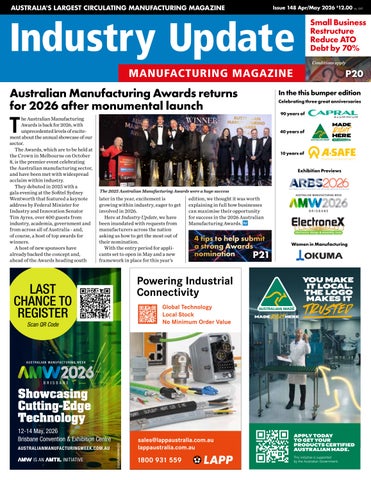

Australian Manufacturing Awards returns for 2026 after monumental launch
The Australian Manufacturing Awards is back for 2026, with unprecedented levels of excitement about the annual showcase of our sector.
The Awards, which are to be held at the Crown in Melbourne on October 8, is the premier event celebrating the Australian manufacturing sector, and have been met with widespread acclaim within industry.
They debuted in 2025 with a gala evening at the Sofitel Sydney Wentworth that featured a keynote address by Federal Minister for Industry and Innovation Senator Tim Ayres, over 400 guests from industry, academia, government and from across all of Australia - and, of course, a host of top awards for winners.
A host of new sponsors have already backed the concept and, ahead of the Awards heading south


later in the year, excitement is growing within industry, eager to get involved in 2026.
Here at Industry Update, we have been inundated with requests from manufacturers across the nation asking us how to get the most out of their nomination.
With the entry period for applicants set to open in May and a new framework in place for this year’s


edition, we thought it was worth explaining in full how businesses can maximise their opportunity for success in the 2026 Australian Manufacturing Awards.

4 tips to help submit a strong Awards nomination P21


The 2025 Australian Manufacturing Awards were a huge success

PAS 13 : 2 017
The Code of Practice for safety barriers in traffic management
Protecting people, assets, and infrastructure
Workplace transport remains one of the biggest causes of serious injury and death at work. PAS 13:2017 exists to reduce that risk - setting best practice for the design, testing, installation and inspection of safety barriers used in tra�ic management environments.
Developed by the British Standards Institution, sponsored by A-SAFE, and created in collaboration with an independent industry group, PAS 13 sets the benchmark for barrier safety worldwide.

Why PAS 13 Matters
The movement of goods and materials involves constant interaction between people, vehicles and infrastructure - and the consequences of failure can be severe.
PAS 13 provides a clear framework to help organisations minimise risk and protect people, assets and operations.
A-SAFE barriers are fully compliant with PAS 13 across all three elements.
Fit for Purpose Protection

Not all environments are the same.
PAS 13 recognises that effective protection depends on matching the barrier to the real-world risks, including:
• Vehicle type and speed
• Direction of travel and energy transfer
• Impact zones and deflection requirements
Different performance levels and impact zones ensure protection is �it for purpose.
A-SAFE only recommends solutions that are right for the environment. The right product. The right application.
Installation & Inspection
Compliance doesn’t stop at the product.
A-SAFE provides PAS 13 compliant installation and inspection services, including:
• Certified installation
• Comprehensive inspections
• Risk assessment and expert guidance
• Recommendations on barrier placement and design
• Advice on how to further enhance safety
Publisher SCOTT FILBY scott@industryupdate.com.au
Advertising & Sales Manager
PAUL FERRIS paul@industryupdate.com.au
Editor MIKE WOOD editor@industryupdate.com.au
Editorial Contributor
ROY GREEN
Sub Editor
RENATA GORTAN subeditor@industryupdate.com.au
Universities & Collaboration Editor DAVID SLIGAR unieditor@industryupdate.com.au
JERIN BURZACOTT jerin@industryupdate.com.au
Advertising Sales Director SCOTT FILBY scott@industryupdate.com.au
Marketing Manager DUMINSHA UDESHIKA marketing@industryupdate.com.au
Creative Director EDWIN KWONG production@industryupdate.com.au
Production Manager DUMINSHA UDESHIKA copy@industryupdate.com.au
Video Editor & Producer CHARLIE LOUGHLIN video@industryupdate.com.au
Office Admin JESSICA SUDESH admin@industryupdate.com.au
Finance & Accounts MICHELLE ALCOCK michelle@industryupdate.com.au
Consultant TRACY FILBY tracy@industryupdate.com.au
Accounts Receivable LYN SLIGAR lyn@industryupdate.com.au
Subscription Coordinator GUSTAV RHEEDER info@industryupdate.com.au
Circulation Coordinator RHYS MITCHELL info@industryupdate.com.au
Printer IVE Group

Book explores evolution of psychiatric treatment in Australia

Manufacturers know well the challenges of employee mental health - making a book by experienced practitioner Edward Moxon required reading for anyone interested in learning the history of the treatment of psychiatric illness in Australia.
Moxon’s book, Callan Park, Volume Two: The Rozelle Hospital covers the history of one of Australia’s most prominent mental health facilities, and charts the development of treatment there in the time since the NSW Royal Commission into the Callan Park hospital in 1961.
That Commission was called in response to allegations that staff were stealing from and abusing patients, and while not all complaints were upheld, it represented a sea change in how mental health care was organised in the state.

“The book is a record of how governments are influenced by groupthink and financial priorities, as well as being dictated to by bureaucracy and the desire to survive politically,” said Moxon.
“A variety of people in the following years made significant changes to the hospital administration, education of nurses, treatment of patients, community involvement and the environment.
“The unions fought a long battle to protect patient rights and improve hospital standards and reasonable working conditions.”
Moxon’s work runs from the 1961 Commission all the way through to 2008, and can provide great insights into the development of mental health care over that time.
“The incidence of mental illness has increased and the availability of treatment has become remote for many people, especially those with a long-lasting illness,” he said.
“Hospital treatment has drifted to general hospitals and the Mental Health Act has significantly changed. Private treatment is expensive and limited.
“Hopefully the book will highlight some of these problems and give direction for consideration by administrators, planners and politicians.
“One in five people will have a major psychiatric event and will want to know that they will be appropriately cared for.
“It will appeal to mental health workers to know how far the service has progressed and to be aware of previous mistakes and hopefully have the tools to address deficits in the system.
“For administrators, it’s a lesson on how not to run a mental health service. For past employees and patients, it could be a time of reflection and dealing with past trauma.”
Volume 1 & 2 are available from all good bookshops or online. Please address inquiries or direct orders to edwardmoxon@gmail.com
Ted Moxon’s book goes into the history of Callan Park Hospital
Cobots (collaborative robots) are becoming a familiar tool across Australian manufacturing and logistics.
They’re flexible, safe around people and great for shared tasks - if chosen and set up correctly.
Australia’s cobot safety landscape is guided by global standards like ISO 10218 and the collaborative- operation rules integrated from ISO/ TS 15066, outlining how cobots must be installed, validated and operated safely.
SafeWork NSW adds structure with guidelines for planning, hazard identification, and risk assessment across a cobot’s entire lifecycle.
“Cobots are incredibly safe when used the right way,” said Colin Wells, Group Managing Director of Robotic Automation, one of Australia’s leading cobot experts.
“The standards give us a solid roadmap so people and robots can work confidently side by side.”
Updated ISO requirements emphasise validating speed, force and separation limits rather than relying on manufacturer settings alone. Modern cobot systems also rely on advanced sensors and monitoring to keep interactions predictable.
Wells explained a situation that he sees more often than he would like in the real world.
“Sometimes I walk into a site and see an entry-level cobot tucked away in a corner,” he said. “It was sold as a ‘set-and-forget’ system,

but the customer actually needed something more tailored and never got the support to make the system work.”
“We even find cobots installed behind safety fencing. Once you put a cobot in a cage, you’ve removed the value of collaboration - that’s usually a job for a faster industrial robot instead.”
These cases are reminders that matching the tool to the job really does matter. While budget cobots
Robotic AutomationTM is an
Choosing
have their place, some systems may not fully meet collaborative safety requirements without proper validation or support.
“A good integrator doesn’t just install a robot,” explained Wells. “They help you build a solution that stays safe, reliable, and productive as your operation grows.”
Robotic Automation ragroup.com.au

Colin’s “Good to Know” Cobot Checklist
• Speed vs Safety - “Cobots are safe because they’re intentionally slower,” explained Wells. “If you need high speed or fast cycle times, that’s when you should choose an industrial robot instead.” Collaborative safety modes like Power-and-Force Limiting and Speed-and-Separation Monitoring prioritise worker protection over throughputperfect for shared spaces but not for high-volume tasks.
• End‑of‑Arm Tooling (EOAT) - Safety standards now explicitly include EOAT. Tools must be validated to avoid sharp edges or trapping points and to match the task’s hazards.
• Handling sharp or over head loads - Risk assessments must account for dropped-load hazards and object shape, especially when sharp or heavy items are lifted above head height.
• Welding applicationsWelding brings heat, fumes and arc-flash risks, requiring additional protective measures under ISO 10218.
A Yaskawa Cobot Palletiser
ROBOTICS & AUTOMATION
How automation is taking over the seas - and what manufacturers can learn from it
By Stuart Willison, Offshore, oil and gas specialist, Igus
The maritime industry - like all other industries - has to face the challenges of automation and digitalisation.
Whether in navigation, shipping companies or in the offshore industry with gas and oil, the analogue world is almost history - digital systems are establishing themselves and laying the foundation for automation concepts.
Complex solutions transform ships into autonomous factories, pave the way for shipping companies to become fully-fledged logistics providers and support the offshore industry in harvesting the oil and gas fields more efficiently by means of automated production processes.
In all areas, the higher the degree of automation and optimisation of these systems, the more cost-effective, sustainable and secure the business operations of companies will be.
In order for automation to succeed under these harsh environmental conditions, components and parts have to meet different requirements to those in conventional factory automation.
It’s why DNV-GL certification is so important, because ensuring that automation meets maritime standards is how companies can be confident that their tech is going to work when they most need it.
A glance at the variety of electrical cables available gives an idea of the risk to which maritime companies expose themselves when they equip their processes and systems with cables of average or inferior quality: important functions on a ship can fail and, in the worst case, lead to navigational failure or shipwreck.
Spare parts have to be delivered by helicopter at great expense; delivery of goods is delayed, entire supply chains are disrupted.
All in all, costs arising from an operational failure are out of proportion to the manageable additional costs arising from the acquisition of higher-quality cables.
In addition to control cables, data cables and motor cables, bus cables, measuring system cables or servo cables are indispensable components in automation, which are also used on ships and drilling platforms.
The material of these cables is subject to harsh environmental conditions such as salt, humidity or light irradiation and more. Many

cables are also constantly in motion.
Whether in drilling rigs, ship cranes or sluices, serious statements about the service life of a permanently moving cable can only be made if appropriate tests are carried out and the results confirmed by a qualified external expert.
DNV-GL is responsible for the certification of offshore plants, gas and oil pipelines, but also for important onshore areas such as wind, tidal or solar energy.
The classification organisation emerged from two heavyweights: the Norwegian company Det Norske Veritas (DNV), which carried out technical inspections on Norwegian merchant ships, and Germanische Lloyd (GL), which was founded in Hamburg in 1867 by 600 shipbuilders, shipowners and insurers.
It was not until 2012 that the two merged to form DNV-GL.
Those who have companies from the offshore industry as customers are measured almost exclusively by the safety of their products and thereby contribute to the safety of the end customer.
All these structures have one thing in common: heavy equipment is moved on top of, on and below them.
This is often made possible by energy chains in which signal, control or servo cables are guided. These chains guide and protect the sensitive cables even in highly dynamic applications and confined spaces.
A key point is that the selected cables must be suitable for use in the energy chain in a maritime environment.
Thus, the Igus engineers had to prove to the DNV-GL experts in comprehensive tests in the in-house Igus laboratory that the cables are suitable for the safe and stable operation of e-chains in/on offshore plants.
The chainflex cables are flexible down to operating temperatures of -40°C and are also UV-resistant.
Besides having seawater resistance, the meticulously-tested chainflex cables also operate reliably under the influence of oil.
The cables are resistant according to MUD NEK606, which enables maintenance-free pumping on drilling rigs and also stands for operator safety.
The Igus chainflex cables are designed for highly dynamic movements, and have gone through the complex process of a DNV-GL certification.
The chainflex cables are designed for use in e-chains and are tested and approved for use in maritime environments.
Shipping companies or operators of drilling platforms, gas production plants, wind farms, port facilities or ship cranes have the guarantee of maximum safety - trouble-free even over a long period of time.
This means that the further
automation of processes can be achieved even more efficiently.
Oil and gas production plants are usually planned, designed and installed for years of continuous operation.
The focus is always on the average operating time or the predicted time until a component fails.
Artificial lift systems make this clear: the automated and relatively new production processes increasingly use different pumps to convey oil from the wells.
Without a high degree of automation and optimisation, companies cannot provide cost-effective and sustainable support, which is the only way to compensate for the natural drop in production output.
The situation is similar in unmanned navigation. The ships of the near future will also be highly automated and dependent on software-based control systems.
On the whole, modern shippingjust like industry 4.0 on land - will make use of cyber-physical systems and link machines with information, communication and automation technology or integrate them into higher-level systems.
All this is only possible with the integration of components that meet the demands at sea and whose service life is predictable.
Treotham Australia treotham.com.au
Igus energy chains are widely used in shipping
The leading supplier of the BIGGEST names in Automation

Secure supply of energy and data to moving industrial equipment.
• Large size range
• Vertical travels
• Energy tubes
• Hygienic chains
• Solutions for long travel
• Guide troughs
• Readychain
• Robotic, 3D
• Circular movement

HUGE range of high quality flexible cables
• Control cables
• Single cores
• Data cables
• Sensor/Actuator
• Intrinsically Safe
• VSD/EMC cables
• Halogen Free cables
• High temperature
• Harsh Conditions
• Crane cables
• Profibus cables
• Bus/DeviceNet
• Solar cables
• Instrumentation
• Flat cables
• Curly cords

Largest range of flexible conduits for cable protection
• Conduits
• Conduit fittings
• Divisible systems
• Jumbo systems
• Conduit Accessories
• Braided cable protection
• Fire barrier solutions
• Food and beverage
• EMC systems
• Ex, ATEX, IEC EX

Industrial connectors for many industries
• Rectangular multipole connectors from ILME
• Single pole Powerline connectors from TEN47
• EPIC connectors from Lapp Group
• M23 circular connectors from Hummel
• Circular connectors specifically for the entertainment/stage lighting industry from Socapex

Safety engineering solutions from EUCHNER
• Multifunctional Gate Box MGB
• Transponder-coded safety switches
• Electromechanical safety switches
• Magnetically coded safety switches

Sensor technologies for automation
• High-Precision Laser Distance Sensors
• Ultrasonic Sensors
• Inductive Sensors
• Fluid Sensors
INDUSTRIAL SAFETY
How insurance is reshaping safety in Australian manufacturing

For most industrial operators, safety scrutiny isn’t just coming from the regulator any moreit’s coming from your insurer.
Across Australia, there’s a clear shift underway. Safe Work Australia still sets the minimum standard, but insurers are increasingly defining what an acceptable level of risk actually looks like in practice.
If your premiums have been creeping up, or your renewal process has turned into a deep dive on ‘minor’ incidents and site layout, you’re already seeing it.
Compliance vs. Actuarial Reality
There’s a growing gap between being compliant and being insurable. Compliance is a baseline. It asks whether the required controls exist. Insurance looks at something different: what actually happens on the ground.
Claims data tells a very clear story over time, and insurers price risk accordingly.
What stands out isn’t always the major incidents. It’s the accumulation of smaller ones: clipped bollards, damaged racking, repeat near misses at the same crossing points. Individually, they’re manageable. Collectively, they point to systemic issues and to where a larger claim is most likely to occur.
Nick O’Kane, National Sales Manager at Barrier Group, sees this regularly.
“I regularly walk sites with managers who are frustrated because their compliance paperwork is perfect, yet their broker is hammering them,” he said.
“The reality is that insurers have lost faith in ‘soft’ controls like highvis vests and ‘look-both-ways’ training. They know that under pressure, people take shortcuts.
“They are now looking for ‘hard’ proof. Physical separation that makes a human error impossible to turn into a claim.”
This is where the change is most noticeable. Traditional safety approaches rely heavily on behaviour: procedures, signage, high-vis, training.
All of these matter, but they’re inherently variable. Under normal conditions they work well.
Under pressure at peak dispatch, shift change and tight deadlines they can start to break down.
Physical controls don’t have that problem.
Separation systems, barriers, and controlled access points work regardless of intent. They remove ambiguity and reduce the need for constant decision-making on the floor. From an insurer’s perspective, that consistency matters.
Increasingly, sites that rely on visual or procedural separation alone are being viewed as higher risk.
Sites with clear, engineered separation and impact mitigation are viewed very differently, even if both are technically compliant.
What this means in practice
This shift doesn’t show up as a formal rule change. It shows up in pricing, in questions at renewal, and in how claims are assessed.
Sites with repeat low-level damage often see premiums trend upward over time. Known risk areas can lead to exclusions or conditions being introduced quietly at renewal.
After an incident, upgrades are often expected before terms improve. In effect, insurers are responding to real-world performance, not theoretical compliance.
Hardening your risk profile
The practical takeaway is straightforward: treat safety as a risk asset, not just a compliance requirement. A few areas consistently make a difference:
1. Identify repeat damage patterns Look beyond major incidents. Where are the same assets being hit repeatedly? These are the areas insurers focus on because they signal underlying design issues.
2. Remove negotiation points Any location where pedestrians and vehicles have to “work it out” in real time is a risk. Reduce or eliminate these interactions through physical separation or controlled crossings.
3. Focus on impact outcomes, not just prevention Incidents will still happen. Systems that absorb and dissipate energy reduce the cost and severity when they do, which is exactly what insurers are measuring.
4. Get ahead of the renewal cycle Engage early. Document upgrades and present them clearly. A site that demonstrates deliberate risk reduction is in a much stronger position than one reacting after the fact. Insurance is becoming a real-time feedback loop on how a site actually performs, not how it is designed to perform. Compliance will always matter. But increasingly, it’s just the starting point.
The more relevant question is whether your site would be assessed, based on its layout, controls and incident profile, as low risk by someone pricing the exposure. Because in practice, that’s what ultimately determines the outcome.
Barrier Group are safety experts

Facilities Safe for Everyone.
Most facilities have some safety measures in place, but gaps can appear over time as operations change.
➡ Pedestrian walkways are separated from vehicle traffic;
➡ Loading docks and mezzanines are protected from falls;
➡ Racking is protected from material handling vehicle impacts; and
➡ Traffic routes are clearly marked and controlled.
If any of these areas could benefit from improvement, simple upgrades can often make a big difference.
Many facilities enhance safety and compliance with solutions such as:
✔ Pedestrian walkway barriers to separate workers from vehicles;
✔ Racking protection to protect forklift damage;
✔ Gates for mezzanines and loading zones; and
✔ Bollards to control vehicle movement.
Make sure you check... Protecting Facilities in Australia for Over 25 Years!


Our team can help you identify simple and practice upgrades that improve safety and compliance. Contact us to organise a free on-site inspection of your facility today!
CASE STUDY
How Amiga are pushing the potential of additive and precision engineering
Founded in 1988, award-winning highly-professional business
Amiga Engineering Pty Ltd has built a national and international reputation for delivering precision-machined and Additive Manufacturing (AM) components across such diverse industries as aerospace, automotive, space, medical, sovereign precision engineering, mining, oil & gas, food & beverage, water treatment and industrial engineering.
Based in Tullamarine, Victoria in almost 20,000 square metre modern facilities, Amiga started with just two manual machines.
Today, they employ 20 highly skilled personnel with a combination of youth - including three apprentices - and a team of long-serving, experienced engineers with capabilities in mechatronics, chemical, aerospace and mechanical skill sets.
The company has invested heavily in the latest technology with some of the most advanced 3D additive manufacturing systems in Australia, with castings or hybridised manufacturing routes where shapes are optimised for strength and weight. Across the aerospace, automotive and energy sectors, component designers are pushing the limits of geometry, material science and structural performance increasing the importance of this technology.
Amiga has spent years building the capacity and engineering sovereign capability designed to solve challenges with components featuring organic shapes, internal
channels, multi-axis curvature and minimal flat faces.
Additive Manufacturing metal materials currently in use at Amiga include Ni-Nickel Super Alloy, AISi10Mg Aluminium, SS316LStainless Steel, W-45-Tungsten, T1A14v Grade 23, Scalmalloy and 17-4PH with many of these used in critical components in space, aerospace and highly corrosive applications.
Today Amiga is one of a very limited number of companies in the world that can metal 3D print in tungsten and the only company in Australia certified to print in Scalmalloy.
According to Amiga founder and owner Michael Bourchier, the latest additive manufacturing capability delivers weight reduction, customisation, lattice structures, topology optimization, enhanced fluid flow and component consolidation leading to increased functionality.
Amiga has recently commissioned the latest FANUC Robocut Model Alpha-C800iC high performance Electrical-Discharge Machine for precision cutting of thick, stepped and tapered parts with enormous savings in machine time and running costs.
Of critical importance in the further development and enhanced capability of the company, Amiga is celebrating the most recent acquisition with the commissioning of the latest Okuma GENOS M460V-5AX Vertical Machining Centre.
This machining centre is internationally recognised as one of


the most capable vertical 5-axis machining centres in its class with thermal stability and micron-level accuracy.
It will be particularly important in the machining of complex automotive and mechatronic system components such as housings, knuckles, mounts and control interfaces which require exceptionally tight machining tolerances across non-linear geometries.
There is an air of excitement within the engineering personnel with the introduction of this machining centre as the latest technology brings new skills and advanced Okuma programming capability.
“Our strategy at Amiga is to expand Australia’s sovereign precision-machining capability, to support emerging industries in space, advanced mobility and clean technology, strengthen the integration between Additive Manufacturing and CNC machining and to design without compromise delivering complex geometries consistently with repeatable quality,” said Bourchier.
“We are reinforcing our position as one of the most capable multi-disciplinary engineering firms in the country dedicated to expanding both domestic and international markets.”
This quality assured company is certified to ISO9001:2015 and AS9100D is already expanding development into highly sophisticated training drones, high performance ballistic Titanium vehicle protection and critical item component protection.
Also manufactured are complex helicopter bed and medical bed mechanisms, vital components in collaboration with Gilmore Space, Hypersonix Launch Systems for the Scramjet Engine and body works with Hypersonix Launch Systems, optimised UAV structures, crafted ballistic suppressors and lightweight aircraft components to name just a few.
“The company has built a proven track record of taking research to commercialisation with partners in Universities, DTC and DSTG and this work is acknowledged with numerous industry awards such as Most Innovative Manufacturer, Sovereign Industry Champion, Aus Space Award – Engineering company of the Year 2025, Vic Manufacturing Hall of Fame –Manufacturer of the Year and Apprentice of the Year 2025,” said Bourchier.
As part of the company’s significant diversification program Amiga manufactures industrial gearboxes and supplements this program with globally recognised gearbox brands plus extensive fabrication and maintenance of large precision items.
Expansion plans for the company involves ongoing investment in technically advanced machines and robotics plus the development of tactical drones, high temperature Additive Manufacturing (AM) coatings for space components etc. as Amiga Engineering continues to build a bright future for Australian manufacturing.
Amiga Engineering are based in Tullamarine, Victoria
Amiga Engineering CEO Michael Bourchier with the latest Okuma Machining Centre

100%
Locally
Quality
Local
Repair
Excellent
National
Free

Manufacturing is one of the few certainties in life.
From the moment we are born - on a hospital bed, wrapped in a blanket or placed in a bath - to the moment we depart this world in a coffin or cremator, manufacturing is always there beside us.
At times like these, it is good to remember that our sector is resilient, and will remain so.
We have seen an exceptional amount of disruption to start 2026. The recent explosion in Geelong was the last thing we needed given the chaos in the Middle East, and we can only pray that the Iran War ends soon.
Trump actually could have been a hero for once by liberating the good Iranian people from the tyranny of their government - which he promised to do - but in the end, he only did what suited him.
Of course, all of this impacts manufacturing in major ways, and the government needs to look at how to help manufacturers, especially traditional manufacturers who have told me recently they seem to miss out on many incentives. Let’s see how we can get them some assistance…
Australian Manufacturing Awards
I was thrilled to welcome Federal Minister Tim Ayres to the first Australian Manufacturing Awards ceremony in Sydney last October, and we are delighted to announce he will be back at the 2026 event, which I am proud to confirm will take place at the Crown in Melbourne on October 8.
We also hope that Premier of Victoria, Jacinta Allen, and Minister Colin Brooks (confirmed) will be in attendance.
To have the Federal Minister and various state governments support the Australian Manufacturing Awards from its inception shows the strength and need for this platform of excellence.
As for industry - the response has been, I am pleased to say, awe-inspiring!
We also now have the Awards Advisory Council, representing the most respected minds from industry, providing their expertise.
Today I learned that South Australia has a lot happening in manufacturing, mining and infrastructure.
For the June/July edition we will visit SA and bring you all the very latest that has awakened one of the quietest states in Australia!
Don’t forget - nominations for the Australia Manufacturing Awards opens May 2026, so keep an eye on all things awards at industryupdate. com.au for updates!

It had gone out of fashion in recent years, but the favourite phrase of the Covid era is back.
“In these uncertain times” is perhaps even more true now than it was then, with the conflict in the Middle East sending oil prices skyrocketing and causing myriad flow-on problems across all sectors of the economy.
In these uncertain times, the only thing Australia can be certain of is ourselves, and in particular, the things that we make here.
It’s why this edition, which will focus heavily on Australian Made Week, with a bumper feature, and Australian Manufacturing Week (AMW), the national showcase of our industry, is so important.
Further to that, too, is the recent developments in defence that have seen sovereign capability put front and centre of the Australian manufacturing narrative.
Late April saw the first launch of the Guided Multiple Launch Rocket System (GMLRS) at the Woomera Test Range in South Australia, Australian Made rockets for the Australian Army.
On the same day, the Albanese Government released the 2026
$21 million for NT advanced manufacturing glass facility
Northern Glass Solutions’ (NGS) has opened a state-of-the-art automated glass manufacturing facility in East Arm, Darwin.
The $21 million project strengthens local manufacturing capability, improves supply chain resilience and cuts lead times by bringing glass production 3,000 kilometres closer to the Territory.
Supported by the Northern Territory Government and the Advanced Manufacturing Growth Centre (AMGC) through the Advanced Manufacturing Ecosystem Fund (AMEF), the facility will produce special-purpose products including triple- and quadruple-glazed, laminated, tempered, acoustic, fire-resistant, cyclone-resistant, safety and bullet-resistant glass - the latter not previously manufactured in Australia.
NGS owner Jiayun Li said the support of the NT Government and AMGC was essential in bringing this project to life.
“Co-investment through the AMEF gave our project partners and investors the confidence to back a bold idea and build something entirely new for the Territory,” Li said.
To date, more than $4.8 million in state-of-the-art manufacturing equipment has been installed, enabling high-precision cutting, processing and quality control previously unavailable locally.
In just over six months, the project has created 12 jobs for Territorians, including four office and technical roles in administration, scheduling, procurement and technical support, plus eight factory roles covering production, machine maintenance, quality control and dispatch.
NT Minister for Advanced Manufacturing, Trade, Business and Asian Relations, the Honourable Robyn Cahill OAM MLA, said this project will build regionally important capabilities.
“It is driving real industry growth, which is in turn creating real opportunities for Territorians, now and into the future,” Cahill said NGS supplies architects, builders, engineers, window fabricators and property developers with a broad product range, including NTough, VistaLam, ZenPane Acoustic, InsulPane, DuoPane, ClimaLam, ClimaSmart, ResiShield, SentriShield, PatternaPane,
National Defence Strategy and the 2026 Integrated Investment Program, in which lay the announcement of a huge rise in defence spending that will see a further $53 billion sunk into the sector over the next decade, with $14bn of that brought forward to the next four years.
Clearly, although Australia is not a participant in the conflict in the Middle East, it is taking note that the neighbourhood is less secure than it once was, and that the old order is withering on the vine.
Sovereign capability has been a watchword for a while, and our ability to produce these items onshore is clearly highly valued in this government.
The total expense over the next decade has now topped $425bn, and that’s just the topline - beyond that massive number lies incrementally investment everywhere in the Australian supply chains, expertise and materials required to make the investment worthwhile.
With this huge increase in spending, it is clear that the Albanese Government’s loud spruiking of Made Right Here isn’t just talk.
As we walk around AMW in Brisbane, and as we enjoy a week of celebration for Australian Made at the end of May, we can state with confidence that our sector will rise to the task.
HuesPane, ArtiPane and N Mirrors. It covers everything from high-performance, acoustic, safety and decorative glass needs.
NGS will also collaborate with the Australian Glass & Window Association, James Cook University and RMIT University to research, prototype and test special-purpose glass products for cooling climate zones and cyclonic regions.
Through its newly established in-house R&D capability and these partnerships, NGS will leverage leading expertise and the latest research to strengthen innovation and advanced manufacturing capability in the NT glass industry.
As part of the project, NGS received a $668,072 co-investment from the NT AMEF, administered by AMGC. NGS matched the co-investment in cash and contributed an additional $4.1 million, bringing the total project value to $5.4 million.
AMGC director for the Northern Territory, Charmaine Phillips, is thrilled with the result.
“The success of the AMEF program demonstrates how targeted co-investment can unlock private sector confidence, accelerate advanced

manufacturing capability and deliver long-term economic benefits for the Northern Territory,” Phillips said.
With strong local and export potential to the Pacific Islands and Southeast Asia, the NGS project is expected to generate $12.6 million in new revenue and 22 jobs within five years.
Northern Glass Solutions is one of 16 projects to receive co-investment through AMEF. Since the program’s launch in 2021, AMEF has injected $32.1 million into NT manufacturing, supporting over 310 new jobs and generating more than $163 million in revenue over five years. Over the same period, AMGC has undertaken more than 700 stakeholder engagements, almost 200 site visits, 25 regional visits and 140 interstate engagements, strengthening industry connections and capability across the Northern Territory.
AMGC - amgc.org.au
NGS will manufacture specialty glass locally for sectors including defence and construction
Editor Mike Wood
Publisher Scott Filby
Why major report could be ‘tipping point’ for Australian innovation
By
Amid global turmoil, the report of the Strategic Examination of R&D (SERD) calls for “bold reform” of Australia’s “broken” research and innovation system. What better time to prepare for an uncertain future.
Ambitious Australia joins a long line of reports stretching back to the Hawke-Keating era, when public spending on science, research and innovation gained a 40 per cent boost in real terms.
By the end of the 1990s, knowledge-driven “elaborately transformed manufactures” were the fastest growing component of Australia’s export mix, with productivity growth running well above the OECD average.
We are now in a very different world. If the SERD report did nothing other than highlight the precarious state of Australia’s hardwon prosperity, it would still have performed a valuable service. And on this it does not hold back.
The report notes that Australia’s manufacturing share of GDP is the lowest among developed economies, business expenditure on R&D is also the lowest as a share of GDP and productivity growth is the lowest on average over the past decade for 60 years.
Of course, correlation is not causation. But as manufacturing is the major source of business R&D spending in most countries, it is hardly surprising that its decline is accompanied by the decline of R&D spending and, consequently, sluggish productivity performance – with associated real wage stagnation.
The problem is that in pursuit of “comparative advantage”, successive governments have allowed Australia’s resources exports to crowd out high-value manufacturing from an increasingly narrow trade and industrial structure. Hence, the task of the SERD was two-fold.
First, it had to think through the reconstruction of our entire research and innovation system, including neglected “blue sky” research.
And second it had to ensure that the system was “fit for purpose” as part of broader industrial policy to build new areas of competitive advantage in global markets and value chains.
After an extensive consultation
process, the report proposes a comprehensive “plan for action” with six elements.
The first and most significant element is “greater focus and scale”, recognising that “the system is fragmented, with uncoordinated programs, duplicated efforts across jurisdictions, and inefficient competition for limited resources”.
Echoing previous reviews, Ambitious Australia opts for a National Innovation Council to devise mission-led priorities for the system, safeguard national research infrastructure and coordinate implementation across six “pillars” – health and medical, agriculture and food, defence, environment and energy, and resources and technology.
Each of these pillars is designed to sponsor “national strategic initiatives” which consolidate and concentrate public funding and “engage all tiers of government, startups, small to medium enterprises, large businesses, investors and researchers in high-risk, high-impact challenges”.
The problem here is that while the motivation is sound, the bureaucratic complexity of these initiatives may prove a drawback, especially for industry involvement.
Simply replicating program-based models in a new institutional architecture would miss the opportunity for a more grounded approach.
In particular, submissions to the SERD panel proposed a network of collaborative, place-based innovation hubs or precincts, like the successful German Fraunhofer Institutes, UK Catapult Centres and ManufacturingUSA Institutes. This approach accepts that innovation is not linear but thrives in “ecosystems”.
30 years ago, the Innovate Australia policy statement favoured a similar model, with CSIRO and universities as an R&D engine for industrial transformation.
But in a story which would repeat to the present day, including for the Rudd-Gillard Venturous Australia report, the idea was lost with a change of government.
Other areas in the SERD plan for action are familiar but no less important. They encompass better support for foundational research, changes to the incentive structure for research and innovation, improved startup financing,

Roy Green has pursued a career in universities, government and industry and published widely on innovation and industrial policy, including with the OECD, European Commission and Australian government. He has led and participated in government inquiries and advisory bodies, most recently on regional energy transition and economic diversification, and is an experienced board chair across a range of areas.
development of workplace capability and embedding R&D in public procurement decisions.
What do we make of Ambitious Australia? It has assembled a formidable array of recommendations whose time has surely come.
But there are also significant gaps for further consideration by the government in the leadup to the 2027 budget, with the next election in prospect.
For example, the report has no view on the cost effectiveness of the demand driven R&D Tax Incentive (RDTI) as against direct targeted funding.
Nor has it addressed the critical role of management capability to engage with workforces and build
enterprise “absorptive capacity”, including for embodied artificial intelligence in manufacturing.
There is also the vital part Australia’s regions can play in the research and innovation system, as they address the related challenges of energy transition and economic diversification.
A separate report on the government’s Energy Industry Jobs Plan goes some way to filling this gap.
The SERD panel has made a welcome contribution to a complex and undervalued policy domain. The government’s task now is to process and integrate this contribution with its wider, transformative vision of a Future Made in Australia.
Roy Green, Emeritus Professor and Special Innovation Advisor at the University of Technology Sydney.
FROM THE MINISTER
From ingenuity to industry: Unlocking Australia’s critical minerals
By Tim Ayres, Minister for Industry and Innovation and Minister for Science
Australia is geologically rich. Below the ground, our deposits of both traditional commodities and critical minerals are the envy of the world.
Above the ground, we are home to a strong resources industry that applies world-leading expertise to transform these mineral deposits into new opportunities for industry and workers.
Despite being a major producer of many critical minerals, much of the downstream processing and refining has historically taken place offshore.
The question that will determine Australia’s prosperity and security over the coming decades is how effectively we can move up the value chain and convert geology into industrial capability.
Using research and development to boost critical minerals processing
Australia is a critical minerals powerhouse, in particular. We are the world’s largest producer of lithium – so crucial for modern battery technologies.
Australia is also among the five largest producers of cobalt, manganese and tantalum, and has the only supply chain outside of China capable of supplying both light and heavy rare earth elements.
Australia’s critical minerals and rare earths are essential to the technologies that will shape 21st
century industry. From renewable energy to defence manufacturing, by using Aussie research to increase Australia’s refining and processing capability we can strengthen local industries and build good blue-collar and engineering jobs.
Research and development is central to unlocking these new industries.
In December 2024, the Albanese Labor Government commissioned an independent panel to conduct the Strategic Examination of Research and Development, examining how Australia can strengthen its national research and development system.
The panel’s final report, Ambitious Australia, released in March 2026, sets out a roadmap to boosting’s Australia’s prosperity – and the critical minerals opportunity is a key example.
The techniques used to extract, refine and process these materials are advancing quickly. New techniques can reduce energy use, lower costs, unlock previously unviable deposits and integrate critical minerals production with new modes of industrial manufacturing.
Government investment in critical minerals processing and refining
That’s why the Albanese Government has invested $53 million to establish the Critical Metals
Minister for Industry and Science
Tim Ayres
Fire Sleeves - PVC Vinyl Caps - Spirals Guards


for Critical Industries Cooperative Research Centre (the CMCI CRC) to build Australia’s critical minerals refining and processing sector.
The CMCI CRC builds on significant investment by the Albanese Government in research and development in the critical minerals sector, like the Australian Critical Minerals Research and Development Hub, and broader investment of over $28.3 billion to support the development of the sector.
The new CRC will bring together more than 60 industry, universities and research organisations to develop and commercialise new refining and processing technologies for critical minerals.
The CMCI CRC will target its research in high-value minerals, breakthrough technologies and sustainable refining and processing methods.
It reflects what the CRC Program has done for more than 35 years: crowding in private capital – in this case, more than $185 million – to drive Australian research that solves important national challenges.
Delivering together –researchers, industry, government
Advances in these technologies will strengthen supply chains, support advanced industrial capability and create good-quality high-skilled jobs and economic opportunity in

Australia’s industrial regions.
This is what industry policy is all about. Governments creating the conditions for purposeful private sector investment. Researchers developing new knowledge. Industry partners marshalling their energies to help solve big challenges and achieve commercial outcomes. Together, we build capability that none could achieve alone.
This collaborative model sits at the heart of the Albanese Government’s broader approach to economic transformation.
Through Future Made in Australia, our $22.7 billion plan to provide targeted support to sectors linked to Australia’s long-term prosperity, we are working to ensure Australia captures the opportunities of the energy transition and strengthen Australia’s security and resilience.
Achieving that goal will require research, engineering expertise and sustained collaboration.
Australia’s world-leading CRC Program delivers on Bob Hawke’s promise in the late 1980s to make Australia a ‘clever country’ that turns its resources and ingenuity into good industries.
The CMCI CRC will work in that rich tradition. As it does, it will help build the industries, skills and jobs that will underpin Australia’s next era of economic growth that delivers for all Australians.
Atlas Copco’s new GA15-45VSD delivers:

Up to 35% energy savings with advanced VSD drive train
IE5‑rated iPM motor for maximum efficiency
Smart controls for real‑time optimisation
IP66‑protected motor built for tough Australian conditions
Elektronikon® Touch for remote monitoring and performance insights
Higher reliability & lower total cost of ownership


MANUFACTURING BUSINESS & FINANCE
How to maximise the value of an acquisition for your manufacturing business
The Australian manufacturing sector has seen renewed focus in recent years, driven by supply chain pressures, technological change and the need for greater operational resilience.
The last five years have seen the mid-market drive merger and acquisition activity in Australia. For those wondering, ‘What is an acquisition?’, it is the purchase of control in another entity to deliver strategic or financial benefits.
While local transactions have grown, there’s also been a flurry of inbound activity for quality Australian businesses, driven by a weaker Australian dollar, a stable investing environment and a strong developed economy.
The data shows that foreign buyers accounted for 30% of transactions within Australia, the highest share in ten years.
Foreign acquirers continue to pay premium multiples for Australian assets, particularly where there is earnings visibility, strong governance and reporting and exposure to long-term growth.
With interest from foreign firms making Australian businesses more lucrative for a sale, there’s still a big opportunity for businesses to consider adopting an acquisitive growth strategy to gain a competitive edge.
When assessing a business acquisition target, it should be value accretive and increase the value of the business, whether directly, in the case of increased earnings, or indirectly, in the case of achieving economies of scale.
An effective business acquisition should be tied to the buyers’ strategic objectives. Some of the more common characteristics sought when selecting a potential acquisition target are discussed below.
Financial performance
Targets may be profitable or unprofitable, but in each case, the acquirer must be confident the acquisition will add value (including earnings) post-completion.
Some acquirers may purposefully seek targets that are in financial distress in order to obtain a bargain, with the belief they have the ability to turn around the target’s performance.
It is essential, however, to gain an understanding of the underlying reasons contributing to the poor
By Mark Calvetti, Partner, Corporate Advisory, WilliamBuck
performance and the subsequent implications.
These factors must then be carefully assessed to ensure they do not permanently prohibit the target’s ability to generate profits and growth in the future.
However, the latest data shows companies are taking an alternate route to acquisition, preferring to invest in quality companies which are profitable.
Target size
Determining the size of the acquisition target will depend largely on the experience and resources of the acquiring entity.
Our analysis found that mid-market transactions continued to dominate the volume of M&A deals, with the largest segment being deals with a value of up to $100m making up almost 75% of all deals in 2025.
The attractiveness of an acquisition should not solely depend on the size of the potential target.
Ensuring the target or buyer reflects the objectives of the acquisition strategy will be of greater importance and subsequently, factors such as market share or synergies may be more significant than size.
Management and key staff
When reviewing a potential acquisition target, it is important to assess the capabilities of management and key staff and look at ways in which their skills can be used to fill gaps in the current business’ capabilities.
It is vital that the management and key staff required to ensure the future success of the business are willing to remain with the company subsequent to the acquisition (and can be locked in for a period of time post-acquisition).
Conversely, it is important to look at functions or job roles that may overlap post-acquisition and have a redundancy strategy in place if required.
Cultural compatibilities
Differences in corporate culture are one of the major factors contributing to the failure of mergers and acquisitions. As such, cultural issues should be carefully considered prior to entering into any transaction.
Depending on the level of integration proposed, cultural compatibility may, or may not, be essential to

the success of the transaction.
Where there is a low level of integration required, the transaction is unlikely to cause any significant culture shock to employees and synergistic cultures may not be essential to the success of the transaction.
Where there is a high level of integration, culture shock can be a big problem that may eventually lead to key employees feeling unsatisfied and leaving the organisation.
Achievability of forecasts
Careful consideration must be paid to any forecasts (financial or otherwise) that may be relied upon in making decisions regarding the transaction, particularly where they are prepared by the target or on behalf of the target.
Financial forecasts may be based on unrealistic assumptions and can fail to take into account the distraction on a target during the acquisition process (which can stretch over a 12 month period).
Intellectual property
Mergers and acquisitions can be useful strategies for obtaining intellectual property, such as trade secrets and patents, complementary to existing assets.
The significant increase in transactions in the technology sector demonstrates the interest by
buyers in harnessing these capabilities rather than building their own capabilities.
It is important that sufficient due diligence is carried out to ensure intellectual property is protected, the target holds full title to these assets, and they are not subject to any restrictions that may inhibit the intended benefits of the transaction.
Price and terms
Where the acquisition target is highly attractive, it can be easy for the acquirer to get carried away in the negotiation process. A transaction should not be completed at any cost to the acquirer.
It is important to maintain an objective perspective and ensure that a fair price and suitable terms can be agreed upon with the potential target’s owners. Plan how you will begin financing a business acquisition, whether through model debt covenants, working capital, or integration costs.
Each acquisition will have its own individual characteristics and requirements. When selecting a potential acquisition target, it is essential to refer back to the unique objectives sought in the acquisition strategy and pay close attention to the acquisition profile established.
William Buck - williambuck.com
William Buck are here to assist with manufacturing accountancy needs
Manufacturing iLab focuses on AI, growth and diversification
In uncertain economic times, it helps to have an expert or two on hand.
Thankfully, the Manufacturing iLab, held in Parramatta in March, had exactly that, in the form of Besa Deda, chief economist at accountancy and advisory firm William Buck, and Alice Cahill, Director, Industry Development at Investment NSW.
The pair enlightened the meeting room at the iLab, a gathering organised by WilliamBuck, St.George Bank, insurance brokerage Aon and Coleman Greig Lawyers as a forum for manufacturing business owners to network, share best practice and question expert speakers.
Deda presented the latest in economics, while Cahill explained the current policies within NSW that are available to help the manufacturing sector.
As many might have predicted, AI and growth were high on the agenda, and speaking to Industry Update after the event, Deda explained how investment related to new tech was filtering through into economic numbers..
“If you look at employment gains and share market returns over the last year across industry sectors, it becomes clear that the gains are not evenly distributed,” she said.
“The pattern is quite uneven, and that unevenness is also visible in business investment. A significant portion of recent investment has been driven by data centre fit-outs,
which are inherently lumpy.
“Looking at where growth is concentrated, several sectors stand out.
“Energy, defence and data technology - particularly advanced manufacturing capability - have been key drivers. Housing also plays a role. In the share market, materials have been a major contributor, supported in part by elevated commodity prices.
“These concentrations highlight a broader issue. Some parts of the economy are performing strongly, while others are not keeping pace. That divergence reinforces the need to diversify into other areas rather than relying on a narrow set of high-performing sectors.”
Cahill added that the state government was acting in response to this uneven development, in particular by introducing more breadth into NSW’s manufacturing sector.
“New South Wales is actively working to diversify both the markets it exports to and the types of products and services it exports,” she told IU.
“This is a central focus of the state’s trade and investment strategy. The aim is to expand beyond a narrow base of key sectors and reduce reliance on both specific industries and limited export markets.


“As part of that strategy, there is a clear push to broaden the economic mix. This includes targeting a number of key focus sectors identified within the trade and investment framework.
“These sectors include agri-food, health and science, defence and aerospace, as well as manufacturing.
“The overall objective is to build a more balanced and resilient economy.
“By diversifying both what is produced and where it is exported, New South Wales is seeking to reduce its dependence on traditional industries and create a more sustainable long-term growth model.”
Deda agreed, opining that wider global conditions also played into the need to build a broader base to the economy.
“The current environment makes diversification even more critical,”
she said.
“Global economic uncertainty remains high in the near term due to geopolitical developments, and is likely to remain elevated due to structural factors such as ageing populations, the transition to net zero and the rapid development of artificial intelligence.
“In that context, the uneven distribution of growth underscores the importance of diversifying both geographically and across industries.
“Compared to a year ago, the spread of returns and activity is more uneven, making diversification more important than ever.”
William Buck - williambuck.com

Are you prepared for the next stage of your business growth? Access the William Buck Hour, a free session designed to help middle-market businesses assess their current position, realign thinking and maximise their potential. Scale up your growing business in just one hour. Post-session, our
Besa Deda of William Buck
Alice Cahill of Investment NSW
MANUFACTURING BUSINESS & FINANCE - CASE STUDY
Three generations, two brands, one bank - and whole heap of salt

Surviving and thriving in Australian manufacturing often involves agility: responding to the capricious nature of our geography, climate and economic conditions to make the most of an opportunity.
For Pacific Salt, that adaptability has been at the heart of their story. They were formed in response to the last great Australian droughtthe one in the 1940s, not the 2020s - when weather conditions in the Goulburn area forced Norman Olsson to get creative about keeping his sheep healthy.
With nutrients in short supply, he bought his own salt-press and got going: first with salt from Mexico, then domestically produced crystals from the Yorke Peninsula and,
eventually, Whyalla.
“It sounds like a strange associationsteel and salt - but before steel could be heated to remove impurities, it was washed with heavy brine. A lot of steel manufacturers had salt pans,” explained Alex Olsson, director at Pacific Salt.
“That’s where our main salt manufacturing hub is now, and from there, it expanded. We make blocks in Whyalla as well, but mainly in Morningside, a suburb of Brisbane, where about 80 per cent of our blocks are made.
“To make salt, you need hot days and wind. The wind whips up the water and helps evaporation. Most good salt locations have over 300 days of sunshine and strong wind. Whyalla is very windy, which works well.”
Alex is the third generation of Olsson to sit in the big chair at Pacific Salt in Yennora, in Sydney’s southwest, but it was her father, Charles, that supercharged the business.
He first got Pacific Salt involved with St.George Bank. Charles was open about the challenges of his industry, and would meet regularly with the bank - first every six weeks, then every three months - over a 15-year period to ensure that everyone was on the same page.
Lucky for him, the bank were ready to match his ambition, and to appreciate the challenge that comes with the industry.


“We know this is not a standard relationship,” said Alex.
“Having a bank manager who understands the business gives us confidence to make those decisions.
“We are a conservative business. We think carefully about everything we do. There haven’t been any ill-considered concepts during my time. That comes from learning from my father.”
Working in such a changeable business requires a financial partner who understands manufacturing, in all of its sector-specific quirks.
“When we have dry conditions, production increases significantly,” said Alex.
“That means we need more capital to purchase ingredients, packaging, energy and labour. We might not see returns for six to eight months.
“Conversely, in wet periods, revenue drops and we need time to work through existing stock without losing employees.
“We don’t want to lose employees. We value them highly, so we try to keep them and adjust operations.
“All of this means we need a bank that understands fluctuations — both when revenue drops and when we need increased credit for production.”
Alex wasn’t always with the family business. She had a separate career in hospitality before joining the agricultural side, and that experience in the restaurant trade proved vital in launching the second strand of the business - Olsson’s Salt.
The venture paid off big time, with the blue-and-white striped Olsson’s packaging highly recognisable - thanks to Alex’s marketing ability, which turned the company’s Scandinavian heritage and experience in the salt industry into
culinary gold.
“I worked in restaurants and hotels until I joined my father in 1997,” she said.
“I first got into the blocks, because that was the emotional and historical core of the business. Around 2012, I moved over to the salt side.
“Because of my background in hospitality, I went out to my contacts and we started with flakes, which was a new product. Then we expanded.”
“It’s hard to say the salt business isn’t subject to events — it is — but it’s more stable than the block side because of seasonality.
“The old Pacific Salt logo was a Viking ship. We took the stripes from the sails and used them on the packaging, and it seems to have resonated.
“I still go to Carriageworks Markets in Sydney and speak directly with customers. That feedback is valuable.
“We get a lot of international visitors. Australia has a reputation for being clean, green and ethical. That’s what we rely on in export markets.
“Not all our salts are premium. We offer affordable options as well. Everyone should have access to good quality products.”
The expansion would not have been possible without St.George Bank, who were willing to go the extra miles, based on years of mutual trust and support.
“This isn’t a normal banking relationship,” admits Olsson.
“We recognise that. It’s not something we take for granted.”
St.George - stgeorge.com.au
Olsson’s Salt is a culinary favourite
Pacific Salt have a location at Port Alma
Alex and her father Charles

Matthew Kelly Head of Manufacturing & Wholesale
MANUFACTURING BUSINESS & FINANCE
Navigating ATO Debt using a Small Business Restructure (SBR)
By Tom Vandermeer of BCR Advisory

Importantly, the process provides a structured and legally supported pathway to deal with mounting liabilities, including ATO debt.
Why this matters now
A critical development impacting manufacturers is Australia’s increasing energy costs, now exacerbated by the oil crisis, driven by geopolitical instability in the Middle East.
Disruptions to the major supply route of the Strait of Hormuz have caused sharp increases in oil and fuel prices, significantly raising energy and transportation costs for businesses.
For manufacturers operating on tight margins, this surge in energy costs will place ongoing and substantial pressure on profitability and cash flow.
What was once a relatively stable input cost has become expensive and volatile, feeding through production expenses and making it far more difficult to manage the cost base of the business.
For many businesses in the manufacturing sector, the past few years have been defined by disruption: supply chain instability, rising input and compliance costs, labour shortages and fluctuating demand.
As a result, tax obligations have often been deferred to preserve cash flow.
This was not such an issue when the Australian Taxation Office (ATO) was less active.
However, the ATO has now resumed a more proactive approach to debt recovery and has refocused on collecting tax debts legally due from taxpayers.
As a result, it has never been more important to understand the options available when your ATO debt starts to mount.
One of the options available to companies that find themselves with the overbearing accumulation of tax debt is the Small Business Restructuring (SBR) process.
SBR is a formal insolvency process introduced to help eligible small businesses restructure their debts while the business continues
trading.
It is designed to be more of a ‘light touch’ than the traditional Voluntary Administration, making it quicker and more cost-effective.
That makes it particularly relevant for small to medium-sized manufacturers facing financial distress.
How the SBR Works
The SBR process allows a company’s directors to remain in control of day-to-day operations while working with a registered Restructuring Practitioner to develop a plan to compromise outstanding debts.
Once the process begins, a proposal is put to creditors outlining how much of the debts will be repaid, typically with an agreed amount paid in by the Company over a defined period.
Commonly, the contribution may enable - as a guide - on average a payment of around 30% of the total debts.
Creditors vote on the plan, and if approved, the business can continue operating while meeting the agreed repayment terms.
Engaging with a Restructuring Practitioner at the first signs of financial stress allows for greater flexibility in designing a workable plan.
It also increases the likelihood of creditor support, as stakeholders are more inclined to back a business that is proactive and transparent.
Early action can also prevent the accumulation of additional penalties and interest, preserving value within the business and improving long-term viability.
By contrast, delaying action typically diminishes options, raises costs and increases personal risks to directors.
Financial distress can be confronting. However, SBR offers a viable pathway for manufacturers to stabilise their operations and move forward.
It is not a last resort. It is a strategic tool that, when used early, can preserve the business, protect jobs and value and deliver better outcomes for all stakeholders. Don’t wait until options become limited. Take the first step now.
BCR Advisory - bcradvisory.com.au
At the same time, the ATO has become more assertive in pursuing outstanding debts, including issuing Director Penalty Notices (DPNs) and initiating enforcement actions.
This creates a more urgent environment where inaction can quickly escalate into serious consequences.
Manufacturers are particularly exposed due to the capital-intensive nature of their operations.
High fixed costs, including equipment, facilities and workforce expenses, limit flexibility when cashflow tightens.
Additionally, long production cycles and extended payment terms can create timing mismatches between revenue and obligations.
Where legacy liabilities such as unpaid superannuation or ATO debt exist, the pressure is further intensified.
These factors make early intervention critical. Waiting until cash flow becomes unmanageable reduces the range of available options and increases the likelihood of the closure of the Company.
The most important message for manufacturers is this: SBR is most effective when implemented early.
Fast Facts: Small Business Restructuring (SBR)
• Debts need to be less than $1 million.
• Tax lodgements and Employee liability payments need to be up to date.
• The average debt reduction from an SBR is 70%.
• Directors remain in control of day-to-day operations.
• The SBR stops creditor pressure immediately.
• The ATO is the primary creditor in 85% of SBRs.
• Compliance is key - a good ATO compliance record will point to better prospects.
• Early action significantly improves the likelihood of a successful outcome.
• Delaying action can lead to enforcement action and personal liability for directors.
• BCR has conducted approximately 300 SBRs.
• You can only do it once every 7 years, so use someone with the experience required!
By Tom Vandermeer of BCR Advisory

4 Tips to help submit a strong Awards nomination
Choose the right award
It is important to ensure that you nominate for the correct Award(s) as there are plenty to choose from.
The chances are that you are eligible for more than one of them. Some awards are, naturally, more popular than others, so don’t be afraid to put yourself forward in multiple categories to give yourself the maximum chance.
The best place to start is with the award that is most suited to your sector, then work up from there.
If you feed into the Defence industry in any way,
Study the framework
then tell us about it, and if you have made great strides in safety, then make sure you focus your efforts there before going into the more wide-ranging categories.
When you start the nomination form, there will be boxes to tick that pertain to award categories such as Australian Made, Regional Manufacturer and Small/ Medium Business that enable the judges to advance nominations that they think are particularly strong. For example, if you nominate for Defence Award but tick the box as an Australian Made licensee, your application can also be considered for the Australian Made Award.
The Awards Council have put together a framework for every award that reflects the key values that define what good looks like in manufacturing. Each Award has guidelines which clearly
Back it up
The written submission is the most important part of your nomination, but alongside it, the judges are looking for hard evidence that backs up what you are saying. If the evidence is commercially sensitive, nominations will not be punished. Remember, our judges are all from within the manufacturing community, so they understand that trade secrets, defence contracts and other limiting factors are there.
Make it yours
The Awards nominations are designed to offer the opportunity for the manufacturing sector to blow its own trumpet and celebrate all the good work that is done. Don’t be afraid to big yourself up - after all, that’s what we’re here for!
A second aspect of the awards process is for manufacturing businesses to self-assess the work that they do, because sometimes it requires an outside eye to


state the specific priorities relevant to the judges in that category, so make sure that, wherever possible, you refer to the framework in your nomination.
A good nomination is all about you, but also where the great work that you do feeds into the priorities and values that make manufacturing in Australia successful.
They do not mark down for lack of evidence, and are instructed to consider the written submission first and foremost.
But they can only work with the material that they are provided, so it pays to give them every possible reason to mark your nomination up. If you can provide evidence - do it!
A strong written submission with detailed, factual evidence and a clear storyline on why you deserve to win the award is the best way to give yourself a chance.
see what works and what doesn’t.
The framework is designed to help you to do this. It is based on national key priorities in manufacturing, so when you put together your nomination, use that as an opportunity to audit what you do and think about the big picture.
The judges want to see how a business or individual fits into the sector, and what innovations, improvements and excellence they are displaying. Most of all, this is about you and your story - so tell it in your own way!
Our 2026 sponsors


AUSTRALIAN MANUFACTURING AWARDS

New Advisory Council to guide Australian Manufacturing Awards
The Australian Manufacturing Awards has further deepened its link with Australian industry with the announcement of a new Advisory Council to guide the event’s development and integrity for 2026 and beyond.
The Advisory Council will provide guidance to Awards organisers Industry Update on key elements of the awards program, including award categories, judging criteria and the overall awards experience. It will also play a role in reviewing learnings from the 2025 program and shaping priorities for future award seasons.
The formation of the Council follows strong interest from sponsors and stakeholders and reflects a desire to ensure the awards continue to recognise manufacturing excellence in a way that is credible, relevant and reflective of the sector’s breadth.
The Council is co-chaired by Annette Dockerty and Monique Donaldson, and brings together senior leaders from industry, government, research and economic policy.
Members represent a broad cross-section of the manufacturing

ecosystem, with experience spanning SMEs and large manufacturers, economic development, innovation, skills, research and finance, and with geographic representation across NSW, Victoria and national roles.
“This is a major advancement for the Australian Manufacturing Awards, and further underlines how well-received the Awards have been within industry,’ said Scott Filby, Publisher of Industry Update and organisers of the Awards.
“Having such an esteemed and respected Council to assist will provide vital industry knowledge, ensure independence and improve the value of the Awards to Australian manufacturing as a whole.”
The Advisory Council will meet regularly throughout the 2026 awards cycle, providing structured input to support the continued evolution of the Australian Manufacturing Awards as a national platform for recognising manufacturing capability, leadership and innovation.
Council members include:
• Annette Dockerty (UTS)
• Monique Donaldson (The Purposeful Exporter)

• Daniel Gronowski (Founder, Gron Management Consulting)
• Professor Roy Green (Independent; Special Innovation Advisor to UTS)
• Besa Deda (Chief Economist, William Buck)
• Vikram Sachdeva (Director –Manufacturing Excellence & Transformation, Factory of the Future, Swinburne University of Technology)
• Lindsay Wakefield (Executive Director, Safetech Australia)
• Marijana Upton (National Manager Marketing, BlueScope)
• Sue Logan (Manager – Melbourne’s North Advanced Manufacturing Group, North Link)
• Steve Milanoski (Director, Manufacturing Technology, Advanced Manufacturing Readiness Facility)
• Sarah Rowe (Manager Economic Development, City of Whittlesea)
• Tyson Bowen (Director, Media and Government Relations, Advanced Manufacturing Growth Centre)
• Holden Frisoli (Manager Economic Development, Fairfield City Council).
Annette Dockerty is a trusted adviser to NSW manufacturers, bringing four years of hands-on industry engagement through her role as Program Lead, SME Engagement at the University of Technology Sydney (UTS).

Monique Donaldson is an international growth specialist, with her own strategy practice, The Purposeful Exporter. She has 20 years of advisory experience working across renewable energy and carbon emission reduction, food and agriculture, mining services, advanced manufacturing and enabling technology.

Annette Dockerty Besa Deda Monique Donaldson Daniel Gronowski
Besa Deda is a highly experienced Chief Economist with a solid background in financial markets and leadership. Besa became the first Chief Economist of an Australian Bank with St.George Bank in 2008, and joined accountancy firm William Buck in 2025 after 15 years in the Westpac Organisation.

Daniel Gronowski has 20 years’ experience in strategy consulting, early-stage ventures, university commercialisation and venture capital. He runs a management consultant practice and is an Advisor for the Federal Government’s Industry Growth Program.
The 2025 Australian Manufacturing Awards were a huge success


Holden Frisoli
Holden Frisoli is the Manager of Economic Development at Fairfield City Council, where he leads initiatives to strengthen the local manufacturing sector.

AUSTRALIAN MANUFACTURING AWARDS

Lindsay Wakefield Marijana Upton
Lindsay Wakefield is the founder of Safetech, Australia’s largest dock equipment and materials handling company, with more than 200 employees and offices in all states.

Marijana Upton is National Manager, Marketing for BlueScope’s Distribution group, with over 20 years of experience. She is a committed advocate for Australian manufacturing and the advancement of women in industry.
Roy Green Sarah Rowe Steve Milanoski
Roy Green is Emeritus Professor and Special Innovation Advisor at the University of Technology Sydney. He currently chairs the Advanced Robotics for Manufacturing (ARM) Hub and is a board director of the Commonwealth Scientific and Industrial Research Organisation (CSIRO).


Sarah Rowe is the Manager of Economic Development for the City of Whittlesea in Melbourne’s north, focusing on investment attraction, business growth and local economic support. She serves on the serves on the NORTH Link board and has over 15 years of local government experience.

Steve Milanoski has spent his career turning ambitious engineering into production reality. As Technical Director at the Advanced Manufacturing Readiness Facility (AMRF), Steve now leads Australia’s only facility dedicated to manufacturing industrialisation.
Sue Logan Tyson Bowen Vikram Sachdeva
Sue Logan is General Manager – Skills & Employment and Manager of Melbourne’s North Advanced Manufacturing Group at NORTH Link. She works closely with manufacturers, government, education providers and industry partners to support the continued growth of advanced manufacturing across Melbourne’s northern region.

Tyson Bowen is Manager, PR and Communications at the Advanced Manufacturing Growth Centre (AMGC), and brings over 20 years of communications experience across technology-driven industries.

Vikram Sachdeva is Operations Manager at Swinburne University of Technology, and brings over 25 years of experience in the manufacturing space spanning operations, industrial engineering, continuous improvement and digital transformation.
MADE
Australian Made Week is here!
Australian Made Week is one of the biggest of the year for our manufacturing sector - a celebration of the Green and Gold Kangaroo logo that pays tribute to every corner of Australian industry.
The big week will run from 18-24 May 2026, with comedian Andy Lee joining the ranks of Ariarne Titmus OAM, Jessica Mauboy, Ash Barty, Adam Liaw and Elyse Knowles as the official Australian Made ambassador.
The 2026 campaign coincides with the Australian Government’s massive push behind local manufacturing, the Made Right Here advertising campaign that was launched in January by Federal Minister for Industry and Innovation Tim Ayres.
This edition will be bigger than ever for another reason, with the Australian Made Campaign celebrating their 40th year in operation - and, by the stats, they are going stronger than ever.
In the latest data, it was revealed
that 84% of Australians are more likely to buy a product if they know it is Australian Made, and 73% of Australians want to buy more Australian-made products to reduce Australia’s reliance on imports.
Moreover, if every Aussie household spent just $10 more a week on Australian Made products, it would be worth $5 billion to the economy as a whole.
“When consumers choose Australian Made, they’re actively supporting local economies, strengthening communities and helping Australian businesses thrive. Supporting local has never been more important,” said Australian Made Chief Executive Ben Lazzaro.
Australian Made Week is about calling on shoppers and businesses to back the home team and look for the Australian Made logo, because Australian Made makes Australia.”


TANK-FED SAFETY SHOWERS
• No reliance on mains water supplyperfect for remote areas
• Manufactured to meet AS4775-2007, EN15154 and ANSI Z358.1-2014
• 1500L jacketed & insulated tank
• Corrosion-resistant construction
• Suitable for indoor or outdoor installation
• Optional upgrades also available, such as: chiller units, eye/face wash stations, lighting and alarm systems


Comedian Andy Lee is an official Australian Made ambassador

AUSTRALIAN MADE
Capral celebrates 90 years of Australian manufacturing

Capral, one of the biggest names in Australian manufacturing, are turning 90 this year - and are celebrating it in style.
They have already had a huge national media moment, hosting the launch event for the Australian Made Campaign’s Made Right Here campaign, with Federal Minister for Industry and Innovation and Minister for Science Tim Ayres visiting their facility in Smithfield, NSW.

That is just one of several events that will be held at sites across Australia, representing the breadth and depth of Capral’s contribution to Australian industry.
Both workers and customers will be invited to participate, and the company is set to release a publication that will detail the huge progress made over the years that have passed since Capral was launched in 1936.
“Reaching 90 years of Australian manufacturing is a significant achievement and one that reflects
the dedication of generations of employees, customers and partners who have contributed to Capral’s success,” said Capral Chief Executive Officer and Managing Director Tony Dragicevich.
“Our business has evolved through many chapters. Throughout that history, one thing has remained constant, a commitment to manufacturing in Australia and supporting the industries that rely on locally produced aluminium.”
Capral have traded under several names in their history, but can chart their story of making aluminium right here in Australia over nine decades.
They were initially the local arm of the British Aluminium Company, before becoming Australian Aluminium Company, then Australuco and Alcan Australia and ultimately Capral in 1995.
Their business was based out of Granville in Sydney’s West from as early 1941, when the first local aluminium sheet rolled off the line, helping the Australian war effort and beginning a commitment to sovereign manufacturing that continues to this day.
The development of Australia’s primary aluminium industry was an important chapter in this story.
In 1969, the Alcan Kurri Kurri aluminium smelter in New South Wales commenced production, supplying locally produced primary
well as OneSteel Aluminium in 2013.
Now, the company is Australia’s largest aluminium extrusion manufacturer and distributor, with a product line that support industries across the country, from construction and manufacturing to renewable energy, transport, marine and defence.
All the while, the commitment to making their product in Australia, for Australia, has never wavered.
“Aluminium is one of the most versatile and sustainable materials available today. It has shaped our transport systems, our buildings and our infrastructure for decades, and it will continue to play a critical role in energy transition, renewable technologies and modern construction,” said Dragicevich.
“As a proud licensee of the Australian Made logo, Capral is committed to strengthening local supply chains and ensuring customers have access to high-quality aluminium products manufactured right here in Australia.
aluminium that supported the business’s downstream manufacturing operations.
Over time the smelter became an important part of Australia’s aluminium supply chain and contributed hundreds of thousands of tonnes of locally produced aluminium during its early years of operation.
The current business is the product of acquisitions that saw established aluminium brands like Comalco and Crane Aluminium brought under the Capral banner, as
“As we celebrate this milestone, we are also looking forward.
Australian manufacturing continues to play an essential role in the nation’s economic strength, and aluminium will remain central to the industries shaping Australia’s future.
“Capral is proud to be part of that story and committed to supporting Australian manufacturing for generations to come.”
Capral - capral.com.au

Syphoning aluminium from a smelter cell in Kurri Kurri
Tim Ayres at Capral Aluminium to launch the new campaign
Workers at the facility in Lidcombe
Need Aluminium Extrusions
As Australia’s largest supplier and extruder of aluminium, Capral is committed to supporting Australian manufacturing with high-quality, locally produced aluminium extrusions. Our state-of-the-art facilities provide precision-engineered solutions for industries nationwide, from construction, to engineering, transport, and marine.
Choosing Capral is an investment in reliable supply, shorter lead times, and a stronger Australian manufacturing sector.
When you need Australian-made aluminium, Capral can do.
Order online 24/7 Pick-up & Delivery shop.capral.com.au
Celebrating 90 years of Australian manufacturing
AUSTRALIAN MADE
From factory floor to aluminium expert the Australian Made way
Brian Blowes has seen it all in manufacturing. The brains behind BAB Aluminium began, like many do, on the factory floor with a big idea - and managed to turn it into an Australian Made success story.
His background was not industrial in the slightest. Blowes was raised on a farm in Crookwell, just outside Goulburn, far away from the big smoke.
It was there, helping on the farm and playing local sport, that he learned the value of hard work and leadership.
It was only when he moved to Western Sydney that manufacturing got into his blood.
Blowes began as a brake-press operator in Punchbowl in the late 1970s but quickly transitioned to welding security doors and eventually building boats for the famed Hawker de Havilland Marine in Hoxton Park and then to Hawker de Havilland Large Craft at Homebush Bay.
Blowes gained experience and leadership roles before, in 1984, the chance came to buy into the business of Castle Lace, making aluminium security doors and decorative aluminium lace balustrading, and get a half share of the ownership.
“I bought half the business on a loan that was guaranteed by my father,” he remembered.
As well as doors and railings, Castle Lace branched into manufacturing automated gates.
Blowes purchased the remaining ownerhip in 1986.
Unfortunately, when the recession hit in the early 1990s, he was

spurred to pivot the direction of the business as the need for such luxury items had vanished.
Blowes’ capacity for thinking outside the box would also deliver him his next big innovation: aluminium outdoor seating.
“Inspired by a moment at traffic lights in Liverpool, I recognised the potential to improve park benches and tables with aluminium,” he said.
This led to a first order of aluminium seats for Busby West Public School.
Faced by what he thought were overpriced steel seat supports for the project, Blowes resolved to make his own.
“They were like 25 bucks a pop, which was a fortune back then. I thought, ‘I can make my own.’ So I did,” said Blowes.
Ironically, Alcan (now Capral) agreed with him, and began buying the new aluminium seat supports from BAB and they have been working closely with BAB Aluminium

ever since.
“We ventured into white label manufacturing of grandstands, but I saw an opportunity to engineer much superior designs, leading to the launch of our own premium range.”
BAB are now a long way from brake pressing and welding, with a large, automation-heavy facility in Ingleburn and a thriving business that includes all kinds of aluminium work.
Grandstands Australia creates outdoor stadium seating and bleachers which are not only Australian Made but also designed for continuous outdoor use in our harsh climate - all the way up to cyclone ratings.
They have not done it alone.
“Our partnership with BAB Aluminium has been built over many years on performance, trust and a shared commitment to Australian manufacturing,” said Capral CEO Tony Dragicevich.
“We are both focused on delivering quality product through a dependable Australian-based supply chain.
“Australian manufacturing works best when local businesses back each other. That approach supports jobs, investment and long-term industry strength, and gives customers confidence in quality and continuity.”
BAB is not only linked with Capral, but also with the Industry Capability Network, who have aided with sourcing projects, winning grants and nominating for awards.
That included the Australian Manufacturing Awards, for which BAB were a finalist in the Sustainability Award as a business and Brian personally as an Environmental Champion, as a recognition of BAB Aluminium’s work in producing cleaner, greener, lower
carbon product.
They are also long-standing licensees of the Australian Made Campaign.
“BAB Aluminium is a great example of the strength and capability that exists within Australian manufacturing,” said Australian Made Chief Executive Ben Lazzaro.
“By designing and producing high-quality outdoor infrastructure like tables, seats and grandstands here in Australia, and carrying the Australian Made logo, BAB gives customers confidence that they are investing in durable products built to suit local conditions while supporting local jobs and industry.
“It’s manufacturers like BAB Aluminium and their partners across the supply chain that help keep Australian manufacturing strong.”
For Blowes, though, it always comes back to his why.
“My pride in BAB Aluminium extends beyond business success,” he said.
“It’s about upholding the values instilled in me by my parents - honesty, integrity and a sense of family.
“Through sponsorships and community initiatives, I strive to give back to the communities that have supported us.
“At 65 years old, with the joy of parenthood blessing my life once again when I was 49 and 51, my passion for innovation burns brighter than ever.
“As I look to the future, I am grateful for the blessings bestowed upon me and eager to continue inspiring through innovation and dedication.”
BAB Aluminium babaluminium.com.au
Brian Blowes has build the company from the ground up
BAB Aluminium are proudly Australian Made

100% Designed - Engineered - Made in Australia
BAB Aluminium Australia’s Trusted Manufacturer of Aluminium Seating Solutions
BAB Aluminium Group is a 100% Australian manufacturer of aluminium seating solutions.
Through our brands BAB Aluminium, Grandstands Australia and Buddy Bench Australia, we design and manufacture seating solutions used across schools, stadiums, parks and community facilities nationwide.
From large sheltered grandstands to bench seating and school table settings, every product is engineered for durability, safety and long service life.


AUSTRALIAN MADE
Australian Made drives quality in medtech manufacturing
Medtech is one of the fastest growing segments of the Australian manufacturing industry, and, for one manufacturer, making their product right here is vital to providing healthcare customers with successful products that can last into the future.
Alevo manufacture products at their facility in Ballarat, and proudly sell them across the medical and wellness industries with the Green and Gold Kangaroo logo attached.
Athlegen, their treatment table brand, is designed for allied health practitioners such as chiropractors and physiotherapists, while their Forme Medical imprint is aimed at more acute care environments such as radiology, IVF clinics and hospitals.
They can offer this flexibility because they are Australian Mademeaning customers have the chance to speak to an expert, consult on design, customise product and even select from an expanded range of colours.
“It’s special that we are still manufacturing here,” said Jacqui Haylett of Alevo.
“After Covid, there has been an

influx of imported products, making it very competitive. It’s driven by price.
“We’re seeing products that don’t last as long as ours, but we sit in a premium space, so we have to communicate the total cost of ownership. It’s about long-term
investment.
“It’s rewarding selling a premium product because you know the quality is there.”
Medtech is an area of global strength for local manufacturing, but according to Haylett, there’s still a way to go to help Australian
Made products become more widely adopted in the sector.
“Hospitals need more funding to purchase premium products, because ultimately they last longer and make business sense,” she said.
Alevo - alevo.co
Security manufacturing strengthened by Australian Made production
The Australian Lock Company, as the name suggests, is an Australian high-security lock manufacturer.
They’ve been in the industry for over 30 years, specialising in security needs for a wide range of sectors including critical infrastructure, facility management and industrial premises.
All their keys, cylinders, plugs and components are made and assembled in Wollongong, supported by plating and key blank manufacture in Sydney, before being distributed to locksmiths and end users across Australia.
From there, those locksmiths sell the product onto end users, ranging from governments - schools, hospitals, defence and more - as well as commercial facilities.
With such a diverse range of clients, and in such a competitive market, the green and gold kangaroo can go a long way - but that all starts in the manufacturing itself, which can be adapted to every circumstance.
“Being Australian Made helps with our supply,” explained Sam
Ponting of the Australian Lock Company.
“It means we can take control of the quality, and our customers have access to local support afterwards. It also gives them the opportunity to support Australian jobs and the broader economy.
“We have Business Development Managers in every state of Australia, who travel around to different customers and users, showcasing our product range and how they can fit their needs.”
Flexibility is a key factor in their industry, and something that can only be achieved by being onshore.
“We can tailor certain products and carry out specialised manufacturing here on site as well,” said Ponting.
“For more complex requirements, we’ve got an engineering team here in Wollongong who can design solutions specifically for their site. Every application is different in terms of where the locks are going, whether it’s a school or a hospital or another type of facility.
“The government has different
specifications and requirements, and being Australian made is a huge benefit with an added layer of trust.
“There are defined government security classifications that determine specific requirements. From there, we can showcase what products we have and how they fit those needs.”
The customers, too, respond to the logo and want to back Australian made products.
“Customers trust the quality that’s made here,” said Ponting.
“They’re supporting local skills, manufacturing capability in Australia and local jobs. That’s a real driver for certain customers.
“They recognise it’s a high-quality product, with a strong reputation. We’re well known globally and across Australia.
“A lot of end users recognise our brand. The fact that we’re Australian made and can manufacture everything here quickly is important.
“If something goes wrong and they need a full rekey, for example if a key is stolen, which we’ve had

The Australian Lock Company have been in the industry for over 30 years
before, we can accommodate quickly without relying on offshore supply. It’s a real bonus that it’s all made right here.”
The Australian Lock Company australianlock.com.au
Alevo make Australian Made treatment tables
Nearly 50 years of Aussie cabinet know-how coming to AMW
By Bob Griffin, BAC Systems
With AMW heading to Brisbane this May, we expect to hear the same question we’ve been asked at every show over the years: “Are these still made in Australia?”
We’re happy to give you the answer right now, ahead of the show: Yes.
Every BAC product is still manufactured in our Sydney factory using Australian steel from BlueScope and powder coated with Australianmade Dulux powders.
Our company remains owned and operated by the same Australian family who founded it nearly 50 years ago, and every stage of the manufacturing process - sheet metal fabrication, coating and assembly - is carried out by skilled local workers.
Fifty years is a long time to build expertise.
We’ve used that time to become leaders in what we call 3D storage: the art of maximising storage capacity within the available space, but even after five decades, we still see
businesses wasting valuable storage capacity by using tubs on shelves for small parts.
This approach creates dead space above boxes, reduces visibility and access, increases aisle requirements, and results in unnecessary movement and inefficiency.
Smart drawer storage offers a better way.
High-density drawer storage systems dramatically improve efficiency, speed up part picking and reduce operating costs.
In many cases, drawer storage uses a third - or even less - of the floor space required by traditional shelving for the same volume of parts.
Given these advantages, it continues to surprise us how often new facilities are still built around outdated shelving systems, even when storing large quantities of small components.
While we didn’t invent the partitioned drawer, we have spent decades refining it.
Over nearly 50 years, BAC Systems has helped bring order

to chaotic operations, improve workflow efficiency, reduce the need for larger facilities and make parts storage simpler, faster and more effective.
BAC Systems will be exhibiting at AMW Brisbane this May, showcasing our high-density drawer storage cabinets with partitioned drawers, alongside our range of workbenches and tool storage solutions.
We invite you to visit us and see
firsthand what Australian manufacturing can achieve when experience meets innovation and a commitment to quality.
More importantly, come and discover how a BAC Drawer Storage Cabinet can transform your parts operation or maintenance storesdelivering greater efficiency, space savings and control.
BAC Systems - bacsystems.com.au


BAC Systems are bringing their knowledge to Brisbane for AMS 2026
AUSTRALIAN MADE
Aussie founder tackles microplastics with local solution
Aussie ingenuity comes in many forms, and for Karen Jones Hauser, Founder of The Goodside Project, it was an inability to solve what she thought should be a simple problem.
After being told how much microplastic pollution the average washing machine sent into the water supply, she presumed that there would be a product on the market that could filter it out - only to find that no such solution existed.
Jones Hauser had already begun a project that took plastic waste and recycled it into towels and footwear, and took on the microplastics problem with the same gusto - and the Good Catch filter was born.
“Every time you do a load of washing with polyester, nylon, lycra and a lot of fast fashion, you’re sending nearly 700,000 microplastics into waterways with every wash,” she
explained.
“If you’ve got a big household with young kids, you can imagine the amount of waste you’re creating.
“I tried to find a filter that already existed, but all I could find were a couple made overseas for about $300, with filters that had to be replaced after 20 washes.
“It was so expensive that I thought I could create my own for less, in a way that people would actually use.
“I don’t have that background - my dad’s a plumber, that’s about as close as I get to washing machines - but I made one, connected it to a washing machine and it worked.
“One of those $300 products was a Samsung one that Harvey Norman had in store, and they didn’t sell many of them.
“Mine is $69.95. I wanted something well made, from recycled plastic, made in Australia, that stops
93% of microplastics, tested locally and affordable.”
Now, the Good Catch has certification from Flinders University and a distribution deal with The Good Guys to get the product to market widely - with the Green and Gold Kangaroo logo on it as well.
“Having the Australian Made logo already in place meant people thought: “OK, you must be doing something right’,” she said.
“When I developed the Good Catch, I could have had it made overseas, but having it made in South Australia was just as important as having a product that worked. I wanted to be proud of it.”
The Goodside Project thegoodside.com.au

Lyons Woodturning embodies regional Aussie values
Regional Australia is built on the idea of keeping things local and helping your neighbours - which is why Australian Made remains so strong in the bush.
There can be few better examples than Lyons Woodturning, a family-run business that focuses on creating handcrafted timber products.
Based in Jindera in the Riverina, they take recycled timber - and wherever possible, salvaged - and turn it into a range of items such as practical art, kitchenware, travel mugs and other wooden goods.
Patricia Lyons told Industry Update that circular economics was at the heart of their business, and that community was always a key area of focus.
“A big part of what we do is making the most out of every piece of timber,” she said.
“Larger jobs are done first, and then the offcuts are used to create smaller items. Even the sawdust is collected and given away to local property owners to use as mulch, for chook pens or for injured animals.
“Nothing goes to waste. Everything gets reused in some way.
“We’ve had situations where, for example, an olive farm at Rutherglen called us after pruning their trees. They asked if we could come down, drive along the rows and take
whatever timber we wanted.
“We collected the timber, cleaned up their property for them, and in return we got beautiful olive wood to work with. It gives that timber a new life, helps them with cleanup, and means we’re not paying for raw materials, which helps us keep our prices down.
“Our approach also helps keep prices competitive. Using salvaged timber means we don’t have the same raw material costs, so while we’re not as cheap as imported products, we’re not significantly more expensive either.”
The Green and Gold Kangaroo reflects this same mentality.
“Since Covid, more people have seen the benefit of buying Australian made. It’s about letting people know that we are Australian,” said Lyons.
“We think of ourselves as everyday people, and if we were choosing between two products, we’d pick the one with the Australian Made logo, so when we send out quotes, we include the logo because it might influence their decision.
“We’ve always tried to encourage people to buy local.”
Lyons Woodturning lyonswoodturning.com.au

Lyons are based in Jindera in the Riverina
Karen Jones Hauser, Founder of The Goodside Project
Going for (green and) gold: 82% back Australian made Olympic uniforms
Australian made should be at the forefront of the 2032 Olympics and Paralympics in Brisbane with locally-manufactured uniforms, according to a leading fashion peak body - and backed by 82% of Aussies.
Ethical Clothing Australia (ECA), which represents Australian manufacturers in the Textile, Clothing and Footwear (TCF) industry, made the call for Australian made clothes for our athletes after a YouGov poll revealed that over four in five respondents wanted to see Australia step out in uniforms made locally.
“More than 8 in 10 Australians see representing their country and supporting the local industry as important reasons why Olympic uniforms should be made here, and this view is shared across all demographics,” said ECA CEO Rachel Reilly.
“It is estimated that the Brisbane Olympic and Paralympic games will
create up to $70 billion in economic opportunity and we must take steps now to ensure this opportunity is realised locally and ethically.”
The uniforms for the Paris Olympics last year were made offshore, as were those for the recent Milan-Cortina Winter Olympics in Italy.
Karbon, who made the Winter Olympics gear, are a subsidiary of Canadian company Schure Sports, while Asics, who currently provide the Summer Olympics uniforms, are Japanese.
A further 85% of survey respondents said that they thought government-funded agencies such as the Australian Olympic Committee (AOC) should use their buying power to support local manufacturing.
Buckle, a belt manufacturer based in Sydney’s Inner West, have made Olympic uniforms in the past and

backed the idea of more Australian made content for our national sporting teams.
“This is a once-in-a-generation opportunity to restore pride and investment in Australian manufacturing,” said Director Warren Sanders.
“Local procurement for an event
like this would benefit not only businesses like ours that already have this kind of experience but also the broader economy and our industry’s workforce.”
Ethical Clothing Australia ethicalclothingaustralia.org.au


Altrac Jib Crane
Altrac Gantry Crane
Altrac Monorail Crane
Australia’s uniforms have been made by Asics, Adidas and Karbon in the past, all foreign manufacturers
AUSTRALIAN MADE
Australian Made advanced manufacturing works up and down the supply chain

Australian Made products are often bespoke and artisan, but heavy advanced manufacturing is still going strong, feeding into the business ecosystems that keep industry going.
Tuff Manufacturing mass-produce hydraulic cylinders, focused on standard cylinders that can be used in thousands of applications, from a tailgate on a trailer to a small crane on a truck.
There are still 15 people putting in the hard yards on the factory floor, but the embrace of robotics automation across CNC machines and welding has allowed Tuff to compete globally while still retaining production and jobs in Australia.
According to Tuff director Chris Kennedy, industrial manufacturers like Tuff aren’t siloed - they’re part of a self-supporting, mutually-beneficial Aussie industry.
“There are so many others involved: suppliers of castings, chrome rod, seals, pins, as well as freight and logistics. When you buy Australian made, you’re supporting an entire industry,” he said.
“Our competitors import steel from around the world, whereas we don’t. Once people understand that, and if we’re within 10–15 per cent on price, they see the value. Sometimes we can even match the price.
“It’s about educating people on

How Tuff Mounts are keeping the Aussie
auto flag flying high
why they should buy Australian made. Covid was a good example. During that time, people came to us looking for supply when their overseas chains failed. Now things have normalised, people forget.”
The Kangaroo logo means a lot, not least because it can assure other members of that ecosystem that their products are also Australian made.
The Made Right Here campaign is more designed for end consumers than the industrial segment that Tuff feed into, but greater domestic consumption flows up and down the chain.
“Our industry is quite hidden,” explained Kennedy.
“People don’t think about hydraulic cylinders. They just see machines operating and don’t consider what makes that possible - but increasing awareness of the Australian Made logo is vital, and that’s why I support it fully.
“Anyone making Australian-made products is buying a cylinder that is made in Australia, using Australian steel castings, labour and processes.
“We need to keep reminding people why local manufacturing matters, because once you lose that capability, you can’t get it back.”
Tuff Manufacturing tuffmanufacturing.com
Australia is a country obsessed with cars - so it’s no surprise that our domestic car part manufacturing sector is going strong.
Tuff Mounts manufacture bespoke engine and transmission mounting systems, supply and manufacture a range of engine conversions - for performance or OEM-style replacement - all on-site at their facility at St Marys in Adelaide.
They’ve been going for almost 20 years, servicing well-loved Australian Made vehicles from the late 60s through to the mid-2010s - and are thriving precisely because they work onshore, which gives a level of flexibility, knowledge and customer service that would simply be impossible elsewhere.
“Everything we do is designed around Australian vehicles and the performance market here,” said Jason Waye, Director at Tuff Mounts.
“Having accessibility to local manufacturing and local customers goes hand in hand with what we do.
“We can go to a trade event and talk directly with our customers and manufacturers. We can go down the road and speak to other experts.
“Everything is easy. We’re speaking English, working on Australian timeframes. We can order something today and have it tomorrow.
“We can design a part and have
prototypes within a week. You don’t get that going offshore.”
The Green and Gold Kangaroo logo is the perfect marketing material to underline what Tuff Mounts do - not just because it proves the provenance of the product, but also because it assures customers that they are getting something that they can’t get elsewhere, and protecting local industry.
“When people see the logo, they immediately know it’s Australian made,” said Waye.
“That’s the confidence aspect.
“To still be able to manufacture parts for these cars 10 or 20 years later is fantastic.
“We were always concerned we’d run out of Australian-made cars to supply products for, but that hasn’t happened. We’re getting busier and busier.
“We’re also taking work away from people who copied our products, sent them to China to be manufactured cheaper, and then sold them against us.
“Despite that, our sales are still increasing. That’s a testament to being made here in Australia and having that trust from Australians.”
Tuff Mounts - tuffmounts.com.au
Tuff are flying the flag for heavy manufacturing in Australia
Tuff Mounts in action
Aluminium market still feeling the impact despite Iran ceasefire
Over the past few weeks, the aluminium market has shifted from watching risk unfold to responding to real disruption.
What began as rising tension in the Middle East has now translated into direct impacts across global supply.
The region plays a critical role in aluminium production and export, and when instability takes hold, the effects move quickly.
In this case, it is no longer just the threat of disruption. Direct damage to major aluminium smelters in the Gulf, alongside broader production curtailments across the region, has reduced available supply.
Facilities including Emirates Global Aluminium (EGA), Aluminium Bahrain (Alba), Qatalum and others have been forced to lower output, removing
At the same time, attention has been firmly on the Strait of Hormuz.
As one of the most critical shipping routes for aluminium and its raw materials, any disruption has immediate consequences.
In recent weeks there have been delays, rerouting and rising insurance costs, all of which have added pressure to supply chains and increased the cost of moving material globally.
The announcement of a ceasefire and early signs that shipping through the Strait may begin to normalise are positive. It should support a more consistent flow of material and ease some of the immediate logistical pressure.
But it does not undo what has already occurred.
Material lost through curtailed production and damaged infrastructure is still absent from the market.

material from an already tight global system.
Capral CEO Tony Dragicevich says the speed at which the situation has escalated highlights the fragility of global supply.
“What we’ve seen is how quickly geopolitical risk can turn into real supply disruption,” he explained.
“This isn’t just market sentiment, there has been a physical impact on production, and that has consequences.”
That loss of production capacity is not easily recovered.
Aluminium smelting is a continuous process. When operations are disrupted, whether through energy constraints, raw material shortages or physical damage, restarting is complex and slow.
In some cases, interruptions can result in lasting impacts to production capacity, with recovery measured in months or even years, not days.

Source: CRU March 2026
the supply that’s been lost doesn’t just come back overnight,” he added.
“The market will take time to rebalance, and in the meantime, pricing will continue to reflect that tightness.”
At the same time, the cost of securing and transporting aluminium remains elevated.
The London Metal Exchange (LME) is currently sitting around the US$3,500 per tonne range, reflecting ongoing tightness and market sensitivity to supply risk.
Some analysts, including Harbor Aluminum, are forecasting prices could push closer to US$4,000 per tonne as the market continues to respond to constrained supply and ongoing geopolitical uncertainty.
Regional premiums are also rising sharply. The Major Japanese Ports (MJP) benchmark has lifted to around US$350 per tonne, up significantly on prior periods, as buyers compete for available supply and absorb higher freight and logistics costs.
According to Dragicevich, this is where the market is feeling the impact most directly.
“It’s not just the LME,” he said.
“The premiums are doing a lot of the work at the moment. When supply tightens and logistics become more complex, that cost shows up very quickly in the delivered price.”
Even as conditions begin to stabilise, those premiums are expected to remain elevated while the market works through the supply gap.
“Even with conditions improving,
For Australian manufacturers, this reinforces a familiar dynamic. While supply may be largely domestic and reliable, pricing is global. Movements offshore flow directly through to local costs, now compounded by ongoing pressure in freight and transport.
“We’re in a strong position with domestic supply, but we don’t operate in isolation,” said Dragicevich.
“The global market sets the price, and right now that market is still under pressure.”
While the ceasefire is a positive step, it does not signal a return to normal conditions. The impacts of recent disruption will be felt for some time, and the market remains sensitive to further instability.
The outlook is one of cautious stability, with supply expected to recover gradually, but pricing likely to remain elevated for an extended period.
Capral - capral.com.au


Regional Aluminiun Smelting
Source: Based on image shared by CRU March 2026
AUSTRALIAN MADE
Making the Australian Dream Australian Made with Deco

It’s often said that Australians are obsessed with property - we love nothing more than buying and selling houses, renovating them and making them our own.
Local industry thrives on this, with construction, manufacturing and more all benefiting - including companies like Deco Australia, who are helping to put Australian Made at the heart of the Australian Dream.
They have been flying the flag for locally-made aluminium since 2004, pioneering their own DecoWood product that is now widely seen around the country.
All the while, Deco has put Australian Made right at the heart of his business.
“Being Australian Made is central to Deco Australia’s business,” said General Manager, Richard Hamber.
“We ensure products are designed and engineered to meet Australian standards and built to withstand our country’s harsh environmental conditions, like the intense UV exposure and coastal climates that affect many other building materials.
“Being Australian Made isn’t just a label for us - it’s a commitment. It means our products are engineered for local conditions, manufactured to the highest standards and support Australian industry and jobs.
“We take pride in delivering durable, high-quality aluminium solutions that our customers can trust, right here from our Minto factory.
“For customers, the logo provides assurance that products comply with strict Australian Standards and building codes - a critical factor in an industry where performance

and compliance are non-negotiable.”
The recent Made Right Here campaign, which has seen a push behind on-shore manufacturers such as Deco, who have also made it part of their purchasing policies.
“I strongly support initiatives that promote local manufacturing and reinforce consumer confidence in Australian-made products,” said Hamber.
“The campaign has raised awareness of the value of Australian Made, reminding consumers of the benefits – and pride – of buying locally.
“Its strength lies in showcasing the breadth of Australian industry, highlighting the diverse skills, innovation and quality available across multiple sectors.
“We prioritise Australian suppliers wherever possible. Key materials are sourced or we’ve even worked with suppliers to formulate materials locally, supporting both the business and the broader Australian manufacturing sector.
“We partner with Capral Aluminium, Australia’s leading aluminium extruder and another Australian Made licensee, as well as smaller local extruders, ensuring the majority of products are extruded domestically.
“Even beyond core materials, we keep expenditure in Australia by working with local packaging suppliers and other suppliers like IT and marketing agencies. This approach strengthens the local economy and reinforces Deco’s identity as a proudly Australian manufacturer.
How co-operation is powering Western Australian innovation
As all Australians know, our country isn’t just a country. It’s a continent, a massive land area that covers a huge range of landscapes, climates and topographies.
It’s why Australian solutions to tackle our diverse, unique landscape are required - and why companies like Future Engineering and Communication are so vital.
They are an Australian owned organisation specialising in design, manufacture, supply and installation of powerline infrastructure, lattice towers, steel monopoles, guyed masts and custom designed steel structures, all built in Western Australia with local conditions in mind.
Naturally, they are licensees of Australian Made, and rely on the ecosystem of Aussie businesses to help keep their business as local as possible.
“We are proud to maintain a sovereign supply chain and promote this whenever we get the opportunity,” said Nick Chilli, General Manager of Future Engineering and Communication.
“We value the support of our supply chain partners who truly add value to us as a business and our clients.
“An example of this is Bluescope Steel, who we work closely with during our design phase and on a recent project they supported us by completing a special mill run of a client specified steel grade which enabled us to win the work with
technically compliant, locally made product at a competitive cost.
“The project involved the design, manufacture and installation of 330kV dual circuit transmission poles which was the catalyst for Future Engineering to be nominated for the Industry Update Australian Made Award 2025 for which we were proudly announced as a finalist.
“The good news story for Australian manufacturing was that our Australian designed and manufactured transmission poles were utilised to replace an imported product that failed and was deemed not suitable for use on the project.”
That is just one example of how an Australian supply chain, with Australian assistance, helped solve an Australian problem. It’s what the Green and Gold Kangaroo logo signifies to the market.
“The Australian Made logo is synonymous with quality, reliability and trust, and these are traits that align with our business and how we wish to operate and be perceived,” said Chilli.
“We utilise the logo in our marketing, on our website and in our documentation as we believe it reinforces the values under which we do business and is a simple stamp of authenticity that is easily recognisable by our clients and the public alike.”
Deco Australia are aluminium experts
Future Engineering & Communication are Australian Made telecommunications experts
How Made Right Here inspires South Australia’s last sink manufacturer standing
Longevity is one of the best marketing tools that any manufacturer can have. After all, if you can point to 80 years of history, then customers can see for themselves that you have a product that will last.
For South Australian sink experts Oliveri, it’s an easy sell. They’re turning 80 next year and are the last manufacturer standing in their field, building deep-drawn stainless steel bowls in Adelaide.
Even after all that time, they still re-invent themselves and, alongside the Made Right Here campaign, are looking forward to the future with Australian Made.
“The Made Right Here campaign is helping elevate the message,” said Madeleine Murphy of Oliveri.
“We’re launching an Australian Made promotion to align with that campaign and leverage the broader marketing across TV and advertising.
“Given global events, people are more appreciative of living in Australia, and the message around supporting local products feels timely.
“We’re trying to create more meaningful conversations around it. During Covid, there was a shift towards premium imports, and the Australian Made story lost some focus within our brand.
“We’ve needed to rebuild that narrative. The Made Right Here campaign has come at a good time because we are able to align with that messaging”
Oliveri proudly claim that one in three South Australian homes has one of their sinks, and alongside that support for the product comes in-built support for well-paid, long-lasting skilled Aussie jobs.
“Local manufacturing supports Australian jobs, working conditions and the broader industry,” said Murphy.
“We display the Australian Made logo across all of our locally made sinks. We pay for the licence each year because we see the value in it.
“We hope customers choose a quality product over a cheaper import. Our products are premium

and therefore more expensive than imported alternatives, but people recognise the logo and understand what it represents.
“We have employees who have been with us for over 30 years. Every year we recognise those milestones.
“If the business declined, those people would have to look elsewhere or retire, and this is all they’ve known. So we’re constantly trying to introduce new designs and work
with major customers to keep production going.
“If we shut down, local manufacturing of this product would disappear. People don’t often think about their sink until they’re renovating or building, but our presence is widespread. We’re working hard to maintain that.”
Oliveri - oliveri.com.au
Bathurst manufacturer brings new life to classic metalwork
Australian Made means a lot of things to a lot of people, but to Racquel Graham, Director of Pressed Tin Panels, it is more than just a logo - it is keeping a proud tradition alive.
Her business takes classic pressed Australian metalwork, and gives it a new life as stylish pieces of decor for kitchens, bathrooms, ceilings and more.
Just don’t let the name fool you: they work across many metals, not just tin, with aluminium, copper, brass and zinc all going through their facility in Bathurst in Central West NSW.
“Pressed Tin Panels for us is not just a job or business, it is a passion,” said Graham.
“Every day I’m still amazed at what we can do with a flat sheet of metal and turn it into this truly amazing product that is recognised worldwide.
“We love to hear and see clients all across the world being in awe of our products and constantly thanking us for keeping the manufacture
of these alive and thriving in Australia.”
Having Australian Made certification is a major point of pride, and one that benefits the business.
“Being Australian is everything to us,” said Graham.
“The recognition of that logo reassures our clients that we are authentic and truly manufacturing all of our products right here at our factory in Bathurst.
“For us, this also gives clients the clarity between other products on the Australian market which are suggesting they are Australian Made.
“The Australian Made logo has truly helped build our business from strength to strength. It has been instrumental to our growth.
“During uncertain times in the world over the last few years, it has given clients the reassurance that they are buying Australian, dealing directly with Australian people on Australian shores.
“It instills that our brand is backed by a larger entity under the Kangaroo logo.”

It has even helped to bring on new clients, who want to pass the benefits along to their customers too.
“The Australian Made logo has helped us also to bring on board a large distributor who for years has been importing pressed metal from China,” explained Graham.
“They have also now recognised that they were losing business due to not buying in Australia.
“We are hoping that, by supporting our business and displaying the Australian Made logo alongside our products, it will now give their clients the reassurance that they are now supporting Australian manufactured products as well.”
Pressed Tin Panels pressedtinpanels.com
One in three South Australian homes has a Oliveri sink
Pressed Tin Panels work, with the classic Kangaroo logo
AUSTRALIAN MANUFACTURING WEEK

Why seeing technology in action still matters for Australian manufacturing
For all the advances in digital marketing, virtual demonstrations and remote sales tools, manufacturing remains an industry where decisions are made with eyes, ears and hands.
Seeing machines run, comparing systems side by side and interrogating suppliers in real time still matters, particularly when capital investment, productivity and workforce capability are on the line.
That reality underpins Australian Manufacturing Week (AMW) 2026, the next edition of Australia’s most comprehensive display of advanced manufacturing technology.
More than 220 exhibitors will gather in Brisbane, creating a national platform for manufacturers to evaluate equipment, solutions and systems in person.
The show’s first foray into Queensland has been in high demand, with exhibitor space for AMW 2026 completely sold out, reinforcing the event’s role as a decision-making environment rather than simply a showcase.
“There is no substitute for being there in person,” said Paul Phillips, Managing Director of Benson Machines and AMTIL Board Member.
“With all the videos and digital tools available, you still cannot replicate the experience of seeing a machine running on the floor, asking technical questions and comparing options side by side. AMW is where those decisions get made.”
Hosted by AMTIL with support from the Queensland Government, AMW has evolved over more than
25 years into a national forum for precision manufacturers.
The 2026 edition continues that evolution, with a show floor structured to reduce noise and help visitors focus on technologies aligned to operational outcomes.
Exhibitors are grouped across six product zones, covering machine tools, additive manufacturing, robotics and automation, welding and air technology, manufacturing solutions and the Australian Manufacturers’ Pavilion.
The format is designed to support efficient discovery and meaningful comparison, while live demonstrations give visitors the context needed to assess capability, integration and suitability.
Across the floor, technologies on show will span CNC machining and precision engineering, automated handling and inspection, robotics cells and collaborative robots, additive manufacturing systems, industrial software and data platforms, and integrated automation solutions.
The emphasis is not on novelty, but on capability that can be assessed in person and mapped directly to productivity, quality and competitiveness.
Running alongside the exhibition, the Future Solutions Speaker Series adds depth to the event by addressing the forces shaping manufacturing decisions today.
Sessions will explore innovation pathways, operational excellence, digital transformation, workforce development and strategies for competing in fast-changing markets.

Rather than treating technology as an end in itself, the program is designed to connect adoption with outcomes, including implementation challenges, skills requirements and return on investment.
“The Future Solutions Program focuses on real decisions manufacturers are making now,” said Kim Banks, Exhibition


Director of AMTIL.
“From adopting automation to building skills and lifting competitiveness, it will help visitors connect technology choices with business outcomes.”
The strength of AMW lies in pairing working technology on the floor with practical insight from experienced speakers.
Attendees can assess systems in action, then deepen the conversation by examining how similar technologies have been implemented and scaled within Australian businesses.
Beyond technology evaluation, AMW remains Australia’s largest opportunity for the manufacturing community to connect at scale.
Engineers, production specialists, educators, executives and policy stakeholders will converge in Brisbane, creating space for conversations that extend well beyond individual purchasing decisions.
“If visitors leave AMW with only a shopping list, they have missed half the value,” said AMTIL Board Member Phil Bowles.
“Partnerships, capability building, digital literacy and workforce conversations are part of the experience. You can research equipment online, but you cannot replace the conversations you have here.”
While AMW is a national event by design, 2026 marks the first time it will be hosted in Queensland.
The move reflects the state’s growing role across defence, aerospace, resources, advanced materials and clean energy technologies, and places national attention on that momentum.
“Manufacturing is evolving rapidly across Australia, and
Queensland is no exception,” said Lorraine Maxwell, CEO of AMTIL.
“Queensland is home to a growing number of innovative manufacturers. AMW 2026 will highlight the strength of this local industry while continuing to serve as a national platform for showcasing excellence in advanced manufacturing.”
For Queensland manufacturers, hosting AMW locally provides direct access to suppliers, expertise and networks that might otherwise require interstate travel.
For visitors from across the country, it offers insight into a region that is becoming increasingly central to Australia’s industrial future.
“Hosting AMW in Brisbane underscores the confidence and momentum within Queensland’s manufacturing sector,” said Dale Last MP, Queensland Government’s Minister for Manufacturing.
“It will bring national attention to local capability and give Queensland businesses direct access to the suppliers and know-how that accelerate growth.”
“Events like AMW help strengthen the foundations of our sovereign industrial capability.
“By connecting Queensland manufacturers with national and international expertise, the exhibition supports the growth of secure, skilled and future-focused industry across the State.”
AMW 2026 is free to attend, with pre-registration encouraged to streamline entry and maximise time on the show floor and within the Future Solutions Speaker Series.
AMW - australian manufacturingweek.com.au
AMW hits Brisbane for the first time in 2026
AMW remains the most important week of the year for the manufacturing sector
AUSTRALIAN MANUFACTURING
Blickle to bring high-performance wheels and castors to AMW 2026
In today’s manufacturing environment, wheels and castors are expected to do far more than simply keep equipment moving.
They must handle heavy loads, support safe and ergonomic transport and perform reliably even in harsh or hygiene-sensitive conditions. This is where Blickle can make a difference.
As a leading manufacturer of wheels and castors, the name stands for premium quality, engineering expertise and dependable performance.
With a comprehensive portfolio of standard and customisable products, Blickle offer solutions for all industries – whether intralogistics, conveyor technology, mechanical and plant engineering or mobile devices and appliances.
With its own entity near Brisbane and a local warehouse, they can supply its customers with several thousand wheels and castors from stock in Australia.
Polyurethane
solutions for challenging environments
Blickle’s high-quality polyurethane wheels combine strong load-bearing capacity with low rolling resistance, long service life and excellent floor protection.
This makes them ideal for demanding transport tasks and heavy-duty applications where durability and performance are essential.
With a brand-new polyurethane series alongside a proven existing range, the German company continues to deliver solutions engineered for demanding operational conditions.
Stainless steel castors for hygiene and corrosion resistance
In industries where moisture, cleaning processes or aggressive environments are part of everyday operations, the Blickle stainless steel castors are often the preferred choice.
They offer excellent resistance to corrosion while supporting hygiene requirements and longterm reliability.
For sectors such as food production, pharmaceuticals and clean industrial environments, stainless steel solutions are a key factor in achieving both mobility and compliance.

Reliable mobility solutions for safer and more efficient workflows
Supporting ergonomic transport and occupational safety Ergonomic transport and occupational safety are equally important.
Blickle wheels and castors as well as the ErgoMove electric drive systems can significantly reduce push and pull forces, improve manoeuvrability and help create safer, more efficient workplaces.
By minimising physical strain and supporting smooth handling, they contribute to better working conditions and lower risk in daily operations.
Come and visit us at AMW 2026!
At AMW Brisbane, Blickle Australia will present practical mobility solutions that bring these priorities together: premium polyurethane performance for heavy-duty handling, stainless steel for demanding applications and engineered products that support ergonomic and safe transport.
Visit Blickle Australia at AMW Brisbane, 12–14 May 2026, Brisbane Convention and Exhibition Centre Halls 2–4, Booth 1720, to discover premium wheels and castors for every industrial application.
Blickle - blickle.com.au
an

Blic kle Premium Wheels & Castors for Every Industrial Application in Australia.
Blickle Australia Wheels and Castors PTY LTD Phone: 07 5584 5000 sales@blickle.com.au www.blickle.com.au www.ergomove.com
Book
appointment with Blickle at AMW
Learn more about ErgoMove


Sydney 1/2 Windsor Rd, Northmead
Brisbane 625 Boundary Rd, Coopers Plains
Melbourne 4 Abbotts Rd, Dandenong South
Perth 11 Valentine St, Kewdale
Adelaide Unit 11/20 Cheltenham Parade, Woodville
DNX 2100SB SUB SPINDLE MULTI TASKING TC
DVF 5000 5 AXIS VERTICAL MC
CNC PLASMA
AUSTRALIAN MANUFACTURING WEEK
Why Yawei can offer ‘more machine for the same money’
For many years, buying machinery from abroad was fraught with risk.
The tech might work, but if it went wrong, there was often little aftersales, customer service or recourse to fix it. Buy a European machine and you might get those perks, but have to wait weeks or months for something to be done, and often at high cost.
It’s a journey that DD Smith have been on over more than 50 years of operation in the metals sector, but one that might just have been solved.
Around a decade ago, Daniel Smith - the second generation of his family to run the businesswas introduced to Daniel Fisher of Applied Machinery, who had a proposition.
Years later, Smith was happy to admit that the decision to purchase a new machine was something of a stab in the dark.
“It was a guess,” he told Industry Update
“We just needed to do something.
“From our foundation in 1969 right through to around 2015, the company did original manufacturing - metal stamping, toolmaking, large volume, repetitive manufacturing.
“By the end of the 90s, it was quite apparent that this was a dying trade, or at least not a growing one, because that’s what China did so well due to tariffs. It forced the industry to pivot, if you were smart.
“That’s why I purchased a laser cutter from Applied and settled on a Yawei because they had a good name and were within my budget.
“It ended up being very successful. It fitted into what we did well, and from there the company started to grow again.”
The Yawei went so well that business grew, orders came in and forced DD Smith to return to Applied with more, bigger questions.
“Not only did we grow from laser cutting work, but it opened doors for people to come in and recognise our other skills, which then grew as well,” said Smith.
“Ten years later, that laser reached capacity, so I needed another one. About 18 months ago, I bought a second laser, again from Applied because of the relationship and service.
“This time, I bought a bigger and more powerful one. I didn’t want two of the same - I wanted something that could do what the other couldn’t.

“I bought one with a four-metre bed and 15 kilowatts, which enabled me to be faster, cut thicker material and handle longer jobs than most companies in Sydney.
“That’s done exactly what I hoped. It’s opened more doors. People come in and say, okay, you can do that too, and then more work comes in.
“One thing it highlighted was that if I can cut four metres, I need to be able to bend four metres. My old brake press was only three metres.
“So I purchased another brake press, again from Applied and again, Yawei. I’ve had no issues with any of their machines.
“My latest acquisition is a 300tonne, four-metre CNC press brake. It’s been operating for two weeks, and I couldn’t be happier.”
In that decade, Smith has seen the quality available from China skyrocket, almost meeting European or Japanese standards while remaining far more affordable.
“I think it’s arrogant and shortsighted when people say Chinese products are low quality,” he opined.
“The quality coming out of China now is acceptable - more than acceptable. It may not be German quality, but it’s good enough for most applications.
“It’s like comparing a Commodore to a Mercedes. Both will get you where you need to go.
“For me, the equivalent German or Japanese machine would have cost two, three or four times as much. That’s a lot of work to recover that cost, for not much extra benefit.
“My first laser was built in China but used German components like Siemens controls and an IPG laser source.
“Now, most of those components are Chinese, and they’re reliable and much cheaper.
“The new machine is bigger, longer and more powerful, and it cost about the same as the first
one 10 years ago. You get a lot more machine for the same money.”
A large reason for the confidence in purchasing a Yawei has been the relationship with Applied, who can provide the aftersales support that was previously lacking from imported machines.
“That’s why I was comfortable buying a second,” said Smith.
“Back in the 90s, we bought a wire cutter from a Chinese company with no local support. It was a terrible decision.
“The machine itself was fine, but when it broke down, there was no support, and it became a nightmare.
“So when we bought again, our main consideration was having local support - someone onshore to facilitate everything. That’s been a good relationship.”
DD Smith have had several Yawei machines

12TH - 14TH MAY 2026. BRISBANE CONVENTION & EXHIBITION CENTRE.

You’ll find us on Stand 2000.
We’ll be showcasing our newest partner, ANTIL AUTOMATION. Their 10 shelf ARW-3015 automatic material library increases your vertical storage capacity and ensures maximum factory safety. We’ll be running demonstrations all week long. Also, stop by to see our Yawei PBE 60-2050 fully electric CNC pressbrake featuring the latest Delem DA-69S 3D control. Our team will be available all week to discuss your current and upcoming machinery needs. Real Service. Real Support. Real People. That’s Applied Thinking.


AUSTRALIAN MANUFACTURING WEEK
What does ‘cheap’ machinery actually cost your business?
For over a century, Colchester Machine Tool Solutions has been the trusted name for those who understand the value of investing in quality and precise machine tools.
They have spent over a hundred years delivering high-quality machine tools that set the global standard for excellence.
That legacy is not built on shortcuts, but on the rock-solid foundations of three prestigious brands: Colchester, Harrison and Pratt Burnerd International.
These names are synonymous with longevity, but more importantly, they represent a philosophy that prioritises the total life cost of a machine over the deceptive allure of a cheap initial investment.
In the modern manufacturing landscape, the pressure to minimise upfront capital expenditure is immense.
Faced with a sea of low-cost alternatives, it is tempting to view a machine tool as a mere commodity - a line item where the lowest bid wins.
However, in the world of precision engineering, the adage ‘cheap isn’t good’ is more than a warning; it is a financial reality.
When you opt for a budget-tier machine, you aren’t just saving money today; you are deferring a much larger, more punishing debt that will eventually be paid through downtime, lost productivity and the premature replacement of poor-quality equipment.

When a bargain-bin lathe or mill fails, the cost isn’t just the repair bill: it is the cascading effect of a halted production line, missed deadlines and the erosion of your reputation for reliability.
Poorly built machinery lacks the structural integrity to maintain tolerances over time, leading to increased scrap rates and frustrating inconsistencies. In contrast, making the wisest financial choice means looking beyond the sticker price.
Colchester or Harrison machine is engineered to perform for decades, not just until the end of a warranty period.
With legendary parts availabilityoften spanning thirty years or more - the investment you make today continues to yield returns long after a cheaper alternative would have been scrapped.
If you are looking to secure the future of your workshop, you must demand more than just a “working” machine - you require a partner in

productivity.
When the requirements are uncompromising quality, relentless power and world-class precision, the decision becomes simple.
You don’t just buy a tool; you invest in a legacy of engineering excellence that protects your bottom line for the long haul.
Colchester - colchestermachines.au


A
Colchester provide high quality machinery that is built to last
Vapour blasting to take centre stage at AMW 2026
Australian Manufacturing Week brings together the entire sector, allowing every part of the industry to get themselves up to speed on what every other part is doing.
Vapour blasting is one such industry - and on the floor of the show in Brisbane, manufacturers will be able to see the latest by visiting the Dana-Ridge stand.
They bring decades of experience in the vapour blasting industrythe company is now into the third generation of operation - and will be demonstrating products and processes to visitors.
“The purpose of being at AMW is to increase the awareness in the manufacturing and remanufacturing industries of the potential of this process,” explained Henry Thomas, Managing Director of Dana-Ridge.
“Not only has the process become an integral part of many engineering and manufacturing processes, but the Dana-Ridge range of systems have cultivated a strong base of loyal supporters through durability,
performance and efficiency.”
Vapour blasting works by combining water with abrasive media, removing unwanted material while preserving the integrity of the underlying surface, making it a valuable tool across manufacturing and remanufacturing environments. Its applications are wide-ranging.
Vapour blasting is used for cleaning, including removing oxide build-up from extrusion dies, for surface finishing such as reconditioning motorcycle parts, and for surface preparation prior to anodising die castings.
The flexibility of the process is a key factor in its uptake. A range of media can be used depending on the application, with glass bead the most common, while systems can also be automated to suit production environments.
Durability is another defining feature.
Machines more than 40 years old remain in operation, supported by a full range of spare parts, including for systems originally manufactured

in the 1970s.
This has contributed to a strong base of repeat users, with many returning to purchase additional or replacement machines.
As manufacturers look to improve performance and extend the life of

Dana


Before (L) and after (R) vapour blasting
AUSTRALIAN MANUFACTURING WEEK
Combilift drives greener lifting with electric innovation
Sustainability is a term that is becoming increasingly important for companies worldwide.
“Green” is no longer just a colour: it has become a symbol, as businesses strive to demonstrate their commitment to environmentally responsible practices.
In material handling, this shift is most evident in the transition to electric-powered equipment.
Electrifying forklift fleets not only lowers emissions but also supports quieter, cleaner, and more adaptable working environments - particularly important in modern warehouses and manufacturing environments where indoor operations and energy efficiency go hand in hand.
“Sustainability is at our core,” said Combilift CEO and Co-founder, Martin McVicar.
“We’re highly focused on making our vehicles more environmentally friendly and helping our customers maximise their warehouse efficiency.”
This commitment is reflected in Combilift’s strategy, with 98% of its research and development dedicated to energy-efficient and
UNLOCK EVERY INCH OF YOUR STORAGE SPACE!
electric-powered equipment. Today, over 70% of its production is electric.
Combilift’s electric range continues to evolve, offering material handling solutions designed to meet the demands of increasingly complex and space-conscious operations.
A standout example is the CombiCB70E, a multidirectional counterbalance forklift that combines high capacity with exceptional manoeuvrability.
It is designed with a small footprint and lateral movement capabilities that allow easy navigation through confined spaces and narrow aisles, making it ideal for transporting long and bulky items such as timber loads or structural steel.
“Almost every model in our extensive range of products is now available with electric power,” said McVicar.
“The ever-increasing lift capacities will answer the demand for more powerful products, which at the same time help companies to achieve their aims for more sustainable operations”
Designed with driver comfort in
mind, it features a spacious cab with floor-to-ceiling panoramic glass and the Auto Swivel Seat, which automatically rotates 15 degrees to the left or right depending on travel direction, significantly reducing driver strain, particularly during reverse manoeuvres.
Electric innovation has long been part of Combilift’s DNA.
The launch of the first electric C4000 in 2005 marked a significant milestone as one of the earliest multidirectional forklifts available in electric form, designed specifically for handling long, heavy loads in confined spaces.
Since then, the electric C-Series range has expanded, now offering capacities of up to 18 tonnes.
Another key development is the Combi-CBE range, available in 2.5, 3, and 4-tonne capacities.
This fully electric, multidirectional counterbalance forklift features drive on all three wheels. Its patented traction control system allows each wheel to operate independently, ensuring maximum grip even on wet or uneven surfaces

Combilift’s forklifts are some of the greenest on the market
- eliminating the need for differential lock and enhancing safety in challenging conditions. Its versatility enables it to operate as a conventional counterbalance forklift for pallet handling in frontal mode, while also being able to operate in sideward operation for long loads. Its multidirectional and carousel modes allow it to work efficiently in confined areas, both indoors and outdoors, and even within racking systems.
Visit Combilift at Stand 1715 at Australian Manufacturing Week 2026
Combilift - combilift.com

ENHANCE THE SAFETY, STORAGE & EFFICIENCY OF YOUR LOGISTICS WITH COMBILIFT
Combilift’s range of multidirectional forklifts, pedestrian reach trucks, straddle carriers and container loaders will allow you to maximize the capacity, improve efficiency and enhance the safety of your facility. Contact Us Today
To find out how Combilift can help you unlock every inch of your storage space.
Velotic launch reshapes manufacturing software landscape
The launch of Velotic in March 2026 represents a critical turning point for industry managers seeking to navigate the complexity of digital modernisation.
Formed through a strategic consolidation backed by global investment firm TPG, Velotic emerges as a standalone, AI-focused powerhouse by integrating three of the sector’s most established technology pillars: GE Vernova’s Proficy and PTC’s Kepware and ThingWorx businesses.
For plant managers and operations leaders, this move directly addresses the “perfect storm” of modern industrial challenges, including entrenched data silos, integration complexity and a global shortage of skilled labour.
By moving away from disconnected “point solutions,” managers can now leverage a hardware-agnostic, flexible software stack designed to simplify the deployment of complex, next-generation architectures.
The Velotic advantage is built on three specific functional layers:
• Connectivity (Kepware): Acts as the bridge for industrial data, supporting over 150 protocols to enable seamless communication between legacy hardware and modern IT systems.
• Foundation (Proficy): Provides the essential automation and production management tools, including Manufacturing Execution Systems (MES) and HMI/SCADA.
• Analytics (ThingWorx): Serves as the intelligence engine, utilising Industrial IoT and AI to translate raw operational data into actionable insights.
The goal of this unified stack is to provide a robust data layer for autonomous operations and agentic AI.
Early benchmarks suggest that manufacturers utilising these integrated platforms can achieve a 15–25% improvement in Overall Equipment Effectiveness (OEE) and a 30–50% reduction in unplanned downtime.
By unifying connectivity, automation and analytics, Velotic is

positions as a key partner for managers ready to move beyond fragmented systems toward a resilient, software-defined future. Headquartered in the Boston area with over $300 million in revenue,
Velotic - velotic.com

well
Velotic is led by seasoned executives including CEO Brian Shepherd and Executive Chair James Heppelmann.
Velotic can provide a robust data layer for autonomous operations and agentic AI


Hetech showcases electronics capability during AMW
Event Details


As Australian Manufacturing Week arrives in Brisbane for the first time, it marks an exciting moment for the local manufacturing industry.
While many companies will be taking to the show floor, Hetech is taking a different approach.
Instead of a standard exhibition stand, Hetech is opening its doors and giving visitors a closer look at how ideas become working electronic products.
For more than 30 years, Hetech has been working behind the
scenes as the electronics partner to Australian innovation.
From early-stage design through to full-scale manufacturing, the team brings complex electronic products to life across industries including defence, mining, renewables and automation.
Now, they’re inviting customers, partners and innovators to see it firsthand.
Hetech is currently delivering a range of exciting and forward-thinking projects that highlight what is possible when design, engineering
and manufacturing come together under one roof.
While many of these projects remain under wraps, they reflect a clear focus on innovation, capability and building technology that performs in the real world.
To coincide with Australian Manufacturing Week, Hetech is offering a rare behind-the-scenes factory tour and breakfast event, giving attendees an inside look at how these ideas become reality.
Guests will step through the full production journey, from bare
Date: Wednesday 13 May 2026
Time: 8:00am to 9:30am
Location: 33 Perrin Drive, Underwood QLD
Guests can meet onsite or join a private bus departing the Brisbane Convention & Exhibition Centre at 7:15am.
If you’re ready to go beyond the exhibition floor and see manufacturing in action, register your interest to join the tour.
circuit boards to fully assembled and tested systems.
Along the way, they’ll see the precision, expertise and advanced processes that define modern electronics manufacturing, and gain a deeper understanding of what it takes to successfully bring products to market in Australia.
More than just a tour, it’s an opportunity to connect with the people behind the technology, ask questions and experience the environment where innovation happens every day.
Hetech - hetech.com.au
Register to join the tour


Hetech’s state-of-the-art 850m² electronics manufacturing facility for precision design, assembly, testing and production.
Australia’s biggest electronics event set for Sydney return
Electronex, the biggest trade show in the Australian electronics industry, returns to Sydney in early June with a sold out event at Rosehill Gardens over the 3-4 June 2026.
The show brings together over 100 exhibiting companies, both domestic and international, as well as an attendee group that includes manufacturers, designers, engineers, managers and other professionals from across the electronics sector.
This is the event of the year for Australian electronics, and features a wide range of electronic components, surface mount and inspection equipment, test and measurement and other ancillary products and services.
“Following a highly successful event in Melbourne last year, we are delighted with the response to the Sydney event with the Expo a sellout,” said Noel Gray, Managing Director at Australasian Exhibitions & Events (AEE), who organise the event.
“Many companies will be launching and demonstrating new products and technology at the event, and trade visitors and manufacturers can discover and discuss how AI is revolutionising the electronics industry.”
Running concurrently is the Surface Mount and Surface Board Association (SMCBA) annual symposium, where electronics and manufacturing professionals can meet to hear industry expert speakers, share best practice and network with colleagues.
Electronex will also offer their own free speaker program, held on the show floor, with topics such as AI and IoT among the hot topics up for discussion.
The ever-popular SCMBA Hand Soldering competition will be held, and attendees who fancy themselves as Australia’s best can enter on the day.
ElectroneX - electronex.com.au


Electronex is back in Sydney for 2026


Why getting the basics right matters in manufacturing
By Ben Kitcher, Executive Director, Advanced Manufacturing Readiness Facility
Not long ago at the Advanced Manufacturing Readiness Facility (AMRF), we were producing a small batch of M1 holes in high-alloy steel.
These weren’t cosmetic features or forgiving clearances, they were critical, high-precision holes in a demanding material destined for a prototype where failure was not an option.
Our first instinct was to drill them, but at this scale, the risks matter as much as the process itself. A snapped micro-drill is effectively irrecoverable, turning an expensive component into scrap.
We reassessed how we were making the hole, and by moving away from drilling and toward a more controllable strategy, we reduced the consequences of failure and regained control of the process.
The same machine, the same material, the same hole size. One path led to broken tools and wasted parts, the other delivered a highvalue prototype that could move forward with confidence.
That experience might sound niche, but it captures the role the AMRF plays every day – we focus on critical fundamentals that are repeated at scale.
Manufacturing is built on features like holes that seem simple but sit at the intersection of design intent, process capability and commercial reality.
When these fundamentals are poorly understood, problems compound downstream. When they are done well, quality stabilises, costs

fall and production scales.
The AMRF exists to take manufacturing challenges that sit in the uncomfortable gap between theory and production and turn them into industrially reliable processes.
History offers a sobering reminder of what happens when these fundamentals fail.
In 1988, Aloha Airlines Flight 243 suffered a catastrophic structural failure caused not by a single dramatic defect, but by fatigue cracking around thousands of rivet holes.
Each one was insignificant on its own, but together, they caused a failure that reshaped aviation safety

standards worldwide. The lesson was clear – systemic weakness in simple, repeated features can have consequences far out of proportion to their size.
This matters because critical holes are made across the Australian economy every single day.
Mining equipment relies on them to carry enormous loads under vibration and heat. Naval vessels depend on them for structural integrity and survivability.
Aerospace platforms demand absolute consistency to manage fatigue over decades of service. Medical devices require precision and repeatability to ensure safety and regulatory compliance.
Even our energy transition is built on holes. Transmission towers, substations, wind and solar mounting systems all depend on vast numbers of safety-critical fasteners and connections.
As Australia accelerates investment in renewable generation and grid upgrades, the volume of these ‘simple’ features, and the cost of getting them wrong, will only increase.
Optimising how a hole is made has tangible economic effects. Better processes reduce scrap and rework, protect workers from unpredictable tool failures and improve consistency.
Just as importantly, they extend product life. When holes are manufactured with precision and care, they quietly do their job for decades.
These are exactly the environments the AMRF is built to support, where failure is expensive, volumes are high, and process reliability matters.
We do this through practical capability such as designing features for downstream success, applying certified heat treatment to stabilise materials before machining, and developing robust drilling, milling, boring and reaming strategies that hold tolerance at scale.
We back this with inspection that feeds real process improvement, destructive testing that exposes true failure modes and CT scanning where conventional measurement falls short.
In composites, we optimise hole making around fibre orientation and damage tolerance, and use cutting simulation to reduce risk before a tool ever touches the part.
None of this is glamorous, but together it turns ideas into industrially credible, scalable and profitable manufacturing processes.
If Australia wants an advanced manufacturing sector that endures, we need to value this kind of work.
Economic resilience is not built only through bold visions and big announcements, but through quiet excellence in the fundamentals. Sometimes, the future really does come down to getting the small things right, one hole at a time.
smallest hole can make a difference
The AMRF sit at the heart of advanced manufacturing in NSW
Accelerate your innovation with the AMRF
The Advanced Manufacturing Readiness Facility is built for what’s next in industry, helping manufacturers improve productivity in real world environments.
We offer:
engineering expertise

Scan the QR code to take a virtual tour of our facility.
collaborative partnerships
industrial-grade equipment

WOMEN IN MANUFACTURING
We can’t fix the HVAC&R skills gap with half the talent pool
By Amanda Searle,
Every year the industry asks the same thing: ‘Where are the technicians?’
When our industry fails to recruit from across the gender divide this question will continue to be asked. Women are still vastly absent from the industry.
Jobs and Skills Australia reports the female share of employment for air conditioning and refrigeration mechanics sits at 2%.
For businesses operating within HVAC&R and building services, including the manufacturers and suppliers creating and supporting the systems the industry relies on, the repercussions are tangible.
It is reflected in the extended lead times on service and installation, the strain on technical support teams and the increasing difficulty to find qualified people as systems become more complex and the requirements for performance increase.
And this is no longer a matter that can be confined to bringing on more apprentices. It questions capability, flexibility and whether the industry is structured to access a bigger part of the population and retain them. This is a productivity challenge first and foremost. When participation is so unbalanced, our industry is more vulnerable: the same group is expected to carry greater responsibility, work levels escalate and the ability for businesses to grow diminishes.
Concurrently, manufacturing and distribution networks feel it in downstream capacity, as servicing resources tighten and gaining technical knowledge becomes less accessible within the field.
The larger trades ecosystem
confirms the difficulty. Empowered Women in Trades (EWIT) say women only represent 3% of all skilled tradespeople and have publicly set a goal of lifting female representation to 30% by 2030.
Yet the data points to how languid the progress has been. In 2025, females made up just 11.5% of all trade apprentices, marginally up on where we were ten years ago.
Even in the face of recent improvements, the current flow rate is not steep enough to match the demand profile the sector is forecast to face.
At ARBS, being the conduit that brings the whole sector together in one place provides us with a unique opportunity to witness the recurring skills crisis conversation.
This takes the form of exhibitor discussions related to service capacity, struggles to locate qualified tradespeople and the expanding requirement for new capabilities as buildings grow more digital and the need for performance intensifies.
Granting access to the residual 50% of the population can directly alleviate skills shortages while enhancing workforce capabilities, diversity and enduring performance.
ARBS 2026 returns to Melbourne from 5–7 May, with more 300 exhibitors and a program designed around the real issues shaping building services, including workforce capability.
But we must do more and each one of us can contribute. Because, if we’re honest, our workforce challenge doesn’t just hinge on the low participation and training numbers of women.
It’s about who can see a future in this industry and whether


the pathway feels accessible and supported.
But to attract and retain more people within HVAC&R and building services, we must operate across multiple variables.
The solution to the pipeline issue occurs long before recruiting begins.
If a woman is unable to encounter a tradeswoman, never perceives HVAC&R as a valid, respected, future-oriented career and cannot comprehend in layman’s terms exactly what the work entails, then the sector may not register as a choice.
We need to challenge that by systematically engaging with students at relevant key points, in conjunction with STEM initiatives and career education, complemented by site excursions, employer-led forums and tangible examples of what great HVAC&R looks like.
This involves highlighting the diversity of tasks involved in design, fabrication, installation, service, commissioning, control, project coordination, supervision and at the technical intersection of buildings’ performance and engineering.
While attraction is only part of it, retention and development are just as critical. Businesses require practical strategies and processes to enrol, develop, retain, support and promote women.
And we need to be candid about why they exit, which can range from blatant to subtle factors such as loneliness, sexist assumptions,
workplace conflict, prejudiced behaviours, limited opportunity, inappropriate safety gear, unsuitable facilities and the subtle signals that the ‘team’ does not want you. Culture and conditions influence who stays and who leaves turning them into operational concerns, not HR issues.
The potential here is that every stakeholder can influence that result. If you are a manufacturer or supplier, you influence the experience by delivering that learning, technical support, the way product training is conveyed and the profile of women in technical aligned roles.
If you are a contractor or building services business, influence derives from team dynamics, mentorship, worksite facilities and education to the team. If you are a client or consultant, influence derives from the conditions you set through procurement expectations, site culture mandates and the visible performance that we reward in the field.
We can’t fix the skills crisis through dreaming that the same pipeline will afford us different results.
When a balanced gender ratio makes up a normal proportion of the workforce delivering Australia’s buildings, the crisis subsides and the industry becomes more resilient and better prepared for the future.
ARBS - arbs.com.au
CEO, ARBS Exhibitions
Amanda Searle, CEO, ARBS Exhibitions
WOMEN IN MANUFACTURING
Celebrating Women in Manufacturing with Okuma
For generations, Australia and New Zealand’s manufacturing sector, especially metalworking, has carried the reputation of being a male stronghold.
Today, the narrative is shifting as women increasingly take their place on the factory floor, in design studios and at the helm of national and international corporations.
Their growing presence is more than a question of fairness; it is a driver of economic resilience.
By bringing fresh perspectives to engineering challenges, design processes and workplace culture, women are helping to close critical skills gaps in welding, machining and fabrication while strengthening supply chains and boosting productivity.
From family-owned workshops to global enterprises, their contributions are reshaping and inspiring the next generation to see manufacturing not only as accessible but as a rewarding career path.

Okuma have profiled three female leaders in the manufacturing sector, from the boardroom to the factory floor, highlighting the significant contribution that women are making in a changing manufacturing environment.
Jodie Hawkes, Chief Executive Officer of Bowhill Engineering
Jodie entered manufacturing after a tragedy struck the family when the founder and innovator of the company was killed in a motor vehicle accident aged 30 years. Her husband became Managing Director at the age of 27 and she joined her husband to do whatever was necessary to assist the survival of this small family business.
Jodie’s skills significantly contributed to the development of systems in administration, Human Resources (HR), Project Management, Quality, Safety,
Environmental Compliance, IT, Marketing and Finance as Chief Financial Officer (CFO).
Today this growing company employs 67 personnel, including 15 apprentices, and is highly regarded as a specialist in the fabrication of heavy and complex steel structures from design optimisation through to installation.
Bowhill Engineering has a number of women within the manufacturing area with two working in the welding and fabrication area, one on the workshop floor as materials coordinator, two in the project office plus five in Human Resources (HR), administration and accounts.
Systems and procedure development plus training have all played a major role for Jodie along with developing the potential of her people.
Elana Kolman, Director - Facet Engineering, WA
Facet Engineering was founded in 2001 by father and son team Morris and Shawn Kolman and is a company based on high quality output, with Elana specialising in all aspects of the CNC machining business.
Originally the Kolman family arrived from South Africa with absolutely nothing and worked on providing a 100% personalised service to their customers which continues today.
Now employing a staff of 18 including two apprentices, the company is male-dominated in the manufacturing area with an all-female staff in administration.
Elana is seen as a role model by many in the industry due to her strong work ethic and guidance to her younger staff.
The machines are much more sophisticated and work longer with an evening shift now operating to meet the high expectations of its customers for on-time reliable service.
The women under Elana’s guidance actively participate in strategic leadership and drive innovation particularly in cost savings, safety and Occupational Health & Safety (OH&S) with each one possessing strong organisational skills.
Although the industry is changing, Elana sees the strong contribution of women in manufacturing to be in the finance, administration and technology areas in the future.
Chantelle Leeman, Hardman Brothers
Chantelle is a qualified fitter and

turner at Hardman Brothers of the Hardman Group, specialists in gearbox solutions, custom gear manufacturing, CNC machining and general engineering.
The company supplies gearboxes and gears to a diverse range of industries including mining, general engineering, agriculture, energy, automotive, rail and aerospace.
Originally, Chantelle‘s interest was to take up automotive mechanical engineering but the opportunity opened up to undertake an apprenticeship in fitting and turning.
“My father was a diesel mechanic and I always wanted to work with my hands and I was not interested in office or ‘girlie’ work,” she said.
“There have been no barriers working as a female in a male dominated work environment as I have found all my colleagues are supportive and respectful.”
The work in CNC engineering is challenging and technically suited to women with long term opportunities for progress into more senior roles. Chantelle works in a clean environment but doesn’t mind getting dirty where the work or
material demands it.
Okuma acknowledge women in manufacturing
In summary, it is clear that the contribution of women within the manufacturing industry in Australia and New Zealand is extremely significant and beneficial in so many areas of manufacturing.
As skills and technology continue to advance, the role of women and their understanding of business and technology will continue to benefit both countries.
By continuing to embrace inclusion, Australia and New Zealand industry can ensure its metalworking workshops and factories stand to endure symbols of resilience, creativity and national pride for generations to come.
Okuma Australia and New Zealand proudly acknowledge and thank all the women in the manufacturing industry – those who have paved the way with dedication and resilience and those emerging as the next generation of leaders.
Okuma Australia okumaaustralia.com.au

Jodie Hawkes (left)
Elena Kolman
Chantelle Leeman
INFORMATION TECHNOLOGY
How manufacturers can cope when growth outpaces systems
By Nicholas Wood, Momentum Software Solutions, Manufacturing ERP Implementation Expert
You’re unsure whether a completed job was actually profitable. Delivery deadlines are missed because materials arrived late or were double-allocated to two jobs.
A production manager takes leave, and suddenly nobody knows what’s supposed to happen next week.
These aren’t symptoms of poor management or the wrong people – they’re signs that the velocity of your growth has exceeded your systems’ capacity to support it.
For most manufacturers in this position, the technology environment tells the story.
Financials are managed in an accounting platform built for a business a third of the size.
BOM workflows exist as informal documents, or only in the heads of a senior operator.
Stock is replenished when shelves run low, with no real visibility of what’s coming in or when.
At Momentum Software Solutions, we have seen this pattern consistently across high-growth


Bonfiglioli offers an extensive range of specialised solutions for the food, beverage, solid and liquid packaging processing applications - delivering power, durability, reliability and hygiene.
Bonfiglioli is your trusted partner.
https://www.bonfiglioli.com/australia/en
Momentum can provide the edge on the factory floor
discrete manufacturers.
Growing manufacturers often have an accounting package, but they’re substituting that with a lot of spreadsheets.
Those bridges get convoluted, error-prone and slow. Prices and markets change, so they can quickly become unusable or out of date.
Behind the technology, there’s a human reality.
The factory floor runs on tribal knowledge and a handful of people who know where everything is.
Then a production manager takes leave, and all of that knowledge leaves with them. Or the business commits to multiple customers without the capacity to deliver, and is forced to choose between expensive shortcuts and missed deadlines.
They end up promising three customers three projects when they’ve only got the capacity to make one. All of a sudden, they have to use external contractors that weren’t originally costed in.
When that happens, a job that was supposed to be profitable becomes a net loss that nobody is aware of until month-end.
The factory is still running,
finished goods are still going out the door and every new crack in the infrastructure becomes just another thing to tolerate.
Control gradually slips away as volume and complexity increase, until the gap becomes too big to ignore. Without project-level visibility, you can’t accurately quote costs, predict cash flow or know which jobs are worth taking on.
You might know your overall margin - but do you know which projects are profitable and which ones are losing you money?
I’ll often get shown a spreadsheet and be forced to tell the manufacturer: ‘You haven’t recosted your labour or copper in 10 years. The price has doubled.’
They assume that because raw components are $100 and finished goods sell for $200, they’re making money. But if labour isn’t included, and it costs $120 per build, you’re losing money.
Word of a company’s reputation travels quickly in tightly-networked industries. One lost customer can soon become 50 missed opportunities.
For larger contracts or tenders
where traceability and control are prerequisites, even minor delays can result in serious opportunity loss.
A manufacturer will lose customers or isn’t able to scale past a certain ceiling. Their system can handle 10 customers a month, so they’ll either stick to ten or get 20 in one month and not be able to handle it.
There’s an organisational challenge, too. Senior leaders get pulled into day-to-day production exceptions because no one else has the full picture.
Critical knowledge stays concentrated in one or two long-tenured people. Finance and operations work from different versions of the truth. In the background, headcount quietly grows to manage the volume of manual work.
These issues compound.
Margin opacity means you can’t accurately price what you make. Delivery failures mean you lose customers you can’t afford to lose. Organisational fatigue means the people best placed to drive change are too deep in firefighting to lead it.
If left long enough, something will eventually force the issue – a lost client, a cash flow crisis or internal
When
friction between teams.
ATP Science, a Brisbane-based health supplements manufacturer, is a useful illustration.
When they began the process of overhauling their systems, they had fewer than 20 staff and were relying on manual spreadsheet-based tracking.
The core problem was traceability: there was no reliable way to connect raw materials to the finished product or the customer who received it.
After implementing an integrated ERP system, every goods receipt was captured centrally. A batch of raw material could now be traced forward to the exact products it went into and the customers those products were sold to.
That capability opened access to retailers and larger commercial buyers who require this level of control as a baseline.
The operational problems that feel inevitable are not. They’re the consequence of running a complex, capital-intensive manufacturing business on systems built for something much smaller.
Momentum Software Solutions

but do
know which jobs are making money and which ones are losing


EXCLUSIVE WEBINAR
INFORMATION TECHNOLOGY
Inside the AI-driven factory: The tech transforming automation in Australia
By Connor Doherty, director of industrial automation at DigiKey

AI is revolutionising industrial automation, transforming how manufacturers optimise production, predict equipment failure and ensure quality control.
From programming PLCs and robotics to streamlining production scheduling and forecasting, AI is reshaping factory floors in Australia with precision and efficiency.
One of the more interesting developments is AI’s ability to generate realistic 3D models of physical objects and environments using techniques like generative adversarial networks (GANs).
These models are not just visual representations, they’re foundational to creating digital twins, virtual replicas that simulate realworld systems.
Digital twins powered by AI give manufacturers the ability to accurately view their entire floor in a simulated environment, which enables manufacturers to see how changes in programming would affect real-world production, reduce design cycle time, enhance testing and improve outcomes.
When optimised with AI technologies like computer vision, machine learning and deep learning, these twins become even more accurate and insightful.
Industrial AI for the Australian market
Industrial AI has the potential to revolutionise the automation market in Australia entirely.
Through strong innovation and demand, we expect innovative designs to continue to build on the
industrial AI revolution.
DigiKey’s product portfolio continues to expand, offering Australian customers access to innovations like:
• Industrial edge-like vision systems with onboard AI that can detect and act without a central server.
• AI-enhanced sensors that support predictive maintenance, smart energy monitoring and environmental monitoring.
• AI control and robotics with embedded machine learning that provide predictive alerts.
One big challenge in AI implementation is integrating with legacy hardware. The prevalence of older factories raises the question of whether new AI-enabled products can communicate with existing PLC or SCADA products. Bridging these products could require middleware to enable the solution.
Data quality is another challenge. Plants will need to collect sufficient data to support AI and machine learning, including a historical baseline to determine when an abnormal event might be occurring.
Lastly, cybersecurity is increasingly becoming an issue and as a distributor, we need to ensure we are providing compliance guides alongside the technical specs to ensure the safety and security of data.
Edge AI
One AI technology we are closely following is edge AI, which uses artificial intelligence directly within a device, computing near the data source rather than in an off-site data centre with cloud computing.

It offers reduced latency, faster processing, limits the need for constant internet connectivity and can lower privacy concerns.
This technology represents a significant shift in how data is processed and analysed. As demand for real-time intelligence grows, edge AI is well-positioned to continue its substantial impact in industrial automation.
The most significant value of edge AI is the speed it can provide for critical applications. Unlike cloud/ data centre AI, edge AI does not send data over network links, hoping for a reasonable response time.
Instead, edge AI is doing computation locally (often on a real-time operating system), which excels at providing timely responses. For situations such as conducting machine vision on a factory line and needing a product to be diverted within a second, edge AI is well-equipped.
AI at DigiKey
From logistics and procurement to customer service and internal optimisation, AI at DigiKey enables smarter, faster and more sustainable outcomes.
Across the supply chain, it has optimised operations in transportation and warehouse fulfillment, while increasing visibility and enhancing the customer experience.
Our goal at DigiKey is to embed AI into every facet of our operations. We currently have more than 70 AI-related projects in development across our business. Five dedicated teams are focused on digital innovation, reimagining how AI can enhance existing processes and
discovering new applications that do not yet exist.
We also tap into AI for smarter procurement and demand modelling by leveraging a diverse range of data sources, including web traffic, Google Trends, online search behaviour, CAD model activity and supplier funnel insights, to more accurately predict future needs. This shift ensures we’re not just reacting to yesterday’s demand but proactively preparing for tomorrow’s needs.
Our customers continually praise our parametric search function on the DigiKey website, often citing that they use it before searching on Google. We’re continuously making improvements to enhance our customer search experience, transitioning to a more natural language search that provides smart filtering for an even smoother shopping experience.
In the future, we anticipate increased adoption of AI-driven manufacturing for predictive maintenance, which will minimise unplanned downtime and extend asset life. This will be achieved through process automation, advanced analytics for real-time decision making and robotic automation, which will enhance capabilities for quality control and efficiency. The road to this adoption is already being paved with significant investments in regional AI infrastructure. We can expect more AI integration into automation software and increased bridging between research and the industry.
DigiKey - digikey.com.au
Connor Doherty, director of industrial automation at DigiKey
AI is already everywhere in manufacturing


INFORMATION TECHNOLOGY
Q&A: How SME manufacturers can consolidate into one MRP
MaXXflow is a new software product designed to help bring planning, procurement, inventory, scheduling and production into one place, so manufacturers can see risk early, make faster decisions and keep work moving.
It was launched earlier this year, and has been greatly received by industry - especially the SME sector, which has been crying out for a product designed with them in mind.
Industry Update sat down with Central Innovation’s Damien Davis, GM of Data Solutions, and Chatura Elkaduwa, Head of Technical and Product, to talk through the product.
For readers who are new to MaXXflow, what is it, and what problem is it designed to solve for manufacturers and other SMEs running a complex supply chain?
Damien: MaXXflow is an AI-enabled MRP built for SMEs that have outgrown spreadsheets and disconnected tools. It brings planning, purchasing, inventory, production and delivery into one live operating system, so teams can make faster decisions, reduce waste and keep supply chains moving.
A lot of smaller and mid sized operators are still managing planning, purchasing, stock and production through a mix of spreadsheets, finance systems and workarounds. What does that approach usually cost them in real terms?
Damien: The real cost is hidden in missed buys, excess stock, late jobs, manual rework and poor visibility. Businesses often accept these as normal issues to deal with, but it drains cash, margin and management time while making growth harder than it should be.
How does MaXXflow actually work across the day to day flow of the business, from planning and procurement through to inven tory, scheduling, production and delivery?
Chatura: MaXXflow connects the daily workflow end to end: sales demand and planning feed procurement, inventory and production; schedules update in real time; barcode actions and dashboards keep stock, work orders and delivery status visible. The goal is one live source of truth across the operation.
MaXXflow is described as an

AI enabled MRP. In practical terms, what does that mean for the people using it, and where does AI make the biggest difference?
Chatura: AI in MaXXflow is about better decisions, not gimmicks. It is designed to surface risks, exceptions and recommendations earlier, so users spend less time searching and more time acting, especially around replenishment, bottlenecks, scheduling and operational priorities.
What kind of business is MaXXflow best suited to? Are there particular signs that tell an SME it has outgrown its current systems and should be looking at something like this now?
Damien: It suits product-based SMEs with multiple SKUs, BOMs, work orders, variable lead times or supplier complexity. If teams are relying on spreadsheets, double-handling and siloed knowledge to keep orders on track, they have probably outgrown their current setup.
There are already a lot of systems in market that claim to help with operations and inven tory. What have you built into MaXXflow specifically for SMEs with complex supply chains that you think has been missing?
Chatura: We built MaXXflow for the messy middle: businesses too

complex for basic inventory tools, but underserved by enterprise platforms. What is often missing is practical control—live visibility across stock, manufacturing orders, barcode operations, work centres, exceptions and performance in one system people will actually use.
MaXXflow has Australian Made certification. Why was that important to achieve, and what does a locally built MRP product mean in practice for Australian manufacturers?
Damien: Australian Made mattered because SMEs in Australia want software that understands their environment and is backed close to home. It signals commitment: this is built here, for this market, with local support, local insight and accountability.
When you say MaXXflow is built for Australian conditions, what does that look like in reality for the businesses using it day to day?
Chatura: Built for Australian conditions means fitting the realities of local supply chains—distance, imports, variable freight, lean teams and the need to move quickly. Technically, that means configurable workflows, strong traceability, audit trails and operational visibility without enterprise-level overhead.
Why should businesses get
involved early rather than waiting until the product is fully estab lished in market? What is the advantage of joining the journey now?
Damien: Early adopters get more than software; they get influence. They can help shape features, workflows and priorities with us while gaining an operational platform designed to support growth. For us, launch is not the finish line; it is the start of a strong customer-led roadmap.
This is a big year for trade events and industry activity. What role do face to face events still play in launching a product like MaXXflow, and what can people expect from your activations this year?
Damien: Face-to-face still matters because SMEs want to see the product, challenge it and relate it to their own operations. This year our activations will be hands-on, practical and energetic, showing MaXXflow in action and why we are genuinely excited to bring it to market. It’s everything you need, and none of what you don’t!
Chatura Elkaduwa, Head of Technical and Product
Damien Davis, GM of Data Solutions


Smarter workstation design for Australian manufacturers
In today’s fast-paced warehouse and production environments, efficiency isn’t just a goal - it’s a necessity.
The difference between meeting targets and exceeding them often comes down to one critical factor: your workspace.
Action Engineering Services Group (Action ESG) have seen firsthand how a well-designed, custom aluminium workstation can transform productivity, safety and overall workflow.
This isn’t about off-the-shelf solutions. It’s about engineering workstations that are purpose-built for your operation.
Every warehouse is different. Your processes, products and people demand a solution that fits seamlessly into your workflow.
Custom aluminium workstations allow you to design around your exact requirements - whether it’s assembly, packing, testing or dispatch.
Using premium aluminium profile systems such as MayTec, Action ESG create modular, scalable workstations that grow with your business.
Need to reconfigure? No problem. Their systems are designed to adapt as your operation evolves, ensuring long-term value and flexibility.
In industries dealing with electronics, components or sensitive equipment, electrostatic discharge (ESD) is a silent risk that can cause significant damage and costly downtime.
Action ESG’s custom workstations can be fully ESD-compliant, incorporating:
• Conductive surfaces and laminates
• Grounding points and wrist strap connections
• ESD-safe shelving and accessories
By controlling static build-up, you’re not only protecting your products but also ensuring compliance with industry standards. It’s a small investment that safeguards against major losses.
A workstation should work with your team - not against them.
Action ESG offer both fixed height and powered height-adjustable workstations, allowing you to tailor ergonomics to your workforce.
That includes fixed height options which are ideal for consistent tasks and environments where standardisation is key. They are built to be robust, simple and cost-effective.
Action ESG also have powered adjustable workstations, designed for dynamic environments, which allow operators to adjust height at the push of a button - reducing fatigue, improving posture and increasing efficiency across shifts.
The result is a safer workplace, fewer injuries and a more productive team.
A modern workstation is more than just a bench - it’s a complete operational hub. Action ESG’s aluminium workstation systems are designed with intent and a ‘no clutter, no compromise’ philosophy.


They can be fully integrated with:
• LED task lighting for precision work and reduced eye strain
• GPO (General Power Outlets) positioned exactly where you need them
• Cable management systems to keep work areas clean and hazard-free
• Data and air line integration where required
Aluminium profile systems deliver the perfect balance of strength and versatility. They’re lightweight yet incredibly durable, corrosion-resistant and engineered for industrial environments.
More importantly, they provide a clean, professional finish that reflects the quality of your operation. When your workspace looks
organised and purpose-built, it sets the tone for performance.
Action ESG don’t just supply workstations - they partner with you to engineer solutions that deliver real results.
From initial consultation through to design, manufacture and installation, they take ownership of the entire process.
Their experience across warehouse, manufacturing and industrial sectors means they understand what works - and what doesn’t - providing well-founded confidence in what they deliver, based on the experience of providing impactful operations for clients over many years.
Action Bearings
actionbearings.com.au
Action Engineering Services Group (Action ESG) can transform productivity, safety and overall workflow
Custom aluminium workstations allow you to design around your exact requirements


Safety barrier pioneer marks decade serving Australian manufacturing
Few companies in Australian manufacturing can claim to have invented their entire market segment, let alone to have lasted for a decade at the top of that market.
But for A-Safe, the Western Sydney-based safety barrier specialists, that is very much the case.
They are lighting the candles on a decade in operation in 2026, and as they do so, recognising the long journey that the company’s Aussie arm has been on to get to this point.
To celebrate, Industry Update sat down with Mark Collins, Director of A-Safe Australasia, to reminisce about the journey the company has been on.
“The business in Australia began with a simple reality: ten years ago, there was no impactable polymer safety barrier market,” he said.
“It was built from the ground up. It began in the garage at home , and now we have moved to our third premises with 20 staff and 2800 pallet spaces.”
That growth didn’t come from nowhere: the brains behind A-Safe’s Australian team were already in the industry and could see where the gap in the market lay.
“People who had worked together across years in related industries saw the potential early,” said Collins.
“The product, at the time, was new, not yet proven in the market. But there was a shared belief in what it could become. That belief translated into action.
“The philosophy from the start was: ‘We are pioneers, we do the right thing and we are in it together’.
“That continues to underpin how the product is developed, tested and taken to market.
“People followed the opportunity because they could see what was in it. The business was built on that shared vision - a group of people with passion for seeing the product succeed, and a willingness to do whatever was required to get it there.
“That meant long hours, door knocking, installations and doing work that was outside normal staff roles. The growth from a single operator to a current team of twenty was the result of that collective effort.”
For A-Safe, that also means testing their ideas against the real world, because in safety, a product only works when it has to - and if it doesn’t, it doesn’t work at all.
With exacting standards, including several which the company itself has had a hand in developing, A-Safe can be confident that customers are buying a product that will stand up at that crucial moment.
“A key distinction in the industry is the difference between analysis and proof,” explained Collins.
“Many products are promoted as tested, but in reality, rely only on finite element analysis (FEA). While FEA is widely used across industries such as automotive and aerospace to reduce prototyping costs, it is only part of the process.
“The critical question is whether a product has been physically tested to a recognised standard.
“There is a significant difference between testing to a company’s own specification and testing to an independent standard.
“A specification can be defined internally, but it does not necessarily reflect real-world performance.
“The expectation in other industries is clear - products are built, tested and proven before they are trusted. That same principle applies here.
“A product cannot claim to stop a defined load or impact unless that has been physically demonstrated.
“That approach defines how the company operates. Anyone can manufacture a barrier. The difference lies in what happens when it is impacted, and what the outcome is afterwards.”
Crucially, ten years in, A-Safe can not only point to independent safety standards but also the legacy of having pioneered the entire product category in Australia, developing the polymer barrier space in this country.
“The polymer barrier market did not exist prior to this development,” said Collins.
“The product created that category, and that is why we position ourselves as an industry leader.
“Over time, competitors have entered the space, often following established designs rather than introducing new ones.
“The scale of the polymer barrier market is still relatively small in global terms. Steel barriers continue to dominate and will remain necessary for certain applications.
“However, polymer barriers serve a different purpose. Their role is not only durability, but the ability to absorb impact and reduce injury risk between moving machinery, flooring and people.”
Even as they are celebrating, A-Safe are still looking forward to the next generation of barriers and potential technical advancements that can help mitigate accidents in the workplace yet further.
“As technology evolves - including the use of AI, cameras and motion sensing - there is increasing ability to predict and capture incidents,” said Collins.
“That shifts the focus from simply installing a barrier to understanding how that barrier behaves under impact. This is where the distinction becomes critical.
“Ultimately, the business has been built on three consistent principles: identifying a market that did not exist, proving performance through testing, not assumption, and committing to long-term value rather than short-term cost.
“From a garage operation to a large warehouse facility, globally connected business, the trajectory reflects the combination of those elements.”
A-Safe are market leaders in polymer barrier technology
A cool solution for cable harnessing thanks to Lapp’s new division
The Australian division of global HVAC experts Seeley International are implementing a locally-manufactured cable harnessing solution to optimise reliability and meet crucial UL standards for exporting an innovative new rooftop package unit to the United States.
Seeley’s new hybrid rooftop package unit combines two proven technologies – Indirect-Direct Evaporative Cooling (IDEC) and a streamlined integrated heat pump –into a single system that harmonises the two technologies to get the best of both worlds.
“The majority of cooling is done by the indirect evaporative component, but in extreme weather conditions the air conditioning can provide the necessary additional support,” said Leon Minnie, Product Manager – IDEC Commercial and International, Seeley International.
“The result is a solution that’s around 70% more energy efficient and delivers greater volumes of freshly filtered outside air than most other systems available.”
“This new system is manufactured in Australia and has been specifically designed for the US commercial market, so having as many UL-certified components as possible significantly simplifies the
export process.”
Seeley had previously used Lapp Australia’s multi-standard cables, and sought to expand the partnership by engaging Lapp’s newly established Cable Harnessing Solutions division.
Lapp Australia’s Cable Harnessing Solutions division delivers standards-compliant, tested and traceable cable assemblies to save on-site staff time, whilst also enhancing accuracy and quality control.
“When we discovered Lapp now had a local manufacturing site for cable harnesses, we saw great potential for faster assembly, consistent quality and UL standards compliance, and we’ve been impressed with the service,” said Minnie.
The Lapp cable harnesses include a combination of multi-standard UL-certified single-insulated switchboard flex cables, Etherline CAT.5E Ethernet cables, UL-certified end sleeves, as well as WAGO conductors and connectors, for which Lapp Australia is an authorised distributor.
“Not only has the Lapp team been very responsive, but they all have a great eye for detail, often identifying issues in drawings that have helped us prevent potential problems later on,” said Minnie.
“Additionally, the fact that Lapp holds local stock of all the cable ranges
is a huge benefit to us. It means faster delivery, and allows us to select customer-specified cable colours, without adding delay to the project.”
While IDEC and heat pumps are each not new technologies, the innovative Hybrid approach designed by Seeley International is.
“To make this solution function seamlessly and harmoniously, we needed a more complex cable configuration, so knowing we have the reliability of Lapp’s Germanengineered cables, backed by local service, gave us peace of mind for this new system,” added Minnie.

“To make things even more efficient, one Lapp cable harness can be used across three of our units –some being used in Australia and some in the US.
“There are sensors that enable
automatic switching when outside air quality deteriorates, such as a scenario where there is bushfire smoke in the air, so that the indoor air quality is not affected. For such an elegant system, cable reliability was essential.”
LAPP Australia lappaustralia.com.au
Flexible, scalable, always on: Rethinking digital conveyor lines
As conveyor systems become smarter and more datadriven, the pressure on performance, uptime and scalability continues to grow.
Whether it’s high-speed FMCG production, complex manufacturing assembly or warehouses and order fulfillment centers operating 24/7, manufacturers require solutions that are robust, responsive and ready to evolve with shifting production demands.
Turck’s decentralised automation offering addresses this need with digital conveyor line architectures built around block I/O control modules and distributed IP67 components.
For industries such as food and beverage, biomedical and pharmaceuticals, the stringent hygiene requirements, washdown environments and small footprints are daily realities.
Cabinet-free IP67 solutions mounted directly in the field offer clear advantages. By reducing
the need for large control panels and long cable runs, installation becomes faster, layouts become cleaner and production space is used more efficiently.
In intralogistics and warehousing environments, where conveyor lines can stretch across vast facilities and operate continuously, decentralised intelligence improves both performance and resilience.
Local processing at the machine level ensures that only essential data is transmitted to higher-level control systems. This reduces network traffic and supports faster cycle times, a critical factor in high-throughput sortation and assembly operations.
Traditional centralised architectures can increase wiring complexity, data congestion and potential failure points.
Turck’s distributed IP67 block I/O modules, PLCs and network switches, mounted close to sensors and actuators, streamline installation and improve signal integrity.
The result is quicker commissioning, reduced cycle times and enhanced overall reliability.
The decentralised approach also enhances availability. With fewer centralised components and shorter cable paths, fault risk is reduced.
Integrated diagnostics enable faster troubleshooting and support predictive maintenance strategies, helping facilities maintain continuous operation in environments where downtime directly impacts revenue.
For manufacturers across FMCG, automotive, logistics, pharmaceuticals and industrial manufacturing, Turck’s distributed IP67 solutions provide a practical and futureready pathway to digital conveyor automation.
By combining flexibility, scalability and high availability within a modular framework, Turck enables conveyor lines that are not only smarter, but more efficient, resilient and prepared for the demands of modern production.

Turck are decentralised automation experts
LAPP’s cable harnesses are neatly sorted, packed and labelled to make installation as efficient and seamless as possible
COMPRESSORS
Compressed air quality is the key to laser cutting
Laser cutting is the standard for modern fabrication. It delivers faster cutting speeds, tight tolerances of up to ±0.05 mm, narrow kerf widths and minimal material distortion.
Compared to gas cutting, plasma cutting and mechanical punching, it offers higher productivity, better cut quality and lower operating costsall with improved energy efficiency.
To achieve consistent results, compressed air quality is critical.
During laser cutting, compressed air performs two essential functions: clearing molten material

Chicago Pneumatic are compressed air experts
from the cutting zone and protecting optical lenses from heat and contamination.
Air that contains oil, moisture or particles can quickly compromise results. Contaminated air leads to laser beam dispersion, rough or uneven cut edges and inconsistent performance.
Over time, it can also damage lenses and laser heads, reducing their service life by up to 30-40% and increasing maintenance costs and downtime.
Chicago Pneumatic laser cutting air compressors are designed to deliver clean, dry air at stable pressure, helping protect laser equipment while maintaining consistent cutting quality, and are purpose-built for laser cutting applications.
With a true plug-and-play design, compression, drying, filtration and air storage are integrated into one compact system - making installation simple and operation reliable. All CPVSH units are fully compliant with Australian mechanical and electrical standards, giving customers confidence that their system meets local regulatory requirements from day one.

Key benefits include:
• Plug-and-play design for fast installation
• Compact footprint for efficient use of workshop space
• Latest VSD technology for improved energy efficiency
• Robust construction for demanding industrial environments
• All-in-one air solution tailored to laser cutting processes By delivering consistent air
quality and stable pressure, Chicago Pneumatic laser cutting air compressors help manufacturers achieve cleaner cuts, longer equipment life and lower operating costs. It’s a practical, reliable compressed air solution designed to support precision laser cutting - day after day.
Cleaner air, smarter operations thanks to heatless modular desiccant dryer
Reliable, clean and dry compressed air isn’t just a ‘nice to have’ for the modern manufacturer - it’s a non-negiatiable.
From food packaging and pharmaceuticals to electronics, tools and automotive manufacturing, the quality of compressed air directly affects product performance, machine reliability and long-term operating costs.
That’s why the latest update in compressed air treatment technology is worth talking about.
The Pneumatech SHM Heatless Modular Desiccant Dryer, designed for businesses wanting dependable air quality without complicated installation or maintenance demands.
The SHM series (models SHM10–140) delivers a consistent pressure dew point of -20°C, with an optional upgrade to - 40°C for applications requiring ultra- dry air.
This ensures moisture is removed before it can cause corrosion, damaged tools, product contamination or costly downtime.
The unit uses a heatless desiccant drying method - simple, efficient and proven - to remove moisture by cycling air through high- quality adsorbent material.
This design not only maintains stable dew point performance but also protects the desiccant with a special compression device that reduces the risk of dusting or breakdown.
For customers, one of the biggest advantages is the compact, cabinet-style design. With small footprint requirements and no pressure vessel inspections needed, installation is easy - even in tight spaces or existing facilities.
The SHM series also uses aluminium alloy extrusion modules for rust and corrosion resistance, making it a longlasting solution even in demanding environments. Ease of use is another strong benefit.
The dryer comes standard with timer control, LED indicators and the option to add a digital dew point display with alarm - giving operators visibility and confidence that their
air quality stays within target.
For industries where precision matters, this real-time monitoring can help avoid product spoilage, machine wear or production delays.
By delivering stable, high-quality compressed air, the SHM dryer helps customers extend equipment life, reduce maintenance costs and improve overall process reliability.
Whether a business is packaging food, assembling electronics or running pneumatic tools, clean air means better performance and fewer interruptions.
And with flexible model sizes from 10 to 140 m³/h, there’s a solution that fits operations big or small.
In short, the SHM Heatless Modular Desiccant Dryer brings together smart design, durability and user-friendly features - helping businesses achieve cleaner air and smoother operations with confidence.
Pneumatech - pneumatech.com

Chicago Pneumatic - cp.com
Successful laser cutting depends on high-quality compressed air
The Pneumatech SHM Heatless Modular Desiccant Dryer


MATERIALS HANDLING
Adept are expanding automation beyond picking
The pace of automation across the warehousing and logistics sector continues to accelerate.
What was once considered the domain of large-scale operators is now firmly within reach of businesses of all sizes. Robotics and advanced automation technologies are no longer just a ‘nice-to-have’.
Manufacturers are seeing a clear shift away from traditional zone routing systems toward more sophisticated solutions such as ASRS (Automated Storage and Retrieval Systems), AMRs (Autonomous Mobile Robots) and grid-based storage systems like AutoStore.
These technologies are transforming how goods are stored and picked, delivering significant improvements in efficiency, accuracy and space utilisation.
But automation does not stop at picking, and this is where Adept can play a critical role.
They are experts in designing and delivering solutions that take over once the picking process is complete,
seamlessly moving products through to final dispatch.
For example, an AMR may deliver a tote to a picker, who completes the order into that tote. From there, Adept’s systems ensure the smooth transfer of goods to the next stage.
The company’s conveying solutions direct completed orders to the appropriate packing stations, while automated tote return systems efficiently recirculate empty totes back to picking areas.
Once orders are packed into cartons, further opportunities for automation emerge.
They can integrate systems for weighing, dimensioning and labelling, ensuring accuracy and consistency at every step.
From there, advanced sortation solutions can organise shipments by courier, destination or customer requirements.
For operations that dispatch via pallets, Adept design solutions to streamline pallet handling and movement.
For container or truck loading,

telescopic conveyors provide a safer, efficient and ergonomic method for loading goods directly into vehicles.
Adept designs and manufactures a full range of conveyor and sortation systems, including roller conveyors, belt conveyors and fully integrated material handling solutions.
Their focus is simple: to improve operational efficiency, enhance safety and deliver a clear return on investment.
With hundreds of successful projects delivered, Adept have extensive experience integrating with a wide
range of downstream equipment, from carton erecting and sealing, to automated labelling, strapping, lidding, document insertion, check weighing, dimensioning and final sortation.
Automation is evolving rapidly, and businesses that embrace it strategically will be best positioned for the future. Adept are proud to support that journey every step of the way.


Adept Conveyors are helping automate supply chains


Protect items from shock with Footmaster shock absorbing castors
Mechanical shock has the potential to inflict a wide range of damaging effects on objects.
This can include bending, fractures, breakage, failure, spillage, inaccuracies, performance degradation, inefficiencies, weakened connections - and, of course, many more.
Absorbing or dampening this shock energy is important to mitigate the adverse effects of impact forces and vibrations.
Footmaster Shock Absorbing Castors generate narrow waves of force with fewer outliers to safely disperse the energy.
This provides a superior level of protection for valuable items and equipment they support, and are designed to limit and potentially eliminate sound energy with smaller deviations.
Based on solid mechanical engineering principles, reducing sound energy is accomplished by changing the form of the energy responsible.
Contrary to steel coil springs, the special rubber cushion disperses the absorbed energy away from the source in the form of heat.
Tente, who have been masters in the castors and wheels field for over a century, are offering the Footmaster to the Australian market.
Made in South Korea, the product is ideal for use in shock-sensitive environments such as high-precision factories and warehouses, as well as in any environment where smooth transit of materials is paramount.
Tente - tente.com.au
NEVER SPILL A DROP….
Footmaster Shock Absorbing Castors keeps your load level & secure when precision transport is non negotiable


Superior Shock Absorption
Using Special Rubber Cushions
Superior Level of Protection For Valuable Items & Equipment
Anti Vibration Performance
High Durability & Long Life
Designed For Heavy Loads
Reduced Noise When Castors Hit Bumps
Tente are wheel and castor specialists
MATERIALS HANDLING
Why the fuel crisis will change warehouses forever
When the fuel crisis ends, warehouse operations don’t return to how they were before - not because fuel disappears, but because the exposure has been exposed.
For years, Australian supply chains have operated with a high dependency on fuel across transport, material handling and site operations.
That model worked when fuel was relatively stable. It becomes far less attractive when volatility starts driving cost spikes, delays and operational uncertainty.
The recent disruption has forced operators to confront that reality. But importantly, the shift away from fuel dependency did not start here.
Well before the latest fuel volatility, warehouses were already moving toward more efficient, less fuel-dependent operations.
In materials handling alone, electric forklifts have been steadily gaining share globally, now representing the majority of new units sold in many developed markets.
In Australia, the electric forklift segment is already substantial, with an estimated market value of around USD $800 million and growing, driven by rising operating costs, automation and the need for more efficient handling environments.
At the same time, warehouse operators have been investing heavily in automation.
Technologies such as autonomous mobile robots (AMRs), automated guided vehicles (AGVs) and goodsto-person systems are reducing the need for manual transport across facilities.
This matters because movement is energy. The more a warehouse relies on forklifts travelling distance, the more it relies on fuel or power.
Automation changes that equation. Goods-to-person systems, for example, can reduce internal travel distances by 30–70% while increasing picking productivity by up to 2–3 times.
The outcome is not just faster operations, but less energy required per unit moved. This is not about replacing fuel. It is about needing less of it.
What the crisis changed
What the fuel crisis has done is accelerate decisions that were already being considered. Instead of asking whether to

invest in electric equipment or automation over the next three to five years, operators are reassessing timelines now.
Why? Because fuel does not just impact transport costs. It flows through the entire operation:
• Inbound and outbound freight
• Internal material movement
• Labour availability, particularly where commuting becomes more expensive
• Overall cost predictability
During periods of volatility, logistics costs can increase by 10–30%, depending on exposure. That level of fluctuation is difficult to absorb, particularly for operations already operating on tight margins.
The result is a shift in thinking. Fuel is no longer just a cost to manage - it is a dependency to reduce.
What happens next
As fuel markets stabilise, the expectation might be that operations return to previous models. That is unlikely.
What is emerging instead is a more balanced operating approach, where businesses are actively reducing exposure while maintaining flexibility.
This is happening in three clear ways.
1. Electrifying where it makes sense
Electric forklifts and material handling equipment are being adopted where utilisation, duty cycles and
infrastructure support it. The commercial case is increasingly driven by total cost of ownership, including lower maintenance and more predictable energy costs.
2. Reducing movement through automation
Automation is not just about labour. It is about reducing unnecessary movement. Systems that bring goods to people or automate repetitive transport, reduce energy consumption regardless of whether that energy is fuel or electricity.
3. Designing more efficient facilities
Warehouse layouts are being optimised to reduce travel distances between key zones. At the same time, more facilities are being positioned closer to demand centres, recognising that last-mile delivery can account for up to 50% of total logistics costs.
The common thread is not technology for its own sake.
It is control - meaning fewer variables, more predictable costs and less exposure to external shocks.
This shift is particularly relevant in Australia.
The combination of large distances, heavy reliance on road freight and exposure to global fuel markets means that volatility hits harder here than in many other regions.
At the same time, Australia has strong potential for electrification, supported by increasing renewable
energy adoption and infrastructure development.
That creates a clear opportunity, not to eliminate fuel overnight, but to reduce how critical it is to daily operations.
For most operators, the challenge is not a lack of options. It is understanding what works in practice.
There is no single solution. The right approach depends on variables such as facility size and layout, throughput requirements, labour availability and existing infrastructure.
What is clear is that the direction of travel is set.
Warehouses that perform best in the next phase will not be the ones that simply manage fuel better. They will be the ones that rely on it less.
That shift is already visible across the industry.
At CeMAT Australia, this full spectrum of solutions will be on display, from traditional material handling equipment through to electric fleets, automation systems and integrated warehouse technologies. With the exhibitor list now live at CeMAT.com.au, businesses can start to see exactly who is delivering these solutions and how they can be applied in real operations.
Because after the fuel crisis, the question is not whether things go back to normal. It is what the new normal looks like and who is already building for it.
The Strait of Hormuz will reopen eventually, but manufacturers might move on
The simple switch that could slash forklift costs by 91%
By Darrin Pride, owner of Pride HC
Rising fuel costs and tighter margins are forcing Australian warehouse operators to rethink how efficiency, performance and sustainability are achieved on the floor.
In this high-pressure environment where every dollar counts, lithium-powered forklifts offer a simple way to dramatically reduce costs and improve efficiency.
The cost benefits of switching from LPG to lithium forklifts are impossible to ignore.
An LPG forklift costs around $7 per hour in fuel, while lithium powered models cost nearer $0.60 per hour. That’s roughly a 91% reduction in fuel costs.
Per forklift, that equates to a massive saving of $66,560 in fuel costs alone over 5 years. If your operation is running multiple trucks and long shifts, the savings quickly become substantial, often cutting tens of thousands in monthly expenses.
Maintenance savings further strengthen the case. LPG forklifts typically need servicing every 250
hours at a cost of around $600, or $2.40 per hour.
Lithium units extend service intervals to 500 hours and cost around $350, or $0.65 per hour. Combined with fuel savings, operators can reduce total running costs by up to 87%.
Clean, fast lithium charging also means reduced downtime and improved efficiency. Pride HC lithium forklifts have a two-hour charging cycle, a 75% reduction on the usual eight hour charging cycle with lead acid battery forklifts.
This means lower electricity costs with no potentially dangerous fumes when charging or heavy gas bottle replacements like those required for LPG forklifts.
Pride HC lithium forklifts also feature an internal charger, meaning no outside charging infrastructure is needed.
Customers have the option of 3 Phase or single 240v plugs, and users can even program the charging to take place when electricity costs are
the lowest.
Together, these gains make lithium-powered forklifts more than an upgrade; they are fast becoming a financial necessity.
They deliver cleaner power, greater uptime, and significantly lower operating costs, helping warehouses become more sustainable, both environmentally and financially.
The transition is often straightforward, with minimal disruption to existing workflows and immediate efficiency gains. Operators can integrate lithium fleets gradually or replace ageing LPG units outright, depending on budget and operational priorities.

As operational budget pressures continue to rise, lithium technology offers a smarter way forward, one that
enhances productivity while reducing cost and complexity, ultimately building a more sustainable and profitable warehouse operation.
IFE Forklifts -


A Pride HC forklift
DOORS
Five entrance security tips to reduce theft and enhance worker safety
Manufacturing, distribution and supply chain facilities are critical to modern commerce, but their interconnected operations also create exposure to risks such as cargo theft, unauthorised access, cyber and physical intrusion and workplace violence.
Protecting both people and assets requires a layered approach to entrance security that balances safety, efficiency and loss prevention.
Here are five key tips from global entrance security specialist Boon Edam:
1. Compartmentalise ingress and egress into two separate workflows
Ingress design should prioritise safety by preventing unauthorised access, including controls to deter tailgating and piggybacking, eliminating blind spots in surveillance coverage, maintaining weapons-free environments and restricting mobile phone use in sensitive operational areas where required.
Egress design focuses on preventing shrinkage and loss. This includes
ensuring clear visibility in exit areas, reducing hiding places for products, using automated rather than discretionary screening to reduce bias, limiting opportunities for collusion and separating break areas from exit and divestment zones.
2. Implement secure entrances from the inside out
Effective security planning starts with high-value internal assets and expands outward to the facility perimeter. A layered model should be built around risk levels in each zone, from server rooms and sensitive inventory areas through to docks, parking areas and perimeter fencing. While security is designed inwardto-outward, user movement flows in reverse – from perimeter entry through to restricted internal zones – requiring a seamless access experience.
3. Integrate ingress safety and egress loss prevention
Although ingress and egress are ideally separated, many facilities must combine them in shared spaces. In these cases, careful
compartmentalisation and design are essential. Automated screening systems may be used within warehouse environments for both inbound safety checks and outbound loss prevention.
Aligning life safety, brand protection and shrinkage reduction also strengthens business cases for investment.
4. Add analytics to entrances
Modern security entrances can go beyond simple credential checks by incorporating biometrics to verify identity and reduce impersonation risks.
Analytics can also detect behaviours such as repeated access attempts without entry or tailgating incidents. These insights support risk management, improve operational performance and help identify maintenance or uptime issues.
5. Consult with entrance security specialists
Selecting the right solution requires specialist expertise, as no single system suits every environment.
Experienced providers can design tailored, layered solutions that

support compliance, accessibility, throughput, user experience and brand presentation.
They also assist with ROI justification, system reliability, maintenance planning and long-term operational performance.
With deep experience in secure entry systems, Boon Edam supports organisations in designing and implementing integrated ingress and egress strategies that improve safety, reduce losses and enhance operational resilience.
Boon Edam - boonedam.com
THE COMPREHENSIVE ENTRANCE SECURITY SUITE FOR MANUFACTURERS
FROM TRAFFIC FLOW TO 100% PREVENTION OF UNAUTHORISED ENTRY


ENTRANCE SECURITY FOR MANUFACTURERS
Whether it’s separating the office from the factory floor, or protecting people, valuable machinery, and IP, Boon Edam Australia’s comprehensive entrance security suite has solutions to keep manufacturing facilities safe and secure.
Boon Edam specialise in revolving doors and security entrances
As automation accelerates, engineers seek cost-efficient compact, flexible, and powerful solutions to actuation challenges
Pneumatic actuators are vital to rapid-cycling automation in manufacturing, food and beverage packaging and processing, conveying, and materials handling applications.
Their high speed, high force, and reliability in often wet or challenging environments make them a preferred option for repetitive tasks, such as clamping, lifting, and valve control.
Plus, pneumatic conveyors typically require less maintenance and can eliminate lubricants that might otherwise contaminate products in hygiene- and cleanliness-critical industries, such as food and beverage, pharmaceuticals, electronics and healthcare.
And they are often cheaper to buy, install and use than electric or hydraulic alternatives.
But not all pneumatic actuators are the same and different types are suited for different tasks.
1. There are ubiquitous pneumatic metal cylinder types,
from which a piston extends to provide force.
2. And there are the globally proven Airide air spring actuators from Firestone, which are enormously tough metal-and-fabric bellows, inflated by factory-compressed air to provide rapid-cycling actuation.
In the case of an air spring, the bellows itself extends to provide the actuating force.
Despite their outward differences, both rapid cycling air springs and conventional pneumatic cylinders are essentially self-contained columns of air that are pressurised to actuate machinery.
Each type of cylinder can be superior to the other in particular applications. But sometimes the more familiar conventional metal pneumatic cylinder, with rod and seals, may be specified for materials handling applications simply because it is better known in Australia than the internationally proven alternative, rather than
being better suited.
The differences start with the structure of the respective pneumatic cylinders, whereas conventional cylinders contain their air in a rigid metal jacket, air springs contain theirs in a flexible but immensely strong rubber- and fabric-reinforced bellows (of the same outstandingly flexible and robust construction as the suspension components used globally beneath heavy trucks and trains).

basic design is the same.
The shape of the bellows may vary – it may be tubular, like the air bags used in truck suspensions, or it may be convoluted. These latter, doughnut-shaped air springs may be constructed in one, two, or three convolutions, depending on the stroke and performance required.
While air springs are available in a variety of styles, sporting differing components that control the shape and path of axial extension, their
Each style is, in essence, a heavy-duty balloon that offers 40-40,000kg of pushing or lifting power, and strokes (extensions) of up to 350mm, powered by simple, basic compressor equipment found in nearly every factory.
Because air springs contain no pistons, rods or static or dynamic seals, this can mean, in some of the examples to follow, they cost less, last longer, and are less expensive to operate than conventional air cylinders. Their low maintenance, ease of Continues next page


washdown and absence of lubricant means they are ideal for a number of food and beverage and other hygiene-sensitive applications.
The ends of the single and double convoluted Airide springs above left, and of the rolling sleeve types, right, are sealed by bead plates, which are crimped around the bead of the bellows. These plates contain the attachment hardware for the part, normally a blind tapped hole called a blind nut. An air fitting, generally in one bead plate, allows fluid (air, or hydraulic medium) to be introduced into the chamber. The fabric in the side wall of the bellows restricts radial expansion, so pressure is built up, causing axial extension.
Because friction is reduced, and there are no internal moving parts to break or wear, they are also very suitable for high-repetition tasks, such as actuating change gates on conveyor lines, or powering stamping presses. The flexible air springs’ ability to arc without a clevis – to bend and to tolerate uneven and fluctuating loads – also means they are suitable for materials handling tasks such as tensioning webs, belt take-up on conveyors, or powering scissors lifts.
Manufacturing and industrial plants also use them as ram cylinders, die cushions, counterbalances, clamps, lifters, valve operators, flexible connectors, shock absorbers and isolators (a function at which Airides also excel).
Firestone Airide springs (which also function as highly efficient isolators) offer compact installation, side-load flexibility, ease of attachment, curtailed air (energy) losses, constant force and durability. They don’t require lubrication and thus have a lower system cost.
In many cases where they may be overlooked, air springs are the ideal substitute for OEM actuators and isolators that have outlived their usefulness – or where an upgrade is required for automation and highspeed operation.
Naturally, different types of springs have different performance characteristics suited to particular tasks. These should always be discussed with suppliers having wide experience in the particular area of application being considered.
Air Springs Supply airsprings.com.au
ATDC installs folding door system at Sydney shopping centre
Australian Trellis Door Company (ATDC) has completed the installation of a premium folding closure system at Stanhope Village Shopping Centre in Sydney’s West.
The work was part of a fit-out for Le Wrap, a retailer specialising in made-to-order wraps, plates and salads.

The installation features a white Dulux Duralloy powder-coated door, manufactured with a heavyduty aluminium top track.
The curtain infill comprises 300mm-wide panels with perforated mesh, providing visibility into the store while allowing ventilation to help preserve fresh and perishable food products.
Up/down locking mechanisms are interspaced across the width of the
door, enabling secure closure without the need for bottom tracking.
The door measures 5000mm wide by 3500mm high. This system supports a maximum height of 4500mm, with no practical limitation on span width.
The project was delivered by Sylvania-based builder Sabbabuild and ATDC provide a 12-month warranty covering defective materials and workmanship.
ATDC - trellisdoors.com.au
Dimetix laser distance sensors optimise silo level measurement


For monitoring industries that rely on bulk materials, such as plastic moulding, food processing and construction materials, determining exact stock levels of silos is extremely important.
And it will become even more so as industries move closer to justin-time manufacturing. They will need to produce accurate, reliable and repeatable level measurements quickly. Which means high inventories of raw materials should be avoided if possible.
This is where Dimetix laser distance sensors come in. They help industries determine the exact level of silos at any time, allowing companies to optimize their raw material stock.
Dimetix sensors measure accurately at longer distances (≥65meters) on a wide variety of materials, without making contact with the materials being measured.
The reliability and repeatability of laser measurements are also independent of colour and material. Surfaces consisting of white plastic pellets are measured as accurately as those composed of dry or wet gravel.
Even in the case of semi-transparent plastic resin pellets, enough light is

reflected back to the sensor to obtain accurate and reliable measurements. Customer advantages;
• Easy installation thanks to visible laser beam
• Easy configuration thanks to the free software
• Operation in the largest temperature range (-40°C to +60°C) possible
• Measuring ranges up to 100 m on natural surfaces
• Measuring ranges up to 500 m on reflective foil
• Accuracy ± 1mm
• Repeatability ± 0.3 mm
• Measurements can be acquired by a PLC or PC
• Maintenance-free operation
Dimetix’s lasers quickly and accurately determine the exact levels of silos
ATDC’s latest installation
LM Fasteners supports Australian manufacturing with fast supply
Since its establishment in 1998,
LM Fasteners has grown into one of Australia’s trusted suppliers of fastening solutions, building its reputation on a combination of product range, industry knowledge and a commitment to genuine customer service.
Located in Smithfield, NSW, the company has become a reliable partner for trades, construction professionals, manufacturers and businesses seeking dependable fastening products backed by practical expertise.
What sets LM Fasteners apart is its dedication to traditional, faceto-face service in an increasingly automated industry.
While many suppliers rely solely on online transactions, LM Fasteners continues to prioritise direct customer interaction.
Orders can be placed easily by phone or email and customers are always welcome to visit the company’s well-known trade counter, where knowledgeable staff are ready to assist.
This personalised approach ensures that customers receive the right advice and the right product
for their specific application.
Behind this service is one of the most extensive fastener inventories available.
LM Fasteners stocks a comprehensive range of products including bolts, nuts, screws, rivets, threaded rods, masonry anchors, washers and cap screws.
Materials range from mild steel and galvanised finishes to stainless steel, brass and high tensile grades, with structural fasteners also available for heavy-duty applications.
The company supplies fasteners in metric, metric fine and imperial sizes, ensuring compatibility across a wide variety of industries and projects.
The company’s expansive warehouse operations allow it to maintain significant stock levels, enabling fast turnaround times for customers who need products quickly.
LM Fasteners provides next-day delivery across Sydney, while courier services ensure efficient dispatch to customers across wider regions.
This reliability allows businesses to maintain productivity without delays caused by supply shortages.
Beyond fasteners, LM Fasteners
Simpler, safer, speedier: Meet the newest
name in skid pallet lifting
What if the process of lifting pallets could be easier? What if it was safer and faster at the same time?
Skid pallets (with no bottom boards) are usually raised to working height using either a Skid Lifter or High Lift Pallet Truck when transferring product to or from a bench in a warehouse, or feeding items into machinery then receiving the finished parts from the other side.
The skid pallets used are often in a closed loop situation, with the finished products being shipped off on a Chep style pallet. Often, goods from overseas are received on skid pallets that are typically suited to a narrow lifter.
Ordinary lifters are manually manoeuvred, and either foot pump or battery hydraulic raised and lowered.
Pack King’s powered skid lifter (PSL) offers an alternative to traditional manual handling equipment, combining power drive and power lift to improve safety and efficiency in warehouse operations.
The PSL removes the need to push or pull heavy loads manually, as well as repeated pumping to raise forks to working height.

It can also be used to raise crates to an accessible height, reducing the need for bending and supporting its use as an adjustable working platform. Designed to handle stillages and crates with or without wheels, the unit is available with two fork widths to suit different applications. It can also be fitted with optional features such as auto height detection, allowing the lifter to adjust automatically as layers are removed, and an integrated weighing scale for applications requiring accurate shipping weights.
The PSL provides up to 900mm of lift and a capacity of 1300kg, exceeding typical standard lifters.
Pack King - packking.com.au

offers a broad range of complementary products including drill bits, hand tools, abrasives, sealants and thread repair equipment such as taps and dies. This wider offering allows customers to source essential tools and materials in one convenient location, streamlining procurement for busy trades and businesses.
Strong partnerships with trusted suppliers play an essential role in maintaining consistent product quality and availability.
LM Fasteners also offers the flexibility to purchase screws and
bolts individually, giving customers the freedom to buy exactly what they need without unnecessary excess.
More than two decades after its founding, LM Fasteners continues to deliver on its promise of reliability, expertise and service.
By combining extensive stock availability with knowledgeable support and efficient delivery, the company remains committed to helping Australian industries stay connectedone fastener at a time.
LM Fasteners - lmfasteners.com.au

LM Fasteners facility in Smithfield, NSW
The Powered Skid Lifter from Pack King
Shaking up the status quo in industrial protection
Safety, as everyone in manufacturing knows, is always a primary concern.
Sydney-based supplier Saunders Distribution are new to the market, having been established in 2024, but they bring decades of hands-on experience in the industrial protection sector.
Despite their young age, customers across Australia, New Zealand and the wider APAC region can testify to their core proposition: high-quality products at competitive prices, backed by exceptional service quality.
Two flagship products illustrate this approach.

The Fire Sleeve range is designed to protect hoses, cables and pipes exposed to extreme heat.
Braided from high-performance fibreglass and coated for added durability, they are MSHA-rated and resistant to flames, molten splashes, abrasion, vibration and contaminants.
The product is suited to applications across mining, construction machinery, marine and motorsport, where it can help extend equipment life and reduce downtime.
The Spiral Guard range provides heavy-duty protection for hydraulic and pneumatic hoses as well as electrical cables.
Its flexible design allows it to withstand crushing, abrasion and general wear in environments such as mine sites, manufacturing facilities and transport fleets.
The product is designed for ease of installation and long service life, with locally held stock supporting availability.
These two products form part of a broader and steadily expanding range, with new lines regularly added to meet changing customer needs.

As a recent entrant to the market, Saunders pride themselves on challenging the status quo.
“By prioritising quality without premium mark-ups and delivering exceptional service, we are proving that businesses do not have to settle for compromise,” said Ross Saunders, Director at Saunders
Distribution.
“For those who value dependable protection at a fair price, we look forward to introducing you to what Saunders can offer.”
Saunders Distribution saundersdistribution.com.au
Bonfiglioli solution meets Ontrak Engineering customer requirements
Ontrak Engineering, a local specialist in the design, manufacture and overhaul of mining equipment, has expanded its footprint to supply turnkey solutions to a customer in Indonesia.
This move comes in partnership with HMA Group, a manufacturer and distributor of capital plant equipment in the region.
This was not Ontrak’s first project for delivery in Indonesia, and according to company MD, Steve Lewry, it won’t be their last.
“We intend to expand our footprint in Indonesia and capture a higher percentage of the market for this type of equipment over there,” he said.
Bonfiglioli’s contribution was integral to this project.
“The end user was looking for a cost-effective, yet technically superior product, and felt that the Australian Made Ontrak/HMA Group Products fitted the criteria for all parameters,” said Lewry.
“The Bonfiglioli project team supplied drives tailored exactly to the contract requirements, offering the customisation, flexibility and
product delivery needed for us to achieve the right solution.
“In addition, Bonfiglioli also provided a very detailed customer-centered Factory Acceptance Test (FAT), which was met with enthusiasm from the end user team that witnessed this procedure”.
The end user – a coal mining project – required a very specific pick roll or breaker solution that breaks coal down into smaller product for more efficient transportation and processing.
Bonfiglioli supplied a complete solution to power the breaker, comprising of HDO gearbox with an Australian-designed and manufactured Alignment Free Drive (AFD) bell housing to accommodate the fluid coupling, as well as a highpower, 185kW three-phase electric motor with IP66 protection.
“This is a quality product with extremely good reliability under mining conditions,” said Alex KolcNSW Sales Engineer for Bonfiglioli Transmission (Australia).
The HDO 140 gearbox is a heavyduty right-angle helical-bevel gearbox, designed to reduce motor speed and increase torque and is ideal for

demanding mining applications.
The unit’s bell housing and guard assembly ensure the geared motor is safely connected to the fluid coupling. This coupling is commonly used in heavy-duty or variable-speed applications because it reduces mechanical stress and delivers smooth torque transmission with built-in overload protection. Together, these features help control start-up torque, absorb shock loads, and provide seamless power delivery.
“The drive arrangement includes an overload mechanism within the fluid coupling that, if triggered, shuts the machine down if a jam occurs, protecting the gearbox from damage,” added Kolc.
Following a successful FAT process, the complete breaker solution was recently dispatched to the end user for installation.
Bonfiglioli - bonfiglioli.com
The Spiral Guard range provides heavy-duty protection for hydraulic and pneumatic hoses as well as electrical cables
The Fire Sleeve range is designed to protect hoses, cables and pipes exposed to extreme heat
The team at Ontrak Engineering
EVENTS
Upcoming Events

Hunter Manufacturing Awards name new Chair and board
The Hunter Manufacturing Awards (HMAs) will have new leadership with outgoing Chair Jacqui Daley set to depart after three years in post and nine years on the board.
Daley’s replacement will be Chris Kelleher, General Manager at Myo Munchee Operations, who steps up after 13 years on the HMAs judging panel.
Also joining the board are Crystal Bergemann (Managing Director, The Brand People), Andrew Caska (Patent Attorney, Trademark Attorney & IP Strategist, Caska IP), Marnie Davey (Director, Integrated AI), Jeff Honniball (CEO, Varley Vehicles) and Brandon Lane (Electronics Product Design Engineer, Elecbrakes, and 2025 HMA Rising Star winner).
The legacy Daley leaves behind is extensive. The 2025 HMAs were the biggest ever, with a record attendance at the event, and saw a 50% jump in nominations for awards year-on-year.
She was also responsible for the HMAs national partnership


with Industry Update and for their integration with the Australian Manufacturing Awards, the national showpiece event for the manufacturing sector,
“Serving as Chair of the Hunter Manufacturing Awards has been a genuine privilege,” said Daley.
“I have continually been inspired by the passion, ingenuity and resilience of the people and organisations who are vital to Australia’s economic future.
“Our region’s manufacturers are world-class innovators, problem-solvers and community builders. It has been an honour to shine a light on their achievements.
“As I hand the baton over, I do so knowing that the organisation is in exceptional hands under the leadership of incoming Chair Chris Kelleher, and that HMA will continue to grow, evolve, and celebrate the incredibly talented people and businesses
shaping the future of our region.
“We are fortunate to have long-standing Board Members who bring continuity and wisdom, alongside fresh energy and new perspectives from five new additions to the Board in 2026, representing a diverse cross-section of experience.
“I am deeply grateful to the Board, our partners, sponsors and the wider manufacturing community for their unwavering support throughout my tenure.
“I leave with immense pride in what we’ve achieved together and with great admiration for the remarkable talent across our region.
“Whilst I am no longer a Board Member, I will always continue to support the Awards and advocate for the strength and vital importance of our region’s manufacturing industry.”
Hunter Manufacturing Awards hma.org.au
ROKLive 2026 returns to Adelaide to explore the future of industrial automation
ROKLive 2026 will build on the success of ROKLive on the Gold Coast, which saw more than 900 problem solvers come together for keynotes, training, networking and a showcase of the latest industrial automation technologies
Rockwell Automation, a global leader in industrial automation and digital transformation, has released the program for its premier Australia and New Zealand event, ROKLive 2026, which will this year return to the Adelaide Convention Centre from June 23-25.
Bringing together professionals from manufacturing, mining, utilities and heavy industry, ROKLive 2026 will serve as a key platform for learning, collaboration and innovation.
The multi-day event will feature an extensive program of expert-led sessions, interactive demonstrations and networking opportunities designed to help organisations navigate an increasingly complex industrial landscape.
With industries under pressure to improve efficiency, sustainability and resilience, the 2026 program places a strong emphasis on practical strategies and real-world outcomes.
Attendees can expect deep dives into topics such as industrial AI, connected operations, cybersecurity and data-driven decision-making.
Event highlights include:
• Expanded conference program featuring a broad range of sessions
across key industry themes, including smart manufacturing, digital engineering, asset performance and sustainable operations
• Interactive hands-on labs enabling attendees to explore the latest automation technologies and software in real-world scenarios
• Industry-led keynotes and panels delivering insights into emerging trends, leadership and the future of industrial operations
• Technology showcase presenting cutting-edge solutions from Rockwell Automation and its partner ecosystem
Beyond the formal sessions, ROKLive 2026 will provide valuable opportunities to connect with peers, exchange ideas and build relationships across the industrial sector.
The event continues to attract a diverse community of engineers, plant managers, system integrators and business leaders.
As industrial environments become more connected and data-driven, the need for skilled professionals and robust systems has never been greater. ROKLive 2026 is positioned to support this evolution by fostering knowledge sharing and practical upskilling.
Sessions and training fill fast and attendees are advised to book their spot early.
Awards finalists announced ahead of major event in May
The ARBS 2026 Awards finalists have been announced, with awards spanning cutting-edge products, projects, education initiatives and emerging industry professionals.
Following a competitive nomination process, the quality of submissions reflects the depth of talent and innovation driving Australia’s HVAC&R, building services and technology sector.
“The response to this year’s program has set a new benchmark for the Awards,” said Amanda Searle, CEO, ARBS Exhibitions.
“We received almost 100 nominations, the biggest submission round in the history of the ARBS Awards.
“The quality and breadth of entries was exceptional, from major infrastructure projects to emerging tradespeople and innovative new technologies.
“It’s a genuine reflection of the talent and ambition that exists right across our industry and we couldn’t
be more excited to celebrate these finalists at ARBS 2026.”
The Awards are structured across two streams. The ARBS Industry Excellence Awards recognise outstanding products, projects and education initiatives, while the ARBS Future Leader Awards celebrate the emerging professionals shaping what comes next.
Daikin returns as Platinum Partner of the Industry Excellence Awards and the ARBS Foundation will award four $5,000 scholarships to Future Leader Award winners to support their continued professional development.
Industry Excellence Awards
Gala Dinner and the ARBS Future Leaders Forum, both held during ARBS 2026 in Melbourne in May 2026.
ARBS - arbs.com.au
Analytics IBTech Project Excellence Award
• Intelligent Environmental Monitoring (Regulated Site) - Bitpool & Envirocal
• 255 Pitt Street, Sydney NSW - IFM Investors, CopperTree Analytics & Exergenics
• 123 Albert Street, Brisbane QLD - VAE Group
• Woolworths Portfolio AI Integration - Bueno Analytics & Woolworths’ Energy Management Centre
Major Project Excellence Award (Over $5 million)
Queen’s Wharf Integrated Resort, Brisbane QLD - Ellis Air
• Sydney Metro Martin Place, NSW - AG Coombs
• Cabravale Club Resort, Cabramatta NSW - Superior Air
• Cultural Institutions Collections Storage Facility, SA - O’Connors
Minor Project Excellence Award (Under $5 million)
• Kelvin Grove Thermal Energy Project, QLD - NorthWest Healthcare
• Eastland Shopping Centre Stage 1 Chiller Replacement, VIC - Airmaster
• Leichhardt Park Aquatic Centre Upgrade, NSW - PACE Services
• Scentre Group Multi-Asset Retail Centre Intelligent Building Analytics - Bueno Analytics & Scentre Group Refrigeration Product Excellence Award
• ii915 Acoustic Imager - Fluke Australia
• CO2 Scroll Refrigeration Units - Copeland
• Panasonic Transcritical CO2 (TCO2) Outdoor Condensing Unit - Hussmann Australia
• DST G300 Gas Sensor - Danfoss Sensing Solutions ARBS Future Leader Awards Young Achiever Award
• Joshua Budd - Bellarine & Westcoast Refrigeration
• Muhammad Izzul Hakimi bin Roslan - CAMS AssetHub
• Finn Veeneklaas - WSP
HVAC&R Tradesperson Award
• Dylan Bryon - TVHS Corren Cox - Carve Industries and Electrical
• Adam Morgan - Clements Airconditioning Refrigeration and Electrical
• Jaimee Van Leerdam - D&E Air Conditioning
Outstanding Female in Industry Award
• Tahlia Agnew - SP&R Air Conditioning
• Manasa Marasani - GWA Consultants
• Deepika Naicker - Actron Air
• Jess Thomson - Bueno Analytics

EtherCAT roadshow showcases future of automation
Automation is a buzzword across manufacturing, and while most in the industry can see the benefits, the delicate processes behind it are often less widely understood.
It’s why events such as the EtherCAT Roadshow, organised by Beckhoff Automation and other key providers, are so vital: by speaking directly to the practitioners, explaining the process and detailing the efficiencies, they can improve adoption and implementation.
And make no bones about it, EtherCAT is at the core of modern automation principles, simplifying and optimising the process by which industrial digital communication networks interact.
“It’s as simple to use as a traditional fieldbus, but it’s Ethernet-based, which gives you more performance because of our unique functional principle,” explained Martin Rostan, executive director of the EtherCAT Technology Group and a Senior VP of Beckhoff Automation.
“That unique functional principle means we’re not sending one frame to each device and getting a frame back. Instead, we send one frame through all the nodes, and every node extracts data from that frame and inserts its own data into that frame.
“By doing this, we maximise performance.” Rostan presented this at length to an audience of engineers across Australia, detailing the speed and accuracy of EtherCAT, while combining it with the cybersecurity and reliability.
The metaphor he uses is simple: most people who own a Ferrari wouldn’t use it to go to the supermarket, preferring a smaller runabout car. But with EtherCAT, it’s a supercar you could take to the shops every day.
“Of course we emphasise the performance of EtherCAT because it makes a difference in many applications,” he said.
“You can reduce waiting times in transitions, which means in sequential control scenarios you can speed up machines without further improvements. That’s why performance matters.
“But others use EtherCAT simply because it’s easy to use. They use it because it’s flexible. They use it because it has the widest product variety in the industry.
“Some people are put off by the performance because they say they don’t need it, so they choose something else. That makes no sense.
“Too much performance would only be a problem if it came with high

costs, vulnerability, lack of robustness or complexity. EtherCAT does not have those issues. It is extremely fast, but at the same time provides all the features people value.”
Perhaps most tellingly, the proof in the EtherCAT pudding is that multiple businesses in the same industry as Beckhoff, some of whom are competitors, all participate in the Roadshow, as they all use and support the same system, as well as the infrastructure behind it.
As a result, the EtherCAT Technology Group is the world’s largest fieldbus organisation, with more than 8700 member companies from 79 countries.
Rostan said the decision to work together with these companies was easy.
“They all agree on EtherCAT as the communication foundation for their products,” he said.
“Of course, there are competitors within that group, but they understand that by supporting an open architecture like EtherCAT, they don’t differentiate themselves through the network.
“Instead, they choose the best technology and compete on their products. That helps them win customers. That’s why they join forces at events like this.”
Beckhoff Automation beckhoff.com


LOAD LIMITERS


The EtherCAT Roadshow in Sydney

Introducing next generation BC/UC capacitive sensors from Turck.
Reliable, intuitive sensors with IO-Link for easy parameterisation, diagnostics and commissioning. Simple as that.