




Yoga

By Juhi Varma
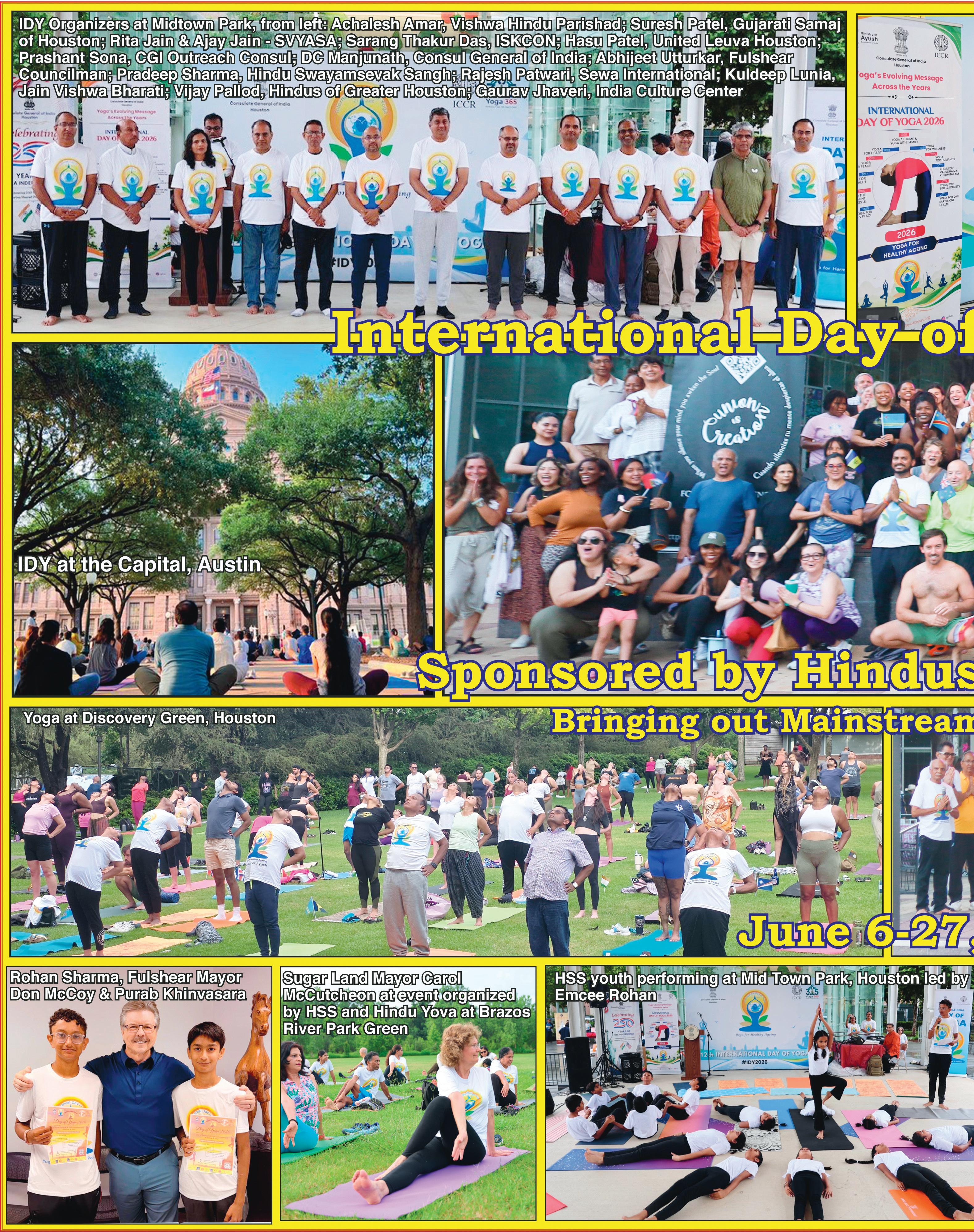
Texas: Yoga enthusiasts across Texas rolled out their mats in parks, temples and community spaces to celebrate the 12th International Day of Yoga, embracing a day dedicated to wellness, community and cultural connection.
This year’s theme is ‘Yoga for Healthy Ageing.’
The Consulate General of India, in partnership with diaspora organizations, celebrated IDY 2026 across multiple venues in major Texas cities.
More than 35 outdoor and indoor events took place across Houston this year. While it is impossible to capture every event, here are some of this year’s highlights.
“We appreciate the Houston community for participation and inspiring organizers to raise the bar every year,” said Sharad Amin, Texas coordinator for IDY 2026. “We have different organizations conducting session over three weeks in different area of town.”
“Yoga has become very popular last decade or so, it’s endorsed by wellness experts , longevity enthusiasts, community centers , gyms and so many yoga studios, the efforts also of the IDY celebrations have put some focus and resources available to the community,” said Yasmin Udawala, a SVYASA-certified yoga instructor who also serves as secretary of the Indian Muslima Association of Greater Houston.
Nonprofits, temples, wellness groups and local governments planned public yoga sessions, meditation programs, chair yoga workshops and wellness events throughout June. The Hindu
Temple of the Woodlands also held a health fair.
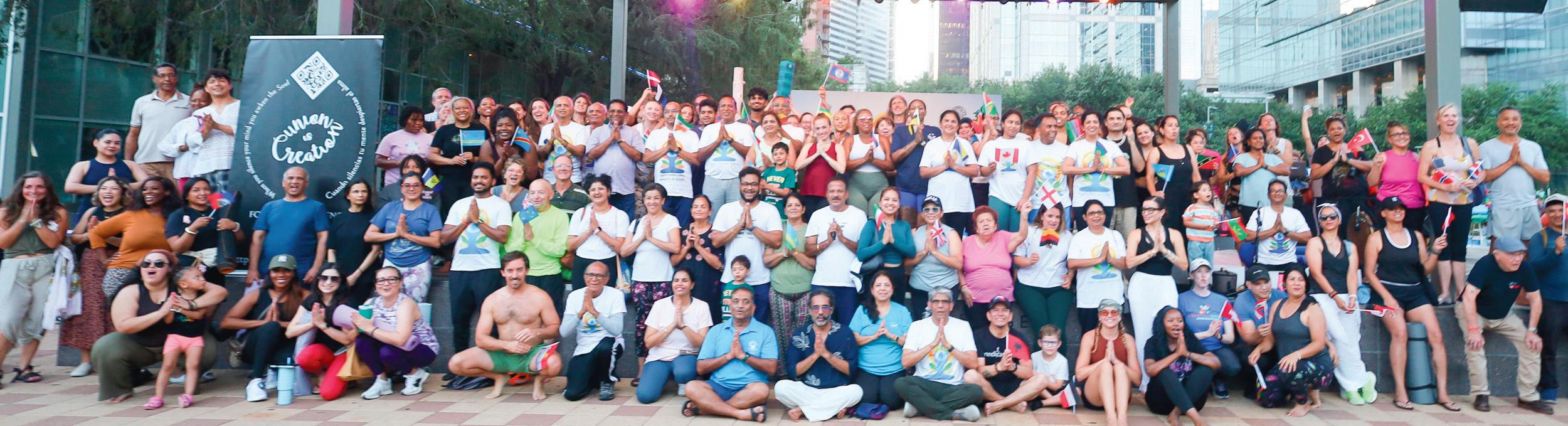
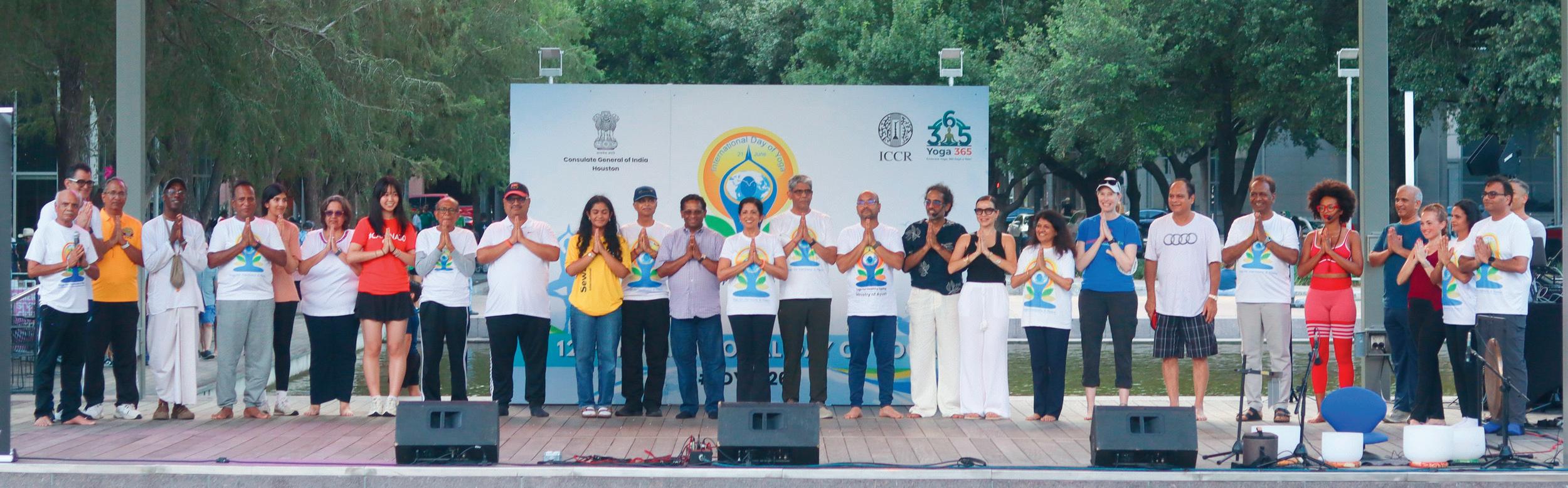
Discovery Green Hundreds gathered at Discovery Green on June 21 for one of Houston’s largest celebrations. Organized by CGI Houston, Discovery Green, Union is Creation, Hindus of Greater Houston and Fit Houston, the event brought together yoga enthusiasts as well as yoga-curious community members for an evening of movement, meditation and mindfulness.
The park’s expansive Jones Lawn was transformed into a vibrant gathering space beneath the downtown skyline. Despite scorching temperatures and weeks of severe weather that had forced the cancellation of several other outdoor yoga events across the region, the celebration proceeded as planned.
“I am very pleased to know people from all communities participate in Yoga Day,” said Prashant Sona, who was representing CGI Houston at the Discovery Green event.
The program featured guided yoga sessions, classical dance performances and demonstrations by advanced yoga practitioners.
“Our mission is health and happiness, and to shine a light on the diversity of cultures that exist in Houston,” said Frankie Ortega, marketing director for Discovery Green. “That’s what today is all about.”
Instructors introduced participants to traditional practices as well as innovative offerings such as hip-hop yoga, reflecting yoga’s growing popularity and evolution in Houston.
Elected officials and community leaders in attendance included Judge Surendran K. Pattel of the 240th District Court and Sugar Land City Coun-
cil Member Sanjay Singhal.
“Yoga offers tremendous benefits for both physical and mental well-being,” Pattel said. “It was wonderful to see so many people come together to celebrate a practice that promotes balance, mindfulness and healthy living. Events like this help strengthen our community while introducing more people to the positive impact yoga can have on their lives.”
“The event celebrated the unity of diverse community of Houston, The participants were from different ages, races and backgrounds. Everyone practiced Yoga together and reinforced the benefit of Yoga which is harmony between body, mind and soul,” said Singhal.
Union is Creation is a Houstonbased wellness collective known for its free yoga and sound healing classes at Discovery Green. Led by Lillian and Saumil Manek, it specializes in sound healing and techniques designed to promote nervous system regulation and overall well-being.
“I think it went really well,” said Saumil Manek. “Everybody was happy, so definitely it was a success. There were many new faces.”
The event continued into the evening with a ‘labyrinth walk’. Participants had brought canned food donations, which were used to outline the labyrinth path before being sent to the Houston Food Bank.
The Discovery Green celebration brought together cultural and community organizations from across the Houston area, including Rita Jain and Ajay Jain of SVYASA; Prashant Sona, representing the Cultural and Outreach Division of the Consulate General of India in Houston; Hindu Temple
of The Woodlands, represented by Neeta Hiray; Hindus of Greater Houston, represented by Hemant Jadhav; Sewa International, represented by Dr. Madan Luthra; and the Art of Living Foundation, represented by Gita Masand; Yoga and Health of Greater Houston (YHGH) and Hindu Heritage Youth Camp (HHYC), represented by Namita Pallod; ISKCON Houston, represented by Bhakta Lansing Mill; the Arya Samaj of Greater Houston, represented by Sanjay Jain; the World Hindu Council of America, represented by Achlesh Amar; the Meenakshi Temple Society, represented by Partha Krishnaswami; MMNA, represented by Sanjay Biyani; the Indian Muslim Association of Greater Houston (IMAGH), represented by Rafi Ahmed; India Cultural Center (ICC) represented by Bharat Patel; and the International Hindi Association, represented by Manisha Gandhi.
Midtown Park
Another major gathering took place at Midtown Park on June 20, where participants braved intermittent rain to celebrate International Day of Yoga.
Consul General D.C. Manjunath welcomed the crowd, describing Yoga Day as one of the Consulate’s most significant outreach initiatives promoting harmony and wellness.
The program included a children’s yoga demonstration by the Fulshear team, a yoga showcase by Team Woodlands, a session led by Rita Jain of SVYASA Houston, and a meditation session by Shri Sujan Shah. In keeping with this year’s theme, “Yoga for Healthy Ageing,” senior community members were also honored for their dedication to yoga.
Texas State Capitol
An IDY celebration was held at the Texas State Capitol in Austin on June 21. CGI partnered with Yoga Bharati, Art of Living and Heartfulness to organize the event. D.C. Manjunath thanked the Office of Secretary of State Jane Nelson and the Office of State Senator Sarah Eckhardt for their support.
Sewa International and Hindu Swayemsevak Sangh
Sewa and HSS jointly organized a Yoga session and 5K walk at George Bush Park on June 21. The weather was rainy and the event was held in a modified format, with participants enthusiastically promoting health, wellness and community spirit. Sai Prakash represented CGI Houston and conveyed the consulate’s greetings to organizers and participants.
Fulshear hosted a vibrant International Day of Yoga celebration at Irene Stern Community Center on 21 June, bringing together yoga enthusiasts, families, and members of the local community for a morning dedicated to health, harmony, and well-being.
The event, organized by the City of Fulshear and the Yoga Community of Fulshear & Katy, featured a special Chair Yoga session as well as a Common Yoga Protocol session, reflecting the inclusive spirit of Yoga and its universal relevance for people of all ages and abilities
Mayor Don McCoy also attended the celebration and extended warm wishes to all participants on the occasion of International Day of Yoga as well as Father’s Day.
PHOTO COLLAGE

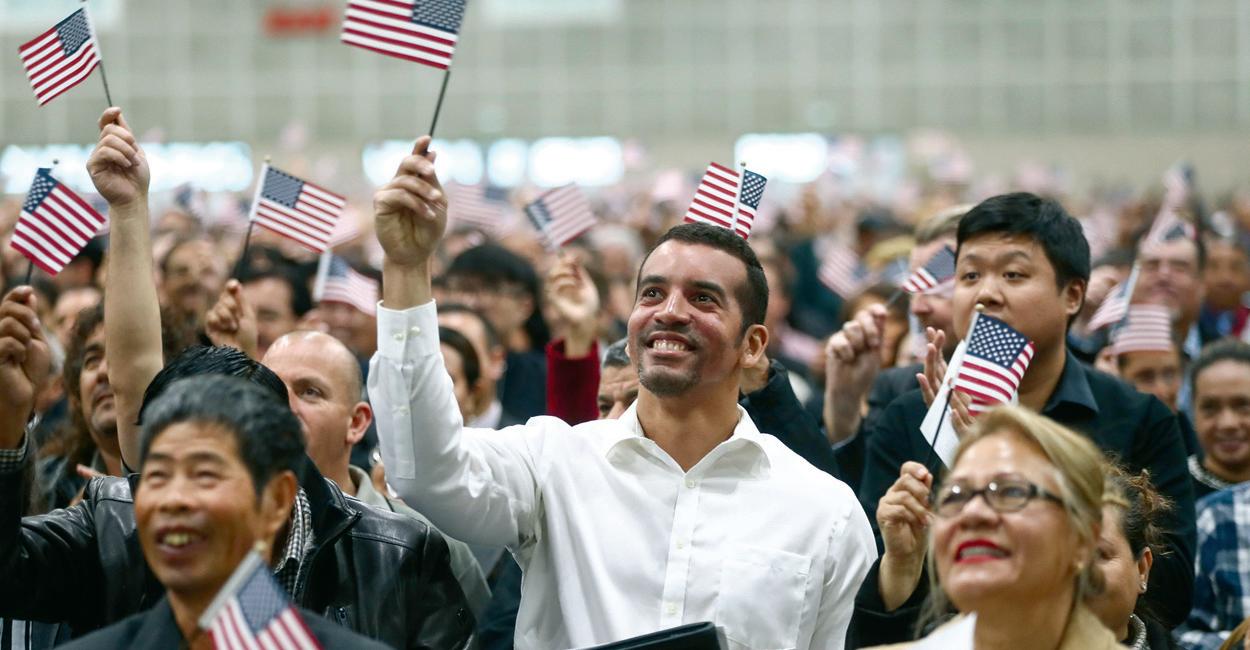
WashingTon DC: The cost of becoming a US citizen could soon rise sharply.
The US Department of Homeland Security (DHS) has proposed a significant increase in naturalisation filing fees, potentially making American citizenship considerably more expensive for lawful permanent residents, including thousands of Indians who apply for citizenship each year. The proposal would not only raise application costs by up to 80% but also eliminate fee waivers and reduced-fee options currently available to lower-income applicants.
1. Who can apply for US citizenship?
To become a naturalised US citizen, applicants must generally be at least 18 years old, hold lawful permanent resident (green card) status, and have lived in the United States continuously for at least five years. They must also have been physically present in the country for at least 30 months during that period and lived for at least three months in the state or USCIS district where they file their application.
Applicants are also required to maintain good moral character, demonstrate an attachment to the principles of the US Constitution, and remain continuously resident in the country until citizenship is granted. In addition, they must pass English language requirements and show a basic understanding of US history, government and civics.
2. N-400 citizenship application fee could rise by up to 80%
Under the Department of Homeland Security’s proposal, the filing fee for Form N-400, the primary application used by green card holders seeking US citizenship, would increase sharply.
The fee for paper applications would rise from $760 to $1,330, a jump of 75%, while online applicants would see the fee increase from $710 to $1,280, an increase of around 80%.
3. Reduced fees and fee waivers could be eliminated
The proposal would end reduced-fee applications and most fee waivers currently available to lower-income applicants.
If approved, the change could make the citizenship process significantly more expensive for students, retirees and other immigrants who currently qualify for financial assistance.
4. Nearly 50,000 Indians became US citizens in FY 2024
Indians continue to be among the largest groups acquiring American citizenship
According to DHS data, 49,700 Indians became US citizens in FY 2024, making India the second-largest country of birth among newly naturalised Americans after Mexico.
5. Indian citizenship numbers have fallen nearly 25% in two years
The number of Indians acquiring US citizenship has steadily declined in recent years.
DHS data shows that 65,960 Indians became US citizens in FY 2022, followed by 59,050 in FY 2023 and 49,700 in FY 2024, a drop of nearly 25% over two years.
6. Appeals against citizenship denials could cost up to $1,475
The proposal also raises fees for Form N-336, which allows applicants to challenge a denial of their citizenship application. The filing fee for paper submissions would increase from $830 to $1,475, while online filings would rise from $780 to $1,425.
7. Public has 60 days to comment before rule is finalised
The proposed changes are not yet in ef-
fect. DHS has opened a 60-day public comment period during which individuals and organisations can submit feedback.
The agency will review those comments before deciding whether to implement the final rule.
“The electronic Federal Docket Management System will accept comments prior to midnight ET at the end of that day,” the DHS statement reads.
According to the department, the proposed increases are intended to better align application fees with the actual cost of processing and adjudicating immigration benefits. DHS says the move will help recover operational expenses and support immigration services.

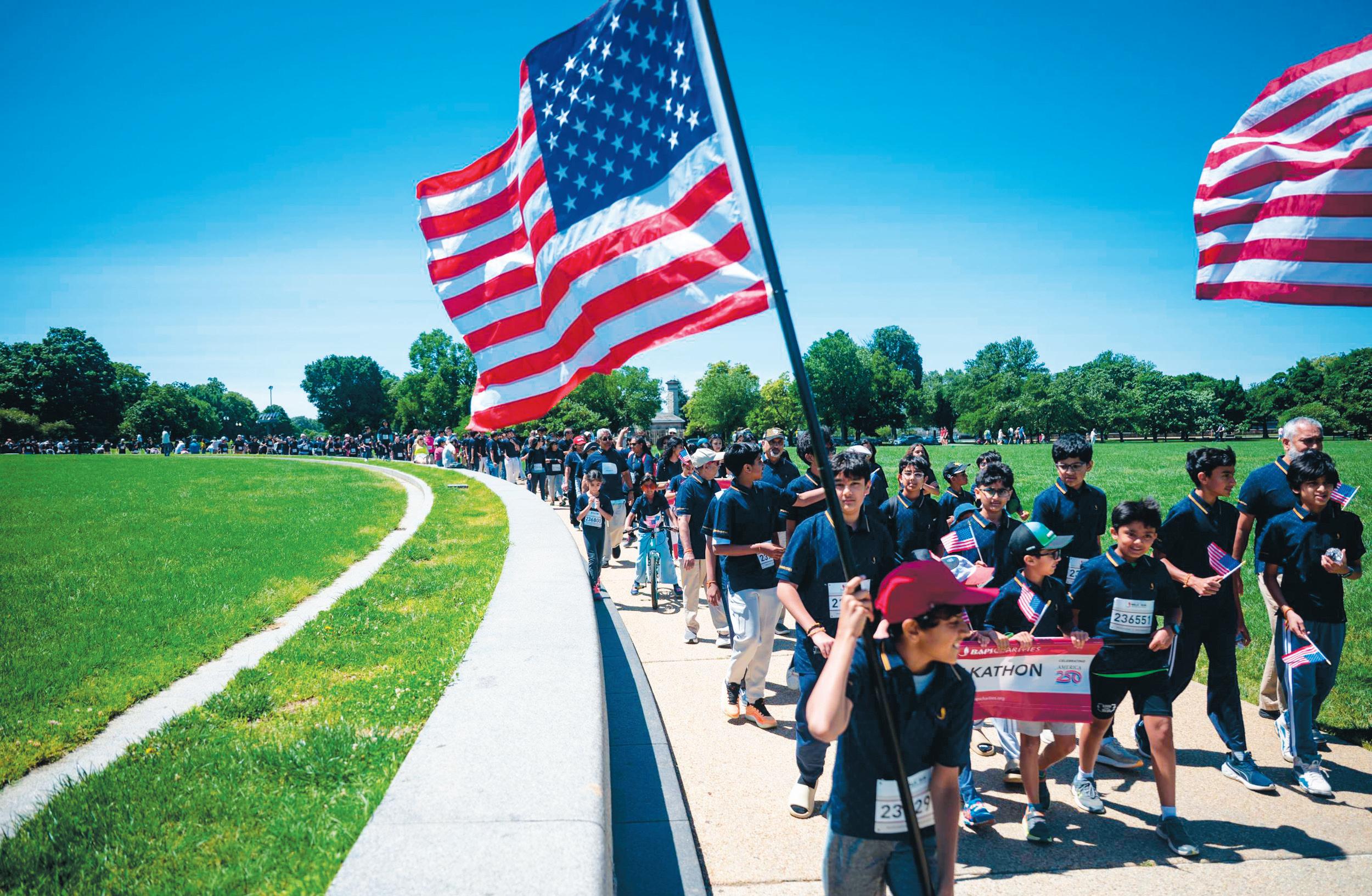
As the United States approaches its 250th anniversary, more than 50,000 participants took part in the 2026 BAPS Charities Spirit of Service Walk-Run, held in over 100 cities across North America this spring. Each city organized its own walk-run to promote volunteerism and support local charitable causes. Together, these events turned parks, town squares, and community centers into hubs of civic engagement and pride.
Families participated alongside fire chiefs, members of Congress, mayors, and community advocates. The America250 initiative directly benefited more than 90 organizations, including first responders, food banks, and cancer research groups throughout the U.S. and Canada.
The Spirit of Service Walk-Run brought together federal, state, and local leaders to promote community unity.
In Greater Houston, 2,200 participants assembled at Sugar Land Town Square to support local mental health, education, and law enforcement initiatives. Congress-
man Christian Menefee and Sugar Land Mayor Carol McCutcheon joined the volunteers.
“We go on social media and think about ourselves. We watch the news and think about how it impacts us personally,” said Congressman Menefee. “But sometimes we need to focus on our neighbors, our brothers, our sisters, and our community — and that’s what this is all about.”
In Dallas, State Representative Matt Shaheen reinforced this message:
“We have gotten united here for a purpose. There is just joy that we experience together in serving others, and that is what BAPS Charities is all about.”
In Edison, New Jersey, U.S. Congressman Frank Pallone led a bipartisan group of public officials, including State Senator Patrick Diegnan, Assemblymen Robert Karabinchak and Joe Danielson, and the mayors of Edison, Piscataway, and East Brunswick.
In Pennsylvania, U.S. Congressman Brian Fitzpatrick joined State Senators Frank Farry and Steve
Santarsiero, State Representatives Jim Prokopiak and Tina Davis, and Bucks County District Attorney Joe Khan. At the same time, Connecticut’s efforts were supported by State Senator Matt Lesser, State Representatives Jillian Gilchrest and Tom Delnicki, and Rocky Hill Mayor Allen Smith.
The call to service resonated throughout the American heartland and South. In Michigan, State Senator Michael Webber and State Representative Tom Kuhn supported local initiatives in Sterling Heights. In Jackson, Mississippi, Mayor John Horhn, State Senator Sollie Norwood, and Fire Chief Rasean Thomas participated alongside community members.
Localized Philanthropy: Voices from the Frontlines
BAPS Charities employs a decentralized funding model, enabling local committees to select beneficiaries that serve their communities.
Beneficiaries highlighted the tangible impact of the 2026 event: Progressing Medical Frontiers: “BAPS Charities’ continued sup-
port holds an important role in promoting cancer research,” noted Monty Permenter of the American Cancer Society in Jackson, Mississippi. “Their contributions help create a lasting influence on individuals and families affected by cancer.”
Direct Patient Aid: Lydia Nadeu of the Carol G. Simon Cancer Center in New Jersey added, “Today, your support helps our patients; individuals you may never know, yet your generosity allows us to continue this important work.”
Combating Homelessness: “Thank you for making sure that the homeless families and children that we serve have the resources they need to move from crisis to stability,” stated Katrina Bostick, CEO of Family Promise of the Coastal Empire in Savannah, Georgia.
Sustaining First Responders:
Doug Clarke of the Rocky Hill Fire Department in Connecticut said the funds would help recruit and retain volunteer firefighters as the department nears its centennial.
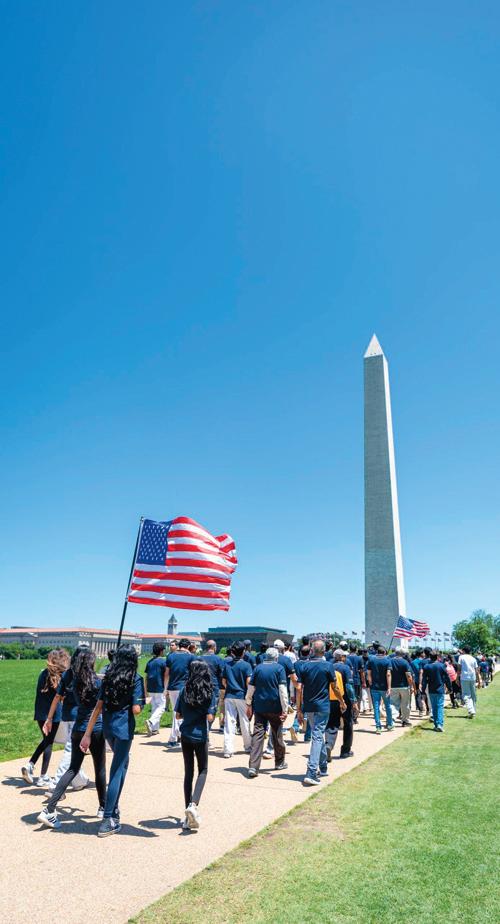
The call to service resonated throughout America’s heartland and South.
A Legacy of Selfless Service
The Walk-Run is part of BAPS Charities’ broader mission. Guided by the ethos, “In the joy of others lies our own,” the organization coordinates global volunteer efforts, disaster relief, and local community support.
Looking Forward: A Shared Path Toward Tomorrow
As America approaches its 250th anniversary, thousands walking together demonstrate a commitment to advancing national ideals. These collective actions show that true citizenship involves actively supporting and uplifting our communities to create a more inclusive future.
The 2026 Spirit of Service WalkRun demonstrates that collective local volunteerism can drive significant social change. By supporting local initiatives and assisting neighbors, citizens strengthen communities and set a standard of civic responsibility for the future.



Question: What is the science behind the effectiveness of the Yogasans?
Swami Mukundananda: The art of healthy living must incorporate all aspects of the personality: the physical, mental, emotional, intellectual, and spiritual. While the central theme of Yog remains the highest goal of the spiritual path, physical yogic practices enshrined in it give direct and tangible benefits to everyone regardless of their spiritual aims. Yogasans harmonize the body, mind and emotions.
For example, at the physical level, organs, muscles and nerves may not be functioning properly. Asans bring the different bodily functions into perfect coordination so that they work for the good of the whole body. At the mental level, people harbor poisonous thoughts and emotions within. Muscular knots can occur anywhere in the body – in the neck as cervical spondylitis, in the face as neuralgia, etc. Every mental knot has a corresponding physical, muscular knot and vice versa.
The aim of asans is to release these knots. For full benefit, these asans should be performed along with the meditation. Meditational exercises cleanse the mind, to bring a feeling of peace and contentment within.
Proper asans, Pranayam, subtle body relaxation, meditation, tackle these knots both at the physical and mental levels. As a result of the release of dormant energy, the body becomes full of vitality and strength, the mind becomes light and creative, joyful and balanced. Yogasans have succeeded as an alternative therapy in diseases such as asthma, diabetes, blood pressure, arthritis, digestive disorders and many ailments of a chronic and constitutional nature, where modern medical science has failed.
Q: What is the difference between Yogasans and exercises?
SM: Exercises impose a beneficial stress on the body. Without them, the muscles waste, the bones become weak, the capacity to absorb oxygen decreases, and the ability to meet demands of sudden physical activity is lost. However, exercises work only on the muscles. They cause catabolism, or break down of cells. Asans work on the organs, nerves and glands, and alter the electrochemical activity in the nervous system. They increase the oxygen in the blood, lower the bodily temperature, and slow down metabolic rates.
Q: Why do many people, who flock to Yoga studios, yearn for something more substantial than the physical exercises of Yoga, which will satisfy their inner yearning for spirituality?
SM: The word “Yoga” does not exist in the Sanskrit language or in the Vedic scriptures. The proper word is “Yog”, which means “to unite.” In this context, it means to
answers some interesting questions on benefits of yoga and explains its true essence.
unite the individual soul with the Supreme soul.
The Shreemad Bhagavatam states: Etavan yog adishto… (Bhagavatam)
“True Yog means removing the mind from all the material objects of attachment, and fixing it completely on God.”
Many institutions have not endeavored to highlight the mental and spiritual aspects of Yog. Without emphasis on the purification of the mind, the hunger of the soul remains unaddressed.
The scriptures state: Man ev manushyanam karanam bandha mokshayoh (Panchadashi)
“The mind alone is the cause of bondage and liberation.” If the mind is neglected, then any science for the nourishment and evolution of the personality will be incomplete and only partially effective. Those people who have deeper spiritual sanskars yearn for a genuine Divine experience.
Swami Mukundananda is a world-renowned Spiritual teacher and a best-selling author who earned his degrees from the prestigious IIT Delhi and IIM Kolkata.
He worked with a multinational firm for a short period before renouncing his promising career to enter Monkhood at the age of 23. For four decades he has been sharing his vast knowledge through his books and discourses.
His lectures on social media platforms are followed by millions. He has deeply affected the lives of millions of people who have been drawn by his profound integrity, charismatic personality, and his passion to serve. Swamiji divides his time between India and the USA.
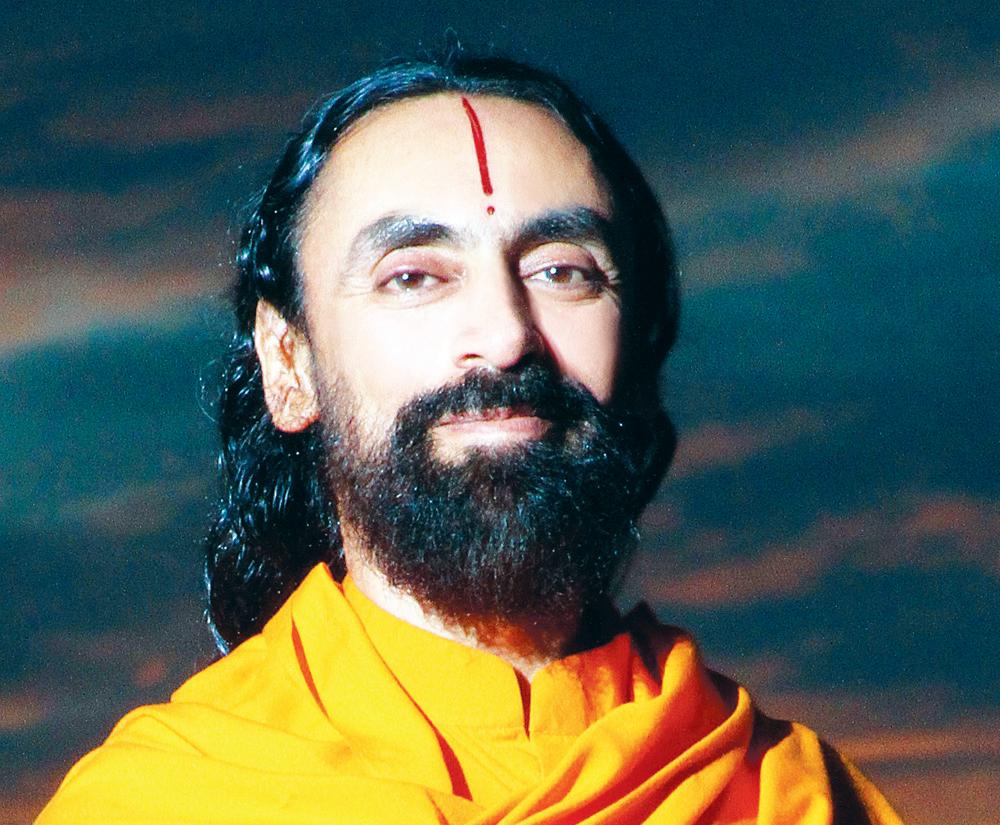
Swami Mukundananda ji will be having program in Houston from July 18 through July 29, 2026, from 7pm-9pm. The program details are below –Sri Sharadamba Temple, 10315 Clodine Road, Richmond, TX on Saturday, July 18th, Monday, July 20th through Friday, July 24th
Vadtal Dham, 10825 Clodine Road, Richmond, TX on Sunday, July 19th
India House, 8888 West Bellfort Avenue, Houston, TX from Saturday, July 25th through Wednesday,29th.
All Programs are free & dinner prasad is served daily.
For FREE Registration visit JKYog.org/Houston For more details, text or phone 281-630-5982 or 281-780-4877.

neW Delhi: India is turning to its overseas community to boost its foreign currency inflows, with banks expected to offer substantial leverage on special foreigncurrency deposits. This comes after the Reserve Bank of India (RBI) cleared lenders to extend loans against such deposits.
Earlier on Tuesday, the apex bank said that lenders can extend loans to overseas residents against foreign-currency deposits and place a lien on those deposits. Banks will also be permitted to issue letters of credit against the product.
According to banking officials, lenders may provide leverage running into double digits against these deposits.
“We expect banks across the system to offer leverage of up to 9 times,” Alok Singh, head of treasury at Fairfax-backed CSB Bank Ltd told Bloomberg, adding that returns on deposits above 6% and leveraged rates above 10% are enough to attract a significant amount of dollar inflows to the country.
The move forms part of a broader effort by authorities to strengthen foreign currency buffers amid the Middle East conflict. With foreign fund outflows from domestic assets dragging down rupee, policymakers have introduced a series of measures aimed at drawing capital into the country. Under the special programme, banks are offering guaranteed returns of more than 7.1% on dollar deposits and have stepped up outreach through advertisements and social media campaigns to attract
overseas investors.
Some bankers estimate that the initiative could bring in more than $80 billion.
The RBI also announced that it will provide a buy-sell foreign exchange swap for eligible deposits. The facility will cover the principal amount, though not the interest component.

The latest steps come alongside other coordinated measures unveiled by the government and the central bank in recent weeks. These include a concessional forex-swap facility to encourage overseas borrowings by state-owned companies and full hedging-cost support for banks raising deposits with maturities of three to five years until September 30.
The strategy mirrors a mechanism used during the 2013 taper tantrum, when Indian lenders mobilised about $34 billion to help arrest the rupee’s decline.
Authorities are counting on the country’s 35-million-strong diaspora to support the latest drive. Non-resident Indian remittances are already among the largest globally, and policymakers hope that a combination of higher deposit rates and leverage options will encourage additional inflows at a time when capital inflows
have moderated.
India recorded inward remittances of more than $155 billion in 2025-26, Bloomberg reported. With the programme potentially bringing in an estimated additional $50 billion by September, total inflows this year could exceed $200 billion.
While countries in the Gulf Cooperation Council were once the dominant source of diaspora remittances, advanced economies now account for a larger share of the money being sent back to India.
India’s current account surplus narrowed sharply in the fourth quarter of fiscal year 2026 as a widening merchandise trade deficit offset strong growth in services exports and remittance inflows, according to data released by the Reserve Bank of India (RBI).
The country’s current account surplus stood at $7.1 billion, or
0.7% of GDP, in the JanuaryMarch quarter of fiscal 2026, down from $13.7 billion, or 1.4% of GDP, recorded in the corresponding quarter of the previous year. The decline was primarily driven by a significantly wider merchandise trade deficit, which expanded to $83.4 billion in quarter ended March from $59.3 billion a year earlier. The higher import bill outweighed gains from India’s services sector and overseas remittances.
Providing support to the external account, net services receipts rose to $60.4 billion during the quarter compared with $53.3 billion in ther fourth quarter. The increase was led by robust growth in exports of computer services and other business services, underscoring the resilience of India’s technology and outsourcing sectors amid a challenging global environment.
India also benefited from stronger remittance inflows. Personal transfer receipts, which largely comprise money sent home by Indians working overseas, increased to $43.5 billion in the fourth quarter from $33.9 billion in the yearago period.
Meanwhile, the net outgo un-
der the primary income account, which mainly reflects investment income payments, eased to $11.1 billion from $11.9 billion a year earlier, providing some relief to the current account balance.
On the capital flows front, foreign direct investment (FDI) showed signs of improvement. Net FDI inflows rose sharply to $4.2 billion in quarter ended March compared with just $0.4 billion in the corresponding period last year, indicating continued long-term investor confidence in the Indian economy.
However, foreign portfolio investment (FPI) flows remained under pressure. FPIs recorded a net outflow of $12 billion during the quarter, significantly higher than the outflow of $5.9 billion seen a year ago, reflecting volatile global capital flows and investor caution.
Other components of the financial account presented a mixed picture. Net inflows through nonresident Indian (NRI) deposits increased to $3.3 billion from $2.8 billion, while net inflows under external commercial borrowings (ECBs) moderated to $3.6 billion from $7.5 billion in the previous year.
India’s foreign exchange reserves increased by $7.2 billion on a balance of payments basis during the quarter, lower than the accretion of $8.8 billion recorded in quarter ended March.
For the full financial year, India’s current account deficit stood at 0.6% of GDP, unchanged from fiscal 2025. -- ToI


WashingTon DC: Indian-American lawmakers in the US urged the diaspora to join politics to tackle the rise of “anti-Hindu, anti-Indian, anti-Desi hate”.Speaking at an event on Capitol Hill hosted by the Foundation for India and Indian Diaspora Studies (FIIDS) on Tuesday, Congressman Raja Krishnamoorthi said Indian-Americans, despite being one of the most educated and economically successful communities in the United States, are confronting a new set of challenges.
“There is the rise of anti-Hindu, anti-Indian, anti-Desi hate,” news agency PTI quoted Krishnamoorthi saying.
“It’s time to get more involved than you’ve ever been. You have to raise your voice. You have to speak up. You have to show up. You have to make sure that your voices are heard everywhere,” he added.
He urged Indian-Americans to seek elected office at every level of government, regardless of their political party affiliation.
“I want you to think about running for office, whether it’s city council. I don’t care if you’re a Republican, Democrat, or Independent. I don’t care who you are. There’s an old saying in Washington DC, if you don’t have a seat at the table, you’re on the menu. And none of you can afford to be on the menu, nor can our families, nor can our interests,” he said.
“I want you to consider running for city council. I want you to consider running for state house or state senate or for the US Congress, although not in my congressional district. But consider running for office and making sure your voice is heard,” Krishnamoorthi added. Several US lawmakers, including Congressman Shri Thanedar, Senator Roger Marshall and other Democratic representatives, voiced support for the Indian-American community, addressing concerns ranging from rising anti-immigrant sentiment and immigration challenges to green card backlogs, while also underscoring the importance of strengthening US-India ties.
The Indian-American community, estimated at 5.2 million people as of 2023 as per the US Census Bureau, is among the fastest-growing and most influential ethnic groups in the United States, with increasing representation in business, academia and public service.
Hindus for Human Rights today condemned the latest public expression of anti-Indian and anti-immigrant hostility in Frisco, Texas, after a viral video circulated on June 3 showing an Indian flag being torn near Frisco City Hall amid anti-India slogans and “Indian invasion” rhetoric.
The incident is disturbing on its own. It is also the latest visible example of a larger pattern in Texas, where anti-Hindu, antiMuslim, anti-Indian, and anti-immigrant rhetoric has moved from online agitation into city council meetings, religious-site controversies, and statewide political campaigns. What may appear as separate incidents in Frisco, Sugar Land, and state politics are increasingly part of the same message: that temples, mosques, Indian families, Muslim families, and immigrant communities are not part of Texas, but threats to it.
In Frisco, that message has become especially visible. On May 19, a far-right activist and pardoned January 6 rioter used public comment over proposed religious institutions to target Hindus, Muslims, Jains, immigrants, and South Asian communities. His remarks followed months of rhetoric around an alleged “Indian takeover,” H-1B visas, and demographic change in North Texas.
This rhetoric does not exist in isolation.
In Sugar Land, Texas, the 90-foot Panchaloha Abhaya Hanuman statue at Sri Ashtalakshmi Temple has become a recurring target of public protest, online denunciation, and anti-immigrant rhetoric. -- ToI, Hindus for Human Rights
FounDer: Dr. K.l. sinDWani
PuBlisher: JaWahar malhoTra
eDiTor: PramoD KulKarni
CorresPonDenT: sanChali Basu


By shuBhra guPTa
‘Ooh, a threesome?’ ‘Hawww, noooo, just checking’. This could well be a tagline for Cocktail 2, a spiritual sequel of the 2012 original of the same name, which once again gives us a guy and two girls looking for The One.
Kunal (Shahid Kapoor) plays a dashing chef whose mere presence makes irate female customers swoon. But he’s perfectly content with the love of his life, Diya (Rashmika Mandana), and the two have settled into post-hangoverburpy-domesticity minus the pheras: shaadi, who needs that, when the two are miya and biwi in all but name?
On a holiday in stunning Sicily, a chance encounter with the free-spirited Ally (Kriti Sanon), an old friend of Diya’s, becomes the third side of the triangle. Ally is single, and ever ready to mingle, and following through on a wholly contrived ruse, finds herself alone with Kunal: will the two find more than one chance to stray, and how will that impact our lovey-dovey jodi? Who will be the twosome, and who will walk away, all lonesome?
As befits a 2026 rom com, we get couples living-in quite comfortably, without anyone — families or friends — morally judging Kunal or Diya, though neither of them are strictly averse to matrimony as we discover later in the film. Everyone is wealthy enough to go roaming about the world, whistling up fancy convertibles, and vineyard tours: no poor people in this film.
The conflict comes up only when a gorgeous fly-in-the-ointment shows up, which seems to be the only instrument Bollywood filmmakers have to muddy the waters: in that respect, nothing seems to have changed in the interval. Can two people fall out of love? That would demand too much complexity, and what would happen to that gold standard Bollywood, ‘dekh tere liye do ladkiyaan lad rahin hain’. Perish the thought.

The same director, Homi Adajania, helms both films, but this one is written by Luv Ranjan; the older one had Imtiaz Ali as the writer. What I wanted to see was whether the 2026 guy has progressed from being any better than the compulsive flirtatious jerk played by Saif Ali Khan, who was more in Luv Ranjan territory. Interestingly enough, it’s the Shahid Kapoor character who fits better with Imtiaz Ali’s idea of a romance: Kunal turns out to be a better guy than we give him credit for; when temptation arises, he turns all noble. Cocktail 2 coasts on glossiness and too much talkiness, overlaid with Pritam’s ever-present background music. The reprise of the still-popular songs, including Tum hi ho bandhu, is flat: all emotions are underlined and overstated, just in case we missed the stuff going on between the three.
Kriti Sanon finds herself with more feelings than she wagered for; Rashmika Mandana’s very silly idea of testing-her-true-love leaves her, unsurprisingly, in a suspicious puddle: the former is glamorous in a leggy, sunburnt way; the latter flubs the Hindi accent, and is surprisingly dull after the first half fully committed to
the template of beautiful vistaswashboard abs-messy emotions, the film turns into a mix of my best friend’s wedding, and the beautiful bridesmaid, in which we get an array of lehengas and maangtikas, and other eye-catching ensembles. Post interval, all the hard-working breeziness turns into melodrama, with a ringing endorsement of love not as excitement but habit. Yes, sexiness is great, impulsivity is wonderful, but the ever-after is reserved for steadiness, and responsibility.
Ultimately Cocktail 2 comes off a bit of a cocktail itself, swinging between style and substance . It is Shahid Kapoor who carries this film with a pleasing conviction I haven’t seen in a long time. And while I missed Deepika Padukone’s wild wounded-ness, Sanon isn’t half bad herself. But there’s no getting past the conservatism which comes wrapped in this pyaar ka punchnama: for all its modern vibe, it’s the guy who gets the last word, not the gals.
Cast: Shahid Kapoor, Rashmika Mandana, Kriti Sanon, Pulkit Sharma, Tiku Talsania
Director: Homi Adajania
Rating: 2.5 rating -- IE


Place a number in the empty boxes in such a way that each row across, each column down and each 9-box square contains all of the numbers from one to nine.
Send us the correct answer before June 30, 2026. Email us at indoamericannews@yahoo.com. Please send us your solved Sudoku for your name to be published.


Sanchali Basu, Kumud Athavale, Krishna R. Vuddagiri, Prabha Barvalia, Jawahar Khandheria, Prabha Narumanchi, Yudhveer Bagga, Naveen Garg, Nihira Ghanta, Srikanth Madhavan, Harsh Malkan, Soumya Srikanth, Rajesh Pradbhu, Priya Pathak, Mohit Mittal, Ayush Khaple, Rekha Trivedi, Arup Gupta