





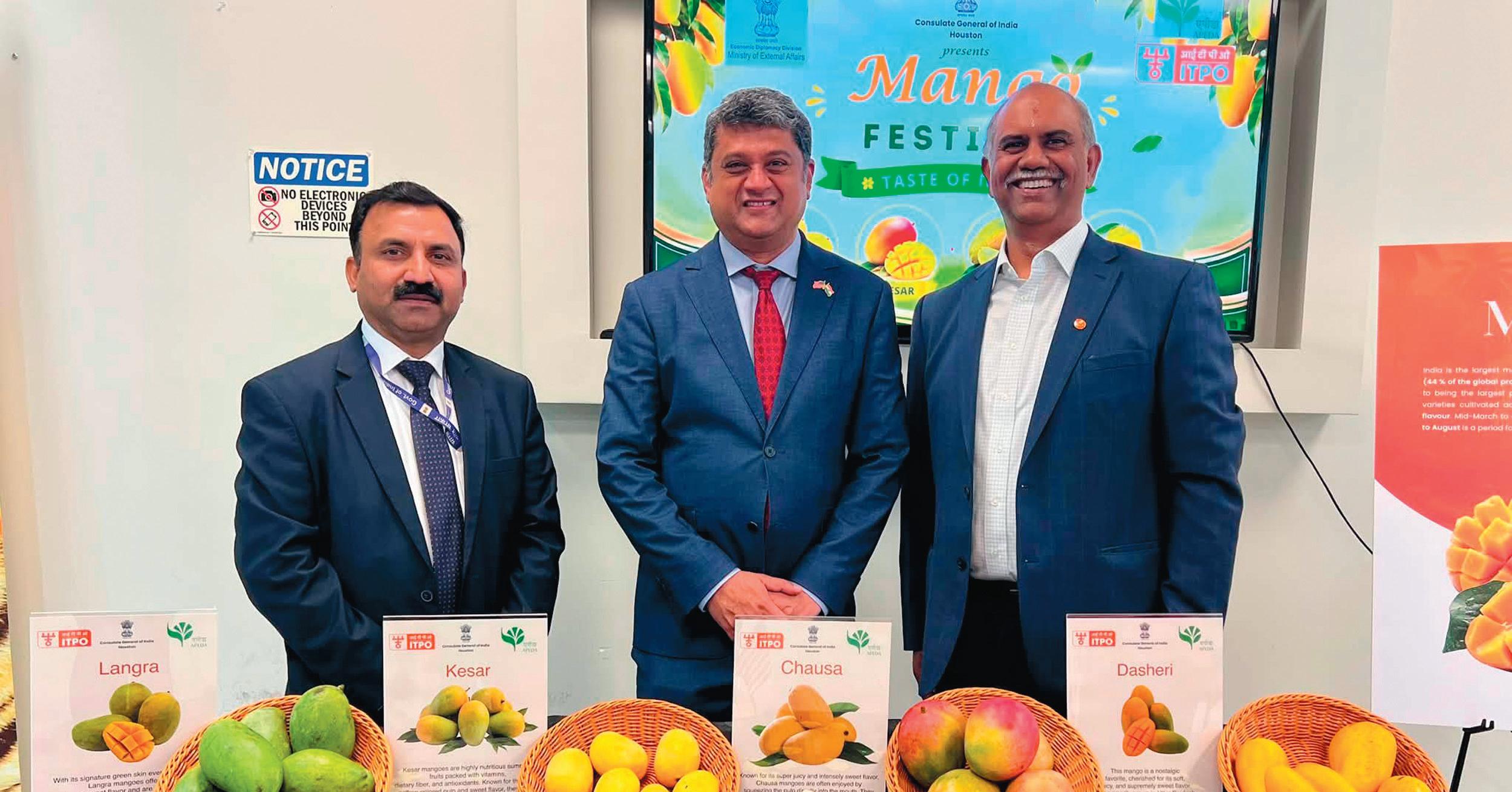
Houston: The Consulate General of India, Houston, in collaboration with APEDA (Agricultural and Processed Food Products Export Development Authority) and with the support of the India Trade Promotion Organization (ITPO), successfully hosted a two-day Mango Festival on 2nd & 3rd July 2026 at the Consulate premises and at Keemat Store, Hillcroft. The event drew enthusiastic participation from Consular corps, local families, community members, and business leaders across Houston.
Attendees enjoyed premium va-
rieties of Indian mangoes. mango based products, and India’s globally renowned Basmati rice were on display, showcasing India’s strength as a reliable partner in the global agri export value chain. The festival also served as a valuable platform for local businesses to explore sourcing
opportunities and understand India’s agricultural export ecosystem.
The Consulate conveys its appreciation to Keemat Store for hosting the event and to ITPO for supporting India’s trade promotion outreach in the United States. The positive response from the Houston
community reflects the growing interest in India’s high quality agri products and the deepening India–Texas commercial connect.
Businesses interested in sourcing Indian mangoes, mango products, or Basmati rice may directly contact APEDA.

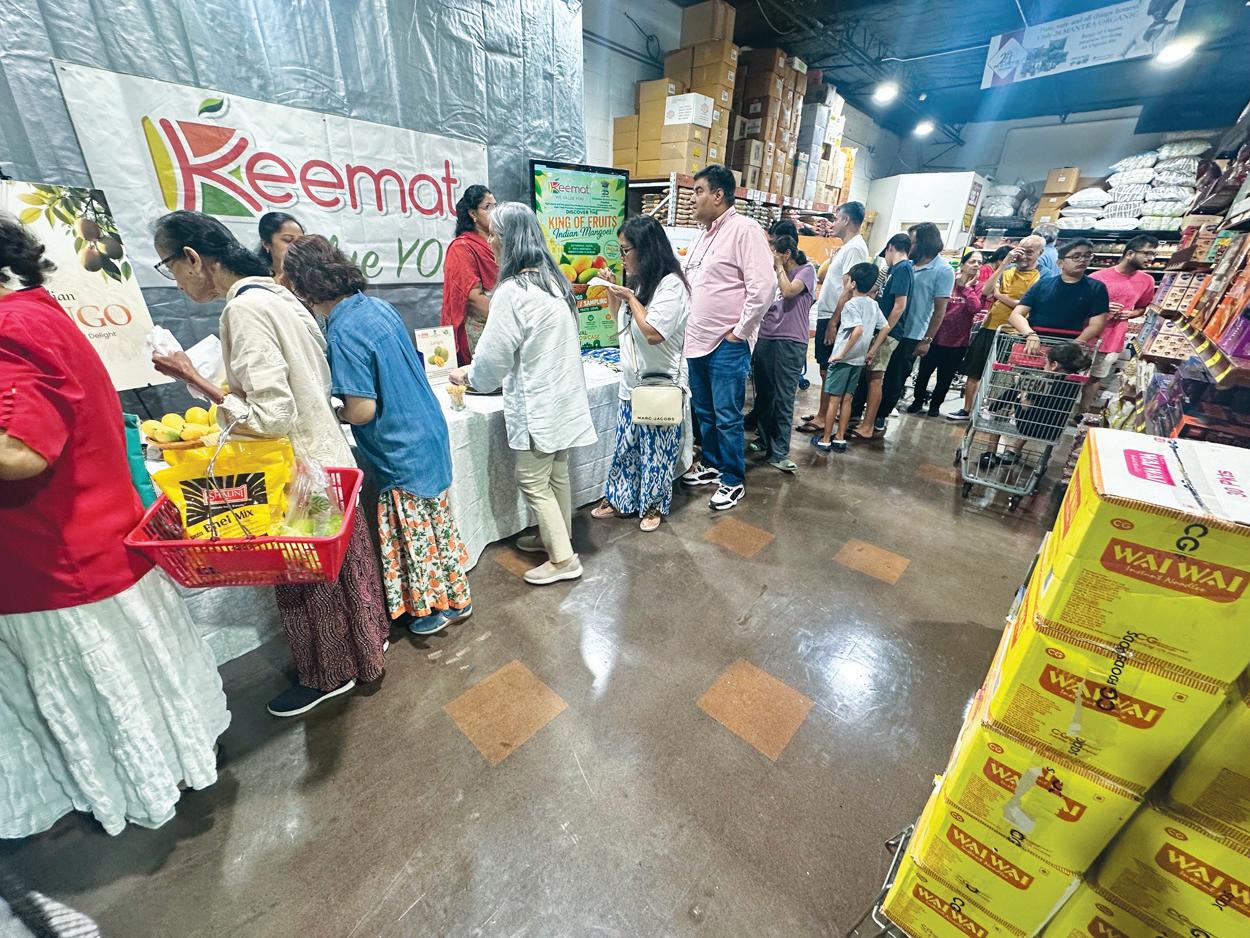
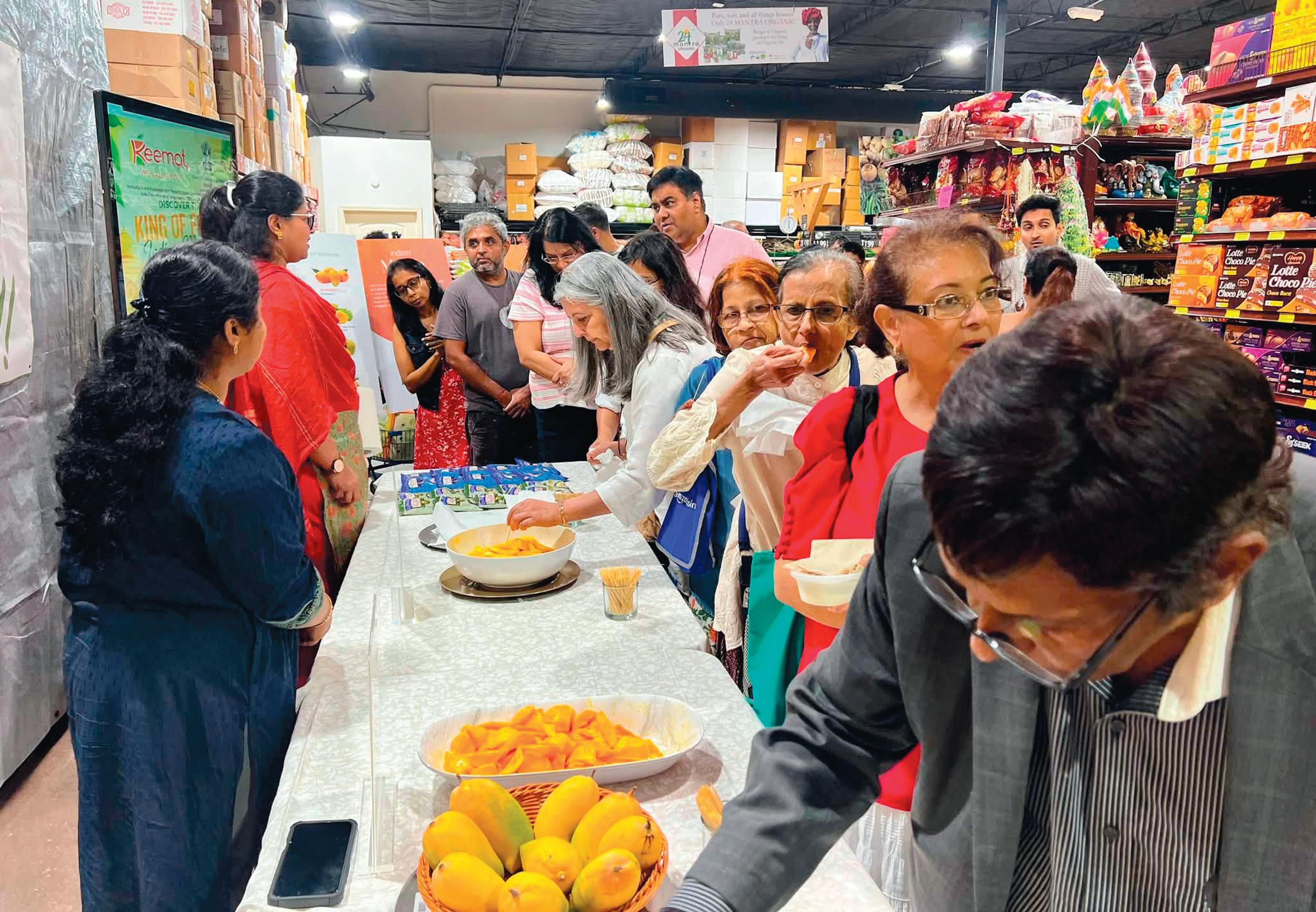
Eager customers at Keemat Grocers Hillcroft line up for a taste of three varieties of Indian mangoes.
By JawaHar MalHotra
Houston: When our Houston Indian Consul General D.C. Manjunath got a whiff of the national tour of Indian mangoes to four American cities – Seattle, Atlanta, Washington and New York – and found that Houston was not included, he sprang into action and implored the tour leader Dr. C.B. Singh to make a pitstop in Houston too, telling him about the very
active and huge Indian community here.
He persuaded Dr. Singh, the Deputy General Manager of the Agricultural and Processed Food Products Export Development Authority, a unit of the Indian Ministry of Commerce and Industry (APEDA) to stop at the Bayou City for two days and hastily pulled together two functions: a meeting with community leaders and other Consul Generals of other countries
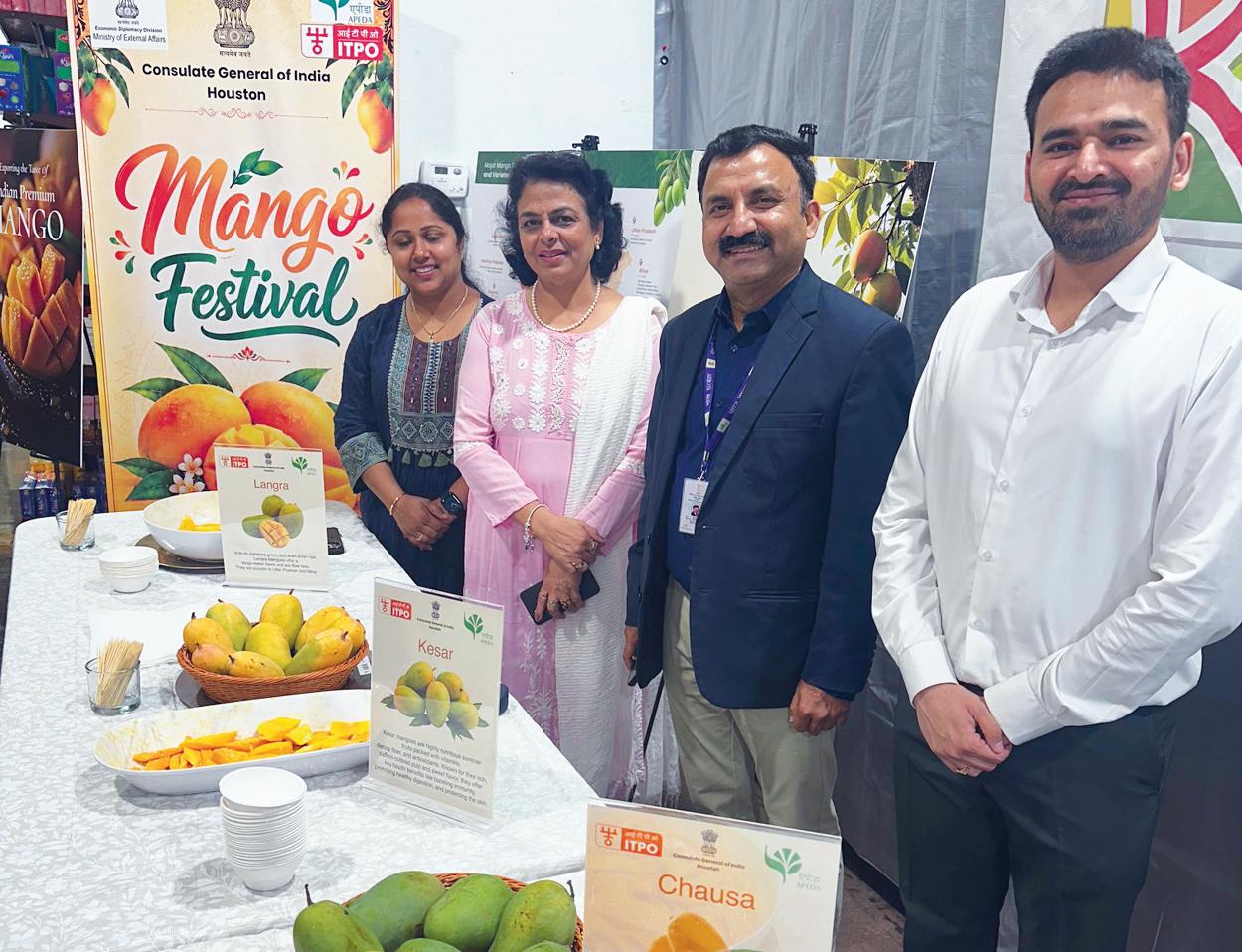
Staff from the Indian Consulate joined Dr. C.B. Singh (in black coat) from APEDA, who is promoting Indian mangoes for the Government of India.
on Thursday at the Indian Consulate and a mango tasting event at Keemat Grocers on Hillcroft.
Both events showed the draw of the fame of the Indian mangoes, especially at the Keemat Grocers event where about 40 customers lined up and eagerly picked the peeled and sliced samples.
Between the Langra, Chausa and Kesar mangoes served, the Kesar with its powerful aroma and appeal to the tastebuds was the clear
winner. Many customers were visibly upset that they could not buy boxes of these mangoes, Singh told them there were not enough to go around.
Singh was delighted by the response to his initial tour of the US.
“In Seattle, we held the tasting in Costco to hundreds of shoppers and in Washington, DC, the event was at Dupont Circle where thousands of people clamored for samples,” he explained. “I had no idea
that Houston was such a vital and large market for us, but thanks to Consul General Manjunath, I am better informed.”
Singh left back to India last Sunday but he is already thinking of making another American visit next year to build on the success of the initial tour and hopes to get Indian mangoes into the US market soon.

wasHington DC: The Trump administration is preparing a fresh round of immigration rule changes that could reshape the H-1B visa program, employment-based green cards, visa tenure of international students and the optional training program (OPT) available to them. A soon to be issued final rule will also end automatic extension of employment authorisation documents (EADs). Indian professionals and students are likely to be among those most affected if the proposals are implemented.
The proposals are part of the latest regulatory agendas released by the US Departments of Homeland Security (DHS), Department of Labor (DOL) and Department of State (DOS), which outline the administration’s immigration priorities over the coming months. While the timelines are tentative and the Trump administration eyes tighter H-1B, green card and student visa rules
H-1B program. One of the most closely watched proposals relates to the H-1B program, which is expected to be published in August.
DHS plans to tighten eligibility for certain exemptions from the annual H-1B cap of 85,000 (at present universities and eligible research outfits can hire H-1B employees at any time and are not subject to the annual lottery) , introduce additional requirements for employers placing H-1B workers at third-party client sites and subject employers with a history of H1B violations to greater scrutiny. A common staffing model used by Indian IT and consulting companies is placing H-1B workers at third-party client sites. While the administration has not yet released the draft text, it may require employers to demonstrate a genuine employer-employee relationship, establish that the worker will perform specialty occupation duties at the client location, and maintain greater documentation of assignments. Another key element is enhanced scrutiny of employers found to have violated H1B program requirements. Such employers could face more rigorous reviews when filing future H-1B applications, signaling the administration’s intention to step up compliance and enforcement.
Under a final rule expected this month, companies with more than
Immigration rule changes could reshape the H-1B visa program, employment-based green cards, visa tenure of international students, and the optional training program (OPT) available to them.
50 employees in the U.S., where over half the workforce holds H-1B or L-1 visas, would be required to pay the additional 9-11 Response and Biometric EntryExit Fee not only for new H-1B and L-1 petitions and change-ofemployer filings, but also when seeking extensions of stay for existing employees. At present, these employers pay an additional $4,000 for eligible H-1B petitions and $4,500 for eligible L-1 petitions only when sponsoring a worker for an initial period of stay or when the employee changes employers. Extending the fee to renewal petitions would increase costs for employers that rely heavily on H-1B and L-1 workers, including several large IT outsourcing companies. The proposal was initially scheduled for publication in April 2025, later dropped from the regulatory agenda, and has now re-emerged as a near-term priority.
Timeline. The final rule is likely to be published in July. DOL also intends to finalise a rule that will hike the prevailing wage levels under the four-tiered structure for H-1B and employment green card cases. The draft was issued in March and the public comment pe-
riod ended in May. If implemented as proposed, the wage regulation would increase the threshold for entry-level wages from the 17th percentile to the 34th percentile for the occupation and geographic area. As a result, employers would see higher sponsorship costs for both temporary work visa filings and most permanent residence cases. TOI had analysed the proposal and pointed out that it could be subject to legal challenges. The regulatory agenda does not provide an anticipated date for release of the final rule.
Employmentlinked green cards certification process this month. Before an employer can file a green card application, it must obtain PERM labou=r certification from DOL. The department said the existing recruitment framework, introduced in 2004, no longer reflects today’s hiring practices and technological advances in recruitment. The proposal would update the minimum standards for testing the US labour market, tighten rules governing layoffs of US workers before employers can sponsor foreign workers, and strengthen compliance with nondiscrimination requirements during recruitment and hiring. Time-
line: The proposed rule is likely to be published in July.
International students India is the leading country of origin of international students in the US. According to the latest Open Doors Report, during the academic year 2024-25, there were 3.6 lakh Indian students in the US constituting nearly 31% of the total number of 11 lakh international students. While the numbers of new students from India is falling, the cohort of Indian students will continue to be significant and the proposed regulations will have far reaching impact. The coming weeks will see DHS publish a final regulation that will end the longstanding practice of admitting foreign students and exchange visitors to the US for the duration of their program (known as duration of status). Instead these visas will be of a fixed tenure – the draft had proposed a maximum of four years; after which they be required to file an extension with the immigration authorities in order to remain in the US. TOI has extensively analysed the draft proposals. Also read: International students in line of fire again - Trump admin proposes limiting visa tenure to a fixed period
Timeline: The final rule is likely
to be published in July. A proposed regulation slated for Feb 2027 is expected to seek amendments to the optional practical training (OPT) programs. Though the regulatory agenda provides few details, proposals could include restrictions on the two year OPT Originally, the proposal was set to be published in September 2025. Timeline: The proposed rule is likely to be published in Feb 2027. Ending automatic extension of EADs A regulation expected this month will finalize an interim regulation in place since Oct 2025 that eliminated the maximum 540-day automatic extension of employment authorization documents (EADs) for certain foreign nationals who timely filed EAD renewal applications on or after Oct 30, 2025. TOI had analysed the interim final rule and pointed out that it would adversely impact H-4 visa holders (spouses of H-1B visa holders who are on track for a green card). As many as one lakh Indian spouses (largely women) have benefited from the work authorization permit – which in addition to enabling them to work or be self -employed, also enables them to avail of basics such as a driving license.
Under the new rule, individuals cannot continue working after their current permit expires. They must wait until the US Citizenship and Immigration Services (USCIS) approves and renews the EAD. The hitch: H-4 EAD holders can file renewal applications only up to 180 days before the expiration date, but USCIS typically takes a longer time to process the application. This creates an unavoidable gap and can result in job losses. “The regulatory agenda provides an important roadmap of where the administration intends to focus its efforts over the coming months,” said Mitch Wexler, senior counsel at Fragomen, a global immigration law firm. “While many of these are proposals rather than final rules and the usual rulemaking process takes several months, employers should begin evaluating how potential changes to the H-1B program, employment-based permanent residence process and OPT could affect their workforce planning and compliance obligations,” Wexler said.
-- ToI

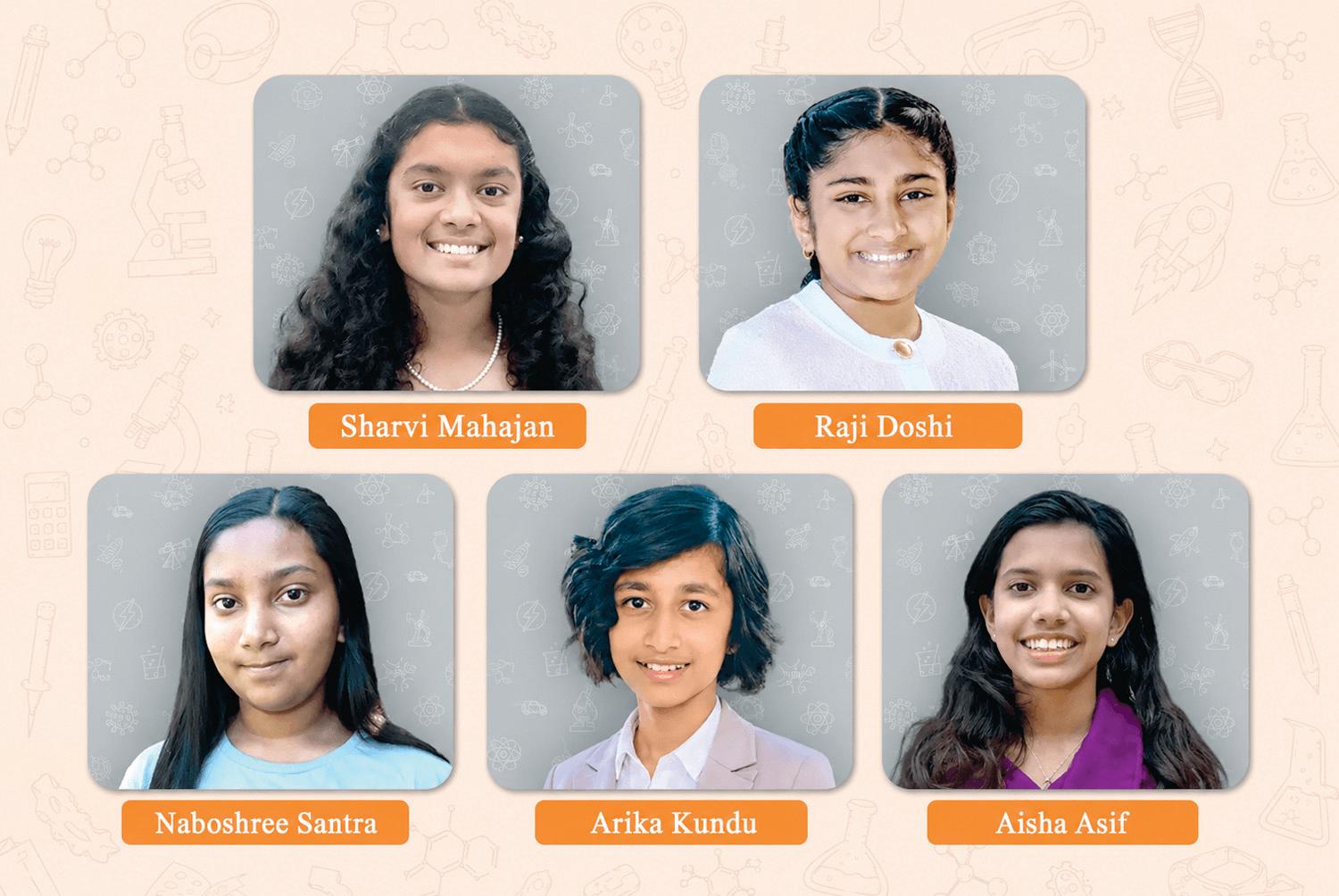
Minneapolis: After a spectacular run in the 2026 Scripps National Spelling Bee, Indian-origin kids are gearing up for America’s top young scientist title. The 2026 3M Young Scientist Challenge finalists have been announced, and the top 10 finalists include 5 Indian American students. In the past 16 years, the America’s Top Young Scientist title has gone to Indian immigrant kids 7 times for unique problem-solving ideas and scientific innovations. 2026 3M Young Scientist Challenge: Five Indian-origin finalists
• from Minnesota
Arika Kundu, 7th grader
• er from Florida
Naboshree Santra, 6th grad-
• Connecticut
Raji Doshi, 7th grader from
• from California
Sharvi Mahajan, 8th grader
• from Florida
Aaisha Asif, 6th grader
Sharvi Mahajan and NeuroDrive Alert Invention
Among the finalists for America’s Top Young Scientist title 2026, Sharvi Mahajan from California has created NeuroDrive Alert. This is an EGG-based machine learning alert system for real-time fatigue prediction. Sharvi’s NeuroDrive Alert is an advance system that tracks fatigue over time to predict microsleep and enhance safety in driving and other high-risk activities. Intrigued by the depth of neuroscience, she aspires to be a computational neuroscientist and found a tech startup that would build AI-based neuroscience models. Her favorite invention is Electroencephalogram (EEG) machine that measures brainwave activ-
ity through a system of electrodes placed on the scalp.
Arika Kundu and her LIGNEX invention
Arika Kundu, the Minnesota State Merit award winner, got entry to the 3M Young Scientist Challenge finals for her innovative model – LIGNEX. It is a biosorption based method that uses agricultural waste like peanut shells to remove pesticides from fresh produce. It would not only make food safer but more accessible. Her favorite scientific breakthrough of the past 100 years is the Human Genome Project.
Arika Kundu aspires to be an astrobiologist and make it big in computational biology. One of
her goals is to reduce radiation exposure in space and make space exploration safer for long-term advancements. She believes the lesser the space radiation, the better it is for agriculture and cancer treatment.
Raji Doshi and her coastal solution for marine health
12-year-old Raji Doshi is among the 2026 3M Young Scientist Challenge finalists for her durable algae-aragonite alkalinity system to reduce ocean acidification and improve marine health. Atmospheric carbon is changing chemistry of the oceans at an alarming rate that affects millions of people’s health and livelihood directly or indirectly. She found it too hard
to ignore, and thus, engineered a unique coastal solution to not just enter the 3M Challenge but fight climate change.
Raji Doshi from Connecticut aspires to be a NASA aerospace engineer and develop space-based monitoring systems for ocean health. Her favorite invention for the humankind is the autonomous underwater vehicle (AUV). Scientists use AUV drones to collect real-time data on oceans’ carbon absorption, chemistry, and marine health.
Naboshree Santra and her solution for drought-affected regions
11-year-old Naboshree Santra is the youngest of 3M Young Scientist
Challenge finalists in 2026. A resident of Florida, Naboshree “developed biodegradable soilshade balls that reduce evaporation and help soil retain more moisture, offering a simple solution for agriculture in drought-affected regions,” according to Youngscientistlab.com. She believes “if nature can grow it, we can engineer it.” She is an aspiring researcher who wishes to make sustainable products from natural materials for a healthier planet.
Aaisha Asif and her eco-friendly adhesive
Among the finalists for America’s Top Young Scientist title 2026, Aaisha Asif developed a mussel-inspired, eco-friendly adhesive from natural proteins and iron-based crosslinkers that creates strong bonds while reducing pollution. Her product is the best environment-friendly alternative to conventional adhesives that release volatile organic compounds (VOCs), contribute to air pollution, and cause health problems. She aspires to be an environmental scientist.
America’s top young scientist title and $25K prize
Discovery Education’s 3M Young Scientist Challenge is a national STEM competition that provides a stage for America’s middle school students, 5 to 8 grades, to demonstrate their ideas and solutions to tackle real-world issues.
The ‘America’s Top Young Scientist’ title winner earns a $25K grand prize while other finalists get $1000 each along with an opportunity to participate in an exclusive summer mentorship program with a 3M scientist. -- Indian Eagle
new york: In the fevered corners of the internet where men — primarily white — gather to “optimise” every little detail of their bodies, there is a belief that even the brain can be beaten into shape to make men seem more attractive. Here, cortisol affects “facial fat redistribution”, dopamine affects “eye contact quality”, serotonin affects “resting expression”, and acetylcholine affects “intelligence in social contexts”. And among the optimisers? Ashwagandha, to “remove stress expression patterns” by reducing cortisol. Brahmi, for “verbal fluency” by supporting the brain’s acetylcholine system. And kaunch beej for “mood, motivation, libido” by giving for serotonin, a “guide” says. Go even deeper, into testosterone boosting spaces — where increasing testosterone “naturally” is believed to be the “cheat code” of masculinity — and ashwagandha, methi and shilajit are recast as part of the esoteric toolkit to do that. But just outside the shadows of these conversations, these Ayurvedic ingredients have become a business opportunity for MAHA — Make America
Healthy Again, the Trumpaligned wellness movement that treats food, supplements and lifestyle as alternatives to the conventional medical establishment that it thinks is compromised.
The medical evidence is modest. Small, short trials suggest, for instance, that some ashwagandha preparations may help with stress and sleep, and offer limited evidence of higher testosterone after two to four months. Or that turmeric may help knee-osteoarthritis pain, though better studies are needed. For shilajit, the testosterone claim rests largely on a single 90-day trial of a purified preparation in men aged 45 to 55. Small, mixed studies can’t establish any of that. And yet, the story fits the MAGA wellness world because it offers the thrill of ancient hidden knowl-

edge — a “natural” alternative to doctors, drugs and institutions that followers are already primed to distrust. And with that, for many in the US, Ayurveda has become a shelf of exotic Indian ingredients repackaged for an American fantasy of masculine self-optimisation. So, Joe Rogan, the podcaster whose huge and overwhelmingly male audience made him a prized voice to get through to young men in Trump’s America, says he takes a pre-workout supplement which contains ashwagandha as a way to build endurance. It is sold by Onnit, the supplement company
he cofounded and promoted for years before Unilever bought it in 2021. Alex Jones, the Trump-aligned far-right conspiracy broadcaster, sells a supplement called Shilajit Complex on his online store. It’s built around the “legendary Himalayan resin” shilajit, the site says, along with ashwagandha, to make a “vitality formula” for “energy, stamina, and hormone balance”.
The site tells customers that their purchase “directly keeps Alex Jones on the air”. The Hodgetwins, conservative podcast twins with a huge pro-Trump following, sell their own Shilajit Power Stack — with shilajit, ashwagandha, and black seed (kalonji). “You want to feel like a man?” the site asks, “Start here.”
Casey Means, the MAHA wellness influencer and Trump’s former surgeon-general pick, recom-
mends the ashwagandha sold by Momentous, a sports-supplement under painkillers. Her brother Calley Means, a senior US government health department adviser cofounded Truemed, a platform that helps Americans use healthbenefit money on wellness products — including a shilajit blend with ashwagandha and kaunch beej, marketed as an “artisanal product of India” by the American wellness company selling it. And Mehmet Oz, popularly known as Dr Oz and now Trump’s administrator of the Centers for Medicare & Medicaid Services (CMS), said he has made ashwagandha part of his own wellness routine. He has written that he takes it every morning for thyroid health and its calming properties. In late 2024, shortly after Trump chose him to run CMS, he urged his millions of followers to take iHerb’s ashwagandha to ease Thanksgiving stress. Oz was then iHerb’s “global adviser and stakeholder” — a relationship visible in his social-media bios but often not disclosed in the promotional posts themselves. -- ToI

Fort BenD County, tX —
Fort Bend Interfaith Community (FBIC), a leading council dedicated to strengthening relationships among diverse faith communities, announced the appointment of its new Chairperson and Leadership Team. This leadership transition marks an important milestone in FBIC’s ongoing mission to promote unity, service, and collaboration across Fort Bend County.
The newly elected Chairperson, Ms Geetha Ravula, brings a long history of community engagement, interfaith partnership, and public service. In previous roles with Fort Bend Interfaith, she championed initiatives focused on youth engagement, service and cross-cultural dialogue. As Chairperson Ms Ravula along with the Leadership Team will guide the council’s strategic direction, expand partnerships, and lead efforts to address shared challenges through collective action.
“I am humbled to serve as Chairperson of FBIC,” said Ms Ravula. “Our county stands as the nation’s number one county for diversity, and our strength comes from our ability to listen, learn, and serve together. I look forward to building on the foundation laid by our past leaders and advancing our mission of unity, devotion and service.”
FBIC’s new Leadership Team:
Chairperson: Ms Geetha Ravula, Hindu Community Vice Chairperson: Ms Waheeda Kara, Ismaili Community Internal Communications: Mr Ghasem Bayat, Bahai Community External Communications: Mr Bo Singh, Sikh Community Event Liaison: Ms Anthea Pierre,
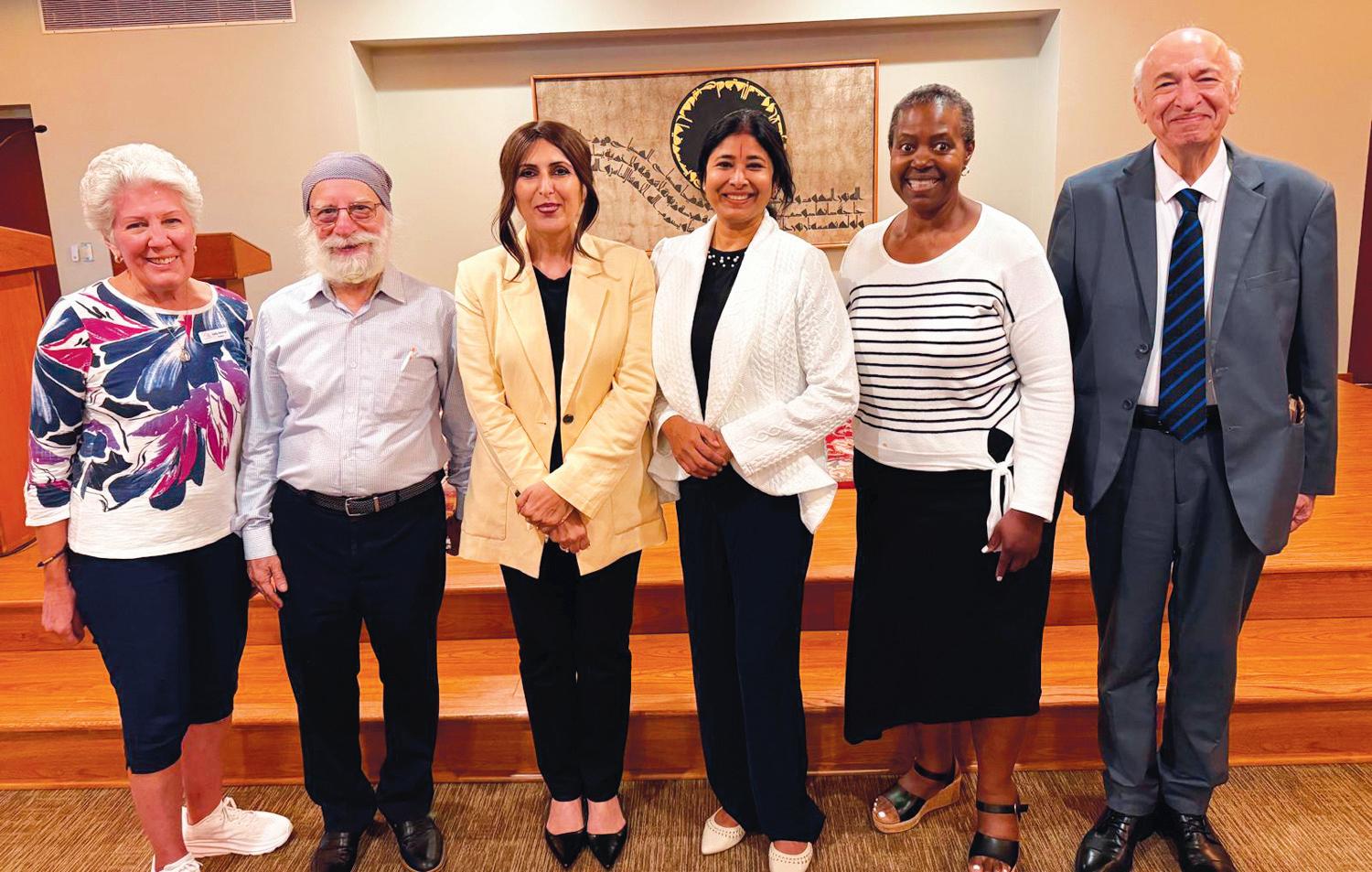
The new board represents a wide range of faith traditions reflecting FBIC’s commitment to inclusivity and shared leadership. Throughout the upcoming term, FBIC will focus on expanding interfaith service projects, strengthening youth leadership programs, and hosting community dialogues on issues affecting Fort Bend County.
FBIC members express their profound appreciation to Past Chairman Pastor John Stader for his unwavering dedication, steady leadership, and heartfelt commitment to FBIC’s mission. The new leadership team shared that his vision strengthened FBIC’s foundation, and his integrity established a standard we are honored to carry
forward.
Pastor John Strader of The Christian Community shared the following message as he concluded his term as Chair of FBIC:
“It has been one of the great honors of my life to serve as Chair of the Fort Bend Interfaith Community and to witness firsthand the extraordinary people who make this work possible. Fort Bend County is one of the most diverse communities in America, and that diversity isn’t merely reflected in demographics, but in the relationships, service, and genuine care shown by the leaders of this council.
As I transition into a new season of ministry, I do so with deep confidence in the remarkable team
stepping forward to lead the next chapter of the FBIC. Each of these leaders represents not only their respective faith communities with integrity and excellence, but also a sincere commitment to the flourishing of our entire community.
I am especially grateful for the leadership of Ms. Geetha Ravula of the Hindu community as incoming Chairperson, whose wisdom, compassion, and steady leadership have already made a meaningful impact. Alongside her, Ms. Waheeda Kara of the Ismaili community will serve as Vice Chairperson, bringing a spirit of unity and thoughtful collaboration that has long strengthened our work together.
Mr. Ghasem Bayat of the Bahá’í
community will serve in Internal Communications, continuing his faithful work of strengthening relationships, coordination, and connection within the council itself. Mr. Bo Singh of the Sikh community will serve in External Communications, offering both vision and strong community connection. Ms. Anthea Pierre of the Christian community will serve as Event Liaison, bringing energy, care, and a deep commitment to meaningful engagement across faith traditions.
Together, this team reflects the very best of Fort Bend County. They are servant leaders, bridge builders, and people of genuine character. I believe the future of the Fort Bend Interfaith Council is bright because of their leadership and because of the many faith communities committed to working together for the common good.
I remain deeply thankful for every friendship, every partnership, and every opportunity we have shared together in service to our community.”
About Fort Bend Interfaith Community
FBIC is a council of faith communities working together to promote understanding, cooperation, and service. The mission of FBIC is to build meaningful relationships, rooted in trust, respect, and shared values, between members of diverse religious and cultural backgrounds. Seeking to promote dialogue, understanding, and a sense of kinship, FBIC brings people together to worship, learn, and engage in good works. We welcome all who share in our vision.
By aMBassaDor Vinay kwatra
For decades, the Indian diaspora has been one of our country’s greatest strengths, serving as a living bridge between India and the world, contributing to innovation ecosystems, shaping global discourse, and strengthening economic and cultural ties.
Today, as India positions itself at the forefront of frontier technologies, knowledge production, and is on an upward ambitious path, a new opportunity presents itself to deepen this partnership: The Prime Minister’s Research Chair Scheme This initiative seeks to attract eminent scholars, scientists and innovators of Indian origin who have established distinguished careers in leading universities, research institutions, and industry across the world to India. The scheme provides a structured mechanism for these experts to contribute their knowledge and experience to India’s development by creating prestigious research chairs in
India’s premier institutions.
Prime Minister’s Research Chair Scheme is an important pillar in the larger national vision of Viksit Bharat 2047. Achieving this vision demands breakthroughs in science and technology, frontier research, innovation-led industries, and the ability to create intellectual property that powers economic prosperity.
The Government of India has consistently emphasized that a developed India must also be a knowledge leader, capable of generating solutions not only for its own citizens but for the world. The Prime Minister’s Research Chair Scheme directly contributes to this ambition. By encouraging interdisciplinary research and close collaboration between academia, government, and industry, it seeks to ensure that scientific discovery translates into innovation, commercialization, and public policy.
From artificial intelligence, quantum technologies and semiconductors to biotechnology, cli-
mate resilience, advanced manufacturing and healthcare, the research undertaken through these Chairs has the potential to accelerate technological self-reliance, foster innovation, strengthen industrial competitiveness, and create high-quality employment in India. The scheme is therefore an investment in India’s future economic and strategic capabilities.
For our Indian diaspora, participation in this unique initiative offers a never seen before opportunity to contribute to one of the most consequential nation-building projects of our time. Indian-origin scholars have helped shape some of the defining innovations of the modern age across laboratories, universities, research institutes, and technology companies around the world. The Prime Minister’s Research Chair Scheme creates an institutional bridge to connect this global expertise with India’s rapidly expanding research ecosystem.
It enables the diaspora to become
active partners in building the scientific, technological, and intellectual foundations of a developed India. A distinguishing feature of the initiative is also its flexibility. It enables internationally accomplished researchers to engage with Indian institutions through sustained collaborations, mentoring programmes, joint research projects, faculty exchanges, doctoral supervision, and the establishment of long-term international research partnerships.
For the Indian diaspora, these features make the scheme uniquely attractive. Researchers can maintain their global academic engagements while helping build India’s capacity for the next generation. There is also a deeper enduring dimension to this effort to capitalize on our shared dreams. The relationship between India and its diaspora has evolved to a consequential partnership being defined by shared ambition. The Prime Minister’s Research Chair Scheme builds on this evolution, offering a
platform where intellectual capital becomes the new currency of engagement between India and the world.
The diaspora has always been an integral part of India’s economic progress. This is a moment to step forward once again as co-authors of India’s intellectual future. Through this medium, I would like to invite all our diaspora members to utilize this opportunity to co-create knowledge ecosystems that connect the best of Indian and global talent. The diaspora’s role in this effort is indispensable, and we look forward to embarking on this journey together as we realize the vision of our Prime Minister Shri Narendra Modi to chart the path of Viksit Bharat 2047.
Hon. Vinay Kwatra is the Indian Ambassador to the United States. He assumed the post in August 2024 after completing his term as India’s Foreign Secretary (20222024. His expertise lies in Agriculture and animal husbandry.

siMpliCity Vs. CleVerness
Question: In spirituality, we are taught to be simple and trusting. But my experience is that people in the world take advantage of my simplicity. This upsets me, and I am apprehensive about my straightforwardness. Can you please guide me?
Answer by Swami Mukundananda: You have correctly observed the paradox. To negotiate the spiritual and the material arenas of work, we must often deploy contradictory principles.
In the material arena, remember that people are under the influence of maya. They are not beyond selfishness, anger, and greed. This makes them inclined to manipulate and exploit us. Expecting worldly people to be your selfless wellwishers is naïve. Do not implicitly trust them. It is advisable to always be cautious in your dealings with them.
If ever you get cheated in the world, learn the lesson and file it in your intellect. The episode will equip you to be more cautious in future. At the same time, release the hurt and resentment, remembering that no one is perfect here. In this way, keep your mind free from bitterness, while at the same time not trusting anyone.
The spiritual path, on the other hand, requires us to be sharanagat (surrendered). Without it, we will not get the grace of the Supreme. For samarpan (surrender), we must take a ‘leap of faith’. If we are unwilling to do so, we will not succeed. The difference in the spiritual realm is that trust in God and the Guru does not make us vulnerable. They have no self-interest to fulfil
from us.
Hari Harijan ke karya ko, karan kachhu na lakhay
Par upakar swabhav-vash, karat karya jag ay.
(Bhakti Shatak verse 57)
‘God and the Saints have no other reason behind Their actions. Their sole intention is the welfare of others. For this purpose alone, They come to the world’.
God and God-realized Saints desire nothing from us. Their only objective is to help us become the best version of ourselves. Hence, we can completely trust Them, like a baby trusts its mother. In fact, sharanagati (complete surrender) is a pre-requisite to move forward on the spiritual path. Therefore, keep both principles in mind. In spiritual matters, work on the principle of faith. In worldly dealings, be cautious and do not allow yourself to get cheated.
Reference:
“Questions You Always Wanted to Ask” book by Swami Mukundananda. Available on https:// www.jkyog.org/books and Amazon.com
reinCarnation
Question: My friends reject the concept of reincarnation. Is rebirth a fact or just a myth?
Answer by Swami Mukundananda: The soul is eternal – it existed even before birth and will continue to exist even after death. There is, in fact, no birth or death for the soul. ‘Death’ is merely the act of discarding its old dysfunctional body. And what is called ‘birth’ is the soul receiving a new body to continue its journey. This principle of the soul changing bodies is called ‘reincarnation’.
The Bhagavad Gita explains reincarnation beautifully as: vāsānsi jīrṇāni yathā vihāya navāni gṛihṇāti naro ’parāṇi tathā śharīrāṇi vihāya jīrṇānya nyāni sanyāti navāni dehī (2.22)
‘As a person sheds worn-out garments and wears new ones, likewise, at the time of death, the soul casts off its worn-out body and enters a new one.’
The Nyāya Darshan also gives strong evidence for rebirth. It states that a one-month-old baby, without any visible reason, experiences the emotions of happiness, sadness, and fear:
jātasya harṣhabhayaśhoka sampratipatteḥ (3.1.18)
Sometimes, the infant smiles without a cause. At other times, it cries or becomes fearful, again without reason. These emotions arise because of past life memories that are still not fully erased. Without accepting reincarnation, it is impossible to explain the disparity that exists among human beings. For example, how can one explain why someone is born blind? If we say it was the will of God, the question arises: Why did the all-merciful God do injustice to a particular soul? If we say it was the result of karma, the question will arise regarding when these karmas were performed by a newborn. Since this baby was just born, it obviously means that its actions cannot be of this lifetime; it is evident the actions had to be of prior lives. The principle of reincarnation offers the only reasonable answer to the disparity of births. The concept of reincarnation is not unique to Vedic scriptures. It is accepted in most Eastern phi-
losophies. It is an inherent part of Hinduism, Jainism, and Sikhism. In Buddhism, we see that Lord Buddha made frequent references to his past lives.
In ancient classical Western religious and philosophic circles, famous thinkers, such as Pythagoras, Plato, and Socrates accepted reincarnation to be true, and their views were also reflected in Orphism, Hermeticism, Neoplatonism, Manichaeism, and Gnosticism.
Within the mainstream Abrahamic faiths as well, many mystics of the three major religions supported reincarnation. Josephus, the great ancient Jewish historian, used language in his writings that ascribes belief in some form of reincarnation among the Pharisees and Essenes of his day. The Jewish Kabbalah prescribes to the idea of reincarnation as gilgul neshamot, or the ‘rolling of the soul’.
Many of the early Christians believed in the concept of reincarnation. Jesus indirectly proclaimed this doctrine when he told his disciples that John the Baptist was Elijah the Prophet reincarnated (Matthew 11:13-14). Solomon’s ‘Book of Wisdom’ says: ‘To be born in a sound body with sound limbs is a reward of the virtues of past lives.’1
The great Sufi mystic Jalal alDin Muhammad Rumi declared2: I died as stone, and rose again as plant; I died as plant and became an animal; I died as animal and was born a man
Yet once more shall I die as man,
To soar with angels blessed
above.
Thus, most of the major religions have direct or indirect references to the concept of reincarnation.
References:
1Dass, Ram, Paths to God: Living the Bhagavad Gita, Harmony, New York, 2007, Kindle ebook.
2Ibid.
“Questions You Always Wanted to Ask” book by Swami Mukundananda. Available on https://swamimukundananda.org/books/ and Amazon
Swami Mukundananda is a world-renowned Spiritual teacher and a best-selling author who earned his degrees from the prestigious IIT Delhi and IIM Kolkata. He worked with a multinational firm for a short period before renouncing his promising career to enter Monkhood at the age of 23. For four decades he has been sharing his vast knowledge through his books and discourses. His lectures on social media platforms are followed by millions. Swamiji has been invited to speak at various Fortune 500 companies like Google, Oracle, Yahoo, Amazon and for the youth, Swamiji has conducted programs at prestigious universities like Princeton, Stanford, Kellogg, MIT, and Duke. Swami Mukundananda’s enlightening discourses clarify the deepest concepts of the Vedic scriptures with wit and perfect logic. He has deeply affected the lives of millions of people who have been drawn by his profound integrity, charismatic personality, and his passion to serve. Swamiji divides his time between India and the USA.

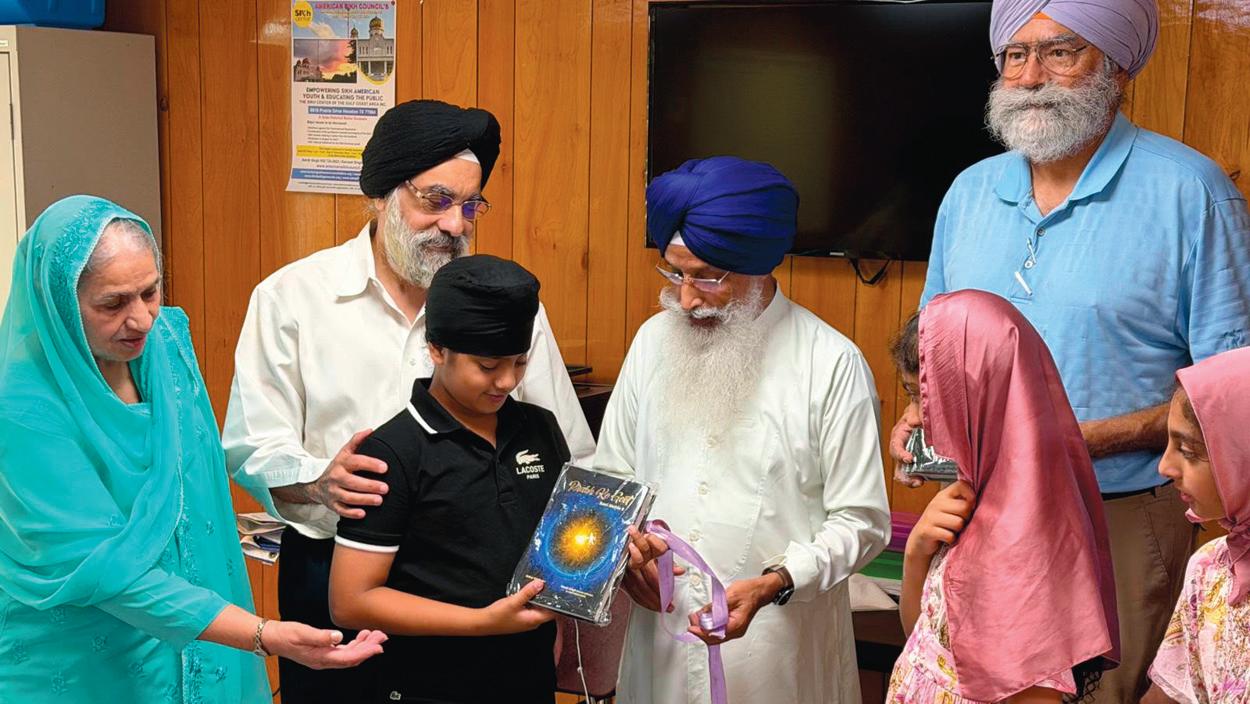
Houston: In November 2025, we celebrated the 350th anniversary of the martyrdom of Guru Tegh Bahadur Ji, the ninth Sikh Guru. To commemorate that event Prof. Manjit Singh, Ex-Jathedar of Sri Akal Takht Sahib, along with Dr. Onkar Singh have jointly produced a unique book titled “Prabh Ke Geet” on the Bani of Guru Ji. Where they have provided word by word meaning, including meaning of the entire Shabad plus its detailed elucidation. Even the title of the book is from the line of one of the 57 Saloks in the Bani. The uniqueness of the book is that on the back of the book cover, there is a QR code for linking to YouTube. By scanning the QR code one can listen to musical rendition of the Bani in the same musical scale (Raaga) as the composition of the bani. This distinctive feature enables reader to enjoy the singing of the Bani while s/he is reading about it. Currently the book is available in Gurmukhi, Hindi and English. There are plans to make the same book available in other leading languages.
Program
The US Book Launch took place on June 13, 2026, at Sikh Center of Gulf Coast, Houston, TX. The program started with the Welcome address and brief Introduction of the book. After the introduction, Prof. Manjit Singh shared with the audience the highlights of the book and it unique features. In
his address Prof. Manjit Singh shared that we have categorized the Bani of Guru Tegh Bahadur as “Vairaghmai” which is translated as detachment from the world. The result and the connotation of “Vairaghmai” is taken in the negative sense, implication being not interested in life. He explained it is in reality it is a Life Affirming Bani, which talks about how to live an engaging, fulfilling and a successful life. The life should be purposeful, satisfying and full of bliss.
He also shared that this is the first time that the entire bani of Guru Tegh Bahadur Ji, 59 Shabads and 57 Saloks have been explained with word meanings and shabad meaning plus its elucidation in a book form. The entire project took three years to complete. He said that during the celebration of Martyrdom of Guru Tegh Bahadur Ji, the Governor of Bihar had released this book at Patna Sahib.
The President of Sikh Center, Houston was requested to release this book formally. He asked Prof. Manjit Singh to join him. Then Prof. Singh asked that a representation from ladies and children should also be there. Thus this event became a unique book launch as well. The president of the Sikh Center thanked Prof. Manjit Singh and the audience for their participation. Then it was followed by a Questions and Answers session. The program concluded with refreshments.

Join Wednesday afternoons at Stafford Park for low-stress
Recently retired players are
Contact Andy at (281) 851-9602 or andyb@infodatinc.com for more information.
FounDer: Dr. k.l. sinDwani
puBlisHer: JawaHar MalHotra
eDitor: praMoD kulkarni
CorresponDent: sanCHali Basu

Tel:713-789-6397, email: indoamericannews@ yahoo.com, website: www.indoamerican-news.com
By renuka VyaVaHare
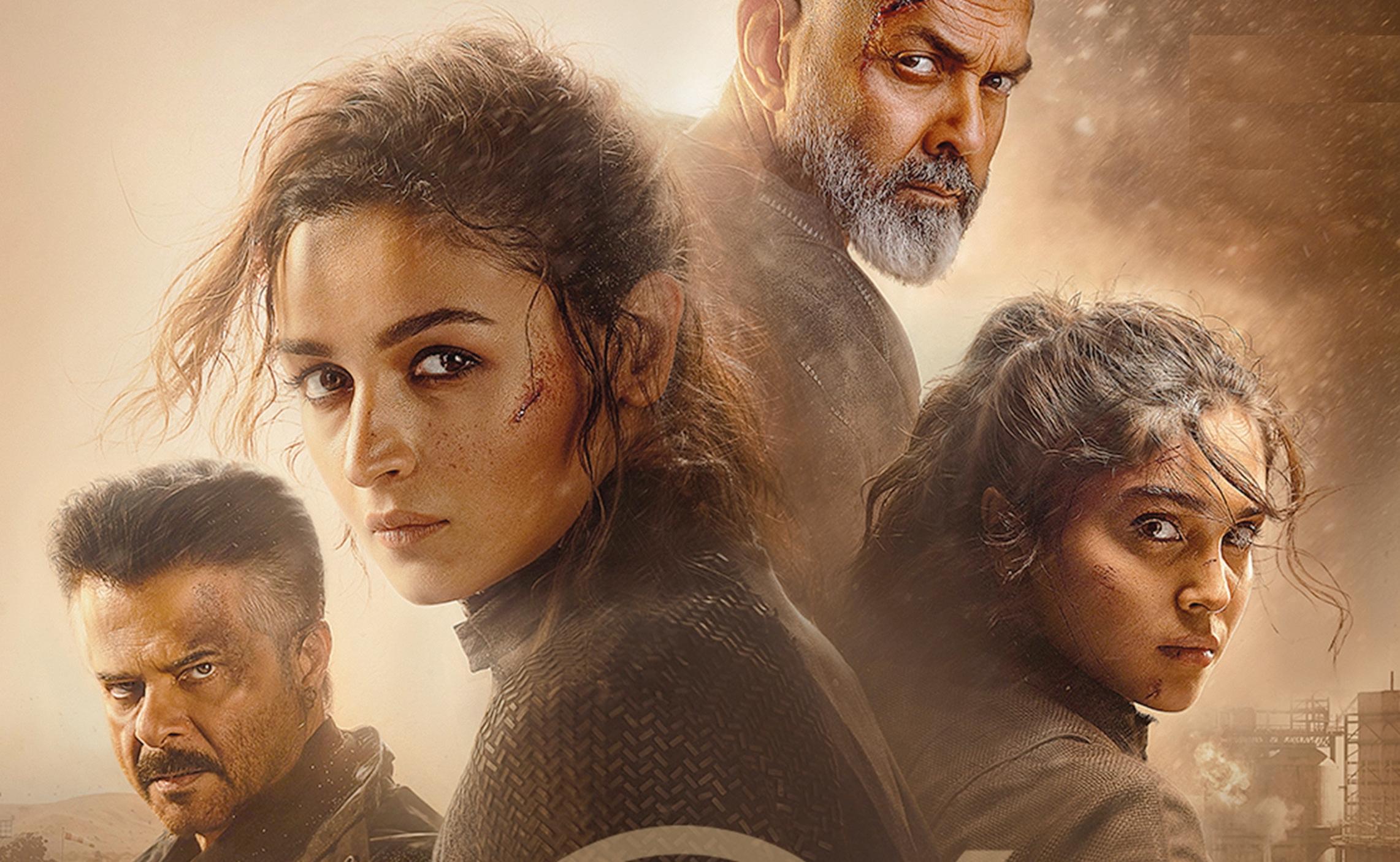
Story: Armed with the potent Alpha serum, Sita (Alia Bhatt) is trained by Colonel Fateh (Bobby Deol) to become an elite assassin and a valuable asset for India’s special forces. However, everything changes when she discovers the truth about her past and goes rogue.
Review: Along the way, Sita crosses paths with Durga (Sharvari), RAW chief Kaul (Anil Kapoor), and a tragic past that binds the trio together while reopening old wounds.Shiv Rawail’s Alpha rests on the petite shoulders of two capable female leads, neither of whom are conventional action stars — a relatively novel proposition for Bollywood.
Rooted in the trauma of a stolen childhood, Alpha initially shows promise of crafting an action thriller around buried pain and emotional scars. You expect that inner conflict to shape the narrative. Even the idea of introducing two superheroic female assassins, reminiscent of Black Widow, into the YRF Spy Universe feels genuinely exciting on paper.
Bollywood creating its own genetically enhanced super soldiers
armed with elite combat training, think Captain America or The Winter Soldier, is an ambitious idea in itself.
Unfortunately, Alpha soon devolves into a dull, fragmented and underwhelming drama, clumsily pieced together with painfully expository dialogue. It fails to establish the emotional resonance it sets out to create right from the beginning. There’s clearly more to Sita than being a mere killing machine, and her internal struggle could have formed the film’s emotional core.
Instead, the story abruptly shifts focus to family conflict, hollow patriotism, forced twist and a pointless cameo by a light-eyed superstar.The writing and execution derail the film completely. The dialogues and repetitive war cries over-explain everything.
“Alpha is all skill, no luck. Sabse pehle, sabse tej, sabse veer.” A scientist announces, “Iska IQ high hai,” while referring to a super soldier. RAW chief Kaul enters, only for someone to tell him, “Mossad chief aapse baat karna chahte hai,” simply to establish how important he is. We are also generously informed that “Battle se peeche hatne ko bhaagna nahi, strategic
retreat kehte hai.” “Iss baar Sita Lanka khud jalayegi” is perhaps the only powerful line in the entire film.This origin story feels so empty that it has the depth and range of an energy drink or athleisure brand commercial, further diluted by ill-placed and inconsequential song.
The music often feels like an advertisement jingle, with “Tu hi toh Agni hai” blaring every time Alia Bhatt breaks into combat mode.A braided, stoic Alia Bhatt, despite her baby face, delivers a sincere performance and remains committed throughout, but the film gives her very little to work with. Sharvari is reduced to a bubbly sidekick, wasting much of her potential.
Bobby Deol and Anil Kapoor bring strong screen presence, but even they are let down by an overly convenient screenplay.The action sequences are slickly shot and Alpha certainly had potential, but it crashes into a narrative devoid of thrill, unnerving tension and grit required for a compelling action thriller. You ultimately walk away disappointed. This is no Ballerina from the world of John Wick.-- ToI


Place a number in the empty boxes in such a way that each row across, each column down and each 9-box square contains all of the numbers from one to nine.
Send us the correct answer before July 14, 2026. Email us at indoamericannews@yahoo.com. Please send us your solved Sudoku for your name to be published.


Sanchali Basu, Kumud Athavale, Krishna R. Vuddagiri, Prabha Barvalia, Jawahar Khandheria, Prabha Narumanchi, Yudhveer Bagga, Naveen Garg, Nihira Ghanta, Srikanth Madhavan, Harsh Malkan, Soumya Srikanth, Rajesh Pradbhu, Priya Pathak, Mohit Mittal, Ayush Khaple, Rekha Trivedi, Arup Gupta