

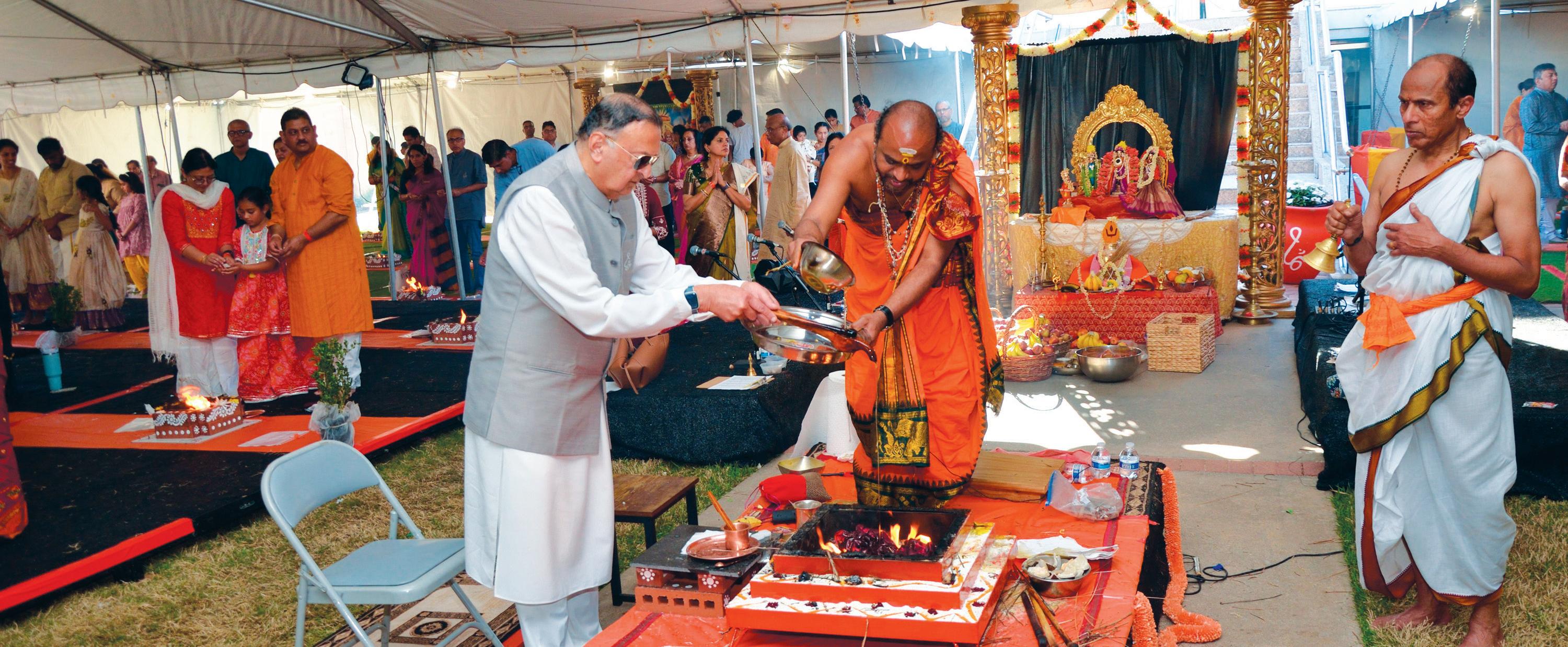






At Chinmaya Mission Houston, the Amrit Mahotsav was commemorated with a deeply inspiring and memorable 108 Samashti Shri Hanuman Chalisa Havan. Photos by Bharath Rao and Ashutosh Kak.

By Rimi Bhawal
The Chinmaya Amrit Mahotsav marks the 75th year of the Chinmaya Movement—a global celebration honoring the timeless Vedantic legacy of Pujya Gurudev Swami Chinmayananda that began in 1951.
Across the world, devotees are coming together to express gratitude to Gurudev’s glorious vision through many joyful offerings including signature spiritual events such as global chanting of the Bhagavad Gita, the Chinmaya Amrit Yatra, and the 108 Samashti Shri Hanuman Chalisa Havan. These celebrations highlight seventy-five years of knowledge, service, and inspiration that have touched countless lives.
At Chinmaya Mission Houston, the Amrit Mahotsav was commemorated with a deeply inspiring and memorable 108 Samashti Shri Hanuman Chalisa Havan on March 14, 2026 - a day of devotion immersed in yajna spirit, centered around 54 sacred Havan Kunds, and resounding with 108 continuous chants of the Hanuman Chalisa. More than 600 families and over 2,000 participants gathered around the glowing Havan kunds in the beautiful courtyard of Sri Saumyakasi Sivalaya in Chinmaya Prabha, where the sacred verses were chanted with reverence from 7 am until the final round of Havan and Poornahuti in the evening.
Despite the large gathering, the event unfolded with remarkable discipline, order, and a palpable sense of holiness. This seamless experience was made possible by the tireless efforts of a true Chinmaya army of volunteers who worked continuously, dedicating countless hours for months ahead to plan and organize the daylong prayer. Among them were 70 enthusiastic middle school and high school volunteers, whose remarkable energy and commitment embodied the spirit of service that Chinmaya Mission seeks to nurture in the next generation.
Before March 14 dawned, volunteers arrived to ensure everything was perfectly arranged for the sacred observances. By 6:45 a.m., the sankalpa, the sacred determination, was taken, setting the spiritual tone for the day. Precisely at 7:00 a.m., the opening verses of the Hanuman Chalisa energized
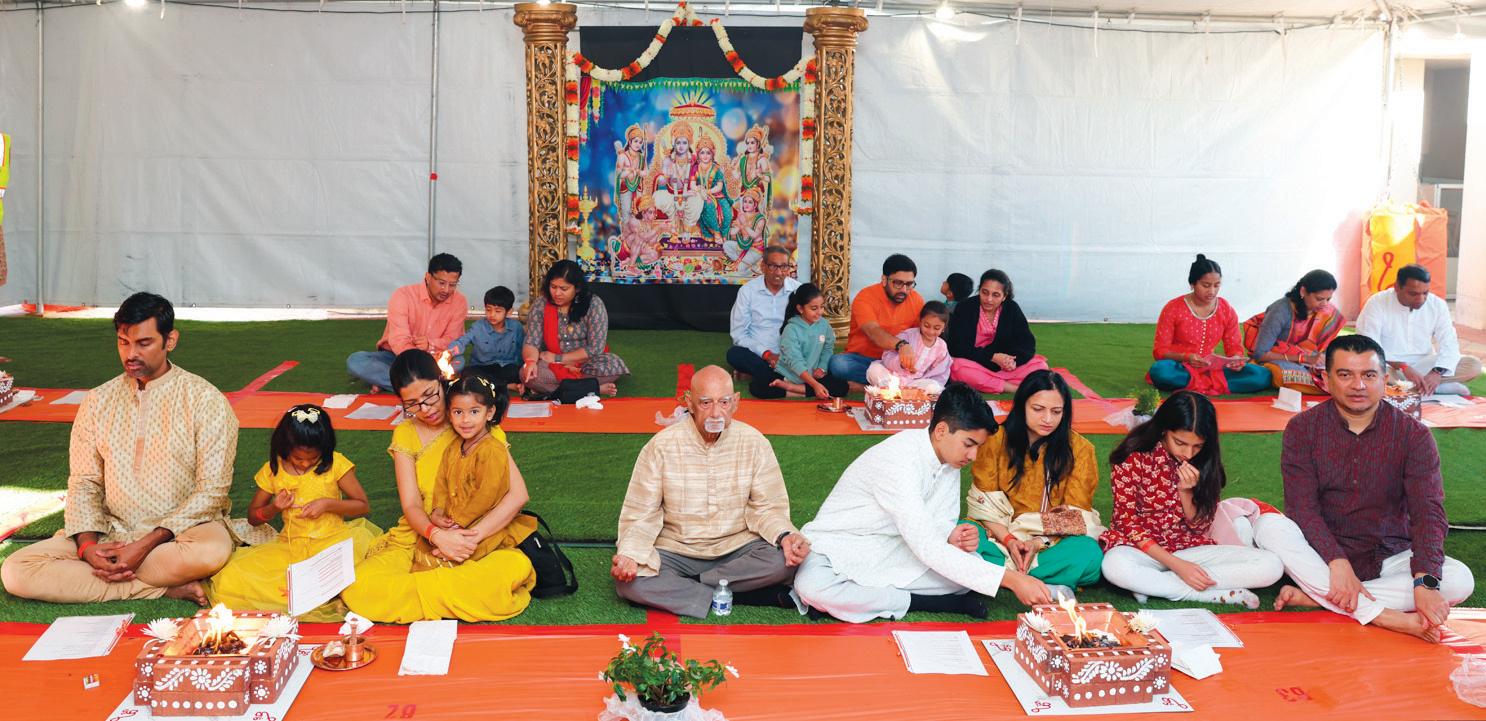
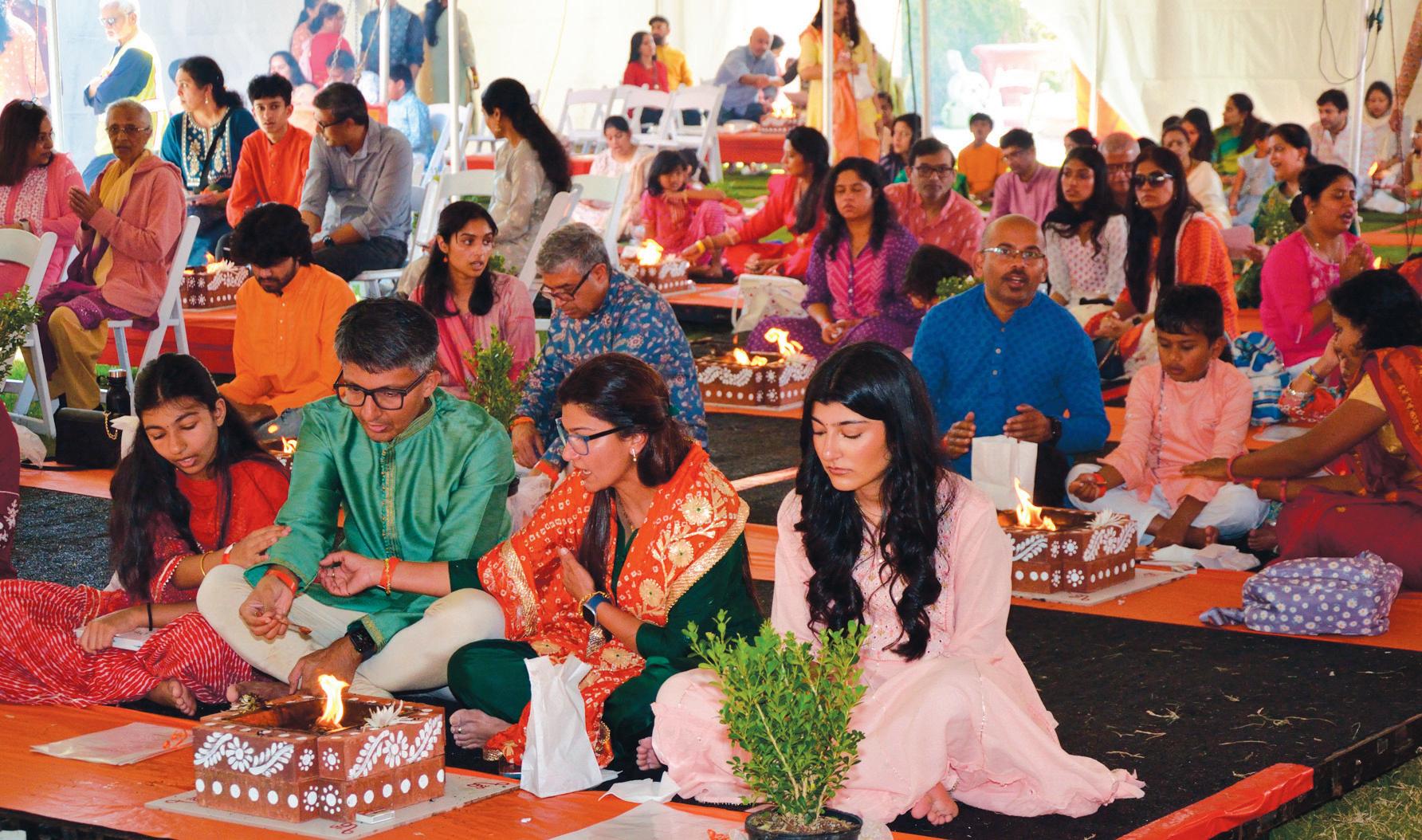
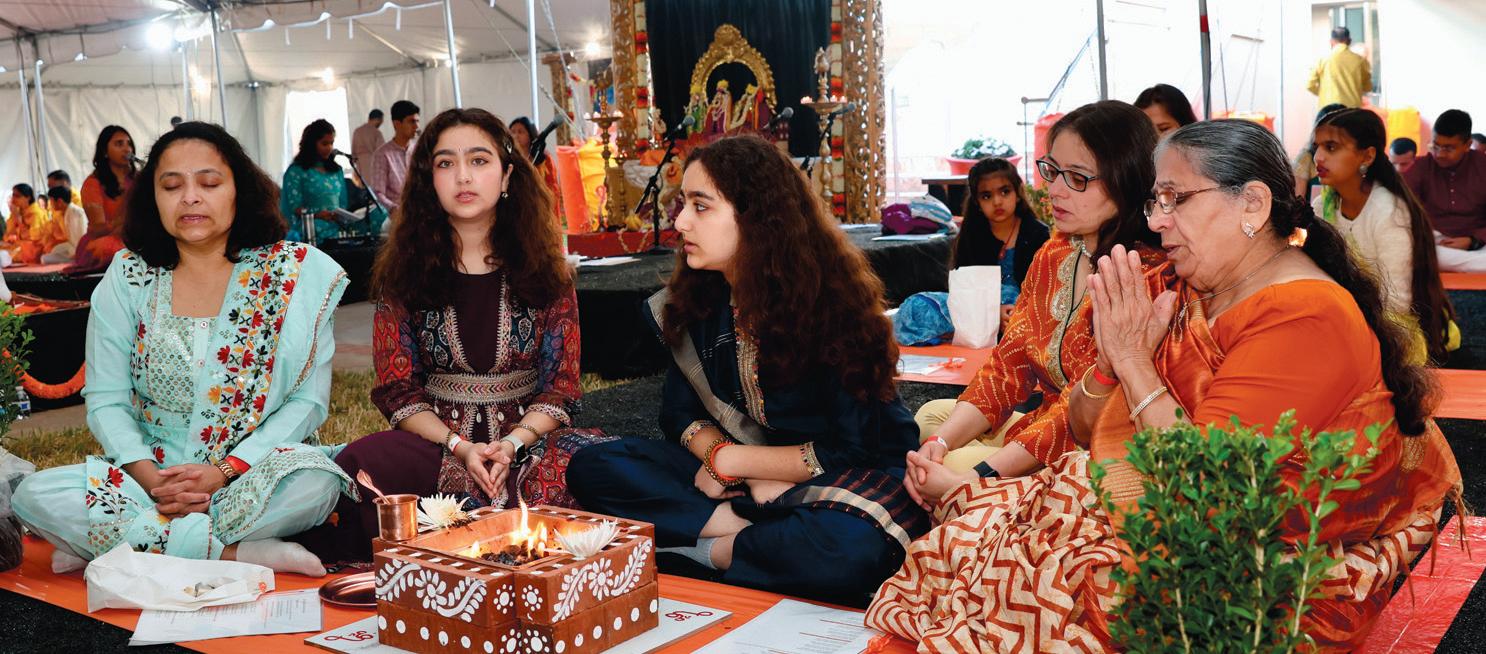
the morning and marked the beginning of a day filled with collective devotion. Families moved through the yajna space, sat around the havan kunds, and offered ghee and dried coconut pieces into the shining flames with quiet reverence
while the continuous chanting created a powerful and uplifting spiritual atmosphere.
The Samashti Havan was more than a devotional event—it was a thought-provoking tribute to Pujya Gurudev during the milestone year
of the Chinmaya Amrit Mahotsav.
Many participants reflected on how this celebration embodied the unity and dedication of the Chinmaya community, brought together by Gurudev’s teachings.
As part of the program, after
performing the Havan, families streamed into the Chinmaya Smrti Hall to view a short documentary on the life and mission of Swami Chinmayananda. The film traced Gurudev’s inspiring journey— from his early life and spiritual awakening to his deep quest for the knowledge of Vedanta. It showcased how he spread that knowledge to awaken Hindus worldwide to their philosophical roots. Following the inspiring documentary, families participated in a lively Chinmaya Mission–themed bingo game which tested their knowledge of the Mission’s history and teachings in a fun and engaging way. Then, the happy members of the huge family of Chinmaya Mission Houston placed their thumbprints on a giant mural to commemorate their participation in the momentous 75th year celebration. The colorful mural signified how the great qualities of Hanuman and the spiritual guidance of Pujya Gurudev will ferry all devotees across the ocean of world life toward the Highest which shines like the Sun.
After that sacred day of fellowship and gratitude, participants left the premises with a framed memento featuring the Sanskrit verse “Buddhir Balam Yasho Dhairyam,” a prayer to Lord Hanuman to gain intelligence, strength, fame, courage, patience, health, alertness, and eloquence. They also received a delicious Prasadam, wrapped with love. The following day, Chinmaya Mission Houston (CMH) families gathered for a Mahabhog, a community feast as the weekend celebrations concluded in a spirit of service and togetherness.
The Chinmaya Amrit Mahotsav celebrations in Houston truly galvanized the community. Families, volunteers, and children alike poured their hearts into this offering of devotion, expressing their deep gratitude to Gurudev and reaffirming their commitment to continue the journey of seeking and sharing the timeless wisdom of Vedanta for generations to come.
For more information about Chinmaya Mission Houston, Sri Saumyakasi Sivalaya, and its activities, please visit www.chinmayahouston.org, www.saumyakasi. org or call temple 281 568 1690 or Jay Deshmukh 832 541 0059 or Bharati Sutaria 281-933-0233

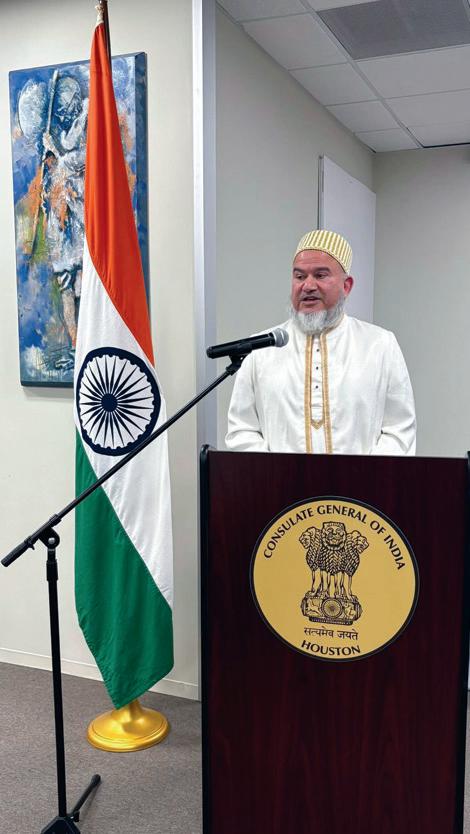
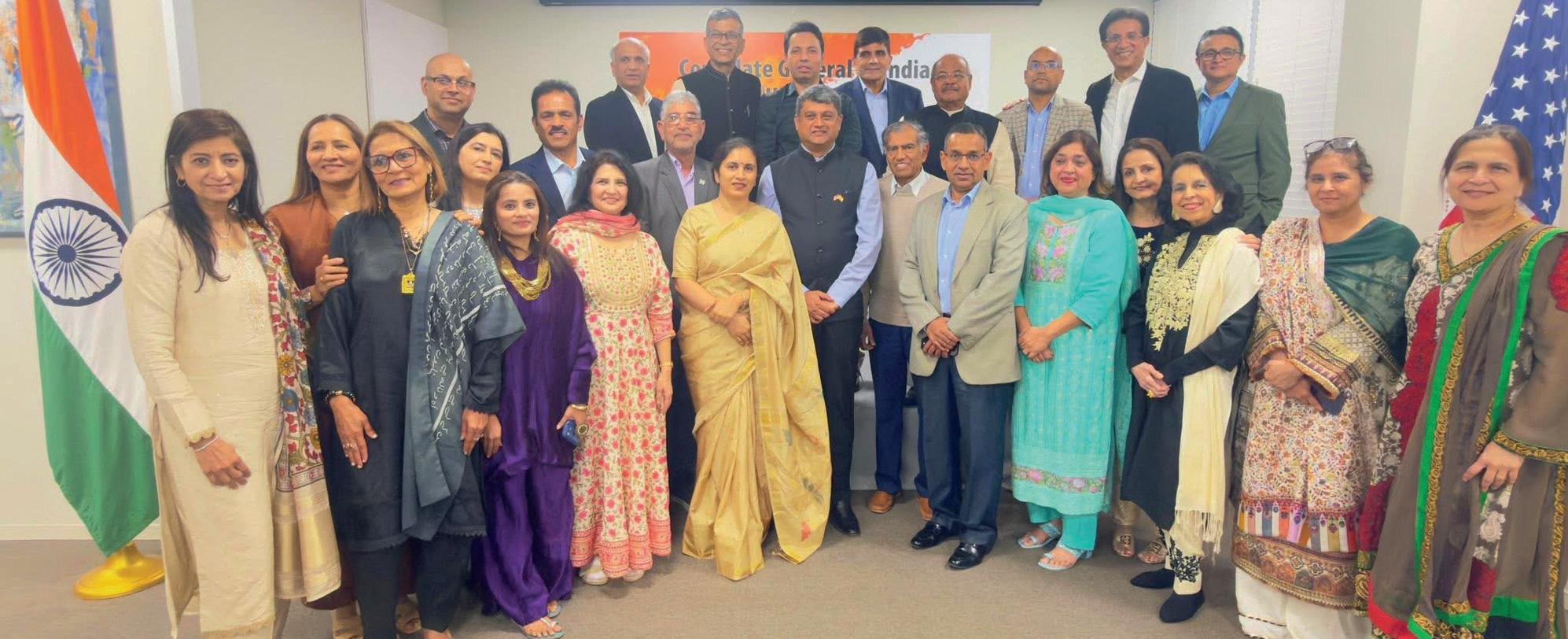
houston: The Consulate General of India, Houston hosted a well-attended Iftar gathering on the evening of March 16, 2026, as part of its ongoing community outreach initiatives.
The event brought together members of the Indian community and friends from the Consular Corps for an evening of unity and celebration.
Consul General DC Manjunath extended greetings on the occasion of Ramadan, emphasizing the values of unity, compassion, and collective well-being.
The evening reflected the spirit of togetherness and harmony that defines India’s cultural and religious diversity.











By ClaiRe Goodman
RiChmond: A defense expert told jurors Wednesday that the campaign finance report at the center of the case against Fort Bend County Judge BP George was accurate, pushing back on prosecutors’ claims that he failed to properly disclose campaign loans.
Election law attorney Andy Taylor testified that the report in question covers only a narrow window, about 65 days at the end of 2018, and should not include financial activity from earlier in that year.
Prosecutors have argued that George moved money between personal and campaign accounts without properly reporting it, as part of a broader allegation that he misused political funds.
But Taylor told jurors that campaign finance reports are timespecific and only require disclosure of loans made during the period covered by each filing. He acknowledged that bank records show money did move into the campaign in 2018, but those transactions occurred months earlier, primarily between March and June, and would belong on different reports.
Taylor also said the available records are incomplete, with years of financial history missing due to standard retention limits.
Taylor walked jurors through a simplified accounting using figures introduced by prosecutors, including about $72,850 he said George contributed to his campaign between 2016 and 2018. Even after subtracting transactions identified by the state, including roughly $46,500 in withdrawals, Taylor said George still appears to have put more money into the campaign than he received back.
He described any discrepancy as minor.
On cross-examination, prosecutor Katie Peterson questioned both Taylor’s conclusions and the foundation of his analysis.
Peterson noted that Taylor is not a certified accountant and did not have receipts for many transactions, relying instead on partial records and assumptions.
Taylor disputed how prosecutors interpreted key figures in the campaign report, saying certain totals, including a $399 figure cited in testimony, do not reflect a campaign bank balance and should not be read that way.
He further testified that a listed $3,000 loan amount represented money owed to others, not a loan George made to himself, contradicting the state’s characterization.
Throughout his testimony, Taylor said that both sides are working with gaps in the financial record, making it difficult to reconstruct a full picture of the campaign’s finances.
“He may be way in the black because we’re missing data,” Taylor said. -- Houston Chronicle

Join Wednesday afternoons at Stafford Park for low-stress practice sessions. Recently retired players are welcome. Contact Andy at (281) 851-9602 or andyb@infodatinc.com for more information.


By Jonathan dee
The late great S.P. Chopra, the fictional politician whose influence forever looms over the characters in Karan Mahajan’s new novel, was more of a prolific father than an attentive one. With a long, illustrious record of public service (framer of India’s Constitution, governor of its Reserve Bank), he seemed to belong as much to the nation as to his family.
One might trace this back to his relationship with his own father, whom he did not meet until he was 12, after the elder Chopra was advised by an astrologer that any sight of his newborn son’s face would kill him. Now, S.P. lives posthumously in the heads of his nine adult children less as a collection of memories than as a vague but crushing set of patrimonial expectations.
His emotional legacy may be murky, but his material one takes the very concrete form of two multistory buildings in Delhi. These have been divided haphazardly into apartments in which more than 20 of his descendants and their families live in irritable proximity: the “Complex” of the novel’s title. (“Compound” might have been a better word for this real estate setup, but of course it lacks the piquant alternative meanings.)
While it’s true that Delhi prices make both the property and the land extremely valuable, the Complex itself is no palace: “Old paint on the wall, mere powder in places — paint chosen by her father and never recoated. Old black switches, the wires running in covered plaster rails along the walls. To live in this house was to live inside their father’s mind: half village, half city.”
S.P.’s heirs have the means, and sometimes the desire, to leave home, even to emigrate to the West; but family dynamics, good or bad, tend to pull them back. Thus the novel’s field of action — at first quite global, with long interludes in Michigan and in London — gradually contracts to this claustrophobic setting, where there is so little space that the returning family members squabble over who has the right to build new rooms on the roof, or in the dilapidated servants’ quarters.
The Chopra family members who suffer most tend to be the women, especially those who marry into it. One of them is back in Delhi after moving excitedly to her new husband’s home in England, only to learn that he was already married to a white Englishwoman there, who had borne him a son. But that’s far from the worst of it. Another of S.P.’s sons, Laxman — the Chopra whose struggles and misdeeds grow to dominate the novel — has the seriously unfortunate habit of sleeping with his relatives’ wives. Nor is he always, to attempt to put it delicately, a stickler for consent.

When one of Laxman’s victims, Gita — his nephew’s wife — finally summons the nerve to tell a family member about his having forced himself on her, she is amazed to learn that the family (or some of them, at any rate) already knew about it, and further, that they had hoped it might turn out to provide a genetically acceptable “solution” to the shameful problem of Gita’s childlessness. Rape as blessing in disguise, as it were. This revelation is somehow more staggering to the reader than to the characters. Indeed, as the novel pushes past this development and continues to narrate the relatively ordinary tribulations of this pathologically insular family — business ventures gone bad, squabbles over living space, routine domestic violence — one starts to wonder: Where could all this possibly be going?
Mahajan knows exactly where it’s going. His previous novel, the rapturously received The Association of Small Bombs (2016), was about the long tail of violent, “political” acts in the personal lives of individuals caught in their orbit, willingly or not. In “The Complex,” Mahajan approaches that same truth from the opposite direction, showing us how organically and dangerously certain qualities can turn men into political leaders, and how even a movement of millions can have one man’s atavism at its heart.
Laxman — son of a “great man,” business flop, cheerful sociopath, rapist, masterly avoider of blame or consequence — eventually fails his way into the world of local politics. He succeeds with terrifying ease, as befits someone with no real convictions and an instinct for power.
The political events he exploits for his personal advancement, like the Mandal Commission’s affirmative-action programs and the mass protests against them, or the assassination of Indira Gandhi, are all real-life ones. How had this happened? Gita wondered. How had the worst person in the family become its doyen? Or was this the fate of all groups? That power accrued to the person with the most energy, regardless of whether that energy was good or evil?
“The Complex,” Mahajan’s third novel, is a more magisterial performance, mostly in good ways. His work has always woven a subversive, contemporary sensibility into a traditional, almost 19th-century approach to form and style.
The narration in “The Complex,” though technically (indeed, almost secretly) delivered by Laxman’s nephew Mohit, exercises an easy omniscience, even within scenes, and is given to apothegms that might be risky if it weren’t for the fact that the author so consistently nails them: “No one was friends in any family. It was just another network of power masquerading as a nest of love.” Mahajan is a confident, ambitious and increasingly important writer, from whom one only wishes we heard more often.
The crime at the end of the book is revealed in its opening pages,
as is the identity of the criminal — so straightforwardly that I found myself trying to anticipate a twist, a reveal. But it’s telling that the twist never comes. There are fewer ironies in “The Complex” than in “Small Bombs”; the new book seems more like a study of revealed inevitability. “Say what you would about Laxman,” Mohit observes, “but he had been exactly what he appeared to be. There was no artifice. He saw the world and he took and took. He never apologized.”
THE COMPLEX | By
Karan
Mahajan | Viking | 435 pp. | $30
Jonathan Dee is the author of eight novels, most recently “Sugar Street,” and the director of the graduate writing program at Syracuse University. -- NYT

By dhaval Roy
Story: Anusuya (Dimple Kapadia) wakes up from a coma after two years and confesses a deeply personal secret to her husband, Gopal Chandra Nautiyal (Pankaj Kapur). The revelation and the husband’s emotional upheaval test the duo’s relationship and their 50-year marriage, as he seeks a divorce.
Review: Saurabh Shukla is one of the finest actors of our time, who can shift between comic and serious scenes with effortless ease. He translates this prowess onto the screen through his writing and direction. The story is set in Uttarakhand and begins on a loving but sombre note, with Gopal tending to his comatose wife, Anusuya. He fills her in about their daily lives — the househelp going on leave, the onset of winter, and the doctor calling their children to meet her one last time. Right when you think this would be a story about grief or a dysfunctional family coming together, the narrative flips.
Anusuya wakes up, and the secret she reveals sets in motion a curious run of heartbreaking yet comedic events, with neither overpowering the other.
This is a mature romance where an older couple takes centre stage. The story is unique and, even as the couple’s relationship and family dynamic shift, it remains entertaining without becoming trivial. The dialogues are also thoughtful. “Rishton mein sach badi cheez hoti hai, sach se shikayat nahin (Truth matters in relationships; there can be no complaint about the truth),” a younger lawyer, R K Negi (Aparshakti Khurana), says The film also explores the fragility of relationships and old age, and what love really means after decades together. The husband is upset, but he also won’t hear unsavoury words about his wife. The characters feel humane and relatable.
In his introductory scene, Param (Samir Soni) comes across as pragmatic to the point of being insensitive — prepping for his
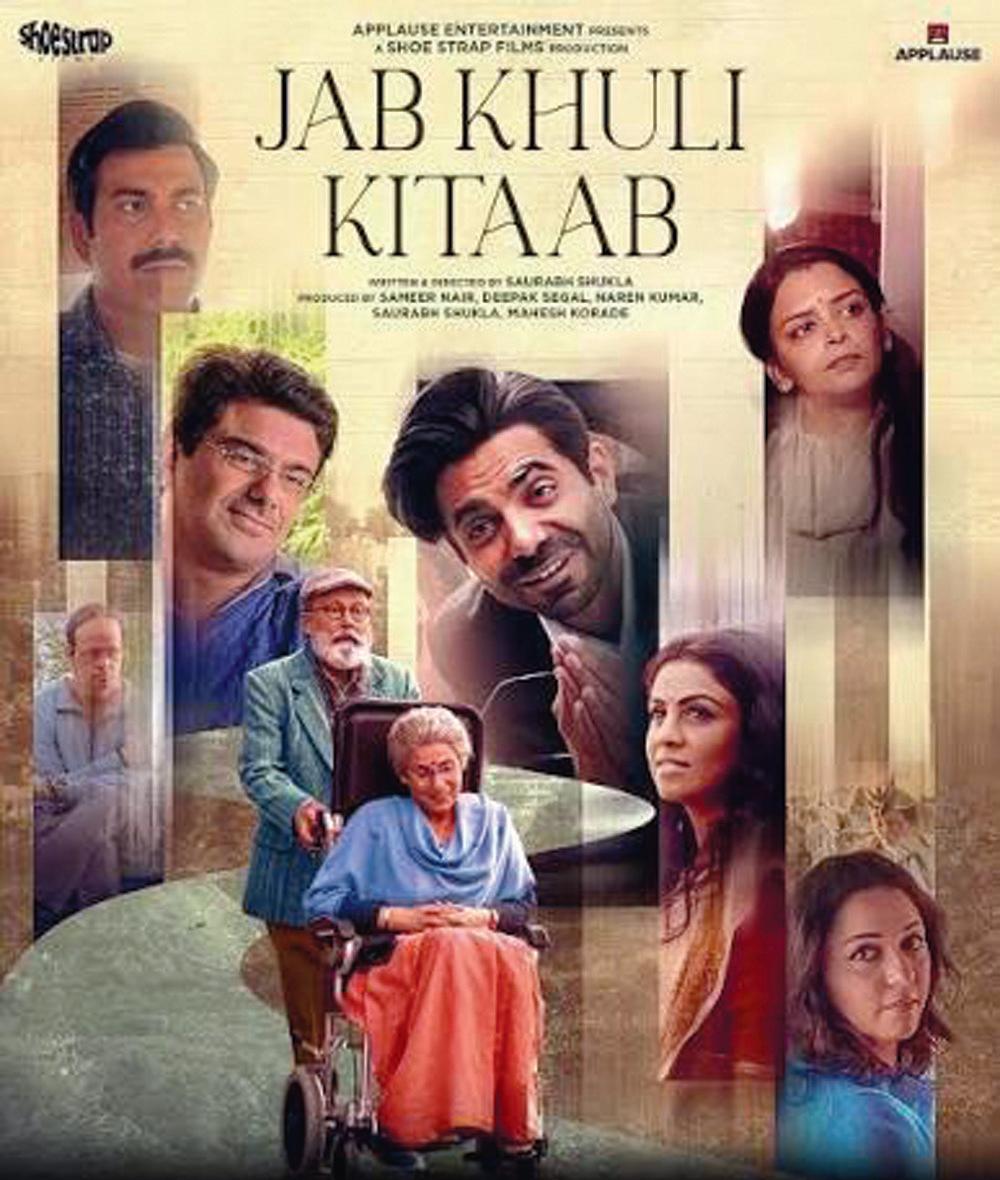
mother’s funeral even before she has passed — while his brother-inlaw Jignesh (Sunil Palwal) storms into the room talking on the phone about being at a “death home”. Later, both turn out to be noble and decent men.
There are subtle scenes about how women are undermined in daily life, even an overachiever like District Magistrate Asha (Manasi Parekh), whose emotionally distant, stern husband reprimands her for dressing up for court Pankaj Kapur is outstanding in
every scene — tender and emotional, or comically outraged. Watch out especially for the shift in his demeanour and body language toward the end.
Dimple Kapadia can emote even as a comatose woman, and she is just as brilliant as Kapur. Aparshakti Khurana, Samir Soni, Nauheed Cyrusi, and Abuli Mamaji as Dholu all deliver strong performances.The atypical romance story and stellar performances make this mature love story worth watching. -- ToI
FoundeR: dR. K.l. sindwani
PuBlisheR: JawahaR malhotRa
editoR: PRamod KulKaRni
CoRResPondent: sanChali Basu
®All rights reserved. No material herein or portions thereof may be published without the written consent of the publisher. Deadline for advertising and articles is 4 pm on Monday of each week. Please include self-addressed, stamped envelope for return of all unsolicited material. Published at 2470 S. Dairy Ashford #175, Houston, Texas 77077. Tel:713-789-6397, email: indoamericannews@yahoo.com, website: www.


Place a number in the empty boxes in such a way that each row across, each column down and each 9-box square contains all of the numbers from one to nine.