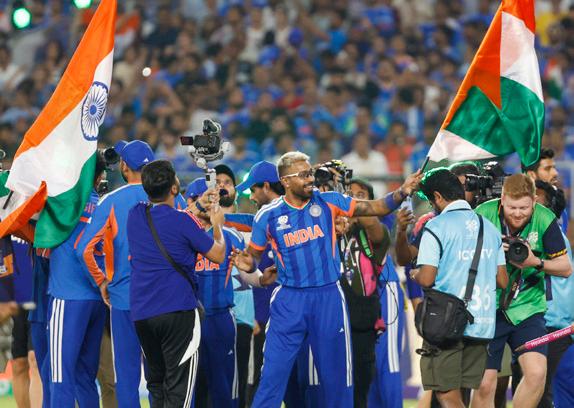
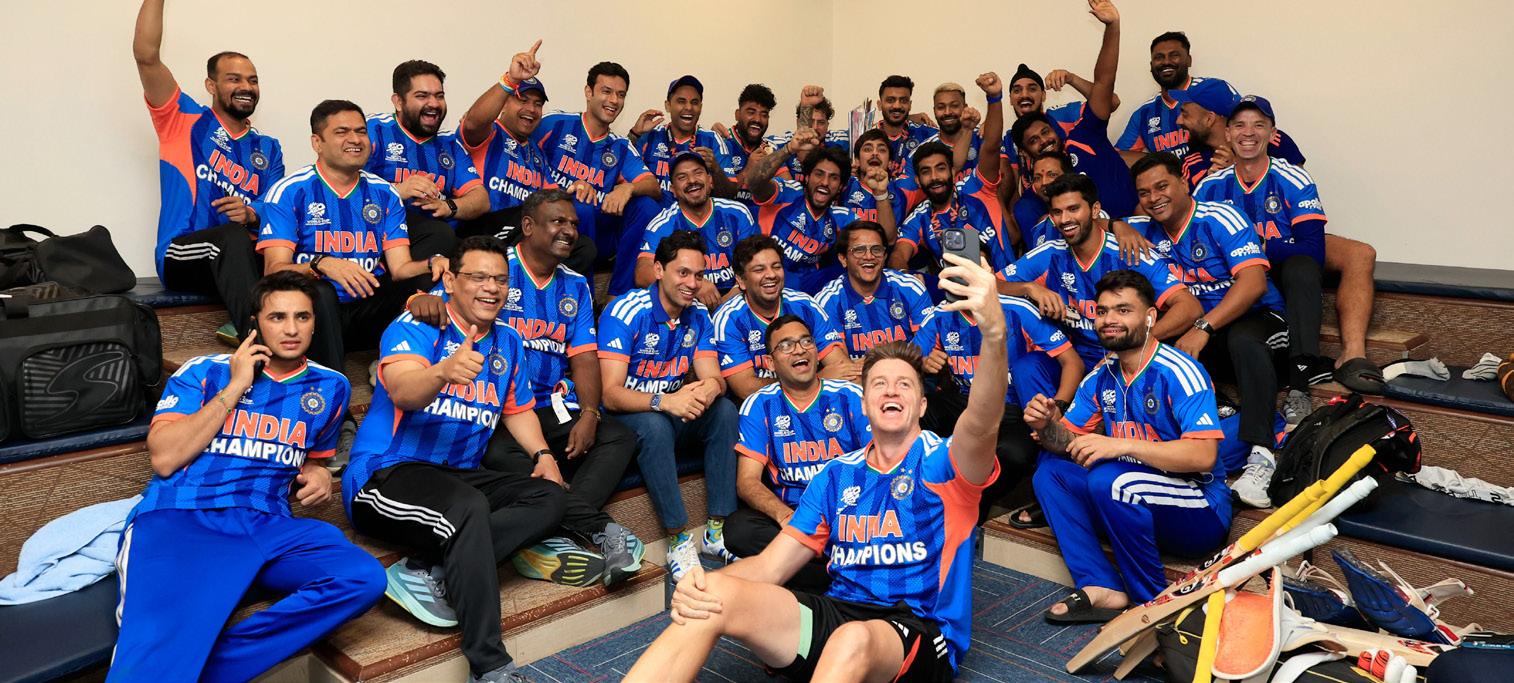
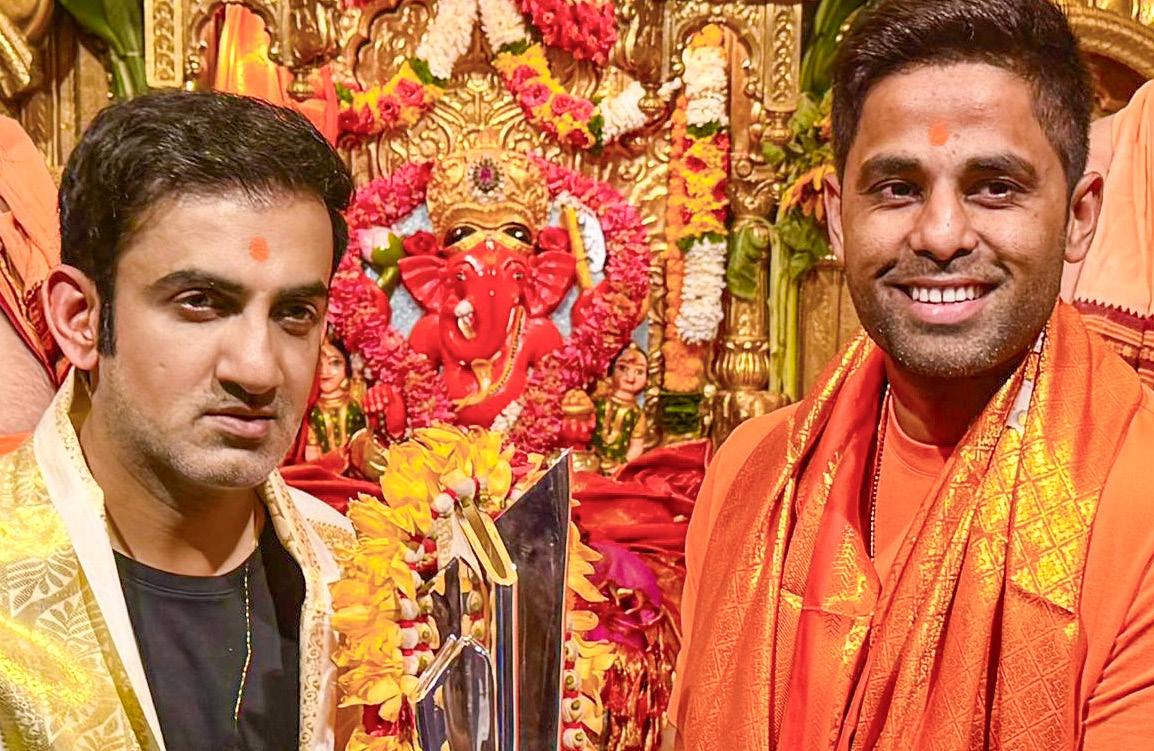
Ahmedabad, March 8 (IANS) The ghosts of the past were finally laid to rest at the Narendra Modi Stadium as India delivered a
masterclass against New Zealand to retain their ICC T20 World Cup title with a 96-run win on Sunday. In a poetic reversal of fortune at the very venue that once hosted their most bitter defeats in 2023, the Men in Blue stood tall, transforming the world’s largest cricket arena into a cauldron of pure jubilation. India were the favourites to lift the title as they entered the tournament in scintillating form
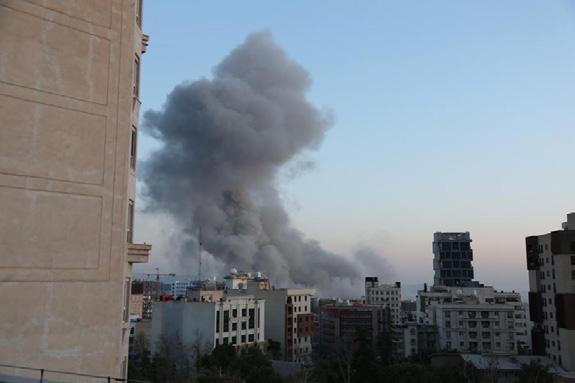
West Asia conflict: 2 Indian nationals killed, several injured in Oman attack
New Delhi, March 13 (IANS)
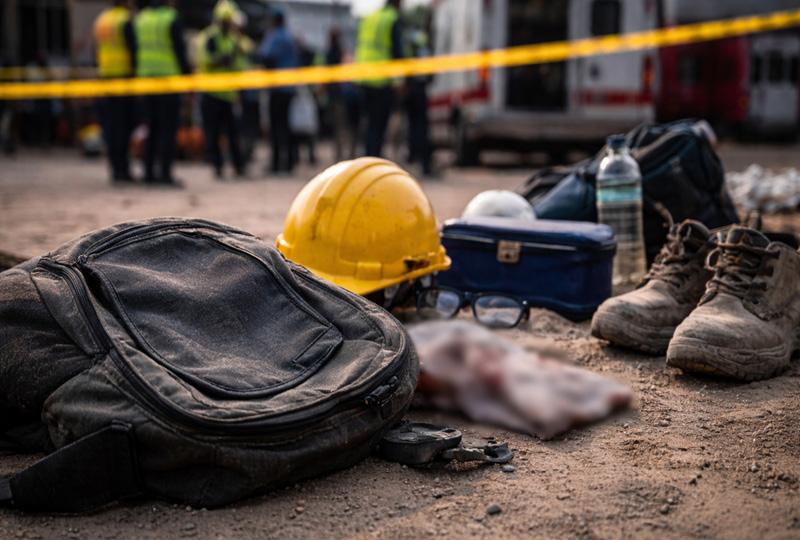
Two Indian nationals were killed and several others injured in an attack in Oman's Sohar amid the
ongoing conflict in West Asia, the Ministry of External Affairs (MEA) said on Friday.
MEA spokesperson Randhir Jaiswal said in a post on X that the Indian mission in Oman is in contact with local authorities and the employer company and is providing assistance to those affected.
“We lost two Indian nationals
that has seen them win 48 of their last 56 T20I games dating back to October 2023. And producing a dominant series win against New Zealand ahead of the marquee event, they lived up to the tag.
The Men in Blue had a strong and steady campaign leading to the final of the ICC Men’s T20 World Cup 2026, achieving seven wins in eight matches. Their journey
United Nations, March 14 (IANS)
Five candidates have been nominated to vie to become the next United Nations secretarygeneral, taking over the
MHA revokes NSA detention of Ladakhi activist Sonam Wangchuk
Jammu, March 14 (IANS)
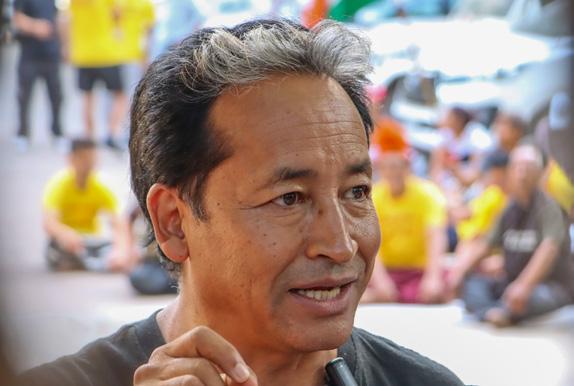
The Ministry of Home Affairs (MHA) on Saturday revoked the detention of Ladakhi climate activist, Sonam Wangchuk under the National Security Act (NSA).
In a statement the MHA said today that it has revoked the detention
of activist Sonam Wangchuk under the National Security Act (NSA) with immediate effect, adding that the government of India remains committed to fostering an environment of peace, stability, and mutual
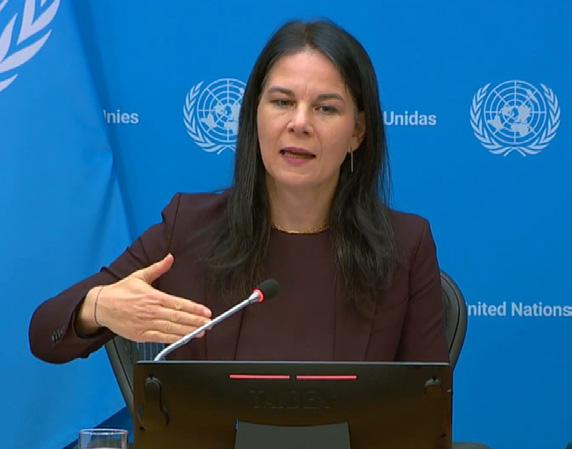
organisation at a time of crises around the world and within it, and the election process will start next month, according to General Assembly President Annalena Baerbock.
"This is a very transparent, very neutral, and fair process in which every candidate ... will have the same chances and opportunities”, she said on Friday.
Starting April 20, each of the candidates will face a three-hour interactive session during which they will present their case for
New Delhi, March 9 (IANS)
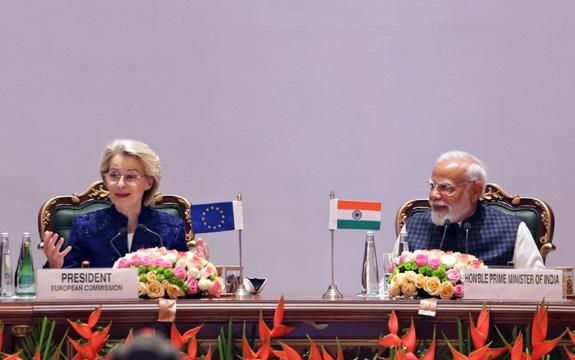
India’s relations with Germany and the European Union (EU) have strengthened from being based merely on trade ties to a strategic alignment encompassing economics, technology and shared interest in a stable IndoPacific, according to a new report
“Recent high level visits and upgraded frameworks with Germany, France, Italy, Finland,
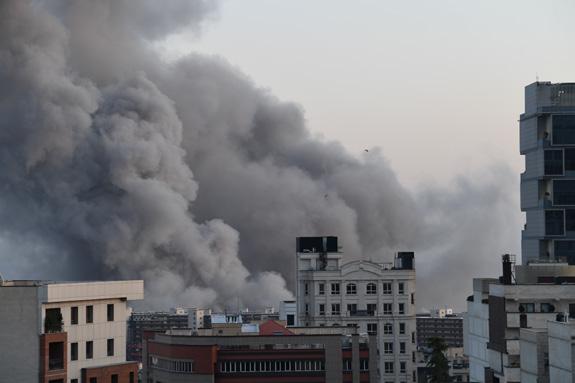
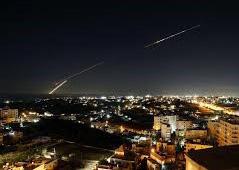
New Delhi, March 14 (IANS) The United Nations Human Rights Office has warned that the ongoing Iran–Israel conflict is rapidly escalating with serious humanitarian, economic, and global consequences, urging all parties to move towards an immediate ceasefire and stronger
election to head the 193-member organisation and run a gauntlet of questions.
The dialogue will include civil society organisations and be broadcast on the web.
The call for candidates was put out last year by Baerbock and the then-president of the Security Council called for women candidates, reflecting a wide sentiment that after 80 years it was time for a woman to helm the organisation.
and the EU leadership have consolidated Europe as India’s second strategic theatre after the Indo-Pacific’s core Quad network,” according to an article in India Narrative.
India’s ties with Europe which were earlier dominated by trade, aid, and diaspora linked politics have seen a shift to strategy: technology supply chains, defence co production, clean energy transition, and joint Indo-Pacific projection. In the last five years Brussels has begun treating New Delhi as a systemic stabiliser and key voice of the “Global South”, reflected in the EU College of
EDITORIAL TEAM
Dr Ram Mohan, Chairman
Dr Ashutosh Misra, Editor-in-Chief
EDITORIAL BOARD
Amrita Deshpande, Community News Editor
Paras Sharma, Assistant Editor
Dr Uttam Kumar Sinha, Senior Fellow, Nehru Memorial Museum & Library, India
Mr Shaun Star, Director, Centre for Australia India Studies, Jindal Global University, India
A hat-trick of firsts: India defend T20 WC title, break home jinx, claim record third crown
Continued from Page 1
started with a 29-run win against the United States national cricket team at the Wankhede Stadium on February 7.
They then dominated the Namibia with a convincing 93-run victory in Delhi on February 12. One of their most important wins in the group stage came when they defeated their arch-rivals, the Pakistan, by 61 runs in Colombo on February 15.The team continued to build momentum with a 17-run win over the Netherlands in Ahmedabad on February 18.
India's only defeat in the tournament came against South Africa in Ahmedabad on February 22. However, this loss did not derail their campaign. The team responded strongly, beating Zimbabwe by 72 runs in Chennai on February 26. They then overcame the West Indies team by five wickets in Kolkata on March 1, securing a spot in the semi-finals, where the Suryakumar Yadav-led
side beat England by seven runs in a thrilling contest.
With this victory, India has rewritten the record books. Take a look at the milestones the Men in Blue conquered in their title defence.
1) First team to defend T20 World Cup
Entering the 2026 tournament as defending champions, India carried the momentum of their historic 2024 campaign—a victory that marked their second T20 World Cup title since the inaugural 2007 triumph. By clinically dismantling New Zealand in the final, the Men in Blue have now achieved what no other men’s side in history has: a successful title defense. This back-to-back glory cements their status as the format's undisputed powerhouse.
This latest milestone follows their record-breaking 2024 run, where India redefined dominance by winning eight consecutive matches to lift the trophy. In
doing so, they became the first team in the tournament’s history to complete an entire World Cup campaign undefeated.
2) First men's team to lift T20 World Cup crown on home soil India’s victory in Ahmedabad marks a watershed moment in the tournament’s history: they are now the first men's team to lift the T20 World Cup trophy on home soil. Since the inaugural 2007 edition in South Africa, the coveted silverware has consistently eluded the host nations. From the Caribbean to Australia, and across previous editions in Asia, the "home-ground advantage" had historically proven to be a burden rather than a blessing.
Until Sunday’s final, the list of hosts who fell short was long and distinguished, including South Africa (2007), England (2009), Sri Lanka (2012), and Australia (2022). Even in 2024, the co-hosting USA and West Indies watched as the trophy was claimed by others.
Election process for UN Secretary-General to start next month with five candidates so far
Continued from Page 1
The Assembly resolution on the election set "equal and fair distribution” on the basis of gender as a desirable goal. But two of the five candidates nominated so far are men. The three woman candidates are former Chilean President Michelle Bachelet, who was also the UN High Commissioner for Human Rights and was nominated by Chile, Brazil
and Mexico; Costa Rica’s nominee Rebecca Grynspan, the secretary-general of UN Trade and Development (UNCTAD), and a former vice president of Costa Rica, and Virginia Gamba, a Argentinian nominated by Maldives, who held senior positions at the UN, including Secretary-General Antonio Guterres' Special Representative for Children and Armed Conflict, and the head of the Organisation
for the Prohibition of Chemical Weapons.
Another Argentinian, Rafael Grossi, who heads the International Atomic Energy Agency, and was nominated by his country, is one of the two men running for the office.
The other, nominated by Burundi, is Macky Sall, a former president and prime minister of Senegal. Nominations close on April 1, and other candidates can emerge.
MHA revokes NSA detention of Ladakhi activist Sonam Wangchuk
Continued from Page 1
trust in Ladakh to facilitate constructive and meaningful dialogue with all stakeholders.
“After due consideration, the government has decided to revoke the detention of Sonam Wangchuk with immediate effect, reiterating its commitment to providing all necessary safeguards for Ladakh.
“In the backdrop of the serious law and order situation that arose in the peace-loving town
of Leh on 24 September 2025, Sonam Wangchuk was detained on 26 September 2025 under the provisions of the National Security Act (NSA) pursuant to an order issued by the District Magistrate, Leh, with a view to maintaining public order. “He has already undergone nearly half of the period of detention under the said Act. “The Government has been actively engaging with various stakeholders and
community leaders in Ladakh with a view to addressing the aspirations and concerns of the people of the region.“However, the prevailing atmosphere of bandhs and protests has been detrimental to the peace-loving character of the society and has adversely affected various sections of the community, including students, job aspirants, businesses, tour operators and tourists and overall economy.
India emerges as a strategic partner for EU: Report
Continued from Page 1
Commissioners’ unprecedented visit to India in February 2025, the article states.
Simultaneously, leading member states have “bilateralised” their India bets. France has elevated ties to a “Special Global Strategic Partnership”; Germany marks 25 years of Strategic Partnership; Italy has unveiled a detailed 2025 2029 Joint Strategic Action Plan; and Finland has deepened its strategic partnership through
high-level ministerial and presidential engagements in early 2026.
This creates an overlapping lattice: EU level frameworks on trade, digital and connectivity, complemented by state level defence, industrial and technology cooperation that directly feed into India’s growth and security objectives, according to the article written by Anushree Dutta. The article points out that Germany’s relationship with India has long rested on economic
India can play important role: UN urges ceasefire as Iran–Israel war escalates
Continued from Page 1
diplomatic efforts from influential countries including India to help de-escalate the crisis.
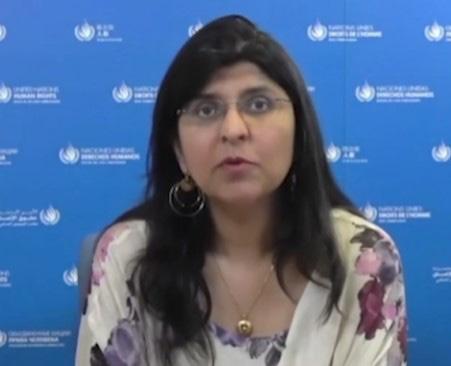
Speaking to IANS, UN Human Rights spokesperson Ravina Shamdasani said the organisation had already warned about the possibility of a conflict months before the hostilities began.
“We have been warning about this for several months. In fact, just the week before the war began, our monitoring showed there was a heightened risk of conflict and hostilities,” she said.
According to the UN Human Rights Office, the conflict has expanded beyond initial attacks and now involves multiple actors across the region.
Ravina Shamdasani noted that the escalation began after attacks involving Israel, Iran and the United States, followed by retaliatory actions and wider hostilities affecting neighbouring countries.
“This is an unfolding catastrophe before our very eyes, and it was entirely avoidable,” she said.
She added that the UN is closely monitoring developments in several countries including Iran, Lebanon and Israel, while also tracking global consequences such as rising fuel prices, disruption of humanitarian aid and economic difficulties affecting migrant workers in Gulf nations.
Shamdasani also highlighted that countries with global influence — including India — can play an
important role in helping to end the conflict.
“India, along with other influential countries, can recommit to the UN Charter and insist on bringing this conflict to an end,” she said. She added that world leaders must push for dialogue, negotiations and respect for international law to prevent the crisis from escalating into a wider regional war.
The UN also expressed deep concern over reports that a strike hit a girls’ school in Minab, killing a large number of students.
“This is absolutely horrific,” Shamdasani said.
According to the UN Human Rights Office, reports indicate that more than 100 students — around 160 girls —were killed during school hours, raising serious concerns about possible violations of international humanitarian law.
“This is potentially a grave violation of international law. We are urging a prompt investigation and full accountability,” she said, stressing that the victims’ families deserve transparency about what happened.
Shamdasani emphasised that international humanitarian law clearly requires the protection of civilians and critical infrastructure during armed conflicts. “Even wars have laws. Parties to a conflict must do their utmost to ensure the protection of civilians and civilian infrastructure,” she said.
West Asia conflict: 2 Indian nationals killed, several injured in Oman attack
Continued from Page 1
today in an attack in Sohar, Oman, in the ongoing conflict in West Asia. Several other Indian nationals were also injured. We express our deepest condolences to the families of the deceased and wish a speedy recovery to the injured,” Jaiswal said.
He added that the Indian embassy in Oman is closely monitoring the situation and extending all possible help to the victims and their families.
complementarity, but the recent pivot is toward a strategic industrial and green transition partnership. Chancellor Friedrich Merz’s January 2026 visit to India was deliberately framed as a signal that Berlin sees New Delhi as a primary Indo Pacific partner, not a peripheral emerging market. For India, German capital and technology are instruments for de-risking its China-exposed supply chains and accelerating its domestic manufacturing and green energy ambitions.
“Our Mission in Oman is in touch with the local authorities as well as the employer company and is extending all possible assistance,” the MEA spokesperson said. The incident comes amid heightened tensions and security concerns in parts of West Asia, where ongoing hostilities have affected several areas and raised concerns about the safety of foreign nationals working in the region.
Sohar, an industrial port city in Oman, hosts a number of industrial facilities and employs
a large expatriate workforce, including many Indian nationals working in various sectors.
India maintains a sizeable diaspora presence in Oman, with hundreds of thousands of Indians employed across sectors such as construction, industry, services and trade.
The Indian embassy in Muscat regularly coordinates with Omani authorities and employers to address issues related to the welfare and safety of Indian workers in the country.
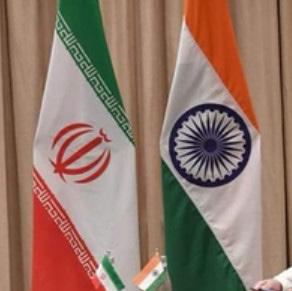
Earlier on Friday, External Affairs Minister (EAM) S. Jaishankar held another telephonic conversation with Iranian Foreign Minister Seyed Abbas Araghchi, discussing bilateral cooperation and matters concerning BRICS, where India is the current chair and Iran a member of the grouping.
This marked the fourth such conversation between the two ministers amid the escalating crisis involving Iran, the United States and Israel.
Global supply chain disruptions highlight need for resilient infrastructure: Karan Adani
New Delhi, March 13 (IANS)
As global supply chains face recurring disruptions from geopolitical tensions and shifting trade routes, resilient infrastructure and logistics networks will be critical to sustaining economic growth, said Karan Adani, Managing Director (MD), Adani Ports and Special Economic Zone (APSEZ), and Director, Adani Cement, at the annual leadership summit of a media group here on Friday. He noted that the ongoing crisis in West Asia has highlighted the vulnerability of global trade routes passing through key maritime choke points such as the Strait of Hormuz, the Suez Canal, and the Strait of Malacca.
Disruptions along these corridors can quickly ripple across global supply chains, reinforcing the need for stronger logistics infrastructure and diversified trade networks.
Karan Adani added that the infrastructure platforms built by the Adani Group are national assets that strengthen India’s trade, logistics and energy security.
Speaking during a fireside conversation at the conclave that brings together leaders from politics, business, technology and culture, Karan Adani said disruptions since 2020 — from the Covid-19 pandemic to geopolitical conflicts — have reshaped global trade and supply chain strategies.
“Supply chains have faced continuous shocks over the past few years. In such an environment, countries must build strong logistics networks and resilient infrastructure,” he
said.
Karan Adani said the Adani Group’s infrastructure strategy reflects this paradigm shift. By building platforms across ports, logistics, energy and airports, the Group aims to strengthen India’s capacity to support trade, manufacturing and economic growth. “We strongly believe in the India story. We know the assets we are building and the role they can play in the country’s future,” he said. According to Karan Adani, the Group’s longterm aspiration is to become the country’s most efficient logistics provider and among the cheapest generators of power while maintaining strong corporate governance.
Reducing logistics costs remains a key priority. Stronger integration between ports, transport utilities, airports, and logistics networks can significantly improve supply chain efficiency. “Once infrastructure is built, trade follows,” he said.
Tehran to give safe passage to Indian ships in Strait of Hormuz: Iran envoy
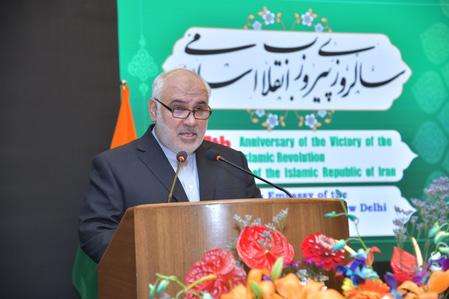
New Delhi, March 13 (IANS) Iran's Ambassador to India, Mohammad Fathali, on Friday, indicated that Indian ships could soon get safe passage through the Strait of Hormuz amid escalating tensions in the Middle East, which has brought transit through the crucial waterway to a standstill. Pointing out that India and Iran share common interests in the region, Fathali said, "Yes, because India is our friend. You will see it within two or three hours. We believe that Iran and India share common interests in the region."
"As ambassador in India, I say that the Indian government in this
situation, after the war, helped us in different fields," he added.
The Ambassador's statement comes a day after Iranian Deputy Foreign Minister Majid TakhtRavanchi said that Tehran has permitted ships from some countries to transit the Strait of Hormuz.
He also dismissed allegations about Iran laying mines in the Strait, saying "this is not true, it is closed during the war".
The Minister said Iran will not let enemy countries use the Strait.
"As far as Iran is concerned, we feel that those countries that joined the aggression should not benefit from safe passage through the Strait of Hormuz," he added.
The Strait of Hormuz, is one of the world's most vital shipping lanes through which 20 per cent of the world's oil and gas exports transit. The Ministry of Ports and Shipping said on Thursday that
the number of Indian-flagged vessels operating in the Persian Gulf region, remains unchanged at 28 and all Indian vessels and crew are being actively monitored for their safety and security.
As many as 24 of these Indian ships are located west of the Strait of Hormuz, carrying 677 Indian seafarers, and four vessels are on the east of the Strait with 101 Indian seafarers on board.
"Authorities, ship managers, and recruitment agencies are closely coordinating with Indian embassies and local authorities to ensure safety, and render medical assistance," the statement said. Advisories issued on precautionary measures to safeguard Indian seafarers, Indian-flagged vessels and maritime trade operations issued by Director General Shipping on February 28, 2026, remain in force.
Amid geopolitical fragmentation, India maintains constructive ties across competing blocs
New Delhi: The ongoing conflict in West Asia, particularly the rising escalation involving the US, Israel, and Iran, has sucked in the Gulf states and has created one of the most volatile environments in recent decades. For India, whose economic and strategic interests are deeply tied to West
Asia, the crisis presents both challenges and opportunities.
New Delhi has responded with a carefully calibrated policy of strategic neutrality, emphasising restraint, dialogue, and diplomatic engagement rather than overt alignment with any side. This posture reflects India’s broader foreign policy doctrine of strategic autonomy and plurilateralism, which seeks to maintain balanced relationships with multiple actors.
India’s stance is not merely a diplomatic convenience; it is a strategic necessity as West Asia
CBFC certified 71,963 films in five years, Govt tells Rajya Sabha
New Delhi, March 14 (IANS)
The Central Board of Film Certification (CBFC) has certified 71,963 films over the last five years, while also reducing the average time taken for certification of feature films to 22 working days with the implementation of an online system, the Government informed the Rajya Sabha.
Minister of State for Information and Broadcasting L. Murugan shared the details in response to questions raised by Leader of the Opposition in the Rajya Sabha Mallikarjun Kharge.
According to the data provided by the Ministry of Information and Broadcasting, the CBFC, which functions under the Cinematograph Act, 1952, certifies films for public exhibition in
accordance with statutory provisions and certification guidelines. Cuts or modifications are recommended only when content is found to violate parameters related to sovereignty and integrity of India, security of the state, friendly relations with foreign states, public order, decency or morality, defamation, contempt of court, or incitement to an offence.
The data shows that the number of films certified annually by the CBFC has steadily increased in recent years. While 8,299 films were certified in 2020-21, the number rose to 12,719 in 2021-22 and further to 18,070 in 2022-23. In 2023-24, the board certified 17,431 films, while 15,444 films were certified during 2024-25. Out of these, several films were cleared with cuts or modifications suggested by the board. The number of such films increased from 1,475 in 2020-21 to 1,911 in 2021-22; 2,205 in 2022-23; 2,440 in 2023-24, and 3,033 in 2024-25. Only three films were refused certification during the five-year period -- one in 2022-23 and two in 2024-25.
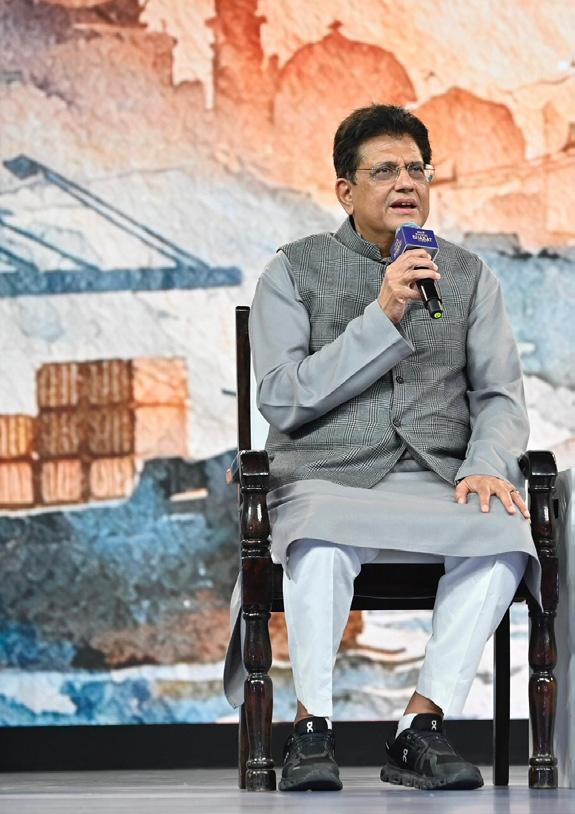
India-UK FTA moving fast, could be implemented soon: Piyush Goyal
New Delhi, March 13 (IANS) Union Commerce and Industry Minister Piyush Goyal on Friday said that the India-UK free trade agreement could come into force soon, noting that the ratification process is moving quickly in the United Kingdom.
is central to India’s economic security. The Gulf region alone hosts nearly nine million Indian expatriates and contributes more than $50 billion annually in remittances, which accounts for 38 per cent of India’s total remittance value. The Gulf Cooperation Council (GCC) collectively represents one of India’s largest trading partners and in addition, a large portion of India’s oil and gas imports passes through the Strait of Hormuz, making the stability of the region essential for India’s energy security.
Speaking at a commemorative session marking two years of the signing of the India–EFTA Trade and Economic Partnership Agreement, organised by ASSOCHAM via video conference in the national capital, Goyal said the agreement with the UK is progressing rapidly and could become one of the fastest trade deals to be approved by the UK Parliament.
He noted that the trade agreement was signed on July 24 during the visit of Narendra Modi to the United Kingdom at Chequers and expressed optimism that it could soon enter into force.
“The swift progress reflects
strong cooperation between the two countries and the efforts of the Indian diplomatic team in London,” Goyal mentioned.
During his address, the minister also highlighted the significance of the India-EFTA trade pact, calling it a major milestone in India’s economic engagement with Europe.
“The agreement marked the beginning of deeper economic ties with the European region and paved the way for further trade deals,” Goyal mentioned.
Goyal pointed out that after concluding the EFTA agreement, India went on to finalise the trade pact with the United Kingdom and later reached an agreement with the 27-nation European Union.
He noted that Ursula von der Leyen had described the India-EU agreement as the “mother of all deals”.
The minister also emphasised the investment commitments secured under the EFTA agreement.
“The four EFTA countries -- Switzerland, Norway, Liechtenstein and Iceland -have committed to invest 100 billion dollars in India under a legally binding provision of the agreement,” he stated.
“The investment commitment is expected to create around one million jobs in India’s economic ecosystem,” Goyal explained. He said the agreement is unique because it combines a free trade agreement with a legally binding investment commitment, something that has not been seen before in global trade negotiations.
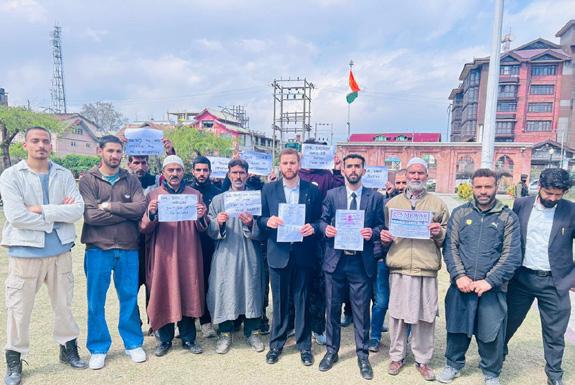
J&K students association meets protesting Kashmiri students & parents of Rajasthan’s Mewar University
Srinagar, March 13 (IANS) The Jammu and Kashmir Students Association (JKSA) delegation, on Friday, met protesting students and parents of Kashmiri students enrolled in the B.Sc Nursing programme at Mewar University in Rajasthan's Chittorgarh, who had held a demonstration in Srinagar, expressing concern over the alleged lack of recognition for the course and the detention of students following a campus protest.
Nasir Kheuhami, JKSA National Convenor said, "During the interaction, a JKSA delegation led by State President Mubashir Ahmad, accompanied by Coordinator Reshi Showkat
and other members, listened to the grievances raised by families regarding the academic uncertainty and safety of their children studying outside Jammu and Kashmir."
"The Association assured the protesting students and parents that a delegation led by JKSA National Convenor Nasir Khuehami would meet Defence Minister Rajnath Singh and take up the matter with him, considering that many of the affected students had secured admission under an educational initiative linked to the Indian Army's Sadbhavana outreach programme aimed at supporting students from Jammu and Kashmir."
"The issue has caused deep anxiety among more than 50 Kashmiri students currently pursuing the B.Sc Nursing programme at Mewar University, many of whom are in the advanced stage of their fouryear course and approaching
their final semesters," the JKSA National Convenor added.
"The students had taken admission in the programme believing that it had the necessary statutory approvals from the Indian Nursing Council and the Rajasthan Nursing Council, the regulatory bodies governing nursing education and professional registration in the country."
"However, serious concerns recently emerged after students allegedly discovered that the programme may not have the mandatory approvals from the Indian Nursing Council and Rajasthan Nursing Council, raising fears that their degree may not be recognised for professional registration and employment in the nursing sector," Kheuhami said.
"The students approached the university administration seeking clarification and official documentation confirming the recognition status of the course."
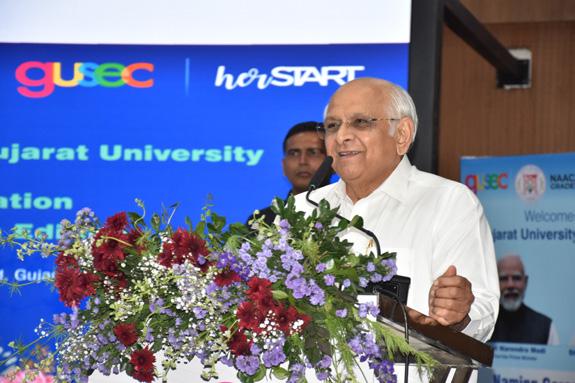
Gujarat govt approves 24 road upgrade projects worth Rs 1,185 crore in Surat Economic Region
Gandhinagar, March 8 (IANS) Road infrastructure works worth Rs 1,185 crore have been approved to upgrade connectivity across the Surat Economic Region (SER), with Chief Minister Bhupendra Patel describing the move as part of Gujarat’s roadmap towards “Viksit Gujarat@2047”.
The projects, covering 24 works over a total length of 383 kilometres, will be implemented in districts forming part of the SER, including Surat, Bharuch, Navsari, Valsad, Tapi and Dang.
According to the state government, these districts together contribute more than 35 per cent to Gujarat’s overall economic development.
Announcing the decision, the Chief Minister said the initiative aligns with the national vision of “Viksit Bharat@2047” given by Prime Minister Narendra Modi and is aimed at strengthening infrastructure-led economic growth in southern Gujarat.
“As part of the roadmap for Viksit Gujarat@2047, we have resolved to realise the vision of Viksit Bharat@2047 during this Amrit Kaal,” Patel said.
The road upgradation projects are part of regional economic master plans prepared to develop six growth hubs across the state for balanced and comprehensive development.
These plans have been prepared by the Gujarat State Institution for Transformation (GRIT), which was established to plan long-term and result-oriented development based on infrastructure, innovation, individuals and institutions.Officials said the Surat Economic Region has been identified as the growth hub of South Gujarat under these plans. Approving the first set of projects worth Rs 1,185 crore for road infrastructure upgradation in the region, the Chief Minister said the state government has acted on its commitment of ensuring that “what is said must be done”. Patel said Gujarat, which contributes significantly to the country’s economic growth, is working with the approach that it should also lead in achieving the goals.
Andhra CM Chandrababu Naidu sets target of creating 5 lakh women entrepreneurs in state
Amaravati, March 8 (IANS)
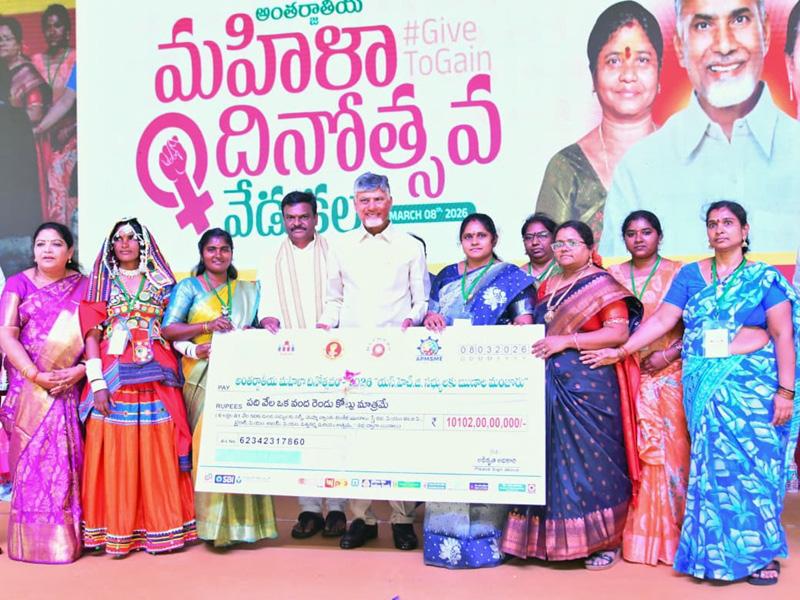
Andhra Pradesh Chief Minister N. Chandrababu Naidu on Sunday announced that the state government has set a target of developing five lakh women as entrepreneurs.
He stated that one lakh women have already been turned into entrepreneurs within a year
and expressed confidence that Andhra Pradesh will soon have six lakh women entrepreneurs, the highest in the country.
Participating in the International Women's Day celebrations organised by the state government at the Amaravati Parade Grounds, he said there should be one MSME from every household and that 50 per cent of them should be led by women.
The Chief Minister unveiled the ‘Swayam AP’ logo for marketing products made by self-help groups.
He also felicitated five outstanding women entrepreneurs and presented
Meghalaya govt aims at empowering women: CM Conrad Sangma
Shillong, March 8 (IANS)
Meghalaya Chief Minister Conrad K. Sangma on Sunday extended greetings on International Women’s Day, highlighting the state government’s initiatives aimed at empowering women through self-help groups (SHGs), entrepreneurship support and farmer welfare programmes.
Sangma praised women for their resilience, determination and achievements across various fields, stating that their empowerment is essential for the overall progress of society.
“Wishing all the incredible women who believe, dream, break barriers and achieve so much more a very Happy International Women’s Day,” the Chief Minister said.
Emphasising the importance of financial independence and equal opportunities, Sangma said that the Meghalaya government is committed to creating an environment where women can freely make their own choices
and pursue their aspirations with confidence.
“In Meghalaya, women's empowerment means ensuring that women have the freedom to make their own choices, achieve financial independence, and pursue their dreams with confidence,” he said.
The Chief Minister noted that the state’s strong network of selfhelp groups has played a crucial role in improving the economic condition of women in rural areas by encouraging collective action and entrepreneurship.
According to him, various government initiatives aimed at supporting women entrepreneurs and strengthening farmer welfare programmes are helping women gain greater financial stability and social recognition.
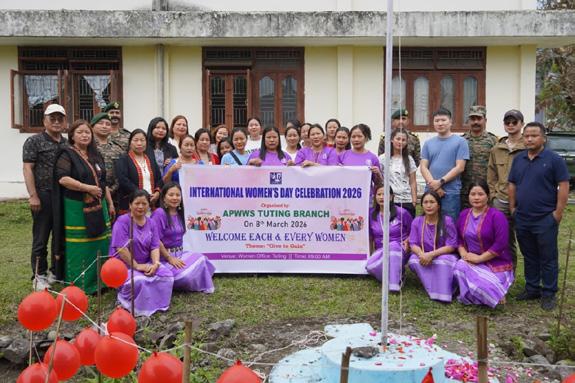
Sangma said these initiatives reflect the spirit of this year’s International Women’s Day theme — “Give to Gain” — which underscores the importance of collective empowerment and community participation.
“Through our strong SHG movement, support for women entrepreneurs and farmer welfare programmes, we are witnessing the power of collective empowerment, truly reflecting this year’s theme, ‘Give to Gain’,” he said.
The Chief Minister further
Telangana govt mulls law to regulate social media
Hyderabad, March 8 (IANS)
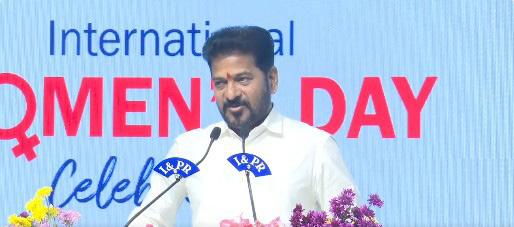
Telangana Chief Minister A. Revanth Reddy said on Sunday that the state government is planning to bring a law to regulate social media.
He noted that the issue would be discussed in the ensuing Assembly session and a platform will be created to curb false propaganda on the social media.
a cheque of Rs 10,100 crore in subsidised loans benefiting 6,81,506 women from various sectors.
Extending greetings to women on the occasion of International Women’s Day, he stated that women are known for hard work, love and sacrifice.
The Chief Minister said that the state Cabinet has three women ministers who are working efficiently. The President of India is a tribal woman and the Union Finance Minister is also a woman who presents the national Budget effectively every year.
Speaking at the International Women's Day celebrations here, he stressed the need for a mechanism to complain about false news which are being broadcast or posted on social media.
"While there is an authority to complaint about news and views of electronic media, such a mechanism is lacking for social media," the Chief Minister said.
"The Telangana government will definitely examine the issue and create a platform to lodge complaints about false news circulated on social media," he added.
The Chief Minister said such a legislation is necessary to distinguish between real
journalists and those who do business or run their affairs in the guise of journalists.
He added that there is a need to stop the disgruntled elements from exploiting the system in the guise of journalists.
He felicitated some women journalists on the occasion. Remembering the constructive role played by newspapers and journalists during the freedom struggle, CM Revanth Reddy said that Mahatma Gandhi started a magazine called Young India and former PM late Jawaharlal Nehru launched the National Herald magazine.
He recalled that Suravaram Pratap Reddy started the Golconda magazine.
Chief Minister Revanth Reddy said these personalities proved that wars can be won through newspapers. The Chief Minister listed the schemes implemented by the state government for women empowerment, which includes free travel for women in regional transport corporation buses and making them owners of 1,000 buses and 1,000 MW solar power plants. The state government has signed an agreement with Amazon for the sale of goods produced by self-help groups, Chief Minister Revanth Reddy said.
Agriculture to become more capable through AI, digital facilities, says Maharashtra minister
Mumbai, March 13 (IANS)
Maharashtra agriculture minister Dattatray Bharne on Friday said that the government is working extensively through various schemes to make agriculture in the state more capable, modern, and sustainable.
In his response to a discussion in the state Assembly, he stated that the government is striving to bring about a major transformation in Maharashtra's agriculture sector through the use of Artificial Intelligence (AI), digital facilities, farmer welfare schemes, and investment in infrastructure.
Minister Bharne said that agriculture has become more risky due to climate uncertainty,
pest-disease outbreaks, rising production costs, and market price fluctuations. To face these challenges, the state government has prepared the Maha-Agri 'AI' Policy for the period 2025 to 2029, making Maharashtra the first state in the country to implement such a policy.
The government aims to bring modern technology into farming using Artificial Intelligence, Generative AI, drones, and robotics. This technology is expected to increase farmers' production by approximately 40 per cent, reduce fertiliser use by 30 per cent, and save 40 per cent to 50 per cent of water, he added.
Minister Bharne further stated that special training will be provided to farmers to enable them to use modern technology, and training will also be given to officers and employees of the Agriculture Department. A statelevel Artificial Intelligence and Agritech Innovation Centre has been established, and 'AI' research and incubation centres have been approved in all four agricultural
universities of the state. The 'AI for Agri' international conference was recently held in Mumbai, where experts from India and abroad discussed new technologies in agriculture. Through the 'Mahavistar' mobile app developed by the Agriculture Department, advice regarding crop cultivation, disease control, proper use of water and fertilisers, and market prices is being provided; currently, about 30 lakh farmers are using this app.
Additionally, for farmers without smartphones, the 'Vasudha' AIbased phone service has been started, where farmers can get guidance in Marathi by calling the number 155313, the Minister informed. To increase capital investment in agriculture, the Krishi Samruddhi Yojana is being implemented, with a provision of Rs 2,000 crore for the year 2026-27. Under this scheme, farm ponds, plastic lining, and the use of agricultural drones are being encouraged.
Lok Sabha okays extra Govt spending of Rs 2.01 lakh crore in FY26
New Delhi, March 13 (IANS) The Lok Sabha on Friday approved the second batch of Supplementary Demands for Grants, which will enable the government to spend an additional Rs 2.01 lakh crore in the current financial year. The government had sought approval to spend a gross additional amount of Rs 2.81 lakh crore. However, with estimated additional receipts of Rs 80,000 crore during the current fiscal year, the net additional cash spending stands at Rs 2.01 lakh
crore.
In her reply to the debate in the House, Finance Minister Nirmala Sitharaman said the new spending will not push the fiscal deficit beyond the government’s target. "There is no increase in expenditure beyond the BE of 2025-26 due to the second Supplementary Demand for Grants," she said.
The supplementary demands include grants for spending on setting up an Economic Stabilisation Fund of Rs 1 lakh crore. The Parliament’s approval was also sought for an extra spending of Rs 19,230 crore towards fertilisers’ subsidy and Rs 23,641 crore for subsidies under the Pradhan Mantri Garib Kalyan Anna Yojana (PMGKAY). Other
major expenditure heads include Rs 41,822 crore for the defence ministry.
"The Rs 1 lakh crore Economic Stabilisation Fund will give fiscal headroom to allow India to respond to global headwinds," Sitharaman said.
She said the fund will act as a buffer to absorb shocks arising due to unforeseen global challenges, such as the ongoing Iran war. The Finance Minister assured that there would be no shortage of fertilisers for farmers, and adequate provision has been made in the supplementary demands for grants.
The supplementary demands were passed through a voice vote in the Lok Sabha amid disruptions.
Congress to raise foreign policy, economic impact of Iran conflict in Parliament
New Delhi, March 8 (IANS) The Congress Parliamentary Strategy Group meeting discussed national and international issues and decided to raise foreign policy, unemployment and economic issues prominently during the second part of the Budget Session of Parliament starting on Monday, a party MP said.
In light of the conflict in the Gulf, the Congress has decided to raise issues related to its implications, the fall in the rupee and our foreign policy deviation, said Congress MP from Rajya Sabha
Syed Naseer Hussain on Sunday.
He said the Opposition has also resolved to collectively vote in favour of the no-confidence motion against Speaker Om Birla on Monday in the Lok Sabha.
“A meeting of floor leaders of all Opposition parties will be held at 10 a.m. in the office of Congress President and Leader of the Opposition in Rajya
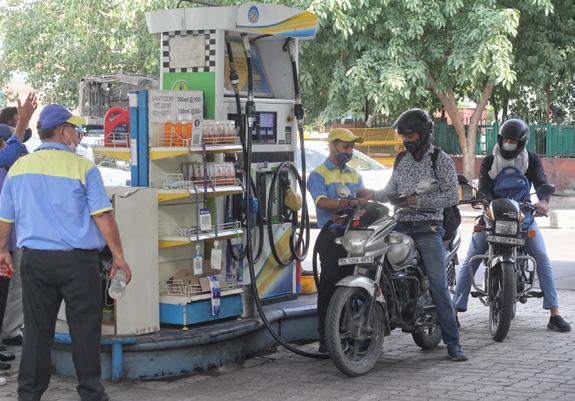
Govt urges consumers to avoid panic buying as petrol, diesel, LPG supply is normal
New Delhi, March 13 (IANS)
The Centre on Friday advised consumers to avoid panic buying of petrol, diesel, and LPG as adequate stocks are available across the country.
No cases of fuel dry-outs have been reported at any of the 1 lakh retail outlets by the Oil Marketing Companies. Adequate stocks of petrol and diesel are available, and supplies are being maintained regularly, a senior Petroleum and Natural Gas Ministry official said.
The official underlined that India currently has a refining capacity of around 258 MMTPA and is the fourth largest refining hub in the world. The country is selfsufficient in the production of petrol and diesel, and no imports of petrol and diesel are required to meet domestic demand. All refineries are currently operating at high levels, including some of them even above 100 per cent capacity.
All Indian refineries are also currently maintaining adequate crude oil inventories, and supplies are being continuously received through diversified import sources and shipping
routes.
The Petroleum and Natural Gas Ministry official briefed the media on the current energy supply situation and the steps being taken to ensure the continued availability of petroleum products and LPG despite concerns about supply due to the prevailing geopolitical situation and closure of the Hormuz Strait.
The Government has also issued a Natural Gas Control Order on March 9 under the Essential Commodities Act, which directs 100 per cent supply of PNG and CNG with no cuts. So, there is no need to panic and supplies to industrial & commercial consumers are being regulated at 80 per cent, the official said.
Around 3.73 MMSCM per day of gas is being consumed across the Domestic PNG segment, for which adequate gas supply is available across geographical areas.
More than 1.5 crore PNG households in India are currently being served natural gas in their homes and will continue to be served without any hindrance. In view of the prevailing geopolitical situation, it is advisable to promote the use of domestically supplied PNG for residential consumers so as to conserve domestic LPG cylinders. The conserved LPG cylinders may be diverted for use in other consumer areas, where PNG connectivity is not available, the official pointed out.
Telangana declares Gurramguda area as reserve forest
Sabha Mallikarjun Kharge,” said Hussain.
He said the party is also planning to raise the issue of the impact of the conflict on our international trade and energy sector.
The Congress MP also gave a strong indication of the party seeking a debate on the impact of the interim Indo-US trade deal on farmers and the agricultural economy of the country.
He said the party is also focused on discussing the fiscal centralisation and the crisis in Parliament.
Hyderabad, March 13 (IANS) After a long legal battle, the Telangana government has declared Gurramguda forest area in the Amangal division in Rangareddy district as a reserve forest, a senior official said on Friday. The state government has issued a Government Order (GO) notifying 424 acres and 31 guntas of forest land as Reserve Forest under Section 15 of the Telangana Forest Act, 1967.
According to a statement issued by Principal Chief Conservator of Forests, Dr. C. Suvarna, the government issued G.O. Ms. No. 7 dated March 9, 2026 through the Environment, Forests, Science and Technology Department. With this notification, the legal process concerning the land has been completed and the forest area now has official Reserve Forest status, ensuring stronger legal protection.
She stated that 102 acres in Survey No. 201/1 of Sahebnagar Kalan village, part of this area, had long been under legal dispute. The matter, widely known as the 'Sahebnagar Kalan case,' was heard in various courts for several years. Ultimately, the Supreme Court upheld the Forest Department’s claim, reinforcing the need to protect forest lands from encroachments and unauthorised claims.
In December 2025, the Supreme court declared 102 acres of land in Sahebnagar Kalan a part of the Gurramguda reserve forest block, and not private land. The forest department had faced defeat in lower courts as well as the Telangana High Court. According to officials, a few people claiming to be the legal heirs of Salar Jung III, Mir Yousuf Ali Khan, tried to usurp the land. The Principal Chief Conservator of Forests stated that the judgment further strengthened the government’s rights over the land. The Telangana government has also decided to develop the area into a large Urban Forest Park.
Democratic US lawmakers demand probe into Iran school strike
Washington, March 14 (IANS)
Democratic lawmakers in the US Congress are pressing the Pentagon for answers after reports that a US strike during Operation Epic Fury hit a girls’ elementary school in Iran, killing at least 175 civilians — many of them children — prompting calls for a full investigation, accountability, and stronger safeguards to prevent civilian casualties.
Members of the House and Senate said the incident, which reportedly occurred on February 28 near the town of Minab, could represent one of the deadliest civilian casualty events linked to recent US military operations in the Middle East.
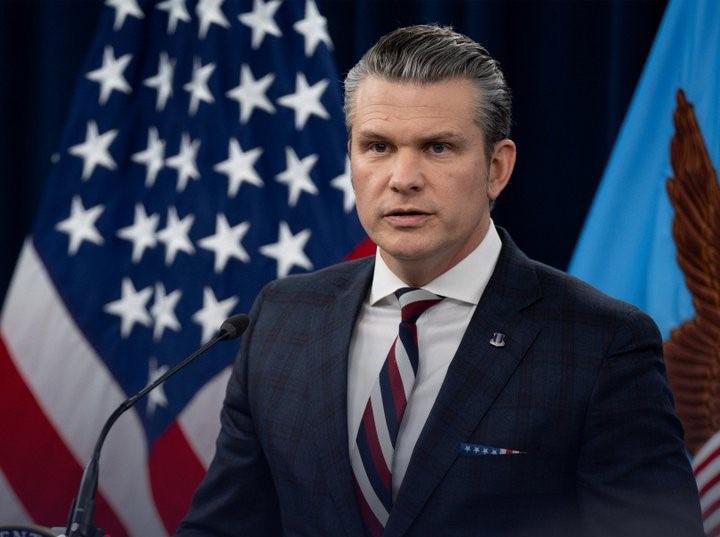
Representative Gabe Vasquez of New Mexico said he has sent a letter to Defence Secretary Pete Hegseth demanding “detailed information about the steps the US is taking to prevent and respond to civilian harm,” including an assessment of casualties caused by the airstrike on the Shajareh Tayyebeh girls’ elementary school.
“Civilians and civilian infrastructure may under no circumstances be the object of attack and must at all times be respected and protected by all parties,” Vasquez and other lawmakers wrote. “We seek detailed information regarding civilian protection during Operation Epic Fury and steps the military is taking to mitigate and respond to civilian harm.”
Separately, Congressman Jason Crow and more than 120 Democratic members of Congress also asked the Pentagon for answers about the strike and broader civilian casualties reported during the ongoing war in Iran.
India-Brazil-South Africa fund drives women’s empowerment through development
United Nations, March 13
(IANS) The India-Brazil-South Africa (IBSA) Fund has emerged as a strong vehicle of SouthSouth cooperation promoting women’s empowerment through development, according to leaders from the three nations.
The Fund is “a far-sighted joint initiative of the government of India, Brazil and South Africa, that has proven its utility by supporting over 50 development assistance projects across close to 40 countries since its establishment in 2004”, Savitri Thakur, India’s Minister of State for Women and Child Development, said on Thursday.
“To walk the talk, we have supported many projects relating to the development of women”, she said at an event commemorating the success stories of Women-Led Development and South-South Cooperation.
“South-South cooperation holds profound value for gender equality and the empowerment of
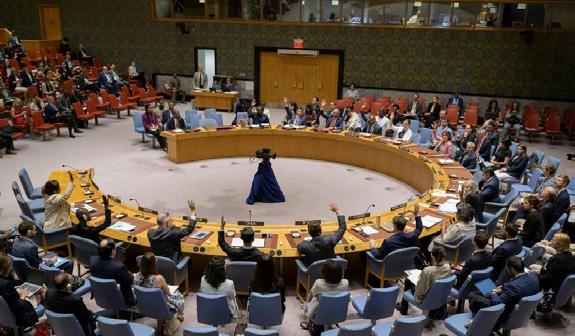
Energy security needs, safety of diaspora utmost important: India on co-sponsoring GCC-led resolution at UNSC
New Delhi, March 12 (IANS)
The Ministry of External Affairs (MEA) said on Thursday that India has co-sponsored the Gulf Cooperation Council (GCC)led resolution at the United Nations Security Council (UNSC) considering the welfare and wellbeing of large Indian diaspora in the GCC countries.
Addressing a weekly media briefing on Thursday, MEA spokesperson Randhir Jaiswal stated that India has issued several statements on the ongoing conflict in West Asia and underlined the need for prioritising the safety of all people.
“Yes, we have co-sponsored the GCC-led resolution at the UN Security Council. We have 135 countries who have co-sponsored this particular resolution. The resolution reflects several of our positions, as you know, that we have a large diaspora in the GCC countries and their well-
Iran’s
3
women and girls”, said Sindisiwe Chikunga, South Africa’s Minister for Women, Youth and Persons with Disabilities.
She said that “at a time when multilateralism is under pressure and development finance is increasingly conditional and contested”, the role of the IBSA Fund becomes important.
“In fact”, she said, “IBSA Fund represents an opportunity for voices of emerging and developing economies to carry equal weight and be accountable to the people they serve”.
She said that IBSA’s significance for the Global South is that it “is proof and a proof of concept for a development paradigm that centres Southern agency, rejects dependency and demonstrates that countries that have themselves navigated postcolonial reconstruction must drive sustainable development”.
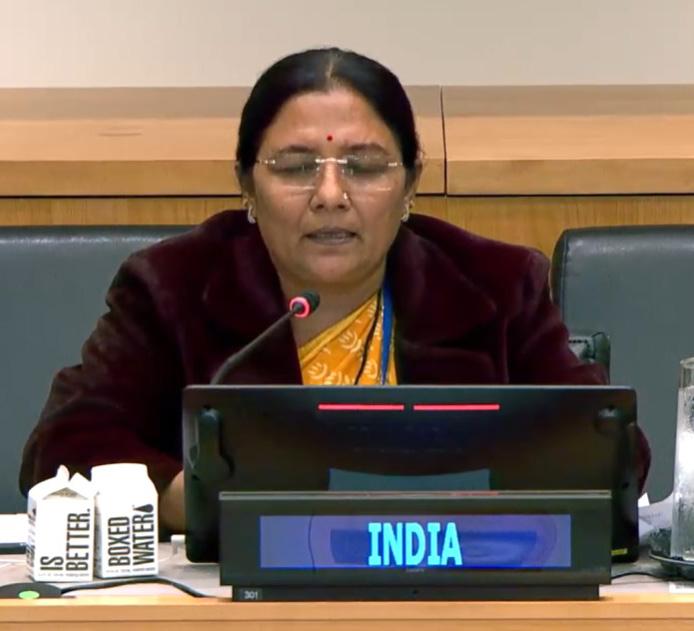
India’s Permanent Representative P Harish said, “Empowerment of women in enabling their effective contribution to our productive economies is the force multiplier”.
"In a world where traditional aid architectures are under strain, where development assistance is increasingly fragmented, and where trust between the Global North and South is increasingly frayed, the IBSA Fund offers a trustworthy model that demonstrates the effectiveness of South-South solidarity”, he said.
being and welfare is of utmost importance. The Gulf is also very important for our energy security needs,” said Jaiswal.
“... We have issued statements dated 28th February on 3rd March and thereafter, External Affairs Minister also made a suo moto statement in the parliament where he has dealt with all issues... We have issued several statements on the ongoing conflict. We have underlined the need for prioritising the safety of all civilians. We regret the precious lives lost and express our grief in that regard,” he added.
Earlier on Thursday, Jasem Mohamed Albudaiwi, Secretary General of the GCC, welcomed the UNSC resolution condemning the "treacherous Iranian military operations" against the GCC States and the Hashemite Kingdom of Jordan.
"The adoption of the resolution by 136 states demonstrates the international community’s full conviction regarding the gross violation posed by Iranian aggressions against the sovereignty of the GCC member states and Jordan, affirming their legal right to respond in accordance with Article 51 of the
conditions to end
conflict-
UN Charter, which guarantees the inherent right of individual or collective self-defence in the event of aggression, to take all measures necessary to preserve sovereignty, security, and stability," stated Albudaiwi. He emphasised that this international condemnation, achieved through unprecedented international consensus, serves as blatant evidence of Iran’s violation of international laws, norms, and UN charters by targetting civilians, civilian objects, and infrastructure across the Council states and Jordan. The GCC Secretary General further explained that the Security Council resolution underlined its strong support for the territorial integrity, sovereignty, and political independence of all GCC states and Jordan. The resolution also highlighted the strategic importance of the Gulf region to international peace and security and its vital role in global economic stability, while reaffirming the right of navigation for vessels traveling to and from the ports and facilities of coastal states that are not parties to the hostilities.
rights, reparations, guarantee against future aggression
Delhi, March 12
As the United States and Israel’s military campaign against Iran and the latter’s retaliatory strikes move toward their third week, Tehran has laid down three key conditions for ending the conflict, including recognition of its rights and compensation for the damage caused during the war.
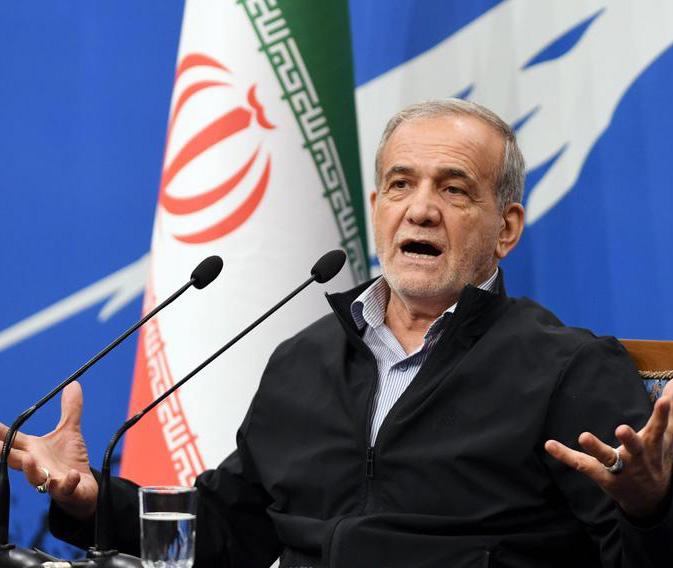
Iranian President Masoud Pezeshkian said Tehran remains committed to peace but asserted that the conflict can only end if its demands are accepted by Washington and Tel Aviv.
In a statement posted on social media after holding conversations with the leaders of Russia and Pakistan, Pezeshkian said that Iran’s position on ending the war was clear.
“The only way to end this war -- ignited by the Zionist regime and the US -- is recognising Iran’s legitimate rights, payment of reparations, and firm international guarantees against future aggression,” Pezeshkian said.
Tehran has maintained that the conflict began after attacks by the United States and Israel and has insisted that it will not agree
to a ceasefire without concrete assurances regarding its security and rights.
Despite these conditions, there appears to be little indication that the fighting will end soon.
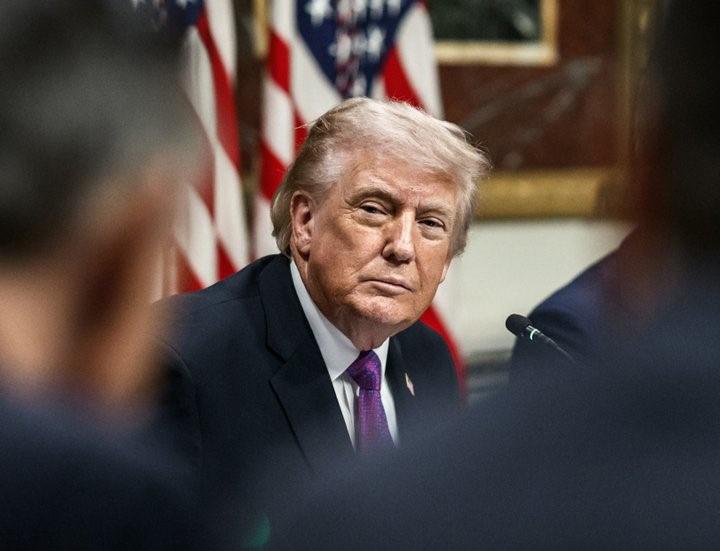
US President Donald Trump said that the United States intends to continue its operations, even as the war entered its second week following joint American and Israeli airstrikes on Iranian targets.
Speaking at a campaign-style rally in Kentucky ahead of the November midterm elections, Trump claimed that the United States had effectively gained the upper hand in the conflict but signalled that military operations were still ongoing.
“We don’t want to leave early, do we? We got to finish the job,” Trump said.
Shortly before making that remark, the US President had also indicated that the conflict might end soon, arguing that there were limited remaining targets for American forces to strike.
“Any time I want it to end, it will end,” Trump said, adding that there was “practically nothing left” for the US military to bomb.
Meanwhile, the US military has issued warnings to Iranian civilians, advising them to avoid ports that host naval facilities, citing the risk of further strikes. Israel, on its part, has indicated that it still has a long list of potential targets inside Iran, including locations linked to ballistic missile capabilities and nuclear-related infrastructure.
The conflict has already resulted in heavy casualties and widespread disruption across the region.
According to estimates, nearly 2,000 people have been killed so far, most of them Iranians and Lebanese, as the violence has spilt over into Lebanon.
The war has also had a devastating impact on children. According to the United Nations Children’s Fund (UNICEF), more than 1,100 children have either been killed or injured since the conflict began.
Global energy markets have reacted sharply to the escalation, particularly because of concerns over supply disruptions around the Strait of Hormuz, one of the world’s most crucial energy transit routes. Roughly one-fifth of the global oil supply passes through this narrow waterway. Oil prices surged to nearly 120 US dollars per barrel earlier in the week before easing to around 90 dollars, but renewed tensions pushed prices higher again on Wednesday.
Iran has warned that the situation could worsen further, cautioning the global community to prepare for oil prices potentially climbing as high as 200 US dollars per barrel. Tehran has also indicated that shipping through the Strait of Hormuz has become nearly impossible, claiming control over the strategic waterway and attacking vessels approaching the strait.
New
(IANS)
WFP warns millions face hunger in Afghanistan as border clashes with Pakistan intensify
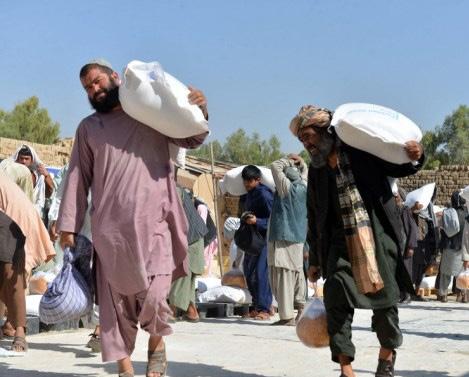
Kabul, March 7 (IANS) The World Food Programme (WFP) has raised alarm over Afghanistan’s hunger crisis, warning that millions are facing acute food insecurity amid the escalating border conflicts with Pakistan. The agency stated that without sufficient funding, it may also struggle to provide aid to refugees fleeing Iran and Pakistan, as well as those internally displaced due to conflict along the border.
“Afghanistan remains one of the world’s most severe hunger crisis, with one in three Afghans — 17.4 million people in urgent need of food assistance. Child malnutrition has also reached worrying levels, with 3.7 million
children projected to need treatment in 2026. With a new crisis in the making and the current funding outlook, WFP will not be able to reach families fleeing Iran and Pakistan and those internally displaced by the cross-border conflict in Afghanistan,” said John Aylieff, WFP Afghanistan Representative and Country Director.
According to Aylieff, the crossborder violence between Pakistan and Afghanistan has intensified since February 26, displacing approximately 20,000 Afghan families across the eastern, southeastern and southern regions.
He stressed that across the Afghan provinces, including Nangarhar, Nuristan, Kunar, Laghman, Paktika, Paktya, Khost, Kandahar, Helmand, Zabul, WFP has been forced to temporarily suspend emergency, social protection, school feeding and livelihood activities, affecting nearly 160,000 people.
Highlighting that on Afghanistan’s
western border, violence in Iran is sparking fears of a surge in returnees, Aylieff said, “We witnessed a similar surge in returns during increased fighting in June 2025. For many, coming back to Afghanistan means not only facing poverty, unemployment and hunger but also renewed instability.”
“Afghanistan already saw an influx of more than 2.5 million returnees from Iran and Pakistan in 2025. Even before the latest escalation, projections estimated a similar influx in 2026—but renewed fighting may drive those numbers even higher, placing unbearable strain on a woefully underfunded humanitarian response,” he added.
Aylieff stated that for the winter response in 2026, the WFP was able to provide food assistance to a fraction of those in need, while cautioning that funding for emergency operations will run out in the next month, putting millions at risk of losing critical support in Afghanistan.
Self-defence to continue till US-Israel ‘aggression’ ends or UN names aggressors: Iran
Tehran, March 8 (IANS) Iran on Sunday declared that its right to self-defence will continue until what it described as “aggression” by the United States and Israel comes to an end or until the United Nations Security Council identifies and names the “aggressors” under Article 39 of the UN Charter and determines the responsibilities arising from their actions.
In a statement issued by Iran’s Ministry of Foreign Affairs, Tehran said the joint military attacks carried out by the US and Israel began on February 28 with the killing of Supreme Leader Ayatollah Ali Khamenei and
several senior Iranian officials.
According to the statement, the attacks have continued with strikes on both military and civilian infrastructure across the country.
The ministry stated the operations have targeted facilities including schools, hospitals, sports centres, residential homes and public service institutions.
The statement described these actions as a “flagrant violation of Iran's territorial integrity and national sovereignty,” asserting that the attacks had breached fundamental principles of international law.
Iran further said that responding to what it termed “ruthless military aggression” is its “inherent right to self-defence,” citing Article 51 of the United Nations Charter.
“The exercise of Iran's inherent right to legitimate self-defence will continue until the aggression
ceases, or until the UN Security Council fulfils its duty under Article 39 of the UN Charter by identifying and naming the aggressors and determining the responsibilities arising from their aggression,” the statement read. Tehran also referred to its communications with the United Nations Security Council, stating that international law places obligations on states regarding the use of their territory in acts of aggression.
“As has been elucidated in various correspondences with the UN Security Council, based on the fundamental principle of international law concerning the ‘prohibition of causing harm from one's own territory’, states are prohibited from allowing their territory to be used, directly or indirectly, to cause injury or damage to other states,” the statement said.
US evacuates 28,000 citizens from Middle East
Washington, March 7 (IANS)
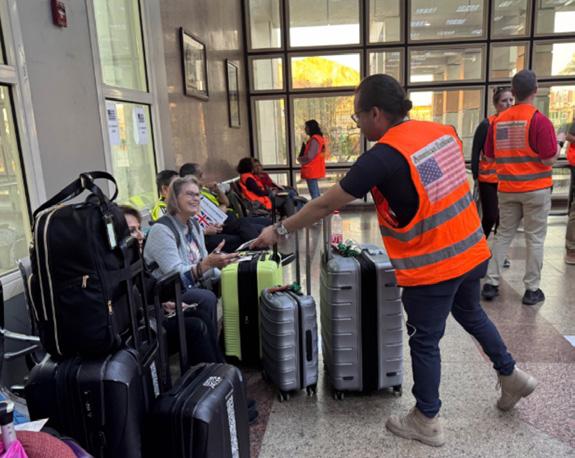
More than 28,000 American citizens have safely returned to the US from the Middle East since late February, the State Department said on Saturday, as Washington continues large-scale evacuation and assistance efforts
across the region.
In a statement, Assistant Secretary of State Dylan Johnson said the US government had been coordinating flights, ground transport, and emergency assistance to help Americans leave the region amid ongoing security concerns.
"Since February 28, more than 28,000 American citizens have safely returned to the United States from the Middle East," Johnson added.
He said that the data does not include Americans, who have travelled to other countries in the region or those still in transit on
Over 500 Uyghurs arrested in Xinjiang amid Ramadan crackdown by Chinese authorities
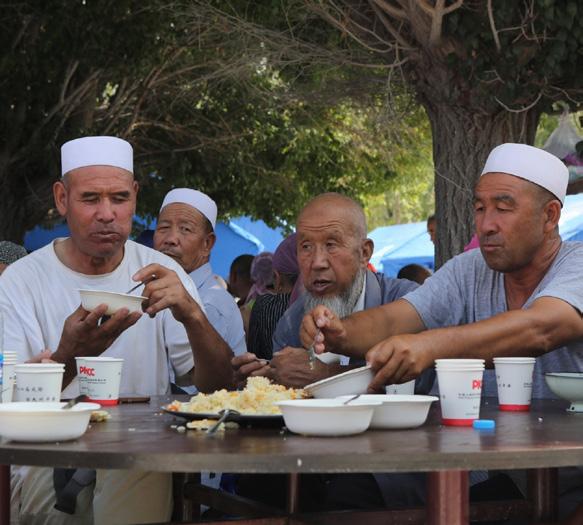
Beijing, March 7 (IANS) China's Xinjiang province has experienced a familiar yet disturbing surge in crackdowns by Chinese authorities during Ramadan with over 500 Uyghurs arrested in the Hotan region alone for "illegal religious activities" including private fasting and gatherings, a report said on Saturday. It added that checkpoints multiplied around mosques, while residents were subjected to random searches for “halal food or religious texts”, creating a climate of constant fear.
According to a report in ‘Impact International’, the 'Holy Month Siege' weaponises Ramadan’s spiritual significance, where “reflection and abstinence” were treated as punishable acts by the Chinese authorities.
“Global Alarm rises over Uyghur
Arrests in China's Holy Month Siege. Intensified crackdowns on Uyghur Muslims in China's Xinjiang region during Ramadan have triggered widespread international concern, highlighting a pattern of religious suppression and mass arrests,” the report stated.
“These measures, enforced as part of broader state policy, transform the holy month into a period of heightened surveillance and coercion, raising urgent questions about human rights violations on a massive scale. Reports from advocacy groups detail thousands detained for basic religious observances, underscoring the systematic nature of Beijing's approach to Uyghur communities,” it added.
The report noted that since 2017, China's policy in Xinjiang included the establishment of extensive internment camps, with estimates suggesting more than one million Uyghurs and other Muslim minorities held in facilities officially termed as "vocational training centres".
“These camps emerged in response to sporadic violence in the region, but critics argue they serve as instruments of cultural assimilation rather than security.
Iran transition plan highlights India ties, Chabahar port revival
Washington, March 8 (IANS)
A blueprint drafted by Iranian opposition figures for governing the country after the fall of the Islamic Republic proposes reviving the Chabahar Port project with India and restoring long-term crude oil exports to the world’s fastest-growing major energy market.
their way back to the US.
"These figures do not include the many Americans who have safely relocated to other countries or those who have left the Middle East but are still in transit back to the US," the statement said.
The US State Department said that it had organised special charter flights to move Americans out of areas affected by instability.
"Additionally, the Department of State has completed more than a dozen charter flights and has safely evacuated thousands of Americans from the Middle East," Johnson said.
The proposal appears in the Emergency Phase Booklet of the Iran Prosperity Project, a detailed plan outlining how a transitional government could stabilize Iran’s economy and foreign policy during the first six months after a regime collapse.
The 178-page document singles out India as an important economic and strategic partner in a future Iranian foreign policy that seeks to rebuild trade links and attract international investment after years of sanctions and isolation.
Under the plan, Iran would
resume cooperation with New Delhi on the development of Chabahar port on the country’s southeastern coast and position it as a commercial hub connecting the Persian Gulf and the Indian Ocean with Central Asia.
For India, the port has long been viewed as a strategic gateway to Afghanistan and the broader Central Asian region, bypassing Pakistan.
The blueprint also calls for reviving crude oil exports to India, which was once among Iran’s largest energy buyers before US sanctions sharply curtailed trade.
In the document’s broader geopolitical vision, India is described as a key Asian partner as Iran seeks to reposition itself as a regional economic and transit hub linking the Middle East with South and Central Asia.
The report also outlines plans to recalibrate relations with major global powers, including China and Russia, while maintaining a balance between economic partnerships and national sovereignty.
Iran’s future leadership, the document says, would review existing strategic agreements with both countries while continuing cooperation based on transparency and mutual interests.
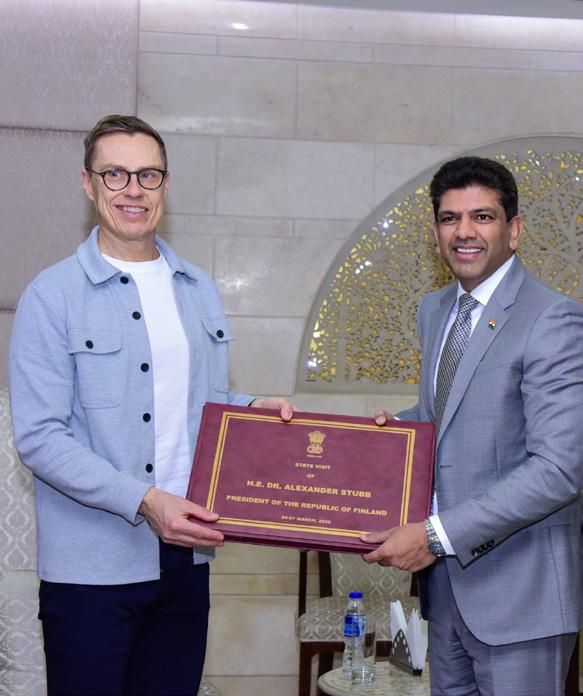
Finnish Prez Alexander Stubb concludes ‘fruitful’ India visit
Mumbai, March 8 (IANS)
Finnish President Alexander Stubb concluded his State Visit to India on Sunday and was warmly seen off by the Minister of State for Rural Development and Communications, Chandra Sekhar Pemmasani.
Taking to X, the Ministry of External Affairs (MEA) said, "A fruitful visit concludes as President Alexander Stubb of Finland departs India. Warmly seen off by Minister of State for Rural Development and Communications Chandra Sekhar Pemmasani at the airport."
A defining moment in the IndianFinland ties as the relationship gets elevated to 'Strategic Partnership in Digitalisation and Sustainability', which will add significant momentum in bilateral relations," it added.
During his India visit this week, Stubb earlier highlighted India and the Global South's growing role in shaping a cooperative, fair and representative multilateral world order.
Prime Minister Narendra Modi also said that the cooperation between India and Finland will expand in key technology sectors such as artificial intelligence, 5G and 6G telecommunications, advanced data analytics and quantum computing. During the talks with Stubb, both sides also agreed to strengthen research collaboration and promote innovation.
Joint research calls between India's Department of Science and Technology and Finland's innovation funding agency Business Finland will focus on areas such as renewable energy, smart cities, hydrogen technologies, electric vehicles, and waste management.
Earlier, in his address at the Raisina Dialogue in New Delhi on March 5, Stubb mentioned that the power balance has shifted and the Global South has both demography and economy on its side. "I mean, here we are in a country which is portraying growth rates of 7 per cent, probably projecting all the way to 2047. And at the same time, it's the biggest democracy in the world.
India to take 100 million barrels of Russian oil waiting for China: US
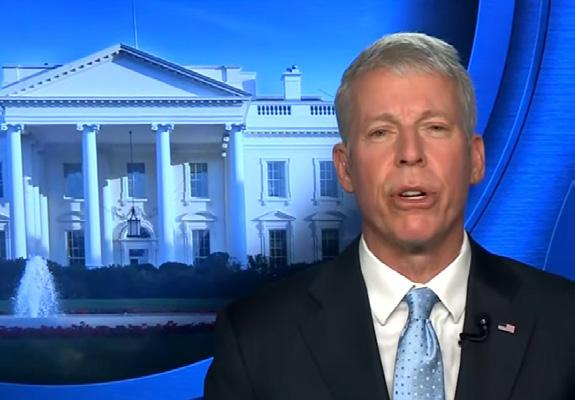
Washington, March 8 (IANS) The United States of America urged India to draw down more than 100 million barrels of Russian crude waiting offshore for Chinese refineries in an effort to cool rising oil prices during the Iran conflict, Energy Secretary Chris Wright said on Sunday.
Speaking in interviews on US television programmes, including CNN and CBS News, Wright said the Trump administration directly reached out to India as part of a short-term effort to calm energy markets rattled by disruptions in the Middle East.
"I did call up the Indians, as did Treasury Secretary (Scott) Bessent, and say, look, there's a whole bunch of oil that's floating to wait to unload at Chinese refineries," the Energy Secretary added.
"There's over 100 million barrels of floating Russian crude waiting
Washington, March 8 (IANS) The US military has issued a warning on Sunday to civilians in Iran, urging them to stay indoors as Iranian forces continue launching drones and ballistic missiles from densely populated cities -- a tactic American officials say is placing millions of ordinary people at risk.
US Central Command said the Iranian military had been conducting operations from crowded urban areas, including the cities of Dezful, Esfahan, and Shiraz, where drones and missiles have been launched in recent days.
“The Iranian regime is using heavily populated civilian areas to conduct military operations, including launching one-way attack drones and ballistic missiles,” CENTCOM said in a statement.
American officials warned that using residential neighbourhoods for military operations could expose those areas to retaliation under international law.
“This dangerous decision risks the lives of all civilians in Iran since locations used for military purposes lose protected status and could become legitimate military targets under international law,” the command said.
The statement urged civilians across Iran to remain inside their homes as fighting intensifies.
in line to deliver to China," Wright said.
According to the US Energy Secretary, the proposal was to redirect those cargoes to Indian refineries rather than allowing them to remain idle offshore while waiting for Chinese unloading slots.
"Instead of having it wait six weeks to unload there, let's just pull that oil forward, have it land at Indian refineries and tamp this fear of shortage of oil, tamp the price spikes and the concerns we see in the marketplace," Wright said.
He described the move as a temporary and pragmatic step aimed at preventing panic in global oil markets as the conflict involving Iran disrupts key energy shipping routes. "It's just a pragmatic effort that has a short time span," Wright said.The US Energy Secretary stressed that the step does not represent any shift in Washington's broader policy toward Russia."It is not.
The United States' policy towards Russia has not changed at all," Wright said when asked whether the move undermined the US administration's efforts to limit reliance on Russian oil.
“US forces strongly urge civilians in Iran to stay at home,” the statement said, adding that the Iranian government was “knowingly endangering innocent lives".
American officials also accused Iranian forces of targeting civilian infrastructure elsewhere in the region.
According to CENTCOM, Iranian forces have “deliberately and indiscriminately targeting civilian airports, hotels, and residential neighborhoods” across parts of the Middle East, putting innocent people in neighbouring countries at risk.
Adm. Brad Cooper, commander of US Central Command, said Tehran’s actions were placing both its own population and regional partners in danger.
“Iran’s terrorist regime is blatantly disregarding civilian lives by attacking Gulf partners while compromising the safety of their own people,” Cooper said.
U.S. officials said Iran had launched hundreds of ballistic missiles and thousands of oneway attack drones since February 28. But they added that the pace of those launches has begun to slow after sustained military pressure.
“Launch rates have drastically declined as US and partner forces decimate Iran’s military capabilities,” the command said.
The US military said it was taking steps to minimise civilian harm but cautioned that it could not guarantee safety near facilities used by Iranian forces.
“The US military takes every feasible precaution to minimize harm to civilians but cannot guarantee civilian safety in or
near facilities used by the Iranian regime for military purposes,” the statement said.
“Unlike the Iranian regime, US forces do not target or intentionally risk the safety of civilians.”
At the same time, the US State Department said it has been carrying out a large effort to help Americans leave the region as tensions escalate.
Assistant Secretary Dylan Johnson said more than 32,000 Americans have already returned to the United States since the crisis began.
“Since February 28, over 32,000 American citizens have safely returned to the United States from the Middle East,” Johnson said.
The State Department said it had organised nearly two dozen charter flights and evacuated thousands of Americans from the region, while commercial flight availability across the Middle East gradually improves.
Through its round-the-clock task force, the department said it has directly assisted more than 19,000 Americans abroad by providing security guidance and travel support.
The evacuation programme covers Americans in Oman, Kuwait, Bahrain, the United Arab Emirates, Qatar, Saudi Arabia and Israel who may require assistance leaving the region.
Officials also noted that more than half of the Americans who asked for help ultimately declined government-arranged transport when contacted. Some chose to remain in the region, while others preferred to arrange their own departures.
US lawmakers question Trump’s Iran war strategy
Washington, March 8 (IANS)
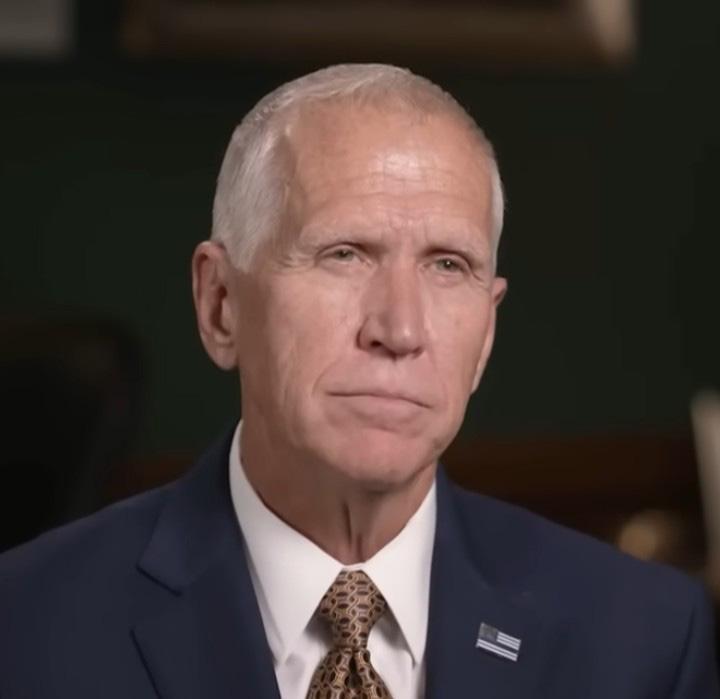
The US lawmakers, on Sunday, raised sharp questions about the objectives and potential duration of President Donald Trump's expanding military campaign against Iran, warning that the administration must clearly explain its strategy to the American people and the Congress.
Speaking to CNN, Republican Senator Thom Tillis said the White House needs to clarify its goals as the conflict enters its second week.
"I think that the administration needs to be clear on what the goal is," Tillis added.
"If our ultimate goal is going to be regime change, then it may take longer than the 60 days that the
war powers resolution provides the President before they really do need to come before the US Congress and get it authorised," he said.
Tillis said the US Congressional backing would strengthen the legitimacy of a prolonged military effort.
"Wouldn't we want to legitimise this by getting a Congressional vote supporting the President if it's going to be a long-term engagement?" he added.
The North Carolina Senator also suggested that if US forces are deployed on the ground, the conflict could evolve into a longer campaign.
"When you start putting boots on the ground, and those boots on the ground may need reinforcement, that starts looking like a longer-term conflict," Tillis said.
Democratic Senator Chris Murphy offered a far more critical assessment of the war, warning that the conflict risks becoming another costly Middle East campaign.
"This is already a war that is becoming an ongoing disaster," Murphy said in the same CNN
interview.
"It gets worse if the President is talking about putting ground forces in," he said, adding that such a move could lead to significant American casualties. "You're talking at that point about dozens, if not hundreds of new American casualties," Murphy said.
He also added that military strikes alone cannot permanently eliminate Iran's nuclear capabilities."You can't bomb knowledge out of existence," he said. "Even if you were to do something wildly dangerous, like putting American ground forces in order to try to extract some of their enriched uranium, there's still going to be the knowledge inside Iran."The Senator urged a return to diplomacy, pointing to the nuclear agreement negotiated during the Obama administration. "A diplomatic agreement," Murphy said, describing it as the "only true path" to ensure Iran does not obtain nuclear weapons.
Murphy also criticised plans to approve additional funding for the conflict, saying the American public does not want another long-running war in the region.
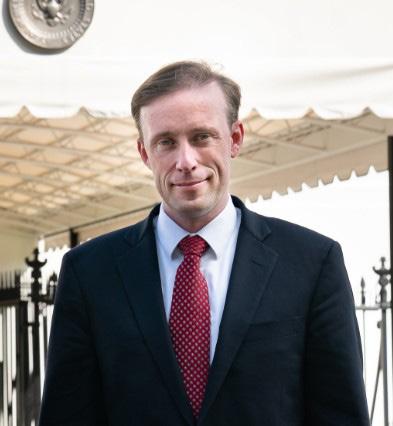
H-1B bill seeks to reverse Trump rules Trump’s war strategy criticised by former NSA, says goals remain unclear
Washington, March 9 (IANS)
A Democratic lawmaker has introduced a legislation in the US House of Representatives seeking to nullify President Donald Trump’s proclamation that imposed strict wage requirements and steep fees on employers hiring H-1B visa workers.
Congresswoman Bonnie Watson Coleman announced the measure, titled the Welcoming International Success Act, aimed at reversing the September 2025 proclamation that mandated rigid wage levels and imposed a $100,000 fee on employers sponsoring H-1B workers .
“Trump’s shortsighted proclamation has created significant barriers for US employers, universities, hospitals, and research institutions that rely on highly-skilled professionals,” Watson Coleman said.
“The H-1B program does not replace the domestic workforce; it serves as a bridge between US talent and global talent that fuels US economic growth,” she added. The H-1B visa programme allows US employers to hire foreign
professionals in specialised fields where there are shortages of skilled workers. These include industries such as technology, engineering, healthcare, and education.
Supporters of the new bill argue that tightening the programme through higher wage thresholds and costly employer fees has made it harder for institutions to recruit talent needed to sustain innovation and critical services.
Watson Coleman said the restrictions are particularly concerning at a time when the United States is facing mounting pressure in the healthcare sector.
“A combination of an aging workforce, COVID-related burnout, restrictions on H-1B visas, and the Trump Administration’s recent limitations placed on federal student loans for nursing degrees has created a perfect storm for a nursing shortage in the coming years,” she said.
“The Welcoming International Success Act would ease this burden as demand for qualified healthcare professionals increases.”
The legislation has drawn support from several Democratic House lawmakers. Co-sponsors include Representatives Yvette D. Clarke of New York, Lois Frankel of Florida, Seth Moulton of Massachusetts, and Henry C. “Hank” Johnson of Georgia.
Iran may target tech giants’ offices in Israel, Gulf: Report
New Delhi, March 11 (IANS)
Offices and infrastructure of major US technology companies in Israel and some Gulf countries could come under Iranian attack as the conflict in the Middle East intensifies, according to reports.
Iran’s Tasnim News Agency, which is affiliated with the Islamic Revolutionary Guard Corps (IRGC), has reportedly published a list of offices and infrastructure run by leading American companies with Israeli links, alleging that their technology has been used for military purposes.
The list described these facilities as "Iran’s new targets", adding that as the regional conflict expands into an infrastructure war, the scope of what Tehran considers legitimate targets may also widen. Companies mentioned in the list include Google, Microsoft, Palantir Technologies, IBM, Nvidia, and Oracle Corporation, according to a report by Al Jazeera.
The companies operate offices across several Israeli cities and parts of the Gulf region. Google
Washington, March 9 (IANS)
Former US national security adviser Jake Sullivan said that the Trump administration’s war with Iran risks drifting without a clear strategic objective, even as American military operations demonstrate significant tactical success.
Speaking on CNN’s Fareed Zakaria GPS, Sullivan said the US military’s operational performance had been “remarkable” but questioned the clarity of the war’s ultimate goals.
“On the encouraging side, the US military is just simply remarkable,” Sullivan said. “It's remarkable at being able to achieve tactical objectives, to execute operations with skill, professionalism, and courage.”
But he cautioned that the strategic purpose of the war remains unclear.
“The discouraging part is we are asking the US military to put itself in harm's way, and we've already lost six service members, pointed towards a completely unclear
has its Middle East headquarters in Dubai, while Microsoft maintains a significant regional presence in Abu Dhabi. Both firms also operate offices in Israel.
Tehran has also warned that economic centres and banks linked to US and Israeli entities in the region could become potential targets.
According to Al Jazeera, a spokesperson for Khatam alAnbiya Headquarters, which the United Nations describes as being owned by the IRGC, said that the recent strikes had "left Iran free to target economic centres and banks belonging to the United States and the Zionist regime in the region".
The spokesperson reportedly warned residents in the region to stay away from such locations, saying people should not remain within a one-kilometre radius of banks linked to those entities.
Iranian media also reported that recent US and Israeli strikes had hit a bank in Tehran, resulting in casualties among employees, although the number of deaths was not specified.
The warnings come as tensions escalate following Iranian counterstrikes after coordinated attacks by the United States and Israel. Tehran has also targeted US-linked assets in the region and warned Gulf nations allied with Washington.
objective,” Sullivan said. According to him, the administration has offered multiple explanations for the war without clearly defining its end state.
“The administration has not been able to say with any clarity whatsoever what the ultimate goal of this war is,” he said, adding that officials have “given perhaps a dozen different explanations, shifting by the hour by the day.”
Sullivan said the lack of a clear strategy more than a week into the conflict poses a serious risk.
“To have that level of muddiness, that muddle, I think is a huge challenge,” he said. “It suggests that this war got launched without being fully thought through.”
He also questioned whether the Trump administration drew the wrong lessons from a previous US special forces operation in Venezuela.
“President Trump is going to draw the wrong lesson from this,” Sullivan said, referring to the earlier raid. “He's going to think we can use military force anywhere, anytime, for any purpose, and it will all work out just fine.”
Sullivan said the war may also have unintended geopolitical consequences, particularly benefiting Russia.
“Russia is an adversary of the United States,” he said. “They're an adversary who, reportedly, is actually supplying intelligence so that Iran can pinpoint locations
where US service members are present.”
He warned that Moscow could gain both financially and strategically from the conflict.
“One of the big winners in all of this is Vladimir Putin and Russia,” Sullivan said, pointing to rising oil prices and reduced US military resources available for Ukraine.
Sullivan argued that the decision to launch the Middle East war has weakened Ukraine’s defensive position against Russia.
“At a critical point in the negotiations, at a moment when President Trump could have come in in massive support of Ukraine… President Trump decided instead to launch this massive adventure in the Middle East,” he said.
He added that the war risks reinforcing dangerous geopolitical precedents.
“I think they're taking two major lessons,” Sullivan said, referring to China’s likely interpretation of the conflict.
“The larger strategic lesson… is that we're in a new era of geopolitics, where big countries… can act with force without any reference to international law.”
According to him, Beijing could interpret the war as evidence that the United States and its allies are less able to deter military action elsewhere.
“I think this is going to make them believe… that they have a greater window to be able to use military force against Taiwan,” Sullivan said.
US vows to secure Hormuz amid Iran conflict
The United States has said it will ensure the security of the Strait of Hormuz and maintain the free flow of global energy supplies as the conflict with Iran escalates, while warning that Tehran is miscalculating American military resolve.
In an interview with CBS’s 60 Minutes, US Secretary of War Pete Hegseth said American forces were already degrading Iran’s naval capabilities and were prepared to take further action to safeguard critical shipping routes.
“What was the Iranian Navy is largely no more,” Hegseth said, adding that US forces would continue targeting vessels and assets that threaten maritime security.
Hegseth suggested Washington’s military operations were aimed at ensuring that such disruptions do not materialise.
“We’re taking care of a lot of
that… American firepower,” he said when asked about protecting shipping through the strait and restoring confidence for commercial vessels operating in the region.
Hegseth said the administration believes it can manage the economic impact while continuing military operations.
“It is an important goal to achieve,” he said, referring to the broader campaign objectives, adding that US officials were working with allies and energy authorities to mitigate any shock to global markets.
The comments come amid heightened tensions in the region and fears that the conflict could trigger a wider disruption to energy supplies.
Beyond the maritime dimension, Hegseth framed the campaign against Iran as a strategic effort to weaken Tehran’s ability to threaten US forces, regional partners, and global commerce.
“It means we’re fighting to win.
It means we set the terms,” he said when asked what President Donald Trump meant by saying Iran would face unconditional surrender.
According to Hegseth, the objective is to reach a point
where Iran is no longer capable of sustaining military operations.
“We’ll know when they’re not capable of fighting. There’ll be a point where they’ll have no choice but to do that,” he said.
He also stressed that the current phase of the campaign represents only the early stages of US operations.
“We have just now begun to fight, just now begun to surge,” Hegseth said, signalling that further military pressure could follow. At the same time, the interview highlighted growing geopolitical complexities surrounding the conflict, including reports that Russia may be sharing intelligence with Iran regarding US military movements.
Asked about those reports, Hegseth said American commanders were closely monitoring the situation and factoring it into operational planning.
“We have the best intelligence in the world. We’re aware of who’s talking to who, why they’re talking to them,” he said.
The US official dismissed suggestions that such cooperation would significantly endanger American forces.
Washington, March 9 (IANS)
India’s latest Maritime Doctrine responds to strategic environment: Report
Canberra, March 14 (IANS)
India’s 2025 Maritime Doctrine underscores its ambition to be a “preferred security partner” and “first responder” in the region, marking a notable shift from repeated use of these terms in diplomatic statements to their formal inclusion in a naval policy.
According to a report in Australiabased independent think tank Lowy Institute's ‘The Interpreter’, the doctrine's geographic imagination has also expanded, with earlier versions focused mainly on the Indian Ocean Region (IOR) as the “core theatre
for India’s maritime strategy”. The 2015 doctrine broadened India’s maritime outlook by outlining primary and secondary areas of interest beyond the region.
The doctrine, the report said, presented India, the Indian Ocean Region and the Indo-Pacific as an interconnected continuum rather than a “hierarchy of operational priorities”. The shift is significant because it integrates the Indo-Pacific concept within the doctrinal framework that shapes India’s naval planning.
“Most notably, the new doctrine is an acknowledgement that contemporary conflict rarely conforms to a clear line between peace and war. The document repeatedly refers to a condition described as “No War No Peace” – the space where countries pursue their objectives without crossing the threshold of
open armed conflict. Rather than treating war as a discrete event, the doctrine situates it along a continuum of cooperation, competition, confrontation, and conflict,” the report detailed.
“Maritime rivalry today seldom erupts into open conflict. It unfolds through forms of pressure, such as ships shadowing one another, increased patrols, and competing legal claims. The doctrine’s attention to such dynamics suggests that the Indian Navy sees maritime competition as an ongoing contest for advantage,” it added. The report stressed that the doctrine responds to the strategic environment by addressing “greyzone operations”, a concept that has become prominent over the past decade, especially in the South China Sea context.
Australia’s gender pay gap falls, but men dominate highest-paying roles: Govt report
Canberra, March 3 (IANS)
Australia's workplace gender pay gap fell in 2024-25, but men remained significantly more likely than women to hold the highest-paying jobs, according to a government report.
The Workplace Gender Equality Agency (WGEA) on Tuesday published annual gender pay gap results for 10,500 employers across the country, revealing that
half of employers had an average total gender pay gap lower than 11.2 per cent in favour of male employees in 2024-25.
It marks a decline of 0.9 percentage points from 2023-24, when half of employers had an average gender pay gap lower than 12.1 per cent.
The WGEA report said that 54.8 per cent of employers nationally reduced their average total gender pay gap in 2024-25. However, the WGEA found that men accounted for 64 per cent of the highest-paying quartile of jobs in 2024-25 and that women accounted for 58 per cent of the two lowest-paying quartiles
of jobs, Xinhua news agency reported.
"The fact that men are nearly twice as likely as women to be in the highest paid roles and that women still dominate the lowest paid roles should offer a reality check for anyone who thinks Australia has achieved equality in the workplace," WGEA chief executive officer Mary Wooldridge said in a statement.
The report found that 22.5 per cent of employers had a gender pay gap within the WGEA's target range of 5.0 per cent in favour of men or women in 2024-25, up from 21.4 per cent within the target range in 2023-24.
We celebrate each other’s differences, and come together: Australian PM Albanese’s Holi greetings
Canberra, March 4 (IANS)
Australian Prime Minister Anthony Albanese on Wednesday conveyed heartfelt Holi greetings, highlighting the festival’s timeless message of the victory of good over evil, the significance of friendship and forgiveness, as well as the shared spirit of humanity.
“For many Australians of Hindu and South Asian heritage, Holi is a time to come together in celebration of shared history, heritage and traditions. It is
a festival with truly timeless themes: the triumph of good over evil, the enduring value of friendship and forgiveness, and the oneness of the human spirit. It holds out to us a chance to renew ourselves, and each other,” the Australian PM said in a statement.
Stressing that the vibrant celebration of colour has been widely embraced across Australia, Albanese said, “What is truly wonderful is the way Holi has been so enthusiastically absorbed into the story of modern Australia, its joyful expression of colour, love and new life heartily embraced by people of all backgrounds as a highlight of our festival calendar.”
He noted that festivals like Holi serve as a reminder that all Australians benefit from the beliefs, customs, and experiences of people from around the world,
Australian FM says 115,000 citizens stranded in Middle East
Canberra, March 2 (IANS)
Australia's Minister for Foreign Affairs said on Monday that an estimated 115,000 Australians are currently in the Middle East after flights in and out of the region were canceled amid US-Israeli strikes against Iran.
Penny Wong told the Australian Broadcasting Corporation television that the federal government is awaiting updates on the resumption of commercial flights through the Middle East before committing to repatriation flights for stranded citizens, Xinhua news agency reported.
"Given the number of people in the region, people will get home most quickly if we can facilitate
Prospects for
people getting on commercial flights at the moment," she said.
In a statement issued earlier on Monday, Wong said that the government is now advising Australians not to travel to Bahrain, Iran, Iraq, Israel, Kuwait, Lebanon, Palestine, Qatar, Syria, the United Arab Emirates and Yemen.
Additionally, she said that Australians should reconsider the need to travel to Jordan, Oman and Saudi Arabia.
Australian citizens already in the Middle East have been advised by the government to closely monitor events and local media, confirm plans directly with airlines or travel agents, review their travel insurance and follow the Department of Foreign Affairs and Trade (DFAT) for the latest updates.
Wong said that DFAT has activated its Crisis Center to provide consular support to Australians in the Middle East.
Deputy Prime Minister and Minister for Defence Richard Marles said the government has taken steps to protect the safety of around 100 defense force personnel currently based in the region.
lasting solution to Pak-Afghan conflict remain unlikely: Report
along with their aspiration, hard work and deep commitment to the nation. “We celebrate each other’s differences, and come together in our shared identity as Australians. May this year’s Holi celebrations nurture friendships and build communities so that, long after the gulal has drifted away, the power of all that connects us continues,” Albanese added. Earlier in the day, Prime Minister Narendra Modi wished everyone on the occasion of Holi and said that may everyone’s life be filled with the colours of happiness, prosperity, and success. PM Modi took to the social media platform X and said, “Happy Holi to all our fellow citizens. May this festival of colours and joy bring joy to everyone. May everyone’s life be filled with the colours of happiness, prosperity, and success.”
Canberra, March 7 (IANS) The ongoing conflict between Pakistan and Afghanistan marks a sharp deterioration in bilateral ties that have simmered since the Taliban reclaimed power in August 2021. Islamabad has previously carried out significant airstrikes targetting Tehreek-e-Taliban Pakistan (TTP) militants in Afghanistan, notably in December 2024, a report has highlighted.
“On 26 February, Afghan troops launched major attacks on a dozen Pakistani border posts, which, according to the Afghan government, were in retaliation for Pakistan airstrikes on Pakistan Taliban, known as the Tehreek-e-Taliban Pakistan (TTP), hideouts in Afghanistan earlier in February. Islamabad responded by bombing 22 cities and military targets in Kabul, Kandahar, Paktia, Nangarhar, Khost and Paktika provinces,” a report in Australia-based think tank Asialink mentioned.
Citing official Pakistani military spokesperson, Lieutenant General Ahmed Sharif Chaudhry, the report noted that 274 Taliban personnel have been killed and over 400 injured, while 73 Afghan posts along the Pakistan–Afghanistan border
have been destroyed and 18 seized. Pakistan’s Defence Minister Khwaja Asif said that the hostilities between the two countries had escalated into an “open war”.
According to the report, the last major military clash between the two countries occurred in October 2025 and concluded with a ceasefire mediated by Turkey and Qatar. However, despite subsequent negotiations, the two countries failed to reach a lasting peace agreement.
In the latest assaults, it said, Pakistan’s air force targetted Taliban military facilities in Kabul, reflecting Islamabad’s hardline stance over the Taliban’s refusal to expel the TTP from its territory.
“In addition to its military might, Pakistan has other tools in its State kit. It could further tighten movement across its 2600-kilometre border. The critical border controls at Torkham and Chaman provide about 40 per cent of Afghanistan’s customs revenue. By imposing further tariffs on top of the existing 10 per cent and greater import restrictions, it would make it more costly economically for the Taliban to continue to support the TTP,” the report detailed. “Pakistan could increase the number of Afghan refugees it forcefully repatriates to Afghanistan, creating more economic hardship for the country. In 2025 alone, 930,000 Afghans were repatriated, 67 per cent of them forcefully,” it added.
From the editor’s desk India’s rise is not a strategic favour — it is a national resolve Champions of the shortest game
India’s triumph in the T20 World Cup has once again reminded the cricketing world of a simple yet powerful truth: when the Indian team finds its rhythm in the shortest format of the game, it becomes a force that few sides can easily match. The victory is not merely another addition to India’s rich cricketing record. It is a statement about the extraordinary depth, confidence and evolving philosophy that now define Indian cricket in the T20 era.
Cricket in India has never been merely a sport. It is a shared national passion that binds people across regions, languages and communities. From the crowded streets of metropolitan cities to the small grounds of distant towns, the game occupies a place of pride in the country’s cultural life. When the national team wins a global tournament, it becomes more than a sporting achievement. It becomes a moment of collective pride that resonates across the country.
India’s success in the T20 World Cup must also be viewed in the context of how dramatically the game has evolved over the past two decades. The T20 format has transformed cricket’s tempo and strategy. Where once patience and endurance defined the longer formats of the game, the shortest version now demands rapid decision-making, fearless stroke play and sharp tactical awareness.
In this format the margin for error is extremely small. A single over can change the course of the match, and momentum often shifts with startling speed. Teams that succeed are those that combine aggression with calm judgement. The Indian team displayed precisely this balance throughout the tournament.
One must pause here to reflect on the qualities required to succeed in modern T20 cricket. Batters must attack with confidence but remain aware of the match situation. Bowlers must innovate constantly while operating under immense pressure. Fielders must maintain alertness at every moment, knowing that a single run saved or a catch taken under pressure can alter the result of the game. India’s performance in the tournament showed how effectively the team has mastered these demands. What stood out most clearly was the collective nature of the effort. The team did not depend on one individual performance to secure victory. Instead, success came from contributions across the squad. Batters built partnerships and accelerated scoring when opportunities appeared. Bowlers maintained discipline even when confronted by aggressive
batting. Fielders displayed the athleticism and commitment that modern cricket demands. Such balance is rarely accidental. It reflects the strength of a cricketing system that has been steadily developed over many years.
India’s batting approach during the tournament illustrated the confidence that now characterises the side. Modern Indian batters step onto the field with the clear understanding that the tempo of the game must be dictated rather than merely endured. Controlled aggression has become the defining feature of this philosophy.
There was a time when teams approached T20 cricket cautiously, wary of losing early wickets. That hesitation has gradually disappeared from India’s game. Today’s players display the confidence to attack from the very beginning, while retaining the ability to rebuild the innings when circumstances demand patience.
Equally impressive was the performance of India’s bowling unit. Bowling in the T20 format presents unique challenges. Batters frequently attempt innovative strokes and look to dominate from the outset.
Yet India’s bowlers combined accuracy with imagination. Fast bowlers used variations in pace and length intelligently, while spinners controlled the middle overs and often broke crucial partnerships.
Fielding too played a decisive role in India’s success. Modern cricket demands exceptional athleticism, and the Indian team displayed a level of commitment that reflected the highest international standards.
Behind these performances lies the strength of India’s domestic cricket structure. Over the past two decades the country has invested heavily in developing its cricketing ecosystem. Domestic competitions have grown stronger and more competitive, producing a steady stream of talented players ready for the international stage.
The Indian Premier League has played a transformative role in this process. By bringing together international stars and emerging Indian talent, the league has provided young players with invaluable experience in highpressure situations.
It is important to remember that great teams are rarely built overnight. They are the result of sustained effort, careful planning and a clear vision for the future.
The current Indian side reflects exactly such preparation.
.India’s T20 World Cup victory therefore represents far more than success in a single tournament. It demonstrates the maturity of Indian cricket and its ability to adapt to the changing nature of the modern game.
By Rahul Ranjan Das
Over the past decade, the Raisina Dialogue has steadily grown into one of the most significant global platforms where diplomats, policymakers and strategic thinkers gather to reflect on the changing contours of the international order. What began as an important Indian initiative has gradually evolved into a forum where the world pauses to examine the shifting balance of power, the emerging alignments among nations and the challenges that define our times. The 2026 edition of the Dialogue once again brought together voices from across continents. Yet amid the many conversations that took place, one particular exchange captured global attention and provoked a deeper reflection on how nations understand their place in the world.
On the concluding day of the Dialogue, India’s External Affairs Minister, Subrahmanyam Jaishankar, responded to remarks attributed to Kurt Campbell, a senior American official long associated with shaping Washington’s strategic outlook towards Asia. Campbell had suggested that the United States had once made a strategic mistake by helping China’s economic rise and that Washington would not repeat the same error with India.
At first glance, the remark might have appeared to be part of a continuing debate within the United States about how to deal with rising powers. But the comment carried with it a deeper implication, one that could not pass without reflection. It raised a fundamental question: does the rise of a nation depend upon the strategic choices of another power, or is it shaped primarily by the aspirations, institutions and resolve of that nation itself?
Jaishankar’s response was calm but unmistakably clear. India, he suggested, does not see its future as something dependent on the strategic calculations of another country. India will decide its own rise.
Those words resonated widely, not because they were confrontational but because they reflected a truth that many countries increasingly recognise. The trajectory of a nation is rarely determined elsewhere. It emerges from within — from the energy of its people, the strength of its institutions and the choices it makes over time.
To fully appreciate the significance of this exchange, it is necessary to understand the context in which Campbell’s remark was made. For several decades, the United States supported China’s integration into the global economy. Washington believed that economic engagement would
not only benefit global trade but also encourage political moderation and cooperation. China’s entry into international economic institutions and its access to global markets were viewed as part of a strategy that would ultimately lead to shared prosperity.
For a time, that assumption seemed justified. China experienced remarkable economic growth and became deeply integrated into global supply chains. Yet China’s subsequent emergence as a strategic competitor to the United States has led many policymakers in Washington to reassess those earlier decisions. Some now argue that engagement inadvertently strengthened a rival power. It was within this strategic debate that Campbell’s observation about not repeating the same “mistake” with India was made. Yet the implication that another country might determine the trajectory of India’s rise was precisely what Jaishankar sought to address. India’s rise has not been the product of a single external relationship. Rather, it has been the outcome of decades of internal transformation. Economic liberalisation in the early 1990s opened new avenues for growth. The expansion of education and technology sectors created a globally competitive workforce. India’s entrepreneurs and innovators built industries that now shape global markets. Equally significant has been the development of India’s digital infrastructure. Initiatives that connect millions of citizens to financial services, identity systems and digital governance have transformed the country’s economic landscape. These changes have not been imposed from outside. They are the result of deliberate policy choices and the collective effort of a society determined to move forward. It is therefore natural that India sees its rise not as a favour granted by another power but as a reflection of its own capabilities and aspirations.In many ways, Jaishankar’s remark echoed a long-standing principle that has guided India’s foreign policy since independence — the principle of strategic autonomy. For decades India has sought to maintain independence in its international engagements. During the Cold War, the country was closely associated with the Non-Aligned Movement, which sought to avoid being drawn into the rivalry between competing power blocs. Although the world today is very different from the Cold War era, the underlying philosophy of autonomy continues to shape India’s diplomatic approach. India works closely with the United States in areas such as defence cooperation, emerging
technologies and the security of the Indo-Pacific. At the same time, it maintains relations with countries such as Russia and continues to engage actively with the nations of the Global South. This balanced approach reflects the reality of an international system that is no longer defined by rigid alliances. Instead, the world is gradually moving towards what many analysts describe as a multipolar order.
The evidence of this transformation is visible everywhere. Economic power is distributed across multiple regions. Technological innovation emerges from several centres of influence. Political authority is no longer concentrated in a single dominant power. In such an environment, the notion that one nation can determine the rise of another appears increasingly outdated. India’s emergence as a major global actor is part of this wider shift. With its vast population, expanding economy and growing diplomatic presence, India is steadily becoming one of the important poles in the evolving international system.
Another dimension of Jaishankar’s response lies in the distinction between partnership and patronage. Modern international relations increasingly revolve around partnerships based on mutual benefit rather than hierarchical arrangements. India’s relationship with the United States is often described as one of the most important strategic partnerships of the twentyfirst century. Both countries share democratic values and have overlapping interests in maintaining stability in the IndoPacific region. Yet partnership does not imply dependency. A genuine partnership recognises that each country has its own priorities and strategic calculations. Cooperation becomes stronger when it is grounded in mutual respect rather than assumptions of influence. In that sense, Jaishankar’s remark was not directed against cooperation with the United States. Instead, it served as a reminder that cooperation works best when both sides recognise each other’s autonomy.
There was also an unmistakable tone of confidence in his response. For many years after independence, India approached international forums with caution, aware of its economic limitations and developmental challenges. Today the picture is very different.
India is among the fastestgrowing major economies in the world. Its technological innovation influences global industries.
NRIs are ambassadors of Indian culture: BJP National Spokesperson Pratyush Kanth
New Delhi, March 9 (IANS) Bharatiya Janata Party (BJP) National Spokesperson Pratyush Kanth said on Monday that non-resident Indians (NRIs) are the true ambassadors of Indian culture, who have a crucial role to play in achieving "Viksit Bharat@2047".
Speaking at the presentation of a book "Great Indo-Canadians" by Toronto-based senior journalist Gurmukh Singh, Kanth said that under Prime Minister Narendra Modi's vision the country has been taking big strides and making the most of the contributions of people of Indian origin settled abroad.
"Indians settled abroad have earned a name for themselves and the country through hard work. They have also preserved the Indian culture wherever they have settled," the BJP National Spokesperson added.
Kanth praised author Gurmukh Singh for playing the role of a sentinel of Indian culture and ethos.
"His book transcends the boundaries of standard storytelling and highlights lives of patriotic Indo-Canadian achievers, who are role models for the young generation," he said.
This coffee-table book features some unique Indo-Canadian entrepreneurs, who have created successful businesses, enriched society by giving back in various ways, including charity, and promoted 'Brand India' in Canada.
Among these individuals are those who have got top awards in both Canada and India.
Honoured with the Order of Canada and the Pravasi Bharatiya Samman Award, Tamil Naduborn V.I. 'Lucky' Lakshmanan is Canada's top clean energy scientist, who has founded Process Research ORTECH -- which is a global leader in sustainable process technologies today.
Awarded with the Pravasi Bharatiya Samman Award, Gujarat-origin Ramesh Chotai founded one of Canada's top privately run pharmacy chains --
Bromed Pharmaceuticals. Haryana-born chartered accountant-entrepreneur Satish Thakkar, who has led the IndoCanada Chamber of Commerce and the Canada India Foundation, and founded the Excelsior Group with interests in real estate, is credited with bringing yoga and Ayurveda to Canada.
Gujarat-born Anil Shah, who founded Ni-Met, a leader in metal trading, is credited with pioneering Diwali charity galas in Canada.
Ludhiana-born Surjit Babra was the first Sikh entrepreneur to establish an airline -- SkyLink. More than anything else, the individuals featured in this book have donated millions to charities in Canada and India.
With its lovely flowing style and attractive visuals, this book makes a great read.
Toronto-based Gurmukh Singh is a former Times of India (Delhi) Special Correspondent and IANS Canada Correspondent. He has also written for all major Canadian newspapers such as the Globe and Mail, Toronto Sun, National Post and the Canadian Broadcasting Corporation (CBC).
Pakistan’s failure to tackle trafficking lets criminal networks thrive: Report
Islamabad, March 7 (IANS)
Pakistan will continue to see disappearances buried in administrative records rather than investigated as crimes unless trafficking is recognised not only as a humanitarian crisis but also as an institutional vulnerability. Such neglect enables organised criminal networks to flourish and undermines the credibility of the authorities, a report said on Saturday.
According to the report in Pakistani daily, 'The Friday Times', police in Sadiqabad region of Pakistan’s Punjab province on February 14, reunited an elderly woman with her family after she had gone missing as a routine procedural recovery – an incident that did not draw national attention.
“Yet in Pakistan, such outcomes are not routine. For every missing woman who is found, many others disappear into circumstances later categorised as abduction,
migration, domestic dispute, or voluntary departure. What often goes unexamined is how many of these cases intersect with poverty, gender inequality, and organised trafficking networks,” it stated.
Citing the '2025 Trafficking in Persons Report', issued by the US Department of State, the report noted that Pakistani authorities identified 37,303 trafficking victims in the latest reporting year compared to 29,113 the previous year. Among the 26,613 identified sex trafficking victims in Pakistan, over 21,000 were women, who also constituted nearly half of the 9,917 forced labour victims.
“Many trafficking cases do not begin as trafficking investigations but as missing persons complaints: by the time exploitation is confirmed, evidence has often dissipated. For international observers, trafficking in Pakistan is often understood primarily through cross-border migration routes, and with good reason,” it detailed.
“Pakistan is deeply embedded in regional and transnational trafficking networks. Routes run westward through Balochistan into Iran, onward to Turkey, and eventually toward Europe’s Mediterranean crossings. Others move south by sea toward the Gulf states. Women are trafficked through both irregular smuggling
moving towards an innovation-driven economy: PM Modi
New Delhi, March 9 (IANS)
Prime Minister Narendra Modi on Monday called upon academic institutions to transform their campuses into hubs of industry collaboration and researchdriven learning to provide students with essential real-world exposure.
provide a solid roadmap for the future and solidify the foundation of a Developed India.
"With such efforts, the foundation of a Developed India will be further strengthened," said PM Modi.
Prime Minister lauded the evolving mindset of India’s youth as the nation's greatest strength and called for an education system that matches this spirit. He highlighted that continuous efforts are being made to link education with employment and enterprise.
corridors and formal visa channels, including work and pilgrimage visas that are later exploited. But these cross-border routes do not begin at the border; they begin in villages,” it further mentioned.
Despite thousands of traffickingrelated cases registered annually, the report said, conviction rates remain disproportionately low, with law enforcement agencies, including Pakistan's Federal Investigation Agency (FIA), facing constraints in investigative capacity, jurisdictional overlaps, and evidentiary hurdles.
“Many trafficking cases do not begin as trafficking investigations. They begin as missing persons complaints. By the time exploitation is confirmed, evidence has often dissipated, and victims are under pressure from families or communities not to pursue prosecution,” The Friday Times quoted one senior FIA official, as saying on condition of anonymity.
The report further said,
“Failure to treat missing women cases as potential trafficking investigations weakens institutional credibility. When disappearances are normalised as private family matters rather than investigated as potential organised crime indicators, criminal networks operate with relative impunity.”
Addressing a post-Budget webinar in the virtual mode, PM Modi discussed the integration between education, employment, and enterprise, highlighting the promotion of the AVGC (Animation, Visual Effects, Gaming, and Comics) sector. Asserting that India is moving towards an innovation-driven economy, Prime Minister said “I would urge you that in this webinar, there must be a brainstorm on developing your campuses as centres of industry collaboration and researchdriven learning”. He further highlighted the importance of synergy between institutions, industry, and academia to accelerate national progress expressing confidence that these discussions would
Prime Minister emphasised that the New Education Policy provides the foundation for a curriculum that must stay aligned with market demands and the real-world economy, specifically in fields like AI, automation, and the digital economy.
"We will have to accelerate the process of linking our education system with the real-world economy," PM Modi noted.
Prime Minister also expressed pride in the increasing number of women in STEM fields and reiterated the government’s commitment to ensuring equal opportunities for daughters in futuristic technologies.
Calling for a robust research ecosystem that encourages young researchers to innovate and experiment without barriers, he said, "we have to create such a research ecosystem where young researchers get full opportunity to experiment and work on new ideas."
NITI Aayog, UNICEF India sign pact to boost nutrition efforts in aspirational areas
New Delhi, March 5 (IANS) NITI Aayog on Thursday said that it has signed a Statement of Intent (SOI) with UNICEF India to support strategic interventions in aspirational districts and aspirational blocks.
The objective of this agreement to leverage the strengths of both institutions to advance efforts towards improving maternal and child nutrition outcomes in underserved areas.
The SOI was signed by Rohit Kumar, Additional Secretary and Mission Director of the Aspirational Districts and Blocks Programme at NITI Aayog, and Arjan de Wagt, Deputy Representative at UNICEF India, the government think tank said.
“The partnership will support the promotion of multi-stakeholder engagement and strengthen implementation systems for nutrition and health interventions at the block level,” NITI Aayog
said.
Kumar said partnerships with organisations such as UNICEF India would further strengthen efforts to address critical health and nutrition challenges and enhance last-mile service delivery in high-priority regions.
“The Aspirational Districts and Blocks Programme has demonstrated the importance of convergence, collaboration and data-driven governance in accelerating development outcomes,” he added.
UNICEF India, via its platform IMPAct4Nutrition (I4N), will provide technical expertise and support engagement with businesses, public sector enterprises and industry associations to channel corporate social responsibility (CSR) investments into nutritionfocused initiatives, the government said.
The agreement will focus on strengthening Anganwadi infrastructure, enhancing nutrition literacy, improving the uptake of Integrated Child Development Services (ICDS) and building the capacity of frontline workers, the apex public policy body said.
US debt surge could ripple across global economy
Washington, March 12 (IANS)
The US is heading towards an unsustainable debt trajectory that could trigger global financial shocks, economists have warned lawmakers during a Senate hearing, raising concerns that rising American deficits may push up global interest rates and ripple through emerging economies, including India.
Opening the hearing of the Senate Finance subcommittee on fiscal responsibility and economic growth on Wednesday, Senator Ron Johnson said the country’s debt trajectory had reached alarming levels. “Soon it will hit and surpass 39 trillion,” he said,
adding that within a decade the national debt would “almost certainly exceed $ 60 trillion”. Johnson said Washington had failed to seriously confront the growing fiscal imbalance. “We still haven’t taken the first step in solving a problem, which is to admit we have one,” he told the panel.
He argued that federal spending surged during the Covid-19 pandemic and never returned to earlier levels. “There is absolutely no justification for that whatsoever,” he said, referring to the sharp increase in government spending in recent years.
Ranking member Senator Tina Smith agreed that the country faces a dangerous fiscal outlook but said both spending and falling revenues had contributed to the problem. “Deficits aren’t caused just by spending that’s too high. They are just as contingent on the revenue side of the ledger,” she said, calling the latest budget outlook “a grim picture”.
Phillip Swagel, director of the
Congressional Budget Office, told lawmakers that the current trajectory of federal finances is historically unusual and unsustainable. According to CBO projections, federal debt held by the public will rise from 99 per cent of GDP in 2025 to 120 per cent by 2036 and eventually to 175 per cent by 2056. “Our projections continue to indicate that the trajectory for budget deficits is not sustainable,” Swagel said. He added that stronger economic growth could reduce deficits but would not resolve the problem on its own. “Policy action is needed to reduce the budget deficit,” he said.
Maya MacGuineas, president of the Committee for a Responsible Federal Budget, warned that the growing debt burden now poses risks beyond economics. “Our national debt is the issue that everybody knows is a problem, but very few people are willing to do anything about,” she told senators.
FPIs offload Indian equities worth over Rs 21,000 crore last week amid
New Delhi, March 8 (IANS)
Foreign portfolio investors withdrew Rs 21,831 crore from Indian equities over the last week from four trading sessions amid deteriorating global risk sentiment tied to the West Asia conflict, exchange data showed. The recent sell-off followed a strong February, when FPIs
infused Rs 22,615 crore into Indian equities, posting the largest monthly inflow in 17 months.
Foreign investors were net sellers for three straight months prior to February, pulling Rs 35,962 crore in January, Rs 22,611 crore in December and Rs 3,765 crore in November.
However, domestic institutional investors (DIIs) continued to provide support in March, infusing approximately Rs 32,786 crore, aided by steady SIP flows and long-term domestic participation.
Market participants attributed the March sell-off to rising geopolitical tensions after the
US-Iran war
US and Israel launched strikes on Iran, which analysts said raised fears of supply disruptions through the Strait of Hormuz and pushed Brent crude above $90 a barrel. Qatar’s energy minister Saad al-Kaabi had in previous week warned that war in the Middle East continuing for "few days" could cause Gulf exporters declaring force majeure, halting deliveries, pushing oil to $150 a barrel and natural gas to $40 per MMBtu within weeks.
Analysts also cited by rupee weakness slipping below the 92-per-dollar level and elevated US Treasury yields that drew capital toward safe-haven assets.
India’s energy policy is written in New Delhi, not Washington, shows data
New Delhi, March 8 (IANS)
India’s energy policy is determined in New Delhi and not in Washington, data has showed. The analysis by The Matrix, which analysed data on India’s crude oil imports between November 2024 and February 2026, claimed that despite a prolonged pressure campaign from the United States under President Donald Trump, India continued to increase its imports of crude oil from Russia, prioritising its own energy security and economic interests. According to the data cited in
the social media post on X, the pressure on India began even before Trump assumed office.
During his presidential campaign in September 2024, Trump had warned India against purchasing Russian oil.
After taking office in January 2025, the rhetoric gradually translated into policy measures aimed at discouraging such trade.
The situation escalated on April 2, 2025, when the US administration announced a 25 per cent “reciprocal” tariff.
However, the data shared by The Matrix suggested that India did not reduce its Russian oil purchases.
Instead, the share of Russian crude in India’s total imports reportedly rose to 43 per cent that month, the highest level during the period covered in the analysis.
MP: State Tiger Force arrest wildlife smuggler in Bhind
Gwalior, March 11 (IANS)
Madhya Pradesh State Tiger Strike Force (MP-STSF), in coordination with the Central Bureau of Investigation (CBI), arrested wanted wildlife smuggler Mishrilal Mahor from Shivpuri district of Gwalior division on Wednesday.
Upon receiving information about Mahor’s location, a team of the State Tiger Force raided his house in Gohad village, Bhind district, and arrested him, a senior forest official told IANS.
Mahor was allegedly involved in large-scale smuggling of Red Crown Roof Turtles and had been absconding for the last nine years.
The State Tiger Force had earlier busted a gang involved in smuggling Red Crown Roof Turtles, a rare species found in the Chambal River, to foreign countries, and registered a forest crime case on May 5, 2017.
A total of 16 accused were arrested in this case from four
states, including 11 foreign nationals. The case was later transferred to the CBI, which has also arrested three other accused.
This development came three days after the State Tiger Strike Force, in a coordinated operation with the Wildlife Crime Control Bureau, arrested Tarak Nath Ghosh, the kingpin of a reptile smuggling racket, from Kanpur on Monday.
The accused, wanted in three cases of transnational illegal trade in turtles and gharials registered in Madhya Pradesh, had been absconding for eight years. Arrest warrants had been issued against him by three different courts.
According to information, Ghosh had spread his syndicate across several states, including Uttar Pradesh, Madhya Pradesh, Andhra Pradesh, Bihar, Odisha, Tamil Nadu, Karnataka, and West Bengal. He is also suspected to have a network outside India, including Bangladesh, Thailand, Myanmar, and Singapore.
On Wednesday, both Ghosh and Mahor were produced before the Shivpuri district court and subsequently remanded to forest custody for further investigation.
Crude rally continues: Brent hits $100, WTI jumps 8 pc amid Middle East supply concerns
Relations between India and the US reportedly became more strained following the military operation referred to as “Op Sindoor” in May 2025. Later, on August 6, the White House introduced a stricter measure by imposing a total 50 per cent tariff -- a 25 per cent reciprocal tariff and an additional 25 per cent specifically linked to India’s purchase of Russian energy.
Despite these measures, the data indicated that India’s imports of Russian crude continued to grow. Shipments reportedly increased from around 1.6 million barrels per day in August to about 2 million barrels per day by October 2025. The post further claimed that the standoff eventually ended with the United States easing its stance.
Mumbai, March 12 (IANS) Global oil prices surged sharply on Thursday as markets remained worried about supply disruptions linked to the ongoing tensions in the Middle East.
The rally in crude prices came despite the announcement of the largest coordinated release of emergency oil reserves by the International Energy Agency. Benchmark crude prices climbed more than 8 per cent during the day. West Texas Intermediate rose around 8.8 per cent to trade near $95 per barrel, while Brent crude gained about 8.9 per cent to hover around $100 per barrel.
The surge reflected strong concerns among traders that global supply could tighten if the conflict in the Middle East disrupts oil shipments.
On Wednesday, the International
Energy Agency announced that its 32 member countries would release a combined 400 million barrels of crude oil from their strategic reserves.
The move marks the largest coordinated drawdown of emergency oil stocks since the agency was formed after the 1973 Oil Crisis.
Separately, the United States Department of Energy said it would release 172 million barrels of oil from the country’s Strategic Petroleum Reserve.
US Energy Secretary Chris Wright said the shipments could start as early as next week and may take about 120 days to complete. However, despite these coordinated efforts to increase supply, oil markets continued to rise. Traders remain concerned that the emergency releases may not be enough to fully offset potential disruptions in oil flows through the Strait of Hormuz, one of the world’s most critical routes for global crude shipments. Meanwhile, Indian equity markets opened sharply lower as surging crude oil prices weigh on sentiment.
Asian shares also fell as reports of additional vessel strikes in the Strait of Hormuz and Iraqi waters sent oil prices higher, fanning inflation fears and pushing borrowing costs up globally.
Empowered women key to building nation’s future: President Droupadi Murmu
New Delhi, March 8 (IANS)
President Droupadi Murmu said on Sunday that empowered women play a very important role in social progress and are the greatest force needed for building the country's future.
She added that educated, selfreliant women are builders of India, which is not just a piece of land, but a living nation.
President Murmu expressed these views while addressing the concluding session of the two-day national conference of women thinkers titled "Bharti -- Naari Se Narayani" held at Vigyan Bhawan in New Delhi.
The conference brought together women thinkers from different fields across the country.
The President said that in Indian tradition, women are not seen
only as protectors of the family but also as symbols of knowledge, strength and prosperity.
She added that today Indian women are achieving remarkable success in many fields such as education, science, administration, sports, entrepreneurship and social service, and are contributing significantly to nation building.
President Murmu said that the real progress of any society is possible only when women receive equal opportunities, respect and security.
She emphasised that women must get the freedom to make decisions, the opportunity to live with self-respect, and equal access to education and employment.
The President also said that the idea of women-led development is growing rapidly in India today. Encouraging young girls, President Murmu added that they should move forward with confidence to achieve their dreams and actively contribute to the nation's development.
She added that when women are empowered, families, society and the nation all become stronger. President Murmu expressed confidence that Indian women, through their knowledge, leadership and sensitivity, will take the country to new heights of progress and prosperity.
At the closing ceremony, Rashtra Sevika Samiti Chief V. Shanta Kumari said that women should accept encouragement from society.
"By increasing our abilities, respect naturally comes to us. Our behaviour should inspire society to support us, and we should use that support to work for the upliftment of society," she added.
She said that after gaining respect -- moving from "Naari to Narayani" -- women can move forward in every field. She emphasised that women should stay connected with the roots of Indian culture and take pride in it, adding that in this way, they can become role models for others.
India gave women voting rights at Independence, unlike some oldest democracies: PM Modi’s 2003 speech highlights
New Delhi, March 8 (IANS) India granted women universal suffrage at the time of Independence in 1947, a step that came much earlier compared to many of the world’s oldest democracies, where women had to struggle for decades to secure voting rights. The historical milestone was highlighted in a video shared by the social media handle ‘Modi Archive’ on International Women’s Day.
According to the Modi Archive post on X, "While some of the world’s oldest democracies took over a century to grant women the right to vote, India gave women universal suffrage in 1947 itself. This was before the legislation, the national mission, the policy frameworks, and the implementation of the Nari Shakti Vandan Adhiniyam, which reserved 33 per cent of Parliament's seats for women."
The post noted that even in 2003, as the then Chief Minister of Gujarat, PM Modi had raised an important question about the role of women in public life.
"Twenty years ago, a Chief Minister was already asking: Why should women's power remain confined to the family? Why not
the Gram Sabha, the district, or every room where decisions are made? The year was 2003. The day was Women’s Day. The leader was Narendra Modi," the post added.
The video clip shared by ‘Modi Archive’ features the then CM Modi addressing the status of women in India and challenging common narratives that portray women in Western countries as being far more empowered.
“There is a narrative spread in our country about different nations of the world, suggesting that women there are far ahead and can do anything they wish,” he said, adding that many people in India who do not fully understand the strength and traditions of the country often get influenced by such narratives.
Indian Army marks Women’s Day with health camps, HPV vaccination & blood donation drives in Northeast
March 8
Red Shield Division
the Indian Army, on Sunday, organised a series of health and wellness initiatives across Arunachal Pradesh, Mizoram, Tripura and Manipur to mark the International Women's Day, aiming to promote preventive healthcare and enhance medical awareness among women and
their families.
According to officials, the outreach programmes focused on addressing critical health concerns while encouraging community participation in lifesaving initiatives.
Marking the spirit of strength, resilience and unity, the Indian Army's Spear Corps celebrated the International Women's Day with great enthusiasm at Vibrant Village Tuting in the remote Upper Siang district of Arunachal Pradesh.
The event paid tribute to the remarkable contributions of women in society and highlighted the importance of empowering women in border communities.
Women business leaders hail ‘Bharati–Nari to Narayani’ convention for empowering voices
New Delhi, March 8 (IANS)
Women business leaders and professionals from diverse fields on Sunday lauded the national convention of women thought leaders titled "Bharati -- Nari to Narayani", saying the platform has brought together women from across communities and sectors to deliberate on empowerment, culture and leadership.
Speaking to IANS, Lakshmi Puri, Ambassador and former Assistant Secretary-General of the United Nations, extended greetings on the occasion of International Women's Day and said she felt privileged to participate in the unique gathering.
"Happy International Women's Day to all women and girls in India and around the world.
I am particularly pleased and privileged to be here at this firstof-its-kind conference, which has been organised to bring together women and girls from all over India, from all communities, all generations and from different sectors and professions," she said.
Sangeet Natak Akademi Chairperson, Sandhya Purecha, said the discussions at the convention covered a wide spectrum, ranging from India's ancient knowledge traditions to
modern policy frameworks.
"I feel very proud to say that discussions here covered everything from our ancient knowledge to modern policies. Another very important point was the focus on women's empowerment, the strengthening of families, and conversations about culture and progress," she added.
Highlighting the theme of the event, Purecha said that the journey from "Nari to Narayani" symbolises recognising the deeper strength and potential of women in society.
"The entire journey from Nari to Narayani -- it's true essence and the meaning behind it -- was discussed here. I believe that India has not conquered the world through weapons but through the legacy of our knowledge and culture," she added.
Businesswoman Shashi Buvna said the gathering brought together women from different social and economic backgrounds, allowing them to share experiences and perspectives.
"I believe that every woman, whether she comes from a lowerincome group, a middle-class family, or a high-class family, faces different kinds of situations and challenges in her life. At this gathering, people from all sections of society have come together," she added.
Mankind indebted to ‘Nari Shakti’, says HM Amit Shah on International Women’s Day
New Delhi, March 8 (IANS) Prime
The celebration brought together women from the local villages in a vibrant display of camaraderie, health awareness and community bonding.
The programme commenced with a rejuvenating yoga session aimed at promoting physical fitness, mental well-being and stress reduction. Conducted in the serene natural surroundings of Tuting, the session encouraged participants to adopt a healthy lifestyle and showcased the benefits of yoga as a holistic practice for maintaining both physical and emotional balance.
Minister Narendra Modi was on Sunday joined by Union Home Minister Amit Shah in extending greetings on the International Women's Day, lauding the role of "Nari Shakti" in India's progress. In a post on social media platform X, the Union Home Minister said, "Warm greetings to our "Nari Shakti" on the International Women's Day. Humankind is indebted to the peerless role Nari Shakti plays in society. Nurturing generations and driving scientific and economic progress, they contribute to every aspect of our lives." "This deep gratitude drives PM Narendra Modi Ji's vision of women-led development, where women are no longer just witnesses to progress but the changemakers, who pave our journey to greatness," Union
Minister Shah added.
Prime Minister Modi greeted women across the country and acknowledged their growing role in shaping India's progress. He said that across every field, women are contributing with determination, creativity and unmatched zeal, and that their achievements inspire the nation while strengthening the collective resolve to build a 'Viksit Bharat'.
Highlighting the Union government's commitment towards women-led development, the Prime Minister noted that empowerment of women lies at the core of several schemes and initiatives of the government. He reiterated that the Union government remains committed to creating opportunities that enable every woman to realise her full potential and contribute to India's journey of development.
Prime Minister Modi also remarked that the achievements of India's "Nari Shakti" are a source of pride for the nation and a powerful reminder of the transformative role played by women in nation building.
Agartala/Aizawl,
(IANS) The
of
Gold Coast Holi festival draws large community gathering
Brisbane, March 7 (Australia India News Newsdesk)
C
onsul General Neetu Bhagotia joined members of the Indian diaspora and friends of India at a vibrant Holi celebration on the Gold Coast organised by the Indian Community of Gold Coast (ICGC).
The festival was attended by several public representatives including Assistant Minister for Multicultural Affairs and International Student Attraction Hermann Vorster, State Minister for Housing and Public Works
Sam O'Connor, Federal MP Angie Bell, MP Mark Boothman and Gold Coast City Councillor Joe Wilkinson.
A large number of community members gathered to celebrate the festival, which symbolises joy, unity and the arrival of spring. Addressing the lively and colourful gathering, Consul General Bhagotia extended warm Holi greetings and appreciated the enthusiasm of the Indian community and supporters who came together to mark the occasion.
Indian community celebrates International Women’s Day in Canberra
Canberra, March 8(Australia India News Newsdesk)
The Federation of Indian Associations of ACT Inc. (FINACT), with support from the High Commission of India, Canberra, organised a community event in Canberra to mark International Women's Day 2026, focusing on the theme “Unity and Strength.”
A highlight of the programme was the unveiling of a new initiative titled “AEKTA,” aimed at bringing women together and creating a supportive platform for greater collaboration and engagement within the community.
The event was attended by representatives from the High Commission, Suzanne Orr of the ACT Government, and women from the Indian community across Canberra. The programme featured stalls, exhibitions, skits, and interactive icebreaking sessions, encouraging active participation and lively engagement among attendees. Organisers said the celebration served as an opportunity to recognise the contributions of women while promoting unity, empowerment, and stronger community connections.
Queensland marks Commonwealth Day with ceremony at Parliamentary Annexe
Brisbane, March 10 (Australia India News Newsdesk)
Commonwealth Day 2026 was observed on March 9 at the Queensland Parliamentary Annexe, celebrating the spirit of unity, diversity, and cooperation among Commonwealth nations.
The ceremony included the participation of Year 10 students from Loreto College Coorparoo,
who took on the roles of flag bearers and ushers, assisting dignitaries and guests during the programme. Among those present were members of the Australian Defence Force and representatives connected with Commonwealth institutions.
The event highlighted this year’s theme, “Unlocking opportunities together for a prosperous Commonwealth,” focusing on
the importance of collaboration and stronger connections between communities across the Commonwealth.
Held with the involvement of the Commonwealth Parliamentary Association (CPA), the celebration reflected the shared values and partnerships that unite the Commonwealth’s 56 member countries around the world.
Community marks Australian Sikh Heritage Day at Canning River Site
Perth, March 10 (Australia India News Newsdesk)
Consul General Kajari Biswas joined community members at the Australian Sikh Heritage Trail to celebrate Australian Sikh Heritage Day, recognising the long-standing contributions of the Sikh community to Western Australia and the nation.
Situated along the Canning River, the heritage trail stands on a historic cremation ground once used by early Sikh settlers in Western Australia. Historical accounts also indicate that the site was shared by members of other communities, including the Chinese community, reflecting the multicultural character of the region’s early migrant history.
The trail, supported by the City of Canning, serves as an important
initiative to preserve and highlight the stories of early Sikh migrants and their contributions to the development of Western Australia.
Among those attending the event were Deputy Chair of Committees Hon Dr Parwinder Kaur MLC, MLA Yaz Mubarakai, MP Sam Lim,
Consulate
in Brisbane discusses
‘Seva
Sankalp Resolution’
Brisbane, March 3 (Australia India News Newsdesk)
Officials at the Consulate General of India, Brisbane, led by Consul General Neetu Bhagotia, reviewed and discussed the “Seva Sankalp Resolution” adopted by the Union Cabinet during its inaugural meeting at the new Prime Minister’s Office, known as Seva Tirth.
The discussion focused on the principles and commitments outlined in the resolution, which underscores the importance of
service-oriented governance and strengthening public service delivery. Officials reaffirmed their collective resolve to uphold the spirit of the resolution in their work.
Particular emphasis was placed on enhancing citizen-centric services, including passport and other consular services provided to members of the Indian community. The officials reiterated their commitment to ensuring efficient and responsive assistance to citizens in line with the objectives of the resolution.
Consul General joins Groundbreaking for Perdaman Solar Poject in Karratha
Perth, March 6 (Australia India News Newsdesk)
The Consul General of India, Perth, Kajari Biswas, attended the groundbreaking ceremony of Perdaman’s Project Helios –Phase 1 in Karratha on March 4, marking the launch of a 30MW solar farm project in Western Australia.
The ceremony was officiated by Western Australia Premier Roger Cook and Vikas Rambal, Founding Chairman and Managing Director of Perdaman. Among those present at the event was Kevin Michel MLA, the Member for Pilbara.
The 30MW solar farm will be developed at Site ‘F’ within the
MLA Terry Healy, Deputy Mayor Mark Bain of the City of Canning, Mayor Ruth Butterfield of the City of Armadale, and Deputy Mayor Serena Williamson of the City of Gosnells, along with members of the Sikh community and local residents.
Strategic Industrial Area.
The project will also include solar installations across the rooftops of buildings associated with Project Ceres, including the urea plant facilities and sheds. Perdaman has indicated that onsite construction is expected to begin in the second quarter of 2026. The company estimates that the solar farm will be completed within 12 months once construction begins.
The development is part of Perdaman’s broader initiatives aimed at integrating renewable energy solutions within its industrial operations in the Pilbara region of Western Australia.
Burrup
Admissions open for Nalanda University Master’s programmes for 2026–27 intake
Brisbane, February 18 (Australia India News Newsdesk)
The Consulate General of India in Brisbane has announced the opening of applications for the 2026–27 academic year Master’s programmes at Nalanda University, an Institution of National Importance operating under the Ministry of External Affairs, Government of India. The University’s postgraduate courses are designed to strengthen conceptual knowledge, practical skills and research capabilities, equipping students to engage with global challenges in areas such as sustainability, peace studies, public policy, academia and industry. The programmes are open to
graduates from diverse academic backgrounds, reflecting Nalanda University’s interdisciplinary approach.
Applications must be submitted through the University’s official online portal, with the deadline set for June 15, 2026. The new academic session is expected to begin in the first week of August 2026.
Officials encouraged interested candidates to visit the University’s website for detailed information on courses, eligibility criteria and the admission process, noting that the programmes offer an opportunity for students to pursue advanced studies in an internationally oriented learning environment.
Indian Consulate and ISWA host consular services Open House in Perth
Perth, March 6 (Australia India News Newsdesk)
The Consulate of India in Perth, in partnership with the Indian Society of Western Australia (ISWA), organised an Open House on Consular Services at the Indian Community Centre in Willetton, offering members of the Indian community an opportunity to engage directly with consular officials.
The outreach session aimed to inform the community about various consular services and provide a platform for addressing queries related to documentation and official procedures. Members of the Indian diaspora attended the event to seek guidance on issues concerning passports, visas, Overseas Citizen of India (OCI) cards, attestation services and other consular matters.
During the session, officials from the Consulate explained the different services provided by the mission and outlined the procedures for availing them. They also discussed the use of online systems and official channels that have been introduced to streamline applications and improve the efficiency of consular services. The interactive programme allowed participants to raise specific concerns and questions related to consular processes. Consulate officials responded to these queries and offered practical guidance to help community members navigate various procedures.
Representatives of the Indian Society of Western Australia, which assisted in organising the event, said the initiative created
an important opportunity for the community to interact directly with officials and gain clearer information about consular services.
The Consulate noted that engagement with the Indian diaspora remains a priority and that such community outreach programmes help strengthen communication between the mission and Indian nationals living in Western Australia. Participants welcomed the initiative, saying the session helped them better understand the processes involved in accessing consular services. The organisers expressed hope that similar community interactions would continue in the future to support the needs of the growing Indian community in the state.
Saree draping workshop marks International Women’s Day celebrations in Brisbane
Brisbane, March 12 (Australia India News Newsdesk)
International Women’s Day was celebrated with colour, culture and camaraderie at an event hosted by the Consulate General of India, Brisbane in collaboration with Councillor Penny Wolff of the Brisbane City Council.
The Saree Draping Workshop, held on March 11, brought together Brisbane City councillors, members of the diplomatic corps, and officials from government agencies including DFAT and Tourism and Events Queensland. The evening featured draping demonstrations, cultural dance moments, and a shared dinner,
creating a lively atmosphere of connection and celebration.
The workshop was presented by Sharmeen Thomas, who guided participants through the art of saree draping. Attendees also tried Bollywood dance steps, adding an energetic and festive touch to the programme.
Guests were further introduced to India’s rich tea heritage through a curated tasting of Indian teas. The event was attended by several councillors and distinguished guests, reflecting strong cultural engagement and community participation in marking International Women’s Day.
Seminar on women’s health and ageing held for International Women’s Day
Perth, March 9 (Australia India News Newsdesk)
Consul Neeraj Kumar participated in a seminar on Women’s Health and Ageing organised by the Federation of Indian Associations of WA Inc (FIAWA) to mark International Women’s Day.
The event brought together members of the Indian community in Western Australia to discuss key issues related to women’s health, ageing, and
wellbeing. The seminar aimed to raise awareness about the health challenges faced by women and the importance of informed care and support as they age.
Organisers said the programme was intended to encourage dialogue within the community on women’s health concerns and promote greater understanding of the need for awareness, preventive care, and support systems.
The seminar also served as
an occasion to recognise the significance of International Women’s Day and to highlight the contributions and wellbeing of women in the community.
Participants engaged in discussions on health awareness and the importance of addressing issues related to ageing among women. The event concluded with interaction among attendees and community members reflecting on the importance of supporting women’s health initiatives.
Women in sport event strengthens Australia–India sporting connections
Perth, March 9 (Australia India News Newsdesk)
T
he Consul General, Kajori Biswas, addressed the event titled “Women in Sport: Powering Australia–India Connections,” organised by the Centre for Australia India Relations in collaboration with the Government of Western Australia. In her address, the Consul General highlighted the growing influence of women in the world of sport and acknowledged the outstanding achievements of Indian women athletes in recent years. She noted that events such as this create an important platform for sharing ideas and exploring opportunities for deeper cooperation between
Australia and India in the field of women’s sport.
The programme brought together government representatives, policymakers, and members of the sporting community to discuss ways of strengthening sporting ties and encouraging greater participation of women in sports.
Among the dignitaries present were Senator Nita Green, Senator for Queensland and Assistant Minister for Northern Australia, Tourism and Pacific Island Affairs; Senator Varun Ghosh, Senator for Western Australia and Chair of the Environment and Communications Legislation Committee as well as Chair of the Parliamentary Joint Committee
on Human Rights; Dr Parwinder Kaur MLC, Deputy Chair of Committees; and Chad Anderson, Director General of the Department of Creative Industries, Tourism and Sport. The event also saw participation from representatives and leaders of several sporting organisations from across Australia and Western Australia, highlighting the growing momentum behind initiatives aimed at supporting women in sport.
Speakers and participants emphasised the role of sport as a bridge between nations and discussed how increased collaboration could help advance opportunities for women athletes in both Australia and India.
Threads of Unity showcases artisan heritage at Parliament House, Brisbane
Threads of Unity presented a 15-minute cultural segment at a ‘Commonwealth Day’ gathering at Parliament House in Brisbane, attended by approximately 400 invited guests from government, business, and community sectors.
The showcase explored the connection between artisan textiles, ethical trade, culture, and sustainability. It opened with a short parliamentary address co-presented by Demetra Allen, founder of Threads of Unity, and actor Sean Dennehy. Demetra and Sean co-presented the segment, with Demetra wearing a khadi silk suit designed by Threads of Unity and Sean wearing a khadi shirt.
The segment also featured a video message from acclaimed filmmaker Rajkumar Hirani, who spoke about the importance of supporting Indian artisans and preserving traditional crafts that
sustain livelihoods, dignity, and cultural heritage.
A curated fashion presentation followed, highlighting handloom traditions and artisanal craftsmanship. The first two saris were exquisitely draped by Mrs Archana Singh, former Honorary Consul for India in Queensland. Designs by renowned Indian designer Nupur Kanoi were presented alongside pieces from Threads of Unity designed by Demetra Allen, including garments sourced from the Indigenous Kunbi weaving communities of Goa.
The program included a brief dramatic performance by Swetha Gopan Chazhikulam and Sri Jahnavi Kollimarla from Tapori Squad, alongside Celia Marshall and Summer Carseldine from Steps Dance Company. This was followed by a vibrant dance performance by Tapori Squad,
joined by Tabitha Shruthi Surendran, Gayatri Nair, Navnita Vinod Thayyil, and Zeel Kaushik Soni, with assistance from Devika Praseetha Suresh and Zain Chams.
The presentation reflected this year’s Commonwealth theme, “Accelerating Partnerships and Investment for a Prosperous Commonwealth.” Special thanks are extended to Rajkumar Hirani, Rajkumar Hirani Films, Sean Dennehy, Dr Ram Mohan, Nupur Kanoi, Noela O’Donnell, William Willcocks, Chairman of The Victoria League for Commonwealth Friendship, Mrs Archana Singh, former Honorary Consul for India in Queensland, Dr Kean-Seng Lim (General Practitioner), Professor Llewellyn Leonard (University of South Africa), Diya Arora, Steps Dance Company, Tapori Squad, and Parina Parina from Parina Beauty Lab.
Celia Marshall in a Pink Silk tissue Handloomed Sari Backstage
Consul General Mrs Neetu Bhagotia and Sanjay Banga From the Consulate General Of India, Brisbane
Sean Dennehy and Demetra Allen (Presenters) and Celia Marshall modelling a Pink Handloomed Suit by Threads of Unity’s Demetra Allen
Sean Dennehy (Presenter)
Tapori Squad
William Willcocks Chairman, The Victoria League for Commonwealth Friendship in Queensland
Sean Dennehy and Demetra Allen (Presenters)
Demetra Allen (Presenter)
Dr Ram Mohan and Mrs Archana Singh, former Honorary Consul for India in Queensland
Tapori Squad and Steps Dance Company
ECCQ to host first members’ meeting of 2026 in Brisbane
Brisbane, March 15(Australia India News Newsdesk)
The Ethnic Communities Council of Queensland (ECCQ) will hold its first members’ meeting of 2026 on April 1 at the Tzu Chi Foundation Brisbane Community Centre, focusing on the theme of passing on culture within culturally and linguistically diverse (CALD) communities.
The informative and interactive session will address key challenges faced by CALD parents in Australia, including raising children while maintaining cultural identity, navigating intergenerational differences, and understanding child protection and family safety frameworks.
Guest speaker Lilian Fleuri is scheduled to lead a presentation on raising bilingual and multilingual children. The session will explore language acquisition and the role of community languages, followed by a panel discussion and question-andanswer segment.
Organisers said the meeting aims to provide meaningful insights for parents and community members while fostering dialogue on cultural continuity and community wellbeing. The event is expected to bring together ECCQ members and stakeholders for an evening of engagement and shared learning.
ECCQ to host interpreting careers workshop on March 18
ECCQ marks International Women’s Day, announces women’s leadership dialogue
Brisbane, March 8 (Australia India News Newsdesk)
The Ethnic Communities Council of Queensland (ECCQ) marked International Women's Day on March 8 by celebrating the achievements and contributions of women across Queensland, while highlighting plans for its upcoming Women’s Ethnic Network (WEN) International Women’s Day Breakfast 2026.
rebalance systems and decisionmaking processes across the state.
ECCQ also underscored the importance of engaging men as allies and partners in advancing equality and fostering inclusive leadership. The programme aims to encourage meaningful dialogue and ensure that decisions affecting communities are made with active participation from those communities.
Brisbane, March 15 (Australia India News Newsdesk)
The Ethnic Communities Council of Queensland (ECCQ) is set to organise an onsite workshop under its Interpreter Employment Success Program (IESP) on March 18, aimed at supporting language professionals in building sustainable careers in interpreting.
Titled “Employment Through Language – Building Sustainable Interpreting Careers,” the workshop will be held from 10 am to 2 pm at the Jubilee Bowls Club in Mundingburra. The session will provide participants with an opportunity to explore new career pathways beyond freelance work and gain insights into specialising and upskilling to expand professional opportunities.
Organisers said the programme will also enable attendees to connect with experienced interpreters and industry experts, while offering practical tips to strengthen career prospects and professional confidence.
The initiative forms part of ECCQ’s broader efforts to support employment pathways for culturally and linguistically diverse communities. The project is funded by the Queensland Government and is expected to attract aspiring and practising interpreters from across the region.
The breakfast event, themed “Balance the Scales,” will focus on gender equity, leadership, and systemic change. Organisers said the initiative will place particular emphasis on multicultural women’s leadership and explore how women are working to
Through the WEN platform, ECCQ seeks to strengthen connections, empower women from culturally and linguistically diverse backgrounds, and promote collaborative leadership across Queensland’s diverse society.
The rise of a fashion voice that feels effortlessly personal
Alia Bhatt
I
n an industry where fashion is often defined by grandeur and dramatic reinvention, Alia Bhatt has quietly shaped a style identity that feels refreshingly grounded. Her fashion journey has never been about excess alone. Instead, it has unfolded gradually, reflecting personal growth, professional maturity, and a deepening understanding of what it means to dress with intention. Today, she stands as one of Bollywood’s most influential style figures — not because she chases trends, but because she makes fashion feel relatable, human, and emotionally authentic.
Alia Bhatt’s style evolution mirrors the path of many young professionals navigating identity in the public eye. From playful beginnings to polished global appearances, her wardrobe tells a story of experimentation, confidence, and subtle transformation.
Early style: Youthful energy and exploration
When Alia Bhatt first stepped into the spotlight, her fashion reflected her youth. Bright colours, trendy silhouettes, and contemporary western outfits defined her early appearances. She embraced bodycon dresses, casual denim, and vibrant party looks that felt aligned with the expectations placed on a young debutante in Bollywood. Yet even in those early years, there was a sense of ease in how she carried herself. Her fashion did not feel forced or overly calculated. Instead, it seemed like an extension of her personality — expressive, cheerful, and approachable. Audiences connected with this authenticity. She appeared less like a distant celebrity and more like someone discovering her style in real time.
contemporary. Her saree appearances often feature delicate fabrics, subtle embroidery, and minimal jewellery, allowing the craftsmanship to shine without feeling heavy. This styling approach has encouraged many young women to embrace traditional clothing in fresh ways. It demonstrates that heritage fashion does not have to feel intimidating or outdated. From festive appearances to international events, she often integrates Indian silhouettes into global fashion spaces. This ability to move effortlessly between cultures has strengthened her position as a modern fashion ambassador who celebrates Indian identity while embracing global aesthetics.
International red carpets: Confidence wthout excess
The quiet discipline behind a timeless style
Akshay kumar
As her acting career evolved, so did her fashion sensibilities. The playful experimentation gradually gave way to a more refined aesthetic, signalling a shift not just in wardrobe choices but in personal confidence.
The move towards understated elegance
One of the most defining aspects of Alia Bhatt’s fashion journey has been her embrace of minimalism. While Bollywood’s red carpets often favour heavy embellishments and dramatic silhouettes, she frequently opts for softer palettes, structured tailoring, and thoughtful detailing.
Her outfits rarely overshadow her presence. Instead, they highlight her natural charisma. Pastel tones, clean lines, and lightweight fabrics have become recurring elements in her wardrobe, creating a signature look that feels modern yet timeless. This understated approach has subtly influenced how audiences perceive glamour — suggesting that sophistication can exist without overwhelming spectacle. The shift toward minimalism also reflects a broader change in Bollywood fashion, where personal style is beginning to matter more than sheer visual impact. Alia Bhatt has become a leading example of how simplicity, when styled thoughtfully, can feel powerful. Reinventing ethnic wear for a new generation
Perhaps one of the most significant aspects of her fashion narrative is her relationship with Indian ethnic wear. Over time, she has helped redefine how sarees and traditional ensembles are perceived by younger audiences. Rather than treating ethnic clothing as formal or ceremonial, she presents it as versatile and
As Alia Bhatt’s career expanded beyond Bollywood, her fashion adapted to a wider audience. International red carpet appearances introduced her to new fashion landscapes, yet she retained the softness and authenticity that define her personal style. Instead of dramatic transformations designed solely to impress, she has chosen outfits that reflect continuity. Sleek gowns, structured silhouettes, and contemporary tailoring appear alongside traditional Indian looks, creating a fashion narrative that feels cohesive rather than fragmented. What makes her global appearances compelling is the sense of comfort she brings to every look. She does not appear overshadowed by couture. Rather, she wears each ensemble with a quiet confidence that makes the fashion feel accessible, even aspirational.
Off-duty fashion: Relatability as ayle
Beyond red carpets and photoshoots, Alia Bhatt’s everyday style has played a major role in shaping her fashion identity. Her off-duty wardrobe leans toward comfort — oversized shirts, relaxed trousers, neutral shades, and soft fabrics that prioritise ease of movement. Airport looks and casual outings often reflect a modern understanding of fashion as something lived in rather than performed. This relaxed aesthetic resonates strongly with younger audiences who seek inspiration that fits into their daily lives. Instead of presenting unattainable perfection, she shows how style can coexist with practicality. Her casual fashion choices also highlight an important shift in celebrity culture. Increasingly, authenticity matters more than extravagance, and her wardrobe reflects that transition beautifully.
In the fast-moving world of Hindi cinema, where fashion trends evolve almost every season, Akshay Kumar has built a style identity that stands apart for its simplicity and authenticity. For more than three decades, Akshay Kumar has remained one of the most recognisable faces in Bollywood, not only because of his prolific film career but also because of the disciplined lifestyle he consistently represents. His fashion choices mirror that discipline—clean, practical, and quietly confident.
Unlike many stars who rely heavily on stylists and dramatic fashion reinventions, Akshay Kumar’s wardrobe reflects a more grounded philosophy. His style is not driven by spectacle or experimentation. Instead, it is shaped by his personality, fitnessdriven routine, and preference for comfort. In many ways, his fashion journey tells the story of a man who values function over flamboyance and consistency over trend-chasing.
A style rooted in simplicity
Akshay Kumar entered the film industry in the early 1990s and gradually built his reputation through action films and versatile roles. From the beginning, his off-screen appearance reflected a straightforward approach to dressing. Over time, that approach evolved into a personal style that remains remarkably consistent.
His casual wardrobe typically revolves around classic staples— well-fitted T-shirts, denim jeans, polo shirts, and light jackets. Neutral colours such as black, navy, white, olive, and grey dominate his clothing choices. These colours are practical and versatile, allowing easy coordination without unnecessary complexity.
What distinguishes Akshay’s casual fashion is the emphasis on fit. His clothes are usually structured in a way that complements his athletic physique without appearing overly styled.
Straight-cut denim, simple cotton shirts, and comfortable sneakers are often part of his everyday look. The result is a style that feels natural and accessible rather than curated for effect.
For many fans, this straightforward fashion sense has become a defining part of his public image. It demonstrates that confidence does not always require elaborate styling or luxury branding. Fitness as the foundation of style
One cannot discuss Akshay Kumar’s fashion without acknowledging the role fitness plays in shaping it. Before becoming an actor, Akshay trained in martial arts and spent time in Thailand learning Muay Thai. Those early experiences established a strong foundation of discipline and physical training that he has maintained throughout his career. Even today, Akshay is known for his early morning routine, which includes exercise, martial arts practice, and various forms of physical training. This commitment to fitness has helped him maintain an athletic physique well into his later years in the industry. His fitness philosophy also influences his clothing choices. Athleisure—track pants, sports T-shirts, hoodies, and training shorts—is an important part of his daily wardrobe. These outfits reflect practicality rather than fashion performance. They are designed for movement, comfort, and durability.
This authenticity makes his fitness-related style credible. When Akshay Kumar appears in workout gear, it reflects a lifestyle he genuinely follows rather than a carefully staged image.
Red carpet style: Classic and controlled
When it comes to formal occasions, Akshay Kumar adopts a refined yet understated approach. His red carpet wardrobe typically includes tailored suits that emphasise clean lines and structured silhouettes. Black, charcoal, and navy suits dominate his formal appearances, often paired with crisp white shirts.
13 Kerala women’s special dance debut ode for International Women’s Day
Thiruvananthapuram, March 8 (IANS) Marking International Women’s Day with a unique cultural initiative, Natyaveda, a well-known dance and music academy in Kerala, will present a special arangettam performance featuring 13 senior women from different walks of life. The programme will be held at 5 p.m. at the state government cultural auditorium, Vyloppilli Samskrithi Bhavan in Thiruvananthapuram. The event will feature a singlestage performance in which the 13 participants, in the 4050 age group, will make their debut before an audience.
The programme is aimed at highlighting the message that the pursuit of art and learning can begin at any stage of life.
According to Guru Kalamandalam Sony Teacher, the guiding force behind Natyaveda, the performers come from diverse backgrounds, including professionals and homemakers who have trained in classical dance before stepping onto the stage for their debut.
“For many of these women, performing on stage has been a long-cherished dream. This arangettam is a tribute to their dedication and to the spirit of International Women’s Day,” she said.
Founded in 2000 in Thiruvananthapuram, Natyaveda has developed over the past two decades into a vibrant cultural institution dedicated to promoting and preserving Indian performing arts traditions. What began as a small collective of artists, scholars and art lovers has evolved into a respected cultural platform connecting performers, scholars, amateurs and connoisseurs of classical arts.
Registered under the Charitable Societies Act and affiliated with the Kerala Sangeetha Nataka
Akademi, Natyaveda regularly conducts workshops, lecture demonstrations, seminars and cultural festivals aimed at enhancing appreciation for Indian art and culture.
A major milestone in the institution’s journey has been the establishment of the Natyaveda College of Performing Arts, which is affiliated with Indira Kala Sangeet Vishwavidyalaya (IKSVV), Khairagarh University in Chhattisgarh -- India’s first university dedicated exclusively to performing arts.
The college offers undergraduate degree programmes in Bharatanatyam, Carnatic vocal and Hindustani vocal music, along with diploma courses in Bharatanatyam, Kathak, Carnatic and Hindustani music, Sitar, Tabla and Yoga. It is also the only IKSVV-affiliated performing arts college in South India.
Students from the institution have earned national recognition in university examinations and have performed at prestigious events such as the Khairagarh Festival.
RSS Chief attends historic Chadar Mahotsav at Jaisalmer’s Sonar Fort
Jaipur, March 6 (IANS) The golden city of Jaisalmer in Rajasthan witnessed a rare spiritual gathering on Friday as Mohan Bhagwat, Sarsanghchalak, Rashtriya Swayamsevak Sangh (RSS), arrived in the historic Jaisalmer Fort, popularly known as Sonar Fort, to inaugurate the Chadar Mahotsav.
The three-day religious festival is being held after an extraordinary gap of 871 years, drawing thousands of devotees, Jain monks and visitors from across the country.
The event has generated considerable buzz on social media, not only because of its historic significance but also due to Bhagwat’s simple and modest style during the visit. Despite tight security arrangements, Bhagwat rode an e-rickshaw through the narrow lanes of Sonar Fort. The short ride from Dussehra Chowk to the Parshvanath Jain Temple surprised locals and tourists alike. Many residents described the gesture as a powerful message of humility and accessibility from the RSS chief. Upon reaching the temple, Bhagwat offered prayers in the Mool Gambhara, the sanctum sanctorum dedicated to Parshvanath, the 23rd Tirthankara in Jain tradition.
He prayed for the prosperity and well-being of the nation. He also visited the historic Jinbhadra Suri Gyan Bhandar, a revered repository of ancient manuscripts, where he viewed the legendary “Amar Chadar”, believed to date back to the 11th century.
According to Jain tradition, the sacred cloth remained intact even during the cremation of the revered Acharya Jindatt Suri, which has given the chadar a reputation for miracles and spiritual significance. The Chadar Mahotsav marks the first formal consecration of this sacred cloth in nearly nine centuries.
Over 400 Jain saints and more than 20,000 devotees have gathered in Jaisalmer for the occasion.
A major highlight of the festival will take place on Saturday, when an estimated 1.8 million devotees worldwide are expected to simultaneously recite the Jain prayer “Dadaguru Ektisa”, sending a collective message of global peace.
To commemorate the historic moment, special postage stamps and coins are also expected to be issued.
The three-day Chadar Mahotsav will conclude on March 8, marking a unique blend of faith, history and spiritual unity in the desert city of Jaisalmer.
President of the Jaisalmer Jain Trust, Mahendra Singh Bhansali, said that the Chadar Mahotsav symbolises deep reverence for Dada Gurudev.
Kerala man becomes new South Asian ambassador of International Magicians Society
Thiruvananthapuram, March 8 (IANS) Aravind V.K., an Indian magician-technologist internationally known by his stage name 'Myztiq Mayaman', has been appointed South Asian Ambassador of the International Magicians Society (IMS), marking a historic milestone as the first Indian technologist-magician to hold this prestigious international leadership position.
The announcement follows Aravind’s Merlin Award victory in 2025 in Las Vegas, one of the highest global honours in the field of magic. The Merlin Award, often described as the “Oscar of Magic”, has previously been presented to legendary performers such as David Copperfield, Criss Angel, and India’s renowned magician Gopinath Muthukad.
The main attraction of the festival is the display of Gurudev’s ancient garments -- chadar, chola patta and muhapatti -- which have been carefully preserved for nearly nine centuries. According to Bhansali, this is the first time in the history of the Jain community that such a Chadar Festival is being organised.
Explaining the historical background, Bhansali said that according to tradition, when Dada Gurudev attained samadhi in Ajmer in Vikram Samvat 1211, his body was consigned to the funeral pyre. However, his sacred garments miraculously remained completely intact despite the flames.
These garments were later taken to Patan in Gujarat, where they were preserved for many years. Their journey to Jaisalmer is also associated with an interesting historical episode.
Bhansali explained that around 145 years ago, Jaisalmer was struck by a severe epidemic that caused widespread concern among residents. During that period, the Maharawal (king) of Jaisalmer arranged to bring the sacred garments of Dada Gurudev from Patan to Jaisalmer.
It is believed that soon after the arrival of these revered garments in the city, the epidemic subsided and Jaisalmer gradually returned to normalcy. Since then, the sacred garments have been carefully preserved in the historic “Gyan Bhandar” of Jaisalmer.
Aravind was honoured with the distinctive title “Most Magical Techie & Filmmaker”, recognising his groundbreaking work combining technology, magic, and cinematic storytelling.
The recognition highlights a rare and innovative approach that blends digital engineering, psychological illusion, and narrative filmmaking -- an interdisciplinary style seldom acknowledged in the history of the International Magicians Society.
With his appointment as South Asian Ambassador, the IMS has acknowledged Aravind not only as a performer but also as a global innovator and thought leader in modern magic. In this role, he will represent the organisation across South Asia, help promote the art of magic, and mentor emerging talent in the region.
Originally from a modest village in Kerala, Aravind’s journey reflects a unique combination of scientific expertise and artistic creativity.
Professionally, he works as a senior data engineer in the US, while pursuing his passion for creating technology-driven magic experiences that integrate artificial intelligence, psychology, and cinematic storytelling.
Speaking about the appointment, Aravind described the role as both an honour and a responsibility. He said the position provides an opportunity to represent South Asia on the global stage while demonstrating that artistic innovation can evolve alongside technological advancement.
Aahana Kumra explores art, mythology during Italian holiday
Mumbai, March 5 (IANS) Actress
Aahana Kumra shared glimpses from her trip to Florence, calling the experience of witnessing the city’s iconic art and history in person “unforgettable.”
Taking to Instagram, the actress shared a string of pictures and videos from her Italian holiday. She also reflected on seeing the legendary David up close, describing the moment as one of the highlights of her short stay in Florence.
“Leaning Tower of Pisa — one of the Seven Wonders of the World — to soaking in the sheer magnificence of Florence. Even though my time in Florence was short, witnessing David in real life was unforgettable,” Aahana wrote. She also spoke about standing
before the striking sculpture Perseus with the Head of Medusa, noting how surreal it felt to see the mythological figure of Medusa.
“And then seeing Perseus with the Head of Medusa — the very Medusa whose head became the iconic logo of Versace — standing right there in the heart of the city… surreal. To see symbols I’ve grown up noticing on packaging and fashion come alive through history and mythology felt magical,” she added.
Aahana further visited the Leonardo da Vinci Museum, where she said witnessing the legendary inventor’s ideas and creations firsthand was “outstanding.”
“Walking through the Leonardo da Vinci Museum, seeing ideas and inventions I’ve only ever read about in books… outstanding is an understatement,” she wrote.
Sharing her travel reflections, the actress also mentioned enjoying local cuisine and Chianti wine.
“Beautiful food, Chianti, kind guides, and the quiet power of solo travel — going where I want, when I want. Grateful that this lifetime lets me see the pages of history unfold before my eyes,” Aahana concluded.
Ahmedabad: A city where history, enterprise and culture walk side by side
In western India, on the banks of the Sabarmati River, stands Ahmedabad, one of the country’s most historically significant and culturally vibrant cities. Known for its deep connection to India’s freedom movement, its distinctive architecture, and its thriving textile heritage, Ahmedabad presents a fascinating blend of the past and the present. It is a city where centuries-old neighbourhoods coexist with modern institutions, and where traditions continue to influence everyday life even as the city evolves into a major urban and economic centre.
Founded in the early fifteenth century, Ahmedabad has grown into the largest city in the state of Gujarat and one of India’s most important commercial hubs. Yet despite its economic growth and expanding skyline, the city has managed to retain a strong cultural identity shaped by history, religion, and community life. Travelling through Ahmedabad is not simply about visiting monuments; it is about understanding the stories that shaped one of India’s most distinctive urban landscapes. A city founded by a sultan
The modern city of Ahmedabad traces its origins to 1411, when Ahmed Shah I, the ruler of the Gujarat Sultanate, established a new capital along the Sabarmati River. He named the city after himself and built fortifications, mosques, and palaces that formed the nucleus of what would become a major centre of trade and culture.
One of the earliest architectural landmarks from this period is the Bhadra Fort, which served as the royal complex of the sultanate. Over time, the surrounding area developed into a bustling marketplace and administrative centre. Even today, the neighbourhood around Bhadra Fort remains lively, with shops, street vendors, and local markets continuing traditions of commerce that date back centuries.
The city’s early architecture reflects a remarkable fusion of Islamic and local Hindu and Jain design traditions. Intricate stone
carvings, delicate latticework, and finely crafted pillars can still be seen in several historic buildings across Ahmedabad.
The architectural legacy of the old city
Ahmedabad’s historic core, often referred to as the Old City, is famous for its traditional neighbourhoods known as “pols.”
These closely built residential clusters developed as selfcontained communities where families lived in houses arranged around narrow lanes and shared courtyards.
In 2017, the Old City of Ahmedabad was recognised as a UNESCO World Heritage City — the first city in India to receive this designation. Walking through these pols reveals a unique urban design shaped by climate, culture, and social structure. Houses often feature intricately carved wooden facades, internal courtyards for ventilation, and secret passages that historically served as escape routes during periods of conflict.
Among the most admired monuments within the Old City is the Jama Masjid Ahmedabad, built in 1424 during the reign of Ahmed Shah I. The mosque’s vast courtyard and prayer hall supported by hundreds of carved pillars demonstrate the artistic skill of craftsmen who blended Islamic architecture with elements derived from temple design.
Nearby stands another remarkable structure, the Sidi Saiyyed Mosque, famous for its intricately carved stone windows known as “jalis.” The delicate lattice design depicting a tree with intertwining branches has become one of the most recognised symbols of the city. Ahmedabad and the freedom movement Ahmedabad holds a special place in India’s modern history because of its association with Mahatma Gandhi. In 1917, Gandhi established the Sabarmati Ashram on the banks of the Sabarmati River. The ashram served as his residence and a centre for organising campaigns against British rule.
From this ashram, Gandhi launched several important
movements, including the famous Salt March in 1930, which began in Ahmedabad and ended in the coastal town of Dandi. Today, Sabarmati Ashram functions as a museum and memorial dedicated to Gandhi’s life and philosophy.
Visitors can see the simple living quarters where he stayed, photographs documenting the freedom struggle, and exhibits explaining the principles of nonviolence and civil resistance.
The calm atmosphere of the ashram contrasts sharply with the busy streets of the city, offering a space for reflection on India’s journey toward independence. The textile heritage of Ahmedabad
For much of the nineteenth and early twentieth centuries, Ahmedabad was known as the “Manchester of India” because of its thriving textile industry.
Numerous cotton mills operated in the city, making it one of the country’s most important centres for textile production.
Although many of the old mills have closed, the legacy of the textile industry remains an essential part of Ahmedabad’s identity. One of the best places to explore this heritage is the Calico Museum of Textiles, widely regarded as one of the finest textile museums in the world.
The museum houses an extensive collection of historic fabrics, garments, and traditional weaving techniques from across India. These exhibits illustrate the artistry and craftsmanship that have long defined Indian textiles. They also remind visitors of Ahmedabad’s role in shaping India’s industrial history.
Modern Ahmedabad: A growing metropolis
While Ahmedabad is deeply connected to its past, it is also a rapidly developing modern city. Infrastructure projects, educational institutions, and business centres have transformed the urban landscape over the past few decades.
One of the most visible examples of modern development is the Sabarmati Riverfront, a large urban renewal project along the Sabarmati River. The riverfront features landscaped promenades, parks, cycling tracks, and cultural spaces that provide residents with recreational areas while helping manage seasonal flooding.
The city is also home to some of India’s most respected academic institutions. The Indian Institute of Management Ahmedabad, founded in 1961, is internationally recognised for its business education programs. Its campus, designed by renowned architect Louis Kahn, has become an architectural landmark in its own right.
Another notable institution is the National Institute of Design, which has played a major role in shaping modern design education in the country.
Mumbai: A city that never stops moving
There are cities that impress visitors with their monuments and carefully preserved heritage, and then there are cities that reveal themselves through the energy of everyday life. Mumbai, India’s financial capital and one of the world’s most densely populated metropolitan regions, belongs firmly to the latter category. Mumbai is not a city that pauses for admiration. It moves constantly, carried forward by millions of people who shape its character every single day. Located on India’s western coast along the Arabian Sea, Mumbai developed historically as a major port city. What began as a group of seven islands under Portuguese rule in the 16th century eventually came under British control in the 17th century and evolved into an important trading centre of the British Empire in India. Over time, the islands were joined through land reclamation projects, creating the modern city that today functions as a commercial, cultural and cinematic powerhouse.
Yet beyond the economic statistics and skyscrapers, Mumbai remains a deeply human city — a place where ambition and resilience coexist, where traditions survive alongside rapid urban change, and where the rhythm of life feels both exhausting and inspiring. The historical gateway of India One of Mumbai’s most recognised landmarks is the Gateway of India, located in the Colaba district overlooking the Arabian Sea. Built in 1924 to commemorate the visit of King George V and Queen Mary to India in 1911, the monument represents a blend of Indo-Saracenic architectural styles. Its large basalt arch faces the harbour, and today it serves as a symbolic entrance to the city. Visitors often gather here early in the morning when the area is relatively calm. Fishing boats move slowly across the water, ferry services depart for nearby islands, and the atmosphere feels reflective before the day’s
crowds arrive. Just across from the Gateway stands the historic Taj Mahal Palace Hotel, one of India’s most famous luxury hotels, opened in 1903 by industrialist Jamsetji Tata. Together, these landmarks represent the intersection of colonial history, maritime trade, and modern tourism that defines Mumbai’s waterfront.
Colonial architecture and the story of a growing city Mumbai’s colonial past is visible in several buildings that still define its skyline. Among the most remarkable is Chhatrapati Shivaji Maharaj Terminus, a UNESCO World Heritage Site and one of India’s busiest railway stations. Completed in 1887, the building combines Victorian Gothic Revival architecture with elements of Indian design. Its domes, turrets, stained glass, and intricate carvings make it one of the most striking railway stations in the world.
The station remains a central hub of Mumbai’s suburban railway system, which carries millions of passengers every day. For many residents, these trains are an essential part of daily life, connecting distant suburbs with workplaces in the city centre.
Walking through South Mumbai reveals several other historic buildings from the British era — courts, universities, and municipal offices that reflect the city’s transformation during the 19th century when trade, cotton mills, and port activity drove economic growth.
Marine drive: The queen’s necklace
Few places capture the spirit of Mumbai as vividly as Marine Drive, the sweeping boulevard that curves along the Arabian Sea. Officially known as Netaji Subhash Chandra Bose Road, Marine Drive stretches for about 3.6 kilometres from Nariman Point to Girgaum Chowpatty. Locals often refer to it as the “Queen’s Necklace” because at night the streetlights form a glowing arc resembling a string of pearls when viewed from above.
Assam making world-class sports infrastructure: CM
Guwahati, Feb 24 (IANS) Assam
Chief Minister Himanta Biswa Sarma on Tuesday said the state government is making sustained investments in world-class sports infrastructure to nurture young talent and create an enabling ecosystem for athletes to compete at national and international levels.
Sharing a post on X, Sarma said that state-of-the-art sports facilities are being developed across Assam to ensure that promising sportspersons get the infrastructure and exposure they need to excel.
“To ensure Assam’s sporting talent gets world-class facilities, we are building state-of-the-art sports infrastructure across the state,” the Chief Minister said. He announced that on Wednesday, he will dedicate the Lovlina Borgohain Sports Arena in Lakhimpur, describing it as a major step towards inspiring the next generation of champions.
Named after Olympic bronze medallist and world boxing champion Lovlina Borgohain, the arena is expected to serve as a hub for training, grassroots development, and talent identification in Upper Assam. Sarma said the government’s
Sarma
sports policy focuses on decentralising infrastructure so that athletes from rural and semi-urban areas do not have to migrate to major cities to access quality training facilities.
He added that modern stadiums, indoor halls, synthetic tracks, and academies are being developed in multiple districts to promote a sporting culture at the grassroots level.
The Chief Minister noted that investment in sports infrastructure has been complemented by enhanced support systems, including coaching, scholarships, financial assistance, and international exposure for athletes.
According to him, the state has prioritised disciplines in which Assamese sportspersons have shown exceptional potential, such as boxing, football, athletics, and archery.
Sarma said that facilities named after sporting icons serve not only as training centres but also as symbols of aspiration for young athletes. “When children train in arenas named after champions from Assam, it reinforces the belief that they too can achieve global success,” he said. He added that the Lovlina Borgohain Sports Arena will play a crucial role in identifying and nurturing talent from Lakhimpur and neighbouring districts, strengthening Assam’s contribution to India’s sporting achievements.
Sharma Endures tough final round at Joburg Open, finishes tied 57
Johannesburg, March 9 (IANS)
Shubhankar Sharma carded a 2-over 72 in the final round of the Joburg Open to finish tied for 57th place in the tournament.
Sharma began his final round on a positive note with a birdie on the opening hole but dropped a shot with a bogey soon after, before making five consecutive pars. He picked up his second birdie of the day on the eighth hole to reach 1-under par at the turn. However, the back nine proved challenging. A bogey on the 13th hole followed by back-to-back bogeys on the 15th and 16th saw him drop three shots over four holes.
He eventually closed the day with a 2-over 72, finishing the week at 1-under par with rounds of 66-7269-72. Despite the difficult final round,
Three Indians make the cut in Australian Women’s Open
Adelaide, March 13 (IANS) Diksha Dagar, Vani Kapoor and Avani Prashanth made the halfway cut at the Women’s Australian Open, while two other Indians, Hitaashee Bakshi and Pranavi Urs missed the cut.
Diksha, who was the top Indian last week also, shot 2-over 74 and was now 2-over for two rounds.
Vani Kapoor, who received an invite this week, added 2-over 74 to her first round 72. She was also 2-over for 36 holes and the duo was Tied-31st.
Avani, who missed the cut in her last two starts, shot 77 on the first day and added 72 to make the cut on the line at 5-over. She was ied60th, as 67 players made the cut.
Hitaashee Bakshi (77-74) and Pranavi Urs (78-75) missed the cut.
Celine Herbin will take a oneshot lead into the weekend after carding a second round 69 (-3) at a testing Kooyonga Golf Club to move to six-under par.
Major winner Hannah Green, sits just one back in a tie for second alongside compatriot Kirsten Rudgeley and France’s Agathe Laisne – a recent winner at the Ford Women’s NSW Open. The two-time Ladies European
Tour (LET) winner Herbin as she came alive on her back-nine, the course’s front-nine, following 10 consecutive pars.
After the turn, Herbin posted birdies at the 2nd, 4th, 5th and 6th to soar into a two shot lead before she handed two shots back to the field with a double bogey on the 8th.
But with the Adelaide heat cooling down, the 43-year-old made a clutch birdie at the par-5 9th thanks to a wonderful third shot. She leads a bunched field by a single shot heading into the weekend in Australia.
One of the chasers, seven-time LPGA winner Green, carded five birdies in her final 10 holes to recover from a double-bogey at the 7th and post a 69 (-3).
There has not been an Aussie winner of the Women’s Australian Open since Karrie Webb lifted the famous trophy in 2014.
the Joburg Open remains a favourable venue for Sharma. The Indian golfer has now made the cut in four of his five appearances at the event and also claimed his maiden DP World Tour title here in 2017.
Meanwhile, Dan Bradbury produced an impressive finalround charge to claim the title.
He shot a 5-under 65 to finish at 17-under par (64-70-64-65) for the week. Bradbury secured his third DP World Tour title after overcoming a three-stroke deficit to Hennie Du Plessis at the turn.
Bradbury delivered a strong performance on the back nine, recording four birdies without dropping a shot, while his closest challengers faltered.
Du Plessis, who had been in contention, dropped three strokes over two holes with a bogey on the 15th and a double bogey on the 16th. Casey Jarvis and Brandon Robinson Thompson also slipped late in their rounds, finishing one stroke short.
Bradbury sealed the victory with a birdie on the 17th and a par on the 18th.
His final round included seven birdies and two bogeys, both coming on the front nine.
IPL 2026: Zimbabwe pacer Muzarabani leaves out PSL to join KKR
New Delhi, March 13 (IANS) Kolkata Knight Riders have signed Blessing Muzarabani for the upcoming Indian Premier League
2026.
"The 6 ft 8” right-arm quick has emerged as one of Zimbabwe’s leading pace bowlers in the shortest format, known for his steep bounce and ability to strike in key phases of the innings. Muzarabani brings significant T20 experience, having claimed over 90 wickets in more than 80 T20 Internationals at an average of around 21, with best figures
of 3/8," the franchise said in a release.
He is scheduled to arrive in Kolkata on March 17.
His pace and consistency across global leagues and international cricket add further depth to KKR’s pace attack heading into the season. Muzarabani arrives after a strong showing in the ICC Men's T20 World Cup 2026, where he was the leading wicket-taker for the Zimbabwe national team, claiming 13 wickets—the fourthhighest in the tournament overall.
Diksha Dagar battles brutal weather to finish T5 at Australian Women’s Classic; Pranavi Urs ends 14th
Shores (Australia), March 9
Diksha Dagar displayed grit and composure in extremely challenging conditions to secure her first Top-5 finish of the 2026 season at the Australian Women’s Classic, while compatriot Pranavi Urs finished 14th after slipping in the final round.
Battling strong winds and intermittent rain on the Central Coast, Diksha produced one of the standout rounds of the day with a 1-under 71. It was a remarkable effort on a day when scoring proved difficult across the field. In fact, the Indian golfer was one of only three players to finish the final round under par, underlining the quality of her performance.
Diksha’s steady round ensured she ended the tournament tied for fifth place, making her the best-placed Indian in the field this week.
The Indian started the day positively with birdies on the fourth and fifth holes to move into contention. However, the tough conditions soon took their toll as she dropped shots on the seventh and ninth to slip back. A further bogey on the 13th threatened to derail her round, but Diksha showed resilience by bouncing back strongly. She picked up birdies on the 15th and the 17th to close with a solid 71 and secure a place inside the Top-5.
While Diksha thrived in the testing conditions, Pranavi Urs endured a difficult final day. Having been well placed going into the last round and in contention for a Top-5 finish, Pranavi struggled to find momentum and signed for a 6-over 78.
She bogeyed three times on the front nine and added three more bogeys by the 14th hole. Her only birdie of the day came on the 15th, which briefly lifted her to tied 10th, but another dropped shot on the closing hole saw her finish in sole 14th place.
The other two Indians in the field, Avani Prashanth and Hitaashee Bakshi, had missed the halfway cut earlier in the week.
Australia’s Kelsey Bennett emerged as the champion, claiming the biggest victory of her career with a four-shot win and her maiden Ladies European Tour title. Starting the final day with a narrow one-shot lead at Magenta Shores Golf and Country Club, the 26-year-old handled the harsh conditions superbly to post a 1-under 71 and finish at 13-under par overall.
Bennett also secured a coveted spot in the AIG Women’s Open with the victory.
Playing in the final group alongside 2022 champion Meghan MacLaren and rookie Caley McGinty, Bennett faced early pressure when McGinty birdied the first and third holes. Bennett quickly responded with birdies of her own on the third and fifth, the latter coming after she narrowly missed holing out for an eagle from the rough.
Bennett finished the round with five birdies and four bogeys, while MacLaren and McGinty both carded rounds of 74 to share second place at nine-under par. Thailand’s Trichat Cheenglab finished fourth at seven-under, with Diksha just one shot further back in fifth after her impressive fight against the elements.
Magenta
(IANS)
Fragmented apps, devices hinder agentic AI development in China: Report
New Delhi, March 11 (IANS)
India undertook an "ambitious financial-technology transformation in modern history," to become "one of the world’s most advanced digital payment ecosystems" creating a model for developing economies, a report has said. India’s model shows how "government policy, technological
innovation and widespread mobile connectivity can combine to create efficient payment infrastructure," the report from Azerbaijan-based News.az said.
India’s digital payment revolution has attracted global attention, with economists and technology experts studying it as a "model for other developing economies."
A combination of digital identity systems, expanding mobile connectivity, innovative payment platforms and supportive government policies, created one of the world's largest and most efficient digital ecosystems, it noted.
The report credited the meticulous planning of the
government saying state-run programs that expanded financial inclusion and provided digital identity to millions of citizens provided the base for the system. Rapidly improving mobile internet access and affordable smartphones, drove the mass adoption. Public internet access has also expanded through the Prime Minister Wi-Fi Access Network Interface (PM-WANI) programme. As of February 2026, the initiative had enabled 4,09,111 Wi-Fi hotspots, supported by 207 PDO Aggregators and 113 app providers, aimed at delivering low-cost, high-speed internet connectivity, particularly in rural and remote areas.
Fragmented apps, devices hinder agentic AI development in China: Report
New Delhi, March 8 (IANS)
Agentic artificial intelligence can only succeed if it can operate seamlessly across applications and connected devices, but China’s fragmented mobile ecosystem and super app fragmentation prevent such interoperability, a report has said explaining the Doubao phone controversy.
The report from Lawfare media said China’s “do everything” apps such as WeChat and Alipay create
closed ecosystems that block agents from accessing calendars, emails, chat logs and payment credentials.
Further, if these broad permissions are granted across devices, they come at a cost to data privacy and security, the report pointed out calling it "the crux of the controversy over OpenClaw in the western world and the Doubao phone in China."
"What this means for AI agents is that when they go to call on an app to complete a task—for example, accessing the contents of a text message in WeChat discussing plans to meet for dinner—the task will fail without the agent having the ability to read and act on the information held within the app’s walled garden," the report explained.
The agent embedded in Doubao
phone, which can read screens and act like a user, prompted major apps including Taobao, Alipay and WeChat to block it amid fears of fraud and data exposure.
As China blocks Google, Android smartphone manufacturers have developed an equivalent to GMS that runs on Android’s opensource operating system. Chinese users switching phones between manufactures should also switch app stores, cloud services, assistants, push notifications, and a range of other services.
"Developers, meanwhile, must adapt their software for each manufacturer’s proprietary layer if they wish to market apps in different countries," the report explained the confusion in the Chinese manufacturing ecosystem.
Modern tech can help identify potential faults, minimise risk to linemen: Minister
New Delhi, March 8 (IANS)
Shripad Yesso Naik, Minister of State for Power and New and Renewable Energy, has emphasised the need to strengthen safety culture at the workplace through consistent use of personal protective equipment, proper shutdown confirmation before undertaking maintenance work, and regular capacitybuilding and training.
Speaking at the ‘Lineman Diwas’ organised by the Central Electricity Authority (CEA), Naik said that the day, observed during National Safety Week,
acknowledges the dedication of frontline power sector workers who ensure uninterrupted electricity supply across the country.
He highlighted that the adoption of modern technologies such as smart grids, real-time monitoring systems, AI-enabled predictive maintenance, and drone-based inspections can help identify potential faults in advance and minimise risk to field personnel.
Referring to the theme of the sixth edition of Lineman Diwas — ‘Seva, Suraksha, Swabhiman’ — the minister said it reflects the spirit of service, safety, and dignity of the power sector’s frontline workforce.
‘Lineman Diwas’ is aimed at acknowledging the tireless dedication and invaluable services of linemen and ground maintenance staff, whose contributions are critical to
OpenAI robotics chief resigns over Pentagon AI deal
New Delhi, March 8 (IANS)
The head of OpenAI’s robotics team, Caitlin Kalinowski, has announced resignation, citing the company’s move to deploy its artificial intelligence (AI) models within the Pentagon’s classified network.
“AI has an important role in national security. But surveillance of Americans without judicial oversight and lethal autonomy without human authorisation are lines that deserved more deliberation than they got," Kalinowski said in a post on X, adding that the decision to resign was difficult.
OpenAI confirmed Kalinowski’s exit in an emailed statement, saying it believes the Defense Department agreement “creates a workable path for responsible national security uses of AI while making clear our red lines, no domestic surveillance and no autonomous weapons.”
“We recognise that people have strong views about these issues and we will continue to engage in discussion with employees,
government, civil society and communities around the world,” the company said. Kalinowski joined OpenAI in November 2024 after leading augmented-reality glasses' team at Meta.
OpenAI, in a late-February deal with the Pentagon, struck an agreement to deploy advanced AI systems "in classified environments," which the company requested the government to also make available to all AI companies, a release said. “We retain full discretion over our safety stack, we deploy via cloud, cleared OpenAI personnel are in the loop, and we have strong contractual protections. This is all in addition to the strong existing protections in US law,” the company said. The deal was reached after talks between the Trump administration and Anthropic broke down. Anthropic has said it will challenge a Pentagon designation that labelled the company a supply-chain risk. OpenAI also publicly disagreed with the blacklisting of Anthropic. Anthropic also confirmed it has been formally designated a “Supply Chain Risk (SCR)” by the US government and the firm's CEO also apologised for criticising President Donald Trump.
Ocean tech projects in Lakshadweep to boost water security, clean energy: Govt
ensuring the reliable delivery of electricity services across the country.
Around 250 linemen and supervisors from over 66 State and private power distribution and generation companies, along with transmission licensees across India, participated in the event.
The gathering provided a platform to share experiences, discuss operational challenges in maintaining uninterrupted power supply, and exchange insights on safety practices while promoting collaborative learning among participants, according to Ministry of Power.
Pankaj Agarwal, Secretary (Power), observed that during harsh weather or natural disasters, when people remain indoors, linemen step out to restore electricity and ensure continuity of power supply.
New Delhi, March 7 (IANS) The Ministry of Earth Sciences on Saturday said the development of ocean technology projects in Lakshadweep will strengthen water security and open new opportunities for clean energy in island territories.
The update came after Union Minister of State for Earth Sciences and Science and Technology Dr. Jitendra Singh reviewed the progress of key projects being implemented by the National Institute of Ocean Technology during a meeting with scientists and officials in Kavaratti.
During a meeting with scientists and officials from the National Institute of Ocean Technology (NIOT) in Kavaratti, the minister assessed the functioning of existing Low Temperature Thermal Desalination (LTTD) plants across the islands and reviewed progress on the upcoming Ocean Thermal Energy Conversion (OTEC)-powered desalination facility being developed there.
Officials said LTTD plants established by the government through NIOT are currently operational across eight islands of Lakshadweep, providing a reliable source of potable water in a region historically challenged by limited groundwater resources, salinity intrusion, and dependence on seasonal rainfall.
“The LTTD technology converts seawater into drinking water by using the natural temperature difference between warm surface water and cold deep-sea water drawn from depths of about 350–400 metres,” the ministry said.
Singh reviewed the operational performance of the plants and discussed maintenance practices supported by trained local manpower under the Union Territory administration. According to the ministry, officials noted that the availability of desalinated water has improved access to safe drinking water and reduced reliance on rainwater harvesting systems across the islands.
Meanwhile, the minister also reviewed progress on the country’s first OTECpowered desalination plant being developed in Kavaratti.
Ayushman Bharat and Mahatma Phule schemes deliver lifesaving care in Maharashtra
Amravati (Maharashtra), March 11 (IANS) The central government’s Ayushman Bharat Pradhan Mantri Jan Arogya Yojana (PMJAY) and the state government’s Mahatma Phule Jan Arogya Yojana are transforming healthcare access for thousands of patients in Amravati.
The patients at the governmentrun Amravati Super Speciality Hospital are receiving free, high-quality medical treatment under these two schemes. The treatment they are receiving would otherwise cost lakhs in private hospitals, say officials.
According to officials at the hospital, this year alone, the hospital has conducted 44,000 free surgeries successfully.
The treatment includes 69 kidney transplants, over 15,000 dialysis treatments, more than 1,000 neurosurgeries, 5,000 chemotherapy sessions, and 8,000 kidney stone surgeries. All procedures are provided at no cost under the two healthcare schemes. This is a big relief for the patients and their families
‘Sundays
as they have no financial burden during treatment. Dean of the hospital, Dr Amol Narote, and his dedicated team were recognised by the Maharashtra government with the ‘Hridaysamrat Balasaheb Thackeray’ award for their outstanding service. Dr Narote said, “Thanks to the government’s health schemes, we have been able to provide life-saving care to thousands of patients.”
Patients and their families expressed heartfelt gratitude to Prime Minister Narendra Modi and the medical staff. One family member said, “After the kidney transplant, we are truly grateful to PM Modi and the doctors for giving our loved one a new lease on life. Such care would have cost lakhs in private hospitals.”
The hospital has also received multiple awards for its excellent services and patient care. With the launch of the new Ayushman Bharat portal, patients now find the schemes more accessible, making life-saving healthcare faster, easier, and more transparent. The Amravati Super Speciality Hospital has emerged as a benchmark for government healthcare in Maharashtra, demonstrating how public health schemes can bring real, transformative change to people’s lives.
on Cycle’ event organised in Imphal, motivates people to adopt healthy lifestyle
Imphal, March 8 (IANS) On the occasion of International Women's Day, the North-Eastern regional centre of the Sports Authority of India (SAI) organised the 'Fit India Sundays on Cycle' at the city's Khuman Lampak Sports Complex on Sunday. The cycling competition was flagged off by Manipur Sports Minister Govindas Konthoujam and saw participation of many acclaimed sportsmen, medalwinners besides top government officials who worked a great deal in successful organisation of the programme.
Manipur Sports Minister Govindas Konthoujam, speaking to mediapersons, said that the 'Sundays on Cycle' initiative is an initiative to encourage people to adopt healthy lifestyle and promote Fit India vision.
He said that It is essential for every Indian to remain fit for country's growth and development and underlined the importance of inculcating it in a daily routine. He stated the programme was organised in accordance with
SAI, Odisha Sports dept to organise 3-day ‘Fit India Carnival’ in Puri
Puri, March 9 (IANS) The Sports Authority of India (SAI) and the Odisha Sports and Youth Services Department will jointly organise the Fit India Carnival–2026 in Puri district from March 15 to 17, according to official statement issued on Monday.
The three-day event aims to promote a healthy and active lifestyle among people under the Fit India Mission launched by Prime Minister Narendra Modi. Preparations for the carnival were reviewed at a meeting held at the regional office of the SAI in Kolkata under the chairmanship of Odisha Sports Minister Suryabanshi Suraj.
During the meeting, the Minister reviewed the preparations and discussed plans to ensure the smooth conduct of the event. According to officials, the carnival will see participation from youth, women, senior citizens, volunteers from the National Cadet Corps and the National Service Scheme, members of self-help groups and people from various communities across the state.
Several fitness and recreational activities will be organised during the three-day programme. Morning sessions at the beach in Puri will include yoga, pranayama, walkathons and marathons, along with sporting events such as athletics, football, Zumba, aerobics and volleyball. Special attractions like a Kids' Zone and a Women's Wellness Zone will also be set up.
In addition, an AYUSH Wellness
Centre and group meditation sessions will be organised to promote both physical and mental well-being.
The evening sessions will feature cultural and fitnessrelated programmes, including performances of traditional art forms such as Gotipua dance and Mallakhamb. A fitness fashion walk, cultural performances and an open mic session where participants can share their fitness journeys will also be part of the carnival. Speaking at the review meeting, Minister Suraj said the Fit India Carnival is being organised in Odisha for the first time and will showcase the state's rich art and cultural heritage alongside promoting fitness. He expressed hope that people from Puri district as well as other parts of the state would actively participate and make the event a grand success.
India expanding digital health infrastructure, enhancing disease surveillance: Minister
the Union Sports Ministry’s guidelines to help raise awareness about fitness among people. Further extending his greetings to nation on the occasion of International Women's Day, he urged everyone to participate in activities that promote health and wellness.
Arjuna Award winner Laishram Sarita Devi urged people to stay fit and take care of their health.
She said, "On International Women's Day, we should congratulate all women and ensure their equal rights, as they have played a crucial role in the country's progress. Women build society, but the foundation of a healthy society is also laid by women. I urge all women to take care of themselves and keep their families fit."
Dhandapani C, Regional Director-in-Charge of the SAI Northeast Regional Centre, who participated in the event said, "Many cycling clubs have participated in the competition this year, and our aim is to promote fitness among the people." The event was attended by cycling enthusiasts, CRPF personnel, athletes and fitness enthusiasts, who participated in the ride to promote the message of a healthy and fit India.
New Delhi, March 9 (IANS) The government is expanding the digital health infrastructure under the Ayushman Bharat Digital Mission, strengthening primary health services through health and wellness centres, Union Minister of State for Health and Ayush Minister, Prataprao Jadhav, said on Monday.
He further stated that “we are also expanding immunization efforts, introducing new vaccines, and making disease surveillance systems more effective.”
Addressing the gathering at an event by the National Institute of Health and Family Welfare (NIHFW) here, the minister
emphasised the importance of strengthening public health institutions and highlighted the role of NIHFW in building skilled health professionals and supporting national health programmes.
Dr Sunita Sharma, Director General of Health Services (DGHS), appreciated the institute’s continued contribution to public health research, training, and policy support for the government.
She stated that the institute has played an important role in strengthening the capacity of India’s health workforce and in the effective implementation of national health programmes. In his address, Dr Sunil Vilasrao Gitte, Director, NIHFW, highlighted the institute’s key achievements over the past year, including advancements in public health training, research initiatives, and collaborations aimed at strengthening the
country’s health systems.
During the event, the institute’s annual publications, “Dharna”, the HPPI Journal, and “Prospects of Placement Cell”, were formally released by the dignitaries. According to the ministry, awards were also presented to outstanding employees, students, and sports achievers in recognition of their dedication and excellence. The celebration also featured cultural performances by students, reflecting the vibrant academic environment of the institute.
“The Annual Day celebration reaffirmed NIHFW’s commitment to advancing public health education, research, and policy support, with the aim of improving healthcare delivery and population health across the country. Dean of the Institute, Prof. V.K. Tiwari, delivered the vote of thanks to all the distinguished guests and attendees,” said the ministry.
J’khand: Jan Aushadhi Kendra in Jamtara proves ‘major support system’ for poor, middle-class
Jamtara, March 7 (IANS) With the launch of the Pradhan Mantri Bhartiya Janaushadhi Pariyojana (PMBJP), an ambitious public welfare initiative by the Narendra Modi government, the Jan Aushadhi Kendra located near Veer Kunwar Chowk in Jamtara
district of Jharkhand, is fast emerging as a major relief for poor and middle-class people, ensuring that affordable and quality medicines reach the general public.
Patients and their families, who visited the Jan Aushadhi Kendra, say that the generic medicines available here are 50 to 90 per cent cheaper than the branded medicines available in the market. This significant price difference has helped reduce the overall cost of treatment for many families.
The Jan Aushadhi Kendra offers medicines for common ailments
as well as essential drugs for serious health conditions such as diabetes, blood pressure, and heart disease. In addition to medicines, a variety of surgical items are also available at affordable prices.
Patients have expressed satisfaction with the quality of the medicines available at the Jan Aushadhi Kendra.
With medical treatment becoming increasingly expensive, the Jan Aushadhi Kendra has proved to be a major support system, especially for economically weaker sections of society.
Indian Naval Symphonic Orchestra performs ‘Sargam 2026’, celebrating the Indian Navy’s traditions through a blend of military, classical and contemporary music, at Bharat Mandapam in New Delhi, Monday, March 9, 2026.
New Delhi:
Dharamshala: Vice President C.P. Radhakrishnan with Himachal Pradesh Governor Kavinder Gupta during the 9th convocation of Central University of Himachal Pradesh in Dharamshala on Saturday, March 14, 2026.
Mumbai: Union Minister of Commerce and Industry Piyush Goyal presents the Excellence in Sports Award to Indian cricket team head coach Gautam Gambhir at the CNBC-TV18 Indian Business Leader Awards in Mumbai on Saturday, March 14, 2026.
New Delhi: Union Commerce and Industry Minister Piyush Goyal interacts with graduate students from the Wharton Business School, University of Pennsylvania, in New Delhi on Monday, March 9, 2026.
Dharamshala: Vice President C. P. Radhakrishnan pays floral tributes at the State War Memorial in Dharamshala, Himachal Pradesh, Saturday, March 14, 2026.
Haret Saida: Smoke billows out from a building hit by Israeli drone strikes in Haret Saida, Lebanon, on Saturday, March 14, 2026.
New Delhi: External Affairs Minister S. Jaishankar interacts with the US-India Business Council (USIBC) Global Board of Directors Mission in New Delhi, Monday, March 9, 2026.
Mumbai: Indian cricketers Rohit Sharma and Sayali Satghare during the launch of the 4th season of the T20 Mumbai League in Mumbai on Saturday, March 14, 2026.
Champawat: Uttarakhand Chief Minister Pushkar Singh Dhami flags off an advanced cardiac ambulance at Tanakpur Sub-District Hospital in Champawat on Saturday, March 14, 2026.
Kolkata: Prime Minister Narendra Modi being felicitated by Leader of Opposition in the West Bengal Assembly Suvendu Adhikari during the foundation stone laying and inauguration of various development projects at a public event in Kolkata, West Bengal, on Saturday, March 14, 2026.
Mumbai: Team India Head Coach Gautam Gambhir, along with Indian captain Suryakumar Yadav, offers prayers while carrying the ICC Cricket World Cup 2026 trophy at Shree Siddhivinayak Temple in Mumbai on Saturday, March 14, 2026.
Ahmedabad: Indian players and support staff click a selfie with the trophy after India won the ICC Men’s T20 World Cup 2026 in Ahmedabad on Sunday, March 08, 2026.
New Delhi: Delhi Chief Minister Rekha Gupta in a group photo session with the dignitaries at the NXT Summit at Bharat Mandapam in New Delhi, Saturday, March 14, 2026.
RABB DA RADIO 3
RELEASE DATE: 3 April 2026
LANGUAGE: Punjabi (With English
Subtitles)
RUNTIME: 131 Mins
PRODUCER: Manpreet Johal
RELEASE DATE: 24 December 2026
LANGUAGE: Hindi (With English
Subtitles)
PRODUCER: Red Chillies Entertainment & Marflix Pictures
Mumbai: Actors Suniel Shetty and Ahan Shetty at the launch party of Hoonur in Mumbai on Saturday, March 14, 2026.
Mumbai: Actress Sophie Choudry rocks the Zee Cine Awards 2026 in Mumbai on Monday, March 02, 2026.
Mumbai: Actor Sahher Bambba during ‘Celebration of Excellence – The Honours’ by The Hollywood Reporter in Mumbai on Wednesday, February 18, 2026.
Mumbai: Actress Kriti Sanon makes a glowing appearance at the Zee Cine Awards 2026 in Mumbai on Monday, March 02, 2026.
Mumbai: Actress Khushi Mukherjee brings glam to the Zee Cine Awards 2026 in Mumbai on Monday, March 02, 2026.
Mumbai: Rapper and songwriter Raja Kumari brings glamour to the launch party of the PUMA x Outhouse in Mumbai on Sunday, March 01, 2026.
Mumbai: Actress Ananya Pandey makes a stylish appearance at the Zee Cine Awards 2026 in Mumbai on Monday, March 02, 2026.
Mumbai: Actress Rakul Preet Singh leads the way while Jackky Bhagnani holds her hand at the Zee Cine Awards 2026 in Mumbai on Monday,
Shimla: Artists perform during the fifth and final evening of Him Sangeet Samaroh 2026 in Shimla on Saturday, March 14, 2026.
Mumbai: Actor Anupam Kher celebrates his birthday with paparazzi on the red carpet during the News18 Showsha Reel Awards in Mumbai on Saturday, March 07, 2026.
Mumbai: Actors Prakash Jha, Nana Patekar, Kubbra Sait, and Sanjay Kapoor during the promotion of upcoming Sankalp at Mehboob Studios in Mumbai on Monday, March 9, 2026.
Mumbai: Bollywood diva Kareena Kapoor Khan brings glamour and star power to the launch party of the PUMA x Outhouse in Mumbai on Sunday, March 01, 2026.
Raveena Tandon spends Women’s Day wielding a sword & talking about women’s safety
As the entire World celebrated Women's Day on Sunday,
a sword and talking about women’s safety during an event in Jaipur.
Raveena took to her official Instagram account and treated the users with glimpses from the event.
In one of the photos, Raveena was seen holding a sword while flaunting a traditional Rajasthani
turban on her head.
A video from the post showed the 'KGF: Chapter 2' actress greeting the large number of females gathered to celebrate Women's Day.
Dropping a glimpse of her Women's Day celebration, Raveena captioned the post, "Ask me how i spent my #womansday? Wielding a sword and talking about Women’s Safety and Warrior Queens ! Jai Bharat
! #jaipur #shaktibandhan #womensday And #harekrishna @jaipurwatchcompany (sic)", along with a red heart emoji. The 'Shool' actress looked her ravishing self in a green silk dress, which Raveena accessorized with a matching green neckpiece.
With her hair tied in a stylish ponytail, she kept her makeup brown-toned.
Talking about Raveena's professional commitments, she will next grace the screen with Akshay Kumar’s muchanticipated laughter ride "Welcome to the Jungle".
Ahmed Khan has directed this comedy drama that enjoys a ensemble cast with Suniel Shetty, Jackie Shroff, Disha Patani, Jacqueline Fernandez, Arshad Warsi, Paresh Rawal, Rajpal Yadav, Johnny Lever, Aftab Shivdasani, Lara Dutta, Shreyas Talpade, and Tusshar Kapoor, in crucial roles, along with others.
In addition to this, the reports further claim that Raveena will also be seen alongside comedian and actor Kapil Sharma in filmmaker Sharat Katariya’s forthcoming Netflix drama. While no official announcement regarding the project has been made till now, if the reports turn out to be true, the project will mark Raveena's first on-screen collaboration with the comedian.
Trisha Krishnan responds to remarks made about her during an event
Soha Ali Khan calls returning to UN as a UNFPA Advocate a ‘full circle moment’
called
to the United Nations as a UNFPA Advocate a 'full circle moment' for her.
Soha revealed that her first job which paid happened to be with UNIFEM (United Nations Development Fund for Women in New Delhi).
media post, which might be her indirect address to the matter. While she did not take any names or specify which event she was exactly talking about, Trisha called out the “stupidity” of the individual involved.
Explaining how her name and image were used at a recent event, she wrote on her social media handles, “I was informed by the organisers of a recent event that my name and picture were included at the last minute at the request of an individual conveyed through his assistant. (sic)”. Criticising the unnecessary remarks made about her, she went on to add, “A microphone doesn’t make a comment intelligent or humorous. It just makes stupidity louder. Crude words without knowledge say more about the speaker than the person they’re aimed at.”
Trisha's recent post might have come in response to the comments made by Parthiban during an award ceremony. When asked to speak about actors he had worked with, he was shown Trisha’s picture, and reacting to it, he made a remark referring to her role as Kundavai, saying, “This Kundavai should be kept at home for a few days. That’s good. Don’t let her come out.”
There, she used to work towards the advancement of women’s economic and political empowerment, along with trying to end violence against women. "Back in 1999, my first salaried job was with UNIFEM in New Delhi, working to advance women’s economic and political empowerment and end violence against women (sic)," the 'Rang De Basanti' actress wrote on the photo-sharing app. Now, almost 3 decades later,
‘Raju
Soha has returned to the United Nations as an UNFPA (The United Nations sexual and reproductive health agency) Advocate. This time, she will be championing for some crucial aspects of a woman's life, such as her reproductive health, menstrual health, gender equity, and, most importantly, their dignity. She went on to share, "27 years later, I return as a UNFPA Advocate — championing reproductive health, menstrual health, gender equity and the dignity of girls and women. The UN has always meant collective action to me — countries and communities coming together to protect opportunity and choice. Motherhood deepened that conviction. And it’s the same belief that shapes All About Her."
weds Rambai’ fame Chaitu Jonnalagadda roped in for Dhanush’s #D55?
If sources in the industry are to be believed, Telugu actor Chaitu Jonnalagadda has been roped in for director Rajkumar Periasamy's upcoming Tamil film, featuring actors Dhanush and Malayalam superstar Mammootty in the lead.
Industry insiders say that Chaitu, who recently won the Special Jury (Male) award at the 2025 Gaddar Telangana State Film Awards for his performance in the Telugu film 'Raju Weds Rambai', has already shot for three days for the Tamil film, which is yet to be titled and which is tentatively being referred to as #D55. They say the actor, who has shot for the film in Chennai, alongside
actors Dhanush and Sai Pallavi, will be seen playing a character that appears throughout the film. It may be recalled that director Rajkumar Periasamy had only recently announced the entire technical team of the film and disclosed that the film was to be shot by cinematographer Ezhil Arasu.
He had also gone on to reveal that editing would be by Kalaivanan R and that Kavya Sriram would be designing the costumes for this film. Although art director Rajeevan was missing in the picture, the director mentioned his name and said that he would be handling the production design.
Already, the team had announced that Sai Abhyankkar would be scoring the music for the muchawaited entertainer.
Earlier, the makers of the film, had welcomed Malayalam star Mammootty on board the film.
actress Raveena Tandon spent the day wielding
Actress Soha Ali Khan
returning
Actress Trisha Krishnan garnered a lot of eyeballs as she recently arrived alongside actor and politician Vijay Thalapathy at a reception ceremony.
After glimpses of Trisha and Vijay together from the event made it to social media, filmmaker and actor R Parthiban commented on the situation. Now, Trisha has shared a social
Adah Sharma reveals that a producer abused her manager over date allocation for a film
Actress Adah Sharma revealed through her latest social media post that a producer ended up abusing her manager over date allocation for a film.
In the video uploaded by Adah on her official Insta handle, she shared that she was shooting for three films, and after the dates of the first film kept changing, it ended up getting clashed with the schedules of the other two projects.
However, the producer of the first film insisted Adah's manager to give him the same dates at any cost, even using some harsh language. "He said, "no matter what, I want these dates". My manager asked, "are you sure?" He said, "yes, I want these dates. I'm sure. They can't be changed,"" said Adah. Nevertheless, when the directors of the other two
films found out about this, they graciously decided to change their dates without making a big deal out of it. The producer of the third drama was even forced to change the dates of the entire cast because of Adah.
"You must have heard a lot that the people in the industry are bad. But I want to tell you that there are good people as well. Not everyone is ill-mannered," Adah pointed out. Once everything was sorted, the producer of the first movie suddenly said that, "I don't want those dates now," leaving Adah out of work for a month now. Sharing her ordeal with the netizens, Adah concluded the post saying, "My life is ruined. And now I have been idle for a month. Like fully, completely, emotionally, mentally, professionally, financially idle."
Snehlata Vasaikar says new show‘Vashikaranam’ will ‘explore the many shades of a woman’s life’
Sony Entertainment Television’s latest offering ‘Vashikaranam’, will be exploring the many shades of a woman’s life, making it all the more special, as revealed by the lead of the show, Snehlata Vasaikar.
The actress will be seen essaying the titular role of Suman, a woman with a commanding aura and with whom no one dares to raise their voice against.
Talking more about her role, Snehlata Vasaikar added, “I have explored many characters across genres, but Vashikaranam has been a completely different experience.”
She added, “My character Suman is layered, powerful, and deeply complex, and portraying her has pushed me to discover new emotional depths within myself as an actor. What makes the show special is how it explores the many shades of a woman’s life.”
She concluded, “I am truly excited that this journey unfolds on Sony Entertainment Television, and I am proud to be part of the Sony Entertainment Television family for the second time.”
Talking about Snehlata, the actress was also seen in the fourth season of Bigg Boss Marathi as the first wild card contestant in the year 2022.
The actress earlier rose to fame with her performance as Soyrabai in the show 'Swarajya Rakshak Sambhaji' and Hindi TV show
'Punyashlok Ahilyabai Holkar' where she played the role of Gautamabai.
The actress stars alongside a talented cast including Milind Dastane, Ujjwal Tathe, Swati Bhingadive, Sharad Gurav, Chandan Jamdade, and Sweta Naik, among others.
The show has been produced by Yelkotti Productions OPC Pvt Ltd and directed by Avinash Waghmare. Vashikaranam is set to launch from 16th March, 2026, on Sony Entertainment Television and will also stream on Sony LIV.
Rashmika Mandanna reminds her girlies this Women’s Day: You are enough exactly as you are
Actress Rashmika Mandanna took the time this Women's Day to remind her girlies that "You are enough exactly as you are".
In her special post, Rashmika gave a shout-out to all the women out there who did not give up despite things being extremely difficult.
The 'Animal' actress penned on the Stories section of her official Instagram handle, "To all the beautiful women out there... Today is your day... but honestly, every single day should be. To the women who dream big, to the women who work extremely hard but your wins are not always celebrated, to those who quietly hold everything together, who are still figuring life out, and to the
women who smile even on the days when it's hard and you just want to give up..but you say to yourself 'this too shall pass' (sic)".
Rashmika said that women have a unique ability to rise again and again, no matter what the circumstances. "I see you. And I am so proud of you. Sometimes we tend to forget how powerful we really are. How much strength it takes to keep going.. to love to deeply .. to core endlessly... and it's somehow become the norm of being a woman.. but we know it is so because we are the only ones capable of it... and to rise again and again and again.", added the 'Pushpa'
Bharath-starrer ‘Kaalidas 2’ to hit screens on April 3
The makers of director Sri Senthil's eagerly awaited investigative thriller, Kaalidas 2, featuring actor Bharath in the lead, have now announced that the film will hit screens on April 3 this year. The film, which is the second instalment in the superhit franchise 'Kaalidas', is being produced by Five Star K.Senthil and Dr. N. Yogeshwaran. Written and directed by Sri Senthil, who was also the director
of the immensely popular first part, 'Kaalidas 2' will have Ajay Karthi playing the lead along with Bharath. The film will also feature a host of actors including Bhavani Sre, Sangita, Abarnathi, Ananth Nag, TM Karthik and 'Singam' Jayavel. The film has triggered huge interest in fans and film buffs for a number of reasons. Firstly, the film is the sequel to the superhit film 'Kaalidas'. Next, it will mark the return of actress
Sangita to the big screen after a long gap. A teaser that the makers released some months ago begins with Bharath, who plays a cop in the film, receiving a call for help from a woman, who is shivering with fear. She tearfully says that she is scared and literally pleads with him to come. We then hear a voice over that asks, "Can every sin here be forgiven? But then, in there is a punishment for every crime.As per law, there is some
punishment. At the same time, the punishment for some crimes isn't delivered by external forces."
The teaser shows that along with Bharath, Bhavani Sre too plays a cop in this film. The film has the tag line "Monster Hunt". Sources close to the unit of the film say that the second instalment of the thriller will have more mystery, more danger, and take a deeper dive into the world of crime and justice.