Security alert at The Lodge prompts PM evacuation, political leaders condemn threats
Canberra, February 25 (Australia India News Newsdesk)
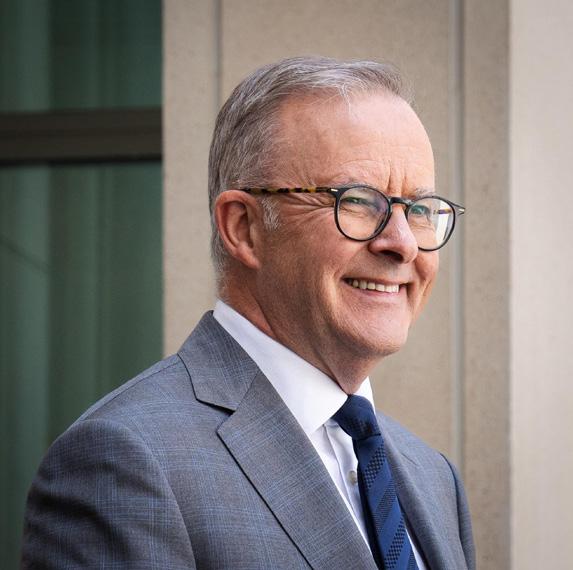
Prime Minister Anthony Albanese was temporarily evacuated from his Canberra residence following a threatening message that triggered a large-scale security response, with leaders from across Australia’s political spectrum urging restraint and respect in public debate.
As reported by ABC News,
the Australian Federal Police responded to an alleged threat involving claims of explosives near The Lodge, moving the prime minister to a secure location while specialist officers searched the property. Authorities later confirmed that no dangerous items were discovered and reassured the public that there
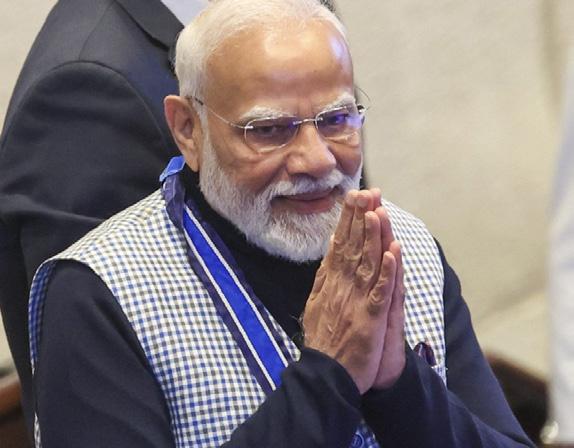
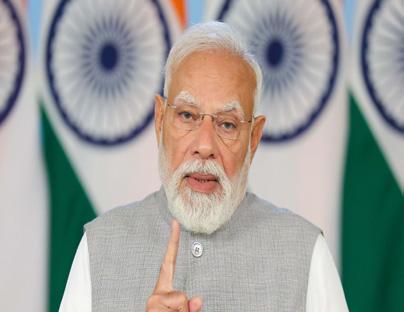
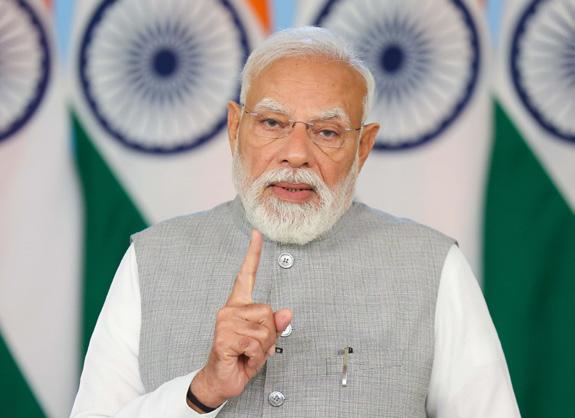
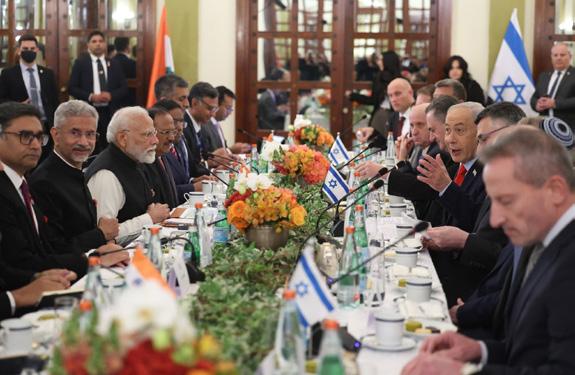
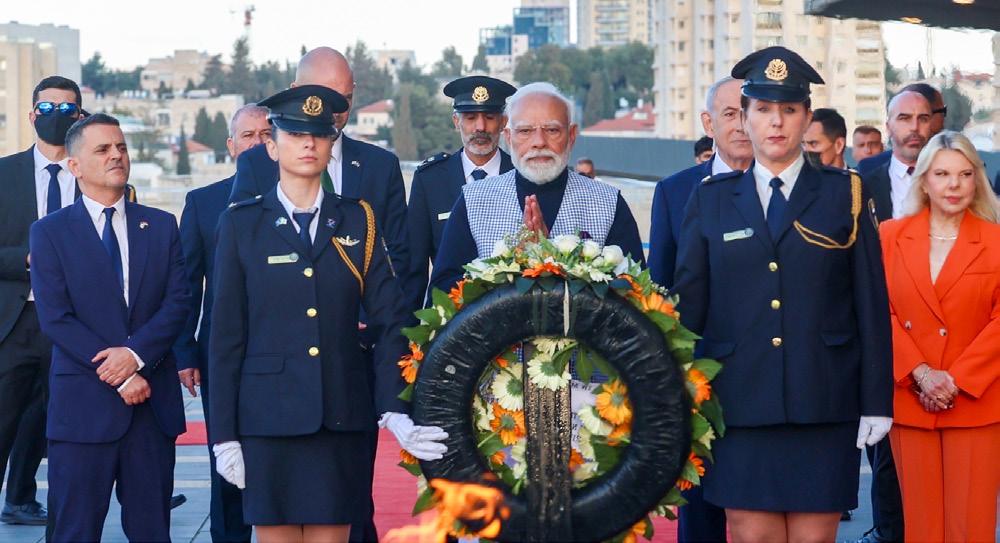
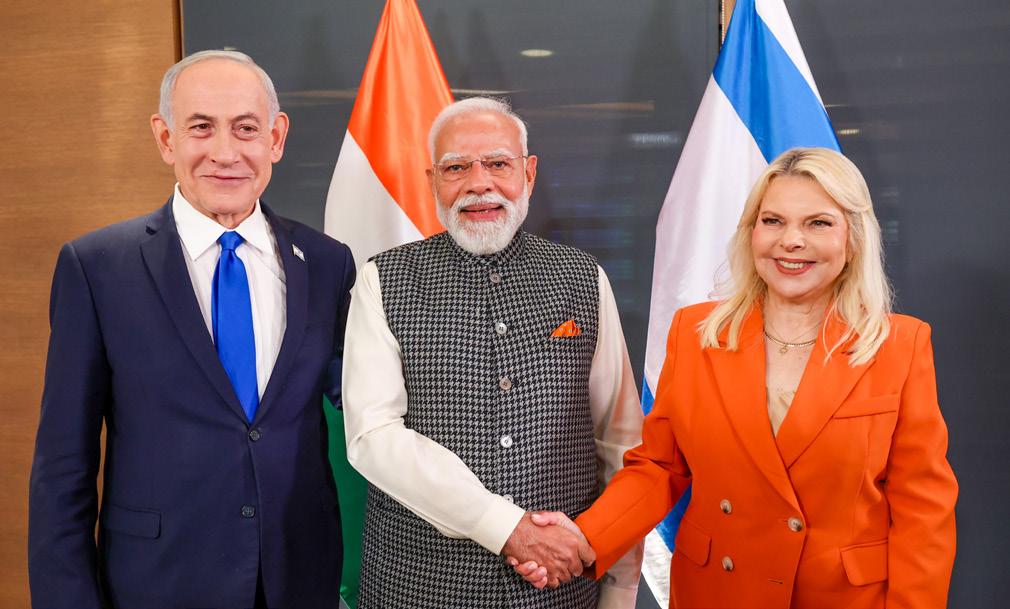
Wednesday said that he accepts the Medal of the Knesset with utmost humility and gratitude. Israel's Parliament, the Knesset, conferred the 'Speaker of the Knesset Medal' on PM Modi, making him the first-ever recipient of this prestigious award.
Knesset Speaker Amir Ohana presented the medal to PM Modi
Hindu and Sikh religious sites in Pakistan sold, forcibly occupied: Report Accept Medal of the Knesset with humility: PM Modi
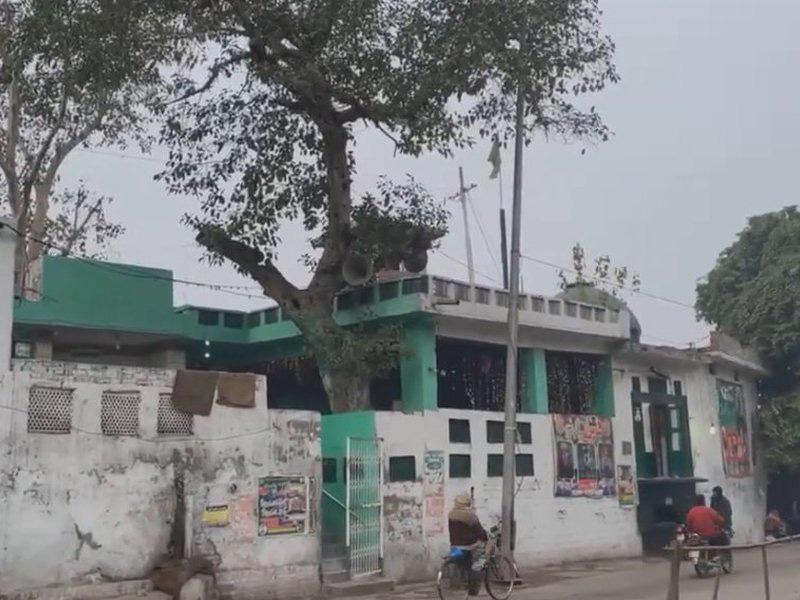
that land belonging to several religious sites of the minority communities has been sold, with other properties allegedly being forcibly occupied by local individuals across the country. According to a report in 'Khalsa Vox', another case recently came to light in which a historic gurdwara in Abbottabad in Pakistan’s Khyber Pakhtunkhwa province was allegedly sold for 10
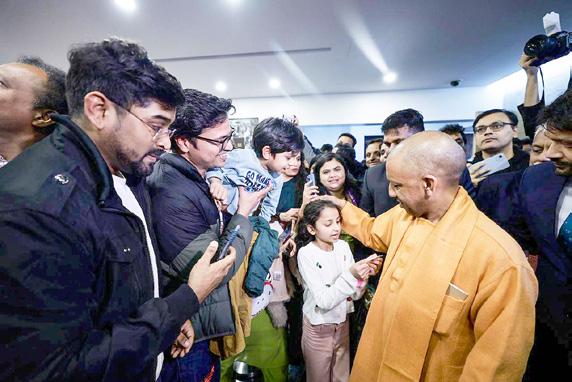
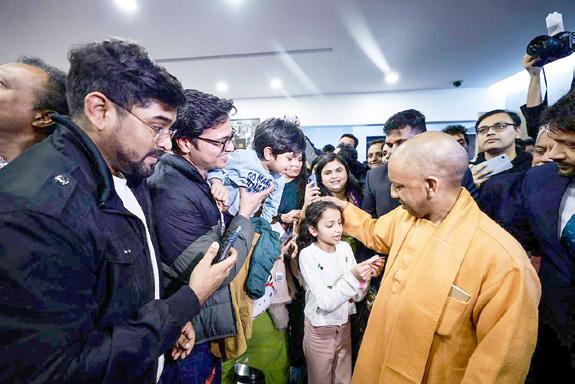
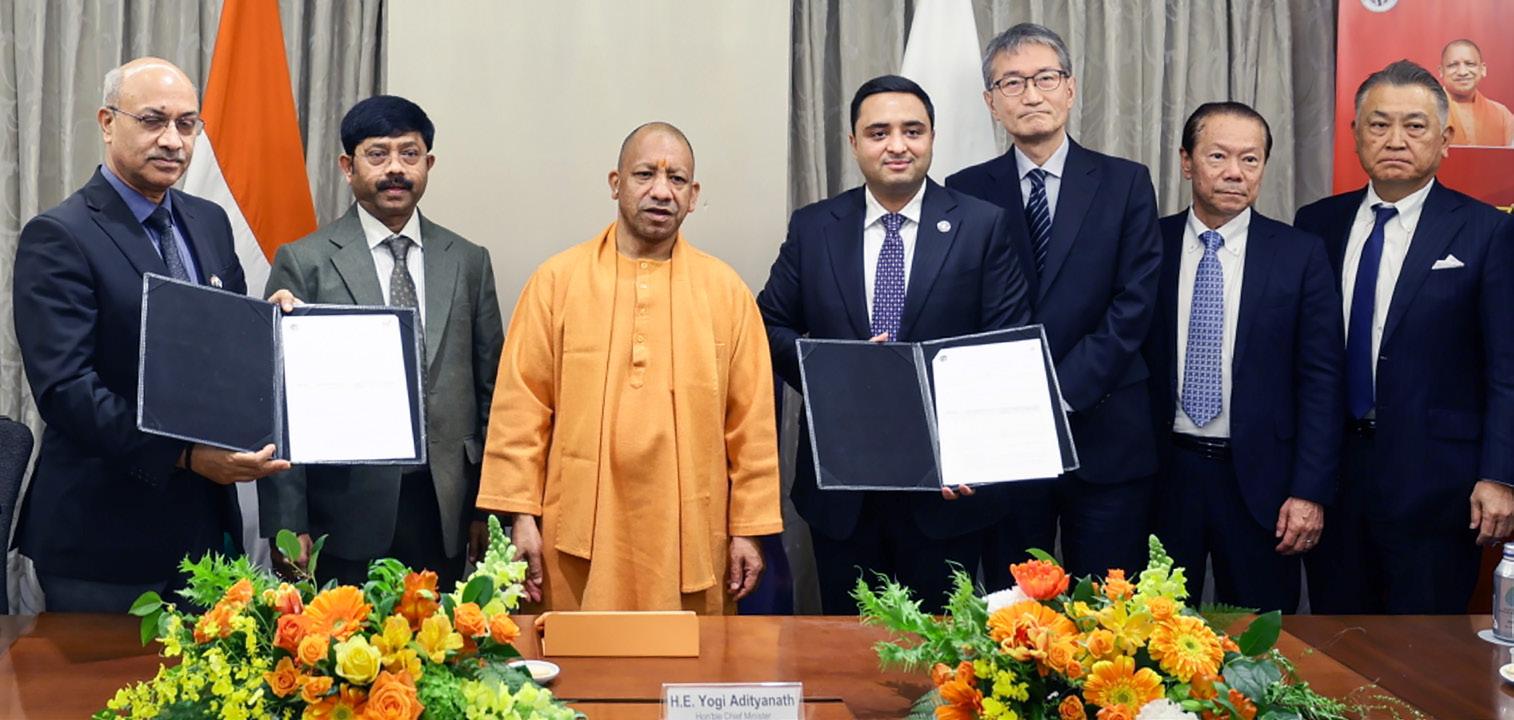
‘Those inclined towards robbery kept UP in darkness’: CM Yogi Adityanath in Tokyo
Tokyo, Feb 25 (IANS) Uttar Pradesh Chief Minister Yogi Adityanath is on a visit to Japan. Addressing a gathering of Indian
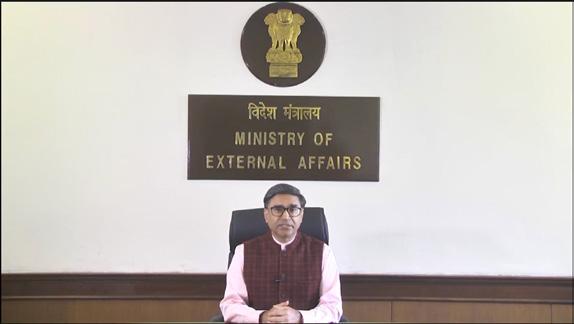
India warns of rising global risks as arms control frameworks weaken, calls for strategic stability
Geneva, Feb 25 (IANS) India has emphasised the urgent necessity of safeguarding strategic stability and averting a fresh global arms
race, cautioning that growing geopolitical uncertainties are coinciding with the erosion of key arms control mechanisms.
Addressing the 2026 High-Level Segment of the Conference on Disarmament in Geneva on Tuesday (local time), Foreign Secretary Vikram Misri said, “The recent expiration of the New Strategic Arms Reduction Treaty
(New START) poses a significant setback for global arms control. India believes that preserving strategic stability and preventing an arms race remain vital, more than ever, for global security.”
He noted that the High-Level Segment was being convened amid a “profoundly uncertain geopolitical and security
diaspora in Tokyo, he said that previous governments kept the state in “darkness” due to their inclination towards corruption and lawlessness, asserting that his government brought UP “into the light” by all-around improvement in law and order, infrastructure and power supply.
The Chief Minister spoke about what he described as UP’s transformation from “darkness to
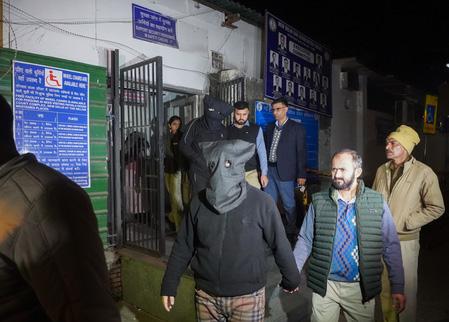
New Delhi, Feb 25 (IANS) The National Investigation Agency has arrested two more individuals allegedly linked to the conspiracy behind the bomb blast in Delhi's Red Fort area, pushing the total number of arrests in the case to eleven, the investigation agency said in a statement.
The arrested persons have been identified as Zameer Ahmad Ahangar, a resident of Ganderbal, Jammu and Kashmir, and Tufail Ahmad Bhat, a resident of
development.”
“Earlier, there were no roads, no proper connectivity, and no electricity. People used to complain about constant power cuts. Those who work in darkness do not like light. When the tendency is towards robbery, everything is done in the dark,” he said.
“If we want to free Uttar Pradesh
Srinagar, Jammu and Kashmir. According to the NIA, both were actively involved in the plot and had supplied weapons to the prime accused in the blast case.
The explosion, which occurred on November 10, 2025, claimed eleven lives and left several people injured.
The prime accused, Umer Un Nabi, was also killed in the blast.
The NIA is probing the case under FIR to fully uncover the conspiracy. Investigations have established that Zameer Ahmad and Tufail Ahmad functioned as Over Ground Workers (OGWs) for the banned terror outfit Ansar Ghazwat-ul-Hind.
Working in close coordination with the Jammu and Kashmir
Tel Aviv, Feb 26 (IANS) Prime Minister Narendra Modi on
Islamabad, Feb 25 (IANS) As the population of Sikhs and Hindus in Pakistan continues to shrink, a report on Wednesday highlighted
EDITORIAL TEAM
Dr Ram Mohan, Chairman
Dr Ashutosh Misra, Editor-in-Chief
EDITORIAL BOARD
Amrita Deshpande, Community News Editor
Paras Sharma, Assistant Editor
Dr Uttam Kumar Sinha, Senior Fellow, Nehru Memorial Museum & Library, India
Mr Shaun Star, Director, Centre for Australia India Studies, Jindal Global University, India
Rangbhari Ekadashi sparks Holi fervour across Ayodhya, Sambhal, Vrindavan
Strengthening Australian social cohesion could take
says Bondi attack inquiry
One step ahead: Sangita Basfore dreams giant leap from Asia to
World
Security alert at The Lodge prompts PM evacuation, political leaders condemn threats
Continued from Page 1
was no continuing risk after the operation concluded.
Coverage by Reuters linked the warning to emails sent to organisers of Shen Yun, a New York-based classical Chinese dance troupe associated with the Falun Gong spiritual movement.
Investigators are examining whether the message formed part of an effort to disrupt the group’s Australian tour, with officials treating the claims about explosives as a hoax.
According to News.com.au, the
incident prompted immediate political reactions, including a message from One Nation leader Pauline Hanson, who expressed concern for the prime minister and his family while reflecting on her own experiences dealing with threats. Coalition figures also criticised attempts to intimidate elected representatives, emphasising that political disagreements must be resolved through democratic channels.
Reporting in The Guardian noted that Labor ministers and Greens representatives highlighted the
seriousness of the situation and called for a more measured tone in political discourse, pointing to growing concerns about the increasing number of threats directed at public officials.
The prime minister returned to The Lodge later that evening after security teams declared the residence safe. While the scare did not result in any physical harm, it has reignited national discussion about the safety of political leaders and the pressures facing security agencies as political tensions continue to rise.
‘Those inclined towards robbery kept UP in darkness’: CM Yogi Adityanath in Tokyo
Continued from Page 1
from fear and corruption, we must bring it into the light. We are sons of the Sun; we need light like the Sun,” he added, drawing a metaphorical contrast between past and present governance.
The CM said that under the leadership of Prime Minister Narendra Modi, India is moving steadily towards becoming a Viksit Bharat, and Uttar Pradesh -- with a population of nearly 250 million -- is playing a key role in that journey.
“Earlier, news from UP revolved around curfews, riots and
darkness. Today, it is about Diwali celebrations, the Maha Kumbh, and global investment,” he said.
He highlighted improvements in law and order, road connectivity and electricity supply, claiming that the state has emerged as a major investment destination in sectors such as semiconductors, data centres, artificial intelligence, green hydrogen, logistics parks and international airports.
Referring to cultural and religious events, CM Yogi said that large-scale celebrations such as Deepotsav in Ayodhya,
Dev Deepawali in Kashi, and Holi festivities in Mathura and Vrindavan symbolise a positive transformation in the state.
Extending Holi greetings to the Indian diaspora in Japan, he said that events such as the Maha Kumbh in Prayagraj and the construction of the Ram Temple in Ayodhya reflect India’s cultural strength and civilisational heritage.
He also mentioned the redevelopment of the Kashi Vishwanath Dham as an example of blending modern infrastructure with tradition.
India warns of rising global risks as arms control frameworks weaken, calls for strategic stability
Continued from Page 1
environment”, which was characterised by increasing military spending, pressure on established arms control arrangements and rapid technological progress with direct military implications.
“India, as a responsible nuclearweapon state, is committed, as per its nuclear doctrine, to maintaining a credible minimum deterrent, and espouses a posture of ‘no-first use’ and non-use against non-nuclear-weapon
states,” he added. Misri reiterated India’s longstanding position in favour of universal, non-discriminatory and verifiable nuclear disarmament through a phased, multilateral approach. At the same time, he expressed support for negotiations on a Fissile Material Cut-off Treaty based on the existing mandate within the Conference on Disarmament.
Turning to emerging and disruptive technologies, the
Foreign Secretary observed that scientific and technological advancements are transforming military capabilities while simultaneously creating new vulnerabilities and areas of competition. He said India has called for a UN system-wide evaluation of the security implications arising from such technological developments. On artificial intelligence, he underlined India’s commitment to its responsible deployment in the military sphere.
Israel launches ‘preventive’ strikes on Iran
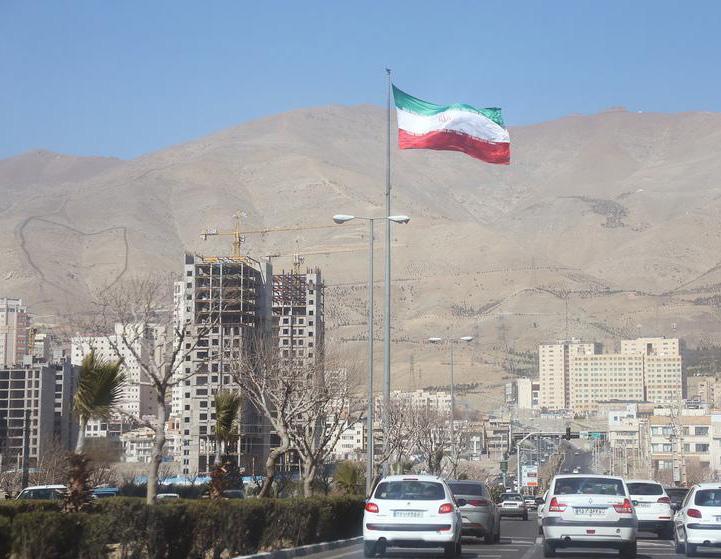
Tehran, Feb 28 (IANS) Tehran
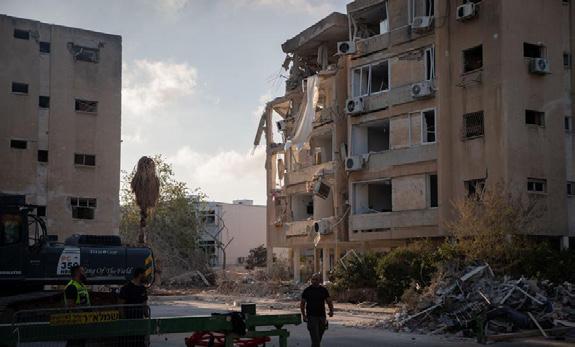
was rocked by massive explosions on Saturday after Israel launched what it described as “preventive” missile strikes against Iran, dramatically escalating tensions in the region, local media reported. The strikes come amid heightened strain between the United States and Iran over a potential nuclear agreement and growing fears of a wider military confrontation in the Middle East.
Several missiles hit areas along University Street and in the Jomhouri district of the Iranian capital.
Thick plumes of smoke were seen rising from near Pasteur Street in downtown Tehran, an area that houses key government buildings.
The extent of the damage and possible casualties was not immediately clear.
In anticipation of possible retaliation, the Israeli military said it had sounded air raid sirens in multiple areas across the country.
The move, it said, was a proactive measure “to prepare the public for the possibility of missiles being launched towards the state of Israel.” Sirens were heard across parts
Accept Medal of the Knesset with humility: PM Modi
Continued from Page 1
immediately after his address to the lawmakers in Jerusalem.
“This honour is not a tribute to an individual, but to the enduring friendship between India and Israel,” PM Modi wrote on X.
The Knesset citation highlighted PM Modi's role in deepening bilateral ties across defence, technology, agriculture, innovation, and economic cooperation.
“I am deeply honoured to receive the Medal of the Knesset,” said PM Modi.
The honour, described as the highest recognition bestowed by the Knesset, acknowledges PM Modi's exceptional personal leadership in significantly strengthening and elevating the strategic partnership between India and Israel.
“I accept it with humility and
Hindu and Sikh
gratitude,” PM Modi informed on X.
The Prime Minister said that after his Knesset address, he, along with Netanyahu, is on the way to an exhibition which showcases strides made in the world of technology.
The Prime Minister also said that Israel’s highest award reflects the shared values that guide our two nations.
The award comes at a time when PM Modi is on a visit to Israel, where he delivered a historic speech to the Knesset, the first by an Indian Prime Minister, receiving a standing ovation from members.
In his remarks, he expressed gratitude for the honour, calling it a recognition of the enduring friendship between the two democracies.
religious sites in Pakistan sold, forcibly occupied: Report
Continued from Page 1
million Pakistani rupees by the Evacuee Trust Property Board, the body responsible for maintaining gurdwaras, temples, and other places of worship belonging to minority communities in the country. “At the time of the 1947 Partition, many religious sites of the Sikh community and Hindu temples remained in Pakistan. To oversee their maintenance, the government established the Evacuee Trust Property Board (ETPB). However, it is now being observed that most gurdwaras and temples are either in a dilapidated condition or have been erased altogether, allegedly to prevent the Sikh and Hindu communities from claiming their rights over them,” the report mentioned.
Citing media reports, it said that the ETPB administrator based in Attock district of Punjab province, allegedly transferred possession of Gurdwara Sri Guru Singh Sabha Abbottabad - constructed during the Sikh rule - to a local resident named Waheed Bala after reportedly receiving 10 million Pakistani rupees as a bribe.
of Israel as authorities warned of potential incoming attacks.
As a precautionary step, Israel ordered schools nationwide to remain closed, advised citizens to work from home, and imposed a ban on public gatherings.
The military said the alert measures were aimed at ensuring civilian safety in the event of retaliatory missile fire from Iran or its regional allies. The developments come at a sensitive diplomatic moment.
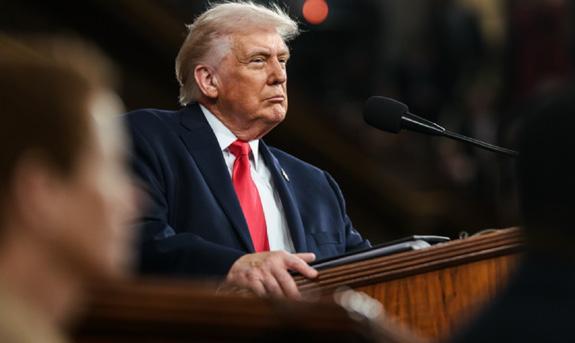
Earlier, US President Donald Trump described Iran as “very difficult” and “very dangerous.”
A third round of negotiations between Iranian and US officials was held in Geneva on Thursday, with another round of talks scheduled later on Saturday.
The official, the report said, is accused of granting permission to demolish the gurdwara and replace it with a clothing boutique. “It is reported that the gurdwara was transferred in the names of Waheed Bala’s two wives, Rida Jadoon and Ayesha Waheed. Pakistani Sikh leaders have appealed for the immediate dismissal of the concerned ETPB official and for the preservation of the gurdwara building. They stated that the department responsible for maintenance had earned millions of rupees from shops rented inside and outside the gurdwara premises, yet, contrary to regulations, it did not spend any money on the repair or upkeep of the shrine,” the 'Khalsa Vox' report detailed.
“The main entrance of the gurdwara still bears the inscription 'Gurdwara Sri Guru Singh Sabha' in Gurmukhi, and the words ‘Sachkhandi Vasai Nirankar’ can be clearly read outside the Diwan Hall. Despite this, the property has now reportedly come under the control of the individual who purchased it,” it noted.
Red Fort blast: NIA arrests two more terror operatives
Continued from Page 1
Police, Haryana Police, and other security agencies, the NIA found that the duo played a role not only in the Delhi blast conspiracy but also in other terror-related activities, it said further in the statement.
They were engaged in procuring and collecting arms and ammunition intended for use against the Indian state, as revealed through detailed examination of evidence, it said. The agency has determined that the blast conspiracy was
orchestrated by Umer Un Nabi in collaboration with other accused persons, including Muzammil Ganai, Shaheen Saeed, Mufti Irfan, Adeel Ahmed Rather, and five others who provided shelter and logistical assistance to the main conspirators. These nine individuals were arrested earlier from different locations in Jammu and Kashmir and Haryana.
The NIA continues its efforts to trace the full network and ensure all those involved in planning and executing the attack face legal action.
We celebrate spirit of research, innovation that drives nation forward: PM Modi on National Science Day
New Delhi, Feb 28 (IANS) Prime Minister Narendra Modi on Saturday extended greetings on National Science Day and said that today "we celebrate the spirit of research, innovation and scientific curiosity that drives our nation forward."
PM Modi took to his social media 'X' and said, "Today, on National Science Day, we celebrate the spirit of research, innovation and scientific curiosity that drives our nation forward.
This day commemorates the groundbreaking discovery of the Raman Effect by Sir C.V. Raman. This discovery placed Indian research firmly on the global map."
"We reaffirm our resolve to empower our youth, strengthen research ecosystems and harness science and technology for
national development and global good," PM Modi said.
External Affairs Minister S. Jaishankar also extended his wishes and said, "On National Science Day, greetings to our scientists and innovators whose dedication and perseverance continue to expand the frontiers of knowledge. From AI, space, defence and IT to healthcare, agriculture and renewable energy, your breakthroughs are inspiring India’s youth, strengthening our economy, enhancing national security and improving lives."
Earlier in the day, Union Home Minister Amit Shah also extended his greetings to scientists and researchers across the country on the occasion of National Science Day, praising their dedication to innovation and nation-building. Taking to social media platform X, HM Shah said, "Greetings to all our scientists, researchers on National Science Day. Your quest lights our path shaping solutions for a better future. May this day renew our zest and resolve to innovate, build and craft destiny of our choice."
India is observing National
Science Day on February 28 to commemorate the landmark discovery of the Raman Effect by eminent physicist C.V. Raman in 1928. This groundbreaking work on the scattering of light later earned him the Nobel Prize in Physics in 1930, marking a historic moment for Indian science on the global stage.
Celebrated annually on February 28, the day honours Raman’s pioneering contribution, which made him the first Asian to receive a Nobel Prize in the sciences. Over time, National Science Day has evolved into a nationwide movement aimed at fostering scientific temper, encouraging research and innovation, and inspiring young minds to pursue careers in science and technology.
This year’s national-level celebrations are being organised at Vigyan Bhawan under the aegis of the Department of Science and Technology, Ministry of Science and Technology. The programme begins with special lectures chaired by Principal Scientific Adviser Professor Ajay Kumar Sood.
What difference does it make, he has freedom to speak: Rijiju lashes out at
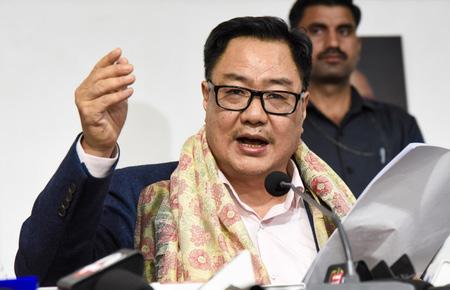
New Delhi, Feb 28 (IANS) Union Minister Kiren Rijiju on Saturday dismissed the remarks made by AAP National Convenor Arvind Kejriwal after being acquitted by a Delhi court in the liquor policy case, claiming that it made no difference if he made such statements, as he had been making similar claims for years. Speaking to reporters upon arriving at Kangra Airport, Himachal Pradesh, Rijiju said, “What difference does it make if he says such things? Arvind Kejriwal has been making such statements for years; there is no credibility to be found in them.
Kejriwal
He says things like this casually. There is no truth in his claims. He uses demeaning language against the Prime Minister to stay in the news, but there is nothing we can do — it’s a democracy, and he has the freedom to speak.”
Rijiju's remarks came after a Delhi Court discharged former Delhi Chief Minister Arvind Kejriwal and 22 others, including his close aide and former Delhi Deputy Chief Minister Manish Sisodia, in the Excise Policy case.
On the court’s verdict, Rijiju said, “This is a normal process. If any court issues an order and if there is an error in it, the matter can be taken to a higher court or a larger Bench for correction. If the facts were not properly examined, an appeal can be filed, after which the necessary corrections are made, and a proper judgment is delivered.”
Earlier on Friday, following the
court’s order, a visibly emotional Kejriwal told reporters that the judgment proves that he, Sisodia, and the AAP are “Kattar Imaandar (brutally honest)".
Speaking with tears in his eyes, he claimed that “Modi-ji and Amit Shah-ji together hatched the biggest political conspiracy of Independent India. The five biggest leaders of AAP were sent to jail to finish off the party. First time a sitting Chief Minister was ‘dragged out of his home and put in jail'.”
At a subsequent press conference, Kejriwal attacked the ruling BJP, claiming that the party could not defeat the AAP in Delhi and, seeing the public’s approval of his government, resorted to a political conspiracy.
He insisted, “I have not earned a single illegal penny, and I am not like them," adding that Delhi has been pushed into decline.
TN to build statewide drone ecosystem through TNUAVC-industry tie-ups
Chennai, Feb 28 (IANS) In a major push to strengthen technology-driven governance, the Tamil Nadu Unmanned Aerial Vehicles Corporation (TNUAVC), functioning under the Higher Education Department, has initiated steps to partner with drone manufacturers and service providers across India to build a comprehensive drone ecosystem in the State.
The corporation, established to meet the drone-based operational
requirements of various state government departments, aims to deploy advanced aerial solutions to improve governance efficiency and enhance public service delivery.
Officials said the initiative is designed to integrate drone technology into key sectors such as municipal administration, agriculture, policing, forest management, water resources, and disaster response.
A senior official from the Higher
India, EU agree to grant each other MFN status for 5 years under trade deal
Mumbai, Feb 28 (IANS) India and the European Union have agreed to give each other MostFavoured-Nation (MFN) treatment for five years after their proposed free trade agreement (FTA) comes into force.
The move is aimed at ensuring fair and equal treatment in trade in services between both sides.
Under the MFN provision, service sectors and service providers from India and the European Union will be treated at least as favourably as those from any other country.
This means neither side can give better treatment to a third country without extending the same benefit to the other party, subject to certain conditions and limits.
However, the MFN treatment will not apply to matters related to taxation treaties, mutual recognition of standards or
authorisations, and dispute settlement procedures.
The agreement also allows both sides to provide special advantages in border areas for services that are produced and consumed locally.
The provision is part of the Trade in Services chapter of the FTA text that was made public on January 27.
As part of the arrangement, a Joint Committee will conduct a review in the fourth year of the agreement.
The review will focus on issues such as the entry and stay of Indian students in the EU, their rights to work, and rules governing the temporary movement of service providers.
Based on this review, the Joint Committee will decide whether to continue the MFN treatment beyond the initial five-year period.
Either side can also request a review if circumstances arise that negatively impact their interests. If the Committee decides not to extend the arrangement, the obligation to provide MFN treatment will end, although benefits already granted will remain in place.
DMK, Cong to begin formal seat-sharing talks today amid alliance speculation
Chennai, Feb 28 (IANS) Ending days of speculation over the future of their alliance, the DMK and the Congress will formally begin seat-sharing negotiations on Saturday for the upcoming April–May Tamil Nadu Assembly elections.
opening informal channels with actor Vijay’s Tamilaga Vetri Kazhagam (TVK), should negotiations with the DMK fail to yield a satisfactory agreement. The developments also come nearly a week after Congress General Secretary K.C. Venugopal met Chief Minister Stalin to discuss the party’s expectations within the DMK-led Secular Progressive Alliance (SPA). Sources indicate that the Congress has sought more than 35 Assembly seats along with two Rajya Sabha berths.
Education Department stated that TNUAVC has begun the process of empanelling eligible drone manufacturing firms and service providers with proven expertise.
"The vendor must have an established drone manufacturing facility and should have supplied at least five drones to government agencies," the official said.
"Additionally, the manufacturer must hold certification from the Directorate General of Civil Aviation (DGCA) for research and development.”
The first round of discussions is scheduled for 10.30 am at Anna Arivalayam, the DMK's headquarters in Chennai. Tamil Nadu Congress Committee President K. Selva Perunthagai confirmed that the party would be represented by a four-member team comprising himself, AICC incharge Girish Chodankar, co-incharge Nivedith Alva, and Congress Legislature Party (CLP) leader Rajesh Kumar.
The DMK delegation will be led by party Treasurer T.R. Baalu and include a seven-member committee appointed by Chief Minister and DMK President M.K. Stalin.
The talks assume significance amid growing political buzz about the Congress exploring alternative options, including
However, informal discussions held earlier between Girish Chodankar and DMK MP Kanimozhi Karunanidhi reportedly hit a roadblock due to differences over the number of seats to be allocated.
According to sources familiar with the negotiations, the DMK has so far offered around 25 Assembly seats and one Rajya Sabha berth, with a possible increase to 27 or 28 seats at most.
“We have to accommodate several allies and potential new partners. Meeting a demand of 35-plus seats will be difficult,” a senior leader aware of the discussions said.
While the Congress is said to have dropped its earlier demand for a share in government, it continues to press for a larger seat allocation.
India, Bhutan deepen ties on trans-boundary rivers, hydropower projects
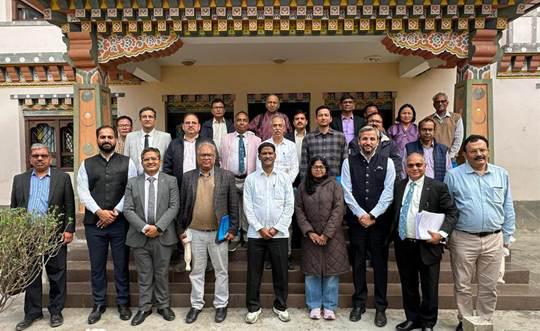
New Delhi, Feb 27 (IANS) India and Bhutan have decided to further strengthen bilateral cooperation on trans-boundary rivers and hydropower projects at a high-level official meeting in Thimphu, according to an official statement issued on Friday.
V. L. Kantha Rao, Secretary, Department of Water Resources, River Development and Ganga Rejuvenation (DoWR, RD and GR), Ministry of Jal Shakti, led an Indian delegation comprising officers from the ministry, officials from the Assam and West Bengal governments and WAPCOS Ltd., to the Kingdom of Bhutan from February 24-27.
The two sides discussed matters related to cooperation on transboundary rivers and to review the ongoing activities of the Punatsangchhu-I Hydro Electric
Project being implemented in Bhutan in partnership with the Government of India.
During the Secretary-level bilateral meeting held on Wednesday, the two sides reviewed the existing mechanisms of bilateral cooperation between India and Bhutan in flood management and flood forecasting.
Further deliberations focused on strengthening and modernising the existing hydro-meteorological observation network in Bhutan on trans-border rivers, improving data-sharing mechanisms for hydro-meteorological and flood forecasting data relating to trans-border rivers, enhancing collaboration in capacity building and technical exchanges, and addressing emerging challenges arising from climate change, glacial lake outburst floods (GLOFs), and extreme weather events.
After the bilateral meeting, Secretary Rao paid a courtesy call on Lyonpo Gem Tshering, Bhutan's Minister for Energy and
Natural Resources.
The Secretary also visited the Punatsangchhu-I Hydro Electric Project under construction and the recently commissioned Punatsangchhu-II Hydroelectric Project in Bhutan on Thursday. He held meetings with officials of PHPA-I and PHPA-II and reviewed the progress of these projects. Other site visits included the National Centre for Hydrology and Meteorology (NCHM), Bhutan, in Thimphu; the 3.5 MLD Water Treatment Plant at Chamgang; and the NCHM flood monitoring station near Wangdue Phodrang Dzong, the statement said,
The visit aimed to enhance water resources management, flood forecasting, and climate resilience in shared river basins. It reaffirmed the shared commitment of both countries to the sustainable and mutually beneficial management of transboundary water resources. The Secretary also conveyed India's continued support for deepening cooperation in water resources management, the statement added.
Bihar Cabinet clears greenfield international airport in Sonpur; 35 proposals approved
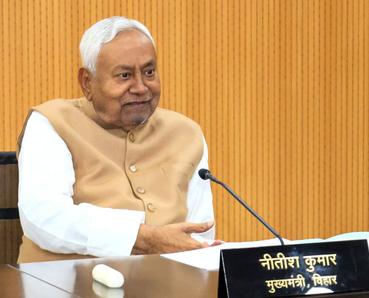
Patna, Feb 20 (IANS) A Cabinet meeting chaired by Chief Minister Nitish Kumar was held on Friday amid the ongoing budget session of the Bihar Assembly. After the conclusion of Assembly proceedings, the state Cabinet met at 5:30 p.m. and approved 35 important proposals, including major infrastructure and floodcontrol projects.
The Bihar Cabinet has approved the construction of a Greenfield International Airport in Sonpur, located in the Saran district.
Funds amounting to Rs 1,302 crore have been sanctioned for land acquisition for the project.
According to the proposal, the airport will be developed in the Dariyapur Chanwar area, situated between Hajipur and Dumaria (Gaya).
The state government has set a target to complete the airport by 2030.
The decision is being seen as a major boost to regional connectivity in north Bihar.
Bharatiya Janata Party Lok Sabha MP from Saran, Rajiv Pratap Rudy, welcomed the state
Cabinet's decision and expressed gratitude to the state government for approving the long-pending demand.
The state Cabinet also approved a Rs 70 crore anti-erosion project in the Ismailpur–Bindtola area to protect Bhagalpur from severe erosion caused by the Ganga. The Bihar Water Resources Department has prepared a detailed action plan to curb annual riverbank erosion, which leads to large-scale flooding and poses a serious threat to residential and agricultural areas in and around Bhagalpur.
Earlier, during the budget session on February 6, another state Cabinet meeting approved 17 agenda items.
Congress bringing shame to all Indians: BJP President on AI Summit protest
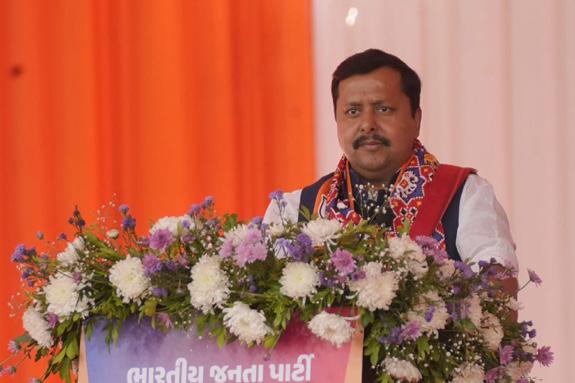
Ahmedabad, Feb 20 (IANS) BJP national president Nitin Nabin on Friday accused the Congress of bringing shame to all Indians after members of its youth wing staged a protest at the India AI Impact Summit in New Delhi, saying the party’s “anarchic policies” would lead to its downfall.
Speaking during his threeday visit to Gujarat, where he is meeting party leaders and workers as part of organisational outreach, Nabin said the incident had cast a shadow over what he described as a moment of pride for the country.
“Today is a saddening day for the country and its citizens. When parties have no principles, no policies, and their leadership turns anarchic, such anti-national thinking comes to the fore," Nabin said.
He said that at a time when the world expresses pride in the AI Impact Summit being held in India, people with an anarchic
India, Israel cement trade, investment & tech ties
Tel Aviv, Feb 26 (IANS) Prime Minister Narendra Modi and Israel’s Prime Minister Benjamin Netanyahu on Thursday emphasised the importance of unlocking the full potential of bilateral trade and investment between India and Israel, according to the joint statement issued after the successful conclusion of the summit.
The Prime Ministers affirmed their commitment to integrating India's and Israel's advancements in AI, cybersecurity, semiconductors, quantum computing, biotechnology, agriculture and water management, defence platforms, and space exploration.
This partnership strengthens India’s vision of an ‘Atmanirbhar and Viksit Bharat 2047’, aims to spark the next wave of technological transformation and shared progress of both countries, the joint statement said.
The leaders acknowledged that Indian and Israeli capabilities complement each other perfectly
- Israel is a global powerhouse of technology and innovation, India serves as a hub of talent, manufacturing excellence and entrepreneurial energy. They welcomed the signing of the India-Israel Bilateral Investment Agreement by the two Finance Ministers in New Delhi in September 2025, which is expected to enhance investor confidence, promote greater two-way investments, and ensure transparency, predictability, and protection through a clear framework of treatment of investment and an independent dispute resolution mechanism. Both leaders asserted their commitment to the realisation of the FTA Agreement between the two countries and tasked the negotiating teams to expedite the negotiations for an early signing of an FTA. The two leaders welcomed the strategic partnership in the financial-cyber domain. This collaboration will focus on enhancing the resilience of the financial ecosystem through the exchange of financial-cyber intelligence, joint development of methodologies, and the performance of multilateral financial-cyber simulations operationalised through Financial Computer Security Incident Response Teams of both countries.
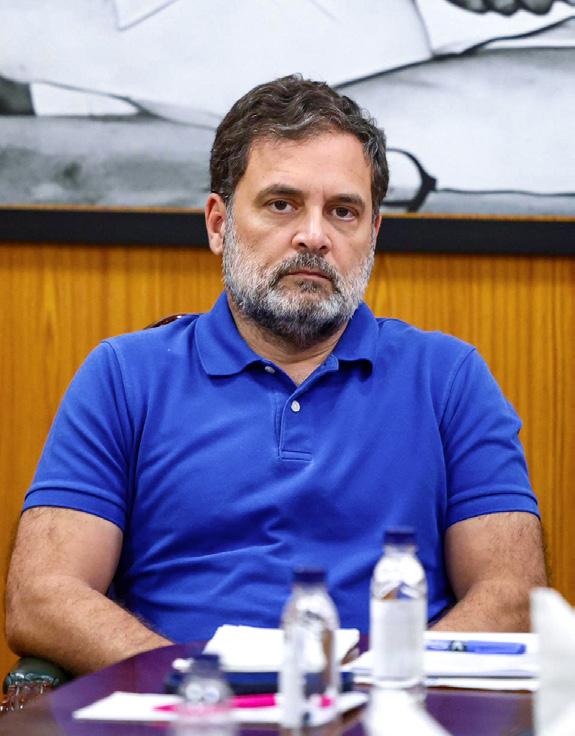
Rahul Gandhi writes to J&K students body, condemns attacks on Kashmiris
mindset are conspiring to defame the country.
Earlier, around 10 members of the Indian Youth Congress staged a brief protest inside an exhibition hall at the summit venue, raising slogans before being removed by security personnel. Police detained several protesters. Referring to the disruption, Nabin said: “The manner in which Congress leaders created a ruckus at the AI Summit, and the way the Congress is supporting it, is extremely unfortunate. I condemn it in the strongest terms.”
Srinagar, Feb 20 (IANS) Leader of Opposition in the Lok Sabha and senior Congress leader Rahul Gandhi on Friday wrote to the Jammu and Kashmir Students Association (JKSA), condemning recent attacks on Kashmiri students and shawl sellers reported from various parts of the country, and expressed solidarity with the victims.
Gandhi wrote the letter to JKSA National Convenor Nasir Khuehami in response to concerns raised by the association regarding incidents of harassment, assault, and intimidation targeting members of the Kashmiri community outside Jammu and Kashmir.
In his letter, Gandhi expressed deep concern over what he described as a disturbing pattern of violence against Kashmiri
students and seasonal traders, particularly shawl sellers, in different states.
He observed that the “politics of hate” had weakened institutions and fractured the country’s social fabric, and alleged that certain elements, encouraged either tacitly or overtly by those in power, had contributed to an atmosphere of fear among minorities and marginalised communities.
The Leader of Opposition unequivocally condemned violence in all its forms and reaffirmed his party’s commitment to upholding constitutional values and protecting the rights of all citizens.
Expressing solidarity with the victims and their families, Gandhi said those affected had endured “unimaginable pain” and assured that he would continue to raise his voice against hatred and discrimination.
He also stressed the importance of ensuring dignity, safety, and equal citizenship rights for every individual, regardless of region, religion, or background.
The development comes amid growing concern over repeated incidents involving alleged harassment and attacks on Kashmiri students and traders in several states across the country.
INS Anjadip to be commissioned in Chennai on Friday, strengthening coastal anti-submarine
Chennai, Feb 25 (IANS) The Indian Navy will commission INS Anjadip, a specialised "Dolphin Hunter" anti-submarine warfare vessel, at Chennai Port on Friday, marking a significant step in bolstering the country's coastal defence architecture.
The warship, designed to hunt and neutralise enemy submarines in shallow waters, is the third of eight Anti-Submarine Warfare
Shallow Water Crafts (ASWSWC) being inducted to enhance surveillance and underwater combat readiness along India’s coastline.
Constructed by Garden Reach Shipbuilders and Engineers (GRSE), Kolkata, INS Anjadip has been purpose-built for operations in the littoral combat environment — the complex and strategically sensitive coastal and shallow water zones that are critical to national security.
Naval officials said these vessels are designed to counter evolving underwater threats in areas where conventional large warships face operational constraints.
Measuring 77 metres in length, the ship is powered by a high-speed water-jet propulsion system that allows it to reach speeds of up to 25 knots.
This propulsion configuration enhances manoeuvrability and rapid response capability, enabling sustained patrol and quick interception missions along India’s extensive coastline.
Described as a "Dolphin Hunter", INS Anjadip is equipped to detect, track and neutralise enemy submarines attempting to operate close to Indian shores.
It carries an advanced, largely indigenous Anti-Submarine Warfare weapons and sensor suite.
Key among them is the hullmounted sonar ‘Abhay,’ designed for underwater detection in shallow waters. The vessel is also armed with lightweight torpedoes and anti-submarine warfare rockets, significantly enhancing
shield
its strike capability against subsurface threats.
Navy chief, Admiral Dinesh K. Tripathi, is scheduled to preside over the commissioning ceremony on Friday. The induction of INS Anjadip reflects the navy’s continued focus on indigenisation and self-reliance in defence manufacturing under the broader push for domestic shipbuilding.
Named after Anjadip Island off the Karwar coast in the Arabian Sea, the vessel symbolises India’s maritime heritage while reinforcing operational preparedness.
Once commissioned, it will play a key role in securing maritime approaches along the Tamil Nadu and Puducherry coasts, in addition to safeguarding wider national maritime interests.
Apart from anti-submarine duties, the warship will also undertake coastal surveillance, low-intensity maritime operations and search-andrescue missions, expanding its role beyond conventional combat functions.
Centre launching digital rupee-based food subsidy pilot project in Puducherry
New Delhi, Feb 25 (IANS) The Centre will launch a Central Bank Digital Currency (CBDC)based food subsidy distribution pilot project under the Pradhan Mantri Garib Kalyan Anna Yojana (PMGKAY) in the Union Territory of Puducherry on Thursday in a major step towards strengthening India’s digital public infrastructure and enhancing transparency in subsidy delivery, according to an official statement. The digital rupee or e-rupee is
a tokenised digital version of the Indian rupee, issued by the Reserve Bank of India (RBI) as a Central Bank Digital Currency (CBDC). The introduction of the digital rupee offers an opportunity to enhance the direct benefit transfer (DBT) ecosystem by providing a secure, instant, traceable, and programmable digital cash mechanism for PMGKAY beneficiaries, thereby enabling smoother fund flow and reducing friction in availing entitlements.
The pilot project will be inaugurated by Union Minister for Consumer Affairs, Food and Public Distribution, Pralhad Joshi, in the presence of Puducherry Lt Governor, K. Kailashnathan and
Chief Minister, N. Rangasamy. The initiative marks a significant reform in the delivery of food subsidy through the Public Distribution System (PDS) by integrating the digital rupee issued by the RBI into the direct benefit transfer framework. Under the pilot project, the food subsidy will be credited to identified beneficiaries in the form of programmable Central Bank Digital Currency tokens directly into their CBDC wallets. The tokens will be redeemable exclusively for the purchase of entitled foodgrains at authorised merchants and fair price shops, thereby ensuring purpose-bound usage of subsidy and enhanced transparency.
Over 1 lakh migratory water birds of 107 species recorded in Assam’s Kaziranga: Survey
Guwahati, Feb 25 (IANS) A total of 1,05,540 winged visitors belonging to 107 species were recorded in the latest water bird survey conducted at Assam's Kaziranga National Park and Tiger Reserve (KNPTR), officials said on Wednesday.
KNPTR Director Sonali Ghosh said that the 7th Kaziranga
Waterbird Count documented 1,05,540 water and wetlanddependent birds representing 107 species.
She said that the synchronised survey, conducted from January 4 to 11, 2026, covered 166 wetlands across 10 ranges under the Eastern Assam Wildlife Division, Biswanath Wildlife Division, and Nagaon Wildlife Division.
The birds recorded included ducks and geese, waders, herons and egrets, marsh birds and other wetland-dependent species, with the Bar-headed Goose, the Northern Pintail, and the Lesser
Gujarat: Tribal Youth launches bamboo startup with support from SSIP scheme
Navsari, Feb 25 (IANS) A young tribal entrepreneur from Navsari in Gujarat has established a successful bamboo-product enterprise with support from the Gujarat government’s Student Startup and Innovation Policy (SSIP).
The venture, which manufactures more than 120 items from bamboo, reflects a growing trend of student-led innovation in rural parts of the state.
Yogesh Yadav, who grew up in a village, founded the startup, named 'House of Shitij', after completing training in bamboo work during a third-year course at the College of Forestry, Navsari Agricultural University.
With his partners, Om and Preya, he turned his interest in bamboo into a business focused on producing natural, durable, and environmentally sustainable alternatives to plastic and ceramic products.
“In the third year, there was a course named ELP, in which we worked extensively on bamboo. And through that work, I thought of proceeding further,” Yadav said, explaining the genesis of his enterprise.
He added that the startup’s
products were intended to reduce reliance on plastics and ceramics in households.
Yadav also said that a key objective of the enterprise was to promote products made by the tribal community through eco-friendly means.
The venture received financial backing under the SSIP scheme, a state government initiative designed to encourage student entrepreneurship by offering funding, mentorship and access to incubation resources.
SSIP 2.0, launched in January 2022 and running until March 2027, seeks to foster a culture of innovation from the school level through higher education by providing grants for proofof-concept and prototype development, as well as support for intellectual property registration and industry linkages.
The initiative has been credited with helping students turn ideas into viable enterprises and has supported thousands of student startups and innovations across the state.
Observers say the rise of entrepreneurs such as Yadav aligns with national goals of self-reliance and economic development. His experience has been cited as an example of how government schemes can enable young innovators to contribute to broader development objectives, including Prime Minister Narendra Modi’s vision of a selfreliant India.
‘Those inclined towards robbery kept UP in darkness’: CM Yogi Adityanath in Tokyo
Tokyo, Feb 25 (IANS) Uttar Pradesh Chief Minister Yogi Adityanath is on a visit to Japan.
must bring it into the light. We are sons of the Sun; we need light like the Sun,” he added, drawing a metaphorical contrast between past and present governance.
Whistling Duck emerging as the most abundant species.
According to Ghosh, the survey report highlighted targeted conservation priorities, recording one critically endangered species, one endangered species, two vulnerable species, and 14 near-threatened species under the International Union for Conservation of Nature (IUCN) Red List categories.
The KNPTR Director said that the water bird count was first initiated in 2018-19 by the park management.
Addressing a gathering of Indian diaspora in Tokyo, he said that previous governments kept the state in “darkness” due to their inclination towards corruption and lawlessness, asserting that his government brought UP “into the light” by all-around improvement in law and order, infrastructure and power supply.
The Chief Minister spoke about what he described as UP’s transformation from “darkness to development.”
“Earlier, there were no roads, no proper connectivity, and no electricity. People used to complain about constant power cuts. Those who work in darkness do not like light. When the tendency is towards robbery, everything is done in the dark,” he said.
“If we want to free Uttar Pradesh from fear and corruption, we
The CM said that under the leadership of Prime Minister Narendra Modi, India is moving steadily towards becoming a Viksit Bharat, and Uttar Pradesh -- with a population of nearly 250 million -- is playing a key role in that journey.
“Earlier, news from UP revolved around curfews, riots and darkness. Today, it is about Diwali celebrations, the Maha Kumbh, and global investment,” he said. He highlighted improvements in law and order, road connectivity and electricity supply, claiming that the state has emerged as a major investment destination in sectors such as semiconductors, data centres, artificial intelligence, green hydrogen, logistics parks and international airports.
Referring to cultural and religious events, CM Yogi said that large-scale celebrations such as Deepotsav in Ayodhya, Dev Deepawali in Kashi, and Holi festivities in Mathura and Vrindavan symbolise a positive transformation in the state.
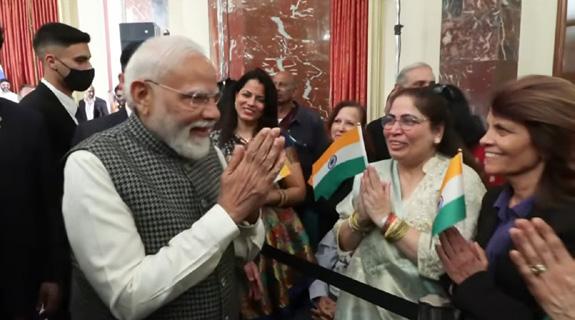
PM Modi receives rousing welcome from Indian community in Israel
Tel Aviv, Feb 25 (IANS) Prime Minister Narendra Modi received a rousing welcome from the Indian community in Israel as he arrived at his hotel in Tel Aviv, Wednesday afternoon.
The spectacular engagement highlighted India's cultural and spiritual heritage.
PM Modi witnessed cultural performances and applauded the performing artists who welcomed him. Chants of 'Modi Modi', 'Bharat Mata ki Jai' and 'Vande Mataram' reverberated, underscoring the deep love for India and massive popularity enjoyed by the Indian PM.
PM Modi arrived at the hotel after holding a private meeting with his Israeli counterpart Benjamin Netanyahu at the Ben-Gurion
International Airport soon after his arrival in the country on a two-day State Visit. The two leaders discussed a wide range of subjects aimed at boosting bilateral ties besides regional issues.
"This is a bond of real friendship. Great friend, my great friend," Netanyahu was seen saying while meeting PM Modi in a video shared by the Israeli Prime Minister's office.
"Had an excellent meeting with Prime Minister Netanyahu. Expressed gratitude to him for the warm welcome earlier in the day. It is a delight to be back in Israel after 9 years. We discussed a wide range of subjects aimed at boosting bilateral ties.
Sectors such as technology, water management, agriculture, talent partnership and more offer immense scope for close collaboration. We also discussed key developments in the region," PM Modi posted on X after the meeting.
The 'private meeting' between the two leaders took place after Netanyahu and First Lady Sara Netanyahu welcomed PM Modi at the Ben-Gurion airport in a special gesture. "You are a great leader," said Netanyahu after the two leaders exchanged a warm hug at the tarmac. The Israeli PM also engaged in an animated conversation with PM Modi, highlighting that the colour of PM Modi's pocket square matches Sara's saffron dress perfectly.
"My wife Sara and I welcomed today our good friend, Prime Minister of India Narendra Modi, who has arrived for another historic visit to Israel. Prime Minister Modi previously visited Israel in 2017, and I later paid a reciprocal visit to India that was truly exceptional. We share a close personal relationship, speak often, and I believe that the deep friendship between us powerfully reflects on the ties between our two countries," Netanyahu posted on X.
European countries urge citizens to leave Mideast as US-Iran tensions rise
Brussels, Feb 28 (IANS) Some European countries have urged their citizens to leave or avoid travel to Iran and several other Middle East regions due to escalating US-Iran tensions.
Nepal
The British government on Friday (local time) said it has temporarily withdrawn staff from Iran, with its embassy continuing to operate remotely, and advised against all travel to the country.
The French Foreign Ministry issued a security advisory for French nationals against travel to Israel, Jerusalem and the West Bank, citing possible regional repercussions from the situation involving Iran. It warned of potential flight cancellations or delays and urged citizens in affected areas to remain vigilant
Trump’s tariffs fuel farm crisis, boost China: US Democrats
Washington, Feb 28 (IANS)
US Senate Democrats accused President Donald Trump of deepening a farm and food affordability crisis, arguing that his tariff policies have handed China leverage in global agriculture while driving up grocery prices at home.
Releasing a new report titled “Trump’s Broken Promises: Devastating America’s Farmers and Working Families,”
Democrats said Trump’s trade war with Beijing has sharply curtailed US export markets and forced American farmers into financial distress.
The report states that China, once a major buyer of US soybeans, stopped purchases in retaliation for Trump’s tariffs. In 2024, China spent $3 billion on US soybeans. In 2025, Trump’s tariffs caused China to pivot from US markets to Argentina and Brazil, and resumed purchases now
and avoid gatherings, reports Xinhua news agency. Italy also urged its citizens to leave Iran and advised extreme caution across the Middle East. "Italians in (Iran) for tourism or whose presence is not strictly necessary are urged to depart," the foreign ministry said in a statement, strongly discouraging travel to Iraq and Lebanon as well.
Germany updated its travel guidance to discourage travel to all of Israel, expanding earlier advice that had applied only to certain parts of the country.
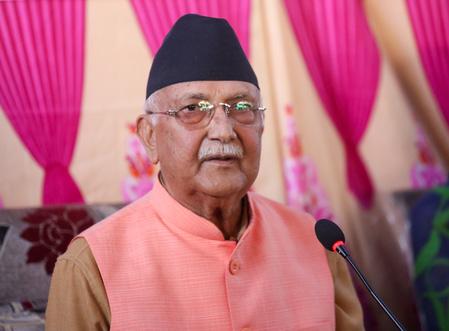
polls: All eyes on Jhapa-5 seat where KP Sharma Oli is pitted against ‘Balen’
New Delhi, Feb 20 (IANS) When parliamentary election is held in Nepal on March 5, all eyes and ears would be turned to the Jhapa-5 constituency where former Prime Minister KP Sharma Oli is pitted against an engineerrapper-politician, Balendra Shah, also known as ‘Balen’. In earlier elections, Oli would travel extensively, addressing mass rallies around the country and positioning himself as a central figure who could win
votes nationwide. This will mark Oli’s eighth electoral contest in Jhapa, where he was first elected 34 years ago. But now, the Communist Party of Nepal (Unified Marxist–Leninist) chairman is “confined to his own constituency”, reflecting the changing dynamics, according to a report in Kathmandu Post.
“After Balendra Shah, popularly called Balen, resigned as Kathmandu mayor to contest against Oli in Jhapa-5, the latter has hardly had time to travel to other places to canvass votes for his fellow comrades,” it observed this week.
Balen was the first independent candidate to be elected as mayor of the capital, serving as the 15th mayor of Kathmandu Metropolitan City from May 2022 until his resignation in January
this year.
Oli was the Prime Minister in the UML-Nepali Congress coalition government at the time of last year’s youth uprising, which reports claimed resulted in at least 19 deaths, and more than 300 injuries in clashes with the police.
After the resignation of Oli in September 2025 amid the antigovernment protests, Balen emerged as a face being backed by some of the Gen Z protestors. Known for expressing “explosive opinions” mostly through social media, he boasts of lakhs of followers on his handles. Balen stood in support of the Gen Z protestors and started trending after the government rolled back the ban on social media platforms.
represent a 32 per cent decline since 2024.
It adds that farmers are entering a new growing year with surplus commodities they cannot sell and “no certainty about what to plant in the coming year.”
The report expressed concerns over foreign control in the US food system. It notes that Smithfield Foods, owned by China’s WH Group, has a dominant position in the US pork market, controlling a quarter of pork processing.
Syngenta Group, a major supplier of agricultural chemicals and seeds, “is owned by ChemChina, a Chinese state-owned enterprise, giving China control over major inputs for America’s farmers.” Against that backdrop, Democrats argue that Trump’s domestic policies have compounded the strain.
“Donald Trump’s tariffs have put American farmers and ranchers under extreme financial strain. Costs are rising. Markets are closing,” Senator Maria Cantwell said. “The President doesn’t care. But now, it’s time to find out if Republicans care about these farm communities that they represent.”
All aspects of bilateral ties will be discussed with new Bangladesh govt: MEA
New Delhi, Feb 20 (IANS) India on Friday reiterated that it is looking forward to further strengthening the multifaceted bilateral ties with Bangladesh following the formation of a new government in the neighbouring country under the leadership of Tarique Rahman.
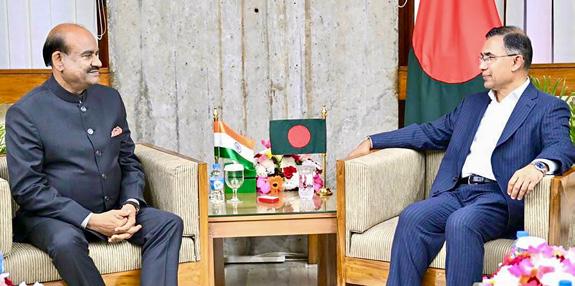
"You would have seen that once the election happened in Bangladesh, our Prime Minister congratulated Bangladesh Prime Minister Tarique Rahman. On February 17, during the swearingin ceremony, the Speaker of the Lok Sabha, Om Birla, represented the Government of India.
There, he handed over a letter from our Prime Minister to the Prime Minister of Bangladesh," Ministry of External Affairs (MEA) spokesperson Randhir Jaiswal said during a weekly media briefing in New Delhi on Friday.
"He also had a bilateral meeting with the Bangladesh PM. Building on warm and historic ties between the two countries, we look forward to further strengthening our multifaceted bilateral ties with Bangladesh. We look forward to engaging with the new government and taking things forward. On the visa issue, we have conveyed our desire to build our bilateral ties. We have a new government there which has
just come in, all aspects of our ties will be discussed with them," he added.
Earlier this week, Lok Sabha Speaker Om Birla met new Bangladesh Prime Minister Tarique Rahman as he represented India at the swearing-in ceremony of the newly elected government in Dhaka. "Glad to attend the swearing-in ceremony of the new Government of Bangladesh led by Prime Minister Tarique Rahman in Dhaka today. India stands ready to support Bangladesh’s endeavours to build a democratic, progressive and inclusive nation," Birla posted on X after the meeting. During the meeting, Birla extended wishes to Rehman on assuming office and also invited him to visit India. The two leaders expressed optimism to work together for the wellbeing of the people of India and Bangladesh.
In a statement shared on X, Bangladesh High Commissioner to India, Riaz Hamidullah, stated, "Prime Minister, H E Tarique Rahman, conveys his greetings to India and PM Hon. Narendra Modi to the visiting Lok Sabha Speaker Om Birla, at a courtesy meet following the swearing-in of the new Government."
"Hon Speaker conveyed wishes from India and Invitation to India. Both leaders expressed optimism to work together for the wellbeing of the people of Bangladesh and India pursuing a peoplecentric menu of cooperation," he
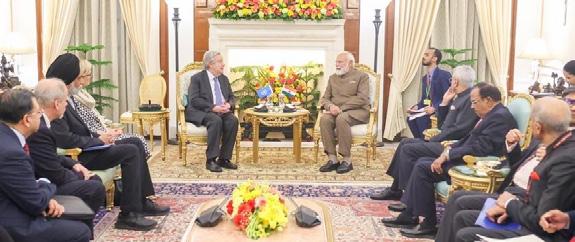
Guterres, at meetings with PM Modi, President Murmu, congratulates India’s leadership
United Nations/New Delhi, Feb 20 (IANS) UN SecretaryGeneral Antonio Guterres on Friday congratulated India for its leadership in the AI domain at his meetings with Prime Minister Narendra Modi and President Droupadi Murmu, according to his spokesperson’s office.
Guterres congratulated them "on the organisation of the AI Impact Summit and expressed his deep appreciation for India’s cooperation with the United Nations" at the separate meetings he had with the leaders in the Indian capital, the UN readouts said.
PM Modi said on X that during his meeting with Guterres, they "exchanged perspectives on UN reforms, especially giving greater voice to the Global South".
UN Under-Secretary-General Amandeep Singh Gill, who leads
the organisation’s AI and digital initiatives, was with Guterres at both meetings.
Gill, a former Indian diplomat, is also Guterres’ special envoy for technology. Guterres is in New Delhi for the India AI Impact Summit, where he strongly advocated for democratising AI and making it inclusive by ensuring the Global South gets resources for developing AI and a voice in determining its future.
"We talked about making AI allinclusive and how the UN can play a constructive role in this regard,"
PM Modi said in a post on X after the meeting with the UN chief.
The Prime Minister said he "reiterated India's support towards any effort aimed at harnessing AI for a better planet".
External Affairs Ministry
Spokesperson Randhir Jaiswal said on X: “PM highlighted India’s efforts in creating a humancentric AI development keeping in mind the priorities of the Global South”. President Murmu "thanked Secretary-General
in AI domain
Guterres for his participation in the AI Impact Summit and welcomed his initiative to create a global scientific panel on AI to serve all of humanity", the Rashtrapati Bhavan said on X.
"The President noted that at a time of global uncertainties, multilateralism is facing major challenges, including a widening trust deficit. She added that the existing outdated framework of the UN Security Council must be reformed to reflect contemporary geo-political realities, and the Global South must have a greater say in decision-making. She emphasised that urgent reform of the UN Security Council is the key to maintaining the relevance and effectiveness of the UN," read a statement issued by the President's Secretariat.
"The President noted that while the ‘UN-80’ initiative offers a good platform for reforms, it is important that developmental priorities of the Global South are protected in any restructuring exercise.
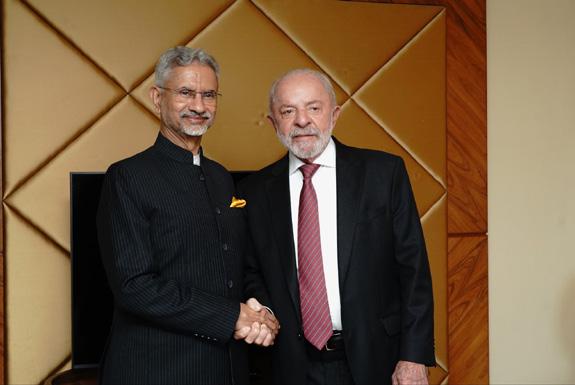
EAM Jaishankar calls on Brazilian Prez Lula, discusses advancing strategic partnership
New Delhi, Feb 21 (IANS)
External Affairs Minister (EAM)
S. Jaishankar on Saturday called on Brazilian President Luiz Inacio Lula da Silva and discussed ways to advance the Strategic Partnership between the two nations.
Later in the day, PM Modi and the Brazilian President will hold a bilateral meeting. The EAM expressed confidence that the Brazilian President's engagements with Prime Minister Narendra Modi later in the day would impart a new momentum to the bilateral ties.
Following the meeting, EAM Jaishankar took to X and said,
"Honoured to call on President Luiz Inacio Lula da Silva of Brazil, visiting India on a State Visit. Deeply appreciate his warm sentiments and guidance on advancing our Strategic Partnership."
"Confident that his meetings with PM Narendra Modi later today will impart a new momentum to our ties," he added.
Earlier, the Ministry of External Affairs (MEA) had stated, "Both leaders would be reviewing the entire gamut of bilateral relations.
The Prime Minister is scheduled to host a lunch in honour of the visiting dignitary. The two leaders would also be exchanging views on regional and global issues of mutual interest, including cooperation in multilateral fora, reformed multilateralism, global governance and issues concerning the Global South."
President Lula arrived in India on February 18 for the 2nd AI Impact
Summit.
He is accompanied by about 14 ministers and a large delegation of top CEOs of Brazilian companies. The accompanying ministers would be having meetings with their Indian counterparts.
This is the sixth visit of President Lula to India.
"He had first visited India in 2004 as the Guest of Honour for Republic Day celebrations, and last visited India for the G20 Summit in September 2023.
Both Prime Minister Narendra Modi and President Lula have, however, been meeting frequently in between. It may be recalled that Prime Minister Modi was in Brasilia on a State Visit from 7-8 July 2025, which was the first State Visit by an Indian Prime Minister in the last 57 years. Both leaders also met in Johannesburg during the G20, in November 2025," the MEA stated.
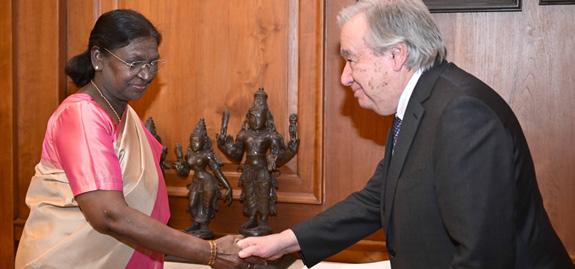
UN Secretary General Guterres calls on President Murmu
the AI Impact Summit in New Delhi. According to the President's Secretariat, the UN Secretary General appreciated India’s leadership role in convening the successful AI Impact Summit, and its
longstanding collaboration with the United Nations in various fields. President Murmu welcomed the initiative of Secretary General Guterres to create a global scientific panel on AI to serve all of humanity.
"The President noted that at a time of global uncertainties, multilateralism is facing major challenges, including a widening trust deficit. She added that the existing outdated framework of the UN Security Council must be reformed to reflect contemporary geo-political realities, and the Global South must have a greater say in decision-making. She
India attended Board of Peace meeting as an observer: MEA
New Delhi, Feb 20 (IANS) The Ministry of External Affairs (MEA) on Friday stated that India attended the Board of Peace's first meeting in Washington on Thursday as an observer country and continues to back all efforts underway to find peace in Gaza as part of the UN Security Council (UNSC) resolution.
"We did attend the Board of Peace meeting in Washington DC as an observer. We have also welcomed the Gaza Peace Plan initiative of President Trump, as well as all such efforts underway as part of Resolution 2803 of the UNSC," Ministry of External Affairs (MEA) spokesperson Randhir Jaiswal stated at the weekly media briefing in New Delhi.
Representatives from over 40 countries, including several Heads of State attended the inaugural meet. India was represented at the meeting by Namgya Khampa, Charge d'Affaires at the Indian Embassy in Washington DC.
The MEA spokesperson also
clarified India's stance on signing a joint statement that had expressed concerns over Israel’s "unilateral" measures in the occupied West Bank.
“You may be aware that this was not a negotiated document as is usually the case in the UN. Our position on this issue was most recently expressed in the IndiaArab League Ministerial Joint statement," said Jaiswal.
He was referring to the 'Delhi Declaration of the Second IndiaArab Foreign Ministers’ Meeting' issued on January 31 following the second India Arab Foreign Ministers’ Meeting. The meeting saw the participation of Foreign Ministers of Arab States and the Secretary-General of the League of Arab States and was preceded by the meeting of India Arab Senior Officials on January 30. On the issue of Palestine, the Declaration stated: "Both sides reaffirmed their commitment to achieving a just, comprehensive, and lasting peace in the Middle East, according to international law, relevant UN resolutions and the Arab Peace Initiative. They called for a sovereign, independent and viable State of Palestine based on 1967 borders, living side by side in peace with Israel. Both parties supported the practice of inalienable rights of the Palestinian people."
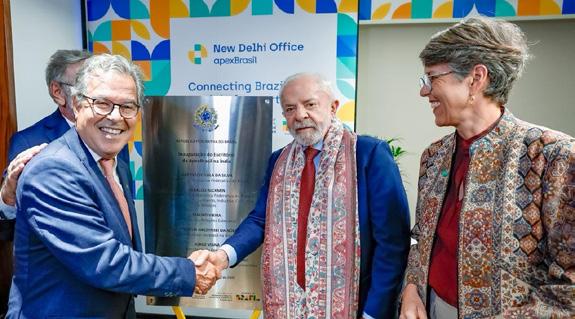
President Lula inaugurates Brazil’s first trade office in Delhi
New Delhi, Feb 20 (IANS) Brazil’s President Luiz Inacio Lula da Silva on Saturday announced the inauguration of the first office of the Brazilian Trade and Investment Promotion Agency (Apex) in New Delhi.
"This agency works to promote Brazilian products and services abroad and to attract foreign investments to strategic sectors of the Brazilian economy," President Lula said in a post on X.
emphasized that urgent reform of the UN Security Council is the key to maintaining the relevance and effectiveness of the UN," read a statement issued by the President's Secretariat.
"The President noted that while the ‘UN-80’ initiative offers a good platform for reforms, it is important that developmental priorities of the Global South are protected in any restructuring exercise. The President extended her good wishes for the rest of Mr Guterres’ tenure as UN Secretary General, and reiterated India’s full support towards multilateralism," it added.
"Brazil and India are two of the largest nations of the Global South. We had a trade flow of US$ 15.2 billion in 2025, with plenty of room for growth. I was accompanied by government ministers and the president of Apex, Jorge Viana," he stated.
President Lula arrived in India on a high-profile state visit this week, bringing with him the largest-ever Brazilian business delegation to travel abroad, underscoring trade and economic cooperation as the central pillar of bilateral engagement.
Lula is accompanied by more than 260 Brazilian companies, around 14 cabinet ministers and several top chief executives, as India and
Brazil seek to expand commercial ties amid shifting global trade dynamics triggered by tariff actions taken by the United States under President Donald Trump. The visit coincides with Lula's participation in the AI Impact Summit in New Delhi, where he addressed issues related to technology, digital public infrastructure and the role of artificial intelligence in inclusive growth. The Brazilian leader attended the summit on Wednesday, marking technology cooperation as a new and growing dimension of India-Brazil relations. Lula is scheduled to hold wide-ranging bilateral talks with Prime Minister Narendra Modi on February 21. According to the Ministry of External Affairs (MEA), the two leaders will review the "entire gamut of bilateral relations," with discussions expected to cover trade, investment, energy, defence cooperation, digital technologies and people-to-people links. "The leaders will also exchange views on regional and global issues of mutual interest, including cooperation in multilateral fora, reformed multilateralism, global governance and issues concerning the Global South," according to a statement issued by the Ministry of External Affairs.
New Delhi, Feb 20 (IANS) United Nations Secretary General Antonio Guterres on Friday called on President Droupadi Murmu at Rashtrapati Bhavan on the sidelines of
US banking overhaul draws fierce Senate debate
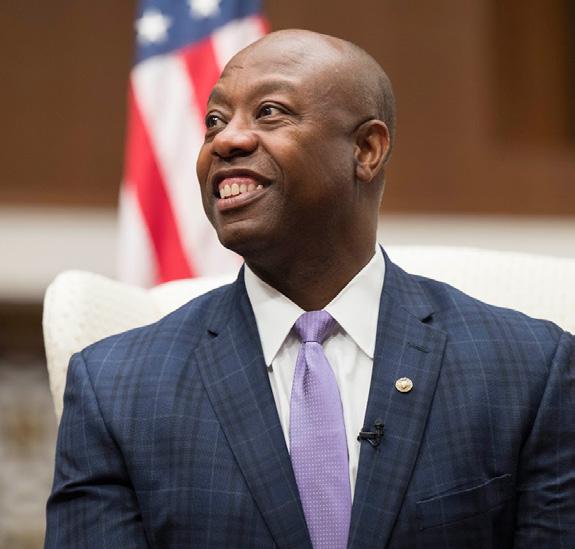
Washington, Feb 28 (IANS) US banking regulators defended sweeping efforts to recalibrate capital rules and formalise crypto oversight as senators clashed over Basel reforms, political “debanking” and consumer safeguards in a hearing with global implications for capital flows and digital finance.
Senate Banking, Housing, and Urban Affairs Committee
Chairman Tim Scott said regulation must focus strictly on financial risk.
“No law -- no lawful business in Anderson, South Carolina or anywhere in America should be denied access to banking services because of shifting political winds or subjective considerations like reputation risk,” he said.
Scott backed efforts to revisit the “Biden-era proposals like Basel III Endgame” and urged regulators to ensure capital rules “reflect real world risk without unnecessarily holding back
lending”.
Ranking Member Elizabeth Warren warned that easing capital requirements could increase systemic risk.
“Ordinary Americans are squeezed hard, but boy, it is a good time to be a Wall Street CEO,” Warren said, adding that strong capital cushions reduce “the likelihood of financial crashes and taxpayer bailouts”.
Vice Chair for Supervision
Michelle Bowman said the banking sector remains stable.
“The banking system remains sound and resilient,” she told lawmakers. “Banks continue to report strong capital ratios and significant liquidity buffers, which position them well to support economic growth.”
Bowman confirmed that regulators are working with the FDIC and OCC on a revised Basel proposal, adding that supervision must focus on “material risks to bank operations and to the stability of the broader financial system”.
She also addressed criticism over politically motivated account closures.
“We have also ended the practice of using reputational risk in our supervisory programs,” Bowman said. “Banks must be free to make their own risk-based decisions to serve individuals and lawful businesses without interference.”
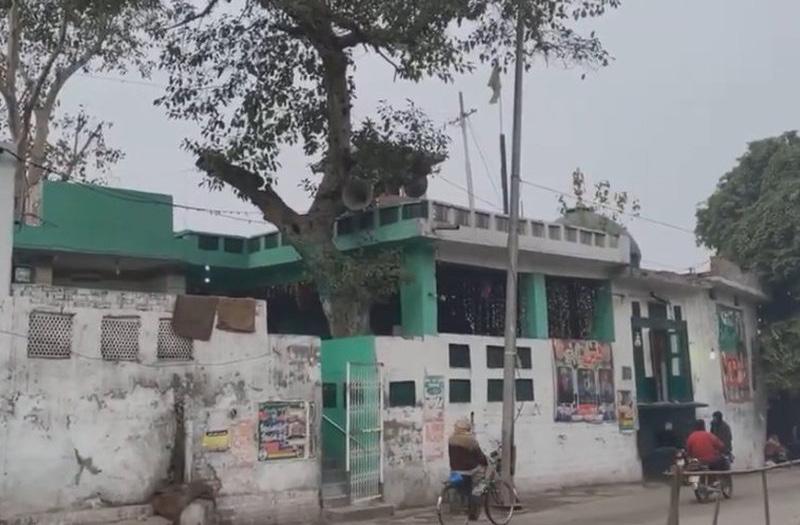
Hindu and Sikh religious sites in Pakistan sold, forcibly occupied: Report
Islamabad, Feb 25 (IANS) As the population of Sikhs and Hindus in Pakistan continues to shrink, a report on Wednesday highlighted that land belonging to several religious sites of the minority communities has been sold, with other properties allegedly being forcibly occupied by local individuals across the country.
According to a report in 'Khalsa Vox', another case recently came to light in which a historic gurdwara in Abbottabad in Pakistan’s Khyber Pakhtunkhwa province was allegedly sold for 10 million Pakistani rupees by the Evacuee Trust Property Board, the body responsible for maintaining gurdwaras, temples, and other places of worship belonging to minority communities in the country.
“At the time of the 1947 Partition, many religious sites of the Sikh community and Hindu temples remained in Pakistan. To oversee their maintenance,
ISI eliminates assets switching loyalties during Afghan war escalation
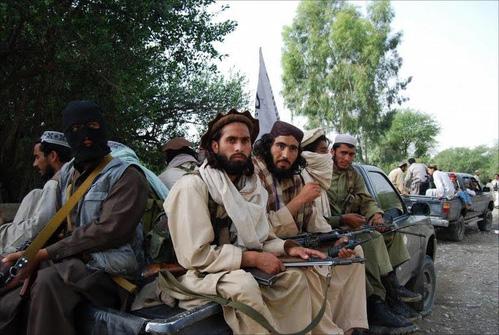
New Delhi, Feb 28 (IANS) As the war with Afghanistan rages on, Pakistan is beginning to realise that many of its assets have deserted it, only to choose the opposite side. Hence, it has been eliminating assets who have been switching loyalties during the Afghan war escalation.
For Pakistan the scenario post 2021, when the Taliban regained control over Afghanistan, is not exactly how it would have pictured it to be.
Afghanistan has taken a more pragmatic approach and has chosen India over Pakistan, understanding fully well that this would be the first step towards international recognition.
This shift in policy by the Afghan Taliban has resulted in major losses for Pakistan as many of its known assets are shifting sides. Take the case of Haji Lali Mama Nurzai, a top asset of the ISI. For the ISI, Nurzai was a go to man when it came to orchestrating terror attacks against India.
For years, Nurzai who operated from the Pakistan-Afghanistan border set up suicide training camps and networks that trained terrorists in guerrilla warfare. Nurzai was just not an asset for the ISI, but he shared a good rapport with the Taliban as well. Nurzai was found dead under mysterious circumstances. The
the government established the Evacuee Trust Property Board (ETPB). However, it is now being observed that most gurdwaras and temples are either in a dilapidated condition or have been erased altogether, allegedly to prevent the Sikh and Hindu communities from claiming their rights over them,” the report mentioned.
Citing media reports, it said that the ETPB administrator based in Attock district of Punjab province, allegedly transferred possession of Gurdwara Sri Guru Singh Sabha Abbottabad - constructed during the Sikh rule - to a local resident named Waheed Bala after reportedly receiving 10 million Pakistani rupees as a bribe.
The official, the report said, is accused of granting permission to demolish the gurdwara and replace it with a clothing boutique.
“It is reported that the gurdwara was transferred in the names of Waheed Bala’s two wives, Rida Jadoon and Ayesha Waheed.
Pakistani Sikh leaders have appealed for the immediate dismissal of the concerned ETPB official and for the preservation of the gurdwara building.
Pakistan establishment tried to pass it off as a case of heart attack, but in reality he was eliminated by the ISI, Intelligence agencies have learnt.
The reason behind this was that the ISI felt that Nurzai was getting too close to the Taliban.
An Intelligence Bureau official said that since the return of the Taliban in 2021, the ISI has conducted multiple covert operations to eliminate persons who were once upon a time its assets.
While Nurzai is a known cases, estimates by the Intelligence agencies suggest that the ISI may have eliminated at least 40 such people who switched loyalties to the Taliban.
These assets worked for the ISI for years, but the shift in foreign policy by the Taliban and the unwanted aggression by Pakistan has made these persons think twice about who they need to be loyal to, the official said.
Nurzai and the other assets had gradually moved away from the ISI and offered to mobilise networks in the bordering areas against Pakistan.
The reason for this change in stance is not just attributed to Pakistan’s aggression against the Taliban. These persons who have a lot of clout among the tribals, feel that it is safer to be in Afghanistan when compared to Pakistan.
The Pakistan Army has been facing heavy losses at the hands of the Tehrik-i-Taliban Pakistan (TTP) over the past many months.
The TTP has drawn up a list of the ISI’s assets and has been looking
to take them down.
Further, after 'Operation Sindoor' which saw the Indian armed forces decimate terror networks in Pakistan, has shaken the trust of both terrorists and assets in the Pakistan Army.
While the assets that the ISI nurtured in Pakistan and Afghanistan are questioning the capabilities of the army in protecting them, similar questions have been raised by many within the Lashkar-eTayiba and Jaish-e-Mohammad, which were the worst hit during 'Operation Sindoor', an official said.
Another official said that many within Afghanistan, who were once loyal to the Pakistan establishment, are changing their positions today. The Taliban’s approach towards India is one such major reason.
India has maintained that it will continue to emphasise on diplomacy and development. New Delhi has made it clear that its first priority is regional stability and the same is recognised by the Taliban as well.
The former ISI loyalists in Afghanistan feel that being Pakistan’s pawn or puppet is futile in today’s scenario. This has left the ISI with very little leverage as its own assets, which once included the Taliban, are taking a whole new approach that believes in diplomacy, development and also international recognition. Officials say that the narrative has changed quite rapidly and Pakistan realises that its policy towards Afghanistan that believed in control and coercion, is no longer working.
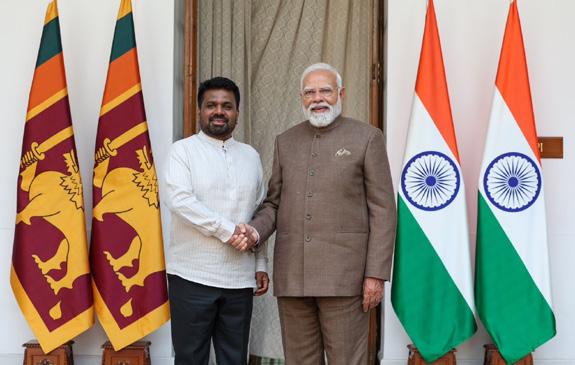
Lankan President meets PM Modi, thanks India for ‘exceptional support’ during Cyclone Ditwah
New Delhi, Feb 20 (IANS) Sri Lanka President Anura Kumara Dissanayake on Friday thanked Prime Minister Narendra Modi for the invitation to the landmark AI Impact Summit and also India's "exceptional support" during the recent Cyclone Ditwah that caused widespread damage in the island nation.
PM Modi and the visiting Lankan leader met at the Hyderabad House in New Delhi, holding discussions on the sidelines of the AI Impact Summit in New Delhi.
"Joined Indian Prime Minister Narendra Modi in New Delhi this afternoon for a meeting. I thanked him for the invitation to the AI Impact Summit 2026. We held extensive discussions on strengthening our historic ties
and expanding economic, trade, and cultural cooperation. I also expressed my gratitude for India’s exceptional support during the recent Cyclone Ditwah," Dissanayake posted on X.
Describing Sri Lanka as a "valued neighbour", PM Modi stated that the meeting further strengthened the longstanding friendship between both countries.
"Strengthening friendship with a valued neighbour! It was wonderful meeting President Anura Kumara Dissanayake in Delhi. We took stock of the progress in India-Sri Lanka relations in the recent times. We also discussed avenues of cooperation in areas such as energy, connectivity, infrastructure, healthcare, skilling, culture, blue economy and more," PM Modi posted on X.
During his India visit, Dissanayake also held discussions with several other world leaders.
"Had a friendly discussion with Prime Minister Narendra Modi, President Emmanuel Macron,
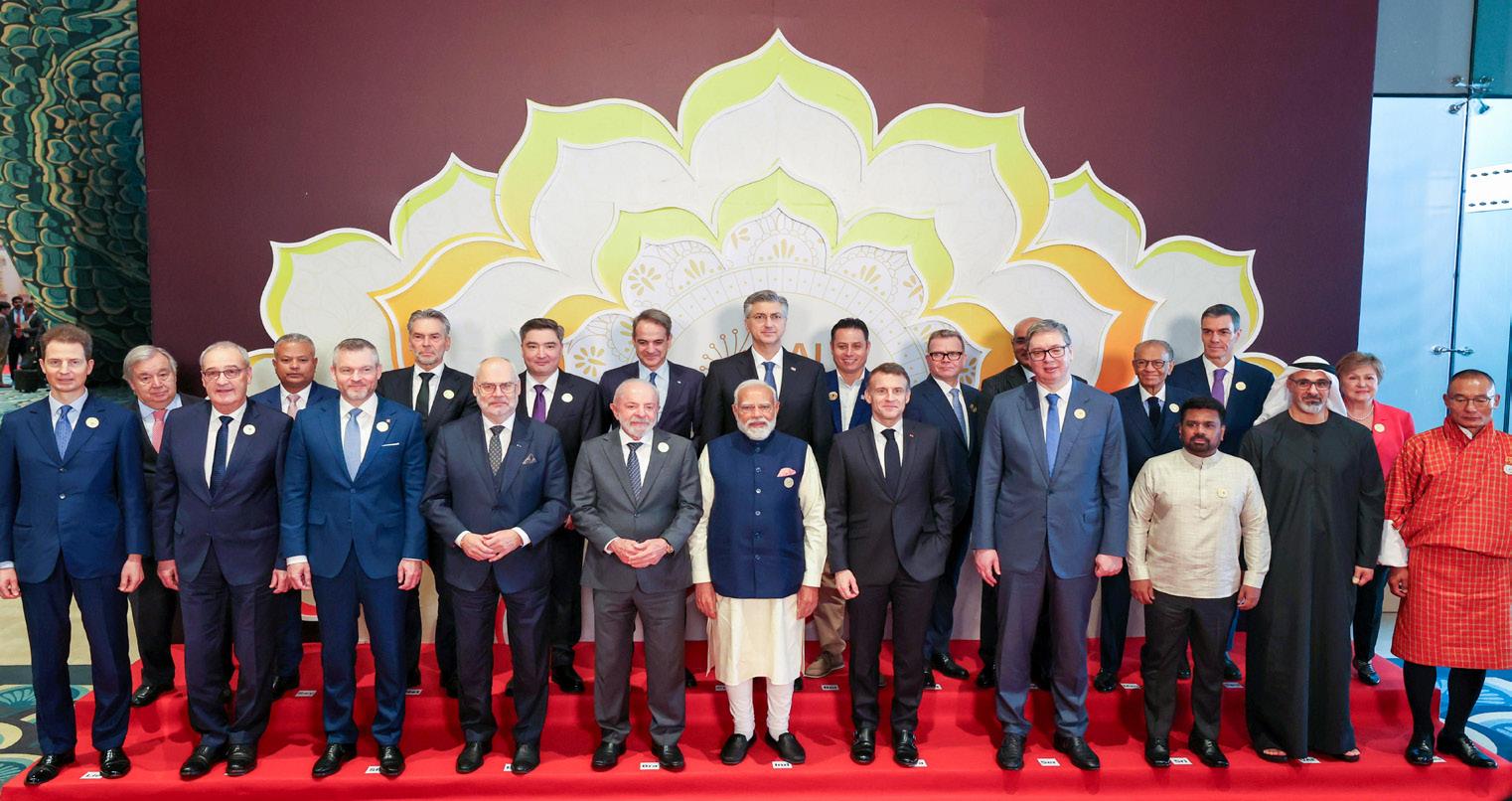
President Aleksandar Vucic and President Peter Pellegrini during the AI Impact Summit 2026 in New Delhi today. We discussed harnessing AI for global good and strengthening multilateral cooperation," the Lankan President stated on Thursday. Dissanayake mentioned that during his address at the Summit, he focused on steering Artificial Intelligence (AI) toward a future that serves all humanity.
"In my address, I emphasised that technology must be a tool to elevate, not erode, our cultural values and human capabilities. The future of civilisation depends on this balance," he said.
India has assisted Sri Lanka massively in the aftermath of Cyclone Ditwah, extending reconstruction and rehabilitation efforts and at the same time restoring critical connectivity in parts of the country.
Several Lankan leaders have thanked New Delhi for extending support "when it mattered most".
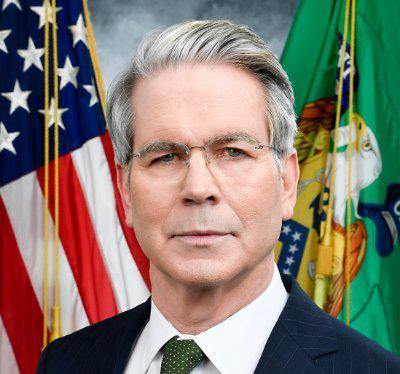
Tariffs stay central to Trump’s economic policy: US Treasury Secretary
Washington, Feb 21 (IANS) US Treasury Secretary Scott Bessent made clear that tariffs will remain a central tool of President Donald Trump’s economic strategy, even after a Supreme Court ruling limited the administration’s use of one legal authority to impose them.
Speaking at the Economic Club of Dallas, Bessent addressed the court’s decision directly.
“Six Justices simply ruled that IEEPA (International Emergency Economic Powers Act) authorities cannot be used to raise even one dollar of revenue,” he said. He pushed back against critics who portrayed the ruling as a setback. “Despite the misplaced gloating from Democrats, illinformed media outlets, and the very people who gutted our industrial base, the Court did not rule against President Trump’s tariffs,” Bessent said.
Instead, he signalled continuity.
“This Administration will invoke alternative legal authorities to replace the IEEPA tariffs,” he said.
He cited Section 232 and Section 301 tariff authorities, which he described as having been “validated through thousands of legal challenges.”
Bessent added that Treasury estimates show that the use of Section 122 authority, combined with potentially enhanced Section 232 and Section 301 tariffs, will result in “virtually unchanged tariff revenue in 2026.”
The remarks underscore that trade enforcement and tariff leverage remain integral to what Bessent called an “economic security” agenda.
“Economic security is the foundation that allows a country to fulfill its most basic obligation of safeguarding its people,” he said. He argued that the United States must restore industrial capacity and reduce vulnerabilities created by overreliance on overseas supply chains.
Referring to the “China Shock,” Bessent said the US lost “nearly six million manufacturing jobs” between 1999 and 2011, weakening strategic industries and productive resilience.
Neal Katyal, Indian-American lawyer who stopped Trump’s tariffs
Washington, Feb 21 (IANS)
The son of Indian immigrants who once served as America’s top courtroom advocate has emerged as the face of a landmark Supreme Court judgement that overthrew President Donald Trump’s sweeping tariffs.
Neal Katyal, a former Acting Solicitor General of the United States, argued against Trump’s use of the 1977 International Emergency Economic Powers Act (IEEPA) to impose what he described as “unjust, unconstitutional taxes” on imports from nearly every trading partner.
Moments after the ruling, Katyal said: “Today, the United States Supreme Court stood up for the rule of law, and Americans
Key takeaways from President Trump’s press conference
Washington, Feb 21 (IANS) US President Donald Trump used an expansive and combative news conference to respond to a Supreme Court judgment that curtailed his use of a key tariff authority, turning what might have been a defensive moment into an aggressive reaffirmation of his trade doctrine.
Over more than an hour inside the James S Brady Press Briefing Room of the White House on Friday afternoon, Trump attacked the apex court, dismissed Congressional critics, signalled higher tariffs ahead, defended his economic record, accused unnamed "foreign interests" of influencing justices, and framed tariffs not merely as trade tools but as instruments of diplomacy, border security, and national power.
His crowded news conference underscored how central tariffs remain to his presidency -- and how little the apex court's ruling appears to have moderated his approach.
Here are the comprehensive takeaways from the press conference:
1. A new 10 per cent global tariff Trump announced he would sign an executive order imposing "a 10 per cent global tariff under Section 122", adding to existing measures.
everywhere. Its message was simple: Presidents are powerful, but our Constitution is more powerful still. In America, only Congress can impose taxes on the American people.”
The case was brought by small businesses and supported by the Liberty Justice Center. Trump had defended the tariffs as vital to national security and economic leverage, citing trade deficits and fentanyl overdoses as national emergencies.
Katyal framed the ruling as a constitutional milestone. "The US Supreme Court gave us everything we asked for in our legal case. Everything,” he said. “This case has always been about the presidency, not any one president. It has always been about the separation of powers, and not the politics of the moment. I'm gratified to see our Supreme Court, which has been the bedrock of our government for 250 years, protect our most fundamental values,” Katyal said.
Born in Chicago to Indian immigrant parents — a doctor and an engineer — Katyal has built a career around high-stakes constitutional battles. He is a graduate of Dartmouth College and Yale Law School and clerked for Justice Stephen Breyer of the US Supreme Court.
but a shift in legal strategy.
2. Tariffs could go higher When asked whether tariff rates could ultimately increase beyond current levels, Trump replied: "Potentially higher... It depends whatever we want them to be."
He added that under alternative statutes, "we can judge much more than I was charging," suggesting the Supreme Court's judgment might lead to broader tax duties.
3. Emphasis on embargo powers President Trump repeatedly stressed the scope of his authority beyond tariffs.
"I can embargo," he said. "I can do anything I want." He elaborated: "I'm allowed to destroy the country, but I can't charge them a little fee."
Though hyperbolic, the language highlighted President Trump's view that the court had affirmed sweeping executive power to restrict or halt trade entirely.
4. Sharp attack on the Supreme Court
President Trump called the Apex court's judgment "deeply disappointing" and said he was "ashamed of certain members of the court".
He praised Justices Thomas, Alito and Kavanaugh for dissenting, citing their "strength and wisdom and love of our country".
Of other Supreme Court Justices, including some he appointed, President Trump said the decision was "an embarrassment to their families", though he declined to say whether he regretted nominating them.
5. Allegations of foreign influence
He emphasised that national security tariffs under Section 232 and existing Section 301 tariffs would "remain in place, fully in place and in full force and effect". The move signalled not retreat,
In one of the most striking moments, President Trump asserted: "It's my opinion that the court has been swayed by foreign interests."
Asked if he had evidence, he replied, "You're going to find out what?" but offered no specifics.
He suggested outside forces had "undue influence" and that the Supreme Court Justices might be affected "through fear or respect or friendships".
The allegation marked a significant rhetorical escalation against the Judiciary in the US.
6. Dismissal of Congress
President Trump brushed aside suggestions that he should work with lawmakers to craft a new tariff framework.
"You don't need to -- it's already been approved," he said.
"I have the right to do tariffs. And I've always had the right to do tariffs."
The comment reflected President Trump's longstanding view that existing statutes grant the executive broad trade authority.
7. Intraparty friction
Addressing the Republican critics who opposed elements of his tariff policy, President Trump acknowledged losing "three votes" but said they were "not good Republicans".
The US President emphasised party unity, noting that the vast majority of Republican lawmakers supported him.
8. Refund uncertainty
The Supreme Court judgment left open the question of what happens to billions of dollars already collected under the challenged authority.
"They don't even discuss that point," President Trump said of the opinion. He predicted the issue would "get litigated for the next two years", adding, "We'll end up being in court for the next five years."
9. Tariffs as economic engine Trump tied tariffs directly to economic performance, citing stock market milestones.
"Our stock market has just recently broken 50,000 on the Dow... and... broken 7,000 on the S&P," he said.
US business groups, lawmakers welcome Supreme Court ruling against Trump
New York, Feb 21 (IANS) US business groups, advocacy organisations and lawmakers welcomed a Supreme Court ruling that invalidated President Donald Trump's use of emergency powers to impose tariffs, calling the decision a reaffirmation of congressional authority and a relief for businesses.
In a 6-3 decision, the Supreme Court determined that the executive branch exceeded its authority by invoking emergency powers to levy import taxes on most trading partners, declaring many of the previous year's tariffs
Neil Bradley, executive vice president and chief policy officer at the US Chamber of Commerce, said on Friday that the decision was "welcome news for businesses and consumers," noting that companies had faced significant cost increases and supply-chain disruptions as a result of the tariffs.
He urged the administration to move swiftly to refund unlawfully collected duties and to reset overall tariff policy to promote economic growth and lower costs for families.
We Pay the Tariffs, a coalition advocating for small businesses, also called for "full, fast and automatic" refunds, saying many of its members had paid billions of dollars in duties that "never should have been imposed."
US Senator Mitch McConnell, a Republican from Kentucky, also welcomed the ruling, Xinhua
tariffs
news agency reported.
"The empty merits of sweeping trade wars with America's friends were evident long before today's decision," McConnell said in a statement.
"The American people already know that when Washington throws up artificial barriers, building and buying here at home become more expensive."
Edward Fishman, a former State Department and Treasury official now with the Council on Foreign Relations, said the decision could limit the use of tariffs as a rapid-response geoeconomic tool, though they could still be employed in trade negotiations through other legal channels. Some business groups cautioned that uncertainty remains, expressing concern that tariffs could be reimposed through alternative statutory mechanisms.
Strengthening Australian social cohesion could take years, says Bondi attack inquiry head
Sydney, Feb 24 (IANS) The head of a major inquiry into the antisemitic terror attack at Sydney's Bondi Beach in December said on Tuesday that it could take years to strengthen social cohesion in Australia.
Former High Court Justice Virginia Bell, who was appointed by the federal government to lead the royal commission on antisemitism and social cohesion, said in her opening statement on the inquiry's first day on Tuesday that the work of the commission would help Australians come to terms with the attack.
The royal commission was
established by Prime Minister Anthony Albanese in January, almost one month after 15 people were killed in the fatal mass shooting that targeted a Jewish event at the iconic beach on December 14.
Bell said that it is of critical importance that the inquiry hands down its final report before the first anniversary of the attack, but warned that strengthening social cohesion would be the work of "years, not months."
Bell said she was interested in hearing from Jewish Australians who had experienced antisemitism, “whether at school or at university or in the workplace, or elsewhere”, and making a submission online did not commit them to giving evidence in public.
She said that the royal commission would not hear
evidence from eyewitnesses of the attack so as not to prejudice criminal proceedings against the surviving alleged gunman Naveed Akram, Xinhua news agency reported.
The senior counsel assisting the royal commission, Richard Lancaster, said that dozens of notices have been issued to federal and state government agencies to appear before the inquiry and produce relevant documents.
"A large part of the work of this commission will be to present evidence to allow a broader understanding of the scourge of antisemitism, its nature and prevalence throughout Australian society and its impact on the lives of fellow Australians," he said. The inquiry is expected to hand down an interim report by April 30.
Australian police launch task force to target Pacific drug trafficking
Canberra, Feb 20 (IANS)
Authorities on Friday launched a new task force to target organised criminals trafficking illicit drugs into northern Australia from Pacific nations.
A statement from the Australian Federal Police (AFP) and the police force in the northeast state
of Queensland said that the North Queensland Joint Organized Crime Task Force (JOCTF) would counter the growing threat of criminals sourcing methamphetamine and cocaine stockpiled in the Pacific, Xinhua news agency reported.
It said that the task force will target organized criminals engaged in trafficking through the Torres Strait, the body of water that separates northern Queensland and New Guinea, to protect vulnerable communities and Australian sovereignty.
"We believe there are tonnes of illicit commodities that have been stockpiled in the Pacific
over many years, giving onshore and offshore organized crime syndicates reliable and easy access to dangerous drugs on the doorstep of Australia," AFP Commissioner Krissy Barrett said. She said that there is a growing concern among leaders of Indigenous communities who inhabit islands in the Torres Strait that more of their youth are consuming illicit commodities because of the increase in trafficking.
In addition to drug trafficking, the AFP said that the new JOCTF would identify and prevent sexual servitude, forced labor and people smuggling.
Extreme heat pushing Australia’s farms, wildlife to limits, study warns
Canberra, Feb 18 (IANS)
Australia's record-breaking heatwave in late January, with inland temperatures reaching 50 degrees Celsius, has inflicted severe damage on agriculture and wildlife, scientists warn.
Thousands of flying foxes died in the state of South Australia, while mango growers in the state of Western Australia reported fruit "boiled" on trees, according to an article published on The Conversation website on Wednesday.
These increasingly extreme heatwaves now threaten crops, livestock, wildlife and ecosystems,
said the article by Owen Atkin, director of the Agrifood Innovation Institute, Australian National University (ANU), and ANU ecology professor Adrienne Nicotra, with two co-authors. Such intense and prolonged heatwaves are becoming more frequent and will persist for centuries even after global emissions reach net-zero, the authors said.
Sustained intense heat can degrade proteins inside plant and animal cells, cause cell membranes to rupture and disrupt metabolic processes essential to survival, they said. Australian farms are under threat. Heat causes wheat to photosynthesise less and damages pollen in cereal crops, leading to less fertile seed, big falls in yields, and mass die-offs of plants and animals, said the article.
Four teenagers charged over Sydney attacks linked to organised crime conflict
Sydney, Feb 20 (IANS) Four teenagers have been arrested and charged over a spate of shootings and arson attacks across western Sydney linked to an organised crime conflict.
The police force in the state of New South Wales (NSW) said on Friday that the four males, aged 16, 18 and two 19-year-olds, were arrested by officers executing search warrants at six western Sydney properties on Thursday, Xinhua news agency reported.
It comes after the NSW Police Force on Wednesday established a strike force to investigate three shooting and arson attacks in western Sydney on Tuesday and Wednesday that investigators believe were linked to an organised crime conflict and
targeted the same family.
A 44-year-old man was hospitalised with serious injuries after he was shot multiple times in the first attack on Tuesday morning, but nobody else was injured in the subsequent incidents.
Strike force officers executing the warrants on Thursday seized 1 kg of cocaine, three vehicles, electronic devices and clothes relevant to their investigation.
The 16-year-old boy and one of the 19-year-old men were charged with offenses relating to the shooting of the 44-year-old. It will be alleged in court that the 19-year-old picked up the gunman involved in the shooting after the attack and that the 16-year-old was involved in supplying the firearm.
The other 19-year-old and 18-year-old were both charged over the firebombing of a property in the early hours of Wednesday morning.
The second 19-year-old was also charged with drug trafficking offenses relating to the seized cocaine.
Police said that the strike force was continuing to investigate the incidents.
Australian unemployment rate steady at 4.1 per cent
Canberra, Feb 19 (IANS)
Australia's unemployment rate remained steady at 4.1 per cent in January, according to official data released on Thursday.
per cent between December and January to 2.01 billion.
On February 3, Australia's central bank raised its key interest rate for the first time in more than two years in response to a spike in inflation.
The Reserve Bank of Australia (RBA) said that its Monetary Policy Board unanimously decided at its first meeting of 2026 to raise the cash rate target from 3.60 per cent to 3.85 per cent.
"Sustained heat is most damaging when the heat stays overnight," said the experts.
The authors called for more research to identify heattolerance traits in native species and develop large-scale methods to cool landscapes and protect ecosystems, Xinhua news agency reported.
Meanwhile, the most catastrophic heatwave, which was responsible for the death of 435 people, occurred between 1895 and 1896 and covered most of the country. In 2009, 432 people lost their lives during a heatwave in Victoria and South Australia. Rising greenhouse gas emissions have increased average temperatures across Australia, leading to hotter summers, warmer autumns, and even unusually warm winters.
The latest monthly labour force data from the Australian Bureau of Statistics (ABS) showed that the number of Australians employed on a full-time basis increased by 50,500 between December and January, which was partially offset by a fall in part-time employment of 32,700 people, Xinhua News Agency reported.
The official unemployment rate remained at 4.1 per cent in January after it fell from 4.3 per cent from November to December.
Economists were widely expecting the unemployment rate to rise slightly to 4.2 per cent in January, according to local media.
The ABS said that the participation rate, which measures the proportion of the working-age population who are either employed or actively looking for work, was 66.7 per cent in January compared to a record-high 67.3 per cent recorded 12 months earlier.
The total number of hours worked by Australians increased by 0.6
It marks the first increase to the cash rate target since November 2023 and comes after the central bank cut rates by 0.25 percentage points on three separate occasions in 2025.
The Monetary Policy Board said that inflation has fallen substantially since its peak in 2022, but picked up materially in the second half of 2025.
According to the latest official data from the Australian Bureau of Statistics (ABS), the consumer price index (CPI) rose by 3.8 per cent in the 12 months to December 2025, up from 3.4 per cent in November.
The trimmed mean, a measure of underlying inflation preferred by the RBA, rose by 3.3 per cent in the year to December, up from 3.2 per cent in the year to November.
The Monetary Policy Board said that it now considers that inflation is likely to remain above the 2-3 per cent target band "for some time."
From the editor’s desk
Balancing innovation and education
Australia’s AI classroom debate needs calm reflection
A new era in Australian education has begun with the increasing use of artificial intelligence in classrooms. Both hope and concern have been raised by reports that some universities are asking students about their assignments using AI chatbots, which essentially ask them to explain their work in real time. These tools, which provide creative ways to uphold academic integrity and promote deeper understanding, are seen by some as a natural progression in learning. The quick speed of change makes some people wonder if education is rushing into uncharted territory, especially teachers who are at the center of classroom life. Technology in education has always been welcomed in Australia. Innovation has frequently made it easier for students to access knowledge more quickly, from interactive whiteboards to online learning environments. But the introduction of AI feels different. AI chatbots actively interact with students, influencing their approach to assignments and even how they reflect on their own thinking, in contrast to previous tools that supported teachers in the background. Although the goal of such technology may be positive— making sure that students truly comprehend their work instead of using short cuts—its effects go well beyond practicality. Proponents of using AI in the classroom contend that these tools can assist in resolving some of the most important issues that educators are currently facing. Large class sizes, administrative duties, and rising parental and legislative expectations are all things that teachers frequently have to balance. Artificial intelligence (AI) tools that help with student questioning or understanding gaps could free up teachers' valuable time so they can concentrate on mentoring and innovative learning. In a time when students are utilising sophisticated digital tools, it might seem reasonable for teachers to follow suit. However, it would be foolish to disregard the uneasiness that many members of the teaching community have expressed. Education has always been based on relationships based on empathy, trust, and communication rather than being a transactional process. Some educators are concerned that automated systems may eclipse the subtle art of teaching when chatbots are incorporated into the
educational process. After all, the classroom fosters curiosity via interpersonal interaction in addition to serving as a venue for knowledge testing. If technology is not carefully integrated, it may feel impersonal in practice even though it seems efficient on paper.
Recognising the larger social context is also necessary for a balanced viewpoint. Teachers and students were pushed into online learning environments almost immediately as a result of the COVID-19 pandemic, which accelerated the digital transformation of schools. Although many people responded well to the experience, it also brought to light the drawbacks of technology when it is divorced from human interaction. Some educators may be wary because AI tools were introduced so soon after that disruption. Their worries are more about making sure that change occurs at a rate that enables schools to make thoughtful adjustments than they are about necessarily opposing innovation. Equity is yet another crucial factor. Schools with wildly disparate resources and technological capacities are part of Australia's educational system. The gap between institutions with large budgets and those with smaller ones may grow if AI chatbots take center stage in evaluation or education. Instead of making AI a privilege available to a select few, policymakers must make sure that its advantages are available to everyone in the system. Instead of causing new divisions, innovation should promote educational inclusion. Privacy and data protection also need careful attention. AI systems that analyze assignments inevitably collect information about students’ learning habits and intellectual growth. While this data can improve personalized education, it also raises questions about transparency and accountability. Parents and students need assurance that their information is managed responsibly and that the purpose of technology focuses on educational wellbeing instead of commercial interests.
At the same time, it is important not to see the debate as just a conflict between technology and teachers. Many educators understand that AI, when used wisely, can improve learning outcomes.
After Munich: A world between orders as global leaders confront end of post-1945 era
By Rohit Bal
When world leaders, defense strategists, and policymakers came together at the recent Munich Security Conference, the discussions had a noticeably different tone than in previous years. For decades, the conference served as a platform where the basic assumptions of the international system, such as alliances, collective security, and multilateral cooperation, were mostly accepted without question. This time, though, a clear feeling arose from discussions in both panels and private meetings: the world order established after 1945 is no longer stable. What lies ahead is unclear, but the acknowledgment that a historical era might be ending has compelled nations to reconsider their priorities, partnerships, and views on global stability.
The global order that took shape after 1945 was built in the shadow of the devastation left by the Second World War. It was anchored in institutions, alliances and shared rules meant to ensure that such a catastrophe would never happen again. Multilateral organisations, close transatlantic ties and the idea of collective security formed its foundation. For much of the late twentieth century, these arrangements brought a sense of stability and predictability—even during the Cold War, when ideological rivalry ran deep. After the Cold War ended, there was widespread optimism that globalisation and economic interdependence would only reinforce this system. Many believed that closer trade links and shared prosperity would make conflict less likely. Yet recent discussions in Munich suggest a growing awareness that those assumptions no longer feel as secure. The confidence that once underpinned the postwar order is being questioned, signalling a world that is far less certain than it once appeared.
A number of forces are driving this sense of change. Competition among major powers has grown sharper, with wars and strategic rivalries increasingly testing the idea of a shared international community. Regional conflicts, rising economic nationalism and intense competition over technology have all reshaped how countries think about their own security and interests.
The war in Europe, mounting tensions in the Indo-Pacific, and ongoing debates around energy security and fragile supply chains all point to a world that feels more divided than united. At Munich, leaders spoke not just about immediate dangers, but about a deeper shift taking place beneath the surface. There was a growing recognition that the old, rules-based order—once shaped largely by a handful of dominant powers—is giving way to a more uncertain, contested and fluid
global environment.
Describing the post-1945 order as “dead” does not mean it collapsed overnight. What it really points to is a slow wearing away—something that has been happening over many years.
Institutions created for a very different world are now being stretched by challenges they were never meant to handle. Rapid technological change, shifting centres of economic power, and new forms of conflict such as cyber warfare and information manipulation have reshaped what security itself means. Today’s global competition is no longer defined only by military alliances, but also by control over data, innovation and influence. Munich discussions highlight that alliances themselves are being rethought. Long-standing partnerships still matter, but many countries are now favouring more flexible arrangements guided by practical national interests rather than fixed ideological loyalties. This shift reflects a world in which power is more widely spread and emerging economies are demanding a stronger say in how global rules are made.
For many European countries, this moment feels especially unsettling. Europe, once held up as a powerful example of postwar cooperation and integration, is now confronting a far more uncertain security environment. Debates around defence spending, strategic independence and the dependability of longstanding alliances featured prominently in discussions. There is a growing recognition that Europe must take greater responsibility for its own security, even as it continues to value strong transatlantic ties. At the same time, economic strain and domestic political pressures make it harder for European nations to speak and act with a single, unified voice on global issues. Beyond Europe, perspectives from Asia and Africa, as well as from countries across the Global South, added important depth to the conversation. Many leaders pointed out that the post-1945 order had not always produced fair or balanced outcomes for all regions. From their viewpoint, the current period of transition is not just a moment of risk, but also one of opportunity—a chance to reshape global institutions so they better reflect today’s more diverse and interconnected world. Calls for reform in international finance, climate governance and security arrangements resonated strongly, underlining a growing demand for inclusion and a stronger voice in global decisionmaking.
Technology became a key topic in the discussions in Munich. Artificial intelligence, cyber security, and new defence technologies are changing the
strategic landscape. They are blurring the lines between civilian and military areas. The competition for technological leadership is now a major part of international relations, affecting everything from economic policy to diplomatic ties. Leaders recognized that managing these technologies requires cooperation, but competition often distracts from efforts to create common rules. The struggle between innovation and regulation shows the wider uncertainty affecting the global order.
At the centre of the Munich talks was a deeper philosophical question: what takes the place of a world order that is deemed outdated? Some participants mentioned a multipolar era, where power is shared among various key players rather than held by one group. Others cautioned that without shared rules and trust, multipolarity might result in instability and division. The challenge for global leaders is to navigate this shift without letting rivalries turn into open conflict. India’s evolving role in global diplomacy was frequently referenced as an example of how middle powers are shaping the emerging landscape. Countries that once remained on the margins of major geopolitical debates are now asserting themselves as bridge-builders, seeking dialogue across competing blocs. This approach reflects a broader shift toward strategic autonomy, where nations engage with multiple partners while maintaining independent decision-making. The Munich discussions suggested that such models may become more common as the world moves away from rigid alliance structures.
Another important theme that emerged from the conference was the idea of societal resilience. The pandemic laid bare weaknesses in global supply chains and healthcare systems, reinforcing the need to think about security in broader, more integrated terms. Saying that the post-1945 world order is fading does not automatically point to despair. For many, it opens up a chance to question old assumptions and design a more flexible approach to international cooperation. Even as political divisions grow sharper, the world remains deeply interconnected. Trade, technology and cultural exchange continue to bind societies together across borders. The real challenge ahead is finding the right balance between competition and cooperation—making sure that strategic rivalries do not overwhelm the shared interests that still link nations and make collective progress possible. (The author is a freelance journalist & global security analyst. The views expressed are his own.)
Rangbhari Ekadashi sparks Holi fervour across Ayodhya, Sambhal, Vrindavan
New Delhi, Feb 27 (IANS) As Rangbhari Ekadashi marks the ceremonial beginning of Holi festivities, the spiritual towns of Ayodhya, Sambhal and Vrindavan have been swept up in vibrant celebrations, blending devotion with colour and joy.
In Ayodhya, Holi processions have begun emerging from the monasteries and temples of Ramnagari. Sadhus smeared in 'abir' and 'gulal', were seen dancing to traditional Holi songs, heralding the arrival of the festival. In Ayodhya, Holi traditionally begins in temples and akharas on Rangbhari Ekadashi, when spiritual leaders formally commence the celebrations.
Markets across the city are buzzing with activity. Shops decorated with bright colours, water guns and festive masks are drawing heavy crowds. This year, water guns themed around Prime Minister Narendra Modi and Uttar Pradesh Chief Minister Yogi Adityanath have emerged as
special attractions. Children, in particular, are excited about these politically themed pichkaris, while masks featuring the Prime Minister are also witnessing brisk sales. Shopkeepers say demand has surpassed previous years, and traders expect footfall and sales to rise further as Holi approaches. Siddhpeeth Hanumangarhi Mahant Deveshacharya Maharaj said, “This is a centuriesold tradition. At Siddhpeeth Hanumangarhi, the emblem of Lord Hanuman is worshipped, and sadhus and mahants perform rituals before inviting devotees from Ayodhya’s Panchkosi region and major monasteries to celebrate Holi together.”
In Sambhal, Rangbhari Ekadashi was also celebrated with equal enthusiasm. From early morning, children, youth and elders were seen drenched in colours across neighbourhoods and markets. The rhythmic beats of drums and Holi songs filled the air. People greeted one another with 'gulal', while groups of youngsters played Holi in the streets. Women celebrated after offering prayers at home and in temples, applying 'abir' and 'gulal' to one another. Markets in Sambhal also witnessed large crowds purchasing colours and water
guns. The administration has put in place strict security arrangements to ensure peaceful celebrations. The festival is being observed with harmony, joy and a spirit of brotherhood.
Meanwhile, in Mathura’s Vrindavan, a sea of devotees gathered for Rangbhari Ekadashi at the famous Banke Bihari temple. Devotees thronged the temple premises for 'darshan', many viewing the deity through railings due to heavy crowds. On this auspicious day, Thakur Banke Bihari is believed to play Holi with devotees, adding to the divine charm of the celebrations.
Holi, the festival of colours, is celebrated on the full moon night of Phalguna, known as Phalguna Purnima. According to Drik Panchang, a total lunar eclipse will occur on the evening of March 3, directly affecting the religious calendar.
While the Purnima tithi runs from March 3 into March 4, the visible eclipse on March 3 evening has made that time unsuitable for Holika Dahan in many regions. As a result, some states will perform Holika Dahan on March 2 and celebrate Holi on March 3. Others will hold Holika Dahan on March 3 and mark Holi on March 4.
Global women diplomats share triumphs over barriers at ‘Sashakt Nari, Viksit Bharat’ forum
New Delhi, Feb 26 (IANS) Diplomats from around the world shared inspiring stories of resilience and progress in breaking barriers at the "Sashakt Nari, Viksit Bharat" forum held in Delhi on Thursday.
Organised by the Chintan Research Foundation, the event brought together women leaders to discuss women's empowerment and their pivotal role in shaping a developed India by 2047, with a dedicated session titled "Diplomacy Through Her Eyes: Women Leading Globally". More than 30 women currently serve as ambassadors or high commissioners in India, standing as powerful symbols of gender progress on the international stage. Several shared candid experiences of the challenges they encountered and the determination required to overcome them.
Ambassador of Lithuania to India, Diana Mickeviciene said: "That you know across professions and vocations there are definitely many issues in common and here we are talking about the profession and the area which was almost exclusively maledominated until quite recently. "The situation was different then, and it is different now. Back then, we felt inferior," she said. In the past, women were absent from the field, but today, 60 per cent of Lithuania's diplomats are women -- though fewer than
half have reached ambassadorial positions, highlighting lingering gaps in top-level representation.
Sri Lankan High Commissioner Mahishini Colonne addressed comparisons between her nation and India, emphasising context.
Sri Lanka, with its 29.9 million population, produced the world's first female prime minister, Sirimavo Bandaranaike, yet she remains the only woman to have served as foreign minister. "There are many women in the foreign service and Parliament, but when it comes to mission posts, women are less appointed," she observed.
While public confidence exists, administrative priorities often fall short, with no formal reservations in place. Mary M. Mutuku, Deputy Chief of the Kenyan Mission to India, spoke about entrenched cultural norms where men dominate leadership roles, including as CEOs. Women have only recently begun assuming greater responsibilities.
She said: ''I think in African culture, we have the culture where it's men who lead in most things. They're the head of family. When it comes to institutions, most of them are the CEOs.''
She pointed out a painful reality: "Not only men, but women too sometimes don't recognise your strengths and look down on you."
Women, she stressed, must work harder and fight more intensely to prove themselves.
Q3 GDP growth likely at 8.3 pc as GST cuts boost demand: Report
New Delhi, Feb 27 (IANS) India’s gross domestic product growth for the third quarter of the current financial year (Q3 FY26) will likely remain elevated at 8.3 per cent, driven by demand fuelled by goods and services tax (GST) rate cut despite an unfavourable base effect, a report has said.
The report from Union Bank of India said that gross value added growth for Q3 FY26 likely improved to 8 per cent from 6.5 per cent in Q3 FY25, though it may be marginally slower than the 8.1 per cent recorded in the second quarter.
"GDP data for Q3 FY26, due on February 27, likely clocked 8.3 per cent, sharply higher from the same period previous year (Q3 FY25: 6.4 per cent)," the report said.
Nominal GDP growth is estimated to have slowed to 8.5 per cent, down from 8.7 per cent in Q2 and 10.3 per cent in the same period last year, due to a fall in GDP deflator amid easing inflation, the report further said.
The bank noted its estimates are based on the old base year, given the uncertainty with respect to the impact from the base year revision on GDP numbers following the base-year revision by the Ministry of Statistics and Programme Implementation. While the growth outlook for FY26 remains broadly resilient and early indicators for FY27 suggest continued momentum, the annual estimates have to be revisited once clarity emerges on the forthcoming GDP base revision, the report said.
The Ministry of Statistics and Programme Implementation (MoSPI) will release the Gross Domestic Product (GDP) data with the revised base year of 2022-23 on Friday.
FY 2022-23 has been chosen as the base year of the new series and revised inputs for the new series aim to strengthen estimates across institutional sectors, especially private corporations and MSME-heavy activities where data gaps have long persisted, the government had earlier said.
India to protect its interests in trade deal with US amid evolving situation: Piyush Goyal
Estonia's Ambassador Marje Luup said: ''I would rather say that I don't see the gender coming in so much now. It's absolutely correct, as you said, the Estonian e-renomme is running ahead of us all the time, so whenever I start a conversation with Indian, let's say, people, then very often we are just talking about Estonian e-governance, Estonian digital success stories, not about gender.'' She highlighted positive shifts in perception. In Estonia, strong performance in IT draws admiration from India, where people seek opinions on digital technology rather than focusing on gender. Still, she acknowledged room for growth; fewer women currently work in the sector, prompting efforts to encourage more young women to enter IT. The forum underscored a shared global narrative -- while advancements in women's diplomatic leadership are evident, persistent structural and societal hurdles demand continued push for equality and recognition. These stories from the frontlines of international representation reinforced the event's core message -- empowering women diplomats is essential for inclusive global progress and India's vision of development.
New Delhi, Feb 27 (IANS) Commerce and Industry Minister Piyush Goyal said on Friday that India would go in for a rebalancing of the proposed trade agreement with the United States, if required, to protect its interests, in view of the changed situation following the US Supreme Court annulling the tariff hikes announced earlier by the Donald Trump administration.
"Given the evolving situation on US tariffs, we will wait and watch and ensure India’s best interests are protected," Goyal said at a media event here.
"It’s an evolving situation. The Trump administration has made some comments; they have other tools that they can use. Next week, they can increase tariffs to 15 per cent. Various dialogues are going on. I had said that if the circumstances change, the deal will be rebalanced."
The minister pointed out that the "India-US joint statement says that should circumstances change, the deal will be rebalanced".
He further stated that bilateral trade discussions with the United States are continuing amid the
changing situation.
In an oblique reference to President Trump’s announcements after the Supreme Court verdict, Goyal said: "There are many tools that the Trump administration can use in this evolving situation; one of them is the move to levy a 10 per cent tariff."
Goyal was optimistic about the outcome of the trade deal with the US. "There are so many positives in the US deal; let us see how the situation moves forward. International trade deal is about competitive advantage," he remarked.
He reiterated that sensitive dairy and farm sectors have been protected in the proposed arrangement.
"No GM foods will come into India. Dairy, maize, soybean and poultry are exempt from the US trade deal. We have preserved the interests of farmers, dairy. The deal preserves our interests," the minister said.
He further stated that despite the global headwinds, India’s exports are poised to increase this year. India and Washington have decided to reschedule the official meeting over the interim bilateral trade agreement, so that both sides can factor in the implications of the US Supreme Court judgment striking down the Trump administration’s tariff hikes.
A three-day meeting between teams headed by the chief trade negotiators of the two countries was earlier slated to take place in the US on February 23.
India’s
GDP
growth likely to cross 8 pc in Q3 FY26 despite global headwinds: SBI report
New Delhi, Feb 24 (IANS) India’s GDP growth in the third quarter of FY26 is likely to come at 8-8.1 per cent, an SBI Research report said on Tuesday, adding that the domestic economy has maintained strong growth momentum despite global headwinds.
High-frequency activity data indicates resilient economic activity in Q3 FY26 (OctoberDecember 2025).
“Rural consumption remains strong, driven by positive signals from farm and non-farm activity. Supported by fiscal stimulus, urban consumption shows a consistent uptick since the last festive season,” said Dr. Soumya Kanti Ghosh, Group Chief
Economic Adviser, State Bank of India.
As per the first advance estimate, GDP is estimated to growth at 7.4 per cent in FY26, with growth largely driven by domestic demand.
India is updating its GDP base year from 2011-12 to 2022-23, with the new series scheduled for release on February 27.
This revision, along with an updated CPI base (2024), aims to better reflect the current economic structure, including increased digital commerce and service.
The overhaul includes better measurement of the informal sector and new data sources like GST, potentially placing India as the world's fourth-largest economy. "Given significant methodological changes and new data series to be released, it is difficult to predict the extent of revision,” said the report.
The new methodology will incorporate more granular data, including GST records, e-Vahan (vehicle registrations), and information on natural gas consumption.
The Second Advance Estimates of GDP for 2025-26 along with past 3 financial years’ GDP estimates as well as Quarterly GDP estimates as per the new base 2022-23 will be released on February 27. As per the latest Economic Survey, India’s potential GDP is estimated to be around 7 per cent and estimated to grow in the range of 6.8-7.2 per cent during FY27. Meanwhile, the global economic environment is characterised by high uncertainty, with growth projected at 3.3 per cent both in 2025 and 2026 but remain uneven elsewhere due to geopolitical tensions, high debt, and structural shifts like digitalisation and decarbonisation.
Exporters jubilant at US tariff verdict; $8 billion of exports may still face duties
New Delhi, Feb 20 (IANS)
With the US Supreme Court striking down reciprocal tariffs imposed by the Donald Trump administration on Friday, Indian exporters were jubilant at the news. However, around $8-9 billion worth of trade is still likely to face higher duties under national security provisions. The US Supreme Court ruling effectively eliminates the 18 per cent reciprocal tariff agreed
earlier under the India–US trade framework.
According to analysts, Section 232 duties remain in force, covering sectors deemed critical to US national security such as steel, aluminium, automobiles, timber, copper and certain machinery products.
According to data, India exported about $8.3 billion worth of goods in Section 232 categories to the US in 2024.
This accounts for around 10.4 per cent of India's more than $80 billion exports to the US. However, the US administration indicated it could explore alternative routes to impose trade
restrictions.
Among the options available to the US administration is to rely on long-standing trade statutes that give the President authority to impose tariffs after formal investigations.
After the US Supreme Court ruling, President Trump said that he has a "backup plan" for the punitive duties. As per reports, these include Section 301 of the Trade Act of 1974, which allows the US to impose duties in response to unfair trade practices by foreign countries, and Section 232 of the Trade Expansion Act, which permits tariffs on national security grounds.
US court ruling reduces 18 pc reciprocal tariff uncertainty for India
New Delhi, Feb 20 (IANS) The US Supreme Court’s ruling against reciprocal tariffs brings significant legal clarity and reduces tariff uncertainty for India, reinforcing limits on unilateral tariff actions, industry experts said on Friday. Notably, under the interim trade arrangement the US had agreed to reduce reciprocal tariffs on India to 18 per cent which will no longer remain relevant following the Court’s decision.
“Any attempt to levy such tariffs would require Congressional approval. This is likely to give much-needed relief and a competitive boost to Indian exporters, while also paving the way for potential refunds of tariffs collected without adequate legal basis,” said Manoj Mishra, Partner and Tax Controversy Management Leader, Grant Thornton Bharat. However, the US is expected to continue relying on sectorspecific tariffs under Section 232 in strategic sectors, underscoring the importance of advancing the bilateral trade agreement to secure durable tariff certainty and stable market access for Indian exporters, said experts.
In a major setback to President Donald Trump’s economic agenda, the US Supreme Court on Friday struck down most of his sweeping tariffs, ruling
Explained: 10 pc US tariffs for 150 days globally under Section 122
New Delhi, Feb 21 (IANS) After the US Supreme Court struck down reciprocal tariffs imposed by the Donald Trump administration, the White House has released a Fact Sheet, explaining that Trump has now invoked his authority under “Section 122 of the Trade Act of 1974”, which empowers the President to address certain “fundamental international payment problems” through surcharges and other special import restrictions.
The Proclamation imposes, for a period of 150 days, a 10 per cent “ad valorem import duty on articles imported into the United States. The temporary import duty will take effect February 24 at 12:01 a.m. eastern standard time.”
Notably, some goods will not be subject to the temporary import duty because of the needs of the US economy or to ensure the duty more effectively addresses the fundamental international payments problems facing the United States.
These include certain critical minerals, metals used in currency and bullion, energy, and energy
products, natural resources and fertilisers, certain agricultural products, pharmaceuticals and pharmaceutical ingredients; certain electronics; passenger vehicles and more.
In addition, the President has directed the Office of the United States Trade Representative to use its section 301 authority to investigate certain unreasonable and discriminatory acts, policies, and practices that burden or restrict US commerce.
“The United States faces fundamental international payment problems, in particular a large and serious balance-ofpayments deficit. As a result of its loss of domestic production, the United States must import much of what it consumes, sending US dollars out of our own economy and overseas,” the statement argued.
Tariffs imposed under Section 122 automatically expire after 150 days unless Congress votes to extend them. While the time limit is explicit, trade experts note that the President could allow the measures to lapse and potentially reintroduce them by declaring a fresh balance-of-payments emergency.
Unlike several other trade laws, Section 122 does not require a formal investigation before tariffs are imposed, allowing rapid action, according to multiple reports.
Adani Power to supply 558 MW high-quality power to benefit Tamil Nadu consumers
that he lacked authority under a 1977 emergency law to impose broad import levies on America’s trading partners across the world, including India.
The ruling marks a rare instance of the conservative-led court reining in Trump’s use of executive power. According to POLITICO, the court in a 6-3 decision struck down the tariffs, calling it “a major repudiation of a core piece of Trump’s economic program.”
Chief Justice John Roberts, writing for the majority, said: “The President asserts the extraordinary power to unilaterally impose tariffs of unlimited amount, duration, and scope. In light of the breadth, history, and constitutional context of that asserted authority, he must identify clear congressional authorization to exercise it.”
Ahmedabad, Feb 24 (IANS) Adani Power on Tuesday said that its subsidiary Moxie Power Generation Ltd (MPGL) has received a Letter of Award (LoA) from Tamil Nadu Power Distribution Corporation (TNPDCL) for supply of 558 MW (net) power for a period of five years.
The power supply agreement is expected to benefit Tamil Nadu consumers by providing an additional 558 MW of reliable and high-quality power, enhance grid stability, and support uninterrupted electricity supply to households, businesses and industries.
Moxie Power operates a 1,200 MW (2X 600 MW) power plant in Tuticorin, Tamil Nadu. It emerged as the lowest bidder in a tightly contested bid by offering a tariff of Rs 5.910 per unit, with supply starting April 1, 2026, said Adani Power, India’s largest private power producer with a generation capacity of 18.15 GW. Now, both units of the plant have power supply agreements, and more than 95 per cent of Adani Power’s total operating capacity is
secured with medium to longterm contracts, said the Adani Group company.
“This provides significant longterm revenue visibility and also derisks the company from short-term market volatility. The company aims to achieve almost 100 per cent PPA (power purchase agreement) tie-up for all its operational and under commissioning plants over the coming years,” according to a company statement.
By securing power at a competitive tariff, consumers are expected to benefit from more affordable and dependable energy in the years ahead.
Adani Power has an installed thermal power capacity of 18,110 MW spread across 12 power plants in Gujarat, Maharashtra, Karnataka, Rajasthan, Chhattisgarh, Madhya Pradesh, Jharkhand, and Tamil Nadu, apart from a 40 MW solar power plant in Gujarat.
Adani Power reported a 5.3 per cent rise in its continuing profit before tax (PBT) for the third quarter (Q3) of FY26. The company’s PBT stood at Rs 2,800 crore in Q3 FY26 compared to Rs 2,659 crore in the same period last financial year, supported mainly by lower finance costs and stable operating performance.
PM Modi calls India ‘natural hub’ for AI, backed by ‘resilient ecosystem’
New Delhi, Feb 19 (IANS) Prime Minister Narendra Modi on Thursday stated that India is emerging as a “natural hub” for Artificial Intelligence, backed by a robust digital foundation, secure infrastructure and a vibrant startup ecosystem.
Addressing the India AI Impact Summit, PM Modi highlighted the country’s expanding technological capabilities across critical sectors.
“From semiconductors and chip manufacturing to quantum computing, India is building a resilient ecosystem with secure data centres, a strong IT
backbone, and a dynamic startup ecosystem. These strengths make India a natural hub for affordable, scalable, and secure AI solutions,” he said.
Emphasising India’s unique strengths, the Prime Minister noted that the country’s diversity and democratic structure position it strongly in the global AI landscape.
“India has diversity, demography, and democracy. An AI model that succeeds in India can succeed globally,” he said.
“Design and develop in India. Deliver to the world, deliver to humanity,” he added.
PM Modi underscored the importance of shifting the focus of AI development from machines to people, calling for systems that are sensitive, accountable and
aligned with human values.
“That is the core purpose of this Global AI Impact Summit. India’s vision of AI is reflected in the theme of this Summit -- ‘Sarvajan Hitaya, Sarvajan Sukhaya’, which means ‘Welfare for All, Happiness for All’. That is our benchmark,” he said.
Highlighting the need to democratise Artificial Intelligence, the Prime Minister stressed that technology must empower rather than marginalise.
“We must ensure that human beings do not remain mere data points and are not reduced to raw material. AI must be democratised. It must become a tool of inclusion and empowerment, especially for the Global South,” he said.
AI Summit: GNA Energy launches ‘Vidyut AI’ to boost operating framework
New Delhi, Feb 20 (IANS) The five-day-long AI Impact Summit 2026, held in the national capital, saw significant innovations and applications being displayed, focused on accelerating the digitalisation of the country's energy sector.
Vidyut AI, a flagship project of
GNA Energy Private Limited, was one of the Artificial Intelligence (AI)- derived solutions that grabbed the attention of visitors as well as exhibitors.
The application provides power market data, demand forecasting, and does price analysis through artificial intelligence on a single platform.
Paru Agarwal, product manager at GNA Energy Private Limited, told IANS that his company launched the product at the AI Summit to showcase its multi-tasking features and how it will simplify and integrate a host of functions on one platform.
He said that this incorporates all the market information and
intelligence gathered by the company.
Stating that the company operates on two fronts, he said, “One, the over-the-counter platform, where trading takes place, and the second, where they provide necessary intelligence to SLDCs, Power Purchase Committees, Discoms, and CNI consumers.”
He explained that data digitisation has been a major challenge in the energy sector.
“The company has integrated all these sources and created a central data repository. An effort has been made to streamline this data systematically, keeping in mind the Indian energy stack,” he explained.
US rejects global AI governance, pushes sovereign stack at Delhi summit
Washington, Feb 21 (IANS) The United States firmly rejected global governance of artificial intelligence while urging nations to adopt what it called a sovereign AI model built on the American technology stack, at the India AI Impact Summit 2026 in New Delhi.
Leading the US delegation, Michael Kratsios, Assistant to the President and Director of the White House Office of Science and Technology Policy, delivered a pointed message on AI policy and sovereignty.
“As the Trump Administration has now said many times: We totally reject global governance of AI. We believe AI adoption cannot lead to a brighter future if it is subject to bureaucracies and centralized control,” he said.
Kratsios argued that AI governance must remain local and aligned with national interests. “AI governance must focus on the particular needs and interests of particular people, and so it must be local,” he said.
The US position was framed around what Washington calls “real AI sovereignty”.
“Real AI sovereignty means owning and using best-in-class technology for the benefit of your people, and charting your national destiny in the midst of global transformations,” Kratsios said.
He cautioned against complete technological self-sufficiency.
‘MANAV’ Vision for AI: PM Modi calls for human-centric, transparent global framework
New Delhi, Feb 19 (IANS)
Prime Minister Narendra Modi on Thursday outlined a comprehensive and humancentric approach, MANAV, to Artificial Intelligence (AI), urging the global community to balance innovation with responsibility while shaping the future of AI.
Addressing the India-AI Impact Summit 2026, the Prime Minister said the world carries both a “big vision and an equally big responsibility” in the AI era.
“Along with the present generation, we also have to worry about what form of AI we will transfer to the coming generations. Therefore, the real question today is not what AI can do in the future. The question is, what do we do with AI in the present? Such questions have arisen before humanity. The most powerful example is nuclear power. We have seen its destruction, and its positive contribution has also been seen,” he said.
Describing AI as a transformative force, PM Modi cautioned against its misuse.
“AI is also a transformative power.
If it goes directionless, then it will cause destruction; if it goes in the correct direction, then it will become a solution,” he said, emphasising the need for responsible and ethical use of the technology.
The Prime Minister introduced what he called the ‘MANAV’ vision for AI, presenting it as India’s human-centric framework for the 21st Century.
“We must give AI an open sky, but also keep the command in our own hands. Like GPS suggests the route, but the final call on which direction to take remains ours. The direction we take AI in today will determine our future. Friends, today at the New Delhi AI Impact Summit, I present the ‘MANAV’ vision for AI -- MANAV, which means a human-centric Indian vision for AI,” he said.
Explaining the acronym, he said, “M stands for Moral & Ethical Systems, which means AI must be guided by ethics and respect human values; A for Accountable Governance, transparent rules, robust oversight, and national sovereignty, Whoever owns the data must own the rights; N for Accessible and Inclusive, AI must not become a monopoly, but a multiplier of opportunities; A for Valued and Legitimate, AI must be lawful, trustworthy, and socially accepted; V for Vision for Humanity, the ultimate goal of AI must be the welfare of humanity.”
UN computing centre to establish centre of excellence for AI in Amaravati
“Complete technological selfcontainment is unrealistic for any country, because the AI stack is incredibly complex,” he said.
“But strategic autonomy alongside rapid AI adoption is achievable, and it is a necessity for independent nations. America wants to help.”
Kratsios urged nations to partner with Washington through the American AI Exports Program.
“We believe that independent partners are critical to unlocking the prosperity AI adoption can open to all of us. That is why the president launched the American AI Export Program,” he said. At the summit, he announced a series of initiatives aimed at accelerating global adoption of US AI systems. These include a National Champions Initiative to integrate partner nations’ leading AI companies into customised American AI export stacks.
Amaravati, Feb 20 (IANS) The United Nations International Computing Centre (UNICC) will establish a Centre of Excellence for artificial intelligence (AI) and quantum at the Amaravati Quantum Valley in Amaravati, the capital city of Andhra Pradesh.
A letter of intent to this effect was signed between at the AI Impact Summit 2026 in New Delhi on Friday in the presence of Chief Minister N. Chandrababu Naidu. He posted on social media platform X that the Centre of Excellence will position Amaravati as a Digital Embassy for secure AI, enabling sovereign, cybersecure AI deployments aligned with UN grade standards.
"This collaboration will bring international best practices and global partnerships, placing Andhra Pradesh on the global map of trusted AI and quantum readiness," Chief Minister Chandrababu Naidu said, who
interacted with Sameer Chauhan, UNICC Director, and Anusha Dandapani, UNICC's AI Hub Chief.
The Andhra Pradesh government signed a total of seven memorandums of understanding (MoUs) with various companies and institutions on the sidelines of the summit.
The state has partnered with BharatGen, NexGen, and IBM India to launch a state-wide AI Tech Hub.
Chief Minister Chandrababu Naidu said the initiative will empower citizens, from farmers to fishermen, setting a national example with an inclusive, Telugu-first, citizen-focused AI, with future Quantum-AI integration.
The Andhra Pradesh government also signed an MoU with the National Institute of Electronics and Information Technology (NIELIT) to establish its first South India campus in Amaravati, he added.
"The Skill Development arm of the Ministry of Electronics and Information Technology, NIELIT (Deemed to be University), will strengthen Andhra Pradesh's journey as a hub for Quantum and AI education.
AIBC delegation concludes landmark Chennai visit, strengthens Australia–India business ties
Canberra, February 24 (Australia India News Newsdesk)
The Australia India Business Council (AIBC) has concluded its largest-ever business delegation to Chennai, describing the visit as a significant step in deepening economic engagement between Australia and the Indian state of Tamil Nadu.
The week-long programme focused on strengthening collaboration across sectors including innovation, small and medium enterprises (SMEs) and investment, reflecting the growing momentum in the India–Australia economic corridor under the India–Australia Economic Cooperation and Trade Agreement (ECTA). Delegates said the visit reinforced the expanding opportunities for bilateral trade and business partnerships.
One of the highlights of the visit was a strategic meeting with Tamil Nadu Chief Minister M. K. Stalin, where discussions
centred on startup ecosystems and potential collaboration with Startup Tamil Nadu. The delegation also toured the A2B manufacturing facility and visited the renowned Kanchipuram Silk Park, gaining insights into India’s traditional industries alongside modern manufacturing practices.
Cultural and industry engagements formed a key part of the programme, including a visit to the historic shores of Mahabalipuram and an interaction with actor and public figure Khushboo Sundar.
Delegates also explored Chennai’s growing technology landscape through a visit to Madras IT Park, reflecting the city’s reputation as a hub for innovation and digital growth.
Organisers acknowledged the contributions of Cameron Noble from the Australian Consulate in Chennai and Merin Devassia from the Indo-Australian Chamber of Commerce for facilitating
the programme. A reception hosted by Silai Zaki brought together members of diverse business communities, further strengthening professional networks and dialogue. According to participants, the delegation created strong business-to-business synergies, with discussions covering investment opportunities, skills development and cross-border collaboration. The visit was seen as part of AIBC’s broader vision to expand commercial connections and foster long-term partnerships between businesses in India and Australia.
As the delegation concluded, members expressed optimism about the future of bilateral trade, highlighting the role of ongoing engagement in connecting Australian businesses with India’s dynamic market while opening new pathways for collaboration in the years ahead.
Community spirit and wellbeing highlighted at Shakti Global’s second anniversary in Brisbane
Brisbane, February 23 (Australia India News Newsdesk)
The Consul General of India in Brisbane, Neetu Bhagotia, joined community leaders and guests at the second anniversary celebration of Shakti Global, a Gold Coast-based non-profit organisation focused on holistic health and cultural wellbeing initiatives.
The milestone event was attended by Federal Member for Moncrieff Angie Bell and Queensland’s Assistant Minister for Multicultural Affairs and International Student Attraction Hermann Vorster,
reflecting strong support from local leaders for communitydriven programmes promoting inclusivity and wellness.
Shakti Global has been actively delivering initiatives centred on spiritual care, mental health awareness and community engagement. The anniversary programme featured vibrant cultural performances alongside yoga and wellbeing sessions conducted by Art of Living Australia, attracting large participation from community members.
Organisers highlighted the organisation’s mission to create
Indian-Australian youth joins council to strengthen young voices in community leadership
Brisbane, February 23 (Australia India News Newsdesk)
Youth participation in community leadership received a boost with the selection of Indian-Australian student Aryan Goyal to serve on a Youth Council aimed at amplifying young voices and encouraging civic engagement across the region.
decision-making spaces in Queensland.
a supportive environment where individuals can connect through shared cultural experiences while also focusing on personal growth and mental wellbeing. The event served as a celebration of community unity, diversity and the positive impact of grassroots organisations across the Gold Coast region.
The evening concluded with interactive sessions and networking, reinforcing the role of Shakti Global in fostering holistic wellbeing and strengthening multicultural connections within Queensland’s vibrant community landscape.
The council provides a platform for emerging leaders to contribute to community initiatives, share perspectives on issues affecting young people and help shape programmes focused on social development and youth empowerment. Aryan’s inclusion highlights the increasing representation of multicultural youth within leadership and
Observers note that such youth councils play a vital role in connecting younger generations with community organisations and policy discussions, fostering skills in leadership, collaboration and public engagement. His appointment also reflects a broader trend of IndianAustralian students taking active roles in civic life and contributing to multicultural dialogue.
Community representatives said the initiative demonstrates the importance of inclusive youth platforms in building stronger and more resilient communities, ensuring that diverse perspectives are reflected in future planning and communitydriven projects.
Brisbane’s FICQ Toastmasters Club invites community to build confidence and leadership skills
Brisbane, February 24 (Australia
India News Newsdesk)
The federation of Indian Communities of Queensland (FICQ) Toastmasters Club in Brisbane is encouraging community members to enhance their communication and leadership abilities through its supportive platform under Toastmasters International.
Designed to help individuals overcome stage fright and express themselves more effectively, the club offers a welcoming space for people at all experience levels.
Organisers said the initiative focuses on nurturing confidence by encouraging members to stand up, speak and grow through regular practice and constructive feedback.
Each session blends learning with interaction, featuring speaking activities, encouragement from fellow participants and opportunities to develop leadership skills in a positive environment. Members describe the club as a community-driven space where laughter, learning
and personal development go hand in hand.
The organisers invited interested individuals to attend a meeting as guests and experience the supportive atmosphere firsthand. Those seeking more information about joining or upcoming sessions can contact FICQ president Preethi Suraj.
The club continues to promote the idea that effective communication and confidence are skills that can be developed with guidance, practice and a strong sense of community support.
Admissions
open for Nalanda University Master’s programmes for 2026–27 intake
Brisbane, February 18 (Australia India News Newsdesk)
The Consulate General of India in Brisbane has announced the opening of applications for the 2026–27 academic year Master’s programmes at Nalanda University, an Institution of National Importance operating under the Ministry of External Affairs, Government of India. The University’s postgraduate courses are designed to strengthen conceptual knowledge, practical skills and research capabilities, equipping students to engage with global challenges in areas such as sustainability, peace studies, public policy, academia and industry. The programmes are open to
graduates from diverse academic backgrounds, reflecting Nalanda University’s interdisciplinary approach.
Applications must be submitted through the University’s official online portal, with the deadline set for June 15, 2026. The new academic session is expected to begin in the first week of August 2026.
Officials encouraged interested candidates to visit the University’s website for detailed information on courses, eligibility criteria and the admission process, noting that the programmes offer an opportunity for students to pursue advanced studies in an internationally oriented learning environment.
Moreton Volunteer Award recognises community leadership of Karthick Elangovan
Brisbane, February 22 (Australia
India News Newsdesk)
The contributions of multicultural volunteers were highlighted as Tamil Association of Queensland president Karthick Elangovan was honoured with the Moreton Volunteer Award 2025, recognising his ongoing service and leadership within the local community.
The award acknowledges sustained efforts in community development and cultural engagement, reflecting the
growing influence of volunteerled initiatives across Queensland.
Community representatives said the recognition underscores the value of grassroots leadership in strengthening social connections and supporting diverse communities.
In a Facebook message following the announcement, Elangovan said he was “deeply honoured” by the recognition, describing volunteerism as a reflection of core Australian values such as mateship, generosity and mutual support. He noted that
the achievement belonged to the wider network of volunteers who work collectively to make a positive impact.
Elangovan also thanked Julie-Ann Campbell MP for her support, emphasising the importance of collaboration between community organisations and local representatives. Observers said the award highlights the significant role played by volunteers in building inclusive and resilient communities across the region.
King’s Medal honour highlights leadership and service within Queensland’s Tamil community
Brisbane, February 17 (Australia
India News Newsdesk)
The presentation of the King’s Medal to community member Senthil Kumaran Sentheyval has drawn attention to the growing contributions of Tamil-Australians in community leadership and public service across Queensland.
The recognition acknowledges dedication, perseverance and ongoing efforts that have strengthened community engagement and inspired wider participation in multicultural initiatives. Community observers said the honour reflects the positive impact of individuals who continue to promote service, collaboration and social responsibility.
Representatives from Tamil Association Queensland Inc noted that such achievements showcase the role of grassroots leaders in shaping inclusive communities while encouraging younger generations to pursue leadership and volunteer opportunities. The
award also highlights the broader contribution of multicultural communities to Queensland’s social fabric.
Community leaders described the recognition as a milestone
that reinforces the importance of commitment and excellence, while celebrating the values of hard work and service that continue to shape the region’s diverse community landscape.
Emergency preparedness workshop highlights consular support and legal awareness
Canberra, February 23 (Australia India News Newsdesk)
The High Commission of India, in partnership with FINACT, conducted a Crisis and Emergency Workshop in Canberra to raise awareness about consular services, legal assistance and emergency response measures for members of the Indian community.
The panel featured officials from the High Commission alongside representatives from a legal firm, ACT funeral homes and the ACT Multicultural Hub. The session focused on providing practical guidance on how individuals can access support during challenging situations, including legal issues, domestic crises and bereavement.
During the workshop, officials outlined key consular services such as Overseas Citizen of
India (OCI) matters, eVisa and Emergency Visa procedures, and the issuance of Emergency Certificates. Participants were encouraged to promptly inform the High Commission or relevant Consulate in cases of arrest or detention to ensure access to consular assistance. The importance of registering with the High Commission was also highlighted as a crucial step for receiving timely updates and support.
Legal experts discussed available avenues for assistance, particularly in cases of domestic violence or abuse, with special attention given to the challenges faced by temporary visa holders.
The session aimed to ensure that community members are aware of the resources available to them and how to seek help when
needed.
Representatives from funeral services provided detailed information on postdeath processes, including documentation requirements, necessary clearances, funeral arrangements, repatriation procedures and associated costs.
Organisers said the discussion was designed to help families better understand complex procedures during emotionally difficult times.
The workshop concluded with an interactive exchange between panel members and participants, reinforcing the value of collaboration between government agencies and community organisations in strengthening awareness and preparedness within the Indian diaspora.
Indian Army Chief General Upendra Dwivedi meets Indian Army veterans in Sydney
Sydney, February 26 (Australia India News Newsdesk)
I
ndia’s Chief of the Army Staff, General Upendra Dwivedi, interacted with veterans of the Indian Army at the Consulate General of India in Sydney as part of his visit to Australia, reaffirming the Army’s enduring bond with its former servicemen. The engagement provided an opportunity for the Army Chief to acknowledge the dedication and
sacrifices of veterans who have served the nation with distinction. He conveyed appreciation for their lifelong commitment to duty and recognised their continued role in upholding the values of the Indian Army, even beyond active service.
General Dwivedi reiterated the Indian Army’s strong focus on veteran welfare and emphasised the importance of nurturing connections with members of the
Reception in Canberra honours Indian Women’s Cricket Team during Australia tour
Canberra, February 19 (Australia India News Newsdesk)
The High Commission of India in Canberra organised a reception celebrating the achievements of the Indian Women’s Cricket Team, which is currently in Australia for a cricket series. The event highlighted the growing prominence of women’s sport and the spirit of sporting excellence shared between India and Australia.
India’s Chief of the Army Staff, General Upendra Dwivedi, who is on an official bilateral visit to Australia, attended the reception and interacted with the players, conveying his best wishes for their forthcoming matches.
His presence added a special significance to the evening, reflecting broader engagement between the two countries beyond sport.
The gathering was attended
by members of the diplomatic community, senior Australian Government officials, representatives from sporting bodies, media representatives and members of the Indian diaspora. Guests praised the team’s achievements and the role of women’s cricket in inspiring the next generation of athletes. Organisers described the reception as an opportunity to celebrate dedication, teamwork and the rising global profile of women’s cricket. The evening also underscored the importance of sport in strengthening cultural connections and fostering goodwill between communities in India and Australia.
The programme concluded with informal interactions among guests and players, reinforcing the sense of camaraderie and support surrounding the team as they continue their tour.
veteran community living abroad. He noted that maintaining close ties with overseas veterans strengthens the broader Army fraternity and reinforces shared traditions and values.
The interaction was marked by a spirit of camaraderie and mutual respect, reflecting the deep bonds that unite members of the Indian Army across countries and generations.
Culture, music and storytelling unite communities at BhuMeJa Project in Perth
Perth, February 24 (Australia India News Newsdesk)
India’s Consul General in Perth, Kajari Biswas, attended the BhuMeJa Project — a unique cultural evening that blended music, dance and storytelling while celebrating the shared spirit of nature and community.
The event, held as part of Perth Festival 2026, brought together Indigenous and international artists in an immersive experience focused on healing, harmony and cultural exchange.
The special gathering featured celebrated songman and ceremonial leader Daniel Wilfred from Ngukurr in Arnhem Land, alongside dancers, musicians and elders representing Noongar Boodjar in Perth, as well as artists from India and Malaysia. Through a fusion of traditional sounds, movement and narratives, the evening sought to highlight the deep connection between land, water and culture that resonates across continents.
Organisers described the BhuMeJa Project as more than a performance — it was a space designed to encourage reflection and collective healing. Drawing inspiration from the flowing energies of Mother Ganga in India and Derbarl Yerrigan, the Noongar name for the Swan
River, the event symbolically linked ancient waterways that have sustained communities for generations. Performers used music and storytelling to evoke themes of peace, resilience and shared heritage.
Consul General Kajari Biswas’ presence underscored the growing cultural ties between India and Western Australia.
Her attendance reflected ongoing efforts to strengthen people-to-people connections through artistic collaborations that celebrate diversity while promoting mutual respect.
Observers noted that events such as the BhuMeJa Project highlight the Indian community’s engagement with Indigenous cultures and multicultural initiatives in Australia.
Audience members were invited into an immersive environment where soundscapes, dance and ceremonial elements unfolded against a natural backdrop.
Traditional rhythms merged with contemporary expressions, creating a powerful atmosphere that honoured both ancient traditions and modern artistic interpretations. The participation of elders from Noongar Boodjar added a strong cultural grounding, emphasising respect for country and the importance of
storytelling as a living tradition. For many attendees, the evening served as a reminder of how art can bridge geographical and cultural distances. The collaboration between artists from Arnhem Land, Perth, India and Malaysia showcased the possibilities that emerge when different cultural voices come together with a shared purpose. The themes of flowing rivers and interconnected landscapes resonated strongly, symbolising continuity and renewal.
The BhuMeJa Project formed one of the many highlights of Perth Festival 2026, which continues to draw artists and audiences from across Australia and beyond. Known for showcasing innovative performances and cross-cultural collaborations, the festival has become a platform for conversations about identity, environment and community.
As the night concluded, participants reflected on the event’s message of unity through nature and culture. By weaving together Indigenous knowledge, global artistic traditions and spiritual symbolism, the BhuMeJa Project offered an experience that went beyond entertainment — creating a moment of shared understanding and celebration in the heart of Perth.
Indian classical fusion takes centre stage at Perth Fringe World Festival
Perth, February 17 (Australia India News Newsdesk)
Music lovers in Perth were treated to a memorable evening of cultural celebration as SWARASYNTHESIS delivered a unique blend of Indian classical melodies and global musical influences during the Perth Fringe World Festival 2026.
The programme was presented by the Swami Vivekananda Cultural Centre and the Consulate General of India in Perth in collaboration with ArtRage, reflecting a shared commitment to promoting artistic diversity and cross-cultural engagement. India’s Consul General attended the event as the Guest of Honour, highlighting the significance of cultural initiatives that connect communities through the arts.
The performance featured six local artists whose talents brought traditional Indian musical forms into conversation with contemporary world sounds.
Organisers said the event aimed to showcase the richness of Indian heritage while encouraging creative collaboration within Western Australia’s multicultural arts scene.
Audiences witnessed a lively fusion of rhythm and harmony, with classical influences reimagined through modern interpretations. The evening not only celebrated music but also underscored the role of cultural platforms in fostering dialogue and understanding among diverse communities.
As part of the wider Fringe World Festival programme, SWARASYNTHESIS added a distinctive multicultural flavour to Perth’s arts calendar, demonstrating how traditional art forms can evolve while staying rooted in heritage. The event concluded with enthusiastic applause, leaving attendees inspired by the power of music to unite people across cultures.
Tamil Association of Queensland participates in federal roundtable
Immigration and Foreign Affairs and Trade
and key
The forum, organised by the Department of Home Affairs, brought together community representatives to exchange views on migration policies, workforce participation and the evolving needs of diverse communities in Queensland. Participants highlighted the importance of collaboration between government and community organisations in shaping inclusive initiatives.
Representatives from the Tamil Association said the roundtable provided a valuable platform to represent the interests of the Tamil community and engage in constructive dialogue on policy matters. Discussions focused on skilled migration pathways and
strengthening support systems that help communities thrive.
Organisers noted that ongoing engagement with community leaders is essential to building a more inclusive society, with
the association reaffirming its commitment to working closely with government agencies and partners to support positive outcomes for Queensland’s multicultural population.
Brisbane, February 20 (Australia India News Newsdesk)
The Tamil Association of Queensland joined a Community Leaders Roundtable with Assistant Minister for
Matt Thistlethwaite MP, contributing to discussions on skilled migration
issues affecting multicultural communities.
Consul General attends ISWA event, backs launch of community guide ‘The Last Journey’
Perth, February 17 (Australia India News Newsdesk)
The Indian Society of Western Australia (ISWA) hosted a Capacity Building Community event in Perth, attended by India’s Consul General Kajari Biswas, where a new publication titled The Last Journey was unveiled to support the Indian-origin community with after-death formalities and cultural practices. The guide has been developed as a practical and culturally
sensitive resource aimed at assisting families during times of loss. It offers information on rituals, administrative processes and community support, helping individuals navigate complex arrangements while preserving traditional values.
During the event, Consul General Biswas praised ISWA for taking the initiative to create a resource that responds to an important community need. She highlighted that the publication combines practical advice with cultural
understanding, enabling families to approach difficult moments with compassion, respect and clarity.
Community leaders said the launch reflects ISWA’s ongoing efforts to strengthen community capacity by addressing real-life challenges faced by migrants in Western Australia. By providing structured guidance and accessible information, The Last Journey seeks to reduce uncertainty and offer reassurance to families managing end-of-life
arrangements.
Organisers noted that the publication is intended not only as a reference guide but also as a step towards encouraging open dialogue within the community about planning, traditions and support networks. The initiative underscores the role of cultural organisations in promoting awareness and fostering unity among diverse migrant groups. Encouraging wider participation, the Consulate General urged members of the Indian-origin
community to make full use of the guide, describing it as an important tool that enhances preparedness and strengthens collective support during sensitive times.
The event concluded with discussions on future collaborations and initiatives aimed at empowering the Indian diaspora in Western Australia through culturally informed community programs.
Business forum in Perth highlights scope for India’s textile and handloom industries
Perth, February 17 (Australia India News Newsdesk)
Strengthening trade links between India and Western Australia’s fashion and textile sectors was the focus of an International Business Discussion jointly organised by the Consulate General of India in Perth and the International Business Council of Australia (IBCA).
The event explored the theme, “The Potential of India’s Apparel, Textile and Handloom Industries in the Australian Market,” bringing together exporters, importers, policymakers and industry stakeholders. Acting Vice President of IBCA Shibli Khan opened the session with a welcome address, while IBCA President Dr Dilawar Singh provided an overview of the organisation’s work and its role in fostering business connections.
India’s Consul General in Perth, Kajari Biswas, delivered the keynote address, emphasising the opportunities for deeper collaboration in textiles
and apparel between India and Western Australia. She highlighted how growing demand for diverse fashion products and sustainable manufacturing practices could open new pathways for bilateral trade and innovation.
The discussion featured a series of expert presentations from industry representatives.
TEXPROCIL – The Cotton Textiles Export Promotion Council of India joined virtually to outline export prospects, while Shailesh Martis, Additional Director at the Handloom Export Promotion Council (HEPC), spoke about India’s rich handloom heritage and its global market potential.
Dr M Sundar, Joint Director, also shared insights into industry development and emerging trends.
Local perspectives added depth to the dialogue, with Carol Hanlon, Chief Executive Officer of the Textile Clothing Footwear Resource Centre WA Inc. (TCFWA), discussing
sustainability initiatives and the outcomes of trade missions to India. Harish Kukadia, Director of Rani Veda Indian Wear Boutique in Perth, offered the viewpoint of an importer, highlighting consumer demand and the challenges of operating within the Australian retail landscape. Participants included representatives involved in clothing recycling, exports, importing and fashion incubation, making the session a broad platform for networking and knowledge exchange. Organisers said the forum underscored the importance of collaboration in strengthening economic ties and promoting innovation across the apparel, textile and handloom sectors.
The programme concluded with a vote of thanks delivered by IBCA Treasurer Avinash Dhalia, who acknowledged the contributions of speakers and attendees and expressed optimism about future business partnerships between India and Western Australia.
AIBC delegation deepens economic ties during Mumbai leg of India visit
Canberra, February 25 (Australia India News Newsdesk)
Building on a productive round of business engagements in Chennai, the Australian India Business Council (AIBC) delegation moved to Mumbai for the second phase of its India mission, participating in high-level discussions aimed at strengthening bilateral trade and investment ties.
The Mumbai programme commenced with engagements connected to the Future Economic Corporation Council, organised in partnership with the Ministry of External Affairs, Government of India, and the Government of Maharashtra, ahead of the Global Economic Corporation Summit 2026. The meetings focused on emerging economic trends, global trade shifts and the opportunities arising from closer Australia–India collaboration.
During the summit, delegates heard addresses from External Affairs Minister Dr. S. Jaishankar,
Maharashtra Chief Minister Devendra Fadnavis and Union Commerce and Industry Minister Piyush Goyal. Dr. Jaishankar spoke about the rapidly evolving international landscape, describing a period of transition in which traditional global systems are intersecting with new frameworks shaped by geopolitics, security priorities and the accelerating influence of artificial intelligence on economies worldwide.
Members of the AIBC delegation contributed to two panel discussions alongside representatives of the USUK Business Council and the UAE Business Council. The conversations explored developments surrounding the India–Australia Free Trade Agreement and examined India’s expanding role as a significant driver of global economic growth.
A notable outcome of the visit was the signing of a Memorandum of Understanding with the World Trade Centre in Mumbai. The
agreement is expected to pave the way for closer institutional collaboration and enhanced trade linkages between Australian and Indian businesses. Delegates acknowledged the hospitality extended by Dr. Vijay Kalantri, CEO Priya Pansare and their team, and gained insights into the Centre’s operations and international network.
The visit concluded with a reception hosted by Australia’s Consul General in Mumbai, Christian Jack, alongside Deputy Consul General Todd Miller. The event brought together members of Mumbai’s business community and provided an opportunity for informal exchanges, networking and reflection on the delegation’s week-long mission.
The Mumbai engagements capped a successful India tour for the AIBC delegation, reinforcing business partnerships and opening new avenues for cooperation between Australia and India in an increasingly dynamic global economy.
QLD makes strategic India push as Brisbane & Gold Coast unite for direct flight dream
Brisbane, February 27 (Australia India News Newsdesk)
Brisbane and the Gold Coast have formally joined forces in a strategic push to attract more Indian travellers, appointing a dedicated in-market representative and strengthening their pitch for a future direct air connection between India and Queensland.
In a coordinated move, the Brisbane Economic Development Agency (BEDA), Brisbane Airport, and Experience Gold Coast have appointed Horus Development and Consulting to represent both destinations in India. According to reporting by The Australia Today, the appointment will focus on trade engagement, marketing initiatives and public relations activities aimed at elevating South-East Queensland’s profile among Indian travel buyers, airlines and investors.
India’s importance to Queensland’s tourism sector is rapidly increasing. As highlighted by The Australia Today, India is now ranked among Australia’s top five inbound tourism markets. In the year to September 2025, Queensland welcomed approximately 77,000 Indian visitors who contributed an estimated USD 238.9 million to the state’s economy. The figures show Brisbane recorded around 46,000 arrivals from India during that period, while the Gold Coast experienced
particularly strong growth, with visitor numbers rising 35 per cent to reach 25,000. Industry stakeholders say this upward trajectory strengthens the commercial argument for direct aviation links.
The broader aviation context adds further weight to the proposal.
The Australian Financial Review has reported that Brisbane Airport has been actively exploring opportunities to secure nonstop services to India, citing rising passenger volumes, strong education links and expanding business ties between Queensland and Indian cities. Airport executives have indicated that a direct route would reduce travel times and improve convenience for both leisure travellers and the large student and diaspora communities.
The global travel landscape also supports Queensland’s ambitions.
The Guardian Australia has reported that India is one of the fastest-growing outbound aviation markets globally, prompting intense competition among Australian states to secure direct connections. Analysts cited in the report said that nonstop services often significantly influence destination choice, particularly for family travel and corporate delegations.
Tourism marketing is being tailored accordingly. ABC News has reported that Tourism and Events Queensland is intensifying promotional campaigns in India, highlighting Queensland’s natural attractions, beaches, wildlife experiences and premium tourism infrastructure. Officials have said that integrating Brisbane and the Gold Coast into a single itinerary enhances appeal
and spending potential. The economic dimension extends beyond leisure travel. According to SBS News, India is one of Australia’s largest sources of international students and skilled migrants, creating steady yearround demand for travel. Experts told SBS that a direct service would likely stimulate additional tourism expenditure, business engagement and conference activity.
Local operators have welcomed the joint initiative. News.com. au reported that hospitality and retail sectors on the Gold Coast see significant growth potential in improved Indian connectivity, arguing that direct flights would boost hotel occupancy, visitor spending and employment.
While no airline has formally confirmed a direct India–Queensland route, stakeholders say discussions and feasibility assessments are ongoing. As reported by The Australian Financial Review, aircraft availability, bilateral air service agreements and sustained passenger demand will ultimately determine timing.
By appointing a dedicated representative in India and presenting a united front, Brisbane and the Gold Coast are signalling that the Indian market is now central to Queensland’s tourism strategy. With visitor numbers climbing and spending already approaching a quarter of a billion US dollars annually, industry leaders argue that a direct flight would not only enhance convenience but also symbolise deepening economic, educational and community ties between Queensland and India.
India–Australia women leaders unite
New business dialogue forum to launch in Sydney on March 18
Sydney, February 26 (Australia India News Newsdesk)
Adedicated platform to strengthen collaboration among women entrepreneurs from India and Australia will be launched in Sydney on March 18, 2026, under the patronage of the Consulate General of India. The initiative, titled the India–
Australia Women in Business Dialogue Forum, is guided by the philosophy “Lead, Connect, Grow, and Prosper.” It is envisioned as a structured forum to promote deeper engagement between women leaders as bilateral ties between the two nations continue to expand across multiple sectors. With India–Australia cooperation growing in areas such as technology, advanced manufacturing, energy, robotics, education, professional services, sports, trade and investment, organisers believe the time is ripe to strengthen networks among women entrepreneurs. The Forum aims to create meaningful opportunities for dialogue, knowledge exchange and crossborder partnerships.
Designed as a trusted and collaborative space, the platform will enable women business leaders to connect, share experiences and identify new commercial avenues across
IABCA leaders spotlight features veteran diplomat Barry O’Farrell
Sydney, February 25 (Australia Indian News Newsdesk)
The India Australia Business & Community Alliance (IABCA) showcased Barry O’Farrell AO in its Leaders Spotlight Series, acknowledging his significant role in shaping and strengthening Australia–India relations.
A former Premier of New South Wales and former Australian High Commissioner to India, O’Farrell brings extensive experience in public leadership and international diplomacy. His career has spanned state governance and high-level diplomatic engagement, positioning him as an influential voice in advancing bilateral cooperation.
Speaking during IABCA’s India Immersion Week 2025, O’Farrell reflected on the growth of Australia–India collaboration and the factors that underpin durable partnerships. He highlighted the importance of
sustained leadership, mutual cultural understanding and strong institutional relationships in navigating global political and economic transitions. He noted that meaningful engagement must extend beyond formal agreements to include continuous interaction between governments, businesses and communities.
As a member of the IABCA Advisory Board, O’Farrell continues to contribute to initiatives aimed at strengthening trade, investment and people-topeople connections, supporting IABCA’s vision of building robust and future-focused bilateral pathways.
In keeping with this commitment to excellence and collaboration, IABCA has opened entries for the IABCA Awards 2026, which will recognise outstanding contributions across trade, innovation, sustainability and broader Australia–India engagement.
industries. It will also focus on fostering leadership, innovation and long-term cooperation in emerging sectors.
The inaugural event on March 18 will centre on the theme, “Breaking Barriers, Building Bridges: Women Leaders Catalysing India–Australia CrossBorder Growth.” The programme will include a plenary session, followed by panel discussions and interactive roundtables featuring prominent women entrepreneurs and industry leaders.
Organisers have expressed optimism that the dialogue forum will evolve into a sustained mechanism for empowering women-led enterprises and advancing inclusive economic growth between India and Australia. Women leaders and entrepreneurs are expected to gather in Sydney for what promises to be a milestone event in strengthening bilateral business engagement.
Marathi Association Perth hosts grand Shiv Jayanti celebration, ISWA joins in tribute
Perth, February 24 (Australia India News Newsdesk)
The Marathi Association Perth organised a vibrant Shiv Jayanti celebration to mark the birth anniversary of Chhatrapati Shivaji Maharaj, with the Indian Society of Western Australia (ISWA) joining the commemorative event.
The programme brought together members of the Marathi community and the wider Indian diaspora in Perth to honour the life and legacy of the legendary Maratha ruler. The celebration featured traditional cultural performances, historical reenactments and thematic
presentations that highlighted Shivaji Maharaj’s courage, vision and contributions to governance. Attendees were treated to a rich display of Maharashtrian heritage through music, dance and storytelling, reflecting the enduring impact of Chhatrapati Shivaji Maharaj across generations.
ISWA representatives appreciated the efforts of the Marathi Association Perth in organising the event, noting that such initiatives play a vital role in preserving cultural heritage and fostering unity within Western Australia’s multicultural community.
Indian community team gears up for Fremantle Multicultural Cricket Tournament
Perth, February 24 (Australia India News Newsdesk)
Preparations are in full swing for the Fremantle Multicultural Cricket Tournament at Fremantle Oval on March 2, 2026, with the Indian community team officially receiving its new jerseys ahead of the muchanticipated event.
Sponsored by Avid Sports, the newly designed kits were presented to the players during a formal gathering at the Consulate General of India in Perth. Dr Jags MLA handed over the jerseys in the presence of Ansh Gautam, Founding Director and Chairman (Australia) of AvidSys Group, Shruti Simon, Director of Avid
Sports, and Indian team captain Vaibhav Chhabra.
The presentation ceremony underscored the strong backing from business and community leaders for multicultural sporting initiatives. Speakers at the event highlighted cricket’s unique role in bringing communities together and strengthening bonds across cultural backgrounds.
Captain Vaibhav Chhabra thanked sponsors and supporters for their encouragement, expressing optimism about the team’s performance at the tournament.
Representatives from Avid Sports reaffirmed their commitment to promoting grassroots sports and supporting community-driven
events.
The Fremantle Multicultural Cricket Tournament is expected to draw diverse teams and spectators from across Perth, creating a festive atmosphere that blends competitive sport with cultural celebration. Organisers anticipate a lively day featuring cricket matches, traditional food, and opportunities for families and friends to connect.
With fresh jerseys and renewed enthusiasm, the Indian community team is set to take the field at Fremantle Oval for what promises to be a spirited and memorable celebration of sport and multicultural unity.
ITC Infotech establishes Asia-Pacific headquarters and AI hub in Melbourne
Melbourne, February 23
(Australia India News Newsdesk)
Consul General of India in Melbourne, Anish Rajan, joined senior officials from the Government of Victoria along with representatives of ITC Limited and ITC Infotech at the formal inauguration of ITC Infotech’s Asia-Pacific Headquarters and its new Digital & AI Engineering Hub in Melbourne.
The opening marks a key milestone in the company’s regional expansion strategy and reflects the strengthening economic relationship between India and Australia, particularly in technology-led sectors.
The Melbourne-based facility will serve as the company’s central base for operations across the Asia-Pacific region,
supporting innovation, digital transformation, and advanced engineering solutions.
Speakers at the event emphasised the growing importance of artificial intelligence and digital technologies in shaping global business landscapes. The new hub is expected to focus on AI-powered solutions, digital engineering, and next-generation technology services across multiple industries, including financial services, manufacturing, retail, and the public sector.
Victorian Government representatives welcomed the investment, noting that it reinforces Melbourne’s reputation as a leading destination for technology and innovation. The project is also expected to generate high-skilled employment opportunities and
Business Lounge at Indian Consulate in Sydney supports India–Australia trade engagement
Sydney, February 18 (Australia India News Newsdesk)
The Consulate General of India in Sydney is promoting stronger commercial ties between India and Australia through its Business Lounge facility, a dedicated space created to assist business communities from both countries.
Introduced in 2024, the Business Lounge offers a professional environment where companies can hold meetings with prospective partners, access Indian and Australian trade and business databases, and engage directly with commercial representatives and trade officers at the Consulate. The platform also enables
deepen collaboration between Australian and Indian technology ecosystems.
Industry leaders highlighted that the establishment of the Asia-Pacific headquarters in Melbourne will enhance cross-border partnerships and encourage knowledge exchange in emerging technologies. The initiative is seen as a significant step toward fostering AI-driven innovation and expanding commercial engagement between the two countries.
With the launch of the headquarters and Digital & AI Engineering Hub, ITC Infotech aims to accelerate growth in the region while contributing to stronger business ties and shared economic progress between Australia and India.
Sydney
AFC Women’s Asian Cup 2026
Perth, February 26 (Australia India News Newsdesk)
In a spirited show of community enthusiasm, the Consulate of India in Perth organised a Poster Making Competition to cheer on Team India ahead of the AFC Women’s Asian Cup 2026™. The initiative attracted a strong response, with participants expressing their support for Indian women’s football through vibrant and imaginative artwork. The competition highlighted the growing excitement around the tournament and encouraged young members of the community to actively engage with women’s sport. Colourful posters featuring messages of encouragement and national pride reflected both creativity and
passion for the team.
Four participants were awarded match tickets as prizes, made possible through the generous sponsorship of the Perdaman Group. The winners announced were Anya Ray, Aarya Buche, Syed Nazafarin Nouf and Darpad Pednekar.
Consulate officials extended their congratulations to the winners and appreciation to all who took part in the event. The tickets will be emailed directly to the recipients.
The event underscores ongoing efforts to strengthen community involvement and promote support for Indian athletes competing on the international stage, while celebrating the rising profile of women’s football.
Consulate commemorates
India’s 77th Republic Day
businesses to display product samples along with supplier and vendor details, providing an opportunity to showcase offerings to potential collaborators.
Officials said several companies have already utilised the facility to promote their products and explore new market opportunities.
Designed to support exporters and importers, the Business Lounge aims to help businesses connect with suitable partners and expand their commercial engagements. The Consulate noted that the initiative reflects its continued efforts to facilitate trade, encourage networking and strengthen economic cooperation between India and Australia.
Sydney, February 18 (Australia India News Newsdesk)
The Consulate General of India in Sydney marked India’s 77th Republic Day with a vibrant celebration held at the Consulate premises on January 26, 2026, attended by members of the Indian diaspora and friends of India from diverse communities. Consul General Dr S. Janakiraman unfurled the National Flag during the ceremony and read the President of India’s Address to the Nation, highlighting the significance of the occasion. The gathering reflected strong community participation and a
shared sense of national pride.
This year’s celebrations also commemorated the 150th anniversary of “Vande Mataram,” with attendees joining in a mass rendition of the iconic patriotic song. Organisers said the tribute added a meaningful cultural dimension to the programme, honouring India’s heritage while strengthening bonds within the community.
The event concluded with informal interactions among guests, reinforcing the spirit of unity and celebration that marked the Republic Day observance at the Consulate.
Indian food and agri delegation strengthens trade links during Sydney tour
Sydney, February 26 (Australia India News Newsdesk)
The Consulate General of India in Sydney hosted and coordinated a high-level Indian Food and Agriculture delegation visit to Sydney from February 23 to 25, 2026. The delegation, led by the Federation of Indian Export Organisations (FIEO), comprised 28 Indian companies representing a wide spectrum of food and agri products.
The visit commenced with a Buyer-Seller Meet at Hilton Sydney on February 23, where Indian exporters showcased their products to Australian buyers, importers and distributors. The
business interactions focused on expanding market access, understanding consumer demand and exploring long-term commercial partnerships.
On February 24, the delegation visited key retail and distribution facilities, including Woolworths sites in Gables and Bella Vista.
The companies were briefed on retail operations, logistics networks and compliance standards in the Australian market. The programme also included a visit to Harris Farm Markets in Drummoyne, where delegates examined opportunities in fresh produce and specialty food categories.
The Sydney segment of the tour concluded on February 25 with a Business Conclave at Holiday Inn Parramatta. The conclave brought together Western Sydneybased food and agri importers and distributors for focused discussions on trade prospects, regulatory frameworks and collaboration pathways.
The three-day engagement was aimed at enhancing India–Australia trade cooperation in the food and agriculture sector, fostering direct business connections and identifying new growth avenues under the expanding bilateral economic partnership.
Indian Consulate in Sydney announces Open House for community engagement
Sydney, February 19 (Australia India News Newsdesk)
The Consulate General of India in Sydney will host an Open House on March 5, 2026, from 14:30 to 15:30 hrs at its premises, inviting members of the Indian diaspora to interact directly with consular officials.
The session is designed to provide a platform for community members to discuss consular
matters, raise concerns and seek assistance on a range of issues.
Organisers said the initiative aims to strengthen communication channels and foster closer engagement between the Consulate and the Indian-origin community. Through the Open House, participants will have an opportunity to share feedback, ask questions and gain clarity on
available services, while officials hope the interaction will further enhance support mechanisms for the diaspora in Sydney and surrounding regions.
The Consulate encouraged community members to take part in the session, describing it as an important step towards building stronger connections and ensuring responsive consular outreach.
Indian academic delegation engages in partnership talks during Brisbane visit
Brisbane, February 27 (Australia India News Newsdesk)
The Consul General met members of an Indian University leaders’ delegation visiting Brisbane for the India Showcase 2026 event held at the University of Queensland.
The showcase was co-organised by QS, an international higher education analytics and engagement organisation, and Austrade, the Australian Government agency that
promotes trade, investment and global education partnerships.
The delegation comprised founders, vice chancellors and senior administrators from prominent Indian universities. Their visit focused on strengthening institutional linkages and exploring new avenues for collaboration with Australian counterparts, particularly in Queensland.
Discussions highlighted opportunities to expand joint academic programmes, research
partnerships and student exchange initiatives. Both sides underscored the importance of innovation-led cooperation and knowledge sharing in advancing higher education ties between India and Australia.
The meeting reflected the growing emphasis on education diplomacy as a cornerstone of the broader bilateral relationship, with stakeholders keen to deepen long-term academic and research collaboration.
Shilpa Shetty: Where fashion, fitness, and discipline come together
When it comes to personalities in Indian cinema, not many have managed to remain popular across decades. One of those who have succeeded in doing so has been none other than Shilpa Shetty. Her early years in Bollywood saw her blossom through her roles, and now her present role has been that of a wellness entrepreneur and style icon. One look at her career seems to suggest that Shilpa’s journey has so far been that of relentless reinvention, and her consistency and self-discipline would leave one awestruck, to say the least. As is found among the actors, Shilpa’s fashion sense, personal style, and her fitness are deeply intertwined, showing that she possesses a lifestyle consciously built and sustained.
Shilpa Shetty’s public image is wrought by her credibility. Her fitness is not merely aspirational, rather she practices what she yearns for, and when it comes to her fashion choices, these are a direct extension of that strength and confidence.
Fitness as a way of life, not a phase
Shilpa Shetty is widely recognised as one of the earliest mainstream Bollywood figures to popularise yoga as a holistic fitness practice. Long before wellness became a social media trend, she spoke openly about yoga, balance, and mindful living. She is a certified yoga enthusiast who has consistently credited yoga for her flexibility, mental well-being, and physical endurance.
Her fitness routine includes a mix of yoga asanas, strength training, stretching, and functional workouts. Over the years, she has shared how fitness helped her recover post-pregnancy, maintain hormonal balance, and stay mentally centred amid professional and personal pressures. This long-term commitment lends authenticity to her wellness advocacy.
Shilpa’s physique—lean, strong, and flexible—has not been achieved through extreme dieting or short-term goals. She has repeatedly spoken about moderation, home-cooked meals, and consistency. This disciplined approach is what sets her apart in an industry often driven by extremes.
Fashion rooted in body confidence
Shilpa Shetty’s fashion choices reflect her comfort with her body. She does not shy away from bold silhouettes, experimental cuts, or statement pieces, but her style is rarely reckless. Whether she is wearing a bodycon gown, a sharply tailored co-ord set, or a sculpted saree, her outfits celebrate structure and movement.
On the red carpet, Shilpa often gravitates towards
contemporary Indian designers who blend modern aesthetics with traditional craftsmanship. Corset blouses, dramatic drapes, metallic textures, and sculptural gowns frequently feature in her wardrobe. These looks work because they align with her posture and confidence— something that cannot be styled artificially.
Her fashion is also age-inclusive without being age-conscious.
Shilpa does not dress to appear younger; instead, she dresses to appear powerful, comfortable, and self-assured. This distinction has made her a reference point for women across generations.
Indian wear: A signature strength
Indian wear is where Shilpa Shetty truly commands attention. Sarees, in particular, have become a signature part of her public style. She frequently experiments with unconventional drapes, modern blouse designs, and rich fabrics like organza, chiffon, silk, and georgette.
Her saree appearances often blend tradition with innovation— think sculpted blouses, belts, layered pallus, or architectural pleats. Yet, the essence remains rooted in Indian aesthetics. She balances boldness with grace, ensuring that the look never feels costume-like.
Lehengas and anarkalis also find a place in her wardrobe, especially during festive and television appearances. Colour choices range from jewel tones to pastels, often paired with minimal yet impactful jewellery. The consistency in her ethnic style reflects an understanding of what works for her frame and personality.
Contemporary and casual style
Away from events and cameras, Shilpa’s casual style leans towards comfort with polish. She is often seen in relaxed co-ord sets, loose trousers, oversized shirts, and breathable fabrics. Her off-duty fashion mirrors her wellnessfirst lifestyle—nothing restrictive, nothing overly ornate.
Athleisure plays a prominent role in her daily wardrobe. Yoga pants, tank tops, sweatshirts, and sneakers dominate her casual outings, particularly around
Redefining modern masculinity through effortless style
Vijay Deverakonda
In an industry where male fashion has often leaned towards safe choices — classic suits, predictable colour palettes, and carefully controlled public images — Vijay Deverakonda has emerged as a figure who challenges expectations.
Known for his work in Telugu cinema and his growing presence across India, he has built a fashion identity that feels instinctiverather than manufactured. His style is not about perfection or rigid rules; it is about attitude, comfort, and the confidence to experiment.
fitness studios. Unlike curated celebrity gym looks, Shilpa’s workout fashion feels practical and lived-in, reinforcing her authenticity. Accessories are usually understated—functional handbags, minimal jewellery, and comfortable footwear. This restrained styling allows her natural presence to stand out. Beauty, grooming, and self-care Shilpa Shetty’s approach to beauty aligns closely with her overall philosophy. She favours glowing skin, minimal makeup, and well-groomed hair over heavy transformations. Her skincare routine often emphasises hydration, traditional practices, and consistency. She has spoken about the importance of sleep, stress management, and inner balance, reinforcing the idea that beauty is a byproduct of wellness. This holistic approach resonates with her audience because it feels attainable rather than performative.
Influence beyond cinema Today, Shilpa Shetty’s influence extends beyond films and television. As a wellness advocate and entrepreneur, she has played a significant role in normalising fitness conversations for Indian households. Her fashion choices amplify this message—strong, flexible, and expressive rather than ornamental. What stands out is that her style has evolved without abandoning its core. She has adapted to changing fashion landscapes while staying rooted in her personal values of health, discipline, and confidence. A style built on consistency Shilpa Shetty’s fashion and fitness journey is not about fleeting reinvention. It is about sustained effort, self-awareness, and balance. Her wardrobe celebrates strength, her fitness reflects discipline, and her public image carries the assurance of someone who knows herself well.
In an industry driven by novelty, Shilpa Shetty remains relevant by staying real. Her style does not chase attention—it commands respect. And that, perhaps, is her most enduring statement.
What makes Vijay Deverakonda’s fashion journey fascinating is how naturally it mirrors his on-screen persona. Just as his film roles often portray unconventional heroes, his wardrobe reflects a refusal to be boxed into traditional definitions of masculinity. He moves between rugged casual wear, bold street style, and sharp formal looks without losing authenticity. The result is a fashion narrative that feels human, evolving alongside his career rather than existing as a separate performance.
Early style: Raw, relatable and unfiltered
When Vijay Deverakonda first gained attention, his fashion choices felt refreshingly unpolished. Instead of appearing overly styled, he embraced simple outfits — loose shirts, denim, sneakers, and relaxed silhouettes that reflected a grounded personality. This early aesthetic resonated strongly with younger audiences who saw in him a break from the overly groomed image often associated with film stars.
His public appearances during this phase carried an air of spontaneity. He seemed less concerned with fitting into established fashion expectations and more focused on comfort. This authenticity became a defining element of his style, setting the foundation for a fashion journey built on individuality rather than conformity.
As his popularity grew, so did the curiosity around his wardrobe. Fans began to notice how effortlessly he balanced casual dressing with a subtle sense of rebellion — unbuttoned collars, rolled-up sleeves, and an ease that suggested fashion could be expressive without being intimidating.
Street style influence: Breaking traditional norms
One of the most recognisable aspects of Vijay Deverakonda’s fashion is his embrace of streetwear. Oversized hoodies, graphic tees, distressed denim, and layered outfits have become recurring elements in his off-duty looks. This approach feels aligned with global fashion movements while still retaining a distinctly Indian sensibility.
What sets his street style apart is the absence of excess styling. He often appears in outfits that look lived-in rather than curated for effect. This relaxed approach has influenced many young fans who view fashion as a reflection of personal identity rather than a rigid set of rules.
His willingness to experiment with unconventional silhouettes — from oversized jackets to gender-neutral pieces — has also contributed to conversations around modern masculinity in Indian fashion. By stepping outside traditional expectations, he encourages a broader definition of what male celebrity style can look like.
Red carpet evolution: From casual rebel to confident sophistication
As his career expanded into larger projects and international appearances, Vijay Deverakonda’s red carpet fashion evolved significantly. While he retained his signature ease, his formal looks began to showcase structured tailoring, bold colours, and contemporary cuts. He has often chosen suits that break away from classic black-and-white norms — experimenting with textures, pastel shades, and unconventional layering. These choices reflect a growing confidence, suggesting that formalwear can feel expressive rather than restrictive. Yet, even in polished ensembles, there remains a sense of effortlessness. His styling rarely feels overdone. Accessories are minimal, and grooming remains natural, reinforcing the idea that true style lies in how comfortably one inhabits a look rather than how elaborate it appears.
Ethnic fashion: Tradition with a modern edge
While much of his fashion identity is associated with western silhouettes, Vijay Deverakonda has also embraced Indian ethnic wear in distinctive ways. Whether appearing in a kurta set or a traditional sherwani, he often chooses designs that blend heritage with modern cuts. His ethnic fashion tends to avoid heavy embellishment, favouring clean lines and understated colours. This approach reflects a contemporary reinterpretation of traditional menswear — one that feels relevant to younger audiences who wish to honour culture without feeling bound by formality.
Gujarat CM felicitates writers, urges preservation of mother tongue
Gandhinagar, Feb 20 (IANS)
Gujarat Chief Minister Bhupendra Patel said on Friday that honouring one's mother tongue while respecting other languages reflects the essence of Indian culture, as he presented literary honours at a state-level event on the eve of International Mother Language Day.
Speaking at the Mother Language Festival organised by the Gujarat Sahitya Akademi, Chief Minister Patel said: "Respect for other languages along with pride in one's mother tongue is the true expression of our culture."
Elaborating on the significance of language, the Chief Minister said, "Our mother tongue begins with 'A' and extends to 'Gya', which signifies knowledge. The emotions and sensitivities of
the heart can be expressed only through the rich knowledge embedded in our mother tongue."
He added that preserving language and culture and carrying them forward to future generations was "the need of the hour".
Referring to a statement by Prime Minister Narendra Modi that there can be no comparison to mother, motherland and mother tongue, the Chief Minister said: "Anyone who takes pride in their mother tongue is a matter of pride for me."
For 2024, the Sahitya Gaurav Award for Gujarati language was conferred on Praveen Darji, while Mavji Maheshwari received the award for Kutchi language.
Under the Yuva Gaurav Awards for young writers, Ajay Soni was honoured for Gujarati literature and Dipak Nanda for Kutchi literature.
Describing the mother tongue as a symbol of collective identity and self-respect, CM Patel said that similar self-respect had been fostered among citizens through initiatives such as 'Somnath
Delhi L-G to open Palaash Mahotsav 2026 at Asita today
New Delhi, Feb 21 (IANS) Delhi
Lieutenant Governor and DDA Chairperson V.K. Saxena will on Saturday inaugurate the two-day Palaash Mahotsav 2026 at Asita floodplain near ITO.
The festival reflects DDA’s continued efforts towards sustainable urban development and enhancement of accessible public green spaces across the city.
Visitors at the festival experience elaborate floral arrangements, seasonal plant displays and interactive green installations, showcasing both ornamental and native species, it said.
Complementing the horticultural exhibits are artisan stalls, food courts, cultural performances, workshops and participatory activities, making the festival inclusive and engaging for families, students and visitors of all age groups.
Minister of State for Corporate Affairs Harsh Malhotra and DDA Vice Chairman N. Saravana Kumar will also participate in the inaugural event.
The Palaash festival marks the transition from winter to spring - a season of renewal, colour and togetherness.
On February 14, the L-G inaugurated the "DDA Green
Swabhiman Parv' and efforts towards the revival of heritage and culture.
He also noted that culture, language and traditions of knowledge occupy a significant place in the vision of Developed India 2047, and called on writers, creators and language enthusiasts to contribute towards the preservation and promotion of their mother tongues while working towards the goal of a Developed Gujarat within a Developed India.
Folk singer Kirtidan Gadhvi told IANS: "In the presence of the Chief Minister, awards were presented to artists from across the state."
He added, "We must all respect and value our mother language. The event had given young artists renewed enthusiasm and motivation to work more in literature."
The programme was held in the presence of Minister of State for Sports, Youth Services and Cultural Activities Jayram Gamit and Gujarat Sahitya Akademi Chairman Bhagyash Jha.
Hindi, local languages must grow together to unite people: Tripura CM
Agartala, Feb 20 (IANS) Tripura Chief Minister Manik Saha said on Friday that the preservation of local languages and the promotion of Hindi must go hand in hand, stressing that the primary purpose of language is to connect people and not create divisions. Addressing the Eastern, North-Eastern and Northern Regional Rajbhasha Sammelan, inaugurated by the Union Home Minister Amit Shah at the International Indoor Exhibition Centre in Hapania, Chief Minister Saha said the conference should inspire collective progress through India's official language while ensuring regional languages thrive. Welcoming delegates from more than 20 states in the country to Tripura, the Chief Minister thanked Union Home Minister Shah for choosing the state as the venue and lauded officials for their efforts in
organising the significant event. Chief Minister Saha underlined that a widely understood language strengthens the bond between citizens and the government, and in this regard Hindi has played a key role. "India is a land of many languages. Hindi unites the people of the world's largest democracy, but it should not overshadow local languages. Both must flourish together -this diversity is our strength," he said. The Chief Minister added that under the leadership of Prime Minister Narendra Modi, India has entered a golden era for the revival and promotion of Indian languages, including Sanskrit. He highlighted the emphasis on multilingual education under the National Education Policy, 2020, including the use of mother tongues as a medium of instruction. Pointing to Tripura's own experience, Chief Minister Saha said the use and understanding of Hindi have increased in the state alongside the continued practice of local languages, which he described as the identity and soul of the people.
Traditional crafts by women adorn corridors of Gujarat Assembly
Expo 2026" and Palaash Mahotsav 2026 at Baansera on the Yamuna bank, calling upon every citizen to feel responsible towards the environment.
The L-G said, “Who would have ever imagined, just 3 years back, that this degraded and polluted site would host a ‘Green Expo’ and become a platform for planning a sustainable future for Delhi.”
In a message on social media, he said, “A stellar example of greening and reclaiming degraded land, Baansera is a testimony to resilience and endeavour. I hope this Expo mulls over and offers practical solutions to Delhi's environmental challenges.”
“Let us imagine Delhi as a city, where every resident breathes clean air, every neighbourhood enjoys the shade of trees, every riverbank is cared for, and every citizen feels responsible towards the environment,” he said.
The DDA said on social media, “A purposeful start to Day 1 at DDA Green Expo. From the inaugural ceremony and MoU signings to the logo reveal, keynote address and exhibition walkthrough, the first half set the tone for Delhi’s vision of a climate-ready, sustainable future.”
In addition to Baansera at Birsa Munda Chowk, the Palaash Festival was simultaneously celebrated at Ashoka Garden at Ashok Vihar, Lala Hardayal Park at Jasola, and Smriti Van at Narela, each curated around a distinct theme celebrating nature, sustainability and community life.
Ghar Ghar Swadeshi’ campaign.
Assembly Speaker Shankar Chaudhary formally inaugurated the festival. Deputy Speaker Purnesh Modi and Minister for Women and Child Welfare Dr Manisha Vakil were present at the ceremony, along with Assembly Secretary Chetan Pandya, senior officials of the Women and Child Development Department, and citizens.
Addressing the gathering, Chaudhary said women in Gujarat have earned international recognition for their craftsmanship, particularly in embroidery and traditional handicrafts.
“Through their dedication and skill, the women of Gujarat have brought global recognition to our handicrafts. Today, these traditional arts have become a respected global brand,” he said.
Rajsakhi fair inaugurated in Rajsamand, Eco-friendly herbal colours steals spotlight
Rajsamand (Rajasthan), Feb 22 (IANS) A seven-day Rajsakhi Fair showcasing products made by women’s self-help groups under the Rajasthan Grameen Aajeevika Vikas Parishad (Rajeevika/RGAVP) was inaugurated in the state's Rajsamand district on Sunday, with herbal colours (gulal) prepared from local vegetation emerging as the star attraction ahead of Holi. The fair, being held from February 22 to 28 under the joint aegis of the Rajeevika group and the district administration, features a wide range of handmade products brought by women’s groups from across the state for marketing and sale.
Superintendent of Police Mamta Gupta, Zila Parishad CEO Brijmohan Bairwa, Rajeevika
DPM Dr Suman Ajmer, BJP district President Jagdish Paliwal, and other officials and public representatives were present at the inauguration. The dignitaries cut the ribbon, inspected various stalls, and interacted with the participants.
With Holi approaching, herbal colours produced from locally available flowers and leaves have become a major crowd-puller. The skin-friendly colours are not only environmentally safe but also provide livelihood opportunities to rural women.
Bala Devi, a member of a Rajeevika women’s group from Kumbhalgarh, said the group has been producing herbal colours for the past four years, and demand has been steadily rising. "It has no
side effects, and around 30 to 35 women are getting employment through this activity," she said.
Consumer Bhagyashree Khatik said she purchased red colour made from palash flowers and green colour prepared from custard apple and neem leaves, adding that the product is safe for the skin.
Mukesh Kumar Nuwal, Manager of the Rajeevika Group in Rajsamand, said the colours are made entirely from natural sources — yellow from marigold flowers, green from custard apple and neem leaves, red from palash flowers, and maroon from beetroot juice.
Officials said orders worth about Rs 7 lakh for the herbal colours have already been received, highlighting growing public preference for eco-friendly Holi products.
Gandhinagar, Feb 23 (IANS) The Women Art and Craft Festival was inaugurated at the Gujarat Legislative Assembly premises on Monday under the ‘Har Ghar
Swadeshi,
Sri Lanka: An island that teaches you to slow down
Some journeys begin with a checklist — places to see, photographs to capture, stories to tell when you return home. A visit to Sri Lanka feels different. It unfolds gradually, not through grand spectacles alone but through moments that feel deeply human: the smile of a stranger offering directions, the quiet rhythm of a train rolling through tea-covered hills, or the gentle sound of waves meeting the shore at sunset. Sitting just south of India in the Indian Ocean, Sri Lanka may appear small on a map, yet its cultural depth and natural diversity make it feel vast once you begin to explore. What strikes you first is how close everything seems — beaches, mountains, forests, and ancient cities are often just a few hours apart — yet each place carries its own personality. The island invites you to travel slowly, to notice how history and modern life overlap, and to appreciate how resilience and hospitality shape everyday interactions.
Colombo: First impressions of an evolving city
Arriving in Colombo feels like stepping into a city balancing multiple identities. It is busy and modern in parts, yet traces of its colonial past remain visible in architecture and street layouts. The sea is never far away, and evenings along the Galle Face Green promenade reveal a softer side of the city. Families gather, children run across open spaces, vendors sell local snacks, and the ocean breeze brings a sense of calm after a long day.
Walking through the Pettah market area is an experience in itself. Narrow streets overflow with colour, conversation, and movement. Shopkeepers call out to customers, buses pass close to pedestrians, and the scent of spices lingers in the air. Colombo does not try to impress through perfection; it feels lived-in and real. Conversations here often shift easily between local concerns and global ideas, reflecting a society that has endured change yet continues to move forward.
The cultural triangle: Where ancient stories live on Leaving the city and travelling inland reveals a very different side of Sri Lanka. The Cultural Triangle — which includes ancient cities like Anuradhapura and Polonnaruwa — offers insight into a civilisation that flourished long before modern
one of the most beautiful train rides in the world. The train moves slowly, allowing you to watch landscapes change from dense forests to rolling tea plantations. Workers move through the fields with steady precision, and small villages appear briefly before disappearing behind mistcovered hills.
Maldives: Finding quiet joy in a world of water and light
borders existed. Massive stone stupas, ancient reservoirs, and carefully planned urban spaces demonstrate remarkable engineering and spiritual vision. Walking among these ruins feels less like visiting a museum and more like stepping into a living landscape. Pilgrims continue to visit sacred sites, offering flowers and prayers, reminding travellers that these places still hold deep meaning. Sigiriya, the famous rock fortress rising dramatically from the plains, is one of the most memorable experiences. The climb is steady rather than rushed, and each step upward reveals more of the surrounding forests and fields. Standing at the top, you realise how closely power and geography were once connected.
Nearby, the cave temples of Dambulla provide a quieter form of reflection. Inside, centuriesold murals and statues create an atmosphere of stillness that encourages you to slow your thoughts. Even visitors unfamiliar with Buddhist traditions often find themselves moving more gently here, influenced by the calm energy of the space.
Kandy: A spiritual and cultural Heart
As the road winds towards Kandy, the landscape begins to rise and the air feels cooler. The city sits beside a tranquil lake, surrounded by green hills that soften the urban environment. Kandy feels more intimate than Colombo, with a pace that encourages wandering rather than rushing.
The Temple of the Sacred Tooth Relic is central to the city’s identity. Watching pilgrims arrive with offerings of flowers gives you a sense of how faith shapes everyday life. The sounds of traditional drumming during rituals echo across the complex, blending devotion with artistry. Even for those visiting simply as observers, the atmosphere feels deeply respectful and reflective. Kandy also preserves artistic traditions. Cultural performances showcase Kandyan dance, where elaborate costumes and rhythmic movements tell stories rooted in history and spirituality. These performances are not just entertainment; they represent a living connection between generations.
The Hill Country: Tea, trains and quiet conversations
The journey from Kandy into the hill country is often considered
Towns like Nuwara Eliya and Ella feel almost timeless. Cool air replaces tropical heat, and mornings begin with fog drifting across valleys. Visiting a tea plantation offers insight into a legacy that began during British colonial rule and continues to shape the region’s economy. Watching tea leaves being sorted and processed makes you appreciate the labour behind a simple cup of tea.
In the hill country, conversations often feel unhurried. People talk about harvests, family, and weather, grounding daily life in rhythms that feel far removed from the pace of large cities. Sitting with a warm drink while looking out over endless green slopes becomes less about sightseeing and more about simply being present.
Wildlife and the natural world Sri Lanka’s compact size allows travellers to experience remarkable biodiversity without long journeys. National parks such as Yala and Udawalawe offer opportunities to observe elephants, birds, and other wildlife in their natural habitats. Safaris here feel intimate rather than overwhelming. Instead of large crowds, you often find yourself quietly waiting, listening to the sounds of the forest and watching the landscape shift with light and shadow.
Local guides frequently speak about conservation challenges and successes, highlighting the delicate balance between tourism and environmental protection. Watching elephants move slowly through open grasslands or spotting a bird resting near a water source reminds you that Sri Lanka’s natural beauty depends on careful stewardship.
Southern coastlines: Where the ocean sets the pace
Moving towards the southern coast introduces yet another rhythm. Historic towns like Galle blend colonial architecture with contemporary life. Walking along the walls of Galle Fort at sunset feels peaceful and reflective. Locals gather to talk, watch the waves, and enjoy the cooling breeze. The sea becomes a constant companion, shaping both livelihood and leisure.
Further along the coast, quieter beaches offer space to pause. Fishing boats line the shore, and mornings begin with the return of fishermen carrying their catch. These coastal communities remind you that the ocean is not only a source of beauty but also of work and survival.
There are journeys that fill your schedule, and then there are journeys that gently empty it. A visit to the Maldives belongs to the second kind. Long before you arrive, you may have seen photographs of impossibly clear lagoons and villas standing above turquoise water. But what those images rarely capture is the feeling of being there — the stillness that settles around you, the slow rhythm of island life, and the way everyday worries begin to loosen their grip.
The Maldives is not just a collection of luxury resorts or postcard-perfect beaches. It is a country made up of hundreds of small coral islands scattered across the Indian Ocean, each shaped by tides, sunlight, and generations of people who have lived close to the sea. Travelling here is less about chasing experiences and more about allowing yourself to notice the small, quiet details that make this place deeply human.
First impressions: The ocean before everything else Your journey often begins with the sight of water stretching endlessly beneath you. Whether arriving by plane or seaplane, the first glimpse of the Maldives is unforgettable — rings of coral islands floating in shades of blue that seem almost unreal. Yet the moment you land, reality feels warm and welcoming rather than distant or dreamlike.
In the capital, Malé, life moves quickly compared to the tranquil islands beyond it. Narrow streets hum with activity, scooters pass by in steady streams, and local markets offer fresh fish, fruits, and spices. It is here that you begin to understand that the Maldives is not only a tourist destination but also a home to thousands of people whose lives revolve around the ocean. Malé feels compact and lively. Mosques stand beside cafés, children walk home from school in groups, and the sound of waves remains close, even in the heart of the city. Spending time here before heading to quieter islands helps you see the Maldives as a living, breathing society rather than just a holiday escape.
The journey to the islands: A transition in pace Leaving Malé by boat or seaplane
feels like stepping into a different rhythm. The farther you move away from the capital, the quieter everything becomes. The water turns calmer, the air feels lighter, and the horizon opens wide in every direction.
When you reach your island, one of the first things you notice is the absence of noise. There are no busy roads, no crowded intersections, and very little urgency. Instead, there is the soft rustle of palm trees and the gentle movement of waves. The simplicity of the surroundings encourages you to slow down almost without realising it. Days begin to feel longer here. Without the constant pull of schedules, you find yourself paying attention to things you might normally overlook — the way sunlight reflects off shallow water, the pattern of shells along the shore, or the laughter of someone walking past.
Living with the ocean
In the Maldives, the sea is not just scenery; it is a presence that shapes daily life. Many travellers spend hours snorkelling or swimming, discovering a world beneath the surface that feels both vibrant and peaceful. Coral reefs host schools of colourful fish, and sometimes you might spot a graceful manta ray gliding through deeper waters.
Even if you are new to the ocean, the experience feels accessible. Floating gently in warm water, watching marine life move effortlessly around you, creates a quiet sense of connection with nature. It is not about adventure in a dramatic sense — it is about observing life in its simplest form. Conversations with local guides often reveal a deep respect for the sea. Many speak about conservation, coral restoration, and the challenges of protecting such delicate ecosystems. These discussions add meaning to the beauty around you, reminding you that the Maldives is as fragile as it is breathtaking.
Island time: Rediscovering simplicity
What surprises many visitors is how quickly their priorities shift once they settle into island life. Instead of planning every hour, you begin to follow the rhythm of the day. Morning walks along the beach feel natural, and afternoons slip by in quiet relaxation.
Assam making world-class sports infrastructure: CM Sarma
Guwahati, Feb 24 (IANS) Assam
Chief Minister Himanta Biswa Sarma on Tuesday said the state government is making sustained investments in world-class sports infrastructure to nurture young talent and create an enabling ecosystem for athletes to compete at national and international levels.
Sharing a post on X, Sarma said that state-of-the-art sports facilities are being developed across Assam to ensure that promising sportspersons get the infrastructure and exposure they need to excel.
“To ensure Assam’s sporting talent gets world-class facilities, we are building state-of-the-art sports infrastructure across the state,” the Chief Minister said. He announced that on Wednesday, he will dedicate the Lovlina Borgohain Sports Arena in Lakhimpur, describing it as a major step towards inspiring the next generation of champions. Named after Olympic bronze medallist and world boxing champion Lovlina Borgohain, the arena is expected to serve as a hub for training, grassroots development, and talent identification in Upper Assam. Sarma said the government’s
sports policy focuses on decentralising infrastructure so that athletes from rural and semi-urban areas do not have to migrate to major cities to access quality training facilities.
He added that modern stadiums, indoor halls, synthetic tracks, and academies are being developed in multiple districts to promote a sporting culture at the grassroots level.
The Chief Minister noted that investment in sports infrastructure has been complemented by enhanced support systems, including coaching, scholarships, financial assistance, and international exposure for athletes.
According to him, the state has prioritised disciplines in which Assamese sportspersons have shown exceptional potential, such as boxing, football, athletics, and archery.
Sarma said that facilities named after sporting icons serve not only as training centres but also as symbols of aspiration for young athletes. “When children train in arenas named after champions from Assam, it reinforces the belief that they too can achieve global success,” he said. He added that the Lovlina Borgohain Sports Arena will play a crucial role in identifying and nurturing talent from Lakhimpur and neighbouring districts, strengthening Assam’s contribution to India’s sporting achievements.
AUS vs IND: Ellyse Perry, Kim Garth ruled out of ODI series due to quad injuries
Brisbane, Feb 24 (IANS) Australia all-rounder Ellyse Perry and ace pacer Kim Garth have been ruled out of the three-match ODI series against India owing to the quad injuries that they picked up during the third and final T20I in Adelaide on Saturday. Their availability for the Test match will be determined after the ODI series, depending on their rehab progress. Garth underwent scans on Monday and was officially ruled out on Tuesday, with skipper Alyssa Healy confirming during the toss that the two players had been sidelined.
“No Perry, no Garth. Got some injuries picked up in the third T20,” Healy said after India won the toss and elected to bat.
Megan Schutt and Lucy Hamilton have been drafted into the ODI squad, strengthening Australia’s options ahead of the series.
Schutt’s return adds experience and firepower to the pace unit, while Healy is set to partner
One step ahead: Sangita Basfore
dreams
giant leap from Asia to the World
Perth, Feb 25 (IANS) Long before the final whistle in Thailand confirmed India’s place in the continental showpiece six months ago, Sangita Basfore had already manifested the journey in her mind as something much bigger than just qualifying for the AFC Women's Asian Cup.
At the very start of last year’s qualifying campaign, while the immediate objective for the India women's national team was to reach the Asian Cup, Sangita’s focus stretched one step further. For her, the Asian Cup was never the destination. It was the gateway to the FIFA Women's World Cup.
That forward-thinking mindset defined her campaign. And fittingly, when India sealed qualification, powered by
Sangita’s decisive two-goal performance against Thailand in the final qualifying match, it felt less like the end of a journey and more like the opening of the real mission.
That forward-looking mindset still defines her approach as the Blue Tigresses prepare in Australia, where the team arrived earlier than all competitors to maximise preparation time and settle into unfamiliar conditions.
For Sangita, the message inside the squad has remained consistent from the qualifiers to the tournament proper.
“From the start of the Asian Cup qualifiers last year, the whole team have had one thought, which is to qualify for the World Cup. But that is just one step. Right now, our time has come, and our first match is on March 4, so all our focus is on that. If we win that, our confidence will grow, and the same motivation will continue for the rest of the games. Everyone in the team is clear about taking it game by game," Sangita told AIFF.
Preparation for this moment has been long and structured.
The squad has spent a month and a half together, including a training camp in Türkiye, before travelling Down Under. The sharp change in climate, from winter cold to Australian warmth, made early arrival more than a logistical convenience. It became a competitive necessity.
“It has been very important. We have been together for 45 days. Earlier, we were preparing in Turkey, where it was very cold, but here the weather is completely different, much warmer. So coming early gave us a very good opportunity to adapt. At the start, it was difficult, but now we are getting used to the heat and playing better. So it was a good decision to come early and get time to adjust to the conditions.”
Her own role in getting India here remains one of the defining moments of not just the campaign, but Indian football history. The two goals in the decisive qualifier brought headlines, interviews and widespread recognition, but Sangita still frames that night as a collective achievement, rather than a personal breakthrough.
Ranji Trophy: From outsiders to title contenders – how J&K scripted a remarkable run
Phoebe Litchfield at the top of the order as she begins her farewell tour. Meanwhile, T20 opener Georgia Voll has been slotted into a middle-order role for the 50over format.
Schutt’s addition to the XI worked wonders for the home team as the veteran pacer dismissed India opener Pratika Rawal, who was making her first international appearance since the injury that she picked up during the side’s victorious ODI World Cup campaign.
Schutt struck off just the second delivery of the game and trapped Rawal lbw to send her back to the dugout for a two-ball duck. Seven-time World Cup champions Australia have long set the pace in one-day cricket and maintain a strong overall record against India.
Meanwhile, India, playing their first ODI since winning the Women’s ODI World Cup in November 2025, aim to transfer the confidence gained in the T20Is into the longer format. The first ODI at The Gabba will set the tone for the series, influenced by recent form, tested reputations, and the subtle reminder that in 50-over cricket, patience and precision remain crucial.
New Delhi, Feb 23 (IANS) 67 years after Jammu & Kashmir first appeared in the Ranji Trophy, they now stand on the verge of winning the title when they take on Karnataka in the title clash in Hubbali starting on Tuesday. Not long ago, using Jammu & Kashmir and playing the Ranji Trophy final is something anyone wouldn’t have written in the same sentence.
For decades, J&K team was a footnote in Indian domestic cricket - a team that showed up, occasionally surprised, and went home. At best, they were termed party spoilers, while hosting games was more of a tourism package for the visiting sides after pocketing an easy win.
Now, on the eve of playing their first-ever Ranji Trophy final, everyone is rooting for them to achieve championship glory. The journey to reach here has been a hard way - after losing to Mumbai in Srinagar, which stung them hard, J&K beat Rajasthan at home, before going on to beat Delhi in Delhi and defeat Hyderabad in Jammu.
Draws over Chhattisgarh, Pondicherry and Himachal Pradesh ensured J&K finished as second-best team in Elite Group D with 24 points. Once knockouts arrived, J&K
brought on their A-game by beating Madhya Pradesh in Indore and defeating Bengal in Kalyani. Now J&K stands as a team that no longer fears anyone. "The mood is very, very confident and boys are enjoying the moment because it's a very, very big thing for us. In last two games, whatever I've seen is that playing against many big names, they are not at all bothered. They are saying that, 'We'll see them on the ground,’" said bowling coach P. Krishnakumar to IANS from Hubbali.
J&K’s run to the Ranji Trophy final did not happen overnight. It took five years, including a heart-break of missing out on quarter-final due to Kerala taking one-run lead last time, a restructured administration, carefully assembled coaching staff, and a group of young men from the valleys and plains of J&K willing to outwork everyone else.
"Reaching here is not easy for a team which was not even in the map of Indian cricket and is now one of the dominant teams of the country, especially, in the bowling part, as this is the number one bowling side in the country. As a bowling coach, I'm very proud of how the boys have responded. I always believe I'm a resource for the boys - they use our knowledge, experience, and they move and grow," added Krishnakumar.
One of Krishnakumar's first acts upon joining J&K team was to study the people, their culture,
history and temperament. "It really helped me to know how the Jammu and Kashmiri people are? It gave me the edge as I knew that Kashmiris are a little calm, quiet and prefer to stay behind because they have faced so many hardships in their life and they are slightly laid-back type of guys who don't want to be in the limelight.
“Jammu people are different because they go out to Delhi and different places in the country to play. So they are a little khule (open-minded) and understanding that really helped me as I planned my sessions accordingly."
"To the Kashmiris, I had to give them a lot of motivation and make them feel that they are very good. Then what happened was that trust developed between the players and the coach and that again is a very, very important part," he said.
The results of that trust-building are visible in the numbers. Since Krishnakumar joined, J&K have been a stellar bowling unit, with pacer Auqib Nabi their leading wicket-taker with 55 scalps and having a Rs 8.4 crore IPL contract with Delhi Capitals. His new ball partner, left-arm pacer Sunil Kumar has 29 scalps while left-arm spinner Abid Mushtaq has 20 scalps.
A big reason behind J&K’s resurgence has been the dismantling of the inferiority complex - the quiet but crippling sense that certain opponents were simply beyond them.
Union Ministers hail PM Modi’s AI-driven education reforms and cultural reorientation
New Delhi, Feb 23 (IANS) Union Ministers on Monday praised the Centre’s push to integrate Artificial Intelligence (AI) into India’s education system and highlighted the government’s broader vision of reforms inspired by Indian philosophy and national priorities.
Speaking to media in the national
capital, Union Education Minister
Dharmendra Pradhan said that India’s education system is steadily moving towards the use of AI in different areas.
He noted that a teachers’ app was developed in collaboration with the Bharti Airtel Foundation and was inaugurated in November 2024.
"These days, India’s education system is gradually moving toward AI across various dimensions,” Pradhan said.
“Recently, in collaboration with Bharti Airtel Foundation, a teachers’ app was developed, which we inaugurated in November 2024,” he added.
He added that a new version of the app has now been
introduced in partnership with the CK-12 Foundation, further strengthening digital learning tools for teachers.
“Such initiatives are aligned with the vision of Prime Minister Narendra Modi to modernise education while keeping Indian values at the core,” Pradhan said. Referring to an event at Rashtrapati Bhavan, he said the Prime Minister has called for the decolonisation of the country by 2035.
As Education Minister, he said he is implementing the National Education Policy in line with the Prime Minister’s vision, ensuring that India’s education system reflects its own identity and heritage.
CM Revanth Reddy moots AI Start-up Village in Telangana, AI War Room in Hyderabad
Hyderabad/New Delhi, Feb 20 (IANS) Telangana Chief Minister
A. Revanth Reddy on Friday mooted a proposal to establish an AI Start-up Village in the state to serve the entire nation, with support from the Centre. Revanth Reddy also said that Hyderabad is ready to host AI War Room, if approved by the Centre. He mooted the proposals during his address at the India-AI Impact Summit 2026 in New Delhi.
According to the Chief Minister’s Office (CMO), the Telangana Chief Minister stated that India must not miss the AI revolution as it did the industrial and manufacturing revolutions. While India excelled in the services and software sectors, it did not create global technology products, he said.
He stressed that India must move from being only a user of global platforms to becoming a producer and owner of AI technologies. The Chief Minister proposed that India should lead across all layers of AI, including GPU chip manufacturing, green energy, data storage, platforms and core AI languages, applications and AIdriven services
Outlining a comprehensive roadmap for India’s AI leadership, he suggested the establishment of a National AI War Room with
participation from the Centre and states to monitor rapid AI developments.
Revanth Reddy stated that Hyderabad is ready to host and build such an AI War Room, if approved by the Centre.
He also proposed the creation of a world-class AI University with campuses across India focused on original research, as well as immediate efforts to manufacture GPU chips and integrate India into the global AI supply chain, including securing rare minerals. He also suggested a national assessment of AI-driven job displacement, coupled with massive investment in re-skilling and job creation.
Revanth Reddy mooted a National AI Fund to support start-ups and encourage youth-led AI innovation.
AI agents will reshape SaaS business models but not render them obsolete overnight: Industry
New Delhi, Feb 21 (IANS)
Leading industry leaders, during the ‘AI Impact Summit 2026’, examined whether AI agents are fundamentally disrupting the traditional software-as-a-service (SaaS) models, and cautioned against oversimplification.
Addressing speculation around the future of SaaS, Arundhati Bhattacharya, Chairperson and CEO of Salesforce India, said that markets will say a lot of things, and not all of it comes true.
“When you talk about the SaaS model, it’s not only about vibe
coding or creating an application, it’s about understanding workflows, recognising customer pain points, and ensuring you address them. It’s about observability, governance, auditability, and adoption,” she said during a session here. Bhattacharya emphasised that while ways of working will evolve, long-term sustainability will depend on delivering real customer value.
K. Krithivasan, CEO of Tata Consultancy Services, said that “We are entering an era where the role of the software engineer is shifting toward high-level architecture and rigorous validation.”
While AI promises immense productivity gains, he stressed that enterprise adoption requires significant groundwork, from data rationalisation to application modernisation.
Pentagon shuns Anthropic, picks OpenAI models in its classified network
New Delhi, Feb 28 (IANS) The United States Department of Defense has decided to deploy OpenAI’s artificial intelligence models on its classified network, even as it distances itself from Anthropic over disagreements on AI safety and military use, OpenAI chief Sam Altman said on Saturday.
Altman confirmed the development, saying the company has reached an agreement with the Pentagon to move forward with the deployment.
In a post on X, Altman said OpenAI’s discussions with the Department of Defense showed “deep respect for safety” and a shared goal of achieving the best possible outcome.
Referring to the department as the “Department of War” (DoW),
he added that OpenAI remains committed to serving humanity, while acknowledging that the world is “complicated, messy, and sometimes dangerous.”
“Tonight, we reached an agreement with the Department of War to deploy our models in their classified network. In all of our interactions, the DoW displayed a deep respect for safety and a desire to partner to achieve the best possible outcome,”
Altman stated.
Altman said OpenAI continues to prioritise AI safety and the wide distribution of benefits.
He stressed that two of the company’s core safety principles are a ban on domestic mass surveillance and ensuring that humans remain responsible for the use of force, including in autonomous weapon systems. “AI safety and wide distribution of benefits are the core of our mission. Two of our most important safety principles are prohibitions on domestic mass surveillance and human responsibility for the use of force, including for autonomous weapon systems,” he added.
India, Sweden sign AI pact; launch SITAC to boost tech, trade ties
New Delhi, Feb 25 (IANS) India and Sweden have taken a step forward in strengthening cooperation in artificial intelligence and digital technologies, Ministry of Electronics & IT said on Wednesday.
“We don’t envision a shrinking of the sector, but rather a massive explosion in the volume of what can be produced and the complexity of the problems we can solve,” he added.
Salil Parekh, Chief Executive Officer of Infosys, said that AI is creating a $300 billion services opportunity by making the ‘impossible’ economically viable. Through Infosys’ orchestration platforms, he noted, enterprises can integrate foundation models with specialised agents to unlock measurable business value.
According to C Vijayakumar, CEO and Managing Director of HCL Technologies, “Large language models and foundational models cannot yet be applied most efficiently to enterprise use cases”, noting a persistent gap between foundational capabilities and enterprise-grade performance.
On the sidelines of the India AI Impact Summit 2026, the IndiaAI Mission and Business Sweden signed a Statement of Intent to boost bilateral collaboration in AI and promote trade and investment between the two countries.
The agreement lays down a structured framework for working together on the development, application and deployment of AI solutions.
The focus will be on delivering real-world industrial and social outcomes. The partnership builds on the long-standing ties between India and Sweden and reflects their shared priority of using AI to drive innovation, economic growth and sustainable development, while also managing potential risks.
Kavita Bhatia, Chief Operating Officer of the IndiaAI Mission, said India and Sweden are not just partners in AI but co-architects of a value-based, sustainable and trusted AI future.
She said the collaboration highlights the complementary strengths and shared democratic values of both countries and positions them to shape the next phase of global technological change.
Sofia Hogman, Trade and Invest Commissioner of Sweden to India, said the Statement of Intent marks an important step in turning the shared strategic vision into concrete outcomes. She added that through the proposed corridor initiative, both sides aim to connect their AI and digital technology ecosystems and create new business opportunities.
As part of the partnership, the two sides will jointly develop a dedicated programme called the Sweden–India Technology and Artificial Intelligence Corridor, or SITAC.
This corridor will act as a flagship platform to bring together government agencies, industry leaders, startups and academic institutions from both nations.
Under SITAC, the two countries plan to organise conferences, seminars and thematic workshops, facilitate exchanges between AI ecosystems, and conduct field visits to innovation hubs and centres of excellence. The initiative will also encourage engagement among companies, investors, researchers and policymakers, identify opportunities for joint innovation platforms and investment corridors, and promote the deployment of AI solutions across priority sectors in both countries.
AI is force multiplier in addressing health inequities: MoS Health
Anupriya Patel at AI Impact Summit
New Delhi, Feb 17 (IANS) Union Minister of State for Health and Family Welfare, Anupriya Patel, on Tuesday underscored the transformative role of Artificial Intelligence (AI) in India’s healthcare sector, asserting that technology must serve as a force multiplier to promote inclusivity and health equity.
Speaking at the AI Impact Summit in the national Capital, Patel said the true strength of AI lies in its ability to bridge health inequities and support India’s governance model. “The real measure of the power of AI lies in the extent to which it is able to touch and address health inequities. That's the governance model we follow, in which AI becomes an enabler and a force multiplier, and it is able to take us closer to the goals of inclusivity and health equity,” she said. Emphasising the government’s long-term vision, the Union Minister said India is moving ahead with the goal of becoming a developed nation by 2047, with health as a central pillar of that vision.
“Marching ahead with a big vision of building a developed nation by 2047. And when we envision a developed India, health becomes an extremely important pillar. India has unique challenges, our vast and diverse population, the rural-urban divide, and also the dual burden of non-communicable as well as communicable diseases. So when we look at these unique challenges, it becomes extremely important that we make use of technologies,” Patel said.
She added that India’s approach goes beyond mere adoption of technology and represents a strategic response to structural healthcare challenges.
“We have had comprehensive technological integration in our national healthcare framework, which we don’t see only as adoption of technology but a strategic response to the unique challenges that we have. Today, we have integrated AI across the entire health sector, from disease surveillance to prevention, diagnosis, and treatment. It is everywhere, and it shows the power of AI in bringing about transformation,” she noted.
Citing examples, Patel highlighted the use of AI-driven tools such as the Media Disease Surveillance System.
K’taka launches free medicine programme for haemophilia patients
Bengaluru, Feb 25 (IANS)
Karnataka government launched 'Kusuma Sanjeevini' programme under which patients suffering from haemophilia will be provided treatment at no cost.
Health and Family Welfare
Minister Dinesh Gundu Rao said that the decision to provide free medicines to haemophilia patients has given him a deep sense of fulfilment.
He was speaking at the Kusuma Sanjeevini (Haemophilia) programme held at the U.R. Rao Auditorium in Bengaluru, which was inaugurated by Deputy Chief Minister D.K. Shivakumar.
Dinesh Gundu Rao said haemophilia is a rare bloodclotting disorder predominantly seen in males. While women are less affected, they act as carriers and can pass the condition genetically to their children. He said there are about 2,600 haemophilia patients in the state, many of whom face difficulties in accessing timely treatment.
Children suffering from this disease were often unable to study or play properly and were
JP Nadda launches indigenously developed tetanus, adult diphtheria vaccine
Kasauli, Feb 21 (IANS) Union Minister for Health and Family Welfare J. P. Nadda on Saturday launched the indigenously manufactured tetanus and adult diphtheria (Td) vaccine at the Central Research Institute (CRI) here in Himachal Pradesh.
Addressing the gathering, Union Minister Nadda congratulated the scientists, technical experts and staff of the Central Research Institute (CRI), Kasauli, describing the indigenous launch of the tetanus and adult diphtheria vaccine as a momentous and historic occasion.
He stated that the launch marks a significant step towards safeguarding national health
security and strengthening India’s public health infrastructure.
The Union Minister underlined that the government, under the leadership of Prime Minister Narendra Modi, has set clear targets for achieving self-reliance in the health and pharmaceutical sectors.
He noted that the launch of the indigenously manufactured Td vaccine represents a concrete step towards the vision of Aatmanirbhar Bharat in health and medicine.
With the formal launch of the Td vaccine , the vaccine has now been introduced for supply under the Universal Immunization Programme (UIP).
The Central Research Institute will supply 55 lakh doses to the UIP by April, with production expected to scale up progressively in subsequent years to further strengthen the Universal Immunisation Programme of the
government of India, he said.
Highlighting India's global standing, Nadda also stated that India is widely recognized as the “pharmacy of the world” and is among the leading vaccine manufacturers globally.
He said India has achieved Maturity Level III in the World Health Organization's global benchmarking of regulatory systems, reflecting the robustness of its vaccine regulatory framework.
Institutions such as CRI, and have played a significant role in achieving these standards.
The Union Health Minister recalled that historically vaccine and drug development timelines were long --tetanus vaccine development took decades globally, tuberculosis medicines took nearly 30 years to evolve, and the Japanese Encephalitis vaccine took almost a century of scientific effort.
Ayush offers comprehensive lifestyle framework for holistic wellbeing: President Murmu
pushed away from mainstream social life.
He explained that there is no permanent cure for the disease. Until now, patients required injections into the veins two to three times a week for life, which was particularly challenging in young children. However, with advances in science, a new Monoclonal Antibody treatment is now available. This injection is administered under the skin and helps prevent physical deformities and disabilities in patients. He described it as a miracle of modern science. He said the injection needs to be given only once a month, enabling patients to live normal lives like everyone else. The treatment has already been tested on 200 patients. The state government has sanctioned Rs 45.55 crore for the programme, including Rs 17 crore specifically for the new medicine. The cost of treatment per patient is approximately Rs 5 lakh per year. He added that free 108 ambulance services would also be provided to support haemophilia patients. The new medicine, Emicizumab, provided by Roche Pharma India, along with free ambulance services, will help haemophilia patients lead a more socially active life and enjoy a better quality of life.
New Delhi, Feb 25 (IANS) Ayush systems offer not merely treatment but a comprehensive lifestyle framework based on balanced diet, daily and seasonal regimens, yoga, meditation and natural therapies, President Droupadi Murmu said on
Wednesday. She noted that the world increasingly recognises that true wellness requires harmony between body and mind. “Preventive and holistic healthcare is essential for reducing disease burden and promoting long-term wellbeing,” President Murmu while inaugurating the ‘National Arogya Fair 2026’ at Shegaon in Buldhana district, Maharashtra, organised by the Ministry of Ayush in collaboration with the All India Ayurvedic Congress. She emphasised that Ayurveda, Yoga, Naturopathy, Unani, Siddha,
Sowa-Rigpa and Homoeopathy have made invaluable contributions in preventive, promotive and curative healthcare and continue to guide society towards balanced living. President Murmu further highlighted that India possesses a rich heritage of medicinal plants and traditional knowledge. Stressing the importance of conservation and scientific cultivation of medicinal plants, she said that strengthening the raw material base would support sustainable healthcare, enhance farmers’ incomes and protect the environment.
AI in healthcare to be remembered for billions of lives it helped improve
New Delhi, Feb 20 (IANS) AI is not about replacing clinicians; it is about giving time back to them, time to think, time to connect and time to care, according to industry leaders.
Roy Jakobs, CEO, Philips, positioned healthcare as the sector where AI could have the greatest human impact.
Highlighting how AI is already easing pressure on overburdened systems at the AI Impact Summit here, he said that “When we look back a decade from now, AI in healthcare will not be remembered for what was
optimised on a screen, but for the billions of lives it helped improve.”
Alexander Wang, Chief AI Officer, Meta, highlighted AI’s growing integration into everyday life and India’s central role in shaping its trajectory.
Emphasising the company’s vision for “personal superintelligence,” he said, “Our vision is personal superintelligence, AI that knows you, your goals, your interests, and helps you with whatever you’re focused on doing”.
“It serves you, whoever you are, wherever you are.” Underscoring the importance of responsible deployment, he added, “Given how intimately your personal AI will know you, people aren’t going to hire us for the job if we’re not doing it responsibly. Trust, transparency and governance must move as fast as the models themselves,” said Wang.
According to Martin Schroeter, Chairman and CEO, Kyndryl, “The innovation is real. The challenge is readiness. AI today is not yet industrialised, infrastructure, data, operations and people must be prepared to support it at scale.”
Stressing trust and governance, he added, “The future of AI will not be decided in research labs or boardrooms. It will be decided by how reliably and responsibly it is embedded into the systems society depends on every day.”
Olivier Blum, Global CEO, Schneider Electric, underscored the deep interlinkages between AI and the global energy transition. “AI means more compute, and more compute means more energy. We cannot underestimate the pressure this will put on global energy systems,” he noted. At the same time, he pointed to AI’s transformative potential for efficiency.
Election Commissioner
Election Commissioners
Oslo: Union Minister for Finance and Corporate Affairs Nirmala Sitharaman with Norwegian CEOs and investors during a meeting in Oslo on Wednesday, February 18, 2026.
New Delhi: Prime Minister Narendra Modi poses for a group photograph with world leaders during the India AI Impact Summit 2026, in New Delhi, Thursday, February 19, 2026.
Jerusalem: Prime Minister Narendra Modi pays floral tributes at the Knesset Plaza Memorial in Jerusalem, Israel, Wednesday, February 25, 2026.
el Aviv: Prime Minister Narendra Modi with Israel’s Prime Minister Benjamin Netanyahu and his wife Sara Netanyahu during a meeting in Tel Aviv on Wednesday, February 25, 2026.
New Delhi: Australia’s Assistant Minister for Science, Technology, and the Digital Economy Andrew Charlton and Canadian AI and Digital Innovation Minister Evan Solomon meet Minister for Railways, Information & Broadcasting, Electronics & Information Technology Ashwini Vaishnaw in New Delhi on Thursday, February 19, 2026.
Barsana: Men holding shields and drenched in vibrant Holi colours move towards a temple during the traditional Lathmar Holi celebrations in Barsana, in Uttar Pradesh, on Wednesday, February 25, 2026.
Guwahati: Congress General Secretary and Chairperson of Assam Screening Committee Priyanka Gandhi Vadra interacts with party workers upon her arrival at Rajiv Bhawan in Guwahati, Friday, February 20, 2026.
New Delhi: Prime Minister Narendra Modi welcomes Vice President Edmundo Lara Montaño of Bolivia at the official banquet hosted for dignitaries attending the India-AI Impact Summit 2026 in New Delhi, Tuesday, February 18, 2026.
New Delhi: French President Emmanuel Macron takes a selfie with students during his visit at the All India Institute of Medical Sciences (AIIMS) in New Delhi, Wednesday, February 18, 2026.
New Delhi: Prime Minister Narendra Modi, Hereditary Prince of Liechtenstein Alois Phillip Maria and other dignitaries hold discussions on the sidelines of the India AI Impact Summit 2026 in New Delhi on Friday, February 20, Oslo: Union Minister for Finance and Corporate Affairs Nirmala Sitharaman calls on Norway Prime Minister Jonas Gahr Store, in Oslo, Norway on Wednesday, February 18, 2026.
Tokyo: Uttar Pradesh Chief Minister Yogi Adityanath meets a delegation of Minda Corporation (Spark Minda Group) and its Japanese joint venture partners in Tokyo,
Puducherry: Chief
Gyanesh Kumar, along with
Sukhbir Singh Sandhu and Vivek Joshi chair a review meeting on poll preparedness for the forthcoming Puducherry Assembly Elections 2026 in Puducherry, Wednesday, February 25, 2026.
DO DEEWANE SEHER MEIN
RELEASE DATE: 20 February 2026
LANGUAGE: Hindi (With English Subtitles)
PRODUCER: Z Studios, Bhansali Productions, Rancorp Media
DIRECTOR: Ravi Udyawar CAST: Siddhant Chaturvedi, Mrunal Thakur
RELEASE DATE: 24 December 2026
LANGUAGE: Hindi (With English
Subtitles)
PRODUCER: Red Chillies Entertainment & Marflix Pictures DIRECTOR: Siddharth Anand CAST: Shah Rukh Khan
CAST: Gippy Grewal, Nimrat Khaira, Prince KJ, Deep Sehgal, Gurpreet Ghuggi, Hardip Gill, Rupinder Rupi
Mardaani 3
RELEASE DATE: 30 January 2026
LANGUAGE: Hindi (With English Subtitles)
PRODUCER: Aditya Chopra
DIRECTOR: Abhiraj Minawala
CAST: Rani Mukerji & others
Mumbai: Maharashtra Chief Minister Devendra Fadnavis presents an award to Filmmaker Aryan Khan for the Best Debutant Director for “The Ba***ds of Bollywood”
Mumbai: Actor and film producer Anil Kapoor during ‘Celebration of Excellence – The Honours’ by The Hollywood Reporter in Mumbai on Wednesday, February 18, 2026.
Mumbai: Actor Sahher Bambba during ‘Celebration of Excellence – The Honours’ by The Hollywood Reporter in Mumbai on Wednesday, February 18, 2026.
Mumbai: Actress Neha Dhupia during ‘Celebration of Excellence – The Honours’ by The Hollywood Reporter in Mumbai on Wednesday, February 18, 2026.
Mumbai: Actor Bobby Deol during ‘Celebration of Excellence – The Honours’ by The Hollywood Reporter in Mumbai on Wednesday, February 18, 2026.
Mumbai: Actor Anya Singh during ‘Celebration of Excellence – The Honours’ by The Hollywood Reporter in Mumbai on Wednesday, February 18, 2026.
Mumbai: Actor Anupama Parameswaran during ‘Celebration of Excellence – The Honours’ by The Hollywood Reporter in Mumbai on Wednesday, February 18, 2026.
Mumbai: Actor Boman Irani during the Iconic Gold Awards night in Mumbai on Wednesday, February 18, 2026.
Mumbai: The cast of the Amazon Prime original film ‘Subedaar’ attends its trailer launch in Mumbai, Monday, February 23, 2026.
Mumbai: Actors Mona Singh and Radhika Madan attend the trailer launch of the upcoming Amazon Prime original film ‘Subedaar’ in Mumbai, Monday, February 23, 2026.
Mumbai: The cast of the Amazon Prime original film ‘Subedaar’ attends its trailer launch in Mumbai, Monday, February 23, 2026.
Mumbai: Actor Kareena Kapoor Khan during ‘Celebration of Excellence – The Honours’ by The Hollywood Reporter in Mumbai on Wednesday, February 18, 2026.
Kayadu Lohar pens note of gratitude as her blockbuster film Dragon completes one year!
‘Dragon’, has now penned a note of gratitude on the occasion of the film completing one year.
Taking to her Instagram page to
post pictures of her on the sets of the film, she wrote, "Dragon turns 1 today! The journey where it all started. Thank you for giving me a place in your heart and for welcoming me so graciously.
Pallavi will always be special. Thank you and congratulations @
The film was a roaring success when it released last year. It not only set the cash registers ringing and emerged a huge blockbuster but also fetched all the actors of the film lots of love and admiration from the audiences.
In fact, Kayadu Lohar was floored by the love she received from audiences.
Overwhelmed by the appreciation she was receiving, the actress put out a post thanking all her fans and wondering how she could repay their kindness.
“My TL is filled with a lot of appreciation and edits! I can’t reply to everyone, but thank you so much for the love, guys. What can I do to repay this kindness?
One thing I’m sure of—I will act in many great films for you all #Dragon,” she wrote on her X timeline.
Dragon, which was already declared a success even before it released because of the money it made through non-theatricals, took a very strong opening, collecting 50 crores in just three days.
Produced by Kalpathi S Aghoram, Kalpathi S Ganesh and Kalpathi S Suresh, the film had Pradeep Ranganathan playing the lead along with Anupama Parameswaran and Kayadu Lohar. Music for the film was by Leon James and cinematography was by Niketh Bommi.
‘The Kerala Story 2 – Goes Beyond’ makers clear the air around teaser being pulled down
The makers of the upcoming film ‘The Kerala Story 2 –Goes Beyond’, have cleared the air around the reports of the film’s teaser being pulled down.
On Tuesday, the production house behind the film, Sunshine
Pictures, shared in an official statement that such reports are false and misleading. They said in a statement, “Sunshine Pictures would like to categorically clarify that the news currently circulating regarding
Anirudh releases title, first look of Pari Elavazhaganstarrer ‘Anbe Diana’
Onethe removal of ‘The Kerala Story 2 – Goes Beyond’ teaser is completely false, baseless, and misleading.The matter is presently sub judice. No judgment or order has been passed by any court directing the removal of any content. We have not deleted or taken down any material”. They further mentioned, “Both the teaser and the trailer of ‘The Kerala Story 2 – Goes Beyond’ continue to remain available across all our official platforms. We strongly urge media houses, digital platforms, and individuals to refrain from spreading unverified information and speculative reports. Such misinformation only creates unnecessary confusion”.
Earlier, reports stated that the teaser of ‘The Kerala Story 2 –Goes Beyond’ was briefly released online before being pulled down across official social media handles, triggering fresh debate around the franchise’s already contentious positioning.
The original ‘The Kerala Story’ attracted intense scrutiny, legal challenges, and political reactions over its claims and portrayal of sensitive social themes.
of India's top music directors Anirudh on Wednesday released the title and first look poster of director and actor Pari Elavazhagan's upcoming film, 'Anbe Diana', much to the delight of fans and film buffs. Taking to his social media timelines to release the title and the first look poster, Anirudh wrote, "Happy to release the FIRST LOOK of #AnbeDiana.
My best wishes to the entire team @PariElavazaghan @RamyaRanganathn @ bharathsankar12 @MillionOffl @ Yuvrajganesan @Neo_Castle_." Produced by Million Dollar Studios and Neo Castle Creations, 'Anbe Diana' not only has Pari Elavazhagan directing it but also playing the film's lead. For the unaware, Pari Elavazhagan is best known for having directed and acted in the critically acclaimed Tamil film 'Jama'.
Yash’s ‘Toxic’ team releases first look of Balaji Manohar as Bheera in film!
Themakers of director Geethu Mohandas's 'Toxic : A Fairy Tale for Grown Ups', featuring Rocking Star Yash in the lead, on Tuesday officially unveiled the striking first look of actor Balaji Manohar as Bheera in the film.
Taking to his social media timelines, Yash shared Balaji Manohar's first look in the film
and wrote, "Introducing Balaji Manohar as BHEERA in - Toxic: A Fairy Tale For Grown-Ups. #Toxic In Cinemas Worldwide from 1903-2026."
Director Geethu Mohandas, who took to her Instagram stories to share her experience of directing Balaji Manohar, wrote, "It has been an absolute pleasure working with you. I noticed how you chose to stay on set even after your shots were done, simply to soak in the process of cinema. That kind of dedication is rare. Your enthusiasm, your constant curiosity, and your willingness to contribute thoughtful suggestions never go unnoticed. You just don't perform your role, you invest in the film. Thank you @ balajimanoharofficial."
Interestingly, the unit had, on Monday, released the first looks of actors Akshay Oberoi as Tony and Sudev Nair as Karmadi in the film.
Actress Kayadu Lohar, who made her debut in Tamil cinema with director Ashwath Marimuthu’s blockbuster film
Konkona Sen Sharma talks about shining a light on untold stories
Sharma, who is awaiting the release of her upcoming streaming movie ‘Accused’, has spoken up on the importance of shedding light on untold stories.
‘Accused’ follows the story of a woman, who has been alleged to have sexually harassed a victim. The actress spoke with IANS during the promotions of the film, and shared how the film flips the script.
She told IANS, “It's such an unusual kind of a premise where we usually never see women as the accused. We always see them as the accuser or the victim or survivor. We hardly ever see this. Of course, I think statistically, it's usually men who are the perpetrators. Let's not forget. But it does happen with women as well”.
She further mentioned, “It's always nice to shine a light on untold stories because there's one narrative which is out there, which we're all aware of. But the flip side of the coin, we
hardly ever examine. So it was very interesting for me to have that as the backdrop to examine power dynamics of women in the workplace, women in positions of power. The power dynamics between two women in a relationship, and how something like this affects them, and how their life kind of unravels”. “So it's an exploration of that, really. And somebody who's not always likeable, and somebody who is a little grey. It's ultimately confronting us as viewers and our biases. When you're accusing a woman of sexual harassment, it's such a rare thing that, you know, usually, we tend to believe the woman. But here, in this case, that's just complicated a little further because of the nature of her job, the nature of the relationship, there's also a large age gap between these two, which is very normalized in heterosexual couples. But we haven't actually seen that on screen as much.
So all of these factors were very novel for me, and very interesting for me”, she added.
Raashii Khanna says ‘Almost there’ as she commences dubbing for ‘Ustaad Bhagat Singh’
Actress Raashii Khanna has finally commenced the dubbing for Harish Shankar's highly-awaited action entertainer "Ustaad Bhagat Singh".
Ahead of the release of the movie on March 26, Raashii dropped some snippets from the dubbing session on her official Instagram handle.
In one of the photos, she was seen smiling at the camera while holding the script in her hands. The 'Farzi' actress further uploaded a poster of "Ustaad Bhagat Singh", featuring protagonist Pawan Kalyan on the photo-sharing app.
Elated about another project nearing the countdown, Raashii penned in the caption, "When dubbing begins, the countdown feels real. Almost there…(sic)."
Raashii has been keeping her InstaFam updated by sharing various exciting glimpses from the project.
In December last year, Raashii posted some BTS videos of herself from the sets of "Ustaad Bhagat Singh".
She took to her official Instagram
Kunal
Kapoor
handle and wrote, "Between action and cut, there’s stillness. And sometimes, laughter. @ harish2you #ubs."
Before this, Raashii described her experience of working with
Pawan Kalyan in "Ustaad Bhagat Singh" as a ‘true honour.’
Spilling her excitement about being part of the muchanticipated project, Raashii shared a selfie with Pawan Kalyan on social media.
says India’s move to regulate social media for kids is ‘not anti tech but pro future’
ActorKunal Kapoor has voiced support for India weighing restrictions on social media access for children under 16, saying the move is not “antitechnology” but “pro-future”.
Kunal took to X, formerly called Twitter, where he re-shared a news about how “India with a population of 1.4 billion is considering a ban on social media for children under the age of 16.”
Reacting to the ongoing discussions around regulating social media use among minors, Kunal said protecting young minds from algorithms designed to be addictive is the need of the hour.
He wrote: “This is much needed. It’s not anti tech but pro future. Have to protect young minds from algorithms engineered to be addictive. And it also gives us a chance to build our homegrown platforms, that are focused on growth, not just engagement,” tweeted the actor.
The Union government is reportedly considering restricting social media access for those below the age of 16, by amending the Information Technology (Intermediary Guidelines and Digital Media Ethics Code) Rules, 2021.
Kunal started his career as an assistant director, and made his acting debut with the MF Hussain 2004 film Meenaxi: A Tale of Three Cities. His career breakthrough was with the Aamir Khan-starrer Rang De Basanti in 2006. He was then seen in films such as Aaja Nachle, Laaga Chunari Mein Daag, Bachna Ae Haseeno, Welcome to Sajjanpur, Don 2, Luv Shuv Tey Chicken Khurana, Dear Zindagi, Veeram, Gold.
After a brief hiatus, Kunal earned critical acclaim for his portrayal of Babur, in
Kim Kardashian recalls performing Belinda Carlisle classic track in 1987 talent show
Reality TV star Kim Kardashian took a trip down memory lane as she shared a few childhood photographs from 1987, remembering a special talent show performance with her closest friends.
Kim posted two throwback images on Instagram.
In one image, a young Kim is seen standing outdoors in front of a chain-link fence, dressed in a light-patterned dress paired with a matching long jacket. She
completed the look with white socks and sneakers. The other photograph had little Kim posing with her friends all dressed in a similar outfits.
Taking to the caption section, Kim said that she and her “lifers” had performed Belinda Carlisle’s hit track Heaven Is a Place on Earth at their school talent show that year. She wrote: “Me and some of my lifers. the year was 1987. we performed Belinda Carlisle ‘heaven is a place on earth’ for the
talent show this day.”
She fondly remembered how they practised tirelessly in a friend’s basement and dressed up in coordinated outfits ordered by her grandmother, MJ, from her store.
“My grandma MJ ordered us these outfits from her store. we practiced so hard in Ashley’s basement. my dad video taped this performance. I have to find it,” Kim concluded.
On February 10, Kim enjoyed a fun night in with her sisters Khloe
Kardashian and Kylie Jenner. Kylie, who is a make-up mogul, took to her official Instagram handle and shared a video of herself trying some fun tricks from the internet with Kim and Khloe. The clip showed Khloe attempting to lift Kim and Kylie on her legs, just like shown in a social media video. However, when they fail even after multiple attempts, Khloe playfully starts pulling Kim.
The Empire in 2021. The actor will be seen next in the magnum opus Ramayan along with Ranbir Kapoor and Sai Pallavi.