

Smoking causes mutations. This is how cancer starts.
When you smoke, the chemicals you inhale cause mutations in your body. If you could see the damage, would you stop?


PUBLISHER
Pawan Luthra
EDITOR
Rajni Anand Luthra
CONTRIBUTORS
Lakshmi Ganapathy, Torrsha Sen, Tanisha Shah, Apoorva Tandon, Harsheni Maniarasan, Prutha Chakraborty, Nikhil Kulkarni, Sun Yee Yip, Noami Kaushik, Preeti Khillan, Sandip Hor, Minal Khona, Nitin Gupta
SALES AND MARKETING
Charu Vij
GRAPHIC DESIGN
Shailesh Tinker
Indian Link is a monthly newspaper published in English. No material, including advertisements designed by Indian Link, may be reproduced in part or in whole without the written consent of the editor. Opinions carried in Indian Link are those of the writers and not necessarily endorsed by Indian Link. All correspondence should be addressed to:
INDIAN LINK MEDIA GROUP
Level 25 / 259 George St, Sydney 2000
GPO Box 108, Sydney 2001
Ph: 02 9279-2004
Email: info@indianlink.com.au

TThe day the Liberal Party lost its way
That balance began to collapse after the referendum.
BY PAWAN LUTHRA
he current decline of the Liberal Party of Australia may one day be traced back to a single political calculation: 5 April 2023, the day
Peter Dutton announced the party would oppose the Indigenous Voice referendum.
At the time, it looked politically smart. The referendum was divisive, emotions were high, and polling suggested suburban and regional scepticism. Dutton saw a chance to unite conservatives and position himself against what many viewed as elite identity politics.
In narrow political terms, he succeeded. The referendum failed.
But that victory may also mark the moment the Liberal Party began losing something much bigger: its ideological centre, its moral confidence, and ultimately, perhaps its electoral identity.
For decades, the Liberal Party survived because it was ‘a broad church’. It appealed to migrants building businesses, suburban families chasing stability, professionals in the cities, and conservatives in regional Australia.
It balanced economic liberalism with social moderation and understood modern multicultural Australia.
By campaigning so aggressively against the Voice, the party moved into territory long occupied by One Nation, being grievance politics, culture wars, anti-establishment rhetoric, and growing suspicion around migration and identity.
But One Nation already owned that political lane authentically.
The Liberal Party’s problem was not simply moving right, but never appearing comfortable there. Traditionally grounded in business and economic management, its attempts to compete with One Nation often felt more like imitation than conviction.
And voters usually prefer the original over the copy.
Regional voters increasingly drifted to One Nation, while moderate metropolitan voters moved toward the Teals, leaving the Liberals squeezed between populism and centrism.
The result is a party trapped between two identities and trusted by neither.
This shift has also contributed to a broader hardening of public debate. Australia remains a successful multicultural society, but the national conversation has become more divisive, suspicious, and tribal in recent years.
No one is suggesting the Liberal Party deliberately empowered extremist voices. But once mainstream politics leans on fear, resentment and cultural division, more radical
elements inevitably feel emboldened. That carries consequences for social cohesion. Australia’s success was built not on ethnic nationalism but on a shared civic culture where migrants integrated, contributed, and prospered. Today, many of its communities feel politically disconnected.
Younger Australians increasingly associate conservative politics not with economic competence, but with anger and division — a dangerous problem for any party hoping to govern a modern multicultural democracy.
Dutton may argue, and with some justification, that he simply reflected public sentiment during the referendum campaign. Politics is about reading voters. But leadership is also about choosing the kind of country and the kind of party you want to build.
The referendum became a turning point for the Liberal Party: rebuild as a modern centre-right force, or lean further into culture-war politics. The party chose the latter.
And now the consequences are visible everywhere: Teals dominating affluent city seats, One Nation growing in regional Australia, moderates disappearing from the Liberal ranks, and voters increasingly unsure what the party actually stands for anymore.
Dutton won the referendum battle, but may have lost the larger political war - accelerating the decline of a party that once defined modern Australian conservatism.

Truly Breathtaking Events Venue






Authorised by the Victorian Government, 1 Treasury Place, Melbourne.
Leela Hospitality
YOUR SAY

MY MUM, IN HER OWN WORDS
In our Mother's Day series, MEGHANA GOPALAN of Sydney interviewed her lawyer mum MITTU GOPALAN.
Mala Mehta OAM wrote: Beautiful article - Meghna and Mittu Gopalan have so thoughtfully captured the journey of a mother who moved far from home to build a new life for herself and her family. A heartfelt tribute to the strength, sacrifices and resilience of so many mums.
Neeru Saluja wrote: Every word in this heartfelt tribute speaks of love, happiness, and the spark of joy that a mother carries for her children. Well done Meghana to capture your mum Mittu Gopalan’s inspirational journeywho balances it all superbly while acknowledging her pillars of strength!
Bee Raine wrote: I see that you had a great Mother’s Day. Daughters are the best gift.
Kiran Jassal wrote: What a beautiful write up.
Sarojini Pillay wrote: So beautiful, and so inspiring. Loved it.
Mittu Gopalan wrote: Thank you Indian Link for the opportunity.

NOT JUST A PRINT… A WHOLE PERSONALITY
HARINI SRIDHAR and RAJNI ANAND LUTHRA on Madras checks – which really said local to global before it was cool.
Aruna Chandrala wrote: Love the history behind and significance of Madras checks.
Charu Luthra wrote: Great information. Never knew that check prints originated in Madras, India.
Kamani Sahni wrote: Love it. Traditional artisans truly are the backbone of our heritage. A beautiful story.
Mala Mehta OAM wrote: Very interesting and informative.
Jenny Bardoville wrote: Thank you for the back story of our island Dominica’s traditional cloth.
ON THE IDEA OF HOME, HOMECOMING, HOMEBUIDLING … AND BEING UNHOMED
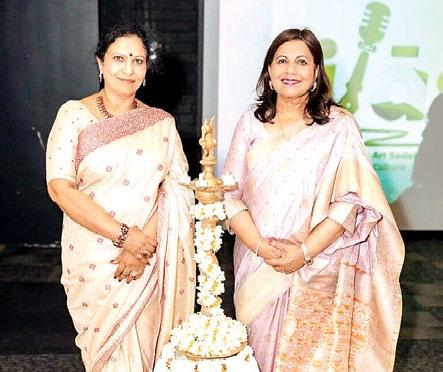
A review of ILASA’s anthology of short stories Home Across The Horizons (2026), by RAJNI ANAND LUTHRA.
ILASA wrote: Thank you for this comprehensive review published by the Indian Literary & Art Society of Australia. It’s a remarkable effort to read all 32 stories, analyse them so deeply and thoughtfully placing them into various categories. Congratulations to all the authors - new and old, shy and bold. Well done, team ILASA.
Anu Shivram wrote: The review in Indian Link feels like the final nod of approval! Thank you for identifying, supporting and nurturing the creative endeavours in the community.
Uma Srinavasan wrote: It was a privilege to write one small story ‘The Tranquebar Connection’ for this anthology - Home Across the Horizon - adding a speck to the space we perceive as home that spreads across the horizon. Rekha Rajvanshi wrote: Thank you for this detailed review, and for encouraging our writers.
Sharon Rundle wrote: Congratulations to editor Anu Shivaram, and all the contributors. It’s an exceptional anthology - a great read.
Usha Salagame wrote: Beautiful review in the Indian Link. While the unifying theme of migration was the subtle thread linking the stories in the book, this write up brings that theme out and discusses its various aspects openly as a means of introducing the gist of each story.
Chakravarti Madhusudana wrote: Well done, Anuji. All that hard work and frustrations were worth it! Congratulations.
Indra Halder wrote: Brilliant article to celebrate our anthology. Let’s keep going. The more the readership, the better we have done.




THE HYMN AND THE BUGLE
On RAJNI ANAND LUTHRA’s Anzac Day note about the music that heals, remembers and unites.
Mala Mehta OAM wrote: Having grown up as an Army officer’s daughter and attending the Beating of the Retreat, I completely resonate with your feelings of The Last Post - the sound of the bugle has always been and will always remain deeply moving for me.
Poornima Menon wrote: Thank you for your post. Watching the Indian veterans’ contingent of which my husband is a part, marching in the Anzac Day parade to honour the participation of the Indian soldiers is a privilege.

‘BRO KNOWS BALL’: TONY BURKE’S FAVOURITE BOLLYWOOD FILMS
Because some questions matter just as much as politics… we had to ask the Federal Minister for the Arts Tony Burke the ultimate rapid-fire question: what are your favourite Bollywood films?
Hiitzmeshalini wrote: Unbelievable - he knows the dialogues too.
Pallavi Savant wrote: OMG, I wasn’t expecting Tony to rattle off Bollywood gems and dialogues.
Ria Stone Author wrote: SRK introduced me to the world of Indian movies including Lollywood, Kollywood, Tollywood and more. One of my favourite film directors is Guru Dutt.
Shaadisandmore_au wrote: He had me at “I’m a fan of Shah Rukh Khan.”
Hxsinx-1 wrote: I was about to scroll but then he said Shah Rukh Khan.
Sanu Kumar wrote: Thank you Minister of Immigration Tony Burke. I loved your interview (I follow your Facebook page for all updates.)
Kadam wrote: Did you hear that @farahkhankunder?
Justadilx wrote: He knows ball.
Somya Bahadur wrote: Om Shanti Om is my guilty pleasure, I don't think it's a great movie or a great script etc but I weirdly watch it over and over. On the political points (in this interview), no comments.
Jasmine Batra wrote: Good to see those making Australia India trade decisions curious about Indian culture and films. A movie recommendation for the minister Salaam Namaste also filmed in Australia.
Subrat Choudhury wrote: There was a time when Australia was a favoured backdrop for Bollywood storytelling. Films like Dil Chahta Hai and Salaam Namaste not only captured stunning landscapes but also strengthened cultural connections between India and Australia. This phase marked a unique moment of creative collaboration.
DJZaff wrote: @farahkahnkunder, you should watch this.
ShoeVow wrote: Bro’s got ball knowledge.
Nanda Gudban wrote: I need to see Om Shanti Om then.
Arshad _13_12 wrote: I heard Shah Rukh… I stopped.

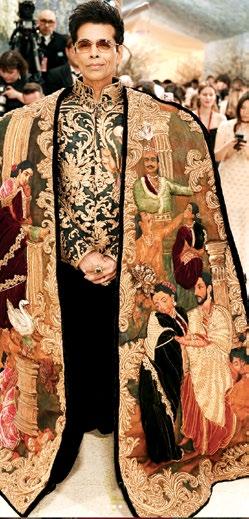
KARAN JOHAR, UNBUTTONED
It’s ‘Drama, Darling!’ when Karan takes Raja Ravi Verma to the Met Gala. Nisha JamVwal wrote: Each one a worthy ambassador of #India. Each one with a statement of their own.
Radhika Sunderaj wrote: Our Maharaja complex.
Rachel Sunila wrote: Looks more like a carpet.
Sarita Bamotra wrote: What’s done with these types of clothes after the show?
Luckyy Danny wrote: It's either a blanket or a carpet!
Ramsha Khan wrote: Absolute art...
Joseph Tino wrote: Nice carpet.
Vidya Kamath wrote: Why are they all carrying the weight of the world on their shoulders?
Terrence D’Mello wrote: Carpet.
Renu Mavar wrote: It would look nicer on someone with a better build and height, but still, what a stunning piece!
Racel Sunila wrote: Looks like a carpet to me.
Namita Rai wrote: It’s a carpet for the red carpet.
Ekta S Kothari wrote: If the jacket had zip he would look like a blazer with head in the blazer cover.
Anu Deo wrote: Indians saved the MET this year.
Meena Keshwani wrote: A walking carpet.
Jaya Giri wrote: Flying carpet – (in case of) flight cancellations.
Tanveer Ali wrote: Looking like Taj Mahal Pro Max.
Kaushik Ghoshal wrote: Lovely rug!
Shobhana Sethi wrote: What is the purpose of this event?
Sonya Sabharwal wrote: All are imitating the original king Diljit Dosanjh.
Nilanjan Biswas wrote: Curtain call.
Khyati Patel wrote: Oversized suit cover.
Daisy Nusrat wrote: Nice carpet.
Raj Ramsinghani wrote: Must’ve been cold in New York – so he brought his own comforter.
Nilofer Hanif wrote: Seriously?
GUESS THE MOVIE
A prince fell in love. An emperor saw a betrayal. A dancer paid the price. And a song became history.
Readers Manoj Narsey, Deepak Shah, Chris Mallika Bhadra, Rani RJ, Srinivasan Iyer, Divya Palsodkar, and Sunit Sethi guessed correctly: Mughal e Azam.
Get the best of Indian Link straight in your inbox. Scan the QR code to sign up to our weekly enewsletter

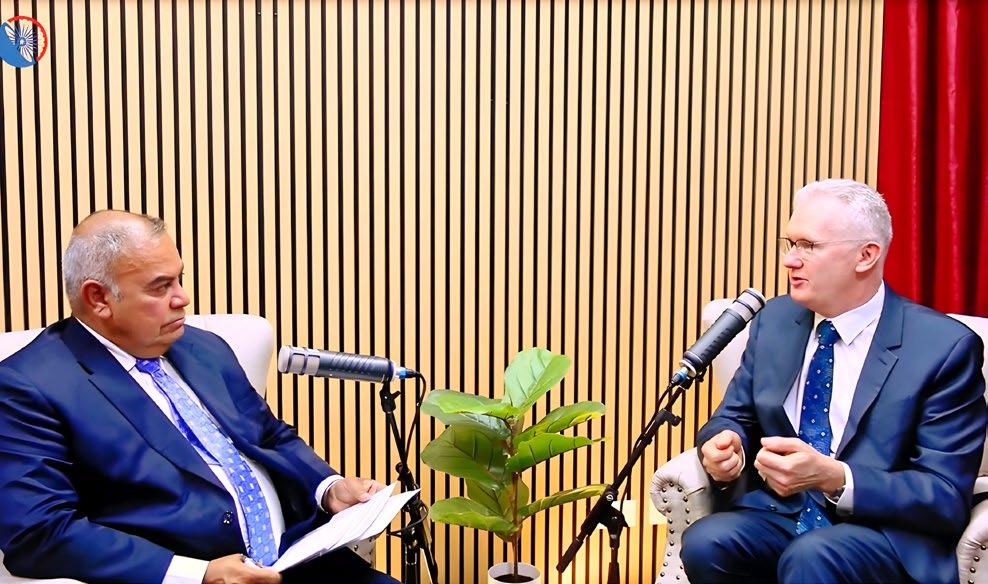
‘Immigration is the solution, not the problem’
As debate around migration intensifies, Minister for Immigration TONY
BURKE
speaks with PAWAN LUTHRA about rebuilding public trust and restoring the “social licence” for immigration.
Welcome to Indian Link and the Pawan Luthra Podcast, Minister.
It’s wonderful to finally be in your office. I’ve been following your publication for more than twenty years now and seeing them at different community events. But I haven’t been here before, so thank you for having me here.
It’s our pleasure to have you over here. Minister, you have been closely tied to the immigration portfolio for nearly 20 years. So, what’s actually changed, and what hasn’t, in Australia’s migration system over that time?
The first thing that’s happened, as an economy, we have needed to find the best skilled migrants more than ever before. Half of our doctors now are born overseas. Half of our registered nurses are born overseas. About a quarter of the tradespeople we need to build homes are born overseas. So effectively, we can’t run our health system or build the houses that we need without immigration now. And we have really geared up the targeting, and there’s still more that I want us to keep doing to make sure that we can get the best and the brightest, to fill those skills gaps.
Because so much of the economic strength of Australia relies on us having a really welltargeted immigration program. And can I say, in the time that story has happened, that we’ve needed the best and the brightest and more skilled immigrants, has been the exact time that we’ve seen the growth in the Indian community in Australia.
Right, but there have been calls recently to have a sharper focus on the number of migrants coming into this country. I recall between 2010 and 2013, when you served as Minister for Population initially under Prime Minister Rudd and then Prime Minister Gillard, the approach was to manage growth, not cut migration. If the original philosophy was that growth is inevitable and must be managed, what has changed? The philosophy itself, or the ability of the government to sustain that approach in the face of housing and infrastructure constraints?
So two things are true. The first is that, economically, we need immigration. We need the skills, we need the people. And culturally, we’re stronger because of it. But secondly, we also need to make sure that
the infrastructure and services are keeping pace as well. This is where the targeting has to be done really carefully.
So it is true that you need to make sure you are building enough houses for the people to deal with the housing shortage that we have. Getting the right immigrants is actually part of the solution, not necessarily part of the problem - in that, as I said before, about a quarter of the tradespeople that we need are born overseas. So to be able to build the houses and deal with the infrastructure, we need the targeting. But it is also true that we need to make sure migration is managed and it’s paced.
One of the things that really worries me about the current debate though, if you get into a world of just saying, effectively, ‘Immigration is bad,’ you get into casting suspicion on immigrants.
Obviously the Indian community has seen that be done in a really horrible way.
Then effectively it’s bad for economy, it’s bad for the cohesion of Australia. It’s not who we are, and it leads people to feeling, why is the country that I love questioning me?
Minister, you’ve been strongly critical of the migration policy released by Opposition Leader Angus Taylor. What specifically about it crosses the line for you? Is it bad politics or is it a bad policy?
There are two different aspects here. Some of it deals with claims. He will say, ‘We need to do this, we need to do that,’ and it’s things we already do. He’ll say, for example,‘We need a task force to bring together ASIO, the federal police, and Home Affairs.’ That is in fact what the Home Affairs portfolio is. It’s already there, already being done. He’ll talk about security checks, and we already have extraordinary security checks that take place.
I view immigration in terms of us getting the skills that we need. I think Angus Taylor is viewing it as trying to get the votes from One Nation that he needs. And that’s the lens that he’s applying to it.
Effectively, much of what he says is about getting Australians to blame each other. That’s an ugly, horrible thing to do, and I don’t think it’s the interests of Australia. Angus Taylor, on coming to the leadership, did two things very quickly.
First, he brought Jacinta Nampijinpa Price back to the front bench - the person who had specifically singled outmigrants from India.
And second, start this weaponising of immigration. And in particular, when he talks about immigration, to say that, one of the critical issues with respect to Bondi was immigration.
Now, of course, one of the two people was born here. The other, yes, he did migrate from India, but he migrated 30 years ago. But the, radicalisation of those two is something that had happened, you know, and it obviously will be argued back and forth in court. But anything about their radicalisation will be an argument about what happened in Australia. And to somehow blame that as being relevant to the immigration from India 30 years ago, was an ugly thing to do. And it was about effectively detonating an argument within Australia where communities, the IndianAustralian community, were going to suffer abuse and judgment from fellow Australians that they just don’t deserve.
Minister, polling shows that there’s record support for One Nation and there’s widespread concern that migration is too high. Do you believe this is just perception or a signal that current policy settings are not correct? The migration numbers always need to be tailored to where the country’s at and where the economy’s at, at different points in time. At the moment, we do have a significant housing shortage. So that is why I’ve been bringing the numbers down. I’ve been doing that in a measured, targeted way. Effectively, it’s now 45% lower than its peak.
What I will never do, is start this blame of immigrants. It’s on the government of the day to make sure that we’re tailoring the numbers to get the people we need to build the houses and build the infrastructure, but also to make sure the numbers don’t get too far beyond.
We’ve said to the universities, effectively, ‘You need to provide enough student housing. If you provide the housing, then you can have the students. If not then we’re not going to increase your numbers.’ And put a very real incentive between providing the housing and getting the students. That’s the way we need to do it.
But the way Angus Taylor has just blamed immigrants and used a narrative that very much singles out the Indian community in Australia, I think is ugly. In policy terms, it is wrong. You know, when you enter politics, you take on leadership positions, your reference point has to be Australia. Your reference point has to be, how do we build the best community here? And I don’t think for a minute that’s what he’s done.
How then does government rebuild public trust and restore the ‘social licence’ for migration?
Part of that is why I’m here now - to make sure that people know how strict the security checks are, and how targeted our processes are, but also how important immigration is to the economy.
There is not a single hospital that you could run in Australia without people who are on visas. Not one. Aged care, our elderly effectively don’t have the care they need without our immigration system. And yes, we do have a housing shortage but unless we get the skills we need to build the
houses, we will continue to have a housing shortage.
A big part of this is explaining, and me doing interview after interview, which is why I’m here, explaining to people that when they talk about problems with infrastructure not keeping up, they are right. We don’t deny that there is a housing shortage, infrastructure is behind, but then to explain that immigration is part of the answer to that. If we were to stop migration, if we were to single out the Indian community of all communities, which has so many highly trained people coming to Australia, would be to simply hurt Australia, not protect it.
Minister, I’m going to go a bit macro now. In 2023, respected bureaucrat Martin Parkinson delivered a review of the migration system. It said the system isn’t failing because of numbers, it’s failing because it’s poorly designed. Parkinson said that it’s overly reliant on temporary visas. Now, what concrete actions have been taken? And this does affect the Indian community because a number of them are on temporary visas. So what concrete actions have been taken to reduce the number of people stuck in permanently temporary status? So there’s a few changes (needed); some things we’ve already done and some things we’re continuing to look at. If I start with the values that I’m trying to bring to this debate, first of all, there are lots of countries that have effectively part of their economy as guest workers who will never become citizens. I don’t believe that should be the model for Australia. I believe that people who are still here, people who are going to continue to be here and are working here, should have an opportunity to become fully part of Australia’s democracy. There was a lot of publicity at the start of last year when I was holding very large citizenship ceremonies and people like the Liberal Party were very angry with me for doing it.
Are they ever happy with you?
That’s probably part of the deal, it’s true. But for me, those citizenship ceremonies are the most patriotic events you can have. They are events where we have people who have chosen us.
Tell us about a special memory you have from one of these citizenship ceremonies.
Well, can I tell you a special memory from all of the citizenship ceremonies? ‘Cause it’s something that happens almost every time now. I read out the list - I’ve always got a record of the youngest person becoming a citizen (and sometimes they’re as young as a few months old); who the oldest person is (and I’ve had 90-year-olds), and usually, the people who’ve waited the longest. (I’ve had people who’ve waited more than 60 years in Australia before they become citizens. Almost always they’re from the UK. Almost always.) I then go through the country from where they’ve got here, and people will put their hands up or call out. I get to India, and the cheer is always the loudest. And there’s just this complete sense of celebration from everybody - that their whole migration journey, the final step, is now about 15 minutes away. And the final thing I say to them after I’ve made them citizens is, ‘Welcome home.’
I want that to be real. I don’t want people to become citizens and then feel that Australian politicians are going to keep judging as to whether they’re real Australians.
Have you ever thought about getting them to change their cricket T-shirts from blue to green and gold?
I know from my own Irish heritage, people have a natural affiliation, even generations on, to the country of their heritage. That’s a beautiful thing. That doesn’t detract from their loyalty to Australia.
Minister, getting back to the Parkinson Review, it also found issues with skilled migration, which is failing to match skilled migrants to appropriate jobs. It’s still a bottleneck for migrants. There are skilled migrants already here who are underemployed or extremely frustrated. How is your department fixing this issue? There are two ways that people come with skills. If you come as the main applicant for skilled migration, then it’s always the case that your skills have already been recognised, and you’ll be fully recognised on arrival. But what happens is often the whole family will come across, and there’ll be other family members with skills that have not yet been recognised. What we’re trying to do, is to work out how we can have as many short courses as possible to increase the recognition.
Government’s not in charge of the recognition systems – they are managed by individual professional associations, and some of that goes through the states as well. But what we’ve been able to do is to say, okay, for people who have skills that aren’t recognised, rather than having to completely do the whole course again, are short courses where they can sometimes skill up for something that is within their area of expertise even if it’s not exactly what they’ve done. For example, we have people in hospitals now doing work in pathology. That’s a much better outcome (than driving an Uber).
Some of it is also dealing with the professional organisations and just encouraging them to be more sensible. Obviously we don’t want them to drop their standards. We just want them to be able to recognise where they can and if there are bridging courses to provide them.
Again, going back to Dr. Parkinson’s review, it said the migration policy is too reactive and lacks a long-term strategy. So is there a clear publicly defined plan that links migration levels to housing, infrastructure, and workforce needs? So that is what we’re increasingly doing, and the first step we did on that was with student visas, with what I explained before with the universities.
There is one challenge with long-term planning that we always need to remember. And that’s that migration numbers are not only affected by Visa holders, they’re also affected by Australian citizens going back and forth or NewZealanders who are allowed to move back and forth under a treaty arrangement.
Tell us about the spike after COVID. The numbers did get too high off the back of COVID.
Now that was for a logical reason. A whole lot of people come back after
COVID. No one’s on a visa that’s about to expire. And we have a peak in the numbers. We needed to get that down.
And as I say, it’s now 45% lower than what it was. That did need to happen and we do need to keep moderating it down. But what we mustn’t do, is just attack the numbers, or attack public confidence in immigration.
Because if we go down that path, the people who will lose will be every single person in Australia who’s looking for a doctor, who wants to go to a hospital, who has a relative needing aged care, who’s wanting to live in a home and needs someone to build it, who’s needing a renovation, who’s needing wanting to be able to have the infrastructure to make life good in Australia. All of those things rely on immigration as well.
Minister, what would you say to the young kid on the train, who has just been harassed and told to “go back to where you came from”?
First of all, we need leaders to say what the prime minister would say, and what I say all the time, and what I’m about to say again on your program. The person who says that, the loud, angry voice, does not represent modern Australia. And the person who’s receiving it, you are part of modern Australia. You are welcome here. You are at home.
Before we conclude, a question on values and your legacy as a minister. If you could change one public perception about migrants overnight, what would it be, and why?
I wish we were better at walking in each other’s shoes. One of the things that’s happened with social media is people tend to see things that they agree with, and views can become increasingly extreme in that sort of context.
If I could change one thing, it would be for us to get back to where we were not that long ago, where we had a better capacity to be curious and to understand the experience of others. I think right at the moment, and this is happening all around the world, people are finding it more difficult to walk in each other’s shoes. (We need to) help people to get back to a situation of empathy, of understanding each other, of understanding each other’s experiences. It is a great miracle of Australia that we, for a long time, have been a country where people from around the world arrive, often with one suitcase but it’s a suitcase full of dreams, and when they come here, they bring all their skills, they bring people they love and they leave hatreds behind. But what we need to make sure is, it’s not just the immigrant doing that. It’s also those who were born here, who are already here, that we need that same level of generosity from, and curiosity, and understanding of each other.

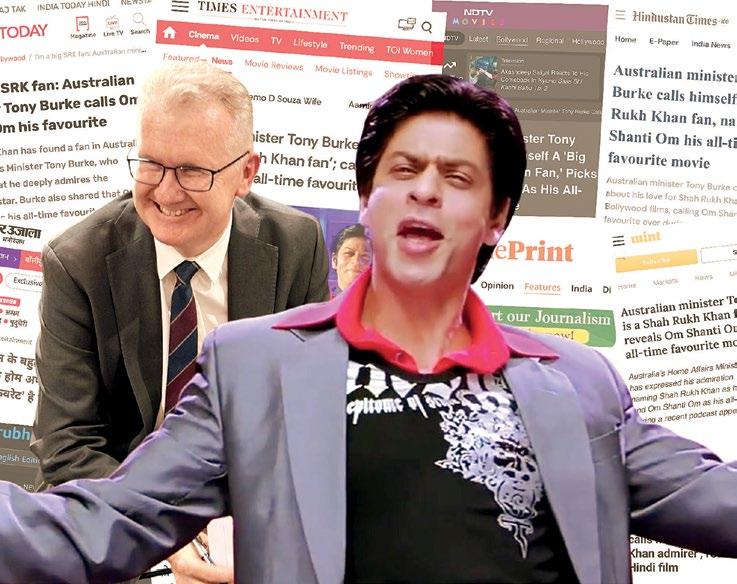
Tony Burke came to talk visas but gave us viral SRK moment
When Australia's Minister for Home Affairs forgot about policy for a moment, reaching out for Shah Rukh Khan instead

TBY TORRSHA SEN
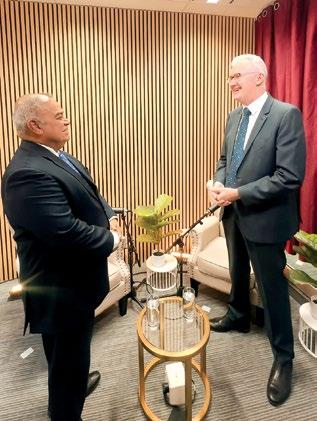
here are interviews you prepare for, and then there are the moments inside those interviews that you cannot prepare for. We had both in the same sitting, during the latest episode of the Pawan Luthra Podcast. When Tony Burke walked into the Indian Link studio, he carried the full weight of his portfolio with him.
Minister for Home Affairs, Minister for Immigration and Citizenship, Minister for Cyber Security, Minister for the Arts, Leader of the House – he’s one the most consequential figures in the current Australian cabinet.
In conversation with host Pawan Luthra before the interview began, the Minister recalled his visits to India, including an invitation to the Mumbai home of actor Shah Rukh Khan.
But the conversation ahead was set to centre on immigration – the issue of
the day.
Pawan had already lined up the questions that mattered. The conversation was going to be heavy, and it was. Until it wasn’t.
It was somewhere near the end of the recording when Pawan shifted gears, as he often does with guests, steering the conversation toward something warmer and less scripted. He asked Burke, in his capacity as Minster for the Arts, about Indian cinema. There was a pause that followed. Not a politician’s pause, but the pause of a person deciding how honest to be.
“I am a massive Shah Rukh Khan fan,” Burke began, “so let me start with that. And I love AR Rahman’s soundtracks as well.” There was something almost relieved in the way he said it, as though he had been waiting for the right room to admit this in. This was not a man performing cultural appreciation for a diaspora audience. This was someone who had, at some point in his private life, sat with these films and let them matter to him.
The Minister went on to speak about Chak De! India (2007), a hockey drama
resharing it into loops (garnering 371K views till we went to press).
And before we knew it, Indian media houses were all over it, lifting it, sharing it, clipping it: NDTV, Hindustan Times, India Today, Times of India, The Print, Zoom TV, Live Mint, Times Now, WION News, Aaj Tak, Amar Ujala, Mathrubhumi.
Not bad for a question that was lastminute, hesitantly asked, and nearly cut from the interview entirely. It landed us record views across platforms, a repost from AR Rahman, one from Farah Khan, and a dignified silence from Shah Rukh (characteristic of him, but the Minister would have been thrilled).
The comments on social media came in thick and fast.
n “He had me at “I’m a fan of Shah Rukh Khan”
n Omg I was not expecting Tony to rattle off Bollywood gems and dialogues! I’m biased I LOVE Om Shanti Om!
n I was about to scroll but then he said Shah Rukh Khan.
And then came the conversations underneath, the ones that always seem to find Shah Rukh Khan eventually.
I’ll say it again, Shah Rukh Khan is the face of Indian cinema, arguably the most famous Indian alive today. You can run all the negative PR you want, but you can’t erase what he has built. The GOAT of Indian cinema Shah Rukh Khan.
Shah Rukh’s name rising this visibly in global discourse had fans noting, not unkindly but firmly, that even Ranveer Singh’s barnstorming run with Dhurandhar (2025-26) had not yet placed him in the kind of cultural conversation where a foreign minister reaches for his films unprompted, in a moment of genuine feeling, years after release.
Minister Burke had come in to talk about migration. He left having wandered elsewhere – into cinema, memory, and the lines we carry when the moment turns difficult. He stepped out of our offices lighter than when he arrived. That, perhaps, is what Shah Rukh Khan tends to do to people.
filmed in Sydney, Melbourne, and Brisbane; Lagaan (2001), and Jodha Akhbar (2008).
But he saved the best for the end. “The last one I want to mention isn’t just my favourite Bollywood film, it’s my favourite film of all time – Om Shanti Om.”
And then he spoke about that line from the film: “If it’s not happy, it’s not the end, the story is not over yet. It’s a line that feels particularly alive right now, given the world is in such a difficult place.”
A senior government minister, sitting across from us, citing the philosophy of a Farah Khan production, was not what we had expected from the afternoon.
Here was a man who holds the Arts portfolio for an entire nation, who understands at a structural level what culture does to a community and why it endures. And yet his relationship with these films was not administrative. It was personal in the way that only unplanned love can be. No one had briefed him to love Om Shanti Om. He had arrived there on his own.
The clip went viral before the episode had even properly settled, with fan pages
Meanwhile in Australia, news.com.au picked up the interview on 2 May, paraphrasing the wider conversation, which had primarily focused on immigration.
On 7 May, Sustainable Population Australia referenced the interview in a press release titled: “Tony Burke’s push to convert up to 3 million temporary visa holders to permanent resident status undermines ecological limits, liveability, and quality of life for all Australians,” which was widely reposted on social media.
A day later, AFP Fact Check debunked claims circulating online that Tony Burke had announced plans to grant citizenship to all temporary visa holders in Australia during The Pawan Luthra Podcast.

Scan this QR code to see the Minister Tony Burke talk about this favourite Indian films

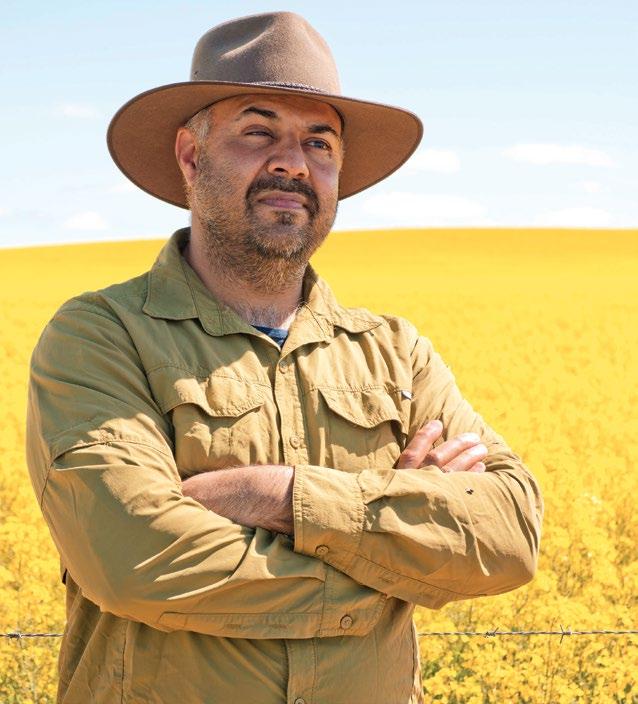

GrainSupp: An Aussie boost for Indian farmers
An Australian-built AI–blockchain tool is being adapted to bring transparency, trust, and better prices to Indian farmers

WBY PRUTHA CHAKRABORTY
hen Professor Harpinder Sandhu and his research team at Federation University Australia set out to build GrainSupp, they were not thinking about India.
The goal was simpler, and far more urgent in Australia’s context: fix the broken visibility in grain supply chains.
But what began as an Australian solution to trace grain from paddock to port is now being adopted for one of the world’s most complex agricultural ecosystems – India.
What is GrainSupp3.0?
GrainSupp3.0 is a digital traceability system that fuses blockchain and artificial intelligence to create a tamper-proof identity for every grain batch.
“It tracks grain from farm to consumer by combining blockchain record-keeping with AI-enabled capture of policy and
regulatory requirements across the supply chain,” explains Sandhu, an agricultural scientist.
At the farm level, every detail – from crop type and inputs to harvest conditions – is recorded and verified. Once validated, it is time-stamped and stored on a blockchain ledger, creating what Sandhu describes as a “trusted digital identity for each grain batch”.
As the grain moves through storage,
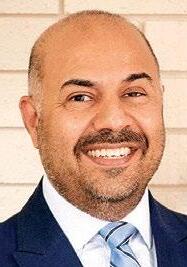
processing, and export, every transaction and quality check is added. AI flags anomalies, while blockchain ensures the record cannot be altered.
GrainSupp was built for Australia to address a key gap – fragmented, paperbased systems that fail once grain leaves the farm.
“GrainSupp was created to address a gap in Australia’s grain supply chains where verified farm-level quality, provenance,
“GrainSupp tracks grain from farm to consumer by combining blockchain record-keeping with AI-enabled capture of policy and regulatory requirements across the supply chain.”
and compliance data could not be reliably preserved and shared beyond the farm gate,” Sandhu tells Indian Link.
That gap becomes even more critical as export markets demand proof – not just of quality, but of origin, sustainability, and safety. Traditional systems, he notes, simply are not equipped.
It is this mismatch between demand and documentation that has now pushed GrainSupp towards India.
“The decision to take GrainSupp to India was triggered by a convergence of strategic, market, and policy factors,” he shares.
All roads lead to India
India’s agriculture, while globally significant, is marred by fragmentation, informal transactions, and inconsistent quality verification. At the same time, the country is rapidly digitising its agri systems, creating what Sandhu sees as a timely opportunity.
“GrainSupp3.0 delivers trusted, low-cost traceability suited to smallholder dominated systems,” he adds. “The timing is further shaped by strengthening Australia-India trade relations under ECTA and growing demand for transparent, verifiable supply chains for grains, pulses, and value added products. Support through the Maitri Grant Program of the Centre for AustraliaIndia Relations has also enabled deeper collaboration, making India a logical next market to adapt and scale GrainSupp beyond its Australian origins.”
To adapt, Sandhu’s team is removing complexity out of the system.
“GrainSupp is being modified… by prioritising simplicity, affordability, and inclusion,” he says.
In practice, that means farmers will not interact with the technology directly. Instead, engagement will flow through Farmer Producer Organisations (FPOs) and Farmer Producer Companies (FPCs), avoiding the need for individual digital onboarding or new infrastructure.
This intermediary-led model is key to scaling in India, where digital literacy and connectivity vary widely.
Small solution, big problem
The impact, Sandhu feels, will be significant.
By enabling verified traceability, GrainSupp could allow Indian farmers to move beyond anonymous bulk selling and into premium, certified markets.
“GrainSupp3.0 can help Indian farmers secure better prices and stronger bargaining power by enabling verified access to premium domestic and export markets,” Sandhu informs.
He, however, feels the biggest hurdles in implementing GrainSupp in India are not technological.
“The biggest barriers… are institutional and behavioural,” Sandhu points.
India’s multiple overlapping systems –mandis, procurement networks, traders, and cooperatives – make coordination difficult. Equally challenging is trust: convincing stakeholders to adopt a system that changes long-standing trade practices.
Still, Sandhu is hopeful, and feels that this model can open doors for other Australian AgTech innovations to India.
“Yes, this project can serve as a practical model for exporting other Australian AgTech innovations to India,” he says.
Keeping it fresh
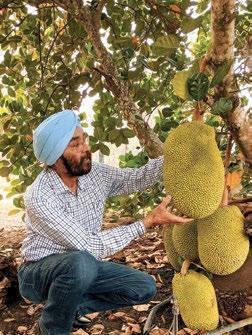
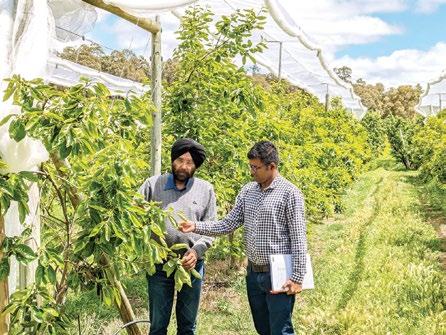
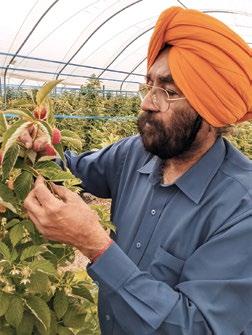
Agricultural scientist Prof Zora Singh of WA’s Edith Cowan University takes home the ‘Outstanding International Horticulturist’ Award for his work in reducing produce waste

O“BY HARSHENI MANIARASAN
ne third of the food we produce,” Professor Zora Singh observes, “never reaches a human’s mouth.”
“This equates to 1.3 billion tonnes a year of unconsumed produce.”
Added to this is the greenhouse gas emissions – some 3.3 billion tonnes of it –that the wasted food produces.
Fortunately, Prof Singh says, up to 60% of this wastage can be reduced if we handle our agricultural produce appropriately.
A Foundation Professor in Horticultural Science at WA’s Edith Cowan University, Prof Singh’s particular expertise is postharvest physiology of fresh produce.
Post-harvest science is the study of what happens to produce after it is harvested, all the way from the farm to the consumer. It focuses on steps like cleaning, cooling, sorting, and packing to keep produce fresh, high quality, and suitable for sale, as it naturally starts to deteriorate once it is separated from the plant.
For his work in developing innovative production and post-harvest technologies to reduce horticultural losses, Prof Singh was honoured this month with the Outstanding International Horticulturist Award by the American Society for Horticultural Science.
He is the first Australian to receive the honour, one of the highest within the worldwide horticulture industry. It recognises Prof Singh’s 30-year career across intensive research, education and global industry collaborations.
Early years
Trained at India’s leading agricultural institution, Punjab Agricultural University in Ludhiana, Prof Singh’s ties to agriculture began in a farming family in the region known as the “breadbasket of India”. The northern state of Punjab may be renowned
To
overcome the challenge of export mangoes surviving sea journey, Prof Singh developed a controlled atmosphere storage technology that lowers oxygen, increases carbon dioxide, and stores fruit at 13°C with 90% humidity. This extended mango shelf life to six weeks, making commercial sea freight viable.
for its production of wheat, rice and maize –but it was fruit, vegetables and flowers that captivated the young Zora. At university, he studied horticultural science, ultimately completing a PhD in mango malformation.
“My work was based on reducing the problem of malformation to increase the yield and profitability for the growers.”
Moving on from mangoes, it was apples and pears for his postdoctoral work in the UK (at the International Horticulture Research Institute at East Malling). Back at his alma mater as Assistant Professor of Horticulture, he returned to his favourite fruit mango, but also studied citrus fruits and other crops.
Following his migration to Australia, Prof Singh dedicated some time to working on bananas. “I investigated a banana disease caused by cucumber mosaic virus (CMV), developing a molecular technique to identify the virus and subsequently refining it to determine which CMV subgroup was responsible for the infection.”
What causes postharvest loss?
Post-harvest loss (PHL) refers to the measurable reduction in quantity and quality of produce between the phases of harvest and consumption.
“There are multiple causes for this,” Prof Singh clarifies. “For example, storing
temperatures – if you store fruit at a temperature too low, it will cause a chilling injury or a freeze injury. Alternatively, if the temperature is too high, you will fail to extend the shelf life and maintain the fruit’s quality.”
Growth and developmental issues along with metabolic changes also contribute.
Post-harvest deterioration is often linked to the living nature of horticultural produce. Respiration, ethylene production, water loss and microbial activity continue after harvest, affecting both quality and marketability.
“Ethylene, a hormone which induces fruit ripening, is being used commercially on a vast scale, on produce such as bananas, avocados, tomatoes and oranges. However, as the saying goes, there are two sides to a coin; ethylene shortens the shelf life. If we dissect the losses, I’d say about 40% alone are caused by ethylene. The usage of ethylene in fruit production majorly contributes to shorter storage lives and food losses.”
There are also instances of post-harvest diseases affecting the produce, causing them to begin rotting. It is no surprise that post-harvest management poses a critical challenge.
How to prevent post-harvest loss
A major step, Prof Singh states, would be to manage ethylene usage. “In my last 15 years
of work, in collaboration with an organic chemist from my previous university, we developed two compounds that antagonise ethylene action. So, when we fumigate the fruits with these ethylene antagonists, the ethylene cannot touch it, whether it comes from inside the fruit or externally.”
Transforming global agricultural trade, Prof Singh has championed the shift from air freight to sea freight for Australian mango exports. Previously, mangoes sent to destinations such as Dubai and London relied on expensive and limited air cargo space, costing growers about $17.50 per tray and restricting export volumes.
To overcome the challenge of mangoes surviving the three-and-a-half-week sea journey, Prof Singh developed a controlled atmosphere storage technology that lowers oxygen, increases carbon dioxide, and stores fruit at 13°C with 90% humidity. The innovation extended mango shelf life to more than six weeks, making commercial sea freight viable.
The impact has been significant. Freight costs have dropped to around $2.20 per tray – nearly 75% lower – while sea freight also offers environmental benefits through reduced fuel use. The technology has already replaced air freight for Kensington Pride and R2E2 mangoes, with work underway for a third major variety in the Northern Territory.
As Prof Singh puts it, the shift is both commercially and environmentally beneficial, improving Australia’s competitiveness as compared to Asian markets, while making exports more sustainable.
The professor’s ultimate aim – to reduce the 30-40% of post-harvest losses and to support food and nutritional security – is particularly relevant in current times when one in 11 people will go hungry every day, especially as conflict – the leading cause of hunger – continues unabated.
Projecting forward, Prof Singh concludes, “The world’s population, currently 8 billion, is expected to reach 10 billion by 2050. We’re going to have to increase the availability of food to the growing population.”

AirTrunk’s India push shows where Australia’s next tech opportunity lies
A multi-billion dollar bet on India’s data centre boom highlights the scale of opportunity beyond Australia’s borders. Are more Australian companies prepared to follow?

ABY NIKHIL KULKARNI
ustralian data centre giant AirTrunk’s $7 billion push into India is being seen as a major expansion into one of the world’s fastest-growing markets. It is an early signal of where the next layer of global technology infrastructure is being built, and a signal for other Australian companies to take note and move with urgency.
What’s unfolding in India is not just another growth story. India is positioning itself as a serious player in AI infrastructure, emerging as a third major region alongside the United States and China. Data centre capacity, typically measured in megawatts of power, is expected to grow from around 1.5 gigawatts in 2025 to close to 10 gigawatts by 2030, based on Deloitte estimates. This expansion is being backed by unprecedented capital commitments, with industry and government collectively targeting more than US$200 billion in AI infrastructure investment over the coming years.
That scale is already attracting large-scale global capital and partnerships. Google has committed US$15 billion towards AI and digital infrastructure in India over the rest of the decade, while Amazon Web Services (AWS) has announced plans to invest US$12.7 billion in cloud
infrastructure over a similar timeframe.
OpenAI is partnering with the multi-billion dollar Indian conglomerate Tata Group to develop 100 megawatts of AI capacity, with plans to scale to 1 gigawatt. In practice, this means build-out of large-scale data centre campuses, supported by dedicated power, advanced cooling and the high-speed connectivity required to run AI workloads at scale.
This is exactly where the opportunity lies for Australian companies. The buildout of AI infrastructure at this scale requires capabilities that go well beyond the construction of data centres. It involves reliable power systems, advanced cooling, high-speed connectivity and the operational expertise needed to run large-scale infrastructure efficiently and securely.
These are areas where Australian

capability is well established. From infrastructure investment and project delivery to renewable energy integration and enterprise-grade systems, Australian firms have experience operating at global standards. This combination of capabilities is critical to delivering and operating AI infrastructure at scale.
If that opportunity is to be realised, it will require a shift in how Australian companies engage with India. Three priorities stand out.
First, move beyond exporting services and establish a long-term presence in India. This means partnering with local players that are already committing significant capital to AI infrastructure, including large industrial and energy groups building integrated data centre platforms. Joint ventures, coinvestment and on-the-ground teams will be critical to navigating the market and participating meaningfully in the build-out.
Second, leverage Australia’s strength in energy and sustainability. As AI infrastructure scales, energy is emerging as the primary constraint globally. India’s approach is already integrating data centre expansion with renewable energy and longterm power strategies. Australian expertise in renewable integration, energy efficiency and grid management positions its companies well to contribute to the development of sustainable AI infrastructure at scale. Third, make better use of policy and institutional pathways to support commercial engagement. India’s push into AI infrastructure is being driven not just by private capital, but by coordinated national ambition, reflected in large-scale investment commitments and government-led initiatives. Engaging through bilateral forums, industry platforms and channels such as Austrade and DFAT can help Australian firms build relationships, navigate regulatory environments and position themselves early in the market.
AirTrunk’s move is an early signal of where this is heading. The larger question is whether more Australian companies are prepared to follow with the same level of conviction. The build-out of AI infrastructure will define the next phase of the global technology economy. The opportunity for Australia is real, but it will not remain open indefinitely. The time to act is now.
Rather than seeing India only as an export destination, Australian firms have opportunity now to participate directly in building AI infrastructure - especially in areas where they already have strengths:
• renewable energy integration
• power and grid management
• infrastructure investment and delivery
• advanced cooling systems
• enterprise-scale operations.
Robin Khuda, billionaire founder and CEO of data centre company AirTrunk
Photo: Canva

Why are over 20,000 migrant teachers underutilised?
With schools struggling to fill vacancies, our migrant teachers might hold the solutions, writes SUN YEE YIP
Australia needs more teachers. It ranks among the worstperforming countries in the OECD for teacher shortages. This is particularly so for public schools.
As of December 2025, there was a reported shortfall of 2,600 teachers in Victoria and NSW alone.
A 2024 Australian Education Union survey of 953 primary and secondary schools also found almost 83% were experiencing teacher shortages. Many were relying on merged classes, relief staff and teachers taking on extra duties simply to keep operating.
State and federal governments have acknowledged the shortage, and have a national plan to improve the situation.
Yet while schools continue to struggle to fill vacancies, Australia has access to an untapped teaching workforce. But it is not using it.
Thousands of qualified migrant teachers already living here are not fully employed in the profession. What’s going on?
A broader skills recognition problem
A migrant teacher is one who did their teaching qualifications in another country before coming to Australia to live.
Migrant teachers currently make up about 6% of the overall teaching workforce in Australia. But there are an estimated 20,590 qualified migrant teachers who are not working in schools at all or who are underemployed (not working as much as they want).
This is part of a broader national problem. Policymakers have long warned Australia is failing to make full use of migrant skills. Former Treasury secretary Ken Henry recently argued that many
migrants are working in jobs well below their qualifications, weakening productivity and leaving workforce shortages unresolved.
It is estimated 44% of Australia’s skilled migrants are employed below their skill level.
An uncertain process
For teachers trained overseas, entering the profession in Australia is often a long and uncertain process.
The entire process, from initial document preparation to final approval, can take several months. Sometimes, if a migrant needs to do more study to meet Australian standards, it can take up to two years.
Most begin by having their qualifications assessed by the national teaching institute to see if they fit with Australia’s teaching standards. They may also need to meet English language proficiency requirements, even when they have taught for years in English-speaking settings.
They must then register through a state or territory teacher regulatory authority. Because education is governed separately across jurisdictions, rules and processes can vary. Most states and territories require a minimum of four years of fulltime tertiary training and a minimum of 45 days of supervised teaching. But specific requirements for Working with Children Checks, police checks and documentation vary significantly by jurisdiction and employer.
The pathway can be expensive. It may involve translating documents, verifying transcripts and sitting English tests multiple times to meet the score required if one’s teacher qualifications are not from Australia, New Zealand, the United Kingdom, United States, Canada or Ireland.
Teachers trained overseas who hold a three-year teaching degree often need to undertake further study or bridging program

to address regulatory gaps and satisfy registration requirements.
What happens next?
Even for migrant teachers who successfully gain registration, barriers often remain.
My research with migrant teachers in Australia shows many arrive with years of experience, strong subject expertise and a deep commitment to teaching. Yet they are often treated as newcomers with deficits rather than professionals with valuable expertise.
Some describe years of waiting, repeated applications and being told they lack “local experience”.
Others reportbeing overlooked because of their accent, unfamiliar names or assumptions about classroom fit.
Years of overseas teaching are frequently discounted, forcing experienced educators to start again at lower levels or in casual roles. Some eventually leave teaching altogether.
This is a significant loss. Not only can these teachers fill vacant positions, they can bring many benefits. They have linguistic resources, intercultural knowledge and global experience that can strengthen schools and better reflect increasingly diverse student communities.
What needs to change for migrant teachers
To boost migrant teachers in Australia, we can make several changes.
First, we can make the recognition of qualifications faster, clearer and more nationally consistent.
Second, targeted transition programs by state education departments or registration bodies could help teachers understand Australia’s curriculum requirements, classroom expectations and local systems without unnecessary formal retraining through universities.
Third, overseas teaching experience should count more meaningfully in salary placement, hiring and promotion.
Fourth, schools should review recruitment practices for bias and better recognise international experience, multilingual capability and cultural knowledge.
Finally, once they are employed, migrant teachers should have proper mentoring and clear career pathways so they can stay and thrive in the profession.
The writer is a Lecturer in Teacher Education, Monash University. This article first appeared in The Conversation, and has been republished under a Creative Commons licence.
Not only can migrant teachers fill vacant positions, they can bring many benefits. They have linguistic resources, intercultural knowledge and global experience that can strengthen schools and better reflect increasingly diverse student communities.
Photo: Canva
A tale of two Little Indias

LBY LAKSHMI GANAPATHY
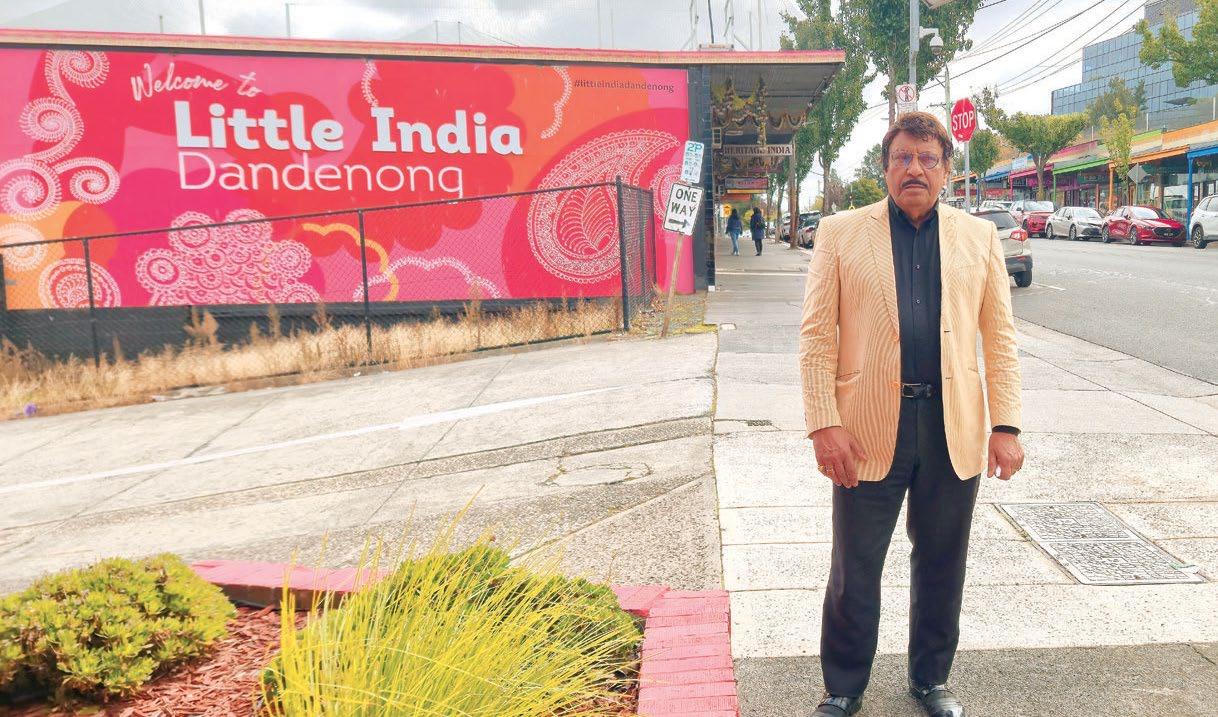
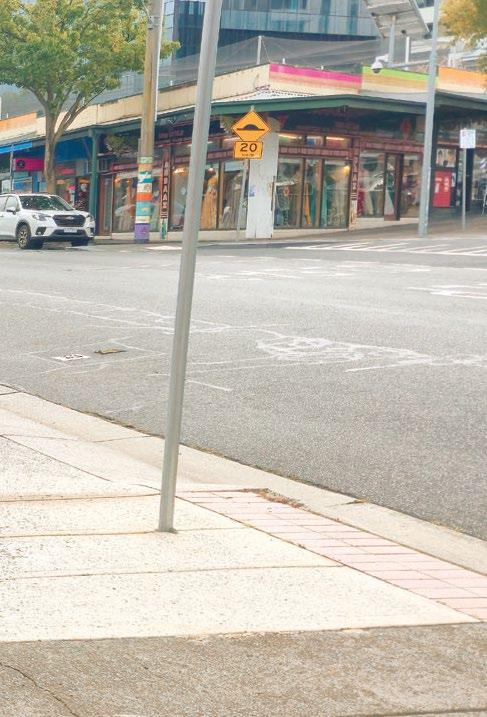
ittle India in Dandenong has seen better days. Despite being Saturday afternoon, the place is a ghost town, nary a window shopper in sight. The once vivid shopfronts now appear exhausted, the aroma of masala and agarbathi masked by the fumes of passing cars. Plastic floral garlands hang raggedly from the rafters, muddy and tattered.
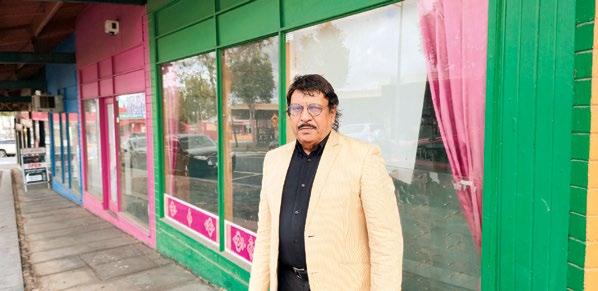
Steve Khan, Vice-President of the Little India Traders Association, and shop owner since 1994, still remembers the golden days of the precinct.
“This was [bigger] than Blacktown [in NSW], once upon a time. There used to be people everywhere,” he recalls.
“It was a second home.”
So why is Dandenong’s Little India in such disrepair?
“People have lost interest because it's going to be demolished –they’re surprised to hear we’re still here.”
Khan is referring to Development Victoria’s 16-year plan to revitalise the area, which has loomed over traders since 2014. Titled ‘Revitalising Central Dandenong’, it could see small businesses like Khan’s Shalimar café potentially replaced by a supermarket chain, high-rise apartments or a cinema within a refreshed Little India precinct.
Though those behind the plan have promised they ‘don’t want to see Little
India disappear’, it’s hard to imagine how the rustic charm of these family-owned businesses might survive within the sleek multi-story build proposed.
With Khan describing developer-trader consultations as ‘minimal’, the plan has left them sitting in limbo for over a decade. Khan says a clause in their leasing agreement even allows developers to evict traders with no compensation.
“This development, high-rise buildings and all, would be an attraction for (new businesses). What’s in these things for me?” says Khan about the plan.
“It’s just the government making things; it will be a symbolic thing with no feel of Indian atmosphere.”
Ironically, about 34 kilometres away, something analogous is unfolding.
As part of their Draft Budget for 202627, the City of Melbourne have allocated $1.2 million towards building a Little India precinct in Docklands.
Reception to this proposal has been negative, with most responses to the draft budget questioning, amongst other things, the choice of location and seemingly topdown delivery.
Is this poetic coincidence or something more?
The Docklands Debate
With around 13 percent of Docklands’ residents being Indian born, City of Melbourne Councillor Philip Le Liu says the harbourside region was chosen for Little India not only due to diaspora presence, but its centrality.
“It’s easier to put it in a place where it’s kind of neutral. Everyone comes to the city, cities belong to everyone,” Cr Le Liu says. “We are probably the better location… more logically we could be a better curated one. That's not to say the Little India in Dandenong is not worthwhile.”
But many see the Wyndham or Casey areas as more obvious fits for a Little India precinct, the two municipalities home to the largest shares of Victoria’s Indian population. Steve Khan is equally unconvinced about the choice of location for the new precinct.
“I don't know how many people would be interested; having a business in Docklands would be expensive compared to Werribee or Tarneit,” he notes.
“They might go there for entertainment, but I don't think it would flourish as much as [something in] Tarneit, Truganina or Clyde.”
Professor Nikos Papastergiadis, former director of Melbourne University’s research unit in Public Cultures, says cultural connection to an area is essential for building a successful multicultural precinct.
“Traditionally, ethnic communities, like the Italians on Lygon Street or the Greeks on Lonsdale Street, were formed because entrepreneurs, social services and communities were proximate to each other,” he explains.
“It’s that idea of clustering, where because it's convenient, people gather, and therefore services and shops also develop a certain concentration that enables them to then belatedly establish an identity.”
Professor Papastergiadis is skeptical of whether these conditions have been fulfilled in Docklands.
“I'm not sure there is a bottom-up services and commercial drive and community clustering that's been formed [here],” he notes.
“I understand there are some young Indian professionals and international students living in the area. But it's not clear to me they are driving this new precinct. You then start speculating, as I must, since I don't know the story of its formation, as to what is motivating its existence.”
Among the bigger blights to the proposal are previous failed attempts to retrofit the disastrously planned Docklands area. A suburb described as a ‘soulless wind tunnel’,

Steve Khan, Vice President of the Little India Traders Association
Councillor Philip Le Liu
Image: Andrew Campbell
Photo: Lakshmi Ganapathy
Indias
Docklands is infamous for its concreteladen high-rise vistas and lack of public infrastructure, patched over hastily with a cow sculpture here and Ferris wheel there.
Naturally, many Little India opponents have thus viewed the proposal as another attempt to inject life into the area at the expense of the Indian community.
“We can't use it just to help improve Docklands…that's the wrong focus and not the right reason to do it,” concedes Cr Le Liu.
A curated Little India precinct is planned in Docklands while demolition looms at Little India Dandenong. What can we learn from this?
and businesses saying, without really engaging, we've kind of put Docklands [down] - that's something that we probably haven't done too well,” he admits.
“We’ve put the cart before the horse.”
There is something to be said about a centrally located precinct’s potential to unite a diaspora scattered across the outer suburbs of Melbourne, but seemingly, not at the expense of functionality and fit.
Perhaps we can learn something by looking south…
this coalescence of location, economic circumstances and community need that give rise to precincts like Dandenong.
“The restaurants that opened in Lonsdale Street had multiple functions for the Greek community. They were employment agencies as well as a community centre,” he explains.
“There has to be a symbiosis between accommodation, culture and work; that was certainly the case in Dandenong for the Indian community.”
hollowed out; they're not fulfilling the original function of a community centre and vibrant cultural life - they're performing a different role.”
Professor Papastergiadis says the disparity between curated and organic precincts is marked: “One comes into being because it's working. The other one you impose in the hope that it might work; this concept of build-it-and-they-will-come is a fantasy.”
Stressing the intent behind the precinct is to celebrate the Indian community’s contributions, he believes unclear messaging and consultation have led to such cynicism about the precinct.
“The surprise from Docklands residents
Demolishing Dandenong
Seeking affordable housing during the 1990s recession, the first wave of modern Indian migrants flocked to Dandenong, touted then as a crime-ridden industrial township on the outskirts of Melbourne.
Little India emerged organically as a third space for this fledgling community, quickly becoming the go-to destination for anything from sherwanis to mithai over the next two decades.
“Coming to Little India was an outing… people used to come from other parts of Melbourne and spend the whole afternoon looking at clothes, buying groceries and having food,” Khan recalls.
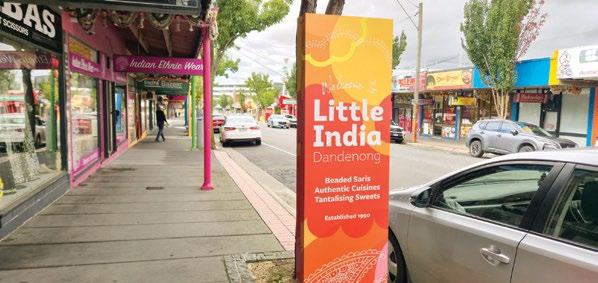
Formally recognised in 2015, the precinct spans two blocks across Foster and Mason Street, and at its peak, was home to 37 South Asian owned businesses.
Crucially, it was these business owners who drove the formation of this precinct, shaping it into a hub to help South Asian migrants settle into life in Australia.
Professor Papastergiadis says it’s
Migration has been crucial for re-writing Dandenong’s reputation, to the point where it was briefly envisioned as a ‘second city’ to rival NSW’s Chatswood or Parramatta.
Though this plan never materialised, the ‘Revitalising Central Dandenong’ proposal echoes these intentions with its desire to ‘transform central Dandenong into a vibrant and thriving economic hub.’
Since the Whitlam era, Professor Papastergiadis says, governments have recognised the benefits of investing in multicultural precincts.
But careless investment in an area can run the risk of destroying just what makes it special.
Having observed the Greek businesses of Lonsdale Street, most of whom have since relocated to Oakleigh, he cautions that precinct construction shouldn’t gentrify an area and drive away the very communities it serves.
“As these communities migrate outwards, these old precincts become empty display cabinets,” he notes.
“The dynamism of these places has been
The consternation over Dandenong’s planned revitalisation, and now, the proposed Docklands build seems to offer a cautionary tale against curated development; multicultural vibrancy isn’t something that can be constructed.
Cr Le Liu says council are aware of the perils of building a top-down precinct and are keen to hear out the Indian community and Docklands residents in further consultations.
“We can only lead or consult; I don't think it's our role to dictate,” he says.
“I would hope that just like with Chinatown, Koreatown and Lygon Street, it's ultimately up to the community to get behind it. As I said to one group, you can either fight amongst yourselves and you'll never get it up or come together…it’s in the interest of everyone to do this.”
That message, however, appears to have come too late for Dandenong, many shops now standing derelict as traders move away. Yes, the 30-year-old facades may need some attention, but not of the gentrifying kind.
“We are not against modernisation. We just wanted more input,” Khan says.
Khan outside of his now vacant shop
Formal recognition involved the installation of murals and signs like this one
Prof. Nikos Papastergiadis Image: Vicki Bell

Pink vs Black: When price tags become about gender
From razors to deodorants, products marketed to women still come with a noticeably higher price tag than those aimed at men

WBY NOAMI KAUSHIK
alking out of the store after buying a razor as you usually do, you notice that the man in front of you is also buying a razor, but somehow, it is two dollars cheaper. The only difference? His is black and yours is pink.
This is an example of the pink tax. No, the pink tax is not an actual tax, but a practice that puts women at a financial disadvantage.
According to a study conducted by Moneyzine in 2023, women pay an average of 7% more for products similar to those for men, and 42% of women-marketed products cost more. In the kids’ sections of stores, “girls” products are priced at an average of 7% higher than “boys” products, highlighting the gender disparity that is embedded into society from a young age.
This signifies that gender inequality cuts across age, merit and circumstance, revealing how deeply entrenched such disparities remain. It starts with pricing products higher that are targeted towards “girls” and eventually develops into broader economic disadvantages for women.
Attempts to reverse this narrative have been made, as seen by key legislative changes. For example, pricing "substantially similar goods” differently for men and women, under New York and California jurisdictions, would be recognised as breaking the law. Similarly, 2019 saw the Australian Government
officially removing the mandatory 10% GST from sanitary products.
Various locations around Sydney also have free sanitary products including some public bathrooms, libraries and university campuses like the University of Sydney and University of New South Wales. Legally-binding changes via legislation are crucial when it comes to broader societal issues as they pose an actual risk for wrongdoers.

The Women’s Budget statement released on May 12, 2026 notably highlighted continued funding, particularly for maternal health, including National Breastfeeding Helpline and National Preterm Birth Prevention Program. Acknowledging efforts regarding the seemingly never-ending abyss of gender inequality is important. But, it is even more important to note that this is not enough. Pink tax and period poverty are closely related, arguably the former significantly leads to the latter. The “Bloody Big Survey" 2024 showed that 64% of menstruators in Australia could not afford period products or had difficulty doing so due to costs. Without wider implementation and recognition of these issues, true reform is dawdling.
Ultimately, this raises questions about how truly intertwined systemic oppression is for women. We can continue to live in blissful ignorance that things are completely
amended. An investigation on Indian consumers published in the Journal of Management Research and Analysis in 2025 showed that 72% of respondents were not aware about the pink tax.
Women are expected to meet a range of social and hygiene standards – from hair removal and cosmetics to managing menstruation, which itself often requires multiple products, depending on individual health and hormonal needs. Yet many of these products, whether socially imposed or biologically necessary, are priced higher for women. Combined with a persistent gender pay gap, the result is a frustrating imbalance: women are often paying more while earning less. (Australian Bureau of Statistics figures released in February this year show the national gender pay gap is currently at 11.5%.)
Appalling statistics and the repetition of deeply ingrained misogynistic patterns
may spark outrage, but outrage alone rarely creates change. So what can actually be done? To better understand the work happening on the ground, I spoke to people actively trying to make a difference.
Safe N Happy Periods is an India-based non-profit organisation working towards period literacy for women as well as donating products to those in need. “Donations do not have to be very high,” a representative said. “Even sponsoring period products for one girl for a month can make a difference.”
Yet, they stressed, donating is about more than just money. “Just the act of donating pads helps people realise that there are underprivileged women and girls who simply cannot afford them.” In many cases, volunteers step in to provide products themselves when donations fall short - a quiet but powerful reminder that real change is often driven by persistence and empathy rather than grand gestures.
This is not to say that if you do not donate to a cause you cannot make a change. Not everyone can donate, and that is reasonable. Aid, however, extends beyond monetary goodness. Acknowledgement of unfair patterns that catalyse crucial social movements result in necessary changes as seen historically. We can make a change by an act as rudimentary as challenging something we see on a day-to-day basis. As a matter of fact, some of the greatest social change has come by questioning society, like Rosa Parks challenging racial segregation, triggering the US Civil Rights Movement. So, I would like to ask, Why is the pink razor more expensive than the black one?
Photo: Canva

PCOS, rebranded

FA new name, and a chance to change the conversation
BY Dr PREETI KHILLAN
or years, many women heard the word PCOS and thought of cysts, infertility, weight gain or irregular periods. Now, PCOS has officially been renamed PMOS (Polyendocrine Metabolic Ovarian Syndrome).
The name sounds technical, but the reason is simple. The old name made people believe the condition was mainly about cysts on the ovaries. It is not. PMOS can affect periods, skin, hair growth, weight, fertility, mood, blood sugar, heart health and wellbeing across life.
A better name can lead to better understanding, earlier diagnosis and more respectful care.
Not just a “cyst problem”
The old term, polycystic ovary syndrome, caused confusion. Some women feared they had dangerous cysts. Others were told they could not have the condition because their scan did not show cysts.
Experts now stress that cysts are not the main story. A woman can have PMOS without ovarian cysts. It is a hormone and whole-body health condition.
How common is it?
PMOS is very common. The World Health Organization estimates that PCOS, now PMOS, affects about 10 to 13 per cent of women of reproductive age, and many remain undiagnosed. Other global estimates suggest it affects around one in eight women.
For Indian women, the concern is significant. Research in India has found that
the condition may affect roughly 7 to 20 per cent of women, depending on how it is diagnosed. Many women with PMOS also have related problems such as weight gain, high cholesterol, fatty liver, blood sugar issues or higher diabetes risk.
In simple words: this is not rare. It is one of the most common women’s health conditions, yet it is still often missed.
Why Indian families need to talk about it
For women from collectivist, communityoriented cultures like South Asia, PMOS is not only a medical issue. It can become a family, social and emotional issue. Periods are still not openly discussed in many homes. Facial hair, acne and weight gain can cause shame. Fertility is often linked to marriage expectations and a woman’s identity. A teenage girl with irregular periods may be told to ignore it. A married woman struggling to conceive may face pressure, pity or blame.
This silence delays care. Many women
seek help only when pregnancy becomes difficult, even though symptoms may have started years earlier.
Migrant women can face extra barriers: language, stigma, and lifestyle advice that does not fit their cultural food habits, vegetarian diets, fasting practices, family routines or work stress. PMOS must be explained in a way families can understand - without shame and without blame.
It is not her fault
One harmful myth is that women with PMOS are careless, lazy or undisciplined. This is wrong.
PMOS can affect how the body handles insulin, the hormone that helps control blood sugar. This can influence weight, cravings, tiredness, skin, periods and longterm health. Some women gain weight easily. Some struggle to lose weight despite serious effort. Some have PMOS even when they are not overweight.
Healthy food and movement are important, but “eat less and exercise more”

is not enough. Women need proper checks, emotional support and long-term care.
The emotional cost is real PMOS can affect confidence, relationships and mental health. A girl with acne may avoid social events. A woman with facial hair may feel embarrassed. A bride facing fertility questions may feel anxious. A woman struggling with weight may feel judged at home, at work and in the community.
Families can help by listening, avoiding hurtful comments and encouraging support.
What will change in medical care?
The name change will not transform treatment overnight, but it should change how doctors and health systems approach the condition.
Future care is likely to look at the whole person, not only periods, fertility or ultrasound scans. Doctors may check earlier for diabetes risk, cholesterol, heart health, mental wellbeing, sleep problems and family history. Care may involve GPs, gynaecologists, hormone specialists, dietitians, fertility experts and mental health professionals working together.
What
should women look out for?
Women and girls should seek advice if they have irregular or missed periods, acne, excess facial or body hair, scalp hair thinning, unexplained weight gain, dark skin patches around the neck or underarms, trouble becoming pregnant, mood changes or a family history of diabetes.
These signs do not always mean PMOS, but they should not be ignored.
From shame to understanding
The change from PCOS to PMOS is a chance to change how we talk about women’s health.
PMOS is common. It is manageable. It is not a woman’s fault.
It also reminds us that women’s health should not matter only when a woman wants to become pregnant. It matters in adolescence. It matters in young adulthood. It matters after childbirth. It matters through midlife and beyond.
PMOS is lifelong. It can affect physical, emotional, family and social life. But with earlier diagnosis, better awareness and more compassionate care, women can live healthier and more confident lives.
The name has changed. Now our understanding must change too.
For women from collectivist, communityoriented cultures like South Asia, PMOS is not only a medical issue. It can become a family, social and emotional issue.
Photo: Canva
Not just locks and keys
Senior
Correctional Officer MOHINDER SINGH of the NSW Correctional Service on the human side of prison work we rarely get to see
What drew you to corrections work?
I wanted a career where I could make a real difference in people’s lives while serving the community. Since commencing my training at Brush Farm Corrective Services Academy in 2015, I’ve realised that this work is not just about security, it’s about people, resilience, and supporting change. What has kept me in the role is the opportunity to help staff and inmates through difficult situations, particularly through traumainformed care, staff wellbeing initiatives, and mentoring younger officers.
What does a typical shift look like for you?
No two shifts are ever the same. A typical day involves supervising operations, ensuring safety and security, supporting staff, managing inmate welfare concerns, and responding to incidents when required. In my current role as Supervisor of the Mental Health Screening Unit at Metropolitan Remand and Reception Centre (MRRC), I work closely with psychologists, psychiatrists, mental health nurses, and Services and Programs Officers (SAPOs) to ensure vulnerable inmates receive appropriate support and safe management.
How do you build authority while maintaining respect with inmates?
Respect is built through consistency, fairness, and communication. I treat every inmate professionally and with dignity, while also maintaining clear boundaries and expectations. Authority comes from being calm, confident, and fair rather than aggressive.
What have you learnt about human behaviour through this job?
I’ve learnt that every person has a story, and many people entering custody are carrying trauma, addiction, mental health challenges, or difficult life experiences in their past. This role has taught me patience, empathy, and the importance of understanding behaviour rather than simply reacting to it. It has also reinforced how important structure, support, and positive role models can be in someone’s life.
Is there a moment that has stayed with you long after your shift ended?
Working in the Mental Health Screening Unit, there have been moments where vulnerable inmates were experiencing severe mental health crises. Supporting individuals during those critical moments and seeing collaborative intervention from staff and health professionals make a difference, has stayed with me. It reminds me that our work can genuinely save lives.
What’s the toughest call you’ve had to make on the job?
Balancing security concerns with the wellbeing of vulnerable inmates or staff. In high-pressure environments, decisions often need to be made quickly while considering safety, mental health, and operational risks at the same time. Those moments require
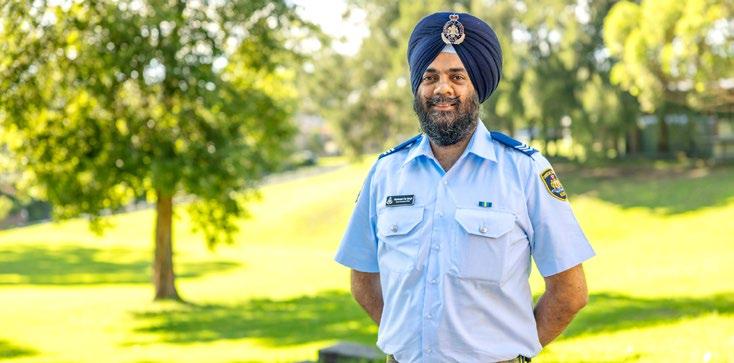
calm judgment, adaptability, and teamwork. How do you manage conflict or tension when situations escalate?
I rely on communication, de-escalation, and remaining calm under pressure. My experience in negotiation, mental health training, “5-Minute Intervention”, traumainformed practice, and conflict management training programs provided by the Department has taught me that listening, remaining professional, and responding calmly can often prevent situations from escalating further.
Working in corrective services, particularly within the Mental Health Screening Unit at MRRC, has reinforced the importance of understanding behaviour, identifying early warning signs, and adapting communication approaches based on the individual and the situation. Safety always comes first, but respectful communication, empathy, and professionalism are equally important in achieving positive outcomes and maintaining stability within the correctional environment.
What misconceptions do people have about correctional facilities?
A common misconception is that corrections work is only about locking people up. In reality, correctional facilities are complex environments focused on security, rehabilitation, mental health support, education, and reintegration. Officers are not just security personnel – they are mentors, communicators, first responders, and support systems.
Do you see your role as part of rehabilitation, security, or both?
Definitely both. Security is essential because without safety and order, rehabilitation cannot occur. At the same time, every professional interaction with an inmate can influence behaviour, accountability, and rehabilitation outcomes. The two go hand in hand.
What does success look like in your job?
Success means ensuring everyone goes home safely at the end of the day.
Sometimes success is preventing a crisis before it happens.
Have you witnessed a genuine turnaround in someone?
Yes, I’ve seen inmates who arrived with significant behavioural or mental health challenges gradually begin engaging with support services, education, and structured wellbeing activities, leading to genuine positive change.
I often encourage inmates to do constructive and therapeutic activities such as colouring sheets, sketching, drawing, jigsaw puzzles, and other structured programs that help them occupy their minds in a positive and calming way. These activities can reduce stress, improve focus, and provide a healthy outlet for emotions, particularly for inmates experiencing anxiety, trauma, or mental health challenges.
Over time, I’ve witnessed individuals become more cooperative, emotionally stable, and willing to engage with our staff and support services.
How do you switch off after a difficult day?
I focus on family, community involvement, fitness, and cultural activities to maintain a healthy balance outside of work. Running Bhangra programs, playing badminton, and cycling help me stay physically active, mentally refreshed, and connected to the community in a positive way.
As a Peer Support Officer at MRRC, I also strongly believe in the importance of peer support, wellbeing programs, and maintaining healthy conversations with colleagues. In corrective services, looking after your own mental wellbeing is extremely important, and having strong support networks both inside and outside the workplace plays a key role in maintaining resilience and long-term wellbeing.
Has the job changed how you see people – or the world? Yes, it has made me more understanding
and less judgmental. It has reinforced that people are capable of both poor decisions and positive change. It has also strengthened my appreciation for resilience, teamwork, and community support.
What’s the most unusual part of your job?
The unpredictability and the wide range of situations you may face within a single shift. In one day, you might manage operational issues, support someone experiencing a mental health crisis, mentor junior staff, and coordinate wellbeing initiatives for employees all while responding to rapidly changing situations within the correctional environment.
What would people be surprised to know about correctional officers?
People are often surprised by how much emphasis there is on communication, empathy, mental health awareness, rehabilitation, and staff wellbeing within corrective services. Many people assume the role is only focused on security, but correctional officers are regularly dealing with complex human situations that require patience, professionalism, emotional intelligence, and strong communication skills.
Correctional officers support people during some of the most difficult moments of their lives, including mental health crises, personal trauma, addiction, and emotional distress. At the same time, we also support one another through teamwork, peer support, and wellbeing initiatives, because the job can be mentally and emotionally demanding.
The role requires balancing safety and security with compassion, fairness, and rehabilitation, which is something many people outside the profession may not fully realise.
If you had to describe your work in three words, what would they be? Resilience. Service. Responsibility.
Rajni Anand Luthra
With more than a decade of service, Mohinder Singh, 44, works at the Metropolitan Remand and Reception Centre (MRRC)


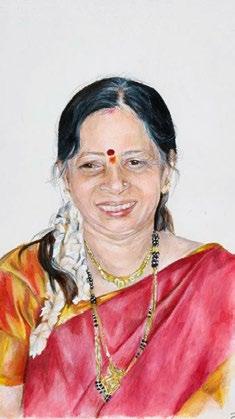
Little hands, big portraits
Three budding artists currently have their work hung at the Art Gallery of NSW, in the Young Archie competition

TBY RAJNI ANAND LUTHRA
hirteen-year-old Viraj Tandon could well be a “veteran” at the Young Archie 2026 competition. This year the Sydney Grammar student notches up his third shortlist at the Art Gallery of NSW’s children’s portrait competition that runs alongside the Archibald Prize.
Speaking to Indian Link, his quiet confidence and clarity seem to sit comfortably with this growing artistic experience.
“It felt great to be a finalist again,” he says. “I felt I have progressed my style.” How so, we ask.
“In my first portrait of my grandfather, I used vivid palettes,” he describes. “My second portrait of my grandparents included finer details. This time round, I’ve combined both… but I still have a lot to learn.”
This year his subject is his cousin Angad. Angad is a psychiatrist and a musician, and Viraj’s portrait of him includes both aspects of his work.
On one side stands the doctor, stethoscope around his neck – composed and precise, eyes observant and alert. On the other side, the same figure is softened and relaxed, in DJ mode, as the disco ball shimmers overhead.
The two images are separated by a clear window, and the scene outside is one Viraj has a particular passion for: urban landscape. It depicts Fitzroy in Melbourne, where Angad lives, in its striking mix of oldworld charm and edgy energy.
It adds to the push and pull between two selves that gives this portrait its depth –science and art, discipline and abandon – and provides the work its title, Reflections by Viraj.
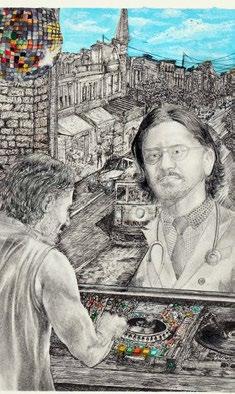
Six-year-old artist George Rajagopalan of Adelaide explains in some detail how he worked on his grandfather’s beard. “I drew zigzag lines – long lines then little lines and then some more long lines and little lines.”
There’s a clarity in the way he explains it – and suddenly, we begin to see the artist at work. It earned him a shortlist for his portrait Poppy.
Poppy is a farmer, and George makes that unmistakably clear.
“I was excited when I heard, and so was my art teacher,” George reveals.
“Poppy was excited too, he couldn’t believe it,” Mum Jessica laughs. “He was a reluctant participant, and it did not occur to him that he would be a finalist!”
Poppy hasn’t seen the portrait yet (he lives some distance away), but has seen a photo Jessica sent him.
“Poppy and Thatha and Patti are all very
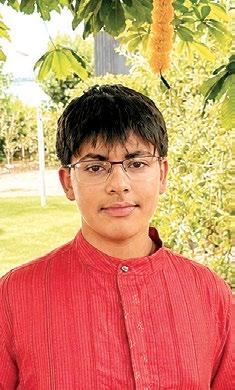
proud of my hard work,” George says. They are all coming up to Sydney in July to see the exhibition.
The young artist worked from a photo of his Poppy that his mum had taken, creating his piece with tempera paint, HB pencil and blackline marker on cartridge paper.
Jessica reveals that art teacher Catherine Puckridge at St Andrews School, Walkerville, picked ten artworks for the Young Archie 2026 competition. “We are very grateful for the encouragement and support she has provided.”
Meanwhile, this possible Archibald Prize finalist of the future reveals that he has been painting since he was two – his work hangs in pride of place at home and at his parents’ workplaces.
“I was shocked – and excited – when I heard I’m in the Young Archie,” Hitha
Manupuri tells Indian Link.
Her portrait Strength – that’s my grandma is a tribute to her Ammuma who lives in Bangalore, India.
The portrait is rendered with an almost tactile realism – the silk of the saree catching the light in soft, shifting glints, and pallu arranged with careful precision, each fold held exactly where it should be. Each strand of black-and-white hair is carefully observed, jasmine string nestling closely. The necklaces rest with quiet precision against the chest, their weight and placement perfectly understood. But it is the face that holds you – eyes lit with warmth, and a smile that doesn’t just sit on the lips but lingers, gentle and shy.
It is a picture of dignity and grace.
It is not surprising that the Year 10 student’s art teacher at Huntingtower School Mt Waverley (Melbourne) “was thrilled”.
“I picked my grandma because I love her so much,” Hitha says.
She created her portrait with wax-based pencils, working from a photograph that is two years old.
“Ammuma was very happy when she saw my drawing,” Hitha reports. “I myself can’t wait to see it on the walls of the AGNSW – we’re coming up in July!” Her mum Thriveni chimes in, “The shortlist was a big surprise, but we are very proud. I look at the drawing and think my mum is about to step out of the frame! Mum is currently recovering from a heart attack, and so this drawing –and being picked as a finalist at this point in time – both seem especially meaningful.”
Hitha meanwhile is now certain that art will be a major part of her life, at least in the near future. “Definitely picking Visual Arts as a subject for my VCE,” she says, revealing a recent burgeoning interest in French artist Claude Monet.
Sydney’s Viraj Tandon, and his portrait 'Reflections by Viraj'
Adelaide’s George Rajagopalan, and his portrait 'Poppy'
Melbourne’s Hitha Manupuri, and her portrait 'Strength – that’s my grandma'

PayPal launches Xoom in Australia, enabling money transfers to India and 150+ countries
PayPal recently launched its international money transfer service, Xoom, in Australia. Xoom is a fast, secure, and reliable digital service that makes it easier for Australian users to send money to India and more than 150 countries and regions worldwide, in over 100 currencies.
As cross-border connections grow, Xoom gives Australians more flexible and diverse ways to transfer funds – whether supporting family or paying for overseas services. Customers can use Xoom to send money straight to a bank account or mobile wallet, and in India they can also choose cash-pickup from convenient partner locations.
Xoom is already trusted by millions of users around the world. Its launch in Australia covers around 95% of the country's major money transfer destinations, including India as well as key markets such as the UK, China, Vietnam and Sri Lanka.
There are currently more than 9.5 million active PayPal accounts in Australia, representing approximately half of the adult population. Furthermore, PayPal


was recently named "Most Trusted Payment Brand of 2025" by Roy Morgan, Australia's largest independent research firm.
Andrew Toon, General Manager of PayPal Australia, said: “With Xoom, Australian users have more flexibility and choice in how they send and receive money. Whether it’s depositing money in a bank or mobile wallet, or arranging for self-pickup or home delivery, Xoom puts control in the hands of customers, making cross-border support fast, simple, and secure.”
HOW TO USE XOOM:
n Access: via the Xoom app, the Xoom.com website, or within the PayPal app.
n Sign up: Existing PayPal users can create an Xoom account directly using theirPayPal credentials, and new users can sign up in just a few steps.
n Ways to send: Send to bank accounts or mobile wallets, orchoose cash pickup or home delivery in supported countries/ regions.
n Limits: A maximum of AUD 50,000 per transaction.
n Real-time tracking: Monitor your transfer in real time via the Xoom app or your PayPal account.
The launch of Xoom in Australia highlights PayPal’s commitment to helping individuals and communities thrive by making cross-border money management simpler, safer, and more convenient.
Australian users can start quickly and securely sending money by downloading the Xoom or PayPal mobile app, or by visiting the Xoom information page on Xoom.com or PayPal.com.
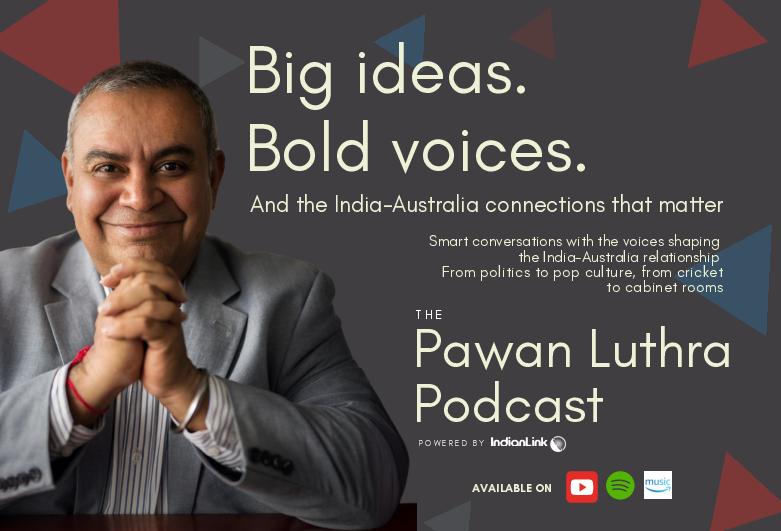

with Lakshmi Ganapathy
NAKUL LEGHA is the Head of Scripted content at SBS, commissioning new and diverse voices through their flagship Originals and Digital Originals slate, and overseeing award-winning productions including Four Years Later, Reckless and The People vs Robodebt. Previously at Netflix, he was a Creative Executive on Boy Swallows Universe, Wellmania and ONEFOUR: Against All Odds.

Do you think growing up without television in Bhutan gave you a clearer sense of what genuine attention feels like?
I was an only child; you learned to appreciate the power of your own imagination and your own company, and you also learned to make friends with your neighbours. There was a language barrier with the people that we lived around, but you found other ways to connect with people. You also spent a lot of time outdoors just making up things. That joy of connection, of knowing that you can find play and imagination in whatever you have, that resourcefulness, I think that's true of every migrant experience as well; you make do with what you can.

You wrote for SBS Voices about being obsessed with talkback radio kings like Alan Jones as a child. What responsibility does our media have in helping people understand Australia?

I think powerful media and storytelling help create connection, through both friction and celebration. Media can and should challenge assumptions, and in doing so, build empathy.
The world that I'm in - scripted drama and series - the great joy is we can use the make-believe. We can use largerthan-life characters and genres that audiences love, like romance, crime, thrillers to expand the imagination of what Australia can be.
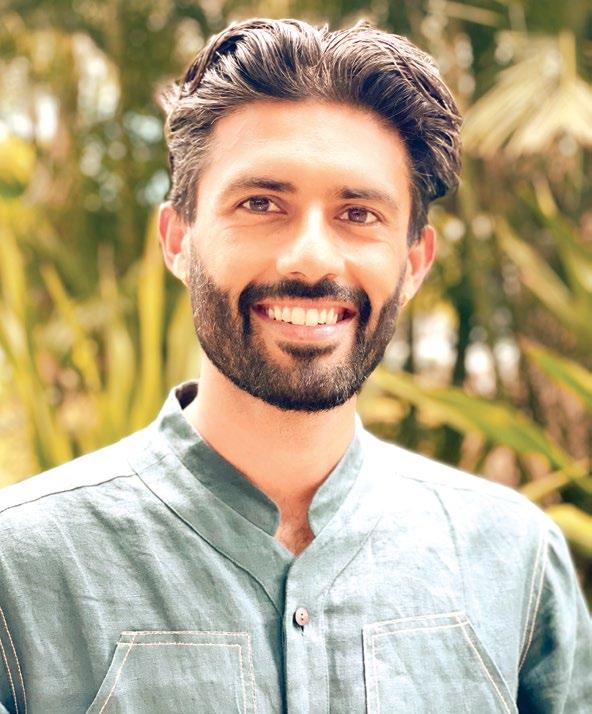
I think about one of our recent Four Years Later, which is a romantic drama across India and Australia, it's in Hindi and in English; an Irish-Australian colleague was brought to tears watching this because it brought to life his own journey of migrating and romance from Ireland to Australia. It's that kind of connection and the bridges that we can build, especially through drama, that I think is
At SBS, we're the smaller public broadcaster, but we have a very timely and urgent charter responsibility around social cohesion. For us, it's about commissioning distinctive, creatively ambitious series that have that something to say - that cut through the noise and stay with people, that move hearts and minds. That's the north star in everything that we commission here.

In these turbulent times, what is an ‘Australian’ story? We spend a lot of time thinking about this. I think the best way I could frame it is in the same way there's no one answer for ‘what is Australian cuisine’ when someone asks you what's an Australian dish. An Australian story is one that looks and sounds as diverse as contemporary Australian audiences; the joy of that is that it can mean different things to different people.

What’s something you’re currently listening to/ reading/playing/watching?
Satinder Sartaaj. He's playing a concert; my parents are going tonight to see him. I’ve been down in Canberra for Mother's Day, and all weekend we've been listening to Satinder Sartaaj.

You’ve said previously that ‘SBS are not in the volume game’. Do you think we’ve become too focused on quantity rather than quality with the advent of streaming?

What’s a word that you like in a South Asian language, and what does it mean?
Khatta meetha. I'm always thinking about food. Khatta meetha is great because it's like the best of both worlds. I think that applies to so much of life - if you can have the best of all worlds, why not reach for it? It also speaks to great stories; they both challenge you and bring you great joy.
And finally: Soan Papdi or Papdi Chaat?
Well, there are no rules to Papdi Chaat, and I love khatta meetha, so I'm going to sprinkle Soan Papdi on my Papdi Chaat and have the best of all worlds!

More than a tropical getaway
Vanuatu: When you plan to slow down - but the island has other ideas

IBY SANDIP HOR
n 1774, English explorer Captain James Cook, while mapping the Pacific region, encountered a cluster of islands that reminded him of the Hebrides archipelago in Scotland.
He named them the New Hebrides, a designation later replaced by Vanuatu after the islands gained independence from joint British and French colonial rule. The two powers had administered the archipelago under a Condominium established in 1906.
"It was more of a pandemonium than a condominium," an elderly local commented to me during my recent visit to Port Vila, the capital of Vanuatu.
He spent a considerable portion of his life under that intricate regime, and it is quite understandable how difficult his daily existence must have been when subjected to the governance of two administrative systems, requiring navigation through two separate legal, administrative, and educational frameworks, along with various cultural influences. Additionally, there
were two distinct police forces tasked with maintaining law and order in an area six times smaller than Tasmania.
This historical context renders Vanuatu unique, as only two other nations in the world – Sudan and St Martin – have the experience of such a similar situation.
However, after independence, that pandemonium has gradually vanished and present-day Vanuatu unfolds to visitors an unspoiled and pristine territory, ideal for a
tranquil holiday with soothing nature and smiling locals as companions.
Vanuatu consists of 83 islands located in the South Pacific Ocean and is just three and a half hours by air from the east coast of Australia. The island of Efate, which is home to the capital city Port Vila and the international airport, is the most significant island in the nation. It functions as the political, commercial, and economic centre of the country. Additionally, Port Vila is a
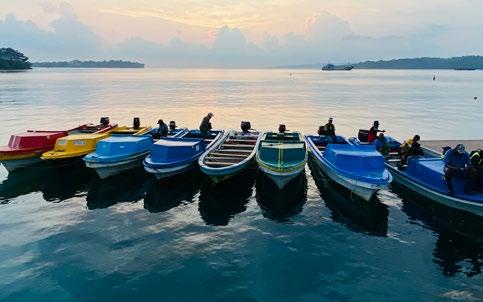
prominent stop on the itineraries of cruise ships traveling through the Pacific Ocean islands.
Other islands of importance in Vanuatu are Espiritu Santo known for its mountains, rivers, and World War II history; Malakula notable for its cultural diversity with many distinct indigenous languages and traditions, and Tanna which houses Mount Yasur, one of the world’s most accessible active volcanoes. Most of the nation’s population of 365,000 lives on these four islands.
Because of its position along the Pacific ‘Ring of Fire’, Vanuatu's climate is tropical, with warm temperatures all year round. This geographic feature paired with proximity to Australia, makes the destination a popular hideout for Aussies keen on getting a relaxing break from a hectic urban routine. After touching down in Port Vila, I felt like stepping into another world where the atmosphere appealed as laid-back, slow-paced and grounded. Shaped by ocean breezes, lush greenery, and closeknit communities, its modest infrastructure reflected a simple rhythm of life, with few visible markers of 21st-century urbanisation. In Vanuatu, there are no towering high-rises dominating the skyline, no global fast-food chains like McDonald’s, and traffic flows
Blue Lagoon
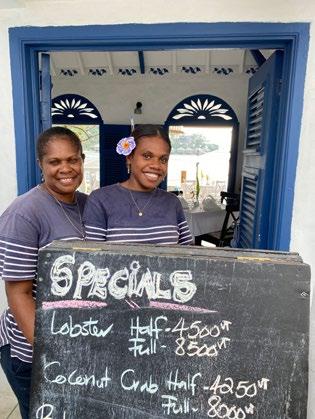
without the aid of traffic lights. Roads are modest, and development is low-density, blending into the natural environment rather than reshaping it. This absence of heavy commercialisation gives the domain a distinct charm, where tradition and nature remain central, and daily life unfolds at a pace that prioritises people, culture, and rituals.
However, the hotel I stayed in while at Port Vila, known as the Grand Hotel and Casino, featured ultra-modern amenities beautifully enveloped in the traditional warmth of the island.
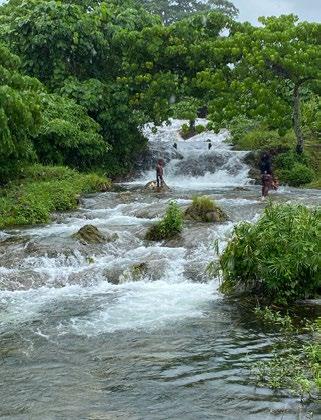
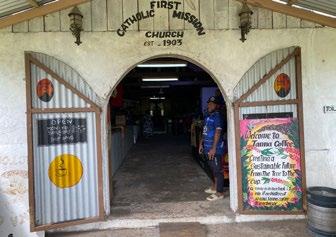
This establishment has recently reopened following an extensive renovation after the catastrophic earthquake that struck in 2024. Situated less than thirty minutes from the airport, this eight-story building stands as a sleek oceanfront landmark, inviting vacationers to relax with sweeping views of the harbour and soothing Pacific breezes.
Most conveniently, the hotel is within walking distance of major city attractions, including the Vanuatu Parliament House, National Museum, Sacre Coeur Cathedral, and the lively Mama’s Market, and numerous restaurants and cafes offering a variety of culinary delights.
Similar to its neighbouring island nations - Fiji, Solomon Islands, and New Caledonia - Vanuatu is part of the region referred
to as Melanesia, which is a cultural and geographical collection of Pacific Islands. Consequently, the history of this nation is profoundly intertwined with ancient Melanesian culture, with human habitation tracing back over 3000 years. The National Museum serves as an excellent venue to learn more about the intricate history of the archipelago and to view various examples of Melanesian art and crafts. However, an exhilarating experience awaits at the bustling Mama’s Market, where women dressed in vibrant island attire arrange pyramids of pawpaw, bananas, island cabbage, and shiny eggplant, while fishermen bring in yellowfin tuna, still shimmering with silver.
While mingling with the locals at the market, I found them to be straightforward, amiable, and easy to engage in conversation,
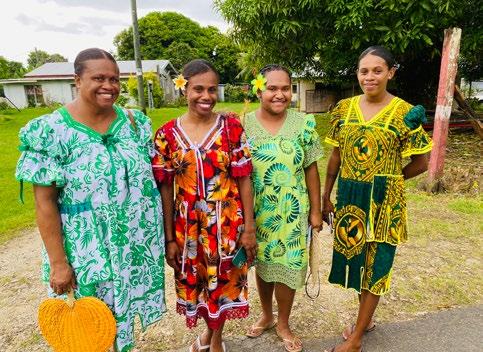
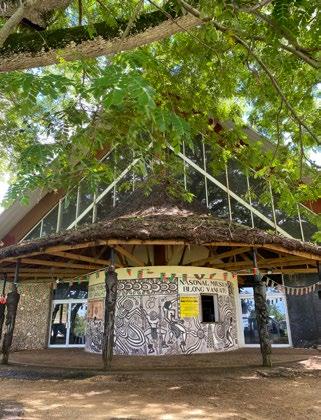
TRAVEL
NOTE BOOK
Getting There: Jetstar (www. jetstar.com) flies three days a week from Sydney direct to Port Vila
Stay: Grand Hotel and Casino (www.grandvanuatu.com)
Tour Guide: Onak Tours Vanuatu (What’sApp +678 5138807)
often punctuated with laughter, which helped me comprehend why Vanuatu is considered one of the happiest places on Earth. They seemed content with their simple way of life and appeared somewhat detached from global events. Many individuals I conversed with were unaware of the ongoing conflict in the Middle East and had not heard about the recent terrorist attack in Sydney.
Not far from the heart of Port Vila, several natural attractions can be found, including Eton Beach and Etmat Bay, which are among the top sandy beaches on Efate Island, perfect for swimming, snorkeling, and diving. Additionally, the Mele Cascades, Rarru Rentapao Waterfall, and the Blue Lagoon offer ideal spots for refreshing freshwater swims, alongside a lush green rainforest that features multiple ziplines and
a 120-metre sky bridge suspension walk. Island hopping near Port Vila is also a favoured activity, especially to Hideaway Island, which claims to host the world's only underwater post office.
I arrived in Vanuatu with the intention of relaxing and doing nothing, aside from sitting on the private balcony of my room and gazing at the azure waters of the Pacific Ocean. However, the sightseeing and activities on offer turned out to be unexpectedly enjoyable. The highlight for me was riding a horse at the Club Hippique Adventure Park.
What made Vanuatu unique for me was its harmonious combination of tranquility and liveliness. Within just a few days, I was able to enjoy a sandy beach, trek through the verdant rainforest, ride a horse along the beach, swim under the waterfalls, learn about the island's history and culture, converse with market vendors about their daily catch, and still have time to relax on my hotel balcony, aimlessly watching life on the turquoise blue water while sipping on locally brewed Tusker beer.
As I departed from Port Vila, I took with me more than just photographs. I carried the true essence of the island - steady, generous, and quietly vibrant.
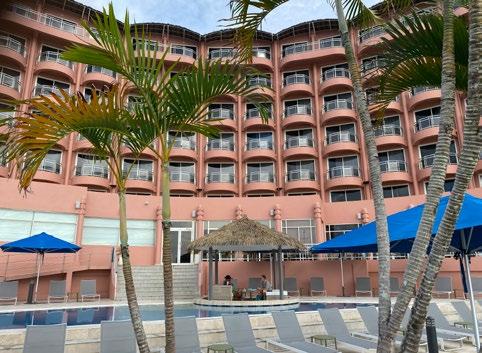
Warm local hospitality
Where the rainforest pauses to breathe National Museum
Quiet stories of faith and resilience
Wrapped in colour; carried by joy
Grand Hotel and Casino
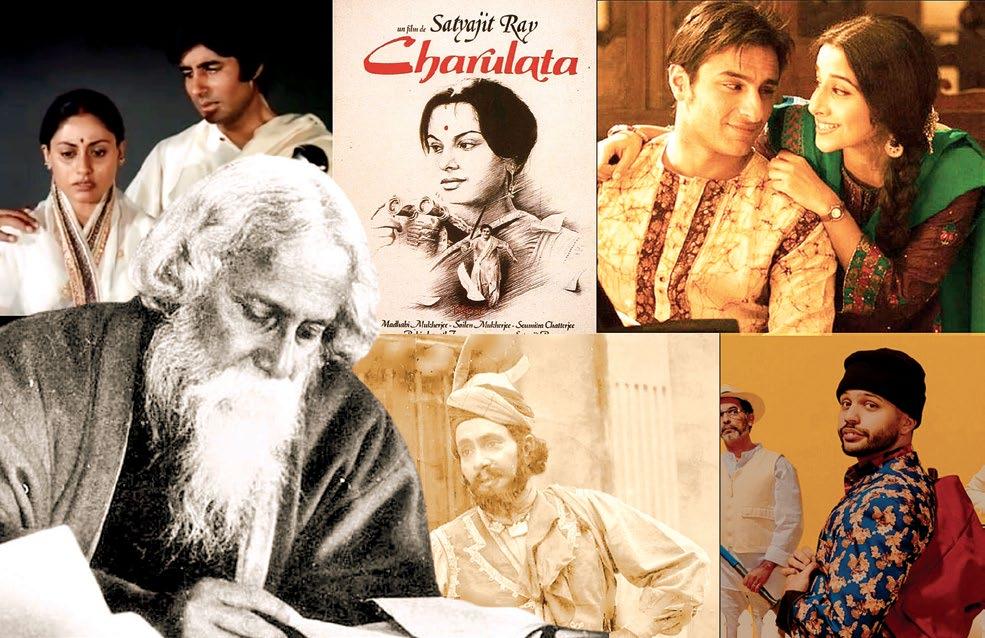
Tagore on screen
On the Nobel Laureate’s 164th birth anniversary, a look at the Tagore blueprint that Bollywood has been quietly following for decades
WBY TORRSHA SEN
hen the Sydney Opera House announced Balloon Dog for its 2026 season, the billing was straightforward enough: a modern adaptation of Rabindranath Tagore's short story Kabuliwala, relocated from 1800s Calcutta to 21st-century Auckland by New Zealand's Indian Ink Theatre Company. The production's premise, that strangers are more alike than they appear, is precisely the kind of universalist argument Tagore spent a lifetime making. That a theatre company in the South Pacific is still reaching for his work to make that argument is, in itself, a data point worth examining.
Rabindranath Tagore was born on 7 May 1861 in Jorasanko, Calcutta, and died in the same house eighty years later, having somewhere in between written the national anthems of two countries, composed over 2,000 songs, won the Nobel Prize in Literature, founded a university, and produced a body of fiction and poetry that an entire subcontinent is still working its way through. That Hindi cinema keeps borrowing from him, consciously or otherwise, is not surprising. It would be more surprising if it didn't.
Because Tagore's relationship with popular Indian cinema is not incidental. It is structural. For the better part of a century, Indian cinema has returned to his stories, his melodies, and his moral universe, sometimes crediting him, sometimes not, but always drawing on a well he effectively dug.
The most direct line runs through adaptation. The 1957 Hindi film Kabuliwala, directed by Hemen Gupta and starring Balraj Sahni, is widely considered one of Hindi cinema's finest. Sahni's portrayal of Rahman, the Afghan dry-fruit seller who forms an unlikely bond with a Calcutta child named Mini, is held up as a benchmark of restrained screen acting. The film's music, composed by Salil Chowdhury with lyrics by Shailendra, produced Ae Mere Pyare Watan, a song that has outlived the film itself in public memory.
A Bengali adaptation, also titled Kabuliwala, was released the same year, directed by Tapan Sinha, with Chhabi Biswas in the lead role. Both films stayed close to the emotional architecture of Tagore's original: tenderness as the radical act.
Satyajit Ray's Charulata (1964), based on Tagore's novella Nastanirh, brought the literary estate into conversation with art cinema. The film, now studied in universities across the world, uses Tagore's own Rabindra Sangeet as score. Ray was among those who understood that Tagore's music and his prose were not separable projects. The songs are not decoration; they are argument.
It is through that musical inheritance that Tagore's influence on mainstream Bollywood becomes most traceable, and most interesting. Music director Sachin Dev Burman, a Bengali himself, could naturally relate to the folk music that Tagore had repeatedly used, drawing on Kirtanyagya-based songs and Bhatiyali songs in his own compositions. The transactions were not always transparent. Credit was not always given. But the musical lineage is audible across decades of Hindi film scores.
Three songs in particular illustrate the range of this borrowing. Tere Mere Milan Ki Yeh Raina from Abhimaan (1973) is perhaps the most famous example, with S.D. Burman drawing directly from Tagore's Mishra Khamaj-based composition Jodi Tare Nai Chini Go Seki for the song's opening melody. The duet, sung by Lata Mangeshkar and Kishore Kumar for Hrishikesh Mukherjee's film about a singing couple, became one of the defining recordings of both singers' careers. The song was listed among the biggest hits on Binaca Geetmala's Annual List for 1973.
A decade later, Chookar Mere Mann Ko from Yaarana (1981), sung by Kishore Kumar, drew inspiration from Tagore's Tomar Holo Shuru, with music director Rajesh Roshan keeping the remainder of the song original. The song, picturised on Amitabh Bachchan, became one of the more enduring pieces of the era's soundtrack canon, its
lyrical quality traceable, at least in part, to the Rabindra Sangeet melody it was reaching toward.
Then there is Piyu Bole from Parineeta (2005), composed by Shantanu Moitra and sung by Sonu Nigam and Shreya Ghoshal. The song was inspired by Tagore's classic folk composition Phoole Phoole Dhole Dhole from his Kalmrigaya collection. Notably, in both Parineeta and Ray's Charulata, Phoole Phoole Dhole Dhole appears during a scene of a woman on a swing, a deliberate intertextual reference that the 2005 film's makers embedded knowingly.
Parineeta carries a further biographical footnote. The film starred Saif Ali Khan, whose family connection to Tagore runs through his mother, the actress Sharmila Tagore. That Saif Ali Khan should appear in a film layered with Tagorean references, performing alongside music drawn from Rabindra Sangeet, while carrying that bloodline through his mother, is the kind of coincidence produced without apparent effort. Tagore wrote in a register, moral, musical, and narrative, that Hindi cinema kept needing to borrow from. His characters are motivated by longing, dignity, and the particular grief of people who love across social distance. These are not niche concerns. They are, as it turns out, perennial ones. The Auckland production opening at the Sydney Opera House this June is simply the latest confirmation that the well has not run dry.
cineTALK
From captivating love stories to intense dramas and epic narratives, EKTA SHARMA picks Indian films in May 2026 with fresh talent, familiar faces, and a promise of an exciting mix. Get ready to experience a rollercoaster of emotions.

EK DIN (In cinemas)
The trailer opens on a tranquil, snow-blanketed landscape as Junaid Khan steps quietly up to a wish bell – a haunting image that sets the film’s dreamy tone. In that fleeting moment, he makes a heartfelt wish, one that soon begins to blur the line between reality and longing. Directed by Sunil Pandey, Ek Din stars Sai Pallavi in her Hindi debut alongside Khan. Adapted from the 2016 Thai film One Day, it follows Rohan, a soft-spoken man in love with colleague Meera. A work trip to Japan changes everything. The film also releases in Tamil and Telugu as Oru Naal and Okka Roju. Releasing 1 May 2026

CITADEL SEASON 2 (PRIME VIDEO)
Citadel returns with a more intense second season, again led by Priyanka Chopra Jonas as elite spy Nadia Sinh. Picking up after Season 1, the story follows Nadia and Mason Kane as they confront Manticore, the powerful syndicate that destroyed their agency. When a new threat emerges, Nadia is drawn back into a world she tried to leave behind. Joined by Kane and Bernard Orlick, the team assembles new operatives and embarks on a global mission to stop a dangerous conspiracy. Expect high energy, emotional depth, and twists where no one can be fully trusted.
Releasing 6 May 2026

LUKKHE (AMAZON PRIME)
See rapper King in a gripping new role, alongside Raashii Khanna and Palak Tiwari. Filmed in Punjab, Lukkhe blends love, ambition, and rivalry into a gripping narrative. King stars as Lucky, a determined sportsman, who falls for Sanober (Raashii Khanna), a passionate musician. However, their blossoming romance is soon caught in a dangerous clash between a relentless cop and an up-and-coming rapper.
Releasing 8 May 2026
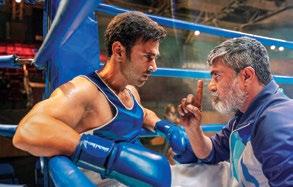
GLORY (NETFLIX)
A boxing-set drama starring Divyenndu Sharma, Pulkit Samrat, and Suvinder Vicky, this story unfolds in a world where legacy and survival go hand in hand. When a shocking murder disrupts the tightly knit boxing community, two estranged brothers are unexpectedly pulled back into each other’s lives. What begins as a search for truth soon turns into something far more personal, forcing them to confront old wounds and a broken relationship with their father.
Releasing 1 May 2026

DAADI KI SHAADI (IN CINEMAS)
Riddhima Kapoor Sahni, daughter of Neetu Kapoor, makes her much-anticipated Bollywood debut in a family comedy-drama that offers a refreshing, feel-good take on love and companionship. When a strong-willed grandmother decides to remarry, it sets off a delightful chain of reactions within the family. Directed by Ashish R. Mohan, the film also features Kapil Sharma, whose lively screen presence is sure to add charm and humour. A warm, modern take on generational differences. Releasing 8 May 2026

AAKHRI SAWAL
(IN CINEMAS)
Directed by Abhijeet Mohan Warang, this is a thoughtprovoking drama starring Sanjay Dutt. The story follows Vicky, a talented but unpredictable student, who publicly accuses his respected mentor, Professor Gopal Nadkarni, of bias. What starts as a personal disagreement quickly grows into a big national issue. As the media and politics get involved, their conflict turns into a heated televised debate, bringing questions of power, fairness, and truth into the spotlight.
Releasing 8 May 2026

RAJA SHIVAJI (IN CINEMAS)
A grand, star-studded spectacle, this film brings together Riteish Deshmukh, Abhishek Bachchan, Sanjay Dutt, Fardeen Khan, Mahesh Manjrekar, Sachin Khedekar, Genelia Deshmukh, Bhagyashree and Vidya Balan. Directed and written by Riteish Deshmukh, it narrates the journey of Shivaji Maharaj, capturing the spirit, bravery, and vision of the legendary ruler. Blending emotion and visual grandeur, expect a tale told with both strength and sensitivity. Scheduled to release on the special occasion of Maharashtra Day, the film will be presented in Marathi, Hindi and Telugu. Releasing 1 May 2026

MAIN ACTOR NAHIN HOON (IN CINEMAS)
Led by Nawazuddin Siddiqui, this thought-provoking drama follows a retired banker who dares to pursue a long-buried dream of becoming an actor. What begins as an unlikely aspiration turns into a deeply personal journey of reinvention. In a contemporary twist, he takes virtual acting lessons, opening a door to a world he has only admired from afar. As he navigates self-doubt, identity, and ambition, the film explores loneliness and the courage to begin again. Directed by Aditya Kripalani, it promises a quietly powerful, emotionally resonant experience.
Releasing 8 May 2026

CHAND MERA DIL (IN CINEMAS)
With its central line, pyaar mein thoda paagal hona hi padta hai, this is a tender coming-of-age romantic drama set on an engineering campus, starring Ananya Panday and Lakshya Lalwani. As their relationship evolves, it becomes more layered and emotionally complex, reflecting how young love changes under the weight of time, growth, and real-world choices. Directed by Vivek Soni, who previously made the heartfelt Aap Jaisa Koi.
Releasing 22 May 2026


MAY 2026 BY MINAL KHONA
Minal Khona has been reading tarot cards for the last two decades. She uses her intuition and connect with the cards mostly to help people.
TAURUS
TAROT
GEMINI
You draw your sign’s card in reverseexpect delays, and possibly a no from the universe on something you’ve been hoping for. Turn inward instead: focus on self-growth and personal goals. In relationships, resist the urge to shut down or cut people off; stay open to positive energy. At work, make confident, well-considered decisions. Singles may receive a marriage proposal. For the self-employed, fresh ideas and clear communication bring results. If you’re in a technical field, prioritise upskilling.
A good month ahead, as delays begin to lift - if they haven’t already - expect resolution within eight weeks. The Wands card signals action, bringing movement across all areas. A blind date or unexpected invitation could spark a passionate romance. Travel, for work or pleasure, is likely. Professionals and the self-employed may see sudden progress, while finances improve. Trust in divine timing - what’s meant for you is on its way. Stagnation fades as life begins to flow smoothly again.
This month calls for healing your inner child to support emotional wellbeing, even as nostalgia surfaces. The health problems you face this month may be signals to slow down and reflect. Someone or something may exit your life, making way for new beginnings. A surprise job or business opportunity could arrive. Writers may find literary success. Seek joy in multiple sources, not just one. Whatever is worrying you now is likely to resolve more positively than you expect.
Finances may feel tight this month, with income matching expenses. In relationships, tensions could rise - open communication is key. Solutions may come from unexpected sources. At work, try a fresh approach to ongoing projects. Work may get so busy you may have no time to spend with family. The self-employed might need to offer discounts to attract business. A shift in perspective will be your greatest asset - adaptability and openness can turn challenges into opportunities.
SCORPIO
- NOV 21
A slightly challenging month for you, Leos, with disruptions to travel and work plans. You’ll stand firm on not compromising your values. Be cautious - someone may attempt manipulation or mind games. Stay alert. Any aches and pains are your body’s way of telling you to slow down and rest. A friend offers timely support. Unexpected financial gains are possible. Socialising and business meetings could open doors, bringing opportunities and success if you remain grounded and aware.
Gemini energy brings a surge of ideas and communication for meticulous Virgos. In relationships, recent disagreements or distance may persist, with neither side willing to give in - set ego aside, and a reunion is possible. Professionals and business owners could meet influential people who open doors. Children may be a little challenging this month. On the financial front, it’s a win-win period, with gains and stability likely if you stay practical and open-minded.
Knights signal fast-moving energy, so actions taken this month will bring quicker results. An existing situation may shift unexpectedly. Singles could meet someone with soulmate energy - an instant, familiar connection worth exploring. Workplace arguments will be temporary. Obstacles may feel stressful, but handle them methodically. Emotional strain could affect your stamina, so pace yourself. It’s a good time for a dental checkup. Avoid forcing outcomes - trust the universe to unfold things in its own time.
A month to release insecurities around money - trust that the universe provides. Ask yourself what you’re still holding on to. In dating, hurdles may arise, but with effort, things can still work. The selfemployed may start a new venture or see sudden gains. If work feels stagnant, consider a change. Let go of anxiety and attachment to people, ideas, or material things - it only drains your energy. Embrace trust, flexibility, and forward movement.
The start of a creative phase or new venture is likely - possibly one that brings financial reward. If you’re awaiting results within a set timeframe, they could arrive within a week. Singles will seek a deeply committed partner. If you’re feeling sluggish, consider a detox or cleansing routine. Shake things up by refreshing your daily habits. To manifest your dreams, consistent action is essential - intent alone won’t suffice, so stay proactive and focused.
A month of abundance across multiple areas for Capricorn. Singles may meet someone through social circles or at work. Opportunities for self-promotion are likely, helping you step into the spotlight. Family and friends remain supportive, and a monetary gift could come your way. If you’re dating, the relationship may move to the next level. At the same time, a karmic connection could come to an end. Luck is on your side - move ahead with confidence and without fear.
The next three months are significant for Aquarians, with the Ace of Cups card signalling new beginnings, joy and emotional healing. A silent admirer may reveal their interest. Some may purchase a new home. If you’re in a creative field, innovative ideas will find success. New assignments could boost your income. The universe is sending an unexpected gift your way. What is meant for you is already in motion - trust in divine timing and allow things to unfold naturally.
Letting go and making sacrifices may be your key challenges this month. Singles may date, but the spark could feel missing. Some may choose to end a relationship and walk away. Avoid bottling up your feelings - speak your truth. A sudden windfall or unexpected event may shift your perspective. Professionally, expect expansion, with your skills in demand. A legal matter could go in your favour. If you’re experiencing vision issues, consider getting your eyes checked.
The secret behind Om Shanti Om
The chaos, clichés, and cleverness that turned Farah Khan’s film into a cult classic

ABY NITIN GUPTA
s the conversation between our Pawan Luthra and Tony Burke goes viral, less for their immigration banter and more for Mr Burke’s favourite Hindi films, the spotlight has suddenly come on his ‘all-time favourite film ever’ - Farah Khan’s Om Shanti Om (2007).
The film is almost twenty years old now. A hit upon its release, it has aged. And yet wave after wave of Next Gen keeps finding it thanks to Netflix, and, like my kids, not only see it again and again but also show it to their non-Indian friends. And unfailingly, Western millennials and Gen Z find it fascinating, funny, and absorbing - perhaps a vision of a Disneyfied India.
Makes you wonder - what exactly makes this film such a lasting favourite?
I do imagine, though, if you had put a request for a sure-fire hit film idea into ChatGPT and asked it to suggest themes, here’s what you may have got:
n Take SRK - and have him take his shirt off.
n In fact, WTF. Take 2 SRKs!
n Take the hottest model you can find with

talent and make this her debut.
n In fact, WTF. Give her a double role too.
n Take a hit leading actor like Arjun Rampal and make him the villain (screw you Dhurandhar, Farah Khan thought of it first).
n Set it in the ‘70s and have your designers go wild.
n Go retro hard in your themes and songs. Here are some inspirations - Mother India
scene where Sunil Dutt actually rescued Nargis from the fire. John Jani Janardhan from Naseeb.
n While on retro, it's been a while for punar janam (reincarnation) films. Take Karz and suck it dry. Oh - borrow your title from one of its songs. Om Shanti Om. Two Oms, one Shanti. Got it?? Shhhh, don't tell.
n Oh, and steal the whole theme of The

MATRIMONIALS
SEEKING GROOM
36-year-old traditional and conservative woman seeking a life partner with good morals, values and ethics. I am not very educated and I am not wealthy. Please message on WhatsApp 0430 025 516.
Professionally qualified match FOR Brahmin dentist girl, practising in Sydney. Divorced, no children. Australian citizen, 1986-born, 5’3”. Interested parties may share profile on mobile and WhatsApp +61 468342 814, or email profrajayurveda@gmail.com

Alchemist: if you desire something hard enough, the whole universe conspires to get it for you.
n Anchor your film on the mother - always works in Bollywood. And not any mother. A drama queen Punjabi mother who is a has-been actress.
n Get Pyarelal ji from LP to make a comeback and compose one song.
n Sign the hottest musical duo VishalShekhar.
n Get Javed Uncle to write the most absurd song ever - a disco song with nonsense lyrics and steeped in pain and anguish. Erm, call it Dard-E-Disco.
n Amp the colour scheme so high that kids “loooove” the film and remember it always.
n Tell Farah to make her famous Yakhni Pulao, send it to every actor in Mumbai, and ask them ALL to do walk-on cameos in the film. For free.
n Oh, and finally, make it funny. Make it sad. Make it dramatic. But make it all seem frivolous and make-believe. Remember, Bollywood is the suspension of disbelief.
And this is how Farah Khan came up with Om Shanti Om.
But wait. Picture abhi baaki hai, mere dost. She got SRK to produce it as well! Genius. Had to work.







Driving on less than five hours of sleep? You’re putting you and your family at risk.
When you drive on less than five hours of sleep, you are four times more likely to crash. Do not drive tired. Consider an alternative mode of transport, postponing your trip, or get more sleep before driving.


Are you driving above the speed limit? Significant fines apply.
If you drive faster than the speed limit, you’re breaking the law and could face serious legal penalties or lose your licence. Police and speed cameras can be anywhere, so why take the risk? Police can be anywhere at any time.
