L I N K I N G I N D I A W I T H AU S T R A L I A
FREE
DECEMBER 2018
n
BRISBANE SYDNEY
indianlink.com.au
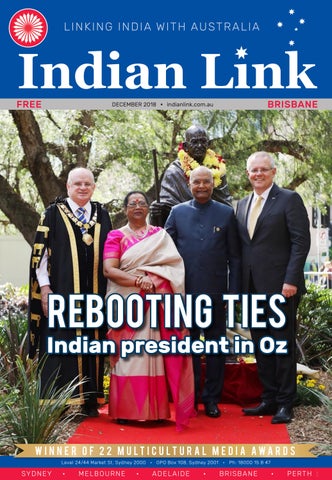
Rebooting ties
Indian president in Oz
W I N N E R O F 2 2 M U LT I C U LT U R A L M E D I A AWA R D S Level 24/44 Market St, Sydney 2000 • GPO Box 108, Sydney 2001 • Ph: 18000 15 8 47
SY D N E Y
•
MELBOURNE
•
ADELAIDE
•
BRISBANE
DECEMBER 2018 1
•
PERTH
Superb iPhone XR with no excess data charges. 50GB $99/mth. Min cost $2,376 over 24 months on a Mobile Lease Plan when phone returned in good working order. For use in Australia. 64GB capacity.
Visit your local Telstra store telstra.com/iPhone THINGS YOU NEED TO KNOW: Your minimum cost may be higher if you cancel early. Mobile Lease plans: You must lease an eligible phone for 24 months. You don’t own the phone, and must return it at the end of the lease unless you make an offer to purchase it. If your lease is cancelled within 12 months you must pay a fee based on the recommended retail price of your phone. If your lease is cancelled after 12 months you can return the phone and pay $99 if in good working order. In both cases you must also pay any additional early termination charges or accessory option repayments. Additional fees up to $499 apply if you return a damaged phone, the locking features have not been disabled, you cancel your lease early and return a damaged phone or you don’t return your phone at the end of your lease. Learn more about leasing at telstra.com/swap. Apple is a trademark of Apple Inc. registered in the U.S. and other countries. Apple Music is a trademark of Apple Inc. The spectrum device and ® are registered trade marks and ™ are trade marks of Telstra Corporation Limited, ABN 33 051 775 556. MC/18 TEL1201
TEL1201 - 30 Oct iPhone XR - Press - SA - 358x250 - Indian Link.indd 1
2 DECEMBER 2018
26/11/18 10:12 am
www.indianlink.com.au
EDITORIAL
China’s tantrum diplomacy: Gains for India?
PUBLISHER Pawan Luthra EDITOR Rajni Anand Luthra SOCIAL MEDIA Neha Malude MELBOURNE COORDINATOR Preeti Jabbal CONTRIBUTORS Sudarshan Arvind, Vish Chilumkurti, Usha Ramanujam Arvind, Ritam Mitra, Mohammed Shafeeq, Minal Khona, Auntyji ADVERTISING MANAGER Shriti Sinha 0410 578 146 ADVERTISING ASSISTANT Charuta Joshi 02 9279 2004
Indian Link is a monthly newspaper published in English. No material, including advertisements designed by Indian Link, may be reproduced in part or in whole without the written consent of the editor. Opinions carried in Indian Link are those of the writers and not necessarily endorsed by Indian Link. All correspondence should be addressed to:
INDIAN LINK MEDIA GROUP Level 24/44 Market St, Sydney 2000 GPO Box 108, Sydney 2001 Ph: 02 9279-2004 Fax: 02 9279-2005 Email: info@indianlink.com.au
BY PAWAN LUTHRA
T
he Asia-Pacific Economic Cooperation (APEC) was founded in 1989 by former Australian Prime Minister Bob Hawke as an inter-governmental forum for 21 Pacific Rim member economies to promote free trade throughout the region. The yearly summits are highly orchestrated events: what most take away from the meetings are the world leaders wearing the national dress of the host country, waving and smiling for the cameras. The summit this year which recently concluded in Papua New Guinea was however held at a time when the heavyweights of the world economy – United States and China – are at a trade war with each other. The distrust between the two countries spilled over at APEC when for the first time in its 29-year history, it was decided not to release a common statement. All
20 countries except China finally agreed to the joint statement. As per reports in the media, the Chinese delegation objected primarily to one line that read: “We agree to fight protectionism including all unfair trade practices.” They perceived that as singling out and targeting China. Reports from APEC also singled out China as resorting to “tantrum diplomacy”. According to The Washington Post, “Chinese tactics included being thuggish with the international media, busting into government buildings uninvited, papering the capital city of Port Moresby with proBeijing propaganda and possibly even using cyberattacks to stifle the message of Vice President Pence, the US delegation leader.” Rather than presenting a friendly face to the world, China came across as aggressive and a bully. It’s One Belt One Road (OBOR) policy was questioned and called a “one-way road into a debt trap”. Increasingly, the rising debt burdens now being experienced by such countries as Sri Lanka, Pakistan and the Maldives have raised questions about the viability
of cheap Chinese infrastructural loans. Initially starting out as loans, they appear to be accompanied by land grabs. Commentators have called OBOR ‘an exploitative, colonial stratagem to gain vital assets in small countries’. India is in a unique position to benefit from the sense of “selling out” that is being experienced by the local population in some of these countries. Its democratic traditions are a good starting point. Due to its history and position in the Indian Ocean region, India also has a shared history with a number of its neighbours. Reference to the island of Java, off the coast of Indonesia can be traced back to the time of the Indian epic Ramayana, India introduced Buddhism to Sri Lanka in the 4th century, and Malaysia was part of the Chola empire. India’s cultural diplomacy is an asset which can stand the test of time. It can, with like-minded countries such as Australia, Japan, and the United States, offer an alternative to the Chinese assertiveness. Besides, the line-of-credit rates offered by India to neighbouring countries is 1% or less. Commercial reality is an attractive way also to win friends in the region.
send Money Overseas most reliably and securely within 10 minutes through moneygram send Money to any bank account at the best rate and flat fee of $15 (No Limits applicable on amounts) exchange your currency with us, we give the best rates and do not charge any commission send money to our own branches in all major towns and cities in Fiji and New Zealand Ask us about our commercial business, we do import payments and all international business related remittance at best rate and a flat fee of $15.00 only NeW ZeaLaND BraNCHeS 649 369 1723
aUSTraLIaN BraNCHeS Parramatta Parramatta Blacktown Liverpool Hurstville Sydney CBD Darling Hbr Brisbane City
NATIONAL EDITION
02 9806 0977 02 9806 0955 02 9831 8033 02 9877 2201 02 9585 2881 02 9235 2553 02 9211 3021 07 3220 2881
St.Lukes Brown Bay Sylvia Park Mid Queen New Lynn Hamilton Wellington
649 846 6637 649 476 2086 649 525 4111 649 377 5478 649 825 0121 647 834 3293 644 589 9582
Manukau Mt.roskill Papatoetoe Lower Queen Pakuranga rotorua Christchurch
649 262 2931 649 620 4757 649 277 4000 649 365 2280 649 577 3223 647 350 2425 643 343 3357
FIjI BraNCHeS Suva Suva Nadi Lautoka Nausori
679 331 7755 679 310 0512 679 670 2257 679 666 7855 679 347 7042
Namaka Labasa Nasinu Ba
679 666 1242 679 881 1106 679 339 2007 679 667 8155
www.lotusfx.com DECEMBER 2018 3 JULY (2) 2014 15
YOUR SAY L I N K I N G I N D I A W I T H AU S T R A L I A
FREE
ACCOLADE
Indian Link takes the Publication of the Year at the NSW Premier’s Multicultural Communication Awards 2018 Sriraman Annaswamy wrote: Well done, Pawan Luthra and Indian Link, you’ve made an indelible mark in our Indian-Australian community over the last 25 years or so! Harish Malik wrote: Congratulations Pawan and Indian Link. Shivdev Kler wrote: Congratulations, Indian Link truly deserves it. Meenakshi Sharma Kalia wrote: Many many congratulations to your entire team. Manju Anand wrote: Congratulations, well deserved achievement. Sachin Wakhare wrote: Best of the best – Indian Link! Many congratulations to the team!! Janine Holgate wrote: Wow, well done Rajni, Pawan and team. All your hard work and your service to the community has been justly rewarded. Gaurang Joshi wrote: Wow! What an achievement guys! Congratulations. Dipen Rughani wrote: Congratulations @Pawanlink and the whole team at @indian_link! Well deserved. IABBV Hindi School wrote: Congratulations Pawan Rajni and the Indian Link team. Scott Farlow MLC wrote: Happy Diwali to all my friends, particularly to @Pawanlink from @indian_link who won publication of the year at @GladysB’s Multicultural Media Awards last night! It was great to join him and all the team to celebrate Diwali in Little India at Harris Park recently. Multicultural NSW wrote: Congratulations to @indian_link winner of the Publication of the Year Award at the #PMCA18 Australian Muslim Times wrote: Great job @indian_link! Rosy Lalmalsawmi Khuma wrote: Congratulations Rajni and Pawan. Kalyani Wakhare wrote: Awesome Indian Link, very well deserved! Many congratulations to the entire team! Petra O’Neill wrote: Great work! Katrina Hall wrote: Congratulations to you! Emie Roy wrote: Awesome work Rajni and Pawan Luthra! Raka Mitra wrote: Congrats to the whole team. Rekha Rajvanshi wrote: Well-deserved Indian Link, congratulations. Mittu Gopalan wrote: Hearty congrats, guys! Well done and hats off to you both and the entire team Nishaa Singh Lamba wrote: Wow, congratulations on your achievement. Bhavisha Parmar Bhandari wrote: Congratulations to Indian Link and to the Luthras. Harshad Pandharipande wrote: Thoroughly deserved! I want to congratulate Pawan, Rajni, Neha, Shriti, Charu and the entire Indian Link family for the award. I felt super proud. Ritam Mitra wrote: Honoured to be a finalist for Best News Report at PMCA18 for my piece on intercountry adoption in Australia, but even prouder of the Indian Link team for taking out the Best Publication award.
SAY IT AGAIN 4 DECEMBER 2018
Virat Nehru wrote: It’s a surreal moment seeing your work recognised on a projected screen as a room full of people clap when your name is announced. Wouldn’t trade this feeling for anything in the world.
FORTNIGHTLY
Vol.26 No.1 (1)
OCTOBER (1) 2018
SYDNEY
indianlink.com.au
25 TH AN N IVERSARY ISSU E Level 24/44 Market St, Sydney 2000 • GPO Box 108, Sydney 2001 • Ph: 18000 15 8 47 • email: info@indianlink.com.au
SY D N E Y
•
MELBOURNE
•
ADELAIDE
•
BRISBANE
•
PERTH
MILESTONE
Indian Link marks 25 years Prime Minister Scott Morrison wrote: I extend my warmest congratulations to staff and readers of Indian Link as you celebrate your 25th anniversary year. The Australia-India partnership is strengthened by the many contributions of Australians of Indian descent who, over the years, and through successive waves of immigration, have worked hard, brought new ideas, and helped shape our identity and prosperity. Australia is one of the most successful multicultural countries on earth, and support for the cultural and religious diversity of this nation is something that should be cherished and championed by all. In this context, quality multicultural media like Indian Link not only provides valuable access to information and entertainment, but has a leadership role to play in sharing ideas around culture and ethnicity, and in building respect and understanding. I thank staff and readers of Indian Link for your commitment to these aims, and wish you many more years of success.
WHERE IN INDIA
Name this spot in India, we asked in our online quiz, and got a flurry of correct answers. This place - especially in today's unsafe times - is really unique. Not a single house in this village has a door or a lock. Nor do people lock up their possessions or valuables.
The correct answer, Shani Shingnapur in Maharashtra, came in from Sunil Coelho, Punita Udeshi Ganwani, Ajay Sharma, Haniyur Subbaramiah and Arix Bishnoi.
India’s and Australia’s vibrant, multicultural democracy, free press, independent judicial system and the English language bring us together. And more so, when all this is so passionately wrapped in our shared love for cricket and hockey. And Masterchef! President of India Ram Nath Kovind
Numerous Australian PMs from Menzies to Turnbull have laid wreaths in Gandhi’s honour at Rajghat and paid their respects; now we have the opportunity to do that right here in Parramatta Prime Minister of Australia Scott Morrison
www.indianlink.com.au
AUSTRALIA’S PLACE IN THE NEW ASIAN WORLD ORDER
When Stan Grant of ABC News discussed the Asia-Pacific Summit season on his show Matter Of Fact (Thursday 15 Nov 2018), Pawan Luthra joined him as guest alongside Michael Wesley of ANU and Merriden Varrall of KPMG Australia. See the entire episode on ABC iView, or a snippet on www. indianlink.com.au @crudeoilpeak wrote: Of course China has a strategy to secure it’s oil supply routes after it peaked 2015. Guess where Australia will end up in this game @MCfromPerth wrote: India calls their concept of PRC strategic diplomacy (as it affects them) “The string of pearls”. With strong PRC influence in Myanmar to E, Pakistan to W, Maldives to SW & Sri Lanka to SE, no-one can accuse Beijing of failing to think strategically! @InfowarsChina wrote: One belt one road is a project, you don’t like the terms, don’t sign it then! Go to a bank, ask them for a loan, and tell them it’s debt trap… go, try it! @Rogerinaustr wrote: Cricket would not be possible with such behavior. They are said to recognise only their team? @renmarkugento wrote: Colonisation and living space by stealth - is this China’s agenda? Looks that way. Sunil Vyas wrote: Excellent interview and commentary. Harish Velji wrote: Saw you on Matter of Fact, you were great. Sudhir Warrier wrote: Saw you on TV just now, your thoughts were well articulated. Good on you, mate. Karam C. Ramrakha wrote: Could not sleep so watched Stan Grant. When he raised what I paraphrase as the spectre of "Hindu Nationalism", your reply, Pawan, was too self-effacing… No doubt you are a closed secularist, or possibly an open one. But resorting to my roots as a UP bhaiya, that question of Stan would have set my hair on fire; your reply was too namby pamby – (it) should have been a rebuke. Hindu nationalism, which CIA has said is the most evil in the world today, is the bedrock on which India must flourish or fall. I don't think you will publish this in your esteemed newspaper.
DIWALI IN BLACKTOWN
Shamila and Vishal Sadhu’s home wins Blacktown City Council’s Diwali Lights contest Chandni Sheth wrote: Congratulations Dr Shamila, belated Happy Diwali to you and family. Monideepa Pal wrote: Our neighbour!! Beautiful decorations Girija Krishnakumar wrote: Lakshmi’s heavenly abode! Madan Puri wrote: Aap sab pariwaron ko dheron shubkamnayein Rana Youkhana wrote: How nice is this!! Leighton Farrell wrote: This looks amazing. Stunning. Sunny Jindal wrote: Amazing. Ashish Garg wrote: Great decoration. Melanie Jane wrote: Beautiful congrats. Nayyar K Verma wrote: Congratulations. Swati Varun Adlakha wrote: This is just wow. Nanetta Sadsad wrote: So pretty. Congratulations.
Blacktown Police Area Command wrote: Now that's impressive!! Donna White wrote: Polite question, no rudeness meant, why does it look like a Nazi symbol is in the lights? Ami Lama wrote: Donna White, it’s a Hindu religious icon, it goes clockwise whereas Nazi symbol is anti-clockwise. Gurmeet Kalsi wrote: It’s Buddhist too, it’s called swastika. Donna White wrote: Ami Lama Gurmeet Kalsi, thank you, I have learned something today. Darlene Clinch wrote: Donna White likewise I had no idea of this - learn something new every day. Trish Caruana wrote: Donna White when I first saw it over a year ago, I was a bit spun out too, lol.
I feel that Australian films are not well represented in India, a country where people are cinema-mad. Masterchef is one of the most popular shows here. So, it would be great to have more Australian films released here. Mitu Bhowmick Lange, at the Kolkata International Film Festival
BOLLYWOOD DIWALI? NO THANKS
We shared a video online of a British Airways-organised Bollywood flashmob on Diwali at Heathrow Airport. Kala Raghunath wrote: Indian festivals are not an excuse to start dancing to Bollywood. Diwali, Holi, shrad… Bollywood everywhere! Terrible! Krish Na wrote: I watch Bollywood movies and think, ‘wow my real life is nothing like that’. Got the same feeling with this video. The Diwali I grew up with feels nothing like this. Same probably for most of the people from the south. Not complaining - at least some version of Diwali made it to the mainstream, LOL!
I have to speak a little bit slower, but people are laughing and getting into it. Everyone gets my references. Brisbane-based stand up comic Mel Buttle in Bangalore
Without Steve Smith and David Warner, Australia are like India without Virat Kohli. Sourav Ganguly, former Indian cricketer on IndiaAustralia Test series
DECEMBER 2018 5
THE TEA M Carl Buhariwala
Grahak Cunningham
Saroja Srinivasan
Shafeen Mustaq
Sandeep Hor
Radhika Bhatia
Devna Luthra
Beheshta Wasseh
n e p
s e W
Dhanya Samuel
Puneet Anand
Nanditha Suresh
Dilip Jadeja
Sai Narayan
Mohan Thite
Niraj Pandya
Deepa Gopinath
Sukesh Thapliyal
Raweena Raval
Royston Rebello
Neha Malude
Tarini Puri
Aparna Ananthuni
Farzana Ahmad
Uttam Mukherjee
Dipanjali Rao
Sunila Vig
Emie Roy
Darshak Mehta
Sukrit Sabhlok
Anup Kumar
Virat Nehru
Priyanka Tater
Petra O’Neill
Avi Chandiok
s e ri
Jyoti Shankar
Mohan Dhall
Mital Parekh
Saroni Roy
r u o y g
o t s
Frankey Gerard Fernandes
Sagar Mehtrotra
Rajni Anand Luthra
t
n i l el
Yesha Joshi
Sydney Srinivas
Neelam Vasudevan
6 DECEMBER 2018
e m
Astha Singh
Rani Jahla
LP Ayer
Sahibnoor Singh
i t r
u o d
Usha Ramanujam Arvind
Ritam Mitra
Kashif Harrison
Pawan Luthra
Charuta Joshi
Gaurav Masand
Simren Samrai
Vish Chilumkurti
Kalyani Wakhare
Raka Sarkhel
Nikita Kulkarni
Vinaya Rai
Komal Utsav Jagad
Preeti Jabbal
Dinesh
Kira SpucysTahar
Anubhuti Madan Singh
Auntyji
Minnal Khona
Hamida Parkar
Nisha Joseph
Aneeta Menon
Sudarshan Arvind
www.indianlink.com.au
WORK
Out of this world Arvind Ramana on his work in Australia’s emerging space industry BY SUDARSHAN ARVIND
C
hennai-born and Canberra-based Arvind Ramana leads a team at UNSW Canberra Space that is helping to propel the Australian space sector into the stratosphere. Its pioneering BRMM (Buccaneer Risk Mitigation Mission) satellite, produced as a collaboration between UNSW Canberra Space and the Defence Science and Technology (DST) Group has been fully designed, built and tested on Australian shores. Travelling at an eye-watering speed of 7km/second and orbiting at an altitude of 550km, it has sent back the first ever image of Australia captured from space by an Australian satellite. The stunningly compact, “milk-carton sized” machine will provide “valuable assistance to the Australian Defence Force in safeguarding the borders”, Ramana told Indian Link, helping to calibrate the Jindalee Operational Radar Network which is currently in place to monitor sea and air movements in Australian territory. He added, “The satellite also has key applications in Space Situational Awareness and Ionospheric research, which will propel our ever-growing knowledge-base in the field.” Since migrating to Canberra from Singapore in 2015, Arvind Ramana has headed the Embedded Systems and Flight Software Team at UNSW Canberra Space, the UNSW’s campus at the Australian Defence Force Academy, a world-class conglomeration of academics and professionals that has spearheaded the emergence of Australia’s space industry on the global stage. Graduating with a degree in Electronics and Communications Engineering from Anna University (Chennai), Ramana’s academic and professional journey has taken him from India to Singapore and finally Australia. “Coming from the land of APJ Abdul Kalam, space has always been of huge interest to me,” Ramana revealed when looking back on the origins of his passion in the field. “When studying at Nanyang Technological University Singapore, the opportunity to work in the sector presented itself, and I haven’t let go of it since.” While at Singapore, he worked on designing and developing various hardware subsystems including mission critical on-board computers and digital design for TeLEOS-1 satellite (Singapore’s first commercial earth observation satellite). He is a strong advocate for Australia’s involvement in space and acknowledges some of the crucial contributions the country has made over the years. “Australia has played a huge supporting role in major space programs including the famous moon landings. The industry has grown by leaps and bounds in recent years with successful satellite missions, cutting edge research in Space situational
awareness and the recent establishment of the Australian Space Agency,” he explained. According to Ramana, Australia’s strengths in the field derive from its “facilities and skill sets in spacecraft operations, radar technology, data processing and analysis (which are) phenomenal and recognised worldwide”. Speaking about the motivation behind his team’s BRMM satellite, he stated that “UNSW Canberra Space has always been interested in applications of space research that are directly beneficial to a better Earth.” Not merely satisfied with the incredibly high quality of research data produced by the UNSW Canberra Space laboratories, he pointed out that his team is also deeply entrenched in a mission to develop a local ecosystem of space capability in Australia. “We are working very closely with the local scientific community and organising various STEM outreach events to make sure that the younger generation also gets inspired by Space Engineering and Research”. Ramana is particularly excited about the local Indian community’s enthusiastic involvement in this field. “Many of our outreach events see a good share of local Indian community participation and I can also see a lot of local Indian uni students showing initiative to get involved with our team’s projects as well.” Looking beyond the operation of the BRMM satellite which is one of the key current priorities of the UNSW Canberra Space labs, Ramana’s team has been “busy developing the [upcoming] M1 and M2 satellite missions. M1 will be launched in the next couple of days while M2 is anticipated to launch in June 2019.” Both satellites will have wide-reaching applications including ship and aircraft detection, as well as providing an opportunity to test “in-house developed technology”.
Ramana with Buccaneer, a “milk carton” sized satellite that has just marked its first birthday in space
DECEMBER 2018 7
COVER STORY
President comes calling In the first ever visit to Australia by an Indian President, Ram Nath Kovind invites Australia to benefit from India’s growth story
B
harat mata ki jai! The cry went up from the crowds at Parramatta NSW just as the President of India Ram Nath Kovind took to the microphone to begin his address. “I find much similarity between (the terms) ‘Bharat mata’ and ‘Parramatta’,” the President said, as the crowd erupted again. That clever way with words popped up frequently enough during the President’s visit to Australia to impress the audiences. The crowd’s more than warm reception of India’s head of state might have given the host nation some idea of the regard with which the mild-mannered and gently spoken man is held in his country. There were no Modi-like histrionics or flashy kurtas, and while the mannerisms may
8 DECEMBER 2018
have been gentle, the message repeatedly conveyed was strong and clear: let’s take this bilateral relationship to the next level, there’s plenty in it for both of us. In anticipation, the Australian government finally endorsed the India Economic Strategy report that it commissioned Peter Varghese to write in July 2018, and announced its in-principle support to its 20 priority recommendations. Besides his official one-on-ones with the Governor General Peter Cosgrove, Prime Minister Scott Morrison, Leader of the Opposition Bill Shorten and Defence Minister Marise Payne, the President met with the expat Indian and the business communities in large numbers.
GANDHI STATUE UNVEILING
At Parramatta, hundreds of Indians gathered at Jubilee Park to see him unveil the statue of Mahatma Gandhi, the best-known Indian in the world. Standing alongside PM Scott Morrison, the missive here was really twopronged: one, that the Government of India values its diaspora - “a living bridge,” as the President described; and two, that the Government in Australia values its own migrant constituents. The President said, “This statue - an initiative of the city council - symbolises the bond that ties our nations together. Going forward, I’m optimistic that our two countries, which share so much in common, can achieve so much together.”
Mr. Morrison said about the Mahatma, “His message is not a whisper of the past, but a teaching embedded in the hearts of millions around the world.” He added, “Numerous Australian PMs from Menzies to Turnbull have laid wreaths in his honour at Rajghat and paid their respects, and now we have the opportunity to do that right here in Parramatta.” The President gifted a book titled Hind Swaraj to the Prime Minister and the Lord Mayor of Parramatta Andrew Wilson, a book written by Gandhi in 1909.
HIGH COMMISSION OF INDIA RECEPTION
In stark contrast to the Parramatta event, the reception hosted by the High Commission of
www.indianlink.com.au
India was much more subdued, and steeped in formality. Some 300 invited guests from across the country gathered to welcome the President to Australia. As he wished his compatriots belatedly for Diwali, and for Milad Un Nabi and Gurupurab, he expressed satisfaction at the manner in which they have adapted to their karmabhoomi, and invited increased engagement with their land of birth. In an unusual ritual, members of the audience were invited in small batches up on stage to be photographed with the President. (Perhaps this was sparked after the swarm of selfie-hunters impeded proceedings somewhat at the 2014 visit of Prime Minister Narendra Modi.)
AFR AND AIBC
At two business events - the Australian Financial Review India Business Summit and the Australia India Business Council’s annual India Address - the President invited Australia to benefit from India’s growth story. “In recent years, India has renewed its commitment to a liberal, transparent and globalised economy,” he pointed out. He added that India has reached the top league in terms of openness to foreign investors, and listed a variety of sectors that have thrown open their doors to global players, including aviation, mining and defence production. India is in the midst of an “infrastructure push of unusual urgency”, he detailed, as it
constructs highways, rolls out broadband, creates new railway and freight corridors, upgrades ports and high-speed train networks, expands air connectivity and industrial corridors. He also pointed out that India’s growth is different from that of many others. “We are the first major country that is seeking to make that leap into industrialisation while also combating climate change, and while reducing the intensity of dependence on fossil fuels,” he said. “India has set a target of 175 gigawatts of renewable energy by 2022, of which 100 gigawatts will comprise solar energy, and is on course to exceed the target.” While India’s digital economy, its e-commerce companies, its technology start-
ups and its fin-tech innovators are attracting foreign direct investment, he said Australia seems missing in the India investment story. “This is a gap we need to address. Australia and India have too much at stake in each other to not up their game,” he said. Kovind said the Australian super-funds or pension funds will find Indian infrastructure space worthy. “Let us put our heads together and create investment products that work for Australian super-funds and Indian infrastructure, and for Australian pensioners and Indian consumers, and lead to a win-win situation,” he said. India-Australia trade, valued at $21 billion in 2018, has grown but remains below potential, he said, adding that India DECEMBER 2018 9
COVER STORY
“Australia and India have too much at stake in each other to not up their game” “Batsmen who do well on India’s pitches … show patience, they study the conditions. They form good partnerships, and they do not get taken in by the spin” “India has set a target of 175 gigawatts of renewable energy by 2022, of which 100 gigawatts will comprise solar energy, and is on course to exceed the target” “Let us put our heads together and create investment products that work for Australian super-funds and Indian infrastructure, and for Australian pensioners and Indian consumers, and lead to a win-win situation” “There is a world of opportunities waiting for you in India. I hope to see more mates and mateship between the business communities of Australia and India” is positively engaging in the Regional Comprehensive Economic Partnership and will contribute to its conclusion by 2019. Kovind also said the two countries shared the vision for peace and prosperity of a free, open and rules-based Indo-Pacific Region. “There is a world of opportunities waiting for you in India,” the President concluded. “I hope to see more mates and mateship between the business communities of Australia and India.”
DINNER AT MANJIT’S
The President Mr Kovind, First Lady Savita Kovind and their daughter spent a relaxed evening at Sydney’s leading Indian restaurant Manjit’s at the Wharf. (Indian Link understands this was a request from the President himself). 10 DECEMBER 2018
The high-profile visitor and his entourage were treated to a specially designed menu by Manjit’s staff, including tandoori fish malai, tandoori aloo, dal bhat tikka, Balmain bug curry, kaju ki sabzi, goat curry and vegetable biryani. Part of the restaurant was closed off to regular diners.
THE UNIVERSITY OF MELBOURNE
At the University of Melbourne, the President delivered a lecture titled ‘Australia and India as knowledge partners’. The special public lecture event was organised by the university’s Australia India Institute led by CEO and Director Professor Craig Jeffrey. The President opened his address by
congratulating the university for living up to its founding motto Postera Crescam Laude which means, ‘We shall grow in the esteem of future generations’. “Our ever-growing knowledge partnership has happened principally through two streams: education cooperation and scientific collaboration,” said the President. Whilst this has worked well, he said, the ambit can be expanded with more knowledge areas to work on. “Australia ranks the second most preferred destination for Higher Education for Indian students,” he said. “Today, there are close to 85,000 Indian students in various parts of Australia. Over 1500 Australians have studied and completed internships in India in last few years.”
The President was happy that the two governments have rightly identified education as a priority area for bilateral cooperation and it has been chosen as the flagship sector for Australia in the India Economic Strategy. Speaking of the knowledge engagement through scientific collaboration and research, he noted that Australia is among the top five research partner countries for India. During his visit both countries announced a renewed commitment of $10 million dollars each towards the Australia-India Strategic Research Fund. “As mega-bio-diverse countries, both India and Australia can enrich the world with biogenomic wealth and improve agriculture and human health. Our scientists and experts can together develop climate change adaption
www.indianlink.com.au
strategies and innovative ways to manage the environment,” said the President. He noted that as an oceanic culture, Australia is known for its understanding and expertise in marine ecology and blue economy. Australia and India are thus collaborating under the Indian Ocean Rim Association framework. On the other hand India’s strength lies in space technology, cyber security, traditional medicine and basic research and India can provide new synergy to scientists and researchers in Australia. The President also touched upon the promising area of partnership between the two in the field of sports beyond cricket. “Your sporting expertise can help us develop sports medicine, sports management and a sporting way of life. On our side, we
are ever ready to share with you how to bring the balance of Yoga to the pace of Australian Rules Football.” As part of his engagements in Melbourne the President visited Government House where the Governor of Victoria, Ms Linda Dessau, held a luncheon banquet in his honour. Leader of the Opposition in Australia Mr Bill Shorten also briefly called on the Indian President. They discussed the strength of the bilateral relationship and a shared desire to enhance it further across multiple sectors including economic, trade, skills development, education and cultural links. The President’s much-anticipated visit to the MCG to witness the India-Australia T20 match live was unfortunately cancelled due to inclement weather.
BACK TO CRICKET AND CURRY
Cricket analogies abounded across President Kovind’s speeches. He urged Australian businesses to take heed from batsmen who do well on India’s pitches. “They show patience, they study the conditions. They form good partnerships, and they do not get taken in by the spin,” he observed as attendees at the AFR summit burst into laughter. If it was cricket for Kovind, it was food for Sco-Mo: the garam masala analogy was recounted yet again, and may well be a good analogy to describe multiculturalism, but might just be a bit too hot to handle for the tastebuds of many in the mainstream. More interesting was the PM’s reprisal of a predecessor from years ago, Alfred Deakin,
who “to use his phrase, ‘spread his sails to catch India’s breeze’ … (and) fell in love with and wrote two books about India before he became prime minister; the complexities, contradictions, colours, faiths, architecture and vibrancy of India captivated him. He returned to Australia as an evangelist for the opportunities for India.” Deakin had predicted way back in 1893, that education could be an avenue to bring India and Australia closer 125 years after the potential was realised, will Kovind’s visit to Australia - and Peter Cosgrove’s upcoming return visit to India - see Australia finally spread its sails widely enough to catch India’s breeze? Pawan Luthra, Neha Malude, Rajni Anand Luthra and Simmi Singh DECEMBER 2018 11
INDOPHILE
Flushing their worries away Keeping girls at school: that’s Mark Balla’s ultimate aim as he builds basic facilities in rural India BY PREETI JABBAL
1
9 November was officially recognised as World Toilet Day by the United Nations in 2013 as a day to raise awareness of the importance of sanitation. For Melbourne-based social entrepreneur Mark Balla, however, every day is World Toilet Day as he delves into the potential and limitations of bringing about a social change for school kids in rural India. Working in collaboration with Rotary Club India, Mark initiated Operations Toilets Australia (OTA), which has helped nearly 30,000 Indian students to get access to toilets. OTA builds toilets and delivers hygiene education programs in schools in developing countries with the special aim of improving educational opportunities for adolescent girls. For ‘toilet warrior’ Mark Balla, the main focus is on breaking the taboo of toilets and constructing dialogue around it. In 2013 an unplanned visit to Dharavi, Asia’s largest slum in Mumbai, saw a turn in Mark’s life that set him off on this unconventional journey. He was travelling in Mumbai’s local train when two young boys approached him and offered to take him on a tour of Dharavi. He impulsively agreed, ignoring the safety warnings for foreigners. The boys took him around the densely populated area that accommodates nearly a million people in 535 hectares of land. They also took him to a primary school where he noticed that there were no teenage girls. The majority of the students were boys of all ages, and some younger girls. When asked, the boys explained that there were no teenage girls in school as there were no toilets for them to use. They have to defecate in the open and they skip or drop out of school when they go through puberty. Mark, whose daughter was turning 13 at that time, was shocked to know that many girls were deprived of education due to lack of basic facilities. He couldn’t comprehend how girls, at an age when they should be excited about their future, were instead faced with the end of their education. “There’s the old saying that ‘if you educate a woman you educate a village’. To me the women not fully participating in the economy due to lack of education was a civil concern,” Mark told Indian Link. He realised that there are massive flowon effects to this issue that are statistically proven. Girls who stay in school longer get married later and have fewer children, their children are less likely to die in the first five years of their lives, and their 12 DECEMBER 2018
earning capacity goes up 5 -10% with each additional year spent in school. Mark then started his own research to find that according to UNICEF nearly 33% of India’s population lacked access to proper toilets and around 530 million people defecate in the open. The impact of this endemic sanitation issue included unsafe waters and communicable disease, and deaths due to diarrhoea. Lack of privacy and dignity contributed to nonattendance in schools, low health and equity outcomes and risk of disease, abuse and exclusion. Mark returned to Australia to create ‘We can’t wait’ a not-for-profit organisation that partnered with Rotary Club to raise funds to build 15 toilets for a school in Nashik, Maharashtra. Starting with their first project in 2015 that reached 500 children, they have now reached another 30,000 children. They don’t just build toilets, they also assist with hand washing stations and training, water
and sanitation education and outreach to families and wider community. “I have never had so much job satisfaction from a job that virtually pays nothing,” remarked Mark as he laughingly shared that he had to swap his Mercedes for a cheaper car recently. According to Mark, the sacrifice was not a difficult decision for him, as he likes to put his money where his mouth is and contribute to this great cause. “With generous support, sponsors and ongoing efforts we have been able to remove one of the barriers to education through a reduction in incidences of sanitation-related issues, and helped create a healthier and protective school environment,” said Mark. Sharing some interesting stories of his trips to India Mark talked about his favourite experience of a school that he visited, up in the hills, a couple of years ago. The village was populated by 300 people with around 25 primary aged
children, all being taught by one lady teacher. They had no toilet so he asked the teacher how they managed. The teacher told him that she took a bus from her village every day, travelled for two hours to get to the school, taught all day and took the same journey home. She said she got home and took a big drink of water. She went the whole day without drinking water and when he asked her how she managed when she had her periods she told him that the children do not come to school on those days. Mark was horrified and he worked out a solution where a toilet and a washbasin was quickly provided for the children and teacher to share. A few weeks later he got a message from the teacher telling him that now when she gets to school, the first thing she does is drink a lot of water. She also told him that the previous month was the first time since she started working at the school that the children had attended school every day.
www.indianlink.com.au
Starting with their first project in 2015 that reached 500 children, OTA have now reached another 30,000 children. OTA doesn’t just build toilets, it also assists with hand washing stations and training, water and sanitation education and outreach to families and wider community. “I have never had so much job satisfaction from a job that virtually pays nothing” Mark Balla No doubt we will get to read more about this single-teacher school in Mark’s upcoming book A Journey to the Toilet, but it is experiences such as this that motivate Mark to continue to push the conversations, mobilise projects, support and collaborate with schools and organisations to ensure that basic sanitation needs are met. Mark praised the Indian Prime Minister Narendra Modi’s Swachh Bharat Abhiyan, a nationwide campaign that aims to have India Open Defecation free by October 2019. “What they are trying to achieve is fantastic and there have been many toilets installed in the country as a result of this ambitious project, its high profile ambassadors and Government subsidies,” he said when asked about its progress. Speaking of confusing data on the subject, Mark said that the data that they tend to trust mostly is from UNICEF and other large organisations like World Vision, as they have a large number of people on the ground collecting that data. According to him the Indian Government
data is good from an infrastructure point of view, however not necessarily from the quality perspective. For example they may be able to list the number of toilets in schools but not necessarily the condition of those toilets or the number of children that can use those toilets. “Some of the toilets I have seen in schools are appalling. They may exist but are completely unusable or used for storage and other purposes,” said Mark. “We take on projects that are easy to implement, where water is not scarce and the school authorities are completely engaged in the process and desperate for improvement,” he continued. As a former writer of survival guides for Lonely Planet, his survival tip for those planning to conduct any charity work in India is that it is important not to judge anyone. The journey may not be easy and can have frustrating moments but continue to persevere and do not fail to tell stories that capture people’s attention as stories are powerful. DECEMBER 2018 13
COMMUNITY
Knowing themselves through dance
L
Students of the Lalitha Kalalaya school of dance present annual concert
alitha Kalalaya, a Bharatnatyam dance school set up by Padmalakshmi Sriram, celebrated its fifth anniversary recently. It marked the occasion with a Salangai Puja – in which prayers (puja) are offered to the anklets (salangai) worn by the dancers, an integral part of the attire. The ceremony is a rite of passage to advanced skills while learning Bharatnatyam, and signifies an ongoing dedication to this ancient southern Indian dance form. Essentially a dance performance spanning the entire Bharatanatyam gamut, the evening began as per tradition with an invocation to Lord Shiva also known as Nataraja (King of Dance). Following were the usual presentations of Alaripu (Flowering Buds), Pushpanjali (Offering of Flowers) and Jathiswaram, a dance form which focusses on intense dance sequences
14 DECEMBER 2018
without abhinaya (expressive component of creativity). The performers were accompanied by a live ensemble of Arthavan Selvanathan on the mridangam (drum), Muralidharan Ramakrishnan on the flute, Aswin Narayanan on the violin and Sushmita Ravi as the vocalist. This Salangai Puja precedes the Arangetram, a graduation performance for a Bharatnatyam debutante completing many years of training. In contrast, Salangai Puja demonstrates the dedication of the student and verifies that the student has the stamina and perseverance to pursue higher goals. Aptly, the school’s annual concert that followed two weeks later, was titled Samarpan (dedication). Some hundred students in all age groups presented their skills. For many of the tiny tots in the
youngest age group, this was perhaps their first ever time on stage. One little one was so overcome that she burst into tears. It goes to Padmalakshmi’s credit that instead of taking the child off the stage, she stood beside the child and gave her confidence to complete the routine. That is the sheer stuff the guru-shishya tradition is made of. Padmalakshmi told Indian Link “We have grown from 20 students in our first concert, to more than 100 students this time. I can only consider this a dedication to my own gurus who have taught me”. One of the highlights of the annual day concert was Krishna Swagatham, a dance performance by 7-8 year old students accompanied by their mums. Padmalakshmi’s efforts to teach Bharatnatyam in a traditional way have reached fruition after a lifelong dedication
to Bharatnatyam. Her journey started in India as a child when her mother enrolled her in Bharatnatyam classes against strict family norms which didn’t allow girls to go out to learn dance. Currently she balances life as a teacher’s aide in a Queensland school for socially disadvantaged students, a Bharatnatyam teacher, a mother of a university going student and a homemaker. She admits that the second generation Indian students in Australia have a steeper learning curve compared to her students in India - perhaps due to a veritable clash of cultures that sets in when young people are exposed to differing cultures. However, she has done a fantastic job in making the ancient Indian dance form more popular in Brisbane. Her love for dance is summed up by her words, “Dance fulfils me.” Vish Chilumkurti
www.indianlink.com.au
THE YOUNG ONES
The stuff of dreams When high school kids get to bowl to Virat Kohli in the nets Venkat with Ashwin
A
head of an all-important Test series, it would be a routine task for the Indian team’s batting coach Sanjay Bangar to organise net bowlers to facilitate a good training session. This time round, he got together with an old mate Sanjiv Dubey, a Sydney-based sports coach and sports writer, to give a local group of upcoming cricketers the experience of their lives. In a unique opportunity, four young lads from Western Sydney got to take a day off school to see what it’s like to bowl to the stars of India’s cricket team, including Virat Kohli, Rohit Sharma, Ajinkya Rahane, Murali Vijay and Cheteshwar Pujara. “I was really excited,” spinner Venkat Viswanathan recounts. “Initially I felt under pressure, but as I bowled I began to feel more comfortable.” It is an experience that he and his mates Avi Bansal, Sandeep Deepak and Ishan Iyer will never forget. Sanjiv Dubey, a Level 3 coach, is the founder of the Western Sydney based cricket academy Sports Foundation
Australia, and as coach of the Blacktown Grade Cricket Club, he has been mentoring the boys for a very long time. “These boys are not just weekend warriors – they are keen and budding cricketers who have been part of Cricket NSW’s pathway program, playing representative cricket before emerging into senior cricket,” the proud coach, who has himself been invited to net sessions with visiting Indian cricket teams for many years now, tells Indian Link. His wards have now started to make their mark in the NSW Premier Cricket league. “Venkat finished as the second highest wicket-taker in last year’s NSW Under 16 Green Shield tournament,” Sanjiv reveals. “And he hasn’t stopped there – in the NSW state Under 21 PGs competition playing for Blacktown Grade Cricket Club, he has been in the thick of wickets, claiming the scalps of some big names like Liam Scott and Lachlan Hearne (who are representing NSW in the Under 19s). Venkat is still under 17.” Dubey was able to organise for Indian chinaman Kuldeep Yadav to share some
Venkat with Yadav
quick words of wisdom with Venkat, advice that will stand the youngster in good stead as his own career blossoms. No doubt Virat Kohli is currently in great form for his country, but so is fast bowler Avi for his Blacktown Club, as are Sandeep for Mosman and Ishan for Western Suburbs. “It was like David and Goliath, watching them against the greats at the SCG nets,” Dubey laughs. The Goliaths of the Indian team have been known to mentor many young Davids. In fact, Sanjiv reveals, as the videos of Venkat bowling to Virat Kohli got shared around in India, he was mistaken for another Indian youngster who is often seen bowling at the Indian team’s net sessions, and is deemed to be another spin wiz. “Was the wicket spinning?” Sanjiv asked Venkat later. “Not that much - only the occasional ball,” the 16-year-old replied like a pro. “A few of my leg spinners and wrong’uns spun, but not too much.” Sanjiv is very proud of the manner in which his boys rose to the occasion. “On the day these young boys fully understood their job and role and presented
themselves with great professionalism, while respecting the expectation without getting in the personal spaces of the senior players,” he describes. “Once the net session was over, they also had the opportunity to interact and take photos with their heroes.” Equal respect and admiration was witnessed from the entire Indian team as well. Coaches Bharat Arun, Ravi Shastri and Sanjay Bangar ensured that the boys didn’t end up over-bowling in excitement, having the boys bowl short spells. The team’s bowlers Bumrah, Ishant, Bhuvi, Umesh and Shami also bowled short spells. “It was a unique experience to be able to interact with the Indian team,” paceman Avi Bansal recounts. “To be alongside players of such high calibre and to train with them is the stuff of dreams.” Dubey agrees. “It will be an understatement to say that these boys have scored a lifelong memory. This should inspire and motivate many other young cricketers to keep playing and one day maybe bowl to their star players.” Munish David
Over 55 Community Lifestyle Apartments embracing
Indian Culture with over
3,000 sqm of Resort-style Facilities
First Development of its kind in PERTH with Strata Title !
DECEMBER 2018 15
ACCOLADE
Publication of the Year Indian Link brings home its 22nd media award
BY USHA RAMANUJAM ARVIND
N
ice Diwali present, Premier Gladys Berejiklian murmured to Indian Link founders Pawan and Rajni Luthra. She was on stage, handing them the Publication of the Year Award at the 2018 NSW Premier’s Multicultural Communications Awards (PMCA). She must truly believe in the ‘most successful multicultural nation on earth’ spiel her party is constantly delivering, or she’s been to way too many Diwali events in the past few days. Either way, she couldn’t have said it better to the Indian Link team on awards night. It’s also not a bad 25th anniversary gift,
16 DECEMBER 2018
they could have told her. The publication brought home its 22nd media award this month. This is the second time Indian Link has won in this category, having won it before in 2015. The prestigious annual awards recognise excellence in the multicultural media and marketing industry. “Multicultural communicators ensure everyone has access to information about services and opportunities to participate fully in our society,” Premier Gladys Berejiklian stated on the occasion. “Communicating the successes of our multicultural society and identity is core to the success of our harmonious and socially cohesive State.” Minister for Multiculturalism Ray Williams noted that winners and finalists demonstrated the importance of a thriving multicultural communications sector.
“These awards set the benchmark of excellence for media and marketing professionals not only in NSW, but across the country,” he said. Indian Link CEO Pawan Luthra was delighted at his team’s collaborative efforts. “Trust is a major factor in the world of media today,” he noted. “With the consumer having the option of receiving their information from multiple sources, it is imperative that your reportage is fair and accurate and you continually search for not only excellence in media reporting but work hard to remain ahead of the curve in your ability to deliver news and information through multiple platforms to your consumers. At Indian Link Media Group we are privileged to have a group of dedicated writers and regular advertisers who understand the principles to which we adhere, to maintain our quality and trusted brand status.”
The award came at a time when his core team had finished a massive round of Diwali mela appearances on multiple weekends, and were probably suffering ‘fair fatigue’. Ray Williams, Minister for Multiculturalism, congratulated the Indian Link team. “You work hard to deliver a variety of stories that connect thousands of Indian-Australians to their culture every day. Thank you for your leadership in multicultural media and commitment to ensuring the community remains informed.” “The late nights and deadline stresses all seem worth it,” Rajni said later that night as the team took repeat selfies with the gong and the plaques. She added, “I am so proud of Ritam Mitra, nominated for Best News Report, and Virat Nehru, nominated for Young Journalist.” Ritam’s story Labour pains of adoption,
www.indianlink.com.au
an investigative piece developed over the course of several months, tackled head-on the often overlooked issue of adoption, highlighting a significant policy and information gap in Australia’s arrangements for inter-country adoption from India. Published in November 2017 during National Adoption Awareness Week (NAAW), the piece has been viewed more than 21,000 times on the website alone besides print nationwide, reached over 2,000 people on Facebook with over 200 likes. The story was also one of the top reads on Indian Link’s weekly e-newsletter in 2017. It also drew international attention, including being shared by the Central Adoption Resource Authority (CARA), an Indian government body formed under the Ministry of Women & Child Development, and the UK-based International Adoption Guide. Virat Nehru has been contributing for Indian Link for four years now. He wrote extensively for the student newspaper Honi Soit while at uni and was the prose editor for Sydney University Literary Society’s annual journal Carillon. He worked at SBS World News as well as at The Conversation Media Group before plunging into the world of arts journalism. What is most impressive about Virat’s body of work is his particular approach to exploring through the arts - specific cultural issues and touchpoints. He believes that arts and culture journalism holds an interesting mirror up to the society we live in. His expertise on Indian cinema and culture was officially recognised by the Sydney Film Festival this year when it invited him to introduce the Indian feature film Mehsampur – playing as part of the program – and to conduct and moderate
the Q&A with the director of the film Kabir Chowdhry post the film screening. Indian Link was also nominated this year in the Best Use of Digital or Social Media category, for their widely read weekly enewsletter. This is one of the many multimedia channels through which the publication reaches its readers. Launched in 2007, today it reaches 43,900 subscribers in the cities of Melbourne, Sydney, Perth, Adelaide and Brisbane, with Sydney and Melbourne newsletters being sent out weekly. The e-news is a carefully curated collection of the best stories carried in Indian Link’s print editions and on its website. It has become an important connect to readers in a way that’s substantial yet convenient. The success of the take-up rate from amongst the subscribers has also made it a lucrative option for businesses large and small to send their message out to the community. Meanwhile, on the other side of the world at around the same time, another major award was announced when Idris Elba was named by People magazine as the Sexiest Man Alive for 2018. When CEO Pawan Luthra was asked if he was willing to trade his award for that honour, he said, “Nah… ours is more lasting. I will hang on to this one, thank you.” Photos: PMCA/Salty Dingo Facing page Gladys Berejiklian with Rajni and Pawan This page clockwise from top Ministers Geoff Lee and Ray Williams want to join the Indian Link team in a spot of masti, Ritam Mitra with Minister Ray Willimas, Virat Nehru (second from right) with other nominees in his category DECEMBER 2018 17
CRICKET
Expect the unexpected this summer India are favourites to claim their first-ever Test series on Australian soil, but the path ahead is not as easy as it seems
BY RITAM MITRA
I
n many corners, this summer’s BorderGavaskar Trophy is all but promised to India, with the current level of instability in and around Australian cricket at a level unseen since the bitterness in the immediate aftermath of World Series Cricket in the 1980s. But to adopt such a mindset is to ignore half the equation; after all, the tourists arrive beleaguered by problems of their own. For once, however, the Indian side has managed to slip under the radar, such is the degree of scrutiny on their opposition. So talismanic too, is the Indian captain, that local broadcasters have adopted the promotional slogan “King Kohli v Australia”, making it very clear where the hosts expect the series will be won or lost notwithstanding all the other battles India will need to fight.
18 DECEMBER 2018
www.indianlink.com.au
Ghosts of the past: The weight of history is against India, whose all-time greats failed to win a Test series in Australia from several attempts together
Batting: With Hardik Pandya ruled out of the series with injury, India’s tail essentially begins at 7 A batting slump
India’s batting line-up is perhaps the least settled it has been in the last five years, and the form of the batsmen, too, is a concern. Despite coach Ravi Shastri’s assertion that this is the best Indian side in the last 15 years, the simple fact is that no Indian batsman other than Kohli would have been selected in any Indian team in that period. At the top of the order, India must choose between Murali Vijay, who has recently fallen out of favour, the out-of-form KL Rahul, and the rookie Prithvi Shaw. After Shaw’s exploits in his debut series, all of a sudden the 18 year-old’s position looks the most assured, but playing against Australia in foreign conditions is an entirely different prospect to playing a lacklustre West Indies outfit at home. Pujara and Kohli pick themselves at 3 and 4, but are followed by a brittle middle and lower order, only heightening the pressure on the Indian top four. Ajinkya Rahane, who shone on his last tour of Australia, looks a shadow of that player today - loose outside the off stump, with little fluency in his movement or in his scoring. At 6, Rishabh Pant is young and certainly a precocious talent, but has only one gear. With Hardik Pandya ruled out of the
Bowling: Bumrah and Yadav, both sharp and in scintillating form, hold the trump cards for India
series with injury, India’s tail essentially begins at 7. Jadeja and Ashwin are not destined to score runs in Australia, while India’s quick bowlers are, for the most part, proper tailenders. Kohli has himself honed in on this point ahead of the series, noting, “As we saw in England, their lower order contributions were much bigger than ours. That was the difference in the series. That’s where we want guys to be fearless. Actually, that’s the best place to bat. If you’re an allrounder who can bowl as well then there is literally no pressure. If they can get going they can change the course of the whole game or a whole series.” Add to all of that the rampaging Australian attack of Starc, Hazlewood, Cummins and Lyon - at its core the same attack which has terrorised Indian batting line-ups in the recent past - and India’s batsmen face a tougher challenge than many may think.
English conditions, Australia has traditionally been a graveyard for Indian quicks, who have lacked the pace and fitness to consistently hit the deck and extract bounce from often unrelenting pitches. Ashwin and Jadeja too, have been punished in their previous Australia tours, and India would do well to consider instead playing Kuldeep Yadav in all four Tests, given the value of a wrist-spinner on flat pitches. This time around, Bumrah and Yadav hold the trump cards for India. Both are sharp, and both are in scintillating form, with Yadav taking 10 wickets in an innings for the first time in his last match, and Bumrah enjoying an excellent start to his Test career in South Africa and England. It helps too, that Ishant Sharma has developed something missing from his game since his debut: discipline.
On the bowler’s shoulders
There can be no mistake, all the pressure in this series is on India, and how India responds to that pressure in the big moments will go a long way towards deciding who prevails. When those moments come by, and if India begins to believe it can win, it will promptly start to face a different enemy altogether: the
India’s bowlers acquitted themselves wonderfully in England, regularly picking up 20 wickets and, together with Kohli, keeping India in the contest even in the face of regular batting collapses. But while Bumrah, Shami, Yadav and Sharma thrived in the cool, swinging
History flatters to deceive
weight of history. India has not just never won a Test series in Australia; it has, in all reality, rarely looked like doing so. All-time greats such as Tendulkar, Dravid, Laxman, Ganguly and Kumble have toured several times, mostly together, but on each occasion, they tasted failure. On paper, those sides outclass Kohli’s in almost every respect (Shastri’s comments notwithstanding), yet it is in this series that India has its best-ever chance of breaking its Australian drought. The primary reason for that, of course, is the state of play on the other side of the fence. It is perhaps the first time in a generation that an Australian cricket team carries so little expectation. For the Australian side, this means only one thing: freedom. While India may well play in fear of messing up such a big opportunity, the Australians have nothing to lose. * The last edition of the Border-Gavaskar trophy didn’t go entirely to script, with Australia mounting a fierce challenge in an electric 2-1 series defeat in India. But sport is at its best when it throws up the unexpected, and fans and neutrals alike may be hoping Australia pull a rabbit or two out of the hat in what promises to be a monumental series for the Kohli dynasty. DECEMBER 2018 19
CRICKET Nations like Afghanistan stand to gain from the guaranteed matches promised by the ICC’s Future Tours Programme for 2018-2023
Marquee players like AB de Villiers are at risk of being lost to domestic T20 leagues over the international circuit
The dawn of a new cricket era The ICC’s transformative initiatives planned for the next five years of may well determine the future of one or more formats of the game
Y
ou may have missed it, but international cricket is on the cusp of entering one of its most transformative phases since the T20 format was first introduced. Next year marks the start of the ICC World Test Championship, while 2020 will see the commencement of the ICC Cricket World Cup Super League, two critical ICC initiatives aimed at giving context to every Test and ODI clash. At the board level meanwhile, managing player workloads and finding the delicate balance between the intrinsic primacy of international cricket and the riches of more than a dozen domestic T20 leagues will also become an increasingly challenging task. Cricket will never stop being played; but how it is played will depend greatly on how players, boards and the ICC alike navigate these untested waters. The last decade in world cricket has seen the proliferation of meaningless bilateral limited overs series, as boards scramble to arrange their schedules in a way which results in the highest possible broadcasting revenue. From the countless ODI contests between India and Sri Lanka, to South Africa’s recent trek to Australia for a three-match ODI series and what became a solitary T10 match, each series has simply dissolved into the next, with results almost immediately forgotten. From a Test perspective too, beyond the marquee series - the Ashes, the Border-Gavaskar Trophy, and perhaps the Pataudi Trophy between India and England - matches have held little meaning. The ICC World Test Championship will see the world’s top 9 Test nations play
20 DECEMBER 2018
six series in a two-year cycle on a home and away basis. In June 2021, the leading two nations will meet at Lords to play the inaugural final to decide the World Test champions. In practice, this might mean that the otherwise meaningless two-Test series between Bangladesh and Australia slated for February 2020 could be critical in determining whether Australia qualifies for a final that it would no doubt love to play. Meanwhile, the ICC Cricket World Cup Super League will serve primarily as a qualification pathway for the ICC ODI World Cup, with the 2020-2022 edition paving the way for the 2023 World Cup in India. The top seven sides, plus the host nation (India) will automatically qualify for the World Cup; the bottom five must battle it out against a number of Associate nations through the ICC Cricket World Cup Qualifier. The upshot of it all is that the future of ODI cricket - as the sport’s most vulnerable format - may well rest in the success or otherwise of the ICC’s initiative. After all, while the best players in the world regularly recognise the supremacy of Test cricket, ODI cricket is the much maligned middle child. In the midst of these new initiatives, selectors and administrators will face an uphill battle trying to avoid losing players to the various domestic T20 leagues. Next year, the turnaround between the gruelling IPL and the ICC World Cup in England could be as little as two weeks, raising concerns over player workload management, particularly for fast bowlers. Managing this balance is an easier task for some boards than for others – the top Indian, Australian and English cricketers
are already signed up to lucrative national contracts, whereas boards with tighter purse strings such as the West Indies are in an almost helpless positions. Even for boards like Cricket South Africa, it is a mean challenge: take the case of AB de Villiers, a formidable talent who continues to ply his trade in domestic T20 leagues, but would still be playing for South Africa if we were in any other era. Australia and India, too, are grappling with similar issues. Top Australian bowlers such as Pat Cummins have recently pointed out the inadequacy of their one-year contracts in providing enough security to skip the IPL. In an average career span of 12-15 years for batsmen, and 10 years for bowlers, the mantra for many will be to make hay while the sun shines. In India, captain Virat Kohli recently called for IPL franchises to rest India’s quicks from the IPL, to keep them fresh for the World Cup - but this would rely on the BCCI compensating those players for lost earnings, the mere thought of which is a luxury that other boards do not have. As an aside, it is difficult to understate how crucial it is for the future of world cricket that Australia rebuilds a competitive team. Cricket benefitted greatly from Australia’s dominance in the 2000s, following the demise of the West Indies, but the sad truth is that a strong Australia is far more important to the game today than a strong West Indies. Cricket has evolved to survive without the West Indies; but it has done so because Australia has filled that vacuum.
That is what makes the current degree of public antipathy towards the Australian cricket set-up - and the immense loss of pride in what was previously the country’s most valuable and revered sporting brand - so dangerous. It’s of vital importance for Australia and the wider cricketing world that the Australian cricket team recaptures the public’s imagination, as the game begins an exciting but uncertain new chapter. Ritam Mitra
Managing player workloads and finding the balance between the intrinsic primacy of international cricket and the riches of more than a dozen domestic T20 leagues will also become an increasingly challenging task. www.indianlink.com.au
Anup
Neelam
Raghu
Manoj
Kashif
Sagar
Radio
Rishabh
Pavitra
Priyanka
Charuta
Pawan
IN
INDIAN LINK RADIO Download the free App Now
Phone
Safari
Camera DECEMBER 2018 21
CRICKET
Good governance gone bad The fallout at Cricket Australia over the ball-tampering saga continues, with no end in sight for administrators or fans alike
Despite the contrasting recent fortunes of the Australian and Indian cricket teams, their respective boards have one thing in common: a litany of corporate governance failures, with more hurdles lying in wait
BY RITAM MITRA
A
s the Australian and Indian players take centre stage in a hugely anticipated summer of cricket, fans will certainly be watching closely. However, administrators will do well not to be distracted by the ongoing governance issues which continue to plague the respective boards. Although the challenges they face are of vastly different scales and natures, the last 12 months has revealed a staggering lack of good corporate governance and oversight in the higher echelons of both of these multimillion dollar businesses. While Cricket Australia is struggling to regain the trust and respect of fans and players after the ball-tampering episode in Cape Town in March, the BCCI currently run not by the Board, but by
a Supreme Court-appointed Committee of Administrators (CoA) - continues to resist the Lodha Committee’s 2016 suite of recommendations for overhauling the BCCI’s flawed and corruption-prone governance model.
F
or Australia’s part, the damage to the Cricket Australia brand started at least back in 2017, during its player pay dispute with the Australian Cricketers Association. That saga began a long-running rot which ultimately culminated in the devastating events in Cape Town. A subsequent review into the culture of the Australian cricket setup revealed endemic organisational issues, forcing the resignations of Chairman David Peever and board member Mark Taylor, and the sackings of high performance manager Pat Howard and executive general manager of broadcasting, digital media and commercial, Ben Amarfio. Yet even the review and its recommendations were ironically opaque, with the public version of the report
As CA and the BCCI continue their internal tussles, they risk alienating not just their players, but their most important stakeholders: their fans. 22 DECEMBER 2018
redacted beyond readability in some sections. You would have been forgiven for assuming that the report was in fact Special Counsel Robert Mueller’s Russia probe, rather than a relatively straightforward review into the organisational culture of a sporting body. This was merely the latest in a long string of failures by CA to understand the inherent identity of the Australian cricket team. In addition to its overzealous redaction of the report, CA has been ridiculed for its attempt to associate the team with the nonsensical slogan “elite honesty”, and its ongoing production of a fly-on-the-wall “documentary” on the inner sanctum of the Australian cricket team, in what is surely set to be one of the most sanitised of all cricket productions. These initiatives reek of meaningless “corporate” values, and point to a basic lack of understanding by CA that its cricket team is most respected when it is winning, not when it is the subject of PR by a thousand cuts. Some may argue that CA’s hand was forced by the public and media’s vitriolic reaction to the events of Cape Town, and certainly some changes are needed; the permanent removal of David Warner from Australian cricket is one such fundamental change. But it would be an insult to the current group of Australian players to suggest that they are incapable of being taught the basic mantra: play hard, play fair. In such a polarising milieu, CA will be
thankful for this much: at least it managed to agree its landmark $1.2 billion rights deal with Foxtel before the fallout from the ball-tampering scandal became as evident as it is today. If those rights were up for negotiation today, CA would be hardpressed to earn anything close to that figure.
I
n contrast to Australia, the Indian cricket team is a more valuable product than ever. In April, the BCCI secured a record Rs 6,138 crore ($1.16 billion) rights deal with Star, to go with its September 2017 IPL rights deal of close to $3.5 billion. They are staggering figures by any stretch of the imagination, cementing India’s position as the financial hub of global cricket. Yet, surprisingly, despite the success of the national team and of its marquee domestic T20 tournament, the BCCI is in perhaps an even greater state of disarray than the beleaguered CA. It is, perhaps, a perfect embodiment of the phrase “more money, more problems”. The Lodha Committee was formed in 2015, in response to the spot-fixing and match-fixing scandal which rocked the IPL in 2013. Its wide-ranging recommendations for reform of the BCCI were approved by the Supreme Court in early 2016, yet the intervening period has been characterised by a bitter feud, lining the pockets of lawyers but leading to very few of the
www.indianlink.com.au
In contrast to Australia, the Indian cricket team is a more valuable product than ever Committee’s recommendations being implemented. Some of those recommendations included setting term limits on BCCI officebearers, including the president; changing the voting rights of its member states; establishing a separate governing body for the IPL; legalising betting to dismantle black markets; and establishing a set of principles designed to minimise conflicts of interest, such as reducing the participation in the BCCI of individuals entrenched in politics. Despite the BCCI’s numerous legal challenges to the Committee’s recommendations over the last two years, India’s Supreme Court has, for the most part, endorsed those recommendations. Yet the BCCI has remained stubbornly reluctant to implement many of them, leading to stern rebukes from the judiciary. That is just one of a number of battles currently being fought by the BCCI through the CoA. It is also battling to overturn the Central Information Commission’s decision to bring the BCCI within the scope of a “National Sports Federation” for the purposes of the Right to Information Act 2005, which effectively makes the BCCI answerable to “freedom of information” style requests from the Indian public again, invoking the kind of transparency which appears to be the BCCI’s worst nightmare. And to top it all off, the BCCI CEO Rahul Johri, is facing sexual assault
Gone: CA executives David Peever and Mark Taylor resigned in the wake of the Ethics Centre’s review into the organisation’s culture
allegations by an ex-colleague, but the CoA has refused to release to the public the results of an independent investigation into the allegations, asking the three-member panel to instead publish an “executive summary” for the BCCI’s website. The allegations have further divided the BCCI, with some sources suggesting the internal turmoil is higher than ever.
I
n corporate circles, culture often begins at the top, and filters down. Whether that is true in the world of cricket remains to be seen; however, this much is clear: transparency and accountability remain fundamental pillars of good governance. As CA and the BCCI continue their internal tussles, they risk alienating not just their players, but their most important stakeholders: their fans.
[The BCCI] is, perhaps, a perfect embodiment of the phrase “more money, more problems”
Guilty: If implemented, the Lodha Committee recommendations will go a long way towards stamping out corruption and influence of the kind carried out by Gurunath Meiyappan and Raj Kundra in 2013
DECEMBER 2018 23
BOOKS
Introvert and cricket legend The story of the quiet batsman who made that career-defining knock of 281
A
utobiographies of sportspersons evoke curiosity among sports lovers and fans but when it is penned by someone who remained an introvert throughout his playing career, it is bound to heighten interest. Indian cricket great V.V.S. Laxman, who was known for keeping his distance from controversy, has laid bare the various highs and lows in his arduous journey to become one of the best batsmen India ever produced. Coming from a conservative, middle-class family in Hyderabad, Laxman never allowed his emotions to show, either on or off the field. In this book authored with R. Kaushik, a veteran cricket writer, the former Indian batsman shared his thoughts, his childhood dreams, the dilemma he faced in choosing a career, the hard work he had to put in, and the ups and downs he encountered. Vangipurapu Venkata Sai Laxman, popularly known by his initials, goes down memory lane, his tryst with cricket during school and college days, playing for a local club, and his emergence as a first class cricketer. For Laxman, who made his debut for India in 1996, Mohammad Azharuddin was a childhood hero. He writes that “Azzu Bhai” had massive influence on him. “I was totally in awe of him then, and I still am, all these years later.” The autobiography makes for interesting reading as it covers aspects like the pride Laxman felt on wearing the India cap, the ecstasy of being in the midst of the greatest players of his time, his love for Eden Gardens, his equation with teammates, heartbreaks over being dropped without strong reasons, the team’s journey to become the No 1 Test side in the world, and the injuries he had to grapple with. Laxman, who was dropped as often as he was selected and never played a World Cup, revealed that he was so hurt over the manner in which he was left out of the 2003 edition that he had almost made up his mind to call it a day. The Hyderabadi believes his One-Day International (ODI) career was a roller coaster of several lows and occasional highs. He admitted that he was not an ODI natural and that big shots were not
24 DECEMBER 2018
his strength. He also acknowledged that he was not the fastest man on the park or the most naturally athletic. “Different captains, coaches and selection panels kept picking me and dropping me for no apparent reason, and I found that hard to comprehend,” he writes. He recalled that he grappled with the bouts of negativity, first in 2000 when he was dropped midway through the home series against South Africa, in 2003 when he was not selected for World Cup and the third time in 2007 when he was being weighed down by the pressure of having to go out and prove himself day after day. Laxman believes that his spiritual quotient helped him overcome the negativity and find his mojo again. “There are well-documented stories of sportspersons going into depression. Every professional sportsperson, indeed every individual, goes through these periods, when nothing seems to matter anymore, when you find yourself in a sea of darkness, waves of anguish washing over you, over and over again.” As Laxman is defined by his memorable knock of 281 against Australia at Eden Gardens in 2001, it is no wonder that he choose this as the title of his autobiography. The knock, after India trailed by 274 runs in the first innings, has been rated as the greatest Test performance of the last 50 years by fellow players, commentators and journalists in a poll conducted by ESPN’s Cricket Monthly digital magazine. Little wonder then that the stylish
batsman, who retired in 2012 after playing 134 tests and scoring over 8,000 runs, has devoted the first chapter to the knock that changed his life. The wristy batsman recalled how he went ahead with the announcement to retire even though his parents, uncle, coaches and teammates tried to convince him to defer it at least till the home series against New Zealand for which he was picked. Though he wanted to go out on a high by playing home series against England and Australia to redress the wrongs on away tours to those countries, the pressure of his values and ideals weighed in favour of quitting. With both father and mother being
Laxman’s 2001 knock of 281 against Australia, after India trailed by 274 runs in the first innings, has been rated as the greatest Test performance of the last 50 years.
doctors, Laxman was also expected to pursue a career in medicine after he passed an entrance exam but his parents gave him the choice and he preferred serving the country with his willow. However, becoming a doctor remained his passion. After retirement at the age of 38, he toyed with the idea of doing an MBBS, but his wife Sailaja argued that the children would have to spend more time away from their father. He, however, remained linked to cricket, taking up commentary, writing columns, coaching and running an academy - but dearest to him is mentorship of the Indian Premier League team Sunrisers Hyderabad. “All along, the driving force in my life had been education and cricket. Through these new engagements, I found a way to fuel my second innings.” According to Laxman, the only controversy of his cricketing career was triggered when the media speculated that he retired because of differences with then captain M.S. Dhoni. He recalled how he was struck by Dhoni’s maturity and simplicity when he went to meet his teammates to thank them on his retirement. The captain suggested he not take the media reports to heart. Mohammed Shafeeq
www.indianlink.com.au
FORETELL
December 2018 BY MINAL KHONA Minal Khona has been reading tarot cards for the last two decades. She uses her intuition and connect with the cards mostly to help people.
TAROT
ARIES March 21 - April 19
TAURUS April 20 - May 20
GEMINI May 21 - June 20
CANCER June 21 - July 20
An unexpected trip could lead to a chance encounter. Check the fine print if starting a new business. Success at work improves your attitude and determination. An estranged ex could try and win you back. Eat more high energy food and reconcile your differences if any, with family members. Good news regarding your business or finances can be expected. Luck is on your side to help you make new business connections though don’t accept any offers if you don’t feel good about them.
Everything you thought you had a handle on resurfaces to challenge you this month. It could include old friends, lovers, habits, desires, health or money – and you will seek spiritual assistance to cope. An ex could pop up and the encounter brings closure. Happiness comes through improved health or finances. Try to stay emotionally balanced as old wounds could crop up. Your best success comes through your ability to stay in control; and you can change a negative situation into a positive one.
You have divine protection no matter what you embark on and more than work, it is family matters that take up your time this month. A petty argument or confrontation takes you off guard and it could be due to a misunderstanding or a financial matter. You, a family member or a pet could need medical attention. Money will come through multiple sources like clients, investments etc. Your best success comes through areas related to family, friends, the home or your personal appearance.
An Aries temperament this month makes Cancerians feel all charged up about something only to lose interest in some time. Renewed business activity, financial security and a powerful love affair keep you occupied. Short trips could be on the anvil. A family member could fall seriously ill. Luck is on your side with everything this month. Career success and financial gains are predicted. A good time to embark on new projects and if you visualise it, you will receive guidance to solve problems.
LEO July 21 - Aug 22
VIRGO Aug 23 - Sep 22
LIBRA Sep 23 - Oct 22
SCORPIO Oct 23 - Nov 21
A mixed bag as the year ends for Leos: life forces you to let go of a situation as all your attempts to change it have failed. A sudden financial opportunity will come your way and a profit is indicated. There could be feelings of martyrdom in a relationship. Rest some more and avoid those who drain you. A new way of thinking will evolve from your struggles and conditions improve. Let go: a turbulent time is coming to an end.
If you have been wishing for something, you just might see it begin to manifest as the Magician heralds new beginnings. It also signifies a synergy of elements and everything coming together like magic. Those wanting to sell property will be successful, a new venture is on the anvil and a rekindled love affair or a new relationship is imminent. Money is good but avoid stress or you could get ill. The universe always gives more – be open to receiving.
Keep your distance if a relationship is stagnating, as familiarity does lead to contempt. A gift from the universe will turn out to be a blessing – this could be related to work, money or your love life. Be meticulous with paperwork; business takes a turn for the better. Any niggling health condition will improve but go easy on it this month and stick to your limit with alcohol. If you are in a rut, do something different to feel alive again.
Tens signify coming a full circle, so you might have to come to terms with something you have avoided in the past. Be prepared for an intense and unusual love affair; healing and taking a break from boring responsibilities. If you are single, marriage could be indicated. A negative situation comes to an end but be prepared for mood swings. Finances will improve and if you are experiencing bouts of anxiety, reduce your work load at office or at home.
SAGITTARIUS Nov 22 - Dec 21
CAPRICORN Dec 22 - Jan 19
AQUARIUS Jan 20 - Feb 18
PISCES Feb 19 - March 20
New ideas, tensions, and a new beginning – all are on the anvil now. An unexpected admirer makes their love for you known. People express interest in your work and strong emotions at work or in a marriage makes a situation precarious and tense. Don’t let frustration bog you down as it is a temporary situation. The money situation remains tense and it could lead to you taking action to improve your health. A new direction in your career is foretold.
Delays come to an end this month and expansion at work, travel and gettogethers are indicated. A great time to start a new love affair so make sure you get under the mistletoe. Travel for work is also indicated. No health issues to bother you so you can enjoy the festive season. Avoid misunderstandings with friends. Conditions change for the better and there is a renewed energy in your work. Don’t be anxious; everything is working out in your favour.
You will be diligent, practical and busy this month. Good news from someone who cares makes you happy and you indulge in some retail therapy to keep moody blues at bay. You might consider separating from your spouse due to incompatibility. Mood swings keep you high and low and health issues could bother you all month. Money is slow and travel plans might have to get cancelled. If something is meant to be, it will come of its own accord.
A busy month for Pisceans as legal matters, settlements and reviewing of one’s situations is on hand. You want a better quality of closeness in your relationship and not quantity. A payment comes through earlier than expected. A new cycle will begin and a tense situation becomes more flexible. There could be some upsetting news at work or a relative might be considering separation or a divorce. An unsolved dilemma makes you anxious but it is best to wait it out.
DECEMBER 2018 25
ENTERTAINMENT
cineTALK IT HAS ITS HEARTWARMING MOMENTS
RAJMA CHAWAL (NETFLIX)
DIRECTOR: Leena Yadav STARRING: Rishi Kapoor, Anirudh Tanwar, Amyra Dastur
HHHHH
ka shauq hai, mera dil Chandni Chowk hai. What is it about Old Delhi that drives filmmakers crazy with yearning and nostalgia? So many memorable and not-so-memorable films, from B.R. Chopra’s Chandni Chowk to Rakeysh Omprakash Mehra’s Delhi 6 to Kabir Khan’s Bajrangi Bhaijaan have pitched their tale’s tent in the crowded galis of Chandni Chowk where the sun sets and
the jalebis never stops sizzling in the streetside kadhaai (wok). Here, Leena Yadav who gave us the brilliant Parched two years ago is not as comfortable dealing with an estranged father-son’s attempts to iron out their differences as a gaggle of friends and distant relatives in Old Delhi eggs them on. A tech-savvy aunt and her daughterin-law (played with wonderful charm by Nirmal Rishi and Sheeba Chaddha) suggests that the father chat on Facebook with his son. The scenes where the two ladies set up Rishi Kapoor’s Raj Mathur on the iPhone with his son Kabir are done with a sense of reined-in fun. But then it all comes undone. The plot hops, skips and jumps all over the place barely able to avoid the potholes it creates for itself. For one, it is hard to swallow that a father would carry on the charade of posing as a girl named Tara on Facebook to get his son’s attention, and the son would not come to know of his father’s hare-brained scheme even when the father asks his son for headphones after the son offers to play a song for ‘Tara’ during their net-chat. Such improbabilities would go unnoticed in escapist kitsch. Rajma Chawal aims to be in a more realistic natural space. The problem is, the more it tries the more the plot ties itself into impossible knots. Midway through the promising but compromised screenplay (Vivek Anchalia, Manurishi Chadha, Leena Yadav), the film introduces the wildchild character of Tara (Amyra Dastur), a homeless nomadic opportunistic adventurer who is befriended by Raj Mathur and his busybody friends (all played by savvy veterans) to bring Raj’s son back on the track.
Happy Holidays!
The closing song of this sensible but scattered film goes, Mujhe dosti karne
Wishing you a Merry Christmas & a Happy New Year from the team at Indian Link indianlink.com.au
26 DECEMBER 2018
/IndianLinkAustralia
It really makes no sense for the patriarch to employ an outsider’s help, paying her huge amounts of money to do the needful when he’s allegedly bankrupt, while the son sulks and sings some songs with a ragged band that wouldn’t qualify in the first round of any music contest. Nonethless Rajma Chawal is not totally a wash-out. The son’s attachment to his dead mother and the resultant hostility towards his father could have been better explored. The nooks and corners of Chandni Chowk are explored with curious candour, with the very talented Adil Hussain showing up in one fleeting scene. Rishi Kapoor, who is never known to fail the script, barely manages to make the disgruntled father’s role credible. Fatally the actor Anirudh Tanwar playing Rishi’s son fails to make his character relatable. And Aparshakti Khurrana who never fails to make an impact scarcely gets a chance to make an impact in his loutish revolvertoting loverboy’s role. He does have one strong moment with the pretty Amyra Dastur (nose ring and all to look adequately rebellious) when he confesses she isn’t ‘disgusting’. (She has just returned the money she owes him and I agree that’s a rare quality). No such harsh description can be applied to this film. It is a sweet if somewhat strained attempt to make sense of Delhi’s quasi-diasporic demagogue. Could have been so much better. But then as a famous poet once declared Kabhi kissiko muqammal jahaan nahin milta. So let’s look at this unfinished film as representative of the incomplete people it depicts. Subhash K Jha
Happy Holidays! @Indian_link
www.indianlink.com.au
ENTERTAINMENT
ENGROSSING BUT TEDIOUS PIHU
DIRECTOR: Vinod Kapri STARRING: Myra Vishwakarma
HHHHH
Writer-director Vinod Kapri’s purported thriller Pihu is an attempt to shake parents and guardians out of their stupor and get them to realise the perils of a two-year-old child alone at home. It borrows the concept from Home Alone sans the comic elements of that film and also from the recently released Hindi film Trapped. While the film starts on a compelling note as Pihu (Myra Vishwakarma) is seen trying to wake her mother who is lying on the bed, the series of events that follow Pihu’s misadventures with various dangers - geyser, balcony, hot iron, gas stove - the film appears to be an exaggerated drama that is intense yet tedious to watch. The plot is wafer-thin and does not go beyond what was offered to the audience in the trailer. Apt for a short film, the narrative is unsuited to a full-length feature and the amateurish treatment further sounds its death knell. There is nothing light-hearted about the film and although at most times the director acquaints you with stark reality,
it appears trite and repetitive after a while. Yes, there are moments, when the parent or guardian in you puts at the edge of your seat, worrying about the innocent Pihu’s next move and its outcome, but those moments are few and far between. A one-actor film, Pihu naturally belongs to Myra, who prods along, oblivious of the camera, shining effortlessly in her character of a child alone at home, challenged by a series of happenings and obstacles as she navigates her way through various activities. Cinematographer Yogesh Jaini certainly does justice and contributes in a large way, as he adds the element of thrill through the various camera angles which sufficiently scare you at times in the film when Pihu is at a dangerous point. The voices of the other characters, who are not seen, has been skilfully woven into the narrative. But the sound design and effect are amateurishly mounted and is a sore point of the narrative. Overall, Pihu is a decent attempt, but should have been carefully thought through if a full-length feature film was to be made on the subject. In its current form, it fails to entice you. Troy Ribeiro
MAMMOTH DISAPPOINTMENT 2:0
DIRECTOR: Shankar STARRING: Rajinikanth, Akshay Kumar
HHHHH
With due respects to Thugs Of Hindostan, it wouldn’t be wrong to call Shankar’s long-awaited spectacle about Man, Robot and Radiation the biggest letdown of the year. Take a deep breath when you enter the theatre to see this digital-age mayhem. You need extra strength to make it through the cheerless cautionary drama. 2:0 is a work of FX-driven misadventure that screams for attention. The larger-than-life combats between the robot Chitthi and the rampageous environmentalist Pakshi Rajan (so called, because he loves birds, isn’t that subtle?) are staged with the frenzied determination of religious rallies on roads orchestrated by red-eyed youngsters who don’t know any better. There is a quality of desperate anxiety to please audiences which ultimately reduces this film to an epic mess. When a film screams for attention the audiences recoil in embarrassment. Director Shankar, never known for subtlety, goes for the sledgehammer effect where every thunderous thud is driven home with a disdainful disregard for the audiences’ visual and aural sensory perceptions. While the plot pleads for environmental degradation to be curbed, it induces a noise pollution far more hazardous than any cellphone related catastrophe. The soundtrack is obstreperous and Rahman’s music is sinfully soul-less. The anarchic narrative knocks you senseless with its senselessness. What on earth is the film trying to say
about ecological imbalance? That the cellphones of the world must be annihilated to save the planet? This thought- process is put through a gruelling stream of clumsily-staged sequences showing mobs being devoured by thousands of cellphones. The villain Pakshi Rajan is not really a villain because... well... he’s played by Akshay Kumar. So the character’s outward ferocity, punctuated by makeup borrowed from Friday The 13th, is given a sympathetic backstory about a bird-lover whose pleas for a reduction on cellphone towers is mocked by the powers-that-be. There is a telecom minister who makes so many sneering faces I thought the film had finally decided to get satirical about its message... but no, it’s all serious business. This post-intermission interlude of about 15 minutes when we see Akshay as the caring bird-lover is the only chunk of the sprawling unwieldy narrative that has an emotional grip. The rest of the film feels as robotic as Amy Jackson’s performance. That she actually plays a robot doesn’t matter. Every actor seems to have been given the brief to pull out all stops. The agonizing film has hundreds of junior artistes who have to look startled/ scared/traumatised. I’ve never seen a mob of actors hamming so much, and enjoying it to the hilt. Alas, we cannot bring ourselves to share the mob’s enthusiasm even when we get two Rajinikanths for the price of one. The novelty of the double deal wears off within 15 minutes as director Shankar unleashes a bloodless tide of chaos and incoherence seldom witnessed and scarcely tolerated. Subhash K. Jha DECEMBER 2018 27
ENTERTAINMENT
The BUZZ UP-TO-DATE NEWS ON WHAT’S HOT AND HAPPENING IN BOLLYWOOD
SARA ALI KHAN
AAMIR KHAN ON THUGS... FAILURE Actor Aamir Khan has taken full responsibility for the debacle of Thugs Of Hindustan. He recently apologised to the audience for not being able to entertain them even though the team tried hard to give the high budget film its best shot. Acknowledging the failure of Thugs Of Hindostan, in which he united with megastar Amitabh Bachchan for the first time, Aamir said, “We went wrong. We tried very hard to make a good film and we didn’t hold back from putting in our entire effort, but somewhere or the other, we went wrong. Most people didn’t like our film - we are aware of that.” He added, “I want to apologise to my audience also as this time I wasn’t able to entertain them. Next time, we will try harder.” Hey, at least he knows he screwed up… Over the years, Aamir Khan has had a loyal audience which he has earned through films like Taare Zameen Par, Ghajini, 3 Idiots, and PK. Produced by Aditya Chopra under his banner Yash Raj Films and directed by Vijay Krishna Acharya, the film was one of the most anticipated Bollywood movies this year. It was widely panned by the audience and critics.
KEDARNATH: WORTH WAITING FOR? YOU DECIDE!
F
#NICKYANKA
ireworks. That’s the one word to describe the Priyanka Chopra-Nick Jonas wedding so far. As we go to press, pics have come through of the first event at the Udaipur wedding of the couple known as Nickyanka (or #prick to some). The happy couple have released all but three pics thus far – from their pre-wedding mehendi ceremony, celebrated in what looks like much merriment and plenty of dancing. But it is one of these that has had Twitter up in arms: the one of the synchronised fireworks outside the grand Umaid Bhawan venue. You see, only weeks ago, Priyanka
28 DECEMBER 2018
Chopra had starred in a social media campaign for the reduced use of fireworks to bring down Diwali pollution, so asthamatics like her and numerous others would not suffer. Twitter was abuzz with people pulling her up on her “hypocrisy”. But if we know them better, all will be forgotten as soon as the next lot of pics are released by the couple. The white wedding is done now (with none other than the groom’s dad officiating). Reports are that it was Ralph Lauren dominated – no surprise as it was this label that got the two together. No doubt the visuals will be swoon-worthy, at least enough for the fireworks controversy to tide over.
Smart and savvy, now those are not words that are being used to describe Sara Ali Khan’s debut film, about to hit the screens. You see, the trailer appears way too dakiyanoosi for someone who is, er, so smart and savvy. Here’s how reviewer Subhash K Jha described it. “So now we know why the tsunamilike floods occurred in Kedarnath in 2013? You see, a young Hindu girl who looks a lot like Sara Ali Khan fell in love with a not-so-young Muslim boy who bears an uncanny resemblance to Sushant Singh Rajput. When her parents raised hell and vowed they wouldn’t allow the match to happen, she vows, “Then I will do jaap (holy chants) to make sure pralay (catastrophe) happens!” And that’s how the fury of nature pelted down on Uttarakhand.” He concluded, “Sushant is a Muslim pithu (carrier) and debutante Sara is a tourist who he carried to the top of the mountain. And there they should remain.” Oh dear. Bollywood maybe famous for its tales
of “unlikely lovers combating the world,” he noted, but “what are the chances of this alliance actually happening in real life? Director Abhishek Kapoor is not keen to tell a realistic story. He just wants to go with the flow. Never mind if the flow is a studio-created tidal wave.” Ouch. And yet, many people gave him the thumbs up when he declared, Sara’s real debut was on Karan Johar’s show: “Poised, articulate, relaxed, witty. And very eager to embrace the camera -ladies and gentleman, a star is born.”
KEDARNATH: DIRECTOR EXPLAINS Abhishek Kapoor has said his upcoming film Kedarnath is “a genuine attempt to create harmony.” His comments come in the wake of the ‘Love Jihad’ controversy that has flared up, because the film is a romance between a Hindu girl and a Muslim boy. Even as a BJP leader seeks a ban on the film, poor Abhishek has been doing declaring loud and clear that he is a good Hindu, devotee of Lord Shiva no less, and one who made many trips to Vaishno Devi in his life. In fact it was on one such trip recently that the idea for the film took shape. “To see a Muslim porter carrying a Hindu pilgrim on his back, was a vision. If you see what it stands for, it tells you what this country is all about.” It looks as through the controversies will not end for this poor film – the project has overcome many hiccups in its making, even changing production houses. When it releases on 7 Dec, let’s hope Abhishek Kapoor is successful in his ultimate aim – to bring healing.
ANUSHKA, INTERACTIVE Actor-producer Anushka Sharma unveiled her wax figure in Madame Tussauds at Singapore recently. It is an interactive figurine, the first ever talking wax statue. “My fans who visit Madame Tussauds Singapore can engage with my interactive figure and also take a selfie,”
www.indianlink.com.au
CAPTION CONTEST
PRIYANKA CHOPRA
WIN MOVIE TICKETS!
KAREENA KAPOOR KHAN ANUSHKA SHARMA
Anushka said in a statement. Her life-like figure holds a phone personally inviting visitors to photograph a selfie with her, which can be digitally shared with friends and family. Anushka’s figure in Singapore joins other Bollywood stars including Kajol, Shah Rukh Khan, Amitabh Bachchan, Aishwarya Rai, Madhuri Dixit, Kareena Kapoor Khan and Ranbir Kapoor in the IIFA Awards experience, and offers you a chance to re-live the glamour of a Bollywood awards ceremony.
ROLLERBLADES, RECORD PLAYER: PRIYANKA-NICK’S WEDDING REGISTRY Priyanka Chopra has created a $14,000 wedding registry in association with Amazon with some unusual items on the list. The list includes items for entertaining and decor, including a Riedel wine decanter, Now House by Jonathan Adler Throw Pillow, and Dorotea dinner plates. Priyanka said on Instagram, “I had so much fun building a wedding registry guide with Amazon. They have everything that you need in one place! Amazon has also made a $100,000 donation to UNICEF, a charity that is extremely important to me!” Er, is this your wedding, or are you in an ad for Amazon, Priyanka? “A lot of people get so stressed about
weddings and I think we lose the charm. (Wedding planning) is fun - and it should be. Amazon makes sense for a registry because there are such incredible things you can find under one roof. These are the kinds of things I want when I build a home,” Priyanka said recently. She added, “My home is always bustling with loved ones. I have a very close-knit set of friends and so does Nick and I like being a host.” Sounds like… endorsement? Who knows. We wish the happy couple all the best.
KAREENA, ABHISHEK, MADHURI JOIN THE WORLD OF MOWGLI Stars Kareena Kapoor Khan, Abhishek Bachchan, Madhuri Dixit Nene, Anil Kapoor and Jackie Shroff will lend their voices to characters of Netflix’s Mowgli: Legend of the Jungle for its Hindi dubbed version. Abhishek will lend his voice for Bagheera. Kareena will be infusing life to the soft and hypnotic voice of the python Kaa. Anil will be giving voice to the freespirited bear Baloo, Madhuri to Nisha and Jackie to Shere Khan. In the English version, Christian Bale has given his voice for Bagheera and Cate Blanchett for Kaa. Directoractor Andy Serkis has lent his voice
WHO WORE IT BETTER?
for the character of Baloo, Benedict Cumberbatch to Shere Khan. Indian-American child actor Rohan Chand will be seen as Mowgli, Matthew Rhys is Lockwood and Freida Pinto essays the role of Messua. Mowgli: Legend of the Jungle will bring the world of Rudyard Kipling’s 1864 classic The Jungle Book alive on the big screen, splashed with shades of grey. The Jungle Book tells the story of an Indian boy named Mowgli, wandering in an enchanting Indian forest with an entourage of his animal friends and fighting for survival. Mowgli’s adventures have made way for several adaptations like the popular eponymous 1967 animated film or Jon Favreau’s similarly titled re-imagination. Netflix bought the film from Warner Bros in July. The acquisition is believed to be one of the streaming giant’s costliest ever purchases. Warner had planned to release the movie in October. Directed by Serkis, Mowgli: Legend of the Jungle will premiere globally on Netflix on 7 Dec. But before that, Serkis along with Rohan, Bale and Freida will visit Mumbai for the world premiere of their film to be held there on 25 November.
What’s the chitchat between Deepika and Ranveer here? Send your response to: media@indianlink.com.au TO WIN A MOVIE TICKET!
LAST ISSUE CAPTION CONTEST
WINNER
ON TWITTER THIS WEEK Match the stars to the tweet that follow Priyanka Chopra, Akshay Kumar, Amitabh Bachchan, Hrithik Roshan He sang his first song for me, film Mard, “Mard tange wala”. He became my voice alter ego for many after that. His sudden passing has left us in shock. May Allah be with him, and in peace!
What’s the chitchat between Priyanka Chopra and Nick Jonas here?
KAREENA KAPOOR KHAN OR RUBY ROSE IN PRABAL GURUNG?
One of the most special things that our relationship has given us is a merging of families who love and respect each others’ faiths and cultures.
Priyanka: So how far is my green card now?
Share your views + with us on our
Meet 3.0 in 2.0! The perfect movie outing for your children this weekend
Facebook page /IndianLinkAustralia
Here is Sussanne, my closest friend (also my ex-wife) capturing a moment with me and our boys.
Congratulations, ANERI UPADHYAY! You win a movie ticket!
DECEMBER 2018 29
BACKCHAT
ASK AUNTYJI Man or mouse, squeak up… DEAR AUNTYJI
I have a small problem with my wife of two years and I was hoping you could give me some advice. Ours was an arranged marriage, but I love my wife with my heart and soul. I know she loves me the same way. We have a very happy life here in Sydney and we have a wide circle of friends. Recently, about 10 couples decided that the wives would have a ladies night together, while all the husbands went to a Pakistani mate’s house to watch Australia play Pakistan in Abu Dhabi on TV. So the ladies all got together, and after us men left, I realised I had forgotten to take my wallet and ran upstairs to get it. Now I know that all the wives knew the husbands had left - so they started talking about their husbands. They started providing particular details, and they were laughing so uproariously that I just had to. Stop to listen. Of course they did not know I was there. Shekar’s wife called him a tiger and said that he was always on the hunt, while Anup’s wife said he was like a water buffalo. Auntyji, some of the details still make my face turn red. But auntyji, here is where the problem starts. When the ladies asked Anita, my wife about me, she just laughed and changed the subject. She refused to be drawn into the conversation and I am now upset. Why couldn’t she have said I was a lion or a horse or even a badtempered wildebeest. I feel she let me down by not extolling my virtues. I left shortly after the conversation changed, but I have been unable to get this out of my mind. Can you please advise how I bring this up with Anita, please?
AUNTYJI SAYS
Arre, satyanaash…! Have you no shame listening to secret women’s business conversations and then griping about what you heard? Mein to hairaan hoon ki aap itna pareshaan hai is choti si baat pe! This was a conversation amongst ladies, and you eavesdropped - and so your punishment is that this will remain on your nasamaj akal for ever. And not only that, now I will seek to punish you further for not just the transgression of eavesdropping, but because you had the gall to get upset with Anita for her restraint and genteel behaviour. Instead of being proud of her, you have deigned to judge her - so here is your punishment, you anxiety ka maara purush. Jab Anita chup thi, and did not engage in the takaluf ki baatein, all the auratein naturally assumed that Anita’s pati must be a chuha, a mouse, which is why Anita did not have anything good to say. Now all the other saheliyaan were proud to boast about their sher, except Anita. So all the women now look at you and feel sorry for Anita. So deal with that, you shakki insaan. A better husband would have been so proud of his wife for her restraint. But not you. You deserve what you got, you chuha. Now chup chaap jaa ke apni biwi ko chai bana ke de. Everyone knows a sher is useless unless they can make chai.
Biwi ka lacey secret DEAR AUNTYJI
My wife of five years and I work in the same building in the CBD and each day, we take the train in. When we get off at Town Hall station, there are lots of shops there, so sometimes we walk past these shops and window shop. There is a ladies shop there that sells nice things for women - and every single day, my wife Kal hovers in front of the window display, taking her time to look at the pretty lacey items. Now Auntyji, I don’t understand this, and would like to understand this better. Why is my wife spending so much time looking at these things? I am worried that other people will think I am the one standing there looking at the mannequins - like a backward perverted uncle who has dirty thoughts and intentions. What is your rai on this subject, and what should I say to Kal - I am getting somewhat uncomfortable with this behaviour.
AUNTYJI SAYS
What is it with these insecure husbands writing to me asking stupid questions when they could be communicating better with their wives? Arre, you nadaan puppy of a man, have you considered the many reasons why Kal is loitering in front of Victoria’s Secret? Could it be that she is giving you hints for buying her a gift? Or are you such a nadaan that you think she may be considering some other ulterior motive? For you
not to have thoughts about buying Kal a gift from this store is a tauheen e mohabat. Have you not watched any Bollywood film from the ‘50, ‘60s or ‘70s, when the heroines spoke volumes with their eyes? And expressed their desires without even a word? You need to learn more about your wife. It’s clear that Kal is trying to give you a hint, and an andha, nasamaj like you is missing all the signals. So next time she lurks near the shop, watch her eyes and see which items she is admiring. Then at lunch time, go out and buy her the item. Then surprise her. Now if you get the size wrong, that’s ok, because Kal can return the item and get something in the right size. Now of course, agar Kal hairaan ho gayi, and churail ki tarah accuses you of something, then I think we have a bigger problem. Perhaps Kal has issues with her esteem. Perhaps she is comparing herself to the models. Perhaps she is thinking some other thoughts. Either way, there is only ek hi raasta to determine kaun sa paap is in Kal’s head. Start by buying her the item. Then write back and tell me what happened. I will give you solid salah after that. Good luck my man. And be brave. Vijay unki hoti hai jo risks lete hai.
Do you have a question for Auntyji? Email info@indianlink.com.au
MATRIMONIALS SEEKING GROOMS Brother based in Sydney seeks suitable Match for 39-year-old Mumbai born, never married Gujarati girl, 5’4”, well cultured medium built, BCom and working for international shipping company in Dubai. Hindu grooms please contact on 0416 475 948 or komaldxb@gmail.com Well-settled/professional match invited for Sydney-based Punjabi girl IT professional/business analyst, never-married, 44/5›6», attractive, fair, jolly nature, good mix of Indian and modern values. Working in MNC. Australian citizen. Educated family. Parents well settled. Send details with photo: sydgirl09@gmail.com
30 DECEMBER 2018
Seeking professionally qualified settled match for Sydney based, never married Aus citizen, Hindu, Punjabi Khatri, 45, 5›3» slim, fair, attractive girl. Girl is postgraduate and is working in a good position in government organisation. Please send details with photo to Indsyd2016@gmail.com Australian-born Indian, resembles Deepika Padakone, seeks a handsome, tall, Indian Christian boy with good job and character. She works as teacher with 6-figure salary in Sydney. Email pauline.phillips@ liquorandgaming.nsw.gov.au Seeking professionally qualified match for Brahmin, vegetarian girl born in 1985, and working as a doctor
in Sydney. The family are well settled in Sydney and prefer boy having Australian citizenship or PR. Please contact aussyd08@gmail.com
SEEKING BRIDES Seeking a beautiful, slim, <5’4”, Hindu vegetarian, qualified girl for a 35-yearold boy. He is a Chartered Accountant in Sydney. Please send details with photo to cksg7103@gmail.com Seeking a beautiful and well educated girl in Australia for a handsome Jat Sikh boy, Australian citizen, 1984 born, 5’10”, non-drinker and nonsmoker, innocently divorced, completed MBA and professionally employed in Melbourne. Contact 0490 849 695.
Seeking professionally qualified settled match for Sydney based, never married Aus citizen, Hindu, Punjabi Khatri 44, 6›, athletic built boy. He is project manager with engineering background and is working in a private organisation. Please send details with photo Indsyd2016@gmail.com. Indian Christian Protestant parents, seeking a suitable match for their 38-year-old son, software engineer, born and brought up in Australia. Seeking Protestant girl between 28-34 years. Email sammy5073@gmail.com, Mob: 0403 836 360. Hindu male, ‘81 born, BIT/MBA Post Grad, looking for an educated and settled bride. Prefer from Australia or Canada, America, NZ but others may approach. Please call 0424 014 255
www.indianlink.com.au
INDIAN LINK SOCIAL MEDIA
l e n n a h c r u o o t e ubscrib
s
/IndianLinkAustralia
@indian_link
/IndianLinkAustralia
DECEMBER 2018 31
My sister has a promising future Aditi’s family wanted to know the Navy was a smart career choice. Now Aditi’s joined they’ve discovered her Navy engineering education and training is also recognised by many industries outside of the Australian Defence Force. But that wasn’t the only thing they found out. In fact, the Navy is supportive of all backgrounds, cultures and beliefs.
32 DECEMBER 2018
Aditi works in one of many diverse roles, with great career advancement opportunities, offering her a rewarding career as a Marine Engineer Officer that makes her family proud.
Find out for yourself. Watch Aditi and Priya’s full story. defencejobs.gov.au/family
www.indianlink.com.au