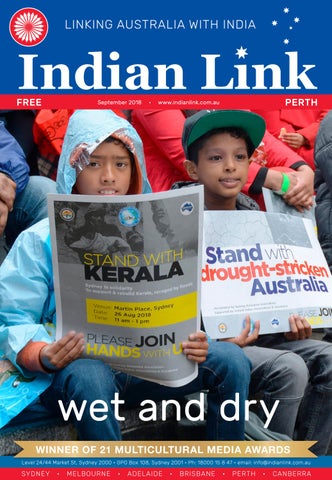
LINKING AUSTRALIA WITH INDIA
FREE
September 2018
•
PERTH
www.indianlink.com.au
wet and dry WINNER OF 21 MULTICULTURAL MEDIA AWARDS Level 24/44 Market St, Sydney 2000 • GPO Box 108, Sydney 2001 • Ph: 18000 15 8 47 • email: info@indianlink.com.au
SEPTEMBER 2018 1
SYDNEY
•
MELBOURNE
•
ADELAIDE
•
BRISBANE
•
PERTH
•
CANBERRA
www.instarem.com NSW Permit No: LTPS/18/25963
2 SEPTEMBER 2018
www.indianlink.com.au
EDITORIAL
What the shenanigans in Canberra mean for Australia-India ties
PUBLISHER Pawan Luthra EDITOR Rajni Anand Luthra ASSISTANT EDITOR Neha Malude MELBOURNE COORDINATOR Preeti Jabbal
Rudd veered Australia towards the Chinese orbit. PM Julia Gillard did bring India back in the equation in 2011when she strongly advocated and won the debate to sell uranium to India. Narendra Modi took power in India when Abbott was at the Lodge, and went on a successful overseas charm offensive. The shared ideological background between the two men – and the ‘bromance’ that developed – further aligned the path of the two nations. But with Malcolm Turnbull, the relationship floundered yet again. While Australian business has made inroads in India, the pace, by the sheer volume of opportunities, has been slow. Case in point the recent white paper on Australia’s India economic strategy by Peter Varghese. The blueprint is a brilliant roadmap of how Australia can work with one of the fastest growing economies in the world. Yet, the low-key launch of the report led to murmurings of a ‘burial’, as key geopolitical impacts were pointed out. Since then, various DFAT and other officials are working overtime to give oxygen to this report. Though there are 90 recommendations made, the spotlight is on education,
BY PAWAN LUTHRA
CONTRIBUTORS Sai Narayan, Uma Nair, Natasha Jha Bhaskar, Charuta Joshi, Emie Roy, Nanditha Suresh, Aparna Ananthuni, Minal Khona, Auntyji, Tarini Puri
A
fter multiple starts and stops, it looks like the India-Australia engagement will be stalled at least until 2020. He’s not getting much love at the moment, but to his credit, Tony Abbot has been the only Prime Minister this century who has shown any urgency of wanting to do business with India. With the shenanigans going on in Canberra, it may well be 2020 before we see a serious political engagement between the two countries. At the turn of the century, India – still smarting from the Australian Government’s accusations after its nuclear tests in 1998 – took time to thaw to the new John Howard Coalition government. Howard, in his two visits to India, was able to convince the government of the Australian desire to engage, and move along the sale of uranium. The advent of Kevin Rudd at the helm in Australia put a brake on this relationship: rather India perceived that
ADVERTISING MANAGER Shriti Sinha 0410 578 146 ADVERTISING ASSISTANT Charuta Joshi 02 9279 2004
Indian Link is a monthly newspaper published in English. No material, including advertisements designed by Indian Link, may be reproduced in part or in whole without the written consent of the editor. Opinions carried in Indian Link are those of the writers and not necessarily endorsed by Indian Link. All correspondence should be addressed to:
INDIAN LINK MEDIA GROUP Level 24/44 Market St, Sydney 2000 GPO Box 108, Sydney 2001 Ph: 02 9279-2004 Fax: 02 9279-2005 Email: info@indianlink.com.au
agribusiness, resources and energy and tourism – all low hanging fruit which if grabbed, can initiate business momentum. India would have liked more investment in infrastructure. The problem is that the ministers leading these portfolios need higher and constant engagement with India. The previous education minister Simon Birmingham visited India in April 2017 with the PM; the previous Minister for Trade, Tourism and Investment Steve Ciobo also visited India in May 2017. Both have had their counterparts tour Australia. However, the current situation in Canberra will have the ministers scampering to save their seats. While the Coalition Morrison government is still at the helm in Canberra, the punters are not offering any bets on them being there after the next elections. As Canberra bunkers down for the next election – due in May 2019 but which might be called earlier – Varghese’s 514-page tome on engaging with India will definitely not be on top of any reading lists. Whoever wins, it may be a while before the Varghese report is brought out and dusted. With India also entering its 5-year election cycle in 2019, the starting point could well be 2020. The challenge is, will there be the will to make it work?
MA
Member of
Professional Immigration Advice at Affordable price.
MIGRATION SERVICES
Contact us for MARCH 2018 changes and your options
Migration Alliance
1
1/;: 111;,f 11\j'1 1l11\i, IIIIJ:/1:;JI Migration Agents Reg1strat1on Number WWW mara gov au
Sonal Agrawal
Is the TSS visa for you? I Need Skills assessment for RSMS? Seek admission to World's Top ranked Universities in Australia, New Zealand, Canada, USA, UK and 20 more countries!!! To know more,
get quick services with FREE online assessment
PERMANENT RESIDENCE
BUSINESS & WORK VISA
• Skilled Migration
• Business Innovation Visa • Business Investor Visa
• All Skill Assessment
• RSMS Permanent Residence • Employer Nomination Scheme
• State I Regional Sponsorship • Temporary Visa 485 • Relative Sponsorship Visa
• CDR/RPUACS Speciality
ji◄
• Short Term Work Visa 400 / 408 TSS 482 (Work Visa)
•
STUDENT VISA
FAMILY VISA
• Offshore Student Visa
• Long Stay Visa (Parents)
• Student Dependent Visa
• Spouse De-facto Visa
• Student Visa Extension
• Partner Visa
• MT Review
• Child Visa
• Change of Course/ UNI/ College
• Visitor Visa
�-,...._
• Specialist in ACS I TRA I Engineers Australia I CDR I Skill Assessment
• Remaining Relative Visa_ .
We are registered Migration Agents and specialise in all Australian Immigration matters.
Opening Hours: - Mon - Fri 9am to 5 pm - After hours appointments and Weekend prior appointments available - EFPTOS Facility available
Suite 2, Level 2, 48 Macquarie Street Parramatta Australia 2150. Tel: +61 2 9891 2574 Fax: +61 2 9806 0523
www.auramigrationservices.com.au info@auramigrationservices.com.au For appointments: 0433 986 780 I 0404 175 866
SEPTEMBER 2018 3
YOUR SAY
REACHING OUT WITH FOOD
CARL BUHARIWALA wrote about a Melbourne-based food joint that provides free, warm food to homeless people. Deen Parast wrote: Great work by Vishal Vohra and Meetu Arora, and business partner Ranvir Singh. Feeding the hungry is the greatest charity, as per many great saints. Keep up the good work and all the Forces of Good will bless you. Rajni Luthra wrote: So inspiring Shivani Nikhil Dhawan wrote: This is such a fantastic and superb initiative you guys have taken. I was feeling so proud while reading this post. Keep going and good luck.
WHAT FREEDOM MEANS TO ME
On the occasion of India’s Independence Day, INDIAN LINK asked what freedom means in a personal sense. B Vanlalvawna, Sydney Consul General said: Freedom to me is the ability to make choices without being influenced by external factors. It’s a choice that comes from within. Mala Mehta said: My parents used to live in Lahore and my father was in the Army and he fought many wars. That influenced and inspired me to become the person I am today. It’s because of my parents that I am able to appreciate my freedom. 7-year-old Ishan Mehrotra, said: Freedom means I can sit in my room and read books. It also means that I can watch a movie on my own. Akshay said: Freedom to me doesn’t mean just one thing: it’s many things – it is to empower women, it’s being able to live freely, it’s being having access to education. Bipin said: Freedom doesn’t just mean being able to speak freely, it can also mean having the choice to listen. But it doesn’t come without responsibilities. It’s our duty to enjoy freedom but according to the letter of the law. Diksha said: Freedom means to be able to express yourself without hesitation and the fear of consequence. Just being yourself. Pravina said: Simply put, to be able to do what I want, go where I want, any time of the day. Sanul said: To be able to practise my values and enact my thoughts is freedom, to me. At the same time, it means keeping in mind others’ sentiments. Usha said: Freedom to me means equality. I mean look at our girls! They are just as talented and able as our boys. They’re becoming astronauts, scientists. That’s what true freedom is. Vkane said: Freedom to mean is to study whenever you want. Shobhna said: Freedom to me means having no fear of life or death here and to live happily in coexistence. Yash said: Freedom means living life free of judgement. We constantly live in fear of what people might say, so for me freedom means to live free of that fear.
SAY IT AGAIN 4 SEPTEMBER 2018
SAGAR ON SUNDAY MATINEE
Indian Link Radio’s SAGAR MEHROTRA asked listeners on his show Sunday Matinee to list the apps that have helped make their daily lives easier. Rachit Mehta wrote: ARCity-VPS (Visual Positioning System). It is good while you are walking on the roads or travelling by car. Tunein Radio for all worldwide radios, you can download it on smart TV and listen to Indian link at home and keep your mobile free. Parkmate: It’s from Wilson’s Parking, you can book your parking in advance anywhere in Australia where they have parking. They will send you their own card. Space shuttles are part of Wilson’s parking in Mascot and the shuttles are free. Cashrewards Australia gives you rewards for online shopping and doesn’t have an expiry date, you can claim back rewards for shopping or transfer to your bank account. Velocity Frequent Flyer, it’s free (Qantas rewards are paid) and you can get rewards on flights, shopping, etc. And it’s valid for 2 years. Stocard: you can save your all plastic rewards memberships in this app and scan where you want to use them. Sonali Thakur wrote: There is a good app for yoga: Gaia. It’s a paid app but it’s not that expensive. I also use Indian Link app, Whatsapp and FB. Live 360 is a great one. I use this to track the whereabouts of family members. Not to stalk them, mind you, but just to be aware. Particularly helpful if you have young adult kids who are out and about a lot.
I love Melbourne, the vintage shops in Chapel St and Collins St, the nightclubs and gay bars where I can dance with abandon without being recognised Bollywood actor Richa Chadha during IFFM 2018
I’m excited to announce that I’m signing for Jamshedpur FC in the Indian Super League. I’ve been really impressed with the club and their goals. Tim Cahill, Australian professional footballer
www.indianlink.com.au
AUSTRALIAN CITIZENSHIP
#INDIANLINK
Tanvi Mor @tanvimor shared this picture from Indian Link’s Independence Day special edition.
Post a picture on Instagram of Indian Link in your life using the hashtag #indianlink. We will select the best pic and publish it here.
A message from Minister for Citizenship and Multicultural Affairs Alan Tudge explaining why Indian migrants have to wait to get citizenship IELTS8 wrote: What a coincidence. Bill was blocked in Oct 2017 and citizenship processing had been slowed down deliberately, I had applied since Jan 2017 and had already lapsed 18 months. I had my Freedom of information notes demonstrating that my application had already been finalized, waiting for approval on the date I attend the interview and no further progress had been done since then. DHA needs to stop telling lies to restore trust among Australian. The largest agency in the country with the least resource to deal with Australian.
NAAN STOP
We posted a picture of Victorian MP Daniel Andrews cooking naan and asked people to guess the ‘secret ingredient’ that made it extra special. Remiya Goswami wrote: Ghee/butter/yoghurt/chilli sauce... list goes on. Rupa Kumar wrote: Chilli flakes? Aparna Raghavan wrote: Ghee! All good guesses but Remiya got it right with butter.
Please send to Australia … rain welcome party will be arranged. Australia’s ambassador to the US, Joe Hockey’s comment on Kerala floods
This afternoon we launched the bust of Dr Bhimrao Ambedkar on Barry Street, joined by representatives from Ambedkar International Mission. Australia India Institute
It’ll bring in more visitors, boost our economy...and help us build our very own Vollywood. Vic Premier Daniel Andrews on setting up a fund for Indian movies to be filmed in the state SEPTEMBER 2018 5
TRIBUTE
A moderate among hardliners
H
A tribute to India’s former Prime Minister Atal Bihari Vajpayee
e was a man of moderation in a fraternity of jingoistic nationalists; a peace visionary in a region driven by religious animosity; and a man who believed in India’s destiny and was ready to fight for it. Former Prime Minister Atal Bihari Vajpayee (93), who died on 16 August, will go down in history as a person who tried to end years of hostility with Pakistan and put development on the front burner of the country’s political agenda. He was also the first non-Congress Prime Minister to complete a full five-year term. In his tumultuous tenure, Vajpayee made India a declared nuclear state and then almost went to war with Pakistan before making peace with it in the most dramatic fashion. In the process, his popularity came to match that of Indira Gandhi, a woman he admired for her guts even as he hated her politics. He became PM, but only for 13 days, from May 16-28, 1996, after his deputy, LK Advani, chose not to contest elections that year. His second term came on March 19, 1998, and lasted 13 months, during which India stunned the world by undertaking a series of nuclear tests that invited global reproach and sanctions. Although his tenure again proved shortlived, his and his government’s enhanced stature following the world-defying blasts enabled him to return as Prime Minister for the third time on October 13, 1999, a tenure that lasted a full five-year term. He finally stepped down in May 2004, after losing the election. The BJP’s election strategy rested on seeking a renewed mandate over three broad pillars of achievement that the government claimed – political stability in spite of a multi-party coalition; a “shining” economy that saw a dizzying 10.4 percent
growth in the last quarter of the previous year; and peace with Pakistan. Vajpayee was born on Christmas Day in 1924 in Gwalior, Madhya Pradesh. After a Masters in Political Science, he worked as a journalist with Hindi publications such as Rashtradharma, Panchjanya, and two Hindi dailies, Swadesh and Veer Arjun. By then he had firmly embraced the ideals of the Hindu nationalist Rashtriya Swayamsewak Sangh (RSS). But even as he struggled to win electoral battles, his command over Hindi, his conciliatory politics and riveting oratory brought him into public limelight. His first entry into Parliament was in 1962 through the Rajya Sabha, and in 1971, he won a Lok Sabha election. Vajpayee spent months in prison when Indira Gandhi imposed Emergency rule in June 1975 and put her political opponents in jail. When the Janata Party took office in 1977, dethroning the Congress for the first time, he became the foreign minister. The lowest point in his career came when he lost the 1984 Lok Sabha polls, that too from his birthplace Gwalior, after Rajiv Gandhi won an overwhelming majority following his mother Indira Gandhi’s assassination. In no time, Vajpayee was replaced and “eclipsed” by his long-time friend LK Advani. Although they were the best of friends publicly, Vajpayee never fully agreed with Advani’s and the assorted Hindu nationalist groups’ strident advocacy of Hindutva, an ideology ranged against the idea of secular India. He was often described as the right man in the wrong party. Often he found his convictions and value systems at odds with the party, but the bachelor-politician never went against it.
It was precisely this persona of Vajpayee — one merged in Hindutva ideology yet seemingly not wholly willing to bow to it — that won him admirers across the political spectrum. It was this trait that made him the Prime Minister when the BJP’s allies concluded they needed a moderate to steer a hardliner, pro-Hindu party. Vajpayee’s diplomatic initiative to start a bus service between New Delhi and Pakistan’s Lahore city was lauded, although it was suspended after the 2001 terror attack on the Indian Parliament. The freeze was cracked in 2003 when Vajpayee, while in Kashmir, extended a “hand of friendship” to Pakistan, which led to the historic summit in January 2004 with then President Pervez Musharraf in Islamabad — a remarkable U-turn after the failed summit in Agra of 2001. Despite the two men being so far apart in every way, Musharraf developed a strong liking for the Indian leader. He was not known as “Atal-Ji”, a name that translates into firmness, for nothing. He could go against the grain of his party if he saw it deviate from its path. When Hindu hardliners celebrated the destruction of the 16th century Babri Mosque at Ayodhya, he was full of personal remorse and called it the “worst miscalculation” and a “misadventure”.
In his full five-year term, he successively carried forward India’s economic reforms programme with initiatives to improve infrastructure, including flagging off a massive national highway project that has become associated with his vision, went for massive privatisation of unviable state undertakings despite opposition from even within his own party. However, his judgment was found wanting when his government was rocked by an arms bribery scandal that sought to expose alleged payoffs to some senior members of his cabinet. His secular proclamations and failure to speak up against the killing of more than 1,000 Muslims in Gujarat, allegedly by his party members, were questioned by the liberal fraternity. He wanted then chief minister — now Prime Minister, Narendra Modi — to take responsibility for the riots and quit but was prevailed upon by others not to press his decision. Vajpayee wanted to devote his time to writing and poetry. But fate ruled otherwise. The man who once said that “I have waited too long to be Prime Minister” found his last days in a world far removed from the adulation and attention. Although people prayed for his well-being, he was surrounded only by care-givers and close family whom he even failed to recognise. IANS
A poet and a politician
M
ere prabhu, mujhe itni unchaai kabhi mat dena, gairon ko gale na laga sakun itni rukhai mat dena (God, don’t ever give me such heights that I’m not able to embrace strangers). Abbas Raza Alvi narrated the first lines of Vajpayee’s book of poems Meri Ekyavan Kavitayen with the ease that can only come from a genuine love for poetry. “Vajpayeeji’s words are replete with irony, pain and empathy for the common man’s problems,” Alvi said. He was speaking on Indian Link Radio in a tribute to the former Indian prime minister who breathed his last on 16 August 2018. The Sydney-based poet and musician set to music a select sample of poems from Vajpayee’s book, in an album entitled Sandesh. “The
6 SEPTEMBER 2018
selected works espouse the message of peace and a better future for the world, hence the name Sandesh,” Alvi explained. The album features local artistes Alka Kumar, Anita Barar, Gargi Mukherjee, Jaya Sharma, Pushpa Jagadish, Rachna Bhatnagar, Anand Arora, Anup Kumar, Ashok Chetty, Pupinder Mintu, Riaz Shah, Surender Bhardwaj, Iqtedar Abdi, Michael Raj, Zafar Siddiqui, Namit Bimbhat and Diana Kropman. Alvi had been influenced by the late leader’s works in poetry for a long time. The project Sandesh commenced in 2001, he revealed, with the blessings of the man himself, and concluded with a launch in Sydney in 2003. Just as much as his poetic works, Alvi was influenced also
by Vajpayee’s efforts in building bridges with neighbouring Pakistan. “No other political leader made a more earnest effort to thaw the tense relationship between India and Pakistan,” Alvi observed. “When I met him in 2003, he told me how much he liked one of the compositions, Jung na hone denge (We won’t stand for war). He was appreciative of the fact that I had roped in both Indian and Pakistani singers for this song.” Bharat Pakistan padosi saath saath rehna hai, Pyaar karen ya vaar karen dono hi sehna hai. Vajpayee the poet, Alvi recalled, was not very different from Vajpayee the politician. He talked about the ordinary man and his daily struggle, but he talked about
Abbas Raza Alvi with Atal Bihari Vajpayee
politics in his poems too. “Desh ki rajdhani me Sansad ke saamne dhool kab tak udegi? Meri ankhen band hain, mujhe kuch dikhai nai deta (How long will dust fly in front of the Parliament in the nation’s capital? My eyes can’t see anything). That’s Vajpayeeji talking politics. What other politician writes about things like these?” Alvi asked. Giving music to Vajpayee’s
poems was no mean feat, but Alvi insists that it was a gratifying experience to breathe life into the words of the man who gave so much, both to the country and the common man. “His death is a great loss to us. Vajpayeeji was a Prime Minister for Hindus, Muslims, Christians, Parsis, everyone. He was India’s true Prime Minister.” Charuta Joshi
www.indianlink.com.au
PERTH Lifestyle Apartments Resort-style facilities embracing Indian culture
no
y
r in your i
u
i
in your y
Jeevan Saath
r
m
r
Jeevan Saath will be the first Community Lifestyle Apartments to be built in Perth with resort-style facilities embracing Indian Culture for persons aged 55 and over. Enjoy an independent, social and physical active life with like-minded people in a secure and self-contained environment.
m
n
uniqu
• Offers a social, independent and secure lifestyle to
people aged 55 and over
on • A self-contained secure complex offering a
community lifestyle to keep you physically active
• Aims at bringing like-minded people together
• Undercover secure parking
• 67 spacious one and two bedroom with kitchen
• Lifts to Apartments
apartments at affordable prices
• Resort style communal facilities spread over
3000m2 • An option to dine in the communal dining hall with home-cooked vegetarian meals
• Modern Indian culture infused with the best of the
West!
• Situated in a prime, well connected and convenient
location
• Strata titled apartment which you own • Spacious yet easy to maintain apartments.
o
ion
Conveniently located in Butler within close vicinity of Butler train station, Butler Central Shopping Centre, a new Joondalup Medical Centre, Joondalup Hospital and other retail outlets. A treat for beach lovers with Eden and Jindalee Beaches just within 4km.
or in orm ion Information sessions with further details including prices to be held Sep - Oct 2018 in Perth. For an invitation to attend a information session visit our website and complete Enquiry Form Information form available on the ‘Contact Us’ page.
ee ansaat ma www.jeevansaath.com.au SEPTEMBER 2018 7
COVER STORY
Bringing God’s Own Country back Members of the Malayalee community across Australia talk about their loved ones grappling with floods back home in Kerala BY NEHA MALUDE
O
ver 400 lives lost, countless homes destroyed, livestock and pets lost – the floods in Kerala have ravaged the state like nothing before. After what seems like an eternity, the water is finally receding and people are taking stock of what’s left behind, picking up the pieces and trying to gather some semblance of normalcy. And while their distress is unimaginable, it’s just as bad – if not worse – for their loved ones who live on the other side of
Sydney
8 SEPTEMBER 2018
the world who have been waiting and watching with bated breath to find out if their families are safe. “My parents built a house in Valakom (Kollam) last year but my father still goes to the old house in Muvattupuzha during the day,” Raveesh John, Secretary of Perth United Malayalee Association Inc. tells Indian Link. “The town was under water for three days and we lost everything – our documents for the old and new house, paperwork, furniture, our countless possessions that were still there.” John, whose parents MV John and Elizabeth are senior citizens, adds, “My father is 75 years old and there was little he could do. He is still in depression. They’ve lost everything.” He recalls the panic that had set in when he couldn’t contact them for four days. “It was a tense time for us. But luckily they
had some help. My father is a member of the local cooperative bank which was handing out free rice. The Panchayat also stepped in to help. Actually, it’s things like this they needed then, not money.” Bijoy, from Adelaide, whose parents live in Chengannur, has a similar story. The municipal town in the Alappuzha district is one of the worst-affected areas. “I remember that after the floods, for two days no one came. Finally, on the third day, our neighbours were going around in a boat rescuing people. Another neighbour was in a boat, supplying rice to people.” “My classmate’s father, an 85-year-old man was alone in the house when the floods struck. He had to crouch on the terrace for four days with no food or water. He survived on leaves and rain water before someone came for him. The helicopters
couldn’t airlift in many areas because of the trees and wind wreaking havoc.” Bijoy’s wife Divya, who’s also a committee member of Adelaide & Metropolitan Malayalee Association, adds, “The airlifting rescue ops were also difficult because Google and GPS were showing two different locations, so technology didn’t exactly help.” As many others have been saying, it was the fishermen who helped rescue a majority of stranded people. Bijoy says that the defence forces, especially the Navy did try their best to rescue people. They dropped food packets on the roofs, but they were no match for the currents in their inflatable boats. “The fishermen, on the other hand, did a fantastic job. We should really thank them for their help. They know the lay of the land and knew
Melbourne
www.indianlink.com.au
Photos: AAP, Northside Malayalee Community Club, Suresh Pokkattu, Brisbane Malayalee Association
Melbourne
how to navigate the flood waters. It’s their experience that saved us.” Melbourne-based Dhanya Samuel, whose parents are in Kerala, says the extent of devastation left behind by a natural disaster can only be truly felt when it hits one’s own home. “It was a harrowing 4-5 days that I went through recently. While my father and mother didn’t need to be evacuated (our home was at a slightly elevated angle), the rest of the colony where our house is situated had to be. But no power supply meant that I hardly could communicate with them.” She adds, “My sister’s family resides in Chengannur. There was no connectivity, so we had no idea if they were safe or not. Rescue help line numbers, Facebook posts and WhatsApp forwards were the lifelines we held to. One of the older members of the family had a fall as his cot was placed on top of a table to avoid the flooding water. There was a deep gash on his head and he couldn’t be taken to the hospital. Luckily, volunteers carried him through the water to the house of a doctor nearby who was able to give him the necessary medical treatment. He was then rescued by the Navy boats and taken to hospital.” Now that the flood waters are receding,
Sydney
citizens face yet another predicament: postflood clean-up. “There is over two feet of mud inside houses. And although people from Seva Bharati are really helping, there’s so much more to be done. There just isn’t enough manpower,” says Bijoy. And when resources are few, the effects are inevitable: the cost of water, food and travel has tripled. “People have lost their life savings in one swipe. Where’s the money to pay three times the money for something as fundamental as drinking water?” For some, the ordeal of cleaning up has been even more terrifying. The flood “brought up everything” as Gita Sudheer from NSW says. Most of her family – mum, grandmother and extended family lives in Kerala. Her father’s brother lives in Thrissur, she says. “He woke up around midnight to use the bathroom and when he put his feet down, there was water up to his knees. And not standing water, either. When he looked around, everything was floating around him – the fridge, the gas, furniture. Can you imagine that?” She tells us about her mother and cousins in Chalakudy, a municipal town situated on the banks of Chalakudy river in Thrissur. “They were airlifted after spending three days on the terrace. And
They were airlifted after three days on the terrace. And when they came back to clean the house, they found a crocodile in the house when they came back to clean the house after the water receded, they found a crocodile and snakes in the house!” After what is hopefully the end of one of the biggest natural disasters the state has seen in a century, citizens are trying to get their lives together. Their families across Australia, meanwhile, have been conducting fundraising events and vigils to help in whichever way they can. Madanan Chellappan of the Brisbane Malayalee Association says the organisation has teamed up with Caboolture Hospital in Queensland to set up a fundraiser next week as many of its employees are Malayalee. The BMA also had a candlelight vigil earlier this week which was attended by Brisbane City Councillor Amanda Cooper and Lord Mayor of Brisbane Graham Quirk. AMMA, which was to host Onam
festivities on 18 August, turned the festival into a fundraiser too, and donated all the profits to the Kerala Chief Minister’s Distress Relief Fund (CMDRF). PUMA raised close to $17,000 and hosted a fundraiser on 2 September with other Malayalee associations in Western Australia. Dhanya has decided to engage in a small, private fundraising to help out her maid whose house was damaged in the floods. “While the Government is offering all possible help, it is important for all of us to come together and do our bit, the least we can from so far away.” The mission is singular: to help Kerala get back on its feet. Whether it’s through prayers, vigils or events, the Indian Australian community is leaving no stone unturned. It is truly a lesson in resilience. Donate to the CMDRF here: https://donation.cmdrf.kerala.gov.in/
Brisbane
SEPTEMBER 2018 9
COVER STORY Sydney
Oz #StandsWithKerala Australian Parliamentarians participate in efforts to rehabilitate Kerala after devastating floods in the Indian state
BY EMIE ROY
“T
here was no way I could hold myself from attending this vigil,” Melbourne’s Benila Ambika said to Indian Link. “I was heartbroken when I saw the news of my homeland, Kerala, being ravaged by floods. I saw myself in the people who stood there helpless, watching their homes being taken by the flood waters,” She added, evidently moved after attending a public vigil that was organised in North Melbourne that saw around 300 people from various Indian communities in attendance. “Being part of this vigil is the least I could do to share their agony.” As Kerala, the south Indian state, is getting back on its feet gradually shrugging off the bruises from the deluge that took the lives of nearly 400 people and displaced a million, people all across the world are lending their hands to rebuild the state and rehabilitate its people. Australia is joining in the league too and the vigil in Melbourne was one of those in many Australian cities to support and #StandWithKerala. Canberra, the capital city of Australia, saw around 150 people attending a vigil in the Civic Square. Sanju George, one of the attendees had more of a first-hand experience to share. “I was in Kerala during the first stage of the flood, and was involved in relief operations with
10 SEPTEMBER 2018
my friends. We purchased food kits and travelled in boats through what normally would be roads, to supply those to people stranded in their houses. I returned to Australia before the flood got worse, hence it was quite depressing for me to watch from here what happened afterwards. So here I am, doing whatever I can, from where I am at, attending this and contributing to the $37,000 that Canberra Malayalee Association raised.” The Malayalee based organisations in Brisbane organised community walks, candlelight vigils and fund-raising events in support of the cause, which were attended by hundreds. Sydney saw a whopping crowd of around 600 people attending the Kerala Flooding Vigil held at Martin Place, often called the heart of the city. The vigil was quite inclusive of the regions including the afflicted Coorg which is in close proximity to Kerala, and also of the drought-stricken Australia. Sydneysiders also took the ‘Oath of Solidarity’ to support both their homeland and the land that welcomed them with open arms, to the best of their capacity. Roanna Gonsalves, the awardwinning writer who attended the vigil said, “I could feel the outpouring of concern and love for the communities badly affected by the floods. I was surprised yet not surprised that the Sydney Malayalee Association had already raised close to $30,000. Living outside India, we feel acutely our privilege of being safe and well, yet there is also a sense of helplessness, and a desire to use our privilege, to be of service to those affected back home.
A gathering such as this allowed us to collectively express these different emotions. It was cathartic. And hopefully the funds raised will make a difference to the lives of those suffering in Kerala.” The best and biggest impact of all these activities was how it helped in bringing awareness amongst the crop of young second generation migrants, like Roshan John. Roshan, a kindergartener, has now decided to donate the money from his birthday presents to the flood relief fund. “Mum said there are children in Kerala who have even lost all their books and have nothing to learn from. I said to her that she can collect all the money for my presents and give it to those children,” said a beaming Roshan.
Support from Australian Parliamentarians
Australian Parliamentarians made their presence felt in all of these vigils. Joy Burch, the speaker of the ACT Legislative Assembly attended the Canberra vigil and her recollections about the beautiful Kerala that she had visited last year moved many. Jodie Mackay, the MP for Strathfield (NSW), spoke about the importance of restoring tourist activities to Kerala, and thus supporting the economy
of the state, during the Sydney vigil. It has been widely appreciated that Michelle Rowland, the Federal MP for Greenway (NSW), and Anthony Byrne, Federal Member for Holt (Victoria) spoke about Kerala floods in the Federal Parliament of Australia. Michelle said in her address, “Whilst it is crucial that disaster relief support is provided immediately, it is also imperative that ongoing support is given in the region to alleviate the damage to the local economy. It’s crucial that we elevate discussion within the Asia-Pacific and the Indo-Pacific region about preparation efforts for extreme climate events, including flood mitigation. Australia can and should lead this conversation.” Anthony mentioned, “This is about us working together, in whichever form of Govt we can, to provide assistance, so that we can raise money with all of the communities coming together; and to amplify the absolute scale of the destruction occurred consequent to the flooding and the landslides that occurred. Please also encourage the Australian Govt to make representations to the Indian Govt to provide any support we can.” For sure, this is a small world, and we are all global citizens.
Jodie Mackay, the MP for Strathfield (NSW), spoke about the importance of restoring tourist activities to Kerala to support its economy www.indianlink.com.au
Canberra
Canberra
Melbourne
A birthday party fundraiser
A man wades through flood waters in Kerala
Photos: AAP, Canberra Malayalee Association, Suresh Pokkattu
SEPTEMBER 2018 11
COVER STORY
all of them seem to be able to bear with it. Dying animals also affect farmers and their families. Those with young families are the ones who are really affected–just like a young family in the city would suffer if the breadwinner lost a job.” Asked about farmer suicides, Mark told Indian Link, “The meagre subsidy for farmers here as compared to that in other western countries is causing a tight squeeze. It’s not just the farmers who are the victims. The rural economy itself is getting affected. Usually, the farmers will spend their money in the businesses in the country towns, who in turn source products manufactured in small Australian companies. When farmers stop spending, it creates a cascading effect and impacts the entire economy.” Sydney’s Lucinda Coble, whose father is from Charleville, an outback town in Queensland, said, “We were out there a few weeks back and the place is a dust bowl. We couldn’t believe it, really terrible.”
The big dry It’s time to brace ourselves for the ongoing drought in NSW and Queensland, and to pitch for afflicted farmers, writes EMIE ROY
W
hile Kerala soaks wet like never before, closer home to us here in Oz, the states of NSW and Queensland are in the middle of the worst drought in years. The Big Dry has been around for a few months and the situation looks dismal, thanks to a critical lack of rain this year among other things.
What exactly is drought?
Dr Avanish Panikker, Senior Wastewater Engineer in Sydney explains in his paper Predicting the drought: the needs and the haves: “Identification of the beginning or end of drought conditions is debatable. Low rainfall in itself does not constitute the commencement of drought; rain or flooding during prolonged periods of drought does not necessarily signal the end of drought”. So what exactly is drought? Apparently, drought can be felt in four different ways: meteorological drought (deviation from normal precipitation conditions over a period of time), agricultural drought (lack of adequate soil moisture for crops or pasture), hydrological drought (reduced precipitation for an extended period of time) and socio-economic drought (recognises the relationship between supply and demand for water, how low water supply negatively impacts communities in terms of businesses and social behaviour.)
substantial. Also, our position under the subtropical high-pressure belt encourages the air to push down, preventing the lift required for rain. Other systems called climate drivers like El Nino and La Nina in the central and eastern tropical Pacific can make things worse from time to time. The Bureau of Meteorology’s Climate Updates also mention that climate change and extreme weather events might exacerbate the risk of droughts.
Who’s affected?
“You have no idea what it is like here. We have absolutely no rains at all,” said an anonymous volunteer in Central NSW who works amongst the farmers. “The farmers
How does it affect me?
are in a terrible situation. We are trying to provide as much assistance as possible to sustain life here. Life is tough here, to say the least.” Indian Link was able to engage in an in-depth conversation with Mark Judson, a NSW farmer who owns or leases about 5,000 acres in the country town of Bogangate, between Parkes and Forbes. “Farmers here are a tough lot, as they have seen many ups and downs,” said Mark, as he confirmed the information on the Bureau of Meteorology’s page. “This drought did not just commence right now, it has been around for months. The livestock as well as mixed crop farmers have fallen victims, and as an outcome the winter crops like wheat, barley, oats and canola are affected too. The fact that there was not much rain when seedlings sprouted will certainly take its toll on these crops. Without rain most will die within three weeks.” He added, “There is not much hay or grain available to feed our sheep. Whilst we are feeding them a ration, and also providing them mineral supplements, not
A predicted pinch in bread and red meat will be hitting markets soon. Bread prices could go up since wheat production is affected. Red meat’s availability will increase initially due to farmers offloading their sheep first, and then it is expected to limit itself as the breeding stock would have perished and it takes time to establish a new stock.
Can I help?
The most important thing seems to be donating to genuine organisations, so do your research before doing so. We have been advised that some of the farmers never want to ask for help. In those circumstances, the volunteers will just leave parcels and care packages at the farmer’s front gate and drive off without going in. This makes it even more important to donate to the right people. A few charities that have set up fundraising efforts for these farmers are Drought Angels, Aussie Helpers, Buy a Bale, Disaster Relief and Recovery Appeal run by Australian Red Cross. Volunteers advise that it’s better to donate cash rather than in kind, to get the money rolling in the rural economy. Even better, you can volunteer yourself. Or take a trip and spend money in these rural towns to inject life into their businesses.
Dry sowing (left) and temporary water points as dams go dry
Why is there drought in Australia at the moment? The Bureau of Meteorology’s autumn summary advised that this year’s April to June period has been the fourth-driest since the Bureau of Meteorology started taking records back in 1900. Being the driest inhabited continent, Australia’s rainfall and natural climate variability is
12 SEPTEMBER 2018
www.indianlink.com.au
SEPTEMBER 2018 13
COMMUNITY
Independence Day The felicitation of community members is a highlight at the Consulate celebration this year BY UMA NAIR
“F
or every Indian, whether living at home or anywhere else in the world, 15 August is sacred.” This 15 August, MLA Yaz Mubarakai and MLA Kevin Michel, as well as members of the Indian community in Perth joined Consul General Amit Kumar Mishra at the Consulate General of India to celebrate Independence Day. Following the unfurling of the tricolour by the Consul General and singing of the national anthem, the Consul General read excerpts from the address of the President
14 SEPTEMBER 2018
of India, Ram Nath Kovind, to the nation made on the eve of India’s 72nd Independence Day. “Every Indian who does his or her job with sincerity and commitment, who contributes to society by being true to a professional ethic, who fulfills a personal and professional obligation… is in their own way upholding the values of freedom. They are providing the fruits and goods and services of freedom to fellow citizens.” The speech expressed particular gratitude toward our farmers, our armed forces and our police forces, and highlighted the importance of harnessing the unlimited human capital of our youth. He also gently reminded us that a freedom struggle still continues today for many of the women of our country. “The expansion of freedom in our
country in many senses amounts to the expansion of freedom for women in our country.” The President’s words honoured Mahatma Gandhi, and upholded that we as a global Indian community still have much to learn from Gandhiji’s teachings, especially in regards to ahimsa (nonviolence), swachchta (cleanliness), and the promotion of both physical and mental health. Following the President’s address, Consul General Amit Kumar Mishra encouraged the Perth Indian community to participate in several initiatives that allow for engagement between Australia and India, including the Bharat Ko Janiye Quiz, Pravasi Bharatiya Divas and the Know India Programme. MLA Yaz Mubarakai then proceeded to award certificates of appreciation
to community members for their invaluable contributions in supporting the Consulate General of India in promoting Yoga and Ayurveda in Perth. These included Ritika Chopra (State Coordinator for Art of Living); Kalpa Vally (Art of Living); Ramesh Kandaswamy (Art of Living); Rameshchandra Shah (HSS); Damji Bhai Koriya (HSS); Vidhu Sharma (Director, Ayurveda for Wellness Centre, and WA State Representative, Australasian Association of Ayurveda). Winners of the Champaran Satyagraha Quiz, Deepashree Matta and Amod Kumar, were also congratulated The function concluded with various cultural performances, including poems by Perth-based Hindi poet Prem Chandra Mathur, and patriotic songs by local Hindustani music groups.
www.indianlink.com.au
FATHERS DAY
Our dad, a superhero Melbourne based Indian father chosen as 62nd Victorian Father of the Year
BY TARINI PURI
A
father or father-figure stands rock solid besides their children to provide them moral support, confidence, mentoring, education and the strength to face multiple challenges of life. So says Sandeep ‘Sunny’ Jadhav, named recently as the 62nd Victorian Father of the Year for 2018. Jadhav was chosen from over a thousand nominations from across the state for an outstanding father figure by the organisers YMCA Victoria in association with the Father’s Day Council of Victoria. Declaring Jadhav as a winner, the organisers lauded him for being a fatherly figure dedicated to young people. “Sandeep is an incredible dad and mentor for many. He is a true role model, who inspires the next generation of Australia’s brightest young people,” Chair of the Father’s Day Council Barry Novy said. 49-year-old Jadhav lives in Melbourne with his wife Kiran and two teenage daughters, 13-year-old Sachi and 16-year-old Khushi – who secretly sent his nomination for the award. Nagpurborn, he moved to Australia in 1996. While he works as a Land Maintenance System Electrical Engineer for the Defence Force, his true joy comes from teaching and inspiring others in maths, science and engineering subjects. For over 15 hours a week, for the past 16 years, Jadhav has voluntarily tutored primary school aged kids, VCE and university students and army officers from all cultures and backgrounds. Mentees and
their parents appreciate his passion and involvement, besides his calm and stressfree demeanour. Many of Jadhav’s 200-odd students and mentees have gone onto become pilots, surgeons, doctors and scientists across Australia. They continue to be in touch and hold him in high regard, which makes his wife Kiran observe that he is “really a dad to so many.” As well as being a dad to others, Jadhav is dedicated to his family. He takes his daughters for runs twice a week at 5.15am,
Our dad is a real life superhero. He doesn’t wear a cape though because he wears the army uniform cooks breakfast for the family, makes his wife tea, drops off and picks up his daughters from school and helps them with their a homework. In the summer months he plays cricket with his family. Jadhav says mentoring and being a positive role model to his daughters inspires him every day. His own inspiration is his father, a retired public servant back in India who ingrained early in him the attitude he carries to this day. “My father always told me, never ever lower your moral values for anything. He used to travel a lot while I was growing up, but would always manage to
< Sunny (Victorian Father of the Year), Sally Capp (Lord Mayor of Melbourne), Kiran (Wife)
find quality time for me. I am trying to do the same with my daughters. I am ever-engaged and in touch with them, and always try to leave a small inspiring note for them before setting out,” he says. Jadhav admits there are challenges in the father role. “Parenting is an extremely challenging role. The responsibility of shaping young minds is a herculean task. I have never walked alone on this path, as my wife has always supported me. It feels wonderful to be recognised with this award,” he says. The best stamp of approval came from his own daughters who expressed their pride for their father in their nomination entry for Jadhav. “Our dad is a real life superhero. He doesn’t wear a cape though because he wears the army uniform. We love our dad so much because he does so much for the community,” they wrote. No doubt this year’s Father’s Day, Sunday 2 Sept, will be a special one for the Jadhav family. They’ll be spending it by cheering Sandeep on, as he runs the YMCA Father’s Day Fun Run at Melbourne Tan. He’ll be raising money for YMCA youth programs that build resilience and positive mental health. Since 1956, the Father’s Day Council of Victoria has named a Father of the Year for Victoria, to celebrate and recognise the important role fathers and father-figures play in family life. Since 13 years, it has been partnering with the YMCA to first identify local YMCA Community Father of the Year awardees before selecting a statelevel winner.
SEPTEMBER 2018 15
FIRST PERSON
NISHTHA SHARMA talks about an unexpected but fateful encounter with spirituality while on a student exchange program in the US
An aarti to remember T
here here isis an an old old saying saying in in Hinduism Hinduism that dictates that one that dictates that one can can never never predict predict where where and and when when they’ll they’ll discover discover their their inner inner spiritualism. spiritualism. For me this occurred on my recent For me this occurred on my recent exchange to Georgetown University in exchange to Georgetown University in Washington DC. Washington DC. When the University of Sydney provided When the University of Sydney provided me an opportunity to study abroad at me an opportunity to study abroad at Georgetown University, I was delighted Georgetown University, I was delighted to have the chance to live and study to have the chance to live and study in the heart of American politics and in the heart of American politics and government. government. Studying at Georgetown had always Studying at Georgetown had always been a dream of mine, but what I had been a dream of mine, but what I had not expected was the chance to explore not expected was the chance to explore my faith and spirituality in a foreign my faith and spirituality in a foreign environment while on exchange. environment while on exchange. Within days of arriving on campus, I Within days of arriving on campus, I discovered that Georgetown University discovered that Georgetown University offered its Hindu students an opportunity offered its Hindu students an opportunity to explore and learn more about their faith to explore and learn more about their faith through a full-time Director for Hindu through a full-time Director for Hindu Life and the Hindu priest. I was intrigued Life and the Hindu priest chaplain. I was by the fact that a Jesuit institution was intrigued by the fact that a Jesuit institution so open to students of other religious was so open to students of other religious traditions, having never expected a Hindu traditions, having never expected a Hindu priest in the Campus Ministry. priest in the Campus Ministry. As a Catholic, Jesuit university, As a Catholic, Jesuit university, Georgetown welcomes students who Georgetown welcomes students who belonged to diverse religious traditions, belonged to diverse religious traditions, and promotes interfaith understanding, and promotes interfaith understanding, respect and dialogue through its support respect and dialogue through its support for a wide array of organisations and for a wide array of organisations and programs. One of Georgetown’s core programs. One of Georgetown’s core value is interreligious understanding, and value is interreligious understanding, and the Office of Campus Ministry encourages the Office of Campus Ministry encourages students to explore the wide array of students to explore the wide array of religious services, holiday celebrations, religious services, holiday celebrations,
( 16 DECEMBER SEPTEMBER 2018
and and small small group group opportunities opportunities on on campus campus both within and of outside of their both within and outside their own own tradition. tradition. Our Our Hindu Hindu Life Life retreat retreat coincided coincided with with the Muslim Life retreat, giving the Muslim Life retreat, giving us us the the opportunity opportunity to to interact interact with with students students from from aa different religious background. different religious background. II was was never never deeply deeply religious religious to to begin begin with, and the opportunity to learn with, and the opportunity to learn about about my my faith faith from from someone someone who who was was deeply deeply knowledgeable knowledgeable about about it, it, and and could could make make Hinduism more relatable to university Hinduism more relatable to university students, students, was was too too good good to to pass pass up. up. II decided to take the plunge and decided to take the plunge and attended attended the the weekly weekly aarti aarti service service on on Sunday. Sunday. While While II was was usually usually unable unable to to understand most of the understand most of the Sanskrit Sanskrit prayers prayers and and Hindu Hindu pujas pujas at at the the temple temple back back in in Sydney, Sydney, having having attended attended many many religious religious services services and and aartis aartis in in my my life, life, II thought thought II knew knew what what to to expect. expect. At At Georgetown, Georgetown, however, however, when when Brahmachari Sharan Brahmachari Sharan began began the the weekly weekly service, service, his his ability ability to to explain explain rituals rituals and and pujas pujas in in simple simple terms terms really really made made it it aa service service unlike unlike any any other other II had had attended attended growing up. Seeing other Hindu growing up. Seeing other Hindu students students around around me me brought brought back back the the sense sense of of community community that that II had had left left behind behind in in Sydney. Sydney. The The tasty tasty Indian Indian dinner dinner that that followed afterwards was always followed afterwards was always aa bonus. bonus. Since Since then, then, attending attending the the weekly weekly aarti aarti became became an an important important part part of of my my exchange exchange life life at at Georgetown, Georgetown, just just like like going going to to classes and eating at the dining classes and eating at the dining hall hall with with friends. friends. Having Having enjoyed enjoyed attending attending the the weekly service, when when the the opportunity opportunity to to weekly service, join Hindu Life at Georgetown on their join Hindu Life at Georgetown on their annual annual spiritual spiritual retreat retreat into into the the Blue Blue Ridge Ridge
Mountains Mountains of of Virginia Virginia overlooking overlooking the the Shenandoah Valley came Shenandoah Valley came up, up, II knew knew it it would would be be something something II would would enjoy. enjoy. The The ability ability to to disconnect, disconnect, albeit albeit for for one one night, night, from the hustle and bustle of campus from the hustle and bustle of campus life, life, was was aa golden golden opportunity. opportunity. During During the the Hindu Hindu Life Life retreat, retreat, through through the guidance of Brahmachari the guidance of Brahmachari Sharan, Sharan, II participated participated in in various various activities activities and and workshops focussed on the workshops focussed on the experiential experiential aspect aspect and and wisdom wisdom of of Dharma. Dharma. However, However, what made the experience what made the experience stand stand out out was was the time and planning Brahmachari the time and planning Brahmachari ji ji had had invested invested in in ensuring ensuring everyone everyone on on the the retreat retreat learned learned something something new new about about the the faith. faith. From From playing playing Hindu Hindu jeopardy Jeopardy to to writing group reflections about writing group reflections about Hindu Hindu rituals, rituals, the the activities activities challenged challenged us us to to think think deeply about the way Hinduism affected deeply about the way Hinduism affected us us in in our our daily daily lives. lives. Having Having the the chance chance to to discuss discuss problematic problematic aspects aspects of of certain certain rituals rituals and and beliefs, beliefs, understanding understanding the the value value of of Hindu Hindu rituals rituals and and pujas, pujas, and and appreciating appreciating the the value value of of faith faith in in connecting connecting us us to to our our culture were all aspects of the retreat. culture were all aspects of the retreat. The The best best part, part, however, however, was was aa puja puja
walkthrough walkthrough where where Brahmachari Brahmachari Sharan Sharan provided each participant provided each participant aa personalised personalised puja puja kit kit and and introduced introduced us us to to the the process process of conducting puja step by step. of conducting puja step by step. The The personalised personalised kit kit was was not not only only small small enough enough to to be be transportable, transportable, but but was was compact compact enough enough to to fit fit all all the the required required elements elements in in aa plastic plastic box box about about the the size size of of aa lunch lunch box. box. As As the the retreat retreat came came to to an an end end and we began our trip back to the the and we began our trip back to Georgetown hilltop, I reflected on the the Georgetown hilltop, I reflected on interconnectedness of my faith and culture. interconnectedness of my faith and culture. After spending a weekend thinking about After spending a weekend thinking about what it it means means to to be be aa Hindu, Hindu, II was was deeply deeply what thankful for for the the opportunity opportunity to to explore explore thankful my faith faith with with my my peers peers and and gain gain aa deeper deeper my understanding about it, unexpectedly on understanding about it, unexpectedly on exchange, far away from home. exchange, far away from home. Having recently recently returned returned from from an an Having incredible semester abroad at Georgetown incredible semester abroad at Georgetown University, II have have had had some some time time to to think think University, about the the impact impact studying studying at at Georgetown Georgetown about and living living in in Washington Washington DC DC has has had had on on and me personally. While studying there was me personally. While studying there was always on on the the list, list, II truly truly believe believe that that II always could not have picked a better institution could not have picked a better institution for the the wholesome wholesome experience experience II received. received. for
Our Hindu Life retreat coincided with the Muslim Life retreat, giving us the opportunity to interact with students from a different reli ious back round www.indianlink.com.au www.indianlink.com.au
YOUTH
Make your business dream come true Four business leaders present tips for entrepreneurial success at YSPN’s latest event
BY SAI NARAYAN
N
adhirah Jalani had a well-paying day job, but dreamt about doing something with her passion for making lifestyle products centred around her Muslim beliefs. “It was like an itch I had to scratch,” she told her bemused audience at a recent event organised by the Young Sikh Professionals Network (YSPN). Today, she is the ‘Chief Happiness Officer’ at Qenza. Nadhirah joined three other successful business leaders in a facilitated discussion at the event, as they spoke about their particular journeys, how they found their purpose, and the problems they solved along the way. Nadhirah revealed in her presentation that the biggest challenge she faced in her entrepreneurial life has been that she has had to become “a master of all trades” – run a warehouse, create a marketing plan, look after accounting. “Yet passion is the fuel that makes it all happen,” she finished. The others who recounted their inspirational stories included Debbie Whiting (Managing Director, Utopia Financial Services Group), Johnny Wong (Business Owner/Restaurateur) and Jo Saunders (Marketing Strategist/Author). Jo Saunders, social media guru, described
herself as an “accidental” entrepreneur. She advised budding entrepreneurs to be prepared for a “roller coaster” ride. Being part of networks, collaborating with others, helping people connect and running events is what motivated this published author and recognised speaker. “Give it a go and the money will take care of itself,” she told her young audience. “Connect with mentors who understand your vision and can help you.” Debbie Whiting, investment accounting expert, showcased her single-minded focus when she proclaimed that there is no point in becoming a “part-time” entrepreneur. “If you want to spend one day on your business, you might as well play golf!” A continual striving for excellence is what keeps her motivated, she revealed. “Set goals and use a scorecard to track progress. A true business means it’s bigger than you, more scalable than you and can outlive you.” She talked also about the importance of “expert power” (she herself conducts seminars as an expert on topics in her industry), of doing a SWOT analysis of your strengths and weaknesses, and of surrounding yourself with people with complementary skills. Johnny Wong, burger maestro, said entrepreneurship for him is about creative freedom. His one-line mission statement is “Good food for good people”. He talked about how he struggled to finish high school and felt the pressure from his family to perform well in academics. His family initially didn’t believe he could succeed
in the food business, but after seeing his successes over a few years, they now help him. “Do what you love, and people will love what you do,” he concluded convincingly. It was passion that came across clearly as an underlying theme in all four stories – whether it was passion for making delicious burgers, or looking after someone’s financial investments, or writing a book on social media management. Yet, Nadhirah sounded a note of warning: “Don’t let passion be your peril!” she noted. Have an exit plan, and be ruthless in cutting your losses if the business model isn’t working,” she advised. The four entrepreneurs attracted a good turnout, even though the weather outside was stormy and cold. A Uni student confided, “I’ve almost completed my engineering and accounting degree, but I don’t see myself doing a 9 to 5 job, that’s why I am here – to learn about other avenues to success.” A salaried professional with over 15 years of industry experience said, “I enjoy what I do and don’t really see myself starting a business in the short term. But this event might give me new ideas”. One common thread among attendees was an interest in personal growth and a thirst
for new ideas. The Young Sikh Professionals Network (YSPN) was established in 2012, as part of an initiative by Sikh Youth Australia. The Perth chapter has been operational since November 2015. In the past, the group has staged events hosting well known guests like spoken word artist Sukhjit Kaur Khalsa, and the CIO of the Reserve Bank of Australia. Are YSPN’s events just for Sikhs or for young people? Balraj Singh Hansra, National Content Lead at YSPN Perth, and facilitator of this most recent event, clarified, “We target all demographics. The title Young Sikh Professional Network reflects our beginnings as a Sikh Youth Australia initiative, but our events are inclusive of the wider community. Interest for these events is broad based.” Top five takeaways from the discussion? • Find the entrepreneurial path that is right for your circumstances. • Fuel your journey through adversities with your passion for what you do. • Build up your “expert power”. Learn and improve continuously. • Connect with and take feedback from mentors who understand your vision. • Set goals and track your progress.
There’s no point in being a “part-time” entrepreneur. If you want to spend one day on your business, you might as well play golf! Debbie Whiting SEPTEMBER 2018 17
INDIA DIARY
Fair or faulty?
India may soon pass a bill to introduce proxy voting for the diaspora, but there are many issues to be ironed out before it comes into practice BY NATASHA JHA BHASKAR
T
he Lower House (Lok Sabha) of India’s Parliament has passed a Bill that proposes to allow registered non-resident Indian voters to use proxies to cast votes on their behalf in Indian elections. Introduced in the Lok Sabha last December and passed recently, it now needs the approval of the upper house Rajya Sabha.
What is proxy voting?
You can vote in an Indian election in three ways - in person, by post and through a proxy. Under proxy voting, a registered elector can delegate his voting power to a representative. This was introduced in 2003 for elections to the lower house (Lok Sabha) and State Assemblies, but on a limited scale. Only a “classified service voter” belonging to the armed forces or a paramilitary force is allowed to nominate a proxy to cast vote on his behalf in his absence, as long as the proxy, too, is a registered voter in the same constituency.
How will the mechanism for proxy voting work?
Although the contours or the mechanics of proxy voting are not yet clear, any implementation mechanism for such a move has to be carefully crafted. Proxy vote in essence goes against the very concept of a secret ballot as one has to disclose his or her preference to another individual, who in turn has to vote on his or her behalf. There is no guarantee that the proxy will vote for the candidate preferred by the overseas voter, thereby vitiating the object of free and fair elections. It is still not clear who can qualify as a proxy. A relative, a friend, who? How does the Election Commission plan to ensure that the proxy votes as per the wish of an overseas voter? Clearly, there is much that needs to be ironed out. Out of the 30 million NRIs in 208
18 SEPTEMBER 2018
countries, the Election Commission has no estimate of how many of these qualify as voters. One major reason for low registration is that the NRIs have to be physically present at a polling station under present rules. Of the 24,348 NRIs who’ve registered, 23,556 are from Kerala, and the remaining 4% or 792 are divided between the remaining 35 states and Union territories. There are 13 states/ UTs, including Karnataka where not even a single NRI has registered to vote. In Punjab, which has attracted the second highest number, 364 registrations have come in. All other states have low numbers. Geographical distance and the high cost of travel prevent NRIs from effectively participating in elections in India. Unofficial data with Election Commission shows that only 10,000 to 12,000 overseas voters have exercised their franchise because they do not want to spend foreign currency to come to India and vote.
Why is proxy voting debatable?
The government believes that there will be several positives of proxy voting. States like Kerala, Gujarat, Telangana and Andhra Pradesh will attract overseas voters. The fact that most Indians settled abroad are strongly connected to their roots and plugged to state politics regardless of their present residence, should help political parties in consolidating the diaspora base. The implementation of it all, however, has its own challenges. Some opposition political parties believe that it could never be guaranteed that the proxy voter would vote as per the wishes of the actual voter. Proxy voting suffers from the inherent problem of ‘trust deficiency’, and violates the principles of ‘secrecy of voting’ and ‘free and fair elections’. Bribery and inducements of voters are strictly kept in check in elections. These are impossible to implement abroad. There can be no guarantee of NRI voters exercising their vote in a free and fair manner, as there can be no check on coercion or inducements by employers and supervisors. A majority of foreign migrants
are poor workers often at the mercy of their employers who even take their passports into custody. Again, Indian embassies and high commissions are short on human resources. The regular elections in India will further add to their workload. The smaller regional parties will be at a disadvantage, as they have no support base or financial clout to lure the diaspora crowd.
vote, with different rules. For instance, a British citizen living abroad can either travel back to the UK to vote in person, or vote by post, or nominate a proxy to do so. American expatriates can vote for federal office candidates in primary and general elections, irrespective of how long they have been living abroad. Once registered, an overseas Amercian voter will receive a ballot paper by email, fax, or download, depending on the US state.
What does this mean for NRIs in Australia?
Modi’s constituency?
For over 700,000 strong Indian diaspora in Australia, proxy voting can be an opportunity to keep themselves plugged in to the home country’s politics - national and state. And yet, it is also paradoxical that the government which plans to give proxy voting rights to NRIs, has found them ineligible to file Right to Information applications.
How to register as an overseas voter
The first step in this process is to get registered as a voter. The application for this purpose can be filed in prescribed form in person before the concerned Electoral Registration Officer of the constituency within which one’s residence in India falls, or sent by post, or filed online on the website of Chief Electoral Officer of the concerned state, or website of Election Commission of India (eci. nic.in) with all relevant documents. Once enrolled, you can cast your vote in India during Assembly or Parliamentary elections at the respective polling station after showing your valid Indian passport. And with the proxy voting option to be available soon, can also nominate a proxy. Having a voter ID also serves as general identity, address, and age proof for other purposes such as buying a mobile phone SIM card or applying for any relevant documents.
Other examples of overseas voting
Many countries allow expatriates to
Nationalism resonates with the NRI audience. There are about 10 million NRIs in the countries that PM Modi has visited since Nov 2014. With winning margins going down with every election, this number is significant for the BJP. Modi is the only campaigner in this constituency of goodwill. Given his demonstrated power to influence the masses with his fiery rhetoric, proxy voting rights to NRIs can turn out to be a big poll bonanza for BJP and allies in 2019 Lok Sabha elections.
Analysis
Eminent German political scientists Dieter Nohlen and Florian Grotz argue that “the notion of external voting … goes against one of the classic requirements… namely the residency inside the state territory.” The fundamental right to equality is the prime argument. How can we give special privilege of distance voting to some people who have migrated abroad, when there are many times more domestic migrants who also seek to have a voting right at their homes? It is patently discriminatory. If a person from Bihar moves to Delhi or Mumbai in search of a job or education, he loses his right to choose his legislator in his village, but if he moves to London, he will be entitled to special privilege. Remember that the right to vote is not a fundamental right whereas the right to equality is. Clearly, this is a tricky issue that needs deeper analysis and finer details. Proxy voting may be an advantage that has to be exercised with caution and diligence.
www.indianlink.com.au
ORGANISED BY
Salman Foundation, So Change Inc & Opus Homes welcomes everybody to
OPUS
FESTIVAL
HOMES
Join Perth’s biggest multicultural spring event for the whole family 28 October 2018 11am - 10pm Langley Park
Proudly Supporting
FREE RIDES FREE KITE FLYING 100s OF STALLS KIDS ACTIVITIES
.org
ENTRY BY DONATION
MULTICULTURAL DANCE COMP
www.basantfestival.com.au * register online to claim your free rides pass
OPUS
HOMES Conncecting
Skills
VKAN
WA
HOME INSPECTORs SEPTEMBER 2018 19
SPECIAL REPORT
M F IF
MASALA & MUSINGS From celebrity selfies and panel discussions to dance competitions and movie screenings, Indian Film Festival Melbourne 2018 was less about stars and more about stellar performances
BY PREETI JABBAL
A
lthough last year, the Indian Film Festival of Melbourne (IFFM) was high on celeb quotient with the likes of Aishwarya Rai and Karan Johar, this year, it was more about offbeat themes and ‘thinking stars’. Festival guests Vicky Kaushal, Richa Chadha, Ali Fazal and Mrunal Thakur may not yet be household names, like the A-listers of Bollywood, but their talent has gained them much respect from a discerning audience. A new wave in Indian cinema is bringing to the fore a legion of talent that is less about Shakespearean strutting and more about natural, believable portrayals.
20 SEPTEMBER 2018
Riding that wave is Kaushal, who took home the IFFM 2018 Best Supporting Performance Award for his role as Sanjay Dutt’s friend Kamli in the latest Bollywood blockbuster Sanju. He wooed both critics and audiences with his roles in Masaan, Raazi, Love Per Square Foot, Zubaan and Raman Raghav. When asked what he thought of being the poster boy of this new wave in Indian cinema, Kaushal said, “When I started I didn’t know what type of labels I’d be tagged with. My aim in life is to give 100% to my present; if I do that my future will be better than what I want it to be.” “My job is to be completely honest to the characters between ‘action’ and ‘cut’. Apart from that I am just Vicky Kaushal,” said the actor at the IFFM launch and press conference. Chadha, who won the Best Supporting Performance for her role in Indo-American film Love Sonia agrees, “My quest was never to be the number
one superstar, but to be an actor who has a long, successful and glorious career, someone who can look back at her filmography and be proud. I am happy to represent the offbeat change from detour age cinema.” The actor, who’s acted in films such as Oye Lucky Lucky Oye, Fukrey, Gangs of Wasseypur and Masaan, praised the presence of women in media today. “When people question, object to or raise their voice against a zoomed-in shot of their midriff or breasts, it promotes a positive body image.” Her partner Ali Fazal was also present as a judge for the short film competition. Chadha said one of the reasons she came to Melbourne was to spend some quality time with him. During her last visit she enjoyed dancing in nightclubs and gay bars to live bands. “I cannot party like this in India for fear of being recognised or videographed,” Chadha said.
Everyone loves Melbourne
The love for liveable Melbourne was a common theme among the celebrities from India. Director Rajkumar Hirani and writer Abhijat Joshi professed to have lost their hearts to the city, its rising cityscapes and breathtaking views. It was Rani Mukerji, however, who stole the show. The actor who was here to hoist the Indian flag at Federation Square articulated her affection not just for the city but also for its ‘really handsome Premier’. Daniel Andrews, the Victorian Premier, had just finished announcing plans to establish a $3 million Indian Cinema Attraction Fund to enable more filmmakers to explore Victoria as a shooting location when he was left at a loss for words by Rani. Andrews blushed as the actor took his hand, ushered him to the stage, cupped his chin and serenaded him with her own version of the famous Bollywood song >
www.indianlink.com.au
All photos: Ravinder Singh Jabbal
Premier Andrews with Rani Mukerji
Richa Chadha Mrunal Thakur
Rajkumar Hirani and Abhijat Joshi
Malaika Arora with Richa Chadha
Taran Adarsh
Rani Mukerji SEPTEMBER 2018 21
SPECIAL REPORT
Tabrez Nurani and Freida Pinto
> Tum paas aye as thousands of onlookers cheered. Although a picture of elegance in her soft chiffon sari with just a stole to keep her warm in the chill, Rani seemed unfazed. And why wouldn’t she? The quintessential drape is associated with the Bollywood song-and-dance routine where Indian actresses brave freezing conditions to sashay down snow-capped mountains or run around trees, while the heroes are snug and toasty in their trendy woollens. “I wore this to remind you of all those Bollywood films,” said the actor to the crowd.
About inclusion and diversity
Freida Pinto of Danny Boyle’s Slumdog Millionaire fame, who’s also starred in several American and British productions including Rise of the Planet of the Apes and Michael Winterbottom’s Trishna, accepted her IFFM Diversity Award. “Diversity or diverse roles is not something I do alone or can ever do alone. It is because of the writers, team members, agents, managers and filmmakers. Most importantly, it is the stories past and contemporary that inspire people to make films and make those
2222AUGUST SEPTEMBER (2) 2018 2018
Ali Fazal
characters come to life. That’s what makes stories diverse,” she said. This year, the IFFM theme of inclusion was celebrated by sharing the work of the two winners of the BMW Short Film Competition at the Red Carpet Awards Night held at Palais Theatre in St Kilda. Jeyachandra Hashmi’s winning entry from India was titled To Let, based on prejudices one comes across when renting a place. Kauthar Aboualam was the Australian winner with her short film Found, based on Islamophobia and the risk to Islamic women wearing scarfs, which according to her is statistically 79.6% more frequent today.
Awards and awardees
Actor Manoj Bajpai was the surprise entry as he snuck in to claim the Best Actor award for his role in Gali Guleiyan (In the shadows), an intense, enthralling psychological thriller. The Dipesh Jain film also found special mention under the Best Indie Film category. Love Sonia, which was screened on the opening night, won the Best Indie Film award. Tabrez Noorani and David Wormack’s dark and confronting drama
on international sex trafficking created quite a buzz and provoked both thought and debate among film enthusiasts. Also very well received was Mahanati, Nag Ashwin’s Telugu biographical film based on the life of South Indian actress Savitri. Actor Keerthi Suresh who played the lead accepted the IFFM Equality in Cinema award for the romantic tragedy. Interestingly, actor Sanjay Dutt who was to attend the festival was allegedly refused a visa due to his previous conviction, much to the disappointment of his fans and the director of his biopic, Rajkumar Hirani. But Sanju took the coveted IFFM Best Film award while Hirani accepted the Best Director. Ranbir Kapoor deservedly took the title of IFFM Vanguard in the lead role, but couldn’t be present because he was shooting overseas. Mukerji, who snapped up the Best Actress award for Hichki had her fans wrapped around her little finger as she spoke, sang and happily posed for selfies with them. Despite another style faux pas at the awards night with unflattering, super straight hair extensions and a middle parting, she came, smiled, flirted and
conquered – especially at the Q&A session with Rajeev Masand where she invited children to sit with her. She also made a point to congratulate and hug IFFM real life heroes Ryka Gulati and Alle Sayers who were acknowledged for their bravery and courage. During the awards function, IFFM jury members Simi Garewal, Sue Maslin, Jill Bilcock, Nikkhil Advani and Geoffrey Wright were invited to introduce the artists. They praised the calibre, diversity, creativity and talent that made their task of choosing the best tough. Caroline Pitcher, CEO of Film Victoria, said, “Cinema is not just entertainment. It can provide opportunities, education and understanding and can often address issues that can change attitudes, moral values and behaviour. It can be a medium for social change.” Festival Director Mitu Bhowmick Lange was described as a powerhouse and Garewal thanked her team for working tirelessly to make the festival a roaring success. With the Telstra Bollywood Dance Competition for Talent, discussion panels and a variety of movies, there was something for everyone.
www.indianlink.com.au www.indianlink.com.au
IFFM WHEN SANJU CAME TO MELBOURNE Film-maker Rajkumar Hirani talks to PREETI JABBAL about his latest blockbuster, the ‘whitewashing’ rumours, and why we need more film festivals
H
e is known as Indian cinema’s most bankable director, a master craftsman and a creator with an intuitive Midas touch. It’s no wonder Rajkumar Hirani (of 3 Idiots, PK, Munnabhai MBBS and Sanju fame) won the IFFM 2018 Best Film and Best Director award. He talks to Indian Link about his latest offering Sanju, the controversial buzz surrounding it and of course, its reception at the festival.
Preeti Jabbal (PJ): Sanju has raised all sorts of interesting questions about the character and the interpretation. Have you achieved what you set out to achieve? Raju Hirani (RH): When every film ends you always feel you could have done more. In hindsight, you wish that you could have done something differently, but finally it boils down to making choices due to limitations of time or restriction of budget. In Sanju, we talked about media using the guise of ‘our sources’ or sutron ke anusaar to get away with allegations and character assassinations. We focussed on the dreaded question mark that almost always goes unnoticed. PJ: But the media is mum about the whole thing… RH: It is hard when you turn the mirror around and they have to face it. I won’t make a sweeping statement and say everyone in the media is unethical, but the sad reality is that negativity sells and that’s what some people focus on to create news. After the release of Sanju the word ‘whitewash’ was thrown out there by some in the media and it stuck. We have been accused of whitewashing Sanjay Dutt’s story. But we clearly showed
that he did drugs, he confessed to sleeping with over 300 women, he cheated with his best friend’s girlfriend and that he went to jail. So where is the whitewashing? PJ: But people loved the film. And you even managed to reach out to the visually challenged. Did you have any role in achieving this? RH: Yes of course they couldn’t have done it without my involvement. Saksham, the organisation behind this, had trialled something similar with my film PK but for DVD. This time, they managed to make it possible for the visually challenged to enjoy the movie in the cinema halls. You download an app, link it to the audio of the theatre and use your headphones. Plus, you get a visual description of the scenes. Like any new initiative, it will grow with time.
are a great platform for films that aren’t commercially appealing or don’t boast of big stars. They are a great way to reach film lovers. I find that if movies get a good review in a festival, they get a better release. What Mitu Bhowmick Lange does with the Indian Film Festival in Melbourne is amazing. It may be easy to curate films, but bringing guests out from India is tough. I know how much effort she must be putting in to convince people to come here. We were here a few years ago when it was a much smaller event, now it is getting bigger and better.
PJ: Coming now to Oz, do you think the Victorian government’s $3 million fund for Indian cinema will attract more artists? RH: Melbourne is a fantastic city to shoot. It has a distinct character. And apart from the CBD there are some wonderful locations, like the Great Ocean Road. But there’s no denying that it’s expensive. I tried shooting here once but it was too costly an affair. The fund is a great initiative, but it’s not clear as to how they are going to distribute the $3 million. Usually, we get tax rebates when we shoot abroad. They offer free locations to shoot or reduce the taxes by 25% because the country attracts tourism. It’s a win-win.
PJ: What will it take for Bollywood to make a sizeable impact on the western world? RH: I don’t think we should worry about that. People who are exposed to a certain milieu and culture make cinema. It’s not necessary that it will travel across the world and honestly, there is no harm if it doesn’t. We make films for India. Americans, for example, have little exposure to India whereas we in India have more exposure to America. Generally, they tend to see the poverty and so movies like Slumdog Millionaire work. Maybe they are not yet able to associate with us.
PJ: Film festivals: what’s your opinion? RH: The more, the merrier! Festivals
PJ: Actors like Vicky Kaushal are becoming poster boys for a new wave of
Indian cinema. What are your thoughts? RH: It’s not surprising. In fact, it reflects the intelligence of the audience. Back in the ‘80s, there was one (basic) formula on which multiple films were made. Sure there were great films too, like Ardh Satya, but they had limited audiences. Over the years, filmmakers have become bolder in their experiments, and people have become accepting of different genres of films. They like watching commercial cinema but they are also interested in contemporary movies or films that are based on out-of-the-box subjects. PJ: On the personal front, what is your stabilising influence in this rapidly changing world? RH: Not being judgemental or cynical helps, as our view of the world is completely made up of what we fill in our heads. The more we judge and are cynical, the more these stories will bother us, so it is important to remain sane. PJ: Do you ever fear disappointing your fans, critics or even yourself? RH: Yes. Whenever you make a film you want it to be accepted, you want your work to be loved, you want people to find resonance. With that expectation comes fear, but it is a good fear as it makes you strive for more.
SEPTEMBER 2018 23
SPECIAL REPORT Sachin
Rani Mukerji with Mitu Bhowmick
IFFM
WHO WORE WHAT Who sparkled and who shone? Did we gush or did we moan? Let’s hear the verdict from the fashion cops at IFFM Awards Night 2018
Richa Chadha
THEY GOT IT Little Freida Peep..er..Pinto exuded vintage vibes in her gorgeous Elie Saab gown. There’s a lot going on there, but Freida, ever the picture of elegance, managed to pull it off. And unlike Rani Mukerji, who chose to freeze to death in her beautiful but sheer sari, Freida layered the number with extra tulle. Full points, Freida. Fashion siren Malaika Arora brought her A-game on the red carpet at IIFM in a House of Kotwara outfit. The soft mint and cream lehenga, with a sexy choli paired with statement oxidised silver necklace from Apala by Sumit, dewy makeup and a soft bun ticked all the boxes. Richa Chadha, darling of the masses, looked quite chic in a sparkling navy gown by Namrata Joshipura. The muted makeup with smoky eyes and soft curls went perfectly with the bold colour of the dress and took the focus away from the tuck shop arms. A mention for the Label Sreya Samanta dress sari, though, that she wore on the opening night. Such a spunky yet gorgeous outfit and no one could have pulled it off better than her. Talented Actor Vicky Kaushal filled his tall frame snugly in a well cut, long achkan style jacket with white bottoms and it was love per square foot for all the fans in the audience. We fell in deep for this dark maroon, soft silk Sabyasachi number with a delicate gold border and hand embroidered blouse carried off beautifully by festival director Mitu Bhowmick Lange. Super woman sure knows how to rock her sarees.
24 SEPTEMBER 2018
Malaika Arora
THEY DIDN’T
Simi Garewal
Best Actress Rani Mukerji was also nominated for fashion’s best in a trademark black Sabyasachi anarkali, paired with a grey and gold dupatta. An overzealous straightener let her down, though, as did the hohum smoky eyes. Elegant, sure, but spectacular? Nah. Sachin of the Sachin-Jigar duo chose to go monochrome. The funky jacket that shone on stage didn’t quite cut it, nor did his performance, by the way. She loves her white – we know that from the time she hit the screen in the ‘70s but this fur meets furls failed to flatter our generally elegant yesteryear actress and talk show host Simi Garewal. The fresh botox looked furious not fashionable. Vicky Kaushal
Preeti Jabbal
Freida Pinto
www.indianlink.com.au
SEPTEMBER 2018 25
ADVERTISEMENT SOS Centre - Science of Spirituality Meditation Centre, National Headquarters, Lisle, Illinois
SANT RAJINDER SINGH JI MAHARAJ, HEAD OF SCIENCE OF SPIRITUALITY, INAUGURATES SPECTACULAR NEW NATIONAL HEADQUARTERS, THE SCIENCE OF SPIRITUALITY MEDITATION CENTER, IN CHICAGO, ILLINOIS SUBURB
O
ver the last three decades, Sant Rajinder Singh Ji Maharaj has impacted the lives of millions of people throughout the world with his message of personal transformation through meditation on the inner Light and Sound. As witness to his global influence, thousands of people from different countries gathered in Lisle, IL on Saturday, July 28, for the inauguration of the new National Headquarters for the Science of Spirituality.
Accompanied by a delegation of dignitaries from local cities, the U.S. Senate and the U.S. House of Representatives, Sant Rajinder Singh Ji Maharaj cut the ribbon to inaugurate the iconic building. The organization’s new home embodies love, grace, and universality, bringing together design elements from the East and the West, just as the spiritual Master’s message brings together people from all walks of life. The ribbon-cutting took place in front of the reflecting pool where a threeton sculpture named “The Meditator” embodies the Science of Spirituality logo and represents a person in meditation. The gently rippling pool in which it sits echoes the inner stillness and peace a person experiences in meditation. In the middle of the main building, the circular, gold-colored main hall rises up from the tinted, curved glass arms that surround it, evoking two hands cupped in prayer and reaching to the heavens for divine inspiration and love.. Perhaps one of the most interesting features of the building is a separate golden circular structure designed as a meditation sanctuary. It sits on a floor that was poured separately so that sound or vibration cannot travel from any other part of the building. The sanctuary is only for meditation. With its transitional lighting and serene atmosphere, the sanctuary will serve the community as a place to sit in silence and discover the peace and joy embedded within. The architect, Gensler, is widely recognized as the world’s largest and leading collaborative architectural design
26 SEPTEMBER 2018
firm, while the general contractor, Skender, has been the builder of choice for many of the world’s leading brands. The Science of Spirituality Meditation Center, built in accordance with green standards, represents one of Gensler’s and Skender’s most recent iconic successes The inauguration program, featuring a panel of honored guests as speakers, took place on the stage of the main hall immediately following the ribbon-cutting. Speaking first, Sant Rajinder Singh Ji Maharaj expressed his appreciation to the guests, after which he outlined the main purposes of the Meditation Center. He said, “We have a wisdom awaiting us deep within. Instead of only logging onto the Internet, we can take some time daily to log into our own inner essence to lead to a wisdom to enrich our lives. We can discover how to enter our personal sanctuary through meditation, leading to inner and outer peace and lasting joy. Meditation can help us uncover our spiritual side and discover the wonders within.” U.S. Congressman Bill Foster, from the 11th District of Illinois, commented on how the Science of Spirituality has brought together people from all backgrounds. “I cannot tell you how proud I am to look out at the wonderful diversity in this audience and think how it reflects the diversity of these communities, of the state of Illinois, the United States and all of humanity. Thank you for representing them.” Kathryn Kruger, PhD read a welcome letter from U.S. Senator Dick Durbin, Illinois: “There’s an old saying: travel light, live light, spread the light, be the light. The Science of Spirituality has been the light in Lisle, Illinois for years, and today, with the inauguration of its new meditation center, that light shines a little bit brighter. Thank you for all you do and all you will continue to do in this community. Your work matters and makes a meaningful difference in all the lives you touch.” Marina Faz-Huppert, the Chicago Director for U.S. Senator Tammy
Speakers at inaugration 2018 - Inauguration of the new Science of Spirituality National Headquarters, Lisle, Illinois. L to R: Wheaton Mayor, Michael Gresk; Sant Rajinder Singh Ji Maharaj’s wife, Mata Rita Ji; Sant Rajinder Singh Ji Maharaj; U.S. Congressman, Bill Foster; and Village of Lisle Mayor Chris Pecak
Duckworth, Illinois, read the Senator’s congratulatory letter, in which she said, “I am particularly appreciative of the Center’s mission to support people from all walks of life in coming together to encourage peace. our efforts are vital in uniting people all over the world and emphasizing the values of kindness, goodness, and harmony.” U.S. Representative Grace Meng from New York, after mentioning the organization’s affiliation with the United Nations as an NGO and praising its commitment to enriching the lives of those it serves, wrote: “I commend Science of Spirituality for its unwavering dedication to supporting its community and beyond.” All the thanks and appreciation are a testament to the tireless efforts of Sant Rajinder Singh Ji Maharaj whose vision for humanity is both individual and global. It is one in which all people can realize the true value of their deepest self. Through meditation we deepen our commitment to serving the world with love and compassion. Through meditation we realize that all life forms
are vital and valuable members of one family of God. When the Meditation Center opens its doors to the public in September, not only will the community find a sanctuary of peace where they can spend time in meditation, but they will also be able to register for a variety of classes, programs, and events. These, as with all Science of Spirituality programs, are free. From vegetarian cooking classes, to learning how to meditate or participating in retreats, the Meditation Center will offer the community a full schedule of activities. All are welcome. As you enter the doors of this meditation center, May you be illumined with golden light, May you discover your sanctuary of inner peace, and May you bask in the spiritual sunshine within.
For more information see: www.sos.org www.sos.org/aus/australia Phone Australia +61 431 718 888 USA 0011 1 (630) 955 1200
www.indianlink.com.au
ARTS
Breaking down borders Two Melbourne artists bring to the forefront their Indian and Pakistani heritage in their work, only to find the differences dissolve in the diaspora BY APARNA ANANTHUNI
O
n 17 August, 1947, the border between the newly independent states of India and Pakistan was officially created. Drawn up by British lawyer Cyril Radcliffe (hence the name The Radcliffe Line), it was the product of inexperience (Radcliffe had never been to India before), ignorance (he was consulting out of date maps), and indifference to the possible human cost of such a hurried, ill-considered slicing up of an ancient, vast and complex polity. This turned out, as we know, to be cataclysmic: the largest migration in human history and at least one million lives lost in the bloody conflict that accompanied it. That a physical, legal and political border exists between the nation-states of India and Pakistan today is fact. But does it have any other existence? Where does it reappear, and where does it dissolve? One space that it arguably disintegrates is in the South Asian diaspora. It is this ‘third space’ relationship that is explored by contemporary artists Anindita Banerjee and Wardah Alam in their joint exhibition, Sarhad, recently on display at KINGS Artist-Run in Melbourne. In it, Ray and Alam, both immigrant artists, explore the “fragile, transitory and melting” nature of the Indo-Pakistani border in the Australian South Asian diaspora. The artists have spent 15 months working together, exploring the role contemporary art can play in, as Banerjee phrased it, “dissolving borders and creating connections”. “We went through a whole process, starting with the question of whether it [the border] exists,” she said. While recognising the fraught, tangled nature of the relationship between the two nations, the artists offer us works that find and embrace commonalities and confluences. In the video work Instant Jalebi, for example, we see each artist making their favourite sweet from home:
Single channel video
the jalebi. But the jalebi is more than just a symbol of shared culture; as Alam explained at a panel discussion of the exhibition, it is also a metaphor for the endless political debates that rage around that connection. They began the project thinking about using performance and prayer rather than the motifs of food, costume and colour that emerged. “But we found we wanted to avoid the religious theme,” Alam said. Instead, they preferred to use visual metaphors and symbols. Religion is of course a vexed and bruised issue. As Dr Zahid Shahab Ahmed, research fellow at Deakin University said at the panel, “Religion is central to both countries.” Australia, on the other hand, he said, is “a very individualistic society”. But he also pointed out that Indians and Pakistanis face “common challenges” in Australia: being ‘other’, the outsiders. “We connect better in Australia,” he said. Dance artist Joshinder Chaggar brought
a unique perspective to the panel as an Indian who migrated to Australia as a child, lived and worked in Karachi, and has now returned to Australia. Working in the arts in Karachi, she said the environment was “always welcoming, always safe”, and Indian and Pakistani artists were always excited to meet and work together. However, while she has “no border in her”, she believes “that for the majority of people [in Australia], the border is real”, particularly in her own Sikh community. This, she believes, is due to generational suspicion, lack of curiosity and lack of exposure to cosmopolitan, multi-faith spaces. This brings us back to Banerjee and Alam’s project of using art to question and destabilise the very idea and existence of the border here in Australia. And art itself is another space altogether – perhaps even a ‘fourth space’ within the ‘third space’ of diaspora, and a space with its own ethos; in fact, Banerjee and Alam
have experienced criticism of their work as being an ‘artificial’ representation of the state of relations between their nations. Nonetheless, Sarhad is a potent embodiment of what it means to reach across a divide, and it comes down to two women and two artists taking that journey together. In my favourite work, the video work What Is It That Make Us Different, the two women, dressed in the grey-beige of army uniforms (Banerjee in a sari, Alam in kameez/salwar), simply sit across from one another and stare. Eventually, though, they can’t keep straight faces, eyes crinkling, mouths twitching into laughter. Banerjee said this started as a serious exercise, to try and tap into the importance of the issue they were exploring. The ‘serious staring game’, however, failed. “We sat there staring at each other trying to be serious, and we just started laughing…thinking what is the difference between us really?”
Anindita and Wardah spent 15 months working together, exploring the role contemporary art can play in “dissolving borders and creating connections” SEPTEMBER 2018 27
Diwali Art Competition n g i s s ’ De K N I L N A I d r D a IN C i l a ! S D iw I ZE
R s: P e i r N o te g s WI r a a c e O y T W p to 7 rs u a e s y d i K 12 8 s K id
28 SEPTEMBER 2018
WIN book vouchers valued at $75 and $50 in both categories. PLUS Winning entry will be used for Indian Link’s 2018 Diwali cards COLOUR IN OR PAINT THE ABOVE MANDALA. Photocopy it if you need to. Send in your work, along with your name, age, address and phone number to: Indian Link, GPO Box 108, Sydney 2001. Last date for submission 10 October 2018 For more details, ring the Indian Link office on 02 9290 1855 or email media@indianlink.com.au
www.indianlink.com.au
FORETELL
SEPTEMBER 2018 BY MINAL KHONA Minal Khona has been reading tarot cards for the last two decades. She uses her intuition and connect with the cards mostly to help people.
TAROT
ARIES March 21 - April 19
TAURUS April 20 - May 20
GEMINI May 21 - June 20
CANCER June 21 - July 20
Action happens in the realm of the mind this month for Arians. You will be given the solutions for any problems that come your way – your mind will do the solving. You might feel restricted in a relationship but are actually in a protective space. You might abandon a project. Watch your health and be careful or you could have an accident around the house. Any oppressive situations or circumstances will dissolve as you find your way out of them.
Unfinished business or stagnant conditions must be cleared away before you make any progress spiritually or in your work. Your relationship could hit rock bottom but the worst is over. Pray, let go and let God take it where it has to. Watch for illness as you or a family member could be hospitalised. Disputes at work could even lead to a dismissal so keep a low profile. Stay away from negative thoughts. Your success comes from financial gains.
You can expect ups and downs, conflicts of interest and unexpected developments in work or your personal life. A lover from the past returns but you don’t know whether to reconnect or not. Financial responsibilities increase due to living expenses or incomplete repairs. Mood swings due to work or personal issues are indicated. A problematic cycle ends and a new one commences, causing a change for the better. Letting things take their own course leads to good fortune.
A long term condition could change suddenly for you this month. You will focus on living arrangements, love affairs and impending decisions. You could meet someone with whom you establish a rapport and feel very deeply for. You might even want to move in with this person. Things could stall due to an unexpected illness or an uncomfortable occurrence. Problems related to finance will get resolved positively. Tensions will dissipate and events will work out in your favour.
LEO July 21 - Aug 22
VIRGO Aug 23 - Sep 22
LIBRA Sep 23 - Oct 22
SCORPIO Oct 23 - Nov 21
Conditions are taking shape and you experience satisfaction on the work front. An unexpected clash with someone important due to a financial matter could take place. New elements enter your life that make the future look more hopeful. A pet or family member might need medical attention. You could also inherit some money. Correct what is wrong in your life – at work or at home – by taking the right step. Let go of behaviour patterns that no longer serve you.
There is renewed business activity and financial security. A powerful love affair could sweep you off your feet. Several short trips are indicated. A prosperous phase at work is imminent – through a promotion. Spiritually, you are in a relaxed frame of mind as you are willing to let the universe direct your life. You will have luck on your side in love and money matters. A good time for new projects and any assistance you seek will be given.
An idea manifests or the space for things to grow is created. This happens because of a destined change that has come about. Old habits give way to a new lifestyle, caused by health or relationship issues. Travel plans get delayed. A relationship could end but feelings remain. A loss of income is also indicated. The future causes anxiety but look inward and pray as a new direction comes forth. What you thought was a lost cause will flourish again.
A lover could cause disappointment; and accepting a relationship that goes against all that you believe in won’t make you happy. Restlessness due to delays cause frustration which seeps into your work as well. Suppression of what worries you can cause constipation. An outgrown friendship or emotional attachment to a situation is going to end. You success comes through your ability to use the metaphysical elements in your daily life. If someone has to return, they will on their own.
SAGITTARIUS Nov 22 - Dec 21
CAPRICORN Dec 22 - Jan 19
AQUARIUS Jan 20 - Feb 18
PISCES Feb 19 - March 20
Career opportunities come your way this month, as do potential investments. New elements at work can help but you still feel unsettled. Guard against accidents at home and be careful of what you eat; you could get sick. Money is in abundance from multiple sources but don’t lend any. Unfinished business causes anxiety. New work or educational resources lead to success. There are answers available but stop thinking about problems – that is the only solution. Defer instant gratification for the moment.
Things might seem to go wrong and leave you confused. But an unpleasant event becomes a lucky break. A depressed, life-is-at-a-dead-end kind of feeling overwhelms you but the best option is to wait it out. If a relationship is on the rocks, it will tide over the bad times because of a strong bond. Material concerns occupy you more than the metaphysical and that is okay. Don’t take any rash decisions and risks. Play it safe on all fronts.
You share similarities with another air sign; a Gemini influence leads to focus on communication, mental absorption, the arts and beginning new projects. Your love life is at an impasse and the give and take is missing. Your health improves on all counts, and financial transactions will lead to prosperity. Everything going wrong in your life will get sorted out and friends will help out. Past hurts come to an end. A reunion or reconciliation is on the cards.
Exams, travel, meetings, new experiences dominate this month. You could be on the horns of a dilemma regarding a new job or love. The home front keeps you busy but watch out for faulty appliances. Money through commissions, trade or an unexpected source is indicated. If you are in a confrontation with someone, stick to your ground and don’t give in. What looks like a loss will actually be the opposite. Fate brings serendipity so depend on the universe.
SEPTEMBER 2018 29
BACKCHAT
ASK AUNTYJI Bole chudiyaan, bole kangana
DEAR AUNTYJI
I need your advice desperately. Ours was an arranged marriage. Neel’s family is old school, almost princely and very well off. I fell in love with Neel almost immediately after the shaadi, and I like to think we had three happy years together. Our honeymoon was in Switzerland, Maldives and Oslo, and I received many gifts from the family. Neel is handsome and charming. I knew how his family lived and was looking forward to a good life. Now my family was not as well off, but we were very comfortable. In any case, teen saal baad, Neel decides that he doesn’t want to be married anymore, saying there are a lot of differences. I don’t know what differences he means, but he says that all we seemed to do was go on holidays, and he is more social minded about helping poor people. I was desperately unhappy when the shaadi ended: I wanted my life back. But what broke my heart was that Neel asked for some jewellery back, saying that it belonged to his family. Auntyji, those family jewels were given to me as a wedding gift, why should I give them back? They rightfully belong to me. Neel
calls me at least once a month to ask if he can take them back, but I tell him he should have stayed married. It’s been a year since we separated. What do you think, Auntyji?
AUNTYJI SAYS
Thodi si bhi maryada nahin hai aap mein? The family heirlooms are probably generations old, and if I know the way of these nawabs and thakurs, they pass jewels down to bahus. You turned out to be a lousy bahu instead of serving the state and helping the less fortunate, you wanted to live a glamorous life like a desi Kardashian. And I would think that Neel’s family - having old money - would be more inclined towards social pursuits that included philanthropy, a foreign concept to you. Hence the barbadi of the shaadi. Baat rahi gahenon ki, they do not belong to you. They belong to Neel’s family - and you’re not part of it anymore. I recommend that you give back what does not belong to you. And maybe start doing some social work? Maybe the marriage can be salvaged. That might be a start to finally acknowledging that you have been a selfish little thing.
Kya khubsoorati hi sab kuch hai? DEAR AUNTYJI
I am happily married, but I am a little concerned about my wife’s behaviour. I love my bride of one year, lekin uski ek baat gives me much trouble. She likes to say that I am very handsome, and that I look like Hrithik Roshan. Even other people have told me this. Auntyji, I don’t care about looks. I have many other good attributes - I am a good person, I read, I help my friends and I always try hard not to say unkind things about others. But Jiya never talks about that - she only tells me, at least once in the morning and once at night, that I am super handsome. Am I an object? I am a man with many qualities. Why is she only focussing on my khubsoorati?
AUNTYJI SAYS
Arre mera chikna shonu monu, kyon apna man kharaab kar rahe ho with wifey’s compliments? Shukar karo ki you are such a hunk, such a hero, ki your wife is besotted. Ok, so ye such hai ki your wife is a superficial person, who
only sees the skin deep beauty of the god that you are, but you have only been married for a year. Enjoy this while you can, because who knows how long this will last? What if she gets used to you and starts picking on other things? Like the fact that you might be lazy, or that you don’t acknowledge and appreciate that she is complimentary of your physical traits? Your other option is to ask her which of your qualities she likes the most. If she only lists your mardangi, ok, then there might be a problem. We will know she has a major crush on Hrithik Roshan - and who can blame her. He is, after all, a god. You can also nudge her towards a more nuanced appreciation of your traits by being more explicit and grateful when she highlights other features. Perhaps it’s your reaction she seeks. Maybe you puff up and walk around like a hero looking for a villain each time she says you look beautiful. Maybe it’s time to look at your own behaviour to see why your begum chooses to compliment your badshah jaisi surat.
Do you have a question for Auntyji? Email info@indianlink.com.au
MATRIMONIALS SEEKING GROOMS Seeking professionally qualified settled match for Sydney based, never married Aus citizen, Hindu, Punjabi Khatri, 45, 5’3” slim, fair, attractive girl. Girl is postgraduate and is working on a good position in government organisation. Please send details with photo to Indsyd2016@gmail.com. Suitable alliance from well-educated, Australia/New Zealand employed person for professionally qualified Aus citizen Hindu Naidu girl 163cm, 37 years old, divorcee, no children, currently working New Zealand. Parents well educated, settled in Melbourne. Please email ravihappy16@gmail.com with biodata and photos. Sydney-based well settled Hindu Brahmin, beautiful, slim girl, 1985 born, 5’2” working in reputed hospital as a doctor, seeking alliance from qualified Indian Hindu boy with good family background, settled in Australia. Please respond sydaus25@gmail.com
SEEKING BRIDES Seeking professionally qualified settled match for Sydney-based, never married Aus Citizen, Hindu, Punjabi Khatri 44, 6’, athletic built boy. He is project manager with engineering background and is working in a private organisation. Please send details with photo to Indsyd2016@gmail.com. Seeking 25-30-year-old Hindu/Punjabi girl from Australia for our 31-year-old Specialist doctor son 5’9”, born and brought up in Sydney. Please respond gupta_rsr@hotmail.com or ph 0414 282 510
Are you looking for ‘the one’? List your matrimonial with Indian Link!
sales@indianlink.com.au or phone (02) 9279 2004
30 SEPTEMBER 2018
www.indianlink.com.au
Please contact us for the Cheapest Air Tickets for • India • Pakistan • Nepal • Bangladesh • Sri Lanka • Singapore • Malaysia
2 Shreeve Road, Canning Vale WA 6155 email: info@simranairtravels.com.au www.simranairtravels.com.au
phone: 08 94552441 mob: 0425 111 041 (Ekam Singh) SEPTEMBER 2018 31
PPI IAARRAA G A R D E N G A REstate DEN Boutique Private Pgreywacke I ABoutique R Aentrance, G A piara REstate Dwater EN Private Boutique Private Estate greywacke entrance, water Boutique Privatepiara Estate
greywacke greywacke entrance, entrance, piara piara water water
STAGE SALE STAGE 11 LLAND AND FOR FOR SALE from $243,000 STAGE 1 only Lonly AND FOR SALE from $243,000 from only CASH $243,000 UP REBATE UPTO TO$15,000 $15,000 CASH REBATE
time REBATE only fora$15,000 alimited limitedCASH only UPfor TO for a limited time only ALLTITLES TITLES ALL ARE OUT! ARE OUT! ALL TITLES
§ Freehold &green greentitle title § Freehold &OUT! ARE § Land size from § Land size from title §§ Freehold Freehold & green title 300sqm& togreen 492sqm 300sqm to 492sqm § Land size from § Land size from § House and land package § House and land package 300sqm to 492sqm available 300sqm to 492sqm available §§ House and land §House Strategic within andlocation land package package § Strategic location within established community available available community §§established Strategic location within Strategic location within For more information please visit: www.piaragarden.com.au community established community Forestablished more information please visit: www.piaragarden.com.au For For more more information information please please visit: visit: www.piaragarden.com.au www.piaragarden.com.au
Contact our Exclusive Selling Agent:
Sales office open every Saturday 1-4pm. times by appointment Contact our VeraOther Zhang 0432 069 060 Exclusive Selling Agent: Vera@stageproperty.com.au Contact our www.stageproperty.com.au Contact our 069 060 Vera Zhang 0432
Exclusive Exclusive Selling Selling Agent: Agent: Vera@stageproperty.com.au Vera Zhang www.stageproperty.com.au Vera Zhang 0432 0432 069 069 060 060 Vera@stageproperty.com.au Vera@stageproperty.com.au www.stageproperty.com.au www.stageproperty.com.au
32 SEPTEMBER 2018
www.indianlink.com.au