LINKING AUSTRALIA WITH INDIA
FREE
FORTNIGHTLY
VOL. 25 NO.10 (2)
JULY (2) 2018
indianlink.com.au
SYDNEY
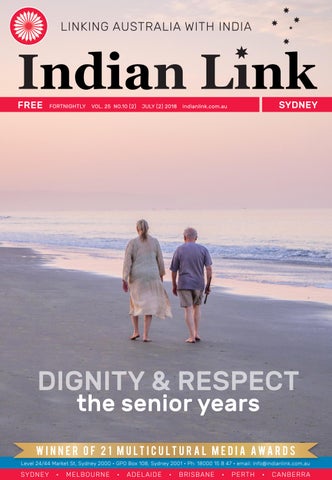
DIGNITY & RESPECT the senior years
W I N N E R O F 2 1 M U LT I C U LT U R A L M E D I A AWA R D S Level 24/44 Market 2001••Ph: Ph:18000 1800015158 84747• email: • email: info@indianlink.com.au Level 24/44 MarketSt, St,Sydney Sydney2000 2000 •• GPO GPO Box Box 108, 108, Sydney Sydney 2001 info@indianlink.com.au JULY (2) 2018 1
NATIONAL EDITION
SYDNEYSYDNEY • MELBOURNE • ADELAIDE • BRISBANE • PERTH • CANBERRA • MELBOURNE • ADELAIDE • BRISBANE • PERTH • CANBERRA
er
en
ds
m
id
ni
gh
t
31
LY 18 ICT MEuly 20 I TR J t
S T RA D FO ITE
ff
LIM
O
Luxury is Our Standard
s
UP TO
$20K OF EXTRAS
FREE! Super-Luxe gourmet kitchen with every Kaplan Home All this added to your Luxury High Gloss Kaplan Polyurethane Kitchen doors and panels available in a choice of over 1,000 colours.
■
Quantum Quartz 40mm Edge to Stone Benchtops
■
Quantum Quartz Waterfall Panels
■
DecoGlaze Glass Splashback
■
Westinghouse 900mm Freestanding Cooker
■
Westinghouse 900mm Canopy Rangehood
■
Squareline under-mount kitchen sink
■
Phoenix Blix Flexi Sink Mixer
■
Hettich Soft close door hinges
■
Hettich Soft Close drawer runners and framing
1800 527 526 kaplanhomes.com.au
Conditions: This offer is only applicable to Kaplan Homes quotations and tenders issued after 12th July 2018. This offer does not apply to previous or existing customers or projects and does not apply to quotations and tenders issued before 12th July 2018. The upgrade applies to only one kitchen per home & or per contract and does not apply to granny flats or secondary dwellings, this offer is not redeemable for cash or credit. Kaplan Homes may and will withdraw this offer at any time without notice prior to and before a deposit is made as the quantity to be issued is strictly limited and once allocations are exhausted the offer and promotion will end. All stone is from the quantum quartz standard range of 10 colours, glass splashbacks are from Decoglaze standard solid colour range. Westinghouse freestanding cooker WFE914SB, canopy hood WRC913SB. This offer can not be added to or included as additional to any other free items that may have been offered at a previous date. This offer ends at Midnight on 31st July 2018. Not all items depicted on images are included as there are other items within the pictures & images that are not part of this offer, only the 9 x items specifically listed on this offer are included as part of this offer.
2 JULY (2) 2018
www.indianlink.com.au
Hyundai Sonata.
Test drive the Sonata today and experience the sporty design, performance and technology. Including 8-speed automatic transmission*, wireless smartphone charging* and Apple CarPlay™ & Android Auto™. The 2018 Hyundai Sonata. Settle for more.
hyundai.com.au/sonata *Only available on Sonata Premium variant. Wireless smartphone charging requires a Qi-enabled smartphone or adapter to operate. Apple CarPlay™ functionality requires software update. Requires iPhone 5® or subsequent model (lightning cable) in order to operate. Apple® and iPhone® are registered trademarks of Apple Inc. Android™ Auto requires a device with Android 5.0 operating system or subsequent version in order to operate. Android™ is a registered trademark of Google. ^Sonata Premium variant shown.
NATIONAL EDITION
JULY (2) 2018 3
Send and smile Get a $10 e-Gift card* with your MoneyGram transfer
For new customers only How will new customers receive the e-Gift card? 1. MoneyGram will contact you via SMS^ 2. Simple reply ‘Yes’ to the SMS to receive a link to your e-Gift card^
T F I G E- RD CA
Send from anywhere you see the MoneyGram sign.
Discover your way at moneygram.com.au cash-to-cash • cash-to-account
moneygram.com.au/promotion Toll free: 1800 049 087
*Terms and conditions apply and can be found at moneygram.com.au/promotion. MoneyGram and the Globe are marks of MoneyGram. © 2018 MoneyGram. ^Message and Data rates apply: your network carrier’s messaging and data rates apply to your entry message, all subsequent SMS correspondence and the use of the Internet. MoneyGram is not covering such charges. Please contact your network carrier for more information. MoneyGram will not be liable for any delays or failures in your receipt of any SMS messages. 18-04301
4 JULY (2) 2018
www.indianlink.com.au
EDITORIAL
FIFA reflections
PUBLISHER Pawan Luthra EDITOR Rajni Anand Luthra ASSISTANT EDITOR Neha Malude MELBOURNE COORDINATOR Preeti Jabbal CONTRIBUTORS Harshad Pandharipande, Sandip Hor, Nehal Chhatrapati, Hamida Parkar, Natasha Jha Bhaskar, Jyoti Shankar, Nishtha Sharma, Avi Chandiok, Mohan Dhall, Auntyji ADVERTISING MANAGER Sukesh Thapliyal 0410 578 146 ADVERTISING ASSISTANT Charuta Joshi 02 9279 2004
Indian Link is a fortnightly newspaper published in English. No material, including advertisements designed by Indian Link, may be reproduced in part or in whole without the written consent of the editor. Opinions carried in Indian Link are those of the writers and not necessarily endorsed by Indian Link. All correspondence should be addressed to:
INDIAN LINK MEDIA GROUP Level 24/44 Market St, Sydney 2000 GPO Box 108, Sydney 2001 Ph: 02 9279-2004 Fax: 02 9279-2005 Email: info@indianlink.com.au
BY PAWAN LUTHRA
I
t’s done and dusted. France took home the glory, and the drudgery of routine daily life is upon us again after the analysts have all but wrapped up. Looking back at the month-long FIFA World Cup in Russia, there is much that is worth taking away from this remarkable tournament, over and above the moments of football brilliance – and some of stupidity, no doubt. > It truly was a ‘world’ cup: While there are only 193 member nations in the United Nations, 209 teams competed to reach the final 32 in the qualification process. Initial estimates for television are that over 3.4 billion people across the world have watched the tournament at some stage. And this does not take into account those who watched on social media. Next time around in 2022, when the qualification is extended to 48 nations, expect a further explosion in numbers. s s s
Donald Trump and others of his ilk, including some right wing Indian leaders, may lash out against immigration, but it was great to see the strength which the teams drew from their migrant communities. Belgium in the semi-final had five such players. England drew on their talent pool from Caribbean backgrounds to represent their country. The champions France, it has been famously claimed, is a team that is 80% African and 50% Muslim. Is it not obvious that a shared love of sport increases acceptance and promotes tolerance? Barriers break down when players - as well as supporters - go through the highs and lows of the game together, celebrating successes and commiserating at the losses. > It was the teams that won, not star players: There were celebrities galore - Ronaldo from Portugal (who has just switched clubs for a fee of 100 million euro), Messi from Argentina, Neymar from Brazil. But it was when the players worked as a team that the brilliance shone through (France, Croatia, Belgium). Even England, who had an excellent World Cup, left their established players at home and brought in a young team unfazed by egos. > The energy of youth: France’s squad was
the second youngest in the tournament, and the energy displayed by Kylian Mbappé was simply electrifying. Brilliant, fearless, talented and a delight to watch. The youthful Daniel Arzanni, a firecracker from Australia, dazzled all with his brief appearance at the games. Exciting times are in store for the game, without a doubt. > Dangerous to rest on past glory: There is always someone hungrier than you are, it has been said. It was amazing to see previous greats unceremoniously booted out from the tournament. This year, immediate past champions Germany did not even get out of the group stage; the 2010 winners Spain lost to Chile and Netherlands in the group stage in 2014. Based on past experience, there may not be many takers for a bet on France for World Cup 2022. Perhaps the lesson here is the need for teams to rethink, restrategise and realign after each milestone is successfully conquered: nothing wilts faster than laurels that have been rested upon. It was a few magical days of a beautiful game, which had the whole world fired up - and the late nights and early mornings were well worth it. Oh, and blessed is the s s
YOUR ULTIMATE INCLUSIONS
‘Everything you’ve ever wanted in your new Masterton Home’ masterton.com.au or 1300 44 66 37 NATIONAL EDITION
Jim wouldn’t have it any other way JULY (2) 2018 5
CONTENTS 19
SPECIAL FEATURES EXPATS Chitchat with Jennifer Milford
17
Australia’s new India economic strategy
19
ENVIRONMENT Renewed war on plastic ban
22
FIRST PERSON An unexpected spiritual encounter
27
SPECIAL FEATURE Sydney cricketer
6 JULY (2) 2018
17
33 COVER STORY
33
27
Protecting seniors from abuse
10
www.indianlink.com.au
International Migration Centre Contact us for all your Australian Visa needs • Skilled – independent and Australian sponsored visas • Independent and sponsored visas for regional areas • Student visas and graduate skilled visa • Fiancé, partner and other family visa applications • Business skill – Temporary, provisional & permanent visas • Bridging visas • Applications for Review and Appeals Tribunals
We have moved to new address
Suite 2, Level 1,
57 – 59 Dunmore Street Wentworthville NSW 2145 Phone 02 86287336
CONTACT DETAILS Amrit P Jagota (MARN 0532014) Ph 0414 338 423 Manvinder K Josan (MARN 0962796) Ph 0410 719 375
Bella Vista 8883 0055 Castle Hill 9659 6433 Auburn 0470 687 768 Bankstown 0477 053 053 Blacktown 9621 7711 Campsie 9789 2676 Chatswood 9411 4564 Eastwood 9874 8801 Epping 9869 8002 Girraween 0469 872 857 Gordon 0433 422 499 Gosford 0411 332 209 Hornsby 9987 2248 Lidcombe 8034 4635 Liverpool 9601 0963 Merrylands 0481 752 073 Newington 9648 0377 Parramatta 0410 783 260 Pennant Hills 0411 305 516 Revesby 0451 577 008 Ryde 0490 088 626 Strathfield 9764 2002
M Pennant erry Op la Hills en nd n e s Op
NATIONAL EDITION
JULY (2) 2018 7
YOUR SAY
THAILAND CAVE RESCUE
LOKI MADIREDDI’S RECIPE FOR HAPPINESS
Ex-MasterChef Australia contestant Loki Madireddi dropped in at the Indian Link Radio Studio to talk to RJ Pavitra Shankar Listener Rati rang in to ask: What were your thoughts after being eliminated because you didn’t use the immunity pin? Loki replied: I absolutely do not regret not using the immunity pin. I was very proud of myself. My journey doesn’t end after being eliminated. Whether I used the pin or not, I might face a similar situation elsewhere. I’m clearer in my head now and I’m doing so many things now, and so, I’m really happy.
A HELPING HAND FOR CHARITIES
CARL BUHARIWALA reported on Third Man Up, a Melbourne-based youth group who raise funds to help existing charities keep up the good work. Jennifer Street wrote: Great to read this article about all the wonderful work you do! Well done, Jude and crew. Malvika Kher wrote: Sri, Suri, Jude, Natasha and Rishi, great work! Proud of you. Third Man Up wrote: We’re incredibly humbled to have Third Man Up featured in the latest edition of Indian Link.
SAY IT AGAIN 8 JULY (2) 2018
INDIAN LINK shared a post about one of the world’s most famous rescue missions in recent times, that of 12 boys and their football coach who were stuck in a cave for over 10 days. Wendy Parmenter wrote: Ok, please don’t get me wrong as I’ve been praying since it hit the news! Was only in Thailand in November and know how proud Thai people are. But I’m Aussie so my question is what, how and why a soccer team on an excursion would remotely do that and get that far into a cave that they could hardly walk through or crawl through without water squeeze through? Sorry, so many questions in my head. Because if that had happened here in Australia, there would be a lawsuit, that’s for sure. But as I said so blessed for the outcome and so sad for the rescuer that didn’t survive, prayers. With his family xx. Usha Kumar wrote: Wow! What an incredible feat! The rescuers deserve to be worshipped.
ABUSING WOMEN, ABUSING POWER
PAWAN LUTHRA wrote an editorial on the blatant lack of respect towards women by a certain section of the Australian community. Aneeta Menon wrote: Kudos, Indian Link. It is refreshing to see men, who are not terrible, using their platforms to contribute to an important national conversation. Doubly so when speaking to diasporas who traditionally lack diversity in their news reporting and are often forced to rely on sensationalist gutter trash.
Australia vs India dance match with @priyankachopra x Australian actress Rebel Wilson with Bollywood actress Priyanka Chopra in NYC for their new film shoot
A statue dedicated to the ancient Indian physician-surgeon Sushruta, at Royal Australian College of Surgeons in Melbourne. Image tweeted by Virendra Sehwag, Indian cricketer
www.indianlink.com.au
INDIANS WAITING FOR AUSTRALIAN CITIZENSHIP
INDIAN LINK published a report on Minister for Citizenship and Multicultural Affairs Alan Tudge’s explanation as to why some Indian migrants will have to wait a bit more to get their Australian citizenship. Nicholas Houston wrote: What about the fact that the Australian Government attempted to retrospectively change the law to require people to have a greater period of time in Australia as a permanent resident, and when that law was blocked in the Senate by the ALP and Greens in October 2017, the Government stopped processing applications. It is clear the Liberal Party wants to reintroduce the legislation, and it seems the Government has stopped processing applications until it gets the new law through. Best not to believe everything you read in a Government press release. In the meantime, everyone is just waiting patiently.
INCENTIVE FOR INTERCASTE MARRIAGES
VEGAN EGGS?
INDIAN LINK’s shared post on ‘vegan eggs and bacon’ made from flax seeds, sweet potato, coconut milk and seaweed got quite a reaction. Raka Mitra wrote: I’ve always found this stuff really lame - if you want to be vegan/vegetarian, you shouldn’t really want to eat eggs/bacon. In fact, even the fake stuff should make you a little queasy. As food art though, it’s pretty cool.
INDIAN LINK ON INSTAGRAM
INDIAN LINK shared a post on how the Odisha government in India has hiked the incentive for intercaste Hindu marriages from Rs. 1 lakh to Rs. 2 lakh. Leyla Singh wrote: What’s intercaste? Is it mixed caste? Maria Fernandez wrote: Uhmmmm I missed out, I think. Jayanthi Vellore wrote: OMG, I need to claim! Sona John wrote: Never knew this kind of thing existed.
Chaitalee,, who’s just arrived in Australia, shared this picture on her Instagram account @leesohoni and captioned it: Can’t wait to watch the new (well not so new here!) season of MasterChef Australia!
MELBOURNE CAR CRASH TRAGEDY
NEHA MALUDE wrote about the recent car crash tragedy in Melbourne in which two young Indian-origin children lost their lives. Loreen Lal wrote: So heart breaking to lose your loved ones only because of reckless and stupid drivers. They shouldn’t be allowed on the roads ever. Ginz Sidhu wrote: So sad. Please start a donation page or does anyone know if there already is one?
Just realised India did to England what England have just done to Australia over the past few weeks!!! Looked very well organised. I am now officially concerned about the Indian White ball team #Kuldeep #ENGvIND Michael Paul Vaughan, former English cricketer after Ind-Eng ODI
NATIONAL EDITION
INDIAN LINK POLL
We asked: Cancer Council Queensland has called for a ban on smoking at the workplace, saying that it affects productivity at work. Do you agree? Yes it does: 98% No, it won’t make a difference: 2%
We have done it! Australia has won their 15th Champions Trophy in shootouts. Well played India, that was an amazing way to play out the last ever Champions Trophy! #PrideOfTheKookas #HCT2018 Australian hockey team Kookaburras, after the Hockey Champions Trophy 2018
JULY (2) 2018 9
COVER STORY
A little bit of your time Community seniors talk about emotional and financial abuse by loved ones, and their pursuit of dignity in the face of it all BY HARSHAD PANDHARIPANDE
“B
as,” Mr Das shrugs. “Yahan ka culture hi aisa hai.” It’s the culture here. “That’s right. It’s not as if our children don’t love us. Pyar toh hai, lekin...” Mrs Singh begins saying, but then s s s s s Ms Cotter has a simple enough explanation that she seemed convinced with: “It is the generation gap.” “Yes, exactly. Why choose to be
10 JULY (2) 2018
dependent on your children when you can be independent?” Mr Singh asks, with not a hint of bitterness. “In fact, I simply love the freedom of living independently. I can sleep in if I want to,” he says, clearly relishing the luxury of waking up at 8.00am when he wants to. “Parents!” I think to myself, even as I smile and nod. “Classic parents.” I am at a senior citizens group where I have been allowed to be part interviewer, part fly-on-the-wall. The unpalatable, fraught topic: elder abuse. It isn’t going to plan. I have been expecting to hear hard-hitting, angry, tearfilled indictments of their children, but s s s s explanations (excuses?); waving away
suggestions of neglect; dancing delicately around the subject; and blaming the circumstances, the changing times, today’s busy lifestyle - everything but their kids. “Yep,” I think, trying to not shake my head ‘out loud’. “Classic parents.” The close-to-dozen seniors are all my parents’ age, some of them even older. Their children - the ones they are talking about, the ones they are giving all these explanations for, the ones they are refusing to chide even gently behind their back - and I are the same generation. Would my parents, whom I had said goodbye to (left behind?) in India when I migrated to Australia just over a year ago, also be having similar conversations with their friends, I wonder. Do they feel I have
abandoned them, or have they convinced themselves that love does mean letting go? What would happen 20, 25, 30 years later, when my daughter grows up, I think, with more than a little dread. Mrs Singh, with the zen and liberating detachment that can only come when you are in your eighties, jolts me back to the conversation. “If there is no expectation, there is no abuse,” she says. It’s a quotable-quote-worthy line, delivered with devastating simplicity. Is she being simplistic? Is she in denial? I don’t know. But with that piece of distilled wisdom, she has demolished the very definition of elder abuse, which the World Health Organisation defines as “a single or repeated act or lack of
www.indianlink.com.au
If you have no expectations, there will be no abuse appropriate action, occurring within any relationship where there is an expectation of trust which causes harm or distress to an older person” (emphasis added). But, if Mrs Singh and others of her ilk would like to think that they have no expectation, then, by their logic, there would be no abuse. See? Devastating. I wish it were that simple. But, Mrs Singh, it’s not.
Profoundly under-reported
Elder abuse isn’t imaginary; it is painfully real. In fact, the Australian Institute of Family Studies (AFIS) calls it “fundamentally a human rights issue”, adding that it is likely that between 2% and 10% of older Australians experience elder abuse in any given year, with the prevalence of neglect possibly higher. But it is also one of the most under-reported s s s s in silence rather than “exposing their children”, says Jay Raman, who is the vice-president of Sri Om Foundation, an independent organisation, and has worked with the elderly for several years. An AIFS report commissioned and funded by the Australian Government Attorney-General’s Department (available on https://aifs.gov.au/publications/ elder-abuse/export) says: “The available evidence suggests that prevalence varies across abuse types, with psychological and financial abuse being the most common types of abuse reported, although one study suggests that neglect could be as high as 20% among women in the older age group (Australian Longitudinal Study on Women’s Health [ALSWH], 2014). Older women are significantly more likely to be victims than older men, and most abuse is intergenerational (i.e. involving abuse of parents by adult children), with sons being perpetrators to a greater extent than daughters.” “In New South Wales, two years of call data to the NSW Elder Abuse hotline (NSW Elder Abuse Helpline and Resource Unit, 2015) reveals that women were most commonly reported to be the victims (71% women compared to 28% men), and the most common age group of concern in the calls was 75-84 year olds (33%). In 71% of calls, the perpetrators were family members, and the largest group of perpetrating relatives were adult children (26% sons and 21% daughters). Just over one in 10 (12%) of perpetrators were spouses. The most common abuse type reported in the calls was psychological abuse (57%), followed by financial abuse (46%), neglect (25%), physical abuse (17%) and sexual abuse (1%),” the report further says. It also notes that among the ways in which financial abuse is carried out were misuse of powers of attorney, coerced changes to wills, unethical trading in title to property, and the coercion of people without capacity into signing documents in relation to assets that would result in financial gain for the perpetrator. Elders in culturally and linguistically diverse (CALD) communities such as Indians face additional challenges. “In CALD communities, the literature
NATIONAL EDITION
suggests that a number of factors can heighten vulnerability to abuse, including s s s primary language is not English, social dependence on family members for support, and the potential conflict caused by cross-generational expectations in relation to care,” says a 2009 study by Bagshaw et al. The AIFS report also outlines the barriers for reporting of elder abuse. “[An] aged person may be reluctant to disclose abuse by someone on whom they depend for care, since disclosure may mean withdrawal of the care and potentially an unchosen change in living circumstances. Cognitive impairment may also mean that an older person is unable to disclose or is not believed when they do disclose. Shame, embarrassment, fear of negative repercussions and/or a belief that disclosure and/or reporting may result in no consequences or negative consequences may also be relevant.” Sadly, the report adds that legal redress is often unattainable for practical reasons (assets are unrecoverable) or personal reasons (the older person decides that maintaining relationships is more important than pursuing justice).
‘What will people say?’
Maintaining relationships or pursuing justice: it’s a choice no one should have to make. And yet, it is one that many elders – even those who have been abused – have to make. They often take the ‘classic parent’ approach, may be grudgingly revealing their travails to a support group, but expressly asking them not to inform the police. After all, what sort of parent reports their own children to the police? Srilata, coordinator of the seniors’ centre that I am visiting, tells me that s s only because they know that police will not be involved. “We try to either inform other government agencies or deal with
the problem ourselves,” she says. The members also say that on occasions when something has to be reported to the police, they do so through their centre, rather than approaching the police as an individual because it adds a bit of weight to the issue. Raman tells me about a few abuse cases. In one case, a retired senior had been psychologically abused by a close family member and kept confined in the house for four to five days, without the house keys and with limited food, while the rest of the family went away on holidays for a long weekend. The lady confided to Raman, but asked him not to report the case to the police because ‘badnaami ho jaayegi’ (it will bring the family a bad name). Raman reported the case anyway, but the police said that they would take action only if the situation aggravated. Has Raman ever confronted the alleged abusers? “Yes, and they have told us not to interfere and teach them how to care for their parents. They are not very receptive,” says Raman. Has anyone expressed remorse? “Yes, in one case.” He hints that even that may have had something to do with the fact that the abused parent started receiving a pension. Raman’s organisation helps out seniors for all levels of abuse. “We also see some severe cases of abuse. If those abused are pensioners, we may try to look for accommodation for them, as we did in the case of the retired senior. (Sri Om seeks help from other retirement living agencies for accommodation). If they are not pensioners, we may have to look for foster accommodation, which is like random people taking care of these seniors. Eventually they go back to India. Initially they are upset but at the same time, they do not want to expose their children,” he says. Raman says that the law is limited and that only certain cases can be classified as ‘domestic violence.’ “If it is passive, s s
unless the seniors want to report the matter to the police and testify in court,” he says. And therein lies a cultural barrier. For many elders, that all-powerful and quintessentially Indian reasoning to do anything undesirable – ‘log kya kahenge’ (what will people say?) – is a big factor s s s lack of this factor, the absence of relatives and acquaintances that gives many adult children a free hand to neglect their parents or even take financial advantage of them,” says Srilata. She adds that culturally, Indians are quite tolerant. “What others might see as abuse, Indians might accept. Also, we tend s s of God. For instance, even if elders might get something unexpected to eat, they tend to think ‘Oh, this is what God wanted’,” she says. Skimming parents’ pension money seems to be the favourite form of financial abuse of many abusers. That money may go to pay mortgage on a property or make other payments, sometimes even day-to-day expenses. Somehow, this seems to be the lesser evil. “Here, children at least allow their parents to live under the same roof. Many Australians expect their parents to live separately,” says Mr Mendes. Raman recalls cases of people who employ stratagems that are approaching stunning levels of psychological manipulation. “When their pensioner parents are within earshot, people will deliberately scold their young children – ‘no beta do this’”. No prizes for guessing that the s their money. “They say to their grandkids, ‘What’s mine is yours,’” Raman says. Not spending money even when elderly parents clearly need it also abuse. Raman remembers a case in which a retired s living in Australia on a bridging visa. “The lady fell sick but the son did not pay for the treatment. The parents had to return
JULY (2) 2018 11
COVER STORY
What is so wrong in expecting your children to take care of you? Being respectful and kind to your parents is not a bad thing
to India and the lady eventually passed away,” he says. Of course, these are exceptions rather than the norm. To be fair, most adult children do financially provide for their elderly parents, even those who live independently. However, many of these parents receive pension or are otherwise financially independent. What they really crave is something no amount of money can buy: time. Time from their children, that is. Between their work commitments during weekdays; and household chores, groceries, the kids’ sports and get-togethers over the weekend, adult children often find that they have run out of time. There’s none left to spend with their parents. Then, before you know it, it’s Monday again. s s parents may, in extreme cases, constitute as neglect. But is it abuse?
No quality time
Many elders say that their children happily pay for their aged care, but can’t always find or make time to spend with them. All of Mr Das’ children live in Australia, but he stays alone – he prefers to calls it ‘independently’ – in Sydney. “More than financial support, we need moral support,” he says. “But the kids are all grown up now. They don’t need us parents much.” The heartbreak in his voice is, well, heartbreaking. Mr Singh is much more pragmatic. “We need to change our expectations. Indians think that as part of our culture, it is our children’s duty to take care of their aging parents. But it was we who sent our kids here. They adopted Western thinking which places no burden on them to take care of their parents. In Australia, the definition of family is husband, wife and kids; not the extended family. Grown-ups do not expect their parents to take care of them. Old parents should not expect their grown-up children to take care of them either.” But isn’t it inherently human to have expectations from everyone, and to base relationships on give-and-take? Mr Trivedi seems to think so. “It’s impossible to love
12 JULY (2) 2018
unconditionally, except may be if you are a mother. If one says ‘You should be detached’, it is bullshit.” But Mr and Mrs Singh are firmly in the ‘no expectations’ camp. And so, a year and a half ago, they started living independently from their son. “Is it good?” I ask them. Mr Singh replies, “Independence is happiness.” Mr Trivedi disagrees. “What is so wrong in expecting your children to take care of you? Being respectful and kind to your parents is not a bad thing. Anyone’s first responsibility is towards their parents,” he says. Mr Singh argues. “I am over 80. What should I expect my son to do, sit by my side every day? He would rather speak to his children, his family,” he says, implying that “family” does not include elderly parents. Yet, Mrs Singh’s daughter-in-law certainly thought of her as family. “When I first arrived in Australia 20 years ago, there weren’t as many Indians around as there are today. My daughter-in-law would take me to get-togethers with her friends,” she remembers. Of course, most members recognise that they won’t be welcome to the get-togethers of their children or grandchildren. “It’s fine if we stop by and say hello. But after that, they might not be entirely comfortable in our presence,” Mr Singh says. Ms Cotter adds, “It is understandable. Even we would be comfortable among people of our age and interest. It is the same with them.” Mrs Singh agrees. She says, “We like all good things about Australia - its discipline, its cleanliness and so on. We should also learn that here, kids are not expected to take care of their elderly parents.” Mr Trivedi blames it on an increasingly individualistic society. “Many people even get their parents here for financial benefit. Not only do they save on childcare, they can even get some money if the parents get a pension,” he says. Srilata, who is about my age and a representative of the ‘grown-up children’ generation during the discussion, perhaps feels pressed to provide an explanation.
“Even when my husband and I migrated to Australia, it was hard for us to leave behind my mother-in-law back in India. But what could we do? We had our daughter and her education to take care of. Elders understand this and say, ‘Do not worry about us, look after yourself and your family first.’” Mr Singh exclaims, “That’s right. In our kids’ hearts, there is no shortage of love for us. But it’s just that they do not want that responsibility. And it is our responsibility not to burden them,” he says.
Happy to be free
Don’t for a moment think of them as worthy of pity. Many seniors in the group who no longer live with their children have embraced their independence rather than moping about loneliness and alienation. That’s because in the group that they are a part of, they have formed close friendships. Back in India, Mrs Singh used to be a teacher. “I remember when I would enter s s s colleagues would welcome me. I get the same feeling when I come here every day,” she says. For most members, the three or four hours at the centre are a welcome time away from a lonely home, from what Mr Trivedi describes as a ‘first-class jail’. “After our children have left for work and our grandchildren for school, what are we going to do at home, count its bricks?” he asks. “It becomes a first-class jail, nothing else. You have all the comforts and amenities, but you are confined to the house. It is good for us, physically and mentally, to get out of the house. If you sit at home doing nothing, you would go mental.” At the centre, the members do some light yoga, occasionally have cultural activities, play rummy, have lunch, watch television and unwind. While I was there, someone pulled out their phone to read a message about a phishing scam. Two other members said they had received similar messages as well. “Friendship with a side
of financial awareness,” I think to myself. Mr Das adds, “The centre is more than a support system; it’s a family. The good thing is that we also have people coming in from Centrelink, Fair Trading, Dementia Society to speak to us about various issues.” Birthdays and anniversaries are a big deal at the centre. “For our wedding anniversary, they made us exchange garlands. We had songs and dance and food, just a lot of fun,” Mrs Singh says. Adds Mr Trivedi, “Yes, we get to be kids again here.” Raman says the social contact is essential for the members. “It is important for us to keep in touch with them, like it is for a doctor to keep in touch with a patient. It helps us get to know if they have any problems at home,” he says. He adds that the organisation also sends the seniors to volunteer at some local community events. “It is not hard work, but simply an opportunity for them to step out of the house, so they don’t feel lonely or depressed,” he says. However, for all the members’ positivity about being independent, they sometimes let slip stories that leave me a bit depressed. Mr Das tells me he has ancestral land back in India, and every time he goes back to his village, he gets the feeling that his brothers start thinking if he has come back to claim his share. “My nephews ask me if my ticket is one-way or return,” he laughs, seemingly making light of the issue. Mr Singh says he and his wife too visit Delhi every year for two years and live with their younger son. “However, even if we stay for a few weeks more, we can sense a change in our daughter-in-law’s demeanour,” he says. The couple loves Australia, its ‘loving and gentle people’, the weather and, of course, their friend circle. But would they expect their son, who lives here, to care for them during their last years? They seem to have no such illusions. “When my father was on his last legs, I dropped everything I was doing to be with him and to take care of him until the end. But do I expect the same from my son?” he asks, and answers the question himself. “No.” Mrs Singh is by his side. “You are happy if you don’t have expectations,” she reiterates. “If you have no expectations, there will be no abuse.” [Names of all group members and coordinator have been changed to protect their identities]
www.indianlink.com.au
FREE - Expression of Interest Skilled Migration (PR) Temporary Visa (485) State/ Regional sponsorship Relative Sponsorship Visa All Skill Assessments Specialise in CDR / RPL
FREE - Student services Change of Course/ College/ Uni Offshore Student Visa Student Visa Extension Student Dependent Visa Refused Cases GTE Explanations
We are a CPA Practice Tax agent 23282009
100% Online
58 Ross Street, North Parramatta, NSW 2151
General Practitioner Tamil Speaking Lady Doctor. Speciality in Paediatrics and Child Health
PARRAMATTA: Suite 1 & 2, Level 1, 247 Church St. (Opp Westpac, above Subway) Email: info@mytaxrefundtoday.com.au | Web: www.mytaxrefundtoday.com.au
NATIONAL EDITION
NORTH PARRAMATTA PHONE 9890 9778
MBBS, FRACGP, Dip. Paediatrics, FAP
FRONTLINE MEDICAL CENTRE
Dr Sumathy Mahen
CRN No. 499928
Visitor Visa Long Stay Visa for Parents Spouse/ De-facto Visa Same Sex Partner Visa Parents Visa Child Visa Remaining Relative Visa
Australia wide
/ /
Rank Amongst Top 100 Brokers in Australia 3 Years in a row
Employer Nomination Scheme RSMS Permanent Residence 457 (Work Visa) Short Term Work Visa Business Investment Visa Business Setup Job Placement Assistance
SERVICES PROVIDED
General practice for all ages • Women’s Health, • Immunisation • Child Health • Pap Smears • Workers Compensation • Minor Surgery Pathology, Blood Test • • • Paediatrics • ECG
BULK BILLING APPOINTMENTS & WALK-INS OPENING HOURS Mon, Tue, Thu & Fri 9:00 am - 5:00 pm Wednesdays 9:00 am - 1:00 pm 1st Saturday of every month 9:00 am - 1:00 pm Weekends / Public Holidays Closed
JULY (2) 2018 13
SENIORS
How seniors can protect themselves There are services at the government and
community levels that elders can access so their rights are respected BY NEHAL CHHATRAPATI
R
ajita, an 80-year-old widow, was invited to move in with her daughter. Within a short span of time, she was swindled out of her assets including her own house, and subjected to mental, physical and financial abuse. The perpetrator - her daughter. What could Rajita have done to protect herself? Are there services that people like her can avail? A team of experts recently got together to explain to seniors in Sydney’s Indian community about what constitutes abuse, and the systems in place at the government and community level to help prevent it. . They spoke at an information forum organised by AASHA (Australian-Indian Aged Care Support Holistic Association) at Blacktown Senior Citizens Centre. The event attracted some 200 community members. Although Rajita was a fictitious case,
14 JULY (2) 2018
the panellists seemed to indicate that such exploitation is rife, even among South Asian communities that are family-oriented and where parents live with their adult children as tradition recommends. The expert panel included a senior consultant from Elder Abuse Hotline; a senior constable from NSW Police; a solicitor from Senior Rights Service, and s from the Department of Human Services. Diana Bernard of the Seniors Rights Service acted as moderator. AASHA director Bijinder Dugal said many older members of the Indian community are unaware of how to get help when needed, or, for cultural reasons, are often reluctant or scared to come forward if they need assistance. At the very outset, Vivienne Duval, Senior Consultant at Elder Abuse Helpline and Resource Unit explained that elder abuse could take five forms: psychological abuse, financial abuse, neglect, physical abuse and sexual abuse. Regarding financial abuse the forum provided insight into issues such as gifting s s on pensions, and the risks of lending
money without financial advice. Solicitor Nalika Padmasena of the Senior Rights Service explained how Rajita could have avoided the financial abuse. “The victim should have entered into an agreement with her daughter and her family regarding how her money will be
used, and how the common expenses like electricity will be divided.” “We want people to understand their legal rights in assisting their children financially and in being able to protect themselves,” Diana said. “By all means help your family, but protect yourselves first.”
Audience members at the forum
www.indianlink.com.au
Raji Selvakumar, Financial Information s Human Services shed some more light on the case. “Although we do not encourage people to give away the money they have, we don’t have any control over how they spend it. The rules for gifting, however, suggest that the gift amount should not exceed $10,000 per financial year and not more than $30,000 in 5 years. If you do exceed this, it’s considered as an asset on your record.” Also covered were topics such as power of attorney, how organisations such as Seniors Rights Service and the Elder Abuse Hotline can provide assistance, and the role of the police force in guaranteeing older people’s financial, legal and personal rights. Senior Constable Jason Roughley
AASHA directors
NATIONAL EDITION
s issue, his core message being to speak up about mistreatment. “Domestic violence is our foremost priority and we encourage people to not hold back any type of communication and request them to come forward and speak up if they are facing any sort of domestic violence or abuse.” AASHA’s Dr. Praful Valanju took this up in depth by bringing out the cultural stigma associated with such abuse. “The reason people hesitate in our community to get legal and professional help in situations like these is our culture,” he said. “The family name is of utmost importance and we do everything possible s s indignity.” AASHA representatives also indicated
the way in which their foundation can assist and support seniors on matters raised at the event. Founded in 2015, AASHA (a Hindi word meaning ‘hope’), claims to “celebrate ageing as a way of life and create proactive awareness about dementia and seniors rights”. The discussion brought out some valuable insights from law enforcement personnel, and information about aid available in situations like these. When the gathered senior community were given opportunities to ask questions, it was obvious there was much anxiety: a number of questions and doubts were raised to resolve the issues they were facing. Some of these included the waiting periods to get into aged care facilities, struggling to receive benefits from Centrelink, accessing healthcare facilities, transferring properties and other assets to children and moving in with them, inability to go back to their home country for a longer period due to certain rules by Centrelink that would stop or delay their pensions. Panellists patiently answered all their questions and a lot of information came through on how to obtain legal, financial and government help when required. While on one hand we pride ourselves for the values and traditions of our culture, on the other hand the reality is that our community needs legal and government aid to improve the personal situations at home. Hindu philosophy teaches us to revere our parents like gods. While we may find it challenging to follow this in today’s time, let’s at least pledge to treat our own families with the respect they are due.
HELPLINES FOR SENIORS Elder Abuse Helpline 1800 628 221 elderabusehelpline.com.au Senior Rights ServicE 1800 424 079 info@seniorsrightservice.org.au Financial Information Service 132 021 humanservices.gov.au AASHA Australia Foundation info@aashaaustralia.org.au Law Access NSW 1300 888 529 lawaccess.nsw.gov.au NSW Civil and Administrative Tribunal 1300 006 228 ncat.nsw.gov.au NSW Trustee and Guardian 1300 364 103 tag.nsw.gov.au My Aged Care 1800 200 422 myagedcare.gov.au Welfare Rights Centre 1800 226 028 welfarerightscentre.org.au
JULY (2) 2018 15
Spirit of India FREE Admission of Australia India FREE Admission Yo VedaSpirit INC. Welcomes All to FREE Yo VedainINC. Australia spiritual discourses SYDNEY Welcomes All to FREE City of Parramatta spiritual discourses in SYDNEY By His Holiness Swami Anubhavananda Saraswati By His Holiness Swami Anubhavananda Saraswati
Morning Talks on Spirit of IndiaGITA FREE Admission ASHTAVAKRA Morning Talks on
INDIAN FLAG RAISING CEREMONY
Celebrating Indian Independence Day Hosted by City of Parramatta Lord Mayor Cr Andrew Wilson and Consul General of India, Sydney Shri B. Vanlalvawna
ASHTAVAKRA GITA Yo Veda INC. Australia
7th – 10th August 2018 Wednesday 15 August 2018 6:15 – 7:15 am 12pm – 1pm Parramatta Town Hall 62 Bombay Welcomes Street Lidcombe All to2018 FREE 7th – 10th August Centenary Square, Parramatta spiritual discourses Swami Paramananda 0410 660, 6:15698 – 7:15 amin SYDNEY This is a public event and includes raising of the Australian and Indian Mataji 0423 205 210,Street Lidcombe 62 Bombay National Flags, cultural dancing and performances by Swastik Institute Subhash 0411 400 313 Swami Paramananda 0410 698 660, of Dance and Lingalayam Dance Company. By His Holiness Mataji 0423 205 210, Swami For more information, visit cityofparramatta.nsw.gov.au Subhash 0411 400 313 Anubhavananda Saraswati
Evening Talks on YOGA VASISHTHA Evening Talks on Spirit of India FREE Admission Morning Talks on 7th – 10th August 2018 YOGA VASISHTHA 7:30 – 9:00 pm ASHTAVAKRA GITA
Yo Veda INC. Australia
Marsden High School, 7th – 10th August 2018 22a Winbourne Street, West Ryde 9:00 pm2018 7th –7:30 10th– August Welcomes All to FREE Marsden High School, Swami Paramananda 0410 660, 6:15698 – 7:15 amin SYDNEY spiritual discourses Mataji22a 0423 205 210,Street Street, West Ryde 62Winbourne Bombay Lidcombe Suresh Yogi 0412 202 182 Swami Paramananda 0410 698 660, By 205 His Holiness Mataji 0423 210, Swami Suresh Yogi0411 0412 202313 182 Subhash 400 Anubhavananda Saraswati
Non-Residential Weekend Retreat on Non-Residential Evening Talks on KENO UPANISHAD Weekend Retreat Morning Talks onon YOGA VASISHTHA 11th –ASHTAVAKRA 12th August UPANISHAD 2018 KENO GITA – 10th August 2018 12 Glenroy Av, 7th Middle Cove (Dr. Steve & Robyn’s residence) – August 9:00 pm2018 11th – 10th 12th August 2018 7th –7:30 Marsden School, Swami Paramananda 0410 660, 6:15698 –High 7:15 am Cove 12 Glenroy Av, Middle 22a Winbourne Street, West Ryde Mataji 0423 205 210, (Dr. & Robyn’s residence) 62 Steve Bombay Street Lidcombe
Robyn 0421 813 702 Swami Swami Paramananda Paramananda 0410 0410 698 698 660, 660, Mataji 0423 205 210, Mataji 0423 205 210, Suresh Yogi 0412 202 182 Robyn 0421 813 702 Subhash 0411 400 313
For all details contact: swamiparmananda@yahoo.com | 0410 698 650
Non-Residential Evening Talks on swamiparmananda@yahoo.com | 0410 698 650 Weekend Retreat on YOGA VASISHTHA Co -sponsored by Spirit of India (NSW) Inc. KENO UPANISHAD
Co -sponsored by Spirit of India (NSW) contact: Inc. For all details
16 JULY (2) 2018
7th – 10th August 2018
www.indianlink.com.au
EXPATS
The daily unexpected There are an estimated 450,000 people of Indian ancestry in Australia. Some 163,000 Indians migrated to Australia in the last five years alone. But Australians living and working in India are still a rare breed. Just as the average Indian migrant faces a mixed bag of experiences – some pleasant and some challenging – it’s a tricky affair for Aussie expats living in India as well. In this series, we speak to such Aussies about their life in India – what took them there, what they do, and what they have learnt about a different culture and a new way of life.
This issue we speak with leading Indian law firm COO, Jennifer Milford .
At Jaipur Literature Festival
In Kochi
At an Indian w edding
What do you do in India? I am the COO for Shardul Amarchand Mangaldas, one of India’s largest law firms. With more than 100 partners and 520 lawyers plus business services teams s s it makes for a busy role. What challenges have you faced at work? Both, the “daily unexpected” (which keeps life interesting), as well as the (sometimes) slow pace of change. How did you first get to India? I was in a similar role in Hong Kong for 10 years. The needle of Australian-Indian bilateral trade has been stuck at $15 billion for some time now. Why aren’t there more Australian companies in India? With India, I think it can be hard for businesses to know where to even start. But over the last five years, I have seen the growth in levels of support available to Australian business, in terms of agencies, organisations and even individuals who specialise in assisting Australian businesses to enter Indian markets, so I think that needle will move over time. Let’s talk about your personal experiences of India now. What was your first impression? I first visited India many years ago and
NATIONAL EDITION
loved the colour and culture even then. That hasn’t changed and it is one of the things I really enjoy about it. I call it the “daily colour”, as in I know there will always be something to surprise, challenge or even shock me on a daily basis. Life is never dull or too predictable in India. Adjusting, what was the most difficult bit? I was fortunate enough to make some great friends fairly quickly and easily, so that certainly softens any landing into a new culture, not only from the social perspective but a network of friends can also be a source of great tips, especially around seemingly simple things like food, shopping and restaurants. s s s living in Delhi are the air quality, the s s s eating plastic bags by the roadside. Having s s s and pollution problems too! What did you find to be the most strange? Not so much strange, but I found that it has been really worthwhile building a deeper understanding by digging into the meaning behind the various holidays and festivals. Figured out the head wobble? I love the head wobble. But I always
ask and never assume that I have interpreted the meaning correctly. I have learnt that the meaning behind a head wobble can be highly nuanced. What was the easiest thing settling in India? Finding great people on the ground to assist me has been key. My driver has made my life so much easier and I feel very fortunate to have had his help over the years. I am also lucky to have very good people at work who have been able to help me sort some of those India-specific issues that do arise on a regular basis. How did your neighbours treat you when you moved in? Very hospitable and welcoming. I have had some great neighbours and yes, great
landlords too! Apart from family and friends, what do you miss about Australia? A supermarket where I can visit at the end of a busy work week, and being able to buy the week’s food and groceries in a single shop and stop. What’s your India bucket list? Still quite long. It’s such a vast country. Do you see yourself long-term in India? I have lived in Delhi for almost five years now and it still continues to surprise me. Any advice to Aussies looking to work in India? Think more globally. Expect to be surprised and challenged by India. Be open to learning something new, every day.
UP CLOSE AND PERSONAL Read a book by an Indian writer? Quite a few really as I was a member of three book clubs at one point in time, as well as a visitor to the Jaipur Literature Festival. We read Arundhati Roy, Anuradha Roy, Amitav Ghosh, and of course, William Dalrymple, Tarquin Hall (OK, I know they are British), Salman Rushdie, and Kiran Desai but also Neel Mukherjee, Arvind Adiga, Khushwant Singh, Madhur Jaffrey, Shona Patel, Jaspreet Singh and Namita Ghokhale. Know any Hindi words? My first Hindi word – apart from Namaste – was ‘chalo’. I still love it. Favourite local dish? Aloo gobi. How can cauliflower taste so great?
Cook anything Indian? Aloo gobi! Favourite Indian celebrity? That’s a tough one. Deepika, Kajol and Alia? I also like to sneak in a Koffee with Karan on occasion. Seen a Bollywood movie? Absolutely. Who doesn’t love Hrithik Roshan in Bang Bang? Fabulous. I also really enjoyed The Lunchbox and of course, I would have to add Jolly L.L.B. to my list as well. Know any Hindi film songs? Well, the obvious one of course is Jai Ho (but the words are pretty easy for us Westerners to learn!) I am pretty good at humming. Salman Khan or Shahrukh Khan? Shahrukh all the way!
JULY (2) 2018 17
Rewriting the rules to engage a rising India Grasping the opportunities India has to offer: New Economic Strategy suggests solutions BY NATASHA JHA BHASKAR
A
ustralia recently released a report on its economic strategy for India recommending that the latter should be put into its top three export markets and made the third largest destination in Asia for the country’s outward investment. The report titled ‘An India Economic Strategy to 2035’ – authored by former Australian High Commissioner to India Peter Varghese – was welcomed by Australian Prime Minister Malcolm Turnbull. The report said it would see Australian exports to India grow from $14.9 billion in 2017 to around $45 billion in the next 20 years, and outward Australian investment to India rise from $10.3 billion to over the $100 billion mark, reflecting a transformational expansion of the relationship. The report through its 90 recommendations noted
18 JULY (2) 2018
that the opportunities, however, would not come down easily. The government would require a sharper national focus; and that patience, perspective and preparation is needed to engage with India. The report identifies 10 sectors and 10 states in an evolving Indian market where it has competitive advantages where s s s s s divided into a flagship sector (education), three lead sectors (agribusiness, resources, and tourism) and six promising sectors (energy, health, financial services, infrastructure, sport, science and innovation). The Indian diaspora in Australia is expected to play a larger role in building these economic linkages, highlighting the importance of the largely prosperous 700,000-strong Indian-origin population here. The focus on states reflects that India is not seen as a single economy but as an s s s s s s and likely to continue to be uneven in their progress.
India: State of the economy
Today India is the fastest growing major s s opportunities for business and economic partnership. Australia’s new India economic strategy shows how India’s growing economic weight makes it an unavoidable economic partner, despite the challenges in navigating its market. It is not surprising therefore that Australia wants to press the reboot button in this relationship. Many countries are reformulating their economic and foreign policies to engage India. India’s scale is extraordinary. By 2024, India would have overtaken China as the world’s most populous country. India has the world’s largest youth population, but isn’t yet fully capturing this potential demographic dividend - over 30% of India’s youth are NEETs (not in employment, education or training), according to the OECD. By 2025, one-fifth of the world’s working age population will be Indian. By 2030 there will be over 850 million
internet users in India. By 2035, India’s five largest cities will have economies of comparable size to middle income countries today. Over the past decade and a half, India’s economic growth, its appetite for resources, energy demand, skill development, technical know-how and investment have made it an important trade partner and export destination for Australia. There is no market over the s s opportunities for Australian business than India. The International Monetary Fund’s World Economic Outlook reports that “the Indian economy is expected to grow at an annual rate of 7.4% in 2018 and 7.8% in 2019, lifted by strong private consumption, structural reforms and implementation of the national goods and services tax”.
Australia-India trade at present
Australia’s India Economic Strategy report acknowledges that though India is already in the first tier of Australia’s diplomatic relations, the economic relationship is
www.indianlink.com.au
stuck in the second tier. Bilateral merchandise trade was only $19 billion in 2015-16 (compared with $150 billion for China), making India Australia’s 10th largest trading partner. Many Australian resource companies keen to invest in India have found themselves locked out of the market. Merchandise trade has declined by 50% in value since 2010. Australia is ranked 33rd in countries to whom India exports, and India is no longer in Australia’s top-ten two-way trade partners. Investment is thin and largely one-way, from India to Australia. Australian firms remain uneasy about doing business in India, their biggest concerns being corruption, red tape, enforcement of contracts, and the cost of doing business.
The elusive CECA
For many, the remedy to declining trade and investment was a preferential trade agreement, such as those Australia has with Japan, South Korea and China. But this has not been successful with India. Despite years of negotiation, a Comprehensive Economic Co-operation Agreement remains elusive. The negotiation for the CECA between India and Australia, was started in 2011 to provide fillip to trade and investments between the countries. Several rounds of negotiations have been completed for liberalising trade and services regime, s s s encouraging investments. But both sides have yet to resolve issues pertaining to goods and services. There have been nine rounds of negotiations so far on CECA. The last round was held in September 2015. The Australian Government’s India Economy Strategy report also concedes that Australia and India are “too far apart” to conclude the bilateral Comprehensive Economic Cooperation Agreement (CECA) in the near term. It says that Australia should focus on securing some of the objectives of the CECA with India through the Regional Comprehensive Economic Partnership (RCEP). Senior Economist Prof Arun Kumar, retired from Jawaharlal Nehru University’s Centre for Economic Studies and Planning and currently the Malcolm Adisheshiah Chair Professor at Institute of Social Sciences, is not surprised that CECA has stalled. He told Indian Link, “Such an Agreement is always a challenge between s s
NATIONAL EDITION
development, and the gap between India and Australia is substantial. Given the poverty levels and backwardness, India has to be careful about what it opens up to foreign trade and investment. Already there is massive under employment among youth and with more imports and setting up of high technology industries, s agriculture is in a crisis and more imports of agricultural products would pose severe problems for the farmers who are agitating in a big way across the country.” Giving more details about CECA, Prof Harsh V Pant, Professor of International Relations at King’s College London told Indian Link, “On CECA, India is not agreeable to Australia’s demands to reduce/eliminate duties on wine, dairy, pharmaceuticals, fresh fruits and meat, while Australia continues to drag its feet on India’s demands to eliminate duties on textiles, automobile components and fresh fruits as well as giving India greater market access in service. Now the two are looking at RCEP before moving ahead with CECA.”
Geo-strategic compulsions
The economic strategy paper comes soon after the foreign policy white paper by the Australian government, which made a big space for relations with India, pushing India to among Australia’s top strategic partnerships. India and Australia are both countries situated in the most dynamic region on the planet, where the centre of economic and strategic gravity is shifting to the IndoPacific. Prof. Pant noted, “The current transition of power in the Indo-Pacific, underlined by America’s relative decline and China’s growing power, has significant implications for the future of international politics. India, Japan and Australia are at the centre of this strategic flux in the Indo-Pacific. India and Australia are wary of China’s assault on maritime security and freedom of navigation in the Indo-Pacific region.” These common concerns have strengthened the need for greater maritime cooperation between the two nations, and the two have started conducting joint naval combat exercises. As leading powers in the Indian Ocean region, the two countries are also at the helm of Indian Ocean Regional Association (IORA) – a formal grouping of the Indian Ocean Littoral States. Australia is also a permanent member of
The future must be woven around the three pillars of economic relationship, geo-strategic congruence and people-to-people ties. The glue that binds all is sustained momentum the Indian Ocean Naval Symposium which brings together the local navies of Indian Ocean region. Clearly, Australia has also come to look at India as a potential partner in promoting regional security and stability. This led to upgradation of bilateral relationship between the two nations to a ‘Strategic Partnership’, including a Joint Declaration on Security Cooperation in 2009 and the Framework for Security Co-operation agreed in 2014.
Opportunities and challenges
Australia’s interest in developing a stronger economic relationship with India comes at a time when it is increasingly aware of India’s economic exposure and potential vulnerability to China. It also comes at a time when the Australian government acknowledges the need to “catch up,” so to speak, in India. Former Secretary of the Department of s High Commissioner to India) Peter Varghese, notes in his introduction to the strategy: “Timing has always been a challenge in Australia’s relationship with India… Today the risk is that we are not moving fast enough and Australia might fall behind as other countries accord India a s momentum or to assume that the logic of complementary interests will be enough to take the economic relationship to the level it needs to rise.” Tim Harcourt, Senior Economist at the University of New South Wales and a former Chief Economist of the Australian Trade Commission (Austrade) told Indian Link that obstacles shouldn’t stop Australia from exploring the Indian market. “India is notorious for its red tape,” he concedes, “but more businesses are finding it can be worth it to settle in for a long innings. South Australia has engaged in water policy through the state’s ties to Rajasthan (helping Hydro-dis), huge human capital, Make in India and Digital India programme is making things easier, India is more entrepreneurial and
proactive today.” Prof Arun Kumar notes, “India is now the 5th largest economy in the world so it is important to all countries in the world. India lacks technology so it gives Australia a chance to increase high technology trade with India. Australia would also like to balance trade with China by diversifying.” The India Economic Strategy report states categorically, “India is too complicated for its growth story to be linear. Its economic progress will be uneven and incremental, constrained by the political compromises demanded by a diverse democratic federation, held back by thinly resourced institutions, burdened by a bureaucracy too susceptible to arbitrary interference, dented by endemic corruption and shaped by a political tradition which puts much greater faith in government intervention than the s s lamenting these constraints. They are wired into the Indian experience. We need to understand them but also acknowledge that they are changing and look beyond them to grasp the significance of the opportunities created by a growing Indian economy. India needs to be understood on its own terms. It will always march to its own tune.”
Way ahead
The Australia-India bilateral relationship has been largely a case of “one step forward, two steps back”. A positive shift in relations has been observed since the visit of Indian Prime Minister Narendra Modi to Australia in Nov 2014 after a gap of 28 years. Modi in his speech to the Joint Sitting of Parliament in Canberra then, had famously said that Australia was no longer at ‘the periphery of India’s vision but at the centre of its thoughts.’ The opportunity as well as the challenge s s levels of development, so the interests can either converge or diverge. The future must be woven around the three pillars, which are economic relationship, geo strategic congruence and people-to-people ties. The glue that binds all is sustained momentum.
JULY (2) 2018 19
INDIAN NEWS Indian Hindu devotees participate in the annual festival of Rath Yatra, or chariot procession, in Ahmedabad, India. The three idols of Hindu God Jagannath, his brother Balabhadra and sister Subhadra are taken out in a grand procession in specially made chariots called raths, which are pulled by thousands of devotees on this day. Photo: AP
Woman overcomes grenade blast disability to inspire change
Malvika Iyer was a charming 13-year-old girl in 2002 when a grenade accidentally blew up in her hands, ripping her forearm and paralysing her legs, in Bikaner, Rajasthan, where she lived with her parents. An accident that could have ended her life completely changed her perspective, and even though it took years for her to overcome the trauma, she came out stronger and not only found a way to get her life back on track, but also became a harbinger of change for the disabled. Now 29, the Chennai-based activist has overcome her disability by sheer will and was honoured with the prestigious Nari Shakti Puraskar (Women Power Award) by President Ram Nath Kovind for pushing the envelope in making everyone understand disability and come to terms with the physically challenged. Through her talks across countries like the United States, Norway and South Africa as a global motivational speaker, Malvika’s saga has been igniting hope for thousands of people with disabilities the world over. “I grew up in Bikaner in Rajasthan, where my father was working as an engineer in the state Water Works Department. The incident occurred on May 26, 2002 when I was 13 years old and studying in class IX.” She adds, “As I was rummaging in the garage at home, I unknowingly held a grenade in hand that blew up, snapping my forearms and severely injuring my legs, which lay dangling,” recalled Malvika. A fire that broke out in the ordnance depot at Bikaner in January 2002 had flung pieces of ammunition in the vicinity, one of which claimed her arms. Though bed-ridden for nearly 18 months after multiple surgeries on the legs, which s ss s that were fitted with prosthetics, a restless Malvika soon pushed herself to face the challenge of her life at such a young age. With just four months left for class X exams in 2004, she decided to appear as a private candidate in Chennai for the Tamil Nadu Secondary School Leaving Certificate
20 JULY (2) 2018
(SSLC), having missed class IX in 2002-03 after being hospitalised. The gritty survivor, a bilateral amputee, then took her first steps with her parents’ support and wrote the exams with the help of a scribe as she was still getting used to prosthetics. Her determination had the nation in awe as she passed the board exam with distinction and was among the toppers in the southern state. “Then President APJ Abdul Kalam read about me in a newspaper and invited me to Rashtrapati Bhavan. He (Kalam) asked me about my career plans and spoke to me about missile making,” Malvika fondly remembered. “Facing board exams with no arms and meeting a President like Kalam made me realise that I should never feel bad about anything lost. There was no looking back after this thought,” said the disability rights activist. Since then, Malvika forged ahead with higher education at the prestigious St. Stephen’s College in Delhi in Economics, a Master’s in Social Work from the Delhi School of Social Work and an M.Phil and PhD in Social Work from the Madras School of Social Work in Chennai, even as she learnt to tackle disability and people’s attitudes towards it head-on. “I was very active throughout my childhood - good at sports, dancing and had a fun teen life. It wasn’t easy to cope with losing my arms and seeing my legs weakened. But I soon felt that people’s attitude to disabilities hurt more than disability itself,” Malvika explained. After her first speech in 2013, which she delivered in Chennai, she appealed to many nations across the world, demanding better laws and facilities for the disabled. Through her talks, Malvika has been highlighting the issues of inclusion, attitudinal change towards the disabled, accessible elections, accessible fashion -- where clothing is designed keeping disabilities in mind -body positivity, celebrating people with all body types, etc., while allowing people to connect with her through her own story. “Every day, I receive hundreds of messages from people across countries,
saying that I’ve been a reason why they never gave up in life. It is overwhelming people’s lives,” noted Malvika, who also turned a model to advocate accessible fashion. In March 2017, the United Nations invited her to deliver a speech at its headquarters in New York. “I was humbled to receive a standing ovation from international delegates when I shared my story.” Prime Minister Narendra Modi described her as an “adbhut naari” (wonder woman), Malvika recollected, stating the award makes her want to work more for women and the disabled. “It is unfortunate that accessibility remains a major issue in our country. There is a need for an attitudinal shift among the people, as discrimination is the main obstacle for the disabled, making them feel excluded from society,” she pointed out. Through her PhD research on reasons for stigmatisation of people with disabilities, Malvika urged for a school curriculum that sensitises children from a young age on disabilities. “I hope I can work with the state-run bodies and educational institutions to introduce a curriculum in schools for the youngsters to understand disability and eliminate pity and stigma,” she added.
France wins FIFA, West Bengal town cheers
The football mad state of West Bengal which was otherwise missing its euphoria of a World Cup final due to non-involvement of Brazil and Argentina, sprung to life after France lifted their second title beating Croatia 4-2 in the final. From Chandannagar, located 35 kilometres north of Kolkata, which was once the French colony of Chandernagore, to the consulate here - merry-making defined the hour as Les Bleus supporters partied till the wee hours recently. At the Alliance Française du Bengale, Alliances Françaises in the world, 30-odd French expatriates came together at a star
hotel on Park Street to watch the final. There were close to 50 more students of the Alliance Française du Bengale, some German expatriates and the city’s France fans who had only one prayer on their minds. “It was crazy. There was tension after the first half as Croatia were the better team. But in the second half as France scored the goals, the mood changed quickly and expatriates started singing the national anthem,” a spokesperson of the consulate said. “Merci (‘thank you’ in French) to all of those who backed us. I am over the moon,” Fabrice Plançon, director of Alliance Française du Bengale said. At Chandannagar, a huge giant screen was set up at The Strand, on the bank of the Hooghly river where thousands of enthusiasts gathered to watch the summit clash. “It was a scene to savour after France won the World Cup. Paris is far from here s s Sumita Rakshit, a resident, gushed. Since morning the fervour surrounding the grand finale was unmistakable around the area which is an hour away from the city. There were supporters who had their faces painted blue, white and red and Kylian Mbappe and Antoine Griezman shirts on their back. The French flag was s s s grew nearer. “We were here at The Strand in 1998 too. We fondly remember (Zinedine) Zidane scoring two goals with his head. Then we were left gutted in 2006 (when France lost to Italy in the final),” said another resident, who is a Mbappe fan. After Argentine referee Pitana Nestor blew the final whistle, the small town known for bright festival lights, rejoiced in the hue of blue, red and white as residents exchanged pleasantry and sweets. Chandannagar in Hooghly district was one of the first outposts of India’s colonial past, a French colony rather like Puducherry.
Bihar set to get cheapest drinking water in world
s project in Bihar promises to lower the price of one-litre bottles to 50 paise – the cheapest in the world. The project - Sulabh Jal - was launched last week in Darbhanga by Sulabh International. It will convert contaminated pond water into safe drinking water. “Sulabh International, an organisation that introduced the concept of ‘Sulabh Shauchalya’ in the country decades ago from Bihar, laid the foundation stone for an innovative project which will provide cheapest drinking water in the world costing only 50 paisa per litre,” said a statement from the social service organisation. “Sulabh Jal will be made available through various stages of purification. It s water body such as a river or a pond,” it said.
www.indianlink.com.au
The LGBTQ community ‘Pride Parade 2018’ in Bhopal, India 15 July 2018, celebrated sexual minorities and emphasised the need for equality. Photo: AP
Sulabh International founder Bindeshwar Pathak laid the foundation for the project at Haribol Pond on Darbhanga Nagar Nigam premises. “The project work will start soon. By December it will be functional,” Pathak said. The installation of the project would cost around Rs 20 lakh and it would have a capacity to produce 8,000 litres of potable water per day at a nominal cost. “Local people and NGOs are going to maintain it. It is a self-sustainable project with active participation of the community. It will also generate employment,” he said. The pilot project in three districts of North 24 Parganas, Murshidabad and Nadia in West Bengal had been jointly established three years ago by Sulabh and a French organisation and the trial run proved successful. “This is first time in the world that we have succeeded in producing pure drinking water at a very nominal cost using this new technology and villagers would benefit directly from it,” said Pathak. Groundwater in many parts of Bihar bordering Nepal has been severely s contamination.
22 Amarnath Yatra
A batch of 2,201 Amarnath pilgrims left Jammu recently for the cave shrine in the Kashmir Valley, police said. Since it started on June 28, more that 197,000 pilgrims have already performed the annual pilgrimage. “Escorted convoys carrying the 2,201 Yatris left the Bhagwati Nagar Yatri Niwas here for the Valley,” the police said. “Of these, 1,344 are heading to the Pahalgam base camp while the 857 others are going to the Baltal base camp.” Coinciding with the Shravan Purnima festival, the Amarnath Yatra will end on August 26.
for global translators’ prize this year
Entries are now open for the Harvill Secker Young Translators Prize, with Bengali being the chosen language for the ninth edition of the annual prize. The entrants are required to translate the short story Half-Timer Pawre by the 2017 Sahitya Akademi Yuva Puraskar winner Shamik Ghosh, from his collection Elvis O Amolasundari. Young literary translators, with no more than one full-length translation previously published, can submit their English translations with the entry form via post to the publisher’s London centre by 28 August. Languages including Spanish, Arabic, Chinese and German have been chosen for previous editions of the prize. Bengali is the first Indian language to be selected for it. In a statement, Penguin Random House, the publisher of Harvill Secker imprint, said s s language each year and is open to anyone
NATIONAL EDITION
between the ages of 18 and 34, with no restriction on country of residence. The publisher said that the prize aims to recognise the achievements of young translators at the start of their careers. “This year’s prize will be judged by translator Arunava Sinha, anthropologist and novelist Tahmima Anam, writer and television presenter Konnie Huq and Harvill Secker editor Mikaela Pedlow,” said the statement. A prize of 1,000 pounds and a selection of Harvill Secker books will be awarded to the winning translator. The publisher said that winning translator will take part in a Norwich-based National Centre for Writing Emerging Translator Mentorship. The mode of the mentorship programme, along with involved costs, however, remain unclear. Most of the previous winning entries have appeared in Granta, a topnotch magazine founded in 1889 by students at Cambridge University.
classrooms turn hi-tech
As part of the KITE (Kerala Infrastructure and Technology for Education) initiative of the Kerala Government, more than 40,000 classrooms have turned hi-tech and 4,500 more would do so by the end of this month, s K. Anvar Sadath, Vice Chairman and Executive Director, KITE, said that they have enabled over 40,083 classrooms in the state-owned schools. All students from Class 8 to 12 would now be able to make use of the facility from this month onwards. “We have completed the deployment of laptops, multimedia projectors, mounting kits, USB speakers and additionally 16,500 laptops for the computer labs are also being deployed,” he said. Malappuram district has the highest number of hi-tech classrooms (5,096), followed by Kozhikode (4,105) and Thrissur (3,497). “However, there are 59 schools with 439 classrooms where the facility could not be rolled out yet. But, alternate arrangements would be in place by the end of this month for these students,” Sadath said.
Kashmir’s biggest mass marriage
A total of 105 couples tied the knot last week in Kashmir in what was the state’s biggest-ever mass marriage function. At the simple but dignified function at the Amar s districts of the Kashmir Valley tied the knot as scores of supportive locals gathered to the Jafria Council, a religious and social organisation. The council provides all monetary and social support to such couples. Secretary Gulam Rasool told reporters that couples register with the organisation and after verifying their credentials and antecedents to find out whether they really deserve monetary and social support, the organisation starts arrangements for their marriage. Jafria Council President Haji Musadiq Hussain told reporters that well-to-do donors who don’t want to be named come forward and give donations to the council for helping such couples get married. He said the financial background of these couples is such that the expenses needed for the marriage cannot be met. Hussain said his organisation plans to finally move to the district headquarters so that the couples are identified and supported. For these couples, the council had provided marriage attire, some ornaments for the brides and other facilities.
Dolphin population declines in India’s only dolphin sanctuary
The population of the endangered Gangetic river dolphin has declined at the Vikramshila Gangetic Dolphin Sanctuary (VGDS) here, India’s only sanctuary for its national aquatic animal. A survey conducted in December 2017 by Vikramshila Biodiversity Research and Education Centre (VBREC) -- in partnership with researchers from Ashoka Trust for Research on Ecology and Environment (ATREE), Bengaluru, and Wild Life
Institute of India (WII), Dehradun -found that the number of dolphins in the sanctuary had declined to 154 from 207 in 2015. Sunil Choudhary, coordinator of VBREC at Tilka Manjhi Bhagalpur University and an expert on dolphins, said, “We are still analysing the exact reasons but the movement of big cargo vessels in the river and dredging activities have impacted the number of dolphins.” Last year, dolphin experts had warned ss dependence on echolocation, the Gangetic s s s pollution created by large ship propellers, and dredging. Dredging activity in the area has increased manifold in recent years because the Central government has declared the stretch of the Ganga from Varanasi to Haldia in West Bengal National Waterway Number 1. Choudhary said that during the monsoon dolphins go to the tributaries and side channels, and return when the water recedes. But in the last two years -- when the current dredging activity really started -- the dolphins had not returned. R.K. Sinha, vice chancellor of Nalanda Open University in Patna and a reputed expert on Gangetic river dolphins, said the Gangetic river dolphin, which is India’s national aquatic animal, also frequently falls prey to poachers, is sometimes killed by being trapped in fish nets or hit by propellers. Sinha was, however, dismissive of the drop in numbers, pointing out that numbers had never been very high to begin with. Gopal Sharma, a scientist with the Zoological Survey of India, Patna, also said that the sanctuary had been disturbed, but he added that the data did not fully support that the dolphin numbers have come down. In 2014, a team of Zoological Survey of India led by Sharma conducted a Dolphin Status Survey in the sanctuary and found 129 dolphins there. He said that a management plan for the sanctuary has been delayed. “I have consulted all stakeholders and the draft is ready,” Sharma said. IANS
JULY (2) 2018 21
ENVIRONMENT
Plastic: The new WMD As plastic waste quite literally takes over the world, nations are being spurred into the war against it with a new sense of urgency
BY HAMIDA PARKAR
O
n 1 July this year, Western Australia and Queensland joined South Australia, ACT, Northern Territory and Tasmania in banning single-use plastic bags from major supermarkets. NSW remains the only state that hasn’t yet done so, although supermarket chains Coles, IGA, and Woolworths have now joined Harris Farm Markets, who went plastic-free in January this year. In India, many states have had plastic ban and restrictions in place, as well as citizen championing, long before Indian Prime Minister Narendra Modi declared that India will eliminate all single-use plastic by 2022. Convenient lifestyle has ensured that plastic has, in one way or the other, entrenched itself in every aspect of our daily lives. UN Environment’s latest report ‘Single-use Plastics: A roadmap for Sustainability’ says that 50 per cent of the plastic waste generated globally in 2015 was plastic packaging. The culprits found across the environment are, in order of enormity, cigarette butts, plastic drinking bottles, plastic bottle caps, food wrappers, plastic grocery bags, plastic lids, straws and stirrers, other types of plastic bags, and foam take-away containers. The report was released in India this year on World Environment Day (5
22 JULY (2) 2018
June) by the Head of UN Environment Erik Solheim and Modi. It is the “first comprehensive review of state of plastics”, a global assessment of government action against plastic pollution. Major governments across the world had already announced changes in the two decades, some early adopters being Denmark (1994) and Sikkim (1998). UN Environment’s CleanSeas Campaign launched in February 2017 was all about showcasing what plastic waste is doing to our oceans, wildlife, and us. So what is all the fuss about? We
have been manufacturing plastic since the 1950s, and its production has now overtaken almost every other material. The problem is that most of it is made for single use and throw. The product or packaging is either recycled, incinerated, landfilled, dumped in uncontrolled sites, or littered in the environment. Around 79 per cent of plastic waste then shows up in landfills, dumps, or the environment, with 12 per cent incinerated, and only 9 per cent of the 9 billion tonnes recycled. The report also states that we consume an estimated one to five trillion plastic
bags worldwide each year – a number that calculates to almost 10 million plastic bags per minute. Strung together, “they would go around the world seven times every hour and cover an area twice the size of France”. Here are some disturbing statistics: >> 322 million tons of plastic was produced in 2015. >> Each year, 8 million tons of plastic is released into the ocean. >> 60 to 90 per cent of marine litter comprises of various plastic polymers. >> An estimated 99 per cent of sea birds
GLOBAL FLOW OF PACKAGING WASTE 2015 Total packaging waste in 2015: 141 million tonnes
www.indianlink.com.au
will have absorbed plastic by 2020. s s marine litter. >> Around 50 trillion microplastic particles exist in our oceans already. >> Personal care and cosmetic products could contain equal amount of plastic they are packaged in. >> A single synthetic garment expends more than 1,900 microplastic fibres. If we don’t start fixing our consumption patterns and waste management practices now, we will have 12 billion tons of plastic litter in landfills and natural environment by 2050. Many solutions are needed, including actions from government policies and consumer companies – that list is long. Let’s talk about plastic in terms of its impact on our daily lives, and how we can reduce it. Plastic bags and foamed plastic products are the most visible single-use plastics, and not a pretty addition to the environment, with windblown bags perched on fences or trees or floating in rivers. Single-use plastic bags, used to carry our grocery or personal items, are made of polyethylene – or polythene – a tough, light, flexible, synthetic resin obtained by polymerizing ethylene. Foamed plastics, or commonly known brand Styrofoam, is used in food containers for its rigid, lightweight, and good insulation properties. Its main types are foamed polystyrenes, and foamed polyurethanes. >>
We also replaced traditional material with plastic in our consumption packaging. Milk, edible oil which once came in glass or metal, now comes in 3 or 5 layer film pouches. Toiletries (soap/shampoos) packed in paper and glass now use plastic pouches, or films. Cement and fertiliser jute sacks have been replaced by PP/HDPE woven sacks. Toothpaste’s metal tube is now a plastic lamitube.
THE EXTENT OF DAMAGE Some studies suggest plastic bags and styrofoam containers may not decompose for thousands of years, resulting in polluted soil and water, and causing consumption, clogging and entanglement hazards to wildlife on land and in the ocean. Ditto with plastic bags since they are light, and easily blown in the air. UN campaigns have shown how high concentrations of plastic materials, mainly bags, obstruct airways and stomachs of hundreds of species, including unsuspecting birds. Turtles and dolphins mistake them for food. Recent evidence suggests that toxic chemicals residue from the manufacturing process gets transferred into animals’ tissues, and
PLASTIC EVERYWHERE
subsequently into the human food chain. Microplastic particles, mentioned earlier, out from open oceans.
Health problems
Styrofoam products include carcinogenic chemicals like styrene and benzene, which are highly toxic when consumed. ss s s and reproductive organs. Toxins from containers transfer into food and drinks. Poor countries burn plastic waste for heat or cooking, harming people with its toxic emissions. In the open air it releases the harmful gases furan and dioxin. Plastic bags or materials can block waterways, worsen natural disasters, and choke sewers leading to breeding of mosquitoes and pests, or lead to vector-borne diseases like malaria. Recent reports also talk about microfibers from synthetic fabrics like polyester, rayon and nylon, fabrics used in 60 per cent clothing. During wash, plastic microfibers are shed in the washing machine - a single jacket producing up to 250,000 fibres. These travel to wastewater plants and inject themselves into marine environments, again returning to the food chain. A 2011 study states that microfibers make up 85 percent of human-made debris on shorelines around the world.
Solution and tips
s s strategy is to reduce the input of plastic. Here are some tips to avoid our day-to-day consumption of plastic: >> Avoid food, personal and cosmetic items packaged in plastic. Choose simple packaging, look for glass jars, and paper boxes. >> Pick cloth shopping bags. Keep them handy, so they are with you even when you go to the shops unscheduled. >> Say no to bottled water. Choose a glass bottle instead. >> Upcycle at home. Look up innovative ways to use old items instead of throwing. >> Say yes to reusable mugs for s car or in your bag for when you order. >> Say no to straws. If you must use them, buy them in reusable stainless steel or glass. >> Wear natural: avoid synthetic materials when buying clothes. >> Use washable and reusable cups, plates or utensils; look out for wood or compostable material options. >> Repair or upgrade your devices, instead of buying new. >> Carry your own container when you order take away, and to bring home leftovers, ask if you can get the food in your own reusable container.
GLOBAL PLASTIC PRODUCTION BY SECTOR 2015
>> Low Density Polyethylene: Bags, trays, containers, food packaging film. >> High Density Polyethylene (HDPE): Milk bottles, freezer bags, shampoo bottles, ice cream containers. >> Polyethylene Terephtalate (PET): Bottles for water and other drinks, dispensing containers for cleaning fluids, biscuit trays. >> Polystyrene (PS): Cutlery, plates and cups. >> Expanded polystyrene (EPS): Hot drink cups, insulated food packaging, protective packaging for fragile items. >> Polycarbonate, Polypropylene (PP): Microwave dishes, ice cream tubs, potato chip bags, bottle caps.
NATIONAL EDITION
JULY (2) 2018 23
WHAT’S ON MAINSTREAM Tales from the East: India and NSW 27 April – 26 Aug (10.00-4.00pm) Old Government House, Parramatta Park, Parramatta. Details 02 9635 8149. The Struggle of Identity Politics in India Wed 25 July (6.00pm – 7.30pm) A lecture by Professor Anwar Alam on how India navigates through the social class structures that separate its citizens. At Affinity Intercultural Foundation, Level 5, Suite 502, 51-57 Pitt Street, Sydney NSW 2000. Details 02 8065 2502. Negotiations and Influence in an Asian Context Thu 23 Aug (9.00am – 5.00pm) A participatory one-day program that combines global perspectives on cross-cultural negotiation with Australian executive insights and reflections from Indian counterparts. At Dexus Place, Level 15, 1 Farrer Place, Sydney, NSW 2000. Details l.clunies@asialinkbusiness.com.au Talk: Opportunities in the Indian Health Sector Wed 25 July (5.30pm – 7:30pm) The inaugural Health Chapter event will outline the many opportunities for Australian businesses to engage with India as it progresses its ambitious Universal Health Coverage agenda. At The George Institute for Global Health, 1 King Street, Level 5, Newtown, NSW 2042. Details 1300 176 684. KIDS AND YOUTH Know Goa Programme Nov 30 – Dec 14 2018 Designed for students and young professionals in the age group 18-28. Participants will visit educational, cultural, historical and industrial sites of interest, and interact with local Goans, elected representatives and government officials. Applications close 15 Aug. Details Consulate General of India (Sydney) 02 9223 2702 COMMUNITY Mateship Fair 2018 Sun 5 Aug (11.00am – 8.30pm) Get set for an entire day of celebration, food, fun rides and Independence Day celebrations organised by United Indian Association Inc. At 103 George street, Parramatta, NSW 2150. Details 0452 025 666. Women of Diversity Dinner Sat 28 July (6.30 pm) An evening of intercultural friendship, food and fun including a vegetarian dinner at Himalaya Emporium Function Centre, 258 South Terrace, Bankstown. Details 0422 082 608. The Sydney Hills Curry Festival Sun 19 Aug (11.00am – 6.00pm) The Sydney Hills Curry Festival will feature wide variations of your favourite dishes with a twist. This multicultural food and entertainment
24 JULY (2) 2018
festival will also feature live on stage performances, stalls, children’s rides, henna tattoos, giveaways, etc. At Castle Hill Showgrounds, Showground Rd, Castle Hill NSW 2154. Details 1300 338 368. India Day Fair Sun 12 Aug (12.00pm – 8.00pm) Come and celebrate FIAN’s India Day fair with lots of cultural performances, food, kids’ entertainment and fireworks. At Parramatta Park, Pitt St & Macquarie St, Parramatta NSW 2150. Details 0413 375 669. Thillana 8 cultural night Sun 19 Aug (5.00pm- 10.00pm) An annual cultural fundraising night organised by Sydney Tamil Manram volunteer team. The aim is to support community projects. At Bowman Hall, 5 Campbell St, Blacktown, NSW 2148. Details 0448 697 948. 2018 Doonside Village Festival Sat 28 July (9.00am – 3.00pm) Join your community at the annual Doonside Village Festival for a fun filled day out for the whole family. Some featured activities include live stage entertainment by local talent, food trucks, free kids rides, emergency services display and over 100 food and craft stalls. At Doonside CBD, Hill End Road, Doonside 2767. Details 9809 6000. STAGE Rom-com dance drama Sat 12 August (5.30pm-9.30pm) UTS Kathambamaalai presents Azhagiye Marry Me, a romantic comedy dance drama. Yet another thrilling and exciting production filled with fits of laughter, lots of kadhal and konjam sentiments. Held at Bowman Hall Blacktown. Campbell St, Blacktown, NSW, Australia 2148. Kathambamaalai is a charity production, therefore each year we provide funds raised to a specific charity foundation/organisation. So make sure you come support us and this worthy cause. For more information please contact Divya 0411 824 495. Raxstar in Sydney Fri 20 July (6.00pm-11:30pm) Punjabi rap sensation, known for hits such as hits such as Jaaneman, Akhiyan, Queen, Bandook in Sydney. At Bowman Hall 35 Campbell Street, Blacktown, NSW 2148. Details 0416 032 387. Sonam Bali Live Fri 27 July (7.00pm onwards) A live performance by Indian artist Sonam Bali at Bonnyrigg Sports Club 618 Elizabeth Drive Bonnyrigg Heights NSW 2177. Details 0452 337 387. Shaadi ka Laddu, Laddu ki Shaadi Sat 28 July (6.30pm – 9.30pm) A Hindi play that tells the stories of four marriages. Whether your marriage is a fine wine or vinegar, there is something for everyone to relate to and enjoy here. At NIDA 215 Anzac Parade, Kensington 2033. Details 02 9697 7600.
Gaane Gaane Mitali’r Shondha Sat 28 July (6.30pm – 10.30pm) Enjoy a melodious evening of Bengali music by your favourite artists. At UNSW Science Theatre Gate 2, High Street, Kensington 2052. Details 0435 486 190. ‘70s ke yaadein Sun 5 Aug (3.00pm – 5.00pm) Artists come together from Sydney, Melbourne, Canberra and Adelaide to recreate the magic of the ‘70s on stage with live music by Adrian’s Orchestra. Held at 35 Campbell Street, Bowman Hall Blacktown. Details 0420 468 557. Ilaiyaraaja live concert Sat 11 Aug (6.30pm) Watch one of India’s best music composers in action at Hillsong Convention Centre,1-5 Solent Circuit Baulkham Hills, NSW 2153. Details 0433 211 986. SPIRITUALITY On Yoga: The Architecture Of Peace Thu 26 July (6.00pm – 9.00pm) An exhibition by photographer Michael O’Neill who spent photographing and filming yoga’s great masters. An evening of film, live music, chocolate tasting and a delicious Indian buffet dinner. At Govindas Cinema & Restaurant, 112 Darlinghurst Road, Darlinghurst, NSW 2010. Details 02 9380 5155. Simran and Meditation Diwan Wed 25 July (6.30pm – 8.30pm) Take part in Simran and meditation at Gurudwara Turramurra Sikh Temple Sydney81 kissing point road, Turramurra, NSW 2074. Details 02 9449 8253. Nayanur Guru Puja Sun 22 July (8.30am – 12:30pm) Sundaramoorthy Nayanur Guru Puja which includes abhishekam, alankaram and maha deeparadhana for Niruthi Valampuri Ganapathy followed by special puja and procession. At Shiva Temple complex, Temple Road, Helensburgh, NSW 2058. Details 02 4294 3224. Shreenathji Sandhya Sat 21 July (4.00pm onwards) Swar Ganga events presents Shreenathji Sandhya by Indian singer Jaydev Gosai and Sydney’s Bhagirathi Bhatt. Held at Bowman hall, 35 Campbell Street, Blacktown 2148. Details 0401 628 448. Spiritual discourse Tue 7 Aug (6:15am) to Fri 10 Aug (9.00pm) Yo Veda Inc invites everyone to free spiritual discourses by Swami Anubhavananda Saraswati on Ashtavakra Gita (at 62 Bombay Street, Lidcombe), Yoga Vasishtha (Marsden High School, 22a Winbourne Street, West Ryde) and a non-residential weekend retreat on Keno Upanishad (12 Glenroy Av, Middle Cove, Dr Steve & Robyn’s residence). Details 0410 698 650 or 0423 205 210.
ENTERTAINMENT Anjali Ball 2018 Fri 3 Aug (7.30pm) to Sat 4 Aug (12.30am) UNSW Anjali Tamil Society is proud to present their annual black-tie event: Anjali Ball 2018 ‘The Royal Ball’ at Parra Villa Function, Lounge 42 Campbell St, Parramatta, NSW 2150. Details 0481 111 543. Bollywood Winter Dance Bootcamp Sat 21 July (11.30am – 3.30pm) Fun Bollywood classes that will have you bopping along to the latest Bollywood dance tracks and getting a workout. At Mango Crows Nest at Evolution Dance Centre, 15 Falcon Street, Crows Nest, NSW 2060. Details 0457 509 448. Indian Fusion Dance Workshop Mon, 16 July (8.00pm – 9.00pm) A session that will focus on the basics of Bharatnatyam -- working on technique and understanding the classical dance form, fusing it with modern hip-hop and popping elements. At Connection Studios Sydney 103 Foveaux Street, Surry Hills, NSW 2010. Details 0416 052 742. Shreya Ghoshal Live Sat 4 Aug (7.00pm onwards) Star Alliance entertainment presents Shreya Ghoshal Live concert at 1-5 Solent Circuit, Baulkham Hills 2153 NSW. Details 0417 244 724. MISC Hindi-English speakers Bilingual polling officials play a crucial role in ensuring all electors fully understand the process. The Australian Electoral Commission is asking bilingual Hindi-English speakers to sign up to help deliver the next Australian federal election. All temporary election roles are paid and full training is provided. Those wishing to register their interest in working at the next election, or wanting to find out more information, should head to www.aec.gov.au In memory of a beautiful little soul: Blood donation campaign The Sydney-based Kaushik family are commemorating the brief life of their daughter Vanhi (16 April 2013 - 09 July 2015) by asking the community to join them in their blood donation campaign for Red Cross. Vanhi, who fought bravely against leukaemia, would have been 5 this year. The Kaushiks are seeking to raise 116 blood donations, to commemorate her 116 precious weeks with them. Join their campaign ‘Vanhi the Smiling Star’s Red 25’ either by registering online (https://www.donateblood. com.au/red25) or by calling 131 495. Contact Group Coordinators Vishal and Nidhi Kaushik on 0433 823 668 for your suitable time and it will be booked for you under the group name.
To add your event emai media@indianlink.com.au
www.indianlink.com.au
INDIAN LINK SOCIAL MEDIA
l e n n a h c r u o o t e b i r c s b su /IndianLinkAustralia
NATIONAL EDITION
@indian_link
/IndianLinkAustralia
JULY (2) 2018 25
OPINION
Himalaya Spice Centre
‘You name it, we have it’ YO U R O NE- STOP S P I C E S HOP
Will India-Pak join hands to fight water crisis? 1 Station Street Thornleigh, NSW • 9481 8200
India’s ‘worst water crisis’ is Pakistan’s worst too. But whether the two nations will deal with the climate change together is yet to be seen
N
ews of crippling water shortage across Indian states has been doing the rounds for a few weeks now. Several media organisations are calling it the “worst water crisis in the history of the nation”. Following the June report from leading Indian think-tank NITI Aayog, Pakistan senate opposition leader, Sherry Rehman urged Pakistan and India to work together to address climate change. The report however, which warned that 600 million Indian citizens face high to extreme water stress, didn’t have data on J&K, the state that the Indus River flows through before reaching Pakistan. But drought warnings have been issued in Pakistan too. Pakistani mango harvests in the south-eastern Sindh province have been damaged by the country’s worst drought in 25 years. Global warming is expected to cause a rise in sea levels and melt the Himalayan glaciers at a faster than normal rate. s s frequent and severe flooding. Climate change is also likely to result in less rainfall in India and Pakistan. Such a result would be disastrous, particularly as the summer rain makes up 90 per cent of India’s total water supply. For the Indus River, increased flash flooding and warmer temperatures s will increase tensions between the riparian countries, India and Pakistan. The Indus River basin spans a total area of 1.12 million square kilometres. About 47 per cent of the basin lies within Pakistan, 39 per cent in India, with the remainder distributed between China and Afghanistan. Thanks to population growth, development pressures and climate-related challenges, the aquifers beneath the Indus River basin are some of the most stressed in the world. As Rehman has noted, unless India and Pakistan decide to agree and co-
26 JULY (2) 2018
operate, climate-related issues are likely to become a major security threat to millions of people in the two countries. The Indus Waters Treaty (IWT), which s India and Pakistan as a tool to manage the shared waters of the Indus River basin. Despite the ever-present tensions existing between India and Pakistan, the IWT has been praised for its ability to withstand numerous hostilities between them. As a mechanism for addressing future climate-related issues, however, the IWT has limited use. There is currently no provision in the agreement that provides a framework ss s Since the time that it was enacted, there has been little amendment to the agreement. Given that it took nine years for both countries to agree to implement the initial IWT, the task of re-negotiating any of its s s While Rehman’s call to action should be praised for its forward-thinking and responsible approach to climate change, it is unlikely that Pakistan and India will engage in any meaningful climate cooperation in the near future. The success of the IWT has been an exception to the traditionally hostile relationship between the two countries. India and Pakistan are also currently engaged in arbitration with the World Bank over the construction of two hydroelectric power plants being built by India. s change is needed to ensure future food and water security for both countries, but the prospects of successful co-operation between Pakistan and India remain bleak. Written by MADELEINE LOVELLE Madeleine Lovelle, Research Analyst, Global Food and Water Crises Research Programme, published by Future Directions
www.indianlink.com.au
FIRST PERSON
FIRST PERSON
NISHTHA SHARMA talks about an unexpected but fateful encounter with spirituality while on a student exchange program in the US
An aarti to remember T
here here isis an an old old saying saying in in Hinduism Hinduism that dictates that one that dictates that one can can never never predict predict where where and and when when they’ll they’ll discover discover their their inner inner spiritualism. spiritualism. For me this occurred on my recent For me this occurred on my recent exchange to Georgetown University in exchange to Georgetown University in Washington DC. Washington DC. When the University of Sydney provided When the University of Sydney provided me an opportunity to study abroad at me an opportunity to study abroad at Georgetown University, I was delighted Georgetown University, I was delighted to have the chance to live and study to have the chance to live and study in the heart of American politics and in the heart of American politics and government. government. Studying at Georgetown had always Studying at Georgetown had always been a dream of mine, but what I had been a dream of mine, but what I had not expected was the chance to explore not expected was the chance to explore my faith and spirituality in a foreign my faith and spirituality in a foreign environment while on exchange. environment while on exchange. Within days of arriving on campus, I Within days of arriving on campus, I discovered that Georgetown University discovered that Georgetown University s s s s s s to explore and learn more about their faith to explore and learn more about their faith through a full-time Director for Hindu through a full-time Director for Hindu Life and the Hindu priest. I s intrigued Life and the Hindu priest chaplain. I was by the fact that a Jesuit institution was intrigued by the fact that a Jesuit institution so open to students of other religious was so open to students of other religious traditions, having never expected a Hindu traditions, having never expected a Hindu priest in the Campus Ministry. priest in the Campus Ministry. As a Catholic, Jesuit university, As a Catholic, Jesuit university, Georgetown welcomes students who Georgetown welcomes students who belonged to diverse religious traditions, belonged to diverse religious traditions, and promotes interfaith understanding, and promotes interfaith understanding, respect and dialogue through its support respect and dialogue through its support for a wide array of organisations and for a wide array of organisations and programs. One of Georgetown’s core programs. One of Georgetown’s core value is interreligious understanding, and value is interreligious understanding, and s s s s s s students to explore the wide array of students to explore the wide array of religious services, holiday celebrations, religious services, holiday celebrations,
DECEMBER ( NATIONAL EDITION
and and small small group group opportunities opportunities on on campus campus both within and of outside of their both within and outside their own own tradition. tradition. Our Our Hindu Hindu Life Life retreat retreat coincided coincided with with the Muslim Life retreat, giving the Muslim Life retreat, giving us us the the opportunity opportunity to to interact interact with with students students from from ss II was was never never deeply deeply religious religious to to begin begin with, and the opportunity to learn with, and the opportunity to learn about about my my faith faith from from someone someone who who was was deeply deeply knowledgeable about it, and could make Hinduism Hinduism more more relatable relatable to to university university students, was too good to students, was too good to pass pass up. up. II decided to take the plunge and attended the weekly aarti aarti service service on on Sunday. Sunday. While I was usually unable While I was usually unable to to s s of the Sanskrit s understand most prayerss and Hindu pujas and Hindu pujas at the temple back in Sydney, Sydney, having having attended attended many many religious religious services and aartis in my services and aartis in my life, life, II thought thought II knew what to expect. At At Georgetown, Georgetown, however, however, when when Brahmachari Sharan began the weekly service, service, his his ability ability to to explain explain rituals rituals and and pujas in simple terms really made pujas in simple terms really made it it aa sservice unlike any other I had attended growing growing up. up. Seeing Seeing other other Hindu Hindu students students s of around me brought back the ssense community community that that II had had left left behind behind in in Sydney. The tasty Indian dinner Sydney. The tasty Indian dinner that that followed followed afterwards afterwards was was always always aa bonus. bonus. Since then, attending the weekly aarti aarti became became an an important important part part of of my my exchange exchange s like going to life at Georgetown, just classes and eating at the classes and eating at the dining dining hall hall with with friends. Having enjoyed attending friends. Having enjoyed attending the the s weekly service, when the opportunity to join Hindu ife at at Georgetown Georgetown on on their their join Hindu Life annual annual spiritual spiritual retreat retreat into into the the Blue Blue Ridge Ridge
Mountainss of Virginia overlooking the Shenandoah Valley came up, I knew it would would be be something something II would would enjoy. enjoy. The The ability to disconnect, albeit for ability to disconnect, albeit for one one night, night, from from the the hustle hustle and and bustle bustle of of campus campus life, life, was a golden opportunity. was a golden opportunity. During During the the Hindu Hindu Life Life retreat, retreat, through through the the guidance guidance of of Brahmachari Brahmachari Sharan, Sharan, II participated participated in in various various activities activities and and s s ss workshops focussed on the experiential aspect aspect and and wisdom wisdom of of Dharma. Dharma. However, However, what made the experience what made the experience stand stand out out was was the time and planning Brahmachari the time and planning Brahmachari ji ji had had invested invested in in ensuring ensuring everyone everyone on on the the retreat learned something new about retreat learned something new about the the faith. faith. From From playing playing Hindu Hindu jeopardy Jeopardy to to writing writing group group reflections reflections about about Hindu Hindu s the activitiess challenged uss to think rituals, ss ss in our daily lives. in our daily lives. Having Having the the chance chance to to discuss discuss problematic aspects of problematic aspects of certain certain rituals rituals and and beliefs, beliefs, understanding understanding the the value value of of Hindu Hindu rituals rituals and and pujas, pujas, and and appreciating appreciating the the value value of of faith faith in in connecting connecting us us to to our our culture were all aspects of the retreat. culture were all aspects of the retreat. The The best best part, part, however, however, was was aa puja puja
walkthrough where Brahmachari Sharan provided provided each each participant participant aa personalised personalised puja ss puja kit and introduced uss to the process of conducting puja step by step. The of conducting puja step by step. The s s kit wass not only ssmall enough personalised to be transportable, to be transportable, but but was was compact compact enough to fit all the required enough to fit all the required elements elements in in aa plastic plastic box box about about the the size size of of aa lunch lunch box. box. As As the the retreat retreat came came to to an an end end and we began our trip back to the Georgetown hilltop, hilltop, II reflected reflected on on the the Georgetown interconnectedness of my faith and culture. interconnectedness of my faith and culture. s After spending a weekend thinking about what it it means means to to be be aa Hindu, Hindu, II was was deeply deeply what thankful for the opportunity to explore my faith faith with with my my peers peers and and gain gain aa deeper deeper my understanding about about it, it, unexpectedly unexpectedly on on understanding exchange, far away from home. exchange, far away from home. Having recently recently returned returned from from an an Having incredible semester abroad at Georgetown incredible semester abroad at Georgetown s I have had some s University, time to think about the impact studying at Georgetown Georgetown about the impact studying at and living in Washington DC has had had on on and living in Washington DC has me personally. personally. While While studying studying there there was was me always on on the the list, list, II truly truly believe believe that that II always s could not have picked a better institution for the wholesome experience I received. for the wholesome experience I received.
Our Hindu Life retreat coincided with the Muslim Life retreat, giving us the opportunity to interact with students from a www.indianlink.com.au JULY (2) 2018 27
ART
Surgeon wields the palette knife For Dr Sam Gue, picking up a paintbrush comes as naturally as picking up a surgical instrument
BY AVI CHANDIOK
I
t’s not unusual to find medical doctors having a symbiotic relationship with the arts. For Dr Sam Gue, painting is the art form he has been drawn to over the years. He grew up in Rewa, UP, and studied Obstetrics and Gynaecology pursue surgery. Eventually, he moved to Broken Hill as a consultant. During his practice in the Australian outback, Gue met one of the ‘Brushmen of the Bush’, Jack Absalom. “I operated on him one time and since then, we became really good friends,” says Gue. “He’s the one who introduced me to the basics of painting.” Bush artists taught him how to stretch a canvas and put on the first coat of white paint but other than that he is entirely self-taught.
28 JULY (2) 2018
As I sit in his lounge room my eyes are drawn to his paintings hanging all around us. He muses, “Despite a busy life I took up painting, and it went on to became my second love. It helped me to relax from the busy, 24-hours-a-day arduous demands of surgery that can be quite stressful.” Many of the paintings have a story behind them. Some paintings are Gue’s purely personal interpretations of mythical and historical stories from India, some are landscapes and others are seascapes. One painting, for instance, is a result of his journey by train on the Indian Pacific to attend a conference in Perth. He was struck by the beauty of the stark and harsh bush landscape and claims it intrigued him to no end. “After falling in love with the red earth and blue bushes, I never had the opportunity to spend as much time with my favourite surrounds as I’d have liked. But I can reflect on my work as if I am still in those peaceful surrounds.” Surprisingly, Gue prefers oil colours to watercolours despite the ease of the latter. For the doctor, the complexity and
challenge of painting in oils brings its own reward. “My oil paintings are layered can build it up,” he explains, disarmingly admitting that it is easier to cover up mistakes or changes of mind as “you can just paint over them”. His painting Father Showing his Daughter their Land gives me a peek into Gue’s closeness to his Aboriginal friends. Bungle Bungles with Wild Flowers and Billabong is a delightful and stylised depiction of this World Heritage Site. And the Barrier Reef - Turtles, Colourful Fish, Sea Horse, living in Harmony is a good example of his versatility. In March, Gue even held an exhibition of his oil paintings at the Royal Australasian College of Surgeons Building in Adelaide. The chief guest at the exhibition was His Excellency Hieu Van Le, the Governor of South Australia. When asked if paintings show the soul of the artist, Gue pauses for a moment before replying, “You put everything you have in your painting. I start painting and
I forget everything.” Undoubtedly, his patients will remember him for his surgical work and others for the memories and pleasure they get from his unique paintings.
www.indianlink.com.au
NATIONAL EDITION
JULY (2) 2018 29
SCHOOL
Practice makes perfectly imperfect The idea of ‘perfection’ we seek in our kids’ endeavours from constant practice is deeply flawed
BY MOHAN DHALL
I
overheard a conversation recently between parents, their child and a teacher. The child was struggling with structuring a piece in a particular genre of writing. The parents and teacher both told the child to practice, but neither ss s s to master the writing genre. The parents nodded in agreement when the teacher said, “Practice makes perfect”. The mother looked at her blank-faced son and said, “Yes, as I always say, practice makes perfect!” The only problem is – the adults here were wrong.
Practice makes good enough
The use of idioms, maxims and slogans – such as “practice makes perfect” – as a means of imbibing a message are, in my opinion, often almost wholly useless and possibly even psychologically dangerous. Perfection is a suitably nebulous and s s s around. Each child’s concept of what is ‘perfect’ is informed by the views of the “assessor of perfection”, the adult. Since the concept of perfection is generally a subjective or personal one, it leaves a child at a loss as to what to attain other than something that is worthy of approval. What a strange way to imbibe encouragement: “Keep trying until I approve.” It is obvious that practice is required to master skills and/or attain a level of understanding in a particular area of endeavour. This includes academic pursuits, art, sports, etc. Practice does lead to attainment and improvement and in the process, confidence building. Further, it may lead to some personal satisfaction and feeling of achievement. However, uncoached, it will not lead to “perfection”. Actually, even coached, it will not lead to “perfection.” This is easily exemplified. Think of the highest achieving person in any field. Ask yourself whether the person is always peaking. That is, do they attain your own perception of perfection every time they do something related to their field of expertise? The answer to this question every time, for any realist is “no”. Sometimes yes, usually… maybe. Always? Absolutely not. Otherwise what would be the point of
30 JULY (2) 2018
any form of competition? The premise of competition is that a person’s “perfect” at a point of time is rewarded, and this will vary over time. The highest achieving exemplars are not perfect, though we may see moments of perfection within the elitism of their performances. Why then should we impose some standard of “perfectionism” onto children? And why for routine or mundane tasks such as writing an English essay or creative writing piece?
What is perfect anyway? A definition of “perfect” includes factors such as “as good as can be”, “qualities that meet the highest standards possible” and “features that are flawless”. The real question is: why would anyone aspire to such things when there is no objective standard against which to measure perfection? By definition, perfect is humanly unattainable. For me, the person limping with each painful step along a pavement, in recovering from a car accident, a week earlier is walking bravely and perfectly. Similarly, the awkward legs-bent cartwheels of a child in a playground are the perfect expression of joy – though not resembling a cartwheel performed by an elite gymnast.
What a strange way to imbibe encouragement: “Keep trying until I approve” The child who tries their best to write an essay, in the absence of structures and guidance, has written the perfect piece.
Practice and what is attainable
In terms of practice, the aspiration should be, at least initially, “good enough.” That s s practice in so far as it leads to a reasonable enough standard to master the task at hand. If a child can go further, great. The basis of “good enough” is an excellent springboard to “better” and “how far can I go with this?” However, the outset is not cast in the inevitable feeling of failure that “perfection” encompasses. If a child cannot get to a point of “good enough” then the purpose of practice will never be lost, as it focuses on processes rather than outcomes. In an educational and parenting context, practicing for perfection leads to an incapacity to take risks. After all, why try
s s practice? This is most evident in schools and families where bright children are underachieving. Often, though not always, this child is the second or third born child with a very high achieving older sibling. Alternatively, it can be the older boy with a high achieving younger sister, or vice versa. The permutations are many but the parameters are the same. The parent or educator’s expectations and ideals have been internalised by the child to the point where perfection matters more than trying, where success or mastery is measured in terms of what others can do, and where what is done is prioritised over how the child feels. If a parent or teacher must say anything – it might be better to role-model a statements on a child’s self-confidence. To the parents and teachers who say, “Practice makes perfect” I ask this. Why say something so perfectly flawed?
www.indianlink.com.au
Anup
Neelam
Raghu
Manoj
Kashif
Sagar
Radio
Rishabh
Pavitra
Priyanka
Charuta
Pawan
IN
INDIAN LINK RADIO Download the free App Now
Phone NATIONAL EDITION
Safari
Camera JULY (2) 2018 31
MATRIMONIALS SEEKING GROOMS Sister based in Sydney seeks suitable match for 39-yr-old, 5’5’’, never-married Punjabi Khatri girl. Doctor by profession, vegetarian. Settled in India, but willing to move overseas. Currently in Sydney (on holidays). Caste no bar. Please e-mail at guruji2111@gmail.com or call 0424 386 040 Brother based in Sydney seeks Hindu boy for 39-yr-old Mumbai-born, never married Gujarati girl, 5’4”, medium build, B.Com and working for an international shipping company in Dubai. Please call 0416 475 948 or e-mail komaldxb@gmail.com Parents visiting Australia looking for a match for their daughter who’s Hindu, an Australian citizen, 34 years old, 5’4, has a Master’s degree in IT and works in a Sydney bank. Beautiful, fair, never married, vegetarian. Call 0402 265 428 or +91-989 801 7279 (after August). Highly educated and well-settled parents seeking match for their Hindu daughter who’s an Australian citizen, Canberra-based IT professional. Please e-mail rukrghrmn@gmail.com
SEEKING BRIDES Seeking a 25-30-yr-old Hindu Punjabi girl settled in Australia for our 31-year-old son who is a surgeon, 5’9’’, born and brought up in Sydney. Please respond to gupta_rsr@hotmail.com Seeking a match for a 37-yr-old, 5’11’, north-Indian male, never married, Hindu, fair, enjoys keeping fit, is a Melbourne-based corporate & legal adviser. Seeks female, never married, tall, fair, interested in our Indian culture, traditions and values (including Hindi, food, music, films), enjoys keeping fit, non-veg food, blend of intellect/cultured/worldly, appreciates the fragility of life and so prioritises things that matter. Please email ashok1940@hotmail.com with recent photo to connect.
Are you looking for ‘the one’? List your matrimonial with Indian Link!
sales@indianlink.com.au or phone (02) 9279 2004
SERVICE YOU CAN TRUST. Because without an AFTA travel agent You’re on your own
32 JULY (2) 2018
www.indianlink.com.au
SPECIAL FEATURE
Bowled over
A Sydney-based cricketer gets a chance to play in India - for a movie
BY JYOTI SHANKAR
F
or most first-time visitors to India, the journey is all about exploring a land steeped in colours, tradition, a rich heritage and history and of course, the food. For Erica James though, s s mention exciting. Erica, a Sydneysider, is my colleague at work, and recently discovered a whole new world – that of the Indian film industry. The story began in early May when she came across a call seeking players in Australia who would be interested in playing cricket for an upcoming Tamil movie to be shot in India. Accommodation and flights would be taken care of. “India was never on my radar as far as travel goes but this seemed interesting,” says Erica. There were no formal auditions but players were chosen based on screen presence and playing skills, as seen from videos they had sent of their chosen discipline – batting, bowling or fielding.
Soon they were rushing to get inoculations and travel kits organised. The lead time was short and a few people even chickened out wondering if the whole venture was genuine. “In the end, it was just nine of us – four players, a pretend coach and manager from our club, and three from other clubs in Australia,” she says. Except for one girl who had been to India before for only a day, none had been there before. In less than a month since they heard about s impression of India and its people, which stayed with Erica throughout, was the welcome bandwagon at Vizag. “The Indian players came down to the foyer to welcome s s s s to the hotel and they were all so warm and friendly,” she recounts. They only had a day to do some sightseeing around Vizag city. “It was very hot with temperature peaking to 40 degrees but we had fun getting to know each other and taking lots of pictures with the locals!” Since the cricket season in Australia ends in March, the hiatus meant that the Aussie team also needed to get some net practice with their Indian counterparts. Erica talks with unconcealed awe about
being on a professional cricket field for the first time. “This is where the biggies play cricket. I was thrilled. I was sore and dehydrated at the end but it was so much fun,” she says. Of course when the shooting began the next day, the scene before her eyes changed dramatically. “There were people and cables everywhere, sewing machines on the field, hundreds of extras around. It was such a transformation,” gushes Erica, who was also shooting a film for the first time ever. Putting on the Australian cricket uniform made her feel immensely proud. “I know it was just a costume but I really felt that I was representing the Australian international cricket team.” Speaking about her experience with Aishwarya Rajesh, the movie lead actor, Erica says they got various shots of bowling, batting and fielding with her. “The cricket scenes we shot for were pretty disjointed. I guess they will be somehow pieced together.” She also talks about how she almost broke Aishwarya’s finger in one of the shots when she was asked to hit a sixer. “Ash bowled a pretty good ball and I couldn’t get under it. When I hit it back, it
hit her finger which swelled to three times its size. We lost an hour of shooting as they were icing it and I felt so bad,” says Erica, needlessly worried she would be deported for this accident. Sydneysiders may have seen Aishwarya in The Crow’s Egg (Kaaka Muttaii) for which she received the Tamil Nadu State Award for Best Actress. Erica says that for this role as a cricketer, the actress was being coached by a leading IPL player. “She forgave me and we are friends on Facebook now,” says Erica, visibly relieved. The Sivakarthikeyan film, Kanaa, is a story of a girl from a rural area who ends up playing for the Indian cricket team. The shoot was for a World Cup semi-final against Australia. “I don’t know who wins but I am looking forward to seeing the movie when it is released later this year,” Erica tells me. Unfortunately, as soon as they finished shooting they had to head back to Australia but the snippet of India that Erica experienced was enough. “I expected dust and dirt but it was the beauty of colourful houses and clothes, people wearing smiles and the vibrancy that floored me,” says Erica, who wants to return to see more another day.
I hit a ball that Aishwarya bowled We had to stop shooting for an hour. I was so scared I’d be deported for it NATIONAL EDITION
JULY (2) 2018 33
TRAVEL
ways to fly better Flying pulling you down? Here are some tips and tricks to make your travel comfortable
BY SANDIP HOR
T
here was a time when flying was considered a privilege of the
scores of airlines flooding the air travel market, flying has become not only the fastest, but sometimes even the cheapest way to get from point A to point B. But the ease of flying comes with its challenges (read hidden costs, limited leg space, crying kids). And while there’s little we can do about these, there do exist tricks and tips you can employ to make flying a hassle-free and possibly an enjoyable experience. How many do you know of?
1 Fare scare
So you scrolled up and down and settled on the flight that showed the cheapest fare possible on the right side of the screen. So cheap it’s suspicious. But you thank your lucky stars instead and hit the Book button. What you may have missed is the fine print. This is applicable to all classes of travel – Economy, Premium Economy, Business and First. Even within these classes, there are several subclasses, each of which has restrictions attached to it. To avoid confusion and surprises at a later date everyone needs to find out before paying what these conditions are.
34 JULY (2) 2018
The most common ones to be aware of are rules and fees applicable for change of dates, cancellation, frequent flyer point allocation and even seating allocation. s s seatings at extra cost, otherwise seat selection can only be done 48 to 24 hours before departure. Some of the cheap economy class tickets marketed as ‘super specials’ can be non-refundable in case s s cheaper higher class deals.
2 Upgrade to higher classes
These days you can be lucky enough to get an upgrade when the flight is overbooked (don’t be surprised as most airlines do it knowingly, there are always last minute cancellations and no shows) and a few passengers are moved to higher classes. This commonly occurs during ‘peak’ periods of travel like Christmas, school holidays, Chinese New Year and the like. Upgrade priorities are given to loyalty club members of that airline, gold category membership receiving the call first. Like in case of Thai Airways, their Royal Orchid Plus Gold frequent flyer members will be given the first priority. Passengers travelling solo have better chances. There are other ways to upgrades, though that requires some payment. Thai Airways allow passengers to buy a standby upgrade at the airport for most sectors. Malaysian Airlines have a scheme called MHupgrade where eligible passengers are invited to bid for an upgrade, prior to departure.
3 Fly budget
Airlines like Jetstar, Air Asia, Scoot, Indigo, Easy Jet, Ryan Air and others that fly passengers from A to B at low prices, are referred to as budget airlines. They achieve the lower price by generally optimising fuel consumptions, rationalising time on ground, selecting departure/ arrival at nonpeak times and keeping corporate overheads low. Their base price doesn’t include meals, beverages, entertainment, baggage, etc., which are all available at extra costs, providing savings to those who don’t want these amenities. Many budget airlines operate with new carriers and ss s good balance between cost, comfort and luxury. No airline compromises on safety for cutting costs, though the levels of acceptable risks may vary between airlines. However, all carriers operating commercially are required to abide by applicable civil aviation rules and regulations.
4 Beating jetlag
ss s s body clock is a bane of travel that few travellers have managed to overcome.
s s s bad, compared to coming back east when normal time cycle runs in opposition to one’s body clock. Experts suggest some simple methods s s s include drinking plenty of water, eating s s doing light exercises and staying relaxed. ss s s set your watch to the destination time so that your mind has time to adjust to new time zone.
5 Inflight passenger behaviour
Many complain today that travelling in economy class is becoming increasingly unpleasant due to poor inflight passenger behaviour. According to a recent study by Expedia, the issues that cause the maximum stress are passengers in front reclining seats without notice during meals, passengers behind pushing and kicking your seat, talking loudly with lights on during ‘sleep time’, queue jumping during boarding and deplaning, parents being inattentive, dirty toilets and filling up all of cabin baggage space. Want a stress-free flight? Keep these pointers in mind.
Jet-lagged? Drink more water, eat less and avoid that tempting glass (or two) of wine www.indianlink.com.au
THE TEA M Carl Buhariwala
Grahak Cunningham
Saroja Srinivasan
Shafeen Mustaq
Sandeep Hor
Radhika Bhatia
Devna Luthra
Beheshta Wasseh
n e p
s e W
Dhanya Samuel
Virat Nehru
Puneet Anand
Dilip Jadeja
Sai Narayan
Mohan Thite
Niraj Pandya
Deepa Gopinath
Sukesh Thapliyal
Raweena Raval
Royston Rebello
Neha Malude
Tarini Puri
Aparna Ananthuni
Farzana Ahmad
Uttam Mukherjee
Dipanjali Rao
Sunila Vig
Nanditha Suresh
Darshak Mehta
Sukrit Sabhlok
Anup Kumar
Priyanka Tater
Emie Roy
Petra O’Neill
Avi Chandiok
s e ri
Jyoti Shankar
Mohan Dhall
Mital Parekh
Saroni Roy
r u o y g
o t s
Frankey Gerard Fernandes
Sagar Mehtrotra
Rajni Anand Luthra
t
n i l el
Yesha Joshi
Sydney Srinivas
Neelam Vasudevan
NATIONAL EDITION
e m
Astha Singh
Rani Jahla
LP Ayer
Sahibnoor Singh
i t r
u o d
Usha Ramanujam Arvind
Ritam Mitra
Kashif Harrison
Pawan Luthra
Charuta Joshi
Gaurav Masand
Simren Samrai
Vish Chilumkurti
Kalyani Wakhare
Raka Sarkhel
Nikita Kulkarni
Vinaya Rai
Komal Utsav Jagad
Preeti Jabbal
Dinesh
Kira SpucysTahar
Anubhuti Madan Singh
Auntyji
Minnal Khona
Hamida Parkar
Nisha Joseph
Aneeta Menon
Sudarshan Arvind
JULY (2) 2018 35
ENTERTAINMENT
cineTALK UNASSUMING, YET INSPIRING AND HEART-WARMING
SOORMA
STARRING: Diljit Dosanjh, Taapsee Pannu, Angad Bedi, Kulbushan Kharbanda, Vijay Raaz, Mahabir Bhullar, Satish Kaushik DIRECTOR: Shaad Ali
HHHHH
Shaad Ali’s Soorma is a remarkable story of hope and inspiration based on the life of Sandeep Singh, the former captain of the Indian Hockey team. Narrated from Harpreet Kaur’s point of view, the film captures Sandeep’s early life in Shahabad, Haryana, where
every young person’s goal in life is to play hockey for “India” - not sure about the patriotic aspect, but surely for the fringe benefits of a secure job and a bright future that come along with the selection. Sandeep and his older brother Vikram are keen enthusiasts of the game. But the abusive Coach Kartar Singh pushes the young Sandeep away from the hockey field, while Vikram forges ahead. Years later, by happenstance, Sandeep meets the striking hockey player Harpreet Kaur on the field, when he goes to deliver lunch to his older brother. Love blossoms, and his interest in the game reignites. How he pursues the game, gets selected to play for the country and is christened “Flicker Singh” for his expertise, forms the crux of the narrative. While initially, the tone of the film is light and frothy, the plot whips up a storm of emotions after the promising star is accidentally shot in the train while on his way to join his team due to leave for the World Cup. How he overcomes paralysis of his lower limbs and re-joins the team for the Commonwealth Games in London,
keeps you hooked to your seats. The natural performances and the subtlety of love, determination, sacrifices and patriotic fervour, are what make this film shine. While there are nuggets of humour strewn across the narrative, there are also moments that touch the core of your heart. With a tinge of innocence and sincerity in his eyes, Diljit Dosanjh surely steals your heart as Sandeep Singh. He is equally effortless and intense with his restrained performance. Tapsee Pannu shines as Harpreet Kaur, Sandeep Singh’s love interest. Her on-screen chemistry with Diljit is palpable and they make a cute pair. Angad Bedi as the supportive older brother Vikram is impressive. So are Satish Kaushik as Diljit’s father, Vijay Raaz as the Bihari coach, Danish Husain as Coach Kartar Singh, Mahabir Bhullar as the Sandeep’s “grandfather figure” and Seema Kaushal as Sandeep’s mother. They all shine in their moments of on-screen glory. The background score and the music of the film are melodious. The numbers Ishq di Baajiyaan, Goodman di Laltain and Pardesiya soulfully touch your heart and capture the essence of the duo’s romance and separation, to perfection. With ace production values, the film is brilliantly shot by cinematographer Chirantan Das. The hockey games are intelligently and astutely replicated and there are instances when you feel that you are watching a live match. And at the end, with the inclusion of the documented clip, one gets to see the real life hero, the unassuming Sandeep Singh receiving the Arjuna Award from the President of the India. Troy Ribeiro
I N D IAN LI N K
RAD I O WEEKE N DS DOWNLOAD APP VIa ITUNES & GOOGLE PLAY
36 JULY (2) 2018
KASHIF
SATURDAYS 10 AM - 1 pm
ANUP
SAT 1-4 pm SU N 5-8 pm
SAGAR
SUNDAYS 9 AM - noon www.indianlink.com.au
Diwali Art Competition n g i s s ’ De K N I L N A I d r D a IN C i l a D iw
s: e i r o te g e a r s a c T WO p t o 7 y u 2 K ids
NATIONAL EDITION
WIN book vouchers valued at PLUS Winning entry will be used 2 COLOUR IN OR PAINT THE ABOVE MANDALA. Photocopy it if you need to. Send in your work, along with your name, age, address and phone 2 Last date for submission 10 October 2018 For more details, ring the Indian Link office on 02 9290 1855 or email media@indianlink.com.au
JULY (2) 2018 37
ENTERTAINMENT
The BUZZ UP-TO-DATE NEWS ON WHAT’S HOT AND HAPPENING IN BOLLYWOOD
SHABANA AZMI
RIP RITA BHADURI
AKSHAY, SALMAN AMONG WORLD’S HIGHEST PAID CELEBS
B
ollywood’s Akshay Kumar and Salman Khan, with earnings of $40.5 million and $37.7 million respectively, have made it to Forbes’ World’s Highest-Paid Celebrities 2018 list, topped by former professional boxer Floyd Mayweather. Akshay, 50, and Salman, 52, are the only two Indians in the list. Akshay is ranked 76th, while Salman is placed at 82 in the list, which includes athletes, musicians, personalities, actors and comedians. According to Forbes, the world’s 100 top-earning entertainers pulled in a combined USD 6.3 billion pre-tax over the past 12 months, up 22 per cent from last year and 11 superstars crossed the $100 million threshold, more than double the number from the last two years combined. The Celebrity 100 list ranks front-of-camera stars using their pre-tax earnings over a year taking into account fees for managers, lawyers and agents. Akshay has been described by Forbes as one of Bollywood’s leading men who “has transitioned to socially-conscious roles, such as Toilet: Ek Prem Katha, a comedy supporting government campaigns to improve sanitation, and Pad Man about a guy hoping to provide inexpensive sanitary pads to rural communities”. “He still mints millions from backend profits and endorsing some 20 brands, including Tata and Eveready,” the description read. As for Salman, he has been called Bollywood’s “mainstay” who “continues to produce and star in hits such as Tiger Zinda Hai, cashing in on backend profits. Coupled with a slew of endorsements from Suzuki motorcycles to Chlormint gum, he remains one of India’s top earners.” As for Salman, he has been called Bollywood’s “mainstay” who “continues to produce and star in hits such as Tiger Zinda Hai, cashing in on backend profits. Coupled with a slew of endorsements from Suzuki motorcycles to Chlormint gum, he remains one of India’s top earners.”
38 JULY (2) 2018
Yesterday, the Indian film industry lost yet another talent, one of the “finest” to emerge out of the Film and Telivision Institute of India, actress Rita Bhaduri. Most of us remember her as a dignified Indian mum on screen, protective of her children yet loving. Rita, whose film and television career spanned five decades, passed away in Mumbai on 17 July. The industry bid her a tearful adieu and remembered her as a warm and jovial person. Rita, who was fighting a weak kidney and was on dialysis twice a week, died at the Sujay Hospital in Vile Parle. Zama Habib, producer and writer of the actress’ show Nimki Mukhiya, said he had sensed she was critical. “Her condition was not good,” Habib said. In Nimki Mukhiya, she was seen as Imarti Devi, the grandmother of the house. The shoot for the day was cancelled as a mark of respect. Rita’s funeral was held on the afternoon of 17 July and was attended by fraternity members Satish Shah, Tiku Talsania, Jaya Bhattacharya, Shishir Sharma, Paritosh and Abhay Bhargav attended the funeral. Shishir was one of the first to share condolences on social media. “We deeply regret to inform you that Rita Bhaduri has departed for her journey beyond... Extremely sad. Lost a wonderful human being... A mother to many of us. Will miss u Ma,” he wrote. Jaya said: “Ritaji was such a beautiful person. She had inner strength. You won’t believe it, but she was shooting till now. She would come from dialysis and shoot. She never complained and never made a fuss about anything. And she would need dialysis twice a week. May God bless her soul.” Rita, a noted alumnus of FTII, Pune, began her career during the 1960s. She played important supporting parts in movies like Kabhi Haan Kabhi Naa, Kya Kehna, Dil Vil Pyar Vyar and Main Madhuri Dixit Banna Chahti Hoon. She also featured in Gujarati movies. On the TV front, her credits include popular shows like Sarabhai vs Sarabhai, Khichdi, and Ek Mahal Ho Sapnon Ka. She was particularly popular for playing roles of a mother or grandmother. Veteran actor Shabana Azmi said Rita was her friend and closest competitor at FTII, while Anil Kapoor called her one of the “finest” at FTII. “I had the honour of working with her in Ghar Ho to Aisa, Beta and Viraasat and I’m really saddened to hear about her passing. She will be dearly missed by her friends, family and fans,” Anil said.
Bollywood actor Anupam Kher said: “Rita Bhaduri was affectionate, helpful, jovial, bright and full of life. It is sad and unfortunate that we sum up a person only when he or she is gone. I wish we met more often. We have lost a very fine actress and a brand ambassador of FTII.”
A FRIEND, A COMPETITOR: SHABANA AZMI
Actress Shabana Azmi remembers the late Rita Bhaduri as a “cute and impish” girl who was her friend, batchmate and closest competitor at the Film and Television Institute of India (FTII) in Pune. Following the demise of the actor, Shabana was flooded with calls to share her “thoughts” on Rita. “There is something so matter of fact, almost cold about this question, ‘Your thoughts on Rita Bhaduri’. I am yet to fully comprehend that my classmate from FTII passed away this morning. I’m on my way to her house and the phone hasn’t stopped ringing. Perfunctory questions... your reactions please? How strange that I mentioned her in a piece I wrote on the FTII days just three days ago,” Shabana said. The actor is part of a Whatsapp group of FTII classmates where they all kept in touch now and then. “I got a message yesterday that her condition was critical. She fell down at a shooting a month ago and injured her spine. Unfortunately, she contracted an infection and had to undergo another surgery. She was in excruciating pain because she was on dialysis and could not be administered strong pain killers. And today she is gone,” said Shabana. As the actor shared anecdotes about her classmate, it was clear that they weren’t just contemporaries at FTII, but close friends too. “For as long as I can remember I used to snuggle into my parents’ bed first thing in the morning. When I left home for FTII, it was Rita’s bed I would tumble into, my eyes only half-opened. There was something cute and impish about her. We used to call her Tanuja (veteran actress) because of her effervescence. She was a good student, my closest competitor in class but that didn’t colour our friendship. And then life
www.indianlink.com.au
SAIF ALI KHAN
CAPTION CONTEST WIN MOVIE TICKETS!
KAJOL
DIA MIRZA
happened. We went our separate ways.” As everyone eventually does.
IT AIN’T PESONAL: SC ON SACRED GAMES
Ever since it aired, the new series starring Saif Ali Khan and Nawazuddin Siddique has been ruffling feathers everywhere, with some people even filing police reports for the “insults” to Prime Minister Rajiv Gandhi. Now, the Delhi High Court has said actors cannot be held liable for dialogues that allegedly insulted Gandhi. In fact, the court is asking why the actors were made a party to the case in the first place. A valid question! The bench also questioned the maintainability of the plea since all the episodes are on air. In a move that both surprised and delighted everyone from the film fraternity and champions of freedom of expression, the bench said that everyone has freedom to express their views, whether they are right or wrong. The PIL (Public Interest Litigation) filed by lawyer Nikhil Bhalla sought the removal of two clips that according to him “tarnished” the image of late PM. The lawyer claimed that the series incorrectly depicted historical events such as Bofors scandal, Shah Bano case, Babri Masjid demolition and communal riots. The bench said that there was
nothing urgent in it as all the episodes had already been aired. Recently a Congress activist in West Bengal filed a police complaint against actor Nawazuddin Siddiqui, over-the-top media services provider Netflix and the makers of Sacred Games for “insulting and abusing” Rajiv Gandhi. The web series has episodes on the Emergency imposed by the Indira Gandhi government, Bofors scandal and the Shah Bano case that created a storm during Rajiv Gandhi’s tenure as prime minister.
NO PLASTIC IS FANTASTIC: DIA MIRZA
Continuing her campaign against pollution, actor Dia Mirza is urging people to avoid using any kind of plastic in the upcoming Ganesh Chaturthi in September. The UN Environment Goodwill Ambassador Dia Mirza tweeted a message for leaders in Mumbai to contribute by eradicating the use of plastics in pandals. Counted as the most popular festival in the state of Maharashtra, Ganesh Chaturthi sees a lot of pandal decoration using plaster of paris and platic adornments. Once the festival and the merry making is over, however, these are dumped into landfills or worse, rivers, choking them badly. “This year, as we approach Ganesh Utsav, it will be incredible to see all
WHO WORE IT BETTER?
PADMA LAKSHMI or ARIELLE VANDENBERG in CUSHNIE ET OCHS? Share your views + with us on our
Facebook page /IndianLinkAustralia
NATIONAL EDITION
our MPs, MLAs and leaders display their solidarity for Swachh Bharat by making our pandals free of plastics and plaster of paris,” she wrote.
QUIT HATING: ANUBAV SINHA
Filmmakers in India probably know that they should expect controversy when they make films that deal with sensitive subjects. Anubhav Sinha’s new film Mulk is no exception. Sinha, who is being accused of running propaganda to garner support and sympathy for Muslims through his film, has hit out at trolls, saying the movie is not funded by either underworld kingpin Dawood Ibrahim, the Congress or the RSS, and neither is it about Hindus or Muslims. The filmmaker tweeted recently about the negative comments that he has been receiving against the film, a courtroom drama about restoring the honour of a Muslim family accused of treason. He slammed trolls for how they are “lost under heaps and heaps of hate posts that you write every day, every hour for four years now” and without having “a name or a face”. Sinha added, “Sometimes you do end up hurting us but mostly not because we know it is not your voice. In fact, it is not even you. It is just your fingers and your eyes being grossly underutilised by your masters. It is your master’s instructions and we give a damn about them.” “Mulk is not about your masters, Hindus or Muslims. It is about you and it is about me and mostly it is about us.”
NO FEAR: KAJOL
You see them as perfect human beings on screen, but actors are just ordinary people at the end of it all, says Kajol. “We are supposed to kind of just go out there be perfect, incredible, amazing and not have any faults,” said the actor. “But we all are humans and we have a right to be human as much we can.” She said that despite being behind the camera for so many years, she still doubts herself sometimes. “People judge and criticise but all you can do is have faith and work through it all.” Well said, Kajol, well said.
What’s the chit-chat between JACQUELINE FERNANDEZ and SONAKSHI SINHA? Send your response to: media@indianlink.com.au
LAST ISSUE CAPTION CONTEST
WINNER
What’s the chit-chat between SANJAY DUTT and RANBIR KAPOOR? Sanjay: Wah re mere Babbar Sher..tune meri kaya palat di...yeah le Jadu ki jhappi. SABIHA M SHAIKH, NSW
Congratulations, Sabiha! You win a movie ticket! Another good one: Sanjay: Bro mere Saath rahega toh tu toh lamba jayega. JAYANTHI VELLORE, NSW
JULY (2) 2018 39
BACKCHAT
ASK AUNTYJI Nimbooda nimbooda DEAR AUNTYJI
Suniye toh, Auntyji. My mother is 86 years old and she is a sprightly old saperan. She can talk underwater with a mouth full of bhujia. She has a rai on sub kuch. Aur, wo sub jaanti hain kiske ghar me kya ho raha hai. Anyway, Mum has a nimbu tree in her backyard that she is devoted to. Now, her neighbour of 40 years is also her best saheli and they always spend time with each other. But lately, over the last 6 months I have seen my mother standing at her kitchen window grumbling. Once I even saw her waving a rolling pin at someone outside the khidki. When I ask her what is wrong, she says that Pushpa from next door is standing near the lemon tree, leering at the nimbu with her kaali kaali ankhen. My mother then insists that with Pushi’s evil eyes, the lemons will turn sour and will fall from the tree. I too have seen Pushpa staring at the nimbu and twice my daughter Jiah has stopped me from yelling at Pushi from my kitchen. Auntyji, batao nah, how do we stop this evil eye? I have tied a black thread around the tree but I am concerned that Pushi’s eyes are very strong. Kuch salah dijiye please Auntyji.
AUNTYJI SAYS
Ya khuda! He Ram! Bachayiye mujhe. Now suno meri baat, this evil ankhen is just a figment of you and your crazy mother’s imagination. Just because someone stares at something does not mean that it will wither away and die. This is not quantum physics where atoms behave different when someone’s evil eyes are on them. The nimbu ped will be fine. What I need you to do is to stop believing in this folklore and superstitious nonsense, and most of all, stop encouraging your mother as well. Tell your mother that people’s eyes don’t control lemon trees, if anything, the nitrogen composition of the soil will have more to do with the quality of the fruit than Pushi’s lustful gaze and malicious glare. Also, aren’t lemons supposed to be sour? How will Pushi’s pernicious peep render them tart? If this is the case, then you should invite Pushi over to stand under the tree and sing bhajans to make the lemons even more khatte. Win win for all!
Sydney jalebi, bhai waah DEAR AUNTYJI
Last week I had an unusual encounter that I wanted to share with you. Auntyji, I was home alone and I was watching Deewar on YouTube and eating jalebis which I had bought from Harris Park. Now it was raat ke das baje (10pm at night) and I was home akeli. Then, in the corner of my eye, I saw a saaya move near my door. Ram ki kasam it was the same shape and size of my late aunt, and I even smelt the chameli perfume she used to wear before she passed. I was so amazed that I called out, Nilo kaki, is that you? And Shivji ki kasam I heard, Haan, Radha, main hoon na. And then the hairs on my arms stood up and I was so shocked and pareshan that I immediately called my husband and told him to come home (he was next door playing patte (cards) with the neighbours). Auntyji, can you explain this phenomenon to me please? I have heard of things like this happening, but it’s my first encounter and I wanted to hear your thoughts on this.
AUNTYJI SAYS
So there you are, late at night, sitting there like a haathi stuffing your muh with jalebis, and you get a massive sugar rush, and the insulin spike and load on your liver causes you to have a hallucination. And somehow, you thought you had a close encounter with Nilo kaki. Look, I wouldn’t have been surprised at all if it was indeed Nilo kaki who came to visit you to warn you that your sugar consumption habits so late at night would hasten your journey into the afterlife to join her. I understand that jalebis from Harris Park are pretty special, and yes, once you have one, you must have the pura pakit, but seriously, raat ko? What did you think was going to happen? This is the fast track way to get diabetes, you know. So yes, I am pretty sure Nilo kaki came to wean you off your beemaar, najais habits. It’s such a shame she did not stop by your padosi’s house to advise your husband that playing patte at raat time is shaitaan ke kaam also. By the way, Deewar is such a good film na? That Amitabh, such a national treasure he is. Do you think he eats jalebis raat ko? Of course not. He is not a petu.
Complete Migration Services International
Want toFREE!!! work, study CALL & live in Australia or New Zealand? NSULTATION NOW ON 0413 553 553 140 140 1ST CONSULTATION FREE!!! CALL NOW ON 0413 Contact us! We do the hard work for you!
1ST CONSULTATION FREE!!! CALL NOW ON 0413 553 140 1STCONSULTATION CONSULTATION FREE!!! CALL NOW ON140 0413553 553140 140 1ST NOW ON 0413 CALLFREE!!! NOW ONCALL 0413 553 Australian Registered Migration Agents and Mortgage Brokers. We help with all your Australian and New Zealand Migration related enquiries.
1ST CONSULTATION FREE!!!- Partner CALLandNOW ON 0413 553 140 Our services Include: New Zealand Entrepreneur Family Migration Specialist - Advice and Lodgement on Migrational Pathways - General skills Migration Advice Lodgement - Student Visa Advice and Lodgement - State Sponsored Visa/ ENS/ RMS/ TSS Advice and Lodgement - Business Migration Advice and Lodgement
Work Visa now available
- Admission in Australian Colleges and Universities - AAT Review Procedures in Australia - Immigration changes introduced as of March 2018 - Permanent Skilled changes as of March 2018 - Temporary Skilled Visa Shortage Update
We also specialise in: - Home and commercial Loans MFAA Certified - International Money Transfer
SPEAK WITH US BEFORE ITS TOO LATE! CONTACTS: Syed Mohiuddin Director Syed Mohiuddin Director Ground Floor, 57 Macquarie Street Ground Floor, 57 Macquarie St Parramatta, NSW 2150 Parramatta, NSW 2150 Mob: 0421Mob: 119 628 0421 119 628, Ph: +612 8677 5161 Ph: +612 syedcompletems@gmail.com 8677 5161 syedcompletems@gmail.com syed@completemigrationservicesint.com.au syed@completemigrationservicesint.com.au
NENW EW OF NWEON EEO W ENN W W F O OFFF FIIFFCCOFIECE FESISCEFICES IFSCES NEWAdil Mohiuddin
Adil Mohiuddin
S
O
FFICEDirector Managing S
CANADA Managing Director Ground Permanent Street residency Ground Floor, 57 Macquarie St Floor, 57 Macquarie Contact: Priyanka Ajaykumar Parramatta, NSW 2150Parramatta, NSW 2150 of Canada Mob: 0413 553 140 Migration Agents Mob: 0413 553 140,Former Ph: Employee +612 8677 5161 Migration Migration Agents AgentsNumber Consulate General. Registration Ph: +612 8677 5161 Migration Agen Migration Agents Registration Number Registration Number Migration Agents adil@completemigrationservicesint.com.au 1171248 Registration Number Registration Num 0435 549 106 adil@completemigrationservicesint.com.au 1171248 1171248 www.mara.gov.au 1171248 www.mara.gov.au
Registration Number www.mara.gov.au www.mara.gov.au
1171248
40 JULY (2) 2018
1171248
www.mara.gov.au
www.mara.gov.au
www.indianlink.com.au
SWAT
Exam Date
Sunday,, 19 August 2018 ter! s i g e R Must
(1:30pm - 5:30pm)
Selective Written Assessment Test
Warm Up For 2019 Selective High Schools Placement Test All NSW Year 5 Students are welcome Subjects Tested: Reading, Mathematics, General Ability & Writing Exam Venue: Southee Complex (Hall 5A), Sydney Olympic Park Exam Cost: $75 Up to 20 scholarships Closing Date: Sunday, 12 August 2018
ERIC RONG Selective Schools Placement Test Top Score: 296.06
to be WON!
provides parents with an accurate * SWAT and detailed assessment of students’
The SWAT test is conducted by North Shore Coaching College. The College is responsible for the HIGHEST ever Selective Schools Placement Test
Coaching College
Score of 296.06
*
Coaching College
*
abilities & likely results in the actual test SWAT test papers follow the exact format of the actual Selective High Schools Test Online Error Review with Hints
Book now by calling 9415 1977 or
visit any of North Shore Coaching College campus or download the enrolment form at www.north-shore.com.au Parents, drop off your child & attend our
FREE Education Seminar (Time: 1:45pm - 3:15pm)
with emphasis on NAPLAN, SCHOLARSHIPS, SELECTIVE SCHOOLS & OC Information 65 Archer Street, Chatswood NSW 2067 / Tel: 9415 1860 / Fax: 9411 3263 / Website: www.north-shore.com.au / Email: enquiry@north-shore.com.au
Coaching College
BUSINESS ACHIEVERS AWARD Winner Tuition, Training & Children’s Services Hall of Fame
Tuition
Parents, drop off your child & attend our
ster! Must Regi
FREE Education Seminar
with emphasis on NAPLAN, SCHOLARSHIPS, SELECTIVE SCHOOLS & OC Information Time: 1:45pm - 3:15pm Presented by North Shore Principal
PRINCIPAL SCHOOL: 65 Archer St, Chatswood NSW 2067
For FREE Assessment: (02) 9415-1977
Over 60
ks ! r o That W
2019 SCHOLARSHIP AND ENTRANCE EXAM
For FREE Assessment: (02) 9415-1977
Full, Half & Quarter Scholarships for 4 Terms of the Young/High Achiever Program to be WON!
Year 3
4 Young Achiever Program
Year 4
5 High Achiever Program
(Open for all Year 3 students to enrol) (Open for all Year 4 students to enrol)
2017-18 Young Achiever Scholarship Winners A Young Achiever Program student had attained
the Top OC Placement Test Score of 289.28 A High Achiever Program student had attained
the Top Selective High Schools Placement Test Score of 296.06
2017-18 YA & High Achiever Scholarship Winners
Will your child be next? NSW Branches: - 0410 816 186 Ashfield Bankstown - 0434 658 369 Bella Vista - 0422 564 943 Beverly Hills - 0478 398 200 Blacktown - 0450 480 991
NATIONAL EDITION
Book now by calling 9415 1977 or visit any of our campuses or download the enrolment form at www.north-shore.com.au Exam Content: One Written assessment and 3 multiple choice tests consisting of English, Mathematics & General Ability Exam Date: Location: Cost: Closing Date: Results:
Sunday, 19 August 2018 (1:30 - 5:30pm) Southee Complex (Hall 5A), Sydney Olympic Park
$50 (Non-refundable fee) Sunday, 12 August 2018 Results will be available on our website by Tuesday, 28 August 2018
Free Assessment & Enquiry: (02) 9415 1977 / (02) 9415 1860 / (02) 9415 1955 - 02 8065 4805 Burwood - 0433 536 999 Cabramatta - 0432 810 282 Carlingford Campbelltown - 0425 242 191 - 0432 810 282 Campsie
Castle Hill - 0410 715 136 Chatswood - 02 9415 1860 Eastwood - 0431 626 619 - 0404 088 574 Epping - 0401 744 551 Hornsby
Hurstville Kogarah Lidcombe Parramatta Randwick
- 0478 398 200 - 0478 398 200 - 02 9649 2959 - 0478 841 982 - 0420 566 134
- 0411 763 758 Rosebery - 0401 078 766 St Ives - 0403 076 636 Surry Hills - 0481 308 999 The Ponds Wentworthville - 0423 284 406
www.north-shore.com.au
ACT - 0431 999 544 QLD - 07 3343 1883 SA - 08 8123 1663
VIC - 03 9898 9880 WA - 08 9328 8228
JULY (2) 2018 41
FIAN brings for the 4th Year PRESENTED BY
day
Silver Sponsor
Media Partner
• Celebration • Dances & Music • Food • Stalls • Prizes • Kids Rides • Fire Works
DE SI ILSS IN E DE A SE INSIET IL A E SE D ET R D FOOR F
12pm - 8pm Saturday, 11 August 2018 Parramatta Park Dr Yadu Singh President
A N ASS O DI C
TION OF I RA
N TIO S OF IA
N
Fair
N
SW
FE D E
FEDERATION OF INDIAN ASSOCIATIONS OF NSW
0413 375 669 fianinc1@gmail.com
FREE T N E V E
w w w. f i a n . o r g . a u
Kumar Madappa Mr Mahesh Raj Baljit Singh Khare Surinder Bhogal Navneet Verma Dr Naveen Shukla
Online Media Partner
John Niven
Fair Director 0411259978
w w w. f a c e b o o k . c o m / f i a n i n c
fianinc1@gmail.com
www.twitter.com/fianinc
PRINT SHOP
Portico Plaza Toongabie
Partnering Governments. Providing Solutions.
Cpply apply 431 Cleveland Street, Surry Hills, NSW 2010 Tel: 8399 3785
www.mayadhaba.com.au
42 JULY (2) 2018
www.indianlink.com.au
Talk longer Feel closer Unlimited standard international calls to 35 countries Available on selected mobile plans
Visit Optus.com.au/international for list of selected countries. OPT1427BR
NATIONAL EDITION
Visit optus.com.au/international
JULY (2) 2018 43
44 JULY (2) 2018
www.indianlink.com.au