We Set Science in Motion to Create a Better World. From breakthrough discovery to agile delivery of advanced products and services, our acquisition of VWR strengthens Avantor’s ability to drive innovation and collaboration in the industries we serve. Together, we have a shared vision to be a trusted partner for our global life sciences and advanced technology customers.
Learn more about our new company at www.SettingScienceinMotion.com
Š2018 Avantor Performance Materials, LLC All rights reserved.
Quality
Flexibility
Output
Speed
Costs
360˚ LEADING EXCELLENCE IN CARTONING. Uhlmann Cartoners. For bottles, blisters, and more. Uhlmann bottle cartoners are flexible. They not only package bottles in cartons, but can also handle blisters, vials, bags, pens, and special, large-sized blisters. Supplementary pharmaceutical utensils and inserts, such as measuring spoons, pipettes, and dierent types of information material, can also be included. All packaged with consistent precision. The focus is on your productivity! www.uhlmann.in The experts from Uhlmann India support you in all matters concerning the pharmaceutical packaging process. Uhlmann India Pvt. Ltd. +91 91 4600 3482 sales@uhlmann.in
CONTENTS
Union Budget 2018: Will it please the pharma sector?
Vol.13 No.6 January 16-31, 2018 Chairman of the Board Viveck Goenka Sr Vice President-BPD Neil Viegas
This budget would be the last full-fledged budget of the Narendra Modi-led government before 2019 elections and like other sectors, Indian pharma industry too has high hopes from this government. Industry stakeholders share their expectations with Express Pharma | Pg 34
Editor Viveka Roychowdhury* Chief of Product Harit Mohanty BUREAUS Mumbai Usha Sharma, Raelene Kambli, Lakshmipriya Nair, Sanjiv Das, Mansha Gagneja, Swati Rana New Delhi Prathiba Raju DESIGN
PHARMA LIFE
P16: INTERVIEW
National Design Editor
'Epygen Biotech to produce the recombinant Streptokinase (rSK) for the cardiovascular segment'
Bivash Barua Asst. Art Director Pravin Temble
Debayan Ghosh, President and Founder, Epygen Biotech
Chief Designer Prasad Tate
Graphics Designer Gauri Deorukhkar
‘In Capex alone we will be investing around Rs 250 crores this year‘
Senior Artist Rakesh Sharma
Prashant Tewari, MD, USV
Photo Editor Sandeep Patil
P41: INTERVIEW
MARKETING Regional Heads Prabhas Jha - North Harit Mohanty - West Kailash Purohit – South Debnarayan Dutta - East
‘The US FDA approval of Trastuzumab is a huge milestone for Biocon’ Kiran Mazumdar Shaw, CMD, Biocon
Marketing Team Rajesh Bhatkal Ambuj Kumar Ajanta Sengupta E Mujahid Nirav Mistry
CIRCULATION Circulation Team Mohan Varadkar
Automation solutions for PHARMA industry www.br-automation.com
P43: RESEARCH Chronic disease treatment calls for innovation
PRODUCTION General Manager BR Tipnis
Scheduling & Coordination Santosh Lokare
NOVARTIS APPOINTS ELIZABETH BARRETT AS ONCOLOGY HEAD
P20: INTERVIEW
Senior Designer Rekha Bisht
Manager Bhadresh Valia
72
Express Pharma® Regd. With RNI No.MAHENG/2005/21398. Postal Regd.No.MCS/164/2016-18. Printed and Published by Vaidehi Thakar on behalf of The Indian Express (P) Limited and Printed at The Indian Express Press, Plot No.EL-208, TTC Industrial Area, Mahape, Navi Mumbai-400710 and Published at Express Towers, Nariman Point, Mumbai 400021. Editor: Viveka Roychowdhury.* (Editorial & Administrative Offices: Express Towers, 1st floor, Nariman Point, Mumbai 400021) * Responsible for selection of news under the PRB Act. Copyright © 2017. The Indian Express (P) Ltd. All rights reserved throughout the world. Reproduction in any manner, electronic or otherwise, in whole or in part, without prior written permission is prohibited.
To subscribe: bpd.subscription@expressindia.com
EXPRESS PHARMA
13
January 16-31, 2018
EDITOR’S NOTE
Sabke Saath, Pharma ka bhi Vikas?
A
ll eyes are now on Finance Minister Arun Jaitley as he readies to present the Union Budget 2018-19, most probably on February 1. This is the first post Goods and Services Tax (GST) budget as well as the last full budget of Prime Minister Modi's NDA government before the all important general elections. Thus political pundits are predicting a populist budget with an eye on the elections. Measures like a cut in corporate tax rates, for instance, are clearly being considered. Pharmaceutical associations like Indian Drug Manufacturers' Association (IDMA) have sent in their proposals. IDMA's pre budget wish list contains a long list of suggestions, 24 in all, on the modifications/clarifications needed on GST. In terms of direct taxes, their recommendations include investment based tax incentives to boost API manufacturing in the country, as well as notification of special zones for manufacture and export of APIs. As different sectors have differing gestation periods, IDMA recommends that the phase out of deductions and exemptions should be applicable in a selective manner. But India Inc did not need to wait for the Budget for good news. On January 10, setting the stage for PM Modi’s presence at the World Economic Forum in Davos, the Union Cabinet approved amendments in India's Foreign Direct Investment (FDI) policy “to liberalise and simplify the FDI policy so as to provide ease of doing business in the country. In turn, it will lead to larger FDI inflows contributing to growth of investment, income and employment.” Besides allowing 100 per cent FDI under automatic route for single brand retail trading, 100 per cent FDI under automatic route in construction
Kromasil EternityXT UHPLC/HPLC columns with extended lifetime 5 1 2 3 4
0
0.5
1.0
1.5
2.0
Stat. phase: Column size: Mobile phase: Gradient: Flow rate: Temperature: Detection: Substances:
2.5
Kromasil EternityXT-2.5-C8 4.6 x 50 mm acetonitrile/water + 0.1% TFA 15 – 70% acetonitrile in 2.5 min 1.7 ml/min 30°C UV @ 220 nm 1: acesulfame K, 2: caffeine, 3: saccarine, 4: aspartame, 5: benzoic acid
www.kromasil.com/EternityXTcolumns
14
EXPRESS PHARMA
January 16-31, 2018
Political pundits are predicting a populist budget, so can the pharma sector fare any better this year?
development, allowing foreign airlines to invest up to 49 per cent under approval route in Air India, allowing FIIs/FPIs to invest in power exchanges through the primary market, the definition of ‘medical devices’ was also amended. This amendment in the definition of ‘medical devices’ in the FDI policy and dropping of the reference to the Drugs & Cosmetics Act from the FDI policy is very significant because it effectively delinks medical devices from the pharma sector. But Rajiv Nath, Forum Coordinator, Association of Indian Medical Device Industry (AiMeD) hints that the FDI could result in building warehouses and financing inventory of imports, resulting in stunting rather than increasing manufacturing of indigenous brands. Commenting on the move to amend the definition of ‘medical devices’, he welcomed 100 per cent greenfield investment in India for medical devices but expressed his reservations on the 100 per cent auto route without oversight of Department of Pharmaceuticals (DoP) for brownfield projects. Using a parallel from the auto sector, his point is that consumers in Tier 2 and 3 towns need access to ''Indigo and Swift as they cannot afford a Merc or a BMW''. He cautions that the brownfield policy could result in restricted access in certain categories of devices to Mercs and BMWs in the absence of oversight by DoP or RBI. Thus as PM Modi and his government woo corporate investments, they will have to ensure that they fulfill their campaign promise: ‘Sabka Saath, Sabka Vikas' (Collective Efforts, Inclusive Growth)
VIVEKA ROYCHOWDHURY Editor viveka.r@expressindia.com
MARKET I N T E R V I E W
Epygen Biotech to produce recombinant Streptokinase (rSK) for the cardiovascular segment Debayan Ghosh – President and Founder, Epygen Biotech shares insights on the current opportunities and challenges in the biosimilar industry and speaks about Epygen Biotech's offerings for the industry, in an interaction with Swati Rana How do you see the growth of biosimilar market in India? What are the growth drivers? Taking the past few years in to consideration, the Indian market has doubled in size in the biosimilar space. The biosimilar market has grown by 30 per cent due to rise in domestic business, exports, mergers and acquisitions and new product innovations. Over the past five years, this industry has steadily grown by a 30 to 50 per cent and this sector at present employs more than 30,000 biotech scientists, who continue to drive growth. The current scenario is that the Indian market accounts over 1.1 per cent of the global biotech market. However, its rapidly growing capability is likely to position India as a leading player in the years to come, posing a triple digit growth in the next decade. India ranks third in the AsiaPacific region, after Japan and Korea and among the top 12 globally. There is constant monitoring done by the Central Drugs Standard Control Organization (CDSCO) and the Department of Biotechnology to improve the biosimilar drugs policy and regulatory pathway, for manufacturing processes that aims to deliver safety,
16
EXPRESS PHARMA
January 16-31, 2018
efficacy and quality of international standards. This policy is expected to catapult the Indian biosimilar market size to the vicinity of $50 billion by 2030!
Biopharma is emerging as one of the hottest segments of the pharma industry and is expected to reach $390 billion by 2020 where biosimilars will account for at least 10 per cent of the overall biologics market
As India’s biosimilar market is expected to increase from $186 million in 2016 to $1.1 billion in 2020. How are you planning to utilise the opportunity? There is no doubt that the Indian market for biosimilars is getting competitive and busy and will continue to be so. While the number of Indian companies to make it to the developed markets are still few, the Indian market itself will continue to see multiple players diving in, including international companies marketing products through collaborations. It indeed is a big task to accommodate the paradigm shift resulting from upsurge of biosimilars, a business which had been traditionally dictated by multinational inventor corporations. Indian life science firms are investing in biosimilars development to tap this growing opportunity and several of them are opting for acquisitions and alliances to get biologics skills and the latest manufacturing technologies to be able to
succeed in a complex regulatory environment. Development of biosimilars is dependent on significant investments, not only in terms of time required to bring a single drug to market but also the cost associated with its research. A company may require around $20 million to set up an R&D centre in India, excluding substantial expenses such as clinical trials. These opportunities offered by biosimilars would be faced by steep regulatory hurdles of adopting framework, along with the cost associated with conducting clinical trials in various geographies. There is no doubt that setting up and running a manufacturing plant for biosimilars will be definitely much more difficult and costlier than that for small molecules. Epygen is utlising its resources and vast experience of expressing quality recombinant proteins in large quantities and at an affordable cost, within the most stringent regulatory framework, to steer its ways into the world of biosimilar possibilities. What are the challenges faced by the biosimilar industry and how are you planning to overcome it? Taking the current market
MARKET scenario, biopharma is emerging as one of the hottest segments of the pharma industry and is expected to reach $390 billion by 2020 where biosimilars will account for at least 10 per cent of the overall biologics market, if not much more! Currently, the biosimilar industry in India has just entered into a nascent stage, opening up the gates for the country to make a statement in the world biosimilars scene in times to come. Biosimilar manufacturing is far more complex than generics, as the drugs are often derived from recombinant living cells and protein characterisation and purification still remains immensely elusive. The manufacturer of biosimilars in various stages of development is staggering and the stakeholders focus on driving its value by delivering quality healthcare, effectively managing cost and patient outreach. Developing and manufacturing biosimilars is particularly challenging in terms of quality, safety, and efficacy, closely matching an already licensed reference product, being difficult to standardise such inherently complex products based on complicated manufacturing
Quality concerns, tech hurdles, lack of robust regulatory frameworks, development timelines and costs are hurdles for biosimilars processes. Brief us on the R&D in biosimilar space in India R&D expenditure for biosimilar development in India increased substantially to $1.4 billion during the year ended March, 2015, a 28.8 per cent increase from $1 billion in the previous year. [Source: OPPI November 2015Assocham]. This increased R&D expenditure is a result from the engagement of lifescience companies from large biopharma, major generic companies, young biotech JV ventures and start-ups developing skills for biosimilars manufacturing. It is reported that there are more than 10 companies in India, genuinely developing biosimilars for the highest selling monoclonal antibodies of the world. Even globally, the technology development landscape for biosimilars reflects deeper engagement. The current vibrant landscape includes companies across the spectrum of large, mid-sized
and smaller ventures. With several active global programmes on biosimilar opportunities, there is a good possibility today to partner for technology access. While technology still remains key to competitive biosimilar business, its threat as a barrier is diminishing given the expanded global partnership possibilities. Tell us about the major R&D focus areas of Epygen Biotech Oncology: Epygen’s Bevacizumab is a recombinant humanised monoclonal IgG1 antibody that will bind to and inhibit the biologic activity of human vascular endothelial growth factor (VEGF). This monoclonal antibody targeting VEGF was the first FDA approved therapy designed to inhibit tumour angiogenesis. Therapeutic use of this antibody aims at metastatic colorectal cancer, non-small cell lung cancer, recurrent glioblastoma, metastatic renal-cell carcinoma, recurrent
platinum-treated cervical cancer, advanced ovarian cancer and age related macular degeneration (AMD). Oesteoporosis: Teriparatide Teriparatide is aimed for the activation of osteoblasts more than osteoclasts leading to an overall increase in bone growth of the patients having osteoporosis. Usually, Osteoporosis is treated with anti-resorptive agents (bisphosphonates, oestrogens, selective estrogen receptor modulators etc.), but teriparatide has a unique mechanism of action. While endogenous PTH is responsible for bone demineralisation, exogenous PTH stimulates osteoblastic activity. This drugs is aimed for use in postmenopausal women with osteoporosis How do you ensure quality, affordability and accessibility of your product? Due to certain reasons, biological drugs remain
inaccessible to most patients in the emerging markets as the biosimilars represent a compelling proposition for patient affordability and access. However, quality concerns, technology hurdles, lack of robust regulatory frameworks, and development timelines and costs are key hurdles for biosimilars in these markets. Epygen has a fantastic team of scientists who scrutinise quality from start to end. One of the important factor that we looking at, is our product affordability for the patients and easy access to all regions in the country. Epygen has its aim clear and we as a team have been working towards it. Epygen Bioprocess Engineers take care of the various aspects of process optimisation, HCD Fermentation and scaling up of the technologies to maximise the expression levels of the protein of interest to the highest levels. The downstream scientists and engineers precariously design the steps like cell lysys and solubulisation and finally the chromatography experts make sure that the purity of the protein is achieved to 100 per cent, devoid of any junk proteins or endotoxins whatsoever. Epygen’s internal regulatory
CONTRIBUTOR’S CHECKLIST ❒ Express Pharma accepts editorial material for
❒ We welcome information on new products and
regular columns and from pre-approved contributors / columnists. ❒ Express Pharma has a strict non-tolerance policy of plagiarism and will blacklist all authors found to have used/refered to previously published material in any form, without giving due credit in the industryaccepted format. All authors have to declare that the article/column is an original piece of work and if not, they will bear the onus of taking permission for re-publishing in Express Pharma. ❒ Express Pharma's prime audience is senior management and pharma professionals in the industry. Editorial material addressing this audience would be given preference. ❒ The articles should cover technology and policy trends and business related discussions. ❒ Articles for columns should talk about concepts or trends without being too company or product specific. ❒ Article length for regular columns: Between 1200 1500 words. These should be accompanied by diagrams, illustrations, tables and photographs, wherever relevant.
services introduced by your organisation for our various sections: Pharma Ally (News, Products, Value Add), Pharma Packaging and Pharma Technology Review sections. Related photographs and brochures must accompany the information. ❒ Besides the regular columns, each issue will have a special focus on a specific topic of relevance to the Indian market. ❒ In e-mail communications, avoid large document attachments (above 1MB) as far as possible. ❒ Articles may be edited for brevity, style, and relevance. ❒ Do specify name, designation, company name, department and e-mail address for feedback, in the article. ❒ We encourage authors to send their photograph. Preferably in colour, postcard size and with a good contrast.
18
EXPRESS PHARMA
January 16-31, 2018
Email your contribution to: The Editor, Express Pharma, Business Publications Division,
The Indian Express (P) Ltd, 1st Floor, Express Towers, Nariman Point, Mumbai - 400 021. Tel: 91-22-2202 2627 / 2285 1964/ 6744 0000 Fax: 91-22-2288 5831 viveka.r@expressindia.com
MARKET team makes sure that global standards are adhered to and all the quality checks and paper works are in place. Epygen Biotech (EBPL) would be launching its entry biosimilar molecule Recombinant Streptokinase (rSK) in 2018. Tell us more on this Currently, my team and I are only focusing to produce the recombinant Streptokinase (rSK) for the cardiovascular segment under License and Technology support from CSIR Govt of India. We want to make this life-saving cardiovascular thrombolytic drug for the people of this country as the statistics say 17 lakh people die of heart attacks in India every year. It is the need of the hour to produce rSK for patients in the Indian subcontinent and the underprivileged of the world, at an affordable cost, while maintaining highest quality and abiding stringent international regulatory standards. A biosimilar rSK product results in a further reduction in infusion associated side effects by eliminating materials with pyrogenic and/or hypotensive effects from preparations. The new version of rSK non-Beta lactum clone further increases safety profile for this protein as a life saving drug. Are there any other products that are there in the pipeline for 2018? There are quite a few exciting products in the pipeline of other e-coli based technologies e.g. PEG GCSF (a chemo induced neutropenia protein drug) and monoclonal antibodies for oncology, making steady progress. What is the roadmap of the company for next five years? Epygen Biopharmaceutical pipeline consists of E.coli based products like GCSF, PEG-GCSF and Teriparatide, and also CHO cell based products like Bevacizumab. In the first unit at Patalganga, Epygen has planned to produce the E.coli
EXPRESS PHARMA
19
January 16-31, 2018
based products and fill them in vials, pre-filled syringes and cartridges depending on specific demand and business plan. The animal cell culture facility has been planned to follow suit in the adjoining area belonging to Epygen. Expression levels, purification and dosage preparations have been
carefully panned to cater to India, South Asia region and the semi-regulated global markets coming under the regulatory framework of WHO. While the worldwide sales of Bevacisumab and Pegfilgrastim contributes $7.2 billion and $4.8 billion respectively, these molecule’s sales in India are less than Rs
100 crores each, owing to the price barrier presented by the innovators. Harnessing the tools of proteomics and improved bioprocess, which Epygen had been consistently able to do for several years, we are aiming to bring about a sea change in these meagre numbers, rendering these drugs more
affordable for patients in the region. The rSK has been planned for launch by 2019 and by that time at least one other E.coli based biosimilar has been planned to enter pre-clinical trials, and subsequently the other molecules will follow. swati.rana@expressindia.com
MARKET I N T E R V I E W
‘In Capex alone we will be investing around `250 crores this year’ USV, a 55-year old pharma company recently announced regulatory submission of proposed biosimilar Pegfilgrastim and acceptance for review by EMA. Prashant Tewari, MD, USV, divulged his company growth plans in 2018 and more, in an interview with Lakshmipriya Nair How will 2018 be for the pharma industry? 2018 should be better for the pharma industry than the last year. GST is stable in pharma now. In 2017, there was some impact on the bottom line for everybody because the delta over the earlier excise duty/VAT regime is about 2.5 per cent. So, some reduction in their sales has happened to every company. However, all this is behind us and 2018 should be better. Yes, there could be some adverse impact for pharma majors with substantial international exposure. Our exposure is not large so the impact is less. So far we have had a very niche portfolio. Our business in the US is around $25 billion. What are USV’s plans for the coming year? USV’s 80 per cent of business is in India but we are looking at expanding in the global markets. We have 16 ANDAs approved, and 40 more awaiting approval. However, we have received a warning letter for our Daman facility. We will receive approvals only after that is lifted. India remains our major focus. It is a big market for us, we are leaders in diabetes, cardiovascular segments. These segments have potential for good growth as well. We have some pipeline projects for India, they are more mid-term/long-term plans. We are working on an anticancer vaccine, the clinical
20 EXPRESS PHARMA January 16-31, 2018
trials will tell us about our progress on this front. You have recently applied for marketing authorisation application for a biosimilar in Europe, is that also a focus area? In India we are not looking at biosimilars, we are looking at US and Europe for this segment. It is a lucrative space but also tough in terms of investments. It is very different game from generics. Biosimilars will be the driver for our international business. We have filed for European Union and we are also doing the additional clinical trials which are necessary to help us enter the US market as well.
USV’s 80 per cent of business is in India but we are looking at expanding in the global markets. However, India remains our major focus. It is a big market for us, we are leaders in diabetes, cardiovascular segments. These segments have potential for good growth as well
So, what are the investments planned by USV in this year? In capex alone we will be investing around `250 crores in a new plant for capacity enhancement. We will be investing it in a new facility near Baroda. We already have possession of that land, the plant which will come up will have a lot of modern automation technology so a lot of investment will go into it. The other investments will go for Pegfilgrastim, the cancer vaccine and their clinical studies. Many Indian pharma companies are facing US FDA warnings. So, why hasn’t the industry come together to tackle this challenge? Actually, it is not an industry
issue but a company-specific issue from the US FDA perspective. But, of course the industry has come together on a quality platform. It is trying to make sure that a common approach is taken towards quality. For instance, Indian Pharmaceutical Alliance (IPA) has engaged McKinsey to do some major work on quality transformation. So that is ongoing but the challenge is in translating it into large companies, multiple sites and building a culture of compliance. Companies need to understand that to ensure compliance if business needs to take a back seat then it has to. It is necessary for long term benefits and growth. So, are Indian companies ready/inclined to make this change? Yes, absolutely. Indian companies have made tremendous progress in this direction. Talking about us, we have also made substantial changes. We track our own metrics internally. These are simple metrics that the US FDA also tracks. Basically, it is about strengthening your existing systems which are in place and ensuring that these systems are followed. And right from the top management, everyone has to be engaged in ensuring quality totally. We have a quarterly quality review meetings for the whole company, we look at all the quality events that take place. All the complaints,
MARKET deviations or specifications etc. are reviewed. By doing this, we give out a strong message to everyone in the company that quality is a top priority. Monitoring and investigation is also important because quality is not just the final product, it is quality through the process. These are fundamental subsystems of the quality system which need to be strengthened through training and education to ensure that your teams are aligned to the quality goals of the company. Which events will shape the industry in India? In India, the only downside is NLEM but it is part of the
Quality systems need to be strengthened through training and education to ensure that their teams are aligned to the quality goals of the company game. We, at USV, don’t complain about it. The other thing is if generic prescribing comes into being, things will change. But, now they are rethinking about it and may enforce it only for simple products, Class I products. It is better that way. All our products are from the past, so it is better if it doesn’t get enforced for difficult compounds. How is technology changing the game in the pharma sector? Is the pharma industry resistant to technology adoption? In the pharma industry,
EXPRESS PHARMA
21
January 16-31, 2018
technology has two aspects: manufacturing and analytical. The pharma sector has already adopted technology on the analytical end as testing is very large and complex in pharma. Now we are seeing rapid adoption in the manufacturing side as well as it automates the processes and reduces
chances of human error. Technology has several benefits and can help improve compliance but the cost is often a deterrent, especially for generics manufacturers. The technologies have a price, but if your product is a `1 tablet then it is going to be an issue.
But, isn’t innovation the way forward? Everybody is innovating in some way or the other. Innovation is a continuum. Most countries have gone through this continuum, some of them have made it to a level where innovation is an integral part of their culture. We are also going through it
and we have made considerable progress on this path. But, there is also a risk involved. Therefore, every company is taking the risk they can handle. So, it depends on their size, their balance sheets. In innovation, the other side of the coin is risk. lakshmipriya.nair@expressindia.com
MARKET
69th IPC held at Chitkara University,Chandigarh Experts discuss various steps needed for bridging gap between industry and academia Usha Sharma Chandigarh THE 69TH Indian Pharmaceutical Congress (IPC) 2017 was inaugurated at Chitkara University, Chandigarh. Reportedly, the three-day academia – industry event will see attendance from over 8000 delegates. On the first day of the event, Chief Guest, Vijayendrapal Singh Badnore, Governor Punjab lit the lamp, along with the Guest of Honour, Dr B Suresh, President, Pharmacy Council of India. Other dignitaries on the dais, Dr Shailendra Saraf, Chairman, Local Organising Committee (LOC) 69th IPC; Dr Vallamudi Rao, President Indian Pharmaceutical Association; Atul Nasa, President, Indian Pharmaceutical Graduate Association (IPGA) and Deputy Drugs Controller and Licensing Authority, Drugs Control Department Government of NCT of Delhi, Praveen Chaudhury, President, Association of Pharmaceutical Teachers of India, Dr Madhu Chitkara, Vice Chancellor, Chitkara University; Dr Ashok Chitkara, Chancellor, Chitkara University, Dr Dhirendra Kaushik, Organising Secretary of 69th IPC LOC; Dr Ramakrishna, Convenor of Scientific Sessions; Dr TB Narayanan, General Secretary, Indian Pharmaceutical Congress Association (IPCA); Dr Mahesh Burande, President 69th IPC; Swarandutta Saraf, LOC Nominee and Dr Milind Umrekar, Vice President, APTI also joined the lamp lighting ceremony. Dr Saraf, in his inaugural address, informed about the gaps that exist in the education system and stressed on the challenges faced by the pharmacist students. He also mentioned that due to regulatory challenges there have been imbalance in growth, both in the industry as well as in the academia. He also informed that this is the right time to consolidate industry and aca-
22
EXPRESS PHARMA
January 16-31, 2018
demia, especially on the API front. Taking a cue from the PM’s statement, ‘Hum Chale Na Chale Desh Chal Pada Hai’ he signed off with a similar statement, ‘Hum Chale Na Chale Pharmacist of India Bhi Chal Pada Hai.’ Next, Vijayendrapal Singh Badnore, Governor of Punjab, addressing the august gathering. In his speech he referred himself as a common man and praised the role of pharmacist students played largely in the rural areas. While stressing on the need for skilled pharmacists in the rural areas, he urged the students to consider getting placed in rural areas instead of urban areas, because then they will be serving the society for a better future. Dr Madhu Chitkara, Vice Chancellor, Chitkara University said that there is an immense need for industry-academia collaboration. He informed that there are lot of pharma as well as diagnostic research works being carried out in our university as well as
in other universities, now the industry needs to encourage these research works and take it to the next level. She also mentioned that we need to have better associations with the industry for doing research works on drug discovery, drug delivery, skill enhancement and it is mainly possible through training programmes. She also mentioned that this event will motivate students and educate the pharmaciststudent community about entrepreneurship. Dr Burande gave an energyfilled speech and provided an understanding about the challenges and success of the Indian pharma industry. He motivated the pharmacist-student community to continue enhancing skills and meeting the Pharmacy Vision of 20:20. He also said that Make in India initiative is the most successful programme in the Indian pharma industry. He also stressed that the pharmacists are going to play a very important role in the pharmacy
profession. Highlighting the challenges faced by the industry on the API front and the need for innovation to tackle them, he suggested that the government should come out with some programme or initiative which will lessen the industry’s API dependence on China. He also suggested points like updating the syllabus by pharma industry experts, industrial training to experienced pharmacy teachers, adding the skill component in the syllabus, enabling problem-based learning, entrepreneurship development, training for young pharmacy teachers and skill development for industry people. He signed off with the message that there is a need for innovation to develop drug formulation for older population and lots of skill needs to be carried out. Jointly, industry and academia can drive the need through knowledge and skill. On the sideline of the event,
Atul Nasa said that we have been talking about bringing change in the pharma curriculum but there is a lot that still needs be done. He suggested that amendments are needed for the 1940 Drugs and Cosmetic Act, as the existing act mentions that any B.SC graduate can become part of the pharma formulation industry. He suggested that we should revise the qualification from BSc graduates to MPharm to drive positive changes in the industry. Nasa also suggested that Indian Drugs Manufacturers Association (IDMA), along with other pharma associations such as IPCA, PCI should come together and create industry-academia collaborations for a better tomorrow. He said that there is a need for reforms in the qualifications for providing wholesaler drugs licenses as well. He also informed that the 70th IPC will be held in Delhi and IPGA will be the host of the event. u.sharma@expressindia.com
MARKET DEAL TRACKER
IPM clocks `118554 crores in December 2017 Top 10 brands were valued at `335 crores combined and grew of 13 per cent in the last month of 2017 THE INDIAN Pharma Market (IPM) clocked `118554 crores and grew at 5.4 per cent as of MAT December 2017, reveals recently released data from IQVIA, a global provider of information, innovative technology solutions and services to healthcare industry. The retail sector was valued at `100196 crores as of MAT December 2017 and showed a growth of six per cent. However, growth for IPM was much stronger on monthly basis where eight per cent growth was recorded for the month of December 2017. Top 10 companies grew better than the IPM with a 10 per cent SPLY growth and clocked a combined revenue of `4411 crores for the month of December 2017 which forms a 44 per cent share in the IPM. Four of the top 10 companies grew in double digits with Mankind (23 per cent) and Alkem (17 per cent) showing the strongest growth for the month of December 2017. Only Torrent showed a degrowth of -2 per cent. Companies in 11-20 bracket have shown a slower combined growth of eight per cent which is mainly due to Pfizer’s degrowth of -10 per cent. However other companies in this bracket showed good growth especially Aristo (13 per cent) and Intas (10 per cent) growing in double digits. Top 10 brands in the IPM were valued at `335 crores combined and showed a growth of 13 per cent for the month of December 2017. There was degrowth for the No. 3 brand Glycomet-GP (-1 per cent) and also for Novomix (-4 per cent). However other top 10 brands have shown a strong performance with seven of them growing in double digits and Lantus
EXPRESS PHARMA
23
January 16-31, 2018
MARKET
(29 per cent) showing the strongest growth among these brands. Brands ranked 11-20 grew at combined growth of 10 per cent and were valued at `224 crores with eight of them growing in double digits. While brands like Monocef (24 per cent), Shelcal (25 per cent), Liv-52 (16 per cent) and Dexorange (15 per cent) registered strong growths in this segment, Voveran (-3 per cent) and Galvus Met (-10 per cent) performed poorly. Indian companies continued to dominate the IPM with their share of 79 per cent for the month of December 2017 and grew combined at a strong nine per cent growth rate. MNCs on the other hand registered a below par growth of four per cent with their share maintained at 21 per cent in the IPM. Five of the top 10 Indian companies registered a strong
24 EXPRESS PHARMA January 16-31, 2018
double digit growth. No. 1 Indian company Sun grew at three per cent. Mankind (23 per cent) was the fastest growing Indian company and Alkem (17 per cent), Macleods (10 per cent) and Intas (10 per cent) all showed double digit growth. On the other hand while top MNC Abbott grew at eight per cent, No. 4 Pfizer (-10 per cent) and No. 6 Novartis (-9 per cent) grew negatively. Acute therapy with a growth of nine per cent for the month of December 2017 for the second time this year has showed a better growth than Chronic therapy which grew at six per cent. Acute therapy however lost two per cent share and came down to have 64 per cent share in IPM as compared to chronic therapy’s 36 per cent share. The growth for Acute therapy has mainly been due to a strong 13 per cent growth for the No. 1 therapy
Anti-infectives which also crossed the double digit growth mark for the second time this year. Also Respiratory’s 13 per cent and Derma’s 21 per cent growth over SPLY added to the growths for Acute Therapy. On the other han, three most important therapies in Chronic which are Cardiac (four per cent), Anti-Diabetes (eight per cent) and Neuro/CNS (two per cent) all grew slower. Anti-Infective therapy was valued at `1208 crores for the month of December ’17 with a growth of 13 per cent. All of the top 10 molecules except Cefixime Oral Solids (nine per cent) grew in double digits with Amikacin (30 per cent), Azithromycin Oral Solids (20 per cent) and Ceftriaxone Injectables (24 per cent) showing more than 20 per cent growth for the month. All Top 20 molecules showed a positive growth which is
a reason for a very strong performance of the therapy. Another strong point was eight of the Top 10 brands growing in double digits with the No. 1 brand Clavam growing at 11 per cent over SPLY. Other top 10 brands which showed a strong growth are Clavam (25 per cent), Monocef (24 per cent), Moxikind-CV (24 per cent) Azithral (37 per cent) and Mikacin (26 per cent). Cardiac therapy continued to be the second largest therapy in IPM clocking a revenue of `1200 crores and a growth rate of four per cent on SPLY. The slow growth was mainly due to Top 2 molecules Rosuvastatin (0 per cent) and Atorvastatin (-8 per cent) showing a poor performance. Only Atenolol + Amlodipine (10 per cent) showed growth in double digits. While Combinations showed a better growth of
seven per cent, Plain molecules pulled down the overall growth and grew by a below par two per cent for the month. Telmisartan & combinations continued to show their progressive trend with a growth of seven per cent. While five of the Top 10 brands showed double digit growth of which Amlokind-AT (63 per cent) and Dytor (27 per cent) grew the strongest, No. 1 brand Rosuvas (two per cent) and No. 2 brand Telma (two per cent) did not perform well. Gastro intestinal therapy continued to be the No. 3 ranked therapy in IPM with a value of `985 crores for the month with a growth of six per cent which slightly below par than the IPM. All top 10 molecules in the therapy except Ranitidine Oral Solids (1 per cent) and Omeprazole + Domperidome (-3 per cent) registered a positive growth. The largest molecule
MARKET Pantoprazole + Domperidome clocked `64 crores for the month and showed a growth of five per cent while the second largest molecule Rabeprazole + Domperidome (four per cent) also showed below par growth. Bacillus Clausii continued to be the fastest growing among Top 25 molecules with a growth of 30 per cent for the month. All Top 10 brands except Zinetac (-1 per cent) showed a positive growth with the No. 1 brand Spasmo-Proxyvon+ growing at 2 per cent. Top 10 brands to show a double digit growth were Pan (16 per cent), Rantac (11 per cent) and Pantop-D (16 per cent). Anti-diabetics maintained continued to be fourth ranked therapy in the IPM andclocked a value of `946 crores for the month of December ‘17.
Indian firms continued to dominate IPM with 79 per cent share in December 2017 and combined, grew at a rate of nine per cent However, it recorded a growth of eight per cent for the month with its growth sliding into single digit for the second time in this year. This was mainly due to three of the top 10 categories Glimepiride + Metformin (0 per cent), Metformin + Vildagliptin (-4 per cent) and Metformin (-3 per cent) showing very low growths. While DPP4 Inhibitors clocked a combined value of 221 crores and grew at 11 per cent which was much faster than the therapy, Metformin + Vildagliptin (-4 per cent) and Vildagliptin (-8 per cent) degrew. The growth for DPP4 inhibitors was mainly driven by Teneligliptin &
EXPRESS PHARMA
25
January 16-31, 2018
Combination which grew at a strong 42 per cent for the month. SGLT-2 Inhibitors also continued its progressive trends with 59 per cent growth over SPLY. Three of the top 10 brands GlycometGP (-1 per cent), Novomix (-4 per cent) and Galvus Met (-10 per cent) showed degrowth. However there were other top
10 brands like Mixtard (12 per cent), Janumet (21 per cent), Lantus (29 per cent) and Jalra-M (12 per cent) which grew strongly. Dermatology continued to be one of the fastest growing therapy in IPM with a growth of 11 per cent for the month of December ’17. The therapy clocked `784 crores for the
month. Seven of the top 10 molecules grew in double digits while the top one Emollients Protectives grew at six per cent for the month. Both antifungal molecules Itraconazole (51 per cent) and Luliconazole (135 per cent) continued their strong progression and drove the growth for the therapy. However, three of the Top
10 brands Betadine (-1 per cent), Betnovate-C (-1 per cent) and Skinlite (-2 per cent) registered negative growth. Other Top 10 brands like Panderm+ (12 per cent), Candiforce (33 per cent), IT-Mac (46 per cent), T-Bact (120 per cent) and Dettol (71 per cent) however continued to record tremendous growths.
cover )
26 EXPRESS PHARMA January 16-31, 2018
(
THE MAIN FOCUS
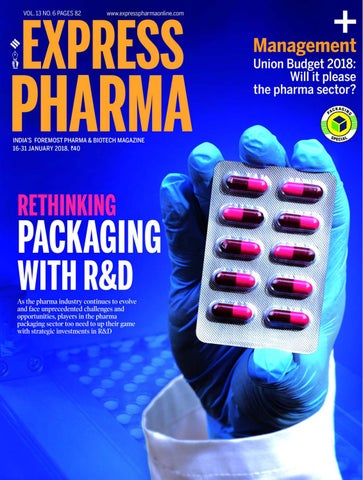
As the pharma industry continues to evolve and faces unprecedented challenges and opportunities, players in the pharma packaging sector too need to up their game with strategic investments in R&D By Swati Rana
T
he Indian pharma industry is expected to grow to $55 billion by 2020, courtesy ageing and growing population, rising income levels, emergent medical conditions and diseases etc. However, growth in the pharma packaging industry is unable to meet the same pace. To accelerate progress in this sector, which is expected to be worth $2.60 billion by 2020, there is an urgent need for innovation which in turn needs substantial investment on R&D. So, what are the aspects which highlight the need for a renewed R&D focus in the pharma packaging industry?
Growth drivers The current focus on packaging R&D is in the areas of product safety, stability and patient’s compliance. As Jaya Abra-
To subscribe: bpd.subscription@expressindia.com
ham, VP, Research and Development, Alvogen highlights, “R&D in pharma packaging would have a significant impact as India’s growing population and economy is creating a large middle class with the resources to afford differentiated medicines to improve the overall treatment outcome.” Moreover, the looming threat of counterfeiting has also opened up new opportunities in this segment. Industry reports too validate this fact. According to markets and markets research report, stringent government regulations related to manufacturing of counterfeit medicines in several countries of the world has given the opportunity to increase the investment in R&D and be the growth driver of the pharma packaging market during the forecast period, 2016 to 2021. Mohan G Joshi, International Busi-
ness Coach and Former President, SCHOTT Glass India informs, “10 to 30 per cent pharma drugs under circulation globally are counterfeit and are responsible for up to one million deaths due to ineffective drugs. The packaging industry need to address challenges faced by pharma companies which are in the areas of counterfeiting, theft, diversion and false returns to manufacturers.” He continues, “One clear objective of R&D growth should be driven by the demand for counterfeit technologies which include barcodes, tamper evident packaging and more recently, radio frequency identification (RFID). These security devices provide no assurance for the authenticity of the contents and alone do not eliminate counterfeits but act as strong deterrents due to ease of identification.”
EXPRESS PHARMA
27
January 16-31, 2018
cover ) Rishad Dadachanji, Director, SCHOTT KAISHA says that highly sensitive formulations require packaging which minimises drug/container interaction over the shelf life of the product, combination products can be filled in double-chamber systems, unique tamper evident closure can be used as a step in anti-counterfeiting and the fight against spurious drugs. These solutions provide advantages such as shelf life stability, easy administration of combination products, a unique product identity and enables a pharma company to gain credibility and confidence from doctors and the end consumer.
To be a part of the change, packaging R&D team compositions would need scientists from diversified backgrounds and will be key to success Jaya Abraham, VP, Research and Development, Alvogen
R&D in pharma packaging would have a significant impact as India’s growing population and economy is creating a large middle class with the resources to afford differentiated medicines to improve the overall treatment outcomes Mohan G Joshi, International Business Coach
Challenges to overcome Yet, despite the manifold benefits, there are several factors hampering investments in this sphere. Joshi highlights, “It really starts with India’s low investments in scientific research. Pharma packaging companies are part of a large value chain of pharma companies. The education system is to blame as well as we still have focus on imparting theoretical knowledge and not focusing on problem solving and innovation. Any research investment must focus on four pillars: finances, infrastructure, human resources and legal & regulatory framework.” According to Prabir Das, Head - Packaging Services, OSD (India), Mylan Laboratories, lack of a designated team in R&D of packaging has also lead to sluggish growth in the pharma packaging industry. He says, “Only few big players forming the upper layer of the industry have designated packaging teams at their R&D centres. For an overall growth and development of the industry, every organisation needs packaging specialists to keep themselves floating in today’s competitive market.” He further asserts, “It is important for people to understand that packaging is as important as the product, then the challenges can be easily addressed. A majority of the packaging industry is still being considered and controlled under
28 EXPRESS PHARMA January 16-31, 2018
To boost investment in R&D in this sector, pharma packaging companies must understand the changing trends and new requirements demanded by the end users Rishad Dadachanji, Director, SCHOTT KAISHA
It is important for people to understand that packaging is as important as the product, then the challenges can be easily addressed Prabir Das, Head - Packaging Services, OSD (India), Mylan Laboratories
unorganised sector and there are gaps between requirements – understandings – deliverables compliance.”
Steps to progress However, the industry is waking up to R&Ds growth potential in the pharma packaging sector. Yet, there are several factors to be considered while embarking on this journey. As Dadachanji highlights, “It is no longer enough for suppliers to focus on their core areas. They are rather required to take the entire value chain into account.” He further informs, “To boost investment in R&D in this sector, pharma packaging com-
panies must understand the changing trends and new requirements demanded by the end users. This knowledge and understanding gives us the foresight to be able to develop what the market needs and ready to offer it when the market needs it. We, as a packaging firm, are constantly in touch with our partners and by understanding their needs and the needs of the consumer, we are able to invest in new R&D activities. Continuously strengthening this chain of open communication is an important driver which helps us constantly increase our investments. Constant innovations in the pharma
industry itself has a direct impact on the primary packaging which plays an important role in helping bringing these innovations to the markets. New drugs which require unique and stable packaging rely on innovations in the packaging sector as 'the medication is only as good as the container it's in. Schott Kaisha took the initiative and invested into R&D activities and works closely with partners in order to be able to supply our customers with an entire basket of products and innovative new technologies.” Abraham says, “Indian companies have started entering into the realm of R&D
with few NCE (New Chemical Entities) and new biologicals and differentiated formulations and innovative packaging solutions like the Starhaler from Sun Pharma; India has the world’s second biggest pool of English speakers and a strong system of higher education like the IITs and IIP, so it is well-positioned to serve as a source for research talent. To be a part of the change, packaging R&D team compositions would need scientists from diversified backgrounds and will be key to success.” Outlining a strategy for packaging R&D, Joshi says, “The first stage focus must be to implement serialisation at multiple packaging levels. The next phase is to implement an electronic pedigree, where companies can show data across the supply chain. Track and trace technology plays a crucial role for any pharma supply chain. The aim of pharma industry is to prevent the illegal and dangerous counterfeit medicines to reach the end consumer and track and trace research is the major tool to help easy identification of products throughout the supply chain.” Joshi believes that investments in R&D for pharma packaging are strongly dependent between collaborations with pharma companies and/or between major players in the supply chain. He pointed out to the recent collaboration of Corning and Gerresheimer which has announced a glass innovation aimed at enhancing quality of parenteral packaging. Corning Valor Glass is a breakthrough glass container engineered for the storage and delivery of 21st century injectable drugs. Valor Glass’s superior strength, chemical durability and damage resistance result just not in better protection of drugs but also enables increased throughput and higher quality assurance for pharma companies and patients. According to Das, awareness building and understanding the importance of investment in R&D are the two major factors
( to change mindset of promoters and investors. There are many awareness programmes being organised to make people understand its importance to protect and preserve the quality of the products, safety and security through supply chain and to survive and sustain in the market as a brand.
Success with R&D As the packaging industry wakes up to the need for R&D in packaging, companies are slowly and steadily investing in it to provide new and innovative solutions that can drive growth. GIving an instance, Joshi highlights that SCHOTT Glass has invested heavily in research and development for Type 1 plus vials. Increasing shelf life stability for sensitive drug formulations is a challenge for all companies. Protein adsorption and leaching from primary packaging are known to be root causes of reduced shelf life in sensitive formulations. SCHOTT Type I plus vials have an inside SiO2 coating with outstanding barrier properties. This reduces the interaction between drug formulation and container surface to a bare minimum, thereby providing a superior packaging solution for sensitive ingredients. He gives another example and says, “Indian global company ACG Worldwide is a one-stop-shop offering integrated manufacturing, packaging and R&D solutions to the global pharma industry. ACG Worldwide has synergistically integrated business right from granulation and coating equipment to hard capsules and capsule filling machines. So long term commitments and establishing partnerships for mutual benefit is a prerequisite for increasing investments in R&D of pharma packaging.�
Path to progress The continuation of support received from government with strategies such as the Make in India initiative has motivated the industry to supply high
EXPRESS PHARMA
29
January 16-31, 2018
quality products which meet international standards. But, to increase investment in R&D for packaging, the industry expects some kind of financial help and tax benefits to ensure strong in-
frastructure, backward integration, smooth and fast communication and better distribution channels. Pharma packaging improvements cannot be made in isolation but must occur
THE MAIN FOCUS
across the spectrum. The government should also enable better enforcement of regulatory standards; improving tracking and visibility across the value chain; plug infrastructure
gaps- for e.g. cold chain and packaging must expand and quality, establish skill development and training programmes to enable progress. swati.rana@expressindia.com
cover )
Innovation in pharma packaging Pranay Kumar, Chief Environment Officer, Vasudha Ecofriends Projects gives valuable insights on the trends which will determine growth in pharma packaging in times to come
P
harma packaging is evolving with the rise in demand of innovative designs, security features and track and trade features. At the same time, raw materials, primary, secondary and tertiary packaging is self transforming to reduce cost, unburden the logistic chain and increase visibility. Sustainable (biodegradable /bioplastic) plastics are slowly working on the minds of pharma and packaging companies. The consumers’ reduced time availability and simultaneous rising awareness of pros and cons of drugs in educated urban areas needs different packaging raw material to printing to tracking. Small towns and villages still rely on local pharmacists, which mandates strong security features and pictorial depiction. Last but not the least, the government regulating the pharma sector, which also calls for reducing the prices and waste, is set to transform the sector like never before. Here we delve in-depth on smart packaging evolution and innovation.
Concerns in pharma packaging In recent years, certain factors have encouraged the pharma industry to transfer the landscape of its packaging. First and foremost, concerns in the Indian market is counterfeiting and safety of products. Many generic drugs sold in large volumes require much less resources than patented products , thus making these drugs target for easy copying including the packaging. Higher level of awareness and regulatory compliance
30 EXPRESS PHARMA January 16-31, 2018
have resulted in precise, compact product information. This field is evolving as further explained. Patient compliance for drugs is a very critical but evolving domain in India. As our healthcare system (right now almost non-existent) evolves in India, targeted patient data and its usage would transform itself towards customisation. Safety and exposure to hazardous product regulations have led to huge volume rejections for Indian drug companies. India is a major exporter in regions like Africa, Russia, West Asia. These rejections led to a tumultuous phase in the industry. Now, Indian drug companies have pulled all stops in engraining and embedding;
TOP TRENDS IN PACKAGING 1. Smart packaging 2. Environmentally and financially sustainable packaging 3. Digital marketing 4. Holistic packaging 5. Communication through colours
literally hidden and visible information. Waste reduction and cost optimisation are leading to sustainable packaging design, alternatives like biodegradable plastic packaging compatible with tertiary, secondary and primary packaging. United Nations agencies also intend to reduce waste exported in form of packaging.
There are many remote places and countries without proper waste strategy, where United Nations does not wish to aggravate the rising waste situation.
Anti-counterfeit methods Safety and security solutions can be categorised into three basic types: 1. On-package solutions 2. Serialisation (or track and trace) 3. Direct product testing The most prevalent technology implemented and recommended is on-package solutions and direct product testing is the least used anticounterfeiting method On-package solutions can be divided into two types: 1) Overt features, which are expected to assist the users
to confirm genuineness of a pack and are significantly visible, complex and expensive to reproduce, thus creating a significant barrier to counterfeiting and 2) Covert features, which aid the brand owner to recognise a counterfeited product while remaining invisible to the customers and counterfeiters.
Barcodes Barcode is a more used overt technology. Barcodes play a key role in enabling retailers, manufacturers, transport providers and hospitals to automatically identify and track products as they move through the supply chain. The advantages of the technology are: â—— A product can be identified
( uniquely across the globe using laser or camera-based systems ◗ Barcodes are generally in B&W and can be scanned electronically ◗ They are used to encode information such as product or serial numbers and batch numbers. The disadvantages are as follows: It is ‘read-only’ and not secure and little data is stored Chances are that it might be replicated from an original one 2D colour barcode technology which aims at increasing data density and robust data transmission is better method than simple barcode [black and white lines of various thickness] technology. Colour barcodes are also an alternative. They
THE MAIN FOCUS
- Increase the data embedding capacity than normal 2D barcodes - Provide high level security and data confidentiality Here two points of informations are merged. One is the data source and the other image source or colour source, both are overlapped to create a complex 2D barcode.
and light background 4. Opposite combinations can create problem at the time of scanning because of poor contrast ratio and unreadable barcodes 5. Hence, Color Barcodes have not yet been popular because of high expense and poor combination of colors to create a color barcode
fluorescent inks, which are invisible in daylight but exhibit distinct fluorescent shades on exposure to UV light. Contain some form of taggant that is only visible or detectible through more sophisticated hand-held readers such as laser pens. Covert solutions offer increased security as compared to overt solutions.
Challenges of 2D barcodes
Watermarking
The properties of watermarking are as follows: Capacity: The number of bits that can be embedded in the host image Perceptual Transparency: It should be invisible to human eyes without affecting the quality of the original image Robustness: The watermarked data should not be removed or eliminated by unau-
1. Barcode symbols require dark colors for bars like black, blue, dark brown, dark green, and light colors for background 2. These dark and light combination is more preferable so that barcode symbols can be recognised by a scanner 3. There must be a adequate contrast between the dark bars
To subscribe: bpd.subscription@expressindia.com
These are classified again into Overt technology: Clearly visible and do not require detection. Include holograms, inks that change color with view angle, metachromic inks that change color based on the light source, and thermochromic inks that change color based on temperature Covert technology: Include
thorized distributers, thus it should be robust to resist common signal processing manipulations such as filtering, compression etc Security and Safety: The watermark should be detected by authorized person Here we describe two types of watermarks Colour watermarks and Digital watermarks. Color Watermark is a kind of information security and data protection technology. It is typically used to identify ownership of copyright media Digital image watermarking: Information is embedded in cover image to prove ownership, Information must remain detectable even if image is manipulated Applications of digital image watermarking: Copyright
EXPRESS PHARMA
31
January 16-31, 2018
cover ) protection, health care, fingerprinting, ID card security, authentication and integrity verification Two types of digital watermarking techniques are as follows: Spatial domain: In this technique the watermark can be inserted directly by manipulating the pixel intensity values of the original image Transform or frequency domain: In this technique digital image is transformed into frequency domain such that transform coefficients can be modified to hide the watermark and the reverse transformation is applied to get the watermarked images Recently Digimarc, an Indo French collaboration, is developing an innovative method of water marking. Recently, new schemes have been proposed which are based on a quantization process. The purpose of a color quantization process is to represent an image by a limited number of colors with a minimal visual distortion. In this process two watermarks have embed in the same host image where the first one is embedded in the chromatic plane and second one embedded in the lightness component. Another method quantization index modulation (QIM) quantizes the color of each pixel in the host image by one of the numbers of the colour quantizers. But the quantization and processing steps are not optimal because they do not take into account the HVS sensitivity. To give imperceptibility in a watermark the color difference between a pixel and its watermark counterpart should be uniform over the whole image. To do the same is a uniform quantization is applied in a uniform color space with the quantizer step size tuned to provide imperceptible colour differences between neighbour pixels. The deliverables of Digimarc where product it self becomes the barcode
32 EXPRESS PHARMA January 16-31, 2018
( invisible ) are ◗ New Color BarCode solution, ◗ A new Digital Watermark solution ◗ A new anti-counterfeit packaging solution for medicinal packaging. The interesting features of Digimarc are ◗ Watermark printed packaging not directly from the spatial domain but indirectly from the chrominance domain ◗ Develop a generic solution to increase the package surface coverage by a watermark whatever the area (white background, color patterns, spot colors, color gradient, text, ◗ Innovating on increasing the package surface coverage ◗ The Digital Barcode is designed to be readable using red LED illumination or white light strobe illumination. In this project, the effects of the spectral distribution of the light source on the watermarking process implemented Thus as we can see above pharma packaging is far ahead of other industries in working on very secure operational and futuristic methods to keep ahead of times and deliver cost effective and robust solutions. Besides above methods pharma industry is also working on reducing, recycling its waste including biodegradable plastics. In 2015 a lab report and a complaint by an NGO led to banning of PET bottles for liquid pharma packaging. This decision was based on a flawed report by the said lab, which was proven by Dr Habbu of Reliance Industries. The author had also written in Express Pharma quoting USFDA, USEPA and an Elsevier paper that PET for pharma packaging is least h armful. ( refer to the article ). Biodegrading plastics is one the method of reducing pharma packaging waste. Its sustainable as it leads to biodegrading the waste, which cannot be economically collected and/or recycled. UNDP is working with certain pharma firms to make their plastic packaging biodegradable. But the implementation of
the rules of Plastic Waste Management 2016 of Ministry of environment, Forests and Climate Change, Government of India (MoEFCC) is archaic and without any hierarch. Though MoEFCC is the final authority, each state and even municipality is creating its own rules without a shred of scientific approach. Certain District magistrates/Commissioners are have stated ( unfortunately) “ if the product burns without leaving any residue , we will know that its plastic and disallow it and if leaves a residue , we will allow that product.” With 9 mandated methods for testing biodegradability prescribed in PWM 2016 by MoEFCC , this is the hilarious yet ineffective and unproductive diktats. MoEFCC, GoI needs to assert its authority , if it really cares about waste management. Even Central Pollution Control Board (CPCB) is not agreeing to ministry of environment’s rules. CPCB is creating its own oblique rules creating loss of emolument, chaos in pharaoh, plastics and packaging industries. Though it has started with plastic bags, the confusion in sub-rules of CPCB might encroach on other types of plastic packaging including pharma plastic packaging. Each company involved and effected is also creating further confusion by not working on fundamental rules and International laws (ISO) but just trying to prove its knowledge or relying on heresay. To give the example of the chaos and confusion created by CPCB’s rules, the author will explain what happened to the plastic bag segment of plastic and packaging industries.
Rules of plastic waste management 2016 and confusion and conflict in its implementation According to Ministry of Environment (MoEFCC), Government of India 2016 notification there are nine methods to test biodegradability only one method ( IS 17088) has been allowed
Despite the fact that most plastics land up in landfills, which are Anaerobic (withoutOxygen)in nature,why only IS 17088, an expensive and time consuming (approximately 9-10months) was chosen is beyond the author’s comprehension. A 45 day test period the same test method (IS 17088) exists but it was overlooked or missed. Same thing is being mooted in draft BIS method for Agricultural mulch film, which will spell disaster for the fields and farmers as those tested under IS 17088 will biodegrade above the soil thus contaminating it. The most spectacular point overlooked by the ministry or the industry is that 50 microns bags are being allowed along with biodegradable bags (of less than 50 micron thickness as per IS17088), which will increase the plastic waste by a humongous 250 per cent ! More unfortunate reason given for increased thickness is that it would be collected by the rag pickers ! Majority of the rag pickers are children below the age of 17-18 , is our government relying on an exploitative system to manage its waste ? In short term the plastic bag industry may benefit from increased volume sales but as the plastic waste increases , the agencies will finally ban the plastic bag altogether sounding the death nail of the industry. This has already happened in states like Karnataka and Punjab. Sustainability lies not only in reducing the waste but also to save the lakhs of jobs. Secondly, only one lab namely CIPET was mandated and allowed by CPCB to test thus creating a business monopoly for CIPET. Further to extend and complicate the situation an endorsement by CPCB was put in place. Is it that CPCB does not trust NABL,a government body for certification and verification of labs? If this is the case, why has CPCB not come out with a rule that it will inspect ALL labs across the country testing pollution parameters?
Does CPCB trust its own recommended lab? Does CPCB has time to endorse thousands of bags manufacturers across the country ? April 2018 brings a ban on multilayered , which cannot be recycled. Pharma industry will be one of the many effected industries. Keeping in mind the above difficulties faced by plastic bags manufacturers, pharma industry should not wait for the time “when they came for me, none was left to save me” situation. It should be proactive on solid waste (read plastic waste ) and clarify itself on rules to follow. I have suggested a three point solution to Ministry of Environment, Government of India response to which is still awaited. It follows 1) Allowing all nine test methods for biodegradability for all types of polymers and applications and allowing thickness less than 30 microns in most carry bags. 2) Allowing all NABL approved labs to test the biodegradibility of plastics. CIPET, Chennai can test a maximum of only five samples as admitted by it in an RTI query. This will enable any company to test the plastic packaging within the time period allowed by MoEFCC by April 2018. 3) Withdrawing endorsement by CPCB as it creates a trust deficit between the NABL accredited labs and CPCB. The step will also result in an impossible task for CPCB with thousands lining up for endorsement. The intention of MoEFCC is very noble and laudable but simplifying the process , giving options to the industries and asserting its authority will create an alignment and would result in implementation of the intention of reducing the plastic waste ! The industry needs to be proactive and not stall the waste management efforts of the governments through courts. Ultimately to be a good corporate citizen we need to make our country clean and sustainable first !
MANAGEMENT
UNION BUDGET 2018 Will it please the pharma sector?
This budget would be the last full-fledged budget of the Narendra Modi-led government before 2019 elections and like other sectors, Indian pharma industry too has high hopes from this government. Industry stakeholders share their expectations with Express Pharma
34 EXPRESS PHARMA January 16-31, 2018
Weighted deduction on R&D should be continued Here are some of the key expectations from a pharma/healthcare personal tax standpoint:
Increase in tax-free medical expenditure reimbursement from employer to employee: The current limit of `15,000 per annum (pa) of tax free reimbursements for medical expenditure from employee to employer was last revised almost two decades back (i.e. in 1998). With significant increase in healthcare costs this limit may be considered to be atleast doubled to `30,000 pa.
Deduction for medical expenditure: Currently deduction for medical expenditure incurred is restricted to `30,000 and allowed only where such expenditure is incurred for very senior citizens (above 80 years of age) who do not have a health insurance policy. Considering that a large mass of Indian population have limited access to even basic healthcare facilities, this deduction may be considered to be allowed to all
To subscribe: bpd.subscription@expressindia.com
taxpayers where they do not have any health insurance policy. From a direct tax perspective, the following may be considered:
MAT provisions. Indigenous R&D (Patent) – option should be given to the resident taxpayer to avail benefit of concessional tax regime or opt out of the same.
Weighted deduction on R&D: For a sector witnessing unprecedented pressure, not only on the export front but even locally, weighted deduction on R&D should be continued. Further, weighted deduction is allowed only on expenses incurred in a recognised in-house R&D facility. However, there are certain expenses necessitated by the industry’s business that are incurred outside this R&D facility: such as clinical trials, patent approvals, overseas trials, preparation of dossiers, etc; these should ideally be eligible for weighted deduction. Considering the gestation period with regard to R&D and that benefits, if any, are available after long gaps, unutilised R&D weighted deduction should be available for carry forward for at least 10 years (if not more) and weighted deduction should be allowed while computing book profits under
Secondary adjustment A deemed dividend approach should be followed in case of secondary adjustment (followed in the US and Germany) rather than a deemed loan approach, since under the former only a one-time payment is made which can be settled without a carry forward impact; the key challenge under the latter being - difficulties in accounting treatment. Alternatively, if the deemed loan approach is to be followed, then interest payment should be restricted to be a one-time payment. Limitation on deduction of interest under Section 94B relating to thin capitalisation. It is recommended to delete the word implicit guarantees to ensure ease in application of Section 94B(1). - KPMG India
EXPRESS PHARMA
35
January 16-31, 2018
MANAGEMENT
One can expect increased government spending in health sector
W
hile the regulatory aspects of this sector are extremely critical to ensure effective compliance with the laws, what the Indian pharma industry needs the most is a significant fiscal incentive from an income-tax perspective.
RITU SHAKTAWAT Associate Partner
MR RAGHAV KUMAR BAJAJ Senior Associate, Direct Tax team Khaitan & Co
What pharma sector needs Last year, apart from announcing two new AIIMS (at Jharkhand and Gujarat), the Union Budget did not offer any significant tax breaks to the pharma sector. Thus, this year, being the last full budget before next general elections, pharma sector is all-fingers-crossed in hopes for a major fiscal boost. Considering that the government is implementing several schemes for betterment of the healthcare of different sections of the society which would need the support of manufacturing, one hopes that Union Budget 2018 announces a pan-India investment allowance for setting up factories/units to manufacture pharma sector related inputs. Secondly, the amendment which has reduced the weighted deduction (i.e. giving a tax break for more than what is spent) for expenditure incurred in relation to scientific research and eventually discontinue the same should be rolled back. This is because though the government’s objective to gradually phase out all fiscal incentives
and ultimately lead to an overall reduced corporate tax rate is acceptable, given that scientific research is the most essential tool for the growth and progress of pharma and healthcare sector, this sector needs to be distinguished from the general corporates at least on this account. Moreover, currently, the weighted deduction concept is only applicable in relation to computation of income under the normal provisions of the Income Tax Act and not for computing the minimum alternate tax (MAT). To make this incentive more effective for this industry, the benefit of the aforesaid deduction should also be extended for computing the MAT. Another aspect which needs to be expressly clarified is in relation to weighted deduction for expenditure on the outsourced scientific research. Given that in many instances, for better efficiency and for making use of the specialists, research activity is
outsourced, it would be appropriate to clarify that the weighted deduction expenditure in relation to scientific research would be available even for outsourced scientific research. Needless to say, to prevent the misuse of this provision, suitable safeguards may be provided in the law itself. In order to incentivise inventions and patents, the patent box regime (i.e. concessional tax regime for patents developed in India) was introduced in 2016. While the intent and object of this beneficial tax regime – to encourage indigenous R&D activities and to make India a global R&D hub – is undoubtedly clear, the language used in the statute book does not appear to be in sync. Currently, the benefit of patent box regime is restricted to ‘true and first inventor of the invention’ – even in case of joint patentees. Under the patent laws, where a company incurs expenditure and
develops a patent with its employee, the company cannot be a ‘true and first inventor’. As a result, despite having incurred the development expenses in relation to the patent, the company (being the economic owner of such patent) may not be able to claim the benefit of this provision. Therefore, one would hope that the language is modified to ensure that in cases of joint patentees (especially where one of the joint patentee is a firm/ LLP/company), the benefit of this regime is extended to the assignee of the true and first inventor. On the litigation front, the root cause of controversy in a significant number of cases in the pharma industry has been a CBDT circular which provided that expenditure on freebies provided to medical practitioners in violation of applicable regulations do not qualify for set off against taxable income of pharma companies. As a result
of this circular, the pharma companies are facing significant hardship and protracted litigation, as even genuine brand building and business promotion expenses incurred by them, say towards sponsorship of events organised by medical associations, medicine samples provided to practicing doctors, conducting awareness programmes etc, are being disallowed by the tax officers on the basis of wide reading of the CBDT circular. Thus, clarity should be provided to exclude such genuine expenses from the purview of the said circular. As per Economic Survey 2016-17, the annual expenditure by government (Central and State Governments combined) on health as percentage of GDP for last three years has been below 1.5 per cent every year. The National Health Policy 2017 envisages increasing expenditure by government on health to 2.5 per cent of GDP in a time bound manner by 2025. Given that this year, it is the last full budget before next general elections, one can expect increased government spending in this sector. One hopes that increased allocation to this sector is in the form of tax breaks and fiscal incentives, as such measures offer an economic benefit for the present, and lead to capacity building for sustainable growth as well as development of the sector.
Budget 2018 should consider nil GSTon medicines /devices
G
lobally tomorrow's challenge is to develop new medicines that can prevent or cure currently incurable diseases and address unmet medical needs. Mortality rates from major diseases including heart disease, cancer and stroke are down dramatically. Most drugs on the market in developed economies have proven efficacy and safety. Pharma is a very large and complex growing part of the global economy. We predict that the pharma industry will grow substantially in the decades ahead. It is estimated that the total revenue of the
36 EXPRESS PHARMA January 16-31, 2018
VINOD ARORA Principal Advisor, IGMPI
pharma industry will triple in real terms between 2017 and 2060. The pharma sector has great expectations from Budget 2018
as Government of India’s vision of Making India one of the top three pharma market by 2020 can only be achieved if there is a booster dose for
pharma and healthcare sector. Budget to develop a proactive approach towards building better quality, compliance and become a facilitator of funds and platform leaving the mechanism of delivery to pharma sector which is primarily driven by private sector. In order to stay competitive in the overseas market and given the uncertain global climate that Corporate Tax to be reduced to half and specific impetus or incentives should be given to innovation in the form of increased weighted deduction on R&D, adding filing fees and clinical trial under ex-
emption, incentives for patents. India remains one of the largest poor countries on per capita basis. India's per capita (nominal) income was $1670 in 2016 ranked at 112th of 164 countries by the World Bank. Medicines/devices are taken by patients not by choice but because of disease therefore we should provide medicines at the lowest cost. We know that Government of India has taken many steps in this direction but Budget 2018 should consider nil GST on medicines/ devices as they are taken by poor people of India .
MANAGEMENT
We need help from the government in terms of stronger regulations on both manufacturing and drug registration for Ayurveda
I
n the past few years there has been almost a mass consciousness towards natural wellness including Ayurveda. This is largely due to two factors, one being the efforts taken by the Ministry of AYUSH by commemorating the ‘International Yoga Day’ and ‘National Ayurveda Day’ and the other being the plethora of FMCG players who have flooded the market with herbal and Ayurvedic products, the likes of Unilever’s Ayush, Patanjali, Shri Shri Tattva, etc. Additionally, the market has also seen niche premium brands like Kama, Khadi, Forest Essentials who have started to make their presence felt.
SANDEEP BALI CEO, allAyurveda.com
The Ayush ministry has been putting serious efforts and is making substantial leeway to promote Ayurveda in India and abroad. While the government has been focusing on export promotion as well as expertise in manufacturing ayurvedic
products, the major assistance that the ayurvedic industry needs from the government today is the ease of reaching out to international markets. Ayurveda is a wide phenomenon internationally. At present, the ayurvedic products
market is expected to be at $2.5 billion dollars. The government expects the market for ayurvedic products raise to $ 8 billion by 2022. To start with, our government could start discussions with governments globally to recognise Ayurveda as a medical system allowing us to register Ayurvedic products and claim them to be medical. China has done this very effectively with their Chinese medicines and so has Homeopathy. We feel that we need government’s help to do this globally for Ayurveda. While the government has been trying to do this, a larger push from their end will benefit the industry
largely. Domestically, the government has been helping and promoting Ayurveda and yoga globally. However, from a larger manufacturer perspective, the help we need from the government is in terms of stronger regulations on both manufacturing and drug registration for Ayurveda so that we make sure that every product in the market actually complies with the high standards of manufacturing and product development. Currently, the same is only being adhered to by a few larger companies. We would actually like government regulations in the industry as a whole to improve the domestic part of the market.
The Standard of Comparison
Pharmaceutical Grade Crystalline, Spray Dried, Anhydrous, and Inhalation Lactose • For more than 70 years, we have delivered the industry's most extensive Lactose portfolio
www.SheffieldBioScience.com
• The original patent for Anhydrous Direct Tabletting (DT) Lactose • Batch to Batch Consistency • Global technical service, regulatory and application expertise to ensure regional and global market compliance
To subscribe: bpd.subscription@expressindia.com
Registered Office Address: 17th Floor, Nirmal Building, Nariman Point, Mumbai - 400021 Corporate Identification Number: U15400MH2010PTC202946 Tel.: +91 22 27815003, Fax Number ; (022- 27815989) Email: Kerry-India.Info@kerry.com
EXPRESS PHARMA
37
January 16-31, 2018
MANAGEMENT
Budget 2018 must avoid temptation to bolster govt revenue myopically
T
he Budget 2018 is the last full Budget of the present government and also the last one before eight state elections and the 2019 General Election. We expect this Budget to be a populist one. The government is planning an overhaul of the drug policy. Under the new rules, the government is planning to scrap the need to renew various licences and ease regulations to allow medical and drug research, among others. There is a need to re-enact Drug & Cosmetic Act to match current regulatory requirements related to quality, efficacy and safety of drugs. The sector needs R&D incentives in the form of tax rebate and fund allocation given the capital intensive nature of the sector and long gestation periods. The government could relax licencing conditions for pharma/ API/biotech manufacturing units to encourage investments. The government needs to
SURYAKANT MARDHEKAR Sr. Manager – (Finance & Accounts), Bliss GVS
create a robust framework — a cluster-based approach to diminish the dependency on China for the import of crucial APIs. E-commerce players are looking for a policy push to streamline the regulatory environment for e-pharmacies. High sounding words and some dos are heard from the union ministries regarding help and boost to be provided to MSME sector all around the year. A standalone policy to help the MSME sector in the pharma area in terms of quick decisions being offered in terms of loans to substantially im-
prove the manufacturing units to worked standards (WHO GMP units) has been awaited by the industry. Positive steps on this front will be highly recommended as this is the need by the hour, both in API sector and formulation. We hope that the growth focus would continue even if comes at the cost of some slippage on the fiscal deficit side. The government should not stop doing investment in the year to come. It is not the time to consolidate on the fiscal side at the cost of growth. We also expect that government to cut corporate tax to 25 per
cent. With the US tax rate cut, it is very essential that we should bring down taxes. Even if they bring it down to 28 per cent it will be great relief to the industry. Central Board of Direct Taxation (CBDT) has a proposed reduction of weighted deduction of expenditure incurred on scientific R&D from 200 per cent to 100 per cent, which could hamper the innovation edge of the sector. The government needs to continue these weighted deductions along with deductions under Section 35 (2AB) of the Income Tax Act. In order to promote R&D in India, the amount of weighted deduction should be deducted while computing book profits for the purpose of MAT. The DSIR should not decide the quantum of R&D expenditure entitled to weighted deduction. Considering the longer time taken in R&D and its benefits available, government should clarify that unutilised R&D weighted deduction
should be available to be carried forward for at least 8 to 10 years. We expect by March, the GST regime should stabilise. By end of the FY 2019, we expect government will bring down the GST to two to three slabs. From FY 2019, we will see real pick up in tax revenue because of GST. There should be around five per cent additional revenue in indirect tax. The worry is that with changes in most indirect taxes out of the control of the government following transition to GST where revenue collection is below expectation government will think about the direct taxes to offset the transition challenges. Hence budget 2018 must avoid the temptation to bolster government revenue myopically. The government should expedite the process of ITC refund/transitional credit as EOU oriented companies having inverted duty tax structure suffer a lot on account of delay in refund which result in blockage of working capital.
We are all expecting a ‘popular’but not a ‘populist’budget
T
he government’s focus this time is likely to be on infrastructure, recapitalisation of public sector banks and reducing the stress on the rural sector. The budget is also likely to overhaul the income tax administration by improving efficiency of tax collection by reducing the human interaction and depending more on technology. Pharma and life sciences industry is looking for reduction in corporate tax to make it globally more competitive. Globally, the corporate tax rates have fallen from average 27.5 per cent to 23.6 per cent in a span of 10 years. In India, corporate tax has averaged 35 per cent over last two decades. This, coupled with MAT on book profits and dividend distribution tax (DDT), make India one of the highest tax regimes in the world. The DDT often discourages
38 EXPRESS PHARMA January 16-31, 2018
DR AJIT DANGI President and CEO, Danssen Consulting
companies from paying dividends. This has negative impact on investment. Time has therefore come to scrap DDT. While the government has promised to reduce the corporate tax to 25 per cent in a phased manner, the glide path for the same is missing. Giving a roadmap will enable the corporates to take more informed investment decisions. Now that the GST is slowly getting stabilised, it is time to consider
reducing the number of slabs from five to three and do away with cess on some categories. In the last budget, announcement was made to create 34 mega modal logistic parks. Process should begin to operationalise these plans which will significantly reduce logistic and supply chain cost which is one of the highest in the world. Transfer pricing laws have also resulted in widespread litigation and need rationalisation.
Being a knowledge-based industry, incentivising innovation by way of weighted deduction for R&D, filing patents, reduction in import duties for advanced instrumentation and equipment required for drug discovery research etc. would go a long way in making India an innovation hub. As pharma industry is becoming more and more reliant on technologies such as AI, IOT, robotics and automation to increase productivity and efficiency, the import duties on such technologies need to come down significantly. Similarly, some newer regulations coming from regulatory agencies in US and Europe such as a track & trace system and serialisation for drugs exported to these countries from India would need investment in expensive equipment. Not only such equipment should be made duty free, but the government
should also give soft loans to midsize pharma companies to acquire them to enhance export. Medical Council of India recently amended its guidelines to encourage prescribing generics. While MCI’s fate is currently undecided, it is possible that the budget may indicate changes in Drug and Cosmetic Rules towards this initiative. While this move may make drugs more affordable to the common man, without an effective regulatory system to monitor quality, safety and efficacy, it will be a disaster for the patient. It will also disincentivise companies who have assiduously built strong brands in spite of intense competition, and it is also contrary to the policy of encouraging protection of intellectual property. Lastly, we are all expecting a ‘popular’ but not a ‘populist’ budget.
MANAGEMENT
Govt should encourage domestic API & rawmaterial manufacturers
I
n 2017 Indian pharma market saw many ups and downs. One of the significant reforms which came into effect was GST. The implementation of one uniform tax will ease the way of doing business in the country, and minimise the cascading effects of manifold taxes that are applied to one single product, impacting the overall cost of operating. Moreover, GST would also improve operational efficiency by rationalising the supply chain. It has made it imperative for pharma companies to review their strategy and distribution networks. In 2018, we would like the government to have robust planning for the pharma sector. The sector is already battling price control policies and various government policy changes are further adding to it. If the government takes a 360o view in framing any policy for the pharma sector where all stakeholders are consulted , it would lead to an ideal win-win situation for all. The government should also en-
RAHUL KUMAR DARDA Chairman & Managing Director, Brinton Pharmaceuticals
courage the domestic API and raw material manufacturer as we face stiff competition from Chinese suppliers. A strong policy would also help generate more job opportunities and contribute to the government's marquee 'Make in India' policy.
We hope upcoming budget brings ‘Acche Din’for pharma sector
I
t will be an interesting budget and with 2019 elections coming up, the budget seems to be leaning towards a populist one. As always, people have a lot of expectation from this year’s budget in terms of tax relief. This year with the implementation of GST there was a drastic change in the indirect tax structure. The ideal behind introducing GST was to curb tax evasion. We hope the new budget comes with improved tax exemptions and changes in corporate tax. The last three years have been challenging for the pharma industry with price regulation, demonetisation and GST implementation. This year we expect some normalisation to occur. With bans on combination drugs and increase in the number of 483s, the pharma sector has thus been facing brunt from both ends! Domestic manufacturing moved to the North-East portion of India to avail tax and excise exemption for 10 years. With the introduction of GST, this advantage stands reduced and a double component of IGST and CGST came into place. With low consumptions in this area, companies are suffering because only 29 per cent is under CGST and 58 per cent under IGST. We are hoping these figures
SURESH PAREEK Managing Director, Ideal Cures
change in the upcoming budget, bringing back the tax advantage we had earlier. Expectations are also focused on better incentives for exports and R&D expenditure related tax offset. A 50 per cent reduction in the offset limit from 200 per cent to 150 per cent should hopefully change back to the prior in this Budget 2018. This will allow for new products to be developed in India boosting Make in India campaign. All said and done, we hope that this upcoming budget brings back the ‘Acche Din’ for pharma sector!
To subscribe: bpd.subscription@expressindia.com
EXPRESS PHARMA
39
January 16-31, 2018
www.fsie.in
MAKE YOUR BUSINESS
SECURED & FIRE PROOF ode C g n i ild u ial B c l r a e n m o i om Nat c l l l e l a h a t h y r t t i e e af yw l S As p p e f m i L o c s. to and e m e r v r i a o F h n r ts fo ity n r e u c m e h s is establ precaution & fire
FIND LATEST TECHNOLOGIES, DEVELOPMENTS & APPLICATIONS FOR FIRE SAFETY AND SECURITY
For more details, Contact:
Apurba Biswas +91-97690 51748 apurba.biswas@nm-india.com
*Show Timings:
Organised By:
22 February 2018: 10am – 6:00pm 23 February 2018: 10am – 6:00pm 24 February 2018: 10am – 5:00pm
*Entry restricted to trade professionals only. Children below 18 years of age are not allowed. Organiser reserves the right to entry.
MANAGEMENT I N T E R V I E W
‘The US FDA approval of Trastuzumab is a huge milestone for Biocon’ First biosimilar Trastuzumab has been recently approved by the US FDA. Kiran Mazumdar Shaw, CMD, Biocon, reveals more an in an interaction with Express Pharma
The US FDA approval for biosimilar Trastuzumab comes at a time when the global biosimilars opportunity is just beginning to open up. What does this approval mean for the Indian pharma industry in general and Biocon in particular? The US FDA approval of Trastuzumab is a huge milestone for Biocon as well as the Indian biotech sector since this is the first biosimilar from India to be approved in the US. More importantly it is also the first biosimilar Trastuzumab to be approved by the US FDA. This approval is a validation of our development, regulatory and manufacturing capabilities in the complex area of biosimilar versions of monoclonal antibodies, which require advanced scientific capabilities and stringent quality controls. This approval has established Biocon as a credible biologics player from India and has put us in an exclusive league of global biosimilar players. It has also strengthened our resolve to focus on developing affordable biologics that can make cancer care both, more effective and more equitable around the world. It will spur us on our journey of developing advanced therapies that have the potential to benefit billions of patients. After dominating the traditional generic drugs industry for decades, many Indian companies are now in the race to create generic versions of biologic drugs, or biosimilars, which are far more complex to make but offer a large global opportunity. As the first biosimilar from India to be approved by US FDA, this approval endorses the strength of our country’s science and the manufacturing capability to develop world class biosimilars. It demonstrates that Indian scientists, researchers and
engineers are second to none and that Indian biopharma companies can produce advanced therapies that conform to best-in-class global quality standards. What kind of challenges did Biocon have to surmount on the path to obtaining approval for biosimilar Trastuzumab from the US FDA? We have had to traverse a long capitalintensive and research-intensive path to achieve this milestone. Developing a
To subscribe: bpd.subscription@expressindia.com
EXPRESS PHARMA
41
January 16-31, 2018
MANAGEMENT biosimilar is a highly expensive, complex and time-consuming exercise because it requires the confluence of multiple highend skills due to the complexity involved in bioprocess development and significant investments in sophisticated manufacturing infrastructure including aseptic processing. This is because biosimilars are large and complex targetspecific molecules, placed at the high end of the pharma value chain. Pharmacokinetic / pharmacodynamic studies demonstrating biosimilarity against the chosen reference product are integral to the development process of biosimilars. Regulatory agencies also require comparative clinical assessments in phase III trials in a local setting. While we cannot share molecule wise specific expense details, we would like to share that the cost of developing any biosimilar for global markets is estimated to be around $75-150 million in comparison to $2-5 million required to develop a generic. In addition, the investment required for setting up a biologics manufacturing facility ranges from tens to hundreds of millions of dollars. For example, it would take $200-500 million to build a large-scale biologics manufacturing facility versus $30-100 million to build a small molecule manufacturing facility. Can you provide some insights into the development process for your biosimilar Trastuzumab? The US FDA had, in January 2017, accepted for review our Biologics License Application (BLA) for the proposed biosimilar Trastuzumab. The submitted BLA included a comprehensive package of analytical similarity, nonclinical and clinical data. We generated robust data from the structural and functional characterisation of the molecule using multiple orthogonal techniques, nonclinical studies and pharmacokinetic evaluation in healthy subjects and patients
42 EXPRESS PHARMA January 16-31, 2018
and a safety, efficacy and immunogenicity study in relevant patient populations, which compared our biosimilar Trastuzumab to the innovator product. The clinical data consisted of two pharmacokinetic studies and the HERITAGE confirmatory efficacy and safety trial. In July, the FDA Oncologic Drugs Advisory Committee (ODAC) unanimously recommended approval of our proposed biosimilar Trastuzumab. Data presented to ODAC included results from analytical, nonclinical and clinical studies which demonstrated that our proposed biosimilar Trastuzumab is highly similar to the innovator product. When will Ogivri get launched in the US market? Our partner Mylan anticipates potentially being the first company to be able to offer a biosimilar Trastuzumab to patients in the US, as it has been able to secure global licenses for the product from Genentech and Roche earlier this year. This FDA approval is a key milestone, which will open up a clear pathway for Mylan to commercialise our biosimilar Trastuzumab in various markets globally. In March 2017, Mylan had announced a global settlement and license agreement with Genentech and Roche on Herceptin. The settlement gives Mylan global licence to commercialise its Trastuzumab product in various markets around the world. However, as all other details are confidential we are not in a position to comment on commercialisation timelines. What are the commercial terms with Mylan for the sale of biosimilar Trastuzumab in the US? Mylan and Biocon have an exclusive partnership for a broad portfolio of biosimilar and insulin products. Our biosimilar Trastuzumab is one of the products that has been co-developed by Mylan and Biocon for the global marketplace. While Mylan has exclusive commercialisation rights in the US, Canada, Japan, Australia, New Zealand
and in the European Union and European Free Trade Association countries, Biocon has co-exclusive commercialisation rights with Mylan in the rest of the world. The two companies have a cost share and profit share arrangement. Biocon has also invested significantly in establishing global scale capabilities to manufacture Trastuzumab in India to address global needs for affordable biologics. What are your sales estimates for biosimilar Trastuzumab in the US? Biosimilars such as Ogivri are affordable biologics that expand access to cutting-edge targeted therapies for patients who are not able to afford expensive originator biologic products. The product can help in enhancing patient access to biosimilars and deliver substantial savings to the US healthcare system. In the US, an estimated 250,000 new cases of female breast cancer and 28,000 new cases of stomach cancer are expected to be diagnosed in 2017 alone. Approximately 20 per cent to 25 per cent of primary breast cancers are HER2-positive. You can gauge the market opportunity by the fact that Herceptin had US sales of more than $ 2 billion for the 12 months ending September 30, 2017. What kind of competition do you expect from other players for biosimilar Trastuzumab in the US? According to the public information available, three other players have made regulatory submissions seeking approvals for biosimilar Trastuzumab in the US. Do you have plans to launch biosimilar Trastuzumab in other markets? Biosimilar Trastuzumab, codeveloped by Mylan and Biocon, is under review by regulatory authorities in Australia, Canada, Europe and several additional markets. It is already approved in 19 countries around the world and is being marketed in some of
the emerging markets including India. How soon are you likely to launch biosimilar Trastuzumab in EU? The EMA has accepted for review our partner Mylan's Marketing Authorisation Applications (MAA) for the proposed biosimilars of trastuzumab and pegfilgrastim. These applications were resubmitted upon completion of the Corrective and Preventive Actions (CAPAs), including the modifications of our aseptic drug product facility. We expect these CAPAs to be verified during inspection as part of the review process. We continue to work closely with our partner Mylan in engaging with EMA to provide these high quality, affordable therapy options for cancer patients in Europe. We are ready for the reinspection of our facility, however, cannot comment on the timing. We hope that the regulator will give us an early date. Could you provide details on Biocon's biosimilars pipeline? Biocon has a broad portfolio of biosimilars under codevelopment with Mylan that includes insulins, monoclonal antibodies and other recombinant proteins that will address critical chronic diseases such as diabetes, cancer and autoimmune disorders, and collectively target a global market opportunity of over $ 60 billion. The two companies have one of the longest-standing partnerships in the global biosimilars space with a leadership position in the nascent industry. While we have been able to obtain regulatory approval for our biosimilar Trastuzumab in the US, there has been significant headway in the clinical development programmes of some of the other molecules as well. Dossier submissions have been made for three, namely Trastuzumab, Pegfilgrastim and Insulin Glargine, in the regulated markets of the US,
EU, Australia and Canada as well as in key emerging markets. These three products target a global market opportunity of about USD 1820 billion at current innovator pricing. Among India biosimilars players, Biocon has the most advanced biosimilars pipelines targeted at a global patient pool. Has the launch of Trastuzumab in India increased access for patients of cancer here? CANMAb, which was introduced by Biocon in India in 2014, has been benefitting thousands of breast cancer patients. It is actually the world’s first affordable biologic Trastuzumab to be developed in India and launched at a highly discounted price in comparison with the originator product. With its introduction, patients in India gained access to a cutting-edge affordable biologic for HER2-positive breast cancer and with more products coming in, the market saw a drop in the prices of the originator brand as well. CANMAb, today ranks as the No. 2 brand of Trastuzumab in the country which has garnered a volume market share of 23 per cent which is up from 18 per cent volume market share in 2015. (as per IPSOS June 2017& June 2015, MAT data). In 2016, Trastuzumab was further included in the NELM which ensures a uniform price for this life saving therapy. The entry of other players with their brands of Trastuzumab has turned out well for the patients as it has expanded the overall market for Trastuzumab in India with many more patients now being able to access this affordable therapy. As per IPSOS MAT June 2015 and 2017, the overall volume growth for Trastuzumab has been nearly 24 per cent from 57,921 units (June 2015) to 71,701 units (June 2017). Interestingly the total market size of Trastuzumab, in value terms however has declined which is an outcome of the recent price regulation. EP News Bureau
RESEARCH
Chronic disease treatment calls for innovation India has already become the world capital of diabetes and heart diseases, and is set to acquire the same dubious distinction in other chronic diseases, too. Considering the need for long-term treatment and the higher risks these diseases pose to specific population groups, pharma companies are reworking prevalent treatment methodologies and ushering in innovations. Usha Sharma finds out
To subscribe: bpd.subscription@expressindia.com
EXPRESS PHARMA
43
January 16-31, 2018
RESEARCH
A
ccording to a report released by the global non-profit organisation Partnership to Fight Chronic Disease (PFCD) last year, over 20 percent of India’s population is suffering from at least one of the chronic diseases. This is estimated to cost India $6.2 trillion during the period 20122030. The report also mentions that four non-communicable diseases—cancer, heart ailments, respiratory diseases and diabetes—are most likely to cause death during the most productive years. According to Anil Khanna, Partner, Wisdomsmith Advisors, “The total Indian market size for chronic diseases is over `45,000 crores and is growing significantly. The key categories are cardiac, anti-diabetic and neuro valued at `14369 crores, `10568 crores and `7072 crores, respectively. Other therapies, which have a large component of chronic medicines are respiratory (`8579 crores), pain (`7886 crores), gynaecological (`5909 crores) and blood-related disease (`1438 crores).”
Patient adherence Most chronic diseases need a long period of treatment making patient compliance a big challenge in India. However, the industry is addressing the issues of disease duration, disease intensity, number of complications, degree of disability and management of symptoms through new drug delivery systems. Vinod Kumar Arora, Principal Advisor, Institute of Good Manufacturing Practices India observes, “Drug delivery systems address treatmentrelated factors, frequency of dosage, and the cost and complexity of treatment. The last decade has seen substantial accretion in industry valuation from adoption of biologics for the control of diabetes, inflammation and cancer. In the long term, we expect substantial growth in nucleic acid drugs built through approaches like microRNA, RNAi, direct mRNA, gene therapy and gene editing.” Addressing the patient compliance issue from a pharma
44 EXPRESS PHARMA January 16-31, 2018
Innovation in drug delivery may not necessarily bring down incidence. However, it can definitely improve compliance leading to improved outcomes and quality of life Dr Sanjit Singh Lamba, MD, Eisai Pharmaceuticals
Medicines for chronic diseases are not prescribed in many rural areas as there is no qualified doctor Dr Damodar Bachani, Ex-Deputy Commissioner (NCD), Ministry of Health & Family Welfare, Government of India
Innovation in drug delivery system can help only if it improves the ease of taking medicine, there is no higher cost implication or the cost is less, and there are no side effects Anil Khanna, Partner, Wisdomsmith Advisors
Normally, once-a-day dosages are more convenient to patients. So, we are striving to work on sustained-release formulations, which can last for a coverage of 24 hours SV Veerramani, Founder & Chairman, Fourrts India
While advanced formulations may be more expensive than conventional dosage forms, they often have a more favourable pharmacology profile and can be cost-effective Vinod Kumar Arora, Principal Advisor, Institute of Good Manufacturing Practices India
company's perspective, Dr Sanjit Singh Lamba, MD, Eisai Pharmaceuticals says, “Patient adherence is very critical, and we do understand the reasons for non-adherence. In our experience, some of the crucial reasons include lack of efficacy, high cost, complexity of administration, difficult accessibility, etc.” Highlighting the importance and relevance of innovative drug
delivery methods in the chronic disease arena, SV Veerramani, Founder and Chairman, Fourrts India, says, “Innovative drug delivery systems can certainly help in adherence to dosages and also availability of the drug in the body at the right site and right time. This will certainly help treat the chronic disease better.” “However,” he continues, “the
other challenges in patient adherence are in the areas of dosage compliance and prevention of the missing of a dose. Sometimes, a tablet or capsule is preferred over dry granules, sachets or liquids. Hence, we tend to introduce the more tablet and capsule dosage forms.” Dr Damodar Bachani, Ex-Deputy Commissioner
(NCD), Ministry of Health & Family Welfare, Government of India, has another view. “People’s perception about chronic diseases needs to be changed. Firstly, non-communicable diseases (NCDs) may not display any symptom for a long period of time. In general, people perceive disease as appearance of symptoms. This may not be true for many NCDs as these are silent diseases to begin with. That is the reason many persons do not even start the treatment prescribed for them.” So, why do people ignore a chronic disease until it becomes severe? Dr Bachani answers, “The tendency to stop or reduce the frequency of medication as soon as one perceives relief and a feeling of improvement can stretch the duration of treatment. Therefore, at every point of contact (doctor, nurse and pharmacist) patients and their caretakers must be counselled that reduction or stoppage of prescribed treatment could lead to complications requiring very costly treatment or hospitalisation. Many people opt for alternative medicines (like herbal preparations containing heavy metals), which may worsen the situation.” Talking about the work being done by his company, Dr Lamba points out, “Our objective is to ensure that the patients, who begin therapy with our drugs, continue to remain on the therapy for the required duration and complete the dosing regimen for a better outcome, resulting in improved quality of life. For example, we have developed oral disintegrating strips of mecobalamin called Quicobal because it is very difficult for oncology patients to take injections and tablets on a continuous basis.” According to WHO's report, premature deaths caused by NCDs have risen due to multiple health transitions like demographic change in population, nutritional change with high calorie food consumption and low physical activity levels, etc. NCDs are the leading cause of death accounting for 60 percent of all deaths in India. From 1990 to 2016, the largest disease bur-
RESEARCH den or disability-adjusted life year (DALY) rate increase was observed for diabetes at 80 percent followed by ischaemic heart disease at 34 percent.
Economic burden In 2016, three of the five leading causes of disease burden in India were non-communicable, with ischaemic heart disease and chronic obstructive pulmonary disease (COPD) as the top two and stroke as the fifth leading cause. The DALY rate across India in 2016 was ninefold for ischaemic heart disease, six-fold for stroke and four-fold each for COPD and diabetes. According to Dr Bachani, “While ischaemic heart disease and diabetes generally had higher DALY rates in states that are at a more advanced epidemiological transition stage toward non-communicable diseases, the DALY rates of COPD were generally higher in the EAG states that are at a relatively less advanced epidemiological transition stage. On the other hand, the DALY rates of stroke varied across the states without any consistent pattern in relation to the stage of epidemiological transition.” DALY rates of chronic disease are increasing significantly, so will bringing innovation in drug delivery systems help in cutting down the incidence? Dr Singh responds, “Innovation in drug delivery may not necessarily bring down the incidence. However, it can definitely improve compliance leading to improved outcomes and quality of life.”
Accessibility and affordability With changing lifestyles, chronic diseases are on the rise and becoming a major health concern in India. Earlier, people took this to be more of an urban lifestylerelated disorder. However, it has already reached rural areas. With 70 percent of India's population living in rural areas and most of them preferring public health centres, do they have adequate access to medicines for chronic diseases? Dr Bachani is sceptical. “Medicines for chronic diseases are not prescribed in many rural areas as there is no qualified doctor.”
He goes on to suggest a solution. “We could explore a more decentralised system of dispensing medicines close to the homes in villages through auxiliary nurse midwives (ANM) at the sub-centre or accredited social health activists (ASHA) may be explored. Patients are dispensed medicines for a maximum of one month and they have to travel long distances to come for a refill. Even though the drugs are free, they lose money on travel and lost wages. This is also a reason for poor drug adherence. Prescribing generic medicines or dispensing through co-operative drug stores at a reasonable cost can help to reduce out-of-pocket (OOP) payments.” Unlike developed countries, in India patients bear their own medical expenses. Now, the government is working aggressively towards making medicines affordable to everyone. Several steps have been taken to bring essential medicines under the National Health Mission. Dr Bachani says, “The objective is to reduce OOP expenditure in chronic disease management. And the government has already initiated steps like dispensing medicines at reasonable cost through Jan Aushadhi Kendras, prescription of quality generic medicines at low cost, capping prices of essential medicines and deployment of e-procurement and logistics management systems for regular assessment of supply and demand.” Along with the government, pharma companies too have initi-
To subscribe: bpd.subscription@expressindia.com
ated several programmes towards making medicines for chronic disease more affordable.
Single dosing effect For cancer and diseases of the central nervous system, Eisai India has a tiered pricing programme for patients. Dr Singh explains, “In our country, affordability still remains a key challenge for most of the patients. As a company, in therapeutic areas where medical needs are unmet, we believe in launching original research products with high potency. This offers the patients once-daily dosing thereby reducing the pill burden and ensuring adherence. At Eisai, based on an innovative tiered pricing model which we run for Halaven, Lenvima and Zonegran, we ensure that the treatment is tailored and customised on the basis of the patient’s capacity to complete the therapy.” However, such programmes will help only a limited number of patients. In order to benefit a larger number of patients, companies will need to address both cost and dose. Dr Singh suggests, “Over a period of time, we have seen that once-a-day dosing can reduce infusion time and improve the patient compliance and yield better outcomes.” While explaining the benefits of a single dose, he adds, “Where patients need to be admitted to hospitals for administration of anti-cancer medications, our drug (Halaven) can be given in a matter of four to five minutes, thereby reducing longer waits at
hospitals. This results in reduced economic burden and improves the overall experience of the patient.” Veerramani also agrees with the idea of single dosing. “Normally once-a-day dosages are more convenient to patients. So, we are striving to work on sustained release formulations, which can be efficacious for 24 hours.” Arora, too, emphasises, “Innovations in dosage forms and dose delivery systems across a wide range of medications offer substantial clinical advantages. These include reduced dosing frequency, improved patient adherence, minimum fluctuation of drug concentrations, maintenance of blood levels within a desired range, localised drug delivery; and the potential for reduced adverse effects and increased safety.” Addressing the issue of innovation-driven cost, Arora says, “The advent of new large-molecule drugs for previously untreatable or partially-treatable diseases is stimulating the development of suitable delivery systems for these agents. Although advanced formulations may be more expensive than conventional dosage forms, they often have a more favourable pharmacology profile and can be cost-effective. Inclusion of these drug dosage forms may help patients remain on therapy and reduce the burden of care.”
Will cost affect innovation? Chronic diseases drain the patients not only physically but also mentally and financially. The objective of bringing innovation in drug delivery systems is to ensure that the patients who commence a drug therapy for chronic disease, continue to remain on the therapy for a longer duration and complete the dosing regimen for better outcomes resulting in improved quality of life. For improving existing dosage forms, pharma companies need to invest heavily in research. Pointing out the cost aspect, Khanna alerts, “Innovation in drug delivery system can help only if it improves the ease of taking medicine, there is no higher cost implication, or the cost is less, and there are no side effects.”
Talking about the steps taken by Eisai India, Dr Singh shares, “One of our products, Aricep M, intended for elderly patients suffering from dementia has been re-developed by our team to make the tablet size smaller to make it easier to swallow, thus ensuring better compliance. Thus, a reduction in tablet size help in increasing patient compliance.” In chronic diseases, initially patients are very serious about the disease and diligently comply with the medications prescribed. However, over a period of time, compliance drops. This is where the need for once-a-day dosing arises. Dr Singh adds, “Our epilepsy medicine where compliance is related to the number of the pills that a patient needs to take, we have been providing once-a-day dosing advantage to the patients.”
Educating caregiver In chronic disease, over a period of time, there is an increase in disability and the patient becomes more and more dependent on the family member or the caretaker. In such cases, it is important to educate the caregiver. Singh informs about Eisai India’s initiatives in educating the caregivers, “We work very closely with the caregivers and family members and educate them so that they can impress upon the patients the need to comply with daily medicines for effective outcomes.” Arora sums up, “Understanding the dynamics of drug delivery design, pharmacokinetics, and the clinical effects would require cross-discipline collaboration. The industry will need to work academia, regulatory agencies, patient advocacy organisations and other stakeholders. However, the future of drug delivery is more exciting than ever. Continuing advances in understanding of traditional and modern delivery systems and emerging technology are expected to provide greater clinical improvement in all therapeutic areas. Not so long ago, cell therapy was viewed as having little to do with the pharma industry. Today, attitudes have changed substantially.” u.sharma@expressindia.com
EXPRESS PHARMA
45
January 16-31, 2018
RESEARCH
Making India a global R&D leader: Opportunities and challenges By Biten Kathrani, Director R&D, Asia Pacific, Boston Scientific outlines the trends which will drive progress in the R&D industry and examines whether the sector is ready to make the most of the opportunities in the year ahead IN 2016, India improved its innovation ranking on the Global Innovation Index from 81st to 66th. India is now recognised as a strong R&D hub, with global companies and innovators making greater investments for reasons including quality of talent, innovation mindset, better access to emerging markets and overall cost benefit. In fact, cost benefit has now become an outcome rather than a primary focus point of R&D investment. But to keep pace with R&D in the global medical device marketplace, we must anticipate global needs and create products that address existing and future challenges. This requires us to continue developing the skill set of our talented workforce, tapping into the strength of our mature national software and IT industry in areas like digital health, and responding to an industry shift away from outsourcing in favour of in-house resources. Three clear trends augur well for the R&D industry in India in the year ahead. It is time to ask ourselves: are we ready to make the most of these opportunities in the year ahead?
Three pathways to success in 2018 Embrace disruption by digital technology: The growing penetration of digital technology is disrupting established business models. Once seen as just an enabler, digital technology is now recognised as a future business growth driver. Connected devices and wearable technologies demonstrate great potential for preventive healthcare and represent an evolving healthcare delivery model. They
46 EXPRESS PHARMA January 16-31, 2018
exemplify the convergence of fields such as personal health, medical devices and artificial intelligence, all of which require sound digital knowledge and expertise. For companies to be successful in this changing R&D landscape, they require forwardthinking strategies that embrace the power of digitisation. It does help that India has a strong talent base in software, which allows us to drive quick wins and enhance the overall credibility of our operations. Our national digital workforce today comprises over 150,000 employees with Social, Mobile, Analytics and Cloud (SMAC) skills. An impressive 50,000 employees are already skilled in analytics, 30,000 in enterprise mobility and over 50,000 in cloud, social media and collaboration. Expand approach to talent development: The fact is that while India does have a strong talent base in software and engineering, this talent is still evolving. A clear ‘innovation gap’ exists in India and bigger investment in the field is the need of the hour. The medical device industry is highly dependent on technical expertise and demands development of innovative products to continue on a profitable growth path. The Indian medical device industry is only three decades old, and the R&D centre investments were initiated by multinational companies (MNCs) as late as in the mid to late nineties. Current university syllabi and programmes must be more dynamic to take on the challenges of the future. Our universities need investment in enabling technology platforms like micro-electro-mechanical
systems (MEMS), implantables, nanotechnology and material sciences. Our progress in scientific research and training over the past few years has been good. Today, India’s scientific research institutions outscore China, Brazil and Russia in terms of quality of research.iii With increased public investment in education and R&D, India has jumped six points in higher education and training (75th position) and three points in technological readiness (107th position) in the last two years. But we are still a long way from realising our full potential. India is on the path to being a global leader in technology and R&D, and our biggest challenge now is to devise industry strategies to sustain this rapid progress. Strengthen in-house capabilities: Companies are moving from the outsourcing model to developing their own global in-house capability centres (GICs), with GICs evolving to provide niche skills to the parent organisation. With the GIC model, companies are able to combine innovation and scale to support product development for both global and emerging markets. This means we can re-purpose our R&D efforts to meet three key endpoints: India for global, India for the region and India for local. This
can help ensure scalability of products and encourage better investment in R&D in the years to come. Companies with established GICs are now utilising their success to make bigger investments, either by bringing in more functions and services, or by tapping into local manufacturing. Since 2010, the total revenue generated by GICs has gone up 1.7 times to cross $19 billion, and this segment currently employs more than 25 per cent of the industry workforce.
Boston Scientific India R&D centre Boston Scientific adopted the GIC model in 2014. Since then, we have developed a state-of-the-art medical device R&D centre in Gurgaon, India, focused on single-use devices and digital technologies. In three years, the centre has launched its first two products.
The way forward The foundation we have laid in R&D needs to be further strengthened by growing our talent pool on multiple levels. We need educational institutions to create a strong and relevant academic framework for innovation, enabling more and more individuals to develop their research and technology skills and give us leverage to compete in a rapidly changing ‘digitised’ world. I am hopeful that together these measures will help us bridge the existing innovation divide and improve the quality of India’s innovation in 2018 and beyond. *not in India
References:
1) Global Innovation Index 2016: India improves its innovation rank 15 positions in GII 2016, CII Press Release http://www.cii.in/PressreleasesDetail.aspx?enc=m+bWuzUkFVKmYL1wze2pyJthXEw1uZnPfzW+ X1ZyuQAGaqyM+yDbN8uVT5hIwYke+s6ZJkFgBnACASL2kC3eW w== 2) Sector Survey: IT & Bpm, 2017 http://www.makeinindia.com/article/-/v/sector-survey-it-bpm and NASSCOM http://www.nasscom.in/itbpm-sector-india-strategic-review-2015 3) Bridging the innovation gap: Mark F. Schultz, The Hindu, Updated April 2016 http://www.thehindu.com/opinion/op-ed/bridging-the-innovationgap/article6561565.ece 4) Global competitiveness ranking: World Economic Forum Report (2017) 5) India improves on WEF's global competitiveness rankings: India Focus, Biz E – Newsletter, 30th Sept 2017, Issue 223 https://www.hcisingapore.gov.in/p df/India_Focus_30Sep17.pdf 6) Strategic Sourcing and Global In-house Centers (GICs): NASSCOM Community Admin, July 2017 https://community.nasscom.in/community/discuss/global-in-house-centers/blog 7) GICs in India: Then and Now: Nerurkar Diksha, June 2016 https://community.nasscom.in/community/discuss/global-in-house-centers/blog
PHARMA ALLY INSIGHT
Recent trends in analytical instrumentation technology Dr Padmakar Wagh, Head- Technical Support, Waters India, gives an insight about the role of liquid chromatography
L
iquid Chromatography has been adopted as standard analytical testing tool by many industries because of its versatility to analyse wide range of analytes with accuracy, sensitivity and specificity. In pharmaceutical industry the role of liquid chromatography has become most critical as it is used as main testing equipment to certify the quality of the product in terms of content and purity of analyte. The Food & Drug administration authorities (FDA) across the globe are very particular about the quality of drug products manufactured and imported. Recently, ICH & US-FDA rolled out the quality by design (QbD) guidelines to understand the variousprocesses and minimise the risk of potential quality related issues. Analytical method development has to align with the same guidelines to ensure that impurity profiling or chromatographic separation is risk free. The analytical development departments have always been using Photo Diode Array (PDA) as a tool to access the quality of separation. But PDA has inherent limitations like detection for only chromophoric analytes and gives peak purity values for only spectrally different compounds which can make the QbD approach less effective. In order to have more risk coverage/assessment, an orthogonal detector has been suggested. recently launched Acquity QDa detector which can provide unparallel orthogonal detection with lot of additional information like peak identifi-
ahead analytical methods developed using Acquity QDa can be effectively be transferred to quality control (QC) department without any hassles. Apart from just method development, the Acquity QDa can also solve many analytical challenges in daily life. Acquity QDa being a mass detector has higher sensitivity than UV detector (10 to 100 times, depending on molecule) making it effective for low dosage formulation analysis test like dissolution, related substances and cleaning validations or wash water analysis. In typical QC environment, Acquity QDa can be used as an investigation tool to check any abnormality in impurity profilcation by mass, peak purity detection based on mass and also possible detection of non chromophoric compounds. Conventionally, mass spectrometers are not an easy to access tool. They are mostly inaccessible to most of the chromatographers because of its price, size and complexity of operation. Waters has worked extensively on these concerns of chromatographers and made an easily accessible tool to any chromatographer. Acquity QDa is cost-effective, size just like PDA detector and most importantly can be handled by any chromatographer as it is virtually plug and play detector. It is also important to note that it can be seamlessly controlled by Empower software and all the mass data is processed in background to display the meaningful data to a chromatographer. Going
To subscribe: bpd.subscription@expressindia.com
ing of drug substances where urgent investigation is required for determining corrective and preventive actions (CAPA). Acquity QDa can save valuable time of QC/QA departments and hence increase profitability of any organisation. In summary, going forward as the quality standard requirements of drug products are increasing day by day, more versatile analytical tools are required to meet such needs. Waters being an innovator company always work on customer challenges and bring solutions to address it. Acquity QDa is an innovation and outcome of Waters efforts to help customers in current scenarios.
Figure-1
EXPRESS PHARMA
47
January 16-31, 2018
PHARMA ALLY VENDOR NEWS
Gerresheimer to present integrated,passive safety system for avoiding needlestick injuries at Pharmapack Gx InnoSafe reliably protects against inadvertent needlestick injuries and prevents repeated use WITH THEIR exposed cannulas, used syringes are a source of risk at physicians’ surgeries, laboratories, and hospitals the world over. Although existing needle protection systems reduce the risk of injury for the end user, they are more complex for pharma companies to fill and must be handled by medical specialists. With the Gx InnoSafe, Gerresheimer is now offering a syringe with an integrated passive safety system that avoids inadvertent needlestick injuries, prevents repeated use, and is designed with pharmaceutical companies’ production processes in mind as well as being optimised for simple and intuitive use by medical specialists. “For healthcare workers, handling used hypodermic needles is part of their day-today job. In some cases, this leads to serious diseases being transmitted. It is estimated that around one million needlestick injuries occur in Europe every year,” explains Maximilian Vogl, Product Manager Injection Devices, in the presentation that he will be giving in the Learning Lab at Pharmapack on February 7, adding that in the worst case, it can lead to serious infections. There is also the risk of used syringes being used for a second time by accident. Gx InnoSafe reliably protects against inadvertent needlestick injuries and prevents repeated use. Unlike many existing solutions, the needle shield mechanism is ac-
48 EXPRESS PHARMA January 16-31, 2018
tivated automatically and does not require any additional manipulation by the end user. It is therefore known as a passive needle protection system. The processing of the Gx InnoSafe syringes, which can be carried out without any major changes to existing lines in a nested state, is just as beneficial to pharmacists. This eliminates the need for an additional step to assemble the safety system, as is currently standard on the market. The user wants a safety system that does not change the familiar injection procedure, that is intuitive and ergonomic to handle, and that requires no additional manual activation to secure the cannula before it is disposed of. As part of the manufacturing process, the Gx InnoSafe safety system is installed on Gx RTF glass syringes in the cleanroom like a standard needle shield. The syringe body is completely visible so that the presence of the active ingredient, its purity, and its administration can be observed and monitored ideally. The injection itself is also administered as usual. After removing the ergonomic sealing cap with an integrated, flexible needle shield, the syringe is placed on the injection site, the cannula is inserted into the tissue to be administered, and the active ingredient is injected as with a common syringe. The safety system cannot be activated inadvertently because the mechanism is not preloaded before the injection. The system is
only activated when the cannula is inserted and it automatically ensures that the safety mechanism is permanently locked when the syringe is removed from the injection site. This guarantees that the cannula is reliably covered and the syringe cannot be reused. Gx InnoSafe provides advantages for pharma companies in the filling process of ready-to-fill syringes. The safety system is installed during the RTF process entirely automatically and fully checked for any punctures and positioning with a visual inspection. The syringes are then packaged into trays of 100 (nests) and tubs, including the safety system, and are then sealed and sterilised with ethylene oxide gas. They can be processed on existing filling lines without any additional preparation or assembly steps. The design of the safety mechanism avoids inadvertent activation during filling, packaging, and transport. The flexible needle shield part is available in all standard market elastomers for pharmaceutical applications. With the introduction of the new product line, Gx InnoSafe is available for the 1.0 ml long RTF glass syringe with ½ "cannula. Further needle variants will follow. Gerresheimer will be at booths A20 and A24 at Pharmapack in Paris on February 7 and 8. EP News Bureau
Aptar Pharma to exhibit innovative drug delivery devices at Pharmapack 2018 This year, three of Aptar Pharma’s experts have been selected to share their specialist knowledge during Pharmapack APTAR PHARMA will be a key exhibitor at Pharmapack 2018, Europe’s dedicated pharmaceutical packaging and drug delivery event, which takes place on February 7-8 at Paris Expo, Porte de Versailles, France. Aptar Pharma’s booth, located at Hall 7.1, Booth B24/B26, will present their diverse portfolio of drug delivery solutions and will showcase their latest technology innovations. A dedicated connectivity hub will centre on the field of connected healthcare solutions, a significant megatrend, which can greatly improve patient behaviour and adherence. Pharmapack provides invaluable insight into the latest trends, developments and regulatory changes impacting the industry, as well as a wide variety of learning opportunities. This year, three of Aptar Pharma’s experts have been selected to share their specialist knowledge during Pharmapack. Gerallt Williams, Director – Scientific Affairs at Aptar Pharma, will present Opportunities and Challenges of Drug Delivery Via the Nasal Route, on February 8. Dr Williams’ talk is part of Conference Session 3: How will New Drug Delivery Solutions Revolutionise Patient Life and Improve Treatment Adherence? Arnaud Fournier, Senior Business Project Manager – Injectables will present a Learn-
ing Lab on February 7. His talk, Setting the Standard for Film Coated Stoppers with an unrivalled reduction in particulates will discuss injectable drug trends given today’s stricter regulatory requirements. With more sensitive drugs being developed, Fournier will share insight into the need for tighter quality standards and coated packaging solutions such as Aptar Pharma’s PremiumCoat coated stopper, which offers an unrivalled reduction in particulates. Sai Shankar, Director Business Development – Connected Devices, will present a Learning Lab entitled Driving Better Patient Outcomes with Connectivity on February 7. Shankar will discuss how patient behaviour can be changed through connective, intuitive, user-friendly devices, which can significantly increase does adherence and improve patient health outcomes. He will also feature Aptar Pharma’s connected device portfolio which covers application fields such as respiratory and eye Care. Aptar Pharma will also be a selected exhibitor on Pharmapack’s guided Innovation Tours on February 8. With over 400 exhibitors and more than 5,000 pharma and drug delivery professionals expected to attend Pharmapack this year, Aptar Pharma welcomes the opportunity to once again be a part of this important industry event.
PHARMA ALLY PRODUCTS
B&R presents new I/O modules for monitoring control cabinets WITH THREE new I/O modules in its X20 series, B&R makes control cabinet monitoring easier than ever. All three modules measure temperature and humidity in the control cabinet and log how much time the values spend within defined ranges. This allows critical environmental conditions to be evaluated later on. The modules also log operating hours and power cycles internally.
remain in the system even if the controller needs to be replaced.
Integrated technology guarding Two of the new I/O modules provide technology guarding functionality and can be used to manage software licenses. This is especially helpful if there is no USB port available for dongles or if the port can't be used due to security concerns. Contact details B&R Industrial Automation 8, Tara Heights, Mumbai-Pune Road, Wakdewadi Pune 411 003 T +91 20 414 78 – 999 F +91 20 414 78 – 998 M +919960692328 E: www.br-automation.com
Save recipes permanently The X20CMR010 and X20CMR111 are also equipped with 512 kB of non-volatile user memory. The memory functions without a battery and is therefore maintenance free. It can be used to store recipes and other data. The data will
TO ADVERTISE IN EXPRESS PHARMA, CONTACT:
HEAD OFFICE MUMBAI Rajesh Bhatkal The Indian Express (P) Ltd. Business Publication Division 1st Floor, Express Tower, Nariman Point, Mumbai- 400 021 Board line: 022- 67440000 Ext. 527 Mobile: +91 9821313017 Email id: rajesh.bhatkal@expressindia.com BRANCH OFFICES NEW DELHI Ambuj Kumar The Indian Express (P) Ltd.
Business Publication Division Express Building, B-1/B Sector 10 Noida 201 301 Dist.Gautam Budh nagar (U.P.) India. Board line: 0120-6651500. Mobile: +91 9999070900 Fax: 0120-4367933 Email id: ambuj.kumar@expressindia.com
CHENNAI Kailash Purohit The Indian Express (P) Ltd. Business Publication Division New No. 37/C (Old No. 16/C) 2nd Floor, Whites Road, Royapettah, Chennai- 600 014 Board Line: 044- 28543031/2/3 044- 42285522 Mobile: +91 9552537922 Fax: 044- 28543035 Email id: kailash.purohit@expressindia.com
BANGALORE Kailash Purohit The Indian Express (P) Ltd. Business Publication Division 502, 5th Floor, Devatha Plaza, Residency road, Bangalore- 560025 Board line: 080- 49681100 Mobile: +91 9552537922 Fax: 080- 22231925 Email id: kailash.purohit@expressindia.com
HYDERABAD E.Mujahid The Indian Express (P) Ltd. Business Publication Division 6-3-885/7/B, Ground Floor, VV Mansion, Somaji Guda, Hyderabad – 500 082 Board line- 040- 66631457/ 23418673 Mobile: +91 9849039936, Fax: 040 23418675 Email Id: e.mujahid@expressindia.com
KOLKATA Ajanta Sengupta The Indian Express (P) Ltd. Business Publication Division JL No. 29&30, NH-6, Mouza- Prasastha & Ankurhati, Vill & PO- Ankurhati P.S.- Domjur (Nr. Ankurhati Check Bus Stop) Dist. Howrah- 711 409 Mobile: +91 9831182580 Email id: ajanta.sengupta@expressindia.com
AHMEDABAD Nirav Mistry The Indian Express (P) Ltd. 3rd Floor, Sambhav House, Near Judges Bunglows, Bodakdev, Ahmedabad - 380 015, Mobile: +91 9586424033 Email Id: nirav.mistry@expressindia.com
IMPORTANT Whilst care is taken prior to acceptance of advertising copy, it is not possible to verify its contents. The Indian Express (P) Ltd. cannot be held responsible for such contents, nor for any loss or damages incurred as a result of transactions with companies, associations or individuals advertising in its newspapers or publications. We therefore recommend that readers make necessary inquiries before sending any monies or entering into any agreements with advertisers or otherwise acting on an advertisement in any manner whatsoever.
To subscribe: bpd.subscription@expressindia.com
EXPRESS PHARMA
49
January 16-31, 2018
PHARMA ALLY
Gandhi Automations offers high speed doors HIGH SPEED doors designed and manufactured by Gandhi Automations are sturdy, dependable and are an ideal solution for medium and large entrances. The doors are manufactured with European collaboration and technology with innovative and creative engineering. Fast moving functional and reliable doors are needed in industrial and commercial contexts. Gandhi Automations' designed and manufactured high speed doors are versatile and solid ensuring long-lasting reliability. The modular structure of the curtains, assembled and joined by anodised aluminium extrusions, provides for a wide range of polyester sections available in a variety of colours. Wide, full-width window panels ensure a safer traffic and allow more light in. Their fast and easy replacement, in case of accidental tearing, saves money and time. The alternating metal tubular structure there inserted ensures high wind-resistance. Prime high speed doors are the ideal solution for internal and external entrances and effectively operate in any situation, even when strong winds are blowing and in rooms with high volume traffic. Sturdy and dependable, Prime is the intelligent door for medium and large entrances. High speed doors for external entrance are equipped with spring steel wind lock in curtain pocket that ensures silent door travel, higher wind loads and curtain stability. For further details contact: Gandhi Automations Chawda Commercial Centre Link Road, Malad (W) Mumbai – 400064, India Off: +91 22 66720200 / 66720300(200 Lines) Fax: +91 22 66720201 Email : sales@geapl.co.inWebsite: www.geapl.co.in
50 EXPRESS PHARMA January 16-31, 2018
PHARMA ALLY VALUE ADD
Perlen Packaging revolutionising dry powder inhalation Matteo Trisoglio, Manager Business Development, Perlen Converting, gives an insight on PERLAMED-BLIST, which has a simple design with low manufacturing cost SINCE THE invention of the multi dose, dry powder inhaler back in the 50s the API´s are administered in multi dose devices that are quite complex. This complexity requests patients to be skilled on their devices, not ideally for disposable and/or single use applications and, furthermore, requests high manufacturing costs. Perlen Packaging presented during the Pharma-Pack 2017, in Paris, the world’s first thermo-formed Inhaler (BLISTair).
Advantage of the products The thermo-formed packaging is protecting the device itself throughout a high barrier film that Perlen is selling since years in the market with comparable barrier efficiency like Alu-Films that are in use for such applications. On one hand, the thermo-formed packaging is protecting the powder and at the same time, the packaging is the device itself. The handling of this device is extremely intuitive, there is simply to pull a lash of the device to open up the powder chamber and inhale the API. For this reason, for the first time, a disposable single use inhaler is available to the market, without a need for a secondary packaging. The primary packaging is already the device! The fields of applications are extremely wide. The requests Perlen has since first presentations are so wide, it starts from asthma/COPD to vaccines, over to emergency
For the first time since the invention of the DPI in 1959, Perlen Packaging presents the PERLAMED-BLISTair, the world’s first disposable single use inhaler. This device consists of two thermo-formed foils that enclosure the active pharmaceutical ingredient. The device sets a new point when it comes to simple design and very low manufacturing costs. Furthermore, in the last four months it has won several awards such as the high ranked and recognised 'CPHI Pharma Award 2017' (category 'Drug Delivery') as well as the 'German Packaging award 2017'
and/or military applications as well as pain and cold treatments (OTC). Obviously, the correct defined amount of inhalations, given by the nature of this system, allows running perfect clinical trials with a set number of inhalations. As well as an application dedicated to a fixed period of time, limited inhalation period (E.g. in hospitals) the 'BLISTair' find its market. Lung cancer applications, palliative medication pain cold and OTC could be ideally administered in the case of 'BLISTair.' Compared to standard multi dose devices the singleuse disposable device has a
To subscribe: bpd.subscription@expressindia.com
very flexible application field. A defined amount of inhalation, prescribed by a doctor could be sold in exact the prescribed amount and will help insurance companies to save money and contribute as well to save the environment. Instead of purchasing 30 or 60 inhalations, when 15 are needed the patient will have exact the needed amount, the health insurance will refund the exact amount and material and manufacturing is dedicated to the correct purpose. 'BLISTair' was tested, and is positioning itself, in a direct comparison, as very efficient. Trials realised with prototypes are proving very good
results in particle distribution and in the device resistance. The device resistance, due to its flexible manufacturing process and the given flexibility of the system itself, is even adjustable. The emptying of the device is what specialists would call 'complete' and all results are definitely replicable. Interesting aspect are the changes for PERLAMEDBLISTair in the so called 'pharmeging countries.' Those areas are suffering under pollution driven by the growth of their markets and with this, the amount of potential patients is rising through the top. On the other hand, exactly this sector of
(potential) patients cannot afford to pay 30 or even 60 inhalations, given by existing systems, at once. The patient should pay the amount of inhalations he is getting with the device. That's where Perlens device is creating many requests, simply because by lowering down the single inhalations (manufacturing) costs, this segment of patients can purchase every single inhalation exactly in the corresponding size of their own wallet. When it comes to evolved markets, we have to state that PERLEMED-BLISTair can add a value to existing Asthma and/or COPD applications simply by improving
EXPRESS PHARMA
51
January 16-31, 2018
PHARMA ALLY the life-quality of patients. The device is so small that any stigmatisation of patients using a device is avoid. The device disappears, in a neutral flow-pack; with this any inhalation disappears literally in the hand of the patient. By travelling for only two days, e.g. the patient can carry in his pocket only two BLISTair devices instead of a huge device and amount of blisters/capsules. Why is this so? Because the primary packaging is the device. If there is a need for a short-term inhalation such as for pain and cold issues (OTC), one can assume a treatment period of approximately 14 days. That approximately is the amount of inhalations within the BLISTair is pricewise almost unbeatable, according to Perlen. Considering that point that the BLISTair can also offer a DUAL CHAMBER (so called 'Tandem Version') this device is seriously a revolution. The dual chamber gives the chance to combine two not registered API's on ONE device and with this reduce the time to market and offers a full range of new applications to patients and pharmaceutical companies. In addition, two not combining, unstable API´s can now be administered simply by placing them separately within the same device until the patient pulls the lash and breathes. In this moment, the two API's will be delivered together. The impact on the environment is so low, that it makes it attractive also on this point of view. Considering that any transport and energy consumption for the manufacturing and device assembly is not requested, the CO2 Footprint of this device is seriously much more than a 'green paint.' The flexibility of this device is as well proven by the chances to administer the API trough the trachea, mucosa or lung and on two different ways: either oral or nasal. All of this on one and the same device.
52
EXPRESS PHARMA
January 16-31, 2018
Open
Composition, how to produce and quality? The complete manufacturing has been developed, from the beginning, with the cooperation partner of Perlen such as Uhlmann Pacsysteme GmbH and Harro Höfliger. The project in terms of manufacturing is feasible and relay on existing, known and controlled, manufacturing processes of thermo-forming by Uhlmann and well-known filling from Harro Höfliger. Even sample manufacturing, studies, prototyping are realisable at very low costs. The barrier capabilities of the foils, containing the API, are available on the market since years. Manufacturing costs are one of the main advantages the BLISTair is showing-off. In cooperation with Uhlmann Pac Systeme and Harro Höfliger, Perlen Packaging worked out the realisation of this project and its feasibility. The solution is ready to go and today we can focus ourselves to see what the advantages of the BLISTair compared to an injectionmoulded device. First, we have to point out again that the PERLAMEDBLISTair gets along without any injection moulding at all. This has the tremendous advantage that a pharmaceutical company is not depending on a third party, risks of
Breathe
transport, expensive toolings and dedicated warehouses for incoming goods as well as safety stock for injection moulded parts that are literally an equivalent to money placed under the matrasses. Currently manufacturing requests, after the incoming components inspection, the assembly under big clean room conditions. All of those process steps and many others have been realised separately and under certain complications or challenges. At least at a certain amount of costs, to then finally have the marriage of all components to a DPI. In the case of BLISTair, the manufacturing is completely different. The complete manufacturing can be realised at one site. Only all what is requested, is dedicated, but not newly invented, Uhlmann blister machine and the well-known powder-dosing unit from Harro Höfliger. The capacity of this machine is up to 300 devices per minute. The material requirement for a yearly double-digit manufacturing is a few pallets of foils and for the packaging carton – that's it. When it comes to adaptions on a device, the complete supply chain is usually involved. 'BLISTair' simply requires new blister machine tools. In the same period, a blister format is changed, in the same
Dispose
time and at the same costs, you turn the complete manufacturing to a different device and application. Just by changing a format part on a blister machine. This is indeed revolutionary. All of this, and more, are lowering the manufacturing costs dramatically and are simplifying the manufacturing of a DPI to a maximum. An assembly line is needless as much as a big cleanroom because the requested Uhlmann blister machine is much smaller than all assembly lines we all know. Furthermore, the blister machine — apologise — the device manufacturing machine is requesting less operators and controls. However, Perlen is launching this project with a tremendous offer: to act as a contract manufacturer for all those who are interested.
a very simple step, taken by the motto 'think outside of the box'. By using all what was already known and experienced in the market by the above-mentioned companies, Perlen Packaging created a new device with all the potential of a revolution, simply more than an innovation. The Perlen Packaging BLISTair team states: Wolfgang Grimm, CEO, Perlen Packaging “...BLISTair underlines the innovation power of Perlen Packaging. Again we have proved that a specialization and courage will pay off…” Johannes Giessler, CSO, Perlen Packaging “…Revolutionary. This true innovation can open up new segments and markets…not only to us in fact to all our customers!...”
Advantages at a glance:
Matteo Trisoglio, Manager Business Development: BLISTair is indeed a revolutioniser. With one single blister machine, DPI's can be manufactured at lowest costs. The complete abstinence of injection moulding is selfspeaking. This will allow many pharmaceutical companies to open up a market that was blocked in the past simply due to investment costs and to the spending capacity of patients in emerging markets.
◗ Easiest adaptions to different powder formulations ◗ Oral and nasal application is available ◗ Drug delivery to the mucosa, trachea or the lung ◗ Adaptable designs ◗ Lowest manufacturing costs and low start investments ◗ Two powder chambers solution available ◗ Easiest and simplest supply chain This all states that a new device is not a trial but can be
PHARMA ALLY VALUE ADD
Health is wealth It is rightly said that the greatest wealth is health. Doctors primarily help us in maintaining our health. But it would not be possible for them to do their jobs if it wasn’t for those tiny, life-saving capsules. ACG Pam-Pharma Technologies Pvt. Ltd. is a trusted name when it comes to capsule weighing and keeping the weight of the ingredients to the permitted dosage per capsule. With B&R, ACG-Pam provides the best in-class solution to its customer
ACG-PAM IS a member of ACG Worldwide, which has been serving the pharmaceutical industry for five decades. It is the second largest manufacturer of empty hard capsules in the world. They offer a complete range of solutions beginning with empty capsules, granulation and coating, capsule filling, tableting, packaging films, blister packing and carton packing to the end-of-line solutions. ACGPam has been pioneering in newer technologies for over forty years, and is helping the pharmaceutical industry address its challenges. The company offers unique capsule filling and tablet compression equipment capable of customised capabilities and containment. To optimise the production processes, ACGPam offers 100% capsule checkweighers and other ancillary equipment. As the pharma industry grows, so does the competition, pushing companies to comply with strict rules and regulations of the US FDA, which regulates almost every facet of prescription drugs, including testing, manufacturing and safety. Hence, each and every capsule manufactured needs to be closely inspected. “We at ACG-Pam are committed to providing world class machines for FDA approved companies and for those companies eyeing to comply with the US FDA,” sights Jagadish Kadu, General Manager - Operations, ACG Pam-Pharma Technologies
Pvt. Ltd. “To cater to these rising demands of the market for complying with the US FDA, we launched our ACCURA checkweighing machines in 2013.”
100,000 capsules/hour The main motivation of the development of ACCURA for checkweighing was for the users to comply with the US FDA. “To provide our customers with the best possible machine, we paid attention to
the primary customer needs, improving the setup times, robust product and better hardware and software reliability,” mentions Jagadish Kadu. This machine was developed by Scitech Centre, which is the R&D center for ACG Worldwide jointly with ACG-Pam and combining the expertise of B&R. ACCURA checkweighers can be easily integrated with existing high speed encapsulation machine for pre-fill or post-fill check-
weighing. Enhancing the quality of capsules, the ACCURA ensures that every capsule is well within compliance limits. Handling 100,000 capsules/hour, the machine is the fastest capsule weighing application available in the market today. The machine is automated by using the highly efficient and intelligent ACOPOS servo drives. These drives provide the best possible synchronisation on Ether-
CUSTOMER QUOTES JADADISH KADU General Manager - Operations ACG Pam-Pharma Technologies Pvt. Ltd. “The level of confidence in our sales and service teams is incredibly high.The B&R hardware robustness and software flexibility has helped us cater to our customers in the best possible manner.”
To subscribe: bpd.subscription@expressindia.com
net POWERLINK. The machine has a magazine where all the capsules are loaded. A motor is used to load the capsules in the magazine before the machine can be operated. The machine makes use of the 4 servo axes. Capsules from the loader are loaded in the V-pan of the load cell, where the capsules are weighed. Each and every capsule is checked for the weight and then ejected out of the Vpan. The weights are transferred to the SCADA systems via the powerful B&R controller X20CP3585 over Ethernet. If the weight of the capsule is appropriate, it is ejected into the accept-bin else into the reject-bin. Another axis then pushes the capsule on the right track post ejection. All these axes need to be perfectly synchronised for achieving accuracy and precision.
Performance simplified The X20 controllers provide exceptional performance for
ACOPOS DRIVES VINAYAK KELKAR Head of Electronics Department ACG Pam-Pharma Technologies Pvt. Ltd. “Working with B&R was easy and we were very comfortable.The entire B&R team was very receptive and have exceptional expertise.They offered us excellent support.This expertise combined with the hardware and software facilitated the lowest time to market this machine.”
B&R’s ACOPOS servo drives provide the best in-class precision and accuracy as they are equipped with drive-todrive communication.These intelligent servo drives run at microsecond cycle times
EXPRESS PHARMA
53
January 16-31, 2018
PHARMA ALLY
Jadadish Kadu, General Manager Operations, ACG Pam-Pharma Technologies
Vinayak Kelkar, Head of Electronics Department, ACG Pam-Pharma Technologies
necessary decentralised operation coupled with the ACOPOS servo drives. Thanks to multitasking, the user gets complete flexibility and highest performance necessary for such complex applications. The ACOPOS servo drives have inbuilt features such as cross communication and synchronisation down to 0.1μs. These features, combined with the open source, real-time, deterministic Ethernet POWERLINK network, enable the high-speed operations in the machines. B&R’s Automation Studio, which is a single tool for programming all the devices, uses IEC-61131 programming languages as well as object oriented programming offers unlimited freedom of programming. “Owing to the reliable hardware and flexible software, we have used B&R controls on ACCURA checkweigher machines,” mentions Vinayak Kelkar, Head of Electronics Department, ACG Pam-Pharma Technologies Pvt. Ltd. “Working with B&R was easy and we were very comfortable. The entire B&R team was very receptive and have exceptional expertise. They offered us excellent support. This expertise combined with the hardware and software facilitated the lowest time to market this machine.”
54 EXPRESS PHARMA January 16-31, 2018
ACCURA checkweighers from ACG Pam-Pharma Technologies Pvt. Ltd. enable users for compliance with the US FDA. They provide exceptional speeds of weighing 100,000capsule/hour at an accuracy of +/- 2mg.
Easier way of solving complex applications B&R has always been at the
forefront of effortlessly providing solutions to the most complex applications in any
industry. With ACG Worldwide, it was nothing different. The high quality B&R hardware, software and the technical team’s excellence made the development and commissioning of the complex ACCURA checkweigher machines easy. The power of B&R systems lies in consistent design of all modules – compatibility in interfaces and inter-operability, matching operating cycles, integrated programming and diagnostics capabilities. All this yields a performance greater than the sum of the parts. “The level of confidence in our sales and service teams is incredibly high. The B&R hardware robustness and software flexibility has helped us cater to our customers in the best possible manner,” asserts Jagadish Kadu. “Thanks to B&R, we have been able to reduce the buffer for software validations to a great extent. Once the mechanical and electrical teams complete the machine, it just takes a couple of days for testing the machine for quality and then it is ready for dispatch.” ACG-Pam has been associated with B&R for a long time for various machines. The technical expertise offered by the B&R teams and the collaborative approach enables the user to become all the more technically competent.
BUSINESS AVENUES
EXPRESS PHARMA
EXPRESS PHARMA
January 16-31, 2018
55
BUSINESS AVENUES
EXPRESS PHARMA
S. P. PRODUCTS
TM
PHARMA EQUIPMENTS AT IT'S BEST
S.S. MULTIPURPOSE TROLLEY
S.S. VIAL / AMPOULE BOX
S.S. CAGE TROLLEY
S.S. TROLLEY FOR STD WEIGHT / STORAGE
S.S. CONTAINER (5LTR - 500LTR)
S.S. STEP OVER BENCH WITH SHOE RACK
S.S. HELMET STAND
S.S. CHEMIST TABLE.
S.S. STERILE CABINET WITH UV LIGHT
S.S. SIEVES FOR SIFTER / MULTIMILL / CADMILL
S.S. CROSS OVER BENCH 'L TYPE & 'C TYPE
SS INPROCESS CONTAINER
S.S. DRAIN TRAP (SINGLE / DOUBLE SEAL)
S.S. PADDLE / TILTING DUSTBIN
S.S. KEY BOX
S.S. SIEVES TROLLEY
S.S. TRAY
S.S. SPOON / MEASURING JAR / SCOOPS
S.S. STERILLIUM STAND
S.S. STEP LADDER
S.S. PERFORATED / PLAIN TABLE
S.S. PASS BOX
S.S. CABINET FOR FBD BAGS STORAGE
S.S. TROLLEY FOR HAND DISINFECTANT / HAND GLOVES / MASK /ROLLER
S.S. STREET SHOE RACK
TM
S.S. PALLET
S.S. ANTIVIBRATION TABLE S.S. FIX / REV STOOL / CHAIR TM
S.S. CABINET FOR BLISTER S.S. LOCKER S.S. VISITOR CHANGE PART / STRIP CH PART / FOR KEEPING APPRON CABINET POLYBAG STREET GARMENT
• All products are custom made & available in 304, 316 & 316L Quality with optional Matt & Mirror finish. • We undertake the side work of Cladding of Machinery & others.
56
January 16-31, 2018
S.S. CABINET FOR MULTIMILL SIEVES
S.S. WRITING DESK WITH DRAWERS
S.S. II CHANGE CROSS OVER BENCH
Contact: Mr. Kiran Shah / Mr. Chirag Shah
S.S. DIES & PUNCHES CABINET
OFFICE: F-823, VEENA SANTOOR BLDG., NEAR PAWANDHAM, BEHIND 'D' MART, MAHAVIR NAGAR EXTN. ROAD, BORIVALI (W), MUMBAI-400092. TELEFAX: 28197068 / 3082 MOBILE: 98200 54453. Email: info@pharmaequipments.com URL: www.pharmaequipments.com WORKS: W6, OM SAI COMMERCIAL COMPLEX, GODDEO ROAD, NEAR EKVIRA GAS GODOWN, BHAYENDER (EAST), THANE - 401 105 TEL: 2819 3082
EXPRESS PHARMA
BUSINESS AVENUES
EXPRESS PHARMA
2
Designers, Engineers & Manufacturers of Machinery & Filteration Equipments for:
es Decad ies. ustr Over d In to ice of serv ing Stronger Grow t & Integrity us with Tr
Pharmaceuticals, Packaging, Chemicals, Food, Beverages, Distilleries, Breweries, Paints, Food, Oils & Consumers
MAJOR PRODUCTS MANUFACTURED AT UNIPACK Linear Vial/Bottle Washing Machines Sizes: vials 2ml to 100 ml & Bottles 15 ml to 500 ml Scramblers/Unscramblers Sizes:24” dia, 36” dia. 48” dia 60” dia Hydraulic Loading Platforms Inspection Tables Loading and unloading Conveyors Liquid Filling, Rubber Stoppering & aluminium Cap sealing Machines for Vials Powder Filling, Rubber Stoppering & aluminium Cap sealing Machines for Vials
Sterlity Testing Units in S.S. Sizes: Single Place, Three Place & Six Place Plate and Frame Type Filter press in SS Size: 20 cm X 20 cm, 40 cm X 40 cm, 60 cm X 60 cm, 100 cm X 100 cm Zero hold up/Sparkler Filter press Size : 600 LPH to 15500 LPH Sterile Pressure and Storage Vessels Size : 10 ltrs to 500 ltrs Membrabe Filter Holders (Size: 293 mm, 142mm, 90mm) Inline Filter Holders (Size:47mm, 25mm, 13mm) Basket/Bag/Catridges Filters
We Supply different sizes of Filter Sheets and Filter Modules of Major International Brands
Our Achievements: Over 2500 installations of our major products manufactured in-house are supplied to all Leading Companies in India & Multinationals abroad
EXPRESS PHARMA
January 16-31, 2018
57
BUSINESS AVENUES
EXPRESS PHARMA
28-30 Nov 2017, BEC, Mumbai Visit us : Booth No.: N52, Hall No.: 5
1st Indian Company to launch “CE” approaved equipment. 1st Indian Company to launch “PLC Based” Control System.
GSM Technology: SMS Mobile Alert. “Best Service in its Class”. Acclaimed by our Proud Customers.
Our World Class & World Renowned Equipment I
Walk-In Humidity Chambers.
I
BOD Incubators.
I
Humidity Chambers.
I
Bacteriological Incubators.
I
Walk-In Cold Chambers
I
Photostability Chambers.
I
Cold Chambers.
I
Deep Freezers.
I
Walk-In Incubators.
I
Ovens.
Mack Pharmatech Pvt Ltd. B-48, Malegaon MIDC, Sinnar, Dist. Nashik, Pin - 422 113, Maharashtra, India
+91 2551230877
+91 2551230877
sales@mackpharmatech.com
58
January 16-31, 2018
www.mackpharmatech.com
service@mackpharmatech.com
EXPRESS PHARMA
BUSINESS AVENUES
EXPRESS PHARMA
EXPRESS PHARMA
January 16-31, 2018
59
BUSINESS AVENUES
EXPRESS PHARMA
www.kesarcontrol.com
www.kesarcontrol.com
www.kesarcontrol.com
Humidity Chamber
Cold Chamber
Service Network all over INDIA Mfg. Unit : B/8, Karma Industrial Estate, Nr. Trikampura Patiya, Vatva, Ahmedabad - 382445. Gujarat, INDIA. Tele : 079 - 25890727
Mobile : 09427613646 Email : service@kesarcontrol.com
60
January 16-31, 2018
EXPRESS PHARMA
BUSINESS AVENUES
EXPRESS PHARMA
EXPRESS PHARMA
January 16-31, 2018
61
BUSINESS AVENUES
62
January 16-31, 2018
EXPRESS PHARMA
EXPRESS PHARMA
BUSINESS AVENUES
EXPRESS PHARMA
EXPRESS PHARMA
January 16-31, 2018
63
BUSINESS AVENUES
64
January 16-31, 2018
EXPRESS PHARMA
EXPRESS PHARMA
BUSINESS AVENUES
EXPRESS PHARMA
EXPRESS PHARMA
January 16-31, 2018
65
BUSINESS AVENUES
EXPRESS PHARMA
OSMOMETER 3250
Milk Cryoscopes Available
127, Bussa Udyog Bhavan, Tokershi Jivraj Road,Sewri, Mumbai - 400015. India
Tel: +91-22-24166630 Fax: +91-22-2662776 E-mail: support@rosalina.in Web: www.rosalina.in
66
January 16-31, 2018
EXPRESS PHARMA
BUSINESS AVENUES
EXPRESS PHARMA
EXPRESS PHARMA
January 16-31, 2018
67
BUSINESS AVENUES
EXPRESS PHARMA
To Advertise in
Business Avenues Please Contact: ■ Mumbai: Rajesh Bhatkal 09821313017 ■ Ahmedabad: Nirav Mistry 09586424033 ■ Delhi: Ambuj Kumar 09999070900 ■ Chennai ■ Bangalore: Kailash Purohit +91 9552537922 ■ Hyderabad: Mujahid 09849039936 ■ Kolkata: Ajanta 09831182580
68
January 16-31, 2018
EXPRESS PHARMA
BUSINESS AVENUES
US $4 Billion well diversiďŹ ed Group
EXPRESS PHARMA
Leading Nirtogen Plant manufacturer for more than 30 years
Turnkey supplies to Pharma Sector and other industrial segments such as Chemical, Power, Metallurgical and Food - where we have sustained majority market share consistently and established ourselves as market leaders and amongst the largest and best-of-breed air and gas treatment systems company around the world.
EXPRESS PHARMA
January 16-31, 2018
69
BUSINESS AVENUES
Wiper Type Sight Glass
EXPRESS PHARMA
DIN 100 Light Glass LED
Swastik Associates Shed No. 1, 2 & 3, Sr. No. 30/7, Behind Dran Company, Dhayari-Pune 411041 Phone : 020 24690268 / 24690041, 9923124949 / 9028716622, 9028716222 Email : sale1swastik@gmail.com swastikpune1@gmail.com
Our other product details u
SS Fittings
u
SS Valves Manual & Pneumatic
u
SS Filters
u
SS Pumps: Centrifugal, Self Priming & Shear Pump
u
SS Powder Blender
u
SS Steam & Water Mixing Station
u
Drain Trap
Sight Glass Flange with LED
LED Bush
4W / 15W / 20W / 24W
Manhole Round Dia 450
Manhole Pressure Type
Manhole Elliptical
Goggles & Writing Accessories For Cleanroom
LABORATORY EQUIPMENTS
Lab Stirrers Hot Plate Magnetic Stirrers
Walk-in chamber
ble vaila nch A w No Lau n lean Bioc g Versio fo Anti-
Refrigerated Centrifuge Deep freezer
Laboratory Centrifuge
u
BCAG
Single Door Refrigerator
Cyclomixer
Mini Rotary Shakers
Cleanroom Paper & Pad (Autoclavable)
u
Sterile Pen & Marker
u
S S Writing Pad & S S Pen With Chain
u
Cleanroom Vinyl Sterile Tape 1/2”, 1” & 2”
u
Clear view Autoclavable Panoramic Thermoplastic rubber Body Goggles With 40 Autoclave Cycles
u
Can Be Worn Over Eyeglass With Grid For Marking Autoclaving Goggles
Cleaview Autoclavable Goggles With 40 Autoclave With Grid For Marking Autoclaving Goggles
Incubator Shaker
u
BCAP
u
Grid For Marking Autoclaving
Grid
Remi House, 3rd Floor, 11 Cama Industrial Estate, Walbhat Road, Goregaon (East), Mumbai - 400 063. India Tel: +91 22 4058 9888 / 2685 1998 Fax: +91 22 4058 9890 E-mail: sales@remilabworld.com l Website: ww.remilabword.com
70
January 16-31, 2018
11X14EPAd02
REMI SALES & ENGINEERING LTD. June Enterprises Pvt. Ltd. l www.june4gmp.com info@june4gmp.com l 9930359528
EXPRESS PHARMA
BUSINESS AVENUES
EXPRESS PHARMA
EXPRESS PHARMA
January 16-31, 2018
71
PHARMA LIFE APPOINTMENT
Novartis appoints Elizabeth Barrett as oncology head Barrett currently is Global President Oncology at Pfizer
N
ovartis has announced that Elizabeth Barrett, currently Global President Oncology at Pfizer, has been appointed CEO Novartis Oncology and a member of the Executive Committee of Novartis, effective from February 1, 2018. She will be based in Basel. Barrett succeeds Bruno Strigini who decided to retire from Novartis for personal reasons. Vasant Narasimhan, CEO, Novartis says, “Barrett is a highly accomplished and recog-
72
EXPRESS PHARMA
January 16-31, 2018
Robert Kowalski, Head of Global Regulatory Affairs, will assume ad interim leadership of Drug Development Organisation, effective Feb 1, 2018 nised oncology and people leader with an impressive record of building successful business organisations in the US, Europe and globally. She has been instrumental in creating new commercial models, driving innovation in close
partnership with research and development and leveraging business development opportunities. Her long-time commercial pharma industry experience, marketing skills and perspectives make Liz a great fit to further develop
our oncology business.” Barrett says, “I feel honored to join Novartis, a recognized pioneer in the oncology area. It is key to me to contribute to transformative advancements in oncology, and to serve in a highly impactful leadership
role to this end.” Novartis also announced that Robert Kowalski, Head of Global Regulatory Affairs, will assume ad interim leadership of the Drug Development Organisation, effective February 1, 2018. Dr Kowalski has been Head of Global Regulatory Affairs for Novartis since February 2016 and has played an important leadership role in securing approvals for several breakthrough medicines including revolutionary CAR-T therapy Kymriah.
Waters (India) Pvt. Ltd. 36A, 2nd Phase, Peenya Industrial Area, Bangalore - 560 058. Tel: 080-49292200-03 (3 lines) Fax: 080-49292204, E-mail: Waters_India@waters.com Mumbai : Tel : 022-25170127, Fax : 022-25170616, E-mail : Office_Mumbai@waters.com New Delhi : Tel : 011- 40194100- 4149, Fax : 011 - 40194115, E-mail: Office_Newdelhi@waters.com Kolkata : Tel : 033-22828338, Fax: 033-22828384 , E-mail: Office_Calcutta@waters.com Hyderabad : Tel : 040-27901532, Telefax : 040-27901586, E-mail: Office_Hyderabad@waters.com Chandigarh : Tel : 0172-2623149, Telefax : 0172-2623295, E-mail: Office_Chandigarh@waters.com Ahmedabad : Tel : 079-29702903, Fax : 079-29702904, E-mail: Office_Ahmedabad@waters.com Chennai : Tel : 044-22350336
REGD.WITH RNI NO. MAHENG/2005/21398, POSTAL REGD. NO. MCS/164/2016 – 18, PUBLISHED ON 5TH / 20TH EVERY FORTNIGHT, POSTED ON 5TH, 6TH, 7TH & 20TH, 21ST, 22ND OF EVERY FORTNIGHT POSTED AT MUMBAI PATRIKA CHANNEL SORTING OFFICE, MUMBAI – 400001