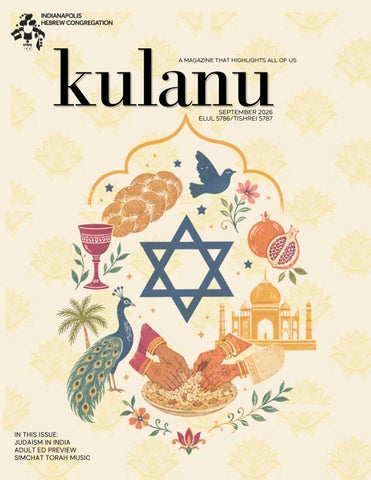
kulanu
A MAGAZINE THAT HIGHLIGHTS ALL OF US
SEPTEMBER 2026 ELUL 5786/TISHREI 5787
IN THIS ISSUE: JUDAISM IN INDIA ADULT ED PREVIEW SIMCHAT TORAH MUSIC
Feels Like Home By Cantor Aviva Marer SEPTEMBER 2026 ELUL 5786/TISHREI 5787
CONTENTS High Holy Days Schedule...........................................3 Bene Israel: India’s Jewish Culture........................4 High Holy Day Appeal..................................................7 Adult Education Preview............................................8
There is truly nothing like walking into my parents’ home in Richmond, British Columbia. The smell of homemade challah mingled with my favorite food in the world — my mother’s gobi — and I know immediately: I am home. That cauliflower, onion, garlic, ginger, and turmeric dish takes me right back to my childhood, when Indian food shared the table with homemade apple cake, challah, and whatever other Jewish delicacy my mother happened to be making.
Simchat Torah Music...................................................9 Mazel Tov........................................................................11 Upcoming Events .......................................................14 Yahrzeit List...................................................................15
CONNECT Indianapolis Hebrew Congregation
@ihc.indy
Phone: 317.255.6647 ECC: 317.254.2186
www.ihcindy.org
My parents immigrated from New Delhi to Toronto in the early 1970s and spent nearly three decades moving around Canada before settling in Richmond. As Bene Israel Jews from India, they grew up knowing how naturally Jewish and Indian traditions could live side by side. Jewish life in India meant Hebrew prayers and Shabbat alongside Indian languages, food, music, and customs. That blending of worlds has always been an important part of my own Jewish story. So this year, as we gather for Selichot — a time to pause, reflect, and prepare our hearts for the High Holy Days — I’m especially excited to share a little piece of that story with you.
SHABBAT AT IHC Kabbalat Shabbat Services 6:15 p.m. Fridays
It was never either/or. It was simply who we were.
Torah Study 9 a.m. Saturdays
Participate in person or visit ihcindy.org/online. Services, unless otherwise noted, will be live streamed at ihcindy.org/streaming.
Indianapolis Hebrew Congregation (IHC) is an inclusive Jewish community where all congregants matter, are inspired to action through Jewish values, and experience Judaism in a meaningful way.
We’ll watch “Shalom Bollywood,” a fascinating documentary about the history of Jewish participation in India’s famous film industry. It’s a wonderful reminder that Jewish identity has never been one-size-fits-all. We have found ways to make Judaism our own in countless cultures and communities. Come for the movie, stay for the conversation, and maybe discover something about your own journey home along the way. I hope you’ll join us for an evening of connection, reflection, and joy as we welcome the new year together. May the year ahead bring you sweetness, belonging, and many moments that remind you where — and with whom — you feel at home. Cantor Aviva Marer
High Holy Days 5787 The High Holy Days are fast approaching. This year, we invite you to “hear the call of the shofar.” Beyond the sound of its blast, the shofar calls us to introspection and action. This year, we have designed a variety of programs to help you hear the call in the way that is most meaningful to you. Below are some key dates and times. Look for more information in our High Holy Day Book and available online at ihcindy.org/highholydays.
SELICHOT Saturday, September 5
Joint Service with Beth-El Zedeck at IHC with Special Film Screening | 7 p.m. - Program | 9 p.m. - Service
EREV ROSH HASHANAH Friday, September 11
ROSH HASHANAH Saturday, September 12
ROSH HASHANAH SECOND DAY Sunday, September 13
EREV YOM KIPPUR Sunday, September 20
YOM KIPPUR Monday, September 21
Traditional Service | 7:30 p.m.
Rosh HaShanah Retreat at GUCI | 9 a.m. Tot Service | 9 a.m. Family Service | 9:30 a.m. Traditional Service | 11:45 a.m. Tashlich and Havdalah at GUCI | 3 p.m. Shofar Blowing at IHC | 10 a.m. Family Picnic - Shofar Blowing/Tashlich in Carmel | 11 a.m. Kever Avot at IHC North and South Cemeteries | 2 p.m.
Alternative Kol Nidre Experience | 5:30 p.m. Traditional Kol Nidre Service | 7:30 p.m.
Meditative, Musical Service at GUCI | 9 a.m. Tot Service | 9 a.m. Family Service | 9:30 a.m. Traditional Service | 11:45 a.m. Healing Service | 1:30 p.m. Learning Session | 2:45 p.m. Yizkor Service | 4 p.m. N’ilah/Havdalah | 5 p.m. IHCIndy.org | SEPTEMBER 2026 | 3
Malida and Memories The centuries-old story of the Bene Israel, India’s Jewish Community, and the cantor who proudly shares their traditions. By Blake Kraus “We are losing the Jewish people in the diaspora,” said former Israeli interior minister Eli Yishai in a controversial 2009 speech. There is often a view of the Jewish people, among both Jews and nonJews, that Jewish culture is monolithic. In the United States, Jewish culture tends to be dominated by Ashkenazi culture. Others typically conflate all Jewish culture with Israeli culture. That viewpoint is usually not malicious, excluding the previous quote. But this perspective inadvertently erases small pockets of active Jewish culture that have existed for thousands of years. Over 2,000 years ago, it is believed that the first Jews arrived in India, fleeing persecution in Judea under the rule of King Antiochus IV (of Hanukkah fame). They settled in India’s western coastal region of Konkan, where they worked for centuries as oil-pressers. They became known as the Bene Israel, or ‘sons of Israel.’ Over time, they became both Indian and Jewish, absorbing many parts of Indian culture while continuing their Jewish practices. There were some differences in how they practiced Judaism compared to other corners of the diaspora. Like other communities that departed Judea before the destruction of the Second Temple, they were largely unaware of postbiblical holidays (such as Hanukkah and Tisha B’Av). 4 | SEPTEMBER 2026 | IHCIndy.org
Purim, on the other hand, holds outsized importance to the Bene Israel compared to other Jewish communities, as the kingdom of Persia is said to have stretched to India. They had the Torah, but not the Talmud or other scholarly commentaries that shaped modern Jewish practice. It was Judaism built on the main tenets of the Torah's commandments: observing Shabbat, reciting the Sh’ma, following the laws (such as keeping kosher), and upholding the traditional brit milah covenant that dates to Abraham.
apples, dates, pears, bananas, and berries. During the ceremony, the Bene Israel light candles, sing hymns like Eliyahu Hanavi, and recite blessings over the food. This community began to migrate to bigger cities like New Delhi and Bombay in the 1800s for better career opportunities and the chance to serve in the British military. Unlike most Jewish communities around the world, they had always been a welcome part of Indian society and faced very little antisemitism.
All the while, Bene Israel Jews became distinctly Indian. They adopted Indian dress, including wearing sarees and kurtas. They cooked Indian food, making substitutions to follow kosher laws. For example, many northern Indian dishes employ cream, but Bene Israel Jews often used coconut milk as a parve alternative. The Bene Israel community also has the unique tradition of the “Malida ceremony,” which takes place at special occasions such as weddings, birthdays, and b’nai mitzvah, as well as Tu B’Shevat. Malida, itself, is a food made of poha (flattened and dried rice), sugar, raisins, nuts, cardamom, and coconut. During the ceremony, the malida is placed on a large platter and formed into a mound, to resemble Mount Sinai. That mountain is adorned with fresh flowers and a variety of fruit, like
A Traditional malida ceremony
According to the book “Burnt Bread and Chutney” by Carmit Delman, “Because they were not persecuted by non-Jews for their beliefs the way that Jews in other countries often were, the Bene Israel achieved a solid relationship with the general Indian community and succeeded in the military, medicine, and the arts.” Our story begins in New Delhi, after this large migration. The year is 1956, and the new Judah Hyam Synagogue is hosting its opening. It is a modest building, constructed by Bene Israel community members, including Ezra Kolet, grandfather of IHC Cantor Aviva Kolet Marer. The city was bustling as India found a new identity in the post-war and post-colonial years. Around 900 miles south, Bene Israel Jews in the city once called Bombay (now Mumbai) played a crucial role in the nascent Bollywood film industry. As displayed in the documentary, “Shalom Bollywood: The Untold Story of Indian Cinema,”
Bene Israel Jews served as prominent directors, actors, and producers, contributing greatly to the boom that Indian film would experience in the coming decades. One Bene Israel actor, David Abraham Cheulkar, performed in over 300 films throughout his career spanning four decades. Notably, Jewish women were frequently featured as actresses since Muslim and Hindu women — at that time — were restricted from performing in public due to longheld cultural norms. Women like Pramila (born Esther Victoria Abraham) were the most acclaimed leading ladies of early Bollywood. Yet, in the 1950s, the Bene Israel community in India was dwindling. After the founding of the State of Israel in 1948, many decided to make aliyah. Others sought new opportunity in the United States or in Canada, where Cantor Marer’s parents ended up. In 1948, over 20,000 Bene Israel Jews lived in Mumbai. By 2020, that number dropped below 3,500. For the first time in their long history, the Bene Israel had to
contend with the discrimination and antisemitism that existed in almost every other part of the world. In the United States and Canada, they found themselves considered different for three distinct reasons. They were Indian, they were Jewish, and — most puzzling to even their Jewish neighbors — they were Indian and Jewish. “Once they reconnected [with other worldwide Jewish communities], the dark color of their skin and their centuries of isolation sometimes led other Jewish communities to look down on them and question their Jewish purity,” wrote Delman. “I know what it feels like to be a stranger in a Jewish space,” Marer explained. Growing up in Canada, she attended Ashkenazi synagogues, save for the holidays, when her family gathered with a small group of Sephardic Jews. Still, aside from her family, she was the only Indian Jew.
Example of a Bene Israel celebration, featuring a malida ceremony, courtesy of the Sankar Family. IHCIndy.org | SEPTEMBER 2026 | 5
Despite this, her parents taught her many specific Bene Israel traditions. When she became a bat mitzvah, she learned her Torah portion in the unique Bene Israel trope (way of chanting). “My dad had a man in India record a cassette tape. I must have listened to it 10,000 times,” she said. “That’s how I learned my portion.” Cantor Marer had a Malida ceremony at her bat mitzvah ceremony and her wedding. Being a brown person in a Jewish space has led to some uncomfortable experiences. “I have been stopped at religious schools and asked if my parents are Jewish. I have had incredibly ignorant things said to me,” she explained. As a cantor, these experiences have grown her awareness for the need to make the Jewish community a more welcoming place.
“I think the intersectionality of identity has offered me a broader insight into how people feel welcome into our space,” she said. As the proud torchbearer of her heritage, she chooses to meet ignorance with cultural awareness. “In Jewish spaces, people are always going to wonder what my background is, just by the nature of how I look,” Cantor Marer explained. “I realized that I have a choice: I can meet that with anger and resentment, or I can meet it with education.” Over her career, she has visited various communities, presenting on the history and traditions of Bene Israel, including conducting malida ceremonies. “In the past few years, I realized that I have a responsibility to stand up on our bimah and be a Jew with a different background and with a different skin color,” she explained.
“It is a responsibility that carries a lot of weight.” Yet, this weight is the strength that has allowed her to connect with congregants of all backgrounds. “When you see yourself represented on the bimah, that carries great importance,” she said. On September 5, preceding Selichot services, IHC will host a special screening of “Shalom Bollywood,” to showcase the intersection of Jewish and Indian culture. There will also be an opportunity to try Malida, made by Cantor Marer. “It's so important that we carve out the space for different corners of the Jewish world,” she said. “For me, it is as simple as doing my job proudly. Teaching at the religious school about all of the places where Jews come from. And doing programs like the upcoming screening of ‘Shalom Bollywood.’”
Sanctuary of Judah Hyam Synagouge in New Delhi
Program for the malida ceremony at the wedding of Cantor Aviva and Jim Marer 6 | SEPTEMBER 2026 | IHCIndy.org
Cantor Aviva Marer and Blake Kraus make malida
ANSWER THE CALL 5787 High Holy Day Appeal Dear IHC Family, We come to this letter from three different vantage points — the bimah, the boardroom, and the daily life within our building — but we arrive at the same conviction: IHC matters, and it is worth sustaining together. From the sanctuary, we see people finding comfort in ancient prayers and new friendships, families marking life's milestones, and a community that shows up for one another in celebration and in grief. From the board table, we see the careful stewardship that keeps this congregation strong and the vision that helps it grow. And in the daily activity within our building, we see that much of what makes IHC feel like home depends on decisions made and the gifts of time, kindness, and generosity made quietly throughout the year. We also know that the IHC we have today exists because of the investments made by generations before us. That history is on our minds often, and especially now, as we approach the High Holy Days. This year, as we hear the shofar's call, we invite you to consider how you may answer. Giving to IHC is one way to sustain the congregation we all value. If you have already made a gift to the High Holy Day Appeal, thank you. If not, we hope you'll consider making a gift today. The Appeal is a core part of IHC's annual budget. Your gift supports learning, worship, pastoral care, adult and youth programs, music, security, and community gatherings — and it gives us room to innovate and respond to the future needs of our changing community.
We know these are hard times for many families, and a meaningful gift looks different for every household. We're not asking everyone to give the same amount — we're asking each of us to consider what we can give and to participate in sustaining our Jewish community. You’ll hear from fellow congregants in the coming weeks about why they give. Their reasons will differ, because their connections to IHC differ. But each will reflect something we see daily, from our different vantage points: this congregation matters deeply to the people who call it home. If being part of the IHC community has enriched your life — helped you forge new relationships, celebrate a life cycle event, supported you through a hard moment, strengthened your children’s Jewish identity, deepened your connection to Judaism, or simply given you a place where you feel you belong — we hope you'll see the Appeal as an opportunity to build upon those experiences in your own life and for others. This year's goal is $125,000. It's ambitious by design: reaching it not only supports our budget but also gives us the opportunity to think beyond what we already do — to create, experiment, and respond to what our community needs next. There's no single gift that defines commitment to this congregation. Our hope is for broad participation — a community where each of us, in our own way, chooses to help sustain what we value. We do this work — together — because we believe IHC and our Jewish community’s future are worth investing in. We hope you'll join us by making a gift to the 5787 High Holy Day Appeal and answer the call. May the New Year see us all inscribed in the Book of Life. Rabbi Brett Krichiver Peter Smithhisler, Executive Director Jennifer Vigran, President
Donate via check or online at IHCINDY.ORG/HIGHHOLYDAYS/GIVING IHCIndy.org | SEPTEMBER 2026 | 7
IHCIndy.org | SEPTEMBER 2026 | 8
MORE THAN JUST A WEDDING BAND BY CANTOR JANICE ROGER Sisu v'simchu b'Simchat Torah Rejoice and be happy on Simchat Torah! On October 2, we will celebrate the annual cycle of Torah reading.
After the destruction of the Second Temple in 70 C.E., the use of instruments in Jewish celebration as well as worship was forbidden. The rabbis of that time explained that the IHC's Simchat Torah celebration ban was instituted because it includes dancing with the Torah was sacrilegious to replicate scrolls, accompanied by our 65th any practice of the Temple. Street Klezmorim, directed by Dr. Also, Jews were in mourning Shawn O'Connor. The Klezmer for the Temple, so rejoicing of ensemble has been part of the any kind was not appropriate. festivities for at least two decades. However, as the decades and However, musicologist Yale Strom centuries passed, some of the has researched the genre and writes restrictions loosened and later that the idea — if not the name — of rabbis allowed instrumentalists klezmer dates back to the 14th at wedding festivities. century. The term is a Yiddish combination of two Hebrew words: klei and zemer, which literally means, "instruments of song."
9 | SEPTEMBER 2026 | IHCIndy.org
The repertoire of the earliest klezmorim was passed down orally, so we don't have written evidence of the melodies they used. With the Enlightenment, in the 17th and 18th Centuries, Jewish musicians had contact with the world outside their small towns. The music of these bands reflected folk melodies in the secular world as well as traditional Jewish tropes. The repertoire of klezmorim included dances - freylekhs, bulgars, horas, and shers. The lead instrument was often a violin, but hammer dulcimers, trumpets, clarinets, accordions, and simple percussion instruments often rounded out the ensemble.
By the time klezmer music arrived on American shores, in the late 19th and early 20th centuries, many klezmer musicians were musically educated and able to write out the tunes they played. Some of the more famous names in American klezmer of the 20th century are Joseph Rumshinsky, Abe Schwartz, Naftuli Brandwein, and Dave Tarras — the latter two clarinet virtuosi. As the century progressed, the klezmer tradition continued. However, the Yiddish label was all but abandoned in the United States. In the 1970s and 80s, a renewed interest in Yiddish culture included a renaissance for klezmer music and a revival of the centuries-old name. Yale Strom identifies five generations of klezmer music in America. IHC's 65th Street Klezmorim falls into the fifth generation, which began in the 1990s. Our band has engaged musicians from ages 14 to ... well, let's not give away our oldest members' ages. The band has included strings (violin, viola, cello, and bass), winds (flute, oboe, clarinet, and saxophone), brass (trumpet, french horn, trombone and even a tuba), and rhythm (guitar, bass guitar, drums, and piano). Our current ensemble doesn't have all the listed instruments; however, we welcome new members of all ages who play an instrument, feel comfortable reading music, and are willing to learn. For more information, contact Dr. Shawn O'Connor at Soconnor@marian.edu. Sisu v'simchu b'Simchat Torah - Rejoice and be happy on Simchat Torah! I hope you'll be dancing with us.
WANT TO LEARN MORE ABOUT KLEZMER MUSIC? BOOKS: Klezmer: Music, History and Memory by Walter Zev Feldman American Klezmer: Its Roots and Offshoots by Mark Slobin The Book of Klezmer by Yale Storm PODCASTS: Radiant Others: A Klezmer Music Podcast An Exploration of Klezmer Music with Abigale Reisman WEBSITES: klezmerinstitute.org klezmershack.org klezcalifornia.org IHCIndy.org | SEPTEMBER 2026 | 10
Mazel Tov
Graduates! Philip Berebitsky, child of Jeff & Jenni (z”l) Berebitsky, graduated from North Central High School and is taking a gap year in Israel. Kayleigh Borek, child of Rosemary Borek, graduated from Westfield High School and is attending Indiana University. Aaron Cahn, child of Victoria Hyatt Cahn & Seth Cahn, graduated from University High School and is attending Indiana University - Kelley School of Business. Sophia Cahn, child of Victoria Hyatt Cahn & Seth Cahn, graduated from University High School and is attending Butler University. Isaac Cohen, child of Jen & Jeff Cohen, graduated from Park Tudor High School and is attending Xavier University. Abe Greenfield, child of Rachel & Ben Greenfield, graduated from Lawrence Central High School and is attending The Ohio State University.
*Information shared by students/parents following requests via email and in our eblasts.
IHCIndy.org | SEPTEMBER 2026 | 11
Jayden Kleiner, child of Stephanie & Lee Kleiner, graduated from Carmel High School and is attending the University of Michigan. Drew Organ, child of Debbie & Jason Organ, graduated from Carmel High School and is attending Indiana University. Hank Orman, child of Jennifer & Eric Orman, graduated from Camel High School and is attending Indiana University. Isaac Pleasure-Kranowitz, child of Jennifer Pleasure & Jeremy Kranowitz, graduated from the International School of Indiana and is attending Oberlin College. Jacob Schiffer, child of Karen & Adam Schiffer, graduated from Park Tudor High School and is attending the University of Maryland. Molly Schmidt, child of Margo & Mike Schmidt, graduated from Carmel High School and is attending the University of Cincinnati. Rebecca Steingold, child of Lisa Brown & Mark Steingold, graduated from North Central High School and is attending College of Charleston. Dagan Waldman, child of Divonna & David Waldman, graduated from North Central High School and is attending Wabash College. David Weissbach, child of Lani & Rob Weissbach, graduated from Carmel High School and is attending Purdue University. Gabriella Zelikovich, child of Shana & Eddie Zelikovich, graduated from Carmel High School and is attending the University of Cincinnati. *Information shared by students/parents following requests via email and in our eblasts.
IHCIndy.org | SEPTEMBER 2026 | 12
MAZEL TOV! Mazel Tov... to Michelle Lawrence and Christopher Lentz on their engagement.
Welcome New and Returning Members... Jeffrey Bennett & Laura Romito
Todd & Linda Maurer
Mara & Danny Brezik
Miles Roger
Ursula David
Sara Beth Rubin
Jeffrey Hester & Sara Nadeau
Jordan & Jessica Silberman
Daniel Kahn & Mindy Shapiro
Will & Josh Turpin-Doty
Ian & Kelly Velinsky
A note from the new guy Hello Kulanu readers and IHC family! My name is Seth Tow, and I’m IHC’s new communications specialist. Blake Kraus held this post for the year preceding me, and he graciously left a lot in place for me to make this transition as smooth as possible. I want to thank him for that, and for the help he’s provided me. He did a great job, and I commit to continuing that good work while putting my own spin on things. My journey to IHC has had twists and turns. I grew up in Columbia, Maryland, in between Baltimore and Washington, D.C. I lit candles (and devoured challah) every Friday night with my family growing up. I went to a Jewish summer camp — Camp Airy, in Thurmont, Maryland — and spent 14 13 | SEPTEMBER 2026 | IHCIndy.org
summers there as a camper and staff member. I graduated from Indiana University Bloomington in 2019 as a media major, with an emphasis in sports media. I worked at newspapers in Easton, Maryland and West Lebanon, New Hampshire for around a year each, covering high school sports at both along with Dartmouth College athletics in N.H. I returned to Bloomington in 2022 and spent more than four years covering IU football, men’s basketball, and women’s basketball professionally, briefly for The Herald-Times and then with The Daily Hoosier. And I’ll still be covering IU games this year, on the side, so I’m always happy to talk about the Hoosiers — or just about anything sports-related!
Ultimately, writing about sports is writing about people and telling their stories. And that’s my goal here at IHC: to bring those stories to life with my storytelling experience and Jewish background. Of course, you won’t see slam dunks in the sanctuary or touchdowns in the social hall. But everyone has a story to tell, and I love diving into them all. Feel free to say hello if and when you see me around the building. I’m looking forward to settling in with the IHC community! Seth Tow (rhymes with cow) setht@ihcindy.org 317-255-6647 ext 2504
UPCOMING EVENTS DATES TO KNOW
EYE ON ISRAEL
14 | SEPTEMBER 2026 | IHCIndy.org
September Yahrzeits SEPTEMBER 1 Michael Baram Shoshane Baram Miriam Bromberg Ethel Chasteen Bessie Epstein Burack Benjamin Finkel William Gitlin Sam Halpern Albert Klineman Gloria Lutz Henry Marer Harry Selig Nathan Solomon SEPTEMBER 2 Josh Barez Joseph Barrett Gertrude Breitbart Zena Davis Bertha Epstein Mayer Jean McCann Selma Rice Dorothy Strater Esther Vernick SEPTEMBER 3 Albert Calderon Robert Cohen Esther Fairbanks Sidney Herman Larry Horberg Mildred Kaufman Helen Provisor Stephen Vogel SEPTEMBER 4 Milton Rapkin Lawrence Ress Arthur Shapiro Kenneth Siegel Gita Weinberger SEPTEMBER 5 Jacob Goldman Elizabeth Joseph Charles Kahn Beryl Leonards Marks Levy Gus Rosen Florence Winter Hannah Zeilberger SEPTEMBER 6 Harry Cooler, Sr. Arnold Gotfried Lottie LaBounty Louise Lieberman Geri Miller Klara Peysekhman Dorothy Schuman J. Alan Slivka Kathryn Smith Rita Werner Max Wolfson
SEPTEMBER 7 Sylvia Beiman George J. Claymon Jack Cohen Herman Foster Michael Gray Esther Kusnitz Ida Lemberger Ralph Newmark Dorothy Spitzberg SEPTEMBER 8 Harold Burgheim Sylvia Diamond William J. Dumes Ida Goldberg Gertrude Ruth Lipman Gould Ruby Marilyn Moss Eleanor Nemes Max Paul Frieda Simon Fran Weiss SEPTEMBER 9 Esther Aroesti Cohen Lily Davis Gloria Deremiah Gregory Ford Goble Max Hackman Irwin Katz Clara Louise Kessler SEPTEMBER 10 Mary Efroymson Super Ben Falender Albert Frankel Herb Marer Celia Marmelstein Gilbert Parker Karen Shlensky Rebecca Shmookler Samuel Shorr Arnold Vandroff SEPTEMBER 11 Nathan Cohen Morton Cooper Richard Dorson Irene Fischer Eva LaBounty Anna Mirowski Joyce Moore Lawrence M. Reuben
SEPTEMBER 12 Christopher Arnold Sadie Bloom Clarence Kouts Rachael Barrett Libowitz Louise Litwack Ethyl Mansbach Jim McCarthy Florence S. Sering Jeffrey Siegel Louis Spitzberg Minnie Tuchman Joseph Wilker
SEPTEMBER 17 Terry Cage Suzanne Centman-Miller Solon Harris Geraldine Hurwitz Marcella Kaplan George Jack Kline Milton Korobkin Ida Mickelson Brooks Morris Alice Rubin Harriet Simon
SEPTEMBER 13 Diane Bercovitz Hilda Bleiweiss Abe Goldsmith Charles Hamer Fred Joseph Anna Purchick Samuel Rappaport Rosetta Rosenblatt Ruth Rosenstein Jacob Herzl Segal Belle Swedarsky Nellie Wender Theresa Wiener
SEPTEMBER 18 Harriet Bookheim Albert Brinn Susan Cahn Robert Deremiah Inda Jane Larman Fried Singer Norbert Loeb Carol Mann Oscar Barry Strain Joan Vigran Lewis Wittles
SEPTEMBER 14 Morris Beiman Joseph Cantor Helen Cohen Harry Epstein Florence Kroot Jerome S. Leviton Robert L. Pine Rae Rosenberg Jone Shapiro SEPTEMBER 15 Kathleen Borinstein Jon Gregory Ellison Dora Field Jenny Gavin Max Gavin Jenny Geddes Eunice Goldshine Janet Gould Sachs Rosa Gumbiner Dorothy Herzberg Ruth Klein Rothman Alan I. Klineman Lewis Lurie Ruth Roth David Schwartz Lilly Schwartz Sylvia Wikoff SEPTEMBER 16 Judith Blau Jaffe Barbara Fineman Earl Getsug Louis Goldstein Mildred Karmen David Lutz Raymond Z. Russell Clara Vogel Goldsmith Burnstein
*as of 7/30/26
SEPTEMBER 19 Floyd R. Beitman, Sr. Patricia Benrubi Bernice Braun Daniel FitzGibbon Lyubov Getsis Joyce Hyatt Ethel Ratskoff Eli Sachs Flora Silver Lea Traugott Cassel Evalyn Yaunt Draper SEPTEMBER 20 Jean Baerncopf Jeanne Bengis Robert Borinstein Harry Burnstein Maxine Cohen Maurice Kaufman Louis Silver SEPTEMBER 21 Margie Astren Arthur Fiszbein Bessie Fuchs Sylvia Goldberg Martin Kochman John Magazine Cornelia Vogel Heinrich Vogel Marta Vogel Maxmillian Vogel
SEPTEMBER 22 Gladys Abramowitz Abraham Diamond Elmer E. Frankel Charles Ginsberg Abraham Greenberger Elaine Greene Michael Greenwald Sara Ruth Herman Celianne Kohen Hamilton Wayne Kreuscher Alvin Levy Sarah Parker Leonard "Lenny" Rubenstein Michael Shapiro Esther Stein Harry Webster SEPTEMBER 23 Gleela Baldwin Clara Bassler Sylvia Chavkin Nahoma Deckelbaum Mae Elkins Richard Joseph Sol Levin Ronald Newmark Jacob Schwartz Ann Selig Shapiro SEPTEMBER 24 Jerome Blickman Adele Domont Bert Freid George Gelles Emma Henry Romer Kenneth Leeds Fred Salzberg Evelyn Stein Farber Edward Stempel SEPTEMBER 25 Jean Blach Adams Ruth Barrash Mary Furscott Sheldon Giniger Loren Goodman Marjan Halberstadt David Larman Michelle Lichtenfeld Reis Clare Lisker Ernest Lowenstein Tilden Mendelson Phyllis Shane Schlesinger Betty Trockman Shirley Zeidman Halpern Mansbach
SEPTEMBER 26 Clara Cohen Louis Dubin Donald Fritschle Robert Gaberman Louis Peter Goldstein Ethel Gotfried Zelda Landy Hyman Loganofsky Rebecca Newman Joyce Romer Celia Sonya Rossen Hugo Schneider Robert Smalbach Robert Van Cleeff SEPTEMBER 27 Lucille Asher Elya Borodaty Carol Finkle Morris Fishbein Label Grynheim Patricia Hellman Sharon Jacobs Gertrude Kochman Blanche Lebowitz William Levine June McKown Susan Miller Betty Mintz Melvin Polick Irene Regenstreif Gary Sicanoff Brad Strausburg David Swedarsky SEPTEMBER 28 Sylvia Dansker Reuben Finkel Patricia Lamott Albert Lieberman Elias Russell Samuel Shaffer SEPTEMBER 29 Bahiyyah Allen Eda Appel Joseph Baerncopf Toby Blickman Myra Kahn Tammy Kelly Herbert Larks Sylvia Leitz Siegfried Leon Samuel Leviton Ruth Paul Hammerschmidt Buchholz Natalie Smulyan Judith Tilton SEPTEMBER 30 Joy Arnold Julie Bennett Florence Calderon Irving "Ernie" Calderon Jacob "Jack" Cohen Harlan Davis Sylvia Finn Morris Gavin Margaret Grumbacher Sam Levinsky Florence Levy Hans Lion Robert Perk George Ressler Kenneth Valentine IHCIndy.org | SEPTEMBER 2026 | 15
INDIANAPOLIS HEBREW CONGREGATION 6501 North Meridian Street Indianapolis, Indiana 46260 IHCINDY.ORG | 317-255-6647
CLERGY
Non-profit Organization US Postage PAID Indianapolis, IN Permit No. 819
SENIOR RABBI Brett Krichiver CANTOR Aviva Marer CANTOR EMERITA Janice Roger
EDUCATION DIRECTOR OF LIFELONG LEARNING Rabbi Roxanne Shapiro EARLY CHILDHOOD CENTER DIRECTOR Jodi Kaseff YOUTH ENGAGEMENT COORDINATOR Leah Matthys
ADMINISTRATION EXECUTIVE DIRECTOR Peter Smithhisler ACCOUNTING MANAGERS Adrienne Aronson-White Elaine Wells COMMUNICATIONS SPECIALIST Seth Tow CLERGY COORDINATOR Katie Borman ADMINISTRATIVE ASSISTANTS Kendra Steele Colleen King MAINTENANCE Gary Davis Joyce Patterson SECURITY Willard Mosley Nikki Boone Shawn Boone Hawaii Lee
BOARD OF DIRECTORS PRESIDENT Jennifer Vigran VICE PRESIDENT Jaclyn Grahl VICE PRESIDENT Jeff Rubenstein TREASURER Eric Simons SECRETARY Carly Traynor Immediate Past President Sarah Freeman Sisterhood President Elyse Chuvalas
MEMBERS AT LARGE Benjamin Abraham Lorraine Ball Steve Bulloff Kate Duffy Sim Ken Gould Matt Kaprove Stevie Pactor
Marci Price Julian Shepard Polly Spiegel Drew Soshnick Dodie Stein Carly Turow
Kulanu is published seven times per year by Indianapolis Hebrew Congregation. For more information, please call the Temple office at 317.255.6647. For most up-to-date information, make sure you’re receiving our weekly eNewsletter. Sign up on our website at ihcindy.org. All articles, graphics, and photos credited to Seth Tow unless otherwise noted.
Kareem McGraw @IHC.INDY