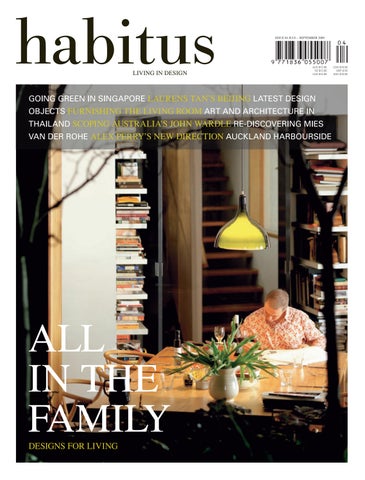
GOING GREEN IN SINGAPORE LAURENS TAN’S BEIJING LATEST DESIGN OBJECTS FURNISHING THE LIVING ROOM ART AND ARCHITECTURE IN THAILAND SCOPING AUSTRALIA’S JOHN WARDLE RE-DISCOVERING MIES
VAN DER ROHE ALEX PERRY’S NEW DIRECTION AUCKLAND HARBOURSIDE
ALL IN THE FAMILY
DESIGNS FOR LIVING
AUD $12.95 NZ $13.95 USD $15.95 CDN $16.95 GBP 8.50 SGD $10.95 ISSUE 04 JULY – SEPTEMBER 2009
TRP MI 1494 For more information on Miele’s impeccable fleet design range of ovens, rangehoods, microwave combi ovens, cooktops, plate warmers, steam ovens, coffee machines, dishwashers and refrigeration contact the specialist Project Division in your state. VIC 03 8633 8335 NSW 02 8977 4235 QLD 07 3632 2471 SA 08 8352 9500 WA 08 9286 7800 NZ 09 573 1269 www.miele.com.au
Because great coffee should be up there with great food, our machines are built in, next to our ovens.
Built into your kitchen, a German engineered Miele coffee machine makes a clear statement of streamlined, good taste – along with impeccable espresso, cappuccino or latte macchiato, all with perfect Barista crema. To see the full range of Miele kitchen appliances visit www.miele.com.au
BATHROOM DESIGN CENTRE 84 O’Riordan Street Alexandria 8339 7000 103–123 Parramatta Road Auburn 9648 5411
Everything we learn here,
Electrolux Integrated Barbecue
Beautifully designed outdoor spaces deserve a barbecue to match. The Electrolux Integrated Barbecue features a cooking surface with a completely linear design allowing it to integrate seamlessly into a bench or working surface. According to Jamie Durie, “There isn’t a barbecue in Australia that works as harmoniously with the outdoors than the Electrolux Integrated Barbecue. It’s all about taking the luxuries of indoor living, outdoors. And as we know everything tastes better outside!” We couldn’t agree more. Share more of our thinking at www.electrolux.com.au
Jamie Durie, Australian Landscape Designer
we apply here.
Let your turbo heart soar.
Saab 9 -X Air.
Innovative. Uplifting. Defying convention. Saab 9-X Air. Our latest concept car. Showcasing future technology not yet in production. Born from Scandinavian origins. Aircraft heritage. An evolution of ideas. Forging a new classic. It’s what your next Saab could be. Fresh. Open air. Open minded design. Defining a unique brand DNA. It’s everything your turbo heart desires. No compromises.
The heart of every Saab is its turbo. Experience the entire Saab range for yourself with a test drive. Call 1800 50 7222, visit saab.com.au or text 9XAIR to 1998SAAB SAA28265/H/0309
1.
HABITUS REVIEWS
SCAN A SELECTION OF FURNITURE, OBJECTS AND LIGHTING FROM AROUND THE WORLD, READ AN EXTENDED REVIEW OF A NEWLY-RELEASED DESIGN AND ARCHITECTURE TITLE AND GET HOOKED ON COAT RACKS.
24
DESIGN NEWS
Be inspired by our round-up of the very best products for living, working and relaxing – plus one or two quirky new ideas, just for fun.
34
RE-SHOOT
The most interesting reinventions of the good old coat hook and coat rack – spread over two pages.
2. HABITUS PEOPLE & PLACES
IT’S AN AUSTRALIAN AND NEW ZEALAND AFFAIR THIS ISSUE. MEET A DIVERSE SELECTION OF CREATIVE PERSONALITIES WITH A PASSION FOR ART, JEWELLERY, TEXTILES, FASHION AND ARCHITECTURE.
44
ON LOCATION
Stephen Crafti visits Melbourne creative Tim Fleming on location at his studio in Melbourne, and is introduced to five other locations that inspire Fleming’s art, furniture and design.
57
PARTNERSHIP
Kath Dolan discovers what makes textile design studio Sixhands tick, and learns how the three-way partnership combines very different creative styles within the one exciting design umbrella.
68
ALCHEMIST
Australian fashion designer Alex Perry is known primarily for his womenswear ranges, but Hande Renshaw finds his trademark aesthetic of old-world glamour translates just as successfully into textiles and interiors.
73
SLOW DISSOLVE
We let the camera slow dissolve on New Zealand jeweller Joanna Campbell, as Andrea Stevens takes a closer look at the process and philosophy behind her pieces.
38
MONTAGE
Habitus editor Paul McGillick explores a new book celebrating the interior design and furniture of Mies van der Rohe and speculates that, combined with Mies’ furniture, his spirit stands behind most of the best residential architecture of our time and region.
82
CLOSE UP
Innovation, imagination and the highest quality finishes and detailing – Melbourne-based architect John Wardle is in a class of his own. Anna Johnson profiles this fine architect, focussing on his residential projects and their response to family and context.
3.
HABITUS HOMES
JOIN US ON A JOURNEY ACROSS
AUSTRALIA, NEW ZEALAND, SINGAPORE, MALAYSIA AND THAILAND INTO INSPIRING AND DIVERSE HOMES AND WAYS OF LIFE.
99
SCENARIO: TERRACE HOUSE
Residential architecture
Chu Lik Ren visits an urban home in Singapore designed by Chang Architects, which provides a green oasis for its residents.
111
SCENARIO: LILYFIELD HOUSE
Residential architecture
In the inner-Sydney suburb of Lilyfield, Nicky Lobo finds a surprising and successful addition to an original 1830s weatherboard cottage designed by Nobbs Radford Architects.
habitus 04 contents 07
155
CROSS FADE: KEW HOUSE
Renovations and additions
With a 1960s house as her starting point, interior designer Amanda McPherson of Miss Sixty-Two has created a crisp and colourful Palm Springs-inspired home for her family. Stephen Crafti reports.
123
SCENARIO: HUD HOUSE
Residential architecture
Jasmeet Sidhu meets up with an old colleague, architect Ar Hud Abu Bakar, whose family home in Kuala Lumpur is truly modern while also being a subtle interpretation of the traditional kampong house.
132
SCENARIO: SWANSEA HOUSE
Residential architecture
As Jane Burton Taylor learns, a web of relationships between three generations of family was a driving force in the design of this holiday house on Tasmania’s beachfront. The firm 1+2 Architecture rose to the challenge.
143
SCENARIO: RIRKRIT HOUSE
Residential architecture
Tonkao Panin visits the Chiang Mai home of Thai installation artist Rirkrit Tiravanija, which responds to its cultural context, but also embodies many of Rirkrit’s artistic concerns.
167
DIRECTOR’S CUT: ICE STATION
Architects and designers designing for themselves Principal of the large Auckland commercial architecture practice Jasmax, Tim Hooson has discovered the structural and decorative potential of DuPont Corian in his waterfront apartment. Andrea Stevens pays a visit.
177
HOME MOVIE: COTTAGE POINT
Where personality and residential architecture meet Penelope Barker visits a house in one of the magnificent river valleys north of Sydney that was originally designed by legendary architect Bruce Rickard for his own family, and that was more recently added to by architect Genevieve Furzer and architectural photographer Simon Kenny.
189
JUMP CUT: JEREMY WOLVERIDGE
Two projects by one architect Jane Burton Taylor compares two very different projects by Melbourne-based Jeremy Wolveridge, one on the starkly beautiful Mornington Peninsula south of Melbourne, the other in tropical Queensland.
4. HABITUS SIGN-OFF
VENTURE ACROSS THE GLOBE FOR SOME INSPIRATIONAL IDEAS, GET COZY WITH OUR NEW-LOOK IN CAMERA SECTION AND SEE THE CITY OF BEIJING THROUGH THE EYES OF AN ARTIST.
204
INSPIRATION BOARD
Take a design hint from a couple of projects in Thailand and Brazil that have inspired us.
209
IN CAMERA
We’re staying in a lot more these days, so express yourself from the comfort of your lounge room with the latest and greatest products.
218
SNAPSHOT
Australian artist Laurens Tan has rediscovered his Chinese origins in Beijing, which has become a second home. He introduces us to his Beijing – an artist’s city.
habitus 04 contents 08
Zip HydroTap® at home. Imagine. Imagine. No more waiting for water to boil. No more bottled water to buy. Zip HydroTap gives filtered boiling water and filtered chilled water instantly. For a free quotation call 1800 42 43 44 or visit www.zipindustries.com The terms ‘HydroTap’ and ‘Zip’ are trade marks. Instant Boiling Water
Hey,it’sonlynatural. puretann ® VegetabletannedPureAnilineLeather OnlythefinestBavarianhidesareselectedforPuretann®. Eachuniquehideistannedonlywithextractsfrompodsofthe Taratree,growninthetemperateclimateofthePeruvianAndes. ThisgivesPuretann® anunbelievablysoft,luxuriousfeeland appearance. AvailableexclusivelyfromContemporaryLeathers.
c contemporaryleathers contemporaryleathers www.contemporaryleathers.com.au c yescommunications
Velvets and Felts from KnollTextiles available exclusively from Woven Image wovenimage.com
At the time of writing I am just back from the International Furniture Fair Singapore 2009/26th ASEAN Furniture Show. There were 471 exhibitors from 33 countries, 30% of them for the first time – not bad considering we are in the middle of the GGFC – Great Global Financial Crisis.
It was my first time at the fair, so I was grateful for the invitation from the Singapore Furniture Industries Council – and to the photographer from The Straits Times who snapped me unawares and working hard in the middle of the Fl!p Challenge student exhibition.
It is a regional fair and reminds me of the Promosedia fair in Udine in Italy because both are organised by the local manufacturers. It’s their fair and so it has a distinctive character. And, as far as Singapore is concerned, the fair needs to be seen within the context of a national strategy to make the island state the design hub of the Region.
The times they are a’changing. And, as we know, when things change in Singapore they do so at the speed of a ballistic missile. This is not to forget that the fair is an international fair with a strong emphasis on the Region. There was a lot of Teak still to be seen, but the really interesting products demonstrated the same kind of marriage of local and international that we see in the architecture published in every issue of Habitus
In fact, with Office Planning (a Singapore furniture manufacturer) we saw the ultimate collaboration – between their designers and Karim Rashid for a truly international range of products suitable either for domestic or commercial use.
The fact is, we can look at this phenomenon as a blending of cultures, or as cross-pollination – check out the Hud House in Malaysia, the Terrace House in Singapore or Rirkrit House in Thailand in this issue and see what you think.
These are houses which spring from their own climatic and cultural context, but which are very much houses for modern times. This is no less the case with Melbourne architect, John Wardle – our profile in this issue – whose exquisite houses may seem at first glance straight out of the international canon. But if you look carefully at the planning, materials, finishes and detailing, you will see a highly sensitive response to place: they are every bit as responsive to climate, landscape and culture as the tropical houses.
The truth is, no one ever really blends. It is more like fine cooking or an outstanding wine where all the ingredients remain distinctive yet work together for a single, memorable experience.
On another note, we send our congratulations to the winner of the Habitus/Kohler $10,000 bathroom giveaway, Anne Hayes of Coorparoo in Queensland, Australia.
Also, we have had massive feedback from the first three issues of Habitus, most of it very supportive. But we have also had suggestions for improvements and so we are making some design changes to make Habitus more reader-friendly. Keep telling us what you think.
Paul McGillick, Editor
15 habitus 04 paul mcgillick editor’s letter
The truth is, no one really ever blends. It is more like fine cooking or an outstanding wine where all the ingredients remain distinctive yet work together...
Pictured:
Andrea Millar (Associate Editor) and Paul McGillick (Editor)
PeneloPe Barker
Writer
Writer, Penelope Barker, grew up in a leafy North Shore suburb of Sydney with very traditional architecture and interiors. She was blown away when her family went to live in Denmark in the late 1970s – “even fellow students had very cool apartments”. She lives in a circa 1900 weatherboard cottage in the tiny historic village of Terara on the Shoalhaven River, two hours south of Sydney, with partner, Michael White.
Murray Fredericks
Photographer
Photographer Murray Fredericks, lives with his wife, Francesca, andfour young children in NorthBondi, just back from the beach in asemi. He loves his garden that fills every inch of available external space – “It’s alive, it evolves and maintaining it is a constant and rewarding form of procrastination...” This year Murray will be taking photos while spending five weeks alone, buried below the ice to shelter from storms on Greenland’s Icecap.
s T uar T Fros T
Photographer
Stuart Frost studied photography in Perth before heading overseas and eventually returning to Australia and settling in Cairns, with Port Douglas just up the road and the Great Barrier Reef, Daintree rainforest and Atherton tablelands nearby. He lives with partner, Simone, and two sons, Felix and Ziggy. Stu loves his carbon steel Sabatier chef’s knives, saying “It’s refreshing to be able to use a quality tool without having to worry about upgrading it in the near future.”
Jason s ch MidT
Photographer
With a degree in art history, Jason Schmidt is also a wellpublished fashion, interiors and architecture photographer living and working in Manhattan, NYC with wife, Corey and baby boy, Jules. This year Jason plans to complete the follow up to his first published book entitled artists, while celebrating his 40 th birthday in Venice.
r ichard Birch
Photographer
After graduating in engineering in the UK Richard spent a couple of years travelling and trying to work out a way of not becoming an engineer. This led him to art school where he specialised in photography and now happily shoots a mixture of interiors and people. Richard lives in Five Dock with wife, Virginia, and three year old daughter, Claudia, and this year plans to sidestep the economic pessimism and take his work to another level while also preparing for child number two.
Ja Mes Geer
Photographer
James has photographed fashion, interiors and portraits all over the world, and lives near Elwood Beach in Melbourne in a 1940’s Californian Bungalow. His two loves are the sea and his family – wife Rebecca, baby girl Valentina and 16-year old Blue Heeler, Ollee. A family treasure is an original 1953 tugboat metal letterbox found at a garage sale at Lakes Entrance, with separate compartments for the newspaper, letters and milk bottle.
s i Mon k enny Photographer
Simon Kenny has specialised in architectural and interiors photography for over 20 years, and has been published in magazines and books worldwide. He lives in Sydney’s Northern Beaches with wife, Genevieve, although children, Max, Sybilla and Hugo are now grown up. Plans for this year include “Surviving until 2010 (and then world domination)”.
Jas Mee T s idhu Writer
For this issue, practising architect, Jasmeet Sidhu, wrote the Hud House feature on page 123. He believes that, despite the global turmoil, many opportunities lurk out there and that quality, not quantity, will prevail. After experiencing a destructive landslide in December 2008 that left him and his neighbours cut off from civilisation and communication for three days, he says, “learning to fly a helicopter would be pretty handy!”
kaTh dolan Writer
Melbourne based freelancer, Kath Dolan, lives in a rambling late 1960s brick veneer house in Melbourne’s inner north-west with her husband, Graeme, and children Max and Zoe. A keen painter, print maker and sculptor, Kath’s favourite design object at home is a painting called ‘The Blue Monkey’ by son Max, who mercifully developed an interest in art at kinder last year after alarming her early in life with the chilling words, “Mum, drawing: boring”.
Paul hoPPer Stylist
Interiors stylist/designer
Paul Hopper was born in Devon in the UK and worked in various different fields including horticulture, visual merchandising, management, retail & catering before finding his passion as a stylist. Paul created the new-look In Camera section this issue and lives in Sydney’s Paddington with partner, Jamie, and their 2 dogs. Their Kartell Componibili storage units designed by Anna Castelli Ferrieri are enjoyed for their versatility and have been used as everything from bedside tables to office storage.
a
Once again Alaana Fitzpatrick got to rummage around the big old pool of design and fish out the best and most beautiful new products for Habitus readers – “In particular, there were a couple of European fairs that highlighted an interesting response in a time when many industries are battening down the hatches,” she says. In 2009, Alaana is focussed on living the London life, “Letting go... allowing myself to thoroughly enjoy each and every new experience that I can”.
Anna Johnson is a lecturer at RMIT and a freelance writer. She has authored five books on architecture and is currently completing her postgraduate studies at RMIT. Anna lives in Thornbury, with partner, Damien, backyard-loving children, Mischa and Eva, and dog, Sooty. Her design pick at home is a mid-20 th Century Dutch drawer-cum-general storage ensemble.
c
hu l ik r en
Writer
Chu Lik Ren is a practising architect living in Singapore with wife Lini and son, Zach. This issue Lik Ren wrote the Terrace House project on page 99. He loves to read at home on his sturdy IKEA lounge but this year hopes to leave its comfort to venture into West Africa .
Rhiannon Slatter is a recognised photographer of architectural and interior design projects, as well as product, people and lifestyle. Rhiannon lives with partner, childcare worker Sid, in a selfrenovated weatherboard home in Bayside Melbourne and loves an abstract painting by artist friend Sally Tape, which she says is “The kind of image which you get more from the more you look at it, constantly intriguing.”
h
Writer
After studying and working in interior design, freelance writer Hande Renshaw decided to chase her dream of becoming a wordsmith. Hande lives in Sydney’s eastern suburbs with her partner, Josh, and their two children, Jakob and Toby. She loves a pre-loved Danish rosewood 1960s credenza, which takes pride of place in their tiny lounge room.
l aurens Tan
Writer Dr. Laurens Tan, writer, artist and digital media worker, has recently been working and living equally between Sydney and a small apartment in Beijing. His great grandfather emigrated from the province of Fujian in the late 1800s, and he hopes that his current stay in China may compensate for the long estrangement from his roots. Laurens feels that it will take years to explore Beijing in detail and enjoys cooking in both Chinese and Western styles.
16 habitus 04 contributors
r hiannon s laTT er Photographer
a laana Fi T z PaT rick Writer
nna Johnson Writer
ande r enshaw
contributors 17
RichaRd BiRch Photographer
Jason schmidt Photographer
Jasmeet sidhu Writer
Rhiannon slatteR Photographer
lauRens tan Writer
hande Renshaw Writer
chu lik Ren Writer simon kenny Photographer
stuaRt FRost Photographer
PeneloPe BaRkeR Writer
muRRay FRedeRicks Photographer
James GeeR Photographer
Paul hoPPeR Stylist
anna Johnson Writer
alaana FitzPatRick Writer
kath dolan Writer
SERIOUS? At Smeg we are serious about fine food technology and wonderful lasting design. Introducing the 150cm CSA150X double oven cooker and K7088D twin rangehood. For the location of your nearest Smeg retailer, call 02 9384 5678 or visit www.smegappliances.com.au
technology with style
Editorial dirEctor Paul McGillick habitus@indesign.com.au
associatE Editor
Andrea Millar andrea@indesign.com.au
assistant Editor Nicky Lobo nicky@indesign.com.au
dEsignErs
Bronwyn Aalders bronwyn@indesign.com.au
Lauren Mickan lauren@indesign.com.au
Camille Manley camille@indesign.com.au
contributing WritErs
Penelope Barker, Chu Lik Ren, Stephen Crafti, Kath Dolan, Alaana Fitzpatrick, Anna Johnson, Tonkao Panin, Hande Renshaw, Alex Robinson, Jasmeet Sidhu, Andrea Stevens, Laurens Tan, Jane Burton Taylor
contributing PhotograPhErs
Pirak Anurakyawachon, Richard
Birch, Max Creasey, Simon
Devitt, Murray Fredericks, Stuart Frost, James Geer, John Gollings, H. Lin Ho Photography, Ray Joyce, Simon Kenny, Albert Lim, Trevor Mein, Jason Schmidt, James Silverman, Rhiannon Slatter, Derek Swalwell
contributing stylists
Helen Adams, Paul Hopper
PublishEr / Managing dirEctor
Raj Nandan raj@indesign.com.au
oPErations ManagEr
Adele Troeger adele@indesign.com.au
businEss dEvEloPMEnt ManagEr
Richard Burne richard@indesign.com.au
Production coordinator/ dEsign
Sarah Djemal sarah@indesign.com.au
Eunice Ku eunice@indesign.com.au
Production coordinator
Kristy Macfie kristy@indesign.com.au
Financial dirEctor
Kavita Lala kavita@indesign.com.au
accounts
Gabrielle Regan gabrielle@indesign.com.au
Darya Churilina darya@indesign.com.au
onlinE
coMMunications ManagEr Rish Raghu rish@indesign.com.au
onlinE
coMMunications assistant Simon Layfield simon@indesign.com.au
EvEnts and MarkEting
Kylie Turner kylie@indesign.com.au
Angela Raven angela@indesign.com.au
advErtising EnquiriEs
Richard Burne richard@indesign.com.au
(61) 423 774 126
Marie Jakubowicz marie@indesign.com.au
(61) 431 226 077
Bernadette Bellwood bernadette@indesign.com.au
(61) 401 641 679
original dEsign tEMPlatE Wishart Design wishartdesign.com
covEr iMagE
John Wardle at home
Photography: Max creasey indEsign Publishing Level 1, 50 Marshall St Surry Hills NSW 2010 (61 2) 9368 0150 (61 2) 9368 0289 (fax) indesignlive.com
Printed in Singapore
All rights reserved. No part of this publication may be reproduced, stored in a retrieval system, transmitted in any form or by any other means, electronic, mechanical, photocopying, recording or otherwise. While every effort has been made to ensure the accuracy of the information in this publication, the publishers assume no responsibility for errors or omissions or any consequences of reliance on this publication. The opinions expressed in this publication do not necessarily represent the views of the editor, the publisher or the publication. Contributions are submitted at the sender’s risk, and Indesign Publishing cannot accept any loss or damage. Please retain duplicates of text and images. Habitus magazine is a wholly owned Australian publication, which is designed and published in Australia. Habitus is published quarterly and is available through subscription, at major newsagencies and bookshops throughout Australia, New Zealand, South-East Asia and the United States of America. This issue of Habitus magazine may contain offers or surveys which may require you to provide information about yourself. If you provide such information to us we may use the information to provide you with products or services we have. We may also provide this information to parties who provide the products or services on our behalf (such as fulfilment organisations). We do not sell your information to third parties under any circumstances, however, these parties may retain the information we provide for future activities of their own, including direct marketing. We may retain your information and use it to inform you of other promotions and publications from time to time. If you would like to know what information Indesign Group holds about you please contact Nilesh Nandan (61 2) 9368 0150, (61 2) 9368 0289 (fax), subscriptions@indesign. com.au, indesignlive.com Habitus magazine is published under licence by Indesign Group.
ISSN 1836-0556
20 habitus 04
Hamilton, seating system design: Rodolfo Dordoni
Australia: Sydney - Dedece - Tel. 02 9360 2722
Melbourne - Dedece - Tel. 03 9650 9600
Brisbane - Dedece - Tel. 07 3367 0755
New Zealand: Auckland - ECC Lighting & Living - Tel. 09 379 9680
Minotti S.p.A. 20036 MEDA (MI) ITALIA via Indipendenza, 152 Tel. +39 0362 343499
- info@minotti.it
www.minotti.com
Furniture for life.
CONSCIOUS PRODUCTS around
23 habitus 04 1. news
Take a global tour OF THE MOST INNOVATIVE , INTELLIGENT &
habitus 04 24 habitus living design news 01
NOUVELLE VAGUE The seamless curves of this thermoplastic furniture offer a retreat in the form of a cantilever chaise. The Nouvelle Vague can stand alone as a statement piece, or be paired with the matching ottoman, porro.com
“Recognising the need is THE PRIMARY CONDITION for design”
CHARLES EAMES
to storing
a Karim Rashid-designed veggie peeler would look like? Light and ergonomic, it has a ceramic blade that stays razor-sharp for longer, slicehome.com
ZEBRA Clean and striking, the Zebra light marries high-quality polycarbonate and silver metal in a wild yet classy combination, in versatile table, floor, base and pendant versions, visoinc.com
SCOOP This freestanding pedestal basin and mirror join the Scoop freestanding bath to create a uniquely sculptural bathroom collection. Manufactured using Cristalplant, an innovative composite material similar to natural stone, the ‘soft-touch’ finish in black provides a striking contrast, rogerseller.com.au
25 03 02
DISH DRAINER A contemporary solution
dishes while they dry, this foldable rack can also help cut down on dishwasher use to reduce your environmental footprint, enjoi.com.au / delica.es
04
SLICE VEGGIE PEELER Ever wondered what
05 06
BCN STOOL Designed by Barcelona studio Harry & Camila for Kristalia Italy, this indoor/outdoor sculptural stool in a lacquered steel or chrome finish was the recipient of the Good Design Award 2008, fanuli.com / milkfurniture.com
habitus 04 26 habitus living design news
11 09 08 10
UFO COFFEE TABLE Originally conceived for iconic Italian fashion duo, Dolce & Gabbana, this futuristic design is made entirely from shaped multi-layered timber with a veneered top and the choice of matching veneer or lacquer for the base. It’s designed by Ferruccio Laviani for Emmemobili, fy2k.com.au
PETEK BOOKSHELF Translated from Turkish, the word ‘petek’ means honeycomb and the aesthetic connection is clear. With its clever structure, the Petek holds books in a unique way, alperboler.com
PERSIAN TULIP Hand-tufted from 100 per cent New Zealand wool, this rug is one in a series of new designs based on elegant 1920s lace, rc-d.com.au
FRILLy This striking Patricia Urquiola-designed chair may have been inspired by gently pleated fabric, but it’s actually made from durable polycarbonate, spacefurniture.com.au / kartell.it
07
HAVANA Designed by Lievore Altherr Molina for Tacchini, this new sofa offers minimalist design and understated comfort. With a single action, it’s also capable of transforming into a generously sized bed or storage unit, stylecraft.com.au / tacchini.it
In 1958 the Cherner chair was elegant, innovative and comfortable. It still is.
www.fy2k.com.au 17 Thurlow Street East Redfern, Sydney P + 61 2 8399 1644 E info@fy2k.com.au
design news
CRINOLINE The Crinoline is the latest offering from Patricia Urquiola for B&B Italia’s outdoor range, in which the versatile designer unites the natural and the synthetic in a collection of seats and armchairs, bebitalia.it / spacefurniture.com.au
CEMENTUM Lightweight construction, versatility, and simplicity are key factors in the beauty and triumph of the Cementum range of tables, benches, fireplaces and sunshade stands for Viteo, viteo.at
BUCK ROCKER A lazy Sunday spent in this elegant rocking lounger is the ideal remedy to a hectic working week. They are available as double or single seaters and are perfect for perching
habitus 04 28 habitus
outdoor
14 13 12
by the pool or under your favourite tree, exprimae.com
www.rado.com CERAMICA CHRONOGRAPH JUBILÉ
design news
work + play
TYPE TRUMPS Child’s play for those passionate about design, Type Trumps offers a glimpse at some of the best (and worst) typefaces around, and is designed to be played like the popular Top Trumps card game. Displaying the font name, designer, year of release, type foundry and various other specifications, the fonts are ranked based on the personal opinion of the game’s designer, Rick Banks, face37.com
MILK Ideal for everyday use, this moisturiser with SPF 30+ was developed by former Australian swimmer Michael Klim and contains a host of marine-based ingredients, milkskincare.com
KNOT BRACELET If you’ve ever tied a piece of string around your finger as a reminder, you’ll appreciate this stylishly knotty cuff, thisis.com.au
AT-AT LAPTOP DESK From Roethlisberger Kollektion, this laptop desk is elegant and compact – just what you’d expect from the company that was awarded the iF Product Design Gold Award for 2009. Referencing the Japanese art of origami in exquisite wood, it has a drop-down lid and when open, serves as a desktop, anibou.com.au
15 19 16 17 18
ECHO DOG BOWL Pampered pooches get a dinnertime companion in this witty ceramic dish from designer Reiko Kaneko, who speculates that it holds the echo of dogs past, reikokaneko.co.uk
3030 habitus 04
design news
baby + child
Rocky This brightly-coloured set of rocking toy animals is the latest creation of PearsonLloyd for Martinez Otero. The seal, dog and whale figures each vary slightly to convey the animals’ distinctive traits, appealing to the curiosity of that little someone, martinezotero.com
LUXEMBoURG k ID Made from extruded aluminium and protected by an anti-UV powdercoat, the Luxembourg Kid is a little piece of style for any area. Stackable and weighing only 1.1kg, you’ll need one in every colour, fermob.com
BLooMINGToN Inspired by the idea that furnishings should transform, changing form and function, this cot design by Terry Dwan turns into a timeless small sofa, architonic.com 24
WISHBoNE Made from sustainably-grown timber with post-consumer recycled plastic wheels, this pedal-less bike is propelled by the young rider’s feet, Flintstone-style. Converting from a three-wheeled tricycle to a two-wheeled bike, it has also been awarded the 2008 Juvenile Products Manufacturers Association Award, wishbonedesign.com
PLANE Ole Søndergaard designed this wooden toy after hearing the hum of a plane’s engine on a summer’s day, normann-copenhagen.com
habitus 04 32 habitus
23 20
22
21
www.pierreandcharlotte.com ☎ 613 9329 4414 hbt P&C030
Hooked on racks
01 Stand a few metres away, throw a coat, hat or scarf on this wall-mounted coat rack and watch it stick. The surprise is in how haphazard it looks, yet how well it works. What appears to be a random construction is in fact a carefully composed arrangement of dowels that achieve maximum effectiveness for hanging and display exceptional strength. Also available in white and red.
02 Ágústsdóttir’s work often involves using everyday items in a completely new context. Cups, for example, have a history of being useful objects, but in this instance they become unique and eye-catching hooks. An Icelandic artist and designer, Ágústsdóttir has studied in Strasbourg and Milan and has participated in numerous exhibitions since 1991, both in Iceland and abroad.
03 Inspired by a bird’s nest, the Nest design is based on the principle of organised chaos. Each asymmetric ‘branch’ serves as a hook and is designed to hold just about everything. Use it in the hall or bedroom for keys, clothes or jewellery, or in the bathroom and kitchen for towels. Nest comes in freestanding or wall-mounted versions in Oak, Birch or one of eight standard colours.
habitus 04 34 re-shoot
03 Nest Coat Stand Designed by Mattias Ståhlbom & Gabriella Gustafson Karl Andersson, Sweden fredishere.com.au RRP AUD$1600
01 Victoria Butler Coat Rack Atlason, USA atlason.com RRP USD$2800 02
Hangers Coat Rack Designed by Ragnheidur Ingunn Ágústsdóttir Birkiland, Iceland birkiland.com RRP USD$49
04
CIMI Portemanteau
Designed by Johann Aumaitre & Jérôme Groove Studio Manzano, France studiomanzano.com
RRP €950.00 (inc. VAT)
05
Wishbone Coat Rack
Designed by Busk + Hertzog Frost Design, Denmark interstudio.com.au
RRP $585
06
Stoby Pole Coat Stand Designed by David Potts, Australia workshopped.com.au
Prototype
04 Constructed from powder-coated steel and bamboo plywood, the contemporary form of this new coat stand from French design team Studio Manzano was inspired by the humble coathanger. “We wanted to design a coat rack that would not deform your nice suits,” notes designer Johann Aumaitre. “Tree shapes and natural forms inspired us, but finally it is a very functional form.”
05 Designed by top Danish designers Busk + Hertzog, the Wishbone coat rack was a winner of the Red Dot Design Award in 2008. As the name suggests, its sculptural form harks back to the fused clavicle bone found in birds, which is shaped like the letter Y and is commonly thought of as a lucky charm. And who couldn't use a little luck around the home? It’s available in black, white, red and lime green.
06 The design for this quirky telegraph-pole coat stand originated from designer David Potts’ passion for the contemporary stencil art of the streets, combined with the urban architecture of his home state, South Australia. With its cartoonish style, the stand triggers memories of childhood days and has a sense of humour that will amuse young and old alike.
35
Practical storage solutions are now smarter and better looking than ever. They should also bring a bit of humour and wit into your hallway.
WHERE DESIGN GOES TURBO.
The platform on which companies build their products is today – more than ever – an important consideration, not only for the maker but also for the end user.
In an age where brands have to battle for differentiation and market share from their competitors, there is huge benefit in continuing to build on solid company heritage as a point of difference and strength.
As a premium car manufacturer, Saab has an enduring company heritage. It underpins the brand culture, where thinking differently is deeply rooted in their Scandinavian origins, aircraft background, inventiveness and a focus on functionality. This philosophy matches
the mindset of the Saab customer, who also appreciates and values something different.
This translates into a range of products that capture a high degree of distinctiveness based on three key attributes: performance, responsibility and innovation.
Performance is a key area for a premium car manufacturer and Saab can boast over 30 years of turbocharging with a range that includes Saab XWD – featuring a new innovative cross-wheel drive system; TTiD –Saab’s most powerful and efficient diesel ever; and BioPower –- which assists in reducing CO2 emissions.
In terms of innovation and design, Saab leads the way with its position firmly planted in a desirable Scandinavian design aesthetic that sees form and function combined as one. Resulting in concepts that give you sporty, versatile cars. The Saab brand boasts heated front seats, award-winning active head restraints (SAHR), Saab Park Assist, and among other features, the Bi-Xenon cornering headlights.
For motoring enthusiasts, Saab focuses on areas of car design that their customers value: distinctive design, a premium driving experience and features that go beyond function to cater to desire. The aim is understated prestige and it is this legacy that drives the company. It is a powerful formula – for Saab and also for Saab drivers around the world.
Saab 1800 50 7222 saab.com.au
habitus | Issue 01 sponsored
02
03
01
9-X Air concept car unveiled at the 2009 Geneva Motor Show.
Combining technology and looks – the elegant curves of the BioPower exhaust.
The first Saab ever produced in 1947, the 92.001 Ursaab.
02 01 03 36
kvadratmaharam.com +61.2.9212.4277
horto by be atriz mi lhaz es
Reconciling Man and Nature
Mies van der Rohe
Wikipedia is to history like processed food is to organic food. Indeed, it is processed history – processed invariably through the prism of contemporary mores and reduced to a neatly packaged, ready-to-use, form and stripped of the texture of authenticity. It leaves no room for subtlety, offering instead a uni-dimensional reading tailored to current prejudice.
Wikipedia entries read like extracts from school textbooks with their sweeping interpretations of historical development and a cast-iron confidence about the chains of cause and effect.
I looked up Mies van der Rohe on Wikipedia which summarises his career by saying: “...while Mies’ work had enormous influence and critical recognition, his approach failed to sustain a creative force as a style after his death and was eclipsed by the new wave of Post-Modernism by the 1980s”.
Well, so much for Mies – a mere footnote to architectural history marching on to the drumbeat of historical determinism which has already escorted the tumbrels of Post-Modernism, itself eclipsed in about the time it took for Mies to serve his apprenticeship.
Things are never that simple and as I look over many of the buildings in Habitus I see Mies everywhere.
Take the term ‘modernism’, for example. It is both useless and useful. It is useless insofar as it is a form of trash language – namely, a term used when you can’t or won’t work out exactly what it is you are talking about, an aspect of a collusion in which – nudge nudge, wink wink – you know what I mean, so I don’t have to spell it out. The trouble is, no one does actually know what you are talking about but, like the emperor’s new clothes, no one is about to admit it.
However, the term can be much more useful than one thinks. Ezra Pound famously said: “Make it new” – the ‘it’ being the tradition. In other words, renew the tradition because it has fallen into habit and habit, said Samuel Beckett, “is a great deadener”.
Art critic, Clement Greenberg, called the Modernists “reluctant innovators”, compelled to challenge tradition in order to rescue it. Mies was a Modernist and an innovator, but perhaps not all that reluctant. On the other hand, Mies did not spring out of nowhere. He was, as much as anyone else, a product of his own context and certainly in his early career preoccupied with the revivification of certain values in design. However, he did (in a
38 habitus 04 montage
The best houses today seem to combine a sense of place with a universalist aesthetic, not to mention a close connection between inside and outside. Paul McGillick asks: Is this really new or does it have a pedigree?
Mies did not spring out of nowhere. He was, as much as anyone else, a product of his own context ...
1928 lecture) refer to those who persisted in revivalist styles as followers of a “life force of the old order”.
In fact, his name could be read as an indicator of what his agenda was. He was born in 1886 as Ludwig Mies but around 1921 he changed his name to Mies van der Rohe, ostensibly combining his father’s and mother’s family names (although, in reality, she did not sport the aristocratic ‘van der’), as though to highlight that he was the product of two forces coming together – analogous to the collision of old and new in design.
Essentially, Mies came out of the Neo-Biedermeier movement which succeeded Art Nouveau (Jugendstil in the German-speaking countries) and reacted against it, emphasising the importance of ‘home’, but in a more restrained and linear way. Neo-Biedermeier ran parallel to the Werkbund, a state-sponsored initiative to bring together manufacturers and designers, or the craft tradition with mass manufacturing (primarily as a way to make German manufacturing more competitive against the English).
Mies saw the Werkbund as a means to the end of modern design. But as Helmut Reuter points out in this book, Mies at that time had little sympathy for the Bauhaus (although he was to become director of the Bauhaus when it moved to Dessau until it closed in 1932). Founded in Weimar in 1919 the Bauhaus was itself a product of the Werkbund, but Mies said he was “poles apart from Weimar”. Instead of the “geometricisation” of the Bauhaus and De Stijl, Mies preferred what he called “elementary design”. As Reuter puts it: “Furniture that corresponded with the technical possibilities of the age should not be ‘formalist’ nor display parlour-style features of the popular Art Deco... [instead] it should be linked to the conditions of the New Architecture.”
Mies’ vision of abstract space – the dissolution of walls and the integration of interior and exterior by the use of glass walls had its genesis in the work of contemporaries such as Bruno Taut. Likewise, his interest in interiors and furnishings was an expression of a contemporary preoccupation with enriching both the private and public domains.
According to Birgit Schulte, there was probably an influence from the remarkable Karl Ernst Osthaus – urban planner, founder of the Folkwang Museum in Hagen, one of the founders of the Werkbund and a proponent of the garden city. Osthaus combined an interest in the house/home with
MIES AND MODERN LIVING: INTERIORS/FURNITURE/ PHOTOGRAPHS
HELMUT REUTER AND BIRGIT SCHULTE (EDS.)
Published by Hantje Kantz
Distributed by Tower Books 288pp hardcover AUD$130 towerbooks.com.au
39
a passion to reconcile art and life. He spoke of “the penetration of function and form” and declared in 1907: “Not beautification, but beauty; not decoration, but design – that is the tenet put forth by modern art to oppose the age of short-lived fashions.”
For his part, Mies said that “inventing forms is not just a task for architecture”. Instead, he embodied the passion of his age for a holistic approach where architecture, interiors and furnishings were all part of the same creative challenge. As Reuter puts it, Mies was concerned with “the multi-layered dialectical relationship between the use of modern furniture and the determination of spatial functions”.
This book is about that relationship and is, therefore, about designing homes for the bourgeoisie – again a tradition stemming from NeoBiedermeier and one continued by Mies and Le Corbusier, if not by the Modernists as a whole.
Mies designed thirty-three villas and single-family residences up to his departure for the U.S. in 1938. As Wita Noack points out, the original designs for the Lemke House (1932–33) resembled the Tugendhat House in Brno (1928–30). But Mies typically responded to the uniqueness of each commission, so when the clients asked for better access to the
garden, Mies responded with an L-shaped house which opened from the two back wings on to a sloping garden. Apart from the fact that Mies and Lily Reich designed all the interior decoration and the timber furnishings, also significant was the choice of a particular kind of brick which made for a textured façade creating strong connection with the landscape. “In the Lemke House,” says Noack, “Mies demonstrated how brick could be transferred into modernity, in particular by treating it as a material that lends structure.”
Noack sums up by saying that the house is “nothing less than a virtual concentration of modernity” and that “Mies realised his primary goal, the “reconciliation of man” with nature in an impressive, calm, and consistent way.”
This book continues with revelatory studies of the furniture, but it is probably Noack who sums up best how Mies is the elephant in the room with regard to so many of the projects published in Habitus. Noack argues, for example, that the Lemke House is a place for contemplation by simultaneously opening up the landscape outside while (through a “terracing effect”) positioning it as an object of contemplation.
“The ground level transition from indoors to outdoors, however,” says Noack, “causes the flow of space that is typical of Mies’ work to undergo a crucial change: the center of the house is outside. Through the Lemke House’s clear relationship to the horizontal plane, Mies demonstrates how ‘nature, dwellings, and people’ can be brought together to form a ‘higher entity.’”
40 habitus 04 montage
He embodied the passion of his age for a holistic approach where architecture, interiors and furnishings were all part of the same creative challenge .
Thonet No18 chair
Michael Thonet’s signature chair shown with Ebony finish, a timeless design for any interior.
Melbourne 237 Napier Street, Fitzroy VIC Australia 3065 Freecall 1800 800 777 Phone 03 9417 0077 Fax 03 9417 0011 Email sales@thonet.com.au Sydney 21 Boundary Street, Darlinghurst NSW Australia 2010 Phone 02 9332 1600 Fax 02 9332 4073 Email nsw@thonet.com.au Adelaide 1000 Chairs 45 Gilbert Street, Adelaide SA Australia 5000 Phone 08 8232 2155 Perth Katsui Phone 08 9385 3005 Newcastle HVD Phone 02 4929 6066 www.thonet.com.au
Bate dinning table in solid American Oak shown with smoke finish from the Thonet Australia collection.
FLUSH MOUNTING - TO HAVE A MUCH LOWER PROFILE MORE USE OF NEW TECH GLASS - HAS EXCELLENT HEAT TRANSMISSION QUALITIES.
HEAT TECHNOLOGY TO SPERSE HEAT MORE EVENLY CROSS THE BODY
Inspired by designers, brought to reality by IXL’s engineers, the Tastic® Neo Dual and Single are the culmination of hundred’s of hours spent researching customer needs, developing new technologies and sourcing quality materials.
The Tastic® Neo uses 800 W tungsten halogen heat lamps, in conjunction with reflective elements, for a more efficient dispersion of radiant heat. Its in-line fan improves airflow ensuring a pleasant, temperate bathroom clear of moisture, while gimbal-mounted downlights allow directional lighting.
DIRECTIONAL LIGHTING
CONTE
STRAIGHT LINES. NEEDS TO FIT WITHIN CONTEMPORARY HOMES
Side ducting provides versatility for installation into multi-storey dwellings, venting directly to outside. The Tastic® Neo also has minimal overall height for a low profile.
Accompanied by a five year in-home warranty and a two year replacement warranty on heat lamps, the Tastic® Neo provides unsurpassed safety and quality
www.sampfordixl.com.au
We listened to the designers…
V INT INNTEG E W
Where DESIGN IS AT, talented PEOPLE & COMPELLING PLACES
43 habitus 04 2. people & places
Tim Fleming – much more than OK
Melbourne-based artist, Tim Fleming, turns his hand to screen printing contemporary furniture in between running his web-based, handmade objects business and developing new furniture designs. Stephen Crafti visits his studio in central Melbourne to find out about the city – and the spaces within it – that play a role in the artist’s creative psyche.
Designer Tim Fleming must enjoy one of the most picturesque vistas in Melbourne. His studio in the Nicholas Building overlooks the worn copper dome on Flinders Street Station. With views over St Kilda Road and the Royal Botanic Gardens beyond, Fleming’s modest studio (approximately six by eight metres) feels considerably grander. “It’s not just the view. This building is full of artists and designers. It’s a great community,” says Fleming.
Simply furnished with a 1950s lounge and a kitchen bench from the same period, Fleming’s studio features a work bench at one end and a desk and chair at the other. A few built-in shelves showcase Fleming’s work under the brand name, Flatland OK, which he began four years ago. The OK Hand Mirror is constructed with layers of plywood behind a mirrored silhouette of a hand. On the shelf are also miniature Shadows of Darkness figures are made from black acrylic. One cut-out outlines the figure of a woman with a hawk on her shoulder. Another features a set of
45 habitus 04
on location
tim fleming — VIC, australia
Text Stephen Crafti
Photography James Geer
three wolves. “You can arrange them to create a scene on your mantelpiece. Or you can put them in your pocket as lucky charms,” says Fleming.
Fleming gravitated to producing small objects after pursuing studies in the arts. After leaving school, he studied photography at RMIT University. “I’d always loved the work of some of the early French photographers, Brassaï and Gustave Le Gray.” But rather than pursuing photography as a career, Fleming then studied Fine Art at Monash University, majoring in
printmaking. Fleming describes the years after graduation in 1995 as a bit of a blur. “After six years of studying, I was at a slightly loose end,” he says, remembering the next five years spent working odd jobs and travelling to places such as India.
On returning, Fleming continued to study, completing an honours degree in sculpture, also at RMIT University. Some of Fleming’s earlier work is a hybrid between sculpture and painting. A circular piece, made from hand-painted timber, creates an abstract scene on his studio wall. “I always wanted to form an art practice that would provide me with a living,” says Fleming. “Working in a creative environment has always been important,” he adds.
The name of his business, Flatland OK, comes from a novel of the same name, which continues to be a source of inspiration. Written in 1884 by English schoolmaster, Edwin A. Abbott, Flatland explores the plight of characters who live in a two-dimensional plane and then face the challenge of comprehending a three-dimensional world. The work is a both a satire on the social hierarchy of Victorian culture, as well as an examination of the relationship of dimensions. The characters are fictitious, as are the locations, but Abbott brings both into the world, “just like my shadow figures,” says Fleming.
The proliferation of mass-produced objects in the world has encouraged Fleming to create handmade objects and more recently, furniture. Working closely with Ross Hines, founder of studio collective Design Refinery and owner of design retailer Tongue and Groove, Fleming has screen printed his Shadows of Darkness
46 habitus 04 on location
03 02
“I always wanted to form an art practice that would provide me with a living.”
–TIM
tim fleming — VIC, australia
His studio in the Nicholas Building overlooks the worn copper dome on Flinders Street Station.
COR arthe | design Prof. Wulf Schneider Siekaup: Australian + New Zealand agents Shop 1/360 Pacific Highway, Crows Nest NSW 2065 | t 02 9906 5472 | e siekaup@bigpond.com | www.siekaup.com.au Made in Germany
on location
silhouettes on a plywood unit. The multidisciplinary approach of Abbot’s Flatland is reflected in Fleming’s approach to this collaboration. “I love working across disciplines. But sometimes, it’s hard to focus your energy,” says Fleming, who is pleased that an assistant is about to start working with him. “My designs are extremely time-consuming. All the outlines are cut by hand,” he adds.
While the panoramic view from Fleming’s studio is desirable, so are some of the locations in Melbourne to which he gravitates.
Jungle Juice Bar, Centre Place Laneway
Prominently positioned on one corner of the laneway (abutting Flinders Lane) are the Majorca apartments, built in a Moorish style of architecture. This laneway includes a variety of specialty boutiques and cafes. “I love the density in the lane, both buildings and people,” says Fleming. One of his regular visits is to the Jungle Juice Bar, literally a ‘hole in the wall’. Despite its size (less than two metres in width), it’s a regular for locals, as well as being a stop over for international stars such as musician Patti Smith. “She was in town for the Melbourne Arts Festival [in 2008]. The owner told me she kept coming back for a certain bagel that was also sold in New York,” says Fleming.
Fleming’s apartment, South Yarra
Fleming’s apartment overlooks the grounds of Melbourne Grammar School in South Yarra. Built in the 1940s, the main bedroom in the
01
Tim Fleming enjoys a morning coffee on the balcony of his South Yarra apartment.
02
The Nicholas Building houses a community of designers and artists.
03
The Shadows of Darkness series of plywood figures.
50 habitus 04
05
Literally a ‘hole in the wall’... Despite its size (less than two metres in width), it’s a regular for locals...
06
tim fleming — VIC, australia
the essence of natural purity Celebrate in an extravagant way JEANPAULGAULTIER
tim fleming — VIC, australia
apartment leads to a north-facing balcony. “It’s wonderful looking out to the trees. In winter, when the trees are bare, there’s a panorama of Melbourne’s skyline. I also love looking at the bluestone clock tower [inside the school grounds]. The chimes are magical. And they ring always at the same time – 8am, 12 midday and 8pm. I always know when it’s time to leave for the studio.” Fleming and his partner, Sally Warring, also love eating breakfast on the balcony. “We bring out a table and have a leisurely breakfast, usually poached eggs,” he says.
Royal Botanic Gardens
Like Warring, who is studying botany, Fleming regularly sketches plants in the Royal Botanic Gardens. “Sometimes, I’ll draw plants. Other times, I take my camera,” says Fleming, who is drawn to the New Caledonia collection, located approximately 50 metres inside Gate E of the gardens. Nearby is a lake covered with pink water lilies. “It’s so peaceful here. I feel like I’m sitting in a landscape painting,” says Fleming. And over time, more is revealed. “It’s easy to become engrossed. After a while, you start to see the turtles in the lake,” he adds.
52 habitus 04
on location
07 08 09
Queen Victoria Market
Located in Elizabeth Street, the Melbourne landmark draws locals as well as international visitors. “I have been shopping at the market for as long as I can remember. It’s always on a Saturday morning. I suppose I’m a creature of habit,” says Fleming. In contrast to the open air experience to be had there, Fleming sees supermarkets as clinical shopping environments. “There are no windows and it’s not really a place where you develop relationships with people,” he says.
Capitol Theatre
Designed by Walter Burley Griffin and Marion Mahony in association with Peck & Kemter in the early 1920s, the Capitol Theatre is a landmark building in Swanston Street, Melbourne.
The spectacular plaster ceiling in the theatre is reminiscent of a crystal-hung cave, with thousands of concealed lights. “My previous studio was on the same level as the projectionist’s booth [and] I was once invited in. It was amazing to see the different dimmers that caused the lights to change from red to green,” says Fleming. As memorable for Fleming are the reliefs featured on the exterior of the building. “You rarely see this level of detail in contemporary buildings,” he says.
10
04
Fleming’s signature OK Hand Mirror series.
05
Plywood is the base material of many works.
06 The Jungle Juice Bar is tucked into Central Place.
07
Tim in his simplyfurnished studio.
08
Tim enjoys the intricate detail of the Capitol Theatre.
09
Melbourne’s Royal Botanic Gardens is a source of inspiration.
10
Queen Victoria Markets provides a more sensual experience of buying fresh food than the supermarket.
54 habitus 04 on location
Flatland OK, flatlandandflagship.com
“I have been shopping at the market for as long as I can remember. It’s always on a Saturday morning.”
–TIM
tim fleming — VIC, australia
Forover90years,Kaldeweiproductshavebeenmanufacturedusingonlynaturalmaterials. Andallour3.5mmsteelenamelbathscanbecompletelyrecycledattheendoftheirlifespan, makingthemidealforeco-friendlyfit-outprojects.That’swhyKaldeweiisthefirstGerman bathroomfixturescompanytobeawardedtheprestigiousIBUCertificateforsustainability.
Europe’sNo.1forbaths KALDEWEI yes communications bathe 1300 133 320 bathe.net.au
beautyforlife.
Kaldewei Ellipso Duo (European model shown)
www.smallaustralianprojects.com.au 1300 000 SAP
fi ne furniture from australian architects
The Power of Three
In just over two years the flamboyant and highly expressive work of Sydney textile design studio, Sixhands, has attracted some of Australia’s leading fashion designers, turned heads at Rosemount Australian Fashion Week, and moved into eclectic interiors and lifestyle collections. Kath Dolan talks to the talented trio of Alecia Jensen, Brianna Pike and Anna Harves about the dynamics of a creative partnership of three.
Ask Alecia Jensen, Brianna Pike and Anna Harves what first attracted them to each other when they met studying fashion and textile design at the University of Technology Sydney in 2001 and they’re unanimous: distinctive styles, strong personalities, and a quiet determination to succeed commercially with their artistic freedom intact.
They’re qualities that have since attracted a string of high profile admirers to the Surry Hills studio they set up in late 2006 to create exclusive, custom made and bespoke prints for fashion labels looking for something bold and fresh. Clients range from highly commercial enterprises like Bonds and Sportsgirl to industry stalwarts Wayne Cooper, Alannah Hill, Lisa Ho and Peter Alexander, as well as a diverse mix of boutique labels including the foxy couture of
Daniel Avakian, the glamourous swimwear of Flamingo Sands and the stylish street chic of One Teaspoon. Not bad for a bunch of uni mates still pushing 30.
The broad appeal of Sixhands’ playful prints, which are produced using ecologically sustainable printing processes and soya-based inks, was part of the trio’s vision right from the start. After graduating in 2004 the girls spent two years working for others in the fashion and graphic design industries figuring out exactly what sort of business they did – and didn’t – want to run. Avoiding ‘fashion bitch’ clichés by taking their work rather than themselves seriously was one essential. Finding a commercially viable niche they could have fun filling was another.
“Obviously we thought about starting our own fashion label but... we felt that the lo-
cal market was quite saturated with new labels and that would make it a lot harder for us to start something successful,” says Alecia. They watched as many of their university friends headed overseas in search of the opportunity to create the kind of wildly imaginative, world class couture they’d been trained to produce. Realising this kind of design opportunity is thin on the ground in Australia, it became apparent that textile design offered more scope for the kind of unconventional work they aspired to. “If you go to Europe a small number of people appreciating your quirky label might be a couple of million whereas in Australia that’s going to be more like a couple of thousand,” says Alecia. “So people have to be really careful here about the decisions they make design-wise because ultimately it’s a financial risk each time they design
partnership habitus 04 sixhands — NSW, australia 57 Styling Andrea Millar Text Kath Dolan
Richard Birch
Photography
sixhands — NSW, australia
habitus 04
partnership
something. We really wanted to have some creative freedom and that was partly what drew us to textile design.”
It was a smart move. Printing digitally allows Sixhands to design with literally millions of colors for the same price as the one or twocolour jobs of the past, and to create one-offs and small runs to order on virtually any surface imaginable, from upholstery fabric to glassware, ceramics, carpet or metallic finishes. Hence Sixhands’ catalogue range and custom work has evolved organically from fashion fabrics and swimwear to include a SIXROOMS interiors range spanning wallpaper, canvasses and soft furnishings. In December 2008 Sixhands launched a riotously colourful surfboard range (designed by keen surfer Anna) in collaboration with Sydney board maker, Misfit Shapes.
Sixhands’ eclectic style and joyous use of colour are now winning fans well beyond the tight-knit community of boutique Sydney designers who first embraced them. At last year’s Rosemount Australian Fashion Festival, their work for Mad Cortes, Ruby Smallbone and One Teaspoon among others won rave reviews. Ragtrader credited Sixhands with producing some of the most colourful prints of the festival and described their effect on the influential audience of fashion buyers and media thus: “By day four of the spring/summer 2008 collections, many buyers were left scratching their heads as a solemn darkness descended on the runways. Where had all the colour gone? Anna Harves, Alecia Jensen and Brianna Pike couldn’t have asked for a better plug.”
The girls’ foray into interiors is bumping things up another notch. The innovative wallpaper range released recently features Sixhands’ trademark expressive colour with a simple but clever twist: each roll is double the usual width. Images of the girls’ large scale designs used to dramatic effect in a range of commercial and residential applications have featured prominently in glossy interiors magazines over the past few months. In June 2009 a high profile collaboration with leading rug manufacturer, The Rug Collection, is set to make another splash.
Anna says Sixhands was initially tempted to tone down its flamboyant style for the interiors market but soon saw the importance of playing to its strengths. “Interiors is much more conservative than fashion and the trends move slower. People don’t tend to be as expressive as they are with clothing... in our first range we probably had a couple of more subtle, conservative pieces,” she says. “We realised from people’s reception to the collection that what they actually wanted from us was something flamboyant and quirky and fun because we’re more renowned for that. There were a lot of conservative, comfortable styles pre-exisiting in the industry so people came to us when they wanted something different. They saw us as an interior label that reflects our fashion roots.”
Anna admits they’re a “compulsively creative” bunch but says each range is the result of meticulous planning. “We can’t afford to make mistakes so we research and research and research until we have the best suppliers and the best printers and we try and do things as much as
60 habitus 04 partnership
01
02 Daydream for Mad Cortes. 03 Home Sweet Home for
04 The Flamingo Kid for
05 Blown Away by Ruby Smallbone. 06 Mecca for Tim O’Connor. 07 Eventide for Ginger + Smart. 08 Mountains + Molehills for Bianca Spender. 02 03 04
The creative trio of SixHands in their studio.
fabric manufacturer.
Bond-eye Swim.
sixhands — NSW, australia
05 06 07 08 61
we can environmentally and locally,” says Anna. “So when we have a product like our wallpapers we know that what we’re offering is top of the market and special and unique.” The trio has also maintained control over their intellectual property by offering clients exclusive rights over one-off designs for a period of three years, after which time they’re free to rework its motifs for new purposes. It’s an unusual stance that could have ruffled feathers among established labels used to textile designers relinquishing copyright. The fact that it hasn’t says a lot about the warm and effusive trio’s underlying self confidence (and their determination to work with other progressive outfits who value their work as art).
Bri describes the early days of the partnership as discovery of each others’ hidden talents. Outspoken Alecia emerged as the natural spokeswoman for the group and her background in graphic design made her the obvious choice for managing branding, visual identity, the Sixhands website and media liaison. Anna’s the consummate ‘people person’ whose extensive networks in design circles made her a shoo-in for sales. Bri’s the highly organised quiet achiever who takes the lead in matters of finance and administration.
When it comes to design, however, it’s a case of one in, all in. Bri says each person initiates about a third of each collection and critiques the ideas, scale and colour of everyone else’s designs so extensively the end result is inevitably a Sixhands creation. “Often even between us we can’t necessarily tell who has designed one of the pieces,” says Alecia.
Ideas spring from a huge range of sources – the natural world, a shared love of painting, old magazines, and the quirky collections of retro, found and handmade objects that feature prominently in their shared studio and highly individual homes.
Anna’s father is a potter and sculptor and her mother sews, weaves and paints; her home reflects her love of craft and art that’s made for use.
62 habitus 04 partnership
“Often even between us we can’t necessarily tell who has designed one of the pieces.”
–ALECIA
09
A creative corner in Alecia’s home.
10
10 09
Alecia at home in her Sydney apartment. On the floor is a Sixhands rug for The Rug Collection.
sixhands — NSW, australia
11
A collection of Anna’s favourite objects at home.
12
Anna creates quirky combinations with colour and shape at home. On the floor is a one of their designs for The Rug Collection.
64 habitus 04 partnership
“We don’t think what we do is necessarily better than anyone else... but we do think it’s different.”
11 12
–ANNA
13 Bri at home in her Sydney apartment.
14 Bri’s home office hints at her eclectic tastes.
14 Alecia’s home reflects her rediscovered passion for painting in a way that’s bold, vivid and highly stylised. Bri’s modernist pad is more minimalist than the others’ and reflects her more understated manner. But her amusing collections of newspaper clippings to fridge magnets reveals a sly sense of humour that’s also in evidence in Sixhands’ work.
In the studio, raw inspiration is followed by extensive research and story boarding “to identify key concepts and directions for the ranges,” according to Bri. “You can have a great idea but it needs to be commercial and be able to be produced so that’s where we come in and critique and problem-solve,” she says. Experience has taught them the value of setting aside blocks of time to design collectively.
They’ve also learned the importance of taking a break from 12 hour days in the studio to revitalise and pursue individual passions, from surfing to photography, that help keep their creative juices flowing. With 2009 shaping up as a big year and their collection expanding constantly, maintaining their freshness has never been more important. “We don’t think what we do is better than anyone else necessarily,” says Anna matter-of-factly. “But we do think it’s different.”
66 habitus 04 partnership
–13
Bri describes the early days of the partnership as discovery of each others’ hidden talents
Sixhands, sixhands.com.au
sixhands — NSW, australia
Hearth 2 - 26 July 2009 50 Smith Street Collingwood VIC 3066 10am to 6pm Monday to Saturday 12pm to 5pm Sunday T 03 9417 0800 enquiries@australiangalleries.com.au www.australiangalleries.com.au Member of ACGA Incorporated Image: Hearth - Hear the Art 2008 engraved granite tiles, goldleaf, stainless steel edition of 3, each in a unique granite (shown: ‘Galaxy Black’ ) 180 x 180 cm Richard Tipping A USTRALIAN G ALLERIES SMITH STREET
BEYOND fashion
Alex Perry is on a design journey that has had many incarnations in recent years. For Perry, design is no longer purely about fashion but also encompasses the new design disciplines engaging his particular aesthetic. A couture gown or floor rug, one thing that resonates across all he touches is a passion for old-fashioned luxury, quality and high-fashion glamour.
Fashion designer, rug designer and most recently, interior designer, Alex Perry’s portfolio is expanding at a furious pace. For many years now, Perry’s feminine silhouettes have adorned the fashionable crowd and been a regular on the Australian red carpet, placing him firmly onto the local and international fashion design map. Yet it’s the designer’s current foray into interior design that has highlighted his versatility as a designer. “For me, it’s all about making sure that I impart each of the elements I apply in an evening gown or a tailored suit and getting that same feeling into different mediums,” explains Perry. He adds, “My signature style is about luxury and quality, so it’s those things I translate into other areas.”
The design journey began in 1984 when Perry graduated from the Sydney Institute’s Fashion Design Studio in East Sydney. The gruelling and intensive three-year design course confirmed a passion for creating high-end fashion and instilled in Perry a sense of determination to get ahead within the cut-throat industry. It was in 1992 that Perry went out on a limb and
followed his dream of creating his own label by opening his first store in Kensington in Sydney’s eastern suburbs. Since then, his success has continued to grow.
Today, Alex Perry’s fashion lines include his ready-to-wear collection, wedding lines and Alex Perry Haute Couture, with a retail store tucked in Sydney’s Strand Arcade. If that wasn’t enough, Perry also has his hands full with a multitude of new collaborations and endeavours. “Whatever I am involved in, people that collaborate with me want to capture that ‘thing’ that I do,” he says.
Perry has recently designed the interiors for Ten Wylde Street, a prestigious development by Australian property developers, Ashington. Perry is also a fabric care ambassador for Electrolux’s Iron Aid dryer and has collaborated with Designer Rugs. “The good thing is there is something that connects everything together,” he says. “It’s not like I am out in random fields – I am still working my design aesthetic.”
For the Ashington project, it all came back to Perry’s design aesthetic – it’s the very reason
69 habitus 04 alchemist Text Hande Renshaw Portrait Photography Richard Birch alex perry
— NSW, australia
02
alchemist
alex perry — NSW, australia
70 habitus 04
03 04
“There is something that connects everything together. It’s not like I am out in random fields – I am still working my design aesthetic.” –ALEX
the developers were attracted to the designer. It’s an aesthetic that Perry himself describes as “glamorous and luxurious”. Analysing this point further, when it comes to couture, Perry delivers products that manage to blend traditional notions of quality – Italian silk georgette, beaded lace from France and Swarovski crystals – in forms that draw the materials away from tradition, making them striking, brave creations that are altogether new and desirable works. Perry undeniably has a skill to reinvent tradition that seems innate, and it’s this that makes him a valuable commodity and able to transcend genres.
The luxury development for Ashington, now in building phase, consists of 10 apartments in Sydney’s Potts Point, an area likened to a diminutive Manhattan due to its proliferation of high-end boutiques, restaurants, proximity to the harbour and multitude of high-density Art Deco apartments that hark back to another era. Perry’s ideas were perfectly in tune with the developer’s notion of a contemporary Art Deco, 1920s-influenced look for interiors.
In this unfamiliar design territory, Perry worked closely with a creative team – wellknown design firm Pike Withers – who assisted him in the initial design stages. “When you are given all the information you need, it’s only then that you can start to be creative with it,” explains Perry of the creative collaboration.
When asked about the transition from fashion to interior design Perry admits he went into fashion designer mode to source images that conceptually spoke to him of the prestige and glamour necessary for a development of the calibre Ashington was proposing. Perry turned to books of black-and-white images of film starlets from the ’20s, taking cues from their billowing gowns and the environments in which they were photographed. Perry was able to interpret the timeless aesthetic of that period into contemporary currency, choosing materials and finishes for the apartments that would also pass the test of time, both from a style and quality point of view. To this end, design schemes feature Herringbone
parquetry in French oak, Calacatta marble bathrooms, honed granite and leather-panelled foyers and hand-tufted custom silk carpets.
Perry is currently working with another innovative Australian company, Designer Rugs, on a new collaboration that sees him apply his aesthetic to floor coverings. “The Designer Rugs collaboration is not too far removed from what I did for Ashington, but I had to think about it in a different way,” admits Perry. “Designing with textiles is easy for me but what you do in a silk chiffon or a georgette is different to what you might do on a hand-woven rug,” he adds. Perry describes the upcoming range, available in September, as relying on new and unique textures for effect, including ‘crunchy’ wools and rugs finished with sculpted carvings that give the illusion of cracked pavement.
For this industrious creator, design has become an aesthetic that he can spread across a multitude of disciplines, both locally and abroad, with many more ideas and collaborations quietly brewing away. “It’s going to be one thing at a time, so that it all starts to layer itself,” says Perry. He adds, “If you just did dresses all the time or say you just did rugs, you couldn’t help but at some point feel a little bit stifled – when you are allowed to go and do all these other things, it makes everything regenerate.”
Alex Perry, alexperry.com.au
01
Perry has a new passion – architecture and design.
02
Alex Perry’s ready-towear Autumn/Winter 2009 collection.
03
Perry is revelling in his new design roles.
04
The Ashington project – a new chapter for the fashion designer. 05, 06
Models showcasing the feminine lines and fluid silhouettes of Perry’s ready-to-wear Autumn/Winter ’09 collection.
71
05
06
If you‘ve ever owned one, you‘ll never want to part with it.
Uncompromisingly professional. The new ovens 200 series.
Good kitchen help is hard to find. Particularly if you’re looking for helpers who think for themselves and work with precision and sensitivity – like our ovens. The new ovens 200 series brings modern professional technology into domestic kitchens and sets new standards in steam-baking with its innovative technology.
We’ve already convinced French three-star chef Marc Haeberlin – he uses our new ovens not only at home, but also in his restaurant. We take that as a compliment. The difference is Gaggenau.
Visit one of our national showrooms to discover the strikingly beautiful world of Gaggenau – where the very best built-in appliances are found. To arrange an appliance demonstration or to speak with our project specialist phone 1300 727 421 or visit www.gaggenau.com.au
ConTrasT and illusion
Cultural memory is woven through the work of Auckland jeweller
Joanna Campbell, who brings metal and fabric together to create pieces that play on contrast and illusion. Andrea Stevens talks to her about family, creativity, and the balance she tries to achieve between artistic expression and the commercial aspect of making jewellery.
name name — XXX, place 73 Photography Simon Devitt Text Andrea Stevens slow dissolve habitus 04
joanna campbell — AucklAnd, new zealand
Drawing on her extensive knowledge of textiles, Joanna Campbell works with metal and fabric to create jewellery that plays with ambiguity and materiality. She re-invents and blurs boundaries – silk organza is deconstructed and reconfigured into a ring, antique lace is embossed onto metal and silver and gold bugle beads are woven on a loom. By using dressmaking forms and techniques, the jewellery takes on other dimensions. “I am really interested in the tactile quality of the material and its relationship to the body. I try to make metal more fabric-like – softening the metal and using a very feminine aesthetic,” describes Joanna. Constant experimentation has resulted in some incredibly innovative work. Her rosette brooch of 2002 won the Dowse Art Museum’s David Thomas Foundation Gold Award – New Zealand’s highest prize for contemporary jewellery. In this particular piece, embossed paper-thin gold is concertina pleated and formed into a concave rosette that has incredible movement and grace. “I like to push materials and find something really new and interesting,” notes Joanna. “I’m always striving to produce that bit of magic. That’s what keeps me going.”
Conceptual ideas and technique combine to create objects that have complexity and a high degree of individuality. Her love of shibori – a bound resist dyeing technique – saw the start of a strong Japanese influence in her work. Then, in 2003 she was invited to attend a workshop by Dr Ian Ferguson on mokume gane – a decorative metal technique originally developed in Japanese sword making. In her Mokume Gane Rosettes of 2006 – exhibited at independent designer jewellery store in London, Kabiri – she used a shibori aesthetic to pattern the metal, then embossed and pleated them to form brooches. Intricate surface patterns overlay the delicate fan-like structures, evoking rich cultural references and displaying her high degree of technical skill. These are some of her favourite pieces because they look so much like fabric. “I am really interested in material, in what people do with materials and materiality. I love it when a material gets shifted, becomes ambiguous and the material reading gets skewed – even for an instant. It’s intriguing,” says Joanna.
Photography 04
74 slow dissolve habitus 04
01
Joanna Campbell in her sewing room.
02
The award-winning rosette brooch.
Photo: Sean Shaldbolt 03
Swatches #2 brooches in silver and gold.
Photo: Croyden
03
Joanna’s antique lace and ribbon collection.
02
She re-invents and blurs boundaries – silk organza is deconstructed and reconfigured into a ring, antique lace is embossed onto metal and silver and gold bugle beads are woven onto a loom.
76
“Creativity is about being optimistic, about seeing opportunities... I love watching my son Juno’s creative process, his play. For me, creativity has its roots in play.”
–
JOANNA
77 05 Joanna and son, Juno. 06 Haberdashery series celebrates humble dressmaker’s tools. 07 Earthy tones of copper and gold bangles. 08 A rosette in production in the workshop. 06 07 08
slow dissolve
joanna campbell — AucklAnd, new zealand
Embossing metal to make cuffs, rings and earrings, forms Joanna’s staple production lines. Antique lace and deconstructed silk organza are rolled with silver, gold, copper alloy or aluminium through a traditional rolling mill. The metal records every fine strand and detail. They are a study of contrasts – old and new, fragile and strong, open and solid, feminine and masculine. The apparent filmy surface belies the underlying hardness of the metal. They give the illusion of skin, scales or leather. She adds further depth by dyeing, anodising or oxidising the pieces. With shibuichi and shakudo alloys, she achieves rich earthy patinas and high degrees of colour contrast. When she first launched her hand-made cuff rings in 2000, they were so in demand that she had waiting lists for them.
Exhibition work gives her the space and impetus to develop new ideas. For the Haberdashery exhibition of 2003, she celebrated the dressmaker’s simple tools – tape measure, thimble, pins and sequins – by recreating them in sterling silver and gold as earrings, rings, bangles and brooches. “It was a fun and light hearted way to take these items – jewellery-like objects in themselves – and put them on the body.” She has further developed this series and continues to produce some of the pieces as a production line. “I prefer to evolve ideas over time. To be engaged with materials in the making process is so important to me – I watch how the metal behaves when I try something new or make subtle changes,” she notes.
While working in the production of high-end fashion, she attended a jewellery night class at Workshop 6 in Kingsland, Auckland. Loving it, she enrolled in a full-time degree at the Unitec Institute of Technology, also in Auckland. “I went absolutely crazy and got quite obsessed. I was an ‘adult’ student, so old enough to really appreciate it,” she recalls. “I spent my childhood making things, which gave me a classic Kiwi ‘can-do’ attitude”. Her father was a civil engineer and at home built boats, made furniture and fixed cars. She made her first piece of jewellery when she was eleven years old – a copper cuff. “Creativity is about being optimistic, about seeing opportunities. I believe everybody is creative – some people decide to do it and some people don’t,” says Joanna. “I love watching my
78
habitus 04
09
Embossed metal cuffs are a study of contrasts. Photo: Croyden Photography 10
Joanna embossing fabric onto metal using the roller mill.
11
Workshop detail.
12
10
Dressmaker’s notions reinterpreted in gold and silver. Photo: Croyden Photography
09
son Juno’s creative process, his play. For me, creativity has its roots in play. That’s how I started.” She sees opportunities for creativity in the home constantly – baking, painting, homemade Christmas decorations, making curtains. Her partner, Cam, is a furniture maker and their house is full of beautiful solid timber pieces.
Her latest pieces involve dyeing and anodising aluminium to create vibrant hues, her boldest play with colour so far. She collects Indonesian ikat – designs achieved through careful weaving – and plans to work with the patterning on metal by masking off areas, hand painting and doubledyeing. Making her own lace and making three-dimensional lace are high on her to-do list. “I’d like to do a lot more R&D and experimenting; that’s how the rosette form came about, by playing,” notes Joanna.
There is a classic and timeless quality to Joanna’s work. It stands within a tradition yet is shifted to evoke fresh meanings and associations. Seeing the possibility of metal through the eyes of a dressmaker, she is able to draw on a whole other body of knowledge. Her conceptual ideas and technical explorations overlay to produce work full of movement and grace.
80
habitus 04
slow dissolve
12 11
Joanna Campbell, joannacampbell.co.nz
joanna campbell — AuCklAnd, new zealand
john wardle — VIC, australia
Constantly Engaged
Over the past decade, with major public buildings like The Urban Workshop (2006), the University of South Australia Hawke Building (2007) and the Centre for Learning and Leadership, Melbourne Grammar School (2008), John Wardle Architects (JWA) have become one of Australia’s most outstanding architectural practices. But, as Anna Johnson discovers, Wardle has also produced some of the most exquisite residential architecture ever seen in Australia.
82 close up habitus 04
Text Anna Johnson Photography Trevor Mein
83
close
habitus 04 84 03 02
up
“Architectural media seeks to promote the single hero architect, whereas our practice is one of a much more engaging creative coalition.”
–JOHN
john wardle — VIC, australia
85 04 01
Wardle at work at his home. Photo: Max Creasey 02
In the Vineyard Residence, vineyard and house align, one continuing the rhythm of the other.
03
The fireplace is a focal point. 04
The verandah features uniquely carved posts.
After an apprenticeship with Cocks & Carmichael following graduation from RMIT in 1981, John Wardle opened his own studio in 1986. But it wasn’t until his award-winning Balnarring Beach house (1997) that his exceptional skills as a designer were publicly recognised. This house, with its precise timber detailing and whimsical references to camping recalling the humble beach shack, established Wardle as an architect in command of architectural detailing and composition, and one who understood the potential of expressing the theatre of family life. Although his practice’s more recent large-scale buildings have proven the office’s capability to work across a range of programmatic types and scales, it is the residential work that has been the place for exploration and allows the firm to refine and evolve design processes, particularly the value of developing solid client relationships.
Perhaps what makes Wardle’s relationship with clients so valuable for his design process is his inclusiveness. By his own admission, Wardle can be “tough” and he has the “determination and strength of conviction” needed to get buildings built. But he is keen to emphasise that design authorship is shared within the office, and the office is very much structured like a studio, fostering collaboration and the exchange of ideas. Associate Andy Wong is responsible for many of the “rapid fire” but beautiful ‘sketch’ models used to develop and test ideas, and the design involvement of fellow Principal Stefan Mee and long-term engagement with senior Associates, Megan Dwyer and Bill Krotiris also play a significant role in the studio’s output.
“Architectural media,” says Wardle, “seeks to promote the single hero architect, whereas our practice is one of much more engaging creative coalition. Making a practice is a truly creative act and out of that comes many different possibilities energised by a series of people making and realising ideas.” Also important is the intertwining of family and the process of architecture, both of which affect his creative methodologies.
Apart from formal and contextual issues, it is the narrative of domestic life that underpins the residential projects. Design ideas emerge from initial discussions with clients and from experiencing the site. The first design sketches happen very rapidly – an act of conversation and translation.
“I have always wanted to design houses,” says Wardle, “that respond to the particular characteristics of landscape and context, but that are also an accurate interpretation of the client’s brief. The design must directly engage with the complexities of domestic family life. Many architects design a very strict orthodoxy in which their clients become totally subsumed, requiring them to live in a certain manner and conform to strict principles set by the architect design agenda. By contrast, our architecture endeavours to find the theatricalities of family existence, issues of sociability and what dynamics are present within the family. The story of the house then comes out of those complexities.”
Not wanting to reinvent his own history, or to claim that he was “preordained” to become an architect – he states that he wasn’t – Wardle is a little hesitant talking about his background. Nevertheless, the story of his upbringing is compelling and reveals an engaging childhood where from an early he was age exposed to the wonders of building. His father, an agricultural scientist and a member of the local Historical Society, was always building –“walls from historical remnants, gardens and renovations” – on their Geelong house. He had a friendship with the local demolition contractor, Ken Burns,
05
07
close up habitus 04 86
A jewellery box reveals Wardle’s love of detail and craftsmanship.
06
Through the portal into the intimate seating area of the Diamond Bay House.
The arch in this house, for two painters, refers to the National Gallery of Victoria.
05
john wardle — VIC, australia
and Wardle and his father spent countless Saturdays in Ken’s yard with “dad buying more and more timber or bluestone, while I walked for hours up and down great old industrial sheds filled with what Ken called the ‘precious bits’ – casement windows, balustrades, finials and staircases – developing a great appreciation for not only the humdrum stuff of building, but also the finely crafted elements of architectural composition.”
Every time a church or old building was knocked down, memorial stones would be put aside for Wardle’s father. “In our first house,” he recalls, “dad built a massive wall 20 metres long and 4.5 metres high made out of the stones of the city’s demolished buildings including many memorial stones.” In another formative experience, the family travelled through Europe for a year, beginning in England and then travelling in a campervan down to Naples and right up into the dramatic landscapes of Scandinavia.
This exposure to the fundamentals of architecture, dramatic landscapes and culture is evident in Wardle’s architecture with its expressive detailing, form-making and inventive engagement with landscape. His interest in materiality and construction was further developed while working as a graduate architect with Cocks & Carmichael. As well as meeting specialist steel fabricator, Greg Peter – who for many years was responsible for much of the complex steelwork in his architecture – in these early years of practice Wardle also spent many hours in manufacturers’ workshops
87
06 07
close
habitus 04 88
up
08
The wicker wall detail of the study alcove in Wardle’s own Kew House. Sculpture by Akio Makigawa, painting by Gareth Sansom. 09
09 08
A dramatic gesture softened by reflections of sky and trees.
john wardle — VIC, australia
by For distributor listing & complete product range please visit www.parisi.com.au or call 02 9559 3666
ATHWARE basin
B
MISS
Designed by Sandro Meneghello, Marco Paolelli
observing processes of assembly, for products such as fibreglass, carbon fibre and fine timber furniture. As a result, Wardle says he reveres the skills of those people and also appreciates the power architects have to draw the best work out of people to encourage their best creative moments.
“I don’t think,” he says, “architects have to command the moment in this amazing process of building buildings, but rather can orchestrate a vast array of these people and processes of construction. The architecture that we propose is a practice very engaged in the act of building, and in its detail provides an exposition of ideas and the skills of many participants.”
Wardle’s residential projects are laboratories for ideas and processes and the City Hill house (2004) is an excellent example. Located at the end of a winding road with a view of the surrounding Yarra valley, it extends ideas begun in Wardle’s own Kew house (2000). City Hill is a sculptural building engaged as much with the relationships of skin, detailing and composition as with issues of domesticity. The street-facing two-storey eastern elevation has an all-glass façade held within a muscular steel frame. During the day, reflections of trees and sky mask the interior, while at night the illuminated interior animates the street below. Copper sheeting clads the northern elevation and timber the southern. The planning and orientation are determined by the external views, an active one to the city, and another more passive view towards the valley. Twisting in plan, the house bends to accommodate the vistas, responding to the diagram of the site.
The house’s interior (formed through a twisted and stretched extrusion) pivots about the bend in plan where the curved line of the wall becomes a delicate wicker screen at the second level. Typical of Wardle’s architecture, the joinery detailing and internal surface panelling are highly resolved and become sculptural in their own right. Geometries continue the language of the overall architecture: a timber desk on the top level extends and continues through to ground floor, transforming to become a floating timber ceiling, turning again to become a storage unit.
By contrast, the Vineyard Residence (2004) overlooking the rich farming country of Victoria’s Mornington Peninsula, is a rammed-earth, timber and steel construction, but like the previous houses, possesses an expressionistic plasticity and continues the strategies of poetic analogy and formal extrusions. These are played off against the precise rhythm of the adjacent vineyard. The grafting of new cultivars onto existing rootstock
close up habitus 04 90
10 This 44-storey residential tower, the QV1 Apartments designed in association with NH Architecture, fills an entire city block in Melbourne. Photo: John Gollings. 10
john wardle — VIC, australia
STYHAB0609 leaf collection design lievore altherr molina Sydney 1300 306 960 Melbourne Brisbane Canberra Adelaide Darwin Perth Singapore +65 6511 9328
close up habitus 04 92 11 12
11
In the Kyneton House, the serrated roof overhang is visible from the dining room. The dining table is also designed by Wardle.
12
Showing the folded roof above the glass pavilion.
13
The street-facing glass façade of the City Hill House frames dramatic views, animating the street.
john wardle — VIC, australia
becomes the diagram for the plan form and gives analogous expression to the clients’ shift from the city to the country and the joining of their public viticultural activities with their domestic life.
While the rammed-earth represents a new material application for the practice, the architectonics are familiar. The eastern elevation – the end of the building and of the spatial journey – is dominated by two ‘secateured’ ends that recall the City Hill house and Wardle’s Kew house. In all of these, a custom-made steel framing system holds the tilted floor-to-ceiling glass walls in place. Elemental steel elements are also used for the entry canopy which, clipped over the top of the earth wall, unfold like origami down the wall’s elevation, ending in a protecting entrance gesture.
Internal details of timber ceilings and wall panels are similarly highly designed and typically are scaled down moments of the overall form. Door handles and light fittings are specially created, as is the built-in seating and a highly sculpted cabinet for the fireplace. In contrast, the rammed-earth walls remain relatively pure – all reveals are kept free of window details or servicing. Typical of Wardle’s architecture, this house is a defining sculptural presence in the landscape and a richly layered internal volume.
The Kyneton house (2008) represents an evolution of the practice. Located immediately adjacent to an acre of pinot noir vines on a property near Kyneton, the design – essentially an expressive steel roof gesture atop an uncharacteristically elemental rectilinear plan – becomes a kind of broken silhouette on top of a hill. “We saw,” explains Wardle, “that there was an interesting opportunity to separate roof from dwelling, to have an abstracted roof profile at the top of the hill. That roof became an incredible
expressive gesture – a torn edge and skylight – that appears consistent and repetitious but is not.” Andy Wong’s model-making skills rigorously tested the form over and over. “The geometry of the roof,” adds Wardle, “was worked out in several of these models... the design is as much about these first ideas as it is about the series of exploratory models, vast amounts of detail construction drawings and the intense process of skilled fabrication.” To establish dialogue with the context, the form was then connected to the surrounding grapevines, with the far elevation aligned with the vineyard and the grapes from one end of the vines extending and weaving into the house elevation proper.
Current economic conditions will result in a major shift in the architectural profession. For Wardle, this means “architecture will now be about small strategic moves – this next phase is an opportunity for architects to be instrumental with the tighter grain of city, with aspects of repairs and regeneration. A tougher commercial model will be needed, much more justifiable in terms of cause and effect and environmental sustainability. Expenditure will have to be justified much more exactly and the process of testing ideas will be well scrutinised.” Nevertheless, with their investment in client relationships and an office structure which is organic, flexible and responsive to situational changes, John Wardle Architects will no doubt adapt and continue their remarkably inventive practice.
John Wardle Architects, johnwardlearchitects.com
close up habitus 04 94
13
“The architecture that we propose is a practice very engaged in the act of building...” –JOHN
john wardle — VIC, australia
LUSH, LUSH STRIPE AND LUSH SPOT A STRIKINGLY BEAUTIFUL VELVET COLLECTION. wovenimage.com DINOSAUR DESIGNS ACCESSORIES AND COPORATE CULTURE FURNITURE
Photo: Paul Gosney Stylist: Kathy McKinnon
CONNECT MEET DESIRE EXPLORE READ PLAN New Habitus website coming soon... Explore design online Inspirational products, homes and personalities for the design hunter. Brought to you by habitusonline.com
FROM Malaysia & Singapore TO NEW
ZEALAND,
THERE’S architecture TO INSPIRE
97 habitus 04 3. houses
German design and engineering has made Neff a market leading brand in Europe.
The latest sales figures from Europe by industry research specialist GfK show that Neff is No. 1 in Great Britain, No. 2 in Germany and No. 4 in Central Europe. *
And is it any wonder given Neff has been writing kitchen history with their cooking appliances for over 130 years. Today Neff is still 100% German designed with extensive production facilities and headquarters in Bretten.
Perhaps another surprise - Neff is more technically advanced and offers superior features to many other leading brands. Like the precise temperature control of the CircoTherm cooking system, the unique rotating Revolution handle, the Point & Twist cooktop control and the reassurance of a 4 year warranty on all Neff appliances.
To uncover the benefits of Neff for yourself arrange an appliance demonstration at one of our showrooms, or locate your nearest retailer by calling 1300 727 421 or visit www.neff.com.au.
Proudly imported, distributed and supported by Sampford IXL.
Europe’s kitchen specialist
*The GfK Group is one of the largest market research companies in the world. Figures refer to the period from January to August 2008 based on sales value. Central Europe is Austria, Belgium, Germany, Spain, France, UK, Greece, Italy, Netherlands and Sweden.
In nAtu R e’S ReALm
Chu Lik Ren reveals a very special partnership which led architect, Chang Yong Ter, to design a uniquely ‘green’ house in Singapore.
99 habitus 04 scenario CHANG ARCHITECTS
Text Chu Lik Ren
Photography Albert Lim
Elok Terrace House — singapore
CHANG ARCHITECTS
When Richard Wong and Clara Yue engaged Chang Yong Ter to design their new house just behind Orchard Road, Singapore’s premier shopping belt, they had specifically searched for a young architect and sourced him through design magazines and the internet. They had a functional brief for the architect, but they wanted the house to be ‘green’. Theirs is an intermediate terrace house, hemmed in by party walls on two sides of a 6-metre wide plot, and ending with a two-storey-high retaining wall at the back. The site is almost directly eastfacing, with high-rise apartments at the back overlooking it.
So, it was not the most accommodating of sites as far as eco-friendly living was concerned. Yet the Wongs had hoped that 40% of the house – from the living room to the bedroom – could be made up of landscape elements such as pebbles, plants and even a waterfall. They believed the architect had to be an open, but practical-minded, virtuoso in micro-design with the refined sensibility of a Japanese landscape designer eschewing grandiosity or bombastic display.
As it turns out, the stunning success of the house they conceived with the architect
after two years and a modest construction expenditure of $800,000 surpassed their highest expectations.
The most astonishing thing about the house is how comprehensively it subverts the premise of a terrace house and yet is aptly responsive to its site and climate. “This house is conceived as a three-dimensional landscape installation where pockets of spaces float within,” Chang explains. There is quite a list of the unconventional, innovative features the house embodies:
The ‘wet’ kitchen (customarily where deep-fried cooking is done in Singapore) is located on the timber-lined front porch, and the living room is pushed all the way to the back retaining wall. This gives the front of the house an open-bistro feel with a bar counter loosely separating the outside from the inside. The gate is set 2.5 metres back from the front boundary ensuring that the cars are parked outside the gate, sans roof or enclosure.
There is extensive vertical planting on the party walls that scales the entire three-storey height. Taking advantage of the building’s eastwest orientation, the zones next to the party walls have been left as voids for up to a metre
100 scenario habitus 04
02
There is extensive vertical planting on the party walls that scales the entire three-storey height.
101 1 Porch 2 Wet Kitchen 3 Dry Kitchen 4 Casual Dining 5 Dining 6 Stove 7 Atrium 8 Living 9 Pond 10 Water Fall 11 Green Wall 12 Planter 13 Master Bed 14 Bedroom 15 Bedroom 16 Bedroom
01
Open nature of the 3-storey facade. 02 Green living beyond formal dining area. 03
Floor plans showing Chang’s ‘landscape installation’ concept.
04
03 04 1 2 3 4 5 7 7 7 12 12 15 16 12 12 12 12 12 11 14 8 9 9 9 10 10 13 11 11 11 11 6
Long section across the house.
scenario habitus 04
“Natural light constantly streams into the house. We can tell the time of day depending on how the sunlight comes through the spaces.”
–WONG
CHANG ARCHITECTS
102
Elok Terrace House — singapore
103
from the walls. They coincide with the sun’s path and as Richard has observed, “Natural light constantly streams into the house. We can tell the time of the day depending on how the sunlight comes through the spaces. On the other hand, it remains cool because of the green walls and pond, and the spaces are amply cross-ventilated.”
Seven tree stems in the car porch periscope above circular roof openings to foliate over the second storey. There is a shallow pond on the car porch roof, and the elevated foliage shields tiny fish, lotus and ferns from the morning sun. The result is a veritable eco-system of life at the threshold of the second storey bedroom.
The entire face of the retaining wall at the back of the house is plastered with pebbles to turn a massive handicap into a natural backdrop and an open-to-sky, tiered receptacle of sunshine and rain, with water cascading down into their living room during spells of torrential rain. Water ponds delineate the living room floor and guppies explore their extent. The water here is also recycled for irrigating the plants on the vertical walls.
A triple-volume air-well or ‘atrium’ punctures the middle of the house to allow sunlight to sustain trees grown in the middle of the first storey, facilitating cross-ventilation and screening the living room from the dining area. The atrium is sheltered with an extendable canvas roof when it rains. “The whole house has a feeling of spaciousness and lightness. The
high ceiling, atrium, planters, large rooms and relationship of rooms to each other conspires to give an airy feeling, though physically none of the spaces are very far from each other due to the actual land size. Each living space has views to open spaces giving a feeling of airiness, but they are separated with the use of the atrium, planters and difference in heights leading to a feeling of privacy,” says Richard.
A continuous timber deck floor for the entire ground floor, which is uncommon amongst termite-adverse homeowners in Singapore. But given the right treatment, its sweeping warmth and feel infuse the living areas with a natural sense of the outdoors.
0.9 metre-wide bathrooms inserted in the voluminous party wall zones that enjoy ample ventilation and natural light. From the bedrooms, all the ensuite toilet doors are disguised as part of the wardrobe. In the master bedroom, the bathroom is cleverly incorporated as an extension of the bedroom, with the shower and toilet cubicles anchoring opposite corners and the wash basin a sliver of a trough that frames the back retaining wall. “The bathrooms are wonderfully naturally ventilated. They never feel humid,” Richard says. “We feel the breeze most of the time and they are all surrounded with greenery. In one of the bathrooms on the third floor, we get full sunlight and it feels like showering in sunlight.”
Walls are painted white. Over the atrium, the white walls double up as projection screen for movie viewing.
105
–
05
06
07
“This house is conceived as a three-dimensional landscape installation where pockets of spaces float within.”
CHANG
Living room walls lined with triplevolume planting.
Front bedroom on third storey.
07
Master bedroom with shower area behind bookcase.
Elok Terrace House — singapore
CHANG ARCHITECTS
A fully utilised roof terrace with gardens, dining area and laundry facilities is sandwiched between vertical green walls supporting movable trellis.
Owner/architect collaboration continued even after the house was completed. When they moved in, Richard and Clara invited Chang to stay with them for two weeks to experience the rooms at different times of the day. Where the possibilities arose, further improvements were done. “With all the greenery, cool microclimate and water around us, we feel that we live in an oasis with all the convenience of town living,” says Richard. “Waking up in the morning, showering, relaxing, working, cooking and snoozing are all a complete pleasure in our house.”
At the Singapore Institute of Architects’ 9 th Architectural Design Award of 2008, the house so impressed a panel of judges that it took home the inaugural Design Award for Best Project Below $1 million Construction Cost. Chang also bagged the Design Award for residential project category at the bi-annual event. To cap it off, the project was one of seven projects awarded Singapore’s highest accolade for design excellence; the President’s Award for Design of the Year for 2008.
ARCHITECT
Chang Architects
STRUCTURAL ENGINEER
DPC Consulting Engineers
INTERIOR FURNISHING
East Interior
LANDSCAPE CONTRACTORS
ZinCo Singapore & Greenscape
IRRIGATION SYSTEM
Christensen Irrigation Singapore
CHANG Architects (65) 6271 8219 cyt@changarch.com.sg
FURNITURE
Furnishings selected by East Interior.
FINISHES
Floor Chengal strips and Teak strips. Walls plasterboard with paint finish. Shower walls homogenous tiles. Ceiling plasterboard and paint finish. Joinery custom made in LamiTAK finish, lamitak.com.
LIGHTING
Lights from Lightz D Shop, lightzds@singnet.com.sg.
FIxTURES/EqUIPMENT
Oven and sink Teka, teka.com. Waste bin Franke, franke.com. WC Villeroy & Boch, villeroy-boch. com. Shower mixers and taps Hansgrohe, hansgrohe.com.
Door hardware Olivari from Homewerks, sales@homewerkz. com.sg. Joinery mechanisms Blum, blum.com.au.
108 scenario habitus 04
08 Timber flooring unifies the outdoors with the indoors. 09 Sunlit and airy bathroom. 09
CONTINUE THE HUNT FOR DESIGN
SATURDAY 1 AUGUST
EXPLORE Australia’s best furniture, finishes, fixtures and lighting showrooms, who will open their doors for one exciting Saturday to welcome in architects, designers, students and design-savvy members of the community.
VISIT over 85 leading suppliers in design locations throughout Sydney and discover the latest international and local products and ideas, whilst enjoying unsurpassable hospitality within a passionate design atmosphere.
HOW do you get around? Hop on a complimentary shuttle bus to get between showroom venues – they will travel on set routes for the entire day; and bring your walking shoes to wander the showrooms at your leisure.
ONLINE REGISTRATION IS FREE AT
SATURDAYINDESIGN.COM.AU
Brought to you by Launch Pad major sponsor In association with Official car of SiD Founding sponsor Sponsored by
Context & Contrast
Very few houses successfully tread the tightrope between individuality and the common aesthetic. Nicky Lobo finds one in Lilyfield with an extension designed by Nobbs Radford Architects, that is up to the challenge.
habitus 04
Text nicky Lobo Stylist andrea
scenario
111
Photography richard Birch, Murray Fredericks
Millar
lilyfield house — NSW, australia NOBBS RADFORD ARCHITECTS
scenario
lilyfield house — NSW, australia
NOBBS RADFORD ARCHITECTS
112 02 03 habitus 04
01 1950s chairs designed by Steven Kalmar and custom wallpaper combine to create character.
02 The contrasting forms of the original structure and new extension are seen from the adjacent laneway.
03 The 1830s cottage façade remains.
04 Original weatherboards and timber detailing lead to the modern extension.
Although it accommodated the four bedrooms they wanted, living areas were in short supply. With five busy family members and lots of visiting friends, the Knights were desparate for some contemporary, bright spaces.
habitus 04
05 1 Entry 2 Office 3 Bed 1 4 Bed 2 5 Bathroom/Laundry 6 Dining 7 Kitchen 8 Living 9 Study 10 Deck 11 Pond 1 2 3 4 5 6 7 8 10 9 11
scenario lilyfield house — NSW, australia NOBBS RADFORD ARCHITECTS
–114
Some houses stand out – and not in a good way – their design an affront to the neighbourhood character. There are also examples of the opposite – houses that mindlessly replicate a style and simply melt into obscurity. In the case of a home extension in a suburb with a strong historical context, how do you retain an architectural tradition whilst also expressing personality?
The Knights’ Lilyfield home achieves this with flair, overlaying a contemporary extension to an original 1830s weatherboard cottage, resulting in a surprising and charming combination of old and new.
Originally a rural settlement, Lilyfield became an industrial working-class suburb in the early 20 th Century, with rows of quaint weatherboard cottages defining the suburb’s character. This unique character and convenient location – a mere six kilometres from Sydney’s central business district – has resulted in a
largely affluent and creative community with the means and motivation to address the challenge of expressing personality through architectural experimentation.
Meet the Knights – graphic artist, Richard, high school music administrator, Gretel, and their three teenage children, Coco, Perrin and Hero – who moved into their Lilyfield house after outgrowing their previous one nearly five years ago.
Although it accommodated the four bedrooms they wanted, living areas were in short supply. With five busy family members and lots of visiting friends, the Knights were desperate for some contemporary, bright spaces. As it was, some areas of the site were unusable – “There was a big, rubbishy backyard with a long lean-to shed that used a lot of space really inefficiently, getting lower and smaller and mouldier as it went along,” says Richard. There were problems inside too, he recalls – “You’d be in the shower and the tiles would fall off.”
Desperate as they were, the Knights knew the importance of working with a good architect. “We spent a lot of time talking to people, asking friends who are interior designers... we asked and looked and hunted, and it probably took about 18 months,” they remember. It paid off.
Once they found Sydney duo, Nobbs Radford Architects (Alison Nobbs and Sean Radford), Richard and Gretel were comfortable with giving them free rein, saying “We knew they would do something modern so we said ‘here’s what we need, but then you go and do it from there.’”
For their part, the architects were keen to “create an architectural form that spoke to the broader environment,” as Radford describes it. The fact that the Knights were open to new ideas and ways of living was also attractive.
So began the renovation. The process included demolishing the obsolete shed at the rear of the house and inserting a new, modern addition comprising kitchen, living area, mezzanine and study nook. As well, two bathroom renovations were carefully designed into the original weatherboard section.
Externally, the form of the addition is initially a surprise. That is, until you realise that the vertical lines of the steel cladding are a subtle reference to the original weatherboards. “We wanted the new work to read as a strong, single form that could be enjoyed by both the occupiers and the passers-by,” Radford recalls.
As you enter the house, a glimpse of light beckons from the end of the old timber-panelled hallway. When you reach the end of the original structure, the new extension opens up in an abundance of volume and light. It is hard to believe these two very different characters belong to the same house, but Nobbs Radford Architects has taken great care to sensitively incorporate elements that both mirror and contrast the original.
115
06 05 Ground floor plan. 06 A modern kitchen was an important part of the brief.
Upstairs, the high-gloss door of the new bathroom is juxtaposed beautifully with 200 year-old timber wall panels. On the ground floor, Kauri floorboards provide a link between the original house and the new dining and kitchen before turning into cool unpolished concrete in the living area. It is these elements that bring together the opposing characters of this unique home.
Inside, the personality of the family is revealed. On the clean canvas provided by Nobbs Radford Architects, the Knights have expressed their colourful, creative and quirky character through elements like the graphic wall in the living room. Taken from an original 1938 Superman comic that Richard and Gretel secretly had scanned, enlarged and printed onto wallpaper, it was hung one day while the children were at school. “We didn’t tell the kids, so they came home and kind of freaked right out,” laughs Richard.
Walking through the spaces, various pop art objects – such as a vintage painted Popeye doll that sits on a bookshelf, or the Thunderbirds wall clock – provide bursts of fun amid the serious architecture. These
spontaneous elements catch the eye and make this house a home. There are also the personal touches – a music stand and case in the corner of the dining room, original 1950s Modernstyle chairs given to them by a friend, and a crayon family portrait framed and hung alongside purchased art.
Built on a corner site, the addition is visible from the bordering laneway. Together, Nobbs Radford Architects and the Knights have created something special for themselves and the greater neighbourhood. “We got lots of comments,” says Richard. “Throughout the process as the structure went up, passers-by would give the builder comments – it was fun.”
And whether you agree or disagree with the bold design, it promotes discussion. “Everyone was polarised. Some people thought it was really great; some people were like, ‘What is that?’” Richard admits. “But we thought that was great. If you’re building something, it’s an environment for all the community. So you should at least do something that they’ll talk about, make a statement.”
habitus 04 scenario
lilyfield house — NSW, australia
116 07 A study nook is efficiently tucked along the hallway. 08 The renovation is enjoyed by the whole family, including family pet, Frank the dog. 09 A collection of objects, lighting and art make this house a home. 08 07
NOBBS RADFORD ARCHITECTS
lilyfield house — NSW, australia
118 habitus 04
scenario
NOBBS RADFORD ARCHITECTS
lilyfield house — NSW, australia
PROJECT ARCHITECT
Sean Radford
PROJECT TEAM
Alison Nobbs, Claudia Hutchison
CONTRACTOR
Dorahy Constructions
STRUCTURAL ENGINEER
Partridge Partners
Nobbs Radford Architects nobbsradford.com.au architects@nobbsradford. com.au
ARTWORK
Dining room commissioned by resident ‘White Bay Power Station’ by Jasper Knight, jasperknight. com. Kitchen etching by Pam Vaughan. Near lightwell drawing by Rachel Ellis. On stairwell graphic poster by Charles Spencer Anderson. Mural from the first Superman comic in 1938.
FURNITURE
Kitchen chairs designed by Charles and Ray Eames for Herman Miller, livingedge.com.
au. Lounge chairs original
1953 designed by Steven Kalmar from Rowe Street, Sydney, restored by The Furniture Hospital, (61 2) 9818 4412. Office chairs from IKEA, ikea.com.au.
FINISHES
Timber flooring recycled
Kauri Pine flooring inset to hall and study. Concrete flooring trowel finish with
underfloor heating. Carpet green to loft room and stairs from Edwardstown, (61 8)
8297 4333. Kitchen benchop Corian, corian.com.au.
Windows combination of etched and clear toughened glass on Aneeta sashless double-hung windows, aneetawindows.com and AWS
Framing, awscommercial. com.au. Doors solid core with sprayed polyurethane finish.
LIGHTING
External iGuzzini surface mounted from ECC Lighting + Living, ecc.com.au. External recessed by Bega, begalighting. com. Internal downlights by Cosmoluce, cosmoluce.com.
au. Dining pendant in fabric from Funkis, funkis.com.
FIXTURES/EQUIPMENT
Door hardware by Dalco, ddhardware.com.au. Oven and hob from Ilve, ilve.com.au. Refrigerator Maytag, maytag. com. Tapware Raymore, raymor.com.au.
NOBBS RADFORD ARCHITECTS
10
The extension opens up to the outdoors.
11
A lightwell at the bottom of the stairs to the mezzanine is also enjoyed from the kitchen.
12
The superman comic-inspired graphic wallpaper reveals the family’s creative personality.
13
First floor plan.
120 habitus 04 scenario
13 12 1 Bed 1 2 Bed 2 3 Bath 4 Loft 4 2 1 3
INTERSTUDIO
SYDNEY I MELBOURNE ww w. interstudio.com.a u
MELBOURNE
SYDNEY
BRISBANE
PERTH
CANBERRA
ADELAIDE
GOLD COAST
ALBURY
LAUNCESTON
HOBART
KeePing it SimPLe
Designing a house for himself and his family in Kuala Lumpur, Ar Hud Abu Bakar was focussed on creating a home. As Jasmeet Sidhu discovers, the traditional kampong house provided inspiration.
123 habitus 04 scenario
Text Jasmeet Sidhu
hud house — KUALA LUMPUR, malaysia RSP AKITEK
Photography H. Lin Ho Photography
hud house — KUALA LUMPUR, malaysia
When I was first told of a house that had recently won a design competition organised by a local rag, I didn’t think much of it. After all, there are a lot of ‘award-winning’ houses with little, if any, architectural merit. When informed that this was an architect’s own home, it perked my interest – if only to see what a designer of other people’s abodes will do for himself.
It turned out the architect was an old friend, Ar Hud Abu Bakar, who had served with me as a Council Member of the Institute of Architects Malaysia. As the principal of RSP Akitek, Hud runs a busy and successful multidisciplinary design practice in Kuala Lumpur with associate offices in Singapore, London, Dubai, Bahrain and India.
When we met up, Hud was his usual unassuming self, trying to downplay the award. It was very much a home, he insisted – an open, airy place to come home to and spend quiet time with his family – a wife and three children. For this, he had visions from his childhood days of the quaint kampong house – airy and light, with the right human scale and uninterested in impressing its neighbours.
The house that Hud designed is all that – and more. The uncluttered interior, with influences by his interior designer wife, Nadiah, acts as a stage on which the architecture itself is the main character.
SPAcE ORgAnISATIOn – gROUnd LEvEL
From the street, I almost missed the house. In contrast to other homes in the vicinity, this house has a dignified presence and doesn’t shout its size or opulence. Once inside the compound, the first thing I noticed is the seemingly precarious car-porch roof, elegantly cantilevered using an exposed steel beam. This sets the stage of things to come – the minimalist, ‘light’ architectural theme that rings throughout the house.
A glass covered walkway, its floor lined with untreated, bare solid timber strips, leads up to the main doorway into the house. The single leaf door – unassuming in contrast to the huge double doors prevalent with the neighbours –has a custom, industrial-looking door handle.
Once inside, the living and semi-public spaces are located in a criss-cross fashion diagonally across a central ‘spine’ (which at times is more defined than others). First off the hallway is the formal living room – a sunken double volume space with a floating, curved, white ceiling. What strikes a first-time visitor is how the room opens up to the natural splendour outside and manages to effortlessly dissolve the partition between the interior and exterior.
The western wall is a bare concrete ‘floating wall’ with fixed glass panels from floor level up to a height of about eighteen
RSP AKITEK
124
habitus 04
scenario
02
He had visions from his childhood days of the quaint kampong house, airy and light... and uninterested in impressing its neighbours.
125 03
01 Bare concrete and crisp detailing is evident throughout the house.
02 Glass-covered walkway leading to the entrance.
03
View of double height entrance hallway looking outwards.
126 hud
scenario habitus 04 RSP AKITEK 04 05
house — KUALA LUMPUR, malaysia
04
Ground floor plan.
05
First floor plan.
06
Rear private deck and lap pool next to the family patio.
07
Formal living area with concrete floating wall, ample glass and minimalist furnishing.
127 06 07
hud house — KUALA LUMPUR, malaysia RSP AKITEK
inches. These low-level openings allow a glimpse of the outside greenery and are effective during the traditional doa selamat and kenduri (thanksgiving prayers) ceremonies where the congregation sits on the floor.
The other two sides of the living room have full-height sliding glass doors. When necessary, privacy is achieved by concealed motorised roller blinds. Cream coloured custom sofas complement the otherwise bare walls, while the only colour is provided by an abstract painting and a matching rug.
Across the living room, Hud has suitably located the guest room. Bare concrete walls are punctuated with floor-to-ceiling strip windows giving the room an airy feel. Natural light is also manipulated to amply penetrate the en-suite via a skylight.
Diagonally across the hallway from the living room is the formal dining room with its custom-designed table and matching chairs finished in black. This space opens out on to a timber deck and a split-cut granite clad feature wall. On the opposite end, a strip glass opening at seated eye-level captures natural light and greenery from outside. Two clever features are found in this space – a hidden hand basin alcove and a crevice between the walls hiding the electrical switches.
Behind the dining lies the kitchen – both a formal ‘dry’ kitchen and the more utilitarian ‘wet’ kitchen (a common feature in modern Asian homes). The external wall is a full-height glazed unit with half-height operable windows, bringing ample light into this workspace.
Beyond the kitchen the family room is situated, where the occupants spend most of their time. Timber flooring gives this space a warm feel while an earthy-toned sofa accommodates the whole family. A glass table with leather and chrome chairs serves as the family meal corner.
The family space opens out onto a timber deck patio with a lap pool and garden beyond. The timber deck is carried through on the other side of the pool as well and adjuncts a feature wall of broken rocks layered in different sizes and enclosed by a steel cage – a textural, rustic touch to an otherwise bland boundary wall.
The garden towards the rear of the plot is another ingenious piece of creativity at work. A utility reserve strip running to the rear of the house has been cleverly blended into the garden itself with the actual boundary merely denoted by a grassed mound. Apart from ‘extending’ the garden visually, it helps upkeep the public reserve while keeping mosquitoes and snakes at bay!
SPAcE
ORgAnISATIOn – UPPER LEvEL
The first floor accommodates the private spaces for the family. A wide staircase, with minimalist handrails, leads to the upper level and lands into a family hall. On the opposite side, the hall opens into an open-air pond and
08
Master bedroom ensuite bathed in natural light and luxurious fittings.
09
Children’s
10
11
128 habitus 04
scenario
08
bedroom with a pond flowing beneath the feature wall.
The secure courtyard with open pool provides fresh air and natural light to the family area.
Cross section.
an outdoor timber deck facing a feature wall. The sound of raindrops falling into the pond remind Hud of the kampong house that was the inspiration for this dwelling.
Towards the front is a secondary ‘guest’ room. Fixed glass panels at floor level provide glimpses of the pond and timber deck outside. The attached bathroom has frosted glass walls giving the bedroom an inviting glow at night.
Across the corridor is situated the library, which according to Hud, the children enjoy using. This room overlooks into the formal living hall below on one side and out into the central garden on the other side.
The rear half of the first floor is dedicated solely to the family – these are the private quarters of the couple and their three children. In fact, the whole of this section is closed off at night, thus providing a second level of physical security as well as keeping the air-conditioning compartmentation intact.
129 10 09
hud house — KUALA LUMPUR, malaysia
Contrary to popular local custom, the master bedroom is not located at the front, but rather towards the rear of the house, thus affording maximum privacy while offering great views to the golf course. The south-western window wall employs motorised vertical fins fitted externally to control the sun’s harsh rays. Another wall of the bedroom has full-height panels which slide back to reveal an otherwise ‘hidden’ room in the form of a study-cum-work space and cosy family nook. The master bath ensuite – again with a skylight – is an oasis of luxury with the latest mod-cons such as a rain shower, a Christina longbath and other high-tech fittings.
The remaining part of the family abode consists of two bedrooms for the children, each with its own attached bathroom. However, according to Hud, on most occasions, the family nook in the master bedroom is where everyone retires to at the end of the day. It’s very much reminiscent of how whole families used to live in a single-room space in a bygone era.
EVOCATIVE BALANCE
Overall, the house is an interesting juxtaposition of spaces, volumes and experiences. The simple, concise spatial lay-out manages to configure a series of transparent and open interior spaces that communicate well with the exterior. At strategic points, feature stone walls run continuously from the inside to the outside, tying the spaces together. This is also aided by the glazing, which is generously applied throughout the house and offers an uninterrupted visual flow and spatial continuity. As a result, an airy feel is prevalent everywhere and natural light is cleverly manipulated so that it penetrates every corner. This evocative balance manages to create some wonderfully welcoming and functional living spaces within a simple domestic architectural form.
My departing question to Hud was what I had wondered at the beginning of this article: How long did it take him to complete the design? Hud chuckled as he admitted that an architect’s clients’ work always seems to take precedence over his personal house. Furthermore, a designer continuously has ideas that he’d like to try; in fact, any house design is rarely static – even after being built, newer ideas and requirements make their demands felt.
Pressed, he admitted it took him eight years, hand-drawing himself many of the details. The result, I must admit, is well worth the effort. Others think so too – like the uninvited buyer who is offering almost double the cost of development – but the proud owner isn’t about to give in just yet!
RSP AKITEK
ARCHITECT
RSP Akitek (Ar Hud Bakar)
INTERIOR DESIGNER
Ebiza + Acid Sdn Bhd C & S ENGINEER
RSP Engineer Sdn Bhd
QUANTITY SURVEYOR
AAR Cost Consultant
CONTRACTOR
Lumax Creatives
RSP Akitek (Malaysia) rspkl.com rspa@rspkl.com
ARTWORK
Paintings by Yusuf Ghani, Sufian, Siti Jamilah and Look Lai through Pelita Hati Art Gallery, pelitahati.com.my. Sculpture by Alexander Hunger.
FURNITURE
Chairs Barcelona from Xtra Furniture, xtrafurniture.com, Basculant and Eileen-Gray from Valtra Furniture Designs, valtragalleria.com and Moran from Linds Furniture, lindsfurniture.com. Outdoor furniture from Royal Botania. Table custom. Sofa custom. Built-in joinery custom. Other furniture from Gudang, gudanghome.com, Girsberger
from Diethelm Furniture, diethelmfurniture.com.
FINISHES
Floor Volakas stone tile imported from Greece from Citatah AMS Marble, info@citatah.com and engineered timber from Ekowood, ekowood.com.my.
Dining room terrace and pool deck flamed black granite from Hock Heng Granite, hockheng. com.my. Outdoor deck Balau timber naturally aged. Pool lining green marble tiles. Walls off-form concrete in paint by Jotun, jotun.com. Feature wall chiselled and split cut granite from Hock Heng. Rugs Werge Lesage and Bayliss.
LIGHTING
Uplights and floodlights manufactured by Bega from CS Design Living, csdlight@ singnet.com.sg. Lamps Staff and Tolomeo Mega by Artemide, artemide.com.
FIXTURES/EQUIPMENT
Kitchen by Signature Kitchens, signaturekitchen.com.my.
Sanitaryware Toto from Inhwa Trading, (60 3) 7960 2888.
Ironmongery and locks by Lingkaran System and Services, (61 3) 7981 2152.
130 habitus 04 scenario
11 Feature stone walls run continuously from the inside to the outside, tying the spaces together.
X-Bond Latex Polymer Floor National Sales – 1300 760 877 – www.alternativesurfaces.com.au
scenario
swansea house — TAS, australia
Architects don’t usually commission other architects. But Julia Jago chose 1+2 Architecture for her Tasmanian holiday house. Jane Burton Taylor discovers method in Jago’s madness.
MIX AND MATCH
habitus 04 132 habitus
Text Jane Burton Taylor
Photography Ray Joyce
1+2 ArchiTecTure
Julia Jago represented a collective client, an extended family of around twenty individuals, ranging across three generations.
Michael Verdouw, who together with Cath Hall and Fred Ward designed the house, remembers how Jago initially summed up the situation to them: “It is just like (the film) My Big Fat Greek Wedding,” she said.
The meetings the trio subsequently held with the family proved Jago true to her word, but gave the architects a vivid sense of the collective and varied individual needs of their multi-generational client.
“The client meetings when the family were all invited were always very interesting. They like to eat and drink and they are very festive,” Verdouw says.
“The decibel level was always very high and there was a tremendous amount of honesty and transparency which we appreciated...
They weren’t particularly precious about the architecture or about each other. That added to the vibrancy in which we worked together and impacted on the house in the end.”
The starting points of the project were the grandparents and the shack they had originally built on the beachfront site at Swansea on Tasmania’s east coast in the 1960s.
“When my parents built it was a sheep paddock, quite rural,” Jago recalls. “The locals couldn’t understand why they were paying so much for the block.”
Over the years, the parents had four children and they all grew up spending holidays at the beach house. Even when they were adults and had children of their own, they kept coming. Eventually it reached crisis point. They had to either start a roster, extend or follow one family member’s suggestion to “just pull it down and start again”.
133
02
With a block overlooking a white sand beach, a turquoise bay and the Freycinet Peninsula – the site was critical.
An early dilemma in the design process was whether to build several individual houses or one dwelling. “If we built scattered individual buildings, we decided we would end up with suburbia,” Jago says. So instead they opted for one house with a generous sense of space around it. “We wanted to keep the characteristic of this big open site [as it used to be with the original house],” Jago explains. The architects also admired the informal shack character of the old structure. “We wanted to capture that spirit in the new building,” Ward says.
As always, but particularly in this instance – with a block overlooking a white sand beach, a turquoise bay and the Freycinet Peninsula –the site was critical.
“It was a beautiful place,” says Ward. “So, fundamental to the design was that the new house really connect with the broader landscape... Our first move was really to find a way to open up to that landscape. The problem is, in Tassie, it isn’t the Gold Coast. It is nice to open up a building, but it is a physically cool climate – for example, you get a cold easterly wind that blows across the bay – so you have to be strategic.”
The architects’ solution was to create a linear house with three pavilions that selectively open up to the water, but similarly open to the non-water side, offering a choice of a sheltered place out of the wind.
The main ‘long house’ has a central living area which is book-ended by two sets of bedrooms. The childrens’ pavilion, or rumpus room (complete with billiard table and bunks), sits on the non-water side, forming a courtyard with a barbecue area opening off the main living space.
Alongside the long house, separated by a small courtyard, is the grandparent’s pavilion.
habitus 04 134 scenario
“Fundamental to the design was that the new house really connect with the broader landscape.”
–WARD
03
1+2 Architecture swansea house — tAS, australia
135
03
The house opens to a rear barbecue area and a children’s pavilion.
04
Throughout, the architects have created extra sleeping space through the use of daybeds.
05 Plan.
06
The timber-clad home sits comfortably on its site, retaining the informality of a holiday house.
It serves as an independent living space but one which experiences the same dreamy water view as the main house.
“My parents have gone through their lives accommodating their family,” says Jago, “so we asked the architects to think about creating a space just for them. As soon as my mother and father saw it, we never went back.”
The long house can sleep two, even three, families and the central living room is designed so the different groups and generations can co-exist happily together.“We had to find ways to accommodate people in the living spaces so they weren’t on top of each other,” says Hall. They resolved this challenge by providing several nooks and break-out spaces within the ‘long house’ – and by including day beds in all three pavilions. The day beds also bump up the number of people who can sleep over.
“The two nooks in the main living space have worked really well,” Jago says. “You can have different activities going on and people are not on top of each other. One of the nooks is just off the kitchen, it has been utilised a lot. It is an intimate space with a view and sun, so it gets used all day long.”
habitus 04 136 scenario
Separated by a small courtyard, is the grandparent’s pavilion. It serves as an independent living space but one which experiences the same dreamy water view as the main house.
04
1+2 Architecture swansea house — tAS, australia
Like the main living space, the house works very comfortably with the families who use it on a regular basis, often at the same time. “We tend to mix and match kids,” Jago says of the way the family now uses the house.
As a result of the design, relationships are now building between young cousins and also between aunts and uncles, nieces and nephews, and grandparents and grandchildren who do things like play billiards together in the rumpus room or go fishing in the mornings.
Impressively, the design of the house seems to have been a winner, too, in facilitating enough good choices. So there is harmony about who sleeps where.
“We fi nd we tend to go to the same rooms and it’s been very serendipitous,” Jago says. “Everyone has a preference and their fi rst choice tends to be the rooms they go to. It seems to just work out.”
Like the movie, the design of this multigenerational holiday house, had a happy ending. Jago in part attributes the success to the approach of 1+2 Architecture.
“They are a design-focused practice and they work very much as a design studio,” she says. “The way they work is much more
collective [than most practices], which is really nice because you end up getting a more considered project. I’ve been there when half a dozen of them are talking about a particular point in a project.
In a way they were a nice match to our communal process as well. They had a vision, but were very fluid, because they bounced ideas off each other, and their fluidity, in our case, really aided the project.”
The Australian Institute of Architects, Tasmanian chapter, gave this house a Residential Architecture Award (New Houses) in 2008.
ARCHITECT
1+2 Architecture PROJECT TEAM
Cath Hall, Fred Ward, Mike Verdouw, Piers Chamberlen, Mark Kukola
STRUCTURAL & HYDRAULIC
ENGINEERS
Gandy & Roberts
ELECTRICAL ENGINNER
Ecos
QUANTITY SURVEYOR
Stehel Conultants
LAND SURVEYOR
Andy Hamilton
BUILDING SURVEYOR
Pitt & Sherry
BUILDER
Carter & Franks
SIZE
325m 2
TIME TO COMPLETE
6 months
1+2 Architecture (61 3) 6234 8122
1plus2architecture.com
Living Room
5. Deck
6. Courtyard
7. Rumpus Room
8. Bedroom 1 9. Bedroom 2
10. Bathroom 11. Store 12. Laundry
13. Sitting Room
14. Bedroom 3 15. Bedroom 4
16. Bedroom 5
17. Study
18. Ensuite
19. Kitchenette
20. Water Tank
FURNITURE
External bench custom in pre-cast concrete. Dining table custom Utility Table in stainless steel and Tasmanian Oak from Featherstone Design, (61 3) 6234 6177. Lounge custom Max in macrosuede from Just Leather Furniture, justleatherfurniture.com. Armchairs resident’s own, circa 1980 in Huon Pine. Bed custom in-situ furniture designed by 1+2 Architecture. Stools custom Stave Stool in Hoop Pine ply and leather from Witt Design, wittdesign. com.au. Outdoor table Oslo in anodised steel and Teak from Leisure Living, leisureliving. com.au. Outdoor seating
Lisbo chairs and backless Teak benches from Leisure Living.
FINISHES
Frame steel with hot zinc spray. Cladding fibre cement sheeting and Spotted Gum
137 4 5 6 7 3 11 12 2 13 5 14 15 5 1 10 10 5 16 20 18 19 17 5 5 5 11 11 9 8 10
1. Entrance 2. Kitchen 3. Dining Room 4.
05
weatherboards, unfinished, from Woodform Architectural, (61 3)
5447 3333. Roof Spandek and Trimdek from Bluescope Steel, bluescopesteel.com.au. Gutter Zincalume half round from Stratco, stratco.com.au. Paint by Dulux, dulux.com.au. Paving standard concrete aggregate. Windows natural anodised frames by Capral, capral.com.au with double glazing. Doors double-glazed with hardwood frame. Deck treated timber with black decking stain.
Lighting
Lighting from Casa Monde, casamonde.com.au, Brilliant
Lighting, (61 3) 9765 2555, Intralux, intralux.com.au, Pierlite, pierlite.com. au, Ism Objects, ismobjects.com. au, Modular Lighting Instruments, supermodular.com.
Fixture S / e quipment
Door hardware by Lockwood, lockweb.com.au, and Centor, centor. com.au. Wood heater Evolution 8 by Kent from Abbey Fireplaces, thefireplace.com.au. Sink mixer Abey Gessi from Elite Appliances, elite-appliances.com.au.
habitus 04 138 scenario
06
1+2 Architecture swansea house — tAS, australia
An early dilemma was whether to build several individual houses or one dwelling... They opted for one house with a generous sense of space around it.
139
DESIGNED FOR EXCEPTIONAL LIVING
The latest two residential developments by Ashington signal the success of collaborations between several of Australia’s leading conceptualists, architects and design experts, to create residences with exceptional living environments.
Stonington Malvern, located in the exclusive Melbourne suburb of Malvern, comprises 12 luxury single level residences, 14 expansive apartments, 31 contemporary terraces and 18 spacious town-homes. The development heralds a joint collaboration between several of Australia’s most respected experts including Rothe Lowman, Demaine Partnership, MBA Design, Tract Consulting and Paul Bangay Garden Design.
Set in the beautiful gardens of Malvern’s historical Stonington Mansion, each creative consultant has taken inspiration from the stunning backdrop of the Mansion to create four contemporary and distinct residential enclaves. Ashington has worked with each designer to ensure strong differentiation between each precinct. Importantly, there has been a focus great importance has been placed on bringing a rare and highly sought-after luxury residential product to the coveted leafy suburb of Malvern.
The new properties will feature a rich combination of natural stone, Oak flooring, travertine and glass to sensitively combine the traditional aesthetic with the contemporary. Kitchens and bathrooms feature an elegant yet contemporary combination of timber, glass, stainless steel and stone.
Stonington Malvern is set to embody a traditional sense of fine living, with a
contemporary layer of finishes and appliances offering a unique way of living for singles, couples and families.
10 Wylde Street is situated in a prime harbour-side position in the cosmopolitan village of Potts Point. The $70 million development features a total of 10 over-sized apartments designed by prominent architecture firm Tzannes Associates with interiors by Alex Perry, in conjunction with Pike Withers.
In designing Ten Wylde Street, Tzannes Associates has sought to demonstrate that apartment buildings can be more like a series of homes than non-individual apartments. The design makes use of contemporary building technologies, creating a building with all the latest qualities available in Sydney today. As well, it takes advantage of the best characteristics of the site including a harbour-side location, delivering authentic and memorable architecture.
habitus | Issue 01 140
01 sponsored
The interior palette created by Alex Perry delivers a rich combination of texture and colour, designed to be both glamorous, yet timeless, with a focus on materials and finishes that are bespoke and of exceptional quality.
Ashington specialise in developing projects in sought after locations, incorporating the finest in architecture and design. With a focus on the delivery of excellence from acquisition through to project delivery they strive to ensure that the experience of living, shopping or working in an Ashington property is clearly recognised by the end-user. Ashington’s other projects are POST at 46a Macleay Street Potts Point, and the upcoming redevelopment of the Stamford Plaza Hotel, at 33 Cross Street Double Bay.
Ashington
(61 2) 9239 0899
ashington.com
tenwyldest.com
141 01 Stonington Terraces at Stonington Malvern 02 Mansion Garden Apartment at Stonington Malvern 03 Ten Wylde Street Potts Point
02 03
A P I e C e of Me M ory
Products with true quality always share certain characteristics – classic lines, the best materials, attention to detail and uncompromised craftsmanship. They evoke a sense of enduring confidence, their beauty and worth increasing with age like a fine wine. furniture suppliers of this calibre have something else in common as well – a philosophy based on integrity that is inherently evident in every piece, every design and business decision.
Australian-based furniture manufacturer, Beclau, has such a philosophy. Company founder, Claude ter Huurne, says while pointing out pieces in their Waterloo showroom, “even though we work with a number of designers, you can see every piece is Beclau.”
Claude and her husband, Ben founded the company in 1993 while living in his native city, Maastricht, in The Netherlands. They made the decision to move there from Australia to pursue an interest and passion for finelycrafted furniture, and at the time, european quality was the benchmark.
Beclau brought valuable experience and contacts to Australia when they returned in 2002. With a desire to nurture the local design community, they developed relationships with emerging designers such as Stephen Collins, Gary Galego and Charles Wilson. While some relationships were specifically pursued, others developed more organically, but always with a collaborative approach to creating.
Beclau have strict aesthetic and ethical principles that are inextricably linked. for Claude, there is no good reason to stain timber – “It should be selected for its own qualities. By staining, you are trying to make it something else,” she says. In the same vein, their environmental stance is not a recent creation of the green bandwagon. rather, it is an inherent aspect of the philosophy they have always had, with the end user and the environment in mind – “We believe the best way to achieve this is by creating a beautiful, well-made product that will last forever.”
Their range of products – from Gary Galego’s ‘Parelho’ solid timber coffee tables to Keith Melbourne’s curvaceous ‘ribbon’ tables and the recently-introduced Dibbern range of fine bone and solid colour china – are a testament to this statement.
The Beclau aesthetic is one of quality, simplicity and function. The products are designed both for beauty and extended use. These are pieces that grow with the spaces they inhabit and the people that choose to live with them. They are more than a functional household item; they also become memory.
Beclau
(61 2) 9698 6422 info@beclau.com beclau.com
01
habitus | Issue 01 sponsored
Chev table by Stephen Collins for Beclau
02 Dibbern ‘Pure’ range
142
03 Cassandra sideboard by Charles Wilson for Beclau
01 03
02
ArT of the Ev ErydAy
The installations of Thai artist, rirkrit tiravanija, are all about confounding expectations. tonkao Panin discovered that his own house designed by Aroon Puritat is just as surprising.
143 habitus 04 scenario
Aroon PuritAt Architect rirkrit house — chiAnG MAi, thailand
Photography Jason Schmidt Text Tonkao Panin
If we think of art as something to be viewed and admired, we may be perplexed by Rirkrit Tiravanija’s work. Transporting everyday prosaic affairs into other odd settings, Tiravanija is an artist whose work builds a new set of relationship and creates unexpected participation. Creating situation-related spaces for communication and interaction, his famous ‘installations’ include setting up sizzling food stalls, reconstructing his apartment, setting up a meeting place – all within the environment of art museums. As we enter these galleries, we become participatory constituents of the work itself – even if we never intended to interact –and become almost delirious as to the question of where, when and how because the situations are at once both strange and familiar.
Tiravanija’s house is equally puzzling. The house is located in Chiang Mai, a northern province of Thailand, known for its strong historical, cultural and architectural heritage. Designed by Aroon Puritat in association with Fernlund + Logan Architects, the house seems at odds with any architectural preconceptions one may have about the place.
Upon arrival, the obscurity of the entry represents both a defeat of authorship and
ownership – from the entry passage outside little, if anything, of the settings within is disclosed. Along this passage, we are drawn to the marks cast into the surface of unpolished concrete panels, which form the shape of both the interior and exterior spaces. Simple geometric shapes of concrete and glass give the house a muted, rather quiet expression, receding into the lush trees hovering above it.
The first and foremost design requirement was to keep the existing trees in place. Thus they act as a pretext to the design: they provide the framework of both the interior and exterior spaces. Along the design process, the roles of owner and architect gradually merged. Creative inputs and active dialogues from both sides allowed the design to transform into something neither deliberately ‘owned’ nor ‘designed’. It would be a place that accepted and welcomed both prosaic and aesthetic transformation.
Organised around a central courtyard, activities are simply divided into ‘private’ and ‘public’. Yet there is never a clear line between them as the court allows both to operate through the multitude of daily activities that may occur. In many ways, this is similar to Tiravanija’s work. His art and his house can
145 01 Boundaries between outside and inside are blurred. 02 Extended terraces at nightfall. 03 Artist, Rirkrit Tiravanija, at work.
03
The ‘public’ space of the house integrates four distinct settings into one ensemble...
Aroon PuritAt Architect rirkrit house — chiAnG MAi, thailand
be seen as a transformation of place, merging different activities into a unified whole.
The ‘public’ space of the house integrates four distinct settings into one ensemble: the kitchen or cooking area, the space for dining, the living room and the studio. Each is defined by its own equipment. The extended porches enveloping the spaces simply bind together settings for cooking, eating, living and working.
The climate – which encourages people to spend time out of doors – has brought forth the design, with its courtyards, verandahs and porches enclosed with glass panels. This makes it possible for inhabitants to live both inside and outside the house, and also in the in-between spaces. Shade produced by the brim of a solid slab allows for rest and provides an area for daily domestic activities to unfold protected from the sun.
Insofar as the Thais are still the same people and the climate has not changed, these types are still valid, no matter how traditional or ‘modern’ the house may appear. By means of open-air covered spaces, interior and exterior can be bound together.
In Tiravanija’s installation, art and the viewers can be seen as a network of
habitus 04 148 scenario
04 Living, dining and cooking spaces are open plan. 05 The commercial-style kitchen. 06 The outside is never far away.
The extended porches enveloping the spaces simply bind together settings for cooking, eating, living and working.
Photo: Pirak Anurakyawachon.
05
Aroon PuritAt Architect
relationships. This notion of participation as a fluid experience is explored in the spaces of the house through the connection between interior and exterior, as well as in the transition between the distinct activities of cooking, eating, sleeping and working. The connection is both spatial and visual. The extended terraces around the interior space are the means by which the vision can be led beyond the walls and the house can sustain the sense of free flow. Yet, the physical connection between inside and outside is always a choice, with a series of closable doors and windows around the perimeter. It is only that the presence of them is never apparent. Once opened, they seem to disappear. Thus the threshold is hinted at, but the actual separations are blurred.
As for the outward appearance of the house, there is no defined form – as if it is being shaped and re-shaped by specific circumstances and situations. We never feel that the house is being ‘designed’ to have its own distinct identity. Rather, it is being built as a framework or background to daily life and it is this subservient presence which contrasts with the traditional architecture of the region, which places the building in the foreground.
This contemporary approach allows the house to become re-joined with place in new ways. The inhabitants establish their own experience of the architecture, using the transitory nature of the spaces to play out the various living activities. In this case, the building, the place and the activities are inexplicably joined though they are distinct, interlocked though they are separate. In this way the energy and rhythm of daily activities animate the architecture.
As with Tiravanija’s installations, the task of describing the place becomes clearer: it is to develop vocabularies and concepts that will demonstrate how settings that are distant and distinct from one another can also be interconnected, how they can remain apart and be joined. To inhabit the house means to focus on the performances that the separate settings sustain, and to discover similarities between them. Only in this way will architectural setting be seen to exhibit not just remoteness,
habitus 04 150 scenario
07 08
This notion of participation as a fluid experience is explored in the spaces of the house...
rirkrit house — chiAnG MAi, thailand
151 07 The textured wall of the study is both interesting and soothing. 08 This private area is flooded with natural light. 09 The central courtyard is filled with trees and plants. 10 Floor plan. 09 10
rirkrit house — chiAnG MAi, thailand
Aroon PuritAt Architect
Architect
Aroon Puritat Architect
DeSiGn DeVeLoPMent
Architect
Fernlund + Logan Architects
LiGhtinG DeSiGn conSuLtAnt
Thaneeya Yuktadatta
contrActor
Settawut Pinyorid
ArtiSAnS
Ai Deang, Somkid, Ai Teaud, Uncle Neua, P Bann, P. Aod
Aroon Puritat Architect aroon17@gmail.com
Fernlund + Logan Architects (1 212) 925 9628 fernlundlogan.com
but familiarity – that is, the typicality of recurring situations in a different place. Thinking of the specific situations of daily life, as well as its possible adjustability allows one to witness more clearly the play of its different forms of articulation. In this case, both the architect and the owner have created the possibility of participation and transformation. The presence of the historical context is never obtrusive. On the contrary, it remains as a faint trace that allows current situations to perform. In this house, material, spatial and participatory quality is not an accomplishment, but a task: for both tradition
and the current situation to stay alive, they must be re-made. Thus, both the owner and the architect allow the house to withdraw from an object-like situation in order to transcend itself into the conditions of its own becoming.
11
The bathroom is naturally lit through a series of skylights.
12
The subdued entry passage doesn’t reveal much of what can be expected within.
habitus 04 152
scenario
11 12
For our latest brochure phone 1300 119 119 www.caesarstone.com.au Stylish and functional. Benchtops, splashbacks and more. Urban Black Rocks Whisper New 2009 Colours Imagine the Difference
nsw 02 9369 1766 qld 07 3367 8955 vic 03 9530 6680 nz 09 307 1577 www.poggenpohl.de
White on WhIte
155 habitus 04 cross fade
MISS SIXTY-TWO
Text Stephen
Photography Rhiannon Slatter
Crafti
kew house — VIC, australia
Interior designer Amanda McPherson tells Stephen Crafti that she decided to take on the job herself when renovating a newly acquired house – giving a 1960s classic a contemporary gloss.
kew house — VIC, australia
This home in suburban Kew, Melbourne, is a sharp contrast to the owner’s previous home in inner-city Richmond. “We previously lived in a warehouse, next to a railway line. As you can imagine, it was covered in graffiti,” says Amanda McPherson, who lives with her husband Duncan and their two children Cluny and Angus. “The children enjoyed playing in the lane, but we were looking for a backyard.”
One day Duncan came home and announced that he’d found for sale a large two-storey home in Studley Park, Kew. Built in the late 1960s, a second storey had been added to the house in the ’80s. “Duncan told me to ignore some of the odd details, just look at the larger picture,” says McPherson, an interior decorator and director of Miss Sixty-Two.
McPherson focused on the home’s attributes, including a large north-facing garden with a built-in swimming pool and large picture windows, together with spacious rooms and a workable floor plan. “The house had great bones. It just needed tweaking,” she says, recalling heavy timber beams in the informal living areas and brown tiles on the floor. “The whole feel was quite heavy. The pitched roof didn’t help.”
Rather than going with the slightly Spanish theme the house offered, McPherson was more attracted to the type of post-War modernist architecture found in Palm Springs. With clean lines and a strong connection to the outdoors, these homes are well-suited to contemporary living. “Initially, I approached an architect. We had one meeting, but he couldn’t really see what I wanted to achieve,” says McPherson. Instead, she worked with builder Brad Williams and her brother, Brian Livingstone, who acted as project manager. Furniture designer Gordon Mather also collaborated on the project.
“I wanted to open up the spaces and I was also mindful of where I wanted to place my paintings, many of which are quite large,” says McPherson. Artists such as John Young, Dale Frank and Robert Owen are among the artists featured in this home. “I’m also a fan of Philippe Starck. I love the way he creates glamorous interiors with a slightly raw edge,” she says.
This ‘raw edge’ appears in the informal living area of the Kew house. The fireplace, made from Castlemaine stone, is constructed
01
The reworked entrance to the home now features a goldfish pond framing the timber bridge.
02
The home’s strong, linear façade makes its presence felt in the leafy street.
03
Amanda McPherson relaxes in the sunken, 70s-style lounge.
04
The dining chairs add to the light, transparent feel of the dining area.
05
The formal living room doubles as a home theatre.
156 habitus 04
MISS SIXTY-TWO
cross fade
02
157
04 05 03
“I wanted to open up the spaces and I was also mindful of where I wanted to place my paintings, many of which are quite large.”
–AMANDA
cross fade
kew house — VIC, australia
160 habitus 04 MISS SIXTY-TWO 1 Driveway 2 Garage 3 Entry Bridge 4 Porch 5 Entry Hall 6 Study 7 Formal Dining 8 Sunken Lounge/Theatre 9 Living 10 Kitchen 11 Informal Dining 12 Pantry 13 Laundry 14 Master Bed 15 Ensuite 16 Wardrobe 17 Deck 18 Paved Area 19 Pool 20 Outdoor BBQ 21 Pool Bathroom 08 07
1 2 3 45 6 7 8 9 10 11 12 13 14 15 16 17 18 18 19 20 21
as a dry-stone wall. Its rough texture is a sharp contrast to the pristine white walls, white joinery and white epoxy floor. “My family had a stone-laying business in the 1960s. It wasn’t difficult for my brother to lay this stone,” says McPherson. Mark Tuckey’s oregon table and bench seating also create a contrast to the reflective white surfaces.
Because the family enjoys entertaining, they were keen to create fluid spaces that connect to the outdoors. Large glass sliding doors replaced several pairs of smaller glass doors to frame the living areas. And rather
06
The back garden has a relaxed LA feel, with built-in seating and free-standing lounges.
07
Ground level plan.
08
Son Angus’s bedroom.
09
A study/playroom is connected to Angus’ bedroom.
10
than step down to the garden, as was originally the case, the outdoor terrace was elevated in concrete to align with the floors in the kitchen and living area.
The kitchen of this Kew home is glacial white. A white Corian bench top includes a teppanyaki cooktop and the 2Pac joinery is also white. One of the few contrasting textures in the kitchen comes from the sandblasted glass splashbacks. “I found a sample of wallpaper from the ’60s and had the pattern reproduced,” McPherson explains. While she loves cooking, occasionally a guest chef will be brought in to cater for larger parties. “Finding the right stove was quite difficult. This one is commercial. It’s highly efficient, but it produces a reasonable amount of smoke,” says McPherson, who was mindful of creating sufficient ventilation.
As well as the main kitchen, there is a second smaller kitchen. Used as a preparation room, it includes a second dishwasher, a pantry and storage for extra crockery. “It’s a great work room. And because it’s off to one side, things don’t have to be put away immediately.”
With Palm Springs on McPherson’s mind, it wasn’t surprising she opted for a slightly retro 1960s feel in the formal dining and living areas. Framed by white silk cord curtains, the formal living area features a sunken lounge ‘pit’. “We wanted a home theatre, but we didn’t want to close ourselves off in a room,” says McPherson. Instead, when the family decides to watch a movie, they simply stretch out on the builtin lounge. A screen drops from the ceiling, temporarily covering a Dale Frank painting. At the same time, a projector appears from a ceiling cavity. “I worked with Gordon Mather
The ensuite to the main bedroom has been given a luxurious treatment.
161
10 09
With Palm Springs on McPherson’s mind, it wasn’t surprising that she opted for a slightly retro 1960s feel...
cross fade
on the pit,” she adds. “The lounge is ideal when the children have friends staying over.”
As the bones of the original house were structurally sound, McPherson was able to simply make slight adjustments. The original carport, for example, was enclosed to create a garage. And the additional space (after parking two cars) was used to create a study. Among the other changes were increasing the door heights (now approximately three metres) as well as replacing the timber front doors. “The original doors were quite tactile. But they didn’t relate to the height of the void in the entrance,” says McPherson, who inserted new timber front doors, segmented with clear acrylic to allow for additional natural light.
The first floor of the house was substantially reworked. The space allowed for three bedrooms and a bathroom (since converted to two), but there were no outdoor spaces. And the pitched roof, while functional, screamed 1980s. McPherson replaced the pitch with a flat roof, as well as adding a balcony on either side: one offering views to the city, the other having views over the swimming pool.
While McPherson had a vision in her mind of how the renovation should proceed, she did have to convince some of the tradesmen. “They raised their eyebrows when the white epoxy was applied to the floor. It looks precious, but it’s extremely easy removing the odd scuff,” she adds.
De SIgner Miss Sixty-Two (Amanda McPherson)
Draf TSM an R.S. Rogers
BuI l Der Willwood Constructions (Brad Williams)
S T ruc T ural e ng I neer
John Kyrgios and Associates S TOne WOrk Instyle Stone a rchIT ec T ural W I n DOW SYST e MS Innovative Aluminium lIgh TI ng De SIgn Solarphase (Paul Matthews) PluMBer Metro Plumbing Solutions (Guy Boyd)
Miss Sixty-Two (61) 405 329 601
MISS SIXTY-TWO
a r TWOrk
Kitchen ‘A Flower Study’ by John Young from Anna Schwartz Gallery, annaschwartzgallery.com Entry ‘Haigslea Warrego Highway looking west from the toilet block 3 kilometres west of Beau Bonjour Motel and French Restaurant (tha last before Brisbane)’, 2003, by Dale Frank from Anna Schwartz Gallery. furn IT ure
Lounge B&B Italia Tufty-Time modular by Patricia Urquiola from Space Furniture, spacefurniture.com.au. Sunken lounge Gordon Mather, gordonmatherindustries.com.
Coffee tables Gordon Mather. Dining table from Mark Tuckey, marktuckey.com.au.
Stools Vintage. Formal dining table Gordon Mather. Formal dining chairs Philippe Starck Hudson polished from Living Edge, livingedge.com.au. Bed
King-size by Gordon Mather.
Couchette in bedroom Moooi from Space Furniture. Outdoor table from Milk, milkfurniture. com. Outdoor sun lounges
11
The kitchen and informal living area is a composition of white on white.
12
Division between indoors and outdoors is blurred.
from Safari Living, safariliving. com. Outdoor side tables from Mark Tuckey. fI n IS he S Flooring concrete slab with epoxy coating by Able Industrial Floors, ablefloors. com.au. Joinery high-gloss 2Pac installed by CV Cabinets, (61 3) 9553 0331. Paint Arctic White by Dulux, dulux.com. au. Kitchen splashback 1960s pattern fired into glass from Design Inferno Glass, designinferno.com.au.
Benchtops DuPont Corian in Glacier White from CASF, casf. com.au. Bathroom tiles Black Damsco porcelain from Perini Tiles, perini.com.au. Window coverings silk cord curtains from Annette Saker Design, (61 3) 9882 0227.
lIgh TI ng
Lighting from Euroluce, euroluce.com.au.
fIXT ure S / e quIPMen T
Basins / baths / sinks / tapware from Reece, reece. com.au. Door hardware from Designer Doorware, designerdoorware.com.au.
164 habitus 04
12
kew house — VIc, australia
Belgique a beautiful
of
porcelain Di Lorenzo Pty Ltd Tile and Bathware Concepts ABN > 38 002 487 872 13-15 Lexington Drive, Norwest Business Park, Baulkham Hills NSW 2153 Telephone 02 8818 2999 Suite 48, 26-32 Pirrama Road, Jones Bay Wharf, Pyrmont NSW 2009 Telephone 02 9692 0542 (by appointment only) Unit 2, 37 Griffiths Road, Lambton, newcastle NSW 2299 Telephone 02 4957 9925 sales@dilorenzo.net.au www.dilorenzo.net.au Inkredible 1212-03
collection
timber inspired
corded carpet | goat hair | 48 colours gibbon
looking after the future...
group 07 3881 1777 www.gibbongroup.com.au
Transparent privacy
Fluid yet firmly grounded, public yet surprisingly private, Tim Hooson’s apartment on Auckland’s waterfront is a machine for living. Billowy Corian membranes reflect his love of sailing and drive for structural innovation. andrea stevens catches up with him and partner, jude, and finds a graceful and streamlined interior.
167 habitus 04 director’s cut jasmax
Text Andrea Stevens
Photography Simon Devitt
icestation — auckland, new zealand
director’s cut icestation — auckland, new zealand jasmax
habitus 04 168
02
In the past 10 years, a new type of apartment block has emerged on Auckland’s city fringe. Low-rise with large common courtyards, it is far more open and layered than its predecessors. Often addressing the public edge directly, it calls for a different response to apartment living. Jasmax director and architect, Tim Hooson, and his partner, Jude Hooson, took up this challenge when they refurbished their apartment in the Patterson Associates-designed Stratis building on the Viaduct Harbour.
Surrounded by water – harbour to the east and a private lock for boats to the west –the building effectively forms a pier. Tim has united two neighbouring apartments to create one large space occupying the south-east end of the building. Located on the ground floor, it hovers only two metres above the public realm. Friends knock on the windows or call out when they pass on foot or by boat. In such an exposed setting, and with three glazed elevations, Tim has maximised high-priority living space around the perimeter, and ingeniously concealed services and storage.
An urban retreat in such a public place would normally provoke the use of solid blinds, shutters or curtains. In this case, membranes have been used whereby the occupants are delicately and minimally separated from the outside world. Translucent rolling blinds screen the exterior, and large skins of DuPont Corian (an acrylic product that can be shaped and moulded) conceal private rooms within – the cocooning layers of Corian are only millimetres thick. The actual experience of privacy between public and private domains has been unexpected. “There is something about the lightness of the space that draws you closer to the outside. We feel we are in the same daylight space as the public,” says Tim. “Yet from the outside looking in, it doesn’t feel like that at all – it looks recessed and setback. Most of the time the public are completely unaware that it is they who are being watched – a very intriguing reversal.”
169
Surrounded by water –harbour to the east and a private lock for boats to the west – the building effectively forms a pier.
director’s cut
jasmax icestation — auckland, new zealand
habitus 04 170
03 04
The conceptually-driven interior works on multiple levels to evoke a strong sense of place. Its nickname, Icestation, reinforces the apartment’s greater context of the Southern Ocean. Within the harbour precinct, bluestone from the building’s plinth and sea wall is continued inside as flooring, and the gleaming boat hulls outside echo the interior’s pure white surfaces. Memory of the site’s previous use – a lumber export yard – is retained in timber cabinetry. Commercial tug and fishing boats were replaced by leisure and sailing craft when the industrial harbour was redeveloped for residential use at the time of the 2000 and 2003 America’s Cup challenges.
It is difficult not to draw on water and boating analogies when reading the apartment interior. While there are no obvious marine references, there are some very poetic water and wind allusions; a high level of craft was required to fit timber cabinets in and around curves; every nook and cranny has been utilised for storage; and, as in a boat, personal items are carefully stowed away. The Hoosons are passionate sailors with very busy professional lives. The streamlined and highly efficient interior offers them a city retreat in a location that is close to work, has a lock in which to berth their sailboat and direct access to the idyllic Waitemata Harbour, full of islands and bays that entice sailors.
01 Tim Hooson stands next to a sculpted Corian wall and builtin joinery.
02 The dark bluestone floor visually anchors the freestanding forms.
03
A lanai extends the living space towards the harbour.
04 Bedroom and bathroom are concealed behind Corian membranes.
05 Floor plan.
06
A subtle and continuous flow of rooms.
The billowy Corian membranes are self-supporting and combine with timber cabinetry to contain kitchen and bathrooms. These central islands allow the living and bedroom spaces to occupy nearly the entire glazed perimeter. “Spaces are segmented, but not cut by these suspended pours. They create a subtle and continuous flow of rooms and an equally subtle understanding of uses within each space,” says Tim. As sculptural objects they change character with the light –absorbing it, reflecting a soft sheen, or glowing when sunlight hits the surface. “Without edges marking its spatial shifts, the pour of Corian
171
06 05
There are some very poetic water and wind allusions; a high level of craft was required to fit timber cabinets in and around curves...
icestation — auckland, new zealand
creates an effect of a white-out, a sea fog, with only occasional edges as defining points,” notes Tim. “Our mind is so accustomed to the built environment around us being rectilinear; it becomes quite hard to ascertain where the edges of the surfaces are.” He uses dark bluestone tiles to anchor the shifting forms –the mortar grid acting as a coordinate system. These exquisite white vessels are the heroes of the interior – artwork and furnishings are kept minimal to preserve their quiet presence.
The apparently soft organic forms belie the high degree of innovation and precision required to create them. Tim had experimented with the product for a commercial installation. What he discovered intrigued him, so when he decided to build, he was presented with the perfect opportunity to experiment with the material and test its limits. “In hindsight I would have been keen to push it harder,” he notes. Utilising an innovative process he developed with Corian fabricator and designer, Murray Christensen of Muzarro, the roomscaled forms could be created in under a day. “By applying heat, the material liquefies, enabling exact manipulations and subtle pours which remain in suspended states,” Tim explains. This trait has been humorously sentup in the kitchen where Corian ‘flows’ down the wall to seamlessly morph into a table and two seats.
07 The luminous interior creates a serene and slightly surreal mood.
08 Main bedroom with dressing room cabinetry beyond.
09
A wireless office allows Jude to work throughout the space.
08
a rchitect
Jasmax Architects
Project a rchitect
Tim Hooson (Principal), Valentina Machina
Project m anager and Quantity surveyor
Practec Interiors (Stephen Davies and Carlos Kearns)
Fire e ngineer
Holmes Fire (Martin Feeney)
s tructural e ngineer
Holmes Group (Jeremy Austin)
demolition
Practec Interiors
c oncrete Penetrations
Crystal Concrete Cutters
s tructural steel /
metalwork
Weldrite
c ar Pentry
Kaos Interiors
Plumbing / gasFitting
JC McCall Plumbing
mechanical
1st Mechanical Fire Protection
Entire Fire
jasmax
(64 9) 366 9626
jasmax.com
habitus 04 172
director’s cut
07
jasmax
director’s cut
icestation — auckland, new zealand
Tim’s work is characterised by construction and technological explorations. “My passion for sailing, and the adjacent technologies of the marine industry, inform much of my design work. I’ve been intrigued with the idea that architecture can have a fluid nature to it,” he says. The Telecom Shed pavilion he designed for the 2003 America’s Cup used high-level industrial detailing to create a rolling tensile structure that referenced the dynamic tension of sails, wind and waves.
Tim and Jude have lived in apartments since their university days. Ten years working in Europe cemented this way of life, so upon their return to New Zealand in 1994, they were naturally drawn to the city. Moving from their uptown loft to the harbour’s edge coincided with Jude’s decision to work from home. Her strategic consultancy is largely computer-based and wirelessly operates out of an ‘engine room’. She works from anywhere within the apartment, liberating her from a fixed desk. The freedom this offers is matched by a home and boat that are easy to maintain, batten down and leave.
This serene and slightly surreal cocoon holds its occupants in a gentle luminous suspension. Abstract structures and spatial demarcations create a private retreat that posits a very different model for living.
11
Artwork
’Indian Summer’ by Mal Bouzaid.
Furniture
Armchairs Arne Jacobsen for Fritz Hansen Egg Chair in Hallingdal by Kvadrat and Fritz Hansen leather and wicker PK22 from Living Interiors, kvadratmaharam. com / livinginteriors.com.au, also available from Corporate Culture, corporateculture. com.au. Chaise Le Corbusier.
Ottoman Fritz Hansen Ottoman in Hallingdal by Kvadrat. Dining chair Fritz Hansen Series 7 in white matte lacquer with polished chrome legs. Sofa Le Vele by Luigi Recalcati in White from Gelosa, gelosa.com.au. Office chair Eames from Matisse, matisse. co.nz. Rug cowhide.
Finishes
Paint assorted colours from Resene, resene.co.nz.
Powdercoat Appliance White from Ameron, ameron.co.nz.
Flooring bluestone low-sheen honed tiles from Trethewey
Stone, trethewey.co.nz. Feature flooring Glacier White DuPont Corian from Muzarro, muzarro.com / dupont.co.nz. Bubble wall from Interion 3-Form, interion.co.nz. Joinery laminate, laminex.co.nz. Wall panelling sustainably-sourced white oak veneer.
Lighting
All lighting from Aesthetics Lighting, aesthetics.co.nz. Fixtures/ e quipment Bathroom fittings Vitra Istanbul collection designed by Ross Lovegrove, vitra. com. Underfloor heating from Omniwarm, omniwarm. info. Home automation from Automation Associates, aa.net. nz. Oven and dishdrawer from Miele, miele.co.nz. Refrigerator Westinghouse, westinghouse.co.nz. Kitchen faucet KWC Eve from Franklins, franklins.co.nz. Fireplace from Real Fires, realfires.co.nz.
habitus 04 174
10 Ross Lovegrovedesigned fittings for Vitra adorn the ensuite.
Corian skins separate private and public spaces.
10 11
jAsmAx
showroom 188 chalmers street surry hills nsw 2010 Sydney telephone 02 9690 0991 facsimile 02 9690 0992 precisionflooring.com.au
Innovat I on and t rad I t I on
With the prevailing trend for industrialstyle appliances in the kitchen, the professional range of Bertazzoni cookers is the ultimate choice for the modern food connoisseur. this cooking tradition, with a long history of innovation and excellence, began from Bertazzoni’s base in Guastalla in the Emiliaromagna region, the heartland of Italian food and cooking.
today, the range has exceptional, up-to-the-minute design and technological features; the company has come a long way from their origins as a manufacturer of wood burning stoves at the end of 1800s. Started by Francesco Bertazzoni, the company has been passed down through five generations of the Bertazzoni family, just like a good recipe.
the range is designed in Milan, capital of Italian style, with all the imaginative details and good looks for which Italians are renowned. It is designed for people who have a knowledge and a passion for cooking.
as well as good looks, the Bertazzoni range of cookers is unique because of advanced cooktop elements such as the triple ring gas burner with double control knobs. this triple ring burner adjusts power with perfection, so it is able to go from a delicate simmer function to intense heat with ease. this burner is operated through two gas valves and two control knobs: one controls the inner ring, while the second controls the outer ring. Both rings have their own independently operated ignition and flame failure device. the cooktop also offers a one-piece seamless worktop for ease of cleaning and maintenance.
the oven in a Bertazzoni cooker is also innovative and equipped for modern day use, with the widest opening in its class. the dual Energy models are equipped with a gas and electric oven, both ventilated for maximum flexibility for the most exacting chef. a tripleglazed oven door reduces heat output into the kitchen and provides cool touch for safety.
Besides the original stainless steel finish, the colour lines bring new dimensions to the design of the kitchen. Instead of porcelain enamelled finishes, Bertazzoni innovation takes on the painting process of the automotive industry – the triple coating glossy finish is as brilliant as glass and durable as sports car paint. the colour ranges are painted and hand polished at the nearby Ferrari and Lamborghini paint contractors.
Whether the preference is for a Heritage Series cooker with serious old world charm or a slick contemporary commercial style cooker, each range continues the tradition of antonio, son of founder, Francesco Bertazzoni, the man whose energy and imagination made Bertazzoni the brand it is today.
habitus | Issue 01 sponsored 176 01
Sampford
1300
421 sampfordixl.com.au 01 X366MFEGI Multifunction electric oven range in yellow. 02 the original Bertazzoni wood burning stove. 03 Bertazzoni
03 02
IXL
727
workers at the factory in Italy.
cottage point — NSW, australia
A TA le oF Two FA milieS
This idyllic house on a tributary of the Hawkesbury River north of Sydney has at different times been home to the families of architects, Bruce Rickard and Genevieve Furzer, who both shaped it in their own image. Penelope Barker tells the story of a house which is indivisible from its exquisite setting.
habitus 04
movie 177
home
BRUCE RICKARD/GENEVIEVE FURZER
Styling
Genevieve Furzer/Helen Adams
Text
Photography Simon Kenny
Penelope Barker
home movie
The living pavilion features his signature use of exposed structural trusses, central fireplace and built-in bench seating on the perimeter.
habitus 04
178
cottage point — NSW, australia
02 03
BRUCE RICKARD/GENEVIEVE FURZER
–
01
The road to Cottage Point winds through rugged bushland in the sandstone country north of Sydney. At the end of the road, the small village lies beside the Hawkesbury River and consists of a score of houses nestled among tall Eucalypts, a general store and the Cottage Point Inn restaurant, a perennial favourite with boaties. “We were blown away when we moved here from a small house in the inner city,” say the former owners of this waterfront home. “The whole family couldn’t stop smiling for weeks. The house is so open with very few walls so you can move around and there’s always something new to look at – the water and boats passing by and the sun coming up and setting in different places according to the time of year. It’s a house full of surprises.”
Designed as three timber pavilions, the house features an elevated living pavilion at street level, with a bedroom pavilion and pool house with guest accommodation below. The bedroom pavilion was originally a 1920s fisherman’s cottage when bought by leading Australian architect, Bruce Rickard, affectionately known as ‘the Frank Lloyd Wright of Australian architecture’. Rickard, his former wife and their children lived in the original cottage on weekends while building the living pavilion, which features his signature use of exposed structural trusses, central fireplace and built-in bench seating on the perimeter.
As a young architect in the 1950s, Bruce Rickard journeyed to the US to undertake postgraduate studies. While the International Style introduced by the ‘Silver Prince’, Walter Gropius, Mies van der Rohe and other Bauhaus émigrés reigned supreme in the leading US architectural schools of the time, Rickard was instead drawn to the work and philosophies of Frank Lloyd Wright, with its emphasis on connection to the natural world.
02
Returning home to Sydney, Bruce began to adapt Wright’s architectural language to local climatic conditions and soon became a seminal influence in the ‘Sydney School’ of organic residential architecture, designing houses in natural bush settings that responded lyrically to their sites and incorporated passive solar principles and an emphasis on natural materials and integrated interior and exterior spaces.
Rickard’s work from this period has recently become familiar to many Australians through an unlikely source. His iconic Curry House at Bayview on Sydney’s Northern Beaches, completed in 1960, was flashed onto millions of television screens each week as the set for the home of the notorious ‘Mr Asia’ in the hit television series Underbelly: A Tale of Two Cities
05
In the early 1980s, Bruce went in search of a weekender within easy reach of Sydney. “I drew a circle around a map of Sydney within a 45 minute drive,” recalls Bruce. “Cottage Point fell within the circle. We saw a two-bedroom fisherman’s cottage for sale and bought it
179
View from street level to front entry and living pavilion.
The living pavilion features trademark Rickard elements –central stone fireplace and built-in timber bench seating.
03 Simon Kenny crafted most of the furniture in the house to complement the architecture.
04 Wallpapered sliding panels hide equipment in the home office at one end of the living pavilion.
04 05
Entry foyer.
home movie
cottage point — NSW, australia
BRUCE RICKARD/GENEVIEVE FURZER
habitus 04
180
06
cheaply. The block was full of Lantana and weeds so you couldn’t see the water. When we cleared it, suddenly we had the view. Most of the year we lived under canvas on a big deck we added with bench seating around the edges. The new living pavilion was modelled on the deck. The whole thing is a big deck with sliding doors, so there’s a great intimacy with the view, which is quite extraordinary, especially on days with a blue haze. We lived there for about ten years. Our kids adored it and the house worked well. You could live on the deck during the day then close the doors in the evening and be in the cave-like living room at night.”
Photographer, Simon Kenny, architect Genevieve Furzer, and their three children had been searching for a new home for a year when they came across the Rickard house for sale. “My mother was keen for us to move closer to her in the northern suburbs,” recalls Genevieve. “She kept sending us cuttings of nice executive residences from the Manly Daily and on the back of one of these I found an editorial on Bruce’s house at Cottage Point. We went to inspect it, but didn’t go to the auction because we didn’t think we could afford it. On the day, the agent rang and encouraged us to go along after all and we ended up buying it on the spur of the moment.”
181
06
The dining area and deck have views through the Eucalypts to the river beyond.
07
Bruce Rickard’s original floor plan.
08
08 07 1 Deck 2 Bed 1 3 Bed 2 4 Bed 3 5 Bathroom/Laundry 6 Entry 7 Living 8 Dining 9 Kitchen 10 Deck 1 2 3 4 10 8 6 5 9 7
The timber kitchen is open to the dining area and concealed from the living area by the stone fireplace.
home movie
point — NSW, australia
habitus 04
182 cottage
09 10 1 2 3 4 1 Kitchen 2 Dining 3 Deck 4 Study
BRUCE RICKARD/GENEVIEVE FURZER
The house came with Bruce’s plans for completion of the complex. “We met Bruce through neighbours who had stayed friends with him and invited us to a dinner party to meet him,” recalls Simon. Genevieve drew up plans for completing the bedroom pavilion and adding a lap pool and guest pavilion and the couple did much of the building work themselves. “I did the designs and ran them past Bruce. He’s very happy with what we’ve done here,” says Genevieve. “Whenever we contemplated changes to the house we’d ask ourselves ‘What would Bruce do?’” says Simon. “We always saw the importance of keeping everything in the same vein and maintaining the integrity.” Much of the furniture was designed and made in Australian hardwoods by Simon to complement the natural aesthetic of the house.
“This is an amazing place,” says Genevieve. “We have lyrebirds, echidnas, wallabies and untold reptiles in our garden and the bush turkeys are quite hysterical – they get on the roof and sound like a herd of elephants! We also have possums, including one very audacious individual who used to wander in of an evening, walk straight past us watching television, help himself to the fruit bowl on the dining table and wander straight out again.”
Simon and Genevieve recently sold the house and invited Bruce to a drinks party at the house. “I left a message on his office machine and he rocked up out of the blue,” says Simon. “We were touched that he had made such a long drive from Woolloomooloo and he was treated by all the other architects there as a great legend.” 11
183
“Whenever we contemplated changes to the house we’d ask ourselves, ‘What would Bruce do?’”
–KENNY
home movie
cottage point — NSW, australia
BRUCE RICKARD/GENEVIEVE FURZER
habitus 04
184
185
9 Bruce Rickard’s original elevation.
10
The house is primarily timber.
11 View from sleeping pavilion to upper deck.
12 The infinity-edge pool extends beneath the upper deck.
13 The internal bench seating continues outdoors onto the deck.
14 Architects, Bruce Rickard and Genevieve Furzer.
home movie
cottage point — NSW, australia
OrigiNal BuildiNg
a rchitect
Bruce Rickard PrOject a rchitect
Demetrius Condos eNgiNeer
Taylor Lauder Bersten
Builder
Michael Barrett Constructions
Bruce rickard + a ssociates (61 2) 8354 0646 brucerickard.com
e xte NSiON a rchitect
Genevieve Furzer cONSultiNg eNgiNeer Jack Hodgson Consultant Engineers
Furzer d esign, interiors and architecture (61 2) 9999 5909 gfurzer@optusnet.com.au
a rt WOrk
Living room composition in red, blue and yellow by Piet Mondrian, print from National Gallery of Australia, nga.gov.au;
‘Girl in Rock Pool’ by Martine Emdur from Arthouse Gallery, arthousegallery.com.au; ‘The Clown’ by William Bartlett, gift; ‘Vivienne’ ceramic figure, gift. Bedroom photographic portrait
of children by Simon Kenny. Entry assorted photographs by Simon Kenny and Genevieve Furzer; portrait of a friend, gift.
Fur N iture
Custom joinery designed by Bruce in Blackbutt timber. Cushions made to measure by Brookvale Upholstery Services, (61 2) 9905 6014. Outdoor table from Country Form, now obsolete. Outdoor chairs from David Jones, davidjones. com.au. Daybed by owner in recycled hardwood with assorted cushions. Office chair FS-Line from Wilkhahn in green leather, wilkhahn.com. au. Lounge from Norman + Quaine, normanquaine.com.
au. Armchairs original 1930s leather from PJ Kenny QC, Esquire’s barrister’s chambers. Dining chairs from Thonet, thonet.com.au. Dining table by owner.
Fi N iS he S
External panelling Brushbox weatherboards with rusticated profile from Barrenjoey Timber, barrenjoeytimber. com.au. Roofing corrugated Colorbond, bluescopesteel. com.au. External timber decking Spotted Gum, Tallowwood. Handrail metal
by pool contractor. Structural beams timber. Flooring mixed hardwoods, extra thick profile for insulation. Pool surround stone hand cut on site by stonemason, hand selected from Gosford Quarries, gosfordquarries. com.au. Joinery veneered turpentine. Walls Lime White and Gold Standard paint from Dulux, dulux.com.au, Spotted Gum timber boarding. Graphic cupboard doors
Buttons in lime and grey from Chee Soon & Fitzgerald, cheesoonfitzgerald.com.
l ighti Ng
All lighting low voltage downlights.
Fixture S / e quiPme N t
Refrigerator LG titanium finish, lg.com.au. Oven Smeg, smeg.com.au. Bathroom mixer and spout Duravit and Reece, duravit.com.au, reece. com.au. Bathroom joinery handles from Keeler Hardware, keelerhardware.com.au.
Kitchen joinery handles D-handles from Madinoz, madinoz.com.au.
habitus 04
186
“The whole thing is a big deck with sliding doors, so there’s a great intimacy with the view.”
14 13
–RICKARD
Bruce rickard/geNeVieVe FurZer
175 parramatta road annandale nsw 2038 T. 02 8090 9039 | info@minosa.com.au minosa.com.au Ovo washbasin
®
CALLING ALL ARCHITECTS DESIGNERS & SPECIFIERS
CEDIA ELECTRONIC LIFESTYLES ® RECEPTION IS NOT TO BE MISSED
Wednesday 15 July 2009
Sydney Convention & Exhibition Centre
Exhibition 10am – 8pm
Electronic Lifestyles® Reception 5pm – 6.30pm
TECHNOLOGY IN DESIGN
The CEDIA Electronic Lifestyles® Reception will showcase the latest technology solutions from the world’s best manufacturers. It will educate, motivate and inspire. More importantly, it will provide an opportunity for you to align yourself with a CEDIA member, giving you the total confidence of knowing that they are trained and accredited by the global industry body that sets the standard in custom electronic design and installation.
www.cedia.com.au
REGISTER NOW – FREE PASS HAB09
Modern Latitudes
Melbourne-based Jeremy Wolveridge has been shaped by the landscapes he has worked in – from the tropics in the north to the severe beauty of Bass Strait in the south. Jane Burton Taylor discovers the architect through two contrasting houses.
• Graduated from Deakin University in Geelong in 1995
• Worked for three years in Port Douglas practice, Gary Hunt & Partners
• While in London for two years, worked in commercial practice, Hamilton Associates
• Returned to Australia in 2000, set up Wolveridge Architects, and has since completed over 40 built projects
• Shortlisted in the 2002 RAIA awards in the alterations and additions category, for the Egan Street residence in Melbourne
• Shortlisted in the 2006 RAIA awards in the heritage category, for the renovation of his own workplace, United Tannery and Boot Factory in Melbourne
• Won the 2008 Forbo Innovative Product Use award for the United Tannery and Boot Factory
• Gained a high commendation in the 2008 Interior Design Awards for the United Tannery and Boot Factory
• Won the 2008 Australian Timber Design Awards Interior Fit Out category for the United Tannery and Boot Factory
189 habitus 04 jump cut
WOLVERIDGE ARCHITECTS
jeremy wolveridge — VIC, australia
Text Jane Burton Taylor
Photography Stuart Frost (Alalia) Derek Swalwell (Tennis Court House)
JEREmy WOLVERIDGE
jump cut
Wolveridge’s experience with the landscapes and climates of Australia’s north and south means he now creates elegantly elemental architecture with equal confidence in both. He is an architect adept at adapting, a Melbournian who seems intensely focussed and casual, urban and coastal – all at the same time.
“I grew up on the Mornington Peninsula and went to university at Deakin Uni in Geelong, so lived on the [Victorian] West Coast for a number of years,” he says. “And my father worked, for a time, at Port Douglas, so as kids we were going up there regularly.”
As a student, Wolveridge took a year off university to do work experience in a local Port Douglas practice. He undertook a thesis exploring temporary architecture in the rainforest tropics and later returned to the northern town with its curious melting pot population, to work for another three years in the same local practice.
It was a stint that developed in him a vivid empathy for the tropics and a practice which still spans the diverse worlds of North Queensland and his home state of Victoria.
It was when he was researching his thesis that he first uncovered Sri Lankan architect, Geoffrey Bawa, who he credits as a major
01 Jeremy Wolveridge.
02 A timber boardwalk at the entry hints at the journey-style approach to the design.
03
The house opens up to the outdoors in true Queenslander style.
04
The Geoffrey Bawainspired palette allows the beauty of the tropics to shine.
habitus 04 190
alalia — QLD, australia WOLVERIDGE ARCHITECTS
02
“We were exploring the idea of spreading out on the site... What is important is the location of the buildings and how they relate to each other and the places in-between.”
–
WOLVERIDGE
influence on his subsequent work, both north and south.
“He was interested in the modern idiom, he fused that with indigenous thinking,” Wolveridge says. “He’d, say, build boundary to boundary, put the courtyard in middle, or a series of courtyards... for ventilation. He used polished cement or brick and timber posts made of the coconut trees.”
“His palette was pared back,” says Wolveridge, “modern, but mixed with indigenous elements or materials like the coconut tree posts. His spaces were very liveable but slightly epic, and flowed comfortably from inside to out. He was elegant, with a touch of simplicity, finely tuned but a little bit raw at the same time.”
Wolveridge’s work has a similar mix of rawness and finesse, of modernism tempered by local knowledge; it is architecture that seems, either overtly or subtly, to always be connecting with the landscape.
“Our residential work falls into two main areas, coastal work in a colder climate and coastal work in a tropical climate,” he says. “And both of these require a different mindset and framework and approach. But there are some things that are consistent: the
191 04 03
jump cut
habitus 04 192
1. Entry 2. Waterfeature 3. Deck 4. Study 5. Covered walkway 6. Bedroom 7. Robe 8. Ensuite 9. Terrace 21 23 22 24 25 20 15 19 12 10 11 13 18 16 17 14 2 3 4 7 8 9 6 5 1 10. Living 11. Dining 12. Kitchen 13. Pantry 14. Courtyard 15. Garage 16. Store 17. Laundry 18. Bikes 19. BBQ 20. Bedroom 2 21. Coutyard 22. Lounge 23. Bathroom 24. Pool 25. Pool Pavilion 05 alalia —
QLD, australia WOLVERIDGE ARCHITECTS
understanding of the site, the understanding of the climate, the conditions and the context.”
For both of the houses featured here, Wolveridge started with the constants, showing his strong concern with landscape. In fact, both buildings actually work with their site, even improve it. But as he says, his design approach for each varied considerably.
For Alalia, the house in Port Douglas, his clients were a Melbourne-based family who had bravely bought two blocks of land just a thicket of dune rainforest back from the ocean. They wanted to live the tropical dream.
“They wanted a place to kick off their shoes and walk around and just relax and enjoy time with family and friends; to hang out by
the pool with a beer; to walk down the beach,” Wolveridge explains.
The reality of living in the tropics differs from the dream, though. So, initially the young architect had to educate his clients. “A snake might pass through their house,” he muses, “a harmless green tree snake most likely.” Once the basics were understood, he introduced the idea of a house that was permeable.
“It is almost as if [the house is made up of] external living pavilions. In a sense, the roof is the most important thing: it protects from rain, the seasonal monsoonal downpour and the sun.”
From the front door (which is really a gate), you walk into a cool private domain in which a covered timber boardwalk, wide
05
Alalia ground floor plan.
06
The interconnected spaces are joined by covered timber boardwalks.
07
One pavilion houses the main bedroom, another the living and dining and lastly, the guest quarters.
08
A double outdoor shower with copper highlights extend the tropical experience.
193 06
08 07
WOLVERIDGE ARCHITECTS
jump cut
enough for two to walk side-by-side, leads you by a pond and toward the collection of buildings (or precincts, as Wolveridge calls them) that make up the house.
“This place is more about providing a series of different places or destinations,” Wolveridge says. “We were exploring the idea of spreading out on the site. In a way, the idea of the plan is really the critical aspect of the whole project and the approach. The architecture is almost subsequent to the arrangement of the buildings. What is important is the location of the buildings and how they relate to each other and the places in-between.”
ARTWORK
Kitchen wall specified by Interior Designer.
FURNITURE
Outdoor sun lounge Java stackable from Basketworld, basketworld.com.au. Lounge
Enzo from Jardan, jardan. com.au. Armchair Orana swivel from Jardan. Dining
table Flynn Oak from Jardan. Dining chairs Java Porto from Basketworld. Side tables antique from Kazari, kazari. com.au and Seed Pearl from Kinnarps, kinnarps.com.au.
FINISHES
Roofing Colorbond custom Orb in Windspray, bluescopesteel. com.au. External walls
alalia — QLD, australia
PROJECT ARCHITECT
Jerry Wolveridge
DOCUMENTATION
Matthew Grace
STRUCTURAL CONSULTANT
Colefax and Associates
SERVICES CONSULTANT
Cochrane MRP
ELECTRICAL CONSULTANT
Lincolne Scott
INTERIOR DESIGNER
Decollo Design (Jo Archibald)
BUILDER
O’Farrell Building
undulating cement render painted in Dulux Grand Piano, dulux.com.au, selected hardwood tongue and groove cladding and honed Amadora stone tiles from LaPege, lapege.com.au. Internal walls undulating cement render painted in Dulux Grand Piano and honed Amadora stone
Wolveridge Architects (61 3) 9486 9882 wolveridge.com.au
Decollo Interior Design (61 3) 9500 9422 jo@decollo.com.au
09 Deep overhangs protect from sun and rain, providing protection for the outdoor barbecue.
10 Lower ground floor plan of Tennis Court House.
11 Upper ground floor plan of Tennis Court House.
tiles. Window frame selected stained hardwood. Floors Country Limestone tiles from National Tiles. Joinery honed Calcutta Gold marble and 2-pac paint.
LIGHTING
Downlights Pegg from Inlite, inlite.com.au and Tin Square by Euroluce, euroluce.com.
au. Wall lights Multiline Linea by Euroluce. Lamps imported from France by Interior Designer.
FIXTURES/EQUIPMENT
Door furniture Bronze Antique from Designer Doorware, designerdoorware.com.au.
Kitchen mixer Abey Gessi Ozone from Mary Noall,
marynoall.com.au. Heated towel rail Milan from Reece, reece.com.au. Bathroom mixer Borma from Accent International, accenttapware. com.au. Outdoor shower from Accent International. Oven AEG from Andi-Co Group, andico.com.au.
habitus 04 194
09
10 11 1 3 4 6 5 7 2 1
Ensuite
1.
2. Bedroom 2
3. Lounge/Pool Room
4. Deck
5. Laundry
6. Undercroft Play Area 7. Bedroom 3
4. Pantry
5. BBQ
9. Ensuite 10. Garage
1. Lounge/Dining
2. Kitchen
1 7.
2 3 10 4 6 5 7 8 9 1
3.
Entry
6. Bedroom
Robe 8. Study
WOLVERIDGE
195
tennis court house — VIC, australia
ARCHITECTS
jump cut
12
Elegant furniture complements the lines of the architecture.
13
The living room overlooks a golf course and the sea.
14
It is not until you walk along the boardwalk, past the pond that you really engage with the house. It is a micro-world, but almost anonymous till this point. Here it opens out into a generous living space on one side with guest quarters beyond, and the private heart of the house – the study and the main bedroom – on the other.
All of these rooms open to the outside via louvres, bi-folds and sliding doors – Wolveridge uses screened louvres with fans for night ventilation to avoid mosquitos. Many rooms also open into each other, such as the study and the living room, which are linked by wide, fully openable doorways. “You can be sitting in the living room and see through the study to the garden on other side.”
This permeability allows cooling breezes from the south to move through the house. Because it is in the tropics and close to jungle thicket, Wolveridge wanted to keep fresh air moving through the house.
“Up here the southerlies are the prevailing cool breeze,” Wolveridge explains. “So the building actually helps us cool the site by having it transparent.”
The use of the house itself to improve the site is also a characteristic of the Cape Schanck residence – or Tennis Court House as it is known in Wolveridge’s office – even though it is worlds away.
“Cape Schanck is a golfing community, rolling hills, dense Tea Trees, lovely Moonah trees. It is on the Mornington Peninsula, around two hours drive out of Melbourne.”
“This is an extreme climate too,” Wolveridge muses. “It is hideous weather from time to time, cold winds up from Bass Strait, driving horizontal rain. It is a winter retreat and a summer escape, so this house needed to be able to do both of those things.”
The austere southern façade in pre-cast concrete.
15
The architecture ‘hangs’ off the steeply sloping site.
Design Architect
Jerry Wolveridge
DocumentAtion
Tjeerd van der Vliet Buil Ding surveyor
Ken Weir & Associates
structur A l consultA nt Keith Patrick & Associates
Buil Der MRB Constructions
Wolveridge Architects (61 3) 9486 9882 wolveridge.com.au
robin nedovic interiors (61) 419 339 04
Furniture
Armchair from Jennifer Button Agency, (61 3) 9510 0077. Lounge from Arthur G, arthurg.com.au. Dining table from OSI in Fitzroy. Dining benches from Tait, tait.biz. Dining chairs Verner Panton chair in lacquered plastic from Vitra, vitra.com.au.
Finishes
Roof Colorbond profiled metal deck roof in Woodland Grey, bluescopesteel.com.
au. Walls pre-cast oncrete panels, premium-grade shiplap tongue and groove cladding and Plywood sheet and battens with dark Ebony stain. Window frame Red Cedar timber frame. Floor select grade Tallowwood. Joinery honed Calcutta marble, 2-pac polyurethane and Ash-stained natural veneer.
l ighting
Pendant Hype from Inlite, inlite.com.au.
habitus 04 196
13 12
tennis court house — vic, australia
WolveriDge Architects
197 14 15
Both houses also show his strong concern for the landscape. In fact, both actually work with their site, even improve it.
jump cut
“Suspended off [this southern wall] is a dark-stained plywood box which is where the entrance is. So that evokes the sense of object, a point of recognition of where to go, in a place that doesn’t have any windows.”
“In this house we were exploring external architecture,” Wolveridge says. “An ongoing theme for us, particularly in work down here [in Victoria], is the ability for the architecture to change as the elevation changes. There is this south-facing public street face, then the north side is elevated.”
The architecture is really being fine-tuned to the differing landscapes on site. On one side, the building is solidly on the ground, revealing little to a manicured public domain; on the other, it is elevated and private, with generous and protected living and sleeping spaces full of northern light, taking in views to bush and sea.
“In a sense the building is the realm between the private and public, between north and south. So the concept of the spine is that the architecture hangs off it. There is the box, the spine and then the architecture.”
Like the northern house, there are large overhangs. But here the architect has emphasised the architecture, expressing the container or cocoon-like form of the house.
“Directly comparing the two, one explores the visual of the external form in a greater way than the other. In the Cape Schanck house we contemplated the house as an object that is viewed, whereas the Port Douglas house is a series of objects that are not so much viewed, but experienced. It is about the space in between the objects.”
“In both cases we are trying to enhance the connection between the interior and the exterior. In the case of the cold climate, you need to be able to seal the house off from time to time, in fact most of the time. But it is visually permeable. In the tropical plan, you pass in and out.”
In contrast to the northern house, this was a speculative building and the imagined clients, early retirees with grandchildren, but no children living at home. “It didn’t have the same emotional content,” Wolveridge compares, “but it is great to have a client informed and interested in architecture.”
At Cape Schanck, the site falls away and there is a tennis court on the lower part of it. Wolveridge had to nestle the building between the top of the site and the court.
“But it left the house very exposed to the street. So it was important for us to provide a sense of privacy and visual barrier. The house itself performed this role.“
A wall of heavy pre-cast concrete panels forms a spine for the two-level house, with the lower level sitting down the slope. “The building becomes a retaining wall dealing with the sloping land form,” Wolveridge says.
16
Stepped box forms create overhangs that protect outdoor spaces to the west and north.
17
Light and shade of the surrounding bush is reflected on the playful pattern of timber cladding and windows.
So despite the wildly different conditions at the extremes of the long Australian east coast, the idyllic coastal home is to Wolveridge a place that has the ability to connect us to the landscape physically and visually; the idea is to rejuvenate and be inspired by its idiosyncratic winds and breezes, monsoons and storms, vegetation and beauty.
And for the moment at least, Jeremy Wolveridge’s architectural destiny is to design such houses, adjusting the weighting of his approach depending on its latitude, but always thoughtfully connecting his houses to coastal landscapes which he knows and loves.
habitus 04 200
17
tennis court house — VIC, australia
WOLVERIDGE ARCHITECTS
Vintec Australia Pty Ltd 210 Crown Street Darlinghurst NSW 2010 | 1800 666 778 | 02 9360 3199 | sales@transtherm.com.au | www.vintec.com.au New Zealand Agent Vintec Transtherm NZ Toll free 0800 550 020 | mobile 0274 959 815 | robert@vintec.co.nz WINE STORAGE CABINETS FOR ALL SITUATIONS
Photo shows VINTEC 190SG2E 177 bottle wine storage cabinet in situ at Seven Mile beach housing development
Join the ranks of design lovers around the world addicted to indesignlive.com. With the latest profiles, architecture & interiors, design events, parties and products from Australasia and around the globe. R INTERIORS, ARCHITECTURE, DESIGN UPDATED DAILY H Ave you HA d your dA ily fix? online Print events
EXPERIENCE
Vamp up your DINING ROOM AND GO
THE LATEST FURNITURE, take inspiration from new sources & VISIT
FAR-FLUNG to an enchanting DESTINATION
BREATHTAKING BEIJING
203 habitus 04
4. sign-off
01. Take inspiraT ion from ... the landscape
Casa Du Plessis
Location: Laranjeiras, Brazil
Architect: marcio kogan
Text: a lex robinson
Photography: James silverman
away from Brazil’s urban concrete jungle and favelas, the vibrant natural environment provides a rich landscape of ideas for residential design.
Laranjeiras, a tiny fishing settlement until the end of the last millennium is one such gem – a tropical bay enclosed on three sides by misty rainforestclad slopes, its long, broad beach of sugary sand washed by a gently lapping emerald atlantic.
Casa Du plessis, designed by marcio kogan, both complements and references nature through constant interplay between the environment, horizontal and vertical planes and the building’s substance. as kogan puts it, the building “frames the landscape with raw stone window boxes – not only creating a hierarchy between constructed and open space but enveloping that open space in its entirety... making use of natural materials like stone and wood.”
i n an allusion to Japanese Zen temple gardens, the front patio garden celebrates nature, with a series of rectangular spaces in a high stone wall framing a row of trim trees planted in little grass wells sunk into stone terracing. at night, the pale stone, strong lines and rectilinear portals and spaces interplay with a mathematical combination of angles and lines against the natural canvas of the night sky and the dark indigo of the forest surrounds.
204 habitus 04
inspiration board
IDM37_CorpCulture.indd 2 17/3/09 12:29:05 PM
inspiration board
02. Take inspiraT ion from... places of worship
The gallery is a multi-purpose area that unites different activities and people. Despite its significant scale, it is marked by surprising lightness. partially enclosed by luminous flowing fabric that dances with the tropical ocean breeze, the area is purposely demarcated but uniquely free. o nce ‘inside’, the feeling is of the boundless depth of the space – at once enclosed, open and free. i n the surrounding silence, the visitor might hear the faint sound of the moving fabric, which becomes the language of the place.
Location: sriracha, Chonburi, Thailand
Architect: suriya Umpansiriratana
Text: Tonkao panin
Photography: pirak anurakyawachon
206 habitus 04
Buddha Khodom Temple
Perth Showroom - Now Open +618 9286 1433 Melbourne +613 9543 4633 Sydney +612 9516 0968 Amelia chair designed & manufactured in Australia | www.arthurg.com.au
P lay I ng w IT h
D om I no
Zanotta is a leader in Italian design and was established in 1954. Unique manufacturing technologies and award-winning designs are grounded in research and innovation, produced in tune with the company philosophy of constant experimentation. Zanotta’s history began with the manufacture of upholstered sofas created by architects including Piero gatti, Cesare Paolini, Franco Teodoro and achille Castiglioni.
Such experimentation is evident in the Domino collection, designed by Emaf Progetti in 2008 – a flexible sofa system made up of a combination of seats, benches and islands, which allow a modular and mobile experience. like the playful game it takes its name from, various elements can be combined to create a range of environments whether you are working, relaxing or entertaining. with an additional range of accessories such as coffee tables, bookcases and trays, and soft seat quilts, Domino caters for comfort, classic style and contemporary living.
Zanotta is available exclusively at Space Furniture.
Space Furniture
Sydney (61 2) 8339 7588
Melbourne (61 3) 9426 3000
Brisbane (61 7) 3253 6000
spacefurniture.com
habitus | Issue 01 sponsored 01
Domino sofa designed by Emaf Progetti and Time coffee table designed by Prospero Rasulo in 2006.
02 03 01 208 02
03
Domino sofa and Foscarini Twiggy table lamp designed by marc Sandler, in 2006.
Domino sofa designed by Emaf Pogetti.
Staying In
living solutions in camera habitus 04
Stylist Paul Hopper
Photography Richard Birch Styling Assistant Darren Mercer
The lounge room is the stage for the latest design objects that hail from new technologies, cater to function and experiment with form. Driving contemporary design are pieces that lend a sculptural quality to the everyday. PICTURED CLOCKWISE: Media unit in solid spotted gum ply with glass front by Ross Longmuir,
from Planet Commonwealth. Chair Chair_ One in polished aluminium by Magis, 55cm x 59cm x 82cm,
from ECC Lighting + Living. Lamp Liora
chrome base and grey shade,
Fanuli Furniture. Rug in
by Verner Panton for Designer Carpets
Germany, 300cm
300cm,
FY2K.
209
$5100,
$1739,
with
$485, from
pure wool
of
x
$11,106, from
Glass
sculpture
‘Purple Midnight’
by Emma Varga, POA, from Emma Varga.
living solutions
210 in camera habitus 04
Creature comforts
FROM LEFT: Screen Colossal in lacquered MDF by Carlo Colosimo, three panels 450cm x 1800cm each, from $1900, from Interstudio. Lounge Sky by N. Garnham and R. Carlson, SK330CR 4-seater corner, from $7400, and SK230L 3-seater, from $5300, from Jardan. Coffee table Mobius by Kristalia, from $2795, from Fanuli Furniture. Floor lamp Maderawood in anthracite beech finish by Blauet, 60cm diameter x 175cm, $1798, from ECC Lighting + Living. Chair Dalia by BPA International, $5490, from Fanuli Furniture. Rug Lace-like in 100% wool by Bernabeifreeman, 200cm x 300cm, $5100, from Designer Rugs.
211
Graphic composition
FROM LEFT: Print limited-edition mathematical print by Ghee Beom, from $1500, from Interstudio. Coffee tables Arrow by Tony Basile, from $600 each, from Interstudio. Rug Folk hand-knotted in wool and silk by Bernabeifreeman, 200cm x 300cm, $7800, from Designer Rugs. Sofa Case 2 upholstered in Kvadrat Interferens, $3915, from Stylecraft. Floor lamp Join Terra in black by Palluco Italia, $3280, from Fanuli Furniture. Wire cubes, stylist’s own.
living solutions
Colour and curves
214 in camera habitus 04
Rugs. Armchair Nube by Jesus and Jon Gasca for Stua, $2085, from Stylecraft. Totem Pod Urn in UV-resistant polyethylene by Bernabeifreeman, $460.50, from Living Edge.
FROM LEFT: Chaise Minotti Carnaby upholstered in white leather and natural suede, $9889, from Dedece. Floor lamp as on page 211. Rug
Reflection in New Zealand wool and viscose by Easton Pearson, 250cm diameter, $5468, from Designer
S TO cki STS:
Dedece (61 2) 9360 2722; dedece.com.au
Designer Rugs (61 2) 9550 9933; designerrugs.com.au
Domo c ollections (61 3) 8803 8870; domo.com.au
E cc Lighting + Living (61 2) 9380 7922; ecc.com.au
Emma Varga (61 2) 9981 5601; emmavarga.com
Fanuli Furniture (61 2) 9908 2660; fanuli.com.au
FY2k (61 2) 8399 1644; fy2k.com.au interstudio (61 2) 9360 9377; interstudio.com.au
Jardan (61 3) 9548 8866; jardan.com.au
kvadrat Maharam (61 2) 9212 4277; kvadratmaharam.com.au
Living Edge (61 2) 9640 5600; livingedge.com.au
Planet commonwealth (61 2) 9211 5959; planetfurniture.com.au
Poliform (61 2) 9690 0777; poliform.com.au
Stylecraft (61 2) 9355 0000; stylecraft.com.au
* All prices are listed in Australian dollars.
Pattern and form
FROM LEFT: Armchair Dragonfly by Flexform, $6268, from Poliform. Bottles in hand-thrown ceramic by Walter Auer, from $90 each, from Planet Commonwealth. Lamp Paranoid by Ligne Roset, $1755 each, from Domo Collections. Rug Moon Shadow in New Zealand wool and silk by Easton Pearson, 200cm x 300cm, $6750, from Designer Rugs.
Melbourne Showroom
285 -287 Swan St. Richmond +613 9421 1191
Australia
www.morticeandtenon.com
HiRise Dining Table, Buffet & Heron Chair designed by Tony Stuart Manufactured in
by Mortice & Tenon
Three Faces oF Beiji Ng
having enjoyed two three-month residencies in Beijing as australia china council artist-in-residence (2006–07), artist Laurens Tan decided to stay on to pursue his intrigue with china’s cultural capital.
seamlessly geared for the adaptable and adventurous at heart, Beijing comes across as naturally enterprise-friendly and open-minded. My observations are illustrated by three faces of Beijing which i think echo the city’s expansive disposition.
The Face oF conTemporary arT contemporary art in Beijing has grown in stature and scale since the late 1980s before being catapulted in recent years to become a key hub in china. its dynamism has attracted the Mainland’s art fraternity alongside an increasing number of visitors from other points of the globe.
a model art district for many other cities, the spectacularly successful Dashanzi’s 798 space is now more about the galleries than about the artists’ studios as it was when it all began with huang rui at the helm. recent corporate upgrading of the property appears an inevitable outcome after the boom.
it’s often said that the recent boom in china’s contemporary art needed a jolt to what Beijingers refer to as a return to contentbased ‘normality’. some of the most influential international museums and commercial galleries now have their first or second bases
218 habitus 04 snapshot
Text Laurens Tan
Photography Laurens Tan, Nicky Lobo
here or at nearby Caochangdi, along with the serious and seriously-funded Chinese contemporary galleries. Non-profit art institutions in Beijing are also visible leaders in China’s contemporary movement and in the development of critical agendas. These include the Today Art Museum, Long March, Platform China and the hard-to-believe gargantuan new Sunshine Museum (the largest in Asia with 20,000m 2 of space), Songzhuang Museum and Moon River (Beijing’s MoMA) (all three in the Songzhuang/ Tongzhou districts, about an hour’s drive from the centre), ArtBase and the Found Museum (in Hegezhuang), the Bridge Art Centre closer to town near Dawanglu.
The alternatives to 798 in artzones illustrate the city’s voracious capacity to expand and succeed. Caochangdi, Huantie, Jiu Chang, Suojiacun, Feijiacun and Hegezhuang are not far from Dashanzi and house hundreds of studios and some of Beijing’s most important galleries and cultural venues. Ai WeiWei’s
architectural presence is a significant contribution to Caochangdi’s growing prominence. Songzhuang, the biggest and most self-contained art district and where things first began, has Beijing’s largest contemporary museums, many independent galleries and hundreds of large newly-built studio-residences, including some of the best-designed artists’ spaces seen.
The Face oF The Familiar: my Neighbourhood
I’ve acclimatised to my neighbourhood, DongFengQiaoDong (east of the East Wind Bridge) north-east of Beijing Shi in Chaoyang District just over the 4th Ring Road. At first glance, Jiuxianqiao Nanlu looked too hazardous as a place to live – it’s a busy arterial frenetic with buses, taxis and bicycles. But you get used to it as Beijing’s road anarchy is simply something to be understood. The apartment where I now live is right among the stalls and small businesses which operate village-style like just about everywhere else in Beijing including parts of the CBD – gloriously ordinary, unostentatious, functional and for the most part, still reasonably cheap. The new JingLong Supermarket and Department store opened last November. The Olympics were responsible for transforming all shopfronts to ‘unify’ them, and we miss the individuality of the old signs. New designer apartments are
219
Top row from left: Dongfenfqiao Dong under late February snow; florist near San Yuan Li; apartments overlooking Liang Ma He and Jiulong department store; napping on Liang Ma He bridge; HongXia Village with Upper East Side Apartments, Liang Ma He; Year of the Ox at The Village, Sanlitun. Bottom row from left: QianMen (Facing the Sun Gate); opening of ShangShang (Sunshine) Museum, Songzhuang; a canal.
sprouting not far away – it’s a question of time before things change. (The main picture on this page shows the almost completed Upper East Side designer apartments against the village homes in the foreground). Has nostalgia set in even before the past disappears around me?
Just over the 4th Ring to the east is Liangmaqiao Lu, the expat continuation of Jiuxianqiao Nanlu, which is now connected to the subway’s new Line 10. International schools, eateries, bars and upmarket hotels have made Liangmaqiao Lu very popular – Kempinksi’s, Belgian restaurant Morel’s, Matsuko’s Japanese restaurant and the infamous Suzie Wong and cult White Rabbit bars are in the area. Lucky Street and Tianze Lu are two of a series of subsidiary streets, also dense with imposing restaurants and bars. On Liangmaqiao Lu is Beijing’s only drive-in and within its grounds is Dos Kolegas, a folk and indie media underground collective.
The Face oF Urban Façades
Architectural idiosyncracies are de rigeur here, with the regular rectangular highrise often supplemented with grids, geometric cladding, ornamentation of contours and adventurous spatial effects. In residential buildings, for example, one notices an extraordinarily frequent use of curved glass in multi-storey apartments as a way to escape or distract from the rectilinear. Typical building flourishes – notably formal roof adjuncts and imposed façades – adorn public, corporate and private buildings alike. And just in case we overlook
220 habitus 04 snapshot
Clockwise from top left: The much-photographed Watercube; a walk along the LiangMaHe; view from Jiuxianqiao Nanlu to CCTV and GuoMao; graffiti wall in 798 district; inaugural opening of Pace Wildenstein in 798, August 2008.
Di Lorenzo Pty Ltd Tile and Bathware Concepts ABN > 38 002 487 872 13-15 Lexington Drive, Norwest Business Park, Baulkham Hills NSW 2153 Telephone 02 8818 2999 Facsimile 02 8818 2900 Suite 48, 26-32 Pirrama Road, Jones Bay Wharf, Pyrmont NSW 2009 Telephone 02 9692 0542 Facsimile 02 9692 0857 (by appointment only) Unit 2, 37 Griffiths Road, Lambton, newcastle NSW 2299 Telephone 02 4957 9925 Facsimile 02 4965 5434 sales@dilorenzo.net.au www.dilorenzo.net.au Inkredible 919-13
Matouche Ivoire
these corporate structures as the sun goes down, many are illuminated with programmed coloured LEDs and neons, making for a most entertaining drive through the skyline at night.
Beijing-style entrepreneurial architecture is a term one could use to describe the standard practice of making exteriors and profiles so flamboyant. Such showmanship reveals a corporate recognition that design adds to value. And in China that translates to status. The practice of supplementation seems characteristic in most recent architecture in China in general, but it’s visibly pronounced in Beijing’s skyline.
Beijing is a city of scale – apartments and office blocks are built in groupings, often whole or part blocks are conceived rather than buildings as single entities. The successful Soho group of propery developers links its signature projects through design.
For a view of a great scale model of Beijing, including the city’s future, visit the Beijing Planning Exhibition Hall on Qianmen Dongdajie opposite the new Legation Square. The museum is dedicated to the past, present and future of the city and has all that’s to be found within the 3rd Ring Road displayed in splendid detail.
222 habitus 04 snapshot
Clockwise from top left: Looking south from SanYuanQiao; ChaoYang Park during the Spring Festival’ the old and the new – the Village, Sanlitun; Zhang Huan ‘Jardin/Giant/ from Christian Dior and Chinese Artists at Ullens Center for Contemporary Art (picture © Christian Dior); NanYa DaJiuDian Façade, ChaoYangMen NanZiaoJie.
Habitus magazine is available at newsagents and bookshops across Australasia, South-East Asia, the USA, Canada, Europe, the Middle East and South America. Habitus is published quarterly in March, June, September and December. To subscribe securely online visit indesignlive.com, or you can email subscriptions@indesign.com.au to subscribe or request a full list of locations where Habitus magazine is available.
The team at Habitus magazine thanks our advertisers for their support. Use the directory below to see what page a specific advertisement is on, and visit their website to learn about the great products and services they offer.
131 Alternative Surfaces alternativesurfaces.com.au
65 Artemide artemide.com
207 Arthur G arthurg.com.au
14 0–141 Ashington ashington.com
67 Australian Galleries australiangalleries.com.au
55 Bathe bathe.net.au
142 Beclau beclau.com
153 Caesarstone caesarstone.com.au
188 Cedia cedia.com.au
93 Clipsal clipsal.com
12–13 Contemporary Leathers contemporaryleathers.com.au
31, 205 Corporate Culture corporateculture.com.au
81 Cosh Living coshliving.com.au
63 Designer Rugs designerrugs.com.au
165, 221 Di Lorenzo dilorenzo.net.au
02–03 Domayne domayne.com.au
04–05 Electrolux electrolux.com.au
51 Evian evian.com
27 FY2K fy2k.com.au
72 Gaggenau gaggenau.com.au
166 Gibbon Group gibbongroup.com.au
96 Habitus habitusonline.com
10–11 ILVE ilve.com.au
202 indesignlive indesignlive.com
121 Interstudio interstudio.com.au
109 Jardan jardan.com.au
37 Kvadrat Maharam kvadratmaharam.com
22, OBC Living Edge livingedge.com.au
IFC–01 Miele miele.com.au
187 Minosa minosa.com.au
21 Minotti minotti.com
217 Mortice & Tenon morticeandtenon.com
98 Neff neff.com.au
89 Parisi parisi.com.au
33 Pierre and Charlotte pierreandcharlotte.com.au
154 Poggenpohl poggenpohl.de
79 Poliform poliform.com.au
175 Precision Flooring precisionflooring.com.au
29 Rado rado.com
122 Rogerseller rogerseller.com.au
47 Rugs Carpet & Design rc-d.com.au
06, 36 Saab saab.com.au
42, 176 Sampford IXL sampfordixl.com.au
110 Saturday in Design saturdayindesign.com.au
49 Siekaup siekaup.com.au
56 Small Australian Projects smallaustralianprojects.com.au
18–19 Smeg smeg.com.au
208 Space Furniture spacefurniture.com.au
91 Stylecraft stylecraft.com.au
41 Thonet thonet.com.au
201 Transtherm transtherm.com.au
22 4–IBC W C Wedderspoon wedderspoon.com.au
53 Whitecliffe Imports whitecliffe.com.au
14, 95 Woven Image wovenimage.com.au
09 Zip Industries zipindustries.com.au
habitus 04 directory 223
Make an Ethical Choice
THERE IS SUCH A THING AS SUSTAINABLE AUDIO VISUAL SOLUTION
Since it’s founding in 1978, T+A has applied a philosophy of environmentally sustainable manufacturing practices.
They have always prohibited the use of materials such as chlorine based solvents • and CFCs in the production process.
They have avoided the use of plastics and alloys instead using metals and other • non-harmful materials, which are easily recyclable.
All T+A devices (electronics and loudspeakers) are at least 90% recyclable.
In 1999, T+A partnered with the German Government to develop a proprietary technology designed to reduce power consumption within its Amplifiers by up to 60%. If this T+A technology were used in all Home Entertainment products, this would equate to a reduction, in Australia, of 120,000 tonnes of greenhouse gas emissions per year or the equivalent of taking almost 28,000 cars off the road.
The latest release from T+A CARUSO
Forget everything you ever knew about mini-systems and table radios, because T+A is introducing a completely new compact Hi-Fi system which incorporates the latest and most innovative technologies – the Caruso.
Beautifully made from aluminium and steel, the Caruso features high-quality loudspeaker systems, including subwoofer, 3 x 50 watt power amplifiers, a DVD player and VHF tuner, and even includes the processor board used in the T+A E series, which provides a connection to networks and the internet by acting as a Streaming Client. The Caruso can access anything which supplies music: CD, DVD, internet radio, network music server, USB media storage units, MP3 players, iPod (including control system) and – of course – VHF radio.
At the same time it is easy and intuitive to operate, automatically detects the source devices connected to it, and delivers a sound experience which is quite incredible for its size. Its micro-processor provides a means of fine-tuning the sound characteristics, so that the system produces great quality music on a sideboard or writing desk as well as on a bookshelf. And if that’s not enough for you, you can expand the Caruso by adding either the CM or TALIS Active loudspeakers to form a full-size Hi-Fi system!
BACKGROUND IMAGE COURTESY OF SAM WILLIAMS SAMWILLIAMSPHOTOGRAPHY@HOTMAIL COM
Albi modular lounge by Norman+Quaine
Configure to suit your space
Informal, comfortable and accommodating
Select from a wide range of fabrics to make it your own
Every piece has a story
Pass it on.
clockwise from top: Norman+Quaine Albi modular lounge, Pearson and
For product enquiries please call 1300 132 154.
Lloyd Turtle chair by Walter Knoll, Nelson side table by Herman Miller.