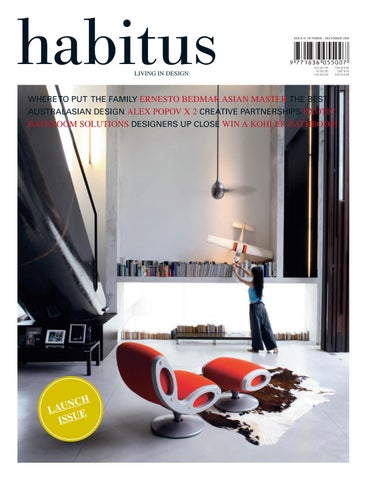
ISSUE 01 OCTOBER – DECEMBER 2008 AUD $12.95 NZ $13.95 USD $15.95 CDN $16.95 GBP 8.50 SGD $10.95 WHERE TO PUT THE FAMILY ERNESTO BEDMAR ASIAN MASTER THE BEST AUSTRALASIAN DESIGN ALEX POPOV X 2 CREATIVE PARTNERSHIPS EXOTIC BATHROOM SOLUTIONS DESIGNERS UP CLOSE WIN A KOHLER BATHROOM
LAUNCH ISSUE
Kohler’s sok™ Overflowing Bath: An ultra deep reservoir, allows two bathers to completely immerse themselves in the water as thousands of champagne-like bubbles emerge gently caressing for a soothing bathing experience. sok™, intentionally beautiful. Call 1300 362 284 or visit www.au.kohler.com for your nearest Kohler showroom. intentionally beautiful
FPA0169/HA
Now all your ideas are possible.
The Izona CoolDrawer will change the way you look at kitchen design. It optimises space by dividing the kitchen into modular zones that break the traditional work triangle. Now you can distribute refrigeration throughout the kitchen and see all your ideas come to life. For more information about the current Izona range and for all future innovations, keep checking tomorrowskitchen.com.au
1. HABITUS REVIEWS
I DISCOVER AN ARRAY OF THOUGHTFUL AND INNOVATIVE DESIGN OBJECTS FROM THE REGION AND BEYOND. READ ABOUT THE LATEST BOOKS. TAKE A LOOK AT DESIGNER WALL CLOCKS AND FIND OUT ABOUT VINTAGE FERRARIS.
24
Design news
This is the Habitus pick of the most interesting furniture and lighting from Milan’s Salone del Mobile ‘08 as well as the latest techno gadgets.
69
insPiReD
Who inspires the inspired?
Sephen Crafti asks Soren Luckins of Melbourne-based design studio, Büro North, who cites contemporary Australian artist, Robert Owen as one of his inspirations.
48 collectoR
Designer, Chris Connell shows Stephen Crafti around his Melbourne home, where he lives with his partner, his cat, and a formidable collection of chairs.
36
Re-sHoot
Habitus reviews an everyday object transformed by design. This issue it is wall clocks.
38
54
conVeRsAtion
Sotheby’s expert, Anne Wall looks at the growing fascination with vintage design Ferraris.
41 montAge
Philip Drew discusses the ideas raised by five recent architectural publications.
2. HABITUS PEOPLE & PLACES
I MEET A COLLECTION OF DESIGN ADVENTURERS WHO HAIL FROM SOUTH-EAST ASIA AND AUSTRALASIA, AND SEE HOW THEIR ENVIRONMENTS REFLECT THEIR LIFE AND WORK.
PARtneRsHiP
Kirsty de Garis ventures into the panoramic Sydney home of landscape designer, Daniel Baffsky, and fashion designer, Sarah-Jane Clarke, and finds a dynamic and symbiotic partnership.
74
cReAtion
Andrea Millar talks to the guys behind Thai industrial design studio, Propaganda and finds they are just as passionate, cheeky and insightful as their products.
85 slow DissolVe
Stephen Crafti meets artist couple, Ashika and Padma Ostapkowicz, whose artworks are as spiritual as their adopted Indian names.
90 close UP
Darlene Smyth profiles prolific Singapore-based Argentinean architect Ernesto Bedmar, and discovers how the tropical environment of South-East Asia, has inspired his work.
3. HABITUS HOMES
I A DIVERSE SELECTION OF THE BEST IN RESIDENTIAL DESIGN FROM AUSTRALASIA AND SOUTH-EAST ASIA.
78 slow DissolVe
The richly layered landscapes of Kuala Lumpur-based landscape architect, Ng Sek San are driven by a sense of environmental responsibility. Chu Lik Ren reports.
62 on locAtion
Penny Craswell visits fashion designer, Akira Isogawa in his Sydney studio, where he reveals the five objects and places that resonate with him, and make him feel at home.
99
scenARio: emmA HoUse
How can contemporary design reflect culture and history?
Chu Lik Ren explores the Emma house in Singapore by FOTA Design and finds a fine example.
habitus | Issue 01 contents 07
109
sCENARIO: BREMER BAY
William Taylor looks at a retreat by SODAA in Western Australia’s remote Bremer Bay, and finds a dwelling that heightens awareness of the natural surroundings
117
sCENARIO: BALGOWLAH
Jane Burton Taylor visits Sydney’s northern beaches and finds a home designed by Reg Lark and a collaborative client that stands out from the norm.
127
sCENARIO: JILLIBY
An accidentally-discovered site became a camping ground for the inhabitants, whose living habits inspired the plan for their home designed by Fergus Scott Architects.
144
sCENARIO: KAO PAN
Tonkao Panin explores a sustainable abode designed by a Thai couple for themselves and their young daughter in Bangkok, which is as playful as a treehouse.
166
DIRECTORs CUT: ALEXANDRIA ROW
David Langston Jones’ design for his own home and studio makes the most of a small site. His approach to modern living results in a compact, yet spacious design.
176
CROss FADE: EMERALD HILL
Making it new… Darlene Smyth explores the make-over of a traditional shophouse in Singapore by conservation experts RichardHO Architects.
150
sCENARIO: TAN QUEE LAN
Erwin Viray discusses how WOHA Architects have brought a brilliant touch of modernity to a heritage precinct in Singapore.
157
DIRECTORs CUT: GEORGE HOUsE
What kind of homes do designers design for themselves? Richard George created a wonderful expression of architetural principles, having designed the house after only five years of practice.
137
sCENARIO: BAY BEYOND
A private yet transparent beach house by Stutchbury and Pape overlooking the bay at Killcare in NSW, takes advantage of the site, Rachael Bernstone reports.
180
HOME MOVIE: PURIANGsA
Dare Jennings, the man behind the Mambo brand, is now proprietor of a motorcycle cafe. Jane Burton Taylor finds out how he and architect, Robert Weir, have transformed a Balinese compound house.
188
JUMP CUT: ALEX POPOV
Same theme, different solutions… Paul McGillick compares and contrasts two projects by Alex Popov Architects in two of Sydney’s waterfront suburbs, Woolwich and Whale Beach.
201
JUMP CUT: COMPOUND HOUsEs
Same theme, different solutions… Designing for the extended family. Jasmeet Sidhu visits a project by Marc Architecture in Malaysia, and Philip Drew explores a project at Guerilla Bay by Julius Bokor.
4. HABITUS SIGN-OFF
FOR SIGN-OFF WE’RE BOTH WHIMSICAL AND PRACTICAL. TAKE A VOYAGE TO SPACES THAT MARVEL AND A CITY THAT LOVES DESIGN. DISCOVER BEAUTIFUL BATHROOM PRODUCTS IN CONTEXT.
214
sPACEs WE LOVE
A collection of diverse and beautiful spaces from the Region.
222
IN CAMERA: BATHROOMs Focusing on specifics, we bring you some inspired ideas to make the bathroom the best room in the house.
236
sNAP sHOT: TOKYO
Snapshots of a wonderfully modern city, plus a guide on where to go and where to stay.
contents habitus | Issue 01 08
Zip HydroTap® at home. Imagine. Imagine. No more waiting for water to boil. No more bottled water to buy. Zip HydroTap gives filtered boiling water and filtered chilled water instantly. For a free quotation call 1800 42 43 44 or visit www.zipindustries.com The terms ‘HydroTap’ and ‘Zip’ are trade marks. Instant Boiling Water
Hey,it’sonlynatural. NSW0293170222ACT0262847245VIC/TAS0394279055QLD0732544788WA0893281500SA/NT0414411562NZ093028885HK0221897068UAE971502547071
www.contemporaryleathers.com.au contemporaryleathers c yescommunications NSW0293170222ACT0262847245VIC/TAS0394279055QLD0732544788WA0893281500SA/NT0414411562NZ093028885HK0221897068UAE971502547071
lifeneeds
Laufen.Atributetotheclassicmodernism. Clearshapes,harmoniousproportions,flawless ceramicsfromEurope’sleadingbathwareproducer. bathe 1300133320orwww.bathe.net.au
yescommunications SwissQuality
paul mcgillick
One reason, is that we’re trying to do with this magazine what I don’t think has been done before in this part of the world – to bring together dwellings of architectural interest with the people who live in them and their way of life. In other words, Habitus is about people who value design, not as something just skin deep, but as an essential part of a life worth living. The magazine is about the design decisions those people make – the house, the products inside, the landscaping, the responses to climate and to the ambient culture – and how those decisions express who they are and what they believe in.
But Habitus has another agenda: to reflect the global economic engagement of Australia and New Zealand through a cultural engagement with their immediate region – South and South-East Asia. The rapid economic development of the Region has been expressed through a new generation of architects (many of whom have been trained in Australia and New Zealand) who have developed an astonishing new wave of ‘tropical modernism’, homes which splendidly reconcile the principles of international modernism with local culture, climate and landscape – and so reflecting the new global culture of what the Indonesians might call ‘unity in diversity’.
Habitus aims to mirror that diversity, and in that respect it will be an invaluable resource of ideas, a stimulus and even an inspiration for those who are driven to express who they are through the environment they create for themselves. The name, I think, communicates wonderfully what we are on about, adopting the term promoted by the great French sociologist, Pierre Bourdieu, and summarised by the Australian academic, Mark Bahnisch, as denoting “a constellation of attitudes, practices and behaviours peculiar to a particular group”.
Habitus is not a repository of ‘politically correct’ architecture or a guide to the latest fads in design. It is about diversity and about the stories behind the design choices people make. To quote the great Viennese proponent of ‘non-dogmatic’ architecture, Oscar Strnad: “We shouldn’t live practically, we should live pleasurably; we should feel a bond with the things in the home. The dwelling must suit the character of its occupants, and that is the architect’s sole task.” Or, what about Strnad’s famous colleague, Bernard Rudofsky: “Architecture is not just a matter of technology and aesthetics, but the frame for a way of life – and, with luck, an intelligent way of life”, what Rudofksy elsewhere described as reconciling “technology with the art of living”.
The magazine is organised into various departments which basically represent different approaches to the whole ambit of dwellings, interior and personal products, landscape and climate. Each department has been given a heading drawn from the world of film. Why? Well, imagine Habitus is a film and you can begin to appreciate the rhythms, the sharp or gradual transitions, the textures, the colours, the details and the broader picture, the personal and the social which characterise the way of life of a rich and diverse region which Habitus sets out to celebrate.
15 habitus | Issue 01
editor’s letter
Paul McGillick, Editor
I “Architecture is not just a matter of technology and aesthetics, but the frame for a way of life – and, with luck, an intelligent way of life.”
I Welcome to Habitus and to what I think is a very special magazine – for all sorts of reasons!
Jasmeet sidhu
Writer
Jasmeet Sidhu, writer of the Rumah Kenangan story in the Jump Cut feature on page 201, studied architecture at Newcastle University before undertaking post-graduate studies in design computing at Sydney University. He established Designscape/Arkitek JazSidhu, completing projects in Malaysia, India and the Middle East and was also the editor-in-chief of Architecture Malaysia from 2005-2007. Jasmeet lives in a leafy hillside suburb in Kuala Lumpur known as Bukit Antarabangsa (International Hill) near the Petronas Twin Towers.
darlene smyth
Writer
Born in Canada, Darlene Smyth has studied communications, music, environmental design and architecture. Darlene has practised architecture extensively in Singapore, where she met up with the legendary Ernesto Bedmar for our Close-Up profile on page 90.
andrea stevens
Writer
Auckland-based freelancer Andrea Stevens wrote the George House text on page157. She lives in a house she designed in the eclectic suburb of Point Chevalier in Auckland with husband Greg, two daughters Stella and Sina and Louis the cat; and loves her Tretchiko African lady print for its vibrant colours, strong presence and mystique. This year, Andrea’s focus is to replace the weeds in her organic garden with vegetables.
Chu lik ren
Writer / Photographer
Chu Lik Ren lives in Singapore with wife Lini and son Zach, and wrote the Emma House article on page 99. Lik Ren studied architecture, but his position as a new father has inspired his current interest in more mundane objects such as movable baby cots, strollers and milk bottle sterilisers. This year, Lik Ren hopes to venture into Asia’s emerging new cities and contribute to its architecture.
anthony Browell
Photographer
Sydney-based portrait, editorial and architectural photographer, Anthony Browell, photographed the Guerilla Bay project in the Jump Cut feature on page 201. He has recently discovered the thrill of lens-less photography and is exploring the delights of his homemade large-format pinhole camera used so brilliantly to reveal the Alexandria Row House on page 166.
simon devitt
Photographer
Photographer Simon Devitt resides in a 1970s flat-roofed house that cantilevers over a slope of dense tropical loveliness in Titirangi in West Auckland, New Zealand, along with his short-haired exotic cat Queenie. Simon shot the beautiful George House feature on page157 and says of his love for beauty – “a lot about photography for me is beauty... beauty is present in all things... and revealing it is the most satisfying reward”.
Paul lovelaCe
Photographer
Paul Lovelace began his photographic career in London freelancing for The Times, and moved to Sydney in 1995 with wife Tabatha and children William and Georgia. Their home is a two-minute walk to one of the most scenic cliff walks in Sydney towards Watsons Bay, but Paul finds it just as satisfying to look up at the detailed art deco ceiling in in house, which he says adds character to the whole living space.
kirsty de Garis
Writer
Kirsty de Garis wrote the Partnership story on page 54. She lives with fiancée Tim and Bernie the groodle (golden retriever x poodle) in an art deco apartment in Sydney’s Rose Bay, which is filled with art picked up from Africa and Europe. Whilst in Portugal, Kirsty watched the transformation of brushed stainless steel sheets into Cutipol cutlery and salad servers, and loves their modernist shape.
PhiliP drew Writer
Philip Drew has written widely on international and Australian architecture, including the Guerilla Bay story in the Jump Cut feature on page 201. He lives with his geotechnical engineer daughter in a century-old terrace in Annandale, a model township which he claims has the most beautiful spire in Sydney. Philip’s favourite objects at home are a plastic red Vico Magistrettidesigned Gaudi chair, and a graceful black Beech Gazelle lounge from Norway.
raChael Bernstone Writer
Writer of Bay Beyond feature on pages 127, Rachael Bernstone lives in a new terrace in an old street near the Cooks River in Sydney, with partner Scott, new baby boy Sam Alexander, dog Panchez and Lennie the cat. She is passionate about design, has recently returned to live in Sydney after a two-year stint in Alice Springs, and loves her red Sunbeam coffee machine because it makes excellent lattes.
tonkao Panin Writer
Tonkao Panin, writer of the KaoPan House feature on page 144, is a practising architect based in Bangkok. Born in France, Tonkao studied architecture in Thailand and then completed her PhD at the University of Pennsylvania. She also teaches at Silpakorn University in Bangkok.
stePhen Crafti Writer
Stephen Crafti, writer of Inspired story on page 48 lives in an apartment in Melbourne with his partner and one of his two sons. After years of living with post-war designer furniture, Crafti now surrounds himself with a few contemporary pieces: a Patricia Urquiola ‘Smock’ chair and a lounge suite by Schamburg + Alvisse. “If I had to single out a few of my favourite pieces, it’s my wall scultpture by Elizabeth Delfs and framed photographs taken by Australian photographer, Robyn Beeche.”
Grazia BranCo
Photographer
Photographer of the Emma House feature on page 99, Grazia Branco was originally a student of architecture, but now specialises in photography. Born in Rome she has lived in Lugano, Switzerland since 1995 and resides there with journalist husband Oliver and daughter Chiara. Their favourite items in the house are the extremely comfortable Basket model chairs from the 1950s designed by Franco Legler.
Jane Burton taylor Writer
Jane Burton Taylor, writer of Balgowlah House feature on page 117, is a journalist who writes predominantly on the subject of residential architecture and design, her personal interest being the discovery of visionary and courageous collaborations between owner and architect.
heidi moore Stylist
Sydney-based stylist Heidi Moore styled the Baffsky and Sass shoot on page 54. Heidi lives in a gothic Victorian cottage with 5 year old daughter, Jemima, James and Molly the fish with an enormous Moreton bay fig tree outside. She cites an Angus McDonald drawing of a large black bull as her favourite object in her home –“its beautiful execution and huge scale make it an arresting image,” says Heidi. Her big plans for the latter half of ‘08 include finishing her contemporary gravel garden.
roBert frith Photographer Robert Frith’s mum gave him a camera at age 12, successfully distracting him from a promising career in delinquency. He has gone on to run a studio near Perth’s CBD and photographed the Bremer Bay project on page 109. Robert lives close to the beach with partner Karen, four year old Orlando, two dogs and a couple thousand earth worms, and loves his bicycle for its potential in helping his own and the planet’s health.
16 habitus | Issue 01 contributors
editorial & contributing team
17
Paul lovelace Photographer
Kirsty de Garis Writer
anthony Browell Photographer
heidi Moore Stylist
roBert Frith Photographer
rachael Bernstone Writer
tonKao Panin Writer
stePhen craFti Writer
darlene sMyth Writer
andrea stevens Writer
chu liK ren Writer / Photographer
Grazia Branco Photographer
JasMeet sidhu Writer
Jane Burton taylor Writer
PhiliP drew Writer
siMon devitt Photographer
TRP MI 949 Miele Showrooms VIC Knoxfield 03 9764 7670, South Melbourne 03 9764 7199 NSW Frenchs Forest 02 8977 4230 QLD Eagle Farm 1800 798 578 SA Hilton 1800 018 770 WA Claremont 1800 094 872 NZ Mt Wellington 0800 264 353 or visit www.miele.com.au
Built into your kitchen, a Miele coffee machine makes a clear statement of streamlined, good taste - along with impeccable espresso, cappuccino or latte macchiato, all with perfect Barista crema. Made in Germany to exacting standards, this beautiful machine has ‘world’s best’ inscribed on every sleek line and perfectly finished curve.
Because great coffee should be up there with great food, our machines are built in, next to our ovens.
FroM thE PUblishEr
This is the very first issue of Habitus, and the Indesign Group’s latest chapter in the wonderful and crazy world that is boutique publishing.
Continuing with our tradition of bringing to market the highest quality design publications, Habitus joins our stable of mags – Indesign and DQ – to deliver the most complete offering of design publications in our Region. We believe that now more than ever, design and architecture are the way forward as a means for selfexpression. Whatever your beliefs, culture, passions and how you see yourself in this world, your way of life is being expressed through the choices you make. Whether you are a doctor, lawyer, artist or architect, design is a way of life. It is not about affluence – it’s about the aquisition of knowledge and applying that to your life.
Habitus explores how we interact with design on a daily basis. Rather than being something reserved for design professionals and cold academic journals, Habitus aims to humanise design by looking through a magnifying glass at design hunters and seekers – the people responsible for driving design choices. We talk to them (and they to us) about the meaning in design, how we live with design, how to foster creativity, where to find inspiration – all the things that give design a life of its own. We accept that design functions in a greater framework of art, culture and technology, and we explore these things too.
But Habitus is also doing something unique. We’ve realised that it’s about time we start to think about design in terms of our Region. The nations around Australia and New Zealand are changing fast, and they are nurturing their own unique design traditions that blend culture, history and climate. Collectively, our Region is an undeniably rich resource of intelligent ideas and fascinating design hunters and seekers.
Habitus will quickly become the single most effective resource for design hunters and seekers in our Region.
raj nandan
Editorial dirEctor Paul McGillick habitus@indesign.com.au
associatE Editor Andrea Millar andrea@indesign.com.au
assistant Editor Nicky Lobo nicky@indesign.com.au
dEsign and art dirEction Wishart Design wishartdesign.com
art dirEctor Karlee Bannon
JUnior dEsignEr Jessica Ryan
contribUting WritErs Pirak Anurakyawachon, Rachael Bernstone, Jane Burton Taylor, Chu Lik Ren, Stephen Crafti, Penny Craswell, Kirsty de Garis, Philip Drew, Tonkao Panin, Jasmeet Sidhu, Darlene Smyth, Andrea Stevens, William Taylor, Erwin Viray
contribUting PhotograPhErs
Azrul Abdullah, Pirak Anurakyawachon, Mike Baker, Lizette Bell, Patrick Bingham-Hall, Anthony Browell, Kraig Carlstrom, Chu Lik Ren, Simon Devitt, Robert Frith, Grazia Branco, Simon Kenny, Albert Lim, Paul Lovelace, Trevor Mein, Sithisak Namkam, Michael Nicholson, Prue Ruscoe, Shania Shegedyn, Carby Tuckwell
PUblishEr / Managing dirEctor
Raj Nandan raj@indesign.com.au
oPErations ManagEr
Adele Troeger adele@indesign.com.au
bUsinEss dEvEloPMEnt
ManagEr
Richard Burne richard@indesign.com.au
ProdUction dEsignErs
Bronwyn Aalders, Lauren Mickan, Sarah Djemal, Camille Manley, Eunice Ku
ProdUction assistant
Kristy Macfie kristy@indesign.com.au
Financial dirEctor
Kavita Lala kavita@indesign.com.au
accoUnts
Gabrielle Regan gabrielle@indesign.com.au
Darya Churilina darya@indesign.com.au
onlinE coMMUnications ManagEr
Rish Raghu rish@indesign.com.au
bUsinEss dEvEloPMEnt ManagEr (onlinE)
Amy Doherty amy@indesign.com.au
brand ManagEr
Emma Telfer emma@indesign.com.au
EvEnts coordinators
Kylie Turner kylie@indesign.com.au
Angela Raven angela@indesign.com.au
advErtising EnqUiriEs
Richard Burne richard@indesign.com.au 0423 774 126
covEr iMagE Emma house, singapore, Fota design
Photo: grazia branco
indEsign PUblishing
Level 1, 50 Marshall St Surry Hills NSW 2010 (61 2) 9368 0150 (61 2) 9368 0289 (fax) indesignlive.com
Printed in Singapore
All rights reserved. No part of this publication may be reproduced, stored in a retrieval system, transmitted in any form or by any other means, electronic, mechanical, photocopying, recording or otherwise. While every effort has been made to ensure the accuracy of the information in this publication, the publishers assume no responsibility for errors or omissions or any consequences of reliance on this publication. The opinions expressed in this publication do not necessarily represent the views of the editor, the publisher or the publication. Contributions are submitted at the sender’s risk, and Indesign Publishing cannot accept any loss or damage. Please retain duplicates of text and images. Habitus magazine is a wholly owned Australian publication, which is designed and publishved in Australia. Habitus is published quarterly and is available through subscription, at major newsagencies and bookshops throughout Australia, New Zealand, South-East Asia and the United States of America. This issue of Habitus magazine may contain offers or surveys which may require you to provide information about yourself. If you provide such information to us we may use the information to provide you with products or services you have. We may also provide this information to parties who provide the products or services on our behalf (such as fulfilment organisations). We do not sell your information to third parties under any circumstances, however these parties may retain the information we provide for future activities of their own, including direct marketing. We may retain your information and use it to inform you of other promotions and publications from time to time. If you would like to know what information Indesign Group holds about you please contact Nilesh Nandan (61 2) 9368 0150, (61 2) 9368 0289 (fax), subscriptions@indesign. com.au, indesignlive.com Habitus magazine is published under licence by Indesign Group.
ISSN 1836-0556
20 habitus | Issue 01
www.rc-d.com.au Your own Tibetan experience ...imagine the possibilities MELBOURNE (HEAD OFFICE) 573 CHURCH STREET, RICHMOND T: 03 9428 6223 OPEN 7 DAYS SYDNEY 112-116 PARRAMATTA ROAD STANMORE T: 02 9519 8555 BRISBANE 5 LIGHT STREET FORTITUDE VALLEY T: 07 3852 6300 PERTH T: 04 2221 2400
Australian design with environmental credentials, made and crafted in Melbourne. Jardan produces beautiful furniture. Showrooms Melbourne 03 9548 8866 Sydney 02 9663 4500 Brisbane 07 3257 0098 Perth 08 6389 2822 Singapore +65 6438 4688 www.jardan.com.au let the inside out
Pictured – Sky sofa and Flynn table
Discerning design: the best in furniture & lighting, technology
designer kids &
‘ ’
23 habitus | Issue 01 1. reviews
habitus | Issue 01 living design news 24
I 01
THE STRAUSS CHAIR Thonet revisits the classic straw seated chair in a contemporary way. This re-interpretation by Gebrüder Thonet Vienna expertly creates a great quality, beautiful looking object. Other possible combinations include a black frame and a natural straw seat or a white frame with an anthracite grey seat, thonet.com.au
“Design is EVERYTHING WE MAKE. It’s also a mix of craft, science, storytelling, propaganda, & philosophy.”
ERIK ADIGARD
SERIES 7
It’s not the crystal design styling, the full HD resolution or fast response time – it’s the internet connectivity that sets these TVs apart. With a broadband connection you can hook it up to get live news & stock feeds, samsung.com.au
re-vamping
Italia has one thing at it’s core, a desire to relax you. Comfort is king in this collection which is a much less formal take on the B+B norm. There are six different modules with simple shapes and generous proportions to combine as you wish, space.com.au / bebitalia.it
25
FRANK SOFA The latest sofa design by Anthony Citterio for B&B
THE ANDOO LOUNGE CHAIR Knoll Furniture introduces a finely crafted armchair to complement the existing ‘Andoo’ range. It’s simplicity and soft leather make it a stand-out design, knoll.com / dedece.com.au
LUCKY CARPET A new range of rugs by Cappellini, the ‘Magic’ carpet range appears to be influenced by geometry and nature – a successful combination, cappellini.com.it / dedece.com.au
TEATINA Designed by Martina Grasselli of S.M.O.G Milano, this porcelain tea set is part of a series designed to reinterpret everyday objects, smogmilano.com
PAESAGGI ITALIANI Edra has spent time
their catalogue collection, including the modular furniture pieces designed by Massimo Morozzi, edra.com / space.com.au
I 02 I 04 I 07 I 03 I 05 I 06
HDTV
BL10 The incredibly covetable, modernist Bestlite lamp originally designed by Robert Dudley Best in1930 has been adapted to include this extendable wall version with an adjustable head, corporateculture.com.au
TREE HOOKED More than a coat rack, the design of dutch duo Jan Habraken and Alissia MelkaTeichroew creates a lovely picture of branches growing wildly along a wall, van-esch.com
SATYR ARMCHAIR Designed by For Use, the armchair version of the sofa, stool, and chair is a smart casual invitation to relax, lean back and put your feet up, classicon.com / anibou.com.au
IZONA COOLDRAWER Fisher and Paykel are redefining kitchen space with the first multitemperature fridge (it can switch from fridge to freezer) in a 900mm wide easy, pull-out drawer system, fisherpaykel.com.au
DAMA Part of the Poliform day collection, these walnut and cedar coffee tables designed by CR&S offer a relaxed alternative to conventional 4 legged versions, poliform.com.au
BOTANICA Poufs resembling huge blossoms combine Asian influenced shapes with Western upholstery techniques. The glossy and opaque surfaces bring out the rounded volumes, hausenwinkelschaub.com
living design news habitus | Issue 01 26
“Design is a plan for ARRANGING ELEMENTS in such a way to accomplish a particular purpose.”
I 08 I 09 I 12 I 13 I 10 I 11
CHARLES EAMES
INTEGRATED BARBECUE A sophisticated version of the outdoor bbq is born with the introduction of this slick integrated version by Electrolux. It’s available with either a pivoting cooking hood or flat lid, electrolux.com.au
MISSONI HOME ‘08 The latest home collection delivers colour, pattern and an uber cool joie de vivre to the outdoor garden or courtyard. Look out for motifs including the season’s tulip, butterfly, polka dot and stripe, spenceandlyda.com
outdoor 27
BIBU Designed by Niels Van Eijk and Miriam Van Der Lubbe in The Netherlands, this weatherproof garden seating solution designed with chair frames and timber slats poses the question, is this a bench or a series of chairs?, van-esch.com
I 14 I 16 I 15
1300 119 119 For our latest brochure phone Mosaici Carbone www.caesarstone.com.au Mosaici Marrone New 2008 Colours Imagine the Difference
design news baby + child
ART TIME EASEL Perfect for the budding young artist and environmentalist. Constructed from just three pieces of 100% formaldehyde-free, environmentally friendly SmartWood, ecotots.com
SAVE Swedish designer Katarina Hall creates bedroom furniture that takes it’s inspiration from deserted old houses where doors and windows are boarded up. A witty design, the range is sophisticated enough for adults and playful enough for kids, katarinahall.se
BABY WARMERS No need to worry about cool weather and babies with these uber-cute sleeping bags for the very small people among us. Available in black only in sizes: 3 to 6 months and 6 to 12 months, thecoolhunter.com.au
PREGNANT CHAIR Sydney designer Trent Jansen’s chair design for Dutch design powerhouse Moooi has mama and baby in mind. The seat has hinged flaps that open up to reveal a toddler version of the orginal, moooi.com / spacefurniture.com.au
MIA COMPOSITIONS If you needed proof that children’s spaces are now the next room in the house – after bathrooms – to be re-invented into contemporary design havens, take a look at the ranges from Italian firm, Pianca, pianca.it
30 habitus | Issue 01
I 17 I 19 I 20 I 21 I 18
SWIMS If the wet weather of La Nina is set to replace the dry spell of El Nino, these overshoes will come in handy. Available in a ballarina style for women or Mobster boot for men, colours include more conservative options, swims.no
SURFACE TENSION A very useful toy, this arcade gaming, internet browsing, iTunes playing, backlit chess board coffee table is what every rumpus room needs, surface-tension.com
MONSOON VERMONT These trash chic, ecofriendly toiletry bags (pictured), waste bins and shower curtains are made from recycled rubbish artfully collaged together, monsoongroup.com
habitus | Issue 01
32 play I 22 I 25 I 26 I 23 I 24
design news
BAMBOO, Is a new range of visually rich and tactile home accessories by design guru’s Dinosaur Designs, dinosaurdesigns.com.au
NOKIA N96 The sequel to N95 and an option to the recently released Apple iphone, this product was designed with the best of everything in mind. Think extra memory, mobile tv viewing, gps, and a dual-flash high-resolution camera, nokia.com
“Colour does not add a pleasant QUALITY TO DESIGN – it reinforces it.”
PIERRE BONNARD
ASUS Eee PC 900 The ‘it’ item for ‘08, this is a fully-functional laptop the size of a paperback novel. It can supplement or replace your other PCs and can run either Windows or Linus software, eeepc.asus.com
ANGLEPOISE TYPE 1228 New semi-translucent shade colours including green, orange, blue and smokey grey have been released for the well-loved table lamp by Kenneth Grange. It also has floor standing pole, wall bracket and desk clamp options, anglepoise.com
AC01 CORPUS This clean-lined drawer for plans has architects top of mind. It’s by notable design house E15. e15.com / format.com.au
SANCTUARY This simple but genious creation is capable of simultaneously charging multiple electronic devices, while offering a central location to place the multitude of personal everyday items that are too often misplaced, bluelounge.com
TABOURET HAUT STOOL Featuring Jean Prouve’s unique design signature, this stool originally designed in 1942 looks equally current today, vitra.com
work
I 27 I 30 I 31
29 I 28 33
I
QUEENSLAND ARCHITECTS TURN UP THE HEAT
Meeting the demands of rapid urbanisation is a challenge for architects the world over. Burgeoning needs for medium and high density accommodation, combined with a diminishing pool of renewable resources such as energy and water, are presenting town planners and architects with problems previously unforeseen.
While many have been caught off-foot in this new world of climate change and population demands, Queensland architects have been working steadily for the past decade or so on creating a new paradigm for environmentally responsive design.
Queensland is perfectly poised to take a world-leading position with many of the environmental design challenges facing architects today. It is a state with a plethora of worldrenowned natural assets, a climate that knows well the extremes of nature, and an urban population growing more rapidly than any other in Australia. Forget images of weatherboard houses teetering on wooden stilts – contemporary design solutions in Queensland cover a range of aesthetic disciplines. Examples range from grand public buildings which are welcoming and inclusive, to multi-purpose complexes where work, play and study spaces blur into a whole-of-community precinct. This evolves through to singular residential architecture which embraces the Queensland love of outdoor living.
AD
Recognising this, a new Queensland Government initiative entitled HEAT: Queensland’s new wave of environmental architects, has been launched to promote Queensland’s highly topical and keenly sought environmental expertise on the world stage.
Tourism, Regional Development and Industry Minister Desley Boyle says there are close to 2,800 architectural firms in Queensland, some of them internationally-renowned. “Architects such as Cox Rayner, Donovan Hill and Architectus and HOK Sport are world famous for their work,” she explains.
“With the HEAT campaign, we are telling the story of Queensland’s architects through an extensive marketing campaign which will focus on the environmental expertise of our architectural industry.
“It also highlights our ability to design for tropical and sub-tropical environments and the rapid way we have embraced the challenges of climate change.
“As part of this initiative, we are producing a range of materials, including the HEAT publication, which focuses on contemporary Queensland environmentally responsive design, our collaborative projects with international clients and allied industries, our response to rapid urbanisation and high quality control for setting new international standards.”
Queensland architecture is at the forefront of environmentally responsive practices. What began with residential architecture, with blurred boundaries between indoor/outdoor living, moved onto public buildings. These include the award-winning Gallery of Modern Art (GoMA) and Queensland State Library, where the huge scale is countered by connection to community and place.
• HEAT, Queensland’s new wave of environmental architects, will be conducting a range of international and onshore initiatives, including media campaigns, trade missions and a suite of collateral, including the HEAT publication. To register your interest in Queensland’s environmental architecture talent, email architecture@dtrdi.qld.gov.au to request a copy of the HEAT publication.
34
sponsored
I 01
Creating sustainable and responsible buildings in Queensland’s highly sensitive environment is not only a challenge but an imperative. Designing urban and regional landscapes that both protect and enhance natural surroundings requires architects who are in tune with their environment and confident in their ability to work with climate, geology and natural boundaries.
A number of skills and attitudes are common among leading Queensland architects, who deal with these challenges in inspiring ways. They are:
• an ability to visualise holistically, especially in extreme climates,
• a creative response to ecological and social challenges,
• a willingness to embrace international collaboration and support other professional disciplines,
• a mindfulness of place and its connection to culture, and
• the social and cultural impact a built environment has on community.
While the HEAT campaign is concentrating on taking Queensland architecture to the international stage, one of the first initiatives has introduced the concept to the domestic market. ‘Place Makers: Contemporary Queensland Architects’, is a stunning exhibition on display at GoMA until 23 November.
“The Queensland Government is a proud supporter of this exhibition,” says Ms Boyle.
“It reflects the diversity of residential work being produced in Queensland, presents recent award-winning public buildings and highlights their capacity to create important social spaces within urban centres.”
For more information, contact the Creative Industries Unit on telephone +61 7 3224 2861 or go to www.dtrdi.qld.gov.au
35 habitus | Issue 01 news
I 03 I 02 | 01
| 02 Queensland Brain Institute –
Bligh Voller Nield –Flow Apartments
| 03
John Wardle Architects + Wilson Architects
(in association)
Cox Rayner –Thuringowa Riverway
Half Time Clock
Christie Bassil Diamantini & Domeniconi Space Furniture spacefurniture.com.au RRP$360 AUD
TICK TOCK...
designer strokes re-define a traditional object
There was a time when clocks – grandfather clocks, cuckoo clocks, flip clocks, even radio alarm clocks – were coveted for reasons as much to do with tradition and function as decoration. That is, until their fall from grace for not keeping up with the space contraints and purist lines of the times. Until now...
The Xemex swiss watch brand has been synonymous with classic design and you may recognize the watch face. Now it has been released as a striking wall clock version of the popular original. Timeless time-keeping, it’s a purists dream and its swiss function will last (and last) the distance.
Cuckoo clocks have always resonated with clock-lovers so it was only natural that it would be re-born as a sleek and sexy black number to cater for a contemporary crowd. In a black lacquered timber frame it’s also available in green. The best part of all is that it’s relatively cheep cheep.
Grandpa Clock Tsu. R Jansen + Co dedeceplus dedeceplus.com RRP$97.50
For the love of type! A homage to 20th Century fonts, the aptly-named ‘Font Clock’ is a 21st Century take on the British 24-hour clock. Designers love its playful use of typographic elements, the rest of us are mesmerised by it’s flip action, size and style.
This clock by PearsonLloyd delivers on the scale of a traditional grandfather clock, but ingenuinely also offers a storage solution to double-up its function. Use it as a coat rack? ‘Horizon’ is part of a modular storage system comprising building blocks in a variety of colours and veneers.
We’re sure this ‘Grandpa Clock’ is set to become a classic. Printed on canvas it playfully looks more like a roll of wallpaper. A new interpretation of the classic grandpa clock, it’s as much art as it is a functioning timepiece with hands that move. Roll it up when not in use.
habitus | Issue 01 36
re-shoot
Font Clock Sebastian Wrong Established & Sons Format Furniture formatfurniture.com RRP$690 (small), $1990 (medium) $2970 (large) AUD
Wall Clock
Quorumtime quorumtime.biz RRP$295
Xemex
Hallway Clock PearsonLloyd MO mozoo.es RRP$2660
sydney melbourne brisbane singapore canberra darwin adelaide perth 1300 306 960 nube armchair design jon + jesus gasca
anne wall, sotheby’s australia
Front seat
I What do Nicolas Cage, Eric Clapton, Clint Eastwood, Jamiroquai’s Jay Kay, Pink Floyd’s Nick Mason, Microsoft’s co-founder Paul Allen, James Coburn, Ingrid Bergman and Michael Schumacher all have in common?
An unbridled passion for vintage design Ferraris.
sought after that they are usually sold privately and very quickly. Rarely available in public offerings Coburn’s Spyder, in its original black, recently sold for €7,040,000. It retailed for US$9000 in 1961.
What is it about vintage design Ferraris that make them so sought after?
“…each and every model characterises an historic moment and launches the basis for future evolution. There are many motorcars that, in the story of this company, represent significant historical moments,” says Luca di Montezemolo, Presidente Ferrari.
The mystique of Ferrari begins in Maranello, Italy. Home of the famous Fiorano Test Track, which is used exclusively for road and race car development, there are no facilities for spectators and access is extremely limited. Ferrari’s have always been produced in Maranello. Though there have been many designers at Ferrari, all are remembered and beloved for their particular innovations. Ferrari design is the embodiment of performance meeting comfort – each innovation is made with the intention of improving speed and meeting driver’s demands. Records of any changes, such as engine revisions, and service should remain with each car and ideally a Ferrari will be in largely original condition, accompanied by the original factory build sheets and a Ferrari Certificate of Authenticity.
As Nick Mason puts it, “to my mind, a great Ferrari is a little like a Fender Stratocaster – it’s not just a guitar, it’s Rock and Roll. An instrument in the right hands to get the right results has to take on some element of romance.”
James Coburn shared a passion for Italian sports cars with close friend and fellow Ferrari enthusiast, the legendary Steve McQueen. James Coburn once said “Actors are boring when they’re not working, it’s a natural condition.” A good way to cure boredom is to buy a Ferrari. Coburn himself once possessed a 1961 Ferrari 250 GT SWB California Spyder, the thirteenth of the fiftysix that were built, followed by other Ferraris including a 1967 412P. Over the course of his 25-year ownership, Coburn was a regular sight in his Spyder, using it as a daily driver to and from the movie studios. Additionally, on weekends,
he, along with McQueen and fellow actor James Garner, could often be found testing their driving abilities through the winding Hollywood hills. William Claxton recalls, “We would set a place to meet for lunch and then take off, Steve in the Lusso and me in my Porsche 356 SC 1600. Steve’s idea of fun was to go roaring off and, a couple of hours later, be parked at the side of the road pretending to be bored waiting for us to arrive. It was a great time. He really loved that car.”
With glorious design, great handling and a sound like no other in the automotive world the 250 GT SWB California Spyder is thought by many to be the pinnacle of road going Ferraris. If you could only have one, this would be it.
Throughout Coburn’s ownership, he repainted the vehicle three times, first in dark blue, followed by silver and finally burgundy. They are so
A car such as Coburn’s Spyder becomes even more desirable with such a wonderful history, though celebrity owners are certainly not the only reason vintage Ferraris are so sought after. Much of the legend that surrounds Ferrari is due to its success in F1 and road races throughout the world. Rosso Corsa, or ‘race red’, is the red international racing colour of Italy, as green is for England, and a colour Ferrari has made it’s own. In Ferrari’s serial numbering scheme, even numbers were reserved for series intended for competition, while models destined for road use were given odd numbers. The early Ferrari road cars were produced in very small numbers and this rarity certainly adds to their cachet and value. The history of a car; the races it has been in and won, the driver’s who have occupied the front seat – all form a part of the mystique and prestige possessed by vintage Ferrari’s. Each model better in some way than the last, all are phenomenal beasts of exceptional design.
In an interview in 1974 Enzo Ferrari was asked, “Mr Ferrari, of all the race cars you have built which is your favourite?”
He answered, “The car which I have not yet created.”
For more information, contact Sotheby’s Australia on (61 2) 9362 1000, sothebys.com.au
habitus | Issue 01 38 conversation
.a & white 16 FOSTER S T S URRY HILLS P H 02 9212 6747 www.spenceandlyda.com.au 2008 homewares collection
group p: +61 7 3881 1777 www.gibbongroup.com.au
49 colours endless combinations gibbon
furniture and rug design by Koskela, Sydney NSW upholstery fabric Woven Image Icon classic felt
PHILIP DREW reviews five new books and uses them as a jumping -off point for a THEMED discussion
habitus | Issue 01 montage 41
montage philip drew
the fifth agenda – to seduce
Philip Drew is a Sydney architectural historian and critic.
01, 02, 04 Modern
TradiTions: ConTeMporary arChiTeCTure in india
Peter Klaus-Gast
Published by Birkhäuser
Distributed by Books at Manic 128pp Hardcover AUD$93.50 (61 3) 9940 1556, manicex@manic.com.au
03 BrandsCapes: arChiTeCTure in The experienCe eConoMy
Anna Klingmann
Published by The MIT Press
Distributed by Footprint Books
364pp Hardcover AUD$47.95 (61 2) 9997 3973, sales@footprint.com.au
05 25 TropiCal houses in singapore and Malaysia
Paul McGillick, photographs by Patrick Bingham-Hall
Published by Periplus
Distributed by Berkley Books 224pp Hardcover AUD$65 us.penguingroiup.com
06 gunyah goondie + Wurley: The aBoriginal arChiTeCTure of ausTralia
Paul Memmott
Published and distributed by University of Queensland Press 412pp Hardcover AUD$90.00 (61 7) 3365 7244, uqp@uqp.uq.edu.au
07 CorrugaTed iron: Building on The fronTier
Adam Mornement & Simon Holloway
Published by Frances Lincoln Limited
Distributedby Bookwise
International
323pp Hardcover AUD$89.95 (61 8) 8444 5304, orders@bookwise.com.au
The premise of Anna Klingmann’s Brandscapes is that branding and architecture have developed an intimate relationship.
The book explains the phenomenon of signature architects and the hunger for iconic buildings. It offers a persuasive argument about the importance of brands in interpreting the economic and cultural drives behind such phenomena as Frank Gehry’s Bilbao Guggenheim. Brands, Klingmann claims, are “lifestyle packages”.
She presents a Madison Avenue version of architectural history and interprets architecture’s goal as the creation of brandscapes – built environments that, by their uniqueness, constitute sites for moving experiences, advertising corporations and cities.
Klingmann’s writing style is ponderous, making it hard going. For all that, it surprisingly doesn’t delve deeply into the early history of branding, nor does it explore how architecture became involved (accidentally) through Frank Lloyd Wright’s Johnson Wax building (1939) and Guggenheim Museum (1960) which serve as exemplars of the spontaneous power of architecture to generate publicity for the clients.
Architects can convert their architecture into a brand – but at the cost of reducing their designs to a predictable formula! The Norman Foster architectural practice has become a franchise: If you require his personal attention, you are advised to pay a 10% surcharge.
Klingmann’s book reinterprets history from modernism to post-modernism. She contends that the information age has created two new agendas for architecture. In modern architecture, she says, the primary goal was driven by three possible agendas: to perform, to appeal and to impress. With branding, a fourth and fifth agenda have appeared: to differentiate and to seduce. She writes: “Brands define the way we live, the experiences we choose, and whom we associate with.” We live in an ‘experience economy’ and the paradigm of style has been replaced by the paradigm of lived experience.
In lieu of modern architecture’s enslavement of a formal aesthetic (its “moralising corset”), with the creation of a perfect object with style, she offers architects a new servitude as creators of formulaic brandscapes serving up “experiential landscapes”. This is seductive rhetoric and it sounds neat – too neat!
The principal weakness with Klingmann’s branding thesis is her failure to understand the origins and development of branding. She avoids a detailed consideration of why brands succeed or fail, their limits, how they limit creativity and innovation. Branding techniques can be used to control and pervert, to support totalitarian regimes which enslave artists as happened under Stalin. This is the dark side of branding.
Another weakness is her poor understanding of architecture. Klingmann builds on the earlier foundations of Robert Venturi, whose theories have been undermined by the poverty of his own architecture.
Philip Johnson never quite grasped these cultural undercurrents because they were identified with the radical left and with Jewish intellectuals – hence his reduction of modernism to an international style. History may be presented as a succession of brands: the Greek, Roman, Romanesque, Gothic brands etc., and its great masterpieces as little more than iconic brandscapes. Only someone completely insensitive to history would undertake to reduce such marvellous crystallisations of human spirit to a marketing paradigm. The fact that Klingmann takes her thesis about branding so seriously trivialises architecture and risks turning it into a lifestyle package.
One of the more objectionable aspects is her interpretation of architecture as an adjunct to brand advertising – for example, the juxtaposition of a Nissan Maxima car with Glenn Murcutt’s
habitus | Issue 01 42
I 01
Moruya beach house in a television ad as a device to Australianise the car. She is not advocating a policy of “Nice and Ordinary” architecture, rather she aspires to an architecture that delivers experiences and entertains – Disneyworld and Las Vegas writ large. You may choose to disagree with her populist conclusion, but there is no avoiding the reality that we live in a media-saturated age of celebrities and fashion – a shallow plastic culture, in which people are exhorted at every turn to consume houses, cars, boats and holidays until they eventually explode.
Thankfully, the world beyond the US does not resemble Klingmann’s stereotypical picture of bloated consumption-led economies. In India, Singapore and Malaysia, the challenge of creating delight in a tropical climate brings one down to earth. Peter Klaus-Gast’s introduction to Contemporary Architecture in India opens new vistas few of us are privileged to know directly. He offers a tantalising collection of the themes Indian architects wrestle with: the challenge of a long, deep, spiritual legacy; independence after a long colonial period; the ending of a socialist system and its replacement by a liberal market economy after 1991.
Paul McGillick’s survey of contemporary houses in Malaysia and Singapore invites us into the intimate spaces of new states that have emerged as successful thrusting economies in South-East Asia which all of us should know more about, not merely because they are close neighbours, but because they are hugely interesting in their own right and illustrate a variety of approaches to creating a sense of identity in an increasingly bland globalised world.
Glast’s book is well written and seductive because his subject is fascinating and raises issues that, although exotic, have a resonance here in Australia, which possesses its own deep past. Contemporary Architecture in India is a book to keep and treasure. It will reward re-reading with its thoughtful selection of examples of works by Raj Rewal, Charles Correa, and many others, including a fine house in Kerala by the author. Correa’s Vihan Bhavan Government Building at infamous Bopal is a truly remarkable work and fusion of religious ideologies incorporating an entrancing mixture of Hindu, Mughal and Buddhist figures with its mandala, courtyards and gardens, and stone stupa in memory of Buddha, together with such traditional devices as verandas and pergolas. Rahul Mehrota’s house at Ahmedabad is striking for its simplicity and use of strong colour as a replacement for traditional decoration, interacting with water it is striking in its evocation of human richness in the stark plantation landscape.
One of the most powerful of the new Indian works is the Indian Parliament Library at New Delhi – startling because it opens the interior up to the sky using large glass domes so one is ever reminded of the diamond brilliance of Indian light. This is just one of many spectacular Indian achievements!
Paul McGillick’s tropical houses range from minimalist environments like the ‘safari roof house’ by Kevin Low in Kuala Lumpur, to restored ‘sandalwood’ shophouses in Singapore (their interiors extensively altered), to the sculptured, almost Amsterdam Expressionist Wooi residence at Selangor with its dynamic, soaring zinc-titanium partly opened umbrella roof. Exotic, rich, voluptuous, seductive. Laden with sensual spices, this is a domestic architecture to savour – a discovery! One is so used to architecture replicating the worst Western excesses. The quiet reverence for tradition – familiar materials used in unfamiliar ways – of these exquisite works is a revelation, another very different side to the brash aggressive personality of new Asia one is accustomed to, viewed through Australian eyes. All credit to the author and Patrick Bingham-Hall for his remarkable images.
It is quite a happy coincidence, Paul Memmott’s magnificent study of classic Aboriginal Architecture and joint authors, Adam Mornement and Simon Holloway’s account of Corrugated Iron: together they supply a far-ranging and penetrating perspective of Australian architecture’s origins and offer an invaluable insight into what it has been and might be.
Eduaro Portello wrote that “a cloned culture is an aborted culture, because when a culture ceases to be independent, it ceases to be a culture”. This, in outline, has largely been the fate of white Australian architecture to the present day – to be no culture at all but a rephrasing of American, European and Scandinavian architecture, interrupted at intervals by intermittent cricket calls in the night from Japan.
43
I 02 I 03 I 04
Memmott’s book both reveals an architecture Europeans have spent the past 200 years denying existed, and is a clarion call to our civilisation of rampant runaway consumption and depletion of the environment. By implication, it is nothing short of an exhortation to rethink what our civilisation is about, to rethink our way of living, and beyond that, to question our most cherished and deeply felt values and meanings. This is a question of our long-term survival, whether we will last or perish as a failed civilisation as Jared Diamond dramatically predicted in Collapse in the chapter ‘Mining Australia (2005)’. Should our mission be to rip out what is precious and valuable for the world and export it at the lowest return, or is it to build something permanent that adds a higher more meaningful purpose?
Memmott shows, in a rich diversity of case studies, that the Aborigines developed three basic types of shelters: a wind break, a shade shelter, and an enclosure of a more permanent kind to protect the Aborigine from insects, rain and cold and as a shelter for fires for warmth in the south.
Aborigines in the north even developed multi-storeyed, though rickety, sleeping platforms to get away from water and as security against animals. But it is the richness, economy and effectiveness of Aboriginal shelters that is surprising, and their refinement to the task over millennia. Can white Australian architects demonstrate such adaptive perfection after a mere 200 years of denial?
One of the leading materials exploited by Aborigines was bark. In the 19th century, the white settler was to use, in ever greater quantities, his own industrial version of bark – corrugated iron. It is a material that resonated with Aborigines who adopted it in isolated arid settlements where bark was either unavailable or was less easily obtained. Corrugated iron became the new Australian bark. But while Australians may lay claim to corrugated iron spiritually as their own, it was, like the veranda which added an Australian inflexion to the English cottages built here, a universal colonial frontier material found around the world from Argentina to South Africa, to Malaya, and New Zealand.
Understanding the message corrugated iron sends is, in part, why Building on the Frontier is such an important book. Its message is simply profound. Corrugated iron encapsulated the industrial revolution in a single example: standardisation: convenience, economy, mass production, cheapness. This explains why Glenn Murcutt was able to tie it into modernism, its message was readymade, tailored made for the Euclidean ideals of Mies van der Rohe’s space.
That part is clear – self-evident almost. But the other, its identification with the frontier, with pioneering, with improvisation and mobility, with roughing it, came later from its connection with the colonial experience.
Corrugated iron coincided with the South African diamond discoveries of Cecil Rhodes, with the gold rushes in California and Australia, with the great European territorial expansions and settlement at the limits of the civilised world. It signified promise, new experiences, new challenges, new environments – all the things that Australia has come to mean and symbolise – with new promise.
Little wonder that Glenn Murcutt’s elevation of corrugated iron rang bells not only here but elsewhere for it amounted to the rediscovery of an old neglected industrial brand that had been devalued but still retained its original value.
habitus | Issue 01 44 philip drew montage
The two books provide a foundation for understanding not only of what the impact has been on Australia of English industrialism in the 19th Century, but the inspiration and fundamental nature of what human habitation of this continent – 40,000 to 50,000 years of lived experience – teaches us, or should teach us, about this land and its exceptional difference from other places.
I 05 I 07 I 06
Classic Stripe Contemporary design tailored for the environment www.wovenimage.com
Photo: Paul Gosney
FORWARD
THINKING IDEAS, PLACES OF INTEREST, CREATIVE SOULS & VALUABLE INSIGHTS
47 habitus | Issue 01 2. people & places
‘ ’
chris connell — VIC, australia
HUNTER and collector
Designer Chris Connell speaks effortlessly about design. Whether talking about one of his chairs, produced by his company MAP International, or a designer classic by Gio Ponti, George Nelson, Frank Gehry or Arne Jacobsen, he speaks a language based on original ideas. “I studied graphic design, as well as interior design. But I didn’t complete either. I went to the school of hard knocks instead,” says Connell, who is coming up to his twentieth anniversary in business.
Connell’s house, which he shares with his partner, stylist Wendy Bannister and their Siamese cat ‘Mr.’, is a ‘design-feast’. Completed seven years ago, the house and furnishings reflect Connell’s aesthetic. Made from split concrete bricks, aluminium and glass, the contemporary home acts as a container for the couple’s collection of chairs, paintings, sculpture and books. “The house is approached like a chair. It’s highly functional,” says Connell, referring to an African timber stool made hundreds of years ago. “Someone was tired of sitting on the dirt and came up with this piece,” he adds.
Connell and Bannister moved from a small Victorian cottage around the corner. “We thought the next house should be built from scratch. Renovating a period home usually requires compromise,” says Connell. This two-storey townhouse doesn’t veer from its original concept.
Unlike the small rooms in their cottage, this house features fewer, but considerably larger rooms. “Like most of my furniture, I designed this house fairly quickly. If you labour over something, you often lose the initial concept,” says Connell.
The open plan kitchen, dining and living areas on the ground floor are framed by large floor to ceiling glass windows and sliding doors which lead to a rear courtyard. Lined with succulents, the garden is evergreen and low maintenance. The only water feature is a clam shell that fills with water when it rains. Rather than fill the garden with brightly coloured annuals, plastic ‘Fez’ stools are scattered throughout. These stools were designed by Connell in conjunction with his business partner Raoul C. Hogg.
A feature of the living room, the Gio Ponti chair, designed in the early 1950s, is as prized as Alberto Meda’s prototype carbon fibre Light Light chair, designed in 1988. “These two chairs were designed more than thirty years apart. But they both have a certain finesse and lightness,” says Connell, picking up each chair between two fingers.
Arne Jacobsen’s Swan chair, designed in 1957, also makes a statement in the living room. The chair’s scuffed leather upholstery complements a Dale Frank painting. “Most of the chairs can be
48
Text Stephen Crafti habitus | Issue 01 collector
Photography Lizette Bell
I Melbourne-based designer Chris Connell takes us through his home to reveal his penchant for chairs with a pedigree.
I 01 Previous Chris Connell and ‘Mr’ the cat, pictured in the designer’s dining room. A Robert Owen sculpture features in the background.
I 02
The dining table is a Chris Connell design. It’s expertly combined with Wishbone chairs by Hans Wegner from Corporate Culture.
I 03
On the benchtop sits an ALESSI fruit bowl with a black and white photo of Picasso, sent to Chris by friend and artist David Band.
sat on. But I get a bit concerned when someone sits on the Gio Ponti. It’s strong, but it’s almost irreplaceable,” says Connell, who does allow Mr. the cat the pleasure of sitting on the chair’s raffia seat.
While many of Connell’s chairs date from the 1950s and 60s, there is also a Memphis style chair, designed by Michele De Lucchi in 1983. Made of steel and lacquered wood, the chair is as distinctive as the colourful Memphis light, also owned by Connell and designed by Ettore Sottsass. “I’m drawn to form and proportion. I’m not fixated by a certain period,” says Connell.
Hans Wegner Wishbone chairs are used as dining chairs, while others in the collection are scattered around the living room or displayed on an oak display stand come desk, designed by Connell. “I used to have a lot more chairs. But we had to rationalize the collection when we moved. There’s still more than enough chairs for our friends and family to sit on,” says Connell, who is known to even take a chair with him on a plane. “I bought this chair by Enzo Mari when I went to the Milan Furniture Fair in 1996. I unscrewed the legs and carried the two pieces (backrest and seat) in my arms”.
However, some of the most treasured items in Connell’s house don’t have four legs. On the kitchen bench is an Alessi fruit stand, filled with apples. Protruding from the arrangement is a black and white photo of artist Pablo Picasso. It was sent to Connell by friend and artist David Band. As noticeable is a Robert Owen sculpture, cantilevered over the dining room table. There’s also a bowl made by Tom Dixon. “Tom bought it when he came over for dinner a few years ago. We didn’t really get time to talk about chairs. We were too busy going through my ceramic collection,” says Connell.
Connell isn’t about the new or the latest in design. MAP International still produces the Oak chair, designed almost twenty years ago. “Chairs can take years to realize, even though the design might happen in a matter of moments,” says Connell, alluding to his Pepe Chair, now in the permanent collection of the Museum of Modern Art in New York.
Chris Connell Design, chrisconnell.com.au
habitus | Issue 01 50 collector I 02 I 03
“ If you la b o ur over something, you often lose the initial concept. ” CHRIS
I 04
Chris Connell’s Chair Collection On Display, From Left: Gio Ponti designed chair circa 1950s with a rattan seat; 1958, George Nelson, white A9279 DAF chair in fibreglass reinforced polyester; Alberto Meda 1984 designed prototype called LIGHT LIGHT made from polyamide and carbon fibre;
Hans Wegner CH-24 Wishbone chair designed in 1949; Michele De Lucchi’s ‘First’ chair designed in 1983 with a circular backrest as part of the Memphis phase; African stool.
habitus | Issue 01 52 collector
“
I used to have a lot more chairs. But we had to rationalise the COLLECTION when we moved...”
CHRIS
FLEXFORM AVAILABLE EXCLUSIVELY FROM POLIFORM SYDNEY 184 CHALMERS STREET SURRY HILLS T 02 9690 0777 MELBOURNE 650 CHURCH STREET RICHMOND T 03 8420 0800 BRISBANE 46 JAMES STREET FORTITUDE VALLEY T 07 3253 6050 SINGAPORE MILLENIA WALK, LEVEL 3, 9 RAFFLES BOULEVARD T 65 6337 1995 KUALA LUMPUR SPACE, 65 JALAN MAAROF BANGSAR BARU T 603 2287 8777 WWW.POLIFORM.COM.AU
Baffsky & SASS
I Prolific landscape designer Daniel Baffsky, and his fashion designer partner
Sarah-Jane Clarke of powerhouse sass & bide share their respective design philosophies and the inspirations behind their work. Kirsty de Garis visited their Sydney home to find out how their creative endeavours – at opposite ends of the design spectrum – meet and flourish in their partnership.
Creative couples have been a source of fascination to us as admirers of their work, forever: the chaos that was famously the shared lives of Zelda and F. Scott Ftizgerald, for example. But it is possible for two creative spirits to get together and spur each other to greater heights of career satisfaction.
One such energetic twosome on the Australian design scene is Sarah-Jane Clarke of sass & bide fashion powerhouse, and her husband, landscape architect Daniel Baffsky, Principal of 360o. The pair met four years ago at a Barry Humphries show and the connection was immediate. They have since added sons Bo, 3, and Arky, 2, to their family and in 2005, bought and renovated their home overlooking Port Jackson in Sydney’s eastern suburbs.
Sarah-Jane, 34, raced to international fame in 1999 when she and business partner Heidi Middleton released sass & bide’s first line of hipster jeans – famously sporting a two-inch zip. sass & bide jeans have showcased the bodies of Sarah Jessica Parker and Kylie Minogue. “I think we were on the tip of the wave when the hipster jean trend came through and to some extent were
in the right place at the right time,” she says. “I also think we have had a little bit of magic sprinkled over us,” she adds.
The heart of sass & bide is very much affiliated with London, where the idea for the business was born. “I love that city,” says Sarah-Jane. She and Heidi take annual inspiration trips, including twice-annual visits to the big fabric fairs in Paris. “We’re both very drawn to old-looking fabrics, natural fibres, linens and organic-feel fabrics,” she explains. “We then embellish that old feel with mirrors and sparkles. I love to mix the old with the new.”
Current inspiration adventures for SarahJane and Heidi include visits to the hills of rural Vietnam, where a tribal culture is thriving. They’re also turning their attention to Russia, but as always, with a twist. “Everyone thinks of Russia in winter so we were thinking of venturing over there during the summer; to take some of the wintry elements and translate it to summery clothes,” she says.
Australia remains the biggest market for sass & bide creations, with the UK a close second. Sales have also grown in Hong Kong, Japan, Dubai
and across Europe. The list continues to grow. Likewise, Sarah-Jane can’t pinpoint one moment in her career that she would pick as a standout: “Every year there is a highlight, whether it be a lesson learned, something that has been successful or I met someone really great,” she says.
Although the UK remains a huge part of the design philosophy of sass & bide, its designs are also hugely influenced by Australia. “Our designs are trans-seasonal,” Sarah-Jane explains. “Our collections are quite light. This reflects the Australian climate and we are very influenced by the colours, weather and lifestyle here,” she adds.
Daniel, 36, grew up in Sydney’s eastern suburbs and has always loved the area. “The whole business I am in is closeness to nature,” he explains. “I like to connect people with spaces, take them out of the car and encourage them to take a big breath,” he says.
His work with 360o has taken him across Australia and also to projects in the Maldives and New Zealand. It’s part of Daniel’s approach when designing to build a strong relationship with both client and architect on every job. “Architecture is
habitus | Issue 01 54 Text Kirsty De Garis
partnership
daniel baffsky & sarah-jane clarke — NSW, australia
Photography Prue Ruscoe Stylist Heidi Moore
I
I 01 Previous
Sarah-Jane Clarke and Daniel Baffsky. At his Sydney home, Baffsky designed windows that pivot upwards creating an indoor/outdoor
‘go-between’ zone that’s part of the living room.
I 02
The recently re-modelled entry features black metal framed glass doors / panels and crazy paving floors.
I 03
The front garden, which is accessed from the street by concrete steps, features an eclectic mix of tropical and native plants.
I 04, 05 , 07
Images from the sass & bide ‘Rainbow for Kate’ 2008 Collection.
I 06
Sarah-Jane Clarke relaxed in her living space.
essentially dealing with space and the outdoors is just another space,” he explains. “For me, architecture is about combining all elements and materials. Planting is just another tool that we use in landscape architecture,” he adds.
Daniel’s work can be seen on the extensive rooftop gardens at M Central apartment complex in Pyrmont, Sydney. It’s a heritage building that was modified for residential living – something dear to Daniel’s heart. “We’ve had a string of interesting heritage projects,” he says.
One such major heritage project he has worked on recently is the Ivy entertainment complex in Sydney’s CBD – another giant undertaking of the Merivale Group, steered by Justin Hemmes. The design approach was as varied as each individual restaurant or bar within the multi-faceted building. The crown of the development is the rooftop pool and bar area and Daniel has been across the design throughout the project.
The brief was 1960s Palm Springs and the results revealed in stage one reflect the glamour of that era. A Japanese maple was planted as the centrepiece of the interior atrium and in addition to hanging baskets of Boston ferns, Daniel introduced a wild element in what he chose to plant. “A trumpet vine,” he says. “It’s Brazilian – mad, with cup-shaped trumpet flowers.”
Each space has a strong aesthetic direction unique to its purpose but they also work as part of a unified whole. “There is a feeling of domesticity, familiarity,” says Daniel. It was what his client was after. “I loved working with this group [that included Nik Karalis and Dominic Alvaro of Melbourne firm Woods Bagot] as they’re all perfectionists,” he says.
Daniel relished the opportunity to harness his architectural knowledge when it came to the design of his home with Sarah-Jane and their sons. The project was overarched by his passionate love of plants. “I do love plants and I don’t want to see them thrown away,” he says, “so our home has become filled with orphaned plants that I have
rescued. I used some of them in our garden. They’re not ones I’d have necessarily used had we started from scratch.” He admits that sometimes his rescues can be a touch overwhelming for SarahJane, “but she is very patient,” he says.
The design of their family home reflects both Sarah-Jane and Daniel’s love of organic forms and materials, and each of them took a large role in detailing to turn it into a space that spoke volumes about how they choose to live. “We trust each other,” says Daniel.
“I think we’re quite complementary because Daniel focuses on the details and I probably focus more on the bigger picture,” Sarah-Jane adds. When it comes to drawing on each other’s talents for inspiration in their wider lives, it’s an indirect influence, Daniel explains. “We don’t look at each other’s work and, by osmosis, think, ‘I can apply that somehow’, but it’s SJ’s magazines that I might flick through, or the places that we travel together, that become a source of inspiration.” This travel is just as likely to be to a far-flung destination as it might be to local bric-a-brac markets in Bondi or Rozelle in Sydney of which, “We have a shared appreciation,” he says.
Daniel focused on architectural details including broad timber window frames that invite the visitor to sit on and admire the view. Sarah-Jane focused her attention on fabrics and furnishing. “Sarah-Jane likes to move, as well,” says Daniel. “So there’s a sense that this will be one of many homes we live in.”
Travel as a couple has been, and continues to be, something they love to do. The pair recently snuck away to Japan for five days. “I appreciate the Japanese dress sense and I love collecting curiosities and weird things. There were a few unusual things we came home with,” says SarahJane. Adds Daniel, “We were both drawn to the
habitus | Issue 01 56
02 I 03
“Our COLLECTIONS are quite light... This reflects the AUSTRALIAN climate and we are very influenced by the colours, WEATHER and lifestyle here.”
SARAH-JANE
partnership
57 I 07 I 05 I 06 I 04
The Baffsky/Clarke home is a haven of natural sunlight with a strong connection to the outdoors.
I 08
Japanese way of overlaying the modern world with their ancient, traditional way of life. There are few places on earth where this contrast is more pronounced.”
Walking the streets of Tokyo together, they were able to gain a deeper appreciation of each other’s design interests. “We loved the way the trees were wrapped in hessian. I loved to walk into the shops and see how they were designed even though I have always been more interested in the natural world. It’s not deliberate, we just do our thing.”
“Having met Daniel, I now appreciate landscape a lot more,” says Sarah-Jane. For some reason I was a little bit oblivious but now I think about landscape and how it works – the layering of trees and shrubs and grasses. I guess everyone can appreciate a beautiful garden but I quite like to break it down and really work out why it’s beautiful,” she adds.
Inside their home, Daniel has introduced large potted indoor plants to many of the light, airy rooms. Sarah-Jane has taken care of the interior decoration and furniture. When it comes to art, there’s a rule: “We both have to like it for it to go on the wall,” she says.
Thanks to their shared aesthetic and appreciation of life, the ways in which design enters the private worlds of Sarah-Jane and Daniel has been a blessing, not a curse. “We like the mix of old and new,” says Daniel. “And we like the 1960s era in architecture. We had a similar feeling about the family home – we wanted open-plan living, we didn’t want everything to be separated because that’s not how we want to live.”
Sarah-Jane adds, “I suppose when we look at our combined approach, it is more organic. But we do like to twist it with something modern –to throw another element in there.”
sass & bide, sassandbide.com 360º, 360.net.au
I 09
M Central rooftop
The rooftop terrace of a heritage building conversion, designed by 360 Degrees.
I 10 Bondi Park
A sculptural design by 360 Degrees marks the public spaces at Bondi Park.
I 11 Sydney Garden
Striking, restrained elements mark this design by 360 Degrees.
habitus | Issue 01 60 I 10 I 09 I 11
“We were BOTH drawn to the Japanese way of overlaying the modern world with their ancient, traditional WAY OF LIFE. ”
partnership
DANIEL
www.parterre.com.au new gandia blasco collection in store sydney 493 bourke street surry hills nsw 2010 t. 02 9356 4747 brisbane 8 wandoo street fortitude valley qld 4006 t. 07 3666 0100 m elbourne 916 high street armadale vic 3143 t. 03 9576 3022 perth 399 hay street subiaco wa 6008 t. 08 9380 6822 www.parterre.com.au new gandia blasco collection in store sydney 493 bourke street surry hills nsw 2010 t. 02 9356 4747 brisbane 8 wandoo street fortitude valley qld 4006 t. 07 3666 0100 m elbourne 916 high street armadale vic 3143 t. 03 9576 3022 perth 399 hay street subiaco wa 6008 t. 08 9380 6822
on location
SYDNEY meets JAPAN: AKIRA isogawa
I Akira Isogawa is one of Australia’s most recognized fashion designers, with his Japanese-inspired collections sought after in every fashion capital in the world. Penny Craswell visited his Sydney studio to find how design figures in his life and to find out his five favourite things and places in his adopted home town, Sydney.
Akira Isogawa has just returned from showing his latest collection in Paris and is busy preparing for more catwalk shows. There are only five weeks to go until the event and his studio is abuzz with activity. Heading past the main room where his staff are busy at work, I am welcomed into a separate studio, where Akira spends much of his time hand-drawing ideas for the collection. He is softly-spoken and there are moments of silence while he concentrates on questions and decides how best to answer them. However, once he gets going, it is obvious that he is passionate about his work.
When asked about the mayhem involved in creating a collection in under two months, he makes it clear that even though his work is shown regularly – twice a year in Paris and once a year in Melbourne – the work is not made to fit around the shows. Akira explains: “Even though I call it a new collection, for me, showing new work is a continuation of what I have done previously. I can’t just cut the thread from one collection to the other, because I am presenting who I am through my work.” Akira’s work is very attuned to who he is. He moved to Sydney as a young man, studying
fashion at the Sydney Institute of Technology and then launched his Sydney boutique in 1993. But even though his career has been in Australia, he is still very connected to his Japanese roots.
He fondly remembers growing up in Kyoto, where he was “surrounded by fabrics”, including the kimonos that his mother and grandmother wore. In turn, his designs are heavily based on this, often taking inspiration from the patterns, colours and fabrics of vintage kimonos. Taking these cues, he creates contemporary designs with modern shapes designed to be practical for the modern working woman: “Women who tend to like what I do are confident and independent. I want to make something that those women feel is useful and comfortable to wear. I’m inspired by strong women.”
Akira’s love of craftsmanship means that beautifully-worked textiles are also key to his work. One of the pieces in his current collection features hand-painted wooden sequins sourced from a trip to the sub-continent. “I made a trip to India and I found a textile manufacturer who produces prints, hand-crafted textiles such as beading and embroideries,” he says. The sequins were then stitched
onto silk, with Akira specifying a pattern often found in vintage kimonos. They were even able to be stitched in such a way that the sequins can be flipped over to reveal a different coloured surface underneath. The effect is beautifully tactile. “I didn’t stitch the sequins myself, but have been fortunate to be able to be in touch with artisans who are able to produce such beautiful work.”
The next question: “What role does design play in your life?” is a difficult one to answer. After having a think about it, we sidestep the issue and the conversation turns to Akira’s collaboration with Designer Rugs. In his most recent, second collection for the rug manufacturer, he has created a range based on contemporary variations on traditional Japanese floral patterns.
The cross-over from designing clothes to designing rugs was not something that he was worried about. For Akira, it doesn’t matter whether you’re designing clothes, or if you’re an artisan or a rug designer or even for that matter, an architect or furniture designer – it’s about whether you have the right aesthetic sense. “Designing clothing, objects, interiors, a house or a building – there isn’t too much difference between them.
63 habitus | Issue 01
Text
Photography Paul Lovelace
Penny Craswell
akira isogawa — NSW, australia
on location
I 01 Previous
Akira Isogawa
The store room at his studio holds a prolific amount of designs.
I 02 Opposite Kimono Fabric
These traditional Japanese fabrics play a large role in inspiring Akira’s creations.
I 03
Tabi Boots
Another connection to his Japanese heritage, Akira wears the modern leather versions every day.
I 04
Sushi at Yoshii
Yoshii crafts his edible masterpieces, creative as an artist and skilled as a surgeon.
I 05
Cut-out dolls
Crossing the boundaries between fashion and art, these dolls were exhibited at the National Gallery of Victoria.
I 03
Marc Newson started designing chairs, but now he’s with Samsonite designing suitcases. If you have a particular aesthetic, you can break boundaries –you can design anything you like.”
And it’s not just about designing. Akira believes that he has a connection to design that goes beyond what he can create. He is also in tune, not only with the objects that he loves, but also every day objects that he uses all the time – he gives me the example of his calculator. “This calculator –this dodgy calculator that I have been using for months and months – is also part of me. I wouldn’t say it’s my favourite but to me it’s not offensive.”
With this statement, in a round-about way, he has returned to my earlier question: “What role does design play in your life?” Akira is a man who knows what he likes and – whether he is designing a new collection or just feeling connected to his calculator – design is a part of his life. “In answer to your earlier question,” he says, “design is a part of you – an extension of yourself. Not only things that you design, but also things that you use. And, if you know what you like, then you shouldn’t be limited by the object.”
Favourites – No. 1
Tabi boots
I like them because I feel that they’re very me. The shape, the colour, the texture are very me – I feel that they’re part of my identity.
What I like about them is that traditionally the Tabi boots are made of cotton canvas, but it is only quite recently that they applied leather on the traditional shape to modernise it. I think the idea of that is something I feel very in tune with – it’s what I do: Apply a certain pattern or motif you found
in something traditional but apply it on a modern shape to make it relevant to our living.
Favourites – No. 2
Sydney Botanical Gardens
I think the botanical gardens have got the best view of Sydney. Sydney is not a small city by any means, but nature co-exists nicely within the urban environment. Last weekend I walked to the Botanical Gardens and I forgot how beautiful it is – you can re-discover something new every time you go there. Last weekend someone was selling a plant that was one of the oldest plants living in Australia. I didn’t buy it, but I felt like I was in a market in a small village. Then I saw this view of the Opera House which just came up in front of me and I thought ‘oh my gosh’. It just hit me and I thought, ‘I’m in Sydney’. You can manage to get lost in it and all that within half an hour’s walk from where I live. It’s very rare to discover that.
Favourites – No. 3
Vintage Kimono
My work is often inspired by vintage kimono. It’s a memory from my childhood – maybe I’m a bit homesick [laughs], but when I think about kimono I feel really in touch with my own origins.
I was surrounded by fabric as a child. My grandmother wore kimono and even my mother wore kimono until everybody started earing modern clothes. But when I was really small, three or four years old, she was still wearing kimono. Kimono fabric brings back the memory of childhood – I’m quite touched by that.
65 habitus | Issue 01
I “I like them because I feel that they’re very me. The shape, the colour, the texture are very me – I feel that they’re part of my IdeNTITY.” AKIRA
Favourites – No. 4 Akira cut-out dolls collection by Christiane
In 2004 I was asked to exhibit my work at the National Gallery of Victoria in Melbourne. They told me I could present anything I wanted and I thought ‘What am I going to do with this big room with high ceilings?’ I wanted Christiane Lehmann, who is an artist who used to work in our shop, to work with me for this specific project. What we did was we went to the market to source inspiration to see if we could find a vintage textile or some interesting object. She pointed out this little cut-out doll to me and asked me what I thought and I said ‘that’s a great inspiration, let’s dress this little doll’. So we bought a few of those and then we duplicated them and I started to gather haberdashery and little fabric swatches from the studio and started applying those little pieces to the dolls.
And we made a collection of dolls which we dress with those little pieces. That became an inspiration for the collection which I presented at the National Gallery of Victoria. I think those dolls remain my favourite. Those are only small, but at the Gallery, because it was such a big room, those images were blown up to human scale to create giant dolls.
Favourites – No. 5
Sushi at Yoshii
I have been to quite a few Japanese restaurants to eat sushi, but Yoshii’s is particularly aesthetically pleasing in terms of presentation. Especially when you sit at the counter and you tell Yoshii himself, can you please make whatever’s freshest and every time he comes up with beautiful sushi dishes.
When you go to Yoshii’s, it’s so dimly lit –everything around you disappears, you are not distracted by anything except this beautifully presented sushi – that pale peach coloured ginger and ivory-coloured polished sushi rice with raw fish on top. It’s very delicate and very munchy [laughs]. He is actually an artist in his own right because he creates that.
habitus | Issue 01 66
I 04 I 05
Akira, akira.com.au
I “I think the botanical gardens have got the best view of Sydney. Sydney is not a small city by any means.”
AKIRA
Perth Showroom - Now Open +618 9286 1433 Melbourne +613 9543 4633 Sydney +612 9516 0968 Amelia chair designed & manufactured in Australia | www.arthurg.com.au
soren LUCKINS
reflecting on artist Robert Owen
Ever wondered where the inspired get their inspiration from? We ask discipline-hopping, Melbourne-based designer Soren Luckins to name his muse.
habitus | Issue 01
Text Stephen Crafti 69 inspired
Photography Lizette Bell
habitus | Issue 01 70 soren luckins — VIC, australia inspired I 03 I 02 I 04
Soren Luckins, Director of multi-disciplinary design practice Buro North, chooses his words carefully. Rather than sell his work, Luckins allows images on the computer to convey the strength of his projects: graphic design, product design, signage and sculptural installations. “We’re one of the few studios working in 3D,” says Luckins, who collaborates with some of Australia’s leading architectural practices.
Luckins, who graduated in industrial design from Swinburne University, Melbourne, went on to study graphic design and architecture at Hildeshiem University, Germany. “Students were able to follow any design stream. I always wanted to broaden my design base,” he says.
And true to this ambition, the projects that have come through the Büro North office since its inception in 2004, are both broad and impressive and include graphic icons for a children’s hospital in conjunction with Bligh Voller Nield Architects, signage at Fall’s Creek ski resort, and even Christmas trees, made of plywood and flat-packed.
While signage can be considered simply as applying the ‘right’ typology, Büro North’s approach is strategic. “At Fall’s Creek, it usually takes two people to change a sign, given the weight of the sign and the depth of the snow. We devised a system where one person could change signs, without carrying or using any tools,” says Luckins, who starts a project from a factual base. For example, the design for Büro North’s Christmas tree was initiated by statistics: the amount of energy used to grow a tree, transport it and then dispose of it as hard rubbish afterwards, is considerably more wasteful than a flat-pack tree for a minimum use of three years. “I’ve always been interested in fusing creativity with pragmatics,” says Luckins.
Luckins enjoys collaborating with other people, whether an architectural practice or behavioral scientists. “I suppose that’s one of the reasons I admire the work of Robert Owen (painter and sculptor). Take the Webb Bridge at Docklands
I 01 Previous Soren Luckins At his multi-disciplinary design firm, Büro North. Behind him is a black and white photograph of his parents taken in the 1960s.
I 02
2007 Green X-Mas Tree by Büro North.
I 03 Chiodo Splash
By Büro North, winner of 2005 ‘Design Landscapes’ at Melbourne Design Festival.
I 04 Milan Info Tree by Büro North at the 2005 Salone del Mobile in Milan.
I 05 UBS Collection, Vessel No. 2 by Robert Owen.
I 06 Spectrum Analyis No. 4 by Robert Owen.
I 07
Artist Robert Owen with his work; Melatonin shift series No.4
Owen worked on with Denton Corker Marshall. Both parties bring a new perspective to the project,” says Luckins. “There’s a complexity in the bridge’s design. And it’s extremely animated. It doesn’t follow the quickest and straightest path across the water,” says Luckins, who also explores several paths for his designs. “I appreciate the historical references in the bridge’s design (alluding to a net used to catch fish by indigenous ancestors),” he adds.
Robert Owen’s three-dimensional steel sculptures, usually in bold colours such as cobalt, also draw accolades from Luckins. “His sculptures distort perspective. You really need to concentrate on each piece. The spaces between the steel lines are extremely powerful,” he says. Many of Büro North’s sculptural installations are 3D generated. The ‘Splash’, created for a store window as part of Melbourne Fashion Week in 2006, took the form of a five-metre high frozen water splash. “Sometimes our work is initiated from an artistic perspective,” says Luckins.
Owen’s use of bold colour, whether in his sculptures or pixilated paintings, also resonate with Luckins. “Robert uses colour in such as powerful way. He doesn’t shy away from experimenting,” says Luckins, who also enjoys trialing new ways of doing things.
SOREN I 05
“ I’ve always been interested in fusing creativity with pragmatics.”
71
AT A GLANCE
Robert Owen
Australian artist Robert Owen has been exhibiting for over 40 years and is highly regarded for his strictly minimal sculptural practice and colour-drenched, abstract paintings that make use of geometric forms and grid variations.
Owen studied sculpture at the National Art School, graduating in 1962. He lived in the Greek islands and London during the 1960s, returning to Australia in 1978.
Owen then exhibited widely in solo and group exhibitions through the 1980s and 1990s and undertook many public sculptural commissions, including the Webb Bridge project with architects Denton Corker Marshall for Melbourne Docklands.
In 2002, Owen received an Australian Council Emeritus award for life-long service to the arts.
His latest exhibition MUSIC FOR THE EYES was exhibited at Arc One Gallery in 2006.
While not directly influenced by Owen’s work, the colour proposed by Büro North for the new entrance to the children’s hospital, demonstrates a similarly lively palette. Featuring a louvred façade, in a range of colours, from bright yellows to pale blues, there’s also a band of red louvres framing the emergency entrance. “You need to understand people’s psychological state when they enter a hospital,” says Luckins, referring to the emotive response when faced with an Owen’s painting. “Owen’s colours are quite ethereal, but they draw out a reaction from the viewer”.
Owen’s ideas are as memorable for Luckins as the artist’s use of colour. “Robert has one powerful idea with each piece. He doesn’t dilute these ideas. Unlike some artists, he doesn’t build up layers of ideas, where you sometimes lose the meaning,” says Luckins, who would love to one day buy a piece of Owen’s work, whether a sculpture or a painting.
And although Luckins has collaborated with many architects, designers and artists, he would also love to collaborate with Owen in the future. “I love his energy. And I think we’re on the same wavelength,” he adds.
Büro North, buronorth.com
Arc One Gallery, arc1gallery.com
habitus | Issue 01 72
I 06 I 07 inspired
www.pierreandcharlotte.com VIC 613 9329 4414 / NSW 612 9699 3298 hbt P&C017
Propaganda...
I When you see the work of design studio Propaganda, established by a group of advertising executives in 1994, you could be mistaken for assuming their quirky everyday products come out of one of the world’s established design cities – Amsterdam or Germany, maybe even London. But how about Bangkok? Meet creative director Satit Kalawantavanich and product designer Ankul Assavaviboonpan, the new faces of Thai design who use humour in design as a weapon, and then export it to over 40 countries worldwide.
habitus | Issue 01
creation 74
propaganda studio — bangkok, thailand
Satit Kalawantavanich, Creative director, Propaganda
Q Is Propaganda an unusual design studio for Thailand, or is Thai design less traditional these days?
A Propaganda is not alone in Thailand, there are many contemporary design studios here but due to Propaganda’s growth and success, it seems we have come to represent Thailand in the global creative industry. Although Thailand’s design industry is changing, traditional design is still the country’s signature and has its foundations in cheap labour, crafts, and the use of natural materials like bamboo, Teak, straw, and rattan. However, basic wages and our natural raw materials aren’t cheap anymore, and this is changing our design landscape.
Q Why else is contemporary design gaining ground in Thailand?
A City folk in Thailand are changing. There has been a lot of growth and development in our behavior and attitude towards trends and fashion. In response, modern design in Thailand has improved in the past 10 years in many areas; fashion, product, furniture
and interior design and architecture. We are moving forward, and creating a new image for the country.
Q Describe some of Propaganda’s most popular products?
A We have over 200 products, one of our most successful product categories is a character we call Mr.P. This figure is deliberately quirky and naughty. Asian consumers tend to love design that evokes an emotional response, so Mr.P works well in Asia. In fact he is loved in many markets around the world where design that creates a connection with human emotions is preferred over purely functional products. These markets seem to be growing, signalling a design trend. People want to feel a connection to the things around them.
Q Traditionally what are the major differences between how Asia and the West design products?
A Design in Asia is still on its own path to discovery. We’re in transition. I can only say that our culture will play a major role in driving design here. Mumbai’s design, Shanghai’s design, and Nagoya’s design all hold their individual value in their unique roots. We need to find Thailand’s
version of that and work out how to communicate it to the world through materials and technology.
Q Describe the home of a Bangkok-based creative director?
A I live in a modern house that looks like a factory. I’ve exposed the factory elements such as the steel pipes, iron frame, air conditioning ducts etc. As many items as I could find. It’s beauty without fuss.
Q What kind of furniture and objects fill your home?
A I mix pre-loved furniture with mid-century furniture that I’ve collected over years. I have a Transparency chair by Tokujin Yoshioka, a folding aluminum chair by Gae Aulenti, a sofa and coffee table by Robin Day, a floor lamp by Achille Castiglioni, Softpad working chair by Eames and even a Thonet rocking chair that I got from a flee market in Bangkok’s China town. Even though you wouldn’t think these work together, it’s their architectural design that binds them.
Q Why do you think that the world is becoming more and more design conscious?
A I think modernism is the new luxury. That is because today luxury
I 04 I 03 I 02
Text Andrea Millar Portrait Photography Itti-on B. Vienravi Still Lives Photography Mr. Chaiyut Plypetch Itti-on B. Vienravi (dog lamp)
needs to be simple as an antidote to the complex nature of todays world. So it comes back to luxury being about simplicity, about good design that serves man’s needs wisely.
Q Describe a Propaganda product that solves a basic human need.
A When we go to the cinema, film takes us into another world; a fantasy world. When we come out, we face the real world. This process always repeats itself, over and over. Human beings are made to live in two halves. The first half occupies itself with function, reason and the rational. The other half finds it’s truth in fantasy, feeling, emotion and instinct. Generally products are concerned with ticking off only half of the box, the first half. Propaganda’s products attempt to pull you out of reality while you are using them. We use humour as a weapon.
Q Propaganda’s Dog Lamp won a 2007 Good Design award – why do you think it won this award? In what environment do you see
this product living once it leaves the shop?
A We chose a figure close to our hearts, a street dog, to design a lamp around. We’ve synchronised the action of patting the dog to the function of switching it on. Light symbolises the pleasure of the dog at being patted. It’s a good mood thing. It’s simple. The product creates a good vibe. When the Dog Lamp is placed in a space or a room that’s lifeless, minimal and cold, the feel of the room changes. It’s designed to evoke a warm emotional response.
Ankul Assavaviboonpan, Product designer, Propaganda
Q What international designers inspire your work?
A I admire Achille Castiglioni. He faced technological limitations in his day but still managed to create products smart in design and function, that are also becoming design classics.
Q Where did you learn design?
I 01 Previous Ankul Assavaviboonpan Propaganda senior designer.
I 02 Satit Kalawantavanich
Propaganda Creative Director.
I 03
Dog Lamp
Designed by Design Director, Chaiyut Plypetch.
I 04
Match Lamp
Designed by Chaiyut Plypetch.
I 05
Mr.P One Man Try Tape dispenser designed by Chaiyut Plypetch.
SATIT
A I graduated from Industrial Education from the State University and then I tried to gain my vision and knowledge by reading design books, magazines and websites. It is important to stay abreast of trends, design and how the world goes round.
Q What materials do you like to use for your product designs?
A It depends on the products themselves. The products will tell us what kind of materials we need to use to complete the design. However, it is the designer’s duty to figure out new ways with technology. I am now learning about sustainable materials to use, for instance…
Q Describe your home.
A I live in a one bedroom studio in Bangkok city. My room is quite empty and I try to organize my space to function efficiently. My room is full of good design books and my favorite designer chairs.
Q How important is design at home?
A It’s really important. I believe that if you have nothing beautiful around you then you have no creation around you. That’s why you can’t ask people who never use items of design to product design. People who live with design absorb the beauty of it bit by bit and then as a designer, it becomes something you can’t live without. However, I think designers should also use common things because without them, we’ll never know what the problems are.
Propaganda, propagandaonline.com
habitus | Issue 01 76 creation
05
I
I “Design in Asia is still on its own path to discovery. We’re in transition. I can only say that our culture will play a major role in driving design here.”
slow dissolve
BEFORE ARCHITECTURE
I Landscape architect, architect manqué, environmental activist and art patron, Ng Sek San is almost – despite all his attempts not to be – a cult figure in Malaysia. His imaginative landscape solutions are matched by his firm, if gentle, ethical stance. Chu Lik Ren meets a man who finds the universal in the particular, celebrating his own culture and landscape, while remaining an enthusiastic citizen of the global village.
Text Chu Lik Ren 78
Photography Chu Lik Ren, Albert Lim, Ng Sek San , David Lok
ng sek san — kuala lumpur, malaysia
habitus | Issue 01
I 01
Malaysian landscape architect, Ng Sek San’s collective works straddle the hard, tactile world of architecture and the soft pliable world of landscape architecture seamlessly. He trained in civil engineering before studying landscape architecture in New Zealand, and has practised solely as the latter for the past 21 years, of which the last 13 years have been on his own in partnership with Carolyn Lau. While he is naturally sought after to complement an architect’s conception of the outdoor spaces, he is not without some strong ideas about the craft of building himself. Indeed, in the houses that he has been able to build for himself – three in Kuala Lumpur’s Bangsar area and one in the jungle near Serendah – he has grasped the chance to concretise a larger personal vision of all he considers to be harmonious living between man and his environment. This vision is a self-effacing one, characterised by a profound respect for nature and her materials, a disbelief for anything that smacks of monumentalism or elitism, a disdain for opulence and a belief in ecologicallysustainable architecture, where materials are re-cycled and the utility bills kept to the minimum. He speaks fondly, for example, of temporal aboriginal huts and how communal and joyous the very act of building can be amongst them. One visits his houses and winds up photographing dense vegetation instead of man-made structures. While at it, one would have wished for a camcorder instead, as isolated framed views would not do justice to the sounds of the jungle, the flutter of wings, the trickle of water and the total environment one senses.
In his work, one senses the influence of practitioners like Geoffrey Bawa, Peter Walker, Luis Barragán, and even Maya Lin. And if Barragán often composed with the clear blue sky as his fifth façade, Seksan’s fifth façade would be the forest canopy, as instanced in his own house in Jalan Tempinis 1, where he stimulated fast-growing plants to compete for sunlight in his garden with selective tree-pruning. There is also a strong hint of modern art in his work, stemming from his close ties with and support of visual artists, many of whom exhibit their work in his gallery on a regular basis. But perhaps his greatest source of inspiration is the island of Bali, which he visits annually. Much of his philosophy, idealising a craft-based utopia and the taming of rampant commercialism, is fermented on its soil. Unusually for a designer, he refused to be photographed, opting instead to populate photos of his spaces with the end-inhabitants of those spaces, thus allowing them to speak on his behalf. Chu Lik Ren speaks to Seksan about his design approach.
LR: The Garden of Eden was there before architecture…
S: They also say that the mother of all arts this century is landscape architecture! It used to be architecture… something has changed. I like that shift. Like everything else, things are trying to get back to basics. Music is unplugged, architecture is moving back into the garden… God has a lot more input in the garden, I think. It is alive and growing. Architecture is man trying to be god. Not too long ago architecture was built for the gods, nowadays it is built for rich Dubai Arabs. This is when some of us realised we have to return to basics. Groovy reflective architecture, gravity-defying buildings, man-made palm islands – it’s only entertaining for a while. In Eden, Adam tried to be God for a while by eating the apple; his genes have been passed down to some of us. We will entertain ourselves for a while building things, but in the long run we will yearn to return to that original garden.
LR: Ever since Le Corbusier detached the building from the land with Villa Savoye, and in fact detaching the landscape from the attention of the architect, architecture has floundered and landscape architecture flourished. You think?
S: I’ve only seen pictures of Villa Savoie. Visited his Ronchamp a couple of years ago. Absolutely beautiful architecture, but the relationship to the land and the wider landscape is not so hot. Fast forward to today: we have a lot of architects who see architecture as detached from the landscape. The thinking is compartmentalised. Buildings are designed as ubiquitous sculptures that can be placed anywhere on earth. This can be very problematic. The works of Frank Lloyd Wright, Luis Barragán and Geoffrey Bawa take a more holistic
I 01 Ng Sek San. I 02
The bath area in Sek San’s Serendah house. I 03
Sibu pavilion 2, Kuala Lumpur.
I 02
79 I 03
slow dissolve
approach. The gardens and the wider landscape are totally locked into their buildings. It is not really about the competition between architecture and landscape architecture; it is more about the two coming together to form something that is greater than the two. These masters are magical.
LR: You try to visit Bali as often as you can. I guess that’s as close an ideal for living with nature we have. But the model of everyone owning and cultivating his/her plot of land is surely not sustainable, especially with rampant urbanisation. We stack homes upwards so we can free more land for greenery in between them. But how do you ‘lock’ the landscape between these high-rise so that they are not left-over spaces to be beautified by landscape architects? Are you happy with the level of inter-disciplinary approach you advocate in your work?
S: It is a common complaint that landscape architects are not brought in early enough and are left with left-over spaces between the buildings. But sometimes it is just a good excuse for doing a lousy job. I am not a big advocate of coming in early. Some of our best works are done when we came in late. The reason being the gestation time is a lot shorter and the design ideas are a lot fresher. In our industry the lapse between ideas and implementation is 3-5 years. That is a long time. While I believe that design ideas are not meant to be fashionable, over five years I find myself doing and appreciating things differently, most of the time making things a lot simpler.
I have no problem with left-over space, especially when it is a precondition for that negotiation to have total freedom to do what I like. I usually have more problems with interference by third parties; get in early where options are too many, designs are then done by committee. We have a term for that in Malaysia, the rojak (mixed salad) scheme, where everyone’s opinions are considered, and ending up with the lowest common denominator.
Lately, my preference is to work with a set of preferred clients and architects. We have got to a level where there is a lot of trust; we can secondguess each other. That level of inter-disciplinary approach you described has become almost second nature, negotiations are less, pretty and meaningless drawings are less, and we can concentrate on what’s important.
LR: I mean, don’t you wish to come on early enough in a project’s design phase where you can address the ecological and land use issues instead of the aesthetics of left-over land parcels?
S: What gives you the impression that I am so ecological? I have some major confessions to make on this! But seriously, I believe that ecological and sustainable issues are not in the sole domain of landscape architects. An enlightened client and architect is almost a prerequisite. We can come in early and articulate such issues, but such enlightenment of the team usually happens long before, usually the project before the last. The question is not how early we come in, it is about that consistent effort that will lay the groundwork for that next project. For developers it is very much about the realisation of the
habitus | Issue 01 80
ng sek san — kuala lumpur, malaysia I 04
I “I have no problem with left-over space, especially when it is a pre-condition for that negotiation to have total freedom to do what I like.”
I 04 Shangrila, Kuala Lumpur. I 05 Boathouse by water at Sentul West Park, Kuala Lumpur. I 06 Pavilion at Sentul West Park, Kuala Lumpur.
SEK SAN
81 I 05 I 06
habitus | Issue 01 82 I 07
hidden value on ecological issues, otherwise there is no action. Enlightened developers are emerging, not necessarily educated by us, but more likely by Al Gore and his inconvenient truth on global warming. But it is true that we are getting involved in projects a lot earlier nowadays.
Recently we looked at a 2000 acre site in Malaysia. The planners and architects did not think it necessary to investigate the site. “It is a flat site. There is only two metre difference from one end of the site to the other.” Eventually, when we did visit the site, there were ponds and lakes with cyan blue water and a beautiful orang asli village in an oil palm estate in the middle of the site. The standard modus operandum in this part of the world is to shift any orang asli settlement to the fringe of the site in order for ‘value’ development to happen in the centre, likely to be a swamp near a cemetery or a sewerage treatment plant. Our early involvement in this case helps in preserving the existing location of the orang asli village and giving a rationale to locate the new town central park around it and the cyan blue lakes.
LR: Your Sekeping Serendah, inspired by Peter Stutchbury, is a primer in “touching the earth lightly”. But can a high-rise building also “touch the earth lightly”?
S: It is a matter of defining “touching the land lightly” differently in the case of high-rise high density buildings. There can still be a lot of respect for the land. Sometimes we advocate fewer blocks and compensate with much higher blocks and leave some land untouched. We have also advocated building high rises with a large area of do-nothing land instead of spreading out all over the site with row houses and retaining walls. We have just completed a high-rise development where the rock outcrops are kept intact. We have to fight on multiple fronts as there are a lot of interests who want to have the rocks blasted away for some lame safety considerations. The neighboring site did just that and they spent months blasting and hacking away at the rock. I don’t think the genus loci was very happy. I guess every piece of land calls for its own solutions.
Touching the land lightly is about listening very carefully to what the land is telling us. It takes a bit of effort. I have on numerous occasions encountered planners and architects who do not think it necessary to visit the site. Plans are drawn without even a contour plan. I guess the assumption is that the land can be flattened anyway. We have all this heavy machinery at our disposal. You can imagine the result in most of these cases.
Geoffrey Bawa builds a series of 4-5-storey buildings for the Kandalama hotel in Sri Lanka. It is painted black and native plants are crawling out from every nook and cranny. It is totally integrated into the land. I bet it could go twenty storeys and it still work. He was touching the land very lightly.
Touching the land lightly is also more than just the physical manifestation. The process of healing the land is an extension of that same philosophy. In Kandalama’s case, every guest that checks into the hotel takes away the equivalent of their own waste in the form of plant compost when they check out, elegantly packed. That is a very gentle thought.
Also in the same philosophy is getting the land to reclaim the buildings, having the land touch the building gently. The jardin vertical and vegetated walls of Patrick Blanc are leading in this area. He has opened up some tremendous possibilities for cities, a paradigm shift in which we view the land and the garden. When we have stacked up homes to cater for urbanisation, horizontal surfaces might be scarce, but there are a lot of vertical surfaces. Like the limestone cliffs and waterfall cliffs, they could be graciously cladded with vegetation. I am sure Patrick Blanc’s vegetated wall was inspired by these. There could be tremendous amount of greenery in future cities. It does not need to look like Batman’s Gotham City.
83
Seksan
Design seksan.com
I “Touching the land lightly is about listening very carefully to what the land is telling us.”
SEK SAN
I 08 I 09 I 07 Lawn at Kuala Lumpur Performing Arts Centre. I 08 Tempanis Satu, Bangsar, Kuala Lumpur. I 09 View across moat to Kuala Lumpur Performing Arts Centre.
ng sek san — kuala lumpur, malaysia
slow dissolve
FEELING THE WAY FORWARD
I When it comes to their work, their names have less to do with India as a place, and more to do with its spirituality, which Ashika and Padma bring to their sculptures and painting. Stephen Crafti spoke to them about their partnership and how their work responds to the landscape surrounding their home in rural Victoria.
85 Text Stephen Crafti
Photography Mike Baker
ashika & padma— VIC, australia
I 01 habitus | Issue 01
slow dissolve
ashika & padma— VIC, australia
ASHIKA
Ashika Ostapkowicz and his partner, Padma, tend to finish off each other’s sentences. It’s as though each knows the other’s thoughts, whether they’re talking about household cats or art. “There’s a synergy in our work,” says Ashika, who works with his hands carving massive granite or basalt boulders – while Padma creates distinctive paintings and collages, often using paint as though carved out of the canvas. “Our creative processes are quite similar. Our work tends to lead us in a certain direction. There’s rarely a firm plan,” says Padma.
The couple live and work from their home studio at Hesket, a small township near Mt Macedon, Victoria. Surrounded by rolling hills and grazing sheep, it’s an idyllic retreat for a couple who spent years travelling the world (Ashika was raised in Canada, while Padma came from the United States). Their adopted names are Indian, the country where they first met. “We knew Mt Macedon was right for us. Where else in the world would you find all this?” asks Ashika, who was captivated by the large deposits of granite and basalt in the region. “They’re some of the oldest stones on the planet.”
After arriving in Victoria in 1997, Ashika started going to the old quarries in the area. Once news reached farmers that there was a sculptor in the region, the phone started ringing. “The farmers were happy for me to take some of their larger stones away,” says Ashika, who is first attracted by the shape of a boulder as well as the history embedded in its crevices. How a stone was once split, and the individual markings made by an early settler, form part of Ashika’s composition. “Initially I started working with half tonne stones. Now it’s usually five to seven tonnes, which require a crane and truck.”
The granite for ‘Time and Timelessness’ was first discovered by Ashika in a nearby quarry. “Both pieces were lying next to each other,” says Ashika, who created a male and female from the granite. With both highly polished and rough sides, each figure is capped with a crescent moon. “I have a history with the moon,” says Ashika, who lived for a time with Indians in Yukon, Canada. “Often, there was no light during the day, except moonlight. It was like a sun dial for us, as well as setting the migration pattern of animals.”
While many of Ashika’s sculptures end up in parks and galleries, they also appear in private homes. One sculpture has recently found a home in Toorak, in a private residence. Set behind a high brick wall, positioned in a front courtyard, Ashika’s sculpture offers a sense of tranquillity. “I love people to leave the bustle behind and walk into a serene space,” says Ashika, who finds many of his clients through exhibiting at Kazari Collector, in Prahran, Melbourne. “People are also welcome to visit us in our studios,” says Padma, who has her easels displayed in her home studio.
Those who visit the couple’s studio will undoubtedly enjoy seeing Ashika’s ‘Chess Mates’. Made from granite, the figures take on the persona of king and queen. The queen has been positioned on the black granite ‘board’, carefully placed to protect her king, in the sense of the game and life. “No one can touch him from that position,” says Ashika.
Another sculpture on the property is ‘Mother of the Universe’, who beckons you to come closer. The highly polished granite ball features a smooth skin and a tactile body within. “I love contrasting the smooth with the rough,” says Ashika, who also ensures that lichen remain on each stone saying, “it’s part of history. It took years to grow.”
habitus | Issue 01 86
I 02
I “I love people to leave the bustle behind and walk into a serene space.”
I 03
01
I
Ashika and Padma Ostapkowicz. I 02
Time and Timelessness
Harcourt granite and silver leaf sculpture in the evening light.
I 03
The whole family gets into the act when deciding which paintings should be exhibited.
87 I 04 I 05
I
I 04
‘Conversation’
The Harcourt granite and bronze sculptural seat is the artists’ favourite spot to enjoy the setting sun.
I 05
Padma’s ‘visual poems’ are a dialogue with nature.
I 06
‘Reflecting’ In South Australian granite and silver leaf, the polished skin of the stone contrasts with old drill marks, creating reflections for the moon.
I 07
Stones and paintings are the essence of Embrace Art Studio.
Many of Ashika’s sculptures include water features, ideal for courtyard and garden settings. But over the last few years, he has used water less, with water becoming a scarce resource. Despite this, water marks are often carved into the stone or alternatively, glass is set into the materials in a poetic way. “Water evaporates even though it’s re-cycled,” says Ashika. One sculpture for a residence at Woodend is set against a timber deck. Made of basalt, the sculpture features cascading water. “It’s a perfect backdrop to alfresco dining.”
While Ashika and Padma work independently, they often exhibit together. Padma’s paintings are often displayed behind Ashika’s sculptures. For both artists, the creative process unfolds rather than being directed to a pre-determined end. “We’re always standing back from our work and waiting for the next step,” says Padma. Ashika nods in agreement.
Embrace Art embraceart.com
habitus | Issue 01 88
I ‘For both artists, the creative process unfolds rather than being directed to a pre-determined end.’
Kazari Collector kazarigallery.com 06 I 07
Quartz Carpet 2 – 3mm exterior stone carpet
National Sales - 1300 760 877 – www.alternativesurfaces.com.au
featured project
interior | exterior quartz carpet
ernesto bedmar — singapore
ernesto
bedmar
tropical magician
I Ernesto Bedmar has an almost cultlike status in South-East Asia for the way he has developed the tradition of contemporary vernacular initiated by architects such as Geoffrey Bawa and Peter Muller, to a new level of sophistication. He spoke to Darlene Smyth about the fusion of landscape and the home and the role of water in his houses.
90 habitus | Issue 01 close
Text Darlene
up
Smyth
Photography Albert Lim
I 01
Inspired by his first taste of Asian culture while working in Hong Kong, Ernesto Bedmar was about to embark on what would turn out to be a directed, intensive, and passion-filled exploration in Asian architecture. Throughout his work and research in Hong Kong and later in Singapore, he would be constantly re-inventing those aspects of traditional place-making that so fascinated him in the tropical architecture of the region and in particular in South East Asia.
Argentinian-born and educated, Bedmar found that by practising architecture as a foreigner, he could either choose to impose his own background and education on the place or he could let the place, its people and its traditional buildings inform his design. This way, he could more intrinsically knit his architecture into the collective history and memory of the area. He clearly decided from the onset to allow this history and memory to drive his design sensibility.
In Singapore in 1987, Bedmar established his current firm, Bedmar and Shi. At that time, he saw that one of the largest influences on the residential architecture of the place was coming from America, in the form of the California House. He thought that this was a missed opportunity as the buildings were not enjoying the beauty of the landscape.
Instead, Bedmar looked inward to the traditional architecture of the various regions of South East Asia which he studied in depth. He found these traditional houses, as well as the works of like-minded designers such as Geoffrey Bawa and Peter Muller to be much more inspiring, and in his early works he tried to draw all these influences together and update them for the contemporary setting of Singapore.
The Belmont house was one of Bedmar’s first projects in Singapore that drew together the various aspects of his research and influence that most fascinated him into one design. Although with time Bedmar’s specific design style has changed, the architectural themes that came to life in this design have remained his centre of interest for the last twenty years as he creatively develops and explores them from project to project.
One characteristic evident in this house as well as the many residential projects by Bedmar to follow is the equal weight given to the architecture and the landscape. The architectural forms do not dominate the landscape, but seem to exist in a symbiotic relationship with it. The rooms themselves are always outward-looking, either overlooking a beautiful garden, larger scenery or a distant vista. So necessary is the garden to the space that the character of the room is integral to the landscape beyond.
The Belmont house also demonstrates Bedmar’s fascination with water. He makes the water a very important element in the design, but not only like a swimming pool as an isolated item, but as an integral part of the architecture. The design of the landscape and the water features started in this house, as in all his future houses, from the onset of the design. Since the garden is considered equivalent in importance to the building, it is not something that could be added toward the end of the project. The garden needed to be conceived simultaneously to the architecture and its evolution and development affected the architecture as much as the architecture affected the garden.
The beauty Bedmar perceived in the indigenous way of life in the region is largely related to the appreciation and connectivity to nature and the environment. In his architecture, the spaces are not only focused on the external, but his designs force the inhabitants to constantly move in and out of these garden spaces in order to get to the other areas of the house. He strives to achieve in his designs a sense of spirituality through the simplicity of living with minimal objects. The quality of the spaces becomes more important than the embellishment. “The traditional buildings are very simple,” he explains, “and this simplicity has a certain beauty. A room always faces some other space like a courtyard or a vista and the spaces don’t need decoration, paintings or furniture… when you achieve that, there is very little extra you need, and it is so beautiful to me because of those qualities.”
Another quality that Bedmar interprets from the character of the local people into his architecture is the manner and process in which its essence is explored. In many of his projects, the procession throughout the building is very important; it is how he creates surprise, axis and emotion in discovering the space. The rooms slowly unfold themselves, one after another until, usually toward the very end or back of the building, the main space is unveiled.
91
I 01
Ernesto Bedmar I 02 Belmont House, 1992
I 02
This Singapore house reveals Bedmar’s early Balinese influence.
I 03
03
I
Caldecott House, 2004 Can only be called sublime, with two pavilions floating at either end of the reflection pool.
I 04
I 04
Cluny Hill House, 2006
This Singapore house melds the monumental and the intimate.
The carefully constructed circulation contributes to what Bedmar describes as the emotional aspect of experiencing buildings.
The Caldecott House, one of Bedmar’s more recent projects, is a very good example of this procession. The project is one of his smaller houses in Singapore, on a very tight plot of land. The long and narrow site is located at the end of a cul-de-sac and is boxed in on both long sides with neighbors. At the back of the house, there is a cemetery, which is considered taboo in the region. The taboo was handled and screened by a simple waterfall that
I
I 05
Ernesto Bedmar in his Singapore Studio, 2008
I 06
Nassim Road, 2007
Ritual and serenity, water and building.
I 07
Cluny Hill House, 2006
Framing the landscape across water.
I 08
Nassim Road, 2007
Blending inside and outside.
gives the feeling that there is something more behind it, but not necessarily a cemetery. The property in front afforded some breathing space as it was owned by the same owner as the Caldecott House so that the two projects could share a common garden between them. A large reflecting pool in front of the house helps to reflect the garden and perceptively enlarge the space.
The experience of the building is a process of moving linearly through the house to the very back where a long pond separates the cemetery from the house. In this project the procession is very clear because it is linear, but the feelings created by the spaces are varied and complex and change depending on your position in the house as well as the direction you are moving along the main circulation spine. This variety of atmosphere is also accentuated by a long skylight along the spine that allows the play of light throughout the house from very early in the morning to the very end of the day.
These two houses, the Belmont house, completed in 1993 and the Caldecott house, completed in 2005, demonstrate the stylistic change in Bedmar’s architecture over his career in Singapore. In the Belmont house, Bedmar’s style seems more influenced by tropical Balinese architecture as well as designers such as Geoffrey Bawa. This, as well as several of his projects of this generation use rustic, natural materials and some indigenous tropical house forms in its execution.
The forms and materials of the Caldecott house are more contemporary in nature, more akin to the International Style and the forms are abstracted from their historical roots. The types of architectural issues explored in the two houses, however, show a consistency of thought and interest that is evident throughout Bedmar’s career. “It is not so much about the building, but about the relationship between the spaces that makes it a successful space,” he says. “The angle of the light, how it enters the room that gives the feeling that there is something special about that space.”
Bedmar + Shi, bedmar-and-shi.com
94 habitus | Issue 01
close up
05
06
I
I “The architectural forms do not dominate the landscape, but seem to exist in a symbiotic relationship with it.” ERNESTO
95 I 07 I 08
DESIGNED LIVING
The physical landscape for residential and commercial environments is changing dramatically. Due to the growing preference of the population to live and work in urban centres, the suburban dreams of yesterday have translated into more urban environments.
A new way of living and working is proving attractive for the modern urban dweller – highly flexible mixed-use developments. These developments attract a variety of buyers, while also addressing council regulations that look to accommodate population growth.
Projects such as Post and Cross by Ashington are already gaining designer kudos, offering quality, innovative design, and lifestyle appeal. With extensive market knowledge and a high level of experience in property development, Ashington identifies trends in the way people are living, and utilises their knowledge to create unique and distinctive projects in Australia.
Their single and mixed-use developments in emerging urban villages and more established suburbs offer spaces for office, hotel, retail and residential use. Ashington also understand the benefit in working with the best, collaborating with iconic Australian designers such as Burley Katon Halliday and Tzannes Associates.
Having initially applied this approach in the commercial property sector, a move into the luxury residential sector was a natural progression. This began with a boutique project of ten house-style apartments at 10 Wylde Street, Potts Point by architects, Tzannes Associates, which incorporates forward-thinking ESD initiatives. A minimal number of load-bearing walls gives owners the flexibility to customise internal layouts to individual tastes throughout construction and after completion. An innovative double-skinned glass façade saves power and provides thermal comfort to occupants, whilst providing maximum exposure to the views. With an understanding of the way in which fashion is increasingly influencing the design of property internationally, Ashington engaged Alex Perry to complete the interiors.
Ashington luxury lifestyle developments provide a way for people to live in a contemporary setting. Medium-density living in mixed-use projects, far from being a utilitarian housing solution, is the way forward for people who want to experience more from their surroundings, in unique, designed environments.
sponsored 96
Ashington (61 2)
0899 ashington.com I Top 10 Wylde Street residential project I Middle Living area in Wylde Street project I Bottom External, Post mixed-use project
9239
CELEBRATE the diversity of THE REGION’S
architecture & DESIGN
habitus | Issue 01 3. houses 97
‘ ’
TWICE
With twin fully-fledged 60cm Thermoseal ovens, the Smeg CSA122X gastop freestander will help make you twice the cook.
www.smegappliances.com.au
technology with
style
THE EXPERIENCE.
F OT A DESIGN
TOTAL CONTACT
I The ‘new Malaysian house’ is a work in progress as architects continue to explore how to make a home for the contemporary family which expresses cultural continuity and addresses climatic reality. FOTA Design is a young practice trained in the values of the international movement. But Chu Lik Ren finds their very first house to be a highly sophisticated response to the on-going debate.
habitus | Issue 01 scenario 99
emma house — kuala lumpur, malaysia
Text Chu Lik Ren
Photography Grazia Ike-Branco
emma house — kuala lumpur, malaysia
The Emma house is Lisa Foo’s maiden built project, yet it is designed and detailed in a way that it would have endured the highest scrutiny even if this had been her last testament. While there may be some qualifications about the boundaries between restraint and excess and the extreme polarities this house undoubtedly holds, it is undeniably the work of an assured and persistent vision, and leagues ahead of what passes for conventional architecture in this part of Kuala Lumpur.
The site of the Emma House (named after the initials of its four inhabitants) is within the upper-class enclave of Damansara Heights, a hilly residential area on the outskirts of Kuala Lumpur where houses are often deemed good investments, so they frequently change hands. But change and impermanence were the last things the owners Edwin and Aileen wanted when they acquired the property and approached Lisa to design a house. On Lisa’s part, she had been equally careful to clarify why the owners had chosen her, screening the kinds of architecture they each like, and how receptive they would be to experimentation. “We don’t go out much, so our house is really where we spend most of our time, and a place where we would want to be most of the time,” says Aileen. Its design process was intensive and exhaustive. “We met with the architect every week for over a year,” says Aileen. Even today, more than a year after its completion (at the end of 2006), this collaboration has continued. The choice of a chandelier over the living area, for example, is still discussed between client and architect. “They take their time to make their purchases, and they would still seek my views on how appropriate some fittings will be,” says Lisa.
Lisa graduated from the University of New South Wales in 2003. Speaking of the architects she likes she mentions Enric Miralles, Peter Zumthor and Antonio Gaudi. But it was a house
I 02
I 02
I 03
habitus | Issue 01 100
FOTA DESIGN
I 01 Previous Rear Addition Despite the double-height volume of the new living area, the house retains a domestic scale.
Kitchen Area Polished concrete complements the warm timber detailing.
Living Area The double-height space draws light into the house.
I One of the first design decisions made was to defer from over-building, choosing instead to leave a large part of the site open as green lungs.
I …the dual character of old and new is as stark as the black and white colour schemes picked to differentiate them.
designed by her tutor, the late Neville Gruzman (the organic, Wright-inspired, hexagonal Chadwick House of the 1960s) she had visited as a student, she found herself being subconsciously drawn to when designing the Emma House. She recalls the house was well-hidden from the road, and one had to go down as if descending into a “cave”, wandering through mysterious passages and then experiencing open all-round views of the Australian landscape. And it is this orchestration of spaces from the well-spring of her memory that one detects in the Emma house, in the conscious choreography of movement from that of going through layers of black veils at the front, through a forbidding dark tunnel of a foyer, into a sudden explosion of spacious volumes and extended vistas at the back.
Despite the lack of rules restricting the site coverage of a house in Malaysia, one of the first design decisions made was to defer from overbuilding, choosing instead to leave a large part of the site open as green lungs. Much of the existing bungalow which occupies the front part of the site is also retained. This has resulted in a compact house with a lower carbon footprint than that of the palatial mansions that typify the neighbourhood. In return, the spacious garden also sets off a yin-yang dialogue with the house, neutralising the building’s pent-up energy and giving it its domestic scale.
While having a double-volume living room is fairly common, the difference here is how directional the space is, framed by walls and ceiling constructed in exposed concrete and with swivelling timber doors that reach to over 15 feet (4.6m) high that open up fully to a view of the garden. It is the modern equivalent of ‘borrowing the scenery’ advocated in traditional Japanese architecture, and there are no roof beams or columns to distract from the purity of the ‘frame’. When closed, the doors themselves become a massive centre of attention, with an intricate arrangement of infill glass panels etched over dark Meranti timber. These glass panels are actually tiny swivelling windows. They allow the living hall to enjoy a degree of ventilation even when all the doors are closed for the night or during heavy rainfall. As an example of thoughtful detailing, the timber used at the base of these doors is Merbau for its more hardy characteristics against splashing water and it is seamlessly jointed to the overall door design. “The main contractor, who we chose because of their experience with exposed concrete construction, told us they couldn’t do the timber doors,” Lisa recalls. “So we had to liaise directly with his sub-contractor, the carpenters themselves, and it became a challenge for us to prove to
I 04 Opposite ‘Black
I 05
I 06
I 06
103
Tunnel’ Corridor
A long, dark corridor explodes into space and light.
Ground Floor Plan
05
Internal Patio Swivelling timber doors open up the living area to garden.
I
Ground Floor 1 Car Porch 2 Foyer 3 Landscape Garden 4 Pool Deck 5 Patio 6 Entrance Foyer 7 Powder Room 8 Sunken Study Room 9 Black Tunnel Corridor 10 Living Area 11 Garden 12 Patio 13 Dining 14 Kitchen 15 Utility Area 16 Store Room 17 Maid’s Bathroom 18 Maid’s Room 19 Yard Area
FOTA DESIGN emma house — kuala lumpur, malaysia
I 07 Opposite View to Kitchen from Living A counterpoint of light and dark, industrial and natural.
I 08
Internal Staircase
The dark, curved steel staircase defines the double-height white volume of the living area.
I 09
Main Bathroom Japanese elements are continued here where the spaces dissolve into one another.
ourselves that things could be done the way we wanted. It was the same with the large curved steel plate we used for the staircase. We had to outsource this item, ask around for a large steel fabricator who was willing to customise this for us.”
There are other environmental-friendly considerations adopted for the house which involve simple and passive strategies such as the siting of the swimming pool on the western side of the house so that the evaporating waters can help cool the severity of the afternoon sun, or making use of concrete’s thermal insulating properties to wall up the east and west façades. Taking advantage of its 6 metre-high volume, the living areas in the new part of the house are not, nor will they be, air-conditioned. Indeed, retaining and integrating a good portion of the existing house into the new house gave the house some of its quirks. The overall pool is raised about a metre above the main house to avoid hitting the foundations of the existing house, and the shower trays are raised above the existing second storey floor slab so that the pipings could be accommodated. The front façade is heavily veiled with an extensive layer of black expanded wire mesh to mask incongruous features or imperfections of the old house, and help to give the house its shockingly contemporary character. “When I first saw the front façade under construction, I thought I was going to live in a vault,” says Aileen. “And then I thought that needn’t be such a bad thing either.” A strip of glass physically splits the old and new halves, partly from structural considerations, partly to emphasise the dual character the house, but more importantly, it allows natural light into the central parts of the house which are normally darker than the perimeters. Indeed, the dual character of old and new is as stark as the black and white colour schemes picked to differentiate them.
There are recurrent motifs to be found in the softer, smaller aspects of the house, and the principal one is the circle, adopted as
105
I 08 I 09
I …here is an updated way to define just what it is to craft an entire house from the ground up by using materials and local timber that do not replicate past forms, but forge new directions for the future.
FOTA
DESIGN emma house — kuala lumpur,
malaysia
if to counter-balance the masculine squareness of the overall composition. It is used in the form of a steel ‘moon-gate’ next to the pool, as circular troughs in all the shower compartments, as large round mirrors, as ceiling recesses for the fans and as carpet shapes here and there. Together with the free-falling, cascading motif of the door assembly and parquet patterns on the second storey floor, they introduce a touch of playfulness and warmth to the raw interiors.
A generation after Malaysian architect, Jimmy Lim’s romanticising of the vernacular timber houses of Malaysia and its craft-based traditions, here is an updated way to define just what it is to craft an entire house from the ground up by using materials and local timber that do not replicate past forms, but forge new directions for the future. That this has been successfully resolved by a soft-spoken and petite architect whose gender is often underrated in a macho and complacent construction industry is noteworthy. After a spell of one-and-half years with a large commercial practice and the longer-thanusual route she took to become an architect, Lisa has revelled in the opportunity afforded by this house to strike out on her own and “build something concrete”. It is unsurprising then that this house is an accomplished piece of work with a mature sensitivity. What is less evident is the tenacity and grit it took to have it realised. If this is a debut, we can hardly wait to see the next instalment.
I 10
ARCHiTECT
FOTA Design
PRojECT TEAm
Lisa Foo Yu Hsia
STRUCTURAL ENGiNEER Web Structures
BUiLDER
Pembinaan Tlt
STEEL STAiRCASE
Preserver Bina
CiRCULAR STEEL mooN GATE Kam Poh Engineering
FEATURED TimBER DooRS
L.H. Classidor Industry
FoTA Design (60 3) 5882 1587 fotadesign.net
FURNiTURE
Feature chair Marc Newsondesigned Gluon chair and easy chair by Moroso, moroso. it. Outdoor Royal Botania, royalbotania.com. Deck Furniture
E-Z Hammock designed by Zaki Molgaard and Bo Larssen from X-tra Furniture, xtrafurniture.com.
FiNiSHES
Ground floor polished concrete, upper floor mixed hardwood timber. Wallpaper in living area from Janine, janine.com.my.
Other internal and external walls are painted in Dulux from ICI Paints, icipaints.com.my.
Bathroom tiles Cotto tiles and
mosaics. Pool tiles Guocera ceramic, guocera.com.
Protective finish for timber doors and pool decking Sadolin, sadolin.co.uk.
LiGHTiNG
Feature floor lamp Sebastian
Wrong-designed Spun Light F by Flos from Vluz Concept, sales@vluzconcept.com.my.
FixTURES/EqUiPmENT
WC Antonio Citterio-designed 500 wall hung from Johnson Suisse, johnsonsuisse.com.
Stainless steel tap and mixer from V.R. Union, (662) 3619 05367.
I 10
Swimming Pool
Wrapping around the house, the pool is part of a ritual sequence of spaces, while assisting in the cooling of the house.
habitus | Issue 01 106
Chu Lik Ren is a Singapore-based architect, educationist and writer.
I “...when I first saw the front façade under construction, I thought I was going to live in a vault.”
AILEEN
Capitonne Nero
DI LORENZO Pty Ltd Tile and Bathware Concepts ABN > 38 002 487 872 13-15 Lexington Drive, Norwest Business Park, Baulkham Hills NSW 2153 Telephone 02 8818 2999 Facsimile 02 8818 2900 Suite 48, 26-32 Pirrama Road, Jones Bay Wharf, Pyrmont NSW 2009 Telephone 02 9692 0542 Facsimile 02 9692 0857 (by appointment only) Unit 2, 37 Griffiths Road, Lambton, Newcastle NSW 2299 Telephone 02 4957 9925 Facsimile 02 4965 5434 sales@dilorenzo.net.au www.dilorenzo.net.au DLZ919-08
brushed
Emeco Navy 1006®
Made with 80% recycled aluminum
Standard U.S. Navy issue since 1944
Used by Petty Officer FTG3 | Tony Kost
polished
Emeco Navy 1006®
Made with 80% recycled aluminum
Selected by Bon Restaurant Paris 1999
Used by Parisienne socialite | Amelia-Louise Enright
Currently available nationwide at Furniture for life | livingedge.com.au
SODAA
Retreat for THE
I A new house in remote Bremer Bay, around 500 kilometres south of Perth in Western Australia, provided architects SODAA with a stunning setting – and a challenge. William Taylor tells how they found pleasure in the ‘tyranny of distance’.
EVERYDAY
habitus | Issue 01 scenario 109
Text William Taylor
Photography Robert Frith
bremer bay — WA, australia
I 01 Previous Front Elevation.
I 02
East Elevation
The form and structure of the house grew out of the contours of the site.
I 03
Gallery An elevated platform with views out to Bremer Bay.
I 04
Kitchen Bench Forms a platform connecting with the gallery and bedrooms.
habitus | Issue 01 110
I 02 I 03
This house at Bremer Bay – which lies approximately half-way between Albany and Esperance on the south coast of Western Australia – invites reflection on the philosophical and environmental circumstances demanding innovative design for such remote locations. Intended as a holiday home for the architect, her family and friends, the project brief described a place for work as well as relaxation, as the site is a six hour drive from Perth and too distant for regular weekend escapes to suit a working week. The challenge of creating quality architecture there invites one to imagine ways of building and living along the Great Southern Ocean that make the most of this distance.
Unlike the McMansions crowding coastal regions nearer to Perth, the Simon house at Bremer Bay is a modest, thoughtful response to both activities, while its design and detailing have resulted in a genuine retreat rather than a statement of affluence. Carefully positioned on a four hectare site to maximise views and mitigate strong winds prevailing from the ocean, two monumental, rammed earth walls organise 150m2 of living space along and on either side of a wide gallery running the length of the house. Space for relaxation and entertaining is arranged on one side of the gallery, while bedrooms are positioned for privacy and distinct views on the other. A large volume accommodating the kitchen, dining and living areas is complemented by three smaller ones comprising two bedrooms and a bathroom. These were conceived of as so many separate cells or boxes, each protected by the monumental walls and completed at the building’s exterior with lighter partitions framed with re-cycled Jarrah timber and clad with 3mm thick weathering steel.
The design invites reflection on how notions of the natural and cultural heritage of the property and its new owner (long ago a migrant to Western Australia) have been addressed architecturally. In the first instance the design can be read as a measure of changing attitudes towards native landscapes. Whereas in the past certain attitudes toward nature justified the wholesale transformation of coastal regions, the near obliteration of topographic nuances and the re-fashioning of terrain to suit European tastes, today there is obviously greater value placed on preserving remnants of indigenous landscapes and on creating buildings that are more environmentally ‘sensitive’or ‘sustainable’.
One can ask whether and how these goals can be achieved, though there is undoubtedly value in questioning how a building might benefit from a more thoughtful engagement with the unique geo-morphology and eco-systems of the region. The Simon house is the result of efforts, not only to ‘fit’ the building into its surroundings visually, but to heighten our awareness of their complex and changing character.
In the second instance, the project engages patterns of sentiment that have long characterised European settlement in Australia. There is a self-consciousness and sense of the ‘diasporic’ about the design. This notion entails a dimension of life in societies where a significant number of inhabitants come from elsewhere. Knowledge of such demographic facts leads to more abstract thoughts on transience, the impermanence of life and the tyranny of distance; it can prompt (as here) one’s retreat to a place made distinct to those housing everyday life. It is not the kind of retreat typified by the luxury resort, but more one where comforts are coupled with a sense of humility that comes with exposure to the immensity of nature.
The walls of the Simon house are one feature that supports these ruminations. Grey cement was used in the monumental walls and the coarseness of gravel aggregate carefully chosen so they appear a part of the landscape. More tellingly, the exterior walls are emblematic of a general trend in Australia to use weathering or self-rusting (Core-ten) steel, a material first popularised in the 1960s, to invoke the passing of time, implicate the precariousness of settlement and denote the red earth of Australia whether or not such earth is apparent nearby. Council planning authorisation for the project was initially withheld given fears that the material would appear too obtrusive. Citing the popularity of the mellow-weathering and brown colour of Donaldson + Warn’s steel bridge for the Federation Walkway at Perth’s King Park, the architect finally won approval for the design, effectively arguing that a building’s aesthetic character evolves in ways that are seldom accommodated by planning guidelines and oftentimes, banal aesthetic prescriptions.
In addition to its walls, the house further adjusts itself to the landscape by the stepping
111
I 04
I The design can be read as a measure of changing attitudes towards native landscapes
bremer bay — WA, australia
I The Simon house draws its evocative charge from panoramic vistas
113 I 06 I 07 1 Winter Courtyard 2 Bedroom 2 3 Bedroom 1 4 Porch 5 Entrance 6 Gallery 7 Bathroom 8 Kitchen 9 Dining & Living 10 Sleeping Nook 11 Summer Courtyard
down of floor levels to accommodate the site’s downward slope. This is a subtle move appreciated when descending into the main living area from the gallery, when standing at the kitchen counter (or even on top, its level being nearly equal to the ground outside and continuous with the gallery floor), or when reclining in the living room sleep-out. This is one of two provided for guests, projecting or seeming to extend from the exterior walls outwards. These platforms for cooking, relaxing and sleeping accommodate generous storage space beneath them, a necessity for times when guests arrive, holiday gear and disorder accumulate or for when everyone leaves and supplies need to be protected from prying eyes and invasive mice. If the monumental walls are suggestive of monastic retreats in the Christian tradition, the design of storage is given an attentiveness which a Shaker would admire while the treatment of platforms is Zen-like.
The Simon house draws its evocative charge from panoramic vistas, the ocean and granite headlands of the Great Southern Region and the ancient peaks (now, more hills than mountains) of the Fitzgerald River National Park – even the sight and sound of whales gathered in the bay. The setting is also a vulnerable environment where the thin topsoil quickly erodes, building finishes can easily deteriorate in the salt air and where fire is an ever-present threat – shortly after purchasing the property, a major bushfire swept through the area.
Design aesthetics belie a host of other, more pragmatic concerns which nonetheless contribute to a sense of the distinctiveness of living there. Of equal concern as views, materials and building
details, is the positioning of drives to minimise erosion, the collection and storage of water on site and the protection of building structure from fire. While external walls might suggest the passing of time, their self-rusting cladding is hung from the steel structure of the roof, not the flammable timber framing. In 2006 the Simon house at Bremer was awarded a commendation for design excellence by the RAIA and deservedly so. It addresses the aesthetics and pragmatics of building and living along the Great Southern Ocean while provoking thought on issues framing our broader awareness of the environment, in both its natural and built forms.
William Taylor is Associate Professor in the Faculty of Architecture, Landscape and Visual Arts at the University of Western Australia.
ArchiTecT SODAA (Studio of Designers and Architects)
PrinciPAL ArchiTecT
Daniela Simon
ProjecT TeAm
Mee Cheng Wong, David Weir
ProjecT mAnAger
David Connoughtan
eLecTric consULTAnT
Peter Provost
engineer
Bill Smalley
LAndscAPe ArchiTecT
Ian Weir
sTeeL cLAdding Steelight
ToTAL FLoor AreA
150m2
Time To comPLeTe 2 years
sodAA (61 8) 9388 6400 sodaa.com.au
Finishes
Flooring sealed concrete and Armopanel reconstituted timber panels from Big River Timbers, bigrivertimbers.com au.
Walls rammed earth from Perth Stabilised Earth, (61 8) 9335
5440 on Re-cycled Jarrah frame from Ital Demolition, (61) 439 943 007. Steel cladding and guttering from Smorgon Steel, smorgonsteel.com.au.
Roof Windspray Trimdek from Steelight, (61 8) 9846 4339.
Anodised aluminium windows from Exclusive Aluminium, (61 8) 9356 2466, with Blockout Roller Blinds and Softline Slimline Venetians from Blinds by Derrick Sambrook, derricksambrook.com.
Doors solid timber from The Door Store, doorstorewa.com.au with paint finish. Paint Dulux, dulux.com.au. Joinery Laminex, laminex.com.au manufactured by Eurotrend, (61 8) 9201 0106.
Marble sills Swanline Botticino supplied by Bernini Stone & Tile, bernini.com.au.
LighTing
All lighting from Lighting Advisory Service, (61 8) 9244 2955. Silver Grey square recessed downlights, Nelson floodlight, twin up/down interior wall light with ribbed back, Matrix
twin cube wall light finished in opal glass, IXL triumph heat and fan light, and stainless steel bollard finished with opal acrylic diffuser with lamp.
FixTUres/eqUiPmenT
Plumbing by Reece, reece. com.au. Kitchen appliances Smeg, smeg.com from Richard’s Electrical, richards.com.au. Door hardware Gainsborough, gainsboroughhardware.com.au from Architectural Design Hardware, adh.com.au.
I 05 Previous
Sleeping Nook I 06
Bathroom I 07
Plan I 08 East Elevation
habitus | Issue 01 114
I 08
Space Furniture
Australia’s largestcollection ofcontemporary design
Sydney 84O’RiordanStreet,Alexandriat0283397588
Melbourne 629ChurchStreet,Richmondt0394263000
Brisbane 10 JamesStreet, Fortitude Valleyt0732536000
Singapore Millenia Walk,Level2,9 RafflesBvdt6564150000
KualaLumpur 65 JalanMaarof, Bangsar Barut603228787 77
www.spacefurniture.com
Cassinaavailable exclusivelyatSpace Furniture
Cassina CapriceChair by PhilippeStarck
125898
Boboli Table by Rodolfo Dordoni
The light, not the chairs... SOLINA DESIGN CHARLES KELLER (02) 8913 5100 Sydney (07) 3666 0955 Brisbane (03) 9686 3000 Melbourne (08) 6461 9300 Perth www.zumtobel.com/SOLINA
REG LARK WHIMSICAL CONTRAST
I In Sydney it often seems to be a case of ‘water, water everywhere’ and then a competitive scramble for the views by going ever higher.
Jane Burton Taylor visits a house by architect, Reg Lark, a ‘wellmannered house’ which gets the views, retains its privacy and keeps the neighbours guessing.
habitus | Issue 01 scenario 117
Text Jane
Taylor
Photography Simon Kenny
Burton
balgowlah house — NSW, australia
habitus | Issue 01 118
balgowlah house — NSW, australia
I 01 Previous Rear Elevation
BOWRING
In a street populated by two-storey houses with double garages, Reg Lark’s latest house at the start of Sydney’s northern beaches peninsula comes as a refreshingly whimsical contrast to convention. It has a low-key timber walkway entry alongside a single sloping façade made up of aluminium slats. “I wanted it to be mysterious,” Lark says as he stands in front of the house on a sunny autumn morning. “I wanted people to look at it and say, ‘What is it? Is it a garage?’”
Asked if he had trouble getting the house through council, he smiles. It did go to the Land and Environment Court, but ironically it was not the unusual front elevation that drew the focus, but another critical aspect of the house. The first time Lark visited his clients, Penny Bowring and Paul Stone, he tells how he climbed up onto the roof of their existing house. Taking in the view down over the harbour to Manly, he announced, “This is where we will have the living space.”
For his clients, particularly for Penny, it was a wish she already had on her list. “It was a key in the original brief,” she recalls. “I had noted all the other houses [in the street] had their living rooms on the upper level [to capture the view] and never used the backyard... I wanted a swimming pool, because I swim. So Reg came up with this idea. It was the inspired part of the design from a living perspective.” The idea Lark came up with was to raise the rear garden half a level to meet stairs that terraced up to a generous open plan living space. A raised lap pool would then be installed down the northern boundary.
It was this reversal of street convention that caused much heated discussion in court. After a day spent negotiating compromises on it, the screen on the front elevation barely raised an eyebrow. “They were focused on the backyard. The neighbours couldn’t get their head around it,” Penny remembers. “But the reality is, it is a well-mannered house and not intrusive on others’ space.” Both Lark and his clients were delighted the screen slipped through and that the essential design they had envisaged was approved. “The screen is what makes the house architecturally interesting,” Penny says. “It says, ‘Don’t come in, this is private.’ It meant, from my point of view, there was the sense of safety and abode... I liked that aspect of it.”
From Lark’s viewpoint, the screen serves several functions. “The front elevation is important. When you are designing a streetscape you usually try and sit [the house] in the streetscape by matching the scale or details of the other
The house opens up to embrace the garden and pool.
I 02 Opposite Swimming Pool
The raised pool projects out to meet the Harbour.
I 03
View from Living Area
Strong visual connection between the living area, the garden and the pool.
I 04
Street Elevation
The aluminium-slatted screen creates privacy and mystery.
buildings,” he says. “This is a reaction against that, it is a simple screen. It is meant to draw the eye, so you move along the boardwalk side entry and into the living area.”
The façade also conceals a three-car garage, which was part of the original brief, and screens the house from strong western sun. “It [the garage] was designed like a living room. The detailing is similar to the detailing in the house,” Lark says. “It was meant to be flexible, so it could serve as a rumpus room or extra living space if needed.” Lark had another reason for putting significant aesthetic effort into the screened garage. Because the house isn’t readily accessed by public transport, the garage was always going to be his clients’ main entry. “It was meant to be inviting. I didn’t want them to enter abruptly,” he says, “the garage is an arrival point.”
For guests, the entry is via the timber walkway, which delivers you directly to the main living space. It is a spatially and visually theatrical room. It has an extremely high ceiling and a serious outlook down to Manly. Massive glass doors stack to the outside of the building, directly connecting you to the elements and the view. “The volume of the living room had to meet the scale of the outlook,” Lark says. To achieve this volume, Lark not only gave the roof a barnlike height, he cleared the space horizontally, cantilevering out the kitchen toward the northern boundary and a built-in sitting area toward the southern. “Everything is cantilevered, so as to keep the space uninhibited,” he explains.
Keeping this space unimpeded allowed Lark to design the rear (street side) rooms, so the occupants can see from these rooms through to
119
I “…it is a well-mannered house and not intrusive on others’ space.”
04
03
I
I
REG LARK
habitus | Issue 01 120 I 05
121 I 08 I 07 I 06
the outlook as well. To do this he used another semi-transparent wall, this one made up of operable louvres, slot windows and a solid bookshelf. He then combined this screen wall with half levels throughout the house.
It means that the internal screen wall separates the living space from the main bedroom and bathroom (half a floor up), and two studies (half a floor down), but that all these rooms have some kind of view to the outlook. The internal screen wall provides ventilation, too, with louvres
opening externally in a vertical strip down the southern edge of the house and along the top, where the living room flips up in one of two butterfly roofs that bookend the space.
On the lower floors – which house the two studies, a spare bedroom and two mirror bedrooms with their own sitting rooms – Lark has shifted the focus out to the side of the site. “Any spaces that don’t take the main outlook have their own outlook to gardens,” he says. “The house isn’t pushed to the boundary, so there is lots of space down the sides that allows light and ventilation.”
Though it doesn’t feel like a large house, other than the grand living space, it actually has four bedrooms. The original brief was for three bedrooms with ensuites and a guest bedroom. “Our daughter was ten at the time,” Penny says, “and we’ve always had a live-in nanny, who is like part of the family. So the two mirror bedrooms downstairs, were for the nanny and her. The upper bedroom was for Paul and I, and in the middle, there were two studies [because] we were both taking our businesses into the home.”
From Penny’s point of view the original brief has been fulfilled and the end result is a house that feels like living in a resort. She particularly enjoyed the collaborative way she was able to work with Lark. “It was a tight brief in the first instance and the design evolved. It has been an iterative process and we worked together,” she says. “I enjoyed that we were able to go back and forth. Essentially the design of the house is his, but I was a client he had to work with, rather than give stuff to. I’m absolutely delighted with the end product.”
habitus | Issue 01 122
I 09
I “Any spaces that don’t take the main outlook have their own outlook to gardens…”
I 05 Living Area A screen wall separates the living area from the master bedroom. I 06 Concept Sketch, Upper and Lower Level Plans I 07 Stairs from Lower Level The use of timber serves to unify the house. I 08 Kitchen Area Cantilevered out on the northern side. I 09 Main Bathroom Timber detailing is extended into the bathroom. I 10 Master Bedroom
LARK
REG LARK
balgowlah house — NSW, australia
123 I 10
balgowlah house — nsw, australia
I 11
Front Elevation
The anodised aluminium screen provides privacy, a sunscreen and an unusual entry.
Architect Reg Lark
structurAl engineer
Barry Smith
Builder
Mark Laverick doors And windows
Award Aluminium
reg lark Architect (61 2) 9527 2598 reglark@optusnet.com.au
Artwork
Hallway ‘My Country’ acrylic on canvas by Ningurra Napurrula (2006), supplied by The Artery Darlinghurst, artery.com. au. Vase Venetian-blown glass from Murano, artist unknown. Bedroom ‘Hills and Hands’ acrylic on canvas by Marnie Wark, bought direct from the artist.
Furniture
Chairs in living area Eames Classic lounge and ottoman by Herman Miller from Work Arena, workarena.com.au, also available from Living Edge, livingedge.com.au / in bedroom
Arne Jacobsen Egg Chair by Fritz Hansen from Corporate Culture, corporateculture.com.au. / in dining area Lily stackable from Café Ideas, cafeideas.com.au.
Banquette lounge designed by Reg Lark, built in with cushions from Freedom Furniture, freedom.com.au. Table Norden series solid Birch from Ikea, ikea.com.au.
Finishes
Floor white structural concrete with basalt aggregate from Boral, boral.com.au. Timber Blackbutt from Precision Flooring, precisionflooring.com.au. Bathroom floor satin honed Basalt tiles. Walls cement rendered and plasterboard painted in Taubmans Snowy White, taubmans.com.au / cladding in Huon pine shiplap boarding milled from the owner’s collection of Huon pine planks / Echo Panel in lime green from Woven Image, wovenimage. com.au. Mirror from Nu Glass, nuglass.com.au. Front elevation rectangular anodised aluminium slatting spaced apart creates a ‘skin’ providing privacy from the street and a screen from sunlight. Bedroom elevation opaque Polgal white acrylic sheet lets in light to the dressing area and garages below, from Ridgeway Roofing, ridgewayroofingsupplies.com.au.
Louvre wall Cedar spray-painted polyurethane satin white from Marketmakers, (61) 419 412 529. Hydraulic operation top three rows of louvres are hydraulically operated via a system from Yelof to allow controllable ventilation to the outside, (61 2) 9907 4448. Ceilings white plasterboard with feature panels lined in clear-sealed Cedar slatting from Greendale Timber, greendaletimbers.com.au.
Roof off-white metal sheeting from Colorbond, colorbond.com.
Benchtops white Corian from CASF, casf.com.au. Kitchen
cupboards stainless steel and Blackbutt veneer. Bathroom cupboards white polyurethane. Entry doors clear anodised aluminium pivoting doors.
Verandah doors stack on extended aluminium tracks on the outside of the building, from Award Aluminium, (61 2) 4388 2111. Pool tiled in white mosaics.
Decking clear finished treated Pine from Greendale Timber, greendaletimbers.com.au.
Fixtures/equipment
Bath Presqu’ile freestanding from Just Bathroomware, justbathroomware.com.au.
Mixer Brodware plate mounted from Just Bathroomware, as before. Sink Parisi Oval from Just Bathroomware, as before. Bathroom fittings Caroma, caroma.com.au. Kitchen fully imported from Leicht, leicht.de. Appliances integrated refrigerator by Liebherr from Andi-Co Australia, andico.com. au / Electrolux Gallery Collection oven from Andi-Co Australia, as before / Electrolux Gallery Collection induction microwave from Andi-Co Australia, as before º/ Bosch diswasher from Domayne, domayne.com.au.
habitus | Issue 01 124 I 11
reg lArk
showroom 188 chalmers street surry hills nsw 2010 Sydney telephone 02 9690 0991 facsimile 02 9690 0992 precisionflooring.com.au
Collection. Breeze Design. Dimitri Condos www.tecno.com.au tel +612 9666 5972
A step outside...
Fergu S Scott
COLONISING the EDGE
I Drawing inspiration from the way his clients inhabited their Jilliby site before they built a house, Fergus Scott’s design makes the most of the point where the forest meets the valley floor. Rachael Bernstone reports.
habitus | Issue 01 scenario 127
Photography Michael Nicholson
Text Rachael Bernstone
jilliby house — NSW, australia
habitus | Issue 01 128 I 02 I 03
jilliby house — NSW, australia
The tree-changers who built this house in the secluded Dooralong Valley in the NSW Central Coast hinterland, had staked out the area for several years before they moved away from Sydney. “They had been up through the back of the valley and happened to drive down the laneway [that leads to the property] five years previously,” says architect, Fergus Scott. “They had their eyes on the area, and when this piece of land came up for sale, they bought it.”
After clearing overgrown vegetation, the couple discovered an enormous billabong fed by a stream, at the foot of a heavily-wooded slope. They set up a temporary camp near the edge of the waterway and spent most weekends exploring their new environment. When they were ready to build, they approached Fergus Scott, whose Wilkinson Award-winning Toumbaal Plains House they admired.
“They came to a few talks I gave about the Toumbaal Plains House and spent a bit of time researching me,” Scott says. “They liked what I had to say and the images of the Toumbaal Plains house. They spent a lot of time looking for their architect and they took architecture very seriously.
“They are both creative people and they had bought a magnificent site, which they were very keen to build sensitively on,” he adds. “This was their first foray into architecture, although they have a lot of works by Australian and New Zealand sculptors, and she is a musician, so they are interested in various arts.”
The clients’ enthusiasm for the project made it a smooth process from the start, when the three collaborators set out to determine a location for the house. “They were interested in engaging in an investigative process with me to confirm the house position,” Scott says. “So over several site meetings, we explored the site on foot extensively. We looked at a site on the other side of the dam, which would have called for a vertical building in the trees, and we considered a paddock up the back that also had northern orientation. In the end, the area in front of the dam was an obvious position, but we didn’t take that for granted.”
The site they agreed on was alongside the clients’ camp and Scott’s design was influenced by their established habits. “It was interesting to observe how they were using the site on the weekend,” Scott says. “They had a small caravan that they’d positioned in the sun on the northern edge of the tree line, and they inhabited the edge of the dam in an east-west direction. They had a table set up for meals, and, further along, a seat to be enjoyed at another time of day. That linear pattern of habitation along the edge of the trees ultimately translated quite literally into the plan for the house.”
I 04
The clients used the site simply: they advanced from or retreated back into the tree line according to the season and time of day. “The design aimed to position a building on that edge, which works so well because of the due north orientation and the views back on to the dam,” Scott says. “Also, because it’s on a sheltered valley floor as opposed to an exposed hilltop site, it’s possible, on one hand, to experience the site and be open to it, and conversely, to offer an appropriate sense of protection and enclosure.”
Scott achieved this juxtaposition by using strong, repetitious pre-cast concrete columns to create open bays along the length of the building. “In a sense, it’s like living amongst the trunks of large trees,” he says. “The vertical structural elements suspend the steel-framed floor and roof planes.”
The lightweight construction method was chosen to conform with the requirements for building in a mine subsidence area. That constraint called for an efficient spanning structure to minimise the number of points of contact with the ground.
The long, linear plan – where rooms are defined by infill walls between the pre-cast columns – makes it possible to open both sides of the building at once. At the eastern end, a hallway on the southern elevation links the master bedroom, ensuite and home office. In the central entertaining zone, the hall crosses
I 01 Previous Music Pavilion
Overlooking the billabong which was revealed as a result of site-clearing.
I 02
Long Elevation
The house follows the edge of the trees and mimics the clients’ earlier campsite.
I 03
Connecting Deck
North-facing, it links all the rooms.
I 04 Kitchen
The house is organised around the central entertaining area.
129
FERGUS SCOTT ARCHITECTS
to the northern elevation, linking the dining room, lounge and kitchen. The laundry, bathroom and guest bedroom occupy the western end.
Decks of equal width line both northern and southern elevations, for sun worship or shady retreat. Leading off the dining room, a timber boardwalk steps down the slope towards the
will roll down and the house becomes enshrouded, then it disappears again just as quickly. The house is responsive and lends itself to being opened and closed on a regular basis, as part of your inhabitation of the building. It lets you experience the quality of living next to that beautiful waterway on the valley floor.”
I 05 Previous
View to Music Pavilion
An axial walkway links the house to the music pavilion and entertaining deck.
I 06 Opposite Music Pavilion
The house is a lightweight steel and concrete column construction.
I 07
Cross-section at dining area
billabong. Overlooking the water lilies, an entertaining deck complete with outdoor fireplace gives access to the dedicated music room, where the client plays her grand piano and cellos.
“The axis down to the music room allows the clients to retreat further back into the tree line from the edge of the field,” Scott says. “Before the house was built, they would go back to that peninsula and have lunch there, especially in summer when it was hot, so it was an area that they were keen to formalise as an architectural solution. From my perspective, it was important that part of the building was intimate to the edge of the water as well.”
Despite its northern orientation, the home responds well to climatic extremes. Double glazing in the high level windows combines with awnings to exclude summer sun. In winter, these allow the sun’s deep penetration into the building, and it’s not uncommon for the owners to have to vent the house on winter afternoons.
“What’s amazing about living on the valley floor is the change of climate that can occur all of a sudden,” Scott says. “A big blanket of mist
It’s also an ideal place from which to observe the local wildlife, including wombats, wallabies and water dragons, and to enjoy the calls of the bellbirds, whipbirds and lyrebirds that inhabit the surrounding forest.
Although the architecture is more sophisticated than the clients’ original camp, it remains faithful to the way they colonised the edge of the tree line. “We were able to maintain a degree a strength and simplicity in the house which was evident in the initial design,” Scott says. “It has an elemental quality that we were able to retain, which is not always easy in the face of structural, budgetary and constructional constraints that crop up throughout the process. The clients were very supportive of my intention to maintain that clarity in the building.”
Architect Fergus Scott Architects
Project teAm
Fergus Scott, Linda Wainwright, Caryn McCarthy, Kira Jovonovski
StructurAl engineer
Simon May & Associates (Simon May)
Builder
R.J. McLean Constructions (Ross McLean)
geo-technicAl engineer Brink & Associates (Bert Brink)
lAndScAPe Architect
Art Gardens of Australia (Tom Gordon)
cuPBoArd joinery
Cherrywood Kitchens (Tony Catalano)
Pre-cASt concrete
BCP Concrete Products (Terry Cloutt)
FerguS Scott ArchitectS (61 2) 9948 0711 fergusscottarchitects.com.au
133
I “The site they agreed on was alongside the clients’ camp and Scott’s design was influenced by their established habits
I 07
FerguS Scott ArchitectS jilliby house
— nSW, australia
I
artwork Kitchen ‘Head V’ in bronze by Kevin Connor. Living room ‘Dancers (Sloping)’ in oil by Garry Shead, ‘Montmarte’ in oil by Gria Shead, ‘Reconciliation Day’ photograph by Peter Darren Moyle, ‘Girl with Ginger Cat’ painting by Robert Dickerson.
Music room ‘The Big Logo’ in CorTen steel by John Kelly.
Bedroom ‘Under the Water’ acrylic on canvas by Guan Wei, ‘Fisherman’ etching by Margaret Woodward. Front lawn ‘Black Dogs’ in bronze by Sophie Ryder, ‘Night Stalker’ found objects sculpture by Phillip Hay. Servery
‘The Travellers’ oil painting by Garry Shead, ‘Red Kangaroo’ in bronze by Geoff Ricardo.
Bathroom ‘Artist and Muse’ etchings by Garry Shead.
Furniture
Lounge Phoenix from King Furniture, kingfurniture.com.au.
Dining chairs Slim leather chairs by Kristalia from Fanuli Furniture,
fanuli.com.au. Dining table Fifty extension table by Kristalia from Fanuli Furniture, as before.
Finishes
Flooring Jarrah with Tung Oil finish. Roof Zincalume Spandek from BlueScope Steel, bluescopesteel.com. Awnings
Zincalume Custom Orb from BlueScope Steel, as before. Cladding Zincalume Mini Orb from BlueScope Steel, as before.
Lighting Lighting from Tovo Lighting, tovolighting.com.au.
Fixtures/equipment
Door and window hardware from Top Brass Architectural Hardware, (61 2) 9693 1350.
Bath Heaven freestanding from Apaiser, apaiser.com.au. Basins
Duravit Vero from Candana Designs candana.com.au. WC
Parisi Envy II from Candana Designs, as before. Fireplace
Radiant double-sided slow combustion from Cheminées Chazelles, chazelles.com.au.
habitus | Issue 01 134 I 08
09
I
I 08 North-East Elevation Siting and the use of overhangs provides openness and protection.
09
Master Bedroom The rooms are effectively bays off the linking deck.
Adelaide: 25 Grenfell Street, Adelaide 08 8461 8920, King William Road, Hyde Park 08 8231 2124, David Jones 100 Rundle Mall, Adelaide 08 8232 7742 Brisbane: 50 James Street, Fortitude Valley 07 3358 6811 Gold Coast: 131 Ferry Road, Southport 07 5591 7444 Melbourne: 841 Burke Road, Camberwell 03 9882 7348, 1152 High Street, Armadale 03 9576 2355, 179 Collins Street, Melbourne 03 9639 9366, David Jones 299 Bourke Street, Melbourne 03 9643 2700 Perth: Shop 11, 1/13 Rokeby Road, Subiaco 08 9280 0420, David Jones 622 Hay Street, 08 9210 4116 Sydney: 311 Willoughby Road, Willoughby 02 9437 1999, 188 Oxford Street, Paddington 02 9356 8111, 424 New South Head Road, Double Bay 02 9328 9444, David Jones 65 Market Street, Sydney 02 9266 6259 Very rarely in life does something this good looking come with so much intelligence… Engineered to give you the best Home Cinema experience ever, this powerful combination will fill your living space with the purest sound and picture. Your senses will be astonished. Visit www.bang-olufsen.com for directions.
84 O’Riordan Street Aleandria 8339 7000 103-123 Parramatta Road Auburn 9648 5411
bay beyond — NSW, australia
STUTCHBURY & PA PE
I A new house by Stutchbury + Pape Architects on the North Coast of NSW, Australia combines openness and transparency with privacy and withdrawal. Rachael Bernstone finds out how a client’s trust in an architect can result in a truly great house.
DICHOTOMIES of SPACE
habitus | Issue 01 scenario 137
Text
Photography Michael Nicholson
Rachael Bernstone
I 01 Previous
The ceiling consists of three blades at different heights to let light in and create a sense of transparency.
I 02
One large space is divided into ‘rooms’ by joinery elements and changing ceiling and floor heights.
I 03
With careful manipulation of internal spaces, it’s possible to look through the house from the street to the bay beyond, without comprimising privacy.
I 04
The timber deck blurs the distinction between inside and outside, and extends the living area into the tree canopy.
I 05 Plan.
I 06 Following
The open and elevated shower in the onsuite takes advantage of views across Putty Beach.
I 07 Following
The lower floor is grounded into the sloping site, creating a contemplative mood.
I 08
Bathing can take place in the garden, with the bathhouse opening onto a private courtyard.
habitus | Issue 01 138
I 02 I 03
The only characteristic that can be said to imbue all of Peter Stutchbury’s work is his intrinsic response to site and its attributes. While much of his easily recognisable work relies upon the double portal timber frame method the architect has perfected over the course of his practice, recent experiments with alternative materials such as concrete and steel have demonstrated his skill and adaptability.
The clients who approached Stutchbury to design a new house overlooking Putty Beach at Killcare had decamped to a traditional seaside shack on the site for many years before deciding to re-build. Having admired the firm’s work in publications over several years, they approached Stutchbury to discuss their own requirements for a low-key beach house on their dress-circle block.
During the initial design phase, the couple visited several other Stutchbury + Pape-designed houses that were under construction in Killcare. The ‘Theatre House’ overlooks the opposite end of the same beach, while the ‘Glade House’ is positioned on the edge of a clearing in remnant bushland, several kilometres away from the coast.
While these particular clients admired the structural timber of both homes, Stutchbury’s approach to their own sloping block called for a different material palette. “This house is a genuine investigation of a solid base and lightweight canopy, and the feeling of being contained at the back and base of the house, and experiencing fragility at its edges,” Stutchbury says.
This contradictory effect is achieved by the use of concrete blockwork that nestles into the hillside on the ground floor, while the upper story is constructed using a lightweight steel frame that supports compressed fibre cement infill panels and large expanses of glass. Above this, three floating roof planes accentuate the transparency of the structure, so that the upper section – which is visible from the street – appears almost ethereal, like a treehouse perched in the landscape.
Despite that transparency, the design offers its occupants ample shelter and protection from the street, partly as a result of the generous setback but, more importantly, because of the careful manipulation of interior spaces.
“The stepping roofs are for transparency: they bring in a very deliberate play of light from the north across the eastern façade,” Stutchbury says. “They also change the scale radically and move mood in what is essentially a puppet-like
fashion upstairs. “The upper level experiments with composition, exploring both the connection and disintegration of rooms into space,” he continues. “Basically, you have bed, bath, study, lounge, dining and kitchen, all in one space, but there are rooms in that as well.”
As well as the changing ceiling heights –which rise from 2.4 metres over the study/lounge bay, to 4 metres in the central sleeping/dining bay, settling at an intermediate level over the ensuite/ kitchen section – the floor level also changes. The entry from the street is 90cm, or five steps,
139
I 04
–
I “This house is a genuine investigation of a solid base and lightweight canopy”
STUTCHBURY
I 05
Stutchbury + PaPe bay beyond — NSW, australia
above the main living area, as is the ensuite/ sleeping section. This master suite is open to the rest of the space from shoulder height, although custom joinery can be closed down for privacy when guests stay overnight.
“Upstairs is a powerful and moody space, so when designing the downstairs area, we had to be careful not to compete with that,” Stutchbury says. “It could have been a backwater but instead it becomes fundamental to the experience of spending time in the house: it’s cooler, and more conducive to listening to music or bathing. That area is all about connecting with the landscape, because the upper floor is all about sky.”
Upstairs, the cantilevered deck that extends off the kitchen and dining area intensifies the sense of being suspended in the treetops, while the distinction between indoor and outdoor spaces is blurred in the living area, where a fragile mesh screen acts as the only separation between the two.
Downstairs, two semi-enclosed courtyards provide connections between indoor and outdoor spaces: the private space off the bathhouse situates the act of bathing in the garden, while a larger quadrangle is accessed via one of the two bedrooms and the studio, providing a sheltered and cool retreat. Altogether, these ambiguous indoor-outdoor spaces, or ‘covered rooms’
as the architect calls them, account for nearly half the home’s total area.
Like many of Stutchbury’s residential projects, the complexity of the design concepts is contradicted by the simplicity of the materials and finishes used. These include low-toxicity or low-emissions products, such as low-VOC paint and the avoidance of MDF in the joinery. Instead, marine-grade ply is paired with Blackbutt veneer for the kitchen and bathhouse cabinets.
Although the clients had initially requested the timber structural framing system they so admired in the ‘Theatre’ and ‘Glade’ houses, the architects convinced them to use timber more sparingly, so that most of the structural function is carried by steel.
“There is a recognition in our buildings that timber is becoming rare – it’s getting harder to find the large sections of timber that we have previously used,” says project architect, Richard Smith. “We think there is an economy associated with using steel that can be attractive, and that well-detailed and galvanised steel can be utilised in a refined way so that that it works at a domestic level – it doesn’t have to alienate people.”
For this project, the steelwork was bolted rather than welded so that it can be effortlessly replaced if need be. Meanwhile, the external
Architect
Stutchbury + Pape
Architecture and Landscape
Architecture
PrinciPAl Architect
Peter Stutchbury
Project Architect
Richard Smith
interior design
Monica Levy
structurAl
engineers
Professor Max Irvine and Robert Herbertson
generAl contrActor
Gil Kaltenbach totAl floor AreA 412m2
stutchBurY + PAPe (61 2) 9979 5030 stutchburyandpape.com.au
finishes
Flooring Blackbutt from The Floor Guys, (61 2) 4322 1900. Bathhouse and kitchen joinery, cantilevered bench and external sliding doors Blackbutt from Bruce Baker and Co., (61 2) 6562 5455. Paint Natural White by Dulux, dulux.com.au. Balustrades mesh from Net & Tackle,
netandtackle.com.au.
External deck boards Spotted Gum from Australian Architectural Hardwoods, aahardwoods.com.
au. Roof Dune from Colorbond, colorbond.com. Timber handrail Blackbutt.
fixtures/equiPment
Toilet Subway by Villeroy & Boch from Argent, argentaust.com.au.
Bath freestanding Nouveau by Clearwater, clearwater-collection. co.uk. Basins Verso Slim in bathhouse and Zero washbasin in ensuite from Rogerseller, rogerseller.com.au. Laundry tub
Lab Sink from Caroma, caroma. com.au. Showerhead Grohe from Argent, argentaust.com.
au. Washing machine AEG from Andi-Co Australia, andico.com.
au. Oven Pyroluxe from Andi-Co Australia, as before. Cooktop Highland Trinity Series, highland. com.au. Kitchen exhaust Qasair from Winning Appliances, winningappliances.com.au.
Door handles Madinoz lever sets, madinoz.com.au. Kitchen cabinet handles stainless steel from Style Finish, stylefinish. com.au. Entrance lock solid bronze by Chant Productions, chantproductions.co.nz.
timber decking, handrails, doors and blinds can also be easily maintained, or replaced in sections in future if required.
Many of Stutchbury’s projects can be seen to be part of a trajectory of development whereby new architectural and technological systems are introduced, refined and then perfected as each job is completed. In spite of that constant innovation though, and learned knowledge being carried forward each time, every project is approached afresh, giving rise to the opportunity to explore and investigate new ideas on each site. In this case, Stutchbury particularly credits his clients for allowing him to experiment with the complementary dichotomies of light and heavy, soaring and grounded, and openness and withdrawal.
“The clients have to be congratulated on their total support of the art of architecture,” he says. “This house recognises their ability to see the keys in architecture, and to approach it as a gracious art. When we suggested something that was artistic and experimental in architecture, they supported it. That’s a great building, and they deserve it.”
habitus | Issue 01 142
I 08
Level 2, 61 Marlborough Street Surry Hills NSW 2010 www.kezu.com.au info@kezu.com.au 1300 724 174 Lineal Comfort designed by Lievore Altherr Molina for Andreu World
kao-pan house — bangkok, thailand
Laan Design
Revolutionary TRADITION:
Upon entering a peaceful piece of land, two small ‘boxes’ calmly stand next to each other. With a long stretch of serpentine ramp, the two colorful boxes on pilotis look inviting. Despite their relatively small size, they catch our attention with their joyful colours as well as their surprising lightness. These two jolly container-look-alike boxes are home to a family of three, whose youngest member is only four years old. A faint sound of the little girl’s laugh adds to the sense of playfulness that the house already emits. Nestled among the lush palm trees right next to a glittery pond, the house gives the impression of a beach hut, a tree house, or even a toy. Perhaps it is something many of us imagined as our secret childhood sanctuary.
The Kao-Pan House is named after the little girl whose laughter fills the air around the house. Sited on the outskirts of Bangkok, the house occupies a small parcel of land that is a part of the ‘mother’ family property. Hidden behind a large house compound that dominates the scene, the Kao-Pan House seems at first like a small child eclipsed by her overpowering parents.
But the gesture of the house cannot easily be dismissed. Its serpentine ramp is as playfully inviting as a slide in a playground. Once within its vicinity, this seemingly tacit little child increasingly demands our attention. Walking up the ramp, we are never sure if we have already entered the house, or are still outside.
The two colorful boxes are elevated above ground, on pilotis, connected by a large verandah, a feature typical of traditional Thai houses. Over the past centuries, Thais have lived in house compounds on pilotis, composed of separate living units interconnected by a central terrace or veranda, which functioned as semi-public and family areas. Raising the dwelling units above ground helped protect the house from unpredictable tropical weather with heavy rains. Once the doors of the living units are fully opened, space flows in and out, allowing light and fresh air to pass through. During the course of the day, Thai domestic lives would revolve around these central terraces, making them the most frequently used areas of the house. Only at night are the doors closed when life moves inside.
Photography Pirak Anurakyawachon and Sithisak Namkam Text Tonkao Panin habitus | Issue 01 scenario
I “How,” asks Tonkao Panin, “do we live in a contemporary home without having to give up the local way of life?” She finds an answer in this house by Kitchai and Duangporn Jitkhajortnwanich on the outskirts of Bangkok which is sustainable in every sense of the word.
I 01 Opposite Rear Elevation
144
A large canvas roof covers one of the living units and the terrace.
145
kao-pan house — bangkok, thailand
Such spatial configuration composed of separate units and central terraces made the traditional Thai house organic. It could literally grow once the family extended. Thus, it is not unusual that the house would gradually transform to accommodate the households of three or four generations. A single family of two or three members living by itself in its own house compound was rare. But that was the story of the past.
Today, the structure of the Thai family has changed. Increasing land prices, especially in Bangkok, have made the extended traditional house compound difficult. Plots are dissected into small pieces to make them more affordable. Furthermore, young families often prefer urban locations, which have been transformed by incredible numbers of condominiums and serviced apartments in and around central Bangkok. Those who prefer a house settle for the city’s outskirts, heavily populated by single family homes. These houses, however, no longer resemble what was once called ‘home’ by the Thais. They are now self-contained, closed off from natural elements, destined neither to grow nor to accommodate generations to come. Attempts to make these houses local often take the form of dashes of traditional motifs and appliqué decorations. Rarely are climate or way of life taken into account. Yet, amidst these changes, some Thais still value the tradition of the extended family. For many, it is still of the utmost importance for a family to have at least three generations living together, providing mutual support and comfort when needed. The question is: In the age of globalisation and a trans-nationalised world, how do we live in a contemporary home without having to give up the local way of life?
The Kao-Pan House is trying to do just that. While it creates a private world for a new single family, it also needs to be a part of a larger household. It does so by opening up to the natural surroundings, offering ‘open spaces’ that are both a part of its own internal spatial configuration and blended with other elements within the whole property. Organised into two small rectangular
I 02
Bathroom
Exposed to the air, it combines the traditional and the modern.
I 03
North Elevation
The house consists of two small rectangular volumes interconnected by a terrace.
volumes interconnected by a terrace, all are elevated, leaving the ground as multi-purpose areas waiting to be filled or transformed as future needs arise. Living units can be added to the areas below to either accommodate more family members, or to serve as private living units for the children once they grow older.
Apart from accommodating an extended family, the Kao-Pan House also works with the local climate. While most contemporary Thai houses today shield themselves from the weather, creating their own internal air-conditioned world, the Kao-Pan House employs the opposite strategy: it borrows from what the Thais were once familiar with – the spatial configuration of the traditional house compound. With a steel structure and light weight 3-inch foam sandwich panels as enclosure, the house seems to attach only casually to the ground, not firmly rooted. The lightness is further emphasised by a large canvas roof covering one of the living units and the terrace, giving the impression of an airy umbrella or a large wing ready to fly. Together with large openings which allow flows of wind and floods of light to enter,
habitus | Issue 01 146 LAAN DESIGN
I 02
I The house offers comfortable sanctuary under the hot tropical sun
147 I 03
the house offers a comfortable sanctuary under the hot tropical sun. Once all the doors and windows are opened, activities flow in and out between the two volumes, making the central terrace the most vital part of the whole compound. Living in the Kao-Pan House, one is neither inside nor outside. Even at night, when each of the living units closes off, the spaces are never
fully self-contained, for the sleeping unit is connected to an open-air bathroom, allowing one to see the sky and smell the air.
Steel columns and beams, foam panels sandwiched between brightly colored corrugated metal sheets, translucent polycarbonate window panes, container-shaped boxes, steel-framed coated canvas roof. The sandwich panels act as insulator against heat transfer, keeping the living units cool. These elements signify neither the familiar traditional motifs nor the so-called local material. They make the house seem temporary, light, casual and playful as if it were just planted and could be lifted off the ground at any moment. But, paradoxically, all the above characteristics have given the house a distinct identity and made it firmly attached to the local condition. At a first glance it may seem as if it can be placed anywhere. But after spending time in the house, one slowly realises that the spatial configuration, the method of construction, the choices of elements and material, not only make the house sustainable in terms of energy, but also make family life sustainable by merging contemporary design approaches with traditional needs. Neither privately self-contained nor publicly exposed to the whole ‘mother’ compound, letting the light, air and laughter flow, it is a home that easily lets the family of three grow and transform, along with the shelter which houses them.
habitus | Issue 01 148 I 05 I 04
I 04 Connected Pavilions An elevated terrace connects and wraps around the pavilions. I 05 Plan I 06 Sequence of Arrival Entry is via a playful ramp.
I The Kao-Pan house… borrows the spatial configuration of the traditional house compound
LAAN DESIGN kao-pan house — bangkok, thailand
149 I 06
WOHA
A Project ONE Cannot SEE
An aluminium screen skin combines functionality and elegance.
I This mixed-use development in a heritage precinct in Singapore illustrates the sophistication and imagination which has made WOHA one of the outstanding architectural practices in the Region. Erwin Viray responds to a project which blends seamlessly with its context while being an astonishing re-invention of the shophouse.
Let us start with a few statements and facts about the Tan Quee Lan Suites taken from the AR Awards for Emerging Architecture citation where it received an Honourable Mention: “WOHA’s sophisticated mixed-use development impressed the judges with its head-on clarity, which arranges a range of uses, scales and materials with highly accomplished finesse” (Architectural Review, December 2006, p.82).
And to understand the overall configuration of the project, from the same citation, here is a description of its plan and section:
“The retained façade was propped up during construction to contain three levels of re-configured space. Towards the rear of the site, within a pre-determined controlled volume, these spaces extend across the plot from street to street and rise to six storeys. Taking the traditional shophouse type as inspiration, the new building arranges different functions one above the next. On the ground floor are four self-contained units, providing space for two restaurants and two shops, while the first floor is divided into six office suites, two of which extend right across the deep plan; above this are four levels of apartments.
On the second floor, where the front and rear blocks remain conjoined, the plan incorporates a re-interpretation of the traditional shophouse light-well in the form of 18 pocket courtyards that separate front from back. These tiny external spaces are configured in a zip-like configuration, with each adjacent courtyard alternating in orientation. As such each of the 10 second-floor apartments has access to its own external private space, bringing light back to the plan and maintaining capacity for cross-ventilation. Courtyards four, six, 13, and 15 also serve to ventilate shared lobbies.
Text Erwin Viray habitus | Issue 01 scenario
Photography Patrick Bingham-Hall
tan quee lan — singapore
I 01 Opposite View of Rear Extension
Photo: Albert Lim
150
151
habitus | Issue 01 152 I 02
I Taking the traditional shophouse type as inspiration, the new building arranges different functions one above the next.
As the rear block extends higher, the third and fourth floors provide eight two-bed dual aspect apartments, while the fifth retreats within the pitch of the roof to contain two penthouses, with roof terraces that provide spectacular city views.”
On one visit, WOHA’s Richard Hassell commented: “This is a project that one cannot see.” Enigmatic.
Indeed, the initial reaction is: Where is the project? It blends harmoniously, perhaps so well it is difficult to tell which one it is. It is one and almost the same colour as the other buildings in the block. It has the same proportions seemingly as its neighbours. The five foot way is the almost the same in character and feeling as its neighbours. On the outside, without any conscious effort to be sensitive, it may be hard to tell the difference from which one is which.
Yet, if we re-trace and step back, take some distance and make a conscious effort in seeing and feeling, then a discovery of the difference can unravel. Stand in front and conscientiously look; the paint of the façade is not plain bright white. Rather, it is more towards off-white, towards beige. Intentionally, it is aged against its bright, white neighbours. Subtly, it sits more comfortably
and confidently as itself, as though it has been there for ages, all the time, as long as its neighbours. That is one difference.
On the five foot way, seamlessly the space joins the other buildings’ five foot way (the two metre open colonnade space in front of the buildings). In some sections, wares and goods are displayed on sale. Again, we make the effort to be sensitively discerning, and we realise the careful detailing of the steel frames, and the deployment of the glass panes add to this sleek modern and cool elegant quality that subtly sets it in a seemingly ordinary way, apart from the other five foot way fronts.
Amidst the hustle and bustle so common in a five foot way, a calm, quiet air emerges upon entry into the lobby. A subdued air of polished grey, muted lighting, and most especially a pleasant scent envelopes the space and sets it apart from the jarred atmosphere outside. It calms, it assures and says, this space is different from the busy and cacophonic outside. This leads to the elevators that take you to the upper storeys, the offices and then the apartments.
The apartments provide ample space for living in the centre of the city, addressing the issue of a dense living, limited space conditions. Care-
I 02
The Building in Context Set in the middle of the city, the development blends in seamlessly.
I 03
Front Elevation
ful detailing and disposition of the spaces create a feeling of expansiveness in the limited area. An oasis in the busy dense centre of the city, through flowing spaces that explore the relation of the inside and outside, that allow crossventilation and comfort in the tight world of the urban realm. Unseen from the outside, the light-wells become open spaces that allow contact with the natural elements of air, sky and rain. The penthouse residences with their terraces allow views of the cityscape, and open a communion with the sky, the clouds, the stars and the moon. The open feel offers respite, release and expansiveness in the tight dense urban conditions.
On the rear façade, the aluminum screen creates a homogeneous surface that can transform into a more heterogeneous form as the sections are opened or closed. The screen offers a shield to house the mechanical systems, offers insulation for privacy and offers an envelope for climate control. It offers a proposal also as to how a rear façade, often neglected and relegated to second priority, can actually form a beautiful face in the city. It offers the thought that the back of the house is as important as the front of the house, and how careful consideration is to be given it.
153
I 03
tan quee lan — singapore
I 04
Interior view of Unit type A.
I 05
Attic storey plan
I 06
Attic unit with rooftop garden
ArcHitEct
WOHA Architects
PriNciPAl ArcHitEctS
Richard Hassell, Wong Mun Summ
PrOJEct tEAm
Esther Soh, Francis Goh, Subramanian Dhamaraj, Christina Ong, Pham Sing
Yeong, Joyce Sng, Toh Hua Jack, Lin Cheer-Ful, Bibi See, Tan Cher Ming, Priscilla Foo
StrUctUrAl ENgiNEEr Tham & Wong
mEcHANicAl AND ElEctricAl
ENgiNEEr Bescon Consulting Engineers
QUANtitY SUrVEYOr
Davis Langdon & Seah Singapore
BUilDiNg cONtrActOr
Hup Soon Construction
AlUmiNiUm AND glAziNg
Global Builders, Egner Building Technologies, Hong Yang Aluminium
tilE rOOfEr
Too Seng Huat Engineering cABiNEtrY
Synergy Builder, OSA Systems lift cONtrActOr Ryoden
mEcHANicAl & ElEctricAl
SUBcONtrActOr
ACRE, Acacia/ LSK Engineering
mEcHANicAl cAr PArkiNg SYStEm MHE-Demag
fUrNitUrE
Dining chair Lux by Moroso from Mod Living, modliving.com.sg. Armchair Fjord by Moroso, as before.
fiNiSHES
The careful thought WOHA has given to the Tan Quee Lan Suites in crafting space that reacts and responds to the conditions of the building’s being and context, opens avenues for what the possibilities could be in densely, intensely vibrant urban conditions. We learn lessons on how an old typology, the shophouse, can be brought to new life and made relevant to what life could be now. The Tan Quee Lan Suites also show how innovation and new quality of spaces can be crafted to project new lifestyles for the future; how the deployment of materials, how the craft of detailing can create that difference which allows atmospheres to emerge, and allows us to appreciate the better qualities of life in the new urban conditions. It offers a good model for
the configuration of merging the old and the new, for creating the hybrid conditions that respond to the demands of that dense urban situation.
An appreciation of such efforts seems apparent, as indicated in the rise in value of the residential units in the Tan Quee Lan Suites. The original price has since appreciated by over 100%. This is testimony that good design and careful thought pays off, not only economically, but also in the appreciation of a quality of life and personal well-being.
Tiles and marble from Spec Building Products, (65) 6744 8801. Flooring timber from Sin Kim Heng Marketing, (65) 6898 0355.
fixtUrES/EQUiPmENt
Sanitaryware and fittings from Building & Design/Sinbor, sinbor. com.sg. Kitchen appliances from BSH Home Appliances, bsh-group.com. Ironmongery by VBH Singapore, (65) 6264 6616.
habitus | Issue 01 154
WOHA
I 04 I 05
Erwin Viray teaches in the Department of Architecture at the National University of Singapore, having previously taught in Japan where he began his association with the prominent architecture journal, a+u.
155 I 05
I We learn lessons on how an old typology, the shophouse, can be brought to new life
STUNNING AND EFFICIENT WINDOW COVERING SOLUTIONS OR EXTREMELY EFFECTIVE ROOM DIVIDERS SOLIS OFFERS THE VERY LATEST AUSTRALIAN AND EUROPEAN SYSTEMS AND TEXTILES.
Extensive range of fabrics, curtain designs & rods Expert advice given by our highly trained staff Combined 36 years experience within the Industry
190 Willoughby Road, Crows Nest, 2065 (61 2) 9439 9020 info@solisproducts.com www.solisproducts.com
A model for living R ICHARD G EORGE
I International in heritage, yet founded on Kiwi tradition – Auckland architect Richard George’s personal investigation of inhabiting a glass box has created a house truly of its place and time.
157 habitus | Issue 01 director’s cut
Text
Photography Simon Devitt
Andrea Stevens
RICHARD GEORGE george house — auckland, new zealand
ARCHITECT
I 01
158 I 02
I 01
Oblique
I 02
Richard
I 03
The
When architects design their own homes they have a rare opportunity to work unconstrained by client-led requirements and expectations. For Auckland architect, Richard George, this was a chance to experiment. He has designed a home for his family that challenges notions about domestic space, materials and structure. Revisiting modernist principles, George has produced a highly abstract home, yet one which sits elegantly among its suburban neighbours.
Auckland lies between two coastlines –the rugged west coast and the gentle east coast. On an isthmus dotted with volcanic cones, the city narrows to only a few kilometres between the Manukau and Waitemata harbours. The George House is located within a river valley leading down to the serene Waitemata harbour.
At the head of this river valley, a raw concrete plinth cuts and retains the earth. Floating out over the plinth is a double-storey pure glass box. Entry is through a large aluminium-clad door into the cool windowless basement, then up a timber stair to emerge through a slot in the first floor. The contrast is dramatic, as the viewer is delivered to one side of an elegant, light-filled dining space overlooking the rear lawn. Materials are honest – glass, timber and steel with plywood joists overhead. Lighting is by hovering glass spheres. Each element clearly articulated, sensitively selected and detailed.
Mies van der Rohe’s Farnsworth House is referenced for the uniform exterior and expressed structure, with internal partitions disconnected from the skin. Glass is used for the entire perimeter and detached from the exterior steel frame allowing each and every panel to slide independently. Boundaries are blurred internally and externally by the use of moveable walls, tranparency and open plan. Partitions and storage slide, fold or wheel to assemble and disassemble spaces. The only fixed elements are core and bathroom fixtures. As the family’s needs and lifestyles change, this kit of parts allows incredible flexibility to change their home on a regular basis –a metaphoric statement of the modern household.
The middle floor is for living. The life of the house revolves literally around a central core. The core does not so much contain rooms but opens to create rooms with the circulation space. The kitchen and office can be fully concealed or opened to access the workings of domestic life. To the west, extending the full length of the floor plate is a freestanding unit. TV and hi-fi are presently stored in the unit’s northern end, tableware in the southern. In the centre, an induction hob and sink are seamlessly integrated into its stainless steel top. The surreal reflection of the outside bush onto the steel bench top evaporates the edge between inside and outside. The unit doubles as a safety barrier when the glass panels are fully open, creating a virtual outdoor room or veranda. One side of the living space opens to a large concrete terrace a half metre below floor level. This step reinforces
159
I 03
view of the western wall showing the main entry door and staircases.
and his son Ethan on the edge of the dining room in the south-eastern corner of the house.
opaque glass sliding wall panels in the main bedroom provide variation in light quality, and some privacy.
I Transparency of its skin gives the house its greatest character
george house — auckland, new zealand RICHARD GEORGE
161
george house — auckland, new zealand RICHARD GEORGE
the clarity of the glass box, by allowing the floor plane to move unbroken over the plinth.
The top floor is an experiment in openness versus privacy, and the flexibility of the free plan. The space is cut into unequal halves by a spine of large sliding panels – to one side circulation and bathing, to the other sleeping. The dividing panels can be moved to completely reveal or screen – between bathing and bedroom, bedroom and circulation. Sleeping spaces can be any size. These are formed by wheeling two metre-wide storage units into place. The possible spatial arrangements are intriguing – what is at one moment a private sleeping space, within seconds becomes a much larger space with ensuite. Clever lighting and power arrangements suit multiple variations. The George family are onto their third bedroom lay-out as their children have grown from babies into toddlers.
Transparency of its skin gives the house its greatest character. By day, room boundaries dissolve and extend to the outer landscape. Native trees filter sun creating a surface dance of light and shadow. Passing storms envelop the perimeter. By night, the house is a lantern, analogous to navigation lights in the harbour. Moonlight penetrates the rooms. The elements and seasons are so much more tangible, imprinting their ever-changing moods on the inhabitants.
The house’s glass exterior is made possible by a remarkably private site. It looks down on neighbours and out to the harbour. Internal site boundaries are largely screened by mature trees. Designed for the relatively benign Auckland climate, cooling is achieved with any number of cross-ventilation scenarios by re-positioning the glass panels. George describes the cladding as a system: “While all panels are glazed, each sliding frame could be easily in-filled with an alternative solid or opalescent material transforming the exterior skin further.”
While on the outside, steel and glass express its international heritage, on the inside the house is founded on New Zealand building traditions. In a country historically abundant with native and now plantation forests, timber is the primary residential construction material. Internal structure and finishes of the George House are all solid or laminated timbers. This imparts the interior with visual and tactile warmth. The structure and services are expressed using minimal, pragmatic detailing – bolt fixings are visible, plumbing is exposed between floor joists. Casual, unpretentious spaces are the spirit of the house. The ‘veranda’ is expressed between the core and the external steel columns – by sliding opening the glass, one creates an outdoor room. Nikau palms, Puriri and Kawakawa trees are within arm’s reach of the living spaces and imbue the interior with the character of the bush.
I 04 Previous
East elevation at night. Privacy to the top floor is created through the use of opaque window panels and the spine of red ochre sliding doors.
I 05
The living spaces are at the northern end of the ground floor.
I 06
Lorna and Ethan George play in the main bedroom and corridor. The red ochre sliding panels and moveable storage units allow multiple configurations
I 07
A view of the kitchen looking south with the dining room beyond.
162
I 05 I 06
163
I 07
I The life of the house revolves literally around a central core
I
One of the sublime experiences of the house occurs when the glass panels slide away to dissolvethe corners. One can then sit on the floor ledge dangling legs into space. This hovering, suspended box gives the house a boat-like feel, linking house with harbour.
Following architecture and geology studies at university, Richard George designed his family home after only five years in practice. Yet it has the confidence and clarity of someone far more experienced. He describes his work as “architectonic and pared back”, using “sitespecific and client-specific response”. For George, building a house for his family was an opportunity “to question why houses in New Zealand are built the way they are – a return to ‘first principles’ to seek other solutions to problems that have been answered, but not questioned of late”.
The George House feels like an architect’s home – it’s edgy, experimental and individual. It is not interested in show or expensive finishes, rather expression of materials, their assembly and a different model for living.
I 08
North-eastern patio at night. The folded steel stairs are under and uplit making them appear weightless.
Architect Richard George (GHD)
StrUctUrAL eNGiNeer
Thorne Dwyer Structures
BUiLDer
Zanar Construction
cABiNetMAKer
Brettcabs
PLUMBer
Craig’s Plumbing and Gas Services
eLectriciAN
Remuera Electrical
PiLiNG AND FOUNDAtiONS
E.M. Foundations
richard George (GhD) (64 9) 307 7373
FiNiSheS
Flooring Victorian Ash tongue and groove from Herman Pacific, hermpac.co.nz. External walls on Level 1 pre-cast from Wilco, wilcoprecast.co.nz.
Internal walls on Level 2
Mahogany Sapele crown-cut and book-matched veneer, on Level 3 Meranti Ply from Plyman, plyman.co.nz. Paint Resene, resene.co.nz. Structural steel framing hot-metal-arc, zinc sprayed by George Grant Engineering, gge.co.nz. Roofing Longrun Zincalume from Stratco, stratco.com.au. Tanking Volclay from Allco Agencies, allco.zes. zeald.com and North Shore Waterproofing, (64 9) 480 5251. Garage doors stucco embossed Ashton Garage Doors from Garador, garador.co.nz.
LiGhtiNG
Lighting from ECC Lighting + Living, ecc.com.au, Thorn Lighting, thornlight.co.nz and Enlightenz, enlightenz.co.nz.
DSI control gear from TridonicAtco, tridonicatco.com.au.
FixtUreS/eqUiPMeNt
Windows and doors Nulook commercial suite by Nulook
Kumeu, nulook.co.nz. Kitchen fittings Vola From Metrix, metrix.co.nz and Marmoli from LG Carder, lgcarder.co.nz.
Benches and shower tray stainless steel from S.J Crosbie, crosbiestainless.co.nz. Sliding and bi-fold hardware from Häfele, hafele.co.nz. Cabinetry hardware Blum from Global Prestige Brands, globalprestigebrands.com.
Cabinetry handles Laia from Katalog, katalog.co.nz. Shower lining and cistern lighting custom stainless steel from Stratco, stratco.co.nz. Toilet pan Scissons from MacDonald Industries, macdonaldindustries.
co.nz. Bathroom fittings Vola and Paini from Metrix, metrix. co.nz, Hansgrohe from L.G. Cardner, lgcarder.co.nz. Bath
custom stainless steel from Metric Sheetmetals, metric.
co.nz. Vanities from Metric Sheetmetals, as before.
Induction hobs Brandt, theinductionsite.com Oven Bosch, bosch.com. Fridge integrated Simpson from Autel Appliances, autel.co.nz.
habitus | Issue 01 164
08
george house — auckland, new zealand richArD GeOrGe
australia
DAVID LANGSTON-JONES
Programme for cha nge
ARCHITECT
DAVID LANGSTON-JONES
Oblivious to the rising costs of buying and servicing land, not to mention radically altered demographics and an environmental crisis approaching like a tsunami, Australians refuse to awaken from the dream of a free-standing house on a quarter-acre block. The result is a kind of suburban desert which stretches for kilometres of what are locally known as McMansions –massive, multi-storied houses occupying almost the entire plot, thus obviating any need for trees and in remote locations bereft of public transport, hence requiring multiple motor cars per household.
This over-dosing on resources and gluttonous consumption of energy is no longer sustainable. It is a bad use of available land and a recipe for social alienation. Moreover, as David LangstonJones points out, it does not reflect the reality of contemporary Australian society where roughly one in three households consist of just one or two people.
Langston-Jones had a 150m2 site (15.7 metres wide and 9.6 metres deep) in a service lane behind four Victorian-era terrace houses in inner suburban Alexandria. Instead of building a single dwelling out-of-scale with the laneway, he decided to design two terrace houses – each 72m2 with a garage – scaled to fit in with their context and for a typical 1-2 person household.
With a Malaysian mother and English father, Langston-Jones studied at Canterbury College of Art in the UK and later the Royal College of Art where James Gowan (a partner of James Stirling) was his tutor for two years. He then worked with Norman Foster for over four years before moving to Australia where he worked for six years designing houses in tropical Cairns.
But he “longed for an urban life”, so he headed for Brisbane and then Sydney with stints with Woods Bagot (Brisbane), Denton Corker Marshall (Sydney) and architectus (Sydney).
“It is very difficult for an architect to design his own home,” he says. “I was Project Architect on Norman Foster’s own home and he said it was the most difficult thing he’d ever designed. The trouble is that your own personality gets in the way even though you try not to let it. A good friend once said to me, ‘David, you haven’t got the insensitivity required of an architect’. Sometimes it’s easier to explore ideas when you aren’t too precious about things.”
He and his partner did not see designing their own home as an opportunity for expressing personality. Rather it was the programme which dominated their thinking: How to optimise a small site for a 1-2 person household. “We had no idea what to create for ourselves,” he says. “We made it up as we went along. We thought we’d only be there for three years. But no stone has been left unturned and we’d be quite happy to live here for the rest of our lives.”
It was case of him fitting in with the house, rather than the other way round. He points out that there are nice materials used (the ‘mirror twin’ has exactly the same finishes, for example), “but they are there to reinforce the architectural grain”. Likewise, the Eileen Gray furniture is not necessarily a personal favourite, but “it seemed right for the space”.
The costs of building and materials were escalating at the time and, given the constraints of the site, detailing was difficult and, therefore, expensive. As a result, the overall cost ballooned and “we had to become a little more long-term
166 Text Stephen Crafti Black
Browell Colour Photography Trevor Mein habitus | Issue 01 director’s
& White Photography Anthony
cut
alexandria row house — NSW,
01
I
David Langston-Jones
Portrait by Anthony Browell. I 02
01
Living Area Stone floor tiling and sliding glass doors connect the inside with the rear courtyard.
I
I You might expect the homes architects design for themselves to be the last word in self-indulgence. But for David LangstonJones his inner suburban row house in Sydney was driven more by a programme of changing demographics and landuse efficiency.
167 I 02
alexandria row house — NSW, australia DAVID LANGSTON-JONES
habitus | Issue 01 168
I 03 I 04
I
I 03
Ground Floor Plan
The Langston-Jones residence on the right has converted the garage into an architect’s studio.
I 04
First Floor Plan
The two houses are a mirror image of one another.
I 05
View from Rear Courtyard
The two residences are separated only by green screening.
I 06
View from Studio to Living Area.
I 05
in our thinking”. The cost of designing and building compact and well-organised spaces will always be expensive, says Langston-Jones and he feels that, although “the mindset is changing”, people wanting to migrate to inner-city living still don’t quite appreciate the cost implied.
For privacy and protection from the western sun, the houses present a blank face to the laneway with just some clerestory windows and discreet balconies to provide permeability. Two adjacent garages are tucked into the centre on the building, set back under an arch which ties the two houses umbilically together. Quartz aggregate blocks on the street level façade link the house’s public face with its inner life where the rear courtyard wall also consists of quartz aggregate blocks. The use of Zincalume Custom-Orb corrugated sheeting for the upper level cladding, on the other hand, is an elegant and geometrically suggestive solution which also hints at the semi-industrial past of the suburb.
Inside, the house is effectively only one room deep, but the living/kitchen space downstairs is continuous with what Langston-Jones calls a ‘verandah’, a double-height space sheltered by a 45º Zincalume roof angled against a projecting louvred skylight. This verandah leads directly into a private and serene courtyard with inside and outside linked by the common stone floor tiling and 100% transparency achieved by the beautifully engineered sliding glass doors. The courtyard is practically semi-tropical in its vegetation and is separated from the neighbouring
courtyard only by plantings, thus resisting any sense of enclosure.
The downstairs space is a compact, open plan where timber panelling warms and softens the ambience, counterpointing the use of more ‘industrial’ materials. The primary-coloured furnishings and free-standing columns define functional areas, but also animate the space and distract the eye, helping to obviate any sense of constriction in the small space.
Equally compact and dynamic is the staircase to the upper level – consisting of two bedrooms and a bathroom – which sinuously works its way over the garage space up to a free-form landing overlooking the double-height dining area and courtyard. As well as generating a sense of space, the void with its louvres, draws in light and provides natural ventilation and access to the cooling effects of the lush courtyard garden.
These townhouses are a remarkable exercise in responding to the demographic realities of inner-city living, acknowledging the need for increasing densities to optimise energy and land resources. They also demonstrate that compact, inner-city residences need not be coldly functional and indifferent to human emotional needs – for they offer a delightful refuge from the noise and intrusion of everyday city living without creating any feeling of claustrophobia.
David Langston-Jones (61 2) 9519 2919
169
I “It is very difficult for an architect to design his own home”
–
LANGSTON-JONES
06
I 07
171 I 08
I 07
Living Area The double -height volume and transparency turn the room into a verandah.
I 08
Stairway A dynamic and spatially-efficient connection to the upper level.
I 09
Street Elevation
The two houses are linked by an archway and a common skin.
I 10
Section
I 11
Living Area
The compact space is animated by colour highlights.
Architect David Langston-Jones
StructurAl engineer Taylor Thomason Whitting (Richard Green)
Builder DLR Enterprises (Sebastian La Rosa)
lAndScApe Architect Sue Barnsley
glAzing engineerS
Eckersley O’Callaghan (Brian Eckersley)
Kitchen Joinery
Zest Kitchens (Richard Sargeant)
doorS
Square Peg Joinery (Sam Harris)
StAircASe
A.W. Todd Staircase Joiners
Furniture
Sofas Slaapbank by Martin Vissen upholstered in Divina 3 by Kvadrat, kvadratmaharam. com, Le Corbusier LC3 sofa and Le Corbusier LC5F sofa bed by Cassina from Space Furniture, spacefurniture.com.au. Dining chairs Le Corbusier LC7 from Space Furniture, as before.
Dining table Le Corbusier LC6
from Space Furniture, as before.
Armchair Bibendum by Eileen Gray from The Aram Store, London, aram.co.uk, also available from Anibou, anibou.com.au.
Side table De Stijl by Eileen Gray
from The Aram Store, as before.
Armrest and wine rack custommade by S&C Carr Joinery, (61 2) 9809 6991.
FiniSheS
Living area floor and external paving diamond-sawn Melbourne Bluestone from Bamstone, bamstone.com.au.
Garage floor Cinca fully vitrified charcoal tiles from Artedomus, artedomus.com.au. Bedroom floor Walton Marmoleum from Forbo, forbo-flooring.com.au.
Walls painted in Aalto Colours paint finishes including kT Le Corbusier paint, aaltocolour.com / American Walnut veneered panels by Brims Wood Panels, brims.com.au External cladding Zincalume CustomOrb and Mini-Orb corrugated wall sheeting and roof sheeting from Lysaght (Bluescope Steel), bluescopesteel.com.au. Glazing
toughened glass from Express Glass, expressglass.com.au on bespoke sliding frameless tracks from Rose Metalwork, (61 2) 9833 2899. Louvres
Freshair from Lidco Diamond Louvres, lidco.com.au. Kitchen exhaust vents aluminium from Seiho in Pasadena, LA, USA, seiho.com and Sunshield 80 from Baymill Distributors, (61 2) 9686 7356. Mirrors custom installed by Penrith Valley Glass, penrithvalleyglass. com.au. Kitchen bench with custom tri-fingerhole cover by Stanford Stainless, (61 2) 9671 1033.
lighting
Suspended lights Parscan track system from Erco, erco.com.
FixtureS/equipment
Garage doors adapted Sovereign doors from Monarch Doors, monarchdoors.com.au with Zincalume Mini-Orb infill panels from Lysaght, bluescopesteel. com.au. Street number signage Richard Neutra series by Apollo Marconi in Winnipeg, Canada, apollomarconi.com. Underfloor heating Devi system from Floorheat Australia, fha.com. au. Underbench bin Sterilite, sterilite.com.au
habitus | Issue 01 172
I 09
173 I 10 I 11 1 Living 2 Patio 3 Garden 4 Garage 5 Porch 6 Balcony 7 Bathroom 8 Bedroom 9 Void 10 Brandling Lane
emerald hill house — singapore RICHARD HO
MAKING it new
I When Singapore belatedly began to value its built heritage, the traditional shophouse suddenly became much sought-after with some stunning make-overs. Richard Ho, a specialist in conservation projects, previously carried out a beautiful renovation to a shophouse in Penang. Darlene Smyth looks at an equally elegant one in Singapore.
Intense sunlight washes evenly over the meticulously crafted moldings, fluted columns and finely detailed glazed tiles of this conservation terrace house. The lack of shadows cast by the diffused tropical sun seems to flatten the otherwise three-dimensional, intricate façade, telling us we are in Singapore. Standing in the carved timber doorway, sheltered by the recessed common walkway that runs down the entire stretch of row houses that the locals call the “five foot way” stands the architect, Richard Ho, ready to unveil to us the multi-layered mystery of the deep recesses within. This recently renovated historical terrace house, at 58 Emerald Hill Road was originally developed in the early 1900s when it was neighbouring a nutmeg plantation. Today, the street finds itself a stone’s throw away from the bustling shopping district of Orchard Road.
No stranger to renovation projects on this street as well as various other housing conservation pockets around Singapore, Richard Ho, who founded RichardHO Architects in 1991 is a designer that one cannot help but respect. Having devoted his career to his unflinching architectural philosophy of conservation, he has now accrued an oeuvre of nearly 40 conservation projects. The lasting appeal of his architecture can be said to be due to his approach to the conservation terrace house, one of the most indigenous architectural typologies of Singapore.
“I have a strong sense that we live in the now, and we should not be replicating history,” he says. “We cannot turn the house into a museum, but at the same time I don’t want the houses to feel like they are in New York or London. Each house should have a sense of place.” Having grown up in Singapore, Ho carries with him the collective memories imbued in the forms, spaces and uses of the long, deep terrace house typology. His architecture is careful not to re-create this history, but to introduce modern facilities and use into the house while retaining the experiential qualities of the old.
The act of stepping through the doorway of the house evokes one of these experiential qualities. The transition from the bright, sun-flooded external to the intimate, narrow and more dimly lit interior marks the passage of space as well as time. The quality of space and light shifts dramatically from outside to inside. The warm hues of the exposed timber joists and timber ceiling panels in the entrance foyer seem to abruptly compress the space, emphasised here by dark timber cabinetry on both of the solid side
habitus | Issue 01 176
cross fade
Text Darlene
Photography Albert Lim
Smyth
I 01
177 I 02
emerald hill house — singapore
RICHARD HO
walls at the entrance of the house. A finely woven timber-framed screen between the entrance and living room offers peeks into the multi-layered space beyond. This shift in light and sudden compression of space heightens the body’s awareness of the environment while at the same time brings a sense of calm to the mind.
Drawn forward by the long windowless side walls as well as by the inherent symmetry of the space, one can see the room opening up to a tall,
voluminous central atrium with a stained-glass skylight above. The light is reflected down the side walls and screens of the atrium and on to a large water feature pond directly below the skylight which again bounces the light back up to create delightful shimmering patterns on the underside of the surrounding ceilings. Ho explains that this pond, with its solid granite edging, evokes the memory of the sunken courtyard that had previously been there as the social centre of the house. The changing of materials to signify spatial changes within the house is a technique that Ho re-interprets from these historical buildings. The granite edging around spaces, loose pebble borders around the tiles of a bathroom as well as thick dark timber frames around doorways all celebrate the body’s movement through the space.
With each house he designs, Ho tries to emphasise its own sense of individuality and specific character. This project, which was done in collaboration with his assistant architect, Leong Kok Fye, has as one of its more defining qualities an expansive atrium around which the architects have wrapped a series of ‘suspended’ corridors and staircases that lead the visitor back and forth between the stacks of rooms on either side of the light well. This staircase acts as a promenade vertically through the house and affords a variety of different views and perspectives of the space. Moving from room to room entails constantly entering and exiting the atrium, which acts like a grounding space that reminds the visitor of the wholeness and quality of the space.
In this house, Ho has centred attention around this light-and-air-well and the upward circulation through it, in part because he has designed a wonderful surprise on the roof top. Due to the lack of garden space on the ground floor, the architect has decided to allow the visitors to experience the house vertically and bring them to a private open-aired roof garden with a small pavilion-like structure that overlooks an outdoor deck and narrow lap pool. At night, the skylight
habitus | Issue 01 178
I 03 I 04
I In this house, Ho has centred attention around this light-and-air-well
I 06
I
over the atrium reverses its role and the light from within the house shines though its stained glass pattern, creating a lantern effect on the roof deck. The traditional mystery of moving though a terrace house is here masterfully given a new dimension, opening up a whole new repertoire of experiences while still evoking the charm and character of the old.
Darlene Smyth is an interior designer and freelance writer on design and architecture based in Singapore.
RichardHO Architects
(65) 6446 4811
richardhoarchitects.com
client Ben and Susan Lim
ARcHitect
RichardHO Architects
(Richard Ho and Leong Kok Fye)
ARcHitectuRAl cleRk-
Of-WORkS
James Lee Woo Kok
QuAntity SuRveyOR
Faithful + Gould
StRuctuRAl engineeR
JS TAN & Associates
MecHAnicAl AnD
electRicAl engineeR
PTP Engineer, then P TAN & Partners
MAin cOntRActOR
U Sage Contracts
kitcHen SpeciAliSt
Design Studio Furniture
Manufacturer
lAnDScApe SpeciAliSt
Mandala Landscapes
StAineD glASS SpeciAliSt
The Glass Atelier
StOne AnD tile SupplieRS
Earth Arts, Opiocolor Mosaic Singapore and Polystone
SAnitARy SupplieRS
Sim Siang Choon Hardware, Sansei Singapura, Hong
Soon Hardware, Econflo Systems, Sinbor Company and Inhwa Marketing
SOliD tiMbeR bRiDge
ZIA Concept
I 01
The front façade had to be completely re-built as the original façade was destroyed by a 1960s version with mosaic tiles.
I 02
The 12-metre lap pool at the rooftop terrace with the guest pavilion and sundeck.
I 03
I 04
Ground floor plan The symmetry of the façade is carried through to the interior, and emphasised by the pair of double height columns in the dining room.
I 05
The experience of the ‘Promenade Architecturale’ is enhanced by the daylight streaming in through the stained glass skylight.
I 06
Throughout the house there is a conscious avoidance of any reference of ‘chineseness’.
179
The visitor is drawn upwards via the staircase and through the length and breadth of the house before ascending to the roof terrace. 05
home movie
puri angsa — bali, indonesia
HOUSE OF GEESE
Jennings, who sold the mega-successful Mambo in 2000 and recently co-founded serious motorcycle shop, Deus Ex Machina, is wellaccustomed to a challenge. In fact, given his track record, he seems to thrive on one, particularly when it is hooked up with one of his idiosyncratic passions.
His most recent venture in Bali has been just such an undertaking. It didn’t involve surfing or motorcycles directly. But it was sparked by the same kind of playful conviction he has about these two pastimes.
Sitting in his warehouse-style cafe in Sydney’s Inner West, bounded by glamorous prototypes of motorbikes, Jennings talks about how he was smitten by the Balinese property and spent the next couple of years making it his own.
He was visiting Bali, where he co-owned a house, when a friend suggested he should go and see a place that was for sale just back from the coast, in Pantai Brawa. It was a very unusual proposition.
“It was this most beautiful old Teak house and the owner had this great sort of art style in the way he built things,” Jennings says. “I thought this is a chance to own a real wood house, made in the traditional way.”
Curiously, it wasn’t just one house that Jennings was buying, but rather a group of them.
WEIR + PHILLIPS ARCHITECTS
180 habitus | Issue 01
Photography Carby Tuckwell
Text Jane Burton Taylor
I When a friend suggested Dare Jennings see an unusual property for sale in Bali , the founder of the witty surfing accessory label, Mambo, didn’t take long to buy , name and set about re-inventing it as a home for his family. Jane Burton Taylor spoke to him and architect, Robert Weir, about the experience.
181
I Curiously, it wasn’t just one house that Jennings was buying, rather a group of them.
JENNINGS
I “It was this most beautiful old teak house and the owner had this great sort of art style in the way he built things.”
The previous owner had been a Teak merchant and collector. He had brought objects and traditional structures, mainly rice barns and fishermen’s huts, from all over Indonesia and then rebuilt them on his block in Pantai Brawa.
“I thought there was something to learn from it. That is the thing about ageing,” the fifty-something Jennings muses. “You’ve got to keep learning, otherwise you just get bogged down in it.”
There was another unconventional aspect of the purchase: Jennings was to inherit the previous owner’s entire art collection.
“He had just got married and his new wife didn’t want anything to do with the house,” Jennings explains. “He said we can have everything in it. So I inherited this beautiful collection of Indonesian archipelago objects.”
Jennings, who hopes to one day move into the house with his wife and two young children,
named his new home Puri Angsa, which means ‘House of Geese’, because the first time he visited, there were geese everywhere.
The Australians then took the next step. He called in a local Italian architect who had designed the house he co-owned in Bali.
“He said pull it down,” Jennings recalls. “It was consumer versus the architect... Basically [he was saying] I will build my thing. He’s famous for these steeply sloping roofs, so I knew at some point he would suggest building one of his trademark roofs.”
The Italian’s view didn’t wash. Jennings knew the buildings didn’t work as they stood, but he wanted to keep the original charm of the place and all its existing structures.
Next he called in Robert Weir of Sydneybased Weir + Phillips Architects, who had designed his home in the Sydney beachside suburb of Tamarama for him eight years earlier.
“He was far more open-minded. He realised that it didn’t make sense, the lay-out and so on,” Jennings says, “but [he saw that] it had been anally constructed and that every last detail had been fussed over. He worked out the relationship of [how] the buildings [would work] together.”
The day Weir walked on to the site he recalls it as a car yard of buildings.
“There were about 13 buildings. They were these bits and pieces that didn’t work together. They hadn’t been arranged purposefully,” Weir says. “None of it really had any planning and, in a western sense, none of it worked for the way we want to live.”
The upside was that because of the Bali location and the nature of the buildings, it would be comparatively easy to just move them around.
Moving the pool for example – it was awkwardly located on the side boundary – was
184 habitus | Issue 01
I Weir has successfully organised Puri Angsa so it works as a cohesive whole
I 03
far more affordable than it would be in Sydney, Weir says. Likewise, the traditional Indonesian structures on-site were pegged and dowelled and so easily transportable.
Given the relative ease of re-organising the structures, Weir, in consultation with Jennings, re-designed the lay-out of the entire compound. He also tweaked levels and detailing of existing buildings and added missing pieces to suit a western lifestyle, where needed.
The entrance and the main building were retained as a kind of anchor to the site. Weir describes this building as essentially one giant parasol roof. It also has a timber floor that was one of the elements that initially mesmerised Jennings. “The floor was hand-cut with an axe. It looks like someone sculpted it rather than sawed it,” Weir says. “It’s like velvet,” Jennings adds.
In front of this main living space, Weir installed the pool and either side of it, two relocated buildings that serve as a main bedroom and kitchen. “We retained the main house, then there’s two arms that come out and enclose the pool and make the pool the focus of the collection of buildings,” Weir explains. “That is what gave us the centre of the site.”
Another decision which was critical for the visual and aesthetic unity of these three main buildings, was Weir’s setting of a uniform floor level.
As the site has a natural slope down toward the river, the main building sits into the hillside. Weir used its floor level as a datum for the two
I 01 Opening
Robert Weir, Dare Jennings Photographed at Dare Jennings’ ‘motor cycle cafe’, Deus Ex Machina, in Sydney.
I 02 Previous Central Courtyard
Main building flanked by re-located buildings housing master bedroom and kitchen.
I 03
Bath House
Combines traditional Indonesian bathing with modern fixtures.
I 04
Dining Pavilion
Traditional roofs and ‘wall-less’ pavilions take advantage of the Indonesian climate.
I 05
Swimming Pool
Dug out by hand, it features a ‘Flintstone’ diving board dreamed up by the builders.
185
I 04 I 05
186 habitus | Issue 01 I 06 I 07
flanking buildings. To do this, he had to place the two side buildings on stone podiums.
“The idea was to start at the front door to establish the ground plane,” Weir says. “All the buildings in the collection are then built up off the same ground plane and have these parasol roofs... So the public living and the main bedroom are all at the one level, and you can see out to the rice paddies and collect the breezes.”
Keeping the big traditional roofs gave the buildings the benefits of an architecture worked out over centuries to suit the Indonesian climate.
“So that when you are inside you are protected from the sun, which is so intense, and the rain, which is frequent,” Weir says. “The roof gives you a sense of protection and shade, [particularly] when you’ve got no real walls.”
Echoing the configuration of the main s tructures at the top of the site, Weir then organised the other buildings on site into a “satellite village” at the other end of the pool. “The idea was that you could stand in the main pavilion and look down toward the village,” Weir says.
Similar to the upper buildings, the lower ones are gathered around a central terrace. “The existing bathroom building and all the others are placed around this terrace, or little village square, so they become a microcosm of the main buildings gathered around the pool.”
Amazingly, to re-locate these small structures, Weir didn’t actually do any architectural drawings. “We found a fantastic builder, a Balinese guy with an engineering degree, the head of his district,” the architect recalls. “He was the calmest person. All our bills were detailed down to the last nail,” Jennings says. “He arrived everyday with a truckload of workers.”
Even though there was a language barrier, Weir says communication wasn’t a problem. He did drawings in the dirt and pegged the buildings out.
“I measured the buildings and I went around with stakes and put a stake in each of the corners,” he says. “Then I marked with a bit of string where the floor level was going to be. And I went away
I 06
Satellite Village Smaller buildings are clustered at the opposite end to the main buildins and around a ‘village square’.
I 07
Main Bedroom
The hand-cut timber floor, pitched, thatched roof and raised island bed maintain the traditional theme.
I 08 Community The compound is home to its own community.
and came back and they had moved them all and put them where I’d staked!”
This team of local builders dug the pool out by hand and worked comfortably with installing western extras into the huts. For example, a bath house hut has a Mundi, a traditional stone container from which you ladle water out to wash yourself. “We also put a mixer into the Teak wall and a shower head,” Weir says.
The builders added some of their own touches too, like “a Flintstone diving board” made of timber, which is a hit with Jennings’ children and friends.
Two years down the track from the day Jennings walked into the place, it has been transformed. Weir has successfully organised Puri Angsa so it works as a cohesive whole and, for as much of the year as they they can make it north, as an idyllic home for Jennings and his young family.
Jennings is enamoured with the house and also with the community that comes with it.
“The people that work there and the guy and the family who live there [who worked for the previous owner and stayed on], plus the village that the house is in,” Jennings says, “there is a whole community of people we go to visit there.”
For further information, including rental opportunities visit puriangsa.com
Weir + Phillips Architects
(61 2) 9212 5458 weirphillips.com.au
187
I The day Weir walked on to the site he recalls it as a car yard of buildings.
I 08
jump cut
woolwich house — NSW, australia
188
ALEX POPOV habitus | Issue 01
Sydney REFUGE and Prospect
I Alex Popov’s architectural journey has been marked by a consistency of concern, pivoting around the idea of home. Paul McGillick looks at two recent houses which exemplify the Popov scenario. They also happen to highlight the two key icons of living in sydney – the harbour and the sea.
189
Text Paul McGillick
Photography Kraig Carlstrom (Whale Beach) Michael Nicholson (Woolwich)
“One may say that architecture is the thoughtful making of spaces. It is, note, the filling of areas prescribed by the client. It is the creating of spaces that evoke a feeling of appropriate use.”
Louis Kahn
Quoting Louis Kahn is not gratuitous –he has been a major influence on Alex Popov. Not in any superficial, scenographic sense – Kahn would turn in his grave at that – but in the sense of absorbing certain principles and systematically exploring their potential for application. And Kahn’s presence can be felt everywhere in these two houses.
But let’s start at the beginning and with another influence, because Popov’s architectural journey is just as much a personal one – one reflected in every house he designs. Each of them offers a journey to those who live in them every time they come home at night.
Always with Popov, a house is a refuge which also provides prospect to the outside. As a refuge it implies a number of rituals –the rituals of domestic life, but also the ritual of homecoming which carries with it an expectation of a safe return from the outside world back to the reassuring enclosure of the home. But once inside, the home also provides generous prospect out, not to the mundane world which has been left behind, but to the natural world with its potential for spiritual rejuvenation, sense of calm and aesthetic refreshment. Popov’s houses turn their backs on the everyday world.
From the street, they give nothing away. Instead, there is a sequence of thresholds, of transitions from the outside world to the inner world. This is itself a procedural ritual which involves a series of delayed experiences – like a series of scenes building to a dramatic climax.
Which brings me to Jørn Utzon, another important influence on Popov. Utzon helped to shape Popov’s career in more ways than we can deal with here. But Popov worked for some years in Utzon’s office and one of the projects he was involved with was the Bagsværd Church (1974-76). I think this made a major impact on him. Firstly, because its domestic scale belies the transcendental experience once inside. Secondly, because this experience is delayed initially by a low entry transitional space before the visitor is overwhelmed as the nave reveals itself, engendering the feeling that one is no longer on this earth, but part of an infinite universe – a space defined, as Kahn maintained, by its structure and light.
habitus | Issue 01 190 woolwich house — NSW, australia ALEX POPOV
I 01 Previous Woolwich House from Water Two pavilions stacked on top of one another.
I 02
Woolwich House with Views to City Horizontal lines of the granite podium.
I 03
Woolwich House North Elevation Framing the view from the internal stairway. 02
I
I 04
Woolwich House Entry Home office with Michael Johnson painting.
I 05
Woolwich House View to Harbour Bridge The living/dining area dissolves into the outside landscape.
191 I 03 I 04 I 05
woolwich house — NSW, australia
I The house is not so much a box between two walls as two pavilions stacked on top of one another with the ground pavilion sitting on a granite podium.
habitus | Issue 01 192
ALEX POPOV
These are strategies found in most, if not all, of Alex Popov’s houses. It is certainly the case with the two houses here – one overlooks Whale Beach and the Pacific Ocean on Sydney’s northern beaches peninsula, the other sits on the point of the Woolwich peninsula with panoramic views eastwards down Sydney Harbour to the Sydney Harbour Bridge.
Both are narrow, sloping sites. But Woolwich is irregular – a wedge shape which opens up as it approaches the water – so that the house appears to angle across the site, whereas the Whale Beach house sits neatly and tightly inside a regular rectangle, face on to the ocean.
Both houses turn an anonymous back to the street and use visual tactics to draw the eye beyond the house to the view beyond. In both houses the garage acts as a transitional space, a kind of intermediary between the outside and the inside worlds, a firm but unimposing barrier between the street and the house entry. In Australia, the garage is typically the main feature of the house and a signifier of the tyranny of the motor car. Popov’s garage strategy could be seen as a quiet satire on the vulgarity of the all-Australian garage. But its real agenda – acting as a forecourt and using decisive horizontals to engage the house with the horizon – is to draw the eye beyond the house and towards the view, before being re-directed by the dynamics of the planning to a side path leading to an imposing ceremonial entry door.
The houses like to maintain their privacy from the neighbours as well. Whale Beach employs what Popov calls two ‘blinkers’, polished, off-form concrete walls on the northern side creating a view corridor to the sea which, in the morning light, is reflected off the walls. Although the Woolwich house actually opens up on its northern side, tolerating its neighbours in
HUNTERS HILL HOUSE
ARcHITEcT
Alex Popov & Associates
BUILdER
KDE Constructions
ENgINEER
Taylor & Herbert Associates
LANdScApE ARcHITEcT
Nicholas Bray Landscapes
MEcHANIcAL ENgINEER
Caerlaw
HydRAULIc ENgINEER
ITM Design
LIgHTINg dESIgN iLab
Alex popov Architects (61 2) 9955 5604 alexpopov.com.au
ARTwORk Stairs ‘Lovers’ sculpture by Thomas Zinyeka from ‘The Passion of Stone’ collection. Hallway ‘Warm Divide’, oil on linen by Michael Johnson.
FURNITURE
Lounge chairs covered in chamois
colour leather from Fanuli
Furniture, fanuli.com.au.
Armchairs B&B Italia Metropolitan covered in red felt from Space Furniture, spacefurniture.com.
au. Outdoor tables white from Xemena collection from Parterre, parterre.com.au. Outdoor chairs white by Royal Botanica from Parterre, as before.
FINISHES
Internal floors reconstituted stone tile in Feren from Rocks On, rockson.com.au. Rug Coral Shag in indigo with red core from Designer Rugs, designerrugs.com.au.
Bathhrom wall Net Satin tile from Bisanna, bisanna.com.au. Bathroom joinery reconstituted stone in Cristobal by Stone Italiana, stoneitaliana.com.
au. Internal and external paint Dulux, dulux.com.au.
External brickwork rendered in Murobond, murobond.com.
au. Screens louvres with clear anodised aluminium members.
Joinery Brushbox veneer and white 2-pac polyurethane.
FIxTURES/EqUIpMENT
Toilet pan Envy wall hung from Parisi, parisi.com.au. Cistern
Gerberit Swissfix Artline from Parisi, as before. Floor waste linear slot drain from Stormtech, stormtech.com.au. Baths
Solaro Hydrotherapy Whirlpool from Kohler, au.kohler.com and Centroform by Kaldewei from Brightwater Bathware, bathsandspas.com.au. Showers
Urban Rain from Candana, candana.com.au and Relaxa Plus
Top 4 by Grohe from Accent, accenttapware.com.au. Basin
Acqualine bench-mounted, from Parisi, parisi.com.au. Basin, bath and bar taps Intamix Geo from
Accent, as before. Make-up mirror Jerdon. Heated towel rail DC Short from Candana, candana.com.au.
Joinery hardware D-Pull from Madinoz, madinoz.com.au.
Kitchen, laundry and barbeque area taps Vegie Spray with mixer by Zuchetti from Candana, as before. Kitchen hot/cold water outlet Zip Hydro Tap, zipheaters. com.au. Dishwasher 2 drawer with integrated timber veneer front panel from Fisher and Paykel, fisherpaykel.com.au. Refrigerator twin with integral ice-maker from Westinghouse, westinghouse.com.
au. Insinkerator from Winnings, winningsappliances.com.au.
Appliances Gas cook top, built-in oven, combi oven, plate warmer and coffee machine in stainless steel from Miele, miele.com.
au. Rangehood Universal from Qasair, qasair.com.au. Washing machine and dryer from Miele, miele.com.au.
I 06 Opposite Woolwich House East Elevation View across swimming pool.
I 07 Woolwich House Plan Showing the wedge-shaped site. I 08 Whale Beach House Section.
I 09 Whale Beach House View from beachside across pool.
I 10 Living/dining/kitchen seen from beachside.
193
I 07
whale beach house — NSW, a ustralia
habitus | Issue 01 194
ALEX POPOV I 08 I 09
exchange for a wonderful view of the bay, like the Whale Beach house it clusters its ‘servant spaces’ on the southern side enabling it to ignore its neighbours to the south.
office immediately inside on the left and a corridor straight ahead, running down the southern wall to the master bedroom whose doorway frames a detail view of the Harbour – a foretaste of what’s to come. On the right, a large-scale Michael Johnson painting – thematically related to water and described by the owner who commissioned it as an “arrival piece” – is recessed into the wall to maintain the clean, bold line of the corridor.
Both houses are simple in plan – a loose, almost tenuous plan, but one which triggers an intriguing journey.
The Closed Space is denoted by a continuous line. Space is defined, enclosed.It is a demarcation of what is inside and what is outside.
Bold, thrusting horizontals – for example, Woolwich’s powerful grey lines of the steel structure, its terraced steps and enfilade of louvres providing protection from the afternoon western sun – ensure that the houses unapologetically prioritise the view and spurn the neighbours to either side. They are what Popov describes as “a box between two walls”. But because of the extensive glazing, the box de-materialises and the “society of rooms” (Kahn) which makes up the interior space is very much defined by structure and light.
The Woolwich house is unusual in that the entry is on the upper, bedroom level. The sequence involves a side-entry door with a home
Only after taking this in does the eye turn left to the grand, returned stairway in Blue Gum which leads down to the living/dining pavilion and an even more grand, double-height window with views to the north-east and the bay. Even now the house holds back and it is only after completing the journey down the stairs that the climax is achieved as the downstairs space dissolves to embrace a sensational view of Sydney Harbour right down to the Bridge.
The house is not so much a box between two walls as two pavilions stacked on top of one another with the ground pavilion sitting on a granite podium. The fact that the house is angled to follow the southern line of the wedge-shaped site activates the terraced landscape, its levels marked out by granite steps. A massive cantilevered roof projects out to the east, modulating the morning sunlight to the living pavilion downstairs while acting as a privacy screen for the master bedroom above.
The Open Space was Peter Brook’s famous description of the ideal stage for performance. So it is with Popov’s houses. It does not separate inside from outside. Instead, it engenders a continuous flow between the two. No boundaries, simply some indicative gestures which suggest limits without actually setting any. These gestures direct our attention without constraining our experience. They imply what should be attended to and what ought to be screened out. They sketch out what is ‘us’ and what is ‘them’, providing a provisional delineation of ‘our space’ from ‘their space’. It is a construction of privacy without the constraint of isolation, tunnel vision with awareness, blinkers without blinders.
195
I The Whale Beach house is a somewhat more restrained drama of contrasted palette and dappled light.
I 10
whale beach house — NSW, a ustralia
If the Woolwich house is a drama inspired by light, the Whale Beach house is a somewhat more restrained drama of contrasted palette and dappled light.
This is a three-level house. Dark painted Jarrah timber panelling collaborates with the copper downpipe to form a portal and define the garage ‘forecourt’, liberating the roof which has an extended rectangular slot on the street side reinforcing the unity of the roof line and the sea horizon. Entry to the house is on the north, down timber steps, through a large Japanese red pivoting door to the middle level of the house containing the living/dining spaces. Once again not everything is yet revealed – just a framed detail of the ocean seen down the view corridor formed by the polished concrete blinkers.
It is only after turning right into the main space that the sensational ocean view is fully revealed. With this house, though, the drama is more than just the view because the interior is itself a quiet piece of theatre with an exquisitely counterpointed palette: the light-grey concrete blinkers, the dark painted Jarrah wall panelling and deck flooring, the American Rock Maple flooring, polished and waxed concrete walls and ceiling, and the blond Ash kitchen bench and stair treads up to the bedroom level. This dark/ light contrast is continued with the carpets and
furnishings – and with special opulence in the bathrooms. A rhythmic element is introduced to this drama by the sequence of view windows and slow combustion stove set into the glass wall, along with the sculptural gesture of an extruded window. —
The home is a place of renewal and to come home is to re-connect with oneself. Homecoming therefore, is not something which should be taken for granted. Rather it something we need to be highly conscious of if we are to fully engage in the process of renewal. It is for this reason that Alex Popov foregrounds the rituals of homecoming, embedding them in the approach and arrival sequence and in the journey through the house, culminating in a climactic experience which acts as a catharsis to re-frame the essential values by which we live rather than the transitory values which determine our experience of the everyday world.
Paul McGillick is Editorial Director of Indesign Publishing and the author of Alex Popov: Buildings and Projects (Axel Menges Editions, 2002).
habitus | Issue 01 198
ALEX
POPOV
I 11 Previous Whale Beach Living/ Dining Area Showing polished concrete ‘blinker’ with view to sea. I 12 Whale Beach Living/ Dining Area A framed view of the Pacific Ocean. I 13 Whale Beach Corridor
I 12
I Alex Popov foregrounds the rituals of homecoming, embedding them in the approach and arrival sequence and in the journey through the house
WHALE BEACH HOUSE
ArCHitECt
Alex Popov & Associates
intEriOr DESignEr
Idaho Design
HyDrAULiC EnginEEr
ITM Design
MECHAniCAL SErviCES
Caerlaw
COppEr rOOfing
Craft Metals
JOinEry
Carala Joinery
StEAM rOOM
Saunair Manufacturing and Construction
HOME AUtOMAtiOn
Harvey Norman Commercial Division
fUrnitUrE
Sofas in rumpus room Cassina
Met and in Level 3 living area B&B
Italia Maxalto SMD/1 from Space Furniture, spacefurniture.com.au.
Dining table Florence Knoll from dedece, dedece.com. Dining chairs
B&B Italia Melandra side chair from Space Furniture, as before. Armchairs
KnollStudio Saarinen Womb from dedece, as before. Coffee table
Norman & Quaine Olin with sandblasted marble top from Living Edge, livingedge.com.au. Bed B&B
Italia Charles from Space Furniture, as before. Side tables Florence Knoll side tables from dedece, as before.
finiSHES
Flooring American Rock Maple from Britton Timbers, brittontimbers.com.
au. Custom rugs and carpeting by Whitecliffe Imports, whitecliffe.com.au. Paint by Dulux, dulux.com.au.
LigHting
Floor, wall and ceiling Kreon Prolog 80 fully recessed and semi-reccessed In-Line fittings from dedece, dedece. com. Wall light to mirrors from Inlite, inlite.com.au. Ceiling pendant Foscarini from ECC Lighting + Living, ecc.com.
au. External in-ground directional from Lumascape, lumascape.com.au, and Hunza from Garema Wholesale Lighting, garemalighting.com.au. Bedside lamps
Kreon Diapason Saver spot with fully recessed track from dedece, dedece.com.au.
fixtUrES/EqUipMEnt
Window and door hardware by Style Finish, stylefinish.com.au. Kitchen appliances from Miele, miele.com.au. Oven by Viking, vikingrange.com.
199 I 13
www.beclau.com
Showroom
open Tuesday to Saturday 15, 198 Young Street, Waterloo, 2017 +612 9698 6422
GET your daily fix Join the ranks of design seekers around the world addicted to indesignlive.com. Catch profiles of creative people, inspiring architecture & interiors, design events, parties and products from the Region and beyond. Online habitusonline.com Print Events ausTralasian dEsiGn on a Global sTaGE R INTERIORS, ARCHITECTURE, DESIGN UPDATED DAILY
Family LIVING a new Tradition
I Even in Asia, the extended family is giving way to the nuclear family. But there are still architects – and clients – wanting to explore the possibility of housing, if only on a temporary basis, the extended family. Typically, these experiments involve the idea of compound housing. Here, Philip Drew visits a Julius Bokor project in southern New South Wales, and Jasmeet Sidhu leaves the conurbation of Kuala Lumpur to visit a fascinating example of adaptive re-use by Marc Architecture.
201 habitus | Issue 01 jump cut guerilla bay — NSW, australia JULIUS BOKOR
Text Philip Drew (Guerilla Bay) Jasmeet Sidhu (Rumah Kenangan)
Photography Anthony Browell (Guerilla Bay) Azrul Abdullah (Rumah Kenangan)
I 01
I 01
North-east view of the art and crafts pavilion in the surrounding Spotted Gum woodland interspersed with ancient Burrawangs.
Before 1788, the Aborigines of Australia lived in the landscape. They found their sacred sites and narratives readymade, embedded in special features of the land. The English brought with them the habit of dwelling in a shelter that separated them from their surroundings as well as from each other.
But Australians have gradually learned what it means to live in the landscape. It is a very simple existence involving a much wider range of experiences than a simple acceptance of place. The colloquial term for this is ‘camping out’, something many people experience on their annual holidays. But these days it is treated more seriously! Architects continually invent new ways to put people in nature, so that it is less about taking the landscape inside than about taking living outside.
The six pavilion Guerilla Bay complex is a radical example of this trend. To understand how it came to be, we need to re-trace its development from 1992 with the de la Vega family living around two tables in a Spotted Gum forest, using a single tent for sleeping. During the Christmas season, they lived without the amenity of modern conveniences – much the way Aborigines did at their pre-settlement campsites – close to nature and without electricity!
After a year, the tent was replaced by six Sydney Water Board re-locatable corrugated iron-clad huts fitted out as bedrooms, kitchen/ dining, art work room, and laundry/toilet. This arrangement lasted twelve years until a neighbour complained to the local council which ordered the de la Vegas to remove the huts and replace them with a permanent dwelling.
Unlike a conventional house, the customary domestic functions are housed in six huts –elegant standard pavilions, not all that different from a Balinese bale. At first, Bokor fused the
living units into a single mass arranged across the hill. But it proved too large and too intrusive. So, Bokor split the pavilions into two clusters, three on each side, separating the children from the parents, and building a rammed earth wall around three sides for privacy and security.
The result resembles an African safari camp with different functions allocated to separate pavilions and a communal living area in the open surrounded by Burrawang ferns and shaded by the tree canopy.
What do I mean by the term ‘pavilion’?
We all know that Mies van der Rohe perfected the 20th Century typology of the pavilion in his open plan, steel and glass pavilions dating from the Barcelona Pavilion in 1929 to the Tugendhat House at Brno and climaxing with the National Gallery in Berlin. But the pavilion is much older than that.
Originally, it did not signify a building, but a square medieval tent with sloping wall cloths and pyramid-shaped roof that replaced the round towers of French Chateaux in the 16th Century. The underlying idea was a light ornamental structure which created an emotional harmony with its surrounding garden. The Guerilla Bay pavilions repeat this in their movement from tent to permanent steel-and-glass constructions to supply a more permanent, fixed version, of medieval French ‘pavilion’ tents.
Obviously, some kind of protection –especially with a +5º C rise in temperature predicted by 2070 – was needed. Water needed to be conserved and the pavilions had to be able to open up, or be readily closed, for protection in the event of bush fires.
The site slopes towards the east. It looks through a palisade of Spotted Gum trunks to the bay making the skillion rooves of the lower pavilions visible from above. The up-tilted rooves
I 02
View from upper master bedroom pavilion down the central wedge-shaped circulation spine.
I 03
The six steel-andzinc-roofed pavilions, protected on three sides by a rammed-earth wall, sit obscurely in a clearing.
I 04
The living room pavilion screens slide into a cavity to open the spacce up to the garden outside.
I 05
Zinc skillion roofs salute the hillside, selected as a material that can achieve a subtle patina to haromise with the surrounding grey spotted gums.
I 06
Typical bedroom pavilion that can be divided into two with the use of sliding wall panels.
I 07 Pavilion dedicated to art and craft work on the lowest south terrace.
are sheathed in zinc – one of the many exceptional details – with the gap in-filled with glass to make them read as separate floating planes. The walls below are made of cement panels with glass sliders behind and a third layer of insect-proofing, all of which slides out of sight into a common wall cavity. Instead of internal paint finishes, polished render is used to help the material read. All the pavilions can be opened up to the outside, just like a tent whose walls are rolled up to catch the sea breeze.
In regular houses, the size of each room is determined by its furniture, function, and symbolic importance in the whole. In the Guerilla Bay pavilion house this is very different. The master bedroom occupies a full pavilion, while the two girls’ bedrooms fit into one. The kitchen/dining and art workroom each occupy a full pavilion. In a normal house, the interconnection between the spaces is by means of hallways, but at Guerilla Bay the occupants walk outside to get to the dining pavilion, the bathroom or the toilet. It is more like camping than living in a house. This changes the living experience in a fundamental way, forcing people to experience the landscape and the weather. The house is no longer a refuge from society and the world, but has become something much more interesting and inviting.
As much as possible, Julius Bokor avoids using applied finishes and paint, and instead, exploits the natural patina of his chosen materials – concrete, zinc and steel. Only outside, in the complex array of paths linking the pavilions, have explicit decorative textures been pursued with beach pebbles inset in the concrete to create a textural transition between the inside to the landscape edge. On the concrete floors, the polished centre is surrounded by an unpolished border as a kind of subtle reminder of rustication as the lived inside space approaches the outside.
habitus | Issue 01 202
JULIUS BOKOR
guerilla bay — NSW, australia
I 02
203 I 03 I 04
habitus | Issue 01
I 05 204
I Unlike a conventional house, the customary domestic functions are housed in six huts.
205 I 06 I 07
guerilla bay
PrinciPal architect
Julius Bokor
Project team
Julius Bokor, Mel Zugai
Engineer
Duncan Bray
Quantity Surveyor
McCreadie, Richmond
Partners
builder
Smith & Primmer
Planner
Janet Thomson
total floor area 230m2
time to comPlete
Approximately 2 years
julius bokor architect (61 2) 9212 6606 juliusbokor.com
exterior finiSheS:
Floor concrete topping with mixed aggregate from Boral, boral.com.au. Walls concrete blocks, perimeter walls in rammed earth. Wall linings cement rendered and set. Door cladding fibrous cement sheets from James Hardie, jameshardie. com.au. Roof zinc panels by Craft Metals, craftmetals.com.au. Paving concrete. Windows steel, with galvanised glazing and stainless steel mesh. Glazing clear safety glass. Heating underfloor system. Steelwork natural, galvanised, white set, sealed not painted. Ceiling plasterboard. Flooring polished concrete. Tiles ceramic from Bisanna, bisanna.com.au and Domus Ceramics, artedomus.com.
lighting
Fittings from Tangent Lights, tangentlights.com.au.
fittingS and eQuiPment
Kitchen appliances by Miele, miele.com.au. Audiovisual fittings/equipment from Smarthome, smarthome.com.au.
For the client, so much of what is important rests with how the materials have been chosen and fitted together in ways which belie the sophistication behind the simple effect: “The quality of the design rests in the details,” says Jane de la Vega. “Nothing that was done was
done without an uncompromising consideration of alternatives. But ultimately, what mattered was the impression of naturalness, of the materials expressing themselves as naturally and directly as the Burrawang ferns and Spotted Gums outside.”
Many people would be offended by having to go outside to reach the kitchen or the bathroom. We have become used to the convenience of indoor living. Yet, what it is gained by enforced excursions outside is a constant awareness of our surroundings and of how beautiful it all is. This continually renews our senses and awareness. We become more alive as a consequence, more alert and attentive to nature – like a hunter in the presence of danger. This may explain what drove Ingmar Bergman to live on his beloved, but nonetheless, bleakly inhospitable, island of Fårö (Sheep Island). Nature is raw, insistent, pressed against your skin. The opportunity to live close to and in harmony with nature, is a continual joy that liberates us from the artifice of the city and channels us into a profoundly spiritual soul-scape and to an encounter with our selves.
This is the point of the Guerilla Bay pavilions. It is no exaggeration to claim that they reverse two centuries of escapist history in Australia by abolishing the pretence we can live safe, insulated lives unaffected by the vagaries of nature. Realistically, the time arrow points forward: there is no way to go back, no alternative to moving forward and adapting. That, precisely, is what the Guerilla Bay house does: it moves people out so that they engage with Australia.
I 08
Separate unit beside bedroom pavilion containing bath, shower and WC. Sliding glass panels recede to reveal the exuberant garden outside.
I 09
Site plan.
I 10
Centre Courtyard
Incorporating a fishpond and decks linking to the additions (background) with ‘old’ house (right foreground) and the bathroon complex (left foreground).
habitus | Issue 01 206
guerilla bay — nSW, australia juliuS
I 08 I 09
I Unlike a conventional house, the customary domestic functions are housed in six huts.
boKor
207 rumah kenangan — malaysia MARC ARCHITECTURE I 10 I 11 1 2 3 4 5 6 8 9 10 11 12 13 14 15 17 18 19 20 21 16 7 1 Verandah 2 Entrance Lobby 3 Lounge 4 Mother’s Bedroom 5 Atrium & Fish Pond 6 Corridor 7 Secured Garden 8 Pond 9 Dining 10 Kitchen 12 Historic Entrance 13 Original ancestors birth place/ traditional meal platform 14 Bathroom Complex 15 Laundry & Utility 16 Multi-purpose Pavillion 17 BBQ pit 18 Herbs Garden 19 Badminton Court 20 Caretaker Kitchenette 21 Guest Chalet
In the early 19th Century, a Javanese by the name of Alwee Bin Samad arrived in a small village near present day Muar town in southern peninsula Malaysia. A hundred and fifty years ago, he built a family home at a site along Jalan Temenggong Ahmad.
In mid-2004, the great grandson of Tuan Haji Alwee, Mr Hamidon Bin Abdullah, commissioned Marc Architecture to undertake an adapt-ive re-use of the building and an upgrading of the accommodation to cater to his current needs.
Although only the client’s aged mother lives full-time in this house now, extended family members use it extensively as a balik kampung
retreat from their busy city schedules. Balik kampung in Malay language literally means ‘returning to the village’ and the house is the perfect nostalgic destination, a mere 2 ½ hours drive from Kuala Lumpur.
The rectangular site of 5,524m2 with a street frontage of about 35 metres had the original house located close to the street, thus allowing a deep rear orchard. This original house was two storeys high with a lounge at ground level and a bedroom above.
To preserve the authenticity of the heritage the client stipulated a number of challenges to the architect: to re-use as much of the timber as possible; to restore and re-install all traditional
doors and windows in their original positions with no changes in orientation; to maintain all wooden columns in their original positions; and to recreate communal outdoor bath/toilet facilities which emulate the original design, but with modern amenities.
The architect responded sensitively in appreciating the old house in relation to the deep site. So as to not dislocate the existing structure, it was decided to build around it a collection of pavilions, each differentiated by their usage.
Firstly, the main house (or what was left of it) was re-built into a single-storey doublevolume pavilion. Specially-designed full-height sliding walls open to merge the indoors with the outdoors. The timber columns and elevations of the original two-storey building are maintained with high-level windows providing additional lighting and ventilation to this large, open-plan building that now houses the dining and kitchen facilities and some storerooms. A large dining table – made of re-cycled timber from the old house – is paired with sleek modern chairs. A raised area marks the traditional meal platform as well as the original ancestral birthplace where many of the family members were welcomed into this world!
Surrounding this building on two sides is a fishpond with a timber deck bridge linking to the living quarters. On the other side, the historic entrance to the old building is celebrated via another deck bridge over the pond.
To provide the extended accommodation stipulated by the client, the architect then designed eleven other buildings, mostly free-standing pavilions, but some interconnected to provide shelter from the harsh tropical elements.
The main pavilion is located towards the front (east) of the site where two previous buildings had stood before. The seven steps at the lobby echo the original house-on-stilts which also had seven steps leading to it. The main door is set facing south (towards the local fishing village) and is decorated with its original iron latch ironmongery. This pavilion houses the main lounge and accommodation for the client’s mother (who lives here full-time). A special heritage room houses historic memorabilia from the ancestral generations of this family.
Accommodation for guests is provided in the form of three large bedrooms and a large
habitus | Issue 01 208 rumah kenangan
malaysia MARC ARCHITECTURE
—
I 12
I To preserve the authenticity... the client stipulated a number of challenges to the architect
I 11
Site Plan and Elevation.
I 12
Interior ‘Old’ House
Single-storey, doublevolume space now housing kitchen and dining area. Dining table designed by architects using re-cycled timber from the ‘old’ house.
I 13
View from Courtyard
Showing fishpond and open decks. Custommade sliding doors open up to bring in outside.
I 14
Bathroom Complex
Modern facilities in a dialogue with nature.
sleeping area for children which opens out to a secured garden. Due to the nature of such occasional communal living, abundant storage space is provided for mattresses, etc.
Behind the living quarters, parallel to the re-built kitchen/dining pavilion, lies the bathroom complex. This has five outdoor and semi-outdoor cubicles with WC and showers as well as two outdoor ‘luxurious’ complete bathrooms. Ample natural lighting flows into this pavilion via roof pergolas and the place is lush with greenery, pebbles and simple white-washed walls. I’m told most of the family members thoroughly enjoy this outdoor bathing experience whenever they are here.
In between the bath complex and living quarters is the multi-purpose open pavilion overlooking the fishpond. Family members often hang out here, sipping tea and catching up on old times. The elevated platform also doubles as a praying corner and outdoor dining area.
The central courtyard is the hearth of the house. It aids in cross-ventilating the five surrounding pavilions, forms the backdrop for the interior spaces as well as being the main activity area during a party.
209
I 02 I 13 I 14
At the furthest end of the orchard towards the west, three pavilions are situated providing further accommodation for guests. Built using attap roof, re-cycled timber structure and unpainted cement weatherboards, each chalet has its own bedroom, bathroom, cooking and laundry facilities. Outside a camping ground allows outdoor entertainment amid the cool village breeze (although pesky mosquitoes can ruin an otherwise perfect night under the stars).
The vast rear garden-cum-orchard boasts a variety of existing tropical fruit trees and other landscaping. A children’s nursery with attached mother’s day-bed is located in a pavilion within the orchard. A badminton court is located nearby.
According to the client’s son, who accompanied me on this visit, his father wanted the house to be a celebration of the 24 people who were born there, many of whom have since passed on. In addition, he wanted the present generation to appreciate their humble beginnings and the sacrifices made by their forefathers.
More realistically, he wants the present generation to be able to experience communal living, something that is sadly missing from modern town living. This is amply achieved –when during festive seasons, more than 25 family members and siblings get together to share in the fun of balik kampung
The project is a wonderful interpretation of the old world charm and cultural context of traditional Malay values that actively involve
the extended family and enjoys communal living. The use of traditional materials such as timber interspersed with brick, concrete and modern amenities provide comfortable accommodation yet one is never detached from the ancestral history of this house and its family.
Some of the newer pavilions may be just that – new – but they share the cultural values of an extended family and a carefree environment away from the hustle and bustle of city living. The overall external built forms stay true to the locale (i.e. pitched roofs) while inside modern creature comforts pamper the occupants. The guest chalets evoke feelings of simple living of years gone by. The orchard allows the children to run about freely, climbing up trees and picking fruits, just as their ancestors had done over the past 150 years.
This is one balik kampung experience everyone looks forward to. Not a bad achievement for a family retreat costing just a tad over US$600/m2 of built-up space.
note In Bahasa Malaysia rumah means house, kenangan means remembrance/memorial/ heritage and balik kampung means return to village (associated with the perennial return during festivities).
habitus | Issue 01 210 I 15 Rear Kitchen Pavilion
with traditional windows. Client Mr
ArChiteCt Marc Architecture Sdn Bhd MAnAgeMent ContrACtor M-arc Builder Sdn Bhd MAin Builder Kim Kui Construction Furniture & Fittings Personal selection by owner and tenants Marc Architecture (60 3) 7880 1253 Furniture
MArC ArChiteCture I 15
Another set of sliding doors
Hamidon Bin Abdullah
All furniture existing, except for the large dining table designed by Marc Architecture, made from recycled timber from the old main house.
rumah kenangan — malaysia
I Some of the newer pavilions may be just that – new – but they share the cultural values of an extended family
THE BEAUTY OF INTELLIGENCE
The kitchen is not only the social hub of the home, it is also the place where the latest technology and intelligent design combine. The open-plan layout of contemporary kitchen design has revolutionised the way we think about kitchens, and in short, they have become efficient, beautiful, uncluttered spaces where social gatherings take place amongst the food preparation and cooking.
When looking at how kitchens have morphed from a simple utilitarian area into the good-looking and productive centre of the home, it’s clear that technology focusing on efficiency of space and practicality of use has been key. Kitchens have had to become clever on inside, so that the parts one doesn’t see, support and complement the parts that you do see. What you see is not what you get.
A few recent developments in kitchen drawer technology by Hettich, the world’s largest producer of fittings, continue to step forward in this area.
For instance, Easys is a new system that allows kitchen drawers to open automatically, like magic. This new opening system for drawers including pot and pan drawers, is electronically activated by just a light touch anywhere on the drawer front. Considering the latest trends towards handle-less furniture Easys is the system to use, offering all the practical benefits.
Tailored organisation inside kitchen cabinets is a mark of distinction that allows a kitchen to stand well apart from the crowd. The latest innovation in this area is another new product by Hettich, the InnoTech drawer systems. Their range of finishes and accessories broaden design options behind the cabinet front. The newest addition to the range of finishes is the ‘anthracite’ charcoal-coloured drawer profile, which provides a modern statement when you open the drawer. Combine this new finish with a stainless-steel railing and it meets all the demands placed on a drawer interior with a look to match the latest kitchen designs. The two new decor profiles, in chrome effect and stainless-steel effect, bring even greater diversity to designing the interior of kitchen cabinets.
sponsored
I Above Easys allows sleek handle-less kitchen front design I Below
212
Hettich Australia hettich.com.au
Innotech stainless steel drawer
organised
with a matching drawer insert
habitus | Issue 01 213
uber
4. sign-off ‘ ’
Be inspired by CREATIVE SPACES. Visit
modern TOKYO
spaces we love
01. WE LOVE In the dharma-sphere
Meditation Shelter and Female Dormitory (2007)
Location: Wachira
Banbhot Temple, Chon Buri, Thailand
Architect: Suriya
Umpansiriratana
Text: Pirak
Anurakyawachon
Photography: Pirak
Anurakyawachon
You don’t have to say a word. The gentle merging of nature and architecture can make you cry and ask yourself why the outside world is so exhausting. Inserted into the dense forest, the building becomes the presence/absence of architecture.
The architect is concerned with architectural typology, especially Le Corbusier. But what I love are the details, like the floating rice grain-formed sculptures over the reflection ponds at the entrance. Once inside, there is the remarkable reveal of the enclosure of the ‘dharma-sphere’ and you are free of mind, focusing on the vanishing-point of the perspective view projected from the simple trough of the rough-textured granite pathway through to the enraptured, breath-taking scenery behind. Then you realise that when you spend time in this tranquility, your consciousness and recognition of life will be transformed. The place and the people, either priest or pilgrim, will direct you to be one with the universe. You don’t have to make a conversation with them, only with yourself.
214 habitus | Issue 01
spaces we love
02. WE LOVE
Treetop Retreats
Singapore Treehouse
Location: Singapore
Architect: Joseph Lim
Text: Andrea Stevens
Photography: Simon Devitt
This treehouse in Singapore was designed by architect, Joseph Lim for a client’s granddaughter and is built around a 60 foot high Tembusu tree and a smaller Jering tree. My first impression was of trees cloaked by a filigree of timber battens. But the seemingly weightless enclosure is supported by steel columns, carefully threaded through the trees.
Three platforms are stacked vertically and linked by ladders. Each offers a very different spatial experience. The upper lookout platform is over seven metres above the ground.
The middle hideout platform is dark and enclosed. The entry platform is semi-enclosed by garden and often used by adults.
My favourite aspect is the way the trees and the structure combine to create space and form. Foliage forms a canopy, branches and timber lattice create rooms and the trunks are huge architectural columns. In time, the tree branches will slowly engulf the structure, returning the space to nature.
habitus | Issue 01
216
Bertazzonihas new ingredients for your kitchen - eight bold, exuberant colours.
Italy’s tradition of fine design and culinaryculture combined.
Wine storage cabinets for all situations
Wine
.com.au
rangeof coloursandoptions phone1300
Rosso/Red Vintec Australia Pty Ltd 210 Crown Street Darlinghurst NSW 2010 1800 666 778 | 02 9360 3199 sales@transtherm.com.au www.vintec.com.au New Zealand Agent Vintec Transtherm NZ Toll free 0800 550 020 mobile 0274 959 815 robert@vintec.co.nz
shelves Photograph features Stamford Cosmopolitan Residences Knox Street, Double Bay 1300 799 893
FRESH CUISINE MACHINES Forthefull
727 421orvisit ww.sampfordixl
Photo shows Vintec 155SGESS (165 bottle capacity) wine cabinet with sliding
cabinets
retail outlets
your
stockist
Trastherm_LP.indd 1 6/8/08 1:31:08 PM
available through major
For
nearest
contact:
spaces we love
03. WE LOVE Suburban Garden Strolling
Atlas Apartments
Location: Sydney, Australia
Architect: Turner Associates
Text: Paul McGillick
Photography: Brett Boardman
We’ve come a long way from the featureless walk-up brick apartment blocks of the postWar years. Now, at least, you have a chance of apartment living plus some green space which is more than token. A beautiful example in inner suburban Sydney are the Atlas Apartments designed by Turner Associates with landscaping by mcgregor+parters where four detached low-rise buildings are clustered around a central courtyard.
The courtyard is a kind of contemporary stroll garden built on top of the carpark but with the normally invisible structural concrete beams turned up and expressed to create patterning and pathways, giving definition to the gardens. A roof rainwater collection system sustains the garden and the four water features which also act a natural coolants. “The planting programme,” say the landscape architects, “was underpinned by a native plant palette and overlaid with edible delights such as oranges and useful medicinal plants such as aloe vera.”
218 habitus | Issue 01
You spoke
FLUSH MOUNTING - TO HAVE A MUCH LOWER PROFILE
NEW HEAT TECHNOLOGY TO DISPERSE HEAT MORE EVENLY ACROSS THE BODY
VENTING COULD BE INTEGRATED INTO THE DESIGN WITH MORE SUBTLETY
DIRECTIONAL LIGHTING
MORE USE OF NEW TECH GLASS - HAS EXCELLENT HEAT TRANSMISSION QUALITIES.
STRAIGHT LINES. NEEDS TO FIT WITHIN CONTEMPORARY HOMES
spaces we love
04.WE LOVE Respite
Sydney Hospital
Location: Sydney
Architect: Unknown
Text: Paul McGillick
Photography: Paul Lovelace
Sydney lacks those urban moments which prevent a city from being just a soulless commercial marketplace. But this courtyard at Sydney Hospital is just such a moment – for me a delightful respite from the mania of the city at the mid-point of an intriguing transition from Macquarie Street and the city proper to the green expanse of the Domain and its harbour vistas.
The architect of the oldest hospital in Australia is unknown, as is the designer of the delightful arts and crafts fountain in the centre of the courtyard. This 3-tiered cast iron fountain was manufactured in the U.K., but features Australian brolgas and black swans.
The link is much used by joggers and people heading for the Botanical Gardens and the Art Gallery of NSW. But the courtyard is always tranquil – a spot for lunch around the fountain and an opportunity to take in the architecture or simply take a break.
220 habitus | Issue 01
We listened
The assimilation of cutting edge technology with stylistic trends, the Tastic Neo is the perfect answer for your next generation of bathrooms.
The Neo uses Tungsten Halogen heat lamps, in conjunction with re ective elements, for a more e cient dispersion of radiant heat. Its in-line fan improves air ow ensuring a pleasant temperate bathroom clear of moisture, while gimbal mounted downlights allow directional lighting. Side ducting provides versatility for installation into multi-story dwellings, venting directly to exterior, whilst the Neo has a minimal overall height for a low ‘pro le footprint.’
Incorporating state-of-the-art technology and modern good looks, the Neo is the most e ective Tastic yet. www.sampfordixl.com.au
habitus | Issue 01 222 in camera astrid hill
small rooms BIG s paces
other products
Both bathrooms use Boffi mixers from Cream Homestore, creamhome@pacificnet.sg and Duravit WCs, duravit.com. In powder room, Shanxi black granite basin and flamed Shanxi black granite to wall, polished Paradiso granite to floor, customised cabinet in Wenge timber veneer finish and brown PVC panelling to wall. In bathroom, customised
Shanxi black granite basin and ledge, textured grey tile to floor and textured white tile to wall. Stone and tiles from Surface Project, surfaceproject.com, Tien Seng Marble, tsm.com.sg and Wantai, wantai.com.
K2Ld Architects
(65) 6738 7277 k2ld.com
In this house in Singapore, K2LD Architects take two different approaches to shaping our experience of the bathroom.
In the powder room, the close-toned palette of customised Shanxi black granite basin, polished Paradiso granite floor, flamed Shanxi black granite wall and Wenge timber veneer finish to the custom cabinet create the ideal context for ‘borrowing’ the outside landscape. This very Japanese strategy is engineered by the operable glass panels, which create a direct connection with the outside when open. When closed, the outside bonsai is seen as a silhouette, as though through a shoji screen.
The bathroom, on the other hand, uses a vertical mirror, a vertical line and a horizontal ledge – again with Shanxi black granite for the basin and ledge with textured grey homogeneous tiles for the floor and textured white homogeneous tiles to the wall – to create a fascinating visual composition, heightened by the reflective feature ceiling. In this way, a small and confined space is made to seem larger and more complex.
223
Photography Aaron Pocock
In association with Kohler, Habitus is offering one lucky reader the chance to win a $10,000 bathroom giveaway from Kohler.
The bathroom has become a place of relaxation and personalised style, a sanctuary. Fixtures, tapware and accessories, bathing products and even aromatherapy all focus on creating a luxurious experience.
Kohler drives bathroom trends with tailor-made spaces that reflect real character and bring beauty, comfort and exceptional performance to the home.
Kohler has long been a pioneer of new styles, innovative technologies and colours that stand the test of time. The beauty of Kohler products begins with a foundation of quality materials and enduring design. And, an amazing breadth of products to please every personality
THE BOLD LOOK OF KOHLER® has become a powerful symbol of Kohler’s values and longstanding tradition of adhering to a singular level of quality. That dedication results in well-designed, reliable products that offer lasting value, surround the end-user with artistry and style, and enhance your life at home.
For your chance to win, send in a photograph of your bathroom and 10 reasons why your bathroom needs a Kohler make-over by 30 December 2008. Send your entry to:
Habitus reader offer Indesign Group
Level 1, 50 Marshall Street
Surry Hills nSW 2010
Australia or eMAIL:
readeroffer@indesign.com.au
Please include your name, address, contact phone number and email address with your entry FOR TeRMS ANd cONdITIONS PleASe vISIT HABITUSON l INe.cOM. OFF eR v AlI d TO 30 deceMBeR 2008. OFFeR TO AUSTRAlIAN ReSIdeNTS ONly.
HABITUS PROMOTION
Win $10,000 worth of ANY Kohler BATHROOm pRODucTs
windsor loft
look, no walls
This inner-suburban apartment in Melbourne wraps itself around an internal courtyard, providing a sanctuary from the busy street beyond. The bathroom effectively has no walls and is completely transparent, connecting directly with the bedroom inside and with the courtyard outside, the bath visible even from the dining area. The glass roof and walls are there simply as protection from the weather. A full mirror wall accentuates the space and natural light. The architect describes the bathroom as being designed, “like a small luxury hotel…the greatest luxury being natural light”. The sense of connection with the courtyard is enhanced by the honed bluestone floor tiles, which extend outside, complemented by the Haute Couture Neobarocco Imperiale wall tiles from Skheme.
habitus | Issue 01
in camera
225
Photography John Gollings and Shania Shegedyn
windsor loft
other products
All sanitaryware supplied by Rogerseller, rogerseller.com. au. The Philippe Starck Romeo Babe W light for FLOS supplied by Euroluce, euroluce.com.au with architectural strip lights from Studio Italia, studioitalia. com.au. Tiles from Skheme, skheme.com and National Tiles, nationaltiles.com.au.
Architects eAt (61 3) 9824 0813 eatas.com.au
habitus | Issue 01
226
in camera
pay tribute to
Sydney Candana 02 9389 8631 / 02 9905 9668 Cass Brothers 02 9389 5000 / 02 9569 5555 / 02 9908 4440 The Bath House 02 9967 4000, The Sydney Tap Centre 02 9698 2367 Melbourne Dedece 03 9650 9600, Finer Bathrooms 03 9822 8777 Mary Noall 03 9690 1327, Brisbane Dedece 07 3367 0755 Adelaide The Source 08 8362 2282 www.vola.com Forty years forward Celebrating continuity Celebrating change
In 1968, the VOLA design was radical. Forty years on, it has become a classic. As we mark the passage of time - and our passion for constant innovationwe
a design that is truly timeless.
www.studiobagno.com.au
zulaikha lawrence
concrete luxury
Inspired by trips to Japan, the aim for the bathroom space was to create a ‘bath-house’, situated externally from the main house. Although the predominant material is concrete, there is undoubtedly a luxurious aesthetic to the space, the only interruption to the grey palette being star-fired glass to the rear wall and the Calacutta Marble to the bath interior.
The washbasin is in concrete and was formed on site using an upside-down light fixture as the formwork. The only fixtures are a Catalano wall hung WC from Rogerseller, and Accent taps from Accent International. The interior is warmed by concealed lighting, and by reflected lighting, which comes in from the garden at night.
habitus | Issue 01 229 in camera
Photography Michael Nicholson
zulaikha lawrence
other products
Catalano wall-hung WC from Rogerseller, rogerseller.com.au.
Tapware from Accent International accentinternational.com.au.
tonkin Zulaikha Greer Architects (61 2) 9215 4900 tzg.com.au
habitus | Issue 01
camera 230
in
Melbourne 587–593 Church Street
Richmond VIC 3121
P 03 9429 8888 F 03 9429 6966
Sydney
PYD Building
197 Young Street
(cnr Phillip & Young St)
Waterloo NSW 2017
P 02 8396 8700 F 02 9690 2804
Brisbane
72–78 McLachlan Street
Fortitude Valley QLD 4006
P 07 3251 4333 F 07 3257 2155
Perth
153 Broadway
Nedlands WA 6009
P 08 6389 1366 F 08 6389 1466
Canberra
Southern Innovations
21 Lyell Street
Fyshwick ACT 2609
P 02 6126 1155 F 02 6126 1156
rogerseller.com.au
Italia Motori
Official Ferrari and Maserati dealer for NSW
We are proud to offer Sydney the finest and largest selection of Pre-Loved Ferrari and Maserati thoroughbreds. Our cars undergo a thorough check as required by the manufacturers and they are elegible for factory backed POWER Warranty for Ferrari and Trident Discovery for Maserati. We are at your full disposal to assist you whether you are buying, trading or... simply looking!
PRE OWNED VEHICLE SALES
Arnouts
NEW VEHICLE SALES
*All prices are subject to government statutory charges. **Warranty conditions apply. IM001
Tony
0417 269 107
Ian Davies 0415 365 985 Alan Hind 0414 602 602 101-111 William Street, East Sydney 02 9380 9888 www.italiamotori.com.au
Get about
TOkyO calling
Tokyo is a city with 12 million inhabitants whose impressions will last in your mind well after you’re back calmly and quietly into life as you know it. This has to be a good thing right? Who wants a forgettable travel experience? In this luminous, frenzied capital with its endless skyline and music that blares from giant building-sized TV screens you’ll be impressed. Not only with the exceptionally stylish crowds that swarm the streets but also with its brilliant examples of dedication to modernist architecture. Tokyo presents its visitor with a unique juxtaposition of tradition and innovation, gastronomic discoveries and of course, wondrous retail therapy.
To get an idea of what things were like in Edo, the Tokyo of yesteryear, visit the old town area known as “Shitamachi,” also called “Kawanote” which means ‘riverside’. This area includes the Imperial Palace, formerly Edo Castle, the temple town Asakusa, the cultural center Ueno, the chic upscale shopping area Ginza, and the economic hub Nihonbashi. Fashionable, edgy areas such as Aoyama, Akasaka, and Roppongi have an urban sense and style all of their own. While new trends in dining, fashion, and entertainment are constantly being created by young people in areas like Shinjuku and Shibuya. The bay area, Uminote which means oceanside, has futuristic areas such as Harumi, Odaiba, and Ariake. If a more relaxed, personal take on Tokyo is on your travel agenda, spend time in up-and-coming Naka-meguro and Daikanyama, south of the hectic Shibuya. These quaint, quieter areas are dotted with interior design shops, small boutiques, and cosmopolitan cafes.
Sleep-in
The setting of Sophia Coppola’s Lost in Translation, the Hyatt Tokyo (3-7-1-2 Nishi-Shinjuku; +813-53221234) is a star in its own right with memorable bird’seye views of the city. Hotel Seiyo Ginza (1-11-2 Ginza; +813-3535-1111) is a delightfully feminine alternative in the heart of department store land, a luxury hotel that’s all magnolia and marble, with butler service included. Recently refurbished boutique hotel Claska (1-3-18 Chuocho, Meguro-ku; +813-3719-8121) is a less central, hip hotel option.
Window shop
Tokyo really is a consumer haven, and you can expect to find all the world’s brands well represented. Buildings such as the bubble wrap-esque Plexiglas exterior of the Prada building (5-2-6 Minami-Aoyama, Minato-ku; +813-6418-0400) and the minimalist labyrinth Comme des Garcons (5-2-1 Minami- Aoyama +8133406-3951) in chic Aoyama are noteworthy not only for their contents but for the modernist architectural feasts they provide the city and the tourist. The same can be
said for the experimental interior of nearby Undercover (5-3-18 Minami-Aoyama, Minato-ku; +813-3407-1232), and the futurism of Bape Exclusive (5-5-8 Minami-Aoyama, Minato-ku; +813-3407-2145).
But it’s more than just fashion houses that are worth spying. Whilst in Tokyo head to the mother-ship branch of design mecca Muji (3-8-3 Marunouchi; +8135208-8241), where you’ll find an optician, café, and bike shop among minimalist stationery and housewares. And Tokyo is not all high-end boutiques and glitzy department stores either. Shops that offer a variety of items for a single ¥100 coin offer the curious a real destination. Most neighborhoods feature at least one ¥100 store, and these are the perfect places to pick up inexpensive souvenirs like chopsticks and teacups. Two of the most popular ¥100 coin shop chains are Daiso and Can Do. Finish up by with investing in rare Japanese art and photography books at Aoyama Book Centre (6-1-20 Roppongi; +8133479-0479).
habitus | Issue 01 snapshot 236
Photography Andrew Cliffe Text Andrea Millar
237
I Pictured are snapshots of a truly modern city, Tokyo.
Devour
You may be surprised to learn that Tokyo has more Michelin-starred restaurants than any other city in the world. For this reason and also given the popularity of Japanese cuisine the world over, it’s likely that you will experience some exceptional gastronomic treats whilst visiting. The district to head to for food, bars and general lounging is Roppongi, although there are other must-try destinations peppered throughout the city.
Opt for the Kafka bar, (Tokyo Midtown Garden Terrace in Galleria /3F/12,9-7-2 Akasaka, Minato-Ku; +813 54137700). A bar where traditional Japanese craftsmanship intertwines with new modern Tokyo. If it’s seasonal kaiseki dining you’re after, locals in the know get a table at the two-star hidden treasure Nihonryori Ryugin (7-17-24 Roppongi, Minato-ku; +813-34238006). Alain Ducasse’s unmatched restaurant, Beige (10f, 3-5-3 Chuo-ku; +813-5159-5500) sits atop Chanel’s flagship in Ginza, and an edgier experience can be had at Bape Cafe (3-27-22 Jingumae, Shibuya-ku; +813-5770-656) in Harajuku. For night owls, the Izakaya bar Gonpachi (1-13-11 Nishi-Azabu, Minato-ku; +813-5771-0170) is great for an entertaining night of sake and grilled dishes and serves until 5 a.m. For drinks, try turquoise cocktails at the New York Grill at the Park Hyatt or hit exclusive Paris-meets-Japan club Le Baron (3-8-40 Minami-Aoyama, Minato-ku; +813-3408-3665), with private Marc Newson-designed karaoke rooms.
habitus | Issue 01 snapshot 238
Kanpai.
I Pictured are snapshots of a truly modern city, Tokyo.
Habitus magazine is available at newsagents and bookshops across Australasia, South-East Asia, the USA, Canada, Europe, the Middle East and South America. Habitus is published quarterly in September, December, March and June. To subscribe securely online visit indesignlive.com, or you can email subscriptions@indesign.com.au to subscribe or request a full list of locations where Habitus magazine is available.
The team at Habitus magazine thanks our advertisers for their support. Use the directory below to see what page a specific advertisement is on, and visit their website to learn about the great products and services they offer.
habitus | Issue 01 directory 59 Academy Tiles academytiles.com.au 89 Alternative Surfaces alternativesurfaces.com.au 6 Anibou anibou.com.au 67 Arthur G arthurg.com.au 96 Ashington Group ashingtongroup.com.au 135 Bang & Olufsen bang-olufsen.com 14 Bathe bathe.net.au 200 Beclau beclau.com 217 Bertazzoni bertazzoni-italia.com 28-29 Caesarstone caesarstone.com.au 174 -175 Classique classique.net.au 232-233 Clipsal clipsal.com 10-11 Contemporary Leathers contemporaryleathers.com.au 31 Corporate Culture corporateculture.com.au 34-35 Creative Industries Unit dtrdi.qld.gov.au 12-13 Designer Rugs designerrugs.com.au 107 Di Lorenzo dilorenzo.net.au 136 Domayne domayne.com.au 04- 05 Fisher & Paykel fisherpaykel.com.au 51 Format Furniture formatfurniture.com 46 FY2K fy2k.com.au IFC-01 Gaggenau gaggenau.com.au 240 -IBC Gelosa gelosa.com.au 40 Gibbon Group gibbongroup.com.au 212 Hettich hettich.com.au 77,156 ILVE ilve.com.au 200 indesignlive.com indesignlive.com 165 Interstudio interstudio.com 234-235 Italia Motori italiamotori.com.au 22 Jardan jardan.com.au 143 Ke-Zu kezu.com.au 68 Koda Lighting kodalighting.com.au 02-03 Kohler au.kohler.com 224 Kohler/Habitus giveaway au.kohler.com 108,OBC Living Edge livingedge.com.au 18 -19 Miele miele.com.au 211 Mortice & Tennon morticeandtennon.com 61 Parterre parterre.com.au 73 pierre & charlotte pierreandcharlotte.com 53 Poliform poliform.com.au 125 Precision Flooring precisionflooring.com.au 215 Rado rado.com 231 Rogerseller rogerseller.com.au 21 Rugs Carpet & Design rc-d.com.au 219, 221 Sampford IXL sampfordixl.com.au 98 Smeg omegasmeg.com.au 156 Solis solisproducts.com 115 Space Furniture spacefurniture.com 39 Spence & Lyda spenceandlyda.com.au 228 Studio Bagno studiobagno.com.au 37 Stylecraft stylecraft.com.au 126 Tecno Furniture tecno.com.au 217 Transtherm Australia transtherm.com.au 227 Vola vola.com 84 Woodmark woodmark.com.au 45 Woven Image wovenimage.com 09 Zip Industries zipindustries.com.au 116 Zumtobel zumtobel.com
239
111 Flinders Street Darlinghurst NSW T 02 9380 6100 www.gelosa.com.au
“ Take your pleasure seriously.” Charles
Eames