

![]()


BRANKO MILETIC
As we launch our first issue of Architecture & Design for 2026, we once again turn our focus to a place where architectural thinking is both deeply grounded and boldly experimental, that is, residential design in Australia.
Australian housing has always been shaped by extremes of climate, landscape, culture and even at times, of materials.
From arid interiors to humid coastlines, from dense urban centres to remote rural settings, the Australian home is not a single idea but a constantly evolving response to typology and space.
In this issue, we look at designs where architects and designers have reimagined what it means to live well in these varied conditions - environmentally, socially, and emotionally.
What stands out in the projects featured here is a renewed sensitivity to place. Homes are no longer conceived as isolated objects, but as systems responding to sunlight, prevailing winds, topography, vegetation, and community.
We see houses that open gently to landscape rather than dominate it; that harvest light and air with intelligence rather than excess; that prioritise comfort through design rather than dependence on technology alone.
Concepts such as passive design strategies, low-impact materials, adaptive reuse, and long-life planning are no longer niche concerns but simply central to good architecture.
Many of the homes in this issue demonstrate that environmental responsibility can coexist beautifully with spatial generosity, material richness, and strong architectural identity.
Equally compelling is the shift in how homes respond to changing ways of living. Multi-generational households, hybrid work patterns, aging-in-place, and cultural diversity are reshaping the domestic brief.
The Australian home of 2026 is often flexible, layered, and open to reinterpretation with spaces that can evolve as families and lifestyles change. We see houses that blur the line between indoors and outdoors, between private and shared, between work and rest.
Design, however, is not only about solving problems, but about creating meaning. The best residential architecture does more than shelter; it supports rituals, memories, and everyday beauty. Whether through a carefully framed view, a tactile material choice, or a courtyard that gathers light at the right moment of the day, these homes show how design can quietly enrich daily life.
Homes are where architecture is most deeply felt and where design decisions touch people’s lives every day. By showcasing Australian residential work at this moment, we aim to highlight not just trends, but values: respect for place, care for people, and responsibility to the future.
We hope this first issue of 2026 inspires architects, designers, and homeowners alike to think more deeply about what a home can be, and what it should stand for in the years ahead.
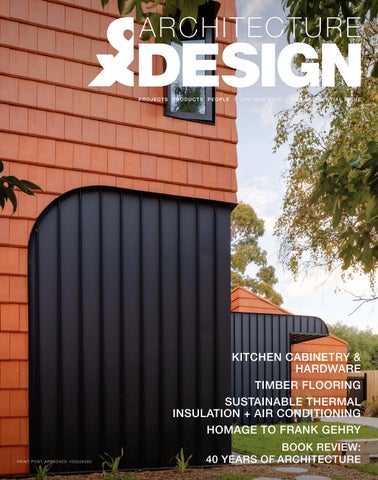
ON THE COVER Set against the tranquil green corridor of Scotchman’s Creek reserve, 2025 Sustainability Awards shortlisted Mahogany House by R Architecture stands as a study in gentle immersion—an architectural gesture that dissolves the threshold between built form and nature. Here, architecture doesn’t dominate; it listens.

EDITOR
Branko Miletic branko.miletic@architectureanddesign.com.au
DIGITAL EDITOR Clémence Carayol clemence.carayol@architectureanddesign.com.au
CONTRIBUTORS
Matt McDonald Prue Miller Emma Adams Jarrod Reedie
DESIGNER Ekaterina Podloujnaya
ADVERTISING SALES MANAGER Adrian Wilson Phone: 02 9368 0150 adrian.wilson@architectureanddesign.com.au
GROUP OPERATIONS MANAGER Sheree Bryant sheree.bryant@architectureanddesign.com.au
MARKETING MANAGER Cherie Nelson cherie.nelson@architectureanddesign.com.au
SENIOR CAMPAIGN MANAGER Kim Ruth production@architectureanddesign.com.au
CAMPAIGN MANAGER Lea Ittermann
CAMPAIGN EXECUTIVE Grace Yang
ARCHITECTURE & DESIGN
Phone: 02 9368 0150
Email: info@architectureanddesign.com.au
SUBSCRIPTION ENQUIRIES
Call Customer Service: 02 9368 0150 ISSN 1039-9704 ARCHITECTUREANDDESIGN.COM.AU

Working as a journalist for the past 25 years, Editor of Architecture & Design Branko Miletic has been privileged to write on many subjects and industries such as Government, Manufacturing, Small Business, IT, Consumer Electronics, Lifestyle, Mining, Hospitality, Packaging, Sport and Food.
Originally a research and development chemist in the mining industry, he has also written general op-ed and feature pieces for a range of mainstream publications here in Australia and around the world.

Clémence Carayol is the Digital Editor at Architecture & Design, managing the publication’s online presence and social media platforms. Originally from France, she relocated from Paris to Melbourne in early 2021. She has written for major outlets like Le Monde and Courrier International, and Canada’s Urbania, covering topics from culture to environmental issues. In Australia, she has held numerous editorial roles, such at Australian Design Review and inside. Her work has also appeared in Harper’s Bazaar


MATTHEW MCDONALD
Matt McDonald has more than 20 years’ experience as a journalist, editor, and copywriter, focussing on the architectural sector, the food, manufacturing and materials handling industries.
Prue Miller has spent her life in the media, from commercials, TV, feature films and of course newspapers and magazines. A background in the arts, combined with a passion for architecture has led her to write extensively about both residential and commercial property and architecture.
Emma Adams is an editor, writer and researcher with extensive experience in managing and commissioning original content and curating material for print, digital release and syndication. She holds a master’s degree in publishing and editing from the University of Melbourne.
JARROD REEDIE
Jarrod Reedie is the former Assistant Editor of Architecture & Design, committed to advocating for good design for all. Now a marketer within the not-for-profit sector, Jarrod prides himself on thoughtful storytelling and collaboration, moonlighting as a podcast host about a not-so-successful rugby league team.
HDR has announced the appointment of Kerrie Russell as Senior Project Architect to strengthen its laboratory and research facility design capabilities. With more than 20 years of experience, Russell brings deep expertise in diverse laboratory typologies spanning health, education, defence, and advanced technologies to her new role.
Russell sees modern laboratories increasingly positioned at the intersection of research, innovation, and industry, with the convergence redefining how laboratories function, demanding adaptable, cross-disciplinary spaces that support evolving scientific frontiers.
Looking to future trends, Russell highlights the growing role of commercial laboratories in driving innovation, the potential for retrofitting lab spaces into non-traditional buildings, and the increasing convergence of defence science with agriculture and other sectors, underscoring the need for flexible, cross-disciplinary design that responds to emerging technologies and community needs.
Passionate about mentoring women in STEM, Russell believes research environments are evolving into dynamic, inclusive, and creative spaces where design directly shapes discovery, innovation, and societal impact.


Based in Singapore, Max Connop will lead the growth of Gensler’s aviation practice across the region, strengthening its position at the forefront of one of the world’s fastest-growing aviation markets.
With more than three decades of international experience, Connop is a UKregistered architect who has played a central role in the creative visioning and design delivery of some of Asia’s most ambitious aviation projects, including Hong Kong International Airport, Shenzhen Bao’an International Airport, Yantai Penglai International Airport, Chengdu Tianfu International Airport, and Bangkok’s Suvarnabhumi Airport.
He is widely recognised for embedding sustainability into every project, ensuring airports are designed for long-term resilience and environmental performance.
Connop’s appointment comes as passenger numbers in Asia Pacific are projected to more than double in the coming decades, with governments across the region investing heavily in next-generation airport infrastructure.
He will collaborate with clients, partners, and multidisciplinary teams to deliver innovative airport solutions that enhance the traveller journey and respond to the global push toward decarbonisation.
MELINDA DE CIANNI IS THE NEW ASSOCIATE AT STUDIO NINE ARCHITECTS
Studio Nine Architects has announced the promotion of Senior Interior Designer Melinda De Cianni to Associate, marking a significant step in the studio’s continued investment in design-led leadership and the growth of its interior’s portfolio.
The elevation recognises De Cianni’s steady influence on the practice’s design culture and her pivotal role across some of its most prominent housing and community projects.
Over recent years, she has led the interior design direction on several landmark projects, including the new Women’s & Children’s Hospital Foundation Elizabeth Vale Development, MUSE Apartments at Bowden, and the inaugural Founder’s Row townhouses at Southwark Grounds. Each reflects her commitment to creating purposeful, usercentred environments.
De Cianni’s design philosophy is deeply rooted in empathy, narrative and place. Her work ranges from developing culturally responsive spaces that support the needs of new mothers, to reinforcing local identity at emerging precincts like Southwark Grounds and cultivating community connections within larger multi-residential settings such as MUSE.
In her new position, De Cianni will continue to champion design excellence within the interiors team and influence the studio’s approach to concept development, storytelling, and overall project direction.
Her promotion underscores both her own dedication to continual improvement and the studio’s commitment to fostering leadership and growth from within.


The Property Council of Australia has appointed Dr Adele Lausberg as Executive Director of the Student Accommodation Council (SAC).
Dr Lausberg returns to the Property Council after serving at Heavy Vehicle Industry Australia as Chief Advocacy Officer, leading campaigns to improve regulatory and policy environments for industry members.
She brings a wealth of experience in policy, advocacy, and stakeholder engagement to her new role, having served in leadership positions across federal politics, peak membership associations and academia, and contributing significantly to the medical and tourism sectors. She was previously the Interim ACT Executive Director at the Property Council.
Dr Lausberg will commence her new role in Sydney in early 2026, as part of the National Advocacy team.
APPOINTED GENERAL MANAGER STRATEGY AT GAMUDA
Gamuda’s newly appointed General Manager Strategy, Tom Perkin, brings 20 years of multidisciplinary experience across investment banking, energy and infrastructure, construction, and property development, serving in various leadership roles.
This breadth of experience is set to provide Perkin a unique perspective on the full lifecycle of major projects, from origination and financing through to execution and operations.
He has also served as Director on several Boards, bringing deep governance and commercial expertise to nationally significant projects, which place him in good stead to lead our Strategy team.
In addition to Perkin leading the Strategy team in his new capacity, he will also continue to remain as primary contact for the Energy and Renewables Sector, based in Sydney.


AUSTRALIAN INSTITUTE OF LANDSCAPE ARCHITECTS APPOINTS NEW CEO
Grant Galvin joins AILA with more than two decades of executive leadership experience spanning commercial enterprises, not-for-profit organisations, and member-based associations.
His extensive background positions him strongly to guide AILA’s ongoing commitment to design excellence, sustainability, and industry advocacy.
Previously, as CEO of Master Builders Queensland, Galvin oversaw significant organisational growth and transformation. Most recently, his global leadership role with the Kevin Murphy Group further demonstrated his capability in driving strategic expansion and strengthening long-term financial sustainability.

As the nation’s leading voice for the design profession, the Design Institute of Australia (DIA) continues to champion creative excellence and uphold high professional standards. LeAmon’s appointment represents an energising new chapter for both the organisation and the future of design in Australia.
LeAmon arrives at the DIA after more than ten years as the inaugural Curator of Contemporary Design and Architecture at the National Gallery of Victoria (NGV), where she played a central role in establishing a globally recognised design program and collection.
Throughout her time at the NGV, she built strong partnerships across industry, government and cultural institutions, creating platforms of national significance that supported designers, boosted design’s cultural and economic influence, and expanded its presence in public life. These accomplishments now form the foundation of her leadership of the DIA’s nationwide agenda.
Before joining the NGV, LeAmon developed a multidisciplinary practice spanning furniture, product, jewellery, interiors, digital and experimental design.
She holds a Bachelor of Fine Art from the Victorian College of the Arts at the University of Melbourne and a Master of Design (Industrial Design) from RMIT University.
Across her extensive career, LeAmon has become one of Australia’s most influential design thinkers. She serves as an Adjunct Professor in RMIT University’s College of Design and Social Context, mentors emerging designers, and advises government and industry on national design policy and discourse.
In 2021, she received the Good Design Australia Women in Design Award, recognising her significant impact on advancing Australian design.
WORDS
BY BRANKO MILETIC


Australia’s major retail groups are moving into residential development, delivering thousands of apartments above supermarkets and shopping centres through fast-tracked planning reforms.
While these mixed-use projects promise better land use, housing supply and access to amenities, they are facing growing community opposition over density, scale, and planning processes.
As Australian retail giants pivot to large-scale, high density residential housing projects by leveraging their massive land assets, they are also competing with traditional developers to invest in sites earmarked for mixed-use development.
Supported by fast-track approval schemes from various state governments, thousands of apartments are currently being planned by leading supermarket chains including Woolworths, Coles and Westfield above their stores in key cities across Australia. While supermarkets have always been integrated into mixed-use developments as part of broader amenities for residents, supermarket-anchored developments where residential apartments are built above retail spaces to maximise land use and long-term value are a recent trend.
Legislative reforms in New South Wales are seeing existing planning controls being overhauled to increase housing supply, especially around urban centres and transport hubs through faster and simpler approval processes. The NSW Government’s Transport Oriented Development (TOD) program, for instance, addresses the housing crisis by leveraging the potential of eight key transport hubs in Greater Sydney to accommodate high density mixed-use developments.
The Low and Mid-rise housing policy allows terraces, townhouses and residential apartments to be built within 800 metres of town centres and train stations, where residents can conveniently access shops, services and amenities as well as public transport and existing infrastructure, and easily commute to their jobs while allowing greater housing diversity and affordability, unlocking opportunities for shoptop housing.
While the TOD program is expected to add more than 60,000 new homes over the next 15 years, the Low and Mid-Rise Housing Policy is set to deliver 112,000 homes across NSW
over the next five years. Shoptop housing also received a boost recently with nine State Significant Development (SSD) proposals receiving approval from NSW Planning through the HDA pathway.
Among shoptop housing projects and proposals by Woolworths’ development arm, Fabcot are The Albion in Brisbane’s innernorth, with approved plans for 456 Build to Rent apartments across two 18-level residential towers above a shared retail podium; another supermarket-anchored 17-storey mixed-use project with 130 apartments on a vacant site in Kangaroo Point, also in Brisbane; a 110-apartment project across a part-eight, partsix storey building in Waterloo and a boutique apartment development with just 14 units in Rose Bay, both in Sydney; an approved dual tower, 11-storey, 148-apartment building in Melbourne’s inner city suburb of Elsternwick as well as another in Glen Iris, which will deliver 60 apartments across five storeys above a fullline Woolworths supermarket.
Mixed-use developments anchored by Coles supermarkets include the Caringbah Pavilion, a 188-apartment project across two residential towers in the heart of Caringbah, NSW, which has received SSD approval; White & Weston, a 45-unit, three-level boutique apartment project in Balwyn in Melbourne’s inner-east; and a seven-storey residential tower with 72 dwellings in Neutral Bay, Sydney.
Another leading retail operator, Scentre Group, which operates 37 Westfield stores in Australia, has revealed ambitious plans for residential development at Westfield Hornsby in Sydney with a proposal for about 2,300 homes across towers up to 53 storeys, as well as Westfield Belconnen in Canberra, having received rezoning approvals for both sites. Scentre has also lodged an SSD application for a mixed-use precinct in Westfield Warringah Mall in northern Sydney to deliver 1,500 apartments across eight towers.
Rival shopping centre owner Vicinity Centres is also redeveloping its retail assets in Buranda Village in Queensland, Box Hill Central and Victoria Gardens Shopping Centre in Victoria,
and Bankstown Central in New South Wales as mixed-use precincts, delivering more than 6,000 apartments across the four properties.
While these retail operators are looking to leverage their landholdings for higher returns through residential development that would also increase footfalls into their stores and lead to greater activation of the precinct, the proposals for mixed-use developments are facing opposition from local communities as they fear the traffic congestion, noise and overshadowing problems from the height, scale and massing of these buildings could turn calm residential areas into busy commercial areas. With supermarkets co-located with other services and stores in the same precinct, small businesses also fear competition.
Another pain point is that these high-density development proposals are bypassing local council rules and using fast-track planning laws and development facilitation programs offered by various state governments to undermine council decisions and veto community objections.
With fast-track approval schemes incorporating a mandatory affordable housing component, developers are integrating affordable rental units as a compliance add-on rather than a key outcome, defeating the intent and leading to accusations that the supermarket operators are gaming the system by exploiting this requirement to push for approval.
Even as retail giants grapple with council and community acceptance – hurdles typically faced by traditional property developers – there are voices of support for the idea of supermarketanchored mixed-use developments that deliver everyday convenience to residents.
“Solving the housing crisis doesn’t just mean building more homes. It means being strategic about where these homes are built, close to transport lines and retail hubs so that people can move around the city with ease and have greater access to amenities and essential services,” says advocacy and urban policy thinktank Committee for Sydney.

WORDS PRUE MILLER
Architect Ed Lippmann’s career has not yet topped out, but he has decided now is the time to review the underpinnings of his exemplary career of forty years in a surprisingly delightful book, 40 Years of Architecture.
I say surprisingly because books regarding architecture are by their very nature rather cut and dried, often weighed down with convoluted vernacular and scholarly reference. As enjoyable as these may be, that is not what Ed Lippmann has created. While his work may be the show, he has allowed us to see behind the curtain, revealing in often amusing detail how the show got on the road.
“I was trying to make it more accessible to people who might not be interested in the technical aspects of architecture,” says Lippmann from his Sydney studio.”
I was hoping it would appeal to a broader audience, which is why I describe the project as anecdotal.”
Delivered in two sections, the first is a an interview between Professor Anthony Bourke and Lippmann. This interview section offers the overview, the general influences, on the architect and the man.
For those currently rearing kids, there is a lot to be learned about the importance and long term value of exploring the world together. He recalls influential time spent with his father and mother:
“We often went to look at new buildings. We visited Christo’s installation at Little Bay, when he came to Sydney to wrap the rocks! But the
big break came when I was 15 years old and my mother took me on a trip around the world. New York was overwhelming and I met my Uncle Jordan for the first time. He was a photographer and took me to a Diane Arbus exhibition at the Museum of Modern Art.”
Now is a perfect point to give credit to the look of this very well designed tome to Carlo Giannasca from Frost*collective whose input is much appreciated by Lippmann, and the reader.
The response of the young architect to landing a job at the celebrated Marcel Breuer’s office on Madison Avenue is a sheer delight, which makes fun reading, architect or not.
Although visited again in the second part of the book, it is here where Lippmann looks at influences on major works, such as, in a roundabout way, the Mies van de Rohe influence on Lippmann’s harbour side Andrew “Boy” Charlton Pool project.
Section two of 40 Years of Architecture is laid out project-by-project, but is still very personal and the first-person narrative is compelling in its story telling. Residential projects include designing his first home, Lippmann House 1, (he rather emotionally uses the renovation of his current home as the final chapter) to commercial projects and public buildings such as the King George V Recreation Centre.


“I relished the chance to design a public building and to work with a local council and not against one. I was comfortable with the increased scale and humbled by the responsibility of contributing to the most sensitive historic fabric in Sydney. By 1996, designing a modern building in a conservation area was something I had strong views on and experience with.”
However, the project attracted some negative publicity, and Lippmann again regales us with what it took to keep his vision, his project, unscathed.
“It was referred to by the press as a “Beached Whale on the Rocks”. Rolf Ockert and I turned up for a site meeting one day to find a suited gentleman standing in the driveway staring incredulously at the arched roof under construction.
After almost running him over, Ockert asked me who the man standing in the driveway was. I told him it was the Lord Mayor and jumped out of the car to introduce myself, apologising for almost running him over.”
The tale, as we all know, has a happy ending, but it is this detail that makes the book so very enjoyable.
“It hasn’t been a red-carpet tide”, insists Lippmann, “not by any means.”
The Butterfly House, an iconic home in Sydney’s blue ribbon Dover Heights, is tracked from an unexpected call from a potential client claiming ‘money is no object’, (a sort of phone call of which the rest of us can only dream) to their desire to have a home with no straight lines. To see the very early preliminary sketches, and the remarkable vision came to life, along with details of the unfolding events, is perhaps my favourite anecdote.
But the most astounding is the full story of the monumental achievement of 8 Chifley Square. How easy it would have been to let the facts and figures tell this story – but Lippmann brings the property to life, in more ways than one.
“For my little practice that was a huge project,” recalls Lippmann, in his now familiar light hearted way.
He is quick to emphasise that his projects are not that of just one man, and wherever he can he includes reference to the many other practices and individuals who have contributed so much to a remarkable portfolio of work. As tremendous as the Chifley project was, it is a
very well-known and recognisable building –this new book lets us see the lesser known, less public successes.
Lippmann is a delightful person to spend time with, his humour and easy going nature shine through in this, as he calls it, ‘cathartic’ work. But it doesn’t stop there. His practice thrives, with a young group of architects on board, and Lippmann’s never ending curiosity of what comes next seemingly inexhaustible.
This book is far from being a manifesto is the recollection of adventures in the world of architecture, design and strength through conviction. In that way, the book has a relevance to more than the narrow field of architecture, it has a much wider appeal. For those who appreciate design in any form, who enjoy a good yarn, and absolutely for those who admire commitment and drive, this is the one to buy.


Melamine Faced Particleboard
Primavera Oak Selection
Primavera Oak is a refined oak décor with a calm, natural grain structure and warm, neutral undertones.


Slimline Worktops
FeelNess PET laminated MDF
A smooth, contemporary PET surface with high colour clarity, designed for kitchens, wardrobes and furniture fronts.
CONTACT
Paul Randall, p.randall@kronospanaustralia.com 0437 176 719
Thomas Beresford, t.beresford@kronospanaustralia.com 0410 086 762

Ultra-slim 12 mm worktops in long formats, created for minimalist kitchens and modern interior concepts.
Rocko Tiles
Rigid SPC wall panels with a mineral
SKIN Melamine Faced Boards

Textured melamine surfaces that enhance sensory experience while delivering practical performance for everyday use.


To explore our full Kronodesign® range, visit www.kronospan.com
WORDS BY JEREMY TURNER, TECHNICAL & POLICY MANAGER AT AUSTRALIAN

Across Australia, poor construction is putting residents and buildings at risk. Recent reports from Darwin state that up to 80% of apartment towers show serious structural issues, while Sydney’s unoccupied 24-storey Parramatta tower highlights that these are not isolated cases - the problem is industry-wide.
These failures highlight the cost of a system that allows buildings to go up faster than we can ensure they’re built properly. While the government focuses on cutting red tape and fast-tracking approvals, we’re being reminded that speed without quality creates long-term pain.
Defects cost Australia an estimated $2.5 to $4 billion every year, in wasted materials, and labour with the resulting housing supply that cannot be occupied.
By comparison, the Productivity Commission’s own estimates suggest that deregulation and faster approvals might deliver $250 million in productivity gains annually, which unfortunately ignores the likely cost of additional defects arising from a faster approvals process.
In other words, we could gain far moreeconomically and socially - by building better, not just faster.
When a building becomes unsafe or unliveable, it’s the consumer who pays the highest price. Families are left without homes, owners face financial and emotional stress, and entire communities lose confidence in the system that is supposed to protect them.
In our submission to the Productivity Commission, we made a strong point that without stronger quality safeguards, deregulation won’t reduce delays. It will just push more defect-prone buildings into the market, driving up remediation costs, stalling supply and eroding public trust in housing.

Speeding up approvals would mean little if the buildings approved aren’t fit for purpose. Without competent, consistent oversight across all states and territories, we risk repeating the same mistakes, at scale.
At AIBS, we’re calling for a national registration and licensing system to ensure that all building surveyors and inspectors meet consistent professional standards. We cannot continue relying on a patchwork of state-based rules and assume that quality will somehow rise to the surface.
Improving productivity starts with strengthening accountability across the entire building ecosystem, not just one group or profession. Developers, builders, suppliers, trades, architects, engineers, designers, surveyors, and regulators all have a role to play in ensuring quality outcomes.
This is not about blame. It’s about recognising that every stage of the building process contributes to consumer protection. When one part of that chain weakens, everyone, from homeowners to the broader economy, pays the price.
The reality is you can’t have trust without competence. And you can’t safely speed up delivery unless the systems underpinning it are rock solid.
Factory-built housing is increasingly thought of as a faster, more affordable way to meet demand. But unless it’s paired with high-quality assurance and independent oversight, it simply shifts the risk from the building site to the factory floor.
A national competency framework would allow us to safely embrace innovation, without sacrificing standards.
Every time we build something that must be fixed, we burn through resources, delay availability, and inflate costs. In a housing market where both supply and affordability are under pressure, we literally can’t afford to get this wrong.
By investing in competence, professional regulation, and better defect-protection, we not only protect consumers, we also free up capacity to build more homes, more quickly, and with fewer costly setbacks.
In 2018, Professor Peter Shergold and Bronwyn Weir presented a landmark report to Australia’s Building Ministers outlining 24 recommendations to strengthen confidence and safety in the construction sector. Those recommendations covered licensing, supervision, enforcement, and national consistency.
Yet, nearly eight years on, implementation remains incomplete. The report’s final two recommendations were simply to establish an implementation plan and deliver it within three years - a reminder that our problem is not a lack of insight, but a lack of follow-through.
Consumers deserve better. They deserve homes built by qualified professionals, overseen by capable regulators, and supported by systems that prioritise safety and quality above speed.
It’s time to stop pretending that red tape alone is the reason Australians can’t find homes. The story is far more complex.
Before we build faster, we need to build smarter. That means enforcing quality, backing professionals who get it right, and creating a national framework that gives Australians the safe, durable homes they deserve.
Anything less, and we’re just building future problems - one rushed approval at a time.

WORDS EMMA ADAMS
Architect Frank Gehry’s works include buildings of varying scale and typology — from multi-level offices to pavilions and residential houses to public works.
At the time of Frank Gehry’s passing on 5 December 2025, aged 96, the Canadian American had also created furniture pieces for Knoll, accessories for Tiffany & Co, and a showroom for Louis Vuitton.
Gehry’s own house in Santa Monica, a breakthrough assemblage over an existing bungalow, is an example of adaptive re-use back in 1978. Gehry retained the original Dutch Colonial house adding new volumes around three sides using materials like plywood, corrugated metal, glass, and chain-link fencing, leaving structural elements exposed and challenging conventional residential forms. Early works such as this as well as his 1960s cardboard chair designs focused on found recycled materials—relevant to today and what we should build.
Gehry visited Sydney in 1979 to present a lecture for what is now the University of Technology Sydney (UTS). Among the architects and students that met with Gehry a few years later in 1982 in Melbourne, Toby Reed Director of Nervegna Reed Architecture recalls that Gehry was “self-assured, not a mega-star. We sat around and looked at the Australian backyard. Mary Ruth, an architect and collector received sketches and recalled Gehry’s obsession—urban schemes with fish and then commissioned one”. Reed notes that this is “interesting in retrospect, this little Gehry in Melbourne”.
The fish was a pavilion in Melbourne that could have happened. Gehry’s sculptural fish was later realised on a beach in Barcelona in 1992 and earlier in a series of lamps first
created in 1983 along with a second generation of fish lamps in 2013. Both were shown at Gagosian Gallery in Beverly Hills, followed by similar exhibitions in 2014 in Paris, London and Hong Kong.
Forward of Gehry’s later works which are characterised by digital modelling, the Vitra Design Museum in Weil am Rhein Germany— opening in 1989—composed of interlacing curved forms. Reed indicates that “the digital technologies that Gehry founded in order to make his buildings real have affected our buildings more than we know. There was some input from Australians there, but I don’t know the details”. The programs that are now used, including Building Information Modelling (BIM) stem from this digital phase.

By adapting custom software, Gehry was able to model and construct complex fluid forms. This approach effectively anticipated BIM by digitally linking design, engineering, and construction, allowing for the precise factory-level production of custom-building components. Formalised through Gehry Technologies, integrated teams, iterative digital workflows and data-rich models to manage complexity, enabled commissions including the Guggenheim Museum in Bilbao and the Walt Disney Concert Hall in Los Angeles, developed at the same time in 1997. Gehry also worked within sensitive heritage contexts. The DZ Bank building in Berlin on Pariser Platz near the historic Brandenburg Gate was completed in 2001—opposite to most Gehry buildings with restrained facade but with interior atrium and sculptural conference space typical of Gehry’s expressive form.
The Dr Chau Chak Wing building at UTS completed in 2015—designed in collaboration
with executive architects DJRD—is Gehry’s only Australian built work. With an east-facing exterior of undulating brick looking to the area’s sandstone heritage and a contemporary western facade of angular glass, the design integrates complex digital modelling and construction.
UTS Emeritus Professor Roy Green commented that Gehry’s “unique approach was to start, not with external appearances, but to ‘design from the inside out’ in dialogue with the users about the functionality of the internal spaces. He asked the faculty: How do you want to work with each other, with students and the community?”
Influencing culture worldwide, Gehry’s architectural legacy is well-established. Gehry also leaves a personal and professional legacy. The impression on those who met and worked with him, including Reed who visited him again at his Los Angeles studio just before Bilbao, was that “he was a really nice man”.


Heard of two minute noodles? How about two minute walls?

Sometimes you are fortunate enough to meet someone who is impressively optimistic, focused and amazingly fearless.


These ‘lights of a brighter future’ too often burn out before they get to make a mark, but Pete Morrison has beaten the odds. He’s already making an impact, including being honoured by receiving the 2025 NSW Young Business Leader of the Year, and he’s only just begun.
It’s a few months since Peter Morrison stood behind the dias in his mammoth factory facility in Orange, (a former munitions factory) NSW and welcomed the curious and the influential to the launch of his company, GTT.
The name derives from Green Timber Technology, a surprisingly bland name for a cutting-edge company that is capable of essentially producing (in panelised form) 800 homes a year.
That’s a big promise, but not one made lightly. GTT is Morrison’s take on MMC (modern methods of construction) building that can produce a timber ‘kit of parts’ at lightning speed, while maintaining green credentials. Whereas modular home builders create volumetric 3D units in a factory that can be transported to site, the GTT factory produces the whole ‘kit of parts’ – like a flat pack and delivers that to site. It’s off-site controlled manufacture, but with remarkable design flexibility and expedited production.
The immaculate production facility in Orange is inhabited by carpentry machine lines and stations from industry automation giant Weinmann. At the October 2025 launch a complete interior wall panel was produced in a few minutes – including GPO and window cut outs and pre-drilled holes for conduits. It’s one thing to read about it, but it’s more impressive to actually see it happen. At this speed GTT can produce an entire house (in elemental form) in four hours, all from renewable timber sourced from GTTs plantation partner just thirty minutes down the road. Waste (in time or material) is kept to an absolute minimum. If innovation is needed to save the struggling housing industry, look no further.
“We’ve got plans to go elsewhere, but not right now. We need 12 months of filling this factory up and getting it right,” says Morrison.
Filling the factory is of course the task at hand –but already that is looking good. Morrison see the Mum and Dad market as a more retail extension of his business, and not one he has the time or resources for right now. He sees the business more as a wholesaler, with his prime market being development companies from the big end of town, operations such as Stocklands, Walkers and Frasers etc. Unit orders from big
developers are numbered in hundreds at a time, and of course government contracts can match that and more. But such large orders leave troughs in production, and it’s here that the one offs will be more than welcome – if they’re from experienced architects.
“If they (architects) can consume our technical guide and they can design with our system in mind then it actually makes our process very easy. The integration is ideal for a one off,” says Morrison who clarifies they are very flexible and open to new design opportunities. For architects the technical input from GTT acts as a second set of eyes –and offers a secure production schedule and guaranteed costs. The IT gurus at GTT are front of house; very much an integral part of the working concept team, and can change plans in seconds, and feed the variation directly to the construction station computer saving time and money.
The GTT system is quick, it’s sustainable, it’s cost saving (and provides cost certainty right down to the number of nails required) – is this not a safe solution to the housing shortfall?
In May last year, the Australian Government’s National Housing Affordability and Supply Council released a report that forecast that

“938,000 new dwellings will be built in Australia over the Housing Accord period covering the five years ending 30 June 2029. This implies a shortfall of 262,000 dwellings relative to the 1.2 million Housing Accord target. No state or territory is forecast to meet the share of the target implied by its population.”
Pressure from all levels of governance, from the Federal Housing Accord right down to suburban LGAs, has resulted in some improvement in the crisis with an uptick in building approvals – and some clarity in the complex land use conundrum – but then other factors muddy the progress, such as the lack of trades. Build Skills Australia estimates the trades shortfall to be 116,700 if the industry is to produce the 1.2 million houses pushed by the Federal Government. Automation is part of the solution.
MMC is not taking jobs, it’s supplementing a struggling industry and rather than bemoan the advanced systems, smart builders now have a chance to improve their own productivity –without waiting for rare-as-hens-teeth trades.
“If you’re a mid-sized or small builder, and if you’re building ten homes a year now, and making 5-10% on that, what if you could do double the volume, hold your margin at the
same position, and limit your risk because we’re taking the risks for you? So, you’re up out of the ground, and you’ve got your weather proof box within two days,” explains Morrison. And of course, GTT is keen to educate and explain the system to builders, while still conceding some builders will prefer the traditional method.
For Morrison, there is room for all to survive and thrive.
Governments in South Australia and Western Australia, and South East Queensland are already showing interest in GTT, but disappointingly sections of the NSW government involved in home building are proving difficult to bring to the table. But not all – GTT has just been awarded a very large contract with Homes NSW, which will no doubt prove the value to the other more recalcitrant departments. One hopes.
Early MMC enthusiasts rushed to the industry with enormous investments, but little experience and promptly fell over. Morrison (whose previous experience includes Program Director for Modern Methods of Construction with the NSW Government) knows this, and while keenly awaiting the chance to scale up GTT across the country, is not falling into a hurry-up-and-fail financial hole in the ground.
He cites failures of the MMC system in the UK, which he says saw $2 billion, over a period of 10 years, disappear into thin air.
The future in this burgeoning industry, if fostered by the drive of people such as Peter Morrison, will become the standard. This amalgamation of technology, design and building skill will advance the quality and affordability of construction for everyone. The trick will be to keep it moving forward, to encourage and not hinder those who hold the secrets of innovation, because, as a rule, we don’t make the path of the bright and gifted easy.
Morrison and his growing family have put everything on the line, the young team he’s built is supportive and individually brilliant, all ready to challenge and change the market. His plan is coming true, in measured certain steps – but I had to ask, is it just as he had planned it – this transition to world class innovator? And for the first time in our conversation he laughed and answered from the heart, “No, it’s way harder.”
And it is that laughter, that unguarded moment that made me believe this is one bright light that is certain to lead the way.
WORDS JARROD REEDIE

New technologies exist, but the construction industry is still slow to adopt them.
IMAGE Obsessive Architecture’s latest bespoke project, Materia, tangibly expresses the practice’s coveted interplay between technology and outstanding design. Photography: Peter Bennetts

Unless you’ve been living under a rock, you’ll have heard that Australia is engulfed in a housing crisis.
An estimated shortage of 200,000 dwellings nationwide is the current state of play, with vacancy rates sitting at approximately two percent in the state capitals. Labour productivity is at its lowest rate in 60 years, while housing reform – Sydney’s Transport-Oriented Development (TOD) manifesto and Melbourne’s Activity Centres program, to name a couple –have been met with opposition from local councils.
The adoption of innovative technologies has long been a challenge for the construction industry. To many developers and construction companies, new technology is foreign, seldom used, untried and untrue, but the speed at which it can deliver, coupled with the ingenuity of our architects, must be realised.
Befitting of their title, Obsessive Architecture’s cycle of designing, pausing, and revising –until gut feel indicates completion – speaks to their conceptual process. Form, light, shadow, texture, and scale are carefully considered to craft a specific feeling.
This search for harmony sees tactile design and a sense of touch married with innovative technology. The end goal, Director Maurie Novak says, is ‘to guide the experience of a space, even when you aren’t paying attention to it’.
Obsessive’s latest bespoke project, Materia, tangibly expresses the practice’s coveted interplay between technology and outstanding design. Utilising cross-laminated timber and Passivhaus principles, extreme thermal performance was achieved via an exhaustive test-and-learn process.
While the result is an embodiment of the outcomes Obsessive aims to achieve with each project, Novak believes the real value of Materia was the lessons contrived from research.
“I have a lot of optimism around how we can leverage those lessons into the housing crisis. We’re working to translate those findings into scalable well-designed housing,” he says.
Novak says he is excited about CLT and 3D printing’s capabilities to increase construction speed and sustainability, bypassing skilled labour shortages. When pressed about his position on the lingering crisis, Novak believes a fundamental shift in thinking that leverages
technology and design is required.
“The danger is that the push to build ‘more and faster’ is being prioritised over building ‘well’,” he says.
“From what I see, construction quality is a systemic issue. If we simply pump out more volume housing to the same low thermal and structural standards, we aren’t solving a crisis, we’re just delaying a different one.
“I do have some optimism, but it doesn’t lie in doing the same things faster, those processes are broken.”
PT Blink’s Chief Delivery Officer, Martin Fenn, agrees with Novak’s sentiments regarding the industry’s old habits. A carpenter by trade, Fenn found it difficult to find carpenters with both the right attitude and skillset.
“Current construction methods produce physical outcomes, and poor quality has major consequences,” he explains.
PT Blink is a construction technology company, boasts designing the beams that sit atop Sydney’s Accor Stadium, as well as Boeing’s clear-span hangars.
The Blink Backbone, is a high-speed structural chassis made from steel that integrates an off-site manufactured kit of parts, including columns and floor cassettes with decking, reinforcement, and service penetrations.
Once installed, concrete flattens the posttensioned steel onsite, eliminating the need for back propping or temporary supports and allowing floors to be accessed the next day.
Fully customisable and not limited by fixed grids or spans, the system can accommodate a wide range of architectural designs and sectors.
These innovative business models come at a time when approximately 45% of homes cost more than what was originally budgeted for, with apartment lead times blowing out by 54% over the past five financial years. A workforce shortage – a personnel deficit of at least five percent year-on-year – will begin to affect largescale infrastructure projects, with the housing crisis destined to continue if systemic change isn’t made.
Novak believes hard times lie on the horizon.
“We are facing a ‘perfect storm’ of material costs, skilled labour shortages, and a massive
housing supply deficit. Additionally, urban planning and long-term strategies for the coming decades require exceptional design thinking. The track past decisions have sent us down – prioritising sprawl over hubs – has left a lot to be desired.”, he says.
Novak believes current legislation remains a roadblock.
“Our current regulatory framework is still geared toward an outdated way of building. While the code is constantly being ‘patched’ to correct existing industry issues, which is necessary, this reactive approach limits our ability to quickly revolutionise how we build,” he says.
“To truly address the crisis, we should be looking to AI, robotics, prefabrication, crosslaminated timber and 3D printing, yet we are often fighting against a building code that favours ‘tick-box’ compliance over highperformance outcomes.”
“The challenge is adoption,” Fenn agrees.
“Construction is archaic in terms of technology uptake and operates on very thin margins, often 3% to 5%, sometimes even zero. That makes innovation feel risky and makes adoption slow.
“That said, industry is very susceptible to fear of missing out. Once early adopters demonstrate success and competitive advantage, others follow. The reality of the workforce shortage will eventually force adoption of chassis-based and kit-of-parts solutions.”
In an age of innovative technologies and methods, Novak says human touch must remain foremost.
“Human and experiential elements must be infused into spaces of all sizes. We have seen too many developer-driven projects that lack connectivity and social cohesion because they were designed to meet a quota, rather than to build communities.”, he says.
“There is a misconception that ‘design’ is a luxury tax on a building. Beauty can be achieved without significant added expense; it just requires creativity and intentionality.
“The exciting thing about new technologies is the opportunity for mass-customisation. We can finally step away from the ‘Australian Ugliness’ of repetitive, cookie-cutter estates and move toward a variety of design that responds to environment.”
Speed, without the sacrificing of quality, is the fix for the housing crisis. Faster hasn’t always meant better, but with new technologies emerging, the paradigm will begin to shift.

Onda is a renovation shaped by restraint. Rather than replacing the existing bungalow, State of Kin worked within its original architectural shell, reconfiguring the layout to improve flow, light and connection to the site.


The aim was to modernise the home while respecting what was already there, creating spaces that feel open without being exposed.
The sloping topography played a key role in shaping the design. Changes in level are used to organise spaces across the home, with curved walls and ceilings helping to guide movement and maximise the available floor area. These forms also allow the house to open toward city views while maintaining a sense of privacy from neighbouring properties.
A restrained material palette supports the overall clarity of the project. Limestone, timber, polished plaster and natural stone are used throughout, creating continuity between architecture and interiors. The materials add warmth and texture without competing with the home’s more complex forms.
Several elements required close technical coordination, particularly the suspended concrete features, including a curved garden bed above the garage. These moments emerged through collaboration with engineers and consultants, turning structural challenges into defining architectural details.
Designed for both family life and entertaining, the home includes flexible living spaces with strong connections between indoors and outdoors. Onda reflects State of Kin’s broader design approach: using constraints as opportunities and allowing site, structure and use to drive the final outcome.
Architect State of Kin
Project Location Attadale, WA
Year 2024
Photography Jack Lovel


PHOTOGRAPHY ADAM GIBSON
Scamander Passivhaus A was shortlisted in the 2025 Sustainability Awards in the Single Dwelling - New category and is a quiet ode to timber and exploration of how a single material, handled with care and conviction, can shape not just a building but an atmosphere.


PROJECT CREDITS
Design / Architecture Firm Spectura Studio
Project Location Scamander
Project Lead / Director Matthew Purves

Formed entirely from low-embodied-carbon components—CLT walls, ceilings, and roof; a timber subfloor; wood-fibre insulation; timber joinery and flooring—the home is warm in both temperature and temperament. Sunlight pours in, held by the Passive House envelope long after coastal weather turns cool, while the exposed grain and soft, muted hues wrap the interior in a constant, gentle calm. Its oblique geometry, made possible by CLT, expands the modest footprint into a series of unexpectedly generous spaces. Open yet intimate, the house defies the usual tension between spaciousness and warmth, holding both with quiet confidence.
Designed and built by its owners throughout the turbulent years of 2022–2025, the project carries the unmistakable imprint of personal devotion. Every detail reflects a lived understanding of how a home should feel— crafted not for investment, but for belonging.
Scamander Passivhaus A is more than a study in timber or efficiency; it is a deeply personal coastal refuge that proves sustainable architecture can be as lyrical as it is rigorous.
WORDS CLÉMENCE CARAYOL

This is Lumeah – a renovation to a house designed in the late 1980s by the legendary architect Paul Couch.


The original home is distinctly Paul Couch’s: a rhythm of exposed concrete beams sitting on concrete walls, an exposed slab carried through the interiors, and infill materials chosen with rigour – bluestone paving in the wet areas, solid timber internal doors, stainless steel joinery, hybrid timber-and-steel windows, and ceilings clad in Stramit Board (compressed straw panelling). Not a single surface was painted.
Pepper & Well’s intent was to renew the ensuite in a way that empathised with and paid homage to the original architecture and Couch’s ethos, without falling into imitation.
The challenge was to stitch new work into the original fabric while allowing both to remain legible.
This is Lumeah was the recipient of four different accolades at this years ArchiTeam Awards, namely the inaugural Heritage Award, the Small Project Medal, the People’s Choice Award, and a commendation in the Residential Alterations and Additions under $500k, sponsored by James Hardie.
PROJECT CREDITS
Architect Pepper & Well
Project Location Macedon, VIC
Year 2025
Photography Tom Ross


In Marrickville, an 1890s corner shop once slouched into disrepair now stands reborn light on its feet, low in embodied carbon, and rich in memory.


This project, the winner in the Adaptive Reuse category for the 2025 Sustainability Awards transformed a forgotten relic into a finely grained mixed-use ensemble: a commercial tenancy at street level, shop-top housing above, and a new three-bedroom residence stitched seamlessly into the urban fabric.
Tucked behind, sun-washed courtyards and lofty garage-workshops open to the rear lane, quietly increasing density while preserving the site’s familiar neighbourhood presence.
The old masonry shell—weathered, imperfect, enduring—has been restored and celebrated, proving that the greenest building is often the one already standing. Around it, new interventions are feather-light: timber-framed additions, FSC-certified plywoods, recycled hardwood, Accoya windows, low-carbon Envisia concrete.
Materials are expressed with candour—timber structures revealed, recycled surfaces retained, limewash and low-toxicity finishes breathing new life into old walls. Rooftop PVs and passive design strategies ensure the building performs as responsibly as it looks.
The result is a warm, textured and intensely functional collection of spaces that fold contemporary sustainability into the layered story of place. It is architecture that honours what came before while carving out room for what comes next.
This project is a testament to what adaptive reuse can achieve, not just the conservation of carbon and craft, but the revival of community, character, and possibility.

Design / Architecture Firm Mackenzie
Pronk Architects & Make Projects Partnership
Project Location Marrickville, NSW
Project Lead / Director Neil Mackenzie, Heidi Pronk, Jos Tarr, Tom Hume


PHOTOGRAPHER CM PHOTOGRAPHY
Set against the tranquil green corridor of Scotchman’s Creek reserve, 2025 Sustainability Awards shortlisted Mahogany House stands as a study in gentle immersion—an architectural gesture that dissolves the threshold between built form and nature.


Here, architecture doesn’t dominate; it listens. The home’s plan is quietly choreographed around three mature trees—a liquidambar, a silver birch, and the eponymous mahogany— each one not merely preserved but honoured as a structural and spatial anchor. The mahogany establishes the home’s central axis, orienting circulation, and views toward a sun-filled courtyard.
Conceived as two sculpted volumes, the home accommodates a multigenerational program with grace and clarity. To the west, a doublestorey family pod gathers daily life; to the east, a single-storey wing offers dignified independence for visiting grandparents. A central entry and lounge stitch the pods together. Crossing the
threshold, visitors are immediately drawn to a luminous internal courtyard where a swimming pool reflects dappled light, and the canopy of the mahogany stands as a living monument. Every decision is underscored by sustainability. The home is purposefully “right-sized,” embracing Passivhaus principles, SIPs construction, and airtight detailing to minimise operational energy. Its terracotta-shingle skin— locally made and unexpectedly economical— wraps the building in a warm, textural envelope that resonates with the site’s palette of bark, leaf, and earth.
Inside, a biophilic sensibility shapes the spatial character. The owners’ extensive indoor plant collection becomes part of the
architecture, integrated through green joinery, plywood surfaces, and carefully framed views. Colour is used with restraint yet confidence, enlivening moments without distorting the home’s overarching calm. The result is a sanctuary of connection—to landscape, to kin, and to the quieter rhythms of suburban life.


PROJECT CREDITS
Design / Architecture Firm R Architecture
Project Location Mount Waverley, Victoria
Project Lead / Director Gaurav Rajadhyax

PHOTOGRAPHER TOM ROSS
The Victoria Street Collective was shortlisted in the 2025 Sustainability Awards in the Multiple Residential category and is a project born not from a single brief, but from a shared desire to rethink how we live together in the city.


What began six years ago with six families and an idea has grown into a quietly radical community of ten households, each with a home crafted to reflect its own rhythms yet deeply connected to a collective vision.
In Brunswick, the project appears as a pair of apricot stucco forms—gentle, confident, and grounded in their heritage streetscape. Within, generous apartments of warm timber, soft cork and uplifting volumes open to gardens brimming with vegetables, fruit, and fragrance. Every detail was shaped through group consensus: windows debated, materials weighed, sustainability tested. Some decisions required mediation; all were driven by a commitment to live well, lightly, and together.
With an average 8.5 NatHERS rating and passive house principles embedded at every turn, the Collective feels less like a building and more like an ecosystem. It is a place where architecture cultivates connection—between neighbours, between indoors and out, between aspiration and lived experience.
Zen Architects have not only designed dwellings; they’ve nurtured a new way of inhabiting the inner city. The Victoria Street Collective stands as a lyrical testament to cooperation, craft, and possibility—a model for a future in which community is not an idea, but a way of life. FOLLOW
Design / Architecture Firm Zen Architects
Project Location West Brunswick, VIC 3055
Project Lead / Director Luke Rhodes
Development Advisory Property Collectives
Builder Maven
Landscaping SBLA
Engineer IStructD
Building Surveyor Grimbos Building
Surveyors
Completed 2024


Windows and doors remain some of the weakest points in the thermal envelope of many Australian homes. Inef cient systems intensify overheating, winter heat loss and air leakage, diminishing the bene ts of otherwise wellinsulated walls and roofs.
Raising the Bar: Why Australia Must Rethink Window and Door Speci cation to Deliver High-Performance Homes sets out the case for lifting the thermal performance of Australia’s residential building stock with a focus on high-performance windows and doors.
Why are Australian homes inef cient?
Australia’s energy ef ciency standards are well below other countries in similar climate zones in both energy performance and greenhouse gas outcomes. Many European jurisdictions mandate building performance equivalent to an Australian eight-star home and treat double glazing as standard practice.
In contrast, high-performance glazing remains uncommon in Australia, even though window and door systems are responsible for a signi cant share of heating and cooling demand. Recent Australian Housing and Urban Research Institute (AHURI) research shows that more than 70 per cent of existing Australian homes have an energy rating of three stars or lower.

changing landscape
The rollout of the NCC 2022 7-Star NatHERS and Whole-of-Home requirements is raising expectations for building fabric performance, particularly glazing, insulation and airtightness. This places greater responsibility on architects to deliver resilient, high-performing homes suited to Australia’s changing climate.
High-performance windows and doors are one of the most immediate and effective levers for improving residential energy performance.
What does true high performance look like?
Achieving genuinely high-performing window and door systems requires a combination of low-conductivity framing, advanced glazing technologies and airtight construction.
Each component must work as part of a continuous thermal and air barrier to ensure predictable, stable performance across Australia’s varied climate zones.
• Low-conductivity frames: Timber and uPVC offer inherently low thermal conductivity, enabling whole-of-window U-values below 2.0 W/m²K and reducing surface condensation risk compared to non-thermally broken aluminium.
• Advanced glazing: Performance improves progressively from air- lled double glazing to argon- lled low-e double glazing, with triple
glazing delivering the highest thermal and solar control where required.
• Airtightness: High-performance homes target ≤1.0–3.0 ACH50. Achieving this requires continuous air barriers, well-detailed sills, appropriate seals and gaskets and high-quality installation.
As a leading manufacturer of architectural windows and doors, BINQ’s product ranges establish a new benchmark for highperformance openings by combining stringent thermal, airtightness and bush re compliance with the design exibility required in modern residential projects.
BINQ’s timber and uPVC ranges translate high-performance principles into robust window and door solutions. The Archetto Timber Series uses 68 mm engineered timber pro les with glazing rebates up to 36 mm to accommodate double or triple glazing, achieving whole-of-window U-values as low as 1.0 W/m²K and SHGC values down to 0.258.
The BINQ uPVC Series delivers sub-1.0 W/m²K thermal performance through low-conductivity pro les, slim European-engineered frames and BAL-40-certi ed con gurations for high bush re risk locations.

PHOTOGRAPHY TCL_JACKIE G
The winner of the Landscape & Urban category and Best of the Best at the 2025 Sustainability Awards, Breakout Creek / Purruna Pari Stage 3 stands as a compelling demonstration of how carefully orchestrated blue–green infrastructure can recalibrate an urban waterway—ecologically, visually, and socially.


The project achieves a climate-positive outcome within 11 years of construction, placing it well ahead of the Australian Institute of Landscape Architects’ 2040 target and positioning it as a benchmark for restorative landscape interventions across Australia.
What was once a degraded drainage channel has become a multi-layered ecological system, where expanded native vegetation, revitalised aquatic habitats and significant improvements to water quality operate in concert with newly enhanced community amenities. Historic levee banks were retained, preserving flood resilience, and allowing horse agistment to continue across parts of the site—an unusual coexistence that underscores the team’s nuanced approach to site heritage and contemporary function.
The scale of intervention is substantial: more than 6.2kms of walking trails and shared paths now thread the river corridor, complemented by 11,400sqm of permanently vegetated wetlands, a new river crossing, five carefully
positioned viewing decks and a universally accessible boardwalk. Integrated throughout is extensive Kaurna cultural interpretation, sensitively placed within existing tree canopies and ecological zones, embedding Country at the heart of the visitor experience.
Initially commissioned under the Adelaide and Mount Lofty Ranges Natural Resources Management Board, the project proceeded through a governance transition during the introduction of the Landscape South Australia Act 2019, eventually finding its home under Green Adelaide. Despite the administrative shift, the design and delivery teams-maintained continuity through a sensitive, high-risk environment.
A central challenge lay in reconciling tree preservation with the integrity of the floodprotection levee banks. Tree root intrusion posed structural risks, requiring meticulous placement of new plantings and arborist-led hydro-excavation to map existing root zones.
These findings shaped design refinements to wetland footprints and path alignments, ensuring both ecological enrichment and engineering reliability.
The project explicitly supports Green Adelaide’s Biodiversity Targets, significantly boosting native vegetation cover, consolidating habitat corridors, and restoring ecological processes to a waterway long compromised by urbanisation.
Breakout Creek / Purruna Pari Stage 3 is ultimately a study in layered complexity: an ecological revival, an infrastructural recalibration and a cultural landscape stitched together within tight spatial and technical constraints.
It demonstrates how a river corridor can be reactivated not merely as a place of recreation, but as a living system—one capable of supporting biodiversity, fostering community, and modelling a more climate-conscious approach to urban waterway design.


PROJECT CREDITS
Design / Architecture Firm TCL with Green
Adelaide, City of Charles Sturt, and City of West Torrens
Project Lead / Director TCL
Collaborating Design /Architecture Firm
TCL
Wetland / Hydrological Engineering
Design Flow
Cultural Collaborators Kaurna Yerta
Aboriginal Corporation
Certifier Katnich Dodd
Civil, Structural & Hydrological
engineering Tonkin
Civil / Landscape Construction Lead
Bardavcol
Planning and Consultation URPS
Soil management ProAg Soil Management
Quantity Surveying RLB
WORDS MATTHEW MCDONALD

Modern air conditioning systems combine sleek design with intelligent climate control. As Matthew McDonald writes, they are not only quiet and energy efficient, but also suitable for seamless integration into all types of contemporary residential settings.


While passive design has a critical role to play here, according to many, so too do space heating and cooling appliances.
As the Energy Rating website (a joint initiative of Australian, state and territory and New Zealand governments) points out, space heating and cooling appliances account for around 40% of household energy use in Australia.
Add this to further statistics (from the Department of Climate Change, Energy, the Environment and Water), which state that residential buildings are responsible for around 24% of overall electricity use and more than 10% of total carbon emissions in Australia, and it becomes clear that the way we keep our homes warm in winter and cool in summer is by no means trivial.
While passive design has a critical role to play here, according to many, so too do space heating and cooling appliances.
“Although principles of passive design will always be a strong foundation, Australian buildings will continue to need some form of mechanical heating and cooling functionality for occupant comfort and health,” says Amanda Searle, CEO of ARBS, which is Australia’s largest heating, ventilation, air conditioning, refrigeration (HVAC&R) and building services event.
In other words, homeowners and designers increasingly view mechanical heating and
cooling as core infrastructure rather than optional add-ons.
According to Searle, visitors to ARBS this year, which takes place at the Melbourne Convention & Exhibition Centre from May 5-7, can expect to see numerous air conditioning systems designed with energy efficiency in mind.
Indeed, given that in July 2025 the Federal Government introduced regulations making it illegal to import or manufacture small multihead split air conditioning systems that use hydrofluorocarbons (HFCs) with a high global warming potential (GWP), products of this kind are here to stay.
Sustainability is front and centre of the consumer decision-making process with net zero driving innovative solutions to create products that are highly efficient and use low GWP refrigerants.
The best suppliers and manufacturers are looking to not just comply with environmental regulations but go beyond it.
“This aligns with Australia’s transition toward electrification and net-zero-ready homes,” says Searle.
According to Searle, beyond these considerations, maintaining indoor air quality and control solutions are other areas worth
keeping an eye on.
“Technology solutions, including smart home systems, automation, integrated data management systems and AI-driven technology that enable consumers to enhance efficiency through monitoring and controlling energy usage, are also increasing in innovation and demand,” says Searle.
Summarising, Searle says that ARBS aims to bring together all those who are shaping the future of residential and commercial HVAC&R.
Beyond meeting suppliers, architects and designers who attend the event can take advantage of the ARBS Seminar Program, which this year will cover topics such as electrification, indoor air quality, heat-pump innovation, and steps toward net-zero-ready buildings.
Of course, broader architectural shifts also influence the types of air conditioning systems making their way into our living rooms and bedrooms.
“Australians favour open plan living, clean lines and integrated design,” says Virender Rana, Head of Business - HVAC Solutions at LG Electronics Australia.
“Homeowners want performance without visual interruption.”
As a result, he says, demand for things like slim, concealed ducted systems, refined indoor units, and thoughtful vent design is growing.
At the same time, it’s important to remember that every home is different.
“Open-plan builds may lean towards ducted systems for comfort and visual minimalism, while apartments or renovations may prefer high performance room air conditioning with refined form factors,” says Rana.
In the contemporary context, automation and digital technology are also important considerations. For Rana, their introduction should be about simplification.
“Connectivity, automation, proactive energy management and compatibility with broader smart-home ecosystems ensure the system adapts to the homeowner – not the other way around,” he says.
“In short, air conditioning today must perform well, look good, think for the homeowner and support better livingall at once.”
In line with these requirements, LG recently released the DualCool AI Air Split System range.
The range features ‘AI Air’, an intelligent technology which automatically analyses room conditions to deliver personalised comfort while managing energy use. In this way, according to the company, it anticipates needs, reduces effort and enhances everyday life.
As Rana points out, further features of the DualCool AI Air Split System range include DualCool Inverter Technology, which is designed to deliver faster cooling, and quiet, fast operation; DUALVane, an airflow design feature that distributes air more evenly with less noise and more comfort; and Energy Manager+, which helps households monitor and manage consumption through the LG ThinQ app.
Multi-Step Cleaning keeps the internal surfaces of the system cleaner and helps maintain airflow performance over time, while thanks to the One-Click Scheduled Cleaning function, it is possible to ensure the system maintains hygiene with minimal effort.
The DualCool AI Air Split System also employs ThinQ Connectivity, which integrates seamlessly with the LG smart home ecosystem for remote control, automation and voice integration using a compatible smartphone.
“We also recognise that Australians use a variety of smart home ecosystems, so our new models are compatible with Google Home and Amazon Alexa,” says Rana.
“Homeowners can adjust their climate with simple voice commands, build multidevice routines and personalise their environment with ease.”
According to Rana, energy efficiency is a core design priority for the company.
“The new LG DualCool AI Air Split system range achieves up to 6 stars in cooling in Australia’s hot climate zone,” says Rana.
Beyond energy efficiency, LG Electronics is actively reducing plastic consumption by redesigning its production methods for the exterior panels of its ceiling mounted cassette units.
“Through the adoption of a foaming injection molding process that uses nitrogen gas to create micro-bubbles within the material, the company is moving away from conventional plastic manufacturing techniques, thereby lowering overall plastic usage,” says Rana.
“LG plans to gradually expand this innovative process to additional residential and commercial product lines.”
In parallel, LG’s air conditioning division is working to increase the use of recycled expanded polystyrene (EPS) in packaging, aiming to minimise reliance on raw materials.
The company has also reinforced its environmental commitment by introducing an inverter scroll chiller that employs R32 refrigerant, which has approximately 30% of the GWP of R410A.
Additionally, LG has transitioned smaller air conditioning units from R410A to R32 refrigerant to comply with the above-mentioned ban on the import and manufacturing of small systems that use high GWP refrigerants.
Ben Muras, Head of Marketing at ActronAir, views air conditioning as fundamental to modern living.
“Homes today are more than the family home,” says Muras. “They are offices, gyms and entertainment hubs.”
“Much like inclement weather halting work on a building site, uncomfortable indoor conditions can slow productivity, stem creativity, and hamper relaxation.”
In contrast, he says, well-managed indoor climates help ensure we can be the best versions of ourselves.
Asked if there are any products he would like to highlight, Muras nominates the ‘Advance’, which is part of ActronAir’s split ducted range.
“Combining our Tru-Inverter technology with high efficiency fans, it operates on R32 refrigerant, which has a significantly lower GWP than traditional R410A systems,” he says.
On top of this, the system’s vertical discharge design solves the problem of having to locate the outdoor unit in the narrow passages between the house and side fence, and consequently, being faced with a drop in performance due to recirculated air.
“By discharging the air upwards, the Advance maintains strong, reliable performance where many other systems may struggle,” he explains. “Our variable fan technology further enhances comfort and efficiency by adjusting airflow automatically to match the user’s needs.”
However, according to Muras, what truly sets the Advance apart is the fact that both the system and the controls are designed hand-in-hand.
“Our award-winning Neo control suite, which is available in jet black or ceramic white, is purpose built for the system, delivering a seamless, stylish and intuitive experience,” he says.
It provides Google Home and Amazon Alexa compatibility, a mobile app, and geofencing capability for automated comfort, based on location.
“It can also assist with integration with Control4 and, for other advanced setups, an interface card allows connection with a wide range of other home automation systems,” says Muras.
Returning to the topic of sustainability Muras says that, beyond the incorporation of low GWP R32 refrigerant, Advance is produced with the minimisation of environmental impact as a key priority.
The system is manufactured locally (at Marsden Park, NSW), in a facility that utilises solar energy, harvests its own rainwater, and runs a recycling program designed to minimise resource consumption and the generation of waste.
Muras says choosing the right air conditioning system starts with the considering essentials – the home’s layout, the functions of various rooms, and factors like whether a whole-home, multi-room, or single-room solution is the best fit.
“Beyond the basic functionality of the system, in contemporary spaces, placement of the outdoor unit and smart controls with discreet design are important considerations,” he explains. “Finally think ahead. Ask what the future looks like. Perhaps that’s a newborn on the way or older kids looking to move out?”
By addressing such questions, homeowners can place themselves in a position to find a system that is able to adapt to changing family circumstances, while also delivering long-term value.
ARBS arbs.com.au LG .lg.com/au
ActronAir actronair.com.au


WORDS CLÉMENCE CARAYOL
Timber flooring has long occupied a special place in residential architecture, associated with warmth, craftsmanship and a sense of permanence. Conversations with Havwoods, Royal Oak Floors and Godfrey Hirst reveal how timber flooring is being used to create durable, comfortable and low-impact homes across Australia, and why its story is increasingly one of stewardship as much as style.

Today, as sustainability moves to the centre of design discourse, engineered timber is being reconsidered not as a nostalgic choice, but as a thoroughly contemporary material that can answer both environmental and performance demands.
Each of these manufacturers’ places engineered timber at the heart of their residential offering. Havwoods supplies an extensive portfolio of interior timber products, with engineered boards in European Oak, Walnut, Blackbutt and other popular species.
Their ranges are carefully curated in terms of tone, grade, texture and pattern, allowing specifiers to move from classic planks to expressive formats such as herringbone, chevron and Versailles without leaving the timber palette.
Royal Oak Floors focuses on premium engineered boards in European Oak, positioning itself as an early champion of the technology in Australia. As founder Kim Harper explains, “with over 20 years in an industry we helped to create, we bear the standard for craftsmanship, sustainability, and a commitment to creating floors that are uniquely tailored to Australia’s people, place, and culture.”
Godfrey Hirst also sees engineered timber as the natural evolution of timber flooring. National Sales Manager for Residential Hard Flooring, Matthew Devereaux, notes that “Godfrey Hirst timber floors are carefully crafted to highlight the natural variations in the knots and grains of the boards.”
Behind these product families sits a clear sustainability logic. Moving from solid to engineered boards allows slow-growing hardwood to be used more efficiently: a solid timber wear layer is bonded to a stable core of faster-growing plantation species.
Havwoods emphasises this shift as a deliberate decision made over decades of practice. Managing Director Marcus Hickson recalls the journey: “When we launched the Australian business nearly 40 years ago, we were specialists in solid timber. Today, our focus is on engineered timber — sourced through one of the most rigorous vetting processes in the industry. That evolution was driven by our commitment to providing a more sustainable product.”
The result is a board that can often be sanded and refinished multiple times, while using significantly less of the finite hardwood resource than a fully solid plank.
Sourcing is another critical dimension.
Royal Oak Floors draws all timber components from FSC-certified forests, where strict standards protect biodiversity and ensure responsible management.
This means that the oak used in its collections can be traced back to forests that also safeguard the rights of Indigenous communities, workers and local stakeholders.
Havwoods follows its own rigorous review process for suppliers, offering third-party certifications such as FSC, Cradle to Cradle and PEFC on selected ranges.
Godfrey Hirst’s Corsica and Chateau Oak products are PEFC Chain of Custody certified, enabling every log to be tracked from forest to finished floor. Devereaux points out that this level of transparency is essential to give both designers and homeowners confidence that the material has been harvested and processed according to recognised ecological and ethical standards.
Lifecycle performance forms the other side of the sustainability equation. The brands acknowledge that the oak used in many of these boards takes years to grow, and they argue that such a resource deserves to be used in ways that genuinely stand the test of time.


Royal Oak Floors highlights the ability of its products to be re-sanded and refinished over their life, with water-based lacquers and low-impact adhesives supporting indoor air quality while extending durability. Havwoods complements robust manufacture with detailed guidance on aftercare, encouraging clients to treat the floor as a long-term asset rather than a short-term surface.
For Godfrey Hirst, the resandable realtimber veneer sits at the heart of the value proposition; Devereaux describes timber floors as having an “enduring appeal” and a “warmly burnished finish” that can add lasting value to a home.
From a design perspective, timber offers a blend of warmth, character and flexibility that makes it well suited to contemporary residential layouts. Havwoods points to the way natural grain, knots and tonal variation introduce depth and texture, whether in coastal, minimalist interiors or more classical schemes.
Royal Oak Floors reflects on the idea that no two oak floors are the same, likening
each installation to a unique story that underpins daily life. Godfrey Hirst similarly emphasises the individuality of every plank; once installed, each floor becomes a singular composition formed by nature rather than a repeated pattern.
Comfort is another recurring theme. Timber’s acoustic softness and ability to retain ambient warmth makes it more forgiving than many hard-surface alternatives. Combined with engineered construction, this comfort is no longer limited to temperate climates.
All three brands reference compatibility with underfloor heating when systems are designed and installed in line with guidelines, extending timber’s use into homes where hydronic or electric floor heating is part of the environmental strategy. Engineered boards are also naturally more dimensionally stable, reducing the risk of cupping, warping or excessive movement as humidity and temperature shift over the year.
The residential projects associated with these manufacturers demonstrate how timber flooring can support wider architectural
ambitions. In Clovelly, Sydney, Angus Stevens Architects used Havwoods’ Ryde board from the V Collection in Vault House, a reimagined Californian Bungalow characterised by a dramatic Venetian plaster vaulted ceiling. Within this sculpted interior, engineered timber acts as a calming counterpoint.
As Angus Stevens explains, “At Angus Stevens Architects, timber flooring was integral to achieving our design ambitions for Clovelly Vault House. As a studio grounded in craftsmanship, sustainability, and a strong sense of place, we sought a material that could bring warmth, durability, and timeless character to the home. Timber delivered all of this.”
“Within the vaulted, light-filled spaces, the timber flooring provides a grounding counterpoint to the sculpted geometry— softening the forms and creating a calm, cohesive atmosphere. It also met the practical challenge of designing for a coastal environment, offering a resilient, renewable material that will age gracefully over time,” he says.


After eight years and almost 300 episodes, Season 10 of the Talking Architecture & Design podcast has arrived and is set to be the most inspiring season yet.


As Australia’s top-rated architecture and design podcast, Talking Architecture & Design continues to lead national conversations that shape the future of architecture, interiors, landscape, and the built environment.


This milestone season brings together some of the most influential voices in Australian and international design.


From award-winning architects and interior designers to urban thinkers, artists, builders, developers, landscapers and innovators, legal experts and even political leaders, each podcast dives deep into the ideas that define great Australian design.


Listeners will hear stories of creative journeys, bold projects, and the challenges (and rewards) that come with pushing boundaries.

Whether it is a large-scale civic project like the recently completed Sydney Fish Market or a superbly crafted sustainable passive house-enabled home in outback Queensland, every conversation reveals how thoughtful design can change the way we live, work, and connect.


Hosted with curiosity and insight by journalist and podcaster Branko Miletic, Talking Architecture & Design remains a must-listen for professionals, students, and anyone who likes great stories, new ideas and is involved in or has a love of, with designing spaces.

Season 10 is set to continue that legacy by further exploring the themes that matter most right now: Sustainability, climateresponsive design, cultural resilience, building materials and technology, along with the human experience of space.


Season 10, which kicked o today with Episode #279, will be more than just a celebration of design; it will in many ways be an invitation to think di erently, see creatively, and be inspired by the amazing and talented people shaping our fastchanging world.
Listen on Apple Podcasts architectureanddesign.com.au/editorials/ podcast or wherever you get your podcasts and be part of the Talking Architecture & Design conversation.


“Ultimately, timber flooring helped us balance robustness with refinement, reinforcing the home’s connection to its coastal setting while elevating the project’s tactile and architectural quality.”
At Field House, CJH Studio worked closely with Royal Oak Floors to develop a custom tone in a herringbone pattern, later formalised as Saddle Oak. The brief was to find a floor that would unify the interior palette and respond to generous natural light. Saddle Oak takes its cues from European Oak, with brown tones that read as both elegant and enduring. As light washes over the boards from full-height glazing, the brushed surface and grain structure create subtle shifts in tone that animate the space.
Director Cassie James-Herrick reflects that “the focus of this renovation was on elevating the home’s original character with a more contemporary interpretation. Saddle Oak was the natural choice, as its timeless quality and deep brown tones create the perfect foundation for sculptural furniture and expressive finishes.”
In Melbourne’s Westgarth Residences, designed by R&CO Design Studio and built by Kube Constructions, Godfrey Hirst Australia’s Chateau Oak in Elm Oak is used to link kitchen, dining, hallway and living areas.
The continuous floor plane creates visual flow and an immediate sense of cohesion. Interior designer Rachel Collard comments that “the timber floorboards do exactly what great flooring should: warm the palette, soften the acoustics, and ties every room together.”
For Devereaux, this project encapsulates what engineered timber can achieve in a family home: a surface that is robust enough for daily life yet refined enough to underpin a carefully considered interior scheme.
Technological innovation is evident across these examples. Havwoods’ multi-layer constructions support wide boards with exceptional stability, while advanced UV-cured lacquers and natural oils help resist scratching and maintain colour. The V Collection illustrates how performance features can be built into an accessible range: micro-bevelled, matt-finished boards with antimicrobial Cleantivity technology, low-VOC FloorScore certification and Hydropel moisture protection are aimed at healthier, higher-performing homes without sacrificing aesthetics.
Royal Oak Floors’ Natural and Heritage collections use a circular sanding technique paired with oxidative lacquer, deliberately replicating the visual richness of an oil finish while avoiding the intensive maintenance that oils often require. Godfrey Hirst, meanwhile, focuses on details such as micro-bevelled edges to subtly define each plank and a suite of brushed, satin and matte finishes that respond to different interior styles and practical considerations. Devereaux describes the brushed option as creating a tactility that “helps to disguise minor wear over time,” a detail that can make a significant difference in busy family environments.
Performance in different residential conditions is a further consideration. Engineered timber’s layered construction, with hardwood wear layers over plantation-grown cores, means the boards are inherently more stable than solid timber. For Godfrey Hirst, the perpendicular grain of each layer is a key factor in reducing seasonal movement and maintaining structural integrity.
Royal Oak Floors highlights the advantages of this stability in both residential and commercial settings, particularly in spaces subject to humidity or temperature fluctuation,
where engineered boards are less prone to swelling or shrinkage than many solid options. Havwoods, drawing on its technical and installation teams, places strong emphasis on preparation, moisture barriers where appropriate, and ongoing education. Their Head of Technical and Installation, Tony Trajkovski, stresses that careful assessment of site conditions and correct product selection are essential to ensuring a successful outcome and long-lasting floor.
“One of the more overlooked but most important aspects of installation is preparation. Ask any trade and they will tell you the same thing. Over the years, I have gained a large amount of practical experience and educational knowledge around timber flooring installation, and this has given me an edge in assessing flooring conditions and selecting the correct fitfor-purpose products for application to ensure a successful outcome,” Trajkovski says.
Taken together, these perspectives show timber flooring not simply as a stylistic choice, but as a carefully engineered and increasingly sustainable component of contemporary residential architecture. Through certified sourcing, efficient use of hardwood, refined surface technologies and thoughtful detailing, manufacturers are expanding what timber can offer in terms of durability, comfort and environmental responsibility.
At the same time, projects like Vault House, Field House and Westgarth Residences demonstrate that when deployed with care, timber flooring can do more than cover a surface: it can anchor a design concept, shape the sensory experience of a home and quietly tell the story of how we choose to live with natural materials in an age that demands both beauty and accountability.


TOP Havwoods’ HW6202 Ryde engineered timber flooring was selected for Clovelly Vault House by Angus Stevens Architects / Katherine Lu. LEFT Key to the Clovelly Vault House vision is the choice of materials from Havwoods, where quality and texture play a pivotal role in shaping the home’s identity / Katherine Lu.
SUPPLIERS
Royal Oak Floors oyaloakfloors.com.au/ Havwoods havwoods.com/au/ Godfrey Hirst godfreyhirst.com/au


WORDS MATTHEW MCDONALD

Considering cost of living pressures, rising energy bills, and the ongoing threat of climate change, residential insulation has never been more important. The good news, as Matthew McDonald writes, is that the products of this type currently on offer have never been more effective.


According to the Department of Climate Change, Energy, the Environment and Water (DCCEW), residential buildings are responsible for around 24% of overall electricity use and more than 10% of total carbon emissions in Australia.
As DCCEW also notes, older homes that were built before building energy standards were introduced, are disproportionately responsible for this high level of emissions.
The most effective gains, therefore, relate to new housing.
In line with this, and with the Federal Government’s greenhouse gas reduction ambitions, the relevant authorities have been moved to act.
Specifically, the National Construction Code (NCC 2022) requires new homes to achieve a minimum thermal performance rating to 7 stars (out of 10) under the Nationwide House Energy Rating Scheme (NatHERS). What this means, in layperson’s terms, is that new homes must function with 25% less energy than previously.
“This has had an impact on the performance of insulation – compelling the use of higher performing products in roofs, walls and floors,” says Stephen Smith, Technical Director Asia Pacific at Knauf Insulation.
According to Smith, given that post-COVID, hybrid work has become commonplace and
people are spending more time at home, there has also been an increase in building rating certifications requirements which has drawn focus on embodied carbon.
“In Australia, BASIX has required calculation since October 2023 while Greenstar projects also require calculation,” he says, adding that NCC2025 will likely include a mechanism for voluntary disclosure, and industry sources suggest it will be mandatory from 2025.
As energy efficiency requirements have increased, higher performing insulation products have been introduced in the market. These products have higher R-value (which is a measure of a material’s resistance to heat transfer) and designs intended to create real environmental impact.
According to Smith, Knauf Insulation’s latest ceiling batts offer the highest thermal performance in the market, at R7 and R8.
“These products are designed overwide to go over the timber frame and knit with the adjacent batt, forming a single continuous layer on insulation in the ceiling,” says Smith. “Hence, they can achieve real performance of R7 and R8 respectively with just one single layer of product.
Previously, other products in the market would require using double layers of R3.5 or R4.0 to achieve similar results but still have energy loss due to thermal bridging.
PREVIOUS Knauf Insulation’s latest ceiling batts offer excellent thermal performance / Supplied.
ABOVE The SPF systems used in Australia, powered by Huntsman Building Solutions technology, and supplied locally through Pacific Urethanes can create a continuous thermal envelope / Supplied.


For two decades, the Sustainability Awards have set the benchmark for excellence in Australia’s built environment. Long before sustainability became a requirement, these awards recognised projects, organisations and individuals delivering measurable, enduring impact.


Entries for the 20th Sustainability Awards open 29 April.

Now in its 20th year, the Sustainability Awards remain Australia’s longestrunning awards program dedicated to sustainable building—trusted by industry, respected by leaders, and grounded in credibility.


If your work stands the test of time, it belongs here.


Proudly presented by


Softened by an earthy palette and a welcoming cascade of greenery and natural stone leading up to the entryway, Contour House’s fluidity relates to its streetscape with polite defiance.
Originally a humble 1950s dwelling, this timeless home emerging from within the suburban plot was designed by Zen Architects in response to the owners’ desire for a garden house. Earning the home its name, the contours of the land were stretched out to form an essential part of the building through a series of curvilinear, landscaped roofs. This multifaceted expression, defined by gestures of brick and spotted gum, offers an apt preamble to the indoor realm. Here, exposed concrete floors and rendered walls reinforce the sense that the dwelling has been carved out of a hill, while the timber-clad level above harkens back to the original single-level structure.
A fundamental part of this garden house’s grounded core, generous stretches of glazing have been leveraged to intertwine indoor and outdoor realms, sculpt with light and veil the residence from its surrounds, without sacrificing comfort. To facilitate this intricate interaction between the structure and its
setting, the architects specified a suite of AWS ThermalHEART™ thermally broken aluminium systems, expertly fabricated by Advanced Windows and Doors to meet the home’s unique needs.
Strategically placed expansive Series 804 ThermalHEART™ Thermally Broken CentreGLAZE™ (100mm) Fixed Windows draw daylight deep into the home’s earth-bound levels, transforming what could be enclosed spaces into immersive sanctuaries. Integrated across the other levels, these pockets of transparency curate a myriad of unique perspectives on the verdant surroundings.
This same principle finds a striking expression in the main living area, where the confident angularity of the Series 852 ThermalHEART™ Sliding Doors frames the threshold to the garden. The glazed expanse dissolves any perceived barrier, while seamless operability ensures that the physical transition between them is as fluid as the visual one.
The frames’ black anodised finish harmonises with the calm, rich palette; however, rather than a purely stylistic choice, this dark geometry also deepens the connection to the landscape
by enhancing the vibrancy of the greenery and providing more transparency.
This enhanced visual clarity is underpinned by the thoughtful integration of bespoke functionality. The large sliding door unit was customised as a complex arrangement, featuring a double stacker at one end, a single slider at the other, with a fixed panel in between. Advanced Windows and Doors also created a custom mullion to integrate a folding fly screen that recesses entirely into the wall cavity, allowing the occupants to embrace the elements without compromise.
In addition, delivering up to 33% greater energy efficiency than standard double-glazed alternatives, the specified Series 804 windows are essential to retaining winter warmth while keeping summer heat at bay, making the vision of year-round comfort a tangible reality. Through engineering prowess and visual geometry that dissolves into the dwelling’s layered expression, the AWS system becomes an essential contributor to the project’s grounded ethos: creating a garden home where the boundaries between inside and out are mindfully erased.
As Smith points out, increased awareness and regulations pertaining to carbon emissions, and in particular embodied carbon levels, have led to investments in technology that reduces embodied carbon.
“For Knauf Insulation, this includes increasing the quantity of recycled cullet in our products and investing further in our recycling facility in Townsville,” he says.
“The use of compression packaging has also been a key element for Knauf Insulation to ensure more product gets transported with a lower carbon footprint.”
On top of this, given that the most crucial part of glasswool insulation is its binder, there has been a shift to create binder technology without added formaldehyde.
“Knauf Insulation’s proprietary binder –Ecose Technology, is a plant-based binder with no added formaldehyde and no harmful chemicals, which has led to overall low embodied carbon levels of the products,” says Smith.
The manufacturing process is also an important focus of the company’s sustainability efforts.
“Since 2021 we have reduced the carbon intensity of our production by 67%, all electricity we use is renewable and we have a continuous improvement culture, which constantly aims to improve the efficiency of our equipment,” says Smith.
“Our scale means that emissions from manufacturing are shared across many products,” notes Smith. “For smaller manufacturers they still need to operate a furnace but if producing less material are less carbon efficient.”
As Liam Thai, National Technical & Specifications Manager at PGF Insulation points out, there has been a change in the ways insulation products are being implemented in wall, ceiling and roof systems.
“With the introduction of thermal bridging requirements [in NCC 2019 for Class 2 applications and in NCC 2022 for Class 1 applications], more focus has been placed on products that are able to help reduce the impact of framing on system thermal performance,” says Thai.
“This has resulted in an expansion in products and systems that are designed to provide a thermal break, either as a thermal break strip or as a continuous insulation barrier.”
According to Thai, there are several types of thermal break strip products on the market. Examples include mineral wool-based options,
which are mechanically fixed strips designed to meet non-combustibility requirements for Class 2 applications under NCC 2019; and foam-based adhesive backed thermal break tapes, which are suitable for applications in Class 1 buildings.
Insulation barrier products, on the other hand, feature a layer of continuous insulation added either on the internal or external face of the stud frame. These products feature various materials, including mineral wool (for applications in which non-combustibility is required) and foam (where combustibility is not an issue).
“These technologies are not new however innovations have been introduced to the marketplace to facilitate the installation of these products in newer applications,” says Thai.
Asked about PGF Insulation’s own product offerings, Thai highlights the Ecowool range of foil faced roofing insulation, ceiling batts and wall batts, which are designed to provide thermal and acoustic comfort within residential buildings.
“All Ecowool wall and ceiling batts are non-combustible when tested to AS1530.1, which makes them suitable for all commercial and residential insulation applications,” says Thai, adding that Ecowool includes Sensitouch technology, a binding system that has a softer feel than alternatives.
Incorporating a natural anti-formaldehyde ingredient, the system ensures an end product that is low in the emittance volatile organic compounds (VOCs) and complies with all relevant Green Building Council of Australia (GBCA) requirements.
Acknowledging that, when it comes to sustainability, energy efficiency and carbon abatement are only part of the story, Thai points out the various other environmental credentials of the range.
“PGF Ecowool insulation is certified with a Global GreenTag GreenRate Level A Certification,” says Thai. “This provides 100% of the credit point required for insulation in the GBCA Green Star Australia and NZGBC Green Star accreditation systems.”
In addition, PGF Insulation operates according to an Environmental, Economic, Social and Governance framework.
Comprehensive and established with a particular emphasis on sustainability, this has ensured that Ecowool products are manufactured using more than 80% recycled glass; and seen the company align its energy and emissions management schemes with the United Nations Sustainable Development goals.
According to Thai, initiatives related to this
alignment include the adoption of electric vehicles within the company fleet and a transition to solar energy, which has resulted in a reduction of its carbon output by 1,300 tonnes a year.
In line with NCC 2022 10.8.3, a building code clause which outlines ventilation requirements based on roof design and climate zone, Bradford recently launched a suite of perimeter solutions, including Bradford Gold R3.0 Ceiling Perimeter Batts and Bradford Perimeter Spacer.
The Gold R3.0 Ceiling Perimeter Batt (a high R-value-low profile ceiling batt, precut to 400mm for easy installation) and the Perimeter Spacer (a ribbed edge vent insulation ceiling accessory, manufactured from 30% recycled content) deliver all the performance and sustainability benefits for which the Bradford Gold Hi-Performance Range has become known.
Designed to be used together, the two products limit the risk of insulation compression in residential roofs where, because of factors such a low-pitch design, space tends to be at a premium. By maintaining a 20mm gap at the ceiling perimeter, they ensure ceiling insulation does not come into contact with the underside of the roof cladding or roof sarking.
The creation of this ventilation and continuous airflow pathway into residential roof spaces is intended to ensure effective condensation management and ensure the homes in which the products are installed remain comfortable.
In terms of sustainability, Bradford glasswool is manufactured from up to 80% recycled glass content. According to the company this is derived, depending on availability, from either used beverage containers or waste flat glass, while the remaining 20& is made primarily from sand. In addition to this reliance on recycled materials, which effectively diverts 25,000 to 30,000 tonnes of glass from landfill annually, Bradford Ceiling Perimeter Batts are designed to last the building’s lifetime. Then at end-oflife they, themselves, are suitable for recovery and recycling.
Offering products that are designed for longlasting performance, Bradford also strives for innovation in its approach to partnerships and research and development. In this way, the company can ensure exceptional product performance.


Celebrating 10 years of design excellence in 2026


2026 marks the 10th anniversary of the INDE.Awards, a landmark year recognising the most progressive architecture and design across the Indo-Pacific region.
Start your entry today and be part of this milestone year!


Choosing Bradford products is not only a costeffective way to reduce carbon footprints, but a way to ensure residential buildings continue to experience improved thermal performance, acoustic control and moisture management for many years to come.
According to a report by the Australian Climate Council, by adding insulation and fixing drafts, Australian households across different capital cities can save between $354 and $1,561 annually on their energy bills.
Beyond these cost benefits, improved insulation helps lower greenhouse gas emissions, contributing to sustainability targets and reduce environmental impact across the broader community.
One of the important innovations in the market right now is the rapid global adoption of spray polyurethane foam (SPF) insulation, which can create a continuous thermal envelope, eliminate air leakage, and strengthen longterm building durability.
These capabilities align strongly with the above-mentioned NCC 2022 updates, which apart from the 7-Star energy ratings, also require tighter building envelopes, improved thermal performance and better condensation management. Indeed, the NCC Condensation
Handbook highlights closed-cell SPF use as “the Clever wall”.
The SPF systems used in Australia, powered by Huntsman Building Solutions technology, and supplied locally through Pacific Urethanes, reflect this move toward higher performing, integrated insulation solutions that support modern building requirements and long-term energy efficiency goals.
Unlike traditional insulation materials that only provide thermal resistance, SPF integrates incredibly good insulation, air sealing and moisture control in a single solution, which fundamentally changes how a building performs over its entire life. Huntsman Building Solutions’ SPF systems hold CodeMark certification in Australia, ensuring that when installed by trained and certified professionals the system complies with NCC 2022 performance and installation requirements.
Where conventional batts rely on friction fit and rigid board products depend on mechanical fastening, SPF adheres directly to substrates and expands to fill all gaps, penetrations, and irregular cavities. This eliminates many of the weak points found in traditional systems such as voids, compression, thermal bridging, and uncontrolled air leakage.
A continuous spray foam envelope delivers high thermal R-value performance (with air sealing built in), moisture resistance and
vapour control, durability, and dimensional stability, improved structural rigidity, more stable indoor comfort and improved acoustics. From a sustainability standpoint, the Heatlok product range incorporates recycled PET plastic and bio-based content, reducing reliance on virgin materials and supporting lower embodied carbon outcomes. The use of advanced HFO blowing agent technology further reduces environmental impact compared to legacy HFC systems.
Independent WUFI hygrothermal modelling completed for an Australian project demonstrated no long-term moisture accumulation and extremely low mould risk when SPF was used as part of a compliant building envelope strategy. Traditional insulation cannot achieve this outcome without additional layers or membranes.
Use of closed-cell Heatlok SPF in underfloor retrofits is a great example, where the benefits of a vapour barrier, high R-value and selfsupporting insulation layer provide a warm floor and house in winter, a cool floor in summer and eliminate squeaking floorboards. Together, these features make SPF a fundamentally different category of insulation. It is not simply a higher R-value product, but a multi-function building envelope system that combines thermal control, air control and moisture control in one step.

INSPIRE provides architects with expert consulting for metal cladding and roofing, offering guidance on performance, compliance, warranties, and material selection. Backed by UniCote® (pre-painted steel and aluminium), VMZINC® and Nordic Copper, our expert support and CPDs help you design and specify with clarity and confidence to deliver better-built outcomes.
WORDS MATTHEW MCDONALD
Through innovation and precision design, it is possible for drawers and cabinets to bring not just order and functionality, but also style to residential kitchens.


While specifying kitchen cabinetry is about effectively meeting storage requirements, it also about a lot more. It involves broader design considerations and the degree to which the product represents a good fit for not just the kitchen but the whole home.
So, what are the latest kitchen storage products and trends right now?
Benita Cripp, Brand Engagement Manager at Momo Handles, says she is seeing the inclusion of warmer, more grounded palettes with rich neutrals, textured materials, and thoughtfully layered finishes in residential kitchens.
“Designers are embracing tactile surfaces, sculptural statement elements and mixedmetal accents, creating spaces that feel both elevated and inviting,” says Cripp.
Within this landscape, hardware plays a crucial role.
“White handle finishes offer a clean, understated look that pairs beautifully with warm off-whites and contemporary minimalism, while bronze handle finishes complement the growing preference for earthy tones and add a sense of warmth and material richness,” says Cripp.
In addition, she says, the new dark bronze finish that the company offers on some of its
handle ranges brings depth and sophistication, especially when paired with darker cabinetry or as part of a mixed-metal scheme.
“Together, these finishes align seamlessly with the shift toward kitchens that balance modern refinement with timeless design,” says Cripp.
At the same time, customisation is important.
“Tailored storage and cabinetry solutions allow homeowners to maximise functionality, optimise small or awkward layouts, and create kitchens that support their specific lifestyles and habits,” says Cripp.
The Essentio basket range (from Momo Handles’ parent company, the Furnware Group) is a good example. Representing an evolution of previous products, the range features solid, slimline side panels that deliver a contemporary, seamless appearance.
“From a practical standpoint, one of Essentio’s key advantages is its thin-wall construction, which has been engineered to maximise internal storage space without compromising strength,” says Cripp.
The baskets, which are finished in a durable powder-coated surface are durable and resilient. Easy to clean, they deliver a blend
of performance and visual harmony and are therefore ideal for modern kitchens.
The Essentio basket range is manufactured by Vauth-Stagel Storage Solutions.
As Cripp notes, the Essentio design is also available across the full suite of straight-sided basket products, including newly released additions to the range.
Ben Hubbard, Purchasing Manager at Titus Tekform, says “blended designs” are becoming more popular in kitchens. Architects and designers are incorporating elements from different trends to create fusion aesthetics, like “Soft Modern” or “Modern Traditional”.
“Think Farmhouse style elements like Belfast sinks or Shaker doors paired with modern handle designs and finishes,” explains Hubbard. “Colours in general are slowly moving away from the standard whites with a stronger focus on alternative cabinetry colours.”
On top of this, things like multi-faceted and textured handles with baseplates have emerged as ways to add a touch of art deco opulence to modern kitchens.

Engineered with the reliability and performance that you’ve come to know from Rinnai, the new Efinity Electric Continuous Flow hot water systems offer superior user comfort and energy efficiency. www.rinnai.com.au

Precise Temperature
Automatic flow control adjusts water flow to ensure precise temperatures and consistent comfort.
Design
Slimline construction makes this perfect for residential apartments and offices.
Quality
Built with market-leading components for unmatched reliability.
Choice
3 phase models available in 14kW, 19kW and 29kW, with a choice of either 50 °C or 60 °C temperature limits to suit varying site requirements.
Easy to use touch screen display allows users to easily customise water temperature and flow.
Safety
Lock function to prevent accidental operation.

“Our new Cambridge range of handles embrace these European designs, with interchangeable baseplates for added flexibility and customisation,” says Hubbard.
In terms of kitchen storage and cabinetry, hidden storage and multifunction areas are becoming more popular. According to Hubbard, incorporating pocket doors and integrated charging stations within cabinetry ensures a clean, functional design.
“Drawers have almost entirely replaced base cabinets, and we’re seeing continued interest in pull-out storage solutions, particularly for corner areas,” continues Hubbard, adding that cutlery trays and inserts can also make a difference to the functionality of kitchens.
Titus Tekform’s offerings include the Quadra range, which is designed to ensure full access to cabinet contents and features an integrated soft close.
“The Italian-designed units come standard in a stylish anthracite finish and the solid base trays are more practical than the chrome mesh alternatives, offering added stability,” says Hubbard.
“Meanwhile, overhead lifters like our easily installed Nebo range can also be a great way
to make use of bulkhead space and increase storage capacity.”
The company also offers two folding door options for cabinetry – the SetF450 Bi-fold doors, which include added adjustment options, and the P700 Hideaway folding pocket door system.
According to Hubbard, both systems can be integrated into kitchen cabinetry to create hidden storage for appliances.
According to Teegan Cocchiaro, Co-Founder/ Director of Lo & Co Interiors, while open-plan kitchens remain a favourite, the market is exhibiting a renewed appreciation for more defined spaces.
“Many projects are embracing the original architectural layout, or ‘bones’, of the home by creating zones that feel purposeful and intimate,” says Cocchiaro. “Rather than dividing spaces completely, designers are subtly defining areas through cabinetry and materiality, giving the kitchen its own identity while still feeling connected to the home.”
At the same time, Cocchiaro says, cabinetry is evolving beyond the classic look, with more people leaning into diverse materials, deeper colours and shapes that feel a bit more architectural.
“As kitchens shift towards more defined and curated spaces, cabinetry plays a larger role in expressing style, through bold detailing and also hardware,” she says.
Asked about customisation, Cocchiaro says that homeowners are designing spaces that not only reflect their aesthetic preferences but also support how they live, day to day.
“Hardware, in particular, has become one of the most expressive elements, with people investing in pieces that feel elevated, tactile, and intentional,” says Cocchiaro.
“From finishes, to scale, to materiality, customisation ensures every detail feels cohesive and completely tailored.”
In this context, Lo & Co Interiors’ latest collections focus on sculptural forms, highquality materials and forward-thinking design.
Designed in collaboration with SMAC Studio, the Forma collection features architectural silhouettes, bow-inspired motifs, and a blend of marble and solid brass.
The pieces bring a striking, contemporary refinement to both cabinetry and kitchen storage.
Meanwhile, the company’s versatile and durable Brass Hardware range, which is available in multiple finishes, is recommended as a means to add warmth and sophistication to everyday kitchen use.
And finally, its Marble Hardware combines luxury with craftsmanship. According to Cocchiaro, these work well on pantries, appliance cupboards, and larger bespoke cabinetry in cases where those involved are seeking to make a statement.
“Across all these ranges, the focus is on longevity, tactility, and form…and on crafting hardware that feels as considered as the joinery itself,” says Cocchiaro.
Grace McDonald, Interior Design Advisor at ForestOne, says an increased emphasis on functionality, along with trends towards shared/communal spaces and larger benches have, in turn, led to more customisation of kitchens.
“Finding and representing one’s personal style has definitely come into light, replacing the desire to have the same as everyone else,” she says.
According to McDonald, the need for space has resulted in the introduction of more and more butler/open plan back kitchens and there has been a return of solid colour/colourful upper cabinets paired with a combination of handles and hooks on cabinetry doors.
On top of that, she says, a lot of designers are “saying goodbye to white cabinet internals and introducing colour, texture and lighting or leaning into the ‘Luxe x Rustic’ trend”.
Australia’s largest independent, locally owned distributor of wood panels, timber and decorative surface products, ForestOne offers various products suitable for installation in kitchens, including the DesignerOne Colour range of decorated panels and laminates.
PEFC Chain of Custody (CoC) certified and crafted for consumers, designers and builders alike, the range is recommended for custom joinery, internal cabinetry, furniture and wardrobe applications, within kitchens and elsewhere.
Characterised by its high-quality finish, the ease with which it can be fabricated, its cost efficiency, and its durability, DesignerOne is intended to strike the right balance between form and function and deliver dependable performance when installed in residential kitchens.
Locally made to ensure faster lead times, the DesignerOne range is available in a range of 24 colours. Designed to work interchangeably with each other, these come in three different
finishes, namely ‘Natural’, ‘Drift’ and ‘Stipple’. Natural ensures a smooth and low sheen surface with a velvety touch; while Drift, with its realistic matte woodgrain texture, captures the tactile and visual authenticity of modern and classic woodgrains; and Stipple, with its slightly textured satin-like finish, can be relied upon to reduce blemish visibility and provide a soft sheen.
Focusing more closely on the many colour options, McDonald says that by combining them – and pairing, say, traditional white with classic/coastal oaks, organic greys and browns with charcoal/cool woodgrains, or charcoal/ deep woodgrains with dark greys and patterns – it becomes possible to achieve various ontrend looks and themes.
When designing or renovating a kitchen, it is always important to quantify the amount of storage space needed, and subsequently, work out how to get the most out of what’s available.
Acknowledging this, Blum Australia offers a range of practical cabinet solutions – including the Space Tower, the Space Corner, the Space Twin, and the Sink Drawer – which are designed to deliver additional storage space without the need to change the dimensions of the room.
Incorporating individual pull-outs, the Space Tower pantry facilitates access from three sides, and therefore ensures stored items are always close at hand. At full extension, users can reach items at the back of the drawer with ease, which means nothing is likely to become lost or forgotten.
The width of the Space Tower can be customised to suit individual requirements, and the product is available with flexible design options. Including gallery rails and glass elements, these ensure complete visibility prior to shopping, during meal preparation, and so on.
Blum’s Space Corner is designed to facilitate access to usually difficult-to-reach corner cabinets. Featuring spacious angled drawers, it allows homeowners to make the most of these useful, yet often wasted, storage spaces.
An ideal place to keep items such herbs and spices, bottles, chopping boards, and baking trays, Blum’s Space Twin solution facilitates the use of the kitchen’s smallest spaces, while at the same time, maintaining a seamless design.
And finally, Blum’s u-shaped Sink Drawer solves the perennial issue of how to best store items under the kitchen sink. Featuring a cutout to accommodate the sink bowl, the sink drawer is ideal for keeping utensils, sponges, and dishwashing liquids out of sight, when they are needed.
According to Nover – an Australian owned and operated company specialising in the wholesale distribution of products to the kitchen, joinery, and furniture manufacturing sector –the focus for kitchen storage and cabinetry options has shifted to highly-customised, intelligent systems that blend form and function seamlessly.
Cabinetry is now designed with tailored zones – such as appliance trays, pull-out spice and cooking-tool bays, full-height pantries, and vertical storage that exploits ceiling height – to support how people actually use kitchens rather than just hide things.
Design-wise, cabinetry is moving toward sleek, integrated systems with hidden handles, minimal hardware, and smart features (integrated lighting, sensor-activated drawers) so that the kitchen retains a streamlined look aligned with open/hybrid layouts.
According to the company, its Peka smart storage system is a good example of smart storage solutions that optimise space in every inch of cabinetry.
Designed with a focus on accessibility, spaceoptimisation and quality, its highlights include pull-out larder units, slide-out corner systems and waste sorting systems that make full use of otherwise hard-to-reach cabinet space.
Nover also offers the Salice range which, apart from hinges, also includes lift fittings, drawer systems, sliding/folding systems, and more.
The Salice Exedra pocket door system, for example, offers a sleek, space-optimising solution for modern cabinetry, delivering smooth, concealed functionality with Italian engineering. Designed for residential kitchens, its standout feature is its ability to seamlessly slide doors into a recessed pocket, keeping them completely out of the way when open.
Meanwhile, the Salice EvoLift system, a versatile lift-up hinge solution designed for modern cabinetry, offers effortless, smooth movement for overhead or wall-mounted doors. Featuring adjustable opening angles, soft-close damping, and compatibility with a wide range of door sizes and weights, it adds a sleek, contemporary look to kitchens and ensures quiet, reliable operation.
SUPPLIERS The Furnware Group furnwaregroup. com.au Titus Tekform titustekform.com.au Lo & Co Interiors loandcointeriors.com.au
ForestOne forest.one Blum Australia blum.com Nover nover.com.au

Find Inspiration, source Products, update your knowledge, and stay informed with the latest industry news at our all new website.
TAILORED EXPERIENCE
Personalise your profile and dashboard to curate your content feed based on your interests and needs.
EFFORTLESS DISCOVERY
Find the latest news, projects and products quickly with an intuitive search and navigation system, saving you time and keeping you up-to-date.
CURATE COLLECTIONS
Simplify your workflow by creating collections of products or projects, save for later or easily share with others.
WORK ANYWHERE, ANYTIME
Save your work and access it seamlessly across all your devices with a responsive interface designed for professionals on the go.
VISUAL INSPIRATION
Explore high-quality, detailed images that bring projects and designs to life, sparking your creativity and helping you visualise concepts clearly.
SEAMLESS SUPPLIER CONNECTION
Contact suppliers effortlessly to access information and resources for your specific projects or requirements.
EXPAND YOUR KNOWLEDGE
Stay up to date with legislation changes, product specifications, and best practices with free white papers, how-to guides, and CPD accredited sessions.


Launched way back in 2017 as part of the Architecture & Design publishing and news network, Talking Architecture & Design has become one of Australia’s most highly regarded design industry podcasts that leads conversations that shape the future of architecture, interiors, landscape, and the broader built environment.
This year - Season 10 - is set to continue that legacy by further exploring the themes that matter most: Sustainability, climate-responsive design, cultural resilience, building materials and technology, along with the human experience of space and place.
From award-winning architects and interior designers to urban thinkers, engineers and innovators and even legal experts, each podcast dives deep into the ideas that define great Australian design, enabling listeners to hear stories of creative journeys, bold projects, and the challenges that come with pushing creative boundaries.
Listen to the Talking Architecture & Design podcast today and become part of Australia’s great design conversation.

EPISODE 281: SHAPING MELBOURNE’S CULTURAL FUTURE WITH DIRECTOR AND CEO OF THE MELBOURNE ARTS PRECINCT KATRINA SEDGWICK
In this episode of Talking Architecture & Design, we’re joined by Katrina Sedgwick, the inaugural Director and CEO of the Melbourne Arts Precinct Corporation (MAP Co), who is leading one of Australia’s most ambitious cultural transformations – a $1.7 billion revitalisation connecting Federation Square through to Southbank.

EPISODE 280: SUZANNE TOUMBOUROU, AUSTRALIAN COUNCIL OF RECYCLING CEO, ON WHY WASTE REDUCTION IS ACTUALLY A REVENUE STREAM
Suzanne Toumbourou, CEO of the Australian Council of Recycling, shares her insights and helps us understand on the challenges the enormous opportunities that recycling and circular thinking present for Australia’s built environment.

EPISODE 279: 2025 BRISBANE LORD MAYOR’S BUSINESS AWARDS LIFETIME ACHIEVEMENT AWARD WINNER MICHAEL RAYNER ON URBAN DESIGN & HIS ‘WHAT
ELSE’ PHILOSOPHY
From the Australian National Maritime Museum, Sydney Exhibition Centre, Sydney Football Stadium, Brisbane Convention and Exhibition Centre, QPAC’s new Glasshouse Theatre to Sydney’s Barker College and a veritable smorgasbord of global high-profile projects such as the National Maritime Museum of China, Rayner’s work has continually asked the same question: “What else?”
bit.ly/TADPodcast_281
bit.ly/TADPodcast_280
bit.ly/TADPodcast_279

EPISODE 271: DR CAROLINE NOLLER ON THE END OF GREENWASHING AND THE TWILIGHT OF UNSUSTAINABLE PRODUCTS IN THE BUILDING INDUSTRY
Dr Caroline Noller is a qualified quantity surveyor, Climate Active Product assessor, and past, MECLA benchmarking working group Chair, ALCAS board member and EPD Australia board member and holds a phD in the Built Environment. In this episode, Dr Noller explains the Brave New World of fully declared and verified clean, green building products.

EPISODE 260: RAY WHITE’S CHIEF ECONOMIST AND ONE OF AUSTRALIA’S LEADING PROPERTY EXPERTS, NERIDA CONISBEE ON FIXING AUSTRALIA’S HOUSING CRISIS
Nerida Conisbee is Ray White’s Chief Economist and one of Australia’s leading property experts. In this exclusive interview, Conisbee unravels the main issues behind our housing affordability crisis and some things we can do to alleviate the problem.
EPISODE 1: Talking with Robin Mellon, CEO of Australia’s Supply Chain Sustainability School
EPISODE 2: Talking with Helen Lochhead, President-elect of the Australian Institute of Architects
EPISODE 97: My sustainability journey by 2021 Sustainability Awards Lifetime Achievement winner, Tone Wheeler
EPISODE 91: Stephen Choi talks about biophilic design and the opportunities it brings to architects
EPISODE 52: Koichi Takada talks about sustainable design and how COVID-19 has forever changed how we work, live, and design our buildings
bit.ly/TADPodcast_271
bit.ly/TADPodcast_260


SW8445 architectureanddesign.com.au

PA1056 architectureanddesign.com.au

BL3549 architectureanddesign.com.au


HE9720
SOUNDLINA ®
2024 Good Design Award winner, Soundlina® is the world’s firstto-market micro perforated wall covering with high acoustic performance. Noise Reduction Coefficient (NRC) of 0.85, Group 1 fire rating, Global GreenTag™ certification, and pre-finished in NAVURBAN Diamond™ for an ultra-realistic woodgrain aesthetic.

LY1125 architectureanddesign.com.au
LYSAGHT HORIZON® facade panels feature a twin-skin, hollow-core rainscreen design with a flat steel face bonded to a trapezoidal backing skin. This creates a wider, smoother, and stronger panel ideal for external and internal walls, parapets, and blades — ideal solution where a linear facade aesthetic is desired.
PROMATECT ® XS – FAST AND DURABLE STEEL PROTECTION
PROMATECT® XS provides frameless fire protection to structural steel while the building is open. It can be installed fully exposed to weather for three months and then can be finished to a high level once the building is closed.

AM4247 architectureanddesign.com.au
Arrow Metal’s bespoke perforated metal service combines strength and durability with custom design. Using advanced CAD and manufacturing, photos, text or illustrations are precisely recreated in metal with exceptional detail and flawless perforation.
REVEGO: POCKET SYSTEM FOR NEW SPACE CONCEPTS
REVEGO pocket systems create seamless, slide-in doors that disappear into cabinetry, enabling flexible, open-plan living. With expanded height options and smooth TIP-ON operation, REVEGO delivers minimalist aesthetics, concealed storage and effortless workflows across kitchens, wardrobes and lifestyle spaces.


STORAGE SPACE ORGANISED THE SMART WAY
Engineered in Italy, this new collection transforms even the narrowest alcoves and awkward corners into practical, wellorganised storage areas. From sleek pull-outs and shelving to soft-close systems and clever corner solutions, this new product range delivers smart, spacesaving design.

FW1610 architectureanddesign.com.au

DS7833 architectureanddesign.com.au
HIGH STRENGTH ALUMINIUM DECK FRAME SYSTEM
Futurewood’s aluminium joists/ bearers can span up to 1800mm and are corrosion, moisture, and rot resistant, producing a long life subframe.
The lightweight aluminium joists/ bearers combine with innovative quick fix clips, brackets, and pedestals, expertly designed to fit together with less screws, saving time and money.
THE DINCEL WATERPROOF SYSTEM WARRANTY FOR BASEMENT WALLS
The Dincel Waterproof System Warranty helps to protect buildings from water ingress at the most vulnerable part of the structure. This also reduces the risk of sick building syndrome and related health hazards such as mould and mildew, damage to stored equipment in basements, and a devalued property.

PA1584 architectureanddesign.com.au

SA4925 architectureanddesign.com.au

RB7551 architectureanddesign.com.au
PAARHAMMER'S BUSHFIRE SAFE RANGE
Safety for all Bushfire Attack Levels (BAL's) including Flame Zone BALFZ without the need for shutters. Manufactured with Manilkara, which is extremely dense and selfextinguishing. Tested, approved and compliant to all relevant Australian Standards.

RB1449 architectureanddesign.com.au
The Australian vehicle lift market continues to be led by Australia’s leading local manufacturer of vehicle lifts, Safetech. Their best-selling AutoMate vehicle lifts are becoming commonplace in private residential and multi-use high-rise developments with national service and emergency callout support.

SJ4758 architectureanddesign.com.au
Petersen KolumbaTM bricks are prized for their elongated format and tactile quality. Individually handmade in wooden moulds, the bricks’ unmatched textures and beautiful shades are highly valued by architects worldwide, each one marked with its brick maker’s thumbprint.
THERMAL COMFORT ALL YEAR ROUND
ThermalHEARTTM thermally broken aluminium window and door frames feature a polyamide strip that reduces heat and cold transfer, delivering excellent insulation. These windows and doors are up to 32% more energy efficient than standard double glazing.

BA9539 architectureanddesign.com.au

NINELINE ™ . SCULPTURAL WALL CLADDING REIMAGINED
Achieve striking facades with NINELINE™ architectural cladding. Seamlessly integrated into Archicad and Revit workflows, this versatile range of 4 transforms building exteriors with distinctive geometric profiles. Discover for yourself how leading Australian projects are creating memorable projects with Stratco.

SV7431 architectureanddesign.com.au
SJ Proteger is an EN121012 (Annex G) compliant NSHV solution, integrating seamlessly into façade designs. Its operable glass louvres support stair pressurisation and smoke control— delivering performance, aesthetic flexibility, and life-safety functionality for fireengineered ventilation strategies.
BILLI OMNONE PRO 20 – THE SMARTER WAY TO HYDRATE
Designed for moderate-use spaces, the OmniOne Pro 20 is ideal for small offices and meeting rooms with up to 20 people. Its compact underbench design enables easy planning and installation, while advanced watercooled technology delivers whisperquiet operation, high energy efficiency, and reduced energy use by recycling waste heat to preheat boiling water.
Easily create outdoor bays or walled areas using SVC’s robust EcoBlox product. Made from excess concrete left over from batching operations, EcoBlox turns would-be waste material into a versatile, functional outdoor building block that is simple to assemble.

WE8757 architectureanddesign.com.au

WI5479 architectureanddesign.com.au

RF0425 architectureanddesign.com.au

WF0910 architectureanddesign.com.au
WEATHERGROOVE FUSION SMOOTH
Weathergroove Fusion combines the grooves from our popular profiles to create a unique style while retaining every measure of durability. This architectural panel provides a smooth flat surface finish, making it the ideal profile to use externally and internally.
Credit: Photographer, Kitti Rivers

BR4147 architectureanddesign.com.au
Big River's New Generation of Prefinished Timber Flooring offers beauty, economy, and ease of installation. The stunning range is available in three native timber species and is a highly attractive solution for builders, architects and homeowners seeking the durability of Australian hardwood.
STEP INTO PARADISE!
Bahamas by EC Carpets blends coastal ease with luxurious 100% New Zealand wool. Inspired by natural sisal yet softer underfoot, it brings warmth, texture and timeless style to any interior—effortless to maintain, beautifully, and perfectly suited from country homes to seaside retreats.

NB4343 architectureanddesign.com.au
Custom-made premium curtains by Norfolk Blinds, crafted in-house to deliver timeless style across residential, commercial and specialist interiors.
VIVENTE
Vivente’s clever design allows for customizable installation. Suited for small apartments to grand entertaining areas, the anti-reflective glass avoids unwanted reflections impacting the stunning flame effect. The Revillusion flame removes the central mirror seen in traditional electric fires and increases the visible depth of the firebox.

RG7354 architectureanddesign.com.au
POLKKY GIANT: TIMBER ENGINEERED FOR AUSTRALIA’S OUTDOORS
Polkky Giant Glulam posts and beams offer a natural, sustainable alternative to traditional solid timber. Made from premium Nordic Redwood and engineered for strength, stability, and longevity, they resist rot, insects, and fire, providing versatile, low-carbon timber for commercial and domestic construction.

IA1346 architectureanddesign.com.au
ACADEMIX CARPET TILES BUILT FOR SCHOOLS
Designed for education spaces, Academix Carpet Tiles support calmer, more comfortable interiors with acoustic benefits and durable performance. A timeless palette makes it easy to coordinate across classrooms and corridors, ideal for practical upgrades and new learning environments.
Experience uninterrupted views with the ProGlide Minimalist™ sliding door system. Designed with embedded rails and refined detailing, it delivers a seamless transition between indoors and outdoors. Ideal for architectural spaces seeking clean lines, maximum glass, and exceptional performance.


Designed collaboratively by BKK Architects and Kerstin Thompson Architects, The Round Performing Arts Centre in Melbourne’s east is a multi-award-winning project of both local and civic significance.

Acting as a beacon in the landscape, extending upward its golden crown clad in COLORBOND® steel, acts as a beacon in the landscape, heralding the sense of occasion captured within. The colour Callisto® in the Metallic finish perfectly compliments the striking circular design of the facade.
Be inspired by this, and other award-winning steel projects, at steelprofile.steelselect.com.au.


Scan the QR code to view the project.


For projects that demand precision, longevity and design integrity, LYSAGHT® walling delivers.
DURABLE.


Made from fire-resistant, termite-proof steel that stands up to Australia’s toughest conditions.
LOW MAINTENANCE.

Clean lines, no peeling or warping. With minimal upkeep required and maximum longevity.
With COLORBOND® steel featuring Thermatech® technology, it helps keep your home cooler in summer and warmer in winter.
100% recyclable, made with recycled contentlong life, low impact.


A range of colours, finishes, and profiles to suit any style.


