www.IndependentPressAward.com
1
www.nycbigbookaward.com
www.IndependentPressAward.com
2
www.nycbigbookaward.com
WHO CAN ENTER?
No publication date restriction. • independent publishers • hybrid publishers • self-published authors
• traditional publishers • university presses • association presses
WHEN CAN I ENTER the Childrens Bookworm Award? We are on a rolling submission, approximately every two and a half months. All entries must be postmarked no later than May 25, 2026. What if I miss the deadline? Enter our spring program IndependentPressAward.com as we take books until December 15th 2025. ENTRY FEE: $59 per title/per category, plus $50 for any additional category. 1. Complete form: Download a form from this page, https://www.ChildrensBookwormAward.com/submit-online OR submit the entry form online on this page, https://www.ChildrensBookwormAward.com/submit-online 2. Calculate the total entry fee. Choose which categories, https://www.ChildrensBookwormAward.com/categories, to enter each book into. You may enter a book into as many categories as you’d like. The fee for the first category is $59. Any additional book categories for that same book is $50 per category. • SINGLE BOOK, MULTIPLE CATEGORIES: One who enters “Book One” in Children’s Educational and Book Cover Design Childrens category, the entry fee is $59 + $50 = $109. • MULTIPLE BOOKS: One who enters “Book One” in Children’s Educational and Book Cover Design Childrens category, the entry fee is $59 + $50 = $109, and “Book Two” in Mystery and New Fiction (first-time published), the entry fee is $59 + $50 = $109, so $109 + $109 = $218 in total book entry fees. 3. • If completing the paper entry form, include one copy of the entry form with the book. • If entry form is completed online, NO paperwork is required. You may send the book directly from Amazon, Walmart, or other major retailer directly to the address below. • For Audiobooks, a single copy of the completed Entry Label must be submitted along with either an include an Audible gift code or “Spotify” code on the entry form. 4. Pay via PayPal button on the website or mail a check, along with your books and printed entry form (if entry form was completed online, NO paperwork is required), and ship to: Printed Word Reviews / Children's Bookworm Award 63 Clinton Road Glen Ridge, NJ 07028 (973) 969-1899
www.IndependentPressAward.com
3 31
www.nycbigbookaward.com
PUBLISHER'S LETTER
Grumpy The Iguana
by Susan Marie Chapman Childrens • ISBN: 9780578568607 • Canoe Tree Press
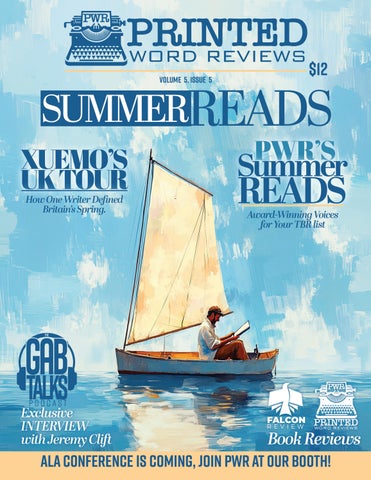
Rip up your TBR list, and get the PWR’s Summer Reads list to replace it! Award-winning authors with something to say or entertain you. See page 8.
A happy iguana in Miami Beach turns grumpy when his tree home is cut down and his routine is disrupted. Displaced and disheartened, his gloom only lifts when a charismatic green parrot offers his friendship and invites him to a new home. www.printedwordreviews.com/bookreviews/9780578568607
FALCON
In this edition, GAB TALKS features Jeremy Clift, a veteran Reuters war correspondent and former IMF publisher whose Galaxy Series secured two 2025 Independent Press Awards. Clift bridges the gap between hard science and human emotion, exploring the ethical complexities of space colonization, the patenting of life, and the survival of the first generation of children born off-Earth.
REVIEW
www.PrintedWordReviews.com
Alien Trucker
by Jeremy Haladyna Fantasy/Sci-fi/Visionary Fiction ISBN: 978-1977279859 • Outskirts Press
We have an account of the acclaimed Chinese author Xuemo's month-long cultural tour across the UK, visiting the London Book Fair and the Oxford Literary Festival. His journey focused on the “wisdom of the heart,” offering Eastern philosophical solutions to modern struggles like burnout, digital disconnection, and the fear of mortality. Through academic exchanges at universities in Bath, Bristol, and London, Xuemo emphasized that literature serves as a “bonfire in the darkness,” helping individuals reclaim inner sovereignty and find universal connection in an increasingly fragmented world.
Jeremy Haladyna’s Alien Trucker is a metaphysical road trip that proves the loneliest stretches of the American Southwest are an ideal stage for an interstellar identity crisis. By blending the “diesel-and-dust” realism of long-haul trucking with the sleek, cold desperation of extraterrestrial politics, Haladyna crafts a narrative that feels like Convoy meets The X-Files.
www.printedwordreviews.com/bookreviews/alien-trucker
FALCON
REVIEW
BookCAMP 2026 and the NYC Big Book and Independent Press Awards celebration was a vibrant, multi-day learning and celebration culminating in a glamorous gala on April 25th. This was an international gathering of talent, bringing together authors from four continents. Jack Olczak’s introduction was an inspirational testimony to the authors' “blood, sweat, and tears” of independent publishing.
www.PrintedWordReviews.com
The weekend kicked off with BookCAMP 2026, full of intensive educational sessions where industry leaders like Nadim Sadek discussed the future of AI in literature, and award-winning authors like Lee Woodman shared strategies for building a cohesive literary brand. These sessions provided authors with the “gold star” confidence and professional tools needed to navigate the global market. The centerpiece was the formal awards dinner, a night of “trumpet calls and fanfare” where winners walked the stage to receive their honors, traveled to the Awards screen for photos, and continued through the “Walk of Fame.” The celebration continued into an afterparty and concluded with the book fair Sunday, raising monies for The Newark Museum of Art and supporting the exhibiting authors. For authors like Joe Sarkic, the event represented the ultimate validation, a moment where their private creative struggles were transformed into public, award-winning triumphs. We invite you to join us next year at BookCAMP 2027, www.PWRBookCAMP.com and for those publishers and authors, join us for this fall’s NYC Big Book Award, www.NYCBigBookAward.com. Until next time, keep on reading,
Ted Olczak TED OLCZAK
Publisher, Printed Word Reviews www.IndependentPressAward.com
4
www.nycbigbookaward.com
TABLE of CONTENTS 2
Join us for the American Library Association Conference
3
Call for the 2026 Childrens Book Worm Awards
4
Publisher’s Letter
5
Table of Contents / Disclaimer
6
GAB TALKS Interview with Jeremy Clift
8
PWR’s Summer Reads: Award-Winning Voices for Your TBR list
11
Current GAB TALKS Podcast Guests
12
Between Oxford, London and Bath: How a Chinese Writer Brought the “Heart” into Britain’s Spring. A literary feature on Xuemo’s UK visit.
17
Awesome Summer Reads
18
PWR / FALCON Book Reviews
DISCLAIMER: The Printed Word Reviews magazine has been issued the following ISSNs by the U.S. ISSN Center, Library of Congress, Washington, D.C.: Format: Online Format: ISSN 3067-011X and is published 10 times per year. The title was previously published under the Independent Press Award and NYC Big Book Award Present with the following ISSNs by the U.S. ISSN Center, Library of Congress, Washington, D.C.: Format: Online Format: ISSN 2836-9157; and the Print Format: ISSN 2836-9149. Any questions or comments, please contact the Publisher Ted Olczak at Ted@GabbyBookAwards.com or Ted@PrintedWordReviews.com. No portion of this magazine may be reproduced without express permission from the publisher. All rights reserved. No part of this magazine may be reproduced or transmitted in any form or by any means, electronic or mechanical, including photocopying, recording, or by an information storage and retrieval system - except by a reviewer who may quote brief passages in a review to be printed in a magazine or newspaper - without permission in writing from the publisher. To submit your book for review, send to: Printed Word Reviews, 63 Clinton Rd, Glen Ridge, NJ 07028. Allow 8 -12 weeks. Unpaid reviews are not guaranteed. More details available on our website at www.printedwordreviews.com To submit your book for our award programs, visit the websites: Fall 2026: https://www.nycbigbookaward.com/ (More consumer focused; different judging; allows for all authors and publishers to participate; closes every August 15th, winners announced in October of every year.) Spring 2027: https://www.independentpressaward.com/ (Independent press and authors consideration; does not permit the big 5 publishing houses to participate; closes December 15th every year, winners announced in March of every year.) To advertise, please contact: Ted@GabbyBookAwards.com or Ted@PrintedWordReviews.com, or visit our website, https://www.independentpressaward.com/advertise www.IndependentPressAward.com
5
www.nycbigbookaward.com
with
Jeremy Clift
Author: Born in Space, Unlocking Destiny
J
eremy Clift is a scientific author, journalist, and award- winning author. His novel, Born in Space, Unlocking Destiny, is a Distinguished Favorite in the 2025 Independent Press Award. His second novel in the Galaxy Series, Space Vault, The Seed Eclipse, is also a distinguished favorite in the 2025 Independent Press Award in the audio books category. It was narrated by Gabrielle Gums Gordon. The sci-fi Galaxy Series of novels is built around the growth of orbiting space habitats and the exploitation of asteroids. Jeremy examines what life might be like for the first children born off Earth and a family’s fight for survival. A former nonfiction publisher with the International Money Fund, the IMF, in Washington DC, he’s a communications consultant who has also worked in magazines and was an international news and war correspondent for Reuters for two decades. Jeremy is a graduate of the London School of Economics and George Washington University. He has lived in a variety of capitals and cities around the world including Beijing, Mumbai, Cairo, New Delhi, Jakarta, London, Manila, and Paris. He’s lived in the US for the past 24 or 25 years, and spoke with us from Charlottesville, Virginia.
Gabby: Both books in the Galaxy Series take place in the not too far off future, which is a little disconcerting, 2056 and 2063. What are the central themes?
to solve the issue of how to populate remote colonies if you want to. Gabby: Both novels are the antithesis of how protagonists are typically and historically portrayed in science fiction books: powerful males. Your main protagonists are powerful, strong females. Were you trying to convey something really special and interesting with that?
Jeremy: It’s a tussle between civilizations and about human identity, who we are, where we are headed. It’s the fusion of genetic engineering, artificial intelligence, moon colonization or colonization of space, put all these things together and it’s about where are we headed, what are we doing.
Jeremy: I didn’t want to follow the same formula for science fiction that people often had in the past. I didn’t want it to be maledominated. I wanted women to be interested in science fiction as much as men. I think more women readers read science fiction than men do now. It’s a big expanding area of writing.
Gabby: The novels are heaping with headline grabbers. You also examine what life would be like for the first children born in space. How did you get so interested in the idea of humans being born in space rather than Earth?
Gabby: The Galaxy Series has been described as emotionally charged, complex, thought- provoking, cutting-edge. What is the underlying philosophical question that you, the author, almost demand that we, the readers ponder?
Jeremy: Everybody talks about colonization of space and how we’re going to do it. Are you going to send people all the time from Earth? I don’t think so. The journeys are going to be too long. So you have
www.IndependentPressAward.com
6
www.nycbigbookaward.com
Jeremy: Who owns life is one of the essential questions. Corporations like to patent things and the book sort of implies that you could patent life itself. There’s obviously resistance around that. It’s starting to get really ethically challenging for us all.
with
Gabby: How did you manage to keep the narrative exciting but also believable and compelling? It almost isn’t science fiction.
Jeremy Clift
Jeremy: I tried to make it as readable as possible for people who may not be completely into sci-fi. It has a lot of human emotion, a lot of human elements: family, motherhood, inter-relationships between father and son, fathers and daughters. I don’t think you want to write about just rockets or abstract stuff. In the books I do try to put in quite a lot of real scientific material to make it believable for people to say, okay, this probably could happen.
To listen to and watch the full interview
www.thegabtalks.com.
To learn more about Jeremy Clift and his novels visit
www.jeremycliftbooks.com
www.IndependentPressAward.com
7
www.nycbigbookaward.com
SUMMER Award-Winning Voices for Your
READS
TBR list
As the days stretch longer, there is no better companion than a book that challenges the mind and stirs the soul. The 2025 NYC Big Book Awards and the 2026 Independent Press Awards have curated a collection of global authors for your next TBR list. Whether you are looking for a pulse-pounding thriller for the beach, a transformative self-help guide in the living room, or a poetic journey into the self, this summer’s reading list offers a plethora of human spirit and great storytelling.
Thrills, Shadows, and Global Stakes For those who crave high-octane adventure rooted in raw, lived experience, Angela Greenman’s The Child Riddler (Winner, NYC Big Book Award) is an essential pick. Greenman, an international nuclear communications expert, draws from a childhood of homelessness and gang violence to craft Zoe, an elite operative who is essentially a female James Bond. It is a story of a hero who defeats the darkness, written by a woman who did the same in real life. If your taste leans toward the psychological, Diana Louise Webb’s Last of the Autumn Rain (Distinguished Favorite, Independent Press Award) offers a “surgical precision” of the human psyche. Webb employs Hemingway’s “Iceberg Theory,” focusing on the “why-we-do-it” when humans are pushed to the absolute brink. Christopher Johnston’s Where You Come From Is Gone (Winner, Independent Press Award) adds a layer of literary gravity to this summer’s list. A first-time novelist who honed his craft under the disciplined influence of Peter Geye, Johnston explores the raw friction between estranged brothers. Drawing inspiration from Tim O’Brien’s The Things They Carried, Johnston’s narrative serves as a study of how characters navigate moral minefields. It is a poignant exploration of the idea that while our origins might be “gone,” the internal scars of where we come from dictate who we become.
For fans of epic and dark fantasy, Michaela Riley’s Labyrinth of Shadows: The Witch's Rebirth Part I (Winner, NYC Big Book Award) and Sara Fanfarillo’s Everlasting provide immersive escapes. Riley’s work is a testament to family legacy and ancestral resilience, while Fanfarillo explores the “strange and shifting realities” of memory and potential.
For the Young (and Young at Heart) Summer is a season of growth, and several award-winning authors have turned their talents toward nurturing the next generation. Heidi Solomon-Orlick’s I Have a Voice: A Book of Listening helps children aged 4–9 identify their inner truth. Solomon-Orlick, a powerhouse advocate for women in business, proves that leadership and empathy begin in the nursery.
David Knoll’s Santa’s Kid of the Year is a delightful holiday-themed adventure with a year-round message: “being kind is cool and being a bully is cruel.” Claudia Daher’s R.A.T.S: Revolutionary Army of Teens (Distinguished Favorite, Independent Press Award) offers a science-fiction lens on social resilience, seeking to fill the “emptiness” many adolescents face with themes of unity and family values.
www.IndependentPressAward.com
8
www.nycbigbookaward.com
www.IndependentPressAward.com
9
www.nycbigbookaward.com
Memoirs of Resilience and Recovery Perhaps the most moving entries this year are those that document the triumph of the spirit over systemic and personal trauma. In a similarly brave vein, Maria Engstrom’s Restrained (Winner, Independent Press Award) details her harrowing journey through psychosis as a medical doctor. Engstrom’s memoir is not just a personal account but a professional call to action, advocating for compassionate, dignity-based mental health care. For those seeking spiritual recovery, Nancy W.’s Dear G-d: A Conversation with G-d, While on the Road to Recovery offers a 460-page intimate journey from addiction to healing through honest, daily dialogue with a higher power. Ivona Olofsson’s The Soul of War: Ukraine – Where Every Step Tells Their Story is a definitive account of the human face of conflict. As the daughter of Polish WWII survivors and a professional therapist, Olofsson documents the “invisible scars” of war with a poetic yet unflinching lens.
Wisdom for Personal and Financial Growth If your summer goal is self-reinvention, Dr. Fang Miao’s Love To The Extreme: A Miracle Unfolds (Winner, NYC Big Book Award) introduces the Meta-Cognitive Root Awareness (MCRA) framework. Dr. Miao’s work helps readers move beyond surface-level fixes to find profound personal transformation. For more pragmatic growth, Dr. Stacker’s Beginner’s Guide to Growing Wealth and Investing is an “instruction manual” for lasting legacy. Drawing from his experience of building and losing a multimillion-dollar portfolio, Stacker focuses on systems over hustle and identity over tactics. Laura Muirhead also provides two distinct paths for growth: A Funny Thing Happened on the Way to My Life, which reflects on the unexpected twists of a lived journey, and Queen Code: The Book, which offers frameworks for grounded leadership and self-trust.
Art, Poetry, and the Cosmos For a sensory experience, look no further than Lee Woodman’s Colorscapes. This collection of ekphrastic poetry explores the weight of the color spectrum, from the "Sari Reds" of an Indian childhood to the "Gallery Greys" of the Smithsonian. Similarly, Paris Rosemont’s Barefoot Poetess offers an intimate journey through the human condition, blending cultural identity with the absurdities of the modern world. In non-fiction, JoAnne M. Spiller’s Visionary Designs by Bill Smith, tj. (Distinguished Favorite, NYC Big Book Award) rescues the history of a forgotten Black jewelry designer from the archives, bringing history to life for a new generation. Finally, for those who believe it is never too late to start over, Joe Sarkic’s Veil of Dawn's Promise (Distinguished Favorite, Independent Press Award) is a must-read. After leaving a manuscript in a binder for 40 years, Sarkic returned to his craft to create a work of "cosmic expansionism," proving that the "harshest critic"—ourselves—can eventually be won over.
www.IndependentPressAward.com
10
www.nycbigbookaward.com
www.IndependentPressAward.com
11
www.nycbigbookaward.com
XUEMO
Between Oxford, London and Bath:
How a Chinese Writer Brought the “Heart” into Britain’s Spring A literary feature on Xuemo’s UK visit
L
ondon in March often feels as if the day has not quite woken up. Outside Olympia London, the wind chills visitors to the bone. Inside the halls the scene is completely different. Spotlights shine. Screens flicker. Rights managers, publishers, authors and literary agents hurry between rows of stands, wheeling suitcases behind them as though chasing the unwritten future of a book.
Amid the noise stands Chinese writer Xuemo at his own booth. His voice is calm and unhurried. On the table lie several books: Eternal Love, Reclaim the Throne of Your Heart, and Way Out: The Awakening of Women’s Wisdom in the Age of AI. The titles feel slightly out of place at the London Book Fair. Here the language of the day is markets and trends. Xuemo’s work seems to come from a quieter, deeper world. In that world people need not only information but inner peace. They need a stage to showcase themselves but also access to self-knowledge. It is this idea of the “heart” that runs quietly through his visit to Britain. In March 2026, Xuemo began his cultural tour across the United Kingdom that would last nearly a month. It ranged from the London Book Fair between 10 and 12 March to a closing dialogue at the Oxford Literary Festival on 29 March. The programme also included a cultural salon at Ming-Ai (London) Institute on how to avoid burnout, academic exchanges at the University of Bath, the University of Bristol and SOAS, University of London, and a charity forum at the Royal Over-Seas League on life, death and human nature, followed by a dialogue with entrepreneurs on leadership and values. Seven events in total, spanning publishing, higher education, charity, culture and business. What unfolded looked less like a promotional tour and more like an extended question. In a world accelerated by efficiency, capital and algorithms, can literature still speak to the heart? Can a writer from China inspire global audiences with something truly authentic?
Xuemo believes he can. www.IndependentPressAward.com
12
www.nycbigbookaward.com
When speaking of “surrender,” a term that often carries negative connotations such as weakness or defeat in English, Xuemo redefined it with strength and clarity. For him, surrender was not giving up but accepting things as they are, just as nature does. He also spoke about a process-oriented mindset: embracing what life brings and doing one’s best without becoming attached to results. The sun shines on all things without asking for reward. When people stay present and trust the process, the mind relaxes. The setting that day was modest. There was no elaborate staging. What impressed people most was Xuemo’s manner of speaking. He did not compete for attention or appear to be delivering a keynote. Instead he seemed to pass on thoughts shaped by personal experience. At the end of the event he presented the organiser with his newly published epic Suosalang. The gesture was simple yet symbolic. It mirrored the spirit of Xuemo’s entire trip. He had not come to prove something but to leave something Behind.
At the London Book Fair his booth stood out because it was independent. Publishers and distributors from Britain, Norway and Italy stopped to discuss rights cooperation and overseas distribution. Xuemo is not new to international publishing. According to his team, he has written more than eighty books in Chinese, with over two hundred editions, and has been translated into twenty-eight languages. The English editions are by Howard Goldblatt and Sylvia Li-chun Lin. Works such as Into the Desert and Wild Fox Ridge have received international awards and ranked among Amazon bestsellers. What made many listeners pause during the following events was a theme Xuemo returned to repeatedly. “Today, the human mind,” he warned, “is increasingly swayed by external forces.” On 16 March the Ming-Ai (London) Institute invited Xuemo to deliver a public lecture titled “From Burnout to Flow: Eastern Wisdom for Focus and Energy.” It was a topic that resonated strongly with urban residents. Yet Xuemo did not frame burnout simply as workplace stress or emotional management.
On 17 March, a cross-sector roundtable at the Royal Over-Seas League in London shifted the focus from dealing with burnout to confronting life’s ultimate trials. The charity forum “Love Conquers All” was organized by the Freya Foundation (London) with support from Xuemo Foundation and other partners. Participants from literature, art and medicine spoke of love and creativity as guiding beacons, closely aligned with the core theme of Xuemo’s work.
“Modern people,” he said, “feel exhausted not only because they constantly multitask but because they compare, compete, judge, and crave, driven by an excessive demand for results. The root of suffering often lies not in what they do but in what he calls the “discriminating mind.”
www.IndependentPressAward.com
Xuemo compared literature and wisdom to a bonfire in the dark-
13
www.nycbigbookaward.com
XUEMO
ness. A bonfire cannot stop nightfall. It cannot end war, illness or death. But it allows those who pass by to draw closer, to warm themselves and to see one another more clearly. “Individuals may not change the overall darkness,” he said, “but they can still ignite the little flame of hope against fear and nihilism.” Drawing on Eastern philosophy, he described death as transformation rather than final termination. “What people truly fear,” he said, “is often not death itself but the lack of preparation to face it.” In a gesture reflecting that spirit, Xuemo Foundation donated £4,000 to the Royal Marsden Cancer Charity. On 19 March the discussion returned to a central question: how can a person regain inner balance and agency? At the University of Bath scholars and guests gathered for an academic seminar that also marked the English launch of Reclaim the Throne of Your Heart, translated by Dr. Yukteshwar Kumar. With Vice-Chancellor Casey Wilson, Professor Yukteshwar Kumar, and faculty and students present, Xuemo recounted a case from the book about a young woman with depression who found healing through its message. “The purpose of the book,” he said, “is not ‘chicken soup’ comfort. It helps people reclaim sovereignty over their lives so their attention, emotions and destinies are no longer controlled by external judgments or social trends.” The topic was unusual for a typical literary event. It felt like a diagnosis of the times. Today people are more connected than ever through the digital world, yet many feel increasingly disconnected from their inner selves. Xuemo, however, did not treat this imbalance as a
www.IndependentPressAward.com
14
modern condition. Instead he placed it within a broader historical and cultural context. “Our society often emphasises external achievements while neglecting inner strength,” he said. “As a result, people may appear powerful on the surface yet hollow Inside.” Xuemo also spoke highly of Professor Kumar’s talent, calling him “a translator sent by heaven”. A book written in Chinese can only come alive in the English-language world if the translator can carry its rhythm, warmth and wisdom across that boundary. The subject of translation was explored further the following day at the University of Bristol. On 20 March Xuemo joined Associate Professor Paul Golf and Professor Kumar in a panel discussion on translation and cross-cultural communication attended by thousands online and in person. When asked why translation still matters in the information age, Xuemo did not reject technology. Instead he redefined translation. “It is not merely the conversion of words or the transfer of content. It is the delicate work that occurs when one culture enters another. It requires strong language skills but also the ability to feel, empathize, judge, and sense what remains unspoken.” “Readers,” he said, “are like the sun, and the writer a clay figure. Without sunlight, the clay remains clay; it can never become a statue.” A book is not finished when the writer completes it but when it is received by another living mind. The conversation continued at the School of Oriental and African Studies. On 21 March, scholars from Oxford, Warwick and other universities gathered for a seminar titled “Literature and Civilization: A Cross-Conti-
www.nycbigbookaward.com
nental Dialogue.”
from literature. But the question behind it was surprisingly aligned: how can a person, an institution, or a civilisation adapt to changing circumstances without losing their inner core?
In his speech, Xuemo reflected on why Chinese civilisation has endured for thousands of years. “Two foundations,” he said, “have sustained it: a holistic governance system and the Xin-Xing (heart-mind and its nature) traditions of Confucianism, Buddhism and Daoism.” Many global crises today, he argued, stem from an imbalance between institutional systems and inner cultivation.
If the earlier events set the stage, the Oxford Literary Festival on 29 March became the tour’s defining moment. At Magdalen College, Xuemo appeared in conversation with Polly Silk, senior lecturer at Oxford University Press. As the festival’s only invited Chinese writer, he explored how literature rooted in local experience can resonate across the world. Instead of using complex terms, he compared his writing to a tree from north-western China known as the desert date. It grows in dry soil, sinks its roots deep into the earth and endures wind, drought and sandstorms.
Xuemo said his writing is rooted in north-western China, a landscape of hardship, resilience and faith. “Because my work grows out of that rugged land,” he argued, “it speaks to universal themes of loneliness, desire, pain and love, and to how people keep an inner light alive amid uncertainty.” He then sang the folk song Farewell at Yangguan Pass, accompanied by pipa and guzheng musicians, and donated more than a hundred copies of his books to SOAS. The gestures were simple, yet they quietly echoed the spirit of his work. In another dialogue, Xuemo spoke on the theme “Balancing Business and Spirituality.” He outlined a framework drawn from Chinese philosophy: Dao, De (virtue), Fa (law), Shu (technique), and Shi (momentum). At first glance the topic seemed far removed
www.IndependentPressAward.com
“Living literature does not flatten itself to please the world. It has character,” Xuemo said. “It must root itself in its own land, experi-
15
www.nycbigbookaward.com
ence and culture before it can speak to the world. Local identity is not the obstacle to universality. Shallowness is.” In Oxford, a city long known for its pursuit of universal knowledge, the argument sounded both simple and striking. “To know others,” he said, “a man must first know himself.”
Literature, real literature, may not transform the world overnight. But like a small fire in the dark, it can still cast enough light for the human heart to find its way. Outside Olympia London, the early spring wind still chills passers-by. The applause in Oxford’s halls has already faded. Posters across Bath and Bristol give way to new events. Time moves forward. The Thames continues to flow. The city quietly absorbs such moments back into the rhythm of everyday life.
Xuemo also spoke about the redemptive power of literature. “Humanity,” he said, “faces multiple crises. Peace cannot depend solely on rules and institutions. It must begin within the human heart. Literature matters because it works on the inner world, helping to reorder love, pain, memory and hope so that people do not lose their sense of direction in the dark.”
Yet some may still remember that one March in Britain when a writer from China’s far west spoke not about success formulas or exporting culture. Instead, he turned to something deeper: how the soul might remain free, how people can hold on to hope amid suffering, and how literature may still deserve a word as ancient and weighty as “redemption.”
Can Eastern wisdom enter the modern world not as a slogan or mystique, but as something people can relate to and live by? This spring offered at least one possible answer. It was not loud, but it reminds us again and again that if we humans continue to expand outward yet never settle inward, then no matter how advanced technology is, civilisation may still lose its Foundation.
www.IndependentPressAward.com
That may be the lasting echo of Xuemo’s visit to the UK.
16
www.nycbigbookaward.com
Awesome
Summer
READS
For some of us, there’s nothing better than laying on the beach while reading a great book. But with so many other things vying for our attention, the book has to be terrific. Here are five of my new and old favorites—and most of them are collections of short stories to captivate your attention in-between hitting the water! Best of is a series of short stories that run the gamut from Godzilla, to a soul-sucking mummy, to zombies, along with several more-normal, equally weird stories. “Bubba Ho-Tep” is included which was made into a horror-comedy movie. My favorite in this collection has to be “Godzilla’s Twelve Step Program,” where by day the titular monster works at a foundry and tries to curb his impulse to destroy with an AA-similar program, along with several other familiar monsters.
1. Writers of the Future Volume 42 – This anthology has a variety of engaging and thought-provoking stories. The ability to stop time in a small space, time travel, fantasy stories with dragons and fairies, AI stories and demon dogs. I’ll talk about just one of my favorites. We’ve all read time travel stories, but in this one, a group goes back in time to cover up and “logically” explain anomalies created by other time-travelers. The author has some wonderfully quotable lines such as:
How could you not want to read a story with that line?
3. Holy Ghost by John Sandford–the only novel in this list. For John Sandford, the Prey series at 36 novels and counting, is usually my all-time favorite. His Virgil Flowers spinoff character has 12 books of his own and Holy Ghost is the absolute best of them. This book will have you reading until the end to figure out who the killer is.
2. The Best of Joe R. Lansdale. This author is skilled in numerous genres with an abundance of awards. His most famous books are the Hap and Leonard series, consisting of 15 novels and a 3-season Sundance TV crime drama. The
4. Night Shift by Stephen King–Some people say that Stephen King writes much better short stories than his novels which sometimes have disappointing endings. Night Shift is so great I can see why people believe he is the master
It would be spectacularly stupid to disband the project. But then, spectacular stupidity has always been one of humanity’s most reliably renewable resources.
www.IndependentPressAward.com
17
www.nycbigbookaward.com
at this form. “Jerusalem’s Lot,” “Battleground,” “Quitters, Inc.” and “Children of the Corn” have stayed with me for years as absolutely fantastic stories. And these are just four of the twenty included in this collection. “Quitters, Inc.” has the mob branching out into services to help people stop their bad habits—all of us have some weakness that probably isn’t the best for our long-term health, and this story will have you wondering if maybe this service could be just what you need!
“Shucks,” I said, “if you’d been a little earlier, you’d have seen us while we were still on fire!” … The canon pretty well quelled our enthusiasm for building our own muzzleloaders from scratch. Not only had it made a big impression on us; it had made numerous small impressions. I hope these five recommendations make it on your must-read summer reading list.
5. I Fish; Therefore, I Am (And Other Observations) by Patrick F. McManus–If you’ve never read Patrick McManus, get ready to have a new source for humor that will have you rolling on the floor with laughter. This is a collection of three of his earlier collected-works books! In “Poof—No Eyebrows,” the young-boy main character and his friend build a small cannon and set it off to disastrous results. As they are recovering behind a shed, a deputy drives up looking for the cause of the explosion he heard. “Now, what I want to know,” the deputy went on, “is why are you two boys sitting out here behind this shed smoking?”
You won’t be disappointed! John Carey BIO: Born and raised in Texas, John Carey loves both the big cities and country life. He always knew he needed a good job to pay the bills so pursued engineering degrees. He shoved his writing and artistic endeavors to the evenings and weekends. John has written over 1.5 million words in short stories, poems and books, both fiction and non-fiction. In 2011, John won Honorable Mention in L. Ron Hubbard's Writers of the Future contest for his science fiction entry, "A Cast of Millions." In 2017, he again won an Honorable Mention in the same contest for "The Changing of the Veil." His latest fiction book on Amazon "Not Worthy of the Air You Breathe" is set in a 2305 dystopian future.
FALCON
REVIEW
Alien Trucker by Jeremy Haladyna Jeremy Haladyna’s Alien Trucker is a metaphysical road trip that proves the loneliest stretches of the American Southwest are an ideal stage for an interstellar identity crisis. By blending the “diesel-and-dust” realism of long-haul trucking with the sleek, cold desperation of extraterrestrial politics, Haladyna crafts a narrative that feels like Convoy meets The X-Files.
hybrid to confront the messy, inconvenient nature of human emotion; and lastly, Kahayla: A woman deeply connected to the Zuni Pueblo, who guides Trucker toward Wenima (the “Dance Hall of the Dead”). It is through Kahayla that the book explores its most fascinating theme: the intersection of ancient Indigenous spirituality and modern “alien” intervention. The search for the pink earth compound becomes less about chemistry and more about the sanctity of the land.
At the heart of the story is H, a hybrid agent sent to Earth by the Pleiadians. These aren’t the benevolent “space brothers” of New Age lore; they are a desperate, stranded race facing a catastrophic power failure on their Orbital Carrier.
The climax is a claustrophobic, tense confrontation in a hidden cave that leaves the reader breathless. Haladyna doesn't opt for a clean, heroic ending. Instead, the resolution is a sobering look at the high cost of survival. Between the loss of life and the cold betrayal of his Pleiadian commanders— who ultimately abandon him to his fate—Trucker’s victory is bittersweet at best.
Disguised as a human trucker in a classic red Peterbilt, H (now “Trucker”) must navigate more than just the Nevada desert. He is tasked with securing Uranium yellowcake and a mysterious “pink matter,” which is a compound essential for his masters’ survival. Haladyna excels at ground-level worldbuilding, making the clattering mechanics of a semi-truck feel just as alien and complex as the Space Force officers’ uneasy alliances.
The novel concludes with Trucker as a fugitive, a man (or something like one) without a world, blending into the very human society he was sent to exploit.
The novel takes a bit to find its rhythm, and comes in the midstory developments. As Trucker traverses the Four Corners, the book shifts from a covert mission to a spiritual odyssey. The supporting cast provides the human (and superhuman) heartbeat of the journey: Chuy: The young guide who grounds the story in the harsh reality of the terrain; Rachelle: A character who acts as a mirror for Trucker, forcing the
ISBN: 978-1977279859 www.IndependentPressAward.com
Alien Trucker is visionary fiction. It manages to be an adventure while posing deep questions about the interconnectedness of worlds. Whether you are a fan of “Hard Sci-fi” covert military thrillers, or metaphysical mysteries, this book offers a ride that is as thought-provoking as it is cinematic.
www.printedwordreviews.com/bookreviews/alien-trucker
18
www.nycbigbookaward.com
Rockstar: Echoes by Zach Taylor Zach Taylor’s “Rockstar: Echoes” isn’t your typical “sex, drugs, and rock ‘n’ roll” romp. Instead, it’s a character-driven dive into the machinery of the music industry and the ghosts that haunt those who dare to step into the spotlight. Set against the starkly contrasted backdrops of high-gloss Los Angeles and the raw, rhythmic pulse of Kansas City, Taylor delivers a narrative that feels as authentic as a sweat-soaked basement show.
glamorous” side of the dream. Her resilience provides a necessary counterpoint to the chaotic energy of Aberdeen. Mike Kilmore is a masterclass in ‘internal band politics,’ acting as a personification of the ego and insecurity that can dismantle even the most talented groups. “Rockstar: Echoes” leans into identity. The book asks a piercing question: “How much of yourself must you lose to become an icon?” The “echoes” in the title refer not just to the music, but to the legacy of Lloyd Brannon. The band’s struggle to move forward while honoring the past is a poignant metaphor for anyone trying to build something new on a foundation of grief. Taylor’s “gritty, realistic style” ensures that the triumphs, like Kline’s climactic high-stakes performance, feel earned rather than gifted.
The story centers on a collision of two rising stars and the seasoned observer documenting their trajectory. Clara Cowley, a veteran rock journalist, provides the lens through which we witness the meteoric, and often perilous, ascent of Kline Thomas. Kline is the enigmatic new frontman of Aberdeen, a band living in the long shadow of their late member, Lloyd Brannon. As Kline fights to find his voice amidst internal sabotage from guitarist Mike Kilmore, he finds a kindred spirit in Rayne Harlow. Rayne, the leader of the Painted Queens, embodies the book's most grounded conflict: the grueling juggle between artistic ambition and the relentless responsibilities of single motherhood.
The book concludes with a satisfying, albeit realistic, resolution. By confronting Kilmore and demanding loyalty, Kline finally steps out from the “Echoes” and into his own light. Rayne’s journey toward finding strength in her community and her craft provides a hopeful, grounded ending. While it does have that final confrontation, "Echoes" is the first of the "Rockstar:" series, leaving the door open to following novels, specifically "Rockstar: Mirrors."
Taylor creates characters who feel like they’ve actually spent years in a tour van. Far from a hollow archetype, Kline’s battle with substance abuse and crippling self-doubt makes his journey feel urgent. His struggle isn’t just about hitting the right notes; it’s about surviving the pressure to be a reincarnation of a legend. Rayne serves as the emotional heart of the novel. Her fight against industry biases and financial instability highlights the “un-
ISBN: 979-8999679710
Whether you’re a fan of punk, rock, or simply a well-crafted character study, “Rockstar: Echoes” captures the spirit of the industry—the noise, the silence, and the beautiful, messy space in between.
www.printedwordreviews.com/bookreviews/rockstar%3A-echoes
FALCON
REVIEW
Framed in Love by Clifton Wilcox Dr. Clifton Wilcox delivers a haunting, lyrical tale in “Framed in Love.” A fantasy romance, the novel functions more as a meditation on the fragility of human connection.
The setting serves as the subconscious. The characters must navigate the architect’s grief to find a way out. As the landscape around them bleeds into blank canvas, the emotional intimacy between David and Abby intensifies. Their love grows in direct proportion to the destruction of their environment, creating a sense of “doomed romanticism” that is rare and deeply moving.
The story’s premise is as imaginative as it is surreal. Following a freak strike of lightning, David is transported into a lush, intricate Victorian park, a sanctuary that exists entirely within a 19th-century painting. Within this gilded frame, he meets Abby; the two become souls tethered to a reality that is literally coming apart at the seams.
The climax of “Framed in Love” is as visceral as it is heartbreaking. Unlike many modern fantasies that offer a “happily ever after” through a magical loophole, Wilcox chooses the path of emotional honesty. When David is forced back into his own world, the transition is jarring and raw.
Wilcox’s “magic” in this story is the metaphor of decay. As the painting physically cracks and fades, the stakes become agonizingly personal. The vibrant garden isn’t just losing its color; Abby is losing her memories. Wilcox uses this supernatural “world-rot” to explore a universal truth: the dread of watching someone you love slip away.
It moves beyond a simple "rescue" story to tackle the interplay between art, life, and the inevitability of change. The image of David left is one that will linger with readers long after the final page is turned. However, the book avoids total despair; instead, it offers a powerful message that art can help us through the most difficult of times. David’s eventual transformation of his grief into art and writing serves as a tribute to the idea that while life is transient, the impact of love is permanent.
The story takes a fascinating turn when David and Abby discover a hidden garden within the painting. This isn’t just a plot device to save the world; it is a journey into the subconscious of the original artist, Stephanie.
ISBN: 978-1969770043 www.IndependentPressAward.com
www.printedwordreviews.com/bookreviews/framed-in-love
19
www.nycbigbookaward.com