1
www.PrintedWordReviews.com
www.PrintedWordReviews.com
2
PUBLISHER'S LETTER
TABLE OF CONTENTS 2
WEBINAR: Make your Book into a Movie for a Fraction of the Cost
3
Publisher’s Letter
4
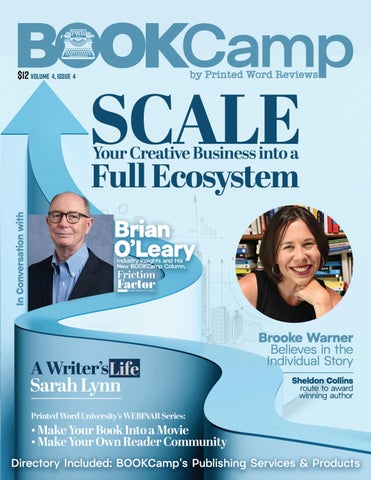
Scale Your Creative Business into a Full Ecosystem
5
WEBINAR: Build a Reader Community That You Actually Own
7
In Conversation with Brian O’Leary (Part One)
8-9
Printed Word Reviews in Ireland!
10
Brooke Warner Believes in the Individual Story
13
Call for 2026 Independent Press Award Submissions
14
Sheldon Collins Chose Indie Production Over Corporate Audio
17
Call for Impactors & Influencers: Printed Word Reviews’ Changemakers
18
Directory Included: BookCAMP’s Publishing Services & Products
19
A Writer’s Life: Sarah Lynn
Dear Publishers, Authors, and Publishing Innovators, Whether you are launching your debut title, expanding an established small press, or seeking new ways to connect with your readership, our mission remains unchanged: to bring you actionable strategies, candid industry perspectives, and practical tools to elevate your publishing journey. This issue is packed with insightful features and expert guidance designed to help you rethink how you build your author brand and scale your business. Here is a preview: Scale Your Creative Business into a Full Ecosystem: Strategy expert Jimmy Newson breaks down how publishers and authors can build a sustainable, interconnected business ecosystem that drives long-term growth and recurring revenue. Reader Turned Editor: Memoir remains one of the most powerful, and challenging, genres in publishing. Renowned publishing mentor and author Brooke Warner tells her personal story and shares invaluable wisdom and insight to the industry. In Conversation with Brian O’Leary (Part One): I sit down with publishing veteran Brian O’Leary for an insightful three-part conversation. Plus, we are thrilled to launch his new regular column for BOOKCamp, Friction Factor, where Brian tackles the operational and supply-chain bottlenecks facing independent creators today. AMPlify Audiobooks: Sheldon Collins’ Route to Award-Winning Author: Audiobooks continue to be the fastest-growing sector in publishing. Learn how Sheldon Collins leveraged audio production to expand his audience, elevate his storytelling, and secure award-winning acclaim.
DISCLAIMER: BOOKCamp by Printed Word Reviews magazine, Online format Library of Congress ISSN: 2994-4406 is published 5 times a year. Questions or comments are welcomed, please contact the Publisher Ted Olczak at Ted@PrintedWordReviews.com.
Writer’s Life: Sarah Lynn, Author of Between the Lines: In our Writer’s Life column, we take a close look behind the curtain with Sarah Lynn. She gives us an intimate look at her creative process, routine, and the inspiration behind her book, Between the Lines.
No portion of this magazine may be reproduced without express permission from the publisher.
We’re excited to highlight two upcoming masterclasses from Printed Word University: 1) Make Your Book Into a Movie (Presented by Creatorwood) where you’ll discover the fundamentals of screen adaptation; and 2) Make Your Own Reader Community (Presented by Jimmy Newson of Moving Forward Small Business) where you’ll learn how to cultivate a loyal, engatged audience that acts as your book’s biggest champion.
To submit your book for our award programs, visit the websites: Fall 2026: https://www.nycbigbookaward.com/ (More consumer focused; different judging; allows for all authors and publishers to participate; closes every August 15th, winners announced in October of every year.)
Thank you for being an essential part of the BookCAMP community. Dive in, take notes, and let’s keep moving your publishing goals forward!
Spring 2027: https://www.independentpressaward.com/ (Independent press and authors consideration; does not permit the big 5 publishing houses to participate; closes December 15th every year, winners announced in March of every year.)
Warmest regards,
To advertise, please contact: Ted@GabbyBookAwards.com or Ted@PrintedWordReviews.com, or visit our website, https://www.independentpressaward.com/advertise
Ted Olczak TED OLCZAK
Publisher, BookCAMP Magazine
3
www.PrintedWordReviews.com
Scale Your Creative Business into a Full Ecosystem For most authors and creatives, the act of creation is the ultimate destination. But a sobering reality awaits on the other side of publication: writing a great book is only half the battle. In his high-energy BookCAMP session, www.ipabookcamp.com/list-of-speakers/jimmy-newson, entrepreneur, speaker, and former music industry professional Jimmy Newson addresses a critical vulnerability shared by the artistic community: the complete omission of the business side of creativity. Drawing from his extensive background in touring, working with the Grammys, and consulting for small businesses, Newson outlines his proprietary “Track to Transcend” ecosystem—a structured, data-driven framework designed to help creators stop hoping for sales and start predictably scaling their businesses. The Creative Paradox: 100% Art, 0% Business. The fundamental challenge in the creative sector is a lopsided allocation of focus. Newson points out that most authors spend 99% or 100% of their time on the book, and 0% of their time on everything else around the book. This “single-minded creator” trap prevents authors from seeing their work as an enterprise. To bridge this gap, you must transition your mindset to look far enough into the future, identify where you want to be, and draw a straight line back to where you are today. While the first dollar you earn as a creative is exciting, the real magic lies in predictability. To generate thousands, hundreds of thousands, or even millions of dollars, you must build systems that allow you to replicate and multiply that revenue. To scale, start with establishing a solid foundation built on data, purpose, and audience intelligence. Newson’s method breaks this foundation into three pillars: First, your founder’s story is the heartbeat of your brand. When building an ecosystem, your “Why” must be connected directly to your strategic partnerships, sales funnels, and funding opportunities. Next, knowing more than your audience’s age, income, and education. True market www.PrintedWordReviews.com
intelligence requires understanding their psychographics: What do they value?; fear?; What are their aspirations? People are either trying to escape a specific pain point or achieve a deeply held aspiration. If you can position your book, community, or services as the vehicle to help them do that, you will capture their loyalty. Lastly, leverage modern digital marketing tools to pinpoint where your readers spend their time. Newson highlights platforms
4
which analyze specific keywords and phrases to show you exactly where your target audience hangs out online, what websites they visit, and what social channels they frequent. For decades, digital marketers preached that “the money is in the email list.” In the modern landscape, that rule has evolved. “If the money was in the list, the new currency is community. You have to start thinking: ‘How do I build a community around my
5
www.PrintedWordReviews.com
solution that serves the audience first; helps the partner fulfill their goals second; and places yourself third. When a major institution shows interest, resist the temptation to immediately pitch a massive, complex project. Start small to build trust. Offer a low-friction, high-value initiative, such as a brief virtual fireside chat or a small online webinar. Next, execute flawlessly and over-deliver on your promises. Lastly, use that success as leverage. Once they see your execution and professionalism, they will often invite you to do larger, fully-funded events. A book should never be the end-point of your business; it is the entry point. To scale your revenue predictably, you must build a value ladder that takes a reader from a low-cost purchase to high-ticket engagements. By breaking your book’s core concepts down into modular workshop curricula, speech topics, and evergreen training programs, you extract maximum value from a single creative asset.
books?’” said Newson. Social media followers are renting space on someone else’s land. To truly scale, you must build a centralized platform or ecosystem that you own and control. When you establish a community, you transform passive consumers into active brand evangelists. It also repositions your role in your industry: you become a facilitator of change, gathering insights from the global stage and feeding them directly back to your community. This dynamic makes you highly attractive to major corporate partners, who are often eager to pay you to gain access to the trust you have built with your niche audience. Many self-published authors and small business owners dream of landing major corporate sponsors, but their outreach fails because they make the pitch entirely about themselves. Newson, who has brokered collaborations with giants like Bank of America, Merrill Lynch, and ADP, uses a strict hierarchy called the Triple Win to command attention. Pitch a www.PrintedWordReviews.com
In an era dominated by artificial intelligence, the competitive advantage belongs to those who know how to use it as a powerful data-crunching assistant rather than a lazy shortcut. Newson’s personal workflow for AI integration is simple. For example, if you have a discovery meeting, you can download the meeting transcript, feed it into an LLM, and upload your product, feature, and about pages. Ask the AI: “Find the exact intersection of alignment between their goals and my services, and write a follow-up proposal email.”
“How do I build a community around my books?.” This approach allows you to move at the speed of light, producing highly personalized outreach that secures more ‘yes’es in a fraction of the time. You don’t have to rely solely on book sales to fund your journey. Millions of dollars in grants and government contracts exist specifical-
6
ly for authors, creatives, and niche experts. By using grant-matching software, you can easily scan for available funding ranging from $25,000 to $150,000, draft solid foundational applications, and refine them with your personal human touch. As the leader of your business, your most precious asset is your time. To scale past a solopreneur mindset, you must ruthlessly audit how you spend your day. Analyze your daily activities, essentially outlining more valuable tasks that yield higher dollar returns. For example, an hourly minimum wage task such as manual administration, data entry, scheduling, basic inbox management should be automated, eliminated, or delegated to work on delivering workshops, speaking, closing high-ticket, building core assets that may yield $1,000 per hour. A “$1,000/hour task” does not mean you will receive a check for $1,000 today. It refers to high-leverage, strategic thinking that generates compounding interest over time. If you spend your entire day bogged down in $10/hour administrative work, you are actively preventing your business from growing. To transition from a single-minded author to an ecosystem leader, execute this roadmap: Document Your Value Ladder: Identify at least two offerings you can build immediately around your book’s core theme (e.g., a 3-part virtual workshop series or a private, paid community channel); Eliminate One Core Bottleneck: Track your time for one week. Identify the most repetitive, time-draining $10/hour task you perform and either automate it using AI tools or delegate it; Harness Your Growth Data: Begin collecting, organizing, and tracking your metrics—such as community engagement rates, newsletter signups, and reader demographics. Having this data ready is your ticket to securing high-value strategic partnerships.
Join Jimmy Newson for a FREE webinar, Build a Reader Community That You Actually Own. Sign up here: www.printedwordreviews.com/courses
PWR in Conversation with
Brian O’Leary Part One
Within hours of Brian O’Leary’s retirement from BISG, and before he could even pack for his Appalachian Trail adventure, Printed Word Reviews publisher Ted Olczak asked for an interview to introduce O’Leary’s launch of his quarterly BOOKCamp column, Friction Factor. To do justice to such a rich life story, Olczak focused on the key highlights and organized his questions into three rough sections: Retrospective, Legacy, and Parting Thoughts, Collective Action & Market Safeguards; and lastly, Tech, Supply Chain, & Operations, with each touching on the two other segments.
O’Leary: The data is suggesting that people are not reading long-form content. PWR: Having served as BISG executive director for a decade, you had to represent the publishing industry as a whole. Now that you’ve stepped down, what is the one truth about the publishing supply chain that you’ve been dying to say out loud, but couldn’t? O’Leary: The way we handle metadata, duplicating copies of publisher feeds at different distributors, retailers, and aggregators, is set up to fail. In fairness, I have said that out loud, including the white paper for Book Publishing Next. Authors who can’t understand why something wrong in their author bio or marketing copy keeps showing up: it’s built to do that.
Retrospective, Legacy, & Parting Thoughts (Part one of three) PWR: AI is important in copyright and content creation, but from a BISG perspective (metadata, workflow, and supply chain) where will AI actually fix the industry’s plumbing, and where will it break it? O’Leary: That’s the big question, really. AI offers significant potential in managing and mining big data sets, but most of those data sets are tied up in proprietary databases. There’s a risk that the strongest players use AI to improve their own position at the expense of the supply chain. At the same time there’s a risk that AI-based startups will break the way the industry has traditionally worked, perhaps undermining the success of the ISBN. I’m hopeful that AI will give us tools to solve problems, while organizations across the supply chain decide whether and how to use those tools. The answers are probably a few years more in the making. PWR: You spearheaded the Book Publishing Next initiative to modernize the industry’s tech stack. If a mid-sized publisher has a limited budget today, what is the single most critical
infrastructure upgrade they cannot afford to ignore? O’Leary: Invest in a rights and royalties management system. We did a study in 2022 that showed the payback is regularly less than a year. It allows you to expand your business and earn more money for your authors. It also avoids a multitude of problems down the road. If you’ll allow me one other: If you’re not using ONIX 3 to transfer metadata, you’re leaving money on the table. There are ONIX 3 compliant systems available for publishers of any size. Doing things in Excel or Filemaker is not an effective option any more. PWR: What keeps you up at night about the book business right now?
7
PWR: If you had to give one piece of parting advice to your successor, Allison Belan, and the rest of the industry leadership navigating the late 2020s, what would it be? O’Leary: Keep your sense of humor (I am sure she will), and say “yes” to as many things as you can. Being part of the conversations helps us all get better. Stay tuned for part two of this interview in the next issue of BookCAMP magazine.
Friction
Factor
with Brian O’Leary www.PrintedWordReviews.com
www.PrintedWordReviews.com
8
9
www.PrintedWordReviews.com
Brooke Warner Believes in the Individual Story: Reader Turned Editor Says Good Stories Are for Everyone Brooke Warner doesn’t believe in exclusivity. As the publisher of She Writes Press, an award-winning hybrid publisher for women authors, Warner works to publish manuscripts that traditional publishing tends to overlook. She believes traditional major publishing houses have a bad habit of saying no to good ideas, if they come from the “wrong” kind of people. She thinks publishing should be accessible to everyone who has a good story to tell. But she didn’t start her career that way.
10
www.PrintedWordReviews.com
Brooke Warner In fact, she hadn’t been planning to get into publishing at all. Warner graduated with a degree in international affairs, but as she began looking for work, she didn’t feel that it was a natural fit. As she began exploring her options, though, the idea of book publishing started creeping in. Right out of college, she spent a year traveling in Europe and worked at Shakspeare and Company, an independent bookstore in Paris. But that was only the first sign. “I came to books, really, because my mom said, ‘What do you love? If you could do something you loved, what would that be?’ And I said, ‘Read,’” Warner said. “ So many people come to book publishing from having a degree in English, or because they’re writers. I was always a reader. And there were all these little pointers, that were almost like the universe pointing in a certain direction.” At 23, Warner landed her first entry-level role, at nonprofit California publisher North Atlantic Books. From there, she grew her career in traditional publishing for 13 years, all the way to becoming the executive editor of Seal Press, a women’s letterpress founded in a Seattle garage. She avidly worked on expanding the field for women writers and cultivating marginalized voices like transgender authors. She loved her work. Then, Seal got acquired. And Warner began to feel disillusioned with her new corporation’s publishing preferences. Books began being scrutinized for the author’s attractiveness and celebrity name value, rather than content. In a 2017 Tedx talk, she walked through one of the main experiences that flipped the switch for her on traditional publishing. One book she had wanted to acquire was by an up-and-coming transgender author. When she pitched it, her publisher told her that the new parent company of the press thought they had published enough of “those kinds of books.” Instead, a few weeks later, she got an offer from an author who had “all the right bells and whistles.” She was attractive, well-connected, and had a celebrity connection. Warner saw those two projects, juxtaposed, as “symbolic of something much bigger” in how publishing was moving.
www.PrintedWordReviews.com
“ I came in at such a moment where editorial was really prioritized, and over 13 years, we got deprioritized,” Warner said. “Marketing started to take over the decision-making for acquisitions. It was very frustrating. These corporate entities buy little, tiny presses that have a certain sensibility and a certain personality, and it was awful. It was really disappointing, and so I realized I just wasn’t happy anymore.” And she began looking for a way out. Through an online community for women writers that she had been participating in, she found it. Kamy Wicoff, an author and therapist, had founded She Writes in 2009 as a way to help women authors break into and understand the publishing field. Wicoff had begun working with Warner even before Seal was acquired, to put on writing and coaching workshops for the community’s membership.
“We’re looking for a good story.” “ It was just clear from the beginning that our missions and the things that we cared about and believed in were really aligned,” Wicoff said. “Brooke immediately became a really important part of that community, and had a great, authentic, inspirational voice there. And so when she started to identify some things that she thought needed changing in publishing, she reached out to me.” In 2012, Warner pitched Wicoff on the idea of She Writes Press, an independent publisher dedicated to women authors. She wanted to model it based on what she loved most about Seal Press, and what she had wanted it to become.
11
Brooke Warner “ When she brought it to me, it resonated from the writer side,” Wicoff said. “ For me as a writer, part of what was really exciting and appealing was that she was really devoted to finding ways to make publishing work better. The traditional model, while it purported to be a gatekeeper based on the quality of manuscripts, really the gatekeeping was about profit, frankly—which is fine, there’s a real place for that. But I think it left many writers who couldn’t get published in that system feeling as though their work was not worthy of being read. And we both believed that was actually not the case.” Since its founding, She Writes Press has signed 1,300 authors and published thousands of books across seven genres, a number of which have sold tens of thousands of copies. In 2019, it became the first hybrid publisher to win the Indie Publisher of the Year award by the Independent Book Publishing Professionals Group. In March of last year, it joined the Stable Book Group, an independent press collective, of which Warner now serves as the COO.
nections. I’m not sitting here stewing over it, it’s business. But I think what happens is that books that should be published don’t get an opportunity, and it’s not because of the books, it’s not because they’re not worthy. It’s because the author doesn’t have ‘star power’.” Warner came to publishing as a reader. At She Writes Press, she focuses on books that she believes need to be read. “ We’re looking for good writing. We’re looking for a good story. And we’re not bound by these pressures,” she said. “Let’s say we did a mother-daughter memoir. [In traditional publishing,]
if I had tried to acquire something similar even within one year of that, it would be, ‘Well, we
She likes to keep busy outside of publishing, too. Warner regularly coaches authors on writing memoir, one of her favorite genres to read, and cohosts the weekly Memoir Nation podcast.
already did a mother-daughter memoir a year ago.’ She Writes’ whole mission is not to be hemmed in in that way. We can publish two mother-daughter memoirs in the same season, because it’s about the writing.”
Warner still thinks corporate publishing has all the same problems. But she understands why that world works the way it does.
A large part of why traditional publishing looks for freshness is to maximize the chances of making a profit. She Writes Press is an author-subsidized hybrid publisher, which removes that pressure from the editorial selection process. Authors also have more creative control with She Writes Press. The press will copyright the book in their name, but the authors themselves retain their rights.
“ I don’t begrudge them,” she said. “Obviously, there are editors who work in traditional publishing who are falling in love with the words. But if you go to editorial and you have a really beautiful book and the author is no one, and you just did a similar kind of book last season, it won’t be acquired. It’s still based on con-
www.PrintedWordReviews.com
As of January 2026, She Writes Press’ pub-
12
lishing package comes in at $12,000. That covers things like cover design, proofreading, inventory warehousing, and traditional distribution through major publishing house Simon & Schuster, which acts as the press’s sales force. That’s an interesting tension for Warner, who supports everything indie, to think about. “ Simon & Schuster is our distributor, and they’re in a lot of ways very independent, and the individuals who work there are awesome,” she said. “But also, they’re backed by private equity. I think we’re in a really challenging environment, because there’s a lot of private equity in the market, and that’s also sometimes how people are surviving. It’s hard. And when I think of an author on Random House, for instance, that individual author is someone who should be supported. Their book should be supported just as much as the next person’s. I think we live in a ridiculously capitalistic society that shoves people who want to do good and independent things into really small corners. To survive, you kind of have to participate in that structure. ” Just like in her approach to publishing, Warner’s approach to this challenge is to focus on the individuals who work within it. “There is no easy answer,” she said. “But in each of those ecosystems, there’s awesome human beings working who care about books. I worry about a lot of these high level things that are sort of out of my control, and then I try to get grounded and keep going. By focusing on my authors, and why they’re with She Writes, and doing the best job that we can do for them, and being proud of the work that we’re publishing, and remembering the mission. It’s super gratifying. Publishing is challenging as an industry. But every single author who opens their box of Advance Reader Copies is a reminder that this matters.”
ENTRIES
INDEPENDENT PRESS AWARD
2027 DISTIN GU IS
DEPENDENT • IN PR
FOR
D HE
ITE • INDE VOR PE FA ND E AWARD ESS PR NT
ER
WARD SA ES
2027 W IN N
CALL
“Book publishers have always counted on awards to highlight the best offerings in a genre or category, that’s true now more than ever.” —David Nudo, Fmr. Dir. of The New York Times Book Review
We invite all Independent Authors & Publishers Open to mid-size and small press; self-published; independent publishers & authors.
Book Award Entry, 3 ways to enter ONLINE 1. 2. 3.
1. 2. 3.
Complete the online form, www.independentpressaward.com/online-entry-form-1 Pay online Email your PDF or .epub to: Gabby@IndependentPressAward.com
What if I miss the deadline? Enter our www.NYCBigBookAward.com program, final books must be entered and received by August 15th.
ONLINE & MAIL (no paperwork)
If I complete the online application, do I need to send a print book? Your choice to email Gabby@IndependentPressAward.com a PDF or ePub file, or have a book sent directly from Amazon or other major retailer.
Some FAQ’s
Complete the online form, www.independentpressaward.com/online-entry-form-1 Pay online Mail your book with NO PAPERWORK directly from Amazon, Walmart, or other retailer directly to our address
Is there a restriction on publication date? No, there is absolutely no restriction on the date your book was published as we are concerned with the best book. Do you take pre-publication manuscripts? Yes as long as the actual publication date is before our official date of announcement on March 20th. (Winners & Favorites will be notified in January.) How is the book judged? Judging is done by committee and point system. Although we do not provide that feedback, we offer a paid book review option at a discount. If you’d like a book review, you can order one via FALCON REVIEW, www.printedwordreviews.com/falcon-review.
Or Submit by Mail: 1. Complete entry form, click to download. 2. Include a check or proof of payment Make checks payable to: Independent Press Award and mail to:
What is provided upon winning? As a Winner or Distinguished Favorite comes with many benefits. We want to showcase your award-winning title, and help you get in front of your audience. We help you with your award-winning book and provide a number of items including free Winner or Distinguished Favorite (2nd place) banners in two different sizes (300x250 and 728x90 are typically supplied, if you need another size is no charge, please ask, any customization is a charge.); free digital certificate of recognition which can be printed on any paper size; we list your title in our Announcement issue (50,000 digital copies, some print); free second listing of author & title in our Holiday Gift Guide or Last Minute Gifts (50,000 digital); free press release template that you can customize, and will even help you get the word out! In addition, you can purchase selfadhesive seals to put on each book you have already printed.
ADDRESS FOR BOOK ENTRIES: Independent Press Award Attn: Gabby Olczak 63 Clinton Rd Glen Ridge, NJ 07028 (973) 969-1899
We promote on trade sites, emarketing, social media, advertising and send press releases that often result in coverage for winners and favorites. As a result, many authors get responses, and we have been personally contacted by news outlets such as Newsday and Readers Digest. We have satisfied authors who appreciate our support. Lastly, check out our promotion page to help get additional exposure to key book buying audiences, discounted magazine and billboard advertising, and even videos and reels. Books recognized as a Winner or Distinguished Favorite of the Independent Press Award® is a celebrated honor given by industry experts, and you’ll want everyone to know!
Last rolling deadline is November 30 and final December 15, 2026. FINAL DEADLINE: Final applications and books to be received by DECEMBER 15, 2026 Winners of the annual award program are announced every Spring. Winners are notified by late January 2027. Awards Dinner is April 10, 2027.
APPLY TODAY
www.IndependentPressAward.com 13
www.PrintedWordReviews.com
Why
Sheldon Collins
Chose Indie Production Over Corporate Audio Producing an audiobook was not something Sheldon Collins had really ever planned on doing. But this year, the author and filmmaker’s new audiobook, The Legend of Valentine: An Ancient Historical Love Story, won four awards for production and sound design, including the 2026 Independent Press Award. To produce that quality, Collins didn’t turn to a
community of people was attractive to me be-
playing multiple characters and over 100 original
massive audiobook corporation. Instead, he used
cause it reminded me of my own background in
musical compositions, it promised to be a highly
Pro Audio Voices, an independent audiobook and
independent filmmaking. When things get too big,
complex, ambitious project. So Collins wanted to
podcast production company run by a team of
too corporate-like, you lose a lot of the creative
make sure he got everything right.
just 20 people. In a phone call this summer, he
collaborations along the way. Pro Audio Voices
walked BOOKCamp Magazine through the pro-
appealed to me because they weren’t too big for
He co-directed the project with Pro Audio Voices
cess of creating that award-winning work from
their own britches, so to speak, and they allowed
CEO Becky Parker Geist, a professional theater
start to finish.
me the creative leniency to do what I wanted to
actress and narrator who founded the company
do.”
in 2019. Working with a smaller company, he
“First and foremost, it was important for me that
said, gave him the flexibility to adjust.
a production partner would allow me creative
Collins didn’t originally write The Legend of Valen-
freedom,” Collins said. “It appealed to me to work
tine to be an audiobook. But as an avid audio-
“ It was way more important to me to slow the
with more of an independent-type production and
book listener himself, he found as he was writing
time down and make sure that there was this
distribution company. The idea of working with a
the story that the epic, sweeping nature of the
incredible attention to detail on every step of the
company where it felt more like an independent
tale would lend itself well to audio. With 20 actors
way, from casting, to directing the performance
www.PrintedWordReviews.com
14
www.PrintedWordReviews.com
www.PrintedWordReviews.com
15
www.PrintedWordReviews.com
to the initial edit, to the sound design, to the mu-
(SOVAS) 2026 Voice Arts Awards and won two,
the company will start working on casting and
sic, and then to the mix,” Collins said. “It was very
including one for Best Sound Design in the Out-
standardizing manuscripts.
important to me that it was always as good as we
standing Audio Engineering category. Pro Audio
could possibly get it. A bigger production entity,
Voices’ Daryl Bolicek took home that award. The
“An audition text is created from your manuscript
like an Audible or a company like that, might have
other win was for Best Producer, which went to
and our Casting Team will invite narrators from
said, ‘We’ve got to get this done by this month.’
Parker Geist on behalf of the team.
our talent pool to audition,” the company’s web-
But Becky really understood how important it was
site describes. “We vet the auditions, then provide
to me and to the project to make sure that we
Collins himself received three SOVAS nomina-
3 or (typically) more narrator samples for you to
nailed this. And that worked out to be part of the
tions for directing. He admitted his situation was
choose from.”
ingredients to the winning formula.”
a bit unique—Parker Geist has never allowed anyone else to direct an audiobook with her
There are also usually some manuscript adjust-
One telling example of this approach was the
company before, but allowed him to work with her
ments that go into converting a written piece into
musical composition.
specifically because of his filmmaking experience.
an audiobook script.
When asked what advice he would give to other “ We got to a point where we had put some music
authors looking to direct or produce an audiobook
“As part of Pre-Production we help develop a
in there, we had licensed either
production manuscript ready for
low-paid royalty or royalty-free,”
recording,” the website states.
Collins said. “But I quickly recog-
“For example, many character
nized that this is not as good as
attributions (e.g., ‘he said angrily’)
it could be. Everything else was
can be omitted, as long as we
so strong. The performance was
have been introduced in the
strong. The story was strong. But
scene to the voice playing that
the music just was not orchestral
character. We don’t need to say
enough for me. It just didn’t give
‘angrily’ since the actor will be
me goosebumps.”
acting that.”
Collins consulted with Parker
To date, Pro Audio Voices lists
Geist and the music team, and
over 200 audiobooks in its portfo-
brought in Grammy-nominated
lio, ranging from children’s books,
composer Stephen Endelman
to romance, to law and politics.
to develop little musical themes for each of the characters and
“ Becky’s leadership is unparal-
design how those themes would
leled,” Collins said. “The people
interact. By the end of the four
who work with her love to work
months that process took, in addition to the four
production of their work, Collins laughed.
months spent on sound design, Collins said, the
with her. She always wants the best product, and she really wants to understand the goals of
audio file was the biggest that the company’s
“ I think you have to be insane, first of all,” he said,
the artist. It was the first time I ever co-directed
audio mixer had ever seen. And Collins was able
chuckling. “Insanity is required. But I would say
anything with anybody. And Becky and I hadn’t
to complete it for under $100,000.
that, with almost anybody in the creative arts
spoken about this, but she was open to working
right now, beyond the skill and the talent there has
with me, and I was open to working with her, and
“ The giants in the industry would’ve produced
to be an incredible will to take it to the next step.
we both clicked, and it worked out fantastic. It
this audiobook at probably somewhere between
I think the first thing that somebody needs to do
was just the way a collaboration should be.”
five to eight times the price, easily, based on the
who’s an author is really decide whether or not
epic nature of this audiobook,” he said. “Pro Audio
this is for them or not. You could very easily pass
Voices recognized that we had to do this at the
it over to Becky and just let her company run with
right budget, and they were capable of doing that
it, in which case you’re going to get a great result.”
without there being too many hands to feed, so to speak, with a bigger company.”
Pro Audio Voices, and AMPlify Audiobooks, its distribution imprint, offers a full production
The Legend of Valentine received eight nomina-
service. After an author has agreed to work with
tions in the Society of Voice Arts and Sciences’
the company and completes a planning session,
www.PrintedWordReviews.com
16
Sheldon Collins www.PrintedWordReviews.com
17
www.PrintedWordReviews.com
www.PrintedWordReviews.com
20