Independent Q1 2026

Page 1


Dear Representative

Happy New Year from Independent Financial Group!

As we begin 2026, it’s a natural moment to pause and appreciate the progress we’ve made, while also looking ahead to what’s next. The past year was one of meaningful growth, strategic milestones, and continued momentum for IFG, and we’re energized by the opportunities that lie ahead.

Throughout 2025, IFG continued to strengthen its standing among the nation’s leading independent broker-dealers by reported revenue. We ranked #15 in Financial Advisor magazine and were recognized as the #2 privately held independent broker-dealer. One of our proudest achievements was earning the #1 ranking for women as a percentage of producing representatives by Financial Planning, reflecting the supportive, advisor-focused culture we continue to build. IFG was also named runner-up for BrokerDealer of the Year at the InvestmentNews Awards Gala. We closed the year with over $320 million in gross revenue, underscoring the resilience and momentum of our firm as we head into 2026.

Our growth extended beyond the numbers. In 2025, we welcomed 35 new representatives from a variety of broker-dealers, representing $12 million in documented GDC production. We’re excited to have these advisors join the IFG community and look forward to supporting their continued success.

The Home Office also experienced a year of growth and evolution, with 24 new full-time team members joining IFG, including Kevin Keefe as President and Chief Operating Officer, Abbey Eastham as Director of Advisory Solutions, and Steven Gensler as Senior Vice President of Advisor Growth and Development. We were proud to host three summer interns across the Alternative Investments, Accounting and Compliance teams, and our Events group once again created opportunities for connection and celebration—from our Super Bowl party and summer picnic at The Catamaran in Mission Bay, to our National Conference recap and football kickoff luncheon, and a festive year-end celebration at the Park Hyatt Aviara.

Giving back remained a key priority in 2025. We officially launched IFG’s charitable foundation, Impact for Good, created to guide and elevate our

firm-wide volunteerism and philanthropic efforts. You can learn more about this exciting initiative on page 14. In addition, IFG donated $200,000 to four outstanding partner organizations: Promises2Kids, Just in Time for Foster Youth, Mitchell Thorp Foundation, and Impact for Good. For the third consecutive year, we partnered with Nationwide at our National Conference to donate hundreds of Growlers dog treats to the San Diego Humane Society and the Helen Woodward Animal Center, reinforcing our commitment to causes close to home.

Looking ahead, 2026 promises to be another exciting year of connection and collaboration. We’ll head to Rome, Italy, to live la dolce vita at the Elite Advisor Conference from March 1–5 (see page 4 for the Class of 2025). Our National Conference returns to downtown San Diego at the Sheraton Resort from August 5–9, and the Practice Management Exchange heads back to the Phoenician in Scottsdale, Arizona, from October 25–28. Be sure to review the conference qualification insert on pages 36-37 for details, and don’t miss the 2025 Practice Management Exchange recap on pages 52-55.

In this issue, we’re spotlighting Erick Montiel as he continues to take Annuities to new levels (page 26), as well as the launch of our new PAC Advisory Council led by Kevin Keefe (page 38). You’ll also find timely updates from Santiago de Paco Priess in Advisory, Lauren Slater in Operations, Steven Gensler on protecting your legacy and introducing our new SME Partners Network, Sarah Kreisman in Compliance, and Colby Taylor in Alternative Investments.

Thank you for being part of the IFG community. We’re proud of what we’ve accomplished together and look forward to another impactful year ahead. Best wishes for a successful and rewarding 2026!

Scott Heising
David Fischer

Contents / Q1 2026

CONGRATULATIONS TO OUR QUALIFIERS - EAC'26

PLANNING FOR

FIVE STRATEGIES TO BUILD FINANCIAL RESILIENCE THROUGH LIFE’S TRANSITIONS PARTNER SPOTLIGHT ASSETMARK

START THE YEAR STRONG: KEY EARLY-YEAR ACTIONS FOR ESTATE, TAX, AND FINANCIAL PLANNING ADVISORY SOLUTIONS YOU CAN’T CONTROL THE MARKET, BUT YOU CAN TAKE CONTROL OF TAX EFFICIENCY PARTNER SPOTLIGHT ORION

PROTECTING YOUR LEGACY PRACTICE MANAGEMENT

CAN YOU TRUST YOUR TRUSTEE? A QUESTION YOU SHOULD ASK YOUR CLIENTS (AND YOURSELF) COMPLIANCE

RAISING THE STANDARD: ERICK MONTIEL ON GROWTH, INNOVATION, AND ADVISOR SUPPORT CORPORATE COMMUNICATIONS

INTRODUCING THE IFG SME PARTNERS NETWORK: A NEW ERA OF ADVISOR COLLABORATION PRACTICE MANAGEMENT

ADVISORS IN ACTION: IFG’S NEW PRESIDENT’S ADVISORY COUNCIL CORPORATE COMMUNICATIONS

BEYOND TRADITIONAL PLANNING: ALTERNATIVE INVESTMENTS IN THE MODERN ESTATE ALTERNATIVE INVESTMENTS

PME 2025: MUSIC CITY. BIG

THE SILVER TSUNAMI IS HERE. WILL YOU LEAD THROUGH IT OR GET SWEPT AWAY? PARTNER SPOTLIGHT NATIONWIDE

RECENT PROMOTIONS

CONFERENCE QUALIFICATIONS

INTRODUCING FLEXDIREX: A NEW WAY TO PLAY OFFENSE (AND DEFENSE) PARTNER SPOTLIGHT FLEXIBLE PLAN INVESTMENTS

COMMUNITY

ANNIVERSARIES

TO OUR 78 ELITE QUALIFIERS

kyle addington

sean agahi

ryan ansted

ian arrowsmith

jammie avila

kirk badii

nick behnke

dustin blodgett

peter blok

blake bonner

pat brennan

steve carlton

james chang

kelly clyde

cindy couyoumjian

ari crandall

daniel dougherty

dillon dougherty

ittai dvir

mark ealy

jay eng

rod evans

jim fahy

james flanagan

chris gleason

joshua goldsmith

tim hayes

marcus henderson

david herman

david hill

rachel hoang

joel hooper

michael hyat

erich imphong

kathy keadle

diane kimbro

kyle kirwan

joshua koehnen

rich krafcik

dan lang

suzy lawrence

josh lee

john lee

marc lord

matthew lum

matthew marcom

bryan mazza

greg meyer

deepen modi

art molloy

anthony napolitano

zoe ng

greg o'donnell

gregory ostrowski

thomas otten

jodi padgett

amrish patel

john pearson

peter prescott

chad schiel

jason segawa

mike senglaub

jim senglaub

jeff senglaub

herb shiraishi

jay sprinkel

larry steckler

steve sutley

jonathan szostek

michael tannery

joyce thomas

joshua tschirgi

chris vizzi

shawn walker

charles wareham

bryan wertzer

frank wong

jay wurtzler

ST. REGIS ROME ITALY

LOOKING FORWARD TO SEEING YOU

Start the Year Strong: Key Early-Year Actions for Estate, Tax, and Financial Planning

When it comes to estate, tax, and financial planning, the actions you take early in the year can have a meaningful impact on your clients’ long-term success. Rather than waiting until deadlines approach, proactive planning allows you to make thoughtful decisions, avoid unnecessary stress, and position yourself to take full advantage of opportunities for your clients as they arise. Below are several key areas to focus on early in the year to ensure your plans remain aligned with your clients’ goals.

1. Review Financial Goals and Cash Flow

Begin the year by reviewing your clients’ financial goals and overall cash flow. Goals often evolve due to life changes such as career moves, family growth, or shifting priorities. Taking time to reassess ensures financial plans remain relevant.

This is a good time to:

• Review clients’ monthly income and expenses to confirm spending aligns with priorities

• Adjust clients’ savings goals for emergency funds, education, or major purchases as needed

• Evaluate progress toward long-term goals such as retirement or financial independence

2. Prioritize Contributions to Tax-Advantaged Accounts

Funding tax-advantaged accounts early in the year can significantly enhance long-term outcomes by allowing investments more time to compound.

Key considerations include:

• Maximizing contributions to employersponsored retirement plans, especially where matching contributions are available

• Reviewing eligibility and funding strategies for IRAs or Roth IRAs

• Evaluating Health Savings Account (HSA) contributions as part of a broader tax strategy

Starting early provides flexibility should your clients’ income fluctuate later in the year and helps ensure contribution goals are met without last-minute adjustments.

3. Engage in Proactive Tax Planning

Tax planning should be an ongoing process, not a once-a-year event. Early in the year is an ideal time to evaluate your clients’ tax situation and implement strategies that can reduce surprises.

Important steps include:

• Reviewing prior-year tax returns to identify trends, carryforwards, or unused credits

• Assessing withholding and estimated tax payments to ensure accuracy

• Identifying potential deductions, credits, or income-timing opportunities

Proactive tax planning allows time to adjust strategies, make informed decisions, and coordinate with broader financial and investment goals.

4. Review and Update Estate Planning Documents

Estate planning documents should reflect clients’ current wishes and circumstances. An annual review helps ensure everything remains accurate and effective.

Areas to review include:

• Wills and trusts, particularly following major life events such as marriage, divorce, births, or relocations

• Beneficiary designations on retirement accounts, life insurance policies, and investment accounts

• Powers of attorney and healthcare directives to ensure trusted individuals are named

Consistency across documents is critical. Even wellcrafted estate plans can fall short if beneficiary designations or account titling are outdated.

5. Reassess Insurance Coverage

Insurance serves as a foundational layer of financial protection. Changes in income, family structure, or assets may warrant updates to coverage.

An early-year review should include:

• Life insurance needs relative to current income, debts, and dependents

• Disability insurance coverage to protect earning power

• Long-term care considerations and potential planning strategies

• Property, casualty, and umbrella liability coverage

Addressing coverage gaps proactively can help safeguard financial plans against unexpected events.

6. Review and Rebalance Investment Portfolios

Market fluctuations over the prior year may have shifted portfolios away from their intended allocations. Reviewing investments early in the year helps ensure alignment with goals and risk tolerance.

This process may include:

• Evaluating asset allocation relative to clients’ time horizon and objectives

• Rebalancing portfolios to maintain discipline and manage risk

• Coordinating investment decisions with tax considerations, such as asset location or harvesting opportunities

A disciplined investment review reinforces long-term strategy rather than reactive decision-making.

7. Coordinate With Your Advisory Team

Financial planning is most effective when professionals work together. Early in the year is an ideal time to coordinate among clients’ tax professional and estate planning attorneys to ensure financial strategies are all in line.

Final Thoughts

Taking deliberate steps early in the year to address estate, tax, and financial planning creates clarity, confidence, and momentum. Rather than reacting to deadlines or unexpected events, proactive planning allows for informed, intentional decision-making. By reviewing goals, optimizing tax strategies, updating estate plans, and coordinating professional advice, you position yourself and your clients for a more organized and successful year ahead. Small actions taken now can lead to meaningful benefits over time, helping ensure your financial plan continues to support your clients’ goals.

Advanced Planning for Women: Five Strategies to Build Financial Resilience Through Life’s Transitions

Working with women in midlife, one concern comes up consistently: I don’t want to become a burden.

Many have cared for aging parents while balancing careers, absorbing both the emotional and financial strain of being the default support system. They want a different path, one that protects their independence, supports their family, and leaves a meaningful legacy. This motivation often sparks a shift from reactive decision-making to proactive, advanced planning.

But too often, planning begins with math: How much should I save? Which policy is right? How much income will I need? When advisors help women articulate what matters most—autonomy, security, and generosity—they engage more deeply and take the necessary steps to create the financial life they want.

These five strategies are a playbook to help clients navigate the financial realities of midlife and beyond through a values lens.

1. Plan for the long haul to bridge savings gaps

Women consistently outlive men by an average of 5.3 years, a wider gap than in comparable countries. A woman retiring at 65 might need her portfolio to last 25 years or longer. Yet many retirement plans haven’t caught up to this reality. For starters, women have about 30% less in retirement savings. What’s more, over a quarter of working women don’t contribute to retirement accounts at all.

Stress-testing portfolios against extended timeframes ensures that plans support both early retirement goals (hello, European river cruise!) and late-life healthcare costs (yes, the familiar “don’t let me be a burden” fear). By modeling scenarios, advisors can identify shortfalls and explore solutions such as adjusting withdrawals, working longer, or downsizing.

Recently, I helped a client approaching retirement see how her income would change if she retired early. But additional modeling revealed a financial gap she could close by combining part-time work with optimized withdrawals.

2. Build contingency plans that protect choice and independence

A comprehensive contingency plan addresses both emotional and financial “what ifs.” This includes solutions like powers of attorney, healthcare directives, liquidity planning, insurance, and trusts that provide flexibility when life doesn’t go according to plan.

One effective tool for couples is a “second-to-die” life insurance policy, which can be more cost-effective than single-life coverage. One client worried about burdening her children after the death of her spouse. Using a second-to-die policy, the family structured benefits so that the child who supported the surviving parent would be reimbursed later with the policy’s death benefit. This approach reduced the family’s financial strain.

3. Model income loss scenarios before they become reality

The loss of a partner is profoundly emotional. But it can also be financially destabilizing. Women often experience a sharp drop in income after widowhood due to reduced Social Security and pension benefits. In fact, nearly half of women lost at least 50% of their income after a spouse died.

One client experienced this firsthand. By modeling her survivor scenario when her spouse died, she was able to see exactly how her income would change going forward. We adjusted her withdrawal rate to keep her portfolio on a sustainable path. Advisors can use these models to show clients exactly how income streams could change upon the death of a spouse and where the gaps might be.

4. Sequence withdrawals to minimize tax drag

Withdrawal sequencing is one of the most overlooked levers in planning. Accessing retirement accounts in the wrong order can cost clients substantially. But optimizing sequencing has been shown to extend portfolio longevity by up to 2.6 years

For example, I guided a widow with multiple account types on sequencing withdrawals across taxable, tax-deferred, and Roth accounts. By coordinating strategically, she avoided higher tax brackets and maximized the longevity of her portfolio.

For charitably minded clients who don’t need their RMDs for living expenses, qualified charitable distributions (QCDs) can further enhance impact and minimize taxes. A surviving spouse can direct RMDs to charity, turning a mandatory withdrawal into a taxfree philanthropic opportunity.

5. Design legacies that reflect values

As women control a larger share of wealth in coming decades, they will increasingly shape how that wealth is used and passed on. Legacy planning extends far beyond simply distributing assets after death. It’s an opportunity to support the next generation, strengthen family relationships, or fund causes that reflect their values.

For example, one client I worked with wanted to honor her late child’s passion for art. She used a donor-advised fund to support multiple art programs at different schools. Another family designed their charitable giving around annual voting, giving everyone a say. All family members, including children, take a turn presenting their favored charity. Gifts are made to the charity that gets the most votes.

Effective legacy planning starts with documenting these values clearly. From there, advisors can tap tools such as 529 plans, donor-advised funds, charitable trusts, special needs trusts, or multigenerational education or caregiving funds to support those priorities.

When done well, legacy planning strengthens— rather than complicates—family bonds and ensures that the next generation inherits the wisdom and values that created the family’s wealth.

Tax Season Reminders and Meet The Newest Members of Operations!

Tax Season Updates and Reminders

The 2026 tax season is upon us. Much like year-end, tax season reinforces the same lesson: the earlier you prepare, the smoother the process will be for you, your business, and your clients. Advisors who take a proactive approach will be best positioned to serve clients efficiently while minimizing risk and last-minute stress.

Back in January, the Pershing phased mailing schedule was posted to Gateway and included in the IFG Corporate Communications Connect email. Pershing recognized the need to increase the frequency of delivery of 1099 tax statements. Instead of four phased mailings, this year there are weekly mailings that began on January 28th, with the final mailing scheduled for March 11th This should result in clients receiving their tax documents sooner while allowing additional time between the final mailing and tax deadline for any corrections or revisions.

Another helpful feature in NetX360 Items for Attention (IFA) is the Pending 1099 Notice. This IFA is generated when Pershing has not received all the information from issuers or

Pershing has not completed processing of all information to complete the 1099 reporting for a client’s account prior to the delivery date. Once the remaining information has been received and processed, Pershing will deliver the tax form with the next mailing date.

Clients receiving their 1099s electronically will have access to final copies only through their NetXInvestor online portal. Draft versions of the 1099 are visible through NetX360 only, not by investors. If a client receiving a physical copy of their 1099 has not received their tax form or needs another copy, electronic versions are available in NetX360 within the client profile that you may download and provide to the client.

Meet The Newest Members of the Operations Team!

We have a few new faces on the team since the last Operations update. Cole and Jason have been great additions to IFG, and we’re excited to have them on the team! We hope you enjoy learning a little more about each of them and their role within Operations.

Q: What is one of your favorite things about working for Operations or IFG as a firm?

A: Every day there’s a unique request I’ll encounter. Whether it’s something I’m familiar with and there’s a new angle to it, something I’ve heard of and am able to attain more indepth knowledge about, or something I’ve yet to know - each is an opportunity to learn and further my knowledge. I haven’t had a day at IFG when I’m not growing!

Q: What are your hobbies or special interests outside of work?

A: I enjoy playing guitar, hiking, cooking, and eating great food. I’m definitely always on the lookout for fantastic places to eat in San Diego, so feel free to give recommendations if you have any must-try establishments.

Q: What is one of your favorite things about working for Operations or IFG as a firm?

A: The people. Everyone is very supportive and just genuinely great to work with.

Q: What are your hobbies or special interests outside of work?

A: Surfing, snowboarding, photography, fishing, hiking, and traveling.

For questions related to tax season, 1099s, or general Operations, please contact Lauren Slater at x301.

You Can’t Control t he Market, But You Can Take Control of Tax Efficiency

Market volatility is one of the few certainties in investing

Whether driven by economic shifts, geopolitical tensions, or sudden changes in investor sentiment, market fluctuations are inevitable But while you can’t predict or control the markets, you can help clients manage what matters most how efficiently their portfolios are handled, especially when it comes to taxes.

That’s where direct indexing enters the picture

As client expectations evolve and demand for personalization intensifies, direct indexing is becoming an essential strategy for advisors who want to differentiate their value proposition. It allows you to tailor portfolios to individual clients without compromising scalability or operational efficiency

Why DIrect Indexing Now?

Historically, direct indexing was limited to ultra-high-networth investors due to its complexity and cost But today’s technology has changed the landscape With modern platforms, direct indexing is more accessible, enabling a broader range of clients to benefit from personalized portfolios that reflect their tax situation, investment goals, and personal values

In a competitive environment where clients are looking for more than generic model portfolios, direct indexing empowers you to deliver investment strategies customized to their needs at scale

Three Core Benefits of Direct Indexing

Direct indexing helps improve after-tax returns through year-round tax-loss harvesting at the individual security level It also enables advisors to align portfolios with each client’s personal values whether that means incorporating ESG principles or excluding specific industries without sacrificing diversification. And thanks to modern platforms, what once required manual effort is now highly scalable, making it easier than ever to deliver this level of personalization across your entire book of business.

The Differentiator Advisors Needs

With rising competition and increasingly sophisticated client expectations, advisors need tools that go beyond performance alone Offering tax-efficient, values-aligned, and truly personalized portfolios positions you as more than just a money manager it establishes you as a trusted guide.

This is especially critical when working with high-networth and next-gen investors These clients are often more attuned to tax impacts and more interested in aligning their money with their values Delivering on these priorities isn’t just a nice-to-have it’s a business imperative

Ready to Take Control?

While you may never be able to control the market, you can take control of how you respond to it With direct indexing, you have the tools to deliver proactive tax strategies, personalized investment experiences, and scalable service that adapts to every client Download the whitepaper, “Deliver Personalization at Scale with Direct Indexing,” to explore how you can implement this powerful strategy across your book and deliver the personalization your clients expect, no matter what the market does next

Differentiate Your Firm with Direct Indexing

https://orion.com/wealth-management/resource/deliverpersonalization-scale-direct-indexing

Tax-Smart Transitions. Zero Added Complexity.

Grow Efficiently:

Impact For Good: IFG Launches New Charitable Foundation to Strengthen Community Impact and Employee Giving

At Independent Financial Group, giving back isn’t just part of what we do; it’s part of who we are. IFG is proud to announce the launch of Impact For Good, a new 501(c)(3) charitable foundation designed to elevate our firmwide philanthropic efforts and empower employees to make a meaningful difference in the communities we serve.

Impact For Good is the centerpiece of IFG’s broader Charitable Initiative, giving every employee a voice in selecting charitable partners and providing structured opportunities to give back. Through the foundation, employees can nominate nonprofits for consideration, vote on the organizations they want IFG to support, and participate in volunteer activities through two paid Volunteer Time Off days each year.

“We’re proud to launch Impact For Good and come together to make a meaningful difference in our community,” said Paige Heising, President of Impact For Good. “It’s about showing up, giving back, and bringing the IFG community together to create lasting change.”

The foundation’s goals are simple but powerful: to engage employees by providing a voice in charitable giving and volunteer opportunities, to amplify IFG’s impact by focusing on causes that make measurable differences in communities, and to inspire a culture of giving that reflects shared ownership in the communities we support.

Impact For Good is guided by a dedicated Charity Committee, comprised of five IFG employees serving two-year terms:

• Paige Heising, President

• Abbey Eastham, Secretary

• Sarah Kreisman, Treasurer

• Madison Turbeville, Committee Member

• Jackson Fischer, Committee Member

All IFG employees may nominate charities for consideration. After nominations are reviewed for eligibility and completeness, employees vote to rank the eligible nonprofits, and the Charity Committee selects the final charitable partners for the year. The nomination period opens each December, with final partners announced in February.

Throughout the year, Impact For Good will host a variety of events—from fundraising initiatives and donation drives to volunteer days and other community engagement opportunities—ensuring that employees can make a difference in ways that are meaningful to them.

Impact For Good is more than a foundation. It’s a reflection of IFG’s values. By creating a structured, employee-driven approach to giving back, IFG is building a culture that celebrates service, fosters collaboration, and strengthens the communities where we live and work.

WELCOME ABOARD

35 NEW REPRESENTATIVES WHO JOINED THE IFG FAMILY IN 2025

Michael Boswak

Karen Brelsford

Wai Kee Chan

Wesley Chapman

Marc Crone

Allyn Deininger

Matthew Devine

Jason Dodzik

Andrew Fairchild

Joseph Gieser

David Heitner

Stalin Jaquez

John Kim

Alexander Koury

Assen Kuklin

Jeremy Laub

Hal Lippman

Jeremy Lyons

Gloria Makino

Frances Makino

Bernard Makino

Rourke Martin

Daniel Martinez

Jason Maxwell Wong

David McCorison

Michael Mishler

Elliot Montgomery

Matthew Moylan

John Nabergall, II

J. Richard Nelson

Colin Peltier

Anthony Scola

Conrad Tarte

David Wheeler

Scott Yarbrough

A PARTNERSHIP BUILT ON COMMITMENT

At Ash Brokerage, we believe in building strong partnerships and providing the resources you need to succeed. From initial case design to underwriting support and advanced marketing strategies, our dedicated team is here to guide you toward optimal outcomes for your clients.

• RVP/RIC Support

• Life/Annuity Audit

• Advanced Case Design

• Ash Express

• Large Case Support

• Life, LTC, DI and Annuity Case Management

• Life/LTC Preview Tool &

• Informal/Large Case Review

• Carrier Appointment/Contracting Assistance

• Agent Change of Record Assistance

• Assistance with In-Force Business

• Ownership/Beneficiary Changes

• Policy Changes

Protecting Your Legacy

For an industry built on serving families, many financial advisors overlook the most important family of all—their own. Despite managing millions in client assets and crafting detailed retirement strategies, a surprising number of advisors have no formal succession or contingency plan in place. The consequences can be severe: lost business value, staff and client disruption, and financial uncertainty for loved ones.

In this edition of The Independent, which focuses on Estate, Tax, and Financial Planning, we felt it was the perfect opportunity to dive into why succession planning is critical, what happens when it’s overlooked, and the practical strategies available to protect your practice, your estate, and your legacy.

Despite its importance, succession planning remains underutilized. In a recent IFG survey, 57% of respondents reported they do not have a formal succession agreement in place. This leaves practices vulnerable to sudden disruptions caused by death, disability, or other impactful events (such as the sudden illness of a family member)—often resulting in client attrition and the potential for a steep decline in the value of the business. For individuals who pride themselves on guiding clients through life’s uncertainties, failing to plan for their own future is a risk that can’t (and should not) be ignored.

The good news is protecting your practice and estate doesn’t have to be complicated. From contingency agreements and buy-sell arrangements to comprehensive succession plans, there are multiple ways to ensure continuity and preserve value. These strategies safeguard revenue for heirs, maintain client trust, and stabilize staff during transitions.

Below are three common options and their pros and cons:

Addendum “D” – Continuing Commission Agreement

This addendum to your IFG Representative Agreement authorizes IFG to pay your designated beneficiary for up to 360 days following your death. Payments may include commissions generated and fees earned prior to the trigging event. Additionally, depending on the terms of any succession plan or agreement—or, if none exists, based on the disposition of your book of business—IFG may continue paying your share of any recurring revenue until the account is either absorbed by another representative or transferred away from IFG.

Pros

• Easy to execute and update (template available on the IFG Rep Portal)

• Already on file for most representatives

Cons

• Only covers catastrophic events unless another agreement is in place

• Valuation is set at 1x and may be lower based on client retention

• Payments to beneficiaries are 1099 taxable income

Note: This document is typically completed as part of the onboarding/initial registration process. Though it is not required, we encourage you to have one on file. You may not have completed one when you joined, or the individual you

originally designated may no longer be accurate due to a change in your circumstances. To verify that you have one and/or who you designated, please contact Kim Scheet (kscheet@ifgsd.com or x232) if you have questions or need assistance.

Death/Disability Contingency / Succession Agreement

An agreement where a successor is named and agrees to terms in the event a triggering event occurs. Two versions exist: Reciprocal (mutual agreement to buy the other’s practice) and One-Way (only triggered by an event involving the individual designated as the seller).

Pros

• Templates available on IFG Rep Portal at no cost

• Covers both temporary and permanent events and can also contemplate temporary leading to permanent, if desired

• Flexible valuation methods and payment options

• IFG assists with client data access and transition of accounts

Cons

• Limited flexibility in tax allocation

• The templates are not one-size-fits-all and may require some editing to fit your specific situation. If you make changes to the template, please make sure they are redlined and submitted to IFG for review prior to execution.

Note: Ensure staff (and even clients) know this arrangement exists – this will help ease the process during what can be a stressful time. Always have agreements reviewed by your CPA and/or legal counsel.

Partnership or Custom Succession Agreements

Highly customized agreements created by an accountant, attorney, or a firm like SRG (Succession Resource Group), designed to contemplate all aspects of your business, comply with state-specific laws, and offer maximum flexibility.

Pros

• Ideal for multi-advisor structures (LLC, partnership)

• Allows multiple successors, alternate valuation methods, and financing options

Cons

• Out of pocket costs for guidance (for example, SRG fees start at $12,000)

• Can be more complex to update

Note: Please forward redlined drafts to IFG Legal for review before execution.

The most important part of succession planning isn’t compliance—it’s about protecting your life’s work, your legacy, your clients, and your family. For most advisors we spoke to, the biggest hurdle wasn’t drafting documents or understanding valuations—it was finding the right match. Identifying a successor who shares your values, client philosophy, and vision for the future can feel daunting, but it’s essential for preserving continuity and trust.

If you would like to explore your options, please reach out to reach out to me directly at sgensler@ifgsd.com or use this link to book time with Steve Gensler to discuss your goals and timeline for getting a formalized plan in place.

Can You Trust Your Trustee? A Question You Should Ask Your Clients (and Yourself)

ANovember 10, 2025, article posted on WealthManagement.com titled, “Advisors: The Overlooked Decision That Could Derail Your Client’s Legacy” sparked this thought, which then seemed like the perfect topic for this article. Though the title focused on clients, I always extrapolate thoughts like this to you, the financial professional. As trusted advisors, clients often ask either for your opinion about what they should do and/or what you are doing. How many of you can answer this with a resounding “yes”? How many of you are sitting there thinking…yikes! I really do need to get to that estate planning stuff (um…yes, you do!) as soon as you finish this riveting article, that is.

I remember when I was doing my estate planning; the attorney asked me to think “present,” not “future.” That is, if something happens tomorrow, who would you want in the respective roles? It was a good (albeit terrifying) exercise. I distinctly remember the day I finished signing all the paperwork; I had this scary feeling I was going to get in a fatal car wreck on the way home (I lived in Atlanta at the time…if you have ever driven there, you will understand why I say that). The person I chose was my father, who at the time was 90, but when I thought about her question, he was the person I would trust the most to do the right thing. He is now 100 and, yep, he is still “it.”

The challenge with the role is that it is way more than paperwork (quite frankly, anyone can help with that). It is about the orderly and fair administration of the legacy that has been built. Having the wrong

person in that role can lead to, among other issues, family conflict, legal battles, and delays with the administration of the estate. All these issues can waste time and cost money. We all know who “wins” when that happens (the lawyers…they get paid no matter what).

We often focus on estate planning—asking questions such as: Do you have a trust? A will? Are all of your non-qualified accounts either TOD or in the trust’s name? Does your will have a pour-over provision? We do not typically ask about the trustee(s). The whole point of a trust is to either allow your legacy to continue or to function as a vehicle to fulfill your final wishes through an orderly and cost-effective distribution of assets. Having the wrong trustee(s) can do quite the opposite, leading to family (or family and non-family) tension, unnecessary delays, and even legal issues.

I would venture a guess that most people name a family member as a trustee (or successor trustee). While there are certainly good, logical reasons for this decision, consider these points (for yourself and ask your client to do the same):

 Decision-making challenges: This person may have to make tough decisions about distributions or their timing. Does this appointment create friction or add to existing issues? Is there any possibility for a conflict of interest?

 Experience and bandwidth: Does this person already have a good working knowledge of what it means to be a fiduciary, apply tax rules, and/or deal with complex assets or asset-based situations or valuations? If not, are you confident they can quickly and easily navigate as needed? Do they have the time and bandwidth to dedicate to this role?

 Future considerations: Though decisions should reflect the present, think about the long-term. If the appointment may not make sense in the future, consider naming a successor who would be a good next in line.

While framed as a legal decision, this is much more than that. It is a very impactful choice, and the most important thing is to avoid making the wrong decision or taking unnecessary and avoidable risks. If it makes sense, encourage your client to talk with the individuals being considered.

Navigating These Conversations

Some thoughts on approaching these discussions (not that you need my help):

Empathize and relate – Acknowledge that this is a difficult decision. I always find it helpful when I can relate personally (I’m sure you find the same). Similar to my story about leaving the lawyer’s office, if you have gone through this process yourself, share that experience. Focusing on what matters most to the client can also be a good bridge. Of course, not telling you how to do what you do since you already have that down, just trying to think about approaching this (often) delicate topic. It’s not about mortality—it’s about legacy….

Explain trustee options – Clarify the difference between corporate and family trustees. Pershing has some great corporate trustee options, so please reach out if you would like additional information. Though it does cost money, it can be a good way to avoid family drama. Depending on what is at stake, it might be well worth it. Some clients might also consider a hybrid structure with a professional and

a family member or friend as co-trustees, which can offer the best of both worlds.

Ask the right questions – Consider:

 Longevity— Will this person be able and willing to serve in 10 years? 20? I If not, perhaps name them for now and also designate a successor. The successor should not be a “throwaway”—someone who would never have to serve—because that is not a smart or safe approach.

 Capacity/Expertise— Do they have the time and experience to manage this process effectively?

 Objectivity— Can they be fair and make difficult decisions regardless of potential conflicts, without compromising their role?

Not addressing these decisions creates risks that are too significant to ignore. You are in a unique position to offer guidance, start (or continue) important conversations, and build trust with clients that can extend to future generations.

Help your clients start 2026 off on the right foot. Have these conversations now, while the parties who need to make decisions are capable of doing so thoughtfully. Nothing good comes from making decisions of this magnitude under pressure, where emotions can cloud judgment, and one of the decision-makers may no longer be able to participate. That only increases the burden on others and introduces unnecessary risk—one that, with your help and guidance, can easily be avoided.

Oh, and one final thing to remember…this advice applies to you as well.

The Silver Tsunami Is Here. Will You Lead Through It or Get Swept Away?

Aseismic shift is underway in how wealth is owned, transferred, and managed across generations. This change is transforming who holds wealth and what it takes for you, as a financial professional, to stay relevant and trusted as families evolve.

By 2048, an estimated $124 trillion will change hands in the largest intergenerational wealth transfer in history, according to Cerulli.1 Some call it The Great Wealth Transfer, while others refer to it as the Silver Tsunami. This phrase captures both the size of the demographic wave and its impact on family dynamics, financial priorities, and decision-making.

The Silver Tsunami reflects the aging of the Baby Boomer generation. Every day, thousands turn 65 Many are living longer, retiring later, and facing questions about health and housing while also preparing to pass on their wealth. This demographic shift is not only reshaping wealth distribution but also raising the bar for financial professionals. This is a pivotal moment. The opportunity to guide

generational legacies has never been greater, but neither has the risk of being left behind.

The Great Wealth Transfer: Risk and reward

Roughly 45 million U.S. households will transfer wealth in the coming decades, including IRAs, 401(k) s, real estate, and more. While more assets in motion means more potential business, it also brings more risk. Cerulli research shows that 70% of heirs may fire their parents’ financial professional.1 Many women also leave advisors after losing a spouse because they felt excluded from the financial planning process.

Your focus needs to be on relationships, families, and emotions. Financial professionals who focus only on investment management risk becoming irrelevant. Those who engage heirs, spouses, and other family members now have an opportunity to gain trust and guide legacies for generations to come.

Key trends reshaping wealth planning

To succeed, you need to understand the new dynamics at play.

1. Multigenerational families are the new normal

Rising housing costs and longer life expectancies have led to a spike in multigenerational households. This creates new complexities around budgeting, estate planning, and caregiving. You can function as a mediator, helping families navigate shared financial decisions. Encourage intergenerational wealth planning and family succession planning conversations early and address potential friction points, like differing charitable priorities or disagreements over a family business.

2. Women are gaining control of more assets

Women already control one-third of U.S. household financial assets, a figure that is growing rapidly as they inherit wealth. They have unique financial considerations around retirement, caregiving, and balancing goals. Still, many feel unheard by their advisors: feeling unheard was the number one reason women switch advisors, according to RFI Global. To build trust, ensure female partners are part of every meeting and that their perspectives are reflected in the financial plan.

3. Younger generations are looking for guidance

Gen X is next in line to inherit wealth, often while juggling their own retirement planning and supporting both parents and children. Millennials and Gen Z will follow, poised to inherit trillions. These generations want more than a money manager; they want a mentor who can provide education and build their confidence. Helping clients build financial literacy early creates sticky relationships and differentiates your services. Try this legacy planning fact finder to start.

From financial professional to legacy steward

Thriving through the Silver Tsunami isn’t about chasing assets. It’s about helping families clarify values, communicate wishes, and preserve what matters most.

Here are some ways you can start the conversation:

• Initiate family meetings to discuss legacy goals in an inclusive environment

• Use real-life scenarios like caregiving or charitable giving to frame planning around impact, not just assets

• Tailor your communication style for different generations

• Recognize women as independent financial decision-makers and valued partners in the planning process

Engage the next generation early to build trust and ensure their involvement

• Address the emotional side of inheritance to deepen client relationships

For more ideas on facilitating meaningful wealth transfer conversations, watch this video on estate planning and transferring wealth and explore A client’s legacy: Your role in wealth transfer plans

The Great Wealth Transfer is more than a market trend; it’s an unprecedented shift in relationships and opportunities. Your role can expand from a strategist to a steward of family connections and shared values. This is your moment to deliver extraordinary value to your clients while securing your practice’s future.

For more relevant expertise on annuities and other timely topics that matter most to financial professionals and their clients, visit Nationwide’s Advisor Advocate blog

1Cerulli. “The Cerulli Report—U.S. High-Net-Worth and Ultra-High-Net-Worth Markets 2024.” December 2024. https://www.cerulli.com/press-releases/cerulli-anticipates-124-trillion-in-wealth-will-transfer-through-2048 NFM-25048M1

AT THE IFG HOME OFFICE RECENT PROMOTIONS

CYNTHIA ORTIZ VP, Information Technology

COLIN ANDREWS Alternative Product Manager

SPENCE Annuity Investment Specialist

BOLEK Annuity Investment Consultant

FERREIRA Corporate Events Associate

CAMRYN
MICHAEL
RAVYN

Estate and gift taxes don’t just impact wealth transfer— they define your family’s long-term financial legacy.

Want to learn how to protect your family’s legacy and maximize today’s tax-efficient planning opportunities?

Understanding the difference between estate and gift taxes is essential for individuals and families who want to preserve wealth across generations. With lifetime exemption amounts indexed for inflation, annual gifting opportunities, portability rules, and new protections introduced through recent legislation, today’s environment offers meaningful opportunities to transfer assets efficiently if you know how to navigate the landscape. A strategic wealth-transfer plan can be designed so that more of your assets go to the people you love rather than to unnecessary taxes.

Read our What’s the Difference Between Estate and Gift Taxes? thought piece to discover how high-net-worth families can use annual gifting, direct payments, and exemption planning to minimize future tax burdens and build a strong multigenerational strategy.

Raising the Standard: Erick Montiel on Growth, Innovation, and Advisor Support

Erick Montiel has been making waves at IFG since he joined over three and a half years ago. He’s the mind behind the Annuity Income Calculator, a game-changing tool that helps advisors quickly compare income options across more than 140 annuity products. But Erick’s impact doesn’t stop there—he’s building a team of product consultants covering Alternatives, Insurance, Annuities, and Advisory, bringing best-in-class solutions straight to advisors’ offices. Known for his quick sense of humor, dedication to mentoring, and client-focused approach, Erick is helping IFG innovate, grow, and make it easier for advisors to focus on what they do best: serving their clients. Read this interview to get to know him better.

You’ve now been at IFG for about three and a half years—how has your experience been, and what has changed within the Annuity Department since your onboarding?

It has been a very rewarding experience. When I was hired, I was asked to provide our advisors with the most competitive product shelf, increase sales, and make it easier to do business so advisors can spend more time with their clients. IFG gave me the creative freedom to think outside the box and develop platform improvements and proactive solutions. The executive team has given me full confidence to use my skill set and maximize the opportunity. I’m very grateful for their trust in me.

What does success look like for the Annuity Department today compared to when you first joined IFG?

When I first arrived, there wasn’t a centralized way to conduct annuity business. Advisors would call their FMOs or wholesalers and rely on their

recommendations for the best products. Essentially, much of the research was delegated. We were also heavily reliant on traditional paperwork.

It all started when I noticed the need for something not available. An advisor would call us with a specific client case, sharing their age and time horizon to generate income. They requested the highest income for life amount with a preference for variable annuities. When someone asks for the highest income, you need to deliver with the highest value, and we were not equipped to recommend with 100% confidence.

I initially developed the calculator to cover all variable annuities, then expanded it to include RILAs, since those products are primarily distributed through wholesalers. Previously, the only way to determine which product offered the highest income was to order 20+ illustrations and manually compare them. Instead, I centralized the product specifications into one comprehensive tool.

While FIAs were largely supported by FMOs, there were still direct products that weren’t being considered, so we decided to include those as well. Today, the calculator represents more than 140 income riders across the full spectrum of annuity products.

Advisors can now conduct their research and due diligence with confidence, knowing they have visibility into how a product ranks among all available solutions. The tool is also valuable for annuity reviews, allowing advisors to estimate income from a client’s current holdings and compare it to newly available products.

The Annuity Income Calculator was nominated for ThinkAdvisor’s Luminaries Award for Product or Service Innovation and for WealthManagement. com’s new service initiative award. What does it mean to you to have the calculator nominated by multiple industry organizations?

It’s very humbling to be recognized for creating something that brings tremendous utility and value to our advisors and clients.

Can you talk about IFG’s participation in the Saltzman & Associates Industry Annuity Sales Reporting and what that milestone represented for the Annuity Department?

Saltzman & Associates is an industry group that tracks annuity sales metrics for multiple wirehouses, banks, and independent broker-dealers. The group typically meets a couple of times a year, bringing together annuity department leaders from across the industry.

Over the past three years, IFG’s annuity sales growth has significantly outpaced industry averages. As a result, I’ve been invited to speak to the group on multiple occasions to share how we can help elevate the industry as a whole.

Don’t worry, I don’t tell them all our secrets. I’m still super competitive!

What has been one of your favorite or most impactful success stories working with an IFG advisor?

I’ve had the opportunity to train two incredible individuals of our team, Michael Spence and Camryn Bolek. They now handle the majority of advisor interactions, and the feedback we’ve received has been stellar.

For example, advisors Rod Evans and Sean Agahi were not previously active in annuities. After working closely with our team on specific client cases, they each generated more than $10 million in new annuity business last year.

I’m very proud of the work our team has done to support them and help identify the best solutions for their clients.

For advisors who have never done annuity business—or are hesitant to start—what advice would you give them?

Annuities have rapidly evolved over the last few years. Historically high interest rates have provided the carriers with generous hedging options to help

your clients. You can de-risk a client’s portfolio by transferring that risk to an insurance carrier. Investing with guarantees can help many clients stay invested or allocate the right amount of equity into their portfolios. Furthermore, I believe that every client would like an asset that is not correlated to negative markets, that is not cash. Fixed index annuities and RILAs have both become fantastic growth vehicles that ameliorate the statement value volatility. When it comes to annuities, you don’t know what you don’t know—it’s about what they do, not what they are.

What is one misconception advisors still have about annuities that you’d like to help change?

That they are expensive. You can invest in annuities that have zero explicit fees, or low-cost variable annuities with a simple death benefit that can help accelerate tax-deferred growth in a non-qualified account. We also have RILAs, which are the fastestgrowing category in the annuity space. They hit the perfect sweet spot between a no-fee FIA and a fully loaded VA. Each option allows you to control how much principal protection you want, while still competing for upside growth. Today, about a dozen of these products provide lifetime income for nearly half the cost of a traditional variable annuity.

Looking ahead to 2026 and beyond, what trends in the annuity space are you watching most closely?

I’m watching lower interest rates and reduced lifetime income guarantees. However, I do see more nervous clients, as the market is being carried by only a handful of stocks. So, I foresee more flows going into variable annuities to transfer the risk to the insurance carriers while still maintaining the equity exposure. If there’s a significant drop in the market, there will be a lot of individuals looking for guarantees. The market has been so good lately that people forget how scary it feels when it drops. A market drop will be an unpleasant reminder — and investing with guarantees will suddenly come back into style.

You were recently promoted to Vice President of Product Consulting. While you’ll continue to work closely with the Annuity Department, your role now expands across Alternative Investments, Insurance, and Advisory. What do you hope to accomplish in this role, and how do you see it evolving IFG’s product strategy?

I have been entrusted with the responsibility to help the firm grow revenue by building a team of various product consultants that will be out in the field at advisor offices. Our team will include specialists in Alternatives, Insurance, Annuities, and Advisory, each with a specific goal: to help individual advisors grow their business by providing education, support, and best practices for their respective product offerings. We aim to bring best-in-class solutions to your doorstep, allowing advisors to spend more time with their clients while exploring new ideas.

For those who may not know you well, who is Erick Montiel?

I am a family man with a quick sense of humor, who is kind to everyone around me and enjoys mentoring others.

Erick’s leadership has helped shape IFG’s annuity strategy, but the true impact is seen in the advisors he supports. In their own words, here’s how the Annuity team is making a difference.

In Their Words: Advisors Share Their Experience

How would you describe Erick’s role in helping advisors navigate annuities from both a technical and strategic standpoint?

Marcus Henderson

Erick plays a dual role: on the technical stance, he ensures advisors fully grasp the product mechanics, from fee structures to payout options, thus they can be confident in the fine details. Strategically, he helps them align annuities with a client’s long-term goals and aspirations. All of the above ultimately undergird the advisor’s recommendation and solidify client/ advisor unity and success.

How has working with Erick and the IFG Annuity team impacted your annuity business or the way you approach annuity planning with clients?

IFG’s annuity support team has been great in helping identify products we were not previously aware of, including options with strong growth potential, varying levels of downside protection, and RILA strategies that fit the client’s risk tolerance extremely well.

Erick and the IFG Annuity team bring a level of expertise and passion that raises the standard of annuity planning. Their support ensures we’re always prepared to have thoughtful, impactful retirement conversations that truly serve our clients’ best interests.

How do IFG’s annuity support, tools, or guidance help you achieve better outcomes for your clients?

What stands out most is IFG’s accessibility and up-todate product knowledge. Their team is consistently available, deeply knowledgeable, and on top of the evolving annuity landscape, which allows me to stay competitive and ultimately deliver better outcomes for my clients.

How have tools like the Annuity Income Calculator influenced your client conversations or your confidence in presenting annuity solutions?

IFG’s income rider tools allowed us to efficiently compare multiple carriers and rider structures across the marketplace, ensuring we secured the highest guaranteed income available rather than defaulting to a familiar but suboptimal option. The result was a solution that provided better growth participation, appropriate protection, and stronger long-term guarantees for the client.

For advisors who may be hesitant to do annuity business, what would you say based on your own experience working with IFG?

My own experience working with the annuity team at IFG is that they are “Positively Reliable”. I always notice their relentless effort and commitment, and I appreciate them for their willingness to help, no matter when or what an annuity challenge is asked.

What’s your favorite way to spend time with your family?

Long sit-down family dinners with the kids; it’s the best opportunity to reconnect on a regular basis and get to know what is going on in everyone’s lives.

Where is your favorite place to travel?

Europe – I enjoy historic monuments, museums, culture, and food.

What’s something you’re competitively serious about — even if it’s just for fun?

Eating well and exercising. Nobody is going to lift the weights for you. You earn it. Put health before wealth.

If you weren’t in this industry, what would you be doing?

I would be a cardiothoracic surgeon. It’s the primary reason I earned a biochemistry degree.

What’s something people might be surprised to learn about you?

I still cry at sentimental movies, so I avoid them.

Erick Montiel Fun Facts:
Jammie Avila

Inherited IRA withdrawal options guide

When you inherit an individual retirement arrangement (IRA) after the death of the account owner, you become the beneficiary of the IRA account. The options a beneficiary has with the inherited IRA account depend on a few different factors. Use the outlined options below to help determine which scenario best matches your specific circumstances.

The following options are set forth by the Internal Revenue Code and are based on whether or not the original owner died before or after the Required Minimum Distribution (RMD) age.

1 As set forth by the Internal Revenue Code, the 10-year rule states all funds must be withdrawn within 10 years of the death of the original owner.

2 Minor children can take RMDs based on their single life expectancy until they reach the age of maturity (21). Once the minor reaches age 21, the 10-year rule applies.

3 Designated beneficiaries of an IRA are required to completely liquidate the IRA by the end of the calendar year of the 10th anniversary of the deceased owner’s death. IRS regulations require beneficiaries who have inherited an account from a deceased owner receiving RMDs to also take RMDs each year while the account is being liquidated. The RMD amount required to be taken is determined using the longer of the deceased owner’s life expectancy or the beneficiary’s life expectancy.

4 The inherited IRA life expectancy method allows the delaying of RMDs until the original owner would reach their RMD age.

The term financial professional is not intended to imply engagement in an advisory business in which compensation is not related to sales. Financial professionals that are insurance licensed will be paid a commission on the sale of an insurance product.

Sammons® Financial Group, Inc. and its affiliates do not give tax, legal, or investment advice. Please consult with and rely on your own tax, legal, or investment professional(s).

Securities distributed by Sammons Financial Network®, LLC., member FINRA . Insurance products are issued by Midland National® Life Insurance Company (West Des Moines, IA). Sammons Institutional Group®, Inc. provides administrative services. Sammons Financial Network®, LLC., Midland National® Life Insurance Company, and Sammons Institutional Group®, Inc. are wholly owned subsidiaries of Sammons® Financial Group, Inc. Sammons Retirement Solutions® is a division of Sammons Institutional Group®, Inc.

4781388

Introducing the IFG SME Partners Network: A New Era of Advisor Collaboration

Welcome to the launch of the IFG SME Partners Network, an exciting initiative designed to help IFG advisors connect, collaborate, and grow.

An SME, or Subject Matter Expert, is an advisor with specialized expertise in a particular area who can provide guidance and support to other advisors. At IFG, we’ve always focused on helping advisors build their businesses in ways that feel authentic. But let’s face it—no advisor can be an expert in every aspect of this industry. Across our community, however, we have deep pockets of specialized knowledge. The challenge has been making that expertise accessible. That’s exactly what this new network is designed to solve.

The concept is simple: create a platform where IFG advisors can easily find and collaborate with other advisors who have subject matter expertise in specific areas—whether it’s alternative investments, advanced planning, retirement plans, or executive benefits. Think of it as building virtual ensemble practices across the firm. You continue running your business as you do today, but now you have a bench of IFG teammates you can call when an opportunity falls outside your lane. Instead of walking away from that opportunity or reinventing yourself, you can bring in an SME who lives and breathes that work every day. The result? Your client gets a better experience, you stay in your sweet spot, and together you compete more effectively in your local market.

This network does more than create convenience—it keeps business inside the firm, strengthens advisor capabilities, and raises the collective expertise across IFG. Here’s how it works:

1. Identifying and Vetting Experts

The IFG home office will take responsibility for vetting SMEs within the firm. We’ll publish these experts by category so you know exactly who to call when a specific opportunity arises.

2. Visibility and Access

We won’t just list names. We’ll share detailed profiles outlining what types of business they handle, the clients they serve best, and where they can add real value. You’ll hear from them on podcast episodes, see them featured in communications, and have easy access through the IFG Advisor Portal / Departments / Practice Development / Tools.

3. Support for Joint Work

Collaboration should be seamless. If joint work makes sense, we’ll help you navigate split-rep code arrangements and the practical steps to manage shared business effectively.

Our goal is clear: foster peer-to-peer connections, strengthen advisor capabilities, and create a culture of collaboration across IFG. This initiative isn’t just about answering questions—it’s about building partnerships that drive growth.

SME Spotlight: 1031 Exchanges – Featuring Chris

We’re excited to kick off our first SME feature with a topic that continues to generate significant interest among advisors and clients alike: 1031 Exchanges. These transactions can be powerful tools for deferring capital gains taxes on real estate investments, but they require specialized knowledge to navigate successfully. That’s where our featured experts come in.

Chris and Kelly were selected as the first spotlighted SMEs for several compelling reasons. First, they bring extensive knowledge and hands-on experience in the 1031 exchange space. Their expertise isn’t just recognized internally—Chris was honored by InvestmentNews in 2024 as Advisor of the Year –Alternative Investments, a testament to the depth of his understanding and the impact of his work.

Second, they’ve demonstrated a strong commitment to collaboration. Chris and Kelly have already partnered with several IFG advisors to help structure and execute successful 1031 strategies for clients. Their willingness to serve as a testing ground for the SME Partners Network speaks volumes about their dedication to helping peers grow and succeed.

Why 1031 Exchanges Matter

For clients with appreciated real estate holdings, a 1031 exchange can be a game-changer. It allows them to defer capital gains taxes by reinvesting

proceeds into like-kind property, preserving more capital for future growth. But these transactions are complex, with strict timelines and compliance requirements. Having access to advisors who specialize in this area ensures clients receive the best possible guidance—and helps you expand your value proposition without stepping outside your core expertise.

How to Engage

If you encounter an opportunity involving real estate and tax deferral strategies, Chris and Kelly are ready to help. Through the SME Partners Network, you can collaborate directly with them, leveraging their knowledge to deliver exceptional outcomes for your clients. Whether it’s structuring a deal, navigating IRS rules, or identifying suitable replacement properties, they bring the experience and insight you need.

This is exactly what the SME Partners Network is all about—connecting advisors with specialized expertise to create better client experiences and stronger businesses. Chris and Kelly exemplify the spirit of collaboration we’re building across IFG.

And this is just the beginning. Over the coming months, we’ll expand the network to include SMEs in areas like estate and legacy planning, tax strategies, and business-owner planning. Our vision is to create a robust, scalable resource that empowers advisors to deliver more value to clients and grow their businesses.

Ready to learn more? Visit the IFG Advisor Portal / Departments / Practice Development / Tools. If you’re interested in becoming a vetted SME, reach out to me directly at sgensler@ifgsd.com or use this link to book time with Steve Gensler. We’re looking for advisors with specialized expertise and a collaborative mindset.

Together, we’re building a stronger, smarter advisor community. Stay tuned for future episodes featuring IFG’s top subject matter experts—and let’s make growth a team effort.

Meet Chris Vizzi (left) and Kelly Clyde (right)

You deserve a provider with the financial know-how, superior service, and streamlined experiences that strives to reduce the confusion that complicates retirement planning. With Jackson®, you get expertise you can depend on, and a partner who will help you do right by your clients. That’s clarity for a confident future.

NATIONAL CONFERENCE

August 5th - 9th, 2026

Sheraton San Diego - San Diego, CA

$0 - $174,999 GDC*

Invitation to attend.

$175,000 - $274,999 GDC*

50% coverage of room and tax up to four nights within conference dates.

$275,000 - $499,999 GDC*

Four nights of coverage of room and tax within conference dates.

$500,000 - $999,999 GDC*

Four nights of coverage of room and tax within conference dates. Waived registration fee and one night of coverage room and tax within conference dates for one registered admin assistant to attend conference and admin training.

$1,000,000+ GDC*

Four nights of coverage of room and tax within conference dates. Economy airfare reimbursement for one. Waived registration fee and two nights of coverage room and tax within conference dates for one registered admin assistant to attend conference and admin training.

*Total 2025 GDC production

National Conference

Known as the “Best Conference in the Industry,” the 2026 IFG National Conference will take place at the Sheraton San Diego in Downtown San Diego, California. The National is IFG’s most widely attended event of the year, incorporating multiple continuing education tracks with product sponsor seminars, a tradeshow hall, motivational speakers, and fun activities for the entire family.

PRACTICE MANAGEMENT EXCHANGE

October 25th - 28th, 2026

The Phoenician - Scottsdale, AZ

*Total 2025 GDC production

$500,000+ GDC*

Includes three nights of accommodation at conference hotel; elite qualifiers receive round-trip economy airfare for one.

This advisor-led, two-and-a-half-day conference is built around the most innovative practice management ideas, with topics including proven sales ideas, training & hiring, technology adoption, marketing & branding, and client experience. Our program includes case studies and panels that will introduce you to advanced tools and strategies that you can immediately implement into your practice. The PME also offers you constructive networking time with leading industry partners and ample opportunities to connect with and learn from your peer advisors.

Practice Management Exchange

Advisors in Action: IFG’s New President’s Advisory Council

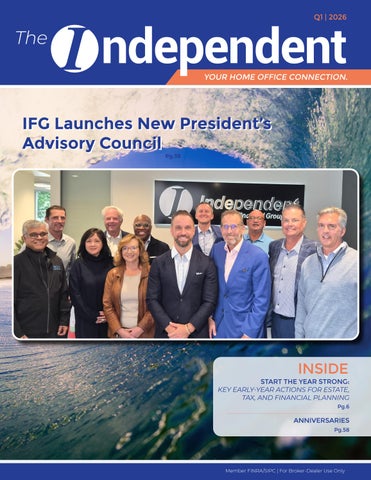
Independent Financial Group was proud to recently announce the launch of its inaugural President’s Advisory Council (PAC), a strategic initiative designed to strengthen collaboration between IFG leadership and the firm’s affiliated advisors.

The PAC was established to provide IFG with direct insight into the evolving needs of advisors and their clients. Its purpose is to ensure that IFG’s priorities, including technology, operations, and service delivery, continue to reflect what accomplished advisors need to succeed in today’s independent wealth management environment.

According to Kevin Keefe, the PAC plays an important role in reinforcing IFG’s advisor-first philosophy. “By creating a formal forum for feedback and dialogue, IFG can better align its strategic initiatives with the real-world experiences of its advisors and respond more effectively as the firm continues to grow.”

The inaugural PAC is made up of advisors from across the country and a range of business models. Members were selected for their experience,

leadership, and willingness to provide thoughtful feedback that benefits the broader IFG advisor community.

The 2026 PAC is led by Chair Bryan Wertzer of Sutley Wertzer Inc., with Chris Vizzi of South Coast Investment Advisors serving as Vice Chair.

Wertzer shared that serving as Chair of IFG’s inaugural President’s Advisory Council is both an honor and a responsibility he takes seriously, particularly knowing he was selected by fellow Council members to represent their collective voice.

“To me, this role is about stewardship, protecting what makes IFG special while helping shape what it becomes next,” Wertzer said. “I hope the Council strengthens the advisor experience by acting as a true bridge between advisors and leadership, providing real-world insight that helps refine strategy and accelerate meaningful initiatives. My goal is that every advisor feels heard, supported, and confident that IFG is evolving with them.”

2026 PAC members include:

The PAC is designed to serve as a two-way channel of communication. Council members will share advisor insights and feedback with IFG leadership, while also helping communicate firm initiatives and priorities back to the advisor community. This collaborative approach allows IFG to refine strategies, enhance services, and remain closely connected to the needs of its advisors.

Vizzi shared his enthusiasm for the Council’s role in shaping meaningful improvements across the firm: “I’m excited to be part of such an exceptional group of advisors on the President’s Advisory Council,” Vizzi said. “One of the most important priorities I believe

we can elevate is streamlining the advisor experience at IFG, so advisors can spend less time on friction and bottlenecks and more time doing what they love most, serving their clients.”

With the launch of the President’s Advisory Council, IFG continues to reinforce its commitment to partnership, transparency, and advisor advocacy. The Council represents another step in IFG’s ongoing efforts to listen closely to advisors and evolve thoughtfully alongside them.

Nick Abbott Mission Financial Group
Kyle Addington American Wealth Advisers
Chris Vizzi South Coast Investment Advisors
Kirk Badii Badii Group
Bryan Wertzer Sutley Wertzer Inc.
Jeb Bashaw JEB & Co.
Stephen Carlton Carlton Investment Services
Marcus Henderson Henderson Financial Group
Rachel Hoang Mathematics Wealth Management
Greg O’Donnell O’Donnell Financial Group
Jodi Padgett Taylor & Padgett Financial Group
Amrish Patel Global Wealth Strategies
Gail Urban AMICUS Wealth Partners

Introducing FlexDirex: A new way to play offense (and defense)

Championships aren’t decided by a single play. They’re won by process: a disciplined game plan that blends offense with situational defense, executed snap after snap over an entire season. That’s the mindset behind FlexDirex—a first-to-market, actively managed single-stock ETF SMA designed to pursue concentrated opportunity in leadership names while managing risk through repeatable rules.

Why precision matters in today’s market

Focused investing can look like a “go route” from the stands, but good teams don’t just heave it and hope. They call scripted plays—but also use pre-snap adjustments.

FlexDirex follows that mindset. It seeks concentrated opportunity in high-profile names—but does so inside a rules-based framework that emphasizes position sizing, risk pacing, and the option to step back when conditions deteriorate:

• Selection is systematic and refreshed weekly, so the roster can adapt as leadership changes.

• Position sizing is driven by Targeted Volatility Analysis (TVA), which seeks to keep portfolio risk near a defined level by hedging with short-term Treasurys (SHY).

• A tactical-signal overlay can cap equity exposure when risk indicators increase; exposure can be dialed down with SHY— field position over forcing a throw.

• Precision here means the right player, the right role, and the right moment—the way a good staff scripts openers, manages the clock, and adjusts at halftime.

Step 1: Picking the roster (systematic selection)

FlexDirex begins with a universe drawn from Direxion’s single-stock ETFs, which are designed to represent the price movements of 40+ major companies—including the “Magnificent Seven” and notable names across sectors. From that roster, FlexDirex assembles a weekly lineup of about 10 positions using a momentum ranking process refined over more than a decade, while also considering volatility, correlation, and trend persistence. The aim is to put the best team on the field for the next series.

For advisers, the key point isn’t the buzz around the names—it’s the cadence. The lineup is refreshed weekly, so the portfolio is not anchored to yesterday’s winners. Leadership changes, correlations shift, and a rules-based approach is meant to respond without requiring an investor to “feel” the turn in real time.

On-field reads: Adjusting at the line

Great offenses don’t just run the called play; they read the defense at the line and shift protections, routes, and timing. Great defenses do the same— reading formation, motion, and cadence to rotate coverage, disguise pressure, or drop into a zone. FlexDirex follows that disciplined approach each week.

After selecting our roster of potential positions, we conduct a weekly review that functions like pre-snap recognition:

• Coverage ID (leadership and lineup): Reassess the ranking of candidates—who’s breaking open, who’s being bracketed, and who should stay on the sideline this series.

• Protection call (volatility analysis): Size positions with TVA to keep overall risk near the target.

• Check-with-me (tactical positioning): If market conditions shift, we can pivot to short-term Treasurys (SHY), reducing equity exposure based on our tactical-signal overlay—equivalent to killing the first call when the front changes. Press when the pocket is clean; tighten protection when pressure builds.

The goal is the same on every down: put the right players in the right roles at the right time—then adjust to what the market is actually showing, not what we hoped to see in the huddle.

Offense and defense: A situational playbook

FlexDirex is designed with versatility. Within a disciplined framework, it can use both:

• 2X long single-stock ETFs when trends are favorable, and

• –1X inverse single-stock ETFs when trends break and defense matters.

That doesn’t make it “predictive.” It makes it responsive—a systematic way to participate when the tape is constructive and to play defense when it’s not.

FlexDirex is offered in two strategy “formations”:

1. Tech Plus — targets a NASDAQ-style risk profile (higher octane).

2. Focused Core — targets an S&P-style risk profile (broader, steadier).

Both aim at annual average daily standard deviation goals aligned to their respective indexes, with hedging to reflect its targeted volatility.

Where it fits in an adviser’s lineup

FlexDirex is best understood as a rules-based satellite sleeve next to a passive core. It’s not a trick play, and it’s typically not positioned as a full replacement for diversified equity exposure. Instead, it can be used as:

• A permanent dynamic, risk-managed satellite sleeve accompanying a passive S&P/NASDAQ core—there before risk shows up, not after.

• An execution system that keeps selection, sizing, and de-risking systematic rather than emotional.

• A matchup edge when leadership is narrow or rotating—without abandoning the stability of the passive core.

In short: your passive core sets the foundation; FlexDirex stays on the field to apply disciplined offense and defense as conditions change.

For more information on FlexDirex, visit https:// www.flexibleplan.com/our-solutions/flexdirexsingle-stock-etf-strategies or watch this on-demand presentation: https://flexibleplan.actonservice.com/ acton/media/34940/ifg

FIRST-TO-MARKET INNOVATION: The only actively managed single-stock ETF SMA strategies available in the U.S.

TACTICAL ETF EXPERTISE: A quantitative manager since its founding in 1981, FPI has applied its dynamic, riskmanaged investing approach to ETFs since 2004.

FlexDirex delivers a new way to think about ETF investing, offering single-stock strategies designed to give tactical management in dynamic markets. With Tech Plus and Focused Core, FlexDirex helps fine-tune exposure to leading equities through a tactically managed, risk-aware approach. Why choose FlexDirex? Learn more at https://www.flexibleplan.com/oursolutions/flexdirex-single-stock-etf-strategies, or call 800-347-3539

TARGETED VOLATILITY MANAGEMENT: Each strategy is designed to align with the volatility of either the Nasdaq 100 or the S&P 500.

ADVISOR-FOCUSED STRATEGIES: The strategies are designed to help advisers differentiate their client portfolios from the competition.

AROUND THE ADVISOR COMMUNITY

Our advisors are always on the move – hosting events, supporting their communities, celebrating wins, and creating memorable moments. Here’s a snapshot of what’s happening across the IFG advisor community.

Cornerstone Wealth Management’s Enchanted Evening

More than 300 clients joined the Cornerstone Wealth Management team for their Enchanted Evening at Enchant Las Vegas on December 3rd, where the Las Vegas Ballpark was transformed into a breathtaking winter wonderland. The evening was filled with festive holiday dinners, specialty beverages, seasonal live music and unforgettable moments inside the world’s largest Christmas light maze.

From glowing light displays to laughter shared over dinner, the event was a magical celebration of the season and, most importantly, of the incredible clients who make up the Cornerstone family.

The evening also included remarks from Dean Huang of Jackson, DJ Kendzior of Skyway, and Colby Taylor of IFG, who shared insights and expressed appreciation for Joyce, her team, and clients in attendance. It was a memorable celebration of the season and a heartfelt thank you to the valued clients who continue to make her practice thrive.

Jeffery Bricker Advertisement

Jeffery Bricker proudly showcased his Independent Financial Group advertisement on the scoreboard at his high school’s football stadium – home of the Massillon Tigers. Supporting his alma mater made the moment especially meaningful, as he was joined by his 4-year-old granddaughter, Madie, creating a special connection between generations.

It’s always inspiring to see our representatives investing in the communities that helped shape their journey while proudly representing Independent Financial Group.

We want to hear from you!

Want to be featured in IFG’s publications? Share your photos, stories, and accomplishments with us at corpcomm@ifgsd.com for a chance to be highlighted and celebrated with the entire IFG family.

Beyond Traditional Planning: Alternative Investments in the Modern Estate

As we enter 2026, estate planning conversations with your clients are becoming increasingly complex. The convergence of historically high estate tax exemptions, potential legislative changes, and an aging investor population has created a pivotal moment for financial advisors. Alternative investments have emerged not merely as portfolio diversifiers, but as essential tools in comprehensive estate, tax, and financial planning strategies.

The Tax Efficiency Advantage: Understanding TaxEquivalent Yield

Not all income is created equal, and helping clients understand this distinction can meaningfully impact their after-tax wealth. When evaluating income-producing alternatives, the tax treatment of distributions deserves as much attention as the stated yield.

Consider the difference between a business development company distributing private credit income and a REIT-based preferred stock backed by multifamily real estate. The BDC distribution is typically taxed as ordinary income at the investor’s marginal rate. The REIT’s non-traded preferred, by contrast, often distributes a significant portion as return of capital, which is income that is not immediately taxable but instead reduces the investor’s cost basis, deferring taxation until the position is sold. For clients in higher tax brackets, this deferral can substantially enhance after-tax returns.

This is where tax-equivalent yield becomes a valuable planning tool. Tax-equivalent yield answers a simple question: What fully taxable yield would my client need to earn to match the after-tax income from a tax-advantaged investment? The math is straightforward. If a client in the 37% federal bracket receives an 8% distribution where 60% is classified as return of capital, to match that after-tax outcome

with fully taxable income, they would need a yield approaching 11%. That is the tax-equivalent yield, and it reframes the conversation entirely.

Our platform includes several non-traded REIT preferred securities and NAV REITs that may offer favorable distribution tax treatment due to their underlying real estate holdings. When you are working with income-focused clients, particularly retirees or those in accumulation phases with high current income, understanding the after-tax picture can differentiate your advice.

Oil and Gas Drilling Funds: The Power of Intangible Drilling Costs

For clients with substantial ordinary income seeking immediate tax relief, oil and gas drilling partnerships offer a unique planning opportunity through intangible drilling cost deductions (“IDC”). Unlike most investments where tax benefits are deferred or spread over time, IDCs can generate first-year deductions often exceeding 70-80% of the invested capital.

Here is how it works. When a drilling fund spends money on labor, chemicals, mud, and other expenses that have no salvageable value, those costs are classified as intangible drilling costs. The IRS allows these expenses to be fully deducted in the year incurred rather than capitalized and depreciated. For a client investing $100,000 in a drilling program with 75% IDC exposure, that translates to a $75,000 deduction against ordinary income in year one. At the 37% federal rate, the immediate tax savings approaches $28,000 – before the wells produce a single barrel of oil.

The planning applications extend beyond simple tax reduction. Business owners facing a high-income year from a sale, bonus, or extraordinary event can

use drilling fund investments to smooth their tax liability. The deduction offsets income taxed at the highest marginal rates, while future production income, if the wells are successful, is recognized over multiple years and often taxed at lower effective rates due to depletion allowances. Note that state tax laws may differ from federal when it comes to IDC and depletion allowances.

These investments carry meaningful risk and are only suitable for accredited investors who can tolerate illiquidity and the possibility of loss. However, for the right client profile, the combination of immediate tax benefits and potential for ongoing income from successful wells creates a compelling planning tool that few other investments can match.

Strategic Roth Conversions: The Development Deal J-Curve

Roth conversions have become a centerpiece of tax-efficient retirement planning, but the strategy hinges on one critical variable: managing the tax cost of conversion. This is where alternative investments can play a supporting role that many advisors overlook, and where a two-step approach can multiply the benefits.

The first step focuses on reducing the value of what you convert. Real estate development partnerships held in self-directed IRAs follow what practitioners call a J-curve valuation pattern. Here is how it works: a client invests traditional IRA funds, say $100,000, into a ground-up development LP. Shortly after construction begins, the sponsor commissions an independent third-party valuation, typically an engineering study. That valuation almost always comes in significantly below the original investment, often 30-40% lower. Why? The partially completed project is illiquid, unmarketable, generating no cash flow, and burdened by construction risk and upfront costs. These are legitimate valuation discounts grounded in established case law.

The LP reports this reduced fair market value to the IRA custodian. The client then executes a Roth conversion at that depressed valuation, converting $100,000 of invested capital at a reported value of perhaps $60,000. The taxable income on the conversion is $60,000, not $100,000. Once the project completes construction, leases up, and stabilizes,

the value recovers and typically exceeds the original investment. That appreciation, however, now occurs inside the Roth, where it grows and can eventually be distributed tax-free.

The second step addresses the tax bill on even that reduced conversion amount. This is where oil and gas drilling funds re-enter the picture. A client executing a $60,000 Roth conversion can simultaneously invest taxable funds in a drilling program, generating IDC deductions that offset a significant portion of the conversion income. The combination is powerful: convert a development investment at 60 cents on the dollar, then use drilling deductions to reduce the tax on even that lower amount.

Consider the full picture. A client invests $100,000 of IRA funds into a development LP. Mid-construction, the valuation comes in at $60,000. They convert to a Roth, recognizing $60,000 in taxable income. Simultaneously, a $50,000 investment in a drilling fund with 75% IDC exposure generates $37,500 in deductions, reducing the net taxable conversion income to $22,500. The project eventually stabilizes and is valued at $150,000, but that $90,000 of growth occurred inside the Roth, tax-free. Meanwhile, the drilling fund may generate ongoing production income for years.

This strategy requires careful coordination, appropriate self-directed IRA custody, independent valuation documentation, and clients with risk tolerance for both development projects and drilling investments. It is not appropriate for every client. For those who qualify, however, it represents one of the most tax-efficient pathways to building Roth wealth available today.

Deferral Strategies: 1031 Exchanges and Opportunity Zones

For clients facing significant capital gains, whether from the sale of investment real estate, a business, or appreciated securities, deferral strategies remain among the most powerful tools in the planning toolkit.

Delaware Statutory Trusts (“DST”) have become a cornerstone of 1031 exchange planning. These fractional interests in institutional-quality real estate allow clients to defer recognition of gains while

transitioning from active property management to passive ownership. The planning advantages extend beyond deferral: DST interests can pass to heirs with a stepped-up basis, potentially eliminating the deferred gain entirely.

Qualified Opportunity Zone (QOZ) funds offer a distinct but complementary structure. While 1031 exchanges require like-kind property, QOZ investments can defer gains from any source, real estate, stocks, or business sales. Following the passage of the One Big Beautiful Bill Act last July, the Opportunity Zone program is now permanent, with new zone designations taking effect January 1, 2027.

The revamped program, often called OZ 2.0, introduces enhanced incentives for rural investments, including a 30% basis step-up at year five (compared to 10% for standard zones) and a reduced substantial improvement threshold of 50% for rural properties.

Stay tuned for new Qualified Opportunity Zone fund offerings on our platform as sponsors launch vehicles structured under the OZ 2.0 framework. The combination of permanent program status, rolling

five-year deferral, and enhanced rural incentives is generating significant sponsor interest. We expect to see new offerings come to market throughout 2026 and into 2027 as redesignated zones are finalized and sponsors position projects to capture the improved benefits. If you have clients with substantial realized gains and a longer time horizon, these new structures may warrant a place in their planning conversations.

We Are Here to Help

Whether you need help modeling tax-equivalent yields, evaluating development deals for discounted Roth conversions, or coordinating drilling fund investments with conversion strategies, the Alternative Investment Consulting team is available to support your practice. Please reach out anytime.

For those attending the Elite Advisor Conference this quarter, I look forward to connecting in person. We will be hosting sessions with our top strategic partners on integrating alternatives into your practice, and I hope to see you there!

INVESTING ALONGSIDE LEADING ENERGY COMPANIES IN A DIVERSIFIED PORTFOLIO OF MINORITY EQUITY INTERESTS IN OIL & GAS PROJECTS IN THE BAKKEN SHALE IN NORTH DAKOTA & PERMIAN BASIN OF SOUTHEAST NEW MEXICO

• INCOME: 10% Initial Return Accrued and Paid from NOI

• GROWTH: Reinvest Excess NOI to Acquire Additional High-Quality Assets

• TAX BENEFITS: Tax Sheltered Income

• PROJECTED HOLDING PERIOD: Sale of Portfolio in 3 to 5 years

• SUITABILITY: Accredited Investors

Diversified across multiple operators, basins, and well vintages.

PME 2025: Music City. Big Ideas. Real Connections.

PME hit the road in 2025, landing in Nashville, Tennessee at the beautiful Conrad Hotel, where 92 advisors gathered for one of the most impactful Practice Management Exchange conferences to date. With 34 partner companies joining us, the event brought together an incredible community of industry leaders, innovators, and strategic collaborators.

The conference opened on Sunday, October 19th with a welcome reception that set the tone for the week ahead. Advisors and partners were greeted with a Southern-style dinner and live music from guitarist Mike Godwin, making for an energizing and memorable start in true Music City fashion.

Monday began with opening remarks from Chad Cristo, Head of Business Development, West at IFG, and Steven Gensler, SVP Advisor Growth & Development at IFG, who kicked off the conference with momentum and excitement. Matt McGuinness, CFP®, Senior Business Consultant at The Ensemble Practice, followed with his keynote “From Founder to Architect: Building an Ensemble Firm,” sharing insights on firm evolution, leadership, and intentional design.

The advisor-led format was a major highlight once again this year. Across Monday, Tuesday, and Wednesday, 14 advisors delivered 20-minute presentations, sharing best practices, ideas, and strategies that have supported their growth and success.

These sessions reinforced the power of advisorto-advisor learning, real experience, and shared momentum.

One of the most meaningful sessions of the week was the Women’s Panel, “Voice of Impact: Women Shaping Financial Services,” led by IFG’s Lauren Slater, VP of Operations, alongside Kathy Keadle, CFEd®, Chelsea Petrizzo, and Marcella Harkness, CFP®. The panel showcased the expanding influence of women in financial services, highlighting leadership, industry impact, and the future of the profession. The energy and expertise on stage made it one of the defining moments of PME 2025.

Monday also featured partner-led panels covering Annuities, Advisory, and Alternative Investments, offering valuable perspectives on trends and growth opportunities.

Partner Speed Dating was featured on both Monday and Tuesday, giving advisors the chance to connect one-on-one with industry partners in fast-paced conversations designed to spark new ideas and future collaboration. With two days dedicated to partner networking, advisors had more opportunities than ever to build relationships and explore strategic alignment.

Tuesday brought another standout keynote from Matthew Goerke, Memory Expert and

Creator of the Memory Switch Program, who led the room through a memorable, interactive session centered around memory as a tool for stronger client engagement and communication.

That evening, advisors, guests, and partners headed off-site to the Country Music Hall of Fame for a private dinner experience featuring live music from Ten Year Town, followed by an exclusive tour of the exhibits. The night brought together culture, community, and connection, delivering exactly what PME does best.

Wednesday began with the IFG update, led by IFG’s Executive Team, Scott Heising, CEO & Founder, David Fischer, Co-Founder & CMO, and Kevin Keefe,

President & COO, sharing vision, momentum, and what lies ahead for IFG. The day continued with remaining advisor sessions before closing with a farewell lunch.

The feedback from PME 2025 was overwhelmingly positive, reaffirming a simple and powerful truth, when advisors lead the conversation, the impact speaks for itself. Nashville gave us the perfect backdrop, partners expanded the dialogue, and advisors brought the ideas that made the week meaningful, memorable, and full of momentum.

WELCOME

NEW HOME OFFICE TEAM MEMBERS

Hannah Elble joins IFG as a Receptionist, reporting to Mercedes Montanez. With experience in administrative support, operations, and client care, she brings a strong focus on coordination, communication, and service excellence. Hannah holds a BA in Sociology from UC San Diego with a specialization in Social Inequality and has completed additional academic programs through Harvard University. At IFG, Hannah manages a high-volume, multi-line phone system, ensuring calls are routed accurately while providing a welcoming first point of contact for clients and visitors. She oversees conference room scheduling, coordinates mail and shipments, maintains shared office spaces, and provides general administrative support to help keep daily operations running smoothly.

Sheryl Ford joins IFG as Supervisory Principal, reporting to Ian Buxbaum. With 28+ years in financial services, she brings extensive compliance and supervision experience from firms including Atria Wealth Solutions, First Allied Securities, and LPL Financial. Her background includes Compliance Analyst, Director of Transitions, Compliance Technology Analyst, Supervisory Principal, and Surveillance Analyst roles. Sheryl holds active FINRA Series 7, 9, 10, and 63 licenses. At IFG, Sheryl oversees and reviews transactional business and trade activity, ensuring accuracy and alignment with firm policies and regulatory standards. She supports new-account processing, commission approvals, and electronic correspondence oversight. Known for building strong trust-based relationships, Sheryl provides training and operational guidance to advisors and their teams while collaborating across departments to resolve inquiries and escalations. She also contributes to cross-department initiatives and special projects that reinforce compliance excellence, operational accuracy, and advisor-focused service.

Hannah

Angel Gonzalez joins IFG as Advisory Billing Manager, reporting to Abbey Eastham. She brings over 7 years of experience in advisory billing, annuity invoicing, and reconciliation across advisor-aligned operations. Her background includes billing and transitions-adjacent finance roles at Atria Wealth Solutions, plus billing and financial-operations experience across SchoolsFirst Federal Credit Union, Camino Federal Credit Union, Chase Bank, and credit-union banking environments. Angel earned her Bachelor’s in Business Management with a Finance focus from California State University, Los Angeles, holds an active SIE certification, and is bilingual in English and Spanish. At IFG, Angel is the primary contact for advisory and annuity billing inquiries. She oversees monthly and quarterly billing cycles, audits and reconciles accounts for accuracy, leads billing-platform optimizations, and supports system integrations across platforms, including Schwab, Pershing, and Envestnet. She partners with Compliance and Operations leadership to develop standardized, regulatory-aligned billing procedures that support timely, accurate, and transparent billing operations across departments.

Matthew Polera

Matthew Polera joins IFG as Onboarding Manager, reporting to David Fischer. He brings deep expertise in advisor onboarding, transitions, and financial-services operations. Previously, he supported advisor transitions at Realta Wealth and served as Advisor Onboarding Manager at Charles Schwab. At TD Ameritrade, including his role as Senior Data Specialist, he led onboarding initiatives, improved workflows, and enhanced advisor and client experiences. Matthew earned his Bachelor of Science in Finance from San Diego State University and holds active FINRA Series 7 and 63 licenses. In his role at IFG, Matthew serves as the primary onboarding contact for advisors from pre-affiliation through post-onboarding. He leads discovery calls, sets transition expectations, tracks advisor progress, and provides step-by-step guidance on registration, compliance, and platform access. He partners internally to develop standardized onboarding workflows and training resources that improve efficiency and support scalable, high-touch transition support across departments.

CONGRATULATIONS!

REPRESENTATIVES WHO CELEBRATED ANNIVERSARIES IN THE 1ST QUARTER OF 2026

13 YEARS

Kerry Schmitz

22 YEARS

David Vaz

Josh Koehnen

David Elhoff

21 YEARS

Jim Albrecht

John Linsly

19 YEARS

Brice Willoughby

Nancy Rhew

17 YEARS

Scott Machen

John McKeon

Bryan Wertzer

Steve Sutley

Cathy Brown

Duane Knopke

16 YEARS

Michael Deboer

Peter Prescott

Paul Huddle

Edwin Unland

15 YEARS

Leo Kowalski

Con Dempsey

Rick Mahlum

Pat Ehsan Kurt Rohrs

Michael Wynns

Larry Steckler

Randy Goodsell

Cuong Thuyen

14 YEARS

Donovan Kelly

Chad Schiel Kirk Riding

Jason Segawa

Lauren Estes

Jay Wahlin

12 YEARS

Tom Polowy

Charles Wareham

11 YEARS

Tom Otten

Michael Moss Erica Tanner

Deepen

Lars Ragan

10 YEARS

Grant Hansen

Leticia Hewko

Robert Sweet

James Dillon

9 YEARS

Jason Wong

Kathleen Covey

Daniel Hahn

8 YEARS

Ryan Ansted

Ian Arrowsmith

Joshua Goldsmith

Samantha

David

David Sizemore

Jay Sprinkel

Jonathan Szostek

Shawn Walker

Jeffrey Cardozo

Charles Immekus

Dale Immekus

Karalyn Carlton

Robert Gunning

Edward Fisher

7 YEARS

Jeff Morand

Josh Tschirgi

Jodi Padgett

Mark Englund

Eric Bowdler

Justin Kauffman

6 YEARS

Robert

Kelsey

Craig

Jeff

Jim

5 YEARS

John Dewey Jason

Lane

4 YEARS Grant

3 YEARS

Frank Cuenca

Keith Trezek

Gregory Chachas Ben Dixon

Lawrence Kelly

Dustin Blodgett

Matthew Speed

2 YEARS

Michael Cook

Diane Hayes

Timothy Hayes

Matthew Sessa

Tina Woodford

Brett Williams

Ronny Inniger

Suzy Lawrence

1 YEAR

Allyn Deininger

Michael Boswak

Stalin Jaquez

David Heitner

Jason Dodzik

Andy Kim

David McCorison

Michael Mishler

Turn static files into dynamic content formats.

Create a flipbook