September 2026
Issue 4 | Special Edition
Inclusive Impact Voices from the 2025 Community Development Conference
Contents
3
5
Contributors
Editorial
7
16
Bios of ten contributors
Lindani Maphumulo, Guest Editor
Stakeholders and Networks Education, Training, and in Community Development Professional Development Community Economy Development: Reflections from Practice Implementation of the Skills Development Program in Response to Ever-Rising Youth Unemployment in Bolata Village, QwaQwa
From Lecture Hall to Community: How Student-Teachers Learn Through Imitation and Why It Matters for Social Change Writing Centre as a Space of Voice and Belonging Beyond Skills: How CommunityBased TVET Can Empower Young People to Transform Their Communities
1
Contents
29
Ethical and Quality-Assured Practice Perspectives on Student Engagement in the Professionalising Process of Community Development Creative methods to engage children as community agents
54
Voices from the Field
Beyond Agricultural Land Redistribution: Towards a Community Development Framework for Addressing Landlessness in South Africa
36
Research and Theory in Community Development Community Development Under Climate Change Pressures: A Study of Socio-Economic Impacts in Nongoma, KwaZulu-Natal Beyond Temporary Employment: Why Evaluating the Expanded Public Works Programme Matters for Youth Development in Mtubatuba Municipality From Dispossession to Hope: Community Voices on Masculinity and Wellbeing in uMkhanyakude More Than Just Volunteering: Giving Back While Building a Future
63
Access and Contribution Guidelines to Inclusive Impact
Turning the Tap: How One Borehole Is Strengthening Rural Resilience in Manyewu Village, Matabeleland South 2
Inclusive Impact
editor@inclusiveimpact.org.za
GUEST EDITOR
EDITORIAL TEAM
Lindani Maphumulo
Cornel Hart, Lindani Maphumulo, Luan Lausberg and Selected 2025 Conference Attendees.
FOUNDING EDITOR & CONTENT DIRECTOR
Cornel Hart EDITORIAL ACKNOWLEDGMENT
SPECIAL EDITION COVER IMAGE
We acknowledge the use of ChatGPT (OpenAI, 2026) for providing editing assistance in the preparation of this magazine. Responsibility for the final content lies with the editorial team.
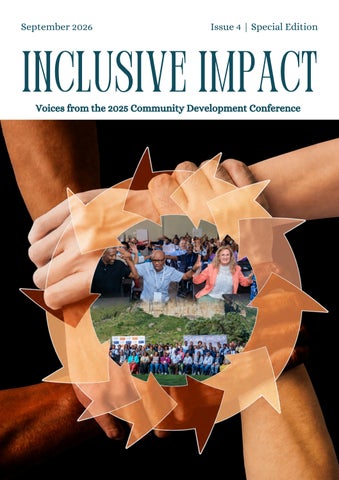
Special-edition cover image created with generative AI using ChatGPT (OpenAI, 2026), based on prompts and direction provided by Cornel Hart and incorporating photographs from the 2025 Community Development Conference. Pixabay images used under their respective licences.
ART DIRECTION
Magazine Design: Created using: https://www.canva.com/ Graphics sourced from: https://pixabay.com/, https://stockcake.com and generative AI using ChatGPT (OpenAI, 2026), based on prompts and direction provided by Cornel Hart
Contributors Nicole Bastien & Anneen Maree
Nyele Tsotetsi
Johannes Buthelezi
Social scientist; founder of What Matters and cofounder of COLAB.
Community Development Practitioner, Department of Social Development.
Lecturer, Faculty of Education, UFS.
Urban and regional planner; co-founder of COLAB.
3
Inclusive Impact Contributors Matseliso Mkotywa- Thando Shusha Lechoba Community Writing Centre Coordinator, UFS Qwaqwa Campus.
Ayanda Princess Myeni Community Development Practitioner, youth development advocate and emerging researcher
Kutloano Malahlela
Angel Ntombikhona Khanyile
Development Practitioner, Master’s student and internship supervisor, UJ.
Community Development Practitioner, founder of The Eye of Hope and MA student, UJ.
Sibahle Mnisi
Lubabalo Mbekeni
Sunga Mzeche
Social work professional specialising in psychosocial support and volunteer management.
Director: Strategic Land Acquisition, Department of Land Reform and Rural Development.
Country Director, Hope for a Child in Christ (HOCIC), Zimbabwe.
Community Development Practitioner, Department of Social Development, KwaZuluNatal.
Desiré Jansen & Madri Jansen van Rensburg van Rensburg Medical student, WITS
Research psychologist and art therapist.
Sithuthukile Myeni & Nonsikelelo Mtshali & Nokuthuthuka Mthethwa Acting Head of Social Community Work, UniZulu
Development Manager, KZN - DSD
Deputy Director, KZN - DSD
4
Editorial
Grounding the Future: Carrying Community Voices and Practice Pathways Beyond the Conference At the 2025 Community Development Conference, participants were invited to add their hands to a shared tapestry. Each hand carried a name, a moment and a word reflecting what Grounding the Future: Community voices and practice pathways for inclusive development meant to the person who contributed it. Individually, each hand told a story. Together, they began to form something much larger: a living representation of the diversity, connection and shared purpose at the heart of Community Development. In many ways, this Special Edition of Inclusive Impact Magazine continues that process of stitching together voices. The conference brought practitioners, academics, students, policymakers and Community Development stakeholders into conversation about both the realities confronting communities and the possibilities emerging
from practice. Its programme deliberately created space for different forms of knowledge: research, practice reflections, case studies, workshops, creative approaches and conversations grounded in lived experience. Under the theme of Grounding the Future, contributors explored local practice and global relevance; community voices and place-based knowledge; learning and leadership; ethics, identity and professionalisation; changing knowledge pathways; and creative expressions of Community
Development. What emerged was not one answer to the future of our field, but a series of questions and experiences about how Community Development can remain relevant, ethical and responsive in changing contexts. This Special Edition carries some of those conversations beyond the conference space. The contributions take us from community economies, skills development and Community-Based TVET to teacher education, academic writing support and student engagement in the professionalisation of Community Development. They also
confront urgent realities including climate pressures on rural livelihoods, persistent youth unemployment, temporary employment interventions, masculinity and wellbeing, volunteerism, land redistribution and community-led infrastructure. Across these very different contributions, a common thread emerges: development becomes meaningful when it remains
Grounding the future is not about predicting what comes next; it is about ensuring that community voices help shape it. 5
connected to lived experience, recognises people as knowledge holders and creates opportunities for participation, ownership and collective action. This returns us to one of the central questions raised throughout the conference: whose voices shape development, and how do we create the conditions for those voices to matter? That question becomes even more important as the spaces in which communities interact continue to change. Digital and hybrid forms of engagement now enable people to communicate, organise, learn and participate across geographical boundaries. Yet being connected does not necessarily mean being included, heard or meaningfully engaged. For me, Ubuntu offers an important way of thinking about this challenge. Ubuntu reminds us that relationships, shared humanity, mutual responsibility and interconnectedness remain central whether engagement takes place in a community hall, a classroom, a professional forum or an online space. It asks us to move beyond communicating to communities towards communicating with them, and to recognise communities as partners, knowledge holders and co-creators. The question, therefore, is not simply whether we can connect communities through technology, but what happens through that connection. This is particularly important because the 2025 conference was never intended to be an endpoint. It formed part of a continuing process of strengthening Community Development knowledge, practice and professional dialogue, and a pathway towards the 2026 National Community Development Conference. The conversations begun in QwaQwa therefore carry a responsibility beyond the event itself: to deepen the questions raised, strengthen connections across the sector and create further opportunities for learning and collaboration. The conference also reminded us that the future of Community Development cannot be shaped by one form of knowledge alone. Academic scholarship, professional practice, lived experience, indigenous and placebased knowledge, creative expression and community voice all have a place. The challenge is to create spaces in which these forms of knowledge are genuinely heard, valued and able to influence practice. Perhaps this is what grounding the future ultimately requires. It is not about predicting what comes next. It is about ensuring that the future of Community Development remains grounded in the knowledge, assets, experiences and aspirations of the people whose lives development seeks to affect. This Special Edition is therefore more than a record of a conference. It is part of an ongoing conversation. May these contributions travel beyond these pages into classrooms, communities, organisations, policy discussions and professional practice — and may they continue to create spaces in which Community Development remains grounded in voice, participation, dignity and collective possibility. Each hand tells a story. Together, we shape the future.
Lindani Maphumulo GUEST EDITOR
Lindani Sthembele Maphumulo is a Lecturer in Community Development at the University of the Western Cape, where he coordinates the fourth-year programme and represents Community Development in the faculty’s learning and teaching portfolio. A multidisciplinary scholar and community development practitioner, his work spans research, teaching, community engagement and development practice. His doctoral research examined the roles of traditional leaders and local government in addressing homelessness in KwaZulu-Natal, with a focus on developing a conceptual framework. He has published book chapters and articles in DHET-accredited local and international journals and is working on three scholarly books in Community Development. His experience includes leadership in higher education, work with non-profit organisations, facilitation of development programmes and workshops, and offender rehabilitation and victim–offender dialogue. 6
STAKEHOLDERS AND NETWORKS IN COMMUNITY DEVELOPMENT Community development thrives on partnerships, bringing together government, non-profits, businesses, and community members to drive collective action and transformative change. This section highlights the collaborative efforts and networks that strengthen community development practice.
7
Community Economy Development: Reflections from Practice Community Development has long recognised that economic development is a central part of creating better livelihoods. For decades, development programmes have focused on entrepreneurs, businesses, households, trainees, and grant recipients. These efforts improved individual outcomes many times. A persistent question remains, though. Why do individual outcomes still fail to translate into stronger community prosperity?
T
his question haunted us. We spent more than a decade in communities across different contexts and geographies. We kept finding communities economically active despite high unemployment, poverty, and exclusion. People were trading, repairing, producing, transporting, providing services, and creating livelihoods every day. The economic capability was there.
Across communities in underserved locations throughout South Africa, Kenya, Lesotho, and other places in Europe, we saw entrepreneurs who understood their customers, suppliers, markets, and local realities. They knew how to respond to community needs through everyday business practice. Yet much of that capability stayed fragmented. Economic knowledge remained with the
individual experience, rarely visible beyond immediate networks. When the individual left the community, so did the knowledge. Businesses operated alongside one another without consistently recognising opportunities to collaborate or coordinate. Economic relationships existed without becoming a local ecosystem through which knowledge and value could accumulate and create wealth. These observations shifted our focus: how could Community Development strengthen not only individual economic actors, but the community economy itself through which prosperity emerges?
Graphics sourced from generative AI using ChatGPT (OpenAI, 2026), based on prompts and direction provided by Cornel Hart
A Different Premise: Economy as a Social Practice Economic Development has long been associated with strengthening local economies through
enterprise development, employment creation, infrastructure, investment, and public policy. Our work builds on that. But we deliberately shift attention from the individual entrepreneur towards the community economy itself. Our understanding of the economy starts from a simple premise: the economy is a social practice. Businesses intentionally create value. Economies exchange these values collectively. Economic outcomes emerge through relationships, exchanges, information flows, trust networks, and coordination mechanisms. Businesses and community economies, therefore, shape one another continuously. Stronger businesses contribute to a stronger community economy, while a stronger community economy creates better conditions for businesses to survive, grow, and create value. 8
Community Economy Development doesn't begin by creating capability where none exists Understanding the economy as a social practice changes where development begins. If community prosperity is an outcome of the interactions between businesses, relationships, knowledge, and local coordination, then strengthening individual enterprises alone won't translate into prosperity on a community scale. Community Economy Development[1] in Practice The distinction we make between economic development and community economy development is intentional. Economic development has long strengthened communities through enterprise development, employment creation, infrastructure, investment, and public policy. Community Economy Development, in our understanding, is the investment in the conditions through
which livelihoods are created and sustained. It is the tissue that runs through a community: the relationships between people, through which they exchange value, the shared knowledge they build, the trust that makes exchange possible, the coordination of activities, and the capability to translate this into coordinated and compounding economic outcomes. Community Economy Development doesn't begin by creating capability where none exists or is not needed. It begins by strengthening the conditions that let existing capability become more visible, connected, cumulative, and durable. We see three important cornerstones: 1) Surface Knowledge: Every community generates a great deal of economic knowledge simply through everyday practice. Entrepreneurs come to understand customers, suppliers, demand, and constraints. This knowledge shapes countless decisions, yet most of it stays embedded in individual experience. When it
becomes visible, shared, and actionable, it strengthens not just individual businesses but a growing body of community economic knowledge. 2) Coordinate Economic Activities: Communities already contain economic relationships, but these don't automatically turn into coordinated systems. Businesses can respond to the same needs without knowing about one another. As a result, supply chains stay disconnected, and opportunities for collaboration go unseen. Strengthening coordination helps businesses recognise those opportunities and increases the value that actually circulates. 3) Anchor Development in the Community: Change holds up better when the knowledge, relationships, leadership, and mentoring capacity built through it stay in the community, so that development doesn't simply end when a project does. One example comes from our Community Economy Hub in Namibia Township, Bloemfontein, where
we have been putting Community Economy Development into practice. The work starts with community gatherings facilitated through an open-space approach. Through these conversations, local needs, economic knowledge, existing capability, and the gaps experienced by the community become visible. Some participants approach us during or after the gatherings with ideas for responding to these gaps through business. As conversations continue, opportunities for complementary businesses responding to community needs become visible. These entrepreneurs join a one-year mentoring programme through the Community Economy Hub, where they strengthen their individual businesses while building relationships with one another and other local businesses. As these connections grow, local supply chains strengthen, and more value circulates within the community. The Community Economy Hub remains open to the wider community, creating an ongoing place and infrastructure
[1]
Throughout this article we use the term Community Economy Development. We originally presented this work at the UFS Community Development Conference in 2025 as Community-Led Economy Development. As our understanding evolved through practice, Community Economy Development became the more accurate description.
9
where knowledge, relationships, and new opportunities continue to develop beyond individual businesses and programmes. The three cornerstones (Surface, Coordinate, Anchor) build what we call Economic Capability: a community's ability to keep developing economically over time. None of this replaces existing approaches to Community Development, local economic, or enterprise development. It complements them by recognising that entrepreneurs and community economies are always shaping one another. What Practice Has Taught Us Our Community Economy Development approach did not come out of a predefined
framework. It grew gradually through our co-creational work with communities, especially township communities in Bloemfontein (South Africa), communities in Nairobi (Kenya), and through dialogues with more than 1,000 practitioners from over 60 countries between 2023 and 2024, exploring different experiences and perspectives on humanity in the economy. The most important insights from our practice: 1) Context is everything Community economies can't be separated from the places they emerge in. History, relationships, institutions, resources, and constraints differ from one community to the next. Understanding a community's economic dynamic isn't a
preliminary step before development starts. It is part of the development itself. 2) Patterns emerge naturally Similar patterns keep showing up across very different communities — not because the communities are alike, but because they organise economic life through many of the same underlying processes. Patterns and principles of ecological and socio-economic development emerge when we pay attention. 3) Start small Every community we have worked alongside already had economic capability. Rather than starting with what is missing, we start with what is already there. We amplify existing capacity before introducing new systems.
4) Build relationships The economy is a social practice, shaped by human relationships. Since the quality of relationships runs on trust, we see trust as an infrastructure. It is as necessary to economic coordination as roads or electricity. Even if trust is far less visible. 5) Circulate value We pay attention not just to how value gets created, but to the conditions that let it circulate. Economic activity should become more connected, not scattered, which includes resources that flow locally and building wealth where it is created. 6) Serve collective needs and innovation Community economy develops by meeting community needs while creating space for local renewal. Meeting a
Graphics sourced from generative AI using ChatGPT (OpenAI, 2026), based on prompts and direction provided by Cornel Hart
10
community need well leaves room for the next imagination. Innovation grows out of that space, not apart from it. 7) Grow from within Economy development starts, grows, and flourishes from within communities. What is imported from outside rarely takes root the same way. Growth that begins inside a community tends to stay there. 8) Shared ownership Resilient community economies not only depend on how well any one business does but also on how capability, responsibility, decisionmaking, and future opportunity are distributed across the community. 9) Learn and adapt Community economies reveal themselves through ongoing observation, not planning alone. New opportunities open while others close. 10) Trade-offs are real Communities have
adapted economically to their current conditions. Every intervention reshapes existing economic gain structures, relationships, and livelihoods while creating new possibilities. As new economic opportunities emerge, existing ones can vanish. There is no version of this work without loss alongside. What this means for Community Development Practice Community Economy Development does not challenge the importance of entrepreneurs, enterprise development, or local economic development. Our work builds on those foundations. What we suggest is that community prosperity depends not only on what individual entrepreneurs and businesses can do, but on the community economy through which they exchange
value, generate knowledge, coordinate activity, and respond to changes. Communities, in our experience, are not passive recipients of development. They are constantly organising economic life through relationships, exchange, adaptation, creativity, and entrepreneurship. All at once, all the time. Community Economy Development starts by recognising the economic capability already there. It works toward strengthening the conditions that let that capability become more visible, more connected, more cumulative, more durable. A few things stay central to how we work. We don't wait for the ideal starting point. Supporting entrepreneurs still matters enormously in our work. At the same time, we strengthen existing economic
capability, helping communities build on it over time. Community economies don't hold still long enough for a plan to capture them once and be done. That challenges our own adaptability daily. Community Economy Development began with a question: What if we shifted our attention from developing individual economic actors alone to strengthening the community economy through which livelihoods actually emerge? We think the question is worth exploring for a while longer. We always start with the community economy that already exists. From there, we pay attention to how knowledge, relationships, and value circulate, and where greater coordination becomes possible.
Authors Nicole Bastien is a social scientist and founder of the What Matters initiative. Her work focuses on Community Economy Development, regenerative economics, and systems change. She brings experience in systemic transformation, advocacy, and public policy. Anneen Maree is an urban and regional planner specialising in local economic and community development in South Africa. Her work focuses on strengthening place-based economic capability through collaboration with communities, entrepreneurs, and local stakeholders. Together, they co-founded COLAB for Future Economics South Africa. They established the Community Economy Hub in Namibia Township, Bloemfontein, where they research and put Community Economy Development into practice. Contact: connect@humanitywhatmatters.com|What Matters www.humanitywhatmatters.com|COLAB www.humanityeconomy.com 11
BE PART OF THE CONVERSATION! Register to Attend
2nd National Community Development Conference 2026 University of Johannesburg, Soweto Campus, South Africa: 30 Nov. - 3 Dec. 2026 REGISTRATION FEES: General delegates: R3 500, Registered students: R1 500, Grassroots/non-profit delegates: R2 000, Virtual attendance: R1 000
Register via this linke: Register OR scan the QR code
Scan to Register
Complete the Registration Form Make Payment and Email proof of payment to: cdc@uj.ac.za Payment deadline: 20 October 2026 PAYMENT DETAILS: Bank: Nedbank, Account holder: University of Johannesburg Account number: 1454094206 Account type: Current Account Branch code: 198765 SWIFT code: NEDSZAJJ PAYMENT REFERENCE: COMDEV_CONFERENCE_SURNAME_ATTENDANCE, replace SURNAME with your surname Host Partners
CONFERENCE OBJECTIVES Reflect on the history and evolution of Community Development in South Africa as a catalyst for global dialogue. Explore philosophies, models, and frameworks that shape contemporary practice. Examine links between CD and national, continental, and global priorities — including Agenda 2063, NDP 2030, and the UN SDGs. Strengthen practitioner and student participation across all sectors. Advance readiness for professional recognition through shared standards and ethical frameworks.
CONFERENCE THEMES Community Voices, Social Justice & Transformation – Exploring activism, equity, and inclusive change. Indigenous, Afrocentric & Decolonial Practice – Honouring contextually grounded, culturally relevant approaches. Ethics, Principles & Professional Identity – Advancing accountability and professional standards. Models, Approaches & Tools – Sharing frameworks and innovations in CD. Sustainable Development & Human Security – Linking community well-being and environmental resilience. Capacity, Supervision & System Building – Strengthening CD systems, leadership, and collaboration. https://w.wiki/FZQ4
Implementation of the Skills Development Program in Response to Ever-Rising Youth Unemployment in Bolata Village, QwaQwa
Graphics sourced from generative AI using ChatGPT (OpenAI, 2026), based on prompts and direction provided by Cornel Hart
W
ithin the Maluti-a-Phofung Local Municipality, Bolata Village reflects many of the structural challenges experienced across South Africa's former homeland areas. The presentation underpinning this article reported that youth unemployment in the municipality stands at approximately 53%, according to Statistics South Africa, demonstrating the severity of unemployment among
economically active young people in the area. Limited industrial development, high poverty levels, inadequate access to vocational opportunities and restricted economic diversification continue to constrain young people's ability to secure meaningful employment or establish sustainable businesses. Consequently, many households remain trapped in cycles of inter-generational poverty, while communities lose
valuable human capital that could otherwise contribute to local development. This article reflects on the implementation of the Tsohang Skills Development Project and explores how community-based skills development can contribute to addressing youth unemployment in Bolata Village. Drawing on the conference presentation, the article examines the programme's implementation, highlights its
achievements and challenges, and identifies practical lessons for Community Development practitioners, policymakers and development partners working to strengthen youth employment interventions. In Bolata Village, these realities created an urgent need for interventions that not only equip young people with technical skills but also build their confidence, strengthen local networks and create 12
opportunities for sustainable livelihoods. The Tsohang Skills Development Project therefore adopted a holistic approach that integrated practical vocational training with mentorship, cooperative development and stakeholder partnerships. Implementation of the Skills Development Programme The project was initiated through the Department of Social Development with funding of approximately R370,000 during the 2023/2024 financial year. The funding was spent in accordance with a Memorandum of Agreement that specified the machinery and materials required for the different technical workshops. The programme targeted unemployed young people who faced limited opportunities to acquire marketable skills or access formal employment. Central to the project's philosophy was the recognition that although skills development alone cannot eradicate poverty, it remains an important instrument for improving
employability, stimulating entrepreneurship and creating opportunities for economic participation. Unlike many short-term training initiatives, the Tsohang Skills Development Project sought to build participants' confidence, resilience and leadership capacity while strengthening their technical skills. Learning was structured around practical workshops facilitated by experienced artisans who served not only as instructors but also as mentors. This experiential learning approach enabled participants to apply newly acquired knowledge in real-life settings while fostering teamwork, accountability and problem-solving skills.
Developing Practical Skills Through Community-Based Workshops The programme consisted of four practical vocational training streams designed to respond to local economic opportunities while encouraging entrepreneurship and cooperative development. Upholstery Workshop The upholstery workshop focused on furniture restoration and upholstery design. Five unemployed young people participated in the programme, receiving practical training in furniture repair, material selection, product finishing and customer service. Rather than limiting learning to technical competence, the
workshop encouraged participants to explore opportunities within the local furniture market by repairing and refurbishing household furniture that could be sold or returned to community members. An important outcome of the workshop was the establishment of a primary cooperative through which participants could collectively market their products and services. The workshop also generated modest income from completed projects, illustrating how vocational training can create both learning opportunities and early incomegenerating possibilities. Mechanical Workshop The mechanical workshop provided practical training in vehicle maintenance
Graphics sourced from generative AI using ChatGPT (OpenAI, 2026), based on prompts and direction provided by Cornel Hart
13
strengthening informal businesses and supporting aspiring entrepreneurs and mechanical repair for seven young participants. Through continuous mentoring by experienced artisans, trainees acquired technical competencies in diagnosing faults, repairing mechanical components and maintaining vehicles. Learning occurred in a practical workshop environment where participants gained firsthand experience of workplace expectations and industry standards. One young woman participating in the workshop reported receiving occasional small payments of around R50 from the workshop leader, supplementing the social relief support she receives from government. One of the programme's most significant achievements was the successful registration of a cooperative involving workshop participants. The cooperative provided a foundation for future enterprise development by enabling participants to offer mechanical services collectively
within the local community. The presentation further highlighted the participants' innovative thinking, which led to the recommendation that their work be digitally documented and promoted through online platforms to showcase local talent and attract broader business opportunities. Welding Workshop The welding workshop combined vocational training with community service, illustrating how skills development can simultaneously strengthen employability and improve community infrastructure. Six young people received practical instruction in welding, fabrication and metalwork while participating directly in local infrastructure improvements. Participants manufactured window frames and volunteered their labour during building renovations, thereby making a tangible contribution to community development. A volunteer safety officer also supported the renovation process by ensuring compliance with occupational health and safety practices.
Retail Business Forum and Hawker Development Recognising that many employment opportunities exist outside the formal economy, the project introduced a Retail Business Forum aimed at strengthening informal businesses and supporting aspiring entrepreneurs. The initiative provided business development support to five local hawkers while also facilitating a workplace placement opportunity for one Technical and Vocational Education and Training (TVET) learner. Fundraising initiatives further strengthened enterprise development by creating opportunities for small businesses to expand their operations. Programme Outcomes The programme has contributed to improvements in participants' skills, employability and opportunities for further learning. Through partnerships with various stakeholders, participants obtained accredited qualifications in Digital Entrepreneurship, Digital Marketing, Food Safety and Cyber Security, thereby enhancing their competitiveness within
an increasingly technology-driven labour market. Seven participants successfully completed Food Safety certification through the Department of Employment and Labour, while another seven obtained Digital Entrepreneurship certificates accredited by CHIETA. The project further facilitated opportunities for continued learning. Importantly, three participants secured employment with a security company, illustrating how skills development programmes can contribute to employment opportunities when linked to industry needs and strategic partnerships. The project also continues to recruit new participants, ensuring that opportunities remain available to unemployed youth within the community. Implementation Challenges Limited financial resources constrained the expansion of training activities, restricted access to equipment and reduced opportunities for supporting graduates after completing their training. Sustainable skills development programmes require 14
Community participation should remain central throughout programme planning adequate investment not only during implementation but also during the transition from training to employment or enterprise development. A second challenge concerned the absence of structured exit strategies for programme beneficiaries. While participants acquired valuable vocational skills, many required continued mentorship, business incubation, financial support and market access to establish sustainable livelihoods. Without these support mechanisms, newly acquired technical competencies may not necessarily translate into long-term employment or successful entrepreneurship.
Lessons for Community Development Practice The implementation of the Tsohang Skills Development Project offers several important lessons for community development practitioners, policymakers and development organisations seeking to address youth unemployment. Entrepreneurship education should be integrated into vocational training programmes. Participants should acquire competencies in business planning, financial management, digital marketing and cooperative management alongside technical skills to improve enterprise sustainability. Government should also strengthen posttraining support by
Graphics sourced from generative AI using ChatGPT (OpenAI, 2026), based on prompts and direction provided by Cornel Hart
establishing mentorship programmes, business incubation services, market linkages and access to microfinance. These interventions can assist programme graduates in transitioning successfully into employment or selfemployment. Community participation should remain central throughout programme planning, implementation and evaluation. Engaging beneficiaries and local stakeholders in decision-making promotes ownership,
accountability and long-term sustainability. Monitoring and evaluation systems should also move beyond measuring only the number of participants trained. Greater emphasis should be placed on employment outcomes, business sustainability, income generation, participant well-being and community-level socio-economic impact.
Author Nyele Tsotetsi is a Community Development Practitioner working for the Department of Social Development in the Thabo Mofutsanyana District. One of his responsibilities is facilitating the establishment of non-profit organisations and cooperatives that respond to identified needs within communities. Acknowledgement The conference presentation on which this article is based was originally allocated to Ms Puleng Litabe, Deputy Manager in the Community Development component, who delegated the presentation to Nyele Tsotetsi.
15
EDUCATION, TRAINING, AND PROFESSIONAL DEVELOPMENT Empowering practitioners through education and training lies at the heart of sustainable community development. This section showcases transformative initiatives and continuous professional development opportunities that equip practitioners with the skills and knowledge to drive meaningful change.
16
From Lecture Hall to Community: How StudentTeachers Learn Through Imitation and Why It Matters for Social Change
O
ne of the most important, yet often overlooked, contributors to community development is teacher education. The teacher who stands in front of learners influences not only their academic achievements but also their holistic development. What lecturers in teacher training programmes do and how they teach may influence student-teachers' understanding of teaching and learning, as well as their responsibilities towards others. For example, when lecturers teach with care, treat student-teachers with dignity and respect, and embrace the principles of Ubuntu, these values may be observed, internalised, and potentially imitated by student-teachers. During teaching practice, studentteachers may then draw on these experiences in their interactions with learners, creating classroom environments characterised by care, respect, empathy, and inclusion. In turn, learners may adopt these values and apply them in their families and communities. Therefore, how studentteachers are taught in higher education may have
“A Space Where Every Student Belongs”. Photograph captured by Lily (pseudonym)
implications that extend beyond schools and into communities. This article is informed by an ongoing qualitative study exploring how student-teachers learn and internalise transformative values during teacher education programmes. The study involves student-teachers from two higher education institutions in the Free State and uses the Arts-Based Method (ABM) to explore participants’ experiences. As data collection and analysis 17
education can function as a practice of freedom through which people develop the capacity to transform their realities are still underway, this article does not present research findings. ABM is utilised in this ongoing study because it provides participants with creative opportunities to express their experiences and ideas that may be difficult to communicate through conventional interviews alone (Leavy, 2013). Instead, it draws on Social Learning Theory, existing literature, and emerging reflections from the study to consider how teacher education may contribute to community development. The main question that is addressed in this article is: if student-teachers imitate the teaching practices they observe at university, what kind of society are we helping to create? The main argument here is that universities are responsible for training future teachers (Louis & Marks, 1998). Social Learning Theory
“Centre of belonging, where characters are moulded”. Photograph captured by Kiwi (pseudonym)
suggests that studentteachers may integrate transformative values into their future professional practice, although the extent to which this occurs remains a question being explored in the ongoing study. Why teacher education matters for community development Teacher education has traditionally focused on subject knowledge and teaching skills. While these remain important, there is growing recognition that teachers should also be agents of positive social change (Louis & Marks, 1998).
In other words, teacher education should not merely prepare student-teachers for employment. It should also contribute to the development of citizens who can help build more caring, democratic, and inclusive communities (Mirra & Morrell, 2011). This aligns with community development principles because it recognises education as a tool for empowerment. Freire (2002) argues that education can function as a practice of freedom through which people develop the capacity to transform their realities. When teacher
education programmes intentionally model inclusion, empathy, respect, and care, they may create opportunities for student-teachers to integrate these values into their future professional practice (Mentz et al., 2020). Learning through observation: insights from social learning theory Most people can recall learning something by observing another person. Whether learning to drive, cook, or use technology, observation often precedes action. The same principle applies 18
positive role modelling may become an important strategy for strengthening professional practice and promoting community-centred education to teaching. According to Albert Bandura’s (1968) Social Learning Theory, people learn behaviours through observation, imitation, and modelling. Learning, therefore, extends beyond direct instruction and includes observing how others behave, speak, engage, and act in the lecture hall or classroom. Bandura (1968) explains this process through four interconnected stages: attention, retention, reproduction, and motivation. Individuals first pay attention to a behaviour, remember it, attempt to reproduce it, and are more likely to continue it when it is reinforced. In teacher education, studentteachers spend four years observing lecturers and mentor teachers. These observations may influence how they understand teaching and professional conduct. Studentteachers do not simply
learn from lectures and textbooks; they also learn from how lecturers interact with students, respond to diversity, encourage participation, and address challenges. Imitative learning is not passive copying. It involves reflection, interpretation, and adaptation (Chan, 2017). Student-teachers make sense of what they observe and apply it within their own contexts. From this perspective, positive role modelling may become an important strategy for strengthening professional practice and promoting community-centred education. Communities as coeducators While universities play a significant role in preparing future teachers, learning does not occur only within lecture halls. Community members, mentor teachers, families, faith-based organisations, youth leaders, and civil society organisations can also model values and behaviours that shape student-teachers' understanding of responsibility, care, and social participation. Peterson (2009)
“A chair of caring and love in lecturer’s office”. Photograph captured by Kiwi (pseudonym).
reminds us that community development scholarship is fundamentally social and occurs through relationships and shared experiences. Partnerships between universities, schools, and communities therefore provide opportunities for student-teachers to engage with local knowledge, learn from diverse role models, and develop a deeper commitment to social justice and community well-being. In this sense, communities are not recipients of educational outcomes but active contributors to the preparation of socially responsive
teachers (Peterson, 2009). Community development practitioners have long recognised that values are learned through participation in communities, relationships, and social networks (Banks & Westoby, 2019). Teacher education therefore becomes one part of a broader ecosystem in which schools, families, community organisations, and local leaders collectively contribute to social development.
values are learned through participation in communities 19
Teacher education is not only about preparing future teachers. It is also about shaping the values, relationships, and social responsibilities that teachers carry into schools and communities. As the
ongoing study explores how student-teachers engage with transformative pedagogies, Social Learning Theory offers a useful lens for understanding how values may be learned through observation and interaction. If
universities, schools, and communities work together to model care, Ubuntu, inclusion, and social justice, teacher education may become a powerful catalyst for both educational and community transformation.
Social Learning Theory offers a useful lens
Author Johannes Buthelezi (PhD) is a Lecturer in the Faculty of Education at the University of the Free State, South Africa. His teaching and research focus on Inclusive Education, social justice, teacher development, and community engagement. Ochid: https://orcid.org/0000-0002-8550-398X References 1.Bandura, A. (1969). Social-learning theory of identificatory processes. Handbook of socialization theory and research, 213(262), 2018-2023. 2.Banks, S., & Westoby, P. (2019). Ethics, Equity and Community Development. Bristol: Policy Press. 3.Chan, S. (2017). The reciprocity of ‘imitative learning’ through apprenticeship. Vocations and Learning, 10(3), 325-342. https://doi.org/10.1007/s12186-017-9175-x 4.Freire, P. (2000). Cultural Action for Freedom. Harvard Education Press. 5.Leavy, P. (2020). Method meets art: Arts-based research practice. Guilford Publications. 6.Louis, K. S., & Marks, H. M. (1998). Does Professional Community Affect the Classroom? Teachers' work and student experiences in restructuring schools. American journal of education, 106(4), 532-575. 7.Mentz, E., De Beer, J., Petersen, N., Van Vuuren, H. J., Botha, C., Botha, L., ... & White, L. (2020). Becoming a teacher: Research on the work-integrated learning of student teachers (p. 470). AOSIS. 8.Mirra, N., & Morrell, E. (2011). Teachers as civic agents: Toward a critical democratic theory of urban teacher development. Journal of Teacher Education, 62(4), 408-420. 9.Peterson, T. H. (2009). Engaged scholarship: reflections and research on the pedagogy of social change. Teaching in Higher Education, 14(5), 541–552. https://doi.org/10.1080/1356251090318674.
20
Scan the QR Code to Order your Copy
Writing Centre as a Space of Voice and Belonging
A
s a firstgeneration student from a small town in Ficksburg, educated in a township school, I entered university without a blueprint for navigating higher education. During my first weeks, two of my lecturers, both of Indian origin, taught exclusively in English, including mathematics. I had come from classrooms where teachers code-switched or taught entirely in my home language, making complex concepts more accessible. Suddenly, that linguistic bridge was gone. Like many first-generation students, I met these challenges with determination and resilience. Failure did not feel like an option, so I kept going. At the time, however, I rarely questioned the role of the language of instruction in teaching and learning. As a junior lecturer in 2016, and later as an academic literacy facilitator and writing consultant (2019–2024), I assumed that, despite our students' linguistic diversity, we could always find ways to
A writing consultation at the UFS Qwaqwa campus
support understanding. Often, that meant codeswitching. That assumption remained unchallenged until one morning in April 2023 (see Figure 1). It was, in many ways, a moment of awakening. A firstyear student from Matatiele in the Eastern Cape sat beside me with no understanding of Sesotho, while I had no knowledge of isiXhosa. For the first time, codeswitching was not an option, and our consultation could not move forward. This article is a practitioner reflection on responsive writing support for first-year
students at a rural campus of a South African University. My work as a Writing Centre consultant, having worked for the university for over nine years, is grounded in the belief that institutions of higher learning are not just places of knowledge production, but that such knowledge is indeed produced by the members of our communities for the members of the communities. Without considering the needs of the communities, our work will be in vain. One such need and
challenge, if you will, is the literacy crisis in South Africa, which has been documented quite comprehensively. Although this phenomenon is predominantly documented in the context of basic and early education (PIRLS 2021 report), its effects extend to higher education. Within the higher education academic writing research, Academic Literacies Theory is arguably the most influential framework. Developed by Lea and Street (1998), this theory views writing as more than a technical 21
skill. It views writing as a socially situated practice shaped by institutional expectations, disciplinary norms, identity, and power relations. Therefore, our work in student writing, writing centres, and academic writing development is grounded in this framework. Bridging the Gap Between School and University Writing There exists a significant mismatch between the high school curriculum and the expectations of higher education, leaving many first-year students inadequately prepared. Many firstyear students face challenges when they transition from high school into the Higher Education sector (Mdodana-Zide and Mukuna, 2023), particularly demonstrating unsatisfactory academic writing literacy (Mudau, Cekiso, and Madende, 2025). Various authors have emphasized the impact of linguistic backgrounds on academic writing proficiency (Mudau et al., 2025; Saud, 2022; Alsariera and Yunus, 2023). Growing
evidence on multilingual education research suggests that students are better positioned to engage with disciplinary knowledge and succeed academically when their home language is recognised as a resource for learning rather than excluded from the teaching and learning process. The University of the Free State Qwaqwa Campus is located in the rural Eastern Free State, and it enrolls mostly students from quintiles 1 to 3. Most of our students arrive having had limited exposure to the language practices and academic conventions expected in higher education. Approximately 54% of first-year students at traditional South African universities speak a home language other than English (UFS SASSE and LSSE 2022 report). Adding to that, the number of firstgeneration students who are more likely to experience the transition into the university as particularly demanding. These statistics present us with an opportunity to think not about what we do to support students in their academic journey, but how we do so. In a
multilingual country such as South Africa, the Department of Higher Education and Training (DHET) Language Policy for Higher Education (2022) notes that English and Afrikaans remain the primary languages of instruction and, therefore, a significant obstacle to access and success in higher education, considering that most students enter universities not fully proficient in these two languages. Our response: translanguaging and code switching One of the purposes served by writing centres is to provide academic support and sustain a teaching and learning environment in which students grow as critical citizens through active dialogic engagement. Writing centres are positioned to offer an alternative to the hierarchical barrier that often exists between students and lecturers, thereby contributing to inclusivity and transformation within universities. Ndebele (2024) points out the need for institutions of higher learning to consider African languages and integration thereof in
the curriculum and pedagogical practices for effective academic literacy development. Heugh (2012) adds that through multilingual practices, individuals and communities enact agency, assert their voices, engage in participatory citizenship, and cocreate and translate knowledge across linguistic boundaries. Grounded in community development principles of asset-based development, social justice, and inclusion, as well as the Academic Literacies theory, we employ translanguaging and code-switching during our consultation sessions. This approach means that students’ home languages and multilingual abilities are viewed as valuable resources for meaningmaking rather than a barrier to academic writing. The aim is to provide an inclusive learning environment and to break language barriers that may affect students’ written work.
home languages and multilingual abilities are viewed as valuable resources 22
linguistic resources are used strategically to scaffold understanding, deepen critical thinking, and help students connect prior knowledge to academic writing During consultation sessions, students are encouraged to use their full linguistic repertoire throughout the writing process, allowing them to brainstorm, discuss ideas, ask questions, or clarify concepts in their preferred languages. These linguistic resources are used strategically to scaffold understanding, deepen critical thinking, and help students connect prior knowledge to academic writing conventions, while then gradually guiding them to express their ideas in the language of assessment (English). Reflecting on my earlier encounter with a student whose learning needs extended beyond code-switching (figure 1), I invited a colleague who was proficient in both isiZulu and isiXhosa to join the consultation. I explained to the students that, while our session could offer
opportunities for mutual learning, our limited time together called for an approach that would best support their needs at the time. By drawing on my colleague’s linguistic repertoire, we sought to create a more equitable learning environment in which the student could engage fully. During the consultation, I observed the student and consultant collaboratively unpack assignment instructions and generate ideas in the student’s home language before developing parts of the written assignment in English. This experience demonstrated how students’ linguistic repertoires function as valuable academic resources, enabling deeper conceptual understanding and active participation rather than serving as barriers to learning. This is but one of the examples that shows that the writing centre’s nonjudgmental approach reduces hierarchical relationships between consultant and student and therefore fosters students’ sense of belonging. Lack of which, according to Strayhorn, (2018) has
the potential to undermine academic achievement and to diminish students’ motivation. What has become apparent in earlier conversations with staff members, in this case consultants, is the concern of what happens when one is not proficient in students’ home languages to facilitate translanguaging effectively. To be quite honest, this was also my question when I attended one of my first translanguaging workshops for staff members in 2024. What I realised was that, although we did not quite have the concept for this, my teachers used to do it throughout my primary and high school education. This concern has been clarified through training sessions and literature that, in fact, our role when employing translanguaging is not to translate or evaluate the students’ language, but rather to create an opportunity for students to draw on their own linguistic resources to develop and clarify ideas (Creese and Blackledge, 2010; Makalela, 2015). In pursuit of knowledge and practical tools to better equip our
consultants and, in turn, enhance student support, I conducted a focused study, which I presented in its early stages at the 2025 Community Development conference. At the conference, I highlighted the need for translanguaging training as part of consultants' professional development. The training took place in February 2026 in collaboration with the Academy for Multilingualism at the UFS. This has given us confidence in our implementation of translanguaging strategies to better assist our students. The study is ongoing, and I hope its results will shed some insights into effective multilingual strategies to improve student support within writing centre practice.
the writing centre’s nonjudgmental approach reduces hierarchical relationships between consultant and student and therefore fosters students’ sense of belonging. 23
“Every single person has capabilities, abilities and gifts” As a writing centre consultant, I take pride in knowing that we are a space within the student academic support services where we meet students where they are, not where they are expected to be.
By recognising students’ multilingual abilities as a resource, and valuing their diverse linguistic abilities, we empower students and help them develop independent writing skills, which will later allow them to succeed in their studies and become participants in knowledge production as well as capable professionals in the future. As academic
support professionals and academic literacy practitioners, especially in supporting first-year students, it is worth remembering that as Kretzmann and McKnight (1993) puts it: “Every single person has capabilities, abilities and gifts”. It is our responsibilities to create spaces where these gifts are recognised, mobilised, and celebrated rather than suppressed. It is
our responsibility therefore to intentionally embed multilingual pedagogies within our practices as a matter of educational equity and social justice, ensuring that our students’ languages become resources for learning, belonging and success.
Author Matseliso Mkotywa-Lechoba is the Writing Centre Coordinator at the Write Site, the University of the Free State's Writing Centre on the Qwaqwa Campus, within the Academic Language and Literacy Development unit. Contact: UFS, Qwaqwa campus; mkotywama@ufs.ac.za
24
Beyond Skills: How Community-Based TVET Can Empower Young People to Transform Their Communities
Y
outh unemployment continues to be one of the most pressing issues, with the youth unemployment rate peaking at 32,7% in Q1:2026 for young people aged 15-34. Although many young people graduate from Technical and Vocational Education and Training (TVET) colleges each year, many still find it challenging to obtain employment. This raises an important question: if young people are obtaining qualifications, why are so many still unemployed?
One of the biggest challenges is that education often prepares students for employment in oversaturated markets or jobs that do not match the realities of their communities. TVET curricula often focus on employability while neglecting the challenges, opportunities and knowledge that already exist within communities. Perhaps it is time to take a different approach. Instead of focusing on how TVET can prepare young people for employment, we should focus on how it can prepare them to create
entrepreneurial opportunities and solve community issues. This is where CommunityBased TVET offers a powerful alternative. This article is based on a comparative review of selected developments in Rwanda, Zambia and South Africa, drawing primarily on secondary literature and publicly available examples. The country cases are illustrative rather than representative of all TVET institutions or programmes. What is CommunityBased TVET? For this article, Community-Based TVET is used as a conceptual approach
Graphics sourced from generative AI using ChatGPT (OpenAI, 2026), based on prompts and direction provided by Cornel Hart
that seeks to connect technical education with local realities and needs. It requires students to engage with real community issues instead of only learning in the classroom. This approach recognises that communities possess knowledge, resources and skills – making education a partnership rather than a one-way transfer of knowledge from students to communities. Students work with communities to identify challenges and develop solutions. Community-Based TVET considers young people as active agents of community development rather than passive recipients of education. Community-Based TVET should not be understood as replacing employment with entrepreneurship as the only desirable outcome. Rather, it seeks to expand the pathways available to young people by preparing them for formal employment, entrepreneurship, cooperatives, social 25
enterprises, community organisations and public-service roles. By connecting technical skills to community realities, graduates are equipped for diverse locally relevant pathways. Learning from African Success Stories Drawing on illustrative examples from Rwanda and Zambia helps demonstrate how community-based TVET can foster innovation and entrepreneurship. However, these examples should not be interpreted as representative of all TVET institutions or programmes in either country. In Rwanda, competency-based TVET reforms have sought to strengthen problem-solving and entrepreneurial skills among learners. One example is Jonathan Shauri, founder and CEO of RE-BANATEX, a Rwandan social enterprise that transforms discarded banana stems into sustainable textiles and products such as bags, fabrics and shoes. Motivated by the environmental challenge of agricultural waste, Shauri developed a
business model that promotes a circular economy while creating economic opportunities for local farmers and artisans. A similar illustration can be found in Zambia. Retiana Tiyamike Phiri, a biomedical engineering student, developed a wearable pain-management device aimed at improving access to non-invasive pain relief for women and other patients with limited access to quality healthcare. Her innovation has been recognised as an example of how technical and vocational education can equip young people with the knowledge and practical skills to respond to local healthcare challenges. Although these examples do not suggest that all TVET programmes in Rwanda and Zambia adopt a community-based model, they illustrate the potential of TVET to support socially responsive innovation, environmental sustainability and local economic development. Rather than waiting for employment opportunities, graduates can apply their technical knowledge to create
solutions that address community needs while generating livelihoods. The South African Opportunity South Africa has invested significantly in expanding access to TVET education, yet many graduates remain unemployed. The reasons for this include a mismatch between graduates' skills and labour market demands, oversaturation in certain occupational fields, limited employment opportunities, and a disconnect between what students learn and the economic and social realities they encounter after graduation. At the same time, many communities face persistent challenges such as food insecurity, water conservation, waste management, renewable energy, youth development, healthcare, and housing. These challenges present opportunities for entrepreneurship, innovation, and local economic development. If TVET curricula were designed around these community priorities, graduates could leave college with not only
technical qualifications, but also viable business ideas, leadership skills, and practical experience gained through working alongside communities, thereby expanding employment opportunities. One South African initiative that reflects this approach is the Allan Gray Makers programme, which is endorsed by the Department of Higher Education and Training. Rather than focusing solely on technical competence, the programme encourages TVET students and young artisans to identify challenges within their communities, apply design-thinking and problem-solving skills, develop prototypes, test their ideas with community members, and refine solutions that have the potential to become sustainable enterprises. Participants receive mentorship, entrepreneurial training, and opportunities to showcase their
communitybased TVET can foster innovation and entrepreneurship 26
innovations. The programme demonstrates how technical skills can be integrated with innovation and entrepreneurship to address local development challenges while creating livelihood opportunities. Although Allan Gray Makers operates independently of the public TVET college system, it offers valuable lessons for the sector. Public TVET colleges could strengthen graduate employability by embedding community-based projects, design thinking, entrepreneurship, and collaborative problemsolving into teaching and learning. Such an approach would enable students to graduate not only as job seekers but also as innovators capable of developing practical solutions to community challenges while contributing to local economic development. Beyond Employability: Developing Youth Agency Sustainable community development is about enabling people to shape their own futures rather than providing
services. The same principle applies to education. Youth agency refers to young people's ability to make decisions, take initiative, and influence positive change in their communities. Community-Based TVET strengthens this agency by encouraging students to identify local problems, work with community members through meaningful participation, develop practical solutions, and take ownership of local development. Meaningful participation requires communities to identify priorities, codesign projects, contribute local knowledge and share ownership of resulting benefits and innovations. This approach recognises that young people can become drivers of social and economic transformation. When education develops agency alongside technical competence, graduates become innovators, entrepreneurs, community leaders, and problem-solvers. Why Decolonsing TVET Matters Another important
aspect of CommunityBased TVET is its contribution to curriculum transformation. For many years, education systems across Africa have relied heavily on models developed elsewhere, often paying insufficient attention to local knowledge, cultures, and community realities. As a result, students may graduate with technical skills, but little understanding of how those skills can respond to local challenges. A community-based approach values indigenous knowledge alongside technical expertise. It encourages students to learn from local artisans, farmers, entrepreneurs, traditional leaders and community organisations, while combining these perspectives with modern technologies and professional practice. Students can also be assessed through real community projects. This creates graduates who are better equipped to serve their own communities because their education reflects the realities they experience every day.
Meaningful participation requires communities to identify priorities, co-design projects A Shared Responsibility Transforming TVET cannot be achieved by colleges alone. Government departments, municipalities, community organisations, businesses, practitioners, and communities all have an important role to play. Strong partnerships can provide students with opportunities for community projects, internships, mentorship, entrepreneurship support, and collaborative problemsolving. When these partnerships are built on mutual respect and shared goals, everyone benefits. Students gain practical experience, communities receive innovative solutions, and local economies become stronger. Looking Ahead Youth unemployment remains one of South Africa's greatest development 27
challenges, but it also presents an opportunity to rethink how education prepares young people for the future. Community-Based TVET reminds us that education should not simply produce job seekers. It should produce citizens who
can identify opportunities, respond creatively to to sustainable local development. By connecting learning with community realities, promoting youth agency, and recognising the value of local knowledge, Community-Based
TVET offers a practical pathway towards more inclusive and sustainable development. The future of TVET lies not only in teaching technical skills but in empowering young people to become confident innovators, entrepreneurs, and
community leaders capable of shaping the future of South Africa from the ground up. Therefore, the article recommends embedding community-engaged.
Author Thando Shusha is a Community Development Practitioner and a master's student at the University of Johannesburg. She also serves as an internship supervisor in the Department of Social Work and Community Development at the University of Johannesburg. Her interests include women and youth empowerment, decoloniality and radicalism. References 1.Hearing the Voices of Young People. AUDA-NEPAD. https://g4mphlj2srfcdtsr.public.blob.vercelstorage.com/youth_voices-7UAzHuej3eydhZMJk1rDIudnZHVI3A.pdf 2.Kamdi, W. (2015). Community-Based Learning in Vocational Education and Training: Making Schools Closer to The Real World. https://doi.org/10.2991/ictvet-14.2015.48 3.Kanwar, A., Balasubramanian, K., & Carr, A. (2019). Changing the TVET paradigm: new models for lifelong learning. International Journal of Training Research, 17(sup1), 54-68. 4.Mabutha, T. (2024). An investigation into ways in which TVET colleges could assist students to become self-employed through improved entrepreneurial training: A case study. University of the Western Cape. https://hdl.handle.net/10566/21625 5.Siew, B. C., Saad, K. M., Amin, H. M., Isa, M. M., & Ramin, U. K. (2020). Reach-out project: Bridging classroom and society for TVET sustainable development. Politeknik & Kolej Komuniti Journal of Social Sciences and Humanities, 5(1), 137-152. 6.Statistics South Africa. (2026). South Africa's Youth and the Labour Market in Q1 2026. Statistics South Africa. https://www.statsa.gov.za/?p=19526 7.University of Rwanda African Centres of Excellence. (2023). UniPod Rwanda inauguration marks a milestone at UR Innovation Week 2023 University of Rwanda African Centres of Excellence. https://aceiot.ur.ac.rw/IMG/pdf/ur-aces-newsletter2024.pdf
28
ETHICAL AND QUALITY-ASSURED PRACTICE Maintaining high standards and ethical practices is essential for impactful community development. This section delves into the standards, case studies, and frameworks that uphold integrity and ensure effectiveness in the field.
29
Perspectives on Student Engagement in the Professionalising Process of Community Development
Graphics sourced from generative AI using ChatGPT (OpenAI, 2026), based on prompts and direction provided by Cornel Hart
T
he engagement of students enrolled in various community development qualifications has been overlooked in the professionalisation of community development practice. For a discipline that is participatory and people-centred, the professionalisation process appears to have remained relatively exclusive, with limited evidence of student participation. It could be argued that the professionalisation process began in 2011,
when the Department of Social Development hosted a summit on the professionalisation and standardisation of community development qualifications (Department of Social Development, 2011). Between then and now, there is limited evidence regarding students' involvement and/or engagement in the professionalisation process. This article is an adaptation of the presentation I delivered at the Annual Community Development
Conference, hosted by the University of the Free State, last November. Building on that presentation, I argue that strengthening student engagement can help accelerate the process of professionalisation. Nature and Scope of Inquiry It is worth noting that this article is written as an autoethnographic reflection. Autoethnographic reflection is a type of research inquiry that uses personal stories and experiences to
explore, analyse, and critique a particular phenomenon (Acut, 2026). For this inquiry, I draw on my experience as a community development postgraduate student, my eight years of practice in community work, observations I have made while teaching and researching community development, and available academic literature on the subject. My argument emerges from recurring concerns regarding student engagement in the professionalisation 30
of community development; it is not a national empirical study of the experiences of students across multiple institutions of higher education. Non-engaged + Nonupdated = Students Student engagement is an important part of any profession, mainly because students are not only trainees in these professions but also help shape what the profession will become. The Council on Higher Education (CHE) posits that student engagement is a shared responsibility, with universities taking the lead in ensuring that students are actively engaged, involved, and supported in matters related to their qualifications (CHE, 2023; CHE, 2020). This principle, however, has not been sufficiently visible in the professionalisation process of community development. This not only risks rendering CHE directives rhetorical but also contradicts the values and principles of the very discipline being professionalised. Community development, as a people-centred discipline, is grounded
in the principles of participation, empowerment, ownership, and selfdetermination (Schenck et al., 2017). The professionalisation process has not yet consistently reflected these values. What prompted this inquiry? This critique does not seek to undermine the strides made in the professionalisation process. Rather, it highlights that those who should be central to this process - the future inheritors of the profession - appear to have had limited opportunities to be engaged, consulted, or even briefed about the progress made. This inquiry was prompted by observations of uncertainty, anxiety, and limited knowledge of career opportunities among some students who hold CDP degrees or are currently studying towards them. In my early teaching experience and regular engagement with community development students, I have encountered many students who did not know the programme existed until their initial study choices were no longer available. Some had
first applied for programmes such as law, social work, or teaching, while others enrolled in community development to avoid an unplanned gap year. In my experience, this can contribute to cohorts that include students who initially have limited attachment to, or understanding of, the discipline. Some may consequently have little awareness of the career prospects associated with the qualification or of its professionalisation status. I argue that this uncertainty reinforces the need for the steering structures and higher education institutions to engage students more deliberately and consistently. What other researchers are saying The current body of research provides limited evidence on student engagement in the professionalisation process of community development. The sources consulted do, however, highlight that students are an integral part of the professionalisation process. At the same time, the process continues to be criticised for limited
limited evidence that students are engaged involvement and inconsistent communication with important stakeholders, including students. Ditlhake (2021) highlighted concerns regarding the lack of consultation with key participants, including students. Furthermore, Hart and De Beer (2022) argued that implementing the professionalisation process requires the participation of all stakeholders - an expectation that is not yet consistently reflected in students' experiences. What the inquiry revealed This inquiry revealed several challenges in the professionalisation process of community development. At the top of the list is the limited evidence that students are engaged, kept up to date, or consulted in the professionalisation process. As a result, students may enter an emerging profession while it is still developing a coherent professional identity, contributing to low morale and uncertainty. 31
In simple terms, a recurring concern is: 'What will we do with this qualification?' A further challenge is variation in curricula across universities, which can contribute to uneven student experiences and perceptions of status within the student population. Because there is no single uniform curriculum across institutions, each university structures its community development programme within its own context. This can result in differences in curriculum emphasis, staff experience, and exposure to community development practice. Lastly, my observations point to a student population that can remain uncertain about what the qualification may hold for them. What could be done I presented several interventions at the conference that could help address this problem. Firstly, many recognised and regulated professions have benefited from practitioners organising themselves around a unified voice to advance their interests. CDPs can learn from such histories by strengthening
representative structures that advance the interests of the profession. With a professional association in place, student chapters could be established at universities offering community development qualifications to represent the interests of Student CDPs. Secondly, clear communication channels involving DSD and SACSSP should enable those driving the professionalisation process to provide regular updates, for instance through a functioning website or social media platforms.
Thirdly, greater coherence and alignment across community development qualifications could be strengthened through the implementation of relevant CHE quality assurance requirements and agreed professional and academic expectations. Lastly, there is a need to maintain momentum and expedite the professionalisation of community development. My last two cents In conclusion, students should not be regarded as passive participants but as integral
stakeholders in the professionalisation process of community development. By embracing principles of people-centredness, inclusivity, and empowerment, the professionalisation process can become more than a procedural step; it can reflect the importance of engagement within community development itself. Community development is not merely a research gap or emerging field of study; it is a viable career pathway for many, and students' voices should help shape where the profession goes next
Graphics sourced from generative AI using ChatGPT (OpenAI, 2026), based on prompts and direction provided by Cornel Hart
32
Author Kutloano Malahlela is a community development practitioner whose passion for the field dates back to the age of 14, when he founded The Eye of Hope Community Development Organisation. He has received several recognitions, including being named among the Mail & Guardian Top 200 Young South Africans. He is currently pursuing an MA in Community Development at the University of Johannesburg, with a research focus on decolonising community development practice and education. References 1. Acut, D. P. (2026). Writing the unwritten and owning the incomplete: An autoethnographic reflection on addressing study limitations in scholarly research. Research Ethics, 22(3), 489-506. https://journals.sagepub.com/doi/full/10.1177/17470161251363704 2. Chile, L. M. (2012). International experience of community development professionalisation. Africanus, 42(2), 42–54. https://www.researchgate.net/publication/280940366_International_Experience_of_Community_Dev elopment_Professionalization_Indicators_for_South_Africa 3. Council on Higher Education. (2020). Student governance and engagement for academic success. Council on Higher Education. 4. Council on Higher Education. (2023). Good practice guide on student engagement in quality assurance and promotion in higher education. Council on Higher Education. 5. Department of Social Development. (2011). Inaugural Summit for the Professionalisation of Community Development. Department of Social Development. 6. Ditlhake, K. J. (2021). Complexities of the professionalisation process and ethics of community development in South Africa [PhD thesis, University of the Witwatersrand, Johannesburg]. WireDSpace. https://hdl.handle.net/10539/40932 7. Gray, M., & Lombard, A. (2024). Complexities and challenges affecting the progress of community development in South Africa’s changing sociopolitical landscape. The International Journal of Community and Social Development. https://doi.org/10.1177/25166026241256718 8. Hart, C., & De Beer, F. (2022). Community development practitioner profiling for occupational professionalisation, skills development, and continuous quality assurance. Social Work/Maatskaplike Werk, 58(4), 501–519. https://socialwork.journals.ac.za/pub 9. Richardson, B. (1999). Professional development: 1. Professional socialisation and professionalisation. Physiotherapy, 85(9), 461–467. https://doi.org/10.1016/S0031-9406(05)65470-3 10. Schenck, R., Nel, H., & Louw, H. (2017). Introduction to participatory community practice (1st ed.). Unisa Press
33
Creative methods to engage children as community agents
C
hildren form an important element of community development work. We advocate for a more intentional inclusion and strengthening of children’s voices while enhancing duty bearers’, including community development practitioners', ability to listen and act on those voices. The importance of including children is followed by practical tips and examples. Children have a right to participate The recognition of children as active agents moves beyond
viewing children as passive recipients of care to acknowledging them as capable rightsholders who can shape their environments and contribute to transformative social change [1]. In the South African context, this is a developmental necessity and a matter of social justice [2]. Child participation is the “active involvement of children in legislation, policies, decisions, processes, and programmes that affect their lives.” [1]. Failure to recognise and cultivate children’s agency results in interventions that are misaligned with their
real needs, despite the robust legal rights secured by the South African Constitution and reinforced by laws such as the Children’s Act [3, 4, 5]. Regionally, the African Charter on the Rights and Welfare of the Child departs from the traditional view of children as mere 'property', granting them a right to a degree of selfdetermination and to have a say in matters affecting their lives [6]. Children’s active participation is crucial to the healthy future of communities and society, from the local to the national level [5].
Hands on with peers creates cohesion (photo by the author with consent)
Children's and adults' views are different Children largely rely on individual and relational resources, such as family or peers, when seeking psychological support. In stark contrast, adult service providers tend to focus less on the child's capacity and instead view formal structural systems, such as schools and community-based resources, as the essential sources of support [2]. Since children rely on immediately available networks, interventions must recognise these relational coping mechanisms. Reinforcing children's agency and systemic change, ensuring that resources are delivered where and how children can access them [2]. Adult attitudes limit children’s voices Despite the legal mandate for child participation, the system's willingness to promote and fulfil this right is consistently 34
restricted by deeprooted sociocultural attitudes which undermine the contribution children can make to society [5]: Cultural hierarchy: Children report that their opinions are dismissed by authoritarian figures determined to shape young people’s views in line with adult preferences. Children who are assertive or express themselves may be perceived as disrespectful of elders, further discouraging participation. Protection vs participation: South African policy often operates with a hierarchy of rights, where the mandate for protection is deemed more important than the right to be heard. Implementation failure: Participation is frequently tokenistic, resulting in minimal influence of children's views on policy and decisionmaking. Critically, policy frameworks fail to educate parents, caregivers, and service providers on how to enhance participation rights
and to provide the necessary resources for meaningful engagement. Institutional practices can limit children’s voices The exercise of agency is often actively suppressed by the intersection of cultural norms and institutional structure: In rural areas, traditional gender roles impose household duties and incomegenerating tasks over education. These expectations prevent learners from prioritising education, limiting their future civic agency [7]. The institutional use of English often alienates children. Visual methods of engagement and expression are seldom used or advanced. Children struggle to understand and participate in more adult-centred language [6]. Even when policy provides for participation in local governance through mechanisms like municipal children's councils [8], implementation
often fails at the local level. Studies indicate that child-friendly spaces are not being successfully implemented, limiting children's opportunities for community interaction and development. Creative methods can reduce language and power barriers Children develop understanding through social interaction and play; their growing cognitive and imaginative capacities mean they interpret social spaces in unique ways. They notice features adults overlook and can generate innovative solutions [8]. Involving children supports their brain development and social learning by valuing their input and strengthening their self-efficacy and social skills. Children’s involvement enriches community development: their distinctive viewpoints, shaped by developing cognitive skills and imagination, help build more inclusive, resilient communities [9]. Putting child participation into social development practice The following are
important aspects to remember when designing participatory approaches for community development: The overlap between participatory approaches and community development strengthens both. Community participation and ownership are critical for development and sustainable system change. Social justice and equity are best achieved through inclusivity and strength-based approaches. The cost of inclusion is less than that of excluding child voices. Engaging children should be age-appropriate, safe and ethical. Leveraging the benefits of participatory and creative approaches for development work promotes ease and confidence in the expression of
Participation is frequently tokenistic, resulting in minimal influence of children's views 35
needs and solutions, and bridges language and power barriers. Using found and recycled objects, natural and lowcost materials, is ecologically friendly, more costeffective and enhances the special ability children have in being creative. Being culturally sensitive and responsive is critical, and truly listening to the voices enhances the understanding of environmental influences and the culture. Participatory approaches are more effective and efficient because they provide a holistic focus on the child's physical, psychological, social, and spiritual aspects. Being theoretically grounded in a model such as Bronfenbrenner’s bioecological model [10,11] ensures child participation as individuals and collectively in the different subsystems and levels that they function in. It also enables participation not only accoss
development sectors but also in the integration of health, education, social welfare, child rights and protection, and related areas. Children should not be seen as immature adults; their stage of development brings fresh, imaginative ideas, and they notice details adults miss. Child participation in action Examples of creative methods for child engagement are drawn from a community project in a Johannesburg suburb. The area has a rich and vibrant cultural and artistic history, and the sad scars of displacement during the 1950s. Using art and creative methods enriched the journey with children who today include a diverse group facing challenges such as failing infrastructure, lack of resources, violence and xenophobia. The practical application of community-based art counselling targeted the age group of eight to 16 years but often included younger children. Adult caregiver/parent consent and child
assent were obtained each year of the project, and their rights (including confidentiality, mandatory referral of disclosure of neglect or abuse) were guarded by both the art counsellors and the communitybased organisation. Children attended sessions voluntary and the group were therefor fluid. An art exhibition at the end of the project ensured that children’s voices were amplified. The following methods have also been successfully implemented and easily adapted to other contexts. Community mapping: Children used recycled materials such as boxes and plastic containers,
as well as natural materials such as twigs, to create a 3dimensional map of their community. The initial map depicted the physical structure and environmental layout more than the social or relational structures. In a further session, they were asked to decorate paper spectacles that highlighted the importance of their own perspectives and agency. Using their spectacles, they were encouraged to change the structures and maps to reflect their preferences or experiences in the community (including safety and health) and to express their creative solutions to challenges.
Mapping a child’s perspective (photo by the author with consent)
36
Handprints to create cohesion: Peer group activities, such as making handprints, build cohesion while visibly illustrating to children that their contributions make a mark. One activity involved applying paint to each child’s hands and allowing them to make prints on signage, directly linking them to one another and their community. Tracing each child’s hand on a single sheet of paper, allowing hands to
overlap and creating layers, has a similar visual and psychological effect of coherence. Newspaper dolls Making and dressing dolls made from torn newspaper includes children of different ages in a single activity. Newspapers served a dual role in linking children to the community, reinforcing their agency as an important contribution to the community and its history, whilst
Newspaper legends (photo by the author with consent)
promoting environmental recycling and care. Dolls of historically important community figures could interact with the children’s individual newspaper
dolls during play. This reinforced the link between them and other generations of community members, anchoring their voices in historical figures and voices.
Author Desiré Jansen van Rensburg is a medical student at the University of the Witwatersrand. Passionate about the continual pursuit of holistic community development and empowering individuals through service, leadership, and initiatives that contribute to stronger, healthier, and more resilient communities. Madri Jansen van Rensburg is an HPCSA-registered research psychologist and art therapist who advocates for participatory methods to amplify the voices of less assertive groups and those often left behind. She works with individuals, groups and communities throughout Africa. References 1.Jerome, L., & Starkey, H. (2022). Developing children's agency within a children's rights education framework: 10 propositions. Education 3-13, 50(4), 439-451. 2.Haffejee, S., Theron, L., Hassan, S., & Vostanis, P. (2023). Juxtaposing disadvantaged children’s insights on psychosocial help-seeking with those of service providers: Lessons from South Africa and Pakistan. Child & youth services, 44(3), 250-274. 3.Jacobs, T., & George, A. (2022). Between rhetoric and reality: learnings from youth participation in the adolescent and youth health policy in South Africa. International Journal of Health Policy and Management, 11(12), 2927. 4.Moses, S. (2008). Children and participation in South Africa: An overview. The International Journal of Children's Rights, 16(3), 327-342. 5.Jamieson, L., & Manjang, H. (2024). A critical review of South Africa’s child participation frameworks. Children’s Institute, University of Cape Town. Retrieved November 4 2025. 6.Lloyd, A. (2002). A theoretical analysis of the reality of children's rights in Africa: An introduction to the African Charter on the Rights and Welfare of the Child. Afr. Hum. Rts. LJ, 2, 11. 7.Sikhwari, M. G., & Mudau, T. J. (2021). Cultural Barriers to Education: Addressing Absenteeism among Marginalized Groups in South Africa. Comparative Education Review, 63(1), 52-74. 8.Save the Children South Africa. (2018). National Child Participation Framework. Republic of South Africa: National Department of Social Development; Save the Children South Africa. https://www.savethechildren.org.za/sites/za/files/migrated_files/documents/e32b69e4-157c-45f0-aa4d2b8fcd63387c.pdf 9.Henderson, P., Pendlebury, S., & Tisdall, E. K. M. (2011). Theorising children’s participation: Transdisciplinary perspectives from South Africa. Perspectives in Education, 29(1), 1-5. 10.Bronfenbrenner, U., & Morris, P.A. (2006). The bioecological model of human development. Handbook of child psychology. New York: John Wiley & Sons, Inc. 11.Madeline, C. (2017). Bronfenbrenner’s bioecological model of development. Learning Theories, May 15. 37
RESEARCH AND THEORY IN COMMUNITY DEVELOPMENT Theoretical frameworks and research enrich community development practice by bridging knowledge and action. This section explores groundbreaking studies, findings, and academic discourse that connect theory to impactful practice.
38
Community Development Under Climate Change Pressures: A Study of Socio-Economic Impacts in Nongoma, KwaZulu-Natal
C
limate change remains a global challenge, with Africa among the continents most vulnerable to its impacts because many communities rely directly on agriculture and natural resources for their livelihoods. In South Africa, KwaZuluNatal has experienced devastating floods and recurring droughts over the past decade, causing widespread damage to homes, roads, schools, healthcare facilities, and agricultural production. Rural municipalities are particularly vulnerable because many households depend on subsistence farming, social grants, and small community enterprises for survival. Community development seeks to improve quality of life through social, economic, and environmental interventions. However, climate change increasingly threatens these efforts by reducing economic opportunities,
Graphics sourced from generative AI using ChatGPT (OpenAI, 2026), based on prompts and direction provided by Cornel Hart
weakening social cohesion, and placing additional pressure on already limited public resources. This article explores how climate change affects community development in the Maphophoma area of Nongoma by examining its influence on sustainable livelihoods, infrastructure, food security, public health, and social vulnerability. Understanding these relationships is essential for developing effective climateadaptation strategies that promote resilient and sustainable communities.
Methodology Quantitative data were drawn from community surveys, Nongoma municipal statistics, and health reports from Benedictine Hospital and the National Health Laboratory Service to identify trends in climate variability and their socio-economic impacts. Qualitative data were gathered through interviews and focusgroup discussions with community members and key stakeholders to explore their lived experiences, perceptions, and coping strategies. Purposive sampling was used to select participants.
Thirty participants completed questionnaires, while 55 took part in focusgroup discussions. Local leadership and other stakeholders were also included. All participants were from the Maphophoma area of Nongoma, representing subvillages in Wards 10 and 11. Findings Impacts on Sustainable Livelihoods The findings indicate that climate change has significantly disrupted sustainable livelihoods within the study area. Prolonged droughts and destructive floods 39
have negatively affected agricultural production, reduced household incomes, and increased unemployment. Community development projects, including agricultural cooperatives, incomegenerating initiatives, and small non-profit organisations, have experienced repeated setbacks because of damaged infrastructure and reduced productivity. The Maphophoma Siyavuna Cooperative, which produces crops such as maize in the Dabhazi area, was affected by drought. A project funded by the Nongoma Department of Agriculture did not achieve its intended outcomes. The project aimed to strengthen local economic activity by processing maize into mealie meal, but the equipment was ultimately left unused when the initiative failed to become sustainable. Damage to Infrastructure Climate-related disasters have caused extensive damage to essential infrastructure. Floods have destroyed homes, roads, bridges, schools, and other facilities, disrupting access to
education and health services during periods of heavy rain. The high cost of rebuilding infrastructure continues to place considerable pressure on municipal budgets, limiting investment in other development priorities. The findings demonstrate that resilient infrastructure is fundamental to sustainable community development and climate adaptation. Climate-Sensitive Diseases The study found that climate-related conditions contribute to an increased burden of health risks. Stagnant water and inadequate access to clean water were associated with reported cholera cases. Participants also reported thunderstorms and lightning-related injuries during periods of extreme weather. Poor air quality was associated with respiratory illnesses, including asthma, while affected communities also experienced mental-health pressures linked to climate-related disruption. Social Vulnerability The impacts of climate change are intensified
by existing social inequalities. Deprivation limits households' ability to prepare for, respond to, and recover from disasters. Limited educational programmes also reduce awareness of climate-adaptation measures. These factors collectively increase vulnerability and slow socio-economic development. Recommendations Addressing the impacts of climate change requires coordinated action across multiple sectors. Community members should receive ongoing education on disaster preparedness, climate adaptation, and sustainable environmental practices to strengthen local resilience. Government should prioritise investment in climate-resilient infrastructure, including roads, bridges, schools, healthcare facilities, and housing capable of withstanding extreme weather events. Local municipalities should develop comprehensive climate-adaptation plans that clearly define the responsibilities of government
departments, civil society organisations, the private sector, traditional leadership, and communities. Strengthening earlywarning systems, promoting climatesmart agriculture, diversifying livelihoods, and expanding foodsecurity programmes can further reduce vulnerability and improve long-term sustainability. Climate change poses a significant threat to sustainable community development in Nongoma, KwaZuluNatal. The findings demonstrate that climate-related hazards affect livelihoods, infrastructure, food security, public health, and social wellbeing, thereby increasing socio-economic vulnerability and slowing development. These impacts are are interconnected and require integrated responses that address both environmental and developmental challenges. Building resilient communities requires coordinated action among government, civil society organisations, the private sector, traditional leadership, and local communities. 40
Investing in resilient infrastructure, strengthening healthcare systems, promoting sustainable livelihoods, and supporting community participation in climate-adaptation initiatives are essential for achieving sustainable development. By adopting integrated and community-based adaptation strategies, vulnerable rural communities can strengthen resilience and reduce the longterm socio-economic impacts of climate change. Community Development Practice As a Community Development
Practitioner, I believe that my work touches the heart and soul of society. I serve as a facilitator of community development programmes that empower individuals and strengthen communities. Seeing the positive impact of these programmes inspires me to remain committed to my profession. What I value most about community development is the opportunity to improve people's lives, promote sustainable development through community projects and programmes, and contribute to meaningful positive change. Community Development
Practitioners can play an important advocacy role by educating communities and building partnerships with relevant stakeholders, including local municipalities, the Department of Health, and disastermanagement structures. Such partnerships can strengthen community awareness of safer settlement practices, including avoiding high-risk areas such as wetlands. Key Lessons for Practitioners Community development requires patience, dedication, and a genuine commitment to serving others. Practitioners
community development is the opportunity to improve people's lives and promote sustainable development should build strong partnerships with community members and stakeholders, promote active participation, and uphold professionalism, integrity, and accountability in their work. Continuous learning, respect for local knowledge, and enabling communities to take ownership of development initiatives are essential for achieving sustainable and lasting positive change
Author Angel Ntombikhona Khanyile is a Community Development Practitioner at the Department of Social Development in Pietermaritzburg, KwaZulu-Natal, with 14 years of experience working in both rural and urban communities, including Zululand, Louwsburg, and Pietermaritzburg. Born and raised in Dabhazi, Nongoma, she holds a Bachelor’s degree in Social Sciences from the University of KwaZulu-Natal (UKZN), a Postgraduate Diploma in Community Development from the University of the Free State (UFS), and a Postgraduate Diploma in Public Health from the University of Pretoria.
41
Beyond Temporary Employment: Why Evaluating the Expanded Public Works Programme Matters for Youth Development in Mtubatuba Municipality
S
outh Africa continues to struggle with high youth unemployment and poverty despite numerous government interventions designed to promote economic participation and social inclusion. Young people in rural areas face particularly steep barriers to meaningful employment, often becoming trapped in cycles of poverty and limited opportunity. My interest in this research grew out of both my academic studies and my commitment to community development. Through my studies and engagement with young people, I have observed that unemployment affects more than finances; it can erode dignity, confidence, and hope. This led me to question whether one of South Africa's flagship employment interventions, the Expanded Public Works Programme (EPWP), is delivering meaningful and lasting change for young people or primarily providing temporary relief. The EPWP was launched by the South African government in 2004 as a poverty-alleviation strategy aimed at creating short-term work opportunities while
Graphics sourced from generative AI using ChatGPT (OpenAI, 2026), based on prompts and direction provided by Cornel Hart
building participants' work experience and skills. Although it has generated substantial work opportunities nationally, questions remain about whether participation helps people transition into stable, longer-term employment. This article explains the motivation behind my study, why evaluating the EPWP in Mtubatuba Municipality matters, and what the research could contribute to community development practice and youth employment policy more broadly. 42
Beyond lost income, unemployment can contribute to poverty, social exclusion, diminished selfesteem, and reduced opportunities for social mobility Understanding the Challenge Youth unemployment is more than an economic statistic; it is also a social and developmental challenge with ripple effects across families and communities. Beyond lost income, unemployment can contribute to poverty, social exclusion, diminished self-esteem, and reduced opportunities for social mobility. This challenge is particularly visible in Mtubatuba Municipality, part of the uMkhanyakude District Municipality in north-eastern KwaZulu-Natal. The municipality's Integrated Development Plan describes a large population facing significant unemployment and poverty. This places pressure on local
government and development practitioners to design interventions that create more sustainable livelihood pathways rather than short-term relief. Many young people in the area are willing and able to work but have limited access to economic opportunities. My central question is therefore whether programmes such as the EPWP contribute to lasting change or whether beneficiaries remain vulnerable to unemployment once temporary contracts end. Understanding the Expanded Public Works Programme The EPWP was established to create work opportunities for poor and unemployed people while also delivering public infrastructure and services. Temporary work is combined with practical experience and, in some cases, skills development intended to improve participants' future employability. The programme places particular emphasis on widening access for groups that have historically faced barriers to economic
participation, including young people, women, and persons with disabilities. In Mtubatuba, the EPWP forms part of the municipality's response to unemployment and poverty and is implemented in alignment with national programme objectives and local development priorities. An important question nevertheless remains: does the EPWP provide a pathway towards more sustainable employment and livelihoods, or does it mainly provide temporary work before participants return to unemployment? This question sits at the heart of my research. Purpose of the Study The study aims to evaluate the effectiveness of the EPWP as a strategy for addressing youth poverty and unemployment in Mtubatuba Municipality. Its objectives are to assess the programme's contribution to reducing youth poverty and unemployment; understand how different EPWP projects contribute to job creation and poverty alleviation; and
explore beneficiaries' experiences and perceptions of the programme's impact on their lives. Rather than focusing only on the number of work opportunities created, the study asks whether participation contributes to meaningful improvements in livelihoods and future employment prospects. The broader aim is to generate knowledge that can strengthen employment interventions and outcomes for young people. Theoretical Perspective The study draws on three complementary theoretical perspectives. Marxist approaches to unemployment draw attention to structural and economic inequalities rather than treating unemployment solely as an individual failing. Economic Development Theory highlights the importance of investment, productivity, and
Economic Development Theory highlights the importance of investment 43
sustainable growth in employment creation and poverty reduction. Community Development Theory emphasises participation, local capacity-building, empowerment, and improved livelihoods. Together, these perspectives provide a framework for examining whether the EPWP contributes to youth empowerment and sustainable community development beyond temporary employment. Research Approach As the study is still underway, a qualitative research approach is proposed. Understanding programme effectiveness requires more than statistics; it also requires listening to the lived experiences of participants. Data will be gathered through focus-group discussions and keyinformant interviews with people who have direct experience of the EPWP. Purposive and convenience sampling will be used to identify participants who can offer relevant insight into programme implementation and impact. The study is expected to provide a
more nuanced understanding of how the EPWP affects employment opportunities, skills development, and quality of life for young people in Mtubatuba, while identifying possible areas for improvement. Reflections from Practice For me, this research is more than an academic exercise; it reflects a commitment to understanding the challenges facing young South Africans and contributing to meaningful solutions. Through my studies and community engagement, I have encountered young people who are eager to work and contribute but continue to face persistent barriers despite having qualifications and determination. Presenting this research at the Community Development Conference created an opportunity to engage with academics, practitioners, and development professionals who share the goal of building stronger and more inclusive communities. One important takeaway
was that youth unemployment requires cross-sector collaboration: government cannot address it alone, and municipalities, educational institutions, NGOs, community leaders, and the private sector all have a role to play. The conference experience strengthened my belief in evidence-based community development. Policies and programmes ultimately need to be assessed through the experiences and outcomes of the people they are intended to serve. I hope this research contributes to conversations about employment programmes that create more lasting opportunities rather than temporary relief, with the broader ambition of seeing young people empowered to build sustainable livelihoods and contribute to their communities. Why This Research Matters The EPWP has created valuable temporary work opportunities across South Africa, providing participants with income and work experience. The key
question for this study is what happens after participation ends. By focusing specifically on Mtubatuba, the research aims to generate localised evidence that can help policymakers and practitioners understand what is working, where gaps remain, and how future employment interventions could better support young people. The findings may also help municipalities and development agencies consider strategies that place greater emphasis on longer-term economic participation, skills development, and viable livelihood pathways alongside temporary work opportunities. Key Lessons for Community Development Practitioners A central lesson informing the study is that employment programmes should be viewed as part of a broader community development strategy rather than only as temporary job-creation initiatives. Practitioners can advocate for continuous learning, mentorship, and skills transfer that prepare 44
young people for employment, selfemployment, or other livelihood pathways beyond the programme's duration. Stronger partnerships between municipalities, government departments, educational institutions, NGOs, and the private sector can also help create transition pathways after programme participation. Meaningful youth participation should remain central to programme design because young people themselves can identify barriers, priorities, and locally realistic solutions. Recommendations At this stage of the study, four areas warrant particular attention: skills development that is better aligned with labour-market demand; stronger partnerships between municipalities, the private sector, NGOs, and higher education institutions to create pathways beyond temporary
Graphics sourced from generative AI using ChatGPT (OpenAI, 2026), based on prompts and direction provided by Cornel Hart
work; entrepreneurship support, including business development, financial literacy, and mentorship, where appropriate; and ongoing monitoring and evaluation that tracks longer-term outcomes, including what happens to beneficiaries after they leave the EPWP. These areas will be reconsidered and refined in light of the study findings. Youth unemployment and poverty remain among South Africa's most urgent development challenges. The EPWP has created valuable
work opportunities, but it is important to understand whether and how those opportunities contribute to longerterm improvements in people's lives. My study seeks to contribute to that conversation by examining the programme's effectiveness in Mtubatuba and generating practical knowledge that can strengthen future community development initiatives. Sustainable development requires more than temporary employment; it also requires building capabilities, creating
pathways to opportunity, and enabling young people to participate actively in shaping their own development.
Meaningful youth participation should remain central to programme design because young people themselves can identify barriers, priorities, and locally realistic solutions
Author Ayanda Princess Myeni is a Community Development Practitioner, youth development advocate, and emerging researcher with a passion for poverty alleviation, employment creation, and sustainable community development. She has experience in community-based youth programmes and is committed to using research to strengthen policy and practice that promote inclusive development and economic opportunities for young people in South Africa. She is affiliated with the University of KwaZulu-Natal in Durban, South Africa. 45
From Dispossession to Hope: Community Voices on Masculinity and Wellbeing in uMkhanyakude
A
cross South Africa, the legacies of historical dispossession, poverty, unemployment, and inequality continue to shape community life, with particularly profound consequences for men whose identities are often linked to roles as providers, protectors, and leaders. The rural district of uMkhanyakude in northern KwaZuluNatal provides an important context for examining these challenges. High unemployment, entrenched poverty, limited economic
opportunities, and social fragmentation continue to influence the lives of Black South African men, reflecting the enduring effects of colonialism and apartheid (Ratele, 2017; Morrell, Jewkes, & Lindegger, 2012). "People no longer know each other." This simple observation from one participant captures much more than changing neighbourhoods. It speaks to the erosion of community trust, belonging, and collective responsibility experienced by many men in uMkhanyakude District. Another
participant shared, "We have nowhere to express our feelings." These reflections emerged repeatedly during discussions with 40 men across the four local municipalities of uMkhanyakude. Participants described how unemployment, social fragmentation, and changing expectations of masculinity affect emotional wellbeing, family relationships, and community life. While these pressures do not inevitably lead to violence, participants described how unresolved emotional distress,
limited support, and harmful coping strategies may contribute to conflict in some circumstances. Understanding Masculinity in a Changing Social Context Masculinity is not fixed but is continually negotiated within changing social, economic, and cultural contexts (Connell, 1995; Ratele, 2017). Participants in this study frequently described feeling voiceless or disrespected when unable to provide financially for their families. One participant reflected, "When you don’t provide, you no longer have a voice in your own family." This reflects participants’ perceptions that men’s contributions within families may be undervalued when they cannot contribute financially. Similar findings have emerged in recent South African research demonstrating that dominant ideals of masculinity continue to
photo by the author with consent
46
centre on being a provider and role model, even as structural conditions make these expectations increasingly difficult to achieve (Young et al., 2025). Listening to Men's Experiences A dominant theme was the fragmentation of community structures and the erosion of social cohesion. Participants described declining collective responsibility, weakened traditional governance systems, and reduced community solidarity. Men also reported a shortage of safe spaces in which to discuss emotional challenges, noting that prevailing masculine norms can discourage vulnerability and helpseeking behaviour. Participants’ experiences resonate with Connell’s (1995) theorisation of hegemonic masculinity, which suggests that rigid masculine norms may constrain men’s emotional expression and wellbeing. Participants associated emotional suppression with substance misuse, family conflict, anger, and mental-health challenges. Despite these challenges, participants
valued initiatives such as Isibaya Samadoda, which provide culturally relevant spaces for dialogue, empowerment, and mutual support. They nevertheless felt that these programmes were not consistently available across communities and were insufficiently coordinated or sustained. Economic Empowerment as a Pathway to Dignity Economic exclusion emerged as one of the most significant challenges facing men in uMkhanyakude, with participants linking employment and economic participation to dignity, social recognition, and the ability to fulfil family responsibilities. Economic security was closely tied to participants’ sense of respect and voice within families. One participant stated, "The inability to provide challenges cultural and biblical notions that define manhood as having an ability to provide." Participants described this as contributing to feelings of invisibility and helplessness. Community development is not solely the responsibility of government and civil
photo by the author with consent
society organisations; it should be co-owned, with men also driving their own initiatives. At the heart of community development is the principle that communities should have ownership of their own development. Participants therefore identified agriculture, livestock production, eco-tourism, indigenous crafts, and cooperative enterprises as viable pathways for improving livelihoods and strengthening community resilience. Their preference for culturally grounded initiatives highlights the value of Indigenous Knowledge Systems, particularly ilima (collective labour) and ukusiselana (reciprocity and mutual support). Participants also proposed men’s cooperatives, stokvels, mentorship programmes, vocational training centres, and community forums to enhance economic participation and social
support. These recommendations align with the Asset-Based Community Development (ABCD) approach, which emphasises mobilising existing community assets and strengths rather than focusing on deficits (Kretzmann & McKnight, 1993). The findings challenge deficit-based portrayals of men and instead reveal a willingness to contribute positively to community development when opportunities for participation, empowerment, and support are available, reflecting principles associated with positive masculinity (Ratele, 2016). Additionally, men further proposed men's cooperatives, stokvels, mentorship programmes, vocational training centres, and community forums to enhance economic participation and social support. These recommendations align with the Asset-Based 47
a strong willingness to contribute positively to community development when opportunities for participation, empowerment, and support are available
Community Development (ABCD) approach, which emphasises mobilising existing community assets and strengths rather than focusing on deficits (Kretzmann & McKnight, 1993). The findings challenge deficit-based portrayals of men and instead reveal a strong willingness to contribute positively to community development when opportunities for participation, empowerment, and support are available, reflecting the principles of positive masculinity (Ratele, 2016). An Afrocentric approach can promote community dialogues, support groups, mentorship programmes, and men’s forums that create culturally relevant spaces for emotional expression. It can also contribute to restoring
cultural identity and belonging by revitalising indigenous values such as ubuntu, respect, responsibility, and intergenerational learning in ways that foster positive masculine identities. Through an Afrocentric lens, greater attention can also be given to men-led cooperatives, entrepreneurship, skills development, agriculture, and community enterprises as pathways to socioeconomic empowerment and selfreliance. Finally, this approach encourages collaboration among men, women, traditional leaders, service providers, and community organisations to strengthen social cohesion and collective accountability. Together, these interconnected strategies can support movement from anger, frustration, and exclusion towards dignity, resilience, and meaningful participation in community life. Why This Research Matters Supporting men is not about competing with existing genderempowerment
initiatives. Rather, it is about recognising that healthy communities require healthy relationships, emotionally resilient individuals, and inclusive opportunities for all community members (Sharp et al., 2022). Participants described how unemployment, exclusion, and changing gender expectations created emotional distress and sometimes contributed to harmful coping strategies such as alcohol misuse, withdrawal, or conflict. The study also demonstrates the value of Afrocentric and community-based approaches that position local people as contributors to solutions rather than passive recipients of services. By investing in men’s wellbeing, communities can strengthen families and promote more inclusive and resilient forms of development that benefit everyone. Key Lessons for Practitioners Practitioners should note that participants often felt unseen, particularly because many government programmes are directed towards
groups identified as especially vulnerable, including women and children. Participants also felt that programmes for men were unevenly available, insufficiently coordinated, and not consistently accessible across communities. While maintaining the importance of men’s accountability for their actions, practitioners can create regular community dialogues in which men critically engage with the isiZulu saying "indoda ayikhali" ("a man does not cry") and explore healthier ways of expressing vulnerability. Culturally relevant spaces grounded in familiar values and practices can help men feel safe enough to speak about their experiences. Regular dialogues, mentorship circles, peer-support groups, and cultural forums can promote emotional resilience and encourage helpseeking behaviour. These interventions can support positive and transformative masculinities.
By investing in men’s wellbeing, communities can strengthen families
48
Participants also reflected on the importance of combining psychosocial support with skills development and sustainable-livelihood initiatives. Integrating these forms of support can address identity, self-worth, and emotional wellbeing while promoting positive masculinity alongside accountability. These pressures do not inevitably lead to violence, nor do they excuse abusive behaviour. Violence remains an individual choice for which perpetrators are accountable.
Author Sithuthukile Sibusisiwe Myeni is Acting Head of Social Work at the University of Zululand. Her research focuses on gender-based violence, community-engaged social work and contextually responsive interventions. Contact: MyeniSS@unizulu.ac.za Nonsikelelo Primrose Mtshali is a Community Development Manager in the KwaZulu-Natal Department of Social Development. Her interests include participatory development, sustainable livelihoods and community empowerment. Contact: mtshalinontsikelelo@gmail.com Nokuthuthuka Nozibusiso Mthethwa is a Deputy Director with the KwaZulu-Natal Department of Social Development and a PhD candidate in Social Work at the University of KwaZulu-Natal. Her research explores Afrocentric social work, masculinities and Indigenous Knowledge Systems in rural communities Contact: nokuthuthukankosi@gmail.com References 1. Connell, R. W. (1995). Masculinities. Berkeley, CA: University of California Press. 2. Di Bianca, M., & Mahalik, J. R. (2022). A relational-cultural framework for promoting healthy masculinities. American Psychologist, 77(3), 321-333. 3. Lorenzetti, L., Jamal, A., Dhungel, R., Hosein, G., Thomas, S., & Halvorsen, J. (2023). Transforming masculinities through cross-cultural collaboration: Reflections on building a community of practice framework. Journal of Participatory Research Methods, 4(2). https://doi.org/10.35844/001c.77373 4. Morrell, R., Jewkes, R., & Lindegger, G. (2012). Hegemonic masculinity/masculinities in South Africa: Culture, power, and gender politics. Men and Masculinities, 15(1), 11-30. https://doi.org/10.1177/1097184X12438001 5. Ratele, K. (2019). The world looks like this from here: Thoughts on African psychology. Johannesburg, South Africa: Wits University Press. 6. Sharp, P., Bottorff, J. L., Rice, S., Oliffe, J. L., Schulenkorf, N., Impellizzeri, F., & Caperchione, C. M. (2022). “People say men don't talk, well that's bullshit”: A focus group study exploring challenges and opportunities for men's mental health promotion. PLoS ONE, 17(1), e0261997. https://doi.org/10.1371/journal.pone.0261997 7. Young, A. M., Moji, M., Duby, Z., Tenza, S., Atujuna, M., Palanee-Phillips, T., Minnis, A. M., & Montgomery, E. T. (2025). The “ideal man”: How gender norms and expectations shape South African men's masculinity, sexual identities, and well-being. The Journal of Men's Studies, 33(2), 417-440. https://doi.org/10.1177/10608265241303734 .
49
More Than Just Volunteering: Giving Back While Building a Future
V
olunteers are often expected to give their time, skills, and compassion without payment. Yet many of the volunteers who support community organisations in South Africa are unemployed graduates, students, or job seekers who also hope to gain practical experience, develop professional skills, and improve their future employment prospects. Volunteerism is generally understood as helping others without expecting financial reward and remains an important expression of community solidarity and active citizenship (Forner et al., 2024). In South Africa, volunteers continue to play a significant role in supporting non-profit organisations and community programmes, especially where resources are limited and social needs are high (Niyimbanira & Krugell, 2017). This article draws on my master’s research, which investigated the evolution of
volunteerism in contemporary society and its impact on service delivery. The study explored the experiences of six volunteers and two managers involved in psychosocial support and counselling services in the Johannesburg North region. Understanding the evolution of volunteerism requires distinguishing between different forms of support. Volunteerism does not need to become ordinary paid employment. A salary generally implies a contractual employment relationship, whereas voluntary service is not based on an employment contract (Forner et al., 2024). Participants emphasised that volunteers should receive appropriate support without compromising the voluntary nature of their contribution. Such support can include stipends to assist with
Graphics sourced from generative AI using ChatGPT (OpenAI, 2026), based on prompts and direction provided by Cornel Hart
basic living expenses, while reimbursement covers actual costs incurred during service delivery, such as transport, data, or materials. Participants also highlighted the importance of nonfinancial recognition, including certificates, reference letters, training opportunities, and ongoing supervision. These forms of recognition acknowledge volunteers’ contributions while
supporting their professional development. Collectively, these forms of support can enable volunteerism to remain rooted in compassion and community service while responding to the changing realities and aspirations of contemporary volunteers (Gunn, 2023). The study suggests that volunteerism can evolve in ways that recognise the legitimate importance of skills 50
Graphics sourced from generative AI using ChatGPT (OpenAI, 2026), based on prompts and direction provided by Cornel Hart
development, structured work experience, supervision, recognition, expense reimbursement, references, and pathways to internships, learnerships, or future employment. Understanding Volunteerism: More Than Giving Time Participants described volunteerism as remaining firmly rooted in compassion, generosity, and a genuine desire to serve others. As one participant explained, “It is a selfless act that does not require compensation to be done.” Both volunteers and managers viewed
volunteering as an act of giving one’s time, skills, and knowledge to improve the lives of individuals and communities. These perspectives illustrate that participants continue to value the traditional principles of volunteerism while also recognising the diverse contributions volunteers make to community organisations (Segal & Robinson, 2024). Why People Choose to Volunteer Volunteer motivations are often diverse and may overlap rather than being purely altruistic or careerdriven (Merrilees et al., 2020). The volunteers in this study described their motivation as
grounded in compassion and a commitment to improving the wellbeing of others. One participant shared, “What motivates me a lot, I’m giving back to the community,” while another reflected, “My drive is just love for people, driven by compassion, especially in counselling.” Managers, however, also recognised that volunteers may seek opportunities for personal and professional growth. Rather than viewing these motivations as contradictory, the findings suggest that contemporary volunteerism can allow compassion, skills development, and future employment
aspirations to coexist. Volunteers Are Essential to Service Delivery The experiences shared by participants demonstrated that volunteers are central to the delivery of psychosocial support and counselling services within the participating organisations. The volunteers in this study provide essential psychosocial support and counselling services in primary schools in the area. These services include: Online counselling services for learners where no permanent staff are available; School-based support 51
programmes, including educational workshops and safety and awareness campaigns for learners who might otherwise lack access to such services; and Community-based psychosocial support, including training and safety programmes for learners and educators, peersupport groups, and community dialogues involving learners, parents, and the wider community. When volunteers leave, often because of inadequate support, recognition, or resources, organisations can experience significant disruption: services may be suspended, waiting lists may grow, and vulnerable community members can lose access to critical support (Fondling et al., 2023). One manager stated, “Our online counselling service is run by volunteers; we don’t have permanent staff for it,” while another explained, “We rely on them to keep our programme running; we cannot reach all learners, so they help us bridge that gap and
continue providing services.” The Cost of Volunteering Despite their commitment, participants described significant challenges affecting both their wellbeing and their ability to continue volunteering. Some explained that they frequently used their own resources to fulfil their responsibilities, often without reimbursement or adequate organisational support such as supervision. Managers similarly acknowledged that limited funding made it difficult to provide volunteers with meaningful recognition or financial assistance. As one manager explained, “It would be nice if volunteers can get some kind of payment or award; it’s difficult to keep the volunteers because we don’t get much funding.” Poorly supported volunteer programmes risk transferring the financial and emotional burden of service delivery to volunteers who may themselves be unemployed or economically vulnerable. Practical issues such as childcare, transport,
challenging cases, and insufficient organisational assistance can discourage people from continuing to volunteer (Thoke, 2023). Strengthening Community Development This study addresses an important and timely issue for policymakers and Community Development Practitioners: the tension between traditional understandings of volunteerism and contemporary economic realities. Volunteerism can mobilise community knowledge, relationships, and compassion while enabling organisations to reach disadvantaged communities. However, when volunteer programmes are poorly supported, they risk shifting the financial and emotional costs of service delivery onto volunteers who may themselves be unemployed or economically vulnerable (Thoke, 2023). This tension has practical implications for people, communities, and service delivery. When volunteers use their
own money for transport or materials, lack supervision and emotional support while handling challenging cases, and receive little recognition for their efforts, the communities they serve may also suffer when volunteers become discouraged and leave (Choto et al., 2020). Recommendations Organisations should establish structured volunteer-management systems that include clear policies, defined roles, orientation, regular supervision, emotional support, reimbursement of legitimate expenses where possible, recognition programmes, references, and opportunities for professional development. These measures can strengthen volunteer retention, support skills development, and improve the quality and sustainability of community services.
volunteers leave, often because of inadequate support, recognition or resources 52
Author Sibahle Mnisi is a social work professional specialising in psychosocial support, volunteer management, and community-based service delivery. She holds a Master’s degree in Social Work and Community Development from the University of Johannesburg and currently works as a health and wellness professional in private practice. Her professional interests include strengthening sustainable psychosocial services and volunteer-support systems. Contact: sibahlemnisi@gmail.com Acknowledgements: I would like to acknowledge my supervisor, Mrs Mashigo, for her guidance during my research studies, and the University of Johannesburg for providing the academic environment in which I completed my Master’s degree. I also thank the volunteers and managers who shared their insights and experiences and made the research possible. References 1. Choto, P., Iwu, C. G., & Tengeh, R. K. (2020). Non-profit organisations and socio-economic development in South Africa: A literature analysis. Humanities & Social Sciences Reviews. 2. Fondling, J., Murozvi, S., Yu, D., & Mtshali, N. (2023). Investigating volunteer activities in South Africa. Development Southern Africa, 40(5), 979–996. https://doi.org/10.1080/0376835X.2022.2163227 3. Forner, V. W., Holtrop, D., Boezeman, E. J., Slemp, G. R., Kotek, M., Kragt, D., & Johnson, A. (2024). Predictors of turnover amongst volunteers: A systematic review and meta-analysis. Journal of Organizational Behavior, 45(3), 434–458. 4. Gunn, R. (2023). How to manage volunteers effectively. Volunteer management. Rosterfy. https://www.rosterfy.com/resources-hub/blog/how-to-manage-volunteers-effectively/ 5. Merrilees, B., Miller, D., & Yakimova, R. (2020). Volunteer retention motives and determinants across the volunteer lifecycle. Journal of Nonprofit & Public Sector Marketing, 32(1), 25–46. 6. Niyimbanira, F., & Krugell, W. (2017). The characteristics of volunteers in South Africa. Journal of Economic and Financial Sciences, 10(3), 424–436. 7. Segal, J., & Robinson, L. (2024). Volunteering and its surprising benefits. HelpGuide. https://www.helpguide.org/mental-health/wellbeing/volunteering-and-its-surprising-benefits 8. Thoke, G. (2023). The difficulties of volunteering: Overcoming barriers to have a greater effect. https://gregorythoke.medium.com/the-difficulties-of-volunteering-overcoming-barriers-tohave-a-greater-effect-0d9f4764b84e
53
VOICES FROM THE FIELD Real stories from practitioners and communities bring community development to life. This section elevates personal experiences and practical insights from those at the forefront of transformative change.
54
Beyond Agricultural Land Redistribution: Towards a Community Development Framework for Addressing Landlessness in South Africa
L
and reform has remained a significant transformation priority in South Africa since the advent of democracy in 1994. Section 25(5) of the Constitution requires the state to take reasonable legislative and other measures, within its available resources, to foster conditions that enable citizens to gain equitable access to land (Constitution of the Republic of South Africa, 1996). The 1994 Reconstruction and Development Programme (RDP) called for 30% of agricultural land to be redistributed within the first five years of the programme (African National Congress, 1994). That original target was not achieved within the stated period. Although the target applied specifically to agricultural land, the broader constitutional and policy mandate also accommodates residential and other productive land uses. To pursue this constitutional
Graphics sourced from generative AI using ChatGPT (OpenAI, 2026), based on prompts and direction provided by Cornel Hart
obligation, government introduced programmes such as the Settlement/Land Acquisition Grant (SLAG), the Land Redistribution for Agricultural Development (LRAD) programme and the Proactive Land Acquisition Strategy (PLAS). These initiatives have enabled some emerging farmers to access agricultural land, but implementation has often been driven by agricultural production objectives (Department of Land Affairs, 1997). The conference presentation on which
this article is based examined how land reform practice has become predominantly agriculture-centred despite the varied realities of landlessness. Communities also seek land for affordable housing, informal settlement upgrading, education, cultural activities, urban agriculture, industrial development and small business opportunities. These demands offer an opportunity to rethink land redistribution through the lens of Community Development rather than agriculture alone.
This article therefore argues for a broader framework that can respond to diverse land needs while advancing constitutional transformation. Moving Beyond Agricultural Redistribution Agricultural production remains important for food security, employment and rural development. However, a predominantly agricultural approach to land redistribution does not fully reflect the complex realities facing South African communities. Land is a multidimensional 55
Empowerment can help communities develop the skills, institutions and partnerships needed to use land effectively resource that contributes to housing, economic development, cultural identity, education, environmental sustainability and social inclusion. The Constitution does not confine equitable access to land to agricultural purposes. Similarly, the White Paper on South African Land Policy recognises land as a resource for social, economic and human development (Department of Land Affairs, 1997). Nevertheless, implementation has often prioritised commercial farming, with insufficient attention given to other land needs. From this perspective, many communities remain without access to land that could support broader development objectives. Broadening land redistribution would
therefore not depart from constitutional principles; it could help realise them across a wider range of land uses. It would enable government to respond to the lived realities of rural and urban communities and align land reform with diverse development priorities. Community Development as a Guiding Framework Community Development advances inclusive and peoplecentred land reform (Ife, 2016). It emphasises participation, empowerment, partnership, selfdetermination, social justice and sustainability (Swanepoel & De Beer, 2018). Rather than treating communities as passive recipients of government programmes, this approach enables them to identify their priorities and participate actively in decisions affecting their development. Within land reform, participation can strengthen accountability and help ensure that land allocation reflects community needs rather than
administrative assumptions. Empowerment can help communities develop the skills, institutions and partnerships needed to use land effectively. A focus on sustainability links access to longer-term improvements in livelihoods. Ubuntu further strengthens this framework by recognising the importance of collective wellbeing, dignity and social cohesion. Land reform informed by ubuntu seeks to restore relationships, promote inclusion and create opportunities that benefit communities collectively rather than focusing exclusively on individual beneficiaries Lessons from Practice and Existing Research The conference contribution drew on professional practice in South Africa's land reform and existing research by Cousins (2016), Hall (2014) and Ngcukaitobi (2021) on redistribution and post-settlement support; it did not report findings from a separate empirical study. Practice-based engagements described in the presentation suggest that
communities seek land for a range of purposes, including affordable housing, student accommodation, informal settlement upgrading, urban agriculture, industrial development, cultural and heritage sites, Khoi-San recognition, initiation schools and small enterprise development, alongside commercial agriculture. For example, professional engagements have included requests for land for emerging farmers displaced by urban growth, as well as for initiation schools and other cultural practices. Other proposals have linked well-located land to student accommodation and small enterprises. Together, these examples illustrate how land can provide a foundation for dignity, belonging and livelihoods, not only commercial farming. These experiences illustrate the multidimensional nature of landlessness. Communities seek land not only for farming but also for education, employment, culture, entrepreneurship and improved quality of life. Responding to these 56
needs calls for a more flexible policy framework that accommodates multiple land uses while remaining consistent with constitutional objectives. Existing research also highlights that access to land alone is insufficient to achieve meaningful development outcomes. Sustainable land reform depends on postsettlement support, including infrastructure, finance, training, market access, institutional development and ongoing technical assistance. Without these complementary interventions, redistribution may not translate into sustainable livelihoods or poverty reduction. This reinforces the case for integrated Community Development approaches that combine land access with wider social and economic support. Implications for Community Development Practice and Policy The proposed multisectoral approach to land redistribution has implications for practitioners and policymakers.
Practitioners should facilitate meaningful participation throughout land identification, planning, allocation and postsettlement support. Communities should be supported to define their priorities and contribute to decisions about land use and local development. From a policy perspective, land redistribution should be coordinated with housing, spatial planning, infrastructure development, education, local economic development and environmental management. Such coordination could increase its developmental benefits while strengthening collaboration among national government, municipalities, civil society organisations, financial institutions and private landowners. Putting this framework into practice would require participatory identification of land needs before acquisition, more flexible criteria for assessing appropriate land uses, and coordinated planning across land reform, housing, education, traditional and cultural affairs, economic
development and municipal spatial planning. Land allocation would also need to be matched with fit-for-purpose post-allocation support, clear institutional responsibilities and partnerships with communities, civil society, financiers, landowners and other private-sector actors. South Africa's land question extends beyond agricultural redistribution. While agricultural development remains essential, the different dimensions of landlessness call for a broader, more inclusive response. This article has argued that Community Development offers a framework for accommodating housing, education, cultural activities, enterprise development and other community priorities
Communities should be supported to define their priorities and contribute to decisions
within land redistribution. By incorporating participation, empowerment, partnership, ubuntu and sustainability, land reform could become a more comprehensive development strategy that advances constitutional objectives while supporting social and economic outcomes. Broadening the scope of redistribution would help government respond to diverse experiences of landlessness and strengthen sustainable Community Development across South Africa.
Graphics sourced from generative AI using ChatGPT (OpenAI, 2026), based on prompts and direction provided by Cornel Hart
57
Key Recommendations Broaden land redistribution policy to recognise housing, education, enterprise development, cultural activities and urban development as legitimate objectives alongside agriculture.
Institutionalise community participation throughout planning, land allocation and post-settlement support so that land reform responds to locally identified priorities.
Adopt an integrated, multisectoral Community Development framework that strengthens collaboration among government, municipalities, civil society, financial
institutions and the private sector, while embedding ubuntu and sustainable development.
Author Lubabalo Mbekeni is Director: Strategic Land Acquisition at the Provincial Shared Service Centre: Western Cape, Department of Land Reform and Rural Development. He holds a PhD and his principal professional and research interests include land and agrarian reform, sustainable livelihoods, post-settlement support and Community Development. References 1.African National Congress. (1994). The Reconstruction and Development Programme: A Policy Framework. Johannesburg: Umanyano Publications. 2.Constitution of the Republic of South Africa, 1996. 3.Cousins, B. (2016). Land Reform in South Africa: Is It Meeting the Challenge? Bellville: PLAAS, University of the Western Cape. 4.Department of Land Affairs. (1997). White Paper on South African Land Policy. Pretoria: Government Printer. 5.Hall, R. (2014). Land Redistribution in South Africa: Progress and Challenges. Bellville: PLAAS. 6.Ife, J. (2016). Community Development in an Uncertain World: Vision, Analysis and Practice. 2nd ed. Cambridge: Cambridge University Press. 7.Ngcukaitobi, T. (2021). Land Matters: South Africa's Failed Land Reforms and the Road Ahead. Cape Town: Penguin Random House South Africa. 8.Swanepoel, H. & De Beer, F. (2018). Community Development: Breaking the Cycle of Poverty. 6th ed. Cape Town: Juta.
58
Turning the Tap: How One Borehole Is Strengthening Rural Resilience in Manyewu Village, Matabeleland South
A young woman from Manyewu Village fetching water easily from a tap. Photo by Zibusiso Moyo, Hope for a Child in Christ (HOCIC), used with permission of HOCIC and all identifiable persons
I
n the south-western reaches of Matabeleland South, water has never been something people could take for granted. For many households in Manyewu Village, home to the Majawule Piped Water Scheme, collecting it meant walking up to five or six kilometres, often to a source that was unsafe to drink from. Only two in every hundred households had a tap inside their dwelling.
Other households relied on boreholes, protected wells or open water points scattered across a landscape already strained by the droughts of 2015–16, 2018–19 and 2023. Water scarcity was more than an inconvenience: it was eroding the community’s ability to absorb and adapt to each new shock. This is the story of what changed when a solarpowered borehole and piped distribution network were
developed not simply as a stand-alone water project but as the anchor for a broader, multi-sectoral effort to strengthen rural livelihoods in a changing climate. A Climate Squeeze on an Already Fragile System To understand the significance of the Majawule scheme, one must first understand the environment it serves. Bulilima District, in southern Zimbabwe, lies within
Agro-ecological Regions IV and V, among the driest parts of the country, where rainfall is often erratic and insufficient. Ndebele, Kalanga and Sotho communities have long relied on livestock, particularly cattle, as an important part of their livelihoods. Yet recurrent droughts have depleted pastures and herds. A report citing the 2025 Zimbabwe Livelihoods Assessment Committee (ZimLAC) assessment
Unless otherwise noted, the quantitative figures in this article—including household water access, walking distances, households and livestock served, savings, and dietary diversity—are drawn from HOCIC’s internal monitoring and evaluation (M&E) reports.
59
stated that more than 60% of households in Matabeleland South no longer owned cattle. Loss of livestock can erode both household assets and cultural ties. Long journeys to water points also place a disproportionate burden on women and children. Successive dry spells have deepened water stress and weakened the coping mechanisms households developed over generations. Against this backdrop, the Climate Adaptation for Rural Livelihoods (CARL) project, implemented by Hope for a Child in Christ (HOCIC) with funding from SIDA and Oxfam, sought a response that would do more than bring water closer to homes. Designing With, Not For, the Community The Majawule scheme began with a decision that shaped what followed: residents identified their own priority. Through a participatory process, the community selected a borehole, and residents’ knowledge of the local water table informed technical siting and drilling. According to the project’s reporting, combining local knowledge with
engineering expertise contributed to successful drilling. Community insight was therefore not merely a courtesy; it informed the technical design. The resulting solarpowered system draws water from a 50-metre borehole and feeds a 30,000-litre masonry tank built with communitycontributed labour and materials, alongside supporting 10,000-litre plastic tanks. The scheme serves 54 households and more than 500 head of livestock through strategically placed community taps and dedicated loading bays rather than a single distant point. Dignity in the Design The most immediate change is also a human one. Where women and girls previously walked long distances and carried heavy loads, often from unsafe sources, they can now collect water at taps closer to home. Loading bays are designed to ease the physical strain of moving full containers. Older residents and people with disabilities have also gained greater independence, while reduced collection time frees up hours for other activities
An older woman collecting water from the Majawule Piped Water Scheme. Photo: Taonga Chikwaya / Oxfam. Used with permission of Oxfam, HOCIC and all identifiable persons
“Having reliable water right here in Manyewu Village has restored our dignity and freed up hours we used to spend walking,” says Thandiwe Moyo, the local Women Affairs Officer and resident. “It isn’t just about water— it has given women in our community the opportunity to grow food, save money, and lead.”
From Tap to Table: Livelihoods Ripple Outward What distinguishes Majawule from a conventional water point is what has developed around it. A 0.6-hectare community nutrition garden, locally known as Phakamani Garden, is managed by 20 women —12 older women and eight young women— and produces crops throughout the year. Leafy greens, tomatoes, carrots, beetroot, onions, garlic, beans 60
and cowpeas contribute to household diets and local markets, providing food and income for the members’ families. HOCIC’s M&E reports record that a Village Savings and Lending Association linked to the garden accumulated US$8,250 in savings between January and August 2025, equivalent to an average of US$412.50 per member. Six women from the group have since been elected to community committees, indicating opportunities for leadership alongside economic activity. The October 2025 CARL M&E report also records improvements in household dietary diversity across the 12 food groups tracked, with diets expanding beyond a mainly carbohydrate-based pattern to include legumes and leafy vegetables. Livestock, an important source of household wealth in this part of Zimbabwe, has also benefited. A dedicated drinking trough gives animals access to water during dry periods and helps households protect a valuable asset.
Protecting the Land That Sustains Them The scheme’s environmental design extends beyond water delivery. Controlled watering at the livestock trough can reduce crowding, bank erosion and land degradation associated with animals gathering at open water points. Solar power reduces reliance on fossil fuels. The community garden also provides an alternative water source for food production, potentially easing pressure on rivers and dams. Governance, Maintenance and Inclusion A local Water Committee, chaired by the senior village head of Manyewu Village, manages the scheme. Residents contribute a reported 50 ZAR per month towards maintenance and future upgrades. The committee includes young people and persons with disabilities; women make up 60% of its membership, reflecting the important role women play in using and managing the water point.
Why This Matters for Community Development Practice Viewed through the Sustainable Livelihoods Framework, the Majawule scheme illustrates how one intervention can strengthen several forms of capital: natural capital through access to water and productive garden land; physical capital through the borehole, pipes, taps and troughs; human capital through time savings and opportunities to develop skills; financial capital through income generation and protection of livestock; and social capital through collective action and participatory governance. The central lesson for practitioners is that water infrastructure can contribute much more when it is designed as part of an integrated initiative. A project focused only on drinking water may miss opportunities for irrigation, food security and local economic activity. At Majawule, water provision also supports livestock, a nutrition garden, savings and inclusive governance. As the project’s reporting puts it, “The solar-powered borehole combines traditional knowledge with modern engineering.” Integration, rather than isolation, underpins this approach.
Key Lessons for Practitioners 1. Treat water infrastructure as a multi-sectoral opportunity, not an end in itself. Linking a borehole to a nutrition garden, livestock watering and savings groups can extend its benefits beyond drinking water and create income that may help sustain maintenance. 2. Combine Indigenous knowledge with technical expertise from the outset. At Majawule, community knowledge of local conditions informed the drilling process. 3. Build community ownership deliberately. Contributions of labour and materials, together with inclusive governance, can give women, older people and persons with disabilities a meaningful role in decisions. 4. Prioritise community governance from the start. Transparent water committees, partnerships with traditional leaders and community-led rules and maintenance plans can strengthen collective responsibility and protect the investment. 5. Build strategic partnerships for
61
partnerships for sustainability. Water security requires collaboration among communities, government, development partners, civil society organisations and the private sector. These partnerships can combine technical expertise, funding and policy support for community-led development. A Call to Funders and Policymakers The project illustrates a practical message for funders and policymakers: in climate-stressed communities, water provision can be linked to food security and energy systems rather than treated as an
Project design should include Indigenous knowledge Garden Members with Village Head and Agriculture Extension Officer. Photo by Taonga Chikwaya/ Oxfam. Used with permission of Oxfam, HOCIC and all identifiable persons in the picture.
isolated service. Project design should include Indigenous knowledge and attention to how benefits and burdens are distributed among community members. Majawule offers one example of how an integrated, community-
led approach can support greater resilience. The Majawule Piped Water Scheme is more than a pipeline. It offers a practical example of participatory development and of emerging around it.
how integrated, community-owned infrastructure can support livelihoods and resilience in the face of climate change. Its story is not only about water flowing, but also about opportunities.
About the project The Majawule Piped Water Scheme forms part of the Climate Adaptation for Rural Livelihoods (CARL) project in Zimbabwe, implemented by Hope for a Child in Christ (HOCIC) with funding from SIDA and Oxfam. The implementing organisation and donors agreed that the project could be showcased through site visits and case-study sharing Author Sunga Mzeche is the Country Director for Hope for a Child in Christ (HOCIC) in Zimbabwe and a PhD Candidate, University of KwaZulu-Natal (UKZN).. Contact: sungamzeche@hociczim.org | www.hocic-zim.org |+263772944165 References 1. Government of Zimbabwe (n.d.) Matabeleland South. Available at: https://www.zim.gov.zw/index.php/my-government/provinces/matabeleland-south (Accessed: 19 September 2026). 2. Hope for a Child in Christ (HOCIC) (2025) Climate Adaptation for Rural Livelihoods (CARL): monitoring and evaluation report, October 2025. Internal project report. 3. NewsDay (n.d.) ‘60% of Mat South households do not own cattle – ZimLAC’. Available at: https://www.newsday.co.zw/local-news/article/200035857/60-of-mat-south-households-do-not-owncattle-zimlac (Accessed: 19 September 2026). 4. Nyathi, D., Ndlovu, J. and Ndaba, T.Y. (2026) ‘The contribution of livestock to the livelihoods of smallholder farmers: Insights from newly resettled farmers in Matabeleland, Zimbabwe’. 62
Subscribe to
Inclusive Impact
iNCLUSIVE iMPAct Access and Contribution Guidelines
Inclusive Impact Magazine is your platform for sharing and learning. Here’s how you can engage: Receive the Magazine by completing the subscription form further below or scan the QR code at the bottom of this page Share Your Stories: Submit your articles, case studies, or ideas by the 15th of each month to editor@inclusiveimpact.org.za for consideration to a future issue. Click on Submission for Author Guidelines Collaborate with Us: Partner with Inclusive Impact to spotlight your community development initiatives. Send us an email to: editor@inclusiveimpact.org.za We welcome your contributions and feedback to ensure that this magazine remains a vibrant reflection of the community development sector.
Never miss an issue! Scan the QR code OR complete the form via this link to subscribe to the Inclusive Impact Magazine: https://forms.gle/JzRJagLbh2Znxvw97
63
Inclusive Impact