Impact Wealth Spring 2026

Page 1


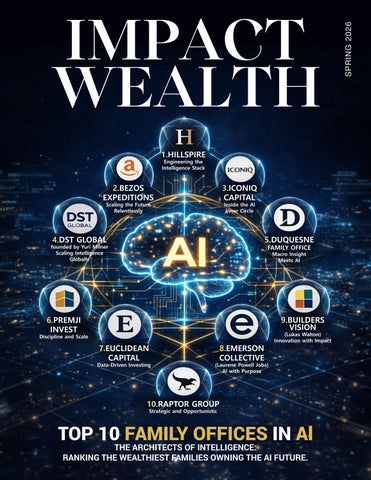
TOP 10 FAMILY OFFICES IN Al

THE ARCHITECTS OF INTELLIGENCE: RANKING THE WEALTHIEST FAMILIES OWNING THE AI FUTURE.

HERITAGE IN Every Hull

Discover exquisite American craftsmanship at Lonic Craft. With Heritage in Every Hull, luxury meets precision in every custom water craft we create.

Outsider’s Mandate: From Entrepreneur to Presidential Contender By Candice Beaumont

Global Perspective on Food, Faith, and the Future of American Health By Liana Werner-Gray

Life in Motion: From Survival to Global Success By Candice Beaumont

The Emerging K-Beauty House Elevating Skincare Through Craftsmanship, Design, and Global Ambition By Hillary Latos

Swiss-born Cellcosmet is redefining luxury skincare through cellular research and a growing focus on longevity By Angela Gorman

48 TOP 10 FAMILY OFFICES IN AI The Architects of Intelligence By Candice Beaumont

58 FALL WINTER 2026

Highlights from the runways of NYFW, MFW and PFW

76 Inside the Growth Strategy of Scanlan Theodore A Blueprint for Modern Luxury By Hillary Latos 80 The Future of Luxury Is Becoming More Personal, Experiential, and Human By Angela Gorman

FINE DINING & BEVERAGE

JAVA LAVA

The Premium Coffee Liqueur Bringing Wall Street Precision to the Spirits World By Hillary Latos

WHERE FAST CARS MEET FINE WINE Adobe Road Winery Is Redefining the Wine Industry By Cristina Carbo

REAL ESTATE

Follow us on Instagram @harryblusus for the latest news and recipes!

"Are you sipping the ultimate pleasure...?

An Original Miami Handcrafted Spirit

EDITOR’S NOTE

The New Architects of Influence

Artificial intelligence is no longer emerging. It is already transforming every sector of the global economy. From healthcare breakthroughs and financial markets to defense systems, media, and consumer behavior, AI is redefining how businesses are built, how capital is deployed, and how societies evolve.

At the center of this shift are family offices.

With patient capital, flexibility, and generational vision, they are uniquely positioned to move faster, and more decisively than traditional institutions. While some are still adapting to this new paradigm, others are already shaping it, backing the platforms, technologies, and founders that will define the next decade.

In this issue of Impact Wealth Magazine, our cover story “Top 10 Family Offices in the World in AI.” focuses on influence as much as capital. These are the families driving global investment trends, accelerating innovation, and positioning themselves at the forefront of the AI revolution.

Beyond the cover, this issue reflects the broader ecosystem of power, innovation, and lifestyle that surrounds modern wealth. In investing, we highlight emerging strategies and opportunities, from Japan's resurgence attracting global capital to Golden Eagle's investments in hypergrowth stocks.. Our profiles feature individuals shaping industries and ideas, including Denis Jacquet, the entrepreneur now stepping onto the political stage in France, Dr. Marty Makary’s impact on healthcare, and German Efromovich’s remarkable journey building Avianca into a global airline.

We explore the intersection of science, beauty, and longevity through brands like Cellcosmet and Mimmua, alongside the growing influence of wellness leaders such as Thailand's eco friendly label free bottled C2 Water, and the Chenot and ULYSSIA collaboration. In fashion, we look at global luxury through the lens of Scanlan Theodore and the evolving narratives emerging from New York and Milan Fashion Weeks, as well as the broader conversation around the future of luxury itself.

Travel and lifestyle continue to evolve alongside wealth, from Ikonic Yachts redefining ultra-luxury experiences to curated jet access and global destinations shaping elite mobility. In real estate, we examine the visionaries and developments transforming key markets, while our events coverage: from the Fort Lauderdale Boat Show and FII Priority Summit Miami to Lake Nona, the 1640 Society

What ties it all together is a single theme: access to the future. The families, investors, and leaders featured in this issue are not waiting for change. They are driving it. In a world increasingly defined by intelligence - both human and artificial, the ability to recognize and act on transformation early has never been more valuable.

The question is no longer whether AI will change the world. It already is.

The question is: who will shape what comes next?

Family Office Forum in the Hamptons, and Old Bags captures where influence, capital, and opportunity converge in real time.

Hillary Latos EDITOR IN CHIEF

Candice Beaumont MANAGING EDITOR

Emil Pavlov ART DIRECTOR

Jaime Pavon, Daniel Perry CONTRIBUTING PHOTOGRAPHERS

Neal Berger, Janelle Brown, Cristina Carbo, Maria Gutierrez, Dorian May, Amy Poliakoff, Hannah Rose, David Seidman CONTRIBUTORS

Angela Gorman, Adam Weiss PUBLISHERS

Colin Thompson DIRECTOR OF SPONSORSHIP

Impact Wealth Media LLC 222 Broadway, 18th Floor, New York, NY 212 542 3146 www.impactwealth.org info@impactwealth.org

Drink youth.

JAPAN’S QUIET RESURGENCE Is Drawing Global Capital

Investor interest in Japan is building at a notable pace. Conversations across the institutional landscape suggest a growing appetite for exposure, yet many allocators have not fully committed capital. Instead, a backlog of demand appears to be forming—capital waiting for entry points amid market pullbacks.

This dynamic is already influencing market behavior. Sustained inflows into Japanese equities have contributed to heightened trading volume and frequent price swings, with major indices often moving 2–3% in a single day. For active strategies, particularly those designed to navigate volatility rather than direction, this environment is increasingly fertile.

Structural Shifts Behind the Momentum

Several factors are converging to reshape the investment case for Japan. Corporate governance reforms and a stronger emphasis on shareholder value are beginning to take hold, supported by a new generation of business leaders more open to engagement with investors. This cultural shift marks a meaningful departure from historically insular practices.

At the same time, global uncertainty has enhanced Japan’s relative appeal. In prior cycles, Japanese markets have demonstrated periods of independence from broader global trends, offering diversification benefits during times of stress.

Long-standing demographic concerns— once viewed as a structural headwind— are also being reassessed. Advances in automation and artificial intelligence are reducing reliance on labor force growth, particularly in a country already known for leadership in robotics, precision engineering, and advanced manufacturing.

Recent market milestones have further reinforced attention. The breach of multi-decade highs in early 2024 signaled renewed confidence, both domestically and internationally, and helped catalyze additional inflows.

Volatility as Opportunity

Against this backdrop, volatility has become a defining feature of the Japanese equity landscape. Earnings seasons, in particular, are producing pronounced reactions at the single-stock level.

In February, several companies posted results that triggered sharp price movements. Electronic components manufacturer Taiyo Yuden saw its shares surge dramatically following earnings,

while Obara Group rallied strongly after reporting robust performance alongside a share buyback announcement. Other companies, including Ibiden and Infroneer, also contributed to upward momentum.

On the other side, declines in names such as Money Forward and Kasumigaseki Capital served as a reminder that dispersion remains high—creating both risks and opportunities for investors positioned to respond dynamically.

A Reawakening in Convertible Bonds

One of the most notable developments has been in Japan’s convertible bond market, which is showing renewed vitality.

A major catalyst came in late February when Nippon Steel announced a multibillion-dollar convertible bond issuance to support its acquisition of U.S. Steel. The deal—one of the largest of its kind in Japan—was met with strong demand, with pricing quickly moving higher after launch.

Additional issuances, including from sporting goods company Mizuno, have also been

well received, reinforcing the view that the primary market is reopening in earnest.

With interest rates rising and equity valuations elevated, conditions appear supportive for continued issuance. Historically, new convertible bond offerings in Japan have tended to come at attractive valuations, often creating compelling entry points for investors focused on relative value and arbitrage opportunities.

Looking Ahead

Japan’s reemergence is not being driven by a single narrative, but rather by a confluence of structural reform, global capital rotation, and evolving market dynamics.

While many investors remain underallocated, the combination of pentup demand and increasing liquidity suggests that participation may broaden over time. In the interim, the volatility accompanying these inflows is likely to remain a defining characteristic—one that active and flexible strategies are particularly well positioned to navigate.

The stock market has entered the

HYPERGROWTH STOCK ERA

The term “hypergrowth” was introduced in a 2008 Harvard Business Review article. In short, the article recognized that certain companies were able to scale their sales at never-before-seen growth rates.

At this time Google had recorded several years of spectacular sales growth, increasing from $1.5 billion in 2003 to $21.8 billion in 2008. Apple, riding the crest of a similar sales curve, saw its sales explode from $6.2 billion in 2003 to nearly $32 billion in 2008.

In 2016 the World Economic Forum, building on the hypergrowth phenomenon, segmented the growth stock universe into three classes. Hypergrowth companies were categorized as having sales growth upwards of 40%, followed by rapid growth companies which exhibited sales growth of 20-39%. The third tier of growth stocks was designated as having normal growth rates of 1-19%.

Much of the emergence of hypergrowth companies is related to the so-called Fourth Industrial Revolution, a topic popularized by the World Economic Forum in 2016. The First Industrial Revolution was marked by a transition from hand work to machine production powered by steam and water power. The Second Industrial Revolution centered around railroad and telegraph construction which allowed for faster movement of people and information.

The Third Industrial Revolution, also referred to as the Digital Revolution, started in the late 20th century and revolved around information technology in connection with both personal computers and the internet.

We are now in the Fourth Industrial Revolution marked by rapid technological development. Areas of emphasis in this revolution include advanced development of artificial intelligence, gene editing and robotics. Many companies that have come of age in this era have global reach which has given rise to more hypergrowth companies than ever before.

Golden Eagle Strategies became intrigued by the Hypergrowth Stock concept some years ago and conducted what is believed to be the first study on Hypergrowth Stock returns. We have analyzed approximately 250,000 stock periods from the U.S. listed

equity universe from 2010 to 2025. Our study shows that the Hypergrowth Stock class has proved to be the most rewarding among the three classes of growth stocks as seen below.

Hypergrowth Stocks have produced an average annual return of 43% compared to an average annual return of 29% for rapid growth stocks and 17% for normal growth stocks.

At this point, the reader could surmise that Hypergrowth Stocks covered in our study were predominantly tech stocks, which is not the case. We have found that hypergrowth companies exist in nearly every one of the 11 economic sectors defined by S&P Global.

Hypergrowth Stock trends tend to be rotational. Tech stocks predominated in our study in 2020, energy stocks in 2022, health care and financial stocks in 2023 and 2024. In early 2026, many materials stocks including gold and silver mining stocks were prevalent in our list of Hypergrowth Stocks.

Our research shows that most companies cannot sustain four consecutive quarters of hypergrowth rates. For example, only 32% were able to generate four consecutive quarters of 40% plus sales growth in our 2024 study. Our Hypergrowth Stock strategy incorporates this reality into stock selection through rebalancing the portfolio monthly while focusing on latest quarter sales results.

The Holy Grail in money management is based on earnings analysis but nowhere in hypergrowth discussions is the word ‘earnings’ mentioned. As noted, hypergrowth companies are typified by 40% plus sales growth. However, readers may be surprised to learn that many hypergrowth companies are losing money.

According to our work, upwards of 40% of some 30,000 stocks were losing money when entering their hypergrowth sales phase. We realize that avoiding money losing companies means missing out on many of the biggest winners in the stock market, so we shifted to using the sales metric in evaluating stocks six years ago.

Our studies indicate that a growing trend of Hypergrowth Stocks has persisted over the past 16 years. Out of a total stock universe of some 5400 stocks, only about 100 stocks

come through our screens which we run every day. The annual average for any year since starting in 2010 has been quite broad but has averaged 129 per month since then.

It is notable that the number of Hypergrowth Stocks has been in a rising trend. During 2010-2019, the average number of Hypergrowth Stocks was 101, surpassed by an average of 176 during 2020-2025. We undertook an analysis of the returns compiled in these two periods and found that the period having the highest

number of these stocks far outperformed the period having the lowest number. Average annual returns for each period were 33% versus 13%, respectively.

Most investors are unaware of the Hypergrowth Stock phenomenon. As such, we believe this gem of all asset classes is underrepresented in most portfolios. To learn more about Hypergrowth Stocks, readers can visit the website: InvestingInHypergrowth.com

THE POWER OF HYPERGROWTH STOCKS

Average Annual Return (2009-2025)

About Robert Zuccaro, CFA

Robert Zuccaro, CFA is the Founder & Chief Investment Officer at Golden Eagle Strategies LLC – a Registered Investment Adviser. Robert has over four decades of experience in equity research and fund management, having led institutional portfolios through multiple market cycles. He’s been recognized by national financial publications for his work in systematic investing.

Email: info@goldeneaglestrategies.com Phone: (561) 510-6606

ONE BRAIN, MULTIPLE MINDS

The Next Architecture of Intelligent Investing

Stanley Druckenmiller once said that the best traders don't think — they feel. The market talks to them. For years I assumed that was mysticism. Then I started studying computational neuroscience and I realized it wasn't mysticism at all. It was pattern recognition at a scale the conscious mind cannot track. Decades of compressed experience, firing as a single instinct. That is not magic. That is architecture.

And if you understand how it works, you can build it.

The Problem With How We Think About AI in Finance

Most conversations about AI in investing start in the wrong place. They start with the algorithm — with speed, with data, with automation. The assumption is that intelligence is a feature you add on top of an existing fund structure. A better calculator. A faster analyst.

That framing misses everything that matters.

The funds that will define the next decade are not the ones that added AI to what they already had. They are the ones that asked a harder question: what does the architecture of a truly intelligent investment operation actually look like? Not faster. Not automated. Genuinely intelligent — in the way that a great trader is intelligent. Contextual. Adaptive. Capable of holding conflicting information and making a decision anyway. According to the 2025 BlackRock Global Family Office Report, 51 percent of family offices are now investing in AI opportunities. Most are buying tools. Very few are building architecture.

That question led me somewhere unexpected.

What the Brain Actually Does

The human brain does not work the way most people think. It is not a single processor running a single program. It is closer to an orchestra — dozens of specialized regions, each processing the world through a different lens, each sending signals to a central structure that listens, weighs, and decides.

Your visual cortex sees a candle pattern. Your memory system pulls up every time you have seen that pattern before and what happened next. Your threat-detection system flags that something in the current environment does not match the expected script. And somewhere in the middle of all that, a decision emerges — not from any single one of those systems, but from their interaction. What Druckenmiller calls intuition is this process running very fast, trained over decades, on an enormous volume of experience. It feels like instinct because it is too fast to observe consciously. It is not mysticism. It is architecture.

One Brain, Multiple Minds

When I started designing the next generation of AI-native investment systems, I stopped trying to build one very powerful model and started trying to replicate the architecture.

The result is a structure I think of as One Brain, Multiple Minds.

The logic is elegant. You build a set of highly specialized AI sub-systems — each focused on a narrow domain, whether that is momentum, volatility regimes, macro signals, or order flow and positioning. Each speaks its own language, trained on its own data, optimized for its own signal. Each is genuinely expert in what it does.

Then you wire them to a governing intelligence — a master layer that does not trade, does not predict, does not generate signals of its own. Its only job is to listen to the sub-systems, detect where they agree, where they conflict, and what that agreement or conflict means in the current moment. This governing layer is not averaging or voting —

it is reading the pattern of agreement and tension between specialized experts, which is a fundamentally different kind of signal.

This is closer to the way a great portfolio manager runs a multi-strategy fund — knowing that the real signal is often not in what any single PM is saying, but in the tension between them.

When the Minds Disagree

The most interesting moments in this architecture are not when the systems agree. It is when they conflict.

Consider August 2024, when the yen carry trade unwound with unexpected speed. Most systematic funds were caught wrong-footed. The momentum signals were bullish going in. The volatility signals were not screaming danger. A single-model system, optimizing for the dominant signal, held its position.

In a One Brain, Multiple Minds structure, the conflict itself becomes information. The macro mind and the volatility mind had been quietly diverging for weeks before the break. The governing layer was watching that divergence widen. The disagreement was the warning.

"A brain that only listens to its loudest voice is not intelligent. It is confident. There is a difference — and in markets, that difference is measured in losses."

The Perpetual CIO

There is another dimension to this architecture that I think matters enormously to family offices and to anyone thinking about wealth across generations.

A great CIO carries decades of institutional memory. They know how the portfolio behaved in 2008. They know which positions held and which stories fell

apart. They know the subtle biases that crept in over time. When they leave, most of that leaves with them.

The One Brain, Multiple Minds architecture, built and trained properly, is a record of every decision, every signal, every outcome. It learns continuously. It does not retire. It does not lose continuity when a team changes. The investment DNA of the fund — the real intellectual capital — lives in the system, not in any individual. And unlike a human CIO, it maintains the same cognitive discipline in the middle of a crisis at 3am as it does on a calm Tuesday morning.

For families thinking across decades, this is not a technology question. It is a governance question. How do you preserve the intelligence of the institution? How do you make sure the next generation inherits not just the capital, but the thinking?

A brain that only listens to its loudest voice is not intelligent. It is confident. There is a difference — and in markets, that difference is measured in losses.

The Window Is Narrower Than It Looks

The funds building this kind of architecture right now are not just gaining an advantage. They are compounding one — and the compounding is the part that people underestimate. Every month the system runs, it learns. Every regime it navigates, it encodes. The gap between the funds that built early and the funds that waited is not linear. It grows faster than the calendar suggests.

We are at the beginning of what I would call the Era of Intelligent Capital — where the edge is not the data you hold, not the people you hired, but the quality of the thinking infrastructure you built. After this comes something more significant still: quantum-accelerated inference, where the speed and complexity of reasoning will be beyond anything we can deploy today. That transition will not create a new winner from scratch. It will accelerate the lead of whoever built their cognitive foundation first.

The funds that arrive at that moment without a cognitive architecture will not just be slower. They will be operating in a world whose signals they can no longer read.

So here is the question I would leave you with — not as a warning, but as an honest mirror: when that moment comes, whose thinking will your portfolio be running on?

Kaushal Sheth is co-founder of an AI-native investment research firm and CTO of a global financial technology company. He has spent the last decade building intelligent systems at the intersection of computational neuroscience and capital markets.

DENIS JACQUET

The Outsider’s Mandate: From Entrepreneur to Presidential Contender

In a quiet but revealing conversation, a seasoned entrepreneur with decades of international experience shared the journey that led him from building global businesses to contemplating one of the most consequential decisions of his life: running for President of France.

What emerged was not a traditional political narrative, but a story shaped by resilience, ambition, and a deep frustration with the structural direction of Europe.

From Normandy to Global Enterprise

“Do you want to start by giving us an overview of your background?”

His history begins in Normandy, a region still marked by the legacy of the Second World War. Born into a lower middle class family that had lost nearly everything during the conflict, his early life was defined by rebuilding and discipline.

“My mother started working at 16. My father became an engineer and spent his life in one company. It was a modest upbringing, but we did not miss anything. My parents invested everything in my sister and me”

Gifted academically and athletically, he quickly distinguished himself. As a young athlete, he rose to become a French and European champion in long distance running, with aspirations toward the Olympics before injury cut that path short.

At the same time, he excelled in school, skipping grades but struggling socially as a result. He balanced this intensity with creativity, becoming a DJ, musician, and radio contributor during his student years.

“I had quite a lot of fun. It was a very dynamic life, that built in me many qualities and skills that were critical for my life. Hard work, resilience to pain, and a love for impossible challenges.”

The Making of an Entrepreneur

His academic path combined business and law, a strategic decision driven by a simple question: where could he create the most value?

The answer led him into tax law, where he began his career under the mentorship of Christine Lagarde, then a leading figure in global law and now President of the European Central Bank.

“I realized after three years that I was not meant to work for someone.”

At 27, he launched his first company in real estate, followed by one of Europe’s earliest online education platforms in 2000. The venture expanded internationally and was ultimately sold in 2016.

Over the years, he lived and worked across the United States, Morocco, and Europe, building a global perspective that would later shape his political thinking.

A Return That Changed Everything

“What led you to reconsider France and eventually think about politics?”

The turning point came when he returned to France after a decade abroad.

“When you leave your country for ten years and come back, you suddenly see it differently. You realize what is not working.”

What stood out most was the country’s relationship with entrepreneurship.

“We do not love entrepreneurs. We do not celebrate success. The instinct is to tax it.”

In response, he founded a nonprofit organization that grew into one of the largest entrepreneurial networks in France, with over 6,000 members. For a decade, he advised political leaders, contributed to economic programs, and became a prominent voice in national debates.

Yet frustration grew.

“They would listen, they would agree, but they would not implement anything.”

This realization pushed him toward writing bestselling books, expanding his public platform, and eventually relocating to the United States in 2019.

Why Run for President Now

“What were the motivating factors that led you to consider running for President?”

His answer is direct and uncompromising. “I supported Emmanuel Macron at the beginning. He had vision. But what I see today is a complete failure.”

He describes a broader systemic issue rather than a single leadership problem.

The ambition of many politicians is limited to squeeze the last drops for their only benefit. It is not about the country anymore. France stopped dreaming, it’s a shame.

“For decades, France has been governed by people who have never worked in the private sector. They are disconnected from reality.”

At the same time, he sees a unique political moment emerging across Europe.

“For the first time, people are ready for someone outside the system. They are looking for a different profile, someone who understands the real economy.”

The decision, he explains, is rooted in responsibility.

“When you are born somewhere, when your family and your business are tied to that country, and you believe you can help, then you should step forward.”

A Different Vision for Leadership

“Where would you take the country? What would you do differently?” His framework begins with foundations.

“If you want to build the future, you need strong foundations. That starts with culture, values, and principles.”

He argues that Europe is facing both cultural and economic challenges that require decisive action. Central to his economic philosophy is fiscal discipline. ““We need to stop spending, and

start investing. No politician wants and knows how to do that. They are scared to lose voters. I am not.”

This, he believes, is the core flaw in modern governance.

“The ambition of many politicians is limited to squeeze the last drops for their only benefit. It is not about the country anymore. France stopped dreaming, it’s a shame”

His alternative is a model of entrepreneurial leadership rooted in execution rather than political longevity. Less taxes, spending and regulations. More investment. Fight radicalisation, get France and Europe back on their feet.

“We need people who come in, do what has to be done, and leave. Not people who stay to preserve their position.”

The Global Context

Throughout the conversation, his perspective reflects a broader geopolitical awareness shaped by years in international business.

Discussing Europe’s evolving relationships, particularly with global powers like China, he cautions against reactive decision making.

“Partnership is not the problem. The problem is acting out of pressure instead of strategy.”

He emphasizes that global dynamics require preparation, clarity, and independence rather than short term alignment shifts.

A Personal Mission Beyond Politics

Despite the political ambition, his work extends far beyond business and governance. As Vice Chairman of an international NGO operating across the Sahel region of Africa, he is involved in initiatives focused on water access, energy, and sustainable development.

“The goal is to help communities thrive where they are, not be forced to leave.”

This humanitarian dimension adds another layer to his profile, reinforcing a consistent theme of long term thinking and structural impact.

The Road Ahead

The conversation closes not with certainty, but with conviction.

“This is not about me. It is about saving the western world. Our challenges are also US challenges. We have to ReAlign.”

Whether or not his candidacy materializes, his perspective reflects a growing sentiment across Europe, a demand for leaders who combine entrepreneurial experience with political courage.

In his words, the opportunity is unprecedented.

“For the first time, everything is aligned for someone from outside the system to step in.”

DR. MARTY MAKARY

A Global Perspective on Food, Faith, and the Future of American Health

Few leaders step into public service with the rare combination of surgical precision, intellectual curiosity, and a deeply personal reverence for life. In this exclusive conversation, I sat down with newly appointed FDA Commissioner Dr. Marty Makary to explore the experiences that shaped his worldview — from growing up between cultures in England, Egypt, and rural Pennsylvania, to spending decades in operating rooms at Johns Hopkins, to ultimately receiving the call to serve at the highest level of American health leadership.

Over fresh-pressed juice in his Florida home, Dr. Makary spoke candidly about questioning long-held medical assumptions, reforming food policy, accelerating drug approvals, reducing animal testing through AI innovation, and bridging the divide between natural and conventional medicine. He reflected on the near-miss moment before his birth that profoundly shaped his gratitude for life, the books that caught the attention of a U.S. President, and the faith and integrity that guide decisions impacting millions.

This is a conversation about prevention, purpose, and the future of health in America — through the lens of a physician who believes that how we live is just as important as how we treat disease.

EARLY LIFE & GLOBAL PERSPECTIVE

Liana Werner-Gray: Your story didn’t begin in the United States. You were born in England, and grew up with strong ties to Egypt. Can you tell us about that experience and how it shaped your views on food, health, and medicine?

Dr. Makary: I was born in Liverpool, England. not during the Beatles, but after they were big. My family is originally from Egypt. I didn’t live there full-time, but I spent summers there and studied there briefly. Growing up, I developed what’s known as a “third culture kid” mindset, where your ethnicity, where you were born, and where you grow up are all different. It gives you a sense of being a guest in society.

That perspective makes you hyper-observant. You compare cultures instinctively, how people eat, how families live, how they approach health. Third culture kids often take non-traditional paths. Elon Musk and Albert Einstein were both third culture kids. You are a third culture kid. About half of primary care physicians in the U.S. are third culture kids.

In medicine, that perspective pushed me toward research. I was always asking “why.” Why is puberty starting months earlier

each generation? Why do some people have blackened lungs simply from living in cities? Why are those questions dismissed so quickly? That curiosity pulled me toward unexplored areas of medicine.

QUESTIONING MEDICAL ASSUMPTIONS

Liana Werner-Gray: You’ve spoken often about questioning long-held assumptions in medicine. Can you expand on that?

Dr. Makary: There are many areas in medicine we do not explore deeply enough: food, mindset, community, spirituality. One study out of Harvard really challenged conventional thinking: lung cancer patients randomized to a close, supportive community lived longer than those receiving standard chemotherapy.

That kind of data forces us to rethink assumptions. It suggests there are vast domains of health we haven’t fully explored yet.

THE CHOICE THAT ALMOST CHANGED EVERYTHING

As we spoke about purpose, service, and the weight of decisions in medicine, Dr. Makary paused and shared a deeply personal story, one that underscores his reverence for life and the gravity with which he approaches his role.

Dr. Makary: When my mother was pregnant with me, a woman approached her and said she had tested positive for rubella. Because she had previously been in contact with my mother, she wanted her to know. Rubella is known to cause birth defects.

Doctors in the UK consulted and advised my parents to bring her in for an abortion. My parents said no.

I only learned this later in life, and it made me even more profoundly grateful to be alive. It puts everything into perspective. One decision can change everything.

Liana Werner-Gray: That choice changed history. We wouldn’t be sitting here today. You wouldn’t be FDA Commissioner.

Dr. Makary: It really is humbling.

COMING TO AMERICA & PUBLIC SERVICE

Liana Werner-Gray: What brought you to America, and what drew you to medicine and public health here?

Dr. Makary: The opportunities in the United States are unmatched. My parents immigrated here for that reason. I grew up in a very small rural town in Pennsylvania, about 16,000 people, no mall, no movie theater.

Through hard work and incredible teachers, I graduated from great schools and later joined the faculty at Johns Hopkins. I’m deeply grateful to this country. Serving as FDA Commissioner feels like a way to give back.

FLORIDA, DELRAY BEACH & LIFESTYLE

Liana Werner-Gray: Out of all places, why Florida, and specifically Delray Beach?

Dr. Makary: We don’t live there fulltime, but we love visiting. Delray Beach is relaxed yet sophisticated. It’s a great beach town with excellent food and live music, and we have family nearby.

It doesn’t feel transient. It feels like a real community.

Liana Werner-Gray: Studies even show that just seeing palm trees helps people relax, even in photos. What does a perfect Florida day look like for you?

Dr. Makary: Great restaurants, live music, walking the Ave, and connecting with local people. It truly feels like a community.

Liana Werner-Gray: Do you have a favorite restaurant in Delray?

Dr. Makary: It used to be Lionfish, but they recently closed. Now I’d say an Italian restaurant called L’Acqua. We also love Farmhouse, they do a great job sourcing their ingredients and serving healthy food.

You’ll be glad to know that Dr. Makary’s favorite local restaurants align with cleaneating values. I checked directly with the kitchens, and Gary Rack’s Farmhouse Kitchen confirmed they use olive oil for sautéing and beef tallow in their fryer, no seed oils.

LEADERSHIP, FAITH & VALUES

Liana Werner-Gray: What core values guide you when making decisions that affect millions of people?

Dr. Makary: Integrity is essential. If you don’t care, the job is easy. If you truly care about public health, especially children, it’s incredibly challenging.

My faith is very important to me. I value my church community. I’m also keenly aware that life is transient. None of us will be here in 100 years. The question becomes: did we serve humanity or just ourselves?

Healthcare is uniquely unifying. Whether you’re a nurse, researcher, food producer, or physician, we’re all driven by compassion. That’s how the FDA should think about innovators, we all want safe, effective treatments.

ONE YEAR AS FDA COMMISSIONER: TOP ACHIEVEMENTS

Liana Werner-Gray: Looking back on your first year, what are your top three achievements?

Dr. Makary: Cutting red tape to unleash cures. We’ve created new pathways to approve drugs in weeks. We need the same urgency used in Operation Warp Speed to tackle cancer, neurodegenerative diseases, autoimmune conditions, and PTSD. My background in pancreatic cancer, one of the hardest cancers to treat, gave me a deep sense of urgency. Reforming food policy and the food pyramid. Updating outdated nutrition guidance is critical for prevention. Reducing animal testing and using AI. We’re embracing more humane, accurate research models.

Other major initiatives include advancing menopausal hormone replacement therapy, removing artificial food dyes, and modernizing FDA oversight across food, drugs, devices, and technology.

CAREER JOURNEY & PREPARATION

Liana Werner-Gray: Your career spans surgery, research, food systems, and public health. How did it prepare you for this role?

Dr. Makary: You can’t train specifically to be FDA Commissioner. But my curiosity prepared me.

I spent 22 years at Johns Hopkins, over 30 years in operating rooms, and worked across nearly every medical discipline. I also served as Chief Medical Officer for a major grocery company, where I learned about food production, meat, dairy, poultry, sourcing.

At the time, people teased me for my broad interests. Looking back, all of it mattered.

ENERGY, GRATITUDE & HEALTH

Liana Werner-Gray: Where do you get your energy?

Dr. Makary: Gratitude. I’m grateful for my wife, who fuels me with healthy food, for the opportunities I’ve had, and for life itself. When you reach the top of academic medicine, you begin asking: what has the greatest impact?

THE BOOKS THAT PUT HIM ON THE PRESIDENT’S RADAR

Liana Werner-Gray: Few people can say their books changed the course of their life. Yours ultimately led to a call from the President. How did it all begin?

Dr. Makary: I started sharing stories from my experience as a student and resident. usually over dinner with friends. I’d be exhausted, but for as long as I could stay awake, I would tell these stories. A friend told me, “You should write them down.” They weren’t just stories for entertainment, they revealed deeper issues in the American healthcare system.

So I wrote the first book to get it all down, not expecting much, there are over 100,000 books published each year. But to my amazement, it gained grassroots momentum, became a New York Times bestseller, and was later turned into the TV show The Resident, which ran for four seasons on Fox. That book also included my work developing the surgical checklist, which was adopted widely, including by the World Health Organization.

After years of speaking about quality in healthcare, I realized another major issue we weren’t addressing enough: the price of healthcare, how high it is and how opaque it is. So I wrote a second book, The Price We Pay, focusing on price transparency and the role of middlemen like pharmacy benefit managers.

Someone at the White House read it, and during the first Trump administration I was invited in to talk about price transparency. The President and his team liked the idea, signed an executive order, and that helped kick off a broader effort around hospital price transparency and healthcare costs.

Those relationships carried forward. Shortly after election day, I got a call, and the President asked if I would consider serving as FDA Commissioner. I said yes right away. It’s an incredible opportunity.

PREVENTION, NATURAL HEALTH & OPEN-MINDED MEDICINE

Liana Werner-Gray: Where do you stand on prevention, natural health, and functional medicine?

Dr. Makary: There’s been an unfortunate standoff between natural and conventional medicine. We need openmindedness. Absence of evidence is not evidence of absence.

We must listen to patients and parents. When families report improvements, like when removing artificial food dyes, that’s data. It deserves study, not dismissal.

I believe in prevention, functional approaches, and modern medicine. I’ve seen miracles from all of them.

GERMÁN EFROMOVICH A Life in Motion: From Survival to Global Success

From a childhood defined by the confines of a shipping container to the helm of a multi-billion dollar aviation empire, German Efromovich’s journey is a masterclass in turning systemic displacement into a relentless drive for global enterprise. He transformed a struggling airline into one of Latin America's largest carriers while building a diversified, high-impact business portfolio.

The story begins far from boardrooms and billion-dollar deals. It starts in La Paz, Bolivia, where a first-generation son of Holocaust survivors was born into a world shaped by resilience rather than resources.

His parents arrived with nothing. As he recalls, “they arrived with just the clothes they were wearing,” supported only by minimal aid. Survival was not guaranteed, and opportunity had to be built from the ground up.

His father, who spoke several European languages but not Spanish, began by delivering bread and milk. Over time, he entered small trade, determined to create a foundation for his family. That early environment shaped a lifelong perspective. As he puts it, “we always had the minimum basics, food, education, and health,” but nothing beyond that came easily.

A CHILDHOOD OF TRANSITION AND ADAPTATION

At the age of five, his family moved to Chile, settling in Arica. The transition was difficult, and for the first two years, home was a 42-foot shipping container shared within a compound of six families.

Despite the hardship, his outlook remains strikingly positive. “We were never unhappy,” he reflects. The experience instilled resilience and perspective that would later define his approach to business and life.

At fourteen, anticipating political changes, his father made another decisive move. The family relocated to Brazil, a decision that would ultimately shape the trajectory of his future.

THE BEGINNING OF ENTREPRENEURIAL DRIVE

In Brazil, stability improved, but his ambition grew stronger. Determined to build independence, he began working at a young age.

“I started to do everything since I was fifteen or sixteen,” he says. From teaching private lessons to selling books and working with financial instruments, each experience added a new layer of understanding.

After completing a degree in mechanical engineering, he entered the corporate world. However, it quickly became clear that structured employment would not align with his mindset. When faced with limitations, he made a defining decision. He thought, "I will do for myself what you don’t let me do for the company,” he explains.

BUILDING A BUSINESS FROM NOTHING

With just $348, he launched his first business during a period of extreme inflation in Brazil. “You couldn’t borrow money,” he says. “You had to generate your own.”

The company focused on nondestructive testing, including industrial X-ray and ultrasound services. The work was demanding and often conducted at night due to safety concerns.

In the early days, he did everything himself. “I was the salesman, the accountant, the cleaner, everything,” he recalls. The workload was intense, but it laid the foundation for disciplined growth.

Over time, strategic partnerships became a key driver. Collaborations with major global organizations enabled expansion into large-scale industrial and energy projects.

EXPANSION INTO MULTIPLE INDUSTRIES

What began as a technical services company evolved into a diversified enterprise spanning oil, offshore operations, agriculture, and aviation.

The expansion was not the result of a rigid plan but a willingness to adapt and seize opportunity. Each new venture

built upon the last, creating a network of interconnected businesses.

This adaptability became a defining trait, allowing him to navigate industries with confidence and scale operations effectively.

ENTERING AVIATION BY OPPORTUNITY

The move into aviation was unexpected. A client, unable to repay a debt, offered an aircraft instead. Rather than seeing it as a setback, he saw potential.

“I had this aircraft, and I thought, what should I do with it?” he explains. The answer was to create an air taxi operation, initially to support his own business operations.

Demand quickly grew. “People started asking for lifts, and I realized there was a business,” he says. Within months, the operation expanded, leading to the acquisition of additional aircraft and entry into the regional airline market.

TRANSFORMING A MAJOR AIRLINE

The most defining chapter came with the acquisition of a struggling airline in bankruptcy. Initially hesitant, he made an offer he believed would be rejected. Instead, it was accepted.

“I made an offer with what I could afford,” he says. “And they accepted.”

The process required navigating complex legal and financial challenges. At one point, a judge questioned his ability to compete with much larger corporations. His response was direct. “Your honor, you’re right. We don’t have the experience,” he said, acknowledging the challenge while demonstrating confidence in execution.

Within months, the company was stabilized. Over time, it was transformed into one of the largest airlines in Latin America. “We took a company with 34 old planes and significant

debt,” he explains, “and built it into a business with 200 modern aircraft, thousands of employees, and billions in revenue.”

LESSONS IN BUSINESS AND TRUST

Across decades of experience, one lesson stands above all others: the importance of people.

“If you don’t deal with the right people, it makes no difference how many contracts you sign,” he says. Trust, he explains, cannot be replaced by legal structures alone.

He often compares partnerships to personal relationships. “A partnership is like a marriage,” he notes. “The important thing is not who you marry, but who you would eventually divorce.”

This perspective reflects a deeper understanding of risk, emphasizing judgment and character over purely financial considerations.

NAVIGATING A CHANGING WORLD

Reflecting on today’s business environment, he sees both opportunity and risk. Technology, particularly artificial intelligence, has dramatically changed the pace of decision-making.

“We did a full project analysis in three hours using AI,” he says, noting that the same work would have taken months in the past. However, he cautions against blind reliance. “You cannot just copy and paste. You have to know how to analyze.”

For him, the key remains understanding. “Every human being has to understand why they are doing something,” he explains. “If you understand why, then you know what you are doing.”

A LIFETIME OF BUILDING AND LEARNING

Despite decades of success, his perspective remains grounded. “I never worked,” he says. “When you do what you enjoy, you don’t work.”

It is a simple statement, but one that reflects a lifetime of discipline, resilience, and curiosity.

From a childhood shaped by displacement to building global enterprises, the journey is not defined by a single moment, but by a consistent approach to opportunity, risk, and growth.

And perhaps most importantly, by the belief that even in the most modest beginnings, there is always the potential to build something extraordinary.

MIMMUA

The Emerging K-Beauty House Elevating Skincare Through Craftsmanship, Design, and Global Ambition

In the ever-expanding world of skincare, true distinction is increasingly rare. Yet Mimmua is emerging as a brand with the kind of clarity, refinement, and founderled conviction that resonates far beyond the beauty aisle. With an ethos rooted in craftsmanship, efficacy, and emotional connection, the Korean skincare label is building a modern beauty house designed not only to deliver visible results, but to create a more elevated and desirable experience at every touchpoint.

Mimmua Is Bringing a More Elevated Sensibility to K-Beauty

Luxury today is no longer defined solely by price. It is defined by intention, by detail, by discernment, and by the ability of a brand to create an experience that feels both personal and aspirational. That is precisely where Mimmua is finding its footing.

Positioned at the intersection of skincare performance and design-driven desirability, Mimmua is part of a new wave of Korean beauty brands that understands modern consumers want more than efficacy alone. They want products that feel considered. They want formulas that perform, packaging that delights, and rituals that inspire confidence. Mimmua’s guiding motto—helping customers achieve “kissable skin” through a skincare ritual centered on self-love and confidence— captures that philosophy with clarity.

What sets the brand apart is its refusal to accept the conventions that dominate

much of the category. In a crowded marketplace where many skincare companies rely on similar formulations and nearly indistinguishable packaging, Mimmua is unapologetically focused on standing apart. Its founder believes beauty should never feel generic, and that customers deserve more than a clinically presented product stripped of character in the name of minimalism. To him, true beauty branding should be purposeful, memorable, and deeply desirable.

That philosophy informs every aspect of the business. For Mimmua, the customer experience begins long before a product touches the skin. It starts with the anticipation of receiving the package, continues through the visual and tactile impact of the bottle and presentation, and culminates in the ritual of use itself. This more holistic vision of skincare—where formula, form, and feeling are all part of the value proposition—gives the brand a resonance that feels increasingly aligned with the expectations of today’s premium consumer.

A Signature Product With Commercial Momentum

At the center of the brand’s ascent is its standout hero product: the Volume UP Time Block Serum. Formulated with 5% Volufiline and 40% Beta Glucan, the serum is designed to address a concern that remains central to many sophisticated skincare consumers: the loss of facial volume and firmness that accompanies aging. By targeting fine lines, wrinkles, and sunken areas of the face, the product has become a breakout success, especially among customers aged 40 and over.

Its commercial traction has been impressive. According to the founder, the serum quickly gained momentum with minimal marketing support and helped drive daily Amazon sales to $10,000 within just two months of launch. That early success laid the foundation for the expansion of the Volume UP franchise, which now includes a moisturizer, toning essence, and 100% Volufiline oil.

For a young beauty brand, that kind of response signals more than a trend. It suggests alignment between product innovation and market demand—a powerful combination in today’s global skincare business.

Understanding the American Luxury Consumer

A crucial part of Mimmua’s differentiation lies in its founder’s bicultural perspective. Having spent nearly half of his life in North America, he possessed a nuanced understanding of the American customer and what drives purchasing decisions in the U.S. market. That insight has shaped not just the brand’s formulas, but also its visual identity, positioning, and price-value equation.

While many K-beauty brands compete aggressively on price, Mimmua has chosen a different path. The company is not trying to be the cheapest option on the shelf. Instead, it is making a case for quality, craftsmanship, and elevated design. The founder is candid about the fact that manufacturing costs are higher because the brand prioritizes what he views as a more premium standard of execution. Customers, he says, recognize that difference and are willing to spend more for products that feel special, thoughtful, and beautifully made.

That choice positions Mimmua in a compelling space: accessible enough to reach a broad market, but aspirational enough to command loyalty from consumers who are increasingly selective about where they spend.

A Global Expansion Story in Motion

Mimmua’s ambitions are not confined to one market. The brand is already live on Amazon in Canada, the UAE, and Australia, with Saudi Arabia launching next and Europe scheduled to follow. Even more notably, the company is in the process of entering Ulta, a significant next step that would place the brand inside one of the most influential beauty retail ecosystems in the United States.

That momentum reflects not only strong consumer response, but also a founder with a clear and expansive vision. His goal is to begin with Ulta and grow into other major retail chains, building Mimmua

into a globally recognized beauty name. In an industry where scale often comes at the expense of soul, the challenge will be preserving the brand’s intimacy and identity as it grows. So far, Mimmua appears keenly aware of that balance.

The Founder Story Behind the Brand

What makes Mimmua especially compelling from an editorial perspective is the story behind it. This is not a brand born in a boardroom or assembled by trend forecasters chasing the latest beauty narrative. It is the result of lived experience, hardship, instinct, and determination.

Born and raised in Korea, the founder later moved to Canada with his family, then to New York to study fashion at Parsons. What began as a promising educational path became far more difficult after his family experienced severe financial setbacks. At

one point, he was living in a small apartment with six other people, juggling financial uncertainty, working late nights in a karaoke bar in K-town, and struggling to stay afloat in one of the world’s most demanding cities.

Eventually, that period of instability led him into beauty almost by chance. A conversation with someone working at Nature Republic opened the door to his first role in the industry, and it quickly became clear that this was where his instincts belonged. He immersed himself in product knowledge, ingredients, customer engagement, and the mechanics of retail performance. Later, he demonstrated a sharp commercial intelligence by identifying untapped customer data and proposing digital outreach strategies that significantly increased sales. During the pandemic, he further expanded that skill set by experimenting with paid online marketing—an effort so successful that he was able to repay a

$13,000 tuition debt in just one month.

After returning to Korea in 2022, he deepened his experience through roles managing Amazon accounts, K-beauty portfolios, and global e-commerce operations. Mimmua is, in many ways, the culmination of those years of hands-on learning. It is the product of someone who understands beauty from the sales floor to the supply chain, from brand image to digital performance.

Beyond Beauty: A Desire to Build With Meaning

For all of Mimmua’s commercial promise, the founder’s ambitions extend beyond market share. The brand already works with the Salvation Army to support single mothers in Korea, and he has expressed a long-term goal of expanding that charitable mission to support children in need globally. His vision is for Mimmua to become a truly

international beauty company that donates a portion of profits from each country to vulnerable communities within that country.

That philanthropic instinct gives the brand an added layer of resonance. In the luxury space, consumers increasingly gravitate toward businesses that stand for something beyond aesthetics alone. Mimmua’s founder is explicit that he wants the company to create value in the world, not merely revenue. That mindset, paired with his deeply personal journey, lends the brand a rare emotional credibility.

The Next Chapter

Looking ahead, the founder hopes to expand beyond skincare into haircare and makeup— an evolution that feels natural given his broader passion for beauty. Yet even as the business grows, his vision remains rooted in authenticity. He believes the future of beauty belongs to people who truly care about the

craft, not those drawn to the category solely because it appears commercially attractive.

That conviction may ultimately be Mimmua’s greatest asset. In a saturated industry, brands often compete on noise. Mimmua is building through substance: refined products, a distinct point of view, thoughtful design, and a founder story that feels both intimate and globally relevant.

In that sense, Mimmua is more than a skincare label. It is a brand born from persistence, sharpened by adversity, and elevated by vision. In a beauty landscape often driven by imitation, Mimmua stands apart by offering something increasingly rare: substance with soul, and products designed not only to improve skin, but to make customers feel seen, valued, and confident in their own ritual of self-care.

www.mimmua.shop

THE SCIENCE OF SKIN

How Swiss-born Cellcosmet is redefining luxury skincare through cellular research and a growing focus on longevity

On the shores of Lake Geneva, an early thread of medical research in cellular therapy would shape one of the more enduring names in luxury skincare. Long before skincare became a global industry measured in the hundreds of billions, the founders of Cellcosmet were already exploring how vitality at the cellular level could influence aging.

It was in this environment that Roland Pfister began working with his father at a Swiss revitalization clinic, building on the research of Professor Paul Niehans. When a patient asked whether cellular therapy could be applied to the skin, it set Pfister on a different path. What followed was years of research that led to the development of the CellControl™ method, designed to preserve the potency of bioengineered cellular extracts.

By 1987, those insights had evolved into Cellcosmet, a brand grounded in science and guided by the precision Switzerland is known for. Even its earliest formulations were focused on restoring cellular energy, something modern longevity and skincare experts have only more recently begun to prioritize. These origins feel increasingly aligned with where the broader healthcare industry is heading.

Skincare now sits at the center of the global beauty economy. The beauty market generated approximately $446 billion in retail sales in 2023, with skincare accounting for roughly 44% of that total. Analysts project the category will grow from about $162

billion in 2025 to more than $222 billion by 2030, reflecting steady, sustained demand.

While Asia Pacific is the fastest-growing region, the United States remains the largest single market, shaping consumer expectations and influencing global trends. Domestically, skincare continues to expand at a measured pace, supported by a culture that prioritizes both preventative care and premium solutions. Against this backdrop, the definition of skincare itself is evolving, moving closer to the language of health, longevity, and performance.

During a conversation with Jennifer Hessel, General Manager of North America at Cellcosmet, it was apparent these shifts were becoming more pronounced, and that her focus is on positioning the brand within this landscape.

With more than two decades of experience, including leadership roles at L'Oréal and work across Kiehl’s and Artis, Hessel brings both operational and strategic perspective to the role. It was clear she is thinking carefully about where the brand shows up and how it is experienced.

That thinking has translated into a strategy centered on high-touch environments, from luxury retail to wellness destinations, where the product can be understood within a broader context of care. It is also reflected in the brand’s customer base. Cellcosmet has cultivated a highly loyal following, with clients who view the products as part of a long-term regimen rather than occasional use. It is not uncommon for customers to keep full sets of their skincare in multiple homes, ensuring consistency in their routine wherever they are.

At the core of Cellcosmet is its continued investment in cellular science. From its Swiss laboratory, Cellap Laboratoire, the brand develops formulations according to its own research timelines. Recent innovations include the CytoPep™ Cellular Extract, formulated at higher concentrations to enhance revitalizing effects, and a Postbiotics Complex derived from marine ferments to support the skin barrier and microbiome.

Another area gaining attention is posttreatment recovery. As procedures such as lasers and microneedling become more common, the period that follows is receiving greater focus.

Cellcosmet has expanded its role within this space, with a new formulation, the Hydra-Soothing Mask, designed to support the skin as it recovers, helping to stabilize hydration and reinforce the barrier. The goal is to extend and protect the results of professional treatments.

Under Hessel’s leadership, the brand has expanded its presence through partnerships that align with its scientific positioning. A recent collaboration with Sensei Porcupine Creek brings Cellcosmet treatments into a setting known for its evidence-based approach to wellbeing.

Such partnerships point to skincare being increasingly integrated into environments focused on long-term health, where treatments are part of a broader lifestyle approach.

The future of skincare is likely to be shaped by a combination of scientific advancement and changing consumer expectations. Personalization, biotechnology, and microbiome research are expected to play larger roles. Within this landscape, Cellcosmet’s foundation in cellular science allows for continued innovation, grounded in a discipline that has defined the brand from the beginning.

FROM THE GOLDEN GLOBES TO GLOBAL IMPACT

How C2 Founder Thanyarat Jirathitikeat Is Redefining Sustainable Luxury

For Thanyarat Jirathitikeat, founder and CEO of C Drink Co., Ltd., sustainability is not a talking point—it is a design philosophy shaped by culture, creativity, and long-term thinking. A lifelong admirer of fashion, music, and dance, Thanyarat has always understood the power of creative industries to influence behavior and shape global narratives. That perspective now defines C2 Water, Thailand’s first label-free bottled water brand, built from day one to eliminate waste at the source rather than manage it after the fact.

C2’s presence at the Golden Globe Awards marked more than a red-carpet moment—it underscored the brand’s growing role at the intersection of sustainability, culture, and global influence. For Thanyarat, supporting film, music, and creative communities is part of a broader mission to nurture industries that move society forward. While she once dreamed of stepping onto the stage herself, today she channels that passion into creating platforms, opportunities, and systems that empower others— whether through sustainable product innovation or cultural collaboration.

At the core of C2 is a belief that environmental responsibility and commercial success are not mutually exclusive. By pioneering a 100%

recyclable, label-free bottle, Thanyarat has positioned C2 as a pathfinder brand—one aligned with future regulation, scalable by design, and increasingly relevant to global markets. In this executive interview, she shares how personal passion informs leadership, why sustainability is a long-term investment, and how Thai innovation can influence the future of consumer brands worldwide.

Impact Wealth speaks to Ms. Jirathitikeat, the dynamic CEO behind C2 Water about what is next on the horizon and her influence in shaping the sustainable packaging trend in Thailand.

What drew C2 to participate in the FDA Innovation Expo, and what role did you play at the event?

C2 participated as Thailand’s first brand to introduce label-free bottled water—not as a concept, but as a functioning business model. From the beginning, our goal has been to demonstrate that sustainability can be structural, scalable, and commercially viable. Our role at the event went far beyond exhibiting a product. We were there to share practical experience—how innovation can work in parallel with regulation, how packaging can be

redesigned at the source, and how businesses can contribute meaningfully to shaping the future of their industries.

What was the original inspiration behind the label-free bottled water concept?

It began with a very direct question: If plastic labels are one of the biggest barriers to recycling, why are we still using them?

At C2, we believe environmental solutions must start at the beginning of the process, not at the end of the waste chain. By removing labels entirely, we eliminated a structural obstacle and redesigned the bottle to be 100% recyclable from day one.

How does this innovation translate into competitive advantage for C2?

Label-free packaging gave C2 a first-mover advantage across three critical areas.

Environmentally, it significantly reduces plastic waste and simplifies recycling. From a regulatory standpoint, it aligns us with future policy and international sustainability standards. And from a brand perspective, it clearly positions C2 as a company willing to act ahead of the market rather than react to it.

How do you evaluate whether this innovation has been successful?

We measure success through real-world impact, not marketing claims. That includes consumer acceptance, consistent sales growth, and recognition by government agencies as a reference model.

These indicators confirm that sustainability can be responsible and commercially sound at the same time.

How do you communicate C2’s sustainability values to consumers without relying on heavy messaging?

We believe actions communicate more effectively than words. Instead of selling sustainability as a narrative, we embed it directly into the product itself.

Our philosophy—dare to think, dare to act, dare to change—guides everything we do. When consumers experience the product, they understand the values without needing to be told.

Do you see broader market shifts toward sustainability as a ripple effect of C2’s initiative?

No single brand transforms an industry on its own, but real action creates momentum. By showing that label-free packaging is feasible, scalable, and accepted by consumers, C2 helped accelerate awareness and policy dialogue across the industry.

That momentum matters.

How do you view C2’s role within Thailand’s bottled water industry?

We see C2 as a pathfinder brand—one that demonstrates Thai companies can lead structural innovation, set new benchmarks, and export ideas, not just products, to the global stage.

As major brands adopt sustainability initiatives, how does C2 view growing competition?

We welcome it. When larger brands move in this direction, it validates the concept and ultimately benefits the environment.

C2 remains differentiated as the originator—backed by execution and experience, not late-stage adoption.

What distinguishes C2 from other environmentally focused water brands?

We did not start with marketing—we started with product architecture. Sustainability was not added later; it was the foundation from the very beginning.

That difference matters.

From a business perspective, do you see sustainability as a cost or an investment?

Sustainability is a long-term investment. In the future, the real cost for businesses will be failing to adapt early enough.

How does C2’s bottle design impact Thailand’s recycling ecosystem?

By removing labels, bottles can enter the recycling stream immediately. This reduces sorting time, labor costs, and contamination, increasing the economic value of recycled plastic and strengthening the entire recycling system.

What’s next for C2 in terms of circular economy initiatives?

Our next phase includes partnerships with

recycling and waste-management systems, development of alternative sustainable materials, and expanding circular design principles across all C2 product lines.

What does being invited by the FDA to exhibit represent for you as a founder?

It signals that label-free packaging is no longer a niche idea—it is becoming part of the future direction of the industry. The collaboration reflects alignment between innovators and regulators working toward shared sustainability goals.

How important is government support in scaling green businesses?

Government support is essential. When policy and innovation move together, sustainability becomes scalable, measurable, and impactful.

Where do you see C2 over the next three to five years?

Our goal is for C2 to become a global reference brand for environmentally responsible bottled water—showing that Thai innovation can influence international standards.

How will C2 maintain leadership as sustainability becomes the norm rather than the exception?

Leadership requires continuous evolution. We will maintain our position through ongoing innovation, close collaboration with policymakers, and expanding label-free and circular concepts across our portfolio.

Being first is important—but staying ahead is the real mission.

LAURA AVERSANO Star of the Spirit World

If her unusual gifts, experiences and healing abilities – including being a spirit walker, ancestral empath and medical intuitivesound like a TV show, that’s because they just might be turned into one soon. Having already helped thousands of people see things in a new light – or through a different dimension – Laura Aversano wants to educate the public on how we can heal ourselves and connect to our past, as well as each other, through a larger platform. Already a star in the spirit world, Laura, who has been tapping into the spiritual realm for 30 years, had her first book accepted by a major publisher at just 29 years old and has plenty of stories to share which even for her, never fall short of amazing.

A published author of numerous books which expand on her spiritual and mystical gifts, for Aversano, having supernatural feelings runs in the family. Hailing from a long lineage of seers, she has learned to fine tune her talents and has helped thousands of people from all over the world. Though being able to communicate with souls at only four or five years old might confuse some parents, Laura’s mom knew that having these paranormal abilities just meant that her daughter was about to figure out her own path within the spirit world.

Let’s just say that her playground talk was also more spirits than superheroes. “Sometimes I would be sitting on my bed and I didn’t always understand myself what I was seeing, but my mother knew, and she nurtured it,” said Laura. As if talking about prior incarnations she had lived through wasn’t enough, she would start randomly talking about Edgar Cayce, a famed clairvoyant who passed away over half a century ago – at six years oldsomething which still even gives her the chills.

Laura, who helps clients overcome certain medical or psychological issues with her otherworldly wisdom, as well as vast knowledge of plants and supplements, recalls how her mother used to have visions of the Holy Mother appearing at her footbed. “She used to think they were just dreams and would walk the streets of Sicily saying prayers and people would follow her,” she said.

It wasn’t until she was about 19 years old when her mother took her to her first healer, or shaman, that she was told just how gifted she really was. She had just returned home with a mysterious illness following her time at an international studies program in Europe and was hospitalized as no one could figure out what was wrong. Aside from getting to the root of the malady, the healer

suggested she find appropriate schools of study to help shape her unique abilities.

The author of The Divine Nature of Plants and Plant Spirit Journey, as well as Affirmations of the Light in Times of Darkness, Laura did indeed take the time to hone her skills. While most of us hardly notice people passing by us, for this empath, it’s not uncommon for her to sense other people’s illnesses coming through her body, as well as which vitamins and food they need to get better. “I would see spirits around them and messages and it was overwhelming sometimes seeing too much,” she said.

Her powers have indeed grown throughout the years, but that doesn’t mean that her abilities don’t come with consequences. She has seen all kinds of spirits, but has learned to structure boundaries to deal with them all safely.

“My Catholic priest heard about me and said either you’re crazy or you’re the real thing. He looked at my face and said ‘you need more protection’.” Working with her mentors, she has learned various methods, including how to detach.

Over the years, Laura’s practice has mostly evolved by word of mouth – to seven different countries. She is now even working with grandchildren of clients who came to her decades ago, mostly communicating with everyone over the phone.

Laura, who believes her religious, spiritual and mystical beliefs and gifts and are tied together, wrote the book Spirit Walker to delve deeper into what that actually means.

“Many people believe a world is happening around us we cannot see or feel. I want to teach others how there are parallel realms above and beyond what we can see that impact our spiritual health through epigenetics. We define fate differently than the spirit world – I’m not this “New Age” version of spirituality. I’m the real deal.”

She also wants you to know that patterns are transgenerational and how we treat each other and the choices we make in our relationships can have an impact on future generations. “That is my understanding of karma,” she said.

Using her ancestral empath abilities, along with her knowledge of epigenetics, she is able to connect past traumas and spiritual attachments to certain events or diseases that might arise in someone’s life. She especially pays close attention to patterns.

“There is a myriad of reasons why things happen, so it’s always important to try to find contributing factors. I had a case where someone with ALS came to me and I just kept looking back in shock until the client informed me of how when she was six years old and tasked with watching her sister, she turned his head for a split second and her sister was run over with a car. So, we have to look at how trauma influences our bodies response to things.”

When speaking with clients, in fact, she goes into parallel realities. “I’m one foot here and one foot there.”

Even now, she is still amazed at some of the things she has seen through her gifts, including how she has communicated with those deep in a coma and even babies in utero. “I love when parents years later tell me how much of what I told them before their child was even born turned out to be true.” Whether their spirits are stuck, they want clarity on relationship issues, or are sick and aren’t getting properly diagnosed, Laura’s clients have gotten spiritual guidance in ways that most of us will never understand. Her talents also extend to communicating with pets.

“Can you imagine a show where people are able to see firsthand how there is so much out there that we don’t even know about

and yet it is crucial to helping us live our best life and overcome generational traumas?”

Regardless, of her own feelings or what she sees, Laura has to remain neutral in her space, because she knows herself there is no telling what might be revealed to her. She has also helped people of all different traditions. “I had a Native American man say to me once you’re scary, but in a good way.”

This spiritual force also reflects on some of the more humorous parts of her gifts.

“Before going on a date once, a spirit came and said ‘this isn’t going to work,’ and I said even though I know that, I’m allowed to have a life, please go,” she joked.

As an expert on earth medicine, she is always connected to nature wherever she goes.

“One time I was in Central Park near an oak tree and I couldn’t breathe and I looked around and realized there were all these cigarette

butts around so I just said ‘I’m so sorry.’ It’s devastating how we care for Mother Nature.”

According to Laura, the easiest way to achieve some sort of connection in our everyday life is to perform acts of kindness and service. “It doesn’t take much to be nice to each other, or give a compliment, and not because you have to, but because you mean it. Be present in the moment and understand the concept of gratitude, even if that means saying thank you God in whatever religion you practice. I write posts about this often.”

Laura is now a regular in-demand guest on national podcasts and is working with the twice-nominated Emmy producer Sam Sokolow who hopes to turn her life’s stories into a TV show – and there is certainly no shortage of stories. Aside from giving others a glimpse into her gifts and how she is able to tap into something most of us can’t even fathom, she also wants to teach people more about what she does and how we can all connect to this world in our own way.

LIVING WELL AT SEA

Chenot and ULYSSIA Redefine Longevity

Through Residential Yachting

Luxury has long been defined by access. Access to places, to experiences, to the rare and the remote. Increasingly, it is also being defined by something more fundamental: access to health.

That shift is at the center of a new partnership between Chenot, the Swiss-founded wellness pioneer, and ULYSSIA, a 323-meter residential superyacht designed to circumnavigate the globe. Together, they are introducing a concept that moves beyond traditional hospitality and into something closer to a continuous, living ecosystem of wellbeing.

The collaboration reflects a broader evolution taking place across luxury, wellness as a way of life.

A Method Designed for Life, Not Escape

For more than five decades, Chenot has built its reputation around a structured, science-led approach to health. Its programs are intentionally immersive.

As Dr. George Gaitanos, Chief Operating and Scientific Officer at Chenot, explains, “the idea is to activate the body’s innate capacity to reset, to repair, to adapt, to regenerate.”

The premise is grounded in a growing body of scientific research. Aging is driven not simply by time, but by the accumulation of cellular damage and declining energy systems. Interventions that stimulate autophagy, the body’s natural process of clearing damaged

cellular material, are increasingly seen as central to maintaining long-term health.

Recent clinical research shared with Impact Wealth by Dr. Gaitanos reinforces this approach. In a controlled human study, a seven-day, plant-based fasting-mimicking protocol was shown to reduce body weight, lower blood glucose by approximately 10 percent, and decrease IGF-1 levels by roughly 35 percent, while also activating autophagy at a molecular level. These are all markers associated with improved metabolic health and healthy aging.

Within the Chenot Method®, these principles are applied through a combination of nutrition, controlled stress, and recovery. “We stress the body and then the body reacts to this stress with repair,” Gaitanos says, describing the underlying biological mechanism.

From Destination to Daily Living

Until now, Chenot’s model has largely been tied to physical destinations, where guests step away from daily life to undergo structured programs. The partnership with ULYSSIA introduces a different framework. Instead of a temporary retreat, the method becomes embedded within a residential environment.

ULYSSIA is designed as a floating community, with 122 private residences and 22 guest suites, allowing owners to travel the world without leaving home. Onboard, Chenot will operate a 1,900-squaremeter medical and wellness facility, integrating diagnostics, treatments, and personalized programs into everyday life.

“It allows us to extend our structured framework into daily living, rather than confining it to a single retreat experience,” says Gaitanos. The shift is subtle, but significant as wellness shifts to something continuous.

The Role of Environment

Part of the appeal lies in the environment itself. The ocean, constant movement, changing geographies, and natural light cycles all contribute to what Chenot views as a more dynamic and responsive setting for the body.

Unlike a fixed location, a residential yacht introduces variability. Climate, altitude, culture, and even cuisine evolve as the vessel travels, creating opportunities to adapt wellness programs in real time. As Dr. Gaitanos laughed about, the continuous variability allows for mental flexibility and stimulation, if only they could limit the use of smart phones or AI.

This approach reflects a broader shift in how health is understood. Increasingly, it is seen not as a collection of isolated metrics, but as an interconnected system. “The fact that we are a system, you touch one thing and then you affect a million other things,” Gaitanos explains.

Within that system, the environment plays a defining role. “You are sensing the world, the way you are creating the walls, the ceilings, the music, the aroma, all these,” he says, describing how sensory inputs influence recovery and mental wellbeing.

On a vessel that moves continuously across geographies, that sensory experience becomes part of the therapeutic framework itself. “You have nature with you, you have the marine environment and all this supports recovery, circadian alignment, and mental wellbeing,” Gaitanos adds.

Rethinking Performance

For ultra-high-net-worth individuals, the pursuit of performance has often defined both business and lifestyle. Within longevity circles, there is a growing recognition that performance alone may come at a cost.

According to Gaitanos, one of the most overlooked aspects of health among this group is recovery. “They are very much into optimization and very much into excess,” he says. “But to me the ultimate purpose is sustained energy, and you achieve this with recovery.”

Many high performers, he notes, believe that “by beating the body they build resilience,” yet in practice, “by improving performance, you’re exhausting the system. Instead, the

foundation is far more fundamental. Sleep is your foundation, your recovery time,” he explains, emphasizing that regeneration happens during rest, not constant output.

The ULYSSIA partnership arrives at a moment when the definition of luxury itself is shifting. Ownership is becoming more experiential. Time is being valued differently. And health is increasingly viewed as the ultimate asset.

The idea of a residential yacht that integrates preventative medicine, diagnostics, and personalized care into everyday life begins to feel like the logical next step. Looking ahead, Dr. Gaitanos suggests that even the language around longevity may evolve. “Longevity as a word… I think it will disappear,” he says, noting that the concept is often misunderstood or overused. Instead, he returns to a more foundational idea. “Wellness is biology, when I ask you how are you, you say ‘I’m well,’ and you’re describing your health in one single word.”

What remains constant is the underlying goal: to live well for longer, with independence, energy, and purpose.

TOP 10 FAMILY OFFICES IN AI

The Architects of Intelligence

The rise of artificial intelligence is no longer confined to venture capital firms or public markets. Behind the scenes, some of the world’s most influential family offices are quietly shaping the future of AI through strategic investments, long-term capital, and convictiondriven bets. These entities operate with patience and flexibility, allowing them to support transformative technologies at scale.

From Silicon Valley to global investment hubs, these family offices are not only backing AI companies but also influencing how intelligence is developed, deployed, and monetized. Their role is increasingly central to the evolution of the AI economy. Artificial intelligence is rapidly becoming the foundational layer of the global economy, reshaping industries with a speed and scale not seen since the advent of the internet. From healthcare and finance to defense, real estate, and energy, AI is transforming how decisions are made, how capital is allocated, and how value is created. Algorithms are no longer just tools, they are becoming core infrastructure, embedded in everything from diagnostics and drug discovery to autonomous systems, predictive analytics, and intelligent supply chains.

In healthcare, AI is accelerating breakthroughs in early disease detection, personalized medicine, and drug development. AI is

compressing timelines that once took decades into years. In business, it is redefining productivity, enabling companies to automate complex workflows, enhance customer intelligence, and unlock entirely new revenue streams. In defense and national security, AI is emerging as a strategic imperative, powering everything from cybersecurity to autonomous systems and battlefield intelligence. Across financial markets, AI-driven models are influencing trading strategies, risk management, and capital flows at a global scale.

This is not simply a technology cycle. It is a structural transformation of the global economy.

At the center of this transformation are family offices. They are uniquely positioned to lead. Unlike traditional institutional investors bound by short-term performance pressures, family offices deploy patient, flexible, and conviction-

driven capital, allowing them to invest early in breakthrough technologies and support them through long development cycles. Their ability to move quickly, think generationally, and partner directly with founders gives them a decisive advantage in a field where timing, access, and insight are everything.

Increasingly, these family offices are not just participants in the AI revolution. They are architects of it. They are backing the infrastructure powering AI, funding the companies redefining industries, and influencing how intelligence is developed, governed, and deployed across society. From Silicon Valley to global financial hubs, their role is becoming central to how the next era of innovation unfolds.

What emerges is a new class of power players who are operating quietly, but shaping one of the most important technological revolutions of our time.

Hillspire:

Engineering the Intelligence Stack

AI is not just a technology wave. It’s a national priority and civilization shift

Hillspire, the family office of Eric Schmidt, stands at the intersection of technology and long-term capital. With Schmidt’s deep roots in Google, Hillspire brings both technical understanding and strategic clarity to AI investments. The firm focuses on foundational technologies, including machine learning infrastructure, cybersecurity, and national security applications of AI. Its approach is deliberate and research-driven, often aligning with projects that have both commercial and societal impact.

AI Exposure:

• Google / DeepMind ecosystem

• Scale AI (data infrastructure)

• Rebellion Defense (AI + national security)

Hillspire operates at the intersection of technology, government, and global AI leadership, making it one of the most influential forces shaping the future of intelligence

Bezos Expeditions reflects Jeff Bezos’s philosophy of bold, future-oriented investment. The office has backed several frontier technology companies, with AI playing a central role in its portfolio. From automation to space-related AI applications, Bezos Expeditions seeks opportunities that can scale globally. The firm’s willingness to invest in high-risk, high-reward ventures positions it as a key player in shaping AI’s next frontier.

Bezos Expeditions combines bold vision with massive scale.

AI Exposure:

• OpenAI

• Figure AI (humanoid robotics)

• Perplexity AI

• Amazon AI ecosystem (AWS, logistics automation)

Bezos is effectively backing AI + robotics + infrastructure at global scale.

B ezos Expeditions: Scaling the Future Relentlessly
The biggest wins come from backing technologies that redefine entire industries.

ICONIQ Capital: Inside the AI Inner Circle

Access is Everything. Especially in AI.

ICONIQ Capital, originally established to manage the wealth of Mark Zuckerberg, has evolved into a premier multi-family office serving many of Silicon Valley’s most influential founders and executives, including leaders from companies such as Meta, LinkedIn, Twitter (now X), and other top-tier technology platforms. Widely associated with

clients like Sheryl Sandberg, Jack Dorsey, Reid Hoffman, and other prominent tech figures, ICONIQ combines elite network access with sophisticated capital allocation.

With deep roots across the technology ecosystem, the firm operates at the intersection of private wealth and venture innovation, often gaining early exposure to category-defining AI companies. Its approach is highly relationship-driven, leveraging proximity to founders and operators to identify transformative opportunities before they reach broader markets.

ICONIQ Capital manages wealth for Silicon Valley’s most powerful foundersand that proximity is its edge.

AI Exposure / Companies:

• Strong ties to OpenAI

• Investments in Snowflake (AI + data cloud)

• Exposure to Databricks (AI/ML infrastructure)

• Backing next-gen AI founders through elite networks

ICONIQ operates as a gateway to the AI elite, often investing before companies become widely accessible.

DST Global, founded by Yuri Milner: Scaling Intelligence Globally

The most important technologies must scale globally - and fast.

DST Global, founded by Yuri Milner, began as a vehicle to back some of the world’s most transformative internet companies and has since evolved into a global investment powerhouse with strong family office characteristics. Known for early and highconviction investments in companies like Facebook and Alibaba, DST applies a similar strategy to artificial intelligence - targeting platforms with massive scalability and data advantages. The firm operates with a global lens, spanning the U.S., Europe, and Asia, and focuses on companies where AI is central to user growth, engagement, and monetization. Its approach is bold and concentrated, backing a small number of high-impact companies that define entire industries.

DST Global has a track record of backing transformative platforms early.

AI Exposure / Companies:

• Investments in Facebook (AI-driven platform evolution)

• Exposure to ByteDance (AI recommendation engine)

• Backing global AI-driven consumer platforms

• Participation in large-scale late-stage AI rounds

DST specializes in AI at planetary scale, where data, users, and intelligence converge.

AI will be one of the most powerful productivity shocks in modern history.”

Stanley Druckenmiller’s Duquesne Family Office brings a macroeconomic perspective to AI investing. The firm views artificial intelligence as a transformative force across industries and allocates capital accordingly. Its investments often reflect broader economic trends, including automation, productivity growth, and digital transformation. This top-down approach complements the more technologyfocused strategies of other family offices.

Stanley Druckenmiller views AI through a macro lens.

AI Exposure / Companies:

• Public and private exposure to NVIDIA (AI infrastructure leader)

• Investments tied to Microsoft / OpenAI ecosystem

• Broad positioning in AI-driven productivity sectors

• Semiconductor and compute infrastructure plays

Duquesne focuses on AI as a macroeconomic force, investing across the entire value chain

AI must translate into real productivity, not just promise.

Premji Invest, backed by Azim Premji, is one of the most structured and disciplined family offices globally. With a strong presence in technology investments, the firm has steadily increased its exposure to AI. Its strategy emphasizes scalable business models and sustainable growth. Premji Invest often targets companies that integrate AI into enterprise solutions, reflecting its focus on long-term value creation rather than short-term hype.

Premji Invest has built a reputation for disciplined, large-scale technology investing.

AI Exposure / Companies:

• Investments in Lenskart (AI-driven retail/vision tech)

• Exposure to Automation Anywhere (AI + RPA)

• Backing enterprise SaaS platforms integrating AI

• Participation in global AI growth-stage rounds

Premji focuses on applied AI within enterprise systems, where adoption drives measurable ROI.

Data is the raw materialalgorithms are the edge.

Euclidean Capital, founded by Jim Simons, is deeply rooted in quantitative analysis and data science. This foundation naturally extends into AI investments. The firm supports ventures that leverage advanced algorithms and data modeling, often aligning with its mathematical heritage. Euclidean Capital’s approach is analytical and precise, favoring companies that demonstrate strong technical differentiation.

Founded by Jim Simons, Euclidean Capital is rooted in quantitative mastery.

AI Exposure / Companies:

• Investments in algorithmic trading and data platforms

• Exposure to machine learningdriven hedge fund strategies

• Backing deep-tech AI startups in modeling and prediction

• Alignment with academic AI research initiatives

Euclidean targets pure-play intelligence systems- where math, data, and AI converge.

Duquesne Family Office: Macro Insight Meets AI
Premji Invest: Discipline and Scale
Euclidean Capital (Jim Simons): Data-Driven Investing

The future of AI must expand access. Not deepen inequality.

Founded by Laurene Powell Jobs, Emerson Collective takes a distinctive approach by blending profit with purpose. Its AI investments often intersect with education, media, and social impact. The organization prioritizes ethical AI development and supports companies that aim to improve access to information and opportunity. This values-driven strategy sets Emerson Collective apart in a landscape often dominated by purely financial considerations.

Emerson Collective focuses on AI with purpose.

AI Exposure:

• AI in education platforms

• Media + generative AI

• Ethical AI initiatives

It is helping define responsible AI in a rapidly evolving landscape.

Artificial intelligence will be critical in solving the world’s hardest problems

Builders Vision, led by Lukas Walton, combines capital with a mission to drive positive change. Its AI investments frequently focus on sustainability, food systems, and climate technology. By integrating AI into these sectors, Builders Vision supports solutions that address global challenges while generating returns. The firm represents a growing trend of impact-oriented family offices entering the AI space.

Lukas Walton’s Builders Vision integrates AI into sustainability and climate solutions.

AI Exposure / Companies:

• AI-driven climate analytics platforms

• Investments in agtech AI (precision agriculture)

• Backing food system optimization using machine learning

• Climate risk modeling powered by AI

Builders Vision is defining the intersection of AI + sustainability, one of the fastestgrowing investment themes globally.

AI is transforming how we engage, consume, and compete.

Raptor Group, the family office of Jim Pallotta, takes a more opportunistic approach. Known for its diverse investment strategy, the firm has increasingly turned its attention to AI-driven companies across sectors such as sports, media, and finance. Raptor Group leverages its network and strategic partnerships to identify emerging opportunities, often moving quickly to capitalize on market shifts.

Raptor Group, led by Jim Pallotta, applies AI across entertainment, sports, and finance.

AI Exposure / Companies:

• AI-driven sports analytics platforms

• Investments in media personalization engines

• Exposure to fan engagement + betting AI ecosystems

• Data-driven performance technologies

Raptor thrives on consumer-facing AI disruption, where engagement and monetization intersect.

Emerson Collective (Laurene Powell Jobs): AI with Purpose
Builders Vision (Lukas Walton): Innovation with Impact
Raptor Group: Strategic and Opportunistic

Builders of the AI Economy

While each of these family offices operates with a distinct philosophy, they share a common belief in the transformative power of artificial intelligence. Their investments span infrastructure, applications, and ethical frameworks, creating a comprehensive ecosystem that supports AI’s growth.

Unlike traditional institutional investors, family offices have the advantage of longterm horizons and fewer constraints. This allows them to take risks, support innovation, and remain patient as technologies mature. In the context of AI, this flexibility is particularly valuable, given the complexity and uncertainty of the field.

Conclusion: Quiet Power

Behind a Global Shift

The influence of family offices in AI is both profound and understated. They are not always visible in headlines, yet their capital and strategic direction are shaping the trajectory of one of the most important technological revolutions of our time.

As artificial intelligence continues to evolve, these family offices will remain central to its development. Their ability to combine vision, capital, and patience ensures that they will not only participate in the AI economy but actively define it.

WHO’S MISSING? THE NEXT POWER PLAYERS IN AI FAMILY OFFICE CAPITAL

No list of the top family offices in artificial intelligence is ever complete. The landscape is evolving too quickly—and many of the most influential players operate across hybrid structures, blending venture capital, personal investing, and family office capital.

Several high-impact investors narrowly missed the Top 10, not for lack of influence, but due to structure, visibility, or sector focus. Yet their role in shaping the AI economy is undeniable.

Peter Thiel (Thiel Capital / Founders Fund) The Contrarian Architect of AI Power

Why He’s Missing:

Thiel’s investments are often deployed through venture platforms rather than a traditional family office structure.

AI Exposure:

• Palantir (AI + data analytics powerhouse)

• Early backing of DeepMind

• Defense and intelligence-focused AI startups

Why He Matters:

Thiel has consistently been early to AI + geopolitics, particularly in defense, surveillance, and national intelligence. His thesis: AI will define global power structures.

AI for Global Impact

Why He’s Missing:

Gates’ AI exposure is often intertwined with philanthropy and large-scale partnerships rather than concentrated direct bets.

AI Exposure:

• Microsoft / OpenAI ecosystem

• AI in healthcare, drug discovery, and climate modeling

• Backing of frontier science initiatives using AI

Why He Matters:

Gates is driving AI at planetary scale, particularly in healthcare and global development - arguably some of AI’s most important applications.

Elon Musk (Excession / xAI Ecosystem)

Building AI from First Principles

Why He’s Missing:

Musk operates more as a builder than an investor, with capital flowing through companies rather than a traditional family office.

AI Exposure:

• Founder of xAI

• Former co-founder of OpenAI

• AI integration across Tesla (autonomy) and X (data + models)

Why He Matters:

Musk is not just funding AI - he is actively building competing AI systems at global scale, making him one of the most consequential figures in the space.

Masayoshi Son (SoftBank Vision Fund / Family Capital)

The Billion-Dollar AI Visionary

Why He’s Missing:

SoftBank operates as an institutional fund, but Son’s personal capital and conviction mirror family office behavior.

AI Exposure:

• Arm Holdings (AI chip architecture)

• Investments across hundreds of AI-driven companies

• Continued focus on AI superintelligence thesis

Why He Matters:

Son has declared AI his life’s mission—and continues deploying capital at unprecedented scale.

Potential

Why He’s Missing:

CZI leans heavily philanthropic, while Meta serves as the primary AI investment vehicle.

AI Exposure:

• Meta AI / Llama models

• AI-driven social platforms and recommendation engines

• Investments in bio + AI convergence

Why He Matters:

Zuckerberg is pushing open-source AI at scale, influencing how models are distributed and democratized.

Bill Gates (Gates Ventures)
Mark Zuckerberg (Chan Zuckerberg Initiative / Personal Capital) AI + Human

Larry Page & Sergey Brin (Family Offices / Personal Capital)

The Original AI Architects

Why They’re Missing: Their influence is deeply embedded within Alphabet rather than external investments.

AI Exposure:

• Founders of Google AI / DeepMind

• Ongoing investments in AI moonshots and frontier tech

Why They Matter: They helped build the modern AI foundation, and continue shaping its evolution behind the scenes.

Sam Altman (OpenAI / Hydrazine Capital / Personal Capital)

The Architect Inside the Machine

Why He’s Missing:

Altman is not a traditional family office investor - he is arguably the most influential AI operator in the world, with capital deployed through a mix of personal investments, venture funds, and his leadership at OpenAI.

AI Exposure:

• CEO of OpenAI (ChatGPT, GPT models redefining global AI adoption)

• Early investor in Helion Energy (AIadjacent compute + energy future)

• Backer of Retro Biosciences (AI + longevity science)

• Investments across frontier tech, compute, and deep science startups

• Influence over Microsoft partnership ecosystem (multi-billion-dollar AI scaling)

“AI will be the most powerful tool humanity has ever created, and the most important to get right.”

Why He Matters:

Altman sits at the epicenter of the AI revolution—not just funding it, but directing its trajectory. Through OpenAI, he has accelerated adoption faster than any company in history, while simultaneously shaping conversations around safety, governance, and global deployment.

He represents a new class of power in the AI economy: as a Builder, Capital allocator and Policy influencer

Unlike traditional family offices that back the future, Altman is actively writing it in real time.

The Bigger Picture: A Blurred Line Between Capital and Creation

What this “missing” list reveals is a powerful trend:

• The most influential players in AI are no longer just investors but they are:

• Builders (Musk, Zuckerberg)

• Platform owners (Gates, Page, Brin)

• Geopolitical thinkers (Thiel, Son)

• Family offices remain uniquely positioned because they combine:

• Long-term capital

• Flexibility

• Direct access to founders

But the AI economy is increasingly shaped by a hybrid elite—where family offices, founders, and institutional platforms converge. If the Top 10 are the architects of AI capital, those on the outside looking in may ultimately be the ones redefining the blueprint itself.

FALL WINTER 2026

Highlights from the runways of NYFW, MFW and PFW

Fall/Winter 2026 delivered a compelling mix of refined tailoring, unabashed glamour, urban edge, and diva-worthy drama.

GENNY
The Glamorous New Romantic

by

Photos
Charles Barnes

BRUNELLO CUCINELLI

Tailored Suiting and textural layers

by

Photos
Charles Barnes

PHILLIP PLEIN

BLUMARINE BY DAVID KOMA The Diva

Dressing to the Nines

DENNIS BASSO

CINQ A SEPT

A Nod to the Icons of the 70s

PAMELLA ROLAND

Voluminous Proportions Inspired by Nature

LOUIS VUITTON

Inside the Growth Strategy of SCANLAN THEODORE

A Blueprint for Modern Luxury

In a fashion landscape often defined by speed, scale, and relentless expansion, Scanlan Theodore is charting a more disciplined course— one rooted in restraint, brand integrity, and long-term value creation.

Under the leadership of Co-CEO Melinda Robertson, the Australianfounded luxury house has emerged as a compelling example of how modern luxury can grow strategically without diluting its identity. As the brand expands its international footprint, the debut of its Spring/Summer 2026 collection offers a timely reflection of that philosophy: refined, directional, and deeply anchored in heritage.

Rather than pursuing aggressive proliferation, Scanlan Theodore has built its business through deliberate market selection, disciplined direct-to-consumer growth, and an uncompromising commitment to client experience. Robertson’s strategy is clear: longevity matters more than momentum. In an era when many luxury brands face pressure to scale rapidly or chase trend-driven visibility, Scanlan Theodore’s measured approach feels not only refreshing, but increasingly relevant.

That same philosophy is expressed in the house’s Spring/Summer 2026 collection, a season inspired by the landscape, color palette, and coastal spirit of Greece. The collection channels the legacy of founder and designer Gary Theodore while pushing the brand’s modern aesthetic forward through softened tailoring, fluid structure, and a nuanced interplay of strength and ease. Elevated fabrications—including feather-light tulle, structured cotton twill, progressive denim, and the brand’s signature crepe knit—create a wardrobe that feels simultaneously architectural and effortless.

The collection’s standout pieces reinforce Scanlan Theodore’s ability to merge wearability with statement-making sophistication. Sleek patent leather separates, the jeweled French Tinsel Gown, oversized indigo denim jackets paired with two-tone boy jeans, the terracotta Gingham Voile Dress with gold neckline detail, and the ethereal Velvet Spot Tulle Dress all contribute to a seasonal offering that is polished yet emotionally resonant. Anchored in a palette of camel, army, terracotta, cream, and deep indigo, the collection captures a sense of sunlit refinement, while velvet, mesh, cork, metallic hardware, and Italian gemstones lend depth and tactile richness.

Importantly, the collection is not simply a seasonal statement— it is an extension of the company’s broader positioning within the global luxury market. Accessories continue to expand the brand’s visual language through hand-quilted leather, soft suedes, gilded hardware, sculptural jewelry, and distinctive bag silhouettes. Meanwhile, the return of the house’s signature Poppy motif, originally designed by Gary Theodore, adds a layer of symbolism and continuity across bags, belts, shoes, denim, and knitwear. It is this careful interplay between evolution and continuity that gives Scanlan Theodore its distinctive authority.

From a business standpoint, Robertson’s growth model is equally intentional. While many international fashion labels enter the United States through wholesale channels, Scanlan Theodore reversed the formula, leading with a direct-to-consumer strategy and establishing boutiques early in its market development. That decision allowed the company to maintain full control over the

customer journey, protect its brand environment, and create a profitable infrastructure resilient enough to weather disruption. It also positioned the brand to cultivate loyalty on its own terms— an increasingly valuable advantage in the luxury sector.

Today, with six boutiques in the United States and plans for additional selective expansion, Scanlan Theodore is proving that scale does not require ubiquity. Robertson has identified the Northern Hemisphere, particularly the UK and Europe, with London as a priority, as the next chapter in the brand’s growth story. Yet even as the company extends its physical presence, it remains equally focused on strengthening its e-commerce platform to serve luxury consumers in markets where a boutique may never open.

That digital emphasis is especially significant as luxury shopping habits continue to evolve. Robertson has acknowledged the challenge of translating the highly tailored in-store experience to an online environment, but the brand is addressing that gap through richer visual storytelling, improved navigation, and a more sophisticated presentation of fit and form. In markets such as California—already one of the brand’s strongest despite the absence of a physical retail location—digital becomes not simply a sales channel, but a strategic pillar of growth.

What sets Scanlan Theodore apart is the consistency between what it makes and how it grows. The Spring/Summer 2026 collection reflects a house confident in its codes: sculptural femininity, refined craftsmanship, and modern elegance shaped by heritage.

Robertson’s leadership reflects those same values on the business side—precision over excess, vision over volume, and long-term brand stewardship over short-term acceleration. In a sector where many players are still searching for the right formula, Scanlan Theodore offers a persuasive blueprint for what enduring luxury can look like.

As Scanlan Theodore enters its next chapter, it is doing far more than expanding its geographic reach—it is refining a distinctly modern vision of luxury rooted in discipline, design authority, and enduring relevance. With the rollout of its Spring/Summer 2026 collection, the house reaffirms that true luxury is not built through ubiquity, but through precision, restraint, and an unwavering commitment to excellence. In Melinda Robertson’s hands, Scanlan Theodore stands as a rare force in fashion: a brand proving that thoughtful growth, when paired with a powerful point of view, can be every bit as compelling as scale.

THE FUTURE OF LUXURY

Is Becoming More Personal, Experiential, and Human

Across products, travel, and culture, a more intentional definition of value is taking shape

Luxury is entering a more considered phase. Across fashion, hospitality, travel, and high-end goods, there is a growing emphasis on experience, meaning, and the distinctly human touch of taste and culture. Ownership still holds value of course, but it increasingly sits alongside narrative, a sense of connection and true craftsmanship. The shift has been gradual, but it is clear as technology increasingly enters every facet of our lives that the true luxury lies in the analog, or at least a perfect marriage between the two.

The Panel

These shifts are not just in theory. They are actively shaping how luxury is being created, communicated, and experienced today. At a recent Future of Luxury discussion hosted by Issa PR, a group of industry voices offered their perspectives on where the industry is heading. Their insights reflect a shared awareness that luxury is evolving across multiple dimensions at once, from creativity and cultural relevance to strategy and execution.

Ori Carino

Artist known for exploring the intersection of technology and contemporary expression

“The emergence of AI has sparked both excitement and resistance within creative communities. Many artists are reassessing their relationship with technology, balancing innovation with a desire to preserve creative expression. The future of creative expression lies in bold, experimental approaches that challenge traditional formats. Embracing new modalities and hybrid practices enables deeper and more dynamic audience interaction. Innovation is increasingly driven by recontextualizing tools that audiences already understand. By applying familiar technologies in unexpected ways, creators can open new pathways for engagement. Artworks are transformative and artists can keep a human presence within increasingly technological mediums.”

Amy Louise Bailey

Editorial Contributor specializing in luxury, culture, and brand storytelling

“The relationship between media and luxury is constantly evolving. With more voices in the space, storytelling must be sharper

and more culturally distinctive - seen in the recalibration of heritage at Chanel under Matthieu Blazy alongside the immersive, place-led narratives of Aman, Belmond, Bulgari, and Airelles. Today’s stories must resonate across print, digital, and social while demonstrating clear commercial viability. Strategic collaborations, such as Louis Vuitton x Takashi Murakami, as a means of introducing playfulness while expanding reach without diluting brand equity, underscore a broader emphasis on curation, trust, and consistency as primary currencies in an increasingly saturated market. There will also be a shift toward a more intentional luxury ethos - defined less by visibility than by discernment, integrity, and lasting relevance.”

Nicole Ingra Global Strategy Director focused on cultural intelligence and brand positioning

“Culture operates as the underlying logic that shapes how and why people behave, along with their motivations. For brands, decoding cultural signals is essential to understanding what truly resonates with audiences. Luxury is increasingly defined by the intersection of past, present, and future. Brands must balance heritage with forward-thinking approaches to remain relevant while preserving authenticity. A growing focus on longevity reflects a broader shift toward wellness and improving the overall quality of life. At the same time, evolving representations of identity highlight the importance of inclusivity in shaping modern luxury narratives.”

“A key issue facing brands and designers today, beyond navigating the attention economy across media and content, is maintaining consistency and cohesion across every vertical and channel. The real question is whether a brand’s social voice actually reflects its identity, and if that same voice translates across the talent it partners with, the media it aligns to, and how it ultimately shows up in-store through sales advisors and client experience. When those touchpoints feel aligned, the brand moves with clarity and intention, rather than feeling fragmented or reactive. The most meaningful partnerships are the ones that are grounded in shared language, history, or values, and that contribute something real to culture while still staying true to the brand. The Apple and Issey Miyake iPhone Pocket is a great example of this, because it resonated not just as a product, but as a continuation of an existing relationship between Steve Jobs and Issey Miyake.”

“The world is rapidly evolving with AI, geopolitical conflict, and new paradigms in art, culture and luxury. CSR and purposedriven campaigns are increasingly more important to connect with consumers. Within luxury, there is also constant reinvention and a need to forge stronger relationships with consumers, the community and the environment around us. This year’s talk assembled some of the industry’s leading voices to discuss how to drive change while

fostering strength, stability and innovation. The speakers in London and New York for Issa PR’s sixth think-tank talk, which explores trends, insights and future forecasts for the industry, shared illuminating forecasts for the year ahead. Culture, storytelling, craftsmanship, compelling collaborations and authenticity remain key tenets for success.”

Where Luxury Is Headed

The conversation yields a clearer picture of where luxury is headed. There is a shared focus on wellbeing. As Nicole Ingra notes, the idea of improving quality of life is becoming central, and this is showing up across categories, particularly in travel and wellness. There is also a renewed appreciation for craftsmanship and individuality. Several panelists touched on the importance of maintaining a human presence, whether in art, product design, or brand expression. As Ori Carino described, even within increasingly technological mediums, that human element remains essential.

Collaboration continues to play an important role, though the tone is shifting. Partnerships that are grounded in shared values and cultural relevance tend to have more lasting impact. Amy Louise Bailey echoed a similar sentiment, pointing to curation, trust, and consistency as key markers of modern luxury.

And underlying much of the discussion is the role of culture. Nicole Ingra framed it as the foundation for understanding behavior and resonance, while Viet N’Guyen connected it to the broader forces shaping the industry and evolving consumer expectations. Taken together, the conversation suggests a more refined distinctly human direction.

JAVA LAVA The Premium Coffee Liqueur Bringing Wall Street Precision to the Spirits World

In the premium spirits market, where authenticity, craftsmanship, and founder narrative increasingly drive consumer loyalty, Java Lava arrives with unusual clarity of purpose. Created by Johnny Rocks Spirits, the handcrafted coffee liqueur is not simply another entrant in an already crowded category. It is a calculated attempt to elevate the coffee liqueur experience—positioning it less as a sugary afterthought and more as a refined sipping spirit for discerning palates.

At the center of the brand is John N. Scaramucich, Founder and CEO of Johnny Rocks Spirits, whose path to the premium beverage sector is anything but conventional. A veteran of the United States Navy, where he served during Operation Desert Shield and Operation Desert Storm and later became a military FAA- certified air traffic controller,, Scaramucich later built a long career in financial services and fintech before turning his attention to consumer-facing brands. That combination of military discipline, enterpriselevel execution, and entrepreneurial instinct gives Java Lava a distinctive identity in the premium spirits landscape.

What makes Java Lava notable is its deliberate effort to challenge the traditional role of coffee liqueur. Rather than creating a product designed solely for cocktails, Johnny Rocks Spirits developed Java Lava to stand on its own—equally compelling neat, over ice, or in an elevated signature serve. According to the company, the spirit is crafted through a 12-hour cold-brew process using globally sourced, freshly roasted espresso beans, resulting in a flavor profile that is exceptionally smooth, rich, and balanced. The Rum base begins with pure cane molasses from the U.S. Virgin Islands, while a subtle touch of blue agave contributes to a silkier, more polished finish. The result is a spirit that feels indulgent, but never cloying.

That refinement was no accident. In the founder Q&A, Scaramucich makes clear that Java Lava was conceived to fill a gap between traditional coffee liqueurs and premium sipping spirits. Many products in the category, he notes, are overly sweet, heavy, or viewed primarily as mixers. Java Lava was designed to counter that perception with greater depth, balance, and a profile that does not rely on sugar to carry the experience. With an ABV of 20%, it strikes

Photos: Kashanti Lawson, Kash Photograhy, LLC.

a carefully considered balance between accessibility and sophistication—smooth enough for newer consumers, while layered enough to appeal to spirits enthusiasts.

That category positioning matters. Consumers at the higher end of the market are increasingly trading up, not just in terms of price, but in terms of story, sourcing, and craftsmanship. Provenance has become part of the luxury equation, and Java Lava leans into that reality. Scaramucich emphasizes that sourcing was central to the brand’s identity, from the rum base to the coffee itself, underscoring a broader premiummarket truth: affluent consumers want to know not only what they are drinking, but why it is different. In a sector where heritage and scarcity often dominate brand storytelling, Java Lava instead offers a modern narrative built on precision, thoughtful sourcing, and contemporary taste.

Scaramucich’s leadership philosophy also appears deeply embedded in the product itself. In the Q&A, he describes how highpressure military environments taught him that “pressure doesn’t create character—it reveals it,” a lesson that informed his approach

to business: stay calm, communicate clearly, and keep the mission moving forward. His years in financial services sharpened other essential tools—discipline, risk awareness, credibility, and an understanding of scale. Those are not traits often associated with artisanal spirits branding, yet they may prove to be a competitive advantage in a

fragmented market where great products frequently fail because of poor execution.

That operational lens is especially relevant in the alcohol business, where success depends on much more than the liquid in the bottle. As Scaramucich points out, the premium spirits world is intensely relationship-driven. Distribution, placement, and advocacy are every bit as important as formulation. It is an insight many firsttime founders underestimate, but one that reflects a broader investment thesis around premium consumer goods: brand equity alone is not enough. Scalable luxury requires systems, discipline, and the ability to translate taste into repeatable market traction.

For investors and entrepreneurs watching the space, Java Lava is also interesting because it sits at the intersection of two powerful consumer categories: premium spirits and specialty coffee. Both continue to benefit from a culture of connoisseurship, where consumers are willing to pay more for quality, provenance, and experience. Scaramucich explicitly notes that craft spirits—and coffee liqueurs in particular—are attractive because they combine authentic storytelling with strong unit economics and broad emotional appeal. It is a compelling case for a category that has room to evolve beyond legacy players and predictable flavor profiles.

Currently available at select retailers in Florida and Georgia, with broader national expansion planned, Java Lava is being positioned as more than a launch—it is a flagship expression intended to set the tone for the future of Johnny Rocks Spirits. Over the next five years, Scaramucich envisions it as the anchor for a broader portfolio of complementary expressions, all tied together by the same emphasis on craftsmanship, creativity, and premium flavor experiences.

In an era when many brands chase attention through novelty, Java Lava takes a more disciplined route. It offers a founder story rooted in service and execution, a product built around thoughtful sourcing and process, and a category strategy designed to elevate an overlooked segment of the market. For the luxury consumer—and for those who study where premium demand is heading next— that may be the most compelling blend of all.

INVESTMENT OPPORTUNITIES AVAILABLE

Photo by Michael Mucciaccio

WHERE FAST CARS MEET FINE WINE Adobe Road Winery Is Redefining the Wine Industry

brands are

Founded by Kevin Buckler, professional racecar driver, team owner, and four-time Rolex 24 at Daytona champion, Adobe Road has always operated by a different set of rules. The same relentless philosophy that delivered seven championships and more than 100 professional victories drives every bottle produced under the Adobe Road label.

That spirit gave rise to The Racing Series, Adobe Road's ultra-premium California wine collection, where each blend is inspired by a defining moment on the racetrack and crafted to represent the highest expression of what California wine can be. Bold, awardwinning, and beautifully packaged, these aren't wines you simply drink. They're wines you experience, and experience is exactly what Adobe Road does best. They have spent decades creating unforgettable moments:

exclusive wine events at top country clubs, as well as curated partnerships with brands like Ferrari, Porsche, and Aston Martin.

But nothing in Adobe Road's history quite compares to what's coming next.

In 2026, Adobe Road will open its new 16,000-square-foot Riverfront Winery and Entertainment Complex in downtown Petaluma, recently named by CNN Travel as one of America's Top 10 Best Towns to Visit. Situated along 160 feet of Petaluma River frontage, the three-story facility features an outdoor rooftop terrace, a commercial kitchen anchored by a 7,000-pound wood-fired pizza oven and a Motorsports Museum with championship race cars and state-of-the-art racing simulators.

As this project nears completion, a limited window remains for accredited investors to get in on the journey. This isn't simply a winery expansion, it's a chance to own a stake in something genuinely category-defining, where world-class wine, high-performance culture, and luxury hospitality converge in a way the industry has never seen.

Come join us on the Petaluma riverfront, pour a glass, and buckle up. The ride is just getting started, and we’d love to welcome you to the team.

Some
born from tradition. Adobe Road Winery was born from adrenaline.

THE ECONOMICS OF YACHT OWNERSHIP

Why the Right Vessel Can Be a Strategic Lifestyle Asset

For many affluent buyers, yacht ownership is often framed as a purely discretionary luxury. But in reality, when approached with the right structure, the right vessel, and the right operating plan, a yacht can serve as far more than a passion purchase. It can become a sophisticated lifestyle asset with meaningful financial advantages, from tax planning and charter revenue to business utility and long-term value creation.

One of the most compelling financial considerations in yacht ownership is tax treatment. Under the right circumstances, and depending on how both the owner and the yacht are structured, it may be possible to write off 100 percent of the purchase price in the first year. In other cases, a yacht may be depreciated over time as an asset. These opportunities are not universal, and they require careful planning with a qualified maritime accountant and the owner’s own tax advisors, but they underscore an important point: a yacht can offer financial utility that extends well beyond recreation. When used properly, it can also serve as a powerful business development and client entertainment platform, further strengthening its economic rationale.

Charter potential is another major factor in offsetting ownership costs. Nearly any yacht can be placed into charter service, provided it complies with the relevant rules and operational requirements. While not every vessel will generate significant profits, many can cover a meaningful portion of annual expenses. In some cases, especially with well-managed catamarans operating in strong markets, ownership can become surprisingly efficient. A properly run catamaran in the British Virgin Islands or U.S. Virgin Islands, for example, can produce healthy charter activity with relatively modest investment and disciplined operating costs. Monohull five-stateroom yachts also tend to perform well in established charter destinations such as the Caribbean, the Bahamas, and the Mediterranean.

Geography and seasonality play an important role in maximizing returns. Catamarans continue to excel in the USVI and BVI markets, while the Mediterranean is emerging as an increasingly attractive charter destination for them as well. Monohull yachts are often most productive in the Caribbean during winter and the Mediterranean during summer, allowing owners to follow demand patterns and optimize availability. New England can also support seasonal charters, though with less consistency. The most successful ownership strategies balance personal use with selective charter placement, moving the yacht where the owner wants to enjoy it while offering it to the market when it is not in use.

Buyers also face an important decision between purchasing pre-owned or commissioning a new build. The global brokerage market offers an enormous range of used yachts in virtually every category and price point, giving buyers flexibility and immediate access. South Florida remains one of the strongest sourcing markets, though exceptional opportunities can be found worldwide. By contrast, a new build offers something entirely different: the ability to create a bespoke vessel tailored to an owner’s exact vision, from layout and performance to finishes and onboard lifestyle. New construction can also present upside in select market conditions, particularly when a newly launched yacht comes to market at the right time and sells at a premium.

Of course, value in yacht ownership is not always about direct profit. There are distressed sales, estate-driven transactions, and occasional opportunities involving repossessed or seized vessels, but these are rarely simple bargains. Many require

extensive work before returning to service, and hidden costs can quickly erode any apparent discount. Smart ownership is less about chasing a deal and more about proper structuring, disciplined acquisition, and clear alignment between the yacht’s intended use and its financial model.

Ultimately, the strongest case for yacht ownership lies in the combination of economic strategy and personal return. Yes, a yacht can provide tax advantages, support business objectives, and generate charter income when managed intelligently. But its greatest value often comes from something far less measurable: the access it creates to unforgettable experiences, family memories, and the freedom to design life on your own terms. That is where yacht ownership becomes more than an expense or even an investment. It becomes a legacy asset.

Steve.doyle@ikonicyachts.com

508-982-0094

ikonicyachts.com

THE NEW LANGUAGE OF WELLNESS

Spoken in Ibiza

A relaunch of the Atzaró Spa brings together longevity science, elemental therapies, and a more considered approach to modern wellbeing.

At the far end of a 43-meter freshwater pool, framed by citrus trees and most often blue sky, something has shifted at Atzaró Agroturismo Hotel. The setting remains familiar. Sunlight moves through orange groves, the pace unhurried. Architecture holds the quiet, grounded elegance one can only find in a Spanish isle.

The change lies in how the experience is its intention.

For 2026, Atzaró Agroturismo Hotel has relaunched its spa as a fully integrated longevity concept, bringing together advanced diagnostics, regenerative therapies, and elemental wellness into a cohesive experience. It reflects a broader movement in luxury travel, where wellness is central to how destinations are chosen and experienced.

According to internal research cited by the property, 43 percent of luxury travelers now select hotels based on spa and wellness offerings, while 71 percent are interested in personalized routines that support long-term health.

A Structured Approach to Longevity

Atzaró Agroturismo Hotel’s approach is defined by structure and personalization. The spa introduces longevity pathways designed as guided programs that combine data, movement, nutrition, and recovery over time.

Guests begin with tools such as a 3D body scan, which measures composition, posture, metabolic age, and other health indicators to establish a baseline. From there, programs are tailored to individual goals, whether focused on performance, recovery, or overall vitality.

The treatments themselves bring together a range of modalities. Hypoxia oxygen therapy uses controlled breathing intervals to support endurance and cellular efficiency. Infrared bed therapy focuses on circulation, tissue repair, and skin health through red and near-infrared light. Cryotherapy introduces short, controlled exposure to low temperatures to stimulate circulation and reduce inflammation.

Each component is designed to work as part of a broader system.

Technology in Dialogue with Nature

The spa’s framework is guided by four natural elements: light, air, temperature, and water. These serve as the foundation for how treatments are organized and experienced.

Light is explored through infrared therapy. Temperature is approached through cryotherapy and contrast circuits. Air is engaged through breathwork and hypoxia training. Water remains central to the physical and sensory environment of the estate.

This structure allows advanced therapies to sit naturally within the landscape and rhythm of the property, creating a sense of continuity across the experience.

Strength and Longevity

A focus on physical resilience runs throughout the program.

Strength training is positioned as a core element within longevity pathways, reflecting the growing understanding of muscle as a key indicator of long-term health. Programs are developed to support strength, neuromuscular adaptation, and alignment, with private sessions tailored to each guest.

Additional medical therapies are available through external practitioners, including nutrient IV infusions, NAD supplementation, and peptide protocols. These options are integrated into the broader experience for those seeking a more clinical layer to their stay.

A Holistic Environment

The spa extends into the wider experience of the estate.

A newly developed longevity menu focuses on anti-inflammatory, nutrientdense ingredients sourced from the property’s organic gardens. Juices and elixirs incorporate functional ingredients such as collagen, turmeric, lion’s mane, and matcha, alongside hydrogen-enriched water designed to support cellular function.

Movement is incorporated through daily yoga, pilates, breathwork, and meditation, often practiced in open-air settings that reflect the surrounding landscape.

The design of the accommodations reinforces this rhythm. Private casitas open onto terraces and courtyards, allowing for a natural connection between indoor and outdoor space. Time unfolds gradually, shaped by the environment.

At Atzaró Agroturismo Hotel, science, environment, and lifestyle come together in quiet alignment. The result is a form of luxury that feels intentional, where each element supports how you live long after you leave.

www.Atzaro.com

PRIVATE JET CARD COMPARISONS

Doug Gollan on Private Aviation Trends & What Wealth Managers Should Know

Private jet usage is again on the upswing. Data from WingX shows 2025 was a record year for private jet flights, breaking the previous highs set during the Covid pandemic, first in 2022, and then again in 2023. Forecasters project 2026 to break last year’s record. Research by private aviation buyer’s guide Private Jet Card Comparisons shows that saving time is the top reason to fly privately, cited by over 90% of its subscribers. We recently spoke to Doug Gollan, the Miamibased Editor-in-Chief and Founder of Private Jet Card Comparisons to learn more about the company he started in 2017, what it does, what’s happening in the private skies and to get his advice for wealth managers.

What does Private Jet Card Comparisons do?

Flying privately is like a time machine. You use private terminals. There are often airports closer to where you are leaving from or where you are going. You don’t have to make connections or wait in long lines. It gives you at least an extra half day on each end of your trip. However, finding the right solution can be time-consuming and confusing. It’s easy to make expensive mistakes. We save consumers time during the research process so they can buy confidently and find the best private aviation solutions for their needs. Private Jet Card Comparisons is a combination of

Consumer Reports for private aviation crossed with Match.com. We have a database of over 80 fractional ownership, jet card, membership, and charter private flight providers, and more than 500 program options. Users can compare programs across over 65 variables that impact choice. We aggregate all the data and provide it for comparison in one place. We update the database continually – over 150 times per year. Subscribers can request a custom analysis in which we identify the providers and programs that best fit their needs, based on what they tell us those needs are, saving them time and making them more knowledgeable buyers. We also provide concierge-level one-on-one support for any questions.

Do you sell private flights?

No, we help them sort through all the confusion – charter flight by flight, jet cards, memberships, fractional ownership – for many people it’s a combination. More than 10% of our subscribers own jets, but they need supplemental solutions when their jet is down for maintenance, not right for the mission, out of position, you name it. We say it’s like cars in your driveway. You probably have more than one, and each serves a different purpose. We help them put the pieces of the puzzle together, so they fit.

What are the biggest mistakes you see consumers making?

The biggest mistake is rushing in and joining a program just because a friend is in it or because of a promotional deal. Slow down, make sure you know what your needs are first. We help flyers understand what matters before they jump in. Do the research. Your friend may have different needs than you do, and that deal, the free hour, or flight credits, can be very expensive if you join the wrong program. Contracts range from a half dozen pages to dozens, and the fine print matters. When you enter a fractional program, it’s three separate contracts, and you are making a five-year commitment. It’s like marriage. Jet cards are typically at least $100,000. Many are non-refundable. If you don’t know what you are doing, it’s easy to lose $30,000 on a single charter flight. It’s the fine print that mandates when you can book, when you can cancel, penalties, where you can fly at specific prices, how many people, what type of aircraft, what’s included, extra charges that

can double the cost of the trip, and so on. We have over 40,000 data points. Trying to do it yourself – you can’t gather all the information we have and then put it into a format that lets you compare it. We’ve done that already.

How do you work with wealth advisors?

Nearly 90% of high-net-worth individuals are interested in private aviation. We enable financial advisors to leverage that interest and engagement with current clients as well as create a meaningful dialogue with prospects. We offer a program called Private Jet Card Comparisons Enterprise Direct. Advisors who enroll can provide clients with access to our database. At the same time, we support advisors with white-glove service – on call to help with their questions, client questions, by co-hosting educational webinars, and providing expert content for their newsletters. Most of all, we give their clients the data and tools to make an informed decision.

What should advisors know when it comes to private aviation?

We take away the risk advisors face if they recommend a program that may not be an optimal fit, and the client comes back to blame the advisor. We help make their clients buy as informed consumers. We add value to their client relationships by being

their expert on call, just as they might engage an expert to help clients build a wine cellar or a timepiece collection. We help them understand the rules of the game and how the game is played.

Do you get paid by the private jet companies?

No! We don’t accept referral fees, commissions, or incentives. We don’t sell subscriber contact information. We provide a concierge level or service that enables users with the information and tools they need to make informed decisions.

Is there anything you would add?

Financial advisors are the fastest-growing segment of our business. Advisors are increasingly seeking to partner with experts who can elevate their clients’ experience. When it comes to private aviation, that’s us, and we love working with advisors and helping them!

What’s the best way for advisors to sign up or learn more?

They can visit our website at https:// privatejetcardcomparisons.com/product/ enterprise-direct-private-jet-card-comparisons/, and we are happy to answer any questions.

HAGAG GROUP

Unveils Tel Aviv’s Most

Coveted ResidencesNow in Miami

This year marks a defining moment for international luxury real estate buyers. Hagag Group, one of Israel’s foremost developers of high-end residential properties, is introducing its most exclusive Tel Aviv portfolio to Miami, presenting a rare opportunity to own in one of the Mediterranean’s most desirable urban landscapes.

The curated collection includes five landmark developments in Tel Aviv’s most sought after locations: the beachfront icons FIRST Sde Dov and Port TLV Residence, alongside three distinguished city-center projects: Masterpiece Bavli, Infinity Tower, and MOMA.

Together, they represent the pinnacle of contemporary Israeli luxury living.

Why Miami and Why Now

For the first time, U.S. buyers are being offered direct access to Tel Aviv’s rarest coastal and urban assets, showcased in Miami - itself one of the world’s most dynamic luxury real estate capitals.

Beyond market timing, this moment carries deeper resonance. In the wake of recent global and regional challenges, many within the Jewish and international community are seeking meaningful ways to strengthen their connection to Israel, not only emotionally, but through enduring, tangible investment.

Owning a home in Tel Aviv today is both a lifestyle statement and a legacy decision.

FIRST Sde Dov - A New International Beachfront District

Rising along one of the most valuable stretches of Tel Aviv’s coastline, FIRST Sde Dov anchors the city’s newest and most visionary seaside district. The project enjoys permanent, unobstructed Mediterranean views, bordered by seventy-five acres of green parkland, a protected coastal nature reserve, and a vibrant new urban fabric.

Designed by the award-winning New York–based architectural studio ODA, the development features a striking 45-story luxury tower alongside three refined nine-story boutique buildings. Together, they comprise 350 meticulously

designed residences that introduce world-class architecture to Israel’s most coveted beachfront address.

Residents experience a true resort lifestyle: an infinity pool overlooking the sea, a full spa and wellness floor, state-of-the-art fitness facilities, cafés, landscaped gardens, sports

areas, a supervised Kids’ Club, and round-theclock concierge and security services. Interiors are defined by premium kitchens, expansive floor tiles, and elegant bathroom suites, a refined canvas for modern Mediterranean living. FIRST Sde Dov has rapidly emerged as one of Israel’s most compelling longterm investment opportunities.

Port TLV Residence - The Last Residential Address on the Water

Port TLV Residence occupies a location that can never be replicated. Positioned beside the iconic Tel Aviv Port, it is the final residential project ever approved just 150 feet from the shoreline.

Designed by internationally acclaimed architect Ilan Pivko, the project is fully completed and move-in ready. The boutique development offers only 37 ultra-luxury residences, each with uninterrupted sea views. A five-star hotel within the lower floors provides an elevated hospitality experience for both residents and guests.

Amenities include a state-of-the-art fitness center, tranquil pool and sauna, 24-hour concierge and security, private parking, an on-site synagogue, and fully furnished turnkey residences curated by leading international brands.

Here, beachfront serenity meets the cultural energy of Tel Aviv — steps from HaYarkon Park, waterfront promenades, cafés, galleries, and the city’s vibrant social scene.

Masterpiece BavliHotel Living, Reimagined

Set within the tranquil Bavli neighborhood, Masterpiece Bavli introduces a refined hotel-living concept to Tel Aviv’s residential landscape. The 49-story luxury tower comprises 247 residences, ranging from spacious two- to sixbedroom apartments, alongside minipenthouses and full penthouses.

Residents enjoy an elevated suite of amenities: spa, swimming pool, state-of-the-art gym, and an elegant private cocktail bar, all surrounded by expansive green spaces. The project masterfully balances serene park-side living with proximity to Tel Aviv’s cultural, commercial, and transportation hubs.

Designed by the renowned architectural firm Yaski-Mor-Sivan, with interiors by Irma Ornstein, construction has recently commenced, with an estimated four-year timeline.

Infinity Tower - Urban Luxury at Its Most Dynamic

Located on Ibn Gvirol Street, one of Tel Aviv’s most prestigious addresses. Infinity Tower (H-Infinity Residence) is among the city’s most ambitious residential statements.

The project blends a soaring 51-story tower with an intimate six-story boutique complex, set amid Tel Aviv’s cultural heartbeat. Residents are moments from Dizengoff Street and a short walk from Kikar Hamedina, the city’s most exclusive shopping destination.

Designed by iconic architect Professor Moshe Tzur, Infinity Tower delivers a sophisticated balance of architectural distinction, modern comfort, and urban vitality. Amenities include a residents’ club, spa, gym, and swimming pool, catering to dynamic professionals and families seeking seamless access to the best of city life.

MOMA Tel Aviv: Where Urban

Sophistication Meets Inspired Living

An architectural statement by acclaimed Israeli architect Gidi Bar Orian, MOMA redefines luxury living in one of Tel Aviv’s most dynamic quarters.

Set on Salameh Street in the heart of Florentin, MOMA is a landmark residential destination comprising 225 refined residences across two striking 17-story towers and an exclusive 6-story boutique building. Designed for those who expect more, the project delivers the ambiance and service of a world-class hotel every day.

MOMA anchors a 4.2-acre master-planned enclave, crowned by a private 1-acre landscaped park, a rare urban luxury. Residents enjoy an effortless lifestyle surrounded by curated cafés, destination dining, boutique retail, and a thoughtfully integrated public kindergarten, all woven into a serene, design-forward environment.

Perfectly positioned at the crossroads of culture and creativity, MOMA is within walking distance of Tel Aviv’s most coveted addresses, including Rothschild Boulevard, Neve Tzedek, and Old Jaffa, where art, gastronomy, and heritage converge.

With the nearby light-rail offering swift, seamless access across the city, MOMA places business, leisure, and the Mediterranean lifestyle effortlessly at your doorstep.

MOMA is not just a place to live, it is a lifestyle crafted for those who value design, discretion, and the art of elevated urban living.

A Rare Invitation

Through this Miami presentation, Hagag Group extends an invitation, not merely to purchase property, but to become part of Tel Aviv’s most exceptional living experiences.

HILARY MUSSER

Precision, Power, and the Art of Building Well

A conversation on success, discipline, and turning a home into a living legacy.

Some builders chase scale. Hilary Musser chases standards.

In a world where “luxury” is often reduced to surface-level signals, Musser’s approach is rarer: obsessive execution, structural ambition, and a very specific definition of success, one that ties together her work, her family, and the satisfaction of completing what she set out to do.

From building record-setting homes that lift entire neighborhoods, to designing complex architectural feats like a secondstory pool engineered “within a pool,” to furnishing with Poltrona Frau at a level most spec houses never touch, Musser’s signature is clear: build the best, be the best.

And now, as she appears on Netflix’s Members Only: Palm Beach, she’s stepping into a new kind of visibility, without losing what makes her formidable: clarity, control, and unapologetic taste.

A LIFE BUILT WITH INTENTION

IW: Hilary, before we talk business, homes, or television, I want to start with you. Success is such a loaded word, especially for women. How do you personally define success today?

Hilary Musser: Success for me is setting out to do something, achieving it, doing it well. Success is also tied to my son, my marriage. Success for me is tied to their happiness, how they’re doing, as well. As for business success, it’s having a goal, having a vision, and making it happen, from idea all the way through to the end.

I love building houses because each one is a different challenge. And I can really see my work at the end. It’s a lasting structure, an imprint on the community. What has resonated with me is people thanking me for changing the neighborhood they live in, or making it more valuable.

For every neighborhood I’ve ever built in, from 1996 on, I’ve built the biggest, best, most incredible house in that neighborhood. And then selling it for record numbers makes everybody around me happy. People see the result and realize what it does for value.

IW: Has that definition of success changed as your career, and visibility, has evolved?

Hilary Musser: It hasn’t really changed. Ever since I was in my late 20s, I’ve had visions for things I wanted to do and I went out and did them.

I had a vision to do an IMAX movie on the Olympics. I went to the IOC, got the rights, went to Japan. I decided it would be good for my company. We were consulting to science museums at the time, and IMAX

movies were only in museums then.

I knew nothing about filming, but I got the rights and hired Frank Marshall and Kathleen Kennedy, who founded Amblin Entertainment with Steven Spielberg. John Williams did the music. I look back at being 29 and think, “Oh my God, I can’t believe I did that.” But it’s the same way I look at land: I have a vision, I figure out how to get there, and then I build it.

The movie is called Olympic Glory. We shot on 15/70 IMAX film, before things were digital.

THE DEVELOPER’S BRAIN: PERFECTION, STRATEGY, AND WEEKLY EXECUTION

IW: You’re a real estate developer, but not in the flashy, headline-chasing sense. You’re known for being incredibly sharp and detail-driven, some would even say ruthless in the best way. Where does that mindset come from?

Hilary Musser: I don’t know, I’ve just always had it. I’m a perfectionist, which is a little bit to a fault. It’s hard for every single thing to be perfect, but if it’s not, I’m not happy. I can’t even leave an empty closet not perfect.

IW: Development requires vision, patience, and decisiveness. Do you see yourself more as a builder, an operator, or a strategist?

Hilary Musser: A builder, an operator, and a strategist. Every week, I sit down with

everyone, even though we have a very accomplished general contractor, Seagate Capital Construction, and we strategize about how to finish. How do we finish on time? If we’re behind on the outside, what’s the fastest sequence to get us there?

We have weekly strategy meetings about what’s going to happen the following week. Sometimes you have strategy meetings about how to manage a subcontractor. If they’re not giving you as many guys as you want, what’s the strategy to get more people there so you can finish? Everybody’s busy. They all have other jobs. As soon as they leave for another job, you’re really in trouble.

Then there’s managing quality, making sure that once the good stuff goes in, nothing gets damaged in the ending stages. There are so many things to think about. I’m over there every day.

IW: From your perspective, what separates great developers from those who don’t last?

Hilary Musser: You have to be well funded. The reason most developers don’t last is because they run out of money. I put everything into one house. I pick my horse and I buy that horse all the way to the end.

Everything you do that’s complicated adds money. We have a second-story pool. How do you build that and make sure it never leaks? I got the best pool engineer and designed a pool within a pool, with a full drainage system underneath. It’s genius, but it’s a million dollars.

A lot of spec house builders don’t do those things because it impacts their profit margin. My strategy is: build the best, be the best, and you’ll get the right price for it. I don’t make as much money as the guy who puts it together

without doing all that, but I’m proud of what I do. The financial model is good enough.

HER HOME: THE ULTIMATE PERSONAL PROJECT

IW: Let’s talk about your home. It feels less like a residence and more like a living, breathing project, almost like a new baby. What drew you to the Poltrona Frau aesthetic?

Hilary Musser: It’s just so classically beautiful. It was so chic to me, not overdone. The aesthetic would appeal to anybody with sophistication, and anybody who buys this house is a sophisticated person. It was a good choice. It wasn’t so specific. It was just well done.

Spec house builders don’t put Poltrona Frau kitchens, Poltrona Frau closets, Poltrona Frau

wine cellars, Poltrona Frau furniture. They stage with mediocre furniture and use local cabinet shops. Nice, but not Poltrona Frau.

IW: How did you approach designing the house, what were your non-negotiables?

Hilary Musser: You always have to start with a fabulous kitchen. This house has the most incredible kitchen I’ve ever seen, and anyone I’ve shown it to agrees.

There are Ferrari leather details throughout, but only where they make sense. You can still wipe everything down. The marble comes from the same block, from the same mountain: the kitchen island, the back wall, and the hood system for the gas grills. Even inside the cabinets at the coffee station, there’s marble. The drawers are fronted in marble. It’s extraordinary.

My strategy is: build the best, be the best, and you’ll get the right price for it. I don’t make as much money as the guy who puts it together without doing all that, but I’m proud of what I do.

There are hidden doors that serve the dining room, and then a full chef’s kitchen in the back with eight burners, electric, gas, teppanyaki, grill, everything is topnotch. There are two Sub-Zeros in the front and two more in the back. Nothing is compromised, right down to the toilets.

The plumbing fixtures are from Fantini. The interior doors are from Garofoli. Every piece of tile is from Florim, and I worked directly with the president of Florim on every room, every bathroom, every elevation.

“I’d like the work I’ve done to represent some of the finest homes on the water in West Palm Beach. That’s my niche: on the water, looking at Palm Beach. We’ve got the better deal. We get the afternoon sun at our pool, we have deep water which they don’t have across there.”

I’m very hands-on with everyone I work with. I meet every subcontractor before they’re hired, and I stay deeply involved through execution.

And when it comes to Poltrona Frau, I’m not working through layers. I work directly with the top of the team. The person who truly made my vision happen

is Francesco Secchiarelli, President of the Americas, working through the New York showroom. I also worked very closely with Violetta Stamowski, their internal designer, coordinating layouts, palettes, and renderings, and with Daniele Solari, who oversaw installations, logistics, and shipping.

The installation phase was highly coordinated. Teams flew in from Italy to install the closets, kitchens, and wine units, including a second installation for the wine units, adding up to roughly twenty days of Italian installation on site. If anything was missing, parts were overnighted from Italy. Perfect was the only acceptable outcome.

IW: Is your home ever really “finished,” or is it always evolving?

Hilary Musser: On a spec house, no, you have to finish, sell it, turn it over. On my own home, I don’t change walls, but I’m always playing with things. People come over and say, “Oh, you moved the art,” or “you moved the chair.” I’m always striving to make it better. I just changed all the outdoor cushions. But my own house is only five years old. I don’t live in older homes anymore. They’re all new.

IW: If your home were a reflection of your personality as a developer, what would it say about you?

Hilary Musser: Classy. If it were a dress, it would be the best. I love clothes. I love fashion. Everything in the house is the best. You can’t go any higher end, even the lighting. If it’s not from Poltrona Frau or Ceccotti Collezioni, the lighting up and down the stairs is from Viabizzuno. They designed a 35-foot ceiling in the stairwell, going up three levels.

We’re at the end of the project now. We worked with the city to redo the sidewalk, put a garden in front of our wall, and add another entrance to the house on South Flagler Drive, so there are two entrances. And we’ve just installed a 200 kW generator.

A lot of what I do involves working with the city to make the house really special. There’s a hundred-foot dock, and the views are grand, looking toward some of the most magnificent mansions in Palm Beach.

I’d like the work I’ve done to represent some of the finest homes on the water in West Palm Beach. That’s my niche: on the water, looking at Palm Beach. We’ve got the better deal. We get the afternoon sun at our pool, we have deep water which they don’t have across there on PBI.

NETFLIX & VISIBILITY: MEMBERS ONLY: PALM

BEACH

IW: You’re now part of Members Only: Palm Beach on Netflix. What made you say yes?

Hilary Musser: It’s a show about five women, Palm Beach society, and our lives. But I thought it was an opportunity to show the world my work, to talk about it, and to have them follow me through the building of a spec house.

They shot about five scenes at the spec house, but Netflix felt going to a construction site wasn’t what they envisioned for the show. A construction site isn’t the same as my own beautiful house. You see my house multiple times. You only see the construction site once because it was unfinished. So as soon as they start filming again, that’ll be the first place they go, because we’re going to sell the house soon. Hopefully, they’ll see the end results.

I stayed really true to myself, and that’s the feedback I’ve had from people.

IW: What surprised you most about seeing yourself and your world through a camera lens?

Hilary Musser: People say “the producers,” but you are you. They don’t change you. They might cut up something you’re saying, and it might feel a little different than you’d envision, but for the most part, I stay true to myself and they stay true to me. I don’t think I’m portrayed as anything other than who I am.

IW: Do you think the show changes how people understand Palm Beach society and life?

Hilary Musser: I think it gives you a little glimpse into the dynamics between different women here. Some of it is meant to be fun and isn’t totally indicative of what happens on the island, but it’s fun, it’s television, and people are watching it.

WHAT’S NEXT: LEGACY, WEST PALM BEACH, AND THE MILESTONE THAT MATTERS

IW: When you look ahead five or ten years from now, what do you want your work to represent?

Hilary Musser: I’d like the work I’ve done to represent some of the finest homes on the water in West Palm Beach. That’s my niche: on the water, looking at Palm Beach. We’ve got the better deal. We get the afternoon sun at our pool, we have deep water which they don’t have across there on PBI. Many houses across from me don’t have a dock.

Life is easier over here, less traffic, less bridge issues, and it’s less than 10 minutes to the airport. Most private schools are over here, and we have great public programs too. My son went to Dreyfus High School, one of the best in the country.

West Palm Beach is “Wall Street South.” It’s not shabby anymore to live here, especially since they built the Bristol. And I’m selling homes to the children of billionaires who live on Palm

Beach Island. That’s a common occurrence.

We’re at the end of the project now. Landscaping is going in, because the house never really looks finished until the landscaping is in. We worked with the city to redo the sidewalk, put a garden in front of our wall, and add another entrance to the house on South Flagler Drive, so there are two entrances.

A lot of what I do involves working with the city to make the house really special. There’s a hundred-foot dock, and the views are grand, looking toward some of the most magnificent mansions in Palm Beach.

IW: What excites you most right now that people don’t see yet, any upcoming project or personal milestone?

Hilary Musser: My personal milestone is to sell this house, to a fabulous person or couple,

or a bachelor, or a single woman, or a family. My milestone is to transfer over what I think is the best piece of interior and exterior work, the best architecture and the best interior I have ever done, as a culmination of my 30 years as a builder and interior designer.

I don’t think I’ve ever achieved anything so well executed. I would change absolutely nothing. Completing it is the transfer of ownership. And even then, I’m there for them. I live down the street. If they want to change anything, I’m here.

Some bedrooms aren’t furnished because I didn’t want to lock someone into kingsize Poltrona Frau beds if they have kids, so I left renderings. I’m happy to help them finish it to make it perfect for their family. Lightning Round

IW: The first detail you always notice when you walk into a space?

Hilary Musser: Everything.

IW: A design choice in your home that feels unmistakably “you”?

Hilary Musser: My closet.

IW: The most misunderstood part of being a real estate developer?

Hilary Musser: People think developers build cookie-cutter product. That’s not me. Everything is one of a kind, never done before, and I’m always trying to be better.

IW: What energizes you more, closing a deal or finishing a space?

Hilary Musser: Both, in different ways. Closing a deal is more financial. Finishing a space is more of a personal accomplishment. https://hilarymusserhomes.com

TE ARAI LINKS

Inside Tom Doak’s Vision for the World’s Next Iconic Golf Destination

On a stretch of Northland coastline with more ocean frontage than Pebble Beach or Bandon, architect Tom Doak has crafted a course that redefines what modern coastal golf can be—anchoring New Zealand’s most luxurious new resort and elevating the country to global golf prominence.

For the world's most discerning golfers who have effortlessly secured tee times at Cypress Point, navigated the gorse at Royal County Down, and walked the ancient links of St. Andrews—the bar for a new, truly exceptional destination is impossibly high. Yet amid New Zealand’s rise as a nexus of elite hospitality and cinematic landscapes (think Rosewood Matakauri and Cape Kidnappers), a new resort has emerged that does more than meet that standard—it redefines it.

Welcome to Te Arai Links, a transformative addition to the global golf landscape and a cornerstone of New Zealand’s ascent as a true luxury golf powerhouse.

At the center of its success is one of the most respected figures in modern golf architecture: Tom Doak. Known for designs that reward nuance, naturalism, and restraint, Doak approaches land the way a great photographer approaches light—revealing what exists rather than imposing what doesn’t. His North Course at Te Arai Links sits beside the Coore & Crenshaw–designed South Course, together forming a 36-hole complex already drawing comparisons to the world’s most storied resorts.

Doak immediately points to what makes Te Arai Links extraordinary. "Te Arai Links has more coastal frontage than any golf facility I can think of - more than Pebble Beach, more than Bandon,” he explains. “The views down the coast and offshore are pretty spectacular. We didn't have as much coastal frontage for the North course as Bill Coore had for the South, so we had to put more emphasis on the contours of the dunesland that runs back inland."

That dunesland—rolling, dramatic, and carved by centuries of Pacific winds—is where the North Course reveals its identity. “Te Arai Links is more spread out, so we could leave some of the forest surrounding the holes, but we varied the size of the spaces as you progress through the round. There's a lot of variety just in the way that we cleared it.”

Te Arai Links also expands on the legacy of Tara Iti, Doak’s earlier New Zealand masterpiece and perhaps the most coveted tee time in the Southern Hemisphere. “Tara Iti preceded Te Arai, and it's hard for most people to imagine that it was completely covered by a commercial pine forest when we started. We had to get good at hiding the work that was done, burying the leftovers from clearing and creating ‘extra’ dunes in addition to the natural ones that were out there.”

Despite his global stature, Doak remains philosophically grounded, designing for members and guests rather than televised tournaments. “I just don't worry much about championship play, and I think that's what makes my courses a better experience for members and visitors. For a members' course you want intimacy, and opportunities to interact with other members through the course of the round.”

This ethos—playability, natural movement, human scale—is visible across Doak’s most celebrated work, from Grand Saint Emilionnais, where “the ground contours are largely untouched,” to Pacific Dunes, which he describes as his “first chance to work alongside the ocean.”

Ultimately, Te Arai Links is a showcase of what Doak does best: elevate a magnificent setting without overshadowing it, creating a layout that feels inevitable, as though it has always belonged to the land. As he reflects, “iconic courses are usually the product of iconic settings, and of making the most of the place you're given.”

At Te Arai Links, the setting is extraordinary, and in Doak’s hands, it has become one of the world’s most compelling new destinations for elite golfers, cementing New Zealand as a must-visit for those who collect not just rounds, but truly transcendent golf experiences.

FII PRIORITY MIAMI

Concludes its Three-Day Summit with a Special Address by Donald J. Trump, 45th and 47th President of the United States of America

At a moment when global markets feel increasingly complex and unpredictable, the FII PRIORITY Miami Summit brought together a formidable assembly of the world’s most influential investors, policymakers, and industry leaders to examine how capital is being reshaped in real time. The summit featured key insights from H.R.H. Princess Reema bint Bandar Al Saud, Ambassador of the Kingdom of Saudi Arabia to the United States, highlighting the strengthening nexus between Middle Eastern vision and Western innovation to address shifting economic structures, investment strategies, and long-term growth trajectories. Global leaders gathered under the theme "Capital in Motion" to address how technological and geopolitical disruption is reshaping investment strategies and long-term economic growth. The summit highlighted Miami as a strategic hub for navigating volatile markets, focusing on actionable investment in AI, critical minerals, and green infrastructure.

At a moment when global markets feel increasingly complex and unpredictable, FII PRIORITY Miami brought together some of the world’s most influential investors, policymakers, and industry leaders to examine how capital is being reshaped in real time. Day 2 of the summit focused on how disruption is redefining economic structures, investment strategies, and long-term growth trajectories.

Building Cities as Investment Ecosystems

One of the most compelling themes of the day was the evolution of cities into integrated investment systems. Rather than viewing urban development as a collection of standalone assets, speakers emphasized a more holistic approach that prioritizes livability, economic sustainability, and long-term value creation.

Michael Dyke, Chief Executive Officer of New Murabba Development Company, a PIFowned entity developing a transformative smart downtown in Riyadh, Saudi Arabia, aligned with Vision 2030 explained that successful developments today are designed around human experience. The goal is to create environments where people genuinely want to live, work, and spend their time, which in turn drives enduring economic value. This shift reflects a broader trend where capital is increasingly aligned

with lifestyle and community outcomes rather than purely financial metrics.

Stephen Ross spoke on South Florida emerging as a global business hub, with many venture capitalists choosing Florida over California. His remarks reinforced the idea that geography is once again becoming a strategic advantage, particularly when supported by favorable policy, infrastructure, and quality of life.

Redefining Asset Management in a Technological Era

The asset management industry is undergoing a significant transformation driven by technology and structural market changes. Leaders highlighted how artificial intelligence is enabling firms to deliver customized investment strategies at scale, fundamentally altering how value is created and sustained.

emphasized that firms capable of leveraging AI effectively will be best positioned to build sustainable competitive advantages. The ability to combine data, technology, and long-term thinking is quickly becoming a defining characteristic of leading investment platforms.

Global Economic Outlook and Rising Volatility

Discussions around the global economic outlook reflected a cautious but strategic mindset. While opportunities remain abundant, speakers warned that the era of relative stability may be giving way to heightened volatility.

Josh Harris, Founder of 26North, advised investors to remain disciplined, focus on

Yie-Hsin Hung, President and Chief Executive Officer of State Street Investment Management,

high-quality assets, and maintain liquidity. The current environment demands patience and preparedness, particularly as geopolitical risks, energy price fluctuations, and supply chain disruptions continue to influence markets.

This perspective underscored a broader shift in capital allocation strategies, where resilience and adaptability are becoming just as important as growth potential.

Aerospace and Industrial Growth as the Next Supercycle

Another major focus of the summit was the aerospace sector, which is increasingly viewed as a cornerstone of future industrial expansion. Speakers highlighted how commercial aviation demand is expected to grow significantly over the coming decades, driving investment across supply chains and infrastructure.

Éric Martel, President and Chief Executive Officer of Bombardier, noted that demand for aviation is projected to double over the next 20 years. This growth is expected to reshape capital flows and reinforce the strategic importance of industrial policy in supporting large-scale development.

Investing in Nations in a Fragmented World

As global dynamics evolve, investors are reassessing what it means to invest in a country. The conversation has shifted toward identifying markets that offer a combination of policy clarity, regulatory stability, and strong execution capabilities.

Increasingly, capital is flowing toward regions where public and private sector priorities are aligned. This alignment creates a more predictable investment environment and enables large-scale projects to be executed efficiently.

Critical Minerals and Strategic Resources

The race for critical minerals emerged as another defining theme of the summit. These resources are essential for energy transition technologies, artificial intelligence infrastructure, and broader industrial growth.

As demand continues to rise, access to these materials is becoming a strategic priority for both governments and investors. The competition for supply is expected to intensify, shaping geopolitical relationships and long-term economic strategies.

Infrastructure, Travel, and Shifting Demand Patterns

Speakers also explored how geopolitical developments are influencing global industries, particularly in travel and tourism. Rising fuel costs, regional instability, and shifting consumer behavior are all contributing to a more complex operating environment.

Manfredi Lefebvre d’Ovidio, Chairman of the World Travel and Tourism Council, highlighted the sensitivity of the cruise industry to fuel prices, noting that even small changes can have significant financial implications.

At the same time, Alejandro Reynal, President and Chief Executive Officer of Four Seasons, expressed optimism about long-term prospects, particularly in regions that continue to demonstrate strong demand fundamentals.

Sport, Entertainment, and the Power of Influence

The afternoon sessions shifted toward emerging drivers of global influence, including sports, entertainment, and technology. These sectors are increasingly interconnected, with cultural impact playing a critical role in long-term value creation.

David Maisel, Founding Partner of Mythos Studios, discussed the importance of building enduring intellectual property that resonates across markets and platforms. The ability to create global narratives is becoming a powerful economic asset.

The conversation extended into the world of sport, where Gianni Infantino highlighted the global significance of the FIFA World Cup, describing it as the largest show on earth. The discussion emphasized not only the economic impact of major sporting events but also their cultural and social influence.

The Race for AI and Compute Dominance

A central theme throughout the summit was the global competition to lead in artificial intelligence infrastructure. As demand for computing power accelerates, countries and corporations are investing heavily in energy, data, and technology ecosystems.

The discussion on compute hubs illustrated how economic power is increasingly tied to the ability to support large-scale digital infrastructure. This convergence of energy, technology, and policy is expected to define the next generation of global leaders.

A Defining Moment for Global Capital

The Summit concluded with a high-profile address to the FII Institute community by Donald J. Trump, reinforcing the broader significance of the summit as a platform for global dialogue and strategic alignment.

As the conversations at FII PRIORITY Miami made clear, the world is entering a period of transformation where capital, technology, and geopolitics are deeply interconnected. Investors are no longer simply responding to change. They are actively shaping it.

SO CHIC AND SOLD OUT

The Center for Family Services Palm Beach County held their signature fundraiser, The Old Bags Luncheon™ at the iconic Breakers Palm Beach.

Palm Beach County continues to experience a growing need for accessible mental health services, with families facing challenges such as economic hardships, trauma, and mental health disparities. The Center for Family Services serves as a beacon of hope, offering these families the resources and professional care needed to overcome adversity.

The Annual signature event for the Center for Family Services of Palm Beach County, the Old Bags Luncheon™ combines fashion, philanthropy, and social engagement, attracting some of the most influential individuals in the region to support the critical work of the organization. This year’s event sold out in record time once tickets became available with a long wait list.

This year, the 2026 OBL Celebrity Speaker was Priscilla Presleycultural icon, actress, and philanthropist who brought her singular story and passion for advocacy to The Breakers ballroom. The OBL 2026 IT Bag Designer was RobertJames. Handcrafted in the United States by master artisans, the OBL 2026 IT Bag features jewelry-like platinum-tone hardware that gleams with understated sophistication.

The versatile chain allows for multiple expressions of wear—short shoulder, long shoulder, or effortless crossbody, ensuring timeless elegance for every occasion. The auction of the OBL 2026 IT Bag broke the record for the highest sum raised, contributing to the Centre’s critical fundraising drive for mental health services.

Notable attendees at the event included: Priscilla Presley, Lora Drasner, Marzia Precoda, James Norton and Robert Walden, Dr. Norman and Mia Rowe, Dr. Charles and Anna Pierce, Dr. Ruth Celestin, Veronica Webb, Joan Yanow, Sonja Stevens, Audrey Gruss, Karen Swanson, Jamee Gregory, Ramona Singer, Lois Pope, Jean Shafiroff, Alyssa D. Quinlan, Michelle Russell-Johnson, Barbara Pendrill, Theodora Pace, Amy Abrams, Bobbi Brown, Aileen Carlucci, Terri Schottenstein, Diana Retzer, Cecilia Wehrle, Renee Scott, Lisa Harwood, Jessica Cristobal, Kimberly Hogan, Aimee Lettich-Pearson, Gisela Gaudreau, Kristen Cottiero, Joseph & Max McNamara, G. Russel and Mariam Hagan, Arlette Gordon, Barbara and Allison Nicklaus, Francis Lindner, Sybil Yurman, Cassie Donegan, Valerie Cooper, Beth Fishel, Tracy Turco, Robin Fleming, Ruchi Kotahwala, Shawn Jan, Christine Rezvanian, Danielle Rollins, Todd L’Herrou, and Lyndsey McMillan.

Photos: BFA / Diana Zapata

THE DIPLOMACY OF TOMORROW

Bridge Global Divides in Sth Florida

Against the tranquil backdrop of the South Florida coastline in Sunny Isles Beach, a high-stakes dialogue unfolded on February 12, 2026, signaling a new era of collaborative statesmanship. Hosted by United World Leaders, the private convening brought together a sophisticated assembly of global ambassadors and industry titans, anchored by the presence of guest of honor, Esko Aho, the former Prime Minister of Finland.

The evening served as a masterclass in modern diplomacy, blending traditional in-person engagement with the digital reach of Discord to facilitate a borderless exchange on the forces currently reshaping the global order.

A Masterclass in Geopolitics

The forum opened with a rigorous examination of the shifting tectonic plates of international relations. Esko Aho, drawing on his storied career in both governance and global business, provided a sobering yet optimistic roadmap for navigating today’s economic transitions. His insights into strategic recalibration offered attendees a rare "insider’s view" on how nations must adapt to stay resilient in an increasingly fragmented world.

The AI Mandate: Ethics Meets Innovation

A significant portion of the evening was dedicated to the "intelligence revolution." As Artificial Intelligence continues to disrupt legacy industries, the dialogue shifted from mere technical capability to ethical stewardship. Members debated the dual nature of AI—its power to redefine human potential and the profound responsibility of leaders to ensure its integration is both conscious and human-centric.

The Demographic Crisis: A Silent Threat

In a departure from standard policy discussions, the group addressed the burgeoning crisis of declining population trends across developed nations. The leaders examined the long-term volatility of decreasing birth rates, discussing innovative frameworks to sustain workforces and preserve cultural continuity. It was a

poignant reminder that the wealth of a nation is ultimately found in its people.

Impact Through Alignment

What sets United World Leaders apart— and what was on full display in Sunny Isles Beach—is the organization's unique "Mission Harmony" approach. Rather than a standard lecture format, Ambassadors were invited to present their individual global missions. This created a fertile ground for diplomatic alignment, where diverse visions were refined and elevated through collective feedback.

"This is not merely a forum for discussion," noted one attendee. "It is a platform for alignment—where global impact is strengthened through unified dialogue."

The Human Element of Leadership

As the sun set, the formal discourse transitioned into an intimate reception.

Over hors d’oeuvres and refreshments, the "soft power" of leadership took center stage. In these quiet moments of camaraderie, the foundations for future cross-border collaborations were laid, reinforcing the idea that at the heart of every global solution is a human connection.

Building the Future

In an age often defined by friction, this gathering stood as a testament to the power of intentional engagement. Under the stewardship of United World Leaders, the event didn't just highlight global challenges—it actively worked to redefine them. As the evening concluded, the sentiment was clear: the future of leadership isn't just being discussed in rooms like these; it is being actively built.

For more information on upcoming convenings and membership, visit unitedworldleaders.org.

POWER AND PERSPECTIVE Inside the Elite 1640 Society Hamptons Family Office

Global family office principals, CEOs, CIOs, billionaires, and C-level executives gathered in the Hamptons for the 1640 Society Family Office Wealth Forum, an invitation-only event limited to a select group of participants. Held in a private setting, the Forum convened prominent families and investors from across the United States, Europe, Latin America, and the Middle East, many of whom arrived via private aircraft. The 1640 Society serves as a global exchange for influential multigenerational families and private capital allocators, offering a platform for strategic dialogue and cross-border investment insights. The annual Hamptons forum brings together a curated group of wealth owners, heirs, and senior decision-makers for private, off-the-record discussions on global markets, governance, legacy, and the shifting dynamics of ultra-high-net-worth capital.

The Forum began Sunday evening, August 10, with a private gathering where Stephen Ross, CEO & Chairman, Related Ross, Founder & Chairman, Related Companies, & Owner of the Miami Dolphins, delivered a special presentation, setting the tone for the weekend with remarks on long-term vision, investment, and the future of American growth.

The 1640 Society Family Office Wealth Forum opened on Monday, August 11, with welcoming remarks from family office and investment leaders. What followed was a day of dynamic, high-level discussions led by global business icons, policymakers, entrepreneurs, and next-generation wealth stewards.

One of the most anticipated sessions featured Governor Brian Kemp of Georgia, who spoke on economic leadership, America’s competitive edge, and the vision for energy, AI, and technology. His remarks resonated strongly with many in the audience, particularly those focused on where capital, innovation, and policy are converging to define the next wave of opportunity.

Energy emerged as one of the dominant themes of the day. A standout session brought together two major global energy billionaires for a discussion on global demand, infrastructure, and the role of private capital in shaping the future of the sector. The pairing of U.S. and Latin American perspectives added a distinct international dimension to one of the Forum’s most compelling conversations.

The day also featured notable voices across private markets, innovation, philanthropy, and family leadership. Venture capital pioneer Tim Draper joined a discussion on bold bets in AI, longevity, and world-changing technology, while multigenerational family office leaders explored leadership across generations and the responsibilities that come with preserving and growing legacy capital. Airbnb leader and investor Joe Gebbia and business leader Ken Lipper discussed philanthropic impact while Johnny Damon and Michael Kidd Gilchrist discussed navigating success after winning world series championships. The evening ended at the private estate of one of the families attending who had custom built a baseball field at his home with families hitting baseballs under the moonlight until after midnight.

Later in the day, conversations turned to geopolitics, diplomacy, and global stability, followed by a session with Donna Karan, who spoke on purpose, healing, style, and social impact. The Forum concluded with a keynote by Barry Sternlicht, Chairman and CEO of Starwood Capital Group, who shared his perspective on investing through cycles and navigating a shifting global economy.

Conversations at the Forum were as diverse as they were intriguing, ranging from energy and artificial intelligence to philanthropy, governance, private markets, and legacy planning. As with all 1640 Society gatherings, some of the most meaningful exchanges happened beyond the stage, where families and investors continued discussions throughout the day and into the evening. The day ended with guests mingling over cocktails.

With many of the most influential families and investors in attendance, admission to the 1640 Society Family Office Forum remains highly selective. Structured more like a private investment club than a typical conference, the Society implements a rigorous vetting process, approving only a limited number of families each year from a much larger pool of applicants.

LAUDERDALE

INTERNATIONAL BOAT SHOW

Impact Wealth celebrated its Fall issue in style during the Fort Lauderdale International Boat Show, honoring cover star Salvatore Ferragamo at an exclusive gathering presented in conjunction with Ikonic Yachts. Bringing together the worlds of luxury, legacy, fashion, and yachting, the event reflected the elevated spirit of the issue while underscoring Impact Wealth’s connection to the people and brands shaping the global luxury landscape.

Photos courtesy of Ikonic Yachts

GOD BLESS AMERICA

What is the essence of America? Does America have a soul?

In a time of constant noise, competing narratives, and rapid change, it is a question that feels more relevant than ever.

When you think of America, do you think of the Statue of Liberty? The Grand Canyon? The Golden Gate Bridge, perhaps? As a nation, we are celebrating 250 years of the American experiment.

On the evening of the horrific attacks on the World Trade Center’s Twin Towers in lower Manhattan on September 11, members of both political parties gathered on the steps of the Capitol Building in Washington, D.C., and sang an impromptu, unaccompanied version of “God Bless America.” They did not sing “The Star-Spangled Banner,” nor did they sing “This Land Is Your Land” or “America the Beautiful.” They sang “God Bless America.”

11:11:11 1918, when translated, means the eleventh minute of the eleventh hour of the eleventh day of November 1918, the day the Armistice was signed, ending “the war to end all wars,” the Great World War.

To commemorate this historic event, Armistice Day, November 11th, was celebrated in the US every year with much flag waving and parades of veterans in every small town, big city, and the U.S. Capitol in Washington, DC.

For almost twenty years the nation reveled in the freedom that this celebration represented. We were a country at peace with the world and ourselves. Then suddenly, the dark clouds of war were gathering over the European continent. The words Hitler, Hitler, Hitler signaled a cause for alarm around the world.

In 1938, as the nation was preparing to celebrate yet another Armistice Day, the twentieth anniversary, the most popular radio show hostess, the acknowledged “First Lady of Radio,” herself, Kate Smith, wanted this year’s celebration to be special. So special in fact that she reached out to one of America’s foremost tune smiths, Irving Berlin, to write her an original patriotic song to be presented for the first time to her many millions of radio listeners. No stranger to patriotic song writing, having written songs for the nation to sing in the Great War, the fifty year old Mr. Berlin reached into his “old kit bag” and pulled out a little ditty he had written some twenty five years earlier for an all soldier show titled, “Yip! Yip! Yaphank!” Yaphank being an army base in a community on eastern Long Island in New York. The show also produced the song,

“Oh How I Hate To Get Up In The Morning.” Realizing why it did not make the cut in its first iteration, he made some changes and then made more until that old WWI ditty read like a prayer, a somber acknowledgement of the greatness of our country.

It was said later that Mr. Berlin felt the song represented a personal expression of his deep gratitude to this country for allowing him, a non English speaking Jewish immigrant, Israel Beilin, who was raised in the slums of lower Manhattan’s east side, to reach the heights he did.

By stark contrast, Kathryn Elizabeth Smith of Greenville, Virginia, was as American as apple pie. She enjoyed a five decade long recording career earning her the title, Songbird of the South. Her huge popularity both before and certainly after GBA made her a paragon of American culture and patriotism.

So much so that in 1939 President Franklin Roosevelt introduced Miss Smith to the visiting King George VI and Queen Elizabeth of England by saying, “this is Kate Smith . . . Miss Smith IS America”. She was so loved by the American public that when CBS abruptly canceled her television show in 1956 they received over 400,000 letters of protest.

Together, the little Jewish immigrant and the larger than life singer combined their talents to raise millions of dollars for the Boys and Girl Scouts of America in royalties from the song.

Prior to the initial performance of the song Kate Smith told her radio listeners about the song and its author and her reasons for introducing it that night. “This year, with the war clouds of Europe so lately threatening the peace of the world, I felt I wanted to do special something that would not only be a memorial to our soldiers but would also emphasize just how much America means to each and every one of us. The song is God Bless America, the composer, mister Irving Berlin. When I tried it over I felt, here is a song that will be timeless, it will never die, others will thrill to its beauty long after we are gone. In my humble estimation, this is the greatest song Irving Berlin has ever composed. As I stand here before the microphone and sing it with all my heart, I’ll be thinking of our veterans and I’ll be praying with every breath I draw that we shall never have another war.”

The song’s success was immediate. Both the Republican and Democratic conventions of 1940 used the song as their anthem. Protesters of every stripe have used the song to represent the freedom that can only be found in America.

Over the past decades many attempts have been made to have GBA replace The Star Spangled Banner as our national anthem.

The song was not without its critics. Some felt that God and politics were not compatible. Song writer Woody Gutherie felt it represented an elitist view of America and in protest penned, This Land Is My Land. There were those who expressed opinions that a Jewish immigrant had no right to write a prayer about America. In an era shaped by global uncertainty, technological acceleration, and shifting cultural identity, the song’s meaning continues to evolve. For some, it is tradition. For others, it is reflection. For many, it remains a quiet expression of hope.

Today, eighty eight years later, the song retains its powerful message. A message we return to in times of uncertainty, when we look to something greater than ourselves for guidance, unity, and perspective.

So, on our nation’s 250th birthday, here’s to who we have been, who we are, and who we are still becoming. God Bless America.

Jim White is a nationally syndicated writer of nostalgia and is a founding partner of the Compass Group at Morgan Stanley.

GIVE SMARTER IN 2026

What the New Tax Law Means for Your Generosity

When the “One Big Beautiful Bill Act” (OBBBA) was signed into law in 2025, most headlines focused on tax brackets and government spending. But for generous families, business owners, and ministries, the more important question is: How does this affect my charitable giving? The short answer: new rules limiting charitable deductions begin in 2026—so accelerating as much giving as possible into 2025 was the smartest move.

WHY ACCELERATE GIVING INTO 2025?

Beginning in 2026, two key changes will limit the tax efficiency of charitable gifts:

Deduction floor: Charitable gifts must exceed 0.5% of adjusted gross income (AGI) before they become deductible. For example, if your AGI is $500,000, the first $2,500 of gifts will no longer count toward deductions.

Deduction ceiling: High-bracket taxpayers will only be able to deduct gifts at a maximum of 35% instead of 37%, slightly reducing the tax savings from donations. Estate and Gift Exclusion

The OBBBA also permanently increased the federal estate tax exclusion amount to $15 million for individuals and $30 million for married couples, starting in 2026. This means families can transfer up to those amounts to heirs without incurring estate taxes.

For most families, this change removes uncertainty — but for larger estates, it also highlights the value of giving intentionally.

Many choose to direct a portion of their estate to ministry, ensuring resources are used for lasting impact rather than taxes.

OTHER NOTABLE CHANGES

(EFFECTIVE 2026)

Standard deduction: Rising to $15,750 for individuals and $31,500 for couples. Since fewer households will itemize, “bunching” two or three years of gifts into one year may help you itemize and increase efficiency.

Above-the-line deduction: Non-itemizers will be able to deduct up to $1,000 ($2,000 for couples) for cash gifts to churches and charities in addition to the standard deduction. Important note: this does not apply to donor-advised funds.

WHAT THIS MEANS FOR YOU

With the new tax environment now in effect, 2026 is a year for strategic giving. While the higher standard deduction makes itemizing more difficult for many, the new above-theline deduction ensures that every taxpayer receives a benefit for their generosity.

Lets make your giving count!

Turn static files into dynamic content formats.

Create a flipbook