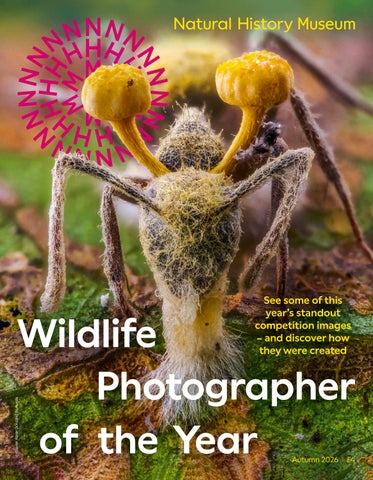
See some of this year’s standout competition images – and discover how they were created
©Javier Aznar González de Rueda
Wildlife Photographer of the Year Autumn 2026 l £4
© Audun Rikardsen
Now open Free for members and patrons
Lead Corporate Sponsor
Welcome
MAKE THE MOST OF BEING A SUPPORTER
A season of discovery
A
s autumn arrives, so too does another exciting chapter in our transformation of the South Kensington site. We’re opening a new gallery every year in the run-up to our 150th anniversary in 2031, and this year the new gallery is Nature and Us opening in the former Old General Herbarium on the second floor of the Central Building. For the first time in 80 years, this remarkable space is once again open to the public. Originally designed as an Osteology Gallery before becoming a working herbarium, it now hosts a temporary exhibition exploring the many ways we connect with and understand nature. Discover crystal structures built from dolls’ hands, the tale of Jenny the talking fish and unusual fossils known as ‘lying stones’. Read more on page 38. This marks the first phase of the gallery’s transformation, with a permanent gallery and events space opening in 2029. Before then, our attention turns to the next major project: the Children’s Nature Gallery (working title), which opens next year. October also brings one of the Museum’s most eagerly anticipated events: the Wildlife Photographer of the Year Awards Ceremony. This year, our international judging panel faced the formidable task of selecting just 100 images from more than 65,000 entries –
‘For the first time in 80 years, the former Old General Herbarium is once again open to the public.’
The Anning Rooms Named in honour of legendary fossil hunter Mary Anning, this suite is exclusively for your enjoyment. Tuck into tasty lunches and snacks in the restaurant, take in the stunning views of the surrounding rooftops from the lounge, or read a book in the study area.
Exhibitions the highest number we’ve ever received – submitted by photographers from 121 countries and territories. It’s a powerful reminder of wildlife photography’s unique ability to inspire wonder, provoke action and tell stories of hope. Turn to page 24 for a selection of this year’s extraordinary images. We look forward to welcoming you to the Wildlife Photographer of the Year exhibition and everything else the Museum has to offer very soon, all of which helps us to inspire the next generation of advocates for the planet.
Alex Burch, Director of Public Programmes
Join the conversation
Get free, unlimited entry to all of the Museum’s ticketed exhibitions, such as Jurassic Oceans: Monsters of the Deep and Wildlife Photographer of the Year, and guaranteed entry to our free exhibitions and installations.
Exclusive events Enjoy private exhibition views, workshops and a talks series, Dig Deeper, led by Museum scientists. As well as discounted tickets you will also receive priority booking and access to a special Members’ Bar on the night.
Shop and café discounts Receive a 20% discount in the Museum’s shops – which are stocked with a wide range of inspiring gifts, fascinating books and stylish clothes – as well as a 10% discount in our cafes and restaurants.
Now fully digital
The Natural History Museum, Cromwell Road, London SW7 5BD
Instagram natural_history_museum Facebook naturalhistorymuseum X NHM_London TikTok @its_nhm YouTube @NaturalHistoryMuseum Email magazine@nhm.ac.uk
The Natural History Museum at Tring, Akeman Street, Tring, Hertfordshire HP23 6AP All information in this issue of Natural History Museum magazine was correct at the time of going to press.
Natural History Museum magazine is now fully digital. By reading your magazine digitally, you are helping to reduce the environmental impact of printing and postage while supporting our vital work. Prefer print? Pick up a copy from the Anning Rooms.
NATURAL HISTORY MUSEUM MAGAZINE 3
Contents
Nature and Us Discover how this ‘fossil’ lies p38
Jurassic oceans
Issue 62 Autumn 2026
This issue’s experts
24
Archie Clarkson
©Ernest Porter
Archie is a PhD student who researches the biodiversity and ecology of microbial life in Arctic and Antarctic freshwaters using DNAbased techniques.
32
©Getty
Susan Holmes Susan is our Exhibition and Interpretation Manager, which means that she creates exhibitions and other displays at the Museum.
Katie is one of the curators of molluscs in Palaeontology. They take care of the fossil clams, snails, tusk shells and chitons.
4 NATURAL HISTORY MUSEUM MAGAZINE
©naturepl.com
Dr Katie Collins
44
©Barry Webb
Journal
12
New at the Museum We report on progress at our Collections, Digitisation and Research Centre, look at how new recording innovations are providing data to promote evidence-based nature recovery, and celebrate a new blue plaque honouring Dorothea Bate.
Features
24
Wildlife Photographer of the Year Enjoy our pick of this year’s most awe-inspiring images, from striking animal behaviour to natural artistry and surprising moments of urban wildlife.
32
Rethinking mammoths New research shows Columbian and woolly mammoths interbred far more than once thought – revealing an adaptable, genetically entangled lineage that rewrites their story.
16
What’s on Events for Members and Patrons, plus a 60-second chat with documentarian Matthew Maran.
18
Science in focus: Hidden worlds Invisible to the naked eye, protists sustain Arctic food webs – and with rapid warming, understanding them has become urgent. Inside story: Dr Spyridoula Pappa A mix of science, detective work and storytelling: no two days are the same for our Senior Curator of Fossil Mammals.
Nature and Us We take a look at standout specimens from more than 50 in our new temporary exhibition exploring how humans and nature shape one another.
44 50
Standing up for nature: Dustin Chen Photographer Dustin Chen shares how he uses his work to protect some of the world’s most vulnerable bird species.
22
Exceptional specimens: Small shells, big lives Meet a tiny Australian bivalve with an unusual, secretive life.
6
60
66
Museum moves: Creation of a masterpiece Work began on the Natural History Museum in 1873 – but rows, budget cuts and design changes stretched the build from three years to eight.
With thanks to James Ashworth, Josh Davis, Darren Dickson, Rhia Docherty, Lucie Goodayle, Izzy Hollingum, Lu Allington-Jones, Lewis Laney, India Main, Matthew Maran, Aimee McArdle, Wendy McGrath, Lewis Morgan, Paul Nicklen, Lauren O’Brien, Barry Webb, Stuart Woolf.
The views expressed in Natural History Museum magazine do not necessarily reflect those held by the Natural History Museum. Produced in association with Our Media. ourmedia.co.uk All photographs and copy ©2026 The Trustees of the Natural History Museum, London unless otherwise stated. If you would like copies of any Museum images please contact the Museum Picture Library on 020 7942 5401. The Natural History Museum Cromwell Road, London SW7 5BD Telephone 020 7942 5000 nhm.ac.uk ISSN 2044-7582
Every issue
54
The life of slime Slime moulds may look like visitors from another planet, but their colours, shapes and complex behaviour reveal a life form unlike any other.
Contributors Dr Neil Adams, Ed Baker, Maxwell Barclay, Dr Alex Burch, Jessica Center, Dustin Chen, Archie Clarkson, Dr Katie Collins, Isabel Davis, Andrea Hart, Susan Holmes, Dr Anne D Jungblut, Rebecca Keddie, Bronwyn O’Reilly, Dr Spyridoula Pappa, Neena Percy, Karolyn Shindler, Professor Gothamie Weerakoon
20
38
Extreme beetles A deep dive into the hidden behaviours and evolutionary oddities that make some beetles among the most extreme creatures on Earth.
For Our Media Editor Sophie Stafford Art Editor Robin Coomber Production Editor Rachael Stiles Senior Account Director Ella Wiggans Editorial Director Matthew Pink
©Andy Tan @naturanaturans.photo
54
Senior Editor Helen Sturge Editorial team Alessandro Giusti, Holly Murphy, Dr Peter Olson, Jennifer Pullar, Dr Helen Robertson, Professor Sara Russell and Dr Tom White
The paper used to produce a limited number of printed copies of the NHM magazine is FSC®-certified paper and is responsibly sourced.
Viewfinder Be amazed by three extraordinary images that inspired everyone at the Museum. From the Archive Discover how a change in gallery design initiated an act of quiet protest – in coffin form. NATURAL HISTORY MUSEUM MAGAZINE 5
Viewfinder Extraordinary images of our natural world
6 NATURAL HISTORY MUSEUM MAGAZINE
Bats are among the most specialised mammals on Earth. Their remarkable ability to navigate and hunt using sound has helped them thrive across the globe. Now scientists have discovered that the sounds bats make may also have shaped the evolution of their skulls. Bats understand the world around them by using echolocation. They emit high-frequency sounds and listen for the returning echoes, which allows them to detect obstacles and prey in complete darkness. A new study has revealed a link between the frequencies bats use and the shape of their heads. Some species emit calls through their mouths, while others use their noses, and these different approaches appear to have influenced skull anatomy. Researchers analysed scans of hundreds of bat skulls from natural history collections across Europe, including specimens from collections we care for here at the Museum. They found that species using higher-frequency calls tended to have shorter faces, while those producing lower-frequency sounds had larger ear bones, which may help them detect echoes more effectively.
Skull shape in insect-eating (left) and fruit-eating bats (right) is strongly influenced by the echolocation frequencies they use.
NATURAL HISTORY MUSEUM MAGAZINE 7
Main image ©Getty
Bat skull secrets
©Shutterstock
8 NATURAL HISTORY MUSEUM MAGAZINE
©Paul Nicklen: A Photography Masterclass (Frances Lincoln)
A dangerous gift Canadian photographer, filmmaker, marine biologist and conservationist Paul Nicklen grew up alongside Inuit communities on Baffin Island, Canada, where his lifelong connection to the natural world began. Today, he is one of the world’s most celebrated wildlife photographers and he co-founded SeaLegacy to inspire ocean conservation through visual storytelling. In his new book, A Photography Masterclass, Paul shares lessons from more than three decades spent behind the camera, including one unforgettable encounter in Antarctica. While photographing leopard seals underwater, Paul found himself face to face with a curious female. ‘At one point, my camera housing was inside her mouth,’ he recalls. ‘I thought the encounter was over, but she kept returning with penguins, as though she was trying to feed me. Every time I got back into the water over the following days, she was there waiting. It was the most incredible experience.’ Having documented everything from polar bears to whales, Paul still ranks the encounter among the greatest wildlife experiences he has ever had. Paul Nicklen: A Photography Masterclass is available from all good bookshops and online stores.
NATURAL HISTORY MUSEUM MAGAZINE 9
10 NATURAL HISTORY MUSEUM MAGAZINE
Deep-sea discoveries
©University of Lodz and Senckenberg CLSM Facility
Deep down in the Pacific Ocean, in one of the least explored places on Earth, scientists are still discovering animals completely unknown to science. As part of an ambitious effort to identify and name 1,000 new ocean species by 2030, researchers have recently described 24 new species of deep-sea crustaceans. These tiny creatures were found in the vast ClarionClipperton Zone (CCZ), a remote region of seabed stretching between Hawaii and Mexico and covering around six million square kilometres. The CCZ has attracted growing attention because its seafloor is scattered with potato-sized metallic nodules that are rich in minerals needed for technologies such as electric vehicles, solar panels and wind turbines. Some companies hope to mine these deposits to support the transition to renewable energy. But scientists warn that the deep sea remains one of the least understood ecosystems on the planet. Before any large-scale mining takes place, they’re racing to document the extraordinary biodiversity that could be at risk. The newly named species are amphipods – small shrimp-like crustaceans that play an important role in deep-sea food webs. Their discovery is another reminder of how much of our ocean remains unexplored and how many species are still waiting to be found.
NATURAL HISTORY MUSEUM MAGAZINE 11
Journal A world of discovery awaits you in our round-up of Museum news
The facility will be kitted out with cutting-edge equipment and labs.
Building a better future Our new state-of-the-art centre will protect 28 million specimens, transform scientific research and help unlock new discoveries about the natural world.
C
onstruction of the Museum’s new Collections, Digitisation and Research Centre at Thames Valley Science Park is progressing rapidly. A key part of the NHM Unlocked programme, the facility will provide a secure new home for 28 million specimens currently housed across multiple Museum sites. Bringing these collections together in a purposebuilt, state-of-the-art facility will help safeguard 12 NATURAL HISTORY MUSEUM MAGAZINE
Above The new facility will transform the research capabilities of the Museum’s 400-strong scientific team and researchers around the world.
them for generations to come, while also freeing up two historic galleries in our iconic Waterhouse building to return to public use. The Museum’s collection is one of the world’s most important scientific resources. It provides the evidence researchers need to understand how our planet is changing and to tackle some of society’s greatest challenges. By improving how the collection is protected, studied and shared, the new centre will strengthen our ability to generate knowledge needed to create a future where both people and planet can thrive. Work on site began in spring 2025, and a major milestone was reached earlier this year with completion of the building’s superstructure. Attention has now turned to completing the outer shell and fitting out the interior. Because the collection requires carefully controlled environmental conditions, installing specialist mechanical, electrical and plumbing systems is a crucial stage of the project.
YO U R MUSEUM IN NUMBERS
©Franz Anthony
WIN
415
19
NHM Unlocked is funded by UK Government with additional funding from Wolfson Foundation.
More than 80 million years ago, an octopus measuring up to 19 metres long may have lurked in the deep ocean. New research suggests Nanaimoteuthis haggarti was a fearsome predator that fed on fish and other marine animals.
15 A rare fossil discovery in South Korea is the country’s first new dinosaur in 15 years. Named Doolysaurus huhmin, it resembles Dooly the Little Dinosaur, the much-loved star of a popular children’s cartoon.
©Jun Seong Yi
Construction is expected to finish next year, with the collection beginning the move to its new home in early 2028. Behind the scenes, teams are already documenting and packing specimens in preparation for the move. Far more than a collections store, the new centre will be a dynamic hub for Museum scientists, students and visiting researchers from around the world. New laboratories, digitisation facilities and research spaces will help unlock the full potential of the collection, supporting research into biodiversity loss, environmental change and the sustainable use of natural resources. Improved physical access to specimens, combined with expanded digital access to collection data, will accelerate scientific discovery and international collaboration. In doing so, the centre will help deepen our understanding of the natural world, inspire more advocates for the planet and support the development of solutions for a more sustainable future.
©Yohei Utsuki
Fossil fragments found in the UK have been identified as the remains of the largest scorpions ever discovered. More than a metre long, Praearcturus gigas roamed the land 415 million years ago.
Interesting Beetles Interesting Beetles showcases curious and colourful species from one of the world’s oldest and most important beetle collections, and is written by Maxwell Barclay, Senior Curator in Charge of Coleoptera at the Museum and a fellow of the Royal Entomological Society. Each portrait is accompanied by a detailed caption exploring the beetle’s fascinating biological, geographical or cultural story. The book also features historic specimens collected by pioneering naturalists including Charles Darwin and Alfred Russel Wallace. We have five copies of Interesting Beetles to give away. To be in with a chance of winning a copy, simply tell us how many species of beetle are found in the UK.
To enter, send an email to magazine@nhm.ac.uk with your name, address, phone number and answer, with ‘Beetles’ in the subject line. Or post your answer to ‘Membership’ at the address on page 3. The closing date is Sunday 28 February 2027. NATURAL HISTORY MUSEUM MAGAZINE 13
Journal Museum news
Owen’s enduring legacy In August, our display Sir Richard Owen: A Natural Legacy in the Images of Nature gallery was refreshed with a new selection of remarkable illustrations.
ighlights of the new display include original anatomical drawings of a frog and the brain of a rhinoceros, alongside familiar studies of a megatherium, a tapir and everyone’s favourite Australian monotreme, the platypus. Complementing these historic works is a contemporary illustration by artist Odile Kidd, depicting the original storage of an Indus River dolphin specimen. Created while working with the Museum’s cetacean collections alongside Richard Sabin, Principal Curator of Mammals, the artwork highlights the continuing importance of observation, documentation and scientific illustration in natural history. As we look ahead to the Museum’s 150th anniversary in 2031 (nhm.ac.uk/support-us/ nhm-150), the display celebrates Owen’s vision in creating the Museum, while highlighting the continuing role of collections in advancing scientific discovery, inspiring advocates for the planet and helping to address today’s planetary emergency with solutions from and for nature.
H
14 NATURAL HISTORY MUSEUM MAGAZINE
Illustrations These drawings, that Owen used in his research publication, show the dissections of an American tree frog and the brain of an Indian rhinoceros by John James Chapman (1790-1867) and James Erxleben (active 1839-1889).
VISIT THE MUSEUM Open until January 2027, Sir Richard Owen: A Natural Legacy can be found in the Images of Nature gallery, in the Museum’s Central Building.
NEWS S H O RTS
A wasp named… A newly discovered wasp from Chile’s Patagonian lakes has been named Attenboroughnculus tau in honour of Sir David Attenborough’s centenary and lifelong work inspiring millions to appreciate the natural world.
Museums for Nature We’ve launched Museums for Nature, a new programme helping museums boost biodiversity in their gardens. Eight museums will create nature-recovery plans before the scheme expands.
©Gabriel Ugeuto
The origin of turtles New research shows an ancient reptile once thought to be an early turtle ancestor belonged to a different group. The findings are reshaping our understanding of how turtles’ shells evolved.
Monitoring the night shift W hen the Museum closes for the evening, the research continues. Long after visitors have gone home, a network of sensors monitors the Nature Discovery Garden, supported by The Cadogan Charity, throughout the night, gathering vital information about how wildlife responds to life in the heart of the city. Since April, these sensors have been joined by LepiSense, an automated moth trap developed by collaborators at the UK Centre for Ecology and Hydrology (UKCEH). A bright LED light attracts nocturnal insects, which land on a white background before being photographed by a built-in camera. Computer-vision software then identifies the species, helping us discover which insects visit the garden after dark. Traditionally, moth surveys at the Museum have relied on light traps, with moths collected overnight before being counted the following morning and then released. LepiSense not only records which species are present, but also exactly when they are active during the night.
We will run LepiSense alongside our traditional moth trap to compare the two methods, understand any differences in the species they record and explore how new technologies can complement established surveying techniques. Powered by a battery charged by a solar panel during the day, LepiSense can run all night long, making it ideal for remote locations such as the meadow at our Museum in Tring, where mains electricity is unavailable. It allows regular night-time surveys without the need to transport and recharge heavy batteries. This collaboration with UKCEH demonstrates the value of the living laboratory we’ve created in our gardens. It provides our researchers and partners from other organisations with a secure site that’s home to one of the UK’s best-studied urban wildlife communities. Collaborations like this give us access to new technologies and data, helping develop the evidence needed to support nature recovery across the UK. Data from the sensor network feeds into the Museum’s pioneering Data Ecosystem, built using Amazon Web Services.
BLUE PLAQUE HONOURS DOROTHEA BATE Tring celebrates the extraordinary life of the pioneering fossil hunter. On 7 September, an Historic England Blue Plaque was unveiled at the Natural History Museum at Tring to honour the trailblazing fossil hunter Dorothea Bate. One of the first women scientists at the Museum, she spent more than 50 years associated with the Natural History Museum. Her fieldwork across
Cyprus, Crete and the Balearics revealed remarkable fossil species – including the unique goaty-antelope Myotragus. She opened fields of research both innovative and influential. Around 100 people attended, with tributes from Museum Director Doug Gurr, Historic England Chairman Lord Mendoza and Dorothea’s biographer, Karolyn Shindler. The event marked a long-awaited moment of recognition for a pioneer whose curiosity and courage inspires new generations of scientists.
NATURAL HISTORY MUSEUM MAGAZINE 15
Journal What’s on
Find out what’s on at the Museum, and plan your next great day out, by visiting nhm.ac.uk/whats-on
VISIT THE MUSEUM
©James Lewin
Pull an all-nighter at the Museum and Members experience an get priority unforgettable booking on a evening of number of events. comedy, food, To find out what’s science and available and when, cinema. Enjoy please look out for live shows, a your monthly three-course e-newsletter. dinner, live music including a harpist and Museum pub quizzes, followed by a hot breakfast the next morning. For ages 18 and over. nhm.ac.uk/dsgu
Exhibitions Wildlife Photographer of the Year Until Sunday 11 July 2027, normal Museum opening times From £17 Adult / £8.50 Child / £13.60 Concession members and patrons go free Enjoy more than 100 winning and commended images by leading photographers from around the world at the Museum’s annual exhibition of wildlife photography. nhm.ac.uk/wpy Jurassic Oceans: Monsters of the Deep Until Sunday 3 January 2027, normal Museum opening times From £15.50 Adult / £7.50 Child / £12 Concession members and patrons go free
Plunge into the Jurassic deep and come face-to-face with the fiercest predators to ever rule the ocean. While dinosaurs dominated the land, lethal marine reptiles ruled the seas. nhm.ac.uk/jurassic-oceans Arcadia Opens Friday 6 November, normal Museum opening times Free The London debut by acclaimed filmmaker Sir John Akomfrah – one of Britain’s most influential contemporary artists – is a multi-screen film exploring how Christopher Columbus’s arrival in the Americas in 1492 resulted in irreversible global changes, through mass movement of plants, animals, disease and people.
16 NATURAL HISTORY MUSEUM MAGAZINE
Other activities Dino Snores for Kids Every month, 18:45–10:00 £87 non-members / £79 members Ever wonder what happens in the Museum when everyone’s gone home? During this action-packed sleepover, you’ll take part in fun, educational activities, discover our T. rex hidden in the shadows of the Dinosaurs gallery, follow a torch-lit trail, and experience a live show with a Museum scientist. In the morning there’s breakfast and a trail of the galleries. For ages 7–11. nhm.ac.uk/dino-snores Dino Snores for Grown-ups Various dates, 18:30–9:30 £235 non-members / £211.50 members
Behind the Scenes Tour: Spirit Collection Various dates, 15:00–15:45 £35 non-members / £28 members Go behind the scenes in the Museum’s Darwin Centre for a look at our fascinating zoology collection preserved in spirit. Explore some of the treasures hidden among the 22 million specimens. nhm. ac.uk/events/behind-thescenes-tour-the-spiritcollection Museum Highlights Tour Various dates and times £20 non-members / £16 members From the awe-inspiring blue whale skeleton suspended from our ceiling to the largest blue topaz gemstone of its kind, the specimens we care for are full of wonder. Join one of our knowledgeable guides to explore our very best highlights. nhm.ac.uk/events /museum-highlights-tour
Please note: Some dates and times are subject to change. For further information on Members’ events, visit nhm.ac.uk/membership.
Buzz along to the Hive An exclusive digital hub especially for our supporters, the Hive is filled with exciting videos, articles and activities to help you stay connected with nature and the Museum. Here you’ll also find an exclusive virtual events programme, bringing you closer to our world-leading scientists through a series of lectures and workshops. Discover it all at nhm.ac.uk/the-hive
Members events Dig Deeper: Behind the Lens of Wild London Tuesday 3 November, 18.30–20.00 Join the team behind this documentary and learn about the incredible process of filming London’s wildlife and working with Sir David Attenborough. Dinosaur Detectives with Ben Garrod Saturday 28 November, 11:00–16:00 Join this new and one-off workshop for members and patrons, from children’s book writer and science presenter, Ben Garrod, for a dino extravaganza! Dig Deeper: Save the date Tuesday 19 January, 18:30–20:00 At this exclusive event for members, join us as we Dig Deeper into our aweinspiring scientific projects and curatorial work.
Patrons events Patrons enjoy a specially curated programme. Member events are open to all patrons and tickets are available to purchase online. Complimentary tickets are available for Platinum Patrons.
Private View of Wildlife Photographer of the Year Tuesday 3 November, 18:30–20:30 Open to All Patrons Join us for your private Patrons view of this year’s iconic exhibition. Behind the Scenes Tour – Human Evolution Tuesday 24 November, 18:30–20:30 Open to Gold, Platinum and Family Platinum Patrons Meet our curators as we explore this fascinating gallery. Patrons Private Tour and Coffee Morning December and January, 8:30–10:00 Open to All Patrons Meet us before opening hours for a curator-led tour following by tea and coffee in the Anning Rooms. Curator Talk and Collections Deep Dive February, 18:30–20:30 Open to All Patrons Your annual evening reception where we dive into part of our collections or a specific gallery and hear from a panel of experts.
Please note: Some dates and times are subject to change. If you have any questions about upcoming events, please contact patrons@nhm.ac.uk
60 SECONDS WITH… M AT T H E W M A R A N By Neena Percy
You’re now a wildlife photographer. Can you tell us about when you worked at the Museum? In 2002 – the pre-digital age – I prepared slide films for the judging of the Wildlife Photographer of the Year competition. It gave me insights into what judges wanted to see in creative wildlife photography and I made lifelong friends. Since then, my work has been awarded in the competition three times – all photos of red foxes taken within a 10-minute walk of my house. This is funny, as I spent years photographing abroad in the hope of getting an image recognised. What has filled you with the most awe while photographing nature? I never take for granted the privilege of spending time with wild animals, whether in the rainforests of Bolivia or an allotment in Tottenham. Learning to observe and respect them in their own space and gain their trust is a thrill I never want to lose. Animal behaviour is a constant source of wonder to me, and if I can contribute visuals that help educate and inspire others, then I consider that a success.
We’re excited to have you at our Dig Deeper talk about Wild London; tell us about the documentary. Over the last 10 years, I’ve followed many urban fox families in London and got to know individuals and their behaviour. Local knowledge and access are two key ingredients for telling impactful stories, so production companies reached out to me. I first filmed with the BBC in 2021. Then Passion Pictures invited me to film a one-off with Sir David Attenborough about London wildlife. How could I refuse? Without a doubt, my highlight was spending an evening with him on the allotment I’ve filmed on (and attempted to grow veg on) for years. The foxes didn’t disappoint, we got some brilliant footage. I’m looking forward to sharing more behind-thescenes stories, alongside Gaby and Joe who produced and directed the documentary.
WATCH THIS Join Matt, Gaby and Joe at Dig Deeper: Behind the Lens of Wild London in November. See left for more details.
NATURAL HISTORY MUSEUM MAGAZINE 17
Journal Science in focus
The Iñupiat people, who have lived in the region for over 1,500 years, take pride in relying on a sustainable Arctic ecosystem for their subsistence culture of caribou hunting and whaling that supports all members of their community.
Dr Anne D Jungblut collecting water from a tundra pond.
The lowdown
Hidden worlds
Where? Arctic tundra ponds near Utqiaġvik, Alaska – one of the fastestwarming regions on Earth.
Invisible to the naked eye, microscopic protists underpin life in Arctic ponds. PhD student Archie Clarkson explains how he studies these overlooked organisms and why rapid Arctic warming makes understanding them more urgent than ever.
What? Water samples were collected to study protists, microscopic organisms that underpin freshwater food webs. When? August 2025, during the brief Arctic summer when ponds thaw and biological activity peaks. Why? To understand how protist communities survive extreme conditions and respond to climate change.
t first glance, Arctic tundra ponds seem almost lifeless. Scattered across the treeless landscape of northern Alaska, they spend much of the year locked beneath ice, enduring months of darkness and freezing temperatures. Yet beneath the surface, a hidden world of microscopic life is hard at work. Among the most important inhabitants are protists – microscopic organisms usually made up of a single complex cell. Though rarely seen, they
A
18 NATURAL HISTORY MUSEUM MAGAZINE
play a vital role in freshwater ecosystems. Some produce oxygen through photosynthesis, while others feed on bacteria and microbes, and some can switch between the two strategies depending on environmental conditions. Together, they help maintain food webs and recycle nutrients, supporting life throughout these fragile ecosystems. Scientists have long known that protists are found across the globe, but only recent advances in DNA sequencing have allowed us to appreciate the true scale
Fast fact Millions of protist cells can be found in a single litre of tundra pond water, despite the Arctic’s extreme conditions.
of their diversity. Even so, many species remain undiscovered, particularly in extreme environments such as the Arctic. This makes the Arctic tundra a fascinating place to study them. North of the Arctic Circle, northern Alaska experiences continuous daylight during summer and near-total darkness in winter. Thousands of shallow ponds form across the tundra as permafrost thaws and refreezes with the seasons. During winter, photosynthesis largely stops and oxygen is no longer replenished,
leaving the deeper waters of many ponds depleted of oxygen. As a PhD student at the Museum, I’m interested in understanding how protists survive these dramatic seasonal shifts. Are they specially adapted to low-oxygen conditions? How do their communities change throughout the year? And what role do they play in maintaining Arctic ecosystems? Tundra adventure Last August, I travelled with Merit Researcher Dr Anne D Jungblut to Utqiaġvik, Alaska, home to the Iñupiat people and the northernmost city in the United States. Working alongside local experts – including a bear guard who helped us navigate a landscape where polar bears are regularly encountered – we collected water samples from tundra ponds across the region. The knowledge and support of local communities were invaluable in helping us work safely and effectively in a challenging environment. Back at the Museum, I’m now analysing these samples using microscopy, environmental DNA barcoding and DNA sequencing. By combining these techniques, we can identify the protists present, investigate how they survive seasonal extremes and potentially discover species new to science. The urgency of this research is clear. The Arctic is warming up to four times faster than the global average, transforming habitats at an unprecedented rate. By revealing the hidden biodiversity of Arctic ponds and understanding how these microscopic organisms respond to environmental change, we hope to gain valuable insights into how ecosystems may adapt to a rapidly changing world. O This research has benefited from transnational access to Barrow Arctic Research Centre funded by the European Union HORIZON EUROPE through the EU Project POLARIN Grant Agreement ID: 101130949.
How we study protists Protists are tiny organisms that play a vital role in ecosystems. They recycle nutrients, consume bacteria and, in some cases, produce oxygen through photosynthesis. Understanding which species are present, and how they respond to environmental change, helps us understand how Arctic ecosystems function.
Collecting samples We collect water from tundra ponds and record information about the environmental conditions, such as temperature and oxygen levels. The water is then filtered to capture microscopic organisms and traces of their DNA.
Reading the DNA Back in the laboratory, DNA is extracted from the filters and sequenced. By comparing these genetic ‘barcodes’ with reference databases, we can identify the species present in each pond, including organisms too small to recognise under a microscope.
Observing living communities Unfiltered water samples are kept under simulated summer and winter conditions to explore how protists respond to seasonal change. Microscopy allows us to observe living organisms, their behaviour and, in some cases, what they eat.
Understanding the ecosystem We combine DNA results with environmental measurements to build a picture of how these pond communities function. This helps us understand which species thrive under different conditions and how Arctic freshwater ecosystems may respond to climate change.
1
3
Protist types Phototrophs: Use sunlight to produce food and oxygen through photosynthesis.
2
4
Heterotrophs: Feed on bacteria and other microbes, recycling nutrients through the ecosystem.
Mixotrophs: Can both photosynthesise and consume prey, switching strategies as conditions change.
NATURAL HISTORY MUSEUM MAGAZINE 19
Journal Inside story
‘My job is a mix of science, detective work and storytelling’ From volunteering at the Museum to becoming Senior Curator of Fossil Mammals, Dr Spyridoula Pappa reflects on the journey that brought her here.
My life in a nutshell My recent research on the endangered Eld’s deer showed how fossil evidence can help guide modern conservation by revealing where species once thrived and how they responded to environmental change. My favourite field site is Milia in northwest Greece, where the world’s longest mastodon tusks were discovered. I’ve been fortunate to learn from inspiring colleagues, including Andy Currant (see page 36), and I hope to pass that same passion on to future generations.
What do you do at the Museum? As Senior Curator of the Fossil Mammals collection, I’m looking after one of the world’s most significant collections of ancient mammals. Spanning the last 66 million years, the collection comprises more than 350,000 specimens from every corner of the globe, and includes many internationally important type specimens. My job is a mix of science, detective work and storytelling. One day I might be helping researchers study Ice Age mammals collected by Charles Darwin or uncovering the history of a forgotten specimen; the next I’m planning a new display, overseeing new acquisitions or preparing collections for the move to our new Collections, Digitisation and Research Centre at Reading. I’m passionate about these extraordinary collections, and sharing the stories they tell about life on Earth and the remarkable people who collected them. How did you start working with fossil mammals? As a child, I loved exploring nature, as well as art and museums. My passion for fossil mammals began in 2002 when I helped excavate a cave containing Ice Age animals. It changed the direction of my career. I was amazed that fossils could reveal what landscapes and climates were like thousands of years ago, and how animals and people responded to environmental change. Over the years, I took part in excavations across Greece, helped establish six natural history museums there and completed a master’s degree studying fossil bears. Those experiences showed me
20 NATURAL HISTORY MUSEUM MAGAZINE
that museums preserve knowledge, inspire curiosity and connect people with our natural heritage. When I moved to London in 2010, I was determined to volunteer at the Natural History Museum. I arrived at the entrance hoping to discuss volunteering opportunities with Andy Currant, then Curator of Fossil Mammals, or Professor Adrian Lister, whose research focused on fossil mammals. By chance, Adrian was signing out attendees from a scientific meeting that day. We started talking about fossil sites in Greece, and he invited me to join the meeting. That chance encounter led to volunteering at the Museum, working on the Tabun Cave collection with Andy, completing a PhD at Royal Holloway and, eventually, returning as Senior Curator. Your work follows in the footsteps of Dorothea Bate. How has she inspired you? I first came across Dorothea through her pioneering work in Greece, Cyprus and the eastern Mediterranean. She was a remarkable Welsh palaeontologist who, despite having no formal university education, became one of the first female scientists at the Natural History Museum and one of the founders of archaeozoology. Her work transformed our understanding of island evolution, particularly dwarf elephants and giant rodents. At a time when women faced huge barriers in science, she created opportunities through persistence, curiosity and hard work. I recognise something of that spirit in my own journey. It’s surreal to hold a role once occupied by such a remarkable scientist. What’s your favourite project you’ve worked on? During the COVID-19 pandemic, the Harrison Institute approached the Museum to help secure the future of one of the world’s most important fossil mammal collections. Working with colleagues, we secured more than 30,000 fossil specimens, ranging from tiny 50-million-year-old mammals to spectacular Ice Age fossils. It was a complex project involving negotiation, documentation and AI-assisted collections management, but knowing these collections are safeguarded for future generations made it especially rewarding. What inspires you about the Museum? The Museum connects the past with the future. Every specimen has the potential to answer questions we haven’t yet thought to ask. Our collections inspire discoveries, international collaboration and research that helps us better understand nature and the challenges it faces. O
NATURAL HISTORY MUSEUM MAGAZINE 21
Journal Exceptional specimens
Small shells, big lives Most clams spend their lives hidden beneath sand or clinging tightly to rocks. But one tiny Australian species breaks all the rules. Meet the moon clam.
Scientific name Moon clam, Ephippodonta lunata
Chosen by Dr Katie Collins
Science Background Senior Curator, Inverts & Plants Palaeobiology
F
ound exclusively along the temperate southern coast of Australia, the moon clam is a tiny bivalve that lives inside sponge tubes or underneath rocks. Bivalves – clams, cockles, scallops, oysters and mussels – are among the most overlooked groups of animals. Almost anywhere there’s water, you’ll find them, yet most lead hidden lives. Their two shells help them dig into sand or bore into rock, as well as acting as armour when they glue themselves to rocks. The moon clam is different. Less than a centimetre long, it uses its shells almost like wings rather than shovels, gliding over rocks with them held wide open, while sensory papillae covering the shells help it feel the world around it. Instead of burrowing alone, moon clams live alongside sponges and shrimps, sheltering with them. Sometimes several individuals are found together on the same rock, suggesting they enjoy each other’s company. The moon clam belongs to the superfamily Galeommatoidea, often known as ‘galeos’. Despite being one of the largest groups of bivalves, they remain remarkably little studied. Around 600 species have been described, but scientists suspect
‘They crawl, glide, wiggle brightly coloured tentacles and “yo-yo” up and down’
there are several hundred more still waiting to be discovered. They are also among the smallest bivalves, with most measuring less than a centimetre across, many only a few millimetres or smaller. Galeos exist in remarkable ways. While some burrow, many – including the moon clam – live in symbiosis with other animals. They have been found living alongside sponges, crabs, mantis shrimps, sea urchins, sea cucumbers, snails, sea anemones, worms, sea squirts, brachiopods and even other clams. One or two species are even ‘vampires’, piercing prey to suck out their body fluids – impressive for an animal scarcely bigger than a shirt button. Their behaviour is equally unusual. Rather than staying put, many galeos are surprisingly active. They crawl, glide, wiggle brightly coloured tentacles or attach themselves to their hosts’ burrows and ‘yo-yo’ up and down – one species is called the yoyo clam. The moon clam is particularly special because it can switch between different lifestyles, sometimes living on rocks and sometimes with other animals. This gives scientists a rare opportunity to study how species adapt to new ways of life and how new species may evolve as a result. My colleague at the University of Birmingham and I are working with scientists around the world to study galeos, including the moon clam. There is still so much to discover about these exceptional little bivalves. O
The lowdown Moon shape
Shell wings
Touch sensors
Ocean cleaner
Ephippodonta lunata gets two of its names from its shape: moon clam in English and lunata in Latin. The whole animal resembles a full moon, while each shell alone looks like a crescent.
The two shells are held flat at 180 degrees from each other, something very few other bivalves can do. This transforms them from digging tools into gliders that help the clam move across rocks.
The moon clam covers its shell ‘wings’ with a thin layer of soft tissue containing tiny sensory organs called papillae. These help the clam feel its surroundings and detect subtle water movements.
Clams like Ephippodonta filter seawater as they feed, removing dirt, pollution and harmful bacteria. They can even trap tiny microplastics, helping to make the ocean cleaner.
22 NATURAL HISTORY MUSEUM MAGAZINE
You won’t find any galeos on display in the Museum. But in the Spirit Building (West Wing) you might see one hiding inside a sponge or echinoderm.
©Andy Tan (@naturanaturans.photo)
VISIT THE MUSEUM
DID YOU KNOW? There are around 6,500 living species of bivalve, but most are only ever seen as empty shells washed up on beaches. Scientists still make surprising discoveries about them every year.
DID YOU KNOW? Moon clams have existed for about 2.5 million years. That may sound ancient, but some clam groups have survived for more than 400 million years.
The moon clam Ephippodonta lunata is roughly 1cm long – about the size of your fingernail.
Water breather
Clam friends
Snail crawl
Global family
The moon clam uses snorkel-like tubes called siphons to breathe water in and out. The outflow siphon sits between the shells, while the inflow siphon has a hood and resembles a vacuum cleaner hose.
Sometimes Ephippodonta explores the rocks, but it also spends time living with shrimps and sponges, gaining extra protection from their burrows and structures.
Most bivalves use their foot for digging, but Ephippodonta uses it to crawl like a snail. Active galeos like this are sometimes mistaken for sea slugs because they’re so lively.
The moon clam lives only in Australia alongside its cousin, the sun clam Ephippodontoana macdougalli. Other galeos live across the world, and the first known species were discovered in the UK.
NATURAL HISTORY MUSEUM MAGAZINE 23
Wildlife Photographer of the Year The prestigious competition attracts the best nature and wildlife images from around the world. Here are a few of our favourites from the 2026 winners.
24 NATURAL HISTORY MUSEUM MAGAZINE
New at the Museum
SCENES FROM THE SWAMP Behaviour: Birds, Winner Isak Pretorius, South Africa Exploring the swamp in a narrow canoe with a guide, Isak felt exceptionally lucky to see not one but two elusive shoebills. The birds pulled out vegetation, dropped it and then repeated the process several times. It’s likely this is a breeding pair gathering nesting material. Though often called the shoebill stork, these large birds are more closely related to pelicans, herons and ibises. Fewer than 5,300 mature shoebills survive across their entire range and their numbers are decreasing. Location: Mabamba Swamp, Wakiso District, Uganda Technical details: Canon EOS R5 + 500mm f4 lens; 1/2500 at f4; ISO 1250
→ NATURAL HISTORY MUSEUM MAGAZINE 25
New at the Museum
ESCAPE ARTISTRY
BETWEEN LAYERS
Natural Artistry, Winner Michał Michalski, Poland Michał was in a field of unharvested sunflowers that had attracted mixed flocks of birds, especially goldfinches and bramblings. As they took to the sky, startled by a sparrowhawk, Michał blurred the movement against a backdrop of leafless birches. There is evidence that flocks containing multiple species forage more efficiently, partly because each brings different skills to the group. With more eyes on the lookout for predators, individuals can also afford to devote more time to feeding.
Animals in their Environment, Highly Commended Jason Gulley, USA Jason had been photographing fish at this striking boundary line between springfed and tannin-stained waters when this manatee pair swam into view. Maintaining his distance, Jason framed the mother (left) showing her calf (right) the location of warm water needed to survive future winters. In summer, manatees disperse along the coast of the southeastern United States. Come winter, the entire population of about 7,000 animals congregate in Florida’s river systems to take refuge in warm natural springs and the thermal outflows of industrial power plants to survive the season.
Location: Miłochowice, Lower Silesian Township, Poland Technical details: Nikon D500 + 500mm f5.6 lens; 1/30 at f8; ISO 250
Location: Florida, USA Technical details: Nikon Z9 + 14–24mm f2.8 lens at 14mm; 1/200 at f10; ISO 1600; Nauticam housing with WACP-2 →
26 NATURAL HISTORY MUSEUM MAGAZINE
SPLIT-SECOND ESCAPE Behaviour: Amphibians and Reptiles, Highly Commended Jens Cullmann, Germany Jens noticed tadpoles on a previous visit after heavy rains and returned the following month to find ponds and puddles full of young bullfrogs. He spent more than two weeks watching the young frogs ‘eat everything that moved’. As adults, African bullfrogs grow up to 12 centimetres (5 inches) in length, turn a drab green and spend 10 months of the year in a dormant state underground, only emerging after the rains to breed and eat voraciously. Location: Central Kalahari Game Reserve, Botswana Technical details: Canon EOS R3 + 100–300mm f2.8 lens + 2x eleconverter; 1/4000 at f9 (-0.3 e/v); ISO 2500
NATURAL HISTORY MUSEUM MAGAZINE 27
New at the Museum
FINDING ROOM Behaviour: Mammals, Highly Commended Zenya Lepper, USA At the end of a long day exploring the vast Pantanal wetland by boat, Zenya saw this jaguar cub leaping over its parent on a branch overhanging the water. From a distance, Zenya stayed with them until the sun set. With a plentiful supply of fish and aquatic reptiles in the Pantanal, jaguar populations here are roughly double those found elsewhere. When food is abundant, there is little reason to fight over it – even adults have been documented hunting and playing together. Location: Pantanal, Mato Grosso, Brazil Technical details: Nikon Z9 + 100–400mm f4.5–5.6 lens; 1/1000 at f5; ISO 2500
28 NATURAL HISTORY MUSEUM MAGAZINE
NATURAL HISTORY MUSEUM MAGAZINE 29
New at the Museum
SWEPT AWAY
URBAN JUNGLE
Natural Artistry, Highly Commended Fabio Sartori, Italy In a field near his home, Fabio watched several ants investigating the tufted seed. He waited to see a single ant clinging to the seed and captured the scene from below, creating the illusion that it was sweeping skywards. Many species of ant include seeds in their diet. Lured by nutritious, fleshy structures – called elaiosomes – attached to the seeds, ants will drag them back to their nests to feed on. The ants then often discard the seeds, effectively planting them in the soil.
Urban Wildlife, Winner Seth Forestson, UK The challenge wasn’t finding these lizards, but catching them in action, as they spend most of the day basking in the sun. When Seth spotted this one, he lowered himself down onto the mud to frame this city dragon against the Bangkok skyline. Common water monitors have successfully adapted to living within cities across South and Southeast Asia. They will take whatever food source is available, such as the plentiful supplies of catfish and koi in the lakes of Bangkok’s Lumphini Park.
Location: Valpiana, Grosseto, Italy Technical details: Olympus OM-D E-M1 Mark II + Panasonic Leica 45mm f2.8 macro lens; 1/320 at f3.2; ISO 640
Location: Lumphini Park, Bangkok, Thailand Technical details: Google Pixel 7 Pro smartphone; 1/291 at f1.9; ISO 47
30 NATURAL HISTORY MUSEUM MAGAZINE
VISIT THE EXHIBITION AT THE MUSEUM Wildlife Photographer of the Year is open until Sunday 11 July 2027. Continue your journey online and discover the planet-positive actions you can take to protect the places and species you’ll see at nhm.ac.uk/wpy. Take home your favourite image from our print-on-demand facility outside the exhibition, or online at nhmshop.co.uk/prints. Members and Patrons receive free, unlimited entry and priority access to Wildlife Photographer of the Year and all paying exhibitions. To become a member, please visit nhm.ac.uk/membership. If you would like to take part in the 2027 Wildlife Photographer of the Year Competition you have until 11.30 (GMT) on Thursday 3 December 2026 to enter. For more information, visit nhm.ac.uk/wpy.
VOTE
Nuveen People’s Choice Award Have your say by voting for your favourite image in the shortlist for the Nuveen People’s Choice Award. The annual award recognises outstanding competition entries as chosen by the public. Voting is now open in the exhibition, and opens online on 20 January 2027. Voting closes at 14.00 (GMT) on 3 March 2027, and the winner will be announced on 10 March 2027. So, vote for your favourite at nhm.ac.uk/wpy. Wildlife Photographer of the Year 2026 is owned by the Natural History Museum, London. The Wildlife Photographer of the Year exhibition is supported by Lead Corporate Sponsor Nuveen, a leading global asset manager.
WIN
WILDLIFE PHOTOGRAPHER OF THE YEAR: PORTFOLIO 36 This portfolio book is a memorable collection of all the winning and commended photographs from Wildlife Photographer of the Year. For your chance to win one of five portfolios, just tell us the name of the photograph of the Adult Grand Title Winner for last year’s Wildlife Photographer of the Year Competition. To enter, send an email with your name, address and phone number, along with your answer, to magazine@nhm.ac.uk, putting ‘WPY’ in the subject line. Or post your answer to the address on page 3. Closing date is Sunday 28 February 2027. NATURAL HISTORY MUSEUM MAGAZINE 31
Reth nk Rethinking k DID YOU KNOW? With its furry coat, the woolly mammoth was well adapted to the cold of the Ice Age. Other mammoths, however, lived in warmer climates.
32 NATURAL HISTORY MUSEUM MAGAZINE
Our impact
New research reveals Columbian and woolly mammoths interbred far more often than anyone realised. Dr Neil Adams explores how these Ice Age giants were far more dynamic, adaptable and genetically entangled than scientists once thought.
mammoths he woolly mammoth is one of the most iconic animals of the Ice Age. Their fossils have been collected across the northern hemisphere for hundreds of years. Even their soft tissues have been documented since the late eighteenth century, based on carcasses preserved in Arctic permafrost with hair, skin, trunks, tails, internal organs and stomach contents intact. It’s exceptionally rare for so much evidence to survive for an extinct species. With such a wealth of information available, it may seem surprising that new discoveries are still transforming our understanding of how mammoths lived and evolved. Advances in the study of ancient DNA (aDNA) have been particularly revolutionary. How different mammoth species were related, how they interacted, and how their diversity changed through time have been subjects of scientific debate for decades, with aDNA now providing unexpected and surprising answers. New dating of mammoth fossils and studies of their geochemistry are also providing important insights. They’re helping scientists understand better than ever before how mammoths responded to rapid climate changes during the repeated freezing and thawing of the Ice Ages.
©Alamy
T
Breakthroughs with ancient DNA The two best-known mammoth species from North America are the woolly mammoth and the Columbian mammoth. It was Hugh Falconer (1808– 1865), a Scottish palaeontologist and specialist on fossil elephants, who gave the Columbian mammoth its scientific name in 1857 based on a tooth in the Natural History Museum’s collections. For a long time, the distribution of fossils of these two mammoth species suggested that woolly mammoths dominated the colder northern parts of North America, while Columbian mammoths → NATURAL HISTORY MUSEUM MAGAZINE 33
Our impact
The fragment of molar tooth used to name the Columbian mammoth in 1857.
held sway in the warmer southern regions. Traditionally, the two species were thought to have interacted little, remaining genetically isolated and separated by their different habitat preferences. Recent breakthroughs in ancient DNA have completely rewritten this story.
where an individual mammoth lived and travelled throughout its life, sometimes year by year, season by season, or even week by week. Recent studies demonstrate that mammoth migration was neither simple nor uniform; it varied by sex, age, season, habitat and changing environmental conditions. In 2021, when scientists first unveiled the hybrid origin of the Columbian mammoth, another group of researchers revealed the first reconstruction of an entire mammoth’s lifetime movements. This was done by taking more than 340,000 chemical measurements along a 1.7-metre-long tusk of a male woolly mammoth from Alaska, representing 28 years of life.
Prehistoric hybridisation In 2021, scientists discovered from aDNA that the Columbian mammoth arose through hybridisation between two different mammoth species: the woolly mammoth and a lineage of more ancient steppe mammoths. The most recent revelation came from a study of two mammoth teeth from Canada published in autumn 2025. Excitingly, the aDNA of these two teeth showed they were hybrids of woolly and Columbian mammoths. The researchers also demonstrated that Columbian mammoth DNA had been introduced by Columbian mammoth males mating with woolly mammoth females. This was detected thanks to the distinct way sex chromosomes are inherited from an individual’s parents. A further surprising result was that the younger of the MUSEUM EXPERT two teeth (at 25,300 years old) contained more Columbian Dr Neil Adams mammoth DNA than the older tooth (35,900 years old). Neil is the Museum’s Curator This can only be explained by more hybridisation events of Fossil Mammals. As well as managing and caring occurring between these two dates. Rather than a one-off for the fossil mammal event, mating between Columbian and woolly mammoths collection, he leads research was a more regular affair, continuing over thousands of years on Ice Age mammals from in areas where the two species overlapped. Britain and Europe. One of the hybrid teeth had the highest genetic diversity ever measured in a woolly mammoth. It’s possible that the greater genetic diversity produced by hybridisation gave descendants a competitive edge, allowing them to better adapt to new and changing environments. Hybridisation may even have fuelled further hybridisation by enabling range expansions The Holyhead into the territories of the other species. mammoth lived just under 15,000 years ago, Mammoth migrations making it one of the Another paradigm shift has been our ability first woolly mammoths to reconstruct the migrations these giants to return to Britain undertook during their lifetimes. From single after the peak of the tusks and teeth, scientists can now reconstruct last Ice Age. 34 NATURAL HISTORY MUSEUM MAGAZINE
Our impact
Comparing giants Columbian mammoth Scientific name: Mammuthus columbi Time span: 1.5 million–11,000 years ago Range: Southern Canada, United States, into Mexico and northern Central America Size: 3.5–4m tall at the shoulder, weighing 8–11 tonnes Diet: Grasses (grazers) as well as shrubs and trees (browsers) Extinct: By ~11,000 years ago
Rare soft tissues suggest Columbian mammoths were hairy, but it’s uncertain how their ‘hairiness’ compared to woolly mammoths.
DID YOU KNOW? The Columbian mammoth shared the high head dome, sloping back and twisted tusks of its woolly cousin, but was substantially larger.
©Alamy
Scientists compared the chemistry of the tusk with a regional chemical map to reconstruct his movements. The results indicated changes in migratory behaviour through life, with a greatly expanded range as a sexually mature adult male. He appears to have undertaken continental-scale migrations between interior Alaska and north of the Brooks Range mountains: a distance of thousands of kilometres. In 2024, results from a female woolly mammoth’s tusk from Alaska revealed a very different pattern. She lived most of her life within a more restricted geographical range and showed lower mobility. This provides some of the best evidence for a social structure in mammoths similar to that of modern elephants, with adult males ranging widely after leaving more stable matriarchal herds.
Woolly mammoth Scientific name: Mammuthus primigenius Time span: 800,000–4,000 years ago Range: Western Europe to northern Eurasia, into Alaska, Canada, and northern–central United States Size: 2.7–3.3m tall at the shoulder, weighing 4–7 tonnes Diet: Mainly grasses, sedges and forbs (grazers) Extinct: One population survived until ~4,000 years ago
Early colonisers in a melting world New dating of fossils found centuries ago has also expanded our understanding of how mammoths adapted to changing conditions. A recent example comes from the Museum’s Holyhead Mammoth, locally nicknamed Myfanwy: a lower jaw of a woolly mammoth found in Holyhead Harbour on Anglesey, off the north Wales coast. The jaw was donated to the Museum collection in June 1864 and is currently on loan to Holyhead Maritime Museum. A sample from the jaw was taken by Museum scientists late last year for radiocarbon dating. At just under 15,000 years old, the Holyhead Mammoth is now known to be among the earliest mammoths to recolonise Britain after the end of the last Ice Age. The project is revealing how woolly mammoths moved and responded to past climate change in the westernmost parts of their range. Some of the most controversial recent discoveries have come from studying ancient DNA preserved not in bones or teeth, but in sediments. This sedimentary ancient DNA (sedaDNA) includes → NATURAL HISTORY MUSEUM MAGAZINE 35
Our impact
Mammoth remains sometimes preserve tufts of coarse hair (right) as well as stomach and intestinal contents (left), revealing the last plants eaten.
mammoth DNA reported from sediments dated to 5,700 years ago in Canada and 3,900 years ago in mainland Siberia. These dates are substantially younger than directly dated fossils from these areas by several thousand years. Some experts doubt that the mammoth DNA and the sediments are the same age. But the latest comprehensive models of mammoth extinction independently predict woolly mammoth populations surviving in Arctic mainland refugia some 5,000 years longer than the fossil evidence alone suggests. More fossil discoveries are needed to test whether this gap is real or imagined. An irreversible toll These latest extinction models suggest humans played a bigger role in mammoth declines than scientists once thought. The research suggests that even relatively low levels of hunting by growing human populations could have had significant effects once mammoth numbers began to fall. Together with rapid climate change, these pressures may have pushed already vulnerable populations towards extinction. The origin, evolution and extinction of mammoths offer valuable lessons for understanding the climate and biodiversity crises we face today. More than 4,000 years after the last individuals disappeared, new discoveries continue to reshape the mammoth’s story. The best-known animal of the Ice Age may still hold some of its biggest surprises. ●
Andy Currant 1952–2026
Above Siberian woolly mammoth skulls feature highly modified crania designed to support their heavy tusks and massive grinding teeth.
36 NATURAL HISTORY MUSEUM MAGAZINE
This article is a tribute to the memory of Andy Currant, Curator of Fossil Mammals for more than 40 years, whose legacy continues to inspire pioneering research into Ice Age mammals.
Our impact
Giant icons of the Ice Age
Giant deer Megaloceros giganteus Often called the Irish elk, giant deer ranged across northern Eurasia from Ireland to Siberia between 400,000 and 7,500 years ago. Males carried the largest antlers of any known deer species, stretching more than four metres across.
Giant ‘wombat’ Diprotodon australis The largest marsupial ever known, Diprotodon weighed up to 3.5 tonnes and roamed Australia until around 40,000 years ago. Though often called a giant wombat, Diprotodon was a distinct marsupial unlike anything alive today.
©Science photo library
©Science photo library
American mastodon Mammut americanum A close relative of elephants, the American mastodon browsed forests across North America using its distinctive teeth with interlocking cone-shaped cusps to shear leaves, twigs and shrubs. Butchered bones suggest humans hunted mastadons more than 12,000 years ago.
©Science photo library
Giant ground sloth Megatherium americanum Weighing up to four tonnes, Megatherium was among the largest land mammals in South America. It could rear up on its hind legs and tail to reach vegetation, while its huge claws helped it feed and defend itself from predators.
©Science photo library
Sabre-tooth cat Smilodon fatalis One of the Ice Age’s most formidable predators, Smilodon hunted across North America using its enormous curved canine teeth and powerful forelimbs. Rather than chasing prey over long distances, it likely relied on ambush attacks against large animals such as bison.
©Alamy
Siberian ‘unicorn’ Elasmotherium sibiricum This giant rhinoceros could reach 4.5 metres in length and is often shown with an enormous horn, earning it the nickname ‘Siberian unicorn’. Yet no horn has ever been found, leaving scientists debating exactly what this Ice Age giant looked like.
©Science photo library
These extraordinary animals shared the world with woolly and Columbian mammoths during the Ice Ages.
NATURAL HISTORY MUSEUM MAGAZINE 37
Nature N r Part of NHM150, our new temporary exhibition Nature and Us invites you to explore the long, shifting relationship between humans and nature through more than 50 specimens that reveal how we have used it, studied it and told stories about it. Here are just a few of the objects on display. WORD S: SUSAN HO L M E S 38 NATURAL HISTORY MUSEUM MAGAZINE
and
Us
New at the Museum
1
Early dogs’ heads and dog’s jaw Humans have lived alongside dogs for thousands of years. Descended from wild wolves, they were gradually domesticated, forming a close partnership with people based on cooperation and companionship. DNA and chemical analysis of this jaw (below), discovered in Gough’s Cave in Somerset, revealed it belonged to one of the earliest-known domestic dogs, which lived around 14,300 years ago. One clue to its domesticated status is that it ate the same food as the people it lived with. What’s more, the remains of an even earlier dog from Türkiye belonged to the same population, suggesting dogs spread alongside humans across Europe between 18,500 and 14,000 years ago. Our relationship with dogs has continued to evolve ever since. In Nature and Us, visitors can handle a 3D print of the ancient dog’s jaw before encountering four taxidermied dogs’ heads from the nineteenth and twentieth
This jaw belonged to one of the earliest-known domestic dogs, which lived around 14,300 years ago centuries. Together, they reveal how centuries of selective breeding have produced more than 200 recognised breeds with distinctive appearances and behaviours. Each head represents a breed developed for a particular purpose: griffon hounds and beagles for hunting, greyhounds for hare coursing and later racing, and chow chows for food, fur and companionship. At a time when selective breeding has left many dogs with serious inherited health problems, the display invites us to reflect on how our relationship with humankind’s best friend has changed – and to ask whether we always have their best interests at heart.
This lower jaw from Somerset belonged to one of Europe’s earliest dogs. Once catalogued as wolf-like, ancient DNA analysis revealed it’s genetically closer to dogs and was already living alongside people about 14,300 years ago.
→ NATURAL HISTORY MUSEUM MAGAZINE 39
New at the Museum
Lion Man replica, Upper Palaeolithic. ©Museum Ulm
Lion Man and Star Wars Fighter Pilot For tens of thousands of years, humans have relied on nature for survival, materials and inspiration. These two small figures, created 40,000 years apart, reveal how that relationship may have changed. One is the Lion Man, one of the oldest-known figurative sculptures in the world. Discovered in HohlensteinStadel Cave in Germany, it was painstakingly carved from mammoth ivory around 40,000 years ago. No one knows exactly what it represents, but its combination of a cave lion’s head and a human body suggests that Ice Age people may have been exploring their place within the natural world. The other is a massproduced 1980s Star Wars Imperial TIE Fighter pilot. Identical to thousands of others when it left the factory, it was later found washed up on the north coast of the UK, encrusted with bryozoans, tiny colonial animals that had colonised its plastic surface. Displayed together in Nature and Us, these objects invite us to reflect on what people may once have revered, and what we value today. Did our ancestors see themselves as part of the natural world, while today we surround ourselves with objects made from it? And as nature adapts to the things we leave behind, what does that say about our place within it? 40 NATURAL HISTORY MUSEUM MAGAZINE
Despite the name, Jenny was not a fish. This skull belongs to a male Mediterranean monk seal that toured Liverpool, Manchester and London during the midnineteenth century as the ‘Talking and Performing Fish’. The animal could roll over, offer a flipper on command and, according to contemporary reports, make sounds that audiences interpreted as words. Though advertised as a fish, posters and newspaper reviews identified it as a seal, and even Richard Owen, Superintendent of the British Museum’s natural history collections, took an interest in the famous performer. Affectionately known as Jenny, the seal became a sensation. At a time when the underwater world was largely inaccessible to most Victorians, few people had ever seen a living seal. Public aquariums were still in their infancy, so encounters with marine mammals were largely limited to coastal communities and fishermen.
Above: Lion Man replica, Upper Palaeolithic. Left: Star Wars Imperial TIE Fighter pilot figure.
When Jenny died in 1862, the British Museum acquired the body to establish exactly what species it was. Rather than the exotic Antarctic leopard seal many believed it to be, Museum scientists identified it as a Mediterranean monk seal, probably from Gibraltar. They also discovered that ‘Jenny’ was, in fact, a male. The specimen has worn teeth and there is some evidence of a possible repetitive injury. As a sub-adult, he would never have reached full size, perhaps because of an unsuitable diet and the harsh training methods common in Victorian animal entertainment. Yet Jenny inspired genuine affection. Contemporary reviewers praised the seal’s intelligence, particularly its apparent ability to say ‘mama’ and ‘papa’, while many commented on its human-like eyes. A cartoon in Punch magazine even portrayed Jenny as a baby in a highchair, reflecting the public’s fascination with its childlike cries. Jenny encourages us to ask whether giving names to wild animals deepens our compassion for them, or limits how we understand them.
Words by Isabel Davis
3
2
Jenny the Talking Fish
4
Ladybird models
Every model of nature is an interpretation. These giant models of the two-spot ladybird were made for the Museum’s insect gallery in the 1930s. The insects chosen to be enlarged into teaching and exhibition models reveal as much about people as they do about nature. At the time, most oversized insect models were created to educate visitors about insect-borne diseases such as malaria, inadvertently reinforcing negative perceptions of insects. Ladybirds, however, already enjoyed a very different reputation. Valued as natural pest controllers and long associated with good fortune, they were an obvious choice for display. They proved so popular that they remained on public view for almost a century, most recently in the Museum’s Creepy Crawlies Gallery, which closed last year. Ladybirds have also featured prominently in European folklore as protectors. Their English name derives from ‘Our Lady’s Bird’ linking them with the Virgin Mary, and they appear in one of Britain’s best-known nursery rhymes:
Ladybird, ladybird, fly away home, Your house is on fire, and your children all gone The rhyme is thought to date back centuries and may refer to the burning of harvested fields, when people hoped these beneficial insects would escape the flames. The models and rhyme remind us that our understanding of nature is shaped not only by science, but also by the stories, beliefs and values we attach to the living world.
5
Barlow’s crystal models
These curious models reveal as much about the way humans understand nature as they do about the crystals they represent. Made by amateur crystallographer William Barlow (1845–1934), they were designed to explain the geometric properties of crystals. To demonstrate how some crystal structures exist as mirror images of one another, Barlow used pairs of dolls’ hands, representing leftand right-handed forms. Barlow created at least 200 crystal models this way. Contemporary accounts described his workshop as resembling a toy factory, filled with hundreds of dolls’ hands. Now, the models look strikingly modern, and would be as much at home in an art gallery as a scientific collection.
Today, they remind us that we can only understand the natural world through human experience. By using the familiar shape of the human body to explain the hidden structure of crystals, they invite us to ask whether seeing nature through our own perspective limits our understanding or provides the very connection that makes understanding possible. →
NATURAL HISTORY MUSEUM MAGAZINE 41
6
Dudley locust
Alfred Russel Wallace’s drawing of a palm brush is nearly identical to the modern one below.
7 This Victorian brooch transforms a 425-million-year-old trilobite fossil into a piece of jewellery, connecting its wearer with a creature that once lived in the ancient seas covering what is now the West Midlands. Around Dudley, nineteenth-century quarry workers regularly uncovered trilobites in the local limestone. Struck by their resemblance to modern insects, they nicknamed them ‘Dudley locusts’ or ‘Dudley bugs’. The fossils became so closely associated with the town that they were adopted as a civic symbol on the coat of arms of the County Borough of Dudley. Across cultures and throughout history, fossils have inspired stories as well as scientific curiosity. In Nature and Us, several fossils, mainly from Europe, show how these ancient remains were once collected as charms, protective objects or jewellery. They remind us that people have long sought to understand and connect with the natural world through both scientific discovery and cultural tradition. 42 NATURAL HISTORY MUSEUM MAGAZINE
Piassava palm fibre brush
Names record our long and changing relationship with the natural world. They preserve clues about how people have understood, used and shared knowledge of the plants, animals and places around them. This modern brush is made from the leaf-stalk fibres of Leopoldinia piassaba, a palm that grows along the Rio Negro in Amazonian Brazil and Venezuela. More than 170 years ago, the English naturalist Alfred Russel Wallace described the species scientifically and sketched a similar brush in his field notebook. The name he gave it reflects the local knowledge on which he relied: piassaba comes from the Indigenous Tupi language of Brazil, recognising the people who already knew and used the plant. That exchange of knowledge continues today. Alongside the brush, Nature and Us
Piassava brush, unknown maker, Alto Rio Negro, Brazil, 2025.
features Voices from the Amazon, an interactive sharing interviews with Indigenous people involved in the Amazon +10 Initiative. They describe what nature, the rainforest and the Rio Negro – the largest left-river tributary of the Amazon River – mean to them, highlighting the knowledge and lived experience that continue to shape our understanding of one of the world’s richest ecosystems. The interviews were recorded as part of the threeyear Tsiino Hiiwiida project, which is researching the extraordinary plant and fungal biodiversity of the Alto Rio Negro. Co-led by Dr Sandra Knapp, Director of Research Themes at the Museum, the project combines scientific research with Indigenous knowledge to build a richer understanding of Amazonian biodiversity.
Courtesy of The Linnean Society
New at the Museum
8
This deception exposed the pressure points of its time and the limits of early fossil science The ‘lying stones’ Imagine finding thousands of ‘fossils’ – animals, spiderwebs, even comets – scattered across a Bavarian hillside. At first glance they seemed like clues to a lost world. But these objects, later known as the lying stones, reveal something else entirely: how a convincing false claim can spread when curiosity is high, evidence is thin and people are Fake fossils eager for a discovery that proves (replicas), 1726. what they already believe. Clockwise from top In 1726, German scholar left: spider with web; and physician Johann bird with eggs, Beringer studied the stones The deception exposed the comet and mating and published his belief that pressure points of its time – rivalry frogs. they were created by God. between scholars, the limits of Fossil formation was still poorly early fossil science, and the desire for understood at the time, and the carvings discoveries that could boost reputations appeared to support ideas he wanted to defend. or prove favoured theories. Once the truth What he didn’t know was that the stones were emerged, the stones stopped being evidence fakes, likely planted by two of his colleagues who of ancient life and instead became a lasting wanted to damage his reputation. The scientific example of ambition, trickery and the dangers breakthrough was a complete hoax. of believing what we want to be true. Hoaxes like the lying stones remind us that ‘fake news’ is not new. They warn us to look at how knowledge of nature is built, and to ask who benefits – and who is misled – when a convincing story stops matching reality.
VISIT THE MUSEUM Nature and Us is now open in the Museum’s Central Building.
Nature and Us is the second milestone for NHM150, the Museum’s plan to transform its South Kensington site from a catalogue of natural history to a catalyst for change ahead of the Museum’s 150th anniversary in 2031. Find out more: nhm.ac.uk/support-us/nhm-150 The Museum thanks Lead Funder the Natural Environment Research Council (NERC), part of UK Research and Innovation, and Associate Funder Bjorn Saven CBE, with additional thanks to Dr Ned F. Kuehn, Roger Gahagan, Edith Murphy Foundation and The James & Shirley Sherwood Foundation for funding Nature and Us.
NATURAL HISTORY MUSEUM MAGAZINE 43
Our heritage
Extreme Beetles have conquered almost every habitat on Earth, from scorching deserts to frozen mountaintops. Entomologist Maxwell Barclay reveals the extraordinary adaptations that have made them the planet’s most successful group of animals.
DID YOU KNOW? A magnificent male three-horned Atlas beetle defends his tree trunk in a steamy tropical Asian rainforest. Males use their huge horns to wrestle rivals, and can lift objects that are many times their own body weight.
44 NATURAL HISTORY MUSEUM MAGAZINE
Our heritage
Violin beetle Minotaur beetle
beetles Beetles have conquered almost every habitat on Earth, from scorching deserts to frozen mountaintops. Entomologist Maxwell Barclay reveals the extraordinary adaptations that have made them one of the planet’s most successful groups of animals. equally astonishing array of adaptations. Here, we explore some of the remarkable survival strategies that have made them one of the most successful groups of animals on Earth. Masters of extremes Deserts are among the least hospitable environments on Earth, yet even they have been Esperanza successfully conquered by beetles. Darkling weevil beetles of the genus Onymacris – some of which are brilliantly white to reflect the sun’s intense heat – have become flightless, their wing hether you’re scaling a cases fused together to conserve moisture. Bornean mountainside, By night they scavenge for windblown fragments of sweltering in the Amazon plants and insects. At dawn, they harvest precious rainforest in Peru, or simply droplets of water by ‘fog basking’. → sat in a corner of your own Rainbow garden, one in five of the stag creatures around you is likely to be a beetle. beetle Since evolving more than 300 million years ago, beetles have dominated Earth’s land ecosystems, thriving everywhere from mountain peaks to the driest deserts. Only the Antarctic has no beetles, but beneath its retreating ice sheets scientists are discovering fragments of a rich beetle fauna that once thrived there. Beetles are extraordinarily diverse, with more than 400,000 named species, more than any other comparable group of animals. They occupy an astonishing range of ecological roles, thanks to an
©Naturepl.com
W
NATURAL HISTORY MUSEUM MAGAZINE 45
Our heritage An acorn weevil poised on a bluebell before taking flight. These longsnouted beetles are common in European woodlands in spring.
©Naturepl.com
1
Climbing to the top of a dune, they stand with their heads lowered so moisture condenses on specialised bumps and channels on their wing cases before running into their mouths. This remarkable behaviour allows them to survive in Africa’s Namib Desert, one of the driest places on Earth. Engineers have even copied the structures on these wing cases in attempts to develop self-filling water bottles and remove tiny droplets of moisture from electronic systems. At the opposite extreme, ground beetles of the family Carabidae live deep inside the Arctic Circle. Several species are freeze tolerant, producing antifreeze chemicals that allow them to survive sub-zero temperatures through most of the year. They thaw and become active during the brief polar summer. Other ground beetles have been found at altitudes of up to 5,000 metres in the Himalayas, eking out a meagre existence among mosses and lichens close to the snow line. Some beetles of the family Leiodidae even live on snow in North America’s Rocky Mountains, feeding on insects blown onto frozen surfaces. Giants and gladiators These desert and ice-dwelling beetles are exceptions. Tropical rainforests support the greatest diversity of beetles, along with the widest variety of forms and adaptations. In humid equatorial forests live the true beetle giants: Goliath beetles in Africa, Atlas beetles in Asia and, in the leaf litter of Brazil and French Guiana, the largest of them all: the Titan longhorn. Titanus giganteus reaches almost 17 centimetres in length and has huge mandibles that are powerful enough to pierce bark. Despite their size, these nocturnal beetles are rarely seen and their larvae have never been observed, though adults fly readily and are sometimes attracted to lights. 46 NATURAL HISTORY MUSEUM MAGAZINE
Brilliant beetles
2
1. Mueller’s rhinoceros beetle Pseudoryctes muelleranus This extraordinary Australian beetle is the type specimen, the first of a handful of specimens ever found. It was collected in 1855 during Ferdinand von Mueller’s arduous navigation of the Fitzmaurice River. Preserved despite crocodile attacks and shipwrecks, it highlights how a museum collection can serve as a scientific database, an art gallery and a time machine. 3
Our heritage
4
family, Brentidae, in the world. First collected during Captain Cook’s 1769 voyage, this distinctive species remains common in much of New Zealand today, where adults can be found on dead wood. 2. Bigjaw mountain stag beetle Colophon primosi One of South Africa’s rarest stag beetles, this flightless insect is among the few beetles protected by law. Restricted to isolated mountain peaks, it’s threatened by habitat loss and climate change. Males possess striking saffronorange jaws. Its inaccessible environment, nocturnal habits and brief adult lifespan make it difficult to find. 3. Andean tortoise beetle Cyrtonota maxhowardi Tortoise beetles are remarkable leaf beetles with elaborate defences. The females guard their eggs and larvae, and the larvae wield movable shields made from their own faeces to deter predators. This striking Cyrtonota species was recently discovered in the Andes. It’s still known from only a handful of specimens. 4. New Zealand giraffe weevil Lasiorhynchus barbicornis This very long weevil, which can reach 9cm, is the longest beetle in New Zealand and the longest member of its
5. Giant riverine tiger beetle Calochroa octonotata Tiger beetles, with nearly 3,000 species, are fastmoving, keen-sighted predators, pursuing insects on the ground and even catching flies in mid-air. Their larvae hide in burrows, using their heads as living trapdoors to ambush prey. This beautiful species, one of the largest, is found in river valleys in India.
Tiger beetles are fast-running, predatory insects. Despite its large size, the giant riverine tiger beetle is a powerful flyer.
Europe’s largest beetle is the stag beetle, often seen on warm summer evenings. It takes its name from the male’s enlarged and branched mandibles (jaws), which resemble a stag’s antlers and serve much the same purpose: fighting rivals for access to females. Males square up to one another and if neither backs down, each tries to grab and throw the other from a branch or tree trunk. Females often remain nearby to observe, and the victorious male has the best chance of mating. But those enormous jaws come at a cost: they help males win fights but make flying and escaping predators much harder. Even more elaborate weapons have evolved in rhinoceros beetles, such as the threehorned Chalcosoma of Asia and the Hercules beetles of the American tropics. Males can wield spectacular horns that are longer than the rest of their bodies. Meet the clean-up crew The sacred scarab of Ancient Egypt is probably the only beetle ever elevated to the status of a god. It’s closely related to the dung beetles, which play an essential role in clearing animal waste while aerating and fertilising the soil. It can roll a ball of dung larger than itself, and to pastoral people it invoked the scarab-headed sun god Khepri, who was believed to roll the flaming ball of the Sun across the sky. Dung beetles bury these balls before laying a single egg inside. The larva hatches safely underground, surrounded by food. Thanks to these beetles’ efforts, an entire pile of dung can be recycled within hours. Carrion beetles perform a similarly important service by removing dead animals. Burying beetles of the genus Nicrophorus bury the carcasses of small animals to hide them from scavengers and rival beetles. →
5
→ NATURAL HISTORY MUSEUM MAGAZINE 47
©Naturepl.com
The male New Zealand giraffe weevil’s elongated snout can be longer than its body.
Our heritage
They then lay their eggs beside the buried carcass and feed the larvae with pieces of food as they hatch, responding to their begging calls much like parent birds. This is one of the few examples of parental care among beetles. Nature’s defenders As prey for birds, mammals and other larger insects, beetles have evolved an extraordinary range of defensive adaptations. These reach their most dramatic expression in the bombardier beetles of the family Carabidae. Named after early artillery soldiers, they mix hydrogen peroxide and hydroquinones inside a reaction chamber near the tip of the abdomen when threatened. The chemicals react instantly. The result is a jet of boiling caustic liquid, heated to around 100°C, which is fired accurately at an approaching predator with a cloud of steam and an audible pop. Most bombardier beetles warn predators to avoid them with bold warning colours of black and yellow or blue and orange. An even stranger defence is found in a South American longhorn beetle, sometimes called the scorpion beetle. Unlike any other known beetle, each antenna ends in a sharp, pointed barb concealed beneath a tuft of bristles and connected to a venomproducing gland. The sting resembles that of a scorpion and is used against potential predators. A few documented cases of humans being stung have caused no lasting harm, but the painful surprise is almost certainly enough to deter an inquisitive monkey. Deadly defenses Many beetles are poisonous. Leaf beetles of the genus Polyclada from southern Africa are highly toxic, particularly as larvae. The San people of the
MUSEUM EXPERT
This display case shows a collection of weevils arranged by naval surgeon and entomologist Francis Pascoe (1813– 1893) to exhibit the extraordinary diversity of the weevil superfamily, Curculionoidea, one of his favourite beetle groups. The collection remains on display at the Museum to this day.
Maxwell Barclay Entomologist Maxwell is Senior Curator in Charge of Coleoptera (beetles) at the Museum, where he manages one of the oldest, largest and best-studied beetle collections in the world.
6. Hercules beetle Dynastes hercules Among the world’s largest insects, and named after the legendary hero, Hercules beetles are found across tropical America and the Caribbean. The males have impressive horns, which are used for combat, and the giant larvae develop in rotting wood. Despite their cumbersome horns, these beetles are still able to fly.
6
With horns, male Hercules beetles can be 19cm long, the longest of all beetles.
48 NATURAL HISTORY MUSEUM MAGAZINE
Our heritage
8. Philippine jewel weevil Pachyrhynchus argus Pachyrhynchus weevils are flightless leaf-eating beetles from the Philippines and Taiwan, famed for their jewellike colours and exceptionally hard bodies. Their dazzling patterns likely warn predators of their toughness. This species is named after the many-eyed giant Argus from Greek mythology, and bears eye-like rings whose scales contain intricate photonic crystals that manipulate light.
Kalahari traditionally collected them to make a paste for poisoning their arrows, which they used to hunt small mammals and birds. Other beetles are poisonous if eaten. One of the best known, the so-called Spanish fly, has been linked to human deaths after being used as a poison, a misguided medicine or an alleged aphrodisiac. 7
8
Living lanterns As well as producing poisons, beetles in at least three families can produce cold light using a chemical system similar to a glow stick, in which one chemical mixes with another to create illumination. Glowworms and fireflies are the best-known bioluminescent beetles, using eerie green or yellow flashes to attract mates. Males use their large eyes to search for glowing females. In some North American fireflies, known as femme fatale fireflies, females mimic the light signals of another species. Unsuspecting males arrive expecting to mate and are instead eaten. These stories only scratch the surface of the extraordinary world of beetles. Across every continent and habitat, they reveal how evolution can push life to astonishing extremes. My new book Interesting Beetles shows just how rich and inventive this group is, drawing on the richness of the Museum’s collection, which holds more than half of all known beetle species. I hope it encourages a deeper appreciation of the natural world and the remarkable creatures we share it with. ●
A metallic frog-legged beetle perches in a tropical Asian forest. Larvae develop inside plant stems, and adults eat leaves.
©sharpphotography.co.uk / wikimedia
7. Rainbow darkling beetle Donaciolagria regia Most darkling beetles are dullcoloured and nocturnal, but the genus Donaciolagria contains some of the most spectacular. Found in a few mountain forests of the eastern Himalayas, this beetle lives up to its royal name. Males shimmer with rainbow iridescence, while females glow crimson and green.
Buy the book Interesting Beetles by Maxwell Barclay is available in the Museum’s Shops and at nhmshop.co.uk priced £14.99. Members and Patrons get a 20% discount.
NATURAL HISTORY MUSEUM MAGAZINE 49
Standing up for nature Dustin Chen
‘Discovery sparks curiosity, which is the first step towards caring about conservation’ Through long-term partnerships and practical projects, Dustin Chen uses his photography to support communities, reshape local economies and help to protect some of the world’s most vulnerable species.
©Dustin Chen
Dustin looks out across the Reserva natural de Tsingy de Bemaraha in Madagascar, a unique habitat that hosts many endemic species.
50 NATURAL HISTORY MUSEUM MAGAZINE
When did you realise you could create real change for local communities and habitats with your photography? I’ve always wanted to help people. In 2016, I travelled to Zapata, Cuba, hoping to see the bee hummingbird, or zunzuncito, the smallest bird in the world. I stayed with a family who struggled to attract tourists because of their remote location. When I noticed hummingbirds feeding on plants behind their garden, I suggested moving the flowers closer and adding feeders. When I returned a few months later, I created some of my first meaningful images. Over time, I built a strong relationship with the family, sharing ideas from my travels. Gradually, we developed a dedicated birding site. I promoted their casa through my photography, bringing in more visitors, which eventually led to their garden hosting a bee hummingbird photography competition. The impact was transformative. From modest incomes, the family was able to invest in a car and solar power. That was the moment it clicked: this work could create real change. A single flagship species can support conservation and livelihoods. Since then I’ve worked closely with local communities, because conservation begins where people directly benefit from protecting nature. What makes a conservation partnership successful and sustainable? Consistency, accessibility and real benefits for local people are essential. In Madagascar and Papua New Guinea, for example, wildlife tourism is often run by international agents who only host a few groups each year. Communities receive income for only a short period, making conservation feel unreliable and low priority. In the UK, birding is accessible to everyone, not just specialists. That’s the key. If bird tourism becomes more affordable and easier to access, it will attract a much wider audience. With communities, I focus on small, practical steps: creating bird-friendly gardens, protecting habitats and developing simple lodges that generate steady, year-round income. As tourism grows, birds become valuable assets, giving people a reason to protect habitats and reduce pressures such as hunting. Where hunting is necessary for survival, I encourage alternatives such as chicken farming. When communities benefit consistently and visitors have meaningful experiences, people begin to see the value of wildlife in their daily lives, and lasting conservation can truly begin. →
NATURAL HISTORY MUSEUM MAGAZINE 51
©Dustin Chen
At just 5cm long, bee hummingbirds attract birdwatchers from around the world, supporting communities and protecting forests.
Standing up for nature
‘When people see the value of wildlife in their daily lives, lasting conservation can truly begin’
My life in a nutshell I was born in Shanghai, China. Growing up in such a crowded, concrete city, I never really had a connection with nature or wildlife.
Dustin being pulled up to the canopy hide at Aru Island to photograph king birdof-paradise displaying.
In the mid-1990s, as China’s internet industry boomed, I changed careers and spent 10 years working for Yahoo! China and Alibaba.com
©Dustin Chen
My first ecotourism experience was in 2012, when I visited Costa Rica. Seeing the hummingbird garden at our lodge totally changed the way I looked at nature. My first encounter with birds-of-paradise came on a trip to Trinidad and Tobago. Our local guide’s stories connected birding with history, science, conservation and exploration.
©Dustin Chen
I studied Traditional Chinese Medicine at university, but after working in the profession I could no longer convince myself of its effectiveness.
How do you see the role of bird photography evolving in influencing tourism, awareness and funding for ecosystems? Bird photography reveals details we’d otherwise miss – fine feather patterns, subtle colours and fleeting behaviours. The Wildlife Photographer of the Year competition showed me how photography can record moments the human eye rarely sees. Photography allows us to show brief bird encounters, revisit and share them. That discovery sparks curiosity, which is the first step towards caring about conservation. Today, bird photography is much more than art or documentation. Through social media, images reach global audiences and influence real-world
Dance of the Flame Bird was highly commended in the 2022 Wildlife Photographer of the Year competition. 60 NATURAL HISTORY MUSEUM MAGAZINE
decisions. People don’t just admire a photo; they want to experience it themselves, so they research locations, guides, lodges and then travel there. In Cuba and Madagascar, local partners have told me that many of their bookings come from images I’ve shared online. Photography is actively driving tourism, creating income and giving communities a tangible reason to protect wildlife. You’ve helped shift local attitudes towards birds. What lessons can be learned from this approach? In Papua New Guinea the shift began at a small scale. At Montahagu, I worked with a lodge owner who focused on cultural tourism for the nearby volcano, not birding. With encouragement, he introduced bird feeders and within months birds-of-paradise began visiting. His excitement transformed his perspective, and birding is now a growing part of his business. One key lesson is accessibility. Many iconic species live deep in remote forests, which isn’t practical for most visitors. By creating opportunities at forest edges – through feeders and simple habitat management – wildlife becomes far more accessible while reducing pressure on ecosystems. Another lesson is making the value visible. In Papua New Guinea, around 75% of people are unemployed, so economic opportunities matter. When communities see birds generating income through guiding, accommodation and local services, attitudes shift quickly. There’s also an ecological benefit. Feeders can supplement limited food sources in disturbed areas, especially when combined with planting native fruiting trees. I’ve documented birds-of-paradise using these feeders to feed their chicks – showing this approach can support breeding success. Conservation doesn’t need to exclude people; when it improves livelihoods in lasting ways, communities are far more likely to support and sustain it. You’ve highlighted private reserves and ecotourism as practical solutions in countries with limited government resources. What makes this approach successful? In Papua New Guinea, where over 95% of land is owned by local tribes, conservation has to work with communities through private reserves and
community-led ecotourism. Reliable, year-round income encourages local support for wildlife protection while creating jobs and supporting local businesses. Community-run reserves, lodges and feeder areas allow visitors to experience wildlife safely, while giving landowners control. Accessibility is vital. Good habitat management, knowledgeable guides and clear visitor information broadens birding’s appeal, while positive experiences shared online attract more visitors. Long-term success comes from balancing community benefits, visitor experience and financially sustainable conservation, rather than relying on external funding such as donations. What are the most urgent actions needed to protect vulnerable native birds? The most urgent priority is protecting habitats. While hunting is often highlighted, habitat loss poses the far greater threat, especially for endemic birds with limited ranges. Even losing a few key trees or plants can disrupt entire populations. In shared landscapes, conservation must focus on practical, locally led solutions. Habitat restoration combined with supplementary feeding can help stabilise vulnerable populations in disturbed environments.
Equally important is community involvement. Photography and storytelling can increase awareness, build connection and inspire action, while ecotourism gives communities a direct stake in conservation. For endemic species, whose survival often depends entirely on the people who share their habitat, this connection is vital. If the habitat is lost, there’s no second chance. How can people living in cities contribute to global biodiversity conservation? The COVID-19 pandemic showed how quickly wildlife can return when human pressure is reduced. Many species are more resilient than we think, if we give them space. People in urban areas can make a difference by creating wildlife-friendly spaces, rather than ornamental ones. Gardens, balconies and shared green areas planted with native flowers or fruiting trees can provide food for wildlife. Equally important is a shift in mindset. When people value local wildlife, they make more conscious choices – protecting plants, tolerating wilder spaces and reducing harm. Conservation starts at home. If more people create these urban green spaces, they form a network of habitats that supports biodiversity. For many species, they can be stepping stones for survival. O
Above Invasive species are a major threat to birds. On Robinson Crusoe Island, Chile, predators such as feral cats threaten the Juan Fernández firecrown hummingbird, making targeted control essential.
HOW YOU CAN HELP Dustin has generously supported the Museum by leaving a gift in his Will. If you would like to join a growing group of people doing the same, you can get in touch by emailing legacies@nhm.ac.uk
NATURAL HISTORY MUSEUM MAGAZINE 53
©Dustin Chen
The Juan Fernández firecrown is one of the world’s rarest hummingbirds and is found only on Robinson Crusoe Island, Chile.
Wild nature
The tiny fruiting bodies of Cribraria aurantiaca change colour as they mature, beginning bright green before turning yellow-ochre as they release their spores.
The
life MUSEUM EXPERT
©Barry Webb
Professor Gothamie Weerakoon Gothamie is Senior Curator of Lichens and Slime Moulds in the Department of Science. Her research focuses on the taxonomy, biodiversity and conservation of lichens and slime moulds.
54 NATURAL HISTORY MUSEUM MAGAZINE
Animal behaviour
W
alk through an ancient woodland after rain and you may pass them without noticing. On fallen logs and decaying bark, or beneath damp leaves, are tiny structures no larger than a pinhead: delicate spheres balanced on hair-fine stalks, metallic globes that catch the light, and intricate lattices that look almost too perfect to be natural. They appear briefly, then vanish again – a quiet performance in miniature. These are myxomycetes, or slime moulds: organisms that have confounded naturalists for centuries. They are neither plants, animals nor fungi, though their spore-bearing, fruiting bodies once led scientists to group them with fungi. Today they are recognised as amoebozoans, more closely related to free living amoebae and part of a lineage that →
of
Neither fungus nor animal, slime moulds challenge our ideas about how life can look, behave and evolve. Professor Gothamie Weerakoon introduces these remarkable organisms.
slime NATURAL HISTORY MUSEUM MAGAZINE 55
Wild nature
reveals just how many evolutionary experiments life has undertaken. More than 1,000 species have been described, though the true number is likely far higher, especially in tropical regions that remain poorly surveyed. Despite measuring only millimetres across, slime moulds occur on every continent and occupy an astonishing variety of habitats. They are among the most widespread yet least familiar organisms on Earth.
©Barry Webb
©Barry Webb
The striped colouration of these Metatrichia vesparium shows the fruiting bodies maturing. They darken as the slime mould dries.
56 NATURAL HISTORY MUSEUM MAGAZINE
A life unlike any other The life cycle of a myxomycete begins with spores – Above microscopic cells released into the air. Carried by air The plasmodium currents, they may drift only metres or, on occasion, of Physarum travel across continents and even oceans. When builds a branching conditions are favourable, the spores germinate transport network that continually into tiny single-celled organisms that feed on reorganises to find bacteria and divide repeatedly. Eventually, they the most efficient begin one of nature’s strangest transformations. routes between food The result is a plasmodium: the feeding stage sources. of a slime mould, which looks like a spreading, shapeless mass that may be bright yellow, A woodlouse white, orange, red or almost transparent. feeds on the Some extend over several square metres, fruiting bodies hidden beneath logs or within decaying of a Stemonitis vegetation. Despite lacking a nervous slime mould. system, slime moulds can respond to their surroundings in surprisingly sophisticated ways, adjusting their growth to locate food and navigate around obstacles. In biological terms, a plasmodium is even stranger than it looks: a giant single cell containing thousands, sometimes millions, of nuclei within a shared membrane. It has no brain, no organs and no fixed shape. Yet it moves in search of food – slowly, rhythmically – driven by pulses of cytoplasm, the cell’s internal fluid. This feeding stage may last days or weeks. Then, often triggered by changes in moisture,
In a now famous experiment, scientists used the plasmodium of Physarum polycephalum to explore how cities might connect. On a map dotted with food sources representing Tokyo and surrounding urban centres, the organism spread outward, forming a network of delicate threads. Over time, weaker routes faded while stronger pathways thickened, creating a living transport map. The final pattern echoed Tokyo’s real railway system with remarkable accuracy, balancing speed, efficiency and resilience. Without planning or instruction, the organism had mirrored one of the world’s most complex transit networks – a reminder that nature’s logic can offer fresh inspiration for human design.
Below Physarum pusillum may be tiny, but it helps recycle nutrients in the forest.
©naturepl.com
Above This slime mould’s plasmodium forms vein-like networks that absorb nutrients and explore its environment.
temperature or light, the plasmodium reorganises itself into fruiting bodies: the tiny, sculptural forms most people encounter. They may appear overnight as clusters of spheres, cushions, nets or coral-like branches. Each contains countless spores, ready to be released into the air to begin the cycle again. Their fragility – they’re easily washed away by rain, dried by sun or trampled by animals – helps explain why they were overlooked for so long. Hidden lives in the woodland Slime moulds are not confined to ancient forests. They thrive wherever moisture and organic matter occur. In woodlands, they graze on the bacterial communities that flourish on fallen leaves, dead wood and mosses, helping regulate microbial abundance and contributing to nutrient cycling. →
Slime moulds can respond to their surroundings in sophisticated ways. NATURAL HISTORY MUSEUM MAGAZINE 57
©Barry Webb
Nature’s railway engineer
Animal Our impact behaviour
Some species specialise in particular microhabitats, while others are remarkably adaptable. Their ecological reach extends to grasslands, wetlands, deserts, alpine zones and coastal dunes. Some species occur in mountain ranges above 4,000 metres; others persist in polar regions where summers are brief and conditions extreme. One of the most striking discoveries of recent decades is how common they are in humandominated landscapes. Urban parks, community woodlands and suburban gardens often harbour surprising diversity. Careful surveys frequently reveal species in places visited by thousands of people every year, unnoticed except by those who know where to look. Survivors from deep time Despite their delicate appearance, slime moulds are survivors from an ancient lineage. Their evolutionary history stretches back hundreds of millions of years. Fossils preserved in Baltic and Caribbean amber reveal fruiting bodies almost indistinguishable from species living today – evidence of a life cycle that has endured through dramatic environmental change. Their origins may reach even Arcyria further. Slime moulds represent denudata an intriguing stage between forms smooth, solitary cells and fully multicellular coral-pink spore organisms. Their plasmodial stage masses on – countless nuclei cooperating slender stalks. within a single giant cell – offers a glimpse of early experiments in 58 NATURAL HISTORY MUSEUM MAGAZINE
Reading the genetic record For much of their history, slime moulds were classified solely by the appearance of their fruiting bodies. Modern molecular techniques now provide a new perspective. DNA barcoding allows scientists to compare genetic material, helping distinguish species that appear almost identical under the microscope. Environmental DNA (eDNA) – genetic material from soil, bark or leaf litter – can detect organisms that are otherwise impossible to observe.
These approaches are reshaping slime mould taxonomy. Species once grouped together on appearance have proved to be only distantly related, while others that look very different share a surprisingly recent common ancestor. Molecular studies are also helping scientists reconstruct the evolutionary history of myxomycetes and understand how major groups are related. Now scientists can build a more complete picture of one of nature’s most unusual lineages.
©Barry Webb
©naturepl.com
On a decaying tree trunk in Scotland, the salmon slime mould produces clusters of tiny, salmon-coloured, egg-like fruiting bodies.
©Barry Webb
Wild nature
The tall, brown sporangia of Stemonitopsis typhina are its final fruiting stage.
©Barry Webb
cellular cooperation. In this sense, they are living relics, providing a window into some of the earliest steps on the evolutionary path to complex life. A global story still unfolding Today, slime moulds are known from every continent, from tropical rainforests to Arctic tundra. Their ability to produce vast numbers of windborne spores explains much of this distribution. A single fruiting body may release thousands of spores; large colonies produce millions. Yet their distribution is not uniform. Tropical forests appear especially rich in species, with surveys often recording dozens in relatively small areas. At the same time, researchers continue to discover species restricted to particular habitats or regions. New species are described regularly, especially from tropical cloud forests, southeast Asian rainforests and isolated islands – suggesting global diversity remains underestimated. Historical collections are central to this work. The Natural History Museum houses one of the world’s most important collections of slime moulds, containing around 50,000 specimens, including approximately 300 type specimens – the reference material on which species descriptions are based. Collected over more than a century, these specimens allow researchers to compare
Top left The mature sporangia of Trichia decipiens, here growing on a rotting trunk in Scotland, glow a soft salmon-pink, slowly darkening as they release their spores. Bottom Physarum psittacinum is a rare species recognised by its iridescent, light-reflecting fruiting bodies and orange stalk.
newly collected material with historical records and to combine traditional taxonomy with modern genetic techniques (see the page opposite). Citizen scientists are increasingly important too. Improved macro photography and online recording schemes mean that observations from local woods and community parks now contribute valuable data. New records are regularly added, expanding our understanding of where species occur and how they respond to environmental change. Breaking the pattern Slime moulds challenge our expectations of what nature should look like. They spend much of their lives as creeping, shapeless masses, only to transform into structures of extraordinary intricacy and beauty. They are ancient organisms that remain poorly understood, widespread yet easily overlooked. The next time you walk through a woodland after rain, pause beside a fallen log and look carefully. Among the moss and bark, you may find tiny spheres glistening in the morning light or delicate networks suspended on hair-fine stalks. What looks at first like a speck of dust or a patch of slime may in fact be part of one of nature’s most remarkable life cycles – an organism that has been quietly reinventing itself for hundreds of millions of years. ● NATURAL HISTORY MUSEUM MAGAZINE 59
Creation at of
This beautiful painting shows Alfred Waterhouse’s original design for the Museum. The side facade at the extreme right of the picture, fronting what is now Exhibition Road, was never built. The arch between the two central towers is the magnificent main entrance to the Museum.
a
masterpiece In 1873, after years of Richard Owen’s passionate campaigning, construction finally began on the new Natural History Museum in South Kensington. It should have taken three years, but in fact took eight exhausting years of rows, budget cuts and design changes before Alfred Waterhouse’s masterpiece was complete, as Karolyn Shindler writes. 60 NATURAL HISTORY MUSEUM MAGAZINE
Museum Our heritage moves
DID YOU KNOW? The water tanks holding the building’s water supply – also essential for fighting fires – had to be stored in the towers and the only way for the pressure to be sufficiently powerful was if they were built high enough.
separate museum to house those departments. He had overcome obstacles from the British Museum itself, from Government, from Parliament and from many in the scientific community. It should have been a moment of triumph for him when construction at last began in 1873, but if anything, the obstacles seemed to get worse. Owen had sketched his original plan in 1859 and refined it in 1861 with help from the Office of Works – the government department which oversaw public buildings. His concept was a long building in which spacious, ordered exhibition galleries were of prime importance, but also contained space for study and, of course, to house the collections, with a large lecture theatre and library. As his thoughts evolved, he developed the idea of an ‘Index Museum’ in the centre of the building – of specimens illustrative of all the main exhibits – and a hall devoted to British natural history collections.
I
n October 1874, about 18 months after building work started, an exasperated commentator in the journal John Bull queried why so little progress had been made with the new Museum. Although completion had originally been planned for 1876, it was, he wrote, ‘but a little way above the ground, and at the present rate will hardly be completed in twenty years’. There was no economy in delays, he complained, as the cost of materials and wages ‘are sure to rise while the work is postponed’ – arguments as true then as they are now. Since the 1850s, Professor Richard Owen, Superintendent of the Natural History departments of the British Museum, had fought to create a
Above right Professor Richard Owen painted by renowned PreRaphaelite artist William Holman Hunt in 1881, the year the Museum opened. It was presented to the Museum by the artist’s son in 1935, and hung originally in the Central Hall (now Hintze Hall).
Architecture by design In 1864 a competition had been held for the design of the museum. It was won by Captain Francis Fowke, but he unexpectedly died in 1865. The commission was then given to a young architect, Alfred Waterhouse. He produced his plan in 1868, retaining significant parts of Fowke’s original design, including cladding the building in terracotta. To incorporate changes required by the British Museum Trustees to Fowke’s original plan, however, he designed great towers, huge, rounded arches, massive piers and intricate and exquisite three-dimensional terracotta decorations both inside and out to echo its exhibits. On these he worked with Owen. He also included Owen’s ideas → NATURAL HISTORY MUSEUM MAGAZINE 61
Museum Our heritage moves Alfred Waterhouse’s 1872 plan, with lecture theatre and library omitted. The plans were constantly adjusted.
©Alamy
for a lecture hall and library. He estimated the cost at £495,000, and with some changes, it was approved by the Trustees – but unfortunately, not the Government, who set a limit of £330,000. Faced with this huge cut to his budget, in 1870 Waterhouse produced a new plan, with what seemed a masterly solution – the Museum would be built in two stages, the magnificent front first, then later the back and two wings along Exhibition Road and Queen’s Gate. When the front was eventually completed, however, and the Museum open and functioning, the will to fund the second stage vanished, and Waterhouse’s planned wings were never built. Additions and subtractions Internally there were also fundamental changes. Among them was the omission of the library and lecture theatre, so central to Richard Owen’s plans. What is curious is that this appears to have been done without Owen – and many others – even being aware of it. In July 1873, after building work had started, the Chancellor of the Exchequer, Robert Lowe MP, asked whether it was true that there was now no provision for a lecture theatre, which he called ‘a serious omission’. It was only when Owen examined the latest plans with Waterhouse that he seems to have realised it had gone. But of course to reinstate it, or something similar, as Waterhouse wrote, ‘the whole construction of that part of the building would have to be altered’, and that meant more expense. 62 NATURAL HISTORY MUSEUM MAGAZINE
Above The architect of the Natural History Museum, Alfred Waterhouse (18301905), portrayed in 1885 by Sir William Quiller Orchardson.
In place of his original plan of a central circular space with a lecture theatre, Waterhouse designed two rectangles – the vast space we know today as Hintze Hall, and a smaller one, the North Hall. When it was suggested that lectures could be given in the larger space, which would become the Index Museum, Waterhouse replied that ‘a Lecturer’s voice would be almost lost to all who did not immediately surround him’. It would, he added, be ‘very much like speaking in the Nave of a Cathedral’ – which (without a microphone), as anyone who knows Hintze Hall will appreciate, it is! However, by October, Owen had accepted that lectures would have to be given in the Index Museum, even with all the drawbacks, and the Chancellor of the Exchequer (particularly facing the possibility of additional expense) agreed. As for the library, although powerful arguments to the Treasury to fund it continued – even the Globe newspaper in 1878 called it ‘a very astonishing defect in the planning of this institution’ – both it and a lecture theatre had to wait many decades until there was further expansion of the Museum. In 1873, the contract for the main building work had been agreed for £352,000 with completion in 1876. By that date, however, that had been increased to £395,000 – and the building was nothing like completed. As the work progressed, so the arguments continued. In 1874 a repeated request to the Office of Works from the Museum Trustees that accommodation should be provided in the grounds for some senior staff to ensure the safety of the collections, particularly in case
Museum moves
When the Museum first opened in 1881, the Central Hall, seen here in 1882, and many galleries, were still empty. The cathedral-like scale of the hall is stunning.
Natural history to its core While the foundations were being dug, some faunal remains were found, including this elephant tooth, Palaeoloxodon antiquus. It is now on view on the balcony above Hintze Hall. In 1875, when the Geological Association visited the site, they also viewed excavations dug in the Thames Valley gravels. A few remains of mammoth, ox and red deer were found.
of emergency, was repeatedly rejected. Plans for separate studies and space for researchers, long approved by all – including the Treasury and Office of Works – were queried in 1877 by the Office of Works, following a report by the Royal Commission on Scientific Instruction. That recommended specimens could be studied actually within the gallery display-cases – but from access through specially built ‘working galleries’ behind the cases which would have backs that opened. In six closely and trenchantly argued foolscap pages, Richard Owen refuted the Commission’s recommendations as ‘disadvantageous’ and ‘detrimental’ to the needs of the student, the public, and the safety of the specimens. Despite considerable pressure, Owen had the backing of the Trustees and the recommendation was dismissed. With ever-rising prices, more economies were needed and in 1874 it was decreed that the two massive towers that were to soar above the front entrance were an
extravagance at 58 metres tall and would have to be greatly shortened. Not only would it have been an architectural disaster, but it also impacted on the space available for departments. To replace them, Waterhouse designed two small spires. It was not until 1878 that the Treasury finally sanctioned the restoration of the great towers – persuaded by the fire safety officers. The water tanks holding the building’s water supply – also essential for fighting fires – had to be stored in the towers and the only way for the pressure to be sufficiently powerful was if they were built high enough, to Waterhouse’s original specifications. The attempt at economising in 1874 in the end cost more. Waterhouse calculated that it had added about £3,000 – roughly £350,000 today – to the overall cost. As well as the problem of inflation, there were delays over delivery of basic building materials. This included iron, which provided the skeleton of the → NATURAL HISTORY MUSEUM MAGAZINE 63
Museum moves
building and is visible in elegant arcs spanning the glorious ceiling of Hintze Hall, and also the terracotta. Huge quantities of this were required and there was just one supplier. Design changes required by variously Waterhouse, the Museum and the Government held things up even more. In 1879 the main contractors were declared bankrupt – and blamed all the above. They were at least allowed to complete the work. Taking shape Throughout the construction process it is striking how plans changed and how much had not been decided, even as the building took shape. It sometimes seems a wonder it was ever completed at all! Even such fundamentals as to where chimney flues should be were hotly debated well into the building process. It is scarcely surprising that the project overran by four years. In March 1877, Parliament was told that the building should be completed early in 1878, ‘if no unforeseen circumstance occurred’, and should be ready for the collections to be moved from the British Museum in Bloomsbury 64 NATURAL HISTORY MUSEUM MAGAZINE
Above The exquisite terracotta carvings and delicate botanical paintings – 162 of them – on the ceiling of Hintze Hall. Above right The Museum's magnificent entrance. Attempts to cut costs by replacing the towers with small spires would have been disastrous.
by the autumn. That did not happen, but rapid progress was at last being made – there were now nearly 500 men employed on site. For Richard Owen, it was more than time. His health was not good and oversight of the Museum meant that was often the priority, not his scientific work. In 1879, when he was 75, he wrote, ‘As my strength fails and I feel the term of my labours drawing nigh, how I long to see the conclusion of their main aim.’ In September the scaffolding came down, and it was hoped the Museum would be ready early in 1880. However, it was not that simple. In 1877, the Treasury had agreed an enormous estimate of £177,000 for furniture and display cases. By 1879, the Government’s finances were so overstretched it delayed providing further funds for the fittings. In June 1880, the building was finally ready to be handed over to the British Museum Trustees, who were told they could now begin the transfer of specimens. Mineralogy, Palaeontology and Botany were the first to move. It would take until 1886 before the Zoology galleries finally opened.
This stunning view of Hintze Hall from the top gallery demonstrates Waterhouse’s eye for scale and detail.
On Easter Monday 1881, Richard Owen’s great vision opened to the public. It was a magnificent, dramatic addition to South Kensington. Entering the great doors into the Central Hall is truly like entering a cathedral to nature. Above, light floods down from the glass and iron roof with 162 central panels of delicate botanical illustrations, and from tall, narrow, stained-glass windows. The grand opening It is a glorious space, its terracotta-clad walls an art gallery of exquisite carvings of a myriad of plants, birds and beasts. Those decorating the east side of the building which housed the geology and palaeontology galleries were extinct species. On the west side, the zoology galleries, the flora and fauna depicted were living. Behind the terracotta panels are the bones of the building, a vast skeleton of iron beams and columns. Waterhouse’s purpose had been to make the visitor’s first impression as exciting as possible and in this he succeeded brilliantly. In the first two weeks, 40,000 people visited, even though the Central Hall and many galleries were still empty. For Richard Owen, the creation of this Museum was a famous victory against unbelievable odds. In 1883, aged 77, this brilliant anatomist and uniquely gifted scientist retired, leaving us with a Museum that stands as his glorious and lasting legacy.
Above Many exhibits had yet to arrive in 1881, but there was plenty to see, including the exquisite botanical panels on the ceiling of Hintze Hall. The artist, Charles Lea, probably painted them in situ, standing on scaffolding.
The Museum’s new facility currently under construction at the Thames Valley Science Park is, at time of writing, ahead of schedule. The 28 million of the Museum’s 80 million specimens which are to be rehoused there are due to begin their transfer in 2028. The huge task to prepare the specimens for their move is under way – just as, nearly 150 years ago, it was also taking place in the British Museum in Bloomsbury, to transfer the priceless collections to their new home in South Kensington. ● Karolyn continues the story in the next issue. NATURAL HISTORY MUSEUM MAGAZINE 65
From the Archive
The protest coffin
The Museum’s Archive holds material relating to its history including architectural plans, expedition reports, research notes and correspondence, specimen records and staff photographs.
Among the more unusual items in our Archive is a tiny wooden coffin – an object that represents a quiet rebellion against changing approaches to gallery design. WORD S: REB ECCA K EDDIE, AS SI STANT ARC HIV IST
S
tanding no more than five centimetres tall and decorated with an inlaid cross, the coffin is made from the salvaged timber of a Victorian display cabinet. Inside are the ashes of another cabinet that once stood in the Museum’s galleries, turning the object into a slightly eccentric memorial to the Museum’s past. The coffin was gifted to the Archives by the bird curators at the Natural History Museum at Tring, along with an intriguing story about its origins. It was discovered in 2005 during a police security sweep ahead of the Diamonds exhibition. Hidden beneath an A-frame bird cabinet – now in the Lasting Impressions gallery – the miniature coffin had been covertly taped to the underside of the case. The cabinet itself is one of the few surviving examples of its kind. Historic photographs show galleries once lined with similar wooden cases, their shelves densely packed with specimens. 66 NATURAL HISTORY MUSEUM MAGAZINE
However, a period of sweeping gallery Much of the coffin’s story A product of careful transformation in remains a mystery, craftsmanship, this tiny the 1970s and ’80s including the identity coffin is only 5cm tall and saw many of these of the craftsperson. was designed to hold Victorian cabinets Nonetheless, in the ashes of a piece of removed, then response to these cabinet wood. auctioned off or changes, the coffin destroyed. survives as an intriguing As legend goes, the artefact from a pivotal point coffin was created by Museum in the Museum’s history. carpenters in response to this upheaval, then concealed as a reminder to future generations of what had been lost. THE These renovations formed part of MUSEUM the New Exhibition Scheme, a bold IN ACTION reimagining of gallery space. Rather than presenting the diversity of nature through rows of specimens, new Our Archives are open to galleries such as Ecology and the Hall the public by appointment, of Human Biology encouraged visitors 10.00–16.00 on Tuesdays, to explore natural history processes and Wednesdays and Thursdays. the relationships between living things. For more information, please The old Victorian cabinets gave way to email archives@nhm.ac.uk vivid graphics and interactive displays.
Visit us
Gift Membership
The e gift gif gif that t says make precious e u memories m Further their curiosity with a gift membership. Visit nhm.ac.uk/gift-membership to find out more.
AFTERNOON SNACK
©Alexis Tinker-Tsavalas
When Rising Star Award winner Alexis TinkerTsavalas spotted this robber fly, it had already impaled its victim, a flesh fly, with its needle-like mouthparts.