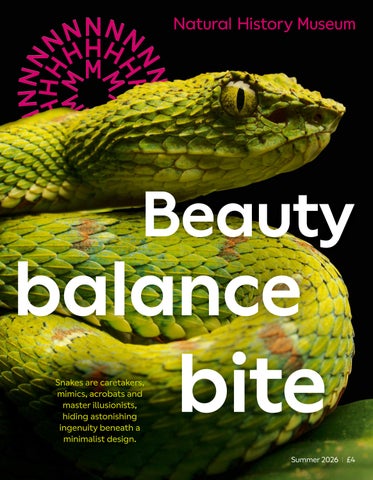
Beauty balance
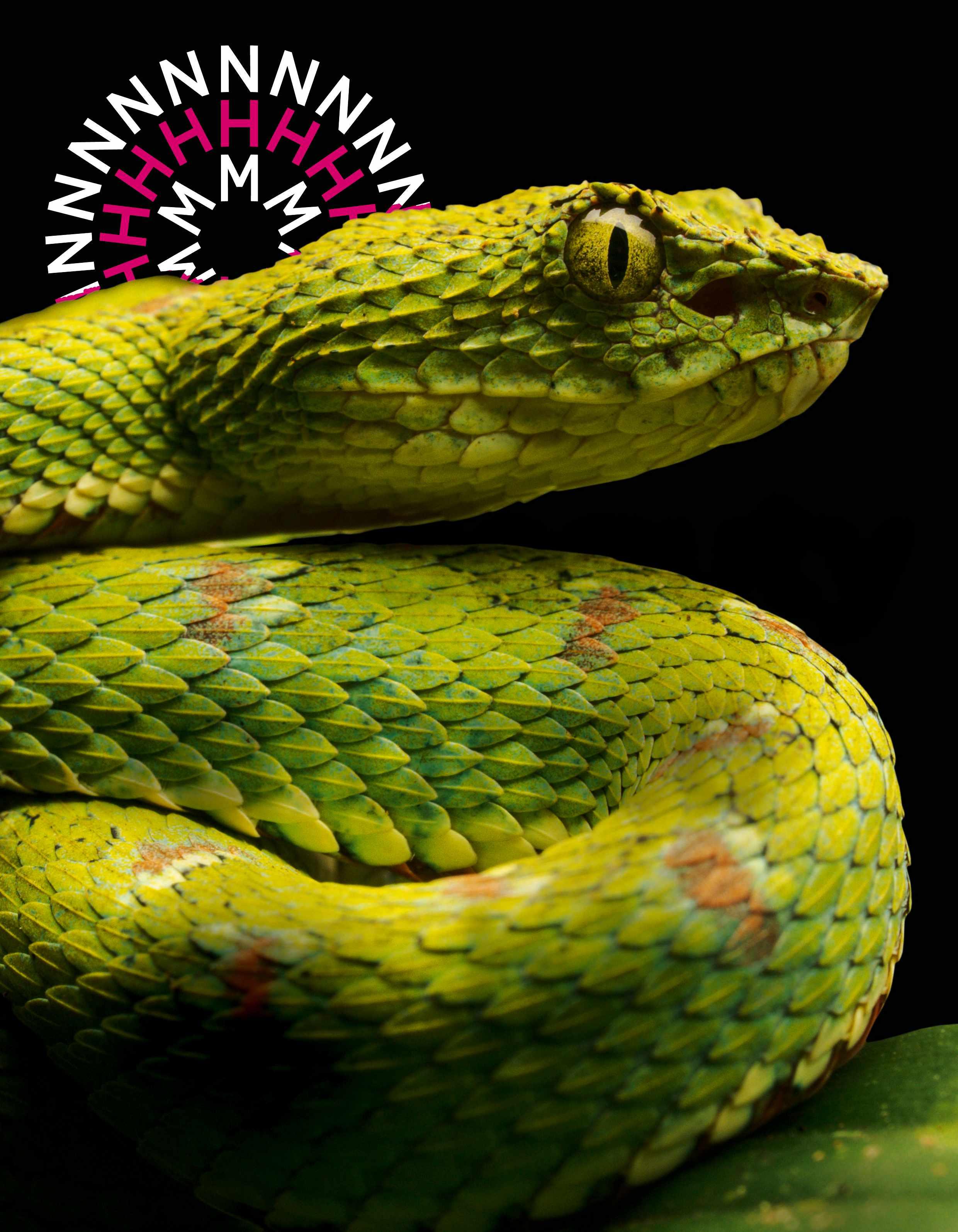
Snakes are caretakers, mimics, acrobats and master illusionists, hiding astonishing ingenuity beneath a minimalist design.
bite
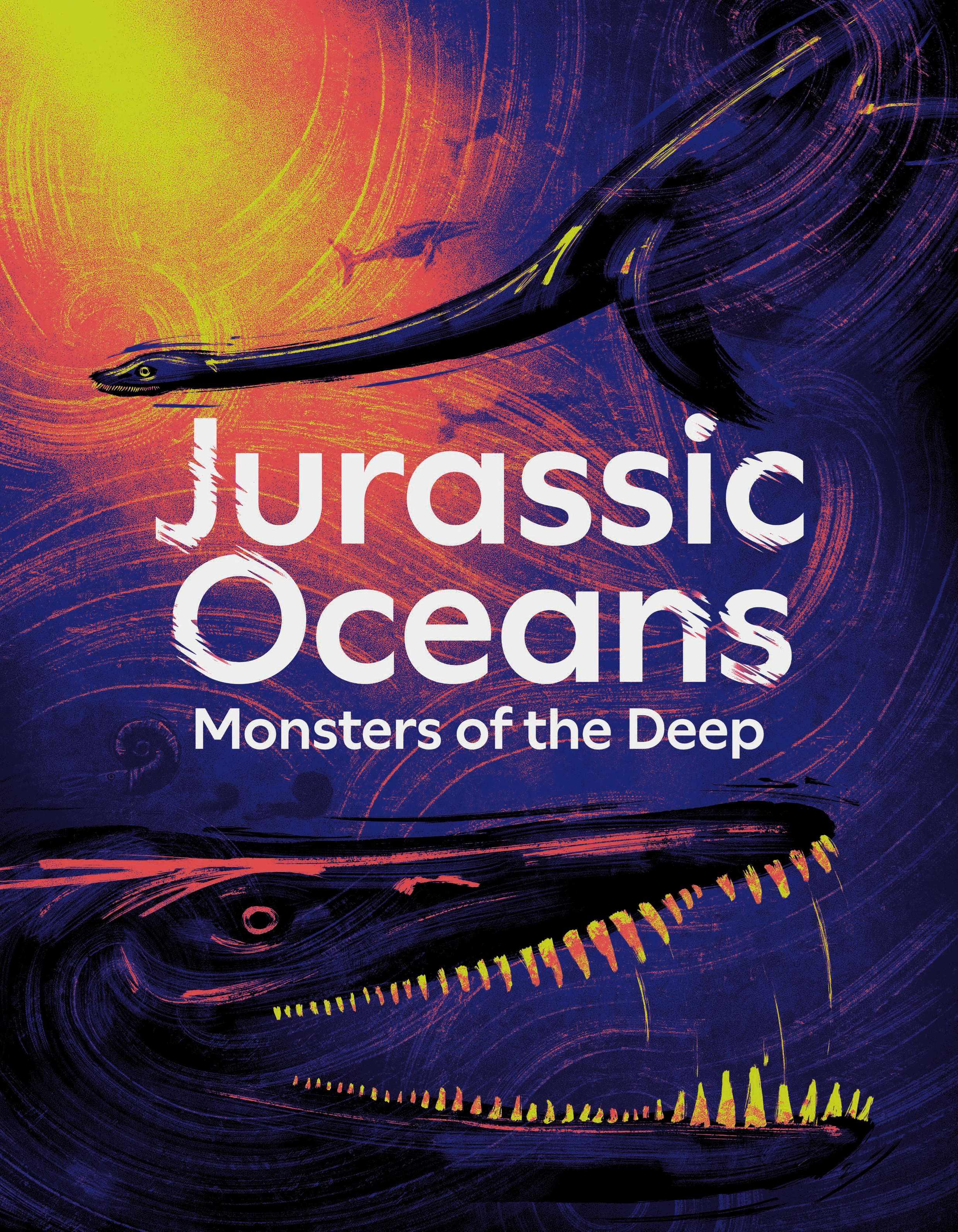
Until 3 January 2027
Welcome
Wonder begins here
One of the best things about working in a museum like ours –and there are many great things to choose from – is watching visitors’ faces light up as they step into a gallery or exhibition, or admire our iconic building. ‘Look at that!’ I hear people say every day, and it never fails to delight and uplift me.
Our mission is to create advocates for the planet and, to do that, we need to amaze and inspire all our supporters. I hope this issue of the Natural History Museum magazine does just that!
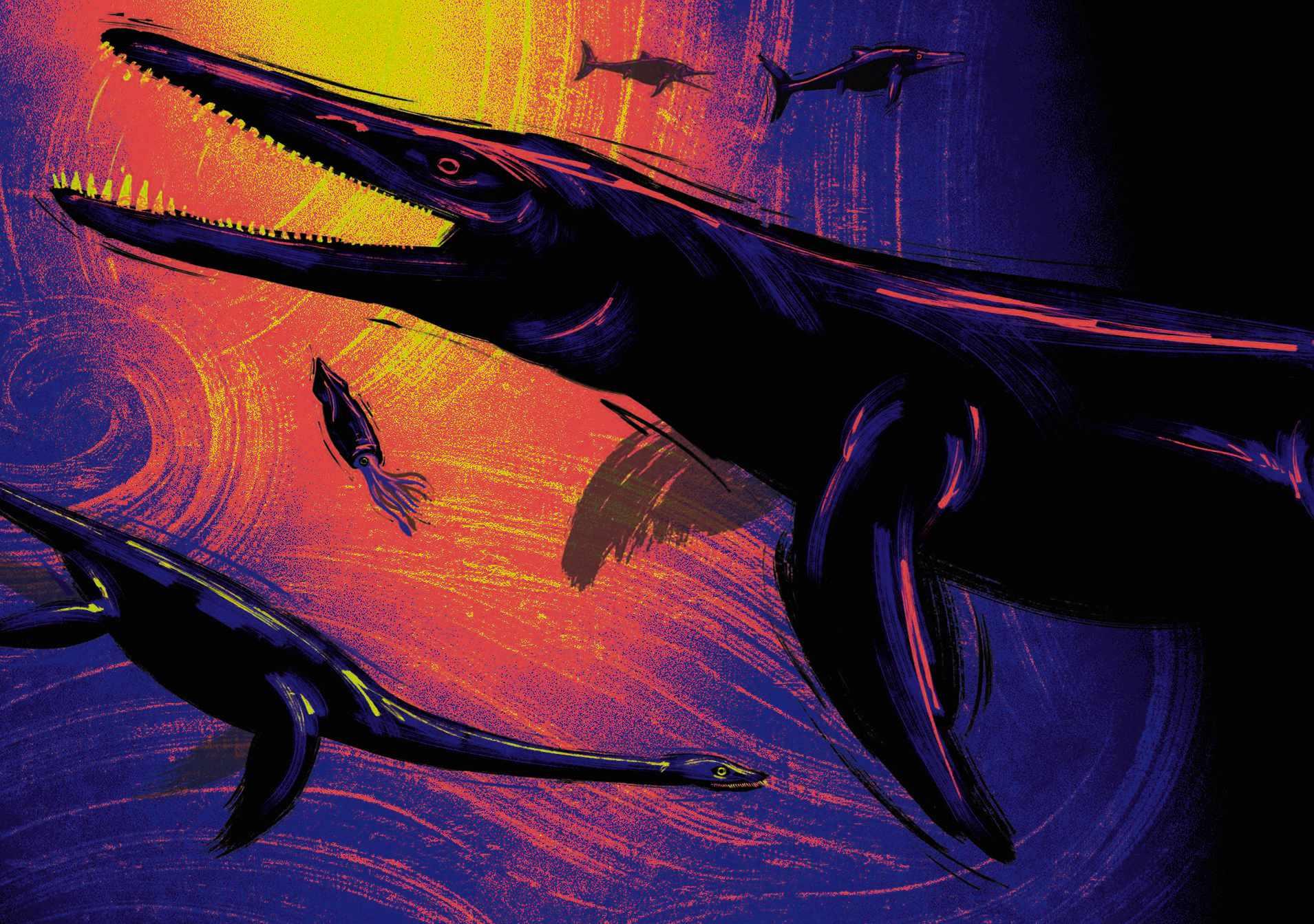
Visit our thrilling new exhibition, Jurassic Oceans: Monsters of the Deep, to come face to face with the ocean’s most formidable prehistoric predators. From ichthyosaurs to plesiosaurs, discover how these animals dominated ancient seas with speed, stealth and astonishing adaptations on page 24.
It’s World Snake Day on 16 July, so on page 36 we explore the extraordinary athleticism of these spectacular animals – they can scale trees, swim long distances and burrow underground, all without limbs.
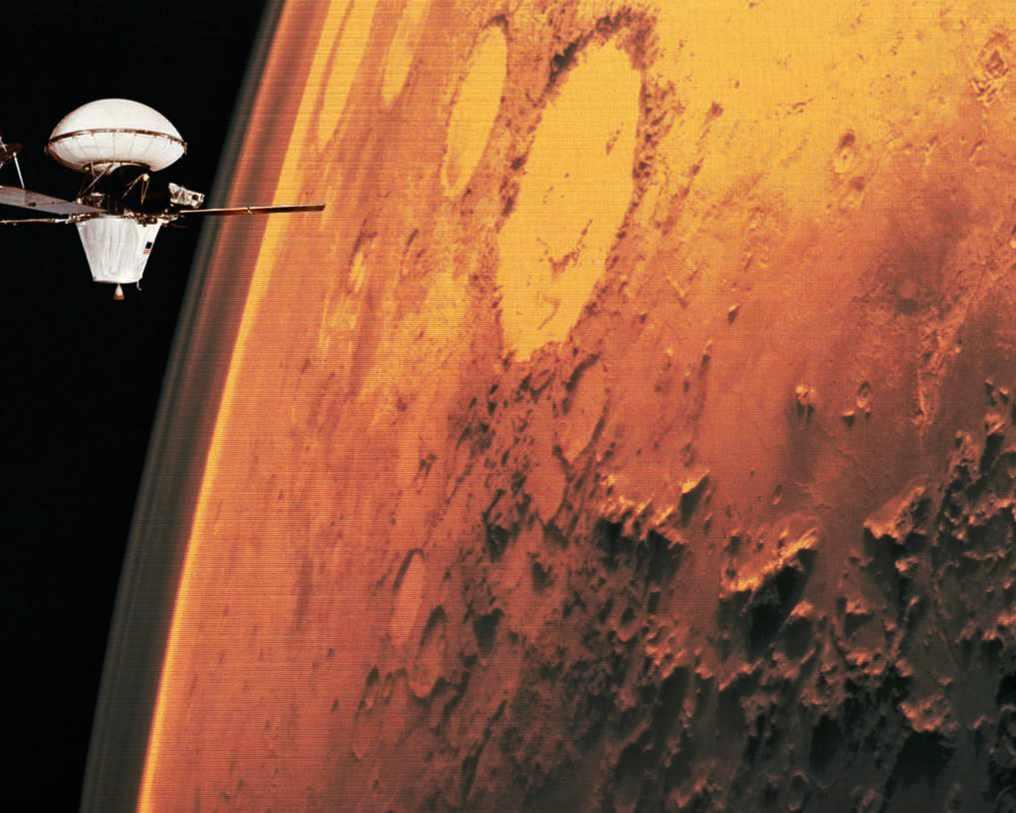
As we celebrate 50 years since the Viking missions landed on Mars, turn to page 30 to explore how these pioneering spacecraft transformed our understanding of the red planet.
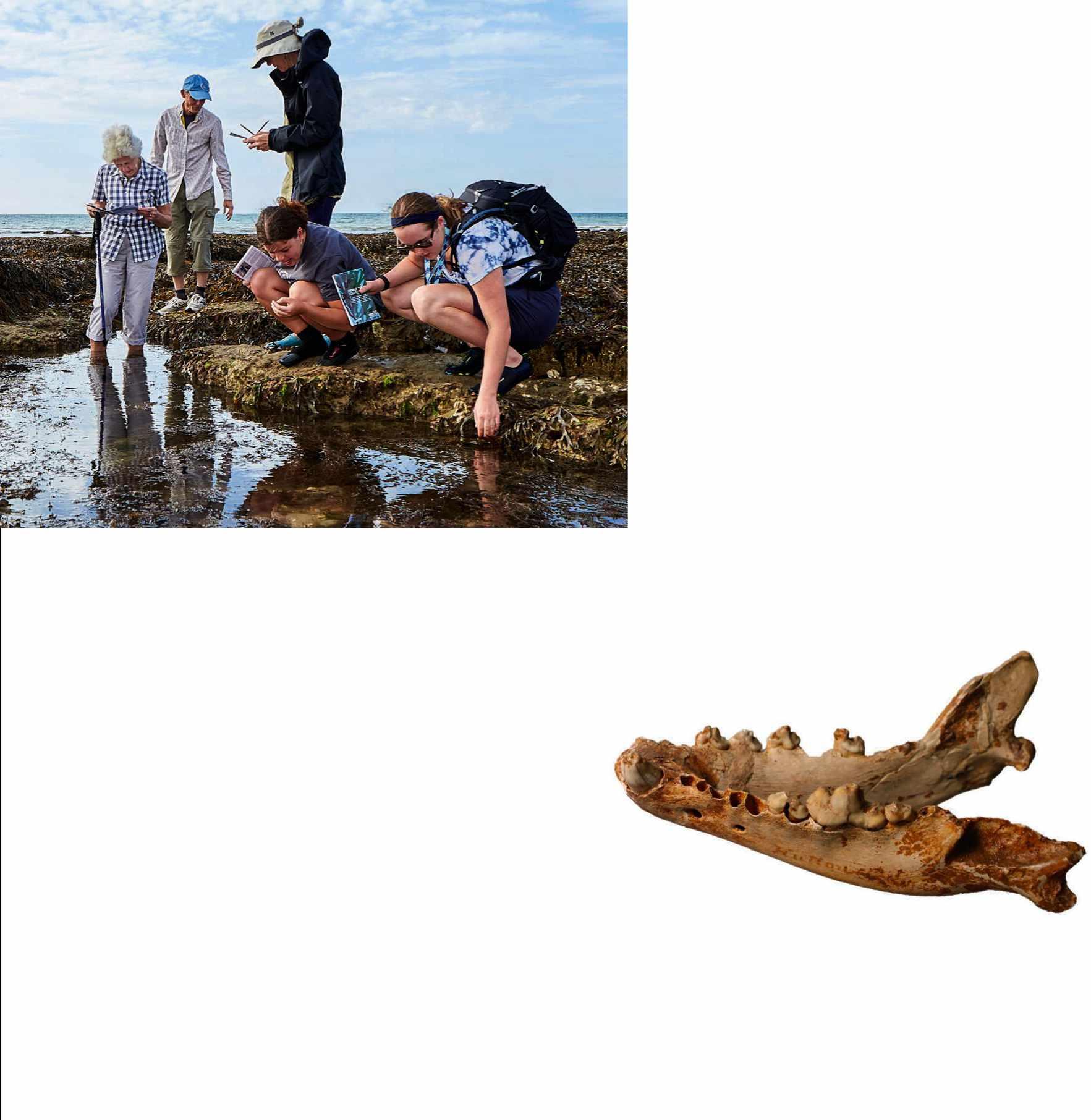
If you’re heading to the UK coast this summer, why not take part in the Big
‘I love watching visitors’ faces light up as they step into a gallery or exhibition. It never fails to delight and uplift me.’
Seaweed Search? Seaweeds shape entire coastal ecosystems, support biodiversity and even store carbon, and you can help us by recording what you nd. Read more on page 54. Finally, when you next visit the Museum, we hope you’ll nd your way more easily thanks to our new signage and way nding system. Let us know what you think. Thank you, as ever, for supporting us as members, visitors and friends. Together, we can create a future where both people and planet can thrive.

The Natural History Museum, Cromwell Road, London SW7 5BD
The Natural History Museum at Tring, Akeman Street, Tring, Hertfordshire HP23 6AP
MAKE THE MOST OF BEING A SUPPORTER
The Anning Rooms
Named in honour of legendary fossil hunter Mary Anning, this suite is exclusively for your enjoyment. Tuck into tasty lunches and snacks in the restaurant, take in the stunning views of the surrounding rooftops from the lounge, or read a book in the study area.
Exhibitions
Get free, unlimited entry to all of the Museum’s ticketed exhibitions, such as Jurassic Oceans: Monsters of the Deep, and guaranteed entry to our free exhibitions and installations.
Exclusive events
Enjoy private exhibition views, workshops and a talks series, Dig Deeper, led by Museum scientists. As well as discounted tickets you will also receive priority booking and access to a special Members’ Bar on the night.
Shop and café discounts
Experience
Adam Farrar Director of Commercial and Visitor
Join the conversation
Instagram natural_history_museum
Facebook naturalhistorymuseum
X NHM_London
TikTok @its_nhm
YouTube @NaturalHistoryMuseum
Email magazine@nhm.ac.uk

Receive a 20% discount in the Museum’s shops –which are stocked with a wide range of inspiring gifts, fascinating books and stylish clothes – as well as a 10% discount in our cafes and restaurants.
Go digital
Get Natural History Museum magazine delivered to your inbox. By receiving a digital copy, you are helping to reduce the e ects of production and printing on the environment. To switch to an online magazine, please email membership@nhm.ac.uk
Issue 61 Summer 2026
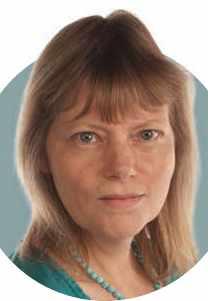
Professor Juliet Brodie
A marine algae research scientist whose research spans taxonomy, ecology, evolution and conservation, Juliet leads the Big Seaweed Search.

Dr Neil Adams Neil is our Curator of Fossil Mammals. He deals with all aspects of the care and management of the Museum’s fossil mammal collection.

Jen Pullar As Science Communications Manager, Jen develops and delivers stories about the work our 450+ scientists do at the Museum.
©Alamy
Journal
Features
24 Jurassic Oceans: Monsters of the Deep
Our monstrous new exhibition dives back in time to discover the erce predators that ruled Jurassic seas more than 200 million years ago.
30 The Martian mystery
Fifty years after they landed on Mars, the Viking missions continue to help us understand the most enigmatic meteorites in our collections.
36 Masters by design
From feigning death to deceiving prey, caring for eggs and even swimming, snakes display behaviours that continually defy expectations.
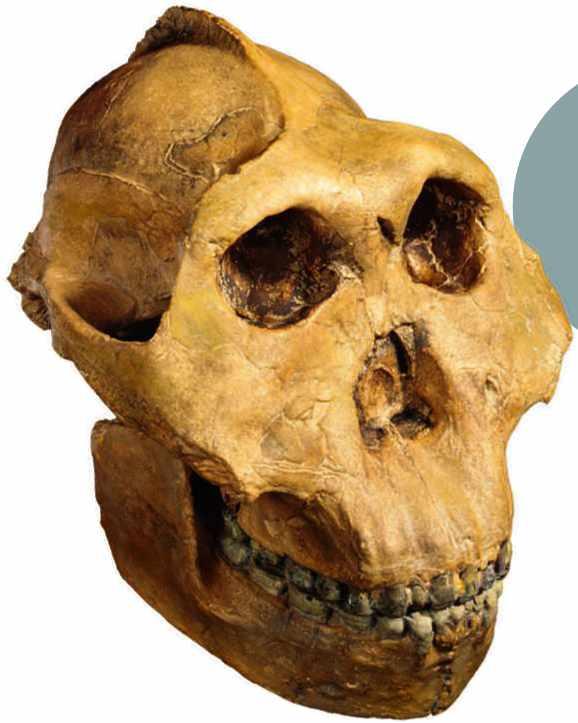
42 Rewriting the story of humans
Our knowledge of human history is always changing. These 10 discoveries have transformed what we know about our relatives – and ourselves.
50 Standing up for nature: Rebecca Wrigley
Rewilding Britain co-founder Rebecca Wrigley explains why true rewilding means letting nature lead and putting communities in the driving seat.
54 Secrets of the shore
As we celebrate 10 years of the Big Seaweed Search, we look back at what a decade of community science has uncovered.
60 Museum moves: High ideals and low politics
In 1863, land was approved for purchase in South Kensington, but not everything was built as planned.
12
New at the Museum
This issue we showcase the new acoustic monitoring in the Nature Discovery Garden, our new children’s clothing collaboration, and an epic agate sculpture on display for a limited time.
16 What’s on Events for Museum
Members and Patrons, plus a 60-second chat about fossil sh with Emma Bernard.
18 Science in focus: Ancient truths in teeth What the teeth of ancient wolves reveal about the threat of climate warming to modern populations.
Senior Editor Helen Sturge
Editorial team Josh Davis, Alessandro Giusti, Holly Murphy, Dr Peter Olson, Jennifer Pullar, Dr Helen Robertson, Professor Sara Russell and Dr Tom White
For Our Media
Editor Sophie Stafford
Art Editor Robin Coomber
Production Editor Rachael Stiles
Senior Account Director Ella Wiggans
Editorial Director Matthew Pink
Contributors Dr Neil Adams, James Ashworth, Ed Baker, Max Barclay, Emma Bernard, Georgie Britton, Professor Juliet Brodie, Eleanor Comforth, Adam Farrar, Robin Hansen, Rebecca Keddie, India Main, Talay Namintraporn, Neena Percy, Amy Pollak, Dr Lucy E Roberts, Louisa Skevington, Karolyn Shindler, Efstratia Verveniotou, Jessica Wardlaw, Rebecca Wrigley
With thanks to Dr Natasha Almeida, Lucie Goodayle, Dr Peter Grindrod, Jonathan Jackson, Dr Marc Jones, Professor Chris Stringer
20 Inside story: Efstratia Verveniotou Conservator E e explains her work and joy in bringing specimens from the Museum’s collections into the galleries for visitors to appreciate.
22 Exceptional specimens: Nature’s undertakers
Meet the beetles that bury the dead. Burying beetles transform tiny corpses into nurseries, food stores and even chemical fortresses.
Every issue
6 View nder
Be amazed by three extraordinary images that inspired everyone at the Museum.
66 From the Archive
The Museum’s role in unravelling the mystery of alleged Abominable Snowman tracks.
The views expressed in Natural History Museum magazine do not necessarily reflect those held by the Natural History Museum. Produced in association with Our Media. ourmedia.co.uk
All photographs and copy ©2026 The Trustees of the Natural History Museum, London unless otherwise stated. If you would like copies of any Museum images please contact the Museum Picture Library on 020 7942 5401.
The Natural History Museum Cromwell Road, London SW7 5BD Telephone 020 7942 5000 nhm.ac.uk
ISSN 2044-7582
The paper used for this publication is responsibly sourced, and has enabled the capture of 57kg of CO2 at Thorney Coppice, Northamptonshire. Learn more at forestcarbon.co.uk
Natural History Museum magazine is mailed in packaging using potato starch along with other biological polymers. It is totally biodegradable and compostable and can be disposed of in the green recycling bin or a home compost bin. It can also be used in your food waste caddy.
Our Media Company is working to ensure that all of its paper comes from wellmanaged Forest Stewardship Council® (FSC®)-certified forests and other controlled sources. This magazine is printed on FSC®-certified paper. It can be


Extraordinary images of our natural world Viewfinder
Record breaker
The Natural History Museum was the UK’s most visited attraction in 2025, welcoming more than 7.1 million people to our South Kensington home.
Alongside being a world-famous visitor destination, we are a leading research centre, with more than 400 scientists tackling some of the planet’s biggest challenges. Our collection of over 80 million specimens, spanning 4.5 billion years, is the most important of its kind anywhere in the world.
The Museum’s success is powered by its sta , visitors and the support of members, patrons, donors, trusts, foundations and corporate partners.
Director Dr Doug Gurr said, ‘We’re thrilled to be the UK’s most popular visitor attraction, smashing all previous records for the sector. These exceptional results re ect our unwavering focus on delivering a fantastic day out for every visitor, and the dedication of colleagues who work tirelessly to create unforgettable experiences and world-class exhibitions.’


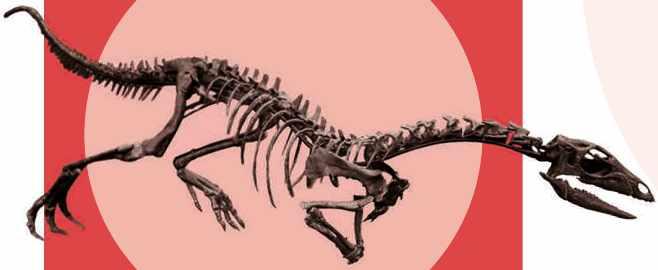
Earliest pachycephalosaur unearthed in Mongolia
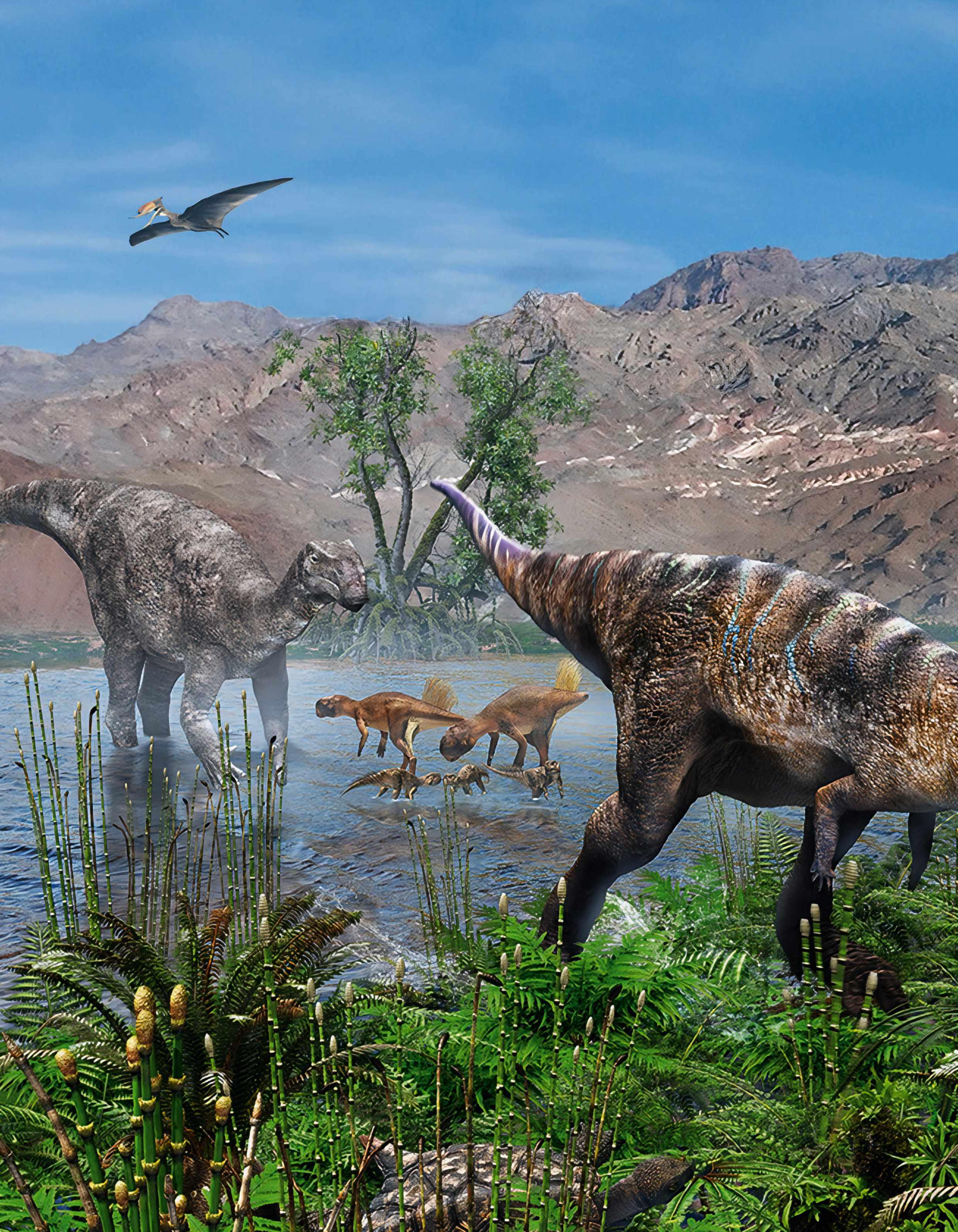


A new species of dome-headed dinosaur, Zavacephale rinpoche, is shining a light on one of the most distinctive but poorly understood dinosaur groups. It is the oldest-known pachycephalosaur and the most complete skeleton of its kind ever found.
Pachycephalosaurs belong to the bird-hipped, or ornithischian, dinosaurs – a major group that evolved during the Late Triassic,
©Masato Hattori
more than 230 million years ago, and includes ankylosaurs, iguanodontians and ceratopsians.
Even within this large and diverse group of dinosaurs, pachycephalosaurs stand out. When they rst appear in the fossil record, they already possess their distinctive domed skulls, suggesting a long earlier evolutionary
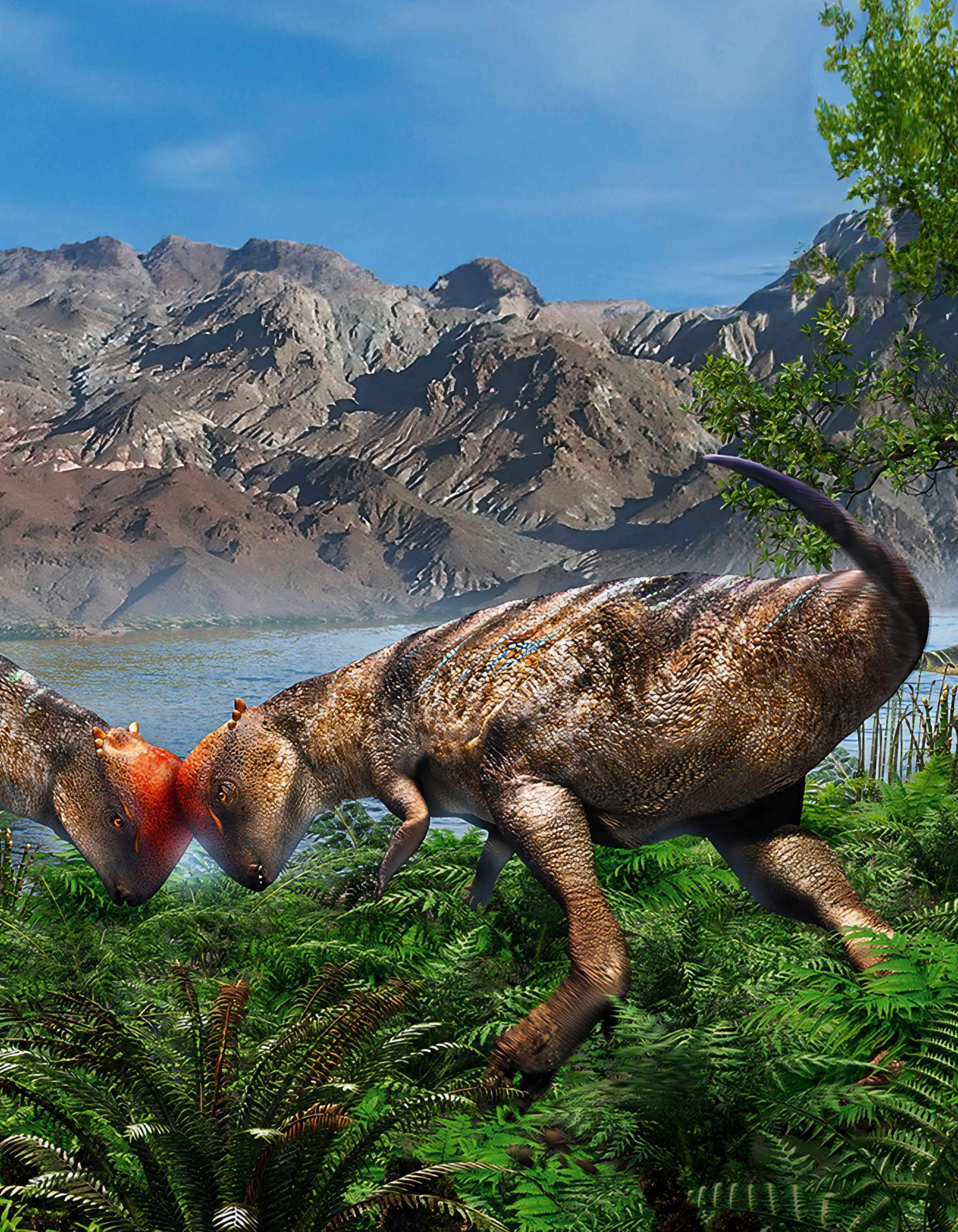
history. But early species are rarely preserved, and most nds are fragmentary.
The discovery of Z. rinpoche in Mongolia, with more than half its skeleton intact – including a hand and full tail, neither previously known in pachycephalosaurs – is helping researchers ll crucial gaps in the story of these rare, mysterious dinosaurs.
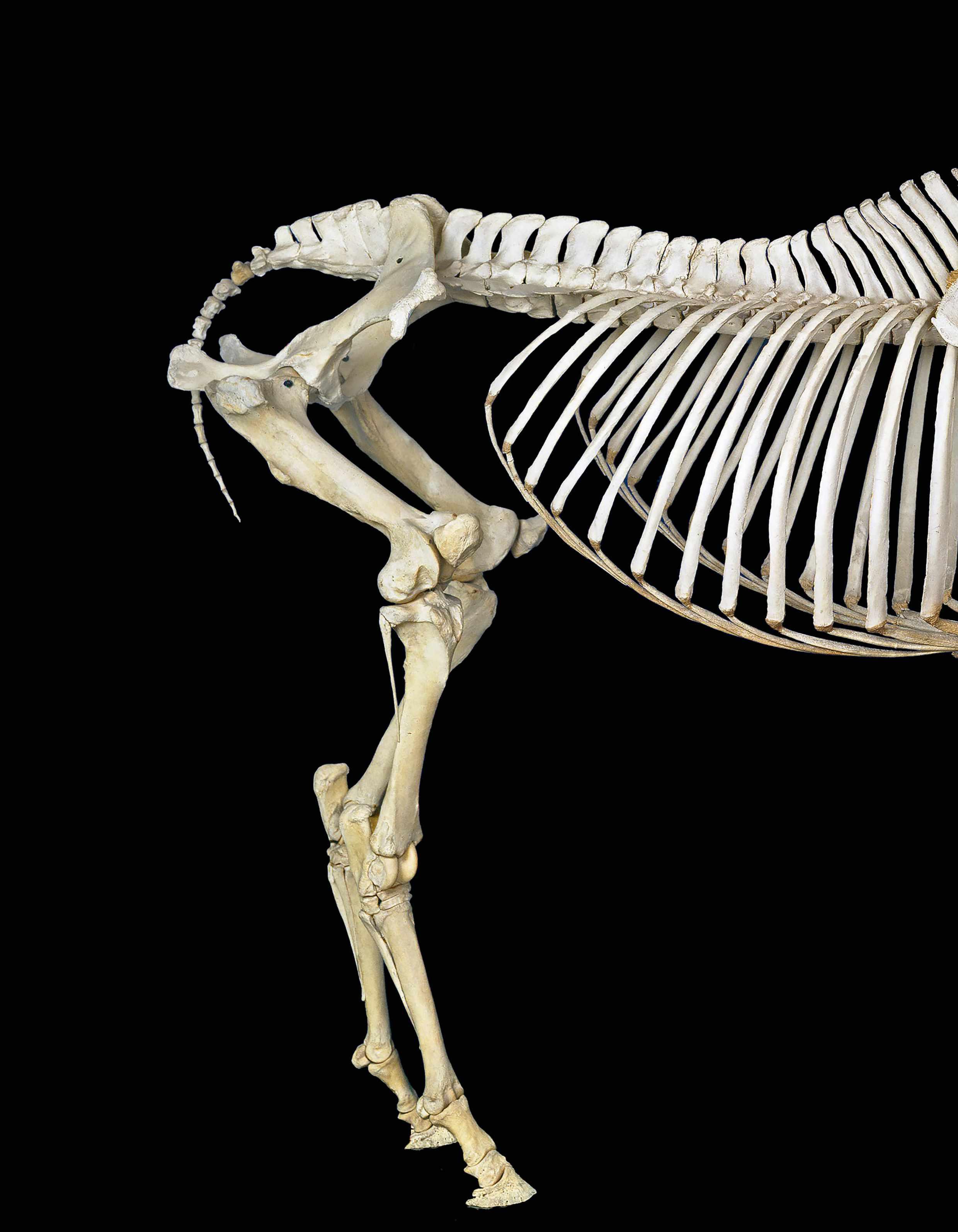
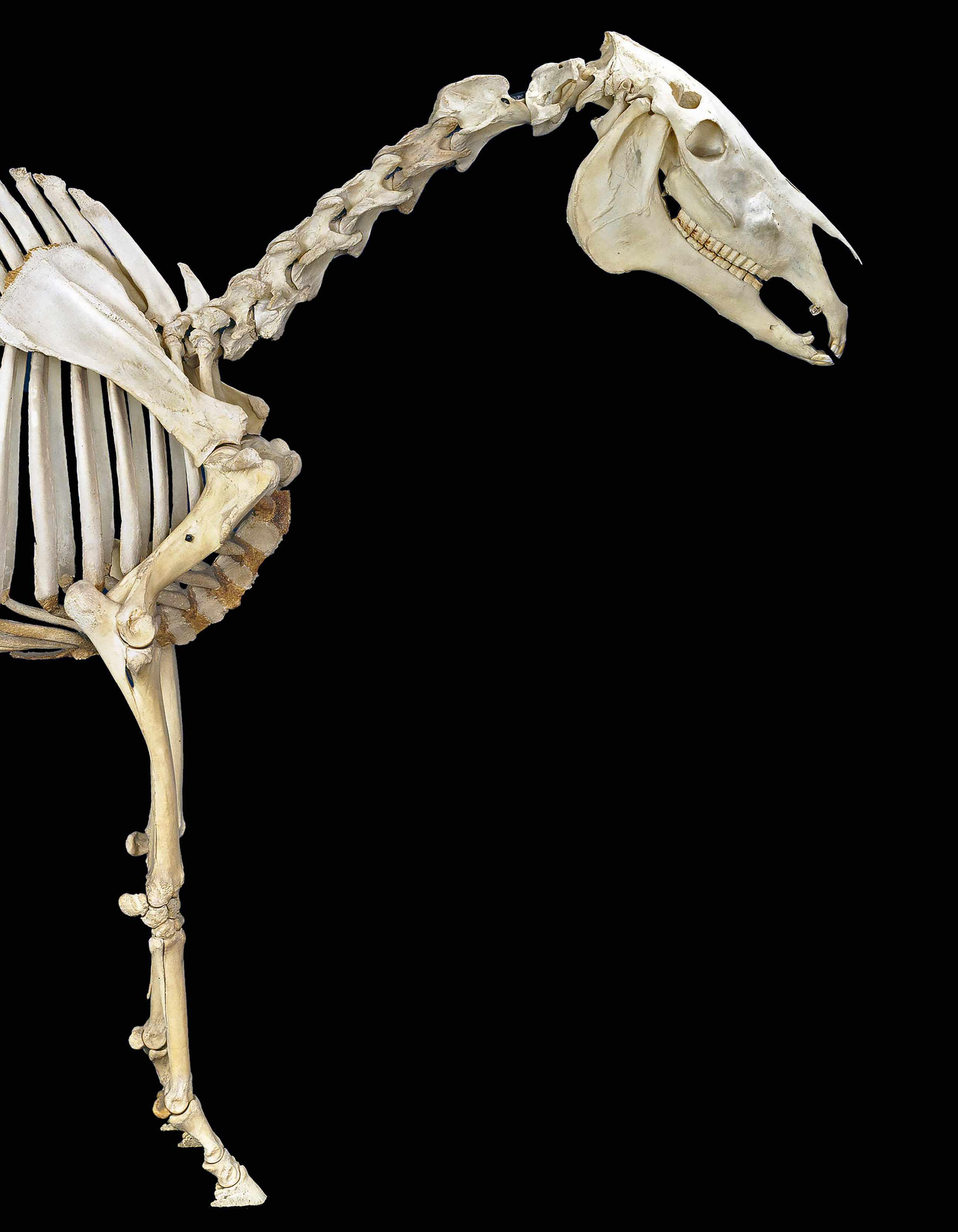
Racehorse royalty
This is the skeleton of Brown Jack, one of 24 celebrated racehorses donated to the Museum. Each horse is accompanied by detailed racing records and pedigree charts, but today their main value is as research subjects. Vets study the bones to investigate injuries linked to racing lifestyles, such as compacted spines caused by intensive early riding.
Brown Jack, who lived to the grand old age of 24, is among the most famous of the articulated skeletons in the collections, alongside St Simon and Persimmon. Between 1927 and 1934 he won 25 races, including the Queen Alexandra Stakes – the UK’s longest at race, held at Ascot – six years in a row, from 1929 to 1934. No other horse has ever won it more than twice.
VISIT THE MUSEUM
Though Brown Jack is not on public display, you can compare the anatomy of a horse with a human in the Mammals gallery (Central Building), as well as skeletons of extinct animals alongside specimens of their living relatives.
Journal
A world of discovery awaits you in our round-up of Museum news
We’re listening to nature
The scale of biodiversity loss and climate change that we’re facing means we need to embrace new technologies to improve urban environments for both people and wildlife. Our reimagined gardens sit at the heart of the Museum’s response, as Acoustic Biology Researcher Ed Baker explains.
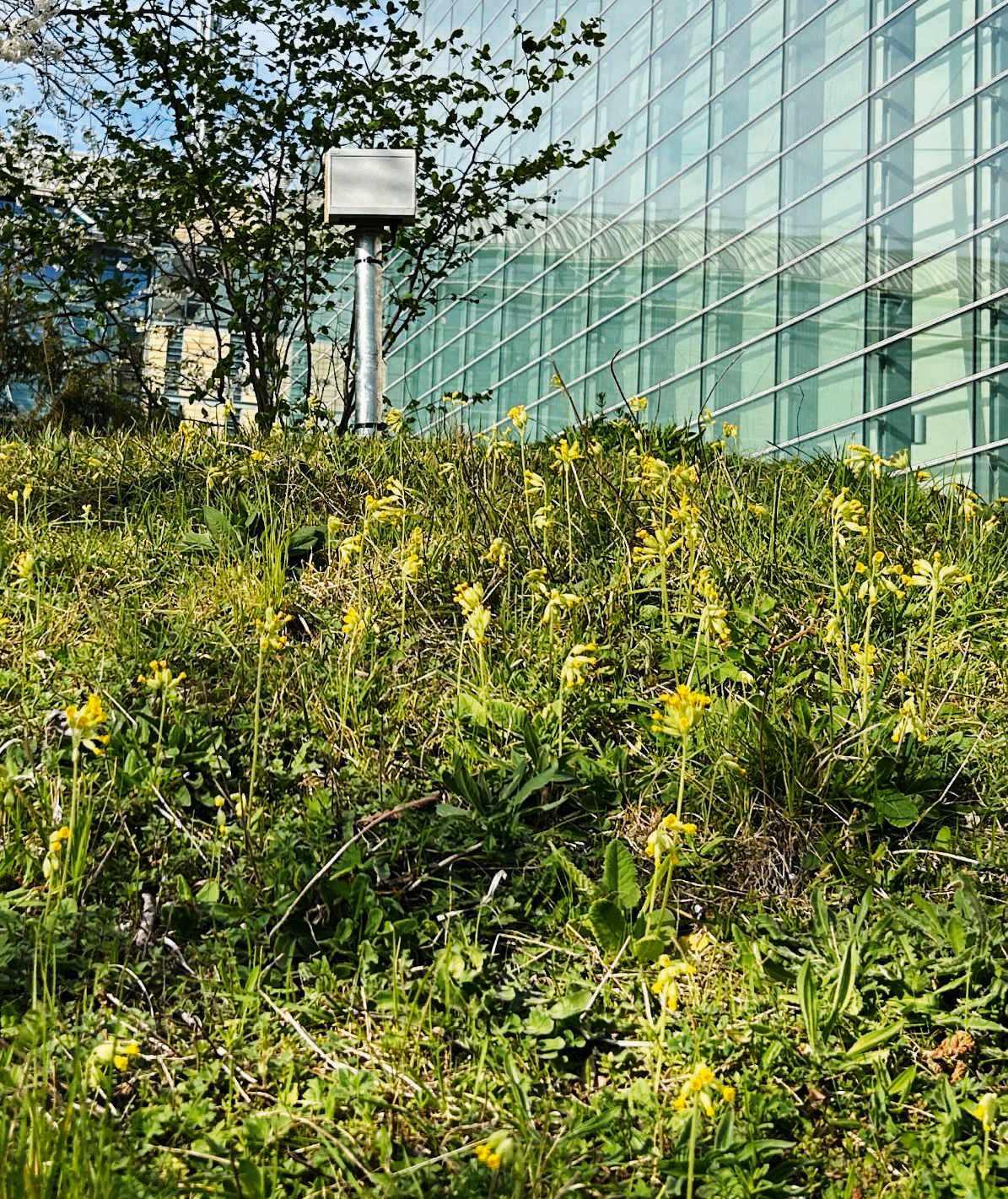
Since the Wildlife Garden rst opened, in 1995, Museum scientists have recorded the species living there, building a valuable record of how newly created habitats develop over time.
As more of the world’s population moves into cities, it is increasingly in urban green spaces where people rst connect with nature. Yet the same pressures that make cities challenging for people –heat, noise, light pollution and air pollution – also a ect wildlife. As part of the recent redevelopment of our gardens, we installed a network of sensors to help us study the urban environment and the biodiversity it supports.
The new gardens act as a living laboratory where we can develop and test fresh approaches to monitoring wildlife. The sensor network combines microphones, digital thermometers and other devices to track how nature adapts to city conditions and how people and wildlife share this small green corner of London.
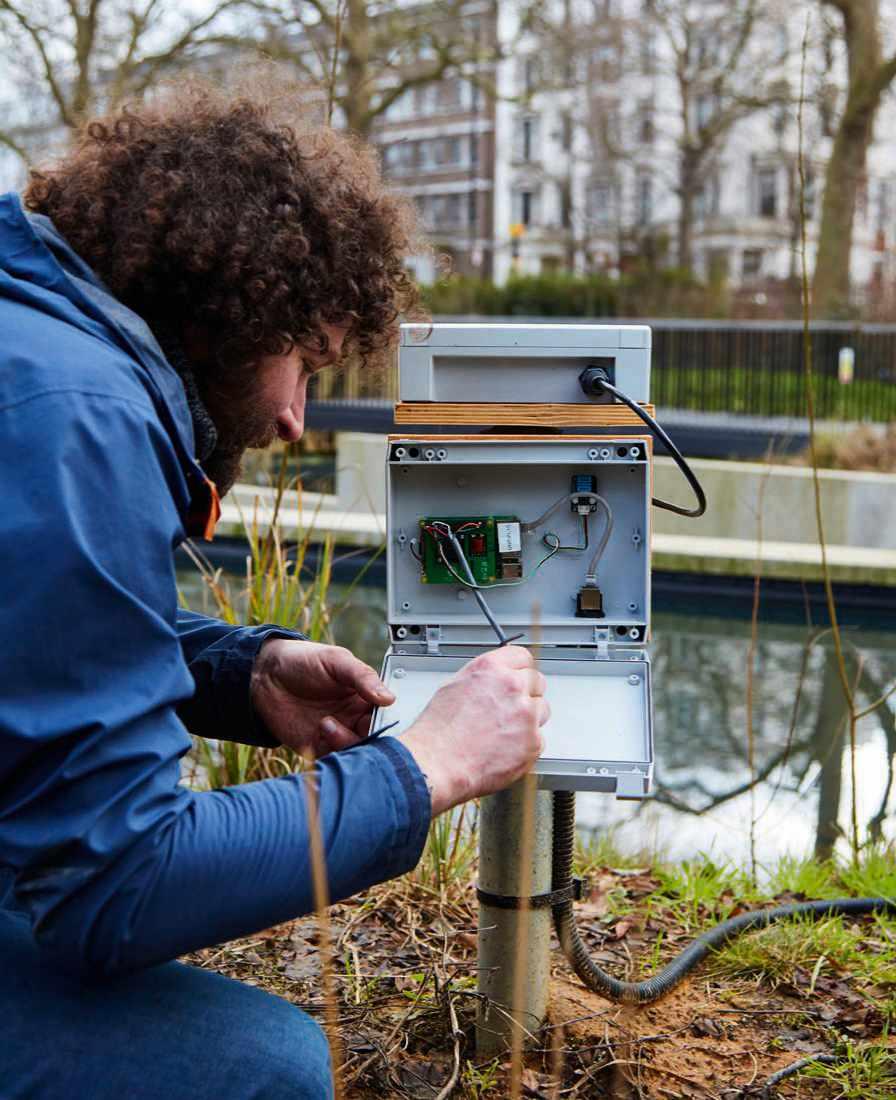
This sensor is recording sounds and soil temperatures.
Associate Becky Heath
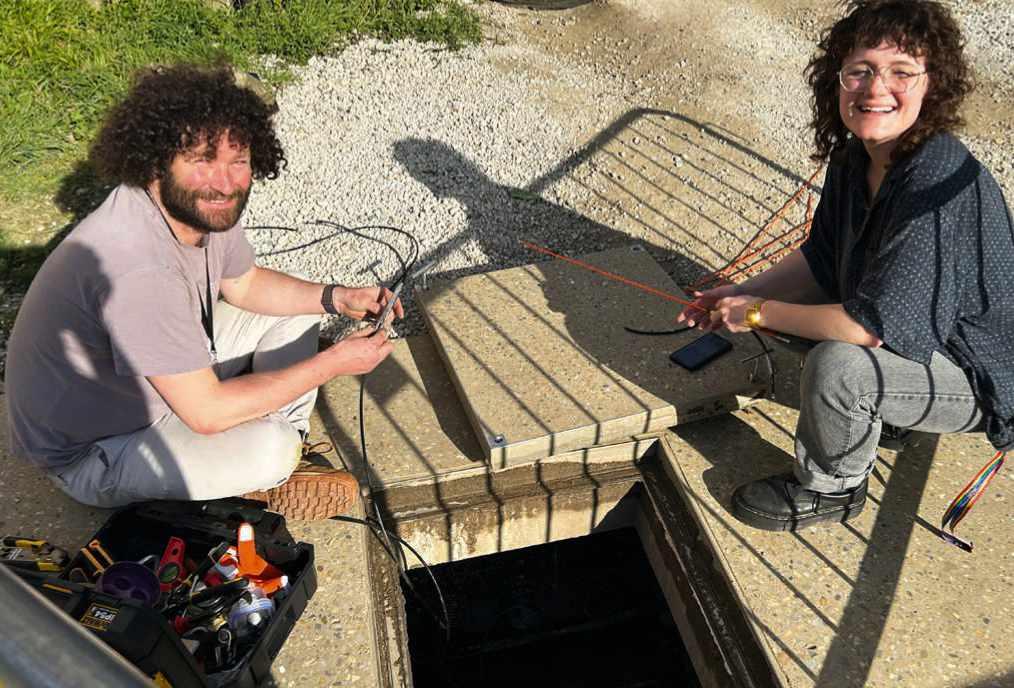
Acoustic sensors positioned around the site capture the daily soundscape, from the dawn chorus and the wingbeats of pollinating insects to rush hour tra c and planes ying overhead. By analysing these recordings we can identify which species are calling, where and when they are active, how their behaviour changes over time and how noise a ects them.
Below ground, temperature probes measure how the soil responds to seasonal shifts and extreme heat. Urban areas experience the ‘heat island’ e ect, where buildings and paved surfaces trap warmth. Green spaces help counter this by providing shade that stabilises soil temperatures. Other measures, such as the pale-coloured paving in the Darwin Centre Courtyard, re ect heat away from the ground.
Soil temperature matters because the soil is home to a huge diversity of organisms, including the roots of most plants. Early results show striking di erences across the site, with variations
The new gardens are a living laboratory where we can track how nature adapts.
of up to 10°C at a depth of 15cm on sunny summer days. We are waiting for a full year of data before we start the analysis to account for seasonal changes, so the results of this work will start to become available this summer. All this data feeds into the Museum’s pioneering Data Ecosystem, a powerful platform built using AWS Cloud and developed in collaboration with AWS.
This year we will be extending the sensor network to the Evolution Garden and the Nature Discovery Garden in South Kensington, and then to our grounds at the Natural History Museum at Tring.
MUSEUM IN NUMBERS
262
In 2025, Museum sta described 262 new species, from parasitic crustaceans that infect sh to dinosaurs that wandered across the ood plains of the Isle of Wight millions of years ago.
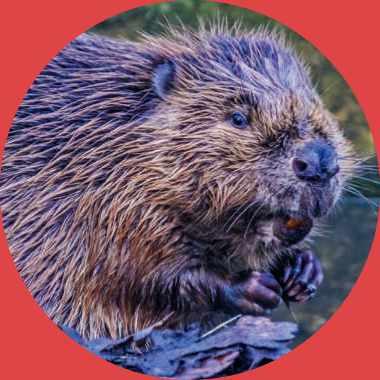
100
Centuries after being wiped out in the UK, the reintroduction of beavers is gathering pace, with 100 set to be released this year. Their activities create wetlands, shape forests, reduce ooding and absorb carbon.
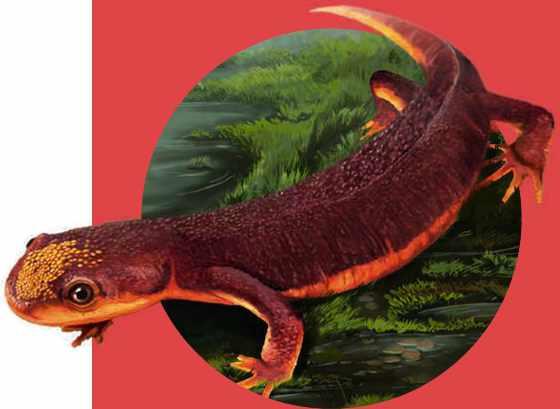
150
A new species of amphibian that lived 150 million years ago has been discovered in Portugal. This tiny animal was among the earliest members of a mysterious group that survived from the time of the dinosaurs to the last Ice Age.
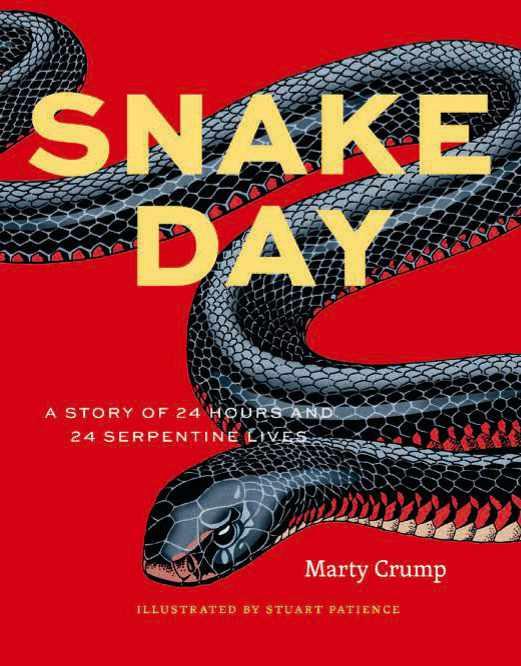
Snake Day: A Story of 24 Hours and 24 Serpentine Lives WIN
Does a snake crossing your path spark delight or dread? Biologist Marty Crump argues for delight –and Snake Day shows why these animals deserve admiration, respect and protection. The book follows 24 snakes over 24 hours, each chapter capturing a single species in a single hour as it hunts, mates and survives in a changing world. Stuart Patience’s pen and ink illustrations bring every scene vividly to life.
We have 10 copies of Snake Day: A Story of 24 Hours and 24 Serpentine Lives to give away. To enter, simply tell us how many species of snake are native to the UK.
Email your name, address, phone number and answer to magazine@nhm.ac.uk, with ‘Snake’ in the subject line. Or post your entry to ‘membership’ at the address on page 3. The closing date is Saturday 31 October 2026.
©Eva Carret
Ed wires in a new sensor with Scienti c
©Alamy
Journal Museum news
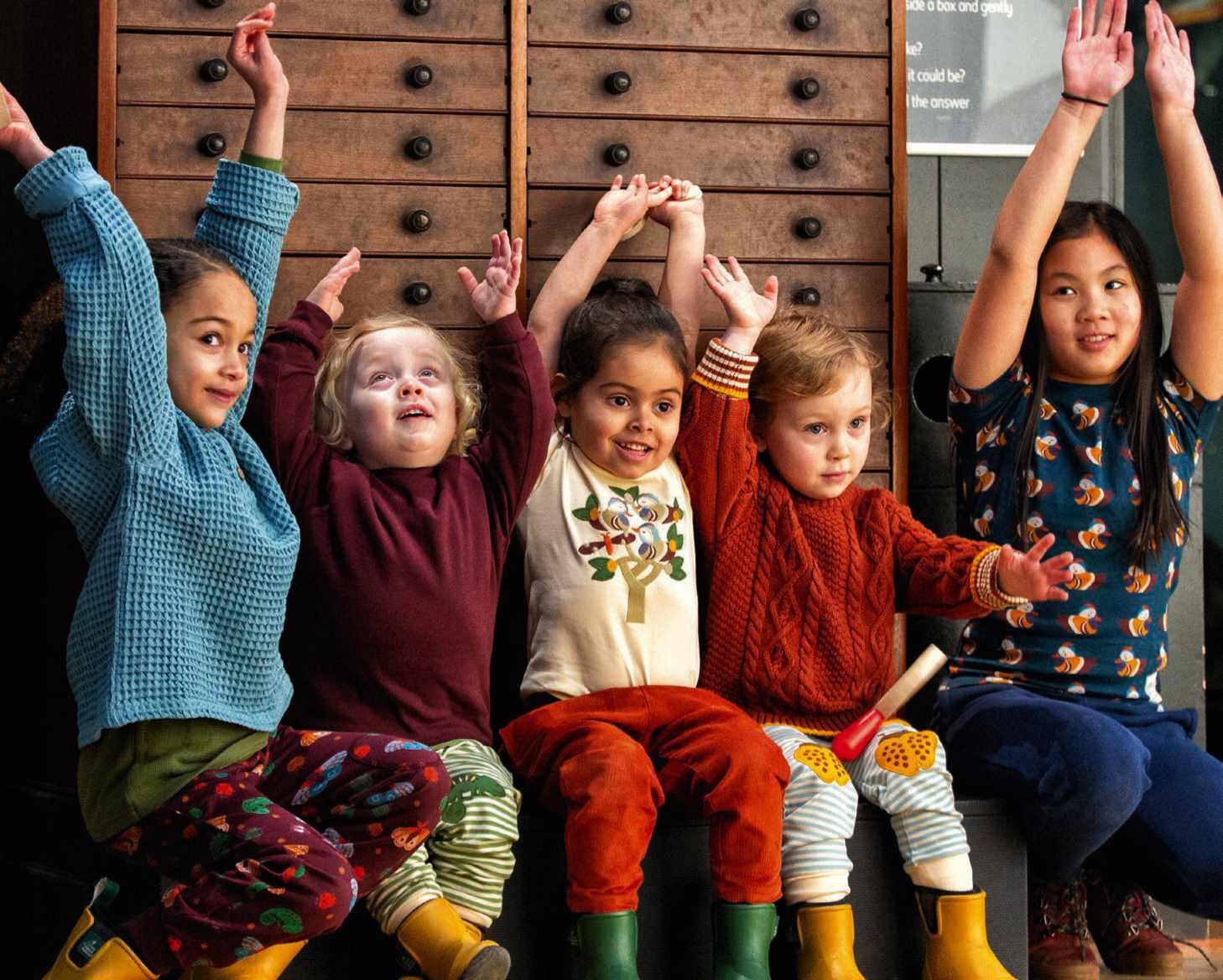
Discover your wild wardrobe
Nature is full of surprises, and sometimes new discoveries are waiting just outside your front door.
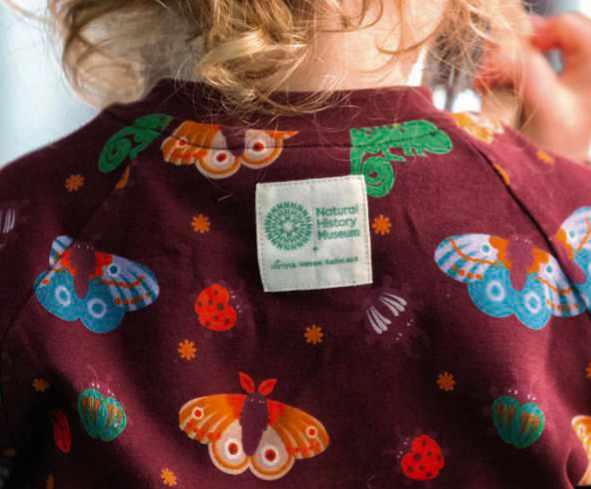
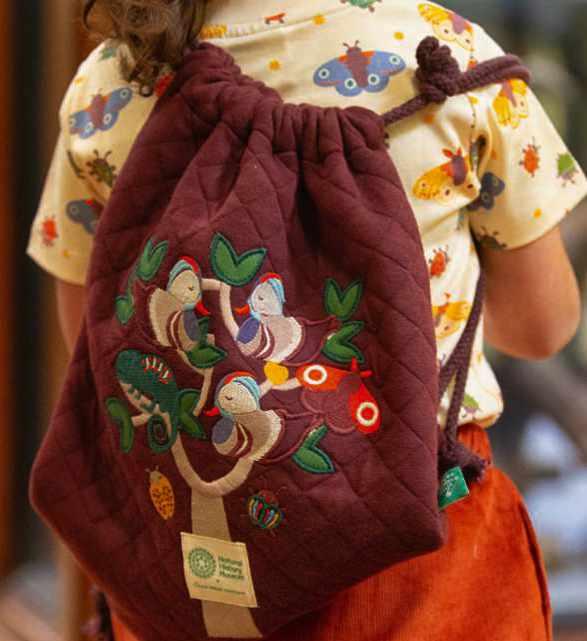
What if your clothes could tell a story about the wild world around you? That’s the idea behind our new collaboration with ethical children’s clothing brand Little Green Radicals. This special collection celebrates some of the remarkable animals you can spot right here in the UK.
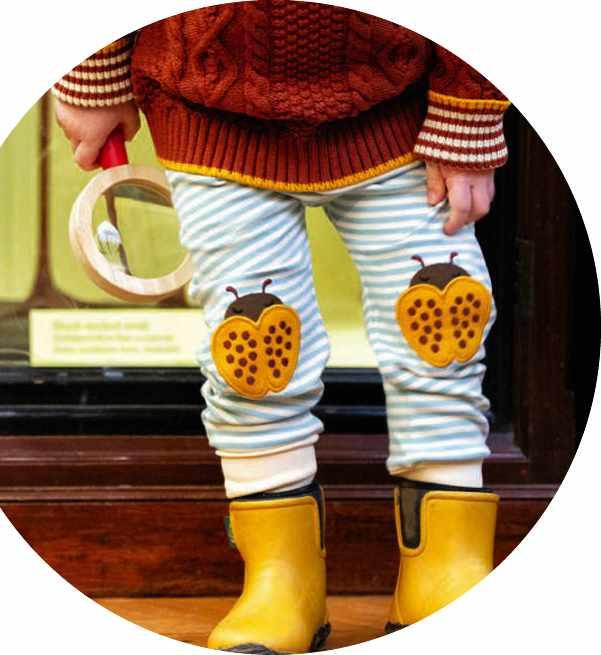
From the bright-yellow 22-spot ladybird and the iridescent rainbow leaf beetle to striking birds like the mandarin duck, each design is inspired by real-life ‘radical creatures’ that may be living closer than you think.
The collection also draws on the Museum’s rich archives, including the work of scienti c illustrator Maud Horman Fisher. Maud joined the Museum in 1879, a time when few women were recognised in science. She produced hundreds of exquisitely detailed insect drawings, capturing every wing, leg and antenna exactly as it appeared in life. Her illustrations
helped scientists study and understand the natural world in extraordinary detail.
Today, Little Green Radicals has reimagined some of her beautiful artwork as colourful, playful prints for a new generation of young adventurer. Designed for every extraordinary explorer, this planet-friendly playwear is made from organic Fairtrade cotton and includes 14 fun styles, with two adaptive pieces to welcome more children into the adventure.
Suitable for ages 18 months to 10 years, the Finding the Extraordinary collection o ers something for everyone – from jogger playsets and T-shirts to sweatshirts and rompers. It also includes a ‘Fix It Kit’ of embroidered patches, ready to repair well-loved out ts after muddy missions and grass-stained escapades.
So get ready, pull on your gear, step outside and prepare to nd the extraordinary in every day. The collection is available now at littlegreenradicals.com
Main Mini nature lovers in clothes that feature some familiar creatures to spot.
NEWS SHORTS
Ancient croc
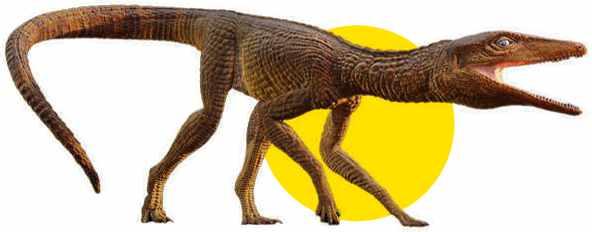
A new species of crocodylomorph dating to around 215 million years ago has been formally identi ed. This unusual ancient relative of crocodiles was unearthed in southwest England in 1969.
Laser vision
A new technique is allowing us to see what’s inside our spirit collection jars without even opening them. By shining lasers through sealed jars, we can use the pattern of light scatter to identify the chemical make-up of the uid.

Find your way
We have updated our signage and way nding systems to help visitors explore with greater ease. Look out for refreshed map designs, new signs, and a directional zoning system to make navigation more intuitive. nhm.ac.uk
The big brachiopod move
As part of the NHM Unlocked programme, around a third of the Museum’s collection –28 million specimens – will be moved to our new facility at Thames Valley Science Park in Reading. While construction continues, teams across the Museum are preparing specimens.
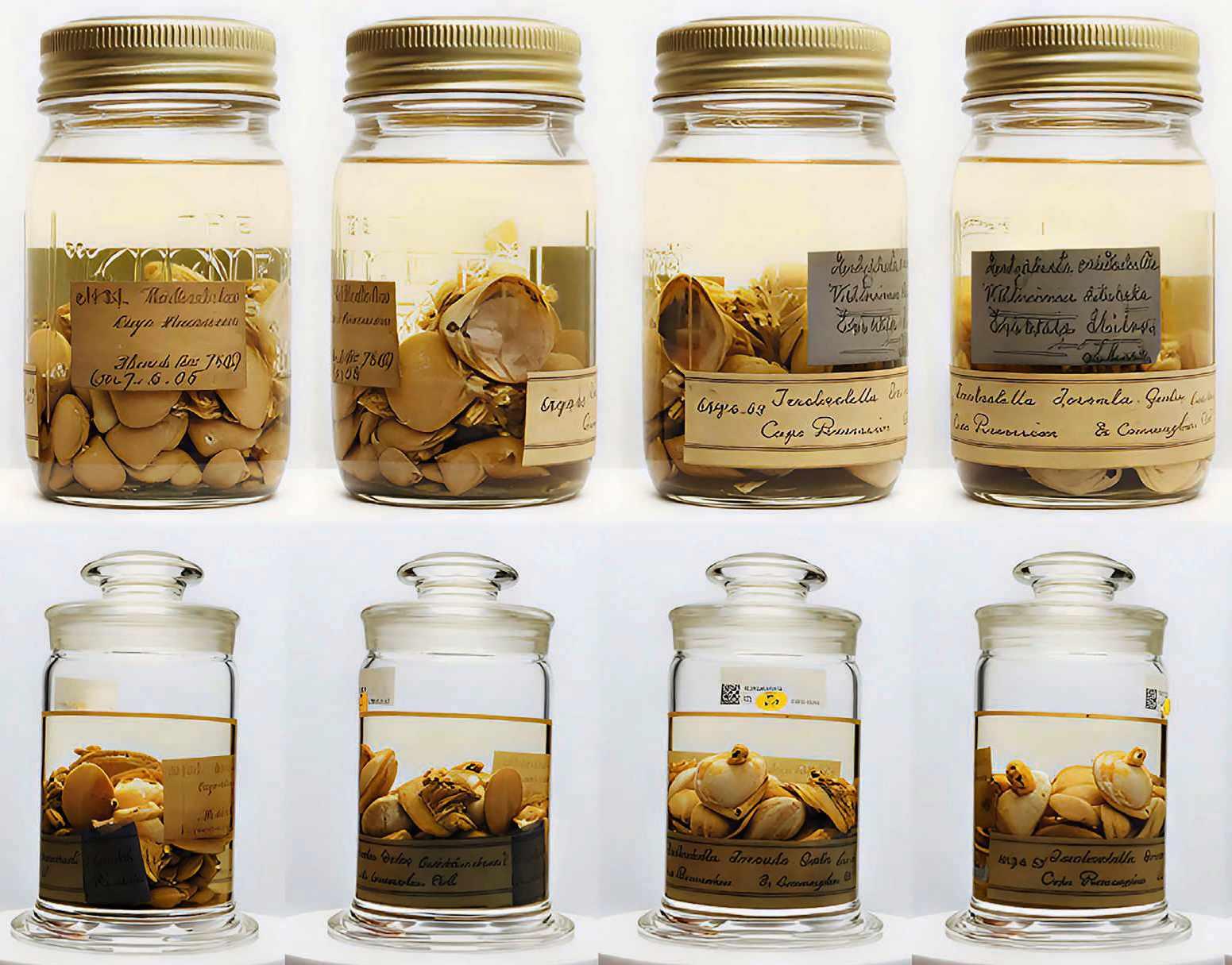
Most recently, our brachiopod collection has been the focus of detailed work. Curator Zoë Hughes and Moves Team members Kezia and Joseph have been rehousing specimens in new containers and digitising them so they can be used by researchers around the world.
The team began by assessing the entire collection to make sure it’s moved safely. Joseph developed a new digitisation work ow using a rotating platform to take seven photos of each specimen. These images were then stitched
CARVING NATURE FROM NATURE
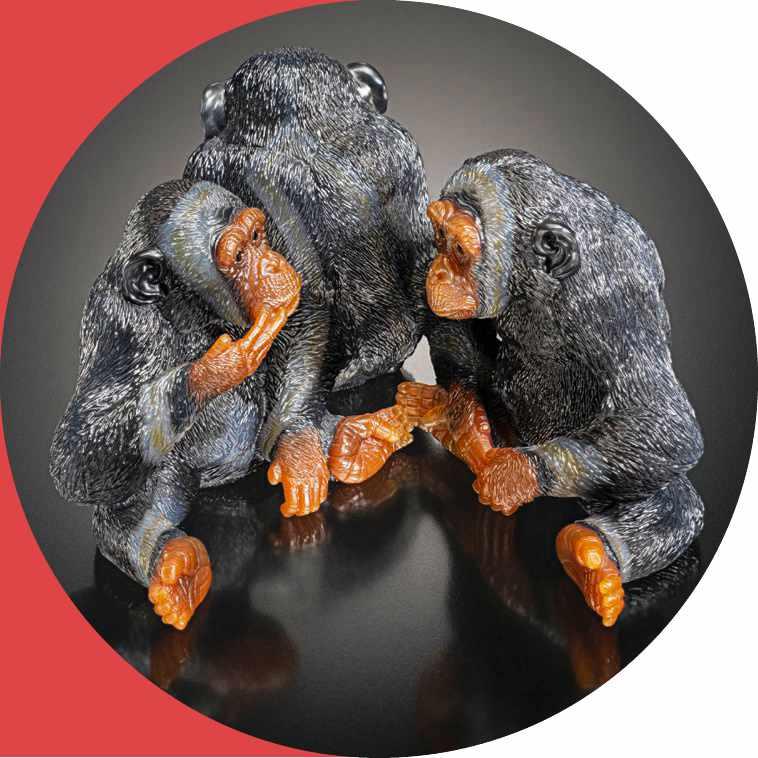
An extraordinary carving of three chimpanzees, created from a single piece of agate, is now on display in The Vault for a limited time.
The lifelike detail is the result of 12 generations of expertise from the Dreher family, renowned for producing remarkably realistic carvings of animals from minerals.
This piece was made by Gerd Dreher (1943–2018) and his son Patrick (b. 1970), who are fourth- and fth-generation Master Carvers.
Old specimen jars before conservation (top) and after (bottom). Their data and condition are captured clearly using the new digitisation technique.
together to create a single seamless view, giving researchers a clear and consistent record.
Once the assessment was complete, the team began the physical preparation work. Specimens were transferred into new jars and boxes to protect them during the move. Each specimen was also barcoded to ensure accurate tracking throughout the relocation. The new digitisation work ow was then repeated to document the conservation work itself, creating a detailed visual record of the team’s e orts and the condition of the specimens as they are prepared for the journey to their new home.
NHM Unlocked is funded by the UK Government with additional funding from the Wolfson Foundation.
Agate, a variety of quartz made of tightly interlocking crystals, is tough and beautifully banded, which is ideal for carving. In this sculpture, the original shape and colour layers have been used to striking e ect, with brown and grey bands echoing the chimps’ fur tones. Hours of meticulous work have brought them to life, capturing everything from their coarse hair and skin folds to opposable thumbs and expressive faces. This sculpture has been kindly loaned to us by Robert Myers.
Journal What’s on
Exhibitions
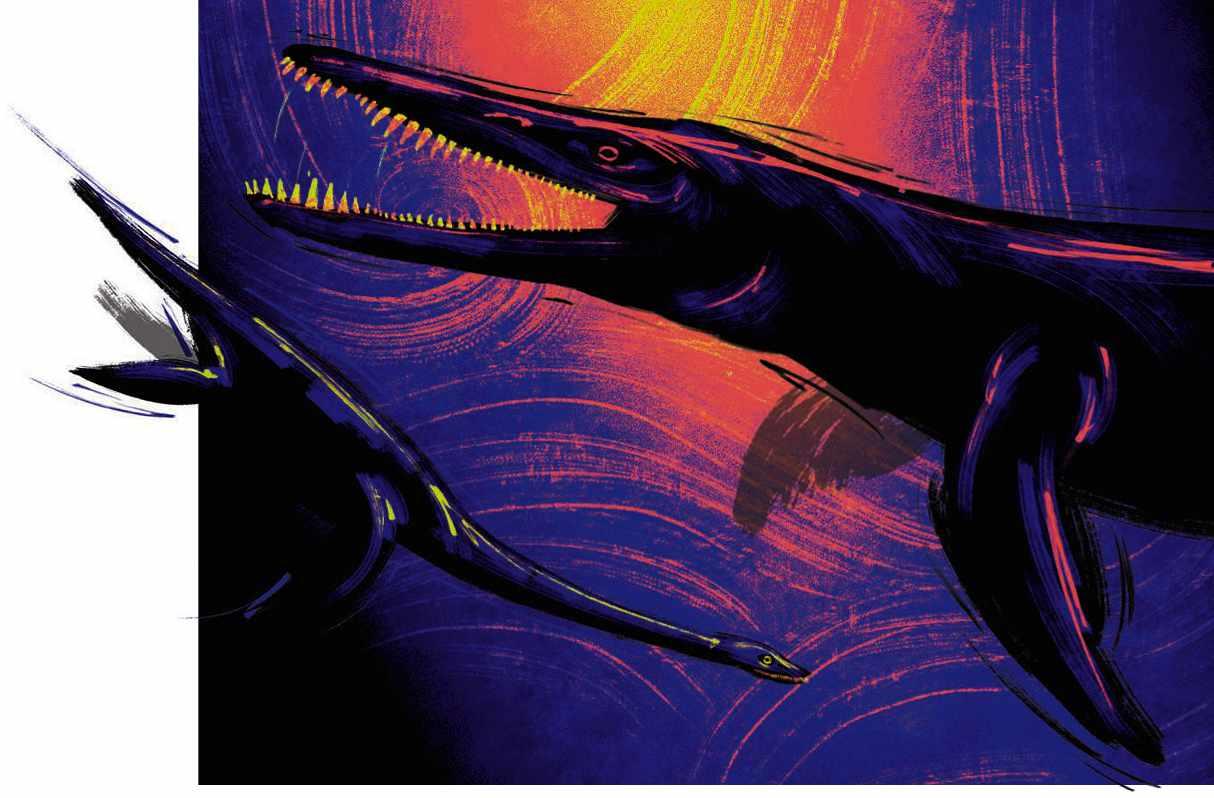
Jurassic Oceans: Monsters of the Deep
Until 3 January 2027, normal Museum opening times
From £15.50 Adult / £7.50 Child / £12 Concession
Members and patrons go free Plunge into the Jurassic deep and come face-to-face with the ercest predators to ever rule the ocean. nhm.ac.uk/jurassic-oceans
Don’t miss it Wildlife Photographer of the Year
Until Sunday 12 July 2026, normal Museum opening times
From £15.50 Adult / £7.75 Child / £12.40 Concession
Members and patrons go free Enjoy more than 100 winning and commended images by leading photographers from around the world at the Museum’s annual exhibition. nhm.ac.uk/wpy
Don’t miss it
Our Story with David Attenborough
Until Sunday 30 August 2026
From £20 Adult / £10 Child
Members and patrons from £10 Adult / £5 Child
Immerse yourself in the epic tale of people and planet in this new 360-degree experience and listen to Sir David as he re ects on his lifetime exploring our planet. nhm.ac.uk/visit/exhibitions/ our-story-with-davidattenborough
Other activities
Dino Snores for Kids
Every month, 18:45–10:00 £87 non-members / £79 members
On this action-packed sleepover, enjoy fun, educational activities, nd a T. rex in the shadows of the Dinosaurs gallery, and see a live show with a Museum scientist. In the morning there’s breakfast and a gallery trail. Ages 7-11. nhm.ac.uk/dino-snores
Dino Snores for Grown-ups
Various dates, 18:30–9:30 £235 non-members / £211.50 members
An unforgettable evening of comedy, food, science and cinema, with live shows, a three-course dinner, music and a pub quiz, and breakfast the next morning. Ages 18+. nhm.ac.uk/dsgu
VISIT THE MUSEUM
Gardens Tour: Journey Through Time and Nature
Various dates, 10:00–11:00, 13:00–14:00 and 15:00–16:00 £20 non-members / £16 members
Trace the footsteps of the past, unlocking a new chapter of our evolutionary history with every step. Having seen where we’re from, step into the present and consider where our collective future lies. nhm.ac.uk/ events/ gardens-tourjourney-throughtime-and-nature
Find out what’s on at the Museum, and plan your next great day out, by visiting nhm.ac.uk/whats-on
Members events
Dig Deeper: Jurassic Waters
Tuesday 7 July, 18:30–20:00
Find out about di erent Jurassic marine monsters, as we pit ferocious predators against one another in this fun dive into our specimens’ scary side.
Members get priority booking on a number of events. To nd out what’s available and when please look out for your monthly e-newsletter.
Members Workshop: Mary Anning Saturday 18 July, 9:00–17:00 Bring your children for fun workshops that bring to life the gures behind the Museum’s collections.
Museum Highlights Tour
Various dates and times £20 non-members / £16 members
From the awe-inspiring blue whale skeleton suspended from our ceiling to the largest blue topaz gemstone of its kind, the specimens we care for are full of wonder. Join one of our knowledgeable guides to explore our best highlights. nhm.ac.uk/events /museum-highlights-tour
Behind the Scenes Tour: Spirit Collection
Various dates and times £35 non-members / £28 members
Go behind the scenes in the Museum’s Darwin Centre for a look at our fascinating zoology collection preserved in spirit. Explore some of the numerous treasures hidden among the 22 million animal specimens housed there. nhm.ac.uk/events/behindthe-scenes-tour-the-spiritcollection
Dig Deeper: The Traveller Tuesday 8 September, 18:30–20:00
At this exclusive event, author Andrea Wulf will be in conversation with our Head of Research, Dr Sandra Knapp OBE FRS and Andrea Hart from Library and Archives. They will discuss Andrea’s new book, The Traveller, on naturalist George Forster’s progressive ideas, and whose collections are held at the Museum.
Members Previews of Wildlife Photographer of the Year 62
Friday 16 October, 19:00–20:00 and Saturday 17 October, 8:30–10:00
Gain exclusive access to the 62nd Wildlife Photographer of the Year competition’s winning images.
Please note: Some dates and times are subject to change. For further information on members events, visit nhm.ac.uk/membership
Don’t miss it
Buzz along to the Hive
An exclusive digital hub especially for our supporters, the Hive is lled with exciting videos, articles and activities to help you stay connected with nature and the Museum. Here you’ll also nd an exclusive virtual events programme, bringing you closer to our world-leading scientists through a series of lectures and workshops. Discover it all at nhm.ac.uk/the-hive

Patrons events
In addition to members events, Patrons enjoy a specially curated programme. Member events are open to all Patrons and tickets are available to purchase online. Complimentary tickets are available for Platinum Patrons.
Nature and Us Launch Tuesday 15 September, 19:00–21:00
Open to Gold, Platinum and Family Platinum Patrons
Join us to celebrate the opening of our new temporary exhibition, Nature and Us.
Patrons Night at the Museum
Wednesday 30 September, 18:30–22:00
Open to all Patrons
Join us for the highlight of the Patrons Circle calendar.
An extraordinary evening celebrating our collections as we thank you for your generous support for another year.
Wildlife Photographer of the Year 62 Exhibition
Launch
Wednesday 14 October, 19:00–21:30
Open to Gold, Platinum and Family Platinum Patrons
Be among the rst to see the 62nd Wildlife Photographer of the Year exhibition, with a drinks reception to celebrate its launch in Hintze Hall.
Please note: Some dates and times are subject to change. If you have any questions about upcoming events, please contact patrons@nhm.ac.uk
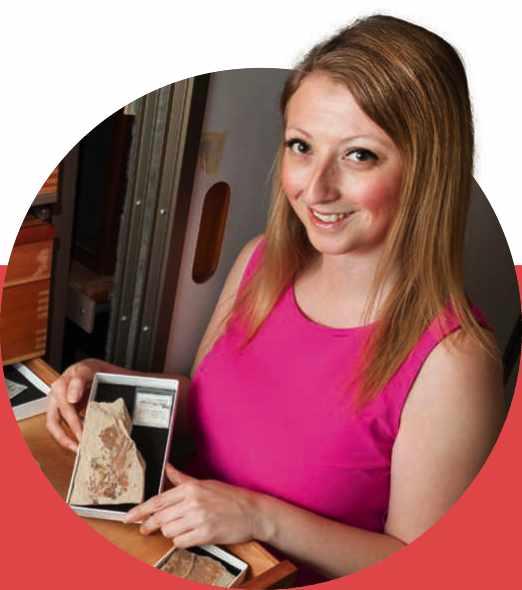
60 SECONDS WITH… EMMA BERNARD
By Neena Percy
Who are you and what do you do?
I’m the curator of fossil sh, which means I’m responsible for looking after more than 100,000 specimens dating back over 400 million years, from sub millimetre teeth and scales to the biggest bony sh that ever existed, Leedsichthys. Its tail is about two metres long (see it in Jurassic Oceans: Monsters of the Deep). I work with lots of people providing access to our world-renowned collections. My research focuses on sharks: how they evolved and, for some, became extinct. I love that there is always something new to learn and sharing the collections and my knowledge with the public. It really is my dream job.
Does the Museum’s collection reveal new things?
We have millions of specimens in the collection, some of which have been in the Museum for centuries. We are still learning a lot about ancient sh by using modern technology. Recently, a new species of fossil coelacanth was discovered in the
collection, which we have had for over a hundred years. A CT-scan revealed the internal morphology of the sh and, on closer examination, we realised it was a completely new species. It’s one of the great things about having our fantastic collections, and one of the best parts of my job is that I’m always discovering something.
What can we expect at your Dig Deeper talk? When people think of the Jurassic, the rst thing that usually pops into their heads are dinosaurs like T. rex. But underwater there were so many amazing predators and sh that were undergoing huge evolutionary transformations. Alongside other experts, I’ll be talking about the Jurassic sharks’ surprising adaptations, which have made them some of the most diverse and successful predators of today.
WATCH THIS
Hear Emma talk all things sharks, and more, at a Dig Deeper talk in July (see left for details).
Journal Science in focus
The lowdown
What?
The Nature of the Beast project, funded by the Natural Environment Research Council (NERC), part of UK Research and Innovation, investigates how wolves have adapted to changing environmental conditions.
Where?
Researchers compared ancient wolves from British Ice Age sites with modern wolves from Poland.
When?
Two warm ‘interglacial’ periods between the Ice Ages were examined: 120,000 years ago and 200,000 years ago.
Ancient truths in teeth
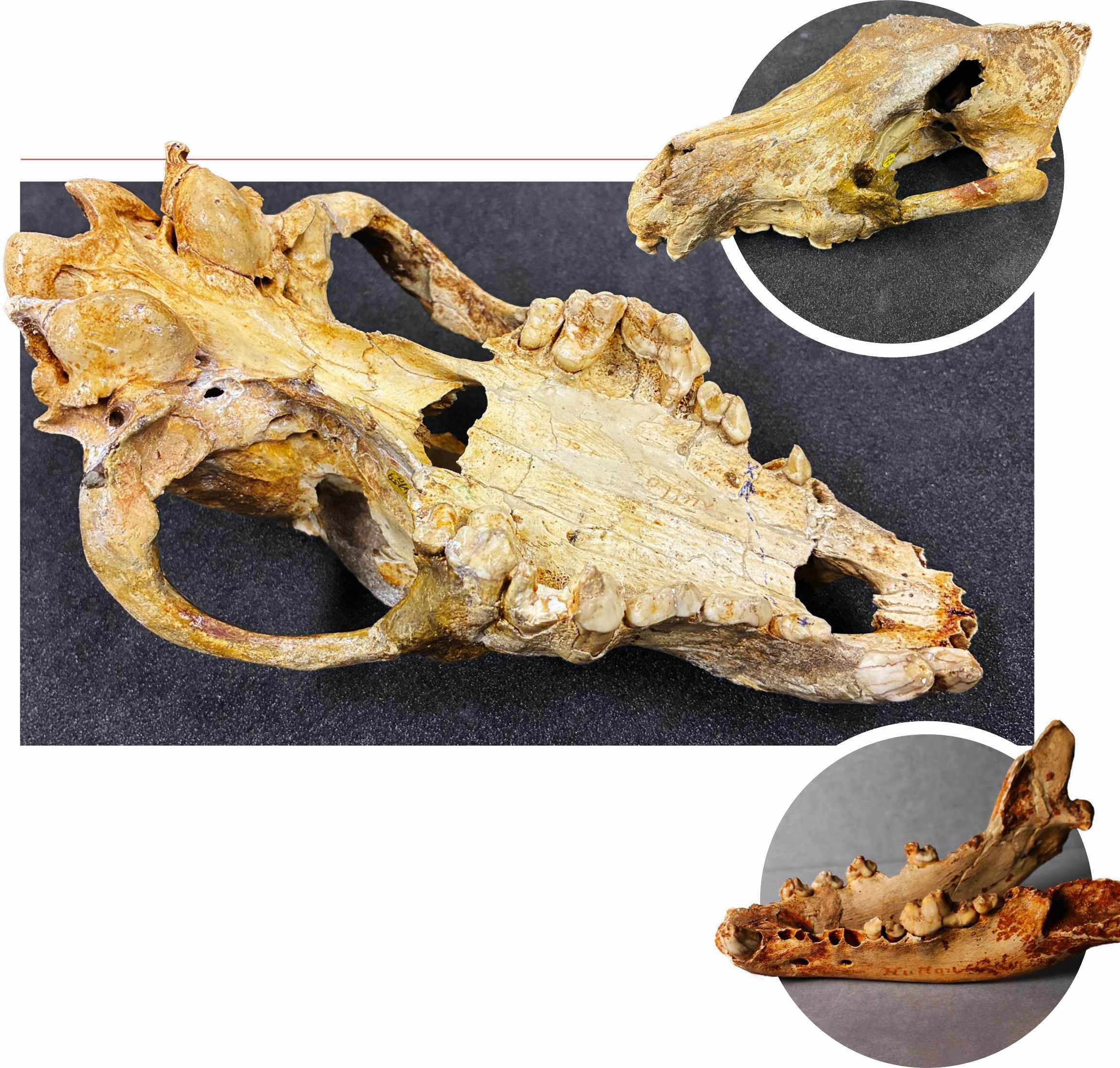
Ancient wolf teeth in the Museum’s collections are revealing how past warm periods shaped wolf survival. Curator of Fossil Mammals Dr Neil Adams explores how these clues from long-extinct wolves can help protect modern populations in a warming world.
Grey wolves are iconic and charismatic mammals, and for nearly half a million years they have been important apex predators across the northern hemisphere.
Having survived multiple periods of climate change, it’s perhaps unsurprising that modern wolves are not currently considered threatened by climate warming, according to the International Union for
Conservation of Nature. Even so, an important question remains: is the wolf’s adaptability enough to keep the species secure in the future?
To explore this, researchers have turned to warm periods in the past, using museum specimens to understand how wolves responded to earlier episodes of climate change.
Wolf teeth held in British museum collections formed the basis of a new study led by
Fast fact
One of Britain’s most complete Ice Age wolf skulls, dating to 200,000 years ago, was discovered in Hutton Cave, Somerset.
the University of Bristol, which reconstructed wolf diets during two warm intervals between Ice Ages. The rst was the last interglacial, 120,000 years ago, when summers were several degrees warmer than today and winters were mild. The second was the cooler penultimate
interglacial, which was 200,000 years ago, when summers were similar to today but winters were much colder.
Dental diaries
The team reconstructed wolf diets by analysing tiny marks on tooth surfaces created during feeding, known as microwear. Crushing hard foods, such as bone, leaves deep pits and coarse gouges on the enamel, while shearing through softer foods, like esh, produces simpler surfaces with shallower, more aligned features.
Wolves from the warm interglacial 120,000 years ago showed microwear patterns indicating hard diets. While in contrast, wolves from the cooler penultimate interglacial 200,000 years ago had microwear consistent with softer diets. This pattern aligns with what we know from wolves today.
Harsh winters improve wolf hunting success. Deep snow weakens herbivores by limiting access to plant food and slows their escape from hunting, meaning wolves can feed more on soft esh. In warm winters, prey animals remain stronger and harder to catch, forcing wolves to consume more of each carcass, including bones, to survive.
Strikingly, the microwear of modern Polish wolves closely matches that of wolves from the last warm interglacial, which suggests similarly intense carcass processing. Some wolf populations may cope by exploiting new food sources in human-dominated landscapes, scavenging roadkill or hunting deer on farmland. But wolves living in remote areas may struggle to nd enough food.
This study identi es shifts towards harder diets as a sign of ecological stress in wolves. It also suggests that climate warming and milder winters should be factored into future conservation planning, as changing conditions may push wolves to rely more heavily on bone and other tough foods.
Studying tooth microwear
Microscopic scratches and pits on tooth enamel – known as ‘microwear’ –reveal what animals were eating. By studying these marks on modern and ancient teeth, scientists can reconstruct past diets and understand how di erent species responded to environmental change and climate warming.
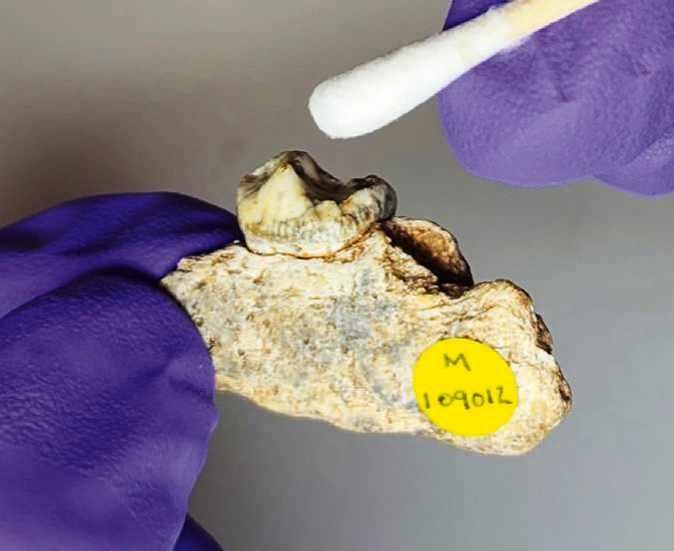
Clean the teeth
The process begins by gently cleaning each tooth with cotton swabs soaked in acetone and ethanol. This removes dirt and surface contaminants, revealing the enamel surface. Teeth coated in thick glues or consolidants are avoided, as these materials can obscure the tiny microwear features that researchers need to observe.
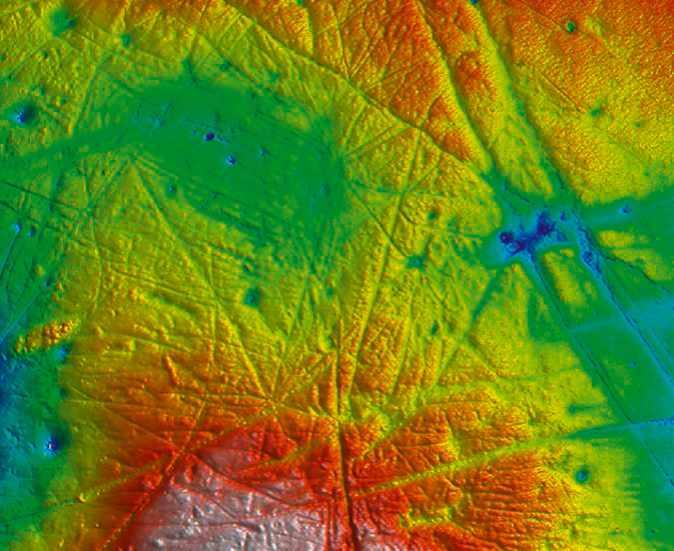
Scan replica tooth surfaces
1 3 2 4
The replica casts are scanned using a microscope, producing high-resolution 3D digital models of the enamel surface texture. For this study, 29 teeth from ancient Ice Age wolves were scanned and compared with 22 teeth from modern wolves. These detailed models record every pit, scratch and groove created during feeding.
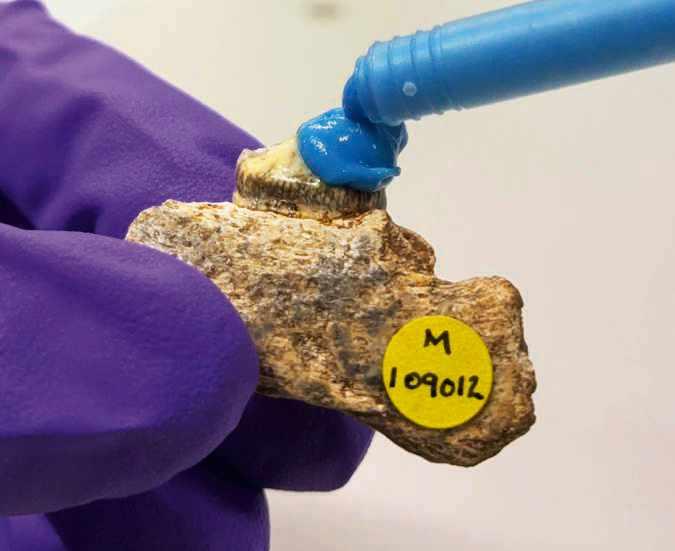
Make moulds and casts
High-quality replicas of the tooth surfaces are created so scientists can study them under powerful microscopes without risking damage to the original specimens. A moulding compound is applied to the areas of interest, capturing even the nest microscopic features. Once the mould has set, epoxy resin is poured in to produce a durable cast.
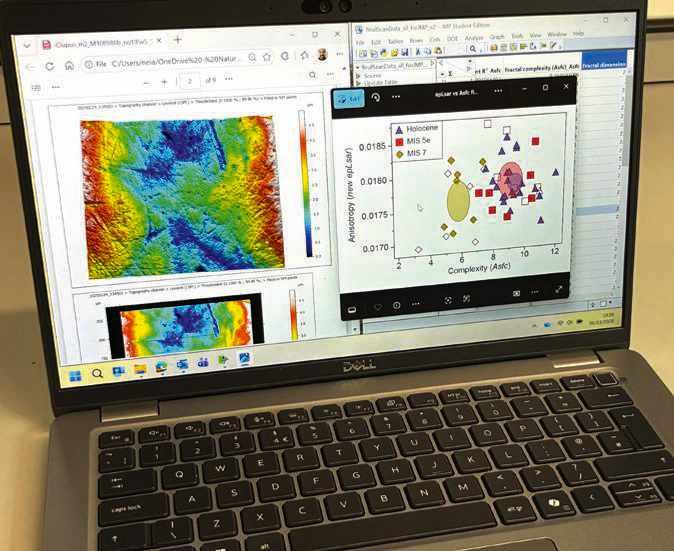
Analyse microwear texture
Researchers measure surface textures, converting them into numbers for statistical comparison. This allows microwear textures from di erent times to be compared. Wolves living 120,000 years ago and modern wolves both have complex, deep wear marks, revealing hard diets, including bone, and how the environment shaped feeding behaviour.
Journal Inside story
‘Shaping how our heritage is cared for inspires me every day’
Senior Conservator Efstratia Verveniotou tells us about her work on the Museum’s collections as they are readied for display.
What do you do at the Museum?
My life in a nutshell
I grew up on the island of Lesvos, in the Aegean Sea, and for a time I struggled to be anywhere that I couldn’t see or smell the sea.
On visits to the UK’s museums, I realised I wanted to be part of this world – helping shape how our heritage is preserved and interpreted for future generations.
I used to struggle with trypophobia, which is when dense, repetitive patterns can feel unsettling.
Spending hours studying and conserving the giant Turbinaria coral – now on display in Hintze Hall – cured me of it.
I lead conservation for the Museum’s permanent galleries and exhibition projects. We often say that conservation holds everything together: caring for specimens so they remain safe, stable and accessible for display and research. My role has evolved over the years and now focuses on preparing specimens for exhibition, assessing their condition, designing treatments, overseeing complex installations and advising on mounts and displays. I work closely with curators, engineers, the exhibitions team and interpretation colleagues to ensure our specimens are looked after properly.
What was your career path to becoming a conservator?
I began in archaeology, which made me realise how much I cared about what happens to a specimen after it is excavated. I trained as an object conservator in Cardi , followed by getting a masters in collection care, which covers the full life cycle of a specimen – from its arrival to its long-term preservation. Conservation is grounded in material science, but also relies on dexterity and hands-on skills developed through practice. It’s a problem-solving discipline that brings together people from many backgrounds, blending science and art.
What’s the most challenging specimen conservation project you’ve worked on?
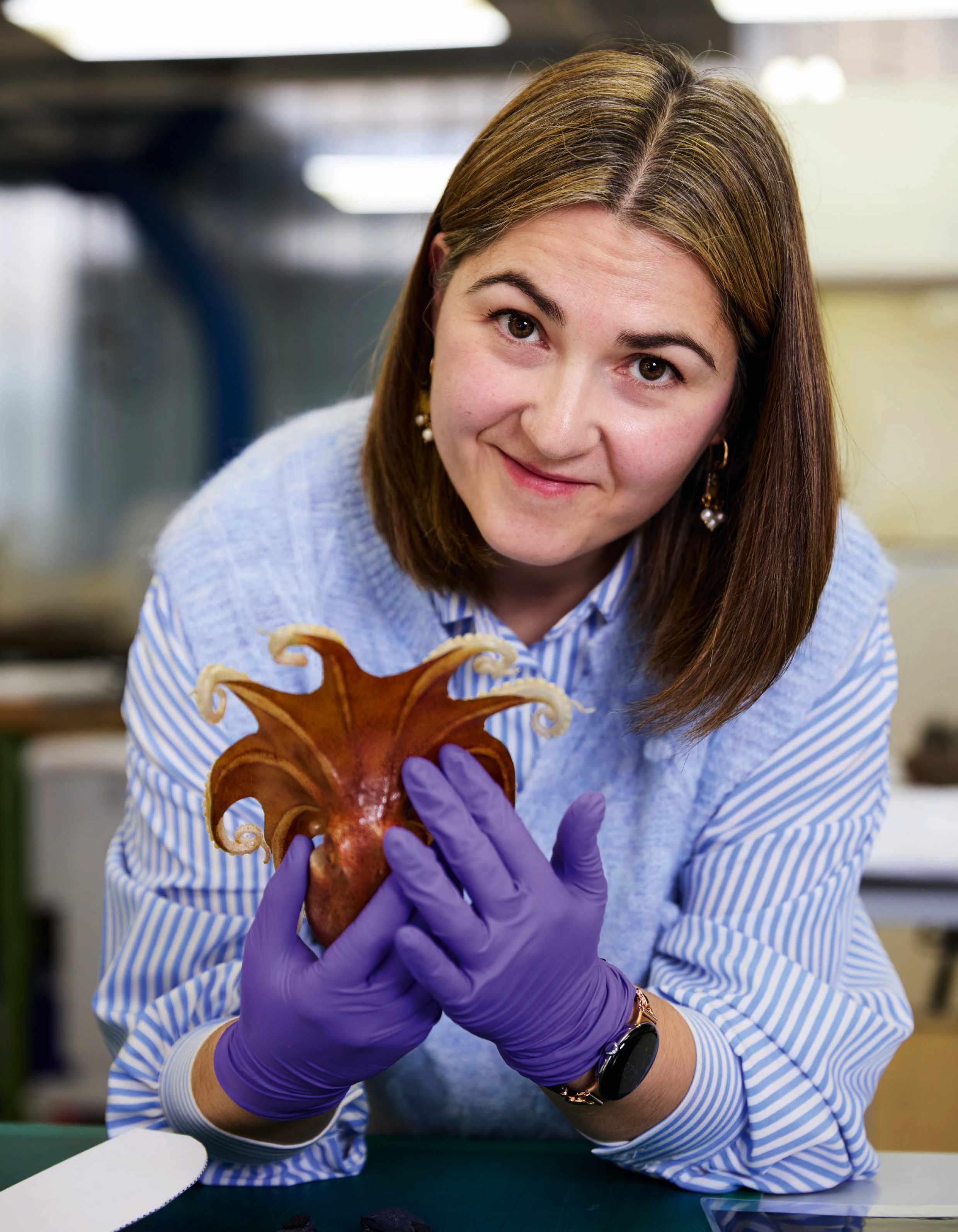
I’m drawn to complex and unusual specimens with layered histories. One example is our beautiful Blaschka models (octopus pictured), which combine extraordinary artistry with scienti c precision in a way that has never truly been replicated. They are made from transparent and coloured glass, shaped over a ame and reinforced with ne metal wires. Paints, water soluble pigments and glues add detail and structural integrity.
As these materials age, they become fragile, so conservation can be challenging – identifying compatible repair materials and preventing fading requires careful research and testing. They were created to be seen, and it’s both a responsibility and a privilege to help keep them visible, not hidden away.
I also appreciate the challenge of reconstructing specimens that have been catastrophically broken – which is, thankfully, rare – where careful work can return something once thought lost back to display.
In terms of gallery content, I especially enjoy displays that bring together a wide range of specimens. My favourite is the ve South Balcony cases: a little of everything we care for, beautifully presented in historic cases.
What upcoming project most excites you?
I’m excited to bring more specimens out of storage and back into our galleries for visitors to appreciate. One example is our Sowerby fungi models, which are a very early example of science outreach created in the late eighteenth century to educate the public about edible and poisonous mushrooms. They were damaged during World War II, but, after careful conservation work, they are back to their full glory, totally restored and ready to be displayed as originally intended. I’m also excited and humbled to contribute to NHM150 (the Museum’s major transformation programme leading up to its 150th anniversary in 2031 nhm.ac.uk/support-us/nhm150). I’m helping to shape and deliver a new gallery every year to 2031, ensuring they inspire visitors for generations to come.
What inspires you about the Museum?
The collections and the Waterhouse building are constant sources of inspiration, but it’s the people I work with across the Museum who inspire the child inside me. When I began my career here, I never imagined I would stay so long. But one of the Museum’s greatest assets is the people who work here, whose passion and enthusiasm keep my sense of curiosity and wonder alive. O
Journal Exceptional specimens
Nature’s undertakers
Beetles play many vital ecological roles, but few are as striking as the work of the burying beetles. These remarkable insects specialise in recycling small carcasses, which helps to keep terrestrial ecosystems healthy.
Scienti c
name
Nicrophorus humator and Nicrophorus investigator
Chosen by
Talay Namintraporn and Max Barclay
Science Background
Coleoptera Curation Team
Beetles are one of the most diverse groups of organisms on Earth, with more than 400,000 species named so far. They make up around a quarter of all known animals. The Museum is home to about 10 million beetle specimens, representing roughly 250,000 species, and making it one of the world’s most comprehensive and scienti cally important collections.
DID YOU KNOW?
Beetle larvae beg adults for food much like baby birds. But begging too persistently can be dangerous – a larva that demands too much risks being eaten, especially when food is limited.
Burying beetles – also known as sexton beetles, after the caretakers of church cemeteries – can detect the scent of decay from long distances. Many individuals may arrive at the same carcass, leading to erce competition as rivals ght for the right to claim it. The successful male and female then work together to bury the body by excavating soil from beneath it, protecting it from scavengers. They skin the carcass and coat it with antimicrobial secretions, before the female lays her eggs on it.
Parental care is rare among beetles, but burying beetles are an exception. Adults stay with
‘Parental care is rare in beetles, but burying beetles are an exception.’
The lowdown
Backyard beetles
The black Nicrophorus humator and the red-striped Nicrophorus investigator are both common in northern Europe. They represent two of the six Nicrophorus species that are found in the UK.
Long-distance yers
Nicrophorus beetles have large wings folded beneath their protective wing cases. Because carrion is scarce, they must travel long distances to nd it – and their large wings make that possible.
the brood, feeding the larvae with the carrion until they are ready to pupate. The level of care varies between species: if the parents die or leave the nest after laying eggs, some larvae are able to feed themselves.
Females may mate away from a carcass and care for larvae on their own if necessary. Multiple pairs can also breed on a single large carcass. Once the larvae complete their development and pupate, the long-lived adults disperse to nd new carrion.
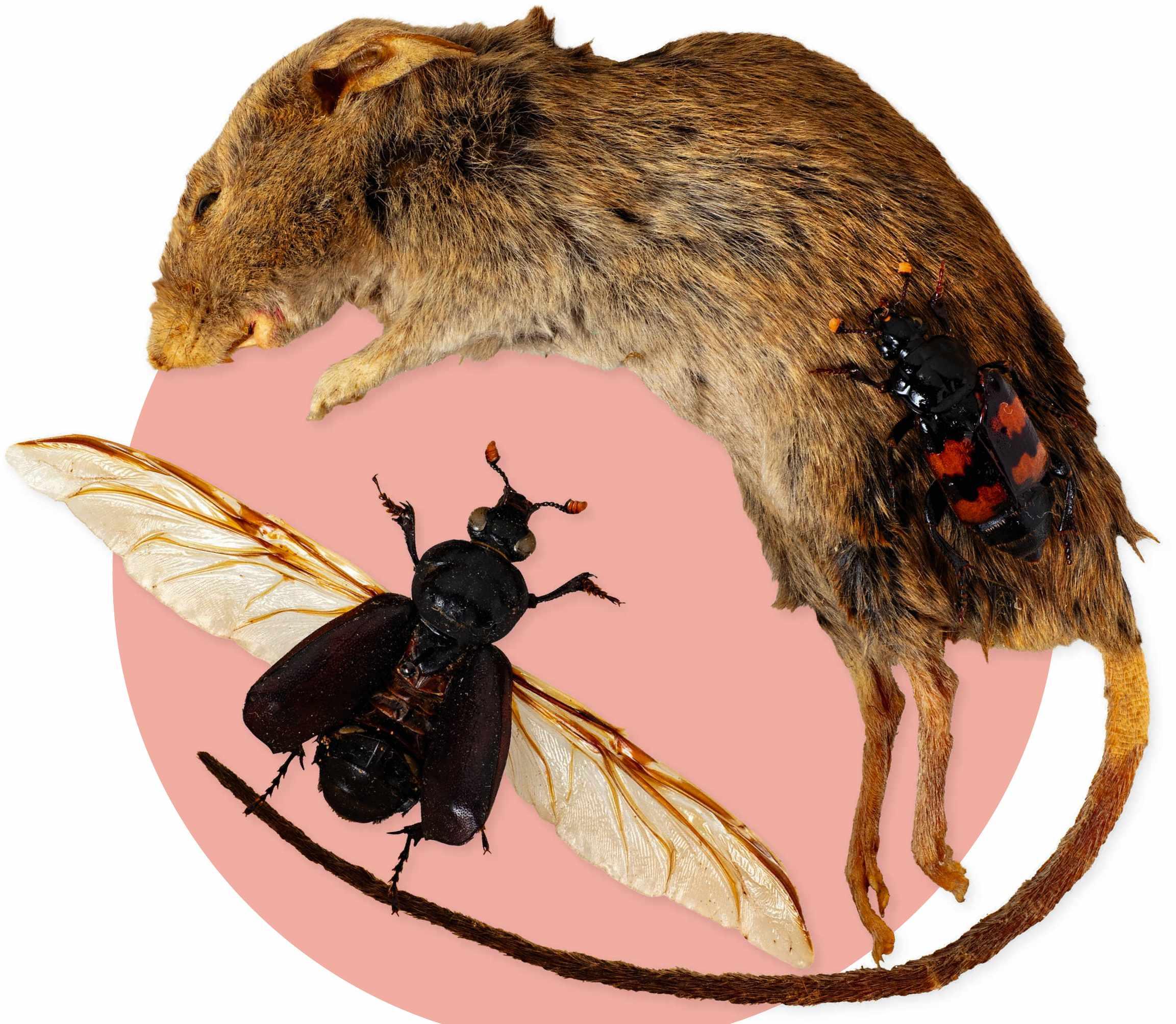
These specimens represent two common species found in northern Europe: the black Nicrophorus humator and the red-striped Nicrophorus investigator. They are displayed with a dead mouse to illustrate their natural behaviour around carrion.
Unlike many beetle groups, burying beetles are most diverse and abundant in the temperate northern hemisphere, with only a few tropical species known. The largest, the American burying beetle (Nicrophorus americanus), can reach 4.5cm in length. Once widespread across eastern North America, from southern Canada to Texas, it had declined to just a few known populations by the 1980s for reasons still not fully understood. Its protection under federal law has helped some populations begin to recover. O
The Piano Mouse
This mouse was found dead inside a piano in the former Members’ Room in the 1970s. It was displayed with Nicrophorus beetles in the ‘Insects’ exhibition, the predecessor to the Creepy Crawlies gallery.
Parents with a purpose
The variation in parental care makes burying beetles valuable for behavioural and evolutionary research. Their predictable life cycles and clear developmental stages also make them excellent study species.
Help us to better understand the decline of burying beetles. Recording schemes and apps such as iRecord help scientists track changes in their distribution and support conservation e orts. HELP US WITH OUR RESEARCH
If a mouse dies on hard ground, the beetles will drag it to softer soil so they can bury it. Many burying beetles die on roads because they cannot dig through the surface to bury roadkill.
Detecting the dead
Burying beetles are uniquely adapted to detect carrion. Scent detecting aps located on their antennae allow them to pick up the smell of a corpse from more than a kilometre away.
Deadly lights
These beetles are attracted to arti cial light and often y towards it at night. Light pollution may contribute to their decline by distracting them from nding food and mates.
Bumblebee pretenders
Several black and red Nicrophorus species mimic bumblebees, copying their bold colours and shape. Some even imitate the buzzing sound bees make in ight, a form of acoustic mimicry that helps deter predators.
Two species of burying beetle are competing for this mouse. The red and black Nicrophorus investigator reached it rst, but the larger Nicrophorus humator may overpower it. Only one species will ultimately claim and bury the carcass.
Mini hitchhikers
Burying beetles often carry phoretic mites. These harmless hitchhikers use the beetles as transport between carcasses, where they feed and complete parts of their life cycle.



d of M s the




DID YOU KNOW?
Some pliosaurs had skulls over two metres long and teeth the size of bananas, but obviously much sharper!
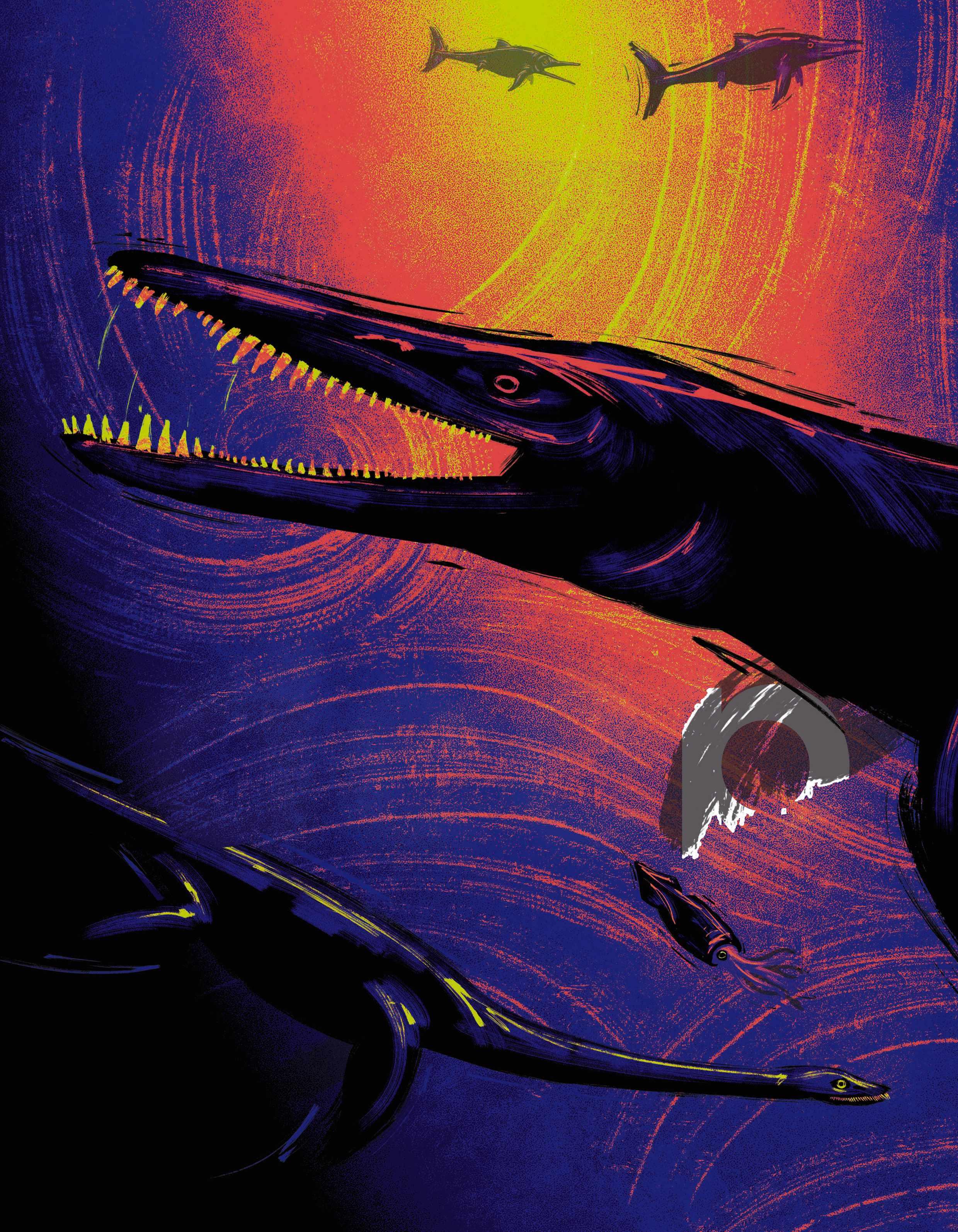
While dinosaurs ruled the land, giant marine reptiles dominated Jurassic oceans, evolving remarkable adaptations to hunt and survive. Dive into our new exhibition Jurassic Oceans: Monsters of the Deep to meet these extraordinary predators.
WORDS: JAMES ASHWORTH, AMY POLLAK & SOPHIE
STAFFORD
Millions of years ago, in the age of the reptiles, dinosaurs roamed the land and pterosaurs soared through the skies – but beneath the waves, another group of giant reptiles ruled the oceans. These marine reptiles were the dominant predators of the Jurassic seas, as formidable in the water as their relatives were on land and in the air.
During this period, higher sea levels created extensive warm, shallow seas that supported coral reefs and a wide variety of life. Though not necessarily more diverse than today’s oceans, Jurassic seas were di erent. The environmental conditions of the time allowed marine reptiles to diversify and thrive.
As top hunters, marine reptiles were well adapted to life in the water. There were many species of ichthyosaur – with streamlined, dolphin-like bodies – of varying sizes and with di ering hunting techniques. Pliosaurs used four powerful ippers and large jaws to tackle bigger prey, while marine crocodiles with smooth skin and ippers darted after sh, and other crocs with blade-like teeth hunted giant sea turtles. These adaptations made Jurassic marine reptiles highly e ective at catching prey.
Top predators
Jurassic marine reptiles were part of complex marine ecosystems and, like modern ocean predators, they played a crucial ecological role. Their erceness is a result of being well adapted to hunt and catch food to survive and their presence is a sign of whole-ecosystem health. Predators help regulate the numbers of the animals they feed on, including smaller predators, which in turn protects life at the base of the food web. When one part of an ecosystem declines or disappears, the e ects ripple outwards, but the decline of some species has a bigger impact than others.
Most ancient marine reptiles went extinct after the asteroid strike 66 million years ago.
Described and named in 2006, Futabasaurus is a genus of plesiosaur.
Most ancient marine reptiles went extinct after the Jurassic following the drastic environmental changes triggered by the asteroid strike 66 million years ago, which marked the end of the Cretaceous period. Ichthyosaurs, however, vanished long before this. Many species relied heavily on squid-like belemnites for food, and as their prey declined, ichthyosaurs may have struggled to survive and reproduce. Combined with other shifts in ocean environments, this could have contributed to their earlier extinction.
Past and present ecosystems
Despite the vast time separating us from the Jurassic, and the di erence in species, today’s oceans share many similarities with those ancient ecosystems. Tiny plankton still form the base of the food web, supporting animals such as crustaceans, sh, sharks, jelly sh, turtles and squid, which feed on these organisms – and on each other. Larger predators sit at the top, thriving on this abundance and, after death, becoming food for others themselves.
Marine reptiles still exist today, including sea turtles, sea snakes, crocodiles and water monitors (lizards), but they are generally less widespread and diverse than their Jurassic relatives. Since the extinction of the ancient marine reptiles, the top predator roles have been taken over by other
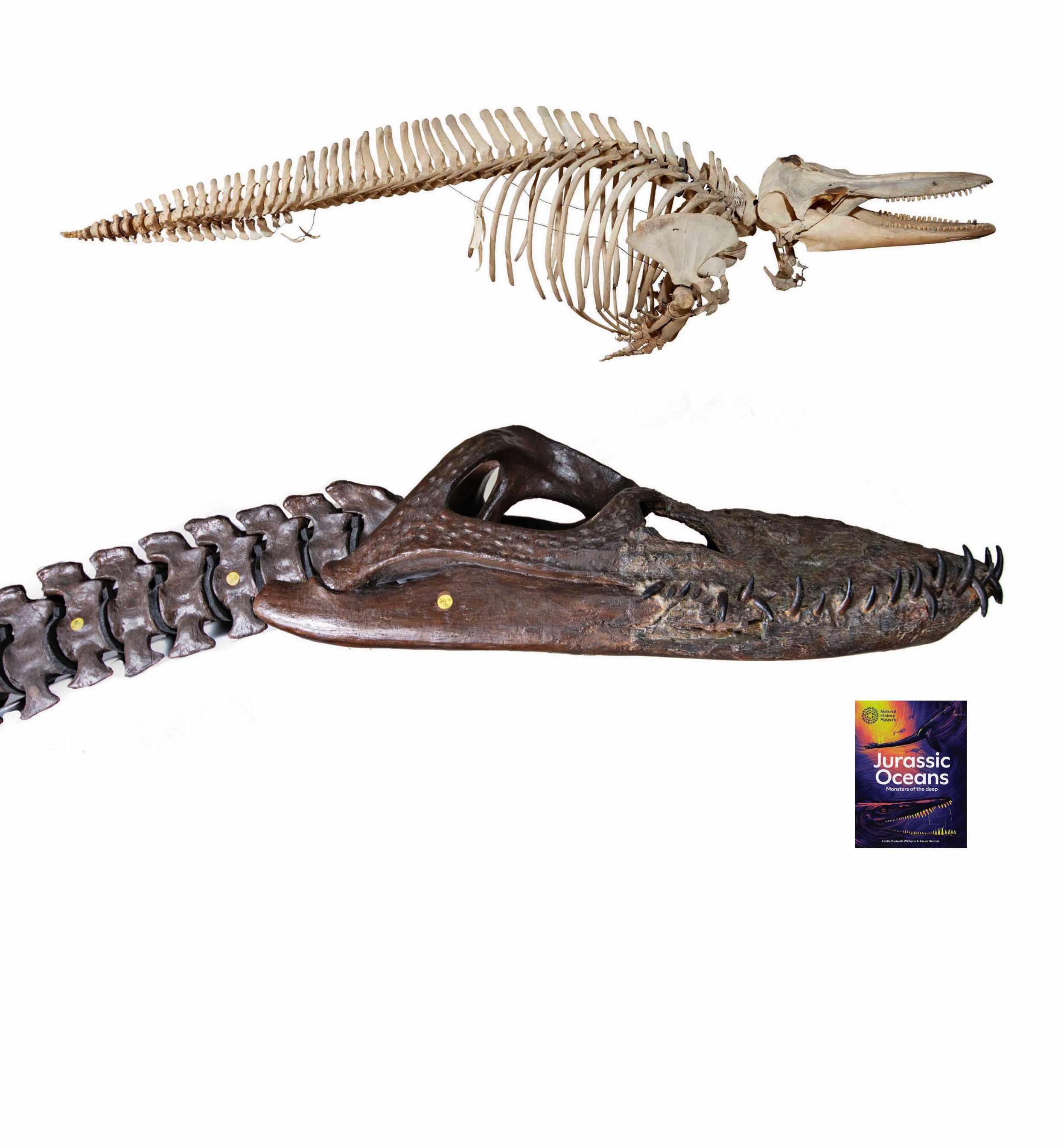
large hunters that evolved later, such as whales, sharks and seals. Many of these animals hunt in similar ways or pursue similar prey to the predators that came before them. Dolphins and ichthyosaurs, for example, share not only a strikingly similar body shape but also comparable adaptations for fast, agile hunting.
Ocean predators past and present are vital to the health of marine ecosystems. Their presence –then and now – is a sign that the seas are thriving. When predators are lost, food webs can become unbalanced, with consequences that a ect many species, including humans. Studying ancient marine reptiles helps scientists understand how ocean ecosystems responded to major environmental changes in the past. That knowledge can be used to understand what we see in today’s oceans. By looking back at these long extinct animals, we gain a clearer picture of how marine life has changed over millions of years and how it may change in the future.
The like of these Jurassic predators has never been seen again. Our new exhibition Jurassic Oceans: Monsters of the Deep o ers a rare chance to get closer to ichthyosaurs, mosasaurs and plesiosaurs, among other marine reptiles, and explore the underwater world they once dominated. ●
Dolphins (above) and ichthyosaurs not only look similar but, due to shared adaptations, have similar hunting techniques.
Buy the book
Jurassic Oceans: Monsters of the Deep reveals the evolution, behaviour and ecosystems of Earth’s most remarkable marine reptiles. Priced £9.99, Jurassic Oceans: Monsters of the Deep is available from the Museum’s Shops and online at nhmshop.co.uk
The real sea dragons
Sleek, fast and superbly adapted to life in open water, ichthyosaurs evolved into some of the most extraordinary hunters ever to patrol Earth’s oceans. Their fossils reveal a lineage that dominated for more than 150 million years. Their streamlined bodies were the result of convergent evolution – the same process that shaped modern dolphins. Early scientists struggled to classify them because their skeletons resembled sh, crocodiles and whales all at once,
⑧ Vertical, crescent-shaped tail n providing strong propulsion.
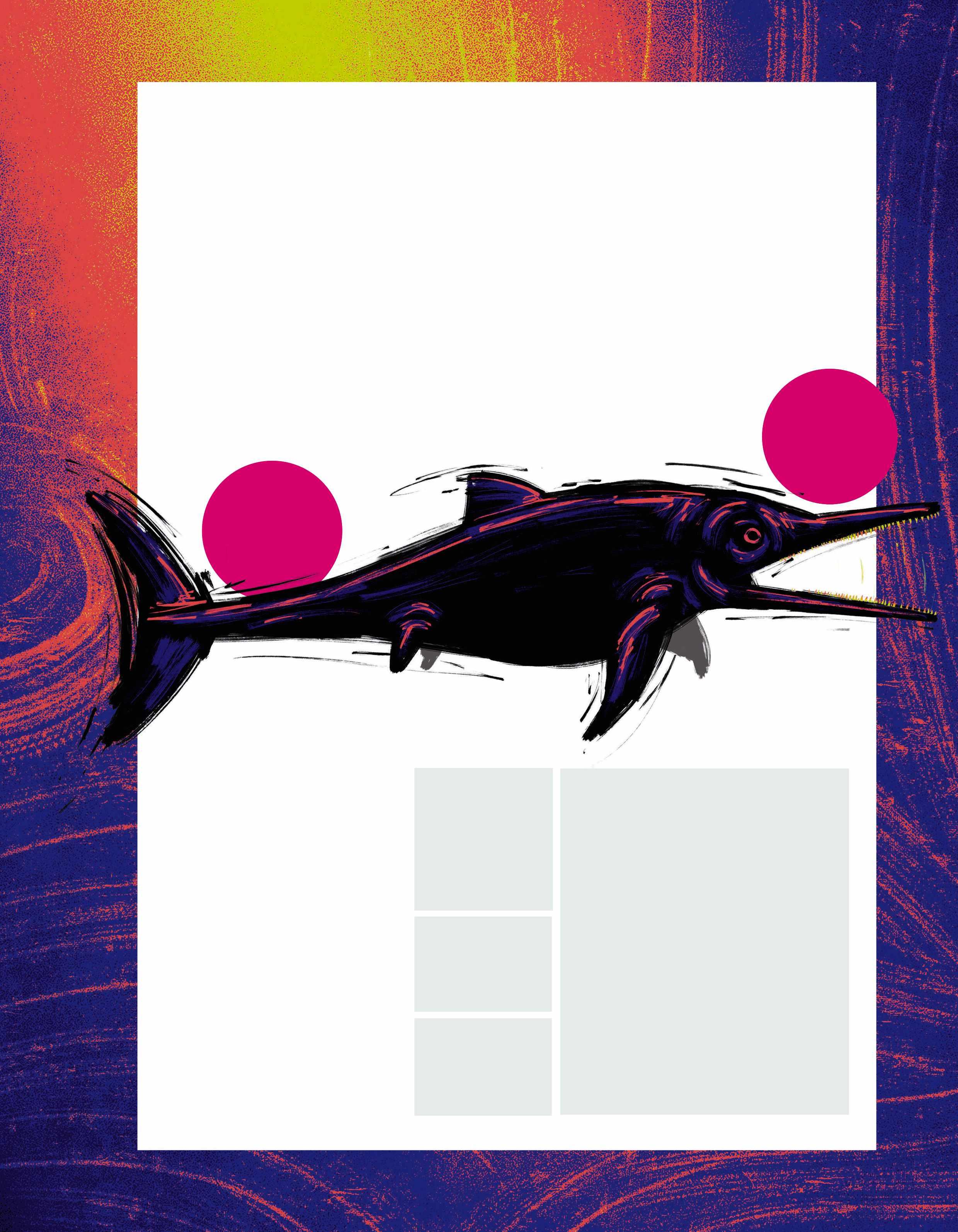
a testament to how completely they had adapted to ocean life.
From the moment they appeared in the fossil record, ichthyosaurs were formidable hunters. Some early species, such as Cymbospondylus, grew up to 17 metres long and were armed with sharp teeth for seizing sh, squidlike belemnites and other prey. Others had rounded teeth for crushing shelled animals like ammonites, while generalist species fed on almost anything they could catch. Fossilised stomach contents show just how powerful they were: one Guizhouichthyosaurus died after swallowing a crocodile-like thalattosaur nearly as large as itself. Their bodies were built for speed and stealth. Soft tissue fossils reveal smooth, streamlined skin and powerful ippers, including a dorsal n rst recognised in the 1890s.
Counter-shaded colouring – dark above, pale below – made them almost invisible, whether viewed from above or below.
Many ichthyosaurs were deep divers. Species such as Ophthalmosaurus had some of the largest eyes in the animal kingdom, allowing them to hunt in near darkness. Fossils show they were likely warm-blooded and insulated with blubber, enabling them to survive and hunt in cold, deep waters long before whales evolved similar traits.
The giants of the family were the shastasaurids, which ruled the oceans for around 30 million years. Among them, the largestknown ichthyosaur, Ichthyotitan severnensis, may have reached 25 metres, rivaling the blue whale.
Though ichthyosaurs vanished around 90 million years ago, their fossils reveal a dynasty of agile, powerful hunters whose adaptations shaped marine ecosystems for millions of years.
10 Huge eyes in some species for seeing in low-light conditions at depth.
⑨ Long, pointed snout lined with numerous small, sharp teeth.
Ichthyosaur
Lived: Late Permian (>252 million years ago) to mid-Cretaceous (~90 million years ago)
Size: From small dolphin-like forms to giants up to c25m
Diet: Fish, squid, shelled animals and other marine reptiles
Built for high-speed pursuit
① Streamlined, dolphin-like body for fast, e cient swimming.
② Large ippers and a dorsal n for stability and manoeuvrability.
③ Smooth skin and hydrodynamic body shape for reducing drag.
④ ‘Wing tips’ – winglet-like structures on their ippers – helped some species move quietly and stealthily underwater.
⑤ Specialised teeth – sharp for seizing prey, rounded for crushing shelled animals, or generalist for mixed diets.
⑥ Paddle-like limbs adapted into sti ippers for steering.
⑦ Pigmented skin: some species were counter-shaded (dark above, light below) for camou age.
The last ocean titans
Mosasaurs were the undisputed rulers of the oceans in the nal chapter of the Cretaceous Period. The mosasaur’s ancestors had already begun adapting to life at sea, developing the ippers and long, muscular tails that would eventually help to power their descendants through ancient waters.
By around 94 million years ago, the rst true mosasaurs had appeared – predators perfectly
Mosasaur
Lived: Late Cretaceous
Size: Many species were 10–15 metres but some exceeded this
Diet: Fish, squid, ammonites, turtles, other marine reptiles
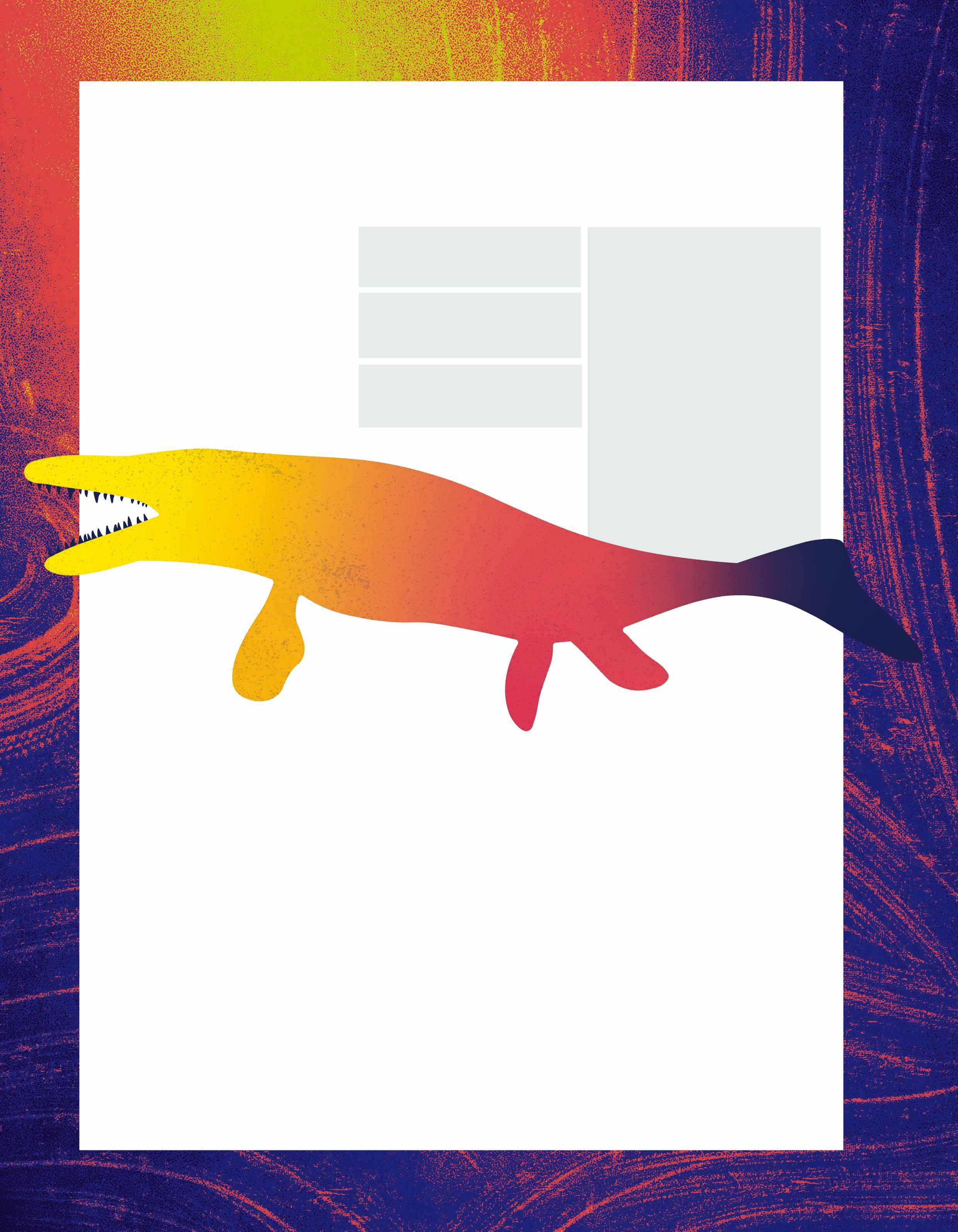
suited to a world that was undergoing dramatic change.
As ichthyosaurs and pliosaurs vanished in the face of severe global warming and collapsing marine ecosystems, mosasaurs seized the opportunity. Their bodies became increasingly streamlined and powerful, driven by a large, downward pointing tail n that propelled them through the water with speed and precision. Strong, paddle-shaped ippers gave them control as they hunted across vast seaways stretching from Canada to Antarctica. Their skulls reveal just how formidable they were. Some of the joints allowed parts of the skull to move independently from one another, in particular the bone that supported the ear and lower jaw. Along with a hinge in the
⑥ Limbs evolved into strong, paddle-shaped ippers.
lower jaw it meant mosasaurs could swallow prey far larger than would be expected. Some species had reinforced snouts for ramming, while others bore sawlike or crushing teeth specialised for slicing esh or cracking ammonites. Fossilised stomach contents show they ate sh, squid, sharks, plesiosaurs – and even other mosasaurs.
Their skin added another layer of advantage. Relatives such as Plotosaurus had snake-like scales that reduced drag, and one Tylosaurus fossil even preserves black pigmentation, hinting at camou age in deep or murky waters. Warm-blooded tendencies
Built for powerful ambush hunting
① Large skull with robust, double-hinged jaws and conical, recurved teeth.
② Flexible skull joints allowed a wide gape and ability to swallow large prey.
③ Streamlined torso suited to fast, ambush-style swimming.
④ Scaly skin, similar to modern monitor lizards, re ecting their close evolutionary relationship.
⑤ Probably warm-blooded enough for them to sustain high activity levels.
⑦ Long, muscular body with a powerful, shark-like tail n for propulsion.
in some species allowed them to thrive anywhere from tropical oceans to polar seas, and fossils of pregnant individuals show they gave birth to live young, freeing them from any need to return to land.
By the end of the Cretaceous, mosasaurs were ourishing, with as many as 16 species living side by side in some regions. Their reign ended only when the asteroid impact 66 million years ago triggered a rapid collapse of marine food chains. Until that moment, they were among the most specialised, adaptable and fearsome predators the oceans have ever known.
Masters of marine grace
With broad torsos, long necks or massive skulls, and four wing-like ippers, plesiosaurs were de ned by a body shape unlike anything alive today.
First appearing more than 200 million years ago, they went on to thrive in seas across the globe, adapting into an extraordinary range of forms with di erent hunting strategies.
Their four powerful ippers were their most remarkable adaptation. Working in synchrony, these limbs generated thrust with exceptional e ciency. Experiments with robotic models show that by precisely timing the strokes of their front and back ippers, plesiosaurs could produce more power than with either pair alone, giving them speed, manoeuvrability and control.
Plesiosaurs came in many shapes and sizes, but two groups dominated the oceans as apex predators. The pliosaurs, with short necks and enormous skulls, grew to gigantic proportions. Species such as Pliosaurus reached lengths of 10–13 metres, armed with huge jaw muscles and ridged, conical teeth capable of killing large prey. Some, like Liopleurodon, could even sense the movement of animals in the water through nerves on their snouts.
Fossil evidence shows they fed on large sh, squid-like belemnites, ichthyosaurs and even other plesiosaurs, while
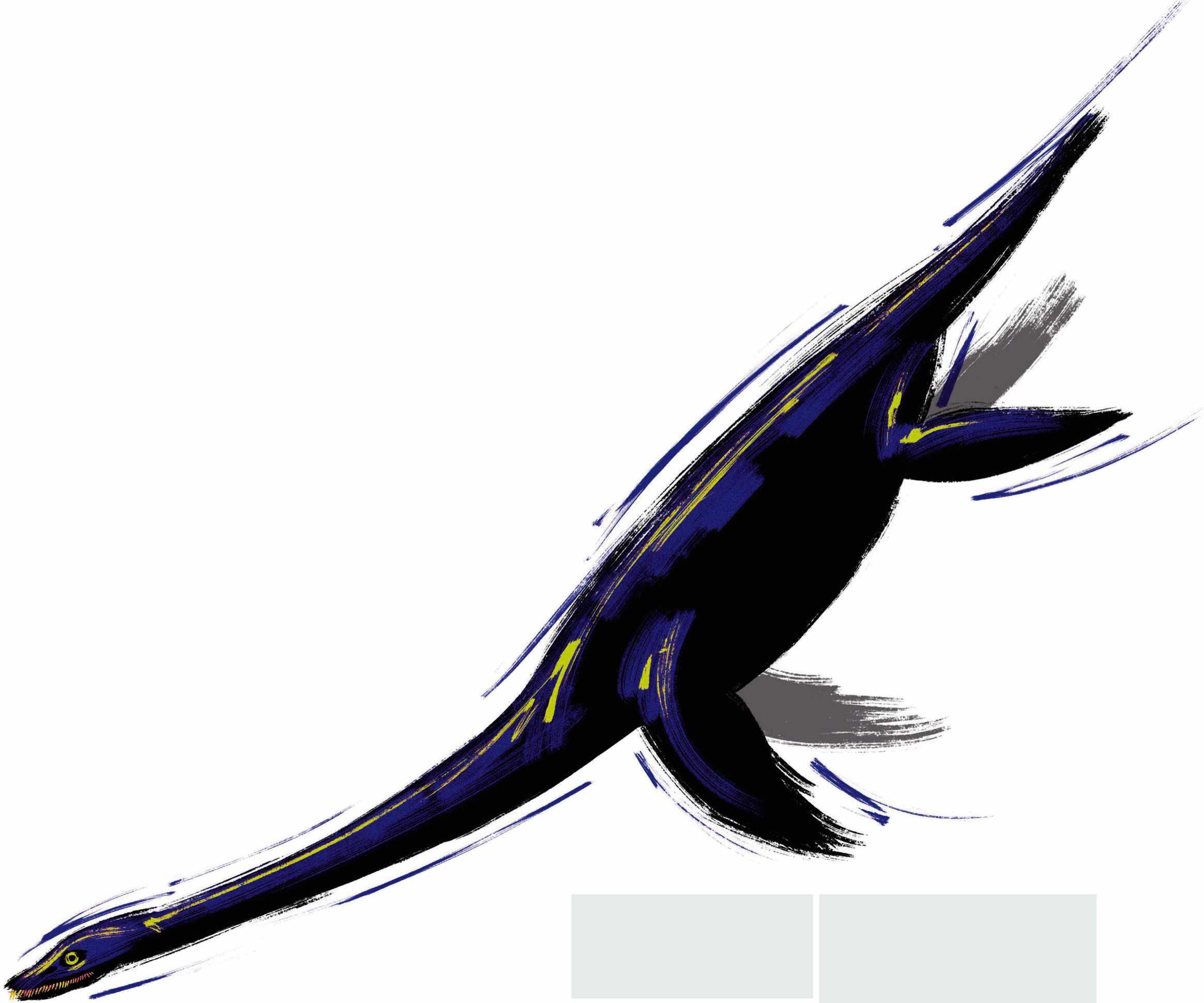
⑤ Teeth conical and interlocking, suited to gripping slippery prey.
tooth marks reveal they also scavenged dinosaurs that had washed out to sea.
At the opposite extreme were elasmosaurs, whose astonishingly long necks – sometimes containing more than 70 vertebrae – allowed them to strike prey with precision. Once imagined as swan-like and exible, their necks were far sti er than early reconstructions suggested. This may have helped them sense movement in the water or sneak up on prey.
Plesiosaurs were also resilient. When volcanic eruptions ended the Triassic Period and wiped out many other marine reptiles, plesiosaurs survived by exploiting the open ocean. With many competitors gone, they diversi ed rapidly during the Jurassic and Cretaceous Periods, spreading across the globe. Some species even adapted to freshwater environments, while others ventured into polar seas.
For more than 140 million years, plesiosaurs ruled the oceans. Their reign only ended after the asteroid impact 66 million years ago. What they left behind is a fossil legacy that continues to reveal how adaptable, inventive and enduring these marine reptiles truly were.
④ Streamlined, broad body adapted for stability in open water.
⑥ Four large, wing-shaped ippers used in a unique underwater ‘ ying’ motion.
Lived: Early Jurassic to end of Cretaceous (over 140 million years)
Size: From c3.5m (Plesiosaurus) to giants over 10m (pliosaurs)
Diet: Fish, squid and other marine reptiles; giant pliosaurs were apex predators
EXPLORE THE EXHIBITION
Built for long-range cruising
① Two main body types: long-necked elasmosaurs with small heads, and short-necked pliosaurs with very large skulls.
② Some species had small tail ns that aided steering.
③ Skin impressions show scaly ippers like sea turtles and smoother body surfaces to reduce drag.
Jurassic Oceans: Monsters of the Deep Plunge into the Jurassic deep and meet the ercest predators ever to rule the ocean. This exhibition explores the astonishing diversity of life that sustains these monstrous marine creatures. Find out more: nhm.ac.uk/jurassic-oceans Members and Patrons get free, unlimited entry, do not need to book and have priority access.
Oceans: Monsters of the Deep is generously supported by the Blavatnik Family Foundation.
Plesiosaur
Jurassic
NASA sent two Viking probes to
– to photograph the planet from above and to study conditions on the surface.

The Mar tian mystery
In 1976, Viking 1 and 2 touched down on Mars. Their data didn’t just reshape our view of the planet – it revealed that some meteorites on Earth came from the red planet itself.
WORDS: PROFESSOR SARA RUSSELL
Mars
Fifty years ago, two missions transformed our understanding of Mars. In the summer of 1976, Viking 1 and Viking 2 landed and beamed back pictures and data from the surface of the planet. Each spacecraft carried an orbiter, which stayed in space around Mars to map the surface of the planet in detail, and a lander – designed to touch down gently on the ground – to study the planet up close. These were the rst successful soft landings on another planet, and they carried a suite of instruments designed to search for signs of life.
Information from the Viking mission has been pored over by scientists ever since and has helped shape our understanding of Mars’ geology, evolution, atmosphere and climate. While headlines focused on the life-detection experiments, the missions also changed how we understand some of the most enigmatic objects in museum collections; their measurements provided the key evidence that some meteorites found on Earth were blasted o Mars itself.
At rst glance, the idea sounds almost fantastical: that ancient impacts on Mars could eject rocks into space, travelling millions of kilometres over millions of years, and that some of those fragments could eventually fall to Earth. Yet today this is widely accepted, and Viking played a central role in turning speculation into proof.
‘Viking transformed Mars from an abstract object
into a measurable world’
The two identical Viking spacecraft launched in 1975 and arrived at Mars a few weeks apart in 1976. Their landers used parachutes to reach di erent sites on the ground to study the Martian air and regolith (soil). One of the most sophisticated instruments was a gas chromatograph–mass spectrometer (GCMS), designed primarily to search for organic molecules that might indicate life.
Although it did not nd clear evidence of biology, it did something just as important: it precisely measured the composition of Mars’ atmosphere. It analysed gases such as carbon dioxide, nitrogen, argon and trace noble gases, as well as the ratios of their isotopes. The results showed that Mars’ atmosphere is very di erent from Earth’s, dominated by carbon dioxide rather than nitrogen. At the time, these measurements seemed interesting but not revolutionary. That view would change in the 1980s.
A mystery in the meteorite collection
For more than a century before Viking, the Natural History Museum had been collecting a rare and strange group of meteorites called the SNCs, →
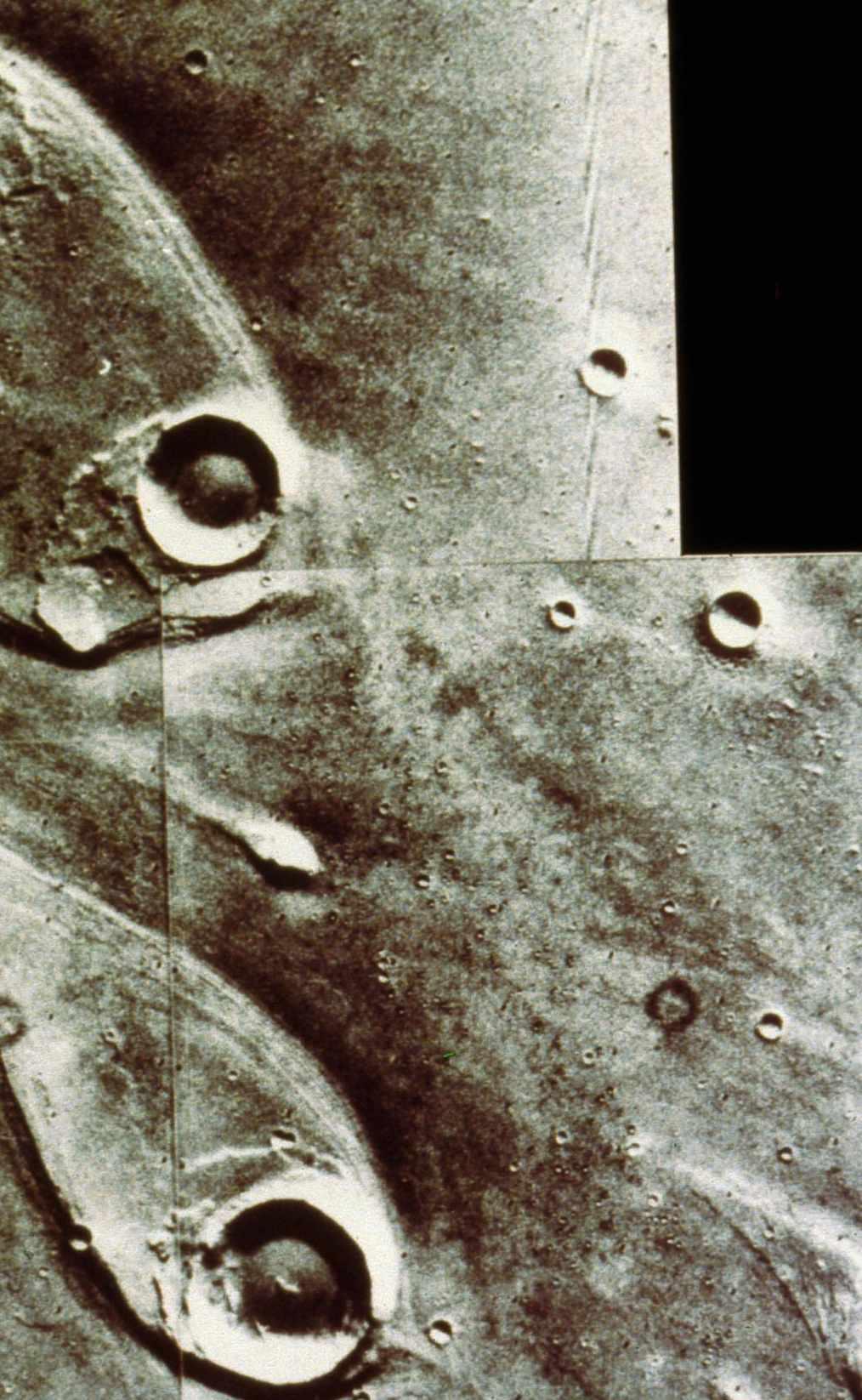
The surface of Mars, photographed by Viking 1 in 1975, shows impact craters where asteroids struck the planet.
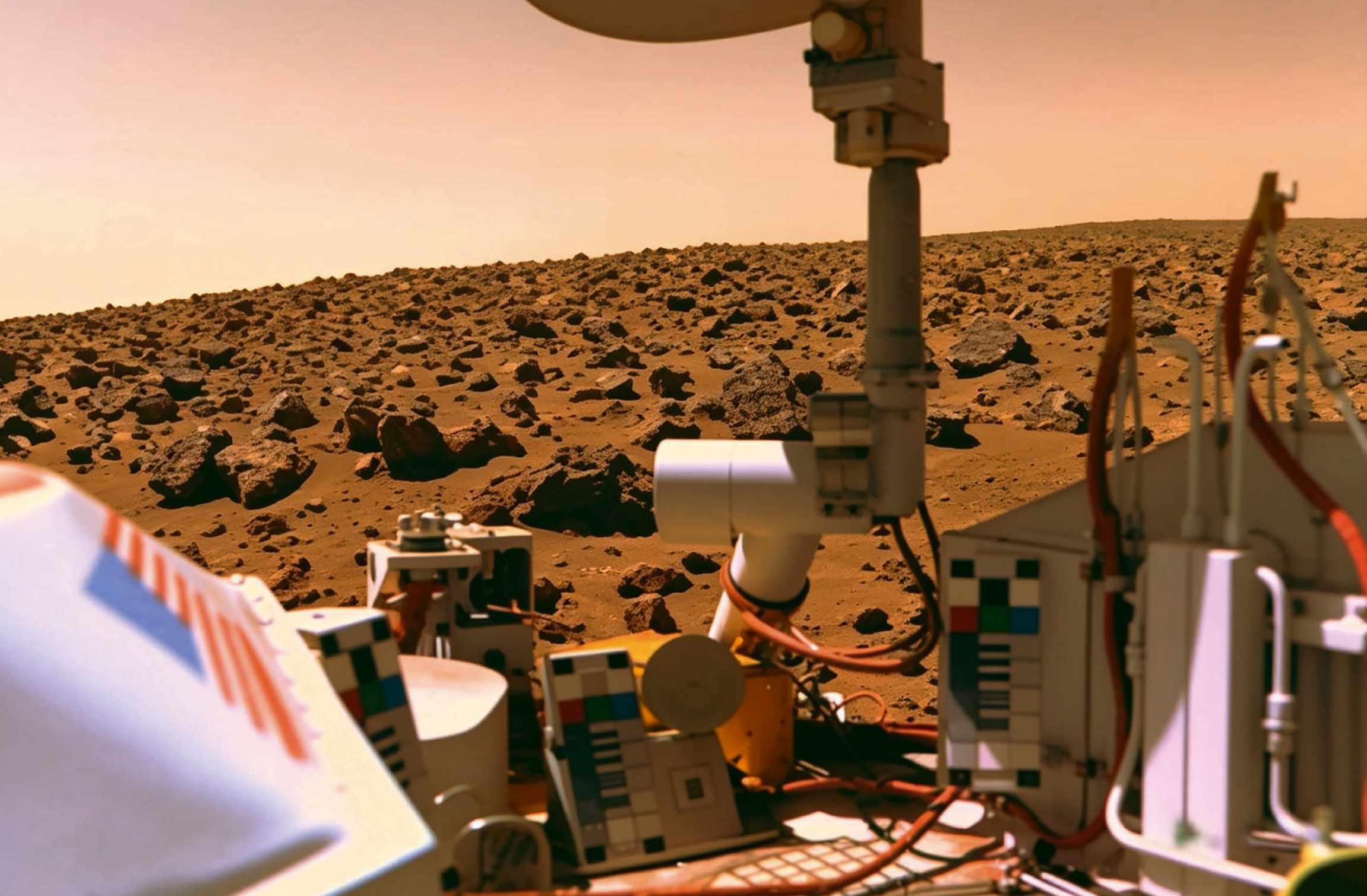
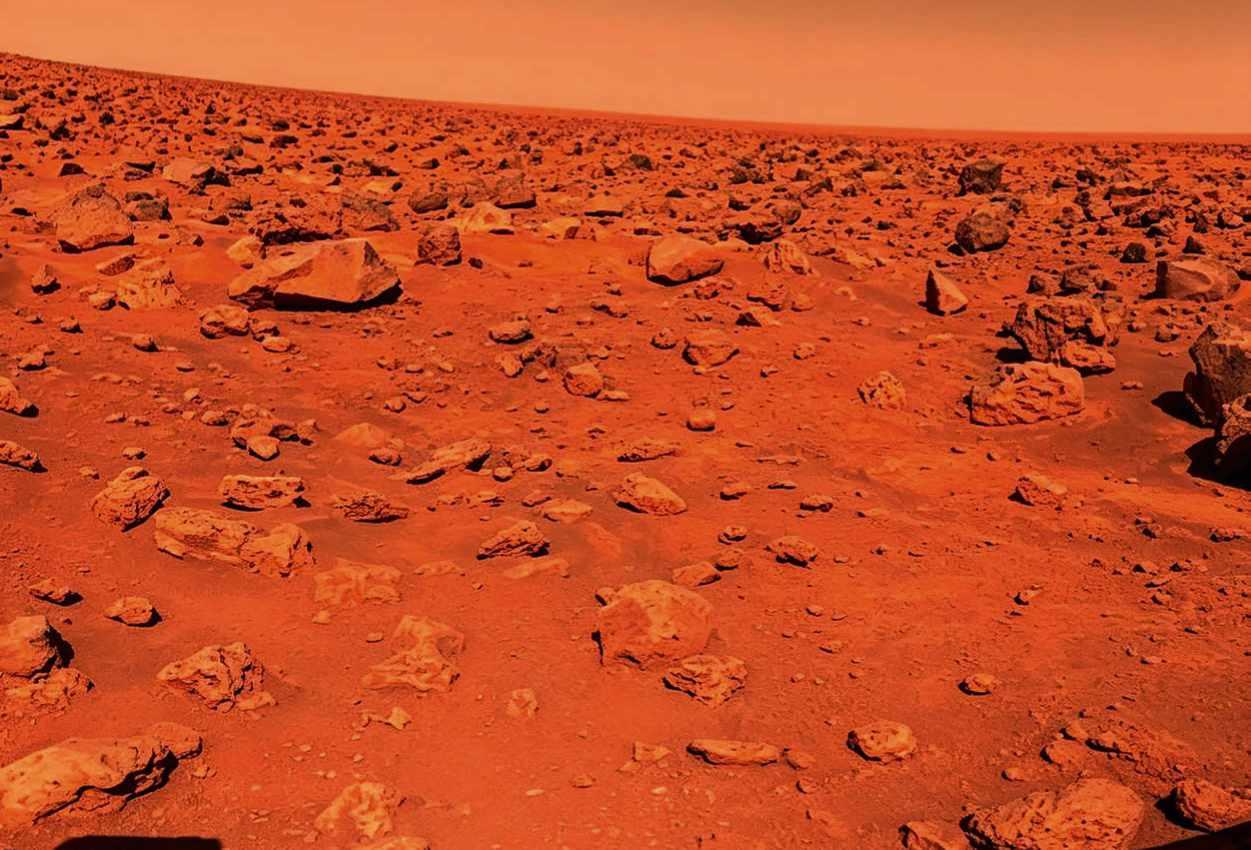
This Viking 2 image of Mars’ Utopia Planitia shows a boulder-strewn plain beneath a dust-tinted, salmon-coloured sky.
named after the rst three examples – Shergotty, Nakhla and Chassigny. Meteorites are any natural extraterrestrial material that falls to Earth, and the vast majority of them are fragments of asteroids, small rocks that orbit the Sun.
Out of 79,000 classi ed meteorites worldwide, only just over 400, or 0.5%, are SNCs. They look di erent from asteroidal meteorites and are igneous, formed by volcanic processes. Their ages, measured using radioactive isotope clocks, range from 4.5 billion years to just 0.18 billion years. In contrast, asteroidal meteorites all typically formed at the same time the Solar System was born, 4.5 billion years ago. This wide age range implies that they formed on a planetary-sized body, large enough to retain heat in its interior to power volcanoes over billennia. The question was: which planet-sized body did they come from?
Breakthrough: trapped gas bubbles
The decisive evidence arrived in 1983, when scientists at the Johnson Space Center in Houston, Texas, made a remarkable discovery. Inside some Martian meteorites they discovered tiny glass pockets that contained trapped gas. When analysed, the gas composition looked strikingly familiar. It was an exact match to the Martian atmosphere measured by Viking.
The ratios of noble gases such as argon, neon and xenon in the meteorite were nearly identical to
the values recorded on Mars – and very di erent from Earth’s atmosphere and from gases found in asteroidal meteorites. The odds of this being mere coincidence were vanishingly small.
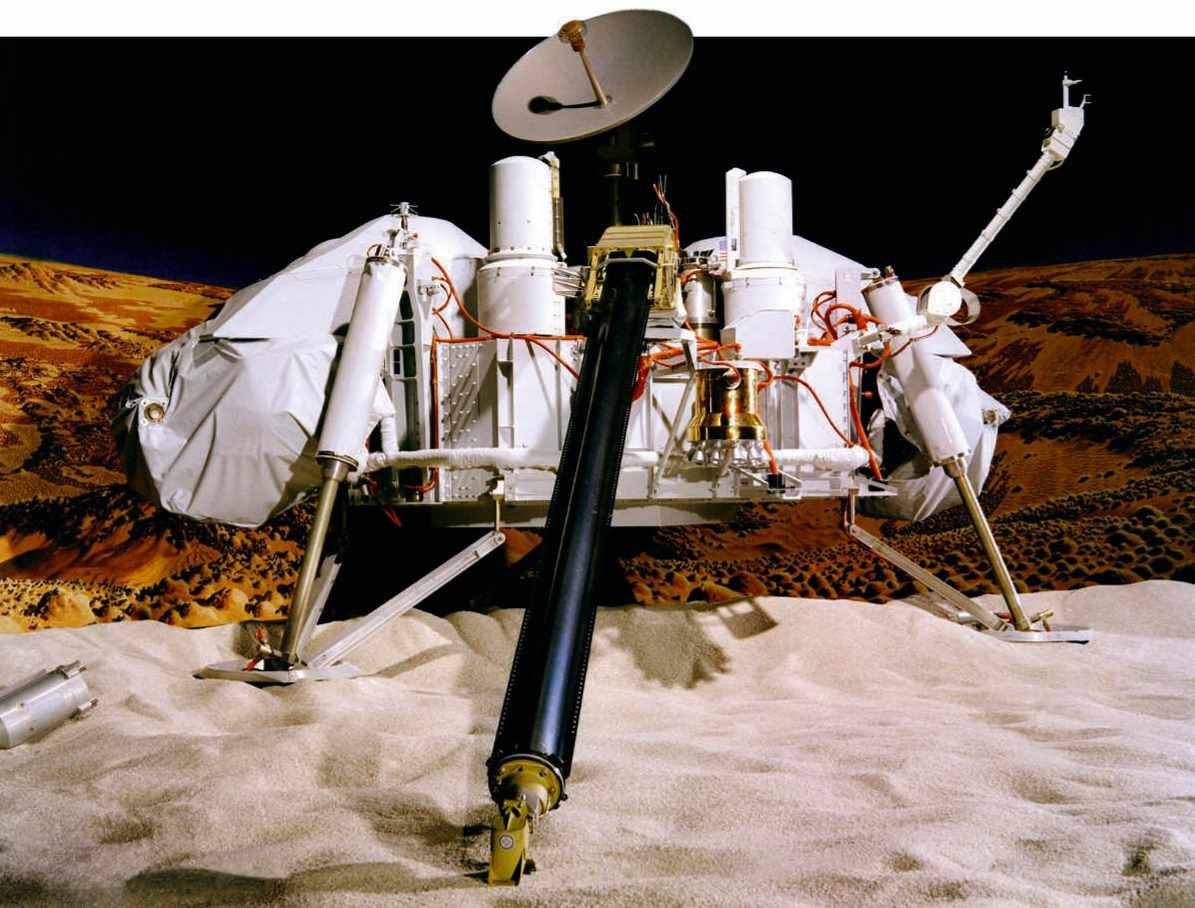
Above Viking
carried scienti c instruments, including cameras, sensors and the high-gain antenna used to study and transmit data from the Martian surface.
Viking had e ectively provided a planetary ngerprint, and when scientists found that same ngerprint sealed inside a meteorite, the conclusion was unavoidable – the rock had come from Mars. By extension, the whole suite of meteorite oddities known as the SNCs in our Museum collections are actually pieces of the red planet. →
landers
Martian meteorites that changed what we know
These remarkable meteorites from around the world o er rare physical clues to Mars’ geology, history and past environments and conditions.
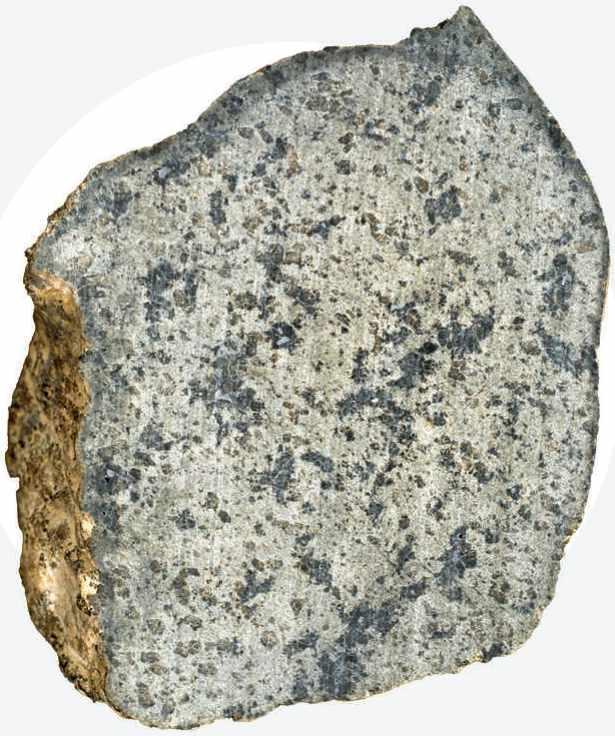
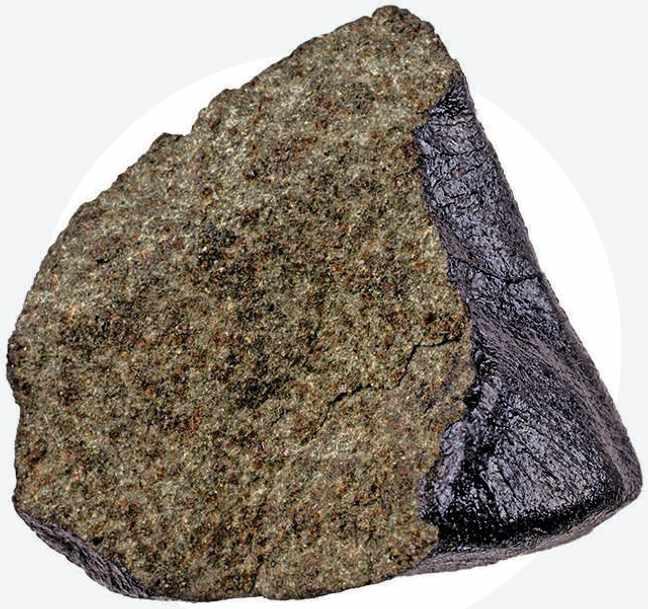
Shergotty
Falling onto an opium eld in Bihar, India, in 1865, Shergotty became the rst known example of the most common type of Martian meteorite: the shergottites. These are relatively young Martian rocks, formed only a few hundred million years ago.
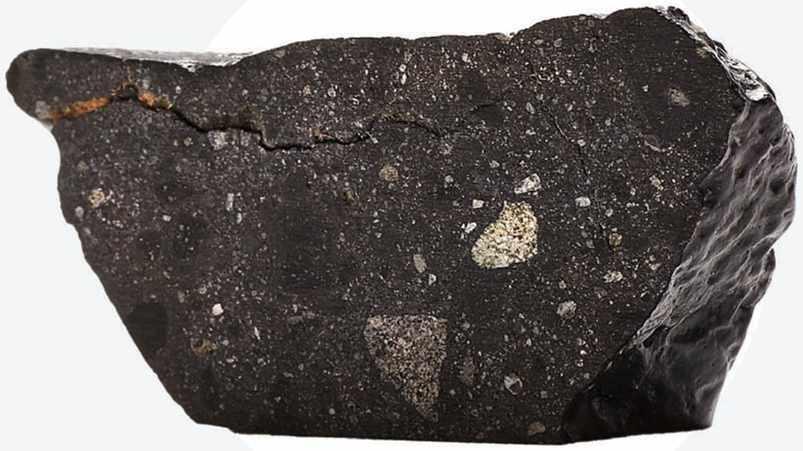
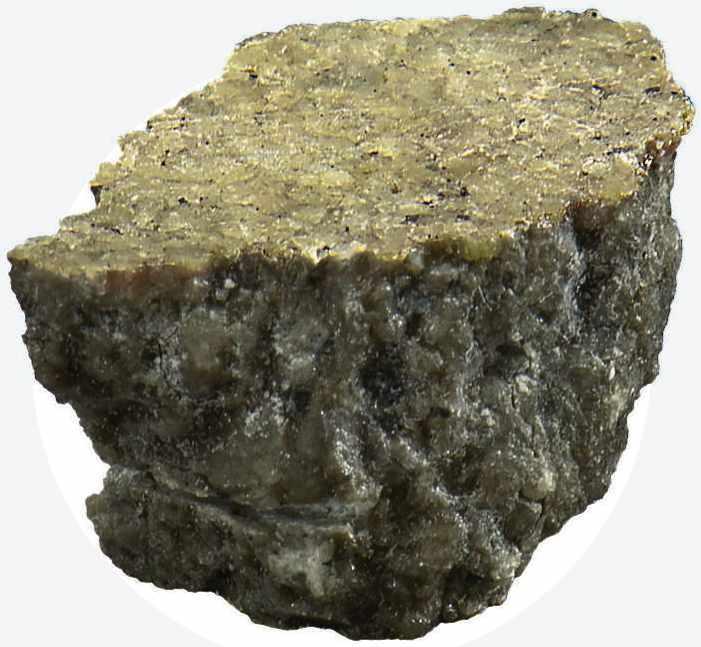
Northwest Africa 11220
Found in northwest Africa, this meteorite belongs to a unique pairing group of Martian samples. It is a breccia – a jumble of di erent rocks fused together by glass – created during an energetic impact event on Mars.
Nakhla
Nakhla fell in Egypt in 1911 as a shower of around 40 stones, with unveri ed reports claiming that one struck and killed a dog. It contains minerals formed by reactions with water, showing that Mars once contained water.
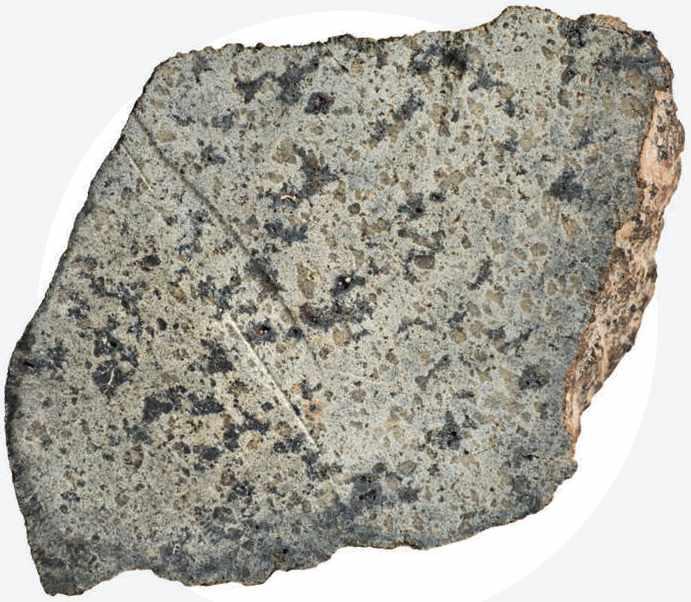
Sayh al Uhaymir 008
Discovered in Oman in 1999, this shergottite type meteorite has a special link to Mars: a fragment from the Museum’s collection was used as a calibration target on an instrument now operating on the Perseverance rover on the Martian surface.
Chassigny
Chassigny, which fell in Haute Marne, France, in 1815, is the oldest Martian meteorite recovered on Earth. Its unusual chemistry and texture suggest it is a rare sample of the Martian mantle, the deep layer beneath the planet’s crust.
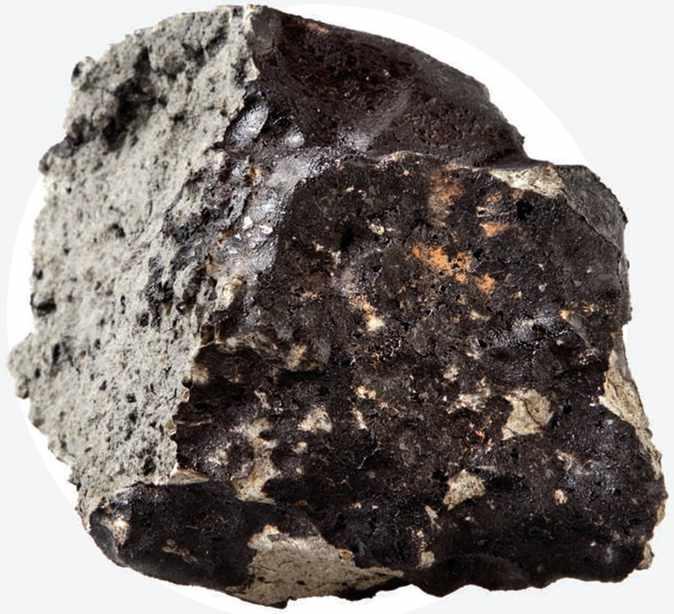
Tissint
Tissint, a beautiful shergottite type meteorite and the Museum’s largest single Martian sample, fell to Earth in Morocco in 2011. It contains striking veins of black glass formed during an impact event and is displayed in The Vault at the end of the Minerals gallery.
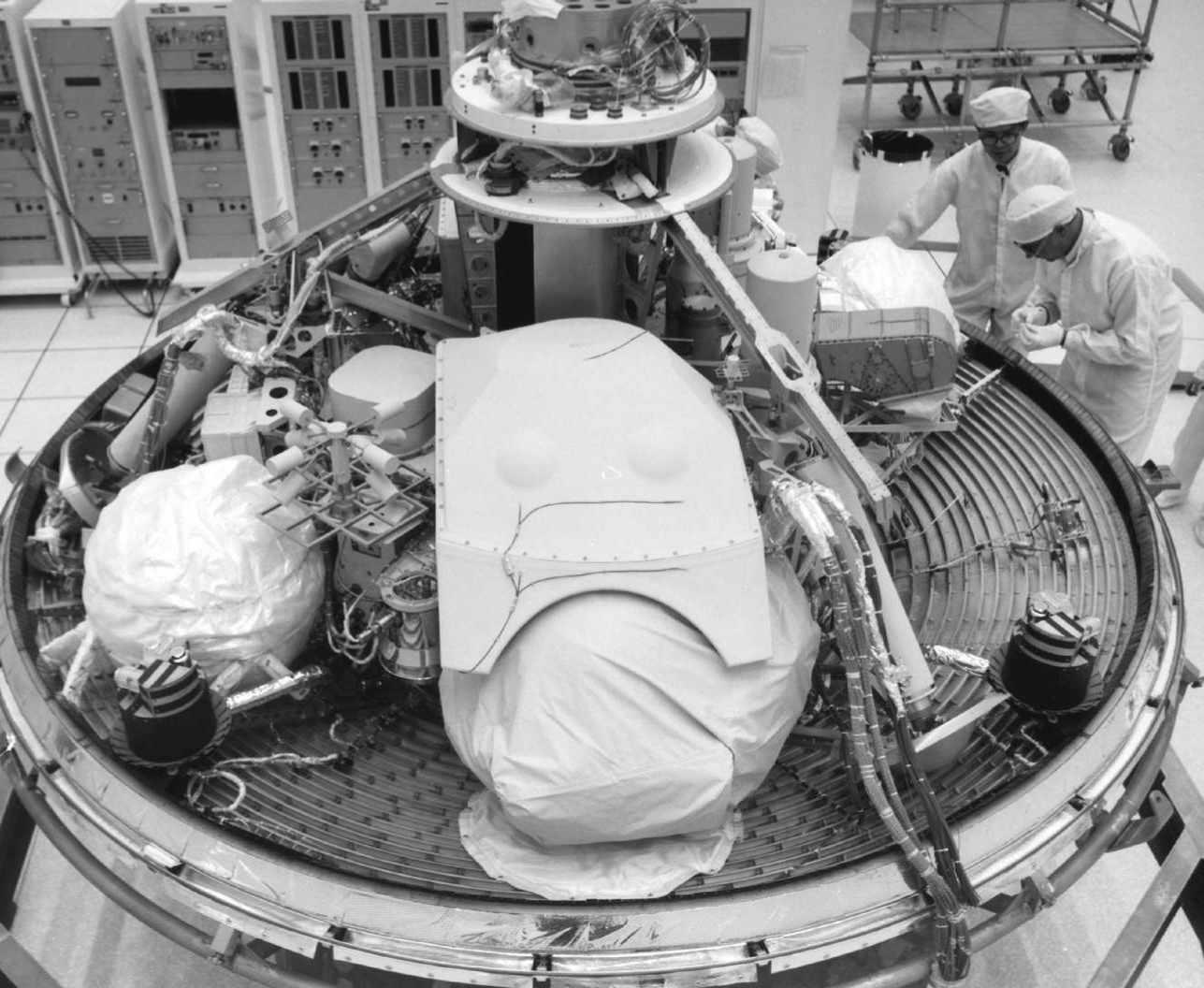
Piaggi’s planet

What’s the link between the Museum’s giant sequoia tree and the Viking missions?
On the upper balcony of the Museum’s Hintze Hall is the enormous giant sequoia tree trunk. Just to its left is a small plaque that reads: ‘Giant Sequoia: Generously supported by the Milner Family to lovingly honour the inquisitive mind of Ezio Piaggi.’
The dedication honours Ezio Piaggi, a member of the Milner family who, in the 1970s, was working for NASA at the Jet Propulsion Laboratory (JPL) in Pasadena, California.
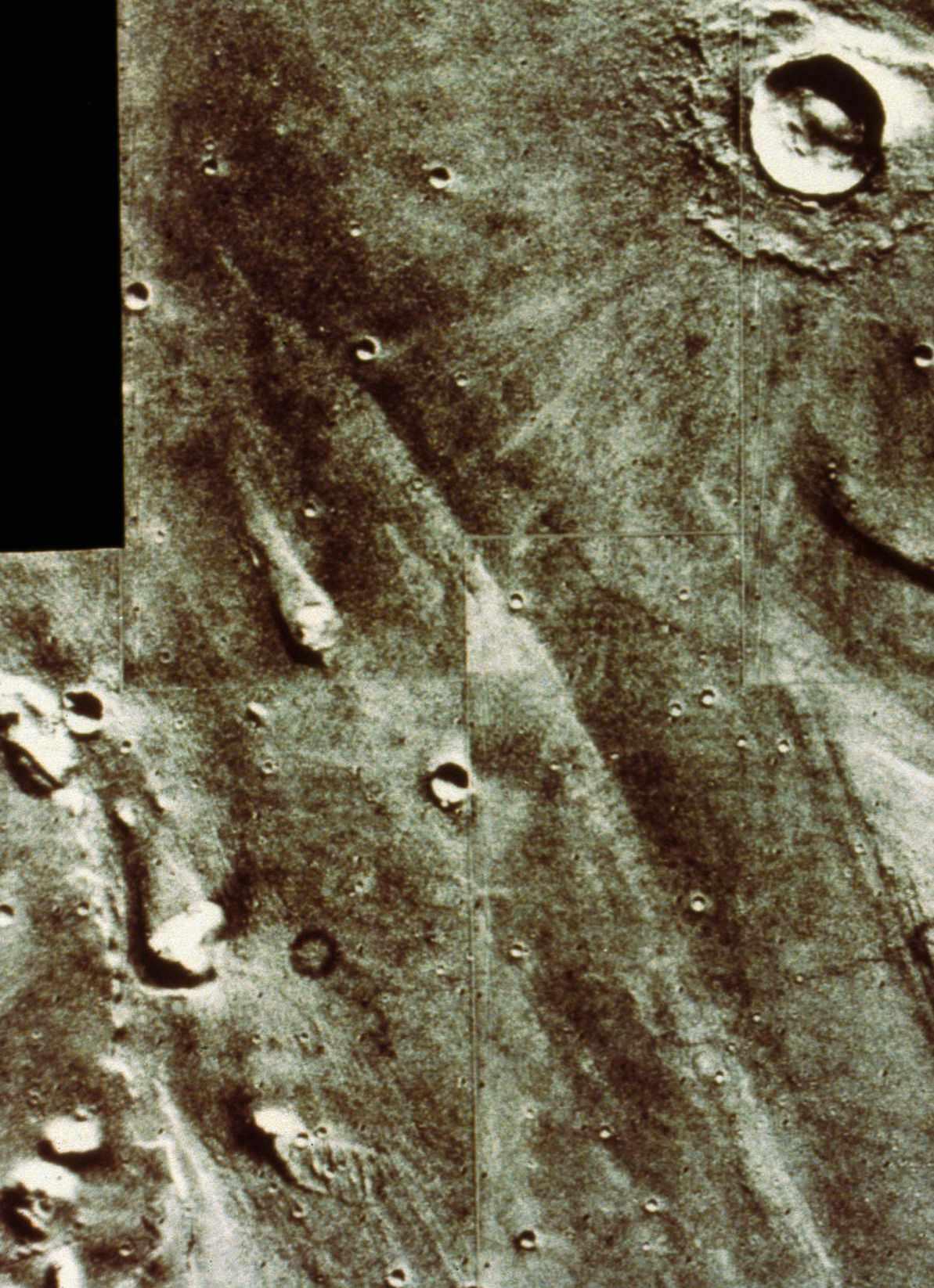
Channels near Chryse Planitia on Mars, photographed by a Viking orbiter, show surface features that may have been shaped by ancient water ow.
VISIT THE MUSEUM
Visit The Vault at the end of the Minerals gallery to see a selection of meteorites from the Museum’s collection.
Piaggi, an Italian immigrant, rose through the ranks at JPL to become the chief engineer of the Viking missions, responsible for directing the spacecraft that have gone on to shape planetary science research for decades.
How rocks escape a planet
With the Martian origin of SNC meteorites established, scientists then turned to the question of how such rocks could have left Mars in the rst place. The answer lies in asteroid impacts. While today, the eight planets of our Solar System follow stable orbits around the Sun, there are millions of asteroids and comets ying around in less predictable ways that can (and do) impact both Earth and the other planets, including Mars. Because Mars has lower levels of gravity than Earth, debris can escape more easily. A large impact – such as when a large asteroid or comet strikes Mars at high speed – can eject surface material with enough velocity to exceed the planet’s escape speed (the minimum speed required by an unpowered object to break free from a planet’s gravitational pull). Over time, most of these fragments fall towards the Sun, which has the greatest gravitational pull in the Solar System. But some are sent onto trajectories that ultimately collide with Earth, where they arrive as meteorites. Viking did not observe this process directly, but its data helped con rm that Mars is a plausible source. The orbiters revealed the planet’s volcanic history and impact-scarred surface, and together with the landers’ atmospheric measurements, they helped build the theory of how Martian meteorites formed.
Why Viking’s contribution matters Viking’s contribution to this discovery is hard to overstate. Before the missions, Mars was a distant world known only through telescopes and brief flybys. Its atmosphere was poorly understood, and precise isotopic measurements were impossible. By placing laboratories directly on the Martian surface, Viking transformed Mars from an abstract object into a measurable world. The missions demonstrated how much can be learned from sending probes to other planets, both from orbit and from landers.
Confirming the existence of Martian meteorites had profound implications. These are the only samples of Mars currently available for scientists to study on Earth, and can be analysed using every technique available to scientists.
Research on Martian meteorites has shown that Mars formed quite rapidly, much faster than Earth. Scientists at the Natural History Museum showed in the 1980s that they contain clays formed by the action of water. In 1996 came a dramatic announcement: some features in a Martian meteorite look like fossils. Subsequent work suggested these features may have formed through mineral processes rather than biology, so the question of life on Mars remains open.
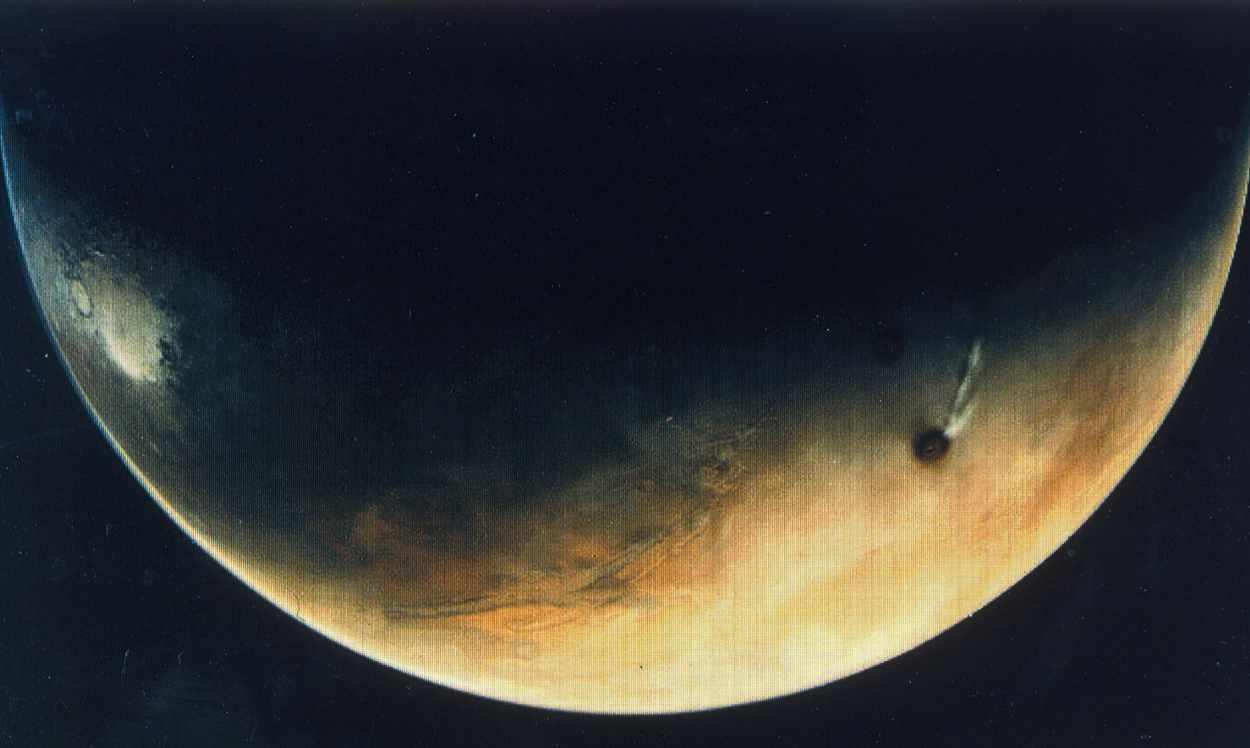
A view of Mars from Viking 2, from August 1976, showing Ascraeus Mons – one of the solar system’s largest shield volcanoes – veiled in ice-crystal clouds.
Today, Martian meteorites are a cornerstone of planetary science and our understanding of Martian geology. They complement data from orbiters, landers and rovers, offering insights that remote instruments alone cannot provide. At the foundation of this entire field lie the Viking missions and their gas analyses from 50 years ago.
Ironically, Viking is often remembered for what it did not find: clear evidence of life on Mars. Yet its lasting impact may be even greater. By helping prove that rocks from Mars reach Earth naturally, Viking connected our planet to another world in a very literal way.
The future of Mars exploration
Although our understanding of Mars has evolved over time, the question that the Viking missions sought to answer – whether life exists on Mars –remains unresolved.
Excitingly, we may soon be closer to an answer. Scientists at the Museum, led by Professor Peter Grindrod, are designing a new instrument for the Rosalind Franklin rover, Europe’s first Martian lander dedicated to searching for life on the red planet. Rosalind Franklin, which will be onboard ExoMars, is due to launch in 2028, ready to help answer one of humanity’s most enduring questions. ●

MUSEUM EXPERT
Professor Sara Russell
Sara is a Merit Researcher at the Natural History Museum. She uses the meteorite collection and samples from space missions to investigate the origin of Earth and our Solar System.
Above top Red, dust-coated rocks, shaped by wind erosion, were photographed on the Martian surface by the Viking missions.



M s design ter
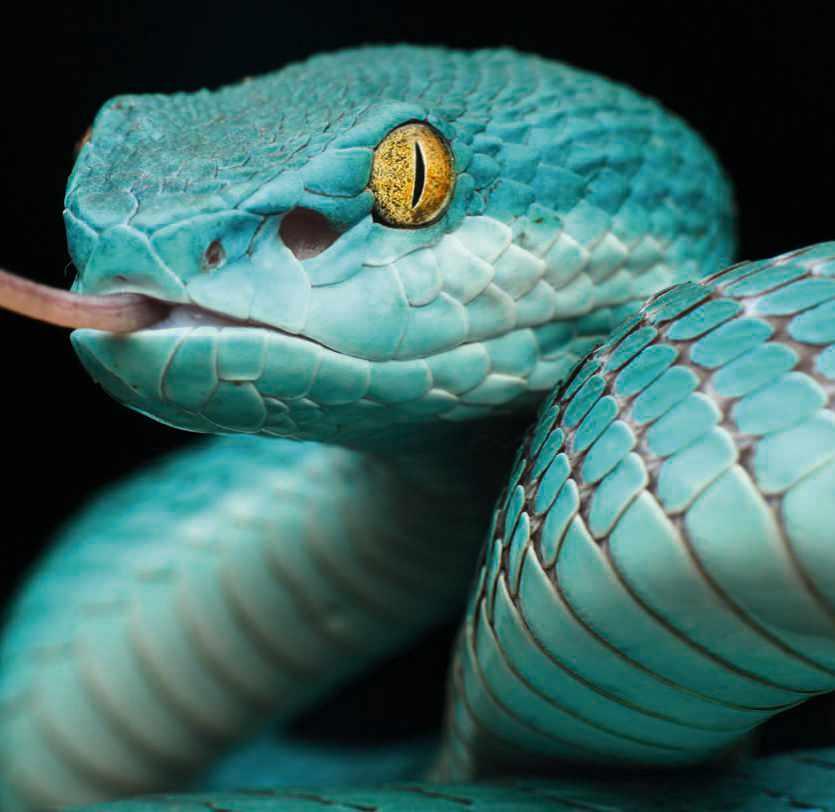
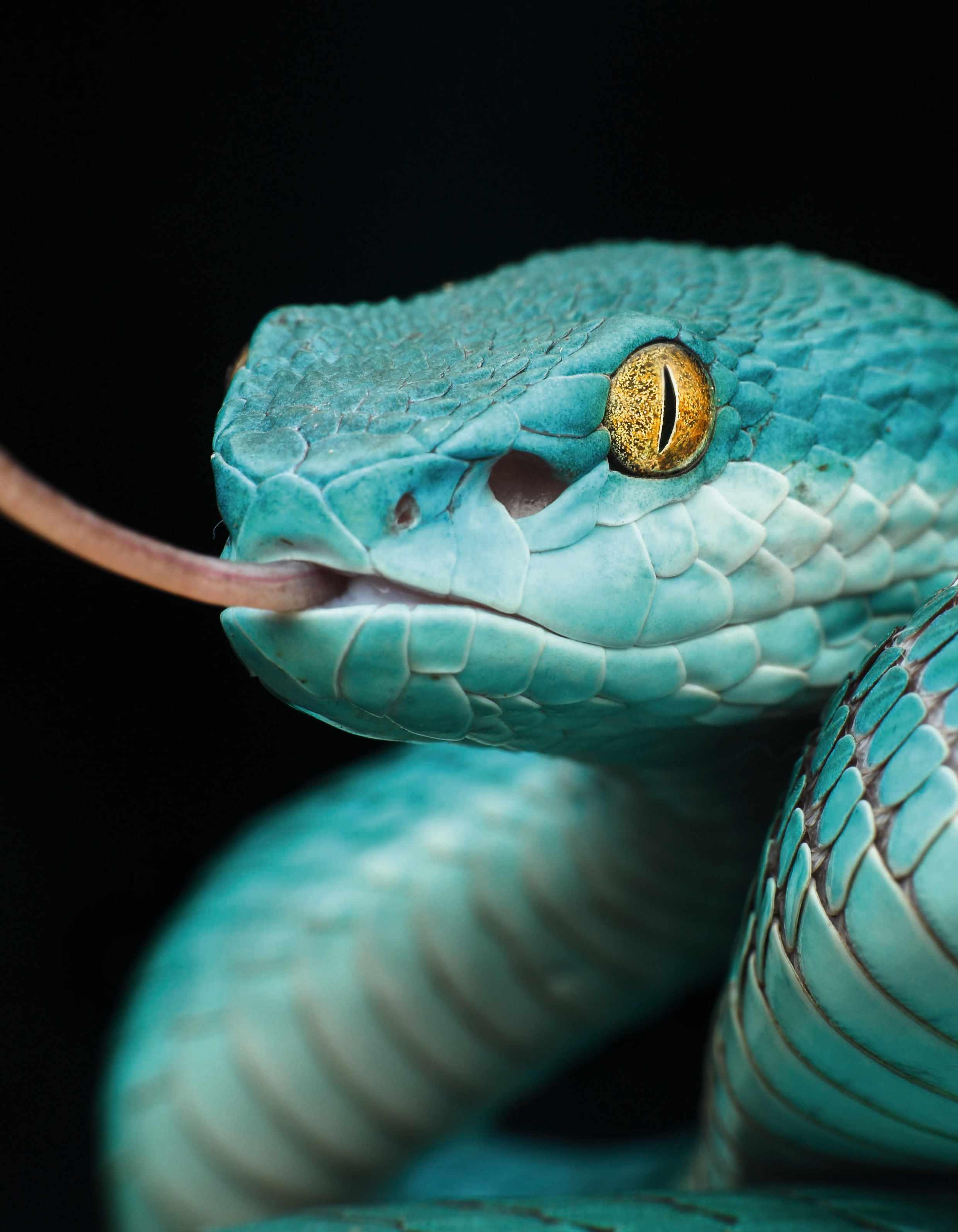
The Indonesian pit viper can ‘see’ heat – its facial pits detect infrared, letting it hunt in total darkness. This is the blue colour variant of this arboreal snake.
DID YOU KNOW?
High-speed cameras reveal that venomous snakes use completely di erent strike strategies – even among closely related species.
by
Snakes
aren’t the cold, silent predators we imagine – they’re babysitters, actors, tricksters and acrobats. Nature’s quiet shapeshifters are far more dramatic and surprising than their simple shape suggests.
WORDS: DR LUCY E ROBERTS

nakes are often dismissed as solitary, cold lurkers, but this reputation hides a remarkable diversity of behaviours and temperaments. Across nearly 4,000 species – a huge number compared to an estimated 6,600 mammals on Earth today – they display forms of care, caution and cunning that rival those of many more popular animals. Their success is re ected in their global spread: snakes live on every continent except Antarctica, with species such as the European adder reaching as far north as Scotland and Scandinavia.
Cold comfort
Though snakes are cold-blooded, or ‘ectothermic’, this doesn’t mean their lives are emotionally or behaviourally cold. Some species show unexpected forms of parental care. In a few of them, this involves guarding eggs, while in others it extends to protecting hatchlings. Female king cobras, native to India and southeast Asia, are the only snakes known to build nests, gathering leaves into a mound and guarding it until the eggs hatch.
Rattlesnakes take a di erent approach: females retain their eggs internally and give birth to live young, known as ovoviviparity. Many rattlesnake mothers remain with their o spring for up to two weeks, protecting them from danger until they can fend for themselves. In the timber rattlesnake, these early bonds echo through adulthood. This sociable species gathers in the same communal winter dens year after year, often alongside their mothers.
Playing dead
Snakes can also be far more fearful – and theatrical – than their reputation suggests. While a mass of hundreds of snakes in a shared den may alarm human observers, the snakes themselves are usually focused on avoiding danger. Without expressive →


DID YOU KNOW?
The Museum holds one of the world’s largest and most historically important herpetology collections. It includes large historical pythons and boas collected during nineteenthand early twentieth-century expeditions.
faces or vocalisations, their fear can be easy to overlook, but some species make it unmistakable.
Eastern hognose snakes, of North America, are famous for their dramatic defence displays. They begin by hissing and attening their heads like cobras. If this fails, they ip onto their backs, writhe, gape and then go limp. Some even regurgitate food or expel blood from their mouths to produce o -putting odours that enhance the illusion of death. The performance is so committed that if a hognose is turned upright, it will often immediately ip back over to maintain the illusion.
Deceiving prey
Other snakes lean into their predatory reputation, using deception not to deter threats but to lure prey. Many species rely on camou age and stillness, waiting for an unwary animal to pass within striking distance. Others take a more active approach. Pu adders, widespread across Africa and parts of the Arabian Peninsula, sometimes stick out their tongues to mimic worms, enticing frogs to come closer.
The spider-tailed horned viper, of Iran, has evolved an extraordinary lure: the tip of its tail has a bulbous end resembling a
Snake bodies are highly specialised and very versatile.
spider, complete with elongated scales that mimic legs. Hidden among rocks, the viper icks this appendage to attract birds, then strikes when they swoop in to seize what they think is an easy meal.
Simple but spectacular
This wealth of weird and wonderful behaviour is even more striking when considered alongside the snake’s relatively simple body plan. Despite being limbless and elongated, their bodies are actually highly specialised and extraordinarily versatile. They thrive in deserts, forests, oceans and even the air, each environment shaping a di erent way of moving.
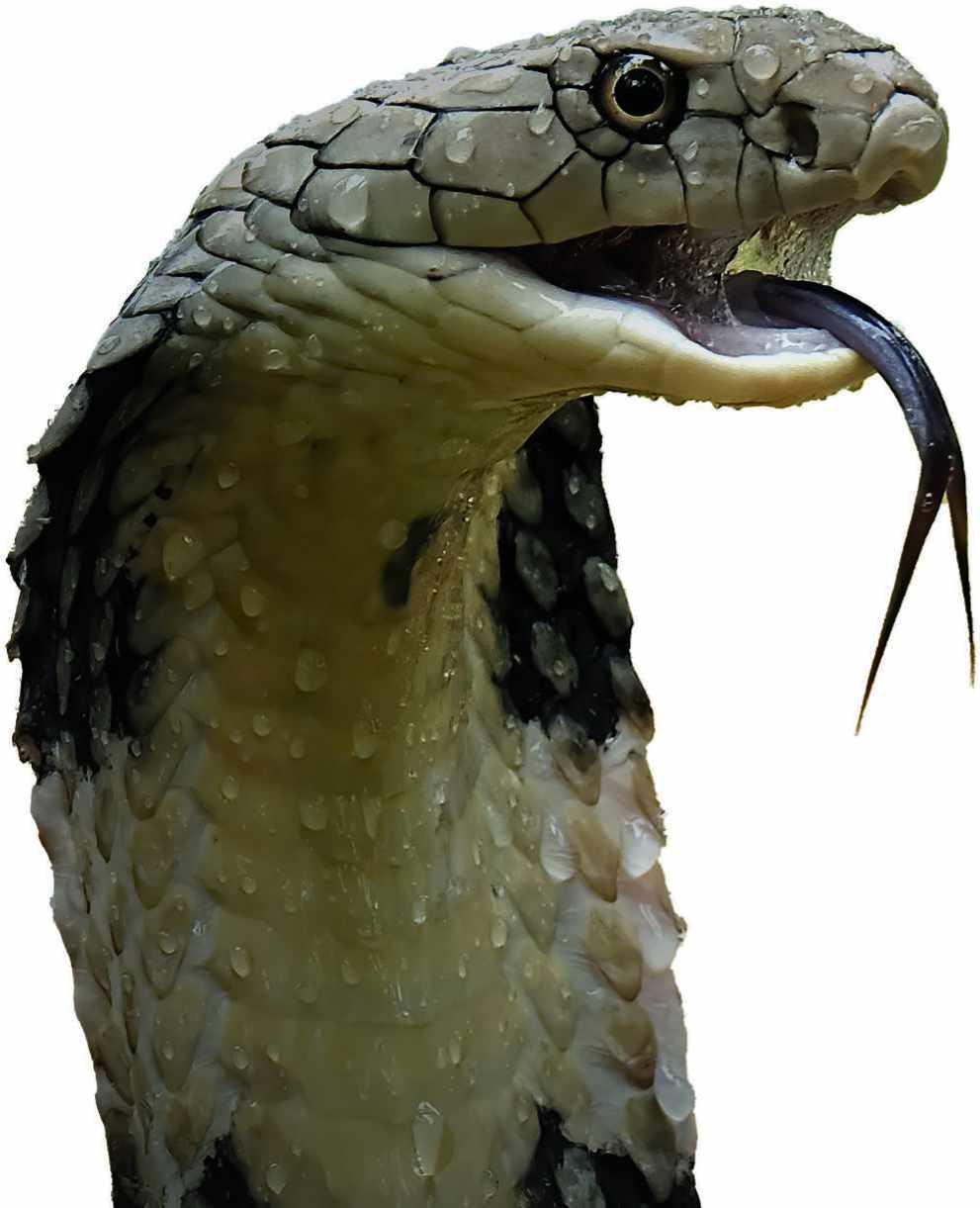
Unlike many other snakes, king cobras are unique for building nests to lay their eggs in.
On land, the most familiar form of snake locomotion is the classic serpentine slither known as lateral undulation. The body forms S-shaped curves that propel the animal forward by pushing against irregularities in the ground. In tight spaces such as burrows or dense vegetation, snakes switch to concertina movement, bunching up the body by pulling the tail closer
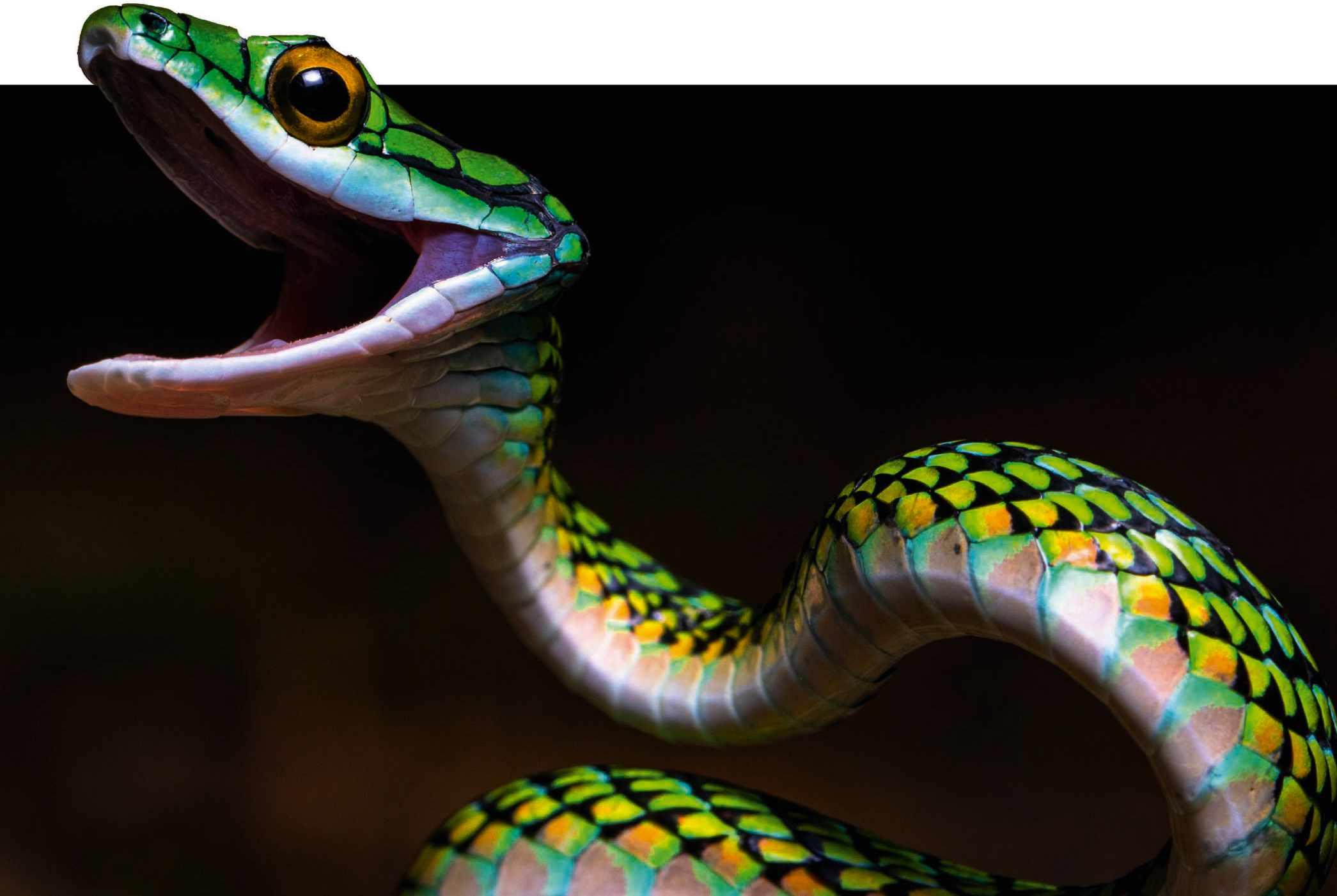
Above Parrot snakes have large, motionsensitive eyes, letting them track and strike fast prey with accuracy.
to the head, then extending in a rhythmic, stop-start pattern.
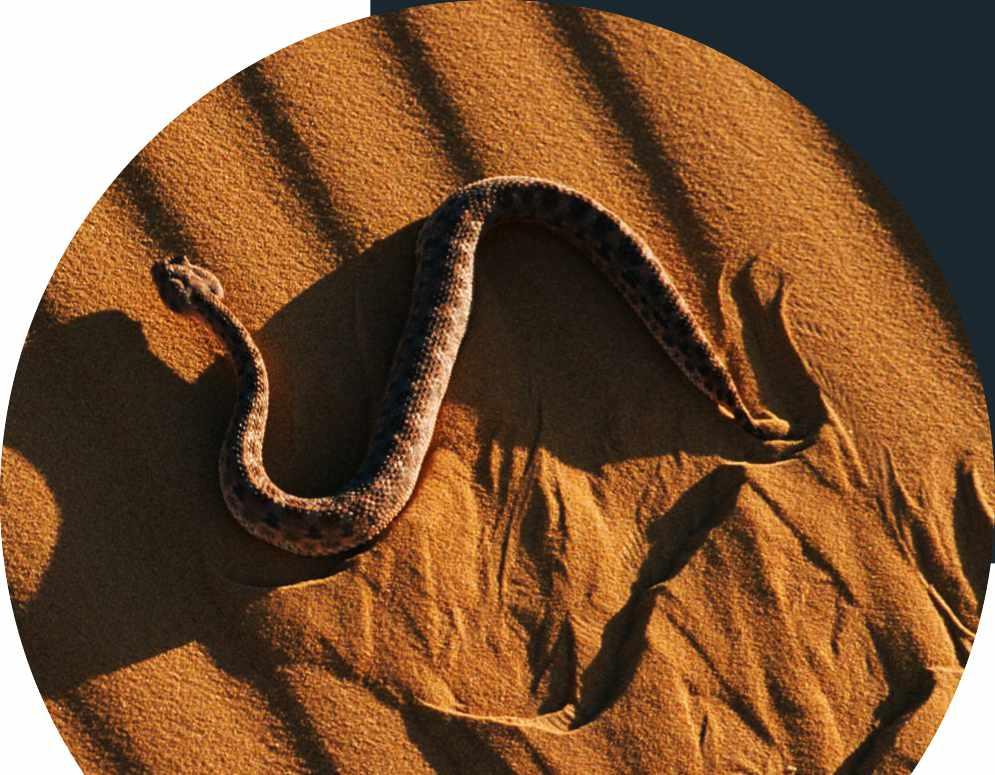
On loose sand, where grip is scarce, some species adopt sidewinding, lifting sections of their bodies and placing them down in sequence, so that only small areas touch the ground at any one time. Sidewinder rattlesnakes of North America are specialists in this technique, leaving distinctive J-shaped tracks across sand dunes.
Larger-bodied snakes may move in another unusual way. The beautiful gaboon viper, found in the rainforests of sub-Saharan Africa, often relies on rectilinear motion, using its muscles to shift its belly scales forward one by one in a smooth, almost imperceptible wave.
In water, snakes return to the sweeping curves of lateral undulation, using the same motion to push against liquid rather than earth. While many terrestrial snakes are able to swim, but do so rarely, some lineages have taken to aquatic life completely.
True sea snakes are fully marine and have
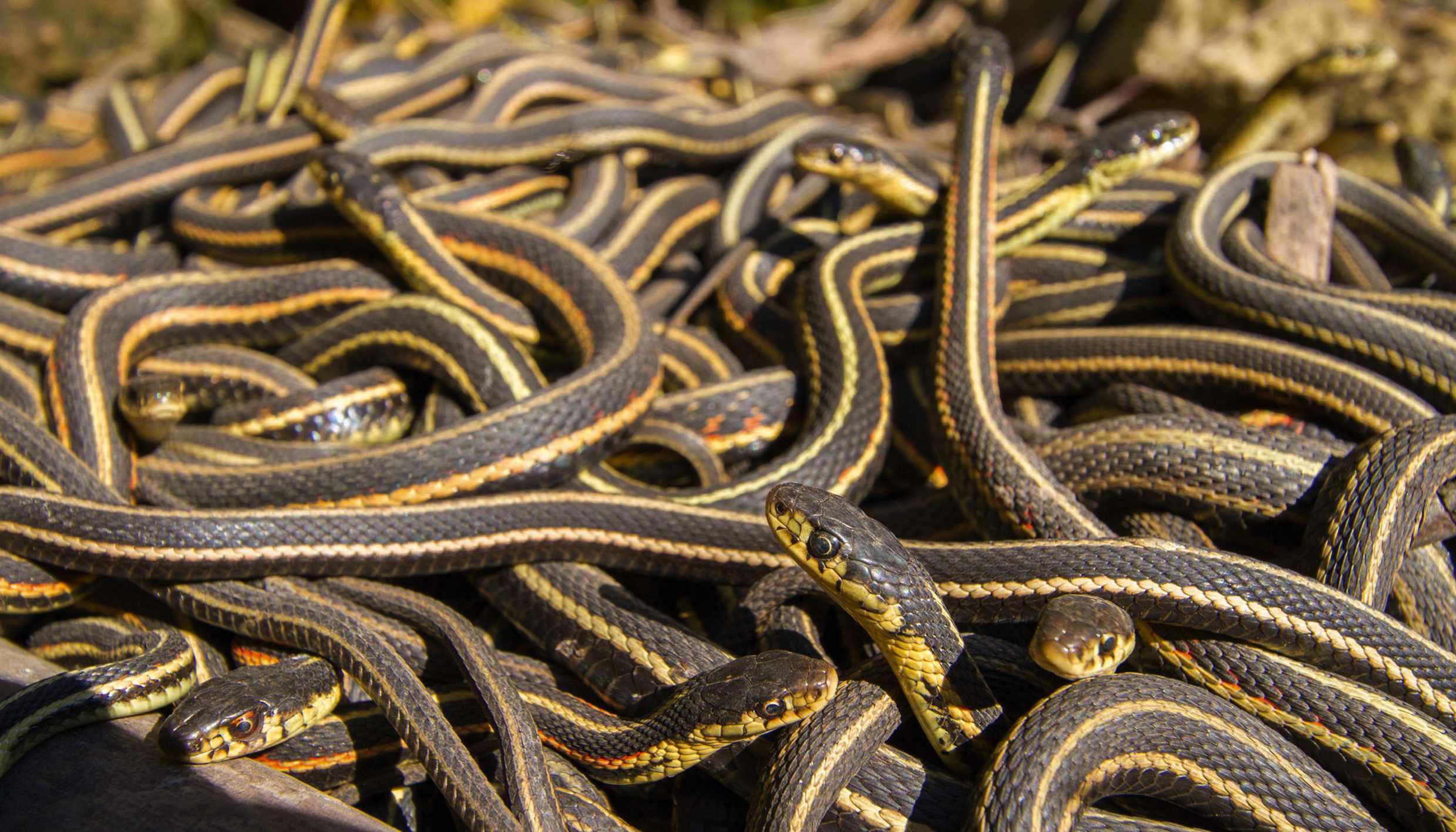
A surprisingly sociable
Snakes are often thought of as solitary, but garter snakes are unusually social. The name ‘garter snake’ refers to around 30 species found across North America, many of which show forms of group living or social behaviour.
Research on the eastern garter snake shows individuals prefer to gather in larger groups and are selective about their companions. Studies of Butler’s garter snake suggest that their social groups can be
snake
structured by age and sex, with older females often leading these groups and younger snakes of both sexes following.
How do these young snakes know who to follow?
Garter snakes communicate using chemical signals called pheromones, which are secreted from the skin and detected through tongue icking. These cues help snakes recognise one another and play a key role in reproduction.
Female garter snakes release pheromones that can attract multiple males at once. In red-sided garter snakes, this can lead to large mating balls, where up to 100 males court a single female. Some males can also produce pheromones that mimic those of females, diverting rival males away from potential mates.
A horned viper, sidewinding.
Garter snakes are unusually social and some live in large groups.
A quick guide to UK snakes
Grass snake
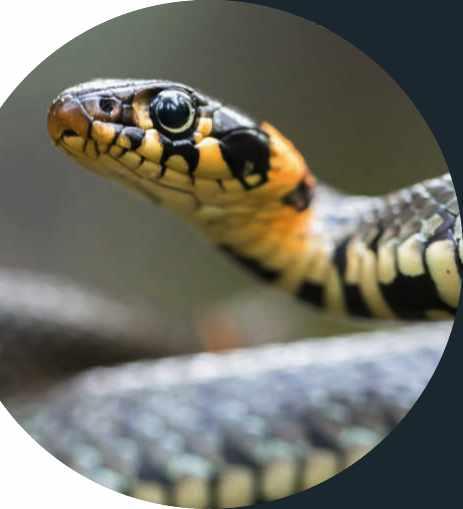
Grass snakes are the UK’s longest snake, reaching up to 150cm. They are light brown to yellow green in colour, with dark bands on the sides and a pale collar behind the head. This species is semiaquatic and commonly seen swimming in rivers. If you spot a snake swimming in England or Wales, it’s probably a grass snake.
Adder
Adders have a distinctive dark zigzag pattern down the length of their back. Male adders are usually grey, while females are brown. They can be found across Great Britain and prefer heathland, moorland and open woodland. Although they are the UK’s only venomous snake, they are much more likely to slither quickly away than bite, if encountered.
Smooth snake
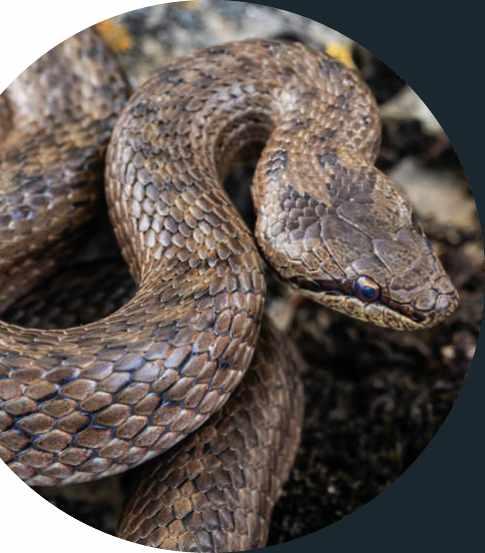
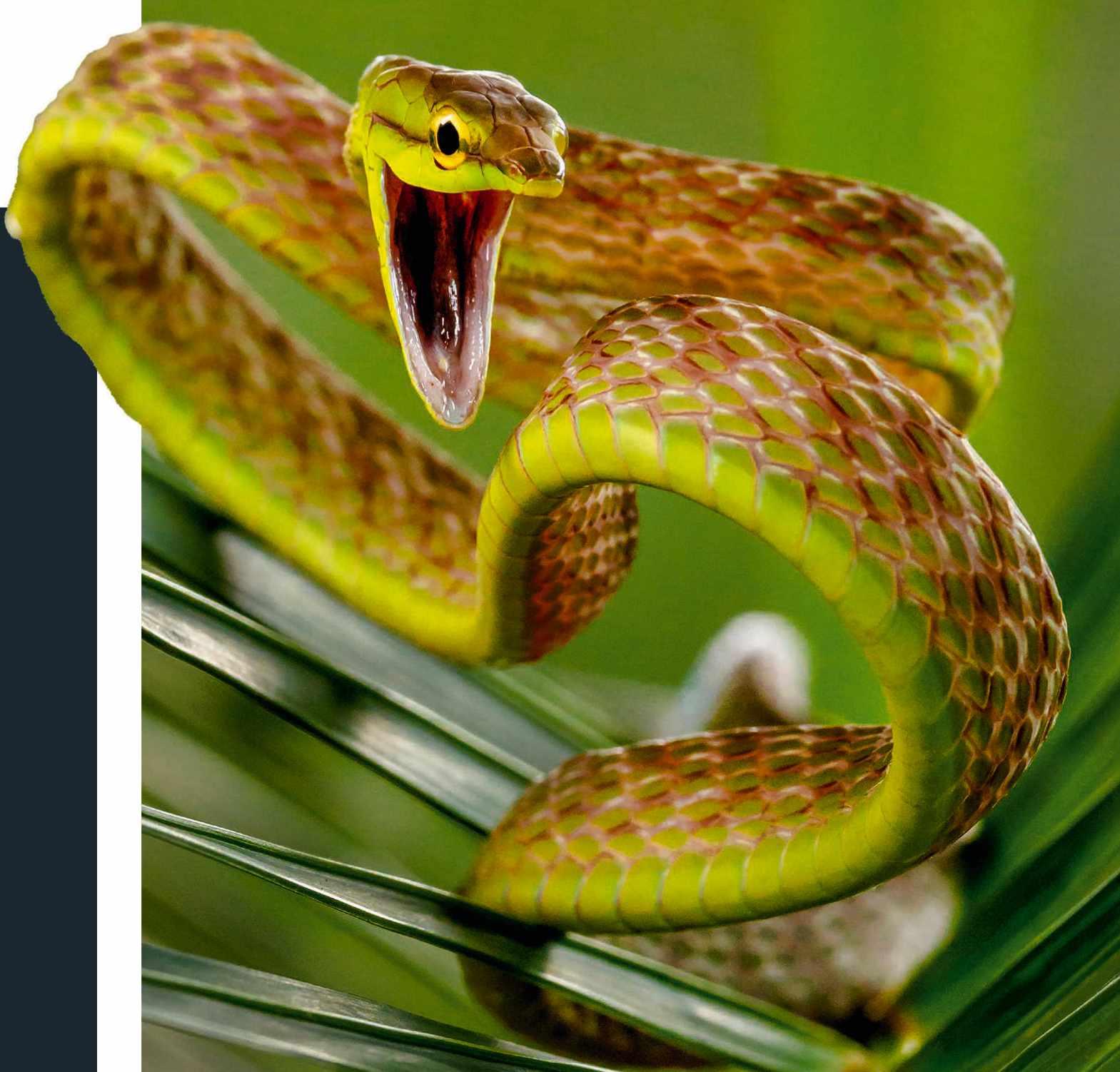
A master of disguise, the short-nosed vine snake hangs still for hours, swaying like a leaf.
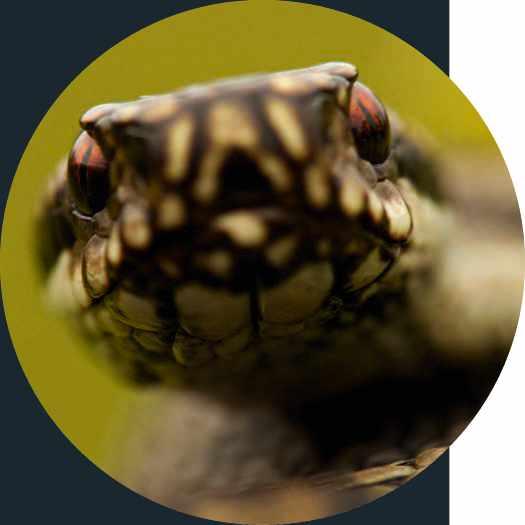
The UK’s rarest and smallest snake, this species is restricted to sandy heathland across Dorset, Hampshire and Surrey, making it the one you’re least likely to see. It is grey or brown, with slightly darker spots running down its body. At rst glance it can look like an adder, but the smooth snake is smaller and more slender and lacks the adder’s distinctive patterning.
©naturepl.com
Snakes are master illusionists, caring mothers and cunning predators.
multiple adaptations to life in the water, with attened, paddle like tails and specialised glands beneath the tongue that help them excrete excess salt. Sea kraits are semiaquatic, dividing their time between land and sea, hunting in coastal waters but returning to shore to rest and reproduce.
Conquering all elements

MUSEUM EXPERT
Dr Lucy E Roberts
Lucy is a Laboratory Manager and Researcher at the Museum, working on the diversity of bone shape in dogs and reptiles.
The absence of limbs does not prevent snakes from climbing. Many arboreal species ascend trunks and branches with ease, using variations of concertina and lateral undulation, gripping bark or looping their bodies around supports. The brown tree snake of Australasia has even been observed using a lasso-like technique, forming a loop around a trunk and inching upward in controlled movements. Some snakes go further still. The so-called ying snakes of southeast Asia do not technically y but glide from tree to tree. Before launching, they are their ribs to atten their bodies into a concave shape, creating a temporary aerodynamic surface. As they descend, subtle undulations in mid-air help
A python can swallow prey much larger than its own head, thanks to exible jaw ligaments and stretchy skin. Its digestive system can break down bone, fur and hooves.
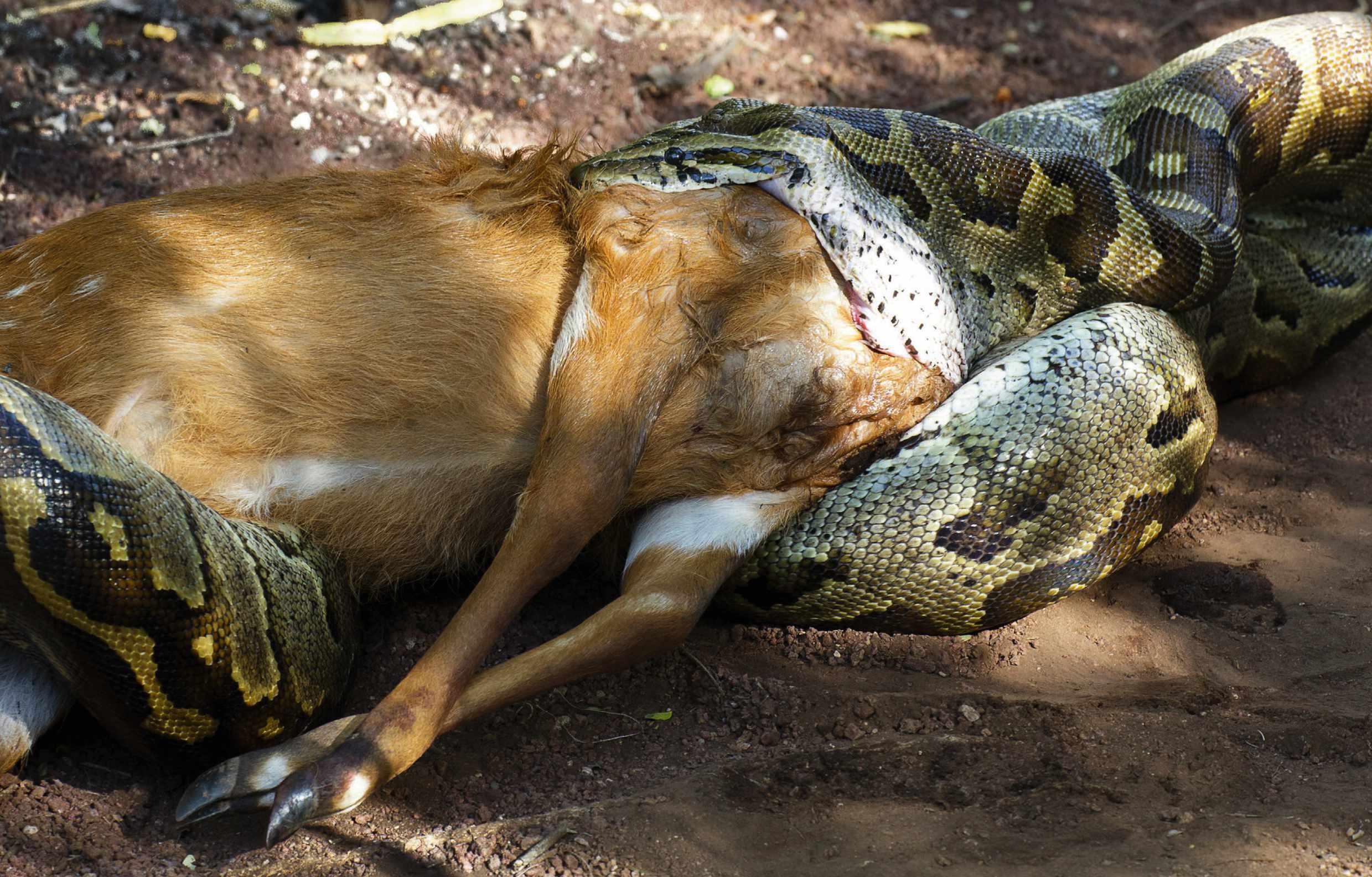
to stabilise and extend the glide, creating enough lift to steer with surprising precision.
Beneath the surface, other species lead more secret lives. Some occupy existing burrows made by other animals, while others excavate their own tunnels. Without limbs to dig, burrowing snakes rely on specialised skulls and snouts. Hognose snakes – found in North America, Madagascar and South America – share upturned, shovel-like noses for pushing through soil and leaf litter.
Taken together, these behaviours reveal lives far richer and more varied than snake stereotypes suggest. Among nearly 4,000 species are attentive mothers, master illusionists, patient ambush predators and agile travellers of land, water, trees and even air. What appears at rst to be a simple body plan conceals extraordinary mechanical and behavioural ingenuity.
Far from being cold or characterless, snakes are among evolution’s most inventive vertebrates, de ned not by limitation, but by adaptability and quiet ingenuity. ●
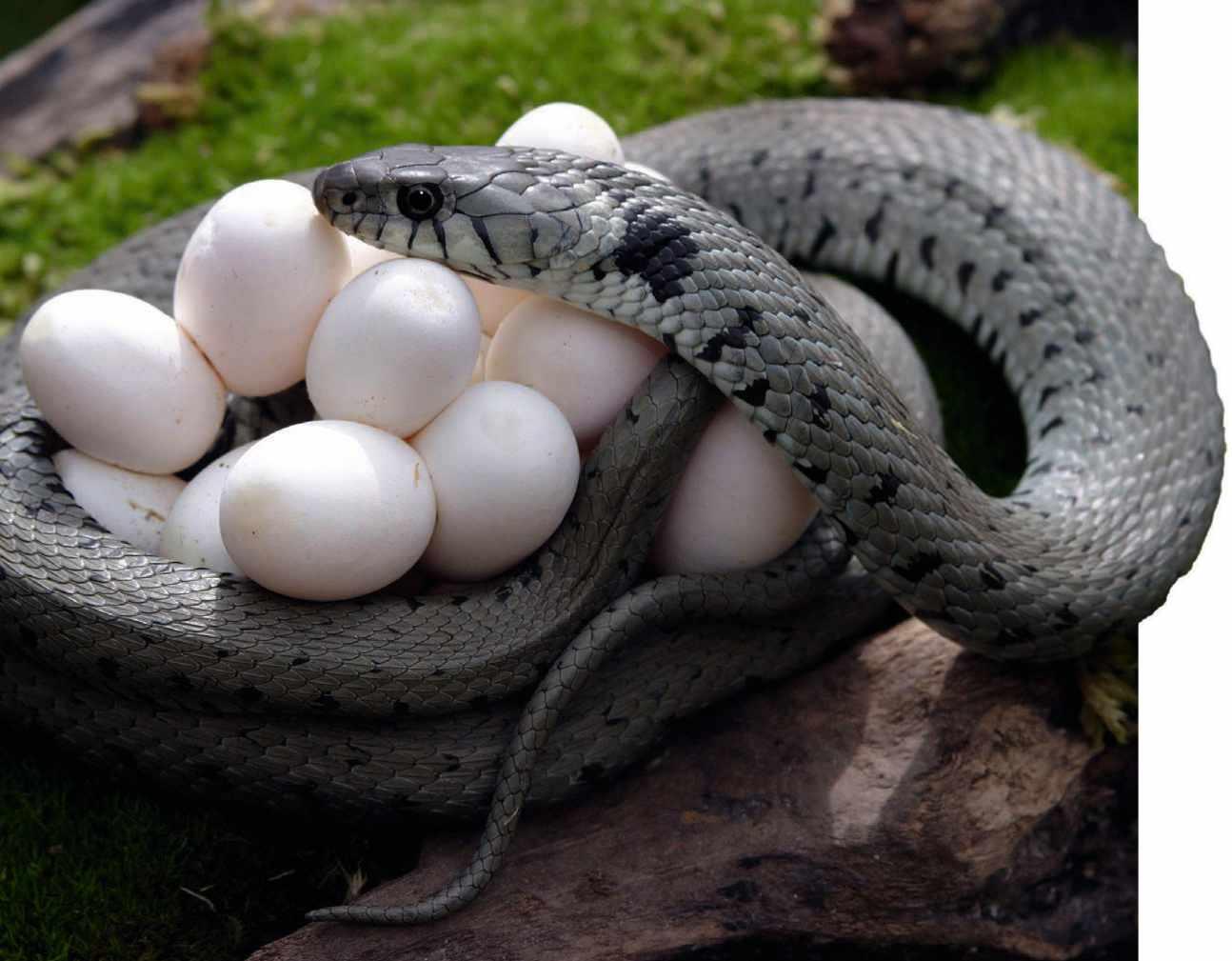
A grass snake caring for its eggs.


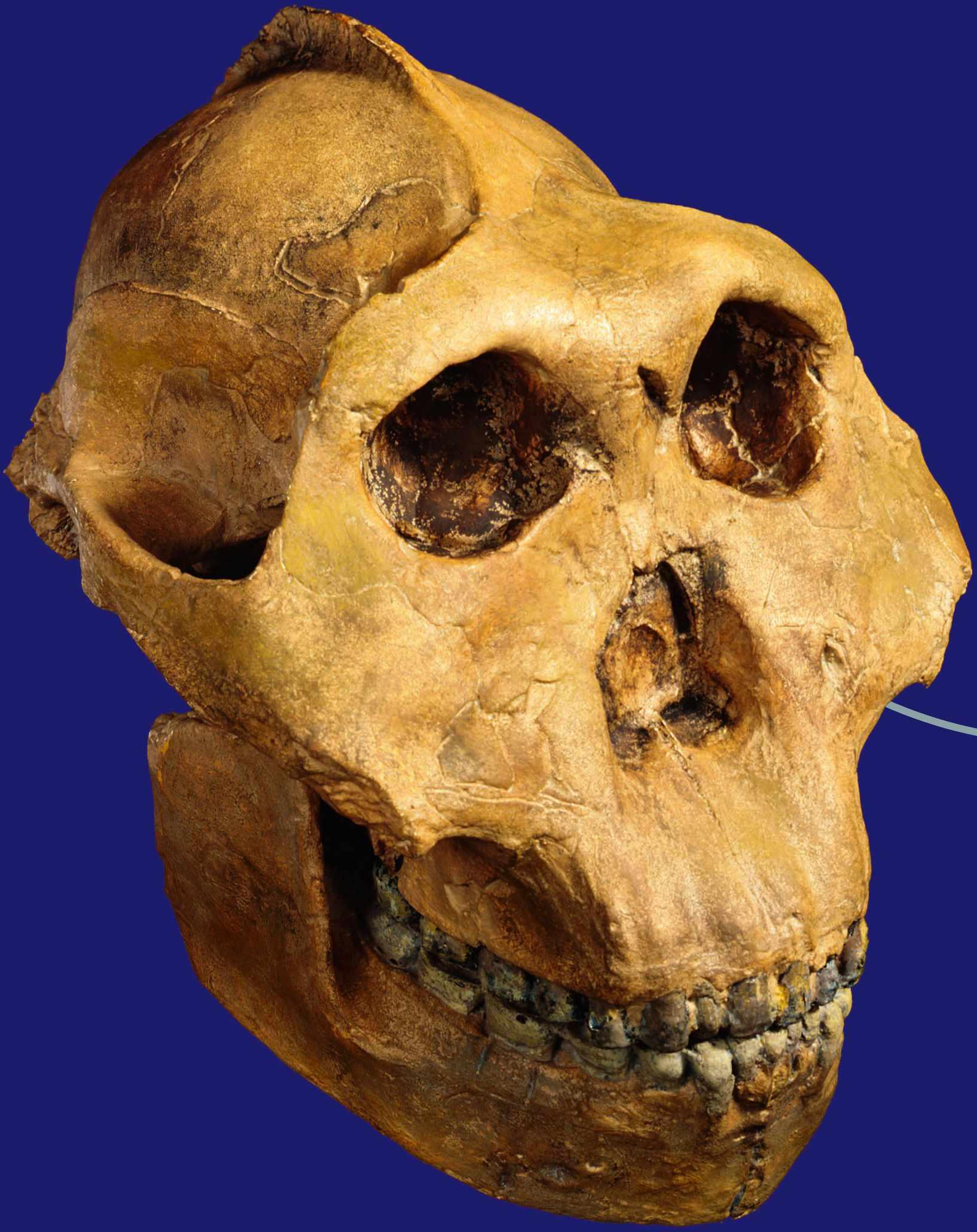
humans story the of R i i g
Paranthropus
boisei had a striking sagittal crest and robust skull to anchor strong jaw muscles.
©Alamy
Our story keeps changing as new discoveries reveal just how diverse our past really was. These 10 recent ndings have shifted the timeline of human evolution and deepened our understanding of our closest relatives.
WORDS: JOSH DAVIS
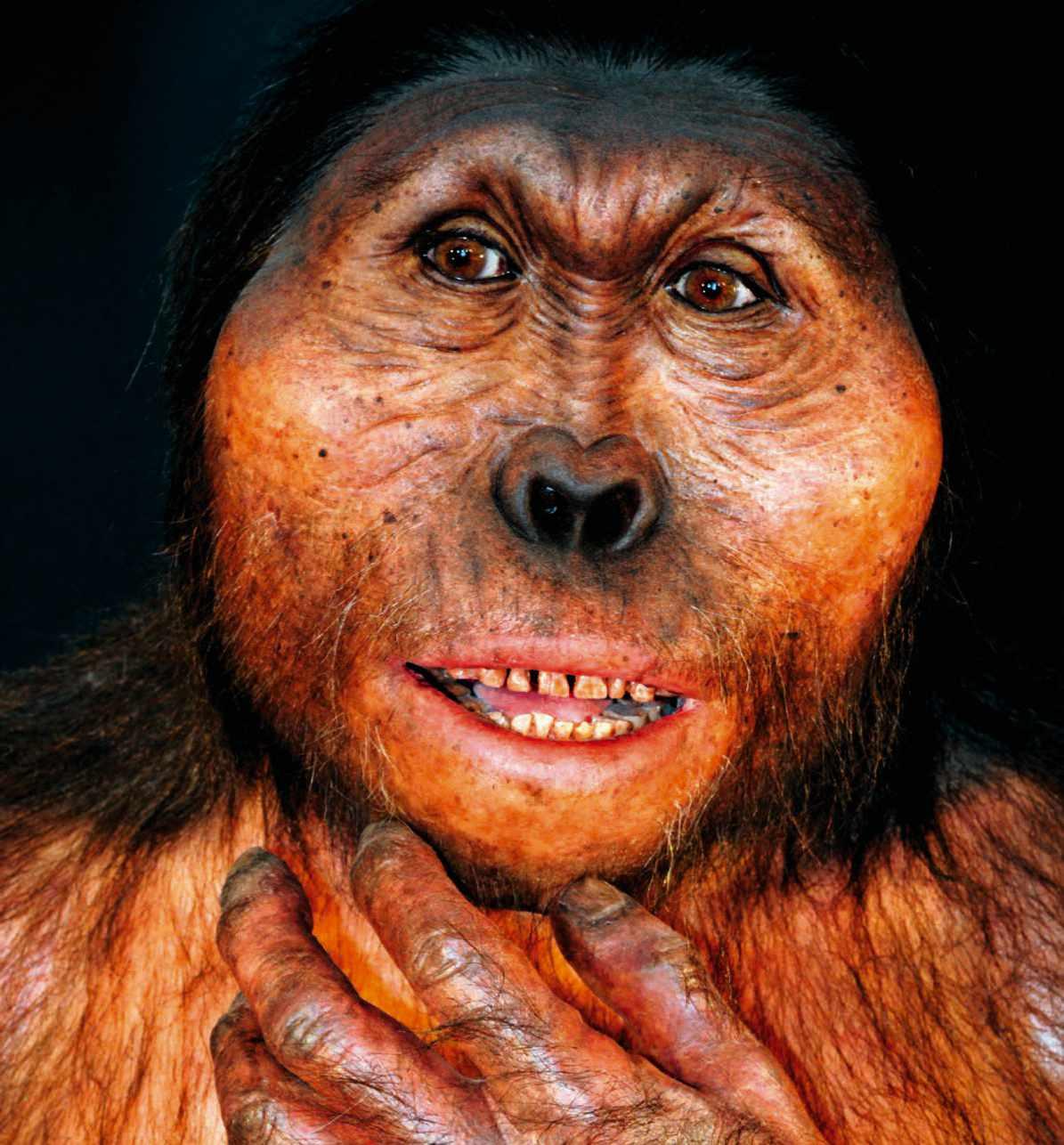
NUTCRACKER MAN’S RANGE AND RESILIENCE WERE EXPANDED
This heavy-built hominin had a broad face, ared cheekbones and huge chewing teeth.
With heavy jaws, large teeth and thick enamel, the extinct Paranthropus has been called ‘nutcracker man’. But new fossils unearthed in Ethiopia’s Afar region are reshaping our understanding of this unusual lineage. Often depicted as gorilla-like, Paranthropus was thought to have had limited distribution, restricted by its diet. Others speculated it may have been outcompeted by early members of the genus Homo. But a newly discovered partial lower jaw challenges this view. Not only is it one of the oldest fossils from the genus, it was found almost 1,000 kilometres further north than any previous Paranthropus remains. This dramatically expands the known distribution of the genus and places it rmly within the same environments as many other ancient hominin groups. The researchers now suggest that Paranthropus had far greater dietary exibility and could adapt to a wider range of conditions, including living alongside our own ancestors.
NEANDERTHALS HAD MAGGOTS ON THE MENU 2
Over the last few decades, our understanding of Neanderthal diets has changed dramatically, giving us a much better idea of what they ate. Archaeological evidence shows they hunted horses, deer, bison and mammoths, and supplemented this meat with nuts, mushrooms and sh. Meanwhile, chemical analysis of their bones reveals high levels of ‘heavy nitrogen’.
The higher up the food chain an animal sits, the more ‘heavy nitrogen’ its body contains. This places Neanderthals near the top of the food chain, alongside cave lions and hyenas.
But some researchers questioned whether Neanderthals could have eaten enough meat to account for these levels. This led scientists to wonder whether the nitrogen might have come from a di erent source. They conducted a grisly series of experiments on rotting cadavers, from which they collected maggots. The larvae were then tested, and because they feed exclusively on decaying meat, they also contained elevated levels of heavy nitrogen.
The researchers suggest that Neanderthals may not only have eaten the meat they hunted, but also stored it to allow maggots to develop – and then eaten those too. Insects, including maggots, remain a major food source for millions of people today, so this behaviour would not be surprising.
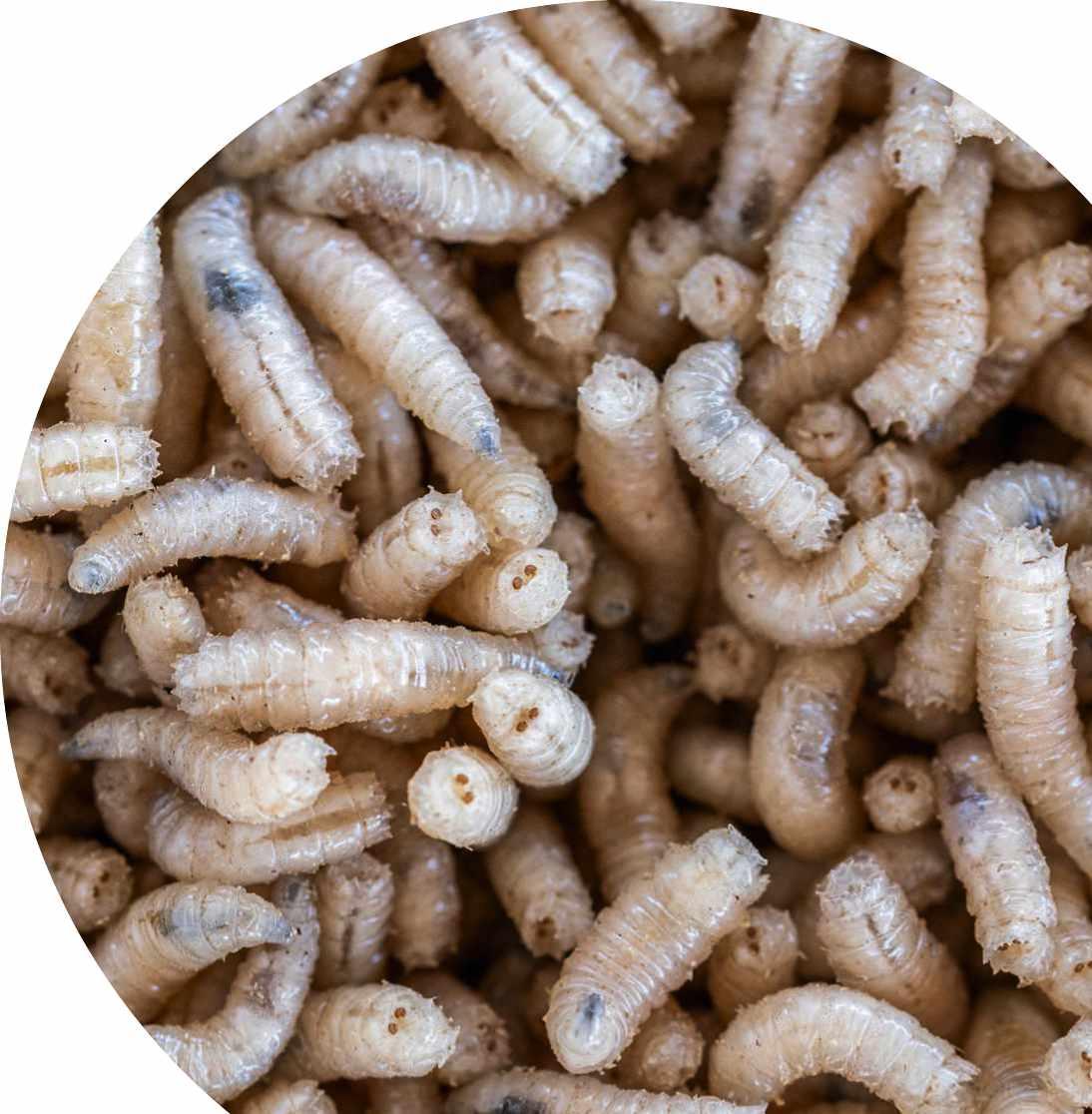
ELEPHANT-BONE TOOLS UNEARTHED
Over the last few millennia, the UK was home to several elephant species. The best known are mammoths, but other species – like the straight-tusked elephant – also lived here. These enormous animals were among the largest land mammals ever to walk the Earth, but that didn’t save them from becoming food for ancient people.
Across Europe and Asia, there’s evidence of humans exploiting the remains of all these elephants, including an extraordinary
3
PARANTHROPUS WALKED TALL
Around two million years ago, Paranthropus robustus lived in the woodlands and grasslands of what is now South Africa. But questions remained about how this species moved – speci cally, whether it habitually walked upright as well as climbing trees.
A remarkable new fossil from Swartkrans Cave, in Gauteng, is now helping to answer this question. Researchers have described an entire articulated leg, including parts of the pelvis, a nearly complete femur and a complete tibia, from what is thought to have been a young adult.
These connected bones allow scientists to reconstruct how Paranthropus robustus walked. The positioning of the leg bones resembles our own, indicating that the species was capable of upright walking. The authors also argue that the shape of the tibia suggests it may have had arched feet.
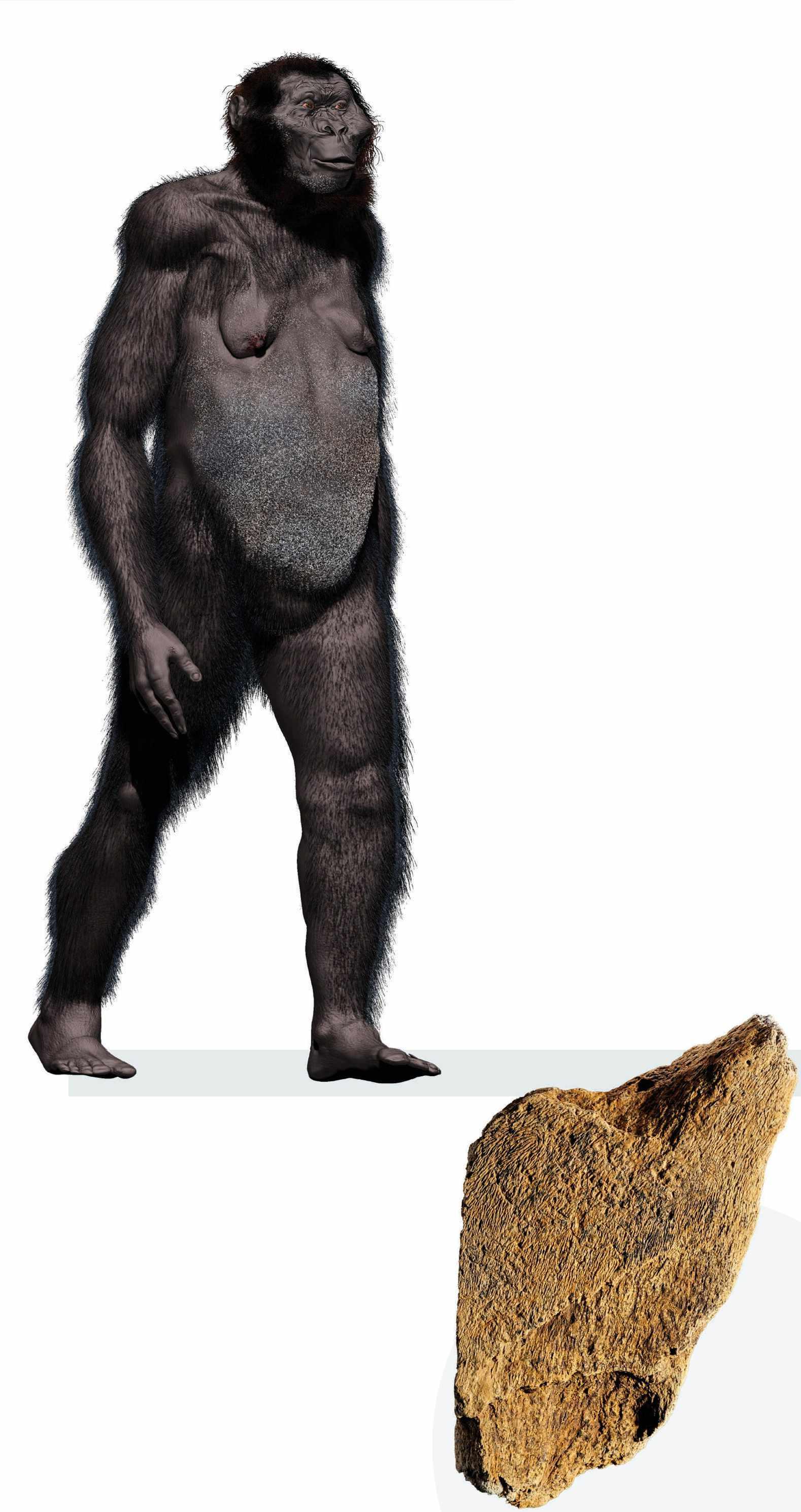
The positioning of the leg bones resembles our own, indicating upright walking.
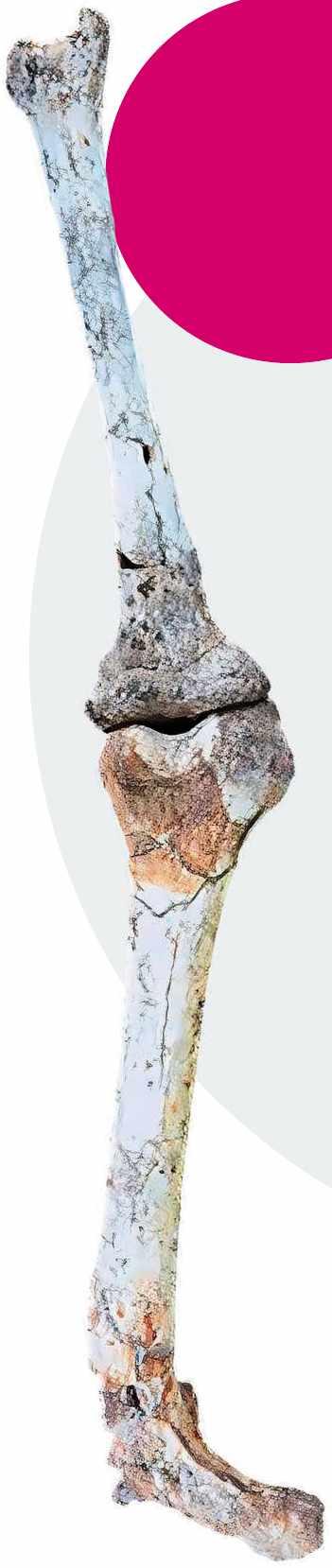
The strong, weight-bearing lower limbs and joint surfaces suggest a habitual biped.
example from 480,000 years ago in West Sussex. At Boxgrove, scientists have unearthed an amazing treasure trove of fossils: the earliest human remains from the UK, the oldest bone tools in Europe and the remains of thousands of butchered animals. Among these nds is a large fragment of elephant bone carefully shaped into a tool known as a ‘retoucher’, used to sharpen hand axes and other stone tools. The people living here – either Homo heidelbergensis or early Neanderthals – were using this tool almost half a million years ago.
ANCIENT ORIGINS OF IMAGINATION
The ability to imagine – whether picturing a tool within a lump of stone or telling stories around a re – has long been considered uniquely human. But new research with apes challenges this assumption.
A study investigating whether bonobos can use imagination found that these apes – which are closely related to chimpanzees and humans – can engage in ‘make believe’. Researchers tested a bonobo named Kanzi, who is known for understanding spoken English, by staging pretend tea parties: this
involved pouring imaginary drinks into cups and eating imaginary grapes from bowls. Even though no food or drink was present, Kanzi could still point to the empty containers when asked where the items were. These results could have profound implications for our understanding of animal cognition, particularly among our closest relatives. They suggest that imagination may be at least eight to nine million years old and could have been present in our lineage from the very beginning.
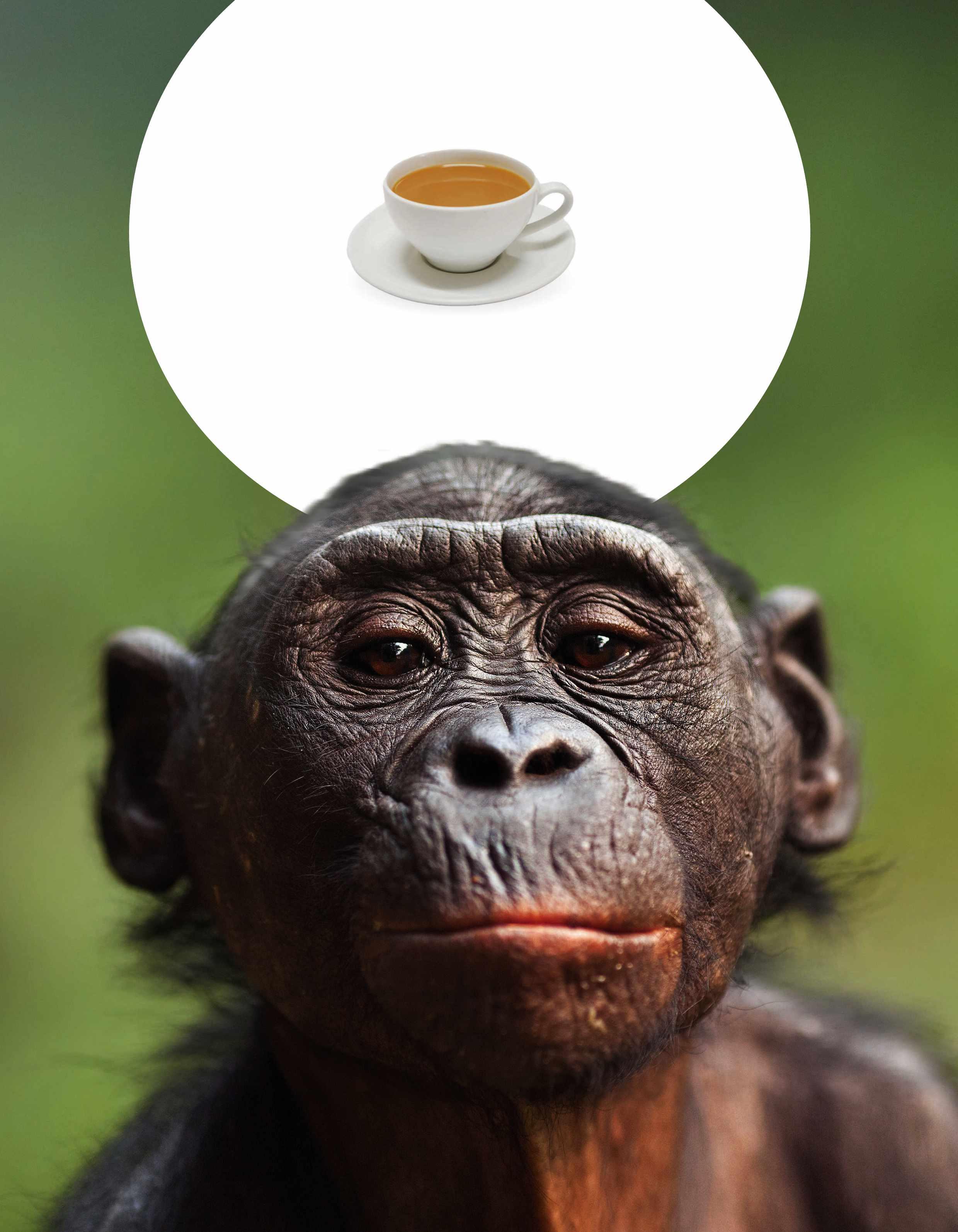
DID YOU KNOW
A 2025 study showed that bonobos can remember and mentally map the locations of familiar individuals, even when they’re out of sight – an ability once considered uniquely human.
This discovery gives us a rare window into a moment when early humans were not just using re, but had begun to understand and control it.
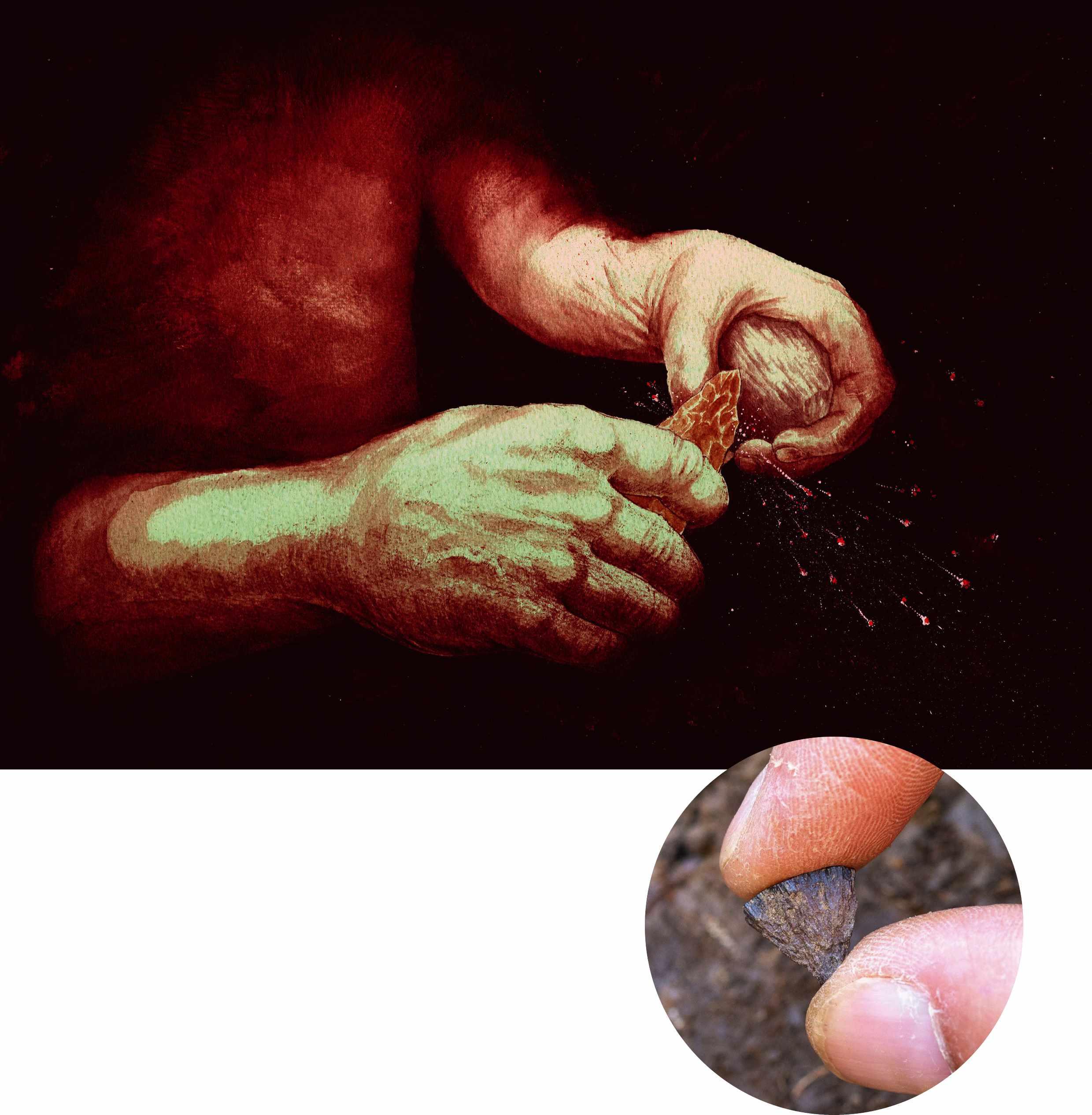
EVIDENCE OF EARLIEST FIRE MAKING DISCOVERED IN SUFFOLK
In the woodlands of Su olk, England, researchers excavating a former clay pit unearthed the earliest-known evidence of humans making and controlling re. The extraordinary discovery dates to around 400,000 years ago, when our species was still evolving in Africa.
In the layers of mud, the scientists found piles of ints that were reddened and cracked, evidence they’d been exposed to intense heating and repeated burning. The piles occured in patches across the site – the team had discovered ancient camp res beside what would have been a spring-fed lake, nestled between grassland and woodland.
But it was the discovery of two tiny, two-centimetre pieces of pyrite that turned the history of human evolution upside down. Striking int against pyrite produces sparks that can start a re, and
because there’s no local source of pyrite, the fragments must have been brought to the site by ancient humans.
The researchers suspect these people were early Neanderthals who had settled by the lake to make tools and keep warm. The ability to control re radically altered human society, providing heat and light after dark and creating a place for people to gather, socialise and maybe even teach.
Neanderthals were making fire nearly 350,000 years earlier than we thought.
Iron pyrite is a mineral that can produce sparks when struck with int.
DID YOU KNOW
Lucy’s species had strong, curved nger bones that point to regular
Even as they walked upright, their hands kept the power and exibility needed to move through the trees.
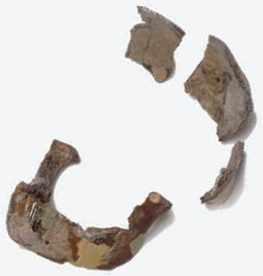
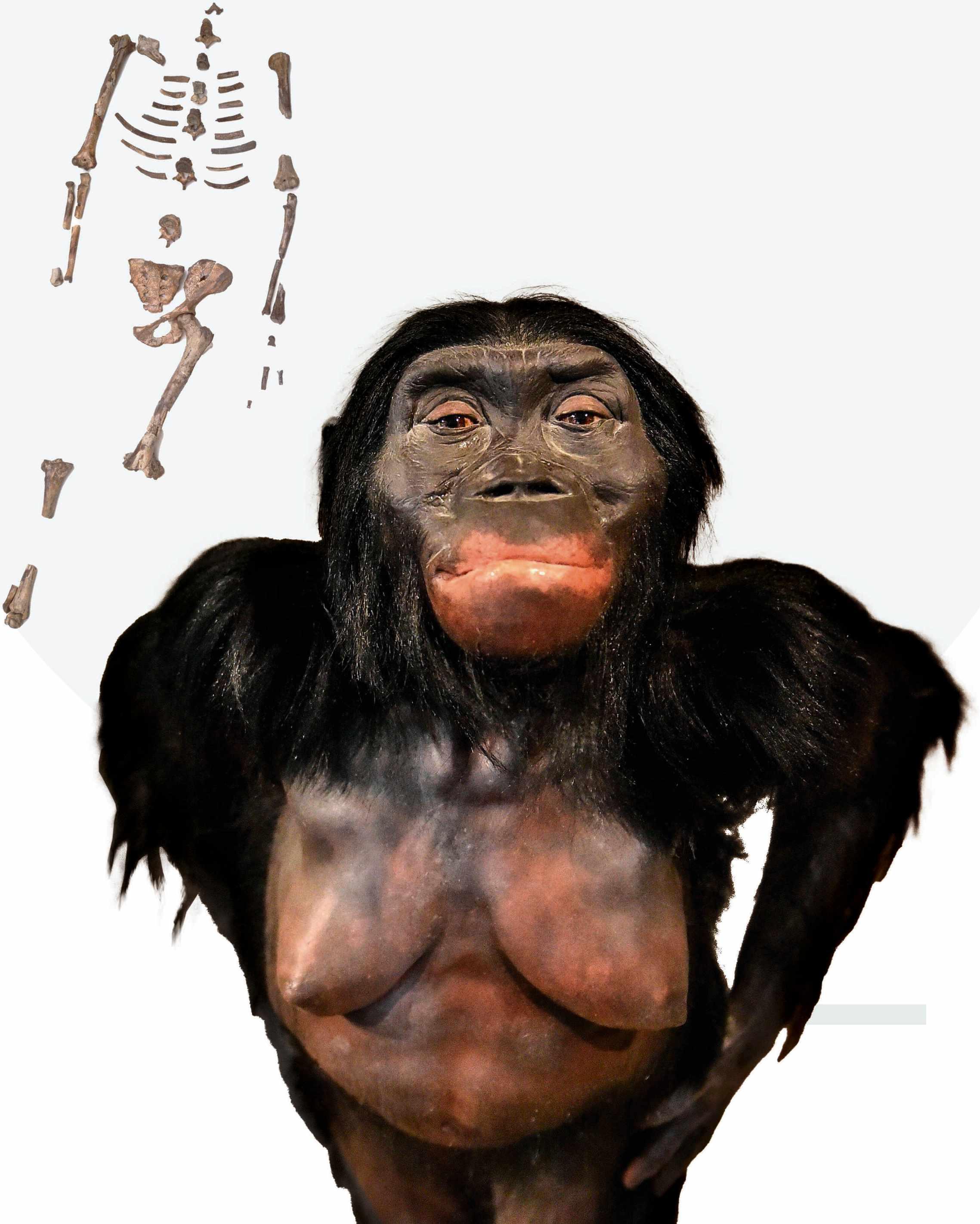
LUCY’S LINE RECONSIDERED
When the partial skeleton of an ancient hominin was discovered in Ethiopia in 1974, it took the world by storm. Belonging to the species Australopithecus afarensis, the fossil was quickly named Lucy and became something of a household name. Dating to about 3.2 million years old, the fossils of this small bodied ape showed that it walked upright
on two legs, leading many to argue that Lucy belonged to a species that eventually built up to our own.
But over the years this narrative has been questioned. New fossils of a foot from a closely related species, Australopithecus deyiremeda, found in northern Ethiopia, have added further doubt to this idea.
These fossils show that multiple species of ancient hominins were living in eastern Africa at this time and indicate that a third species of Australopithecus may sit at the base of this family tree.
This would mean that, rather than being one of our direct ancestors, Lucy was a member of a species that formed a side branch instead.

L f
A reconstruction of Australopithecus afarensis on display at the Neanderthal Museum in Mettmann, Germany. →

Lucy, a fossil of Australopithecus afarensis, is one of the most complete early human skeletons ever found.
climbing.
Our impact
HUMAN ORIGINS RECONSIDERED 8
One of the biggest questions in human evolution is when our own species rst emerged. We know that Homo sapiens existed by at least 300,000 years ago, but determining how far back our lineage extends has been far more di cult.
By studying two ancient human skulls from Yuxian, China, researchers have concluded that our origins may be much older than previously thought. They identi ed the one million-yearold skulls as belonging to early ancestors of another human species, the Denisovans. Because Denisovans and Homo sapiens are thought to share a common ancestor, this would mean our own lineage is equally ancient.
This pushes back the origin of Homo sapiens by at least half a million years and raises new questions about where this lineage originated. Further analysis of ancient skulls from across Africa and Asia may yet re ne this picture.
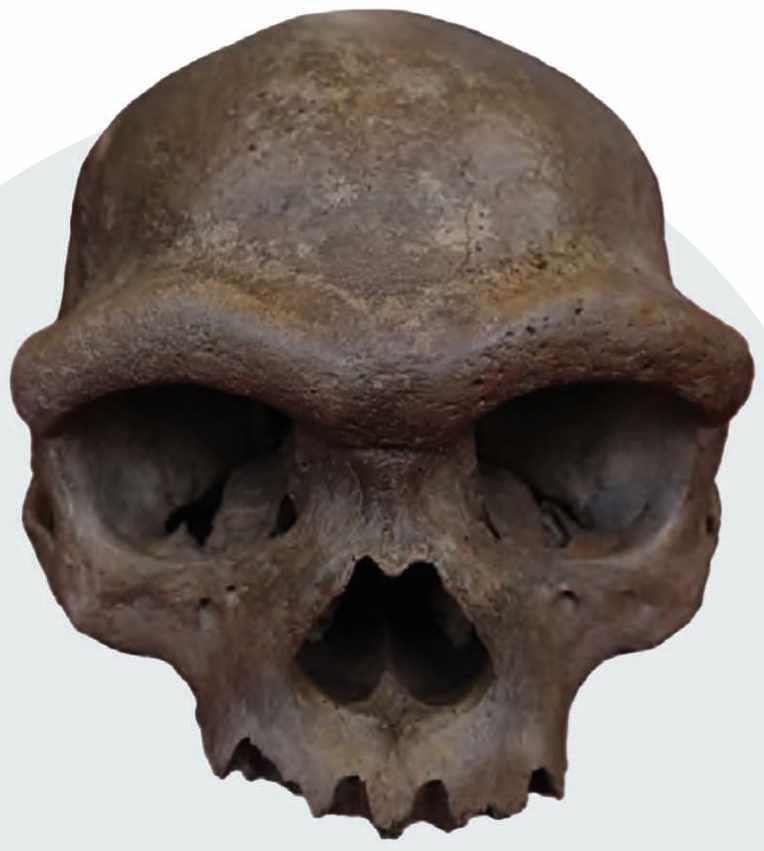
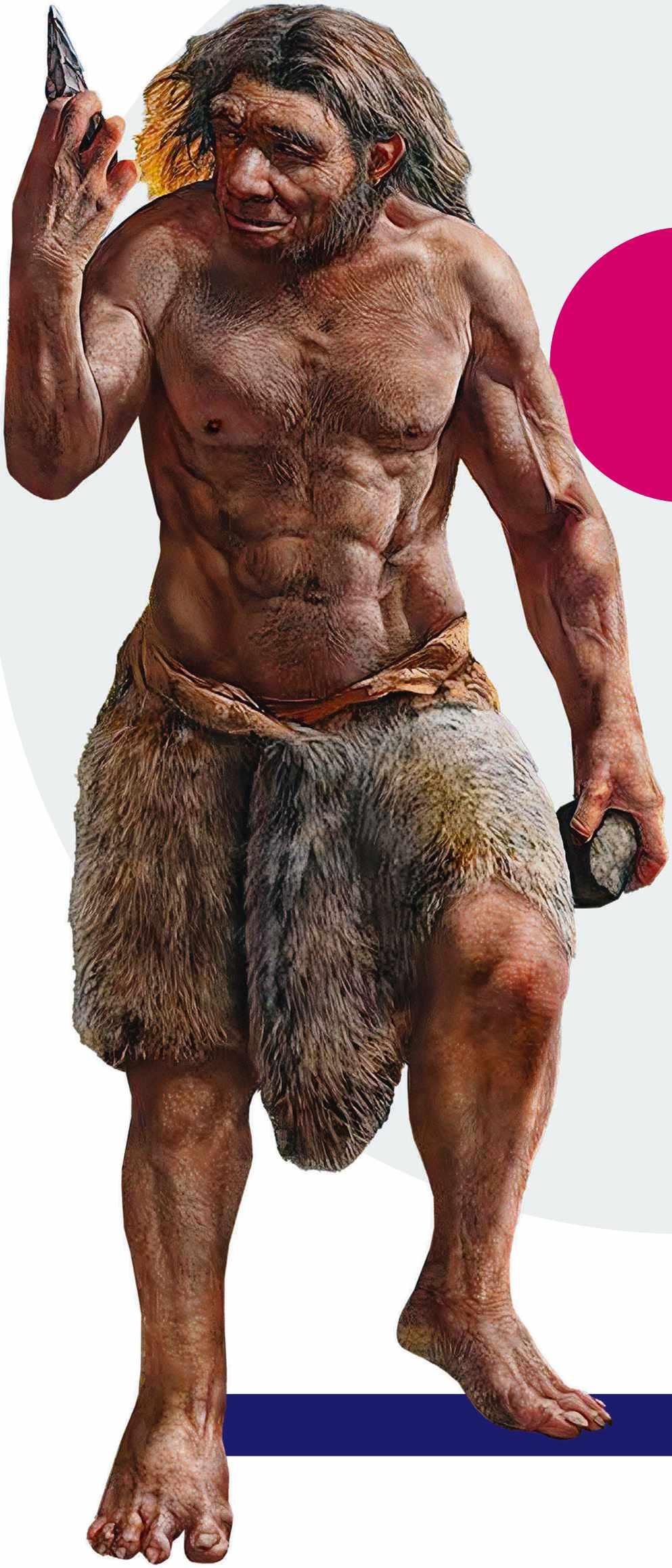
Genetic traces of Denisovans in modern humans show repeated interbreeding events.
The Natural History Museum’s Centre for Human Evolution Research (CHER) is generously supported by the Calleva Foundation.
One of the most enduring mysteries in human evolution has been the identity of the Denisovans. Previously known only from DNA in fragmentary fossils and in our own genomes, we now have a con rmed face for these ancient humans.
Evidence has been growing that several fossil skulls unearthed across Asia over the last century actually belonged to Denisovans. One of these is the Harbin cranium, which was previously named as a new species Homo longi and nicknamed ‘Dragon Man’, after the river near to where it was found.
New research has extracted tiny fragments of DNA from dental plaque on the fossil’s teeth. When compared DRAGON MAN: IDENTITY CONFIRMED 9
The Harbin ‘Dragon Man’ skull belongs to the mysterious Denisovans.
with Denisovan DNA from Siberia, the match was clear. This provides the rst molecular con rmation that Dragon Man was, in fact, a Denisovan.
The conclusion is strengthened by the extraction of ancient proteins from the same sample. These proteins also match those from known Denisovan fossils, and because protein structure is controlled by an individual’s DNA, this adds further weight to the true identity of Dragon Man.
10
ARRIVAL IN EURASIA PUSHED BACK
Our species was the last in a succession of ancient humans that evolved in Africa before spreading across the world. Until recently, it was thought that hominins – likely Homo erectus – rst reached Europe around 1.8 million years ago.
But evidence from the 1960s may push this date further back. At Grăunceanu, in southern Romania, researchers uncovered more than 5,000 animal bones, dating to nearly two million years ago, including remains of woolly rhinos, mammoths and even pangolins.
While conducting a detailed analysis of these bones, scientists noticed what appeared to be cut marks. Although no tools were found associated with the site, they argued that this was evidence of ancient hominins butchering animals. This would push back the date of hominin presence in Europe by at least 200,000 years.
However, others dispute this interpretation, suggesting the marks were caused by natural processes. They even argue that Grăunceanu should not be considered an archaeological site at all.
Researchers noticed tool marks etched into animal bones with stone tools – potential signs of butchering.
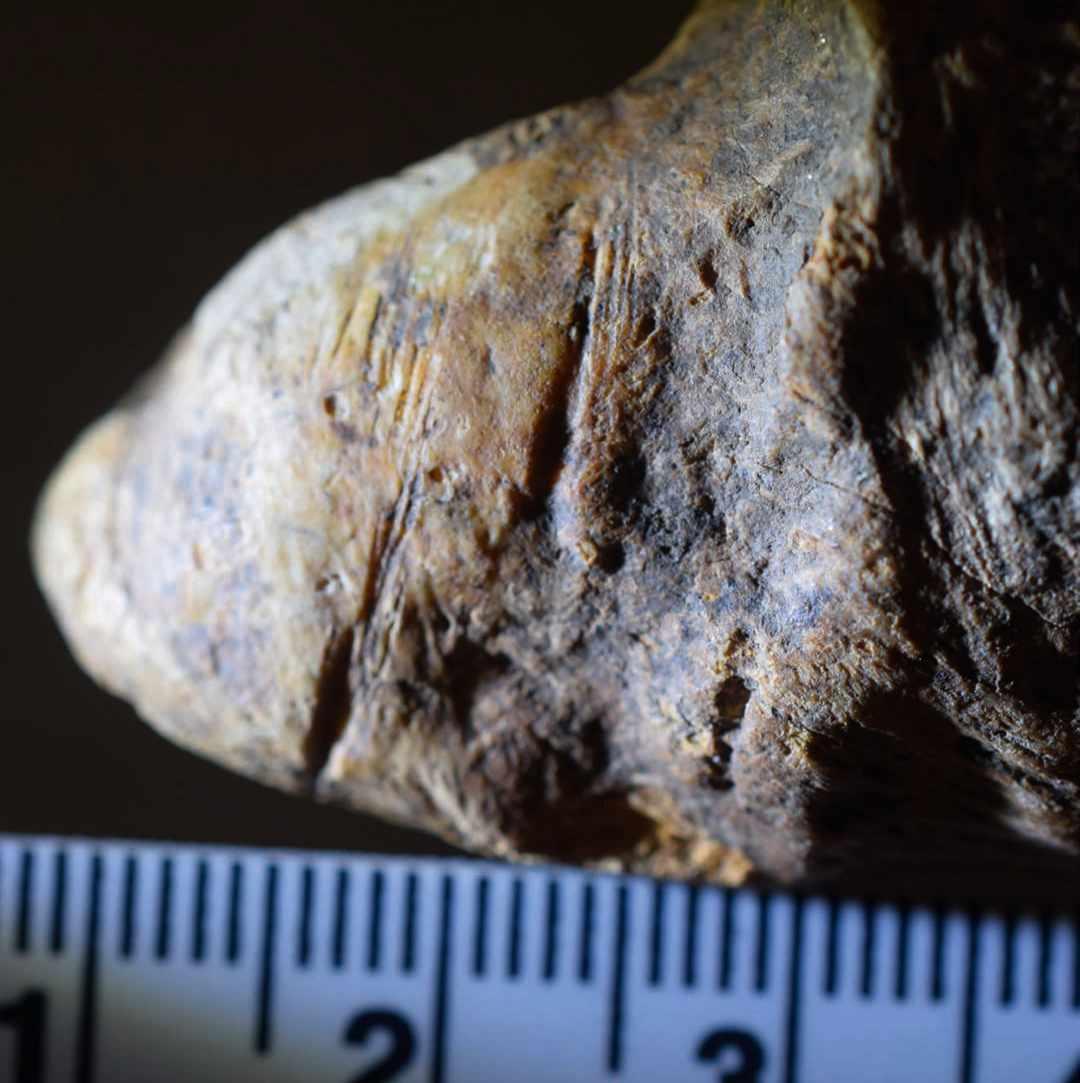
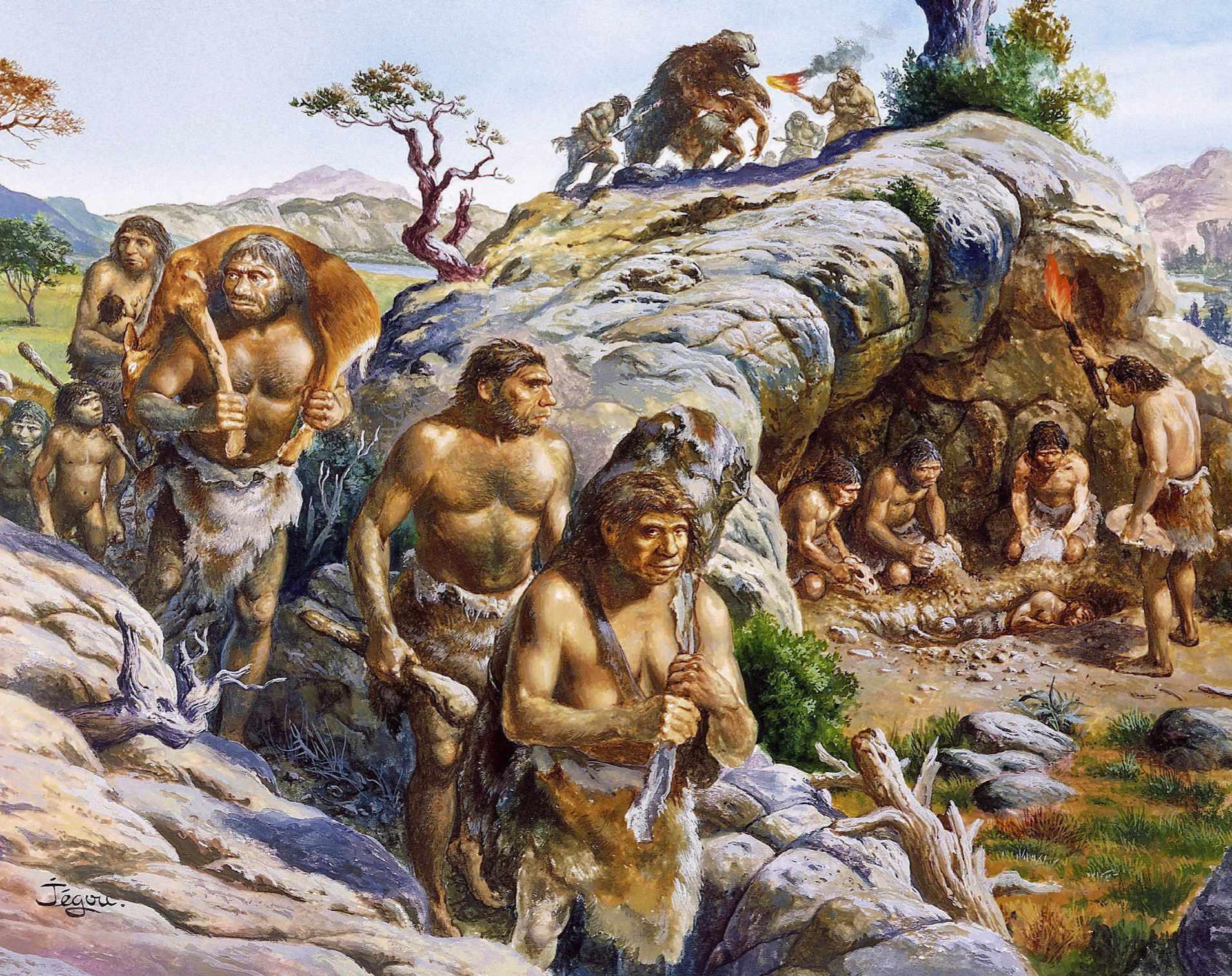
This guide to our fossil relatives explores how our understanding of human evolution has changed over time.
Priced £16.99, Our Human Story by Professor Chris Stringer and Dr Louise Humphery is available from the Museum’s Shops and from nhmshop.co.uk. Members and Patrons receive a 20% discount.
©Claire Terhune/University of Arkansas
Standing up for nature Rebecca Wrigley
‘Britain’s love of nature is its greatest asset – 80% of the public support rewilding’
With rewilding now reshaping landscapes and livelihoods across Britain, co-founder and chief executive of the charity Rewilding Britain Rebecca Wrigley re ects on a decade of progress. She shares the challenges ahead, and why communities are central to nature’s recovery.
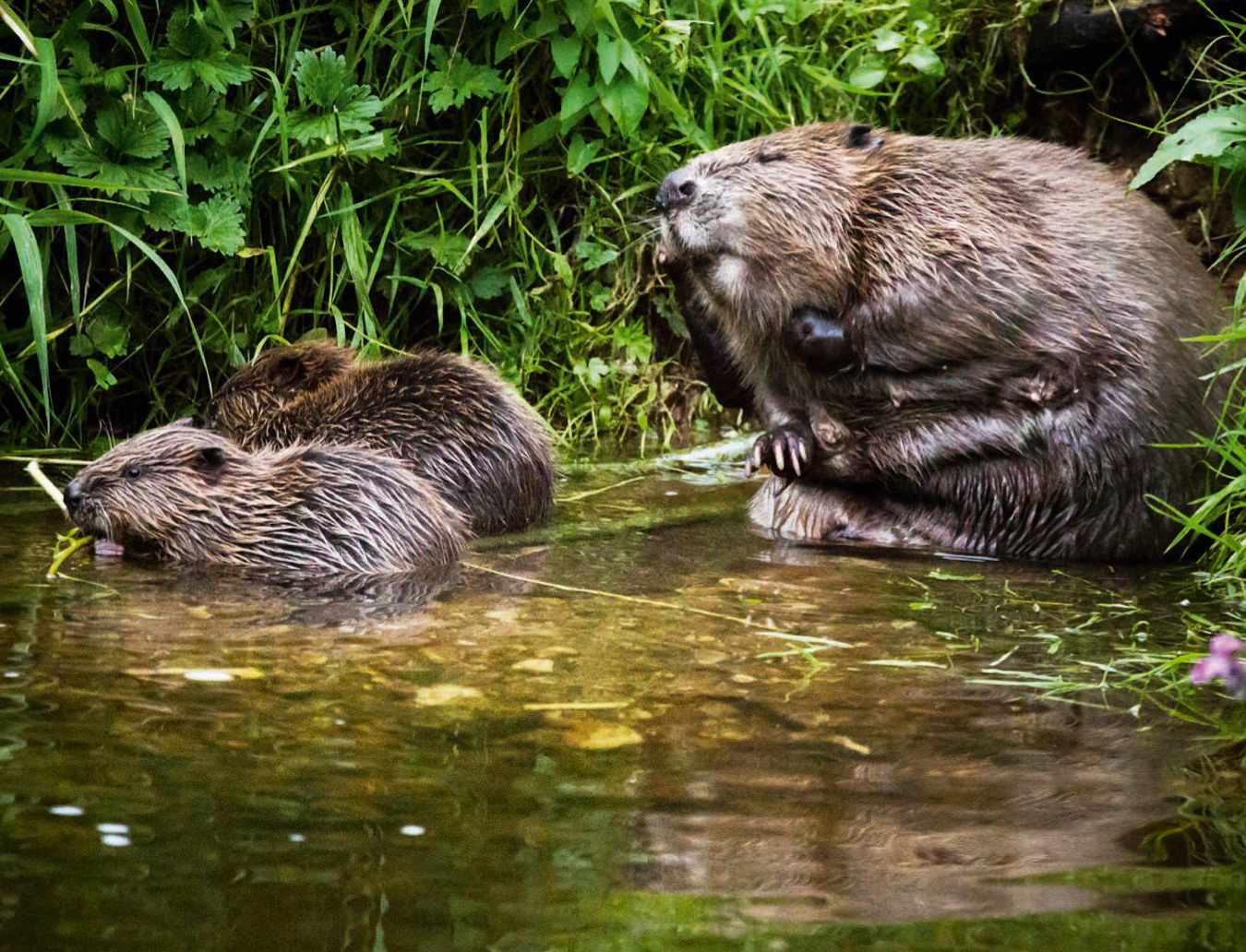
What is rewilding and how did Rewilding Britain come about?
Rewilding is the large-scale restoration of natural processes and ecosystems so that nature can look after itself – and us. It’s about giving nature the space and conditions to take the lead, while recognising that rewilding is also about people.
Healthy ecosystems underpin our ecological, social and economic wellbeing, so rewilding places communities at the heart of decisionmaking, ensuring they bene t as nature recovers. For rewilding to succeed long term, it must support the environment and local livelihoods – we call these nature-based economies.
Rewilding Britain began after journalist and environmental campaigner George Monbiot published his book Feral, which brought rewilding into public awareness. A group of people from di erent backgrounds realised there needed to be an organisation pushing the conversation forward, so that real, lasting change could happen.
What role does the landscape play?
Rewilding focuses on restoring the natural processes that allow ecosystems to adapt, regenerate and thrive – from free- owing rivers to herbivore–predator relationships. Assessing land to determine whether it’s suitable for species reintroductions means understanding whether those processes can function naturally there.
In marine environments, rewilding often means reducing destructive practices, so that ecosystems such as kelp forests can recover and provide a habitat for other species. Some species are known as keystone species: without them, ecosystems deteriorate and struggle to recover. For example, beavers dramatically reshape landscapes by creating wetlands to restore ecological dynamism.
How important is it to involve everyone?
It’s vital. People are part of nature, so rewilding works best when communities are involved in decision-making from the start and projects re ect local culture and context. Some of the most inspiring UK examples are community led – from residents buying land for nature restoration and community regeneration to local divers in Arran coming together to restore damaged seabed.
Rewilding Britain supports monitoring and educational projects. What does this involve? Nature is the foundation of our lives and economy so understanding the ecological, social and economic value of rewilding is essential. →
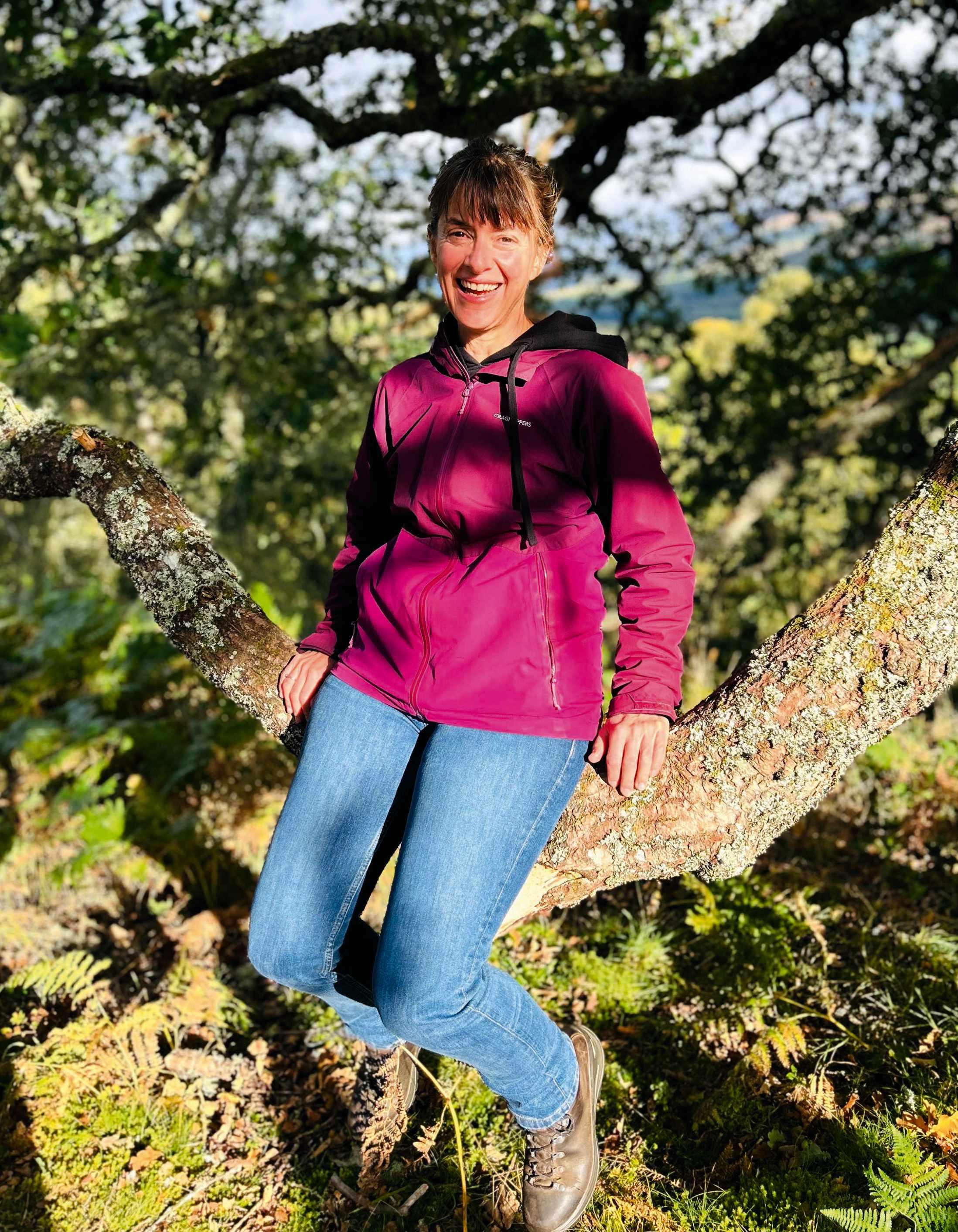
‘I’m most inspired by the quiet, magical moments, like watching a wild beaver at work.’
Standing up for nature
Rebecca’s life in a nutshell
Growing up on the edge of Cambridge, my dad’s love of nature planted the seeds for everything that followed.
I now call Devon home and regularly enjoy wildlife on my doorstep, from seeing blue n tuna to kayaking with dolphins.
After completing a master’s in Rural Resources and Environmental Policy, I worked in conservation, community and social change.
I lived and worked with a Mayan community in Mexico and travelled across three continents –from Papua New Guinea to East Africa – leading projects that heal landscapes and support communities.
As CEO of Rewilding Britain, I’m proud to see the movement grow; our Rewilding Network now covers more than 200,000ha.
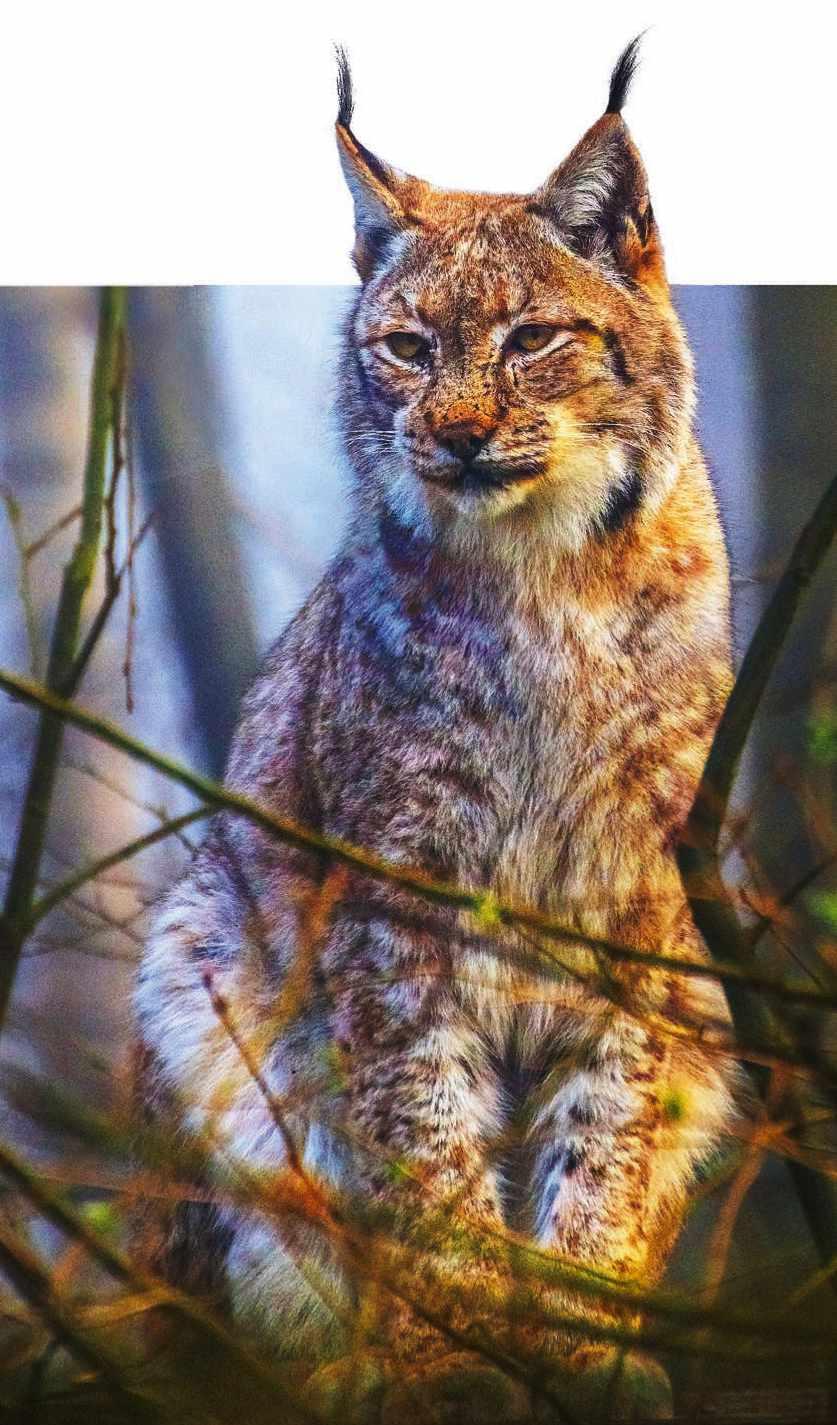
This is why we support a wide range of monitoring and educational work. Our Rewilding Network now includes more than 1,000 members across 200,000 hectares of land and sea. Most monitoring systems only focus on individual species or habitats, not whole ecosystems – and they rarely assess social or economic impact. They’re not getting the bigger picture. So we’ve developed our own frameworks with partners to look at the whole system and evaluate ecosystem health – including species diversity, abundance and the structural complexity of an ecosystem.
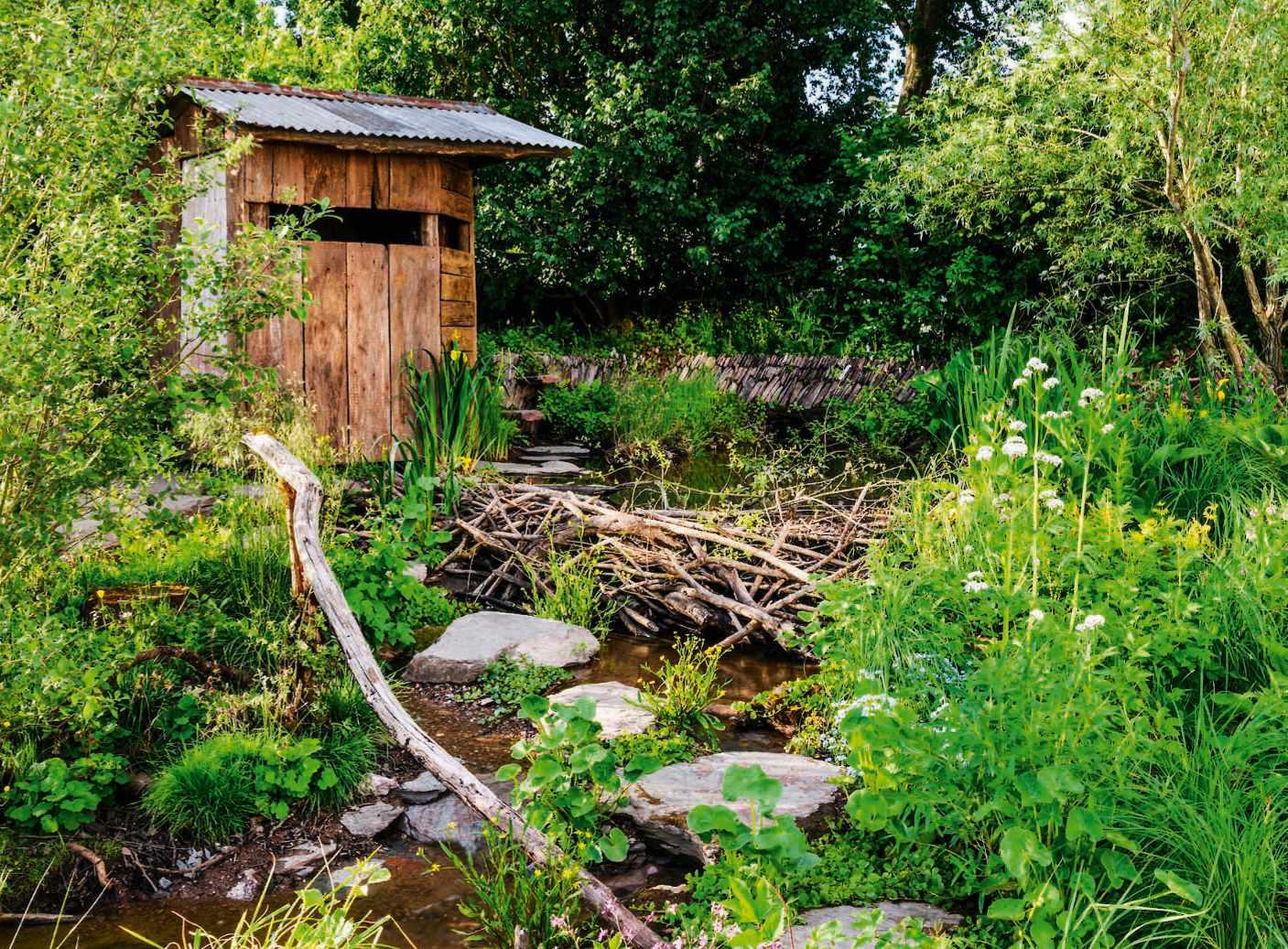
‘Species like the lynx are as much a part of our cultural heritage as Shakespeare.’
How can rewilding support local economies, and what role does government policy play?
When communities are involved from the start, rewilding can support nature-based enterprises and strengthen local economies. Across our Rewilding Network, we’ve seen a 120% increase in full-time equivalent jobs – from traditional roles like stock management and deer control to newer opportunities in ecology, ecotourism, community engagement and monitoring.
Government support can help fund large-scale restoration, but uncertainty around long-term commitment makes it di cult for land managers to invest con dently in future change. Greater clarity and stability would help drive investment in new land and marine management approaches.
What are the biggest challenges?
A major challenge is achieving the scale needed for meaningful change. The Government’s pledge to protect 30% of land and sea by 2030 is approaching fast and still falls short. Nature recovery must happen across entire landscapes and include regenerative land use, yet Government funding remains inadequate. This is worrying given a recent UK report identi ed ecological collapse as a major threat to national and food security – a reminder that restoring nature is essential, not optional. Nature and food production are often framed as competing priorities, but they aren’t. Without healthy ecosystems and a stable climate, agriculture cannot thrive. Rewilding is therefore a productive and worthwhile use of land and sea.
What needs to change to make rewilding easier?
We need stronger political commitment, proper investment and recognition of the crucial role played by communities, land managers, landowners and those working at sea. Bureaucracy around species reintroduction also slows progress. Despite beavers’ clear ecological bene ts, releases require navigating complex local council processes. We’re working on nancing models and supporting landowner cooperatives to make restoration easier. More broadly, we need a national conversation about how to balance the demands we place on the land and the sea, from energy, food and timber to housing, infrastructure and climate. We need a more integrated approach, and rewilding is central.
©Getty
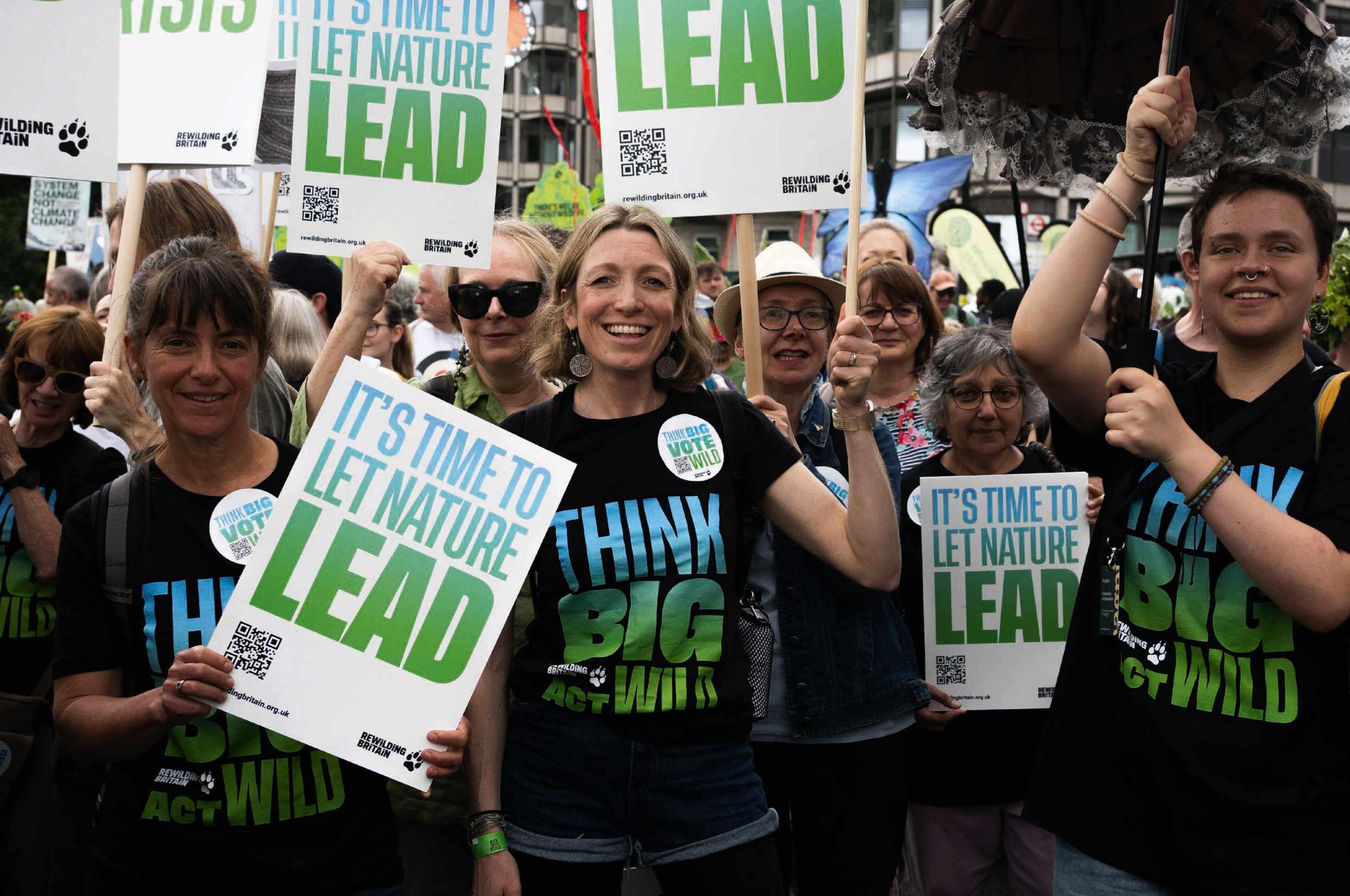
How does rewilding in the UK compare with how it’s happening elsewhere?
Britain is among the world’s most nature-depleted nations, while countries across Europe, Latin America, Africa and New Zealand still have far more naturally functioning ecosystems than we do here. Many British people only experience nature through documentaries. But Britain’s greatest asset is its passionate love of nature. A poll we ran showed more than 80% of the public support rewilding, giving us a powerful foundation to build upon. If we can channel the passion of urban, rural and coastal communities, we can create landscapes where nature and livelihoods thrive together.
What gives you hope for rewilding in Britain?
Britain has an extraordinary wealth of habitats on land and at sea. As an island with a long coastline, our marine environment is a huge asset. Few people realise we have our own native temperate rainforest, which plays a vital role in absorbing and holding water. The potential for a richer, more diverse natural tapestry is enormous. We’re already seeing glimpses of recovery. Watching blue n tuna leap close to shore in south Devon was a hint of the awe-inspiring abundance that could return.
What are your most important achievements? Rewilding is now far better understood, accepted and more mainstream. Advising The Archers on rewilding storylines helped raise its pro le and normalise the concept. We’ve developed our Rewilding Innovation Fund, which supports 15,000 people exploring rewilding approaches, and we’re scaling up our Rewilding Challenge Fund, which provides £100,000 for projects each year.
What projects are coming over the next decade? We’ll continue to expand funding opportunities. This is essential for landscape-scale projects where multiple landowners work together, delivering ecological bene ts to support landowners, tenant farmers and rural economies. Strengthening this collaborative approach also helps normalise rewilding as a productive and valuable use of land. We may also be closer to the reintroduction of lynx. Species like the lynx are as much a part of our cultural heritage as Shakespeare or Burns Night – restoring them is restoring part of who we are. There’s also a strong economic case. In parts of Germany, the presence of lynx has boosted rural economies through tourism. Even though visitors rarely see a wild lynx, the excitement alone attracts people and supports local businesses. O
Top left Lynx would be an extraordinary addition to our ecosystems, restoring balance in ways only a top predator can.
Bottom left Winning Best Show Garden at the Chelsea Flower Show in 2022 for a beaver-inspired garden has helped raise the pro le of rewilding and bring the movement to a wider audience.
Above From marches for nature to policy advocacy and campaigns, Rewilding Britain is pushing for wilder landscapes and giving communities the tools to let nature lead.
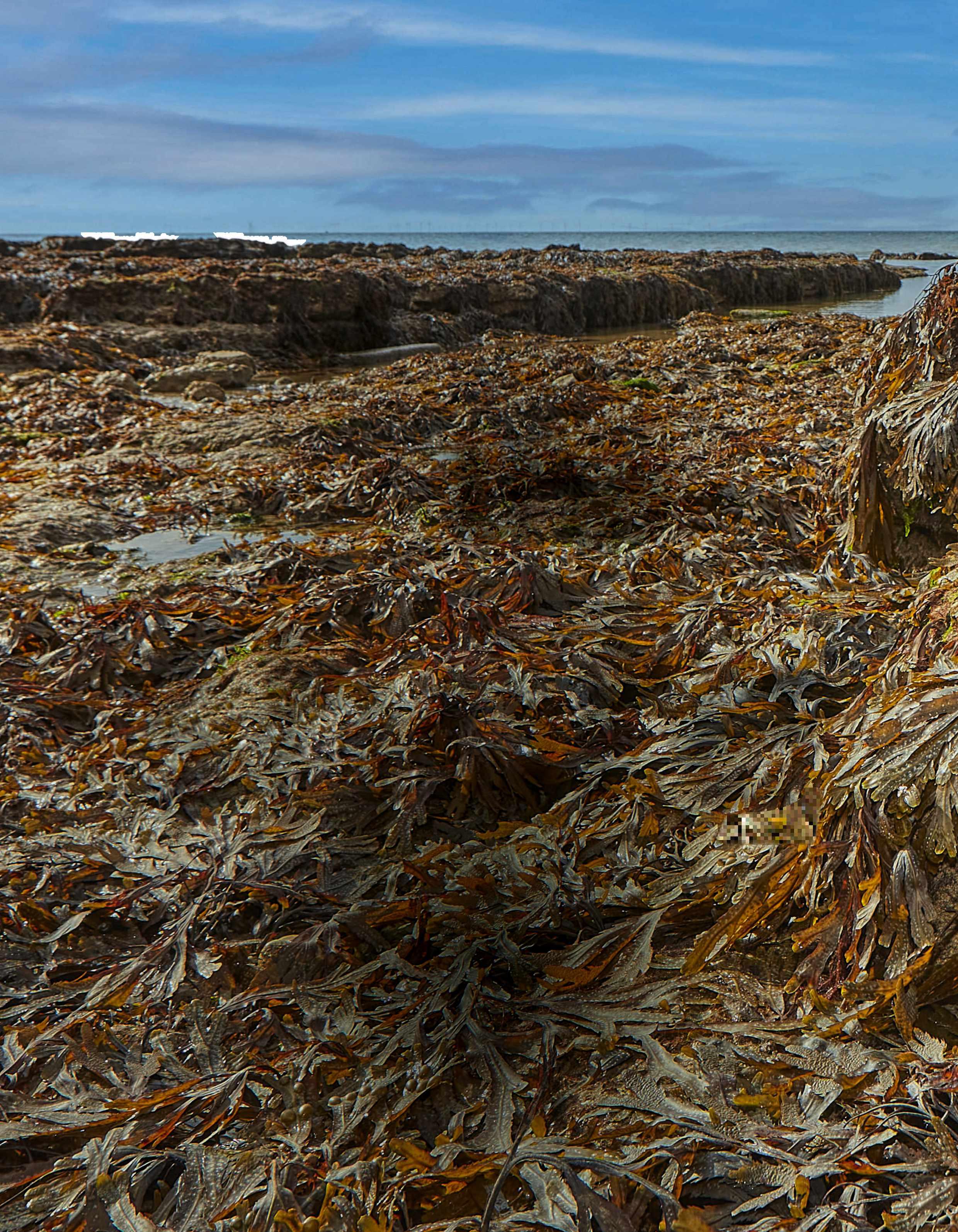

S s of




sh e the ecrets f he






For 10 years, the Big Seaweed Search has brought together generations of coastal recorders to build a unique picture of our shorelines. These vital insights help scientists understand climate change, biodiversity loss and the future.
WORDS: JEN PULLAR

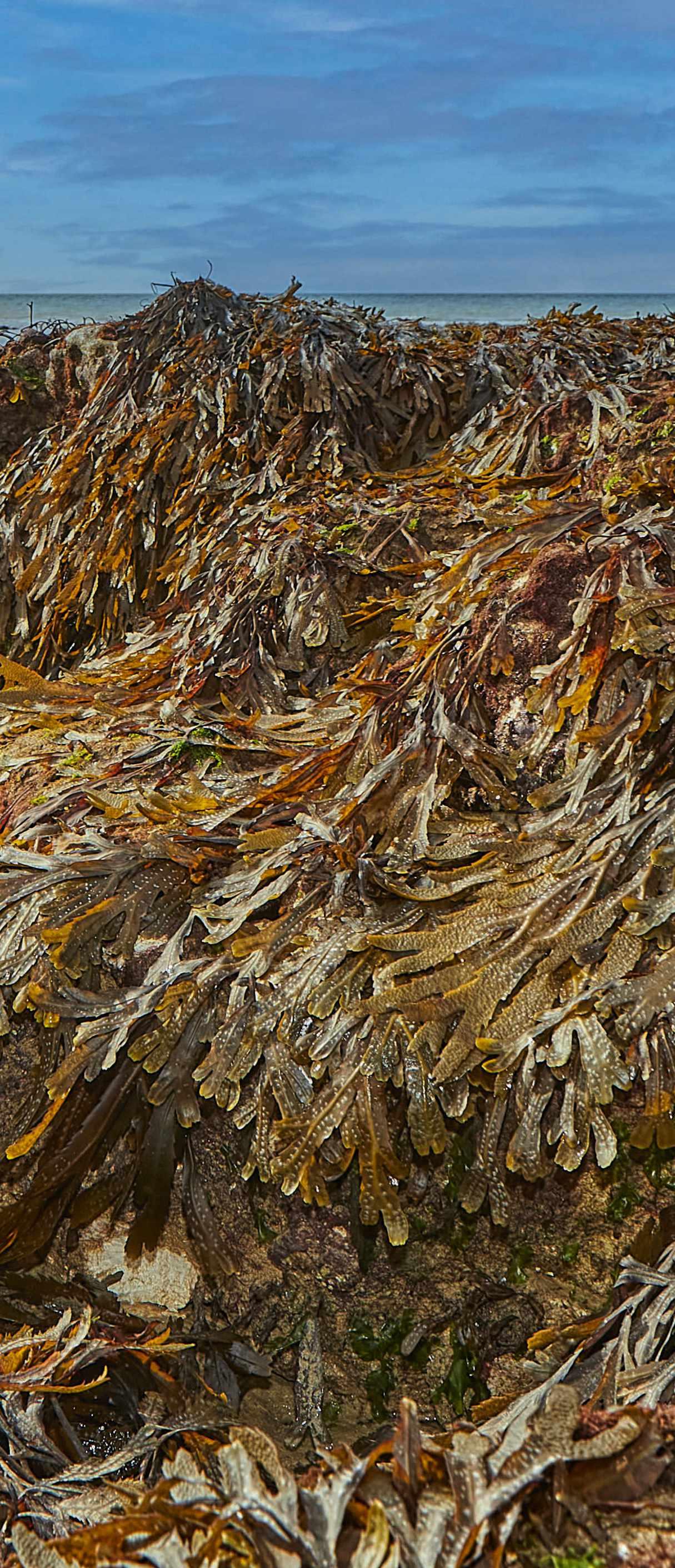
The UK is home to more than 650 species of seaweed, making it one of the world’s hotspots for seaweed diversity. Our long, varied coastline, the mix of warm and cool water in uences, and complex geological history create a huge range of suitable habitats for all these seaweeds to grow.
Seaweeds are large marine algae. They are photosynthetic organisms that use sunlight to grow, like plants, but unlike land plants, algae do not belong to a single biological group. Seaweeds fall into three major groups. Green seaweeds contain the same chlorophyll pigments as land plants, capturing sunlight for photosynthesis and converting solar energy into chemical energy.
Red seaweeds also contain chlorophyll, but have additional red and blue pigments that allow them to thrive in deeper or dimmer waters.
Brown seaweeds include kelps, which are mainly subtidal, and wracks, which dominate rocky shores. They belong to a completely di erent branch of the tree of life, the stramenopiles, and have distinctive brown pigments such as fucoxanthin. These compounds are so unusual that they have attracted considerable interest for their potential anticancer properties.
Why are seaweeds important?
Seaweeds play a huge role in the world’s oceans. They are ecosystem engineers, carbon cyclers, habitat builders and one of the most widespread forms of marine vegetation on Earth. Seaweeds grow across rocky shores, through shallow subtidal zones and, in some cases, down to more than 300 metres, far below where you might expect photosynthetic life to survive. Wherever they grow, they support a wide range of wildlife, o ering food, protection and living space to organisms from tiny snails to commercially important sh.
As photosynthetic organisms, seaweeds form the base of food webs. They regulate carbon and oxygen cycles and in uence nutrient ows in coastal waters. They also protect coastlines by dampening waves and reducing erosion, stabilise sediments and create complex surfaces for other organisms to cling to. Without them, the diversity of life in our seas would be dramatically reduced, sheries would su er, and many coastal environments would be less stable, less productive and less resilient to change.
In 2006, scientist Juliet Brodie found herself doing the RSPB’s annual Big Garden Birdwatch and wondering, ‘Why don’t we have something →

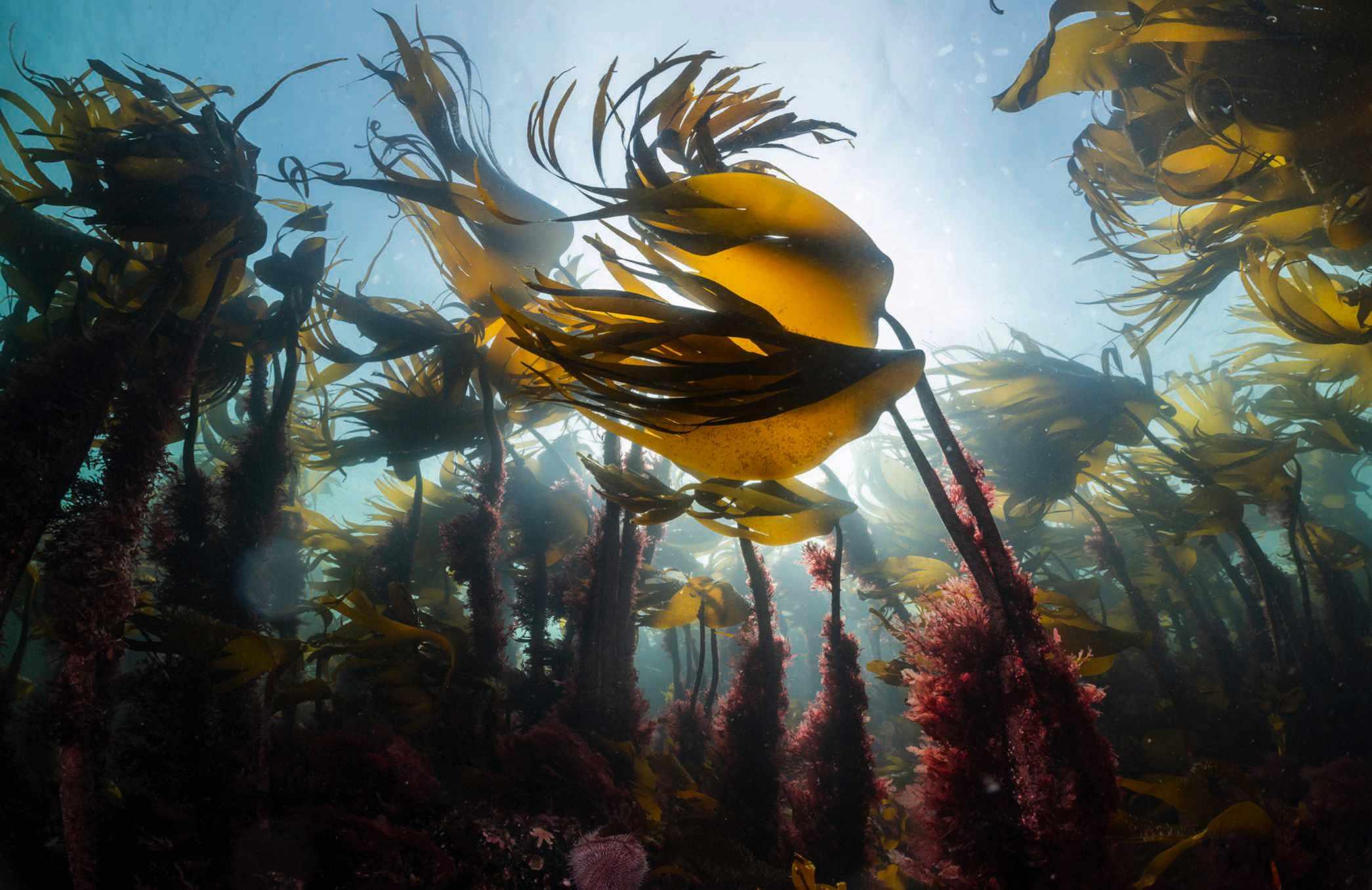
Underwater forests of kelp – like in the North Sea – shelter wildlife, store carbon and protect coastlines, yet many populations are declining.
like this for seaweeds?’ At the time, researchers were increasingly concerned about the loss of large brown seaweeds and the e ects of ocean acidi cation, but the evidence was anecdotal. There was no national, repeatable way to track what was happening along the UK’s coasts. This idea became the seed of a project that would evolve, adapt and grow into one of the Museum’s most successful long-running community science initiatives. The rst version of the Big Seaweed Search launched in 2009. It ran for several years and generated valuable interest, but the method was not precise enough to provide comparable data. In 2016, the project was redesigned from the ground up, this time in partnership with the Marine Conservation Society.
Ten years of community science
The revamped version introduced clear scienti c questions, standardised methods and de ned survey areas and time periods, to make results comparable. Training sessions were introduced, and a network of volunteers were recruited to lead repeat surveys. This transformed the project, making it robust enough to produce data that were suitable for scienti c research. Since 2016, thousands of volunteers have contributed photos
The Big Seaweed Search provides vital insights for tracking changes in our oceans and on our coast.

and data, which have been used in peer-reviewed research. This includes a paper analysing the rst four years of data, and 1,000 data points added to the dataset used in the rst International Union for Conservation of Nature (IUCN) Red List assessment of British seaweeds.
When Juliet and the team analysed the rst four years of data, they found that people’s observations were strong enough to identify environmental patterns. They also learnt where volunteers struggled (such as identifying lookalike species) and used that to improve methods.
Variations of the survey now run in the Falkland Islands, on cruise ships in South Georgia and in Mexico, where a major project focuses on massive Sargassum strandings, combining
Juliet is a research scientist looking at marine algae and specialising in red algal taxonomy, life histories, evolution, ecology and conservation. She leads the Big Seaweed Search.
MUSEUM EXPERT
Professor Juliet Brodie
Know your seaweeds: eight to spot
The British Isles is globally important for seaweeds. The Big Seaweed Search helps scientists understand how seaweeds respond to environmental change.
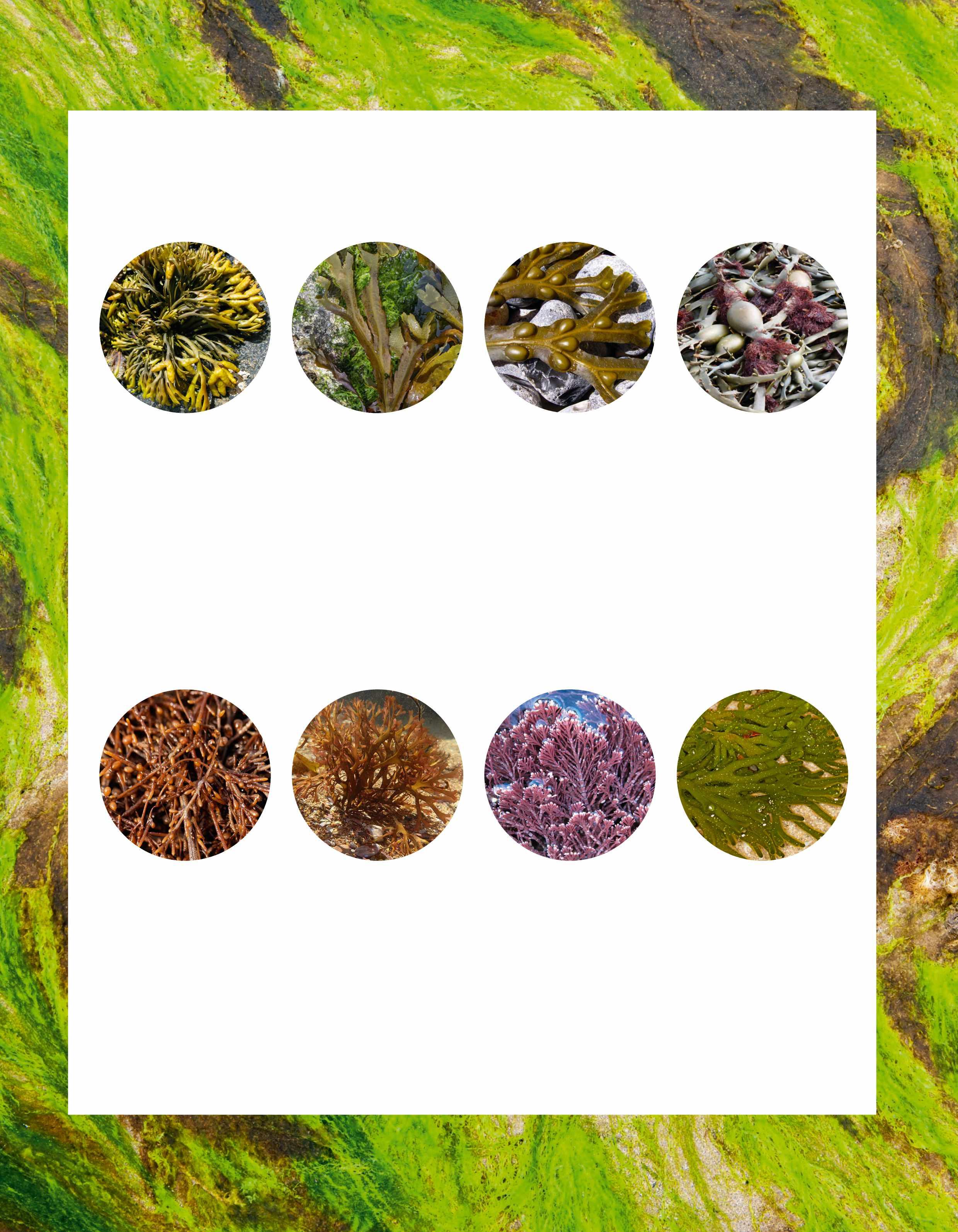
Channel wrack
A brown seaweed with distinctive channelled fronds, growing high on sheltered rocky shores. Fronds are unbranched or forked a few times and reach 5–15cm. It forms dark upper shore bands and tolerates long periods out of water, making it one of our hardiest species.
Serrated wrack
A yellow brown-to-olive seaweed with broad, at fronds edged with clear saw-toothed serrations. It forms dense bands on the lower shore, especially on moderately sheltered coasts. The fronds grow 30–60cm and often overlap to create thick mats across the lower intertidal zone.
Bladder wrack
A brown seaweed with paired air bladders (resembling bubbles) that help it oat towards sunlight for photosynthesis at the sea’s surface. It forms broad, distinctive belts on mid-shore rocky habitats. Fronds vary from 15–90cm and range in colour from greenish to dark brown.
Knotweed
A long-lived brown seaweed with smooth, rope-like fronds and large, oval air bladders spaced along their length. It thrives on sheltered mid-shore rocks, forming thick, tangled masses. Individual fronds can reach one to two metres and may persist for many years.
Wireweed
A fast-growing brown seaweed with long, stringy fronds covered in tiny, round air bladders. Native to Japanese waters, it was rst recorded in the UK in 1973 and has since spread widely. It grows two to four metres and is considered invasive.
Irish moss
A tough red seaweed with repeatedly forked, fanshaped fronds. Colours range from deep red to purple, sometimes turning green. It grows on lowershore and shallow subtidal rocks, often forming dense patches. Fronds reach 5–15cm and feel leathery.
Common coral weed
A calci ed red seaweed with a pink-to-purple, coral-like appearance. Jointed, chalky fronds form small tufts in runnels, rockpools and on lowershore rocks. It grows 2–10cm and is recognised by its brittle, segmented texture and pale, stony colour.
Green sponge ngers
A green seaweed with rm, spongy, nger-like fronds that feel velvety to the touch. It grows on lowershore rocks, in rockpools and in the shallow subtidal zone, forming loose, bushy clusters. Fronds are regularly branched and typically reach 10–40cm.
©Getty
©Alamy
Volunteers of all ages have fun surveying seaweeds.
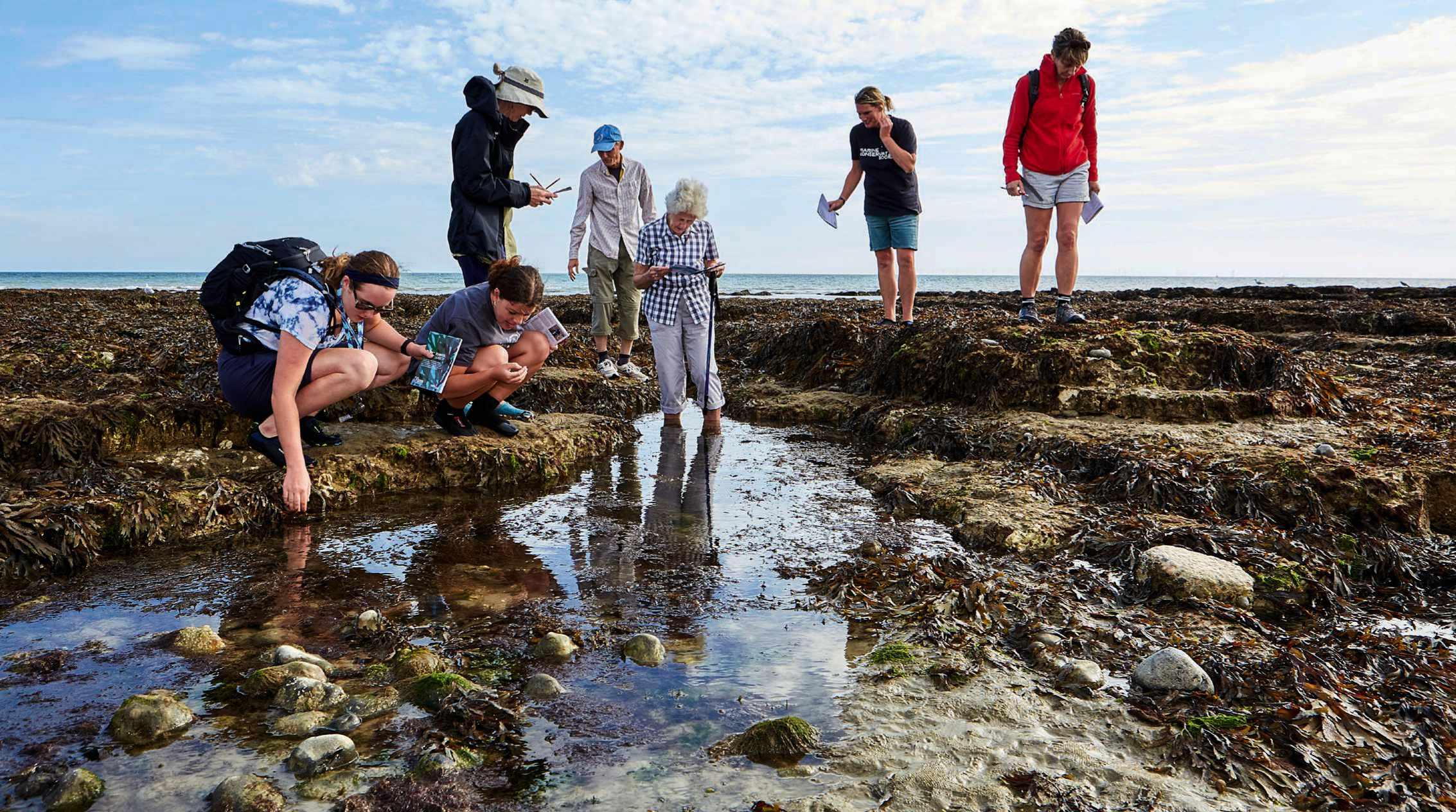
science with youth education. Community science is also being introduced in Malaysia, through Juliet’s work with southeast Asian colleagues to build more resilience in the seaweed aquaculture industry.
An evolving community
A decade on, Juliet sees the project as a reminder that, with enough vision and perseverance, community science can become a powerful scienti c tool – one capable of showing how our shores are changing and empowering communities to help protect them.
Looking ahead, Juliet and the team hope to analyse a decade of Big Seaweed Search data to identify long-term trends over the next decade. The project is
Community science can be a vital scientific tool, showing how our shores are changing.
What we’ve learned from the Big Seaweed Search
A decade of community science has revealed 10 key insights about the UK’s seaweeds.
1 Volunteers generate reliable data – every seaweed record that’s submitted by a citizen scientist is supported by a photo-checked species identi cation and a georeferenced location, giving researchers con dence in the dataset.
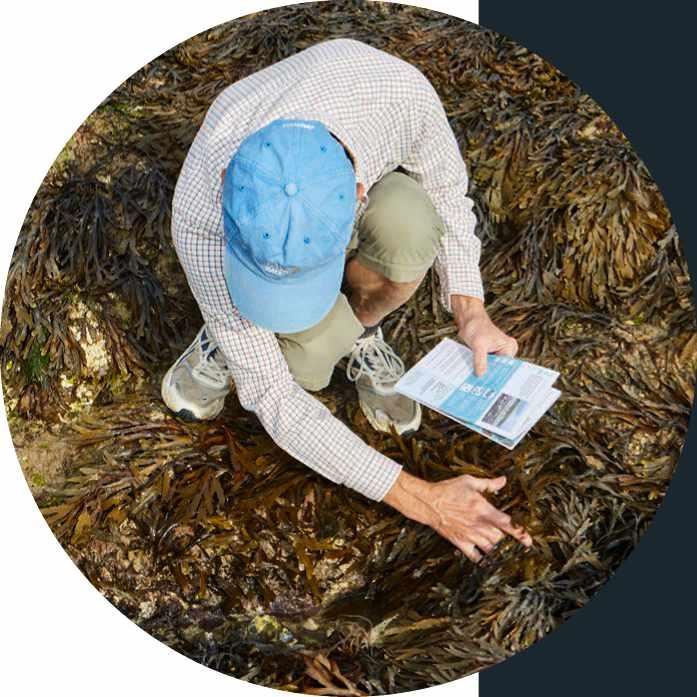
2 Identi cation challenges highlight where training needs strengthening – several species look deceptively similar, and volunteer errors reveal where resources and guidance can be improved, making future data collection stronger.
3 Consistent methods allow nationwide distribution maps to be drawn –for many monitored species, these are the rst UK-wide maps made with standardised, repeatable surveys.
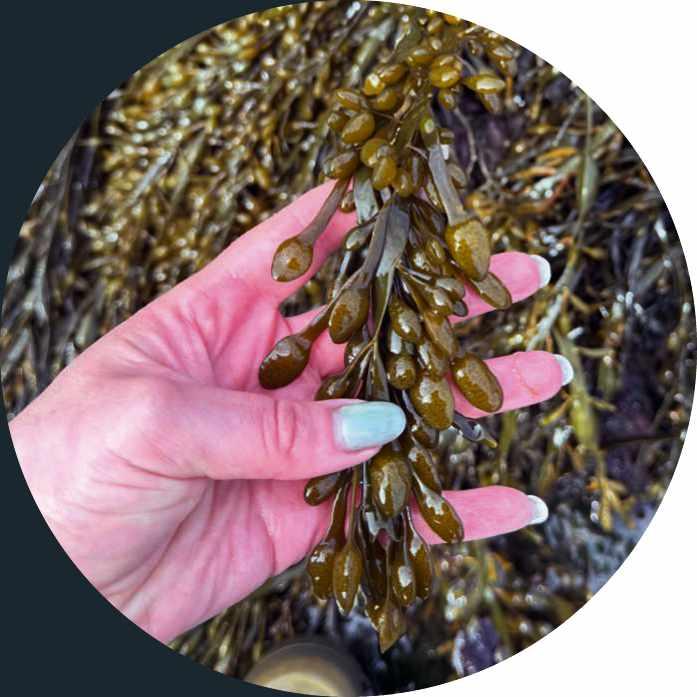
Volunteers submit photos like this for identi cation.
4 Seaweeds show clear responses to environmental change – patterns in the data reveal shifts linked to warmer seas, wave exposure and water quality, helping track declines, expansions or resilience.
5 Non-native species are detected earlier – volunteers have eyes on the shoreline at times and locations researchers cannot, enabling a quicker response to invasions or expansions.
6 The dataset contributes to formal conservation assessments – this is one of the few long-running community datasets robust enough to inform conservation work and assess if species are threatened, stable or declining.
7 The model scales internationally – it demonstrates that community powered monitoring works, with versions now running in places such as the Falkland Islands, South Georgia and Mexico.
8 Training and supporting volunteers strengthens data quality – building a skilled volunteer community improves accuracy of data and long-term engagement.
9 An annual focus week boosts participation and awareness – the Big Seaweed Search creates opportunities for public engagement and activities that families can enjoy, and helps recruit new volunteers.
10 Regular feedback is empowering – annual reports and updates help volunteers see the impact of their contributions, encouraging continued involvement and advocacy for our planet.
already expanding into new areas, such as monitoring kelp recovery. The team is keen to retain and empower the most engaged volunteers to search for rare or long unrecorded species and to explore ways of involving wider communities, including those who cannot easily reach the coast. They are also in discussion with Canadian colleagues about developing a Big Seaweed Search for the Paci c coast.
Community partnerships make this work possible in places the team could never reach alone, and the bene ts ow both ways. For some young people, it can spark a lifelong passion. One such young person was a scout, who, after taking part in the Big Seaweed Search, told us, ‘I wasn’t really into science – now I love it.’
The power of community science in action is inspiring the next generation of scientists. ●
THE MUSEUM IN ACTION
The Museum’s partnership with Amazon Web Services (AWS) is helping speed up and strengthen its research. Data from the Big Seaweed Search feeds into the Museum’s new Data Ecosystem – a cloud-based platform built with AWS – which lets scientists bring together biodiversity records and environmental data, such as water chemistry, quickly and accurately from many di erent sources.
AWS has developed a tool which visualises 10 years of data from the Big Seaweed Search at signalsfromtheshore.co.uk
Seaweed: from food to fuel
People have lived alongside seaweeds for thousands of years, shaping our diets, traditions and understanding of the coast. Their stories are tied to people, culture, landscapes and the sea, all connected through these extraordinary algae.
In food, thin dried sheets of a red seaweed, called nori, are used to wrap sushi and simple rice snacks, thick leathery brown kombu seaweed adds a savoury avour to
broths, and soft green wakame seaweed brightens salads and avours miso soup. In skincare, extracts from kelp, nori and bladder wrack help hydrate the skin, calm in ammation and support collagen.
Seaweeds are also used in medicine, stabilising pharmaceuticals and soothing respiratory or joint issues. They are a renewable resource too, o ering potential biofuels and fast-composting, low-carbon packaging.
And, while seaweed shapes how we eat and live, it’s important to remember that it’s a vital part of our world, not just a resource.
High i s and

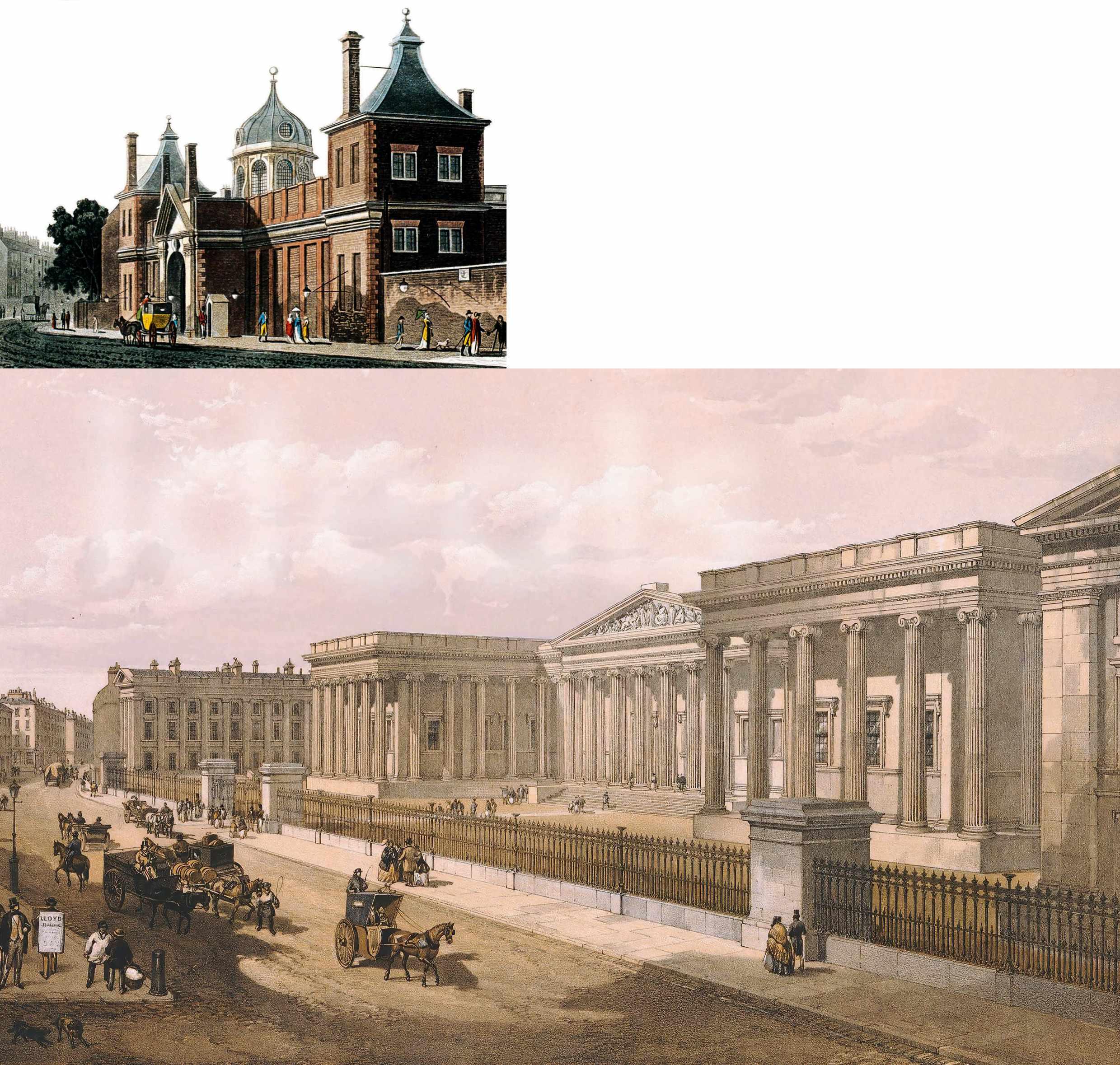
The new British Museum, designed by Robert Smirke, was only completed in 1852 but was already overcrowded by 1856.
low politics
Above top
The original home of the British Museum from 1759 until its demolition in the 1840s. This is the entrance to Montagu House on Great Russell Street.
The Natural History Museum in South Kensington, which opened in 1881, was Sir Richard Owen’s great passion.
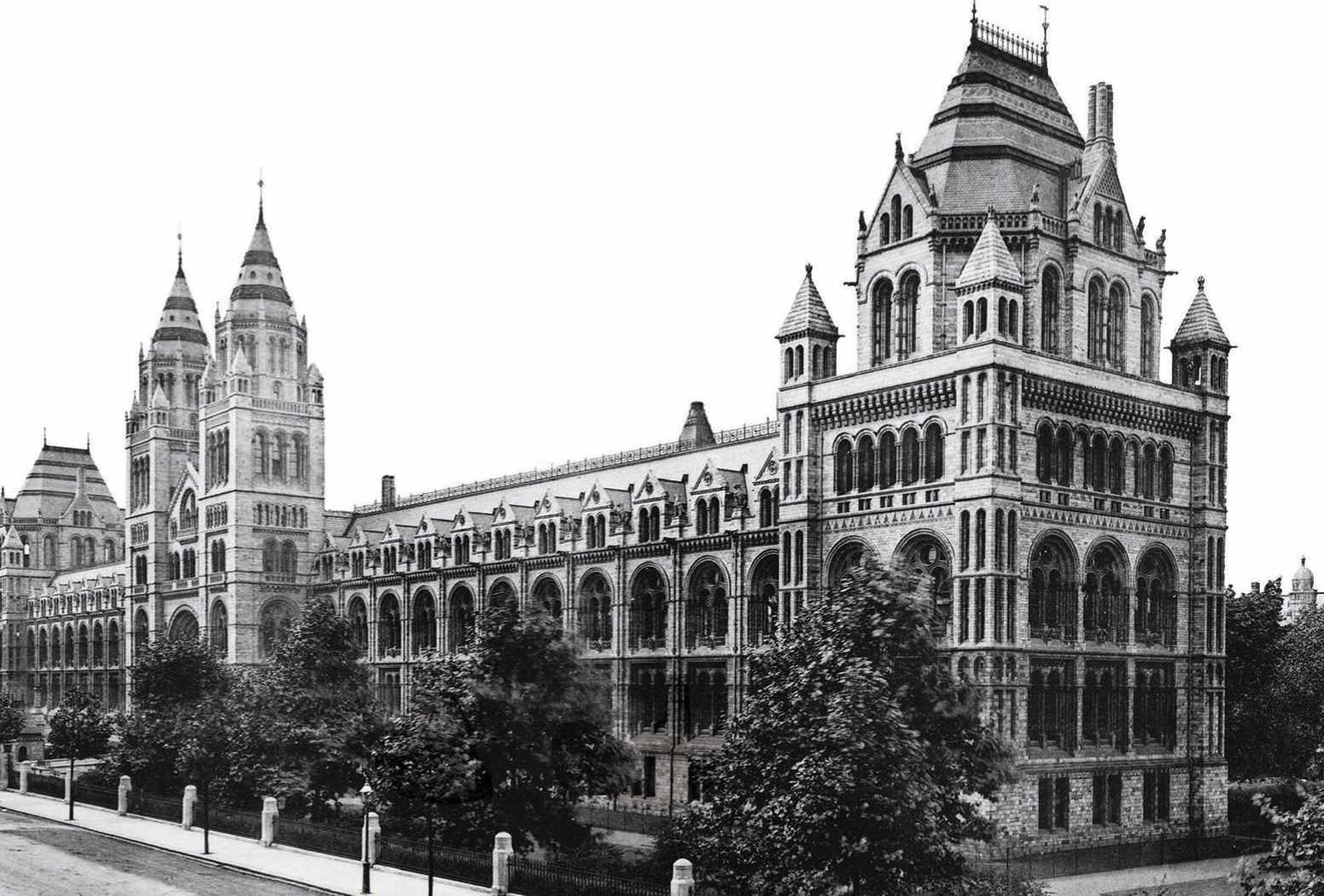
When he arrived at the British Museum, Professor Richard Owen was the most famous scientist in Britain.
In 1856, Professor Richard Owen was headhunted from the Hunterian Museum at the Royal College of Surgeons to oversee the British Museum’s natural history departments. His goal, however, was to create a separate museum of natural history. It was a 25-year battle, as Karolyn Shindler writes.
An artist’s impression of the Museum’s new science, digitisation and research facility at Thames Valley Science Park.
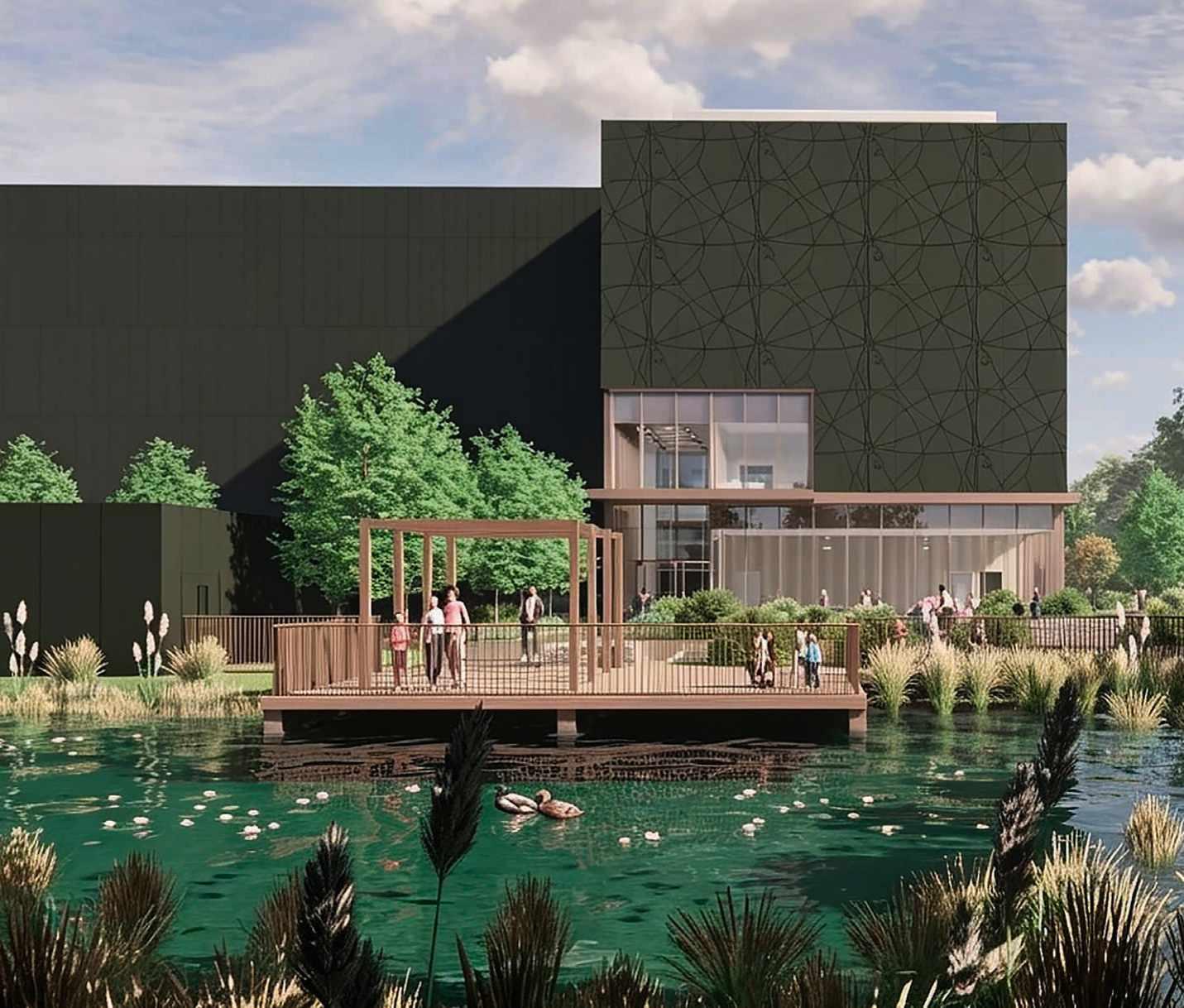
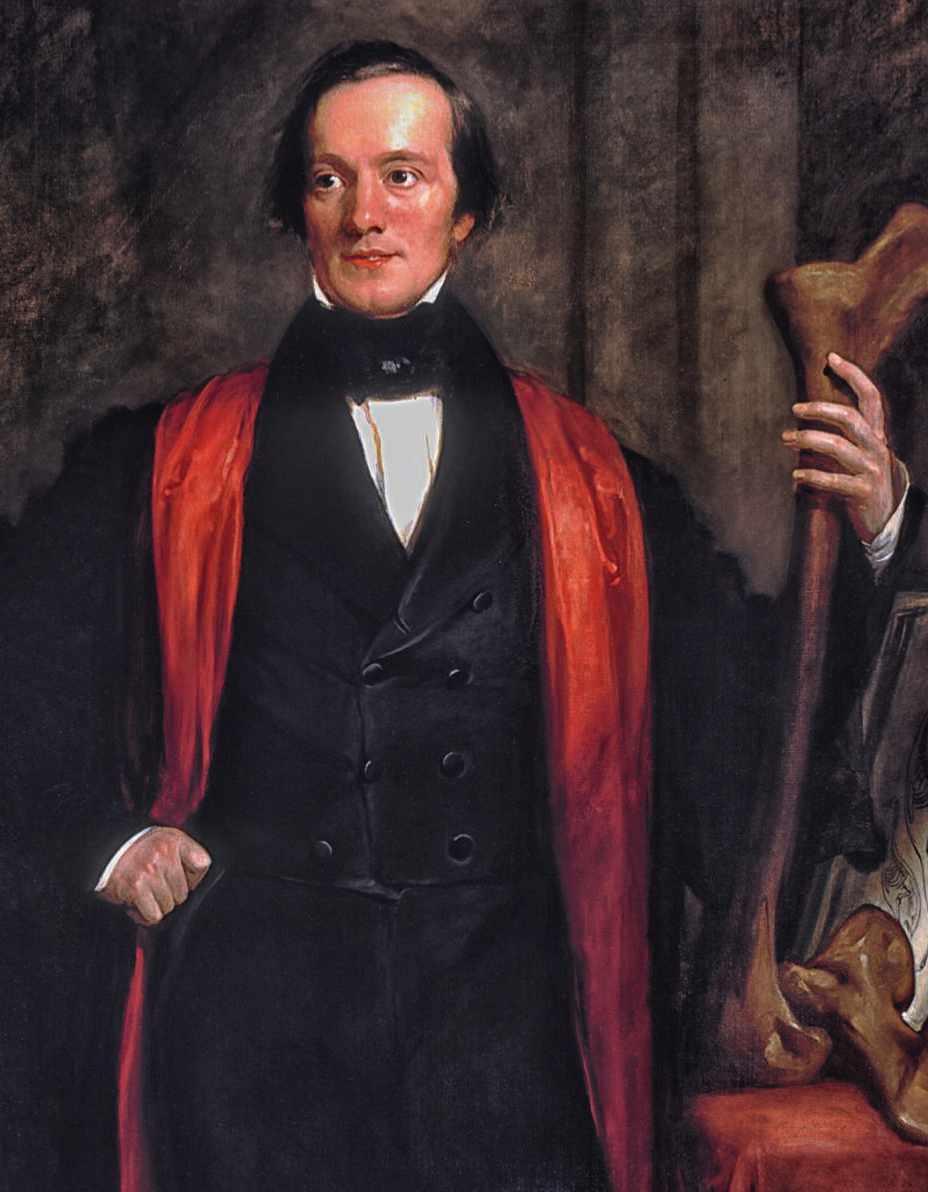
When Professor Richard Owen arrived at the British Museum in 1856, the idea of separating its natural history departments from the rest of the Museum was not new. Overcrowding of the collections had been severe for decades, particularly in the natural history departments, even in the splendid neoclassical building in Bloomsbury we know today, which had been completed only in 1852. Owen knew there were problems before he got there, but even he was unprepared for how dire things were. His own position was also far from ideal. His appointment was resented by the keepers of the natural history departments, who were used to a degree of autonomy and direct contact with both the Principal Librarian (as the head of the British Museum was called) and the Trustees. Now there was Owen between them. Nor was it popular with those in the wider scienti c community who did not want to see any extension of Owen’s in uence.
Museum moves
Po r trait by
Henry William Pickersgill
DID YOU KNOW?
Richard Owen was asked to reconstruct the American Mastodon, now in Hintze Hall, for the British Museum in the 1840s. It was the rst accurate mount of a mastodon.
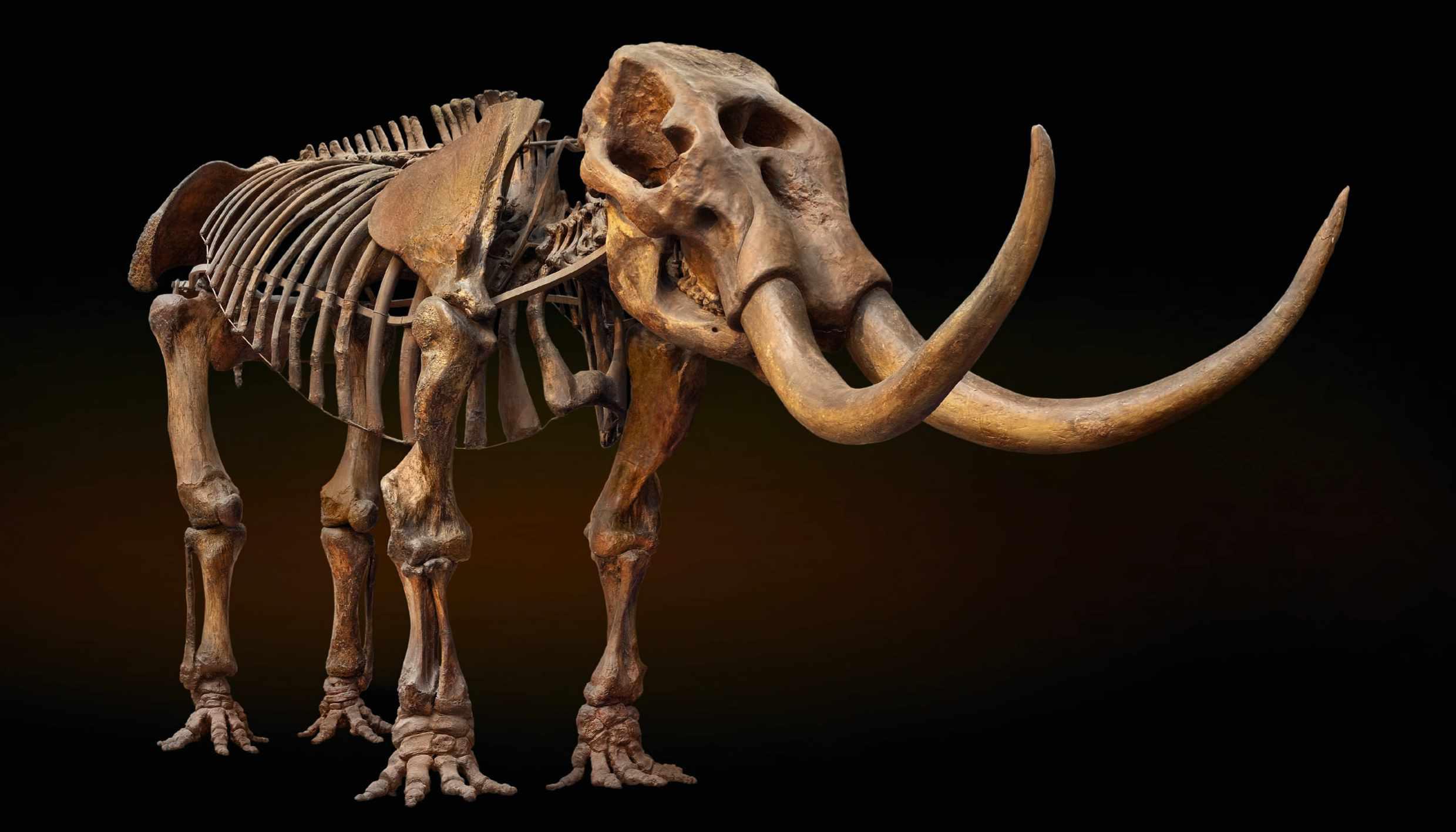
In 1857, Owen began work on his plan for a national museum of natural history.
By the 1850s, Owen was the most famous scientist in Britain with an international reputation. He was uniquely gifted and extraordinarily erudite, with a remarkable breadth and depth of anatomical knowledge. He commanded great respect and friendship, but he could also be contradictory and alienated many, while his success aroused jealousy and resentment.
So many specimens, so little space
The mid-nineteenth century had seen an explosion in the discovery of new species, and a huge in ux of new collections to the British Museum. Specimens were crowded four or ve deep in display cases, or, as Owen wrote, were crowded on the oor ‘like a herd of cattle.’
He estimated, for example, that the number of known species of mammals in 1855 was 2,000. By 1861 it was 3,500. The Zoology Keeper, John Edward Gray, complained those collections had increased ten-fold since 1835, with a small increase in space. He also warned that invaluable specimens would be ‘utterly destroyed’ because of damp in the cellars where they were crammed. Gray’s pleas
for more space were rejected by the Trustees. Yet in a survey in 1860, the natural history galleries were overwhelmingly the most popular, visited by a third more people than the antiquities galleries.
As for what they most wanted to see, newspapers reported, ‘No specimens of Natural History so much excite the interest and wonder of the public, so sensibly gratify their curiosity… as the reconstructed skeletons of large extinct animals.’ The American mastodon you can see today in Hintze Hall is one of those – it has been on display for more than 170 years.
In 1857, Owen began developing his plan for a national museum of natural history. Building on data from the keepers, he estimated the dimensions of galleries needed to house all the British Museum’s existing natural history collections, then added a forecast of additional space needed for the next 30 years.
The building, he calculated, would need about ve acres of ground if two storeys, or 10 acres if just one. He wanted to exhibit the largest species of whales and the largest species of African and Indian elephants – to show ‘the maximum of mass that can be supported and moved on dry land by a living animal’ – and the most complete array of known species and varieties as possible. It was space that was important for him, not place. ‘I love Bloomsbury much,’ he is quoted as saying, ‘but I love ve acres more.’ For Owen, a museum was not simply somewhere to show o extraordinary specimens, but a serious research establishment for the advancement of science, with spacious public exhibition galleries
Above John Edward Gray, Keeper of Zoology. In 1854, he reported on the harm to the collections caused by lack of space, but nothing was done.
on 10 acres.
arranged in a way that would lead to understanding as well as entertainment.
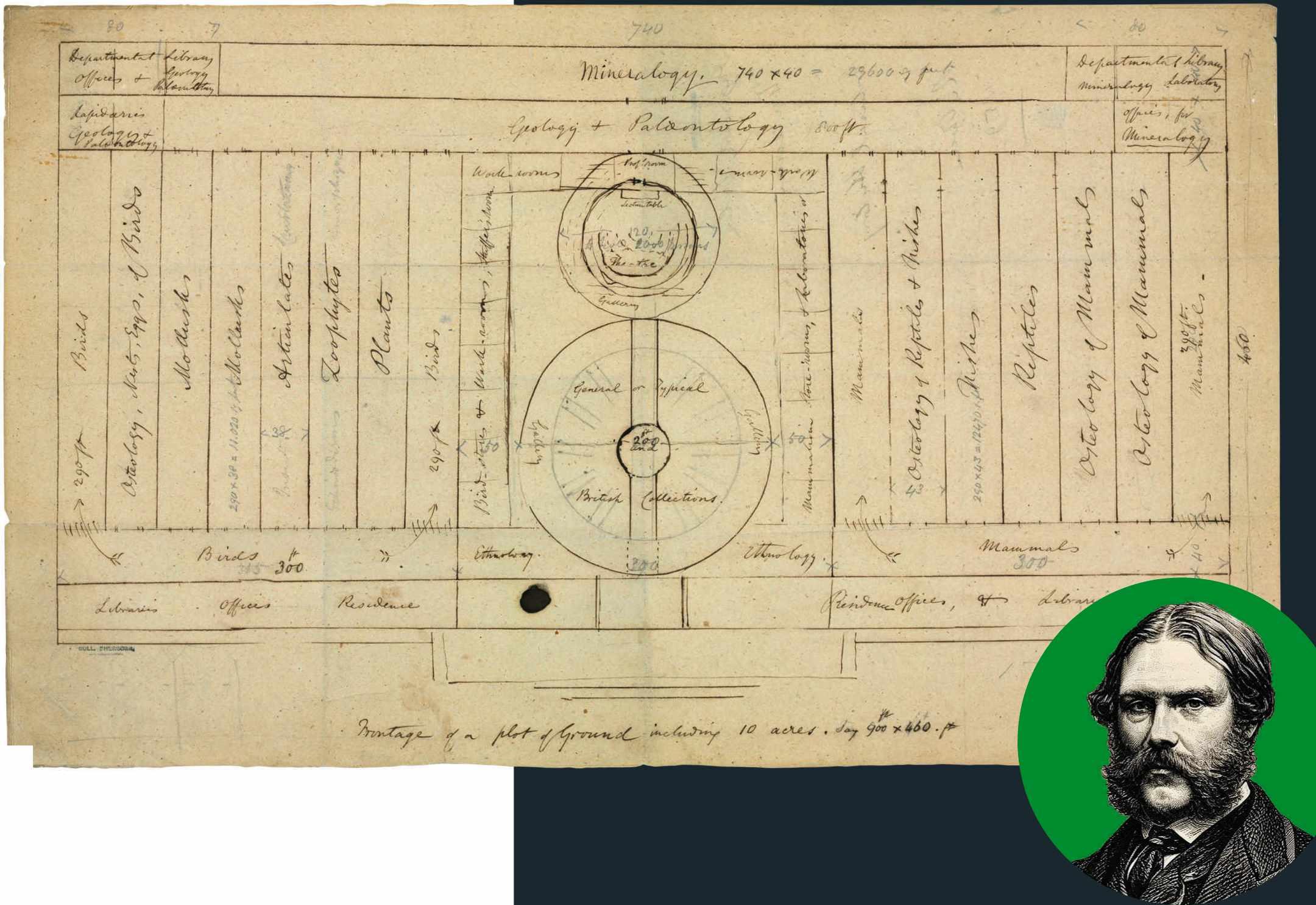
It says much for Owen’s foresight that the museum he so meticulously and passionately fought to create nearly 150 years ago has served so well – though with additional space built over the decades – that it’s only now that there’s need for major expansion to the new Thames Valley Science Park facility, currently under construction.
Early in 1859, Owen submitted his plan to the Trustees, who were impressed enough to forward it for consideration by Parliament. He had hoped that once politicians saw his ideas, there would be little opposition. He was wrong. The Irish MP Sir William Gregory called for a committee of inquiry, which almost unanimously rejected Owen’s plans. They reported that, with the exception of Owen, ‘the whole of the scienti c naturalists’, including the British Museum keepers, believed that the scale of Owen’s plans would lead to the ‘bewilderment and fatigue of the public and the impediment of the studies of scienti c visitors’. Furthermore, the cost would be prohibitive.
Genesis of a museum
1856
Professor Richard Owen appointed rst Superintendent of the natural history departments of the British Museum. His appointment is not universally welcomed.
1857–9
Begins developing plans for a new museum of natural history ①. In February 1859 he sends his Report with Plan for a Museum of Natural History to the British Museum Trustees, who send it for consideration to Parliament.
Undeterred, Owen took every opportunity to speak on the importance of creating this
1860–3
The museum is hotly debated in Parliament. Irish MP Sir William Gregory ② is vitriolic in his dislike of Owen’s plans, calling them ‘crazy, rash and extravagant’. Owen takes every opportunity to speak or write about the proposed museum.
1861–2
Owen shows Sir William Gladstone, Chancellor of the Exchequer, around the overcrowded natural history departments. A Bill Gladstone introduces in Parliament to separate the departments from the British Museum is defeated.
1863
Government introduces a Bill to purchase land in South Kensington, which is considerably cheaper than in Bloomsbury. Parliament agrees.
1864–5
A competition is held to design the new museum. Captain Francis Fowke ③ wins, with plans for a huge Renaissance-style building. He dies unexpectedly, and Alfred Waterhouse takes over, designing the building we know today.
1868
Just as plans are nalised, a new site is suggested – this time on the Embankment. Another inquiry and more opposition follow, but in the end, South Kensington wins based on cost and scale.
1873
Construction begins on the new Natural History Museum.
A sketch by Richard Owen from 1859, entitled ‘Idea of a Museum of Natural History’. This was for a one-storey building
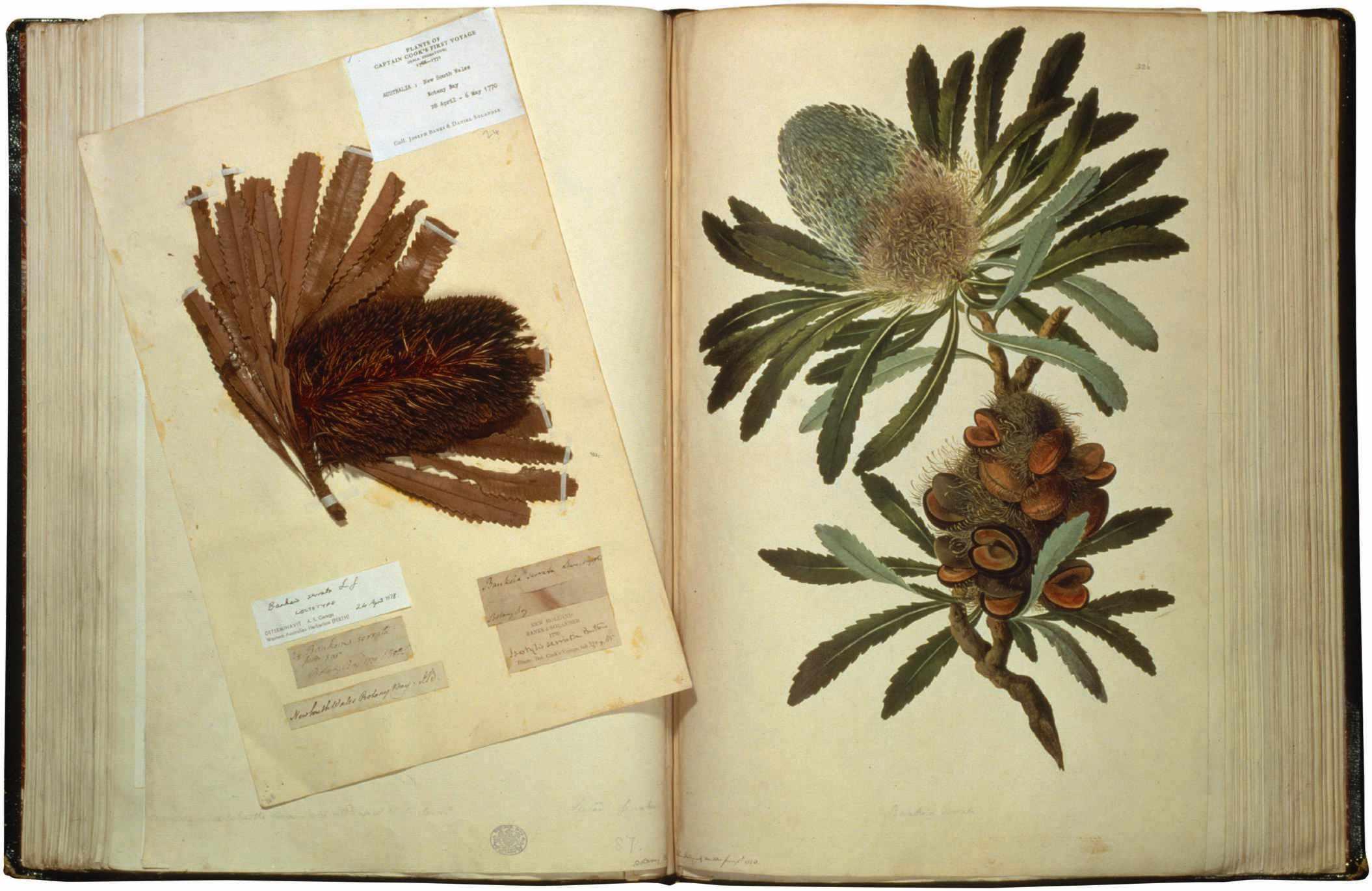
new museum. On 26 April 1861, he gave a lecture expanding on his ideas at the Royal Institution in London. It was printed in the Athenaeum magazine, then reprinted with yet more detail as On the extent and aims of a national museum of natural history. It contains all Owen’s passion for his goal. Charles Dickens called it a ‘charming little book’, and said he had read it with ‘unspeakable interest and pleasure’.
Sir William Gregory, however, was having none of it, describing Owen’s plans as ‘crazy, rash and extravagant’. He also emphasised how accessible Bloomsbury was to the mass of London’s population, whereas moving to a remote suburb (as South Kensington – which was already being discussed as a possible site –then was) would deter visitors.
An uphill battle
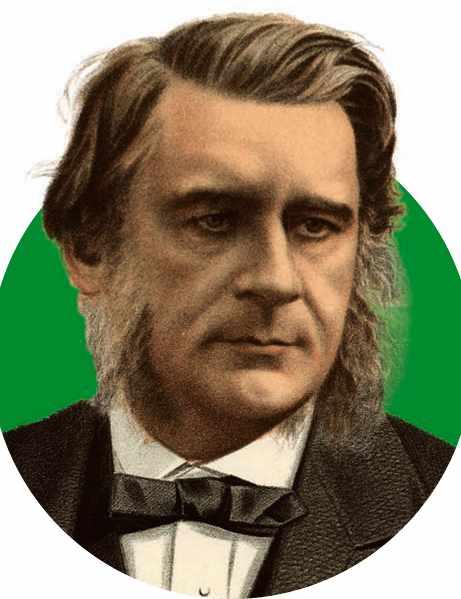
Owen then had the brilliant idea of showing William Gladstone, Chancellor of the Exchequer and Trustee of the British Museum, the shameful state of the national treasures. Together, Owen wrote, they explored ‘every vault and dark recess in the Museum’, with the Chancellor insisting on ‘a conscientious and laborious investigation’ into Owen’s ideas. Gladstone was persuaded, but Parliament was not, still arguing that expanding the
Bloomsbury site was preferable, and that Owen’s ideas were on far too extravagant and great a scale. MPs defeated Gladstone’s bill which would have allowed the natural history departments to be transferred to South Kensington.
The eminent biologist Thomas Henry Huxley, long an opponent of Owen’s, piled on the pressure, writing to The Times to condemn his plan, declaring it would ‘ruin the usefulness of the collections’.
He congratulated Parliament’s decision and assured ‘the majority who voted against the Chancellor of the Exchequer’s Bill that they have earned the gratitude of men of science’.
A key part of the argument against removing the natural history departments was separating the specimens from the British Museum Library. This was a huge issue. Specimens cannot be understood without reference to written collections, and Owen had consistently argued that the natural history books should accompany the specimen collections.
Of particular concern were great collections like those of Sir Joseph Banks, whose invaluable natural history library, including manuscripts and drawings, related directly to his unique herbarium and animal specimens. For Huxley, and all those others opposed to Owen, there was simply no question that any written works of natural history,
Above
Thomas Henry Huxley (1825-95), biologist and anthropologist. A successor of Owen’s as Hunterian Professor at the Royal College of Surgeons, he was nonetheless one of Owen’s ercest critics.
Illustration by Sydney Parkinson
This specimen, Old Man Banksia, was part of the collection of the naturalist Joseph Banks.
The British Museum’s Reading Room was built to house a library of more than half a million volumes.
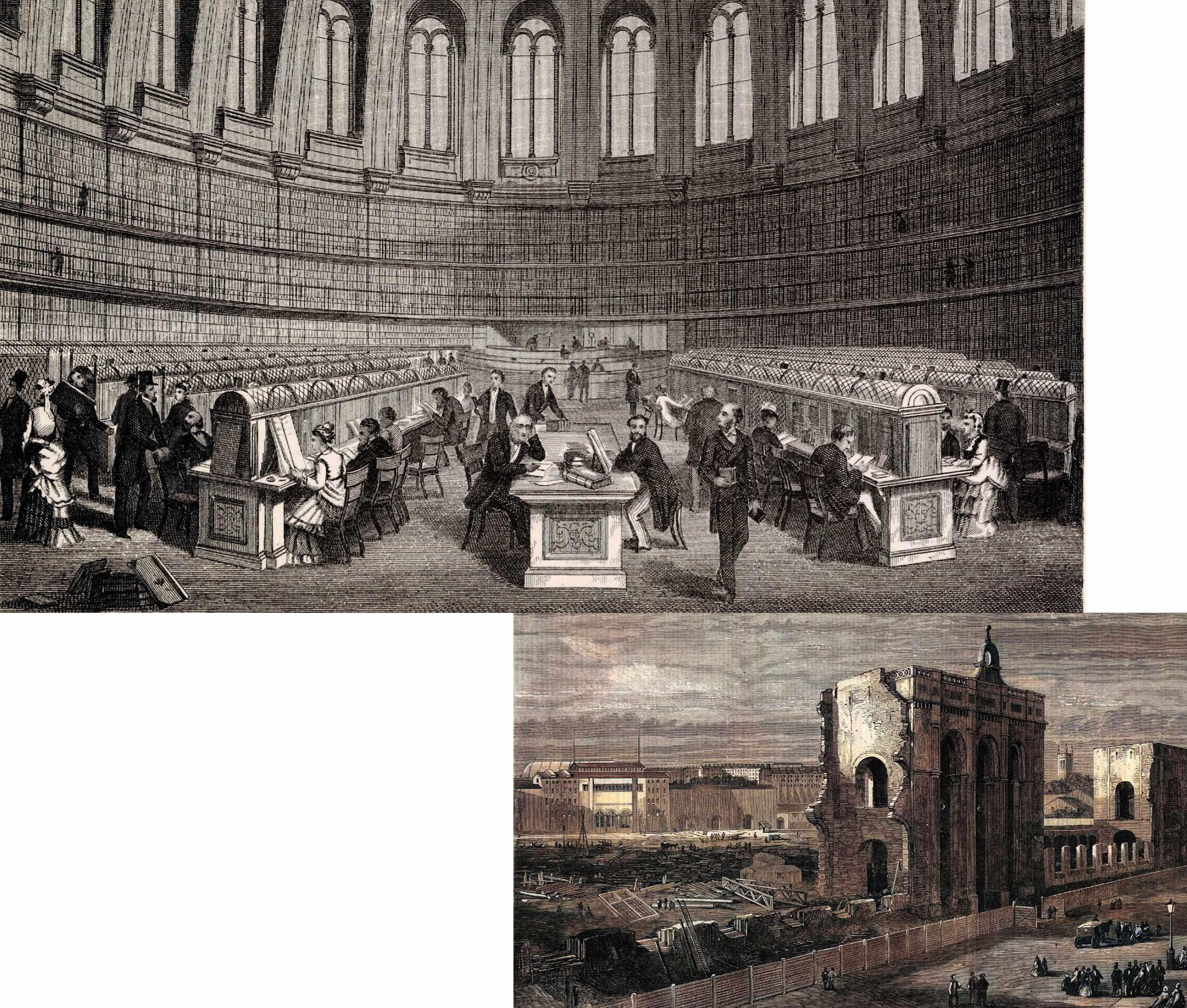
even those as integral to particular collections as Sir Joseph Banks’s were, could possibly be allowed to leave Bloomsbury. Furthermore, the cost of creating a library for the new museum was estimated at £30,000 and considered una ordable.
A breakthrough
Owen thought his plans had been set back for a decade. But just a year later, in 1863, with some modi cations, the Government persuaded Parliament to approve the purchase of the site of the 1862 International Exhibition in South Kensington. Land there was considerably cheaper than in Bloomsbury.
The following year, a competition was held for the design of the Museum. It was won by Captain Francis Fowke, architect of the Royal Scottish Museum in Edinburgh. His design was a grand Renaissance-style building on a huge scale. But in 1865 Fowke suddenly died, at 42, and the commission was given to a young architect, Alfred Waterhouse, who had designed the gothic-style Manchester Assize Courts. He adapted Fowke’s design, replacing the Renaissance style with huge Romanesque arches, replacing domes and cupolas with great towers, and cladding the building in the exquisitely decorated terracotta we know today.
With the plans completed in 1868, there was another setback. The O ce of Works, the department that would oversee the construction and its costs, suddenly suggested that there was a better site – on the Embankment between Waterloo and Hungerford bridges. A further inquiry followed, with Huxley, among others, still arguing against Owen’s plans and also in favour of the
Above
A view looking east along Cromwell Road, London, of the ruins of the building that housed the Great Exhibition of 1862. The site was being demolished and cleared before new construction work could begin on the building that would (and still does) house the Natural History Museum.
Embankment: how much more convenient it would be for working-class visitors. In this, he had picked the wrong argument. In December 1868, South Kensington Underground Station opened, joining the rst section of the Metropolitan District Railway (now District and Circle lines), with Westminster. The underground would transform the city. South Kensington won on both cost and scale. In 1871, plans were approved, but in ation caused further delays. Finally, in 1873, construction began. Who then could have imagined that, in 2025, Richard Owen’s great creation would become the most popular UK attraction ever, with 7.1 million visitors? But in 1873, the obstacles he had faced were nothing compared to what was to come. ●
Karolyn continues Museum moves in the next issue of the magazine, published in October.
©Mary
Abominable snowman
From eyewitness accounts to photos and footprints, the Museum played a key role in examining ‘evidence’ of the Abominable Snowman brought back from Himalayan expeditions in the twentieth century.
WORDS : REBECCA KEDDIE, ASSISTANT ARCHIVIST
Scientists at the Museum are no strangers to unusual enquiries. Among the most curious are those involving cryptids – creatures such as the Abominable Snowman, Bigfoot and the Loch Ness Monster, whose existence sits somewhere between folklore and reality.
In December 1951, photographs taken by Eric Shipton during his Everest expedition were published in The Times. One showed a line of tracks stretching across the snow; another captured a single 13-inch footprint, apparently made by a creature with three broad toes and a thumb-like projection. Shipton claimed the prints belonged to a barefoot, reddish brown, ve-foot tall gure seen by his guide, Sen Tensing.
Stories of the Abominable Snowman, or Yeti, had circulated for centuries among Himalayan communities, but Shipton’s photographs ignited a fascination in the West. Experts were invited to explain the prints, including the Museum’s Keeper of Mammals, TCS Morrison Scott, who suggested they were the overlapping fore and hind footprints of a langur monkey. To satisfy public interest, the
The Museum’s Archive holds material relating to its history including architectural plans, expedition reports, research notes and correspondence, specimen records and sta photographs.
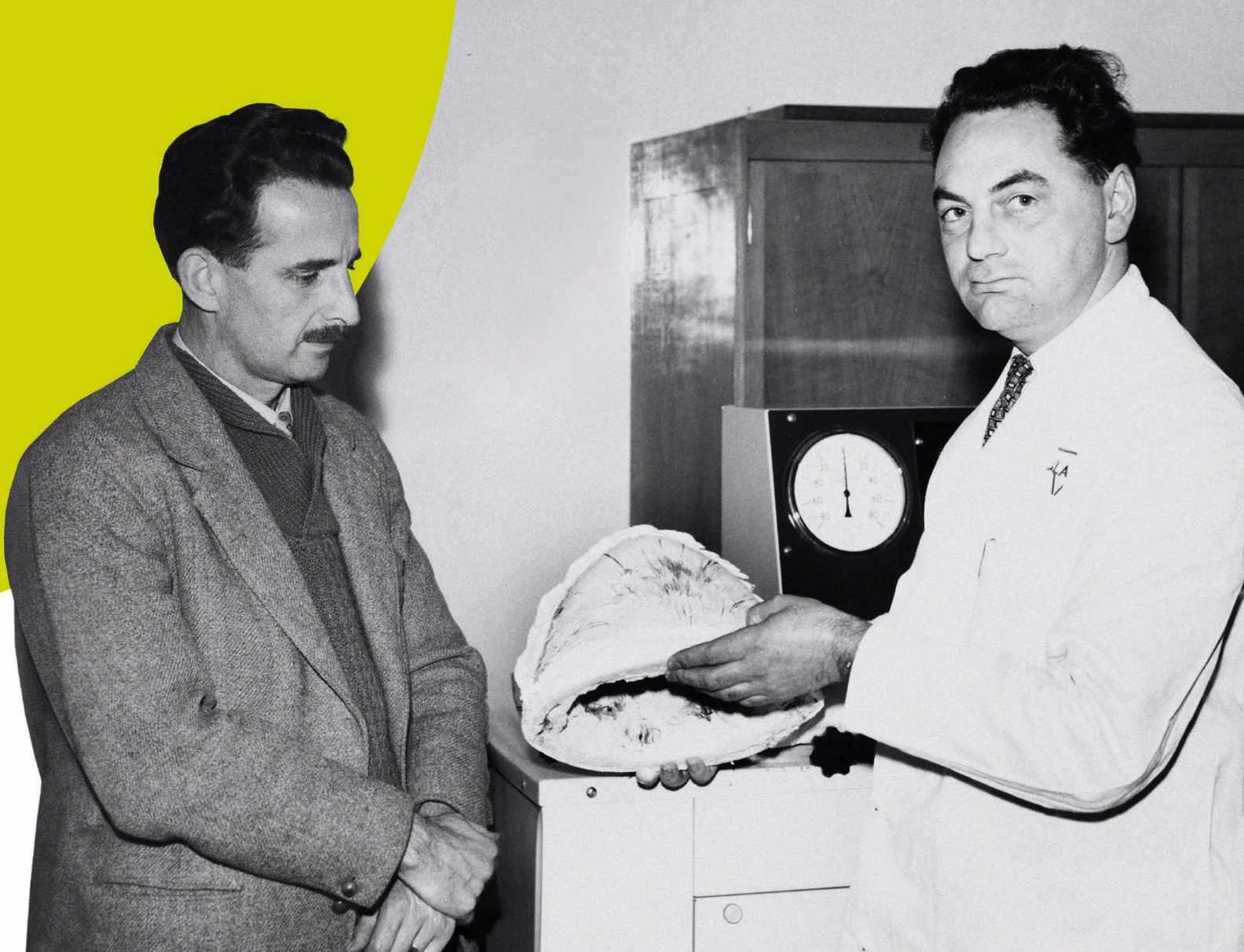
Museum staged an exhibition featuring a langur specimen alongside plaster casts of its footprints.
Arthur Hayward, chief taxidermist, and Dr PW Muggleton, a member of Glaxo Lab’s Biological Unit, where the Yeti scalp brought back by Sir Edmund Hillary was freeze dried.
Shipton’s images triggered a wave of reported sightings, and it became common for people to send the Museum the ‘evidence’ they had collected.
In 1960, explorer Sir Edmund Hillary secured the loan of a Yeti scalp from Khumjung Monastery, on the condition that village headman, Khumjo Chumbi personally escorted the relic. Morrison Scott, now Museum Director, pressed for the artifact to be examined by Museum specialists, who concluded it was not in fact a scalp at all, but had been fashioned from animal hide.
Although interest in the creature waned in the late twentieth century,
it was never entirely extinguished. The Museum continued to receive letters from those convinced they had nally found conclusive proof of the Abominable Snowman’s existence. O
THE MUSEUM IN ACTION
Visit us
Our Archives are open to the public by appointment 10:00–16:00 on Tuesdays, Wednesdays and Thursdays. For more information, email archives@nhm.ac.uk
A more sustainable way to stay curious
Every issue of our magazine explores the natural world and how we can protect it. Choosing the digital edition helps reduce paper use and transpor t emissions, while giving you the same trusted science and stories you value.
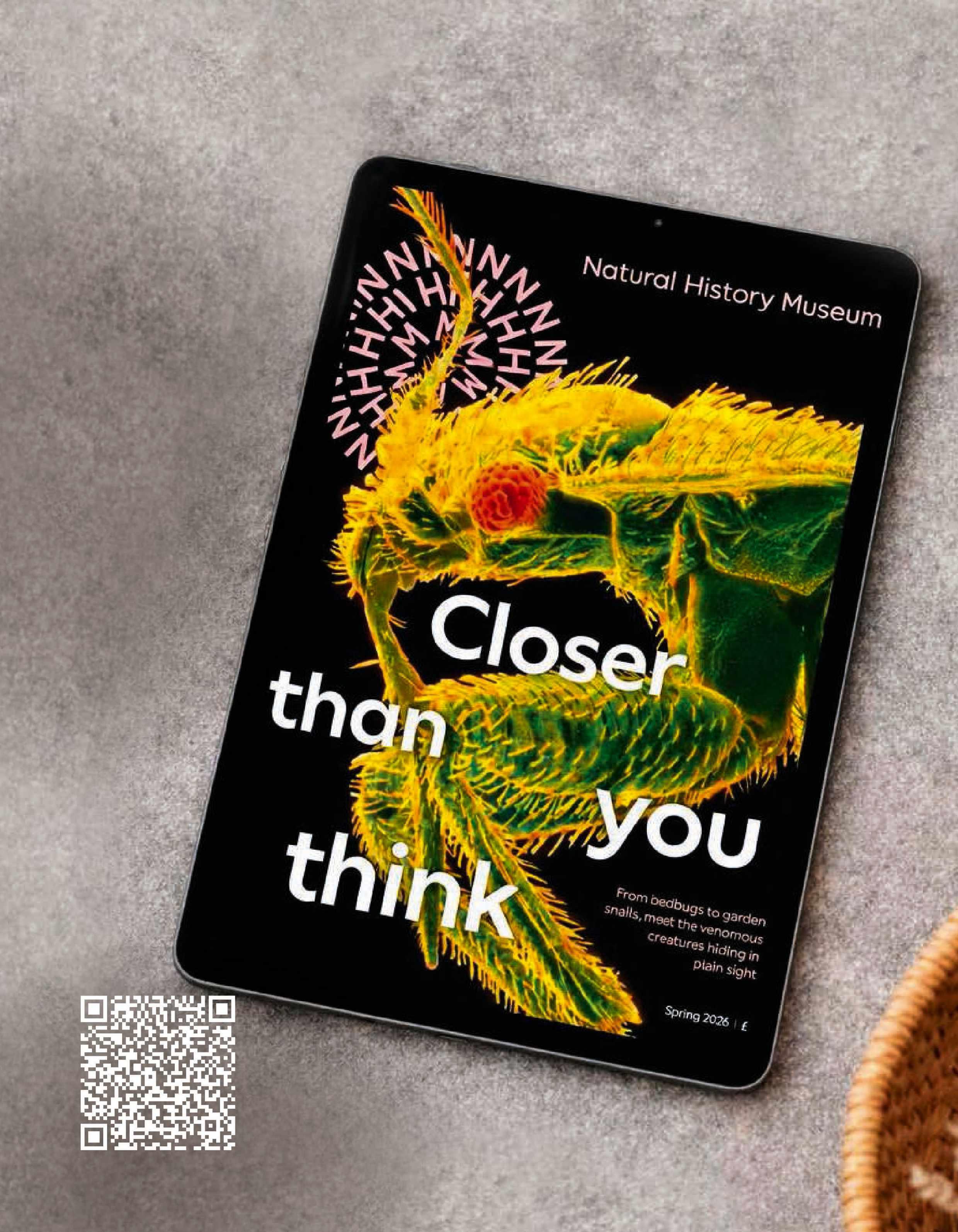
Scan the QR code and make the switch to digital.
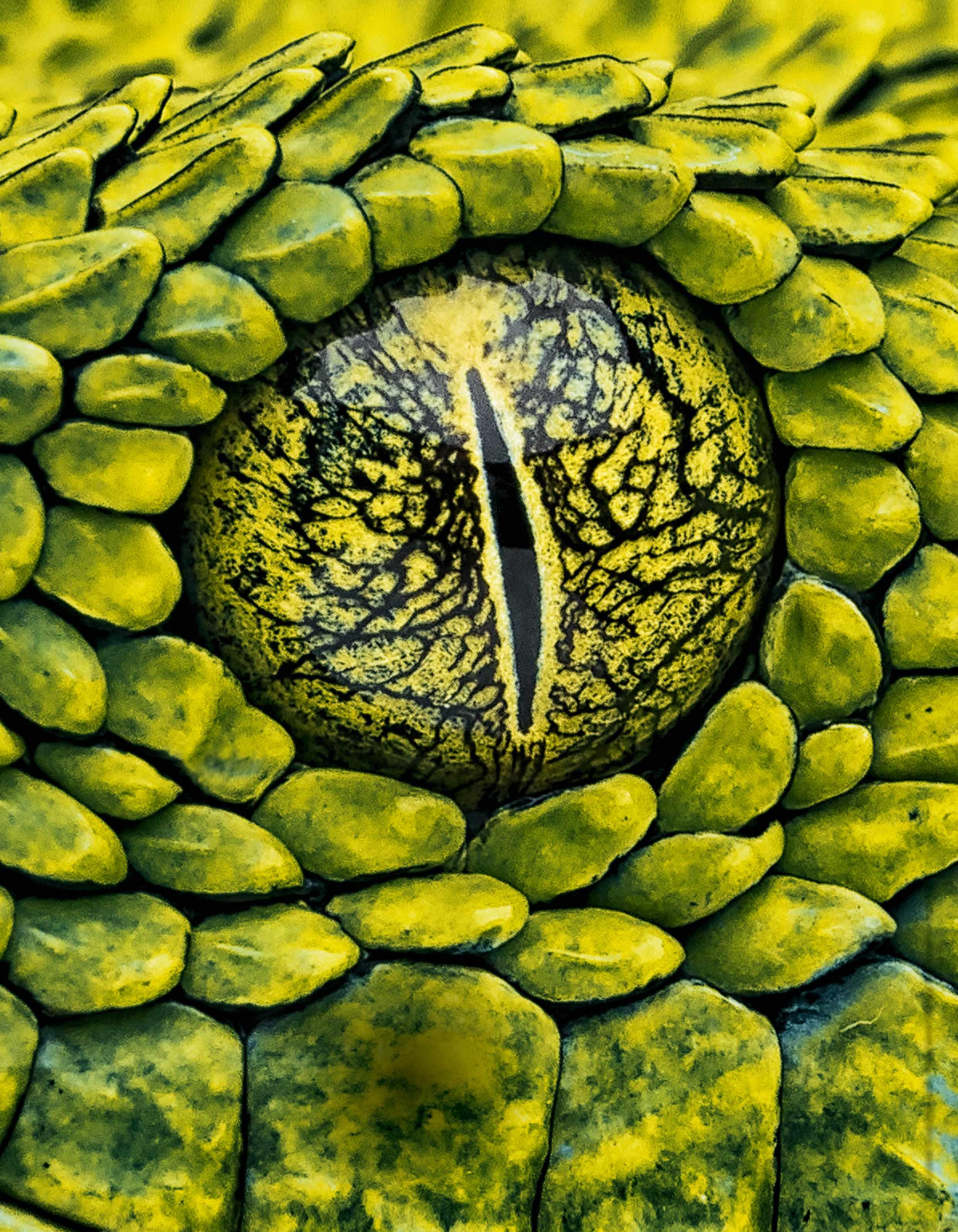
HIDDEN DEPTHS
Nature’s quiet shapeshifters are far more dramatic and surprising than their simple shape suggests.