All material herein IMIESA is copyright protected and may not be reproduced without the prior written permission of the publisher. The views of the authors do not necessarily reflect those of the Institute of Municipal Engineering of Southern Africa or the publishers.
Transportation within a circular economy
With current global oil prices hovering above US$100 per barrel due to the ongoing Middle East conflict, the ramifications for all industries and households is significant. It’s not the first time, as history shows with the 1970s oil crisis being one of the most severe on record, with future price shocks unpredictable.
But what the present energy crisis underscores is how much the world is still dependent on oil, of which transportation – in all forms – accounts for over 50% of consumption demand. That’s aside from the downstream industrial application requirements to produce key components like energy generation, plastics, industrial greases, fertilisers, and bitumen for road construction. Plus, heavy earthmoving equipment still depends on oil.
In reality, we need oil now in our immediate future and according to available statistics there’s still around close to 50 years of known reserves at current global consumption levels. Plus, reports show that there are still potentially huge untapped resources on land and offshore, alongside gas reserves as a cleaner energy alternative. The latter is widely used to power vehicles, industrial processes, domestic heating and HVAC systems, to name a few examples.
However, as we all know, the United Nations climate change net zero 2050 target is in place, with evolving efforts to transition to alternative energy sources. For all industries, biofuels are one alternative, and for the transportation sector renewable electrification. Here the opportunities extend from trains to inner city commuter bus networks, commercial vehicles and passenger cars.
EV evolution
But before we get into that, let’s just consider that in the early 1900s some 28% of cars sold in the USA were electrically powered by lead-acid batteries. They were very slow and obviously sold off a low base since it was presumably a high net-worth purchase. Fast forward and the USA remained a pioneer with more real-world electric powered cars mass produced and sold in their local market around 1996.
These were also initially lead-acid battery powered, subsequently transitioning to nickel-metal hydride, so still relatively basic in modern terms. However, the entry of the lithium-ion battery – in progressive performance upgrades from around 2000 – has been the real gamechanger. This
is especially the case from an emissions perspective, plus up to 95% of the material composition in lithium-ion batteries can be recycled for other downstream uses. These include the manufacturing of new EV battery packs, and Battery Energy Storage Systems for wind and solar projects.
Cost of entry and travel range
Today, even at South African prices and higher import duties compared to ICE vehicles, you can now buy a small zero emissions EV (with a range at around 300 km) for under R400 000.
Top end EVs can average around 650 to 850 km on a single charge, plus premium plug-in hybrid electric vehicles (PHEV) are achieving ranges of up to 1200 km. Similar gains are being made in the modern-day OEM long distance freight sector at around 800 km, with widespread utilisation in regions like the European Union thanks to a comprehensive charging network within and across member countries.
This is something South Africa lacks at present. So, as we evolve our renewable energy transmission footprint, a core priority for transportation specialists is to ensure that we have a supporting nationwide network that sustains EV growth. In parallel, we need a more concerted focus on building a home-based EV manufacturing industry.
EVs can help us reach net zero
Global estimates indicate that the transportation sector accounts for around 20% of all greenhouse gas emissions. So, EV growth is a logical step while the world finds future solutions to its current oil dependency, and the ensuing exposure to price shock volatility.
In South Africa, a burning issue remains the spiralling cost of electricity. We need to get on top of that to truly facilitate fairpriced renewable energy and EV adoption – both interlinked as catalysts for positive socioeconomic gains.
To our avid readers, check out what we are talking about on our website, Facebook page or follow us on Twitter and have your say.
Cover opportunity
In each issue, IMIESA offers advertisers the opportunity to get to the front of the line by placing a company, product or service on the front cover of the journal. Buying this position will afford the advertiser the cover story and maximum exposure. For more information on cover bookings, contact Joanne Lawrie on +27 (0)82 346 5338.
Sponsor a unique aspect of the conference and enjoy
such as: free exhibition stands complimentary delegate registrations brand representation at the event, promotion of your company in the conference proceedings magazine and online free entry for guests at the social evening and much more.
Terms and conditions apply
The pivotal turning point is coming
As South Africa continues its countdown to the 2026 Local Government Elections in Q4 2026, the role and importance of ethical leadership have never been more important.
We have a key part to play as municipal engineers. However, the ultimate responsibility lies within the political arena, where adherence to legislative mandates makes the difference between effective infrastructure execution – as the primary driving force of the economy – or an escalating scenario of wasteful expenditure and poor programme management.
Positive developments include widely publicised court actions against alleged corruption by key government officials at local, provincial and national level surrounding contract approvals and supply chain procurement. The Department of Public Works and Infrastructure’s decision to blacklist defaulting contractors is another step in the right direction. But the burning question remains how we got to this point in the first place. That’s a complex philosophical discussion on its own about the disconnect between our 1994 democratic objectives and the status quo as we speak.
Clean audits and delivery
In March 2026, the Auditor-General of South Africa (AGSA) released its 2024-25 Consolidated General Report on National and Provincial Audit Outcomes. Of the 417 auditees assessed, only 151 achieved clean audits. More significantly, some 266 auditees responsible for managing 88% of the total expenditure budget – including infrastructure – failed to achieve clean audits. Although the latter represents the compliance gold standard, a clean audit isn’t always an indicator of performance versus accounting excellence in practice. However, it does play a critical role in strengthening transparency and accountability. That’s essential for our immediate and future infrastructure roadmap as we navigate into new and positive territory.
Past corruption – either known or still to be uncovered – is effectively water under the bridge and now the responsibility of the judicial system. It’s what we do going forward that counts and in
the national, provincial and local government domain that requires an honest appraisal of who should and shouldn’t hold public office.
WPLG26
That brings us back to the Reviewed Draft White Paper on Local Government (WPLG26) gazetted by the Minister of Cooperative Governance and Traditional Affairs (CoGTA) on 7th May 2026. In the final round, all stakeholders had until 28th May 2026 to submit their comments and IMESA made a further submission.
By now the objectives of the WPLG26 are well known, but just to highlight them again, the major focus is on a return to world class municipal performance. That’s based on selfsustaining public enterprises founded on sound financial management and delivery excellence in all spheres – infrastructure services being the primary mission for achievement.
When we reviewed the latest WPLG26 post its 7th May 2026 release, we were dismayed to see that most of IMESA’s previous inputs had not been addressed. Examples include aspects like the need for cooperative decision-making and compulsory professional registration for engineering and non-engineering professions at designated authority levels.
Why our review contributions have been ignored will become clearer as we engage further with CoGTA. It’s vital that we get answers in the true spirt of transparency, because it has a direct and indirect impact not just for municipal engineering performance but for our enabling infrastructure stakeholders, foremost being consulting engineers, contractors, OEMs and material suppliers.
The primary role of the municipal engineer is to serve as the quality gatekeeper and to ensure that all external infrastructure roleplayers meet the grade during open tender processes. When they do, they are a crucial part of ensuing a realistic price and an expert fit-for-purpose solution.
Currently, the fact that there are widespread examples of poor supply chain decisions that deliberately circumvent municipal engineering authority is a major reason for recurring service delivery failures and corruption.
Hopefully our renewed WPLG26 submission for the 28th May deadline will be noted. We’ll keep you posted because this potentially changemaking initiative is too important to just pass as a tick box exercise.
IFME 2026 World Congress
At any point in time, every country is in transition – economically, politically and socially. The true test is the ability to positively resolve conflict in an equitable manner that protects and enables the achievement of universal socio-economic prosperity. That’s the rationale for the United Nations Sustainable Development Goals (SDGs) ahead of and beyond its initial 2030 target. It’s also where municipal engineers have a catalytic role, but they need inspiration.
In this respect, we are a proud member of the International Federation of Municipal Engineering (IFME), which provides an invaluable knowledge sharing platform between developed and developing nations. Knowing that – to a greater or lesser extent – our challenges are not unique is reassuring. It also energises us in South Africa to challenge the status quo and move past the red tape and political nonalignment to effect meaningful change in a citizen led environment. World class countries are driven by a free market society.
Representing IMESA, between 9 th and 11th June 2026 I’ll be attending the IFME 2026 World Congress on Municipal Engineering in Helsinki, Finland, under the theme “Future Liveable Cities”. It’s an exciting opportunity to benchmark South Africa’s municipal engineering performance against the world’s best and to bring those lessons home. It is also an opportunity to reinforce the argument for autonomous engineering leadership in infrastructure execution within predetermined mandates.
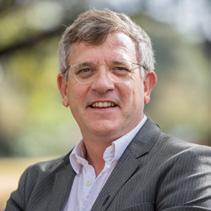
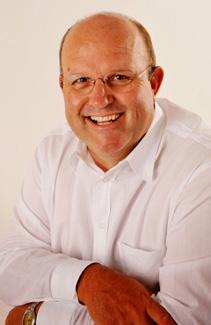
Geoff Tooley, Pr Eng Hon FIMESA, IMESA President: 2024-2026
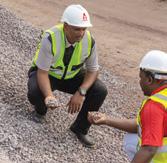
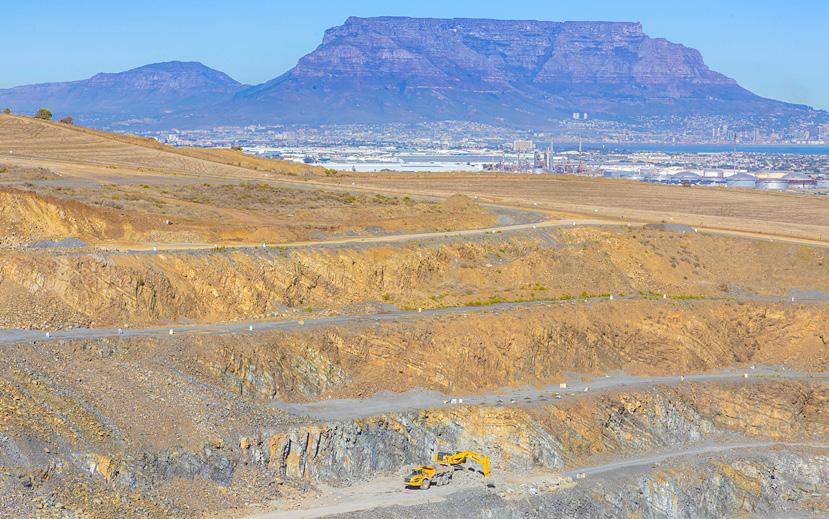
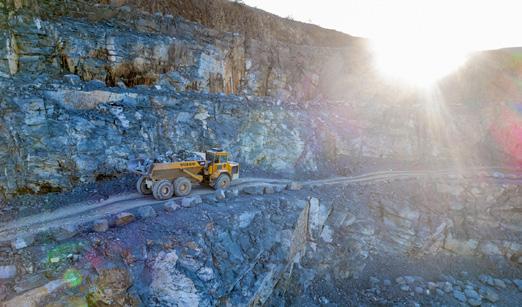
AfriSam’s Peninsula Quarry showcases the company’s commitment to consistent, high quality aggregate production through advanced processing quality control systems
SA’S ROADS RELY ON QUALITY AGGREGATE FOR DURABILITY, LONG LIFE
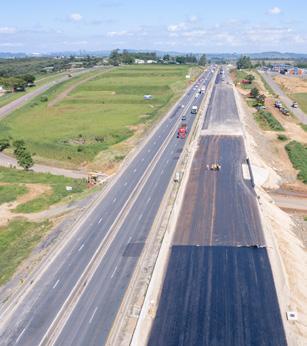
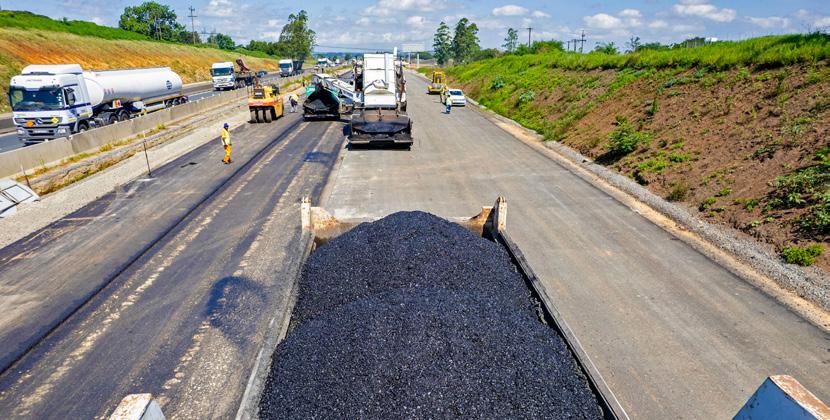
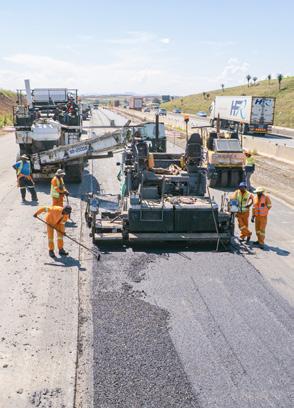
With road building and maintenance among South African municipalities’ most pressing mandates, it is vital that high quality aggregate is used to ensure the performance and lifespan of asphalt.
Aggregates make up the bulk of asphalt by volume, so their characteristics – from grading and durability to shape and cleanliness – play a decisive role in how road surfaces perform. According to Amit Dawneerangen, AfriSam Construction Materials Executive - Sales & Product Technical, the technical demands of asphalt construction mean that aggregate quality can never be compromised.
“The technical requirements that govern how asphalt is manufactured and applied –as set out in the Committee of Transport Officials (COTO) standards – are stringent,” Dawneerangen says. “All levels of government, from national to municipal, are bound by these standards – as are contractors and consulting engineers.”
Nithia Pillay, Regional Product Technical Manager for Construction Materials at AfriSam
Amit Dawneerangen, AfriSam Construction Materials ExecutiveSales & Product Technical
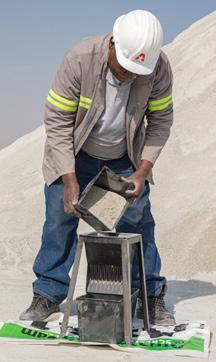
Continuous testing and certification give confidence that aggregates will perform as required in demanding road construction applications
As a result, asphalt and aggregate producers must also comply with COTO standards for asphalt aggregates, which are even more stringent than the SANS standards typically applied to concrete aggregates, he explains. If these parameters are not carefully controlled, the result can be premature rutting, cracking and structural deterioration of the road surface. Conversely, aggregates that consistently meet strict specifications ensure that asphalt layers perform reliably for many years under demanding traffic conditions.
“For aggregate producers and asphalt manufacturers alike, these standards maintain a high bar in terms of quality,” he says. “Consistency, traceability and rigorous quality control are essential across the asphalt supply chain.”
As one of South Africa’s leading construction materials suppliers, AfriSam has invested significantly in quarry planning, advanced processing technologies and laboratory testing, Dawneerangen says. These controls ensure that its aggregates consistently meet national and project-specific standards.
“In asphalt design, aggregates must satisfy a wide range of technical properties,” he explains. “These include strength, durability, resistance to polishing under traffic and the ability to maintain the correct particle shape and grading during production and service.”
Tests such as the Aggregate Crushing Value (ACV), the 10% Fines Aggregate Crushing Test (FACT) and the Polished Stone Value (PSV)
measure key characteristics including strength and resistance to wear. If aggregates do not meet these requirements, the consequences can be severe.
“There is a range of inherent properties that the rock must have,” Nithia Pillay, Regional Product Technical Manager for Construction Materials at AfriSam, explains. “Specifications consider grading, soundness, durability, shape, water absorption and several other parameters.”
The FACT value, for instance, represents the force – in kilonewtons – required to crush a sample of aggregate until 10% of its mass is reduced to fines. Weak aggregates may break down under traffic loads, creating excessive
High quality aggregates are critical to asphalt performance, directly influencing the durability and lifespan of road infrastructure
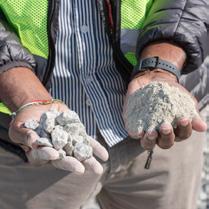
fines within the asphalt layer. This undermines structural integrity and increases the likelihood of rutting. Aggregates that polish too easily can also reduce skid resistance, affecting road safety. Grading of aggregates – the distribution of different particle sizes – is equally critical, Pillay says.
“Proper grading ensures that aggregates pack together effectively, allowing the bitumen binder to create a stable, durable asphalt matrix,” he says. “Any deviation from the specified grading envelope can affect compaction and long-term durability.”
Consistency from batch to batch is also essential, as asphalt plants rely on predictable aggregate
Strict adherence to COTO standards ensures that aggregates used in asphalt meet demanding technical and performance requirements
properties to produce mixes that meet performance requirements. AfriSam therefore conducts testing at every stage, from preblasting through to final aggregate production.
Quarry planning and geological assessment
Before blasting, the company evaluates rock characteristics to determine whether the material will meet required aggregate specifications.
Quarry planning and geological assessment are among the first steps in ensuring that the correct rock types are extracted and processed.
Dawneerangen notes that variability in natural deposits makes this planning critical.
“When dealing with natural materials, variability is inevitable – so we undertake in-depth quarry planning and optimisation,” he says. “This allows us to consistently extract competent rock that can be used effectively in production.”
After extraction, aggregates pass through a carefully controlled crushing and screening process designed to produce specific particle sizes and shapes. The configuration of crushing plants is critical, as different asphalt mix designs require different aggregate fractions.
Proper aggregate
grading and strength are key to achieving a stable asphalt matrix that can withstand heavy traffic conditions
“AfriSam has significant expertise in plant configuration and equipment capability,” Pillay says. “We set up our plants to produce specific products that meet the relevant specifications, even when customers require specialised products.”
The increasing sophistication of asphalt mix designs has also driven AfriSam to invest in additional processing equipment. Dawneerangen points out that recent major road projects have introduced more demanding aggregate specifications.
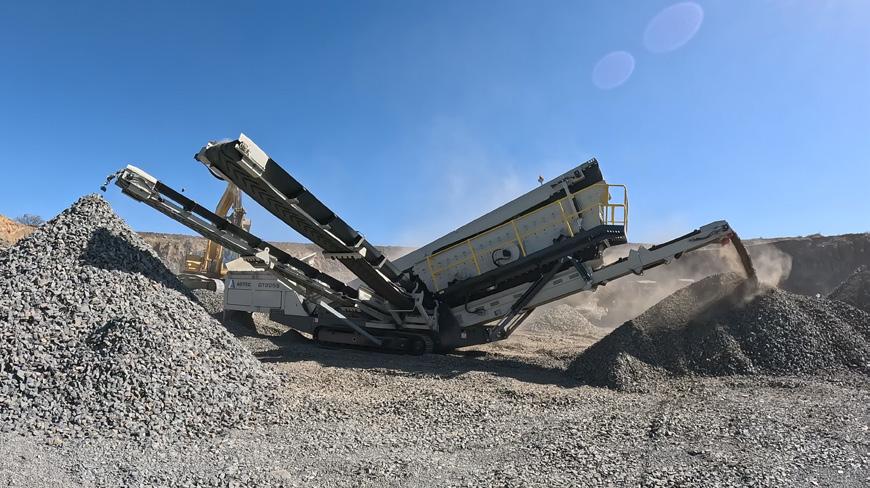
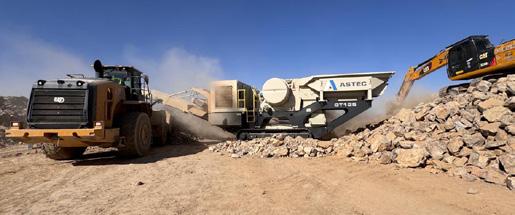
“Over the past few years, we have seen more complex products being specified, particularly on projects like the N3 highway upgrade,” he says. “These products are not easy to manufacture because the specifications are very tight and can slow down production. In response, we have added screening equipment and mobile crushing units to ensure we can meet both the specification and the required volumes.”
He adds that these investments provide valuable operational flexibility, as mobile crushing and screening equipment can be easily deployed not only within individual quarry operations but across different quarries as project demand shifts between regions.
“Dust contamination is a major concern for asphalt aggregates, as standards allow very little
AfriSam’s Umlaas Quarry produces high-quality aggregates that meet strict industry standards, supporting durable infrastructure and reliable road construction projects
fine material in these fractions,” Dawneerangen explains. “If aggregates remain on a stockpile for too long, dust can contaminate them and push the material out of specification.”
Collaborative testing
Pillay notes that AfriSam also conducts collaborative testing with customers, using split samples to build confidence in the supply chain. This allows stockpiles to be pre-approved, ensuring that material meets specification and is ready for dispatch. Each shipment is typically accompanied by a formal test certificate verifying compliance. AfriSam quarries conduct quarterly external SANAS accredited testing of inherent material properties for all required parameters ensuring that compliance information is not more than three months old.
With its extensive network of quarries across South Africa, AfriSam offers asphalt customers a key advantage in accessing the right type and quality of aggregate, concludes Dawneerangen. “Having multiple sources increases the likelihood that we can supply appropriate aggregates close to major infrastructure projects,” he says.
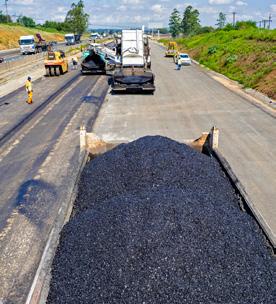
Consistency and rigorous quality control across the supply chain are essential to producing reliable, long-lasting asphalt surfaces
PREPARING YOUR KIKUYU LAWN FOR WINTER
A Water Wise guide
In the month of May, it's important to begin preparing your kikuyu lawn for its natural winter dormancy – an environmentally responsible choice, especially in water-scarce regions such as South Africa. Embracing this seasonal rest period is not only practical but also helps conserve water.
Your grass can enter a state of graceful dormancy without needing to be overwatered if you recognise and honour its natural cycles.
Here, Water Wise explains how you can maintain your kikuyu lawn during the winter season while using much less water, building resilience, and making sure it returns to life and vigorous growth in the spring season.
Kikuyu
Pennisetum clandestinum, commonly known as kikuyu, is the most widely used lawn grass in South Africa. It is native to East Africa and has an aggressive growth form, which means it can become invasive and take over indigenous grasses. Kikuyu is drought-tolerant, inexpensive, and easy to maintain because it can grow in areas where most grasses cannot. However, it is sometimes considered the highest user of water in comparison to other commonly used turf grasses.
Kikuyu is mostly planted as an instant lawn for sports fields, golf course construction, and rehabilitation. It has a mat root and herbaceous growth habit. It, however, doesn’t grow well in shaded areas.
Dormancy in lawn
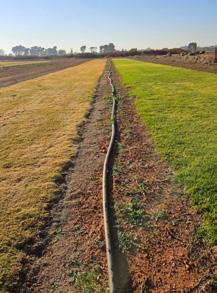
Dormancy refers to a period where the growth of the grass temporarily slows down, and the grass goes into a resting state for one season. Kikuyu in nature always goes dormant during winter, where the grass will turn brown. However, brown kikuyu grass does not mean it is dead; it has simply gone dormant. Lawn in a state of dormancy is simply “resting” and conserving energy for the new growing season.
Dormancy is a natural way for lawn to conserve moisture and nutrients in cold and dry seasons. It is therefore not necessary to apply a lot of water to your kikuyu during winter.
Water Wise watering of kikuyu
• Avoid frequent watering of kikuyu when it is dormant.
• Check your lawn in the morning to assess moisture levels. If it seems moist, water once every 14 days, depending on the weather.
• When the lawn appears to be dry, apply deep watering once a week and only water in the morning (between 6 am – 10 am) until optimal moisture is reached.
• Avoid watering in the evening to prevent prolonged moisture on the grass, which can lead to fungal diseases.
• Newly installed kikuyu will only require more water during its settling or establishment period. Gradually decrease the frequency of watering after this phase.
• In summer, water in the early morning or late afternoon, as this reduces water lost to evaporation.
• Use a trigger nozzle if watering kikuyu with a hose.
Smart maintenance of kikuyu
• Stop mowing your lawn; with reduced grass growth in winter, longer blades insulate roots and soil from cold temperatures while roots remain active.
• Only apply organic fertiliser as part of your spring treatment towards the growing season.
• As spring approaches, prepare for weed emergence on your lawn by hand-picking or spot-treating weeds with organic herbicides. This article was co-authored by Rand WaterWater Wise and Evergreen Turf, aiming to raise awareness among the public and customers about sustainable practices for watering and maintaining kikuyu lawns.
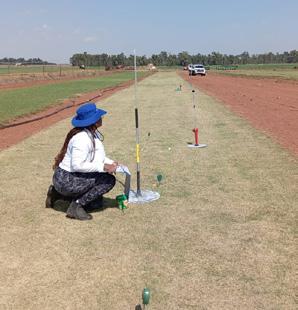
Rand Water Water Wise analysis of a kikuyu test section
During the winter months, kikuyu enters a dormant state and turns brown in colour
Assessing moisture levels is the key to avoiding overwatering
Use a trigger nozzle if watering kikuyu with a hose
Montague Gardens Bulk Sewer
wins SASTT award
Showcasing innovation, the Construction of the New Montague Gardens Bulk Sewer project is the 2026 winner of the Joop van Wamelen Award of Excellence. This prestigious award is conferred annually by the Southern African Society for Trenchless Technology (SASTT) in recognition of exceptional and excellent contributions to the active promotion, development and implementation of trenchless technology in southern Africa.
Project background
In 2021, the City of Cape Town initiated a project to upgrade the existing Montague Drive Bulk Sewer, a 4 km long major collector sewer with an internal diameter (ID) varying between 700 mm and 975 mm. The sewer serves a catchment area of approximately
Project:
Construction of the New Montague Gardens Bulk Sewer
Client:
City of Cape Town – Water & Sanitation
Consultant: Bigen Africa Services
Contractor:
CSV Construction
3 320 ha and forms a critical part of the city’s current and future sanitation infrastructure. The existing bulk sewer starts at the intersection of Montague Drive and Railway Road, where it intercepts the Sanddrift, Century City and Edgemead sewers, and continues along Montague Drive to the Koeberg Road Pump Station. The sewer was installed between 50 and 60 years ago and comprises asbestos cement and reinforced concrete pipe materials.
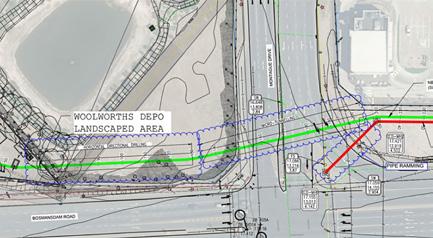
The route for the New Montague Gardens Bulk Sewer line (with the micro-tunnelling section shown in blue) culminating at the existing Koeberg Road Pump Station.
The upgrade of the Montague Drive Bulk Sewer is being implemented in two phases. Executed by CSV Construction as the main contractor, Phase 1 entails the parallel reinforcement of the existing bulk sewer through the construction of the New Montague Gardens Bulk Sewer using micro-tunnelling trenchless construction methods, together with the construction of a new sand trap and screening facility at the Koeberg Road Pump Station. Construction of Phase 1 commenced in March 2023 and was completed in Q2 2026. Phase 2 comprises the rehabilitation of the existing Montague Drive Bulk Sewer using trenchless rehabilitation methods. Construction of Phase 2 is planned to commence in October 2026.
Route and sizing of the
The
ABOUT JOOP VAN WAMELEN (1939-2015)
A professional engineer, Joop van Wamelen was instrumental in forming the Southern African Society for Trenchless Technology back in 1992, subsequently serving as a board member, President, Past President, and later as Honorary Director, in addition to representing South Africa at the International Society for Trenchless Technology (ISTT) board meetings. In recognition of his outstanding contributions to industry, the Joop van Wamelen Award of Excellence was established to honour his legacy.
across Koeberg Road before terminating at the Koeberg Road Pump Station. This route was identified as the most favourable alignment, primarily due to undeveloped land along the majority of the route.
A hydraulic analysis of the upgraded sewage conveyance system was undertaken for the full Koeberg Road Pump Station catchment area to confirm the required capacity and sizing of the New Montague Gardens Bulk Sewer.
Based on the projected growth rates for the various land-use categories within each subcatchment, a maximum densification horizon of 20 years, allowances for groundwater infiltration and stormwater ingress into the sewer network, and the influence of the 37 pump stations within the Koeberg Road Pump Station catchment, it was determined that the New Montague Gardens Bulk Sewer should comprise a 3 790 m long x 970 mm ID concrete sewer installed at a minimum
New Montague Gardens Bulk Sewer
preferred route for the New Montague Gardens Bulk Sewer was identified to start in Bosmansdam Road at Station Road, and follow an alignment along Railway Road, Platinum Street, Esso Road, and Stella Cove
gradient of 1:500 from Station Road to the connection with the existing Montague Drive Bulk Sewer immediately downstream of the Koeberg Road crossing, from where a 260 m long x 1 350 mm ID concrete sewer installed at a minimum gradient of 1 : 1 250 is required up to the Koeberg Road Pump Station.
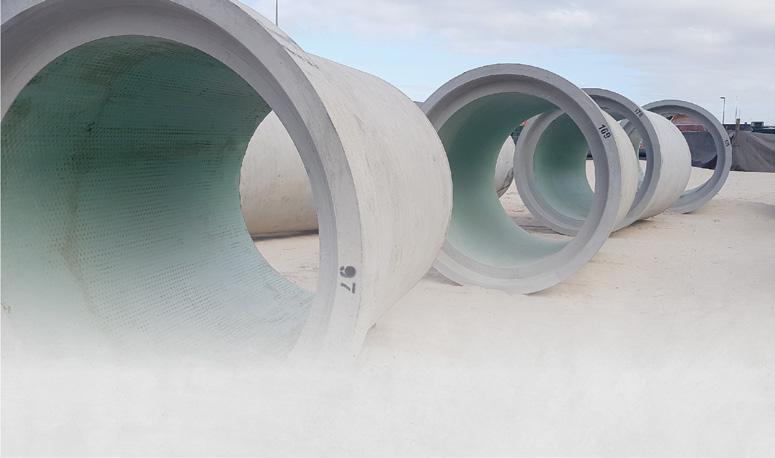
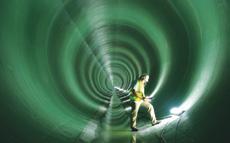
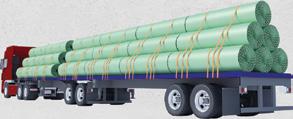
For the project, high density polyethylene (HDPE) lined steel band jacking pipes were specifically designed by precast concrete manufacturer, Rocla, with AKS Lining Systems’ Anchor Knob Sheet (AKS™) technology specified as the optimum HDPE cast-in corrosion protection lining system.
Trenchless construction methods utilised
Four different trenchless construction methods were utilised during construction of the New Montague Gardens Bulk Sewer, as follows:
1 Micro-tunnelling
The depth of installation of the New Montague Gardens Bulk Sewer varied between 4.5 m
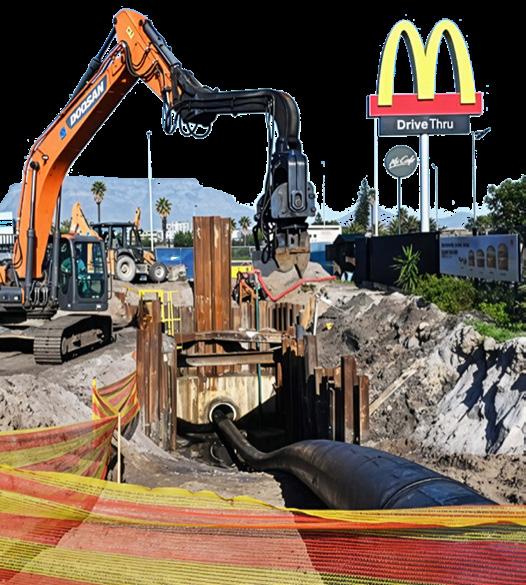
and 10.2 m below natural ground level along the route. Had the sewer been constructed using conventional open trench excavation methods, the works would typically have required a 20 m wide by 4.5 m deep box cut to establish a working platform, followed by trench excavation supported by sheet piling.
Given the alignment of the New Montague Gardens Bulk Sewer, open trench construction would have had a significant impact on existing services, vehicular traffic, and access to the industrial properties located along the route, while also necessitating extensive
road surface reinstatement. Furthermore, the method would have posed a considerable risk of settlement and potential structural damage or cracking to adjacent buildings, pavements, and other infrastructure due to vibrations associated with the installation of sheet piles using high amplitude vibrating hammers.
In light of these considerations, the New Montague Gardens Bulk Sewer was constructed using micro-tunnelling trenchless construction methods rather than conventional open trench excavation techniques.
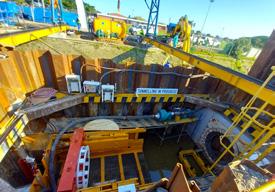
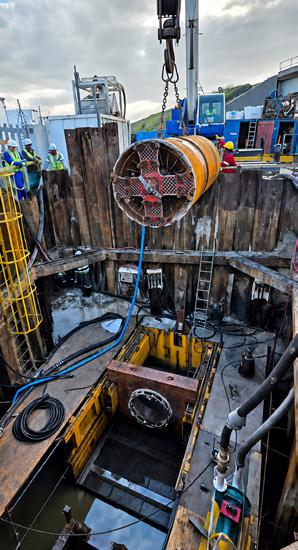
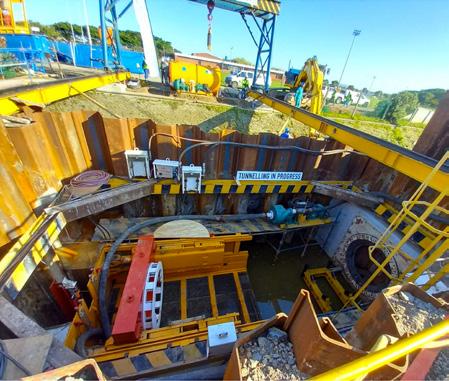
Micro-tunnelling preparation phases on the New Montague Gardens Bulk Sewer line works
Three trenchless technology methods were required to establish the start of the New Montague Gardens Bulk Sewer line within a highly congested site
2 Horizontal directional drilling (HDD)
The intersection of Montague Drive and Bosmansdam Road is recognised as one of the busiest industrial traffic intersections in South Africa. The new 560 mm nominal diameter (ND) HDPE rising main, connecting the Sanddrift East Pump Station to the New Montague Gardens Bulk Sewer, was required to cross both Montague Drive and the adjacent landscaped gardens of the Woolworths Depot.
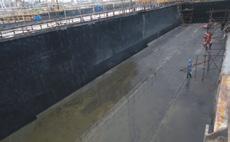
A 70,5 m long 970 mm ID concrete sleeve (with a 3 mm AKS HDPE liner) was installed underneath Montague Drive at a depth of 6 m by means of micro-tunnelling, following the establishment of sheet piled launch and receiving shafts either side of Montague Drive.
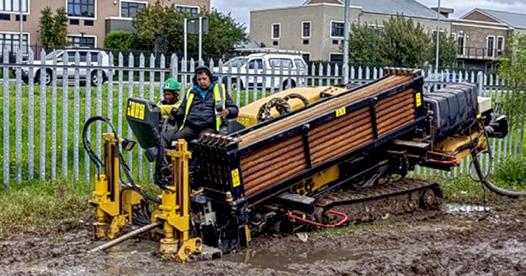
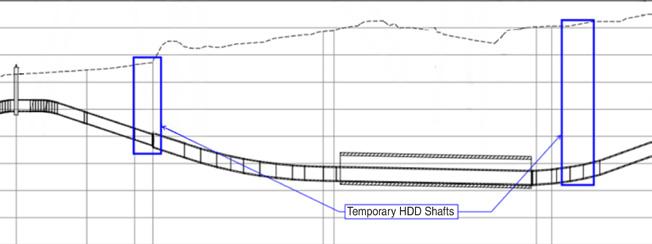
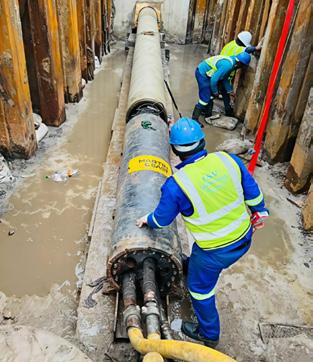
However, the proposed open cut installation through the Woolworths landscaped gardens proved problematic due to the excessive cost associated with the removal and subsequent reinstatement of the landscaped areas. As a result, it was decided to install this 65 m section of 560 mm ND HDPE pipeline using the trenchless HDD construction method at depths ranging between 4 and 6 m via sheet piled launch and intermediate shafts. In total, 135.5 m of 560 mm ND HDPE pipeline was installed by means of HDD. This included the 65 m drilled section underneath the Woolworths landscaped gardens extending to an intermediate shaft used to contain drilling fluid, after which the pipeline alignment was directed towards, and ultimately pulled through, the previously installed micro-tunnelled sleeve underneath Montague Drive.
3 Pipe ramming
The new 525 mm ND bulk sewer, connecting the Century City Bulk Sewer from the small traffic island at the intersection of Montague Drive and Bosmansdam Road, to the New Montague Gardens Bulk Sewer, was required to cross the slip lane into Bosmansdam Road. This crossing was originally planned to be constructed by means of micro-tunnelling. However, the method would have resulted in significant traffic disruption due to the required closure of the slip lane to accommodate the construction of the receiving shaft for the micro-tunnelling equipment.
To minimise traffic impacts, the 18 m crossing was instead installed using pipe ramming trenchless construction techniques. The works comprised the ramming of
HDD phases in progress
three x 6 m long sections of 610 mm ND × 17.4 mm thick steel pipe, launched from the Bosmansdam Road road reserve. The steel pipes were externally coated with Polyclad 777 at 2 000 micron thickness and internally lined with Carboguard 550 SF Epoxy at 600 micron thickness.
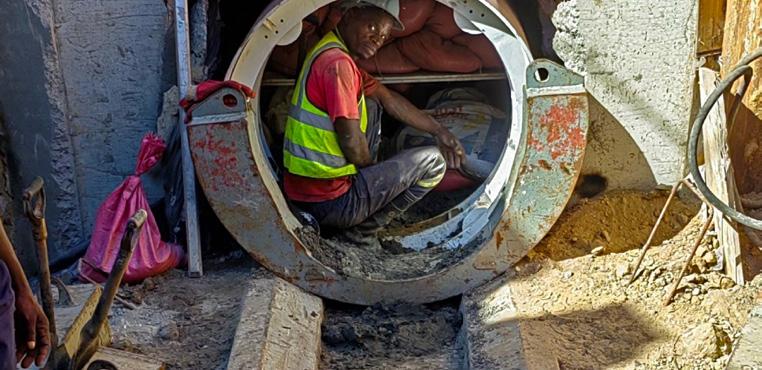
A smaller new manhole was constructed within the traffic island through the installation of 1 800 mm diameter precast concrete rings to a depth of approximately 4 m using the caisson sinking method. The caisson was sunk into position directly above the existing live 525 mm diameter bulk sewer.
4 Pipe jacking
The connection of the existing Montague Drive Bulk Sewer within Theo Marais Sports Complex to the New Montague Gardens Bulk Sewer required the crossing of an existing 3 956 mm x 2 780 mm concrete stormwater culvert with a 970 mm ID concrete pipeline
A schematic of the 65 m section of 560 mm ND HDPE pipeline installed under the Woolworths Depot
Pipe ramming works
incorporating a 3 mm AKS HDPE liner at a depth of 5 m.
Due to the unknown soil conditions and founding arrangements underneath the stormwater culvert – and considering that the crossing length was limited to approximately 20 m – it was decided to construct this section using the conventional trenchless pipe jack construction method.
To facilitate the works, a series of wellpoint dewatering drains was installed to lower the groundwater table and enable the pipe jacking
The launch shaft for the pipe jacking stage was established at an existing manhole on the Montague Drive Bulk Sewer, with a temporary bypass system constructed to divert the live sewer flows during construction
operations to be undertaken safely within the prevailing silty, sandy, clayey soil conditions.
The launch shaft for the pipe jacking works was established at an existing manhole on the Montague Drive Bulk Sewer, with a temporary bypass system constructed to divert the live sewer flows during construction. The existing manhole was subsequently demolished to allow for the preparation of the launch shaft.
The receiving shaft was a newly constructed 6 m deep reinforced concrete manhole on the New Montague Gardens Bulk Sewer.
The remainder of the project entailed microtunnelling of 3 800 m of bulk sewer from Manhole MH2 to Manhole MH51 to progressively link up with the Koeberg Road Pump Station.
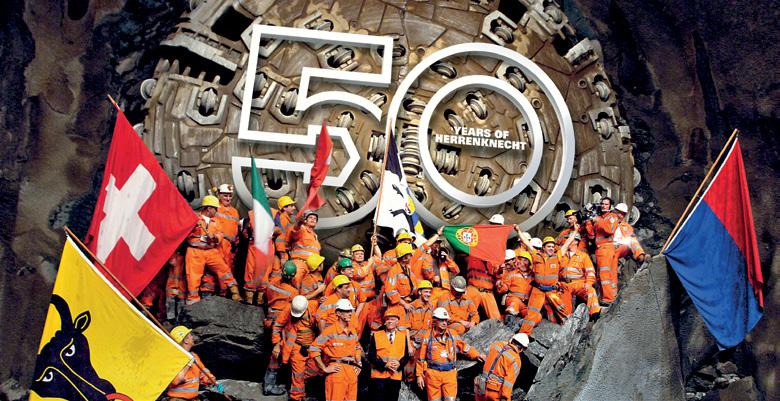
Herrenknecht micro-tunnelling machines
During the course of the various works, the following Herrenknecht micro-tunnelling machines owned by CSV Construction were deployed:
• An AVN 1200XC, upsized to 1 350 mm/ 1 620 mm with soft soil cutting head.
• An AVN 1000 for 1 000 mm/1 220 mm with mixed ground cutting head.
• An AVN 800, upsized to 970 mm/1 170 mm with soft ground cutting head, and
• An AVN 800, upsized to 970 mm/1 170 mm with mixed ground cutting head.
As stated by CSV Construction, varying ground conditions were found, with a large percentage of weathered rock with Uniaxial Compressive Strength (UCS) up to 30 MPa. This weathered rock broke down to an ultra-fine clay that made effective separation very challenging. However, the mixed soil conditions were successfully overcome thanks to Herrenknecht’s AVN closed slurry tunnelling technology.
Due to hard subsoil conditions, CSV Construction had to pre-auger at most of the shaft locations to install sheet piles to depths of up to 12 m. The deepest shaft excavation depth was 11.5 m from NGL.
All considering, the bulk sewer pipeline was successfully installed at a daily rate of 5 m to 30 m (depending on ground conditions) to an accuracy of ±15 mm. All this while crossing major arterial roads, major bulk watermains (with between 100 mm and 600 mm clearance), and even some crude oil pipelines.
Ultimately, what the project demonstrates is the creative application of trenchless technology to meet the city’s current and future wastewater requirements in the region with minimal disruption to the above ground urban landscape.
With Phase I now completed, works will continue on the rehabilitation of the original Montague Gardens line, further boosting downstream capacity in one of South Africa’s fastest growing cities.
RESPONDING TO CONTRACTOR RISKS AS FUEL PRICES SURGE
As diesel rises to record highs, many South African construction contractors may not realise that their contracts offer little protection against this surge, or that their window to claw-back additional costs is closing fast.
That is the urgent warning from construction law specialist MDA Attorneys, which has seen a sharp rise in queries from contractors grappling with fuel and materials costs linked to the ongoing US-Iran conflict and the closure of the Strait of Hormuz. The practice advises clients across various suites of standard construction contracts and warns that the surge in oil prices is likely to be treated under FIDIC, one of the most widely used construction contractual frameworks.
“This is no longer a theoretical risk,” says Clairize Malan, senior associate at MDA Attorneys. “Diesel has jumped within a short time. For contractors running plant-heavy operations, that is a material hit to the bottom line. Most standard contracts were simply not designed to assist contractors in absorbing a shock of this magnitude.”
Under many FIDIC contracts, price adjustments are agreed upfront using formulas and indices via a mechanism known as contract price adjustment (CPA). While CPA clauses are designed to account for fluctuations in the cost of labour, materials and fuel, they are calibrated against longer-term trends. The CPA mechanism is not built to account for sudden, steep price spikes driven by geopolitical conflict.
When oil prices jump sharply over a short period, as they have since February 2026, contractors may find the CPA mechanism does not cover the gap, leaving them to absorb the shortfall themselves.
The situation is set to worsen. May's official fuel prices were calculated based on Brent
crude averaging below US$101 per barrel, but oil has since traded higher following the collapse of US-Iran peace talks. June's prices are likely to be higher still. And from June, the government's temporary fuel levy relief, which has been cushioning South African consumers and businesses from the full impact, will begin to be phased out, falling away entirely in July. Contractors are therefore facing rising global prices and a rising structural price floor simultaneously.
Force majeure provisions
With CPA clauses offering limited relief, some contractors are looking to force majeure provisions as an alternative avenue for recovery. FIDIC's force majeure clause allows a contractor to claim costs where it is prevented from performing its obligations due to an extraordinary event, and war is specifically listed as one of those events. Recoverable costs include expenditure reasonably incurred by the contractor, whether on or off-site.
But relying on force majeure is not straightforward. It depends on how the contract defines war and whether that definition extends to conflicts beyond South Africa's borders.
“Employers will typically push for the narrower interpretation, which limits their exposure,” explains Malan. “Contractors understandably prefer a wider reading that would allow them to recover costs flowing from conflicts
beyond our borders. Whether a contractor can recover these costs ultimately depends on how the contract is interpreted. However, you cannot even have that argument if you have failed to give notice of a force majeure event.”
This is where many contractors are at the greatest risk. Under FIDIC, a contractor who fails to give timely notice of a force majeure event loses the right to claim altogether. For contractors who have not yet issued notices, each week of inaction further weakens their position. In some cases, it may extinguish their claim entirely.
Act now on three fronts
MDA Attorneys is urging contractors to act now on three fronts: examine whether their CPA formulas adequately cover increases in oil-linked costs; assess whether force majeure notices should be issued immediately; and ensure that cost records are being meticulously maintained.
“The construction industry is already operating on tight margins,” says Malan. “Contractors cannot afford to wait and see. They need to understand their contractual position now, take the right steps to preserve their claims, and engage with employers early. The longer this is left, the harder it becomes to recover these costs.”
MDA Attorneys continues to monitor developments and advise clients across the full range of standard-form contracts.
Contractors operating under NEC, JBCC and GCC contracts face different contractual positions and should seek advice tailored to their specific agreements.
Clairize Malan, senior associate at MDA Attorneys
BUILD BACK BETTER WITH GABIONS
While climate change now makes future weather cycles less predictable, May still tends to be the key transition month. It traditionally marks the end of the inland summer rainfall period and the winter ramp-up within the Western Cape. In both seasonal cases, it’s an opportunity to either mitigate previous flood damage, or install erosion countermeasures to weather incoming storms using environmentally engineered solutions.
Climate change impacts have renewed the focus on gabion systems – particularly for riverine protection, marine environments, and mass gravity retaining wall embankment interventions,” explains Louis Cheyne, Managing Director at Gabion Baskets, a leading gabion manufacturer and supplier of interrelated products like geotextiles. “This extends from public infrastructure to commercial developments and residential homes.”
Recent municipal works include an order from a contractor for a river channel lining protection project within Moses Kotane Local Municipality in North West province. This will entail the supply of around 100 tonnes of PVC coated woven mesh wire gabion systems (the equivalent of around 10 000 m3), predominately comprising gabion mattresses as well as the geotextiles essential for underlying structural integrity. While the standard Class A galvanised wire specification is highly durable, a PVC wire coating adds significantly enhanced protection in more corrosive environments.
In addition to a design recommendation, Gabion Baskets will provide on-site training for SMME contractor and community-based labour.
Preserving the water cycle
“Combatting stormwater runoff and river erosion is an essential measure in ensuring a
sustainable ecosystem, as well as in preserving wetlands health. It also reduces downstream sedimentation that – left unchecked – results in reduced dam storage capacity over time, as well as impacting water quality abstraction processes,” says Cheyne.
Essentially, without strategically placed gabion structures, any ensuing flood exacerbates the problem, plus it poses an undermining threat to adjacent buildings and civil structures, with resulting lives and livelihood impacts.
“Alongside public sector works we’ve experienced a major surge in private sector orders from property owners – business and domestic – who have a growing awareness of the benefits of gabions as a vital safeguard. Plus,
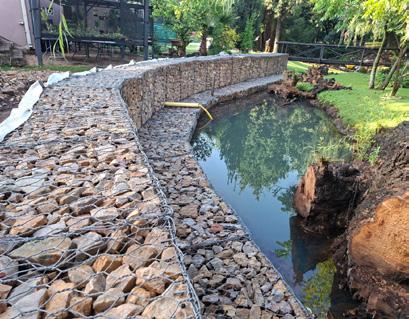
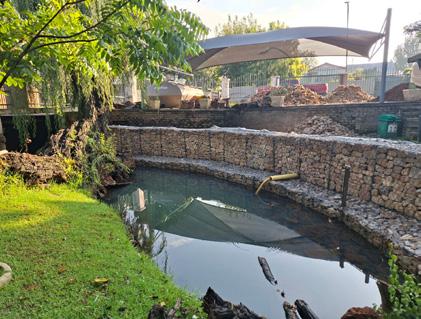
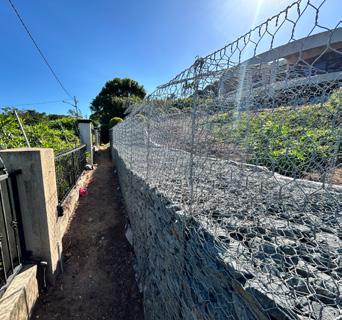
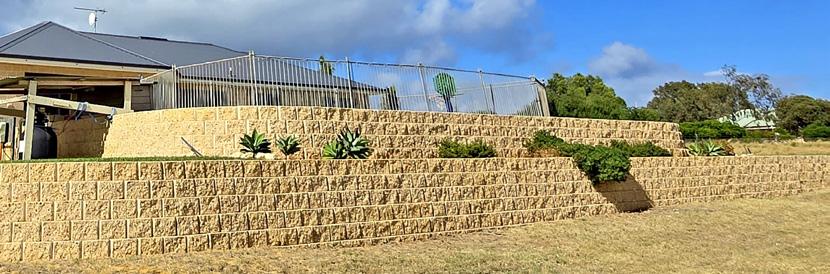
Perspectives of the 24 m long x 1 m high x 1 m wide gabion river retaining wall, founded on a gabion mattress, constructed for a Heidelberg property owner
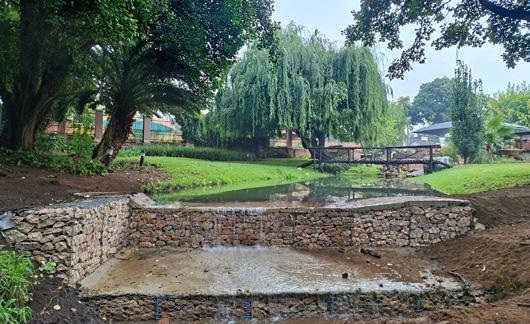
Included in the scope of works was an integrated weir, measuring 8 m in length, with a height and width of 1 m
there’s a major appreciation of the aesthetic benefits of conventionally stone-filled gabions as both an engineered and a landscaping response,” Cheyne continues.
Two recent examples illustrate the point, one in Heidelberg, Gauteng, and the other in Westville. KwaZulu-Natal.
Heidelberg riverside retention
The scope for the Heidelberg project in Gauteng was to counter stormwater runoff from overflowing into the client’s landscaped area. This entailed the construction of a 24 m long x 1 m high x 1 m wide gabion river retaining wall,
HEIDELBERG RIVER WALL AND WEIR
founded on a gabion mattress, with respective dimensions of 2 m x 1 m x 0.3 m.
Also included was a weir to control water flow, reduce erosion, and stabilise the surrounding soil. This measured 8 m in length, with a height and width of 1 m, respectively, founded on a 3 m x 1 m x 0.3 m mattress. The gabion spillway incorporates concrete capping, while an additional 2 m of the mattress surface at the front was also reinforced with concrete. Soil was compacted behind the weir and along the side banks for added stability.
“Concrete capping is a key intervention in extending structural integrity,” Cheyne explains. “It protects the spillway from flood debris impact, plus on the downstream mattress it helps to minimise potential scouring caused by the hydraulic jump.”
All gabions and mattresses used were PVCcoated for added durability and the excavations for their establishment were executed using labour-based methods.
Westville mass gravity wall
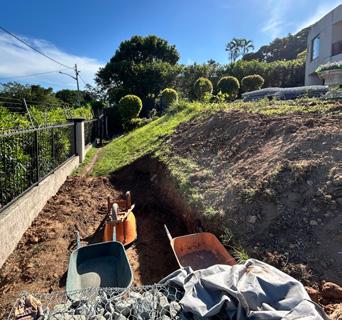
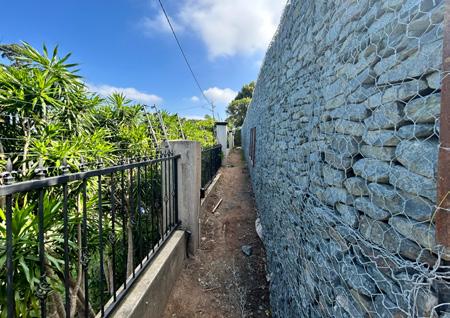
The second project in Westville involved the construction of a mass gravity gabion wall to level and extend the front yard area of a residential property, with heights ranging up to 2 m. The existing terrain sloped toward the front boundary and laterally across the site, requiring a structured retaining solution to create a usable, level platform.
The design incorporated multiple tiers of gabion baskets positioned within the boundary, with infill to achieve the desired ground level. The final installation was aligned parallel to the boundary wall, as per the client’s requirements. As for the Heidelberg project, labour-based methods were used throughout.
Flood barriers and beach erosion countermeasures
“While private owners invest in their own measures to safeguard properties, there’s an urgent need for municipalities to take a holistic approach to urban river management. Due to intensified urbanisation, accelerated stormwater runoff has led to riverine erosion reaching a crisis point – at times undermining neighbouring infrastructure and buildings. Add a flood scenario, and damage can and does reach epic proportions,” Cheyne continues.
“Therefore, it’s vital that municipal engineers appreciate the benefits of gabions as a proactive and sustainable intervention when river walls or embankments are swept away. The same is true for beach erosion countermeasures during severe storms events – another one of our specialist areas. Our factories can respond
A typical gabion river wall cross-section. The gabion mattress serves as both the foundation and an extended section to counter river souring
Establishment of the foundations (left) and construction in progress on the new mass gravity boundary wall (right)
The new gabion boundary wall at an advanced stage of completion
WESTVILLE MASS GRAVITY WALL
rapidly, but we recommend that municipalities keep critical stocks of gabions, geosynthetic sand container (GSC) bags, and related flood barrier systems on hand just in case.”
Marine works
Over the years, Gabion Baskets has supplied design recommendations and solutions for some of Southern Africa’s toughest river erosion challenges. This logically transitions to marine installations, where there’s a proven track record of gabion works – primarily for dune and/or neighbouring earthworks embankment stabilisation.
However, as Cheyne points out, gabions –due to their distinctive rock-filled composition – were never intended to be direct marine defence barriers.
“For land-based and riverine civils structures, each packed rock-filled gabion
basket has an approximately 35% voids component to facilitate controlled drainage via either woven or non-woven integrated geotextile liners. They were never intended to counter direct sea wave impacts, which will obviously suck and remove stones during the tidal action,” Cheyne expands.
Potential marine projects in the pipeline include a municipality on South Africa’s Western Cape coast. The site features a distinctive estuary, where Gabion Baskets has provided a design recommendation for either an approximately 275 m long and 3,5 m high gabion river retaining wall (with a PVC wire coating specification), or alternatively a GSC bag wall installation. The final structure will protect a residential estate bordering the estuary from being potentially undermined by progressive embankment erosion due to river flooding and tidal cycles.
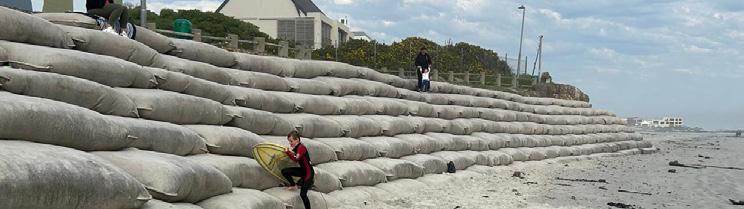
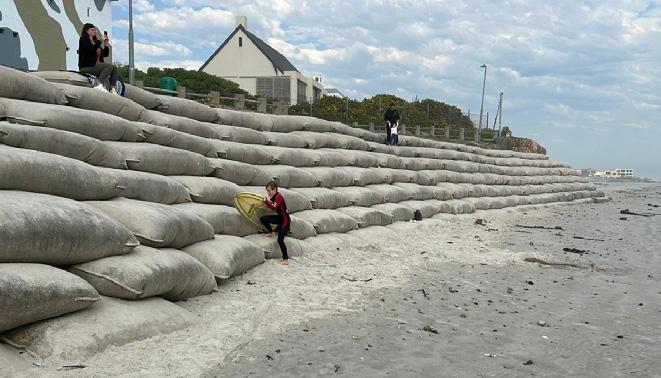
example of a GSC beach bag
a Cape Town
“In this case, GSC bags make the most sense – both in terms of the availability of in-situ materials, as well as from a wave impact perspective. The same principle holds true for inland and general river systems where the ready availability of in-situ rock lends itself to gabion construction. Either way, the beauty of environmentally engineered systems is that they are designed to be flexible, blending and working with the forces of nature to create an optimum balance,” Cheyne concludes.
A schematic example of a 1,6 m high wall constructed using geosynthetic sand container bags for long-term storm surge protection
An
wall constructed on
coastal section
CLOSING THE LOOP ON A WIDELY MISUNDERSTOOD WASTE STREAM: COFFEE PODS
South Africans love their coffee, and this shows with the amount of single-serve coffee capsule waste that is generated. The common assumption among consumers is that the multi-material composition of these pods makes them practically unrecyclable. However, a 10-year-long partnership between Nespresso South Africa and Oricol Environmental Services tells a different story, one where used coffee capsules are recovered and reintegrated into material value streams rather than discarded to landfill.
Nespresso uses aluminium for its coffee capsules because it preserves the freshness and aromas of high-quality coffee by providing a strong barrier against oxygen, light and humidity. At the same time, aluminium is continuously recyclable, making it an ideal material within a circular system where resources can be reused repeatedly. What emerged is a multi-partner system in which Nespresso provides the consumer-facing collection infrastructure, Oricol enables the materials recovery process, and consumers complete the loop by returning used pods through multiple convenient options – including booking a capsule
collection when placing an order online or via the Nespresso app, handing capsules to a RAM courier during any delivery, or dropping them off at any Nespresso boutique using a recycling bag included with each purchase.
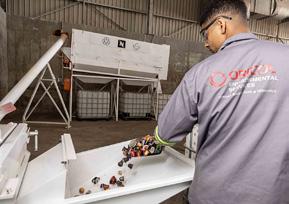
At Oricol's processing facilities, a customised mechanical separation machine, developed specifically for this application, extracts aluminium from the used capsules. That aluminium enters a smelting process and is remanufactured into new products.
Critically, the aluminium being recovered already carries strong recycling credentials. These capsules are made using at least 80% recycled aluminium for Original, while most Vertuo capsules use at least 85%, meaning the material completing this circular loop has already been recovered and reused before.
In turn, the extracted coffee grounds are processed through a composting operation. A portion of the coffee grounds is also channelled to community food gardening programmes, where it serves as a valuable soil amendment product.
“The Draft National Waste Management Strategy 2026 sets a target of diverting 40% of collected waste from landfill within five years, rising to 60%
within fifteen years,” explains Dirk de Wet, Chief Operating Officer at Oricol Environmental Services.
“The strategy identifies metals recycling and organic waste composting as priority diversion mechanisms, and explicitly names packaging, including metallic packaging, among the waste streams earmarked for tightened producer responsibility compliance,” he adds.
“What the broader sector stands to learn from our model is that complexity at the product level need not translate into an unrecoverable waste stream, provided the enabling infrastructure is built and the circular pathway is made accessible,” de Wet concludes.
AFRICA’S CEMENT INDUSTRY
AND THE PUSH FOR ENERGY SECURITY
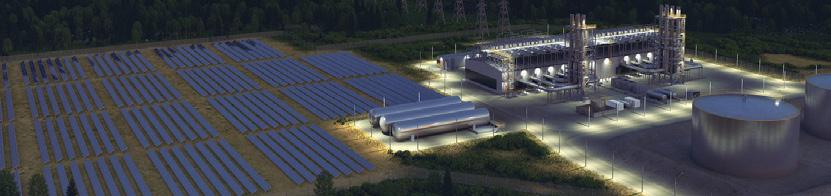
Cement production is energy intensive and highly sensitive to power interruptions. Kilns operate continuously, and sudden shutdowns disrupt production and increase costs. In many African markets, however, limited access to grid power and volatile energy prices leave many cement producers with no other choices but to invest in power generation capabilities on site.
In this context, the question facing the cement industry is no longer whether to generate their own power – they often must – but which technology provides the most practical and resilient solution to do so.
The technological options typically envisaged include open-cycle gas turbines, reciprocating gas engines and sometimes even coal-fired steam turbines. But only one of these technologies offers the optimal balance of flexibility, reliability and affordability suited to highly demanding cement operations.
Flexibility in matching industrial power demand
An essential factor to take into consideration when assessing options is the way power demand fluctuates within cement plants. Although production processes often run continuously, electricity demand varies depending on grinding operations, maintenance cycles and seasonal production patterns.
By design, engine power plants are highly effective at adapting to these changing demand profiles since plant operators can simply change power output from each engine between 10% and 100% within minutes. Because they are composed of multiple engines operating in parallel, independent units can even be switched on or off to match real-time demand.
More importantly, flexible engines can operate stably at very low loads while maintaining high efficiency, giving operators a responsive tool for managing fluctuating power requirements. This capability allows the power plant to maintain very high electrical efficiency across a wide range of output levels.
This operational flexibility is also of paramount importance to support the integration of intermittent renewable energy in microgrids. As the cement industry increasingly turns to solar
By Krzysztof Lokaj*
and wind to lower their carbon emission footprint, matching them with flexible engine capacity will provide the critical dispatch dependability needed in hybrid power plant configurations.
Open-cycle gas turbines, on the other hand, significantly lose efficiency when operating below full capacity. For industrial users that rarely operate at a constant full load, this translates into higher long-term fuel consumption, offsetting the turbines’ lower up-front cost. In a sector where energy costs represent a significant share of operating expenses, differences in efficiency over time will outweigh any initial capital cost advantages.
Unlike engines that can be turned on and off multiple times during a day and require no minimum up and down time, turbines need to operate constantly to avoid thermal stresses and therefore increased maintenance costs. This lack of operational flexibility will significantly undermine the efficiency, but also severely limit the performance of renewables in hybrid microgrid configurations.
Reliability and scalability as baseline requirements
For cement plants, electricity supply must be dependable above all else. Reciprocating engine power plants typically achieve availability rates over 98%, making them well suited to industrial environments where access to energy must always be dependable.
One reason for this reliability lies in the modular nature of engine-based plants. Unlike turbine power plants, their configuration allows individual units to be serviced without shutting down the entire plant. Servicing can be planned and carried out on site while the remaining engines continue to operate. Spare parts planning, local technical support and straightforward servicing procedures also help keep downtime to a minimum.
The modular structure of engine power plants also allows for new generation capacity to be expanded gradually. As cement plants increase production, additional generating units can be installed without redesigning the entire power system, while avoiding the need for oversized plants. This structural flexibility reduces investment risk, allowing power infrastructure to grow alongside industrial demand. In this regard, engine power plants offer a degree of adaptability that is difficult to achieve with other generation technologies.
Coal, a cheap option with considerable downsides
Coal-fired power plants are sometimes considered as an alternative for captive power in certain countries, particularly where cheap coal resources are locally available. However, coal-based generation presents its own set of challenges for industrial users.
Much like open-cycle gas turbines, coal plants are designed primarily for steady, continuous operation and are less suited to environments where power output must adjust frequently and rapidly. Startup times can extend to many hours, and maintenance often requires large sections of the plant to be taken offline. This lack of flexibility negatively impacts project economics.
Environmental considerations also represent a major downside for coal. Financing institutions, investors and owners are paying closer attention to emissions profiles and long-term climate risks. As a result, coal-based power plants can encounter significant barriers to financing.
Preparing for an evolving energy landscape
Energy systems across Africa are evolving, with new gas infrastructure, renewable energy projects and volatile fuel markets reshaping the landscape. Industrial power solutions therefore need to be able to accommodate these transformations. Of course, no single power technology is universally optimal. Yet, when sustainability, scalability, reliability, operational flexibility and long-term efficiency are considered together, engine-based power plants present a compelling option for many cement producers across the continent.
*Africa Development Manager, Wärtsilä Energy
ITAC TARIFFS, END OF CHINA’S REBATE COULD STIMULATE EV BATTERY RECYCLING
South African solar and battery backup consumers are in for yet another round of industry-wide price increases, but it’s not all bad news, writes Lance Dickerson , managing director at REVOV SA.
As of 27 th March 2026, the International Trade Administration Commission of South Africa (ITAC) has proposed preliminary duties of 15% on fully assembled lithium-ion batteries and up to 30% on various solar and wind components to promote local manufacturing.
That’s not all. Based on policy announcements from the Chinese Ministry of Finance and the State Taxation Administration released in January 2026, China is significantly restructuring its export tax rebate system for renewable energy products, specifically targeting solar and batteries. In essence, the Chinese government is ending its 9% tax refund. This change is being implemented with 3% effective immediately and the remaining balance phased in over the next year.
What it means for the industry
Certainly, from REVOV’s perspective, we have always argued for a robust local industry. This is because the industry is awash with incredible talent. The shift towards local manufacturing is a good sustainable move for the country. However, it won’t happen overnight.
Until such time as the local supply chain is embedded and meeting regional demand,
consumers and businesses would do well to seek out suppliers in the renewables sector that have robust local technical and support teams. Teams that not only have a reach across the length and breadth of the country, but teams that assemble the batteries on these shores. That technical expertise will become golden.
Consider this. There are still large stockpiles of fully imported batteries in the market. The ITAC developments may well force a sell-off of these products, but even if it doesn’t the dangers of long-term storage and the resulting degradation of the cells will continue to harm the industry. These batteries will find their way into installations. Potentially inferior products with no local support will do little to support the industry’s reputation or consumers’ pockets.
The circular economy
Perhaps the most exciting outcome will be a reinvigorated investment in 2nd LiFe. 2nd LiFe batteries are lithium iron phosphate batteries, which come from electric vehicle batteries. When EV batteries are replaced, a very strict testing and quality control process is implemented to assess and select individual cells and whole batteries for use in Battery Energy Storage Systems for industrial and residential use.
These batteries have a number of advantages. EV grade lithium batteries are superior to those made for storage exclusively. They are able to handle far more aggressive charge and discharge rates, higher temperatures and even penetration tests.
2nd LiFe batteries are the answer to two questions: What do we do with EV batteries when they are replaced? And where do we find lithium batteries that are robust enough to handle the toughest conditions in Africa while performing on par with First LiFe LiFePO4 batteries?
REVOV has successfully sold and supported thousands of 2nd LiFe batteries over the last decade, and the recent ITAC news provides the perfect launching pad for a reinvigorated 2nd LiFe economy locally.
We procured our first-generation cells from China, where there is an abundance of EVs. South Africa’s sector has grown, with significant numbers of EVs found in large industry, mining and the local vehicle sector.
Now is the time to ensure that when those batteries need to be changed, partnerships should be struck where experts come on board to prevent those batteries from filling our landfills and instead be deployed to power renewable installations as reliable, robust backup batteries. This industry has weathered one shock after the next. This is a moment of immense possibility.
FROM HARMONICS TO ROI
UNPACKING THE TECHNO-ECONOMIC CASE FOR CLEANER POWER IN WASTEWATER PLANTS
economic assessment reveals value that energyonly analyses miss and often shortens the ROI. In terms of available power quality solutions, many technology options have been evaluated as real implementation scenarios, not standalone devices. Using the plant’s data as the benchmark, we modelled each option, such as reactors, passive filters, active harmonic filters, low harmonic drives and hybrid combinations, to understand their true techno-economic impact. What stood out is that higher performing solutions do not just improve compliance; they also restore thermal margins, reduce stress on transformers and motors and stabilise maintenance cycles. It is the difference between running a car gently versus redlining it every day.
Real benefits for municipalities
At plant level, harmonics are not just an abstract electrical theory issue, but a very real reliability risk, causing transformers to run hotter, motors and equipment to age faster, and cables to experience unnecessary stress. Protection systems start tripping more often, increasing the need for maintenance and the likelihood of unexpected failures and service interruptions.
While none of these issues will trigger dramatic alarms, together they steadily drive up maintenance demands and elevate the risk of failure.
In large facilities, such failures can have a ripple effect, disrupting production lines and amplifying losses over time. Without proper mitigation, the cumulative impact becomes significant.
More than just compliance
So, when we talk about power quality, we are really talking about plant stability, uptime and lifecycle cost, not just compliance. The most common symptoms of poor power quality are those that quietly undermine reliability by causing equipment stress that makes plant performance unpredictable.
By Suvern Moodley
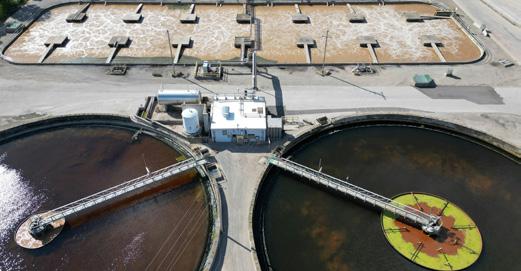
Behind every reliable wastewater plant is an electrical system exposed to the effects of harmonics, voltage distortion and overloaded networks caused by fleets of variable speed drives on pumps and aerators.
For municipal plants already operating on tight budgets, these unseen electrical stressors lead directly to higher lifecycle costs and increased reliability risk. They erode stability long before anyone notices, and by the time the symptoms are obvious, the damage is already baked in. By bringing real customer data into scenario modelling, the conversation shifts from “cost of mitigation” to “return on investment (ROI)” for power quality solutions. Once we move from theoretical assumptions to real facility data, we can model actual operating conditions and quantify far more than energy savings. We can measure avoided failures, longer equipment life and reduced maintenance.
Adding reliability to the equation
When reliability is added to the equation, energy mitigation stops looking like an engineering cost and starts looking like an infrastructure investment. That is when decision-makers see the financial case, not just the technical one. Some solutions that seem expensive upfront actually deliver the strongest lifecycle value, especially when rolled out as part of a phased infrastructure plan. Therefore, a true techno-
For municipalities, these solutions translate directly into tangible benefits such as fewer failures, longer asset life and more predictable operating costs.
Schneider Electric’s work starts with understanding the plant, not pushing products before diagnosing the problem. We combine audits, digital modelling and lifecycle analysis to pinpoint where the biggest reliability and financial gains lie. This gives utilities a clear roadmap for phased upgrades that align with budgets and asset replacement cycles. Instead of a once-off fix, it is a long-term strategy that strengthens reliability and improves financial performance.
Ultimately, power quality is fundamentally a reliability issue, not just a technical one, and that is why audits help customers see the real operational risk. Cleaner power strengthens equipment, stabilises operations, and ultimately supports more reliable water and wastewater services, which is the outcome that matters most.
Suvern Moodley, EcoConsult Business Development, Field Services, for Anglophone Africa at Schneider Electric
INDUSTRIAL GROUNDWATER MANAGEMENT GETS SMARTER
Monitoring groundwater levels across large industrial sites is critical, but for German steel producer, Salzgitter Flachstahl, it became increasingly difficult to manage.
With an extensive works area and surrounding landfill sites requiring constant observation, groundwater levels were traditionally measured manually. This process was not only time-consuming and labour-intensive but also limited in scalability.
As the number of required measuring points grew, the existing approach could no longer keep up.
To address this challenge, Salzgitter Digital Solution was tasked with developing a fully automated and digital monitoring system using long range wide area network (LoRaWAN) technology. The latter is a wireless communication
protocol designed for long-distance, low-power data transmission, making it ideal for industrial monitoring.
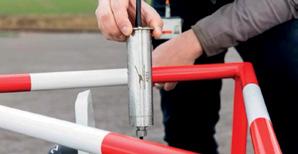
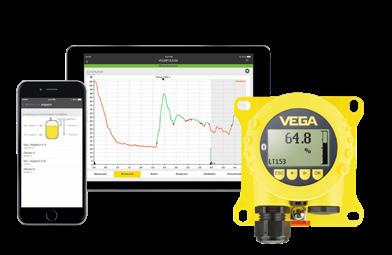
In collaboration with KELLER Pressure, a solution was implemented using high-precision level probes and the ADT1 long range (LoRa) transmission unit, which wirelessly sends measurement data over the LoRaWAN network. This setup enabled continuous, wireless groundwater monitoring across multiple sites.
Beyond basic measurements, the solution also captures critical diagnostic data, including battery voltage (amount of electrical energy remaining), temperature (internal system heat), humidity (moisture in the air around the system), and signal quality (strength and clarity of data transmission). This information provides early warnings for maintenance and helps ensure long-term reliability.
Data security was another key consideration. With encrypted LoRa communication, and an integrated data logger, the system ensures that no critical data is lost – even during transmission interruptions.
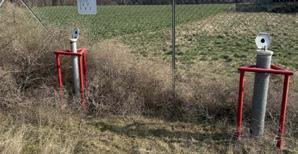
Instruments set up to measure groundwater levels
The Keller ADT1 data logger
Since its implementation, the automated groundwater monitoring system has been running reliably for over three years –supporting better decision-making and longterm environmental compliance.
Can smart water create smart cities?
Smart water is a combination of technologies: sensors to monitor systems, data gathered from those sensors, and software that turns the data into actionable knowledge. Smart meters automate meter reading and provide clear usage metrics. Digital monitoring and analytics detect leaks, pressure anomalies, pump stress, and early asset failure indicators on both distribution and treatment infrastructure. They also extend into renewables such as rainwater capture and greywater recycling.
But how does that get us to smart cities? Smart water systems establish a foundation and culture for smart technologies. By applying relatively simple and unobtrusive solutions like connecting smart meters to pipes, site managers quickly experience the benefit of accurate, datadriven reporting. It encourages exploring other possibilities, including advanced technologies like artificial intelligence and digital twins. Moreover, smart buildings can support municipalities through common standards and integrated reporting systems.
When multiple buildings adopt compatible smart water technologies, municipalities gain access to standardised consumption and leak-pattern data that strengthens planning and reduces system losses. A municipality's effort to deliver on a smart city strategy gains momentum once its residents appreciate the benefits.
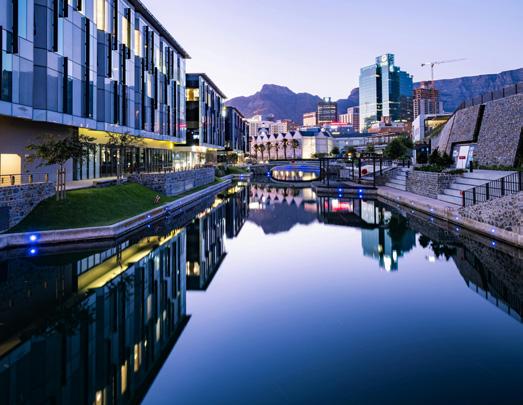
Cape Town is famous for its scenic bay, vibrant weather, and the towering presence of Table Mountain. It’s also infamous for another towering presence, the unfinished highway called “Solly’s Folly”.
The stuff of legends, this road was abandoned in the 1970s, likely because of budget issues. Others blame bad engineering or a stubborn cafe owner who refused to sell their land. To this day, it remains a favourite talking point between locals and visitors who see the high bridge abruptly going nowhere.
Solly's Folly is also a reminder that urban areas are forces of nature. As much as one can rigidly plan and orchestrate our towns and cities, there are other factors as well. Economics, weather, and people's movements all have a say.
In the early 2000s, the idea of smart cities gained popularity. Using digital technology such as data and Internet of Things devices, we could bring order to urban chaos. It sounded very promising. Yet, two decades later, the results are still mixed.
There are successes, such as Singapore and Barcelona, but few other cities have reached the status of being comprehensively “smart”. True smart cities remain elusive. Yet, if we zoom in, we
By Chetan Mistry
Digitising water systems reduces non - revenue water (NRW) and operating costs, which is a prerequisite for any municipality attempting to modernise toward smart city standards.
can see compartmentalised examples of smart city advances, such as dynamic traffic lights in New York and smart energy grids in Shenzhen. Overall, smart water adoption has outpaced most other smart infrastructure initiatives because utilities can quantify the financial impact of leak reduction, pressure management, and regulatory compliance.
The reason is that smart cities are still cities. Top-down planning can help guide and shape them, but they emerge from the bottom up. What bottom-up forces can modernise a city? Water infrastructure is often the first viable entry point for smart city deployment because it delivers measurable economic outcomes such as lower NRW, reduced energy use in pumping, and improved asset uptime.
It can start with individual buildings. Smart water systems generate actionable data that allows utilities and building owners to cut operating costs through leak detection, pressure optimisation, and predictive maintenance. According to the Global Infrastructure Hub, implementing smart meters retroactively on buildings reduces their consumption by as much as 22%. Leak detection is another example, reducing water waste and motivating lower insurance premiums because of lower water damage risks.
The beauty of water systems is that we don't have to change how they work. Retrofittable sensors, telemetry, and analytics can be layered onto existing pump and treatment assets, reducing upgrade costs and accelerating adoption. That can be on a brand new development site or to enhance the city's oldest building.
Solly's Folly tells us why smart cities struggle to come into fruition. Cities don't just respond to command and control. They are organic, impulsive, and driven by different forces. But if we focus on making water smarter at the ground floor, among individual buildings, we'll start creating smarter cities.
Chetan Mistry, Strategy and Marketing Manager, Xylem WSS (AMETI)
CAR WASHES: A BLIND SPOT IN WATER MANAGEMENT
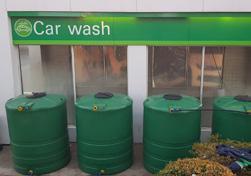
1 2 3
Commercial car washes are widely regarded as an important after-sales service that helps maintain both the exterior and interior condition of vehicles through the effective removal of dirt and debris. Despite their importance, car washing has become an increasing concern due to excessive water consumption and environmental contamination associated with the detergents and chemicals used during the cleaning process.
Amarket research study conducted by Rand Water - Water Wise further revealed that participants from various industries identified illegal water connections, excessive water consumption, and infrastructure damage resulting from uncontrolled runoff as key concerns associated with car wash operations.
One of the notable findings of the study was that “car washes are quietly placing strain on potable water systems and urban infrastructure”.
The study therefore recommends stronger regulatory measures, improved compliance monitoring and enforcement, as well as the formal inclusion of car wash facilities within municipal water billing frameworks to encourage responsible water use and sustainable operational practices.
Commercial car washes consume approximately 34–150 litres ( ℓ ) of water per vehicle, while washing larger vehicles such as trucks and buses may require between 400–600 ℓ of potable water. Certain industrial car wash facilities utilise approximately 60–70 ℓ of drinkable water per wash, depending on factors such as vehicle size, the level of dirt accumulation, and whether the washing process is manual or automated. In comparison, home car washing has been reported to consume approximately 152–532 ℓ of water per wash.
Overall, car wash operations consume substantial volumes of water, placing them in direct competition with potable water required for domestic and human consumption.
The significant water consumption associated with car washing also results in the generation of large volumes of wastewater. Manual car washes generate approximately 400 ℓ of wastewater daily, whereas automated systems generate about
150 ℓ daily due to improved operational efficiency and water management practices.
Untreated car wash wastewater typically contains detergents, oils, grease, suspended solids and heavy metals, which often enter nearby water bodies through stormwater runoff systems. When discharged into rivers, streams or dams, detergents can form foam layers that reduce dissolved oxygen levels and negatively affect the mucus membranes of aquatic organisms such as fish. In addition, oils and grease can coat fish gills, impairing the reoxygenation process and ultimately contributing to declines in aquatic biodiversity and reduced plant growth within aquatic ecosystems.
Key water and environmental conservation recommendations for car washes
• Adopt water-efficient technologies such as highpressure, low-flow spray systems (trigger nozzles for hoses), and automated washing systems to reduce freshwater consumption.
• Install wastewater recycling systems to minimise dependence on potable water supplies. Some professional facilities have reportedly been able to reclaim between 9% and 82% of the water used during washing operations.
• For home car washing, use a bucket and sponge instead of a continuously running hosepipe to significantly reduce water consumption.
• Collect and use rainwater to reduce the dependency on potable water.
• Monitor and record water consumption regularly to identify inefficiencies and improve water management practices.
• Use environmentally friendly and biodegradable detergents to minimise aquatic toxicity and environmental degradation.
1 Washing a truck or bus can consume between 400–600 ℓ of potable water
2 Using rainwater storage to supplement municipal supply is the right approach
3 Automated systems can generate approximately 150 ℓ of wastewater per car – a high percentage of which can be recycled
• Wash vehicles on permeable surfaces, such as lawns or permeable concrete blocks, where possible to reduce contaminated runoff and promote natural infiltration.
• Educate and train staff on water-wise principles and sustainable water-use practices to encourage responsible water management and environmental stewardship.
The car washing industry has proven to be a lucrative and easily accessible business opportunity that can contribute significantly towards increasing employment opportunities for the youth. However, as this industry continues to expand, greater emphasis must be placed on sustainable water use and environmental conservation and stronger municipal by-laws. Excessive water consumption and the improper use of chemicals can have detrimental effects on the very environment we all depend on. It is therefore essential for car wash owners and operators to adopt simple yet effective waterwise practices that promote responsible water use, reduce pollution, and support environmental sustainability.
AECOM HIGHLIGHTS NEED FOR SCIENCE-BASED PFAS REGULATION IN SOUTH AFRICA
Global infrastructure leader AECOM is urging the introduction of enforceable regulatory limits for per- and polyfluoroalkyl substances (PFAS) in South Africa. This comes as a growing body of evidence highlights widespread PFAS detections across water systems and increasing divergence between existing local regulatory frameworks and internationally applied standards.
The findings, detailed in a new article for publication in a leading scientific journal, authored by AECOM specialists across Africa and the United States, indicate that PFAS, a large family of highly persistent and mobile fluorinated organic compounds, are being detected in surface water, groundwater, wastewater, drinking water, and even rainwater across multiple provinces.
Dr Anthony Mader, Senior Environmental Scientist at AECOM Africa and lead author, says that multiple lines of evidence point to a need for regulatory intervention. “South Africa is no longer dealing with isolated PFAS detections. A national assessment, supported by multiple site-specific scientific studies, shows persistent PFAS contamination across water systems, driven by multi-source inputs and governed by complex physicochemical fate and transport processes,” he notes.
“Although direct comparisons between local and international datasets require caution due to differences in analytical scope, at some hotspot locations across South Africa concentrations exceed multiple international benchmarks, yet there is currently no enforceable regulatory framework to drive mitigation. Establishing clear, science-based limits is the most effective way to protect both public health and long-term water security.”
PFAS are widely used in industrial processes
Due to their surfactant properties and resistance to physical, biological, and chemical degradation, PFAS are widely used in industrial processes,
firefighting foams, and consumer products. These same fluorinated carbon chains confer resistance to degradation and enable long-range transport and bioaccumulation, and therefore, incorporation into food chains and ecosystems.
The AECOM article highlights research that conventional wastewater treatment processes are largely ineffective at removing PFAS, particularly short-chain variants, which are increasingly dominant in South African water systems.
Dr Khathutshelo Netshiongolwe, lead of AECOM’s South Africa Environmental Data Management team and co-author, emphasised the implications for water management. “Utilities are facing a class of contaminants that current infrastructure was never designed to remove. Without regulatory drivers, there is limited incentive to invest in advanced treatment technologies or implement upstream source control. This creates a cycle of continuous environmental contaminant loading,” he explains.
Global strengthening of PFAS regulatory frameworks
Globally, PFAS regulation tightened markedly between 2024 and 2026. The United States adopted enforceable standards in the nanogram per litre range (one-part PFAS in one billion parts water), Australia and Canada lowered national guideline values, the European Union brought binding PFAS limits into force, and the UK strengthened PFAS policy, monitoring, and regulatory frameworks.
The AECOM article highlights that many South African water sources would exceed these thresholds if assessed under international standards.
“PFAS regulation is rapidly evolving worldwide, with a clear shift toward group-based and mixturebased regulatory approaches,” comments Dr Rosa Gwinn, Global PFAS Lead at AECOM and an AECOM Fellow. “South Africa has an opportunity to leapfrog legacy regulatory models by adopting a science-led framework that reflects both global best practice and local conditions.”
A pragmatic path forward
The authors propose a multi-tier regulatory framework tailored to South Africa’s PFAS profile, combining individual compound limits with broader group-based controls. Key recommendations include a coordinated, science-based regulatory process; mandatory national monitoring based on accepted laboratory methods; targeted infrastructure upgrades in high-risk catchments; and the development of a national PFAS inventory.
Dr Brandon Barnardo, Junior Environmental Scientist at AECOM, notes that engineering demand is already shifting in response to global regulatory pressure. “Globally, we are seeing a clear pivot toward PFAS-focused design and optimisation. Technologies such as granular activated carbon, ion exchange, and reverse osmosis are becoming essential components of modern water treatment systems,” he explains.
AECOM’s multidisciplinary PFAS practice combines advanced analytics, PFAS forensics, fate and transport and source-pathway-receptor modelling, and treatment technologies to support clients in managing both legacy contamination and emerging risks.
Walter Fyvie, Associate Director, AECOM Africa Environment, and Elisabeth Nortje, Director, AECOM Africa Environment, conclude that addressing PFAS is not just a compliance issue but a long-term resilience challenge. By acting now, South Africa can align with global standards, protect critical water resources, and build infrastructure systems that are fit for the future, ultimately creating Sustainable Legacies.
South Africa’s journey toward a low carbon, resource efficient economy is gaining momentum. With the national commitment to achieve net zero emissions by 2050, industries across mining, manufacturing, water treatment, food production and energy are under growing pressure to operate more efficiently, reduce waste, and demonstrate measurable sustainability gains.
Achieving these goals requires more than just policy alignment or a high-level strategy. It demands precise, reliable data – the kind that enables operators to optimise processes and make informed decisions in real-time.
Within this context, VEGA’s instrumentation can play a deciding role in the success of companies working towards sustainability goals. As a global leader in level, pressure and point level measurement, VEGA provides the technological backbone that allows South African industries to translate sustainability ambitions into operational reality.
Sustainability starts with measurement and the principle is simple: you cannot manage what you cannot measure. Whether your goal is reducing energy consumption, cutting water losses, improving process efficiency or lowering emissions, accurate measurement is the foundation of every sustainability initiative.
VEGA’s sensors – from radar level instruments to pressure transmitters and IIoT enabled systems – deliver high resolution, real-time data that helps plants operate cleaner and smarter. In the South African context, this capability is especially valuable. Ageing infrastructure, water scarcity, rising energy costs and tightening environmental regulations mean that inefficiencies are no longer just operational challenges; they are sustainability risks.
Supporting water security and responsible resource use
Water is one of South Africa’s most critical sustainability concerns. Municipalities and industries across the board face mounting pressure to reduce losses, improve treatment efficiency and safeguard supply.
VEGA’s radar level sensors, such as the VEGAPULS series, are widely used in reservoirs, treatment works
Net zero starts with better measurement
and distribution systems to ensure accurate monitoring under harsh conditions, from high dust loads to extreme temperatures. Their non-contact measurement reduces maintenance requirements and ensures long-term reliability, helping utilities reduce unaccounted for water and optimise pumping schedules to save energy.
In industrial settings, VEGA instrumentation supports closed loop water systems, effluent monitoring and chemical dosing accuracy, which are all essential for reducing freshwater intake and ensuring compliance with environmental standards.
Enabling energy efficiency and emissions reduction
Energy intensive sectors such as mining, petrochemicals and manufacturing are under pressure to cut carbon emissions while maintaining productivity. VEGA’s measurement solutions help operators identify inefficiencies, stabilise processes and reduce unnecessary energy consumption. For example, accurate level control in boilers, separators and storage tanks
interruptions, all of which waste energy and increase emissions.
Pressure transmitters like the VEGABAR series support safe, efficient operation of compressors, pipelines and filtration systems, contributing directly to lower energy use and reduced carbon footprints.
Digitalisation: The accelerator of net zero progress
Digital transformation is a key enabler of South Africa’s sustainability transition. VEGA’s IIoT-ready instruments and Bluetooth enabled configuration tools allow operators to access data remotely, streamline maintenance, and integrate measurement insights into plant wide optimisation platforms.
This digital visibility empowers teams to make proactive decisions, reduce downtime and extend equipment life, all of which support long-term sustainability and cost savings.
A partner in South Africa’s sustainable industrial future
Reaching net zero is not a single action but a continuous journey of improvement. VEGA’s commitment to innovation, reliability, and customer support ensures that South African industries have the tools they need to meet rising environmental expectations while remaining competitive. By delivering precise measurement, enabling digital optimisation and supporting responsible resource management, VEGA is helping build a more resilient, efficient and sustainable industrial landscape –one sensor at a time.
PROACTIVE MEASURES FOR URBAN FLOOD MITIGATION: LESSONS FROM EAST AFRICA
The flooding crisis across East Africa – especially within the rapidly expanding informal urban centres of Kenya and Tanzania – is a catastrophic convergence of climate-driven extreme weather, unplanned urbanisation, and entrenched socio-economic vulnerability. Their collective exposure mirrors parts of our South African experience, but on a far greater scale. In all cases, sustainable infrastructure is a major mitigating factor. By Ian Venter
Over recent decades, the frequency of intense flood events reported in East Africa has increased nearly tenfold compared to historical averages, posing significant hazards to sustainable development, public health, and macroeconomic stability.
During the 2024 rainy seasons alone –intensified by the El Niño climate phenomenon – devastating inundations affected nearly one million people in Burundi, Kenya, Somalia, and Tanzania. These events displaced hundreds of thousands, destroyed over sixty health facilities in Kenya, and triggered deadly outbreaks of waterborne diseases.
Situational reality
In cities like Nairobi and Dar es Salaam, situational reality is defined by severe spatial
constraints and extreme hydrological loading. Based on available statistics, for example, in Dar es Salaam some 70 to 80% of residents live in unplanned areas – including known flood zones – where natural water streams are blocked by informal construction and formal drainage is almost non-existent.
In turn, Nairobi’s issues are said to stem from colonial-era urban planning, which forced marginalised populations into flood-prone areas – a legacy that complicates modern mitigation.
Across the board, existing infrastructure is further compromised by maintenance deficits and clogged drains, compounding the primary function of safe stormwater conveyance. This growing flooding crisis acts as a severe multiplier of socio-economic threats.
For example, Dar es Salaam experienced losses exceeding US$100 million during floods in 2018, representing 2-4% of the city’s GDP, according to a World Bank report. Meanwhile, at the household level, Tanzanian families are said to lose an average of 23% of their annual income per major flood. This asset depletion perpetuates vulnerability, as poorer households lack the resources to recover and cannot invest in resilient housing, undermining broader national development goals.
SUDs
However, the crisis is not insurmountable. Advanced hydraulic attenuation technologies, such as high-capacity sustainable urban drainage systems (SUDs), demonstrate that practical solutions exist both in East Africa and locally in South Africa.
SUDs interventions also respond effectively to the challenges faced by engineers
An example of a SUDs system
Ian Venter is a consultant specialising in polymer piping systems, representing Polymers and Piping (fittings) Systems South Africa (PPfSSA). With extensive experience in quality assurance and industry collaboration, Ian is dedicated to advancing standards and promoting compliance throughout the pipe manufacturing supply chain.
For further information, phone +27 82 770 8244 or e-mail: IanVenter@PPfSSA.com.
and city planners in tackling the so-called “theory of inventive problem solving (TRIZ)” conundrum. The latter asserts that technical contradictions define complex engineering problems, i.e., improving one parameter (volume/capacity of drainage) causes another to deteriorate (area/spatial disruption).
Within the flood prone African context, the SUDs approach resolves the TRIZ contradiction – maximising capacity while minimising surface disruption in densified formal and often over-densified informal settlements through the employment of trenchless technology. Latter methodologies include horizontal directional drilling.
Once installed, these SUDs systems function as a massive underground buffer, instantly capturing and storing floodwater, while neutralising kinetic threats. Water is released safely after peak events, protecting both settlements and downstream ecosystems.
In terms of composition, SUDs systems typically feature large-diameter, structured-wall HDPE pipes connected to subsurface HDPE tanks. From flexibility, strength and chemical inertness perspectives, HDPE as a material is ideal for dynamic and/or contaminated environments in terms of resisting both mechanical and chemical degradation.
The implementation of long-term sensor monitoring further helps to ensure sustained performance and reliability. Plus, since SUDs systems are modular, they can be progressively extended as part of an expanding stormwater mitigation measure.
Quality control is paramount
Ultimately, though, a robust engineering solution must meet stringent quality criteria. Locally, for example, Section 61 of the South African Consumer Protection Act (CPA) 68 of 2008 (and subsequent amendments) holds suppliers liable for harm caused by defective products, regardless of negligence.
When applied to municipal infrastructure, developers and authorities are accountable if
their systems fail under predictable conditions. So, keeping a close watch on product material compliance is crucial to ensure systems and products perform as intended by their designers –and that asset owners get a sound return on investment.
In this respect, adulteration of polymers (80/20 phenomenon) introduces fatal weaknesses; only 100% virgin PE100 or PE80 HDPE is acceptable. More specifically, the melt mass-flow rate (MFR) must not deviate by more than ±20% to ensure strength and consistency.
Furthermore, oxidation induction time must exceed 20 minutes at 210°C, and carbon black content must be precisely controlled for UV resistance. Additionally, client representatives must ensure that all supplier claims are independently verified through laboratory testing before deployment.
With all the right boxes ticked, it’s then over to the contractors for the final installation. Here quality and best practice is equally essential.
Strategic conclusions
From our own recent devastating flood experiences nationally in South Africa up to and including 2026, we know that the Kenyan and Tanzanian experience is far from unique. Flooding and unmanaged stormwater runoff are universally devastating. So, we need solutions that work.
Moving forward, our best reality is a harmonious balance within a grey, blue and green infrastructure environment. Within the mix, SUDs can play a major role in sustaining lives, livelihoods and the planet as we bridge the infrastructure gaps.
How do we really make housing affordable in the Western Cape?
On the back of increased municipal rates and taxes, Cape Town residents are struggling with housing affordability.
Where, in the past, lack of affordability was solely the challenge of lower income groups, increasingly even the middle class can also no longer afford property prices.
By Deon van Zyl
In response, some commentators are calling for price controls and land-value taxation to cross-subsidise housing. Others argue that short-term rentals are reducing available housing stock. Still others blame rising operational costs – particularly higher municipal rates and taxes – and point to an increasingly bloated public administration as the root cause.
But housing affordability is not unique to Cape Town; price escalations in surrounding towns such as Stellenbosch, Paarl and even as far afield as George and Mossel Bay confirm that affordability is a broader regional challenge, driven by both demand and supply challenges.
The healthy market demand is in turn driven by several factors. The Western Cape, and Cape Town specifically, is an internationally recognised destination: a nice place to live. It’s
a good address for international companies needing a presence in Africa (think Amazon). It has a uniquely natural beauty. It’s regional and local government networks seem to be working exceptionally better than in the rest of the country. And, measured on a global scale, the Cape is affordable when compared to other international addresses. Plus, with the message of good governance and a better life comes the message of potential employment opportunities, leading to mass semigration across all levels of income.
Red tape
Yet, on the supply side, notwithstanding the perception of good governance, there are several challenges, primarily driven by red tape and associated costs.
Many would agree that the Western Cape is exceptionally good at crossing every “T” and dotting every “I” when it comes to statutory approvals for new development. This creates the perception that the governing culture is one of “It’s easier to say no than to say yes”.
With public sector salaries and job security often exceeding those in the private sector, bureaucrats are frequently criticised for lack of urgency in delivery, prioritising clean audits over implementation. However, since clean
Deon van Zyl, Chairperson of the Western Cape Property Development Forum (WCPDF)
audits seem to be the political differentiator celebrated by political leadership, can one blame the bureaucrats for the political culture of clean audit above delivery? Red tape is a real challenge in the Cape: the cost of time is directly reflected in the cost of housing.
Land availability
Lack of land availability is internationally recognised as a cost driver and supports the profitability of land speculation. Historically, this lack was addressed through greenfield expansion.
Municipalities now argue for densification, since outward expansion brings additional municipal operational cost implications. Changes in technology and resultant cost reductions – specifically in private electricity generation and water treatment – challenges this argument to some extent, but one must also remember that these advances cause municipalities to lose their monopoly on utility provision.
The obvious solution to land availability is to start with releasing state-owned land, followed by a critical review of why densification does not naturally occur on privately-owned land.
Although the City of Cape Town has made progress in releasing surplus land, ensuring that it is ultimately used for affordable housing remains difficult. One of the biggest obstacles is political resistance from existing voters who prefer to preserve the status quo. Despite its liberal reputation, the Cape is far more conservative than most would care to admit.
The naysayers are many, often hiding behind heritage and environmental arguments. The fact that greenfield developments remain cheaper than brownfield projects – which recycle existing urban land and buildings – speaks volumes. Limited access to recycled land and uncertainty around development rights continue to drive costs higher.
Import parity
Then there is the “bricks and mortar” costs of construction in the Cape, because very few building materials are produced in the province and thus the cost of building is determined on an import parity basis.
Materials delivered at scale in Gauteng are broken into smaller quantities for Cape projects, with transport costs and markups added along the way. As a result, building costs in the Cape are significantly higher than in many other parts of the country. Higher labour costs, stricter site controls and rising building material dumping costs increase expenses further, while recent fuel costs drive import parity even further.
The only way to counter the regional building cost differentiator is to produce building materials locally. But for this, we need production capacity, new approved industrial
areas and buildings, and a predicable market and statuary approval process. Current conditions, irrespective of demand factors, do not support new investment in construction material production.
We therefore need to reduce the cost of time by making statutory approval processes shorter and predictable. And we need access to land, development finance and implementation expertise.
Multifaceted approach
Housing activists often search for the silver bullet to address housing affordability, but none exist. Instead, affordability requires a multitude of strategies including:
A land availability strategy.
A statutory rights strategy.
A strategy to co-opt in NIMBYs (Not in My Back Yard) activists.
A services availability strategy.
A finance strategy – both development and end-user strategy.
A building costs management strategy.
A production strategy that co-opts private sector implementation skills and expertise.
A strategy to transform informal housing into formal housing – turning squatter camps into bricks and mortar suburbs.
A payment strategy to convince housing beneficiaries to pay for housing, rates and taxes.
What we don’t need is an emotive shortterm thinking culture that naively believes that addressing short-term rentals or landvalue capture will magically solve housing affordability.
South African cities are full of plans. Spatial development frameworks, corridor strategies, nodal plans and precinct concepts all claim to shape the future city. Yet cities are not built out of diagrams. They are built out of roads, pipes, cables, treatment works, gradients, servicing thresholds and capital budgets.
By Burgert Gildenhuys*
That raises an uncomfortable but necessary question: who really determines the morphology of the South African city, the visionary urban planner or the engineer? The polite answer is that both do. The more honest answer is that the planner usually writes the intention, but the engineer, backed by finance and infrastructure, often determines the actual form.
That is not an anti-planning statement. It is a statement about how cities become physically real. The difference between a vision and a city is implementation, and implementation is not a neutral administrative step. It is the stage at which urban form is either confirmed, modified or abandoned.
What urban morphology really means
Urban morphology is not an abstract planning phrase. It is the physical anatomy of the city: its footprint, density, block pattern, road hierarchy, service reach, node structure, settlement edge and the relationship between where people live and where opportunity is located. It is the hard structure that governs movement, cost, maintenance, accessibility and future growth. Once established, it is extraordinarily difficult to change. Streets do not shift
WHO REALLY SHAPES THE CITY?
This article draws conceptually on the earlier argument about the physical persistence of the apartheid city in Burgert Gildenhuys’s 1994 paper, “Urban Reconstruction and Development: The Petrification of the Apartheid City” and on the later planning and urban policy framework, especially SPLUMA and the Integrated Urban Development Framework, both of which implicitly recognise that urban form is shaped through the interaction of planning, infrastructure, investment and long-term operational realities.
This article is part two of a two-part series. Part one was published in IMIESA’s April 2026 edition.
because a framework plan has changed. Sewer catchments do not reorganise themselves around a new policy. Gravity ignores ideology. Treatment works, substations, bridges and trunk infrastructure fix growth directions and servicing logic for decades. This is why urban morphology is not a secondary outcome of policy. It is the physical consequence of accumulated decisions.
The planner’s claim
The planning profession understandably argues that it should determine the city because it deals with the whole. The planner works with long-term structure, land use, economic geography, integration, urban efficiency and the public interest. That is all
true. A city without planning becomes reactive, fragmented and wasteful. Good planners can identify where growth should go, where density should increase, where mixed use should be supported and how land use should relate to transport and opportunity.
Without that structuring role, engineering can become narrow and purely sectoral. Roads get planned without considering what they induce. Water and sanitation are extended without asking what settlement pattern they are reinforcing. Capital budgets follow technical urgency rather than urban purpose.
So, the planner’s claim is not unreasonable. Cities do need strategic imagination. But that is not the same as saying the planner determines the city.
The engineer’s reality
The real test is not who writes the concept.
The real test is who fixes the lines on the ground. A settlement is physically shaped by serviced land, gradients, road access, drainage logic, flood lines, bulk water capacity, sewer treatment margins, electricity load capacity, reserve widths, service standards and, above all, capital affordability. These are not secondary matters. They are primary spatial determinants.
A compact city that cannot be serviced is not a city. A corridor without transport and bulk infrastructure is not a corridor. A densification policy without network capacity is a sentence in a report.
This is why engineers exercise more influence over urban morphology than planning discourse often admits. A sewer line does not simply follow
growth. It makes certain growth possible and other growth impossible. A substation does not merely support development. It signals where intensity can occur. A road reserve is not just a technical provision. It becomes a future movement pattern and investment corridor. Infrastructure does not passively serve urban form. It produces it.
Why does the city so often follow engineering logic?
In practice, municipalities do not make decisions in ideal conditions. They work under budget pressure, asset failure, backlogs, grant rules, service standards and operational risk. Under those conditions, what gets built is often what can be serviced most easily, funded most quickly or approved most safely. That tends to privilege engineering logic.
This is not because engineers are more powerful in theory. It is because the physical city cannot proceed without them. Planning can imagine, motivate and propose. Engineering must still answer whether the proposal can stand up, connect, drain, operate and be paid for over time.
That is where many elegant spatial ideas collapse. They do not fail because they are conceptually weak. They fail because they are detached from the servicing and budget realities that determine whether urban form can change at all.
The
danger of each profession on its own
A city shaped by planners alone will often be idealistic, under-costed and detached from network reality. It may look coherent on a map but prove impossible to implement or maintain. A city shaped by engineers alone will often be technically competent but spatially unimaginative, too standards-driven and too willing to reinforce inherited patterns because they are easiest to service.
South Africa has suffered from both errors. It has had spatial concepts with very little grip on capital sequencing, operating cost or infrastructure feasibility. It has also had infrastructure delivery programmes that responded efficiently to technical needs while doing almost nothing to change the deeper structure of the city.
That is why the argument should not be reduced to a professional contest. The real issue is institutional fragmentation. Too often, planners prepare the concept and engineers are
ABOUT THE AUTHOR
Burgert Gildenhuys is a leading authority in municipal planning, infrastructure investment and public finance, with over 45 years of experience in South Africa and across Africa. As Managing Director of BC Gildenhuys & Associates and Founding Director of Spatial Data Services Africa NPC, he has pioneered infrastructure investment planning, delivering more than 100 investment plans, 30 spatial development projects and 45 capital expenditure frameworks. He has advised CoGTA, National Treasury, the World Bank and USAID, with contributions ranging from South Africa’s National Infrastructure Investment Strategy to Nigeria’s energy reforms. He continues to drive integrated, sustainable approaches to urban planning and finance.
Phone: +27 (0)12 141 2094
Mobile: +27 (0)83 450 0077
Email: burgert@bcga.co.za or burgert@sdsafrica.net
later asked to “cost” it. Or engineers assemble a technically driven capital programme, and planners try to retrofit a strategic story onto it afterwards. In both cases, the city grows through disjointed decisions rather than through deliberate physical design.
Where finance enters the picture
There is also a third actor that neither profession likes to admit and which often decides the matter: the budget.
Municipal finance is not just an accounting constraint. It is one of the strongest shapers of urban form. Infrastructure may be technically feasible and spatially desirable, but if it cannot be financed, operated and renewed, it will not determine the city. The budget filters vision through affordability. In many municipalities, the actual morphology of the city emerges from the intersection of planning ambition, engineering feasibility and fiscal limitation.
That usually strengthens the engineer’s hand, because engineering is where affordability meets physical consequence. An engineer is forced to ask not only whether something can
be built, but whether it can be sustained. A planner who ignores this is not shaping the city in any serious sense.
What this means for municipal engineers
For IMIESA’s audience, the implication is clear. Engineers should stop understating their spatial role. They are not neutral technicians servicing a city conceived elsewhere. They are co-authors of urban form. Every decision on standards, alignments, capacity thresholds, phasing and project priority carries spatial implications. That influence, however, brings responsibility.
If engineers simply service the path of least resistance, they will keep reproducing the inherited city. If they engage deliberately with planners around location, compaction, restructuring and long-term operating consequences, they become central to changing the city rather than merely maintaining it. This requires a shift in mindset. Engineering must not ask only, “Can this be serviced?” They must also ask, “What kind of city does this servicing decision reinforce?” That is a
Joburg’s transport masterplan gains momentum
The City of Johannesburg’s journey toward a smarter, more efficient transport system has reached an important milestone. This follows the successful completion of preparatory work for the inception phase of the Joburg Comprehensive Integrated Transport Plan (CITP).
Led by the city’s Department of Transport, through the Johannesburg Development
Agency (JDA), the project is now shifting gears into the next phase. The latter will focus on Transport Indicators and Target Setting – a critical 12-month phase that will help define what a better transport system looks like for Johannesburg.
This next stage will focus on:
• Reviewing best practices and global trends in transport planning.
fundamentally urban question, not merely a technical one.
The blunt answer
So, who really shapes the city? If the question is asked in the abstract, the answer is both planner and engineer. If the question is asked in terms of what gets built, the answer is more direct: the engineer usually determines more of the physical city than the planner is willing to admit. Nevertheless, that happens inside a political, planning and fiscal framework that should be consciously aligned rather than left to chance.
The city obeys networks, gradients, capacity and cost before it obeys slogans. Any serious discussion of South African urban form must start there. Plans matter. Vision matters. But without infrastructure and budget discipline, they do not determine morphology. They merely describe what someone once hoped the city might become.
*B(TRP), BAdmin (Municipal Administration), Pr. Pln, ILGM, MIAM (London), ESSA
• Assessing the current state of Johannesburg’s transport system, and
• Engaging stakeholders and communities to set clear, measurable targets for the future. In simple terms, this phase will answer key questions like: How reliable should public transport be? How accessible should it be? And how do we measure real improvement?
“We are now entering a phase where we define success – setting clear targets that will guide how Johannesburg moves, grows, and connects. This is where planning begins to translate into real impact for residents,” says JDA Chief Executive Officer, Themba Mathibe.
It will set the benchmarks that shape future investment decisions, infrastructure development and service delivery across the city’s seven regions, ultimately guiding how transport projects are prioritised and implemented – from buses and roads to safer pedestrian and cycling infrastructure.
The city has already begun gathering key data and engaging stakeholders, creating the groundwork for deeper public participation in the months ahead. Residents, businesses, and transport users will have opportunities to contribute and help shape the future of mobility in Johannesburg.
Senqu Bridge stands ready for future Polihali impoundment
Officially inaugurated on 22nd April 2026, the completion of the Senqu Bridge marks a major milestone in the Phase II evolution of the Lesotho Highlands Water Project (LHWP) programme.
Spanning the future Polihali Reservoir, at 825 m in length it now stands as the longest bridge in Lesotho as well as being the country's first extradosed structure. The latter comprises a hybrid design that combines the principles of a box girder and a cable-stayed bridge.
The bridge deck, constructed in 50 m sections cast from both ends simultaneously, is supported by 17 piers ranging in height from 15 to around 90 m. At 87.8 m, Pier 7 is the tallest, while the bridge's longest span of 100 m is between Piers 7 and 9.
Fifteen of the 17 piers will be submerged to depths of up to 85 m once the Polihali Reservoir reaches full supply level. This will follow the completion of the Polihali Dam as one of the core components of the LHWP Phase II programme.
Construction of the Senqu Bridge employed a peak workforce of 1 200, averaging 800 over
the three-year construction period, the majority of whom were Basotho nationals. Approximately 150 000 m3 of rock was excavated, 10 000 tonnes of steel was used, and 40 000 m3 of concrete was placed in the structure.
Lesotho national enterprises accounted for 29.6% of total expenditure on goods and services; firms within the project area accounted for 7.9%; and South African black-owned firms accounted for 16.6%.
In terms of the project team, Zutari (formerly Aurecon Lesotho), with White Life Consultants (Lesotho) and Leporogo Specialist Engineers (South Africa) were responsible for the design and construction supervision of the Senqu Bridge.
The bridge itself was constructed by the WRES Senqu Bridge Joint Venture comprising Webuild S.p.A. (Italy), Raubex Construction (South Africa), Enza Construction (South Africa) and Sigma
An integrated bridge monitoring system will continuously track tilt, temperature, movement and structural stresses in the piers, deck and cables throughout the bridge's operational life
Construction (Lesotho) and now stands as an iconic showcase of engineering innovation.
Construction began in 2023 and was completed in February 2026. The bridge was opened to traffic at the end of March 2026
WHY WHISTLEBLOWERS ARE STILL THE MOST POWERFUL FRAUD DETECTION TOOL
When organisations talk about fraud prevention, the conversation usually centres on technology, internal controls or audit processes. These are important, but they often overlook the single mechanism that has consistently proven to be the most effective at uncovering wrongdoing: people.
Across industries and jurisdictions, a large proportion of fraud cases are uncovered because someone inside the organisation chose to speak up. An employee notices something unusual, a supplier questions a payment request, or a colleague becomes uncomfortable with a pattern of behaviour that does not align with policy or ethical standards.
“Despite this, many organisations underestimate the importance of whistleblowing systems or treat them as a compliance requirement rather than a vital governance safeguard,” says Elani Vogel, Senior Forensic Manager at Loxton Forensics. The truth is that employees are often the first to see warning signs that systems and audits might miss. They witness behaviour in real-time, observe changes in processes, and notice when explanations do not quite add up. When they feel confident enough to raise concerns, organisations gain an early opportunity to address risks before they escalate into serious financial, legal or reputational consequences.
However, whistleblowing only works when the environment supports it. Many employees remain silent even when they suspect misconduct,
often because they fear retaliation, damaging relationships with colleagues, or simply being ignored.
For organisations that want to strengthen their fraud detection capability, building an effective whistleblowing culture requires deliberate action.
Some of the most important elements include: Clear and accessible reporting channels: Employees should know exactly where and how to report concerns. Reporting mechanisms must be simple, well communicated, and available through multiple channels such as hotlines, secure digital platforms, or independent reporting services.
Anonymity and confidentiality protections: Many individuals will only report concerns if they are confident their identity will be protected. Anonymous reporting options significantly increase the likelihood that people will come forward with sensitive information.
Visible leadership support: When leaders openly encourage employees to raise concerns and demonstrate that reports are taken seriously, it signals that speaking up is not only safe but expected.
Fair and independent investigations:
Employees are far more likely to report misconduct if they trust that investigations will be objective, professional, and free from internal bias.
Protection against retaliation: Organisations must make it clear that retaliation against whistleblowers will not be tolerated and that those who raise concerns in good faith will be protected.
Feedback and transparency: Where possible, organisations should communicate that reports have been received and addressed. Even limited feedback reinforces confidence in the system.
When these elements work together, whistleblowing becomes far more than a compliance requirement. It becomes an early warning system that helps organisations detect issues before they grow into major crises.
Importantly, whistleblowing systems do not only uncover deliberate fraud. They often reveal process weaknesses, conflicts of interest, or governance gaps that might otherwise remain hidden for years.
In this sense, whistleblowing strengthens organisational resilience. It gives leadership visibility into the realities of how systems function in practice, rather than how they appear on paper.
“Ultimately, the most effective fraud detection tool is not always a sophisticated system or a complex control environment. It is a culture where people feel confident enough to speak when something does not feel right,” Vogel concludes.
TERRAFORCE® IS NOW ON REVIT – AND HERE'S HOW
We are excited to share that most of the Terraforce® product range is now available as a Revit Family Showroom, made possible through our collaboration with York Bros Construction.
The Terraforce ® Showroom comes with a landing page that guides you through the contents and explains the key BIM terminology. So, whether you're a seasoned Revit user or just getting started, you'll find your feet quickly. Plus, the full Terraforce® Showroom file is only 12 MB –light enough to email to anyone who needs it.
Using the right file for your software If you work in Revit or any other Autodesk product, the Terraforce® Showroom file is all you need. For those working in ArchiCAD, SketchUp or other nonAutodesk platforms, IFC exports of the individual block families are available. Just note that these were exported from Revit, which may be useful context when importing.
Not sure where to start? The free Autodesk Viewer platform lets you drag and drop any Autodesk file and view it without needing software installed. It's a handy way to explore the Terraforce® Showroom blocks in their singular format, especially when meeting with clients.
To request access to the Terraforce® Showroom, get in touch at info@terraforce.com. Once the Terraforce® Showroom and image folder has been downloaded, users can then start importing project and product data to simulate Terraforce® installation models.
Current products in the Terraforce® Showroom include 4x4 Step ™ , Terracrete ™ Dry Cast, Terracrete™ Wet Cast, Terrafix™ 100/120, and the comprehensive Terraforce® L11, L12, L13, L15, L16 and L18 hollow-core retainer block series.
TO GET STARTED
A 3D rendition of a Terracrete™ installation incorporating an integrated drainage system
ACKNOWLEDGEMENT
Since its founding in 2015, York Bros Construction has grown into a trusted name across three continents. With over 37 years of combined international experience, their team brings expertise across the full lifecycle of buildings, from large-scale hospitals and data centres to residential and hospitality projects. We are grateful for their expertise in bringing Terraforce® into the BIM world and look forward to seeing the Terraforce® Showroom put to good use on projects near and far.
COPYRIGHT
The Terraforce® Showroom and all block families contained within it are protected under copyright. Terraforce® reserves the right to take legal action should any of these files be used in conjunction with products other than genuine Terraforce® blocks.
CRAFTSMANSHIP IN EVERY BLOCK
PORT DENISON PROJECT
Constructed using Terraforce ® L11 blocks, the three terraces make provision for the planting of hardy plants
An integrated Terraforce ® block staircase
WESTERN AUSTRALIAN HOMEOWNERS REDEFINE RETAINING WALLS
Renowned for their role in establishing large-scale civils works, the Terraforce® block system is equally at home in the residential arena, as underscored by three recent projects in Western Australia.
Here creative homeowners in Denham, White Peaks and Port Denison have achieved impressive results thanks to careful installation, considered design, and a clear understanding of what the blocks can do.
“All blocks featured in these projects were supplied by The Block Makers, the licensed Terraforce manufacturer for Western Australia, whose consistent quality underpins every impressive result,” says Karin Johns, Terraforce’s Director of Marketing & Business Development.
Flowing curve and corners: A creative showcase in Denham
It takes vision to look at a sloping front yard and see not a problem, but a canvas. That is precisely what one Denham homeowner brought to life using Terraforce® L16 rock face blocks.
The installation is a masterclass in geometric confidence: flowing curves sweep across the landscape in elegant terraces, ready for planting. Far from feeling rigid or industrial, the walls appear to rise organically from the site, following its natural contours with remarkable fidelity. This is the Terraforce® system at its most expressive – a
product that bends, literally and figuratively, to the will of a skilled and creative installer.
The block’s ball and socket interlock made it possible to achieve this complex geometry without compromise. With planting yet to be fully established at time of documentation, the hardscape alone commands attention – a testament to how thoughtful block selection and careful placement can elevate functional retaining into genuine landscape architecture.
Sophisticated terracing at White Peaks
At their property in White Peaks, homeowners Jess and Phil Hadley have created a landscape
installation that draws equal admiration from design professionals and passersby alike. Working again with Terraforce® L16 blocks, the Hadleys have demonstrated that refinement is just as powerful as boldness.
Their design centres on tiered terracing, enriched by gently curved staircases and carefully integrated planter boxes that break up the wall faces with texture and life. The choice of the L16 block was deliberate: its smaller size and comparatively reduced weight allowed for a more intricate, nuanced installation than a larger block format would permit. Tighter radii, more delicate transitions, and finer detailing all became achievable – and the Hadleys took full advantage.
The planting palette – hardy, waterwise species selected to complement the earthy tones of the rock face blocks – completes the picture, softening the hardscape without competing with
it. The result is a space that feels designed but also organic, a balance that is notoriously difficult to achieve and speaks volumes about the owner’s thoughtful approach.
Precision and pride in Port Denison
If the Denham and White Peaks projects showcase what is possible with a designer’s eye, the Port Denison installation by Pete and Elize Old proves that remarkable results are equally within reach of dedicated homeowners working with their own hands. Their Terraforce® L11 rock face wall project is a DIY achievement of the highest order — and it shows in every course of block.
What sets this project apart is the consistency of execution. The alignment is impeccable: each block sits in perfect register with its neighbours, the pattern repeats without deviation, and the finished surface has a uniformity that rivals professional commercial installations. This is not a result of luck – it is the product of patience, care, and a clear understanding of the material.
The L11 block, with its robust rock face texture, lends itself beautifully to this kind of disciplined DIY application. Against
the backdrop of the Western Australian landscape, the walls read as both solid and refined.
The Terraforce® advantage: Versatility that inspires “Taken together, these three projects offer a glimpse of what the Terraforce® system makes possible – but they represent only part of the picture,” Johns explains.
Both the Terraforce ® L11 (11 blocks per m2) and L16 (16 blocks per m2) are fully capable of complex, demanding installations within the civils and building arena.
The L16 in particular has been deployed extensively in heavy-duty and composite retaining wall applications in Dubai, UAE, where engineering requirements are exacting and wall heights significant.
“What defines both blocks is adaptability: to terrain, to design intent, and to the full spectrum of installation complexity,” adds Johns.
This versatility is not accidental. It is engineered into the Terraforce ® system developed in South Africa by the company’s founder, Holger Rust, over four decades ago. A winning formula that has led to the ongoing adoption of the Terraforce® range locally and worldwide.
design centres on tiered terracing, enriched by gently curved staircases and carefully integrated planter boxes that break up the wall faces with texture and life
The
The block’s ball and socket interlock made it possible to achieve this complex geometry without compromise DENHAM PROJECT
WHITE PEAKS PROJECT
FAST AND EFFECTIVE CONCRETE SLAB STABILISATION WITH GEOPOLYMER INJECTION
When subsidence issues occur on concrete floor slabs, the first concern is the ensuing impact on the surrounding structures, plus the time and cost of reinstatement.
IMIESA speaks to Tony Pappalardo, director at GeoPoly Systems SA, about two case studies where their advanced geopolymeric ground engineering technology provided a rapid reinstatement solution.
GeoPoly Systems SA utilises a controlled geopolymer injection process to improve ground conditions beneath existing structures without the need for excavation or significant disruption, and the results are immediate for all concrete foundations, as illustrated on the following projects.
On the first case study, GeoPoly Systems SA was engaged by the consulting engineers to provide a ground stabilisation solution for a new MRI department being established within an existing private hospital in Johannesburg’s northern suburbs. The new MRI suite was to be located on the ground floor of the existing structure, requiring the floor slab and supporting sub-base to carry the significant concentrated loading imposed by the MRI equipment.
Dynamic Cone Penetrometer (DCP) testing had been carried out by the consulting engineers during the design phase, and the results were provided to GeoPoly Systems SA for assessment. This confirmed weak soil conditions and poor bearing capacity extending to a depth of approximately 800 mm below the existing floor slab.
“The sub-floor soils in their existing state lacked the bearing capacity required to safely support the equipment without risk of differential settlement or slab movement – which in an MRI
environment carries both structural and clinical risk,” Pappalardo explains.
GeoPoly Precision Densification™
Having confirmed the treatment zone, GeoPoly Systems SA implemented a targeted GeoPoly Precision Densification™ programme to restore full bearing capacity directly below the MRI equipment footprint. This was based on a predetermined injection grid layout and depth determination methodology.
The key challenge was that the treatment had to be completed within a constrained working area inside an active hospital building, with a requirement for immediate return to service, allowing the hospital fit-out programme to continue without delay. This ruled out conventional excavation-based methods.
Expanding on the GeoPoly Systems SA approach, Pappalardo says that as a standard procedure small-diameter access points are drilled through slabs or adjacent to the foundations. Thereafter, high-performance geopolymer is introduced into targeted subsurface zones. As the resin material expands in a controlled manner, it fills any voids and densifies weak soils, progressively lifting the slab back into its correct position, with real-time verification via precision laser instrumentation.
CASE STUDY ONE: FLOOR STABILISATION FOR MRI DEPARTMENT INSTALLATION
Geopolymer injection in progress following the establishment of the drill holes. Slab reinstatement was monitored and confirmed by precision laser measurement
“Injection continues until refusal conditions are reached, indicating that the soils have been sufficiently densified,” he expands.
Once injected, the geopolymer achieves rapid strength gain, and the composite material cures to a strong, stable and enduring matrix that is environmentally inert.
On the MRI project, the GeoPoly Systems SA team arrived on site at 09:00. Injection points were marked in a uniform grid pattern across the 40 m² treatment area. Drilling of injection ports then commenced at 09:30, with small-diameter holes drilled through the existing floor slab at each grid point. Thereafter, geopolymer injection commenced at 10:30. The expanding resin was introduced through the ports, densifying weak soils and filling voids to the targeted depth of 800 mm.
“Additional injection points were introduced directly below the planned MRI machine footprint for enhanced localised bearing capacity,” says Pappalardo, adding that all works were completed by 12:30 – a total site duration of 3.5 hours.
“Our non-invasive process ensured full compliance with the operational constraints of the hospital environment throughout. This underscores the value of the GeoPoly Precision Densification™ technique in occupied or operationally sensitive buildings where programme certainty and minimal disruption are critical.”
GEOPOLY VS CONVENTIONAL METHODS
PRODUCT
DISRUPTION
SPEED
High-performance geopolymer resin
Minimal – no excavation, works in confined spaces
Industrial hardstand stabilisation
The second case study entailed hardstand stabilisation at an industrial facility in Sandton, Gauteng. Here sections of the concrete hardstand began showing signs of deterioration due to pressurised water escaping from a leaking hydrant line beneath the slab system.
Water migrating beneath the concrete pavement was surfacing through slab joints, indicating that subsurface erosion and the washout of fine soil particles was occurring below the slabs.
STUDY TWO: INDUSTRIAL HARDSTAND STABILISATION
1 Geopolymer injection continued until refusal conditions were reached, indicating that the soils had been sufficiently densified. Shown here are the expanded resin points from the injection holes
2 Reinstatement completed on a concrete hardstand section
Grout mix
messy installation
Left untreated, these conditions would lead to loss of support beneath the slabs; differential settlement; cracking and displacement of concrete panels; and progressive deterioration under heavy vehicle traffic loads.
The initial project scope allowed for stabilisation of approximately 150 m² of industrial hardstand. This was subsequently increased to approximately 170 m², keeping within the same budget scope due to material savings.
Because the leaking hydrant line was scheduled for exposure and repair, the treatment focused initially on the slabs located directly adjacent to the planned excavation area.
Prior to commencing of the stabilisation works, the hydrant line was pressure tested to determine the extent of water migration beneath the hardstand. This test revealed that water escaping under pressure had travelled considerable distances beneath the slabs, surfacing through multiple slab joints.
“Approximately 1 000 m² of pavement showed visible signs of water migration, indicating that subsurface erosion may have affected a large portion of the hardstand,” says Pappalardo. “This will need to be addressed during future reinstatement phases.”
Drilling and injection operations commenced late morning once the work permit and safety procedures were complete. All drilling, injection and cleaning operations were completed the same day, allowing site operations to continue with minimal disruption.
Conclusions
Various medium to long-term trends are driving increased demand for geopolymeric ground stabilisation works. These include urban densification and ageing infrastructure; water ingress and poor drainage conditions; climate variability and extreme rainfall events; and increased structural loading on existing
GeoPoly Systems SA is a South African-owned specialist ground engineering contractor, delivering advanced geopolymeric ground stabilisation solutions across South Africa and selected Southern African regions.
Registered in 2007 and fully operational since 2011, GeoPoly Systems SA provides engineering-led, non-invasive ground improvement solutions designed as a modern, efficient alternative to traditional underpinning and piling methods.
As a wholly South African company, we are proud of our local roots and our commitment to delivering world-class geopolymeric engineering on home soil.
Key sectors include:
• Buildings and foundations
• Industrial facilities and warehouse floors
• Roads, rail and transport infrastructure
• Airports and ports
• Mining and heavy industry
foundations. Construction on previously undeveloped or poor-quality land, as well as public sector maintenance and renovation backlogs are other additional causes.
“These factors contribute to the degradation of subsoil conditions across all sectors, creating a sustained and growing need for targeted, noninvasive remediation solutions. Our GeoPoly Precision Densification™ technology is the answer. It’s fast, effective and permanent.”
ABOUT GEOPOLY SYSTEMS SA
SQUARE MANHOLES CHALLENGE THE STATUS QUO
Rocla’s development of square manhole options extends the capabilities of the traditional round version that has been the mainstay in industry. These include larger areas for tasks like cable installations and maintenance access, while also providing more space for valves and control systems.
Internal space can also be maximised for electrical and telecommunications components, while basements and corridors can be more easily integrated into building layouts.
Typically, modular concrete rooms can be constructed, with the square manholes making up the walls and the cover slab being used as the roofing. A channel is cast into the unit to create a frame for a door.
“We currently offer three sizes in the square manhole range, namely 1.2 m x 1.2 m; 2 m x 2 m; and 3 m x 2.5 m,” explains Muhammad Bodhania, Technical Executive at Rocla, adding that the 1.2 m x 1.2 m is an ideal replacement for traditional municipal brickwork manholes. In turn, the 2 m x 2 m and 3 m x 2.5 m have been used nationally for bulk infrastructure projects. These include the specification of 3 m x 2.5 m square manholes on sections of the New Montague Gardens Bulk Sewer line project in Cape Town.
“Rocla offers a standard design for the manholes to be buried 6 m deep, but we can accommodate special depths and sizes if required and feasible,” Bodhania adds.
CEMENT SILO RESTORATION
WITH POST-TENSIONING
The recent restoration of a critical cement storage facility at the PPC Hercules plant in Pretoria West showcases precision planning under live operating conditions.
In June 2024, vertical cracking was identified along the external wall of one of the plant’s reinforced concrete duo-cell silos. The cracks resulted in the leakage of cement fines and the ingress of water, indicating structural deficiencies in the silo shell.
A detailed structural assessment was subsequently undertaken by PPC to evaluate the extent of cracking and to determine the condition of the reinforced concrete wall. PPC, with the assistance of consulting engineers, Jones & Wagener, then developed a recommended repair and strengthening strategy.
“Once the cracking was identified, the priority was to understand the structural behaviour of the wall and implement a repair methodology that would not only address the defects but also enhance the long-term performance of the structure,” explains Grant Harli, lead engineer on this project from Jones & Wagener.
Based on the findings, a rehabilitation methodology was developed combining crack injection, localised concrete repairs, external strengthening through post-tensioning (PT), and the application of protective coating systems.
Subsequently the remediation contract, valued at around R26 million, was awarded to Smart Civils & PT Systems, with the programme carried out between July and December 2025.
PT methodology
The external strengthening system comprised 176 rings of specialised UV protected strands, each anchored at 180 degrees using Dywidag’s ME anchors. A total of 352 Dywidag anchors were installed. Each ring required four jacks to be operated simultaneously at each anchorage point to limit the lateral movement of the cables during stressing and to ensure an even distribution of load.
Adds Harli: “The installation of the external post-tensioning system provided additional circumferential restraint to the structure, effectively improving the load-carrying capacity and enhancing the overall structural performance of the silo wall.”
One of Rocla’s square manholes installed during a new sewer line project in Cape Town
ASTEC STRENGTHENS SAUDI PRESENCE WITH MAJOR EQUIPMENT ORDERS
Significant equipment orders in Saudi Arabia reflect the success of Astec Industries’ strategic partnership with Riyadh-based Saleh Abdulaziz Al Rashed & Sons Co. (Al Rashed & Sons). The recent contracts also strengthen Astec’s footprint in the Kingdom’s fast-growing mining and aggregates sectors.
Astec entered into a dealer partnership with Al Rashed & Sons in 2022 to enhance and expand the sales and service of its high-quality crushing and materials handling equipment throughout Saudi Arabia, including the Telsmith, Osborn, KPI, BTi and Telestack brands. Al Rashed & Sons operates across six business sectors, with a strong focus on mining and contracting.
The latest orders – for two Astec 2624VM High Frequency Screens and a GT125 Mobile Jaw Crushing Plant – highlight the growing demand for advanced, high-performance processing solutions in Saudi Arabia and underscore the value of strong in-country support, according to Astec regional sales manager Ricardo Isaacs.
The screens have been commissioned at a quarry operation located approximately one hour outside Riyadh. Isaacs explains that the client required a solution to reduce the number of micro fines in its concrete sand production process, specifically targeting a reduction of 75-micron fines to below 10% at a feed rate of 100 tonnes per hour per screen.
“Our customer evaluated several technologies, including a washing plant, before selecting an Astec screening solution. Working closely with the client, Astec and Al Rashed & Sons conducted multiple flow sheet simulations before determining that the 2624VM High Frequency Screen was the ideal fit for the application.”
Manufactured at Astec’s Brazil facility, the 2624VM utilises high-speed vibration ranging from 3 600 to 4 200 RPM that is directly induced into the screen media. This enables significantly improved screening efficiency at high production rates when compared to conventional screening technologies.
“This technology has made its mark at operations around the world and our customer in Saudi Arabia has been pleased with the screens’ excellent performance to date,” Isaacs says. “Credit must go to our dealer partner, Al Rashed & Sons, for their outstanding work in identifying this opportunity and successfully completing the high-impact project. The success of this installation demonstrates the importance of combining innovative technology with strong local expertise and support.”
Isaacs notes that Al Rashed & Sons is now fully trained and equipped to commission and support Astec High Frequency Screens throughout the Gulf Cooperation Council (GCC) region, strengthening aftersales service capabilities for customers across the market.
In a second major order completed through Al Rashed & Sons, Astec has supplied a GT125 Mobile Jaw Crushing Plant to a gold mining operation approximately 1 000 km south of Riyadh. The customer needed a reliable primary crushing solution capable of reducing 500 mm feed material down to 125 mm for secondary processing at a throughput of 200 tonnes per hour, explains Isaacs.
“We recommended the Astec GT125 Mobile Jaw Crusher, which was immediately available in Saudi Arabia from dealer stock. This was a critical factor that enabled a rapid response to the client’s operational requirements.
“The GT125 has proved ideally suited to the application and exceeded our customer’s expectations in performance and operational efficiency. It features a class-leading 1½-inch stroke and large flywheels that help reduce peak horsepower requirements while maintaining a powerful crushing performance. This plant’s quick setup and smooth operation enabled the client to begin processing ore within a very short timeframe after delivery.”
Isaacs emphasises the critical role that local dealer inventory and technical support play in ensuring minimal downtime and fast project execution. “Al Rashed & Sons’ ability to hold capital equipment and spare parts inventory in-country was instrumental in meeting our client’s timeline. Equally important was the team’s ability to commission the plant quickly, train operators and provide ongoing technical and spare parts support.”
Al Rashed & Sons commissioned the plant, trained the mine’s operators and continues to provide aftermarket support and technical assistance for the equipment.
“These orders reflect Astec’s commitment to delivering unmatched solutions that improve productivity, efficiency and operational performance for our customers across the Middle East. As Saudi Arabia continues to invest heavily in mining, infrastructure and industrial development under Vision 2030, Astec and Al Rashed & Sons are well positioned to support the Kingdom’s evolving materials processing requirements with advanced technology, strong local expertise and responsive customer support,” Isaacs concludes.
An Astec 2624VM High Frequency Screen operating at a quarry near Riyadh, Saudi Arabia
An Astec GT125 Mobile Jaw Crushing Plant supplied to a gold mining operation in Saudi Arabia
Water Institute of Southern Africa wisa@wisa.org.za
Wam Technology CC support@wamsys.co.za
Zimile info@zimile.co.za
Zutari charmaine.achour@zutari.com
WERNER PUMPS INVESTS IN ADVANCED MACHINING CAPABILITIES
Werner Pumps has expanded its manufacturing capability with the addition of a new 5-axis CNC (computer numerical control) machine as part of its broader commitment to building resilient, locally driven manufacturing systems in South Africa.
We recognised that global supply pressures could increasingly affect the availability of critical components,” says Werner Pumps’ Managing Director, Sebastian Werner. “Investing in advanced machining allows us to take greater control of our production and support not only our own operations but, where needed, broader industry requirements.”
By bringing more machining work in-house, Werner Pumps is able to refine components progressively during production, improving precision and ensuring that parts meet exact performance requirements. This shift is expected to deliver several practical benefits. These include shorter lead times, with reduced dependence on external suppliers; improved responsiveness to customer requirements and field repairs; greater flexibility to customise components for specific applications; plus, stronger quality control.
The company also anticipates improved stock availability, reducing downtime for customers who rely on their equipment in demanding operational environments. Additionally, the investment will strengthen Werner Pumps’ research and development capabilities.
“Reducing the time between design and testing allows us to innovate more effectively,” Werner explains. “It shortens the development cycle and enables us to respond more quickly to real-world operating conditions.” Moving forward, Werner Pumps believes that building in-country capability is essential not only for business resilience, but also for economic growth and job creation.
“By investing in local capability and making use of the skills and resources available here, businesses can play a meaningful role in supporting local industrial development and long-term sustainability,” Werner concludes.
Werner Pumps’ new 5-axis CNC machine enables highly precise machining of complex components from a single block of material
When restoring worn pumps makes cents
Through its extensive SupremeServ operation, KSB Pumps and Valves is equipped to repair a wide range of pumps and valves to original OEM specification at a significantly lower cost than new equipment.
In addition to its own pumps and valves, the company is also able to repair other brands to a level that meets or exceeds original equipment standards. This includes reverse engineering and manufacturing of parts and components for outdated equipment or equipment that is no longer available from OEM manufacturers.
According to KSB SupremeServ operations manager, David Mathonsi, replacement of broken or worn-out pumps is not always the best course of action. Rather, a properly executed OEM repair can deliver the same performance at a lower cost and in less time. This is often a sensible route to go for operators and provides a good balance between costs and availability.
“We showed this recently with the repair of two KSB FBL pumps that have been operating tirelessly within a large water utility pump station. These units are critical to bulk water transport supplying Bothaville, Welkom, Odendaalsrus and surrounding mining operations where failure quickly leads to widespread water outages,” Mathonsi explains.
“These pumps work hard around the clock and in this instance their condition reflected the severity of their duty. The ageing units showed extensive system-induced hydraulic
wear, significant erosion and clear evidence of cavitation. As a result, their performance had already deteriorated in service, with wear affecting reliability and output. Our inspections confirmed widespread damage across key stationary components such as diffusers, stage casings, suction casings and bends, as well as wear rings and other components,” he continues.
“However, due to the urgency of restoring supply for the water authority and its end users, and relatively long lead times for new cast components (and the cost implications), it made sense to pursue repair as the only practical route. In addition, by restoring the pumps instead of replacing them the pumps were repaired at 30% of the price of new pumps. Turnaround time was limited to just six to eight weeks for both pumps, which was far quicker than procurement and delivery of replacements.”
He explains that the success of the project was due to the depth of skill within the company’s technical division as well as the right equipment and materials to do the job to OEM standards. This enabled them to professionally rebuild the impellers, diffusers and all casings, as well as restore mechanical seals and bearings.
Worn consumables, including fasteners, wear rings and shafts were replaced to ensure full system integrity. In addition, all the wet-end components received protective coatings designed to mitigate future erosion and cavitation.
“This type of project shows just some of KSB SupremeServ’s capabilities. We also provide other services such as condition monitoring, diagnostics and field services, as well as professional
installation and commissioning of equipment, which allows our customers to manage their pump systems across their entire lifecycle with full OEM-compliant services,” Mathonsi adds.
“Our projects are also backed by a comprehensive warranty of twelve months from installation or eighteen months from delivery or readiness for dispatch which makes a compelling case for our customers to repair or refurbish first,” Mathonsi concludes.
Quality inspector, Obby Kangwa, takes measurements with advanced equipment used at the KSB SupremeServ facility in Jet Park
David Mathonsi, KSB SupremeServ operations manager
Kenneth Gough, chief quality inspector at KSB SupremeServ, ensures precision workmanship at every station
KSB SupremeServ senior pump fitter, John Shupinyaneng, together with a newly refurbished pump
KSB SupremeServ workshop supervisor, Ashley Pillay, with a pump that is nearing completion
www.imesa.org.za
TO ADVERTISE
Joanne Lawrie
c +27 (0)82 346 5338
e joanne@infraprojects.co.za
TO SUBSCRIBE
e distribution@infraprojects.co.za
Contact us for content marketing opportunities
IMIESA , weekly newsletters , social media posts and www.imesa.org are the platforms used by your target audience for information on infrastructure development, maintenance and service delivery. Our readers are key decision-makers in the industry.
GeoPoly Systems SA is your go-to expert for fast, non-disruptive repair of sunken or unstable ground, concrete slabs and foundations. Whether industrial, commercial or residential, GeoPoly's advanced geopolymeric technology densifies, stabilises excavation needed.
From roads and highways to homes and factories, GeoPoly's Multi-Level Soil Densification and Precision Slab Re-Levelling methods restore structures to their required levels while substantially improving the bearing capacity of the sub-base and soil beneath.
Whether your problem is routine or complex, we love a challenge cleanly, and precisely. Real-time laser monitoring throughout, with immediate results and no curing downtime.