www.imesa.org.za
IMESA The official magazine of the Institute of Municipal Engineering of Southern Africa
INFRASTRUCTURE DEVELOPMENT • SERVICE DELIVERY • ROADS • BUILDING • MAINTENANCE • ENERGY • WASTE
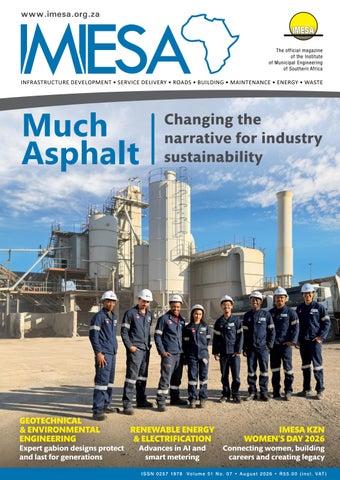
Much Asphalt
GEOTECHNICAL & ENVIRONMENTAL ENGINEERING
Expert gabion designs protect and last for generations
Changing the narrative for industry sustainability
RENEWABLE ENERGY & ELECTRIFICATION Advances in AI and smart metering
IMESA KZN WOMEN’S DAY 2026
Connecting women, building careers and creating legacy
I S S N 0 2 5 7 19 7 8 Vo l u m e 5 0 N o . 0 9 • O c t o b e r 2I0S2S5N• 0R2 5 5 7. 0 19 0 7(8i n cVo l . lVAT u m e) 51 N o . 0 7 • A u g u s t 2 0 2 6 • R 5 5 . 0 0 ( i n c l . VAT )
www.sizabantu.co.za proudly@sizabantu.com
Scan for Sizabantu Website
WHY CHOOSE TOM500 PVC-0? High-pressure performance
Greater hydraulic efficiency
Corrosion resistance
Excellent water hammer resposne
Chemical resistance
INSIDE
VOLUME 51 NO. 07 AUGUST 2026
36 Regulars
www.imesa.org.za www.imesa.org.za
IMESA The official magazine of the Institute of Municipal Engineering of Southern Africa
INFRASTRUCTURE DEVELOPMENT • SERVICE DELIVERY • ROADS • BUILDING • MAINTENANCE • ENERGY • WASTE
Much Asphalt
Changing the narrative for industry sustainability
Editor’s comment President’s comment Index to advertisers
3 4 48
How sustainable is the asphalt industry? It’s all about the people HER Hard Hat Zone 2026. Connecting Women, Building Careers and Creating Legacy
6
10
Expert gabion designs protect and last for generations
Advances in AI and smart metering
IMESA KZN WOMEN’S DAY 2026
Connecting women, building careers and creating legacy
I S S N 0 2 5 7 19 7 8 Vo l u m e 5 0 N o . 0 9 • O c t o b e r 2I0S2S5N• 0R2 5 5 7. 0 19 0 7(8i n cVo l . lVAT u m e) 51 N o . 0 7 • A u g u s t 2 0 2 6 • R 5 5 . 0 0 ( i n c l . VAT )
ON THE COVER Sustainability of the industry in which Much Asphalt operates is critical not only to the company’s future, but also to the country’s future. Much Asphalt is placing significant focus on securing that future in the interests of our economy and our communities, both heavily reliant on our asphalt road networks. P6
Cities stretched beyond their design limits. Why human capacity is now the critical infrastructure
Affordable housing starts with affordable cities Revised strategy needed to deliver Cape housing backlog
14
16 17
35
36
38
Instrumentation
Keeping crushers running. Reliable level measurement for the construction sector Gauteng recycling partnership adds value and extends airspace
18 21
40
41
Pipe Systems
Closing the loop. Responsible plastic pipe recycling in SA
42
Pump Systems
Legal
Bribery: The biggest corruption risk facing SA businesses
22
Expert gabion designs protect and last for generations
23
CEMENT & CONCRETE
Structural waterproofing with ADCOR® 500S Retaining with the Enviro-Wall system New Mapei liquid plant supports regional growth
43 44 45 45
Transportation Engineering 24
Environment
Greener Homes, Resilient Landscapes. Preparing for the ‘looming El Niño’ and Climate Change
Mechanical seals vital for optimum pump performance
Cement & Concrete
Geotechnical & Environmental Engineering
44
34 35
Waste Management
Forensic Countermeasures
WATER & WASTEWATER
32
Vehicles & Equipment
Astec metalworkers redefine who belongs in heavy manufacturing
Renewable Energy & Electrification
The Predictive Utility. How AI maintenance and smart metering can rescue municipal electricity Perovskite photovoltaics. The shift from lab efficiency to mass commercialisation
National Water Action Plan must prioritise technical skills Resilient wastewater plants need asset level intelligence Wastewater is renewable and has value Advanced warning of approaching thunderstorms Pittsburgh’s Commercial Street Bridge replaced in under 24 hours
Spatial Development & Planning
Jurisdiction of an arbitrator. Can an arbitrator declare a state contract invalid?
34
30
Heavy Lifting
Thought Leadership RENEWABLE ENERGY & ELECTRIFICATION
SA’s best engineering projects and professionals celebrated at the CESA Aon Engineering Excellence Awards 2026
Water & Wastewater
Cover Story
IMESA KZN Women’s Day 2026
GEOTECHNICAL & ENVIRONMENTAL ENGINEERING
Consulting Engineers
Greater Protea Glen Transport Masterplan. A path towards a smarter, safer and more connected future
47
Labour Relations 28
Compliance awareness critical as SME contractors expand into civils sector
48
LABOUR RELATIONS
48
HAVE YOU REGISTERED FOR THE 89TH IMESA CONFERENCE YET?
REGISTER TODAY. TAKE ADVANTAGE OF THE STANDARD RATE AND SAVE!
Earn up to 2.5 CPD points by attending
STANDARD REGISTRATION
LAST MINUTE REGISTRATION
• Members: R9 700 • Non-members: R11 900
• Members: R11 450 • Non-members: R13 800
Register and pay AFTER 01 August 2026
Register and pay AFTER 14 October 2026
CONTACT US FOR DETAILS CONFERENCE ENDORSED BY
t: +27 (031)266 3263 e: conference@imesa.org.za marketing@imesa.org.za www.imesa.org.za
IMESA ORGANISER
THE INSTITUTE OF MUNICIPAL ENGINEERING OF SOUTHERN AFRICA (IMESA)
EDITOR’S COMMENT EDITOR Alastair Currie Email: alastair@infraprojects.co.za DESIGNER Beren Bauermeister CONTRIBUTORS Devesh Mothilall, Geoff Tooley, Khanyisa Mabala, Mike Greatwood, Richard Hoal, Roxanne Canny DISTRIBUTION MANAGER Asha Pursotham SUBSCRIPTIONS Email: distribution@infraprojects.co.za ____________________________________________ ADVERTISING SALES KEY ACCOUNT MANAGER Joanne Lawrie Tel: +27 (0)82 346 5338 Email: joanne@infraprojects.co.za ____________________________________________
PUBLISHER IMESA (Pty) Ltd P O Box 2190, Westville, 3630 Tel: +27 (0)31 266 3263 Email: info@infraprojects.co.za
IMESA
ANNUAL SUBSCRIPTION: R805.00 (INCL VAT) ISSN 0257 1978 IMIESA, Inst.MUNIC. ENG. S. AFR. © Copyright 2026. All rights reserved. ____________________________________________ IMESA CONTACTS HEAD OFFICE: Manager: Ingrid Botton P.O. Box 2190, Westville, 3630 Tel: +27 (0)31 266 3263 Email: admin@imesa.org.za Website: www.imesa.org.za BORDER Secretary: Celeste Vosloo Tel: +27 (0)43 705 2433 Email: celestev@buffalocity.gov.za EASTERN CAPE Secretary: Susan Canestra Tel: +27 (0)41 585 4142 ext. 7 Email: imesaec@imesa.org.za KWAZULU-NATAL Secretary: Narisha Sogan Tel: +27 (0)31 266 3263 Email: imesakzn@imesa.org.za NORTHERN PROVINCES Secretary: Lethale Magagane Tel: +27 (0)72 059 7444 Email: np@imesa.org.za SOUTHERN CAPE KAROO Secretary: Henrietta Oliver Tel: +27 (0)79 390 7536 Email: imesasck@imesa.org.za WESTERN CAPE Secretary: Michelle Ackerman Tel: +27 (0)21 444 7112 Email: imesawc@imesa.org.za FREE STATE & NORTHERN CAPE Secretary: Wilma Van Der Walt Tel: +27 (0)83 457 4362 Email: imesafsnc@imesa.org.za All material herein IMIESA is copyright protected and may not be reproduced without the prior written permission of the publisher. The views of the authors do not necessarily reflect those of the Institute of Municipal Engineering of Southern Africa or the publishers.
The ABC logo is a valued stamp of measurement and trust. IMIESA is ABC audited and certified.
Equitable levies that fuel a healthy economy
W
ith no clear end to the Strait of Hormuz conflict in sight, the socio-economic fallout worldwide continues to deepen, placing further financial strain on households, plus private and public sector entities. The major pain point here is obviously the spiralling cost of petrol and diesel, which impacts every sector of the economy. We can’t control global crude oil prices, but perhaps we can review our internal tax structures on imports and fuel sold at the pump to stimulate rather than impede the economy? Recent debates by economists, big business and political parties are placing renewed focus on the best ways to reform the current General Fuel Levy (administered by National Treasury) and the Road Accident Fund (RAF) levy. The objective is to achieve more equitable pricing structures in the medium to longer-term that take the pressure off poorer households and enterprises in general. This takes cognisance of the fact that the General Fuel Levy is a key resource for funding governmental operations. An important point to note is that these levies are not unique to South Africa. A high percentage of developed and developing nations worldwide have a General Fuel Levy tax, plus an RAF-type system in place. The key issue is how well local initiatives are performing. In the case of the RAF, not well. This SOE continues to perform below benchmarked expectations and has received adverse audit findings for the past three financial years. The major red flags are irregular and wasteful expenditure.
Levy allocations for road renewal In turn, our General Fuel Levy generated some R85.8 billion in taxed revenue during the 2024/25 financial year, but expenditure is not audited. However, the upside is that around R16 billion was allocated specifically for metro road and allied projects for the 2024/25 period. The top metro recipients were Johannesburg, eThekwini and the City of Cape Town. For local municipalities, however, their funding routes for road construction and maintenance are not supplemented by the General Fuel Levy. Instead, their sources of funding include the Municipal Infrastructure
Grant (MIG), and to a greater extent, self-funding through services rendered, the key sources being electricity, water, sanitation and waste management. That all hinges on prompt payment for services rendered.
Levies that aid rather than hinder So, both the RAF and General Fuel Levy add value. However, as fuel prices climb through the roof, are these levies helping or hindering socio-economic prosperity? For instance, could they inadvertently be funding a top heavy and inefficient public sector in need of urgent rightsizing and performance management? And why do we struggle so much in terms of service delivery and return on investment (ROI) for taxes paid when South Africa’s general income tax structures are on a par with top tier economies? Shouldn’t this be sufficient? As citizens we want our taxed earnings to matter, whether it’s in terms of efficient transpor tation networks, education, healthcare or public safety. But the pricing must make sense and be spent well in repositioning South Africa for growth.
The runaway cost of electricity In this respect, unsustainable electricity price escalations over the past 10 years are having a far more dire impact on our medium to longer-term growth prospects than short-term fuel spikes. That makes the pros and cons of the General Fuel Levy and RAF taxed revenue streams relatively insignificant in comparison to the implications for industrial downsizing and disinvestment. Aside from structural reforms, the reality is that current electricity prices need to be capped and reduced to far more realistic levels, as does the fuel levy. But that also raises another interesting question about what will replace the General Fuel Levy and RAF levy when electric vehicles predominate. Ultimately, growth and more macroeconomic growth is required. That will make the tax issues far less central within the mix, but not the ROI needed for a prosperous South Africa.
Alastair
To our avid readers, check out what we are talking about on our website, Facebook page or follow us on Twitter and have your say. www.imesa.org.za
IMESA The official magazine of the Institute of Municipal Engineering of Southern Africa
IMESA
imesa_za
imesa
www.imesa.org.za
INFRASTRUCTURE DEVELOPMENT • SERVICE DELIVERY • ROADS • BUILDING • MAINTENANCE • ENERGY • WASTE
Much Asphalt
GEOTECHNICAL & ENVIRONMENTAL ENGINEERING
Expert gabion designs protect and last for generations
Changing the narrative for industry sustainability
RENEWABLE ENERGY & ELECTRIFICATION Advances in AI and smart metering
IMESA KZN WOMEN’S DAY 2026
Cover opportunity In each issue, IMIESA offers advertisers the opportunity to get to the front of the line by placing a company, product or service on the front cover of the journal. Buying this position will afford the advertiser the cover story and maximum exposure. For more information on cover bookings, contact Joanne Lawrie on +27 (0)82 346 5338.
Connecting women, building careers and creating legacy
I S S N 0 2 5 7 19 7 8 Vo l u m e 5 0 N o . 0 9 • O c t o b e r 2I0S2S5N• 0R2 5 5 7. 0 19 0 7(8i n cVo l . lVAT u m e) 51 N o . 0 7 • A u g u s t 2 0 2 6 • R 5 5 . 0 0 ( i n c l . VAT )
IMIESA August 2026
3
IMESA
PRESIDENT’S COMMENT
Connecting the dots The 2026 revision to the original 1998 White Paper on Local Government (WPLG) – an initiative led by the Depar tment of Cooperative Governance and Traditional Affairs (CoGTA) – is now due to be released in September 2026. This follows its formal gazetting for final public comment in May this year, following extensive input by public and private sector stakeholders. That includes IMESA as a key change agent for local government reform.
C
entral to the WPLG 2026 is the need for a complete overhaul of the current system in response to widespread municipal failures. Key among them is financial mismanagement, excessive political interference and a sharp drop in infrastructure deliver y as a result. A core part of the solution is a return to a competency-based system, where qualifications match experience, recruitment is merit-based and professionalisation of the civil service is the norm. That’s not to say this isn’t happening at present, but pockets of excellence alone won’t achieve the universal change we need across the board to ensure that every municipality is a high-performing entity.
Finance and administrative partnership Our municipal engineers – a high percentage of whom are professionally registered with ECSA or working towards registration – continue to deliver against the odds. However, they need competent, professionally registered and committed municipal managers at executive level within administration and finance to connect the dots and bridge the infrastructure gaps. That requires the re-professionalisation of the top municipal leadership structure, where it doesn’t exist at present. Professionalisation also means that misconduct can be addressed by an external body, with potential deregistration. In terms of current National Treasur y requirements, the Municipal Regulations on Minimum Competency Levels (as set out in terms of the Municipal Finance Management Act) does require mandatory training for municipal leaders, on top of minimum qualification levels as a baseline. A key example is the Municipal Finance Management Programme (MFMP) aimed at personnel that include CFOs, senior officials and supply chain specialists.
However, since that is the case, it raises a major red flag concerning past executive appointments that have derailed. This is particularly the case in terms of the exorbitant expenditure on external financial consultants in any given year, despite evidence of internal CFO and allied capacity. For example, in terms of the Auditor-General South Africa’s Consolidated General Report on Local Government Audit Outcomes for 2024–25, this figure stood at around R1,61 billion, but in most cases still didn’t deliver a clean audit.
Infrastructure implementation training for non-engineers WPLG 2026 is part of addressing these and other issues, and in the mix IMESA believes it would be highly beneficial – if not compulsory – for non-engineering executives to participate in high level infrastructure development programmes. That would be especially beneficial for newly appointed officials who have not climbed the ranks within a traditional municipal environment. Within our own IMESA training courses, we’ve already incorporated specific non-engineering awareness programmes for targeted audiences that include municipal officials and councillors. A prime example is the “Design Flood Estimation in Municipal Areas in South Africa” capacity-building workshop, which has been a great success in terms of delegate feedback. Simply put, infrastructure ser vices fund municipal delivery, enable climate resilient towns and cities and promote economic growth. Therefore, it’s essential for municipal administrators and engineering leaders to be aligned on Integrated Development Plan development, plus implementation, as is the norm worldwide.
Civil service selection There’s also a sound argument for introducing a national civil ser vice entrance
Geoff Tooley, Pr Eng Hon FIMESA, IMESA President: 2024-2026
4 IMIESA August 2026
exam, as is the case for a number of leading nations. These include Bangladesh, China, France, India, Italy, Japan, South Korea and Spain, where selection, study and qualification is rigorous, with only the best candidates making the cut. Meanwhile, other countries like the UK and USA apply a series of set competencybased, aptitude and psychometric criteria to achieve a similar outcome specifically for aspiring public sector applicants. Either way, WPLG 2026 provides the opportunity for South Africa to develop its own ideal future standardised recruitment framework based on our unique requirements and priorities. That includes the advancement of women as equal opportunity stakeholders across the professional spectrum. As IMESA we’re proud to state that we are at the forefront as an Institute, with three out of our seven branches headed by women in KwaZulu-Natal, Free State/Northern Cape and the Western Cape, respectively. We also have a growing number of qualifying IMESA bursary applicants that are women, plus our membership application for recent graduates and current women engineering practitioners keeps growing. It’s ver y encouraging, and IMESA continues to promote STEM careers at schools and universities to promote municipal engineering as a sought-after career. That in turn requires an enabling municipal environment which is on a par with the best per forming private sector entities. That’s because in our distinctive developed and developing context, proactive and enabling public-private partnerships are increasingly essential for real-world infrastructure execution, along with allied maintenance. For the former, that could be a wastewater treatment plant development, and for the latter a service level agreement (with training transfer facilitation) on pump station and pipeline networks. However, the proviso here is that overall responsibility within formalised agreements remains with the applicable municipality. Ultimately, accountability for good governance rests with society. That makes the upcoming local government elections in November 2026 a potential watershed moment in effective WPLG 2026 execution.
BUILD IT ONCE. BECAUSE A SMOOTH DRIVE STARTS WITH A STRONG BUILD
1014403
AfriSam Roadstab Cement is a specially engineered, high-quality composite cement for use in road stabilisation. Trusted for over 90 years, this specialist, locally produced cement will smooth out the road ahead. If you want to build it only once, use the A1 Choice. Use AfriSam Roadstab Cement. Ask for AfriSam.
0860 141 141
COVER STORY
Hands-on asphalt workshops focus on the correct use of Much Asphalt’s cold mix products
HOW SUSTAINABLE IS THE ASPHALT INDUSTRY?
It’s all about the people Sustainability of the industry in which Much Asphalt operates is critical not only to the company’s future, but also to the country’s future. Much Asphalt is placing significant focus on securing that future in the interests of our economy and our communities, both heavily reliant on our asphalt road networks.
M
uch Asphalt is 61 years old this year. The company’s executive team brings a combined 282 years of industry experience to the business, an average of almost 18 years of service per member. This, alone, says something about the culture of loyalty and commitment that exists within Much Asphalt.
Managing change Much Asphalt has adapted over its history to suit the needs of its customers. It has diversified with the acquisition of SprayPave, partnered with clients and other industry experts to improve products, expanded its footprint across South Africa, and launched operations in Mozambique and Namibia.
Sustainability requires innovation to deliver products that are purpose-designed for changing conditions and needs such as global warming, higher traffic volumes, different vehicles on the road, and a shortage of non-renewable resources. Much Asphalt is known for its exploration of innovations, alone and in joint ventures with others across the globe, designed to improve Tania Hendricks, HR Executive at Much Asphalt Joanne Muller, Group Technical Manager – Materials at Much Asphalt Eddie Jansen van Vuuren, Marketing and New Business Development Manager at Much Asphalt
6 IMIESA August 2026
COVER STORY
Contractors in Polokwane gain skills on asphalt placement best practice
safety, durability, and lifecycle value across road networks. These include experimenting with large volumes of recycled asphalt, as well as the use of waste glass, plastic and other recyclable materials, to replace virgin aggregates. It also includes studies and trials that seek to reduce the dependence on bitumen from crude oil.
Consistent quality While change is essential, consistency remains equally impor tant to provide sustainable solutions. A major contributor to Much Asphalt’s continuing success is the consistent quality achieved in the manufacture of its multiple products, which number more than 40 standard mixes and several specialty mixes. No matter which plant, quality and delivery to specification have always been non-negotiable. Much Asphalt’s plants meet world class standards in production techniques, balanced by emissions control that significantly outperforms statutory requirements. Every plant has its own quality assurance laboratory, guided by the Cape Town based Central Laboratory that was the first asphalt lab in South Africa to receive SANAS accreditation. Sustained quality leads to long-term customer partnerships and industry leadership. Product sustainability for Much Asphalt extends from the manufacturing plant to the destination of the asphalt mix. It means ensuring quality from production to placement. To this end, Much Asphalt has offered free training for government employees, SMMEs,
and new entrants into the industry on the placement of asphalt by hand for more than 20 years. These individuals seldom have formal training in asphalt placement, resulting in poor workmanship and reputational damage to the industry. Much Asphalt tries to close this gap through the hands-on training, which is accompanied by a step-by-step instruction manual. Sustainability, for Much Asphalt and for the asphalt industry, depends on people.
People Retaining the best staff within a company has a lot to do with a culture of loyalty, commitment, feeling valued, and working side-by-side with like-minded people. It also has to do with personal growth through continued learning and knowledge sharing.
Much Asphalt’s HR Executive, Tania Hendricks, explains that the company values teamwork, accountability, innovation and respect. Employees are encouraged to share ideas, solve problems collaboratively, and continuously improve the way work is done. This creates an environment where people are trusted to contribute and where individual growth is aligned with business success. “The organisation invests in leadership development, technical expertise, and succession planning because its future depends on the capability and commitment of its employees,” she says. “Much Asphalt has earned a reputation for empowering its teams through employee learning programmes, commitment to safety, and long-term career growth.” In 2020, Much Asphalt invested in a dedicated training hub at its Cape Town head office to
Learners in the Go for Gold programme on a Much Asphalt site visit
IMIESA August 2026
7
COVER STORY
Much Asphalt takes asphalt education into schools
working with asphalt. This transfer of knowledge not only accelerates learning but also helps preserve the expertise that has been built within the business over decades.” “The road construction sector relies on specialised skills that cannot simply be replaced overnight,” adds Joanne Muller, Group Technical Manager – Materials at Much Asphalt. “The industry's most experienced professionals have spent years mastering the science of asphalt technology, manufacturing, laboratory testing, logistics and construction. Preserving this expertise requires deliberate investment in developing the next generation.”
Making asphalt interesting focus on internal training programmes that translate into operational excellence. It also serves as a platform to host industry lectures and knowledge sharing sessions for employees and industry partners.
How people succeed Much Asphalt develops people outside and within the company for the future through graduate programmes, apprenticeships, internships, learnerships and structured training to build skills and progress careers.
“We achieve our greatest success when we combine practical, hands-on experience with structured mentorship,” says Hendricks. “The asphalt industry is highly specialised, and while classroom learning provides a strong foundation, it is through real-world exposure that young employees develop the confidence and technical competence to succeed. “One of the company’s biggest strengths is giving young entrants the opportunity to work alongside experienced professionals. They learn directly from people who have spent their lives
Much Asphalt employees Mduduzi Mkalipi, Lilly Mogane, and Oatile Mzuzwana (left to right) engage with learners at a careers fair
8 IMIESA August 2026
Hendricks believes a sense of purpose is a powerful motivator and in the asphalt industry, no matter what your job, you can see the tangible results of your work in the infrastructure you use every day. Giving asphalt the same appeal as other technical callings is not easy. But Much Asphalt has recognised a significant opportunity in engaging with young people who still have big career decisions to make. “Most learners don’t know the industry exists or have misconceptions about it,” says Hendricks. “While road construction and asphalt manufacturing aren’t seen as innovative, technology-driven careers, that’s what they increasingly are.”
COVER STORY
Getting to grips with quality testing in the Benoni Plant’s laboratory
She believes more people can be drawn in by changing the narrative. “Young people want to know why their work matters. We need to tell them not that we manufacture asphalt, but that we build the roads that connect communities, support businesses and keep South Africa moving." Today’s audience is largely online, she adds, and that’s where we have to share authentic content that showcases how modern Students technology is used in the industry. get a view of every This changes the perception from aspect of the “manual labour” to “modern asphalt plant’s infrastructure”, she says. activities By building relationships with schools, universities and colleges, Much Asphalt has established a direct line to learners, students, and graduates. Students are far more likely to pursue careers Much Asphalt is also supporting the future they’ve experienced firsthand, and by offering capability of the infrastructure sector that South plant visits, vacation work, job shadowing, Africa depends on. scholarships and bursaries, Much Asphalt not New technologies, evolving environmental only draws them into its facilities but plants the standards, digitalisation and changing customer seeds that might keep them in the industry. expectations require fresh ideas alongside proven “Young people relate to peers more than experience. Young professionals bring new corporate messaging, so we ask our graduates perspectives, technological skills and innovative to attend the career fairs and expos to share thinking that complement the knowledge of experienced teams. their own experiences.” People entering their careers also want to “Much Asphalt’s comprehensive youth know that their employers are making good development initiatives reflect a simple environmental choices. Saving the planet is philosophy,” says Hendricks. “The roads we becoming an increasingly urgent narrative, build today support tomorrow’s communities with good reason. “We have plenty to show and the people we develop today will build the in terms of asphalt recycling, lower-carbon roads and the businesses of tomorrow. By technologies, energy efficiency, responsible investing in young talent now, Much Asphalt is manufacturing, and sustainable infrastructure,” safeguarding its heritage and its future leadership Hendricks points out. in the asphalt industry.” Ultimately, she says, the greatest success lies not simply in how many young people Women in asphalt enter the programmes that Much Asphalt There are encouraging signs of greater female offers, but how many build rewarding, long- participation across both student programmes term careers at Much Asphalt. “We recruit on and the wider business. “More women are average 30 students every year through our entering our graduate, internship and development programmes and we are seeing increasing learning programmes.” representation across functions such as Supporting our future engineering, laboratories, SHEQ, operations, Roads connect people, enable economic logistics and leadership. growth and improve access to education and “A diverse workforce brings dif ferent employment. By investing in young people, perspectives, stronger collaboration and better
decision-making. Representation matters because it helps break down outdated perceptions about who belongs in the infrastructure sector,” Hendricks points out.
Industry initiatives Last year Much Asphalt partnered with Go for Gold, an education-toemployment initiative founded in 1999 to address the shortage of technical skills in the construction and manufacturing industries. It supports talented youth from disadvantaged communities, bridging the gap from school to tertiary education and into permanent careers through mentoring and work experience. Much Asphalt suppor ts the programme by providing educational assistance to learners from Grades 10 to 12, offering workplace learning internships, and assisting with bursaries for further learning and graduate placements. Much Asphalt also supports Masakh'iSizwe, a bursary programme started by the Western Cape Government in 2006 to bolster the numbers of trained professionals available in engineering and allied built environment fields. The programme awards external bursaries to disadvantaged learners for appropriate studies at higher education institutions in the Western Cape. As a partner to the programme, Much Asphalt offers placement to the students to obtain industry experience. “Our involvement in initiatives like these is essential to facilitate access to the road construction industry by all who use our roads,” says Eddie Jansen van Vuuren, Marketing and New Business Development Manager at Much Asphalt. “We hope to provide opportunities that will bring more passionate youngsters into the sector and spread the word across communities about the role of asphalt in keeping us connected.”
www.muchasphalt.com
IMIESA August 2026
9
IMESA KZN WOMEN’S DAY 2026
HER HARD HAT ZONE 2026
CONNECTING WOMEN, BUILDING CAREERS AND CREATING LEGACY IMESA KZN’s 2026 Women’s Day event, HER Hard Hat Zone, was designed around a simple idea: bring women together, create meaningful connections and give them the oppor tunity to learn from women who are doing great things in the engineering and built environment sectors. By Roxanne Canny Pr Eng
H
eld at Barker Manor in Kloof on 14th August, the event brought together women from across engineering, construction, water, infrastructure and related fields for a day that combined professional development, networking, mentorship and a little bit of fun. At the heart of HER Hard Hat Zone were four pillars: OWN. LEAD. INNOVATE. INSPIRE. These pillars shaped both the programme and the delegate experience, encouraging women to take ownership of their careers, lead with purpose, embrace innovation and use their experience to inspire and create opportunities for others.
The HER Hard Hat Zone Passport Each delegate received a HER Hard Hat Zone Delegate Journal and Passport, sponsored by PPS. The passpor t was designed to encourage delegates to get involved in the
10 IMIESA August 2026
1
IMESA KZN WOMEN’S DAY 2026
But one of the most important parts of the passport had nothing to do with collecting stamps, namely meeting someone new; leaving something behind. Every delegate was assigned another woman to meet. The idea was to encourage women to step outside their usual circles and have a genuine conversation with someone they may not otherwise have approached. It was a small intervention, but it created a very different kind of networking experience. Once they had made that connection, delegates were asked to write a Legacy Card for the woman they had met. These cards were then added to the HER Legacy Wall, sponsored by Icon Construction. The wall became a collection of messages between women – words of encouragement, recognition and suppor t. It captured an important part of what HER Hard Hat Zone different elements of the event rather than simply attend the programme. The concept was simple: Visit. Connect. Collect. Qualify. Delegates were encouraged to visit the sponsor exhibitions, meet the teams behind the organisations, find out more about their work and collect their unique sponsor stamps. This created a much more interactive exhibition experience and gave delegates a reason to have conversations with people they may not normally meet at an industry event. Our Anchor Sponsor, Paradigm Projects, together with Gold Sponsor LVSA Valves, Silver Sponsor HDPE & Geotex, and Journal Sponsor PPS, played an important role in creating these opportunities for engagement. Paradigm Projects’ involvement extended beyond sponsorship. The company also sponsored and arranged the attendance of high school students, giving young people an opportunity to experience the engineering environment, meet women working in the profession and gain exposure to possible career paths in engineering and the built environment. The passport also included other experiences around the venue, including the Bloom Bar sponsored by HDPE & Geotex.
was about: we don't build our careers in isolation, and creating oppor tunities for other women is part of the legacy we leave behind.
Stories that stayed with us The speaker programme brought the four pillars to life through very different personal and professional stories. OWN was reflected strongly in the message from Xoliswa Hlongwane, Founder of RESILIENT and former CFO, who spoke on “Lead Yourself First: The Power of Resilience in Challenging Times”. Her session encouraged women to understand themselves, their experiences and their own stories, and to recognise how these shape the way they lead and respond to challenges. Delegates reflected on themes of resilience, self-awareness and knowing yourself.
2
3
1 IMESA KZN Women’s Day Organising Committee 2 Anchor Sponsor: Paradigm Projects 3 Gold Sponsor: LVSA Valves
Anchor Sponsor: Paradigm Projects
Gold Sponsor: LVSA Valves IMIESA August 2026
11
IMESA KZN WOMEN’S DAY 2026
4 Silver Sponsor: HDPE & Geotex 5 Delegate Journal Sponsor: PPS section of the HER Legacy Wall, 6 A sponsored by Icon Construction
4 LEAD came through strongly in Sekadi Phayane-Shakhane’s session, “Breaking Ground, Not Glass”. As CEO of the South African Institution of Civil Engineering (SAICE), Sekadi spoke about leadership, accountability and the importance of women creating opportunities for other women. Her message encouraged delegates to take responsibility for their own careers while recognising the role they can play in opening doors for others. INNOVATE was brought to life by Dr Manjusha Sunil, Programme Manager at the Water Research Commission, through her session “Engineering the Future”. Her work through the Young Engineers Capacity Programme (YECP) provides a strong connection to the future of our profession.
12 IMIESA August 2026
YECP focuses on capacitating young engineers within the municipal environment, helping to strengthen the technical skills and experience of the next generation of municipal professionals. Her session reinforced the importance of innovation, knowledge-sharing and developing the young engineers who will ultimately be responsible for tackling the infrastructure and service delivery challenges ahead. INSPIRE was particularly evident in the story shared by Malani Padayachee-Saman, CEO of MPAMOT, through “The courage to change the things you CAN”. Malani shared her experience of taking on a new venture while expecting twins – a story that brought the realities of balancing ambition, change and personal circumstances into the room.
What made Malani’s message particularly powerful was that her leadership extends beyond her own career. She dedicates time to mentoring female-owned companies and helping other women grow. Her story was therefore not only about having the courage to take a new opportunity, but also about using your experience to create opportunities for others. Together, the speakers brought very different stories to the room, but there were common threads throughout: know yourself, take accountability, be resilient, set goals, have the courage to change what you can, embrace innovation, and don't forget to bring other women with you.
More than a day out The reflections written by delegates in their journals showed that these messages landed. There were reflections about accountability and authenticity, knowing yourself, resilience, goal setting and innovation. There were also reminders about exposing yourself to new experiences and, importantly, creating opportunities for others. That was really the purpose of HER Hard Hat Zone. Yes, it was a Women's Day event, but it was also so much more; it was also about
IMESA KZN WOMEN’S DAY 2026
5 professional development, building networks and creating space for conversations that can continue long after the event is over. The Student Table, sponsored by Afrostructures, further extended this focus to students and emerging professionals, creating opportunities for interaction between those entering the profession and women already established in their careers.
Acknowledgements The event was supported by a strong group of industry partners. Alongside our Anchor Sponsor, Paradigm Projects; Gold Sponsor, LVSA Valves;
6
Silver Sponsor, HDPE & Geotex; and Delegate Journal Sponsor, PPS; we thank Stefanutti Stocks Coastal for registration sponsorship; Prudentis Blue Star – Sanlam for capturing the day through photography; Pink Africa Consulting Engineers for speaker gifting; Icon Construction for the HER Legacy Wall; Denso for the photobooth; Afrostructures for the Student Table; Drone Labs for the welcome drinks; and DEVMCO Group for the lucky draws. A special thank you also goes to the IMESA KZN Women’s Day Organising Committee for the time, energy and commitment that went into bringing HER Hard Hat Zone to life. The event was the
result of many hours of planning, coordination and teamwork behind the scenes. And that perhaps sums up HER Hard Hat Zone best. It was about where we are, where we are going, and who we take with us. The passport may have been filled with stamps, but the real outcome was the conversations behind them – a new connection, a shared experience, a mentor, a potential collaboration or simply a woman who left the event knowing that someone else believes in her. That is the kind of legacy worth building. OWN your journey. LEAD with purpose. INNOVATE for the future. INSPIRE the women who follow.
Thank You to our Sponsors ANCHOR SPONSOR
GOLD SPONSOR
DELEGATE JOURNALS
PHOTOGRAPHER
WELCOME DRINKS
SPEAKER GIFTING
STUDENT TABLE
SILVER SPONSOR
HER LEGACY WALL
PHOTOBOOTH
LUCKY DRAWS
BRONZE SPONSOR
DELEGATE PENS
FLOWER BAR
NOTEBOOKS
IMIESA August 2026
13
THOUGHT LEADERSHIP
CITIES STRETCHED BEYOND THEIR DESIGN LIMITS WHY HUMAN CAPACITY IS NOW THE CRITICAL INFRASTRUCTURE An aerial perspective of the City of eThekwini. Upgrading existing infrastructure within metros is central to supporting neighbouring developments in underserved communities
South Africa’s municipal infrastructure is not failing quietly; it is failing loudly, visibly, and in ways ever y engineer recognises instantly. Burst frequencies are rising, stormwater systems are choking, wastewater plants are slipping out of compliance, and water networks are entering the wear out phase of their lifecycle. By Mike Greatwood
T
hese are not isolated faults or unlucky failures. They are engineering signals of a deeper institutional collapse: a system that has been stretched far beyond its design limits, staffed by exhausted teams, and held together by people who no longer have the tools, authority or support they need to keep it running. The apartheid municipal system was exclusionary and unjust, but it was technically coherent.
Engineering departments had stable leadership, protected technical posts, strong apprenticeship pipelines and predictable accountability. After 1994, municipalities were required to extend services to millions who had been excluded, but institutional capacity did not expand at the same pace. Infrastructure designed for one population suddenly had to serve another four times larger, without the engineers, operators, technicians or budgets needed to support that expansion.
Pietermaritzburg illustrates this clearly. Following the incorporation of Greater Edendale and Vulindlela, the city’s jurisdiction expanded nearly fourfold. However, the water and sanitation infrastructure – including reservoirs, trunk sewers, pump stations and wastewater works – had been designed for a much smaller population. Urbanisation accelerated, informal settlements grew on unsuitable land, and illegal water connections proliferated. In rural Vulindlela alone, roughly 20 000 formal water connections are matched by an estimated 20 000 illegal ones. Reservoirs designed for low-density rural households now serve dense, unregulated settlements with unpredictable demand patterns and high peak flows.
Structural contradictions National grant rules still prevent investment in “previously advantaged” areas, even though those areas contained the core infrastructure needed to support the newly incorporated communities. Municipalities were required to extend services outward while being prevented from strengthening the systems on which those extensions depended. From an engineering perspective, this created a structural contradiction: the weakest parts of the system were the most heavily relied upon. This pattern is repeated across the country. In the Eastern Cape, Free State, North West, Limpopo, Mpumalanga and the Northern Cape, municipalities face rapid urbanisation, substandard
ABOUT THE AUTHOR Mike Greatwood PrEng FIMESA has served in municipal engineering for close to four decades, focusing on water and wastewater systems in Msunduzi. His work spans technical operations, mentoring, institutional reform and long-term capability building. He is a Fellow of IMESA and remains actively involved in strengthening municipal engineering practice in South Africa.
14 IMIESA August 2026
THOUGHT LEADERSHIP
construction, procurement failures, and institutional instability. The decline is not local; it is national and systemic. The consequences of this institutional overload in engineering are now unavoidable. Many municipal water networks have aged, with pipes ranging from 40 to 60 years old. Failure rates are increasing, and maintenance remains mostly reactive. Nonrevenue water (NRW) surpasses sustainable levels due to leaks, bursts, illegal connections, meter under-registration and pressure fluctuations. Wastewater systems face ageing mechanical and electrical parts, undersized rising mains, and pump stations that struggle to handle duty and standby cycles. Stormwater systems are often blocked, undersized or lack proper outfalls. These engineering failures are inseparable from the human environment in which they occur. Municipal technical staff work with unreliable vehicles, broken tools, delayed procurement, inconsistent supervision, and political interference. Apprenticeships have collapsed, mentoring pipelines have weakened, and institutional memory has eroded. Work culture did not decline because people changed; it declined because the system became unmanageable. Political-administrative dynamics accelerated this decline. The democratic state underestimated the scale of their task. Municipalities were expected to unify fragmented administrations, extend services to millions, transform the civil service, and maintain existing infrastructure simultaneously. Political alignment in senior appointments, while intended to support transformation, often outpaced the development of stable administrative systems. Merit based recruitment weakened, technical autonomy narrowed, and leadership instability increased. Procurement systems became vulnerable to patronage networks, inexperienced contractors delivered substandard infrastructure, and oversight weakened.
Climate shocks The engineering consequences of these institutional weaknesses are now amplified by climate shocks. Floods overwhelm stormwater systems that have not been maintained. Droughts expose water networks already weakened by leaks, illegal connections and unstable pressure zones. Wastewater systems fail when pump stations and treatment works lack the resources to maintain mechanical and electrical reliability. Climate resilience is fundamentally an engineering and institutional capacity issue. A municipality that cannot maintain its basic infrastructure cannot withstand extreme weather.
Professional pride and purpose Rebuilding municipal capability, therefore, requires a human-centred and engineeringcentred approach. Technical authority must be restored so that engineers and operators can make evidence-based decisions rather than political ones. Training and mentoring pipelines must be rebuilt to restore institutional memory. Leadership must be stabilised so technical teams can plan beyond annual cycles. Accountability must be fair and depoliticised. Staff must have the tools, vehicles and procurement support needed to do their work. Professional pride and purpose must be restored so that technical staff feel valued and protected. After nearly forty years in the Water and Sanitation Unit of Msunduzi, I have seen how capability is built and how it is lost. When I began my career, engineering departments were structured around strong technical teams with clear authority and a culture of mentorship. Apprenticeships were routine. Institutional memory lived in the people who had maintained the same reservoirs, pump stations and sewer networks for decades. Decisions were grounded in technical reasoning and supported by stable leadership.
After 1994, the city expanded almost overnight. The moral imperative to extend services was undeniable, but the institutional capacity to absorb this expansion did not keep pace. The same number of engineers and operational staff suddenly had responsibility for a city four times larger. Over time, vehicles became unreliable, tools scarce, budgets unpredictable, senior management turnover frequent, and political pressures increased. The space for technical judgement narrowed. Many of the most experienced staff retired or left, and the apprenticeship pipeline that should have replaced them never fully recovered. None of this happened suddenly. It was a gradual erosion of the institutional fabric that holds a municipality together, and it was not caused by a lack of staff commitment. I have worked with people who cared deeply about their work, who improvised solutions when resources were scarce, and who kept systems running long after they should have failed. But even the most dedicated teams cannot succeed when the environment around them becomes unmanageable.
Institutions fail first, and infrastructure follows South Africa’s engineers know better than anyone that infrastructure does not fail on its own. Institutions fail first, and infrastructure follows. If we want municipalities that can withstand climate shocks, manage rapid urbanisation, reduce NRW, and keep wastewater out of our rivers, we must rebuild the human systems that enable technical systems to function. That means restoring technical authority, rebuilding mentoring pipelines, stabilising leadership, and equipping engineers, operators and technicians with the tools and protection they need to do their jobs. Municipal capability is not an abstract concept; it is built every day by people who care about their work. If we rebuild the environment around them, they will rebuild the infrastructure beneath us.
After South Africa’s post 1994 democratic transition, municipalities were required to extend services to millions who had been excluded, but institutional capacity did not expand at the same pace
IMIESA August 2026
15
SPATIAL DEVELOPMENT & PLANNING
AFFORDABLE HOUSING STARTS WITH AFFORDABLE CITIES South Africa’s affordable housing challenge is too often framed as a numbers game: how many houses can be built, how quickly and at what cost? While increasing housing delivery remains a national priority, this perspective overlooks a more fundamental question, namely what actually makes housing affordable over the long term? By Khanyisa Mabala
T
he answer extends far beyond the purchase price of a home or the monthly rental. True affordability is determined by the total cost of living. It encompasses transpor t costs, access to employment, healthcare, education, utilities, security, maintenance and the quality of infrastructure that supports everyday life. A development may appear affordable on paper because the units are inexpensive to build yet prove financially unsustainable for residents if it is poorly connected to economic opportunities and essential services. If South Africa is serious about addressing its housing backlog, the conversation must evolve from delivering affordable housing units to creating affordable cities. One of the biggest misconceptions is that affordability can be achieved simply by reducing construction costs. While the capital cost of a housing unit remains an important consideration, it represents only one component of what households ultimately pay to participate in urban life. A family may move into a lower-cost apartment; yet spend a significant portion of its monthly income commuting long distances to work, accessing healthcare, travelling to schools or simply reaching essential services. The financial savings achieved through lower housing costs are quickly eroded by transport expenses, lost productivity and the daily pressures associated with lengthy commutes. Equally, specifying lower-cost building materials may reduce upfront expenditure, but often results in higher maintenance costs, shorter replacement cycles and increased operational expenses over the life of the building. Housing should therefore be affordable to build, affordable to operate and affordable to live in.
the urban periphery may reduce land acquisition costs, but they frequently impose significant longterm financial burdens on households that spend hours each day travelling between home and work. This is where the principles underpinning the “15-minute city” become particularly relevant. While South Africa cannot simply replicate European planning models, given its unique mobility patterns and transport systems, the underlying objective remains highly applicable: reducing unnecessary travel by bringing people closer to opportunity. Mixed-use precincts provide an increasingly ef fective model by integrating residential accommodation with employment opportunities, schools, healthcare facilities, retail, recreational spaces and reliable public transport. Barlow Park in Sandton illustrates this shift in thinking. By combining affordable residential units with education, medical facilities, retail space, offices and lifestyle amenities within one precinct, the development demonstrates how affordability can be strengthened through proximity rather than price alone. Residents spend less time travelling, reduce transport costs and enjoy improved access to economic opportunities and essential services. Ultimately, location should be viewed as infrastructure. Where services cannot be provided within a development itself, they must at least be readily accessible through efficient transport networks. Other wise, housing may remain affordable only on a balance sheet while becoming increasingly expensive in everyday life.
Affordable housing begins with location Location remains one of the most power ful determinants of long-term affordability. It influences whether residents can easily reach employment opportunities, schools, healthcare facilities, retail centres, places of worship, public transport and community amenities. Developments situated on
16 IMIESA August 2026
Khanyisa Mabala, Technical Director, MEPF Lead, Cost Management, EC, South Africa at AECOM
Infrastructure is the invisible foundation of affordability The buildings themselves are often the most visible part of a housing development, yet it is the infrastructure beneath and around them that ultimately determines long-term affordability. Bulk infrastructure, including water supply, sewer capacity, electricity networks, stormwater systems and road infrastructure, can fundamentally influence whether projects remain financially viable. A site may appear attractive during the early feasibility stages, but inadequate municipal services or ageing infrastructure can quickly alter development costs and undermine affordability. Today’s operating environment has made resilience an equally important consideration. Ongoing electricity disruptions have encouraged developers to invest in solar photovoltaic systems, backup power solutions and smarter energy management technologies, while increasing water supply challenges are driving the adoption of storage systems, pressure boosting and alternative water strategies. These investments inevitably increase upfront capital expenditure, yet they often reduce operating costs and improve long-term resilience for residents. The challenge is therefore not simply to minimise construction costs, but to balance immediate affordability with future operational savings. From a cost management perspective, this reinforces the importance of lifecycle thinking. The lowest construction cost rarely represents the lowest lifetime cost. Decisions made during design around drainage, ventilation, water systems, energy infrastructure, maintenance access and building services determine how efficiently a development performs over decades. Removing essential systems through aggressive value engineering may create short-term savings but often results in significantly higher maintenance costs and reduced building performance over time. Affordable housing should therefore be judged not only by the cost of construction, but by whether it continues to provide affordable, reliable and resilient living environments throughout its operational life.
SPATIAL DEVELOPMENT & PLANNING
Breaking down silos to build better cities South Africa already possesses a strong policy framework to support integrated spatial development. The Spatial Planning and Land Use Management Act (SPLUMA) provides a clear vision for inclusive, equitable and sustainable planning. However, implementation remains fragmented. Housing, transport, education, healthcare and municipal infrastructure are frequently planned and delivered independently, creating disconnected developments that struggle to meet the broader needs of the communities they are intended to serve. Affordable housing cannot remain solely the responsibility of housing departments. Municipalities need integrated planning pipelines that align housing delivery with transport infrastructure, bulk services, schools, clinics and community facilities from the earliest planning stages. The buildings that eventually emerge are simply the visible outcome of planning decisions made years earlier. If those decisions occur in isolation, the resulting urban environment will inevitably reflect that fragmentation. The same principle applies to collaboration across the built environment. Government, municipalities, developers, investors, consultants, contractors and communities each understand different aspects of the housing challenge. When these stakeholders engage only after projects are already underway, avoidable risks emerge around land availability, planning approvals, infrastructure capacity, construction programmes and long-term operational costs. By working together from the outset, these risks can be identified earlier, responsibilities allocated more effectively and projects designed to remain both financially viable and socially sustainable. Public-private partnerships have an important role to play in accelerating this process, provided that risk is allocated appropriately. Government is best placed to manage land release, policy certainty, planning approvals and infrastructure coordination, while the private sector can contribute design innovation, procurement expertise, construction capability and operational excellence. South Africa has already demonstrated through major infrastructure programmes such as Gautrain that longterm partnerships can successfully deliver complex projects when responsibilities are clearly defined and accountability is shared. Affordable housing developments require the same integrated approach.
Building affordable cities, not simply affordable homes If South Africa is to make meaningful progress over the next decade, implementation must become the priority. The country does not lack progressive policy, planning legislation or technical expertise. What it needs is greater coordination, faster approvals, improved land release and infrastructure investment that is aligned with long-term housing pipelines rather than responding only after developments have been approved. Practical incentives that encourage inclusionary housing, together with more efficient municipal approval processes and strategic investment in bulk infrastructure, would significantly improve both delivery and affordability. Equally important is recognising that affordable housing is not merely a human settlements issue. It is simultaneously an infrastructure issue, a transport issue, a planning issue, an investment issue and, ultimately, a dignity issue. South Africa should therefore stop asking only how to build cheaper homes and instead ask how to build more affordable cities. Housing may be the visible product of development, but infrastructure is what makes it work. Only by integrating planning, transport, resilient infrastructure, sound cost management and effective collaboration can affordable housing become genuinely affordable for the people who need it most.
REVISED STRATEGY NEEDED TO DELIVER CAPE HOUSING BACKLOG
T
he Western Cape Property Development Forum (WCPDF) says the Constitutional Court’s recent judgement against the Western Cape Government and City of Cape Town on affordable housing presents an important opportunity for government, the private sector and civil society to work together on practical, long-term solutions to one of the province’s most significant socio-economic challenges. The Western Cape – and Cape Town in particular – continues to experience strong population growth and sustained demand for housing, while the supply of well-located, developable land remains constrained. Environmental considerations along with the province’s geography and limited availability of suitable land all contribute to higher land values. At the same time, lengthy planning and approval processes, increasing construction costs, infrastructure constraints and higher transport costs continue to drive up the cost of development. Together, these factors create significant barriers to delivering housing at prices that remain affordable for ordinary South Africans. Says WCPDF Chairperson, Deon van Zyl: “The WCPDF believes that the redevelopment of underutilised public land, particularly brownfield sites within existing urban areas, presents one of the greatest opportunities to expand affordable housing close to employment opportunities and public transport. However, unlocking these opportunities will require coordinated planning, streamlined regulatory processes and investment in supporting infrastructure.” Van Zyl also notes that national housing subsidy frameworks should take greater account of the substantially higher cost of delivering housing in the Western Cape: “A funding model that does not adequately reflect regional cost differences risks limiting the delivery of affordable housing in high-demand areas.” “Ultimately, there is no single intervention that will solve the affordability challenge. We need a coordinated response that unlocks more well-located land, reduces unnecessary regulatory delays, improves access to development finance and creates an environment where government and the private sector can work together to deliver housing at scale. We believe this judgment provides an important opportunity to develop those solutions,” Van Zyl concludes.
IMIESA August 2026
17
RENEWABLE ENERGY & ELECTRIFICATION
THE PREDICTIVE UTILITY
HOW AI MAINTENANCE AND SMART METERING CAN RESCUE MUNICIPAL ELECTRICITY The way South African municipalities maintain transformers and measure consumption are changing faster than most bylaws, budgets and business processes can keep up. Artificial intelligence (AI) and smart metering are no longer abstract 4IR buzzwords; they are already reshaping how utilities prevent failures, collect revenue and engage with customers. The question is whether local distributors will harness these tools deliberately or be dragged along by vendors, crises and court cases. By Devesh Mothilall
F
or decades, transformer maintenance in most utilities has followed a familiar pattern: fixed-interval inspections; oil sampling when budgets allow; and emergency repairs when something fails (often at night, in the rain, under intense political pressure). Globally, utilities that have adopted AI-driven predictive maintenance show that this pattern can be broken. By combining online sensors (temperature, load, dissolved gas analysis, partial discharge) with historical fault data, machine learning models can flag transformers that are trending towards failure weeks before anything trips or explodes. In documented international projects, AI-based transformer health monitoring has reduced unplanned failures by around 40–50%, cut maintenance spend by roughly a third, and extended asset life by several years. The principle is simple: instead of managing by calendar, utilities manage by condition and risk. For South African municipalities whose balance sheets cannot absorb major transformer replacements or long outages, this is not a luxury; it is a survival strategy.
18 IMIESA August 2026
What AI sees that humans miss Human experts are still central, but AI changes what they can see and when they see it by adopting the following techniques: • Pattern detection at scale: AI models can continuously analyse thousands of data points across hundreds of transformers 24/7, spotting subtle combinations of temperature spikes, load profiles and gas levels that historically precede failure. • Risk-based prioritisation: Instead of treating 300 transformers as equally urgent, asset managers can focus limited maintenance budgets on the 20 highest-risk units flagged by AI risk scores. • Operational integration: When integrated into existing SCADA and asset management systems, AI alerts can trigger work orders, schedule outages and align with spares logistics, turning insight into action rather than dashboards. International experience is clear on one point: data quality matters. Utilities that invested in better online sensors and disciplined data capture saw far higher prediction accuracy and better
returns than those trying to “do AI” on poor-quality data. For South African distributors, that argues for pairing AI projects with targeted investment in monitoring, not just software licences.
Smart meters: more than fancy prepaid While transformers keep the grid standing, meters are where citizens and municipalities meet. South Africa is now entering a new phase of smart metering at scale. National Treasury’s national smart meter programme – running through an indirect grant and central tender – has begun rolling out advanced meters in dozens of municipalities, backed by a central data platform designed to improve billing accuracy, revenue collection and decision-making. Vendors such as Conlog, under the RT29-2024 national contract, report thousands of smart meters already installed in municipalities like Dihlabeng and Emalahleni, with measurable monthly revenue uplift as accurate metering replaces estimates, bypasses and unbilled consumption. At the same time, specialist firms such as ACTOM Smart Technologies have delivered large prepayment and smart metering deployments across Southern Africa, including one of the first large-scale AMI prepayment projects on the continent, and over 380 000 prepayment meters in various contracts. Done well, smart meters change three things at once: • For consumers: Near real-time visibility of usage, clearer bills, and more control over when and how they use electricity. • For municipalities: Precise measurement, remote connect/disconnect, tamper and loss detection, and load profiling to support planning and demand management.
RENEWABLE ENERGY & ELECTRIFICATION
ABOUT THE AUTHOR Devesh attended the University of Cape Town for an Honours Degree in Electrical Engineering, the University of Pretoria for a Master’s Degree in Technology Management, and the University of Stellenbosch for a Master’s Degree in Renewable and Sustainable Energy. He also obtained a Master’s in Artificial Intelligence from the University of Johannesburg and is currently completing a PhD in Engineering Management.
• For the grid itself: Millions of edge devices that can, in time, support demand response, dynamic tariffs and integration of rooftop solar and batteries. The risk is that municipalities implement smart meters purely as a revenue enforcement tool, rather than as a platform for broader service and grid transformation.
South Africa’s smart metering moment The timing of this technological shift is not accidental. Municipal debt to Eskom has surged into tens of billions of rand, and over 160 municipalities are classified as financially distressed, with many operating on unfunded budgets. Underbilling, non-payment and technical losses all contribute to a vicious cycle of deteriorating infrastructure and service. Smart meters, deployed thoughtfully, are one of the few levers that can improve this picture simultaneously on the technical and
financial fronts. Early results from the national rollout show increased billed consumption and higher revenue collection in pilot municipalities, alongside reduced billing disputes and more transparent consumption data. At the same time, leading municipalities such as Sol Plaatje have adopted formal smart metering policies that emphasise phased rollout, starting in dense, high-impact areas and expanding to residential, industrial and eventually remote communities. These policies highlight not just revenue, but also remote monitoring, faster fault response and consumer engagement as strategic goals.
AI and smart meters: a powerful combination The real transformation comes when AI-driven analytics and smart metering are treated as parts of the same system, not as separate projects. On the network side, smar t meters and substation meters provide granular voltage,
current and event data across the low-voltage network. When fed into AI models, this data can help: • Identify overloaded transformers or feeders before failure. • Pinpoint areas with chronic low-voltage or power quality issues. • D etect non-technical losses through anomalous consumption patterns and tamper events. On the customer side, smart meters combined with usage analytics can: • Offer tailored advice to households and businesses on reducing bills and shifting usage away from peak periods. • Underpin time-of-use tariffs that reward flexible consumption – critical in a loadshedding-prone system.
A cross-sectional infographic of an outdoor smart municipal substation transformer
IMIESA August 2026
19
RENEWABLE ENERGY & ELECTRIFICATION
• Support innovative products like community energy credits or “lifeline plus” tariffs that balance equity with financial sustainability. International grid-intelligence projects already illustrate part of this vision. Eskom’s National Power Grid Intelligence tender, awarded to ACTOM Smar t Technology using CT LAB’s VECTO edge-computing devices, is deploying over 1 300 advanced power-quality and monitoring devices across several provinces to improve visibility at the network edge. While not a consumer smart meter rollout, it shows how local companies are combining advanced hardware, analytics and communications to build a more observable, manageable grid.
Global lessons for local practice Utilities in Europe, North America and Asia that have deployed AI-driven grid analytics and smart metering at scale point to several consistent lessons: • Start with clear business cases: Successful projects tie AI and smart metering to specific outcomes – such as reducing transformer failures by a set percentage, cutting maintenance costs, or improving collection efficiency, rather than “innovation for its own sake”. • Invest in data foundations: Clean, welllabelled historical maintenance records, accurate asset registers and reliable sensor data are more important than exotic models. • Keep humans in the loop: Utilities that retained final decision-making with experienced engineers, using AI as decision support
20 IMIESA August 2026
rather than an oracle, built trust faster and achieved better outcomes. • Phase rollouts and learn: Pilots in a subset of feeders, suburbs or customer segments allow utilities to refine processes and technology before scaling. These are all highly relevant to South African municipalities, many of which are starting from a base of fragmented data, ageing assets and stretched human capacity.
Making it work for municipalities For municipal managers, engineers and councillors, the question is not whether AI and smart metering are coming – they are already here. The question is how to adopt them in a way that strengthens, rather than destabilises, already fragile institutions. A practical pathway could include: • Phase 1 – See the grid: Begin with a focused transformer and feeder health pilot that combines online sensors, existing SCADA data and AI analytics on a defined set of high-risk assets. In parallel, start smart meter pilots in revenue-sensitive areas with high losses and frequent billing disputes. • Phase 2 – Connect the dots: Integrate insights from transformer health analytics and smar t meter data into a single asset and revenue risk view. Use this to prioritise maintenance, network upgrades and enforcement where they will have the greatest technical and financial impact. •P hase 3 – Empower consumers: Move beyond “remote disconnection” as the
A clean, architectural flow diagram illustrating a modern South African municipal smart grid ecosystem
headline feature. Use smart meter data to provide customers with clear, accessible consumption feedback via apps, portals or printed statements, and pilot basic demand-response or time-of-use offerings. •P hase 4 – Institutionalise and scale: Embed AI analytics and smart metering into standard operating procedures, budget cycles and performance indicators, rather than running them as standalone “projects”. Build partnerships with firms like ACTOM Smart Technologies and others that can provide hosted platforms and training where internal capacity is limited. If implemented with this kind of intent, AI-driven transformer maintenance and smart metering can support three outcomes at once: a more resilient network; more predictable municipal revenue; and a more empowered, better-served citizen. South Africa’s grid of the future will not just be greener; it will be more digital, more obser vable and, if utilities choose to use these tools wisely, far more predictable than the system inherited from the last century. The oppor tunity now is to ensure that AI and smar t meters are not just deployed as gadgets but are woven into a deliberate strategy to power tomorrow’s cities more fairly, efficiently and reliably.
RENEWABLE ENERGY & ELECTRIFICATION
PEROVSKITE PHOTOVOLTAICS
I
THE SHIFT FROM LAB EFFICIENCY TO MASS COMMERCIALISATION
nitially, perovskite solar cells captured the world’s attention for three distinct reasons, namely their unprecedented, rapid increases in energy conversion efficiency; their ability to be seamlessly combined with traditional silicon in perovskitesilicon tandem architectures; and their relatively easy, low-temperature manufacturing process. However, as the industr y matures, the narrative surrounding this breakthrough technology has fundamentally shifted in the quest to bridge the gap from “lab to fab”. At present, the downside is that perovskite photovoltaic (PV) systems remain highly sensitive to moisture, oxygen, heat, and UV light. Compared to traditional silicon panels, this causes them to degrade at a much faster rate. The upside is that this thin-film technology can be deployed in environments where rigid silicon panels cannot be due to aspects like their light weight, tunable transparency, and flexibility.
According to IDTechEx’s latest report titled “Perovskite Photovoltaics 2027-2037: Technologies, Markets & Trends”, key factors now taking centre stage include: •M anufacturability and scalability: Transitioning from small area lab cells to large area, high-throughput manufacturing without losing performance. • Yield and cost analysis: Ensuring production economics can genuinely compete with or complement deeply commoditised incumbent solar technologies. • Supply chain resilience: Identifying and securing the specialised materials required for global production, from substrates and transparent conducting films to active layers. • Sustainability: Addressing environmental concerns, including end-of-life recycling and the management of lead content in perovskite structures.
A diverging global market, regional preferences As manufacturers scale up, it is becoming clear that the perovskite PV market is not monolithic. Dif ferent regions are demonstrating distinct technological and commercial preferences based on their domestic energy policies, existing manufacturing infrastructure, supply chains, and geographic constraints. While some regions are heavily prioritising perovskite-silicon tandem PVs to maximise utility scale power density, others are focusing investments on flexible perovskite and single-junction perovskite modules to unlock localised, building-integrated manufacturing. Either way, key growth markets going forward include building-integrated and building-applied PV, vehicle-integrated PV, photovoltaic noise barriers, plus large-scale power.
Holding Africa’s Water 30 Countries and Counting
MINING
AGRICULTURE
INDUSTRY
FOOD & BEVERAGE
MUNICIPAL
FIRE FIGHTING
• High corrosion resistance • Cost effective • On-site assembly • Tough and durable www.rainbowtanks.co.za sales@rainbowres.com +27 (0)11 965 6016
• Low maintenance • 5kL to 4000kL • Steel-domed roofs or open-top tanks
• Human consumption/ food grade certified • Tanks < 350kL require no concrete foundation
LEGAL
JURISDICTION OF AN ARBITRATOR
CAN AN ARBITRATOR DECLARE A STATE CONTRACT INVALID? It is not uncommon in disputes involving municipalities and other organs of state for the question of the validity of the underlying agreement to arise. Some contracts may not be concluded following a proper and lawful public procurement process in terms of section 217 of the Constitution. By Richard Hoal
W
here the par ties have agreed to refer their dispute to arbitration, does the arbitrator have the power to declare that agreement constitutionally invalid? This question came before the Supreme Court of Appeal (SCA) in a judgment delivered on 4th December 2025.
The NAD Property Income Fund Judgment On 16 th February 2016, NAD Property Income Fund (Pty) Ltd (“NAD”) and the Bushbuckridge Local Municipality concluded a construction agreement in terms of which NAD would build three driveway roads and water supply infrastructure to service a shopping mall known as the Dwarsloop Mall. NAD would fund the construction, and the municipality would refund NAD from its budget in the following financial year or years. Both parties knew at the time of contracting that the municipality did not have money in its budget to pay for the works. When the municipality failed to pay, NAD launched an action in the High Court claiming approximately R23.5 million. The municipality raised a number of defences, including that the agreement contravened section 217 of the Constitution and the provisions of the Municipal Finance Management Act (MFMA) because no competitive bidding process had been followed. The municipality also argued
22 IMIESA August 2026
that its municipal manager had never been authorised to conclude the agreement and that no consensus had been reached on price. It filed a conditional counterclaim seeking an order that the agreement be declared unlawful and set aside.
The arbitration Rather than proceed to trial, the parties agreed to refer the dispute to arbitration and retired Judge President Bernard Ngoepe was appointed as the arbitrator. The critical initial issue raised was whether the arbitrator was empowered to make a finding of constitutional invalidity in relation to the agreement. The arbitrator found that he was competent to do so. He reasoned that it would “be idle to suggest that being an arbitrator as opposed to being a cour t”, he should countenance the enforcement of an agreement that was invalid and unlawful. He declared the construction agreement invalid, unlawful and unenforceable for non-compliance with the constitutional
Richard Hoal, Partner at Cox Yeats
and statutor y procurement framework. He further found that the municipality had been unduly enriched by the construction of one of the three driveways and that NAD was entitled to payment for that road.
The High Court review NAD brought review proceedings in the Mpumalanga Division of the High Court, arguing that the arbitrator had exceeded his powers under section 33(1)(b) of the Arbitration Act 42 of 1965. The High Court dismissed the review. Mashile J held that the arbitration agreement, read with section 2 of the Arbitration Act, conferred power on the arbitrator to deal with the constitutional invalidity of the agreement and that the arbitration agreement did not specifically bar the arbitrator from dealing with the central issue in dispute.
The Supreme Court of Appeal The SCA upheld NAD’s appeal and set aside the arbitration award. The Court found that the arbitrator had exceeded his powers. The Cour t acknowledged that an arbitrator’s powers are derived from the arbitration agreement concluded between the parties. However, those powers are not unlimited. Section 33(1)(b) of the Arbitration Act provides that an arbitration award may be set aside where the arbitrator has exceeded his or her powers. The SCA confirmed that, following its earlier decision in Close-Up Mining v Boruchowitz NO, an
FORENSIC COUNTERMEASURES
arbitral determination of any constitutional matter is excluded from arbitration. The Court turned to section 172 of the Constitution, which provides that when deciding a constitutional matter, a court must declare any law or conduct inconsistent with the Constitution to be invalid and may make any order that is just and equitable. The keyword is “court”. Only a court can make such a declaration. The SCA drew on the Constitutional Cour t’s decision in Depar tment of Transpor t v Tasima, which stated that the constitutionality of a contract falls outside an arbitrator’s mandate. As the Constitutional Court put it: “Our Constitution confers on the courts the role of arbiter of legality”. The SCA found that the arbitrator’s reliance on the decision in Gobela Consulting CC v Makhado Municipality was misplaced. In Gobela, it was a court that declared the contract unlawful and invalid; that case never held that an arbitrator is endowed with such a power. The Court emphasised that public procurement is not simply a matter of contract law. When the municipality contracted with NAD, it was exercising its public powers as an organ of state. Municipalities are bound by section 217 of the Constitution and the determination of whether procurement principles have been complied with must be under taken before the cour ts, not in private arbitration proceedings. The SCA fur ther noted that section 109(2) of the Local Government: Municipal Systems Act expressly provides that a municipality may submit to arbitration any matter “other than a matter involving a decision on its status, powers or duties or the validity of its actions or by-laws”. Impor tantly, the SCA rejected the High Cour t’s reasoning that NAD’s consent to the referral conferred jurisdiction on the arbitrator. The court held that NAD’s consent or acquiescence could not confer on the arbitrator a power he did not have in law. Because the arbitrator lacked the power to declare the agreement invalid, the consequential relief he granted on unjust enrichment and lack of authority could not stand either. The SCA declined to make a referral order under section 20 of the Arbitration Act, leaving it to the parties to engage one another as to how they wish to proceed.
Conclusion The judgment is an impor tant reminder for arbitrators and professionals in the built environment that an arbitrator’s powers, while derived from the agreement between the parties, are subject to hard constitutional limits. An arbitrator may not declare a state contract invalid for noncompliance with section 217 of the Constitution or procurement legislation. Only a court may do so and only a court may grant just and equitable relief under section 172. The consent of the parties cannot expand an arbitrator’s jurisdiction beyond what the law permits and municipalities are expressly prohibited by statute from submitting the validity of their actions to arbitration. Where a question of constitutional invalidity arises during arbitration, the proper course is for the arbitrator to invoke section 20 of the Arbitration Act and refer the question of law to the court for its opinion. Getting this wrong, as this case demonstrates, can result in years of costly litigation and an award that is ultimately set aside in its entirety.
BRIBERY: THE BIGGEST CORRUPTION RISK FACING SA BUSINESSES The Prevention and Combating of Corrupt Activities Amendment Bill, recently tabled before parliament, calls for stricter mandatory reporting thresholds and supports severe penalties for failure to report corruption. This makes identifying potential issues an essential priority, explains Elani Vogel, Senior Forensics Manager at Loxton Forensics.
M
odern bribery tries to camouflage itself as legitimate business expenditure, making it difficult – but not impossible – to detect. In response, companies should be aware of red flags in several key areas, namely: • Financial and transactional anomalies: Finance staff should be aware of and look for atypical patterns in accounting transactions. Examples may include repeating amounts just below approval thresholds, split invoices, unusual payment timing, or steadily increasing billings for the same type of work. Also be alert to transaction spikes around the time of significant events, like approval of a contract. • Questionable vendor relationships: It’s often quicker to verify vendors than validate transactions. For example, was a vendor only recently incorporated, is it a shell company, are its directors somehow related to your staff, or are payments made to a ghost, Cayman Islands, or Swiss Bank account? • Bypassed policies or procedures: In addition to checking preferred supplier approval, ask whether required credential checks were ignored, there was an executive override, the procurement process was rushed, or mandatory parameters or metrics were violated. • Document trail deficits: Check for missing or unacceptable documentation, such as no signed contract, a vague proposal of services to be rendered, missing purchase orders or SLAs, or any other documentation normally required in the course of business. • Real-world checks. Were all deliverables – whether services or goods – actually received, were they complete and of the quality expected, and can the managers involved explain any discrepancies? Furthermore, an internal audit function should exist, have the authority to investigate senior management while remaining independent of their authority, and report directly to an Audit Committee. Procurement, finance, operations and other relevant managers and staff also need to be trained on what bribery red flags look like in their specific roles, and how to respond to them. Businesses that build this capability into their governance structures are far better equipped to identify corruption before it becomes a crisis.
IMIESA August 2026
23
GEOTECHNICAL & ENVIRONMENTAL ENGINEERING
EXPERT GABION DESIGNS PROTECT AND LAST FOR GENERATIONS As environmentally engineered systems, gabions are one of the most effective and natural ways to retain structures, protect riverine habitats, and counter the increasing threat of soil erosion induced by land-use and urbanisation. IMIESA speaks to Louis Cheyne, Managing Director at Gabion Baskets, about two recent case studies that underscore these advantages when designed and installed by exper t practitioners.
T
1
2
3
he first case study is a classic example, entailing the execution of the Lostmytjerrie 4.3 km stone stormwater pipe project within Moses Kotane Local Municipality in North West province. At the heart of the project is a 4.3 km stormwater pipe system that captures and transports excess rainwater away from roads, residential properties, and public spaces. By efficiently directing stormwater through a controlled network, the system helps prevent flooding, protects infrastructure from water damage, and enhances public safety. The stormwater is ultimately discharged into specifically designed ponds located within each drainage channel, allowing for controlled water management and reducing the risk of downstream erosion. A key feature of the project is the integration of gabion and mattress structures to provide long-term stability and erosion control. Gabions have been strategically incorporated throughout the system to strengthen vulnerable areas and protect the stormwater outlets. These structures absorb and dissipate the energy of fast-flowing water, significantly reducing soil erosion and preventing undercutting around critical
LOSTMYTJERRIE 4.3 KM STONE STORMWATER PIPE PROJECT ite preparation for the 1 S Lostmytjerrie gabion stormwater channel system and construction works in progress he geotextile layer placed beneath 2 T the gabion mattress installation plays an essential role in preventing soil loss while allowing water to pass freely through the system he gabion baskets flanking the 3 T mattress channel provide added structural protection during storm events
24 IMIESA August 2026
GEOTECHNICAL & ENVIRONMENTAL ENGINEERING
4
5
infrastructure. Their flexibility and permeability also allow them to adapt to ground movement while maintaining structural integrity. To further enhance channel protection, PVCcoated gabion mattresses were installed along the watercourse and around discharge areas. These mattresses create a robust layer of erosion protection, safeguarding channel beds and side slopes from scouring during peak flow events. “As per local and international standards, our standard wire offering is a Class C galvanised specification, followed by an optional higher specification Galfan coating on our hexagonal double-twisted woven mesh steel wire used to form the gabion baskets and mattresses. The addition in either case of a PVC coating adds extra environmental degradation protection from corrosion, scouring and debris impacts commonly experienced within stormwater transfer networks and rivers,” Cheyne explains. Gabions were supplied in 2 m x 1 m x 1 m and 2 m x 0.5 m x 0.5 m specification (500 units respectively) to form structural protection
6
WELTEVREDEN SQUARE WALL REINSTATEMENT e-establishment of a gabion wall 4 R section bordering Weltevreden Square shopping centre following a collapse caused by a vehicle impact he new mass gravity gabion 5 T retaining wall takes shape. The original failed wall section was built as a revetment structure abion Basket’s Gab-Tail soil 6 G reinforcement system was specified for optimum wall stability ackfill compaction in progress on 7 B a Gab-tail section
7
and energy dissipation features. In turn gabion mattress dimensions measured 3 m x 1 m x 0.3 m (6 417 units), 2 m x 0.5 m x 0.3 m (1 375 units), and 6 m x 1 m x 0.3 m (459 units), respectively, which were used extensively throughout the channels and outlet areas. Supporting materials included 9 814 kg of PVC coated 2.2 mm binding wire, which ensured secure assembly and installation of all gabion structures. To provide effective separation, filtration and soil retention beneath the gabions and mattresses, 8 190 m² of F34 geotextile (200 g/m²) was also installed. The geotextile layer plays an essential role in preventing soil loss while allowing water to pass freely through the system. “The Lostmytjerrie 4.3 km stone stormwater pipe project stands out as an excellent example of sustainable stormwater infrastructure,” says Cheyne. “By combining engineered stormwater conveyance systems with proven gabion erosion control solutions, the project delivers long-term protection for both public infrastructure and the
IMIESA August 2026
25
GEOTECHNICAL & ENVIRONMENTAL ENGINEERING
URBAN CHANNEL SYSTEM: JOHANNESBURG
Gabion mattress channel lining systems are an effective measure in combatting urban river erosion that has the potential to undermine neighbouring structures
surrounding environment. The integrated design not only manages stormwater effectively but also promotes resilience against future weather events, ensuring that the area remains protected from flooding and erosion for years to come.” “Furthermore, this project also highlights a wider scale need for escalated erosion protection measures within the rural and urban context – particularly in riverine scenarios – where we work extensively with clients to combat soil losses that threaten neighbouring structures, a case in point being ongoing projects within the city of Johannesburg.”
Durability by design When designed and installed by experts for application-specific roles, gabion structures typically have a lifespan of 50 years, or more. This is determined by the wire specification, with Galfan coatings generally estimated to last twice the life of Class A galvanised wire. In both cases, incorporating a PVC coating will extend lifespans even further. In selecting the right option, Cheyne emphasises that it’s crucial to factor in the geotechnical and site conditions. For example, a drier inland as opposed to a high rainfall region, riverine applications, and corrosive coastal environments all have different design and application requirements. “Furthermore, adequate drainage is always key, especially for mass gravity retaining structures, where the design must counter potential hydrostatic pressure build-ups. Equally important for all gabion structures is correct stone fill material selection, and of course correct installation technique based on a fit-for-purpose solution,” Cheyne continues, adding that in addition to providing design recommendations, Gabion Baskets provides industry-certified installation training, and project management services.
26 IMIESA August 2026
“Although gabions systems may appear simple to construct due to their wire and stone composition, these are engineered solutions and should not be attempted by unqualified contractors as this greatly increases the risk of system failures. Unfortunately, the latter remains a relatively common occurrence, and we are often approached by affected clients to investigate the causes, and remedy a solution based on our more than 20 years of proven experience.”
Failed Weltevreden Square wall: investigation and remediation A case in point is Gabion Basket’s recent assessment of a failed gabion retaining structure constructed at the Weltevreden Square shopping centre in Roodepoort, Gauteng. The purpose of the investigation was to document the wall configuration, determine the circumstances surrounding the failure, identify the primary cause of the collapse, and then provide a reinstatement solution. Based on the available information and obser vations, the failure was not caused by inadequate gabion materials or basket dimensions, but rather by a combination of incorrect installation methodology and external impact loading from a vehicle collision. The vehicle accident was the tigger for the event. However, the original wall design itself was inherently flawed as it had been built as a stepped revetment structure. The latter is intended to solely provide a protective cladding function to counter erosion, and not embankment support, which is the role of the mass gravity gabion retaining wall system. As Cheyne explains, a properly constructed mass gravity gabion wall relies on its substantial weight, width, and interconnection of baskets to resist external forces. The mass of the structure allows
it to withstand lateral earth pressures as well as unexpected external loads. In addition, each layer is designed to transfer forces throughout the wall, creating a stable and integrated unit. In this case, the stepped revetment configuration reduced the overall structural effectiveness of the system. Although the wall appeared visually similar to a retaining structure, it did not possess the same level of resistance to impact loading. “Therefore, the individual layers were more susceptible to displacement when subjected to an external horizontal force, fully appreciating that gabion retaining walls were never intended or are certified to serve as crash barriers,” Cheyne continues. Had the wall been constructed as a mass gravity gabion retaining wall, the additional structural width, weight, and basket interconnection would have provided considerably greater resistance. In such a configuration, a vehicle collision may have caused localised basket damage or deformation, but it is unlikely that an entire section of the wall would have collapsed.
Reinstated wall configuration Having completed its investigation, Gabion Basket’s project management team was given the green light to execute its reinstatement design recommendation. The af fected retaining structure was reconstructed along a 28 m section using a combination of Gabion Basket’s Gab-tail units and conventional gabion baskets arranged in four stepped levels. A reinforced soil system, the Gab-tail comprises a front-facing gabion unit with an extended hexagonal woven mesh tail extending back into the compacted backfill at layer works intervals. In terms of the wall composition, the lower portion of the structure (first and second levels) entailed the installation of 28 m x 1 m x 1 m Gabtail units. In turn, the third level was constructed using 2 m x 0.5 m x 0.5 m Gab-tail units, and the fourth level with 2 m x 0.5 m x 0.5 m standard gabion baskets. The final result is a professionally executed structure that achieves an ideal balance between aesthetics and engineering, while ensuing safe mass gravity retention. “The versatility of gabion systems makes it a popular choice within the mainstream civil engineering industry, with growing popularity in the architectural and building sectors for applications that include internal and external cladding, boundary walls and landscaping. However, in every case, design and installation must balance form and function and that requires an in-depth understand of the gabion mechanics involved,” Cheyne concludes.
ENVIRONMENT
GREENER HOMES, RESILIENT LANDSCAPES
PREPARING FOR THE ‘LOOMING EL NIÑO’ AND CLIMATE CHANGE Climate change is defined as the substantial variation in average weather conditions over several decades or longer, resulting in conditions becoming, for instance, warmer, wetter, or drier. Since 1990, the average temperature in the country has risen twice
T
as quickly as the average temperature globally (0.7°C).
he National Adaptation Plan for South Africa states that there is evidence of an increase in extreme weather events, including a modest extension of dry spell durations, an increase in heat waves (sometimes manifested as part of the El Niño effect), and an increase in rainfall intensity (floods). One key phenomenon influencing South Africa’s climate is El Niño. El Niño is a natural climate phenomenon that occurs in the Pacific Ocean. It involves the periodic warming of sea surface temperatures, and this warming can have far-reaching effects on global weather patterns. Recently, several climate monitoring centres have indicated a 70% possibility for the
occurrence of an El Niño after July 2026 – September 2026, with approximately a 50% possibility of us experiencing a stronger El Niño in the later months of the year. Historically, El Niño events in southern Africa have been associated with below-average rainfall, prolonged dry spells, agricultural loss and intensified water stress. These conditions highlight the importance of preparing our homes, gardens and communities for periods of increased water stress. While climate change may seem like a global challenge beyond our control, everyday actions can make a meaningful contribution to water security. Preparing for El Niño starts at home – with how we use, manage and conserve every drop of water.
Preparing your household for El Niño and water stress Leaking taps can amount to water losses of up to 60 litres a day, while leaking toilets can waste an average of 400 litres per day. This is approximately 1.8 Kℓ and 12 Kℓ, respectively, every month. Water leaks can be very costly and are a large contributor to water wastage in South Africa. As we prepare for potential El Niño-related water stress, household water conservation has become increasingly impor tant in protecting water security. The adoption of simple, everyday actions such as leak fixing can make a meaningful impact on your water usage while reducing your overall water footprint.
Houseowners can also: • Fix leaks: Quickly repair dripping taps, leaking pipes and toilets as soon as possible. • R etrofit your toilets: Toilet flushing constitutes approximately 20% of household water usage. Older cisterns use 10 – 13 litres of water per flush, while more recent ones utilise 9 litres of water. Choosing a dual flush system further reduces water consumption to 3 – 6 litres of water per flush. For older
A Fixing a leaking tap can prevent water losses of up to 60 litres a day B Choosing a dual flush system reduces water consumption to 3 – 6 litres of water per flush
A 28 IMIESA August 2026
B
C
C Taps equipped with flow regulators reduce water usage to around 6 litres or less of water per minute
ENVIRONMENT Indigenous plants need less water and adapt well to changing climatic conditions
cisterns, consider placing a 1.5-litre bottle filled with water or sand inside the cistern to displace water and reduce the volume used per flush. Ensure that the bottle does not interfere with the flushing mechanism. •R etrofit your taps: Taps in dishwashing areas, sinks and bathrooms can account for up to 30% of domestic water usage. A standard tap typically consumes 15 – 18 litres of water per minute, while a water-efficient tap, equipped with flow regulators, reduces the usage to 6 litres and less of water per minute. For commercial and industrial settings, pushbutton (self-closing) taps that automatically shut off after each use can further contribute to water conservation. • Sweep your driveways: Use a broom rather than a hose to clean driveways and paved areas. • Rainwater harvesting: This involves collecting, storing and utilising rainwater from roofs or paving. Rainwater can be directed into storage tanks through gutter and drainage systems, reducing reliance on municipal water by up to 40%. Monitoring the tank’s water level with a water level monitor ensures efficient usage. • Cover your pool: Invest in a pool cover – it is an effective method to minimise evaporation and maintain the pool’s cleanliness by keeping debris out. • Reuse greywater: The use of greywater provides us with an opportunity to use an average of approximately 35 – 234 litres (per person per day) of greywater, which can be repurposed for garden irrigation or toilet flushing where little human contact is achieved.
1 Hydrozoning: Group your plants with similar
2
3
Steps towards climate-resilient landscape design Frequently regarded as merely an aesthetic improvement, landscaping is essential to this change by promoting water conservation, biodiversity, climate resilience and environmental sustainability. Greywater can be repurposed for garden irrigation or toilet flushing
4
watering requirements to reduce the needless use of water. This can be achieved by incorporating the following zones within your landscape design: • High water use zone: Covering 10 – 30% of the garden. This area requires more water (750 – 1 000 mm per year). • M edium water use zone: Covering 20 – 40% of the garden. Plants in this zone receive limited water (500 – 750 mm per year). • Low water use zone: Covering 30 – 60% of the garden. This area should receive 300 – 500 mm per year of water. • Very low water use zone: This zone should cover the largest par t of the garden (<300 mm of water per year). Indigenous plant selection: As climate change unfolds, it alters ecosystems, thus making it critical to select plants such as Aloe africana and Portulacaria afra (known as the Spekboom/Elephant bush), grown in the low water usage hydrozone, that can adapt to the new environment and thrive. Due to their ability to adapt to the local environment, indigenous plants need less water (which can also be enhanced using mulch), maintenance, and pesticides. Sustainable materials: Using sustainable materials is just as important to landscaping as using plants. Choose recycled, sustainable, or materials for your landscaping tasks that are sourced locally. Intelligent irrigation systems: Most reports state that smar t irrigation saves approximately 50% in water use. Investing in intelligent irrigation systems that can
Using a pool cover significantly minimises water loss from evaporation
monitor the weather and modify watering schedules is necessary. Carbon-sequestering landscapes: South Africa is not just the continent’s highest emitter of greenhouse gases, but it also ranks among the top 25 emitters globally. In addition to improving the aesthetics of your landscape, planting trees and shrubs helps absorb carbon dioxide. Trees are a natural resource in our fight against greenhouse gas emissions since they emit oxygen into the atmosphere and absorb carbon dioxide. Constructed wetlands also serve as a huge carbon sequester. Green roofs and walls: Incorporate green roofs or walls to improve insulation, reduce urban heat island effects, and provide additional green space. These features can also contribute to biodiversity and air quality improvements. When you incorporate sustainability and climate resilience into your home and garden, you are not only creating a beautiful and functional living environment, but also contributing to water conservation, environmental sustainability and global health. From using water wisely indoors to making climate-conscious choices outdoors, every action can make a difference. As we work to reduce the impacts of climate change, let the choices we make in and around our homes reflect our commitment to a more sustainable, water-secure and environmentally friendly future. Rand Water through its environmental brand, Water Wise, is dedicated to supporting both industries and communities in becoming conscientious water consumers.
5
6
Always be #WaterWise!
0860 10 10 60 www.randwater.co.za
IMIESA August 2026
29
SA’s best engineering projects and professionals celebrated at the CESA Aon Engineering Excellence Awards 2026 Consulting Engineers South Africa (CESA), in partnership with Aon South Africa, celebrated the country’s leading engineering talent at the CESA Aon Engineering Excellence
T
Awards 2026 on 20th August 2026.
he evening brought together CESA member firms, clients, contractors, government representatives, judges and media to recognise projects and individuals who have set the standard for technical excellence, innovation and integrity in South Africa’s built environment. Speaking at the awards ceremony, held at Vodacom World in Midrand, CESA CEO Chris Campbell noted, “The projects that were shor tlisted demonstrated the extraordinary breadth and capability of South Africa’s consulting engineering profession. From essential public infrastructure and transpor tation systems to water, energy, healthcare and industrial developments, each project reflects the ingenuity, technical expertise and professionalism that define our industry.” Recognising far more than technical achievement, the awards celebrated partnerships built on trust between consulting engineers, clients, contractors, specialist teams and the many professionals whose collective expertise transforms ambitious ideas into infrastructure that serves society. Campbell added: “Behind every recognised project and every honoured individual is a simple truth: when engineering is done well, it improves lives. It delivers water where there is scarcity, connects communities
30 IMIESA August 2026
through reliable roads, strengthens energy systems, and creates the conditions for dignity, opportunity and growth."
Recipients of the CESA Aon Engineering Excellence Awards 2026 Lifetime Industry Achievement Award Louis Joubert from Zutari.
Projects with a value less than R50 million Winner: Bigen Africa Services for the Pressure Network Zone Management Project for Sol Plaatje Municipality. Commendation: Zutari for the Bethlehem Hydro Modernisation Project for Bethlehem Hydro Serengeti Energy. Commendation: Naidu Consulting for the Phase 1 Emergency Repairs to the Mbokodweni River Bridge - B1176B on the N2 for SANRAL.
Projects ranging from R50 million to less than R250 million Winner: SMEC South Africa for the Clarence Drive Rehabilitation Works for the Western Cape Government Department of Infrastructure. Commendation: Bosch Projects for the Nelson Mandela University Science Centre and Digital Planetarium.
Commendation: SMEC South Africa for the Thembalethu East Reservoir, Elevated Tower and Pumpstation for George Municipality.
Projects ranging from R250 million to less than R1 billion Winner: WSP Africa for the K73 & Allandale Road Project for the Gauteng Department of Roads and Transport. Commendation: AECOM for the R573 Moloto Road Section 2 Upgrade for SANRAL. Commendation: Atana for the Toyota South Africa Motors’ Parts Warehouse.
Mega Projects – Projects with a value equal to or greater than R1 billion Winner: Zutari for the Koruson Main Transmission Substation’s Detailed Design for NTCSA / EDF Power Solutions. Commendation: Knight Piesold for the Kareer and Tailings Dam Extension for Harmony Gold.
Best International Project Winner: Zutari for the Polihali Major Bridges Senqu Bridge - Lesotho Highlands Water Project Phase II, for Lesotho Highlands Development Authority, in Lesotho. Commendation: Knight Piesold for the Cricket Namibia High-Performance Stadium Project, in Namibia. Commendation: AECOM for the Polihali Western Access Road for Lesotho Highlands Development Authority, in Lesotho.
Engineering Technology and Innovation: Water, Sanitation, and Hygiene (WASH) Winner: Bigen Africa Ser vices for the Emergency Refurbishment and Reinstatement
CONSULTING ENGINEERS
Young Engineer of the Year Winner: Sachin Ravjee from Zutari. Commendation: Uzair Muhammed Osman from Bosch Projects. Commendation: Marizel Pienaar from Bigen Africa Services.
Publisher of the Year – Trade Publications Creamer Media. of the Klipgat Wastewater Treatment Works for the City of Tshwane.
Publisher of the Year – Daily News
Business Excellence of the Year
Visionary Client of the Year
Winner: Bigen Africa Services. Commendation: Knight Piesold.
Western Cape Government: Department of Infrastructure - Transport Infrastructure.
Mentoring Company of the Year
Aon South Africa CEO Dr Nolwandle Mgoqi congratulated all the winners and finalists: “We celebrate more than outstanding projects. We celebrate the people, teams, and visionaries whose work is helping to shape South Africa’s future. You are raising the bar for our industry, inspiring future generations, and helping
Winner: Makhaotse, Narasimulu and Associates. Commendation: Bigen Africa Services.
Mentor of the Year Winner: Magdeleen Rabé from SMEC South Africa.
Independent Online (IOL).
to build a more resilient, inclusive, and sustainable South Africa.” She added that engineering is often at the heart of progress. “It enables communities to thrive, strengthens critical infrastructure, and helps solve some of our most complex challenges. The excellence we have seen through this year’s finalists is a power ful reminder of the talent, innovation, and commitment that exists within our profession.” Campbell also acknowledged the challenges still facing the profession and the country. “We must also be honest about the challenges we face. South Africa needs to rebuild technical capability, strengthen maintenance, and invest in the next generation of engineers and artisans. That work takes time, commitment and partnership. But it is work that must be done if we are to secure a better future.” He closed with a message to this year’s winners: “Your work matters, and it has a real impact on the country we are building together. Thank you for raising the standard and for showing what is possible when expertise and purpose come together.”
WATER & WASTEWATER
NATIONAL WATER ACTION PLAN MUST PRIORITISE TECHNICAL SKILLS
Consulting Engineers South Africa (CESA) has welcomed President Cyril Ramaphosa’s release of the National Water Action Plan (NWAP), but is cautioning that infrastructure investment and institutional reform will only deliver results if South Africa urgently closes the technical skills gap in its water and wastewater sector.
C
ESA is calling on national and provincial government, municipalities, water boards and private sector par tners implementing the NWAP to incorporate structured, ongoing technical training into all phases of the plan’s rollout, from the immediate stabilisation of failing systems to the long-term institutional reforms the National Water Crisis Committee (WATERCOM) has been mandated to drive. The NWAP, released on 23 rd July 2026 following a meeting of WATERCOM at the Union Buildings, sets out a programme of shor t, medium and long-term inter ventions to address the country’s escalating water crisis. It identifies an inappropriate delivery model, including the absence of ring-fenced water revenues and diffused accountability between billing, revenue collection and technical departments, as the root causes of failing services in many municipalities. “The plan has correctly diagnosed the institutional and financial failures behind the crisis, but no amount of ring-fencing or reform will hold water if there aren’t enough competent people to run the plants, maintain the assets and make sound engineering decisions on the ground,” states CESA CEO, Chris Campbell.
32 IMIESA August 2026
“Government has done the hard work of naming the disease. Ring-fenced revenue, clear accountability, and private sector investment are the prescriptions required. You can reform a municipality’s books all you like; if there is no qualified process controller on shift at the treatment works, if nobody on site understands hydraulic design or can troubleshoot a failing plant, the taps still run dry and the rivers still turn green,” he explains. “We have seen this movie before with load shedding. Fixing the institutions bought Eskom
Chris Campbell, CEO at CESA
time, but it was engineering and operational capability that has made the real difference, which has up to now kept the lights on. We cannot dismiss the realities of the unfortunate reduced industrial demand, combined with residential, commercial and mining houses all implementing various forms of self-help renewable energy systems for their own energy security, all of which have contributed to the lesser demand on Eskom. Water needs exactly the same discipline, technically, operationally and financially through demand and supply management as a water scarce countr y,” Campbell highlights. He notes that South Africa’s Blue Drop and Green Drop per formance, the national benchmarks for drinking water and wastewater quality, has declined in direct correlation to the loss of technical skills from municipalities over the past three decades and reversing this trend requires sustained, practical, engineering-led skills development, not short-term interventions on the eve of looming local government elections. “The warning lights had come on more than two decades ago and just as in the case of our energy crisis, we kicked the can down the road up to now,” he adds. “Every Blue Drop failure and every Green Drop failure I have seen has a lack of skills story behind it. Engineers, technicians, technologists and process controllers who left or retired from the public sector weren’t replaced and incumbents if available were never adequately trained in the first place,” Campbell continues. “The NWAP gives us the institutional architecture to fix this. It’s success depends on whether we treat capacity and competency development as core, and not as a nice-to-have that gets cut when budgets tighten. “This requires a pipeline of competent, professionally registered local practitioners who can take responsibility for these assets and keep them operating for the next 30 years and beyond. Skills development is therefore not separate from the water response. It is one of the foundations on which the response must be built,” he notes. “The long-term success of the NWAP will ultimately be measured by whether the infrastructure and institutional improvements remain functional and effective over time,” Campbell concludes.
SIGN UP for a
Sponsorship NOW
Sponsor a unique aspect of the conference and enjoy great benefits such as: complimentary delegate registrations brand representation at the event, promotion of your company in the conference proceedings magazine and online free entry for guests at the social evening and much more. Terms and conditions apply
CONTACT US FOR DETAILS CONFERENCE ENDORSED BY
t: +27 (031)266 3263 e: conference@imesa.org.za marketing@imesa.org.za www.imesa.org.za
IMESA ORGANISER
THE INSTITUTE OF MUNICIPAL ENGINEERING OF SOUTHERN AFRICA (IMESA)
WATER & WASTEWATER
RESILIENT WASTEWATER PLANTS NEED ASSET LEVEL INTELLIGENCE Wastewater operators face mounting pressure to keep ageing plants running smoothly and meet tougher environmental standards, all while lacking visibility into the health of their medium-voltage drives (MV) and other critical rotating assets.
W
ithout real-time visibility into the equipment that keeps treatment works functioning, small issues can snowball into costly downtime, compliance breaches and reputational damage. This is a gap the sector can no longer afford to ignore,” says Nontu Mkhize, Offer Marketing Manager – Power & Industry for Sub-Saharan Africa at Schneider Electric. Typically, three blind spots consistently undermine the reliability of MV drives and rotating equipment in wastewater operations: • L imited real-time condition monitoring: Many plants still rely on periodic manual inspections, which means early warning signs, such as rising temperatures, abnormal vibration, load fluctuations and insulation decline are often missed. Without continuous data, subtle issues are not detected until they become failures. • F ragmented, siloed asset data: SCADA data, maintenance logs, OEM reports and field notes typically sit in separate systems. With no unified view, teams struggle to link equipment behaviour to process performance, making root cause diagnosis and risk identification far more difficult.
34 IMIESA August 2026
•A geing equipment with no diagnostics: A large share of MV drives, pumps and motors were never built for digital monitoring. Lacking sensors and connectivity, they offer little insight into efficiency losses, wear trends or impending failures. Without retrofit solutions, operators are forced into
Unmonitored equipment results in escalating inefficiencies that increase energy and maintenance costs, plus the risk of critical failures
reactive, firefighting maintenance instead of proactive optimisation. Once installed, though, sensors track key operating parameters, conver ting data into insights. Analytics compare this data against baselines to identify early deviations, highlighting potential issues like bearing wear or overheating before manual inspections can. “Over time, every alert, trend and event feeds into a growing historical record of equipment behaviour, sharpening the accuracy of predictions and making the entire plant progressively smar ter,” Mkhize explains, adding that improved asset-level visibility also enhances energy use, process control and cost management.
Scaling towards full connectivity
Nontu Mkhize, Offer Marketing Manager – Power & Industry for Sub-Saharan Africa at Schneider Electric
Rather than attempting to digitise their entire network in one go, Mkhize says the recommended approach for utility owners is to start small by connecting high risk, high value assets like MV drives and main pumps with simple retrofit sensors. “From there, plants can broaden visibility by integrating SCADA, power metering and equipment data into a single view. This becomes the foundation for a fully connected, resilient wastewater network,” Mkhize concludes.
WATER & WASTEWATER
WASTEWATER IS RENEWABLE AND HAS VALUE
W
astewater is still too often viewed as the end of a process, something to treat and discharge once it leaves a home, business, mine, or industrial site. In a water scarce country like South Africa, that linear view overlooks its value and the consequences of returning it to a connected water system. As standard practice, return flows are incorporated into reconciliation planning in all catchments. However, as Lee Boyd, Technical Director and Water Resource Scientist at WSP in Africa points out, return flows do not always meet the required quality after treatment, and sewer failures can prevent it from reaching treatment works. Her colleague, Kosikee Emma-Iwuoha, Associate and Water Civil Engineer at WSP in Africa, concurs. His earlier career experience includes extending a treated effluent pipeline to potential users in the Western Cape. Here he saw firsthand that effective reuse ultimately hinges on reliable collection, treatment, monitoring, and clear end use planning.
Design should begin with the catchment “A suitably detailed catchment assessment gives us a better understanding of the risks, needs and opportunities. The water quality management plan provides the benchmarks for choosing treatment processes, monitoring performance, and responding under normal and emergency conditions,” says Emma-Iwuoha. Boyd adds that site level wastewater and surface water decisions should reflect the condition and objectives of the broader catchment. “That depends on reliable evidence, yet monitoring information is often fragmented across government departments, municipalities, mines, industries, laboratories and other water users,” she explains. Consolidating and verifying that information would improve treatment planning and allow problems to be identified sooner. For example, a report received months after a pollution incident may explain what occurred, but it cannot reduce the impact while contaminated water is still moving downstream.
Resilience depends on people and assets Ultimately, wastewater systems need to be designed for expected growth rather than present demand alone. Government plans, municipal budgets, industrial expansion, urbanisation and long-term operating requirements influence how much capacity is needed and how soon another upgrade may be required. Planned as a single system, wastewater can support the country’s water security rather than remaining an obligation at the end of a pipe.
ADVANCED WARNING OF APPROACHING THUNDERSTORMS Senseca’s new BTD-1 fully integrated, standalone thunderstorm warning system is specifically designed to detect the presence and range of lightning flashes by monitoring the background quasi-electrostatic field.
D
uring a thunderstorm, a separation of electric charges forms inside the cloud, creating an electric field between the cloud and the ground. When a lightning strike occurs, part of this charge is neutralised, causing a rapid change in the electric field. In this respect, the BTD-1 analyses electric field variations within the 1–50 Hz band. “This approach enables a much wider detection range (up to 83 km), the ability to detect even weak lightning and, most importantly, the capability to generate alerts before the first lightning strike by sensing electrical charges in the air and in raindrops,” explains Jan Grobler, Managing Director of Senseca South Africa. Key elements of the BTD-1 include: • A severe storm feature: This highlights storm cells with increased risk of large hailstones. • Best-in-class detection efficiency: Detects storms earlier with a very low false alarm rate, plus reduced interference from manmade sources. • GPS/GNSS timing: An integrated GPS/GNSS supports the highly accurate flash timing and UTC-based time reference. •P lug-and-play modularity: Easy to install, with optional accessories and integration modules. The BTD-1 should be installed in an open area, away from obstacles, and with proper grounding (earthing). Nearby electrical interferences, such as transformers, should be avoided and the recommended height installation is key. Once installed, the BTD-1 can prove invaluable for advanced disaster and risk management responses, as well as overall safety within public spaces and facilities that include airports, schools, sports facilities, parks, municipal and commercial swimming pools, and construction sites. “At Senseca we believe that the BTD-1, due to its accuracy and extensive range capability, will raise the bar in the supply of advanced technology for early warning electric field and lightning detection,” Grobler concludes. The BTD-1 system is robust, has no moving parts, and is designed to operate in harsh environments, with a lightning detection range of up to 83 km
IMIESA August 2026
35
HEAVY LIFTING
The new 10 000 t Pittsburgh Commercial Street bridge being skidded into position. For this project, Mammoet drew on its experience from landmark skid installation works that include the Chernobyl New Safe Containment structure in 2016
Pittsburgh’s Commercial Street Bridge replaced in under 24 hours Opened to traffic in 1951, the original Pittsburgh Commercial Street bridge was a concrete structure that under went three rehabilitations during its life, the first in 1980, and the other two in 2006 and 2012. Eventually it was time for a steel replacement as a daily volume of around 100 000 vehicles began to take its final toll.
T
o minimise traffic disruptions, the selected solution employed accelerated bridge construction (ABC) techniques. The replacement steel arched delta frame bridge was built beside the old structure over a period of months, and then laterally slid into position immediately after the old bridge was demolished.
Traditional bridge construction methods would have resulted in nearly four years of intermittent lane restrictions and closures. In comparison, adopting the ABC approach resulted in a single 17-day full closure. It also meant the old bridge could remain open until the very last moment. As an integral part of the project team, Mammoet applied its extensive heavy lift
experience and specialist skidding equipment to achieve a successful installation outcome, working in conjunction with the project’s prime contractor, Fay, S&B USA Construction. The latter was responsible for building the new bridge as well as the demolition of the old structure using conventional methods and a controlled implosion. Mammoet’s scope was to plan, manage and perform the skidding installation of the new 10 000 t bridge once the old structure and all debris were removed. “We moved the entire bridge structure whole – the deck and the main suppor t structures,” explains Mark Lane, Engineering Team Lead at Mammoet. “The low height and high load capacity of the system are the key reasons it was chosen. Most skidding systems are likely to move laterally a little when they pick up a heavy load. However, this system can resist that transverse force and minimise stresses on the lifted load.”
Exact precision and oversight To provide additional protection against twisting forces, a temporar y frame was erected between the bridge and the skid shoes, securing everything in place. Furthermore, the low height of the skid shoes gave the engineering team more room to make this
The team needed to ensure every section of the bridge moved at the exact same time, with only a 2.5 cm tolerance from pier to abutment available
36 IMIESA August 2026
HEAVY LIFTING
The skid shoes were spread over four primary support runs: two at the bridge piers and one at each of the abutments
frame strong enough without needing to make its foundations wider. The skidding system also has a newly revamped control system to give operators unprecedented precision and oversight – from the stroke of the main cylinder to the skidding force. Each skid shoe can be operated independently, with the integrated hydraulic jack being used to lift the load from
its temporary construction supports and set it down on its permanent bearings. A total of 42 skid shoes were used for the installation. The shoes were spread over four primary support runs: two at the bridge piers and one at each of the abutments. The team needed to ensure every section of the bridge moved at the exact same time, with only a 2.5 cm tolerance from pier to abutment
available. They conducted a test slide to pick up and move the bridge 1.5 m forward, checking deflections and ensuring everything behaved as normal before the final slide. The final skidding distance was 31.1 m and performed in one continuous move during a single day shift – a remarkable new milestone as the heaviest bridge moved to date in the USA by Mammoet.
astecindustries.com +27 11 820 7600
VEHICLES & EQUIPMENT
ASTEC METALWORKERS REDEFINE WHO BELONGS IN HEAVY MANUFACTURING This Women's Month, Astec Industries is celebrating women who are challenging stereotypes and forging careers in traditionally male-dominated trades.
K
arin Sibiya is a welder apprentice in the Fabrication Department at Astec’s Johannesburg manufacturing facility. Mantsha Mamotheti is a turner machinist. Malebo Bontle Makota is a turner who has been part of the Astec team for seven years. They are all proud to be proving that skill and dedication are not determined by gender, even in the heavy manufacturing sector. The creative aspect of welding is what drew Karin to this field. “I have always loved that I could take raw steel and blueprints and create something permanent with my own two hands.” What attracted her to heavy equipment manufacturing was the responsibility that
comes with the work. “A bad weld on a machine isn’t just a mistake; it’s a safety issue. That responsibility makes me want to get it right every single time.” That commitment to excellence continues to drive her. “Welding gives you instant feedback; there's no hiding a bad bead. I love that it forces me to get a little better every single day and I can literally see my progress in the welds I laid yesterday versus today.” Her journey has not been without obstacles. “I have been underestimated at times because I was the first female welder apprentice in Fabrication. But I told myself that I would be the best welder and prove them all wrong.” She did exactly that, earning recognition as the Best Welder Apprentice at her training centre.
Karin Sibiya earned recognition as the Best Welder Apprentice at her training centre
38 IMIESA August 2026
VEHICLES & EQUIPMENT One of her proudest moments came when she was entrusted to weld a pan feeder on her own for the first time. “I was very nervous. I did everything possible to remain calm and not overthink. I welded it perfectly and it passed Magnetic Particles Inspection.” For Karin, her success is important because it widens the path for others. “The future changes when ‘female welder' stops being a headline and starts being normal.” Looking ahead, she hopes to encourage the next generation. “I can't be what I couldn't see. If one girl sees me running tungsten inert gas and thinks ‘I could do that’ then I've helped shape the future." Malebo says her fascination with machinery inspired her career from the beginning. “I have always been fascinated by how machines work and how different components come together to create something useful.” Today, that curiosity is matched by a desire to keep improving. “Every day brings new tasks that require precision, focus and creativity. Knowing that the work I do contributes to the quality and reliability of our machines motivates me.” She also understands what it feels like to be underestimated. “I proved myself through my dedication, consistency and the quality of my work. I learnt that skills, commitment and a willingness to grow speak louder than assumptions.” Malebo believes that every woman who succeeds in a technical role helps inspire
Mantsha Mamotheti, a turner machinist at Astec Industries, says that if you have the passion and determination, you can achieve anything
Malebo Bontle Makota, a turner at Astec Industries, believes that every woman who succeeds in a technical role helps inspire others
others. “I believe my presence shows that women belong in this industry and can succeed in technical roles.” While she has seen encouraging progress, she believes the journey continues. “There are more opportunities for women now, and more recognition of the value women bring to engineering and manufacturing. Although there is still progress to be made, the industry is becoming more inclusive." Her message to young girls is simple: “Do not limit yourself because of your gender. If
you have the passion and determination, you can achieve anything.” For turner machinist Mantsha, entering heavy manufacturing was about challenging expectations. “My inspiration for pursuing a career in the heavy manufacturing industry stems from a desire to challenge stereotypes.” She says that she wanted to prove that women can excel in demanding technical careers and that they are not limited to any particular roles. The greatest reward comes from seeing the tangible results of her work. “Nothing beats the pride of seeing the components I've worked on leave the shop floor as part of a fully functioning machine.” Although she says she has often been underestimated because of her stature, she has answered those doubts with action. “I've proven my capabilities countless times by independently operating heavy machinery and successfully executing high-stakes tasks that many hesitated to face.” Her biggest personal challenge was learning to find her voice. “I had to step out of my comfort zone, stand my ground and address issues respectfully.” She believes that simply doing her job well sends a powerful message. “My presence proves that gender doesn’t define competency.” As the industry evolves, she sees more women being trusted with work that was once considered exclusively for men. “We are turning the unusual into the standard,” quips this determined turner machinist. Mantsha’s advice to future generations is: “You don’t need to alter yourselves to succeed in this industry. Be bold, resilient and keep on defying stereotypes.”
IMIESA August 2026
39
INSTRUMENTATION
variable weather conditions typical of a quarry or crushing plant. Crucially, the instrument is engineered for immunity to the intense noise generated during crushing, a factor that has historically compromised measurement accuracy in this application. Combined with its non-contact design, this means essentially maintenance-free operation, freeing up plant personnel to focus elsewhere rather than servicing instrumentation.
KEEPING CRUSHERS RUNNING
RELIABLE LEVEL MEASUREMENT FOR THE CONSTRUCTION SECTOR VEGA’s non-contact measurement technology gives crushing plant operators dependable level and limit detection, even in the dust, vibration and noise of the crushing process.
T
he journey from bedrock to building material begins with an explosion. Blasting loosens large boulders from the solid rock face, but this is only the first step in a long process. Before that rock becomes crushed stone, gravel or sand ready for use on a construction site, it must pass through jaw and roller crushers that reduce it to the correct grain size. It’s a brutally demanding environment; one defined by dust, vibration and near-constant noise, and within that chaos, operators still need to know one simple thing: how full is the crusher? Get it wrong, and the consequences are costly. Overfilling accelerates wear on crusher components, while running the process without proper level control undermines the economics of the entire operation. Reliable level measurement and limit level detection are therefore essential, not optional, for keeping crushers running efficiently and cost-effectively.
Why measurement is hard here Conventional measuring instruments struggle in a crusher environment. Heavy dust generation, temperature swings, and above all, the intense mechanical noise produced by crushing rock, can all interfere with accurate readings. Any instrument destined for this application needs to be engineered specifically to see through this interference, without adding to the maintenance burden operators already carry. This is where VEGA’s non-contact measurement technologies come in, offering crushing plant operators a combination of reliability, simplicity and cost-effectiveness.
Radar that isn’t fazed by noise The VEGAPULS 6X brings non-contact radarbased level measurement directly into the crusher. Because it doesn’t rely on physical contact with the material, it delivers a reliable reading regardless of the dust clouds and
Non-contact radar, engineered for immunity to the intense noise of crushing, delivers reliable readings regardless of dust or weather
Accurate point level detection Where a simple limit signal is needed rather than continuous level measurement, the VEGAMIP 61 microwave barrier offers point level detection suited to the same harsh conditions. Like the VEGAPULS 6X, it operates on a non-contact basis, so there is nothing in the material path to wear out or foul. One of its most useful characteristics is that measurement doesn’t require direct exposure to the process at all; the VEGAMIP 61 can detect through solid plastic or ceramic windows from outside the vessel, even where dust, dirt and material buildup are present. This gives plant designers flexibility in how and where the instrument is installed, without compromising measurement certainty.
What this means on site For operators, the combined benefit of instruments like the VEGAPULS 6X and VEGAMIP 61 is straightforward: dependable readings despite the noise, dust and vibration inherent to crushing operations, at a cost that supports rather than strains the operation’s economics. Because both instruments are noncontact and require little to no maintenance, uptime improves and the risk of unplanned downtime for instrument servicing falls away. Just as importantly, both devices are designed for simple mounting, setup and day-to-day use meaning plants don’t need specialist skills on hand to keep level measurement running smoothly. The result is uninterrupted operation through optimal filling, less wear and tear on crushing equipment, and a more predictable, cost-effective path from blasted rock to finished building material.
The VEGAMIP 61 can detect through solid plastic or ceramic windows from outside the vessel, even where dust, dirt and buildup are present
40 IMIESA August 2026
WASTE MANAGEMENT
GAUTENG RECYCLING PARTNERSHIP ADDS VALUE AND EXTENDS AIRSPACE
As Gauteng’s municipal landfill capacity continues to decline, a new par tnership between Producer Responsibility Organisations (PROs) and the private waste sector is demonstrating how collaborative investment can help diver t valuable recyclables, create jobs and protect the environment.
T
he newly launched Tonkmeter Material Recovery Facility (MRF), located on a private landfill site in Springs, has been established through a significant infrastructure investment by Petco, supported by a strategic co-investment from MetPac-SA, South Africa's PRO for metal packaging. Once fully operational, the facility will be capable of recovering and processing up to 600 tonnes of recyclable materials every month, including metal packaging, PET plastic and liquid board cartons. Speaking at the launch, Gauteng Provincial Waste Management Officer, Palesa Mathibeli, says the province’s landfill crisis demands urgent action. “We are quickly running out of landfill airspace because we are not diverting waste
away from them. Facilities like this demonstrate how government and the private sector can work together to address this growing challenge and how Extended Producer Responsibility (EPR) funding can be used to build practical recycling infrastructure that delivers long-term environmental, economic and social benefits.” According to Dr Kishan Singh, CEO of MetPac-SA, the investment supports its ongoing commitment to expanding collection and recycling infrastructure while increasing the recovery of valuable metal packaging. “The Tonkmeter facility is an example of the type of collaboration needed to achieve South Africa's EPR and circular economy objectives. Every tonne of recyclable material recovered represents less waste going to landfill and more valuable resources remaining in the economy,” Dr Singh explains. Tonkmeter CEO, Leon Grobbelaar, says the landfill currently receives around 5 000 tonnes
of waste every month, with the immediate goal of recovering at least 50 tonnes of recyclable packaging before it reaches landfill. The facility already accepts baled recyclable materials from businesses and collectors for further sorting and processing. Future plans include integrating waste pickers operating at the nearby Rietfontein municipal landfill into a centralised recovery system, providing improved market access and more stable income opportunities.
Collaboration in action Petco General Manager for Recycling and Collections, Samu Mkhize, describes the project as a practical example of industr y collaboration in action. “Tonkmeter is not just another recycling project. It integrates landfill diversion with recovery infrastructure and brings together industrial, commercial and informal material streams into a single operating model,” Mkhize explains. Petco’s cashless payment platform enables waste pickers to receive service fees for the PET and liquid board packaging they collect, while the organisation’s investment in conveyor systems, balers and forklifts represents its largest infrastructure investment to date. “As pressure on landfill space continues to grow, the Tonkmeter MRF offers a practical model for future investment, showing how government, industry and PROs can work together to increase recycling, strengthen local value chains, support livelihoods and keep valuable recyclable materials in circulation for longer,” Mkhize concludes.
IMIESA August 2026
41
PIPE SYSTEMS | SUSTAINABILITY
CLOSING THE LOOP
RESPONSIBLE PLASTIC PIPE RECYCLING IN SA As South Africa continues to build a circular economy, plastic pipes are proving that sustainability doesn’t end when infrastructure reaches the end of its ser vice life.
U
nlike many short-life or single use plastic products, PVC and HDPE pipes can remain in service for more than 100 years, and both plastic materials can be successfully recycled rather than becoming landfill waste. However, the one key proviso is that industry standards prohibit their use to form new pressure pipes. “Pressure pipes operate under continuous internal pressure for decades while transporting drinking water, wastewater, gas and industrial fluids,” explains Jan Venter, CEO of the Southern African Plastic Pipe Manufacturers Association (SAPPMA). “Because they form par t of critical infrastructure, manufacturers must guarantee consistent mechanical strength, long-term creep resistance and predictable performance throughout their design life. Unknown recycled material from external sources introduces variables that cannot always be verified, making it unsuitable for these safety-critical applications.” He adds that international and South African standards (ISO/SANS 4427 for HDPE and
42 IMIESA August 2026
equivalent standards for PVC pressure pipes) only permit manufacturers to reprocess their own clean, in-house production scrap under tightly controlled conditions. External recycled material is not permitted because its composition, contamination history and long-term performance cannot be guaranteed. One of the potential contamination factors to consider is the presence of legacy additives in older PVC pipes. Historically, for example, lead stabilisers were widely used around the world, and older infrastructure may still contain these historic formulations. These materials need to be mechanically recycled under strict conditions for specific applications like road furniture where there is minimal or no chance of human contact. SAPPMA members voluntarily phased out lead stabilisers between 2006 and 2012 (five years ahead of comparable European targets). Today all locally manufactured SAPPMA PVC pipes use modern calcium-zinc and organic stabiliser systems, verified through factory
Jan Venter, CEO of the Southern African Plastic Pipe Manufacturers Association (SAPPMA)
audits and the Southern African Vinyls Association’s (SAVA's) Product Stewardship Commitment.
Giving old pipes a new purpose Although unsuitable for new pressure pipes, compliant recycled PVC and HDPE remain valuable engineering materials used in products such as electrical conduit, cable ducting, drainage products, building profiles, fencing, pallets, wheelie bins, plastic lumber and numerous industrial components. “Stating that a product is recyclable does not necessarily mean that it should be recycled back into the same product. In critical infrastructure applications, responsible recycling means giving recovered materials a valuable second life in other durable products where their performance can be fully assured,” Venter explains. According to Plastics SA’s latest 2025 recycling repor t, South Africa recycled 485 000 tonnes of plastics during that year. Of this, PVC and HDPE accounted for 18 238 and 77 799 tonnes, respectively. Rigid packaging took up 16% of the market for recycled plastics, followed closely by agriculture (12%), and building and construction (11%). “The question is no longer whether plastic pipes can be recycled, but how to recycle them responsibly. When every stakeholder plays their par t – from contractors and municipalities to manufacturers and recyclers – we can keep valuable materials in circulation while protecting the safety, reliability and per formance of South Africa’s critical infrastructure,” Venter concludes.
PUMP SYSTEMS
MECHANICAL SEALS VITAL FOR OPTIMUM PUMP PERFORMANCE KSB Pumps and Valves continues to expand its range of mechanical seals to meet varied applications.
M
ost people know KSB as a pump manufacturer and are surprised to learn that we also design, manufacture and support our own range of mechanical seals for nearly every pump type, and that we are continually expanding our portfolio to meet customer needs,” explains Phumelela Ngcobo, sales engineer for mechanical seals at KSB SupremeServ. “Where a standard solution is unavailable, our engineering team will even develop custom sealing systems based on pump dimensions and detailed process information supplied by the customer.” KSB’s range includes component and car tridge mechanical seals available in both single and dual arrangements. It also comprises pump specific sealing solutions, seals manufactured in accordance with DIN EN 12756, API 682 compliant sealing systems for applicable process pumps, slurry application seals, boiler feed pump seals, high pressure mechanical seals, and ATEX certified sealing solutions for use in hazardous environments. In addition to mechanical seals, the portfolio also includes API 682 compliant seal support systems, piping plans, seal pots, heat exchangers, flow meters and associated instrumentation. Supplying these components as an integrated package ensures compatibility between the sealing equipment and support system, simplifying procurement, installation, commissioning and ongoing maintenance while enhancing overall system reliability. Unitas S mechanical seal
Phumelela Ngcobo, sales engineer for mechanical seals at KSB SupremeServ
Material selection Every application is unique and the materials selected for a mechanical seal are chosen to maximise reliability under specific operating conditions. For general industrial duties reaction bonded silicon carbide is often the preferred choice, offering excellent wear resistance and reliable performance across a wide range of applications. Then for more demanding services involving aggressive chemicals, elevated temperatures or higher operating pressures, sintered silicon carbide is typically specified due to its corrosion resistance, higher mechanical strength and excellent performance under severe operating conditions. Carbon is widely used as a seal face material due to its excellent self-lubricating properties and low coefficient of friction, making it ideal for clean fluid applications across a range of industries. For more demanding operating conditions involving higher temperatures and pressures, antimony-impregnated carbon is often specified because of its improved mechanical strength, wear resistance and enhanced thermal conductivity. Where pumps handle abrasive slurries or fluids containing suspended solids, tungsten carbide is frequently selected for its exceptional hardness and outstanding resistance to abrasive wear. Standard metallic components are manufactured from 316L stainless steel, while highly corrosive applications may require upgraded materials such as super duplex stainless steel. Secondary sealing elements are also carefully selected, with elastomers that include FKM, EPDM and FFKM specified according to the chemical compatibility and operating temperature of each application. “Ever y seal that enters our workshop undergoes a detailed inspection before refurbishment. Once assembly has been completed, they are pressure tested to ensure they meet our quality standards, and no refurbished seal leaves our workshop without successfully passing those pressure tests,” Ngcobo adds.
Training and aftermarket support KSB's aftermarket support extends well beyond workshop repairs. Field service technicians provide mechanical seal installation, auxiliary system installation, commissioning assistance, seal failure investigations and on-site technical support to assist customers in identifying the underlying causes of premature failures, rather than simply replacing damaged components. KSB SupremeServ also offers complementary technical training covering mechanical seal fundamentals, seal selection, API 682 piping plans, auxiliary systems, installation best practices and seal failure analysis. Continuous product training is also provided to KSB sales engineers and authorised sales par tners to ensure customers receive technically sound advice from knowledgeable sealing specialists. A KSB 4CP single cartridge seal; KSB 4CPD/F double cartridge seal with pumping ring; and a KSB 4EB single component seal
IMIESA August 2026
43
CEMENT & CONCRETE
ADCOR® 500S is engineered to deliver reliable waterproof performance in demanding structural environments
STRUCTURAL WATERPROOFING WITH ADCOR® 500S As infrastructure projects across Southern Africa continue to place increasing emphasis on durability, long-term per formance and lifecycle cost efficiency, effective waterproofing at structural joints remains a critical component of quality construction.
R
esponding to this need, Chryso Southern Africa continues to support the market with ADCOR® 500S, a high-per formance hydrophilic waterstop solution engineered to prevent water ingress through concrete construction joints and penetrations. ADCOR ® 500S is a conformable, butyl rubber-based hydrophilic waterstop strip that expands on contact with water. Once fully encapsulated within poured concrete, the controlled expansion creates a robust seal against adjacent concrete faces, effectively preventing water entry into below-ground and other water-sensitive structures. This makes the product particularly well suited to critical applications such as basements, retaining walls, pile caps, floor slabs, lift pits, tunnels, water-retaining structures and pipe penetrations, where waterproof integrity is essential to long-term structural reliability. According to Andries Janse Van Rensburg, Specialty Materials Head – Infrastructure BU, Chr yso Southern Africa, waterproofing failures at construction joints can have significant implications for structural durability, maintenance costs and operational continuity. “Water ingress through joints remains one of the most common risks in below-grade and water-retaining concrete structures.
44 IMIESA August 2026
ADCOR® 500S provides a highly reliable and technically advanced sealing solution that responds directly to the presence of moisture, creating an active barrier where it is needed most,” says Janse Van Rensburg.
Controlled volumetric expansion A key differentiator of ADCOR® 500S is its controlled volumetric expansion, which reduces the risk of concrete spalling while maintaining cohesive strength after expansion. Unlike conventional bentonite-based systems, the product is designed for reproducible swelling per formance, even after repeated wet-dr y cycles, ensuring long-term sealing integrity in demanding environments. The product is also highly malleable and conformable, allowing for easy application to irregular substrates and complex concrete profiles. This flexibility simplifies installation on site and suppor ts quality workmanship across a wide range of project conditions. “With modern infrastructure projects becoming increasingly complex, contractors require waterproofing systems that combine performance with ease of installation,” Janse Van Rensburg
explains. “ADCOR® 500S offers both technical reliability and practical site advantages, helping to reduce installation risk while supporting long-term structural durability.” The waterstop system is designed to withstand hydrostatic pressure of up to 70 metres and delivers a minimum volumetric expansion of 100%, making it particularly effective in high water table environments and critical civil engineering applications. As part of Chryso Southern Africa’s broader waterproofing and construction chemicals of fering, ADCOR ® 500S reinforces the company’s focus on delivering advanced, fit-for-purpose solutions that enhance the performance and longevity of infrastructure assets across the region. Designed to seal vulnerable construction joints, ADCOR® 500S helps prevent water ingress where structures are most at risk
CEMENT & CONCRETE
RETAINING WITH THE ENVIRO-WALL SYSTEM
D NEW MAPEI LIQUID PLANT SUPPORTS REGIONAL GROWTH
M
apei South Africa has reached an exciting milestone with the successful commissioning of a new liquid plant at its head office in Germiston, Gauteng. This major investment underscores Mapei’s commitment to innovation and manufacturing excellence as well as the group’s confidence in the local market. The new plant also supports its growth objectives across the SADC region. The commissioning ceremony was attended by the group’s newly appointed Regional Director, Rober t Bonnici, alongside Mapei South Africa’s General Manager, Paul Lowndes. Special acknowledgement was given to Kennedy Mutoro, Business Unit Manager, and his hardworking warehouse team. Their focus on increasing capacity, improving efficiencies and positioning Mapei for future expansion has been instrumental in achieving this milestone. At the heart of the new facility is a state-of-the-art twin shaft mixer equipped with 45 kWh and 7 kWh motors; capable of producing 10 000 kilolitres of admixtures or grinding aids per batch. The new system enables four operators to produce up to 100 000 litres of product in a single shift, more than doubling the current output of 48 000 litres achieved by six operators, while consuming only half the electricity.
esigned for ease of construction, Technicrete’s Enviro-Wall precast concrete retaining wall block system can be installed with gaps between blocks for vegetation growth or as a solid engineering structure. These versatile blocks are also reversible, with one side smooth and the other fluted, allowing for a variety of pleasing visual effects for varied applications that include riverbank protection, as well as commercial, industrial and domestic projects. Enviro-Wall configurations accommodate both concave and convex alignments down to a relatively small (2 m) radius of curvature, with foundation requirements varying according to wall height and underlying soil conditions, as well as drainage. Lower walls would typically be designed as gravity structures where the blocks themselves resist the soil forces, while higher walls are generally reinforced with structural geogrid layers that are locked in place and tensioned between the Enviro-Wall blocks. The angle of inclination of the wall can be set by using the optionally supplied base block at 70°. However, Technicrete’s engineering team can assist where other angles are preferred or required. As for all retaining walls over 1.2 – 1.5 m in height above ground level, it is mandatory that these structures are designed and certified by a suitably experienced and qualified engineer. This will ensure a durable result that will last for decades.
Technicrete recently supplied in excess of 15 000 Enviro-Wall blocks to meet retaining wall requirements during the construction of Nutrochem’s new distribution centre and bulk handling facility in Bethal, Mpumalanga
IMIESA August 2026
45
IMESA
IMESA AFFILIATE MEMBERS PROFESSIONAL AFFILIATES
NOTHI
G
R
O
U
P
T O T A L
P I P E L I N E
W W W. U L T R AVA LV E S . C O . Z A
V A L V E T E L :
S O L U T I O N S
+ 2 7
( 0 ) 1 1
4 5 2
6 5 1 4
AECOM siphokuhle.dlamini@aecom.com AFI Consult banie@afri-infra.com ARRB Systems info@arrbsystemssa.com Asla Construction (Pty) Ltd johanv@asla.co.za Atana info@atana.co.za BMK Group brian@bmkgroup.co.za Bosch Projects (Pty) Ltd mail@boschprojects.co.za BVI Consulting Engineers marketing@bviho.co.za Camjet info.jhb@camjet.co.za CCG puhumudzo@ccgsytems.co.za / info@ccgsystems.co.za Civil Designer info@civildesigner.com Civtech Engineers (Pty) Ltd admin@civtech.biz Corrosion Institute of Southern Africa secretary@corrosioninstitute.org.za Dlamindlovu Consulting Engineers & Project Managers info@dlami-ndlovu.co.za EFG Engineers info@efgeng.co.za Elster Kent Metering Mark.Shamley@Honeywell.com EMS Solutions paul@emssolutions.co.za ENsync Engineers info@ensync.africa ERWAT mail@erwat.co.za Gabion Baskets mail@gabionbaskets.co.za GIBB marketing@gibb.co.za GIGSA secretary@gigsa.org GLS Consulting info@gls.co.za Gorman Rupp Cordeiro@gormanrupp.co.za Hatch Africa (Pty) Ltd info@hatch.co.za HB Glass Filter Media info@hardybulkinglass.com Herrenknecht schiewe.helene@herrenknecht.de HSA Technology (Pty) Ltd cs@hubersa.com info@edams.co.za Hydro-comp Enterprises IMQS Software (Pty) Ltd shemine.adams@imqs.co.za Infrachamps Consulting info@infrachamps.co.za Institute of Waste Management of Southern Africa iwmsa@iwmsa.co.za iX engineers (Pty) Ltd hans.k@ixengineers.co.za Izinga Holdings info@izingalabezi.co.za JG Afrika DennyC@jgafrika.com KABE Consulting Engineers info@kabe.co.za Kantey & Templer (K&T) Consulting Engineers ccherry@ct.kanteys.co.za Kitso Botlhale Consulting Engineers info@kitsobce.co.za salesza@ksb.com KSB Pumps and Valves (Pty) Ltd Kuhle Mcebo Engineers admin@kuhlemceboeng.co.za KUREMA Engineering (Pty) Ltd info@kurema.co.za Lektratek Water general@lwt.co.za muzi@loshini.co.za Loshini Projects m4a fagan@m4a.co.za Makhaotse Narasimulu & Associates mmakhaotse@mna-sa.co.za Maninga charlene@maninga.co.za Mariswe (Pty) Ltd eastlondon@mariswe.com Martin & East gbyron@martin-east.co.za M & C Consulting Engineers (Pty) Ltd info@mcconsulting.co.za MPAMOT (Pty) Ltd mpumem@mpamot.com Mvubu Consulting & Project Managers miranda@mvubu.net NOTHI Group info@nothigroup.co.za NTGR Engineering info@ntgr.co.za Nyeleti Consulting naidoot@nyeleti.co.za quin@rainbowres.com Rainbow Reservoirs maura@re-solve.co.za Re-Solve Consulting (Pty) Ltd Ribicon Consulting Group (Pty) Ltd info@ribicon.co.za info@sabita.co.za SABITA SAGI annette@sagi.co.za info@salga.org.za SALGA SAPPMA admin@sappma.co.za / willem@sappma.co.za SARF administrator@sarf.org.za.co.za SBS Water Systems marketing@sbstanks.co.za Silulumanzi Antoinette.Diphoko@silulumanzi.com admin@siroccon.co.za Siroccon International (Pty) Ltd SiVEST SA info@sivest.co.za Sizabantu Piping Systems (Pty) Ltd proudly@sizabantu.com Siza Water (RF) Pty Ltd PA@sizawater.com Sky High Consulting Engineers (Pty) Ltd nobesuthum@shconsulting.co.za SKYV Consulting Engineers (Pty) Ltd kamesh@skyv.co.za Smartlock jp.alkema@smartlock.net capetown@smec.com SMEC Sabiha@savegroup.co.za SOUTH AFRICAN VALUE EDUCATION Southern African Society for Trenchless Technology director@sasst.org.za jomar@srk.co.za SRK Consulting Structa Group info@structatech.co.za Superior Filtration (Pty) Ltd info@superior-filtration.com TPA Consulting roger@tpa.co.za Ultra Control Valves peter@ultravalves.co.za V3 Consulting Engineers (Pty) Ltd info@v3consulting.co.za Videx Storage Tanks sales@vidextanks.co.za Water Institute of Southern Africa wisa@wisa.org.za Wam Technology CC support@wamsys.co.za Zimile info@zimile.co.za Zutari charmaine.achour@zutari.com
TRANSPORTATION ENGINEERING
GREATER PROTEA GLEN TRANSPORT MASTERPLAN
A PATH TOWARDS A SMARTER, SAFER AND MORE CONNECTED FUTURE
T
he City of Johannesburg’s Transport Department, through the Johannesburg Development Agency (JDA), has taken an important step towards transforming mobility in the city’s south-west with the development of the Greater Protea Glen Transport Masterplan. One of the city’s fastest growing residential areas, today the Greater Protea Glen area is home to an estimated 350 000 residents, many of whom rely on public transport or walking as their primary means of travel. With further residential, commercial and industrial developments planned, travel demand is expected to increase substantially over the coming years, making long-term transport planning essential. Providing a roadmap up to 2040, among the key issues identified are heavily congested intersections, particularly around the N12/R558 interchange, limited access routes into and out of the area, lack of pedestrian infrastructure, fragmented public transport services, underutilised rail infrastructure and road safety concerns. Adopting an integrated approach, some of the key proposals include: Expanding pedestrian walkways, crossings, lighting and cycling infrastructure to make travel safer for all road users. Extending Rea Vaya bus rapid transit (BRT) services deeper into Greater Protea Glen through new trunk and feeder routes. Improving Metrobus services, with neighbourhood feeder routes that better connect communities to major transport hubs. Supporting future extensions of the PRASA rail network, including improved integration with bus and taxi services. Developing multimodal transport facilities where commuters can easily transfer between trains, buses, taxis and other transport services, and Promoting Transit-Oriented Development (TOD) to encourage future development around key transport corridors and stations. A key objective of the masterplan is to ensure that, over time, most residents are within approximately 500 metres of a formal public transport service, making daily travel more convenient, reliable and accessible. The draft masterplan has already been informed by extensive technical investigations and the first round of stakeholder engagement. A second round of stakeholder consultation will be undertaken before the final masterplan is completed, ensuring that communities and key stakeholders continue to shape the future of transport in Greater Protea Glen.
IMIESA August 2026
47
LABOUR RELATIONS BCCEI compliance helps create fair, sustainable and legally compliant employment practices across the civil engineering industry
Registration with the BCCEI is determined by the nature of the work being undertaken, not the size of the contractor or project
Compliance awareness critical as SME contractors expand into civils sector As infrastructure investment across South Africa increasingly shifts towards road rehabilitation, municipal water and wastewater upgrades, and broader public infrastructure maintenance, a growing number of small to medium sized contractors are securing work in the civil engineering sector.
H
owever, many of these businesses remain unaware that the nature of the work they are per forming places them squarely within the scope of the Bargaining Council for the Civil Engineering Industr y (BCCEI) and its legally binding collective agreements. “Many contractors mistakenly believe that BCCEI registration requirements apply only to large construction companies undertaking major infrastructure projects,” explains Lindie Fourie, Operations Manager at the BCCEI. “In reality, any business per forming work that falls within the registered scope of the civil engineering industry is legally required to register with the BCCEI and comply with the applicable collective agreements, regardless of the size of the business or the value of the contract.” She adds that this obligation also extends to companies appointed by municipalities to carry out the maintenance, repair or rehabilitation of
civil engineering infrastructure. “A common misconception is that only the contractors who build infrastructure are required to register. However, businesses engaged to maintain or repair that infrastructure are equally required to register where their activities fall within the scope of the civil engineering industry.” This includes contractors involved in activities such as: • Road rehabilitation and maintenance. • Asphalt and paving works. • Earthworks and trenching. • Pipe laying and reticulation. • Stormwater infrastructure. • Wastewater and sanitation infrastructure, and • B ulk civils and associated construction activities. The collective agreements administered by the BCCEI regulate critical employment conditions within the sector including minimum wages, working hours, leave provisions, health and safety obligations and broader labour
compliance requirements designed to create fair and sustainable operating conditions across the industry. The BCCEI warns that non-compliance – even where unintentional – can expose contractors to significant operational and financial risk. These risks may include compliance investigations, enforcement action, reputational damage and disruptions to project execution. Importantly, Fourie emphasises that compliance should not be viewed as a barrier to growth for smaller contractors but rather as a mechanism that helps professionalise businesses, protects employees and creates a level competitive environment across the sector. The BCCEI is therefore encouraging contractors, municipalities, consulting engineers and principal contractors to play an active role in improving awareness around compliance obligations within the sector. “We believe there is a critical need for education and awareness,” adds Fourie. “Many businesses are not deliberately avoiding compliance – they simply do not understand that the work they are per forming places them within the civil engineering industry framework.” “Early engagement with the BCCEI can help contractors avoid future risks and ensure that they build compliant, sustainable businesses from the outset,” Fourie concludes. As infrastructure investment grows, greater awareness of BCCEI compliance requirements is essential for contractors operating in the civil engineering sector
INDEX TO ADVERTISERS AfriSam
5
APE Pumps & Mather+Platt
27
Astec Industries
37
48 IMIESA August 2026
BSS IMESA Much Asphalt Rainbow Reservoirs
OBC 2, 31, 33, 46 6, OFC 21
Rand Water
28
SIKA
IBC
Sizabantu Piping Systems
IFC
Construction excellence requires trusted materials... with Sika, our customers can relax
Relax. It’s Sika. FROM FOUNDATION TO FINISH - SIKA SHAPES THE WORLD AROUND YOU Build smarter with solutions for waterproofing, flooring, roofing, and refurbishment — every step of the way.
Waterproofing
Sealing and Bonding
Call us for more info: 031 792 6500 www.sika.co.za
Flooring
Roofing
Anchoring and Grouting
Concrete Repair and Protection
Our Supply Depots Cape Town, WC Vanderbijlpark, GP Durban, KZN Gqeberha, EC
South Africa’s leading exporter of bitumen to more than 25 African countries Woodmead, Johannesburg, South Africa +27 11 803 9338 | +27 11 803 9881
reception@bsspty.com https://bsspty.com | www.globalroadbinders.com