www.imesa.org.za
IMESA The official magazine of the Institute of Municipal Engineering of Southern Africa
INFRASTRUCTURE DEVELOPMENT • SERVICE DELIVERY • ROADS • BUILDING • MAINTENANCE • ENERGY • WASTE
INDUSTRY INSIGHT Rocco Lehman
Managing Director, Ammann Kenzam Ammann’s technological leadership drives world class road infrastructure
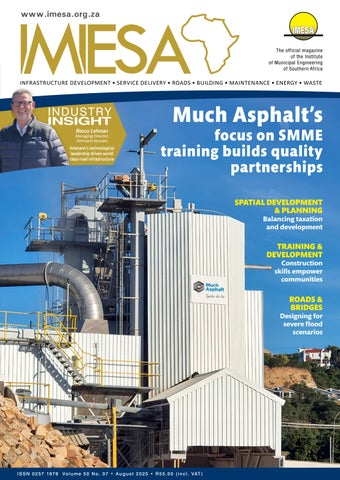
Much Asphalt’s
focus on SMME training builds quality partnerships SPATIAL DEVELOPMENT & PLANNING Balancing taxation and development
TRAINING & DEVELOPMENT
Construction skills empower communities
ROADS & BRIDGES
Designing for severe flood scenarios
I S S N 0 2 5 7 19 7 8 Vo l u m e 5 0 N o . 0 7 • A u g u s t 2 0 2 5 • R 5 5 . 0 0 ( i n c l . VAT )
WWW.SIZABANTU.COM
A FIRST FOR AFRICA.
A GIANT LEAP FOR INFRASTRUCTURE. SIZABANTU PIPING SYSTEMS LAUNCHES AFRICA’S FIRST LOCALLY MANUFACTURED 710M, 800M, 900M, 1000M PN12.5 TO PN25 PVC-O PIPES.
710MM TO 1000MM PVC-O Now in production
First of it’s kind on the continent
In a landmark moment for local manufacturing, Sizabantu Piping Systems and Molecor have successfully produced Africa’s first 710 TO 1000 pipes - with future capacity of up to 1200mm. This giant step puts world-class water infrastructure solutions within Africa’s reach, serving both local and global markets with unmatched strength, efficiency, and quality.
Proudly Made in South Africa
INSIDE
VOLUME 50 NO. 07 AUGUST 2025
20 www.imesa.org.za IMESA The official magazine of the Institute of Municipal Engineering of Southern Africa
INFRASTRUCTURE DEVELOPMENT • SERVICE DELIVERY • ROADS • BUILDING • MAINTENANCE • ENERGY • WASTE
INDUSTRY INSIGHT Rocco Lehman
Managing Director, Ammann Kenzam Ammann’s technological leadership drives world class road infrastructure
Sustainability
Regulars
www.imesa.org.za
Editor’s comment President’s comment Index to advertisers
Much Asphalt’s
focus on SMME training builds quality partnerships SPATIAL DEVELOPMENT & PLANNING
Balancing taxation and development
TRAINING & DEVELOPMENT
Construction skills empower communities
ROADS & BRIDGES
Designing for severe flood scenarios
Cover Story “Together we can”. Much Asphalt’s focus on SMME training builds quality partnerships
I S S N 0 2 5 7 19 7 8 Vo l u m e 5 0 N o . 0 7 • A u g u s t 2 0 2 5 • R 5 5 . 0 0 ( i n c l . VAT )
ON THE COVER Much Asphalt, South Africa’s largest asphalt manufacturer, is celebrating its 60th anniversary in 2025 with a renewed focus on ensuring quality across the asphalt chain from production to placement. P6
INDUSTRY INSIGHT As the South African roads industry gears up for an anticipated resurgence in SANRAL, provincial and municipal work over the Medium Term from 2025/2026, the key to implementation will be the availability of fit-for-purpose technologies to sustain asphalt production. IMIESA speaks to Rocco Lehman, Managing Director of Ammann Kenzam, a wholly owned subsidiary of Ammann Group Holdings AG (Ammann Group), about market trends. P10 ROADS & BRIDGES
6
Industry Insight Ammann’s technological leadership drives world class road infrastructure
16
3 5 52
10
Bitumen & Asphalt Ser ved cold. Roadsaver permanently seals any pothole
13
Bitumen & Asphalt | Instrumentation VEGAPULS delivers safer, more reliable measurements in asphalt storage tanks A smart leap in asphalt binder testing
Water & Wastewater How AI can help solve South Africa’s water crisis Rural ECD gains inspired by water Cape Town sets a high standard for service delivery Understanding your water consumption
36 37 38 39
Legal Not-so-dry issue. Issuance of blue bonds to help address South Africa's water crisis
40
Pump Systems 14 15
Academy pumps out the next generation of experts
41
Spatial Development & Planning
Roads & Bridges Astec cold planer ensures precision milling on N5 rehabilitation SANRAL’s solid investment pipeline in SA roads Portal North Bridge project celebrates a major milestone Designing for severe flood conditions. EThekwini sets a new benchmark for fully integral reinforced concrete bridges
How saving the redfin is helping water conservation 32 Hydrozoning: Designing landscapes for efficient water use 34 Why sustainability and resilience matter more than ever to navigate the ESG backlash 35
Balancing taxation and development 16 18 19
42
Waste Management Driving change for safer roads Adopting tyre devulcanisation will boost downstream recycling
44 45
Renewable Energy & Electrification Nuclear waste storage is not a problem
46
20
Vehicles & Equipment IMESA Defining the Skyline. IMESA celebrates its pathfinding women engineers
26
Women role models at Astec Industries. Breaking barriers and building massive machines
Training & Development
Cement & Concrete
Building foundational and advanced construction skills empowers communities
Sika’s innovative waterproofing system seals an intricate roof design AfriSam says what goes into it matters
30
TRAINING & DEVELOPMENT
30
38
WATER & WASTEWATER
48
51 52
Hands-on solutions for circular change
With over 45 years of experience in the waste management industry, collaborating with customers is how we drive the circular economy. We implement agile and innovative waste solutions, proudly ensuring environmental peace of mind through our commitment to best practice. www.enviroserv.co.za | 0800 192 783 FIND OUT MORE
EDITOR’S COMMENT EDITOR Alastair Currie Email: alastair@infraprojects.co.za DESIGNER Beren Bauermeister CONTRIBUTORS Dr Ashton Busani Mpofu, Deon van Zyl, Geoff Tooley, Hemal Heeralal, Dr Kelvin Kemm, Lerato Nkanza, Dr Lester Goldman, Stephan Jooste DISTRIBUTION MANAGER Nomsa Masina DISTRIBUTION COORDINATOR Asha Pursotham SUBSCRIPTIONS Email: distribution@infraprojects.co.za ____________________________________________ ADVERTISING SALES KEY ACCOUNT MANAGER Joanne Lawrie Tel: +27 (0)82 346 5338 Email: joanne@infraprojects.co.za ____________________________________________
PUBLISHER IMESA (Pty) Ltd P O Box 2190, Westville, 3630 Tel: +27 (0)31 266 3263 Email: info@infraprojects.co.za
IMESA
ANNUAL SUBSCRIPTION: R805.00 (INCL VAT) ISSN 0257 1978 IMIESA, Inst.MUNIC. ENG. S. AFR. © Copyright 2025. All rights reserved. ____________________________________________ IMESA CONTACTS HEAD OFFICE: Manager: Ingrid Botton P.O. Box 2190, Westville, 3630 Tel: +27 (0)31 266 3263 Email: admin@imesa.org.za Website: www.imesa.org.za BORDER Secretary: Celeste Vosloo Tel: +27 (0)43 705 2433 Email: celestev@buffalocity.gov.za EASTERN CAPE Secretary: Susan Canestra Tel: +27 (0)41 585 4142 ext. 7 Email: imesaec@imesa.org.za KWAZULU-NATAL Secretary: Narisha Sogan Tel: +27 (0)31 266 3263 Email: imesakzn@imesa.org.za NORTHERN PROVINCES Secretary: Lethale Magagane Tel: +27 (0)72 059 7444 Email: np@imesa.org.za SOUTHERN CAPE KAROO Secretary: Henrietta Oliver Tel: +27 (0)79 390 7536 Email: imesasck@imesa.org.za WESTERN CAPE Secretary: Michelle Ackerman Tel: +27 (0)21 444 7112 Email: imesawc@imesa.org.za FREE STATE & NORTHERN CAPE Secretary: Wilma Van Der Walt Tel: +27 (0)83 457 4362 Email: imesafsnc@imesa.org.za All material herein IMIESA is copyright protected and may not be reproduced without the prior written permission of the publisher. The views of the authors do not necessarily reflect those of the Institute of Municipal Engineering of Southern Africa or the publishers.
Real unity in action
W
ithin a challenging economy, the cost pressures on households and business continues to intensify. This is being exacerbated by sharp increases in municipal rates and taxes for the 2025/2026 period. A case in point are the City of Johannesburg’s new tariffs, which reflect a 13,9% increase for water and sanitation services for domestic users, a 10% water increase for industrial and commercial users, and a 12,41% hike for electricity. These double-digit increases, alongside a 4,6% property rates escalation, are far from sustainable without a meaningful growth in GDP to create jobs and crowd in investment that enables salary and turnover increases to keep pace. The push back from consumers is on the rise as other municipalities follow suit – particularly in poorer communities, where ongoing violent protest action underscores the financial strain. Across the board, there’s a demand for an equitable exchange in terms of improved ser vice deliver y. However, in many municipalities this is still not happening at acceptable levels. This makes the upcoming 2026 South African local government elections especially impor tant in forcing the change we need to see, especially in terms of sound fiscal discipline and project delivery.
Pathfinders The City of Cape Town continues to show the way, underscored by the results achieved by the city’s Water and Sanitation Directorate for the 2024/2025 financial year. The Directorate achieved 94,1% capital spend of R3,741 billion across more than 150 major projects, with key improvements in treatment works, network capacity and water security via its aquifer projects. However, it’s again a fine balance between infrastructure delivery and citizen taxes, but in Cape Town’s case – given its class leading economic performance – it’s well worth the investment if the tax structures are fair for all parties, namely businesses and consumers.
National dialogue Within the mix is South Africa’s initiation of the first National Convention of the National Dialogue on 15th August 2025. In principle this is an excellent
Resetting the narrative In moving forward, South Africa has a renewed opportunity to reset the narrative and for government to respond in a proactive and open manner. Healthy debate is the hallmark of a true democracy and the National Dialogue, and its successful implementation, will help set the stage for a new roadmap that enables inclusive growth. That’s why those organisations opposed to the National Dialogue for stated reasons should still come onboard, because their concerns are vital for ensuring practical outcomes as opposed to a “talk shop” dead end. We must bridge the disconnect between policy and practice. In the meantime, a major enabler of progress will be the sustained roll-out of government’s R1 billion plus infrastructure budget from 2025/2026 as a concrete measure of the immediate actions we need now to drive investment and growth.
Alastair
To our avid readers, check out what we are talking about on our website, Facebook page or follow us on Twitter and have your say. IMESA
www.imesa.org.za
imesa_za
imesa
www.imesa.org.za
IMESA The official magazine of the Institute of Municipal Engineering of Southern Africa
INFRASTRUCTURE DEVELOPMENT • SERVICE DELIVERY • ROADS • BUILDING • MAINTENANCE • ENERGY • WASTE
INDUSTRY INSIGHT Rocco Lehman
Managing Director, Ammann Kenzam Ammann’s technological leadership drives world class road infrastructure
Much Asphalt’s
focus on SMME training builds quality partnerships
SPATIAL DEVELOPMENT & PLANNING
Balancing taxation and development
TRAINING & DEVELOPMENT
Construction skills empower communities
ROADS & BRIDGES
Designing for severe flood scenarios
The ABC logo is a valued stamp of measurement and trust. IMIESA is ABC audited and certified.
platform to truly match government objectives with the aspirations and realities faced by its constituents. Attended by more than 1 000 delegates representing over 200 organisations spread across all sectors of society, this inaugural event is the start of a series of public national dialogues that will take place over the coming months. South Africans at all levels will be invited to raise key issues that affect their communities within the context of the micro and macroeconomic environment. All of these discussions will culminate in a second National Convention in 2026. The quest is to achieve a common vision and a unified alignment between public and private stakeholders. It’s meant to be a citizen-led approach – coordinated by a representative Steering Committee and guided by the Eminent Persons Group. The latter is composed of prominent individuals appointed by South Africa’s President to support and champion the process. These individuals include Dr Imtiaz Sooliman, founder of Gift of the Givers and a major supporter of municipal projects that include disaster management response.
I S S N 0 2 5 7 19 7 8 Vo l u m e 5 0 N o . 0 7 • A u g u s t 2 0 2 5 • R 5 5 . 0 0 ( i n c l . VAT )
Cover opportunity In each issue, IMIESA offers advertisers the opportunity to get to the front of the line by placing a company, product or service on the front cover of the journal. Buying this position will afford the advertiser the cover story and maximum exposure. For more information on cover bookings, contact Joanne Lawrie on +27 (0)82 346 5338. IMIESA August 2025
3
HAVE YOU REGISTERED FOR THE IMESA CONFERENCE YET?
88 IMESA TH
Earn up to 2.5 CPD points by attending
CONFERENCE
REGISTER TODAY. TAKE ADVANTAGE OF THE STANDARD RATE AND SAVE! SAVE STANDARD REGISTRATION
LAST MINUTE REGISTRATION
Register and pay AFTER 1 August 2025
Register and pay AFTER 13 October 2025
• Members: R9 200 • Non-members: R10 800
• Members: R10 900 • Non-members: R12 500
JOIN US ADDITIONAL (Not included in above Delegate fee)
ANNUAL GOLF DAY
COMPANION PROGRAMME
28 October 2025
29 & 30 October 2025
R650/person
R1 500/person
includes Golf Cart | excludes Caddy
includes Opening & Social Evenings
Light Lunch Prize Giving & Awards
Special Gift Light Lunch provided
CONFERENCE ENDORSED BY
t: +27 (031)266 3263 e: conference@imesa.org.za marketing@imesa.org.za www.imesa.org.za
IMESA ORGANISER
THE INSTITUTE OF MUNICIPAL ENGINEERING OF SOUTHERN AFRICA (IMESA)
PRESIDENT’S COMMENT
IMESA
Women engineering leaders are best equipped to close the gaps Depending on where you live in the world – developed or developing – global citizens experience a greater or lesser degree of socioeconomic opportunity and advancement.
C
ritical aspects start with access to education from a foundational age, backed by sound and affordable healthcare, a home environment where parents are employed, and an enabling governmental policy framework that ensures equal oppor tunity. These mandates are reflected in all 17 of the United Nations Sustainable Development Goals (SDGs) established back in 2015. Central to all of them is SDG 5: Gender Equality, highlighting the fact that in our modern age a high percentage of women and girls worldwide still face some degree of discrimination in society and the workplace. That reinforces the need for collective action, with initiatives like South Africa’s Women’s Month – commemorated annually in August – ser ving as a rallying point for renewed interventions within our own context.
Empowerment and career choices There’s a strong correlation between empowerment and career choices, which is underscored by the fact that in top ranked equality regions, women are prominent in key fields that include science and engineering. According to Eurostat, the split for the EU in 2022 was around 41% for women, as opposed to 59% for men. Still a disparity, but an encouraging trend. As IMESA, it’s one that we’re working hard to replicate within the municipal engineering field. This is being achieved through career advice at secondary level, IMESA bursary programmes (where a high percentage of our candidates are women), and mentorship drives that facilitate innovation and leadership. A case in point is the groundbreaking outreach work being carried out by IMESA’s Young Professionals Portfolio (YP²) committee, which is women led. Today in IMESA around 30% of our members are women, a marked increase from 2005 when the figure was approximately 12%. That’s excellent progress, but more needs to be done within the industry, considering that only 18% of all professionals registered with the Engineering Council of South Africa are women.
Changemakers in society From my experience, women engineers should be encouraged and celebrated because they bring a unique perspective as leaders in the workplace. In the past, it could be argued that infrastructure designs have focused more on function in what has been a male dominated world. That’s why we need to break down stereotypes. The perception of parents and grandparents from the previous generations that engineering, and specifically the municipal engineering fields, were for males only has changed a lot over the last 20 years in South Africa. This is mainly due to the efforts of women engineers from within and outside the IMESA fold that include Dr Allyson Lawless, Linda Ness, Dr Tina Macleod, Bhavna Soni, Bridget Ssamula, Michelle Kruger, Jeanine du Preez and many others. They ser ve as vital role models, because our daughters are seeing women succeeding in the municipal engineering infrastructure space, and making a difference. The determining factor is a passion to make a difference in our society and the world around us, through the engineering we need to survive.
A people centric approach When I started as a young engineer, I was given the guidelines and told to get on and design the required infrastructure. There was no talk of understanding the needs of the specific community that we were ser vicing. Now, the women within the municipal engineering space are changing the type of engineering we are delivering for our community. Empathy is a key factor in terms of ser vice deliver y and interaction with our communities.
Across the board, women are the foundation on which society functions, and those who enter the civil engineering field have a real oppor tunity to drive SDG objectives. They are also instrumental changemakers in closing gender inequality gaps – not just in engineering – but within the communities that they ser ve through future-proof designs that build resilience and empower women and girls.
A shared vision Ultimately, for our society to function effectively, it must be a shared vision. Plus, it’s essential that the solutions address local requirements within our developing context. Without affordable access to water and electricity, for instance, it’s a steep hill to climb out of the endemic poverty that still grips South Africa. Plus, without a sound education in maths and science, there will be fewer opportunities for the next generation to evolve within an increasingly high-tech environment. Aside from access to education, another key success factor is the promotion of women at the highest levels in public and private leadership positions. This is a common feature of high-performing nations, as is a concerted focus on infrastructure development. They are also proactive advocates of equal oppor tunity career choices for men and women in engineering. In South Africa, we need to follow suit, especially in the municipal engineering arena, where civil engineering shapes current and future societies. In all respects, equal par ticipation is the essential ingredient for success. Geoff Tooley, Pr Eng Hon FIMESA, IMESA President: 2024-2026
IMIESA August 2025
5
COVER STORY
The Much Asphalt plant in Eerste River, Cape Town, which is also the location of the group’s head office
Much Asphalt’s focus on SMME training builds quality partnerships Much Asphalt, South Africa’s largest asphalt manufacturer, is celebrating its 60th anniversary in 2025 with a renewed focus on ensuring quality across the asphalt chain from production to placement.
uality has been the watchword for Much Asphalt’s products since its first plant began operating in 1965 and continues today across its 19 asphalt plants in South Africa, Namibia and Mozambique, each with its own quality control laborator y. The company supplies a comprehensive range of generic and customised products to clients in the formal and informal sectors.
Quality from inception to placement But the quality of an asphalt product is as much about how it is placed on the road as it is about how it leaves the weighbridge. This has to do with client relationships, which range from long-term supply agreements – some of them dating back half a century – to
6 IMIESA August 2025
best practice education for SMMEs and new entrants into the asphalt paving sector. The company’s focus on excellence in the asphalt sector, and the guidance it provides for its smaller customers, were factors contributing to the acquisition of the Much group by Old Mutual Private Equity and Sphere Investments from AECI in early 2025. The R1.05 billion deal was based on Much Asphalt’s meaningful contribution to South Africa’s road infrastructure, described by Sphere Investments Director Mohammed Sabi as essential due to its pivotal role in enabling economic development, connecting South Africans and empowering previously disadvantaged communities. Eddie Jansen van Vuuren, Marketing and New Business Development Manager at Much Asphalt, confirms that this sentiment
aligns with the company’s efforts to ensure that its products are respected by the contractors who use them, to the ultimate long-term benefit and safety of road users. “It’s a case of quality, from selecting the materials to produce the asphalt, to placing the asphalt on the road in the best possible manner.” On the input side, Much Asphalt is a firm believer in the use of recycled asphalt and alternative aggregate sources to avoid the use of non-renewable aggregates taken from the ear th. Much Asphalt is a recognised industr y leader in the development of new and improved products that help to
COVER STORY
improve the safety and durability, as well as decreasing the long-term cost, of maintaining South Africa’s road network. While the quality of these products is what defines the company, how they are used is central to the Much Asphalt philosophy.
Much Asphalt recycles reclaimed asphalt from sites across South Africa to reduce pressure on natural resources and carbon footprint. Recycling results in financial savings due to reductions in asphalt binder, energy, and total job costs
Best practice training Almost 20 years ago the Much Asphalt leadership decided steps needed to be taken to establish a uniform, industr y-wide standard for high quality hand-laid hot mix asphalt. This followed an influx of individuals and SMMEs into the industr y to under take small scale asphalt placement jobs. Municipalities needed maintenance and repair works carried out and sub-contractors were engaged by big construction firms to fill gaps. As a response, Much Asphalt launched its Best Practice Workshops in 2006 for individuals, small to medium size contractors, entrepreneurs and local and provincial Much Asphalt employees commit to a government departments wishing to educate company-wide safety pledge their own staff or their contractors. The training involves technical and practical instruction on how to apply Much Asphalt products by hand to achieve the best possible outcomes. In tandem with the training, Much Asphalt produced a Best Practice Handbook to provide guidance on the selection, use and application of its products. The handbook assists super visors and foremen working with established contractors, as well as newly established and emerging contractors, with state-of-the-art knowledge of those products cost-effective asphalt surfaces with a and processes that have high standard of finish. Cenlab Manager Firyaal Moos been proven in practice performing a DSR Free access to expertise to produce durable, test. Cenlab received Much Asphalt’s handbook draws SANAS accreditation for all DSR tests in on the technological know-how April 2022 and extensive experience of leaders in the field of hand-laid hot mix asphalt and helps clients to understand what specification is being worked to and what may be expected from the finished product in terms of appearance, performance and cost. The key to adding real value to the industr y is that the workshops have always been provided free of charge. Many hundreds of individuals from all over South Africa have attended the workshops. Among others, courses have
A lesson in quality control from David Mogale, Quality Assurance Supervisor at the Much Asphalt Polokwane plant
been held in Mangaung (Bloemfontein), eMalahleni (Witbank), Gauteng, Cape Town, Gqeberha (Por t Elizabeth), East London, Durban, Por t Shepstone, George, Benoni and Polokwane among others. Certificates are awarded to all delegates. “We would like to ensure that all contractors deliver durable and costeffective asphalt sur faces to their clients,” says Jansen van Vuuren. “At the end of the day, Much Asphalt and the contractor who is placing our product have a joint responsibility for its quality. This is the thinking behind our ‘Together We Can’ principle.”
Municipal focus He adds that the current focus is on training to assist in the maintenance and repair of municipal roads, in par ticular. “In the immediate future, we will offer our courses
IMIESA August 2025
7
COVER STORY
Contractors in Eikenhof, Gauteng, look on as local Much Asphalt customer, SN Tar, demonstrates how it should be done
to SMMEs that buy their products from Much Asphalt and work on projects for municipalities, as well as contractors using our asphalt for municipal contracts.” In a recent example, Much Asphalt’s Polokwane plant hosted its first Best Practice Workshop on Hand-Laid Asphalt. Five construction companies ser ving the local authorities, BCB Solutions, Shonisani
Rambau Construction, Chauke Business Enterprise, Manengena Construction & Maintenance, and Botlhabatsatsi Group, sent a total of 40 employees for training. The workshop included a presentation using the Best Practice Hand-Laid Asphalt Guide, a tour of the plant, and practical site demonstrations of pothole patching and repairs using both hot and cold mix applications.
Discounts for SMMEs
Practical, on-the-road instruction for hand-laid asphalt practitioners
In an associated new initiative launched to coincide with Much Asphalt’s 60th year in business, monthly Cash Days at selected plants assist SMMEs with savings on specific asphalt products. “Our Cash Days are designed to provide significant value for clients who pay for and collect their products on the day,” explains Jansen van Vuuren. “There is no limit to quantities purchased on Cash Days.” “The objective is to suppor t the growth of SMMEs in our industry. By taking part in Cash Days, clients benefit from savings and unlock future growth. Together, we create a win-win relationship.” Cash Days have been held in Gauteng and the Western Cape to date, with other locations in the planning. Jansen van Vuuren adds that Much Asphalt is partnering with a financial supplier to assist qualified SMMEs with financial management and cash flow.
commercial asphalt supplier to be accredited by the South African National Accreditation System (or SANAS), an indicator of the company’s leadership in product quality. During the COVID-19 pandemic, testing capacity was increased at all the group’s plant laboratories, surpassing industr y requirements. In 2022, Cenlab achieved another industr y breakthrough, becoming the first fully SANAS accredited bitumen and asphalt laboratory in the country. On the back of this, the Much group secured testing work for a major SANRAL funded research project. “Our quality standards across the company are based on the Cenlab benchmark,” concludes Jansen van Vuuren. “We believe this, together with our 60 years of partnership with the South African roads industry, our experienced technical team, our strong safety record, and our reputation as a leader in innovation, more than qualifies us to help educate new generations of asphalt users.” For more information on the Best Practice Workshop on Hand-Laid Asphalt or Much Asphalt Cash Days, please visit the website at www.muchasphalt.com.
Product quality Much Asphalt’s Central Laboratory (Cenlab) in Cape Town was the first South African
8 IMIESA August 2025
www.muchasphalt.com
88 IMESA TH
CONFERENCE
BOOK YOUR accommodation NOW CONFERENCE VENUE EAST LONDON ICC 22 Esplanade, Quigney, East London Premier Hotel ELICC – onsite BOOKING CODE : IMESA2025
HOTELS ONSITE OR WITHIN CLOSE PROXIMITY OF THE EAST LONDON ICC (IMESA will provide transport to and from the hotels listed below)
Premier Hotel Regent onsite - BOOKING CODE : IMESA2025
Hotel Osner 800m from Conference Venue
Garden Court 1km from Conference Venue
Road Lodge 5,5km from the Conference Venue
Hemingways Hotel 8,2km from the Conference Venue
Blue Lagoon Hotel 9,9km from Conference Venue
CONFERENCE ENDORSED BY
t: +27 (031)266 3263 e: conference@imesa.org.za marketing@imesa.org.za www.imesa.org.za
IMESA ORGANISER
THE INSTITUTE OF MUNICIPAL ENGINEERING OF SOUTHERN AFRICA (IMESA)
INDUSTRY INSIGHT
Ammann’s technological leadership drives world class road infrastructure As the South African roads industry gears up for an anticipated resurgence in SANRAL, provincial and municipal work over the Medium Term from 2025/2026, the key to implementation will be the availability of fit-for-purpose technologies to sustain asphalt production. IMIESA speaks to Rocco Lehman, Managing Director of Ammann Kenzam, a wholly owned subsidiary of Ammann Group Holdings AG (Ammann Group), about market trends.
W
ithin the mix is a concerted drive by the South African government to promote black-owned contractor development, which will hinge both on technical capacity as well as access to specialist road building equipment and asphalt plants. “With few exceptions that include the Johannesburg Roads Agency, and the City of Tshwane, most municipalities in South Africa do not own their own asphalt plant, outsourcing this to the private sector, which is also a common practice worldwide,” explains Lehman. “However, back in the 1970s, it was fairly common practice in South Africa’s major centres, with municipalities producing for their own internal requirements, as well as selling asphalt products for external contractors and other municipalities. The same approach still currently applies for municipalities in developed markets like the EU and the USA that continue this practice,” explains Lehman.
“Interestingly, we are now receiving municipal enquires – albeit on a limited scale – which would certainly benefit town and city road maintenance objectives, and alleviate the cost of asphalt plant ownership, especially for smaller construction companies. Going forward though, the bulk of our asphalt plant sales will remain within the private sector in line with local and international norms. This will be strongly influenced by value engineered solutions – an area where Ammann is an undisputed leader, dominating global sales.” Ammann South Africa was established in 2009 to spearhead the local roll-out of the Ammann Group’s whole of Africa strategy. For the South African arm, the acquisition of Kenzam Equipment during 2022 (now trading as Ammann Kenzam) was a pivotal moment as it represented the Ammann Group’s formation of its first fabrication centre in Africa. Previously appointed as Ammann South Africa’s asphalt plant dealer in May 2020, Kenzam Equipment is a leading OEM in its own right, with a long-established track record for the design and manufacture of associated products for the asphalt and bitumen markets in South Africa and Africa. Key examples include containerised emulsion plants, bitumen drum decanters and bulk bitumen storage solutions. “A key advantage of our local fabrication expertise is the ability to retrofit and modify asphalt plants to match regional operational requirements, while the addition of our
Rocco Lehman, Managing Director of Ammann Kenzam
10 IMIESA August 2025
associated product range provides a turnkey production solution,” Lehman explains.
Global manufacturing footprint with local focus Since its inception in 1869, Ammann – a Swiss owned multinational – has been an industry pioneer in OEM innovation, with a key appreciation for country specific product requirements. Their production facilities include factories in Brazil, China, Czechia, Germany, India, Italy, Switzerland and the USA. The Ammann Group also recently opened a new factory in Yuhuan, China to meet domestic and international demand. Ammann India’s factory in Mehsana, near Ahmedabad, is the predominant centre for the supply of Ammann construction machines and asphalt plants for South Africa, Africa, and the Middle East. Ammann Kenzam forms part of the Africa Middle East hub, headquartered in Dubai. “The Middle East region has been especially buoyant in terms of plant and machine sales in countries that include the UAE, Iraq, Kuwait and Saudi Arabia,” says Lehman. “In parallel there’s been strong uptake in North Africa, with Egypt’s concerted infrastructure drive leading the way, with 16 Ammann asphalt plants supplied to various contractors during 2023. Deals worth an estimated US$7 million have also been concluded in East Africa during the 2025 year to date. Locally, Ammann Kenzam has also made strong gains in our cross-border market, as well as in East Africa.” The bulk of the plants sold into Africa and the Middle East comprise either ACC CounterMix or ABC ValueTec models, produced by Ammann India to meet varied production demands, with an excellent return on investment. The ACC CounterMix range (available with outputs of 90 or 120 tonnes per hour) produces mix at a lower cost than traditional parallel-flow drum-mix plants and requires less energy to heat materials, contributing to reduced emissions. Then from a batch plant set-up perspective, the ABC ValueTec comprises four models, with respective output capacities of 80, 140, 180 and 260 tonnes per hour and the capability to produce a broad range of asphalt mixes. “Compared to competitor OEM plants in this segment, the ABC ValueTec claims the lowest product lifecycle cost,” says Lehman.
INDUSTRY INSIGHT
Plant and machine interface Ammann Kenzam is the direct interface for Ammann asphalt plant sales and aftersales suppor t. In the interim, Ammann Kenzam also serves as the customer facing arm for its Ammann construction equipment line, which includes asphalt pavers, soil and asphalt compactors, and light equipment (such as rammers, vibratory plates, and walk-behind rollers). This follows the end of a longstanding local dealer agreement. “We are now actively negotiating with interested parties in the market to find the optimum fit in terms of a suitable dealer replacement. In the interim the previous dealer has committed to ongoing service support for existing Ammann construction machines, while Ammann Kenzam will handle sales and aftersales on new deals,” says Lehman. “We’ve already been doing this in regions not supported by our previous dealer in countries that include the Democratic Republic of Congo, the DRC, and Guinea, where package deals encompassing Ammann asphalt plants and machines are fairly common. These regions attract major investment in mining, and allied infrastructure.” New machine developments include the Ammann Group’s acquisition of the ABG paving product line from Volvo Construction Equipment (CE), which has now been integrated into the Ammann line-up. The acquisition includes the transfer of Volvo CE’s paving businesses in China, India, and Germany. The addition of the ABG range provides a complete solution for mini, tracked, and wheeled paver requirements, with machines for the South African, African and Middle East market predominately manufactured by Ammann India.
Surge in plant sales and aftersales In terms of the asphalt plant business line, Ammann Kenzam has experienced an upsurge
The addition of the Ammann ABG range provides a complete solution for mini, tracked, and wheeled paver requirements
Manufactured at Ammann India’s factory in Mehsana, the ABC ValueTec batch plant range is a bestseller in the African and Middle Eastern markets
in parts and service orders, which supports the view that the South African roads market is experiencing a positive upturn as provincial and municipal work – alongside ongoing SANRAL projects – gains traction. Currently, Ammann Kenzam’s existing static and mobile asphalt plant population are operating across key provinces that include Gauteng, KwaZulu-Natal, the Free State, Limpopo, and the Western Cape. “New asphalt plant sales have certainly been encouraging over the past 18 months, with six units sold to date for South African and SADC customers. We see this trend continuing into 2026,” Lehman continues. In parallel, Lehman says there’s a clear indication that current Ammann owners – contractors and/or asphalt producers – want to optimise their cashflow by extending the life of existing plants for as long as practical to hedge cyclical market trends.
“This has resulted in us completing a series of retrofits to bring older plants up to date with the latest Ammann specifications, which include emission compliance and new product requirements, like higher RAP specifications. Even Ammann plants that are 20 years or older can continue operating productively in modern construction environments. That provides major peace of mind for existing and new buyers,” adds Lehman. Another one of Ammann’s key value propositions is that it provides ongoing technical training for client personnel so that owners can maximise their return on investment. The Ammann Group’s remote advisory service adds an additional dimension, enabling customer service teams to engage with Ammann experts locally and globally to troubleshoot any issue. “For contractors in rapidly expanding markets like Europe and the Middle East, Ammann plants and machines are the preferred solutions. All indications point to a similar trend for South Africa and Africa, backed by the Ammann Group’s more than fifteen decades of commitment to innovation and excellence,” Lehman concludes.
www.ammann.com
IMIESA August 2025
11
ONE POTHOLE AT A TIME
ONE STEP CLOSER TO A BETTER SOUTH AFRICA At Roadsaver, we empower South Africans to take action – repairing roads, safeguarding communities, and building a brighter future – together! Wilco Bothma: (061) 496 3212
Jacki Lategan: Sales (065) 806 3658 info@roadsaver.co.za sales@roadsaver.co.za
Fred Jonker: (083) 633 1028
BOLDLY SOUTH AFRICAN, BACKED BY EXCELLENCE Proudly developed by Universal Blending and crafted right here in South Africa, Roadsaver is a cold asphalt pothole filler perfected through 11 years of rigorous development and testing. Holding Agrément SA’s highest rating – Class 4, Level 3 (CSIR) – it’s fully approved for permanent road repairs, delivering a standard of quality you can trust. Our guiding principle is simple: “Prevention is better than cure”. Roadsaver is not just a quick fix – it’s a long-term solution that preserves infrastructure, enhances safety, and builds trust through consistent, high-grade performance.
ENGINEERED FOR RESILIENCE Roadsaver cold asphalt pothole filler is built to last. This sustainable, ready-to-use mix blends premium 7.1 mm crusher stone and -5 mm crusher run with a specially modified bitumen for unmatched adhesion and long-term durability. Designed to perform in any weather and any season, Roadsaver offers consistent, professional results without heating or complex preparation. With a 12-month shelf life when stored correctly, it’s always ready when you are – ensuring quality, convenience, and lasting performance from start to finish.
A MISSION ROOTED IN PREVENTION Proven Longevity: Over a decade of refinement ensures dependable results.
Top-Tier Certification: CSIR developed and Agrément-approved – validated excellence.
Superior Durability: Petroleum-based formula means stronger, longerlasting repairs.
Homegrown Impact: Supporting local industry, infrastructure, and community growth.
PAVING THE WAY FORWARD Roadsaver is more than a product – it’s the tangible, results-driven answer to one of South Africa’s most pressing infrastructure challenges. We deliver trust, safety, and consistency, forging lasting partnerships by continually exceeding expectations.
The ultimate solution for safe, smooth, and sustainable roads across South Africa
www.roadsaver.co.za
BITUMEN & ASPHALT
SERVED COLD
ROADSAVER PERMANENTLY SEALS ANY POTHOLE Tackling the pothole pandemic head-on, the Roadsaver Group’s Roadsaver cold asphalt is the definitive all-weather solution to an age-old problem, namely the premature failure of repair works due to substandard products.
M
ore than a decade of research and development went into its refinement – including extensive CSIR trials – with the Roadsaver system achieving a major milestone in March 2025 when its attained Agrément South Africa Class 4 Level 3 certification. This is Agrément South Africa’s highest certification level. Engineered for strength, sustainability, and ease of use, this ready-to-apply, petroleum-based mix combines premium 7.1 mm crusher stone with -5 mm crusher run, bound by specially modified bitumen for exceptional adhesion, flexibility, water resistance, and long-term durability. Designed to perform in all weather conditions – even in the rain – Roadsaver delivers consistent, professional repairs without heating, emulsions, or complex preparation. With a 12-month shelf life when stored correctly, it’s always ready when you are, ensuring quality, convenience, and lasting performance from start to finish. For distribution, Roadsaver is available in standard 25 kg bags or 210 litre bulk drums.
Proven durability Essentially, Roadsaver is durable and costeffective, and the tests prove this. A prime example are the heavily trafficked sections rehabilitated by the Roadsaver Group in Silver Lakes, Pretoria, some seven years ago that are still perfectly intact. SANRAL has also specified Roadsaver on road sections within Gauteng
province, with follow-up assessments to date confirming a repair integrity exceeding 12 months or more. International traction is also gaining ground. Examples include a trial installation completed by the Roadsaver Group for a public works project in Uganda during 2023, where the potholes repaired are still 100% today. In neighbouring counties that include Botswana, similar demonstration projects have been completed, with the same satisfactory results. Typical life expectancy is 10 years or more, subject to correct application, which includes sub-base preparation, where required. Plus, the distinctive advantage of Roadsaver is that it’s both a crack sealant and a pothole filler. Roadsaver marries with any existing asphalt material, and its inherent flexibility responds positively to traffic loads without deformation. “Flexible pavements function optimally when sealed. So, when asphalt wear occurs there’s an increasing risk of water ingress, which over time destabilises the wearing course. The ultimate result is pothole formation,” explains Wilco Bothma, director at the Roadsaver Group. “The faster it’s fixed the better, to prevent fur ther road deterioration and the ensuing higher cost of reconstruction. A further plus is that, in addition to potholes, Roadsaver can also be used for other asphalt remediation tasks that include ruts, edges, trench reinstatement and skin patching.”
To date, the Roadsaver Group has conducted a series of side-by-side cold asphalt product comparison trails in conjunction with municipal clients. Roadsaver has always proven to be the lasting solution.
Hot versus cold mix As Bothma points out, hot mix interventions are one potential pothole repair approach, but it’s more costly and complex to effect than cold mix. Hot asphalt requires a nearby plant and timeous delivery, plus the right weather conditions. Hot mix asphalt also needs time to cure before road reopening. In contrast, Roadsaver cold mix comes in a bag – anytime and anywhere you need it – requires minimal equipment and is labour-intensive. That means it’s a vital employment creator in hardpressed communities, and it opens the door for SMME start-ups – both core priorities for public works programmes. Most cold mix asphalts need a tack coat or bonding agent applied to the repaired area before the placement of the patching mix. That’s not the case with Roadsaver for potholes 1 m2 or less, and once the repair is completed the road can be opened to traffic immediately. “Ultimately, the goal of any pothole repair is to ensure road safety and extend pavement working life. Responding timeously and getting it right the first time is the key to optimum service delivery,” Bothma concludes.
IMIESA August 2025
13
BITUMEN & ASPHALT | INSTRUMENTATION
A major manufacturer of roofing and insulation products in Alberta, Canada, produces asphalt shingles at one of their plants in Calgary. In this plant, the company maintains four 17 m high heated asphalt storage tanks. The plant utilises level sensors to help keep track of the amount of asphalt in the tanks to manage inventory as efficiently as possible.
VEGAPULS delivers safer, more reliable measurements in asphalt storage tanks
T
he previously installed level sensors posed several challenges for the company. These sensors could not obtain reliable readings, and finding service or support for the malfunctioning sensors proved nearly impossible for plant personnel. That all changed when the company reached out to VEGA.
The misery of malfunctioning measurements Level measurement is a critical function of most manufacturing operations, and asphalt shingles are no exception. When stakeholders and plant personnel have a clear picture of their inventory, they can keep their processes running efficiently without the fear of detrimental events like overfills. Level sensor malfunctions can be inconvenient at best, and in some cases, disastrous. In this case, plant personnel had to take on the task of level measurement manually when their sensors malfunctioned. This meant climbing up on the asphalt tanks to check the product level, and manual measurements are generally less precise than those obtained through purposebuilt level sensors. To climb these tanks, it is necessary to take additional safety measures, especially during winter months when snow covers the steps leading up to the tops of the tanks. When the company's sensors malfunctioned due to a lack of service or support, they began searching for a new supplier. This was when they discovered VEGA.
Reliability + safety = 6X Exper ts at VEGA assessed the shingles manufacturer’s heated asphalt tanks to determine
14 IMIESA August 2025
what level measurement solution would be the best fit. The sensor required would need to handle the high temperatures of the asphalt vapours and be resistant to buildup caused during the heating process. It was considered that the tanks needed a minimum measurement range of 20 m from the existing mounting location above the tank. The solution came in the form of VEGA’s latest non-contact radar sensor, VEGAPULS 6X. The 6X® is designed to meet the needs of any level measurement application and can withstand process temperatures as high as 450°C, easily above the temperature output by the asphalt vapours. The VEGAPULS 6X can measure up to 120 m, which makes it the per fect choice for measuring the level of asphalt in all four tanks of the company. When presented with the benefits of VEGA’s sensor, the company agreed to place one on each of its four asphalt tanks.
The VEGA difference Some of the challenges caused by the company's malfunctioning sensors could have been prevented with proper service and support. The company made the smart decision to entrust the commissioning and setup of their new sensors to VEGA service personnel. This ensured that they received the best possible service and exper tise. Thanks to VEGA's efficient work, the commissioning and setup were completed quickly, allowing the company to get back on track without any further delays. VEGAPULS 6X is designed to be simple and intuitive, from the point of purchase to usage in the field. Setting up multiple sensors has never been easier thanks to PLICSCOM, VEGA's display and adjustment module. A VEGA representative
Setting up multiple sensors has never been easier thanks to PLICSCOM, VEGA's display and adjustment module
set up the first VEGAPULS 6X and then copied its settings using a PLICSCOM module. Setting up the sensors in the tank farm was a breeze. Simply copying the settings from one VEGAPULS 6X unit to the other three made the process intuitive and straightforward. With the PLICSCOM module, all four sensors were up and running within an hour.
Reliable instrumentation and expert service all under one roof Equipped with VEGAPULS 6X sensors and backed by VEGA’s expert service team, the company now enjoys a clearer view of their asphalt inventory, allowing it to run the plant and produce shingles more efficiently than ever before. The high precision of VEGA’s sensors is matched by their high reliability, meaning plant personnel don’t have to worry about trudging up slippery steps in the cold of winter to make level measurements. VEGA's instrumentation not only offers userfriendly features but also provides robust and unparalleled support for level measurement sensors. It's no surprise that numerous building material companies choose VEGA to optimise their processes.
A SMART LEAP IN ASPHALT BINDER TESTING
A
s municipal engineers grapple with growing demands for road durability, safety, and lifecycle cost reduction, the role of advanced materials testing becomes central. In response, Anton Paar’s SmartPave Dynamic Shear Rheometer (DSR) emerges as a pivotal tool – specifically engineered for the challenges of modern road infrastructure, with its increasing emphasis on data-driven pavement design.
Empowering infrastructure with proven rheology Used to characterise bituminous binders under stress and temperature variations, SmartPave supports South Africa’s evolving pavement performance specifications. Available in two variants – the SmartPave 92 for routine quality control, and SmartPave 102e for advanced research – it equips engineers with results aligned to Superpave, MSCR, LAS, and other global standards (AASHTO, ASTM, EN). By delivering deeper insight into material deformation and fatigue resistance, SmartPave enables proactive design decisions, enhancing road lifespans and reducing maintenance cycles – key concerns for municipalities with limited budgets.
Technology that works for the engineer SmartPave’s technology is as practical as it is powerful: • No water, no hassle: The Peltier temperature control eliminates messy water baths, offering sub-0.1°C temperature gradients for enhanced measurement stability and operator comfort. • ToolmasterTM and QuickConnect: Fully automated recognition of measuring geometries and effortless exchange mechanisms simplify testing workflows. • Intuitive RheoCompass software: Pre-programmed methods for bitumen testing ensure that even new operators can confidently deliver standard compliant results. These features directly benefit public works laboratories and asphalt testing facilities – speeding up operations, minimising errors, and improving data integrity.
Designed for Africa’s roads South Africa's diverse climate zones – from highveld heat to coastal humidity – demand rigorous binder validation. SmartPave meets this need with: • A wide temperature range (-30°C to +200°C depending on the model). • Adaptable testing modules for low-temperature cracking, fatigue, and viscosity. • Modular expansion options for BBR surrogate testing and normal force analysis.
Precision for public value Anton Paar’s commitment to accuracy, efficiency, and local partnership makes SmartPave a compelling solution for every municipality striving to improve road performance and accountability – core values that align with IMESA’s mission to advance municipal infrastructure through engineering excellence. Learn more: http://bit.ly/4fEr6s7 Contact Lorin Hosken at Lorin.hosken@anton-paar.com to find out more.
Spanning the Asphalt Mix / Binder Rheology Spectrum SmartPave Series
Performance grading according to AASHTO T315 / T350 / ASTM D7175 / D7405 Viscosity determination of asphalt binder according to AASHTO T316 / ASTM D4402 Rheological property determination of ground tire rubber (GTR) modified asphalt binders DSR models to meet routine QC and R&D requirements as well as emerging needs for state-of-the-art asphalt and bitumen analysis
www.anton-paar.com
ROADS & BRIDGES
Astec cold planer ensures precision milling on N5 rehabilitation In a landmark order, global equipment manufacturer Astec Industries (Astec) has supplied and commissioned an Astec Roadtec RX-600ex cold planer for an important N5 corridor maintenance and rehabilitation project in the Free State.
T
he group reports that it is proud to be contributing to SANRAL’s critical national infrastructure improvements after supplying the RX-600ex to Damian’s Contractors for use on the roadworks between Bethlehem and Harrismith. This is the first deployment of an RX-600ex cold planer in this part of South Africa. The order is also significant because this is one of the first demo-to-direct sales of this model by Astec’s South African Infrastructure Solutions division. The high visibility of the site and the oftenheavy traffic volumes on the N5 corridor demand precision milling, speed, efficiency,
The ACE Auto-Cut Entry system automatically controls the drum's depth when initiating a cut, rather than requiring the operator to do so manually
16 IMIESA August 2025
and uncompromising safety. The RX-600ex has got what it takes to exceed expectations, comments Philip Saunders, product sales manager for Astec’s Materials and Infrastructure Solutions divisions.
Smooth and uniform roadways Powered by a 630 horsepower Cummins QSX 15 Tier III engine, the RX-600ex has a 2 007 mm wide QX1 asphalt milling drum with 16 mm tool spacing. Its key features include a dust extraction system, hydraulically folding conveyor, Astec’s ACE Grade & Slope Automation with auto-cut entry, dual water spray bars, and bolt-on track pads – all of which are standard on the machine. Astec cold planers like the RX-600ex have two independent spray bars to inject water in the cutter housing. The front spray bar is primarily for dust suppression. The rear spray bar cools the drum. The RX-600ex also boasts an Astec QX1 quick change cutter drum, and an integrated dual operator platform with simplified intuitive controls. The ACE system enables the automatic calibration of specific hydraulic parameters – ensuring that the machine consistently achieves the precise milling depth, while the grade and slope sensors maintain the prescribed parameters when in full operation. “When your track pads are ready to be replaced, you can simply unbolt the old ones and bolt on new ones,” Saunders notes. Because the bolts are not exposed to the surface, there is also the
A boost function on the RX-600ex temporarily speeds up the conveyor should it become overloaded
benefit of no asphalt build-up. “Traditional track pads utilise ‘through bolts’ which build up with asphalt and take longer to remove and replace.” On the RX-600ex, a standard dust extraction system improves operator comfort and safety by removing dust and debris from the milling operation through a hydraulic fan at the primary conveyor. “The dust is ejected at the end of the secondary conveyor into the dump truck. As the dust is ejected, the material exiting the secondary conveyor belt helps to channel the fine material into the dump truck,” Saunders explains. The folding secondar y conveyor available on the RX-600ex as “standard” simplifies transport and loading. A boost function, also offered as a standard feature on the machine, temporarily speeds up the conveyor should it become overloaded.
Saving road builders time and money Saunders says the factors that contributed to Astec netting this order from Damian’s Contractors included the immediate availability of the machine and its suitability for the project, including its advanced automation system. In addition, Astec was committed to ensuring the seamless commissioning of the machine, as well as the provision of comprehensive operator training on the milling systems, all of which took place under live working conditions.
Challenges with noise and dust? For us it’s no problem.
From large stones to the smallest grains: Bulk solids come in all types, shapes and sizes, but choosing the right measurement technology is surprisingly easy. With our level and pressure sensors, you can effortlessly keep an eye on all your important process values – and still have time to crack the really hard rocks. Everything is possible. With VEGA.
vega.com
ROADS & BRIDGES
to Mbizana River, the fifth from Mbizana River to Marburg, and the sixth from the Mtentweni Interchange to the Hibberdene Interchange. SANRAL has also embarked on community development projects in this part of KwaZuluNatal. The scope of work here includes construction of pedestrian walkways along the N2 corridor, pedestrian access infrastructure from Izingolweni to Mthusi, as well as general community development between Izingolweni and Murchison. Through these projects, SANRAL has invested R450 million, with an estimated R58 million to be allocated for subcontracting opportunities.
Free State upgrades
SANRAL’s solid investment pipeline in SA roads The South African National Roads Agency SOC Limited (SANRAL) has successfully signed a R7 billion loan agreement with the New Development Bank (NDB) to support its various toll portfolio projects in the country. In parallel are ongoing new construction and maintenance initiatives.
K
ey projects that will be partially funded through the NDB loan include the N3 Paradise Valley to Marianhill Toll Plaza, the N3 Marianhill Toll Plaza to Key Ridge, N1 Zandkraal to Scottland, and the N1 Scottland to Winburg South project. In total, these four projects represent over R12.7 billion in investment, with more than R3.8 billion reserved for SMMEs and targeted enterprises, and close to R1 billion for labourdriven economic inclusion. Across the board, an estimated 6 600 job opportunities will be created for local communities.
N2 Wild Coast link Alongside its toll road upgrades, SANRAL continues to invest in its regional road network. This includes a planned upgrade of 66 km of the N2 from Mtamvuna River to the
18 IMIESA August 2025
Further afield, SANRAL will embark on an urgent R130 million routine road maintenance project on sections of the N6 and N8 national roads that pass through Caleb Motshabi township in Mangaung, Free State province. This part of the national road network was handed over to SANRAL by the Free State provincial government in November 2024. Key works include surface repairs, base repairs, erection and cleaning of guardrails, cleaning of culverts, grass cutting, erection and repair of fences, and other general maintenance work. The project will take over a year to complete. Just over 1 200 km of the province’s roads were transferred to SANRAL between October 2023 and November 2024 and will now be fully managed by SANRAL’s management in the Free State.
Gauteng sinkhole remediation Hibberdene Interchange in the Ugu District Municipality in the next three to five years. The works are expected to translate into almost 7 000 job oppor tunities for local SMMEs and community members. This project is significant because it forms part of SANRAL’s flagship N2 Wild Coast Project, extending from East London to the Mtamvuna River. The construction programme for the Mtamvuna River to the Hibberdene Interchange upgrade will be divided into six packages. The first includes dualling of the CH Mitchell Bridge, which is in the south of Port Edward and spans the Mtamvuna River. The bridge connects KwaZulu-Natal to the Eastern Cape province. The second package will be from Mtamvuma to Port Edward, the third from Port Edward to Mpenjati River, the fourth from Mpenjati River
Meanwhile, construction is expected to start mid-September on urgent remediation works – valued at some R154 million – to repair a major sinkhole located at Km 0.3 on section 2 of the R21 national road, northbound in Olifantsfontein. Terra Strata Construction has been appointed as the main contractor to carry out the critical repair works for a period of 11 months. The project scope includes drilling boreholes, compact grouting, and road resurfacing. Comments SANRAL’s Chief Executive Officer, Reginald Demana: “As part of our ongoing efforts to support our government’s drive to achieve higher levels of economic growth, SANRAL will continue to implement strategic projects across the country, while also upgrading and maintaining the national roads network falling within its ambit.”
ROADS & BRIDGES
Portal North Bridge project celebrates a major milestone In collaboration with Skanska-Traylor Joint Venture and Carver Marine, Mammoet helped to achieve a significant milestone in the Portal North Bridge project, an essential infrastructure development designed to enhance the rail network in the New York metropolitan area.
T
hree new bridge sections will eventually replace the century-old Portal Bridge, a key link between Newark, New Jersey, and New York City. The current bridge is centuries old and is a notorious bottleneck that has long caused delays for Amtrak and New Jersey Transit trains due to its outdated swing mechanism and frequent malfunctions. Leveraging their depth of experience in bridge installations, Mammoet successfully executed the transport of three bridge sections, each measuring over 120 m, from the assembly site at Port of Coeymans to the roll-on location. From there they were loaded onto a barge for further transit down the Hudson River.
Jacking and skidding phase Each section was carefully transloaded onto the temporary mid-river staging called the transfer bent, before loading onto another barge prepared with Mammoet’s Mega Jack system. Once on the Mega Jack, teams would jack each of the bridge sections 14-16 cassettes high, where the sections would then be positioned by the client using tugboats and winches before being lowered into place by Mammoet onto their columns. Both the East and West bridge sections had the added step of being slid into place using Mammoet’s slide track systems. Use of the Mega Jack allowed for greater speed in raising the bridge sections to the necessary height and the skid systems allowed for precise
A.J. Broom
The Portal North Bridge project will enhance the rail network in the New York metropolitan area
placement of the bridge sections into final position. The quick operation of the Mega Jack allowed for better management of setting windows due to the large tidal differences. The new bridge, a modern fixed-span structure, will eliminate several mass transit problems, improving reliability and efficiency along one of the busiest rail corridors in the USA. It will be 15 m above the water, allowing both land and marine traffic to traverse the area simultaneously. The deployment of Mammoet’s Mega Jack system allowed for greater speed in raising the bridge sections to the necessary height
Road Products
A.J. Broom Road Products are the sole manufacturers and suppliers of this unique range of prefabricated bitumen rubber-bound road maintenance and traffic calming solutions.
• BRP Road Patch • BRP Rumble Strips • BRP Rumble Humps • BRP Stormwater Diverters • BRP Crackseal (011) 454-3102 ajbroom@icon.co.za www.brp.co.za
• BRP Conceal-It • BRP Refuge Islands and BRP Chicanes • BRP Lane Diverters • BRP Delineator: Single
@BRPRoadProducts @BRPRoadProducts
230 Albert Amon Road, Meadowdale, Ekurhuleni, Gauteng, South Africa
ROADS & BRIDGES
1 DESIGNING FOR SEVERE FLOOD CONDITIONS
EThekwini sets a new benchmark for fully integral reinforced concrete bridges
2
Designed in-house and project managed by eThekwini Municipality – Engineering Unit – Roads Provision Depar tment, the new Blundell Road Bridge over the Umhlatuzana River is a highly deser ving winner of a Commendation at the 2025 Fulton Awards in the Infrastructure up to R100 million categor y. Showcasing innovation, it is a first of its kind in terms of long fully integral bridge design in South Africa.
T
3 20 IMIESA August 2025
he new Blundell Road Bridge has been built to provide a robust, “flood-proof” replacement for the poorly functioning bridge that previously carried Blundell Road over the Umhlatuzana River. The old bridge had five spans, a 6 m width and a total length of 32 m and was severely undersized for both road traffic and hydraulic purposes. It suffered major failure during flooding, created traffic congestion under routine use, and it had dangerously tight curves on its approach roads. For the new build approach, this presented an oppor tunity for the eThekwini Roads Provision Department to implement an innovative alternative design. In this respect, the new Blundell Road Bridge is the first long,
fully integral bridge in South Africa that includes not only a strong horizontal curve, but a highly variable alignment in plan, as well as abutments founded on shallow pad footings that cannot rely on piles to provide flexibility. EThekwini’s solution challenges international design practices for integral bridge structures. The bridge is 90 m in length, with approximately half of this being on a curve, and the other half straight. This is a situation where a fully integral structure would not usually be considered, since in principle the size and layout of the supports would appear to restrain the thermal movement of the bridge to an excessive degree, generating powerful reaction forces that could cause structural failure.
ROADS & BRIDGES
BLUNDELL ROAD BRIDGE he remnants of the original 1 T Blundell Road Bridge following devastating flood damage 2 Concrete pouring for the slab deck
4 Furthermore, the asymmetric layout creates non-uniform deflections at the suppor ts, requiring freedom of movement in multiple different planes, and conventional integral supports cannot allow this.
Traditional length limits Another key factor to note is that integral abutment (fully integral) bridges are not typically designed for lengths greater than 70m. For example, the British Highway Code recommends integral abutments for bridges
up to 60 m. And even when used on smaller bridges, integral abutments are typically only introduced for bridges that are straight and within a limited degree of skewness, because of the complexity of the ear th-pressure interaction behind the abutments. Additionally, some codes completely prohibit the use of fully integral abutments where there is any cur vature in plan. Prominent international examples with curvature in plan have a continuous, uniform curvature for the full length of the bridge. Furthermore, integral
he straight portion of the bridge 3 T is 41.15 m, while the other 49.55 m of the bridge is curved, with a centreline radius of 65 m. Shown centre is the site for a picnic spot to enable the public to pause and enjoy the bridge’s aesthetics iers with rigid monolithic 4 P connection to the deck are part of the durable, sustainable design
bridge abutments are usually founded on a row of piles, which significantly increases the flexibility of the abutment while maintaining stability, and most international design guides recommend this type of suppor t for long bridges with integral abutments. In terms of eThekwini’s design, the 90 m long Blundell Road Bridge is a 14.5 m wide, four-span bridge, with a 20-25-25-20 m span configuration. The solid slab fully reinforced
Established in 1980 Grading of 9CE/8GB
CIVIL
BUILDING WORKS
INDUSTRIAL CIVILS
PIPEWORK
Specialising in bridges, culverts, concrete retaining walls, roadways, treatment works, water retaining reservoirs, office blocks, factories, warehouses, and extensive residential housing.
031 817 2600
info@afrostructures.co.za
www.afrostructures.co.za
Your trusted partner in comprehensive civil engineering and construction solutions. Contact us today to bring your project to life.
ROADS & BRIDGES
BLUNDELL ROAD BRIDGE ptimising safe pedestrian and 5 O bicycle access was a key design consideration 6 A night-time perspective
teams forming part of the targeted enterprise emerging sub-contractors. The complete absence of typical work stoppages from strikes or business forums demonstrates this arrangement’s success.
Design methodology
5
6 concrete deck has a depth of 1.25 m. The spanto-depth ratio of 20 is near the limit for a deck without prestress. Furthermore, the straight portion of the bridge is 41.15 m, while the other 49.55 m of the bridge is curved, with a centreline radius of 65 m. Despite these challenging criteria, choosing a fully integral design for the new Blundell Bridge was seen as the optimum solution. The key reason is that integral concrete bridges provide enhanced toughness and resilience during flooding, which can have extremely unpredictable effects on a structure. Fully integral structures are also much better able to resist unconventional loading, since the integral connections create much greater structural stability and structural redundancy. In a city like Durban that will be suffering from further, unknown extremes of climate change
22 IMIESA August 2025
disruption in the future, fully integral concrete bridges are simply the most reliable option available. Another key advantage of fully integral concrete bridges (without joints or bearings) is that they have significantly reduced maintenance requirements compared to all other bridge types, which makes them more durable and reliable in the long-term. From eThekwini Municipality’s experience, plain reinforced concrete structures are also preferred over prestressed concrete, as they divert a smaller portion of the construction costs to specialised contractors from outside of the community. This commitment to local participation resulted in around 45% of the value of the structural portion of the Blundell Road Bridge being sub-contracted out, with carpentry, steel fixing and concrete placing
The design and construction of the new Blundell Road Bridge combined a variety of different solutions to (a) reduce, and (b) absorb the thermal strains created by the unconventional geometr y. Some of these solutions are highly innovative; others fall within conventional “best practice”. They include: • An abutment wall made up of multiple, tapering, contiguous columns, which allows for variable flexure across its width. • Maximising the effect of concrete’s superior thermal capacity (ability to absorb and store heat) and thermal inertia (resistance to heat change) by designing the bridge around a solid slab deck section. • Using haunches in the deck that taper in multiple different planes, to minimise stress concentrations. • Installing an innovative, layered approach-slab behind the abutments, to distribute strains through mats of glass fibre geotextiles. • Specifying a specialised self-healing concrete mix in the substructure and superstructure, to repair cracks that might result from unpredictable stress concentrations. • Designing concrete mixes with reduced shrinkage and heat of hydration. • Scheduling concrete pours (including night pours) that reduce heat of hydration and the associated strains and deflections.
Bigger is better The rudimentary functionality of the old bridge may have been more appropriate at the time it was built, when the surrounding area of Queensburgh was much less developed, and not yet part of the city of Durban. The river crossing is still located within the relatively wild surroundings of the North Park Nature Reserve, and the hilly local topography still allows few opportunities for crossing the river valley, so the route has become an important bottleneck for local road networks.
ROADS & BRIDGES
The limitations of the old bridge had become increasingly problematic in recent years. It was too narrow for safe two-way traffic, or pedestrians, and its low height resulted in it being over topped during major floods, which repeatedly removed bridge furniture such as parapets and a steel sidewalk. Most significantly, the approach embankments were completely swept away during the notorious April 2022 floods, making this critical transpor t route unusable while the embankments were rebuilt. The functional requirement for the new bridge is that it can be safely used by emergency vehicles even while severe flooding is taking place. This meant that it needed to be raised by a minimum of 4.5 m, to above the 1:100 year floodwater level, and made almost three times longer. It also needed to have long, clear spans that are wide and tall enough to allow floating trees to pass through in floods and storms.
Unavoidable curves and a shallow rock level Another problem with the old bridge was that it was located in an awkward position, which allowed it to have the shortest possible length,
but required the approach roads on both sides to form an “S-bend” with unusually tight curves, causing vehicle accidents. The new approach road layout has smooth, standardised geometrics, and to achieve this it has been necessary to move the crossing to a wider point in the river. It was also necessary for a portion of the bridge deck to curve in plan in order to fit the new, widened road curves within the steep slopes of the surrounding hills. The introduction of a partially curving deck created significant challenges when designing the structure as an integral bridge, and so the designer/owner’s firm commitment to having a fully integral design was an unusual approach. A further difficulty with using integral supports is that the existing ground is comprised of hard sandstone rock, right up to the surface, over which the river flows. This meant that the bridge supports cannot simply rely on being long and slender for flexibility. The top of deck level is constrained by the road design since the cost of the roadway approaches increases massively with height. But the designers nevertheless accepted the challenge of optimising the design to a point where it can function without conventional tall supports or flexible piles.
Modelling complex restraints The biggest challenge for the design team was trying to predict the behaviour (movement) of the bridge as precisely as possible under its unusual restraint conditions, and a wide range of international design codes and academic literature were referred to when generating computer models of the structure. The curve creates a natural arch in plan which allows the deck to respond to temperature effects by moving radially inward and outward. The extensive design planning, which considered the natural rock levels and newly aligned road geometry, allowed the curved part of the bridge, which is more complex, to be on the portion of site where the topography allows longer supports, thus more flexibility and freedom. The straight part of the bridge, with shorter, stiffer columns, is expected to behave as per “normal” integral bridge behaviour, and moves less, which encourages a large portion of the flexing and movement to take place within the curve. Modelling confirmed that, as indicated in various technical papers, the curved part can per form unexpectedly well, similar to highly skew integral bridges, as it allows flexibility,
TECHNOLOGY FOR UNDERGROUND CONSTRUCTION • • •
Alkali-free set accelerators for shotcrete Products for mechanized tunneling: foaming agents for soil conditioning, polymers, sealants, lubrificants Products for grouting and consolidating
• •
Learn more on www.utt-mapei.com, info@mapei.co.za
Products for concrete repairing, protection and coating Products for waterproofing: synthetic waterproofing membranes, waterproofing accessories
ROADS & BRIDGES
freedom and movement in the transverse direction. However, for this to work the cur ved deck must also be able to use the backfill and abutment system as a “thrust zone”, and the local effects at the abutments needed to be carefully accounted for.
Deck section – simple but clever The bold and unusual design concept for this highly restrained integral bridge could only be achieved by reducing the deck movement below typical levels. A simple yet clever way to reduce the deck movement was to choose a section with a high thermal inertia. A bridge deck with a high thermal inertia is not easily susceptible to external temperatures (solar radiation) and as a result responds by moving less. Research in South Africa and elsewhere clearly shows that the
1
ideal section is a solid slab type of deck, a minimised surface area, and without voids. The chosen 1.25 m solid slab deck has shallow gradual tapers to the cantilever edge within a minimum thickness of 0.65 m. This was an ideal solid section with no thin cantilever or slab elements which will have a divergent response to temperature.
Contiguous column abutment – a flexible, tapered, finger wall For the curved portion of the bridge, greater freedom of movement had to be provided for the abutment than would be allowed by a solid wall, similar to the concept of having multiple circular columns to make up each pier. The most important factor is that the curved deck undergoes differential thermal edge movements across its 14.5 m width, since the outer edge (outer radius) is longer than the inner edge (inner radius). The different lengths produce different amounts of movement. If a “conventional” integral abutment wall was adopted, this would restrain the deck excessively. A complex degree of warping would occur, and the abutment wall could not be made thin and flexible enough to accept the warping without generating excessively high stresses. To deal with the variable deflections, a novel method was adopted of splitting the abutment wall into five ver tical elements by using full isolation joints through the
HUNSLET ROAD BRIDGE he fully integral Hunslet Road 1 T Bridge replaces three separate, 16 m long, four-span, cellular bridges that were placed in a roadway fill embankment crossing the Piesang River flood plain within the Phoenix Industrial Park north of Durban
2 24 IMIESA August 2025
bird’s eye view of the 2 A completed new Hunslet Road Bridge
COEDMORE ROAD BRIDGE Durban’s new Coedmore Road Bridge replaces a steel composite structure over the Umhlatuzana River that was lifted off its supports and carried downstream during the April 2022 floods
entire height of the wall only. This innovative mechanism allows variable translation and rotation of the wall, and significantly reduces restraint forces, allowing the abutment to respect the deck movements.
A smart bridge The new cur ved Blundell Bridge is also an example of what is sometimes referred to as a “smart bridge”. It has a variety of different electronic sensors imbedded throughout the structure that provide detailed information about exactly what is happening inside the concrete. The bridge design team worked together with the University of Pretoria’s Civil Engineering Depar tment to optimise the sensor array positioning. These sensors are typically used for bridge structural health monitoring, but in this case the sensors allow the behaviour of this unusual bridge to be fully recorded and provide better information about how curved integral bridges work in practise over time, and how they interact with stiff pad footings. The sensors are logged every 15 minutes to detect and quantify trends in strain, temperature, tilt and ear th pressure. The entire system is remote and once a day the data is downloaded to a server which can be accessed through the internet. The resulting comprehensive datasets will provide a reliable, authoritative basis for creating new knowledge, which can then be shared with other designers, and contribute to the development of future design standards. Wider use of integral concrete
ROADS & BRIDGES
bridges will support a better balance between structural resilience and material efficiency, for reduced life cycle costs.
Aesthetic excellence Taking form and function into account, the Blundell Bridge also demonstrates how aesthetic design can enhance the overall built environment experience for communities. In addition to an adjacent picnic area that provides clear views of the structure, other aesthetic elements introduced include waved pattern inlays on the concrete wingwalls, a wave pattern along the handrails and, most impor tantly, a complex precast coping to give the bridge deck a deeply rounded edge. These all aim to introduce organic lines into the structure and complement the curves of the bridge and the river below.
Leading the way with allied bridge projects A proven leader in integral bridge design, eThekwini Municipality – Engineering Unit – Roads Provision Department, also received a Commendation at the 2025 Fulton Awards
in the Innovation & Invention in Concrete category for the Blundell Bridge, as well as the Coedmore, and Hunslet Bridges. Like the Blundell Bridge, they are also integral bridge structures built in response to Kwazulu-Natal flood damage that feature near real-time sensor monitoring. Durban’s new Coedmore Road Bridge replaces a steel composite bridge over the Umhlatuzana River that was lifted off its supports and carried downstream during the April 2022 flooding. This incident, and others like it, led to a decision that all river bridges in Durban built after the floods should be fully concrete, due to reduced buoyancy and structural resilience, and they should all have monolithic connections to their supports. For the new Coedmore Bridge, the abutments needed to be raised to suit the rock level of the relatively steep river valley. It was decided that the only way to achieve the necessary flexibility in a perched, monolithic concrete abutment was to use a pair of concrete hinges that could function as a structural mechanism and allow not just rotation, but horizontal translation at the ends of the deck.
Concrete hinges are a ver y old technology that fell out of favour many decades ago, due to the time and ef for t needed to construct them on site. In a new world, with new priorities, however, their modern-day application remains highly relevant. In turn, the new 90 m long, twin-spine, fully integral Hunslet Road Bridge replaces three separate, 16 m long, four-span, cellular bridges that were placed in a roadway fill embankment crossing the Piesang River flood plain north of Durban. As for the other two bridges, an innovative new slab design approach helps to counter asphalt cracking issues.
Conclusion As pioneers in their field, these integral bridge designs set a new standard for South Africa, and the per formance data recorded will prove invaluable for local and international research. For eThekwini, these projects also underscore innovation and excellence in municipal engineering with fitfor-purpose designs that are enhanced for climate impact resilience.
IMESA
DEFINING THE SKYLINE
IMESA celebrates its pathfinding women engineers
Building a cohesive society is a combined effort that requires dedication and commitment. Within this context women engineers and allied built environment practitioners are at the forefront, working in tandem with multifaceted teams to deliver meaningful infrastructure that creates positive change.
I
t’s about “Defining the Skyline” of what is perceived and possible, which was the universal theme for IMESA’s August 2025 Women’s Day Breakfast events – hosted regionally by the National Provinces, KwaZuluNatal and Western Cape branches.
WESTERN CAPE At the Western Cape event, IMESA’s Branch Chair Princesse Kabala Muke set the tone with a thought-provoking message, stating that “Defining the skyline is not only about altering physical cityscapes, but also about reshaping the cultural and leadership structures that determine our collective progress.” These observations and thoughts were mirrored by the keynote address and presentations: • Thilana Rossouw, Director at Deal Training Consultants, presented on the topic “From Me to We: Harmonising Personal Identity and Professional Success”. She shared strategies for aligning values with career ambitions, emphasising authenticity, resilience, and the power of personal and collective achievements. Her practical exercises, dances, meditation,
and breathwork was thoroughly enjoyed by all, leaving the audience centred and refreshed • Melani Ohlson from the City of Cape Town spoke about “The Purpose-Driven Woman in a Public Transport Environment – A Case Study”. Her journey in a traditionally male-dominated field illustrated how passion and purpose can break barriers and improve service delivery. She left the audience with a renewed passion for service delivery and a call to action in her closing words: “Let’s keep building with purpose, not just through the structures we design and build, but through the stories we live, the barriers we break, and the legacy we leave behind.” • Margot Ladouce, also from the City of Cape Town, added her insights with a presentation entitled “Strategic Management of Urban Waste Management Facilities”, highlighting women’s vital role in technical and operational excellence, and demonstrating that inclusive leadership drives sustainability and innovation. She also raised a reminder to maintain a safe environment for current and future generations by Reducing, Recycling and Reusing.
Networking, engagement and membership A buffet breakfast between sessions created an atmosphere of camaraderie, where attendees shared experiences, discussed challenges, and explored opportunities for collaboration. Multiple sponsored lucky draws after each speaker also kept the audience engaged. The event also served as a prime opportunity to bring more members on board, with Jeanine du Preez, IMESA Western Cape Branch representative and IMESA EXCO member, inviting non-members in the audience to join the IMESA community.
Why celebrating Women’s Day matters “Women’s Day is a powerful reminder of the strides made in the journey toward equality, as well as the work still ahead. It is a time to honour pioneers, empower today’s leaders, and inspire the next generation. Through events like these we reaffirm our commitment to building environments where all voices are heard and valued,” says Muke. “By recognising and celebrating women’s contributions, we are not only rewriting history – we are designing a more equitable future. Thank
The united and dynamic group who attended the IMESA Western Cape Women’s Day Breakfast
WESTERN CAPE WOMEN’S DAY
THANK YOU TO OUR SPONSORS
26 IMIESA August 2025
PHOTOGRAPHY
SPEAKER GIFT
LUCKY DRAWS
ATTENDEE GIFT
IMESA
Women in engineering enjoying the IMESA Northern Provinces’ Women’s Day Breakfast at the KleinKaap Boutique Hotel in Centurion
you to our sponsors, our speakers, our committee and to all the ladies who made this day a great success.”
NORTHERN PROVINCES The Northern Provinces Region successfully hosted its second Women’s Day Breakfast at the KleinKaap Boutique Hotel in Centurion – truly an unexpected gem nestled among lush trees and bush. The venue provided a cozy and elegant setting with two fireplaces, blankets for warmth, and a welcoming atmosphere that per fectly complemented the winter morning. The ladies arrived in their stylish winter outfits and boots, ready to enjoy a peaceful day dedicated to celebrating women in the engineering field. After collecting their name tags, guests could choose to indulge in a comforting cup of coffee with delicious muffins and wraps, pose for fun moments at the ever-popular photobooth, or simply relax by the fireplace while reconnecting with friends and colleagues. As this was an all-women’s event, the IMESA Ladies Management Team set the tone, keeping the theme of the morning alive – “Defining the Skyline”. In an engineering context, this theme is a powerful reminder of how women are no longer just shaping, but also defining, the skylines of our cities and communities through their skills, leadership, and resilience. Just as skylines stand tall and proud, so too do women in engineering who are building a legacy for future generations. The programme for the morning featured three outstanding speakers, each of whom left a lasting impression: • Dr Judey Pretorius from Biomedical Emporium: Her presentation, “All Things Skin”, captivated the audience with scientific insight into skin health from birth to beyond 100 years. She highlighted solutions for common issues such as pigmentation, acne, dryness, and sagging. Particularly moving was her example of a burn victim whose appearance was beautifully
restored through her laborator y’s groundbreaking skin regeneration technology – a true testament to innovation and compassion in science. • Shanaaz Majiet, from the City of Tshwane: With her insightful talk on “Making a Difference with Your Presence”, Shanaaz inspired the audience by encouraging them to reflect on the people who shaped their journeys and influenced who they are today. Her authenticity created a space for open and meaningful dialogue, leaving attendees empowered to embrace the value of their presence and contributions in both their professional and personal lives. • Palesa Monamodi, from SANRAL: Palesa’s talk, “Women Who Move Nations, Build Workplaces”, offered a heartfelt reflection on her journey as a mother and professional. She spoke about the challenges of balancing family life with studies and work, while also expressing gratitude to SANRAL, her family, and mentors who inspired her along her career path. Her story resonated deeply, embodying resilience, determination, and the power of community. A highlight of the morning was the recognition of IMESA bursary recipient, Margo Meyer (right), who was presented with her certificate of achievement. Handing over the certificate is Khodani Tshovhote
NORTHERN PROVINCES WOMEN’S DAY
A highlight of the morning was the recognition of IMESA bursary recipient, Margo Meyer, who was presented with her certificate of achievement. In a heartfelt address, she expressed her sincere gratitude to IMESA for supporting her through a tragic period during her studies. Her story reinforced IMESA’s commitment to not only academic support but also the human element of care and understanding. The event was made even more exciting with lucky draws and a sponsored giveaway. The ladies were delighted with the many generous prizes on offer, and special thanks go to our sponsors. This includes CESA, who sponsored a training course valued at R8,000 which was won by an overjoyed Dimakatso Koloba. After enjoying a scrumptious breakfast, complete with hot chocolate and cappuccinos, the warm ambiance of the fireplaces continued to keep the day cosy and inviting. The morning ended on a high note with the final lucky draws and the distribution of thoughtful goodie bags – leaving every attendee feeling celebrated and appreciated. The Northern Provinces Women’s Day Committee, comprising Khomotso Phofa (MC), Annaline Cronje, Matseliso Fosa, Khodani Tshovhote, Linda Tyers and Lethale Magagane (Branch Secretary) took charge from the start and kept the atmosphere filled with energy throughout the event, while Debbie Anderson (head office) assisted behind the scenes. They extended heartfelt thanks to everyone who contributed to the success of the event and confirmed that next year’s Women’s Day Breakfast will once again bring women in engineering together for an inspiring and memorable celebration.
KWAZULU-NATAL The KwaZulu-Natal Branch of IMESA proudly hosted its annual Women’s Day Breakfast at the prestigious Oyster Box Hotel in uMhlanga. With the powerful theme “Defining the Skyline”, over 100 delegates, dressed in graceful shades of blue, pink, and white – symbolising unity, strength, and hope – gathered to celebrate the remarkable contributions of women in engineering and the built environment.
Opening the conversation The morning began with a warm welcome from IMESA Past President, Bhavna Soni, who set the
ONLINE REGISTRATION
LUCKY DRAW
SPEAKER GIFTS
THANK YOU TO OUR SPONSORS PHOTOBOOTH
TRAINING COURSE
WELCOMING SNACKS
IMIESA August 2025
27
IMESA A morning of impact
The event included a panel discussion led by Philile Mphemba, CEO of Maswazi Group and the event MC. From left are IMESA Past President Bhavna Soni; Khanyi Khanyile; Samantha Naidoo and Dr Bridget Ssamula, CEO at ECSA
tone by sharing current statistics and trends of women in engineering. Her insights highlighted both the progress achieved and the continued challenges in ensuring greater representation and equity in the profession. Following this, IMESA President, Geoff Tooley, offered a thought-provoking reflection on the history of women as the “first municipal engineers”. He reminded the audience that while men hunted, it was women who ensured the extraction of clean water, maintained homesteads, disposed of waste safely, and even took on engineering roles during times of war. His words reframed the narrative, affirming that women have always been central to sustaining communities through engineering.
Stories of resilience and strength The programme featured an inspiring lineup of speakers who embody resilience, courage, and leadership. • R akhi Beekrum, a psychologist, spoke passionately about self-care and the impor tance of building strong personal foundations as professionals and leaders. • Dr Bridget Ssamula, CEO of ECSA and keynote speaker, captivated the audience with her personal story. She urged delegates to give fearless children the space to thrive, to never allow others to define their identity, and to embrace their limitless potential. She also highlighted emotional intelligence and nurturing abilities as women’s greatest leadership strengths.
• Dr Nuthan Maharaj shared her extraordinary journey of perseverance. After becoming a mother of three, she returned to complete her matric, pursued further studies, and ultimately achieved her PhD. Alongside her academic achievements, she broke barriers as the first female Hindu priest to pray at the inauguration of President Cyril Ramaphosa. • Nomfundo Mbatha of Infrastructure South Africa shared her deep passion for socio-economic development and the critical role engineers play in shaping inclusive futures. • Michelle Kruger, Gold Sponsor Speaker from SMEC, spoke with and reminded the audience that innovation and progress begins with curiosity and a willingness to explore new possibilities. • Zovuyo Gqumani, Silver Sponsor Speaker from Nako Iliso, spoke on empowering women to strengthen their financial management skills.
KWAZULU-NATAL WOMEN’S DAY
THANK YOU TO OUR SPONSORS
28 IMIESA August 2025
The event also featured a dynamic panel discussion, led by Philile Mphemba, CEO of Maswazi Group and the event MC. The discussion offered delegates practical guidance and inspiration for their personal and professional journeys. Delegates enjoyed not only inspiring talks but also the opportunity to network over breakfast, participate in lucky draws, and connect with peers in an uplifting environment. The energy in the room was testament to the significance of creating spaces where women in engineering feel seen, celebrated, and supported.
Gratitude and reflection The success of the IMESA KwaZulu-Natal Women’s Day Breakfast was made possible by the generosity of the sponsors, the dedication of the speakers, and the enthusiasm of our delegates. As Dr Bridget Ssamula aptly remarked, “This has been the best engineering event I have attended.” Sincere appreciation goes to the IMESA KwaZulu-Natal Women’s Day Committee, comprising Roxanne Canny (Chair), Prathna Gopi, Madhu Moopanar, Shalina Ramnund, Narisha Sogan, Dhiveshni Naidu, Bhavna Soni, and Zlungile Memela, whose tireless efforts ensured the success of the event.
In closing For all three regions, IMESA’s 2025 Women’s Day Breakfast events reaffirmed the importance of platforms that amplify women’s voices, celebrate their achievements, and inspire the next generation of engineers to rise boldly and define the skylines of tomorrow.
The women attending the KwaZulu-Natal event dressed in graceful shades of blue, pink, and white to symbolise unity, strength, and hope
GOLD
SILVER
BRONZE
1013841
AfriSam Roadstab Cement is a high quality cement, specifically engineered and designed to reduce plasticity and enhance the strength and stability of road-based materials. Cement Your Legacy and Ask For AfriSam. 0860 141 141
TRAINING & DEVELOPMENT
BUILDING FOUNDATIONAL AND ADVANCED CONSTRUCTION SKILLS EMPOWERS COMMUNITIES In addition to establishing essential services, public works and infrastructure programmes present invaluable opportunities to transfer skills, create sustainable employment, and establish SMMEs. IMIESA speaks to South African Value Education’s (SAVE’s) marketing director, Sabiha Docrat (SD), and managing director, Rinus van Raaij (RvR), about how their training initiatives add value. What are the key milestones achieved since SAVE’s formation? SD SAVE has a well-established track record for training service provision in the construction sector since our formation in 1998. In the past two decades or so we’ve undergone a constant evolution, with a series of ownership changes. In 2009, we became part of Aurecon, a multinational engineering and advisory group. Then in 2019 we unbundled and became an independent and predominantly black/female owned company. SAVE expanded into community based participatory planning, stakeholder engagement, social facilitation and soft consulting services in 2020, and we are currently growing and updating our suite of training programmes in 2025 in line with the transition of the skills development and training environment from the SETAs to the Quality Council for Trades and Occupations (QCTO).
As an accredited training service provider, what are your major focus areas? SD Our programmes are multi-faceted with a core focus historically on civil engineering construction, with courses ranging from National
Qualifications Framework (NQF) Level 1 through to NQF Level 7. Training programmes we offer include full and part qualifications in construction roadworks; construction super vision; labour intensive construction (LIC); construction contracting for emerging contractors and various other courses in occupational competencies. These programmes typically have a duration of a few days to a few months. However, shorter skills development courses addressing specific skills are very popular. We are now also moving into the municipal engineering space, with accreditation pending for two qualifications in water and wastewater treatment, as well as water and wastewater reticulation.
What sets SAVE apart from other training service providers in your industry? SD We are mobile and take training and skills development to the communities where it needs to occur. Many people cannot afford to go to major centres/cities for training, so it’s a huge benefit for individuals and their communities when the training comes to them. All our trainers are subject matter experts. This allows us to get involved with the execution of the projects, which enables learners to gain
Rinus van Raaij, managing director at South African Value Education (SAVE)
Sabiha Docrat, marketing director at South African Value Education (SAVE)
30 IMIESA August 2025
firsthand practical exposure, based on what they have learnt during the theoretical sessions. Our goal is to equip individuals and SMMEs for sustainable employment and growth. Our trainers also often provide soft skills training in areas that include preparation for workplace employment in terms of industry etiquette norms, as well as communication skills. To provide the best version of this, we are expanding our training to include the QCTO accredited New Venture Creation and Workplace Preparation Skills Programmes.
Who are your key clients in terms of funding and training provision? RvR Because our focus up until now has been the civil engineering construction industry, the ultimate funder is usually government. Either local and district municipalities, provincial and national government and state entities such as SANRAL. But our immediate client has mostly been the contractor in terms of their internal and external training objectives and specific contractual requirements. Each government contact specifies a percentage of the contract value that needs to be spent on upskilling and training of local labour.
TRAINING & DEVELOPMENT
Government has also been a direct client if, for example, a municipal or provincial Roads Department wants to upskill their staff and equip them with skills, such as routine road maintenance, in order to improve service delivery to the public. In one instance, we put forward a training proposal to the Tirisano Construction Fund (TCF). For that project TCF was the funder. SAVE provided training for various organisations combined like a district municipality, local municipality, provincial department and major contractors that stretched over four provinces and various construction and maintenance projects. Contractors can also apply for SETA training grants to cover a portion of the cost of training provided by SAVE.
How do your consulting services add value? SD We assist clients with the development of training and development policies and strategies, along with their management and implementation. That includes the design and delivery of, for example, emerging contractor development programmes or the implementation and rollout of any other skills development strategies. Consultants and clients in the past have also approached us for advisory services for the initiation and implementation of LIC projects.
When is the best time to start a community engagement process? RvR Community facilitation and stakeholder engagement is most effective when built into a project from initiation and planning phases. SAVE plays a role in planning facilitation at this stage upon client’s request.
A skills training programme in progress in Bot River
SAVE has established a specialised ser vice offering in Community-Based Par ticipator y Planning and Stakeholder Engagement to assist clients, consultants and contractors on their projects. Facilitation is required for any development that can have an impact on the community. This includes but is not limited to housing developments, road construction, new access routes, shopping centres, community facilities and other. Ser vices that we of fer include the establishment of community structures for project implementation; conflict resolution; skills audits; community liaison; labour recruitment; SMME recruitment; and community participation in project planning and execution. SAVE’s role is to facilitate constructive engagement between teams and communities. We aim to create a sense of project ownership within the community, which tends to result in a positive outcome for all stakeholders.
What are the pros and cons of LIC programmes? RvR A project can only be classified as labour intensive if it is economically efficient and technically feasible. In other words, it should result in a significant increase in the employment of labour without compromising the cost, quality or duration of the project compared to its A community development project under way in George
execution using conventional machine-based construction methods. LIC is not suitable for all kinds of projects, especially not for high-tech or highly sophisticated ones. In all respects where LIC is integrated to a lesser or greater degree, the project programme must be designed upfront to cater for this. It’s therefore impor tant to emphasise that LIC is an engineering methodology and should not be seen as a welfare programme. When managed ef fectively, LIC’s benefits include employment creation, skills transfer, infrastructure development, community development, use of local suppliers, and employment of local resources Proven both locally and internationally, LIC definitely has its merits. However, driving greater LIC adoption hinges on government support, and consulting engineering and contractor collaboration. It’s a long-term programme approach.
What other key external stakeholders is SAVE aligned with? SD SAVE is a member of various industry bodies. In turn, SAVE as a company is an affiliate member of the Southern African Bitumen Association (SABITA) and the Institute of Municipal Engineering of Southern Africa (IMESA). Whenever the opportunity arises, we actively engage with all built environment organisations dedicated to infrastructure service delivery. As a training provider we have a deep appreciation of the need to promote knowledge transfer and best practice.
IMIESA August 2025
31
SUSTAINABILIT Y
The community stands united in saving the endangered redin by reversing declining river water quality and over abstraction that also directly impacts domestic and commercial consumption
How saving the redfin is helping
water conservation In the Langeberg mountains of the Western Cape is a critically endangered little fish called the Tradouw or Barrydale redfin (Pseudobarbus burchelli). Most people wouldn’t notice it, but its numbers are rapidly declining, and this is a red flag that the catchment in this vast area that provides water for the town of Barrydale and surrounding farming areas is at risk in terms of quality and quantity.
I
n response, a three-year WWF Nedbank Green Trust project was initiated in November 2024 aimed at implementing collective water resource management of the Huis-Tradouw River system. The latter is within the Langeberg Strategic Water Source Area (SWSA).
Heading the project is Aileen Anderson, general manager of the Grootvadersbosch Conservancy (GVBC), which has 19 members that include private landowners and farmers. “The specific watershed in the region is the Huis-Tradouw river system, which is highly contested as there are multiple users, including
The Barrydale Water System
32 IMIESA August 2025
commercial and small-scale wheat, dairy, fruit, vegetable and vegetable seed farmers, as well as conservation areas, and the communities of Smitsville and Barrydale,” Anderson explains. Adds Poovi Pillay, Executive Head of Corporate Social Impact at Nedbank: “The aim of the WWF Nedbank Green Trust project is to get all the users to share the water fairly – not only for human use but also to improve the ecological flow. In other words, maintaining the amount of water in the system to keep it flowing and healthy.”
Overallocation estimates In the case of the Huis River, it has reached a state where its water resources are insufficient to meet the area’s water needs. “Some estimates have shown that the river could be overallocated by more than 80% but more information is needed to verify this claim,” says Anderson. The effects of water scarcity are felt primarily in the drier summer months and are exacerbated by drought and climate change. This has major downstream implications for redfin species that occur in isolated pools near Barrydale and in the Tradouw Pass. “The redfin is our flagship species,” says Anderson, “and the key for its survival is to keep the base flow of the water constant so that there is interconnectedness between all the different pools, which also maintains the ecological flow throughout the Huis-Tradouw System.” Partners supporting the redfin project are the International Union for Conservation of Nature, the International Climate Initiative, CapeNature, the Gouritz Cluster Biosphere Reserve, and the Species Survival Commission. As Anderson explains, you cannot improve the management of the system until you know how
Local members of the invasive vegetation clearing team
much water is coming into the system (rain to runoff); how much is being diverted for municipal, domestic irrigation and agricultural use; and what usage the system can sustain and still maintain the ecological flow. Backed by WWF Nedbank Green Trust funding, the project team have started installing monitoring systems, led by three specialists in partnership with the Swellendam Municipality. The specialists are water engineer Frankie A’Bear, aquatic ecologist Bruce Paxton from the Freshwater Research Centre, and hydrologist Gerald Howard.
Removing alien vegetation To increase the water flow, the conservancy has also been involved in alien invasive clearing and restoration in the broader catchment over the past 11 years, with periodic funding from the Department of Forestry, Fisheries and the Environment; the Department of Agriculture, Land Reform and Rural Development; and landowners. There are several alien invasive species in this area, including eucalyptus, black wattle, sesbania, hakea and pine. “We’ve cleared 8 km in the Huis and Tradouw catchments, as well as additional kilometres outside the catchment,” says Anderson. “An important part of this initiative is the creation of green jobs in alien clearing and indigenous vegetation restoration to stabilise the riverine areas and re-establish wetlands,” Anderson continues. “Through our local contractor teams, we employ over 120 people a year and this is now expanding on the Barrydale side.” Another key focus is on improving the functioning of the wastewater treatment works outside Barrydale, which discharges into a tributary of the Tradouw River. Scheduled for an upgrade, its current undersized capacity makes it a point source of pollution for the system. “We are helping the municipality to restore a sizeable wetland there to polish the water before it flows into the river,” explains Anderson, adding that this polishing wetland will provide an additional buffer to improve water quality.
Community commitment “Over the years we have developed a positive working relationship with the farmers and community members from Barrydale and Smitsville, who are all concerned about the water supply and the implications for their lives and livelihoods. Everyone can play their part along the whole catchment to collectively manage the shared water resource.” She says their willingness is evident, but they require technical assistance and support to achieve this. The project aims to be a catalyst for this collective effort by empowering local stakeholders with the tools and knowledge needed to better understand and more effectively manage their water. In parallel, this will provide a new lease on life for the endangered redfin.
OUR SERVICES
OUR PRODUCTS
Practical Site Training Site Consultation Complete Installation Gabion Structure Design Technical Presentations Gabion Animations
Gabions & River Mattresses Hexagon Wovenmesh Square Weldmesh Geotextiles Gabion Barriers Gabion Toolsets Gabion Lettering
CONTACT US Gauteng T: 011 882 5788 E: mail@gabionbaskets.co.za Cape Town T: 021 100 6307 E: samantha@gabionbaskets.co.za Kwa-Zulu Natal T: 031 700 2695 E: salesdbn@gabionbaskets.co.za
SUSTAINABILIT Y
HYDROZONING: DESIGNING LANDSCAPES FOR EFFICIENT WATER USE PART OF A WATER WISE CAMPAIGN THAT HAS EVOLVED OVER TWO DECADES
In the late 1990s, Rand Water launched the Water Wise campaign that was aimed at increasing the awareness around the need to value water and use it wisely. As part of the campaign, it introduced the concept of grouping plants according to their water requirements.
I
nitially, this idea was not well received at all as most South Africans favour lush, green and well-watered landscapes. There was pushback due to the perceived expense of applying more sustainable solutions and a general lack of understanding and knowledge regarding the different sustainable alternatives and the consequences of their non-implementation. For tunately, over the years, thinking has changed and there is a greater focus on the design of resilient and sustainable landscapes. Some of these examples include: • Rainwater harvesting mechanisms built into beds or car parks • The effective use of swales • Reuse of greywater • Hydrozoning
Hydrozoning There is a realisation that landscapes can be sustainable and still have their aesthetic appeal and function. Hydrozoning is defined as grouping each plant variety according to their water requirements; to water each group of plants according to its needs; that the irrigation system is specific to that hydrozone; and that each group (hydrozone) has its own valve. This presently forms the basis of many landscape designs and ensures that water use is focused and applied in correct amounts. A landscape can have four hydrozones: • High water use zone (3 Drop): Covering
34 IMIESA August 2025
10 – 30% of the garden. This area requires more water (750 – 1 000 mm per year). • Medium water use zone (2 Drop): Covering 20 – 40% of the garden. Plants in this zone receive limited water (500 –750 mm per year). • Low water use zone (1 Drop): Covering 30 – 60% of the garden. This area should receive 300 – 500 mm per year of water. • Very low water use zone (No Drop): This zone should cover the largest part of the garden (< 300 mm of water per year). Planting in these types of zones can save 30% to 80% water usage. These zones must each be watered individually and have their own professionally designed and installed irrigation sprinkler types and their own valve (whether manual or automatic). The concept can be applied regardless of the water source or how much water is available for use in the landscape. Our website features a South African plant list linked to hydrozoning, which groups plants by hydrozone water-use categories. The list is linked to predefined water amounts and is designed to promote uniformity in the application of hydrozoning among landscape designers.
Ornamental landscapes These are landscapes that offer comfor t, convenience, or enjoyment and are not natural. When designing a landscape, it is suggested that one uses a landscape irrigation water use model. This technology
can be used to determine the amount of water that is required in each hydrozone in the landscape, based on the unique site and environmental aspects for that hydrozone. There are several such models available internationally and one in South Africa. The South African model incorporates a range of design, site, edaphic, climatic, hydrozone, irrigation and maintenance factors that all contribute to determining the amount of water that should be used in the landscape. It allows for landscape designers and maintenance managers to adapt designs up front as well as in the field to reduce water use. Hydrozoning is indeed a tool that can guide landscapers and property owners in leading the way with regards to water conser vation and ensuring that ornamental landscapes are more sustainable.
Always Be #WaterWise www.randwater.co.za 0860 10 10 60
SUSTAINABILITY
Why sustainability and resilience matter more than ever to navigate the ESG backlash We are at a pivotal moment in the evolution of the global sustainability agenda. ESG (Environmental, Social and Governance), once heralded as a pragmatic framework for embedding long-term resilience into business, is now facing growing resistance. It is under scrutiny from both political and cultural fronts, particularly in markets that were previously considered ESG frontrunners. By Stephan Jooste
I
n this climate, I often find myself returning to the core purpose behind sustainability, of creating long-term value in a world of escalating uncertainty. The backlash we are seeing may appear reactionary, but it should not distract us from the facts. Climate volatility is increasing. Resource scarcity is deepening. Social equity remains unresolved. These are not ideological constructs; they are tangible, measurable forces shaping our world. The recently released Sustainability at a Crossroads 2025 repor t, developed by GlobeScan, ERM, and Volans, confirms the shifting tides. Based on insights from 844 sustainability experts across 72 countries, the survey highlights a sobering truth in that over 90% of experts believe the current sustainability approach requires revision, with more than half calling for a radical overhaul. Most respondents from Europe, the Middle East, and Africa are particularly critical of progress to date. Fewer than one in ten believe our efforts have been “excellent”. Even more striking is that seven in ten experts now report significant backlash against sustainability agendas in their countries, up 13 percentage points from 2024. These are not mere outliers; this represents a global pattern. But backlash, however noisy, is not the same as obsolescence. In fact, it often signals that the work is beginning to hit a nerve, disrupting entrenched norms, assumptions, and interests.
A shifting landscape The past six months have seen a flurry of changes, from Securities and Exchange Commission (SEC) rollbacks in the US to political resistance in the EU, a regulatory freeze in the UK, policy slowdowns in Australia, and mixed signals from emerging markets. Companies are reacting
in a variety of ways, with some dropping ESG language altogether, and others maintaining sustainability commitments but keeping them quiet. What this tells us is that, even amidst reputational risk and political pushback, there is a persistent, underlying drive for sustainable action, whether that be out of obligation, transaction, or deep conviction. This moment of tension is also a moment of truth. The ESG narrative has been dominated by investor concerns and regulatory compliance. As a result, it has often failed to capture the imagination or trust of workers, customers, and communities. The legitimacy crisis is real – but it is not inevitable. If sustainability is to remain relevant, it must be embedded into business purpose, not just branding.
How do we move forward? At Zutari, we believe that navigating ESG whiplash requires a recalibration, not a retreat. Here is what I have learnt from working with clients across the continent: • Embed sustainability where it matters: Go beyond reporting and embed sustainable thinking into product development, operations, talent strategies, and capital allocation. This is not box-ticking. It is value creation. • Be honest about trade-offs: Sustainability will not always be easy, or instantly profitable. But the alternative of short-termism is far riskier. The decisions made today will define our resilience tomorrow. • Build broad coalitions: True sustainability cannot be imposed from the top down. It must engage employees, customers, suppliers, and the communities where businesses operate. That is how legitimacy is earned, and impact is amplified. We are not naïve about the challenges ahead. The Sustainability at a Crossroads repor t finds that more than half of experts believe current global shocks, from economic to
political and environmental, are a threat to sustainability. Governments, in particular, are perceived to be lagging. Yet the report also highlights a critical insight in that there is still momentum in the corporate sector and civil society to drive real change. Mechanisms like green bonds, circular economy models, and integrated sustainability strategies are seen as high-impact levers for transformation. It is encouraging to see that academic and research institutions are gaining credibility as trusted sources of innovation. As engineers, planners, and advisors, we at Zutari share this responsibility. We bring rigour, systems thinking, and a deep commitment to co-creating solutions that are locally grounded and globally relevant. As Dr Ioannis Ioannou of London Business School aptly puts it: “The backlash will eventually subside. What will endure are the decisions made in this moment – what to prioritise, what to safeguard, and what principles to uphold.” We are truly at a crossroads. Those who take a long view and resist the noise and stay true to the purpose of sustainability will not only build resilience but unlock new opportunities for innovation, inclusion, and growth. Let us not be deterred by the backlash. Let us lead through it. Because the future is not ESG. The future is resilience – and resilience demands leadership.
Stephan Jooste, Managing Director – Sustainability, Africa, at Zutari
IMIESA August 2025
35
WATER & WASTEWATER
How AI can help solve South Africa’s water crisis
I
South Africa is facing a growing water crisis. Climate change, ageing infrastructure, pollution, and unequal access are putting intense pressure on the country’s water systems. As dams run low, taps run dry, and communities struggle, a powerful question arises: Can artificial intelligence (AI) help us change course? By Dr Lester Goldman* and Dr Ashton Busani Mpofu**
n the words of Nelson Mandela: “Massive poverty and obscene inequality… rank alongside slavery and apartheid as social evils.” These words echo louder today as millions of South Africans still live without reliable access to clean drinking water – despite rapid global advances in technology. The country loses nearly half its treated water to leaks, theft, and poor management. Meanwhile, the tools to fix these problems may already be within reach.
AI: a new ally in an old struggle AI isn't just about robots and smart devices – it’s about using data and machine learning to make smarter decisions, faster. In the water sector, this means identifying leaks before pipes burst, forecasting droughts more accurately, preventing water pollution, and even improving how farmers irrigate their crops. Across Africa, where similar water challenges persist, AI could be a gamechanger, if deployed ethically and inclusively.
Smarter water management AI’s real strength lies in its ability to process massive amounts of data. For water utilities, this can transform how systems are monitored and maintained. The following are some examples: • Early warning systems: AI can analyse satellite imagery and weather data to predict floods and droughts. In disaster-prone areas like KwaZuluNatal, this helps officials act before a crisis hits. • Leak detection and smart maintenance: AI tools can identify pressure drops or hidden leaks, saving precious water. South Africa loses up to 47% of its treated water – AI could drastically cut these losses. • Digital twins: These are virtual replicas of water systems. Utilities can use them to simulate different scenarios, plan upgrades, and reduce maintenance costs.
36 IMIESA August 2025
Making every drop count in agriculture Farming uses over 60% of South Africa’s water. With AI-powered irrigation, farmers can water only when needed, based on real-time data about soil moisture, weather, and crop type. These smart systems can cut water use by 20-60%, boost crop yields by 20-30%, and reduce reliance on chemical inputs and manual labour.
to suppor t decision-making – even when experienced technicians leave.
Building public engagement Technology can also empower the public. AI-powered chatbots and multilingual apps can teach water-saving tips, notify users of local outages, and help people report leaks or vandalism. Communities become partners in managing water – not just passive recipients.
Cleaner water, healthier communities AI can also protect water quality. By analysing pollution patterns, machine learning models can detect contaminants from industries, mines, or agriculture. In rural and under-resourced areas, where data is scarce, AI can still predict pollution risks, helping prevent health hazards before they reach communities.
Tackling corruption and theft Corruption and vandalism are major drains on the water sector. AI can help shine a light on financial misconduct by scanning procurement data for red flags – such as ghost suppliers or suspicious contracts. Video surveillance and AI-powered drones can also monitor vulnerable infrastructure and detect theft in real-time. Furthermore, predictive models can map high-risk areas, helping municipalities focus resources where they’re needed most.
Closing the skills gap There’s a severe shortage of technical expertise in South Africa’s water sector. AI can fill that gap – not by replacing people, but by supporting them. Tools like chatbots, remote dashboards, and automated alerts can help less-experienced staff operate complex systems with confidence. AI also preserves institutional knowledge, digitising manuals and past case data
Ethics first: AI that works for everyone While the promise of AI is enormous, it must be used responsibly. That means ensuring access for rural and marginalised communities, protecting privacy and sensitive data, designing systems that minimise bias, and creating safeguards against job losses in vulnerable communities. Technology is never neutral – it reflects the values of its designers. To truly serve people, AI in the water sector must be guided by ethics, equity, and sustainability.
A way forward To unlock AI’s full potential, South Africa needs to start with practical, high-impact projects – like leak detection and predictive maintenance. But technology alone isn’t enough. Investing in digital infrastructure, skills, and cross-sector partnerships is key. If done right, AI can help deliver universal access to clean, safe water and make the sector more resilient for the future. As AI researcher Timnit Gebru said: “Technology is not neutral; it reflects the values of its creators.” *CEO of the Water Institute of Southern Africa ** Non-Executive Director at the Water Institute of Southern Africa
WATER & WASTEWATER
Rural ECD gains inspired by water
P
ositive initiatives implemented within the rural community of KwaMagwaza serve as a powerful example of how combined access to clean water, early childhood education, and food security can create lasting change. This is thanks to the support of Thanda, a communitybased nonprofit organisation. “We know systemic change doesn’t come from a single solution – it comes from many small, meaningful steps taken together. That’s what we see in KwaMagwaza, and that’s what gives us hope,” says Angela Larkan, cofounder and executive director of Thanda. The transformation began with a simple act of generosity. Duduzile Mvubu (known as MaMvubu) offered her home to host one of Thanda’s early childhood development (ECD) groups, which subsequently became a permanent arrangement. Her daughter, Nelisiwe Mvubu, was unemployed at the time and raising her child on a social grant. But soon after, she was hired by Thanda as an ECD facilitator – a job that changed her life.
A key challenge remained though – no access to water on tap and long distances to trek to source from rivers or water tankers. However, with Thanda’s support, the Mvubu home and many others now have access to clean water through a spring protection system and storage tank installed nearby, ensuring a steady flow, even during the dry season. “We use the water every day for our home and the ECD children – for cooking, washing hands, even mixing paint,” says Mvubu. Recent Early Learning Outcomes Measure (ELOM) assessments of Grade 000 learners in the group reflect strong progress: 80% of children are on track in cognitive and physical development, and 40% are already on track in numeracy and creativity. In addition, the nearby Thanda-supported community farm has provided nutritious food – a pathway to healthy outcomes, selfsufficiency and purpose, and a source of joy. KwaMagwaza’s story is a powerful reminder: clean water isn’t just about survival – it’s about dignity, connection, and the domino
Nelisiwe (Neli) Mvubu with her ECD group at her mother’s home in KwaMagwaza, KwaZulu-Natal
effect of change. Holistic, community-driven models like this one lead the way for other similar initiatives across underserviced rural South Africa. “This work isn’t fast, and it isn’t flashy,” adds Larkan. “But it’s real. It’s rooted. And it works.”
WATER & WASTEWATER
Cape Town sets a high standard for service delivery
The City of Cape Town's Water and Sanitation Directorate has delivered outstanding results for the 2024/2025 financial year, achieving 94,1% capital spend of R3,741 billion across more than 150 major projects.
C
ape Town's investment significantly outpaces other major South African cities, with the city's capital budget being 91,2% larger than Johannesburg and 116,9% greater than eThekwini over three years. “This exceptional 94,1% capital spend represents the largest municipal water infrastructure investment in Africa, demonstrating our commitment to building resilient systems that will serve Cape Town for generations. Every rand invested delivers real value – from new water sources and upgraded treatment plants to modernised pipe networks and flood protection,” says Councillor Zahid Badroodien, Mayoral Committee Member for Water and Sanitation. During the 2024/2025 period, R1,2 billion was invested in boosting wastewater treatment works (WWTW) capacity. Key projects include the Potsdam WWTW extension, valued at
R1,089 billion; and the R97,3 million Athlone WWTW capacity extension. A fur ther R435 million was invested in securing Cape Town's water future via key projects that include the Cape Flats Aquifer development. Here some R222 million was expended across multiple groundwater sites, including major progress at Hanover Park and Philippi, with water treatment works construction well under way. Some R112,8 million was also allocated for the Cape Flats Aquifer Recharge project, with civil construction completed and mechanical/ electrical works in progress. An additional R99,9 million was invested in critical water supply infrastructure upgrades.
Water and sanitation network renewal In parallel, R688 million was allocated for water and sanitation network renewal. Some
Construction works in progress on a new bulk outfall sewer project in Montague Gardens, Cape Town
38 IMIESA August 2025
The multi-million rand upgrade of the Sir Lowry’s Pass River, which is currently under way in Gordon’s Bay and Strand, is making steady progress and remains on track for completion in March 2027
117 km of sewer pipe replacement took place, valued at R294 million, exceeding the city’s 100 km target by 17%. In turn, the city’s R173 million water network upgrades extended across 58 priority projects. Within the mix, R154 million was spent on sewer pump station upgrades, alongside a R121 million bulk sewer rehabilitation in Milnerton to improve regional sewerage capacity and reliability. Other major infrastructure milestones include: • The Gordon's Bay sewer rising main: Some R82,1 million was invested, with 2,6 km of new pipeline installed and pump station construction progressing steadily. • S ir Lowr y's Pass River Upgrade: Here R84,9 million was invested in comprehensive flood alleviation infrastructure protecting communities and businesses. • Fleet and equipment modernisation: A further R103 million was invested in ensuring that operational teams have the vehicles and equipment needed for service excellence. • Meter replacement programme: R71,2 million was also allocated to replace water meters across the city for improved billing accuracy and water management. Cape Town's comprehensive investment strategy positions the city as a continental leader at a time when Africa faces a US$30 billion annual water investment gap. “These results showcase what's possible when a city prioritises infrastructure investment and excellent project execution. This is infrastructure that delivers real impact,” Councillor Badroodien adds. Going for ward, the City of Cape Town’s Water and Sanitation Directorate has secured a budget provision of R4,9 billion for the 2025/2026 financial year, which officially began on 1 July 2025. This will add ongoing impetus to its multi-faceted infrastructure progammes, leading the way for other South African metros to follow.
The new Blower House Complex at the Athlone wastewater treatment works (WWTW), completed in 2022. The City of Cape Town invested R97,3 million in capacity extensions for the Athlone WWTW during the 2024/2025 financial year Photo credit: SALT Architects
WATER & WASTEWATER
UNDERSTANDING YOUR WATER CONSUMPTION Regularly reading your municipal account and water meter is vital to understanding not only how you are billed, but also your consumption and whether there are any potential water leaks on your property.
L
eaking taps can amount to water losses of up to 60 litres a day, while leaking toilets can waste an average of 400 litres per day. That’s 1.8 Kℓ and 12 Kℓ, respectively, every month. Water leaks can be very costly and are a large contributor to water wastage in South Africa. Knowing how to read your water meter is the first step in determining whether you have a leak. Your meter will normally be placed on the wall close to your front boundary line, in a meter box. Anyone who is unable to find their water meter should contact their relevant municipality. Most water meters are volumetric and have a rolling counter (row of numbers) to indicate the amount of water used (as shown in Figure 1). This should be checked at the same time ever y month against your consumption histor y as well as your water bill. If your meter reading is unusually high, it may indicate a water leak. It is good practice to regularly check for leaks as follows: Ask all members of the house/building to stop using water. After half an hour, take a reading on your water meter, making note of the red numbers. Wait for another hour, ensuring that absolutely no water is being used in the house/building. Take another reading. Subtract the first reading from the second reading. If there is a difference between these two amounts, this indicates a leak. Another way to detect leaks is when the small leak detection dial (red triangle/star), as shown in Figure 2, moves while all taps are turned
1 2 3 4 5 6
FIGURE 2: LEAK DETECTION Turn off all taps. Movement indicates a leak
METER READING 1 234 kilolitres PLUS 567.8 litres
FIGURE 1: The above reading is simply 12 345 kilolitres and 678 litres
off. It is good practice to read your meter regularly and per form leak tests to help save both water and money. Leaks should always be addressed timeously to prevent water wastage and high water bills. It is important to always close the stopcock to the house/building or the area where the leak is to be repaired before attempting to fix a leak. However, the stopcock should only be closed when necessary, as the change in pressure that occurs when the valve is closed or opened can cause damage to pipes and pipe brackets. If you are uncertain as to how to repair a leak, consult a certified plumber.
Understanding your water bill You may not realise that you have a household or garden leak until you receive an abnormally large water bill. It is therefore important to read your bill correctly. Your municipal bill can contain two types of readings for water: an estimated reading or an actual reading. An estimated reading is given where the municipality does not actually take a reading from the meter at your property but rather uses an algorithm to estimate your consumption. An actual reading is given when a physical reading has been taken from your meter. It is important to always check this reading against your meter and, where estimated readings greatly dif fer, alert your municipality. Billing is typically based on kilolitre (1 kilolitre is equivalent to
1 000 litres) consumption and most municipalities bill consumers using a sliding scale. This means that the more water you use, the higher the rate per kilolitre you will pay. The City of Johannesburg, for example, applies a sliding scale (as shown in Table 1). Actively practising Water Wise behaviour and reducing consumption will therefore reduce your water bill. TABLE 1: City of Johannesburg water consumption sliding scale
Domestic Water Tariff – Conventional Water Meters Kilolitres (kℓ) per connection per month 0 kℓ to 6 kℓ
2024/25 tariff (R/kℓ) – Price per kilolitre, excluding VAT No charge
From 6 kℓ to 10 kℓ
R 26.20
From 10 kℓ to 15 kℓ
R 27.35
From 15 kℓ to 20 kℓ
R 38.34
From 20 kℓ to 30 kℓ
R 52.99
From 30 kℓ to 40 kℓ
R 57.95
From 40 kℓ to 50 kℓ
R 73.12
From 50 kℓ
R 78.35
Always be #WaterWise!
www.randwater.co.za | 0860 10 10 60
IMIESA August 2025
39
LEGAL
NOT-SO-DRY ISSUE
ISSUANCE OF BLUE BONDS TO HELP ADDRESS SOUTH AFRICA'S WATER CRISIS The evolution of the bond market has seen the development of green bonds, which are financial instruments designed to channel capital toward projects that address environmental and climate-related challenges. However, there’s a blue bond option as well. By Lerato Nkanza and Hemal Heeralal
T
he first green bond was issued by the World Bank in 2008. Since then, the Green Bond Principles, developed by the International Capital Market Association (ICMA), have provided a structured framework for financing projects with clear environmental benefits. Within this broader category, blue bonds have emerged as a subset of green bonds. According to the International Finance Corporation (IFC), blue bonds are debt instruments that finance projects aimed at, among other things, improving sustainable water management. Blue finance is explicitly linked by IFC to two United Nations Sustainable Development Goals (SDGs): SDG 6 (Clean Water and Sanitation) and SDG 14 (Life Below Water). Given the urgency of addressing SDG 6, proactive measures are required in South Africa to mitigate the threat of water scarcity and ensure reliable access to clean water. Blue bonds present a viable solution to channel funding into restoring and expanding South Africa's water infrastructure. These instruments may be used to finance initiatives such as the research, design, development and implementation of efficient water supply and treatment solutions.
Suggested criteria for issuing blue bonds In line with the IFC's Guidelines for Blue Finance, there are suggested criteria that blue bond issuances are encouraged to meet. These serve as guidance to help ensure alignment with recognised principles, rather than strict requirements. Most green bonds today are issued in line with the Green Bond Principles, which also apply to blue bonds as a sub-set. The Green Bond Principles are structured around four core pillars: 1. Use of proceeds: The funds raised must be allocated to eligible projects that address sustainable water management. This includes initiatives focused on water supply and sanitation infrastructure.
40 IMIESA August 2025
2. Process for project evaluation and selection: Issuers should clearly outline how eligible blue projects are selected and evaluated. 3. Management of proceeds: Proceeds from the blue bond issuance must be tracked and managed separately to ensure that they are allocated only to eligible projects. 4. Reporting: Regular repor ting on the use of proceeds and the impact of the funded projects is expected. Transparent and rigorous reporting is key to avoiding “blue washing” and allows impact investors to monitor the effectiveness of water resource management and evaluate investment performance.
Alignment with the SDGs Projects financed by blue bond proceeds should suppor t SDG 6 (Clean Water and Sanitation) without causing material risk to other SDGs, particularly SDG 2 (Zero Hunger), SDG 7 (Affordable and Clean Energy), SDG 12 (Responsible Consumption and Production), and SDG 13 (Climate Action). This means that the design, implementation and outcomes of blue bond projects should be environmentally sustainable, socially inclusive, and economically viable, without compromising food security, energy access, responsible resource use or climate resilience.
Adherence to internationally recognised environmental and social standards Projects financed through blue bonds should indicate alignment with internationally
recognised sustainability standards such as the IFC Per formance Standards and the World Bank Environmental, Health, and Safety Guidelines. These benchmarks ensure transparent and responsible management of environmental and social risks and help bolster the credibility of blue bond projects among sustainability-focused investors. Where applicable, issuers may also apply industry-specific or product-specific standards to ensure that blue bond investments exceed national regulatory requirements.
A path forward with blue bonds The issuance of blue bonds is more administratively demanding than that of traditional green bonds, which only require alignment with the Green Bond Principles. However, the environmental and social value of blue bonds often outweighs the additional ef for t required. As SDG alignment and adherence to sustainability standards are increasingly mandated or adopted voluntarily by financial institutions, these requirements may not be overly onerous when considered in the context of existing ESG frameworks. Issuers with experience in green bond issuance and sustainable finance are well positioned to adapt their frameworks to accommodate blue bonds. From a governance perspective, the additional procedural requirements associated with blue bond issuance enhance transparency and oversight, giving investors greater confidence in how funds are managed. Ultimately, blue bonds present a strategic opportunity to mobilise capital and strengthen governance in suppor t of sustainable development. In South Africa, they could play an impor tant role in addressing the water crisis while advancing both SDG and ESG objectives.
Lerato Nkanza, Partner at Webber Wentzel Hemal Heeralal, candidate attorney at Webber Wentzel
PUMP SYSTEMS
Academy pumps out the next generation of experts
K
SB Pumps and Valves has invested in a specialised training centre designed to equip internal and branch staff, as well as certified partners with in-depth knowledge of KSB products and systems. Clients are also catered for with provision of 1st line maintenance and operator training. According to Craig Hawkins, who heads up KSB’s SupremeServ Academy, the initiative was started due to the growing need for skills development across KSB’s service value chain, particularly in support of the company’s broad pump portfolio. “Our academy is designed to arm our people and partners with the knowledge and skills needed to successfully repair, maintain, install and fault-find KSB products and related equipment. It also aims to ensure that end-users are educated in how to operate our pumps efficiently and reliably,” says Hawkins. The training offered at the SupremeSer v Academy has been created to suit a wide audience including artisans, technicians, engineers, sales teams, certified service partners and clients. It encompasses over 280 training modules, covering everything from basic pump theory,
KSB’s SupremeServ Academy was established to equip its personnel, certified service partners and clients with the knowledge and skills needed to successfully repair, maintain, install and fault-find KSB products and related equipment
pump selection and industry-specific applications to model-specific maintenance, value-added products like Pump-Guard, and even site installation and set-up simulation training. These modules vary in duration, ranging from one-day sessions to week-long courses, and offer a blend of theoretical and interactive content, depending on the needs of participants. While the Academy is currently not a profit generating centre, course costs are structured to cover facilitator fees, training materials and related travel or accommodation expenses, particularly when sessions are delivered off-site. The bulk of the training takes place at the company’s Jet Park-
based facility, where a well-equipped lecture room accommodates up to 16 participants. Although still in its early stages, the academy has already hosted several successful courses, including SAPMA’s advanced pump training and API standards overview. “Upcoming sessions designed for specific industry personnel, such as for boiler water circulating pumps for our energy partners, are already scheduled,” Hawkins continues. Phase two of the SupremeServ Academy, which is currently under way, will include a dedicated practical workshop at KSB’s Jet Park centre, allowing for hands-on training and product familiarisation.
MINING | INDUSTRY | MUNICIPAL | AGRICULTURE | FOOD AND BEVERAGE | FIRE FIGHTING
Premium quality Aluzinc steel sectional tanks for bulk water storage throughout Africa
www.rainbowtanks.co.za sales@rainbowres.com | +27 (0)11 965 6016
SPATIAL DEVELOPMENT & PLANNING | THOUGHT LEADERSHIP
BALANCING TAXATION AND DEVELOPMENT The Western Cape Proper ty Development Forum (WCPDF) has avidly been following the legal interactions happening between the South African Proper ty Owners Association (SAPOA) and the City of Cape Town. SAPOA’s urgent application in the Western Cape Division of the High Cour t aims to have three tariffs – implemented by the city in its recent budget – reviewed and set aside. By Deon van Zyl
W
e fully subscribe to the principle that infrastructure creates the stage for the economy to function. In terms of Cape Town’s CapEx budget, we are in full support of the growth budget. There is no question that Executive Mayor Geordin HillLewis inherited a mess from his predecessors and now needs to urgently deal with critical infrastructure backlogs. We have been calling for some time for the return of the municipal engineer and finally see this call being heeded by budget provision and real steps being taken in new infrastructure provision and renewal projects. The bar is being raised for all other metropolitan councils in the country as an example of what is possible. Providing infrastructure is one thing; paying for it is another, and this is leading the various challenges from business organisations and ratepayers alike. Some new tariffs have been introduced at the behest of National Treasury, such as the newly-ringfenced cleaning tariffs. The cumulative cost to the ratepayer must be questioned as to whether these are fair
42 IMIESA August 2025
and reasonable, in the light of ever-growing operational budgets and lack of clear costsaving measures being implemented to mitigate the escalated cost to the municipal end user. It is here that major work still needs to be done, as we believe the City of Cape Town’s budget is silent on finding savings and value for money in its OpEx costs. Which directs the debate to funding, where the focus now lies. You cannot focus on increasing revenue generation before you have cleaned house; and this, we believe, has not been done. Therefore, if you ask whether anyone supports the budget, you need to correct the debate to ask: Are ratepayers happy to pay what they are asked to pay for services before corrections have been made to the local government business model? SAPOA’s thinking is first built on business logic, one of fair payment for actual ser vice rendered. At the same time, the mayor’s position is first built on political principles, providing ser vices where areas have clearly been underserviced historically. Both sides of the coin have merit. But to classify SAPOA’s
actions as those of “wealthy property owners” to redirect expenditure and possibly secure votes for the next local authority election is not fair.
Ripple effect Yes, SAPOA represents the country’s largest commercial and retail property owners, but in turn have multitudes of tenants they need to think of: a tax on property developers simply becomes a tax on the tenant followed by a tax on the end user. The end user pays, whether it be in the form of a municipal tariff, or the increasing fees being invented and charged by bodies such as the NHBRC (the latter of which effectively causes a 1.5-to-2% inflation on every property sale). Rates increases, like VAT (the much-aired recent debating point in the national budget), mean government’s costs gets moved down the chain to the last person in the queue. The thought that the middleman will pick up all the costs is a misnomer. The end user always pays, and this is ultimately the result of governmentinitiated inflation.
SPATIAL DEVELOPMENT & PLANNING | THOUGHT LEADERSHIP
So, now we have a stand-off between wellintended political expenditure and marketdriven business logic. Clear thinking is sorely needed; the business-as-usual approach of simply charging more tax on those ratepayers who can pay more is not the answer. Foremost, the structural defects of government must be dealt with.
Proactive steps This means, firstly, questioning the salaries of a local authority and whether, for example, it really requires over 34 000 employees. Secondly, salaries of up to 150% of private sector equivalent positions must be reviewed in a time of less than 1% economic growth. Blindly following SALGA-agreed salary increases can no longer be tolerated. Thirdly, acknowledging the additional payments by ratepayers to city improvement districts, already filling the gaps left by local authorities, will go far in building relationships with business owners. But there is a broader clarion call here: SAPOA’s court action is now backed by the Cape Town Collective Ratepayers’ Association (CTCRA), with more legal action coming from AfriForum. The latter comes off the back of AfriForum’s win – together with the residents of Pretoria – in successfully suing the City of Tshwane over its water tariff. It is loud and clear that citizenry has had enough of local government simply taxing citizens to fill the holes. Whether these are large property owners as represented by SAPOA, or ratepayers represented by AfriForum, the message to government is the same: “We cannot just continue to blindly pay you when you are not using our money responsibly and efficiently and not showing us savings.”
Deon van Zyl, Chairperson of the Western Cape Property Development Forum (WCPDF)
Degree of national influence This is not just a local authority issue. Much of the current frustration has been caused by National Treasury incentivising metropolitan governments to create silo structures through which to charge residents. This is the origin of much of the current impasse. When Treasury tries to create optimisation structures and issue edicts around cleaning tariffs and the like, the question to Pretoria should be: What have you done in the past to create efficient local government? What are you doing to prevent SALGA from running wild in setting local government salaries? The result of Pretoria’s intervention has been to open the door for local government to raise additional taxes rather than re-allocating existing income streams already being received. Was this the unintended consequence of a nice idea or has this been intentional? Did Treasury set out to create new revenue streams or was it purely an attempt to create new bureaucratic silos in local government management structures? Whatever the intention, the result is clear: citizens, including business owners, are rebelling against too much taxation.
Funding objectives for positive outcomes But let us go a step further and ask: Are the coffers of local government deep enough to actually do what it needs to do? In an ideal scenario, the success of a local government would be measured in efficiencies, economic growth and employment creation. Local government should benefit and directly
be rewarded by a growth in its rates base and through the success of new businesses contributing to the local fiscus. Yet, in South Africa, with a central fiscus and an active redirection of funds to areas of underperformance, what is a mayor to do? National Treasury, in its allocation of funds to local government, is clearly not keeping track of urbanisation and immigration. If Cape Town’s prediction that its population will hit 10 million is a reality, provision of bulk infrastructure in anticipation of growth is the responsible governance route to follow. Funding should be pouring in from National Treasury to support the growth strategy. Which returns us to the key question: How do we fund successful local government and investment in infrastructure in South Africa when urban growth is not negotiable, when urbanisation is real, and job creation is our only means of survival? Should we continue to tax an ever-shrinking tax base, or should we actively grow the tax base? And what about efficiencies in government – dare we question the status quo? We should. So, when business and rate payers say enough taxation – let’s not call them elite but acknowledge them as concerned shareholders of our collective future.
IMIESA August 2025
43
WASTE MANAGEMENT
DRIVING CHANGE FOR SAFER ROADS Every day, people set out on journeys expecting to arrive safely. Yet globally, an estimated 70-90% of all road traffic collisions are caused by human factors. For young people aged between 5 and 29, the statistics are even more sobering – a road traffic collision is more likely to end their life than any other cause.
A
t EnviroSer v, we see these numbers not just as statistics, but as a call to action. We cannot control every variable on the road – but we can reduce risk, prevent collisions, and change the way we think about driving safety. That’s why, over the past year, we’ve taken decisive steps to protect our drivers and every road user they encounter.
Turning commitment into action In partnership with Optix, we’ve implemented cutting-edge driver safety and coaching systems powered by machine vision (MV) and AI. These technologies work in real-time, using predictive analytics to: • Detect early signs of risk • Provide instant driver alerts • Encourage safer driving habits, and • Optimise fleet performance.
From fatigue and distraction, to speeding, seat belt compliance, and mobile phone use, the system identifies unsafe behaviours before they escalate. This empowers drivers to selfcorrect in the moment, creating lasting positive habits and reducing preventable incidents.
Why it matters in waste collection Waste collection is one of the most complex and challenging driving professions in the world. Our vehicles navigate tight urban spaces, busy pedestrian areas, and unpredictable road conditions daily. By integrating MV+AI technology, we’re not just making our fleet safer – we’re contributing to safer roads for everyone.
Beyond safety – building sustainability and efficiency This technology doesn’t just save lives; it also suppor ts compliance, improves driver performance, identifies operational inef ficiencies, and reduces fuel and maintenance costs. It’s a win for safety, the environment, and our long-term sustainability goals.
Leading the industry forward Road safety shouldn’t be a competitive advantage – it should be a shared standard. At EnviroSer v, we’re proud to set that standard higher, proving that with the right tools and the right commitment, we can help #EndHumanError. We’ll continue to invest in innovation, not just because it’s good for business, but because ever y safer journey means lives saved. Together, we can make our roads safer.
44 IMIESA August 2025
WASTE MANAGEMENT
Adopting tyre devulcanisation will boost downstream recycling
I
n South Africa, the tyre recycling sector is still largely focused on shredding, crumb production, and energy recovery. Unlike other leading regions, there is no operational largescale devulcanisation plant. Introducing one would open up new markets for recycled rubber in manufacturing and construction and enhance South Africa’s fledgling circular economy. It would also reduce dependency on virgin rubber imports, as well as addressing the ever-increasing stockpile of difficult-to-process offthe-road (OTR tyres), which are an ever-present environmental hazard. This is according to Dr Mehran Zarrebini, CEO at Mathe Group, and the founder of the Tyre Recycling Industry Association of South Africa (TRIASA). Dr Zarrebini, a British investor in a company that has grown from a small start-up to a successful operation that has processed more than a million radial truck tyres, is a trailblazer in the local rubber recycling sector. He is also part of an active global movement to find increasingly innovative ways to break down tyres that have been purposely engineered to resist degradation and aging.
Following his return from the annual European Tyre Recycling Association (ETRA) Conference in March 2025, Dr Zarrebini is keen to encourage the still small-scale South African sector to explore new opportunities. “The problem with the sector locally has always been lack of financial support, lack of clearly defined legislation and red tape that stifles incumbents from entering into the industry,” Dr Zarrebini explains.
Devulcanisation developments At the ETRA conference, devulcanisation was highlighted as both a challenge and an opportunity in tyre recycling. During manufacture, rubber is vulcanised by heating and adding chemicals that strengthen the polymer chains, improving the rubber’s mechanical properties. Reversing this process to recover materials for reuse is challenging, requiring purpose-designed technologies. A number of these were highlighted at the ETRA conference, where several European firms presented advancements in microwave
Dr Mehran Zarrebini, CEO at Mathe Group
devulcanisation, chemical softening processes using supercritical fluids, and cryogenic grinding paired with controlled devulcanisation agents. These processes allow for more effective reuse of rubber in high-value products rather than relegating them to low-end fillers. Leading the way for South African industry advancement, Mathe Group is currently in the process of upgrading and expanding its plant at Hammarsdale in KwaZulu-Natal. “The new technology on its way to Mathe focuses on primar y processing of material and more advanced and efficient technology to process tyres. There is also plant that will ensure much of the steel that can be recovered will achieve <3% rubber contamination that will command a much higher price on the international market,” Dr Zarrebini concludes.
Specialist Waste Management Consultants • Waste Collection Optimisation • Transfer Station Design • Material Recovery Facility Design • General Waste Landfill Design • Hazardous Waste Landfill Design • Landfill Closure and Rehabilitation Design • External Auditing of Waste Facilities
• Regional Waste Studies • PPP Involvement in Waste Management • Alternative Technologies for Waste Diversion • Integrated Waste Management Plans • Closure/Rehabilitation Cost Provisions
T: +27 (0)21 982 6570 F: +27 (0)21 981 0868
www.jpce.co.za 60 Bracken Street, Protea Heights Brackenfell, South Africa, 7560
P O Box 931, Brackenfell, 7561
RENEWABLE ENERGY & ELECTRIFICATION | THOUGHT LEADERSHIP
NUCLEAR WASTE STORAGE IS NOT A PROBLEM Stratek Global has so far developed four Small Modular Reactor (SMR) options in response to specific client enquiries. These comprise the Kudu “All Africa” model for towns and cities (shown here); the Impala for manufacturing and mining; the Oryx for desert conditions; and the Sable for seasonal snow bound environments. (Image credit: Johann Koch Design Architects)
The European Commission's scientific body, the Joint Research Centre, telecommunications extended, released a report in April 2021 and so the list goes on. They don't want that. They want which stated that nuclear power is GDP growth to slow down or classified as “green” because it does ideally stop. They advocate not emit any carbon dioxide (CO2) gas. a simple lifestyle in which This is important because nuclear then flying in aeroplanes and eating red meat is frowned qualifies for a green investment label upon. So, they don't like the under the EU green finance taxonomy. idea of inexpensive, reliable But the anti-nuclear lobby nuclear power, particularly if immediately objected. it becomes available in African countries. By Dr Kelvin Kemm
C
urrently, nuclear power accounts for a quarter of the European Union’s (EU’s) electricity. Of course, it is also stable electricity, which is available all the time and not dependent on the weather. So why do the extreme greens object to nuclear when it emits no CO2? Well, one reason is that extreme green elements want to curtail all electricity production – and also do not want inexpensive electricity. They argue that if there is plentiful, inexpensive electricity, then mankind will make more cars, more TVs, more air conditioning, and so on. For that, more factories will be built, roads made,
46 IMIESA August 2025
So now that the EU says that nuclear is green from a CO2 point of view, “the greenies” are desperately looking for another angle to use to oppose it. One that they are grasping at is nuclear waste.
Realities of renewable waste versus nuclear Let me state clearly that nuclear waste disposal is not a problem. A far larger problem is the disposal of old wind turbines and solar panels. The first thing to take note of is the volume difference. There is a huge volume of wind turbines and solar panels that must be disposed of in due course. But the amount of high-level nuclear waste is tiny. Koeberg nuclear power station uses only one truckload of nuclear fuel per year. That
ABOUT THE AUTHOR Dr Kelvin Kemm is a nuclear physicist and is Chairman of Stratek Global, a nuclear project management company based in Pretoria. Dr Kemm is past Chairman of the South African Nuclear Energy Corporation (Necsa). He has given guest presentations in many places across the world ranging from London to Paris, Washington DC, Moscow, New York, Hanoi, Windhoek, Sochi, and in the bush in southern Angola and Sekhukhuneland, South Africa. He currently serves as a Councillor on the South African Council for the Non-Proliferation of Weapons of Mass Destruction.
RENEWABLE ENERGY & ELECTRIFICATION | THOUGHT LEADERSHIP
then powers all of Cape Town and half of the Western Cape. Only one truckload in a year! When you burn coal, it turns into other stuff, like coal ash, CO2, and other gases. Mountains of ash. But if you look at a nuclear fuel element before it goes into a nuclear reactor, and then when it comes out again, say two years later, it looks the same. Some uranium atoms inside have been changed into other atoms, but nothing like ash or gas is produced. Nothing! All you have to dispose of is the original truckload. One per year. Only individual metal assemblies, no gas, no ash, no anything else.
Inherent safety is professionally guaranteed So, we must ask: Are these used fuel elements dangerous? The answer is emphatically yes. If you were to walk past an unprotected used one, it would kill you. But you can also die from sleeping pills, brandy, skydiving, or driving a car, if you do not take due care. If you want a good night's sleep, you can take an entire bottle of sleeping pills. You will never wake up! But people generally do not do stupid things with products, or with actions, which can be dangerous. Nuclear professionals do not do stupid things with spent fuel elements either. When anti-nuclear activists accuse nuclear professionals of not taking nuclear waste into account, that is plain stupid. Can you seriously imagine professional nuclear engineers designing a nuclear power station and forgetting to make provision for handling spent fuel elements?
Vaalputs repository and general storage space availability South Africa possesses one of the largest and oldest nuclear waste repositories in the world. It Is called Vaalputs and is about 100 km inland from the remote Northern Cape town of Springbok. Vaalputs is the size of 20 000 football fields, which sounds substantial. However, South Africa is the same size as the whole of Western Europe, so we are fortunate to have ample space to choose from, safely distant from human habitation.
SMR DEVELOPMENT TAKES ROOT ON GAUTENG’S BORDER In a significant milestone for South Africa’s energy innovation sector, Stratek Global has announced that it will establish a Small Modular Reactor (SMR) at the Zilkaats Estate on the Gauteng-North West border. The project represents more than just a technological advance; it signals real progress in positioning South Africa as a serious player in the global nuclear energy landscape. The estate, a privately owned development valued at R5.7 billion, has offered a strategic site for the construction of Stratek Global’s HTMR-100 reactor, a helium cooled, gas-based modular design that requires no large water source. Its location, near the Necsa nuclear facility at Pelindaba, is ideal for such an installation. The SMR occupies less space than a football pitch and delivers 35 MW of electricity from 100 MW of heat. This marks a return to South Africa’s nuclear development roots. Decades ago, the countr y was the first in the world to launch the development of a commercial SMR. In this respect, Stratek Global’s HTMR-100 is a refined successor to the original Pebble Bed Modular Reactor. “This is not just a power solution for the Zilkaats development. It is an oppor tunity to demonstrate our global leadership in advanced nuclear technology,” says Stratek Global Chairman, Dr Kelvin Kemm, adding that the company is receiving growing interest and enquiries for HTMR-100 installations worldwide for municipal, industrial and mining applications. Dr Kemm emphasises that Stratek Global’s involvement in the Zilkaats Estate development promises more than just electricity. It could become a manufacturing hub for future SMRs and potentially host a nuclear fuel facility, with long-term plans to expor t reactors across Africa. Zilkaats CEO Allan Culver well highlights the strategic vision behind the par tnership: “We see the vast potential of the African SMR market. This project is a gateway to a larger industrial ecosystem.” Pending regulator y approval and financing, construction could begin within two years. Both partners have emphasised a strong commitment to safety and public engagement, in alignment with the National Nuclear Regulator (NNR) and International Atomic Energy Agency (IAEA) standards.
Currently, only lower levels of nuclear waste are stored underground at Vaalputs. Items like lab coats, paper towels, old pipes, and so on, which were used in a nuclear facility, and which may contain some nuclear residue. The South African government has not yet authorised the permanent storage of the spent nuclear fuel there. And space is not the issue. For example, all the spent fuel from 40 years of operations at Koeberg is still on site, either underwater in a pool or lined up
The fuel balls employed to power the HTMR-100 reactor are safe to handle in their inert state. Just six of these balls would supply electricity for a family of four for a decade
A cross-section of Stratek Global’s HTMR-100 reactor
outside in special protective casks. That is how little there is. If you want to sit next to one of the casks and eat your lunch, it is quite safe to do so.
Conclusion The extreme greens’ attempts to demonise nuclear waste are plain silly. Even sillier is to tr y to claim that waste storage is beyond the ability of nuclear professionals to deal with. There is no problem with nuclear waste when it is handled by professionals, per the stringent rules of procedure which are in place. Nuclear power is by far the best green energy for Europe, and even more so for all of Africa.
IMIESA August 2025
47
VEHICLES & EQUIPMENT
WOMEN ROLE MODELS AT ASTEC INDUSTRIES
BREAKING BARRIERS AND BUILDING MASSIVE MACHINES
In celebration of Women’s Month in South Africa during August, global equipment manufacturer Astec Industries has put the spotlight on three remarkable women who are making their mark in a traditionally male dominated industr y.
A
ll three are making a significant contribution to the success of Astec’s operations as they help to build the proudly South African heavy equipment that goes from Astec’s Johannesburg manufacturing facility to mines, quarries, construction, and infrastructure sites around the world. And while building heavy-duty machines, they are serving as role models, striving to ensure a future in which ability, not gender, is all that matters in engineering and all other fields.
Transforming metal and perceptions Kate Mampa, a turner machinist at Astec since 2019, reveals that her journey into engineering was born from an interest in hands-on, detailed
48 IMIESA August 2025
work and a fascination with seeing raw materials transformed into critical components for massive industrial equipment, as well as with the intricacy and interdependence of machine components. “Every part that I machine has a purpose,” she says. “Knowing that it fits into a bigger system gives me real pride.” But the road wasn’t always smooth. Early in her career, Kate encountered doubt that she could not handle tight tolerances or complex jobs. She met these challenges head-on. “I stayed focused, asked questions, learnt from mistakes and let my work speak for itself.” Today, Kate is undaunted by the challenges of tough material, high precision components with very tight tolerances and tight deadlines, and she’s committed to being a role model and
mentor for other women. “By doing my job with skill, confidence and professionalism, I hope to inspire other women to pursue careers in this industry and make it clear that gender does not define ability.”
“Bubbles” of strength and ability For diminutive Azariah Heradien, who is affectionately known as “Bubbles” at Astec, the journey into engineering started as a child at her father’s side, watching and learning as he worked in the electrical field. Now a thirdyear millwright apprentice at Astec, she says that her start in the industry did have some challenges. “I was underestimated,” she recalls. “My age, size and gender influenced how my male colleagues perceived my capabilities.” But she refused to be boxed in by those assumptions. “I had to earn their respect, not just as a person but as a fellow employee.” Her biggest personal breakthrough came not from mastering machiner y, but from finding her voice: “Having the technical skills and knowledge is vital, but it is equally
1
important to engage in meetings and take on the responsibility of certain jobs.” She found confidence and learnt to “speak up and step up”. Azariah’s message to young women aspiring to follow her path is: “Never let your age, gender, build, or others’ opinions limit you. Who you are paves a way, but who you want to become can be your destination. I hope that my presence will help inspire and motivate aspiring female engineers.”
environment, I have certainly been underestimated at times. But I let my work speak for itself. I thrive under pressure and take pride in consistently exceeding expectations.” Her biggest challenge? Driving change in a space where old habits die hard. Her approach encompasses empathy, clarity, and inclusion, and this is how she is shifting mindsets and building trust. Beauty sees her career journey as a symbol of possibility. “My growth and success in this field serve as proof that it can be done. Women not only belong in engineering and heavy equipment manufacturing, but they can also thrive and lead.”
From apprentice to leader
Positive changes
Astec’s Beauty Ramokhali is not your typical boilermaker. Nor is her career journey, which started with a boilermaking apprenticeship, an experience that she says opened the door to the fascinating world of large-scale manufacturing. “I was fascinated by the scale, complexity, and impact of heavy equipment manufacturing. I knew I wanted to be part of an industry that builds powerful, purposeful machines that shape the world around us.” Beauty has risen from artisan boilermaker to operations intern, then operations engineer at Astec Industries. She was recently promoted to her current role of operational excellence manager, and she leads strategic initiatives to improve operational performance. Her leadership is driven by a simple but powerful philosophy: “Knowing that the decisions I make each day are building blocks for a better tomorrow – both for the business and for the people behind it.” Beauty says that she’s had to prove herself. “Being a woman in a male-dominated
Kate, Azariah and Beauty all agree that there have been positive changes in the industry on the gender diversity and equality front since they started their careers. “Training programmes, mentorship and workplace policies have improved to support women’s advancement.” Kate says that she is optimistic because the conversation about inclusion is stronger than ever. For young girls wondering whether they belong in overalls and steel-toed boots, these Astec role models offer a resounding message: You do – if that’s where you want to be. “With confidence, resilience and a strong belief in your own ability, you will thrive,” Beauty asserts. Azariah echoes this. “Gender is just that and not a limitation.” Succeeding, developing, and advancing is about skill, mindset and determination, all three women believe, and say that at Astec, they are given room to grow and not treated differently to male counterparts.
1 A zariah Heradien, third-year millwright apprentice at Astec Industries 2 Kate Mampa, turner machinist at Astec Industries 3 Beauty Ramokhali, operational excellence manager at Astec Industries
2
3
IMIESA August 2025
49
IMESA AFFILIATE MEMBERS
IMESA
PROFESSIONAL AFFILIATES
NOTHI
G
R
O
U
P
T O T A L
P I P E L I N E
W W W. U L T R AVA LV E S . C O . Z A
V A L V E T E L :
S O L U T I O N S
+ 2 7
( 0 ) 1 1
4 5 2
6 5 1 4
IMILE ZIMILE
Consulting En ineers
AECOM siphokuhle.dlamini@aecom.com AFI Consult banie@afri-infra.com ARRB Systems info@arrbsystemssa.com Asla Construction (Pty) Ltd johanv@asla.co.za BMK Group brian@bmkgroup.co.za Bosch Projects (Pty) Ltd mail@boschprojects.co.za BVI Consulting Engineers marketing@bviho.co.za Camjet info.jhb@camjet.co.za CCG puhumudzo@ccgsytems.co.za / info@ccgsystems.co.za Civtech Engineers (Pty) Ltd admin@civtech.biz Corrosion Institute of Southern Africa secretary@corrosioninstitute.org.za Dlamindlovu Consulting Engineers & Project Managers info@dlami-ndlovu.co.za EFG Engineers info@efgeng.co.za Elster Kent Metering Mark.Shamley@Honeywell.com EMS Solutions paul@emssolutions.co.za ENsync Engineers info@ensync.africa ERWAT mail@erwat.co.za Gabion Baskets mail@gabionbaskets.co.za GIBB marketing@gibb.co.za GIGSA secretary@gigsa.org GLS Consulting info@gls.co.za Gorman Rupp Cordeiro@gormanrupp.co.za Gudunkomo Investments & Consulting info@gudunkomo.co.za Hatch Africa (Pty) Ltd info@hatch.co.za HB Glass Filter Media info@hardybulkinglass.com Herrenknecht schiewe.helene@herrenknecht.de HSA Technology (Pty) Ltd cs@hubersa.com Hydro-comp Enterprises info@edams.co.za IMQS Software (Pty) Ltd shemine.adams@imqs.co.za Infrachamps Consulting info@infrachamps.co.za INFRATEC info@infratec.co.za Institute of Waste Management of Southern Africa iwmsa@iwmsa.co.za IQHINA Consulting Engineers & Project Managers info@iqhina.co.za iX engineers (Pty) Ltd hans.k@ixengineers.co.za Izinga Holdings info@izingalabezi.co.za JG Afrika DennyC@jgafrika.com KABE Consulting Engineers info@kabe.co.za Kago Consulting Engineers kagocon@kago.co.za Kantey & Templer (K&T) Consulting Engineers ccherry@ct.kanteys.co.za Kitso Botlhale Consulting Engineers info@kitsobce.co.za KSB Pumps and Valves (Pty) Ltd salesza@ksb.com KUREMA Engineering (Pty) Ltd info@kurema.co.za Lektratek Water general@lwt.co.za Loshini Projects muzi@loshini.co.za m4a fagan@m4a.co.za Makhaotse Narasimulu & Associates mmakhaotse@mna-sa.co.za Mariswe (Pty) Ltd neshniec@mariswe.com Martin & East gbyron@martin-east.co.za M & C Consulting Engineers (Pty) Ltd info@mcconsulting.co.za Mhiduve adminpotch@mhiduve.co.za MPAMOT (Pty) Ltd mpumem@mpamot.com Mvubu Consulting & Project Managers miranda@mvubu.net NOTHI Group info@nothigroup.co.za NTGR Engineering info@ntgr.co.za Nyeleti Consulting naidoot@nyeleti.co.za Prociv Consulting & Projects Management amarunga@prociv.co.za Rainbow Reservoirs quin@rainbowres.com Re-Solve Consulting (Pty) Ltd maura@re-solve.co.za Ribicon Consulting Group (Pty) Ltd info@ribicon.co.za Royal HaskoningDHV francisg@rhdv.com SABITA info@sabita.co.za SAFRIPOL mberry@safripol.com SAGI annette@sagi.co.za SALGA info@salga.org.za SAPPMA admin@sappma.co.za / willem@sappma.co.za SARF administrator@sarf.org.za.co.za SBS Water Systems marketing@sbstanks.co.za Silulumanzi Antoinette.Diphoko@silulumanzi.com Siroccon International (Pty) Ltd admin@siroccon.co.za SiVEST SA info@sivest.co.za Sizabantu Piping Systems (Pty) Ltd proudly@sizabantu.com Siza Water (RF) Pty Ltd PA@sizawater.com Sky High Consulting Engineers (Pty) Ltd info@shconsultong.co.za SKYV Consulting Engineers (Pty) Ltd kamesh@skyv.co.za Smartlock jp.alkema@smartlock.net SMEC capetown@smec.com SOUTH AFRICAN VALUE EDUCATION Sabiha@savegroup.co.za Southern African Society for Trenchless Technology director@sasst.org.za SRK Consulting jomar@srk.co.za Structa Group info@structatech.co.za Superior Filtration (Pty) Ltd info@superior-filtration.com TPA Consulting roger@tpa.co.za Ultra Control Valves peter@ultravalves.co.za V3 Consulting Engineers (Pty) Ltd info@v3consulting.co.za Videx Storage Tanks sales@vidextanks.co.za VIP Consulting Engineers esme@vipconsulting.co.za VNA info@vnac.co.za Water Institute of Southern Africa wisa@wisa.org.za Wam Technology CC support@wamsys.co.za Wilo South Africa marketingsa@wilo.co.za WRCON ben@wrcon.co.za Zimile Consulting Engineers info@zimile.co.za Zutari charmaine.achour@zutari.com
CEMENT & CONCRETE
SIKA’S INNOVATIVE WATERPROOFING SYSTEM SEALS AN INTRICATE ROOF DESIGN Sikalastic®-560 forms a seamless, highly flexible, and weather-resistant waterproofing layer, making it ideal for intricate roof geometries
To further reinforce high-stress areas such as joints, pipe penetrations, and detailing points, Sika® Reemat Premium was incorporated into the system for the Eye of Africa Estate residential project
I
n Gauteng’s prestigious Eye of Africa Estate, a luxury residence required a waterproofing system that could handle the demands of a complex roof design while delivering superior performance. The homeowner, a prominent South African businessman, was recommended Sikalastic®-560 by a friend in the United States who had successfully used the product in high-end residential projects. Sikalastic®-560 forms a seamless, highly flexible, and weather-resistant waterproofing layer, making it ideal for intricate roof geometries. Unlike traditional waterproofing methods, this liquid-applied membrane adapts effortlessly to surface movements, significantly reducing the risk of cracks and leaks over time. Additionally, Sikalastic®-560 features advanced polyurethane-modified acrylic dispersion technology, ensuring high elasticity, UV stability, and long-term durability – essential for South Africa’s demanding climate conditions.
Enhanced strength with Sika® Reemat Premium To further reinforce high-stress areas such as joints, pipe penetrations, and detailing points, Sika® Reemat Premium was incorporated into the system for the Gauteng project. This reinforcement mat enhances durability and crackbridging capabilities, ensuring the waterproofing system remains intact despite thermal expansion and structural movement. The following are some of the key benefits for architects and developers: • Seamless and durable: No joints mean fewer weak points and a watertight finish that stands the test of time. • Highly flexible: Accommodates structural movements, preventing cracks and system failures. • Built for South African climates: UV-resistant and capable of withstanding scorching heat, heavy rainfall, and strong winds. • Energy efficient: The reflective white coating minimises heat absorption, reducing cooling costs. • Fast and efficient application: Liquid-applied for quick curing and full coverage, minimising downtime on-site. • Eco-friendly and low VOC: This water-based, non-toxic formulation conforms to LEED environmental standards. With Sikalastic®-560 and Sika® Reemat Premium, the Eye of Africa residence now benefits from an elite, energy efficient, and long-lasting waterproofing solution. The system meets international approvals such as ETAG 005, Energy Star solar reflectance standards, and fire performance compliance.
IMIESA August 2025
51
CEMENT & CONCRETE
AfriSam’s Roadstab Cement is specially formulated for stabilising the layers beneath the surface
Quality cement is a critical component to the built environment
High quality cement and construction materials ensure durable cost-effective structures
AfriSam says what goes into it matters In a country building towards a better future, what we put into our infrastructure today determines its value tomorrow.
F
rom homes and schools to highways and water systems, South Africa’s development depends on strong lasting foundations and that means choosing quality construction materials from the start. AfriSam’s Sales and Marketing Executive, Richard Tomes, says that quality cement is one of the most unappreciated yet critical components in our built environment. “It is central to the way we create our modern world and facilitate development, providing a costeffective path to a better future,” Tomes says. This cement, often hidden from sight beneath roads or inside walls, is the glue that binds the country’s progress together. What sets AfriSam apart is not just the volume of cement it produces but the quality behind every bag. Each product is designed for longevity because early repairs or rebuilds are simply not an option for developing countries. Good cement choices made decades ago are still saving money today by reducing the need for maintenance and freeing up resources for other priorities. AfriSam’s All Purpose Cement is a standout in its class – engineered to remove confusion in the market and deliver consistent high-performance results across structural and residential applications. For the manufacturing sector, AfriSam’s Rapid Hard Cement gives precast and paving producers the
speed they need to stay productive, offering high early strength and faster turnaround times. On South Africa’s roads, the company’s RoadStab Cement, a specially formulated cement for stabilising the layers beneath the surface, helps prevent the scourge of potholes.
Precision and performance Large infrastructure demands even more specialised solutions. On projects like the Lesotho Highlands Water Project and the construction of wind turbine bases, AfriSam’s low-heat cement helped mitigate cracking by carefully managing the heat of hydration during curing. “It is not just about performance – it is about precision,” Tomes says. That same attention to detail extends to AfriSam’s environmental approach. By incorporating extenders
such as fly ash and slag – byproducts from coal and steel production – the company significantly reduces the carbon footprint of its cements. In fact, its average carbon content per kilogramme of cement is below the global average. And with low water demand options now available, customers can help preserve one of South Africa’s scarcest resources. But perhaps what matters most is how AfriSam ensures its quality promise reaches customers. Through its bi-annual Voice of Customer survey the company gains real-time insights across the full customer journey, from product selection to final payment. “Just like checking out of a hotel, the final experience can shape the entire perception,” says Tomes. “Our goal is to deliver not only a great product, but a great relationship through remarkable service.” “In the end, it is simple,” Tomes concludes. “If you want infrastructure that lasts, start with materials that are built to. What goes into it matters because the future depends on it.”
What sets AfriSam apart is the quality behind every bag
INDEX TO ADVERTISERS AfriSam Afrostructures AJ Broom AKS Lining Systems Ammann Kenzam Anton Paar Aquasteel
52 IMIESA August 2025
29 21 19 OBC 10 15 37
Astec Industries EnviroServ Gabion Baskets IMESA JPCE Mapei Much Asphalt
25 2 33 4, 9, 50 45 23 OFC, 6
Rainbow Reservoirs Rand Water
41 34, 39
Roadsaver
12
SIKA
IBC
Sizabantu Piping Systems
IFC
VEGA
17
FROM FOUNDATION TO FINISHING
YOUR PARTNER IN CONSTRUCTION EXCELLENCE FROM BASEMENT TO ROOF, SIKA DELIVERS PROVEN SOLUTIONS FOR EVERY PROJECT With over a century of expertise, Sika offers a comprehensive range of construction solutions tailored to every project’s unique requirements. Whether you need reliable waterproofing, strong sealing and bonding, durable flooring, roofing systems, anchoring and grouting, or concrete repair and protection, Sika’s high-quality products ensure lasting performance. Our solutions are trusted by professionals around the globe for their innovation, durability, and adaptability to complex construction challenges.
Waterproofing
Sealing and Bonding
Call us for more info: 031 792 6500 www.sika.co.za
Flooring
Roofing
Anchoring and Grouting
Concrete Repair and Protection